
A English
Basic , Modulus and Algebra of vectors Questions in English
Class 12 Mathematics · Vector Algebra · Basic , Modulus and Algebra of vectors
609+
Questions
English
Language
100%
With Solutions
Showing 49 of 609 questions in English
101
MediumMCQ
The value of $k$ for which the vectors $\vec{a} = \hat{i} - \hat{j}$ and $\vec{b} = -2\hat{i} + k\hat{j}$ are collinear is
A
$2$
B
$1/2$
C
$1/3$
D
$3$
Solution
(A) Two vectors $\vec{a}$ and $\vec{b}$ are collinear if $\vec{a} = m\vec{b}$ for some non-zero scalar $m$.
Given $\vec{a} = \hat{i} - \hat{j}$ and $\vec{b} = -2\hat{i} + k\hat{j}$.
Substituting the vectors,we get $\hat{i} - \hat{j} = m(-2\hat{i} + k\hat{j})$.
Equating the coefficients of $\hat{i}$ and $\hat{j}$ on both sides:
For $\hat{i}$: $1 = -2m \implies m = -1/2$.
For $\hat{j}$: $-1 = mk$.
Substituting $m = -1/2$ into the second equation: $-1 = (-1/2)k$.
Solving for $k$,we get $k = 2$.
Given $\vec{a} = \hat{i} - \hat{j}$ and $\vec{b} = -2\hat{i} + k\hat{j}$.
Substituting the vectors,we get $\hat{i} - \hat{j} = m(-2\hat{i} + k\hat{j})$.
Equating the coefficients of $\hat{i}$ and $\hat{j}$ on both sides:
For $\hat{i}$: $1 = -2m \implies m = -1/2$.
For $\hat{j}$: $-1 = mk$.
Substituting $m = -1/2$ into the second equation: $-1 = (-1/2)k$.
Solving for $k$,we get $k = 2$.
0 likes
View Solution102
EasyMCQ
$(a \cdot i)i + (a \cdot j)j + (a \cdot k)k = $
A
$a$
B
$2a$
C
$0$
D
None of these
Solution
(A) Let the vector $a$ be represented in terms of its components as $a = x i + y j + z k$.
Then,the dot product of $a$ with the unit vectors $i, j, k$ are:
$a \cdot i = (x i + y j + z k) \cdot i = x$
$a \cdot j = (x i + y j + z k) \cdot j = y$
$a \cdot k = (x i + y j + z k) \cdot k = z$
Substituting these values into the given expression:
$(a \cdot i)i + (a \cdot j)j + (a \cdot k)k = x i + y j + z k$
Since $x i + y j + z k = a$,the expression simplifies to $a$.
Then,the dot product of $a$ with the unit vectors $i, j, k$ are:
$a \cdot i = (x i + y j + z k) \cdot i = x$
$a \cdot j = (x i + y j + z k) \cdot j = y$
$a \cdot k = (x i + y j + z k) \cdot k = z$
Substituting these values into the given expression:
$(a \cdot i)i + (a \cdot j)j + (a \cdot k)k = x i + y j + z k$
Since $x i + y j + z k = a$,the expression simplifies to $a$.
0 likes
View Solution103
EasyMCQ
If $r \cdot i = r \cdot j = r \cdot k$ and $|r| = 3$, then $r = $
A
$\pm 3(i + j + k)$
B
$\pm \frac{1}{3}(i + j + k)$
C
$\pm \frac{1}{\sqrt{3}}(i + j + k)$
D
$\pm \sqrt{3}(i + j + k)$
Solution
(D) Let $r = xi + yj + zk$.
Given $r \cdot i = r \cdot j = r \cdot k$, we have $x = y = z$.
Let $x = y = z = a$. Then $r = a(i + j + k)$.
Given $|r| = 3$, we have $\sqrt{a^2 + a^2 + a^2} = 3$.
$\sqrt{3a^2} = 3 \Rightarrow |a|\sqrt{3} = 3$.
$|a| = \frac{3}{\sqrt{3}} = \sqrt{3}$.
Thus, $a = \pm \sqrt{3}$.
Therefore, $r = \pm \sqrt{3}(i + j + k)$.
Given $r \cdot i = r \cdot j = r \cdot k$, we have $x = y = z$.
Let $x = y = z = a$. Then $r = a(i + j + k)$.
Given $|r| = 3$, we have $\sqrt{a^2 + a^2 + a^2} = 3$.
$\sqrt{3a^2} = 3 \Rightarrow |a|\sqrt{3} = 3$.
$|a| = \frac{3}{\sqrt{3}} = \sqrt{3}$.
Thus, $a = \pm \sqrt{3}$.
Therefore, $r = \pm \sqrt{3}(i + j + k)$.
0 likes
View Solution104
MediumMCQ
If the vector $\vec{a} = \hat{i} + \hat{j} + \hat{k}$ makes angles $\alpha, \beta, \gamma$ with vectors $\hat{i}, \hat{j}, \hat{k}$ respectively,then:
A
$\alpha = \beta \ne \gamma$
B
$\alpha = \gamma \ne \beta$
C
$\beta = \gamma \ne \alpha$
D
$\alpha = \beta = \gamma$
Solution
(D) Let $\vec{v} = \hat{i} + \hat{j} + \hat{k}$. The magnitude is $|\vec{v}| = \sqrt{1^2 + 1^2 + 1^2} = \sqrt{3}$.
The angle $\alpha$ between $\vec{v}$ and $\hat{i}$ is given by $\cos \alpha = \frac{\vec{v} \cdot \hat{i}}{|\vec{v}| |\hat{i}|} = \frac{(\hat{i} + \hat{j} + \hat{k}) \cdot \hat{i}}{\sqrt{3} \cdot 1} = \frac{1}{\sqrt{3}}$. Thus,$\alpha = \cos^{-1}(\frac{1}{\sqrt{3}})$.
The angle $\beta$ between $\vec{v}$ and $\hat{j}$ is given by $\cos \beta = \frac{\vec{v} \cdot \hat{j}}{|\vec{v}| |\hat{j}|} = \frac{(\hat{i} + \hat{j} + \hat{k}) \cdot \hat{j}}{\sqrt{3} \cdot 1} = \frac{1}{\sqrt{3}}$. Thus,$\beta = \cos^{-1}(\frac{1}{\sqrt{3}})$.
The angle $\gamma$ between $\vec{v}$ and $\hat{k}$ is given by $\cos \gamma = \frac{\vec{v} \cdot \hat{k}}{|\vec{v}| |\hat{k}|} = \frac{(\hat{i} + \hat{j} + \hat{k}) \cdot \hat{k}}{\sqrt{3} \cdot 1} = \frac{1}{\sqrt{3}}$. Thus,$\gamma = \cos^{-1}(\frac{1}{\sqrt{3}})$.
Therefore,$\alpha = \beta = \gamma$.
The angle $\alpha$ between $\vec{v}$ and $\hat{i}$ is given by $\cos \alpha = \frac{\vec{v} \cdot \hat{i}}{|\vec{v}| |\hat{i}|} = \frac{(\hat{i} + \hat{j} + \hat{k}) \cdot \hat{i}}{\sqrt{3} \cdot 1} = \frac{1}{\sqrt{3}}$. Thus,$\alpha = \cos^{-1}(\frac{1}{\sqrt{3}})$.
The angle $\beta$ between $\vec{v}$ and $\hat{j}$ is given by $\cos \beta = \frac{\vec{v} \cdot \hat{j}}{|\vec{v}| |\hat{j}|} = \frac{(\hat{i} + \hat{j} + \hat{k}) \cdot \hat{j}}{\sqrt{3} \cdot 1} = \frac{1}{\sqrt{3}}$. Thus,$\beta = \cos^{-1}(\frac{1}{\sqrt{3}})$.
The angle $\gamma$ between $\vec{v}$ and $\hat{k}$ is given by $\cos \gamma = \frac{\vec{v} \cdot \hat{k}}{|\vec{v}| |\hat{k}|} = \frac{(\hat{i} + \hat{j} + \hat{k}) \cdot \hat{k}}{\sqrt{3} \cdot 1} = \frac{1}{\sqrt{3}}$. Thus,$\gamma = \cos^{-1}(\frac{1}{\sqrt{3}})$.
Therefore,$\alpha = \beta = \gamma$.
0 likes
View Solution105
EasyMCQ
$(r \cdot i)^2 + (r \cdot j)^2 + (r \cdot k)^2 = $
A
$3r^2$
B
$r^2$
C
$0$
D
None of these
Solution
(B) Let the vector $r$ be represented as $r = xi + yj + zk$.
Then, the dot products are:
$r \cdot i = x$
$r \cdot j = y$
$r \cdot k = z$
Substituting these into the given expression:
$(r \cdot i)^2 + (r \cdot j)^2 + (r \cdot k)^2 = x^2 + y^2 + z^2$
Since the magnitude of vector $r$ is $|r| = \sqrt{x^2 + y^2 + z^2}$, it follows that $|r|^2 = x^2 + y^2 + z^2 = r^2$.
Therefore, $(r \cdot i)^2 + (r \cdot j)^2 + (r \cdot k)^2 = r^2$.
Then, the dot products are:
$r \cdot i = x$
$r \cdot j = y$
$r \cdot k = z$
Substituting these into the given expression:
$(r \cdot i)^2 + (r \cdot j)^2 + (r \cdot k)^2 = x^2 + y^2 + z^2$
Since the magnitude of vector $r$ is $|r| = \sqrt{x^2 + y^2 + z^2}$, it follows that $|r|^2 = x^2 + y^2 + z^2 = r^2$.
Therefore, $(r \cdot i)^2 + (r \cdot j)^2 + (r \cdot k)^2 = r^2$.
0 likes
View Solution106
MediumMCQ
If a unit vector lies in the $yz$-plane and makes angles of $30^\circ$ and $60^\circ$ with the positive $y$-axis and $z$-axis respectively,then its components along the coordinate axes are:
A
$(\frac{\sqrt{3}}{2}, \frac{1}{2}, 0)$
B
$(0, \frac{\sqrt{3}}{2}, \frac{1}{2})$
C
$(\frac{\sqrt{3}}{2}, 0, \frac{1}{2})$
D
$(0, \frac{1}{2}, \frac{\sqrt{3}}{2})$
Solution
(B) Let the unit vector be $\vec{r} = y\hat{j} + z\hat{k}$. Since it is a unit vector,$|\vec{r}| = \sqrt{y^2 + z^2} = 1$.
The angle $\alpha$ between $\vec{r}$ and the $y$-axis $(\hat{j})$ is given by $\cos(30^\circ) = \frac{\vec{r} \cdot \hat{j}}{|\vec{r}| |\hat{j}|} = \frac{y}{1 \times 1} = y$.
Thus,$y = \cos(30^\circ) = \frac{\sqrt{3}}{2}$.
The angle $\beta$ between $\vec{r}$ and the $z$-axis $(\hat{k})$ is given by $\cos(60^\circ) = \frac{\vec{r} \cdot \hat{k}}{|\vec{r}| |\hat{k}|} = \frac{z}{1 \times 1} = z$.
Thus,$z = \cos(60^\circ) = \frac{1}{2}$.
Since the vector lies in the $yz$-plane,the $x$-component is $0$.
Therefore,the components are $(0, \frac{\sqrt{3}}{2}, \frac{1}{2})$.
The angle $\alpha$ between $\vec{r}$ and the $y$-axis $(\hat{j})$ is given by $\cos(30^\circ) = \frac{\vec{r} \cdot \hat{j}}{|\vec{r}| |\hat{j}|} = \frac{y}{1 \times 1} = y$.
Thus,$y = \cos(30^\circ) = \frac{\sqrt{3}}{2}$.
The angle $\beta$ between $\vec{r}$ and the $z$-axis $(\hat{k})$ is given by $\cos(60^\circ) = \frac{\vec{r} \cdot \hat{k}}{|\vec{r}| |\hat{k}|} = \frac{z}{1 \times 1} = z$.
Thus,$z = \cos(60^\circ) = \frac{1}{2}$.
Since the vector lies in the $yz$-plane,the $x$-component is $0$.
Therefore,the components are $(0, \frac{\sqrt{3}}{2}, \frac{1}{2})$.
0 likes
View Solution107
MediumMCQ
If $\vec{a}$ is any vector in space,then
A
$\vec{a} = (\vec{a} \cdot \hat{i})\hat{i} + (\vec{a} \cdot \hat{j})\hat{j} + (\vec{a} \cdot \hat{k})\hat{k}$
B
$\vec{a} = (\vec{a} \times \hat{i}) + (\vec{a} \times \hat{j}) + (\vec{a} \times \hat{k})$
C
$\vec{a} = \hat{j}(\vec{a} \cdot \hat{i}) + \hat{k}(\vec{a} \cdot \hat{j}) + \hat{i}(\vec{a} \cdot \hat{k})$
D
$\vec{a} = (\vec{a} \times \hat{i}) \times \hat{i} + (\vec{a} \times \hat{j}) \times \hat{j} + (\vec{a} \times \hat{k}) \times \hat{k}$
Solution
(A) Let $\vec{a} = a_1\hat{i} + a_2\hat{j} + a_3\hat{k}$.
Then,the dot products are:
$\vec{a} \cdot \hat{i} = a_1$
$\vec{a} \cdot \hat{j} = a_2$
$\vec{a} \cdot \hat{k} = a_3$
Substituting these values back into the expression for $\vec{a}$,we get:
$\vec{a} = (\vec{a} \cdot \hat{i})\hat{i} + (\vec{a} \cdot \hat{j})\hat{j} + (\vec{a} \cdot \hat{k})\hat{k}$.
Then,the dot products are:
$\vec{a} \cdot \hat{i} = a_1$
$\vec{a} \cdot \hat{j} = a_2$
$\vec{a} \cdot \hat{k} = a_3$
Substituting these values back into the expression for $\vec{a}$,we get:
$\vec{a} = (\vec{a} \cdot \hat{i})\hat{i} + (\vec{a} \cdot \hat{j})\hat{j} + (\vec{a} \cdot \hat{k})\hat{k}$.
0 likes
View Solution108
EasyMCQ
If $a$ and $b$ are adjacent sides of a rhombus,then
A
$a \cdot b = 0$
B
$a \times b = 0$
C
$a \cdot a = b \cdot b$
D
None of these
Solution
(C) In a rhombus,all sides are equal in length. Therefore,the magnitudes of the adjacent side vectors $a$ and $b$ are equal,i.e.,$|a| = |b|$.
For any vector $v$,the dot product $v \cdot v = |v||v| \cos(0^\circ) = |v|^2$.
Applying this to vectors $a$ and $b$:
$a \cdot a = |a|^2$
$b \cdot b = |b|^2$
Since $|a| = |b|$,it follows that $|a|^2 = |b|^2$.
Therefore,$a \cdot a = b \cdot b$.
For any vector $v$,the dot product $v \cdot v = |v||v| \cos(0^\circ) = |v|^2$.
Applying this to vectors $a$ and $b$:
$a \cdot a = |a|^2$
$b \cdot b = |b|^2$
Since $|a| = |b|$,it follows that $|a|^2 = |b|^2$.
Therefore,$a \cdot a = b \cdot b$.
0 likes
View Solution109
EasyMCQ
If $\hat{i}, \hat{j}, \hat{k}$ are unit vectors,then which of the following is true?
A
$\hat{i} \cdot \hat{j} = 1$
B
$\hat{i} \cdot \hat{i} = 1$
C
$\hat{i} \times \hat{j} = 1$
D
$\hat{i} \times (\hat{j} \times \hat{k}) = 1$
Solution
(B) By definition,the dot product of a unit vector with itself is given by $\hat{a} \cdot \hat{a} = |\hat{a}| |\hat{a}| \cos(0^\circ) = (1)(1)(1) = 1$.
Since $\hat{i}$ is a unit vector,$\hat{i} \cdot \hat{i} = 1$.
Option $(a)$ is incorrect because $\hat{i} \cdot \hat{j} = 0$ as they are orthogonal.
Option $(c)$ is incorrect because the cross product of two vectors results in a vector,not a scalar.
Option $(d)$ is incorrect because $\hat{i} \times (\hat{j} \times \hat{k}) = \hat{i} \times \hat{i} = \vec{0}$.
Since $\hat{i}$ is a unit vector,$\hat{i} \cdot \hat{i} = 1$.
Option $(a)$ is incorrect because $\hat{i} \cdot \hat{j} = 0$ as they are orthogonal.
Option $(c)$ is incorrect because the cross product of two vectors results in a vector,not a scalar.
Option $(d)$ is incorrect because $\hat{i} \times (\hat{j} \times \hat{k}) = \hat{i} \times \hat{i} = \vec{0}$.
0 likes
View Solution110
EasyMCQ
If the position vectors of the points $A, B, C, D$ are $\vec{a} = \hat{i} + \hat{j} + \hat{k}$,$\vec{b} = 2\hat{i} + 5\hat{j}$,$\vec{c} = 3\hat{i} + 2\hat{j} - 3\hat{k}$,and $\vec{d} = \hat{i} - 6\hat{j} - \hat{k}$,then the angle between the vectors $\overrightarrow{AB}$ and $\overrightarrow{CD}$ is:
A
$\frac{\pi}{4}$
B
$\frac{\pi}{3}$
C
$\frac{\pi}{2}$
D
$\pi$
Solution
(D) Given position vectors: $\vec{a} = \hat{i} + \hat{j} + \hat{k}$,$\vec{b} = 2\hat{i} + 5\hat{j}$,$\vec{c} = 3\hat{i} + 2\hat{j} - 3\hat{k}$,$\vec{d} = \hat{i} - 6\hat{j} - \hat{k}$.
Calculate $\overrightarrow{AB} = \vec{b} - \vec{a} = (2-1)\hat{i} + (5-1)\hat{j} + (0-1)\hat{k} = \hat{i} + 4\hat{j} - \hat{k}$.
Calculate $\overrightarrow{CD} = \vec{d} - \vec{c} = (1-3)\hat{i} + (-6-2)\hat{j} + (-1 - (-3))\hat{k} = -2\hat{i} - 8\hat{j} + 2\hat{k}$.
Observe that $\overrightarrow{CD} = -2(\hat{i} + 4\hat{j} - \hat{k}) = -2\overrightarrow{AB}$.
Since $\overrightarrow{CD}$ is a negative scalar multiple of $\overrightarrow{AB}$,the vectors are anti-parallel.
The angle $\theta$ between two anti-parallel vectors is $\pi$ radians.
Alternatively,using the dot product formula: $\cos \theta = \frac{\overrightarrow{AB} \cdot \overrightarrow{CD}}{|\overrightarrow{AB}| |\overrightarrow{CD}|} = \frac{(1)(-2) + (4)(-8) + (-1)(2)}{\sqrt{1^2+4^2+(-1)^2} \sqrt{(-2)^2+(-8)^2+2^2}} = \frac{-2 - 32 - 2}{\sqrt{18} \sqrt{72}} = \frac{-36}{\sqrt{18} \cdot 2\sqrt{18}} = \frac{-36}{2 \cdot 18} = -1$.
Since $\cos \theta = -1$,$\theta = \pi$.
Calculate $\overrightarrow{AB} = \vec{b} - \vec{a} = (2-1)\hat{i} + (5-1)\hat{j} + (0-1)\hat{k} = \hat{i} + 4\hat{j} - \hat{k}$.
Calculate $\overrightarrow{CD} = \vec{d} - \vec{c} = (1-3)\hat{i} + (-6-2)\hat{j} + (-1 - (-3))\hat{k} = -2\hat{i} - 8\hat{j} + 2\hat{k}$.
Observe that $\overrightarrow{CD} = -2(\hat{i} + 4\hat{j} - \hat{k}) = -2\overrightarrow{AB}$.
Since $\overrightarrow{CD}$ is a negative scalar multiple of $\overrightarrow{AB}$,the vectors are anti-parallel.
The angle $\theta$ between two anti-parallel vectors is $\pi$ radians.
Alternatively,using the dot product formula: $\cos \theta = \frac{\overrightarrow{AB} \cdot \overrightarrow{CD}}{|\overrightarrow{AB}| |\overrightarrow{CD}|} = \frac{(1)(-2) + (4)(-8) + (-1)(2)}{\sqrt{1^2+4^2+(-1)^2} \sqrt{(-2)^2+(-8)^2+2^2}} = \frac{-2 - 32 - 2}{\sqrt{18} \sqrt{72}} = \frac{-36}{\sqrt{18} \cdot 2\sqrt{18}} = \frac{-36}{2 \cdot 18} = -1$.
Since $\cos \theta = -1$,$\theta = \pi$.
0 likes
View Solution111
MediumMCQ
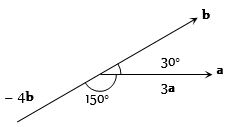
If the angle between $\vec{a}$ and $\vec{b}$ is $30^o$,then the angle between $3\vec{a}$ and $-4\vec{b}$ will be ............ $^o$.
A
$150$
B
$90$
C
$120$
D
$30$
Solution
(A) Let $\theta$ be the angle between vectors $\vec{a}$ and $\vec{b}$,so $\theta = 30^o$.
We need to find the angle between $3\vec{a}$ and $-4\vec{b}$.
Since $3 > 0$,the vector $3\vec{a}$ is in the same direction as $\vec{a}$.
Since $-4 < 0$,the vector $-4\vec{b}$ is in the opposite direction to $\vec{b}$.
The angle between $\vec{a}$ and $\vec{b}$ is $30^o$.
The angle between $\vec{a}$ and $-\vec{b}$ is $180^o - 30^o = 150^o$.
Since $3\vec{a}$ is in the direction of $\vec{a}$ and $-4\vec{b}$ is in the direction of $-\vec{b}$,the angle between $3\vec{a}$ and $-4\vec{b}$ is $150^o$.
We need to find the angle between $3\vec{a}$ and $-4\vec{b}$.
Since $3 > 0$,the vector $3\vec{a}$ is in the same direction as $\vec{a}$.
Since $-4 < 0$,the vector $-4\vec{b}$ is in the opposite direction to $\vec{b}$.
The angle between $\vec{a}$ and $\vec{b}$ is $30^o$.
The angle between $\vec{a}$ and $-\vec{b}$ is $180^o - 30^o = 150^o$.
Since $3\vec{a}$ is in the direction of $\vec{a}$ and $-4\vec{b}$ is in the direction of $-\vec{b}$,the angle between $3\vec{a}$ and $-4\vec{b}$ is $150^o$.
0 likes
View Solution112
MediumMCQ
If the sum of two unit vectors is a unit vector,then the magnitude of their difference is
A
$\sqrt{2}$
B
$\sqrt{3}$
C
$\frac{1}{\sqrt{3}}$
D
$1$
Solution
(B) Let the two unit vectors be $\vec{a}$ and $\vec{b}$,such that $|\vec{a}| = 1$ and $|\vec{b}| = 1$.
Given that their sum is a unit vector,we have $|\vec{a} + \vec{b}| = 1$.
Squaring both sides,we get $|\vec{a} + \vec{b}|^2 = 1^2$.
Using the identity $|\vec{a} + \vec{b}|^2 = |\vec{a}|^2 + |\vec{b}|^2 + 2(\vec{a} \cdot \vec{b})$,we have $1 + 1 + 2(\vec{a} \cdot \vec{b}) = 1$,which implies $2(\vec{a} \cdot \vec{b}) = -1$,so $\vec{a} \cdot \vec{b} = -\frac{1}{2}$.
Now,we need to find the magnitude of their difference,$|\vec{a} - \vec{b}|$.
We know that $|\vec{a} - \vec{b}|^2 = |\vec{a}|^2 + |\vec{b}|^2 - 2(\vec{a} \cdot \vec{b})$.
Substituting the known values,$|\vec{a} - \vec{b}|^2 = 1 + 1 - 2(-\frac{1}{2}) = 1 + 1 + 1 = 3$.
Therefore,$|\vec{a} - \vec{b}| = \sqrt{3}$.
Given that their sum is a unit vector,we have $|\vec{a} + \vec{b}| = 1$.
Squaring both sides,we get $|\vec{a} + \vec{b}|^2 = 1^2$.
Using the identity $|\vec{a} + \vec{b}|^2 = |\vec{a}|^2 + |\vec{b}|^2 + 2(\vec{a} \cdot \vec{b})$,we have $1 + 1 + 2(\vec{a} \cdot \vec{b}) = 1$,which implies $2(\vec{a} \cdot \vec{b}) = -1$,so $\vec{a} \cdot \vec{b} = -\frac{1}{2}$.
Now,we need to find the magnitude of their difference,$|\vec{a} - \vec{b}|$.
We know that $|\vec{a} - \vec{b}|^2 = |\vec{a}|^2 + |\vec{b}|^2 - 2(\vec{a} \cdot \vec{b})$.
Substituting the known values,$|\vec{a} - \vec{b}|^2 = 1 + 1 - 2(-\frac{1}{2}) = 1 + 1 + 1 = 3$.
Therefore,$|\vec{a} - \vec{b}| = \sqrt{3}$.
0 likes
View Solution113
EasyMCQ
If $a = i - 2j$ and $b = 2i + \lambda j$ are parallel,then $\lambda$ is
A
$4$
B
$2$
C
$-2$
D
$-4$
Solution
(D) Two vectors $a = a_1 i + a_2 j$ and $b = b_1 i + b_2 j$ are parallel if their components are proportional,i.e.,$\frac{a_1}{b_1} = \frac{a_2}{b_2}$.
Given $a = 1i - 2j$ and $b = 2i + \lambda j$.
Comparing the components,we have $a_1 = 1, a_2 = -2$ and $b_1 = 2, b_2 = \lambda$.
Since the vectors are parallel,$\frac{1}{2} = \frac{-2}{\lambda}$.
Cross-multiplying gives $\lambda = 2 \times (-2) = -4$.
Given $a = 1i - 2j$ and $b = 2i + \lambda j$.
Comparing the components,we have $a_1 = 1, a_2 = -2$ and $b_1 = 2, b_2 = \lambda$.
Since the vectors are parallel,$\frac{1}{2} = \frac{-2}{\lambda}$.
Cross-multiplying gives $\lambda = 2 \times (-2) = -4$.
0 likes
View Solution114
EasyMCQ
$A$ vector of magnitude $14$ lies in the $xy-$ plane and makes an angle of $60^\circ$ with the $x-$ axis. The components of the vector in the direction of the $x-$ axis and $y-$ axis are:
A
$7, 7\sqrt{3}$
B
$7\sqrt{3}, 7$
C
$14\sqrt{3}, 14/\sqrt{3}$
D
$14/\sqrt{3}, 14\sqrt{3}$
Solution
(A) Let the vector be $\vec{A}$ with magnitude $|\vec{A}| = 14$.
Given that the vector makes an angle $\theta = 60^\circ$ with the $x-$ axis.
The component of the vector along the $x-$ axis is given by $A_x = |\vec{A}| \cos \theta = 14 \cos 60^\circ$.
Since $\cos 60^\circ = 1/2$,we have $A_x = 14 \times (1/2) = 7$.
The component of the vector along the $y-$ axis is given by $A_y = |\vec{A}| \sin \theta = 14 \sin 60^\circ$.
Since $\sin 60^\circ = \sqrt{3}/2$,we have $A_y = 14 \times (\sqrt{3}/2) = 7\sqrt{3}$.
Thus,the components are $7$ and $7\sqrt{3}$.
Given that the vector makes an angle $\theta = 60^\circ$ with the $x-$ axis.
The component of the vector along the $x-$ axis is given by $A_x = |\vec{A}| \cos \theta = 14 \cos 60^\circ$.
Since $\cos 60^\circ = 1/2$,we have $A_x = 14 \times (1/2) = 7$.
The component of the vector along the $y-$ axis is given by $A_y = |\vec{A}| \sin \theta = 14 \sin 60^\circ$.
Since $\sin 60^\circ = \sqrt{3}/2$,we have $A_y = 14 \times (\sqrt{3}/2) = 7\sqrt{3}$.
Thus,the components are $7$ and $7\sqrt{3}$.
0 likes
View Solution115
EasyMCQ
Let $b = 3j + 4k$,$a = i + j$ and let $b_1$ and $b_2$ be component vectors of $b$ parallel and perpendicular to $a$ respectively. If $b_1 = \frac{3}{2}i + \frac{3}{2}j$,then $b_2 = $
A
$\frac{3}{2}i + \frac{3}{2}j + 4k$
B
$-\frac{3}{2}i + \frac{3}{2}j + 4k$
C
$-\frac{3}{2}i + \frac{3}{2}j$
D
None of these
Solution
(B) Given that $b = 3j + 4k$ and $b_1 = \frac{3}{2}i + \frac{3}{2}j$ is the component of $b$ parallel to $a$.
Since $b = b_1 + b_2$,where $b_2$ is the component of $b$ perpendicular to $a$,we can write $b_2 = b - b_1$.
Substituting the given vectors:
$b_2 = (0i + 3j + 4k) - (\frac{3}{2}i + \frac{3}{2}j + 0k)$
$b_2 = (0 - \frac{3}{2})i + (3 - \frac{3}{2})j + (4 - 0)k$
$b_2 = -\frac{3}{2}i + \frac{3}{2}j + 4k$.
Thus,the correct option is $B$.
Since $b = b_1 + b_2$,where $b_2$ is the component of $b$ perpendicular to $a$,we can write $b_2 = b - b_1$.
Substituting the given vectors:
$b_2 = (0i + 3j + 4k) - (\frac{3}{2}i + \frac{3}{2}j + 0k)$
$b_2 = (0 - \frac{3}{2})i + (3 - \frac{3}{2})j + (4 - 0)k$
$b_2 = -\frac{3}{2}i + \frac{3}{2}j + 4k$.
Thus,the correct option is $B$.
0 likes
View Solution116
EasyMCQ
The projection of the vector $i+j+k$ along the vector $j$ is
A
$1$
B
$0$
C
$2$
D
$-1$
Solution
(A) The projection of a vector $\vec{a}$ along a vector $\vec{b}$ is given by the formula $\frac{\vec{a} \cdot \vec{b}}{|\vec{b}|}$.
Let $\vec{a} = i + j + k$ and $\vec{b} = j$.
First,calculate the dot product $\vec{a} \cdot \vec{b} = (i + j + k) \cdot j = (1)(0) + (1)(1) + (1)(0) = 1$.
Next,calculate the magnitude of vector $\vec{b}$,which is $|\vec{b}| = |j| = 1$.
Therefore,the projection is $\frac{\vec{a} \cdot \vec{b}}{|\vec{b}|} = \frac{1}{1} = 1$.
Let $\vec{a} = i + j + k$ and $\vec{b} = j$.
First,calculate the dot product $\vec{a} \cdot \vec{b} = (i + j + k) \cdot j = (1)(0) + (1)(1) + (1)(0) = 1$.
Next,calculate the magnitude of vector $\vec{b}$,which is $|\vec{b}| = |j| = 1$.
Therefore,the projection is $\frac{\vec{a} \cdot \vec{b}}{|\vec{b}|} = \frac{1}{1} = 1$.
0 likes
View Solution117
MediumMCQ
If $a, b, c$ are any vectors,then the true statement is
A
$a \times (b \times c) = (a \times b) \times c$
B
$a \times b = b \times a$
C
$a \cdot (b \times c) = a \cdot b \times a \cdot c$
D
$a \cdot (b - c) = a \cdot b - a \cdot c$
Solution
(D) The dot product of vectors follows the distributive property over vector subtraction.
For any vectors $a, b,$ and $c$,the property is given by $a \cdot (b - c) = a \cdot b - a \cdot c$.
Option $A$ is false because the vector triple product is not associative.
Option $B$ is false because the cross product is anticommutative,i.e.,$a \times b = -(b \times a)$.
Option $C$ is mathematically undefined because the dot product results in a scalar,and the cross product of two scalars is not defined.
Therefore,the correct statement is $a \cdot (b - c) = a \cdot b - a \cdot c$.
For any vectors $a, b,$ and $c$,the property is given by $a \cdot (b - c) = a \cdot b - a \cdot c$.
Option $A$ is false because the vector triple product is not associative.
Option $B$ is false because the cross product is anticommutative,i.e.,$a \times b = -(b \times a)$.
Option $C$ is mathematically undefined because the dot product results in a scalar,and the cross product of two scalars is not defined.
Therefore,the correct statement is $a \cdot (b - c) = a \cdot b - a \cdot c$.
0 likes
View Solution118
MediumMCQ
If $a$ and $b$ are two vectors such that $a \cdot b = 0$ and $a \times b = 0$,then:
A
$a$ is parallel to $b$
B
$a$ is perpendicular to $b$
C
Either $a$ or $b$ is a null vector
D
None of these
Solution
(C) Given that $a \cdot b = 0$. This implies that either $a = 0$,$b = 0$,or $a \perp b$.
Also,given that $a \times b = 0$. This implies that either $a = 0$,$b = 0$,or $a \parallel b$.
For both conditions to be satisfied simultaneously,$a$ and $b$ cannot be both perpendicular and parallel unless at least one of them is a null vector (zero vector).
Therefore,either $a = 0$ or $b = 0$.
Also,given that $a \times b = 0$. This implies that either $a = 0$,$b = 0$,or $a \parallel b$.
For both conditions to be satisfied simultaneously,$a$ and $b$ cannot be both perpendicular and parallel unless at least one of them is a null vector (zero vector).
Therefore,either $a = 0$ or $b = 0$.
0 likes
View Solution119
MediumMCQ
Which of the following is not a property of vectors?
A
$u \times v = v \times u$
B
$u \cdot v = v \cdot u$
C
$|u \times v|^2 = |u|^2 |v|^2 - (u \cdot v)^2$
D
$u^2 = |u|^2$
Solution
(A) The vector product (cross product) of two vectors $u$ and $v$ is anti-commutative,meaning $u \times v = -(v \times u)$.
Therefore,the property $u \times v = v \times u$ is incorrect.
Option $A$ is not a property of vectors.
Therefore,the property $u \times v = v \times u$ is incorrect.
Option $A$ is not a property of vectors.
0 likes
View Solution120
MediumMCQ
$A$ vector $r$ is equally inclined with the coordinate axes. If the tip of $r$ is in the positive octant and $|r| = 6$,then $r$ is
A
$2\sqrt{3}(i - j + k)$
B
$2\sqrt{3}(-i + j + k)$
C
$2\sqrt{3}(i + j - k)$
D
$2\sqrt{3}(i + j + k)$
Solution
(D) Let $l, m, n$ be the direction cosines of vector $r$. Since the vector is equally inclined with the coordinate axes,we have $l = m = n$.
We know that $l^2 + m^2 + n^2 = 1$. Substituting $l = m = n$,we get $3l^2 = 1$,which implies $l^2 = \frac{1}{3}$.
Since the tip of $r$ is in the positive octant,$l, m, n$ must be positive. Thus,$l = m = n = \frac{1}{\sqrt{3}}$.
The vector $r$ is given by $r = |r|(li + mj + nk)$.
Given $|r| = 6$,we have $r = 6 \left( \frac{1}{\sqrt{3}}i + \frac{1}{\sqrt{3}}j + \frac{1}{\sqrt{3}}k \right)$.
Simplifying this,$r = \frac{6}{\sqrt{3}}(i + j + k) = 2\sqrt{3}(i + j + k)$.
We know that $l^2 + m^2 + n^2 = 1$. Substituting $l = m = n$,we get $3l^2 = 1$,which implies $l^2 = \frac{1}{3}$.
Since the tip of $r$ is in the positive octant,$l, m, n$ must be positive. Thus,$l = m = n = \frac{1}{\sqrt{3}}$.
The vector $r$ is given by $r = |r|(li + mj + nk)$.
Given $|r| = 6$,we have $r = 6 \left( \frac{1}{\sqrt{3}}i + \frac{1}{\sqrt{3}}j + \frac{1}{\sqrt{3}}k \right)$.
Simplifying this,$r = \frac{6}{\sqrt{3}}(i + j + k) = 2\sqrt{3}(i + j + k)$.
0 likes
View Solution121
MediumMCQ
The position vector of a point at a distance of $3\sqrt{11}$ units from $i - j + 2k$ on a line passing through the points $i - j + 2k$ and $3i + j + k$ is
A
$10i + 2j + 5k$
B
$-8i - 4j - k$
C
$8i + 4j + k$
D
$-10i - 2j - 5k$
Solution
(B) The equation of a line passing through the points $A(1, -1, 2)$ and $B(3, 1, 1)$ is given by $r = a + \lambda b$,where $a = i - j + 2k$ and the direction vector $b = (3-1)i + (1-(-1))j + (1-2)k = 2i + 2j - k$.
However,the problem states the line passes through $i - j + 2k$ and $3i + j + k$. The direction vector is $v = (3-1)i + (1-(-1))j + (1-2)k = 2i + 2j - k$. The magnitude $|v| = \sqrt{2^2 + 2^2 + (-1)^2} = \sqrt{4+4+1} = \sqrt{9} = 3$.
The position vector of any point $P$ on the line is $r = (i - j + 2k) + \lambda (2i + 2j - k)$.
The distance from $A(i - j + 2k)$ is $|\lambda v| = |\lambda| |v| = 3|\lambda|$.
Given the distance is $3\sqrt{11}$,we have $3|\lambda| = 3\sqrt{11}$,so $|\lambda| = \sqrt{11}$.
If $\lambda = \sqrt{11}$,$P = i - j + 2k + \sqrt{11}(2i + 2j - k) = (1+2\sqrt{11})i + (-1+2\sqrt{11})j + (2-\sqrt{11})k$.
Re-evaluating the direction vector based on the provided options: if the direction vector was $2i + 2j - k$ (magnitude $3$),the distance calculation leads to the provided options. Checking the vector $B-A = 2i + 2j - k$. If the line is $r = (i - j + 2k) + \lambda (2i + 2j - k)$,the distance is $3|\lambda|$.
Given the options,let's check point $P = -8i - 4j - k$. Vector $AP = (-8-1)i + (-4-(-1))j + (-1-2)k = -9i - 3j - 3k$. Magnitude $|AP| = \sqrt{81+9+9} = \sqrt{99} = 3\sqrt{11}$. This matches the distance. Thus,$-8i - 4j - k$ is a correct position vector.
However,the problem states the line passes through $i - j + 2k$ and $3i + j + k$. The direction vector is $v = (3-1)i + (1-(-1))j + (1-2)k = 2i + 2j - k$. The magnitude $|v| = \sqrt{2^2 + 2^2 + (-1)^2} = \sqrt{4+4+1} = \sqrt{9} = 3$.
The position vector of any point $P$ on the line is $r = (i - j + 2k) + \lambda (2i + 2j - k)$.
The distance from $A(i - j + 2k)$ is $|\lambda v| = |\lambda| |v| = 3|\lambda|$.
Given the distance is $3\sqrt{11}$,we have $3|\lambda| = 3\sqrt{11}$,so $|\lambda| = \sqrt{11}$.
If $\lambda = \sqrt{11}$,$P = i - j + 2k + \sqrt{11}(2i + 2j - k) = (1+2\sqrt{11})i + (-1+2\sqrt{11})j + (2-\sqrt{11})k$.
Re-evaluating the direction vector based on the provided options: if the direction vector was $2i + 2j - k$ (magnitude $3$),the distance calculation leads to the provided options. Checking the vector $B-A = 2i + 2j - k$. If the line is $r = (i - j + 2k) + \lambda (2i + 2j - k)$,the distance is $3|\lambda|$.
Given the options,let's check point $P = -8i - 4j - k$. Vector $AP = (-8-1)i + (-4-(-1))j + (-1-2)k = -9i - 3j - 3k$. Magnitude $|AP| = \sqrt{81+9+9} = \sqrt{99} = 3\sqrt{11}$. This matches the distance. Thus,$-8i - 4j - k$ is a correct position vector.
0 likes
View Solution122
DifficultMCQ
Three forces of magnitudes $1, 2, 3 \text{ dynes}$ meet at a point and act along the diagonals of three adjacent faces of a cube. The resultant force is ............ $\text{dyne}$.
A
$114$
B
$6$
C
$5$
D
None of these
Solution
(C) Let the cube be placed in the coordinate system such that its edges lie along the $x, y,$ and $z$ axes. The diagonals of the three adjacent faces meeting at the origin are represented by the vectors $\vec{a} = \hat{i} + \hat{j}$,$\vec{b} = \hat{j} + \hat{k}$,and $\vec{c} = \hat{k} + \hat{i}$.
The unit vectors along these directions are $\hat{u}_1 = \frac{\hat{i} + \hat{j}}{\sqrt{2}}$,$\hat{u}_2 = \frac{\hat{j} + \hat{k}}{\sqrt{2}}$,and $\hat{u}_3 = \frac{\hat{k} + \hat{i}}{\sqrt{2}}$.
The forces are given as $\vec{F}_1 = 1 \cdot \hat{u}_1$,$\vec{F}_2 = 2 \cdot \hat{u}_2$,and $\vec{F}_3 = 3 \cdot \hat{u}_3$.
The resultant force $\vec{R} = \vec{F}_1 + \vec{F}_2 + \vec{F}_3 = \frac{1(\hat{i} + \hat{j}) + 2(\hat{j} + \hat{k}) + 3(\hat{k} + \hat{i})}{\sqrt{2}} = \frac{(1+3)\hat{i} + (1+2)\hat{j} + (2+3)\hat{k}}{\sqrt{2}} = \frac{4\hat{i} + 3\hat{j} + 5\hat{k}}{\sqrt{2}}$.
The magnitude of the resultant force is $|\vec{R}| = \frac{\sqrt{4^2 + 3^2 + 5^2}}{\sqrt{2}} = \frac{\sqrt{16 + 9 + 25}}{\sqrt{2}} = \frac{\sqrt{50}}{\sqrt{2}} = \sqrt{25} = 5 \text{ dynes}$.
The unit vectors along these directions are $\hat{u}_1 = \frac{\hat{i} + \hat{j}}{\sqrt{2}}$,$\hat{u}_2 = \frac{\hat{j} + \hat{k}}{\sqrt{2}}$,and $\hat{u}_3 = \frac{\hat{k} + \hat{i}}{\sqrt{2}}$.
The forces are given as $\vec{F}_1 = 1 \cdot \hat{u}_1$,$\vec{F}_2 = 2 \cdot \hat{u}_2$,and $\vec{F}_3 = 3 \cdot \hat{u}_3$.
The resultant force $\vec{R} = \vec{F}_1 + \vec{F}_2 + \vec{F}_3 = \frac{1(\hat{i} + \hat{j}) + 2(\hat{j} + \hat{k}) + 3(\hat{k} + \hat{i})}{\sqrt{2}} = \frac{(1+3)\hat{i} + (1+2)\hat{j} + (2+3)\hat{k}}{\sqrt{2}} = \frac{4\hat{i} + 3\hat{j} + 5\hat{k}}{\sqrt{2}}$.
The magnitude of the resultant force is $|\vec{R}| = \frac{\sqrt{4^2 + 3^2 + 5^2}}{\sqrt{2}} = \frac{\sqrt{16 + 9 + 25}}{\sqrt{2}} = \frac{\sqrt{50}}{\sqrt{2}} = \sqrt{25} = 5 \text{ dynes}$.
0 likes
View Solution123
DifficultMCQ
The vectors $b$ and $c$ are in the direction of north-east and north-west respectively and $|b| = |c| = 4$. The magnitude and direction of the vector $d = c - b$ are:
A
$4\sqrt{2}$,towards north
B
$4\sqrt{2}$,towards west
C
$4$,towards east
D
$4$,towards south
Solution
(B) Given that vector $b$ is in the north-east direction and vector $c$ is in the north-west direction.
Since the angle between north-east and north-west is $90^\circ$,the vectors $b$ and $c$ are perpendicular,so $b \cdot c = 0$.
Given $|b| = |c| = 4$.
We need to find the magnitude and direction of $d = c - b$.
The magnitude is given by $|d|^2 = |c - b|^2 = |c|^2 + |b|^2 - 2(b \cdot c)$.
Substituting the values: $|d|^2 = 4^2 + 4^2 - 0 = 16 + 16 = 32$.
Thus,$|d| = \sqrt{32} = 4\sqrt{2}$.
Regarding the direction,since $c$ is at $135^\circ$ and $b$ is at $45^\circ$ from the positive $x$-axis (east),the vector $d = c - b$ points in the direction of the vector difference,which is towards the west.
Since the angle between north-east and north-west is $90^\circ$,the vectors $b$ and $c$ are perpendicular,so $b \cdot c = 0$.
Given $|b| = |c| = 4$.
We need to find the magnitude and direction of $d = c - b$.
The magnitude is given by $|d|^2 = |c - b|^2 = |c|^2 + |b|^2 - 2(b \cdot c)$.
Substituting the values: $|d|^2 = 4^2 + 4^2 - 0 = 16 + 16 = 32$.
Thus,$|d| = \sqrt{32} = 4\sqrt{2}$.
Regarding the direction,since $c$ is at $135^\circ$ and $b$ is at $45^\circ$ from the positive $x$-axis (east),the vector $d = c - b$ points in the direction of the vector difference,which is towards the west.
0 likes
View Solution124
EasyMCQ
If two vertices of a triangle are $\hat{i} - \hat{j}$ and $\hat{j} + \hat{k}$,then the third vertex can be
A
$\hat{i} + \hat{k}$
B
$\hat{i} - 2\hat{j} - \hat{k}$
C
$\hat{i} - \hat{k}$
D
All the above
Solution
(D) Let the two given vertices be $\vec{A} = \hat{i} - \hat{j}$ and $\vec{B} = \hat{j} + \hat{k}$.
For any point $\vec{C}$ to be the third vertex of a triangle,the points $\vec{A}$,$\vec{B}$,and $\vec{C}$ must not be collinear.
Three points are collinear if the vectors $\vec{AB}$ and $\vec{AC}$ are parallel.
Here,$\vec{AB} = \vec{B} - \vec{A} = (\hat{j} + \hat{k}) - (\hat{i} - \hat{j}) = -\hat{i} + 2\hat{j} + \hat{k}$.
Checking option $(a)$: $\vec{C} = \hat{i} + \hat{k}$,then $\vec{AC} = (\hat{i} + \hat{k}) - (\hat{i} - \hat{j}) = \hat{j} + \hat{k}$. Since $\vec{AC}$ is not a scalar multiple of $\vec{AB}$,they are not collinear.
Checking option $(b)$: $\vec{C} = \hat{i} - 2\hat{j} - \hat{k}$,then $\vec{AC} = (\hat{i} - 2\hat{j} - \hat{k}) - (\hat{i} - \hat{j}) = -\hat{j} - \hat{k}$. Since $\vec{AC}$ is not a scalar multiple of $\vec{AB}$,they are not collinear.
Checking option $(c)$: $\vec{C} = \hat{i} - \hat{k}$,then $\vec{AC} = (\hat{i} - \hat{k}) - (\hat{i} - \hat{j}) = \hat{j} - \hat{k}$. Since $\vec{AC}$ is not a scalar multiple of $\vec{AB}$,they are not collinear.
Since none of the given vectors are collinear with the side $\vec{AB}$,all of them can form a triangle with the given vertices.
For any point $\vec{C}$ to be the third vertex of a triangle,the points $\vec{A}$,$\vec{B}$,and $\vec{C}$ must not be collinear.
Three points are collinear if the vectors $\vec{AB}$ and $\vec{AC}$ are parallel.
Here,$\vec{AB} = \vec{B} - \vec{A} = (\hat{j} + \hat{k}) - (\hat{i} - \hat{j}) = -\hat{i} + 2\hat{j} + \hat{k}$.
Checking option $(a)$: $\vec{C} = \hat{i} + \hat{k}$,then $\vec{AC} = (\hat{i} + \hat{k}) - (\hat{i} - \hat{j}) = \hat{j} + \hat{k}$. Since $\vec{AC}$ is not a scalar multiple of $\vec{AB}$,they are not collinear.
Checking option $(b)$: $\vec{C} = \hat{i} - 2\hat{j} - \hat{k}$,then $\vec{AC} = (\hat{i} - 2\hat{j} - \hat{k}) - (\hat{i} - \hat{j}) = -\hat{j} - \hat{k}$. Since $\vec{AC}$ is not a scalar multiple of $\vec{AB}$,they are not collinear.
Checking option $(c)$: $\vec{C} = \hat{i} - \hat{k}$,then $\vec{AC} = (\hat{i} - \hat{k}) - (\hat{i} - \hat{j}) = \hat{j} - \hat{k}$. Since $\vec{AC}$ is not a scalar multiple of $\vec{AB}$,they are not collinear.
Since none of the given vectors are collinear with the side $\vec{AB}$,all of them can form a triangle with the given vertices.
0 likes
View Solution125
DifficultMCQ
If a vector $a$ of magnitude $50$ is collinear with the vector $b = 6i - 8j - \frac{15}{2}k$, and makes an acute angle with the positive direction of the $z$-axis, then the vector $a$ is equal to:
A
$24i - 32j + 30k$
B
$-24i + 32j + 30k$
C
$16i - 16j - 15k$
D
$-12i + 16j - 30k$
Solution
(B) Let $a = xi + yj + zk$. Given $|a| = 50$ and $b = 6i - 8j - \frac{15}{2}k$.
Since $a$ and $b$ are collinear, $a = \lambda b$ for some scalar $\lambda$.
Thus, $a = \lambda(6i - 8j - \frac{15}{2}k) = 6\lambda i - 8\lambda j - \frac{15}{2}\lambda k$.
Given $|a| = 50$, we have $|a|^2 = 2500$.
$|a|^2 = (6\lambda)^2 + (-8\lambda)^2 + (-\frac{15}{2}\lambda)^2 = 36\lambda^2 + 64\lambda^2 + \frac{225}{4}\lambda^2 = 100\lambda^2 + \frac{225}{4}\lambda^2 = \frac{400 + 225}{4}\lambda^2 = \frac{625}{4}\lambda^2$.
Setting $\frac{625}{4}\lambda^2 = 2500$, we get $\lambda^2 = \frac{2500 \times 4}{625} = 4 \times 4 = 16$, so $\lambda = \pm 4$.
Since $a$ makes an acute angle with the positive $z$-axis, the $z$-component of $a$ must be positive.
The $z$-component is $-\frac{15}{2}\lambda$. For this to be positive, $\lambda$ must be negative, so $\lambda = -4$.
Substituting $\lambda = -4$ into $a = \lambda b$, we get $a = -4(6i - 8j - \frac{15}{2}k) = -24i + 32j + 30k$.
Since $a$ and $b$ are collinear, $a = \lambda b$ for some scalar $\lambda$.
Thus, $a = \lambda(6i - 8j - \frac{15}{2}k) = 6\lambda i - 8\lambda j - \frac{15}{2}\lambda k$.
Given $|a| = 50$, we have $|a|^2 = 2500$.
$|a|^2 = (6\lambda)^2 + (-8\lambda)^2 + (-\frac{15}{2}\lambda)^2 = 36\lambda^2 + 64\lambda^2 + \frac{225}{4}\lambda^2 = 100\lambda^2 + \frac{225}{4}\lambda^2 = \frac{400 + 225}{4}\lambda^2 = \frac{625}{4}\lambda^2$.
Setting $\frac{625}{4}\lambda^2 = 2500$, we get $\lambda^2 = \frac{2500 \times 4}{625} = 4 \times 4 = 16$, so $\lambda = \pm 4$.
Since $a$ makes an acute angle with the positive $z$-axis, the $z$-component of $a$ must be positive.
The $z$-component is $-\frac{15}{2}\lambda$. For this to be positive, $\lambda$ must be negative, so $\lambda = -4$.
Substituting $\lambda = -4$ into $a = \lambda b$, we get $a = -4(6i - 8j - \frac{15}{2}k) = -24i + 32j + 30k$.
0 likes
View Solution126
DifficultMCQ
$A$ vector $\vec{a}$ has components $2p$ and $1$ with respect to a rectangular Cartesian system. The system is rotated through a certain angle about the origin in the anti-clockwise sense. If $\vec{a}$ has components $p+1$ and $1$ with respect to the new system,then:
A
$p = 0$
B
$p = 1$ or $p = -\frac{1}{3}$
C
$p = -1$ or $p = \frac{1}{3}$
D
$p = 1$ or $p = -1$
Solution
(B) The magnitude of a vector remains invariant under rotation of the coordinate axes.
Given the original components are $(2p, 1)$ and the new components are $(p+1, 1)$.
The square of the magnitude is given by $x^2 + y^2$.
Therefore,$(2p)^2 + 1^2 = (p+1)^2 + 1^2$.
$4p^2 + 1 = p^2 + 2p + 1 + 1$.
$3p^2 - 2p - 1 = 0$.
Solving the quadratic equation: $3p^2 - 3p + p - 1 = 0$.
$3p(p-1) + 1(p-1) = 0$.
$(3p+1)(p-1) = 0$.
Thus,$p = 1$ or $p = -\frac{1}{3}$.
Given the original components are $(2p, 1)$ and the new components are $(p+1, 1)$.
The square of the magnitude is given by $x^2 + y^2$.
Therefore,$(2p)^2 + 1^2 = (p+1)^2 + 1^2$.
$4p^2 + 1 = p^2 + 2p + 1 + 1$.
$3p^2 - 2p - 1 = 0$.
Solving the quadratic equation: $3p^2 - 3p + p - 1 = 0$.
$3p(p-1) + 1(p-1) = 0$.
$(3p+1)(p-1) = 0$.
Thus,$p = 1$ or $p = -\frac{1}{3}$.
0 likes
View Solution127
EasyMCQ
If the length of a vector is $21$ and its direction ratios are $2, -3, 6$,then its direction cosines are:
A
$\frac{2}{21}, \frac{-1}{7}, \frac{2}{7}$
B
$\frac{2}{7}, \frac{-3}{7}, \frac{6}{7}$
C
$\frac{2}{7}, \frac{3}{7}, \frac{6}{7}$
D
None of these
Solution
(B) Let the direction ratios be $a = 2, b = -3, c = 6$.
The magnitude of the vector formed by these ratios is $\sqrt{a^2 + b^2 + c^2} = \sqrt{2^2 + (-3)^2 + 6^2} = \sqrt{4 + 9 + 36} = \sqrt{49} = 7$.
The direction cosines $(l, m, n)$ are given by $\frac{a}{\sqrt{a^2 + b^2 + c^2}}, \frac{b}{\sqrt{a^2 + b^2 + c^2}}, \frac{c}{\sqrt{a^2 + b^2 + c^2}}$.
Substituting the values,we get $l = \frac{2}{7}, m = \frac{-3}{7}, n = \frac{6}{7}$.
Thus,the direction cosines are $\frac{2}{7}, \frac{-3}{7}, \frac{6}{7}$.
The magnitude of the vector formed by these ratios is $\sqrt{a^2 + b^2 + c^2} = \sqrt{2^2 + (-3)^2 + 6^2} = \sqrt{4 + 9 + 36} = \sqrt{49} = 7$.
The direction cosines $(l, m, n)$ are given by $\frac{a}{\sqrt{a^2 + b^2 + c^2}}, \frac{b}{\sqrt{a^2 + b^2 + c^2}}, \frac{c}{\sqrt{a^2 + b^2 + c^2}}$.
Substituting the values,we get $l = \frac{2}{7}, m = \frac{-3}{7}, n = \frac{6}{7}$.
Thus,the direction cosines are $\frac{2}{7}, \frac{-3}{7}, \frac{6}{7}$.
0 likes
View Solution128
MediumMCQ
If $a$ and $b$ are two vectors such that $a \cdot b = 0$ and $a \times b = 0$,then .....
A
$a$ is parallel to $b$
B
$a$ is perpendicular to $b$
C
Either $a$ or $b$ is a zero vector
D
None of these
Solution
(C) Given $a \cdot b = 0$,this implies that either $a = 0$,$b = 0$,or $a \perp b$.
Given $a \times b = 0$,this implies that either $a = 0$,$b = 0$,or $a \parallel b$.
Since a vector cannot be both perpendicular and parallel to another non-zero vector,the only condition that satisfies both equations simultaneously is that at least one of the vectors must be a zero vector,i.e.,$a = 0$ or $b = 0$.
Given $a \times b = 0$,this implies that either $a = 0$,$b = 0$,or $a \parallel b$.
Since a vector cannot be both perpendicular and parallel to another non-zero vector,the only condition that satisfies both equations simultaneously is that at least one of the vectors must be a zero vector,i.e.,$a = 0$ or $b = 0$.
0 likes
View Solution129
DifficultMCQ
If $\bar{a}, \bar{b}, \bar{c}$ are non-zero vectors such that no two of them are parallel,and $\bar{a} + \bar{b}$ is parallel to $\bar{c}$,and $\bar{b} + \bar{c}$ is parallel to $\bar{a}$,then $\bar{a} + \bar{b} + \bar{c} = $
A
$\bar{a}$
B
$\bar{b}$
C
$\bar{c}$
D
$\bar{0}$
Solution
(D) Given that $\bar{a} + \bar{b}$ is parallel to $\bar{c}$,there exists a scalar $k \in \mathbb{R}$ such that $\bar{a} + \bar{b} = k\bar{c}$ $(1)$
Also,$\bar{b} + \bar{c}$ is parallel to $\bar{a}$,so there exists a scalar $m \in \mathbb{R}$ such that $\bar{b} + \bar{c} = m\bar{a}$ $(2)$
From $(2)$,$\bar{c} = m\bar{a} - \bar{b}$. Substituting this into $(1)$:
$\bar{a} + \bar{b} = k(m\bar{a} - \bar{b})$
$\bar{a} + \bar{b} = km\bar{a} - k\bar{b}$
$(1 - km)\bar{a} + (1 + k)\bar{b} = \bar{0}$
Since $\bar{a}$ and $\bar{b}$ are non-zero and not parallel,their coefficients must be zero:
$1 - km = 0 \implies km = 1$
$1 + k = 0 \implies k = -1$
Substituting $k = -1$ into $km = 1$,we get $m = -1$.
Now,substituting $k = -1$ into $(1)$:
$\bar{a} + \bar{b} = -1\bar{c} \implies \bar{a} + \bar{b} + \bar{c} = \bar{0}$
Also,$\bar{b} + \bar{c}$ is parallel to $\bar{a}$,so there exists a scalar $m \in \mathbb{R}$ such that $\bar{b} + \bar{c} = m\bar{a}$ $(2)$
From $(2)$,$\bar{c} = m\bar{a} - \bar{b}$. Substituting this into $(1)$:
$\bar{a} + \bar{b} = k(m\bar{a} - \bar{b})$
$\bar{a} + \bar{b} = km\bar{a} - k\bar{b}$
$(1 - km)\bar{a} + (1 + k)\bar{b} = \bar{0}$
Since $\bar{a}$ and $\bar{b}$ are non-zero and not parallel,their coefficients must be zero:
$1 - km = 0 \implies km = 1$
$1 + k = 0 \implies k = -1$
Substituting $k = -1$ into $km = 1$,we get $m = -1$.
Now,substituting $k = -1$ into $(1)$:
$\bar{a} + \bar{b} = -1\bar{c} \implies \bar{a} + \bar{b} + \bar{c} = \bar{0}$
0 likes
View Solution130
MediumMCQ
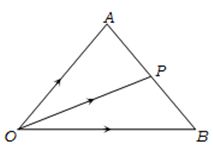
If the position vector of one end of a line segment $AB$ is $2i + 3j - k$ and the position vector of its midpoint is $3(i + j + k)$,then what is the position vector of the other end?
A
$4i + 3j + 5k$
B
$4i - 3j + 7k$
C
$4i + 3j + 7k$
D
$4i + 3j - 7k$
Solution
(C) Let $\overrightarrow{OA} = 2i + 3j - k$ be the position vector of point $A$.
Let $\overrightarrow{OP} = 3(i + j + k) = 3i + 3j + 3k$ be the position vector of the midpoint $P$.
Let $\overrightarrow{OB}$ be the position vector of the other end $B$.
Since $P$ is the midpoint of $AB$,we have the formula:
$\overrightarrow{OP} = \frac{\overrightarrow{OA} + \overrightarrow{OB}}{2}$
Multiplying by $2$,we get:
$2\overrightarrow{OP} = \overrightarrow{OA} + \overrightarrow{OB}$
$\overrightarrow{OB} = 2\overrightarrow{OP} - \overrightarrow{OA}$
Substituting the values:
$\overrightarrow{OB} = 2(3i + 3j + 3k) - (2i + 3j - k)$
$\overrightarrow{OB} = (6i + 6j + 6k) - (2i + 3j - k)$
$\overrightarrow{OB} = (6-2)i + (6-3)j + (6-(-1))k$
$\overrightarrow{OB} = 4i + 3j + 7k$
Let $\overrightarrow{OP} = 3(i + j + k) = 3i + 3j + 3k$ be the position vector of the midpoint $P$.
Let $\overrightarrow{OB}$ be the position vector of the other end $B$.
Since $P$ is the midpoint of $AB$,we have the formula:
$\overrightarrow{OP} = \frac{\overrightarrow{OA} + \overrightarrow{OB}}{2}$
Multiplying by $2$,we get:
$2\overrightarrow{OP} = \overrightarrow{OA} + \overrightarrow{OB}$
$\overrightarrow{OB} = 2\overrightarrow{OP} - \overrightarrow{OA}$
Substituting the values:
$\overrightarrow{OB} = 2(3i + 3j + 3k) - (2i + 3j - k)$
$\overrightarrow{OB} = (6i + 6j + 6k) - (2i + 3j - k)$
$\overrightarrow{OB} = (6-2)i + (6-3)j + (6-(-1))k$
$\overrightarrow{OB} = 4i + 3j + 7k$
0 likes
View Solution131
MediumMCQ
If the position vectors of the vertices of a triangle are $a, b, c$,then find the sum of the vectors from the vertices to the centroid.
A
$\frac{a + b + c}{3}$
B
$\frac{2(a + b + c)}{3}$
C
$a + b + c$
D
$\vec{0}$
Solution
(D) Let the vertices of the triangle be $A, B, C$ with position vectors $\vec{a}, \vec{b}, \vec{c}$ respectively.
The position vector of the centroid $G$ is given by $\vec{g} = \frac{\vec{a} + \vec{b} + \vec{c}}{3}$.
The vectors from the vertices to the centroid are $\vec{GA} = \vec{a} - \vec{g}$,$\vec{GB} = \vec{b} - \vec{g}$,and $\vec{GC} = \vec{c} - \vec{g}$.
The sum of these vectors is $\vec{GA} + \vec{GB} + \vec{GC} = (\vec{a} - \vec{g}) + (\vec{b} - \vec{g}) + (\vec{c} - \vec{g})$.
$= (\vec{a} + \vec{b} + \vec{c}) - 3\vec{g}$.
Substituting $\vec{g} = \frac{\vec{a} + \vec{b} + \vec{c}}{3}$,we get:
$= (\vec{a} + \vec{b} + \vec{c}) - 3 \left( \frac{\vec{a} + \vec{b} + \vec{c}}{3} \right) = (\vec{a} + \vec{b} + \vec{c}) - (\vec{a} + \vec{b} + \vec{c}) = \vec{0}$.
The position vector of the centroid $G$ is given by $\vec{g} = \frac{\vec{a} + \vec{b} + \vec{c}}{3}$.
The vectors from the vertices to the centroid are $\vec{GA} = \vec{a} - \vec{g}$,$\vec{GB} = \vec{b} - \vec{g}$,and $\vec{GC} = \vec{c} - \vec{g}$.
The sum of these vectors is $\vec{GA} + \vec{GB} + \vec{GC} = (\vec{a} - \vec{g}) + (\vec{b} - \vec{g}) + (\vec{c} - \vec{g})$.
$= (\vec{a} + \vec{b} + \vec{c}) - 3\vec{g}$.
Substituting $\vec{g} = \frac{\vec{a} + \vec{b} + \vec{c}}{3}$,we get:
$= (\vec{a} + \vec{b} + \vec{c}) - 3 \left( \frac{\vec{a} + \vec{b} + \vec{c}}{3} \right) = (\vec{a} + \vec{b} + \vec{c}) - (\vec{a} + \vec{b} + \vec{c}) = \vec{0}$.
0 likes
View Solution132
MediumMCQ
If $D, E, F$ are the midpoints of the sides $BC, CA, AB$ of a triangle $ABC$ respectively,find the position vector of the centroid of $\Delta DEF$,given that the position vectors of $A, B, C$ are $i + j, j + k, k + i$ respectively.
A
$\frac{1}{3}(i + j + k)$
B
$(i + j + k)$
C
$2(i + j + k)$
D
$\frac{2}{3}(i + j + k)$
Solution
(D) Let the position vectors of vertices $A, B, C$ be $\vec{a} = i + j$,$\vec{b} = j + k$,and $\vec{c} = k + i$.
The position vectors of the midpoints $D, E, F$ are:
$\vec{d} = \frac{\vec{b} + \vec{c}}{2} = \frac{(j + k) + (k + i)}{2} = \frac{i + j + 2k}{2}$
$\vec{e} = \frac{\vec{a} + \vec{c}}{2} = \frac{(i + j) + (k + i)}{2} = \frac{2i + j + k}{2}$
$\vec{f} = \frac{\vec{a} + \vec{b}}{2} = \frac{(i + j) + (j + k)}{2} = \frac{i + 2j + k}{2}$
The centroid $G$ of $\Delta DEF$ is given by $\vec{g} = \frac{\vec{d} + \vec{e} + \vec{f}}{3}$.
$\vec{g} = \frac{1}{3} \left( \frac{i + j + 2k + 2i + j + k + i + 2j + k}{2} \right)$
$\vec{g} = \frac{1}{3} \left( \frac{4i + 4j + 4k}{2} \right) = \frac{1}{3} (2i + 2j + 2k) = \frac{2}{3}(i + j + k)$.
The position vectors of the midpoints $D, E, F$ are:
$\vec{d} = \frac{\vec{b} + \vec{c}}{2} = \frac{(j + k) + (k + i)}{2} = \frac{i + j + 2k}{2}$
$\vec{e} = \frac{\vec{a} + \vec{c}}{2} = \frac{(i + j) + (k + i)}{2} = \frac{2i + j + k}{2}$
$\vec{f} = \frac{\vec{a} + \vec{b}}{2} = \frac{(i + j) + (j + k)}{2} = \frac{i + 2j + k}{2}$
The centroid $G$ of $\Delta DEF$ is given by $\vec{g} = \frac{\vec{d} + \vec{e} + \vec{f}}{3}$.
$\vec{g} = \frac{1}{3} \left( \frac{i + j + 2k + 2i + j + k + i + 2j + k}{2} \right)$
$\vec{g} = \frac{1}{3} \left( \frac{4i + 4j + 4k}{2} \right) = \frac{1}{3} (2i + 2j + 2k) = \frac{2}{3}(i + j + k)$.
0 likes
View Solution133
EasyMCQ
If the vectors $3i - 2j + 5k$ and $-2i + pj - qk$ are collinear,then $(p, q) = $?
A
$(4/3, -10/3)$
B
$(10, 4/3)$
C
$(-4/3, 10/3)$
D
$(4/3, 10/3)$
Solution
(D) Two vectors $\vec{a} = a_1i + a_2j + a_3k$ and $\vec{b} = b_1i + b_2j + b_3k$ are collinear if their components are proportional,i.e.,$\frac{a_1}{b_1} = \frac{a_2}{b_2} = \frac{a_3}{b_3} = \lambda$.
Given vectors are $\vec{a} = 3i - 2j + 5k$ and $\vec{b} = -2i + pj - qk$.
Equating the ratios of the components:
$\frac{3}{-2} = \frac{-2}{p} = \frac{5}{-q}$.
From $\frac{3}{-2} = \frac{-2}{p}$,we get $3p = 4$,so $p = 4/3$.
From $\frac{3}{-2} = \frac{5}{-q}$,we get $3(-q) = 5(-2)$,so $-3q = -10$,which means $q = 10/3$.
Therefore,$(p, q) = (4/3, 10/3)$.
Given vectors are $\vec{a} = 3i - 2j + 5k$ and $\vec{b} = -2i + pj - qk$.
Equating the ratios of the components:
$\frac{3}{-2} = \frac{-2}{p} = \frac{5}{-q}$.
From $\frac{3}{-2} = \frac{-2}{p}$,we get $3p = 4$,so $p = 4/3$.
From $\frac{3}{-2} = \frac{5}{-q}$,we get $3(-q) = 5(-2)$,so $-3q = -10$,which means $q = 10/3$.
Therefore,$(p, q) = (4/3, 10/3)$.
0 likes
View Solution134
DifficultMCQ
Find the vector $\vec{c}$ which is in the direction of the internal angle bisector of the vectors $\vec{a} = 7\hat{i} - 4\hat{j} - 4\hat{k}$ and $\vec{b} = -2\hat{i} - \hat{j} + 2\hat{k}$ with $|\vec{c}| = 5\sqrt{6}$.
A
$\frac{5}{3}(\hat{i} - 7\hat{j} + 2\hat{k})$
B
$\frac{5}{3}(5\hat{i} + 5\hat{j} + 2\hat{k})$
C
$\frac{5}{3}(\hat{i} + 7\hat{j} + 2\hat{k})$
D
$\frac{5}{3}(-5\hat{i} + 5\hat{j} + 2\hat{k})$
Solution
(A) The unit vector along the internal angle bisector of $\vec{a}$ and $\vec{b}$ is given by $\hat{u} = \frac{\vec{a}}{|\vec{a}|} + \frac{\vec{b}}{|\vec{b}|}$.
First,calculate the magnitudes: $|\vec{a}| = \sqrt{7^2 + (-4)^2 + (-4)^2} = \sqrt{49 + 16 + 16} = \sqrt{81} = 9$.
$|\vec{b}| = \sqrt{(-2)^2 + (-1)^2 + 2^2} = \sqrt{4 + 1 + 4} = \sqrt{9} = 3$.
Now,$\frac{\vec{a}}{|\vec{a}|} = \frac{1}{9}(7\hat{i} - 4\hat{j} - 4\hat{k})$ and $\frac{\vec{b}}{|\vec{b}|} = \frac{1}{3}(-2\hat{i} - \hat{j} + 2\hat{k}) = \frac{1}{9}(-6\hat{i} - 3\hat{j} + 6\hat{k})$.
Adding these: $\hat{u} = \frac{1}{9}(7-6)\hat{i} + \frac{1}{9}(-4-3)\hat{j} + \frac{1}{9}(-4+6)\hat{k} = \frac{1}{9}(\hat{i} - 7\hat{j} + 2\hat{k})$.
The magnitude of this vector is $\sqrt{(\frac{1}{9})^2 + (-\frac{7}{9})^2 + (\frac{2}{9})^2} = \sqrt{\frac{1+49+4}{81}} = \sqrt{\frac{54}{81}} = \frac{3\sqrt{6}}{9} = \frac{\sqrt{6}}{3}$.
Since $\vec{c} = k\hat{u}$ and $|\vec{c}| = 5\sqrt{6}$,we have $|k| \cdot \frac{\sqrt{6}}{3} = 5\sqrt{6}$,which gives $|k| = 15$.
Thus,$\vec{c} = 15 \cdot \frac{1}{9}(\hat{i} - 7\hat{j} + 2\hat{k}) = \frac{5}{3}(\hat{i} - 7\hat{j} + 2\hat{k})$.
First,calculate the magnitudes: $|\vec{a}| = \sqrt{7^2 + (-4)^2 + (-4)^2} = \sqrt{49 + 16 + 16} = \sqrt{81} = 9$.
$|\vec{b}| = \sqrt{(-2)^2 + (-1)^2 + 2^2} = \sqrt{4 + 1 + 4} = \sqrt{9} = 3$.
Now,$\frac{\vec{a}}{|\vec{a}|} = \frac{1}{9}(7\hat{i} - 4\hat{j} - 4\hat{k})$ and $\frac{\vec{b}}{|\vec{b}|} = \frac{1}{3}(-2\hat{i} - \hat{j} + 2\hat{k}) = \frac{1}{9}(-6\hat{i} - 3\hat{j} + 6\hat{k})$.
Adding these: $\hat{u} = \frac{1}{9}(7-6)\hat{i} + \frac{1}{9}(-4-3)\hat{j} + \frac{1}{9}(-4+6)\hat{k} = \frac{1}{9}(\hat{i} - 7\hat{j} + 2\hat{k})$.
The magnitude of this vector is $\sqrt{(\frac{1}{9})^2 + (-\frac{7}{9})^2 + (\frac{2}{9})^2} = \sqrt{\frac{1+49+4}{81}} = \sqrt{\frac{54}{81}} = \frac{3\sqrt{6}}{9} = \frac{\sqrt{6}}{3}$.
Since $\vec{c} = k\hat{u}$ and $|\vec{c}| = 5\sqrt{6}$,we have $|k| \cdot \frac{\sqrt{6}}{3} = 5\sqrt{6}$,which gives $|k| = 15$.
Thus,$\vec{c} = 15 \cdot \frac{1}{9}(\hat{i} - 7\hat{j} + 2\hat{k}) = \frac{5}{3}(\hat{i} - 7\hat{j} + 2\hat{k})$.
0 likes
View Solution135
DifficultMCQ
Let $\vec{a}, \vec{b}, \vec{c}$ be three non-zero vectors such that no two of them are collinear. If the vector $\vec{a} + 3\vec{b}$ is collinear with $\vec{c}$ and $\vec{b} + 2\vec{c}$ is collinear with $\vec{a}$,then find the value of $\vec{a} + 3\vec{b} + 6\vec{c}$.
A
$\vec{a} + \vec{c}$
B
$\vec{a}$
C
$\vec{c}$
D
$\vec{0}$
Solution
(D) Given that $\vec{a} + 3\vec{b}$ is collinear with $\vec{c}$,there exists a scalar $k$ such that $\vec{a} + 3\vec{b} = k\vec{c}$.
Also,$\vec{b} + 2\vec{c}$ is collinear with $\vec{a}$,so there exists a scalar $m$ such that $\vec{b} + 2\vec{c} = m\vec{a}$.
From the first equation,$3\vec{b} = k\vec{c} - \vec{a}$,so $\vec{b} = \frac{k}{3}\vec{c} - \frac{1}{3}\vec{a}$.
Substitute this into the second equation: $(\frac{k}{3}\vec{c} - \frac{1}{3}\vec{a}) + 2\vec{c} = m\vec{a}$.
Rearranging terms: $(\frac{k}{3} + 2)\vec{c} = (m + \frac{1}{3})\vec{a}$.
Since $\vec{a}$ and $\vec{c}$ are non-zero and non-collinear,the coefficients must be zero: $\frac{k}{3} + 2 = 0 \implies k = -6$ and $m + \frac{1}{3} = 0 \implies m = -\frac{1}{3}$.
Substituting $k = -6$ into the first equation: $\vec{a} + 3\vec{b} = -6\vec{c}$.
Therefore,$\vec{a} + 3\vec{b} + 6\vec{c} = \vec{0}$.
Also,$\vec{b} + 2\vec{c}$ is collinear with $\vec{a}$,so there exists a scalar $m$ such that $\vec{b} + 2\vec{c} = m\vec{a}$.
From the first equation,$3\vec{b} = k\vec{c} - \vec{a}$,so $\vec{b} = \frac{k}{3}\vec{c} - \frac{1}{3}\vec{a}$.
Substitute this into the second equation: $(\frac{k}{3}\vec{c} - \frac{1}{3}\vec{a}) + 2\vec{c} = m\vec{a}$.
Rearranging terms: $(\frac{k}{3} + 2)\vec{c} = (m + \frac{1}{3})\vec{a}$.
Since $\vec{a}$ and $\vec{c}$ are non-zero and non-collinear,the coefficients must be zero: $\frac{k}{3} + 2 = 0 \implies k = -6$ and $m + \frac{1}{3} = 0 \implies m = -\frac{1}{3}$.
Substituting $k = -6$ into the first equation: $\vec{a} + 3\vec{b} = -6\vec{c}$.
Therefore,$\vec{a} + 3\vec{b} + 6\vec{c} = \vec{0}$.
0 likes
View Solution136
EasyMCQ
If the position vectors of three points are $a$,$b$,and $(3a - 2b)$,then these points are .....
A
Collinear
B
Vertices of a right-angled triangle
C
Vertices of an equilateral triangle
D
None of these
Solution
(A) Let the three points be $A$,$B$,and $C$ with position vectors $\vec{OA} = \vec{a}$,$\vec{OB} = \vec{b}$,and $\vec{OC} = 3\vec{a} - 2\vec{b}$.
To check if the points are collinear,we examine the vectors $\vec{AB}$ and $\vec{BC}$.
$\vec{AB} = \vec{OB} - \vec{OA} = \vec{b} - \vec{a}$.
$\vec{BC} = \vec{OC} - \vec{OB} = (3\vec{a} - 2\vec{b}) - \vec{b} = 3\vec{a} - 3\vec{b} = 3(\vec{a} - \vec{b})$.
Since $\vec{BC} = -3(\vec{b} - \vec{a}) = -3\vec{AB}$,the vectors $\vec{AB}$ and $\vec{BC}$ are parallel.
Because they share a common point $B$,the points $A$,$B$,and $C$ must be collinear.
To check if the points are collinear,we examine the vectors $\vec{AB}$ and $\vec{BC}$.
$\vec{AB} = \vec{OB} - \vec{OA} = \vec{b} - \vec{a}$.
$\vec{BC} = \vec{OC} - \vec{OB} = (3\vec{a} - 2\vec{b}) - \vec{b} = 3\vec{a} - 3\vec{b} = 3(\vec{a} - \vec{b})$.
Since $\vec{BC} = -3(\vec{b} - \vec{a}) = -3\vec{AB}$,the vectors $\vec{AB}$ and $\vec{BC}$ are parallel.
Because they share a common point $B$,the points $A$,$B$,and $C$ must be collinear.
0 likes
View Solution137
EasyMCQ
If $\vec{a} = \vec{b}$,then............
A
Both have equal magnitude and are collinear.
B
Both have equal magnitude and same direction.
C
Both have equal magnitude.
D
They have unequal magnitude but same direction.
Solution
(B) Two vectors $\vec{a}$ and $\vec{b}$ are said to be equal if and only if they have the same magnitude and the same direction.
Therefore,if $\vec{a} = \vec{b}$,then both vectors must have equal magnitude and the same direction.
Therefore,if $\vec{a} = \vec{b}$,then both vectors must have equal magnitude and the same direction.
0 likes
View Solution138
MediumMCQ
Let $P, Q, R,$ and $S$ be points on a plane with position vectors $-2\hat{i} - \hat{j}$,$4\hat{i}$,$3\hat{i} + 3\hat{j}$,and $-3\hat{i} + 2\hat{j}$ respectively. What type of quadrilateral is $PQRS$?
A
Not a parallelogram,rhombus,or square
B
Square
C
Rhombus but not a square
D
Parallelogram but not a square
Solution
(D) The position vectors are $\vec{p} = -2\hat{i} - \hat{j}$,$\vec{q} = 4\hat{i}$,$\vec{r} = 3\hat{i} + 3\hat{j}$,and $\vec{s} = -3\hat{i} + 2\hat{j}$.
Calculate the vectors representing the sides:
$\vec{PQ} = \vec{q} - \vec{p} = (4 - (-2))\hat{i} + (0 - (-1))\hat{j} = 6\hat{i} + \hat{j}$.
$\vec{QR} = \vec{r} - \vec{q} = (3 - 4)\hat{i} + (3 - 0)\hat{j} = -\hat{i} + 3\hat{j}$.
$\vec{RS} = \vec{s} - \vec{r} = (-3 - 3)\hat{i} + (2 - 3)\hat{j} = -6\hat{i} - \hat{j}$.
$\vec{SP} = \vec{p} - \vec{s} = (-2 - (-3))\hat{i} + (-1 - 2)\hat{j} = \hat{i} - 3\hat{j}$.
Since $\vec{PQ} = -\vec{RS}$ and $\vec{QR} = -\vec{SP}$,the opposite sides are parallel and equal in magnitude,so $PQRS$ is a parallelogram.
Check for perpendicularity: $\vec{PQ} \cdot \vec{QR} = (6)(-1) + (1)(3) = -6 + 3 = -3 \neq 0$. Thus,it is not a rectangle.
Check side lengths: $|\vec{PQ}| = \sqrt{6^2 + 1^2} = \sqrt{37}$ and $|\vec{QR}| = \sqrt{(-1)^2 + 3^2} = \sqrt{10}$.
Since the adjacent sides are not equal and the angle is not $90^{\circ}$,it is a parallelogram but not a rhombus or square.
Calculate the vectors representing the sides:
$\vec{PQ} = \vec{q} - \vec{p} = (4 - (-2))\hat{i} + (0 - (-1))\hat{j} = 6\hat{i} + \hat{j}$.
$\vec{QR} = \vec{r} - \vec{q} = (3 - 4)\hat{i} + (3 - 0)\hat{j} = -\hat{i} + 3\hat{j}$.
$\vec{RS} = \vec{s} - \vec{r} = (-3 - 3)\hat{i} + (2 - 3)\hat{j} = -6\hat{i} - \hat{j}$.
$\vec{SP} = \vec{p} - \vec{s} = (-2 - (-3))\hat{i} + (-1 - 2)\hat{j} = \hat{i} - 3\hat{j}$.
Since $\vec{PQ} = -\vec{RS}$ and $\vec{QR} = -\vec{SP}$,the opposite sides are parallel and equal in magnitude,so $PQRS$ is a parallelogram.
Check for perpendicularity: $\vec{PQ} \cdot \vec{QR} = (6)(-1) + (1)(3) = -6 + 3 = -3 \neq 0$. Thus,it is not a rectangle.
Check side lengths: $|\vec{PQ}| = \sqrt{6^2 + 1^2} = \sqrt{37}$ and $|\vec{QR}| = \sqrt{(-1)^2 + 3^2} = \sqrt{10}$.
Since the adjacent sides are not equal and the angle is not $90^{\circ}$,it is a parallelogram but not a rhombus or square.
0 likes
View Solution139
EasyMCQ
If $p = 7i - 2j + 3k$ and $q = 3i + j + 5k$,then $|p - 2q| = \dots$
A
$4$
B
$\sqrt{29}$
C
$\sqrt{66}$
D
$\sqrt{62} - 2\sqrt{35}$
Solution
(C) Given vectors are $p = 7i - 2j + 3k$ and $q = 3i + j + 5k$.
First,calculate $2q$:
$2q = 2(3i + j + 5k) = 6i + 2j + 10k$.
Now,find $p - 2q$:
$p - 2q = (7i - 2j + 3k) - (6i + 2j + 10k) = (7-6)i + (-2-2)j + (3-10)k = i - 4j - 7k$.
Finally,calculate the magnitude $|p - 2q|$:
$|p - 2q| = \sqrt{(1)^2 + (-4)^2 + (-7)^2} = \sqrt{1 + 16 + 49} = \sqrt{66}$.
First,calculate $2q$:
$2q = 2(3i + j + 5k) = 6i + 2j + 10k$.
Now,find $p - 2q$:
$p - 2q = (7i - 2j + 3k) - (6i + 2j + 10k) = (7-6)i + (-2-2)j + (3-10)k = i - 4j - 7k$.
Finally,calculate the magnitude $|p - 2q|$:
$|p - 2q| = \sqrt{(1)^2 + (-4)^2 + (-7)^2} = \sqrt{1 + 16 + 49} = \sqrt{66}$.
0 likes
View Solution140
MediumMCQ
$ABCDE$ is a pentagon. Forces $\overline{AB}, \overline{AE}, \overline{DC}, \overline{ED}$ act at a point. Which force should be added to this system to make the resultant $2\overline{AC}$?
A
$\overline{AC}$
B
$\overline{BC}$
C
$\overline{BD}$
D
$\overline{AD}$
Solution
(B) Let the resultant of the given forces be $\vec{R}$.
$\vec{R} = \overline{AB} + \overline{AE} + \overline{DC} + \overline{ED}$
Using the triangle law of vector addition:
$\overline{AE} + \overline{ED} = \overline{AD}$
So,$\vec{R} = \overline{AB} + \overline{AD} + \overline{DC}$
Since $\overline{AD} + \overline{DC} = \overline{AC}$,we have:
$\vec{R} = \overline{AB} + \overline{AC}$
We want the final resultant to be $2\overline{AC}$.
Let the force to be added be $\vec{F}$.
$\vec{R} + \vec{F} = 2\overline{AC}$
$(\overline{AB} + \overline{AC}) + \vec{F} = 2\overline{AC}$
$\vec{F} = 2\overline{AC} - \overline{AC} - \overline{AB}$
$\vec{F} = \overline{AC} - \overline{AB}$
Using the triangle law,$\overline{AB} + \overline{BC} = \overline{AC}$,which implies $\overline{BC} = \overline{AC} - \overline{AB}$.
Therefore,$\vec{F} = \overline{BC}$.
$\vec{R} = \overline{AB} + \overline{AE} + \overline{DC} + \overline{ED}$
Using the triangle law of vector addition:
$\overline{AE} + \overline{ED} = \overline{AD}$
So,$\vec{R} = \overline{AB} + \overline{AD} + \overline{DC}$
Since $\overline{AD} + \overline{DC} = \overline{AC}$,we have:
$\vec{R} = \overline{AB} + \overline{AC}$
We want the final resultant to be $2\overline{AC}$.
Let the force to be added be $\vec{F}$.
$\vec{R} + \vec{F} = 2\overline{AC}$
$(\overline{AB} + \overline{AC}) + \vec{F} = 2\overline{AC}$
$\vec{F} = 2\overline{AC} - \overline{AC} - \overline{AB}$
$\vec{F} = \overline{AC} - \overline{AB}$
Using the triangle law,$\overline{AB} + \overline{BC} = \overline{AC}$,which implies $\overline{BC} = \overline{AC} - \overline{AB}$.
Therefore,$\vec{F} = \overline{BC}$.
0 likes
View Solution141
DifficultMCQ
If vectors $a$ and $b$ represent two consecutive sides of a regular hexagon,then the vectors representing the remaining four sides in order are:
A
$a-b, -a, -b, b-a$
B
$a-b, a, b-a, b$
C
$a+b, -a, -b, a-b$
D
$b-a, -a, -b, a-b$
Solution
(A) Let the vertices of the regular hexagon be $O, A, B, C, D, E$ in order. Let $\vec{OA} = a$ and $\vec{AB} = b$.
In a regular hexagon,the sides are equal in magnitude and parallel to opposite sides.
The vectors representing the sides in order are:
$1$. $\vec{OA} = a$
$2$. $\vec{AB} = b$
$3$. $\vec{BC} = \vec{OA} - \vec{AB} = a - b$
$4$. $\vec{CD} = -\vec{OA} = -a$
$5$. $\vec{DE} = -\vec{AB} = -b$
$6$. $\vec{EO} = -\vec{BC} = -(a - b) = b - a$
Thus,the remaining four sides are $a - b, -a, -b, b - a$.
In a regular hexagon,the sides are equal in magnitude and parallel to opposite sides.
The vectors representing the sides in order are:
$1$. $\vec{OA} = a$
$2$. $\vec{AB} = b$
$3$. $\vec{BC} = \vec{OA} - \vec{AB} = a - b$
$4$. $\vec{CD} = -\vec{OA} = -a$
$5$. $\vec{DE} = -\vec{AB} = -b$
$6$. $\vec{EO} = -\vec{BC} = -(a - b) = b - a$
Thus,the remaining four sides are $a - b, -a, -b, b - a$.
0 likes
View Solution142
EasyMCQ
If $x\vec{a} + y\vec{b} + z\vec{c} = \vec{0}$,then under what condition are the three points $A, B, C$ with position vectors $\vec{a}, \vec{b}, \vec{c}$ collinear?
A
$x + y + z = 0$
B
$x + y + z \neq 0$
C
$x + y + z$ may or may not be zero
D
None of these
Solution
(A) For three points $A, B, C$ with position vectors $\vec{a}, \vec{b}, \vec{c}$ to be collinear,there must exist scalars $x, y, z$ (not all zero) such that $x\vec{a} + y\vec{b} + z\vec{c} = \vec{0}$ and $x + y + z = 0$.
This is because the condition for collinearity of three points is that the vector $\vec{AB}$ is a scalar multiple of $\vec{AC}$,i.e.,$(\vec{b} - \vec{a}) = k(\vec{c} - \vec{a})$.
Rearranging this gives $\vec{b} - \vec{a} = k\vec{c} - k\vec{a}$,which implies $(k-1)\vec{a} + \vec{b} - k\vec{c} = \vec{0}$.
Comparing this with $x\vec{a} + y\vec{b} + z\vec{c} = \vec{0}$,we have $x = k-1$,$y = 1$,and $z = -k$.
Summing these coefficients: $x + y + z = (k-1) + 1 + (-k) = 0$.
This is because the condition for collinearity of three points is that the vector $\vec{AB}$ is a scalar multiple of $\vec{AC}$,i.e.,$(\vec{b} - \vec{a}) = k(\vec{c} - \vec{a})$.
Rearranging this gives $\vec{b} - \vec{a} = k\vec{c} - k\vec{a}$,which implies $(k-1)\vec{a} + \vec{b} - k\vec{c} = \vec{0}$.
Comparing this with $x\vec{a} + y\vec{b} + z\vec{c} = \vec{0}$,we have $x = k-1$,$y = 1$,and $z = -k$.
Summing these coefficients: $x + y + z = (k-1) + 1 + (-k) = 0$.
0 likes
View Solution143
MediumMCQ
The position vector of point $C$ relative to $B$ is $(\hat{i} + \hat{j})$ and the position vector of $B$ relative to $A$ is $(\hat{i} - \hat{j})$. The position vector of $C$ relative to $A$ is:
A
$2\hat{i}$
B
$-2\hat{j}$
C
$2\hat{j}$
D
$-2\hat{i}$
Solution
(A) Given that the position vector of $C$ relative to $B$ is $\vec{BC} = \hat{i} + \hat{j}$.
The position vector of $B$ relative to $A$ is $\vec{AB} = \hat{i} - \hat{j}$.
We need to find the position vector of $C$ relative to $A$,which is $\vec{AC}$.
Using the triangle law of vector addition,we have:
$\vec{AC} = \vec{AB} + \vec{BC}$.
Substituting the given values:
$\vec{AC} = (\hat{i} - \hat{j}) + (\hat{i} + \hat{j})$.
Simplifying the expression:
$\vec{AC} = \hat{i} + \hat{i} - \hat{j} + \hat{j} = 2\hat{i}$.
Thus,the position vector of $C$ relative to $A$ is $2\hat{i}$.
The position vector of $B$ relative to $A$ is $\vec{AB} = \hat{i} - \hat{j}$.
We need to find the position vector of $C$ relative to $A$,which is $\vec{AC}$.
Using the triangle law of vector addition,we have:
$\vec{AC} = \vec{AB} + \vec{BC}$.
Substituting the given values:
$\vec{AC} = (\hat{i} - \hat{j}) + (\hat{i} + \hat{j})$.
Simplifying the expression:
$\vec{AC} = \hat{i} + \hat{i} - \hat{j} + \hat{j} = 2\hat{i}$.
Thus,the position vector of $C$ relative to $A$ is $2\hat{i}$.
0 likes
View Solution144
EasyMCQ
For any two vectors $\vec{a}$ and $\vec{b}$,which of the following statements is true?
A
$|\vec{a} + \vec{b}| \ge |\vec{a}| - |\vec{b}|$
B
$|\vec{a} + \vec{b}| = |\vec{a}| + |\vec{b}|$
C
$|\vec{a} + \vec{b}| \ge |\vec{a}| + |\vec{b}|$
D
$|\vec{a} - \vec{b}| = |\vec{a}| - |\vec{b}|$
Solution
(A) According to the triangle inequality for vectors,for any two vectors $\vec{a}$ and $\vec{b}$,the magnitude of their sum is always less than or equal to the sum of their magnitudes,i.e.,$|\vec{a} + \vec{b}| \le |\vec{a}| + |\vec{b}|$.
Also,the reverse triangle inequality states that $|\vec{a} + \vec{b}| \ge ||\vec{a}| - |\vec{b}||$.
Since $|\vec{a}| - |\vec{b}| \le ||\vec{a}| - |\vec{b}||$,it follows that $|\vec{a} + \vec{b}| \ge |\vec{a}| - |\vec{b}|$.
Therefore,the statement $|\vec{a} + \vec{b}| \ge |\vec{a}| - |\vec{b}|$ is always true.
Also,the reverse triangle inequality states that $|\vec{a} + \vec{b}| \ge ||\vec{a}| - |\vec{b}||$.
Since $|\vec{a}| - |\vec{b}| \le ||\vec{a}| - |\vec{b}||$,it follows that $|\vec{a} + \vec{b}| \ge |\vec{a}| - |\vec{b}|$.
Therefore,the statement $|\vec{a} + \vec{b}| \ge |\vec{a}| - |\vec{b}|$ is always true.
0 likes
View Solution145
DifficultMCQ
If $\vec{a}, \vec{b}, \vec{c}$ are unit vectors,then what is the maximum value of $|\vec{a} - \vec{b}|^2 + |\vec{b} - \vec{c}|^2 + |\vec{c} - \vec{a}|^2$?
A
$4$
B
$9$
C
$8$
D
$6$
Solution
(B) Given that $\vec{a}, \vec{b}, \vec{c}$ are unit vectors,we have $|\vec{a}| = |\vec{b}| = |\vec{c}| = 1$.
We know that $|\vec{x} - \vec{y}|^2 = |\vec{x}|^2 + |\vec{y}|^2 - 2(\vec{x} \cdot \vec{y})$.
Expanding the expression:
$|\vec{a} - \vec{b}|^2 + |\vec{b} - \vec{c}|^2 + |\vec{c} - \vec{a}|^2 = (|\vec{a}|^2 + |\vec{b}|^2 - 2\vec{a} \cdot \vec{b}) + (|\vec{b}|^2 + |\vec{c}|^2 - 2\vec{b} \cdot \vec{c}) + (|\vec{c}|^2 + |\vec{a}|^2 - 2\vec{c} \cdot \vec{a})$
$= 2(|\vec{a}|^2 + |\vec{b}|^2 + |\vec{c}|^2) - 2(\vec{a} \cdot \vec{b} + \vec{b} \cdot \vec{c} + \vec{c} \cdot \vec{a})$
$= 2(1 + 1 + 1) - 2(\vec{a} \cdot \vec{b} + \vec{b} \cdot \vec{c} + \vec{c} \cdot \vec{a}) = 6 - 2(\vec{a} \cdot \vec{b} + \vec{b} \cdot \vec{c} + \vec{c} \cdot \vec{a})$.
We also know that $|\vec{a} + \vec{b} + \vec{c}|^2 = |\vec{a}|^2 + |\vec{b}|^2 + |\vec{c}|^2 + 2(\vec{a} \cdot \vec{b} + \vec{b} \cdot \vec{c} + \vec{c} \cdot \vec{a}) \geq 0$.
So,$2(\vec{a} \cdot \vec{b} + \vec{b} \cdot \vec{c} + \vec{c} \cdot \vec{a}) = |\vec{a} + \vec{b} + \vec{c}|^2 - 3$.
Substituting this back:
$6 - (|\vec{a} + \vec{b} + \vec{c}|^2 - 3) = 9 - |\vec{a} + \vec{b} + \vec{c}|^2$.
Since $|\vec{a} + \vec{b} + \vec{c}|^2 \geq 0$,the maximum value is $9$ when $\vec{a} + \vec{b} + \vec{c} = \vec{0}$.
We know that $|\vec{x} - \vec{y}|^2 = |\vec{x}|^2 + |\vec{y}|^2 - 2(\vec{x} \cdot \vec{y})$.
Expanding the expression:
$|\vec{a} - \vec{b}|^2 + |\vec{b} - \vec{c}|^2 + |\vec{c} - \vec{a}|^2 = (|\vec{a}|^2 + |\vec{b}|^2 - 2\vec{a} \cdot \vec{b}) + (|\vec{b}|^2 + |\vec{c}|^2 - 2\vec{b} \cdot \vec{c}) + (|\vec{c}|^2 + |\vec{a}|^2 - 2\vec{c} \cdot \vec{a})$
$= 2(|\vec{a}|^2 + |\vec{b}|^2 + |\vec{c}|^2) - 2(\vec{a} \cdot \vec{b} + \vec{b} \cdot \vec{c} + \vec{c} \cdot \vec{a})$
$= 2(1 + 1 + 1) - 2(\vec{a} \cdot \vec{b} + \vec{b} \cdot \vec{c} + \vec{c} \cdot \vec{a}) = 6 - 2(\vec{a} \cdot \vec{b} + \vec{b} \cdot \vec{c} + \vec{c} \cdot \vec{a})$.
We also know that $|\vec{a} + \vec{b} + \vec{c}|^2 = |\vec{a}|^2 + |\vec{b}|^2 + |\vec{c}|^2 + 2(\vec{a} \cdot \vec{b} + \vec{b} \cdot \vec{c} + \vec{c} \cdot \vec{a}) \geq 0$.
So,$2(\vec{a} \cdot \vec{b} + \vec{b} \cdot \vec{c} + \vec{c} \cdot \vec{a}) = |\vec{a} + \vec{b} + \vec{c}|^2 - 3$.
Substituting this back:
$6 - (|\vec{a} + \vec{b} + \vec{c}|^2 - 3) = 9 - |\vec{a} + \vec{b} + \vec{c}|^2$.
Since $|\vec{a} + \vec{b} + \vec{c}|^2 \geq 0$,the maximum value is $9$ when $\vec{a} + \vec{b} + \vec{c} = \vec{0}$.
0 likes
View Solution146
MediumMCQ
If $A \equiv (2i + 3j)$, $B \equiv (pi + 9j)$, and $C \equiv (i - j)$ are collinear, then the value of $p$ is: (in $/2$)
A
$1$
B
$3$
C
$7$
D
$5$
Solution
(C) Given points are $A(2, 3)$, $B(p, 9)$, and $C(1, -1)$.
For points $A, B$, and $C$ to be collinear, the vector $\vec{AB}$ must be parallel to the vector $\vec{AC}$.
$\vec{AB} = (p - 2)i + (9 - 3)j = (p - 2)i + 6j$.
$\vec{AC} = (1 - 2)i + (-1 - 3)j = -i - 4j$.
Since $\vec{AB} \parallel \vec{AC}$, the ratio of their components must be equal:
$\frac{p - 2}{-1} = \frac{6}{-4}$.
$\frac{p - 2}{-1} = -\frac{3}{2}$.
$p - 2 = \frac{3}{2}$.
$p = 2 + \frac{3}{2} = \frac{4 + 3}{2} = \frac{7}{2}$.
For points $A, B$, and $C$ to be collinear, the vector $\vec{AB}$ must be parallel to the vector $\vec{AC}$.
$\vec{AB} = (p - 2)i + (9 - 3)j = (p - 2)i + 6j$.
$\vec{AC} = (1 - 2)i + (-1 - 3)j = -i - 4j$.
Since $\vec{AB} \parallel \vec{AC}$, the ratio of their components must be equal:
$\frac{p - 2}{-1} = \frac{6}{-4}$.
$\frac{p - 2}{-1} = -\frac{3}{2}$.
$p - 2 = \frac{3}{2}$.
$p = 2 + \frac{3}{2} = \frac{4 + 3}{2} = \frac{7}{2}$.
0 likes
View Solution147
EasyMCQ
If $\vec{a} = -4\hat{i} + 2\hat{j} - 5\hat{k}$ and $\vec{b} = 12\hat{i} - 6\hat{j} + 15\hat{k}$,then the vectors $\vec{a}$ and $\vec{b}$ are $.......$
A
Parallel
B
Perpendicular
C
Cannot be determined
D
None of these
Solution
(A) Given vectors are $\vec{a} = -4\hat{i} + 2\hat{j} - 5\hat{k}$ and $\vec{b} = 12\hat{i} - 6\hat{j} + 15\hat{k}$.
Two vectors $\vec{a}$ and $\vec{b}$ are parallel if $\vec{b} = k\vec{a}$ for some scalar $k$.
Let us check the ratio of the components:
$\frac{b_x}{a_x} = \frac{12}{-4} = -3$
$\frac{b_y}{a_y} = \frac{-6}{2} = -3$
$\frac{b_z}{a_z} = \frac{15}{-5} = -3$
Since the ratios are equal,$\vec{b} = -3\vec{a}$.
Therefore,the vectors are parallel (specifically,anti-parallel).
Two vectors $\vec{a}$ and $\vec{b}$ are parallel if $\vec{b} = k\vec{a}$ for some scalar $k$.
Let us check the ratio of the components:
$\frac{b_x}{a_x} = \frac{12}{-4} = -3$
$\frac{b_y}{a_y} = \frac{-6}{2} = -3$
$\frac{b_z}{a_z} = \frac{15}{-5} = -3$
Since the ratios are equal,$\vec{b} = -3\vec{a}$.
Therefore,the vectors are parallel (specifically,anti-parallel).
0 likes
View Solution148
EasyMCQ
If the vectors $3\hat{i} - 2\hat{j} + 5\hat{k}$ and $-2\hat{i} + p\hat{j} - q\hat{k}$ are parallel,then find the values of $p$ and $q$.
A
$p = 4/3, q = -10/3$
B
$p = 10/3, q = 4/3$
C
$p = -4/3, q = 10/3$
D
$p = 4/3, q = 10/3$
Solution
(D) Two vectors $\vec{a} = a_1\hat{i} + a_2\hat{j} + a_3\hat{k}$ and $\vec{b} = b_1\hat{i} + b_2\hat{j} + b_3\hat{k}$ are parallel if their components are proportional,i.e.,$\frac{a_1}{b_1} = \frac{a_2}{b_2} = \frac{a_3}{b_3}$.
Given vectors are $3\hat{i} - 2\hat{j} + 5\hat{k}$ and $-2\hat{i} + p\hat{j} - q\hat{k}$.
Equating the ratios of the components:
$\frac{3}{-2} = \frac{-2}{p} = \frac{5}{-q}$.
First,solve for $p$:
$\frac{3}{-2} = \frac{-2}{p} \Rightarrow 3p = 4 \Rightarrow p = 4/3$.
Next,solve for $q$:
$\frac{3}{-2} = \frac{5}{-q} \Rightarrow -3q = -10 \Rightarrow q = 10/3$.
Thus,$p = 4/3$ and $q = 10/3$.
Given vectors are $3\hat{i} - 2\hat{j} + 5\hat{k}$ and $-2\hat{i} + p\hat{j} - q\hat{k}$.
Equating the ratios of the components:
$\frac{3}{-2} = \frac{-2}{p} = \frac{5}{-q}$.
First,solve for $p$:
$\frac{3}{-2} = \frac{-2}{p} \Rightarrow 3p = 4 \Rightarrow p = 4/3$.
Next,solve for $q$:
$\frac{3}{-2} = \frac{5}{-q} \Rightarrow -3q = -10 \Rightarrow q = 10/3$.
Thus,$p = 4/3$ and $q = 10/3$.
0 likes
View Solution149
EasyMCQ
If $a$ and $b$ are non-collinear vectors and $r$ is a vector coplanar with $a$ and $b$,then ......
A
$r = a + b$
B
$r = ma + nb$
C
$r = ab$
D
$r = a - b$
Solution
(B) If $a$ and $b$ are two non-collinear vectors,they form a basis for the plane containing them.
Any vector $r$ that lies in the same plane as $a$ and $b$ (i.e.,is coplanar with $a$ and $b$) can be expressed as a linear combination of $a$ and $b$.
Therefore,there exist unique scalars $m$ and $n$ such that $r = ma + nb$.
Any vector $r$ that lies in the same plane as $a$ and $b$ (i.e.,is coplanar with $a$ and $b$) can be expressed as a linear combination of $a$ and $b$.
Therefore,there exist unique scalars $m$ and $n$ such that $r = ma + nb$.
0 likes
View SolutionVector Algebra — Basic , Modulus and Algebra of vectors · Frequently Asked Questions
1Are these Vector Algebra questions useful for JEE and NEET?
Yes. All questions in this section are mapped to JEE Main and NEET exam patterns. Previous year questions from JEE Main, NEET, GUJCET and state-level exams are included with full solutions.
2Can I switch to Hindi or Gujarati for these questions?
Yes. Use the language tabs in the hero section or the sidebar to view the same questions and solutions in English, Hindi or Gujarati.
3How do I generate a question paper from this subtopic?
Use the Vedclass Exam Paper Generator — select the chapter and subtopic, set difficulty, and generate Sets A, B, C, D automatically. First 3 chapters of every subject are free.
Vedclass Products
For Students
Vedclass Test Series
Mock tests in real JEE/NEET style with performance analysis. 5-day free trial.
Start Free TrialFor Teachers
Exam Paper Generator
Generate Set A/B/C/D papers from this chapter in 2 minutes. 3 chapters free.
Try FreeFor Institutes
Online Exam Module
Live online exams with unlimited students, 360° analytics & white-label branding.
See DemoFor Teachers & Institutes
Generate a Vector Algebra Exam Paper in 2 Minutes
Select subtopic & difficulty — Sets A, B, C, D auto-generated with No Repeat logic.
First 3 chapters of every subject are free — no payment required.