
A English
Basic , Modulus and Algebra of vectors Questions in English
Class 12 Mathematics · Vector Algebra · Basic , Modulus and Algebra of vectors
609+
Questions
English
Language
100%
With Solutions
Showing 50 of 609 questions in English
51
MediumMCQ
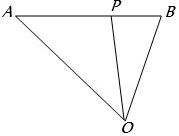
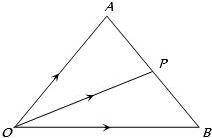
If in the given figure $\overrightarrow{OA} = \vec{a}$,$\overrightarrow{OB} = \vec{b}$ and $AP : PB = m : n$,then $\overrightarrow{OP} = $
A
$\frac{m\vec{a} + n\vec{b}}{m + n}$
B
$\frac{n\vec{a} + m\vec{b}}{m + n}$
C
$m\vec{a} - n\vec{b}$
D
$\frac{m\vec{a} - n\vec{b}}{m - n}$
Solution
(B) Given that $P$ divides the line segment $AB$ in the ratio $m : n$.
Using the section formula for vectors,the position vector of point $P$ with respect to the origin $O$ is given by:
$\overrightarrow{OP} = \frac{n\overrightarrow{OA} + m\overrightarrow{OB}}{m + n}$
Substituting the given values $\overrightarrow{OA} = \vec{a}$ and $\overrightarrow{OB} = \vec{b}$:
$\overrightarrow{OP} = \frac{n\vec{a} + m\vec{b}}{m + n}$
Thus,the correct option is $(B)$.
Using the section formula for vectors,the position vector of point $P$ with respect to the origin $O$ is given by:
$\overrightarrow{OP} = \frac{n\overrightarrow{OA} + m\overrightarrow{OB}}{m + n}$
Substituting the given values $\overrightarrow{OA} = \vec{a}$ and $\overrightarrow{OB} = \vec{b}$:
$\overrightarrow{OP} = \frac{n\vec{a} + m\vec{b}}{m + n}$
Thus,the correct option is $(B)$.
0 likes
View Solution52
EasyMCQ
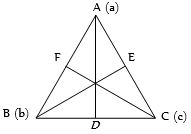
If $D, E, F$ are the midpoints of the sides $BC, CA$ and $AB$ of the triangle $ABC$,then $\overrightarrow{AD} + \overrightarrow{BE} + \overrightarrow{CF}$ is:
A
$A$ zero vector
B
$A$ unit vector
C
$0$
D
None of these
Solution
(A) Let the position vectors of vertices $A, B, C$ be $\vec{a}, \vec{b}, \vec{c}$ respectively.
Since $D, E, F$ are the midpoints of $BC, CA, AB$,their position vectors are:
$\vec{d} = \frac{\vec{b} + \vec{c}}{2}$,$\vec{e} = \frac{\vec{c} + \vec{a}}{2}$,$\vec{f} = \frac{\vec{a} + \vec{b}}{2}$.
Now,we calculate the vectors:
$\overrightarrow{AD} = \vec{d} - \vec{a} = \frac{\vec{b} + \vec{c}}{2} - \vec{a} = \frac{\vec{b} + \vec{c} - 2\vec{a}}{2}$
$\overrightarrow{BE} = \vec{e} - \vec{b} = \frac{\vec{c} + \vec{a}}{2} - \vec{b} = \frac{\vec{c} + \vec{a} - 2\vec{b}}{2}$
$\overrightarrow{CF} = \vec{f} - \vec{c} = \frac{\vec{a} + \vec{b}}{2} - \vec{c} = \frac{\vec{a} + \vec{b} - 2\vec{c}}{2}$
Adding these vectors:
$\overrightarrow{AD} + \overrightarrow{BE} + \overrightarrow{CF} = \frac{(\vec{b} + \vec{c} - 2\vec{a}) + (\vec{c} + \vec{a} - 2\vec{b}) + (\vec{a} + \vec{b} - 2\vec{c})}{2}$
$= \frac{(\vec{a} - 2\vec{a} + \vec{a}) + (\vec{b} - 2\vec{b} + \vec{b}) + (\vec{c} - 2\vec{c} + \vec{c})}{2} = \frac{0}{2} = \vec{0}$.
Thus,the sum is a zero vector.
Since $D, E, F$ are the midpoints of $BC, CA, AB$,their position vectors are:
$\vec{d} = \frac{\vec{b} + \vec{c}}{2}$,$\vec{e} = \frac{\vec{c} + \vec{a}}{2}$,$\vec{f} = \frac{\vec{a} + \vec{b}}{2}$.
Now,we calculate the vectors:
$\overrightarrow{AD} = \vec{d} - \vec{a} = \frac{\vec{b} + \vec{c}}{2} - \vec{a} = \frac{\vec{b} + \vec{c} - 2\vec{a}}{2}$
$\overrightarrow{BE} = \vec{e} - \vec{b} = \frac{\vec{c} + \vec{a}}{2} - \vec{b} = \frac{\vec{c} + \vec{a} - 2\vec{b}}{2}$
$\overrightarrow{CF} = \vec{f} - \vec{c} = \frac{\vec{a} + \vec{b}}{2} - \vec{c} = \frac{\vec{a} + \vec{b} - 2\vec{c}}{2}$
Adding these vectors:
$\overrightarrow{AD} + \overrightarrow{BE} + \overrightarrow{CF} = \frac{(\vec{b} + \vec{c} - 2\vec{a}) + (\vec{c} + \vec{a} - 2\vec{b}) + (\vec{a} + \vec{b} - 2\vec{c})}{2}$
$= \frac{(\vec{a} - 2\vec{a} + \vec{a}) + (\vec{b} - 2\vec{b} + \vec{b}) + (\vec{c} - 2\vec{c} + \vec{c})}{2} = \frac{0}{2} = \vec{0}$.
Thus,the sum is a zero vector.
0 likes
View Solution53
EasyMCQ
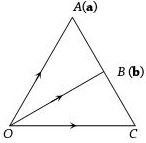
If $a$ and $b$ are the position vectors of $A$ and $B$ respectively,then the position vector of a point $C$ on $AB$ produced such that $\overrightarrow{AC} = 3\overrightarrow{AB}$ is
A
$3a - b$
B
$3b - a$
C
$3a - 2b$
D
$3b - 2a$
Solution
(D) Given that $\overrightarrow{AC} = 3\overrightarrow{AB}$.
Let $\vec{a}$ and $\vec{b}$ be the position vectors of points $A$ and $B$ respectively.
We know that $\overrightarrow{AB} = \vec{b} - \vec{a}$.
Substituting this into the given equation:
$\overrightarrow{AC} = 3(\vec{b} - \vec{a}) = 3\vec{b} - 3\vec{a}$.
Let $\vec{c}$ be the position vector of point $C$. Then $\overrightarrow{AC} = \vec{c} - \vec{a}$.
Equating the two expressions for $\overrightarrow{AC}$:
$\vec{c} - \vec{a} = 3\vec{b} - 3\vec{a}$.
$\vec{c} = 3\vec{b} - 3\vec{a} + \vec{a}$.
$\vec{c} = 3\vec{b} - 2\vec{a}$.
Thus,the position vector of point $C$ is $3\vec{b} - 2\vec{a}$.
Let $\vec{a}$ and $\vec{b}$ be the position vectors of points $A$ and $B$ respectively.
We know that $\overrightarrow{AB} = \vec{b} - \vec{a}$.
Substituting this into the given equation:
$\overrightarrow{AC} = 3(\vec{b} - \vec{a}) = 3\vec{b} - 3\vec{a}$.
Let $\vec{c}$ be the position vector of point $C$. Then $\overrightarrow{AC} = \vec{c} - \vec{a}$.
Equating the two expressions for $\overrightarrow{AC}$:
$\vec{c} - \vec{a} = 3\vec{b} - 3\vec{a}$.
$\vec{c} = 3\vec{b} - 3\vec{a} + \vec{a}$.
$\vec{c} = 3\vec{b} - 2\vec{a}$.
Thus,the position vector of point $C$ is $3\vec{b} - 2\vec{a}$.
0 likes
View Solution54
EasyMCQ
The position vectors of $A$ and $B$ are $\vec{a} = \hat{i} - \hat{j} + 2\hat{k}$ and $\vec{b} = 3\hat{i} - \hat{j} + 3\hat{k}$. The position vector of the midpoint of the line segment $AB$ is:
A
$\frac{1}{2}\hat{i} - \frac{1}{2}\hat{j} + \hat{k}$
B
$2\hat{i} - \hat{j} + \frac{5}{2}\hat{k}$
C
$\frac{3}{2}\hat{i} - \frac{1}{2}\hat{j} + \frac{3}{2}\hat{k}$
D
None of these
Solution
(B) The position vector of the midpoint $M$ of a line segment joining points with position vectors $\vec{a}$ and $\vec{b}$ is given by the formula: $\vec{m} = \frac{\vec{a} + \vec{b}}{2}$.
Given $\vec{a} = \hat{i} - \hat{j} + 2\hat{k}$ and $\vec{b} = 3\hat{i} - \hat{j} + 3\hat{k}$.
Adding the vectors: $\vec{a} + \vec{b} = (1+3)\hat{i} + (-1-1)\hat{j} + (2+3)\hat{k} = 4\hat{i} - 2\hat{j} + 5\hat{k}$.
Dividing by $2$: $\vec{m} = \frac{4\hat{i} - 2\hat{j} + 5\hat{k}}{2} = 2\hat{i} - \hat{j} + \frac{5}{2}\hat{k}$.
Thus,the correct option is $B$.
Given $\vec{a} = \hat{i} - \hat{j} + 2\hat{k}$ and $\vec{b} = 3\hat{i} - \hat{j} + 3\hat{k}$.
Adding the vectors: $\vec{a} + \vec{b} = (1+3)\hat{i} + (-1-1)\hat{j} + (2+3)\hat{k} = 4\hat{i} - 2\hat{j} + 5\hat{k}$.
Dividing by $2$: $\vec{m} = \frac{4\hat{i} - 2\hat{j} + 5\hat{k}}{2} = 2\hat{i} - \hat{j} + \frac{5}{2}\hat{k}$.
Thus,the correct option is $B$.
0 likes
View Solution55
EasyMCQ
If $ABCD$ is a parallelogram and the position vectors of $A, B, C$ are $i + 3j + 5k, i + j + k$ and $7i + 7j + 7k$, then the position vector of $D$ will be:
A
$7i + 5j + 3k$
B
$7i + 9j + 11k$
C
$9i + 11j + 13k$
D
$8i + 8j + 8k$
Solution
(B) In a parallelogram $ABCD$, the vectors representing opposite sides are equal, so $\overrightarrow{AB} = \overrightarrow{DC}$.
Let the position vector of $D$ be $\vec{d} = xi + yj + zk$.
The position vectors are given as $\vec{a} = i + 3j + 5k$, $\vec{b} = i + j + k$, and $\vec{c} = 7i + 7j + 7k$.
We know that $\overrightarrow{AB} = \vec{b} - \vec{a} = (1-1)i + (1-3)j + (1-5)k = 0i - 2j - 4k$.
Similarly, $\overrightarrow{DC} = \vec{c} - \vec{d} = (7-x)i + (7-y)j + (7-z)k$.
Equating $\overrightarrow{AB} = \overrightarrow{DC}$, we get:
$0 = 7 - x \Rightarrow x = 7$
$-2 = 7 - y \Rightarrow y = 9$
$-4 = 7 - z \Rightarrow z = 11$
Thus, the position vector of $D$ is $7i + 9j + 11k$.
Let the position vector of $D$ be $\vec{d} = xi + yj + zk$.
The position vectors are given as $\vec{a} = i + 3j + 5k$, $\vec{b} = i + j + k$, and $\vec{c} = 7i + 7j + 7k$.
We know that $\overrightarrow{AB} = \vec{b} - \vec{a} = (1-1)i + (1-3)j + (1-5)k = 0i - 2j - 4k$.
Similarly, $\overrightarrow{DC} = \vec{c} - \vec{d} = (7-x)i + (7-y)j + (7-z)k$.
Equating $\overrightarrow{AB} = \overrightarrow{DC}$, we get:
$0 = 7 - x \Rightarrow x = 7$
$-2 = 7 - y \Rightarrow y = 9$
$-4 = 7 - z \Rightarrow z = 11$
Thus, the position vector of $D$ is $7i + 9j + 11k$.
0 likes
View Solution56
EasyMCQ
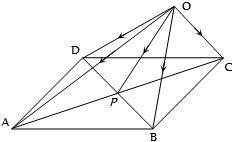
$P$ is the point of intersection of the diagonals of the parallelogram $ABCD$. If $O$ is any point,then $\overrightarrow{OA} + \overrightarrow{OB} + \overrightarrow{OC} + \overrightarrow{OD} = $
A
$\overrightarrow{OP}$
B
$2\,\overrightarrow{OP}$
C
$3\,\overrightarrow{OP}$
D
$4\,\overrightarrow{OP}$
Solution
(D) We know that in a parallelogram,the diagonals bisect each other. Therefore,$P$ is the midpoint of both diagonals $AC$ and $BD$.
Using the section formula for the midpoint,for diagonal $AC$ with midpoint $P$,we have:
$\overrightarrow{OA} + \overrightarrow{OC} = 2\overrightarrow{OP}$ ......$(i)$
Similarly,for diagonal $BD$ with midpoint $P$,we have:
$\overrightarrow{OB} + \overrightarrow{OD} = 2\overrightarrow{OP}$ ......$(ii)$
Adding equations $(i)$ and $(ii)$,we get:
$(\overrightarrow{OA} + \overrightarrow{OC}) + (\overrightarrow{OB} + \overrightarrow{OD}) = 2\overrightarrow{OP} + 2\overrightarrow{OP}$
$\overrightarrow{OA} + \overrightarrow{OB} + \overrightarrow{OC} + \overrightarrow{OD} = 4\overrightarrow{OP}$
Using the section formula for the midpoint,for diagonal $AC$ with midpoint $P$,we have:
$\overrightarrow{OA} + \overrightarrow{OC} = 2\overrightarrow{OP}$ ......$(i)$
Similarly,for diagonal $BD$ with midpoint $P$,we have:
$\overrightarrow{OB} + \overrightarrow{OD} = 2\overrightarrow{OP}$ ......$(ii)$
Adding equations $(i)$ and $(ii)$,we get:
$(\overrightarrow{OA} + \overrightarrow{OC}) + (\overrightarrow{OB} + \overrightarrow{OD}) = 2\overrightarrow{OP} + 2\overrightarrow{OP}$
$\overrightarrow{OA} + \overrightarrow{OB} + \overrightarrow{OC} + \overrightarrow{OD} = 4\overrightarrow{OP}$
0 likes
View Solution57
EasyMCQ
If the position vectors of the points $A, B, C$ are $i, j, k$ respectively and $P$ is a point such that $\overrightarrow{AB} = \overrightarrow{CP},$ then the position vector of $P$ is
A
$-i + j + k$
B
$-i - j + k$
C
$i + j - k$
D
None of these
Solution
(A) Let the position vector of point $P$ be $\vec{p} = xi + yj + zk.$
Given that the position vectors of $A, B, C$ are $\vec{a} = i, \vec{b} = j, \vec{c} = k.$
The vector $\overrightarrow{AB} = \vec{b} - \vec{a} = j - i.$
The vector $\overrightarrow{CP} = \vec{p} - \vec{c} = xi + yj + (z - 1)k.$
Given $\overrightarrow{AB} = \overrightarrow{CP},$ we have $j - i = xi + yj + (z - 1)k.$
By comparing the coefficients of $i, j,$ and $k$ on both sides,we get:
$x = -1, y = 1, z - 1 = 0 \Rightarrow z = 1.$
Thus,the position vector of $P$ is $-i + j + k.$
Given that the position vectors of $A, B, C$ are $\vec{a} = i, \vec{b} = j, \vec{c} = k.$
The vector $\overrightarrow{AB} = \vec{b} - \vec{a} = j - i.$
The vector $\overrightarrow{CP} = \vec{p} - \vec{c} = xi + yj + (z - 1)k.$
Given $\overrightarrow{AB} = \overrightarrow{CP},$ we have $j - i = xi + yj + (z - 1)k.$
By comparing the coefficients of $i, j,$ and $k$ on both sides,we get:
$x = -1, y = 1, z - 1 = 0 \Rightarrow z = 1.$
Thus,the position vector of $P$ is $-i + j + k.$
0 likes
View Solution58
EasyMCQ
If the position vectors of the points $A, B, C, D$ are $2i + 3j + 5k, i + 2j + 3k, -5i + 4j - 2k$ and $i + 10j + 10k$ respectively,then:
A
$\overrightarrow{AB} = \overrightarrow{CD}$
B
$\overrightarrow{AB} \parallel \overrightarrow{CD}$
C
$\overrightarrow{AB} \perp \overrightarrow{CD}$
D
None of these
Solution
(B) Given position vectors: $\vec{a} = 2i + 3j + 5k$,$\vec{b} = i + 2j + 3k$,$\vec{c} = -5i + 4j - 2k$,$\vec{d} = i + 10j + 10k$.
Calculate vector $\overrightarrow{AB} = \vec{b} - \vec{a} = (1-2)i + (2-3)j + (3-5)k = -i - j - 2k$.
Calculate vector $\overrightarrow{CD} = \vec{d} - \vec{c} = (1 - (-5))i + (10-4)j + (10 - (-2))k = 6i + 6j + 12k$.
Observe that $\overrightarrow{CD} = -6(-i - j - 2k) = -6 \overrightarrow{AB}$.
Since $\overrightarrow{CD}$ is a scalar multiple of $\overrightarrow{AB}$,the vectors are parallel. Thus,$\overrightarrow{AB} \parallel \overrightarrow{CD}$.
Calculate vector $\overrightarrow{AB} = \vec{b} - \vec{a} = (1-2)i + (2-3)j + (3-5)k = -i - j - 2k$.
Calculate vector $\overrightarrow{CD} = \vec{d} - \vec{c} = (1 - (-5))i + (10-4)j + (10 - (-2))k = 6i + 6j + 12k$.
Observe that $\overrightarrow{CD} = -6(-i - j - 2k) = -6 \overrightarrow{AB}$.
Since $\overrightarrow{CD}$ is a scalar multiple of $\overrightarrow{AB}$,the vectors are parallel. Thus,$\overrightarrow{AB} \parallel \overrightarrow{CD}$.
0 likes
View Solution59
EasyMCQ
If the position vector of one end of the line segment $AB$ is $2\hat{i} + 3\hat{j} - \hat{k}$ and the position vector of its midpoint is $3\,(\hat{i} + \hat{j} + \hat{k}),$ then the position vector of the other end is
A
$4\hat{i} + 3\hat{j} + 5\hat{k}$
B
$4\hat{i} - 3\hat{j} + 7\hat{k}$
C
$4\hat{i} + 3\hat{j} + 7\hat{k}$
D
$4\hat{i} + 3\hat{j} - 7\hat{k}$
Solution
(C) Let $\overrightarrow{OA} = 2\hat{i} + 3\hat{j} - \hat{k}$ be the position vector of one end $A$ and $\overrightarrow{OP} = 3\hat{i} + 3\hat{j} + 3\hat{k}$ be the position vector of the midpoint $P$ of the line segment $AB$.
Let $\overrightarrow{OB}$ be the position vector of the other end $B$.
Since $P$ is the midpoint of $AB$,we have the relation:
$\overrightarrow{OP} = \frac{\overrightarrow{OA} + \overrightarrow{OB}}{2}$
Multiplying by $2$,we get:
$2\overrightarrow{OP} = \overrightarrow{OA} + \overrightarrow{OB}$
$\overrightarrow{OB} = 2\overrightarrow{OP} - \overrightarrow{OA}$
Substituting the given vectors:
$\overrightarrow{OB} = 2(3\hat{i} + 3\hat{j} + 3\hat{k}) - (2\hat{i} + 3\hat{j} - \hat{k})$
$\overrightarrow{OB} = (6\hat{i} + 6\hat{j} + 6\hat{k}) - (2\hat{i} + 3\hat{j} - \hat{k})$
$\overrightarrow{OB} = (6-2)\hat{i} + (6-3)\hat{j} + (6-(-1))\hat{k}$
$\overrightarrow{OB} = 4\hat{i} + 3\hat{j} + 7\hat{k}$
Thus,the position vector of the other end is $4\hat{i} + 3\hat{j} + 7\hat{k}$.
Let $\overrightarrow{OB}$ be the position vector of the other end $B$.
Since $P$ is the midpoint of $AB$,we have the relation:
$\overrightarrow{OP} = \frac{\overrightarrow{OA} + \overrightarrow{OB}}{2}$
Multiplying by $2$,we get:
$2\overrightarrow{OP} = \overrightarrow{OA} + \overrightarrow{OB}$
$\overrightarrow{OB} = 2\overrightarrow{OP} - \overrightarrow{OA}$
Substituting the given vectors:
$\overrightarrow{OB} = 2(3\hat{i} + 3\hat{j} + 3\hat{k}) - (2\hat{i} + 3\hat{j} - \hat{k})$
$\overrightarrow{OB} = (6\hat{i} + 6\hat{j} + 6\hat{k}) - (2\hat{i} + 3\hat{j} - \hat{k})$
$\overrightarrow{OB} = (6-2)\hat{i} + (6-3)\hat{j} + (6-(-1))\hat{k}$
$\overrightarrow{OB} = 4\hat{i} + 3\hat{j} + 7\hat{k}$
Thus,the position vector of the other end is $4\hat{i} + 3\hat{j} + 7\hat{k}$.
0 likes
View Solution60
EasyMCQ
If $G$ and $G'$ are the centroids of the triangles $ABC$ and $A'B'C'$ respectively,then $\overrightarrow{AA'} + \overrightarrow{BB'} + \overrightarrow{CC'} = $
A
$\frac{2}{3}\overrightarrow{GG'}$
B
$\overrightarrow{GG'}$
C
$2\overrightarrow{GG'}$
D
$3\overrightarrow{GG'}$
Solution
(D) Let the position vectors of the vertices be $\vec{a}, \vec{b}, \vec{c}$ and $\vec{a'}, \vec{b'}, \vec{c'}$.
The centroids $G$ and $G'$ are given by $\vec{g} = \frac{\vec{a} + \vec{b} + \vec{c}}{3}$ and $\vec{g'} = \frac{\vec{a'} + \vec{b'} + \vec{c'}}{3}$.
Therefore,$\vec{a} + \vec{b} + \vec{c} = 3\vec{g}$ and $\vec{a'} + \vec{b'} + \vec{c'} = 3\vec{g'}$.
We need to find $\overrightarrow{AA'} + \overrightarrow{BB'} + \overrightarrow{CC'} = (\vec{a'} - \vec{a}) + (\vec{b'} - \vec{b}) + (\vec{c'} - \vec{c})$.
Rearranging the terms,we get $(\vec{a'} + \vec{b'} + \vec{c'}) - (\vec{a} + \vec{b} + \vec{c}) = 3\vec{g'} - 3\vec{g} = 3(\vec{g'} - \vec{g})$.
Since $\vec{g'} - \vec{g} = \overrightarrow{GG'}$,the result is $3\overrightarrow{GG'}$.
The centroids $G$ and $G'$ are given by $\vec{g} = \frac{\vec{a} + \vec{b} + \vec{c}}{3}$ and $\vec{g'} = \frac{\vec{a'} + \vec{b'} + \vec{c'}}{3}$.
Therefore,$\vec{a} + \vec{b} + \vec{c} = 3\vec{g}$ and $\vec{a'} + \vec{b'} + \vec{c'} = 3\vec{g'}$.
We need to find $\overrightarrow{AA'} + \overrightarrow{BB'} + \overrightarrow{CC'} = (\vec{a'} - \vec{a}) + (\vec{b'} - \vec{b}) + (\vec{c'} - \vec{c})$.
Rearranging the terms,we get $(\vec{a'} + \vec{b'} + \vec{c'}) - (\vec{a} + \vec{b} + \vec{c}) = 3\vec{g'} - 3\vec{g} = 3(\vec{g'} - \vec{g})$.
Since $\vec{g'} - \vec{g} = \overrightarrow{GG'}$,the result is $3\overrightarrow{GG'}$.
0 likes
View Solution61
MediumMCQ
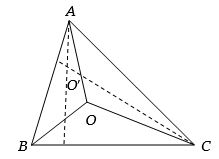
If $O$ is the circumcentre and $O'$ is the orthocentre of the triangle $ABC$,then $\overrightarrow{O'A} + \overrightarrow{O'B} + \overrightarrow{O'C} = $
A
$\overrightarrow{OO'}$
B
$2\,\overrightarrow{O'O}$
C
$2\,\overrightarrow{OO'}$
D
$0$
Solution
(B) Let the origin be at the circumcentre $O$. Then the position vectors of $A, B, C$ are $\vec{a}, \vec{b}, \vec{c}$ such that $|\vec{a}| = |\vec{b}| = |\vec{c}| = R$.
The position vector of the orthocentre $O'$ is given by $\vec{o'} = \vec{a} + \vec{b} + \vec{c}$.
We need to calculate $\overrightarrow{O'A} + \overrightarrow{O'B} + \overrightarrow{O'C}$.
Using the definition of position vectors relative to the origin $O$:
$\overrightarrow{O'A} = \vec{a} - \vec{o'} = \vec{a} - (\vec{a} + \vec{b} + \vec{c}) = -(\vec{b} + \vec{c})$
$\overrightarrow{O'B} = \vec{b} - \vec{o'} = \vec{b} - (\vec{a} + \vec{b} + \vec{c}) = -(\vec{a} + \vec{c})$
$\overrightarrow{O'C} = \vec{c} - \vec{o'} = \vec{c} - (\vec{a} + \vec{b} + \vec{c}) = -(\vec{a} + \vec{b})$
Summing these up:
$\overrightarrow{O'A} + \overrightarrow{O'B} + \overrightarrow{O'C} = -(\vec{b} + \vec{c} + \vec{a} + \vec{c} + \vec{a} + \vec{b}) = -2(\vec{a} + \vec{b} + \vec{c}) = -2\vec{o'}$.
Since $\vec{o'}$ is the vector $\overrightarrow{OO'}$,we have $\overrightarrow{O'A} + \overrightarrow{O'B} + \overrightarrow{O'C} = -2\overrightarrow{OO'} = 2\overrightarrow{O'O}$.
The position vector of the orthocentre $O'$ is given by $\vec{o'} = \vec{a} + \vec{b} + \vec{c}$.
We need to calculate $\overrightarrow{O'A} + \overrightarrow{O'B} + \overrightarrow{O'C}$.
Using the definition of position vectors relative to the origin $O$:
$\overrightarrow{O'A} = \vec{a} - \vec{o'} = \vec{a} - (\vec{a} + \vec{b} + \vec{c}) = -(\vec{b} + \vec{c})$
$\overrightarrow{O'B} = \vec{b} - \vec{o'} = \vec{b} - (\vec{a} + \vec{b} + \vec{c}) = -(\vec{a} + \vec{c})$
$\overrightarrow{O'C} = \vec{c} - \vec{o'} = \vec{c} - (\vec{a} + \vec{b} + \vec{c}) = -(\vec{a} + \vec{b})$
Summing these up:
$\overrightarrow{O'A} + \overrightarrow{O'B} + \overrightarrow{O'C} = -(\vec{b} + \vec{c} + \vec{a} + \vec{c} + \vec{a} + \vec{b}) = -2(\vec{a} + \vec{b} + \vec{c}) = -2\vec{o'}$.
Since $\vec{o'}$ is the vector $\overrightarrow{OO'}$,we have $\overrightarrow{O'A} + \overrightarrow{O'B} + \overrightarrow{O'C} = -2\overrightarrow{OO'} = 2\overrightarrow{O'O}$.
0 likes
View Solution62
DifficultMCQ
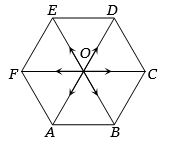
If the vectors represented by the sides $AB$ and $BC$ of the regular hexagon $ABCDEF$ are $a$ and $b$ respectively,then the vector represented by $\overrightarrow{AE}$ will be
A
$2\,b - a$
B
$b - a$
C
$2\,a - b$
D
$a + b$
Solution
(A) In a regular hexagon $ABCDEF$,let the center be $O$.
Given $\overrightarrow{AB} = a$ and $\overrightarrow{BC} = b$.
In $\triangle ABC$,by triangle law of vector addition,$\overrightarrow{AC} = \overrightarrow{AB} + \overrightarrow{BC} = a + b$.
Since $O$ is the center,$\overrightarrow{AO} = \overrightarrow{OC} = \frac{1}{2}\overrightarrow{AC} = \frac{1}{2}(a + b)$.
Also,$\overrightarrow{AF} = \overrightarrow{OC} = \frac{1}{2}(a + b)$ and $\overrightarrow{FE} = \overrightarrow{AB} = a$.
Now,in $\triangle AFE$,by triangle law of vector addition,$\overrightarrow{AE} = \overrightarrow{AF} + \overrightarrow{FE}$.
Substituting the values,$\overrightarrow{AE} = \frac{1}{2}(a + b) + a = \frac{1}{2}a + \frac{1}{2}b + a = \frac{3}{2}a + \frac{1}{2}b$.
Wait,let us re-evaluate using the property of the hexagon: $\overrightarrow{AE} = \overrightarrow{AB} + \overrightarrow{BC} + \overrightarrow{CD} + \overrightarrow{DE}$.
Alternatively,$\overrightarrow{AE} = \overrightarrow{AD} + \overrightarrow{DE}$.
Since $\overrightarrow{AD} = 2\overrightarrow{BC} = 2b$ and $\overrightarrow{DE} = -\overrightarrow{AB} = -a$,
Therefore,$\overrightarrow{AE} = 2b - a$.
Given $\overrightarrow{AB} = a$ and $\overrightarrow{BC} = b$.
In $\triangle ABC$,by triangle law of vector addition,$\overrightarrow{AC} = \overrightarrow{AB} + \overrightarrow{BC} = a + b$.
Since $O$ is the center,$\overrightarrow{AO} = \overrightarrow{OC} = \frac{1}{2}\overrightarrow{AC} = \frac{1}{2}(a + b)$.
Also,$\overrightarrow{AF} = \overrightarrow{OC} = \frac{1}{2}(a + b)$ and $\overrightarrow{FE} = \overrightarrow{AB} = a$.
Now,in $\triangle AFE$,by triangle law of vector addition,$\overrightarrow{AE} = \overrightarrow{AF} + \overrightarrow{FE}$.
Substituting the values,$\overrightarrow{AE} = \frac{1}{2}(a + b) + a = \frac{1}{2}a + \frac{1}{2}b + a = \frac{3}{2}a + \frac{1}{2}b$.
Wait,let us re-evaluate using the property of the hexagon: $\overrightarrow{AE} = \overrightarrow{AB} + \overrightarrow{BC} + \overrightarrow{CD} + \overrightarrow{DE}$.
Alternatively,$\overrightarrow{AE} = \overrightarrow{AD} + \overrightarrow{DE}$.
Since $\overrightarrow{AD} = 2\overrightarrow{BC} = 2b$ and $\overrightarrow{DE} = -\overrightarrow{AB} = -a$,
Therefore,$\overrightarrow{AE} = 2b - a$.
0 likes
View Solution63
EasyMCQ
The position vector of a point $C$ with respect to $B$ is $i + j$ and that of $B$ with respect to $A$ is $i - j$. The position vector of $C$ with respect to $A$ is
A
$2i$
B
$2j$
C
$-2j$
D
$-2i$
Solution
(A) Given that the position vector of point $C$ with respect to $B$ is $\overrightarrow{BC} = i + j$.
Similarly,the position vector of $B$ with respect to $A$ is $\overrightarrow{AB} = i - j$.
Using the triangle law of vector addition,the position vector of $C$ with respect to $A$ is given by $\overrightarrow{AC} = \overrightarrow{AB} + \overrightarrow{BC}$.
Substituting the given values,we get $\overrightarrow{AC} = (i - j) + (i + j) = 2i$.
Therefore,the correct option is $A$.
Similarly,the position vector of $B$ with respect to $A$ is $\overrightarrow{AB} = i - j$.
Using the triangle law of vector addition,the position vector of $C$ with respect to $A$ is given by $\overrightarrow{AC} = \overrightarrow{AB} + \overrightarrow{BC}$.
Substituting the given values,we get $\overrightarrow{AC} = (i - j) + (i + j) = 2i$.
Therefore,the correct option is $A$.
0 likes
View Solution64
EasyMCQ
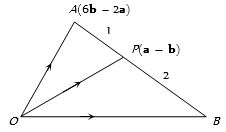
$A$ and $B$ are two points. The position vector of $A$ is $6b - 2a$. $A$ point $P$ divides the line segment $AB$ in the ratio $1 : 2$. If $a - b$ is the position vector of $P$,then the position vector of $B$ is given by:
A
$7a - 15b$
B
$7a + 15b$
C
$15a - 7b$
D
$15a + 7b$
Solution
(A) Let $\overrightarrow{OA} = 6b - 2a$ and $\overrightarrow{OP} = a - b$. Let $\overrightarrow{OB} = r$.
Since $P$ divides $AB$ in the ratio $1 : 2$,by the section formula,the position vector of $P$ is given by:
$\overrightarrow{OP} = \frac{1(\overrightarrow{OB}) + 2(\overrightarrow{OA})}{1 + 2}$
Substituting the given values:
$a - b = \frac{r + 2(6b - 2a)}{3}$
$3(a - b) = r + 12b - 4a$
$3a - 3b = r + 12b - 4a$
$r = 3a - 3b - 12b + 4a$
$r = 7a - 15b$
Thus,the position vector of $B$ is $7a - 15b$.
Since $P$ divides $AB$ in the ratio $1 : 2$,by the section formula,the position vector of $P$ is given by:
$\overrightarrow{OP} = \frac{1(\overrightarrow{OB}) + 2(\overrightarrow{OA})}{1 + 2}$
Substituting the given values:
$a - b = \frac{r + 2(6b - 2a)}{3}$
$3(a - b) = r + 12b - 4a$
$3a - 3b = r + 12b - 4a$
$r = 3a - 3b - 12b + 4a$
$r = 7a - 15b$
Thus,the position vector of $B$ is $7a - 15b$.
0 likes
View Solution65
MediumMCQ
If the position vectors of the points $A$ and $B$ are $\vec{a} = \hat{i} + 3\hat{j} - \hat{k}$ and $\vec{b} = 3\hat{i} - \hat{j} - 3\hat{k}$,then what will be the position vector of the midpoint of $AB$?
A
$\hat{i} + 2\hat{j} - \hat{k}$
B
$2\hat{i} + \hat{j} - 2\hat{k}$
C
$2\hat{i} + \hat{j} - \hat{k}$
D
$\hat{i} + \hat{j} - 2\hat{k}$
Solution
(B) The position vector of the midpoint $M$ of the line segment joining points $A$ and $B$ with position vectors $\vec{a}$ and $\vec{b}$ is given by the formula:
$\vec{m} = \frac{\vec{a} + \vec{b}}{2}$
Given $\vec{a} = \hat{i} + 3\hat{j} - \hat{k}$ and $\vec{b} = 3\hat{i} - \hat{j} - 3\hat{k}$.
Substituting the values:
$\vec{m} = \frac{(\hat{i} + 3\hat{j} - \hat{k}) + (3\hat{i} - \hat{j} - 3\hat{k})}{2}$
$\vec{m} = \frac{(1+3)\hat{i} + (3-1)\hat{j} + (-1-3)\hat{k}}{2}$
$\vec{m} = \frac{4\hat{i} + 2\hat{j} - 4\hat{k}}{2}$
$\vec{m} = 2\hat{i} + \hat{j} - 2\hat{k}$
Thus,the correct option is $B$.
$\vec{m} = \frac{\vec{a} + \vec{b}}{2}$
Given $\vec{a} = \hat{i} + 3\hat{j} - \hat{k}$ and $\vec{b} = 3\hat{i} - \hat{j} - 3\hat{k}$.
Substituting the values:
$\vec{m} = \frac{(\hat{i} + 3\hat{j} - \hat{k}) + (3\hat{i} - \hat{j} - 3\hat{k})}{2}$
$\vec{m} = \frac{(1+3)\hat{i} + (3-1)\hat{j} + (-1-3)\hat{k}}{2}$
$\vec{m} = \frac{4\hat{i} + 2\hat{j} - 4\hat{k}}{2}$
$\vec{m} = 2\hat{i} + \hat{j} - 2\hat{k}$
Thus,the correct option is $B$.
0 likes
View Solution66
MediumMCQ
If $C$ is the midpoint of $AB$ and $P$ is any point outside $AB$,then
A
$\overrightarrow{PA} + \overrightarrow{PB} = \overrightarrow{PC}$
B
$\overrightarrow{PA} + \overrightarrow{PB} = 2\,\overrightarrow{PC}$
C
$\overrightarrow{PA} + \overrightarrow{PB} + \overrightarrow{PC} = 0$
D
$\overrightarrow{PA} + \overrightarrow{PB} + 2\,\overrightarrow{PC} = 0$
Solution
(B) Since $C$ is the midpoint of $AB$,we have $\overrightarrow{AC} + \overrightarrow{BC} = 0$,which implies $\overrightarrow{AC} = -\overrightarrow{BC}$.
Using the triangle law of vector addition in $\triangle PAC$ and $\triangle PBC$:
$\overrightarrow{PA} = \overrightarrow{PC} + \overrightarrow{CA}$
$\overrightarrow{PB} = \overrightarrow{PC} + \overrightarrow{CB}$
Adding these two equations:
$\overrightarrow{PA} + \overrightarrow{PB} = (\overrightarrow{PC} + \overrightarrow{CA}) + (\overrightarrow{PC} + \overrightarrow{CB})$
$\overrightarrow{PA} + \overrightarrow{PB} = 2\overrightarrow{PC} + (\overrightarrow{CA} + \overrightarrow{CB})$
Since $C$ is the midpoint of $AB$,$\overrightarrow{CA} = -\overrightarrow{CB}$,so $\overrightarrow{CA} + \overrightarrow{CB} = 0$.
Therefore,$\overrightarrow{PA} + \overrightarrow{PB} = 2\overrightarrow{PC}$.
Using the triangle law of vector addition in $\triangle PAC$ and $\triangle PBC$:
$\overrightarrow{PA} = \overrightarrow{PC} + \overrightarrow{CA}$
$\overrightarrow{PB} = \overrightarrow{PC} + \overrightarrow{CB}$
Adding these two equations:
$\overrightarrow{PA} + \overrightarrow{PB} = (\overrightarrow{PC} + \overrightarrow{CA}) + (\overrightarrow{PC} + \overrightarrow{CB})$
$\overrightarrow{PA} + \overrightarrow{PB} = 2\overrightarrow{PC} + (\overrightarrow{CA} + \overrightarrow{CB})$
Since $C$ is the midpoint of $AB$,$\overrightarrow{CA} = -\overrightarrow{CB}$,so $\overrightarrow{CA} + \overrightarrow{CB} = 0$.
Therefore,$\overrightarrow{PA} + \overrightarrow{PB} = 2\overrightarrow{PC}$.
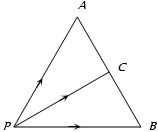
0 likes
View Solution67
EasyMCQ
If in a triangle $\overrightarrow{AB} = \vec{a}$ and $\overrightarrow{AC} = \vec{b}$,and $D$ and $E$ are the mid-points of $AB$ and $AC$ respectively,then $\overrightarrow{DE}$ is equal to:
A
$\frac{\vec{a}}{4} - \frac{\vec{b}}{4}$
B
$\frac{\vec{a}}{2} - \frac{\vec{b}}{2}$
C
$\frac{\vec{b}}{4} - \frac{\vec{a}}{4}$
D
$\frac{\vec{b}}{2} - \frac{\vec{a}}{2}$
Solution
(D) Given that $D$ is the mid-point of $AB$,so $\overrightarrow{AD} = \frac{1}{2}\overrightarrow{AB} = \frac{1}{2}\vec{a}$.
Given that $E$ is the mid-point of $AC$,so $\overrightarrow{AE} = \frac{1}{2}\overrightarrow{AC} = \frac{1}{2}\vec{b}$.
Using the triangle law of vector addition in $\triangle ADE$,we have $\overrightarrow{AD} + \overrightarrow{DE} = \overrightarrow{AE}$.
Therefore,$\overrightarrow{DE} = \overrightarrow{AE} - \overrightarrow{AD}$.
Substituting the values,$\overrightarrow{DE} = \frac{1}{2}\vec{b} - \frac{1}{2}\vec{a} = \frac{\vec{b}}{2} - \frac{\vec{a}}{2}$.
Given that $E$ is the mid-point of $AC$,so $\overrightarrow{AE} = \frac{1}{2}\overrightarrow{AC} = \frac{1}{2}\vec{b}$.
Using the triangle law of vector addition in $\triangle ADE$,we have $\overrightarrow{AD} + \overrightarrow{DE} = \overrightarrow{AE}$.
Therefore,$\overrightarrow{DE} = \overrightarrow{AE} - \overrightarrow{AD}$.
Substituting the values,$\overrightarrow{DE} = \frac{1}{2}\vec{b} - \frac{1}{2}\vec{a} = \frac{\vec{b}}{2} - \frac{\vec{a}}{2}$.
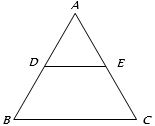
0 likes
View Solution68
MediumMCQ
In the triangle $ABC,$ if $\overrightarrow{AB} = a, \overrightarrow{AC} = c, \overrightarrow{BC} = b$,then which of the following is correct?
A
$a + b + c = 0$
B
$a + b - c = 0$
C
$a - b + c = 0$
D
$-a + b + c = 0$
Solution
(B) By the triangle law of vector addition,we have $\overrightarrow{AB} + \overrightarrow{BC} = \overrightarrow{AC}$.
Substituting the given vectors,we get $a + b = c$.
Rearranging the terms,we obtain $a + b - c = 0$.
Therefore,the correct option is $B$.
Substituting the given vectors,we get $a + b = c$.
Rearranging the terms,we obtain $a + b - c = 0$.
Therefore,the correct option is $B$.
0 likes
View Solution69
DifficultMCQ
Let $A$ and $B$ be points with position vectors $a$ and $b$ with respect to the origin $O$. If the point $C$ on $OA$ is such that $2AC = CO$,$CD$ is parallel to $OB$ and $|\overrightarrow{CD}| = 3|\overrightarrow{OB}|$,then $\overrightarrow{AD}$ is equal to
A
$3b - \frac{a}{2}$
B
$3b + \frac{a}{2}$
C
$3b - \frac{a}{3}$
D
$3b + \frac{a}{3}$
Solution
(C) Given $\overrightarrow{OA} = a$ and $\overrightarrow{OB} = b$.
Point $C$ lies on $OA$ such that $2AC = CO$. This implies $C$ divides $OA$ in the ratio $1:2$ from $O$ to $A$.
Using the section formula,$\overrightarrow{OC} = \frac{2}{3}\overrightarrow{OA} = \frac{2}{3}a$.
Since $CD$ is parallel to $OB$ and $|\overrightarrow{CD}| = 3|\overrightarrow{OB}|$,we have $\overrightarrow{CD} = 3\overrightarrow{OB} = 3b$.
Now,$\overrightarrow{OD} = \overrightarrow{OC} + \overrightarrow{CD} = \frac{2}{3}a + 3b$.
Finally,$\overrightarrow{AD} = \overrightarrow{OD} - \overrightarrow{OA} = (\frac{2}{3}a + 3b) - a = 3b - \frac{1}{3}a$.
Point $C$ lies on $OA$ such that $2AC = CO$. This implies $C$ divides $OA$ in the ratio $1:2$ from $O$ to $A$.
Using the section formula,$\overrightarrow{OC} = \frac{2}{3}\overrightarrow{OA} = \frac{2}{3}a$.
Since $CD$ is parallel to $OB$ and $|\overrightarrow{CD}| = 3|\overrightarrow{OB}|$,we have $\overrightarrow{CD} = 3\overrightarrow{OB} = 3b$.
Now,$\overrightarrow{OD} = \overrightarrow{OC} + \overrightarrow{CD} = \frac{2}{3}a + 3b$.
Finally,$\overrightarrow{AD} = \overrightarrow{OD} - \overrightarrow{OA} = (\frac{2}{3}a + 3b) - a = 3b - \frac{1}{3}a$.
0 likes
View Solution70
MediumMCQ
In a triangle $ABC$,if $2\overrightarrow{AC} = 3\overrightarrow{CB}$,then $2\overrightarrow{OA} + 3\overrightarrow{OB}$ equals
A
$5\overrightarrow{OC}$
B
$-\overrightarrow{OC}$
C
$\overrightarrow{OC}$
D
None of these
Solution
(A) Given the relation $2\overrightarrow{AC} = 3\overrightarrow{CB}$.
We express the vectors in terms of the origin $O$ as $\overrightarrow{AC} = \overrightarrow{OC} - \overrightarrow{OA}$ and $\overrightarrow{CB} = \overrightarrow{OB} - \overrightarrow{OC}$.
Substituting these into the given equation:
$2(\overrightarrow{OC} - \overrightarrow{OA}) = 3(\overrightarrow{OB} - \overrightarrow{OC})$
$2\overrightarrow{OC} - 2\overrightarrow{OA} = 3\overrightarrow{OB} - 3\overrightarrow{OC}$
Rearranging the terms to isolate $2\overrightarrow{OA} + 3\overrightarrow{OB}$:
$2\overrightarrow{OA} + 3\overrightarrow{OB} = 2\overrightarrow{OC} + 3\overrightarrow{OC}$
$2\overrightarrow{OA} + 3\overrightarrow{OB} = 5\overrightarrow{OC}$
We express the vectors in terms of the origin $O$ as $\overrightarrow{AC} = \overrightarrow{OC} - \overrightarrow{OA}$ and $\overrightarrow{CB} = \overrightarrow{OB} - \overrightarrow{OC}$.
Substituting these into the given equation:
$2(\overrightarrow{OC} - \overrightarrow{OA}) = 3(\overrightarrow{OB} - \overrightarrow{OC})$
$2\overrightarrow{OC} - 2\overrightarrow{OA} = 3\overrightarrow{OB} - 3\overrightarrow{OC}$
Rearranging the terms to isolate $2\overrightarrow{OA} + 3\overrightarrow{OB}$:
$2\overrightarrow{OA} + 3\overrightarrow{OB} = 2\overrightarrow{OC} + 3\overrightarrow{OC}$
$2\overrightarrow{OA} + 3\overrightarrow{OB} = 5\overrightarrow{OC}$
0 likes
View Solution71
EasyMCQ
If $\overrightarrow {AO} + \overrightarrow {OB} = \overrightarrow {BO} + \overrightarrow {OC} ,$ then $A, B, C$ form
A
Equilateral triangle
B
Right angled triangle
C
Isosceles triangle
D
Line
Solution
(C) Given the equation: $\overrightarrow {AO} + \overrightarrow {OB} = \overrightarrow {BO} + \overrightarrow {OC}$.
By the triangle law of vector addition,$\overrightarrow {AO} + \overrightarrow {OB} = \overrightarrow {AB}$.
Similarly,$\overrightarrow {BO} + \overrightarrow {OC} = \overrightarrow {BC}$.
Therefore,$\overrightarrow {AB} = \overrightarrow {BC}$.
This implies that the magnitude of vector $\overrightarrow {AB}$ is equal to the magnitude of vector $\overrightarrow {BC}$,i.e.,$|\overrightarrow {AB}| = |\overrightarrow {BC}|$.
Since the lengths of the two sides $AB$ and $BC$ are equal,the points $A, B, C$ form an isosceles triangle.
By the triangle law of vector addition,$\overrightarrow {AO} + \overrightarrow {OB} = \overrightarrow {AB}$.
Similarly,$\overrightarrow {BO} + \overrightarrow {OC} = \overrightarrow {BC}$.
Therefore,$\overrightarrow {AB} = \overrightarrow {BC}$.
This implies that the magnitude of vector $\overrightarrow {AB}$ is equal to the magnitude of vector $\overrightarrow {BC}$,i.e.,$|\overrightarrow {AB}| = |\overrightarrow {BC}|$.
Since the lengths of the two sides $AB$ and $BC$ are equal,the points $A, B, C$ form an isosceles triangle.
0 likes
View Solution72
DifficultMCQ
The sum of the three vectors determined by the medians of a triangle directed from the vertices is
A
$0$
B
$1$
C
$-1$
D
$\frac{1}{3}$
Solution
(A) Let the vertices of the triangle be $A$,$B$,and $C$ with position vectors $\vec{a}$,$\vec{b}$,and $\vec{c}$ respectively.
The medians are vectors directed from the vertices to the midpoints of the opposite sides.
Let the midpoints of sides $BC$,$CA$,and $AB$ be $D$,$E$,and $F$ respectively.
The position vectors of the midpoints are $\vec{d} = \frac{\vec{b} + \vec{c}}{2}$,$\vec{e} = \frac{\vec{a} + \vec{c}}{2}$,and $\vec{f} = \frac{\vec{a} + \vec{b}}{2}$.
The vectors representing the medians are $\vec{AD} = \vec{d} - \vec{a} = \frac{\vec{b} + \vec{c}}{2} - \vec{a} = \frac{\vec{b} + \vec{c} - 2\vec{a}}{2}$.
Similarly,$\vec{BE} = \vec{e} - \vec{b} = \frac{\vec{a} + \vec{c} - 2\vec{b}}{2}$ and $\vec{CF} = \vec{f} - \vec{c} = \frac{\vec{a} + \vec{b} - 2\vec{c}}{2}$.
The sum of these vectors is $\vec{AD} + \vec{BE} + \vec{CF} = \frac{(\vec{b} + \vec{c} - 2\vec{a}) + (\vec{a} + \vec{c} - 2\vec{b}) + (\vec{a} + \vec{b} - 2\vec{c})}{2}$.
Simplifying the numerator: $(\vec{b} + \vec{c} - 2\vec{a} + \vec{a} + \vec{c} - 2\vec{b} + \vec{a} + \vec{b} - 2\vec{c}) = (\vec{a} - \vec{a}) + (\vec{b} - \vec{b}) + (\vec{c} - \vec{c}) = 0$.
Thus,the sum is $\frac{0}{2} = 0$.
The medians are vectors directed from the vertices to the midpoints of the opposite sides.
Let the midpoints of sides $BC$,$CA$,and $AB$ be $D$,$E$,and $F$ respectively.
The position vectors of the midpoints are $\vec{d} = \frac{\vec{b} + \vec{c}}{2}$,$\vec{e} = \frac{\vec{a} + \vec{c}}{2}$,and $\vec{f} = \frac{\vec{a} + \vec{b}}{2}$.
The vectors representing the medians are $\vec{AD} = \vec{d} - \vec{a} = \frac{\vec{b} + \vec{c}}{2} - \vec{a} = \frac{\vec{b} + \vec{c} - 2\vec{a}}{2}$.
Similarly,$\vec{BE} = \vec{e} - \vec{b} = \frac{\vec{a} + \vec{c} - 2\vec{b}}{2}$ and $\vec{CF} = \vec{f} - \vec{c} = \frac{\vec{a} + \vec{b} - 2\vec{c}}{2}$.
The sum of these vectors is $\vec{AD} + \vec{BE} + \vec{CF} = \frac{(\vec{b} + \vec{c} - 2\vec{a}) + (\vec{a} + \vec{c} - 2\vec{b}) + (\vec{a} + \vec{b} - 2\vec{c})}{2}$.
Simplifying the numerator: $(\vec{b} + \vec{c} - 2\vec{a} + \vec{a} + \vec{c} - 2\vec{b} + \vec{a} + \vec{b} - 2\vec{c}) = (\vec{a} - \vec{a}) + (\vec{b} - \vec{b}) + (\vec{c} - \vec{c}) = 0$.
Thus,the sum is $\frac{0}{2} = 0$.
0 likes
View Solution73
EasyMCQ
The position vector of the point which divides the line segment joining the points with position vectors $2a - 3b$ and $3a - 2b$ internally in the ratio $2 : 3$ is:
A
$\frac{12}{5}a + \frac{13}{5}b$
B
$\frac{12}{5}a - \frac{13}{5}b$
C
$\frac{3}{5}a - \frac{2}{5}b$
D
None of these
Solution
(B) Let the position vectors of the two points be $\vec{p} = 2a - 3b$ and $\vec{q} = 3a - 2b$.
The formula for the position vector of a point dividing the join of two points with position vectors $\vec{p}$ and $\vec{q}$ internally in the ratio $m : n$ is given by $\vec{r} = \frac{m\vec{q} + n\vec{p}}{m + n}$.
Here,$m = 2$,$n = 3$,$\vec{p} = 2a - 3b$,and $\vec{q} = 3a - 2b$.
Substituting these values into the formula:
$\vec{r} = \frac{2(3a - 2b) + 3(2a - 3b)}{2 + 3}$
$\vec{r} = \frac{6a - 4b + 6a - 9b}{5}$
$\vec{r} = \frac{12a - 13b}{5}$
$\vec{r} = \frac{12}{5}a - \frac{13}{5}b$.
Thus,the correct option is $B$.
The formula for the position vector of a point dividing the join of two points with position vectors $\vec{p}$ and $\vec{q}$ internally in the ratio $m : n$ is given by $\vec{r} = \frac{m\vec{q} + n\vec{p}}{m + n}$.
Here,$m = 2$,$n = 3$,$\vec{p} = 2a - 3b$,and $\vec{q} = 3a - 2b$.
Substituting these values into the formula:
$\vec{r} = \frac{2(3a - 2b) + 3(2a - 3b)}{2 + 3}$
$\vec{r} = \frac{6a - 4b + 6a - 9b}{5}$
$\vec{r} = \frac{12a - 13b}{5}$
$\vec{r} = \frac{12}{5}a - \frac{13}{5}b$.
Thus,the correct option is $B$.
0 likes
View Solution74
DifficultMCQ
If the position vectors of points $A, B, C$ are respectively $\hat{i}, \hat{j}, \hat{k}$ and $\vec{AB} = \vec{CX}$,then the position vector of point $X$ is:
A
$-\hat{i} + \hat{j} + \hat{k}$
B
$\hat{i} - \hat{j} + \hat{k}$
C
$\hat{i} + \hat{j} - \hat{k}$
D
$\hat{i} + \hat{j} + \hat{k}$
Solution
(A) Given the position vectors of points $A, B, C$ are $\vec{a} = \hat{i}$,$\vec{b} = \hat{j}$,and $\vec{c} = \hat{k}$.
The vector $\vec{AB}$ is given by $\vec{b} - \vec{a} = \hat{j} - \hat{i}$.
Let the position vector of point $X$ be $\vec{x}$. Then $\vec{CX} = \vec{x} - \vec{c} = \vec{x} - \hat{k}$.
Given $\vec{AB} = \vec{CX}$,we have $\hat{j} - \hat{i} = \vec{x} - \hat{k}$.
Therefore,$\vec{x} = -\hat{i} + \hat{j} + \hat{k}$.
The vector $\vec{AB}$ is given by $\vec{b} - \vec{a} = \hat{j} - \hat{i}$.
Let the position vector of point $X$ be $\vec{x}$. Then $\vec{CX} = \vec{x} - \vec{c} = \vec{x} - \hat{k}$.
Given $\vec{AB} = \vec{CX}$,we have $\hat{j} - \hat{i} = \vec{x} - \hat{k}$.
Therefore,$\vec{x} = -\hat{i} + \hat{j} + \hat{k}$.
0 likes
View Solution75
MediumMCQ
If $\vec{a}$ and $\vec{b}$ are the position vectors $(P.V.)$ of two points $A$ and $B$ respectively,and $C$ divides the line segment $AB$ in the ratio $2 : 1$,then the position vector of $C$ is:
A
$\frac{\vec{a} + 2\vec{b}}{3}$
B
$\frac{2\vec{a} + \vec{b}}{3}$
C
$\frac{\vec{a} + 2\vec{b}}{2}$
D
$\frac{\vec{a} + \vec{b}}{2}$
Solution
(A) The position vector of a point $C$ that divides the line segment joining points with position vectors $\vec{a}$ and $\vec{b}$ in the ratio $m : n$ is given by the section formula: $\vec{r} = \frac{m\vec{b} + n\vec{a}}{m + n}$.
Here,the ratio is $m : n = 2 : 1$.
Substituting the values into the formula,we get:
$\vec{OC} = \frac{2(\vec{b}) + 1(\vec{a})}{2 + 1}$
$\vec{OC} = \frac{\vec{a} + 2\vec{b}}{3}$.
Here,the ratio is $m : n = 2 : 1$.
Substituting the values into the formula,we get:
$\vec{OC} = \frac{2(\vec{b}) + 1(\vec{a})}{2 + 1}$
$\vec{OC} = \frac{\vec{a} + 2\vec{b}}{3}$.
0 likes
View Solution76
EasyMCQ
If $A, B, C$ are the vertices of a triangle whose position vectors are $a, b, c$ and $G$ is the centroid of the $\Delta ABC$,then $\overrightarrow{GA} + \overrightarrow{GB} + \overrightarrow{GC}$ is
A
$0$
B
$\overrightarrow{A} + \overrightarrow{B} + \overrightarrow{C}$
C
$\frac{a + b + c}{3}$
D
$\frac{a + b - c}{3}$
Solution
(A) The position vectors of the vertices $A, B$,and $C$ of the triangle are $a, b$,and $c$ respectively.
The position vector of the centroid $G$ of the triangle is given by $g = \frac{a + b + c}{3}$.
We need to find the sum of the vectors $\overrightarrow{GA} + \overrightarrow{GB} + \overrightarrow{GC}$.
Using the definition of a vector between two points,$\overrightarrow{GA} = a - g$,$\overrightarrow{GB} = b - g$,and $\overrightarrow{GC} = c - g$.
Summing these,we get:
$\overrightarrow{GA} + \overrightarrow{GB} + \overrightarrow{GC} = (a - g) + (b - g) + (c - g)$
$= (a + b + c) - 3g$
Substituting $g = \frac{a + b + c}{3}$:
$= (a + b + c) - 3 \left( \frac{a + b + c}{3} \right)$
$= (a + b + c) - (a + b + c) = 0$.
The position vector of the centroid $G$ of the triangle is given by $g = \frac{a + b + c}{3}$.
We need to find the sum of the vectors $\overrightarrow{GA} + \overrightarrow{GB} + \overrightarrow{GC}$.
Using the definition of a vector between two points,$\overrightarrow{GA} = a - g$,$\overrightarrow{GB} = b - g$,and $\overrightarrow{GC} = c - g$.
Summing these,we get:
$\overrightarrow{GA} + \overrightarrow{GB} + \overrightarrow{GC} = (a - g) + (b - g) + (c - g)$
$= (a + b + c) - 3g$
Substituting $g = \frac{a + b + c}{3}$:
$= (a + b + c) - 3 \left( \frac{a + b + c}{3} \right)$
$= (a + b + c) - (a + b + c) = 0$.
0 likes
View Solution77
EasyMCQ
If $O$ is the origin and $C$ is the midpoint of $A(2, -1)$ and $B(-4, 3)$,then the value of $\overrightarrow{OC}$ is:
A
$i + j$
B
$i - j$
C
$-i + j$
D
$-i - j$
Solution
(C) The coordinates of the midpoint $C$ of the line segment joining $A(x_1, y_1)$ and $B(x_2, y_2)$ are given by $\left( \frac{x_1 + x_2}{2}, \frac{y_1 + y_2}{2} \right)$.
Given $A(2, -1)$ and $B(-4, 3)$,the coordinates of $C$ are $\left( \frac{2 + (-4)}{2}, \frac{-1 + 3}{2} \right) = \left( \frac{-2}{2}, \frac{2}{2} \right) = (-1, 1)$.
Since $O$ is the origin $(0, 0)$,the position vector $\overrightarrow{OC}$ is given by $(-1 - 0)i + (1 - 0)j = -i + j$.
Given $A(2, -1)$ and $B(-4, 3)$,the coordinates of $C$ are $\left( \frac{2 + (-4)}{2}, \frac{-1 + 3}{2} \right) = \left( \frac{-2}{2}, \frac{2}{2} \right) = (-1, 1)$.
Since $O$ is the origin $(0, 0)$,the position vector $\overrightarrow{OC}$ is given by $(-1 - 0)i + (1 - 0)j = -i + j$.
0 likes
View Solution78
DifficultMCQ
If $ABCDEF$ is a regular hexagon,then $\overrightarrow {AD} + \overrightarrow {EB} + \overrightarrow {FC} = $
A
$0$
B
$2\overrightarrow {AB}$
C
$3\overrightarrow {AB}$
D
$4\overrightarrow {AB}$
Solution
(D) In a regular hexagon $ABCDEF$,let $O$ be the center of the hexagon. We can express the vectors in terms of the sides of the hexagon.
We know that $\overrightarrow {AD} = 2\overrightarrow {AO}$,$\overrightarrow {EB} = 2\overrightarrow {EO}$,and $\overrightarrow {FC} = 2\overrightarrow {FO}$.
Alternatively,using the properties of a regular hexagon:
$\overrightarrow {AD} = \overrightarrow {AB} + \overrightarrow {BC} + \overrightarrow {CD} = \overrightarrow {AB} + \overrightarrow {BC} + \overrightarrow {AF} = 2\overrightarrow {BC} + 2\overrightarrow {AB}$ (since $\overrightarrow {CD} = \overrightarrow {AF} + \overrightarrow {AB}$ is not direct,let's use the center $O$).
Actually,$\overrightarrow {AD} = 2\overrightarrow {BC}$,$\overrightarrow {EB} = 2\overrightarrow {FA}$,and $\overrightarrow {FC} = 2\overrightarrow {AB}$.
Summing these: $\overrightarrow {AD} + \overrightarrow {EB} + \overrightarrow {FC} = 2\overrightarrow {BC} + 2\overrightarrow {FA} + 2\overrightarrow {AB}$.
$= 2(\overrightarrow {FA} + \overrightarrow {AB} + \overrightarrow {BC}) = 2(\overrightarrow {FC}) = 2(2\overrightarrow {AB}) = 4\overrightarrow {AB}$.
We know that $\overrightarrow {AD} = 2\overrightarrow {AO}$,$\overrightarrow {EB} = 2\overrightarrow {EO}$,and $\overrightarrow {FC} = 2\overrightarrow {FO}$.
Alternatively,using the properties of a regular hexagon:
$\overrightarrow {AD} = \overrightarrow {AB} + \overrightarrow {BC} + \overrightarrow {CD} = \overrightarrow {AB} + \overrightarrow {BC} + \overrightarrow {AF} = 2\overrightarrow {BC} + 2\overrightarrow {AB}$ (since $\overrightarrow {CD} = \overrightarrow {AF} + \overrightarrow {AB}$ is not direct,let's use the center $O$).
Actually,$\overrightarrow {AD} = 2\overrightarrow {BC}$,$\overrightarrow {EB} = 2\overrightarrow {FA}$,and $\overrightarrow {FC} = 2\overrightarrow {AB}$.
Summing these: $\overrightarrow {AD} + \overrightarrow {EB} + \overrightarrow {FC} = 2\overrightarrow {BC} + 2\overrightarrow {FA} + 2\overrightarrow {AB}$.
$= 2(\overrightarrow {FA} + \overrightarrow {AB} + \overrightarrow {BC}) = 2(\overrightarrow {FC}) = 2(2\overrightarrow {AB}) = 4\overrightarrow {AB}$.
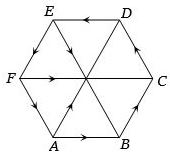
0 likes
View Solution79
EasyMCQ
If the position vector of a point $A$ is $a + 2b$ and a point $P$ divides $AB$ in the ratio $2:3$,where the position vector of $P$ is $a$,then the position vector of $B$ is:
A
$2a - b$
B
$b - 2a$
C
$a - 3b$
D
$b$
Solution
(C) Let the position vector of point $A$ be $\vec{OA} = a + 2b$.
Let the position vector of point $P$ be $\vec{OP} = a$.
Let the position vector of point $B$ be $\vec{OB} = x$.
Since $P$ divides $AB$ in the ratio $2:3$,by the section formula:
$\vec{OP} = \frac{2(\vec{OB}) + 3(\vec{OA})}{2 + 3}$
$a = \frac{2x + 3(a + 2b)}{5}$
$5a = 2x + 3a + 6b$
$2x = 5a - 3a - 6b$
$2x = 2a - 6b$
$x = a - 3b$
Therefore,the position vector of $B$ is $a - 3b$.
Let the position vector of point $P$ be $\vec{OP} = a$.
Let the position vector of point $B$ be $\vec{OB} = x$.
Since $P$ divides $AB$ in the ratio $2:3$,by the section formula:
$\vec{OP} = \frac{2(\vec{OB}) + 3(\vec{OA})}{2 + 3}$
$a = \frac{2x + 3(a + 2b)}{5}$
$5a = 2x + 3a + 6b$
$2x = 5a - 3a - 6b$
$2x = 2a - 6b$
$x = a - 3b$
Therefore,the position vector of $B$ is $a - 3b$.
0 likes
View Solution80
MediumMCQ
If $D, E, F$ are respectively the midpoints of $AB, AC$ and $BC$ in $\Delta ABC$,then $\overrightarrow{BE} + \overrightarrow{AF} = $
A
$\overrightarrow{DC}$
B
$\frac{1}{2}\overrightarrow{BF}$
C
$2\overrightarrow{BF}$
D
$\frac{3}{2}\overrightarrow{BF}$
Solution
(A) Let the position vectors of vertices $A, B, C$ be $\vec{a}, \vec{b}, \vec{c}$ respectively.
Since $D, E, F$ are midpoints of $AB, AC, BC$ respectively,their position vectors are:
$\vec{d} = \frac{\vec{a} + \vec{b}}{2}$,$\vec{e} = \frac{\vec{a} + \vec{c}}{2}$,$\vec{f} = \frac{\vec{b} + \vec{c}}{2}$.
Now,$\overrightarrow{BE} = \vec{e} - \vec{b} = \frac{\vec{a} + \vec{c}}{2} - \vec{b} = \frac{\vec{a} + \vec{c} - 2\vec{b}}{2}$.
And $\overrightarrow{AF} = \vec{f} - \vec{a} = \frac{\vec{b} + \vec{c}}{2} - \vec{a} = \frac{\vec{b} + \vec{c} - 2\vec{a}}{2}$.
Adding these two vectors:
$\overrightarrow{BE} + \overrightarrow{AF} = \frac{\vec{a} + \vec{c} - 2\vec{b} + \vec{b} + \vec{c} - 2\vec{a}}{2} = \frac{2\vec{c} - \vec{a} - \vec{b}}{2} = \vec{c} - \frac{\vec{a} + \vec{b}}{2}$.
Since $\vec{d} = \frac{\vec{a} + \vec{b}}{2}$,we have $\overrightarrow{BE} + \overrightarrow{AF} = \vec{c} - \vec{d} = \overrightarrow{DC}$.
Since $D, E, F$ are midpoints of $AB, AC, BC$ respectively,their position vectors are:
$\vec{d} = \frac{\vec{a} + \vec{b}}{2}$,$\vec{e} = \frac{\vec{a} + \vec{c}}{2}$,$\vec{f} = \frac{\vec{b} + \vec{c}}{2}$.
Now,$\overrightarrow{BE} = \vec{e} - \vec{b} = \frac{\vec{a} + \vec{c}}{2} - \vec{b} = \frac{\vec{a} + \vec{c} - 2\vec{b}}{2}$.
And $\overrightarrow{AF} = \vec{f} - \vec{a} = \frac{\vec{b} + \vec{c}}{2} - \vec{a} = \frac{\vec{b} + \vec{c} - 2\vec{a}}{2}$.
Adding these two vectors:
$\overrightarrow{BE} + \overrightarrow{AF} = \frac{\vec{a} + \vec{c} - 2\vec{b} + \vec{b} + \vec{c} - 2\vec{a}}{2} = \frac{2\vec{c} - \vec{a} - \vec{b}}{2} = \vec{c} - \frac{\vec{a} + \vec{b}}{2}$.
Since $\vec{d} = \frac{\vec{a} + \vec{b}}{2}$,we have $\overrightarrow{BE} + \overrightarrow{AF} = \vec{c} - \vec{d} = \overrightarrow{DC}$.
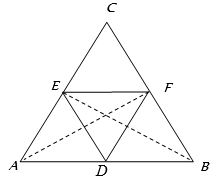
0 likes
View Solution81
MediumMCQ
If the position vectors of the points $A, B, C$ are $i + j$,$i - j$,and $a i + b j + c k$ respectively,then the points $A, B, C$ are collinear if
A
$a = b = c = 1$
B
$a = 1, b$ and $c$ are arbitrary scalars
C
$a = b = c = 0$
D
$c = 0, a = 1$ and $b$ is an arbitrary scalar
Solution
(D) The position vectors are $\vec{OA} = i + j$,$\vec{OB} = i - j$,and $\vec{OC} = a i + b j + c k$.
For the points $A, B, C$ to be collinear,the vectors $\vec{AB}$ and $\vec{BC}$ must be parallel.
Calculate $\vec{AB} = \vec{OB} - \vec{OA} = (i - j) - (i + j) = -2j$.
Calculate $\vec{BC} = \vec{OC} - \vec{OB} = (a i + b j + c k) - (i - j) = (a - 1)i + (b + 1)j + ck$.
Since $\vec{AB}$ and $\vec{BC}$ are collinear,there exists a scalar $k$ such that $\vec{AB} = k \vec{BC}$.
$-2j = k((a - 1)i + (b + 1)j + ck)$.
Comparing the coefficients of $i, j, k$ on both sides:
$k(a - 1) = 0$
$k(b + 1) = -2$
$kc = 0$
From $kc = 0$,since $k \neq 0$ (otherwise $\vec{AB} = 0$,which is not possible),we must have $c = 0$.
From $k(a - 1) = 0$,we get $a = 1$.
From $k(b + 1) = -2$,$b$ can be any arbitrary scalar as long as $k$ is adjusted accordingly.
Therefore,the condition for collinearity is $c = 0, a = 1$ and $b$ is an arbitrary scalar.
For the points $A, B, C$ to be collinear,the vectors $\vec{AB}$ and $\vec{BC}$ must be parallel.
Calculate $\vec{AB} = \vec{OB} - \vec{OA} = (i - j) - (i + j) = -2j$.
Calculate $\vec{BC} = \vec{OC} - \vec{OB} = (a i + b j + c k) - (i - j) = (a - 1)i + (b + 1)j + ck$.
Since $\vec{AB}$ and $\vec{BC}$ are collinear,there exists a scalar $k$ such that $\vec{AB} = k \vec{BC}$.
$-2j = k((a - 1)i + (b + 1)j + ck)$.
Comparing the coefficients of $i, j, k$ on both sides:
$k(a - 1) = 0$
$k(b + 1) = -2$
$kc = 0$
From $kc = 0$,since $k \neq 0$ (otherwise $\vec{AB} = 0$,which is not possible),we must have $c = 0$.
From $k(a - 1) = 0$,we get $a = 1$.
From $k(b + 1) = -2$,$b$ can be any arbitrary scalar as long as $k$ is adjusted accordingly.
Therefore,the condition for collinearity is $c = 0, a = 1$ and $b$ is an arbitrary scalar.
0 likes
View Solution82
MediumMCQ
If the points $a + b$,$a - b$,and $a + kb$ are collinear,then $k =$
A
$0$
B
$2$
C
$-2$
D
Any real number
Solution
(D) Let the points be $P = a + b$,$Q = a - b$,and $R = a + kb$.
For the points to be collinear,the vectors $\overrightarrow{PQ}$ and $\overrightarrow{QR}$ must be parallel.
$\overrightarrow{PQ} = Q - P = (a - b) - (a + b) = -2b$.
$\overrightarrow{QR} = R - Q = (a + kb) - (a - b) = (k + 1)b$.
For these vectors to be parallel,there must exist a scalar $\lambda$ such that $\overrightarrow{PQ} = \lambda \overrightarrow{QR}$.
$-2b = \lambda(k + 1)b$.
Since $b$ is a vector,this implies $-2 = \lambda(k + 1)$.
This equation holds for any $k$ as long as we can choose a suitable $\lambda$. Specifically,if $k = -1$,the points $Q$ and $R$ coincide,making them collinear. For any other $k$,the vectors are proportional. Thus,$k$ can be any real number.
For the points to be collinear,the vectors $\overrightarrow{PQ}$ and $\overrightarrow{QR}$ must be parallel.
$\overrightarrow{PQ} = Q - P = (a - b) - (a + b) = -2b$.
$\overrightarrow{QR} = R - Q = (a + kb) - (a - b) = (k + 1)b$.
For these vectors to be parallel,there must exist a scalar $\lambda$ such that $\overrightarrow{PQ} = \lambda \overrightarrow{QR}$.
$-2b = \lambda(k + 1)b$.
Since $b$ is a vector,this implies $-2 = \lambda(k + 1)$.
This equation holds for any $k$ as long as we can choose a suitable $\lambda$. Specifically,if $k = -1$,the points $Q$ and $R$ coincide,making them collinear. For any other $k$,the vectors are proportional. Thus,$k$ can be any real number.
0 likes
View Solution83
MediumMCQ
If the position vectors of the points $A, B, C$ are $a, b, 3a - 2b$ respectively,then the points $A, B, C$ are
A
Collinear
B
Non-collinear
C
Form a right angled triangle
D
None of these
Solution
(A) Given the position vectors of points $A, B, C$ are $\vec{OA} = a$,$\vec{OB} = b$,and $\vec{OC} = 3a - 2b$.
First,we find the vectors $\vec{AB}$ and $\vec{AC}$:
$\vec{AB} = \vec{OB} - \vec{OA} = b - a$
$\vec{AC} = \vec{OC} - \vec{OA} = (3a - 2b) - a = 2a - 2b = -2(b - a)$
We observe that $\vec{AC} = -2 \vec{AB}$.
Since $\vec{AC}$ is a scalar multiple of $\vec{AB}$,the vectors are parallel.
Because they share a common point $A$,the points $A, B, C$ must be collinear.
First,we find the vectors $\vec{AB}$ and $\vec{AC}$:
$\vec{AB} = \vec{OB} - \vec{OA} = b - a$
$\vec{AC} = \vec{OC} - \vec{OA} = (3a - 2b) - a = 2a - 2b = -2(b - a)$
We observe that $\vec{AC} = -2 \vec{AB}$.
Since $\vec{AC}$ is a scalar multiple of $\vec{AB}$,the vectors are parallel.
Because they share a common point $A$,the points $A, B, C$ must be collinear.
0 likes
View Solution84
MediumMCQ
If $a, b, c$ are non-collinear vectors such that for some scalars $x, y, z,$ $xa + yb + zc = 0,$ then
A
$x = 0, y = 0, z = 0$
B
$x \neq 0, y \neq 0, z = 0$
C
$x = 0, y \neq 0, z \neq 0$
D
$x \neq 0, y \neq 0, z \neq 0$
Solution
(A) By definition,a set of vectors is linearly independent if the only linear combination that results in the zero vector is the one where all scalars are zero.
Since $a, b, c$ are non-collinear vectors (and in the context of three-dimensional space,if they are linearly independent),the equation $xa + yb + zc = 0$ implies that $x = 0, y = 0, z = 0$.
If at least one scalar were non-zero,the vectors would be linearly dependent,which contradicts the property of non-collinear vectors in this context.
Since $a, b, c$ are non-collinear vectors (and in the context of three-dimensional space,if they are linearly independent),the equation $xa + yb + zc = 0$ implies that $x = 0, y = 0, z = 0$.
If at least one scalar were non-zero,the vectors would be linearly dependent,which contradicts the property of non-collinear vectors in this context.
0 likes
View Solution85
MediumMCQ
The points with position vectors $60\,i + 3\,j$,$40\,i - 8\,j$,and $a\,i - 52\,j$ are collinear,if $a = $
A
$-40$
B
$40$
C
$20$
D
None of these
Solution
(A) Let the points be $A(60, 3)$,$B(40, -8)$,and $C(a, -52)$.
Since the points are collinear,the vector $\overrightarrow{AB}$ must be parallel to the vector $\overrightarrow{BC}$.
$\overrightarrow{AB} = (40 - 60)i + (-8 - 3)j = -20i - 11j$.
$\overrightarrow{BC} = (a - 40)i + (-52 - (-8))j = (a - 40)i - 44j$.
For collinearity,$\overrightarrow{AB} = k\overrightarrow{BC}$ for some scalar $k$.
$-20i - 11j = k((a - 40)i - 44j)$.
Comparing the coefficients of $j$: $-11 = -44k$,which gives $k = \frac{11}{44} = \frac{1}{4}$.
Comparing the coefficients of $i$: $-20 = k(a - 40)$.
Substituting $k = \frac{1}{4}$: $-20 = \frac{1}{4}(a - 40)$.
$-80 = a - 40$.
$a = -80 + 40 = -40$.
Since the points are collinear,the vector $\overrightarrow{AB}$ must be parallel to the vector $\overrightarrow{BC}$.
$\overrightarrow{AB} = (40 - 60)i + (-8 - 3)j = -20i - 11j$.
$\overrightarrow{BC} = (a - 40)i + (-52 - (-8))j = (a - 40)i - 44j$.
For collinearity,$\overrightarrow{AB} = k\overrightarrow{BC}$ for some scalar $k$.
$-20i - 11j = k((a - 40)i - 44j)$.
Comparing the coefficients of $j$: $-11 = -44k$,which gives $k = \frac{11}{44} = \frac{1}{4}$.
Comparing the coefficients of $i$: $-20 = k(a - 40)$.
Substituting $k = \frac{1}{4}$: $-20 = \frac{1}{4}(a - 40)$.
$-80 = a - 40$.
$a = -80 + 40 = -40$.
0 likes
View Solution86
EasyMCQ
If $O$ is the origin and the position vector of $A$ is $4\,i + 5\,j$,then a unit vector parallel to $\overrightarrow{OA}$ is:
A
$\frac{4}{\sqrt{41}}i$
B
$\frac{5}{\sqrt{41}}i$
C
$\frac{1}{\sqrt{41}}(4\,i + 5\,j)$
D
$\frac{1}{\sqrt{41}}(4\,i - 5\,j)$
Solution
(C) The position vector of point $A$ is given by $\overrightarrow{OA} = 4\,i + 5\,j$.
To find the unit vector parallel to $\overrightarrow{OA}$,we use the formula $\hat{a} = \frac{\overrightarrow{a}}{|\overrightarrow{a}|}$.
First,calculate the magnitude of $\overrightarrow{OA}$:
$|\overrightarrow{OA}| = \sqrt{4^2 + 5^2} = \sqrt{16 + 25} = \sqrt{41}$.
Now,the unit vector is:
$\hat{OA} = \frac{4\,i + 5\,j}{\sqrt{41}} = \frac{1}{\sqrt{41}}(4\,i + 5\,j)$.
Thus,the correct option is $C$.
To find the unit vector parallel to $\overrightarrow{OA}$,we use the formula $\hat{a} = \frac{\overrightarrow{a}}{|\overrightarrow{a}|}$.
First,calculate the magnitude of $\overrightarrow{OA}$:
$|\overrightarrow{OA}| = \sqrt{4^2 + 5^2} = \sqrt{16 + 25} = \sqrt{41}$.
Now,the unit vector is:
$\hat{OA} = \frac{4\,i + 5\,j}{\sqrt{41}} = \frac{1}{\sqrt{41}}(4\,i + 5\,j)$.
Thus,the correct option is $C$.
0 likes
View Solution87
MediumMCQ
The points with position vectors $10\,i + 3\,j$,$12\,i - 5\,j$,and $a\,i + 11\,j$ are collinear,if $a = $
A
$-8$
B
$4$
C
$8$
D
$12$
Solution
(C) Let the points be $A(10, 3)$,$B(12, -5)$,and $C(a, 11)$.
Since the points are collinear,the vector $\overrightarrow{AB}$ must be parallel to the vector $\overrightarrow{BC}$.
$\overrightarrow{AB} = (12 - 10)i + (-5 - 3)j = 2i - 8j$.
$\overrightarrow{BC} = (a - 12)i + (11 - (-5))j = (a - 12)i + 16j$.
For collinearity,$\overrightarrow{AB} = k \overrightarrow{BC}$ for some scalar $k$.
$2i - 8j = k[(a - 12)i + 16j]$.
Comparing the coefficients of $j$: $-8 = 16k \Rightarrow k = -\frac{1}{2}$.
Comparing the coefficients of $i$: $2 = k(a - 12)$.
Substituting $k = -\frac{1}{2}$: $2 = -\frac{1}{2}(a - 12)$.
$-4 = a - 12 \Rightarrow a = 8$.
Since the points are collinear,the vector $\overrightarrow{AB}$ must be parallel to the vector $\overrightarrow{BC}$.
$\overrightarrow{AB} = (12 - 10)i + (-5 - 3)j = 2i - 8j$.
$\overrightarrow{BC} = (a - 12)i + (11 - (-5))j = (a - 12)i + 16j$.
For collinearity,$\overrightarrow{AB} = k \overrightarrow{BC}$ for some scalar $k$.
$2i - 8j = k[(a - 12)i + 16j]$.
Comparing the coefficients of $j$: $-8 = 16k \Rightarrow k = -\frac{1}{2}$.
Comparing the coefficients of $i$: $2 = k(a - 12)$.
Substituting $k = -\frac{1}{2}$: $2 = -\frac{1}{2}(a - 12)$.
$-4 = a - 12 \Rightarrow a = 8$.
0 likes
View Solution88
MediumMCQ
Three points whose position vectors are $a + b$,$a - b$,and $a + kb$ will be collinear if the value of $k$ is:
A
Zero
B
Only negative real number
C
Only positive real number
D
Every real number
Solution
(D) Let the points be $A$,$B$,and $C$ with position vectors $\vec{OA} = a + b$,$\vec{OB} = a - b$,and $\vec{OC} = a + kb$.
For the points to be collinear,the vectors $\vec{AB}$ and $\vec{BC}$ must be parallel,meaning $\vec{AB} = \lambda \vec{BC}$ for some scalar $\lambda$.
Calculate $\vec{AB} = \vec{OB} - \vec{OA} = (a - b) - (a + b) = -2b$.
Calculate $\vec{BC} = \vec{OC} - \vec{OB} = (a + kb) - (a - b) = (k + 1)b$.
For collinearity,$-2b = \lambda(k + 1)b$.
This implies $-2 = \lambda(k + 1)$. Since $\lambda$ can be any non-zero real number,$k$ can take any real value except for the case where the points coincide. However,in the context of vector collinearity,the condition holds for any $k \in \mathbb{R}$ as long as the vectors are linearly dependent.
Thus,the points are collinear for every real number $k$.
For the points to be collinear,the vectors $\vec{AB}$ and $\vec{BC}$ must be parallel,meaning $\vec{AB} = \lambda \vec{BC}$ for some scalar $\lambda$.
Calculate $\vec{AB} = \vec{OB} - \vec{OA} = (a - b) - (a + b) = -2b$.
Calculate $\vec{BC} = \vec{OC} - \vec{OB} = (a + kb) - (a - b) = (k + 1)b$.
For collinearity,$-2b = \lambda(k + 1)b$.
This implies $-2 = \lambda(k + 1)$. Since $\lambda$ can be any non-zero real number,$k$ can take any real value except for the case where the points coincide. However,in the context of vector collinearity,the condition holds for any $k \in \mathbb{R}$ as long as the vectors are linearly dependent.
Thus,the points are collinear for every real number $k$.
0 likes
View Solution89
MediumMCQ
If the position vectors of $A, B, C,$ and $D$ are $2i + j,$ $i - 3j,$ $3i + 2j,$ and $i + \lambda j$ respectively and $\overrightarrow{AB} \parallel \overrightarrow{CD},$ then the value of $\lambda$ is:
A
$-8$
B
$-6$
C
$8$
D
$6$
Solution
(B) Given position vectors are $\vec{A} = 2i + j,$ $\vec{B} = i - 3j,$ $\vec{C} = 3i + 2j,$ and $\vec{D} = i + \lambda j.$
First,calculate the vectors $\overrightarrow{AB}$ and $\overrightarrow{CD}$:
$\overrightarrow{AB} = \vec{B} - \vec{A} = (i - 3j) - (2i + j) = -i - 4j.$
$\overrightarrow{CD} = \vec{D} - \vec{C} = (i + \lambda j) - (3i + 2j) = -2i + (\lambda - 2)j.$
Since $\overrightarrow{AB} \parallel \overrightarrow{CD},$ their components must be proportional:
$\frac{-1}{-2} = \frac{-4}{\lambda - 2}.$
Solving for $\lambda$:
$\frac{1}{2} = \frac{-4}{\lambda - 2}$
$\lambda - 2 = 2 \times (-4)$
$\lambda - 2 = -8$
$\lambda = -6.$
First,calculate the vectors $\overrightarrow{AB}$ and $\overrightarrow{CD}$:
$\overrightarrow{AB} = \vec{B} - \vec{A} = (i - 3j) - (2i + j) = -i - 4j.$
$\overrightarrow{CD} = \vec{D} - \vec{C} = (i + \lambda j) - (3i + 2j) = -2i + (\lambda - 2)j.$
Since $\overrightarrow{AB} \parallel \overrightarrow{CD},$ their components must be proportional:
$\frac{-1}{-2} = \frac{-4}{\lambda - 2}.$
Solving for $\lambda$:
$\frac{1}{2} = \frac{-4}{\lambda - 2}$
$\lambda - 2 = 2 \times (-4)$
$\lambda - 2 = -8$
$\lambda = -6.$
0 likes
View Solution90
MediumMCQ
If the vectors $3\,i + 2\,j - k$ and $6\,i - 4xj + yk$ are parallel,then the value of $x$ and $y$ will be
A
$-1, -2$
B
$1, -2$
C
$-1, 2$
D
$1, 2$
Solution
(A) Two vectors $\vec{a} = a_1\,i + a_2\,j + a_3\,k$ and $\vec{b} = b_1\,i + b_2\,j + b_3\,k$ are parallel if their components are proportional,i.e.,$\frac{a_1}{b_1} = \frac{a_2}{b_2} = \frac{a_3}{b_3}$.
Given vectors are $3\,i + 2\,j - k$ and $6\,i - 4xj + yk$.
Comparing the components,we have $\frac{3}{6} = \frac{2}{-4x} = \frac{-1}{y}$.
From $\frac{3}{6} = \frac{2}{-4x}$,we get $\frac{1}{2} = \frac{1}{-2x}$,which implies $-2x = 2$,so $x = -1$.
From $\frac{3}{6} = \frac{-1}{y}$,we get $\frac{1}{2} = \frac{-1}{y}$,which implies $y = -2$.
Therefore,the values are $x = -1$ and $y = -2$.
Given vectors are $3\,i + 2\,j - k$ and $6\,i - 4xj + yk$.
Comparing the components,we have $\frac{3}{6} = \frac{2}{-4x} = \frac{-1}{y}$.
From $\frac{3}{6} = \frac{2}{-4x}$,we get $\frac{1}{2} = \frac{1}{-2x}$,which implies $-2x = 2$,so $x = -1$.
From $\frac{3}{6} = \frac{-1}{y}$,we get $\frac{1}{2} = \frac{-1}{y}$,which implies $y = -2$.
Therefore,the values are $x = -1$ and $y = -2$.
0 likes
View Solution91
MediumMCQ
The vectors $a$,$b$,and $a + b$ are:
A
Collinear
B
Coplanar
C
Non-coplanar
D
None of these
Solution
(B) The vectors $a$,$b$,and $a + b$ are coplanar.
This is because any vector $v = x(a) + y(b)$ is a linear combination of vectors $a$ and $b$,which implies that $v$ lies in the same plane as $a$ and $b$.
Here,$a + b = 1(a) + 1(b)$.
Since $a + b$ can be expressed as a linear combination of $a$ and $b$ with scalars $1$ and $1$,the three vectors are coplanar.
This is because any vector $v = x(a) + y(b)$ is a linear combination of vectors $a$ and $b$,which implies that $v$ lies in the same plane as $a$ and $b$.
Here,$a + b = 1(a) + 1(b)$.
Since $a + b$ can be expressed as a linear combination of $a$ and $b$ with scalars $1$ and $1$,the three vectors are coplanar.
0 likes
View Solution92
MediumMCQ
If $a, b, c$ are the position vectors of three collinear points,then the existence of scalars $x, y, z$ (not all zero) is such that:
A
$xa + yb + zc = 0, x + y + z \neq 0$
B
$xa + yb + zc \neq 0, x + y + z = 0$
C
$xa + yb + zc \neq 0, x + y + z \neq 0$
D
$xa + yb + zc = 0, x + y + z = 0$
Solution
(D) Let the points be $A, B, C$ with position vectors $a, b, c$ respectively.
Since the points are collinear,the vectors $\vec{AB}$ and $\vec{AC}$ are parallel.
Thus,$\vec{AB} = k \vec{AC}$ for some scalar $k$.
This implies $(b - a) = k(c - a)$.
Rearranging the terms,we get $b - a = kc - ka$,which simplifies to $a(k - 1) + b - kc = 0$.
Let $x = k - 1$,$y = 1$,and $z = -k$.
Then $xa + yb + zc = 0$.
Calculating the sum of the scalars: $x + y + z = (k - 1) + 1 + (-k) = 0$.
Therefore,for three collinear points,there exist scalars $x, y, z$ (not all zero) such that $xa + yb + zc = 0$ and $x + y + z = 0$.
Since the points are collinear,the vectors $\vec{AB}$ and $\vec{AC}$ are parallel.
Thus,$\vec{AB} = k \vec{AC}$ for some scalar $k$.
This implies $(b - a) = k(c - a)$.
Rearranging the terms,we get $b - a = kc - ka$,which simplifies to $a(k - 1) + b - kc = 0$.
Let $x = k - 1$,$y = 1$,and $z = -k$.
Then $xa + yb + zc = 0$.
Calculating the sum of the scalars: $x + y + z = (k - 1) + 1 + (-k) = 0$.
Therefore,for three collinear points,there exist scalars $x, y, z$ (not all zero) such that $xa + yb + zc = 0$ and $x + y + z = 0$.
0 likes
View Solution93
EasyMCQ
If $a = (2, 5)$ and $b = (1, 4),$ then the vector parallel to $(a + b)$ is
A
$(3, 5)$
B
$(1, 1)$
C
$(1, 3)$
D
$(8, 5)$
Solution
(C) Given vectors are $a = (2, 5)$ and $b = (1, 4).$
First,calculate the sum of the vectors: $a + b = (2 + 1, 5 + 4) = (3, 9).$
We can factor out $3$ from the resulting vector: $(3, 9) = 3(1, 3).$
$A$ vector $v$ is parallel to $u$ if $v = k \cdot u$ for some scalar $k \neq 0.$
Here,$(3, 9) = 3 \cdot (1, 3).$
Therefore,the vector $(a + b)$ is parallel to $(1, 3).$
First,calculate the sum of the vectors: $a + b = (2 + 1, 5 + 4) = (3, 9).$
We can factor out $3$ from the resulting vector: $(3, 9) = 3(1, 3).$
$A$ vector $v$ is parallel to $u$ if $v = k \cdot u$ for some scalar $k \neq 0.$
Here,$(3, 9) = 3 \cdot (1, 3).$
Therefore,the vector $(a + b)$ is parallel to $(1, 3).$
0 likes
View Solution94
MediumMCQ
The vectors $a$ and $b$ are non-collinear. The value of $x$ for which the vectors $c = (x - 2)a + b$ and $d = (2x + 1)a - b$ are collinear,is
A
$1$
B
$\frac{1}{2}$
C
$\frac{1}{3}$
D
None of these
Solution
(C) Since vectors $c = (x - 2)a + b$ and $d = (2x + 1)a - b$ are collinear,there exists a scalar $\lambda$ such that $c = \lambda d$.
Substituting the expressions for $c$ and $d$:
$(x - 2)a + b = \lambda ((2x + 1)a - b)$
Rearranging the terms:
$(x - 2)a + b = \lambda(2x + 1)a - \lambda b$
$((x - 2) - \lambda(2x + 1))a + (1 + \lambda)b = 0$
Since $a$ and $b$ are non-collinear,they are linearly independent. Therefore,the coefficients of $a$ and $b$ must be zero:
$1 + \lambda = 0 \Rightarrow \lambda = -1$
$(x - 2) - \lambda(2x + 1) = 0$
Substituting $\lambda = -1$ into the second equation:
$(x - 2) - (-1)(2x + 1) = 0$
$x - 2 + 2x + 1 = 0$
$3x - 1 = 0$
$x = \frac{1}{3}$
Substituting the expressions for $c$ and $d$:
$(x - 2)a + b = \lambda ((2x + 1)a - b)$
Rearranging the terms:
$(x - 2)a + b = \lambda(2x + 1)a - \lambda b$
$((x - 2) - \lambda(2x + 1))a + (1 + \lambda)b = 0$
Since $a$ and $b$ are non-collinear,they are linearly independent. Therefore,the coefficients of $a$ and $b$ must be zero:
$1 + \lambda = 0 \Rightarrow \lambda = -1$
$(x - 2) - \lambda(2x + 1) = 0$
Substituting $\lambda = -1$ into the second equation:
$(x - 2) - (-1)(2x + 1) = 0$
$x - 2 + 2x + 1 = 0$
$3x - 1 = 0$
$x = \frac{1}{3}$
0 likes
View Solution95
MediumMCQ
The position vectors of four points $P, Q, R, S$ are $2a + 4c$,$5a + 3\sqrt{3}b + 4c$,$-2\sqrt{3}b + c$,and $2a + c$ respectively. Then:
A
$\overrightarrow{PQ}$ is parallel to $\overrightarrow{RS}$
B
$\overrightarrow{PQ}$ is not parallel to $\overrightarrow{RS}$
C
$\overrightarrow{PQ}$ is equal to $\overrightarrow{RS}$
D
$\overrightarrow{PQ}$ is parallel and equal to $\overrightarrow{RS}$
Solution
(A) Given position vectors are:
$\vec{p} = 2a + 4c$
$\vec{q} = 5a + 3\sqrt{3}b + 4c$
$\vec{r} = -2\sqrt{3}b + c$
$\vec{s} = 2a + c$
Calculate $\overrightarrow{PQ} = \vec{q} - \vec{p} = (5a + 3\sqrt{3}b + 4c) - (2a + 4c) = 3a + 3\sqrt{3}b = 3(a + \sqrt{3}b)$.
Calculate $\overrightarrow{RS} = \vec{s} - \vec{r} = (2a + c) - (-2\sqrt{3}b + c) = 2a + 2\sqrt{3}b = 2(a + \sqrt{3}b)$.
Since $\overrightarrow{PQ} = \frac{3}{2} \overrightarrow{RS}$,the vectors are scalar multiples of each other.
Therefore,$\overrightarrow{PQ}$ is parallel to $\overrightarrow{RS}$.
$\vec{p} = 2a + 4c$
$\vec{q} = 5a + 3\sqrt{3}b + 4c$
$\vec{r} = -2\sqrt{3}b + c$
$\vec{s} = 2a + c$
Calculate $\overrightarrow{PQ} = \vec{q} - \vec{p} = (5a + 3\sqrt{3}b + 4c) - (2a + 4c) = 3a + 3\sqrt{3}b = 3(a + \sqrt{3}b)$.
Calculate $\overrightarrow{RS} = \vec{s} - \vec{r} = (2a + c) - (-2\sqrt{3}b + c) = 2a + 2\sqrt{3}b = 2(a + \sqrt{3}b)$.
Since $\overrightarrow{PQ} = \frac{3}{2} \overrightarrow{RS}$,the vectors are scalar multiples of each other.
Therefore,$\overrightarrow{PQ}$ is parallel to $\overrightarrow{RS}$.
0 likes
View Solution96
MediumMCQ
If $a = (1, -1)$ and $b = (-2, m)$ are two collinear vectors,then $m = $
A
$4$
B
$3$
C
$2$
D
$0$
Solution
(C) Two vectors $a = (a_1, a_2)$ and $b = (b_1, b_2)$ are collinear if their components are proportional,i.e.,$\frac{b_1}{a_1} = \frac{b_2}{a_2} = \lambda$.
Given $a = (1, -1)$ and $b = (-2, m)$.
Comparing the components,we have $\frac{-2}{1} = \frac{m}{-1}$.
$-2 = \frac{m}{-1}$.
$m = (-2) \times (-1) = 2$.
Thus,the value of $m$ is $2$.
Given $a = (1, -1)$ and $b = (-2, m)$.
Comparing the components,we have $\frac{-2}{1} = \frac{m}{-1}$.
$-2 = \frac{m}{-1}$.
$m = (-2) \times (-1) = 2$.
Thus,the value of $m$ is $2$.
0 likes
View Solution97
MediumMCQ
If three points $A, B, C$ are collinear,whose position vectors are $i - 2j - 8k$,$5i - 2k$,and $11i + 3j + 7k$ respectively,then the ratio in which $B$ divides $AC$ is
A
$1:2$
B
$2:3$
C
$2:1$
D
$1:1$
Solution
(B) Let the point $B$ divide the line segment $AC$ in the ratio $\lambda : 1$.
Using the section formula,the position vector of $B$ is given by:
$\vec{B} = \frac{\lambda \vec{C} + 1 \vec{A}}{\lambda + 1}$
Substituting the given position vectors:
$5i - 2k = \frac{\lambda (11i + 3j + 7k) + (i - 2j - 8k)}{\lambda + 1}$
Equating the coefficients of $j$:
$0 = \frac{3\lambda - 2}{\lambda + 1}$
$3\lambda - 2 = 0$
$\lambda = \frac{2}{3}$
Thus,the ratio in which $B$ divides $AC$ is $2:3$.
Using the section formula,the position vector of $B$ is given by:
$\vec{B} = \frac{\lambda \vec{C} + 1 \vec{A}}{\lambda + 1}$
Substituting the given position vectors:
$5i - 2k = \frac{\lambda (11i + 3j + 7k) + (i - 2j - 8k)}{\lambda + 1}$
Equating the coefficients of $j$:
$0 = \frac{3\lambda - 2}{\lambda + 1}$
$3\lambda - 2 = 0$
$\lambda = \frac{2}{3}$
Thus,the ratio in which $B$ divides $AC$ is $2:3$.
0 likes
View Solution98
MediumMCQ
If $a$ and $b$ are two non-collinear vectors and $xa + yb = 0$,then:
A
$x = 0$,but $y$ is not necessarily zero
B
$y = 0$,but $x$ is not necessarily zero
C
$x = 0$ and $y = 0$
D
None of these
Solution
(C) Given that $a$ and $b$ are two non-collinear vectors.
We are given the equation $xa + yb = 0$.
If $x \neq 0$,then we can write $xa = -yb$,which implies $a = -(\frac{y}{x})b$.
This means that vector $a$ is a scalar multiple of vector $b$,which implies that $a$ and $b$ are collinear.
However,it is given that $a$ and $b$ are non-collinear,which is a contradiction.
Therefore,our assumption that $x \neq 0$ must be false,so $x = 0$.
Substituting $x = 0$ into the equation $xa + yb = 0$,we get $0a + yb = 0$,which simplifies to $yb = 0$.
Since $b$ is a non-zero vector,it follows that $y = 0$.
Thus,for non-collinear vectors,$xa + yb = 0$ implies $x = 0$ and $y = 0$.
We are given the equation $xa + yb = 0$.
If $x \neq 0$,then we can write $xa = -yb$,which implies $a = -(\frac{y}{x})b$.
This means that vector $a$ is a scalar multiple of vector $b$,which implies that $a$ and $b$ are collinear.
However,it is given that $a$ and $b$ are non-collinear,which is a contradiction.
Therefore,our assumption that $x \neq 0$ must be false,so $x = 0$.
Substituting $x = 0$ into the equation $xa + yb = 0$,we get $0a + yb = 0$,which simplifies to $yb = 0$.
Since $b$ is a non-zero vector,it follows that $y = 0$.
Thus,for non-collinear vectors,$xa + yb = 0$ implies $x = 0$ and $y = 0$.
0 likes
View Solution99
MediumMCQ
$a$ and $b$ are two non-collinear vectors,then $xa + yb$ (where $x$ and $y$ are scalars) represents a vector which is
A
Parallel to $b$
B
Parallel to $a$
C
Coplanar with $a$ and $b$
D
None of these
Solution
(C) By definition,any linear combination of two vectors $a$ and $b$,given by $xa + yb$ where $x$ and $y$ are scalars,lies in the plane spanned by $a$ and $b$.
Since $a$ and $b$ are non-collinear,they define a unique plane.
Therefore,the vector $xa + yb$ is coplanar with $a$ and $b$.
Since $a$ and $b$ are non-collinear,they define a unique plane.
Therefore,the vector $xa + yb$ is coplanar with $a$ and $b$.
0 likes
View Solution100
MediumMCQ
If $a, b, c$ are three non-coplanar vectors such that $a + b + c = \alpha d$ and $b + c + d = \beta a$,then $a + b + c + d$ is equal to
A
$0$
B
$\alpha a$
C
$\beta b$
D
$(\alpha + \beta)c$
Solution
(A) Given that $a + b + c = \alpha d$ and $b + c + d = \beta a$.
Adding $d$ to the first equation,we get $a + b + c + d = (\alpha + 1)d$.
Adding $a$ to the second equation,we get $a + b + c + d = (\beta + 1)a$.
Equating the two expressions for $a + b + c + d$,we have $(\alpha + 1)d = (\beta + 1)a$.
If $\alpha \neq -1$,then $d = \frac{\beta + 1}{\alpha + 1} a$.
Substituting this into the first equation: $a + b + c = \alpha \left( \frac{\beta + 1}{\alpha + 1} \right) a$.
This implies that $a, b, c$ are coplanar,which contradicts the given condition that they are non-coplanar.
Therefore,we must have $\alpha + 1 = 0$,which implies $\alpha = -1$.
Consequently,$a + b + c + d = (\alpha + 1)d = (-1 + 1)d = 0$.
Adding $d$ to the first equation,we get $a + b + c + d = (\alpha + 1)d$.
Adding $a$ to the second equation,we get $a + b + c + d = (\beta + 1)a$.
Equating the two expressions for $a + b + c + d$,we have $(\alpha + 1)d = (\beta + 1)a$.
If $\alpha \neq -1$,then $d = \frac{\beta + 1}{\alpha + 1} a$.
Substituting this into the first equation: $a + b + c = \alpha \left( \frac{\beta + 1}{\alpha + 1} \right) a$.
This implies that $a, b, c$ are coplanar,which contradicts the given condition that they are non-coplanar.
Therefore,we must have $\alpha + 1 = 0$,which implies $\alpha = -1$.
Consequently,$a + b + c + d = (\alpha + 1)d = (-1 + 1)d = 0$.
0 likes
View SolutionVector Algebra — Basic , Modulus and Algebra of vectors · Frequently Asked Questions
1Are these Vector Algebra questions useful for JEE and NEET?
Yes. All questions in this section are mapped to JEE Main and NEET exam patterns. Previous year questions from JEE Main, NEET, GUJCET and state-level exams are included with full solutions.
2Can I switch to Hindi or Gujarati for these questions?
Yes. Use the language tabs in the hero section or the sidebar to view the same questions and solutions in English, Hindi or Gujarati.
3How do I generate a question paper from this subtopic?
Use the Vedclass Exam Paper Generator — select the chapter and subtopic, set difficulty, and generate Sets A, B, C, D automatically. First 3 chapters of every subject are free.
Vedclass Products
For Students
Vedclass Test Series
Mock tests in real JEE/NEET style with performance analysis. 5-day free trial.
Start Free TrialFor Teachers
Exam Paper Generator
Generate Set A/B/C/D papers from this chapter in 2 minutes. 3 chapters free.
Try FreeFor Institutes
Online Exam Module
Live online exams with unlimited students, 360° analytics & white-label branding.
See DemoFor Teachers & Institutes
Generate a Vector Algebra Exam Paper in 2 Minutes
Select subtopic & difficulty — Sets A, B, C, D auto-generated with No Repeat logic.
First 3 chapters of every subject are free — no payment required.