
A English
Basic , Modulus and Algebra of vectors Questions in English
Class 12 Mathematics · Vector Algebra · Basic , Modulus and Algebra of vectors
609+
Questions
English
Language
100%
With Solutions
Showing 50 of 609 questions in English
201
AdvancedMCQ
If $\vec{a} = \hat{i} + 2\hat{j} + 3\hat{k}$,$\vec{b} = 2\hat{i} + 3\hat{j} + \hat{k}$,$\vec{c} = 3\hat{i} + \hat{j} + 2\hat{k}$ and $\alpha \vec{a} + \beta \vec{b} + \gamma \vec{c} = -3(\hat{i} - \hat{k})$. Then the triplet $(\alpha, \beta, \gamma)$ is
A
$(2, -1, -1)$
B
$(-2, 1, 1)$
C
$(-2, -1, 1)$
D
$(2, 1, -1)$
Solution
(A) Given the vector equation $\alpha \vec{a} + \beta \vec{b} + \gamma \vec{c} = -3(\hat{i} - \hat{k})$.
Substituting the given vectors,we have $\alpha(1, 2, 3) + \beta(2, 3, 1) + \gamma(3, 1, 2) = -3(1, 0, -1)$.
This results in the system of linear equations:
$1) \alpha + 2\beta + 3\gamma = -3$
$2) 2\alpha + 3\beta + \gamma = 0$
$3) 3\alpha + \beta + 2\gamma = 3$
Adding all three equations: $(\alpha + 2\alpha + 3\alpha) + (2\beta + 3\beta + \beta) + (3\gamma + \gamma + 2\gamma) = -3 + 0 + 3 \Rightarrow 6\alpha + 6\beta + 6\gamma = 0 \Rightarrow \alpha + \beta + \gamma = 0$.
From equation $(2)$,$\gamma = -2\alpha - 3\beta$. Substituting this into $\alpha + \beta + \gamma = 0$ gives $\alpha + \beta - 2\alpha - 3\beta = 0 \Rightarrow -\alpha - 2\beta = 0 \Rightarrow \alpha = -2\beta$.
Substituting $\alpha = -2\beta$ into equation $(1)$: $(-2\beta) + 2\beta + 3\gamma = -3 \Rightarrow 3\gamma = -3 \Rightarrow \gamma = -1$.
Since $\alpha + \beta + \gamma = 0$,we have $-2\beta + \beta - 1 = 0 \Rightarrow -\beta = 1 \Rightarrow \beta = -1$.
Then $\alpha = -2(-1) = 2$.
Thus,the triplet $(\alpha, \beta, \gamma)$ is $(2, -1, -1)$.
Substituting the given vectors,we have $\alpha(1, 2, 3) + \beta(2, 3, 1) + \gamma(3, 1, 2) = -3(1, 0, -1)$.
This results in the system of linear equations:
$1) \alpha + 2\beta + 3\gamma = -3$
$2) 2\alpha + 3\beta + \gamma = 0$
$3) 3\alpha + \beta + 2\gamma = 3$
Adding all three equations: $(\alpha + 2\alpha + 3\alpha) + (2\beta + 3\beta + \beta) + (3\gamma + \gamma + 2\gamma) = -3 + 0 + 3 \Rightarrow 6\alpha + 6\beta + 6\gamma = 0 \Rightarrow \alpha + \beta + \gamma = 0$.
From equation $(2)$,$\gamma = -2\alpha - 3\beta$. Substituting this into $\alpha + \beta + \gamma = 0$ gives $\alpha + \beta - 2\alpha - 3\beta = 0 \Rightarrow -\alpha - 2\beta = 0 \Rightarrow \alpha = -2\beta$.
Substituting $\alpha = -2\beta$ into equation $(1)$: $(-2\beta) + 2\beta + 3\gamma = -3 \Rightarrow 3\gamma = -3 \Rightarrow \gamma = -1$.
Since $\alpha + \beta + \gamma = 0$,we have $-2\beta + \beta - 1 = 0 \Rightarrow -\beta = 1 \Rightarrow \beta = -1$.
Then $\alpha = -2(-1) = 2$.
Thus,the triplet $(\alpha, \beta, \gamma)$ is $(2, -1, -1)$.
0 likes
View Solution202
DifficultMCQ
Let $\vec{u}, \vec{v}, \vec{w}$ be vectors such that $\vec{u} + \vec{v} + \vec{w} = \vec{0}$. If $|\vec{u}| = 3$,$|\vec{v}| = 4$,and $|\vec{w}| = 5$,then $\vec{u} \cdot \vec{v} + \vec{v} \cdot \vec{w} + \vec{w} \cdot \vec{u}$ is:
A
$47$
B
$-25$
C
$0$
D
$25$
Solution
(B) Given that $\vec{u} + \vec{v} + \vec{w} = \vec{0}$.
Squaring both sides,we get $|\vec{u} + \vec{v} + \vec{w}|^2 = |\vec{0}|^2$.
Using the identity $|\vec{a} + \vec{b} + \vec{c}|^2 = |\vec{a}|^2 + |\vec{b}|^2 + |\vec{c}|^2 + 2(\vec{a} \cdot \vec{b} + \vec{b} \cdot \vec{c} + \vec{c} \cdot \vec{a})$,we have:
$|\vec{u}|^2 + |\vec{v}|^2 + |\vec{w}|^2 + 2(\vec{u} \cdot \vec{v} + \vec{v} \cdot \vec{w} + \vec{w} \cdot \vec{u}) = 0$.
Substituting the given magnitudes $|\vec{u}| = 3$,$|\vec{v}| = 4$,and $|\vec{w}| = 5$:
$3^2 + 4^2 + 5^2 + 2(\vec{u} \cdot \vec{v} + \vec{v} \cdot \vec{w} + \vec{w} \cdot \vec{u}) = 0$.
$9 + 16 + 25 + 2(\vec{u} \cdot \vec{v} + \vec{v} \cdot \vec{w} + \vec{w} \cdot \vec{u}) = 0$.
$50 + 2(\vec{u} \cdot \vec{v} + \vec{v} \cdot \vec{w} + \vec{w} \cdot \vec{u}) = 0$.
$2(\vec{u} \cdot \vec{v} + \vec{v} \cdot \vec{w} + \vec{w} \cdot \vec{u}) = -50$.
Therefore,$\vec{u} \cdot \vec{v} + \vec{v} \cdot \vec{w} + \vec{w} \cdot \vec{u} = -25$.
Squaring both sides,we get $|\vec{u} + \vec{v} + \vec{w}|^2 = |\vec{0}|^2$.
Using the identity $|\vec{a} + \vec{b} + \vec{c}|^2 = |\vec{a}|^2 + |\vec{b}|^2 + |\vec{c}|^2 + 2(\vec{a} \cdot \vec{b} + \vec{b} \cdot \vec{c} + \vec{c} \cdot \vec{a})$,we have:
$|\vec{u}|^2 + |\vec{v}|^2 + |\vec{w}|^2 + 2(\vec{u} \cdot \vec{v} + \vec{v} \cdot \vec{w} + \vec{w} \cdot \vec{u}) = 0$.
Substituting the given magnitudes $|\vec{u}| = 3$,$|\vec{v}| = 4$,and $|\vec{w}| = 5$:
$3^2 + 4^2 + 5^2 + 2(\vec{u} \cdot \vec{v} + \vec{v} \cdot \vec{w} + \vec{w} \cdot \vec{u}) = 0$.
$9 + 16 + 25 + 2(\vec{u} \cdot \vec{v} + \vec{v} \cdot \vec{w} + \vec{w} \cdot \vec{u}) = 0$.
$50 + 2(\vec{u} \cdot \vec{v} + \vec{v} \cdot \vec{w} + \vec{w} \cdot \vec{u}) = 0$.
$2(\vec{u} \cdot \vec{v} + \vec{v} \cdot \vec{w} + \vec{w} \cdot \vec{u}) = -50$.
Therefore,$\vec{u} \cdot \vec{v} + \vec{v} \cdot \vec{w} + \vec{w} \cdot \vec{u} = -25$.
0 likes
View Solution203
AdvancedMCQ
If $\vec{a}$ and $\vec{b}$ are non-zero vectors which are linearly dependent such that $\frac{|\vec{a} + \vec{b}|}{|\vec{a} - \vec{b}|} = 2$ and $|\vec{b}| > |\vec{a}|$,then:
A
$\vec{b} = 3\vec{a}$
B
$\vec{b} = -3\vec{a}$
C
$\vec{b} = 2\vec{a}$
D
$\vec{b} = -2\vec{a}$
Solution
(A) Since $\vec{a}$ and $\vec{b}$ are linearly dependent,we can write $\vec{b} = \lambda \vec{a}$ for some scalar $\lambda \neq 0$.
Substituting this into the given equation:
$\frac{|\vec{a} + \lambda \vec{a}|}{|\vec{a} - \lambda \vec{a}|} = 2$
$\frac{|1 + \lambda| |\vec{a}|}{|1 - \lambda| |\vec{a}|} = 2$
Since $\vec{a} \neq 0$,we have $\frac{|1 + \lambda|}{|1 - \lambda|} = 2$.
Squaring both sides:
$\frac{(1 + \lambda)^2}{(1 - \lambda)^2} = 4$
$(1 + \lambda)^2 = 4(1 - \lambda)^2$
$1 + 2\lambda + \lambda^2 = 4(1 - 2\lambda + \lambda^2)$
$1 + 2\lambda + \lambda^2 = 4 - 8\lambda + 4\lambda^2$
$3\lambda^2 - 10\lambda + 3 = 0$
$(3\lambda - 1)(\lambda - 3) = 0$
Thus,$\lambda = 3$ or $\lambda = \frac{1}{3}$.
Given the condition $|\vec{b}| > |\vec{a}|$,we have $|\lambda \vec{a}| > |\vec{a}|$,which implies $|\lambda| > 1$.
Therefore,$\lambda = 3$ is the only valid solution.
Hence,$\vec{b} = 3\vec{a}$.
Substituting this into the given equation:
$\frac{|\vec{a} + \lambda \vec{a}|}{|\vec{a} - \lambda \vec{a}|} = 2$
$\frac{|1 + \lambda| |\vec{a}|}{|1 - \lambda| |\vec{a}|} = 2$
Since $\vec{a} \neq 0$,we have $\frac{|1 + \lambda|}{|1 - \lambda|} = 2$.
Squaring both sides:
$\frac{(1 + \lambda)^2}{(1 - \lambda)^2} = 4$
$(1 + \lambda)^2 = 4(1 - \lambda)^2$
$1 + 2\lambda + \lambda^2 = 4(1 - 2\lambda + \lambda^2)$
$1 + 2\lambda + \lambda^2 = 4 - 8\lambda + 4\lambda^2$
$3\lambda^2 - 10\lambda + 3 = 0$
$(3\lambda - 1)(\lambda - 3) = 0$
Thus,$\lambda = 3$ or $\lambda = \frac{1}{3}$.
Given the condition $|\vec{b}| > |\vec{a}|$,we have $|\lambda \vec{a}| > |\vec{a}|$,which implies $|\lambda| > 1$.
Therefore,$\lambda = 3$ is the only valid solution.
Hence,$\vec{b} = 3\vec{a}$.
0 likes
View Solution204
AdvancedMCQ
The unit vector $\vec{r}$ which satisfies $\vec{r} \times \vec{b} = \vec{r} \times \vec{c}$,where $\vec{b} = \hat{i} + 2\hat{j} + \hat{k}$ and $\vec{c} = 3\hat{i} + 2\hat{k}$,is:
A
$\pm \left( \frac{2\hat{i} - 2\hat{j} + \hat{k}}{3} \right)$
B
$\pm \left( \frac{2\hat{i} + 2\hat{j} + \hat{k}}{3} \right)$
C
$\pm \left( \frac{\hat{i} + \hat{j} + \hat{k}}{\sqrt{3}} \right)$
D
$\pm \hat{i}$
Solution
(A) Given the equation $\vec{r} \times \vec{b} = \vec{r} \times \vec{c}$.
This can be rewritten as $\vec{r} \times \vec{b} - \vec{r} \times \vec{c} = \vec{0}$,which implies $\vec{r} \times (\vec{b} - \vec{c}) = \vec{0}$.
Calculate $\vec{b} - \vec{c} = (\hat{i} + 2\hat{j} + \hat{k}) - (3\hat{i} + 2\hat{k}) = -2\hat{i} + 2\hat{j} - \hat{k}$.
Since $\vec{r} \times (\vec{b} - \vec{c}) = \vec{0}$,the vector $\vec{r}$ must be parallel to $(\vec{b} - \vec{c})$.
Thus,$\vec{r} = \lambda (-2\hat{i} + 2\hat{j} - \hat{k})$.
For $\vec{r}$ to be a unit vector,we have $|\vec{r}| = 1$,so $|\lambda| \sqrt{(-2)^2 + 2^2 + (-1)^2} = 1$.
$|\lambda| \sqrt{4 + 4 + 1} = 1 \Rightarrow |\lambda| \sqrt{9} = 1 \Rightarrow 3|\lambda| = 1 \Rightarrow \lambda = \pm \frac{1}{3}$.
Therefore,$\hat{r} = \pm \frac{1}{3} (-2\hat{i} + 2\hat{j} - \hat{k}) = \pm \left( \frac{2\hat{i} - 2\hat{j} + \hat{k}}{3} \right)$.
This can be rewritten as $\vec{r} \times \vec{b} - \vec{r} \times \vec{c} = \vec{0}$,which implies $\vec{r} \times (\vec{b} - \vec{c}) = \vec{0}$.
Calculate $\vec{b} - \vec{c} = (\hat{i} + 2\hat{j} + \hat{k}) - (3\hat{i} + 2\hat{k}) = -2\hat{i} + 2\hat{j} - \hat{k}$.
Since $\vec{r} \times (\vec{b} - \vec{c}) = \vec{0}$,the vector $\vec{r}$ must be parallel to $(\vec{b} - \vec{c})$.
Thus,$\vec{r} = \lambda (-2\hat{i} + 2\hat{j} - \hat{k})$.
For $\vec{r}$ to be a unit vector,we have $|\vec{r}| = 1$,so $|\lambda| \sqrt{(-2)^2 + 2^2 + (-1)^2} = 1$.
$|\lambda| \sqrt{4 + 4 + 1} = 1 \Rightarrow |\lambda| \sqrt{9} = 1 \Rightarrow 3|\lambda| = 1 \Rightarrow \lambda = \pm \frac{1}{3}$.
Therefore,$\hat{r} = \pm \frac{1}{3} (-2\hat{i} + 2\hat{j} - \hat{k}) = \pm \left( \frac{2\hat{i} - 2\hat{j} + \hat{k}}{3} \right)$.
0 likes
View Solution205
AdvancedMCQ
If the magnitude of the sum of two unit vectors is greater than the magnitude of their difference and less than $\sqrt{3}$ times the magnitude of their difference,then the complete set of values for the angle $\theta$ between the vectors is
A
$\left(0, \frac{\pi}{3}\right)$
B
$\left(\frac{\pi}{3}, \frac{\pi}{2}\right)$
C
$\left(\frac{2\pi}{3}, \pi\right)$
D
$\left(\frac{\pi}{2}, \frac{2\pi}{3}\right)$
Solution
(B) Let $\overrightarrow{a}$ and $\overrightarrow{b}$ be two unit vectors,so $|\overrightarrow{a}| = |\overrightarrow{b}| = 1$. Let $\theta$ be the angle between them.
The magnitude of their sum is $|\overrightarrow{a} + \overrightarrow{b}| = \sqrt{1^2 + 1^2 + 2(1)(1)\cos \theta} = \sqrt{2 + 2\cos \theta} = 2\cos(\theta/2)$.
The magnitude of their difference is $|\overrightarrow{a} - \overrightarrow{b}| = \sqrt{1^2 + 1^2 - 2(1)(1)\cos \theta} = \sqrt{2 - 2\cos \theta} = 2\sin(\theta/2)$.
Given the condition: $|\overrightarrow{a} - \overrightarrow{b}| < |\overrightarrow{a} + \overrightarrow{b}| < \sqrt{3}|\overrightarrow{a} - \overrightarrow{b}|$.
First part: $|\overrightarrow{a} - \overrightarrow{b}| < |\overrightarrow{a} + \overrightarrow{b}| \Rightarrow 2\sin(\theta/2) < 2\cos(\theta/2) \Rightarrow \tan(\theta/2) < 1 \Rightarrow \theta/2 < \pi/4 \Rightarrow \theta < \pi/2$.
Second part: $|\overrightarrow{a} + \overrightarrow{b}| < \sqrt{3}|\overrightarrow{a} - \overrightarrow{b}| \Rightarrow 2\cos(\theta/2) < \sqrt{3} \cdot 2\sin(\theta/2) \Rightarrow \cot(\theta/2) < \sqrt{3} \Rightarrow \tan(\theta/2) > 1/\sqrt{3} \Rightarrow \theta/2 > \pi/6 \Rightarrow \theta > \pi/3$.
Combining these,we get $\theta \in \left(\frac{\pi}{3}, \frac{\pi}{2}\right)$.
The magnitude of their sum is $|\overrightarrow{a} + \overrightarrow{b}| = \sqrt{1^2 + 1^2 + 2(1)(1)\cos \theta} = \sqrt{2 + 2\cos \theta} = 2\cos(\theta/2)$.
The magnitude of their difference is $|\overrightarrow{a} - \overrightarrow{b}| = \sqrt{1^2 + 1^2 - 2(1)(1)\cos \theta} = \sqrt{2 - 2\cos \theta} = 2\sin(\theta/2)$.
Given the condition: $|\overrightarrow{a} - \overrightarrow{b}| < |\overrightarrow{a} + \overrightarrow{b}| < \sqrt{3}|\overrightarrow{a} - \overrightarrow{b}|$.
First part: $|\overrightarrow{a} - \overrightarrow{b}| < |\overrightarrow{a} + \overrightarrow{b}| \Rightarrow 2\sin(\theta/2) < 2\cos(\theta/2) \Rightarrow \tan(\theta/2) < 1 \Rightarrow \theta/2 < \pi/4 \Rightarrow \theta < \pi/2$.
Second part: $|\overrightarrow{a} + \overrightarrow{b}| < \sqrt{3}|\overrightarrow{a} - \overrightarrow{b}| \Rightarrow 2\cos(\theta/2) < \sqrt{3} \cdot 2\sin(\theta/2) \Rightarrow \cot(\theta/2) < \sqrt{3} \Rightarrow \tan(\theta/2) > 1/\sqrt{3} \Rightarrow \theta/2 > \pi/6 \Rightarrow \theta > \pi/3$.
Combining these,we get $\theta \in \left(\frac{\pi}{3}, \frac{\pi}{2}\right)$.
0 likes
View Solution206
DifficultMCQ
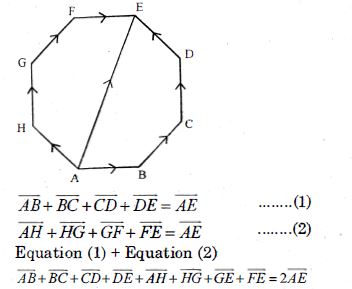
If $ABCDEFGH$ is a convex octagon,then $\vec{AB} + \vec{BC} + \vec{CD} + \vec{DE} + \vec{AH} + \vec{HG} + \vec{GF} + \vec{FE} = $
A
$\vec{AE}$
B
$\vec{O}$
C
$2\vec{AE}$
D
$2\vec{EA}$
Solution
(C) By the triangle law of vector addition,we have:
$\vec{AB} + \vec{BC} + \vec{CD} + \vec{DE} = \vec{AE}$ ........$(1)$
Similarly,for the other path:
$\vec{AH} + \vec{HG} + \vec{GF} + \vec{FE} = \vec{AE}$ ........$(2)$
Adding Equation $(1)$ and Equation $(2)$:
$\vec{AB} + \vec{BC} + \vec{CD} + \vec{DE} + \vec{AH} + \vec{HG} + \vec{GF} + \vec{FE} = \vec{AE} + \vec{AE} = 2\vec{AE}$
$\vec{AB} + \vec{BC} + \vec{CD} + \vec{DE} = \vec{AE}$ ........$(1)$
Similarly,for the other path:
$\vec{AH} + \vec{HG} + \vec{GF} + \vec{FE} = \vec{AE}$ ........$(2)$
Adding Equation $(1)$ and Equation $(2)$:
$\vec{AB} + \vec{BC} + \vec{CD} + \vec{DE} + \vec{AH} + \vec{HG} + \vec{GF} + \vec{FE} = \vec{AE} + \vec{AE} = 2\vec{AE}$
0 likes
View Solution207
AdvancedMCQ
Let $\overrightarrow{a}$ and $\overrightarrow{b}$ be two vectors such that $|\overrightarrow{a}| = 2$ and $|\overrightarrow{b}| = 3$. Then the ratio of the projection of $\overrightarrow{a}$ on $\overrightarrow{b}$ to that of $\overrightarrow{b}$ on $\overrightarrow{a}$ is:
A
$\frac{3}{2}$
B
$18$
C
$6$
D
$\frac{2}{3}$
Solution
(D) The projection of vector $\overrightarrow{a}$ on $\overrightarrow{b}$ is given by $\frac{\overrightarrow{a} \cdot \overrightarrow{b}}{|\overrightarrow{b}|}$.
The projection of vector $\overrightarrow{b}$ on $\overrightarrow{a}$ is given by $\frac{\overrightarrow{b} \cdot \overrightarrow{a}}{|\overrightarrow{a}|}$.
The ratio of the projection of $\overrightarrow{a}$ on $\overrightarrow{b}$ to the projection of $\overrightarrow{b}$ on $\overrightarrow{a}$ is:
$\frac{\frac{\overrightarrow{a} \cdot \overrightarrow{b}}{|\overrightarrow{b}|}}{\frac{\overrightarrow{b} \cdot \overrightarrow{a}}{|\overrightarrow{a}|}} = \frac{\overrightarrow{a} \cdot \overrightarrow{b}}{|\overrightarrow{b}|} \times \frac{|\overrightarrow{a}|}{\overrightarrow{b} \cdot \overrightarrow{a}}$
Since the dot product is commutative,$\overrightarrow{a} \cdot \overrightarrow{b} = \overrightarrow{b} \cdot \overrightarrow{a}$.
Therefore,the ratio simplifies to $\frac{|\overrightarrow{a}|}{|\overrightarrow{b}|} = \frac{2}{3}$.
The projection of vector $\overrightarrow{b}$ on $\overrightarrow{a}$ is given by $\frac{\overrightarrow{b} \cdot \overrightarrow{a}}{|\overrightarrow{a}|}$.
The ratio of the projection of $\overrightarrow{a}$ on $\overrightarrow{b}$ to the projection of $\overrightarrow{b}$ on $\overrightarrow{a}$ is:
$\frac{\frac{\overrightarrow{a} \cdot \overrightarrow{b}}{|\overrightarrow{b}|}}{\frac{\overrightarrow{b} \cdot \overrightarrow{a}}{|\overrightarrow{a}|}} = \frac{\overrightarrow{a} \cdot \overrightarrow{b}}{|\overrightarrow{b}|} \times \frac{|\overrightarrow{a}|}{\overrightarrow{b} \cdot \overrightarrow{a}}$
Since the dot product is commutative,$\overrightarrow{a} \cdot \overrightarrow{b} = \overrightarrow{b} \cdot \overrightarrow{a}$.
Therefore,the ratio simplifies to $\frac{|\overrightarrow{a}|}{|\overrightarrow{b}|} = \frac{2}{3}$.
0 likes
View Solution208
AdvancedMCQ
Let $A, B, C$ be distinct points with position vectors $\hat{i} + \hat{j}$,$\hat{i} - \hat{j}$,and $p\hat{i} - q\hat{j} + r\hat{k}$ respectively. If points $A, B, C$ are collinear,then which of the following can be correct?
A
$p=q=r=1$
B
$p=q=r=0$
C
$p=q=2, r=0$
D
$p=1, q=2, r=0$
Solution
(D) The position vectors of points $A, B, C$ are $\vec{a} = \hat{i} + \hat{j}$,$\vec{b} = \hat{i} - \hat{j}$,and $\vec{c} = p\hat{i} - q\hat{j} + r\hat{k}$.
For points $A, B, C$ to be collinear,the vectors $\overrightarrow{AB}$ and $\overrightarrow{AC}$ must be parallel,i.e.,$\overrightarrow{AC} = \lambda \overrightarrow{AB}$ for some scalar $\lambda$.
Calculate $\overrightarrow{AB} = \vec{b} - \vec{a} = (\hat{i} - \hat{j}) - (\hat{i} + \hat{j}) = -2\hat{j}$.
Calculate $\overrightarrow{AC} = \vec{c} - \vec{a} = (p-1)\hat{i} - (q+1)\hat{j} + r\hat{k}$.
Since $\overrightarrow{AC} = \lambda \overrightarrow{AB}$,we have $(p-1)\hat{i} - (q+1)\hat{j} + r\hat{k} = \lambda(-2\hat{j}) = -2\lambda\hat{j}$.
Comparing the coefficients of $\hat{i}, \hat{j}, \hat{k}$:
$1$) $p-1 = 0 \implies p = 1$.
$2$) $-(q+1) = -2\lambda \implies q+1 = 2\lambda$.
$3$) $r = 0$.
From option $D$,if $p=1, q=2, r=0$,then $2+1 = 2\lambda \implies 3 = 2\lambda \implies \lambda = 1.5$. This is a valid scalar,so the points are collinear. Thus,$p=1, q=2, r=0$ is a correct possibility.
For points $A, B, C$ to be collinear,the vectors $\overrightarrow{AB}$ and $\overrightarrow{AC}$ must be parallel,i.e.,$\overrightarrow{AC} = \lambda \overrightarrow{AB}$ for some scalar $\lambda$.
Calculate $\overrightarrow{AB} = \vec{b} - \vec{a} = (\hat{i} - \hat{j}) - (\hat{i} + \hat{j}) = -2\hat{j}$.
Calculate $\overrightarrow{AC} = \vec{c} - \vec{a} = (p-1)\hat{i} - (q+1)\hat{j} + r\hat{k}$.
Since $\overrightarrow{AC} = \lambda \overrightarrow{AB}$,we have $(p-1)\hat{i} - (q+1)\hat{j} + r\hat{k} = \lambda(-2\hat{j}) = -2\lambda\hat{j}$.
Comparing the coefficients of $\hat{i}, \hat{j}, \hat{k}$:
$1$) $p-1 = 0 \implies p = 1$.
$2$) $-(q+1) = -2\lambda \implies q+1 = 2\lambda$.
$3$) $r = 0$.
From option $D$,if $p=1, q=2, r=0$,then $2+1 = 2\lambda \implies 3 = 2\lambda \implies \lambda = 1.5$. This is a valid scalar,so the points are collinear. Thus,$p=1, q=2, r=0$ is a correct possibility.
0 likes
View Solution209
AdvancedMCQ
Let $p = (x + 4y)\vec{a} + (2x + y + 1)\vec{b}$ and $q = (y - 2x + 2)\vec{a} + (2x - 3y - 1)\vec{b}$,where $\vec{a}$ and $\vec{b}$ are non-collinear vectors. If $3p = 2q$,then the values of $x$ and $y$ are:
A
$x = -1, y = 2$
B
$x = 2, y = -1$
C
$x = 1, y = 2$
D
$x = 2, y = 1$
Solution
(B) Given $p = (x + 4y)\vec{a} + (2x + y + 1)\vec{b}$ and $q = (y - 2x + 2)\vec{a} + (2x - 3y - 1)\vec{b}$.
Since $3p = 2q$,we have:
$3[(x + 4y)\vec{a} + (2x + y + 1)\vec{b}] = 2[(y - 2x + 2)\vec{a} + (2x - 3y - 1)\vec{b}]$
$(3x + 12y)\vec{a} + (6x + 3y + 3)\vec{b} = (2y - 4x + 4)\vec{a} + (4x - 6y - 2)\vec{b}$
Since $\vec{a}$ and $\vec{b}$ are non-collinear,we can equate the coefficients:
$1) 3x + 12y = 2y - 4x + 4 \Rightarrow 7x + 10y = 4$
$2) 6x + 3y + 3 = 4x - 6y - 2 \Rightarrow 2x + 9y = -5$
Multiplying equation $(1)$ by $2$ and equation $(2)$ by $7$:
$14x + 20y = 8$
$14x + 63y = -35$
Subtracting the equations: $(63y - 20y) = -35 - 8 \Rightarrow 43y = -43 \Rightarrow y = -1$
Substituting $y = -1$ into $2x + 9y = -5$:
$2x + 9(-1) = -5 \Rightarrow 2x - 9 = -5 \Rightarrow 2x = 4 \Rightarrow x = 2$
Thus,$x = 2$ and $y = -1$.
Since $3p = 2q$,we have:
$3[(x + 4y)\vec{a} + (2x + y + 1)\vec{b}] = 2[(y - 2x + 2)\vec{a} + (2x - 3y - 1)\vec{b}]$
$(3x + 12y)\vec{a} + (6x + 3y + 3)\vec{b} = (2y - 4x + 4)\vec{a} + (4x - 6y - 2)\vec{b}$
Since $\vec{a}$ and $\vec{b}$ are non-collinear,we can equate the coefficients:
$1) 3x + 12y = 2y - 4x + 4 \Rightarrow 7x + 10y = 4$
$2) 6x + 3y + 3 = 4x - 6y - 2 \Rightarrow 2x + 9y = -5$
Multiplying equation $(1)$ by $2$ and equation $(2)$ by $7$:
$14x + 20y = 8$
$14x + 63y = -35$
Subtracting the equations: $(63y - 20y) = -35 - 8 \Rightarrow 43y = -43 \Rightarrow y = -1$
Substituting $y = -1$ into $2x + 9y = -5$:
$2x + 9(-1) = -5 \Rightarrow 2x - 9 = -5 \Rightarrow 2x = 4 \Rightarrow x = 2$
Thus,$x = 2$ and $y = -1$.
0 likes
View Solution210
MediumMCQ
Let $|\vec{a}| = |\vec{b}| = |\vec{a} - \vec{b}| = 1$,then the angle between $\vec{a}$ and $\vec{b}$ is:
A
$\frac{\pi}{6}$
B
$\frac{\pi}{3}$
C
$\frac{\pi}{4}$
D
$\frac{\pi}{2}$
Solution
(B) Given that $|\vec{a}| = 1$,$|\vec{b}| = 1$,and $|\vec{a} - \vec{b}| = 1$.
We know the identity $|\vec{a} - \vec{b}|^2 = |\vec{a}|^2 + |\vec{b}|^2 - 2(\vec{a} \cdot \vec{b})$.
Since $\vec{a} \cdot \vec{b} = |\vec{a}| |\vec{b}| \cos \theta$,where $\theta$ is the angle between $\vec{a}$ and $\vec{b}$,we have:
$|\vec{a} - \vec{b}|^2 = |\vec{a}|^2 + |\vec{b}|^2 - 2|\vec{a}| |\vec{b}| \cos \theta$.
Substituting the given values:
$1^2 = 1^2 + 1^2 - 2(1)(1) \cos \theta$
$1 = 1 + 1 - 2 \cos \theta$
$1 = 2 - 2 \cos \theta$
$2 \cos \theta = 1$
$\cos \theta = \frac{1}{2}$
Since $\cos \theta = \frac{1}{2}$,the angle $\theta = \frac{\pi}{3}$.
We know the identity $|\vec{a} - \vec{b}|^2 = |\vec{a}|^2 + |\vec{b}|^2 - 2(\vec{a} \cdot \vec{b})$.
Since $\vec{a} \cdot \vec{b} = |\vec{a}| |\vec{b}| \cos \theta$,where $\theta$ is the angle between $\vec{a}$ and $\vec{b}$,we have:
$|\vec{a} - \vec{b}|^2 = |\vec{a}|^2 + |\vec{b}|^2 - 2|\vec{a}| |\vec{b}| \cos \theta$.
Substituting the given values:
$1^2 = 1^2 + 1^2 - 2(1)(1) \cos \theta$
$1 = 1 + 1 - 2 \cos \theta$
$1 = 2 - 2 \cos \theta$
$2 \cos \theta = 1$
$\cos \theta = \frac{1}{2}$
Since $\cos \theta = \frac{1}{2}$,the angle $\theta = \frac{\pi}{3}$.
0 likes
View Solution211
DifficultMCQ
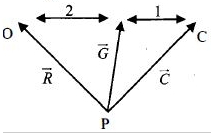
Let $ABC$ be a triangle whose circumcentre is at $P$. If the position vectors of $A, B, C$ and $P$ are $\vec{a}, \vec{b}, \vec{c}$ and $\frac{\vec{a} + \vec{b} + \vec{c}}{4}$ respectively,then the position vector of the orthocentre of this triangle is:
A
$-\left(\frac{\vec{a} + \vec{b} + \vec{c}}{2}\right)$
B
$\vec{a} + \vec{b} + \vec{c}$
C
$\frac{\vec{a} + \vec{b} + \vec{c}}{2}$
D
$\vec{0}$
Solution
(C) Let $\vec{G}$ be the position vector of the centroid of $\triangle ABC$. We know that $\vec{G} = \frac{\vec{a} + \vec{b} + \vec{c}}{3}$.
Let $\vec{H}$ be the position vector of the orthocentre and $\vec{P}$ be the position vector of the circumcentre. We are given $\vec{P} = \frac{\vec{a} + \vec{b} + \vec{c}}{4}$.
In any triangle,the centroid $\vec{G}$ divides the line segment joining the orthocentre $\vec{H}$ and the circumcentre $\vec{P}$ in the ratio $2:1$. That is,$\vec{G} = \frac{2\vec{P} + 1\vec{H}}{2+1} = \frac{2\vec{P} + \vec{H}}{3}$.
Therefore,$3\vec{G} = 2\vec{P} + \vec{H}$,which implies $\vec{H} = 3\vec{G} - 2\vec{P}$.
Substituting the values of $\vec{G}$ and $\vec{P}$:
$\vec{H} = 3\left(\frac{\vec{a} + \vec{b} + \vec{c}}{3}\right) - 2\left(\frac{\vec{a} + \vec{b} + \vec{c}}{4}\right)$
$\vec{H} = (\vec{a} + \vec{b} + \vec{c}) - \frac{\vec{a} + \vec{b} + \vec{c}}{2}$
$\vec{H} = \frac{\vec{a} + \vec{b} + \vec{c}}{2}$.
Let $\vec{H}$ be the position vector of the orthocentre and $\vec{P}$ be the position vector of the circumcentre. We are given $\vec{P} = \frac{\vec{a} + \vec{b} + \vec{c}}{4}$.
In any triangle,the centroid $\vec{G}$ divides the line segment joining the orthocentre $\vec{H}$ and the circumcentre $\vec{P}$ in the ratio $2:1$. That is,$\vec{G} = \frac{2\vec{P} + 1\vec{H}}{2+1} = \frac{2\vec{P} + \vec{H}}{3}$.
Therefore,$3\vec{G} = 2\vec{P} + \vec{H}$,which implies $\vec{H} = 3\vec{G} - 2\vec{P}$.
Substituting the values of $\vec{G}$ and $\vec{P}$:
$\vec{H} = 3\left(\frac{\vec{a} + \vec{b} + \vec{c}}{3}\right) - 2\left(\frac{\vec{a} + \vec{b} + \vec{c}}{4}\right)$
$\vec{H} = (\vec{a} + \vec{b} + \vec{c}) - \frac{\vec{a} + \vec{b} + \vec{c}}{2}$
$\vec{H} = \frac{\vec{a} + \vec{b} + \vec{c}}{2}$.
0 likes
View Solution212
DifficultMCQ
If $|\vec{a}| = 2$,$|\vec{b}| = 3$ and $|2\vec{a} - \vec{b}| = 5$,then $|2\vec{a} + \vec{b}|$ equals
A
$17$
B
$7$
C
$5$
D
$1$
Solution
(C) Given $|2\vec{a} - \vec{b}| = 5$.
Squaring both sides,we get $|2\vec{a} - \vec{b}|^2 = 25$.
Using the property $|\vec{u} - \vec{v}|^2 = |\vec{u}|^2 + |\vec{v}|^2 - 2(\vec{u} \cdot \vec{v})$,we have:
$4|\vec{a}|^2 + |\vec{b}|^2 - 4(\vec{a} \cdot \vec{b}) = 25$.
Substituting $|\vec{a}| = 2$ and $|\vec{b}| = 3$:
$4(2)^2 + (3)^2 - 4(\vec{a} \cdot \vec{b}) = 25$.
$16 + 9 - 4(\vec{a} \cdot \vec{b}) = 25$.
$25 - 4(\vec{a} \cdot \vec{b}) = 25 \implies 4(\vec{a} \cdot \vec{b}) = 0 \implies \vec{a} \cdot \vec{b} = 0$.
Now,we need to find $|2\vec{a} + \vec{b}|$.
$|2\vec{a} + \vec{b}|^2 = 4|\vec{a}|^2 + |\vec{b}|^2 + 4(\vec{a} \cdot \vec{b})$.
Substituting the values:
$|2\vec{a} + \vec{b}|^2 = 4(4) + 9 + 4(0) = 16 + 9 = 25$.
Therefore,$|2\vec{a} + \vec{b}| = \sqrt{25} = 5$.
Squaring both sides,we get $|2\vec{a} - \vec{b}|^2 = 25$.
Using the property $|\vec{u} - \vec{v}|^2 = |\vec{u}|^2 + |\vec{v}|^2 - 2(\vec{u} \cdot \vec{v})$,we have:
$4|\vec{a}|^2 + |\vec{b}|^2 - 4(\vec{a} \cdot \vec{b}) = 25$.
Substituting $|\vec{a}| = 2$ and $|\vec{b}| = 3$:
$4(2)^2 + (3)^2 - 4(\vec{a} \cdot \vec{b}) = 25$.
$16 + 9 - 4(\vec{a} \cdot \vec{b}) = 25$.
$25 - 4(\vec{a} \cdot \vec{b}) = 25 \implies 4(\vec{a} \cdot \vec{b}) = 0 \implies \vec{a} \cdot \vec{b} = 0$.
Now,we need to find $|2\vec{a} + \vec{b}|$.
$|2\vec{a} + \vec{b}|^2 = 4|\vec{a}|^2 + |\vec{b}|^2 + 4(\vec{a} \cdot \vec{b})$.
Substituting the values:
$|2\vec{a} + \vec{b}|^2 = 4(4) + 9 + 4(0) = 16 + 9 = 25$.
Therefore,$|2\vec{a} + \vec{b}| = \sqrt{25} = 5$.
0 likes
View Solution213
DifficultMCQ
If $|\vec{c}|^2 = 60$ and $\vec{c} \times (\hat{i} + 2\hat{j} + 5\hat{k}) = \vec{0}$,then a value of $\vec{c} \cdot (-7\hat{i} + 2\hat{j} + 3\hat{k})$ is
A
$4\sqrt{2}$
B
$12$
C
$24$
D
$12\sqrt{2}$
Solution
(D) Let $\vec{c} = a\hat{i} + b\hat{j} + c\hat{k}$.
Given $\vec{c} \times (\hat{i} + 2\hat{j} + 5\hat{k}) = \vec{0}$,this implies that $\vec{c}$ is parallel to the vector $\vec{v} = \hat{i} + 2\hat{j} + 5\hat{k}$.
Thus,$\vec{c} = k(\hat{i} + 2\hat{j} + 5\hat{k})$ for some scalar $k$.
Given $|\vec{c}|^2 = 60$,we have $k^2(1^2 + 2^2 + 5^2) = 60$.
$k^2(1 + 4 + 25) = 60 \Rightarrow 30k^2 = 60 \Rightarrow k^2 = 2 \Rightarrow k = \pm\sqrt{2}$.
Taking $k = \sqrt{2}$,we get $\vec{c} = \sqrt{2}\hat{i} + 2\sqrt{2}\hat{j} + 5\sqrt{2}\hat{k}$.
Now,calculate the dot product $\vec{c} \cdot (-7\hat{i} + 2\hat{j} + 3\hat{k})$:
$= (\sqrt{2}\hat{i} + 2\sqrt{2}\hat{j} + 5\sqrt{2}\hat{k}) \cdot (-7\hat{i} + 2\hat{j} + 3\hat{k})$
$= \sqrt{2}(-7) + 2\sqrt{2}(2) + 5\sqrt{2}(3)$
$= -7\sqrt{2} + 4\sqrt{2} + 15\sqrt{2} = 12\sqrt{2}$.
Given $\vec{c} \times (\hat{i} + 2\hat{j} + 5\hat{k}) = \vec{0}$,this implies that $\vec{c}$ is parallel to the vector $\vec{v} = \hat{i} + 2\hat{j} + 5\hat{k}$.
Thus,$\vec{c} = k(\hat{i} + 2\hat{j} + 5\hat{k})$ for some scalar $k$.
Given $|\vec{c}|^2 = 60$,we have $k^2(1^2 + 2^2 + 5^2) = 60$.
$k^2(1 + 4 + 25) = 60 \Rightarrow 30k^2 = 60 \Rightarrow k^2 = 2 \Rightarrow k = \pm\sqrt{2}$.
Taking $k = \sqrt{2}$,we get $\vec{c} = \sqrt{2}\hat{i} + 2\sqrt{2}\hat{j} + 5\sqrt{2}\hat{k}$.
Now,calculate the dot product $\vec{c} \cdot (-7\hat{i} + 2\hat{j} + 3\hat{k})$:
$= (\sqrt{2}\hat{i} + 2\sqrt{2}\hat{j} + 5\sqrt{2}\hat{k}) \cdot (-7\hat{i} + 2\hat{j} + 3\hat{k})$
$= \sqrt{2}(-7) + 2\sqrt{2}(2) + 5\sqrt{2}(3)$
$= -7\sqrt{2} + 4\sqrt{2} + 15\sqrt{2} = 12\sqrt{2}$.
0 likes
View Solution214
DifficultMCQ
If $\hat{x}, \hat{y},$ and $\hat{z}$ are three unit vectors in three-dimensional space,then find the minimum value of $|\hat{x} + \hat{y}|^2 + |\hat{y} + \hat{z}|^2 + |\hat{z} + \hat{x}|^2$.
A
$\frac{3}{2}$
B
$3$
C
$3\sqrt{3}$
D
$6$
Solution
(B) Given that $\hat{x}, \hat{y}, \hat{z}$ are unit vectors,so $|\hat{x}| = |\hat{y}| = |\hat{z}| = 1$.
We know that for any vectors,$|\hat{x} + \hat{y} + \hat{z}|^2 \geq 0$.
Expanding this,we get $|\hat{x}|^2 + |\hat{y}|^2 + |\hat{z}|^2 + 2(\hat{x} \cdot \hat{y} + \hat{y} \cdot \hat{z} + \hat{z} \cdot \hat{x}) \geq 0$.
Substituting the magnitudes,$1 + 1 + 1 + 2(\hat{x} \cdot \hat{y} + \hat{y} \cdot \hat{z} + \hat{z} \cdot \hat{x}) \geq 0$,which implies $3 + 2(\hat{x} \cdot \hat{y} + \hat{y} \cdot \hat{z} + \hat{z} \cdot \hat{x}) \geq 0$.
Thus,$2(\hat{x} \cdot \hat{y} + \hat{y} \cdot \hat{z} + \hat{z} \cdot \hat{x}) \geq -3$.
Now,consider the expression $S = |\hat{x} + \hat{y}|^2 + |\hat{y} + \hat{z}|^2 + |\hat{z} + \hat{x}|^2$.
$S = (\hat{x} \cdot \hat{x} + \hat{y} \cdot \hat{y} + 2\hat{x} \cdot \hat{y}) + (\hat{y} \cdot \hat{y} + \hat{z} \cdot \hat{z} + 2\hat{y} \cdot \hat{z}) + (\hat{z} \cdot \hat{z} + \hat{x} \cdot \hat{x} + 2\hat{z} \cdot \hat{x})$.
$S = 2(|\hat{x}|^2 + |\hat{y}|^2 + |\hat{z}|^2) + 2(\hat{x} \cdot \hat{y} + \hat{y} \cdot \hat{z} + \hat{z} \cdot \hat{x})$.
$S = 2(1 + 1 + 1) + 2(\hat{x} \cdot \hat{y} + \hat{y} \cdot \hat{z} + \hat{z} \cdot \hat{x}) = 6 + 2(\hat{x} \cdot \hat{y} + \hat{y} \cdot \hat{z} + \hat{z} \cdot \hat{x})$.
Since $2(\hat{x} \cdot \hat{y} + \hat{y} \cdot \hat{z} + \hat{z} \cdot \hat{x}) \geq -3$,the minimum value of $S$ is $6 - 3 = 3$.
We know that for any vectors,$|\hat{x} + \hat{y} + \hat{z}|^2 \geq 0$.
Expanding this,we get $|\hat{x}|^2 + |\hat{y}|^2 + |\hat{z}|^2 + 2(\hat{x} \cdot \hat{y} + \hat{y} \cdot \hat{z} + \hat{z} \cdot \hat{x}) \geq 0$.
Substituting the magnitudes,$1 + 1 + 1 + 2(\hat{x} \cdot \hat{y} + \hat{y} \cdot \hat{z} + \hat{z} \cdot \hat{x}) \geq 0$,which implies $3 + 2(\hat{x} \cdot \hat{y} + \hat{y} \cdot \hat{z} + \hat{z} \cdot \hat{x}) \geq 0$.
Thus,$2(\hat{x} \cdot \hat{y} + \hat{y} \cdot \hat{z} + \hat{z} \cdot \hat{x}) \geq -3$.
Now,consider the expression $S = |\hat{x} + \hat{y}|^2 + |\hat{y} + \hat{z}|^2 + |\hat{z} + \hat{x}|^2$.
$S = (\hat{x} \cdot \hat{x} + \hat{y} \cdot \hat{y} + 2\hat{x} \cdot \hat{y}) + (\hat{y} \cdot \hat{y} + \hat{z} \cdot \hat{z} + 2\hat{y} \cdot \hat{z}) + (\hat{z} \cdot \hat{z} + \hat{x} \cdot \hat{x} + 2\hat{z} \cdot \hat{x})$.
$S = 2(|\hat{x}|^2 + |\hat{y}|^2 + |\hat{z}|^2) + 2(\hat{x} \cdot \hat{y} + \hat{y} \cdot \hat{z} + \hat{z} \cdot \hat{x})$.
$S = 2(1 + 1 + 1) + 2(\hat{x} \cdot \hat{y} + \hat{y} \cdot \hat{z} + \hat{z} \cdot \hat{x}) = 6 + 2(\hat{x} \cdot \hat{y} + \hat{y} \cdot \hat{z} + \hat{z} \cdot \hat{x})$.
Since $2(\hat{x} \cdot \hat{y} + \hat{y} \cdot \hat{z} + \hat{z} \cdot \hat{x}) \geq -3$,the minimum value of $S$ is $6 - 3 = 3$.
0 likes
View Solution215
DifficultMCQ
If $\vec{a}$ and $\vec{b}$ are non-collinear vectors,then the value of $\alpha$ for which the vectors $\vec{u} = (\alpha - 2)\vec{a} + \vec{b}$ and $\vec{v} = (2 + 3\alpha)\vec{a} - 3\vec{b}$ are collinear is:
A
$\frac{3}{2}$
B
$\frac{2}{3}$
C
$-\frac{3}{2}$
D
$-\frac{2}{3}$
Solution
(B) Two vectors $\vec{u}$ and $\vec{v}$ are collinear if there exists a non-zero scalar $k$ such that $\vec{u} = k\vec{v}$.
Given $\vec{u} = (\alpha - 2)\vec{a} + \vec{b}$ and $\vec{v} = (2 + 3\alpha)\vec{a} - 3\vec{b}$.
Since $\vec{u}$ and $\vec{v}$ are collinear,we have $(\alpha - 2)\vec{a} + \vec{b} = k((2 + 3\alpha)\vec{a} - 3\vec{b})$.
Rearranging the terms,we get $(\alpha - 2 - k(2 + 3\alpha))\vec{a} + (1 + 3k)\vec{b} = 0$.
Since $\vec{a}$ and $\vec{b}$ are non-collinear,their coefficients must be zero.
Thus,$1 + 3k = 0 \Rightarrow k = -\frac{1}{3}$.
Substituting $k = -\frac{1}{3}$ into the coefficient of $\vec{a}$:
$\alpha - 2 - (-\frac{1}{3})(2 + 3\alpha) = 0$.
$\alpha - 2 + \frac{2}{3} + \alpha = 0$.
$2\alpha = 2 - \frac{2}{3} = \frac{4}{3}$.
$\alpha = \frac{2}{3}$.
Given $\vec{u} = (\alpha - 2)\vec{a} + \vec{b}$ and $\vec{v} = (2 + 3\alpha)\vec{a} - 3\vec{b}$.
Since $\vec{u}$ and $\vec{v}$ are collinear,we have $(\alpha - 2)\vec{a} + \vec{b} = k((2 + 3\alpha)\vec{a} - 3\vec{b})$.
Rearranging the terms,we get $(\alpha - 2 - k(2 + 3\alpha))\vec{a} + (1 + 3k)\vec{b} = 0$.
Since $\vec{a}$ and $\vec{b}$ are non-collinear,their coefficients must be zero.
Thus,$1 + 3k = 0 \Rightarrow k = -\frac{1}{3}$.
Substituting $k = -\frac{1}{3}$ into the coefficient of $\vec{a}$:
$\alpha - 2 - (-\frac{1}{3})(2 + 3\alpha) = 0$.
$\alpha - 2 + \frac{2}{3} + \alpha = 0$.
$2\alpha = 2 - \frac{2}{3} = \frac{4}{3}$.
$\alpha = \frac{2}{3}$.
0 likes
View Solution216
MediumMCQ
Let $\vec{\alpha} = (\lambda - 2) \vec{a} + \vec{b}$ and $\vec{\beta} = (4\lambda - 2)\vec{a} + 3\vec{b}$ be two given vectors where $\vec{a}$ and $\vec{b}$ are non-collinear. The value of $\lambda$ for which vectors $\vec{\alpha}$ and $\vec{\beta}$ are collinear is:
A
$-4$
B
$-3$
C
$4$
D
$3$
Solution
(A) Given vectors are $\vec{\alpha} = (\lambda - 2)\vec{a} + \vec{b}$ and $\vec{\beta} = (4\lambda - 2)\vec{a} + 3\vec{b}$.
Since $\vec{a}$ and $\vec{b}$ are non-collinear,$\vec{\alpha}$ and $\vec{\beta}$ are collinear if and only if the ratio of the coefficients of $\vec{a}$ and $\vec{b}$ are equal.
This implies $\frac{\lambda - 2}{4\lambda - 2} = \frac{1}{3}$.
Cross-multiplying,we get $3(\lambda - 2) = 1(4\lambda - 2)$.
$3\lambda - 6 = 4\lambda - 2$.
Rearranging the terms,$3\lambda - 4\lambda = -2 + 6$.
$-\lambda = 4$.
Therefore,$\lambda = -4$.
Since $\vec{a}$ and $\vec{b}$ are non-collinear,$\vec{\alpha}$ and $\vec{\beta}$ are collinear if and only if the ratio of the coefficients of $\vec{a}$ and $\vec{b}$ are equal.
This implies $\frac{\lambda - 2}{4\lambda - 2} = \frac{1}{3}$.
Cross-multiplying,we get $3(\lambda - 2) = 1(4\lambda - 2)$.
$3\lambda - 6 = 4\lambda - 2$.
Rearranging the terms,$3\lambda - 4\lambda = -2 + 6$.
$-\lambda = 4$.
Therefore,$\lambda = -4$.
0 likes
View Solution217
Easy
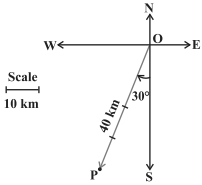
Represent graphically a displacement of $40 \, km,$ $30^\circ$ west of south.
Solution
(N/A) To represent the displacement of $40 \, km,$ $30^\circ$ west of south graphically:
$1$. Draw a coordinate system with North $(N)$,South $(S)$,East $(E)$,and West $(W)$ directions.
$2$. Choose a suitable scale,for example,$1 \, cm = 10 \, km$. Thus,$40 \, km$ corresponds to a length of $4 \, cm$.
$3$. Start from the origin $O$ and draw a line segment $OP$ of length $4 \, cm$ in the direction $30^\circ$ west of south (i.e.,starting from the South axis and moving $30^\circ$ towards the West).
$4$. The vector $\vec{OP}$ represents the required displacement of $40 \, km,$ $30^\circ$ west of south.
$1$. Draw a coordinate system with North $(N)$,South $(S)$,East $(E)$,and West $(W)$ directions.
$2$. Choose a suitable scale,for example,$1 \, cm = 10 \, km$. Thus,$40 \, km$ corresponds to a length of $4 \, cm$.
$3$. Start from the origin $O$ and draw a line segment $OP$ of length $4 \, cm$ in the direction $30^\circ$ west of south (i.e.,starting from the South axis and moving $30^\circ$ towards the West).
$4$. The vector $\vec{OP}$ represents the required displacement of $40 \, km,$ $30^\circ$ west of south.
0 likes
View Solution218
EasyMCQ
Classify the following measure as a scalar or a vector:
$5 \text{ seconds}$
$5 \text{ seconds}$
A
Scalar
B
Vector
C
Both
D
Neither
Solution
(A) scalar quantity is defined as a physical quantity that has only magnitude and no direction.
Time is a physical quantity that is measured in seconds. It does not have a specific direction associated with it.
Therefore,$5 \text{ seconds}$ is a scalar quantity.
Time is a physical quantity that is measured in seconds. It does not have a specific direction associated with it.
Therefore,$5 \text{ seconds}$ is a scalar quantity.
0 likes
View Solution219
EasyMCQ
Classify the following measure as a scalar or a vector:
$1000 \, cm^{3}$
$1000 \, cm^{3}$
A
Scalar
B
Vector
C
Both
D
None of these
Solution
(A) The given measure is $1000 \, cm^{3}$,which represents volume.
Volume is a physical quantity that has only magnitude and no direction.
Therefore,volume is a scalar quantity.
Volume is a physical quantity that has only magnitude and no direction.
Therefore,volume is a scalar quantity.
0 likes
View Solution220
EasyMCQ
Classify the following measure as a scalar or a vector:
$10 \text{ Newton}$
$10 \text{ Newton}$
A
Scalar
B
Vector
C
Both
D
Neither
Solution
(B) The measure $10 \text{ Newton}$ represents force.
Force is a physical quantity that has both magnitude and direction.
Therefore,force is a vector quantity.
Force is a physical quantity that has both magnitude and direction.
Therefore,force is a vector quantity.
0 likes
View Solution221
EasyMCQ
Classify the following measure as a scalar or a vector:
$30 \, km/hr$
$30 \, km/hr$
A
Scalar
B
Vector
C
Both
D
None
Solution
(A) scalar quantity is defined as a physical quantity that has only magnitude and no direction.
$A$ vector quantity is defined as a physical quantity that has both magnitude and direction.
The given measure is $30 \, km/hr$,which represents speed.
Speed is the magnitude of velocity and does not have a specified direction.
Therefore,$30 \, km/hr$ is a scalar quantity.
$A$ vector quantity is defined as a physical quantity that has both magnitude and direction.
The given measure is $30 \, km/hr$,which represents speed.
Speed is the magnitude of velocity and does not have a specified direction.
Therefore,$30 \, km/hr$ is a scalar quantity.
0 likes
View Solution222
EasyMCQ
Classify the following physical quantity as a scalar or a vector:
$10 \, g/cm^3$
$10 \, g/cm^3$
A
Scalar
B
Vector
C
Both
D
None
Solution
(A) Density is defined as mass per unit volume. Since mass and volume are both scalar quantities,their ratio,density,is also a scalar quantity. It has magnitude but no specific direction associated with it. Therefore,$10 \, g/cm^3$ is a scalar quantity.
0 likes
View Solution223
EasyMCQ
Classify the following measure as a scalar or a vector:
$20 \text{ m/s}$ towards north
$20 \text{ m/s}$ towards north
A
Scalar
B
Vector
C
Both
D
Neither
Solution
(B) scalar quantity is defined only by its magnitude,whereas a vector quantity is defined by both magnitude and direction.
The given measure is $20 \text{ m/s}$ towards north.
Since it has both magnitude $(20 \text{ m/s})$ and direction (towards north),it is a vector quantity.
Therefore,the measure is a vector.
The given measure is $20 \text{ m/s}$ towards north.
Since it has both magnitude $(20 \text{ m/s})$ and direction (towards north),it is a vector quantity.
Therefore,the measure is a vector.
0 likes
View Solution224
Easy
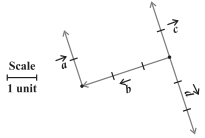
In the given figure,which of the vectors are collinear?
Solution
(N/A) Two or more vectors are said to be collinear if they are parallel to the same line,irrespective of their magnitudes and directions.
Looking at the figure,the vectors $\vec{c}$ and $\vec{d}$ lie along the same line (or are parallel to the same line).
Therefore,the collinear vectors are $\vec{c}$ and $\vec{d}$.
Looking at the figure,the vectors $\vec{c}$ and $\vec{d}$ lie along the same line (or are parallel to the same line).
Therefore,the collinear vectors are $\vec{c}$ and $\vec{d}$.
0 likes
View Solution225
Easy
In the given figure,which of the vectors are equal?
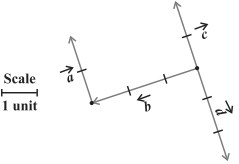
Solution
(N/A) Two vectors are said to be equal if they have the same magnitude and the same direction.
$1$. Vector $\vec{a}$ has a magnitude of $1 \text{ unit}$ and points in a specific direction.
$2$. Vector $\vec{b}$ has a magnitude of $2 \text{ units}$ and points in a different direction.
$3$. Vector $\vec{c}$ has a magnitude of $1 \text{ unit}$ and points in the same direction as $\vec{a}$.
$4$. Vector $\vec{d}$ has a magnitude of $2 \text{ units}$ and points in the opposite direction to $\vec{b}$.
Comparing these,vectors $\vec{a}$ and $\vec{c}$ have the same magnitude $(1 \text{ unit})$ and the same direction.
Therefore,the equal vectors are $\vec{a}$ and $\vec{c}$.
$1$. Vector $\vec{a}$ has a magnitude of $1 \text{ unit}$ and points in a specific direction.
$2$. Vector $\vec{b}$ has a magnitude of $2 \text{ units}$ and points in a different direction.
$3$. Vector $\vec{c}$ has a magnitude of $1 \text{ unit}$ and points in the same direction as $\vec{a}$.
$4$. Vector $\vec{d}$ has a magnitude of $2 \text{ units}$ and points in the opposite direction to $\vec{b}$.
Comparing these,vectors $\vec{a}$ and $\vec{c}$ have the same magnitude $(1 \text{ unit})$ and the same direction.
Therefore,the equal vectors are $\vec{a}$ and $\vec{c}$.
0 likes
View Solution226
Easy
In the given figure,identify which of the vectors are coinitial.
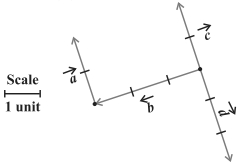
Solution
(N/A) Coinitial vectors are those vectors which have the same initial point.
Looking at the figure,we observe that vectors $\vec{b}$,$\vec{c}$,and $\vec{d}$ all originate from the same point.
Therefore,the coinitial vectors are $\vec{b}$,$\vec{c}$,and $\vec{d}$.
Looking at the figure,we observe that vectors $\vec{b}$,$\vec{c}$,and $\vec{d}$ all originate from the same point.
Therefore,the coinitial vectors are $\vec{b}$,$\vec{c}$,and $\vec{d}$.
0 likes
View Solution227
Easy
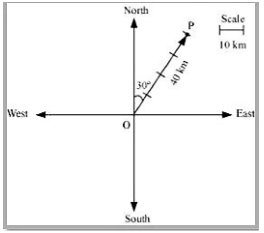
Represent graphically a displacement of $40 \, km$,$30^{\circ}$ east of north.
Solution
(N/A) To represent the displacement of $40 \, km$,$30^{\circ}$ east of north graphically:
$1$. Draw a coordinate system with the North,South,East,and West directions.
$2$. Let the origin $O$ represent the starting point.
$3$. Draw a ray $OP$ starting from $O$ such that it makes an angle of $30^{\circ}$ with the North direction towards the East.
$4$. Using a scale of $1 \, cm = 10 \, km$,mark the length of the vector $OP$ as $4 \, cm$ to represent $40 \, km$.
$5$. The vector $\overrightarrow{OP}$ represents the required displacement.
$1$. Draw a coordinate system with the North,South,East,and West directions.
$2$. Let the origin $O$ represent the starting point.
$3$. Draw a ray $OP$ starting from $O$ such that it makes an angle of $30^{\circ}$ with the North direction towards the East.
$4$. Using a scale of $1 \, cm = 10 \, km$,mark the length of the vector $OP$ as $4 \, cm$ to represent $40 \, km$.
$5$. The vector $\overrightarrow{OP}$ represents the required displacement.
0 likes
View Solution228
EasyMCQ
Classify the following measure as a scalar or a vector:
$10 \text{ kg}$
$10 \text{ kg}$
A
Scalar
B
Vector
C
Both
D
None of these
Solution
(A) scalar quantity is defined as a physical quantity that has only magnitude and no direction.
$10 \text{ kg}$ represents mass,which is a measure of the amount of matter in an object.
Since mass has only magnitude and does not require a direction to be specified,it is a scalar quantity.
Therefore,$10 \text{ kg}$ is a scalar.
$10 \text{ kg}$ represents mass,which is a measure of the amount of matter in an object.
Since mass has only magnitude and does not require a direction to be specified,it is a scalar quantity.
Therefore,$10 \text{ kg}$ is a scalar.
0 likes
View Solution229
EasyMCQ
Classify the following measure as a scalar or a vector:
$2 \text{ meters north-west}$
$2 \text{ meters north-west}$
A
Scalar
B
Vector
C
Both
D
Neither
Solution
(B) scalar quantity is defined only by its magnitude,whereas a vector quantity is defined by both magnitude and direction.
In the given measure,$2 \text{ meters}$ represents the magnitude and $\text{north-west}$ represents the direction.
Since the measure involves both magnitude and direction,it is a vector quantity.
In the given measure,$2 \text{ meters}$ represents the magnitude and $\text{north-west}$ represents the direction.
Since the measure involves both magnitude and direction,it is a vector quantity.
0 likes
View Solution230
EasyMCQ
Classify the following measure as a scalar or a vector:
$40^{o}$
$40^{o}$
A
Scalar
B
Vector
C
Both
D
None
Solution
(A) scalar quantity is defined as a physical quantity that has only magnitude and no direction.
$A$ vector quantity is defined as a physical quantity that has both magnitude and direction.
The measure $40^{o}$ represents an angle,which has only magnitude and no specific direction associated with it.
Therefore,$40^{o}$ is a scalar quantity.
$A$ vector quantity is defined as a physical quantity that has both magnitude and direction.
The measure $40^{o}$ represents an angle,which has only magnitude and no specific direction associated with it.
Therefore,$40^{o}$ is a scalar quantity.
0 likes
View Solution231
EasyMCQ
Classify the following measure as a scalar or a vector: $40$ $watt$.
A
Scalar
B
Vector
C
Both
D
None
Solution
(A) $40$ $watt$ is a scalar quantity because it has only magnitude and no direction associated with it.
0 likes
View Solution232
EasyMCQ
Classify the following measure as a scalar or a vector:
$10^{-19} \text{ Coulomb}$
$10^{-19} \text{ Coulomb}$
A
Scalar
B
Vector
C
Both
D
None of these
Solution
(A) scalar quantity is defined as a physical quantity that has only magnitude and no direction.
Electric charge,measured in $Coulomb$,is a scalar quantity because it does not have a specific direction associated with it.
Therefore,$10^{-19} \text{ Coulomb}$ is a scalar quantity.
Electric charge,measured in $Coulomb$,is a scalar quantity because it does not have a specific direction associated with it.
Therefore,$10^{-19} \text{ Coulomb}$ is a scalar quantity.
0 likes
View Solution233
MediumMCQ
Classify the following measure as a scalar or a vector: $20 \, m/s^{2}$.
A
Scalar
B
Vector
C
Both
D
None
Solution
(B) $20 \, m/s^{2}$ represents acceleration.
Acceleration is a vector quantity because it possesses both magnitude and direction.
Acceleration is a vector quantity because it possesses both magnitude and direction.
0 likes
View Solution234
EasyMCQ
Classify the following as scalar or vector quantities:
Time period
Time period
A
Scalar quantity
B
Vector quantity
C
Both scalar and vector
D
Neither scalar nor vector
Solution
(A) scalar quantity is defined as a physical quantity that has only magnitude and no direction.
$A$ vector quantity is defined as a physical quantity that has both magnitude and direction.
Time period represents the duration of an event,which is described solely by its magnitude (e.g.,$5 \text{ seconds}$).
Since it does not possess any specific direction,time period is a scalar quantity.
$A$ vector quantity is defined as a physical quantity that has both magnitude and direction.
Time period represents the duration of an event,which is described solely by its magnitude (e.g.,$5 \text{ seconds}$).
Since it does not possess any specific direction,time period is a scalar quantity.
0 likes
View Solution235
EasyMCQ
Classify the following as scalar or vector quantity:
distance
distance
A
Scalar
B
Vector
C
Both
D
Neither
Solution
(A) scalar quantity is defined as a physical quantity that has only magnitude and no direction.
Distance represents the total path length covered by an object between two points.
Since distance does not have a specific direction associated with it,it is classified as a scalar quantity.
Distance represents the total path length covered by an object between two points.
Since distance does not have a specific direction associated with it,it is classified as a scalar quantity.
0 likes
View Solution236
EasyMCQ
Classify the following as scalar and vector quantities:
Force
Force
A
Scalar
B
Vector
C
Both
D
None
Solution
(B) scalar quantity is defined only by its magnitude,whereas a vector quantity is defined by both its magnitude and direction.
Force is a physical quantity that requires both magnitude (strength of the push or pull) and a specific direction to be fully described.
Therefore,force is a vector quantity.
Force is a physical quantity that requires both magnitude (strength of the push or pull) and a specific direction to be fully described.
Therefore,force is a vector quantity.
0 likes
View Solution237
EasyMCQ
Classify the following as scalar or vector quantities:
Velocity
Velocity
A
Scalar
B
Vector
C
Both
D
None
Solution
(B) scalar quantity is defined only by its magnitude,whereas a vector quantity is defined by both its magnitude and direction.
Velocity is defined as the rate of change of displacement,which inherently includes direction.
Therefore,velocity is a vector quantity.
Velocity is defined as the rate of change of displacement,which inherently includes direction.
Therefore,velocity is a vector quantity.
0 likes
View Solution238
Medium
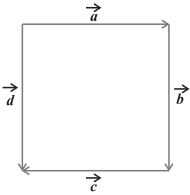
In the given figure (a square),identify the co-initial vectors.
Solution
(N/A) Co-initial vectors are vectors that originate from the same initial point.
Looking at the square,vectors $\vec{a}$ and $\vec{d}$ originate from the top-left corner of the square.
Therefore,$\vec{a}$ and $\vec{d}$ are co-initial vectors.
Looking at the square,vectors $\vec{a}$ and $\vec{d}$ originate from the top-left corner of the square.
Therefore,$\vec{a}$ and $\vec{d}$ are co-initial vectors.
0 likes
View Solution239
Medium
In the given figure (a square),identify the following vectors:
Equal vectors.
Equal vectors.
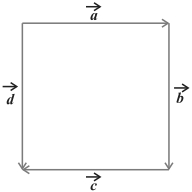
Solution
(N/A) Two vectors are said to be equal if they have the same magnitude and the same direction.
In the given square,vectors $\overrightarrow{a}$ and $\overrightarrow{c}$ have the same magnitude (side length of the square) but opposite directions.
Vectors $\overrightarrow{d}$ and $\overrightarrow{b}$ have the same magnitude (side length of the square) but opposite directions.
Looking at the directions of the vectors:
- $\overrightarrow{a}$ points to the right.
- $\overrightarrow{c}$ points to the left.
- $\overrightarrow{d}$ points downwards.
- $\overrightarrow{b}$ points downwards.
Therefore,vectors $\overrightarrow{d}$ and $\overrightarrow{b}$ are equal because they have the same magnitude and the same direction.
In the given square,vectors $\overrightarrow{a}$ and $\overrightarrow{c}$ have the same magnitude (side length of the square) but opposite directions.
Vectors $\overrightarrow{d}$ and $\overrightarrow{b}$ have the same magnitude (side length of the square) but opposite directions.
Looking at the directions of the vectors:
- $\overrightarrow{a}$ points to the right.
- $\overrightarrow{c}$ points to the left.
- $\overrightarrow{d}$ points downwards.
- $\overrightarrow{b}$ points downwards.
Therefore,vectors $\overrightarrow{d}$ and $\overrightarrow{b}$ are equal because they have the same magnitude and the same direction.
0 likes
View Solution240
Medium
In the given figure (a square),identify the following vectors:
Collinear but not equal
Collinear but not equal
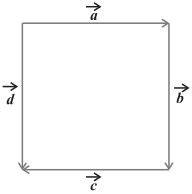
Solution
(N/A) Two vectors are said to be collinear if they are parallel to the same line,irrespective of their magnitudes and directions.
In the given square,vectors $\vec{a}$ and $\vec{c}$ are parallel to each other but have opposite directions. Therefore,they are collinear.
However,they are not equal because equal vectors must have the same magnitude and the same direction.
Thus,the vectors that are collinear but not equal are $\vec{a}$ and $\vec{c}$.
In the given square,vectors $\vec{a}$ and $\vec{c}$ are parallel to each other but have opposite directions. Therefore,they are collinear.
However,they are not equal because equal vectors must have the same magnitude and the same direction.
Thus,the vectors that are collinear but not equal are $\vec{a}$ and $\vec{c}$.
0 likes
View Solution241
MediumMCQ
Answer the following as true or false.
$\vec{a}$ and $-\vec{a}$ are collinear.
$\vec{a}$ and $-\vec{a}$ are collinear.
A
True
B
False
Solution
(A) True
Two vectors are said to be collinear if they are parallel to the same line,irrespective of their magnitudes and directions.
Since $-\vec{a}$ is a scalar multiple of $\vec{a}$ (specifically,$-\vec{a} = -1 \times \vec{a}$),the vectors $\vec{a}$ and $-\vec{a}$ are parallel to each other.
Therefore,$\vec{a}$ and $-\vec{a}$ are collinear.
Two vectors are said to be collinear if they are parallel to the same line,irrespective of their magnitudes and directions.
Since $-\vec{a}$ is a scalar multiple of $\vec{a}$ (specifically,$-\vec{a} = -1 \times \vec{a}$),the vectors $\vec{a}$ and $-\vec{a}$ are parallel to each other.
Therefore,$\vec{a}$ and $-\vec{a}$ are collinear.
0 likes
View Solution242
MediumMCQ
Answer the following as true or false.
Two collinear vectors are always equal in magnitude.
Two collinear vectors are always equal in magnitude.
A
True
B
False
Solution
(B) The statement is $False$.
Collinear vectors are defined as vectors that are parallel to the same line,irrespective of their magnitudes.
For example,if $\vec{a} = 2\hat{i}$ and $\vec{b} = 3\hat{i}$,both are collinear because they are parallel to the $x$-axis,but their magnitudes are $|\vec{a}| = 2$ and $|\vec{b}| = 3$,which are not equal.
Collinear vectors are defined as vectors that are parallel to the same line,irrespective of their magnitudes.
For example,if $\vec{a} = 2\hat{i}$ and $\vec{b} = 3\hat{i}$,both are collinear because they are parallel to the $x$-axis,but their magnitudes are $|\vec{a}| = 2$ and $|\vec{b}| = 3$,which are not equal.
0 likes
View Solution243
MediumMCQ
State whether the following statement is true or false:
Two vectors having the same magnitude are collinear.
Two vectors having the same magnitude are collinear.
A
True
B
False
Solution
(B) The statement is False.
Two vectors are said to be collinear if they are parallel to the same line,irrespective of their magnitudes.
Having the same magnitude does not imply that the vectors are parallel.
For example,consider vector $\vec{a} = \hat{i}$ and vector $\vec{b} = \hat{j}$.
Both vectors have a magnitude of $1$,but they are not collinear because they are not parallel to the same line.
Two vectors are said to be collinear if they are parallel to the same line,irrespective of their magnitudes.
Having the same magnitude does not imply that the vectors are parallel.
For example,consider vector $\vec{a} = \hat{i}$ and vector $\vec{b} = \hat{j}$.
Both vectors have a magnitude of $1$,but they are not collinear because they are not parallel to the same line.
0 likes
View Solution244
MediumMCQ
Answer the following as true or false.
Two collinear vectors having the same magnitude are equal.
Two collinear vectors having the same magnitude are equal.
A
True
B
False
Solution
(B) The statement is False.
Two vectors are said to be equal if they have the same magnitude and the same direction.
Collinear vectors are vectors that are parallel to the same line,irrespective of their magnitudes and directions.
Even if two collinear vectors have the same magnitude,they may have opposite directions (e.g.,$\vec{a}$ and $-\vec{a}$),which makes them unequal.
Two vectors are said to be equal if they have the same magnitude and the same direction.
Collinear vectors are vectors that are parallel to the same line,irrespective of their magnitudes and directions.
Even if two collinear vectors have the same magnitude,they may have opposite directions (e.g.,$\vec{a}$ and $-\vec{a}$),which makes them unequal.
0 likes
View Solution245
EasyMCQ
Find the values of $x, y$ and $z$ so that the vectors $\vec{a} = x \hat{i} + 2 \hat{j} + z \hat{k}$ and $\vec{b} = 2 \hat{i} + y \hat{j} + \hat{k}$ are equal.
A
$x = 2, y = 2, z = 1$
B
$x = 1, y = 2, z = 2$
C
$x = 2, y = 1, z = 2$
D
$x = 1, y = 1, z = 2$
Solution
(A) Two vectors $\vec{a} = a_1 \hat{i} + a_2 \hat{j} + a_3 \hat{k}$ and $\vec{b} = b_1 \hat{i} + b_2 \hat{j} + b_3 \hat{k}$ are equal if and only if their corresponding components are equal,i.e.,$a_1 = b_1, a_2 = b_2$ and $a_3 = b_3$.
Given vectors are $\vec{a} = x \hat{i} + 2 \hat{j} + z \hat{k}$ and $\vec{b} = 2 \hat{i} + y \hat{j} + \hat{k}$.
Comparing the components of $\vec{a}$ and $\vec{b}$:
For the $\hat{i}$ component: $x = 2$.
For the $\hat{j}$ component: $2 = y$,which means $y = 2$.
For the $\hat{k}$ component: $z = 1$.
Therefore,the values are $x = 2, y = 2, z = 1$.
Given vectors are $\vec{a} = x \hat{i} + 2 \hat{j} + z \hat{k}$ and $\vec{b} = 2 \hat{i} + y \hat{j} + \hat{k}$.
Comparing the components of $\vec{a}$ and $\vec{b}$:
For the $\hat{i}$ component: $x = 2$.
For the $\hat{j}$ component: $2 = y$,which means $y = 2$.
For the $\hat{k}$ component: $z = 1$.
Therefore,the values are $x = 2, y = 2, z = 1$.
0 likes
View Solution246
Easy
Let $\vec{a} = \hat{i} + 2\hat{j}$ and $\vec{b} = 2\hat{i} + \hat{j}$. Is $|\vec{a}| = |\vec{b}|$? Are the vectors $\vec{a}$ and $\vec{b}$ equal?
Solution
(N/A) Given vectors are $\vec{a} = \hat{i} + 2\hat{j}$ and $\vec{b} = 2\hat{i} + \hat{j}$.
The magnitude of vector $\vec{a}$ is $|\vec{a}| = \sqrt{1^{2} + 2^{2}} = \sqrt{1 + 4} = \sqrt{5}$.
The magnitude of vector $\vec{b}$ is $|\vec{b}| = \sqrt{2^{2} + 1^{2}} = \sqrt{4 + 1} = \sqrt{5}$.
Since $|\vec{a}| = \sqrt{5}$ and $|\vec{b}| = \sqrt{5}$,we have $|\vec{a}| = |\vec{b}|$.
Two vectors are equal if and only if their corresponding components are equal. Here,the components of $\vec{a}$ are $(1, 2)$ and the components of $\vec{b}$ are $(2, 1)$.
Since $(1, 2) \neq (2, 1)$,the vectors $\vec{a}$ and $\vec{b}$ are not equal.
The magnitude of vector $\vec{a}$ is $|\vec{a}| = \sqrt{1^{2} + 2^{2}} = \sqrt{1 + 4} = \sqrt{5}$.
The magnitude of vector $\vec{b}$ is $|\vec{b}| = \sqrt{2^{2} + 1^{2}} = \sqrt{4 + 1} = \sqrt{5}$.
Since $|\vec{a}| = \sqrt{5}$ and $|\vec{b}| = \sqrt{5}$,we have $|\vec{a}| = |\vec{b}|$.
Two vectors are equal if and only if their corresponding components are equal. Here,the components of $\vec{a}$ are $(1, 2)$ and the components of $\vec{b}$ are $(2, 1)$.
Since $(1, 2) \neq (2, 1)$,the vectors $\vec{a}$ and $\vec{b}$ are not equal.
0 likes
View Solution247
EasyMCQ
Find the unit vector in the direction of vector $\vec{a} = 2\hat{i} + 3\hat{j} + \hat{k}$.
A
$\frac{2}{\sqrt{14}}\hat{i} + \frac{3}{\sqrt{14}}\hat{j} + \frac{1}{\sqrt{14}}\hat{k}$
B
$\frac{1}{\sqrt{14}}\hat{i} + \frac{2}{\sqrt{14}}\hat{j} + \frac{3}{\sqrt{14}}\hat{k}$
C
$\frac{3}{\sqrt{14}}\hat{i} + \frac{1}{\sqrt{14}}\hat{j} + \frac{2}{\sqrt{14}}\hat{k}$
D
$\frac{1}{\sqrt{14}}\hat{i} + \frac{3}{\sqrt{14}}\hat{j} + \frac{2}{\sqrt{14}}\hat{k}$
Solution
(A) The unit vector in the direction of a vector $\vec{a}$ is given by $\hat{a} = \frac{\vec{a}}{|\vec{a}|}$.
First,calculate the magnitude of vector $\vec{a}$:
$|\vec{a}| = \sqrt{2^2 + 3^2 + 1^2} = \sqrt{4 + 9 + 1} = \sqrt{14}$.
Now,divide the vector $\vec{a}$ by its magnitude:
$\hat{a} = \frac{1}{\sqrt{14}}(2\hat{i} + 3\hat{j} + \hat{k}) = \frac{2}{\sqrt{14}}\hat{i} + \frac{3}{\sqrt{14}}\hat{j} + \frac{1}{\sqrt{14}}\hat{k}$.
First,calculate the magnitude of vector $\vec{a}$:
$|\vec{a}| = \sqrt{2^2 + 3^2 + 1^2} = \sqrt{4 + 9 + 1} = \sqrt{14}$.
Now,divide the vector $\vec{a}$ by its magnitude:
$\hat{a} = \frac{1}{\sqrt{14}}(2\hat{i} + 3\hat{j} + \hat{k}) = \frac{2}{\sqrt{14}}\hat{i} + \frac{3}{\sqrt{14}}\hat{j} + \frac{1}{\sqrt{14}}\hat{k}$.
0 likes
View Solution248
EasyMCQ
Find a vector in the direction of vector $\vec{a} = \hat{i} - 2\hat{j}$ that has magnitude $7$ units.
A
$\frac{7}{\sqrt{5}} \hat{i} - \frac{14}{\sqrt{5}} \hat{j}$
B
$\frac{1}{\sqrt{5}} \hat{i} - \frac{2}{\sqrt{5}} \hat{j}$
C
$\frac{7}{\sqrt{5}} \hat{i} + \frac{14}{\sqrt{5}} \hat{j}$
D
$\frac{1}{\sqrt{5}} \hat{i} + \frac{2}{\sqrt{5}} \hat{j}$
Solution
(A) The magnitude of the vector $\vec{a} = \hat{i} - 2\hat{j}$ is $|\vec{a}| = \sqrt{1^2 + (-2)^2} = \sqrt{1 + 4} = \sqrt{5}$.
The unit vector in the direction of $\vec{a}$ is given by $\hat{a} = \frac{\vec{a}}{|\vec{a}|} = \frac{1}{\sqrt{5}}(\hat{i} - 2\hat{j}) = \frac{1}{\sqrt{5}}\hat{i} - \frac{2}{\sqrt{5}}\hat{j}$.
$A$ vector of magnitude $7$ in the direction of $\vec{a}$ is $7\hat{a} = 7 \left( \frac{1}{\sqrt{5}}\hat{i} - \frac{2}{\sqrt{5}}\hat{j} \right) = \frac{7}{\sqrt{5}}\hat{i} - \frac{14}{\sqrt{5}}\hat{j}$.
The unit vector in the direction of $\vec{a}$ is given by $\hat{a} = \frac{\vec{a}}{|\vec{a}|} = \frac{1}{\sqrt{5}}(\hat{i} - 2\hat{j}) = \frac{1}{\sqrt{5}}\hat{i} - \frac{2}{\sqrt{5}}\hat{j}$.
$A$ vector of magnitude $7$ in the direction of $\vec{a}$ is $7\hat{a} = 7 \left( \frac{1}{\sqrt{5}}\hat{i} - \frac{2}{\sqrt{5}}\hat{j} \right) = \frac{7}{\sqrt{5}}\hat{i} - \frac{14}{\sqrt{5}}\hat{j}$.
0 likes
View Solution249
EasyMCQ
Find the unit vector in the direction of the sum of the vectors,$\vec{a}=2 \hat{i}+2 \hat{j}-5 \hat{k}$ and $\vec{b}=2 \hat{i}+\hat{j}+3 \hat{k}$.
A
$\frac{4}{\sqrt{29}} \hat{i}+\frac{3}{\sqrt{29}} \hat{j}-\frac{2}{\sqrt{29}} \hat{k}$
B
$\frac{4}{\sqrt{29}} \hat{i}+\frac{3}{\sqrt{29}} \hat{j}+\frac{2}{\sqrt{29}} \hat{k}$
C
$\frac{2}{\sqrt{29}} \hat{i}+\frac{3}{\sqrt{29}} \hat{j}-\frac{4}{\sqrt{29}} \hat{k}$
D
$\frac{4}{\sqrt{29}} \hat{i}-\frac{3}{\sqrt{29}} \hat{j}-\frac{2}{\sqrt{29}} \hat{k}$
Solution
(A) Let $\vec{c} = \vec{a} + \vec{b}$.
Given $\vec{a} = 2\hat{i} + 2\hat{j} - 5\hat{k}$ and $\vec{b} = 2\hat{i} + \hat{j} + 3\hat{k}$.
Then $\vec{c} = (2+2)\hat{i} + (2+1)\hat{j} + (-5+3)\hat{k} = 4\hat{i} + 3\hat{j} - 2\hat{k}$.
The magnitude of $\vec{c}$ is $|\vec{c}| = \sqrt{4^2 + 3^2 + (-2)^2} = \sqrt{16 + 9 + 4} = \sqrt{29}$.
The unit vector in the direction of $\vec{c}$ is given by $\hat{c} = \frac{\vec{c}}{|\vec{c}|}$.
$\hat{c} = \frac{1}{\sqrt{29}}(4\hat{i} + 3\hat{j} - 2\hat{k}) = \frac{4}{\sqrt{29}}\hat{i} + \frac{3}{\sqrt{29}}\hat{j} - \frac{2}{\sqrt{29}}\hat{k}$.
Given $\vec{a} = 2\hat{i} + 2\hat{j} - 5\hat{k}$ and $\vec{b} = 2\hat{i} + \hat{j} + 3\hat{k}$.
Then $\vec{c} = (2+2)\hat{i} + (2+1)\hat{j} + (-5+3)\hat{k} = 4\hat{i} + 3\hat{j} - 2\hat{k}$.
The magnitude of $\vec{c}$ is $|\vec{c}| = \sqrt{4^2 + 3^2 + (-2)^2} = \sqrt{16 + 9 + 4} = \sqrt{29}$.
The unit vector in the direction of $\vec{c}$ is given by $\hat{c} = \frac{\vec{c}}{|\vec{c}|}$.
$\hat{c} = \frac{1}{\sqrt{29}}(4\hat{i} + 3\hat{j} - 2\hat{k}) = \frac{4}{\sqrt{29}}\hat{i} + \frac{3}{\sqrt{29}}\hat{j} - \frac{2}{\sqrt{29}}\hat{k}$.
0 likes
View Solution250
EasyMCQ
Find the vector joining the points $P(2, 3, 0)$ and $Q(-1, -2, -4)$ directed from $P$ to $Q$.
A
$-3\hat{i} - 5\hat{j} - 4\hat{k}$
B
$3\hat{i} + 5\hat{j} + 4\hat{k}$
C
$-3\hat{i} + 5\hat{j} - 4\hat{k}$
D
$3\hat{i} - 5\hat{j} + 4\hat{k}$
Solution
(A) Since the vector is directed from $P$ to $Q$,$P$ is the initial point and $Q$ is the terminal point.
The vector $\overrightarrow{PQ}$ is given by the difference of the position vectors of the terminal point and the initial point:
$\overrightarrow{PQ} = (x_2 - x_1)\hat{i} + (y_2 - y_1)\hat{j} + (z_2 - z_1)\hat{k}$
Given $P(2, 3, 0)$ and $Q(-1, -2, -4)$:
$\overrightarrow{PQ} = (-1 - 2)\hat{i} + (-2 - 3)\hat{j} + (-4 - 0)\hat{k}$
$\overrightarrow{PQ} = -3\hat{i} - 5\hat{j} - 4\hat{k}$
The vector $\overrightarrow{PQ}$ is given by the difference of the position vectors of the terminal point and the initial point:
$\overrightarrow{PQ} = (x_2 - x_1)\hat{i} + (y_2 - y_1)\hat{j} + (z_2 - z_1)\hat{k}$
Given $P(2, 3, 0)$ and $Q(-1, -2, -4)$:
$\overrightarrow{PQ} = (-1 - 2)\hat{i} + (-2 - 3)\hat{j} + (-4 - 0)\hat{k}$
$\overrightarrow{PQ} = -3\hat{i} - 5\hat{j} - 4\hat{k}$
0 likes
View SolutionVector Algebra — Basic , Modulus and Algebra of vectors · Frequently Asked Questions
1Are these Vector Algebra questions useful for JEE and NEET?
Yes. All questions in this section are mapped to JEE Main and NEET exam patterns. Previous year questions from JEE Main, NEET, GUJCET and state-level exams are included with full solutions.
2Can I switch to Hindi or Gujarati for these questions?
Yes. Use the language tabs in the hero section or the sidebar to view the same questions and solutions in English, Hindi or Gujarati.
3How do I generate a question paper from this subtopic?
Use the Vedclass Exam Paper Generator — select the chapter and subtopic, set difficulty, and generate Sets A, B, C, D automatically. First 3 chapters of every subject are free.
Vedclass Products
For Students
Vedclass Test Series
Mock tests in real JEE/NEET style with performance analysis. 5-day free trial.
Start Free TrialFor Teachers
Exam Paper Generator
Generate Set A/B/C/D papers from this chapter in 2 minutes. 3 chapters free.
Try FreeFor Institutes
Online Exam Module
Live online exams with unlimited students, 360° analytics & white-label branding.
See DemoFor Teachers & Institutes
Generate a Vector Algebra Exam Paper in 2 Minutes
Select subtopic & difficulty — Sets A, B, C, D auto-generated with No Repeat logic.
First 3 chapters of every subject are free — no payment required.