
A English
Types of Relations Questions in English
Class 12 Mathematics · Relation and Function · Types of Relations
263+
Questions
English
Language
100%
With Solutions
Showing 50 of 263 questions in English
151
EasyMCQ
Let $A = \{1, 2, 3, 4, 6\}$. Let $R$ be the relation on $A$ defined by $R = \{(a, b) : a, b \in A, b \text{ is exactly divisible by } a\}$. Find the domain of $R$.
A
$\emptyset$
B
$\{1, 2, 3, 4, 6\}$
C
$\{1, 2, 3, 4\}$
D
$\{2, 3, 4, 6\}$
Solution
(B) The set $A$ is given as $A = \{1, 2, 3, 4, 6\}$.
$R$ is a relation on $A$ such that $b$ is exactly divisible by $a$.
We list the ordered pairs $(a, b)$ such that $a$ divides $b$:
$(1, 1), (1, 2), (1, 3), (1, 4), (1, 6), (2, 2), (2, 4), (2, 6), (3, 3), (3, 6), (4, 4), (6, 6)$.
The domain of $R$ is the set of all first elements of the ordered pairs in $R$.
Domain $= \{1, 2, 3, 4, 6\}$.
$R$ is a relation on $A$ such that $b$ is exactly divisible by $a$.
We list the ordered pairs $(a, b)$ such that $a$ divides $b$:
$(1, 1), (1, 2), (1, 3), (1, 4), (1, 6), (2, 2), (2, 4), (2, 6), (3, 3), (3, 6), (4, 4), (6, 6)$.
The domain of $R$ is the set of all first elements of the ordered pairs in $R$.
Domain $= \{1, 2, 3, 4, 6\}$.
0 likes
View Solution152
Easy
Let $A = \{1, 2, 3, 4, 6\}$. Let $R$ be the relation on $A$ defined by $R = \{(a, b) : a, b \in A, b \text{ is exactly divisible by } a\}$. Find the range of $R$.
Solution
(A) The relation $R$ is defined as $R = \{(a, b) : a, b \in A, b \text{ is exactly divisible by } a\}$.
We check for each $a \in A$,which $b \in A$ satisfies the condition:
For $a = 1$: $b \in \{1, 2, 3, 4, 6\}$ (since $1$ divides all these numbers).
For $a = 2$: $b \in \{2, 4, 6\}$.
For $a = 3$: $b \in \{3, 6\}$.
For $a = 4$: $b \in \{4\}$.
For $a = 6$: $b \in \{6\}$.
The set of all second elements (the range) is the set of all $b$ values that appear in the ordered pairs of $R$.
Range $= \{1, 2, 3, 4, 6\}$.
We check for each $a \in A$,which $b \in A$ satisfies the condition:
For $a = 1$: $b \in \{1, 2, 3, 4, 6\}$ (since $1$ divides all these numbers).
For $a = 2$: $b \in \{2, 4, 6\}$.
For $a = 3$: $b \in \{3, 6\}$.
For $a = 4$: $b \in \{4\}$.
For $a = 6$: $b \in \{6\}$.
The set of all second elements (the range) is the set of all $b$ values that appear in the ordered pairs of $R$.
Range $= \{1, 2, 3, 4, 6\}$.
0 likes
View Solution153
Difficult
Given a non-empty set $X$,consider $P(X)$ which is the set of all subsets of $X$. Define the relation $R$ in $P(X)$ as follows: For subsets $A, B$ in $P(X)$,$ARB$ if and only if $A \subset B$. Is $R$ an equivalence relation on $P(X)$? Justify your answer.
Solution
(D) $1$. Reflexivity: Since every set is a subset of itself,$A \subset A$ for all $A \in P(X)$. Therefore,$ARA$ holds for all $A \in P(X)$,so $R$ is reflexive.
$2$. Symmetry: For $R$ to be symmetric,$ARB$ must imply $BRA$. Here,$ARB$ means $A \subset B$. This does not imply $B \subset A$. For example,let $X = \{1, 2, 3\}$,$A = \{1\}$,and $B = \{1, 2\}$. Here $A \subset B$ ($ARB$ is true),but $B \not\subset A$ ($BRA$ is false). Thus,$R$ is not symmetric.
$3$. Transitivity: If $ARB$ and $BRC$,then $A \subset B$ and $B \subset C$. By the definition of subsets,this implies $A \subset C$,so $ARC$ holds. Thus,$R$ is transitive.
Conclusion: Since $R$ is not symmetric,it is not an equivalence relation.
$2$. Symmetry: For $R$ to be symmetric,$ARB$ must imply $BRA$. Here,$ARB$ means $A \subset B$. This does not imply $B \subset A$. For example,let $X = \{1, 2, 3\}$,$A = \{1\}$,and $B = \{1, 2\}$. Here $A \subset B$ ($ARB$ is true),but $B \not\subset A$ ($BRA$ is false). Thus,$R$ is not symmetric.
$3$. Transitivity: If $ARB$ and $BRC$,then $A \subset B$ and $B \subset C$. By the definition of subsets,this implies $A \subset C$,so $ARC$ holds. Thus,$R$ is transitive.
Conclusion: Since $R$ is not symmetric,it is not an equivalence relation.
0 likes
View Solution154
MediumMCQ
Let $A = \{1, 2, 3\}$. The number of relations containing $(1, 2)$ and $(1, 3)$ which are reflexive and symmetric but not transitive is:
A
$4$
B
$2$
C
$3$
D
$1$
Solution
(D) The given set is $A = \{1, 2, 3\}$.
For a relation $R$ on $A$ to be reflexive,it must contain $(1, 1), (2, 2), (3, 3)$.
For $R$ to be symmetric,if $(1, 2) \in R$,then $(2, 1) \in R$. If $(1, 3) \in R$,then $(3, 1) \in R$.
Thus,the smallest relation $R$ containing $(1, 2)$ and $(1, 3)$ that is reflexive and symmetric is $R = \{(1, 1), (2, 2), (3, 3), (1, 2), (2, 1), (1, 3), (3, 1)\}$.
Now,check for transitivity: $(2, 1) \in R$ and $(1, 3) \in R$,so for transitivity,$(2, 3)$ must be in $R$. Also,$(3, 1) \in R$ and $(1, 2) \in R$,so $(3, 2)$ must be in $R$.
If we add $(2, 3)$ and $(3, 2)$ to $R$,the relation becomes the universal relation on $A$,which is transitive.
Therefore,the only relation that satisfies the given conditions is the one listed above,which is not transitive because $(2, 1) \in R$ and $(1, 3) \in R$ but $(2, 3) \notin R$.
Thus,there is only $1$ such relation.
The correct answer is $D$.
For a relation $R$ on $A$ to be reflexive,it must contain $(1, 1), (2, 2), (3, 3)$.
For $R$ to be symmetric,if $(1, 2) \in R$,then $(2, 1) \in R$. If $(1, 3) \in R$,then $(3, 1) \in R$.
Thus,the smallest relation $R$ containing $(1, 2)$ and $(1, 3)$ that is reflexive and symmetric is $R = \{(1, 1), (2, 2), (3, 3), (1, 2), (2, 1), (1, 3), (3, 1)\}$.
Now,check for transitivity: $(2, 1) \in R$ and $(1, 3) \in R$,so for transitivity,$(2, 3)$ must be in $R$. Also,$(3, 1) \in R$ and $(1, 2) \in R$,so $(3, 2)$ must be in $R$.
If we add $(2, 3)$ and $(3, 2)$ to $R$,the relation becomes the universal relation on $A$,which is transitive.
Therefore,the only relation that satisfies the given conditions is the one listed above,which is not transitive because $(2, 1) \in R$ and $(1, 3) \in R$ but $(2, 3) \notin R$.
Thus,there is only $1$ such relation.
The correct answer is $D$.
0 likes
View Solution155
MediumMCQ
Let $A = \{1, 2, 3\}$. Then the number of equivalence relations containing $(1, 2)$ is:
A
$2$
B
$1$
C
$3$
D
$4$
Solution
(A) Given the set $A = \{1, 2, 3\}$.
An equivalence relation must be reflexive,symmetric,and transitive.
First,for reflexivity,the relation must contain $(1, 1), (2, 2), (3, 3)$.
Since the relation must contain $(1, 2)$,by symmetry,it must also contain $(2, 1)$.
Thus,the smallest equivalence relation containing $(1, 2)$ is $R_1 = \{(1, 1), (2, 2), (3, 3), (1, 2), (2, 1)\}$.
Now,consider adding other elements. If we add $(2, 3)$,by symmetry we must add $(3, 2)$. By transitivity,since $(1, 2) \in R$ and $(2, 3) \in R$,we must have $(1, 3) \in R$. By symmetry,$(3, 1) \in R$. Adding these results in the universal relation $R_2 = A \times A$,which contains all $9$ elements.
Thus,there are exactly $2$ such equivalence relations: $R_1$ and $R_2$.
The correct answer is $A$.
An equivalence relation must be reflexive,symmetric,and transitive.
First,for reflexivity,the relation must contain $(1, 1), (2, 2), (3, 3)$.
Since the relation must contain $(1, 2)$,by symmetry,it must also contain $(2, 1)$.
Thus,the smallest equivalence relation containing $(1, 2)$ is $R_1 = \{(1, 1), (2, 2), (3, 3), (1, 2), (2, 1)\}$.
Now,consider adding other elements. If we add $(2, 3)$,by symmetry we must add $(3, 2)$. By transitivity,since $(1, 2) \in R$ and $(2, 3) \in R$,we must have $(1, 3) \in R$. By symmetry,$(3, 1) \in R$. Adding these results in the universal relation $R_2 = A \times A$,which contains all $9$ elements.
Thus,there are exactly $2$ such equivalence relations: $R_1$ and $R_2$.
The correct answer is $A$.
0 likes
View Solution156
Easy
Let $R$ be a relation from $Q$ to $Q$ defined by $R = \{(a, b) : a, b \in Q \text{ and } a - b \in Z \}$. Show that $(a, a) \in R$ for all $a \in Q$.
Solution
(N/A) To show that $(a, a) \in R$ for all $a \in Q$,we check the definition of the relation $R$.
By definition,$(a, b) \in R$ if $a - b \in Z$.
For the pair $(a, a)$,we have $a - a = 0$.
Since $0$ is an integer $(0 \in Z)$,it follows that $(a, a) \in R$ for all $a \in Q$.
By definition,$(a, b) \in R$ if $a - b \in Z$.
For the pair $(a, a)$,we have $a - a = 0$.
Since $0$ is an integer $(0 \in Z)$,it follows that $(a, a) \in R$ for all $a \in Q$.
0 likes
View Solution157
Easy
Let $R$ be a relation from $Q$ to $Q$ defined by $R = \{(a, b) : a, b \in Q \text{ and } a - b \in Z\}$. Show that $(a, b) \in R$ implies that $(b, a) \in R$.
Solution
(N/A) Given that $(a, b) \in R$,by the definition of the relation,we have $a - b \in Z$.
Since $Z$ is the set of integers,if $x \in Z$,then $-x \in Z$.
Therefore,$-(a - b) = b - a \in Z$.
Since $b - a \in Z$,by the definition of the relation,we have $(b, a) \in R$.
Since $Z$ is the set of integers,if $x \in Z$,then $-x \in Z$.
Therefore,$-(a - b) = b - a \in Z$.
Since $b - a \in Z$,by the definition of the relation,we have $(b, a) \in R$.
0 likes
View Solution158
Easy
Let $R$ be a relation from $Q$ to $Q$ defined by $R = \{(a, b) : a, b \in Q \text{ and } a - b \in Z \}$. Show that $(a, b) \in R$ and $(b, c) \in R$ implies that $(a, c) \in R$.
Solution
(N/A) Given that $(a, b) \in R$,it implies $a - b \in Z$.
Given that $(b, c) \in R$,it implies $b - c \in Z$.
We need to check if $(a, c) \in R$,which requires $a - c \in Z$.
Consider $a - c = (a - b) + (b - c)$.
Since the sum of two integers is always an integer,$(a - b) + (b - c) \in Z$.
Therefore,$a - c \in Z$,which implies $(a, c) \in R$.
Given that $(b, c) \in R$,it implies $b - c \in Z$.
We need to check if $(a, c) \in R$,which requires $a - c \in Z$.
Consider $a - c = (a - b) + (b - c)$.
Since the sum of two integers is always an integer,$(a - b) + (b - c) \in Z$.
Therefore,$a - c \in Z$,which implies $(a, c) \in R$.
0 likes
View Solution159
Easy
Let $R$ be a relation from $N$ to $N$ defined by $R = \{(a, b) : a, b \in N \text{ and } a = b^2\}$. Is the following statement true?
$(a, a) \in R$,for all $a \in N$
$(a, a) \in R$,for all $a \in N$
Solution
(B) The relation is defined as $R = \{(a, b) : a, b \in N \text{ and } a = b^2\}$.
For the statement $(a, a) \in R$ to be true for all $a \in N$,the condition $a = a^2$ must hold for every natural number $a \in N$.
Consider $a = 2$. Since $2 \in N$,we check if $(2, 2) \in R$.
Here,$a = 2$ and $b = 2$. The condition $a = b^2$ becomes $2 = 2^2$,which is $2 = 4$.
Since $2 \neq 4$,the pair $(2, 2) \notin R$.
Therefore,the statement $(a, a) \in R$ for all $a \in N$ is false.
For the statement $(a, a) \in R$ to be true for all $a \in N$,the condition $a = a^2$ must hold for every natural number $a \in N$.
Consider $a = 2$. Since $2 \in N$,we check if $(2, 2) \in R$.
Here,$a = 2$ and $b = 2$. The condition $a = b^2$ becomes $2 = 2^2$,which is $2 = 4$.
Since $2 \neq 4$,the pair $(2, 2) \notin R$.
Therefore,the statement $(a, a) \in R$ for all $a \in N$ is false.
0 likes
View Solution160
Easy
Let $R$ be a relation from $N$ to $N$ defined by $R = \{(a, b) : a, b \in N \text{ and } a = b^2\}$. Is the following statement true?
$(a, b) \in R, (b, c) \in R$ implies $(a, c) \in R$
$(a, b) \in R, (b, c) \in R$ implies $(a, c) \in R$
Solution
(N/A) The relation is defined as $R = \{(a, b) : a, b \in N \text{ and } a = b^2\}$.
To check if $(a, b) \in R$ and $(b, c) \in R$ implies $(a, c) \in R$,we test with counterexamples.
Consider $a = 16, b = 4, c = 2$.
Since $16 = 4^2$,we have $(16, 4) \in R$.
Since $4 = 2^2$,we have $(4, 2) \in R$.
Now,we check if $(16, 2) \in R$.
For $(16, 2)$ to be in $R$,it must satisfy $a = b^2$,which means $16 = 2^2$.
Since $16 \neq 4$,$(16, 2) \notin R$.
Therefore,the statement is false.
To check if $(a, b) \in R$ and $(b, c) \in R$ implies $(a, c) \in R$,we test with counterexamples.
Consider $a = 16, b = 4, c = 2$.
Since $16 = 4^2$,we have $(16, 4) \in R$.
Since $4 = 2^2$,we have $(4, 2) \in R$.
Now,we check if $(16, 2) \in R$.
For $(16, 2)$ to be in $R$,it must satisfy $a = b^2$,which means $16 = 2^2$.
Since $16 \neq 4$,$(16, 2) \notin R$.
Therefore,the statement is false.
0 likes
View Solution161
DifficultMCQ
Let $R_{1}$ and $R_{2}$ be two relations defined as follows:
$R_{1} = \{(a, b) \in \mathbb{R}^{2} : a^{2} + b^{2} \in \mathbb{Q}\}$ and $R_{2} = \{(a, b) \in \mathbb{R}^{2} : a^{2} + b^{2} \notin \mathbb{Q}\}$
where $\mathbb{Q}$ is the set of all rational numbers. Then:
$R_{1} = \{(a, b) \in \mathbb{R}^{2} : a^{2} + b^{2} \in \mathbb{Q}\}$ and $R_{2} = \{(a, b) \in \mathbb{R}^{2} : a^{2} + b^{2} \notin \mathbb{Q}\}$
where $\mathbb{Q}$ is the set of all rational numbers. Then:
A
$R_{2}$ is transitive but $R_{1}$ is not transitive
B
$R_{1}$ is transitive but $R_{2}$ is not transitive
C
$R_{1}$ and $R_{2}$ are both transitive
D
Neither $R_{1}$ nor $R_{2}$ is transitive
Solution
(D) relation $R$ is transitive if $(a, b) \in R$ and $(b, c) \in R$ implies $(a, c) \in R$.
For $R_{1}$: Let $a = 2 + \sqrt{3}$,$b = 2 - \sqrt{3}$,and $c = 1 + 2\sqrt{3}$.
Then $a^{2} + b^{2} = (7 + 4\sqrt{3}) + (7 - 4\sqrt{3}) = 14 \in \mathbb{Q}$. So $(a, b) \in R_{1}$.
Also $b^{2} + c^{2} = (7 - 4\sqrt{3}) + (13 + 4\sqrt{3}) = 20 \in \mathbb{Q}$. So $(b, c) \in R_{1}$.
However,$a^{2} + c^{2} = (7 + 4\sqrt{3}) + (13 + 4\sqrt{3}) = 20 + 8\sqrt{3} \notin \mathbb{Q}$.
Thus,$(a, c) \notin R_{1}$,so $R_{1}$ is not transitive.
For $R_{2}$: Let $a^{2} = 1$,$b^{2} = \sqrt{3}$,and $c^{2} = 2 - \sqrt{3}$.
Then $a^{2} + b^{2} = 1 + \sqrt{3} \notin \mathbb{Q}$. So $(a, b) \in R_{2}$.
Also $b^{2} + c^{2} = \sqrt{3} + (2 - \sqrt{3}) = 2 \in \mathbb{Q}$.
Wait,for $(b, c) \in R_{2}$,we need $b^{2} + c^{2} \notin \mathbb{Q}$. Let $b^{2} = \sqrt{3}$ and $c^{2} = 1 + \sqrt{3}$.
Then $b^{2} + c^{2} = 1 + 2\sqrt{3} \notin \mathbb{Q}$. So $(b, c) \in R_{2}$.
Now check $a^{2} + c^{2} = 1 + (1 + \sqrt{3}) = 2 + \sqrt{3} \notin \mathbb{Q}$.
However,if we choose $a^{2} = 1$,$b^{2} = \sqrt{3}$,$c^{2} = 2$,then $a^{2} + b^{2} \notin \mathbb{Q}$ and $b^{2} + c^{2} \notin \mathbb{Q}$,but $a^{2} + c^{2} = 3 \in \mathbb{Q}$.
Thus,$(a, c) \notin R_{2}$,so $R_{2}$ is not transitive.
Therefore,neither $R_{1}$ nor $R_{2}$ is transitive.
For $R_{1}$: Let $a = 2 + \sqrt{3}$,$b = 2 - \sqrt{3}$,and $c = 1 + 2\sqrt{3}$.
Then $a^{2} + b^{2} = (7 + 4\sqrt{3}) + (7 - 4\sqrt{3}) = 14 \in \mathbb{Q}$. So $(a, b) \in R_{1}$.
Also $b^{2} + c^{2} = (7 - 4\sqrt{3}) + (13 + 4\sqrt{3}) = 20 \in \mathbb{Q}$. So $(b, c) \in R_{1}$.
However,$a^{2} + c^{2} = (7 + 4\sqrt{3}) + (13 + 4\sqrt{3}) = 20 + 8\sqrt{3} \notin \mathbb{Q}$.
Thus,$(a, c) \notin R_{1}$,so $R_{1}$ is not transitive.
For $R_{2}$: Let $a^{2} = 1$,$b^{2} = \sqrt{3}$,and $c^{2} = 2 - \sqrt{3}$.
Then $a^{2} + b^{2} = 1 + \sqrt{3} \notin \mathbb{Q}$. So $(a, b) \in R_{2}$.
Also $b^{2} + c^{2} = \sqrt{3} + (2 - \sqrt{3}) = 2 \in \mathbb{Q}$.
Wait,for $(b, c) \in R_{2}$,we need $b^{2} + c^{2} \notin \mathbb{Q}$. Let $b^{2} = \sqrt{3}$ and $c^{2} = 1 + \sqrt{3}$.
Then $b^{2} + c^{2} = 1 + 2\sqrt{3} \notin \mathbb{Q}$. So $(b, c) \in R_{2}$.
Now check $a^{2} + c^{2} = 1 + (1 + \sqrt{3}) = 2 + \sqrt{3} \notin \mathbb{Q}$.
However,if we choose $a^{2} = 1$,$b^{2} = \sqrt{3}$,$c^{2} = 2$,then $a^{2} + b^{2} \notin \mathbb{Q}$ and $b^{2} + c^{2} \notin \mathbb{Q}$,but $a^{2} + c^{2} = 3 \in \mathbb{Q}$.
Thus,$(a, c) \notin R_{2}$,so $R_{2}$ is not transitive.
Therefore,neither $R_{1}$ nor $R_{2}$ is transitive.
0 likes
View Solution162
DifficultMCQ
Let $A = \{2, 3, 4, 5, \ldots, 30\}$ and $\simeq$ be an equivalence relation on $A \times A$,defined by $(a, b) \simeq (c, d)$ if and only if $ad = bc$. Then the number of ordered pairs $(c, d)$ which satisfy this equivalence relation with the ordered pair $(4, 3)$ is equal to:
A
$5$
B
$6$
C
$8$
D
$7$
Solution
(D) Given the set $A = \{2, 3, 4, 5, \ldots, 30\}$.
The equivalence relation is defined as $(a, b) \simeq (c, d)$ if and only if $ad = bc$.
We need to find the number of ordered pairs $(c, d)$ such that $(c, d) \simeq (4, 3)$.
Using the definition,we have $c \times 3 = d \times 4$,which implies $\frac{c}{d} = \frac{4}{3}$.
This means $c = 4k$ and $d = 3k$ for some constant $k$,where $c, d \in A$.
Since $c, d \in \{2, 3, \ldots, 30\}$,we check the possible values for $k$:
For $k=1: (c, d) = (4, 3)$
For $k=2: (c, d) = (8, 6)$
For $k=3: (c, d) = (12, 9)$
For $k=4: (c, d) = (16, 12)$
For $k=5: (c, d) = (20, 15)$
For $k=6: (c, d) = (24, 18)$
For $k=7: (c, d) = (28, 21)$
For $k=8: (c, d) = (32, 24)$,which is not possible since $32 \notin A$.
Thus,the possible ordered pairs are $(4, 3), (8, 6), (12, 9), (16, 12), (20, 15), (24, 18), (28, 21)$.
The total number of such ordered pairs is $7$.
The equivalence relation is defined as $(a, b) \simeq (c, d)$ if and only if $ad = bc$.
We need to find the number of ordered pairs $(c, d)$ such that $(c, d) \simeq (4, 3)$.
Using the definition,we have $c \times 3 = d \times 4$,which implies $\frac{c}{d} = \frac{4}{3}$.
This means $c = 4k$ and $d = 3k$ for some constant $k$,where $c, d \in A$.
Since $c, d \in \{2, 3, \ldots, 30\}$,we check the possible values for $k$:
For $k=1: (c, d) = (4, 3)$
For $k=2: (c, d) = (8, 6)$
For $k=3: (c, d) = (12, 9)$
For $k=4: (c, d) = (16, 12)$
For $k=5: (c, d) = (20, 15)$
For $k=6: (c, d) = (24, 18)$
For $k=7: (c, d) = (28, 21)$
For $k=8: (c, d) = (32, 24)$,which is not possible since $32 \notin A$.
Thus,the possible ordered pairs are $(4, 3), (8, 6), (12, 9), (16, 12), (20, 15), (24, 18), (28, 21)$.
The total number of such ordered pairs is $7$.
0 likes
View Solution163
DifficultMCQ
Define a relation $R$ over a class of $n \times n$ real matrices $A$ and $B$ as $A R B$ if and only if there exists a non-singular matrix $P$ such that $P A P^{-1} = B$. Then which of the following is true?
A
$R$ is symmetric,transitive but not reflexive.
B
$R$ is reflexive,symmetric but not transitive.
C
$R$ is an equivalence relation.
D
$R$ is reflexive,transitive but not symmetric.
Solution
(C) relation $R$ is defined by $A R B \iff B = P A P^{-1}$ for some non-singular matrix $P$.
$1$. Reflexive: For any matrix $A$,we can choose $P = I$ (the identity matrix). Then $I A I^{-1} = I A I = A$. Thus,$A R A$ holds. So,$R$ is reflexive.
$2$. Symmetric: Suppose $A R B$. Then $B = P A P^{-1}$ for some non-singular matrix $P$. We can write $A = P^{-1} B P$. Let $Q = P^{-1}$. Since $P$ is non-singular,$Q$ is also non-singular. Then $A = Q B Q^{-1}$. Thus,$B R A$ holds. So,$R$ is symmetric.
$3$. Transitive: Suppose $A R B$ and $B R C$. Then $B = P A P^{-1}$ and $C = Q B Q^{-1}$ for some non-singular matrices $P$ and $Q$. Substituting $B$ in the second equation,we get $C = Q (P A P^{-1}) Q^{-1} = (Q P) A (P^{-1} Q^{-1}) = (Q P) A (Q P)^{-1}$. Since the product of two non-singular matrices $Q P$ is also non-singular,$A R C$ holds. So,$R$ is transitive.
Since $R$ is reflexive,symmetric,and transitive,it is an equivalence relation.
$1$. Reflexive: For any matrix $A$,we can choose $P = I$ (the identity matrix). Then $I A I^{-1} = I A I = A$. Thus,$A R A$ holds. So,$R$ is reflexive.
$2$. Symmetric: Suppose $A R B$. Then $B = P A P^{-1}$ for some non-singular matrix $P$. We can write $A = P^{-1} B P$. Let $Q = P^{-1}$. Since $P$ is non-singular,$Q$ is also non-singular. Then $A = Q B Q^{-1}$. Thus,$B R A$ holds. So,$R$ is symmetric.
$3$. Transitive: Suppose $A R B$ and $B R C$. Then $B = P A P^{-1}$ and $C = Q B Q^{-1}$ for some non-singular matrices $P$ and $Q$. Substituting $B$ in the second equation,we get $C = Q (P A P^{-1}) Q^{-1} = (Q P) A (P^{-1} Q^{-1}) = (Q P) A (Q P)^{-1}$. Since the product of two non-singular matrices $Q P$ is also non-singular,$A R C$ holds. So,$R$ is transitive.
Since $R$ is reflexive,symmetric,and transitive,it is an equivalence relation.
0 likes
View Solution164
MediumMCQ
Let $R = \{( P , Q ) \mid P \text{ and } Q \text{ are at the same distance from the origin} \}$ be a relation. Then the equivalence class of $(1, -1)$ is the set:
A
$S = \{( x , y ) \mid x ^{2}+ y ^{2}=4\}$
B
$S = \{( x , y ) \mid x ^{2}+ y ^{2}=1\}$
C
$S = \{( x , y ) \mid x ^{2}+ y ^{2}=\sqrt{2}\}$
D
$S = \{( x , y ) \mid x ^{2}+ y ^{2}=2\}$
Solution
(D) The relation $R$ is defined as the set of all points $(P, Q)$ such that the distance of $P$ from the origin is equal to the distance of $Q$ from the origin.
The equivalence class of a point $(x_0, y_0)$ is the set of all points $(x, y)$ such that the distance of $(x, y)$ from the origin is equal to the distance of $(x_0, y_0)$ from the origin.
The distance of the point $(1, -1)$ from the origin $(0, 0)$ is given by $\sqrt{1^2 + (-1)^2} = \sqrt{1 + 1} = \sqrt{2}$.
Therefore,the equivalence class of $(1, -1)$ consists of all points $(x, y)$ such that $\sqrt{x^2 + y^2} = \sqrt{2}$.
Squaring both sides,we get $x^2 + y^2 = 2$.
Thus,the equivalence class is the set $S = \{(x, y) \mid x^2 + y^2 = 2\}$.
The equivalence class of a point $(x_0, y_0)$ is the set of all points $(x, y)$ such that the distance of $(x, y)$ from the origin is equal to the distance of $(x_0, y_0)$ from the origin.
The distance of the point $(1, -1)$ from the origin $(0, 0)$ is given by $\sqrt{1^2 + (-1)^2} = \sqrt{1 + 1} = \sqrt{2}$.
Therefore,the equivalence class of $(1, -1)$ consists of all points $(x, y)$ such that $\sqrt{x^2 + y^2} = \sqrt{2}$.
Squaring both sides,we get $x^2 + y^2 = 2$.
Thus,the equivalence class is the set $S = \{(x, y) \mid x^2 + y^2 = 2\}$.
0 likes
View Solution165
DifficultMCQ
Let $Z$ be the set of all integers,$A = \{(x, y) \in Z \times Z : (x-2)^{2} + y^{2} \leq 4\}$,$B = \{(x, y) \in Z \times Z : x^{2} + y^{2} \leq 4\}$,and $C = \{(x, y) \in Z \times Z : (x-2)^{2} + (y-2)^{2} \leq 4\}$. If the total number of relations from $A \cap B$ to $A \cap C$ is $2^{p}$,then the value of $p$ is:
A
$16$
B
$25$
C
$49$
D
$9$
Solution
(B) First,find the set $A \cap B$:
$A = \{(x, y) \in Z \times Z : (x-2)^{2} + y^{2} \leq 4\}$
$B = \{(x, y) \in Z \times Z : x^{2} + y^{2} \leq 4\}$
The integer points $(x, y)$ satisfying both inequalities are $(1, 0), (1, 1), (1, -1), (2, 0), (0, 0)$.
Thus,$n(A \cap B) = 5$.
Next,find the set $A \cap C$:
$A = \{(x, y) \in Z \times Z : (x-2)^{2} + y^{2} \leq 4\}$
$C = \{(x, y) \in Z \times Z : (x-2)^{2} + (y-2)^{2} \leq 4\}$
The integer points $(x, y)$ satisfying both inequalities are $(2, 0), (2, 1), (2, 2), (1, 1), (3, 1)$.
Thus,$n(A \cap C) = 5$.
The total number of relations from $A \cap B$ to $A \cap C$ is given by $2^{n(A \cap B) \times n(A \cap C)} = 2^{5 \times 5} = 2^{25}$.
Comparing this with $2^{p}$,we get $p = 25$.
$A = \{(x, y) \in Z \times Z : (x-2)^{2} + y^{2} \leq 4\}$
$B = \{(x, y) \in Z \times Z : x^{2} + y^{2} \leq 4\}$
The integer points $(x, y)$ satisfying both inequalities are $(1, 0), (1, 1), (1, -1), (2, 0), (0, 0)$.
Thus,$n(A \cap B) = 5$.
Next,find the set $A \cap C$:
$A = \{(x, y) \in Z \times Z : (x-2)^{2} + y^{2} \leq 4\}$
$C = \{(x, y) \in Z \times Z : (x-2)^{2} + (y-2)^{2} \leq 4\}$
The integer points $(x, y)$ satisfying both inequalities are $(2, 0), (2, 1), (2, 2), (1, 1), (3, 1)$.
Thus,$n(A \cap C) = 5$.
The total number of relations from $A \cap B$ to $A \cap C$ is given by $2^{n(A \cap B) \times n(A \cap C)} = 2^{5 \times 5} = 2^{25}$.
Comparing this with $2^{p}$,we get $p = 25$.
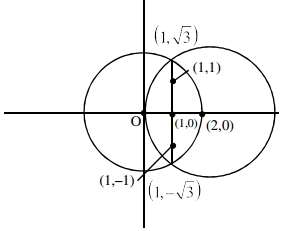
0 likes
View Solution166
MediumMCQ
Which of the following is not correct for relation $R$ on the set of real numbers?
A
$(x, y) \in R \Leftrightarrow 0 < |x| - |y| \leq 1$ is neither transitive nor symmetric.
B
$(x, y) \in R \Leftrightarrow 0 < |x - y| \leq 1$ is symmetric and transitive.
C
$(x, y) \in R \Leftrightarrow |x| - |y| \leq 1$ is reflexive but not symmetric.
D
$(x, y) \in R \Leftrightarrow |x - y| \leq 1$ is reflexive and symmetric.
Solution
(B) Let us analyze each option:
$A$: For $0 < |x| - |y| \leq 1$,if $(x, y) \in R$,then $|x| > |y|$. This is not symmetric because $(y, x) \notin R$. It is not transitive because $(3, 2) \in R$ and $(2, 1) \in R$,but $(3, 1) \notin R$ since $|3| - |1| = 2 > 1$. This is correct.
$B$: For $0 < |x - y| \leq 1$,if $(x, y) \in R$,then $|x - y| = |y - x|$,so it is symmetric. However,it is not transitive. For example,$(1, 1.5) \in R$ and $(1.5, 2) \in R$,but $(1, 2) \notin R$ because $|1 - 2| = 1$,which satisfies the condition,but consider $(1, 1.6) \in R$ and $(1.6, 2.2) \in R$,then $|1 - 2.2| = 1.2 > 1$. Thus,it is not transitive. This statement is incorrect.
$C$: For $|x| - |y| \leq 1$,it is reflexive since $|x| - |x| = 0 \leq 1$. It is not symmetric because $(2, 0) \in R$ but $(0, 2) \notin R$ since $|0| - |2| = -2 \leq 1$ is true,but wait,$|0| - |2| = -2 \leq 1$ is true. Actually,$|x| - |y| \leq 1$ is not symmetric because $|2| - |0| = 2 \not\leq 1$. This is correct.
$D$: For $|x - y| \leq 1$,it is reflexive since $|x - x| = 0 \leq 1$. It is symmetric since $|x - y| = |y - x|$. This is correct.
Therefore,the incorrect statement is $B$.
$A$: For $0 < |x| - |y| \leq 1$,if $(x, y) \in R$,then $|x| > |y|$. This is not symmetric because $(y, x) \notin R$. It is not transitive because $(3, 2) \in R$ and $(2, 1) \in R$,but $(3, 1) \notin R$ since $|3| - |1| = 2 > 1$. This is correct.
$B$: For $0 < |x - y| \leq 1$,if $(x, y) \in R$,then $|x - y| = |y - x|$,so it is symmetric. However,it is not transitive. For example,$(1, 1.5) \in R$ and $(1.5, 2) \in R$,but $(1, 2) \notin R$ because $|1 - 2| = 1$,which satisfies the condition,but consider $(1, 1.6) \in R$ and $(1.6, 2.2) \in R$,then $|1 - 2.2| = 1.2 > 1$. Thus,it is not transitive. This statement is incorrect.
$C$: For $|x| - |y| \leq 1$,it is reflexive since $|x| - |x| = 0 \leq 1$. It is not symmetric because $(2, 0) \in R$ but $(0, 2) \notin R$ since $|0| - |2| = -2 \leq 1$ is true,but wait,$|0| - |2| = -2 \leq 1$ is true. Actually,$|x| - |y| \leq 1$ is not symmetric because $|2| - |0| = 2 \not\leq 1$. This is correct.
$D$: For $|x - y| \leq 1$,it is reflexive since $|x - x| = 0 \leq 1$. It is symmetric since $|x - y| = |y - x|$. This is correct.
Therefore,the incorrect statement is $B$.
0 likes
View Solution167
DifficultMCQ
Let $N$ be the set of natural numbers and a relation $R$ on $N$ be defined by $R = \{(x, y) \in N \times N : x^{3}-3x^{2}y-xy^{2}+3y^{3}=0\}$. Then the relation $R$ is:
A
reflexive and symmetric,but not transitive
B
reflexive but neither symmetric nor transitive
C
an equivalence relation
D
symmetric but neither reflexive nor transitive
Solution
(B) The given equation is $x^{3}-3x^{2}y-xy^{2}+3y^{3}=0$.
Factoring the expression:
$x^{2}(x-3y) - y^{2}(x-3y) = 0$
$(x^{2}-y^{2})(x-3y) = 0$
$(x-y)(x+y)(x-3y) = 0$
This implies $x=y$ or $x=-y$ or $x=3y$.
Since $x, y \in N$,$x=-y$ is impossible as $x, y > 0$.
Thus,the relation is $R = \{(x, y) \in N \times N : x=y \text{ or } x=3y\}$.
$1$. Reflexivity: For any $x \in N$,$(x, x) \in R$ because $x=x$ is true. Thus,$R$ is reflexive.
$2$. Symmetry: Consider $(3, 1) \in R$ because $3=3(1)$. However,$(1, 3) \notin R$ because $1 \neq 3$ and $1 \neq 3(3)=9$. Thus,$R$ is not symmetric.
$3$. Transitivity: Consider $(9, 3) \in R$ (since $9=3(3)$) and $(3, 1) \in R$ (since $3=3(1)$). For $R$ to be transitive,$(9, 1)$ must be in $R$. But $9 \neq 1$ and $9 \neq 3(1)=3$. Thus,$R$ is not transitive.
Therefore,$R$ is reflexive but neither symmetric nor transitive.
Factoring the expression:
$x^{2}(x-3y) - y^{2}(x-3y) = 0$
$(x^{2}-y^{2})(x-3y) = 0$
$(x-y)(x+y)(x-3y) = 0$
This implies $x=y$ or $x=-y$ or $x=3y$.
Since $x, y \in N$,$x=-y$ is impossible as $x, y > 0$.
Thus,the relation is $R = \{(x, y) \in N \times N : x=y \text{ or } x=3y\}$.
$1$. Reflexivity: For any $x \in N$,$(x, x) \in R$ because $x=x$ is true. Thus,$R$ is reflexive.
$2$. Symmetry: Consider $(3, 1) \in R$ because $3=3(1)$. However,$(1, 3) \notin R$ because $1 \neq 3$ and $1 \neq 3(3)=9$. Thus,$R$ is not symmetric.
$3$. Transitivity: Consider $(9, 3) \in R$ (since $9=3(3)$) and $(3, 1) \in R$ (since $3=3(1)$). For $R$ to be transitive,$(9, 1)$ must be in $R$. But $9 \neq 1$ and $9 \neq 3(1)=3$. Thus,$R$ is not transitive.
Therefore,$R$ is reflexive but neither symmetric nor transitive.
0 likes
View Solution168
DifficultMCQ
Let $R_{1} = \{(a, b) \in N \times N : |a - b| \leq 13\}$ and $R_{2} = \{(a, b) \in N \times N : |a - b| \neq 13\}$. Then on $N$:
A
Both $R_{1}$ and $R_{2}$ are equivalence relations
B
Neither $R_{1}$ nor $R_{2}$ is an equivalence relation.
C
$R_{1}$ is an equivalence relation but $R_{2}$ is not
D
$R_{2}$ is an equivalence relation but $R_{1}$ is not
Solution
(B) For $R_{1} = \{(a, b) \in N \times N : |a - b| \leq 13\}$:
$(i)$ Reflexive: $|a - a| = 0 \leq 13$,so $(a, a) \in R_{1}$. It is reflexive.
(ii) Symmetric: If $|a - b| \leq 13$,then $|b - a| = |-(a - b)| = |a - b| \leq 13$. So $(b, a) \in R_{1}$. It is symmetric.
(iii) Transitive: Let $(1, 10) \in R_{1}$ and $(10, 20) \in R_{1}$. Here $|1 - 10| = 9 \leq 13$ and $|10 - 20| = 10 \leq 13$. However,$|1 - 20| = 19 \not\leq 13$. Thus,$(1, 20) \notin R_{1}$. $R_{1}$ is not transitive,hence not an equivalence relation.
For $R_{2} = \{(a, b) \in N \times N : |a - b| \neq 13\}$:
$(i)$ Reflexive: $|a - a| = 0 \neq 13$. So $(a, a) \in R_{2}$. It is reflexive.
(ii) Symmetric: If $|a - b| \neq 13$,then $|b - a| = |a - b| \neq 13$. So $(b, a) \in R_{2}$. It is symmetric.
(iii) Transitive: Let $(1, 14) \in R_{2}$ and $(14, 1) \in R_{2}$. Here $|1 - 14| = 13$ and $|14 - 1| = 13$. Wait,$(1, 14) \notin R_{2}$ and $(14, 1) \notin R_{2}$. Let's test $(1, 2) \in R_{2}$ and $(2, 15) \in R_{2}$. $|1 - 2| = 1 \neq 13$ and $|2 - 15| = 13$. Since $(2, 15) \notin R_{2}$,this is not a valid counterexample. Consider $(1, 2) \in R_{2}$ and $(2, 14) \in R_{2}$. $|1 - 2| = 1 \neq 13$ and $|2 - 14| = 12 \neq 13$. But $|1 - 14| = 13$,so $(1, 14) \notin R_{2}$. Thus,$R_{2}$ is not transitive,hence not an equivalence relation.
Therefore,neither $R_{1}$ nor $R_{2}$ is an equivalence relation.
$(i)$ Reflexive: $|a - a| = 0 \leq 13$,so $(a, a) \in R_{1}$. It is reflexive.
(ii) Symmetric: If $|a - b| \leq 13$,then $|b - a| = |-(a - b)| = |a - b| \leq 13$. So $(b, a) \in R_{1}$. It is symmetric.
(iii) Transitive: Let $(1, 10) \in R_{1}$ and $(10, 20) \in R_{1}$. Here $|1 - 10| = 9 \leq 13$ and $|10 - 20| = 10 \leq 13$. However,$|1 - 20| = 19 \not\leq 13$. Thus,$(1, 20) \notin R_{1}$. $R_{1}$ is not transitive,hence not an equivalence relation.
For $R_{2} = \{(a, b) \in N \times N : |a - b| \neq 13\}$:
$(i)$ Reflexive: $|a - a| = 0 \neq 13$. So $(a, a) \in R_{2}$. It is reflexive.
(ii) Symmetric: If $|a - b| \neq 13$,then $|b - a| = |a - b| \neq 13$. So $(b, a) \in R_{2}$. It is symmetric.
(iii) Transitive: Let $(1, 14) \in R_{2}$ and $(14, 1) \in R_{2}$. Here $|1 - 14| = 13$ and $|14 - 1| = 13$. Wait,$(1, 14) \notin R_{2}$ and $(14, 1) \notin R_{2}$. Let's test $(1, 2) \in R_{2}$ and $(2, 15) \in R_{2}$. $|1 - 2| = 1 \neq 13$ and $|2 - 15| = 13$. Since $(2, 15) \notin R_{2}$,this is not a valid counterexample. Consider $(1, 2) \in R_{2}$ and $(2, 14) \in R_{2}$. $|1 - 2| = 1 \neq 13$ and $|2 - 14| = 12 \neq 13$. But $|1 - 14| = 13$,so $(1, 14) \notin R_{2}$. Thus,$R_{2}$ is not transitive,hence not an equivalence relation.
Therefore,neither $R_{1}$ nor $R_{2}$ is an equivalence relation.
0 likes
View Solution169
DifficultMCQ
Let $R_{1}$ and $R_{2}$ be relations on the set $\{1, 2, \ldots, 50\}$ such that $R_{1} = \{(p, p^{n}) : p \text{ is a prime and } n \geq 0 \text{ is an integer}\}$ and $R_{2} = \{(p, p^{n}) : p \text{ is a prime and } n = 0 \text{ or } 1\}$. Then,the number of elements in $R_{1} - R_{2}$ is:
A
$90$
B
$3$
C
$9$
D
$8$
Solution
(D) The set is $S = \{1, 2, \ldots, 50\}$. The primes $p \in S$ are $\{2, 3, 5, 7, 11, 13, 17, 19, 23, 29, 31, 37, 41, 43, 47\}$ (total $15$ primes).
For $R_{1}$,we need $p^{n} \leq 50$ where $n \geq 0$:
- For $p=2$: $2^{0}, 2^{1}, 2^{2}, 2^{3}, 2^{4}, 2^{5} \leq 50$ ($6$ elements).
- For $p=3$: $3^{0}, 3^{1}, 3^{2}, 3^{3} \leq 50$ ($4$ elements).
- For $p=5$: $5^{0}, 5^{1}, 5^{2} \leq 50$ ($3$ elements).
- For $p=7$: $7^{0}, 7^{1}, 7^{2} \leq 50$ ($3$ elements).
- For $p \in \{11, 13, 17, 19, 23, 29, 31, 37, 41, 43, 47\}$ ($11$ primes): $p^{0}, p^{1} \leq 50$ ($2$ elements each,total $11 \times 2 = 22$ elements).
Total elements in $R_{1} = 6 + 4 + 3 + 3 + 22 = 38$.
For $R_{2}$,we need $n=0$ or $n=1$:
- For each of the $15$ primes,we have $(p, p^{0})$ and $(p, p^{1})$.
Total elements in $R_{2} = 15 \times 2 = 30$.
$R_{1} - R_{2}$ contains elements where $n \geq 2$:
- $p=2$: $(2, 2^{2}), (2, 2^{3}), (2, 2^{4}), (2, 2^{5})$ ($4$ elements).
- $p=3$: $(3, 3^{2}), (3, 3^{3})$ ($2$ elements).
- $p=5$: $(5, 5^{2})$ ($1$ element).
- $p=7$: $(7, 7^{2})$ ($1$ element).
Total elements in $R_{1} - R_{2} = 4 + 2 + 1 + 1 = 8$.
For $R_{1}$,we need $p^{n} \leq 50$ where $n \geq 0$:
- For $p=2$: $2^{0}, 2^{1}, 2^{2}, 2^{3}, 2^{4}, 2^{5} \leq 50$ ($6$ elements).
- For $p=3$: $3^{0}, 3^{1}, 3^{2}, 3^{3} \leq 50$ ($4$ elements).
- For $p=5$: $5^{0}, 5^{1}, 5^{2} \leq 50$ ($3$ elements).
- For $p=7$: $7^{0}, 7^{1}, 7^{2} \leq 50$ ($3$ elements).
- For $p \in \{11, 13, 17, 19, 23, 29, 31, 37, 41, 43, 47\}$ ($11$ primes): $p^{0}, p^{1} \leq 50$ ($2$ elements each,total $11 \times 2 = 22$ elements).
Total elements in $R_{1} = 6 + 4 + 3 + 3 + 22 = 38$.
For $R_{2}$,we need $n=0$ or $n=1$:
- For each of the $15$ primes,we have $(p, p^{0})$ and $(p, p^{1})$.
Total elements in $R_{2} = 15 \times 2 = 30$.
$R_{1} - R_{2}$ contains elements where $n \geq 2$:
- $p=2$: $(2, 2^{2}), (2, 2^{3}), (2, 2^{4}), (2, 2^{5})$ ($4$ elements).
- $p=3$: $(3, 3^{2}), (3, 3^{3})$ ($2$ elements).
- $p=5$: $(5, 5^{2})$ ($1$ element).
- $p=7$: $(7, 7^{2})$ ($1$ element).
Total elements in $R_{1} - R_{2} = 4 + 2 + 1 + 1 = 8$.
0 likes
View Solution170
MediumMCQ
Let a set $A = A_{1} \cup A_{2} \cup \ldots \cup A_{k}$,where $A_{i} \cap A_{j} = \phi$ for $i \neq j$ and $1 \leq i, j \leq k$. Define the relation $R$ from $A$ to $A$ by $R = \{(x, y) : y \in A_{i} \text{ if and only if } x \in A_{i}, 1 \leq i \leq k\}$. Then,$R$ is
A
reflexive,symmetric but not transitive
B
reflexive,transitive but not symmetric
C
reflexive but not symmetric and transitive
D
an equivalence relation
Solution
(D) The relation $R$ is defined as $(x, y) \in R$ if and only if $x$ and $y$ belong to the same subset $A_{i}$.
$1$. Reflexivity: For any $x \in A$,$x$ belongs to some $A_{i}$. Since $x \in A_{i} \iff x \in A_{i}$,$(x, x) \in R$. Thus,$R$ is reflexive.
$2$. Symmetry: If $(x, y) \in R$,then $x$ and $y$ belong to the same $A_{i}$. This implies $y$ and $x$ belong to the same $A_{i}$,so $(y, x) \in R$. Thus,$R$ is symmetric.
$3$. Transitivity: If $(x, y) \in R$ and $(y, z) \in R$,then $x, y \in A_{i}$ and $y, z \in A_{j}$. Since $A_{i} \cap A_{j} = \phi$ for $i \neq j$,we must have $i = j$. Therefore,$x, z \in A_{i}$,which means $(x, z) \in R$. Thus,$R$ is transitive.
Since $R$ is reflexive,symmetric,and transitive,it is an equivalence relation.
$1$. Reflexivity: For any $x \in A$,$x$ belongs to some $A_{i}$. Since $x \in A_{i} \iff x \in A_{i}$,$(x, x) \in R$. Thus,$R$ is reflexive.
$2$. Symmetry: If $(x, y) \in R$,then $x$ and $y$ belong to the same $A_{i}$. This implies $y$ and $x$ belong to the same $A_{i}$,so $(y, x) \in R$. Thus,$R$ is symmetric.
$3$. Transitivity: If $(x, y) \in R$ and $(y, z) \in R$,then $x, y \in A_{i}$ and $y, z \in A_{j}$. Since $A_{i} \cap A_{j} = \phi$ for $i \neq j$,we must have $i = j$. Therefore,$x, z \in A_{i}$,which means $(x, z) \in R$. Thus,$R$ is transitive.
Since $R$ is reflexive,symmetric,and transitive,it is an equivalence relation.
1 likes
View Solution171
MediumMCQ
Let $R_{1}$ and $R_{2}$ be two relations defined on the set of real numbers $\mathbb{R}$ by $a R_{1} b \iff ab \geq 0$ and $a R_{2} b \iff a \geq b$. Then:
A
$R_{1}$ is an equivalence relation but not $R_{2}$
B
$R_{2}$ is an equivalence relation but not $R_{1}$
C
Both $R_{1}$ and $R_{2}$ are equivalence relations
D
Neither $R_{1}$ nor $R_{2}$ is an equivalence relation
Solution
(D) For $R_{1}$: $a R_{1} b \iff ab \geq 0$.
$1$. Reflexive: $a \cdot a = a^{2} \geq 0$ for all $a \in \mathbb{R}$. So,$R_{1}$ is reflexive.
$2$. Symmetric: If $ab \geq 0$,then $ba \geq 0$. So,$R_{1}$ is symmetric.
$3$. Transitive: Let $a=2, b=0, c=-2$. Then $ab = 2 \cdot 0 = 0 \geq 0$ and $bc = 0 \cdot (-2) = 0 \geq 0$. However,$ac = 2 \cdot (-2) = -4 < 0$. Thus,$R_{1}$ is not transitive.
Therefore,$R_{1}$ is not an equivalence relation.
For $R_{2}$: $a R_{2} b \iff a \geq b$.
$1$. Reflexive: $a \geq a$ is true for all $a \in \mathbb{R}$. So,$R_{2}$ is reflexive.
$2$. Symmetric: If $a \geq b$,it does not imply $b \geq a$ (e.g.,$2 \geq 1$ but $1 \ngeq 2$). So,$R_{2}$ is not symmetric.
$3$. Transitive: If $a \geq b$ and $b \geq c$,then $a \geq c$. So,$R_{2}$ is transitive.
Since $R_{2}$ is not symmetric,it is not an equivalence relation.
Thus,neither $R_{1}$ nor $R_{2}$ is an equivalence relation.
$1$. Reflexive: $a \cdot a = a^{2} \geq 0$ for all $a \in \mathbb{R}$. So,$R_{1}$ is reflexive.
$2$. Symmetric: If $ab \geq 0$,then $ba \geq 0$. So,$R_{1}$ is symmetric.
$3$. Transitive: Let $a=2, b=0, c=-2$. Then $ab = 2 \cdot 0 = 0 \geq 0$ and $bc = 0 \cdot (-2) = 0 \geq 0$. However,$ac = 2 \cdot (-2) = -4 < 0$. Thus,$R_{1}$ is not transitive.
Therefore,$R_{1}$ is not an equivalence relation.
For $R_{2}$: $a R_{2} b \iff a \geq b$.
$1$. Reflexive: $a \geq a$ is true for all $a \in \mathbb{R}$. So,$R_{2}$ is reflexive.
$2$. Symmetric: If $a \geq b$,it does not imply $b \geq a$ (e.g.,$2 \geq 1$ but $1 \ngeq 2$). So,$R_{2}$ is not symmetric.
$3$. Transitive: If $a \geq b$ and $b \geq c$,then $a \geq c$. So,$R_{2}$ is transitive.
Since $R_{2}$ is not symmetric,it is not an equivalence relation.
Thus,neither $R_{1}$ nor $R_{2}$ is an equivalence relation.
0 likes
View Solution172
MediumMCQ
For $\alpha \in N$,consider a relation $R$ on $N$ given by $R = \{(x, y) : 3x + \alpha y \text{ is a multiple of } 7\}$. The relation $R$ is an equivalence relation if and only if:
A
$\alpha = 14$
B
$\alpha$ is a multiple of $4$
C
$4$ is the remainder when $\alpha$ is divided by $10$
D
$4$ is the remainder when $\alpha$ is divided by $7$
Solution
(D) For $R$ to be reflexive,$xRx$ must hold for all $x \in N$.
$3x + \alpha x = (3 + \alpha)x$ must be a multiple of $7$.
This implies $(3 + \alpha)$ must be a multiple of $7$,so $3 + \alpha = 7k \Rightarrow \alpha = 7k - 3 = 7(k-1) + 4$.
Thus,when $\alpha$ is divided by $7$,the remainder is $4$.
For $R$ to be symmetric,$xRy \Rightarrow yRx$.
$3x + \alpha y = 7n_1$ and $3y + \alpha x = 7n_2$.
Subtracting these,$(3 - \alpha)(x - y) = 7(n_1 - n_2)$. This condition is satisfied if $3 + \alpha$ is a multiple of $7$.
For $R$ to be transitive,$xRy$ and $yRz \Rightarrow xRz$.
$3x + \alpha y = 7n_1$ and $3y + \alpha z = 7n_2$.
From the first,$\alpha y = 7n_1 - 3x$. Substituting into the second: $3y + \alpha z = 7n_2$.
By eliminating $y$,we find that the relation is transitive if $3 + \alpha$ is a multiple of $7$.
Therefore,the condition for $R$ to be an equivalence relation is that $4$ is the remainder when $\alpha$ is divided by $7$.
$3x + \alpha x = (3 + \alpha)x$ must be a multiple of $7$.
This implies $(3 + \alpha)$ must be a multiple of $7$,so $3 + \alpha = 7k \Rightarrow \alpha = 7k - 3 = 7(k-1) + 4$.
Thus,when $\alpha$ is divided by $7$,the remainder is $4$.
For $R$ to be symmetric,$xRy \Rightarrow yRx$.
$3x + \alpha y = 7n_1$ and $3y + \alpha x = 7n_2$.
Subtracting these,$(3 - \alpha)(x - y) = 7(n_1 - n_2)$. This condition is satisfied if $3 + \alpha$ is a multiple of $7$.
For $R$ to be transitive,$xRy$ and $yRz \Rightarrow xRz$.
$3x + \alpha y = 7n_1$ and $3y + \alpha z = 7n_2$.
From the first,$\alpha y = 7n_1 - 3x$. Substituting into the second: $3y + \alpha z = 7n_2$.
By eliminating $y$,we find that the relation is transitive if $3 + \alpha$ is a multiple of $7$.
Therefore,the condition for $R$ to be an equivalence relation is that $4$ is the remainder when $\alpha$ is divided by $7$.
0 likes
View Solution173
DifficultMCQ
Let $R$ be a relation from the set $\{1, 2, 3, \ldots, 60\}$ to itself such that $R = \{(a, b) : b = pq\}$,where $p, q \geq 3$ are prime numbers and $b \leq 60$. Then,the number of elements in $R$ is.
A
$600$
B
$660$
C
$540$
D
$720$
Solution
(B) The relation $R$ is defined as $R = \{(a, b) : a \in \{1, 2, \ldots, 60\}, b = pq, p, q \geq 3, p, q \text{ are primes}, b \leq 60\}$.
Since $a$ can be any value from $1$ to $60$,there are $60$ choices for $a$.
We need to find the number of possible values for $b = pq$ such that $b \leq 60$ and $p, q \geq 3$ are primes.
Case $1$: $p = 3$. Then $b = 3q$. Since $b \leq 60$,$3q \leq 60 \implies q \leq 20$. The primes $q \geq 3$ are $3, 5, 7, 11, 13, 17, 19$. There are $7$ values.
Case $2$: $p = 5$. Then $b = 5q$. Since $b \leq 60$,$5q \leq 60 \implies q \leq 12$. The primes $q \geq 5$ are $5, 7, 11$. There are $3$ values.
Case $3$: $p = 7$. Then $b = 7q$. Since $b \leq 60$,$7q \leq 60 \implies q \leq 8.57$. The prime $q \geq 7$ is $7$. There is $1$ value.
Case $4$: $p = 11$. Then $b = 11q$. Since $b \leq 60$,$11q \leq 60 \implies q \leq 5.45$. No prime $q \geq 11$ satisfies this.
Total values for $b = 7 + 3 + 1 = 11$.
Since $a$ has $60$ choices and $b$ has $11$ choices,the total number of elements in $R$ is $60 \times 11 = 660$.
Since $a$ can be any value from $1$ to $60$,there are $60$ choices for $a$.
We need to find the number of possible values for $b = pq$ such that $b \leq 60$ and $p, q \geq 3$ are primes.
Case $1$: $p = 3$. Then $b = 3q$. Since $b \leq 60$,$3q \leq 60 \implies q \leq 20$. The primes $q \geq 3$ are $3, 5, 7, 11, 13, 17, 19$. There are $7$ values.
Case $2$: $p = 5$. Then $b = 5q$. Since $b \leq 60$,$5q \leq 60 \implies q \leq 12$. The primes $q \geq 5$ are $5, 7, 11$. There are $3$ values.
Case $3$: $p = 7$. Then $b = 7q$. Since $b \leq 60$,$7q \leq 60 \implies q \leq 8.57$. The prime $q \geq 7$ is $7$. There is $1$ value.
Case $4$: $p = 11$. Then $b = 11q$. Since $b \leq 60$,$11q \leq 60 \implies q \leq 5.45$. No prime $q \geq 11$ satisfies this.
Total values for $b = 7 + 3 + 1 = 11$.
Since $a$ has $60$ choices and $b$ has $11$ choices,the total number of elements in $R$ is $60 \times 11 = 660$.
0 likes
View Solution174
AdvancedMCQ
Let $A$ be a set consisting of $10$ elements. The number of non-empty relations from $A$ to $A$ that are reflexive but not symmetric is
A
$2^{89}-1$
B
$2^{89}-2^{45}$
C
$2^{45}-1$
D
$2^{90}-2^{45}$
Solution
(D) Let $n(A) = 10$. The total number of relations from $A$ to $A$ is $2^{n^2} = 2^{100}$.
For a relation to be reflexive,all $10$ elements of the form $(a, a)$ must be present in the relation.
There are $100 - 10 = 90$ remaining elements in $A \times A$ that can either be present or absent.
Thus,the total number of reflexive relations is $2^{90}$.
For a relation to be symmetric,if $(a, b)$ is present,then $(b, a)$ must also be present for all $a \neq b$.
There are $\frac{10 \times 9}{2} = 45$ such pairs of the form ${(a, b), (b, a)}$.
For a reflexive and symmetric relation,the $10$ diagonal elements $(a, a)$ must be present,and for each of the $45$ pairs,we have $2$ choices (either both are present or both are absent).
Thus,the number of reflexive and symmetric relations is $2^{45}$.
The number of reflexive relations that are not symmetric is the total number of reflexive relations minus the number of reflexive and symmetric relations.
Required number $= 2^{90} - 2^{45}$.
For a relation to be reflexive,all $10$ elements of the form $(a, a)$ must be present in the relation.
There are $100 - 10 = 90$ remaining elements in $A \times A$ that can either be present or absent.
Thus,the total number of reflexive relations is $2^{90}$.
For a relation to be symmetric,if $(a, b)$ is present,then $(b, a)$ must also be present for all $a \neq b$.
There are $\frac{10 \times 9}{2} = 45$ such pairs of the form ${(a, b), (b, a)}$.
For a reflexive and symmetric relation,the $10$ diagonal elements $(a, a)$ must be present,and for each of the $45$ pairs,we have $2$ choices (either both are present or both are absent).
Thus,the number of reflexive and symmetric relations is $2^{45}$.
The number of reflexive relations that are not symmetric is the total number of reflexive relations minus the number of reflexive and symmetric relations.
Required number $= 2^{90} - 2^{45}$.
0 likes
View Solution175
AdvancedMCQ
Let $R$ be a relation on the set of all natural numbers $\mathbb{N}$ defined by $aRb \iff a \text{ divides } b^2$. Which of the following properties does $R$ satisfy?
$I.$ Reflexivity
$II.$ Symmetry
$III.$ Transitivity
$I.$ Reflexivity
$II.$ Symmetry
$III.$ Transitivity
A
$I$ only
B
$III$ only
C
$I$ and $III$ only
D
$I$ and $II$ only
Solution
(A) The relation is defined as $aRb \iff a \mid b^2$ for $a, b \in \mathbb{N}$.
$I.$ Reflexivity: For any $a \in \mathbb{N}$,$a^2$ is always divisible by $a$ (since $a^2/a = a \in \mathbb{N}$). Thus,$(a, a) \in R$ for all $a \in \mathbb{N}$. So,$R$ is reflexive.
$II.$ Symmetry: For $R$ to be symmetric,$aRb \implies bRa$. Let $a=8$ and $b=4$. Here $8 \mid 4^2$ $(8 \mid 16)$ is true,so $(8, 4) \in R$. However,$4 \mid 8^2$ $(4 \mid 64)$ is true,but consider $a=2, b=4$. $2 \mid 4^2$ $(2 \mid 16)$ is true,but $4 \mid 2^2$ $(4 \mid 4)$ is true. Let us take $a=2, b=6$. $2 \mid 6^2$ $(2 \mid 36)$ is true,but $6 \mid 2^2$ $(6 \mid 4)$ is false. Thus,$R$ is not symmetric.
$III.$ Transitivity: For $R$ to be transitive,$(a, b) \in R$ and $(b, c) \in R \implies (a, c) \in R$. Let $a=8, b=4, c=2$.
$(8, 4) \in R$ because $8 \mid 4^2$ $(8 \mid 16)$.
$(4, 2) \in R$ because $4 \mid 2^2$ $(4 \mid 4)$.
Check $(8, 2)$: $8 \mid 2^2$ $(8 \mid 4)$ is false. Thus,$R$ is not transitive.
Therefore,only $I$ is satisfied.
$I.$ Reflexivity: For any $a \in \mathbb{N}$,$a^2$ is always divisible by $a$ (since $a^2/a = a \in \mathbb{N}$). Thus,$(a, a) \in R$ for all $a \in \mathbb{N}$. So,$R$ is reflexive.
$II.$ Symmetry: For $R$ to be symmetric,$aRb \implies bRa$. Let $a=8$ and $b=4$. Here $8 \mid 4^2$ $(8 \mid 16)$ is true,so $(8, 4) \in R$. However,$4 \mid 8^2$ $(4 \mid 64)$ is true,but consider $a=2, b=4$. $2 \mid 4^2$ $(2 \mid 16)$ is true,but $4 \mid 2^2$ $(4 \mid 4)$ is true. Let us take $a=2, b=6$. $2 \mid 6^2$ $(2 \mid 36)$ is true,but $6 \mid 2^2$ $(6 \mid 4)$ is false. Thus,$R$ is not symmetric.
$III.$ Transitivity: For $R$ to be transitive,$(a, b) \in R$ and $(b, c) \in R \implies (a, c) \in R$. Let $a=8, b=4, c=2$.
$(8, 4) \in R$ because $8 \mid 4^2$ $(8 \mid 16)$.
$(4, 2) \in R$ because $4 \mid 2^2$ $(4 \mid 4)$.
Check $(8, 2)$: $8 \mid 2^2$ $(8 \mid 4)$ is false. Thus,$R$ is not transitive.
Therefore,only $I$ is satisfied.
0 likes
View Solution176
DifficultMCQ
The relation $R = \{(a, b) : \operatorname{gcd}(a, b) = 1, 2a \neq b, a, b \in \mathbb{Z}\}$ is:
A
transitive but not reflexive
B
symmetric but not transitive
C
reflexive but not symmetric
D
neither symmetric nor transitive
Solution
(D) Reflexivity: For $R$ to be reflexive,$(a, a) \in R$ for all $a \in \mathbb{Z}$.
This requires $\operatorname{gcd}(a, a) = |a| = 1$ and $2a \neq a$. This is not true for all $a \in \mathbb{Z}$ (e.g.,$a=2$),so $R$ is not reflexive.
Symmetry: For $R$ to be symmetric,if $(a, b) \in R$,then $(b, a) \in R$.
Let $a=2, b=1$. $\operatorname{gcd}(2, 1) = 1$ and $2(2) = 4 \neq 1$,so $(2, 1) \in R$.
However,for $(1, 2)$,$\operatorname{gcd}(1, 2) = 1$ but $2(1) = 2 = b$. Since the condition $2a \neq b$ is violated,$(1, 2) \notin R$.
Thus,$R$ is not symmetric.
Transitivity: For $R$ to be transitive,if $(a, b) \in R$ and $(b, c) \in R$,then $(a, c) \in R$.
Let $a=14, b=19, c=21$.
$\operatorname{gcd}(14, 19) = 1$ and $2(14) = 28 \neq 19$,so $(14, 19) \in R$.
$\operatorname{gcd}(19, 21) = 1$ and $2(19) = 38 \neq 21$,so $(19, 21) \in R$.
However,$\operatorname{gcd}(14, 21) = 7 \neq 1$,so $(14, 21) \notin R$.
Thus,$R$ is not transitive.
Conclusion: $R$ is neither symmetric nor transitive.
This requires $\operatorname{gcd}(a, a) = |a| = 1$ and $2a \neq a$. This is not true for all $a \in \mathbb{Z}$ (e.g.,$a=2$),so $R$ is not reflexive.
Symmetry: For $R$ to be symmetric,if $(a, b) \in R$,then $(b, a) \in R$.
Let $a=2, b=1$. $\operatorname{gcd}(2, 1) = 1$ and $2(2) = 4 \neq 1$,so $(2, 1) \in R$.
However,for $(1, 2)$,$\operatorname{gcd}(1, 2) = 1$ but $2(1) = 2 = b$. Since the condition $2a \neq b$ is violated,$(1, 2) \notin R$.
Thus,$R$ is not symmetric.
Transitivity: For $R$ to be transitive,if $(a, b) \in R$ and $(b, c) \in R$,then $(a, c) \in R$.
Let $a=14, b=19, c=21$.
$\operatorname{gcd}(14, 19) = 1$ and $2(14) = 28 \neq 19$,so $(14, 19) \in R$.
$\operatorname{gcd}(19, 21) = 1$ and $2(19) = 38 \neq 21$,so $(19, 21) \in R$.
However,$\operatorname{gcd}(14, 21) = 7 \neq 1$,so $(14, 21) \notin R$.
Thus,$R$ is not transitive.
Conclusion: $R$ is neither symmetric nor transitive.
0 likes
View Solution177
MediumMCQ
The minimum number of elements that must be added to the relation $R = \{(a, b), (b, c), (b, d)\}$ on the set $\{a, b, c, d\}$ so that it is an equivalence relation,is $.........$
A
$11$
B
$12$
C
$19$
D
$13$
Solution
(D) For a relation $R$ on a set $A = \{a, b, c, d\}$ to be an equivalence relation,it must be reflexive,symmetric,and transitive.
$1$. Reflexivity: For all $x \in A$,$(x, x) \in R$. Thus,we must add $(a, a), (b, b), (c, c), (d, d)$. ($4$ elements)
$2$. Symmetry: If $(x, y) \in R$,then $(y, x) \in R$. Given $(a, b), (b, c), (b, d) \in R$,we must add $(b, a), (c, b), (d, b)$. ($3$ elements)
$3$. Transitivity: If $(x, y) \in R$ and $(y, z) \in R$,then $(x, z) \in R$.
From $(a, b)$ and $(b, c)$,add $(a, c)$.
From $(a, b)$ and $(b, d)$,add $(a, d)$.
From $(c, b)$ and $(b, d)$,add $(c, d)$.
From $(d, b)$ and $(b, c)$,add $(d, c)$.
From $(c, a)$ and $(a, b)$,add $(c, b)$ (already added).
From $(d, a)$ and $(a, b)$,add $(d, b)$ (already added).
From $(a, c)$ and $(c, b)$,add $(a, b)$ (already present).
From $(a, d)$ and $(d, b)$,add $(a, b)$ (already present).
From $(c, d)$ and $(d, b)$,add $(c, b)$ (already added).
From $(d, c)$ and $(c, b)$,add $(d, b)$ (already added).
Also need $(c, a)$ and $(d, a)$ due to symmetry of $(a, c)$ and $(a, d)$. ($2$ elements)
The full relation $R$ is $\{(a, a), (b, b), (c, c), (d, d), (a, b), (b, a), (b, c), (c, b), (b, d), (d, b), (a, c), (c, a), (a, d), (d, a), (c, d), (d, c)\}$.
Total elements = $16$. Given elements = $3$. Elements to add = $16 - 3 = 13$.
$1$. Reflexivity: For all $x \in A$,$(x, x) \in R$. Thus,we must add $(a, a), (b, b), (c, c), (d, d)$. ($4$ elements)
$2$. Symmetry: If $(x, y) \in R$,then $(y, x) \in R$. Given $(a, b), (b, c), (b, d) \in R$,we must add $(b, a), (c, b), (d, b)$. ($3$ elements)
$3$. Transitivity: If $(x, y) \in R$ and $(y, z) \in R$,then $(x, z) \in R$.
From $(a, b)$ and $(b, c)$,add $(a, c)$.
From $(a, b)$ and $(b, d)$,add $(a, d)$.
From $(c, b)$ and $(b, d)$,add $(c, d)$.
From $(d, b)$ and $(b, c)$,add $(d, c)$.
From $(c, a)$ and $(a, b)$,add $(c, b)$ (already added).
From $(d, a)$ and $(a, b)$,add $(d, b)$ (already added).
From $(a, c)$ and $(c, b)$,add $(a, b)$ (already present).
From $(a, d)$ and $(d, b)$,add $(a, b)$ (already present).
From $(c, d)$ and $(d, b)$,add $(c, b)$ (already added).
From $(d, c)$ and $(c, b)$,add $(d, b)$ (already added).
Also need $(c, a)$ and $(d, a)$ due to symmetry of $(a, c)$ and $(a, d)$. ($2$ elements)
The full relation $R$ is $\{(a, a), (b, b), (c, c), (d, d), (a, b), (b, a), (b, c), (c, b), (b, d), (d, b), (a, c), (c, a), (a, d), (d, a), (c, d), (d, c)\}$.
Total elements = $16$. Given elements = $3$. Elements to add = $16 - 3 = 13$.
0 likes
View Solution178
MediumMCQ
Let $R$ be a relation defined on $N$ such that $a R b$ if $2a + 3b$ is a multiple of $5$,where $a, b \in N$. Then $R$ is
A
not reflexive
B
transitive but not symmetric
C
symmetric but not transitive
D
an equivalence relation
Solution
(D) $1$. Reflexivity: For any $a \in N$,$2a + 3a = 5a$,which is a multiple of $5$. Thus,$a R a$ holds for all $a \in N$. So,$R$ is reflexive.
$2$. Symmetry: Let $a R b$,then $2a + 3b = 5k$ for some integer $k$.
We want to check if $b R a$,i.e.,if $2b + 3a$ is a multiple of $5$.
Note that $(2a + 3b) + (2b + 3a) = 5a + 5b = 5(a + b)$.
Since $2a + 3b = 5k$,we have $2b + 3a = 5(a + b) - 5k = 5(a + b - k)$.
Since $a, b, k$ are integers,$5(a + b - k)$ is a multiple of $5$. Thus,$b R a$ holds. So,$R$ is symmetric.
$3$. Transitivity: Let $a R b$ and $b R c$.
Then $2a + 3b = 5k_1$ and $2b + 3c = 5k_2$ for some integers $k_1, k_2$.
We want to check if $a R c$,i.e.,if $2a + 3c$ is a multiple of $5$.
From $2a + 3b = 5k_1$,we have $2a = 5k_1 - 3b$.
From $2b + 3c = 5k_2$,we have $3c = 5k_2 - 2b$.
Adding these,$2a + 3c = 5k_1 + 5k_2 - 5b = 5(k_1 + k_2 - b)$.
Since $k_1, k_2, b$ are integers,$2a + 3c$ is a multiple of $5$. Thus,$a R c$ holds. So,$R$ is transitive.
Since $R$ is reflexive,symmetric,and transitive,it is an equivalence relation.
$2$. Symmetry: Let $a R b$,then $2a + 3b = 5k$ for some integer $k$.
We want to check if $b R a$,i.e.,if $2b + 3a$ is a multiple of $5$.
Note that $(2a + 3b) + (2b + 3a) = 5a + 5b = 5(a + b)$.
Since $2a + 3b = 5k$,we have $2b + 3a = 5(a + b) - 5k = 5(a + b - k)$.
Since $a, b, k$ are integers,$5(a + b - k)$ is a multiple of $5$. Thus,$b R a$ holds. So,$R$ is symmetric.
$3$. Transitivity: Let $a R b$ and $b R c$.
Then $2a + 3b = 5k_1$ and $2b + 3c = 5k_2$ for some integers $k_1, k_2$.
We want to check if $a R c$,i.e.,if $2a + 3c$ is a multiple of $5$.
From $2a + 3b = 5k_1$,we have $2a = 5k_1 - 3b$.
From $2b + 3c = 5k_2$,we have $3c = 5k_2 - 2b$.
Adding these,$2a + 3c = 5k_1 + 5k_2 - 5b = 5(k_1 + k_2 - b)$.
Since $k_1, k_2, b$ are integers,$2a + 3c$ is a multiple of $5$. Thus,$a R c$ holds. So,$R$ is transitive.
Since $R$ is reflexive,symmetric,and transitive,it is an equivalence relation.
0 likes
View Solution179
DifficultMCQ
The minimum number of elements that must be added to the relation $R = \{(a, b), (b, c)\}$ on the set $\{a, b, c\}$ so that it becomes symmetric and transitive is:
A
$4$
B
$7$
C
$5$
D
$3$
Solution
(B) Given $R = \{(a, b), (b, c)\}$ on the set $A = \{a, b, c\}$.
For $R$ to be symmetric,if $(x, y) \in R$,then $(y, x) \in R$.
Adding elements for symmetry:
Since $(a, b) \in R$,we must add $(b, a)$.
Since $(b, c) \in R$,we must add $(c, b)$.
Now $R = \{(a, b), (b, a), (b, c), (c, b)\}$.
For $R$ to be transitive,if $(x, y) \in R$ and $(y, z) \in R$,then $(x, z) \in R$.
Using $(a, b) \in R$ and $(b, c) \in R$,we must add $(a, c)$.
Since $(a, c) \in R$,for symmetry,we must add $(c, a)$.
Now $R = \{(a, b), (b, a), (b, c), (c, b), (a, c), (c, a)\}$.
Checking transitivity again:
$(a, b) \in R$ and $(b, a) \in R \Rightarrow (a, a) \in R$.
$(b, c) \in R$ and $(c, b) \in R \Rightarrow (b, b) \in R$.
$(a, c) \in R$ and $(c, a) \in R \Rightarrow (c, c) \in R$.
Adding these,$R = \{(a, b), (b, a), (b, c), (c, b), (a, c), (c, a), (a, a), (b, b), (c, c)\}$.
The elements added are $(b, a), (c, b), (a, c), (c, a), (a, a), (b, b), (c, c)$.
Total elements added $= 7$.
For $R$ to be symmetric,if $(x, y) \in R$,then $(y, x) \in R$.
Adding elements for symmetry:
Since $(a, b) \in R$,we must add $(b, a)$.
Since $(b, c) \in R$,we must add $(c, b)$.
Now $R = \{(a, b), (b, a), (b, c), (c, b)\}$.
For $R$ to be transitive,if $(x, y) \in R$ and $(y, z) \in R$,then $(x, z) \in R$.
Using $(a, b) \in R$ and $(b, c) \in R$,we must add $(a, c)$.
Since $(a, c) \in R$,for symmetry,we must add $(c, a)$.
Now $R = \{(a, b), (b, a), (b, c), (c, b), (a, c), (c, a)\}$.
Checking transitivity again:
$(a, b) \in R$ and $(b, a) \in R \Rightarrow (a, a) \in R$.
$(b, c) \in R$ and $(c, b) \in R \Rightarrow (b, b) \in R$.
$(a, c) \in R$ and $(c, a) \in R \Rightarrow (c, c) \in R$.
Adding these,$R = \{(a, b), (b, a), (b, c), (c, b), (a, c), (c, a), (a, a), (b, b), (c, c)\}$.
The elements added are $(b, a), (c, b), (a, c), (c, a), (a, a), (b, b), (c, c)$.
Total elements added $= 7$.
0 likes
View Solution180
DifficultMCQ
Let $R$ be a relation on $N \times N$ defined by $(a, b) R (c, d)$ if and only if $ad(b-c) = bc(a-d)$. Then $R$ is
A
symmetric but neither reflexive nor transitive
B
transitive but neither reflexive nor symmetric
C
reflexive and symmetric but not transitive
D
symmetric and transitive but not reflexive
Solution
(D) The relation is defined as $(a, b) R (c, d) \iff ad(b-c) = bc(a-d)$.
$1$. Reflexive: For $(a, b) R (a, b)$,we need $ab(b-a) = ba(a-b)$. This simplifies to $ab(b-a) = -ab(b-a)$,which is only true if $ab(b-a) = 0$. Since $a, b \in N$,this is not true for all $(a, b)$. Thus,$R$ is not reflexive.
$2$. Symmetric: If $(a, b) R (c, d)$,then $ad(b-c) = bc(a-d) \Rightarrow adb - adc = bca - bcd \Rightarrow adb + bcd = bca + adc$. Dividing by $abcd$,we get $\frac{1}{c} - \frac{1}{d} = \frac{1}{a} - \frac{1}{b}$. This is symmetric because swapping $(a, b)$ and $(c, d)$ yields the same condition. Thus,$R$ is symmetric.
$3$. Transitive: The condition $\frac{1}{b} - \frac{1}{a} = \frac{1}{d} - \frac{1}{c}$ implies that the relation is an equivalence relation (if defined on $N \times N$ such that $a, b \neq 0$). However,checking the specific form $ad(b-c) = bc(a-d)$,it is equivalent to $\frac{b-c}{bc} = \frac{a-d}{ad} \Rightarrow \frac{1}{c} - \frac{1}{b} = \frac{1}{d} - \frac{1}{a}$. This is transitive. Since it is symmetric and transitive but fails reflexivity (e.g.,$(1, 1) R (1, 1)$ holds,but for general $(a, b)$,it depends on the domain),the correct classification is symmetric and transitive.
$1$. Reflexive: For $(a, b) R (a, b)$,we need $ab(b-a) = ba(a-b)$. This simplifies to $ab(b-a) = -ab(b-a)$,which is only true if $ab(b-a) = 0$. Since $a, b \in N$,this is not true for all $(a, b)$. Thus,$R$ is not reflexive.
$2$. Symmetric: If $(a, b) R (c, d)$,then $ad(b-c) = bc(a-d) \Rightarrow adb - adc = bca - bcd \Rightarrow adb + bcd = bca + adc$. Dividing by $abcd$,we get $\frac{1}{c} - \frac{1}{d} = \frac{1}{a} - \frac{1}{b}$. This is symmetric because swapping $(a, b)$ and $(c, d)$ yields the same condition. Thus,$R$ is symmetric.
$3$. Transitive: The condition $\frac{1}{b} - \frac{1}{a} = \frac{1}{d} - \frac{1}{c}$ implies that the relation is an equivalence relation (if defined on $N \times N$ such that $a, b \neq 0$). However,checking the specific form $ad(b-c) = bc(a-d)$,it is equivalent to $\frac{b-c}{bc} = \frac{a-d}{ad} \Rightarrow \frac{1}{c} - \frac{1}{b} = \frac{1}{d} - \frac{1}{a}$. This is transitive. Since it is symmetric and transitive but fails reflexivity (e.g.,$(1, 1) R (1, 1)$ holds,but for general $(a, b)$,it depends on the domain),the correct classification is symmetric and transitive.
0 likes
View Solution181
DifficultMCQ
Among the relations $S = \{(a, b) : a, b \in R - \{0\}, 2 + \frac{a}{b} > 0\}$ and $T = \{(a, b) : a, b \in R, a^2 - b^2 \in Z\}$,which of the following is true?
A
$S$ is transitive but $T$ is not
B
$T$ is symmetric but $S$ is not
C
Neither $S$ nor $T$ is transitive
D
Both $S$ and $T$ are symmetric
Solution
(B) For relation $T = \{(a, b) : a^2 - b^2 \in Z\}$:
If $(a, b) \in T$,then $a^2 - b^2 = k$ for some integer $k \in Z$.
Then $b^2 - a^2 = -(a^2 - b^2) = -k$,which is also an integer.
Thus,$(b, a) \in T$,so $T$ is symmetric.
For relation $S = \{(a, b) : a, b \in R - \{0\}, 2 + \frac{a}{b} > 0\}$:
Consider $(a, b) = (1, 1)$. $2 + \frac{1}{1} = 3 > 0$,so $(1, 1) \in S$.
Consider $(a, b) = (1, -1)$. $2 + \frac{1}{-1} = 1 > 0$,so $(1, -1) \in S$.
Consider $(b, a) = (-1, 1)$. $2 + \frac{-1}{1} = 1 > 0$,so $(-1, 1) \in S$.
However,consider $(a, b) = (1, -0.6)$. $2 + \frac{1}{-0.6} = 2 - 1.66 = 0.33 > 0$,so $(1, -0.6) \in S$.
Check $(b, a) = (-0.6, 1)$. $2 + \frac{-0.6}{1} = 1.4 > 0$,so $(-0.6, 1) \in S$.
Let us check symmetry: If $(a, b) \in S$,then $2 + \frac{a}{b} > 0 \Rightarrow \frac{a}{b} > -2$.
For $(b, a) \in S$,we need $2 + \frac{b}{a} > 0 \Rightarrow \frac{b}{a} > -2$.
If we take $a = 1, b = -0.6$,then $\frac{a}{b} = -1.66 > -2$ (True).
But $\frac{b}{a} = -0.6 > -2$ (True).
Wait,let us test $a = 1, b = -0.4$. $2 + \frac{1}{-0.4} = 2 - 2.5 = -0.5 < 0$. So $(1, -0.4) \notin S$.
Let us test $a = 1, b = -0.8$. $2 + \frac{1}{-0.8} = 2 - 1.25 = 0.75 > 0$. So $(1, -0.8) \in S$.
Now check $(b, a) = (-0.8, 1)$. $2 + \frac{-0.8}{1} = 1.2 > 0$. So $(-0.8, 1) \in S$.
Actually,$S$ is not symmetric because if $a=1, b=-0.4$,$(1, -0.4) \notin S$. If $a=1, b=-0.9$,$(1, -0.9) \in S$ and $(-0.9, 1) \in S$.
However,if $a=1, b=-0.1$,$2 + \frac{1}{-0.1} = 2 - 10 = -8 < 0$,so $(1, -0.1) \notin S$.
Since $T$ is symmetric and $S$ is not,option $B$ is correct.
If $(a, b) \in T$,then $a^2 - b^2 = k$ for some integer $k \in Z$.
Then $b^2 - a^2 = -(a^2 - b^2) = -k$,which is also an integer.
Thus,$(b, a) \in T$,so $T$ is symmetric.
For relation $S = \{(a, b) : a, b \in R - \{0\}, 2 + \frac{a}{b} > 0\}$:
Consider $(a, b) = (1, 1)$. $2 + \frac{1}{1} = 3 > 0$,so $(1, 1) \in S$.
Consider $(a, b) = (1, -1)$. $2 + \frac{1}{-1} = 1 > 0$,so $(1, -1) \in S$.
Consider $(b, a) = (-1, 1)$. $2 + \frac{-1}{1} = 1 > 0$,so $(-1, 1) \in S$.
However,consider $(a, b) = (1, -0.6)$. $2 + \frac{1}{-0.6} = 2 - 1.66 = 0.33 > 0$,so $(1, -0.6) \in S$.
Check $(b, a) = (-0.6, 1)$. $2 + \frac{-0.6}{1} = 1.4 > 0$,so $(-0.6, 1) \in S$.
Let us check symmetry: If $(a, b) \in S$,then $2 + \frac{a}{b} > 0 \Rightarrow \frac{a}{b} > -2$.
For $(b, a) \in S$,we need $2 + \frac{b}{a} > 0 \Rightarrow \frac{b}{a} > -2$.
If we take $a = 1, b = -0.6$,then $\frac{a}{b} = -1.66 > -2$ (True).
But $\frac{b}{a} = -0.6 > -2$ (True).
Wait,let us test $a = 1, b = -0.4$. $2 + \frac{1}{-0.4} = 2 - 2.5 = -0.5 < 0$. So $(1, -0.4) \notin S$.
Let us test $a = 1, b = -0.8$. $2 + \frac{1}{-0.8} = 2 - 1.25 = 0.75 > 0$. So $(1, -0.8) \in S$.
Now check $(b, a) = (-0.8, 1)$. $2 + \frac{-0.8}{1} = 1.2 > 0$. So $(-0.8, 1) \in S$.
Actually,$S$ is not symmetric because if $a=1, b=-0.4$,$(1, -0.4) \notin S$. If $a=1, b=-0.9$,$(1, -0.9) \in S$ and $(-0.9, 1) \in S$.
However,if $a=1, b=-0.1$,$2 + \frac{1}{-0.1} = 2 - 10 = -8 < 0$,so $(1, -0.1) \notin S$.
Since $T$ is symmetric and $S$ is not,option $B$ is correct.
0 likes
View Solution182
DifficultMCQ
Let $R$ be a relation on $\mathbb{R}$,given by $R = \{(a, b) : 3a - 3b + \sqrt{7} \text{ is an irrational number} \}$. Then $R$ is
A
Reflexive but neither symmetric nor transitive
B
Reflexive and transitive but not symmetric
C
Reflexive and symmetric but not transitive
D
An equivalence relation
Solution
(A) Check for reflexivity:
For any $a \in \mathbb{R}$,$3a - 3a + \sqrt{7} = \sqrt{7}$. Since $\sqrt{7}$ is an irrational number,$(a, a) \in R$. Thus,$R$ is reflexive.
Check for symmetry:
Let $(a, b) \in R$. Then $3a - 3b + \sqrt{7} = I_1$,where $I_1$ is an irrational number.
For symmetry,we need $(b, a) \in R$,which means $3b - 3a + \sqrt{7}$ must be irrational.
Note that $3b - 3a + \sqrt{7} = -(3a - 3b - \sqrt{7}) = -(I_1 - 2\sqrt{7}) = 2\sqrt{7} - I_1$.
If we choose $a = \frac{\sqrt{7}}{3}$ and $b = 0$,then $3(\frac{\sqrt{7}}{3}) - 3(0) + \sqrt{7} = 2\sqrt{7}$ (irrational),so $(a, b) \in R$.
However,for $(b, a)$,we have $3(0) - 3(\frac{\sqrt{7}}{3}) + \sqrt{7} = 0$,which is rational. Thus,$(b, a) \notin R$. $R$ is not symmetric.
Check for transitivity:
Let $(a, b) \in R$ and $(b, c) \in R$. Then $3a - 3b + \sqrt{7} = I_1$ and $3b - 3c + \sqrt{7} = I_2$,where $I_1, I_2$ are irrational.
For transitivity,$(a, c) \in R$ implies $3a - 3c + \sqrt{7}$ must be irrational.
Adding the two relations: $(3a - 3b + \sqrt{7}) + (3b - 3c + \sqrt{7}) = 3a - 3c + 2\sqrt{7} = I_1 + I_2$.
So,$3a - 3c + \sqrt{7} = I_1 + I_2 - \sqrt{7}$.
If we take $a = \frac{\sqrt{7}}{3}, b = 1, c = \frac{2\sqrt{7}}{3}$,then $(a, b) \in R$ and $(b, c) \in R$,but $3a - 3c + \sqrt{7} = 3(\frac{\sqrt{7}}{3}) - 3(\frac{2\sqrt{7}}{3}) + \sqrt{7} = \sqrt{7} - 2\sqrt{7} + \sqrt{7} = 0$,which is rational. Thus,$(a, c) \notin R$. $R$ is not transitive.
For any $a \in \mathbb{R}$,$3a - 3a + \sqrt{7} = \sqrt{7}$. Since $\sqrt{7}$ is an irrational number,$(a, a) \in R$. Thus,$R$ is reflexive.
Check for symmetry:
Let $(a, b) \in R$. Then $3a - 3b + \sqrt{7} = I_1$,where $I_1$ is an irrational number.
For symmetry,we need $(b, a) \in R$,which means $3b - 3a + \sqrt{7}$ must be irrational.
Note that $3b - 3a + \sqrt{7} = -(3a - 3b - \sqrt{7}) = -(I_1 - 2\sqrt{7}) = 2\sqrt{7} - I_1$.
If we choose $a = \frac{\sqrt{7}}{3}$ and $b = 0$,then $3(\frac{\sqrt{7}}{3}) - 3(0) + \sqrt{7} = 2\sqrt{7}$ (irrational),so $(a, b) \in R$.
However,for $(b, a)$,we have $3(0) - 3(\frac{\sqrt{7}}{3}) + \sqrt{7} = 0$,which is rational. Thus,$(b, a) \notin R$. $R$ is not symmetric.
Check for transitivity:
Let $(a, b) \in R$ and $(b, c) \in R$. Then $3a - 3b + \sqrt{7} = I_1$ and $3b - 3c + \sqrt{7} = I_2$,where $I_1, I_2$ are irrational.
For transitivity,$(a, c) \in R$ implies $3a - 3c + \sqrt{7}$ must be irrational.
Adding the two relations: $(3a - 3b + \sqrt{7}) + (3b - 3c + \sqrt{7}) = 3a - 3c + 2\sqrt{7} = I_1 + I_2$.
So,$3a - 3c + \sqrt{7} = I_1 + I_2 - \sqrt{7}$.
If we take $a = \frac{\sqrt{7}}{3}, b = 1, c = \frac{2\sqrt{7}}{3}$,then $(a, b) \in R$ and $(b, c) \in R$,but $3a - 3c + \sqrt{7} = 3(\frac{\sqrt{7}}{3}) - 3(\frac{2\sqrt{7}}{3}) + \sqrt{7} = \sqrt{7} - 2\sqrt{7} + \sqrt{7} = 0$,which is rational. Thus,$(a, c) \notin R$. $R$ is not transitive.
0 likes
View Solution183
DifficultMCQ
Let $P(S)$ denote the power set of $S = \{1, 2, 3, \ldots, 10\}$. Define the relations $R_1$ and $R_2$ on $P(S)$ as $A R_1 B$ if $(A \cap B^c) \cup (B \cap A^c) = \varnothing$ and $A R_2 B$ if $A \cup B^c = B \cup A^c, \forall A, B \in P(S)$. Then:
A
both $R_1$ and $R_2$ are equivalence relations
B
only $R_1$ is an equivalence relation
C
only $R_2$ is an equivalence relation
D
both $R_1$ and $R_2$ are not equivalence relations
Solution
(A) For relation $R_1$: The condition $(A \cap B^c) \cup (B \cap A^c) = \varnothing$ is the definition of the symmetric difference $A \Delta B = \varnothing$,which implies $A = B$. Since $A = B$ is an equivalence relation (reflexive,symmetric,and transitive),$R_1$ is an equivalence relation.
For relation $R_2$: The condition $A \cup B^c = B \cup A^c$ can be analyzed using set properties.
$A \cup B^c = B \cup A^c \iff (A \cup B^c) \cap (A \cap B) = (B \cup A^c) \cap (A \cap B) \iff A = B$.
Alternatively,using the Venn diagram regions where $a, b, c, d$ represent disjoint regions: $A = a \cup c$ and $B = b \cup c$.
$A \cup B^c = (a \cup c) \cup (a \cup d) = a \cup c \cup d$.
$B \cup A^c = (b \cup c) \cup (b \cup d) = b \cup c \cup d$.
Equating these gives $a \cup c \cup d = b \cup c \cup d$,which implies $a = b$. Since $a$ and $b$ are the regions unique to $A$ and $B$ respectively,$a = b = \varnothing$ implies $A = B$. Thus,$R_2$ is also an equivalence relation.
Therefore,both $R_1$ and $R_2$ are equivalence relations.
For relation $R_2$: The condition $A \cup B^c = B \cup A^c$ can be analyzed using set properties.
$A \cup B^c = B \cup A^c \iff (A \cup B^c) \cap (A \cap B) = (B \cup A^c) \cap (A \cap B) \iff A = B$.
Alternatively,using the Venn diagram regions where $a, b, c, d$ represent disjoint regions: $A = a \cup c$ and $B = b \cup c$.
$A \cup B^c = (a \cup c) \cup (a \cup d) = a \cup c \cup d$.
$B \cup A^c = (b \cup c) \cup (b \cup d) = b \cup c \cup d$.
Equating these gives $a \cup c \cup d = b \cup c \cup d$,which implies $a = b$. Since $a$ and $b$ are the regions unique to $A$ and $B$ respectively,$a = b = \varnothing$ implies $A = B$. Thus,$R_2$ is also an equivalence relation.
Therefore,both $R_1$ and $R_2$ are equivalence relations.
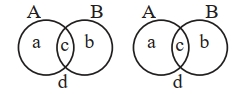
0 likes
View Solution184
DifficultMCQ
Let $A = \{0, 3, 4, 6, 7, 8, 9, 10\}$ and $R$ be the relation defined on $A$ such that $R = \{(x, y) \in A \times A : x - y \text{ is an odd positive integer or } x - y = 2\}$. The minimum number of elements that must be added to the relation $R$ so that it becomes a symmetric relation is equal to $...........$.
A
$18$
B
$19$
C
$17$
D
$16$
Solution
(B) The set $A$ is given as $A = \{0, 3, 4, 6, 7, 8, 9, 10\}$. The number of odd elements is $3$ $(\{3, 7, 9\})$ and the number of even elements is $5$ $(\{0, 4, 6, 8, 10\})$.
The relation $R$ contains pairs $(x, y)$ such that $x - y$ is an odd positive integer or $x - y = 2$.
$1$. Pairs where $x - y$ is an odd positive integer: Since $x - y$ is odd,one must be odd and the other even. There are $3 \times 5 = 15$ such pairs where $x > y$.
$2$. Pairs where $x - y = 2$: These are $(6, 4), (8, 6), (10, 8), (9, 7)$. There are $4$ such pairs where $x > y$.
Total pairs in $R$ with $x > y$ is $15 + 4 = 19$.
For $R$ to be symmetric,if $(x, y) \in R$,then $(y, x)$ must also be in $R$. Since all $19$ pairs currently satisfy $x > y$,their symmetric counterparts $(y, x)$ where $y < x$ are not currently in $R$.
Therefore,we must add $19$ elements to $R$ to make it symmetric.
The relation $R$ contains pairs $(x, y)$ such that $x - y$ is an odd positive integer or $x - y = 2$.
$1$. Pairs where $x - y$ is an odd positive integer: Since $x - y$ is odd,one must be odd and the other even. There are $3 \times 5 = 15$ such pairs where $x > y$.
$2$. Pairs where $x - y = 2$: These are $(6, 4), (8, 6), (10, 8), (9, 7)$. There are $4$ such pairs where $x > y$.
Total pairs in $R$ with $x > y$ is $15 + 4 = 19$.
For $R$ to be symmetric,if $(x, y) \in R$,then $(y, x)$ must also be in $R$. Since all $19$ pairs currently satisfy $x > y$,their symmetric counterparts $(y, x)$ where $y < x$ are not currently in $R$.
Therefore,we must add $19$ elements to $R$ to make it symmetric.
0 likes
View Solution185
MediumMCQ
Let $A = \{1, 2, 3, 4, 5, 6, 7\}$. Then the relation $R = \{(x, y) \in A \times A : x + y = 7\}$ is
A
transitive but neither symmetric nor reflexive
B
reflexive but neither symmetric nor transitive
C
an equivalence relation
D
symmetric but neither reflexive nor transitive
Solution
(D) Given $A = \{1, 2, 3, 4, 5, 6, 7\}$ and $R = \{(x, y) \in A \times A : x + y = 7\}$.
Listing the elements of $R$: $R = \{(1, 6), (2, 5), (3, 4), (4, 3), (5, 2), (6, 1)\}$.
$1$. Reflexive: For $R$ to be reflexive,$(x, x) \in R$ for all $x \in A$. Since $(1, 1) \notin R$,$R$ is not reflexive.
$2$. Symmetric: For $R$ to be symmetric,if $(x, y) \in R$,then $(y, x) \in R$. Since $(1, 6) \in R$ and $(6, 1) \in R$,$(2, 5) \in R$ and $(5, 2) \in R$,etc.,$R$ is symmetric.
$3$. Transitive: For $R$ to be transitive,if $(x, y) \in R$ and $(y, z) \in R$,then $(x, z) \in R$. Here $(1, 6) \in R$ and $(6, 1) \in R$,but $(1, 1) \notin R$. Thus,$R$ is not transitive.
Therefore,$R$ is symmetric but neither reflexive nor transitive.
Listing the elements of $R$: $R = \{(1, 6), (2, 5), (3, 4), (4, 3), (5, 2), (6, 1)\}$.
$1$. Reflexive: For $R$ to be reflexive,$(x, x) \in R$ for all $x \in A$. Since $(1, 1) \notin R$,$R$ is not reflexive.
$2$. Symmetric: For $R$ to be symmetric,if $(x, y) \in R$,then $(y, x) \in R$. Since $(1, 6) \in R$ and $(6, 1) \in R$,$(2, 5) \in R$ and $(5, 2) \in R$,etc.,$R$ is symmetric.
$3$. Transitive: For $R$ to be transitive,if $(x, y) \in R$ and $(y, z) \in R$,then $(x, z) \in R$. Here $(1, 6) \in R$ and $(6, 1) \in R$,but $(1, 1) \notin R$. Thus,$R$ is not transitive.
Therefore,$R$ is symmetric but neither reflexive nor transitive.
0 likes
View Solution186
MediumMCQ
Let $A = \{2, 3, 4\}$ and $B = \{8, 9, 12\}$. Then the number of elements in the relation $R = \{((a_1, b_1), (a_2, b_2)) \in (A \times B) \times (A \times B) : a_1 \text{ divides } b_2 \text{ and } a_2 \text{ divides } b_1\}$ is:
A
$36$
B
$12$
C
$18$
D
$24$
Solution
(A) We are given $A = \{2, 3, 4\}$ and $B = \{8, 9, 12\}$.
We need to find the number of pairs $((a_1, b_1), (a_2, b_2))$ such that $a_1$ divides $b_2$ and $a_2$ divides $b_1$,where $a_1, a_2 \in A$ and $b_1, b_2 \in B$.
Let $S$ be the set of pairs $(a, b) \in A \times B$ such that $a$ divides $b$.
For $a = 2$,$b \in \{8, 12\}$ ($2$ pairs: $(2, 8), (2, 12)$).
For $a = 3$,$b \in \{9, 12\}$ ($2$ pairs: $(3, 9), (3, 12)$).
For $a = 4$,$b \in \{8, 12\}$ ($2$ pairs: $(4, 8), (4, 12)$).
Thus,there are $2 + 2 + 2 = 6$ such pairs in $S$.
The relation $R$ is defined as the set of pairs $((a_1, b_1), (a_2, b_2))$ such that $(a_1, b_2) \in S$ and $(a_2, b_1) \in S$.
Since there are $6$ choices for the pair $(a_1, b_2)$ and $6$ choices for the pair $(a_2, b_1)$,the total number of elements in $R$ is $6 \times 6 = 36$.
We need to find the number of pairs $((a_1, b_1), (a_2, b_2))$ such that $a_1$ divides $b_2$ and $a_2$ divides $b_1$,where $a_1, a_2 \in A$ and $b_1, b_2 \in B$.
Let $S$ be the set of pairs $(a, b) \in A \times B$ such that $a$ divides $b$.
For $a = 2$,$b \in \{8, 12\}$ ($2$ pairs: $(2, 8), (2, 12)$).
For $a = 3$,$b \in \{9, 12\}$ ($2$ pairs: $(3, 9), (3, 12)$).
For $a = 4$,$b \in \{8, 12\}$ ($2$ pairs: $(4, 8), (4, 12)$).
Thus,there are $2 + 2 + 2 = 6$ such pairs in $S$.
The relation $R$ is defined as the set of pairs $((a_1, b_1), (a_2, b_2))$ such that $(a_1, b_2) \in S$ and $(a_2, b_1) \in S$.
Since there are $6$ choices for the pair $(a_1, b_2)$ and $6$ choices for the pair $(a_2, b_1)$,the total number of elements in $R$ is $6 \times 6 = 36$.
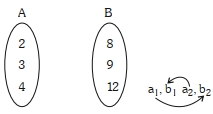
0 likes
View Solution187
MediumMCQ
The number of relations on the set $\{1,2,3\}$ containing $(1,2)$ and $(2,3)$,which are reflexive and transitive but not symmetric,is
A
$0$
B
$1$
C
$2$
D
$3$
Solution
(B) Let the set be $A = \{1, 2, 3\}$.
For a relation $R$ to be reflexive,it must contain $(1,1), (2,2), (3,3)$.
Given that $(1,2) \in R$ and $(2,3) \in R$,for $R$ to be transitive,it must contain $(1,3)$ because $(1,2) \in R$ and $(2,3) \in R \implies (1,3) \in R$.
Thus,the minimal relation $R$ containing these elements is $R_0 = \{(1,1), (2,2), (3,3), (1,2), (2,3), (1,3)\}$.
This relation $R_0$ is reflexive and transitive. It is not symmetric because $(1,2) \in R_0$ but $(2,1) \notin R_0$.
If we add any other element to $R_0$,such as $(2,1)$,the relation becomes symmetric with respect to $(1,2)$ and $(2,1)$. If we add $(3,2)$,it becomes symmetric with respect to $(2,3)$ and $(3,2)$.
Therefore,there is only $1$ such relation,which is $R_0$ itself.
For a relation $R$ to be reflexive,it must contain $(1,1), (2,2), (3,3)$.
Given that $(1,2) \in R$ and $(2,3) \in R$,for $R$ to be transitive,it must contain $(1,3)$ because $(1,2) \in R$ and $(2,3) \in R \implies (1,3) \in R$.
Thus,the minimal relation $R$ containing these elements is $R_0 = \{(1,1), (2,2), (3,3), (1,2), (2,3), (1,3)\}$.
This relation $R_0$ is reflexive and transitive. It is not symmetric because $(1,2) \in R_0$ but $(2,1) \notin R_0$.
If we add any other element to $R_0$,such as $(2,1)$,the relation becomes symmetric with respect to $(1,2)$ and $(2,1)$. If we add $(3,2)$,it becomes symmetric with respect to $(2,3)$ and $(3,2)$.
Therefore,there is only $1$ such relation,which is $R_0$ itself.
0 likes
View Solution188
MediumMCQ
Let $A = \{-4, -3, -2, 0, 1, 3, 4\}$ and $R = \{(a, b) \in A \times A : b = |a| \text{ or } b^2 = a + 1\}$ be a relation on $A$. Then the minimum number of elements that must be added to the relation $R$ so that it becomes reflexive and symmetric is $........$.
A
$5$
B
$7$
C
$6$
D
$4$
Solution
(C) Given $A = \{-4, -3, -2, 0, 1, 3, 4\}$.
First,we find the elements of $R$ based on the conditions $b = |a|$ or $b^2 = a + 1$:
For $b = |a|$: $(-4, 4), (-3, 3), (-2, 2), (0, 0), (1, 1), (3, 3), (4, 4)$. Note that $(-2, 2)$ is not in $A \times A$ because $2 \notin A$. So,we have $(-4, 4), (-3, 3), (0, 0), (1, 1), (3, 3), (4, 4)$.
For $b^2 = a + 1$: If $a = -4, b^2 = -3$ (no); $a = -3, b^2 = -2$ (no); $a = -2, b^2 = -1$ (no); $a = 0, b^2 = 1 \Rightarrow b = 1, -1$ (only $1 \in A$); $a = 1, b^2 = 2$ (no); $a = 3, b^2 = 4 \Rightarrow b = 2, -2$ (no); $a = 4, b^2 = 5$ (no).
Thus,$R = \{(-4, 4), (-3, 3), (0, 0), (1, 1), (3, 3), (4, 4), (0, 1)\}$.
For $R$ to be reflexive,we need $(a, a) \in R$ for all $a \in A$. Missing elements: $(-4, -4), (-3, -3), (-2, -2)$. ($3$ elements).
Now $R' = R \cup \{(-4, -4), (-3, -3), (-2, -2)\} = \{(-4, 4), (-3, 3), (0, 0), (1, 1), (3, 3), (4, 4), (0, 1), (-4, -4), (-3, -3), (-2, -2)\}$.
For $R'$ to be symmetric,if $(a, b) \in R'$,then $(b, a) \in R'$.
Pairs to add: $(4, -4), (3, -3), (1, 0)$. ($3$ elements).
Total elements added = $3 + 3 = 6$.
First,we find the elements of $R$ based on the conditions $b = |a|$ or $b^2 = a + 1$:
For $b = |a|$: $(-4, 4), (-3, 3), (-2, 2), (0, 0), (1, 1), (3, 3), (4, 4)$. Note that $(-2, 2)$ is not in $A \times A$ because $2 \notin A$. So,we have $(-4, 4), (-3, 3), (0, 0), (1, 1), (3, 3), (4, 4)$.
For $b^2 = a + 1$: If $a = -4, b^2 = -3$ (no); $a = -3, b^2 = -2$ (no); $a = -2, b^2 = -1$ (no); $a = 0, b^2 = 1 \Rightarrow b = 1, -1$ (only $1 \in A$); $a = 1, b^2 = 2$ (no); $a = 3, b^2 = 4 \Rightarrow b = 2, -2$ (no); $a = 4, b^2 = 5$ (no).
Thus,$R = \{(-4, 4), (-3, 3), (0, 0), (1, 1), (3, 3), (4, 4), (0, 1)\}$.
For $R$ to be reflexive,we need $(a, a) \in R$ for all $a \in A$. Missing elements: $(-4, -4), (-3, -3), (-2, -2)$. ($3$ elements).
Now $R' = R \cup \{(-4, -4), (-3, -3), (-2, -2)\} = \{(-4, 4), (-3, 3), (0, 0), (1, 1), (3, 3), (4, 4), (0, 1), (-4, -4), (-3, -3), (-2, -2)\}$.
For $R'$ to be symmetric,if $(a, b) \in R'$,then $(b, a) \in R'$.
Pairs to add: $(4, -4), (3, -3), (1, 0)$. ($3$ elements).
Total elements added = $3 + 3 = 6$.
0 likes
View Solution189
AdvancedMCQ
Let $A = \{1, 2, 3, 4\}$ and $R$ be a relation on the set $A \times A$ defined by $R = \{((a, b), (c, d)) : 2a + 3b = 4c + 5d\}$. Then the number of elements in $R$ is:
A
$6$
B
$5$
C
$4$
D
$3$
Solution
(A) Given $A = \{1, 2, 3, 4\}$. The relation $R$ is defined on $A \times A$ such that $2a + 3b = 4c + 5d$,where $a, b, c, d \in A$.
Let $S_1 = 2a + 3b$ and $S_2 = 4c + 5d$.
Possible values for $S_1$ for $a, b \in \{1, 2, 3, 4\}$:
If $a=1: 2+3=5, 2+6=8, 2+9=11, 2+12=14$
If $a=2: 4+3=7, 4+6=10, 4+9=13, 4+12=16$
If $a=3: 6+3=9, 6+6=12, 6+9=15, 6+12=18$
If $a=4: 8+3=11, 8+6=14, 8+9=17, 8+12=20$
Possible values for $S_2$ for $c, d \in \{1, 2, 3, 4\}$:
If $c=1: 4+5=9, 4+10=14, 4+15=19, 4+20=24$
If $c=2: 8+5=13, 8+10=18, 8+15=23, 8+20=28$
If $c=3: 12+5=17, 12+10=22, 12+15=27, 12+20=32$
If $c=4: 16+5=21, 16+10=26, 16+15=31, 16+20=36$
We look for common values $\alpha = S_1 = S_2$:
For $\alpha = 9$: $(a,b)=(3,1)$ and $(c,d)=(1,1) \implies ((3,1),(1,1))$
For $\alpha = 13$: $(a,b)=(2,3)$ and $(c,d)=(2,1) \implies ((2,3),(2,1))$
For $\alpha = 14$: $(a,b)=(1,4)$ and $(c,d)=(1,2) \implies ((1,4),(1,2))$
For $\alpha = 14$: $(a,b)=(4,2)$ and $(c,d)=(1,2) \implies ((4,2),(1,2))$
For $\alpha = 17$: $(a,b)=(4,3)$ and $(c,d)=(3,1) \implies ((4,3),(3,1))$
For $\alpha = 18$: $(a,b)=(3,4)$ and $(c,d)=(2,2) \implies ((3,4),(2,2))$
Total number of elements is $6$.
Let $S_1 = 2a + 3b$ and $S_2 = 4c + 5d$.
Possible values for $S_1$ for $a, b \in \{1, 2, 3, 4\}$:
If $a=1: 2+3=5, 2+6=8, 2+9=11, 2+12=14$
If $a=2: 4+3=7, 4+6=10, 4+9=13, 4+12=16$
If $a=3: 6+3=9, 6+6=12, 6+9=15, 6+12=18$
If $a=4: 8+3=11, 8+6=14, 8+9=17, 8+12=20$
Possible values for $S_2$ for $c, d \in \{1, 2, 3, 4\}$:
If $c=1: 4+5=9, 4+10=14, 4+15=19, 4+20=24$
If $c=2: 8+5=13, 8+10=18, 8+15=23, 8+20=28$
If $c=3: 12+5=17, 12+10=22, 12+15=27, 12+20=32$
If $c=4: 16+5=21, 16+10=26, 16+15=31, 16+20=36$
We look for common values $\alpha = S_1 = S_2$:
For $\alpha = 9$: $(a,b)=(3,1)$ and $(c,d)=(1,1) \implies ((3,1),(1,1))$
For $\alpha = 13$: $(a,b)=(2,3)$ and $(c,d)=(2,1) \implies ((2,3),(2,1))$
For $\alpha = 14$: $(a,b)=(1,4)$ and $(c,d)=(1,2) \implies ((1,4),(1,2))$
For $\alpha = 14$: $(a,b)=(4,2)$ and $(c,d)=(1,2) \implies ((4,2),(1,2))$
For $\alpha = 17$: $(a,b)=(4,3)$ and $(c,d)=(3,1) \implies ((4,3),(3,1))$
For $\alpha = 18$: $(a,b)=(3,4)$ and $(c,d)=(2,2) \implies ((3,4),(2,2))$
Total number of elements is $6$.
0 likes
View Solution190
DifficultMCQ
Let $S = \{1, 2, 3, \ldots, 10\}$. Suppose $M$ is the set of all subsets of $S$. Then the relation $R = \{(A, B) : A \cap B \neq \phi; A, B \in M\}$ is :
A
symmetric and reflexive only
B
reflexive only
C
symmetric and transitive only
D
symmetric only
Solution
(D) Let $S = \{1, 2, 3, \ldots, 10\}$.
The relation is defined as $R = \{(A, B) : A \cap B \neq \phi; A, B \in M\}$.
$1$. Reflexivity: $A$ relation $R$ is reflexive if $(A, A) \in R$ for all $A \in M$. This requires $A \cap A \neq \phi$,which means $A \neq \phi$. Since the empty set $\phi$ is a subset of $S$ and $\phi \cap \phi = \phi$,the condition $A \cap A \neq \phi$ is not satisfied for $A = \phi$. Thus,$R$ is not reflexive.
$2$. Symmetry: $A$ relation $R$ is symmetric if $(A, B) \in R \implies (B, A) \in R$. If $A \cap B \neq \phi$,then $B \cap A \neq \phi$ because intersection is commutative. Thus,$R$ is symmetric.
$3$. Transitivity: $A$ relation $R$ is transitive if $(A, B) \in R$ and $(B, C) \in R \implies (A, C) \in R$. Let $S = \{1, 2, 3\}$. Let $A = \{1, 2\}$,$B = \{2, 3\}$,and $C = \{3\}$. Here,$A \cap B = \{2\} \neq \phi$ and $B \cap C = \{3\} \neq \phi$. However,$A \cap C = \phi$. Since $A \cap C = \phi$,the condition $(A, C) \in R$ is not satisfied. Thus,$R$ is not transitive.
Therefore,the relation is symmetric only.
The relation is defined as $R = \{(A, B) : A \cap B \neq \phi; A, B \in M\}$.
$1$. Reflexivity: $A$ relation $R$ is reflexive if $(A, A) \in R$ for all $A \in M$. This requires $A \cap A \neq \phi$,which means $A \neq \phi$. Since the empty set $\phi$ is a subset of $S$ and $\phi \cap \phi = \phi$,the condition $A \cap A \neq \phi$ is not satisfied for $A = \phi$. Thus,$R$ is not reflexive.
$2$. Symmetry: $A$ relation $R$ is symmetric if $(A, B) \in R \implies (B, A) \in R$. If $A \cap B \neq \phi$,then $B \cap A \neq \phi$ because intersection is commutative. Thus,$R$ is symmetric.
$3$. Transitivity: $A$ relation $R$ is transitive if $(A, B) \in R$ and $(B, C) \in R \implies (A, C) \in R$. Let $S = \{1, 2, 3\}$. Let $A = \{1, 2\}$,$B = \{2, 3\}$,and $C = \{3\}$. Here,$A \cap B = \{2\} \neq \phi$ and $B \cap C = \{3\} \neq \phi$. However,$A \cap C = \phi$. Since $A \cap C = \phi$,the condition $(A, C) \in R$ is not satisfied. Thus,$R$ is not transitive.
Therefore,the relation is symmetric only.
0 likes
View Solution191
MediumMCQ
Let $R$ be a relation on $\mathbb{Z} \times \mathbb{Z}$ defined by $(a, b) R (c, d)$ if and only if $ad - bc$ is divisible by $5$. Then $R$ is
A
Reflexive and symmetric but not transitive
B
Reflexive but neither symmetric nor transitive
C
Reflexive,symmetric and transitive
D
Reflexive and transitive but not symmetric
Solution
(A) $1$. Reflexivity: For any $(a, b) \in \mathbb{Z} \times \mathbb{Z}$,we have $ab - ba = 0$,which is divisible by $5$. Thus,$(a, b) R (a, b)$ holds. So,$R$ is reflexive.
$2$. Symmetry: Let $(a, b) R (c, d)$. Then $ad - bc = 5k$ for some integer $k$. This implies $bc - ad = 5(-k)$,which is also divisible by $5$. Thus,$(c, d) R (a, b)$ holds. So,$R$ is symmetric.
$3$. Transitivity: Consider $(3, 1) R (10, 5)$ because $3(5) - 1(10) = 15 - 10 = 5$,which is divisible by $5$. Also,$(10, 5) R (1, 1)$ because $10(1) - 5(1) = 5$,which is divisible by $5$. However,for $(3, 1)$ and $(1, 1)$,we have $3(1) - 1(1) = 2$,which is not divisible by $5$. Thus,$(3, 1)$ is not related to $(1, 1)$. Therefore,$R$ is not transitive.
$2$. Symmetry: Let $(a, b) R (c, d)$. Then $ad - bc = 5k$ for some integer $k$. This implies $bc - ad = 5(-k)$,which is also divisible by $5$. Thus,$(c, d) R (a, b)$ holds. So,$R$ is symmetric.
$3$. Transitivity: Consider $(3, 1) R (10, 5)$ because $3(5) - 1(10) = 15 - 10 = 5$,which is divisible by $5$. Also,$(10, 5) R (1, 1)$ because $10(1) - 5(1) = 5$,which is divisible by $5$. However,for $(3, 1)$ and $(1, 1)$,we have $3(1) - 1(1) = 2$,which is not divisible by $5$. Thus,$(3, 1)$ is not related to $(1, 1)$. Therefore,$R$ is not transitive.
0 likes
View Solution192
MediumMCQ
If $R$ is the smallest equivalence relation on the set $\{1, 2, 3, 4\}$ such that $\{(1, 2), (1, 3)\} \subset R$,then the number of elements in $R$ is
A
$10$
B
$12$
C
$8$
D
$15$
Solution
(A) For $R$ to be an equivalence relation,it must be reflexive,symmetric,and transitive.
$1$. Reflexivity: Since the set is $\{1, 2, 3, 4\}$,$R$ must contain $\{(1, 1), (2, 2), (3, 3), (4, 4)\}$.
$2$. Symmetry: Given $\{(1, 2), (1, 3)\} \subset R$,by symmetry,$R$ must also contain $\{(2, 1), (3, 1)\}$.
$3$. Transitivity: Since $(2, 1) \in R$ and $(1, 3) \in R$,by transitivity,$(2, 3) \in R$. By symmetry,$(3, 2) \in R$ must also be in $R$.
Combining these,the set $R$ is $\{(1, 1), (2, 2), (3, 3), (4, 4), (1, 2), (2, 1), (1, 3), (3, 1), (2, 3), (3, 2)\}$.
Counting the elements,we have $10$ elements in $R$.
$1$. Reflexivity: Since the set is $\{1, 2, 3, 4\}$,$R$ must contain $\{(1, 1), (2, 2), (3, 3), (4, 4)\}$.
$2$. Symmetry: Given $\{(1, 2), (1, 3)\} \subset R$,by symmetry,$R$ must also contain $\{(2, 1), (3, 1)\}$.
$3$. Transitivity: Since $(2, 1) \in R$ and $(1, 3) \in R$,by transitivity,$(2, 3) \in R$. By symmetry,$(3, 2) \in R$ must also be in $R$.
Combining these,the set $R$ is $\{(1, 1), (2, 2), (3, 3), (4, 4), (1, 2), (2, 1), (1, 3), (3, 1), (2, 3), (3, 2)\}$.
Counting the elements,we have $10$ elements in $R$.
0 likes
View Solution193
MediumMCQ
The number of symmetric relations defined on the set $\{1, 2, 3, 4\}$ which are not reflexive is
A
$950$
B
$940$
C
$960$
D
$965$
Solution
(C) Let $n$ be the number of elements in the set. Here,$n = 4$.
The total number of symmetric relations on a set with $n$ elements is given by $2^{\frac{n(n+1)}{2}}$.
For $n = 4$,the number of symmetric relations is $2^{\frac{4(5)}{2}} = 2^{10} = 1024$.
The number of symmetric relations that are also reflexive is given by $2^{\frac{n(n-1)}{2}}$.
For $n = 4$,the number of symmetric and reflexive relations is $2^{\frac{4(3)}{2}} = 2^6 = 64$.
The number of symmetric relations that are not reflexive is the total number of symmetric relations minus the number of symmetric and reflexive relations.
Number of symmetric relations not reflexive $= 2^{10} - 2^6 = 1024 - 64 = 960$.
The total number of symmetric relations on a set with $n$ elements is given by $2^{\frac{n(n+1)}{2}}$.
For $n = 4$,the number of symmetric relations is $2^{\frac{4(5)}{2}} = 2^{10} = 1024$.
The number of symmetric relations that are also reflexive is given by $2^{\frac{n(n-1)}{2}}$.
For $n = 4$,the number of symmetric and reflexive relations is $2^{\frac{4(3)}{2}} = 2^6 = 64$.
The number of symmetric relations that are not reflexive is the total number of symmetric relations minus the number of symmetric and reflexive relations.
Number of symmetric relations not reflexive $= 2^{10} - 2^6 = 1024 - 64 = 960$.
0 likes
View Solution194
EasyMCQ
Let $A = \{1, 2, 3, 4\}$ and $R = \{(1, 2), (2, 3), (1, 4)\}$ be a relation on $A$. Let $S$ be the smallest equivalence relation on $A$ such that $R \subset S$. If the number of elements in $S$ is $n$,then the value of $n$ is:
A
$16$
B
$15$
C
$14$
D
$13$
Solution
(A) An equivalence relation $S$ must be reflexive,symmetric,and transitive.
Given $R = \{(1, 2), (2, 3), (1, 4)\}$.
$1$. Reflexivity: $S$ must contain $(1, 1), (2, 2), (3, 3), (4, 4)$.
$2$. Symmetry: Since $(1, 2) \in S$,then $(2, 1) \in S$. Since $(2, 3) \in S$,then $(3, 2) \in S$. Since $(1, 4) \in S$,then $(4, 1) \in S$.
$3$. Transitivity: Since $(1, 2) \in S$ and $(2, 3) \in S$,then $(1, 3) \in S$. By symmetry,$(3, 1) \in S$.
Since $(1, 3) \in S$ and $(3, 2) \in S$,we already have $(1, 2) \in S$.
Since $(1, 4) \in S$ and $(4, 1) \in S$,we have $(1, 1) \in S$ (already included).
Since $(2, 3) \in S$ and $(3, 2) \in S$,we have $(2, 2) \in S$ (already included).
Since $(1, 2) \in S$ and $(2, 1) \in S$,we have $(1, 1) \in S$.
Checking the equivalence classes: $1$ is related to $2, 3, 4$. Thus,$1, 2, 3, 4$ are all in the same equivalence class.
If all elements are in one equivalence class,$S = A \times A$.
The number of elements $n = 4 \times 4 = 16$.
Given $R = \{(1, 2), (2, 3), (1, 4)\}$.
$1$. Reflexivity: $S$ must contain $(1, 1), (2, 2), (3, 3), (4, 4)$.
$2$. Symmetry: Since $(1, 2) \in S$,then $(2, 1) \in S$. Since $(2, 3) \in S$,then $(3, 2) \in S$. Since $(1, 4) \in S$,then $(4, 1) \in S$.
$3$. Transitivity: Since $(1, 2) \in S$ and $(2, 3) \in S$,then $(1, 3) \in S$. By symmetry,$(3, 1) \in S$.
Since $(1, 3) \in S$ and $(3, 2) \in S$,we already have $(1, 2) \in S$.
Since $(1, 4) \in S$ and $(4, 1) \in S$,we have $(1, 1) \in S$ (already included).
Since $(2, 3) \in S$ and $(3, 2) \in S$,we have $(2, 2) \in S$ (already included).
Since $(1, 2) \in S$ and $(2, 1) \in S$,we have $(1, 1) \in S$.
Checking the equivalence classes: $1$ is related to $2, 3, 4$. Thus,$1, 2, 3, 4$ are all in the same equivalence class.
If all elements are in one equivalence class,$S = A \times A$.
The number of elements $n = 4 \times 4 = 16$.
0 likes
View Solution195
EasyMCQ
Let $A = \{1, 2, 3, \ldots, 100\}$. Let $R$ be a relation on $A$ defined by $(x, y) \in R$ if and only if $2x = 3y$. Let $R_1$ be a symmetric relation on $A$ such that $R \subset R_1$ and the number of elements in $R_1$ is $n$. Then,the minimum value of $n$ is:
A
$60$
B
$66$
C
$50$
D
$40$
Solution
(B) The relation $R$ is defined as $(x, y) \in R \iff 2x = 3y$,which implies $y = \frac{2}{3}x$.
Since $x, y \in \{1, 2, \ldots, 100\}$,$x$ must be a multiple of $3$.
Let $x = 3k$,then $y = 2k$.
For $1 \le 2k \le 100$,we have $k \le 50$.
For $1 \le 3k \le 100$,we have $k \le 33$.
Thus,$k$ can take values from $1$ to $33$.
The elements of $R$ are $\{(3, 2), (6, 4), (9, 6), \ldots, (99, 66)\}$.
The number of elements in $R$ is $n(R) = 33$.
For $R_1$ to be a symmetric relation such that $R \subset R_1$,for every $(x, y) \in R$,the pair $(y, x)$ must also be in $R_1$.
Since $R$ is not symmetric (e.g.,$(3, 2) \in R$ but $(2, 3) \notin R$),we must include all $(y, x)$ pairs in $R_1$.
Thus,$R_1 = R \cup R^{-1} = \{(3, 2), (6, 4), \ldots, (99, 66), (2, 3), (4, 6), \ldots, (66, 99)\}$.
The number of elements in $R_1$ is $n = n(R) + n(R^{-1}) = 33 + 33 = 66$.
Since $x, y \in \{1, 2, \ldots, 100\}$,$x$ must be a multiple of $3$.
Let $x = 3k$,then $y = 2k$.
For $1 \le 2k \le 100$,we have $k \le 50$.
For $1 \le 3k \le 100$,we have $k \le 33$.
Thus,$k$ can take values from $1$ to $33$.
The elements of $R$ are $\{(3, 2), (6, 4), (9, 6), \ldots, (99, 66)\}$.
The number of elements in $R$ is $n(R) = 33$.
For $R_1$ to be a symmetric relation such that $R \subset R_1$,for every $(x, y) \in R$,the pair $(y, x)$ must also be in $R_1$.
Since $R$ is not symmetric (e.g.,$(3, 2) \in R$ but $(2, 3) \notin R$),we must include all $(y, x)$ pairs in $R_1$.
Thus,$R_1 = R \cup R^{-1} = \{(3, 2), (6, 4), \ldots, (99, 66), (2, 3), (4, 6), \ldots, (66, 99)\}$.
The number of elements in $R_1$ is $n = n(R) + n(R^{-1}) = 33 + 33 = 66$.
0 likes
View Solution196
MediumMCQ
Let $A = \{1, 2, 3, \ldots, 20\}$. Let $R_1$ and $R_2$ be two relations on $A$ such that $R_1 = \{(a, b) : b \text{ is divisible by } a\}$ and $R_2 = \{(a, b) : a \text{ is an integral multiple of } b\}$. Then,the number of elements in $R_1 - R_2$ is equal to . . . . . . .
A
$44$
B
$46$
C
$45$
D
$40$
Solution
(B) The set $A = \{1, 2, 3, \ldots, 20\}$.
$R_1 = \{(a, b) : b \text{ is divisible by } a\}$. The number of elements in $R_1$ is the sum of the number of multiples of each $a \in A$ that are $\leq 20$.
For $a=1$,there are $20$ multiples. For $a=2$,there are $10$ multiples. For $a=3$,there are $6$ multiples. For $a=4$,there are $5$ multiples. For $a=5$,there are $4$ multiples. For $a=6$,there are $3$ multiples. For $a=7, 8, 9, 10$,there are $2$ multiples each. For $a=11, 12, \ldots, 20$,there is $1$ multiple each (the number itself).
$n(R_1) = 20 + 10 + 6 + 5 + 4 + 3 + (4 \times 2) + (10 \times 1) = 48 + 8 + 10 = 66$.
$R_2 = \{(a, b) : a \text{ is an integral multiple of } b\}$. This is equivalent to saying $b$ is a divisor of $a$,which is the same as $R_1$.
However,the definition of $R_2$ given is $a = kb$ for some integer $k$. Since $a, b \in A$,$k$ must be a positive integer. This is the same as $R_1$.
Wait,$R_1 = \{(a, b) : b = ka, k \in \mathbb{Z}^+\}$ and $R_2 = \{(a, b) : a = kb, k \in \mathbb{Z}^+\}$.
$R_1 \cap R_2 = \{(a, b) : b = ka \text{ and } a = mb\} = \{(a, b) : a = mka \implies mk = 1\}$. Since $m, k \in \mathbb{Z}^+$,$m=1, k=1$. Thus $a=b$.
$R_1 \cap R_2 = \{(1, 1), (2, 2), \ldots, (20, 20)\}$.
$n(R_1 \cap R_2) = 20$.
$n(R_1 - R_2) = n(R_1) - n(R_1 \cap R_2) = 66 - 20 = 46$.
$R_1 = \{(a, b) : b \text{ is divisible by } a\}$. The number of elements in $R_1$ is the sum of the number of multiples of each $a \in A$ that are $\leq 20$.
For $a=1$,there are $20$ multiples. For $a=2$,there are $10$ multiples. For $a=3$,there are $6$ multiples. For $a=4$,there are $5$ multiples. For $a=5$,there are $4$ multiples. For $a=6$,there are $3$ multiples. For $a=7, 8, 9, 10$,there are $2$ multiples each. For $a=11, 12, \ldots, 20$,there is $1$ multiple each (the number itself).
$n(R_1) = 20 + 10 + 6 + 5 + 4 + 3 + (4 \times 2) + (10 \times 1) = 48 + 8 + 10 = 66$.
$R_2 = \{(a, b) : a \text{ is an integral multiple of } b\}$. This is equivalent to saying $b$ is a divisor of $a$,which is the same as $R_1$.
However,the definition of $R_2$ given is $a = kb$ for some integer $k$. Since $a, b \in A$,$k$ must be a positive integer. This is the same as $R_1$.
Wait,$R_1 = \{(a, b) : b = ka, k \in \mathbb{Z}^+\}$ and $R_2 = \{(a, b) : a = kb, k \in \mathbb{Z}^+\}$.
$R_1 \cap R_2 = \{(a, b) : b = ka \text{ and } a = mb\} = \{(a, b) : a = mka \implies mk = 1\}$. Since $m, k \in \mathbb{Z}^+$,$m=1, k=1$. Thus $a=b$.
$R_1 \cap R_2 = \{(1, 1), (2, 2), \ldots, (20, 20)\}$.
$n(R_1 \cap R_2) = 20$.
$n(R_1 - R_2) = n(R_1) - n(R_1 \cap R_2) = 66 - 20 = 46$.
0 likes
View Solution197
MediumMCQ
Consider the relations $R_1$ and $R_2$ defined as $a R_1 b \Leftrightarrow a^2+b^2=1$ for all $a, b \in R$ and $(a, b) R_2 (c, d) \Leftrightarrow a+d=b+c$ for all $(a, b), (c, d) \in N \times N$. Then:
A
Only $R_1$ is an equivalence relation
B
Only $R_2$ is an equivalence relation
C
$R_1$ and $R_2$ both are equivalence relations
D
Neither $R_1$ nor $R_2$ is an equivalence relation
Solution
(B) For relation $R_1$: $a R_1 b \Leftrightarrow a^2+b^2=1$ for $a, b \in R$.
$1$. Reflexivity: For $a=0.5$,$a^2+a^2 = 0.25+0.25 = 0.5 \neq 1$. So,$R_1$ is not reflexive.
$2$. Symmetry: If $a^2+b^2=1$,then $b^2+a^2=1$,so $b R_1 a$. $R_1$ is symmetric.
$3$. Transitivity: If $a R_1 b$ and $b R_1 c$,then $a^2+b^2=1$ and $b^2+c^2=1$. This does not imply $a^2+c^2=1$. For example,$a=1, b=0, c=1$. $1^2+0^2=1$ and $0^2+1^2=1$,but $1^2+1^2=2 \neq 1$. Thus,$R_1$ is not transitive.
For relation $R_2$: $(a, b) R_2 (c, d) \Leftrightarrow a+d=b+c$ for $(a, b), (c, d) \in N \times N$.
$1$. Reflexivity: $a+b=b+a$ is true,so $(a, b) R_2 (a, b)$.
$2$. Symmetry: If $a+d=b+c$,then $c+b=d+a$,so $(c, d) R_2 (a, b)$.
$3$. Transitivity: If $(a, b) R_2 (c, d)$ and $(c, d) R_2 (e, f)$,then $a+d=b+c$ and $c+f=d+e$. Adding these,$a+d+c+f = b+c+d+e \Rightarrow a+f=b+e$. Thus,$(a, b) R_2 (e, f)$.
Since $R_2$ is reflexive,symmetric,and transitive,it is an equivalence relation.
Therefore,only $R_2$ is an equivalence relation.
$1$. Reflexivity: For $a=0.5$,$a^2+a^2 = 0.25+0.25 = 0.5 \neq 1$. So,$R_1$ is not reflexive.
$2$. Symmetry: If $a^2+b^2=1$,then $b^2+a^2=1$,so $b R_1 a$. $R_1$ is symmetric.
$3$. Transitivity: If $a R_1 b$ and $b R_1 c$,then $a^2+b^2=1$ and $b^2+c^2=1$. This does not imply $a^2+c^2=1$. For example,$a=1, b=0, c=1$. $1^2+0^2=1$ and $0^2+1^2=1$,but $1^2+1^2=2 \neq 1$. Thus,$R_1$ is not transitive.
For relation $R_2$: $(a, b) R_2 (c, d) \Leftrightarrow a+d=b+c$ for $(a, b), (c, d) \in N \times N$.
$1$. Reflexivity: $a+b=b+a$ is true,so $(a, b) R_2 (a, b)$.
$2$. Symmetry: If $a+d=b+c$,then $c+b=d+a$,so $(c, d) R_2 (a, b)$.
$3$. Transitivity: If $(a, b) R_2 (c, d)$ and $(c, d) R_2 (e, f)$,then $a+d=b+c$ and $c+f=d+e$. Adding these,$a+d+c+f = b+c+d+e \Rightarrow a+f=b+e$. Thus,$(a, b) R_2 (e, f)$.
Since $R_2$ is reflexive,symmetric,and transitive,it is an equivalence relation.
Therefore,only $R_2$ is an equivalence relation.
0 likes
View Solution198
MediumMCQ
Let a relation $R$ on $N \times N$ be defined as: $(x_1, y_1) R (x_2, y_2)$ if and only if $x_1 \leq x_2$ or $y_1 \leq y_2$. Consider the two statements:
$(I)$ $R$ is reflexive but not symmetric.
$(II)$ $R$ is transitive.
Then which one of the following is true?
$(I)$ $R$ is reflexive but not symmetric.
$(II)$ $R$ is transitive.
Then which one of the following is true?
A
Only $(II)$ is correct.
B
Only $(I)$ is correct.
C
Both $(I)$ and $(II)$ are correct.
D
Neither $(I)$ nor $(II)$ is correct.
Solution
(B) $1$. Reflexivity: For any $(x, y) \in N \times N$,we have $x \leq x$ or $y \leq y$. Thus,$((x, y), (x, y)) \in R$. So,$R$ is reflexive.
$2$. Symmetry: Consider $((1, 2), (2, 1))$. Here $1 \leq 2$ is true,so $((1, 2), (2, 1)) \in R$. However,for $((2, 1), (1, 2))$,$2 \leq 1$ is false and $1 \leq 2$ is true. Wait,let us check another example: $((1, 3), (2, 2))$. $1 \leq 2$ is true,so it is in $R$. But for $((2, 2), (1, 3))$,$2 \leq 1$ is false and $2 \leq 3$ is true. Let us take $((2, 3), (1, 1))$. $2 \leq 1$ is false and $3 \leq 1$ is false. So $((2, 3), (1, 1)) \notin R$. Since $((1, 1), (2, 3)) \in R$ but $((2, 3), (1, 1)) \notin R$,$R$ is not symmetric.
$3$. Transitivity: Consider $A = (2, 4)$,$B = (3, 3)$,and $C = (1, 3)$.
$(A, B) \in R$ because $2 \leq 3$ is true.
$(B, C) \in R$ because $3 \leq 3$ is true.
However,for $(A, C) = ((2, 4), (1, 3))$,$2 \leq 1$ is false and $4 \leq 3$ is false. Thus,$(A, C) \notin R$. So,$R$ is not transitive.
Therefore,only statement $(I)$ is correct.
$2$. Symmetry: Consider $((1, 2), (2, 1))$. Here $1 \leq 2$ is true,so $((1, 2), (2, 1)) \in R$. However,for $((2, 1), (1, 2))$,$2 \leq 1$ is false and $1 \leq 2$ is true. Wait,let us check another example: $((1, 3), (2, 2))$. $1 \leq 2$ is true,so it is in $R$. But for $((2, 2), (1, 3))$,$2 \leq 1$ is false and $2 \leq 3$ is true. Let us take $((2, 3), (1, 1))$. $2 \leq 1$ is false and $3 \leq 1$ is false. So $((2, 3), (1, 1)) \notin R$. Since $((1, 1), (2, 3)) \in R$ but $((2, 3), (1, 1)) \notin R$,$R$ is not symmetric.
$3$. Transitivity: Consider $A = (2, 4)$,$B = (3, 3)$,and $C = (1, 3)$.
$(A, B) \in R$ because $2 \leq 3$ is true.
$(B, C) \in R$ because $3 \leq 3$ is true.
However,for $(A, C) = ((2, 4), (1, 3))$,$2 \leq 1$ is false and $4 \leq 3$ is false. Thus,$(A, C) \notin R$. So,$R$ is not transitive.
Therefore,only statement $(I)$ is correct.
0 likes
View Solution199
DifficultMCQ
Let the relations $R_1$ and $R_2$ on the set $X = \{1, 2, 3, \ldots, 20\}$ be given by $R_1 = \{(x, y) : 2x - 3y = 2\}$ and $R_2 = \{(x, y) : -5x + 4y = 0\}$. If $M$ and $N$ are the minimum number of elements required to be added to $R_1$ and $R_2$,respectively,to make the relations symmetric,then $M + N$ equals
A
$8$
B
$16$
C
$12$
D
$10$
Solution
(D) Given the set $X = \{1, 2, 3, \ldots, 20\}$.
For $R_1 = \{(x, y) : 2x - 3y = 2\}$,we find the ordered pairs $(x, y)$ such that $x, y \in X$:
If $y = 2, x = 4$; if $y = 4, x = 7$; if $y = 6, x = 10$; if $y = 8, x = 13$; if $y = 10, x = 16$; if $y = 12, x = 19$.
So,$R_1 = \{(4, 2), (7, 4), (10, 6), (13, 8), (16, 10), (19, 12)\}$.
Since there are $6$ elements and none are of the form $(a, a)$,to make $R_1$ symmetric,we need to add the reverse of each pair,which is $6$ elements.
Thus,$M = 6$.
For $R_2 = \{(x, y) : -5x + 4y = 0\}$,which implies $4y = 5x$ or $y = \frac{5}{4}x$,we find the ordered pairs $(x, y)$ such that $x, y \in X$:
If $x = 4, y = 5$; if $x = 8, y = 10$; if $x = 12, y = 15$; if $x = 16, y = 20$.
So,$R_2 = \{(4, 5), (8, 10), (12, 15), (16, 20)\}$.
Since there are $4$ elements and none are of the form $(a, a)$,to make $R_2$ symmetric,we need to add the reverse of each pair,which is $4$ elements.
Thus,$N = 4$.
Therefore,$M + N = 6 + 4 = 10$.
For $R_1 = \{(x, y) : 2x - 3y = 2\}$,we find the ordered pairs $(x, y)$ such that $x, y \in X$:
If $y = 2, x = 4$; if $y = 4, x = 7$; if $y = 6, x = 10$; if $y = 8, x = 13$; if $y = 10, x = 16$; if $y = 12, x = 19$.
So,$R_1 = \{(4, 2), (7, 4), (10, 6), (13, 8), (16, 10), (19, 12)\}$.
Since there are $6$ elements and none are of the form $(a, a)$,to make $R_1$ symmetric,we need to add the reverse of each pair,which is $6$ elements.
Thus,$M = 6$.
For $R_2 = \{(x, y) : -5x + 4y = 0\}$,which implies $4y = 5x$ or $y = \frac{5}{4}x$,we find the ordered pairs $(x, y)$ such that $x, y \in X$:
If $x = 4, y = 5$; if $x = 8, y = 10$; if $x = 12, y = 15$; if $x = 16, y = 20$.
So,$R_2 = \{(4, 5), (8, 10), (12, 15), (16, 20)\}$.
Since there are $4$ elements and none are of the form $(a, a)$,to make $R_2$ symmetric,we need to add the reverse of each pair,which is $4$ elements.
Thus,$N = 4$.
Therefore,$M + N = 6 + 4 = 10$.
0 likes
View Solution200
DifficultMCQ
Let $A = \{1, 2, 3, 4, 5\}$. Let $R$ be a relation on $A$ defined by $x R y$ if and only if $4x \leq 5y$. Let $m$ be the number of elements in $R$ and $n$ be the minimum number of elements from $A \times A$ that are required to be added to $R$ to make it a symmetric relation. Then $m+n$ is equal to:
A
$24$
B
$23$
C
$25$
D
$26$
Solution
(C) Given the set $A = \{1, 2, 3, 4, 5\}$ and the relation $R$ defined by $4x \leq 5y$.
First,we list the elements $(x, y)$ such that $4x \leq 5y$:
For $x=1$: $4 \leq 5y \implies y \in \{1, 2, 3, 4, 5\}$ ($5$ elements)
For $x=2$: $8 \leq 5y \implies y \in \{2, 3, 4, 5\}$ ($4$ elements)
For $x=3$: $12 \leq 5y \implies y \in \{3, 4, 5\}$ ($3$ elements)
For $x=4$: $16 \leq 5y \implies y \in \{4, 5\}$ ($2$ elements)
For $x=5$: $20 \leq 5y \implies y \in \{4, 5\}$ ($2$ elements)
Total elements $m = 5 + 4 + 3 + 2 + 2 = 16$.
To make $R$ symmetric,for every $(x, y) \in R$ where $x \neq y$,we must have $(y, x) \in R$.
The elements in $R$ where $x \neq y$ are: $(1, 2), (1, 3), (1, 4), (1, 5), (2, 3), (2, 4), (2, 5), (3, 4), (3, 5), (4, 5), (5, 4)$.
There are $11$ such pairs.
We check which of their symmetric counterparts $(y, x)$ are $NOT$ already in $R$:
$(2, 1) \notin R$,$(3, 1) \notin R$,$(4, 1) \notin R$,$(5, 1) \notin R$,$(3, 2) \notin R$,$(4, 2) \notin R$,$(5, 2) \notin R$,$(4, 3) \notin R$,$(5, 3) \notin R$.
Note that $(5, 4) \in R$ and $(4, 5) \in R$,so this pair is already symmetric.
The elements to be added are $\{(2, 1), (3, 1), (4, 1), (5, 1), (3, 2), (4, 2), (5, 2), (4, 3), (5, 3)\}$.
Thus,$n = 9$.
Therefore,$m + n = 16 + 9 = 25$.
First,we list the elements $(x, y)$ such that $4x \leq 5y$:
For $x=1$: $4 \leq 5y \implies y \in \{1, 2, 3, 4, 5\}$ ($5$ elements)
For $x=2$: $8 \leq 5y \implies y \in \{2, 3, 4, 5\}$ ($4$ elements)
For $x=3$: $12 \leq 5y \implies y \in \{3, 4, 5\}$ ($3$ elements)
For $x=4$: $16 \leq 5y \implies y \in \{4, 5\}$ ($2$ elements)
For $x=5$: $20 \leq 5y \implies y \in \{4, 5\}$ ($2$ elements)
Total elements $m = 5 + 4 + 3 + 2 + 2 = 16$.
To make $R$ symmetric,for every $(x, y) \in R$ where $x \neq y$,we must have $(y, x) \in R$.
The elements in $R$ where $x \neq y$ are: $(1, 2), (1, 3), (1, 4), (1, 5), (2, 3), (2, 4), (2, 5), (3, 4), (3, 5), (4, 5), (5, 4)$.
There are $11$ such pairs.
We check which of their symmetric counterparts $(y, x)$ are $NOT$ already in $R$:
$(2, 1) \notin R$,$(3, 1) \notin R$,$(4, 1) \notin R$,$(5, 1) \notin R$,$(3, 2) \notin R$,$(4, 2) \notin R$,$(5, 2) \notin R$,$(4, 3) \notin R$,$(5, 3) \notin R$.
Note that $(5, 4) \in R$ and $(4, 5) \in R$,so this pair is already symmetric.
The elements to be added are $\{(2, 1), (3, 1), (4, 1), (5, 1), (3, 2), (4, 2), (5, 2), (4, 3), (5, 3)\}$.
Thus,$n = 9$.
Therefore,$m + n = 16 + 9 = 25$.
0 likes
View SolutionRelation and Function — Types of Relations · Frequently Asked Questions
1Are these Relation and Function questions useful for JEE and NEET?
Yes. All questions in this section are mapped to JEE Main and NEET exam patterns. Previous year questions from JEE Main, NEET, GUJCET and state-level exams are included with full solutions.
2Can I switch to Hindi or Gujarati for these questions?
Yes. Use the language tabs in the hero section or the sidebar to view the same questions and solutions in English, Hindi or Gujarati.
3How do I generate a question paper from this subtopic?
Use the Vedclass Exam Paper Generator — select the chapter and subtopic, set difficulty, and generate Sets A, B, C, D automatically. First 3 chapters of every subject are free.
Vedclass Products
For Students
Vedclass Test Series
Mock tests in real JEE/NEET style with performance analysis. 5-day free trial.
Start Free TrialFor Teachers
Exam Paper Generator
Generate Set A/B/C/D papers from this chapter in 2 minutes. 3 chapters free.
Try FreeFor Institutes
Online Exam Module
Live online exams with unlimited students, 360° analytics & white-label branding.
See DemoFor Teachers & Institutes
Generate a Relation and Function Exam Paper in 2 Minutes
Select subtopic & difficulty — Sets A, B, C, D auto-generated with No Repeat logic.
First 3 chapters of every subject are free — no payment required.