
A English
Domain and Range Questions in English
Class 12 Mathematics · Relation and Function · Domain and Range
324+
Questions
English
Language
100%
With Solutions
Showing 49 of 324 questions in English
1
MediumMCQ
If $f(x) = \frac{x^2 - 1}{x^2 + 1}$ for every real number $x$,then the minimum value of $f$ is:
A
Does not exist because $f$ is bounded
B
Is not attained even though $f$ is bounded
C
Is equal to $+1$
D
Is equal to $-1$
Solution
(D) Let $f(x) = \frac{x^2 - 1}{x^2 + 1}$.
We can rewrite the function as:
$f(x) = \frac{x^2 + 1 - 2}{x^2 + 1} = 1 - \frac{2}{x^2 + 1}$.
Since $x^2 \ge 0$ for all real numbers $x$,we have $x^2 + 1 \ge 1$.
This implies that $0 < \frac{1}{x^2 + 1} \le 1$.
Multiplying by $2$,we get $0 < \frac{2}{x^2 + 1} \le 2$.
Now,multiplying by $-1$ reverses the inequality:
$-2 \le -\frac{2}{x^2 + 1} < 0$.
Adding $1$ to all parts:
$1 - 2 \le 1 - \frac{2}{x^2 + 1} < 1 + 0$.
$-1 \le f(x) < 1$.
Thus,the minimum value of $f(x)$ is $-1$,which is attained when $x = 0$.
We can rewrite the function as:
$f(x) = \frac{x^2 + 1 - 2}{x^2 + 1} = 1 - \frac{2}{x^2 + 1}$.
Since $x^2 \ge 0$ for all real numbers $x$,we have $x^2 + 1 \ge 1$.
This implies that $0 < \frac{1}{x^2 + 1} \le 1$.
Multiplying by $2$,we get $0 < \frac{2}{x^2 + 1} \le 2$.
Now,multiplying by $-1$ reverses the inequality:
$-2 \le -\frac{2}{x^2 + 1} < 0$.
Adding $1$ to all parts:
$1 - 2 \le 1 - \frac{2}{x^2 + 1} < 1 + 0$.
$-1 \le f(x) < 1$.
Thus,the minimum value of $f(x)$ is $-1$,which is attained when $x = 0$.
0 likes
View Solution2
MediumMCQ
If $f:R \to S$ defined by $f(x) = \sin x - \sqrt{3} \cos x + 1$ is onto,then the interval of $S$ is
A
$[-1, 3]$
B
$[1, 1]$
C
$[0, 1]$
D
$[0, -1]$
Solution
(A) The function is given by $f(x) = \sin x - \sqrt{3} \cos x + 1$.
We know that the expression $a \sin x + b \cos x$ lies in the interval $[-\sqrt{a^2 + b^2}, \sqrt{a^2 + b^2}]$.
Here,$a = 1$ and $b = -\sqrt{3}$.
Thus,the range of $\sin x - \sqrt{3} \cos x$ is $[-\sqrt{1^2 + (-\sqrt{3})^2}, \sqrt{1^2 + (-\sqrt{3})^2}] = [-\sqrt{1+3}, \sqrt{1+3}] = [-2, 2]$.
Adding $1$ to the entire inequality,we get:
$-2 + 1 \le \sin x - \sqrt{3} \cos x + 1 \le 2 + 1$.
$-1 \le f(x) \le 3$.
Since the function $f$ is onto,the codomain $S$ must be equal to the range of the function.
Therefore,$S = [-1, 3]$.
We know that the expression $a \sin x + b \cos x$ lies in the interval $[-\sqrt{a^2 + b^2}, \sqrt{a^2 + b^2}]$.
Here,$a = 1$ and $b = -\sqrt{3}$.
Thus,the range of $\sin x - \sqrt{3} \cos x$ is $[-\sqrt{1^2 + (-\sqrt{3})^2}, \sqrt{1^2 + (-\sqrt{3})^2}] = [-\sqrt{1+3}, \sqrt{1+3}] = [-2, 2]$.
Adding $1$ to the entire inequality,we get:
$-2 + 1 \le \sin x - \sqrt{3} \cos x + 1 \le 2 + 1$.
$-1 \le f(x) \le 3$.
Since the function $f$ is onto,the codomain $S$ must be equal to the range of the function.
Therefore,$S = [-1, 3]$.
0 likes
View Solution3
EasyMCQ
The domain and range of $f(x) = \frac{|x - 3|}{x - 3}$ are respectively:
A
$R, \{-1, 1\}$
B
$R - \{3\}, \{-1, 1\}$
C
$R^+, R$
D
None of these
Solution
(B) The function is defined as $f(x) = \frac{|x - 3|}{x - 3}$.
For the function to be defined,the denominator must not be zero,so $x - 3 \neq 0$,which implies $x \neq 3$.
Thus,the domain is $R - \{3\}$.
If $x > 3$,then $|x - 3| = x - 3$,so $f(x) = \frac{x - 3}{x - 3} = 1$.
If $x < 3$,then $|x - 3| = -(x - 3)$,so $f(x) = \frac{-(x - 3)}{x - 3} = -1$.
Therefore,the range is $\{-1, 1\}$.
The correct option is $B$.
For the function to be defined,the denominator must not be zero,so $x - 3 \neq 0$,which implies $x \neq 3$.
Thus,the domain is $R - \{3\}$.
If $x > 3$,then $|x - 3| = x - 3$,so $f(x) = \frac{x - 3}{x - 3} = 1$.
If $x < 3$,then $|x - 3| = -(x - 3)$,so $f(x) = \frac{-(x - 3)}{x - 3} = -1$.
Therefore,the range is $\{-1, 1\}$.
The correct option is $B$.
0 likes
View Solution4
EasyMCQ
If the domain of the greatest integer function is the set of real numbers,then the range will be the set of
A
Real numbers
B
Rational numbers
C
Imaginary numbers
D
Integers
Solution
(D) The greatest integer function is defined as $f(x) = [x]$,where $[x]$ denotes the greatest integer less than or equal to $x$.
By definition,for any real number $x$,the value of $[x]$ is always an integer.
Therefore,the range of the greatest integer function is the set of all integers,denoted by $\mathbb{Z}$.
By definition,for any real number $x$,the value of $[x]$ is always an integer.
Therefore,the range of the greatest integer function is the set of all integers,denoted by $\mathbb{Z}$.
0 likes
View Solution5
MediumMCQ
The domain of the function $f(x) = \frac{\sin^{-1}(3 - x)}{\ln(|x| - 2)}$ is
A
$[2, 4]$
B
$(2, 3) \cup (3, 4]$
C
$[2, \infty)$
D
$(-\infty, -3) \cup [2, \infty)$
Solution
(B) For the function $f(x) = \frac{\sin^{-1}(3 - x)}{\ln(|x| - 2)}$ to be defined,the following conditions must be met:
$1$. The argument of $\sin^{-1}$ must be in $[-1, 1]$:
$-1 \le 3 - x \le 1$
$-4 \le -x \le -2$
$2 \le x \le 4$
So,the domain of the numerator is $[2, 4]$.
$2$. The argument of $\ln$ must be positive,and the denominator cannot be zero:
$|x| - 2 > 0 \implies |x| > 2 \implies x \in (-\infty, -2) \cup (2, \infty)$.
Also,$\ln(|x| - 2) \neq 0 \implies |x| - 2 \neq 1 \implies |x| \neq 3 \implies x \neq 3, x \neq -3$.
Combining these,the domain of the denominator is $(-\infty, -3) \cup (-3, -2) \cup (2, 3) \cup (3, \infty)$.
$3$. The domain of $f(x)$ is the intersection of these sets:
$[2, 4] \cap ((-\infty, -3) \cup (-3, -2) \cup (2, 3) \cup (3, \infty)) = (2, 3) \cup (3, 4]$.
Thus,the correct option is $B$.
$1$. The argument of $\sin^{-1}$ must be in $[-1, 1]$:
$-1 \le 3 - x \le 1$
$-4 \le -x \le -2$
$2 \le x \le 4$
So,the domain of the numerator is $[2, 4]$.
$2$. The argument of $\ln$ must be positive,and the denominator cannot be zero:
$|x| - 2 > 0 \implies |x| > 2 \implies x \in (-\infty, -2) \cup (2, \infty)$.
Also,$\ln(|x| - 2) \neq 0 \implies |x| - 2 \neq 1 \implies |x| \neq 3 \implies x \neq 3, x \neq -3$.
Combining these,the domain of the denominator is $(-\infty, -3) \cup (-3, -2) \cup (2, 3) \cup (3, \infty)$.
$3$. The domain of $f(x)$ is the intersection of these sets:
$[2, 4] \cap ((-\infty, -3) \cup (-3, -2) \cup (2, 3) \cup (3, \infty)) = (2, 3) \cup (3, 4]$.
Thus,the correct option is $B$.
0 likes
View Solution6
EasyMCQ
Domain of the function $\log |x^2 - 9|$ is
A
$R$
B
$R - [-3, 3]$
C
$R - \{-3, 3\}$
D
None of these
Solution
(C) The function $f(x) = \log |x^2 - 9|$ is defined when $|x^2 - 9| > 0$.
Since the absolute value $|x^2 - 9|$ is always non-negative,the condition $|x^2 - 9| > 0$ is satisfied for all $x$ except where $x^2 - 9 = 0$.
Solving $x^2 - 9 = 0$ gives $x^2 = 9$,which implies $x = 3$ or $x = -3$.
Therefore,the function is undefined at $x = 3$ and $x = -3$.
Thus,the domain of the function is $R - \{-3, 3\}$.
Since the absolute value $|x^2 - 9|$ is always non-negative,the condition $|x^2 - 9| > 0$ is satisfied for all $x$ except where $x^2 - 9 = 0$.
Solving $x^2 - 9 = 0$ gives $x^2 = 9$,which implies $x = 3$ or $x = -3$.
Therefore,the function is undefined at $x = 3$ and $x = -3$.
Thus,the domain of the function is $R - \{-3, 3\}$.
0 likes
View Solution7
EasyMCQ
The domain of the function $f(x) = \log |\log x|$ is:
A
$(0, \infty)$
B
$(1, \infty)$
C
$(0, 1) \cup (1, \infty)$
D
$(-\infty, 1)$
Solution
(C) The function $f(x) = \log |\log x|$ is defined if the argument of the outer logarithm is strictly positive,i.e.,$|\log x| > 0$,and the argument of the inner logarithm is strictly positive,i.e.,$x > 0$.
For $|\log x| > 0$,we must have $\log x \neq 0$,which implies $x \neq 1$.
Combining the conditions $x > 0$ and $x \neq 1$,we get the domain as $x \in (0, 1) \cup (1, \infty)$.
For $|\log x| > 0$,we must have $\log x \neq 0$,which implies $x \neq 1$.
Combining the conditions $x > 0$ and $x \neq 1$,we get the domain as $x \in (0, 1) \cup (1, \infty)$.
0 likes
View Solution8
EasyMCQ
The domain of $f(x) = \frac{{\log_2(x + 3)}}{{x^2 + 3x + 2}}$ is
A
$R - \{-1, -2\}$
B
$(-2, +\infty)$
C
$R - \{-1, -2, -3\}$
D
$(-3, +\infty) - \{-1, -2\}$
Solution
(D) For the function $f(x) = \frac{\log_2(x + 3)}{x^2 + 3x + 2}$ to be defined:
$1$. The argument of the logarithm must be positive: $x + 3 > 0 \implies x > -3$.
$2$. The denominator must not be zero: $x^2 + 3x + 2 \neq 0$.
Factorizing the denominator: $(x + 1)(x + 2) \neq 0$,which implies $x \neq -1$ and $x \neq -2$.
Combining these conditions,the domain is $x \in (-3, \infty)$ excluding the points $\{-1, -2\}$.
Thus,the domain is $(-3, \infty) - \{-1, -2\}$.
$1$. The argument of the logarithm must be positive: $x + 3 > 0 \implies x > -3$.
$2$. The denominator must not be zero: $x^2 + 3x + 2 \neq 0$.
Factorizing the denominator: $(x + 1)(x + 2) \neq 0$,which implies $x \neq -1$ and $x \neq -2$.
Combining these conditions,the domain is $x \in (-3, \infty)$ excluding the points $\{-1, -2\}$.
Thus,the domain is $(-3, \infty) - \{-1, -2\}$.
0 likes
View Solution9
MediumMCQ
The function $f(x) = \frac{\sec^{-1}x}{\sqrt{x - [x]}}$,where $[.]$ denotes the greatest integer less than or equal to $x$,is defined for all $x$ belonging to:
A
$R$
B
$R - ((-1, 1) \cup \{n \mid n \in Z\})$
C
$R^+ - (0, 1)$
D
$R^+ - \{n \mid n \in N\}$
Solution
(B) The function $f(x)$ is defined if the following conditions are met:
$1$. The domain of $\sec^{-1}x$ is $(-\infty, -1] \cup [1, \infty)$,which can be written as $R - (-1, 1)$.
$2$. The denominator $\sqrt{x - [x]}$ must be defined and non-zero. The expression inside the square root must be strictly positive: $x - [x] > 0$.
$3$. Since $x - [x] = \{x\}$ (the fractional part of $x$),the condition $x - [x] > 0$ implies that $x$ cannot be an integer. Thus,$x \in R - Z$.
$4$. Combining these two conditions,the function is defined for $x \in (R - (-1, 1)) \cap (R - Z)$.
$5$. This intersection is equivalent to $R - ((-1, 1) \cup \{n \mid n \in Z\})$.
$1$. The domain of $\sec^{-1}x$ is $(-\infty, -1] \cup [1, \infty)$,which can be written as $R - (-1, 1)$.
$2$. The denominator $\sqrt{x - [x]}$ must be defined and non-zero. The expression inside the square root must be strictly positive: $x - [x] > 0$.
$3$. Since $x - [x] = \{x\}$ (the fractional part of $x$),the condition $x - [x] > 0$ implies that $x$ cannot be an integer. Thus,$x \in R - Z$.
$4$. Combining these two conditions,the function is defined for $x \in (R - (-1, 1)) \cap (R - Z)$.
$5$. This intersection is equivalent to $R - ((-1, 1) \cup \{n \mid n \in Z\})$.
0 likes
View Solution10
EasyMCQ
If the domain of the function $f(x) = x^2 - 6x + 7$ is $(-\infty, \infty)$,then the range of the function is
A
$(-\infty, \infty)$
B
$[-2, \infty)$
C
$(-2, 3)$
D
$(-\infty, -2)$
Solution
(B) Given the function $f(x) = x^2 - 6x + 7$.
We can rewrite the function by completing the square:
$f(x) = (x^2 - 6x + 9) - 9 + 7$
$f(x) = (x - 3)^2 - 2$
Since $(x - 3)^2 \ge 0$ for all real $x$,the minimum value of $(x - 3)^2$ is $0$.
Therefore,the minimum value of $f(x)$ is $0 - 2 = -2$.
As $x \to \infty$ or $x \to -\infty$,$f(x) \to \infty$.
Thus,the range of the function is $[-2, \infty)$.
We can rewrite the function by completing the square:
$f(x) = (x^2 - 6x + 9) - 9 + 7$
$f(x) = (x - 3)^2 - 2$
Since $(x - 3)^2 \ge 0$ for all real $x$,the minimum value of $(x - 3)^2$ is $0$.
Therefore,the minimum value of $f(x)$ is $0 - 2 = -2$.
As $x \to \infty$ or $x \to -\infty$,$f(x) \to \infty$.
Thus,the range of the function is $[-2, \infty)$.
0 likes
View Solution11
EasyMCQ
The domain of the function $f(x) = \sqrt{\log \frac{1}{|\sin x|}}$ is
A
$R - \{ 2n\pi : n \in I \}$
B
$R - \{ n\pi : n \in I \}$
C
$R - \{ -\pi, \pi \}$
D
$(-\infty, \infty)$
Solution
(B) For the function $f(x) = \sqrt{\log \frac{1}{|\sin x|}}$ to be defined,the expression inside the square root must be non-negative:
$\log \frac{1}{|\sin x|} \ge 0$
Since $\log 1 = 0$,this implies $\frac{1}{|\sin x|} \ge 1$,which means $|\sin x| \le 1$.
Also,the argument of the logarithm must be strictly positive: $\frac{1}{|\sin x|} > 0$,which is always true for $|\sin x| \neq 0$.
Additionally,the denominator cannot be zero: $|\sin x| \neq 0$.
$|\sin x| \neq 0 \implies \sin x \neq 0 \implies x \neq n\pi$ for any integer $n \in I$.
Thus,the domain is $R - \{ n\pi : n \in I \}$.
$\log \frac{1}{|\sin x|} \ge 0$
Since $\log 1 = 0$,this implies $\frac{1}{|\sin x|} \ge 1$,which means $|\sin x| \le 1$.
Also,the argument of the logarithm must be strictly positive: $\frac{1}{|\sin x|} > 0$,which is always true for $|\sin x| \neq 0$.
Additionally,the denominator cannot be zero: $|\sin x| \neq 0$.
$|\sin x| \neq 0 \implies \sin x \neq 0 \implies x \neq n\pi$ for any integer $n \in I$.
Thus,the domain is $R - \{ n\pi : n \in I \}$.
0 likes
View Solution12
EasyMCQ
The domain of the function $f(x) = \log (\sqrt {x - 4} + \sqrt {6 - x} )$ is
A
$[4, \infty)$
B
$(-\infty, 6]$
C
$[4, 6]$
D
None of these
Solution
(C) For the function $f(x) = \log (\sqrt {x - 4} + \sqrt {6 - x} )$ to be defined,the expression inside the logarithm must be positive,and the expressions inside the square roots must be non-negative.
$1$. For $\sqrt{x-4}$ to be defined,$x - 4 \ge 0$,which implies $x \ge 4$.
$2$. For $\sqrt{6-x}$ to be defined,$6 - x \ge 0$,which implies $x \le 6$.
$3$. The sum $\sqrt{x-4} + \sqrt{6-x}$ is always non-negative. Since the logarithm is defined for positive values,we check if the sum can be zero. The sum is zero only if $x-4=0$ and $6-x=0$,which is impossible ($x=4$ and $x=6$ simultaneously). Thus,the sum is always positive for $x \in [4, 6]$.
Combining these conditions,the domain is $x \in [4, 6]$.
$1$. For $\sqrt{x-4}$ to be defined,$x - 4 \ge 0$,which implies $x \ge 4$.
$2$. For $\sqrt{6-x}$ to be defined,$6 - x \ge 0$,which implies $x \le 6$.
$3$. The sum $\sqrt{x-4} + \sqrt{6-x}$ is always non-negative. Since the logarithm is defined for positive values,we check if the sum can be zero. The sum is zero only if $x-4=0$ and $6-x=0$,which is impossible ($x=4$ and $x=6$ simultaneously). Thus,the sum is always positive for $x \in [4, 6]$.
Combining these conditions,the domain is $x \in [4, 6]$.
0 likes
View Solution13
MediumMCQ
The domain of the function $f(x) = [\log_{10}(\frac{5x - x^2}{4})]^{1/2}$ is
A
$-\infty < x < \infty$
B
$1 \le x \le 4$
C
$4 \le x \le 16$
D
$-1 \le x \le 1$
Solution
(B) Given the function $f(x) = [\log_{10}(\frac{5x - x^2}{4})]^{1/2}$.
For $f(x)$ to be defined,the expression inside the square root must be non-negative,and the argument of the logarithm must be positive.
First,we require $\log_{10}(\frac{5x - x^2}{4}) \ge 0$.
This implies $\frac{5x - x^2}{4} \ge 10^0$,which simplifies to $\frac{5x - x^2}{4} \ge 1$.
Multiplying by $4$,we get $5x - x^2 \ge 4$,or $x^2 - 5x + 4 \le 0$.
Factoring the quadratic,we have $(x - 1)(x - 4) \le 0$.
This inequality holds for $x \in [1, 4]$.
Since for all $x \in [1, 4]$,the term $\frac{5x - x^2}{4}$ is positive (specifically,it ranges from $1$ to $1.5625$),the logarithm is always defined.
Thus,the domain is $[1, 4]$.
For $f(x)$ to be defined,the expression inside the square root must be non-negative,and the argument of the logarithm must be positive.
First,we require $\log_{10}(\frac{5x - x^2}{4}) \ge 0$.
This implies $\frac{5x - x^2}{4} \ge 10^0$,which simplifies to $\frac{5x - x^2}{4} \ge 1$.
Multiplying by $4$,we get $5x - x^2 \ge 4$,or $x^2 - 5x + 4 \le 0$.
Factoring the quadratic,we have $(x - 1)(x - 4) \le 0$.
This inequality holds for $x \in [1, 4]$.
Since for all $x \in [1, 4]$,the term $\frac{5x - x^2}{4}$ is positive (specifically,it ranges from $1$ to $1.5625$),the logarithm is always defined.
Thus,the domain is $[1, 4]$.
0 likes
View Solution14
MediumMCQ
The domain of the function $f(x) = \log_{3+x}(x^2 - 1)$ is
A
$(-3, -1) \cup (1, \infty)$
B
$[-3, -1) \cup [1, \infty)$
C
$(-3, -2) \cup (-2, -1) \cup (1, \infty)$
D
$[-3, -2) \cup (-2, -1) \cup [1, \infty)$
Solution
(C) For the function $f(x) = \log_{3+x}(x^2 - 1)$ to be defined,the following conditions must be satisfied:
$1$. The argument of the logarithm must be positive: $x^2 - 1 > 0 \implies x^2 > 1 \implies x \in (-\infty, -1) \cup (1, \infty)$.
$2$. The base of the logarithm must be positive and not equal to $1$: $3 + x > 0 \implies x > -3$ and $3 + x \neq 1 \implies x \neq -2$.
Combining these conditions:
$x > -3$ and $x \neq -2$ and $(x < -1$ or $x > 1)$.
Intersection of these sets:
$(-3, -2) \cup (-2, -1) \cup (1, \infty)$.
$1$. The argument of the logarithm must be positive: $x^2 - 1 > 0 \implies x^2 > 1 \implies x \in (-\infty, -1) \cup (1, \infty)$.
$2$. The base of the logarithm must be positive and not equal to $1$: $3 + x > 0 \implies x > -3$ and $3 + x \neq 1 \implies x \neq -2$.
Combining these conditions:
$x > -3$ and $x \neq -2$ and $(x < -1$ or $x > 1)$.
Intersection of these sets:
$(-3, -2) \cup (-2, -1) \cup (1, \infty)$.
0 likes
View Solution15
EasyMCQ
If $n$ is an integer,the domain of the function $\sqrt{\sin 2x}$ is
A
$[n\pi - \frac{\pi}{2}, n\pi]$
B
$[n\pi, n\pi + \frac{\pi}{2}]$
C
$[(2n - 1)\pi, 2n\pi]$
D
$[2n\pi, (2n + 1)\pi]$
Solution
(B) For the function $f(x) = \sqrt{\sin 2x}$ to be defined,the expression under the square root must be non-negative:
$\sin 2x \geq 0$.
The sine function is non-negative in the first and second quadrants,i.e.,in the intervals $[2n\pi, 2n\pi + \pi]$.
Therefore,$2n\pi \leq 2x \leq 2n\pi + \pi$.
Dividing by $2$,we get $n\pi \leq x \leq n\pi + \frac{\pi}{2}$.
Thus,the domain is $[n\pi, n\pi + \frac{\pi}{2}]$.
$\sin 2x \geq 0$.
The sine function is non-negative in the first and second quadrants,i.e.,in the intervals $[2n\pi, 2n\pi + \pi]$.
Therefore,$2n\pi \leq 2x \leq 2n\pi + \pi$.
Dividing by $2$,we get $n\pi \leq x \leq n\pi + \frac{\pi}{2}$.
Thus,the domain is $[n\pi, n\pi + \frac{\pi}{2}]$.
0 likes
View Solution16
MediumMCQ
The domain of definition of the function $f(x) = \frac{3}{4 - x^2} + \log_{10}(x^3 - x)$ is
A
$(1, 2)$
B
$(-1, 0) \cup (1, 2)$
C
$(1, 2) \cup (2, \infty)$
D
$(-1, 0) \cup (1, 2) \cup (2, \infty)$
Solution
(D) For the function $f(x) = \frac{3}{4 - x^2} + \log_{10}(x^3 - x)$ to be defined:
$1$. The denominator must not be zero: $4 - x^2 \neq 0$ $\Rightarrow x^2 \neq 4$ $\Rightarrow x \neq \pm 2$.
$2$. The argument of the logarithm must be positive: $x^3 - x > 0$.
Factoring the inequality: $x(x^2 - 1) > 0 \Rightarrow x(x - 1)(x + 1) > 0$.
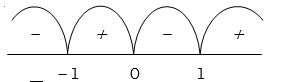
Using the wavy curve method (sign scheme) on the number line with critical points $-1, 0, 1$,the expression is positive in the intervals $(-1, 0) \cup (1, \infty)$.
Combining the conditions: $x \in (-1, 0) \cup (1, \infty)$ and $x \neq \pm 2$.
Since $2$ lies in the interval $(1, \infty)$,we must exclude it.
Thus,the domain is $D = (-1, 0) \cup (1, 2) \cup (2, \infty)$.
$1$. The denominator must not be zero: $4 - x^2 \neq 0$ $\Rightarrow x^2 \neq 4$ $\Rightarrow x \neq \pm 2$.
$2$. The argument of the logarithm must be positive: $x^3 - x > 0$.
Factoring the inequality: $x(x^2 - 1) > 0 \Rightarrow x(x - 1)(x + 1) > 0$.
Using the wavy curve method (sign scheme) on the number line with critical points $-1, 0, 1$,the expression is positive in the intervals $(-1, 0) \cup (1, \infty)$.
Combining the conditions: $x \in (-1, 0) \cup (1, \infty)$ and $x \neq \pm 2$.
Since $2$ lies in the interval $(1, \infty)$,we must exclude it.
Thus,the domain is $D = (-1, 0) \cup (1, 2) \cup (2, \infty)$.
0 likes
View Solution17
MediumMCQ
The domain of the function $f(x) = \sqrt{2 - 2x - x^2}$ is
A
$-\sqrt{3} \le x \le \sqrt{3}$
B
$-1 - \sqrt{3} \le x \le -1 + \sqrt{3}$
C
$-2 \le x \le 2$
D
$-2 + \sqrt{3} \le x \le -2 - \sqrt{3}$
Solution
(B) For the function $f(x) = \sqrt{2 - 2x - x^2}$ to be defined,the expression under the square root must be non-negative:
$2 - 2x - x^2 \ge 0$
Multiply by $-1$ and reverse the inequality sign:
$x^2 + 2x - 2 \le 0$
Complete the square for the quadratic expression:
$(x^2 + 2x + 1) - 1 - 2 \le 0$
$(x + 1)^2 - 3 \le 0$
$(x + 1)^2 \le 3$
Taking the square root on both sides:
$-\sqrt{3} \le x + 1 \le \sqrt{3}$
Subtract $1$ from all parts:
$-1 - \sqrt{3} \le x \le -1 + \sqrt{3}$
Thus,the domain is $[-1 - \sqrt{3}, -1 + \sqrt{3}]$.
$2 - 2x - x^2 \ge 0$
Multiply by $-1$ and reverse the inequality sign:
$x^2 + 2x - 2 \le 0$
Complete the square for the quadratic expression:
$(x^2 + 2x + 1) - 1 - 2 \le 0$
$(x + 1)^2 - 3 \le 0$
$(x + 1)^2 \le 3$
Taking the square root on both sides:
$-\sqrt{3} \le x + 1 \le \sqrt{3}$
Subtract $1$ from all parts:
$-1 - \sqrt{3} \le x \le -1 + \sqrt{3}$
Thus,the domain is $[-1 - \sqrt{3}, -1 + \sqrt{3}]$.
0 likes
View Solution18
EasyMCQ
Domain of the function $f(x) = \frac{x - 3}{(x - 1)\sqrt{x^2 - 4}}$ is
A
$(1, 2)$
B
$(-\infty, -2) \cup (2, \infty)$
C
$(-\infty, -2) \cup (1, \infty)$
D
$(-\infty, \infty) - \{1, \pm 2\}$
Solution
(B) For the function $f(x) = \frac{x - 3}{(x - 1)\sqrt{x^2 - 4}}$ to be defined,the expression inside the square root must be strictly positive and the denominator must not be zero.
$1$. The condition for the square root is $x^2 - 4 > 0$,which implies $x^2 > 4$,so $x \in (-\infty, -2) \cup (2, \infty)$.
$2$. The condition for the denominator is $(x - 1)\sqrt{x^2 - 4} \neq 0$. This means $x - 1 \neq 0$ (so $x \neq 1$) and $\sqrt{x^2 - 4} \neq 0$ (so $x \neq \pm 2$).
$3$. Combining these conditions,we need $x \in (-\infty, -2) \cup (2, \infty)$ and $x \neq 1$. Since $1$ is not in the interval $(-\infty, -2) \cup (2, \infty)$,the domain remains $(-\infty, -2) \cup (2, \infty)$.
$1$. The condition for the square root is $x^2 - 4 > 0$,which implies $x^2 > 4$,so $x \in (-\infty, -2) \cup (2, \infty)$.
$2$. The condition for the denominator is $(x - 1)\sqrt{x^2 - 4} \neq 0$. This means $x - 1 \neq 0$ (so $x \neq 1$) and $\sqrt{x^2 - 4} \neq 0$ (so $x \neq \pm 2$).
$3$. Combining these conditions,we need $x \in (-\infty, -2) \cup (2, \infty)$ and $x \neq 1$. Since $1$ is not in the interval $(-\infty, -2) \cup (2, \infty)$,the domain remains $(-\infty, -2) \cup (2, \infty)$.
0 likes
View Solution19
EasyMCQ
Domain of the function $\sqrt{\log \left\{ \frac{5x - x^2}{6} \right\}}$ is
A
$(2, 3)$
B
$[2, 3]$
C
$[1, 2]$
D
$[1, 3]$
Solution
(B) For the function $\sqrt{\log \left\{ \frac{5x - x^2}{6} \right\}}$ to be defined,the expression inside the square root must be non-negative: $\log \left\{ \frac{5x - x^2}{6} \right\} \ge 0$.
This implies $\frac{5x - x^2}{6} \ge 10^0$,which simplifies to $\frac{5x - x^2}{6} \ge 1$.
Multiplying by $6$,we get $5x - x^2 \ge 6$,which rearranges to $x^2 - 5x + 6 \le 0$.
Factoring the quadratic,we get $(x - 2)(x - 3) \le 0$.
This inequality holds for $x \in [2, 3]$.
Thus,the domain is $[2, 3]$.
This implies $\frac{5x - x^2}{6} \ge 10^0$,which simplifies to $\frac{5x - x^2}{6} \ge 1$.
Multiplying by $6$,we get $5x - x^2 \ge 6$,which rearranges to $x^2 - 5x + 6 \le 0$.
Factoring the quadratic,we get $(x - 2)(x - 3) \le 0$.
This inequality holds for $x \in [2, 3]$.
Thus,the domain is $[2, 3]$.
0 likes
View Solution20
EasyMCQ
The domain of the function $f(x) = \sqrt{2 - x} - \frac{1}{\sqrt{9 - x^2}}$ is
A
$(-3, 1)$
B
$[-3, 1]$
C
$(-3, 2]$
D
$[-3, 1)$
Solution
(C) For the function to be defined,the expressions inside the square roots must satisfy specific conditions:
$(i)$ For $\sqrt{2 - x}$ to be defined,$2 - x \ge 0$,which implies $x \le 2$.
(ii) For $\frac{1}{\sqrt{9 - x^2}}$ to be defined,the denominator must be non-zero and the value inside the square root must be positive: $9 - x^2 > 0$.
This implies $x^2 < 9$,which means $-3 < x < 3$.
To find the domain,we take the intersection of both conditions: $x \le 2$ $AND$ $-3 < x < 3$.
The intersection of $(-\infty, 2]$ and $(-3, 3)$ is $(-3, 2]$.
Therefore,the domain is $(-3, 2]$.
$(i)$ For $\sqrt{2 - x}$ to be defined,$2 - x \ge 0$,which implies $x \le 2$.
(ii) For $\frac{1}{\sqrt{9 - x^2}}$ to be defined,the denominator must be non-zero and the value inside the square root must be positive: $9 - x^2 > 0$.
This implies $x^2 < 9$,which means $-3 < x < 3$.
To find the domain,we take the intersection of both conditions: $x \le 2$ $AND$ $-3 < x < 3$.
The intersection of $(-\infty, 2]$ and $(-3, 3)$ is $(-3, 2]$.
Therefore,the domain is $(-3, 2]$.
0 likes
View Solution21
EasyMCQ
The domain of the function $f(x) = \frac{\sqrt{1 + x} - \sqrt{1 - x}}{x}$ is
A
$(-1, 1)$
B
$(-1, 1) \setminus \{0\}$
C
$[-1, 1]$
D
$[-1, 1] \setminus \{0\}$
Solution
(D) For the function $f(x) = \frac{\sqrt{1 + x} - \sqrt{1 - x}}{x}$ to be defined:
$1$. The expression under the square root must be non-negative:
$1 + x \ge 0 \implies x \ge -1$
$1 - x \ge 0 \implies x \le 1$
Combining these,we get $x \in [-1, 1]$.
$2$. The denominator cannot be zero:
$x \neq 0$
Combining both conditions,the domain is $[-1, 1] \setminus \{0\}$.
$1$. The expression under the square root must be non-negative:
$1 + x \ge 0 \implies x \ge -1$
$1 - x \ge 0 \implies x \le 1$
Combining these,we get $x \in [-1, 1]$.
$2$. The denominator cannot be zero:
$x \neq 0$
Combining both conditions,the domain is $[-1, 1] \setminus \{0\}$.
0 likes
View Solution22
EasyMCQ
The domain of the function $f(x) = \sqrt{x - x^2} + \sqrt{4 + x} + \sqrt{4 - x}$ is
A
$[-4, \infty)$
B
$[-4, 4]$
C
$[0, 4]$
D
$[0, 1]$
Solution
(D) The function $f(x) = \sqrt{x - x^2} + \sqrt{4 + x} + \sqrt{4 - x}$ is defined if all the expressions under the square roots are non-negative.
$1$. For $\sqrt{4 + x}$,we require $4 + x \ge 0$,which implies $x \ge -4$.
$2$. For $\sqrt{4 - x}$,we require $4 - x \ge 0$,which implies $x \le 4$.
$3$. For $\sqrt{x - x^2}$,we require $x - x^2 \ge 0$,which is $x(1 - x) \ge 0$. This inequality holds when $0 \le x \le 1$.
To find the domain,we take the intersection of these intervals:
$x \in [-4, \infty) \cap (- \infty, 4] \cap [0, 1] = [0, 1]$.
Thus,the domain of the function is $[0, 1]$.
$1$. For $\sqrt{4 + x}$,we require $4 + x \ge 0$,which implies $x \ge -4$.
$2$. For $\sqrt{4 - x}$,we require $4 - x \ge 0$,which implies $x \le 4$.
$3$. For $\sqrt{x - x^2}$,we require $x - x^2 \ge 0$,which is $x(1 - x) \ge 0$. This inequality holds when $0 \le x \le 1$.
To find the domain,we take the intersection of these intervals:
$x \in [-4, \infty) \cap (- \infty, 4] \cap [0, 1] = [0, 1]$.
Thus,the domain of the function is $[0, 1]$.
0 likes
View Solution23
EasyMCQ
The domain of the function $f(x) = \frac{1}{1 + e^x}$ is $[-1, 1]$. Find the range of the function.
A
$\left( \frac{1}{1+e}, \frac{1}{1+e^{-1}} \right)$
B
$[-1, 0]$
C
$[0, 1]$
D
$[-1, 1]$
Solution
(A) Given the domain is $-1 \le x \le 1$.
Since $f(x) = \frac{1}{1 + e^x}$ is a strictly decreasing function,the range is $[f(1), f(-1)]$.
Calculating the values:
$f(1) = \frac{1}{1 + e^1} = \frac{1}{1 + e}$
$f(-1) = \frac{1}{1 + e^{-1}} = \frac{1}{1 + \frac{1}{e}} = \frac{e}{e + 1}$
Thus,the range is $\left[ \frac{1}{1+e}, \frac{e}{1+e} \right]$.
Since $f(x) = \frac{1}{1 + e^x}$ is a strictly decreasing function,the range is $[f(1), f(-1)]$.
Calculating the values:
$f(1) = \frac{1}{1 + e^1} = \frac{1}{1 + e}$
$f(-1) = \frac{1}{1 + e^{-1}} = \frac{1}{1 + \frac{1}{e}} = \frac{e}{e + 1}$
Thus,the range is $\left[ \frac{1}{1+e}, \frac{e}{1+e} \right]$.
0 likes
View Solution24
MediumMCQ
The domain of the function $\sqrt{\log({x^2} - 6x + 6)}$ is
A
$(-\infty, \infty)$
B
$(-\infty, 3 - \sqrt{3}) \cup (3 + \sqrt{3}, \infty)$
C
$(-\infty, 1] \cup [5, \infty)$
D
$[0, \infty)$
Solution
(C) The function $f(x) = \sqrt{\log({x^2} - 6x + 6)}$ is defined when $\log({x^2} - 6x + 6) \ge 0$.
This implies ${x^2} - 6x + 6 \ge 10^0$,which simplifies to ${x^2} - 6x + 6 \ge 1$.
Rearranging the inequality,we get ${x^2} - 6x + 5 \ge 0$.
Factoring the quadratic expression,we have $(x - 5)(x - 1) \ge 0$.
Solving this inequality,we find that $x \le 1$ or $x \ge 5$.
Thus,the domain of the function is $(-\infty, 1] \cup [5, \infty)$.
This implies ${x^2} - 6x + 6 \ge 10^0$,which simplifies to ${x^2} - 6x + 6 \ge 1$.
Rearranging the inequality,we get ${x^2} - 6x + 5 \ge 0$.
Factoring the quadratic expression,we have $(x - 5)(x - 1) \ge 0$.
Solving this inequality,we find that $x \le 1$ or $x \ge 5$.
Thus,the domain of the function is $(-\infty, 1] \cup [5, \infty)$.
0 likes
View Solution25
EasyMCQ
The largest possible set of real numbers which can be the domain of $f(x) = \sqrt{1 - \frac{1}{x}}$ is
A
$(0, 1) \cup (0, \infty)$
B
$(-1, 0) \cup (1, \infty)$
C
$(-\infty, -1) \cup (0, \infty)$
D
$(-\infty, 0) \cup [1, \infty)$
Solution
(D) For the function $f(x) = \sqrt{1 - \frac{1}{x}}$ to be defined,the expression inside the square root must be non-negative:
$1 - \frac{1}{x} \ge 0$
$\frac{x - 1}{x} \ge 0$
Using the wavy curve method (sign scheme) for the critical points $x = 0$ and $x = 1$:
The expression is positive in the intervals $(-\infty, 0)$ and $[1, \infty)$.
Note that $x = 0$ is excluded because the denominator cannot be zero.
Thus,the domain is $(-\infty, 0) \cup [1, \infty)$.
$1 - \frac{1}{x} \ge 0$
$\frac{x - 1}{x} \ge 0$
Using the wavy curve method (sign scheme) for the critical points $x = 0$ and $x = 1$:
The expression is positive in the intervals $(-\infty, 0)$ and $[1, \infty)$.
Note that $x = 0$ is excluded because the denominator cannot be zero.
Thus,the domain is $(-\infty, 0) \cup [1, \infty)$.
0 likes
View Solution26
MediumMCQ
Domain of the function $f(x) = \frac{x^2 - 3x + 2}{x^2 + x - 6}$ is
A
$\{x : x \in R, x \neq 3\}$
B
$\{x : x \in R, x \neq 2\}$
C
$\{x : x \in R\}$
D
$\{x : x \in R, x \neq 2, x \neq -3\}$
Solution
(D) The given function is $f(x) = \frac{x^2 - 3x + 2}{x^2 + x - 6}$.
Factorizing the numerator: $x^2 - 3x + 2 = (x - 2)(x - 1)$.
Factorizing the denominator: $x^2 + x - 6 = (x + 3)(x - 2)$.
Thus,$f(x) = \frac{(x - 2)(x - 1)}{(x + 3)(x - 2)}$.
The function is defined for all real values of $x$ except where the denominator is zero.
Setting the denominator to zero: $(x + 3)(x - 2) = 0$,which gives $x = -3$ or $x = 2$.
Therefore,the domain of the function is the set of all real numbers except $2$ and $-3$.
Domain = $\{x : x \in R, x \neq 2, x \neq -3\}$.
Factorizing the numerator: $x^2 - 3x + 2 = (x - 2)(x - 1)$.
Factorizing the denominator: $x^2 + x - 6 = (x + 3)(x - 2)$.
Thus,$f(x) = \frac{(x - 2)(x - 1)}{(x + 3)(x - 2)}$.
The function is defined for all real values of $x$ except where the denominator is zero.
Setting the denominator to zero: $(x + 3)(x - 2) = 0$,which gives $x = -3$ or $x = 2$.
Therefore,the domain of the function is the set of all real numbers except $2$ and $-3$.
Domain = $\{x : x \in R, x \neq 2, x \neq -3\}$.
0 likes
View Solution27
EasyMCQ
Domain of $f(x) = (x^2 - 1)^{-1/2}$ is
A
$( - \infty, -1) \cup (1, \infty)$
B
$( - \infty, -1] \cup (1, \infty)$
C
$( - \infty, -1] \cup [1, \infty)$
D
None of these
Solution
(A) The function is defined when $x^2 - 1 > 0$.
This implies $x^2 > 1$.
Taking the square root on both sides,we get $|x| > 1$.
This inequality holds when $x < -1$ or $x > 1$.
Therefore,the domain is $( - \infty, -1) \cup (1, \infty)$.
This implies $x^2 > 1$.
Taking the square root on both sides,we get $|x| > 1$.
This inequality holds when $x < -1$ or $x > 1$.
Therefore,the domain is $( - \infty, -1) \cup (1, \infty)$.
0 likes
View Solution28
EasyMCQ
The domain of the function $y = \frac{1}{\sqrt{|x| - x}}$ is
A
$( - \infty, 0)$
B
$( - \infty, 0]$
C
$( - \infty, -1)$
D
$( - \infty, \infty)$
Solution
(A) For the function $y = \frac{1}{\sqrt{|x| - x}}$ to be defined,the expression inside the square root must be strictly positive:
$|x| - x > 0$
$|x| > x$
We know that for $x \geq 0$,$|x| = x$,so $x > x$ is false.
For $x < 0$,$|x| = -x$,so the inequality becomes $-x > x$,which simplifies to $0 > 2x$,or $x < 0$.
Thus,the domain of the function is $( - \infty, 0)$.
$|x| - x > 0$
$|x| > x$
We know that for $x \geq 0$,$|x| = x$,so $x > x$ is false.
For $x < 0$,$|x| = -x$,so the inequality becomes $-x > x$,which simplifies to $0 > 2x$,or $x < 0$.
Thus,the domain of the function is $( - \infty, 0)$.
0 likes
View Solution29
EasyMCQ
The natural domain of the real valued function defined by $f(x) = \sqrt{x^2 - 1} + \sqrt{x^2 + 1}$ is
A
$x \in (1, \infty)$
B
$x \in (-\infty, \infty)$
C
$x \in (-\infty, -1)$
D
$x \in (-\infty, -1] \cup [1, \infty)$
Solution
(D) For the function $f(x) = \sqrt{x^2 - 1} + \sqrt{x^2 + 1}$ to be defined,both square root terms must be non-negative.
$1$. For $\sqrt{x^2 - 1}$,we require $x^2 - 1 \ge 0$,which implies $x^2 \ge 1$. This holds when $x \le -1$ or $x \ge 1$.
$2$. For $\sqrt{x^2 + 1}$,we require $x^2 + 1 \ge 0$,which is true for all real numbers $x \in \mathbb{R}$.
Taking the intersection of these two conditions,the domain is $x \in (-\infty, -1] \cup [1, \infty)$,which can also be written as $(-\infty, \infty) - (-1, 1)$.
$1$. For $\sqrt{x^2 - 1}$,we require $x^2 - 1 \ge 0$,which implies $x^2 \ge 1$. This holds when $x \le -1$ or $x \ge 1$.
$2$. For $\sqrt{x^2 + 1}$,we require $x^2 + 1 \ge 0$,which is true for all real numbers $x \in \mathbb{R}$.
Taking the intersection of these two conditions,the domain is $x \in (-\infty, -1] \cup [1, \infty)$,which can also be written as $(-\infty, \infty) - (-1, 1)$.
0 likes
View Solution30
EasyMCQ
The domain of the function $f(x) = \exp (\sqrt {5x - 3 - 2{x^2}} )$ is
A
$\left[ {1, \frac{3}{2}} \right]$
B
$\left[ {\frac{3}{2}, \infty } \right)$
C
$( - \infty , 1]$
D
$\left[ {1, \frac{3}{2}} \right]$
Solution
(A) For the function $f(x) = \exp (\sqrt {5x - 3 - 2{x^2}} )$ to be defined,the expression under the square root must be non-negative:
$5x - 3 - 2{x^2} \ge 0$
Multiply by $-1$ and reverse the inequality sign:
$2{x^2} - 5x + 3 \le 0$
Factor the quadratic expression:
$2{x^2} - 2x - 3x + 3 \le 0$
$2x(x - 1) - 3(x - 1) \le 0$
$(2x - 3)(x - 1) \le 0$
$2(x - 1)(x - 1.5) \le 0$
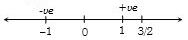
Using the wavy curve method,the expression is $\le 0$ for $x \in [1, 1.5]$.
Thus,the domain is $\left[ {1, \frac{3}{2}} \right]$.
$5x - 3 - 2{x^2} \ge 0$
Multiply by $-1$ and reverse the inequality sign:
$2{x^2} - 5x + 3 \le 0$
Factor the quadratic expression:
$2{x^2} - 2x - 3x + 3 \le 0$
$2x(x - 1) - 3(x - 1) \le 0$
$(2x - 3)(x - 1) \le 0$
$2(x - 1)(x - 1.5) \le 0$
Using the wavy curve method,the expression is $\le 0$ for $x \in [1, 1.5]$.
Thus,the domain is $\left[ {1, \frac{3}{2}} \right]$.
0 likes
View Solution31
MediumMCQ
The range of $f(x) = \sec \left( \frac{\pi }{4} \cos^2 x \right)$ for $-\infty < x < \infty$ is
A
$[1, \sqrt{2}]$
B
$[1, \infty)$
C
$[-\sqrt{2}, -1] \cup [1, \sqrt{2}]$
D
$(-\infty, -1] \cup [1, \infty)$
Solution
(A) Given the function $f(x) = \sec \left( \frac{\pi}{4} \cos^2 x \right)$.
We know that for any real $x$,the range of $\cos^2 x$ is $[0, 1]$.
Therefore,the argument of the secant function,$\theta = \frac{\pi}{4} \cos^2 x$,lies in the interval $[0, \frac{\pi}{4}]$.
Since the secant function is strictly increasing on the interval $[0, \frac{\pi}{4}]$,we evaluate the function at the boundaries:
At $\cos^2 x = 0$,$f(x) = \sec(0) = 1$.
At $\cos^2 x = 1$,$f(x) = \sec \left( \frac{\pi}{4} \right) = \sqrt{2}$.
Thus,the range of $f(x)$ is $[1, \sqrt{2}]$.
We know that for any real $x$,the range of $\cos^2 x$ is $[0, 1]$.
Therefore,the argument of the secant function,$\theta = \frac{\pi}{4} \cos^2 x$,lies in the interval $[0, \frac{\pi}{4}]$.
Since the secant function is strictly increasing on the interval $[0, \frac{\pi}{4}]$,we evaluate the function at the boundaries:
At $\cos^2 x = 0$,$f(x) = \sec(0) = 1$.
At $\cos^2 x = 1$,$f(x) = \sec \left( \frac{\pi}{4} \right) = \sqrt{2}$.
Thus,the range of $f(x)$ is $[1, \sqrt{2}]$.
0 likes
View Solution32
DifficultMCQ
Range of the function $f(x) = \frac{x^2 + x + 2}{x^2 + x + 1}; x \in R$ is
A
$(1, \infty)$
B
$(1, 11/7]$
C
$(1, 7/3]$
D
$(1, 7/5]$
Solution
(C) Let $y = \frac{x^2 + x + 2}{x^2 + x + 1}$.
We can rewrite the function as $y = \frac{(x^2 + x + 1) + 1}{x^2 + x + 1} = 1 + \frac{1}{x^2 + x + 1}$.
Let $g(x) = x^2 + x + 1$. The minimum value of $g(x)$ occurs at $x = -1/2$,which is $g(-1/2) = (-1/2)^2 - 1/2 + 1 = 1/4 - 1/2 + 1 = 3/4$.
Since $x^2 + x + 1$ is a parabola opening upwards,its range is $[3/4, \infty)$.
Therefore,the range of $\frac{1}{x^2 + x + 1}$ is $(0, 1 / (3/4)] = (0, 4/3]$.
Adding $1$ to this range,we get the range of $f(x)$ as $(1 + 0, 1 + 4/3] = (1, 7/3]$.
We can rewrite the function as $y = \frac{(x^2 + x + 1) + 1}{x^2 + x + 1} = 1 + \frac{1}{x^2 + x + 1}$.
Let $g(x) = x^2 + x + 1$. The minimum value of $g(x)$ occurs at $x = -1/2$,which is $g(-1/2) = (-1/2)^2 - 1/2 + 1 = 1/4 - 1/2 + 1 = 3/4$.
Since $x^2 + x + 1$ is a parabola opening upwards,its range is $[3/4, \infty)$.
Therefore,the range of $\frac{1}{x^2 + x + 1}$ is $(0, 1 / (3/4)] = (0, 4/3]$.
Adding $1$ to this range,we get the range of $f(x)$ as $(1 + 0, 1 + 4/3] = (1, 7/3]$.
0 likes
View Solution33
MediumMCQ
The range of the function $f(x) = [x] - x$ is
A
$[0, 1]$
B
$(-1, 0]$
C
$R$
D
$(-1, 1)$
Solution
(B) The function is defined as $f(x) = [x] - x$,where $[x]$ denotes the greatest integer function.
We know that for any real number $x$,$x = [x] + \{x\}$,where $\{x\}$ is the fractional part of $x$.
Therefore,$[x] - x = -\{x\}$.
The fractional part function $\{x\}$ takes values in the interval $[0, 1)$.
Thus,$-\{x\}$ takes values in the interval $(-1, 0]$.
Hence,the range of the function $f(x) = [x] - x$ is $(-1, 0]$.
We know that for any real number $x$,$x = [x] + \{x\}$,where $\{x\}$ is the fractional part of $x$.
Therefore,$[x] - x = -\{x\}$.
The fractional part function $\{x\}$ takes values in the interval $[0, 1)$.
Thus,$-\{x\}$ takes values in the interval $(-1, 0]$.
Hence,the range of the function $f(x) = [x] - x$ is $(-1, 0]$.
0 likes
View Solution34
MediumMCQ
The range of the function $f(x) = \frac{x + 2}{|x + 2|}$ is
A
$\{0, 1\}$
B
$\{-1, 1\}$
C
$R$
D
$R - \{-2\}$
Solution
(B) Given the function $f(x) = \frac{x + 2}{|x + 2|}$.
We know that the absolute value function $|x + 2|$ is defined as:
$|x + 2| = \begin{cases} x + 2, & \text{if } x + 2 > 0 \text{ (i.e., } x > -2) \\ -(x + 2), & \text{if } x + 2 < 0 \text{ (i.e., } x < -2) \end{cases}$
For $x > -2$,$f(x) = \frac{x + 2}{x + 2} = 1$.
For $x < -2$,$f(x) = \frac{x + 2}{-(x + 2)} = -1$.
Note that the function is undefined at $x = -2$ because the denominator becomes zero.
Therefore,the range of the function $f(x)$ is $\{-1, 1\}$.
We know that the absolute value function $|x + 2|$ is defined as:
$|x + 2| = \begin{cases} x + 2, & \text{if } x + 2 > 0 \text{ (i.e., } x > -2) \\ -(x + 2), & \text{if } x + 2 < 0 \text{ (i.e., } x < -2) \end{cases}$
For $x > -2$,$f(x) = \frac{x + 2}{x + 2} = 1$.
For $x < -2$,$f(x) = \frac{x + 2}{-(x + 2)} = -1$.
Note that the function is undefined at $x = -2$ because the denominator becomes zero.
Therefore,the range of the function $f(x)$ is $\{-1, 1\}$.
0 likes
View Solution35
EasyMCQ
If $f: R \to R$,then the range of the function $f(x) = \frac{x^2}{x^2 + 1}$ is
A
$R^-$
B
$[0, 1)$
C
$R$
D
$R \times R$
Solution
(B) Let $y = \frac{x^2}{x^2 + 1}$.
Since $x^2 \ge 0$ for all $x \in R$,the numerator is non-negative and the denominator is always greater than the numerator.
As $x \to \pm \infty$,$f(x) \to 1$,but $f(x)$ never reaches $1$ because $x^2 < x^2 + 1$.
At $x = 0$,$f(0) = \frac{0}{0 + 1} = 0$.
Thus,the range of the function is $[0, 1)$.
Since $x^2 \ge 0$ for all $x \in R$,the numerator is non-negative and the denominator is always greater than the numerator.
As $x \to \pm \infty$,$f(x) \to 1$,but $f(x)$ never reaches $1$ because $x^2 < x^2 + 1$.
At $x = 0$,$f(0) = \frac{0}{0 + 1} = 0$.
Thus,the range of the function is $[0, 1)$.
0 likes
View Solution36
EasyMCQ
Range of the function $\frac{1}{2 - \sin 3x}$ is
A
$[1, 3]$
B
$[\frac{1}{3}, 1]$
C
$(1, 3)$
D
$(\frac{1}{3}, 1)$
Solution
(B) Let $f(x) = \frac{1}{2 - \sin 3x}$.
We know that for any real $x$,the range of $\sin 3x$ is $[-1, 1]$.
So,$-1 \le \sin 3x \le 1$.
Multiplying by $-1$,we get $-1 \le -\sin 3x \le 1$.
Adding $2$ to all parts,we get $2 - 1 \le 2 - \sin 3x \le 2 + 1$,which simplifies to $1 \le 2 - \sin 3x \le 3$.
Taking the reciprocal,the inequality signs reverse: $\frac{1}{1} \ge \frac{1}{2 - \sin 3x} \ge \frac{1}{3}$.
Thus,$\frac{1}{3} \le f(x) \le 1$.
Therefore,the range of the function is $[\frac{1}{3}, 1]$.
We know that for any real $x$,the range of $\sin 3x$ is $[-1, 1]$.
So,$-1 \le \sin 3x \le 1$.
Multiplying by $-1$,we get $-1 \le -\sin 3x \le 1$.
Adding $2$ to all parts,we get $2 - 1 \le 2 - \sin 3x \le 2 + 1$,which simplifies to $1 \le 2 - \sin 3x \le 3$.
Taking the reciprocal,the inequality signs reverse: $\frac{1}{1} \ge \frac{1}{2 - \sin 3x} \ge \frac{1}{3}$.
Thus,$\frac{1}{3} \le f(x) \le 1$.
Therefore,the range of the function is $[\frac{1}{3}, 1]$.
0 likes
View Solution37
MediumMCQ
Range of the function $f(x) = \sin^2(x^4) + \cos^2(x^4)$ is
A
$( - \infty, \infty )$
B
$1$
C
$(-1, 1)$
D
$(0, 1)$
Solution
(B) We know the fundamental trigonometric identity: $\sin^2(\theta) + \cos^2(\theta) = 1$ for any real number $\theta$.
In the given function,let $\theta = x^4$.
Since $x^4$ is a real number for all $x \in \mathbb{R}$,we have $f(x) = \sin^2(x^4) + \cos^2(x^4) = 1$.
Since the function value is always $1$ regardless of the input $x$,the range of the function is the singleton set $\{1\}$.
In the given function,let $\theta = x^4$.
Since $x^4$ is a real number for all $x \in \mathbb{R}$,we have $f(x) = \sin^2(x^4) + \cos^2(x^4) = 1$.
Since the function value is always $1$ regardless of the input $x$,the range of the function is the singleton set $\{1\}$.
0 likes
View Solution38
EasyMCQ
Range of the function $f(x) = 9 - 7 \sin x$ is
A
$(2, 16)$
B
$[2, 16]$
C
$[-1, 1]$
D
$(2, 16]$
Solution
(B) We know that for any real number $x$,the range of $\sin x$ is $[-1, 1]$.
Thus,$-1 \le \sin x \le 1$.
Multiplying by $-7$,we get $-7 \le -7 \sin x \le 7$ (note the inequality signs flip).
Adding $9$ to all parts,we get $9 - 7 \le 9 - 7 \sin x \le 9 + 7$.
This simplifies to $2 \le f(x) \le 16$.
Therefore,the range of the function is $[2, 16]$.
Thus,$-1 \le \sin x \le 1$.
Multiplying by $-7$,we get $-7 \le -7 \sin x \le 7$ (note the inequality signs flip).
Adding $9$ to all parts,we get $9 - 7 \le 9 - 7 \sin x \le 9 + 7$.
This simplifies to $2 \le f(x) \le 16$.
Therefore,the range of the function is $[2, 16]$.
0 likes
View Solution39
DifficultMCQ
The range of $f(x) = \frac{x^2 + 34x - 71}{x^2 + 2x - 7}$ is
A
$[5, 9]$
B
$( - \infty, 5] \cup [9, \infty)$
C
$(5, 9)$
D
None of these
Solution
(B) Let $y = \frac{x^2 + 34x - 71}{x^2 + 2x - 7}$.
$y(x^2 + 2x - 7) = x^2 + 34x - 71$
$x^2(y - 1) + x(2y - 34) - 7y + 71 = 0$.
For $x$ to be real,the discriminant $D \ge 0$:
$D = (2y - 34)^2 - 4(y - 1)(-7y + 71) \ge 0$
$4(y - 17)^2 - 4(-7y^2 + 71y + 7y - 71) \ge 0$
$(y^2 - 34y + 289) - (-7y^2 + 78y - 71) \ge 0$
$8y^2 - 112y + 360 \ge 0$
$y^2 - 14y + 45 \ge 0$
$(y - 5)(y - 9) \ge 0$.
Thus,$y \le 5$ or $y \ge 9$.
The range is $( - \infty, 5] \cup [9, \infty)$.
$y(x^2 + 2x - 7) = x^2 + 34x - 71$
$x^2(y - 1) + x(2y - 34) - 7y + 71 = 0$.
For $x$ to be real,the discriminant $D \ge 0$:
$D = (2y - 34)^2 - 4(y - 1)(-7y + 71) \ge 0$
$4(y - 17)^2 - 4(-7y^2 + 71y + 7y - 71) \ge 0$
$(y^2 - 34y + 289) - (-7y^2 + 78y - 71) \ge 0$
$8y^2 - 112y + 360 \ge 0$
$y^2 - 14y + 45 \ge 0$
$(y - 5)(y - 9) \ge 0$.
Thus,$y \le 5$ or $y \ge 9$.
The range is $( - \infty, 5] \cup [9, \infty)$.
0 likes
View Solution40
MediumMCQ
The function $f:R \to R$ is defined by $f(x) = \cos^2 x + \sin^4 x$ for $x \in R$,then $f(R) \in $
A
$\left( \frac{3}{4}, 1 \right]$
B
$\left[ \frac{3}{4}, 1 \right)$
C
$\left[ \frac{3}{4}, 1 \right]$
D
$\left( \frac{3}{4}, 1 \right)$
Solution
(C) Given $f(x) = \cos^2 x + \sin^4 x$.
We can rewrite this as $f(x) = \cos^2 x + \sin^2 x \cdot \sin^2 x$.
Since $\sin^2 x = 1 - \cos^2 x$,we have $f(x) = \cos^2 x + \sin^2 x(1 - \cos^2 x)$.
$f(x) = \cos^2 x + \sin^2 x - \sin^2 x \cos^2 x$.
Since $\cos^2 x + \sin^2 x = 1$,we get $f(x) = 1 - \sin^2 x \cos^2 x$.
Multiplying and dividing by $4$,we get $f(x) = 1 - \frac{1}{4}(4 \sin^2 x \cos^2 x) = 1 - \frac{1}{4} \sin^2(2x)$.
Since $0 \le \sin^2(2x) \le 1$,we have $1 - \frac{1}{4}(1) \le f(x) \le 1 - \frac{1}{4}(0)$.
Thus,$\frac{3}{4} \le f(x) \le 1$.
Therefore,$f(R) \in \left[ \frac{3}{4}, 1 \right]$.
We can rewrite this as $f(x) = \cos^2 x + \sin^2 x \cdot \sin^2 x$.
Since $\sin^2 x = 1 - \cos^2 x$,we have $f(x) = \cos^2 x + \sin^2 x(1 - \cos^2 x)$.
$f(x) = \cos^2 x + \sin^2 x - \sin^2 x \cos^2 x$.
Since $\cos^2 x + \sin^2 x = 1$,we get $f(x) = 1 - \sin^2 x \cos^2 x$.
Multiplying and dividing by $4$,we get $f(x) = 1 - \frac{1}{4}(4 \sin^2 x \cos^2 x) = 1 - \frac{1}{4} \sin^2(2x)$.
Since $0 \le \sin^2(2x) \le 1$,we have $1 - \frac{1}{4}(1) \le f(x) \le 1 - \frac{1}{4}(0)$.
Thus,$\frac{3}{4} \le f(x) \le 1$.
Therefore,$f(R) \in \left[ \frac{3}{4}, 1 \right]$.
0 likes
View Solution41
EasyMCQ
The domain of the function $f(x) = \log_e(x - [x])$ is
A
$R - Z$
B
$R$
C
$(0, +\infty)$
D
$Z$
Solution
(A) The function $f(x) = \log_e(x - [x])$ is defined when the argument of the logarithm is strictly positive.
So,we require $x - [x] > 0$.
We know that the fractional part function is defined as $\{x\} = x - [x]$.
The range of the fractional part function is $[0, 1)$.
For $\log_e(\{x\})$ to be defined,we need $\{x\} > 0$.
Since $\{x\} = 0$ when $x$ is an integer $(x \in Z)$,the function is undefined for all integers.
For all non-integer values $(x \in R - Z)$,$\{x\} > 0$.
Therefore,the domain of the function is $R - Z$.
So,we require $x - [x] > 0$.
We know that the fractional part function is defined as $\{x\} = x - [x]$.
The range of the fractional part function is $[0, 1)$.
For $\log_e(\{x\})$ to be defined,we need $\{x\} > 0$.
Since $\{x\} = 0$ when $x$ is an integer $(x \in Z)$,the function is undefined for all integers.
For all non-integer values $(x \in R - Z)$,$\{x\} > 0$.
Therefore,the domain of the function is $R - Z$.
0 likes
View Solution42
MediumMCQ
Range of the function $f(x) = \frac{x^2}{x^2 + 1}$ is
A
$(-1, 0)$
B
$(-1, 1)$
C
$[0, 1)$
D
$(1, 1)$
Solution
(C) Let $y = \frac{x^2}{x^2 + 1}$.
Since $x^2 \ge 0$ for all real $x$,the numerator is always non-negative and the denominator is always greater than the numerator.
As $x \to \pm \infty$,$y \to 1$,but $y$ never reaches $1$ because $x^2 < x^2 + 1$.
At $x = 0$,$y = \frac{0}{0+1} = 0$.
Since $x^2 \ge 0$ and $x^2 + 1 > 0$,the value of $y$ is always non-negative.
Thus,the range of the function is $[0, 1)$.
Since $x^2 \ge 0$ for all real $x$,the numerator is always non-negative and the denominator is always greater than the numerator.
As $x \to \pm \infty$,$y \to 1$,but $y$ never reaches $1$ because $x^2 < x^2 + 1$.
At $x = 0$,$y = \frac{0}{0+1} = 0$.
Since $x^2 \ge 0$ and $x^2 + 1 > 0$,the value of $y$ is always non-negative.
Thus,the range of the function is $[0, 1)$.
0 likes
View Solution43
EasyMCQ
The domain of the function $f(x) = \frac{1}{\log_{10}(1 - x)} + \sqrt{x + 2}$ is
A
$(-2, 0) \cup (0, 1)$
B
$[-2, 0) \cup (0, 1)$
C
$(-2, 0) \cup (0, 1]$
D
None of these
Solution
(B) For the function $f(x) = \frac{1}{\log_{10}(1 - x)} + \sqrt{x + 2}$ to be defined:
$1$. The term under the square root must be non-negative: $x + 2 \ge 0 \implies x \ge -2$.
$2$. The argument of the logarithm must be positive: $1 - x > 0 \implies x < 1$.
$3$. The denominator cannot be zero: $\log_{10}(1 - x) \ne 0 \implies 1 - x \ne 10^0 \implies 1 - x \ne 1 \implies x \ne 0$.
Combining these conditions: $x \ge -2$ and $x < 1$ and $x \ne 0$.
Thus,the domain is $[-2, 0) \cup (0, 1)$.
$1$. The term under the square root must be non-negative: $x + 2 \ge 0 \implies x \ge -2$.
$2$. The argument of the logarithm must be positive: $1 - x > 0 \implies x < 1$.
$3$. The denominator cannot be zero: $\log_{10}(1 - x) \ne 0 \implies 1 - x \ne 10^0 \implies 1 - x \ne 1 \implies x \ne 0$.
Combining these conditions: $x \ge -2$ and $x < 1$ and $x \ne 0$.
Thus,the domain is $[-2, 0) \cup (0, 1)$.
0 likes
View Solution44
EasyMCQ
The domain of definition of the function $y(x)$ given by $2^x + 2^y = 2$ is
A
$(0, 1]$
B
$[0, 1]$
C
$( - \infty , 0]$
D
$( - \infty , 1)$
Solution
(D) Given the equation $2^x + 2^y = 2$.
We can rewrite this as $2^y = 2 - 2^x$.
For $y$ to be a real number,the value of $2^y$ must be strictly greater than $0$.
Therefore,$2 - 2^x > 0$.
This implies $2 > 2^x$.
Since the base $2 > 1$,the inequality holds when the exponents satisfy $1 > x$.
Thus,the domain of $x$ is $( - \infty , 1)$.
We can rewrite this as $2^y = 2 - 2^x$.
For $y$ to be a real number,the value of $2^y$ must be strictly greater than $0$.
Therefore,$2 - 2^x > 0$.
This implies $2 > 2^x$.
Since the base $2 > 1$,the inequality holds when the exponents satisfy $1 > x$.
Thus,the domain of $x$ is $( - \infty , 1)$.
0 likes
View Solution45
MediumMCQ
If $f(x) = \frac{x^2 - 1}{x^2 + 1}$ for every real number $x$,then the minimum value of $f$ is:
A
Does not exist because $f$ is unbounded
B
Is not attained even though $f$ is bounded
C
Is equal to $1$
D
Is equal to $-1$
Solution
(D) Given $f(x) = \frac{x^2 - 1}{x^2 + 1}$.
We can rewrite the function as $f(x) = \frac{x^2 + 1 - 2}{x^2 + 1} = 1 - \frac{2}{x^2 + 1}$.
Since $x^2 \ge 0$ for all real $x$,we have $x^2 + 1 \ge 1$,which implies $0 < \frac{2}{x^2 + 1} \le 2$.
Subtracting this inequality from $1$,we get $1 - 2 \le 1 - \frac{2}{x^2 + 1} < 1 - 0$.
Thus,$-1 \le f(x) < 1$.
The minimum value is attained when $x^2 = 0$,i.e.,$x = 0$.
$f(0) = \frac{0^2 - 1}{0^2 + 1} = -1$.
Therefore,the minimum value of $f$ is $-1$.
We can rewrite the function as $f(x) = \frac{x^2 + 1 - 2}{x^2 + 1} = 1 - \frac{2}{x^2 + 1}$.
Since $x^2 \ge 0$ for all real $x$,we have $x^2 + 1 \ge 1$,which implies $0 < \frac{2}{x^2 + 1} \le 2$.
Subtracting this inequality from $1$,we get $1 - 2 \le 1 - \frac{2}{x^2 + 1} < 1 - 0$.
Thus,$-1 \le f(x) < 1$.
The minimum value is attained when $x^2 = 0$,i.e.,$x = 0$.
$f(0) = \frac{0^2 - 1}{0^2 + 1} = -1$.
Therefore,the minimum value of $f$ is $-1$.
0 likes
View Solution46
DifficultMCQ
What is the range of values for $\frac{x}{x^2 + 4}$ for all real values of $x$?
A
$\frac{-1}{2} \le y \le \frac{1}{2}$
B
$\frac{-1}{4} \le y \le \frac{1}{4}$
C
$\frac{-1}{6} \le y \le \frac{1}{6}$
D
None of these
Solution
(B) Let $y = \frac{x}{x^2 + 4}$.
$yx^2 - x + 4y = 0$.
Since $x \in \mathbb{R}$,the discriminant $D \ge 0$.
$D = (-1)^2 - 4(y)(4y) \ge 0$.
$1 - 16y^2 \ge 0$.
$16y^2 \le 1$.
$y^2 \le \frac{1}{16}$.
Therefore,$\frac{-1}{4} \le y \le \frac{1}{4}$.
$yx^2 - x + 4y = 0$.
Since $x \in \mathbb{R}$,the discriminant $D \ge 0$.
$D = (-1)^2 - 4(y)(4y) \ge 0$.
$1 - 16y^2 \ge 0$.
$16y^2 \le 1$.
$y^2 \le \frac{1}{16}$.
Therefore,$\frac{-1}{4} \le y \le \frac{1}{4}$.
0 likes
View Solution47
DifficultMCQ
The largest interval lying in $\left( -\frac{\pi}{2}, \frac{\pi}{2} \right)$ for which the function $f(x) = 4^{-x^2} + \cos^{-1}\left( \frac{x}{2} - 1 \right) + \log(\cos x)$ is defined is:
A
$\left[ -\frac{\pi}{4}, \frac{\pi}{2} \right)$
B
$\left[ 0, \frac{\pi}{2} \right)$
C
$\left[ 0, \pi \right]$
D
$\left( -\frac{\pi}{2}, \frac{\pi}{2} \right)$
Solution
(B) The function $f(x) = 4^{-x^2} + \cos^{-1}\left( \frac{x}{2} - 1 \right) + \log(\cos x)$ is defined if all its components are defined.
$1$. For $\cos^{-1}\left( \frac{x}{2} - 1 \right)$ to be defined,we must have $-1 \leq \frac{x}{2} - 1 \leq 1$.
Adding $1$ to all parts: $0 \leq \frac{x}{2} \leq 2$.
Multiplying by $2$: $0 \leq x \leq 4$.
$2$. For $\log(\cos x)$ to be defined,we must have $\cos x > 0$.
In the interval $\left( -\frac{\pi}{2}, \frac{\pi}{2} \right)$,$\cos x > 0$ is always true.
$3$. Combining these conditions with the given interval $\left( -\frac{\pi}{2}, \frac{\pi}{2} \right)$:
We need $x \in [0, 4]$ $AND$ $x \in \left( -\frac{\pi}{2}, \frac{\pi}{2} \right)$.
Since $\frac{\pi}{2} \approx 1.57$,the intersection is $[0, \frac{\pi}{2})$.
Thus,the largest interval is $\left[ 0, \frac{\pi}{2} \right)$.
$1$. For $\cos^{-1}\left( \frac{x}{2} - 1 \right)$ to be defined,we must have $-1 \leq \frac{x}{2} - 1 \leq 1$.
Adding $1$ to all parts: $0 \leq \frac{x}{2} \leq 2$.
Multiplying by $2$: $0 \leq x \leq 4$.
$2$. For $\log(\cos x)$ to be defined,we must have $\cos x > 0$.
In the interval $\left( -\frac{\pi}{2}, \frac{\pi}{2} \right)$,$\cos x > 0$ is always true.
$3$. Combining these conditions with the given interval $\left( -\frac{\pi}{2}, \frac{\pi}{2} \right)$:
We need $x \in [0, 4]$ $AND$ $x \in \left( -\frac{\pi}{2}, \frac{\pi}{2} \right)$.
Since $\frac{\pi}{2} \approx 1.57$,the intersection is $[0, \frac{\pi}{2})$.
Thus,the largest interval is $\left[ 0, \frac{\pi}{2} \right)$.
0 likes
View Solution48
EasyMCQ
The range of the function $f(x) = \frac{1}{\sqrt{x-[x]}}$ is
A
$(1, \infty)$
B
$(-\infty, \infty)$
C
$(0, \infty)$
D
$\emptyset$
Solution
(A) The function is defined as $f(x) = \frac{1}{\sqrt{x-[x]}}$.
Domain of $f$:
We know that $0 \leq x-[x] < 1$ for all $x \in \mathbb{R}$.
Also,$x-[x] = 0$ when $x \in \mathbb{Z}$.
Since the denominator cannot be zero,$x-[x] > 0$,which implies $x \notin \mathbb{Z}$.
Thus,the domain is $\mathbb{R} - \mathbb{Z}$.
Range of $f$:
For $x \in \mathbb{R} - \mathbb{Z}$,we have $0 < x-[x] < 1$.
Taking the square root,$0 < \sqrt{x-[x]} < 1$.
Taking the reciprocal,$\frac{1}{\sqrt{x-[x]}} > 1$.
Therefore,$f(x) \in (1, \infty)$.
Hence,the range of $f$ is $(1, \infty)$.
Domain of $f$:
We know that $0 \leq x-[x] < 1$ for all $x \in \mathbb{R}$.
Also,$x-[x] = 0$ when $x \in \mathbb{Z}$.
Since the denominator cannot be zero,$x-[x] > 0$,which implies $x \notin \mathbb{Z}$.
Thus,the domain is $\mathbb{R} - \mathbb{Z}$.
Range of $f$:
For $x \in \mathbb{R} - \mathbb{Z}$,we have $0 < x-[x] < 1$.
Taking the square root,$0 < \sqrt{x-[x]} < 1$.
Taking the reciprocal,$\frac{1}{\sqrt{x-[x]}} > 1$.
Therefore,$f(x) \in (1, \infty)$.
Hence,the range of $f$ is $(1, \infty)$.
0 likes
View Solution49
DifficultMCQ
Let $y = \sqrt{\frac{(x + 1)(x - 3)}{(x - 2)}}$. Then,the set of all real values of $x$ for which $y$ takes real values is:
A
$[-1, 2) \cup [3, \infty)$
B
$[-1, 3] \cup (2, \infty)$
C
$[1, 2) \cup [3, \infty)$
D
None of these
Solution
(A) For $y$ to be a real value,the expression under the square root must be non-negative:
$\frac{(x + 1)(x - 3)}{(x - 2)} \ge 0$
We use the sign scheme (Wavy Curve Method) for the expression $f(x) = \frac{(x + 1)(x - 3)}{(x - 2)}$.
The critical points are $x = -1, 2, 3$.
Testing the intervals:
$1$. For $x \in (-1, 2)$,let $x = 0$: $\frac{(1)(-3)}{(-2)} = \frac{3}{2} > 0$ (Valid).
$2$. For $x \in [3, \infty)$,let $x = 4$: $\frac{(5)(1)}{(2)} = \frac{5}{2} > 0$ (Valid).
$3$. At $x = -1$,$y = 0$ (Valid).
$4$. At $x = 3$,$y = 0$ (Valid).
$5$. At $x = 2$,the expression is undefined.
Combining these,the solution is $x \in [-1, 2) \cup [3, \infty)$.
$\frac{(x + 1)(x - 3)}{(x - 2)} \ge 0$
We use the sign scheme (Wavy Curve Method) for the expression $f(x) = \frac{(x + 1)(x - 3)}{(x - 2)}$.
The critical points are $x = -1, 2, 3$.
Testing the intervals:
$1$. For $x \in (-1, 2)$,let $x = 0$: $\frac{(1)(-3)}{(-2)} = \frac{3}{2} > 0$ (Valid).
$2$. For $x \in [3, \infty)$,let $x = 4$: $\frac{(5)(1)}{(2)} = \frac{5}{2} > 0$ (Valid).
$3$. At $x = -1$,$y = 0$ (Valid).
$4$. At $x = 3$,$y = 0$ (Valid).
$5$. At $x = 2$,the expression is undefined.
Combining these,the solution is $x \in [-1, 2) \cup [3, \infty)$.
0 likes
View SolutionRelation and Function — Domain and Range · Frequently Asked Questions
1Are these Relation and Function questions useful for JEE and NEET?
Yes. All questions in this section are mapped to JEE Main and NEET exam patterns. Previous year questions from JEE Main, NEET, GUJCET and state-level exams are included with full solutions.
2Can I switch to Hindi or Gujarati for these questions?
Yes. Use the language tabs in the hero section or the sidebar to view the same questions and solutions in English, Hindi or Gujarati.
3How do I generate a question paper from this subtopic?
Use the Vedclass Exam Paper Generator — select the chapter and subtopic, set difficulty, and generate Sets A, B, C, D automatically. First 3 chapters of every subject are free.
Vedclass Products
For Students
Vedclass Test Series
Mock tests in real JEE/NEET style with performance analysis. 5-day free trial.
Start Free TrialFor Teachers
Exam Paper Generator
Generate Set A/B/C/D papers from this chapter in 2 minutes. 3 chapters free.
Try FreeFor Institutes
Online Exam Module
Live online exams with unlimited students, 360° analytics & white-label branding.
See DemoFor Teachers & Institutes
Generate a Relation and Function Exam Paper in 2 Minutes
Select subtopic & difficulty — Sets A, B, C, D auto-generated with No Repeat logic.
First 3 chapters of every subject are free — no payment required.