
A English
Domain and Range Questions in English
Class 12 Mathematics · Relation and Function · Domain and Range
324+
Questions
English
Language
100%
With Solutions
Showing 50 of 324 questions in English
101
MediumMCQ
If the functions are defined as $f(x) = \sqrt{x}$ and $g(x) = \sqrt{1-x}$,then what is the common domain of the following functions: $f+g, f-g, f/g, g/f, g-f$ where $(f \pm g)(x) = f(x) \pm g(x)$ and $(f/g)(x) = \frac{f(x)}{g(x)}$?
A
$0 \leq x \leq 1$
B
$0 \leq x < 1$
C
$0 < x < 1$
D
$0 < x \leq 1$
Solution
(C) For $f(x) = \sqrt{x}$,the domain is $[0, \infty)$.
For $g(x) = \sqrt{1-x}$,the domain is $(-\infty, 1]$.
The domain of $f+g, f-g,$ and $g-f$ is the intersection of the domains of $f$ and $g$,which is $[0, 1]$.
For $f/g$,we require $g(x) \neq 0$,so $1-x \neq 0 \implies x \neq 1$. The domain is $[0, 1)$.
For $g/f$,we require $f(x) \neq 0$,so $x \neq 0$. The domain is $(0, 1]$.
The common domain for all these functions is the intersection of $[0, 1], [0, 1),$ and $(0, 1]$,which is $(0, 1)$.
For $g(x) = \sqrt{1-x}$,the domain is $(-\infty, 1]$.
The domain of $f+g, f-g,$ and $g-f$ is the intersection of the domains of $f$ and $g$,which is $[0, 1]$.
For $f/g$,we require $g(x) \neq 0$,so $1-x \neq 0 \implies x \neq 1$. The domain is $[0, 1)$.
For $g/f$,we require $f(x) \neq 0$,so $x \neq 0$. The domain is $(0, 1]$.
The common domain for all these functions is the intersection of $[0, 1], [0, 1),$ and $(0, 1]$,which is $(0, 1)$.
0 likes
View Solution102
DifficultMCQ
The range of the function $f(x) = \log_{\sqrt{5}}(3 + \cos(\frac{3\pi}{4} + x) + \cos(\frac{\pi}{4} + x) + \cos(\frac{\pi}{4} - x) - \cos(\frac{3\pi}{4} - x))$ is:
A
$(0, \sqrt{5})$
B
$[-2, 2]$
C
$[\frac{1}{\sqrt{5}}, \sqrt{5}]$
D
$[0, 2]$
Solution
(D) Let the argument of the logarithm be $g(x) = 3 + \cos(\frac{3\pi}{4} + x) + \cos(\frac{\pi}{4} + x) + \cos(\frac{\pi}{4} - x) - \cos(\frac{3\pi}{4} - x)$.
Using the sum-to-product formulas $\cos(A+B) + \cos(A-B) = 2\cos A \cos B$ and $\cos(A-B) - \cos(A+B) = 2\sin A \sin B$:
$g(x) = 3 + [\cos(\frac{3\pi}{4} + x) - \cos(\frac{3\pi}{4} - x)] + [\cos(\frac{\pi}{4} + x) + \cos(\frac{\pi}{4} - x)]$
$g(x) = 3 - 2\sin(\frac{3\pi}{4})\sin(x) + 2\cos(\frac{\pi}{4})\cos(x)$
Since $\sin(\frac{3\pi}{4}) = \frac{1}{\sqrt{2}}$ and $\cos(\frac{\pi}{4}) = \frac{1}{\sqrt{2}}$:
$g(x) = 3 - 2(\frac{1}{\sqrt{2}})\sin(x) + 2(\frac{1}{\sqrt{2}})\cos(x) = 3 + \sqrt{2}(\cos x - \sin x)$.
We know that $-\sqrt{2} \leq \cos x - \sin x \leq \sqrt{2}$.
Thus,$3 + \sqrt{2}(-\sqrt{2}) \leq g(x) \leq 3 + \sqrt{2}(\sqrt{2})$,
which simplifies to $3 - 2 \leq g(x) \leq 3 + 2$,or $1 \leq g(x) \leq 5$.
Since $f(x) = \log_{\sqrt{5}}(g(x))$,the range is $[\log_{\sqrt{5}}(1), \log_{\sqrt{5}}(5)]$.
Since $\log_{\sqrt{5}}(1) = 0$ and $\log_{\sqrt{5}}(5) = \frac{\log_5(5)}{\log_5(\sqrt{5})} = \frac{1}{1/2} = 2$,the range is $[0, 2]$.
Using the sum-to-product formulas $\cos(A+B) + \cos(A-B) = 2\cos A \cos B$ and $\cos(A-B) - \cos(A+B) = 2\sin A \sin B$:
$g(x) = 3 + [\cos(\frac{3\pi}{4} + x) - \cos(\frac{3\pi}{4} - x)] + [\cos(\frac{\pi}{4} + x) + \cos(\frac{\pi}{4} - x)]$
$g(x) = 3 - 2\sin(\frac{3\pi}{4})\sin(x) + 2\cos(\frac{\pi}{4})\cos(x)$
Since $\sin(\frac{3\pi}{4}) = \frac{1}{\sqrt{2}}$ and $\cos(\frac{\pi}{4}) = \frac{1}{\sqrt{2}}$:
$g(x) = 3 - 2(\frac{1}{\sqrt{2}})\sin(x) + 2(\frac{1}{\sqrt{2}})\cos(x) = 3 + \sqrt{2}(\cos x - \sin x)$.
We know that $-\sqrt{2} \leq \cos x - \sin x \leq \sqrt{2}$.
Thus,$3 + \sqrt{2}(-\sqrt{2}) \leq g(x) \leq 3 + \sqrt{2}(\sqrt{2})$,
which simplifies to $3 - 2 \leq g(x) \leq 3 + 2$,or $1 \leq g(x) \leq 5$.
Since $f(x) = \log_{\sqrt{5}}(g(x))$,the range is $[\log_{\sqrt{5}}(1), \log_{\sqrt{5}}(5)]$.
Since $\log_{\sqrt{5}}(1) = 0$ and $\log_{\sqrt{5}}(5) = \frac{\log_5(5)}{\log_5(\sqrt{5})} = \frac{1}{1/2} = 2$,the range is $[0, 2]$.
0 likes
View Solution103
DifficultMCQ
Let $[x]$ denote the greatest integer $\leq x$,where $x \in \mathbb{R}$. If the domain of the real-valued function $f(x) = \sqrt{\frac{|[x]|-2}{|[x]|-3}}$ is $(-\infty, a) \cup [b, c) \cup [4, \infty)$,where $a < b < c$,then the value of $a+b+c$ is:
A
$-3$
B
$1$
C
$-2$
D
$8$
Solution
(C) For the function $f(x) = \sqrt{\frac{|[x]|-2}{|[x]|-3}}$ to be defined,the expression inside the square root must be non-negative and the denominator must be non-zero.
$\frac{|[x]|-2}{|[x]|-3} \geq 0$ and $|[x]|-3 \neq 0$.
Let $Y = [x]$. We solve $\frac{|Y|-2}{|Y|-3} \geq 0$.
The critical points are $|Y| = 2$ and $|Y| = 3$,which means $Y \in \{-3, -2, 2, 3\}$.
Testing intervals for $|Y|$:
$1$. If $|Y| < 2$,then $\frac{-}{-} > 0$ (True). This corresponds to $-2 < Y < 2$,so $[x] \in \{-1, 0, 1\}$,which implies $x \in [-1, 2)$.
$2$. If $2 \leq |Y| < 3$,then $\frac{+}{-} < 0$ (False).
$3$. If $|Y| > 3$,then $\frac{+}{+} > 0$ (True). This corresponds to $Y > 3$ or $Y < -3$,so $[x] \geq 4$ or $[x] \leq -4$,which implies $x \in [4, \infty)$ or $x \in (-\infty, -3)$.
Combining these,the domain is $(-\infty, -3) \cup [-1, 2) \cup [4, \infty)$.
Comparing with $(-\infty, a) \cup [b, c) \cup [4, \infty)$,we get $a = -3$,$b = -1$,and $c = 2$.
Thus,$a+b+c = -3 + (-1) + 2 = -2$.
$\frac{|[x]|-2}{|[x]|-3} \geq 0$ and $|[x]|-3 \neq 0$.
Let $Y = [x]$. We solve $\frac{|Y|-2}{|Y|-3} \geq 0$.
The critical points are $|Y| = 2$ and $|Y| = 3$,which means $Y \in \{-3, -2, 2, 3\}$.
Testing intervals for $|Y|$:
$1$. If $|Y| < 2$,then $\frac{-}{-} > 0$ (True). This corresponds to $-2 < Y < 2$,so $[x] \in \{-1, 0, 1\}$,which implies $x \in [-1, 2)$.
$2$. If $2 \leq |Y| < 3$,then $\frac{+}{-} < 0$ (False).
$3$. If $|Y| > 3$,then $\frac{+}{+} > 0$ (True). This corresponds to $Y > 3$ or $Y < -3$,so $[x] \geq 4$ or $[x] \leq -4$,which implies $x \in [4, \infty)$ or $x \in (-\infty, -3)$.
Combining these,the domain is $(-\infty, -3) \cup [-1, 2) \cup [4, \infty)$.
Comparing with $(-\infty, a) \cup [b, c) \cup [4, \infty)$,we get $a = -3$,$b = -1$,and $c = 2$.
Thus,$a+b+c = -3 + (-1) + 2 = -2$.
0 likes
View Solution104
AdvancedMCQ
The domain of the function $f(x) = \frac{\cos^{-1}\left(\frac{x^{2}-5x+6}{x^{2}-9}\right)}{\log_{e}(x^{2}-3x+2)}$ is:
A
$(-\infty, 1) \cup (2, \infty)$
B
$(2, \infty)$
C
$[-\frac{1}{2}, 1) \cup (2, \infty)$
D
$[-\frac{1}{2}, 1) \cup (2, \infty) - \{\frac{3+\sqrt{5}}{2}, \frac{3-\sqrt{5}}{2}\}$
Solution
(D) For the function $f(x)$ to be defined,the following conditions must be satisfied:
$1$. The argument of $\cos^{-1}$ must be in $[-1, 1]$: $-1 \leq \frac{x^{2}-5x+6}{x^{2}-9} \leq 1$.
Solving $\frac{x^{2}-5x+6}{x^{2}-9} - 1 \leq 0 \implies \frac{(x-2)(x-3)}{(x-3)(x+3)} - 1 \leq 0 \implies \frac{x-2}{x+3} - 1 \leq 0 \implies \frac{-5}{x+3} \leq 0 \implies x+3 > 0 \implies x > -3$.
Solving $\frac{x^{2}-5x+6}{x^{2}-9} + 1 \geq 0 \implies \frac{(x-2)(x-3)}{(x-3)(x+3)} + 1 \geq 0 \implies \frac{x-2}{x+3} + 1 \geq 0 \implies \frac{2x+1}{x+3} \geq 0 \implies x \in (-\infty, -3) \cup [-\frac{1}{2}, \infty)$.
Taking the intersection,we get $x \in [-\frac{1}{2}, \infty)$ (excluding $x=3$ where the expression is undefined).
$2$. The argument of $\log_{e}$ must be positive: $x^{2}-3x+2 > 0 \implies (x-1)(x-2) > 0 \implies x \in (-\infty, 1) \cup (2, \infty)$.
$3$. The denominator cannot be zero: $\log_{e}(x^{2}-3x+2) \neq 0 \implies x^{2}-3x+2 \neq 1 \implies x^{2}-3x+1 \neq 0 \implies x \neq \frac{3 \pm \sqrt{5}}{2}$.
Combining all conditions: $x \in [-\frac{1}{2}, 1) \cup (2, \infty) - \{\frac{3+\sqrt{5}}{2}, \frac{3-\sqrt{5}}{2}\}$.
$1$. The argument of $\cos^{-1}$ must be in $[-1, 1]$: $-1 \leq \frac{x^{2}-5x+6}{x^{2}-9} \leq 1$.
Solving $\frac{x^{2}-5x+6}{x^{2}-9} - 1 \leq 0 \implies \frac{(x-2)(x-3)}{(x-3)(x+3)} - 1 \leq 0 \implies \frac{x-2}{x+3} - 1 \leq 0 \implies \frac{-5}{x+3} \leq 0 \implies x+3 > 0 \implies x > -3$.
Solving $\frac{x^{2}-5x+6}{x^{2}-9} + 1 \geq 0 \implies \frac{(x-2)(x-3)}{(x-3)(x+3)} + 1 \geq 0 \implies \frac{x-2}{x+3} + 1 \geq 0 \implies \frac{2x+1}{x+3} \geq 0 \implies x \in (-\infty, -3) \cup [-\frac{1}{2}, \infty)$.
Taking the intersection,we get $x \in [-\frac{1}{2}, \infty)$ (excluding $x=3$ where the expression is undefined).
$2$. The argument of $\log_{e}$ must be positive: $x^{2}-3x+2 > 0 \implies (x-1)(x-2) > 0 \implies x \in (-\infty, 1) \cup (2, \infty)$.
$3$. The denominator cannot be zero: $\log_{e}(x^{2}-3x+2) \neq 0 \implies x^{2}-3x+2 \neq 1 \implies x^{2}-3x+1 \neq 0 \implies x \neq \frac{3 \pm \sqrt{5}}{2}$.
Combining all conditions: $x \in [-\frac{1}{2}, 1) \cup (2, \infty) - \{\frac{3+\sqrt{5}}{2}, \frac{3-\sqrt{5}}{2}\}$.
0 likes
View Solution105
DifficultMCQ
The domain of the function $f(x) = \sin^{-1}[2x^2 - 3] + \log_2(\log_{1/2}(x^2 - 5x + 5))$,where $[t]$ is the greatest integer function,is:
A
$\left(-\sqrt{\frac{5}{2}}, \frac{5-\sqrt{5}}{2}\right)$
B
$\left(\frac{5-\sqrt{5}}{2}, \frac{5+\sqrt{5}}{2}\right)$
C
$\left(1, \frac{5-\sqrt{5}}{2}\right)$
D
$\left[1, \frac{5+\sqrt{5}}{2}\right)$
Solution
(C) For the function $f(x) = \sin^{-1}[2x^2 - 3] + \log_2(\log_{1/2}(x^2 - 5x + 5))$ to be defined:
$1.$ For $\sin^{-1}[2x^2 - 3]$,the argument must satisfy $-1 \leq [2x^2 - 3] \leq 1$. Since the range of $\sin^{-1}$ is $[-1, 1]$,we require $-1 \leq [2x^2 - 3] < 1$ (because if $[2x^2 - 3] = 1$,then $2x^2 - 3 \geq 1$,which is allowed,but the log term imposes stricter bounds).
Actually,for $\sin^{-1}(y)$,$y \in [-1, 1]$. Thus,$-1 \leq [2x^2 - 3] \leq 1$. This implies $-1 \leq 2x^2 - 3 < 2$,so $2 \leq 2x^2 < 5$,which gives $1 \leq x^2 < 2.5$. Thus $x \in (-\sqrt{2.5}, -1] \cup [1, \sqrt{2.5})$.
$2.$ For $\log_2(\log_{1/2}(x^2 - 5x + 5))$,we need $\log_{1/2}(x^2 - 5x + 5) > 0$. Since the base $1/2 < 1$,this implies $0 < x^2 - 5x + 5 < (1/2)^0 = 1$.
$3.$ Solving $x^2 - 5x + 5 > 0$: Roots are $\frac{5 \pm \sqrt{25 - 20}}{2} = \frac{5 \pm \sqrt{5}}{2}$. So $x \in (-\infty, \frac{5-\sqrt{5}}{2}) \cup (\frac{5+\sqrt{5}}{2}, \infty)$.
$4.$ Solving $x^2 - 5x + 5 < 1$: $x^2 - 5x + 4 < 0 \Rightarrow (x-1)(x-4) < 0 \Rightarrow x \in (1, 4)$.
Intersection of all conditions:
From $1$: $x \in [1, \sqrt{2.5}) \cup (-\sqrt{2.5}, -1]$.
From $2, 3, 4$: $x \in (1, \frac{5-\sqrt{5}}{2})$.
Combining these,the domain is $(1, \frac{5-\sqrt{5}}{2})$.
$1.$ For $\sin^{-1}[2x^2 - 3]$,the argument must satisfy $-1 \leq [2x^2 - 3] \leq 1$. Since the range of $\sin^{-1}$ is $[-1, 1]$,we require $-1 \leq [2x^2 - 3] < 1$ (because if $[2x^2 - 3] = 1$,then $2x^2 - 3 \geq 1$,which is allowed,but the log term imposes stricter bounds).
Actually,for $\sin^{-1}(y)$,$y \in [-1, 1]$. Thus,$-1 \leq [2x^2 - 3] \leq 1$. This implies $-1 \leq 2x^2 - 3 < 2$,so $2 \leq 2x^2 < 5$,which gives $1 \leq x^2 < 2.5$. Thus $x \in (-\sqrt{2.5}, -1] \cup [1, \sqrt{2.5})$.
$2.$ For $\log_2(\log_{1/2}(x^2 - 5x + 5))$,we need $\log_{1/2}(x^2 - 5x + 5) > 0$. Since the base $1/2 < 1$,this implies $0 < x^2 - 5x + 5 < (1/2)^0 = 1$.
$3.$ Solving $x^2 - 5x + 5 > 0$: Roots are $\frac{5 \pm \sqrt{25 - 20}}{2} = \frac{5 \pm \sqrt{5}}{2}$. So $x \in (-\infty, \frac{5-\sqrt{5}}{2}) \cup (\frac{5+\sqrt{5}}{2}, \infty)$.
$4.$ Solving $x^2 - 5x + 5 < 1$: $x^2 - 5x + 4 < 0 \Rightarrow (x-1)(x-4) < 0 \Rightarrow x \in (1, 4)$.
Intersection of all conditions:
From $1$: $x \in [1, \sqrt{2.5}) \cup (-\sqrt{2.5}, -1]$.
From $2, 3, 4$: $x \in (1, \frac{5-\sqrt{5}}{2})$.
Combining these,the domain is $(1, \frac{5-\sqrt{5}}{2})$.
0 likes
View Solution106
AdvancedMCQ
Define a function $f(x) = \frac{16x^2 - 96x + 153}{x - 3}$ for all real $x \neq 3$. The least positive value of $f(x)$ is
A
$16$
B
$18$
C
$22$
D
$24$
Solution
(D) Given,$f(x) = \frac{16x^2 - 96x + 153}{x - 3}$.
Let $f(x) = y$.
Then,$y = \frac{16x^2 - 96x + 153}{x - 3}$.
$y(x - 3) = 16x^2 - 96x + 153$.
$16x^2 - (96 + y)x + (153 + 3y) = 0$.
Since $x$ is a real number,the discriminant $D \geq 0$.
$D = (96 + y)^2 - 4(16)(153 + 3y) \geq 0$.
$9216 + 192y + y^2 - 64(153 + 3y) \geq 0$.
$9216 + 192y + y^2 - 9792 - 192y \geq 0$.
$y^2 - 576 \geq 0$.
$y^2 \geq 576$.
This implies $y \in (-\infty, -24] \cup [24, \infty)$.
Thus,the least positive value of $f(x)$ is $24$.
Let $f(x) = y$.
Then,$y = \frac{16x^2 - 96x + 153}{x - 3}$.
$y(x - 3) = 16x^2 - 96x + 153$.
$16x^2 - (96 + y)x + (153 + 3y) = 0$.
Since $x$ is a real number,the discriminant $D \geq 0$.
$D = (96 + y)^2 - 4(16)(153 + 3y) \geq 0$.
$9216 + 192y + y^2 - 64(153 + 3y) \geq 0$.
$9216 + 192y + y^2 - 9792 - 192y \geq 0$.
$y^2 - 576 \geq 0$.
$y^2 \geq 576$.
This implies $y \in (-\infty, -24] \cup [24, \infty)$.
Thus,the least positive value of $f(x)$ is $24$.
0 likes
View Solution107
AdvancedMCQ
Let $R$ be the set of real numbers and $f: R \rightarrow R$ be given by $f(x) = \sqrt{|x|} - \log(1 + |x|)$. We now make the following assertions:
$I.$ There exists a real number $A$ such that $f(x) \leq A$ for all $x$.
$II.$ There exists a real number $B$ such that $f(x) \geq B$ for all $x$.
$I.$ There exists a real number $A$ such that $f(x) \leq A$ for all $x$.
$II.$ There exists a real number $B$ such that $f(x) \geq B$ for all $x$.
A
$I$ is true and $II$ is false
B
$I$ is false and $II$ is true
C
$I$ and $II$ both are true
D
$I$ and $II$ both are false
Solution
(B) Given $f(x) = \sqrt{|x|} - \log(1 + |x|)$.
Since $f(x)$ is an even function,we consider $g(t) = \sqrt{t} - \log(1 + t)$ for $t \geq 0$,where $t = |x|$.
To check the behavior of $g(t)$,we find its derivative:
$g'(t) = \frac{1}{2\sqrt{t}} - \frac{1}{1 + t} = \frac{1 + t - 2\sqrt{t}}{2\sqrt{t}(1 + t)} = \frac{(\sqrt{t} - 1)^2}{2\sqrt{t}(1 + t)}$.
Since $g'(t) > 0$ for all $t > 0$ $(t \neq 1)$,the function $g(t)$ is strictly increasing for $t \geq 0$.
As $t \to \infty$,$g(t) = \sqrt{t}(1 - \frac{\log(1 + t)}{\sqrt{t}}) \to \infty$. Thus,$f(x)$ is not bounded above,so assertion $I$ is false.
At $t = 0$,$g(0) = 0$. Since $g(t)$ is increasing for $t \geq 0$,the minimum value of $g(t)$ is $g(0) = 0$. Thus,$f(x) \geq 0$ for all $x$. So,assertion $II$ is true.
Therefore,$I$ is false and $II$ is true.
Since $f(x)$ is an even function,we consider $g(t) = \sqrt{t} - \log(1 + t)$ for $t \geq 0$,where $t = |x|$.
To check the behavior of $g(t)$,we find its derivative:
$g'(t) = \frac{1}{2\sqrt{t}} - \frac{1}{1 + t} = \frac{1 + t - 2\sqrt{t}}{2\sqrt{t}(1 + t)} = \frac{(\sqrt{t} - 1)^2}{2\sqrt{t}(1 + t)}$.
Since $g'(t) > 0$ for all $t > 0$ $(t \neq 1)$,the function $g(t)$ is strictly increasing for $t \geq 0$.
As $t \to \infty$,$g(t) = \sqrt{t}(1 - \frac{\log(1 + t)}{\sqrt{t}}) \to \infty$. Thus,$f(x)$ is not bounded above,so assertion $I$ is false.
At $t = 0$,$g(0) = 0$. Since $g(t)$ is increasing for $t \geq 0$,the minimum value of $g(t)$ is $g(0) = 0$. Thus,$f(x) \geq 0$ for all $x$. So,assertion $II$ is true.
Therefore,$I$ is false and $II$ is true.
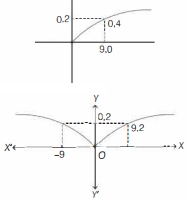
0 likes
View Solution108
AdvancedMCQ
The range of the polynomial $P(x) = 4x^3 - 3x$ as $x$ varies over the interval $\left(-\frac{1}{2}, \frac{1}{2}\right)$ is
A
$[-1, 1]$
B
$(-1, 1]$
C
$(-1, 1)$
D
$\left(-\frac{1}{2}, \frac{1}{2}\right)$
Solution
(C) Given the polynomial $P(x) = 4x^3 - 3x$ for $x \in \left(-\frac{1}{2}, \frac{1}{2}\right)$.
To find the range,we analyze the derivative $P'(x) = 12x^2 - 3 = 3(4x^2 - 1) = 3(2x - 1)(2x + 1)$.
For $x \in \left(-\frac{1}{2}, \frac{1}{2}\right)$,we have $4x^2 < 1$,which implies $4x^2 - 1 < 0$.
Thus,$P'(x) < 0$ for all $x$ in the given interval,meaning $P(x)$ is a strictly decreasing function.
Since $P(x)$ is continuous and strictly decreasing,the range is $(P(1/2), P(-1/2))$.
Calculating the values at the boundaries:
$P(1/2) = 4(1/8) - 3(1/2) = 1/2 - 3/2 = -1$.
$P(-1/2) = 4(-1/8) - 3(-1/2) = -1/2 + 3/2 = 1$.
Since the interval is open,the range is $(-1, 1)$.
To find the range,we analyze the derivative $P'(x) = 12x^2 - 3 = 3(4x^2 - 1) = 3(2x - 1)(2x + 1)$.
For $x \in \left(-\frac{1}{2}, \frac{1}{2}\right)$,we have $4x^2 < 1$,which implies $4x^2 - 1 < 0$.
Thus,$P'(x) < 0$ for all $x$ in the given interval,meaning $P(x)$ is a strictly decreasing function.
Since $P(x)$ is continuous and strictly decreasing,the range is $(P(1/2), P(-1/2))$.
Calculating the values at the boundaries:
$P(1/2) = 4(1/8) - 3(1/2) = 1/2 - 3/2 = -1$.
$P(-1/2) = 4(-1/8) - 3(-1/2) = -1/2 + 3/2 = 1$.
Since the interval is open,the range is $(-1, 1)$.
0 likes
View Solution109
AdvancedMCQ
Let $f(x)=\sqrt{2-x-x^2}$ and $g(x)=\cos x$. Which of the following statements are true?
$I$. Domain of $f((g(x))^2) = \text{Domain of } f(g(x))$
$II$. Domain of $f(g(x)) + g(f(x)) = \text{Domain of } g(f(x))$
$III$. Domain of $f(g(x)) = \text{Domain of } g(f(x))$
$IV$. Domain of $g((f(x))^3) = \text{Domain of } f(g(x))$
$I$. Domain of $f((g(x))^2) = \text{Domain of } f(g(x))$
$II$. Domain of $f(g(x)) + g(f(x)) = \text{Domain of } g(f(x))$
$III$. Domain of $f(g(x)) = \text{Domain of } g(f(x))$
$IV$. Domain of $g((f(x))^3) = \text{Domain of } f(g(x))$
A
Only $I$
B
Only $I$ and $II$
C
Only $III$ and $IV$
D
Only $I$ and $IV$
Solution
(A) Given $f(x) = \sqrt{2-x-x^2}$ and $g(x) = \cos x$.
For $f(x)$ to be defined,$2-x-x^2 \geq 0 \Rightarrow x^2+x-2 \leq 0 \Rightarrow (x+2)(x-1) \leq 0 \Rightarrow x \in [-2, 1]$.
For $f(g(x))$,we need $g(x) \in [-2, 1]$. Since $-1 \leq \cos x \leq 1$,this is always true for all $x \in \mathbb{R}$. Thus,$\text{Domain of } f(g(x)) = \mathbb{R}$.
For $f((g(x))^2)$,we need $(g(x))^2 \in [-2, 1]$. Since $0 \leq \cos^2 x \leq 1$,this is always true for all $x \in \mathbb{R}$. Thus,$\text{Domain of } f((g(x))^2) = \mathbb{R}$.
Therefore,$\text{Domain of } f((g(x))^2) = \text{Domain of } f(g(x))$,so statement $I$ is true.
For $g(f(x))$,we need $f(x)$ to be defined,so $x \in [-2, 1]$. Thus,$\text{Domain of } g(f(x)) = [-2, 1]$.
Since $\text{Domain of } f(g(x)) = \mathbb{R}$ and $\text{Domain of } g(f(x)) = [-2, 1]$,statements $II$ and $III$ are false.
For $g((f(x))^3)$,we need $f(x)$ to be defined,so $x \in [-2, 1]$. Thus,$\text{Domain of } g((f(x))^3) = [-2, 1]$. This is not equal to $\mathbb{R}$,so statement $IV$ is false.
Hence,only statement $I$ is true.
For $f(x)$ to be defined,$2-x-x^2 \geq 0 \Rightarrow x^2+x-2 \leq 0 \Rightarrow (x+2)(x-1) \leq 0 \Rightarrow x \in [-2, 1]$.
For $f(g(x))$,we need $g(x) \in [-2, 1]$. Since $-1 \leq \cos x \leq 1$,this is always true for all $x \in \mathbb{R}$. Thus,$\text{Domain of } f(g(x)) = \mathbb{R}$.
For $f((g(x))^2)$,we need $(g(x))^2 \in [-2, 1]$. Since $0 \leq \cos^2 x \leq 1$,this is always true for all $x \in \mathbb{R}$. Thus,$\text{Domain of } f((g(x))^2) = \mathbb{R}$.
Therefore,$\text{Domain of } f((g(x))^2) = \text{Domain of } f(g(x))$,so statement $I$ is true.
For $g(f(x))$,we need $f(x)$ to be defined,so $x \in [-2, 1]$. Thus,$\text{Domain of } g(f(x)) = [-2, 1]$.
Since $\text{Domain of } f(g(x)) = \mathbb{R}$ and $\text{Domain of } g(f(x)) = [-2, 1]$,statements $II$ and $III$ are false.
For $g((f(x))^3)$,we need $f(x)$ to be defined,so $x \in [-2, 1]$. Thus,$\text{Domain of } g((f(x))^3) = [-2, 1]$. This is not equal to $\mathbb{R}$,so statement $IV$ is false.
Hence,only statement $I$ is true.
0 likes
View Solution110
AdvancedMCQ
The mid-point of the domain of the function $f(x) = \sqrt{4 - \sqrt{2x + 5}}$ for real $x$ is
A
$\frac{1}{4}$
B
$\frac{3}{2}$
C
$\frac{2}{3}$
D
$-\frac{2}{5}$
Solution
(B) The function $f(x) = \sqrt{4 - \sqrt{2x + 5}}$ is defined if the expressions under the square roots are non-negative.
First,for the inner square root: $2x + 5 \geq 0 \implies x \geq -\frac{5}{2}$.
Second,for the outer square root: $4 - \sqrt{2x + 5} \geq 0 \implies 4 \geq \sqrt{2x + 5}$.
Squaring both sides (since both are non-negative): $16 \geq 2x + 5 \implies 11 \geq 2x \implies x \leq \frac{11}{2}$.
Combining these conditions,the domain of $f(x)$ is $x \in \left[ -\frac{5}{2}, \frac{11}{2} \right]$.
The mid-point of the domain is calculated as $\frac{-\frac{5}{2} + \frac{11}{2}}{2} = \frac{\frac{6}{2}}{2} = \frac{3}{2}$.
First,for the inner square root: $2x + 5 \geq 0 \implies x \geq -\frac{5}{2}$.
Second,for the outer square root: $4 - \sqrt{2x + 5} \geq 0 \implies 4 \geq \sqrt{2x + 5}$.
Squaring both sides (since both are non-negative): $16 \geq 2x + 5 \implies 11 \geq 2x \implies x \leq \frac{11}{2}$.
Combining these conditions,the domain of $f(x)$ is $x \in \left[ -\frac{5}{2}, \frac{11}{2} \right]$.
The mid-point of the domain is calculated as $\frac{-\frac{5}{2} + \frac{11}{2}}{2} = \frac{\frac{6}{2}}{2} = \frac{3}{2}$.
0 likes
View Solution111
AdvancedMCQ
Which of the following intervals is a possible domain of the function $f(x) = \log_{\{x\}}[x] + \log_{[x]}\{x\}$,where $[x]$ is the greatest integer not exceeding $x$ and $\{x\} = x - [x]$?
A
$(0, 1)$
B
$(1, 2)$
C
$(2, 3)$
D
$(3, 5)$
Solution
(C) The function $f(x) = \log_{\{x\}}[x] + \log_{[x]}\{x\}$ is defined under the following conditions:
$1$. For $\log_{\{x\}}[x]$ to be defined:
Base $\{x\} > 0$ and $\{x\} \neq 1$. Since $\{x\} = x - [x]$,$\{x\} \in [0, 1)$. Thus,$\{x\} \in (0, 1)$.
Argument $[x] > 0$,which implies $x \geq 1$. Since $\{x\} \neq 0$,$x$ cannot be an integer.
$2$. For $\log_{[x]}\{x\}$ to be defined:
Base $[x] > 0$ and $[x] \neq 1$. This implies $[x] \geq 2$,so $x \geq 2$.
Argument $\{x\} > 0$,which implies $x$ is not an integer.
Combining these conditions,we require $x \geq 2$ and $x \notin \mathbb{Z}$.
Among the given options,the interval $(2, 3)$ satisfies $x > 2$ and $x$ is not an integer.
Therefore,the correct option is $(c)$.
$1$. For $\log_{\{x\}}[x]$ to be defined:
Base $\{x\} > 0$ and $\{x\} \neq 1$. Since $\{x\} = x - [x]$,$\{x\} \in [0, 1)$. Thus,$\{x\} \in (0, 1)$.
Argument $[x] > 0$,which implies $x \geq 1$. Since $\{x\} \neq 0$,$x$ cannot be an integer.
$2$. For $\log_{[x]}\{x\}$ to be defined:
Base $[x] > 0$ and $[x] \neq 1$. This implies $[x] \geq 2$,so $x \geq 2$.
Argument $\{x\} > 0$,which implies $x$ is not an integer.
Combining these conditions,we require $x \geq 2$ and $x \notin \mathbb{Z}$.
Among the given options,the interval $(2, 3)$ satisfies $x > 2$ and $x$ is not an integer.
Therefore,the correct option is $(c)$.
0 likes
View Solution112
AdvancedMCQ
The range of the function $f(x) = (\sin x)^{\sin x}$ defined on $(0, \pi)$ is
A
$(0, 1)$
B
$(e^{-1/e}, 1)$
C
$[e^{-1/e}, 1)$
D
$[e^{-1/e}, 1]$
Solution
(D) Let $y = f(x) = (\sin x)^{\sin x}$ for $x \in (0, \pi)$.
Taking the natural logarithm on both sides,we get $\ln y = \sin x \ln(\sin x)$.
Let $u = \sin x$. Since $x \in (0, \pi)$,the range of $u$ is $(0, 1]$.
We define $g(u) = u^{\ln u}$ for $u \in (0, 1]$.
To find the range,we differentiate $g(u)$ with respect to $u$:
$g'(u) = u^u (1 + \ln u)$.
Setting $g'(u) = 0$,we get $1 + \ln u = 0$,which implies $\ln u = -1$,so $u = e^{-1} = \frac{1}{e}$.
At $u = \frac{1}{e}$,$g(\frac{1}{e}) = (e^{-1})^{e^{-1}} = e^{-1/e}$.
As $u \to 0^+$,$g(u) = u^u \to 1$ (using the limit $\lim_{u \to 0^+} u^u = 1$).
At $u = 1$,$g(1) = 1^1 = 1$.
Since $e^{-1/e} \approx 0.692$,the minimum value is $e^{-1/e}$ and the maximum value is $1$.
Thus,the range is $[e^{-1/e}, 1]$.
Taking the natural logarithm on both sides,we get $\ln y = \sin x \ln(\sin x)$.
Let $u = \sin x$. Since $x \in (0, \pi)$,the range of $u$ is $(0, 1]$.
We define $g(u) = u^{\ln u}$ for $u \in (0, 1]$.
To find the range,we differentiate $g(u)$ with respect to $u$:
$g'(u) = u^u (1 + \ln u)$.
Setting $g'(u) = 0$,we get $1 + \ln u = 0$,which implies $\ln u = -1$,so $u = e^{-1} = \frac{1}{e}$.
At $u = \frac{1}{e}$,$g(\frac{1}{e}) = (e^{-1})^{e^{-1}} = e^{-1/e}$.
As $u \to 0^+$,$g(u) = u^u \to 1$ (using the limit $\lim_{u \to 0^+} u^u = 1$).
At $u = 1$,$g(1) = 1^1 = 1$.
Since $e^{-1/e} \approx 0.692$,the minimum value is $e^{-1/e}$ and the maximum value is $1$.
Thus,the range is $[e^{-1/e}, 1]$.
0 likes
View Solution113
DifficultMCQ
Let $f : R \rightarrow R$ be a function defined by $f(x) = \log_{\sqrt{m}}\{\sqrt{2}(\sin x - \cos x) + m - 2\}$,for some $m$,such that the range of $f$ is $[0, 2]$. Then the value of $m$ is $............$
A
$5$
B
$3$
C
$2$
D
$4$
Solution
(A) We know that $-\sqrt{2} \leq \sin x - \cos x \leq \sqrt{2}$.
Multiplying by $\sqrt{2}$,we get $-2 \leq \sqrt{2}(\sin x - \cos x) \leq 2$.
Let $k = \sqrt{2}(\sin x - \cos x)$,so $-2 \leq k \leq 2$.
The function is $f(x) = \log_{\sqrt{m}}(k + m - 2)$.
Given the range of $f$ is $[0, 2]$,we have $0 \leq \log_{\sqrt{m}}(k + m - 2) \leq 2$.
This implies $(\sqrt{m})^0 \leq k + m - 2 \leq (\sqrt{m})^2$,which simplifies to $1 \leq k + m - 2 \leq m$.
Solving for $k$,we get $3 - m \leq k \leq 2$.
Comparing this with $-2 \leq k \leq 2$,we equate the lower bounds: $3 - m = -2$.
Thus,$m = 5$.
Multiplying by $\sqrt{2}$,we get $-2 \leq \sqrt{2}(\sin x - \cos x) \leq 2$.
Let $k = \sqrt{2}(\sin x - \cos x)$,so $-2 \leq k \leq 2$.
The function is $f(x) = \log_{\sqrt{m}}(k + m - 2)$.
Given the range of $f$ is $[0, 2]$,we have $0 \leq \log_{\sqrt{m}}(k + m - 2) \leq 2$.
This implies $(\sqrt{m})^0 \leq k + m - 2 \leq (\sqrt{m})^2$,which simplifies to $1 \leq k + m - 2 \leq m$.
Solving for $k$,we get $3 - m \leq k \leq 2$.
Comparing this with $-2 \leq k \leq 2$,we equate the lower bounds: $3 - m = -2$.
Thus,$m = 5$.
0 likes
View Solution114
DifficultMCQ
The domain of $f(x) = \frac{\log_{(x+1)}(x-2)}{x^2 - (2x + 3)}$ for $x \in R$ is
A
$R - \{1, 3\}$
B
$(2, \infty) - \{3\}$
C
$(-1, \infty) - \{3\}$
D
$R - \{3\}$
Solution
(B) For the function $f(x) = \frac{\log_{(x+1)}(x-2)}{x^2 - 2x - 3}$ to be defined:
$1$. The argument of the logarithm must be positive: $x - 2 > 0 \Rightarrow x > 2$.
$2$. The base of the logarithm must be positive and not equal to $1$: $x + 1 > 0 \Rightarrow x > -1$ and $x + 1 \neq 1 \Rightarrow x \neq 0$.
$3$. The denominator must not be zero: $x^2 - 2x - 3 \neq 0$.
Factoring the denominator: $(x - 3)(x + 1) \neq 0$,which implies $x \neq 3$ and $x \neq -1$.
Combining all conditions: $x > 2$ and $x \neq 3$.
Thus,the domain is $(2, \infty) - \{3\}$.
$1$. The argument of the logarithm must be positive: $x - 2 > 0 \Rightarrow x > 2$.
$2$. The base of the logarithm must be positive and not equal to $1$: $x + 1 > 0 \Rightarrow x > -1$ and $x + 1 \neq 1 \Rightarrow x \neq 0$.
$3$. The denominator must not be zero: $x^2 - 2x - 3 \neq 0$.
Factoring the denominator: $(x - 3)(x + 1) \neq 0$,which implies $x \neq 3$ and $x \neq -1$.
Combining all conditions: $x > 2$ and $x \neq 3$.
Thus,the domain is $(2, \infty) - \{3\}$.
0 likes
View Solution115
DifficultMCQ
The range of the function $f(x) = \sqrt{3-x} + \sqrt{2+x}$ is
A
$[\sqrt{5}, \sqrt{10}]$
B
$[2\sqrt{2}, \sqrt{11}]$
C
$[\sqrt{5}, \sqrt{13}]$
D
$[\sqrt{2}, \sqrt{7}]$
Solution
(A) Let $y = \sqrt{3-x} + \sqrt{2+x}$. The domain is determined by $3-x \ge 0$ and $2+x \ge 0$,which gives $-2 \le x \le 3$.
Squaring both sides,we get $y^2 = (3-x) + (2+x) + 2\sqrt{(3-x)(2+x)} = 5 + 2\sqrt{6+x-x^2}$.
To find the range,we analyze the expression $g(x) = 6+x-x^2$. This is a downward-opening parabola with vertex at $x = -\frac{b}{2a} = -\frac{1}{2(-1)} = \frac{1}{2}$.
The maximum value of $g(x)$ is $g(1/2) = 6 + 1/2 - 1/4 = 6 + 1/4 = 25/4$.
The minimum value of $g(x)$ occurs at the endpoints of the domain,$x = -2$ or $x = 3$. $g(-2) = 6-2-4 = 0$ and $g(3) = 6+3-9 = 0$.
Thus,$0 \le g(x) \le 25/4$.
Substituting this into $y^2 = 5 + 2\sqrt{g(x)}$,we get $5 + 2\sqrt{0} \le y^2 \le 5 + 2\sqrt{25/4}$.
$5 \le y^2 \le 5 + 2(5/2) = 10$.
Since $y \ge 0$,the range is $[\sqrt{5}, \sqrt{10}]$.
Squaring both sides,we get $y^2 = (3-x) + (2+x) + 2\sqrt{(3-x)(2+x)} = 5 + 2\sqrt{6+x-x^2}$.
To find the range,we analyze the expression $g(x) = 6+x-x^2$. This is a downward-opening parabola with vertex at $x = -\frac{b}{2a} = -\frac{1}{2(-1)} = \frac{1}{2}$.
The maximum value of $g(x)$ is $g(1/2) = 6 + 1/2 - 1/4 = 6 + 1/4 = 25/4$.
The minimum value of $g(x)$ occurs at the endpoints of the domain,$x = -2$ or $x = 3$. $g(-2) = 6-2-4 = 0$ and $g(3) = 6+3-9 = 0$.
Thus,$0 \le g(x) \le 25/4$.
Substituting this into $y^2 = 5 + 2\sqrt{g(x)}$,we get $5 + 2\sqrt{0} \le y^2 \le 5 + 2\sqrt{25/4}$.
$5 \le y^2 \le 5 + 2(5/2) = 10$.
Since $y \ge 0$,the range is $[\sqrt{5}, \sqrt{10}]$.
0 likes
View Solution116
DifficultMCQ
If the domain of the function $f(x) = \frac{[x]}{1+x^2}$,where $[x]$ is the greatest integer $\leq x$,is $(2, 6)$,then its range is
A
$\left(\frac{5}{26}, \frac{2}{5}\right] - \left\{\frac{9}{29}, \frac{27}{109}, \frac{18}{89}, \frac{9}{53}\right\}$
B
$\left(\frac{5}{26}, \frac{2}{5}\right]$
C
$\left(\frac{5}{37}, \frac{2}{5}\right] - \left\{\frac{9}{29}, \frac{27}{109}, \frac{18}{89}, \frac{9}{53}\right\}$
D
$\left(\frac{5}{37}, \frac{2}{5}\right]$
Solution
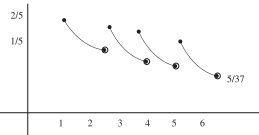
(D) Given $f(x) = \frac{[x]}{1+x^2}$ for $x \in (2, 6)$.
Since $[x]$ is the greatest integer function,we analyze the intervals:
For $x \in [2, 3)$,$[x] = 2$,so $f(x) = \frac{2}{1+x^2}$. As $x$ increases from $2$ to $3$,$f(x)$ decreases from $\frac{2}{1+2^2} = \frac{2}{5}$ to $\frac{2}{1+3^2} = \frac{2}{10} = \frac{1}{5}$. Range: $(\frac{1}{5}, \frac{2}{5}]$.
For $x \in [3, 4)$,$[x] = 3$,so $f(x) = \frac{3}{1+x^2}$. Range: $(\frac{3}{17}, \frac{3}{10}]$.
For $x \in [4, 5)$,$[x] = 4$,so $f(x) = \frac{4}{1+x^2}$. Range: $(\frac{4}{26}, \frac{4}{17}] = (\frac{2}{13}, \frac{4}{17}]$.
For $x \in [5, 6)$,$[x] = 5$,so $f(x) = \frac{5}{1+x^2}$. Range: $(\frac{5}{37}, \frac{5}{26}]$.
The union of these ranges is $(\frac{5}{37}, \frac{2}{5}]$. Note that the function is strictly decreasing in each interval $[n, n+1)$,and the values at the right endpoints are excluded. The set of values is the union of these intervals,which simplifies to $(\frac{5}{37}, \frac{2}{5}]$.
Since $[x]$ is the greatest integer function,we analyze the intervals:
For $x \in [2, 3)$,$[x] = 2$,so $f(x) = \frac{2}{1+x^2}$. As $x$ increases from $2$ to $3$,$f(x)$ decreases from $\frac{2}{1+2^2} = \frac{2}{5}$ to $\frac{2}{1+3^2} = \frac{2}{10} = \frac{1}{5}$. Range: $(\frac{1}{5}, \frac{2}{5}]$.
For $x \in [3, 4)$,$[x] = 3$,so $f(x) = \frac{3}{1+x^2}$. Range: $(\frac{3}{17}, \frac{3}{10}]$.
For $x \in [4, 5)$,$[x] = 4$,so $f(x) = \frac{4}{1+x^2}$. Range: $(\frac{4}{26}, \frac{4}{17}] = (\frac{2}{13}, \frac{4}{17}]$.
For $x \in [5, 6)$,$[x] = 5$,so $f(x) = \frac{5}{1+x^2}$. Range: $(\frac{5}{37}, \frac{5}{26}]$.
The union of these ranges is $(\frac{5}{37}, \frac{2}{5}]$. Note that the function is strictly decreasing in each interval $[n, n+1)$,and the values at the right endpoints are excluded. The set of values is the union of these intervals,which simplifies to $(\frac{5}{37}, \frac{2}{5}]$.
0 likes
View Solution117
DifficultMCQ
Let $f: R - \{2, 6\} \rightarrow R$ be a real-valued function defined as $f(x) = \frac{x^2+2x+1}{x^2-8x+12}$. Then the range of $f$ is
A
$\left(-\infty, -\frac{21}{4}\right] \cup [0, \infty)$
B
$\left(-\infty, -\frac{21}{4}\right) \cup (0, \infty)$
C
$\left(-\infty, -\frac{21}{4}\right] \cup \left[\frac{21}{4}, \infty\right)$
D
$\left(-\infty, -\frac{21}{4}\right] \cup [1, \infty)$
Solution
(A) Let $y = \frac{x^2+2x+1}{x^2-8x+12}$.
By cross-multiplying,we get:
$y(x^2-8x+12) = x^2+2x+1$
$yx^2 - 8xy + 12y = x^2 + 2x + 1$
$x^2(y-1) - x(8y+2) + (12y-1) = 0$.
Case $1$: If $y \neq 1$,for $x$ to be real,the discriminant $D \geq 0$.
$D = (-(8y+2))^2 - 4(y-1)(12y-1) \geq 0$
$(64y^2 + 32y + 4) - 4(12y^2 - 13y + 1) \geq 0$
$64y^2 + 32y + 4 - 48y^2 + 52y - 4 \geq 0$
$16y^2 + 84y \geq 0$
$4y(4y + 21) \geq 0$.
This gives $y \in (-\infty, -\frac{21}{4}] \cup [0, \infty)$.
Since $y \neq 1$ was assumed,we check if $y=1$ is possible.
Case $2$: If $y = 1$,then $x^2+2x+1 = x^2-8x+12$,which simplifies to $10x = 11$,or $x = \frac{11}{10}$.
Since $x = \frac{11}{10}$ is in the domain $R - \{2, 6\}$,$y=1$ is included in the range.
Thus,the range is $(-\infty, -\frac{21}{4}] \cup [0, \infty)$.
By cross-multiplying,we get:
$y(x^2-8x+12) = x^2+2x+1$
$yx^2 - 8xy + 12y = x^2 + 2x + 1$
$x^2(y-1) - x(8y+2) + (12y-1) = 0$.
Case $1$: If $y \neq 1$,for $x$ to be real,the discriminant $D \geq 0$.
$D = (-(8y+2))^2 - 4(y-1)(12y-1) \geq 0$
$(64y^2 + 32y + 4) - 4(12y^2 - 13y + 1) \geq 0$
$64y^2 + 32y + 4 - 48y^2 + 52y - 4 \geq 0$
$16y^2 + 84y \geq 0$
$4y(4y + 21) \geq 0$.
This gives $y \in (-\infty, -\frac{21}{4}] \cup [0, \infty)$.
Since $y \neq 1$ was assumed,we check if $y=1$ is possible.
Case $2$: If $y = 1$,then $x^2+2x+1 = x^2-8x+12$,which simplifies to $10x = 11$,or $x = \frac{11}{10}$.
Since $x = \frac{11}{10}$ is in the domain $R - \{2, 6\}$,$y=1$ is included in the range.
Thus,the range is $(-\infty, -\frac{21}{4}] \cup [0, \infty)$.
1 likes
View Solution118
DifficultMCQ
Let the sets $A$ and $B$ denote the domain and range respectively of the function $f(x)=\frac{1}{\sqrt{\lceil x\rceil-x}}$ where $\lceil x \rceil$ denotes the smallest integer greater than or equal to $x$. Then among the statements
$(S1): A \cap B = (1, \infty) - \mathbb{N}$ and
$(S2): A \cup B = (1, \infty)$
$(S1): A \cap B = (1, \infty) - \mathbb{N}$ and
$(S2): A \cup B = (1, \infty)$
A
only $(S1)$ is true
B
both $(S1)$ and $(S2)$ are true
C
neither $(S1)$ nor $(S2)$ is true
D
only $(S2)$ is true
Solution
(A) The function is given by $f(x) = \frac{1}{\sqrt{\lceil x \rceil - x}}$.
For the function to be defined,the expression inside the square root must be strictly positive: $\lceil x \rceil - x > 0$,which implies $\lceil x \rceil > x$.
This inequality holds for all $x \notin \mathbb{Z}$. If $x \in \mathbb{Z}$,then $\lceil x \rceil = x$,so $\lceil x \rceil - x = 0$,making the denominator zero.
Thus,the domain $A = \mathbb{R} - \mathbb{Z}$.
For $x \notin \mathbb{Z}$,we know that $\lceil x \rceil = \lfloor x \rfloor + 1$. Therefore,$\lceil x \rceil - x = \lfloor x \rfloor + 1 - x = 1 - (x - \lfloor x \rfloor) = 1 - \{x\}$,where $\{x\}$ is the fractional part of $x$.
Since $x \notin \mathbb{Z}$,$0 < \{x\} < 1$,which implies $0 < 1 - \{x\} < 1$.
Then,$0 < \sqrt{1 - \{x\}} < 1$,and consequently $f(x) = \frac{1}{\sqrt{1 - \{x\}}} > 1$.
Thus,the range $B = (1, \infty)$.
Now,$A \cap B = (\mathbb{R} - \mathbb{Z}) \cap (1, \infty) = (1, \infty) - \mathbb{Z}$. Since the intersection with $(1, \infty)$ only includes positive integers,$(1, \infty) - \mathbb{Z} = (1, \infty) - \mathbb{N}$. Thus,$(S1)$ is true.
$A \cup B = (\mathbb{R} - \mathbb{Z}) \cup (1, \infty) = \mathbb{R} - \{0, -1, -2, \dots\}$. This is not equal to $(1, \infty)$. Thus,$(S2)$ is false.
Therefore,only $(S1)$ is true.
For the function to be defined,the expression inside the square root must be strictly positive: $\lceil x \rceil - x > 0$,which implies $\lceil x \rceil > x$.
This inequality holds for all $x \notin \mathbb{Z}$. If $x \in \mathbb{Z}$,then $\lceil x \rceil = x$,so $\lceil x \rceil - x = 0$,making the denominator zero.
Thus,the domain $A = \mathbb{R} - \mathbb{Z}$.
For $x \notin \mathbb{Z}$,we know that $\lceil x \rceil = \lfloor x \rfloor + 1$. Therefore,$\lceil x \rceil - x = \lfloor x \rfloor + 1 - x = 1 - (x - \lfloor x \rfloor) = 1 - \{x\}$,where $\{x\}$ is the fractional part of $x$.
Since $x \notin \mathbb{Z}$,$0 < \{x\} < 1$,which implies $0 < 1 - \{x\} < 1$.
Then,$0 < \sqrt{1 - \{x\}} < 1$,and consequently $f(x) = \frac{1}{\sqrt{1 - \{x\}}} > 1$.
Thus,the range $B = (1, \infty)$.
Now,$A \cap B = (\mathbb{R} - \mathbb{Z}) \cap (1, \infty) = (1, \infty) - \mathbb{Z}$. Since the intersection with $(1, \infty)$ only includes positive integers,$(1, \infty) - \mathbb{Z} = (1, \infty) - \mathbb{N}$. Thus,$(S1)$ is true.
$A \cup B = (\mathbb{R} - \mathbb{Z}) \cup (1, \infty) = \mathbb{R} - \{0, -1, -2, \dots\}$. This is not equal to $(1, \infty)$. Thus,$(S2)$ is false.
Therefore,only $(S1)$ is true.
0 likes
View Solution119
DifficultMCQ
If the domain of the function $\log _e\left(\frac{6 x^2+5 x+1}{2 x-1}\right)+\cos ^{-1}\left(\frac{2 x^2-3 x+4}{3 x-5}\right)$ is $(\alpha, \beta) \cup(\gamma, \delta]$,then $18\left(\alpha^2+\beta^2+\gamma^2+\delta^2\right)$ is equal to $....$.
A
$20$
B
$21$
C
$22$
D
$23$
Solution
(A) For the function to be defined,both parts must be valid.
$1$. For $\log_e\left(\frac{6x^2+5x+1}{2x-1}\right)$,we need $\frac{6x^2+5x+1}{2x-1} > 0$.
$\frac{(3x+1)(2x+1)}{2x-1} > 0$.
Using the wavy curve method,the critical points are $x = -1/2, -1/3, 1/2$.
The inequality holds for $x \in (-1/2, -1/3) \cup (1/2, \infty) \dots (A)$.
$2$. For $\cos^{-1}\left(\frac{2x^2-3x+4}{3x-5}\right)$,we need $-1 \le \frac{2x^2-3x+4}{3x-5} \le 1$ and $3x-5 \neq 0$.
Solving $\frac{2x^2-3x+4}{3x-5} \le 1 \implies \frac{2x^2-6x+9}{3x-5} \le 0$. Since $2x^2-6x+9$ has $D < 0$,it is always positive. Thus,$3x-5 < 0 \implies x < 5/3 \dots (B)$.
Solving $\frac{2x^2-3x+4}{3x-5} \ge -1 \implies \frac{2x^2-1}{3x-5} \ge 0$.
Critical points are $x = -1/\sqrt{2}, 1/\sqrt{2}, 5/3$.
The inequality holds for $x \in [-1/\sqrt{2}, 1/\sqrt{2}] \cup (5/3, \infty) \dots (C)$.
Intersection $A \cap B \cap C = (-1/2, -1/3) \cup (1/2, 1/\sqrt{2}]$.
Here $\alpha = -1/2, \beta = -1/3, \gamma = 1/2, \delta = 1/\sqrt{2}$.
$18(\alpha^2+\beta^2+\gamma^2+\delta^2) = 18(1/4 + 1/9 + 1/4 + 1/2) = 18(1/2 + 1/9 + 1/2) = 18(1 + 1/9) = 18 + 2 = 20$.
$1$. For $\log_e\left(\frac{6x^2+5x+1}{2x-1}\right)$,we need $\frac{6x^2+5x+1}{2x-1} > 0$.
$\frac{(3x+1)(2x+1)}{2x-1} > 0$.
Using the wavy curve method,the critical points are $x = -1/2, -1/3, 1/2$.
The inequality holds for $x \in (-1/2, -1/3) \cup (1/2, \infty) \dots (A)$.
$2$. For $\cos^{-1}\left(\frac{2x^2-3x+4}{3x-5}\right)$,we need $-1 \le \frac{2x^2-3x+4}{3x-5} \le 1$ and $3x-5 \neq 0$.
Solving $\frac{2x^2-3x+4}{3x-5} \le 1 \implies \frac{2x^2-6x+9}{3x-5} \le 0$. Since $2x^2-6x+9$ has $D < 0$,it is always positive. Thus,$3x-5 < 0 \implies x < 5/3 \dots (B)$.
Solving $\frac{2x^2-3x+4}{3x-5} \ge -1 \implies \frac{2x^2-1}{3x-5} \ge 0$.
Critical points are $x = -1/\sqrt{2}, 1/\sqrt{2}, 5/3$.
The inequality holds for $x \in [-1/\sqrt{2}, 1/\sqrt{2}] \cup (5/3, \infty) \dots (C)$.
Intersection $A \cap B \cap C = (-1/2, -1/3) \cup (1/2, 1/\sqrt{2}]$.
Here $\alpha = -1/2, \beta = -1/3, \gamma = 1/2, \delta = 1/\sqrt{2}$.
$18(\alpha^2+\beta^2+\gamma^2+\delta^2) = 18(1/4 + 1/9 + 1/4 + 1/2) = 18(1/2 + 1/9 + 1/2) = 18(1 + 1/9) = 18 + 2 = 20$.
0 likes
View Solution120
DifficultMCQ
The domain of the function $f(x) = \frac{1}{\sqrt{[x]^2 - 3[x] - 10}}$ is (where $[x]$ denotes the greatest integer less than or equal to $x$).
A
$(-\infty, -2) \cup (5, \infty)$
B
$(-\infty, -3] \cup [6, \infty)$
C
$(-\infty, -2) \cup [6, \infty)$
D
$(-\infty, -3] \cup (5, \infty)$
Solution
(C) For the function $f(x) = \frac{1}{\sqrt{[x]^2 - 3[x] - 10}}$ to be defined,the expression inside the square root must be strictly positive:
$[x]^2 - 3[x] - 10 > 0$
Let $t = [x]$. Then $t^2 - 3t - 10 > 0$.
Factoring the quadratic: $(t - 5)(t + 2) > 0$.
This inequality holds when $t < -2$ or $t > 5$.
Since $t = [x]$,we have $[x] < -2$ or $[x] > 5$.
If $[x] < -2$,then $[x] \leq -3$,which implies $x < -2$.
If $[x] > 5$,then $[x] \geq 6$,which implies $x \geq 6$.
Thus,the domain is $(-\infty, -2) \cup [6, \infty)$.
$[x]^2 - 3[x] - 10 > 0$
Let $t = [x]$. Then $t^2 - 3t - 10 > 0$.
Factoring the quadratic: $(t - 5)(t + 2) > 0$.
This inequality holds when $t < -2$ or $t > 5$.
Since $t = [x]$,we have $[x] < -2$ or $[x] > 5$.
If $[x] < -2$,then $[x] \leq -3$,which implies $x < -2$.
If $[x] > 5$,then $[x] \geq 6$,which implies $x \geq 6$.
Thus,the domain is $(-\infty, -2) \cup [6, \infty)$.
0 likes
View Solution121
AdvancedMCQ
Let $D$ be the domain of the function $f(x) = \sin^{-1} \left(\log_{3x} \left(\frac{6+2 \log_3 x}{-5x}\right)\right)$. If the range of the function $g: D \rightarrow R$ defined by $g(x) = x - [x]$ (where $[x]$ is the greatest integer function) is $(\alpha, \beta)$,then $\alpha^2 + \frac{5}{\beta}$ is equal to
A
$46$
B
$135$
C
$136$
D
$45$
Solution
(B) For the function $f(x)$ to be defined,we require the argument of $\sin^{-1}$ to be in $[-1, 1]$ and the base of the logarithm to be positive and not equal to $1$.
First,$\frac{6+2 \log_3 x}{-5x} > 0$ and $x > 0, x \neq \frac{1}{3}$. Since $x > 0$,we need $6+2 \log_3 x < 0$,so $\log_3 x < -3$,which means $x < 3^{-3} = \frac{1}{27}$. Thus,$x \in (0, \frac{1}{27})$.
Next,$-1 \leq \log_{3x} \left(\frac{6+2 \log_3 x}{-5x}\right) \leq 1$. Since $x < \frac{1}{27}$,$3x < \frac{1}{9} < 1$,so the inequality reverses when removing the logarithm: $(3x)^1 \leq \frac{6+2 \log_3 x}{-5x} \leq (3x)^{-1}$.
Solving $15x^2 + 6 + 2 \log_3 x \geq 0$ and $6 + 2 \log_3 x + \frac{5}{3} \geq 0$ leads to $x \in [3^{-23/6}, \frac{1}{27})$.
Thus,the domain $D = [3^{-23/6}, \frac{1}{27})$.
Since $3^{-23/6} < x < \frac{1}{27}$,we have $[x] = 0$,so $g(x) = x$. The range is $(3^{-23/6}, \frac{1}{27}) = (\alpha, \beta)$.
Then $\alpha = 3^{-23/6}$ and $\beta = \frac{1}{27}$.
Calculating $\alpha^2 + \frac{5}{\beta} = (3^{-23/6})^2 + 5(27) = 3^{-23/3} + 135$. Since $3^{-23/3}$ is very small,the value is approximately $135$.
First,$\frac{6+2 \log_3 x}{-5x} > 0$ and $x > 0, x \neq \frac{1}{3}$. Since $x > 0$,we need $6+2 \log_3 x < 0$,so $\log_3 x < -3$,which means $x < 3^{-3} = \frac{1}{27}$. Thus,$x \in (0, \frac{1}{27})$.
Next,$-1 \leq \log_{3x} \left(\frac{6+2 \log_3 x}{-5x}\right) \leq 1$. Since $x < \frac{1}{27}$,$3x < \frac{1}{9} < 1$,so the inequality reverses when removing the logarithm: $(3x)^1 \leq \frac{6+2 \log_3 x}{-5x} \leq (3x)^{-1}$.
Solving $15x^2 + 6 + 2 \log_3 x \geq 0$ and $6 + 2 \log_3 x + \frac{5}{3} \geq 0$ leads to $x \in [3^{-23/6}, \frac{1}{27})$.
Thus,the domain $D = [3^{-23/6}, \frac{1}{27})$.
Since $3^{-23/6} < x < \frac{1}{27}$,we have $[x] = 0$,so $g(x) = x$. The range is $(3^{-23/6}, \frac{1}{27}) = (\alpha, \beta)$.
Then $\alpha = 3^{-23/6}$ and $\beta = \frac{1}{27}$.
Calculating $\alpha^2 + \frac{5}{\beta} = (3^{-23/6})^2 + 5(27) = 3^{-23/3} + 135$. Since $3^{-23/3}$ is very small,the value is approximately $135$.
0 likes
View Solution122
DifficultMCQ
If the domain of the function $f(x) = \log_e(4x^2 + 11x + 6) + \sin^{-1}(4x + 3) + \cos^{-1}\left(\frac{10x + 6}{3}\right)$ is $(\alpha, \beta]$,then $36|\alpha + \beta|$ is equal to:
A
$63$
B
$45$
C
$72$
D
$54$
Solution
(B) The domain of $f(x)$ is the intersection of the domains of its three components.
$(i)$ For $\log_e(4x^2 + 11x + 6)$,we require $4x^2 + 11x + 6 > 0$.
Factoring gives $(4x + 3)(x + 2) > 0$,so $x \in (-\infty, -2) \cup (-\frac{3}{4}, \infty)$.
(ii) For $\sin^{-1}(4x + 3)$,we require $-1 \le 4x + 3 \le 1$.
$-4 \le 4x \le -2$,which implies $x \in [-1, -\frac{1}{2}]$.
(iii) For $\cos^{-1}\left(\frac{10x + 6}{3}\right)$,we require $-1 \le \frac{10x + 6}{3} \le 1$.
$-3 \le 10x + 6 \le 3$,so $-9 \le 10x \le -3$,which implies $x \in [-\frac{9}{10}, -\frac{3}{10}]$.
Taking the intersection of all three intervals:
$x \in ((-\infty, -2) \cup (-\frac{3}{4}, \infty)) \cap [-1, -\frac{1}{2}] \cap [-\frac{9}{10}, -\frac{3}{10}]$.
Intersection of $[-1, -\frac{1}{2}]$ and $[-\frac{9}{10}, -\frac{3}{10}]$ is $[-\frac{9}{10}, -\frac{1}{2}]$.
Now,intersecting this with $(-\infty, -2) \cup (-\frac{3}{4}, \infty)$:
Since $-\frac{9}{10} < -\frac{3}{4}$,the intersection is $(-\frac{3}{4}, -\frac{1}{2}]$.
Thus,$\alpha = -\frac{3}{4}$ and $\beta = -\frac{1}{2}$.
Then $|\alpha + \beta| = |-\frac{3}{4} - \frac{1}{2}| = |-\frac{5}{4}| = \frac{5}{4}$.
Finally,$36|\alpha + \beta| = 36 \times \frac{5}{4} = 9 \times 5 = 45$.
$(i)$ For $\log_e(4x^2 + 11x + 6)$,we require $4x^2 + 11x + 6 > 0$.
Factoring gives $(4x + 3)(x + 2) > 0$,so $x \in (-\infty, -2) \cup (-\frac{3}{4}, \infty)$.
(ii) For $\sin^{-1}(4x + 3)$,we require $-1 \le 4x + 3 \le 1$.
$-4 \le 4x \le -2$,which implies $x \in [-1, -\frac{1}{2}]$.
(iii) For $\cos^{-1}\left(\frac{10x + 6}{3}\right)$,we require $-1 \le \frac{10x + 6}{3} \le 1$.
$-3 \le 10x + 6 \le 3$,so $-9 \le 10x \le -3$,which implies $x \in [-\frac{9}{10}, -\frac{3}{10}]$.
Taking the intersection of all three intervals:
$x \in ((-\infty, -2) \cup (-\frac{3}{4}, \infty)) \cap [-1, -\frac{1}{2}] \cap [-\frac{9}{10}, -\frac{3}{10}]$.
Intersection of $[-1, -\frac{1}{2}]$ and $[-\frac{9}{10}, -\frac{3}{10}]$ is $[-\frac{9}{10}, -\frac{1}{2}]$.
Now,intersecting this with $(-\infty, -2) \cup (-\frac{3}{4}, \infty)$:
Since $-\frac{9}{10} < -\frac{3}{4}$,the intersection is $(-\frac{3}{4}, -\frac{1}{2}]$.
Thus,$\alpha = -\frac{3}{4}$ and $\beta = -\frac{1}{2}$.
Then $|\alpha + \beta| = |-\frac{3}{4} - \frac{1}{2}| = |-\frac{5}{4}| = \frac{5}{4}$.
Finally,$36|\alpha + \beta| = 36 \times \frac{5}{4} = 9 \times 5 = 45$.
0 likes
View Solution123
DifficultMCQ
If the domain of the function $f(x) = \cos^{-1}\left(\frac{2-|x|}{4}\right) + (\log_e(3-x))^{-1}$ is $[-\alpha, \beta) \setminus \{\gamma\}$,then $\alpha + \beta + \gamma$ is equal to:
A
$12$
B
$9$
C
$11$
D
$8$
Solution
(C) For the function $f(x) = \cos^{-1}\left(\frac{2-|x|}{4}\right) + (\log_e(3-x))^{-1}$,we need to satisfy the domain conditions for both parts.
$1$. For $\cos^{-1}\left(\frac{2-|x|}{4}\right)$,the argument must be in $[-1, 1]$:
$-1 \leq \frac{2-|x|}{4} \leq 1$
$-4 \leq 2-|x| \leq 4$
$-6 \leq -|x| \leq 2$
Since $|x| \geq 0$,we have $-|x| \leq 2$ always true. Thus,$|x| \leq 6$,which implies $x \in [-6, 6]$.
$2$. For $(\log_e(3-x))^{-1}$,we need $\log_e(3-x) \neq 0$ and $3-x > 0$:
$3-x > 0 \Rightarrow x < 3$.
$\log_e(3-x) \neq 0 \Rightarrow 3-x \neq 1 \Rightarrow x \neq 2$.
Combining these conditions:
$x \in [-6, 6] \cap (-\infty, 3) \setminus \{2\} = [-6, 3) \setminus \{2\}$.
Comparing this with $[-\alpha, \beta) \setminus \{\gamma\}$,we get $\alpha = 6$,$\beta = 3$,and $\gamma = 2$.
Therefore,$\alpha + \beta + \gamma = 6 + 3 + 2 = 11$.
$1$. For $\cos^{-1}\left(\frac{2-|x|}{4}\right)$,the argument must be in $[-1, 1]$:
$-1 \leq \frac{2-|x|}{4} \leq 1$
$-4 \leq 2-|x| \leq 4$
$-6 \leq -|x| \leq 2$
Since $|x| \geq 0$,we have $-|x| \leq 2$ always true. Thus,$|x| \leq 6$,which implies $x \in [-6, 6]$.
$2$. For $(\log_e(3-x))^{-1}$,we need $\log_e(3-x) \neq 0$ and $3-x > 0$:
$3-x > 0 \Rightarrow x < 3$.
$\log_e(3-x) \neq 0 \Rightarrow 3-x \neq 1 \Rightarrow x \neq 2$.
Combining these conditions:
$x \in [-6, 6] \cap (-\infty, 3) \setminus \{2\} = [-6, 3) \setminus \{2\}$.
Comparing this with $[-\alpha, \beta) \setminus \{\gamma\}$,we get $\alpha = 6$,$\beta = 3$,and $\gamma = 2$.
Therefore,$\alpha + \beta + \gamma = 6 + 3 + 2 = 11$.
0 likes
View Solution124
DifficultMCQ
If the domain of the function $f(x) = \log_e \left( \frac{2x+3}{4x^2+x-3} \right) + \cos^{-1} \left( \frac{2x-1}{x+2} \right)$ is $(\alpha, \beta]$,then the value of $5\beta - 4\alpha$ is equal to
A
$10$
B
$12$
C
$11$
D
$9$
Solution
(B) For the function to be defined,we need:
$1$) $\frac{2x+3}{4x^2+x-3} > 0$
$2$) $-1 \leq \frac{2x-1}{x+2} \leq 1$
Step $1$: Solve $\frac{2x+3}{(4x-3)(x+1)} > 0$.
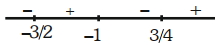
The critical points are $x = -3/2, -1, 3/4$. Using the wavy curve method,the solution is $x \in (-3/2, -1) \cup (3/4, \infty)$.
Step $2$: Solve $-1 \leq \frac{2x-1}{x+2} \leq 1$.
Part $A$: $\frac{2x-1}{x+2} + 1 \geq 0 \implies \frac{3x+1}{x+2} \geq 0$. Solution: $x \in (-\infty, -2) \cup [-1/3, \infty)$.
Part $B$: $\frac{2x-1}{x+2} - 1 \leq 0 \implies \frac{x-3}{x+2} \leq 0$. Solution: $x \in (-2, 3]$.
Intersection of Part $A$ and Part $B$: $x \in [-1/3, 3]$.
Step $3$: Find the intersection of Step $1$ and Step $2$.
$((-3/2, -1) \cup (3/4, \infty)) \cap [-1/3, 3] = (3/4, 3]$.
Thus,$\alpha = 3/4$ and $\beta = 3$.
Step $4$: Calculate $5\beta - 4\alpha$.
$5(3) - 4(3/4) = 15 - 3 = 12$.
$1$) $\frac{2x+3}{4x^2+x-3} > 0$
$2$) $-1 \leq \frac{2x-1}{x+2} \leq 1$
Step $1$: Solve $\frac{2x+3}{(4x-3)(x+1)} > 0$.
The critical points are $x = -3/2, -1, 3/4$. Using the wavy curve method,the solution is $x \in (-3/2, -1) \cup (3/4, \infty)$.
Step $2$: Solve $-1 \leq \frac{2x-1}{x+2} \leq 1$.
Part $A$: $\frac{2x-1}{x+2} + 1 \geq 0 \implies \frac{3x+1}{x+2} \geq 0$. Solution: $x \in (-\infty, -2) \cup [-1/3, \infty)$.
Part $B$: $\frac{2x-1}{x+2} - 1 \leq 0 \implies \frac{x-3}{x+2} \leq 0$. Solution: $x \in (-2, 3]$.
Intersection of Part $A$ and Part $B$: $x \in [-1/3, 3]$.
Step $3$: Find the intersection of Step $1$ and Step $2$.
$((-3/2, -1) \cup (3/4, \infty)) \cap [-1/3, 3] = (3/4, 3]$.
Thus,$\alpha = 3/4$ and $\beta = 3$.
Step $4$: Calculate $5\beta - 4\alpha$.
$5(3) - 4(3/4) = 15 - 3 = 12$.
0 likes
View Solution125
DifficultMCQ
If the domain of the function $f(x) = \frac{\sqrt{x^2-25}}{4-x^2} + \log_{10}(x^2+2x-15)$ is $(-\infty, \alpha) \cup [\beta, \infty)$,then $\alpha^2 + \beta^3$ is equal to:
A
$140$
B
$175$
C
$150$
D
$125$
Solution
(C) The function is $f(x) = \frac{\sqrt{x^2-25}}{4-x^2} + \log_{10}(x^2+2x-15)$.
For the square root term,$x^2-25 \geq 0 \Rightarrow x \in (-\infty, -5] \cup [5, \infty)$.
For the denominator,$4-x^2 \neq 0 \Rightarrow x \neq \pm 2$.
For the logarithm,$x^2+2x-15 > 0$ $\Rightarrow (x+5)(x-3) > 0$ $\Rightarrow x \in (-\infty, -5) \cup (3, \infty)$.
Taking the intersection of all conditions:
$x \in ((-\infty, -5] \cup [5, \infty)) \cap (-\infty, -5) \cup (3, \infty) \cap \mathbb{R} \setminus \{-2, 2\}$.
This simplifies to $x \in (-\infty, -5) \cup [5, \infty)$.
Comparing with $(-\infty, \alpha) \cup [\beta, \infty)$,we get $\alpha = -5$ and $\beta = 5$.
Therefore,$\alpha^2 + \beta^3 = (-5)^2 + 5^3 = 25 + 125 = 150$.
For the square root term,$x^2-25 \geq 0 \Rightarrow x \in (-\infty, -5] \cup [5, \infty)$.
For the denominator,$4-x^2 \neq 0 \Rightarrow x \neq \pm 2$.
For the logarithm,$x^2+2x-15 > 0$ $\Rightarrow (x+5)(x-3) > 0$ $\Rightarrow x \in (-\infty, -5) \cup (3, \infty)$.
Taking the intersection of all conditions:
$x \in ((-\infty, -5] \cup [5, \infty)) \cap (-\infty, -5) \cup (3, \infty) \cap \mathbb{R} \setminus \{-2, 2\}$.
This simplifies to $x \in (-\infty, -5) \cup [5, \infty)$.
Comparing with $(-\infty, \alpha) \cup [\beta, \infty)$,we get $\alpha = -5$ and $\beta = 5$.
Therefore,$\alpha^2 + \beta^3 = (-5)^2 + 5^3 = 25 + 125 = 150$.
0 likes
View Solution126
DifficultMCQ
If the domain of the function $\sin^{-1}\left(\frac{3x-22}{2x-19}\right) + \log_e\left(\frac{3x^2-8x+5}{x^2-3x-10}\right)$ is $(\alpha, \beta]$,then $3\alpha + 10\beta$ is equal to :
A
$97$
B
$100$
C
$95$
D
$98$
Solution
(A) For $\sin^{-1}(u)$,we need $-1 \leq u \leq 1$. So,$-1 \leq \frac{3x-22}{2x-19} \leq 1$. Solving this inequality gives $x \in (5, 8.2]$.
For $\log_e(v)$,we need $v > 0$. So,$\frac{3x^2-8x+5}{x^2-3x-10} > 0$,which simplifies to $\frac{(3x-5)(x-1)}{(x-5)(x+2)} > 0$. The solution is $x \in (-\infty, -2) \cup (1, 5/3) \cup (5, \infty)$.
Taking the intersection of both conditions,the domain is $(5, 8.2]$,which is $(5, 41/5]$.
Here,$\alpha = 5$ and $\beta = 41/5$.
Thus,$3\alpha + 10\beta = 3(5) + 10(41/5) = 15 + 82 = 97$.
For $\log_e(v)$,we need $v > 0$. So,$\frac{3x^2-8x+5}{x^2-3x-10} > 0$,which simplifies to $\frac{(3x-5)(x-1)}{(x-5)(x+2)} > 0$. The solution is $x \in (-\infty, -2) \cup (1, 5/3) \cup (5, \infty)$.
Taking the intersection of both conditions,the domain is $(5, 8.2]$,which is $(5, 41/5]$.
Here,$\alpha = 5$ and $\beta = 41/5$.
Thus,$3\alpha + 10\beta = 3(5) + 10(41/5) = 15 + 82 = 97$.
0 likes
View Solution127
MediumMCQ
Let $f(x) = \frac{1}{7 - \sin 5x}$ be a function defined on $R$. Then the range of the function $f(x)$ is equal to:
A
$\left[\frac{1}{8}, \frac{1}{5}\right]$
B
$\left[\frac{1}{7}, \frac{1}{6}\right]$
C
$\left[\frac{1}{7}, \frac{1}{5}\right]$
D
$\left[\frac{1}{8}, \frac{1}{6}\right]$
Solution
(D) We know that for any real $x$,the range of $\sin 5x$ is $[-1, 1]$.
Therefore,$-\sin 5x$ also lies in the interval $[-1, 1]$.
Adding $7$ to all parts,we get $7 - \sin 5x \in [7 - 1, 7 + 1]$,which simplifies to $7 - \sin 5x \in [6, 8]$.
Taking the reciprocal,the range of $f(x) = \frac{1}{7 - \sin 5x}$ is $\left[\frac{1}{8}, \frac{1}{6}\right]$.
Therefore,$-\sin 5x$ also lies in the interval $[-1, 1]$.
Adding $7$ to all parts,we get $7 - \sin 5x \in [7 - 1, 7 + 1]$,which simplifies to $7 - \sin 5x \in [6, 8]$.
Taking the reciprocal,the range of $f(x) = \frac{1}{7 - \sin 5x}$ is $\left[\frac{1}{8}, \frac{1}{6}\right]$.
0 likes
View Solution128
DifficultMCQ
Let the range of the function $f(x) = \frac{1}{2 + \sin 3x + \cos 3x}, x \in \mathbb{R}$ be $[a, b]$. If $\alpha$ and $\beta$ are respectively the $A.M.$ and the $G.M.$ of $a$ and $b$,then $\frac{\alpha}{\beta}$ is equal to:
A
$\sqrt{2}$
B
$2$
C
$\sqrt{\pi}$
D
$\pi$
Solution
(A) We know that the range of $g(x) = \sin 3x + \cos 3x$ is $[-\sqrt{2}, \sqrt{2}]$.
Thus,the denominator $2 + \sin 3x + \cos 3x$ ranges from $[2 - \sqrt{2}, 2 + \sqrt{2}]$.
Therefore,the range of $f(x) = \frac{1}{2 + \sin 3x + \cos 3x}$ is $[a, b] = \left[\frac{1}{2 + \sqrt{2}}, \frac{1}{2 - \sqrt{2}}\right]$.
Rationalizing the endpoints: $a = \frac{2 - \sqrt{2}}{4 - 2} = \frac{2 - \sqrt{2}}{2} = 1 - \frac{1}{\sqrt{2}}$ and $b = \frac{2 + \sqrt{2}}{4 - 2} = \frac{2 + \sqrt{2}}{2} = 1 + \frac{1}{\sqrt{2}}$.
Given $\alpha = \frac{a + b}{2}$ and $\beta = \sqrt{ab}$,we need to find $\frac{\alpha}{\beta} = \frac{a + b}{2\sqrt{ab}}$.
$a + b = \frac{2 - \sqrt{2} + 2 + \sqrt{2}}{2} = 2$.
$ab = \left(\frac{2 - \sqrt{2}}{2}\right) \left(\frac{2 + \sqrt{2}}{2}\right) = \frac{4 - 2}{4} = \frac{2}{4} = \frac{1}{2}$.
$\frac{\alpha}{\beta} = \frac{2}{2\sqrt{1/2}} = \frac{1}{1/\sqrt{2}} = \sqrt{2}$.
Thus,the denominator $2 + \sin 3x + \cos 3x$ ranges from $[2 - \sqrt{2}, 2 + \sqrt{2}]$.
Therefore,the range of $f(x) = \frac{1}{2 + \sin 3x + \cos 3x}$ is $[a, b] = \left[\frac{1}{2 + \sqrt{2}}, \frac{1}{2 - \sqrt{2}}\right]$.
Rationalizing the endpoints: $a = \frac{2 - \sqrt{2}}{4 - 2} = \frac{2 - \sqrt{2}}{2} = 1 - \frac{1}{\sqrt{2}}$ and $b = \frac{2 + \sqrt{2}}{4 - 2} = \frac{2 + \sqrt{2}}{2} = 1 + \frac{1}{\sqrt{2}}$.
Given $\alpha = \frac{a + b}{2}$ and $\beta = \sqrt{ab}$,we need to find $\frac{\alpha}{\beta} = \frac{a + b}{2\sqrt{ab}}$.
$a + b = \frac{2 - \sqrt{2} + 2 + \sqrt{2}}{2} = 2$.
$ab = \left(\frac{2 - \sqrt{2}}{2}\right) \left(\frac{2 + \sqrt{2}}{2}\right) = \frac{4 - 2}{4} = \frac{2}{4} = \frac{1}{2}$.
$\frac{\alpha}{\beta} = \frac{2}{2\sqrt{1/2}} = \frac{1}{1/\sqrt{2}} = \sqrt{2}$.
0 likes
View Solution129
AdvancedMCQ
Let $f(x) = \frac{x^2-6x+5}{x^2-5x+6}$. Match the conditions / expressions in Column $I$ with statements in Column $II$.
| Column $I$ | Column $II$ |
| $(A)$ If $-1 < x < 1$,then $f(x)$ satisfies | $(p)$ $0 < f(x) < 1$ |
| $(B)$ If $1 < x < 2$,then $f(x)$ satisfies | $(q)$ $f(x) < 0$ |
| $(C)$ If $3 < x < 5$,then $f(x)$ satisfies | $(r)$ $f(x) > 0$ |
| $(D)$ If $x > 5$,then $f(x)$ satisfies | $(s)$ $f(x) < 1$ |
A
$A \rightarrow p, r, s; B \rightarrow q, s; C \rightarrow q, s; D \rightarrow p, r, s$
B
$A \rightarrow q, r, s; B \rightarrow r, s; C \rightarrow q, r; D \rightarrow p, q, r$
C
$A \rightarrow p, r, s; B \rightarrow q, s; C \rightarrow q, s; D \rightarrow p, r, s$
D
$A \rightarrow q, r, s; B \rightarrow q, r; C \rightarrow q, s; D \rightarrow q, r, s$
Solution
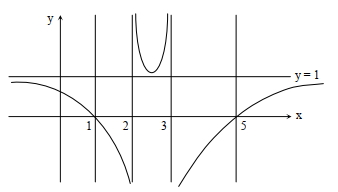
(C) Given $f(x) = \frac{(x-1)(x-5)}{(x-2)(x-3)}$.
$(A)$ For $-1 < x < 1$,$f(x) > 0$ and $f(x) < 1$. Thus,$f(x)$ satisfies $(p, r, s)$.
$(B)$ For $1 < x < 2$,$f(x) < 0$ and $f(x) < 1$. Thus,$f(x)$ satisfies $(q, s)$.
$(C)$ For $3 < x < 5$,$f(x) < 0$ and $f(x) < 1$. Thus,$f(x)$ satisfies $(q, s)$.
$(D)$ For $x > 5$,$f(x) > 0$ and $f(x) < 1$. Thus,$f(x)$ satisfies $(p, r, s)$.
$(A)$ For $-1 < x < 1$,$f(x) > 0$ and $f(x) < 1$. Thus,$f(x)$ satisfies $(p, r, s)$.
$(B)$ For $1 < x < 2$,$f(x) < 0$ and $f(x) < 1$. Thus,$f(x)$ satisfies $(q, s)$.
$(C)$ For $3 < x < 5$,$f(x) < 0$ and $f(x) < 1$. Thus,$f(x)$ satisfies $(q, s)$.
$(D)$ For $x > 5$,$f(x) > 0$ and $f(x) < 1$. Thus,$f(x)$ satisfies $(p, r, s)$.
0 likes
View Solution130
DifficultMCQ
Let $f:[0,3] \rightarrow A$ be defined by $f(x)=2x^3-15x^2+36x+7$ and $g:[0, \infty) \rightarrow B$ be defined by $g(x)=\frac{x^{2025}}{x^{2025}+1}$. If both the functions are onto and $S =\{ x \in \mathbb{Z} : x \in A \text{ or } x \in B \}$,then $n(S)$ is equal to :
A
$30$
B
$36$
C
$29$
D
$31$
Solution
(A) Since $f(x)$ is onto,$A$ is the range of $f(x)$.
$f'(x) = 6x^2 - 30x + 36 = 6(x-2)(x-3)$.
Critical points are $x=2$ and $x=3$.
Evaluating at boundaries and critical points:
$f(0) = 7$
$f(2) = 2(8) - 15(4) + 36(2) + 7 = 16 - 60 + 72 + 7 = 35$
$f(3) = 2(27) - 15(9) + 36(3) + 7 = 54 - 135 + 108 + 7 = 34$.
Since $f(x)$ is continuous on $[0,3]$,the range $A = [7, 35]$.
For $g(x) = \frac{x^{2025}}{x^{2025}+1}$,as $x \in [0, \infty)$,$x^{2025} \in [0, \infty)$.
Thus,$g(x) = 1 - \frac{1}{x^{2025}+1}$.
At $x=0$,$g(0) = 0$. As $x \to \infty$,$g(x) \to 1$.
So,the range $B = [0, 1)$.
$S = \{x \in \mathbb{Z} : x \in [7, 35] \cup [0, 1)\} = \{0, 7, 8, 9, \dots, 35\}$.
The number of elements in $S$ is $1 + (35 - 7 + 1) = 1 + 29 = 30$.
$f'(x) = 6x^2 - 30x + 36 = 6(x-2)(x-3)$.
Critical points are $x=2$ and $x=3$.
Evaluating at boundaries and critical points:
$f(0) = 7$
$f(2) = 2(8) - 15(4) + 36(2) + 7 = 16 - 60 + 72 + 7 = 35$
$f(3) = 2(27) - 15(9) + 36(3) + 7 = 54 - 135 + 108 + 7 = 34$.
Since $f(x)$ is continuous on $[0,3]$,the range $A = [7, 35]$.
For $g(x) = \frac{x^{2025}}{x^{2025}+1}$,as $x \in [0, \infty)$,$x^{2025} \in [0, \infty)$.
Thus,$g(x) = 1 - \frac{1}{x^{2025}+1}$.
At $x=0$,$g(0) = 0$. As $x \to \infty$,$g(x) \to 1$.
So,the range $B = [0, 1)$.
$S = \{x \in \mathbb{Z} : x \in [7, 35] \cup [0, 1)\} = \{0, 7, 8, 9, \dots, 35\}$.
The number of elements in $S$ is $1 + (35 - 7 + 1) = 1 + 29 = 30$.
0 likes
View Solution131
AdvancedMCQ
If the domain of the function $\log _5(18 x-x^2-77)$ is $(\alpha, \beta)$ and the domain of the function $\log _{(x-1)}\left(\frac{2 x^2+3 x-2}{x^2-3 x-4}\right)$ is $(\gamma, \delta)$,then $\alpha^2+\beta^2+\gamma^2$ is equal to :
A
$186$
B
$174$
C
$195$
D
$179$
Solution
(A) For $f_1(x) = \log _5(18 x-x^2-77)$,the domain requires $18 x-x^2-77 > 0$.
$x^2-18 x+77 < 0 \implies (x-7)(x-11) < 0$.
Thus,$x \in (7, 11)$,so $\alpha = 7$ and $\beta = 11$.
For $f_2(x) = \log _{(x-1)}\left(\frac{2 x^2+3 x-2}{x^2-3 x-4}\right)$,the domain requires:
$1) \ x-1 > 0 \implies x > 1$
$2) \ x-1 \neq 1 \implies x \neq 2$
$3) \ \frac{2 x^2+3 x-2}{x^2-3 x-4} > 0 \implies \frac{(2 x-1)(x+2)}{(x-4)(x+1)} > 0$.
Using the sign scheme for $\frac{(2 x-1)(x+2)}{(x-4)(x+1)} > 0$,the solution is $x \in (-\infty, -2) \cup (-1, 1/2) \cup (4, \infty)$.
Taking the intersection with $x > 1$ and $x \neq 2$,we get $x \in (4, \infty)$.
Thus,$\gamma = 4$ and $\delta = \infty$.
Finally,$\alpha^2+\beta^2+\gamma^2 = 7^2+11^2+4^2 = 49+121+16 = 186$.
$x^2-18 x+77 < 0 \implies (x-7)(x-11) < 0$.
Thus,$x \in (7, 11)$,so $\alpha = 7$ and $\beta = 11$.
For $f_2(x) = \log _{(x-1)}\left(\frac{2 x^2+3 x-2}{x^2-3 x-4}\right)$,the domain requires:
$1) \ x-1 > 0 \implies x > 1$
$2) \ x-1 \neq 1 \implies x \neq 2$
$3) \ \frac{2 x^2+3 x-2}{x^2-3 x-4} > 0 \implies \frac{(2 x-1)(x+2)}{(x-4)(x+1)} > 0$.
Using the sign scheme for $\frac{(2 x-1)(x+2)}{(x-4)(x+1)} > 0$,the solution is $x \in (-\infty, -2) \cup (-1, 1/2) \cup (4, \infty)$.
Taking the intersection with $x > 1$ and $x \neq 2$,we get $x \in (4, \infty)$.
Thus,$\gamma = 4$ and $\delta = \infty$.
Finally,$\alpha^2+\beta^2+\gamma^2 = 7^2+11^2+4^2 = 49+121+16 = 186$.
0 likes
View Solution132
MediumMCQ
If the domain of the function $f(x) = \frac{1}{\sqrt{10+3x-x^2}} + \frac{1}{\sqrt{x+|x|}}$ is $(a, b)$,then $(1+a)^2 + b^2$ is equal to :
A
$26$
B
$29$
C
$25$
D
$30$
Solution
(A) For the function to be defined,the expressions inside the square roots in the denominator must be strictly positive.
$1) \ x + |x| > 0$
If $x \leq 0$,then $x + |x| = 0$,which makes the denominator zero. Thus,we must have $x > 0$.
So,$x \in (0, \infty)$.
$2) \ 10 + 3x - x^2 > 0$
Multiplying by $-1$,we get $x^2 - 3x - 10 < 0$.
$(x - 5)(x + 2) < 0$.
This inequality holds for $x \in (-2, 5)$.
Taking the intersection of $x \in (0, \infty)$ and $x \in (-2, 5)$,we get the domain $(a, b) = (0, 5)$.
Therefore,$a = 0$ and $b = 5$.
Calculating the required value: $(1+a)^2 + b^2 = (1+0)^2 + 5^2 = 1 + 25 = 26$.
$1) \ x + |x| > 0$
If $x \leq 0$,then $x + |x| = 0$,which makes the denominator zero. Thus,we must have $x > 0$.
So,$x \in (0, \infty)$.
$2) \ 10 + 3x - x^2 > 0$
Multiplying by $-1$,we get $x^2 - 3x - 10 < 0$.
$(x - 5)(x + 2) < 0$.
This inequality holds for $x \in (-2, 5)$.
Taking the intersection of $x \in (0, \infty)$ and $x \in (-2, 5)$,we get the domain $(a, b) = (0, 5)$.
Therefore,$a = 0$ and $b = 5$.
Calculating the required value: $(1+a)^2 + b^2 = (1+0)^2 + 5^2 = 1 + 25 = 26$.
0 likes
View Solution133
AdvancedMCQ
If the domain of the function $f(x) = \log_e\left(\frac{2x-3}{5+4x}\right) + \sin^{-1}\left(\frac{4+3x}{2-x}\right)$ is $[\alpha, \beta)$,then $\alpha^2 + 4\beta$ is equal to
A
$5$
B
$4$
C
$3$
D
$7$
Solution
(B) The given function is $f(x) = \log_e\left(\frac{2x-3}{5+4x}\right) + \sin^{-1}\left(\frac{4+3x}{2-x}\right)$.
For the function to be defined,we need:
$1) \frac{2x-3}{5+4x} > 0$
$2) -1 \leq \frac{4+3x}{2-x} \leq 1$
Solving condition $(1)$:
$\frac{2x-3}{5+4x} > 0 \Rightarrow x \in \left(-\infty, -\frac{5}{4}\right) \cup \left(\frac{3}{2}, \infty\right)$.
Solving condition $(2)$:
$-1 \leq \frac{4+3x}{2-x} \leq 1$
$\Rightarrow \frac{4+3x}{2-x} + 1 \geq 0$ and $\frac{4+3x}{2-x} - 1 \leq 0$
$\Rightarrow \frac{4+3x+2-x}{2-x} \geq 0$ and $\frac{4+3x-2+x}{2-x} \leq 0$
$\Rightarrow \frac{6+2x}{2-x} \geq 0$ and $\frac{2+4x}{2-x} \leq 0$
$\Rightarrow \frac{x+3}{x-2} \leq 0$ and $\frac{x+1/2}{x-2} \geq 0$
From $\frac{x+3}{x-2} \leq 0$,we get $x \in [-3, 2)$.
From $\frac{x+1/2}{x-2} \geq 0$,we get $x \in (-\infty, -1/2] \cup (2, \infty)$.
Intersection of these gives $x \in [-3, -1/2]$.
Now,taking the intersection with condition $(1)$:
$x \in ([-3, -1/2]) \cap ((-\infty, -5/4) \cup (3/2, \infty)) = [-3, -5/4)$.
Thus,$\alpha = -3$ and $\beta = -5/4$.
Therefore,$\alpha^2 + 4\beta = (-3)^2 + 4(-5/4) = 9 - 5 = 4$.
For the function to be defined,we need:
$1) \frac{2x-3}{5+4x} > 0$
$2) -1 \leq \frac{4+3x}{2-x} \leq 1$
Solving condition $(1)$:
$\frac{2x-3}{5+4x} > 0 \Rightarrow x \in \left(-\infty, -\frac{5}{4}\right) \cup \left(\frac{3}{2}, \infty\right)$.
Solving condition $(2)$:
$-1 \leq \frac{4+3x}{2-x} \leq 1$
$\Rightarrow \frac{4+3x}{2-x} + 1 \geq 0$ and $\frac{4+3x}{2-x} - 1 \leq 0$
$\Rightarrow \frac{4+3x+2-x}{2-x} \geq 0$ and $\frac{4+3x-2+x}{2-x} \leq 0$
$\Rightarrow \frac{6+2x}{2-x} \geq 0$ and $\frac{2+4x}{2-x} \leq 0$
$\Rightarrow \frac{x+3}{x-2} \leq 0$ and $\frac{x+1/2}{x-2} \geq 0$
From $\frac{x+3}{x-2} \leq 0$,we get $x \in [-3, 2)$.
From $\frac{x+1/2}{x-2} \geq 0$,we get $x \in (-\infty, -1/2] \cup (2, \infty)$.
Intersection of these gives $x \in [-3, -1/2]$.
Now,taking the intersection with condition $(1)$:
$x \in ([-3, -1/2]) \cap ((-\infty, -5/4) \cup (3/2, \infty)) = [-3, -5/4)$.
Thus,$\alpha = -3$ and $\beta = -5/4$.
Therefore,$\alpha^2 + 4\beta = (-3)^2 + 4(-5/4) = 9 - 5 = 4$.
0 likes
View Solution134
DifficultMCQ
If the domain of the function $f(x) = \log_7(1 - \log_4(x^2 - 9x + 18))$ is $(\alpha, \beta) \cup (\gamma, \delta)$,then $\alpha + \beta + \gamma + \delta$ is equal to
A
$18$
B
$16$
C
$15$
D
$17$
Solution
(A) For the function $f(x) = \log_7(1 - \log_4(x^2 - 9x + 18))$ to be defined,we must have $1 - \log_4(x^2 - 9x + 18) > 0$ and $x^2 - 9x + 18 > 0$.
Step $1$: Solve $x^2 - 9x + 18 > 0$.
$(x - 3)(x - 6) > 0 \implies x \in (-\infty, 3) \cup (6, \infty)$.
Step $2$: Solve $1 - \log_4(x^2 - 9x + 18) > 0$.
$\log_4(x^2 - 9x + 18) < 1 \implies x^2 - 9x + 18 < 4^1$.
$x^2 - 9x + 14 < 0 \implies (x - 2)(x - 7) < 0 \implies x \in (2, 7)$.
Step $3$: Find the intersection of the two conditions.
$x \in ((-\infty, 3) \cup (6, \infty)) \cap (2, 7) = (2, 3) \cup (6, 7)$.
Thus,$(\alpha, \beta) = (2, 3)$ and $(\gamma, \delta) = (6, 7)$.
Therefore,$\alpha + \beta + \gamma + \delta = 2 + 3 + 6 + 7 = 18$.
Step $1$: Solve $x^2 - 9x + 18 > 0$.
$(x - 3)(x - 6) > 0 \implies x \in (-\infty, 3) \cup (6, \infty)$.
Step $2$: Solve $1 - \log_4(x^2 - 9x + 18) > 0$.
$\log_4(x^2 - 9x + 18) < 1 \implies x^2 - 9x + 18 < 4^1$.
$x^2 - 9x + 14 < 0 \implies (x - 2)(x - 7) < 0 \implies x \in (2, 7)$.
Step $3$: Find the intersection of the two conditions.
$x \in ((-\infty, 3) \cup (6, \infty)) \cap (2, 7) = (2, 3) \cup (6, 7)$.
Thus,$(\alpha, \beta) = (2, 3)$ and $(\gamma, \delta) = (6, 7)$.
Therefore,$\alpha + \beta + \gamma + \delta = 2 + 3 + 6 + 7 = 18$.
0 likes
View Solution135
DifficultMCQ
Let the domains of the functions $f(x) = \log_4 \log_3 \log_7(8 - \log_2(x^2 + 4x + 5))$ and $g(x) = \sin^{-1}(\frac{7x + 10}{x - 2})$ be $(\alpha, \beta)$ and $[\gamma, \delta]$,respectively. Then $\alpha^2 + \beta^2 + \gamma^2 + \delta^2$ is equal to:
A
$15$
B
$13$
C
$16$
D
$14$
Solution
(A) For $f(x)$,we require $\log_3 \log_7(8 - \log_2(x^2 + 4x + 5)) > 0$.
This implies $\log_7(8 - \log_2(x^2 + 4x + 5)) > 1$,so $8 - \log_2(x^2 + 4x + 5) > 7$.
Thus,$\log_2(x^2 + 4x + 5) < 1$,which means $x^2 + 4x + 5 < 2$,or $x^2 + 4x + 3 < 0$.
Factoring gives $(x + 3)(x + 1) < 0$,so $x \in (-3, -1)$. Thus,$\alpha = -3$ and $\beta = -1$.
For $g(x)$,we require $-1 \leq \frac{7x + 10}{x - 2} \leq 1$.
Solving $\frac{7x + 10}{x - 2} \leq 1$ $\Rightarrow \frac{7x + 10 - x + 2}{x - 2} \leq 0$ $\Rightarrow \frac{6x + 12}{x - 2} \leq 0$ $\Rightarrow \frac{x + 2}{x - 2} \leq 0$,so $x \in [-2, 2)$.
Solving $\frac{7x + 10}{x - 2} \geq -1$ $\Rightarrow \frac{7x + 10 + x - 2}{x - 2} \geq 0$ $\Rightarrow \frac{8x + 8}{x - 2} \geq 0$ $\Rightarrow \frac{x + 1}{x - 2} \geq 0$,so $x \in (-\infty, -1] \cup (2, \infty)$.
The intersection is $x \in [-2, -1]$. Thus,$\gamma = -2$ and $\delta = -1$.
Finally,$\alpha^2 + \beta^2 + \gamma^2 + \delta^2 = (-3)^2 + (-1)^2 + (-2)^2 + (-1)^2 = 9 + 1 + 4 + 1 = 15$.
This implies $\log_7(8 - \log_2(x^2 + 4x + 5)) > 1$,so $8 - \log_2(x^2 + 4x + 5) > 7$.
Thus,$\log_2(x^2 + 4x + 5) < 1$,which means $x^2 + 4x + 5 < 2$,or $x^2 + 4x + 3 < 0$.
Factoring gives $(x + 3)(x + 1) < 0$,so $x \in (-3, -1)$. Thus,$\alpha = -3$ and $\beta = -1$.
For $g(x)$,we require $-1 \leq \frac{7x + 10}{x - 2} \leq 1$.
Solving $\frac{7x + 10}{x - 2} \leq 1$ $\Rightarrow \frac{7x + 10 - x + 2}{x - 2} \leq 0$ $\Rightarrow \frac{6x + 12}{x - 2} \leq 0$ $\Rightarrow \frac{x + 2}{x - 2} \leq 0$,so $x \in [-2, 2)$.
Solving $\frac{7x + 10}{x - 2} \geq -1$ $\Rightarrow \frac{7x + 10 + x - 2}{x - 2} \geq 0$ $\Rightarrow \frac{8x + 8}{x - 2} \geq 0$ $\Rightarrow \frac{x + 1}{x - 2} \geq 0$,so $x \in (-\infty, -1] \cup (2, \infty)$.
The intersection is $x \in [-2, -1]$. Thus,$\gamma = -2$ and $\delta = -1$.
Finally,$\alpha^2 + \beta^2 + \gamma^2 + \delta^2 = (-3)^2 + (-1)^2 + (-2)^2 + (-1)^2 = 9 + 1 + 4 + 1 = 15$.
0 likes
View Solution136
DifficultMCQ
If the range of the function $f(x) = \frac{5-x}{x^2-3x+2}$,$x \neq 1, 2$,is $(-\infty, \alpha] \cup [\beta, \infty)$,then $\alpha^2 + \beta^2$ is equal to :
A
$190$
B
$192$
C
$188$
D
$194$
Solution
(D) Let $y = \frac{5-x}{x^2-3x+2}$.
$y(x^2-3x+2) = 5-x$
$yx^2 - 3xy + 2y = 5-x$
$yx^2 + (1-3y)x + (2y-5) = 0$.
If $y=0$,then $x=5$,which is a valid value.
If $y \neq 0$,for $x$ to be real,the discriminant $D \geq 0$.
$D = (1-3y)^2 - 4(y)(2y-5) \geq 0$
$1 + 9y^2 - 6y - 8y^2 + 20y \geq 0$
$y^2 + 14y + 1 \geq 0$.
Solving $y^2 + 14y + 1 = 0$ using the quadratic formula:
$y = \frac{-14 \pm \sqrt{196-4}}{2} = \frac{-14 \pm \sqrt{192}}{2} = \frac{-14 \pm 8\sqrt{3}}{2} = -7 \pm 4\sqrt{3}$.
Thus,$y \in (-\infty, -7-4\sqrt{3}] \cup [-7+4\sqrt{3}, \infty)$.
Here,$\alpha = -7-4\sqrt{3}$ and $\beta = -7+4\sqrt{3}$.
$\alpha^2 + \beta^2 = (-7-4\sqrt{3})^2 + (-7+4\sqrt{3})^2$
$= (49 + 48 + 56\sqrt{3}) + (49 + 48 - 56\sqrt{3})$
$= 97 + 97 = 194$.
$y(x^2-3x+2) = 5-x$
$yx^2 - 3xy + 2y = 5-x$
$yx^2 + (1-3y)x + (2y-5) = 0$.
If $y=0$,then $x=5$,which is a valid value.
If $y \neq 0$,for $x$ to be real,the discriminant $D \geq 0$.
$D = (1-3y)^2 - 4(y)(2y-5) \geq 0$
$1 + 9y^2 - 6y - 8y^2 + 20y \geq 0$
$y^2 + 14y + 1 \geq 0$.
Solving $y^2 + 14y + 1 = 0$ using the quadratic formula:
$y = \frac{-14 \pm \sqrt{196-4}}{2} = \frac{-14 \pm \sqrt{192}}{2} = \frac{-14 \pm 8\sqrt{3}}{2} = -7 \pm 4\sqrt{3}$.
Thus,$y \in (-\infty, -7-4\sqrt{3}] \cup [-7+4\sqrt{3}, \infty)$.
Here,$\alpha = -7-4\sqrt{3}$ and $\beta = -7+4\sqrt{3}$.
$\alpha^2 + \beta^2 = (-7-4\sqrt{3})^2 + (-7+4\sqrt{3})^2$
$= (49 + 48 + 56\sqrt{3}) + (49 + 48 - 56\sqrt{3})$
$= 97 + 97 = 194$.
0 likes
View Solution137
AdvancedMCQ
Let the domain of the function $f(x) = \cos^{-1}\left(\frac{4x+5}{3x-7}\right)$ be $[\alpha, \beta]$ and the domain of $g(x) = \log_2\left(2-6\log_{27}(2x+5)\right)$ be $(\gamma, \delta)$. Then $|7(\alpha+\beta)+4(\gamma+\delta)|$ is equal to . . . . . . .
A
$93$
B
$96$
C
$97$
D
$98$
Solution
(B) For $f(x) = \cos^{-1}\left(\frac{4x+5}{3x-7}\right)$,we require $-1 \leq \frac{4x+5}{3x-7} \leq 1$.
Case $1$: $\frac{4x+5}{3x-7} \geq -1$ $\Rightarrow \frac{4x+5+3x-7}{3x-7} \geq 0$ $\Rightarrow \frac{7x-2}{3x-7} \geq 0$. This gives $x \in (-\infty, 2/7] \cup (7/3, \infty)$.
Case $2$: $\frac{4x+5}{3x-7} \leq 1$ $\Rightarrow \frac{4x+5-3x+7}{3x-7} \leq 0$ $\Rightarrow \frac{x+12}{3x-7} \leq 0$. This gives $x \in [-12, 7/3)$.
Taking the intersection,the domain of $f(x)$ is $[-12, 2/7]$. Thus,$\alpha = -12$ and $\beta = 2/7$.
For $g(x) = \log_2(2-6\log_{27}(2x+5))$,we require $2-6\log_{27}(2x+5) > 0$ and $2x+5 > 0$.
$6\log_{27}(2x+5) < 2$ $\Rightarrow \log_{27}(2x+5) < 1/3$ $\Rightarrow 2x+5 < (27)^{1/3} = 3$ $\Rightarrow x < -1$.
Also,$2x+5 > 0 \Rightarrow x > -5/2$.
So,the domain of $g(x)$ is $(-5/2, -1)$. Thus,$\gamma = -5/2$ and $\delta = -1$.
Now,$|7(\alpha+\beta) + 4(\gamma+\delta)| = |7(-12 + 2/7) + 4(-5/2 - 1)| = |-84 + 2 - 10 - 4| = |-96| = 96$.
Case $1$: $\frac{4x+5}{3x-7} \geq -1$ $\Rightarrow \frac{4x+5+3x-7}{3x-7} \geq 0$ $\Rightarrow \frac{7x-2}{3x-7} \geq 0$. This gives $x \in (-\infty, 2/7] \cup (7/3, \infty)$.
Case $2$: $\frac{4x+5}{3x-7} \leq 1$ $\Rightarrow \frac{4x+5-3x+7}{3x-7} \leq 0$ $\Rightarrow \frac{x+12}{3x-7} \leq 0$. This gives $x \in [-12, 7/3)$.
Taking the intersection,the domain of $f(x)$ is $[-12, 2/7]$. Thus,$\alpha = -12$ and $\beta = 2/7$.
For $g(x) = \log_2(2-6\log_{27}(2x+5))$,we require $2-6\log_{27}(2x+5) > 0$ and $2x+5 > 0$.
$6\log_{27}(2x+5) < 2$ $\Rightarrow \log_{27}(2x+5) < 1/3$ $\Rightarrow 2x+5 < (27)^{1/3} = 3$ $\Rightarrow x < -1$.
Also,$2x+5 > 0 \Rightarrow x > -5/2$.
So,the domain of $g(x)$ is $(-5/2, -1)$. Thus,$\gamma = -5/2$ and $\delta = -1$.
Now,$|7(\alpha+\beta) + 4(\gamma+\delta)| = |7(-12 + 2/7) + 4(-5/2 - 1)| = |-84 + 2 - 10 - 4| = |-96| = 96$.
0 likes
View Solution138
MediumMCQ
If $[x]^2-5[x]+6=0$,where $[\cdot]$ denotes the greatest integer function,then $x$ belongs to:
A
$x \in [2, 3)$
B
$x \in [2, 4)$
C
$x \in [3, 4)$
D
$x \in [2, 5)$
Solution
(B) Given the equation $[x]^2-5[x]+6=0$. Let $[x] = y$.
Then $y^2-5y+6=0$.
Factoring the quadratic equation,we get $(y-2)(y-3)=0$.
So,$[x]=2$ or $[x]=3$.
If $[x]=2$,then $2 \le x < 3$.
If $[x]=3$,then $3 \le x < 4$.
Combining these intervals,we get $x \in [2, 4)$.
Then $y^2-5y+6=0$.
Factoring the quadratic equation,we get $(y-2)(y-3)=0$.
So,$[x]=2$ or $[x]=3$.
If $[x]=2$,then $2 \le x < 3$.
If $[x]=3$,then $3 \le x < 4$.
Combining these intervals,we get $x \in [2, 4)$.
0 likes
View Solution139
EasyMCQ
The domain of definition of $f(x) = \frac{\log_2(x+3)}{x^2+3x+2}$ is
A
$R - \{-1, -2\}$
B
$(-2, \infty)$
C
$R - \{-1, -2, -3\}$
D
$(-3, \infty) - \{-1, -2\}$
Solution
(D) Given,$f(x) = \frac{\log_2(x+3)}{x^2+3x+2}$.
For the function to be defined,the denominator must not be zero:
$x^2 + 3x + 2 \neq 0$
$(x+1)(x+2) \neq 0$
$x \neq -1$ and $x \neq -2$.
Also,the argument of the logarithm must be positive:
$x + 3 > 0$
$x > -3$.
Combining these conditions,the domain is $x \in (-3, \infty) - \{-1, -2\}$.
For the function to be defined,the denominator must not be zero:
$x^2 + 3x + 2 \neq 0$
$(x+1)(x+2) \neq 0$
$x \neq -1$ and $x \neq -2$.
Also,the argument of the logarithm must be positive:
$x + 3 > 0$
$x > -3$.
Combining these conditions,the domain is $x \in (-3, \infty) - \{-1, -2\}$.
0 likes
View Solution140
EasyMCQ
The domain of definition of the function $f(x)$ given by the equation $2^x + 2^y = 2$ is
A
$0 < x \leqslant 1$
B
$0 \leqslant x \leqslant 1$
C
$-\infty < x \leqslant 0$
D
$-\infty < x < 1$
Solution
(D) Given the equation $2^x + 2^y = 2$.
Rearranging for $2^y$,we get $2^y = 2 - 2^x$.
Taking the logarithm base $2$ on both sides,$y = \log_2(2 - 2^x)$.
For the function to be defined,the argument of the logarithm must be strictly positive: $2 - 2^x > 0$.
This implies $2^x < 2$.
Since $2 = 2^1$,we have $2^x < 2^1$.
Since the base $2 > 1$,the inequality holds for $x < 1$.
Thus,the domain is $(-\infty, 1)$,which is written as $-\infty < x < 1$.
Rearranging for $2^y$,we get $2^y = 2 - 2^x$.
Taking the logarithm base $2$ on both sides,$y = \log_2(2 - 2^x)$.
For the function to be defined,the argument of the logarithm must be strictly positive: $2 - 2^x > 0$.
This implies $2^x < 2$.
Since $2 = 2^1$,we have $2^x < 2^1$.
Since the base $2 > 1$,the inequality holds for $x < 1$.
Thus,the domain is $(-\infty, 1)$,which is written as $-\infty < x < 1$.
0 likes
View Solution141
EasyMCQ
The domain of definition of the function $y(x)$ given by the equation $2^x+2^y=2$ is
A
$0 < x \leq 1$
B
$0 \leq x \leq 1$
C
$-\infty < x \leq 0$
D
$-\infty < x < 1$
Solution
(D) Given the equation $2^x + 2^y = 2$.
Rearranging for $2^y$,we get $2^y = 2 - 2^x$.
Since $2^y > 0$ for all real $y$,the expression $2 - 2^x$ must be strictly greater than $0$.
$2 - 2^x > 0$
$2^x < 2$
$2^x < 2^1$
Since the base $2 > 1$,the inequality holds for the exponents:
$x < 1$.
Thus,the domain of the function is $(-\infty, 1)$,which is written as $-\infty < x < 1$.
Rearranging for $2^y$,we get $2^y = 2 - 2^x$.
Since $2^y > 0$ for all real $y$,the expression $2 - 2^x$ must be strictly greater than $0$.
$2 - 2^x > 0$
$2^x < 2$
$2^x < 2^1$
Since the base $2 > 1$,the inequality holds for the exponents:
$x < 1$.
Thus,the domain of the function is $(-\infty, 1)$,which is written as $-\infty < x < 1$.
0 likes
View Solution142
EasyMCQ
If $[x]^2-5[x]+6=0$,where $[x]$ denotes the greatest integer function,then
A
$x \in [2,3)$
B
$x \in [2,3]$
C
$x \in [2,4]$
D
$x \in [2,4)$
Solution
(D) Given equation: $[x]^2-5[x]+6=0$
Let $[x] = a$.
Then the equation becomes $a^2-5a+6=0$.
Factoring the quadratic equation: $(a-2)(a-3)=0$.
This gives $a=2$ or $a=3$.
Substituting back $[x]=a$,we get $[x]=2$ or $[x]=3$.
For $[x]=2$,the range of $x$ is $x \in [2,3)$.
For $[x]=3$,the range of $x$ is $x \in [3,4)$.
Combining these intervals,we get $x \in [2,3) \cup [3,4) = [2,4)$.
Let $[x] = a$.
Then the equation becomes $a^2-5a+6=0$.
Factoring the quadratic equation: $(a-2)(a-3)=0$.
This gives $a=2$ or $a=3$.
Substituting back $[x]=a$,we get $[x]=2$ or $[x]=3$.
For $[x]=2$,the range of $x$ is $x \in [2,3)$.
For $[x]=3$,the range of $x$ is $x \in [3,4)$.
Combining these intervals,we get $x \in [2,3) \cup [3,4) = [2,4)$.
0 likes
View Solution143
EasyMCQ
The domain of the function given by $2^x+2^y=2$ is
A
$0 < x \leq 1$
B
$0 \leq x \leq 1$
C
$-\infty < x \leq 0$
D
$-\infty < x < 1$
Solution
(D) Given the equation $2^x+2^y=2$.
We can rewrite this as $2^y = 2 - 2^x$.
For $y$ to be defined,the argument of the logarithm must be positive: $2 - 2^x > 0$.
This implies $2^x < 2$.
Since the base $2 > 1$,the inequality holds when $x < 1$.
Thus,the domain is $(-\infty, 1)$ or $-\infty < x < 1$.
We can rewrite this as $2^y = 2 - 2^x$.
For $y$ to be defined,the argument of the logarithm must be positive: $2 - 2^x > 0$.
This implies $2^x < 2$.
Since the base $2 > 1$,the inequality holds when $x < 1$.
Thus,the domain is $(-\infty, 1)$ or $-\infty < x < 1$.
0 likes
View Solution144
EasyMCQ
The domain of the definition of the function $y(x)$ given by the equation $2^x+2^y=2$ is
A
$0 < x \leq 1$
B
$0 \leq x \leq 1$
C
$-\infty < x \leq 0$
D
$-\infty < x < 1$
Solution
(D) Given the equation $2^x + 2^y = 2$.
Rearranging for $2^y$,we get $2^y = 2 - 2^x$.
Since $2^y > 0$ for all real $y$,the expression $2 - 2^x$ must be strictly greater than $0$.
$2 - 2^x > 0 \Rightarrow 2^x < 2$.
Since $2 = 2^1$,we have $2^x < 2^1$.
Since the base $2 > 1$,the inequality holds for $x < 1$.
Thus,the domain is $(-\infty, 1)$,which is written as $-\infty < x < 1$.
Rearranging for $2^y$,we get $2^y = 2 - 2^x$.
Since $2^y > 0$ for all real $y$,the expression $2 - 2^x$ must be strictly greater than $0$.
$2 - 2^x > 0 \Rightarrow 2^x < 2$.
Since $2 = 2^1$,we have $2^x < 2^1$.
Since the base $2 > 1$,the inequality holds for $x < 1$.
Thus,the domain is $(-\infty, 1)$,which is written as $-\infty < x < 1$.
0 likes
View Solution145
EasyMCQ
If $[x]$ is the greatest integer function and $2[2x - 5] - 1 = 7$,then $x$ lies in
A
$\left[\frac{9}{2}, 5\right)$
B
$\left[\frac{9}{2}, 5\right]$
C
$\left(\frac{9}{2}, 5\right)$
D
$\left(\frac{9}{2}, 5\right]$
Solution
(A) Given the equation: $2[2x - 5] - 1 = 7$ \\
Using the property $[x + n] = [x] + n$ for integer $n$,we have $[2x - 5] = [2x] - 5$ \\
Substituting this into the equation: $2([2x] - 5) - 1 = 7$ \\
$2[2x] - 10 - 1 = 7$ \\
$2[2x] - 11 = 7$ \\
$2[2x] = 18$ \\
$[2x] = 9$ \\
By the definition of the greatest integer function,$[y] = n \Rightarrow n \leq y < n + 1$ \\
So,$9 \leq 2x < 10$ \\
Dividing by $2$,we get $\frac{9}{2} \leq x < 5$ \\
Thus,$x \in \left[\frac{9}{2}, 5\right)$
Using the property $[x + n] = [x] + n$ for integer $n$,we have $[2x - 5] = [2x] - 5$ \\
Substituting this into the equation: $2([2x] - 5) - 1 = 7$ \\
$2[2x] - 10 - 1 = 7$ \\
$2[2x] - 11 = 7$ \\
$2[2x] = 18$ \\
$[2x] = 9$ \\
By the definition of the greatest integer function,$[y] = n \Rightarrow n \leq y < n + 1$ \\
So,$9 \leq 2x < 10$ \\
Dividing by $2$,we get $\frac{9}{2} \leq x < 5$ \\
Thus,$x \in \left[\frac{9}{2}, 5\right)$
0 likes
View Solution146
DifficultMCQ
The domain and range for the function $f(x) = e^{|x| \sin x}$ are:
A
Domain $= \mathbb{R}$,Range $= [0, \infty)$
B
Domain $= \mathbb{R}$,Range $= [1, \infty)$
C
Domain $= \mathbb{R}$,Range $= \mathbb{R}$
D
Domain $= \mathbb{R}$,Range $= (0, \infty)$
Solution
(D) The function $f(x) = e^{|x| \sin x}$ is defined for all real values of $x$.
Hence,the domain of $f(x)$ is $\mathbb{R}$.
Since $|x| \sin x$ can take any real value from $-\infty$ to $\infty$,the expression $e^{|x| \sin x}$ will always be strictly greater than $0$.
Therefore,the range of $f(x)$ is $(0, \infty)$.
Hence,the domain of $f(x)$ is $\mathbb{R}$.
Since $|x| \sin x$ can take any real value from $-\infty$ to $\infty$,the expression $e^{|x| \sin x}$ will always be strictly greater than $0$.
Therefore,the range of $f(x)$ is $(0, \infty)$.
0 likes
View Solution147
EasyMCQ
The domain of the definition of the function $f(x) = \frac{1}{4-x^2} + \log_{10}(x^3-x)$ is
A
$(-1, 0) \cup (1, 2) \cup (3, \infty)$
B
$(-1, 0) \cup (1, 2) \cup (2, \infty)$
C
$(-2, -1) \cup (-1, 0) \cup (2, \infty)$
D
$(1, 2) \cup (2, \infty)$
Solution
(B) For the function $f(x) = \frac{1}{4-x^2} + \log_{10}(x^3-x)$ to be defined:
$1$. The denominator must not be zero: $4 - x^2 \neq 0 \implies x^2 \neq 4 \implies x \neq \pm 2$.
$2$. The argument of the logarithm must be positive: $x^3 - x > 0$.
Factorizing the expression: $x(x^2 - 1) > 0 \implies x(x-1)(x+1) > 0$.
Using the wavy curve method (sign scheme),the inequality $x(x-1)(x+1) > 0$ holds for $x \in (-1, 0) \cup (1, \infty)$.
Combining the conditions $x \neq \pm 2$ and $x \in (-1, 0) \cup (1, \infty)$,we exclude $x = 2$ from the interval $(1, \infty)$.
Thus,the domain is $x \in (-1, 0) \cup (1, 2) \cup (2, \infty)$.
$1$. The denominator must not be zero: $4 - x^2 \neq 0 \implies x^2 \neq 4 \implies x \neq \pm 2$.
$2$. The argument of the logarithm must be positive: $x^3 - x > 0$.
Factorizing the expression: $x(x^2 - 1) > 0 \implies x(x-1)(x+1) > 0$.
Using the wavy curve method (sign scheme),the inequality $x(x-1)(x+1) > 0$ holds for $x \in (-1, 0) \cup (1, \infty)$.
Combining the conditions $x \neq \pm 2$ and $x \in (-1, 0) \cup (1, \infty)$,we exclude $x = 2$ from the interval $(1, \infty)$.
Thus,the domain is $x \in (-1, 0) \cup (1, 2) \cup (2, \infty)$.
0 likes
View Solution148
EasyMCQ
The domain of the function $f(x) = \frac{1}{\sqrt{x+|x|}}$ is
A
$(-\infty, 0)$
B
$(2, 5)$
C
$(0, \infty)$
D
$(-\infty, \infty)$
Solution
(C) The function is defined as $f(x) = \frac{1}{\sqrt{x+|x|}}$.
For the function to be defined,the expression inside the square root must be strictly greater than zero:
$x + |x| > 0$.
Case $1$: If $x > 0$,then $|x| = x$. Substituting this,we get $x + x = 2x > 0$,which implies $x > 0$.
Case $2$: If $x < 0$,then $|x| = -x$. Substituting this,we get $x + (-x) = 0$. Since $0$ is not greater than $0$,this case yields no solution.
Case $3$: If $x = 0$,then $x + |x| = 0 + 0 = 0$. Since the denominator cannot be zero,$x = 0$ is not in the domain.
Therefore,the domain of the function is $(0, \infty)$.
For the function to be defined,the expression inside the square root must be strictly greater than zero:
$x + |x| > 0$.
Case $1$: If $x > 0$,then $|x| = x$. Substituting this,we get $x + x = 2x > 0$,which implies $x > 0$.
Case $2$: If $x < 0$,then $|x| = -x$. Substituting this,we get $x + (-x) = 0$. Since $0$ is not greater than $0$,this case yields no solution.
Case $3$: If $x = 0$,then $x + |x| = 0 + 0 = 0$. Since the denominator cannot be zero,$x = 0$ is not in the domain.
Therefore,the domain of the function is $(0, \infty)$.
0 likes
View Solution149
EasyMCQ
The domain of the function $f(x) = \sqrt{x-1} + \sqrt{6-x}$ is
A
$[1, \infty)$
B
$[1, 6]$
C
$(-\infty, 6]$
D
$(-\infty, 6)$
Solution
(B) The function $f(x) = \sqrt{x-1} + \sqrt{6-x}$ is defined if and only if the expressions under the square roots are non-negative.
For $\sqrt{x-1}$ to be defined,$x - 1 \geq 0$,which implies $x \geq 1$.
For $\sqrt{6-x}$ to be defined,$6 - x \geq 0$,which implies $x \leq 6$.
Combining these two conditions,we get $1 \leq x \leq 6$.
Therefore,the domain of $f(x)$ is $[1, 6]$.
For $\sqrt{x-1}$ to be defined,$x - 1 \geq 0$,which implies $x \geq 1$.
For $\sqrt{6-x}$ to be defined,$6 - x \geq 0$,which implies $x \leq 6$.
Combining these two conditions,we get $1 \leq x \leq 6$.
Therefore,the domain of $f(x)$ is $[1, 6]$.
0 likes
View Solution150
EasyMCQ
The domain of the function $\log _{10}(x^2-5x+6)$ is
A
$(-\infty, \infty)$
B
$(-\infty, 2) \cup (3, \infty)$
C
$(2, 3)$
D
None of these
Solution
(B) For the function $f(x) = \log _{10}(x^2-5x+6)$ to be defined,the argument of the logarithm must be strictly positive.
$x^2-5x+6 > 0$
Factorizing the quadratic expression:
$(x-2)(x-3) > 0$
Using the wavy curve method or sign scheme,the expression is positive when $x$ lies outside the roots $2$ and $3$.
Thus,$x < 2$ or $x > 3$.
Therefore,the domain is $x \in (-\infty, 2) \cup (3, \infty)$.
$x^2-5x+6 > 0$
Factorizing the quadratic expression:
$(x-2)(x-3) > 0$
Using the wavy curve method or sign scheme,the expression is positive when $x$ lies outside the roots $2$ and $3$.
Thus,$x < 2$ or $x > 3$.
Therefore,the domain is $x \in (-\infty, 2) \cup (3, \infty)$.
0 likes
View SolutionRelation and Function — Domain and Range · Frequently Asked Questions
1Are these Relation and Function questions useful for JEE and NEET?
Yes. All questions in this section are mapped to JEE Main and NEET exam patterns. Previous year questions from JEE Main, NEET, GUJCET and state-level exams are included with full solutions.
2Can I switch to Hindi or Gujarati for these questions?
Yes. Use the language tabs in the hero section or the sidebar to view the same questions and solutions in English, Hindi or Gujarati.
3How do I generate a question paper from this subtopic?
Use the Vedclass Exam Paper Generator — select the chapter and subtopic, set difficulty, and generate Sets A, B, C, D automatically. First 3 chapters of every subject are free.
Vedclass Products
For Students
Vedclass Test Series
Mock tests in real JEE/NEET style with performance analysis. 5-day free trial.
Start Free TrialFor Teachers
Exam Paper Generator
Generate Set A/B/C/D papers from this chapter in 2 minutes. 3 chapters free.
Try FreeFor Institutes
Online Exam Module
Live online exams with unlimited students, 360° analytics & white-label branding.
See DemoFor Teachers & Institutes
Generate a Relation and Function Exam Paper in 2 Minutes
Select subtopic & difficulty — Sets A, B, C, D auto-generated with No Repeat logic.
First 3 chapters of every subject are free — no payment required.