
A English
Continuity Questions in English
Class 12 Mathematics · Continuity and Differentiation · Continuity
598+
Questions
English
Language
100%
With Solutions
Showing 50 of 598 questions in English
201
Easy
Show that the function $f$ defined by $f(x) = |1 - x + |x||$,where $x$ is any real number,is a continuous function.
Solution
(N/A) Let $g(x) = 1 - x + |x|$ and $h(x) = |x|$ for all real $x$.
Then the composite function $(h \circ g)(x) = h(g(x)) = h(1 - x + |x|) = |1 - x + |x|| = f(x)$.
Since $h(x) = |x|$ is a continuous function for all real $x$,and $g(x) = 1 - x + |x|$ is the sum of a polynomial function $(1 - x)$ and the modulus function $(|x|)$,both of which are continuous,$g(x)$ is also continuous.
Since $f(x)$ is the composition of two continuous functions $h$ and $g$,$f(x)$ is a continuous function for all real $x$.
Then the composite function $(h \circ g)(x) = h(g(x)) = h(1 - x + |x|) = |1 - x + |x|| = f(x)$.
Since $h(x) = |x|$ is a continuous function for all real $x$,and $g(x) = 1 - x + |x|$ is the sum of a polynomial function $(1 - x)$ and the modulus function $(|x|)$,both of which are continuous,$g(x)$ is also continuous.
Since $f(x)$ is the composition of two continuous functions $h$ and $g$,$f(x)$ is a continuous function for all real $x$.
0 likes
View Solution202
Easy
Prove that the function $f(x)=5x-3$ is continuous at $x=0$,$x=-3$,and $x=5$.
Solution
The given function is $f(x)=5x-3$.
At $x=0$,$f(0)=5(0)-3=-3$.
$\lim_{x \to 0} f(x) = \lim_{x \to 0} (5x-3) = 5(0)-3 = -3$.
Since $\lim_{x \to 0} f(x) = f(0)$,the function $f$ is continuous at $x=0$.
At $x=-3$,$f(-3)=5(-3)-3=-15-3=-18$.
$\lim_{x \to -3} f(x) = \lim_{x \to -3} (5x-3) = 5(-3)-3 = -18$.
Since $\lim_{x \to -3} f(x) = f(-3)$,the function $f$ is continuous at $x=-3$.
At $x=5$,$f(5)=5(5)-3=25-3=22$.
$\lim_{x \to 5} f(x) = \lim_{x \to 5} (5x-3) = 5(5)-3 = 22$.
Since $\lim_{x \to 5} f(x) = f(5)$,the function $f$ is continuous at $x=5$.
At $x=0$,$f(0)=5(0)-3=-3$.
$\lim_{x \to 0} f(x) = \lim_{x \to 0} (5x-3) = 5(0)-3 = -3$.
Since $\lim_{x \to 0} f(x) = f(0)$,the function $f$ is continuous at $x=0$.
At $x=-3$,$f(-3)=5(-3)-3=-15-3=-18$.
$\lim_{x \to -3} f(x) = \lim_{x \to -3} (5x-3) = 5(-3)-3 = -18$.
Since $\lim_{x \to -3} f(x) = f(-3)$,the function $f$ is continuous at $x=-3$.
At $x=5$,$f(5)=5(5)-3=25-3=22$.
$\lim_{x \to 5} f(x) = \lim_{x \to 5} (5x-3) = 5(5)-3 = 22$.
Since $\lim_{x \to 5} f(x) = f(5)$,the function $f$ is continuous at $x=5$.
0 likes
View Solution203
EasyMCQ
Examine the continuity of the function $f(x) = 2x^{2} - 1$ at $x = 3$.
A
Continuous at $x = 3$
B
Discontinuous at $x = 3$
C
Not defined at $x = 3$
D
None of these
Solution
(A) The given function is $f(x) = 2x^{2} - 1$.
First,we find the value of the function at $x = 3$:
$f(3) = 2(3)^{2} - 1 = 2(9) - 1 = 18 - 1 = 17$.
Next,we calculate the limit of the function as $x$ approaches $3$:
$\lim_{x \to 3} f(x) = \lim_{x \to 3} (2x^{2} - 1) = 2(3)^{2} - 1 = 18 - 1 = 17$.
Since $\lim_{x \to 3} f(x) = f(3) = 17$,the function $f(x)$ is continuous at $x = 3$.
First,we find the value of the function at $x = 3$:
$f(3) = 2(3)^{2} - 1 = 2(9) - 1 = 18 - 1 = 17$.
Next,we calculate the limit of the function as $x$ approaches $3$:
$\lim_{x \to 3} f(x) = \lim_{x \to 3} (2x^{2} - 1) = 2(3)^{2} - 1 = 18 - 1 = 17$.
Since $\lim_{x \to 3} f(x) = f(3) = 17$,the function $f(x)$ is continuous at $x = 3$.
0 likes
View Solution204
Easy
Examine the following function for continuity: $f(x) = x - 5$.
Solution
(N/A) The given function is $f(x) = x - 5$.
It is evident that $f$ is defined at every real number $k$ and its value at $k$ is $f(k) = k - 5$.
We calculate the limit of the function as $x$ approaches $k$:
$\lim_{x \to k} f(x) = \lim_{x \to k} (x - 5) = k - 5$.
Since $\lim_{x \to k} f(x) = f(k)$,the function $f$ is continuous at every real number $k$.
Therefore,$f(x) = x - 5$ is a continuous function.
It is evident that $f$ is defined at every real number $k$ and its value at $k$ is $f(k) = k - 5$.
We calculate the limit of the function as $x$ approaches $k$:
$\lim_{x \to k} f(x) = \lim_{x \to k} (x - 5) = k - 5$.
Since $\lim_{x \to k} f(x) = f(k)$,the function $f$ is continuous at every real number $k$.
Therefore,$f(x) = x - 5$ is a continuous function.
0 likes
View Solution205
Easy
Examine the following function for continuity: $f(x) = \frac{1}{x-5}, x \neq 5$.
Solution
(N/A) The given function is $f(x) = \frac{1}{x-5}$,where $x \neq 5$.
For any real number $k$ such that $k \neq 5$,we evaluate the limit:
$\lim_{x \to k} f(x) = \lim_{x \to k} \frac{1}{x-5} = \frac{1}{k-5}$.
Also,the value of the function at $x = k$ is $f(k) = \frac{1}{k-5}$.
Since $\lim_{x \to k} f(x) = f(k)$ for all $k \in \mathbb{R} \setminus \{5\}$,the function $f$ is continuous at every point in its domain.
Therefore,$f$ is a continuous function.
For any real number $k$ such that $k \neq 5$,we evaluate the limit:
$\lim_{x \to k} f(x) = \lim_{x \to k} \frac{1}{x-5} = \frac{1}{k-5}$.
Also,the value of the function at $x = k$ is $f(k) = \frac{1}{k-5}$.
Since $\lim_{x \to k} f(x) = f(k)$ for all $k \in \mathbb{R} \setminus \{5\}$,the function $f$ is continuous at every point in its domain.
Therefore,$f$ is a continuous function.
0 likes
View Solution206
Easy
Examine the following function for continuity: $f(x) = \frac{x^{2} - 25}{x + 5}, x \neq -5$.
Solution
(N/A) The given function is $f(x) = \frac{x^{2} - 25}{x + 5}$ for $x \neq -5$.
For any real number $c \neq -5$,we have:
$\lim_{x \to c} f(x) = \lim_{x \to c} \frac{x^{2} - 25}{x + 5} = \lim_{x \to c} \frac{(x + 5)(x - 5)}{x + 5} = \lim_{x \to c} (x - 5) = c - 5$.
Also,$f(c) = \frac{c^{2} - 25}{c + 5} = \frac{(c + 5)(c - 5)}{c + 5} = c - 5$.
Since $\lim_{x \to c} f(x) = f(c)$ for all $c \neq -5$,the function $f$ is continuous at every point in its domain.
For any real number $c \neq -5$,we have:
$\lim_{x \to c} f(x) = \lim_{x \to c} \frac{x^{2} - 25}{x + 5} = \lim_{x \to c} \frac{(x + 5)(x - 5)}{x + 5} = \lim_{x \to c} (x - 5) = c - 5$.
Also,$f(c) = \frac{c^{2} - 25}{c + 5} = \frac{(c + 5)(c - 5)}{c + 5} = c - 5$.
Since $\lim_{x \to c} f(x) = f(c)$ for all $c \neq -5$,the function $f$ is continuous at every point in its domain.
0 likes
View Solution207
Easy
Examine the following function for continuity: $f(x) = |x - 5|$.
Solution
The given function is $f(x) = |x - 5| = \begin{cases} 5 - x, & \text{if } x < 5 \\ x - 5, & \text{if } x \ge 5 \end{cases}$.
This function $f$ is defined for all real numbers.
Let $c$ be any real number. Then $c < 5$,$c = 5$,or $c > 5$.
Case $I$: $c < 5$.
Then $f(c) = 5 - c$.
$\lim_{x \to c} f(x) = \lim_{x \to c} (5 - x) = 5 - c$.
Since $\lim_{x \to c} f(x) = f(c)$,$f$ is continuous for all $c < 5$.
Case $II$: $c = 5$.
Then $f(5) = 5 - 5 = 0$.
Left-hand limit: $\lim_{x \to 5^-} f(x) = \lim_{x \to 5} (5 - x) = 5 - 5 = 0$.
Right-hand limit: $\lim_{x \to 5^+} f(x) = \lim_{x \to 5} (x - 5) = 5 - 5 = 0$.
Since $\lim_{x \to 5^-} f(x) = \lim_{x \to 5^+} f(x) = f(5)$,$f$ is continuous at $x = 5$.
Case $III$: $c > 5$.
Then $f(c) = c - 5$.
$\lim_{x \to c} f(x) = \lim_{x \to c} (x - 5) = c - 5$.
Since $\lim_{x \to c} f(x) = f(c)$,$f$ is continuous for all $c > 5$.
Conclusion: Since $f$ is continuous at all real numbers,it is a continuous function.
This function $f$ is defined for all real numbers.
Let $c$ be any real number. Then $c < 5$,$c = 5$,or $c > 5$.
Case $I$: $c < 5$.
Then $f(c) = 5 - c$.
$\lim_{x \to c} f(x) = \lim_{x \to c} (5 - x) = 5 - c$.
Since $\lim_{x \to c} f(x) = f(c)$,$f$ is continuous for all $c < 5$.
Case $II$: $c = 5$.
Then $f(5) = 5 - 5 = 0$.
Left-hand limit: $\lim_{x \to 5^-} f(x) = \lim_{x \to 5} (5 - x) = 5 - 5 = 0$.
Right-hand limit: $\lim_{x \to 5^+} f(x) = \lim_{x \to 5} (x - 5) = 5 - 5 = 0$.
Since $\lim_{x \to 5^-} f(x) = \lim_{x \to 5^+} f(x) = f(5)$,$f$ is continuous at $x = 5$.
Case $III$: $c > 5$.
Then $f(c) = c - 5$.
$\lim_{x \to c} f(x) = \lim_{x \to c} (x - 5) = c - 5$.
Since $\lim_{x \to c} f(x) = f(c)$,$f$ is continuous for all $c > 5$.
Conclusion: Since $f$ is continuous at all real numbers,it is a continuous function.
0 likes
View Solution208
Easy
Prove that the function $f(x) = x^{n}$ is continuous at $x = n$,where $n$ is a positive integer.
Solution
(N/A) The given function is $f(x) = x^{n}$.
It is evident that $f$ is defined at all positive integers $n$,and its value at $x = n$ is $f(n) = n^{n}$.
Now,we evaluate the limit of the function as $x$ approaches $n$:
$\lim_{x \to n} f(x) = \lim_{x \to n} (x^{n}) = n^{n}$.
Since $\lim_{x \to n} f(x) = f(n) = n^{n}$,the condition for continuity is satisfied.
Therefore,the function $f(x) = x^{n}$ is continuous at $x = n$,where $n$ is a positive integer.
It is evident that $f$ is defined at all positive integers $n$,and its value at $x = n$ is $f(n) = n^{n}$.
Now,we evaluate the limit of the function as $x$ approaches $n$:
$\lim_{x \to n} f(x) = \lim_{x \to n} (x^{n}) = n^{n}$.
Since $\lim_{x \to n} f(x) = f(n) = n^{n}$,the condition for continuity is satisfied.
Therefore,the function $f(x) = x^{n}$ is continuous at $x = n$,where $n$ is a positive integer.
0 likes
View Solution209
Easy
Is the function $f$ defined by $f(x) = \begin{cases} x, & \text{if } x \le 1 \\ 5, & \text{if } x > 1 \end{cases}$ continuous at $x=0$? At $x=1$? At $x=2$?
Solution
(N/A) The given function is $f(x) = \begin{cases} x, & \text{if } x \le 1 \\ 5, & \text{if } x > 1 \end{cases}$.
At $x=0$:
The function is defined at $x=0$ and $f(0) = 0$.
The limit is $\lim_{x \to 0} f(x) = \lim_{x \to 0} x = 0$.
Since $\lim_{x \to 0} f(x) = f(0)$,the function is continuous at $x=0$.
At $x=1$:
The function is defined at $x=1$ and $f(1) = 1$.
The left-hand limit is $\lim_{x \to 1^-} f(x) = \lim_{x \to 1^-} x = 1$.
The right-hand limit is $\lim_{x \to 1^+} f(x) = \lim_{x \to 1^+} 5 = 5$.
Since $\lim_{x \to 1^-} f(x) \neq \lim_{x \to 1^+} f(x)$,the limit does not exist at $x=1$.
Therefore,the function is not continuous at $x=1$.
At $x=2$:
The function is defined at $x=2$ and $f(2) = 5$.
The limit is $\lim_{x \to 2} f(x) = \lim_{x \to 2} 5 = 5$.
Since $\lim_{x \to 2} f(x) = f(2)$,the function is continuous at $x=2$.
At $x=0$:
The function is defined at $x=0$ and $f(0) = 0$.
The limit is $\lim_{x \to 0} f(x) = \lim_{x \to 0} x = 0$.
Since $\lim_{x \to 0} f(x) = f(0)$,the function is continuous at $x=0$.
At $x=1$:
The function is defined at $x=1$ and $f(1) = 1$.
The left-hand limit is $\lim_{x \to 1^-} f(x) = \lim_{x \to 1^-} x = 1$.
The right-hand limit is $\lim_{x \to 1^+} f(x) = \lim_{x \to 1^+} 5 = 5$.
Since $\lim_{x \to 1^-} f(x) \neq \lim_{x \to 1^+} f(x)$,the limit does not exist at $x=1$.
Therefore,the function is not continuous at $x=1$.
At $x=2$:
The function is defined at $x=2$ and $f(2) = 5$.
The limit is $\lim_{x \to 2} f(x) = \lim_{x \to 2} 5 = 5$.
Since $\lim_{x \to 2} f(x) = f(2)$,the function is continuous at $x=2$.
0 likes
View Solution210
Easy
Find all points of discontinuity of $f$,where $f$ is defined by $f(x) = \begin{cases} 2x + 3, & \text{if } x \le 2 \\ 2x - 3, & \text{if } x > 2 \end{cases}$
Solution
(C) The given function is $f(x) = \begin{cases} 2x + 3, & \text{if } x \le 2 \\ 2x - 3, & \text{if } x > 2 \end{cases}$.
It is evident that the function $f$ is defined for all real numbers. Let $c$ be any real number. We consider three cases:
Case $I$: $c < 2$. Here $f(x) = 2x + 3$. $\lim_{x \to c} f(x) = 2c + 3 = f(c)$. Thus,$f$ is continuous for all $x < 2$.
Case $II$: $c > 2$. Here $f(x) = 2x - 3$. $\lim_{x \to c} f(x) = 2c - 3 = f(c)$. Thus,$f$ is continuous for all $x > 2$.
Case $III$: $c = 2$. We check the limits at $x = 2$.
Left-hand limit: $\lim_{x \to 2^-} f(x) = \lim_{x \to 2^-} (2x + 3) = 2(2) + 3 = 7$.
Right-hand limit: $\lim_{x \to 2^+} f(x) = \lim_{x \to 2^+} (2x - 3) = 2(2) - 3 = 1$.
Since the left-hand limit $(7)$ is not equal to the right-hand limit $(1)$,the function is discontinuous at $x = 2$.
Therefore,$x = 2$ is the only point of discontinuity.
It is evident that the function $f$ is defined for all real numbers. Let $c$ be any real number. We consider three cases:
Case $I$: $c < 2$. Here $f(x) = 2x + 3$. $\lim_{x \to c} f(x) = 2c + 3 = f(c)$. Thus,$f$ is continuous for all $x < 2$.
Case $II$: $c > 2$. Here $f(x) = 2x - 3$. $\lim_{x \to c} f(x) = 2c - 3 = f(c)$. Thus,$f$ is continuous for all $x > 2$.
Case $III$: $c = 2$. We check the limits at $x = 2$.
Left-hand limit: $\lim_{x \to 2^-} f(x) = \lim_{x \to 2^-} (2x + 3) = 2(2) + 3 = 7$.
Right-hand limit: $\lim_{x \to 2^+} f(x) = \lim_{x \to 2^+} (2x - 3) = 2(2) - 3 = 1$.
Since the left-hand limit $(7)$ is not equal to the right-hand limit $(1)$,the function is discontinuous at $x = 2$.
Therefore,$x = 2$ is the only point of discontinuity.
0 likes
View Solution211
Medium
Find all points of discontinuity of $f,$ where $f$ is defined by
$f(x) = \begin{cases} |x| + 3, & \text{if } x \le -3 \\ -2x, & \text{if } -3 < x < 3 \\ 6x + 2, & \text{if } x \ge 3 \end{cases}$
$f(x) = \begin{cases} |x| + 3, & \text{if } x \le -3 \\ -2x, & \text{if } -3 < x < 3 \\ 6x + 2, & \text{if } x \ge 3 \end{cases}$
Solution
(D) The given function is $f(x) = \begin{cases} |x| + 3, & \text{if } x \le -3 \\ -2x, & \text{if } -3 < x < 3 \\ 6x + 2, & \text{if } x \ge 3 \end{cases}$.
Case $I$: If $c < -3$,then $f(c) = -c + 3$. The limit $\lim_{x \to c} f(x) = \lim_{x \to c} (-x + 3) = -c + 3 = f(c)$. Thus,$f$ is continuous for all $x < -3$.
Case $II$: If $c = -3$,then $f(-3) = |-3| + 3 = 6$. The left-hand limit is $\lim_{x \to -3^-} f(x) = \lim_{x \to -3^-} (-x + 3) = -(-3) + 3 = 6$. The right-hand limit is $\lim_{x \to -3^+} f(x) = \lim_{x \to -3^+} (-2x) = -2(-3) = 6$. Since $\lim_{x \to -3^-} f(x) = \lim_{x \to -3^+} f(x) = f(-3)$,$f$ is continuous at $x = -3$.
Case $III$: If $-3 < c < 3$,then $f(c) = -2c$. The limit $\lim_{x \to c} f(x) = \lim_{x \to c} (-2x) = -2c = f(c)$. Thus,$f$ is continuous for all $x \in (-3, 3)$.
Case $IV$: If $c = 3$,then $f(3) = 6(3) + 2 = 20$. The left-hand limit is $\lim_{x \to 3^-} f(x) = \lim_{x \to 3^-} (-2x) = -2(3) = -6$. The right-hand limit is $\lim_{x \to 3^+} f(x) = \lim_{x \to 3^+} (6x + 2) = 6(3) + 2 = 20$. Since the left-hand limit $\neq$ right-hand limit,$f$ is discontinuous at $x = 3$.
Case $V$: If $c > 3$,then $f(c) = 6c + 2$. The limit $\lim_{x \to c} f(x) = \lim_{x \to c} (6x + 2) = 6c + 2 = f(c)$. Thus,$f$ is continuous for all $x > 3$.
Therefore,the only point of discontinuity is $x = 3$.
Case $I$: If $c < -3$,then $f(c) = -c + 3$. The limit $\lim_{x \to c} f(x) = \lim_{x \to c} (-x + 3) = -c + 3 = f(c)$. Thus,$f$ is continuous for all $x < -3$.
Case $II$: If $c = -3$,then $f(-3) = |-3| + 3 = 6$. The left-hand limit is $\lim_{x \to -3^-} f(x) = \lim_{x \to -3^-} (-x + 3) = -(-3) + 3 = 6$. The right-hand limit is $\lim_{x \to -3^+} f(x) = \lim_{x \to -3^+} (-2x) = -2(-3) = 6$. Since $\lim_{x \to -3^-} f(x) = \lim_{x \to -3^+} f(x) = f(-3)$,$f$ is continuous at $x = -3$.
Case $III$: If $-3 < c < 3$,then $f(c) = -2c$. The limit $\lim_{x \to c} f(x) = \lim_{x \to c} (-2x) = -2c = f(c)$. Thus,$f$ is continuous for all $x \in (-3, 3)$.
Case $IV$: If $c = 3$,then $f(3) = 6(3) + 2 = 20$. The left-hand limit is $\lim_{x \to 3^-} f(x) = \lim_{x \to 3^-} (-2x) = -2(3) = -6$. The right-hand limit is $\lim_{x \to 3^+} f(x) = \lim_{x \to 3^+} (6x + 2) = 6(3) + 2 = 20$. Since the left-hand limit $\neq$ right-hand limit,$f$ is discontinuous at $x = 3$.
Case $V$: If $c > 3$,then $f(c) = 6c + 2$. The limit $\lim_{x \to c} f(x) = \lim_{x \to c} (6x + 2) = 6c + 2 = f(c)$. Thus,$f$ is continuous for all $x > 3$.
Therefore,the only point of discontinuity is $x = 3$.
0 likes
View Solution212
Easy
Find all points of discontinuity of $f,$ where $f$ is defined by $f(x) = \begin{cases} \frac{|x|}{x}, & \text{if } x \neq 0 \\ 0, & \text{if } x = 0 \end{cases}$
Solution
(D) The given function $f$ is $f(x) = \begin{cases} \frac{|x|}{x}, & \text{if } x \neq 0 \\ 0, & \text{if } x = 0 \end{cases}$
It is known that $x < 0 \implies |x| = -x$ and $x > 0 \implies |x| = x$.
Therefore,the function can be rewritten as:
$f(x) = \begin{cases} -1, & \text{if } x < 0 \\ 0, & \text{if } x = 0 \\ 1, & \text{if } x > 0 \end{cases}$
The function $f$ is defined for all real numbers. Let $c$ be any real number.
Case $I$: If $c < 0$,then $f(c) = -1$.
$\lim_{x \to c} f(x) = \lim_{x \to c} (-1) = -1 = f(c)$.
Thus,$f$ is continuous for all $x < 0$.
Case $II$: If $c = 0$,the left-hand limit is $\lim_{x \to 0^-} f(x) = \lim_{x \to 0^-} (-1) = -1$.
The right-hand limit is $\lim_{x \to 0^+} f(x) = \lim_{x \to 0^+} (1) = 1$.
Since the left-hand limit $\neq$ right-hand limit,$f$ is discontinuous at $x = 0$.
Case $III$: If $c > 0$,then $f(c) = 1$.
$\lim_{x \to c} f(x) = \lim_{x \to c} (1) = 1 = f(c)$.
Thus,$f$ is continuous for all $x > 0$.
Conclusion: $x = 0$ is the only point of discontinuity.
It is known that $x < 0 \implies |x| = -x$ and $x > 0 \implies |x| = x$.
Therefore,the function can be rewritten as:
$f(x) = \begin{cases} -1, & \text{if } x < 0 \\ 0, & \text{if } x = 0 \\ 1, & \text{if } x > 0 \end{cases}$
The function $f$ is defined for all real numbers. Let $c$ be any real number.
Case $I$: If $c < 0$,then $f(c) = -1$.
$\lim_{x \to c} f(x) = \lim_{x \to c} (-1) = -1 = f(c)$.
Thus,$f$ is continuous for all $x < 0$.
Case $II$: If $c = 0$,the left-hand limit is $\lim_{x \to 0^-} f(x) = \lim_{x \to 0^-} (-1) = -1$.
The right-hand limit is $\lim_{x \to 0^+} f(x) = \lim_{x \to 0^+} (1) = 1$.
Since the left-hand limit $\neq$ right-hand limit,$f$ is discontinuous at $x = 0$.
Case $III$: If $c > 0$,then $f(c) = 1$.
$\lim_{x \to c} f(x) = \lim_{x \to c} (1) = 1 = f(c)$.
Thus,$f$ is continuous for all $x > 0$.
Conclusion: $x = 0$ is the only point of discontinuity.
0 likes
View Solution213
Medium
Find all points of discontinuity of $f$,where $f$ is defined by $f(x) = \begin{cases} \frac{x}{|x|}, & \text{if } x < 0 \\ -1, & \text{if } x \ge 0 \end{cases}$. Is $f$ a continuous function?
Solution
(D) The given function is $f(x) = \begin{cases} \frac{x}{|x|}, & \text{if } x < 0 \\ -1, & \text{if } x \ge 0 \end{cases}$.
For $x < 0$,we have $|x| = -x$. Therefore,for $x < 0$,$f(x) = \frac{x}{-x} = -1$.
Thus,the function can be written as $f(x) = -1$ for all $x \in \mathbb{R}$.
Let $c$ be any real number. Then,$\lim_{x \to c} f(x) = \lim_{x \to c} (-1) = -1$.
Also,$f(c) = -1$ for any $c \in \mathbb{R}$.
Since $\lim_{x \to c} f(x) = f(c)$ for all $c \in \mathbb{R}$,the function $f(x)$ is continuous everywhere.
Hence,the function has no points of discontinuity.
For $x < 0$,we have $|x| = -x$. Therefore,for $x < 0$,$f(x) = \frac{x}{-x} = -1$.
Thus,the function can be written as $f(x) = -1$ for all $x \in \mathbb{R}$.
Let $c$ be any real number. Then,$\lim_{x \to c} f(x) = \lim_{x \to c} (-1) = -1$.
Also,$f(c) = -1$ for any $c \in \mathbb{R}$.
Since $\lim_{x \to c} f(x) = f(c)$ for all $c \in \mathbb{R}$,the function $f(x)$ is continuous everywhere.
Hence,the function has no points of discontinuity.
0 likes
View Solution214
Easy
Find all points of discontinuity of $f$,where $f$ is defined by $f(x) = \begin{cases} x + 1, & \text{if } x \ge 1 \\ x^2 + 1, & \text{if } x < 1 \end{cases}$. Is $f$ a continuous function?
Solution
(NONE) The given function is $f(x) = \begin{cases} x + 1, & \text{if } x \ge 1 \\ x^2 + 1, & \text{if } x < 1 \end{cases}$.
The function $f$ is defined for all real numbers.
Case $I$: If $c < 1$,then $f(c) = c^2 + 1$. The limit is $\lim_{x \to c} f(x) = \lim_{x \to c} (x^2 + 1) = c^2 + 1$. Since $\lim_{x \to c} f(x) = f(c)$,$f$ is continuous for all $x < 1$.
Case $II$: If $c = 1$,then $f(1) = 1 + 1 = 2$.
The left-hand limit is $\lim_{x \to 1^-} f(x) = \lim_{x \to 1^-} (x^2 + 1) = 1^2 + 1 = 2$.
The right-hand limit is $\lim_{x \to 1^+} f(x) = \lim_{x \to 1^+} (x + 1) = 1 + 1 = 2$.
Since $\lim_{x \to 1^-} f(x) = \lim_{x \to 1^+} f(x) = f(1) = 2$,$f$ is continuous at $x = 1$.
Case $III$: If $c > 1$,then $f(c) = c + 1$. The limit is $\lim_{x \to c} f(x) = \lim_{x \to c} (x + 1) = c + 1$. Since $\lim_{x \to c} f(x) = f(c)$,$f$ is continuous for all $x > 1$.
Conclusion: The function $f$ has no points of discontinuity and is a continuous function.
The function $f$ is defined for all real numbers.
Case $I$: If $c < 1$,then $f(c) = c^2 + 1$. The limit is $\lim_{x \to c} f(x) = \lim_{x \to c} (x^2 + 1) = c^2 + 1$. Since $\lim_{x \to c} f(x) = f(c)$,$f$ is continuous for all $x < 1$.
Case $II$: If $c = 1$,then $f(1) = 1 + 1 = 2$.
The left-hand limit is $\lim_{x \to 1^-} f(x) = \lim_{x \to 1^-} (x^2 + 1) = 1^2 + 1 = 2$.
The right-hand limit is $\lim_{x \to 1^+} f(x) = \lim_{x \to 1^+} (x + 1) = 1 + 1 = 2$.
Since $\lim_{x \to 1^-} f(x) = \lim_{x \to 1^+} f(x) = f(1) = 2$,$f$ is continuous at $x = 1$.
Case $III$: If $c > 1$,then $f(c) = c + 1$. The limit is $\lim_{x \to c} f(x) = \lim_{x \to c} (x + 1) = c + 1$. Since $\lim_{x \to c} f(x) = f(c)$,$f$ is continuous for all $x > 1$.
Conclusion: The function $f$ has no points of discontinuity and is a continuous function.
0 likes
View Solution215
Easy
Find all points of discontinuity of $f,$ where $f$ is defined by $f(x) = \begin{cases} x^3 - 3, & \text{if } x \le 2 \\ x^2 + 1, & \text{if } x > 2 \end{cases}$
Solution
(NONE) The given function $f$ is $f(x) = \begin{cases} x^3 - 3, & \text{if } x \le 2 \\ x^2 + 1, & \text{if } x > 2 \end{cases}$
The function $f$ is defined for all real numbers.
Case $I$: If $c < 2,$ then $f(c) = c^3 - 3.$
$\lim_{x \to c} f(x) = \lim_{x \to c} (x^3 - 3) = c^3 - 3 = f(c).$
Thus,$f$ is continuous for all $x < 2.$
Case $II$: If $c = 2,$ then $f(2) = 2^3 - 3 = 5.$
Left-hand limit: $\lim_{x \to 2^-} f(x) = \lim_{x \to 2^-} (x^3 - 3) = 2^3 - 3 = 5.$
Right-hand limit: $\lim_{x \to 2^+} f(x) = \lim_{x \to 2^+} (x^2 + 1) = 2^2 + 1 = 5.$
Since $\lim_{x \to 2^-} f(x) = \lim_{x \to 2^+} f(x) = f(2) = 5,$ the function is continuous at $x = 2.$
Case $III$: If $c > 2,$ then $f(c) = c^2 + 1.$
$\lim_{x \to c} f(x) = \lim_{x \to c} (x^2 + 1) = c^2 + 1 = f(c).$
Thus,$f$ is continuous for all $x > 2.$
Conclusion: The function $f$ is continuous at every point on the real line. Therefore,there are no points of discontinuity.
The function $f$ is defined for all real numbers.
Case $I$: If $c < 2,$ then $f(c) = c^3 - 3.$
$\lim_{x \to c} f(x) = \lim_{x \to c} (x^3 - 3) = c^3 - 3 = f(c).$
Thus,$f$ is continuous for all $x < 2.$
Case $II$: If $c = 2,$ then $f(2) = 2^3 - 3 = 5.$
Left-hand limit: $\lim_{x \to 2^-} f(x) = \lim_{x \to 2^-} (x^3 - 3) = 2^3 - 3 = 5.$
Right-hand limit: $\lim_{x \to 2^+} f(x) = \lim_{x \to 2^+} (x^2 + 1) = 2^2 + 1 = 5.$
Since $\lim_{x \to 2^-} f(x) = \lim_{x \to 2^+} f(x) = f(2) = 5,$ the function is continuous at $x = 2.$
Case $III$: If $c > 2,$ then $f(c) = c^2 + 1.$
$\lim_{x \to c} f(x) = \lim_{x \to c} (x^2 + 1) = c^2 + 1 = f(c).$
Thus,$f$ is continuous for all $x > 2.$
Conclusion: The function $f$ is continuous at every point on the real line. Therefore,there are no points of discontinuity.
0 likes
View Solution216
Medium
Find all points of discontinuity of $f$,where $f$ is defined by $f(x) = \begin{cases} x^{10} - 1, & \text{if } x \le 1 \\ x^2, & \text{if } x > 1 \end{cases}$.
Solution
(A) The given function is $f(x) = \begin{cases} x^{10} - 1, & \text{if } x \le 1 \\ x^2, & \text{if } x > 1 \end{cases}$.
The function $f$ is defined for all real numbers.
Case $I$: If $c < 1$,then $f(c) = c^{10} - 1$. The limit $\lim_{x \to c} f(x) = \lim_{x \to c} (x^{10} - 1) = c^{10} - 1 = f(c)$. Thus,$f$ is continuous for all $x < 1$.
Case $II$: If $c = 1$,we check the limits at $x = 1$.
The left-hand limit is $\lim_{x \to 1^-} f(x) = \lim_{x \to 1^-} (x^{10} - 1) = 1^{10} - 1 = 0$.
The right-hand limit is $\lim_{x \to 1^+} f(x) = \lim_{x \to 1^+} (x^2) = 1^2 = 1$.
Since the left-hand limit $(0)$ is not equal to the right-hand limit $(1)$,the function $f$ is discontinuous at $x = 1$.
Case $III$: If $c > 1$,then $f(c) = c^2$. The limit $\lim_{x \to c} f(x) = \lim_{x \to c} (x^2) = c^2 = f(c)$. Thus,$f$ is continuous for all $x > 1$.
Conclusion: The only point of discontinuity is $x = 1$.
The function $f$ is defined for all real numbers.
Case $I$: If $c < 1$,then $f(c) = c^{10} - 1$. The limit $\lim_{x \to c} f(x) = \lim_{x \to c} (x^{10} - 1) = c^{10} - 1 = f(c)$. Thus,$f$ is continuous for all $x < 1$.
Case $II$: If $c = 1$,we check the limits at $x = 1$.
The left-hand limit is $\lim_{x \to 1^-} f(x) = \lim_{x \to 1^-} (x^{10} - 1) = 1^{10} - 1 = 0$.
The right-hand limit is $\lim_{x \to 1^+} f(x) = \lim_{x \to 1^+} (x^2) = 1^2 = 1$.
Since the left-hand limit $(0)$ is not equal to the right-hand limit $(1)$,the function $f$ is discontinuous at $x = 1$.
Case $III$: If $c > 1$,then $f(c) = c^2$. The limit $\lim_{x \to c} f(x) = \lim_{x \to c} (x^2) = c^2 = f(c)$. Thus,$f$ is continuous for all $x > 1$.
Conclusion: The only point of discontinuity is $x = 1$.
0 likes
View Solution217
Easy
Is the function defined by $f(x) = \begin{cases} x + 5, & \text{if } x \le 1 \\ x - 5, & \text{if } x > 1 \end{cases}$ a continuous function?
Solution
(B) The given function is $f(x) = \begin{cases} x + 5, & \text{if } x \le 1 \\ x - 5, & \text{if } x > 1 \end{cases}$.
The function $f$ is defined for all real numbers.
Let $c$ be any real number.
Case $I$: If $c < 1$,then $f(c) = c + 5$ and $\lim_{x \to c} f(x) = \lim_{x \to c} (x + 5) = c + 5$. Since $\lim_{x \to c} f(x) = f(c)$,$f$ is continuous for all $x < 1$.
Case $II$: If $c = 1$,then $f(1) = 1 + 5 = 6$. The left-hand limit is $\lim_{x \to 1^-} f(x) = \lim_{x \to 1^-} (x + 5) = 6$. The right-hand limit is $\lim_{x \to 1^+} f(x) = \lim_{x \to 1^+} (x - 5) = -4$. Since the left-hand limit $\neq$ right-hand limit,$f$ is not continuous at $x = 1$.
Case $III$: If $c > 1$,then $f(c) = c - 5$ and $\lim_{x \to c} f(x) = \lim_{x \to c} (x - 5) = c - 5$. Since $\lim_{x \to c} f(x) = f(c)$,$f$ is continuous for all $x > 1$.
Conclusion: The function $f$ is not continuous at $x = 1$.
The function $f$ is defined for all real numbers.
Let $c$ be any real number.
Case $I$: If $c < 1$,then $f(c) = c + 5$ and $\lim_{x \to c} f(x) = \lim_{x \to c} (x + 5) = c + 5$. Since $\lim_{x \to c} f(x) = f(c)$,$f$ is continuous for all $x < 1$.
Case $II$: If $c = 1$,then $f(1) = 1 + 5 = 6$. The left-hand limit is $\lim_{x \to 1^-} f(x) = \lim_{x \to 1^-} (x + 5) = 6$. The right-hand limit is $\lim_{x \to 1^+} f(x) = \lim_{x \to 1^+} (x - 5) = -4$. Since the left-hand limit $\neq$ right-hand limit,$f$ is not continuous at $x = 1$.
Case $III$: If $c > 1$,then $f(c) = c - 5$ and $\lim_{x \to c} f(x) = \lim_{x \to c} (x - 5) = c - 5$. Since $\lim_{x \to c} f(x) = f(c)$,$f$ is continuous for all $x > 1$.
Conclusion: The function $f$ is not continuous at $x = 1$.
0 likes
View Solution218
Easy
Discuss the continuity of the function $f,$ where $f$ is defined by $f(x) = \begin{cases} 3, & \text{if } 0 \le x \le 1 \\ 4, & \text{if } 1 < x < 3 \\ 5, & \text{if } 3 \le x \le 10 \end{cases}$ at $x=3.$
Solution
(D) The given function is $f(x) = \begin{cases} 3, & \text{if } 0 \le x \le 1 \\ 4, & \text{if } 1 < x < 3 \\ 5, & \text{if } 3 \le x \le 10 \end{cases}$
To check the continuity at $x=3,$ we evaluate the left-hand limit,right-hand limit,and the value of the function at $x=3.$
$1$. Value of the function at $x=3$:
$f(3) = 5$ (from the third part of the definition).
$2$. Left-hand limit at $x=3$:
$\lim_{x \to 3^-} f(x) = \lim_{x \to 3^-} (4) = 4$.
$3$. Right-hand limit at $x=3$:
$\lim_{x \to 3^+} f(x) = \lim_{x \to 3^+} (5) = 5$.
Since the left-hand limit $(\lim_{x \to 3^-} f(x) = 4)$ is not equal to the right-hand limit $(\lim_{x \to 3^+} f(x) = 5)$,the limit $\lim_{x \to 3} f(x)$ does not exist.
Therefore,the function $f$ is not continuous at $x=3.$
To check the continuity at $x=3,$ we evaluate the left-hand limit,right-hand limit,and the value of the function at $x=3.$
$1$. Value of the function at $x=3$:
$f(3) = 5$ (from the third part of the definition).
$2$. Left-hand limit at $x=3$:
$\lim_{x \to 3^-} f(x) = \lim_{x \to 3^-} (4) = 4$.
$3$. Right-hand limit at $x=3$:
$\lim_{x \to 3^+} f(x) = \lim_{x \to 3^+} (5) = 5$.
Since the left-hand limit $(\lim_{x \to 3^-} f(x) = 4)$ is not equal to the right-hand limit $(\lim_{x \to 3^+} f(x) = 5)$,the limit $\lim_{x \to 3} f(x)$ does not exist.
Therefore,the function $f$ is not continuous at $x=3.$
0 likes
View Solution219
Easy
Discuss the continuity of the function $f,$ where $f$ is defined by $f(x) = \begin{cases} 2x, & \text{if } x < 0 \\ 0, & \text{if } 0 \le x \le 1 \\ 4x, & \text{if } x > 1 \end{cases}$ at $x=3.$
Solution
(A) The given function is $f(x) = \begin{cases} 2x, & \text{if } x < 0 \\ 0, & \text{if } 0 \le x \le 1 \\ 4x, & \text{if } x > 1 \end{cases}$.
To check the continuity at $x=3$,we evaluate the limit of the function as $x \to 3$ and compare it with the value of the function at $x=3$.
Since $3 > 1$,the function is defined by $f(x) = 4x$ in the neighborhood of $x=3$.
$1$. Value of the function at $x=3$:
$f(3) = 4(3) = 12$.
$2$. Limit of the function as $x \to 3$:
$\lim_{x \to 3} f(x) = \lim_{x \to 3} (4x) = 4(3) = 12$.
Since $\lim_{x \to 3} f(x) = f(3) = 12$,the function $f$ is continuous at $x=3$.
To check the continuity at $x=3$,we evaluate the limit of the function as $x \to 3$ and compare it with the value of the function at $x=3$.
Since $3 > 1$,the function is defined by $f(x) = 4x$ in the neighborhood of $x=3$.
$1$. Value of the function at $x=3$:
$f(3) = 4(3) = 12$.
$2$. Limit of the function as $x \to 3$:
$\lim_{x \to 3} f(x) = \lim_{x \to 3} (4x) = 4(3) = 12$.
Since $\lim_{x \to 3} f(x) = f(3) = 12$,the function $f$ is continuous at $x=3$.
0 likes
View Solution220
Easy
Discuss the continuity of the function $f$,where $f$ is defined by $f(x) = \begin{cases} -2, & \text{if } x \le -1 \\ 2x, & \text{if } -1 < x \le 1 \\ 2, & \text{if } x > 1 \end{cases}$. Is it continuous at $x=3$?
Solution
(A) The given function is $f(x) = \begin{cases} -2, & \text{if } x \le -1 \\ 2x, & \text{if } -1 < x \le 1 \\ 2, & \text{if } x > 1 \end{cases}$.
To check the continuity at $x=3$,we observe the definition of the function for $x > 1$.
For any $x > 1$,$f(x) = 2$.
At $x=3$,the value of the function is $f(3) = 2$.
The limit of the function as $x$ approaches $3$ is:
$\lim_{x \to 3} f(x) = \lim_{x \to 3} (2) = 2$.
Since $\lim_{x \to 3} f(x) = f(3) = 2$,the function $f$ is continuous at $x=3$.
To check the continuity at $x=3$,we observe the definition of the function for $x > 1$.
For any $x > 1$,$f(x) = 2$.
At $x=3$,the value of the function is $f(3) = 2$.
The limit of the function as $x$ approaches $3$ is:
$\lim_{x \to 3} f(x) = \lim_{x \to 3} (2) = 2$.
Since $\lim_{x \to 3} f(x) = f(3) = 2$,the function $f$ is continuous at $x=3$.
0 likes
View Solution221
MediumMCQ
Find the relationship between $a$ and $b$ so that the function $f$ defined by $f(x) = \begin{cases} ax + 1, & \text{if } x \le 3 \\ bx + 3, & \text{if } x > 3 \end{cases}$ is continuous at $x = 3$.
A
$a = b + \frac{1}{3}$
B
$a = b - \frac{2}{3}$
C
$a = b + \frac{2}{5}$
D
$a = b + \frac{2}{3}$
Solution
(D) The given function $f$ is defined as $f(x) = \begin{cases} ax + 1, & \text{if } x \le 3 \\ bx + 3, & \text{if } x > 3 \end{cases}$.
For the function $f$ to be continuous at $x = 3$,the left-hand limit,right-hand limit,and the value of the function at $x = 3$ must be equal:
$\lim_{x \to 3^-} f(x) = \lim_{x \to 3^+} f(x) = f(3)$.
$1$. Left-hand limit at $x = 3$:
$\lim_{x \to 3^-} f(x) = \lim_{x \to 3^-} (ax + 1) = 3a + 1$.
$2$. Right-hand limit at $x = 3$:
$\lim_{x \to 3^+} f(x) = \lim_{x \to 3^+} (bx + 3) = 3b + 3$.
$3$. Value of the function at $x = 3$:
$f(3) = 3a + 1$.
Equating the limits:
$3a + 1 = 3b + 3$
$3a = 3b + 2$
$a = b + \frac{2}{3}$.
Thus,the required relationship is $a = b + \frac{2}{3}$.
For the function $f$ to be continuous at $x = 3$,the left-hand limit,right-hand limit,and the value of the function at $x = 3$ must be equal:
$\lim_{x \to 3^-} f(x) = \lim_{x \to 3^+} f(x) = f(3)$.
$1$. Left-hand limit at $x = 3$:
$\lim_{x \to 3^-} f(x) = \lim_{x \to 3^-} (ax + 1) = 3a + 1$.
$2$. Right-hand limit at $x = 3$:
$\lim_{x \to 3^+} f(x) = \lim_{x \to 3^+} (bx + 3) = 3b + 3$.
$3$. Value of the function at $x = 3$:
$f(3) = 3a + 1$.
Equating the limits:
$3a + 1 = 3b + 3$
$3a = 3b + 2$
$a = b + \frac{2}{3}$.
Thus,the required relationship is $a = b + \frac{2}{3}$.
0 likes
View Solution222
Medium
For what value of $\lambda$ is the function defined by $f(x) = \begin{cases} \lambda(x^2 - 2x), & \text{if } x \le 0 \\ 4x + 1, & \text{if } x > 0 \end{cases}$ continuous at $x=0$? What about continuity at $x=1$?
Solution
(NONE) For the function $f(x)$ to be continuous at $x=0$,the left-hand limit,right-hand limit,and the value of the function at $x=0$ must be equal.
Left-hand limit at $x=0$:
$\lim_{x \to 0^-} f(x) = \lim_{x \to 0^-} \lambda(x^2 - 2x) = \lambda(0^2 - 2(0)) = 0$
Right-hand limit at $x=0$:
$\lim_{x \to 0^+} f(x) = \lim_{x \to 0^+} (4x + 1) = 4(0) + 1 = 1$
Value of the function at $x=0$:
$f(0) = \lambda(0^2 - 2(0)) = 0$
Since the left-hand limit $(0)$ is not equal to the right-hand limit $(1)$,the function is discontinuous at $x=0$ for any value of $\lambda$.
At $x=1$,the function is defined by $f(x) = 4x + 1$,which is a polynomial function. Polynomial functions are continuous everywhere in their domain. Thus,$f(x)$ is continuous at $x=1$ for any value of $\lambda$.
Left-hand limit at $x=0$:
$\lim_{x \to 0^-} f(x) = \lim_{x \to 0^-} \lambda(x^2 - 2x) = \lambda(0^2 - 2(0)) = 0$
Right-hand limit at $x=0$:
$\lim_{x \to 0^+} f(x) = \lim_{x \to 0^+} (4x + 1) = 4(0) + 1 = 1$
Value of the function at $x=0$:
$f(0) = \lambda(0^2 - 2(0)) = 0$
Since the left-hand limit $(0)$ is not equal to the right-hand limit $(1)$,the function is discontinuous at $x=0$ for any value of $\lambda$.
At $x=1$,the function is defined by $f(x) = 4x + 1$,which is a polynomial function. Polynomial functions are continuous everywhere in their domain. Thus,$f(x)$ is continuous at $x=1$ for any value of $\lambda$.
0 likes
View Solution223
Easy
Show that the function defined by $g(x)=x-[x]$ is discontinuous at all integral points. Here $[x]$ denotes the greatest integer less than or equal to $x$.
Solution
The given function is $g(x)=x-[x]$.
It is evident that $g$ is defined at all integral points.
Let $n$ be an integer.
Then $g(n)=n-[n]=n-n=0$.
The left-hand limit of $g$ at $x=n$ is:
$\lim_{x \to n^-} g(x) = \lim_{x \to n^-} (x-[x]) = \lim_{x \to n^-} (x) - \lim_{x \to n^-} [x] = n - (n-1) = 1$.
The right-hand limit of $g$ at $x=n$ is:
$\lim_{x \to n^+} g(x) = \lim_{x \to n^+} (x-[x]) = \lim_{x \to n^+} (x) - \lim_{x \to n^+} [x] = n - n = 0$.
It is observed that the left-hand limit and right-hand limit of $g$ at $x=n$ do not coincide (since $1 \neq 0$).
Therefore,$g$ is not continuous at $x=n$.
Hence,$g$ is discontinuous at all integral points.
It is evident that $g$ is defined at all integral points.
Let $n$ be an integer.
Then $g(n)=n-[n]=n-n=0$.
The left-hand limit of $g$ at $x=n$ is:
$\lim_{x \to n^-} g(x) = \lim_{x \to n^-} (x-[x]) = \lim_{x \to n^-} (x) - \lim_{x \to n^-} [x] = n - (n-1) = 1$.
The right-hand limit of $g$ at $x=n$ is:
$\lim_{x \to n^+} g(x) = \lim_{x \to n^+} (x-[x]) = \lim_{x \to n^+} (x) - \lim_{x \to n^+} [x] = n - n = 0$.
It is observed that the left-hand limit and right-hand limit of $g$ at $x=n$ do not coincide (since $1 \neq 0$).
Therefore,$g$ is not continuous at $x=n$.
Hence,$g$ is discontinuous at all integral points.
0 likes
View Solution224
Easy
Is the function defined by $f(x) = x^{2} - \sin x + 5$ continuous at $x = \pi$?
Solution
(A) The given function is $f(x) = x^{2} - \sin x + 5$.
First,we evaluate the function at $x = \pi$:
$f(\pi) = \pi^{2} - \sin \pi + 5 = \pi^{2} - 0 + 5 = \pi^{2} + 5$.
Next,we calculate the limit of the function as $x \to \pi$:
$\lim_{x \to \pi} f(x) = \lim_{x \to \pi} (x^{2} - \sin x + 5)$.
Using the property of limits for sums and differences:
$\lim_{x \to \pi} f(x) = \lim_{x \to \pi} x^{2} - \lim_{x \to \pi} \sin x + \lim_{x \to \pi} 5$.
Substituting $x = \pi$:
$\lim_{x \to \pi} f(x) = \pi^{2} - \sin \pi + 5 = \pi^{2} - 0 + 5 = \pi^{2} + 5$.
Since $\lim_{x \to \pi} f(x) = f(\pi) = \pi^{2} + 5$,the function $f(x)$ is continuous at $x = \pi$.
First,we evaluate the function at $x = \pi$:
$f(\pi) = \pi^{2} - \sin \pi + 5 = \pi^{2} - 0 + 5 = \pi^{2} + 5$.
Next,we calculate the limit of the function as $x \to \pi$:
$\lim_{x \to \pi} f(x) = \lim_{x \to \pi} (x^{2} - \sin x + 5)$.
Using the property of limits for sums and differences:
$\lim_{x \to \pi} f(x) = \lim_{x \to \pi} x^{2} - \lim_{x \to \pi} \sin x + \lim_{x \to \pi} 5$.
Substituting $x = \pi$:
$\lim_{x \to \pi} f(x) = \pi^{2} - \sin \pi + 5 = \pi^{2} - 0 + 5 = \pi^{2} + 5$.
Since $\lim_{x \to \pi} f(x) = f(\pi) = \pi^{2} + 5$,the function $f(x)$ is continuous at $x = \pi$.
0 likes
View Solution225
Medium
Discuss the continuity of the following functions:
a) $f(x) = \sin x + \cos x$
b) $f(x) = \sin x - \cos x$
c) $f(x) = \sin x \times \cos x$
a) $f(x) = \sin x + \cos x$
b) $f(x) = \sin x - \cos x$
c) $f(x) = \sin x \times \cos x$
Solution
(A) It is known that if $g$ and $h$ are two continuous functions,then $g+h$,$g-h$,and $g \cdot h$ are also continuous.
First,we prove that $g(x) = \sin x$ and $h(x) = \cos x$ are continuous functions.
For $g(x) = \sin x$:
$g(x)$ is defined for every real number. Let $c$ be a real number. Put $x = c + h$. As $x \to c$,$h \to 0$.
$g(c) = \sin c$.
$\lim_{x \to c} g(x) = \lim_{h \to 0} \sin(c + h) = \lim_{h \to 0} (\sin c \cos h + \cos c \sin h) = \sin c(1) + \cos c(0) = \sin c$.
Since $\lim_{x \to c} g(x) = g(c)$,$g(x)$ is continuous.
For $h(x) = \cos x$:
$h(x)$ is defined for every real number. Let $c$ be a real number. Put $x = c + h$. As $x \to c$,$h \to 0$.
$h(c) = \cos c$.
$\lim_{x \to c} h(x) = \lim_{h \to 0} \cos(c + h) = \lim_{h \to 0} (\cos c \cos h - \sin c \sin h) = \cos c(1) - \sin c(0) = \cos c$.
Since $\lim_{x \to c} h(x) = h(c)$,$h(x)$ is continuous.
Conclusion:
a) $f(x) = g(x) + h(x) = \sin x + \cos x$ is continuous.
b) $f(x) = g(x) - h(x) = \sin x - \cos x$ is continuous.
c) $f(x) = g(x) \cdot h(x) = \sin x \cos x$ is continuous.
First,we prove that $g(x) = \sin x$ and $h(x) = \cos x$ are continuous functions.
For $g(x) = \sin x$:
$g(x)$ is defined for every real number. Let $c$ be a real number. Put $x = c + h$. As $x \to c$,$h \to 0$.
$g(c) = \sin c$.
$\lim_{x \to c} g(x) = \lim_{h \to 0} \sin(c + h) = \lim_{h \to 0} (\sin c \cos h + \cos c \sin h) = \sin c(1) + \cos c(0) = \sin c$.
Since $\lim_{x \to c} g(x) = g(c)$,$g(x)$ is continuous.
For $h(x) = \cos x$:
$h(x)$ is defined for every real number. Let $c$ be a real number. Put $x = c + h$. As $x \to c$,$h \to 0$.
$h(c) = \cos c$.
$\lim_{x \to c} h(x) = \lim_{h \to 0} \cos(c + h) = \lim_{h \to 0} (\cos c \cos h - \sin c \sin h) = \cos c(1) - \sin c(0) = \cos c$.
Since $\lim_{x \to c} h(x) = h(c)$,$h(x)$ is continuous.
Conclusion:
a) $f(x) = g(x) + h(x) = \sin x + \cos x$ is continuous.
b) $f(x) = g(x) - h(x) = \sin x - \cos x$ is continuous.
c) $f(x) = g(x) \cdot h(x) = \sin x \cos x$ is continuous.
0 likes
View Solution226
Medium
Discuss the continuity of the $cosine, cosecant, secant$ and $cotangent$ functions.
Solution
(N/A) It is known that if $g$ and $h$ are two continuous functions,then:
$i.$ $\frac{h(x)}{g(x)}, g(x) \neq 0$ is continuous.
$ii.$ $\frac{1}{g(x)}, g(x) \neq 0$ is continuous.
$iii.$ $\frac{1}{h(x)}, h(x) \neq 0$ is continuous.
First,we prove that $g(x) = \sin x$ and $h(x) = \cos x$ are continuous functions.
For $g(x) = \sin x$,let $c$ be a real number. Put $x = c + h$. As $x \to c$,$h \to 0$.
$\lim_{x \to c} \sin x = \lim_{h \to 0} \sin(c + h) = \lim_{h \to 0} [\sin c \cos h + \cos c \sin h] = \sin c(1) + \cos c(0) = \sin c = g(c)$.
Thus,$g(x) = \sin x$ is continuous for all $x \in \mathbb{R}$.
Similarly,for $h(x) = \cos x$,$\lim_{x \to c} \cos x = \lim_{h \to 0} \cos(c + h) = \lim_{h \to 0} [\cos c \cos h - \sin c \sin h] = \cos c(1) - \sin c(0) = \cos c = h(c)$.
Thus,$h(x) = \cos x$ is continuous for all $x \in \mathbb{R}$.
Now,for the other functions:
$1.$ $\cos x$ is continuous for all $x \in \mathbb{R}$.
$2.$ $\csc x = \frac{1}{\sin x}$ is continuous where $\sin x \neq 0$,i.e.,$x \neq n\pi, n \in \mathbb{Z}$.
$3.$ $\sec x = \frac{1}{\cos x}$ is continuous where $\cos x \neq 0$,i.e.,$x \neq (2n+1)\frac{\pi}{2}, n \in \mathbb{Z}$.
$4.$ $\cot x = \frac{\cos x}{\sin x}$ is continuous where $\sin x \neq 0$,i.e.,$x \neq n\pi, n \in \mathbb{Z}$.
$i.$ $\frac{h(x)}{g(x)}, g(x) \neq 0$ is continuous.
$ii.$ $\frac{1}{g(x)}, g(x) \neq 0$ is continuous.
$iii.$ $\frac{1}{h(x)}, h(x) \neq 0$ is continuous.
First,we prove that $g(x) = \sin x$ and $h(x) = \cos x$ are continuous functions.
For $g(x) = \sin x$,let $c$ be a real number. Put $x = c + h$. As $x \to c$,$h \to 0$.
$\lim_{x \to c} \sin x = \lim_{h \to 0} \sin(c + h) = \lim_{h \to 0} [\sin c \cos h + \cos c \sin h] = \sin c(1) + \cos c(0) = \sin c = g(c)$.
Thus,$g(x) = \sin x$ is continuous for all $x \in \mathbb{R}$.
Similarly,for $h(x) = \cos x$,$\lim_{x \to c} \cos x = \lim_{h \to 0} \cos(c + h) = \lim_{h \to 0} [\cos c \cos h - \sin c \sin h] = \cos c(1) - \sin c(0) = \cos c = h(c)$.
Thus,$h(x) = \cos x$ is continuous for all $x \in \mathbb{R}$.
Now,for the other functions:
$1.$ $\cos x$ is continuous for all $x \in \mathbb{R}$.
$2.$ $\csc x = \frac{1}{\sin x}$ is continuous where $\sin x \neq 0$,i.e.,$x \neq n\pi, n \in \mathbb{Z}$.
$3.$ $\sec x = \frac{1}{\cos x}$ is continuous where $\cos x \neq 0$,i.e.,$x \neq (2n+1)\frac{\pi}{2}, n \in \mathbb{Z}$.
$4.$ $\cot x = \frac{\cos x}{\sin x}$ is continuous where $\sin x \neq 0$,i.e.,$x \neq n\pi, n \in \mathbb{Z}$.
0 likes
View Solution227
Easy
Find the points of discontinuity of $f,$ where $f(x) = \begin{cases} \frac{\sin x}{x}, & \text{if } x < 0 \\ x + 1, & \text{if } x \ge 0 \end{cases}$
Solution
(NONE) The given function $f$ is $f(x) = \begin{cases} \frac{\sin x}{x}, & \text{if } x < 0 \\ x + 1, & \text{if } x \ge 0 \end{cases}$
It is evident that $f$ is defined at all points of the real line.
Let $c$ be a real number.
Case $I$: If $c < 0,$ then $f(c) = \frac{\sin c}{c}$ and $\lim_{x \to c} f(x) = \lim_{x \to c} \left( \frac{\sin x}{x} \right) = \frac{\sin c}{c}.$
Since $\lim_{x \to c} f(x) = f(c),$ $f$ is continuous at all points $x < 0.$
Case $II$: If $c > 0,$ then $f(c) = c + 1$ and $\lim_{x \to c} f(x) = \lim_{x \to c} (x + 1) = c + 1.$
Since $\lim_{x \to c} f(x) = f(c),$ $f$ is continuous at all points $x > 0.$
Case $III$: If $c = 0,$ then $f(0) = 0 + 1 = 1.$
The left-hand limit at $x = 0$ is $\lim_{x \to 0^-} f(x) = \lim_{x \to 0^-} \frac{\sin x}{x} = 1.$
The right-hand limit at $x = 0$ is $\lim_{x \to 0^+} f(x) = \lim_{x \to 0^+} (x + 1) = 1.$
Since $\lim_{x \to 0^-} f(x) = \lim_{x \to 0^+} f(x) = f(0) = 1,$ $f$ is continuous at $x = 0.$
From the above observations,$f$ is continuous at all points of the real line. Thus,$f$ has no points of discontinuity.
It is evident that $f$ is defined at all points of the real line.
Let $c$ be a real number.
Case $I$: If $c < 0,$ then $f(c) = \frac{\sin c}{c}$ and $\lim_{x \to c} f(x) = \lim_{x \to c} \left( \frac{\sin x}{x} \right) = \frac{\sin c}{c}.$
Since $\lim_{x \to c} f(x) = f(c),$ $f$ is continuous at all points $x < 0.$
Case $II$: If $c > 0,$ then $f(c) = c + 1$ and $\lim_{x \to c} f(x) = \lim_{x \to c} (x + 1) = c + 1.$
Since $\lim_{x \to c} f(x) = f(c),$ $f$ is continuous at all points $x > 0.$
Case $III$: If $c = 0,$ then $f(0) = 0 + 1 = 1.$
The left-hand limit at $x = 0$ is $\lim_{x \to 0^-} f(x) = \lim_{x \to 0^-} \frac{\sin x}{x} = 1.$
The right-hand limit at $x = 0$ is $\lim_{x \to 0^+} f(x) = \lim_{x \to 0^+} (x + 1) = 1.$
Since $\lim_{x \to 0^-} f(x) = \lim_{x \to 0^+} f(x) = f(0) = 1,$ $f$ is continuous at $x = 0.$
From the above observations,$f$ is continuous at all points of the real line. Thus,$f$ has no points of discontinuity.
0 likes
View Solution228
Medium
Determine if $f$ defined by $f(x) = \begin{cases} x^2 \sin \frac{1}{x}, & \text{if } x \neq 0 \\ 0, & \text{if } x = 0 \end{cases}$ is a continuous function.
Solution
(A) The given function $f$ is $f(x) = \begin{cases} x^2 \sin \frac{1}{x}, & \text{if } x \neq 0 \\ 0, & \text{if } x = 0 \end{cases}$
It is evident that $f$ is defined at all points of the real line.
Let $c$ be a real number.
Case $I$: If $c \neq 0$,then $f(c) = c^2 \sin \frac{1}{c}$.
$\lim_{x \to c} f(x) = \lim_{x \to c} (x^2 \sin \frac{1}{x}) = (\lim_{x \to c} x^2) (\lim_{x \to c} \sin \frac{1}{x}) = c^2 \sin \frac{1}{c}$.
Since $\lim_{x \to c} f(x) = f(c)$,$f$ is continuous at all points $x \neq 0$.
Case $II$: If $c = 0$,then $f(0) = 0$.
We know that $-1 \leq \sin \frac{1}{x} \leq 1$ for $x \neq 0$.
Multiplying by $x^2$,we get $-x^2 \leq x^2 \sin \frac{1}{x} \leq x^2$.
By the Squeeze Theorem,since $\lim_{x \to 0} (-x^2) = 0$ and $\lim_{x \to 0} (x^2) = 0$,it follows that $\lim_{x \to 0} (x^2 \sin \frac{1}{x}) = 0$.
Thus,$\lim_{x \to 0} f(x) = 0 = f(0)$.
Therefore,$f$ is continuous at $x = 0$.
From the above observations,$f$ is continuous at every point of the real line. Thus,$f$ is a continuous function.
It is evident that $f$ is defined at all points of the real line.
Let $c$ be a real number.
Case $I$: If $c \neq 0$,then $f(c) = c^2 \sin \frac{1}{c}$.
$\lim_{x \to c} f(x) = \lim_{x \to c} (x^2 \sin \frac{1}{x}) = (\lim_{x \to c} x^2) (\lim_{x \to c} \sin \frac{1}{x}) = c^2 \sin \frac{1}{c}$.
Since $\lim_{x \to c} f(x) = f(c)$,$f$ is continuous at all points $x \neq 0$.
Case $II$: If $c = 0$,then $f(0) = 0$.
We know that $-1 \leq \sin \frac{1}{x} \leq 1$ for $x \neq 0$.
Multiplying by $x^2$,we get $-x^2 \leq x^2 \sin \frac{1}{x} \leq x^2$.
By the Squeeze Theorem,since $\lim_{x \to 0} (-x^2) = 0$ and $\lim_{x \to 0} (x^2) = 0$,it follows that $\lim_{x \to 0} (x^2 \sin \frac{1}{x}) = 0$.
Thus,$\lim_{x \to 0} f(x) = 0 = f(0)$.
Therefore,$f$ is continuous at $x = 0$.
From the above observations,$f$ is continuous at every point of the real line. Thus,$f$ is a continuous function.
0 likes
View Solution229
Easy
Examine the continuity of $f$,where $f$ is defined by $f(x) = \begin{cases} \sin x - \cos x, & \text{if } x \neq 0 \\ -1, & \text{if } x = 0 \end{cases}$
Solution
(A) The given function $f$ is defined as $f(x) = \begin{cases} \sin x - \cos x, & \text{if } x \neq 0 \\ -1, & \text{if } x = 0 \end{cases}$.
It is evident that $f$ is defined at all points of the real line.
Let $c$ be a real number.
Case $I$: If $c \neq 0$,then $f(c) = \sin c - \cos c$.
$\lim_{x \to c} f(x) = \lim_{x \to c} (\sin x - \cos x) = \sin c - \cos c$.
Since $\lim_{x \to c} f(x) = f(c)$,$f$ is continuous at all points $x \neq 0$.
Case $II$: If $c = 0$,then $f(0) = -1$.
$\lim_{x \to 0^-} f(x) = \lim_{x \to 0} (\sin x - \cos x) = \sin 0 - \cos 0 = 0 - 1 = -1$.
$\lim_{x \to 0^+} f(x) = \lim_{x \to 0} (\sin x - \cos x) = \sin 0 - \cos 0 = 0 - 1 = -1$.
Since $\lim_{x \to 0^-} f(x) = \lim_{x \to 0^+} f(x) = f(0) = -1$,$f$ is continuous at $x = 0$.
From the above observations,$f$ is continuous at every point of the real line.
It is evident that $f$ is defined at all points of the real line.
Let $c$ be a real number.
Case $I$: If $c \neq 0$,then $f(c) = \sin c - \cos c$.
$\lim_{x \to c} f(x) = \lim_{x \to c} (\sin x - \cos x) = \sin c - \cos c$.
Since $\lim_{x \to c} f(x) = f(c)$,$f$ is continuous at all points $x \neq 0$.
Case $II$: If $c = 0$,then $f(0) = -1$.
$\lim_{x \to 0^-} f(x) = \lim_{x \to 0} (\sin x - \cos x) = \sin 0 - \cos 0 = 0 - 1 = -1$.
$\lim_{x \to 0^+} f(x) = \lim_{x \to 0} (\sin x - \cos x) = \sin 0 - \cos 0 = 0 - 1 = -1$.
Since $\lim_{x \to 0^-} f(x) = \lim_{x \to 0^+} f(x) = f(0) = -1$,$f$ is continuous at $x = 0$.
From the above observations,$f$ is continuous at every point of the real line.
0 likes
View Solution230
MediumMCQ
Find the values of $k$ so that the function $f$ is continuous at the indicated point.
$f(x) = \begin{cases} \frac{k \cos x}{\pi - 2x}, & \text{if } x \neq \frac{\pi}{2} \\ 3, & \text{if } x = \frac{\pi}{2} \end{cases}$ at $x = \frac{\pi}{2}$
$f(x) = \begin{cases} \frac{k \cos x}{\pi - 2x}, & \text{if } x \neq \frac{\pi}{2} \\ 3, & \text{if } x = \frac{\pi}{2} \end{cases}$ at $x = \frac{\pi}{2}$
A
$6$
B
$7$
C
$5$
D
$9$
Solution
(A) The given function $f$ is defined as:
$f(x) = \begin{cases} \frac{k \cos x}{\pi - 2x}, & \text{if } x \neq \frac{\pi}{2} \\ 3, & \text{if } x = \frac{\pi}{2} \end{cases}$
Since the function $f$ is continuous at $x = \frac{\pi}{2}$,the limit of $f(x)$ as $x \to \frac{\pi}{2}$ must be equal to $f\left(\frac{\pi}{2}\right)$.
Given $f\left(\frac{\pi}{2}\right) = 3$.
Now,calculate the limit:
$\lim_{x \to \frac{\pi}{2}} f(x) = \lim_{x \to \frac{\pi}{2}} \frac{k \cos x}{\pi - 2x}$
Let $x = \frac{\pi}{2} + h$. As $x \to \frac{\pi}{2}$,$h \to 0$.
$\lim_{h \to 0} \frac{k \cos(\frac{\pi}{2} + h)}{\pi - 2(\frac{\pi}{2} + h)} = \lim_{h \to 0} \frac{k(-\sin h)}{\pi - \pi - 2h} = \lim_{h \to 0} \frac{-k \sin h}{-2h} = \frac{k}{2} \lim_{h \to 0} \frac{\sin h}{h}$
Since $\lim_{h \to 0} \frac{\sin h}{h} = 1$,we have:
$\lim_{x \to \frac{\pi}{2}} f(x) = \frac{k}{2} \cdot 1 = \frac{k}{2}$
Equating the limit to the function value:
$\frac{k}{2} = 3 \implies k = 6$.
Therefore,the required value of $k$ is $6$.
$f(x) = \begin{cases} \frac{k \cos x}{\pi - 2x}, & \text{if } x \neq \frac{\pi}{2} \\ 3, & \text{if } x = \frac{\pi}{2} \end{cases}$
Since the function $f$ is continuous at $x = \frac{\pi}{2}$,the limit of $f(x)$ as $x \to \frac{\pi}{2}$ must be equal to $f\left(\frac{\pi}{2}\right)$.
Given $f\left(\frac{\pi}{2}\right) = 3$.
Now,calculate the limit:
$\lim_{x \to \frac{\pi}{2}} f(x) = \lim_{x \to \frac{\pi}{2}} \frac{k \cos x}{\pi - 2x}$
Let $x = \frac{\pi}{2} + h$. As $x \to \frac{\pi}{2}$,$h \to 0$.
$\lim_{h \to 0} \frac{k \cos(\frac{\pi}{2} + h)}{\pi - 2(\frac{\pi}{2} + h)} = \lim_{h \to 0} \frac{k(-\sin h)}{\pi - \pi - 2h} = \lim_{h \to 0} \frac{-k \sin h}{-2h} = \frac{k}{2} \lim_{h \to 0} \frac{\sin h}{h}$
Since $\lim_{h \to 0} \frac{\sin h}{h} = 1$,we have:
$\lim_{x \to \frac{\pi}{2}} f(x) = \frac{k}{2} \cdot 1 = \frac{k}{2}$
Equating the limit to the function value:
$\frac{k}{2} = 3 \implies k = 6$.
Therefore,the required value of $k$ is $6$.
0 likes
View Solution231
MediumMCQ
Find the values of $k$ so that the function $f$ is continuous at the indicated point. $f(x) = \begin{cases} kx^2, & \text{if } x \le 2 \\ 3, & \text{if } x > 2 \end{cases}$ at $x=2$.
A
$3/4$
B
$1/2$
C
$1/4$
D
$2/3$
Solution
(A) For the function $f(x)$ to be continuous at $x=2$,the left-hand limit,right-hand limit,and the value of the function at $x=2$ must be equal.
$1$. The value of the function at $x=2$ is $f(2) = k(2)^2 = 4k$.
$2$. The left-hand limit at $x=2$ is $\lim_{x \to 2^-} f(x) = \lim_{x \to 2^-} (kx^2) = k(2)^2 = 4k$.
$3$. The right-hand limit at $x=2$ is $\lim_{x \to 2^+} f(x) = \lim_{x \to 2^+} (3) = 3$.
For continuity,$\lim_{x \to 2^-} f(x) = \lim_{x \to 2^+} f(x) = f(2)$.
Therefore,$4k = 3$.
Solving for $k$,we get $k = 3/4$.
$1$. The value of the function at $x=2$ is $f(2) = k(2)^2 = 4k$.
$2$. The left-hand limit at $x=2$ is $\lim_{x \to 2^-} f(x) = \lim_{x \to 2^-} (kx^2) = k(2)^2 = 4k$.
$3$. The right-hand limit at $x=2$ is $\lim_{x \to 2^+} f(x) = \lim_{x \to 2^+} (3) = 3$.
For continuity,$\lim_{x \to 2^-} f(x) = \lim_{x \to 2^+} f(x) = f(2)$.
Therefore,$4k = 3$.
Solving for $k$,we get $k = 3/4$.
0 likes
View Solution232
MediumMCQ
Find the values of $k$ so that the function $f$ is continuous at the indicated point. $f(x) = \begin{cases} kx + 1, & \text{if } x \le \pi \\ \cos x, & \text{if } x > \pi \end{cases}$ at $x = \pi$.
A
$-\frac{2}{\pi}$
B
$\frac{2}{\pi}$
C
$0$
D
$1$
Solution
(A) For the function $f(x)$ to be continuous at $x = \pi$,the left-hand limit,right-hand limit,and the value of the function at $x = \pi$ must be equal.
$1$. Value of the function at $x = \pi$:
$f(\pi) = k(\pi) + 1 = k\pi + 1$.
$2$. Left-hand limit $(LHL)$ at $x = \pi$:
$\lim_{x \to \pi^-} f(x) = \lim_{x \to \pi^-} (kx + 1) = k\pi + 1$.
$3$. Right-hand limit $(RHL)$ at $x = \pi$:
$\lim_{x \to \pi^+} f(x) = \lim_{x \to \pi^+} \cos x = \cos(\pi) = -1$.
For continuity,$LHL$ = $RHL$ = $f(\pi)$:
$k\pi + 1 = -1$.
Solving for $k$:
$k\pi = -1 - 1$
$k\pi = -2$
$k = -\frac{2}{\pi}$.
Thus,the required value of $k$ is $-\frac{2}{\pi}$.
$1$. Value of the function at $x = \pi$:
$f(\pi) = k(\pi) + 1 = k\pi + 1$.
$2$. Left-hand limit $(LHL)$ at $x = \pi$:
$\lim_{x \to \pi^-} f(x) = \lim_{x \to \pi^-} (kx + 1) = k\pi + 1$.
$3$. Right-hand limit $(RHL)$ at $x = \pi$:
$\lim_{x \to \pi^+} f(x) = \lim_{x \to \pi^+} \cos x = \cos(\pi) = -1$.
For continuity,$LHL$ = $RHL$ = $f(\pi)$:
$k\pi + 1 = -1$.
Solving for $k$:
$k\pi = -1 - 1$
$k\pi = -2$
$k = -\frac{2}{\pi}$.
Thus,the required value of $k$ is $-\frac{2}{\pi}$.
0 likes
View Solution233
MediumMCQ
Find the values of $k$ so that the function $f$ is continuous at the indicated point. $f(x) = \begin{cases} kx + 1, & \text{if } x \le 5 \\ 3x - 5, & \text{if } x > 5 \end{cases}$ at $x = 5$. (in $/5$)
A
$9$
B
$1$
C
$2$
D
$3$
Solution
(A) The given function is $f(x) = \begin{cases} kx + 1, & \text{if } x \le 5 \\ 3x - 5, & \text{if } x > 5 \end{cases}$.
For the function $f$ to be continuous at $x = 5$,the left-hand limit,right-hand limit,and the value of the function at $x = 5$ must be equal.
First,we find the value of the function at $x = 5$: $f(5) = k(5) + 1 = 5k + 1$.
Next,we calculate the left-hand limit: $\lim_{x \to 5^-} f(x) = \lim_{x \to 5^-} (kx + 1) = 5k + 1$.
Then,we calculate the right-hand limit: $\lim_{x \to 5^+} f(x) = \lim_{x \to 5^+} (3x - 5) = 3(5) - 5 = 15 - 5 = 10$.
For continuity,$\lim_{x \to 5^-} f(x) = \lim_{x \to 5^+} f(x) = f(5)$.
So,$5k + 1 = 10$.
$5k = 9$.
$k = 9/5$.
For the function $f$ to be continuous at $x = 5$,the left-hand limit,right-hand limit,and the value of the function at $x = 5$ must be equal.
First,we find the value of the function at $x = 5$: $f(5) = k(5) + 1 = 5k + 1$.
Next,we calculate the left-hand limit: $\lim_{x \to 5^-} f(x) = \lim_{x \to 5^-} (kx + 1) = 5k + 1$.
Then,we calculate the right-hand limit: $\lim_{x \to 5^+} f(x) = \lim_{x \to 5^+} (3x - 5) = 3(5) - 5 = 15 - 5 = 10$.
For continuity,$\lim_{x \to 5^-} f(x) = \lim_{x \to 5^+} f(x) = f(5)$.
So,$5k + 1 = 10$.
$5k = 9$.
$k = 9/5$.
0 likes
View Solution234
MediumMCQ
Find the values of $a$ and $b$ such that the function defined by $f(x) = \begin{cases} 5, & \text{if } x \le 2 \\ ax + b, & \text{if } 2 < x < 10 \\ 21, & \text{if } x \ge 10 \end{cases}$ is a continuous function.
A
$a=2, b=1$
B
$a=1, b=2$
C
$a=3, b=1$
D
$a=2, b=3$
Solution
(A) The given function $f$ is $f(x) = \begin{cases} 5, & \text{if } x \le 2 \\ ax + b, & \text{if } 2 < x < 10 \\ 21, & \text{if } x \ge 10 \end{cases}$
Since $f$ is a continuous function,it must be continuous at all points,including $x=2$ and $x=10$.
For continuity at $x=2$:
$\lim_{x \to 2^-} f(x) = \lim_{x \to 2^+} f(x) = f(2)$
$5 = 2a + b = 5 \implies 2a + b = 5$ $(1)$
For continuity at $x=10$:
$\lim_{x \to 10^-} f(x) = \lim_{x \to 10^+} f(x) = f(10)$
$10a + b = 21 = 21 \implies 10a + b = 21$ $(2)$
Subtracting equation $(1)$ from $(2)$:
$(10a + b) - (2a + b) = 21 - 5$
$8a = 16 \implies a = 2$
Substituting $a=2$ into equation $(1)$:
$2(2) + b = 5$
$4 + b = 5 \implies b = 1$
Thus,the values are $a=2$ and $b=1$.
Since $f$ is a continuous function,it must be continuous at all points,including $x=2$ and $x=10$.
For continuity at $x=2$:
$\lim_{x \to 2^-} f(x) = \lim_{x \to 2^+} f(x) = f(2)$
$5 = 2a + b = 5 \implies 2a + b = 5$ $(1)$
For continuity at $x=10$:
$\lim_{x \to 10^-} f(x) = \lim_{x \to 10^+} f(x) = f(10)$
$10a + b = 21 = 21 \implies 10a + b = 21$ $(2)$
Subtracting equation $(1)$ from $(2)$:
$(10a + b) - (2a + b) = 21 - 5$
$8a = 16 \implies a = 2$
Substituting $a=2$ into equation $(1)$:
$2(2) + b = 5$
$4 + b = 5 \implies b = 1$
Thus,the values are $a=2$ and $b=1$.
0 likes
View Solution235
Easy
Show that the function defined by $f(x)=\cos \left(x^{2}\right)$ is a continuous function.
Solution
(N/A) The given function is $f(x)=\cos \left(x^{2}\right)$.
This function $f$ is defined for every real number and $f$ can be written as the composition of two functions as $f=g \circ h$,where $g(x)=\cos x$ and $h(x)=x^{2}$.
$[\because (g \circ h)(x)=g(h(x))=g(x^{2})=\cos(x^{2})=f(x)]$.
It has to be first proved that $g(x)=\cos x$ and $h(x)=x^{2}$ are continuous functions.
It is evident that $g$ is defined for every real number. Let $c$ be a real number. Then $g(c)=\cos c$.
Put $x=c+h$. If $x \to c$,then $h \to 0$.
$\lim_{x \to c} g(x) = \lim_{x \to c} \cos x = \lim_{h \to 0} \cos(c+h) = \lim_{h \to 0} [\cos c \cos h - \sin c \sin h]$.
$= \cos c \lim_{h \to 0} \cos h - \sin c \lim_{h \to 0} \sin h = \cos c \times 1 - \sin c \times 0 = \cos c$.
$\therefore \lim_{x \to c} g(x) = g(c)$. Therefore,$g(x)=\cos x$ is a continuous function.
Now,$h(x)=x^{2}$. Clearly,$h$ is defined for every real number. Let $k$ be a real number,then $h(k)=k^{2}$.
$\lim_{x \to k} h(x) = \lim_{x \to k} x^{2} = k^{2} = h(k)$. Therefore,$h$ is a continuous function.
It is known that if $g$ and $h$ are continuous functions,then their composition $(g \circ h)$ is also continuous.
Since $g(x)=\cos x$ and $h(x)=x^{2}$ are continuous,their composition $f(x)=(g \circ h)(x)=\cos(x^{2})$ is a continuous function.
This function $f$ is defined for every real number and $f$ can be written as the composition of two functions as $f=g \circ h$,where $g(x)=\cos x$ and $h(x)=x^{2}$.
$[\because (g \circ h)(x)=g(h(x))=g(x^{2})=\cos(x^{2})=f(x)]$.
It has to be first proved that $g(x)=\cos x$ and $h(x)=x^{2}$ are continuous functions.
It is evident that $g$ is defined for every real number. Let $c$ be a real number. Then $g(c)=\cos c$.
Put $x=c+h$. If $x \to c$,then $h \to 0$.
$\lim_{x \to c} g(x) = \lim_{x \to c} \cos x = \lim_{h \to 0} \cos(c+h) = \lim_{h \to 0} [\cos c \cos h - \sin c \sin h]$.
$= \cos c \lim_{h \to 0} \cos h - \sin c \lim_{h \to 0} \sin h = \cos c \times 1 - \sin c \times 0 = \cos c$.
$\therefore \lim_{x \to c} g(x) = g(c)$. Therefore,$g(x)=\cos x$ is a continuous function.
Now,$h(x)=x^{2}$. Clearly,$h$ is defined for every real number. Let $k$ be a real number,then $h(k)=k^{2}$.
$\lim_{x \to k} h(x) = \lim_{x \to k} x^{2} = k^{2} = h(k)$. Therefore,$h$ is a continuous function.
It is known that if $g$ and $h$ are continuous functions,then their composition $(g \circ h)$ is also continuous.
Since $g(x)=\cos x$ and $h(x)=x^{2}$ are continuous,their composition $f(x)=(g \circ h)(x)=\cos(x^{2})$ is a continuous function.
0 likes
View Solution236
Easy
Show that the function defined by $f(x)=|\cos x|$ is a continuous function.
Solution
(N/A) The given function is $f(x)=|\cos x|$.
This function $f$ is defined for every real number and can be written as the composition of two functions $f=g \circ h$,where $g(x)=|x|$ and $h(x)=\cos x$.
$[\because (g \circ h)(x) = g(h(x)) = g(\cos x) = |\cos x| = f(x)]$
First,we prove that $g(x)=|x|$ and $h(x)=\cos x$ are continuous functions.
$g(x)=|x|$ can be written as:
$g(x) = \begin{cases} -x, & \text{if } x < 0 \\ x, & \text{if } x \ge 0 \end{cases}$
Clearly,$g$ is defined for all real numbers. Let $c$ be a real number.
Case $I$: If $c < 0$,then $g(c)=-c$ and $\lim_{x \to c} g(x) = \lim_{x \to c} (-x) = -c = g(c)$. Thus,$g$ is continuous for $x < 0$.
Case $II$: If $c > 0$,then $g(c)=c$ and $\lim_{x \to c} g(x) = \lim_{x \to c} x = c = g(c)$. Thus,$g$ is continuous for $x > 0$.
Case $III$: If $c=0$,then $g(0)=0$. $\lim_{x \to 0^-} g(x) = \lim_{x \to 0^-} (-x) = 0$ and $\lim_{x \to 0^+} g(x) = \lim_{x \to 0^+} (x) = 0$. Since $\lim_{x \to 0^-} g(x) = \lim_{x \to 0^+} g(x) = g(0)$,$g$ is continuous at $x=0$.
Thus,$g(x)=|x|$ is continuous everywhere.
Now,$h(x)=\cos x$ is defined for every real number. Let $c$ be a real number. Put $x=c+h$. As $x \to c$,$h \to 0$.
$\lim_{x \to c} h(x) = \lim_{h \to 0} \cos(c+h) = \lim_{h \to 0} (\cos c \cos h - \sin c \sin h) = \cos c(1) - \sin c(0) = \cos c = h(c)$.
Thus,$h(x)=\cos x$ is continuous everywhere.
Since the composition of two continuous functions is continuous,$f(x) = (g \circ h)(x) = |\cos x|$ is a continuous function.
This function $f$ is defined for every real number and can be written as the composition of two functions $f=g \circ h$,where $g(x)=|x|$ and $h(x)=\cos x$.
$[\because (g \circ h)(x) = g(h(x)) = g(\cos x) = |\cos x| = f(x)]$
First,we prove that $g(x)=|x|$ and $h(x)=\cos x$ are continuous functions.
$g(x)=|x|$ can be written as:
$g(x) = \begin{cases} -x, & \text{if } x < 0 \\ x, & \text{if } x \ge 0 \end{cases}$
Clearly,$g$ is defined for all real numbers. Let $c$ be a real number.
Case $I$: If $c < 0$,then $g(c)=-c$ and $\lim_{x \to c} g(x) = \lim_{x \to c} (-x) = -c = g(c)$. Thus,$g$ is continuous for $x < 0$.
Case $II$: If $c > 0$,then $g(c)=c$ and $\lim_{x \to c} g(x) = \lim_{x \to c} x = c = g(c)$. Thus,$g$ is continuous for $x > 0$.
Case $III$: If $c=0$,then $g(0)=0$. $\lim_{x \to 0^-} g(x) = \lim_{x \to 0^-} (-x) = 0$ and $\lim_{x \to 0^+} g(x) = \lim_{x \to 0^+} (x) = 0$. Since $\lim_{x \to 0^-} g(x) = \lim_{x \to 0^+} g(x) = g(0)$,$g$ is continuous at $x=0$.
Thus,$g(x)=|x|$ is continuous everywhere.
Now,$h(x)=\cos x$ is defined for every real number. Let $c$ be a real number. Put $x=c+h$. As $x \to c$,$h \to 0$.
$\lim_{x \to c} h(x) = \lim_{h \to 0} \cos(c+h) = \lim_{h \to 0} (\cos c \cos h - \sin c \sin h) = \cos c(1) - \sin c(0) = \cos c = h(c)$.
Thus,$h(x)=\cos x$ is continuous everywhere.
Since the composition of two continuous functions is continuous,$f(x) = (g \circ h)(x) = |\cos x|$ is a continuous function.
0 likes
View Solution237
Easy
Examine whether $f(x) = \sin |x|$ is a continuous function.
Solution
(N/A) Let $f(x) = \sin |x|$.
This function $f$ is defined for every real number and $f$ can be written as the composition of two functions $f = h \circ g$,where $g(x) = |x|$ and $h(x) = \sin x$.
$[\because (h \circ g)(x) = h(g(x)) = h(|x|) = \sin |x| = f(x)]$
First,we prove that $g(x) = |x|$ and $h(x) = \sin x$ are continuous functions.
$g(x) = |x|$ can be written as:
$g(x) = \begin{cases} -x, & \text{if } x < 0 \\ x, & \text{if } x \ge 0 \end{cases}$
Clearly,$g$ is defined for all real numbers. Let $c$ be a real number.
Case $I$: If $c < 0$,$g(c) = -c$ and $\lim_{x \to c} g(x) = \lim_{x \to c} (-x) = -c$. Thus,$\lim_{x \to c} g(x) = g(c)$. So,$g$ is continuous for $x < 0$.
Case $II$: If $c > 0$,$g(c) = c$ and $\lim_{x \to c} g(x) = \lim_{x \to c} (x) = c$. Thus,$\lim_{x \to c} g(x) = g(c)$. So,$g$ is continuous for $x > 0$.
Case $III$: If $c = 0$,$g(0) = 0$. $\lim_{x \to 0^-} g(x) = \lim_{x \to 0^-} (-x) = 0$ and $\lim_{x \to 0^+} g(x) = \lim_{x \to 0^+} (x) = 0$. Since $\lim_{x \to 0^-} g(x) = \lim_{x \to 0^+} g(x) = g(0)$,$g$ is continuous at $x = 0$.
Thus,$g(x) = |x|$ is continuous everywhere.
Now,$h(x) = \sin x$ is defined for every real number. Let $c$ be a real number. Put $x = c + k$. If $x \to c$,then $k \to 0$.
$\lim_{x \to c} h(x) = \lim_{k \to 0} \sin(c + k) = \lim_{k \to 0} (\sin c \cos k + \cos c \sin k) = \sin c(1) + \cos c(0) = \sin c = h(c)$.
Thus,$h(x) = \sin x$ is continuous everywhere.
Since the composition of two continuous functions is continuous,$f(x) = (h \circ g)(x) = \sin |x|$ is a continuous function.
This function $f$ is defined for every real number and $f$ can be written as the composition of two functions $f = h \circ g$,where $g(x) = |x|$ and $h(x) = \sin x$.
$[\because (h \circ g)(x) = h(g(x)) = h(|x|) = \sin |x| = f(x)]$
First,we prove that $g(x) = |x|$ and $h(x) = \sin x$ are continuous functions.
$g(x) = |x|$ can be written as:
$g(x) = \begin{cases} -x, & \text{if } x < 0 \\ x, & \text{if } x \ge 0 \end{cases}$
Clearly,$g$ is defined for all real numbers. Let $c$ be a real number.
Case $I$: If $c < 0$,$g(c) = -c$ and $\lim_{x \to c} g(x) = \lim_{x \to c} (-x) = -c$. Thus,$\lim_{x \to c} g(x) = g(c)$. So,$g$ is continuous for $x < 0$.
Case $II$: If $c > 0$,$g(c) = c$ and $\lim_{x \to c} g(x) = \lim_{x \to c} (x) = c$. Thus,$\lim_{x \to c} g(x) = g(c)$. So,$g$ is continuous for $x > 0$.
Case $III$: If $c = 0$,$g(0) = 0$. $\lim_{x \to 0^-} g(x) = \lim_{x \to 0^-} (-x) = 0$ and $\lim_{x \to 0^+} g(x) = \lim_{x \to 0^+} (x) = 0$. Since $\lim_{x \to 0^-} g(x) = \lim_{x \to 0^+} g(x) = g(0)$,$g$ is continuous at $x = 0$.
Thus,$g(x) = |x|$ is continuous everywhere.
Now,$h(x) = \sin x$ is defined for every real number. Let $c$ be a real number. Put $x = c + k$. If $x \to c$,then $k \to 0$.
$\lim_{x \to c} h(x) = \lim_{k \to 0} \sin(c + k) = \lim_{k \to 0} (\sin c \cos k + \cos c \sin k) = \sin c(1) + \cos c(0) = \sin c = h(c)$.
Thus,$h(x) = \sin x$ is continuous everywhere.
Since the composition of two continuous functions is continuous,$f(x) = (h \circ g)(x) = \sin |x|$ is a continuous function.
0 likes
View Solution238
Medium
Find all points of discontinuity of the function $f$ defined by $f(x) = |x| - |x + 1|$.
Solution
(NONE) The given function is $f(x) = |x| - |x + 1|$.
Define two functions $g$ and $h$ as follows:
$g(x) = |x|$ and $h(x) = |x + 1|$.
Therefore,$f = g - h$.
First,let us check the continuity of $g$ and $h$.
The function $g(x) = |x|$ can be written as:
$g(x) = \begin{cases} -x, & \text{if } x < 0 \\ x, & \text{if } x \ge 0 \end{cases}$
It is clear that $g$ is defined for all real numbers.
Let $c$ be a real number.
Case $I$: If $c < 0$,then $g(c) = -c$ and $\lim_{x \to c} g(x) = \lim_{x \to c} (-x) = -c$. Thus,$g$ is continuous for $x < 0$.
Case $II$: If $c > 0$,then $g(c) = c$ and $\lim_{x \to c} g(x) = \lim_{x \to c} (x) = c$. Thus,$g$ is continuous for $x > 0$.
Case $III$: If $c = 0$,then $g(0) = 0$. The left-hand limit is $\lim_{x \to 0^-} (-x) = 0$ and the right-hand limit is $\lim_{x \to 0^+} (x) = 0$. Thus,$g$ is continuous at $x = 0$.
Thus,$g$ is continuous at every point.
Similarly,$h(x) = |x + 1|$ can be written as:
$h(x) = \begin{cases} -(x + 1), & \text{if } x < -1 \\ x + 1, & \text{if } x \ge -1 \end{cases}$
It can be proved in the same way that $h$ is continuous for every real number.
The difference of two continuous functions is also a continuous function. Therefore,$f = g - h$ is also continuous at every point.
Thus,$f$ has no points of discontinuity.
Define two functions $g$ and $h$ as follows:
$g(x) = |x|$ and $h(x) = |x + 1|$.
Therefore,$f = g - h$.
First,let us check the continuity of $g$ and $h$.
The function $g(x) = |x|$ can be written as:
$g(x) = \begin{cases} -x, & \text{if } x < 0 \\ x, & \text{if } x \ge 0 \end{cases}$
It is clear that $g$ is defined for all real numbers.
Let $c$ be a real number.
Case $I$: If $c < 0$,then $g(c) = -c$ and $\lim_{x \to c} g(x) = \lim_{x \to c} (-x) = -c$. Thus,$g$ is continuous for $x < 0$.
Case $II$: If $c > 0$,then $g(c) = c$ and $\lim_{x \to c} g(x) = \lim_{x \to c} (x) = c$. Thus,$g$ is continuous for $x > 0$.
Case $III$: If $c = 0$,then $g(0) = 0$. The left-hand limit is $\lim_{x \to 0^-} (-x) = 0$ and the right-hand limit is $\lim_{x \to 0^+} (x) = 0$. Thus,$g$ is continuous at $x = 0$.
Thus,$g$ is continuous at every point.
Similarly,$h(x) = |x + 1|$ can be written as:
$h(x) = \begin{cases} -(x + 1), & \text{if } x < -1 \\ x + 1, & \text{if } x \ge -1 \end{cases}$
It can be proved in the same way that $h$ is continuous for every real number.
The difference of two continuous functions is also a continuous function. Therefore,$f = g - h$ is also continuous at every point.
Thus,$f$ has no points of discontinuity.
0 likes
View Solution239
EasyMCQ
Suppose $f(x) = \begin{cases} a + bx, & x < 1 \\ 4, & x = 1 \\ b - ax, & x > 1 \end{cases}$ and if $\lim_{x \to 1} f(x) = f(1)$,what are the possible values of $a$ and $b$?
A
$a = 0, b = 4$
B
$a = 1, b = 3$
C
$a = 2, b = 2$
D
$a = 4, b = 0$
Solution
(A) The function is continuous at $x = 1$ if $\lim_{x \to 1^-} f(x) = \lim_{x \to 1^+} f(x) = f(1)$.
First,calculate the left-hand limit:
$\lim_{x \to 1^-} f(x) = \lim_{x \to 1} (a + bx) = a + b$.
Next,calculate the right-hand limit:
$\lim_{x \to 1^+} f(x) = \lim_{x \to 1} (b - ax) = b - a$.
Given $f(1) = 4$,we have the system of equations:
$a + b = 4$
$b - a = 4$
Adding the two equations: $(a + b) + (b - a) = 4 + 4$ $\Rightarrow 2b = 8$ $\Rightarrow b = 4$.
Substituting $b = 4$ into $a + b = 4$: $a + 4 = 4 \Rightarrow a = 0$.
Therefore,the values are $a = 0$ and $b = 4$.
First,calculate the left-hand limit:
$\lim_{x \to 1^-} f(x) = \lim_{x \to 1} (a + bx) = a + b$.
Next,calculate the right-hand limit:
$\lim_{x \to 1^+} f(x) = \lim_{x \to 1} (b - ax) = b - a$.
Given $f(1) = 4$,we have the system of equations:
$a + b = 4$
$b - a = 4$
Adding the two equations: $(a + b) + (b - a) = 4 + 4$ $\Rightarrow 2b = 8$ $\Rightarrow b = 4$.
Substituting $b = 4$ into $a + b = 4$: $a + 4 = 4 \Rightarrow a = 0$.
Therefore,the values are $a = 0$ and $b = 4$.
0 likes
View Solution240
Medium
If $f(x) = \begin{cases} mx^2 + n, & x < 0 \\ nx + m, & 0 \leq x \leq 1 \\ nx^3 + m, & x > 1 \end{cases}$
For what integers $m$ and $n$ do $\lim_{x \to 0} f(x)$ and $\lim_{x \to 1} f(x)$ exist?
For what integers $m$ and $n$ do $\lim_{x \to 0} f(x)$ and $\lim_{x \to 1} f(x)$ exist?
Solution
(A) For $\lim_{x \to 0} f(x)$ to exist,the left-hand limit and right-hand limit at $x = 0$ must be equal.
$\lim_{x \to 0^-} f(x) = \lim_{x \to 0} (mx^2 + n) = m(0)^2 + n = n$
$\lim_{x \to 0^+} f(x) = \lim_{x \to 0} (nx + m) = n(0) + m = m$
Thus,$\lim_{x \to 0} f(x)$ exists if $m = n$.
For $\lim_{x \to 1} f(x)$ to exist,the left-hand limit and right-hand limit at $x = 1$ must be equal.
$\lim_{x \to 1^-} f(x) = \lim_{x \to 1} (nx + m) = n(1) + m = n + m$
$\lim_{x \to 1^+} f(x) = \lim_{x \to 1} (nx^3 + m) = n(1)^3 + m = n + m$
Since $n + m = n + m$,the limit $\lim_{x \to 1} f(x)$ exists for all integers $m$ and $n$.
Therefore,the condition for both limits to exist is $m = n$ for any integer values of $m$ and $n$.
$\lim_{x \to 0^-} f(x) = \lim_{x \to 0} (mx^2 + n) = m(0)^2 + n = n$
$\lim_{x \to 0^+} f(x) = \lim_{x \to 0} (nx + m) = n(0) + m = m$
Thus,$\lim_{x \to 0} f(x)$ exists if $m = n$.
For $\lim_{x \to 1} f(x)$ to exist,the left-hand limit and right-hand limit at $x = 1$ must be equal.
$\lim_{x \to 1^-} f(x) = \lim_{x \to 1} (nx + m) = n(1) + m = n + m$
$\lim_{x \to 1^+} f(x) = \lim_{x \to 1} (nx^3 + m) = n(1)^3 + m = n + m$
Since $n + m = n + m$,the limit $\lim_{x \to 1} f(x)$ exists for all integers $m$ and $n$.
Therefore,the condition for both limits to exist is $m = n$ for any integer values of $m$ and $n$.
0 likes
View Solution241
DifficultMCQ
If the function $f(x) = \begin{cases} k_{1}(x-\pi)^{2}-1, & x \leq \pi \\ k_{2} \cos x, & x>\pi \end{cases}$ is twice differentiable,then the ordered pair $(k_{1}, k_{2})$ is equal to
A
$(\frac{1}{2}, 1)$
B
$(1, 1)$
C
$(\frac{1}{2}, -1)$
D
$(1, 0)$
Solution
(A) For $f(x)$ to be twice differentiable,it must be continuous and differentiable at $x = \pi$.
$1$. Continuity at $x = \pi$:
$f(\pi^{-}) = f(\pi) = f(\pi^{+})$
$k_{1}(\pi-\pi)^{2} - 1 = k_{2} \cos(\pi)$
$-1 = -k_{2} \implies k_{2} = 1$.
$2$. First derivative $f'(x)$:
$f'(x) = \begin{cases} 2k_{1}(x-\pi), & x \leq \pi \\ -k_{2} \sin x, & x > \pi \end{cases}$
At $x = \pi$,$f'(\pi^{-}) = 2k_{1}(\pi-\pi) = 0$ and $f'(\pi^{+}) = -k_{2} \sin(\pi) = 0$.
Since $0 = 0$,the function is differentiable at $x = \pi$ for any $k_{1}, k_{2}$.
$3$. Second derivative $f''(x)$:
$f''(x) = \begin{cases} 2k_{1}, & x \leq \pi \\ -k_{2} \cos x, & x > \pi \end{cases}$
For $f''(x)$ to be continuous at $x = \pi$:
$f''(\pi^{-}) = f''(\pi^{+})$
$2k_{1} = -k_{2} \cos(\pi)$
$2k_{1} = -k_{2}(-1) = k_{2}$
Since $k_{2} = 1$,we have $2k_{1} = 1 \implies k_{1} = \frac{1}{2}$.
Thus,$(k_{1}, k_{2}) = (\frac{1}{2}, 1)$.
$1$. Continuity at $x = \pi$:
$f(\pi^{-}) = f(\pi) = f(\pi^{+})$
$k_{1}(\pi-\pi)^{2} - 1 = k_{2} \cos(\pi)$
$-1 = -k_{2} \implies k_{2} = 1$.
$2$. First derivative $f'(x)$:
$f'(x) = \begin{cases} 2k_{1}(x-\pi), & x \leq \pi \\ -k_{2} \sin x, & x > \pi \end{cases}$
At $x = \pi$,$f'(\pi^{-}) = 2k_{1}(\pi-\pi) = 0$ and $f'(\pi^{+}) = -k_{2} \sin(\pi) = 0$.
Since $0 = 0$,the function is differentiable at $x = \pi$ for any $k_{1}, k_{2}$.
$3$. Second derivative $f''(x)$:
$f''(x) = \begin{cases} 2k_{1}, & x \leq \pi \\ -k_{2} \cos x, & x > \pi \end{cases}$
For $f''(x)$ to be continuous at $x = \pi$:
$f''(\pi^{-}) = f''(\pi^{+})$
$2k_{1} = -k_{2} \cos(\pi)$
$2k_{1} = -k_{2}(-1) = k_{2}$
Since $k_{2} = 1$,we have $2k_{1} = 1 \implies k_{1} = \frac{1}{2}$.
Thus,$(k_{1}, k_{2}) = (\frac{1}{2}, 1)$.
0 likes
View Solution242
DifficultMCQ
Let $f(x) = x \cdot \left[ \frac{x}{2} \right]$ for $-10 < x < 10$,where $[t]$ denotes the greatest integer function. Then the number of points of discontinuity of $f$ is equal to
A
$8$
B
$10$
C
$12$
D
$14$
Solution
(A) The function is defined as $f(x) = x \cdot \left[ \frac{x}{2} \right]$ for $x \in (-10, 10)$.
The greatest integer function $[t]$ is discontinuous at all integer values of $t$.
Here,$t = \frac{x}{2}$. Thus,$f(x)$ is potentially discontinuous when $\frac{x}{2} = k$,where $k \in \mathbb{Z}$.
Given $-10 < x < 10$,we have $-5 < \frac{x}{2} < 5$.
The possible integer values for $k = \frac{x}{2}$ are $\{-4, -3, -2, -1, 0, 1, 2, 3, 4\}$.
Let us check the continuity at these points:
$1$. For $k \neq 0$ (i.e.,$x \neq 0$),the function $f(x) = x \cdot \left[ \frac{x}{2} \right]$ is discontinuous because the greatest integer function $\left[ \frac{x}{2} \right]$ jumps at these points,and $x$ is non-zero.
$2$. For $k = 0$,$x = 0$. We check the continuity at $x = 0$:
$f(0) = 0 \cdot [0] = 0$.
$\lim_{x \to 0^+} f(x) = \lim_{x \to 0^+} x \cdot [0] = 0$.
$\lim_{x \to 0^-} f(x) = \lim_{x \to 0^-} x \cdot [-1] = 0$.
Since $f(0) = \lim_{x \to 0^+} f(x) = \lim_{x \to 0^-} f(x) = 0$,the function is continuous at $x = 0$.
Therefore,the points of discontinuity are $\frac{x}{2} \in \{-4, -3, -2, -1, 1, 2, 3, 4\}$,which corresponds to $x \in \{-8, -6, -4, -2, 2, 4, 6, 8\}$.
There are $8$ such points.
The greatest integer function $[t]$ is discontinuous at all integer values of $t$.
Here,$t = \frac{x}{2}$. Thus,$f(x)$ is potentially discontinuous when $\frac{x}{2} = k$,where $k \in \mathbb{Z}$.
Given $-10 < x < 10$,we have $-5 < \frac{x}{2} < 5$.
The possible integer values for $k = \frac{x}{2}$ are $\{-4, -3, -2, -1, 0, 1, 2, 3, 4\}$.
Let us check the continuity at these points:
$1$. For $k \neq 0$ (i.e.,$x \neq 0$),the function $f(x) = x \cdot \left[ \frac{x}{2} \right]$ is discontinuous because the greatest integer function $\left[ \frac{x}{2} \right]$ jumps at these points,and $x$ is non-zero.
$2$. For $k = 0$,$x = 0$. We check the continuity at $x = 0$:
$f(0) = 0 \cdot [0] = 0$.
$\lim_{x \to 0^+} f(x) = \lim_{x \to 0^+} x \cdot [0] = 0$.
$\lim_{x \to 0^-} f(x) = \lim_{x \to 0^-} x \cdot [-1] = 0$.
Since $f(0) = \lim_{x \to 0^+} f(x) = \lim_{x \to 0^-} f(x) = 0$,the function is continuous at $x = 0$.
Therefore,the points of discontinuity are $\frac{x}{2} \in \{-4, -3, -2, -1, 1, 2, 3, 4\}$,which corresponds to $x \in \{-8, -6, -4, -2, 2, 4, 6, 8\}$.
There are $8$ such points.
0 likes
View Solution243
DifficultMCQ
If the function $f(x) = \frac{\cos(\sin x) - \cos x}{x^4}$ is continuous at each point in its domain and $f(0) = \frac{1}{k}$,then $k$ is ........
A
$6$
B
$8$
C
$10$
D
$4$
Solution
(A) For the function to be continuous at $x = 0$,we must have $f(0) = \lim_{x \to 0} f(x)$.
Using the formula $\cos A - \cos B = -2 \sin(\frac{A+B}{2}) \sin(\frac{A-B}{2})$,we get:
$\lim_{x \to 0} \frac{-2 \sin(\frac{\sin x + x}{2}) \sin(\frac{\sin x - x}{2})}{x^4} = \frac{1}{k}$
$\lim_{x \to 0} \frac{2 \sin(\frac{\sin x + x}{2}) \sin(\frac{x - \sin x}{2})}{x^4} = \frac{1}{k}$
Using $\sin \theta \approx \theta$ as $\theta \to 0$ and the Taylor series expansion $\sin x = x - \frac{x^3}{6} + \dots$,we have:
$\lim_{x \to 0} 2 \left( \frac{\sin x + x}{2x} \right) \left( \frac{x - \sin x}{2x^3} \right) = \frac{1}{k}$
$\lim_{x \to 0} 2 \left( \frac{x + x}{2x} \right) \left( \frac{x - (x - \frac{x^3}{6})}{2x^3} \right) = \frac{1}{k}$
$2 \times (1) \times \frac{x^3/6}{2x^3} = \frac{1}{k}$
$2 \times 1 \times \frac{1}{12} = \frac{1}{k}$
$\frac{1}{6} = \frac{1}{k} \Rightarrow k = 6$.
Using the formula $\cos A - \cos B = -2 \sin(\frac{A+B}{2}) \sin(\frac{A-B}{2})$,we get:
$\lim_{x \to 0} \frac{-2 \sin(\frac{\sin x + x}{2}) \sin(\frac{\sin x - x}{2})}{x^4} = \frac{1}{k}$
$\lim_{x \to 0} \frac{2 \sin(\frac{\sin x + x}{2}) \sin(\frac{x - \sin x}{2})}{x^4} = \frac{1}{k}$
Using $\sin \theta \approx \theta$ as $\theta \to 0$ and the Taylor series expansion $\sin x = x - \frac{x^3}{6} + \dots$,we have:
$\lim_{x \to 0} 2 \left( \frac{\sin x + x}{2x} \right) \left( \frac{x - \sin x}{2x^3} \right) = \frac{1}{k}$
$\lim_{x \to 0} 2 \left( \frac{x + x}{2x} \right) \left( \frac{x - (x - \frac{x^3}{6})}{2x^3} \right) = \frac{1}{k}$
$2 \times (1) \times \frac{x^3/6}{2x^3} = \frac{1}{k}$
$2 \times 1 \times \frac{1}{12} = \frac{1}{k}$
$\frac{1}{6} = \frac{1}{k} \Rightarrow k = 6$.
0 likes
View Solution244
DifficultMCQ
Let $\alpha \in R$ be such that the function $f(x) = \begin{cases} \frac{\cos^{-1}(1-\{x\}^2) \sin^{-1}(1-\{x\})}{\{x\}-\{x\}^3}, & x \neq 0 \\ \alpha, & x=0 \end{cases}$ is continuous at $x=0$,where $\{x\} = x - [x]$ and $[x]$ is the greatest integer less than or equal to $x$. Then:
A
$\alpha = \frac{\pi}{\sqrt{2}}$
B
$\alpha = 0$
C
no such $\alpha$ exists
D
$\alpha = \frac{\pi}{4}$
Solution
(C) For the function to be continuous at $x=0$,we must have $\operatorname{Lim}_{x \rightarrow 0^{+}} f(x) = \operatorname{Lim}_{x \rightarrow 0^{-}} f(x) = f(0) = \alpha$.
First,consider the Right Hand Limit $(RHL)$ as $x \rightarrow 0^{+}$:
$\operatorname{Lim}_{x \rightarrow 0^{+}} \frac{\cos^{-1}(1-x^2) \sin^{-1}(1-x)}{x(1-x)(1+x)} = \operatorname{Lim}_{x \rightarrow 0^{+}} \frac{\cos^{-1}(1-x^2)}{x} \cdot \frac{\sin^{-1}(1-x)}{1-x^2} = \frac{\pi}{2} \cdot \operatorname{Lim}_{x \rightarrow 0^{+}} \frac{\cos^{-1}(1-x^2)}{x}$.
Let $1-x^2 = \cos \theta$,then as $x \rightarrow 0^{+}$,$\theta \rightarrow 0^{+}$.
$\operatorname{Lim}_{\theta \rightarrow 0^{+}} \frac{\theta}{\sqrt{1-\cos \theta}} = \operatorname{Lim}_{\theta \rightarrow 0^{+}} \frac{\theta}{\sqrt{2} \sin(\theta/2)} = \frac{1}{\sqrt{2}} \cdot 2 = \sqrt{2}$.
So,$RHL = \frac{\pi}{2} \cdot \sqrt{2} = \frac{\pi}{\sqrt{2}}$.
Now,consider the Left Hand Limit $(LHL)$ as $x \rightarrow 0^{-}$:
For $x \in (-1, 0)$,$\{x\} = x+1$.
$\operatorname{Lim}_{x \rightarrow 0^{-}} \frac{\cos^{-1}(1-(x+1)^2) \sin^{-1}(1-(x+1))}{(x+1)-(x+1)^3} = \operatorname{Lim}_{x \rightarrow 0^{-}} \frac{\cos^{-1}(1-(x+1)^2) \sin^{-1}(-x)}{(x+1)(1-(x+1)^2)} = \operatorname{Lim}_{x \rightarrow 0^{-}} \frac{\cos^{-1}(1-(x+1)^2) \cdot (-x)}{(x+1)(-x)(2+x)} = \frac{\cos^{-1}(0)}{1 \cdot 2} = \frac{\pi/2}{2} = \frac{\pi}{4}$.
Since $RHL = \frac{\pi}{\sqrt{2}}$ and $LHL = \frac{\pi}{4}$,the limits are not equal.
Therefore,the function is not continuous at $x=0$ for any value of $\alpha$.
First,consider the Right Hand Limit $(RHL)$ as $x \rightarrow 0^{+}$:
$\operatorname{Lim}_{x \rightarrow 0^{+}} \frac{\cos^{-1}(1-x^2) \sin^{-1}(1-x)}{x(1-x)(1+x)} = \operatorname{Lim}_{x \rightarrow 0^{+}} \frac{\cos^{-1}(1-x^2)}{x} \cdot \frac{\sin^{-1}(1-x)}{1-x^2} = \frac{\pi}{2} \cdot \operatorname{Lim}_{x \rightarrow 0^{+}} \frac{\cos^{-1}(1-x^2)}{x}$.
Let $1-x^2 = \cos \theta$,then as $x \rightarrow 0^{+}$,$\theta \rightarrow 0^{+}$.
$\operatorname{Lim}_{\theta \rightarrow 0^{+}} \frac{\theta}{\sqrt{1-\cos \theta}} = \operatorname{Lim}_{\theta \rightarrow 0^{+}} \frac{\theta}{\sqrt{2} \sin(\theta/2)} = \frac{1}{\sqrt{2}} \cdot 2 = \sqrt{2}$.
So,$RHL = \frac{\pi}{2} \cdot \sqrt{2} = \frac{\pi}{\sqrt{2}}$.
Now,consider the Left Hand Limit $(LHL)$ as $x \rightarrow 0^{-}$:
For $x \in (-1, 0)$,$\{x\} = x+1$.
$\operatorname{Lim}_{x \rightarrow 0^{-}} \frac{\cos^{-1}(1-(x+1)^2) \sin^{-1}(1-(x+1))}{(x+1)-(x+1)^3} = \operatorname{Lim}_{x \rightarrow 0^{-}} \frac{\cos^{-1}(1-(x+1)^2) \sin^{-1}(-x)}{(x+1)(1-(x+1)^2)} = \operatorname{Lim}_{x \rightarrow 0^{-}} \frac{\cos^{-1}(1-(x+1)^2) \cdot (-x)}{(x+1)(-x)(2+x)} = \frac{\cos^{-1}(0)}{1 \cdot 2} = \frac{\pi/2}{2} = \frac{\pi}{4}$.
Since $RHL = \frac{\pi}{\sqrt{2}}$ and $LHL = \frac{\pi}{4}$,the limits are not equal.
Therefore,the function is not continuous at $x=0$ for any value of $\alpha$.
0 likes
View Solution245
DifficultMCQ
Let $f: R \rightarrow R$ be a function defined as $f(x)=\begin{cases} \frac{\sin (a+1) x+\sin 2 x}{2 x} & , \text{if } x<0 \\ b & , \text{if } x=0 \\ \frac{\sqrt{x+b x^{3}}-\sqrt{x}}{b x^{5 / 2}} & , \text{if } x>0 \end{cases}$. If $f$ is continuous at $x=0$,then the value of $a+b$ is equal to ....... .
A
$-\frac{5}{2}$
B
$-2$
C
$-3$
D
$-\frac{3}{2}$
Solution
(D) Since $f(x)$ is continuous at $x=0$,we must have $\lim_{x \rightarrow 0^{-}} f(x) = \lim_{x \rightarrow 0^{+}} f(x) = f(0)$.
First,find $f(0) = b$.
Next,calculate the left-hand limit:
$\lim_{x \rightarrow 0^{-}} f(x) = \lim_{x \rightarrow 0^{-}} \frac{\sin(a+1)x + \sin 2x}{2x} = \lim_{x \rightarrow 0^{-}} \left( \frac{\sin(a+1)x}{2x} + \frac{\sin 2x}{2x} \right) = \frac{a+1}{2} + \frac{2}{2} = \frac{a+1}{2} + 1$.
Now,calculate the right-hand limit:
$\lim_{x \rightarrow 0^{+}} f(x) = \lim_{x \rightarrow 0^{+}} \frac{\sqrt{x+bx^3} - \sqrt{x}}{bx^{5/2}} = \lim_{x \rightarrow 0^{+}} \frac{\sqrt{x}(\sqrt{1+bx^2} - 1)}{bx^{5/2}} = \lim_{x \rightarrow 0^{+}} \frac{\sqrt{1+bx^2} - 1}{bx^2}$.
Using the expansion $\sqrt{1+u} \approx 1 + \frac{u}{2}$,we get $\lim_{x \rightarrow 0^{+}} \frac{1 + \frac{bx^2}{2} - 1}{bx^2} = \frac{1}{2}$.
Equating the limits:
$b = \frac{1}{2}$ and $\frac{a+1}{2} + 1 = \frac{1}{2}$.
From $\frac{a+1}{2} = -\frac{1}{2}$,we get $a+1 = -1$,so $a = -2$.
Therefore,$a+b = -2 + \frac{1}{2} = -\frac{3}{2}$.
First,find $f(0) = b$.
Next,calculate the left-hand limit:
$\lim_{x \rightarrow 0^{-}} f(x) = \lim_{x \rightarrow 0^{-}} \frac{\sin(a+1)x + \sin 2x}{2x} = \lim_{x \rightarrow 0^{-}} \left( \frac{\sin(a+1)x}{2x} + \frac{\sin 2x}{2x} \right) = \frac{a+1}{2} + \frac{2}{2} = \frac{a+1}{2} + 1$.
Now,calculate the right-hand limit:
$\lim_{x \rightarrow 0^{+}} f(x) = \lim_{x \rightarrow 0^{+}} \frac{\sqrt{x+bx^3} - \sqrt{x}}{bx^{5/2}} = \lim_{x \rightarrow 0^{+}} \frac{\sqrt{x}(\sqrt{1+bx^2} - 1)}{bx^{5/2}} = \lim_{x \rightarrow 0^{+}} \frac{\sqrt{1+bx^2} - 1}{bx^2}$.
Using the expansion $\sqrt{1+u} \approx 1 + \frac{u}{2}$,we get $\lim_{x \rightarrow 0^{+}} \frac{1 + \frac{bx^2}{2} - 1}{bx^2} = \frac{1}{2}$.
Equating the limits:
$b = \frac{1}{2}$ and $\frac{a+1}{2} + 1 = \frac{1}{2}$.
From $\frac{a+1}{2} = -\frac{1}{2}$,we get $a+1 = -1$,so $a = -2$.
Therefore,$a+b = -2 + \frac{1}{2} = -\frac{3}{2}$.
0 likes
View Solution246
DifficultMCQ
If $f: R \rightarrow R$ is a function defined by $f(x)=[x-1] \cos \left(\frac{2 x-1}{2}\right) \pi,$ where $[.]$ denotes the greatest integer function,then $f$ is
A
discontinuous at all integral values of $x$ except at $x=1$
B
continuous only at $x=1$
C
continuous for every real $x$
D
discontinuous only at $x=1$
Solution
(C) Let $x = n$,where $n \in Z$.
First,consider the value of the function at $x = n$:
$f(n) = [n-1] \cos \left(\frac{2n-1}{2}\right) \pi = (n-1) \cos \left(n\pi - \frac{\pi}{2}\right) = (n-1) \cdot 0 = 0$.
Now,calculate the Left Hand Limit $(LHL)$:
$LHL = \lim_{x \rightarrow n^-} [x-1] \cos \left(\frac{2x-1}{2}\right) \pi$.
As $x \rightarrow n^-$,$[x-1] = n-2$.
$LHL = (n-2) \cos \left(n\pi - \frac{\pi}{2}\right) = (n-2) \cdot 0 = 0$.
Now,calculate the Right Hand Limit $(RHL)$:
$RHL = \lim_{x \rightarrow n^+} [x-1] \cos \left(\frac{2x-1}{2}\right) \pi$.
As $x \rightarrow n^+$,$[x-1] = n-1$.
$RHL = (n-1) \cos \left(n\pi - \frac{\pi}{2}\right) = (n-1) \cdot 0 = 0$.
Since $LHL = RHL = f(n) = 0$ for all $n \in Z$,the function is continuous at all integral values of $x$.
For non-integral values of $x$,the function is a product of a constant (locally) and a continuous trigonometric function,hence it is continuous.
Therefore,$f(x)$ is continuous for every real $x$.
First,consider the value of the function at $x = n$:
$f(n) = [n-1] \cos \left(\frac{2n-1}{2}\right) \pi = (n-1) \cos \left(n\pi - \frac{\pi}{2}\right) = (n-1) \cdot 0 = 0$.
Now,calculate the Left Hand Limit $(LHL)$:
$LHL = \lim_{x \rightarrow n^-} [x-1] \cos \left(\frac{2x-1}{2}\right) \pi$.
As $x \rightarrow n^-$,$[x-1] = n-2$.
$LHL = (n-2) \cos \left(n\pi - \frac{\pi}{2}\right) = (n-2) \cdot 0 = 0$.
Now,calculate the Right Hand Limit $(RHL)$:
$RHL = \lim_{x \rightarrow n^+} [x-1] \cos \left(\frac{2x-1}{2}\right) \pi$.
As $x \rightarrow n^+$,$[x-1] = n-1$.
$RHL = (n-1) \cos \left(n\pi - \frac{\pi}{2}\right) = (n-1) \cdot 0 = 0$.
Since $LHL = RHL = f(n) = 0$ for all $n \in Z$,the function is continuous at all integral values of $x$.
For non-integral values of $x$,the function is a product of a constant (locally) and a continuous trigonometric function,hence it is continuous.
Therefore,$f(x)$ is continuous for every real $x$.
0 likes
View Solution247
DifficultMCQ
Let $f: R \rightarrow R$ be defined as $f(x) = \begin{cases} 2 \sin \left(-\frac{\pi x}{2}\right), & \text{if } x < -1 \\ |ax^2 + x + b|, & \text{if } -1 \leq x \leq 1 \\ \sin(\pi x), & \text{if } x > 1 \end{cases}$. If $f(x)$ is continuous on $R$,then $a + b$ equals ..... .
A
$-3$
B
$-1$
C
$3$
D
$1$
Solution
(B) $f(x)$ is continuous on $R$,so it must be continuous at $x = 1$ and $x = -1$.
For continuity at $x = 1$:
$\lim_{x \rightarrow 1^-} f(x) = f(1) = \lim_{x \rightarrow 1^+} f(x)$
$|a(1)^2 + 1 + b| = \lim_{x \rightarrow 1^+} \sin(\pi x)$
$|a + 1 + b| = \sin(\pi) = 0$
$a + b + 1 = 0 \Rightarrow a + b = -1$ ... $(1)$
For continuity at $x = -1$:
$\lim_{x \rightarrow -1^-} f(x) = f(-1) = \lim_{x \rightarrow -1^+} f(x)$
$\lim_{x \rightarrow -1^-} 2 \sin \left(-\frac{\pi x}{2}\right) = |a(-1)^2 + (-1) + b|$
$2 \sin \left(\frac{\pi}{2}\right) = |a - 1 + b|$
$2(1) = |a + b - 1|$
$|a + b - 1| = 2$
This implies $a + b - 1 = 2$ or $a + b - 1 = -2$.
$a + b = 3$ or $a + b = -1$.
Since we already established $a + b = -1$ from the continuity at $x = 1$,the value of $a + b$ is $-1$.
For continuity at $x = 1$:
$\lim_{x \rightarrow 1^-} f(x) = f(1) = \lim_{x \rightarrow 1^+} f(x)$
$|a(1)^2 + 1 + b| = \lim_{x \rightarrow 1^+} \sin(\pi x)$
$|a + 1 + b| = \sin(\pi) = 0$
$a + b + 1 = 0 \Rightarrow a + b = -1$ ... $(1)$
For continuity at $x = -1$:
$\lim_{x \rightarrow -1^-} f(x) = f(-1) = \lim_{x \rightarrow -1^+} f(x)$
$\lim_{x \rightarrow -1^-} 2 \sin \left(-\frac{\pi x}{2}\right) = |a(-1)^2 + (-1) + b|$
$2 \sin \left(\frac{\pi}{2}\right) = |a - 1 + b|$
$2(1) = |a + b - 1|$
$|a + b - 1| = 2$
This implies $a + b - 1 = 2$ or $a + b - 1 = -2$.
$a + b = 3$ or $a + b = -1$.
Since we already established $a + b = -1$ from the continuity at $x = 1$,the value of $a + b$ is $-1$.
0 likes
View Solution248
MediumMCQ
Let $a, b \in R, b \neq 0$. Define a function $f(x) = \begin{cases} a \sin \frac{\pi}{2}(x-1), & \text{for } x \leq 0 \\ \frac{\tan 2x - \sin 2x}{bx^3}, & \text{for } x > 0 \end{cases}$. If $f$ is continuous at $x = 0$,then $10 - ab$ is equal to ...... .
A
$10$
B
$14$
C
$8$
D
$3$
Solution
(B) For $f(x)$ to be continuous at $x = 0$,we must have $\lim_{x \to 0^-} f(x) = \lim_{x \to 0^+} f(x) = f(0)$.
First,find $f(0)$ and the left-hand limit:
$f(0) = a \sin \frac{\pi}{2}(0-1) = a \sin(-\frac{\pi}{2}) = -a$.
Next,find the right-hand limit:
$\lim_{x \to 0^+} \frac{\tan 2x - \sin 2x}{bx^3} = \lim_{x \to 0^+} \frac{\tan 2x(1 - \cos 2x)}{bx^3} = \lim_{x \to 0^+} \frac{\tan 2x \cdot 2 \sin^2 x}{bx^3}$.
Using standard limits $\tan \theta \approx \theta$ and $\sin \theta \approx \theta$ as $\theta \to 0$:
$\lim_{x \to 0^+} \frac{(2x) \cdot 2(x^2)}{bx^3} = \frac{4x^3}{bx^3} = \frac{4}{b}$.
Equating the limits:
$-a = \frac{4}{b} \implies -ab = 4$.
Finally,calculate $10 - ab$:
$10 - ab = 10 + 4 = 14$.
First,find $f(0)$ and the left-hand limit:
$f(0) = a \sin \frac{\pi}{2}(0-1) = a \sin(-\frac{\pi}{2}) = -a$.
Next,find the right-hand limit:
$\lim_{x \to 0^+} \frac{\tan 2x - \sin 2x}{bx^3} = \lim_{x \to 0^+} \frac{\tan 2x(1 - \cos 2x)}{bx^3} = \lim_{x \to 0^+} \frac{\tan 2x \cdot 2 \sin^2 x}{bx^3}$.
Using standard limits $\tan \theta \approx \theta$ and $\sin \theta \approx \theta$ as $\theta \to 0$:
$\lim_{x \to 0^+} \frac{(2x) \cdot 2(x^2)}{bx^3} = \frac{4x^3}{bx^3} = \frac{4}{b}$.
Equating the limits:
$-a = \frac{4}{b} \implies -ab = 4$.
Finally,calculate $10 - ab$:
$10 - ab = 10 + 4 = 14$.
0 likes
View Solution249
DifficultMCQ
Let $[t]$ denote the greatest integer less than or equal to $t$. Let $f(x)=x-[x]$,$g(x)=1-x+[x]$,and $h(x)=\min \{f(x), g(x)\}$ for $x \in [-2, 2]$. Then $h$ is :
A
continuous in $[-2, 2]$ but not differentiable at more than four points in $(-2, 2)$
B
not continuous at exactly three points in $[-2, 2]$
C
continuous in $[-2, 2]$ but not differentiable at exactly three points in $(-2, 2)$
D
not continuous at exactly four points in $[-2, 2]$
Solution
(A) Given $f(x) = x - [x]$ and $g(x) = 1 - (x - [x])$. Let ${x} = x - [x]$. Then $f(x) = {x}$ and $g(x) = 1 - {x}$.
$h(x) = \min \{ {x}, 1 - {x} \}$.
For $x \in [n, n+1)$,${x} = x - n$. So $h(x) = \min \{ x-n, 1-(x-n) \} = \min \{ x-n, 1-x+n \}$.
The graphs of $f(x)$ and $g(x)$ intersect when ${x} = 1 - {x}$,which implies $2{x} = 1$,or ${x} = 0.5$.
In each interval $[n, n+1)$,the function $h(x)$ increases from $0$ to $0.5$ and then decreases from $0.5$ to $0$.
Since $h(x)$ is continuous everywhere and the graph shows sharp corners at $x = n$ (where ${x}=0$) and at $x = n + 0.5$ (where ${x}=0.5$),we count the points of non-differentiability in $(-2, 2)$.
The points are $x = -1.5, -1, -0.5, 0, 0.5, 1, 1.5$. There are $7$ such points.
Since $7 > 4$,option $A$ is correct.
$h(x) = \min \{ {x}, 1 - {x} \}$.
For $x \in [n, n+1)$,${x} = x - n$. So $h(x) = \min \{ x-n, 1-(x-n) \} = \min \{ x-n, 1-x+n \}$.
The graphs of $f(x)$ and $g(x)$ intersect when ${x} = 1 - {x}$,which implies $2{x} = 1$,or ${x} = 0.5$.
In each interval $[n, n+1)$,the function $h(x)$ increases from $0$ to $0.5$ and then decreases from $0.5$ to $0$.
Since $h(x)$ is continuous everywhere and the graph shows sharp corners at $x = n$ (where ${x}=0$) and at $x = n + 0.5$ (where ${x}=0.5$),we count the points of non-differentiability in $(-2, 2)$.
The points are $x = -1.5, -1, -0.5, 0, 0.5, 1, 1.5$. There are $7$ such points.
Since $7 > 4$,option $A$ is correct.
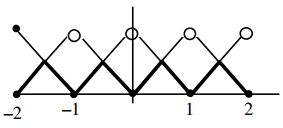
0 likes
View Solution250
DifficultMCQ
If the function $f(x) = \begin{cases} \frac{1}{x} \log_{e}\left(\frac{1+\frac{x}{a}}{1-\frac{x}{b}}\right), & x < 0 \\ k, & x = 0 \\ \frac{\cos^{2} x - \sin^{2} x - 1}{\sqrt{x^{2}+1}-1}, & x > 0 \end{cases}$ is continuous at $x = 0$,then $\frac{1}{a} + \frac{1}{b} + \frac{4}{k}$ is equal to:
A
$-5$
B
$5$
C
$-4$
D
$4$
Solution
(A) For $f(x)$ to be continuous at $x = 0$,we must have $\lim_{x \to 0^{-}} f(x) = \lim_{x \to 0^{+}} f(x) = f(0) = k$.
First,calculate the $RHL$:
$\lim_{x \to 0^{+}} f(x) = \lim_{x \to 0^{+}} \frac{\cos^{2} x - \sin^{2} x - 1}{\sqrt{x^{2}+1}-1} = \lim_{x \to 0^{+}} \frac{\cos(2x) - 1}{\sqrt{x^{2}+1}-1}$.
Using $\cos(2x) - 1 = -2\sin^{2} x$,we get:
$\lim_{x \to 0^{+}} \frac{-2\sin^{2} x}{\sqrt{x^{2}+1}-1} \times \frac{\sqrt{x^{2}+1}+1}{\sqrt{x^{2}+1}+1} = \lim_{x \to 0^{+}} \frac{-2\sin^{2} x (\sqrt{x^{2}+1}+1)}{x^{2}} = -2(1)^{2}(1+1) = -4$.
So,$k = -4$.
Next,calculate the $LHL$:
$\lim_{x \to 0^{-}} f(x) = \lim_{x \to 0^{-}} \frac{1}{x} \ln\left(\frac{1+\frac{x}{a}}{1-\frac{x}{b}}\right) = \lim_{x \to 0^{-}} \left[ \frac{\ln(1+\frac{x}{a})}{x} - \frac{\ln(1-\frac{x}{b})}{x} \right]$.
Using $\lim_{u \to 0} \frac{\ln(1+u)}{u} = 1$,we get:
$\frac{1}{a} - (-\frac{1}{b}) = \frac{1}{a} + \frac{1}{b}$.
Since $LHL = k$,we have $\frac{1}{a} + \frac{1}{b} = -4$.
Finally,calculate $\frac{1}{a} + \frac{1}{b} + \frac{4}{k} = -4 + \frac{4}{-4} = -4 - 1 = -5$.
First,calculate the $RHL$:
$\lim_{x \to 0^{+}} f(x) = \lim_{x \to 0^{+}} \frac{\cos^{2} x - \sin^{2} x - 1}{\sqrt{x^{2}+1}-1} = \lim_{x \to 0^{+}} \frac{\cos(2x) - 1}{\sqrt{x^{2}+1}-1}$.
Using $\cos(2x) - 1 = -2\sin^{2} x$,we get:
$\lim_{x \to 0^{+}} \frac{-2\sin^{2} x}{\sqrt{x^{2}+1}-1} \times \frac{\sqrt{x^{2}+1}+1}{\sqrt{x^{2}+1}+1} = \lim_{x \to 0^{+}} \frac{-2\sin^{2} x (\sqrt{x^{2}+1}+1)}{x^{2}} = -2(1)^{2}(1+1) = -4$.
So,$k = -4$.
Next,calculate the $LHL$:
$\lim_{x \to 0^{-}} f(x) = \lim_{x \to 0^{-}} \frac{1}{x} \ln\left(\frac{1+\frac{x}{a}}{1-\frac{x}{b}}\right) = \lim_{x \to 0^{-}} \left[ \frac{\ln(1+\frac{x}{a})}{x} - \frac{\ln(1-\frac{x}{b})}{x} \right]$.
Using $\lim_{u \to 0} \frac{\ln(1+u)}{u} = 1$,we get:
$\frac{1}{a} - (-\frac{1}{b}) = \frac{1}{a} + \frac{1}{b}$.
Since $LHL = k$,we have $\frac{1}{a} + \frac{1}{b} = -4$.
Finally,calculate $\frac{1}{a} + \frac{1}{b} + \frac{4}{k} = -4 + \frac{4}{-4} = -4 - 1 = -5$.
0 likes
View SolutionContinuity and Differentiation — Continuity · Frequently Asked Questions
1Are these Continuity and Differentiation questions useful for JEE and NEET?
Yes. All questions in this section are mapped to JEE Main and NEET exam patterns. Previous year questions from JEE Main, NEET, GUJCET and state-level exams are included with full solutions.
2Can I switch to Hindi or Gujarati for these questions?
Yes. Use the language tabs in the hero section or the sidebar to view the same questions and solutions in English, Hindi or Gujarati.
3How do I generate a question paper from this subtopic?
Use the Vedclass Exam Paper Generator — select the chapter and subtopic, set difficulty, and generate Sets A, B, C, D automatically. First 3 chapters of every subject are free.
Vedclass Products
For Students
Vedclass Test Series
Mock tests in real JEE/NEET style with performance analysis. 5-day free trial.
Start Free TrialFor Teachers
Exam Paper Generator
Generate Set A/B/C/D papers from this chapter in 2 minutes. 3 chapters free.
Try FreeFor Institutes
Online Exam Module
Live online exams with unlimited students, 360° analytics & white-label branding.
See DemoFor Teachers & Institutes
Generate a Continuity and Differentiation Exam Paper in 2 Minutes
Select subtopic & difficulty — Sets A, B, C, D auto-generated with No Repeat logic.
First 3 chapters of every subject are free — no payment required.