
A English
Continuity Questions in English
Class 12 Mathematics · Continuity and Differentiation · Continuity
598+
Questions
English
Language
100%
With Solutions
Showing 50 of 598 questions in English
101
AdvancedMCQ
Which one of the following functions is not continuous on $(0, \pi )$?
A
$f(x) = \cot x$
B
$g(x) = \int_{0}^{x} t \sin \frac{1}{t} \, dt$
C
$h(x) = \begin{cases} 1 & 0 < x \le \frac{3\pi}{4} \\ 2 \sin \frac{2}{9}x & \frac{3\pi}{4} < x < \pi \end{cases}$
D
$l(x) = \begin{cases} x \sin x & 0 < x \le \frac{\pi}{2} \\ \frac{\pi}{2} \sin(x + \pi) & \frac{\pi}{2} < x < \pi \end{cases}$
Solution
(D) We analyze the continuity of each function on the interval $(0, \pi )$:
$1$. $f(x) = \cot x = \frac{\cos x}{\sin x}$. This function is discontinuous at $x = \pi /2$ is incorrect,it is discontinuous at $x = n\pi$. Within $(0, \pi )$,$\sin x$ is never $0$,so $f(x)$ is continuous.
$2$. $g(x) = \int_{0}^{x} t \sin \frac{1}{t} \, dt$. Since the integrand $t \sin(1/t)$ is bounded and continuous on $(0, \pi )$,the integral function $g(x)$ is continuous on $(0, \pi )$.
$3$. $h(x)$ is defined piecewise. At $x = 3\pi /4$,the left-hand limit is $1$. The right-hand limit is $2 \sin(\frac{2}{9} \cdot \frac{3\pi}{4}) = 2 \sin(\frac{\pi}{6}) = 2(1/2) = 1$. Since the limits match,$h(x)$ is continuous.
$4$. $l(x)$ is defined piecewise. At $x = \pi /2$,the left-hand limit is $\frac{\pi}{2} \sin(\frac{\pi}{2}) = \frac{\pi}{2}$. The right-hand limit is $\frac{\pi}{2} \sin(\frac{\pi}{2} + \pi) = \frac{\pi}{2} \sin(\frac{3\pi}{2}) = \frac{\pi}{2}(-1) = -\frac{\pi}{2}$. Since $\frac{\pi}{2} \neq -\frac{\pi}{2}$,$l(x)$ is discontinuous at $x = \pi /2$.
$1$. $f(x) = \cot x = \frac{\cos x}{\sin x}$. This function is discontinuous at $x = \pi /2$ is incorrect,it is discontinuous at $x = n\pi$. Within $(0, \pi )$,$\sin x$ is never $0$,so $f(x)$ is continuous.
$2$. $g(x) = \int_{0}^{x} t \sin \frac{1}{t} \, dt$. Since the integrand $t \sin(1/t)$ is bounded and continuous on $(0, \pi )$,the integral function $g(x)$ is continuous on $(0, \pi )$.
$3$. $h(x)$ is defined piecewise. At $x = 3\pi /4$,the left-hand limit is $1$. The right-hand limit is $2 \sin(\frac{2}{9} \cdot \frac{3\pi}{4}) = 2 \sin(\frac{\pi}{6}) = 2(1/2) = 1$. Since the limits match,$h(x)$ is continuous.
$4$. $l(x)$ is defined piecewise. At $x = \pi /2$,the left-hand limit is $\frac{\pi}{2} \sin(\frac{\pi}{2}) = \frac{\pi}{2}$. The right-hand limit is $\frac{\pi}{2} \sin(\frac{\pi}{2} + \pi) = \frac{\pi}{2} \sin(\frac{3\pi}{2}) = \frac{\pi}{2}(-1) = -\frac{\pi}{2}$. Since $\frac{\pi}{2} \neq -\frac{\pi}{2}$,$l(x)$ is discontinuous at $x = \pi /2$.
0 likes
View Solution102
AdvancedMCQ
If $f(x) = \frac{\log_{\sin |x|} \cos^3 x}{\log_{\sin |3x|} \cos^3 (x/2)}$ for $|x| < \frac{\pi}{3}, x \neq 0$ and $f(0) = 4$,then the number of points of discontinuity of $f$ in $\left( -\frac{\pi}{3}, \frac{\pi}{3} \right)$ is:
A
$0$
B
$3$
C
$2$
D
$4$
Solution
(C) The function is defined as $f(x) = \frac{3 \log_{\sin |x|} \cos x}{3 \log_{\sin |3x|} \cos (x/2)} = \frac{\ln \cos x}{\ln \sin |x|} \times \frac{\ln \sin |3x|}{\ln \cos (x/2)}$.
For $f(x)$ to be defined,the base of the logarithm must be positive and not equal to $1$,and the argument must be positive.
$1$. $\sin |x| > 0$ and $\sin |x| \neq 1 \implies |x| \in (0, \pi) \setminus \{\pi/2\}$. Given $|x| < \pi/3$,this is satisfied for all $x \in (-\pi/3, \pi/3) \setminus \{0\}$.
$2$. $\sin |3x| > 0$ and $\sin |3x| \neq 1 \implies |3x| \in (0, \pi) \setminus \{\pi/2\} \implies |x| \in (0, \pi/3) \setminus \{\pi/6\}$.
Thus,$f(x)$ is undefined at $x = \pm \pi/6$ and $x = 0$ (initially). Since $f(0)=4$,we check $\lim_{x \to 0} f(x)$.
Using $\ln \cos x \approx -x^2/2$,$\ln \sin |x| \approx \ln |x|$,$\ln \sin |3x| \approx \ln |3x|$,$\ln \cos (x/2) \approx -x^2/8$,we get $\lim_{x \to 0} f(x) = \lim_{x \to 0} \frac{-x^2/2}{\ln |x|} \cdot \frac{\ln |3x|}{-x^2/8} = 4 \lim_{x \to 0} \frac{\ln |3x|}{\ln |x|} = 4 \lim_{x \to 0} \frac{\ln 3 + \ln |x|}{\ln |x|} = 4(1) = 4$.
Since $\lim_{x \to 0} f(x) = f(0) = 4$,$f$ is continuous at $x = 0$.
The points of discontinuity are $x = \pi/6$ and $x = -\pi/6$. Total $2$ points.
For $f(x)$ to be defined,the base of the logarithm must be positive and not equal to $1$,and the argument must be positive.
$1$. $\sin |x| > 0$ and $\sin |x| \neq 1 \implies |x| \in (0, \pi) \setminus \{\pi/2\}$. Given $|x| < \pi/3$,this is satisfied for all $x \in (-\pi/3, \pi/3) \setminus \{0\}$.
$2$. $\sin |3x| > 0$ and $\sin |3x| \neq 1 \implies |3x| \in (0, \pi) \setminus \{\pi/2\} \implies |x| \in (0, \pi/3) \setminus \{\pi/6\}$.
Thus,$f(x)$ is undefined at $x = \pm \pi/6$ and $x = 0$ (initially). Since $f(0)=4$,we check $\lim_{x \to 0} f(x)$.
Using $\ln \cos x \approx -x^2/2$,$\ln \sin |x| \approx \ln |x|$,$\ln \sin |3x| \approx \ln |3x|$,$\ln \cos (x/2) \approx -x^2/8$,we get $\lim_{x \to 0} f(x) = \lim_{x \to 0} \frac{-x^2/2}{\ln |x|} \cdot \frac{\ln |3x|}{-x^2/8} = 4 \lim_{x \to 0} \frac{\ln |3x|}{\ln |x|} = 4 \lim_{x \to 0} \frac{\ln 3 + \ln |x|}{\ln |x|} = 4(1) = 4$.
Since $\lim_{x \to 0} f(x) = f(0) = 4$,$f$ is continuous at $x = 0$.
The points of discontinuity are $x = \pi/6$ and $x = -\pi/6$. Total $2$ points.
0 likes
View Solution103
AdvancedMCQ
$A$ function $f(x)$ is defined as $f(x) = \begin{cases} x^m \sin \frac{1}{x} & x \neq 0, m \in N \\ 0 & x = 0 \end{cases}$. The least value of $m$ for which $f'(x)$ is continuous at $x = 0$ is
A
$1$
B
$2$
C
$3$
D
none
Solution
(C) First,we find $f'(0)$ using the definition of the derivative:
$f'(0) = \lim_{h \to 0} \frac{f(h) - f(0)}{h} = \lim_{h \to 0} \frac{h^m \sin(1/h) - 0}{h} = \lim_{h \to 0} h^{m-1} \sin(1/h)$.
For this limit to exist and be equal to $0$,we must have $m-1 > 0$,i.e.,$m > 1$.
Now,for $x \neq 0$,$f'(x) = m x^{m-1} \sin(1/x) - x^{m-2} \cos(1/x)$.
For $f'(x)$ to be continuous at $x = 0$,we require $\lim_{x \to 0} f'(x) = f'(0) = 0$.
$\lim_{x \to 0} [m x^{m-1} \sin(1/x) - x^{m-2} \cos(1/x)] = 0$.
The first term $m x^{m-1} \sin(1/x)$ approaches $0$ if $m-1 > 0$,i.e.,$m > 1$.
The second term $x^{m-2} \cos(1/x)$ approaches $0$ if $m-2 > 0$,i.e.,$m > 2$.
Since $m \in N$,the smallest integer $m$ satisfying $m > 2$ is $m = 3$.
$f'(0) = \lim_{h \to 0} \frac{f(h) - f(0)}{h} = \lim_{h \to 0} \frac{h^m \sin(1/h) - 0}{h} = \lim_{h \to 0} h^{m-1} \sin(1/h)$.
For this limit to exist and be equal to $0$,we must have $m-1 > 0$,i.e.,$m > 1$.
Now,for $x \neq 0$,$f'(x) = m x^{m-1} \sin(1/x) - x^{m-2} \cos(1/x)$.
For $f'(x)$ to be continuous at $x = 0$,we require $\lim_{x \to 0} f'(x) = f'(0) = 0$.
$\lim_{x \to 0} [m x^{m-1} \sin(1/x) - x^{m-2} \cos(1/x)] = 0$.
The first term $m x^{m-1} \sin(1/x)$ approaches $0$ if $m-1 > 0$,i.e.,$m > 1$.
The second term $x^{m-2} \cos(1/x)$ approaches $0$ if $m-2 > 0$,i.e.,$m > 2$.
Since $m \in N$,the smallest integer $m$ satisfying $m > 2$ is $m = 3$.
0 likes
View Solution104
AdvancedMCQ
For $x > 0$,let $h(x) = \begin{cases} \frac{1}{q} & \text{if } x = \frac{p}{q} \text{ (where } p, q \in \mathbb{N} \text{ are relatively prime)} \\ 0 & \text{if } x \text{ is irrational} \end{cases}$. Which of the following statements does not hold true?
A
$h(x)$ is discontinuous for all $x$ in $(0, \infty)$.
B
$h(x)$ is continuous for each irrational in $(0, \infty)$.
C
$h(x)$ is discontinuous for each rational in $(0, \infty)$.
D
$h(x)$ is not derivable for all $x$ in $(0, \infty)$.
Solution
(A) The function $h(x)$ is known as the Thomae's function (or the popcorn function).
$1$. For any rational number $x = \frac{p}{q}$ (where $p, q$ are relatively prime),$h(x) = \frac{1}{q}$. As $x$ approaches a rational number,the values of $h(x)$ for nearby irrational numbers approach $0$. Since $\frac{1}{q} \neq 0$,the function is discontinuous at every rational point. Thus,statement $C$ is true.
$2$. For any irrational number $x$,$h(x) = 0$. For any $\epsilon > 0$,there are only finitely many rational numbers $\frac{p}{q}$ in any interval such that $\frac{1}{q} \geq \epsilon$. Thus,the limit of $h(x)$ as $x$ approaches any irrational number is $0$. Since $h(x) = 0$ at irrational points,the function is continuous at every irrational point. Thus,statement $B$ is true.
$3$. Since the function is continuous at irrational points and discontinuous at rational points,it is not discontinuous for all $x$ in $(0, \infty)$. Therefore,statement $A$ is false.
$4$. Since the function is discontinuous at every rational point,it is not differentiable (derivable) at any rational point. Thus,statement $D$ is true.
Conclusion: Statement $A$ does not hold good.
$1$. For any rational number $x = \frac{p}{q}$ (where $p, q$ are relatively prime),$h(x) = \frac{1}{q}$. As $x$ approaches a rational number,the values of $h(x)$ for nearby irrational numbers approach $0$. Since $\frac{1}{q} \neq 0$,the function is discontinuous at every rational point. Thus,statement $C$ is true.
$2$. For any irrational number $x$,$h(x) = 0$. For any $\epsilon > 0$,there are only finitely many rational numbers $\frac{p}{q}$ in any interval such that $\frac{1}{q} \geq \epsilon$. Thus,the limit of $h(x)$ as $x$ approaches any irrational number is $0$. Since $h(x) = 0$ at irrational points,the function is continuous at every irrational point. Thus,statement $B$ is true.
$3$. Since the function is continuous at irrational points and discontinuous at rational points,it is not discontinuous for all $x$ in $(0, \infty)$. Therefore,statement $A$ is false.
$4$. Since the function is discontinuous at every rational point,it is not differentiable (derivable) at any rational point. Thus,statement $D$ is true.
Conclusion: Statement $A$ does not hold good.
0 likes
View Solution105
AdvancedMCQ
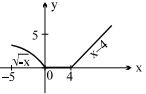
Consider the piecewise defined function $f(x) = \begin{cases} \sqrt{-x} & \text{if } x < 0 \\ 0 & \text{if } 0 \leqslant x \leqslant 4 \\ x - 4 & \text{if } x > 4 \end{cases}$. Choose the answer which best describes the continuity of this function.
A
The function is unbounded and therefore cannot be continuous.
B
The function is right continuous at $x = 0$.
C
The function has a removable discontinuity at $0$ and $4$,but is continuous on the rest of the real line.
D
The function is continuous on the entire real line.
Solution
(D) To determine the continuity of the function $f(x)$,we check the limits at the transition points $x = 0$ and $x = 4$.
At $x = 0$:
Left-hand limit: $\lim_{x \to 0^-} f(x) = \lim_{x \to 0^-} \sqrt{-x} = 0$.
Right-hand limit: $\lim_{x \to 0^+} f(x) = \lim_{x \to 0^+} 0 = 0$.
Value of the function: $f(0) = 0$.
Since $\lim_{x \to 0^-} f(x) = \lim_{x \to 0^+} f(x) = f(0) = 0$,the function is continuous at $x = 0$.
At $x = 4$:
Left-hand limit: $\lim_{x \to 4^-} f(x) = \lim_{x \to 4^-} 0 = 0$.
Right-hand limit: $\lim_{x \to 4^+} f(x) = \lim_{x \to 4^+} (x - 4) = 4 - 4 = 0$.
Value of the function: $f(4) = 0$.
Since $\lim_{x \to 4^-} f(x) = \lim_{x \to 4^+} f(x) = f(4) = 0$,the function is continuous at $x = 4$.
Since the function is continuous at all points in its domain,it is continuous on the entire real line.
At $x = 0$:
Left-hand limit: $\lim_{x \to 0^-} f(x) = \lim_{x \to 0^-} \sqrt{-x} = 0$.
Right-hand limit: $\lim_{x \to 0^+} f(x) = \lim_{x \to 0^+} 0 = 0$.
Value of the function: $f(0) = 0$.
Since $\lim_{x \to 0^-} f(x) = \lim_{x \to 0^+} f(x) = f(0) = 0$,the function is continuous at $x = 0$.
At $x = 4$:
Left-hand limit: $\lim_{x \to 4^-} f(x) = \lim_{x \to 4^-} 0 = 0$.
Right-hand limit: $\lim_{x \to 4^+} f(x) = \lim_{x \to 4^+} (x - 4) = 4 - 4 = 0$.
Value of the function: $f(4) = 0$.
Since $\lim_{x \to 4^-} f(x) = \lim_{x \to 4^+} f(x) = f(4) = 0$,the function is continuous at $x = 4$.
Since the function is continuous at all points in its domain,it is continuous on the entire real line.
0 likes
View Solution106
AdvancedMCQ
Let $f(x) = \frac{g(x)}{h(x)}$,where $g$ and $h$ are continuous functions on the open interval $(a, b)$. Which of the following statements is true for $a < x < b$?
A
$f$ is continuous at all $x$ for which $x$ is not zero.
B
$f$ is continuous at all $x$ for which $g(x) = 0$.
C
$f$ is continuous at all $x$ for which $g(x) \neq 0$.
D
$f$ is continuous at all $x$ for which $h(x) \neq 0$.
Solution
(D) According to the algebra of continuous functions,if two functions $g(x)$ and $h(x)$ are continuous at a point $x = c$,then their quotient $\frac{g(x)}{h(x)}$ is also continuous at $x = c$,provided that the denominator $h(c) \neq 0$.
Since $g$ and $h$ are continuous on the open interval $(a, b)$,the function $f(x) = \frac{g(x)}{h(x)}$ is continuous at all points $x \in (a, b)$ where $h(x) \neq 0$.
Since $g$ and $h$ are continuous on the open interval $(a, b)$,the function $f(x) = \frac{g(x)}{h(x)}$ is continuous at all points $x \in (a, b)$ where $h(x) \neq 0$.
0 likes
View Solution107
AdvancedMCQ
If $f(x) = \frac{x - e^x + \cos 2x}{x^2}$ for $x \neq 0$ is continuous at $x = 0$,then which of the following is true? (Note: $[x]$ and $\{x\}$ denote the greatest integer and fractional part functions,respectively.)
A
$f(0) = \frac{5}{2}$
B
$[f(0)] = -2$
C
$\{f(0)\} = 0.5$
D
$[f(0)] \cdot \{f(0)\} = -1.5$
Solution
(D) For $f(x)$ to be continuous at $x = 0$,$f(0) = \lim_{x \to 0} f(x)$.
$\lim_{x \to 0} \frac{x - e^x + \cos 2x}{x^2} = \lim_{x \to 0} \frac{x - (1 + x + \frac{x^2}{2!} + \dots) + (1 - \frac{(2x)^2}{2!} + \dots)}{x^2}$
$= \lim_{x \to 0} \frac{x - 1 - x - \frac{x^2}{2} + 1 - 2x^2}{x^2} = \lim_{x \to 0} \frac{-\frac{5}{2}x^2}{x^2} = -\frac{5}{2} = -2.5$.
Thus,$f(0) = -2.5$.
Now,$[f(0)] = [-2.5] = -3$.
And $\{f(0)\} = f(0) - [f(0)] = -2.5 - (-3) = 0.5$.
Therefore,$[f(0)] \cdot \{f(0)\} = (-3) \cdot (0.5) = -1.5$.
$\lim_{x \to 0} \frac{x - e^x + \cos 2x}{x^2} = \lim_{x \to 0} \frac{x - (1 + x + \frac{x^2}{2!} + \dots) + (1 - \frac{(2x)^2}{2!} + \dots)}{x^2}$
$= \lim_{x \to 0} \frac{x - 1 - x - \frac{x^2}{2} + 1 - 2x^2}{x^2} = \lim_{x \to 0} \frac{-\frac{5}{2}x^2}{x^2} = -\frac{5}{2} = -2.5$.
Thus,$f(0) = -2.5$.
Now,$[f(0)] = [-2.5] = -3$.
And $\{f(0)\} = f(0) - [f(0)] = -2.5 - (-3) = 0.5$.
Therefore,$[f(0)] \cdot \{f(0)\} = (-3) \cdot (0.5) = -1.5$.
0 likes
View Solution108
AdvancedMCQ
Let $f(x) = \begin{cases} \frac{2^x + 2^{3-x} - 6}{\sqrt{2^{-x}} - 2^{1-x}} & \text{if } x > 2 \\ \frac{x^2 - 4}{x - \sqrt{3x - 2}} & \text{if } x < 2 \end{cases}$. Determine the nature of the function at $x = 2$.
A
$f(2) = 8 \Rightarrow f$ is continuous at $x = 2$
B
$f(2) = 16 \Rightarrow f$ is continuous at $x = 2$
C
$f(2^-) \neq f(2^+) \Rightarrow f$ is discontinuous
D
$f$ has a removable discontinuity at $x = 2$
Solution
(C) To check for continuity at $x = 2$,we evaluate the limits from both sides.
For $x > 2$,$f(x) = \frac{2^x + 8 \cdot 2^{-x} - 6}{2^{-x/2} - 2 \cdot 2^{-x}}$. Let $u = 2^{-x/2}$,then $2^x = u^{-2}$ and $2^{-x} = u^2$. As $x \to 2^+$,$u \to 2^{-1} = 1/2$. The expression becomes $\frac{u^{-2} + 8u^2 - 6}{u - 2u^2} = \frac{1 + 8u^4 - 6u^2}{u^2(u - 2u^2)} = \frac{(2u^2 - 1)(4u^2 - 1)}{u^2(u(1 - 2u))} = \frac{-(2u^2 - 1)(2u - 1)(2u + 1)}{u^3(2u - 1)} = \frac{-(2u^2 - 1)(2u + 1)}{u^3}$. Substituting $u = 1/2$,we get $\frac{-(2(1/4) - 1)(1 + 1)}{1/8} = \frac{-( -1/2)(2)}{1/8} = 8$. Thus,$f(2^+) = 8$.
For $x < 2$,$f(x) = \frac{x^2 - 4}{x - \sqrt{3x - 2}}$. Rationalizing the denominator: $\frac{(x^2 - 4)(x + \sqrt{3x - 2})}{x^2 - (3x - 2)} = \frac{(x - 2)(x + 2)(x + \sqrt{3x - 2})}{x^2 - 3x + 2} = \frac{(x - 2)(x + 2)(x + \sqrt{3x - 2})}{(x - 2)(x - 1)} = \frac{(x + 2)(x + \sqrt{3x - 2})}{x - 1}$. Substituting $x = 2$,we get $\frac{(4)(2 + \sqrt{6 - 2})}{2 - 1} = 4(2 + 2) = 16$. Thus,$f(2^-) = 16$.
Since $f(2^+) \neq f(2^-)$,the function has a jump discontinuity at $x = 2$.
For $x > 2$,$f(x) = \frac{2^x + 8 \cdot 2^{-x} - 6}{2^{-x/2} - 2 \cdot 2^{-x}}$. Let $u = 2^{-x/2}$,then $2^x = u^{-2}$ and $2^{-x} = u^2$. As $x \to 2^+$,$u \to 2^{-1} = 1/2$. The expression becomes $\frac{u^{-2} + 8u^2 - 6}{u - 2u^2} = \frac{1 + 8u^4 - 6u^2}{u^2(u - 2u^2)} = \frac{(2u^2 - 1)(4u^2 - 1)}{u^2(u(1 - 2u))} = \frac{-(2u^2 - 1)(2u - 1)(2u + 1)}{u^3(2u - 1)} = \frac{-(2u^2 - 1)(2u + 1)}{u^3}$. Substituting $u = 1/2$,we get $\frac{-(2(1/4) - 1)(1 + 1)}{1/8} = \frac{-( -1/2)(2)}{1/8} = 8$. Thus,$f(2^+) = 8$.
For $x < 2$,$f(x) = \frac{x^2 - 4}{x - \sqrt{3x - 2}}$. Rationalizing the denominator: $\frac{(x^2 - 4)(x + \sqrt{3x - 2})}{x^2 - (3x - 2)} = \frac{(x - 2)(x + 2)(x + \sqrt{3x - 2})}{x^2 - 3x + 2} = \frac{(x - 2)(x + 2)(x + \sqrt{3x - 2})}{(x - 2)(x - 1)} = \frac{(x + 2)(x + \sqrt{3x - 2})}{x - 1}$. Substituting $x = 2$,we get $\frac{(4)(2 + \sqrt{6 - 2})}{2 - 1} = 4(2 + 2) = 16$. Thus,$f(2^-) = 16$.
Since $f(2^+) \neq f(2^-)$,the function has a jump discontinuity at $x = 2$.
0 likes
View Solution109
AdvancedMCQ
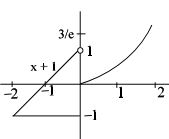
On the interval $I = [-2, 2]$,the function $f(x) = \begin{cases} (x + 1) e^{-\left[ \frac{1}{|x|} + \frac{1}{x} \right]} & x \neq 0 \\ 0 & x = 0 \end{cases}$ is given. Which one of the following does not hold good?
A
is continuous for all values of $x \in I$
B
is continuous for $x \in I - \{0\}$
C
assumes all intermediate values from $f(-2)$ and $f(2)$
D
has a maximum value equal to $3/e$
Solution
(A) First,we simplify the expression for $f(x)$ for $x \neq 0$:
If $x > 0$,then $|x| = x$,so $\frac{1}{|x|} + \frac{1}{x} = \frac{1}{x} + \frac{1}{x} = \frac{2}{x}$. Thus,$f(x) = (x + 1) e^{-2/x}$.
If $x < 0$,then $|x| = -x$,so $\frac{1}{|x|} + \frac{1}{x} = -\frac{1}{x} + \frac{1}{x} = 0$. Thus,$f(x) = (x + 1) e^0 = x + 1$.
Given $f(0) = 0$,the function is:
$f(x) = \begin{cases} (x + 1) e^{-2/x} & x > 0 \\ 0 & x = 0 \\ x + 1 & x < 0 \end{cases}$
Now,check continuity at $x = 0$:
Left-hand limit: $\lim_{x \to 0^-} f(x) = \lim_{x \to 0^-} (x + 1) = 1$.
Right-hand limit: $\lim_{x \to 0^+} f(x) = \lim_{x \to 0^+} (x + 1) e^{-2/x} = (1) \cdot e^{-\infty} = 0$.
Since $\lim_{x \to 0^-} f(x) \neq \lim_{x \to 0^+} f(x)$,the function is discontinuous at $x = 0$.
Therefore,option $(A)$ is false as the function is not continuous for all $x \in I$.
If $x > 0$,then $|x| = x$,so $\frac{1}{|x|} + \frac{1}{x} = \frac{1}{x} + \frac{1}{x} = \frac{2}{x}$. Thus,$f(x) = (x + 1) e^{-2/x}$.
If $x < 0$,then $|x| = -x$,so $\frac{1}{|x|} + \frac{1}{x} = -\frac{1}{x} + \frac{1}{x} = 0$. Thus,$f(x) = (x + 1) e^0 = x + 1$.
Given $f(0) = 0$,the function is:
$f(x) = \begin{cases} (x + 1) e^{-2/x} & x > 0 \\ 0 & x = 0 \\ x + 1 & x < 0 \end{cases}$
Now,check continuity at $x = 0$:
Left-hand limit: $\lim_{x \to 0^-} f(x) = \lim_{x \to 0^-} (x + 1) = 1$.
Right-hand limit: $\lim_{x \to 0^+} f(x) = \lim_{x \to 0^+} (x + 1) e^{-2/x} = (1) \cdot e^{-\infty} = 0$.
Since $\lim_{x \to 0^-} f(x) \neq \lim_{x \to 0^+} f(x)$,the function is discontinuous at $x = 0$.
Therefore,option $(A)$ is false as the function is not continuous for all $x \in I$.
0 likes
View Solution110
AdvancedMCQ
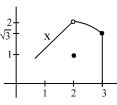
Consider the function $f(x) = \begin{cases} \frac{x}{[x]} & \text{if } 1 \leqslant x < 2 \\ 1 & \text{if } x = 2 \\ \sqrt{6-x} & \text{if } 2 < x \leqslant 3 \end{cases}$ where $[x]$ denotes the greatest integer function. At $x = 2$,the function:
A
has a missing point removable discontinuity
B
has an isolated point removable discontinuity
C
has a non-removable discontinuity of finite type
D
is continuous
Solution
(B) To check the continuity at $x = 2$,we evaluate the left-hand limit,right-hand limit,and the value of the function at $x = 2$.
$1$. Left-hand limit $(LHL)$: $\lim_{x \to 2^-} f(x) = \lim_{x \to 2^-} \frac{x}{[x]}$. Since $1 \leqslant x < 2$,$[x] = 1$. Thus,$\lim_{x \to 2^-} \frac{x}{1} = 2$.
$2$. Right-hand limit $(RHL)$: $\lim_{x \to 2^+} f(x) = \lim_{x \to 2^+} \sqrt{6-x} = \sqrt{6-2} = \sqrt{4} = 2$.
$3$. Value of the function: $f(2) = 1$.
Since $\lim_{x \to 2^-} f(x) = \lim_{x \to 2^+} f(x) = 2$,but $f(2) = 1$,the limit exists but is not equal to the function value. This type of discontinuity,where the limit exists but the point is defined elsewhere,is called a removable discontinuity (specifically,an isolated point removable discontinuity).
$1$. Left-hand limit $(LHL)$: $\lim_{x \to 2^-} f(x) = \lim_{x \to 2^-} \frac{x}{[x]}$. Since $1 \leqslant x < 2$,$[x] = 1$. Thus,$\lim_{x \to 2^-} \frac{x}{1} = 2$.
$2$. Right-hand limit $(RHL)$: $\lim_{x \to 2^+} f(x) = \lim_{x \to 2^+} \sqrt{6-x} = \sqrt{6-2} = \sqrt{4} = 2$.
$3$. Value of the function: $f(2) = 1$.
Since $\lim_{x \to 2^-} f(x) = \lim_{x \to 2^+} f(x) = 2$,but $f(2) = 1$,the limit exists but is not equal to the function value. This type of discontinuity,where the limit exists but the point is defined elsewhere,is called a removable discontinuity (specifically,an isolated point removable discontinuity).
0 likes
View Solution111
AdvancedMCQ
Suppose that $f$ is continuous on $[a, b]$ and that $f(x)$ is an integer for each $x$ in $[a, b]$. Then in $[a, b]$
A
$f$ is injective
B
Range of $f$ may have many elements
C
$\{x\}$ is zero for all $x \in [a, b]$ where $\{.\}$ denotes fractional part function
D
$f(x)$ is constant
Solution
(D) Explanation: Let $f(x)$ be a continuous function on the interval $[a, b]$ such that $f(x) \in \mathbb{Z}$ for all $x \in [a, b]$.
According to the Intermediate Value Theorem,if $f$ is continuous on $[a, b]$,then $f$ must take all values between $f(a)$ and $f(b)$.
Suppose $f$ is not constant. Then there exist $x_1, x_2 \in [a, b]$ such that $f(x_1) = n$ and $f(x_2) = m$ with $n \neq m$. Without loss of generality,assume $n < m$.
Since $f$ is continuous,for any value $y$ such that $n < y < m$,there must exist some $c \in (x_1, x_2)$ such that $f(c) = y$.
However,we are given that $f(x)$ is an integer for all $x \in [a, b]$.
If we choose $y = n + 0.5$,which is not an integer,this contradicts the condition that $f(x)$ must be an integer.
Therefore,the assumption that $f$ is not constant must be false.
Thus,$f(x)$ must be a constant function.
According to the Intermediate Value Theorem,if $f$ is continuous on $[a, b]$,then $f$ must take all values between $f(a)$ and $f(b)$.
Suppose $f$ is not constant. Then there exist $x_1, x_2 \in [a, b]$ such that $f(x_1) = n$ and $f(x_2) = m$ with $n \neq m$. Without loss of generality,assume $n < m$.
Since $f$ is continuous,for any value $y$ such that $n < y < m$,there must exist some $c \in (x_1, x_2)$ such that $f(c) = y$.
However,we are given that $f(x)$ is an integer for all $x \in [a, b]$.
If we choose $y = n + 0.5$,which is not an integer,this contradicts the condition that $f(x)$ must be an integer.
Therefore,the assumption that $f$ is not constant must be false.
Thus,$f(x)$ must be a constant function.
0 likes
View Solution112
AdvancedMCQ
Consider $f(x) = \left[ \frac{2(\sin x - \sin^3 x) + |\sin x - \sin^3 x|}{2(\sin x - \sin^3 x) - |\sin x - \sin^3 x|} \right]$ for $x \in (0, \pi), x \neq \frac{\pi}{2}$,and $f(\frac{\pi}{2}) = 3$,where $[ \cdot ]$ denotes the greatest integer function. Then:
A
$f$ is continuous and differentiable at $x = \frac{\pi}{2}$
B
$f$ is continuous but not differentiable at $x = \frac{\pi}{2}$
C
$f$ is neither continuous nor differentiable at $x = \frac{\pi}{2}$
D
None of these
Solution
(A) Let $g(x) = \sin x - \sin^3 x = \sin x(1 - \sin^2 x) = \sin x \cos^2 x$.
For $x \in (0, \pi)$,$\sin x > 0$ and $\cos^2 x \geq 0$. Thus,$g(x) \geq 0$.
Specifically,for $x \neq \frac{\pi}{2}$,$g(x) > 0$.
Since $g(x) > 0$ for $x \in (0, \pi) \setminus \{\frac{\pi}{2}\}$,we have $|g(x)| = g(x)$.
Substituting this into the expression for $f(x)$:
$f(x) = \left[ \frac{2g(x) + g(x)}{2g(x) - g(x)} \right] = \left[ \frac{3g(x)}{g(x)} \right] = [3] = 3$.
Thus,$f(x) = 3$ for all $x \in (0, \pi) \setminus \{\frac{\pi}{2}\}$.
Given $f(\frac{\pi}{2}) = 3$,the function is $f(x) = 3$ for all $x \in (0, \pi)$.
$A$ constant function is continuous and differentiable everywhere in its domain.
Therefore,$f$ is continuous and differentiable at $x = \frac{\pi}{2}$.
For $x \in (0, \pi)$,$\sin x > 0$ and $\cos^2 x \geq 0$. Thus,$g(x) \geq 0$.
Specifically,for $x \neq \frac{\pi}{2}$,$g(x) > 0$.
Since $g(x) > 0$ for $x \in (0, \pi) \setminus \{\frac{\pi}{2}\}$,we have $|g(x)| = g(x)$.
Substituting this into the expression for $f(x)$:
$f(x) = \left[ \frac{2g(x) + g(x)}{2g(x) - g(x)} \right] = \left[ \frac{3g(x)}{g(x)} \right] = [3] = 3$.
Thus,$f(x) = 3$ for all $x \in (0, \pi) \setminus \{\frac{\pi}{2}\}$.
Given $f(\frac{\pi}{2}) = 3$,the function is $f(x) = 3$ for all $x \in (0, \pi)$.
$A$ constant function is continuous and differentiable everywhere in its domain.
Therefore,$f$ is continuous and differentiable at $x = \frac{\pi}{2}$.
0 likes
View Solution113
AdvancedMCQ
Given the function $f(x) = 2x \sqrt{x^3 - 1} + 5 \sqrt{x} \sqrt{1 - x^4} + 7x^2 \sqrt{x - 1} + 3x + 2$,then:
A
the function is continuous but not differentiable at $x = 1$
B
the function is discontinuous at $x = 1$
C
the function is both continuous and differentiable at $x = 1$
D
the range of $f(x)$ is $R^+$
Solution
(B) To determine the continuity and differentiability of $f(x)$ at $x = 1$,we first examine the domain of the function.
For $f(x)$ to be defined,all square root terms must have non-negative arguments:
$1$) $x^3 - 1 \geq 0 \implies x \geq 1$
$2$) $1 - x^4 \geq 0 \implies x^4 \leq 1 \implies -1 \leq x \leq 1$
$3$) $x - 1 \geq 0 \implies x \geq 1$
For the function to be defined,all conditions must be satisfied simultaneously. The intersection of $x \geq 1$ and $-1 \leq x \leq 1$ is only the point $x = 1$.
Since the domain of the function is the singleton set $\{1\}$,the function is only defined at $x = 1$.
Continuity and differentiability are defined for functions on an interval. Since $f(x)$ is not defined in any neighborhood of $x = 1$,it cannot be continuous or differentiable at $x = 1$ in the standard sense.
However,in the context of such problems,if we consider the domain constraints,the function is discontinuous at $x = 1$ because the limit does not exist.
Thus,the correct option is $B$.
For $f(x)$ to be defined,all square root terms must have non-negative arguments:
$1$) $x^3 - 1 \geq 0 \implies x \geq 1$
$2$) $1 - x^4 \geq 0 \implies x^4 \leq 1 \implies -1 \leq x \leq 1$
$3$) $x - 1 \geq 0 \implies x \geq 1$
For the function to be defined,all conditions must be satisfied simultaneously. The intersection of $x \geq 1$ and $-1 \leq x \leq 1$ is only the point $x = 1$.
Since the domain of the function is the singleton set $\{1\}$,the function is only defined at $x = 1$.
Continuity and differentiability are defined for functions on an interval. Since $f(x)$ is not defined in any neighborhood of $x = 1$,it cannot be continuous or differentiable at $x = 1$ in the standard sense.
However,in the context of such problems,if we consider the domain constraints,the function is discontinuous at $x = 1$ because the limit does not exist.
Thus,the correct option is $B$.
0 likes
View Solution114
AdvancedMCQ
If $f(x) = \frac{x^2 - bx + 25}{x^2 - 7x + 10}$ for $x \neq 5$ and $f$ is continuous at $x = 5$,then the value of $f(5)$ is:
A
$0$
B
$5$
C
$10$
D
$25$
Solution
(A) For $f(x)$ to be continuous at $x = 5$,the limit $\lim_{x \to 5} f(x)$ must exist and be equal to $f(5)$.
Given $f(x) = \frac{x^2 - bx + 25}{(x - 2)(x - 5)}$.
Since the denominator is zero at $x = 5$,the numerator must also be zero at $x = 5$ for the limit to exist.
Substituting $x = 5$ into the numerator: $5^2 - 5b + 25 = 0 \Rightarrow 25 - 5b + 25 = 0 \Rightarrow 50 = 5b \Rightarrow b = 10$.
Now,substitute $b = 10$ into the function: $f(x) = \frac{x^2 - 10x + 25}{(x - 2)(x - 5)} = \frac{(x - 5)^2}{(x - 2)(x - 5)}$.
For $x \neq 5$,we can simplify this to $f(x) = \frac{x - 5}{x - 2}$.
Now,calculate the limit: $\lim_{x \to 5} f(x) = \lim_{x \to 5} \frac{x - 5}{x - 2} = \frac{5 - 5}{5 - 2} = \frac{0}{3} = 0$.
Since $f$ is continuous at $x = 5$,$f(5) = \lim_{x \to 5} f(x) = 0$.
Given $f(x) = \frac{x^2 - bx + 25}{(x - 2)(x - 5)}$.
Since the denominator is zero at $x = 5$,the numerator must also be zero at $x = 5$ for the limit to exist.
Substituting $x = 5$ into the numerator: $5^2 - 5b + 25 = 0 \Rightarrow 25 - 5b + 25 = 0 \Rightarrow 50 = 5b \Rightarrow b = 10$.
Now,substitute $b = 10$ into the function: $f(x) = \frac{x^2 - 10x + 25}{(x - 2)(x - 5)} = \frac{(x - 5)^2}{(x - 2)(x - 5)}$.
For $x \neq 5$,we can simplify this to $f(x) = \frac{x - 5}{x - 2}$.
Now,calculate the limit: $\lim_{x \to 5} f(x) = \lim_{x \to 5} \frac{x - 5}{x - 2} = \frac{5 - 5}{5 - 2} = \frac{0}{3} = 0$.
Since $f$ is continuous at $x = 5$,$f(5) = \lim_{x \to 5} f(x) = 0$.
0 likes
View Solution115
AdvancedMCQ
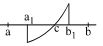
Let $f$ be a differentiable function on the open interval $(a, b)$. Which of the following statements must be true?
$I$. $f$ is continuous on the closed interval $[a, b]$
$II$. $f$ is bounded on the open interval $(a, b)$
$III$. If $a < a_1 < b_1 < b$,and $f(a_1) < 0 < f(b_1)$,then there is a number $c$ such that $a_1 < c < b_1$ and $f(c) = 0$
$I$. $f$ is continuous on the closed interval $[a, b]$
$II$. $f$ is bounded on the open interval $(a, b)$
$III$. If $a < a_1 < b_1 < b$,and $f(a_1) < 0 < f(b_1)$,then there is a number $c$ such that $a_1 < c < b_1$ and $f(c) = 0$
A
$I$ and $II$ only
B
$I$ and $III$ only
C
$II$ and $III$ only
D
only $III$
Solution
(D) Statement $I$ is false because differentiability on an open interval does not guarantee continuity at the endpoints.
Statement $II$ is false. Consider the function $f(x) = 1/x$ on the interval $(0, 1)$. This function is differentiable on $(0, 1)$ but is not bounded as $x \to 0^+$.
Statement $III$ is true. Since $f$ is differentiable on $(a, b)$,it is continuous on $(a, b)$. Therefore,$f$ is continuous on the closed sub-interval $[a_1, b_1]$. By the Intermediate Value Theorem,since $f(a_1) < 0 < f(b_1)$,there must exist at least one $c \in (a_1, b_1)$ such that $f(c) = 0$.
Statement $II$ is false. Consider the function $f(x) = 1/x$ on the interval $(0, 1)$. This function is differentiable on $(0, 1)$ but is not bounded as $x \to 0^+$.
Statement $III$ is true. Since $f$ is differentiable on $(a, b)$,it is continuous on $(a, b)$. Therefore,$f$ is continuous on the closed sub-interval $[a_1, b_1]$. By the Intermediate Value Theorem,since $f(a_1) < 0 < f(b_1)$,there must exist at least one $c \in (a_1, b_1)$ such that $f(c) = 0$.
0 likes
View Solution116
AdvancedMCQ
For the function $f(x) = \frac{1}{x + 2^{\frac{1}{x - 2}}}$,$x \neq 2$,which of the following holds?
A
$f(2) = 1/2$ and $f$ is continuous at $x = 2$
B
$f(2) \neq 0, 1/2$ and $f$ is continuous at $x = 2$
C
$f$ cannot be continuous at $x = 2$
D
$f(2) = 0$ and $f$ is continuous at $x = 2$
Solution
(C) To determine if $f$ can be continuous at $x = 2$,we examine the limit $\lim_{x \to 2} f(x)$.
Consider the left-hand limit: $\lim_{x \to 2^-} f(x) = \lim_{x \to 2^-} \frac{1}{x + 2^{\frac{1}{x - 2}}}$.
As $x \to 2^-$,$(x - 2) \to 0^-$,so $\frac{1}{x - 2} \to -\infty$.
Thus,$2^{\frac{1}{x - 2}} \to 2^{-\infty} = 0$.
Therefore,$\lim_{x \to 2^-} f(x) = \frac{1}{2 + 0} = 1/2$.
Now consider the right-hand limit: $\lim_{x \to 2^+} f(x) = \lim_{x \to 2^+} \frac{1}{x + 2^{\frac{1}{x - 2}}}$.
As $x \to 2^+$,$(x - 2) \to 0^+$,so $\frac{1}{x - 2} \to +\infty$.
Thus,$2^{\frac{1}{x - 2}} \to 2^{+\infty} = \infty$.
Therefore,$\lim_{x \to 2^+} f(x) = \frac{1}{2 + \infty} = 0$.
Since $\lim_{x \to 2^-} f(x) \neq \lim_{x \to 2^+} f(x)$,the limit does not exist at $x = 2$.
Consequently,$f$ cannot be continuous at $x = 2$ regardless of the value assigned to $f(2)$.
Consider the left-hand limit: $\lim_{x \to 2^-} f(x) = \lim_{x \to 2^-} \frac{1}{x + 2^{\frac{1}{x - 2}}}$.
As $x \to 2^-$,$(x - 2) \to 0^-$,so $\frac{1}{x - 2} \to -\infty$.
Thus,$2^{\frac{1}{x - 2}} \to 2^{-\infty} = 0$.
Therefore,$\lim_{x \to 2^-} f(x) = \frac{1}{2 + 0} = 1/2$.
Now consider the right-hand limit: $\lim_{x \to 2^+} f(x) = \lim_{x \to 2^+} \frac{1}{x + 2^{\frac{1}{x - 2}}}$.
As $x \to 2^+$,$(x - 2) \to 0^+$,so $\frac{1}{x - 2} \to +\infty$.
Thus,$2^{\frac{1}{x - 2}} \to 2^{+\infty} = \infty$.
Therefore,$\lim_{x \to 2^+} f(x) = \frac{1}{2 + \infty} = 0$.
Since $\lim_{x \to 2^-} f(x) \neq \lim_{x \to 2^+} f(x)$,the limit does not exist at $x = 2$.
Consequently,$f$ cannot be continuous at $x = 2$ regardless of the value assigned to $f(2)$.
0 likes
View Solution117
AdvancedMCQ
Let $f(x) = \begin{cases} \frac{1 + \cos 2\pi x}{1 - \sin \pi x}, & x < \frac{1}{2} \\ p, & x = \frac{1}{2} \\ \frac{\sqrt{2x - 1}}{\sqrt{4 + \sqrt{2x - 1}} - 2}, & x > \frac{1}{2} \end{cases}$. If $f(x)$ is discontinuous at $x = \frac{1}{2}$,then:
A
$p \in R - \{4\}$
B
$p \in R - \{\frac{1}{4}\}$
C
$p \in R_0$
D
$p \in R$
Solution
(A) For $f(x)$ to be continuous at $x = \frac{1}{2}$,we must have $\lim_{x \to \frac{1}{2}^-} f(x) = \lim_{x \to \frac{1}{2}^+} f(x) = f(\frac{1}{2}) = p$.
First,calculate the left-hand limit:
$\lim_{x \to \frac{1}{2}^-} \frac{1 + \cos 2\pi x}{1 - \sin \pi x} = \lim_{x \to \frac{1}{2}^-} \frac{2 \cos^2 \pi x}{1 - \sin \pi x} = \lim_{x \to \frac{1}{2}^-} \frac{2(1 - \sin^2 \pi x)}{1 - \sin \pi x} = \lim_{x \to \frac{1}{2}^-} 2(1 + \sin \pi x) = 2(1 + 1) = 4$.
Next,calculate the right-hand limit:
Let $t = \sqrt{2x - 1}$. As $x \to \frac{1}{2}^+$,$t \to 0^+$.
$\lim_{t \to 0^+} \frac{t}{\sqrt{4 + t} - 2} = \lim_{t \to 0^+} \frac{t(\sqrt{4 + t} + 2)}{(4 + t) - 4} = \lim_{t \to 0^+} (\sqrt{4 + t} + 2) = \sqrt{4} + 2 = 4$.
Since $\lim_{x \to \frac{1}{2}^-} f(x) = \lim_{x \to \frac{1}{2}^+} f(x) = 4$,the function is continuous at $x = \frac{1}{2}$ if $p = 4$.
Therefore,$f(x)$ is discontinuous at $x = \frac{1}{2}$ if $p \neq 4$,which means $p \in R - \{4\}$.
First,calculate the left-hand limit:
$\lim_{x \to \frac{1}{2}^-} \frac{1 + \cos 2\pi x}{1 - \sin \pi x} = \lim_{x \to \frac{1}{2}^-} \frac{2 \cos^2 \pi x}{1 - \sin \pi x} = \lim_{x \to \frac{1}{2}^-} \frac{2(1 - \sin^2 \pi x)}{1 - \sin \pi x} = \lim_{x \to \frac{1}{2}^-} 2(1 + \sin \pi x) = 2(1 + 1) = 4$.
Next,calculate the right-hand limit:
Let $t = \sqrt{2x - 1}$. As $x \to \frac{1}{2}^+$,$t \to 0^+$.
$\lim_{t \to 0^+} \frac{t}{\sqrt{4 + t} - 2} = \lim_{t \to 0^+} \frac{t(\sqrt{4 + t} + 2)}{(4 + t) - 4} = \lim_{t \to 0^+} (\sqrt{4 + t} + 2) = \sqrt{4} + 2 = 4$.
Since $\lim_{x \to \frac{1}{2}^-} f(x) = \lim_{x \to \frac{1}{2}^+} f(x) = 4$,the function is continuous at $x = \frac{1}{2}$ if $p = 4$.
Therefore,$f(x)$ is discontinuous at $x = \frac{1}{2}$ if $p \neq 4$,which means $p \in R - \{4\}$.
0 likes
View Solution118
AdvancedMCQ
Given $f(x) = b ([x]^2 + [x]) + 1$ for $x \geq -1$ and $f(x) = \sin(\pi(x+a))$ for $x < -1$,where $[x]$ denotes the greatest integer function,for what values of $a$ and $b$ is the function continuous at $x = -1$?
A
$a = 2n + (3/2) ; b \in R ; n \in I$
B
$a = 4n + 2 ; b \in R ; n \in I$
C
$a = 4n + (3/2) ; b \in R^+ ; n \in I$
D
$a = 4n + 1 ; b \in R^+ ; n \in I$
Solution
(A) For the function to be continuous at $x = -1$,the left-hand limit,right-hand limit,and the value of the function at $x = -1$ must be equal.
First,find the value of the function at $x = -1$:
$f(-1) = b([-1]^2 + [-1]) + 1 = b(1 - 1) + 1 = 1$.
Next,find the right-hand limit $(RHL)$ as $x \to -1^+$:
$\lim_{x \to -1^+} f(x) = \lim_{h \to 0} b([-1+h]^2 + [-1+h]) + 1 = b((-1)^2 + (-1)) + 1 = b(1-1) + 1 = 1$.
Now,find the left-hand limit $(LHL)$ as $x \to -1^-$:
$\lim_{x \to -1^-} f(x) = \lim_{h \to 0} \sin(\pi(-1-h+a)) = \sin(\pi(a-1))$.
For continuity,$LHL$ = $RHL$ = $f(-1)$,so $\sin(\pi(a-1)) = 1$.
This implies $\pi(a-1) = 2n\pi + \frac{\pi}{2}$ for any integer $n \in I$.
Dividing by $\pi$,we get $a - 1 = 2n + \frac{1}{2}$,which simplifies to $a = 2n + \frac{3}{2}$.
Since $b$ does not affect the limit at $x = -1$ (as the $RHL$ is independent of $b$),$b$ can be any real number $(b \in R)$.
First,find the value of the function at $x = -1$:
$f(-1) = b([-1]^2 + [-1]) + 1 = b(1 - 1) + 1 = 1$.
Next,find the right-hand limit $(RHL)$ as $x \to -1^+$:
$\lim_{x \to -1^+} f(x) = \lim_{h \to 0} b([-1+h]^2 + [-1+h]) + 1 = b((-1)^2 + (-1)) + 1 = b(1-1) + 1 = 1$.
Now,find the left-hand limit $(LHL)$ as $x \to -1^-$:
$\lim_{x \to -1^-} f(x) = \lim_{h \to 0} \sin(\pi(-1-h+a)) = \sin(\pi(a-1))$.
For continuity,$LHL$ = $RHL$ = $f(-1)$,so $\sin(\pi(a-1)) = 1$.
This implies $\pi(a-1) = 2n\pi + \frac{\pi}{2}$ for any integer $n \in I$.
Dividing by $\pi$,we get $a - 1 = 2n + \frac{1}{2}$,which simplifies to $a = 2n + \frac{3}{2}$.
Since $b$ does not affect the limit at $x = -1$ (as the $RHL$ is independent of $b$),$b$ can be any real number $(b \in R)$.
0 likes
View Solution119
AdvancedMCQ
If $f(x) = \frac{\ln(e^{x^2} + 2\sqrt{x})}{\sqrt{x}}$ is continuous at $x = 0$,then $f(0)$ must be equal to:
A
$0$
B
$1$
C
$e^2$
D
$2$
Solution
(D) For $f(x)$ to be continuous at $x = 0$,we must have $f(0) = \lim_{x \to 0^+} f(x)$.
$f(0) = \lim_{x \to 0^+} \frac{\ln(e^{x^2} + 2\sqrt{x})}{\sqrt{x}}$
Using the standard limit $\lim_{u \to 0} \frac{\ln(1+u)}{u} = 1$,we rewrite the expression as:
$f(0) = \lim_{x \to 0^+} \frac{\ln(1 + (e^{x^2} + 2\sqrt{x} - 1))}{e^{x^2} + 2\sqrt{x} - 1} \times \frac{e^{x^2} + 2\sqrt{x} - 1}{\sqrt{x}}$
As $x \to 0^+$,$e^{x^2} + 2\sqrt{x} - 1 \to 0$,so the first part of the limit is $1$.
$f(0) = 1 \times \lim_{x \to 0^+} \left( \frac{e^{x^2} - 1}{\sqrt{x}} + \frac{2\sqrt{x}}{\sqrt{x}} \right)$
$f(0) = \lim_{x \to 0^+} \left( \frac{e^{x^2} - 1}{x^2} \cdot x^{3/2} + 2 \right)$
Since $\lim_{x \to 0^+} \frac{e^{x^2} - 1}{x^2} = 1$ and $\lim_{x \to 0^+} x^{3/2} = 0$,the first term vanishes.
$f(0) = 0 + 2 = 2$.
$f(0) = \lim_{x \to 0^+} \frac{\ln(e^{x^2} + 2\sqrt{x})}{\sqrt{x}}$
Using the standard limit $\lim_{u \to 0} \frac{\ln(1+u)}{u} = 1$,we rewrite the expression as:
$f(0) = \lim_{x \to 0^+} \frac{\ln(1 + (e^{x^2} + 2\sqrt{x} - 1))}{e^{x^2} + 2\sqrt{x} - 1} \times \frac{e^{x^2} + 2\sqrt{x} - 1}{\sqrt{x}}$
As $x \to 0^+$,$e^{x^2} + 2\sqrt{x} - 1 \to 0$,so the first part of the limit is $1$.
$f(0) = 1 \times \lim_{x \to 0^+} \left( \frac{e^{x^2} - 1}{\sqrt{x}} + \frac{2\sqrt{x}}{\sqrt{x}} \right)$
$f(0) = \lim_{x \to 0^+} \left( \frac{e^{x^2} - 1}{x^2} \cdot x^{3/2} + 2 \right)$
Since $\lim_{x \to 0^+} \frac{e^{x^2} - 1}{x^2} = 1$ and $\lim_{x \to 0^+} x^{3/2} = 0$,the first term vanishes.
$f(0) = 0 + 2 = 2$.
0 likes
View Solution120
AdvancedMCQ
Let $f(x) = \begin{cases} \frac{\tan^2 \{x\}}{x^2 - [x]^2} & \text{for } x > 0 \\ 1 & \text{for } x = 0 \\ \sqrt{\{x\} \cot \{x\}} & \text{for } x < 0 \end{cases}$ where $[x]$ is the greatest integer function and $\{x\}$ is the fractional part function of $x$,then:
A
$\lim_{x \to 0^+} f(x) = 1$
B
$\lim_{x \to 0^-} f(x) = 1$
C
$\cot^{-1} \left( \lim_{x \to 0^-} f(x) \right)^2 = 1$
D
Both $(A)$ and $(C)$
Solution
(D) For $x \to 0^+$,$[x] = 0$ and $\{x\} = x$. Thus,$\lim_{x \to 0^+} f(x) = \lim_{x \to 0^+} \frac{\tan^2 x}{x^2 - 0^2} = \lim_{x \to 0^+} \left( \frac{\tan x}{x} \right)^2 = 1^2 = 1$.
For $x \to 0^-$,let $x = -h$ where $h > 0$. Then $[x] = -1$ and $\{x\} = x - [x] = -h - (-1) = 1 - h$.
$\lim_{x \to 0^-} f(x) = \lim_{h \to 0^+} \sqrt{(1-h) \cot(1-h)} = \sqrt{1 \cdot \cot(1)} = \sqrt{\cot 1}$.
Now,$\left( \lim_{x \to 0^-} f(x) \right)^2 = (\sqrt{\cot 1})^2 = \cot 1$.
Therefore,$\cot^{-1} \left( \lim_{x \to 0^-} f(x) \right)^2 = \cot^{-1}(\cot 1) = 1$.
Thus,both $(A)$ and $(C)$ are correct.
For $x \to 0^-$,let $x = -h$ where $h > 0$. Then $[x] = -1$ and $\{x\} = x - [x] = -h - (-1) = 1 - h$.
$\lim_{x \to 0^-} f(x) = \lim_{h \to 0^+} \sqrt{(1-h) \cot(1-h)} = \sqrt{1 \cdot \cot(1)} = \sqrt{\cot 1}$.
Now,$\left( \lim_{x \to 0^-} f(x) \right)^2 = (\sqrt{\cot 1})^2 = \cot 1$.
Therefore,$\cot^{-1} \left( \lim_{x \to 0^-} f(x) \right)^2 = \cot^{-1}(\cot 1) = 1$.
Thus,both $(A)$ and $(C)$ are correct.
0 likes
View Solution121
AdvancedMCQ
Which of the following function$(s)$ not defined at $x = 0$ has/have a removable discontinuity at $x = 0$?
A
$f(x) = \frac{1}{\ln |x|}$
B
$f(x) = \cos \left( \frac{|\sin x|}{x} \right)$
C
$f(x) = x \sin \left( \frac{\pi}{x} \right)$
D
All of the above
Solution
(D) function $f(x)$ has a removable discontinuity at $x = a$ if $\lim_{x \to a} f(x)$ exists but is not equal to $f(a)$ (or $f(a)$ is undefined).
For option $A$: $\lim_{x \to 0} \frac{1}{\ln |x|} = \frac{1}{-\infty} = 0$. Since the limit exists,it has a removable discontinuity.
For option $B$: $\lim_{x \to 0^+} \cos \left( \frac{\sin x}{x} \right) = \cos(1)$ and $\lim_{x \to 0^-} \cos \left( \frac{-\sin x}{x} \right) = \cos(-1) = \cos(1)$. Since the limit exists,it has a removable discontinuity.
For option $C$: $\lim_{x \to 0} x \sin \left( \frac{\pi}{x} \right)$. Since $|\sin(\pi/x)| \le 1$,by the Squeeze Theorem,$\lim_{x \to 0} x \sin \left( \frac{\pi}{x} \right) = 0$. Since the limit exists,it has a removable discontinuity.
Therefore,all the functions have a removable discontinuity at $x = 0$.
For option $A$: $\lim_{x \to 0} \frac{1}{\ln |x|} = \frac{1}{-\infty} = 0$. Since the limit exists,it has a removable discontinuity.
For option $B$: $\lim_{x \to 0^+} \cos \left( \frac{\sin x}{x} \right) = \cos(1)$ and $\lim_{x \to 0^-} \cos \left( \frac{-\sin x}{x} \right) = \cos(-1) = \cos(1)$. Since the limit exists,it has a removable discontinuity.
For option $C$: $\lim_{x \to 0} x \sin \left( \frac{\pi}{x} \right)$. Since $|\sin(\pi/x)| \le 1$,by the Squeeze Theorem,$\lim_{x \to 0} x \sin \left( \frac{\pi}{x} \right) = 0$. Since the limit exists,it has a removable discontinuity.
Therefore,all the functions have a removable discontinuity at $x = 0$.
0 likes
View Solution122
AdvancedMCQ
If $f(x) = \cos \left[ \frac{\pi}{x} \right] \cos \left( \frac{\pi}{2} (x - 1) \right)$,then $f(x)$ is continuous at: (where $[x]$ is the greatest integer function of $x$)
A
$x = 0$
B
$x = 1$
C
$x = 2$
D
$x = 1$ and $x = 2$
Solution
(D) The function is $f(x) = \cos \left[ \frac{\pi}{x} \right] \cos \left( \frac{\pi}{2} (x - 1) \right)$.
At $x = 0$,the function is undefined because the denominator in $\frac{\pi}{x}$ is zero.
At $x = 1$,$f(1) = \cos \left[ \frac{\pi}{1} \right] \cos \left( \frac{\pi}{2} (1 - 1) \right) = \cos(3) \cos(0) = \cos(3)$. The limit as $x \to 1$ exists and equals $f(1)$,so it is continuous at $x = 1$.
At $x = 2$,$f(2) = \cos \left[ \frac{\pi}{2} \right] \cos \left( \frac{\pi}{2} (2 - 1) \right) = \cos(1) \cos \left( \frac{\pi}{2} \right) = \cos(1) \times 0 = 0$. The limit as $x \to 2$ exists and equals $f(2)$,so it is continuous at $x = 2$.
Therefore,the function is continuous at both $x = 1$ and $x = 2$.
At $x = 0$,the function is undefined because the denominator in $\frac{\pi}{x}$ is zero.
At $x = 1$,$f(1) = \cos \left[ \frac{\pi}{1} \right] \cos \left( \frac{\pi}{2} (1 - 1) \right) = \cos(3) \cos(0) = \cos(3)$. The limit as $x \to 1$ exists and equals $f(1)$,so it is continuous at $x = 1$.
At $x = 2$,$f(2) = \cos \left[ \frac{\pi}{2} \right] \cos \left( \frac{\pi}{2} (2 - 1) \right) = \cos(1) \cos \left( \frac{\pi}{2} \right) = \cos(1) \times 0 = 0$. The limit as $x \to 2$ exists and equals $f(2)$,so it is continuous at $x = 2$.
Therefore,the function is continuous at both $x = 1$ and $x = 2$.
0 likes
View Solution123
AdvancedMCQ
If $f(x) = x^3 + 7x - 1$,then $f(x)$ has a zero between $x = 0$ and $x = 1$. The theorem which best describes this is:
A
Squeeze play theorem
B
Mean value theorem
C
Maximum-Minimum value theorem
D
Intermediate value theorem
Solution
(D) Given the function $f(x) = x^3 + 7x - 1$.
Evaluating at the endpoints of the interval $[0, 1]$:
$f(0) = (0)^3 + 7(0) - 1 = -1$.
$f(1) = (1)^3 + 7(1) - 1 = 1 + 7 - 1 = 7$.
Since $f(x)$ is a polynomial,it is continuous on the interval $[0, 1]$.
Because $f(0) = -1$ and $f(1) = 7$,the function changes sign from negative to positive over the interval.
According to the Intermediate Value Theorem,if a continuous function $f$ takes on values of opposite signs at the endpoints of an interval,there must exist at least one value $c$ in that interval such that $f(c) = 0$.
Therefore,the theorem that describes this is the Intermediate Value Theorem.
Evaluating at the endpoints of the interval $[0, 1]$:
$f(0) = (0)^3 + 7(0) - 1 = -1$.
$f(1) = (1)^3 + 7(1) - 1 = 1 + 7 - 1 = 7$.
Since $f(x)$ is a polynomial,it is continuous on the interval $[0, 1]$.
Because $f(0) = -1$ and $f(1) = 7$,the function changes sign from negative to positive over the interval.
According to the Intermediate Value Theorem,if a continuous function $f$ takes on values of opposite signs at the endpoints of an interval,there must exist at least one value $c$ in that interval such that $f(c) = 0$.
Therefore,the theorem that describes this is the Intermediate Value Theorem.
0 likes
View Solution124
AdvancedMCQ
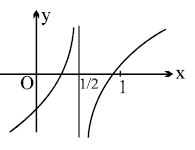
Let $f(x) = \begin{cases} \frac{(x - 1)(6x - 1)}{2x - 1}, & \text{if } x \neq \frac{1}{2} \\ 0, & \text{if } x = \frac{1}{2} \end{cases}$. Then at $x = \frac{1}{2}$,
A
$f$ has a local maxima
B
$f$ has a local minima
C
$f$ has an inflection point
D
$f$ has a non-removable infinite discontinuity
Solution
(D) First,analyze the limit of $f(x)$ as $x \to \frac{1}{2}$.
$\lim_{x \to \frac{1}{2}} f(x) = \lim_{x \to \frac{1}{2}} \frac{(x - 1)(6x - 1)}{2x - 1}$.
As $x \to \frac{1}{2}$,the numerator $(x - 1)(6x - 1) \to (\frac{1}{2} - 1)(6(\frac{1}{2}) - 1) = (-\frac{1}{2})(2) = -1$.
The denominator $2x - 1 \to 0$.
Since the numerator approaches a non-zero constant $(-1)$ and the denominator approaches $0$,the limit $\lim_{x \to \frac{1}{2}} f(x)$ does not exist (it approaches $\pm \infty$).
Therefore,the function has a non-removable infinite discontinuity at $x = \frac{1}{2}$.
$\lim_{x \to \frac{1}{2}} f(x) = \lim_{x \to \frac{1}{2}} \frac{(x - 1)(6x - 1)}{2x - 1}$.
As $x \to \frac{1}{2}$,the numerator $(x - 1)(6x - 1) \to (\frac{1}{2} - 1)(6(\frac{1}{2}) - 1) = (-\frac{1}{2})(2) = -1$.
The denominator $2x - 1 \to 0$.
Since the numerator approaches a non-zero constant $(-1)$ and the denominator approaches $0$,the limit $\lim_{x \to \frac{1}{2}} f(x)$ does not exist (it approaches $\pm \infty$).
Therefore,the function has a non-removable infinite discontinuity at $x = \frac{1}{2}$.
0 likes
View Solution125
AdvancedMCQ
Given $f(x) = \begin{cases} \frac{\ln(1+\text{sgn}[x]+{x}^2)}{1-\cos{x}} & \text{if } x \neq 0 \\ k & \text{if } x = 0 \end{cases}$ (where $[\cdot]$,${\cdot}$ and $\text{sgn } x$ denote the greatest integer function,fractional part function,and signum function respectively),which of the following is true?
A
$f(x)$ is continuous at $x = 0$ if $k = 2$
B
For $k = 1$,$f(x)$ has a removable discontinuity at $x = 0$
C
For $k = 2$,$f(x)$ has a non-removable discontinuity at $x = 0$
D
$\mathop {\lim }\limits_{x \to 0} f(x)$ exists
Solution
(C) To check continuity at $x = 0$,we evaluate the left-hand limit $(LHL)$ and right-hand limit $(RHL)$.
For $x > 0$,$[x] = 0$,so $\text{sgn}[x] = 0$. Thus,$f(x) = \frac{\ln(1+x^2)}{1-\cos x}$.
$RHL = \mathop {\lim }\limits_{h \to 0^+} \frac{\ln(1+h^2)}{1-\cos h} = \mathop {\lim }\limits_{h \to 0^+} \frac{\ln(1+h^2)}{h^2} \cdot \frac{h^2}{1-\cos h} = 1 \cdot 2 = 2$.
For $x < 0$,$[x] = -1$,so $\text{sgn}[x] = -1$. Thus,$f(x) = \frac{\ln(1-1+x^2)}{1-\cos x} = \frac{\ln(x^2)}{1-\cos x}$.
$LHL = \mathop {\lim }\limits_{h \to 0^+} \frac{\ln(h^2)}{1-\cos(h)} = \mathop {\lim }\limits_{h \to 0^+} \frac{\ln(h^2)}{h^2/2} = -\infty$.
Since the $LHL$ does not exist (it is $-\infty$),the limit $\mathop {\lim }\limits_{x \to 0} f(x)$ does not exist.
Therefore,$f(x)$ has a non-removable discontinuity at $x = 0$ for any value of $k$.
For $x > 0$,$[x] = 0$,so $\text{sgn}[x] = 0$. Thus,$f(x) = \frac{\ln(1+x^2)}{1-\cos x}$.
$RHL = \mathop {\lim }\limits_{h \to 0^+} \frac{\ln(1+h^2)}{1-\cos h} = \mathop {\lim }\limits_{h \to 0^+} \frac{\ln(1+h^2)}{h^2} \cdot \frac{h^2}{1-\cos h} = 1 \cdot 2 = 2$.
For $x < 0$,$[x] = -1$,so $\text{sgn}[x] = -1$. Thus,$f(x) = \frac{\ln(1-1+x^2)}{1-\cos x} = \frac{\ln(x^2)}{1-\cos x}$.
$LHL = \mathop {\lim }\limits_{h \to 0^+} \frac{\ln(h^2)}{1-\cos(h)} = \mathop {\lim }\limits_{h \to 0^+} \frac{\ln(h^2)}{h^2/2} = -\infty$.
Since the $LHL$ does not exist (it is $-\infty$),the limit $\mathop {\lim }\limits_{x \to 0} f(x)$ does not exist.
Therefore,$f(x)$ has a non-removable discontinuity at $x = 0$ for any value of $k$.
0 likes
View Solution126
AdvancedMCQ
Consider $f(x) = [x] + \sqrt{\{x\}}$,where $[.]$ denotes the greatest integer function and $\{.\}$ denotes the fractional part function. Identify the correct statement.
A
$f(x)$ is continuous for $R^+$ only.
B
$f(x)$ is continuous for $R^-$ only.
C
$f(x)$ is continuous $\forall x \in R - I$ only.
D
$f(x)$ is continuous $\forall x \in R$.
Solution
(D) Let $f(x) = [x] + \sqrt{\{x\}}$.
For any non-integer $x$,$[x]$ and $\{x\}$ are continuous,so $f(x)$ is continuous.
Now,check the continuity at an integer $n \in I$.
Left-hand limit: $\lim_{x \to n^-} f(x) = \lim_{x \to n^-} ([x] + \sqrt{\{x\}}) = (n-1) + \sqrt{1} = n-1+1 = n$.
Right-hand limit: $\lim_{x \to n^+} f(x) = \lim_{x \to n^+} ([x] + \sqrt{\{x\}}) = n + \sqrt{0} = n$.
Value of the function: $f(n) = [n] + \sqrt{\{n\}} = n + 0 = n$.
Since $\lim_{x \to n^-} f(x) = \lim_{x \to n^+} f(x) = f(n) = n$,the function is continuous at all integers.
Therefore,$f(x)$ is continuous $\forall x \in R$.
For any non-integer $x$,$[x]$ and $\{x\}$ are continuous,so $f(x)$ is continuous.
Now,check the continuity at an integer $n \in I$.
Left-hand limit: $\lim_{x \to n^-} f(x) = \lim_{x \to n^-} ([x] + \sqrt{\{x\}}) = (n-1) + \sqrt{1} = n-1+1 = n$.
Right-hand limit: $\lim_{x \to n^+} f(x) = \lim_{x \to n^+} ([x] + \sqrt{\{x\}}) = n + \sqrt{0} = n$.
Value of the function: $f(n) = [n] + \sqrt{\{n\}} = n + 0 = n$.
Since $\lim_{x \to n^-} f(x) = \lim_{x \to n^+} f(x) = f(n) = n$,the function is continuous at all integers.
Therefore,$f(x)$ is continuous $\forall x \in R$.
0 likes
View Solution127
AdvancedMCQ
If $f(x) = \frac{e^{2x} - (1 + 4x)^{1/2}}{\ln(1 - x^2)}$ for $x \neq 0$,then $f$ has
A
an irremovable discontinuity at $x = 0$
B
a removable discontinuity at $x = 0$ and $f(0) = -4$
C
a removable discontinuity at $x = 0$ and $f(0) = -1/4$
D
a removable discontinuity at $x = 0$ and $f(0) = 4$
Solution
(B) To find the limit of $f(x)$ as $x \to 0$,we use the Taylor series expansions:
$e^{2x} = 1 + 2x + \frac{(2x)^2}{2!} + \frac{(2x)^3}{3!} + \dots = 1 + 2x + 2x^2 + \frac{4x^3}{3} + \dots$
$(1 + 4x)^{1/2} = 1 + \frac{1}{2}(4x) + \frac{\frac{1}{2}(\frac{1}{2}-1)}{2!}(4x)^2 + \dots = 1 + 2x - 2x^2 + \dots$
$\ln(1 - x^2) = -x^2 - \frac{(-x^2)^2}{2} - \dots = -x^2 - \frac{x^4}{2} - \dots$
Substituting these into the expression for $f(x)$:
$f(x) = \frac{(1 + 2x + 2x^2 + \dots) - (1 + 2x - 2x^2 + \dots)}{-x^2 - \frac{x^4}{2} - \dots}$
$f(x) = \frac{4x^2 + \dots}{-x^2 - \dots}$
Taking the limit as $x \to 0$:
$\lim_{x \to 0} f(x) = \lim_{x \to 0} \frac{4x^2}{-x^2} = -4$
Since the limit exists and is finite,$f$ has a removable discontinuity at $x = 0$ and $f(0) = -4$.
$e^{2x} = 1 + 2x + \frac{(2x)^2}{2!} + \frac{(2x)^3}{3!} + \dots = 1 + 2x + 2x^2 + \frac{4x^3}{3} + \dots$
$(1 + 4x)^{1/2} = 1 + \frac{1}{2}(4x) + \frac{\frac{1}{2}(\frac{1}{2}-1)}{2!}(4x)^2 + \dots = 1 + 2x - 2x^2 + \dots$
$\ln(1 - x^2) = -x^2 - \frac{(-x^2)^2}{2} - \dots = -x^2 - \frac{x^4}{2} - \dots$
Substituting these into the expression for $f(x)$:
$f(x) = \frac{(1 + 2x + 2x^2 + \dots) - (1 + 2x - 2x^2 + \dots)}{-x^2 - \frac{x^4}{2} - \dots}$
$f(x) = \frac{4x^2 + \dots}{-x^2 - \dots}$
Taking the limit as $x \to 0$:
$\lim_{x \to 0} f(x) = \lim_{x \to 0} \frac{4x^2}{-x^2} = -4$
Since the limit exists and is finite,$f$ has a removable discontinuity at $x = 0$ and $f(0) = -4$.
0 likes
View Solution128
AdvancedMCQ
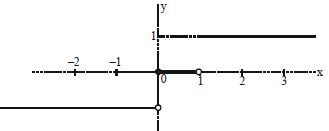
The function $f(x) = \begin{cases} sgn([x]) & x \notin I \\ [sgn(x)] & x \in I \end{cases}$ is (where $sgn()$ denotes the signum function and $[.]$ denotes the greatest integer function):
A
Continuous but not differentiable at $x = 2$
B
Discontinuous at every integer
C
Non-differentiable at $x = 0$ and $1$ only
D
Non-differentiable at every natural number
Solution
(B) Let us analyze the function $f(x)$ for different intervals.
For $x \notin I$,$f(x) = sgn([x])$.
If $x \in (0, 1)$,$[x] = 0$,so $f(x) = sgn(0) = 0$.
If $x \in (1, 2)$,$[x] = 1$,so $f(x) = sgn(1) = 1$.
If $x \in (-1, 0)$,$[x] = -1$,so $f(x) = sgn(-1) = -1$.
For $x \in I$,$f(x) = [sgn(x)]$.
If $x = 0$,$f(0) = [sgn(0)] = [0] = 0$.
If $x > 0$ and $x \in I$,$f(x) = [sgn(x)] = [1] = 1$.
If $x < 0$ and $x \in I$,$f(x) = [sgn(x)] = [-1] = -1$.
Combining these,the function is discontinuous at every integer $n \in I$ because the left-hand limit and right-hand limit do not match the function value at integers. Specifically,for any integer $n$,$\lim_{x \to n^-} f(x) = sgn(n-1)$ and $\lim_{x \to n^+} f(x) = sgn(n)$. These are not equal to $f(n) = [sgn(n)]$. Thus,the function is discontinuous at every integer.
For $x \notin I$,$f(x) = sgn([x])$.
If $x \in (0, 1)$,$[x] = 0$,so $f(x) = sgn(0) = 0$.
If $x \in (1, 2)$,$[x] = 1$,so $f(x) = sgn(1) = 1$.
If $x \in (-1, 0)$,$[x] = -1$,so $f(x) = sgn(-1) = -1$.
For $x \in I$,$f(x) = [sgn(x)]$.
If $x = 0$,$f(0) = [sgn(0)] = [0] = 0$.
If $x > 0$ and $x \in I$,$f(x) = [sgn(x)] = [1] = 1$.
If $x < 0$ and $x \in I$,$f(x) = [sgn(x)] = [-1] = -1$.
Combining these,the function is discontinuous at every integer $n \in I$ because the left-hand limit and right-hand limit do not match the function value at integers. Specifically,for any integer $n$,$\lim_{x \to n^-} f(x) = sgn(n-1)$ and $\lim_{x \to n^+} f(x) = sgn(n)$. These are not equal to $f(n) = [sgn(n)]$. Thus,the function is discontinuous at every integer.
0 likes
View Solution129
AdvancedMCQ
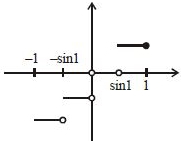
If the function $f(x) = x^2[\sin^{-1}x]$ is discontinuous at $x = \alpha$ and $x = \beta$,where $\alpha, \beta \in R - \{0\}$ and $[.]$ denotes the greatest integer function,then the value of $\alpha + \beta$ is:
A
$-\sin 1$
B
$0$
C
$2\sin 1$
D
$-2\sin 1$
Solution
(B) The function $f(x) = x^2[\sin^{-1}x]$ is discontinuous where the greatest integer function $[\sin^{-1}x]$ is discontinuous.
For the function $g(x) = [\sin^{-1}x]$,the points of discontinuity occur when $\sin^{-1}x$ is an integer.
The domain of $\sin^{-1}x$ is $[-1, 1]$. The possible integer values for $\sin^{-1}x$ are $\{-1, 0, 1\}$.
$1$. $\sin^{-1}x = -1 \implies x = \sin(-1) = -\sin 1$.
$2$. $\sin^{-1}x = 0 \implies x = \sin(0) = 0$.
$3$. $\sin^{-1}x = 1 \implies x = \sin(1) = \sin 1$.
However,we are given that $\alpha, \beta \in R - \{0\}$. Thus,we exclude $x = 0$.
The points of discontinuity in the given domain are $\alpha = \sin 1$ and $\beta = -\sin 1$.
Therefore,the value of $\alpha + \beta = \sin 1 + (-\sin 1) = 0$.
For the function $g(x) = [\sin^{-1}x]$,the points of discontinuity occur when $\sin^{-1}x$ is an integer.
The domain of $\sin^{-1}x$ is $[-1, 1]$. The possible integer values for $\sin^{-1}x$ are $\{-1, 0, 1\}$.
$1$. $\sin^{-1}x = -1 \implies x = \sin(-1) = -\sin 1$.
$2$. $\sin^{-1}x = 0 \implies x = \sin(0) = 0$.
$3$. $\sin^{-1}x = 1 \implies x = \sin(1) = \sin 1$.
However,we are given that $\alpha, \beta \in R - \{0\}$. Thus,we exclude $x = 0$.
The points of discontinuity in the given domain are $\alpha = \sin 1$ and $\beta = -\sin 1$.
Therefore,the value of $\alpha + \beta = \sin 1 + (-\sin 1) = 0$.
0 likes
View Solution130
AdvancedMCQ
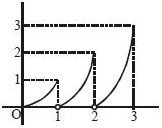
If in the interval $[0,3]$,$f(x) = \begin{cases} x\{x\}^2, & x \notin I \\ x, & x \in I \end{cases}$,then which of the following statements is correct? (where $\{.\}$ denotes the fractional part function)
A
There exist three points at which $f(x)$ is discontinuous.
B
$f(x)$ is an increasing function in $[0,3]$.
C
The number of points of non-differentiability is equal to the number of points of discontinuity.
D
The range of $f(x)$ is $[0,3] - \{1, 2, 3\}$.
Solution
(C) Given $f(x) = \begin{cases} x\{x\}^2, & x \notin I \\ x, & x \in I \end{cases}$ for $x \in [0,3]$.
For $x \in (0,1)$,${x} = x$,so $f(x) = x(x)^2 = x^3$. At $x=0, f(0)=0$. At $x=1, f(1)=1$.
For $x \in (1,2)$,${x} = x-1$,so $f(x) = x(x-1)^2$. At $x=2, f(2)=2$.
For $x \in (2,3)$,${x} = x-2$,so $f(x) = x(x-2)^2$. At $x=3, f(3)=3$.
Thus,$f(x) = \begin{cases} 0, & x=0 \\ x^3, & 0 < x < 1 \\ 1, & x=1 \\ x(x-1)^2, & 1 < x < 2 \\ 2, & x=2 \\ x(x-2)^2, & 2 < x < 3 \\ 3, & x=3 \end{cases}$.
Checking continuity: $\lim_{x \to 1^-} f(x) = 1^3 = 1$,$f(1)=1$,$\lim_{x \to 1^+} f(x) = 1(1-1)^2 = 0$. Since $1 \neq 0$,$f(x)$ is discontinuous at $x=1$.
Similarly,$\lim_{x \to 2^-} f(x) = 2(2-1)^2 = 2$,$f(2)=2$,$\lim_{x \to 2^+} f(x) = 2(2-2)^2 = 0$. Since $2 \neq 0$,$f(x)$ is discontinuous at $x=2$.
Thus,$f(x)$ is discontinuous at $x=1$ and $x=2$. There are two points of discontinuity.
Option $C$ is correct because the function is non-differentiable at $x=1, 2$ (discontinuity) and also at $x=0, 3$ (endpoints) and potentially other points,but the number of points of discontinuity is $2$.
For $x \in (0,1)$,${x} = x$,so $f(x) = x(x)^2 = x^3$. At $x=0, f(0)=0$. At $x=1, f(1)=1$.
For $x \in (1,2)$,${x} = x-1$,so $f(x) = x(x-1)^2$. At $x=2, f(2)=2$.
For $x \in (2,3)$,${x} = x-2$,so $f(x) = x(x-2)^2$. At $x=3, f(3)=3$.
Thus,$f(x) = \begin{cases} 0, & x=0 \\ x^3, & 0 < x < 1 \\ 1, & x=1 \\ x(x-1)^2, & 1 < x < 2 \\ 2, & x=2 \\ x(x-2)^2, & 2 < x < 3 \\ 3, & x=3 \end{cases}$.
Checking continuity: $\lim_{x \to 1^-} f(x) = 1^3 = 1$,$f(1)=1$,$\lim_{x \to 1^+} f(x) = 1(1-1)^2 = 0$. Since $1 \neq 0$,$f(x)$ is discontinuous at $x=1$.
Similarly,$\lim_{x \to 2^-} f(x) = 2(2-1)^2 = 2$,$f(2)=2$,$\lim_{x \to 2^+} f(x) = 2(2-2)^2 = 0$. Since $2 \neq 0$,$f(x)$ is discontinuous at $x=2$.
Thus,$f(x)$ is discontinuous at $x=1$ and $x=2$. There are two points of discontinuity.
Option $C$ is correct because the function is non-differentiable at $x=1, 2$ (discontinuity) and also at $x=0, 3$ (endpoints) and potentially other points,but the number of points of discontinuity is $2$.
0 likes
View Solution131
AdvancedMCQ
If $f(x) = x\sqrt{1 - [x]^2}$,then (where $[.]$ denotes the greatest integer function):
A
$f(x)$ is increasing in $x \in (0, 1)$
B
$x = 1$ is a point of local maxima of $f(x)$
C
$f(x)$ is a negative function
D
Rolle's theorem is applicable on $f(x)$ in $x \in [0, 1]$
Solution
(A) $1$. For $x \in (0, 1)$,$[x] = 0 \Rightarrow f(x) = x\sqrt{1 - 0} = x$. Since $f'(x) = 1 > 0$,$f(x)$ is increasing in $(0, 1)$.
$2$. At $x = 1$,$f(1) = 1\sqrt{1 - 1^2} = 0$. For $x \in (0, 1)$,$f(x) = x$. As $x \to 1^-$,$f(x) \to 1$. Since $f(1) = 0$ and $f(x) > 0$ for $x$ near $1$ from the left,$x = 1$ is not a point of local maxima.
$3$. The domain is determined by $1 - [x]^2 \ge 0 \Rightarrow [x]^2 \le 1 \Rightarrow -1 \le [x] \le 1$. This implies $x \in [-1, 2)$.
$4$. The function is defined as:
$f(x) = \begin{cases} 0, & -1 \le x < 0 \\ x, & 0 \le x < 1 \\ 0, & 1 \le x < 2 \end{cases}$
Since $f(x) \ge 0$ for all $x$ in the domain,it is not a negative function.
$5$. Since $f(x)$ is discontinuous at $x = 1$,Rolle's theorem is not applicable on $[0, 1]$.
$2$. At $x = 1$,$f(1) = 1\sqrt{1 - 1^2} = 0$. For $x \in (0, 1)$,$f(x) = x$. As $x \to 1^-$,$f(x) \to 1$. Since $f(1) = 0$ and $f(x) > 0$ for $x$ near $1$ from the left,$x = 1$ is not a point of local maxima.
$3$. The domain is determined by $1 - [x]^2 \ge 0 \Rightarrow [x]^2 \le 1 \Rightarrow -1 \le [x] \le 1$. This implies $x \in [-1, 2)$.
$4$. The function is defined as:
$f(x) = \begin{cases} 0, & -1 \le x < 0 \\ x, & 0 \le x < 1 \\ 0, & 1 \le x < 2 \end{cases}$
Since $f(x) \ge 0$ for all $x$ in the domain,it is not a negative function.
$5$. Since $f(x)$ is discontinuous at $x = 1$,Rolle's theorem is not applicable on $[0, 1]$.
0 likes
View Solution132
AdvancedMCQ
If $f(x) = \begin{cases} \frac{a + 3\cos x}{x^2}, & x < 0 \\ b\tan \left( \frac{\pi}{[x + 3]} \right), & x \geqslant 0 \end{cases}$ is continuous at $x = 0$,then:
A
$a = 3, b = \frac{-\sqrt{3}}{2}$
B
$a = -3, b = \frac{-\sqrt{3}}{2}$
C
$a = -3, b = \frac{\sqrt{3}}{2}$
D
$a = 3, b = \frac{\sqrt{3}}{2}$
Solution
(B) For $f(x)$ to be continuous at $x = 0$,$\text{LHL} = \text{RHL} = f(0)$.
$\text{LHL} = \lim_{x \to 0^-} \frac{a + 3\cos x}{x^2}$.
For the limit to exist,the numerator must approach $0$ as $x \to 0$,so $a + 3(1) = 0 \Rightarrow a = -3$.
Using the Taylor expansion $\cos x \approx 1 - \frac{x^2}{2}$,we get $\text{LHL} = \lim_{x \to 0^-} \frac{-3 + 3(1 - \frac{x^2}{2})}{x^2} = \lim_{x \to 0^-} \frac{-3/2 x^2}{x^2} = -\frac{3}{2}$.
$\text{RHL} = \lim_{x \to 0^+} b \tan \left( \frac{\pi}{[x + 3]} \right) = b \tan \left( \frac{\pi}{3} \right) = b\sqrt{3}$.
Since $\text{LHL} = \text{RHL}$,we have $b\sqrt{3} = -\frac{3}{2} \Rightarrow b = -\frac{\sqrt{3}}{2}$.
Thus,$a = -3$ and $b = -\frac{\sqrt{3}}{2}$.
$\text{LHL} = \lim_{x \to 0^-} \frac{a + 3\cos x}{x^2}$.
For the limit to exist,the numerator must approach $0$ as $x \to 0$,so $a + 3(1) = 0 \Rightarrow a = -3$.
Using the Taylor expansion $\cos x \approx 1 - \frac{x^2}{2}$,we get $\text{LHL} = \lim_{x \to 0^-} \frac{-3 + 3(1 - \frac{x^2}{2})}{x^2} = \lim_{x \to 0^-} \frac{-3/2 x^2}{x^2} = -\frac{3}{2}$.
$\text{RHL} = \lim_{x \to 0^+} b \tan \left( \frac{\pi}{[x + 3]} \right) = b \tan \left( \frac{\pi}{3} \right) = b\sqrt{3}$.
Since $\text{LHL} = \text{RHL}$,we have $b\sqrt{3} = -\frac{3}{2} \Rightarrow b = -\frac{\sqrt{3}}{2}$.
Thus,$a = -3$ and $b = -\frac{\sqrt{3}}{2}$.
0 likes
View Solution133
AdvancedMCQ
The set of points of discontinuity of the function $f(x) = \frac{\tan x \cdot \tan^{-1}\left(\frac{1}{x-1}\right)}{x(x-3)(x-5)}$ is
A
$\{0, 3, 5\}$
B
$\{(2n+1)\frac{\pi}{2}, n \in Z\}$
C
$\{0, 3, 5\} \cup \{(2n+1)\frac{\pi}{2}, n \in Z\}$
D
$\{0, 1, 3, 5\} \cup \{(2n+1)\frac{\pi}{2}, n \in Z\}$
Solution
(D) function $f(x)$ is discontinuous where it is undefined.
$1$. The denominator $x(x-3)(x-5)$ is zero at $x = 0, 3, 5$. Thus,the function is undefined at these points.
$2$. The term $\tan x$ is undefined when $x = (2n+1)\frac{\pi}{2}$ for $n \in Z$.
$3$. The term $\tan^{-1}\left(\frac{1}{x-1}\right)$ is defined for all $x \neq 1$. At $x = 1$,the limit $\lim_{x \to 1^+} \tan^{-1}\left(\frac{1}{x-1}\right) = \frac{\pi}{2}$ and $\lim_{x \to 1^-} \tan^{-1}\left(\frac{1}{x-1}\right) = -\frac{\pi}{2}$. Since the left-hand limit and right-hand limit are not equal,the function is discontinuous at $x = 1$.
Combining all these,the set of points of discontinuity is $\{0, 1, 3, 5\} \cup \{(2n+1)\frac{\pi}{2}, n \in Z\}$.
$1$. The denominator $x(x-3)(x-5)$ is zero at $x = 0, 3, 5$. Thus,the function is undefined at these points.
$2$. The term $\tan x$ is undefined when $x = (2n+1)\frac{\pi}{2}$ for $n \in Z$.
$3$. The term $\tan^{-1}\left(\frac{1}{x-1}\right)$ is defined for all $x \neq 1$. At $x = 1$,the limit $\lim_{x \to 1^+} \tan^{-1}\left(\frac{1}{x-1}\right) = \frac{\pi}{2}$ and $\lim_{x \to 1^-} \tan^{-1}\left(\frac{1}{x-1}\right) = -\frac{\pi}{2}$. Since the left-hand limit and right-hand limit are not equal,the function is discontinuous at $x = 1$.
Combining all these,the set of points of discontinuity is $\{0, 1, 3, 5\} \cup \{(2n+1)\frac{\pi}{2}, n \in Z\}$.
0 likes
View Solution134
AdvancedMCQ
The number of points of discontinuity of the function $f(x) = \frac{1}{1 - e^{\frac{-x-1}{x-2}}}$ is
A
$1$
B
$2$
C
$3$
D
$4$
Solution
(B) The function is defined as $f(x) = \frac{1}{1 - e^{-\frac{x+1}{x-2}}}$.
First,the function is undefined when the denominator is zero,i.e.,$x - 2 = 0$,which gives $x = 2$.
Second,the function is discontinuous when the denominator of the entire expression is zero,i.e.,$1 - e^{-\frac{x+1}{x-2}} = 0$.
This implies $e^{-\frac{x+1}{x-2}} = 1$,which means $-\frac{x+1}{x-2} = 0$.
This occurs when the numerator is zero,i.e.,$x + 1 = 0$,which gives $x = -1$.
Thus,the points of discontinuity are $x = -1$ and $x = 2$.
Therefore,the number of points of discontinuity is $2$.
First,the function is undefined when the denominator is zero,i.e.,$x - 2 = 0$,which gives $x = 2$.
Second,the function is discontinuous when the denominator of the entire expression is zero,i.e.,$1 - e^{-\frac{x+1}{x-2}} = 0$.
This implies $e^{-\frac{x+1}{x-2}} = 1$,which means $-\frac{x+1}{x-2} = 0$.
This occurs when the numerator is zero,i.e.,$x + 1 = 0$,which gives $x = -1$.
Thus,the points of discontinuity are $x = -1$ and $x = 2$.
Therefore,the number of points of discontinuity is $2$.
0 likes
View Solution135
AdvancedMCQ
Let $f$ be a continuous,periodic even function defined on $\mathbb{R}$ such that $f(0) = 1$,$f(2) = -1$ and the period of $f$ is $4$. The minimum number of roots of the equation $f(x) = 0$ in the interval $[-10, 10]$ will be:
A
$10$
B
$12$
C
$14$
D
$16$
Solution
(A) Given that $f(x)$ is a continuous,periodic even function with period $T = 4$.
Since $f(0) = 1$ and $f(2) = -1$,by the Intermediate Value Theorem,there must be at least one root in the interval $(0, 2)$.
Because $f$ is an even function,$f(-x) = f(x)$,so there must be at least one root in the interval $(-2, 0)$.
Thus,there are at least $2$ roots in one period interval $(-2, 2)$.
The interval $[-10, 10]$ has a length of $20$,which covers $20/4 = 5$ periods.
Therefore,the minimum number of roots in $[-10, 10]$ is $2 \times 5 = 10$.
Since $f(0) = 1$ and $f(2) = -1$,by the Intermediate Value Theorem,there must be at least one root in the interval $(0, 2)$.
Because $f$ is an even function,$f(-x) = f(x)$,so there must be at least one root in the interval $(-2, 0)$.
Thus,there are at least $2$ roots in one period interval $(-2, 2)$.
The interval $[-10, 10]$ has a length of $20$,which covers $20/4 = 5$ periods.
Therefore,the minimum number of roots in $[-10, 10]$ is $2 \times 5 = 10$.
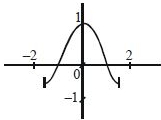
0 likes
View Solution136
AdvancedMCQ
Number of points of discontinuity of the function $f(x) = \sin(\{2^x + [2^x] + [3^{-x}]\})$ for $x \in [0, 4]$ is (where $[.]$ and $\{.\}$ denote the greatest integer and fractional part functions,respectively).
A
$5$
B
$4$
C
$15$
D
$16$
Solution
(C) Given $f(x) = \sin(\{2^x + [2^x] + [3^{-x}]\})$.
Since $[2^x]$ and $[3^{-x}]$ are integers,we use the property $\{x + n\} = \{x\}$ for any integer $n$.
Thus,$f(x) = \sin(\{2^x + [2^x] + [3^{-x}]\}) = \sin(\{2^x + [3^{-x}]\}) = \sin(\{2^x\})$.
The function $f(x) = \sin(\{2^x\})$ is discontinuous where $2^x$ is an integer,because the fractional part function $\{u\}$ is discontinuous at all integers $u$.
For $x \in [0, 4]$,$2^x$ takes values in the interval $[2^0, 2^4] = [1, 16]$.
The integers in the interval $[1, 16]$ are $1, 2, 3, \dots, 16$.
However,$\{2^x\}$ is continuous at $x$ where $2^x$ is an integer if the limit from the left and right are equal.
At $x=0$,$2^x=1$,$\{2^x\}$ jumps from $0$ to $0$ (as $x \to 0^+$,$2^x \to 1^+$,$\{2^x\} \to 0$). Thus,it is continuous at $x=0$.
For $x > 0$,$2^x = k$ (where $k \in \{2, 3, \dots, 16\}$),the function $\{2^x\}$ has a jump discontinuity.
There are $15$ such values of $k$ $(k=2, 3, \dots, 16)$.
Therefore,the number of points of discontinuity is $15$.
Since $[2^x]$ and $[3^{-x}]$ are integers,we use the property $\{x + n\} = \{x\}$ for any integer $n$.
Thus,$f(x) = \sin(\{2^x + [2^x] + [3^{-x}]\}) = \sin(\{2^x + [3^{-x}]\}) = \sin(\{2^x\})$.
The function $f(x) = \sin(\{2^x\})$ is discontinuous where $2^x$ is an integer,because the fractional part function $\{u\}$ is discontinuous at all integers $u$.
For $x \in [0, 4]$,$2^x$ takes values in the interval $[2^0, 2^4] = [1, 16]$.
The integers in the interval $[1, 16]$ are $1, 2, 3, \dots, 16$.
However,$\{2^x\}$ is continuous at $x$ where $2^x$ is an integer if the limit from the left and right are equal.
At $x=0$,$2^x=1$,$\{2^x\}$ jumps from $0$ to $0$ (as $x \to 0^+$,$2^x \to 1^+$,$\{2^x\} \to 0$). Thus,it is continuous at $x=0$.
For $x > 0$,$2^x = k$ (where $k \in \{2, 3, \dots, 16\}$),the function $\{2^x\}$ has a jump discontinuity.
There are $15$ such values of $k$ $(k=2, 3, \dots, 16)$.
Therefore,the number of points of discontinuity is $15$.
0 likes
View Solution137
AdvancedMCQ
If $f(x) = \operatorname{sgn}((x^2 - kx + 6)(\sin x - 1/2))$ (where $k > 0$) has exactly $4$ points of discontinuity in $(0, 6)$,then the maximum integral value of $k$ is:
A
$4$
B
$5$
C
$6$
D
$7$
Solution
(C) The function $f(x) = \operatorname{sgn}(g(x))$ is discontinuous where $g(x) = 0$.
Let $g(x) = (x^2 - kx + 6)(\sin x - 1/2)$.
The points of discontinuity occur where $x^2 - kx + 6 = 0$ or $\sin x = 1/2$.
For $\sin x = 1/2$ in $(0, 6)$,the solutions are $x = \pi/6 \approx 0.52$ and $x = 5\pi/6 \approx 2.62$.
These provide $2$ points of discontinuity.
For $f(x)$ to have exactly $4$ points of discontinuity,the quadratic $x^2 - kx + 6 = 0$ must have $2$ distinct roots in $(0, 6)$ that are not equal to $\pi/6$ or $5\pi/6$.
For the quadratic $x^2 - kx + 6 = 0$ to have $2$ distinct roots in $(0, 6)$:
$1) D = k^2 - 24 > 0 \Rightarrow k > \sqrt{24} \approx 4.89$.
$2) 0 < \text{vertex} < 6 \Rightarrow 0 < k/2 < 6 \Rightarrow 0 < k < 12$.
$3) f(0) = 6 > 0$ (always true).
$4) f(6) = 36 - 6k + 6 > 0 \Rightarrow 42 > 6k \Rightarrow k < 7$.
Combining these,$k \in (4.89, 7)$.
The integral values for $k$ are $5$ and $6$.
Since we need the maximum integral value,$k = 6$.
Let $g(x) = (x^2 - kx + 6)(\sin x - 1/2)$.
The points of discontinuity occur where $x^2 - kx + 6 = 0$ or $\sin x = 1/2$.
For $\sin x = 1/2$ in $(0, 6)$,the solutions are $x = \pi/6 \approx 0.52$ and $x = 5\pi/6 \approx 2.62$.
These provide $2$ points of discontinuity.
For $f(x)$ to have exactly $4$ points of discontinuity,the quadratic $x^2 - kx + 6 = 0$ must have $2$ distinct roots in $(0, 6)$ that are not equal to $\pi/6$ or $5\pi/6$.
For the quadratic $x^2 - kx + 6 = 0$ to have $2$ distinct roots in $(0, 6)$:
$1) D = k^2 - 24 > 0 \Rightarrow k > \sqrt{24} \approx 4.89$.
$2) 0 < \text{vertex} < 6 \Rightarrow 0 < k/2 < 6 \Rightarrow 0 < k < 12$.
$3) f(0) = 6 > 0$ (always true).
$4) f(6) = 36 - 6k + 6 > 0 \Rightarrow 42 > 6k \Rightarrow k < 7$.
Combining these,$k \in (4.89, 7)$.
The integral values for $k$ are $5$ and $6$.
Since we need the maximum integral value,$k = 6$.
0 likes
View Solution138
AdvancedMCQ
$f(x) = \left[ \frac{x^2 + 1}{x^2[|x|] + 1} \right]$ is discontinuous at (where $[.]$ denotes the greatest integer function):
A
one point
B
two points
C
no point
D
infinitely many points
Solution
(B) Let $g(x) = \frac{x^2 + 1}{x^2[|x|] + 1}$.
Case $1$: If $|x| < 1$,then $[|x|] = 0$. Thus,$g(x) = \frac{x^2 + 1}{0 + 1} = x^2 + 1$. Since $|x| < 1$,$0 \le x^2 < 1$,so $1 \le g(x) < 2$. Therefore,$[g(x)] = 1$.
Case $2$: If $|x| \ge 1$,then $[|x|] \ge 1$. Let $n = [|x|]$,where $n \in \{1, 2, 3, \dots\}$. Then $g(x) = \frac{x^2 + 1}{nx^2 + 1}$.
As $x^2 \to \infty$,$g(x) \to \frac{1}{n}$. Since $n \ge 1$,$0 < \frac{1}{n} \le 1$. Specifically,for $x^2 \ge 1$,$g(x) = \frac{x^2 + 1}{nx^2 + 1} \le 1$. Also,$g(x) > 0$. Thus,$[g(x)] = 0$ for $|x| \ge 1$ except when $g(x) = 1$,which happens at $x^2 = 1$ (i.e.,$x = \pm 1$).
At $x = \pm 1$,$g(1) = \frac{1+1}{1(1)+1} = 1$,so $[g(1)] = 1$.
Thus,$f(x) = 1$ for $|x| < 1$ and $f(x) = 0$ for $|x| > 1$,with $f(1) = f(-1) = 1$.
The function jumps from $1$ to $0$ at $x = 1$ and $x = -1$. Hence,it is discontinuous at two points.
Case $1$: If $|x| < 1$,then $[|x|] = 0$. Thus,$g(x) = \frac{x^2 + 1}{0 + 1} = x^2 + 1$. Since $|x| < 1$,$0 \le x^2 < 1$,so $1 \le g(x) < 2$. Therefore,$[g(x)] = 1$.
Case $2$: If $|x| \ge 1$,then $[|x|] \ge 1$. Let $n = [|x|]$,where $n \in \{1, 2, 3, \dots\}$. Then $g(x) = \frac{x^2 + 1}{nx^2 + 1}$.
As $x^2 \to \infty$,$g(x) \to \frac{1}{n}$. Since $n \ge 1$,$0 < \frac{1}{n} \le 1$. Specifically,for $x^2 \ge 1$,$g(x) = \frac{x^2 + 1}{nx^2 + 1} \le 1$. Also,$g(x) > 0$. Thus,$[g(x)] = 0$ for $|x| \ge 1$ except when $g(x) = 1$,which happens at $x^2 = 1$ (i.e.,$x = \pm 1$).
At $x = \pm 1$,$g(1) = \frac{1+1}{1(1)+1} = 1$,so $[g(1)] = 1$.
Thus,$f(x) = 1$ for $|x| < 1$ and $f(x) = 0$ for $|x| > 1$,with $f(1) = f(-1) = 1$.
The function jumps from $1$ to $0$ at $x = 1$ and $x = -1$. Hence,it is discontinuous at two points.
0 likes
View Solution139
AdvancedMCQ
The number of points of discontinuity of $f(x)$ where $f(x) = | | |x + [x]| - 3[x] | - 5[x] |$ on $[-2, 2]$ is (where $[ \cdot ]$ denotes the greatest integer function).
A
$2$
B
$4$
C
$5$
D
$6$
Solution
(B) Given $f(x) = | | |x + [x]| - 3[x] | - 5[x] |$ on $[-2, 2]$.
We analyze the function in intervals based on $[x]$:
For $x \in [-2, -1)$,$[x] = -2$. Then $f(x) = | | |x - 2| - 3(-2) | - 5(-2) | = | | |x - 2| + 6 | + 10 | = | |2 - x + 6| + 10 | = |8 - x + 10| = |18 - x| = 18 - x$.
For $x \in [-1, 0)$,$[x] = -1$. Then $f(x) = | | |x - 1| - 3(-1) | - 5(-1) | = | | |x - 1| + 3 | + 5 | = | |1 - x + 3| + 5 | = |4 - x + 5| = |9 - x| = 9 - x$.
For $x \in [0, 1)$,$[x] = 0$. Then $f(x) = | | |x + 0| - 3(0) | - 5(0) | = | |x| | = x$.
For $x \in [1, 2)$,$[x] = 1$. Then $f(x) = | | |x + 1| - 3(1) | - 5(1) | = | |x + 1 - 3| - 5 | = | |x - 2| - 5 | = |(2 - x) - 5| = |-x - 3| = x + 3$.
For $x = 2$,$[x] = 2$. Then $f(2) = | | |2 + 2| - 3(2) | - 5(2) | = | |4 - 6| - 10 | = |-2 - 10| = 12$.
Checking continuity at boundaries:
At $x = -1$: $LHL = 18 - (-1) = 19$,$RHL = 9 - (-1) = 10$. Discontinuous.
At $x = 0$: $LHL = 9 - 0 = 9$,$RHL = 0$. Discontinuous.
At $x = 1$: $LHL = 1$,$RHL = 1 + 3 = 4$. Discontinuous.
At $x = 2$: $LHL = 2 + 3 = 5$,$f(2) = 12$. Discontinuous.
Thus,there are $4$ points of discontinuity: $x = -1, 0, 1, 2$.
We analyze the function in intervals based on $[x]$:
For $x \in [-2, -1)$,$[x] = -2$. Then $f(x) = | | |x - 2| - 3(-2) | - 5(-2) | = | | |x - 2| + 6 | + 10 | = | |2 - x + 6| + 10 | = |8 - x + 10| = |18 - x| = 18 - x$.
For $x \in [-1, 0)$,$[x] = -1$. Then $f(x) = | | |x - 1| - 3(-1) | - 5(-1) | = | | |x - 1| + 3 | + 5 | = | |1 - x + 3| + 5 | = |4 - x + 5| = |9 - x| = 9 - x$.
For $x \in [0, 1)$,$[x] = 0$. Then $f(x) = | | |x + 0| - 3(0) | - 5(0) | = | |x| | = x$.
For $x \in [1, 2)$,$[x] = 1$. Then $f(x) = | | |x + 1| - 3(1) | - 5(1) | = | |x + 1 - 3| - 5 | = | |x - 2| - 5 | = |(2 - x) - 5| = |-x - 3| = x + 3$.
For $x = 2$,$[x] = 2$. Then $f(2) = | | |2 + 2| - 3(2) | - 5(2) | = | |4 - 6| - 10 | = |-2 - 10| = 12$.
Checking continuity at boundaries:
At $x = -1$: $LHL = 18 - (-1) = 19$,$RHL = 9 - (-1) = 10$. Discontinuous.
At $x = 0$: $LHL = 9 - 0 = 9$,$RHL = 0$. Discontinuous.
At $x = 1$: $LHL = 1$,$RHL = 1 + 3 = 4$. Discontinuous.
At $x = 2$: $LHL = 2 + 3 = 5$,$f(2) = 12$. Discontinuous.
Thus,there are $4$ points of discontinuity: $x = -1, 0, 1, 2$.
0 likes
View Solution140
AdvancedMCQ
Which of the following function$(s)$ not defined at $x = 0$ has/have an irremovable discontinuity at $x = 0$?
A
$f(x) = \frac{1}{\ln |x|}$
B
$f(x) = \cos \left( \frac{|\sin x|}{x} \right)$
C
$f(x) = x \sin \frac{\pi}{x}$
D
$f(x) = \frac{1}{1 + 2^{\cot x}}$
Solution
(D) function has an irremovable discontinuity at $x = a$ if the limit $\lim_{x \to a} f(x)$ does not exist.
$(1)$ For $f(x) = \frac{1}{\ln |x|}$,$\lim_{x \to 0} \frac{1}{\ln |x|} = 0$. Since the limit exists,it has a removable discontinuity.
$(2)$ For $f(x) = \cos \left( \frac{|\sin x|}{x} \right)$:
$\lim_{x \to 0^+} \cos \left( \frac{\sin x}{x} \right) = \cos(1)$
$\lim_{x \to 0^-} \cos \left( \frac{-\sin x}{x} \right) = \cos(-1) = \cos(1)$.
Since the limit exists,it has a removable discontinuity.
$(3)$ For $f(x) = x \sin \frac{\pi}{x}$,by the Squeeze Theorem,$\lim_{x \to 0} x \sin \frac{\pi}{x} = 0$. Since the limit exists,it has a removable discontinuity.
$(4)$ For $f(x) = \frac{1}{1 + 2^{\cot x}}$:
$\lim_{x \to 0^+} \frac{1}{1 + 2^{\cot x}} = \frac{1}{1 + 2^{\infty}} = 0$
$\lim_{x \to 0^-} \frac{1}{1 + 2^{\cot x}} = \frac{1}{1 + 2^{-\infty}} = \frac{1}{1 + 0} = 1$.
Since the left-hand limit $(1)$ is not equal to the right-hand limit $(0)$,the limit does not exist. Thus,it has an irremovable (jump) discontinuity at $x = 0$.
$(1)$ For $f(x) = \frac{1}{\ln |x|}$,$\lim_{x \to 0} \frac{1}{\ln |x|} = 0$. Since the limit exists,it has a removable discontinuity.
$(2)$ For $f(x) = \cos \left( \frac{|\sin x|}{x} \right)$:
$\lim_{x \to 0^+} \cos \left( \frac{\sin x}{x} \right) = \cos(1)$
$\lim_{x \to 0^-} \cos \left( \frac{-\sin x}{x} \right) = \cos(-1) = \cos(1)$.
Since the limit exists,it has a removable discontinuity.
$(3)$ For $f(x) = x \sin \frac{\pi}{x}$,by the Squeeze Theorem,$\lim_{x \to 0} x \sin \frac{\pi}{x} = 0$. Since the limit exists,it has a removable discontinuity.
$(4)$ For $f(x) = \frac{1}{1 + 2^{\cot x}}$:
$\lim_{x \to 0^+} \frac{1}{1 + 2^{\cot x}} = \frac{1}{1 + 2^{\infty}} = 0$
$\lim_{x \to 0^-} \frac{1}{1 + 2^{\cot x}} = \frac{1}{1 + 2^{-\infty}} = \frac{1}{1 + 0} = 1$.
Since the left-hand limit $(1)$ is not equal to the right-hand limit $(0)$,the limit does not exist. Thus,it has an irremovable (jump) discontinuity at $x = 0$.
0 likes
View Solution141
AdvancedMCQ
Let $f(x) = \begin{cases} x^3 - x^2 + 10x - 5, & x \le 1 \\ -2x + \log_2(b^2 - 2), & x > 1 \end{cases}$. The set of values of $b$ for which $f(x)$ has the greatest value at $x = 1$ is given by:
A
$1 \le b \le 2$
B
$b = \{1, 2\}$
C
$b \in (-\infty, -1)$
D
$[-\sqrt{130}, -\sqrt{2}) \cup (\sqrt{2}, \sqrt{130}]$
Solution
(D) For $f(x)$ to have the greatest value at $x = 1$,we must satisfy $f(x) \le f(1)$ for all $x$ in the domain.
First,calculate $f(1)$ using the first part of the function: $f(1) = 1^3 - 1^2 + 10(1) - 5 = 1 - 1 + 10 - 5 = 5$.
For $x \le 1$,$f(x) = x^3 - x^2 + 10x - 5$. Let $g(x) = x^3 - x^2 + 10x - 5$. Then $g'(x) = 3x^2 - 2x + 10$. The discriminant of $g'(x)$ is $D = (-2)^2 - 4(3)(10) = 4 - 120 = -116 < 0$. Since the leading coefficient is positive,$g'(x) > 0$ for all $x$,meaning $f(x)$ is strictly increasing for $x \le 1$. Thus,$f(x) \le f(1)$ is satisfied for all $x \le 1$.
For $x > 1$,we require $f(x) \le f(1)$,which means $-2x + \log_2(b^2 - 2) \le 5$. As $x \to 1^+$,the limit is $-2(1) + \log_2(b^2 - 2) = -2 + \log_2(b^2 - 2)$. For the function to be continuous or have a maximum at $x=1$,we need $-2 + \log_2(b^2 - 2) \le 5$.
Also,the argument of the logarithm must be positive: $b^2 - 2 > 0 \implies b^2 > 2 \implies b \in (-\infty, -\sqrt{2}) \cup (\sqrt{2}, \infty)$.
Solving $-2 + \log_2(b^2 - 2) \le 5$:
$\log_2(b^2 - 2) \le 7$
$b^2 - 2 \le 2^7$
$b^2 - 2 \le 128$
$b^2 \le 130$.
Combining $b^2 > 2$ and $b^2 \le 130$,we get $2 < b^2 \le 130$,which implies $b \in [-\sqrt{130}, -\sqrt{2}) \cup (\sqrt{2}, \sqrt{130}]$.
Therefore,the correct option is $D$.
First,calculate $f(1)$ using the first part of the function: $f(1) = 1^3 - 1^2 + 10(1) - 5 = 1 - 1 + 10 - 5 = 5$.
For $x \le 1$,$f(x) = x^3 - x^2 + 10x - 5$. Let $g(x) = x^3 - x^2 + 10x - 5$. Then $g'(x) = 3x^2 - 2x + 10$. The discriminant of $g'(x)$ is $D = (-2)^2 - 4(3)(10) = 4 - 120 = -116 < 0$. Since the leading coefficient is positive,$g'(x) > 0$ for all $x$,meaning $f(x)$ is strictly increasing for $x \le 1$. Thus,$f(x) \le f(1)$ is satisfied for all $x \le 1$.
For $x > 1$,we require $f(x) \le f(1)$,which means $-2x + \log_2(b^2 - 2) \le 5$. As $x \to 1^+$,the limit is $-2(1) + \log_2(b^2 - 2) = -2 + \log_2(b^2 - 2)$. For the function to be continuous or have a maximum at $x=1$,we need $-2 + \log_2(b^2 - 2) \le 5$.
Also,the argument of the logarithm must be positive: $b^2 - 2 > 0 \implies b^2 > 2 \implies b \in (-\infty, -\sqrt{2}) \cup (\sqrt{2}, \infty)$.
Solving $-2 + \log_2(b^2 - 2) \le 5$:
$\log_2(b^2 - 2) \le 7$
$b^2 - 2 \le 2^7$
$b^2 - 2 \le 128$
$b^2 \le 130$.
Combining $b^2 > 2$ and $b^2 \le 130$,we get $2 < b^2 \le 130$,which implies $b \in [-\sqrt{130}, -\sqrt{2}) \cup (\sqrt{2}, \sqrt{130}]$.
Therefore,the correct option is $D$.
0 likes
View Solution142
AdvancedMCQ
Let $f(x) = \begin{cases} x^p \sin \left( \frac{1}{x} \right) + x|x^3|, & x \neq 0 \\ 0, & x = 0 \end{cases}$. Then the complete set of values of $p$ for which $f''(x)$ is continuous at $x = 0$ is:
A
$[2, \infty)$
B
$[3, \infty)$
C
$(4, \infty)$
D
$[-2, \infty)$
Solution
(C) Let $g(x) = x|x^3|$. Since $g(x) = x^4$ for $x \ge 0$ and $g(x) = -x^4$ for $x < 0$,$g(x)$ is $3$ times differentiable at $x=0$ and $g''(0) = 0$. Thus,$g''(x)$ is continuous at $x=0$.
Now consider $h(x) = x^p \sin \left( \frac{1}{x} \right)$ for $x \neq 0$ and $h(0) = 0$.
For $h'(0)$ to exist,$\lim_{h \to 0} \frac{h^p \sin(1/h)}{h} = 0$,which requires $p > 1$. Then $h'(0) = 0$.
For $x \neq 0$,$h'(x) = p x^{p-1} \sin \left( \frac{1}{x} \right) - x^{p-2} \cos \left( \frac{1}{x} \right)$.
For $h''(0)$ to exist,$\lim_{h \to 0} \frac{h'(h) - h'(0)}{h} = \lim_{h \to 0} \left( p h^{p-2} \sin \left( \frac{1}{h} \right) - h^{p-3} \cos \left( \frac{1}{h} \right) \right) = 0$,which requires $p > 3$. Then $h''(0) = 0$.
For $x \neq 0$,$h''(x) = p(p-1) x^{p-2} \sin \left( \frac{1}{x} \right) - p x^{p-3} \cos \left( \frac{1}{x} \right) - (p-2) x^{p-3} \cos \left( \frac{1}{x} \right) - x^{p-4} \sin \left( \frac{1}{x} \right) = p(p-1) x^{p-2} \sin \left( \frac{1}{x} \right) - 2(p-1) x^{p-3} \cos \left( \frac{1}{x} \right) - x^{p-4} \sin \left( \frac{1}{x} \right)$.
For $h''(x)$ to be continuous at $x=0$,we need $\lim_{x \to 0} h''(x) = h''(0) = 0$. This requires the power of $x$ in all terms to be positive,specifically $p-4 > 0$,so $p > 4$.
Now consider $h(x) = x^p \sin \left( \frac{1}{x} \right)$ for $x \neq 0$ and $h(0) = 0$.
For $h'(0)$ to exist,$\lim_{h \to 0} \frac{h^p \sin(1/h)}{h} = 0$,which requires $p > 1$. Then $h'(0) = 0$.
For $x \neq 0$,$h'(x) = p x^{p-1} \sin \left( \frac{1}{x} \right) - x^{p-2} \cos \left( \frac{1}{x} \right)$.
For $h''(0)$ to exist,$\lim_{h \to 0} \frac{h'(h) - h'(0)}{h} = \lim_{h \to 0} \left( p h^{p-2} \sin \left( \frac{1}{h} \right) - h^{p-3} \cos \left( \frac{1}{h} \right) \right) = 0$,which requires $p > 3$. Then $h''(0) = 0$.
For $x \neq 0$,$h''(x) = p(p-1) x^{p-2} \sin \left( \frac{1}{x} \right) - p x^{p-3} \cos \left( \frac{1}{x} \right) - (p-2) x^{p-3} \cos \left( \frac{1}{x} \right) - x^{p-4} \sin \left( \frac{1}{x} \right) = p(p-1) x^{p-2} \sin \left( \frac{1}{x} \right) - 2(p-1) x^{p-3} \cos \left( \frac{1}{x} \right) - x^{p-4} \sin \left( \frac{1}{x} \right)$.
For $h''(x)$ to be continuous at $x=0$,we need $\lim_{x \to 0} h''(x) = h''(0) = 0$. This requires the power of $x$ in all terms to be positive,specifically $p-4 > 0$,so $p > 4$.
0 likes
View Solution143
AdvancedMCQ
Let $f : [0,1] \to [0,1]$ be a continuous function,then the equation $f(x) = x$
A
may not have any solution in $[0,1]$
B
must have exactly one solution in $[0,1]$
C
must have atleast one solution in $[0,1]$
D
must have atleast two solutions in $[0,1]$
Solution
(C) Define a new function $g(x) = f(x) - x$ for $x \in [0, 1]$.
Since $f : [0, 1] \to [0, 1]$,we have $0 \leq f(x) \leq 1$ for all $x \in [0, 1]$.
At $x = 0$,$g(0) = f(0) - 0 = f(0) \geq 0$.
At $x = 1$,$g(1) = f(1) - 1 \leq 0$ (since $f(1) \leq 1$).
If $g(0) = 0$ or $g(1) = 0$,then $x = 0$ or $x = 1$ is a solution to $f(x) = x$.
If $g(0) > 0$ and $g(1) < 0$,then by the Intermediate Value Theorem,since $g(x)$ is continuous,there must exist at least one $c \in (0, 1)$ such that $g(c) = 0$,which implies $f(c) = c$.
Therefore,the equation $f(x) = x$ must have at least one solution in $[0, 1]$.
Since $f : [0, 1] \to [0, 1]$,we have $0 \leq f(x) \leq 1$ for all $x \in [0, 1]$.
At $x = 0$,$g(0) = f(0) - 0 = f(0) \geq 0$.
At $x = 1$,$g(1) = f(1) - 1 \leq 0$ (since $f(1) \leq 1$).
If $g(0) = 0$ or $g(1) = 0$,then $x = 0$ or $x = 1$ is a solution to $f(x) = x$.
If $g(0) > 0$ and $g(1) < 0$,then by the Intermediate Value Theorem,since $g(x)$ is continuous,there must exist at least one $c \in (0, 1)$ such that $g(c) = 0$,which implies $f(c) = c$.
Therefore,the equation $f(x) = x$ must have at least one solution in $[0, 1]$.
0 likes
View Solution144
AdvancedMCQ
If $f(x) = \begin{cases} -x^3 + 1, & \text{if } -\infty < x \leq 1 \\ |x - 1| + \lambda, & \text{if } x > 1 \end{cases}$,then:
A
$f(x)$ has a point of minima at $x = 1, \forall \lambda \in R$
B
$f(x)$ has a point of minima at $x = 1$ only for $\lambda < 0$
C
$f(x)$ increases at $x = 1, \forall \lambda \geq 0$
D
$f(x)$ has a point of minima at $x = 1, \forall \lambda > 0$
Solution
(D) Given the function $f(x) = \begin{cases} -x^3 + 1, & x \leq 1 \\ |x - 1| + \lambda, & x > 1 \end{cases}$.
At $x = 1$,the value of the function is $f(1) = -(1)^3 + 1 = 0$.
For $x > 1$,$f(x) = |x - 1| + \lambda = (x - 1) + \lambda$.
As $x \to 1^+$,$f(x) \to \lambda$.
For $x = 1$ to be a point of minima,we must have $f(1) \leq f(x)$ for all $x$ in a neighborhood of $1$.
Since $f(1) = 0$,we require $0 \leq \lambda$ for the function to be continuous or to maintain the minimum at $x=1$ relative to the right-hand side limit.
Specifically,if $\lambda > 0$,then for $x$ slightly greater than $1$,$f(x) = (x-1) + \lambda > 0 = f(1)$.
Thus,$f(x)$ has a point of minima at $x = 1$ for all $\lambda > 0$.
At $x = 1$,the value of the function is $f(1) = -(1)^3 + 1 = 0$.
For $x > 1$,$f(x) = |x - 1| + \lambda = (x - 1) + \lambda$.
As $x \to 1^+$,$f(x) \to \lambda$.
For $x = 1$ to be a point of minima,we must have $f(1) \leq f(x)$ for all $x$ in a neighborhood of $1$.
Since $f(1) = 0$,we require $0 \leq \lambda$ for the function to be continuous or to maintain the minimum at $x=1$ relative to the right-hand side limit.
Specifically,if $\lambda > 0$,then for $x$ slightly greater than $1$,$f(x) = (x-1) + \lambda > 0 = f(1)$.
Thus,$f(x)$ has a point of minima at $x = 1$ for all $\lambda > 0$.
0 likes
View Solution145
AdvancedMCQ
If $f(x) = \begin{cases} 3 + x; & x \geqslant 0 \\ 2 - 3x; & x < 0 \end{cases}$,then $\lim_{x \to 0} f(f(x))$ is equal to -
A
$9$
B
$6$
C
$-4$
D
does not exist
Solution
(D) To find $\lim_{x \to 0} f(f(x))$,we evaluate the left-hand limit $(LHL)$ and right-hand limit $(RHL)$ at $x = 0$.
For the $LHL$ $(x \to 0^-)$:
As $x \to 0^-$,$f(x) = 2 - 3x$. Since $x$ is slightly less than $0$,$f(x)$ is slightly greater than $2$.
Let $u = f(x)$. As $x \to 0^-$,$u \to 2^+$.
Since $u > 0$,we use the definition $f(u) = 3 + u$.
Thus,$\lim_{x \to 0^-} f(f(x)) = \lim_{u \to 2^+} (3 + u) = 3 + 2 = 5$.
For the $RHL$ $(x \to 0^+)$:
As $x \to 0^+$,$f(x) = 3 + x$. Since $x$ is slightly greater than $0$,$f(x)$ is slightly greater than $3$.
Let $u = f(x)$. As $x \to 0^+$,$u \to 3^+$.
Since $u > 0$,we use the definition $f(u) = 3 + u$.
Thus,$\lim_{x \to 0^+} f(f(x)) = \lim_{u \to 3^+} (3 + u) = 3 + 3 = 6$.
Since the $LHL$ $(5)$ is not equal to the $RHL$ $(6)$,the limit does not exist.
For the $LHL$ $(x \to 0^-)$:
As $x \to 0^-$,$f(x) = 2 - 3x$. Since $x$ is slightly less than $0$,$f(x)$ is slightly greater than $2$.
Let $u = f(x)$. As $x \to 0^-$,$u \to 2^+$.
Since $u > 0$,we use the definition $f(u) = 3 + u$.
Thus,$\lim_{x \to 0^-} f(f(x)) = \lim_{u \to 2^+} (3 + u) = 3 + 2 = 5$.
For the $RHL$ $(x \to 0^+)$:
As $x \to 0^+$,$f(x) = 3 + x$. Since $x$ is slightly greater than $0$,$f(x)$ is slightly greater than $3$.
Let $u = f(x)$. As $x \to 0^+$,$u \to 3^+$.
Since $u > 0$,we use the definition $f(u) = 3 + u$.
Thus,$\lim_{x \to 0^+} f(f(x)) = \lim_{u \to 3^+} (3 + u) = 3 + 3 = 6$.
Since the $LHL$ $(5)$ is not equal to the $RHL$ $(6)$,the limit does not exist.
0 likes
View Solution146
AdvancedMCQ
Let $f(x) = \begin{cases} x^2 - a & x < 3 \\ b\sqrt{x - 2} + a & 3 \leqslant x < 6 \\ 2x + b & x \geqslant 6 \end{cases}$. If $f(x)$ is continuous $\forall x \in R$,then find the value of $\frac{f(1) - f(3)}{4}$.
A
$-3$
B
$-2$
C
$-1$
D
$0$
Solution
(B) For $f(x)$ to be continuous at $x = 3$,the left-hand limit must equal the right-hand limit: $\lim_{x \to 3^-} (x^2 - a) = \lim_{x \to 3^+} (b\sqrt{x - 2} + a) \implies 9 - a = b(1) + a \implies 2a + b = 9$.
For $f(x)$ to be continuous at $x = 6$,the left-hand limit must equal the right-hand limit: $\lim_{x \to 6^-} (b\sqrt{x - 2} + a) = \lim_{x \to 6^+} (2x + b) \implies b\sqrt{4} + a = 12 + b \implies 2b + a = 12 + b \implies a + b = 12$.
Solving the system of equations: $2a + b = 9$ and $a + b = 12$. Subtracting the second from the first gives $a = -3$. Substituting $a = -3$ into $a + b = 12$ gives $b = 15$.
Now,$f(1) = 1^2 - (-3) = 4$ and $f(3) = b\sqrt{3 - 2} + a = 15(1) - 3 = 12$.
Finally,$\frac{f(1) - f(3)}{4} = \frac{4 - 12}{4} = \frac{-8}{4} = -2$.
For $f(x)$ to be continuous at $x = 6$,the left-hand limit must equal the right-hand limit: $\lim_{x \to 6^-} (b\sqrt{x - 2} + a) = \lim_{x \to 6^+} (2x + b) \implies b\sqrt{4} + a = 12 + b \implies 2b + a = 12 + b \implies a + b = 12$.
Solving the system of equations: $2a + b = 9$ and $a + b = 12$. Subtracting the second from the first gives $a = -3$. Substituting $a = -3$ into $a + b = 12$ gives $b = 15$.
Now,$f(1) = 1^2 - (-3) = 4$ and $f(3) = b\sqrt{3 - 2} + a = 15(1) - 3 = 12$.
Finally,$\frac{f(1) - f(3)}{4} = \frac{4 - 12}{4} = \frac{-8}{4} = -2$.
0 likes
View Solution147
AdvancedMCQ
If $f(x) = \max(\sin x, \sin^{-1}(\cos x))$,then
A
$f$ is continuous everywhere
B
$f$ is discontinuous at $1$ point
C
$f$ is discontinuous at $2$ points
D
$f$ is discontinuous at infinitely many points
Solution
(A) Given,$f(x) = \max(\sin x, \sin^{-1}(\cos x))$.
We know that $\sin^{-1}(\cos x) = \sin^{-1}(\sin(\frac{\pi}{2} - x))$.
For $x \in [-\pi, \pi]$,this simplifies to:
$\sin^{-1}(\cos x) = \begin{cases} \frac{\pi}{2} - x, & 0 \le x \le \pi \\ \frac{\pi}{2} + x, & -\pi \le x < 0 \end{cases}$.
Both $\sin x$ and $\sin^{-1}(\cos x)$ are continuous functions on their respective domains. The maximum of two continuous functions is also a continuous function.
By plotting the graphs of $y = \sin x$ and $y = \sin^{-1}(\cos x)$,we observe that the two curves intersect at certain points,but there are no breaks or jumps in the resulting function $f(x) = \max(\sin x, \sin^{-1}(\cos x))$.
Therefore,$f(x)$ is continuous everywhere.
We know that $\sin^{-1}(\cos x) = \sin^{-1}(\sin(\frac{\pi}{2} - x))$.
For $x \in [-\pi, \pi]$,this simplifies to:
$\sin^{-1}(\cos x) = \begin{cases} \frac{\pi}{2} - x, & 0 \le x \le \pi \\ \frac{\pi}{2} + x, & -\pi \le x < 0 \end{cases}$.
Both $\sin x$ and $\sin^{-1}(\cos x)$ are continuous functions on their respective domains. The maximum of two continuous functions is also a continuous function.
By plotting the graphs of $y = \sin x$ and $y = \sin^{-1}(\cos x)$,we observe that the two curves intersect at certain points,but there are no breaks or jumps in the resulting function $f(x) = \max(\sin x, \sin^{-1}(\cos x))$.
Therefore,$f(x)$ is continuous everywhere.
0 likes
View Solution148
AdvancedMCQ
Let $f(x) = \begin{cases} \frac{(1 + \tan x)^{\frac{1}{x}} - e}{x} & x \neq 0 \\ k & x = 0 \end{cases}$ be continuous at $x = 0$,then the value of $k$ is:
A
$-\frac{e}{2}$
B
$-e$
C
$-\frac{e}{4}$
D
$\frac{e}{4}$
Solution
(A) For $f(x)$ to be continuous at $x = 0$,we must have $k = \lim_{x \to 0} f(x)$.
$k = \lim_{x \to 0} \frac{(1 + \tan x)^{\frac{1}{x}} - e}{x} = \lim_{x \to 0} \frac{e^{\frac{1}{x} \ln(1 + \tan x)} - e}{x}$.
Factoring out $e$,we get $k = e \lim_{x \to 0} \frac{e^{\frac{1}{x} \ln(1 + \tan x) - 1} - 1}{x}$.
Using the limit $\lim_{u \to 0} \frac{e^u - 1}{u} = 1$,we multiply and divide by $(\frac{1}{x} \ln(1 + \tan x) - 1)$:
$k = e \lim_{x \to 0} \left( \frac{e^{\frac{1}{x} \ln(1 + \tan x) - 1} - 1}{\frac{1}{x} \ln(1 + \tan x) - 1} \right) \cdot \left( \frac{\ln(1 + \tan x) - x}{x^2} \right)$.
Using the expansion $\ln(1 + t) = t - \frac{t^2}{2} + \dots$ and $\tan x = x + \frac{x^3}{3} + \dots$,we have $\ln(1 + \tan x) = (x + \frac{x^3}{3}) - \frac{(x + \dots)^2}{2} = x - \frac{x^2}{2} + \dots$.
Thus,$\lim_{x \to 0} \frac{\ln(1 + \tan x) - x}{x^2} = \lim_{x \to 0} \frac{x - \frac{x^2}{2} - x}{x^2} = -\frac{1}{2}$.
Therefore,$k = e \cdot 1 \cdot (-\frac{1}{2}) = -\frac{e}{2}$.
$k = \lim_{x \to 0} \frac{(1 + \tan x)^{\frac{1}{x}} - e}{x} = \lim_{x \to 0} \frac{e^{\frac{1}{x} \ln(1 + \tan x)} - e}{x}$.
Factoring out $e$,we get $k = e \lim_{x \to 0} \frac{e^{\frac{1}{x} \ln(1 + \tan x) - 1} - 1}{x}$.
Using the limit $\lim_{u \to 0} \frac{e^u - 1}{u} = 1$,we multiply and divide by $(\frac{1}{x} \ln(1 + \tan x) - 1)$:
$k = e \lim_{x \to 0} \left( \frac{e^{\frac{1}{x} \ln(1 + \tan x) - 1} - 1}{\frac{1}{x} \ln(1 + \tan x) - 1} \right) \cdot \left( \frac{\ln(1 + \tan x) - x}{x^2} \right)$.
Using the expansion $\ln(1 + t) = t - \frac{t^2}{2} + \dots$ and $\tan x = x + \frac{x^3}{3} + \dots$,we have $\ln(1 + \tan x) = (x + \frac{x^3}{3}) - \frac{(x + \dots)^2}{2} = x - \frac{x^2}{2} + \dots$.
Thus,$\lim_{x \to 0} \frac{\ln(1 + \tan x) - x}{x^2} = \lim_{x \to 0} \frac{x - \frac{x^2}{2} - x}{x^2} = -\frac{1}{2}$.
Therefore,$k = e \cdot 1 \cdot (-\frac{1}{2}) = -\frac{e}{2}$.
0 likes
View Solution149
AdvancedMCQ
Consider $f(x) = [x]|x^3 - 2x^2 - x + 2|$ in $[-\frac{3}{2}, \frac{9}{2}]$. The number of points where $f(x)$ is discontinuous is (where $[.]$ denotes the greatest integer function).
A
$6$
B
$5$
C
$4$
D
$3$
Solution
(D) First,factorize the expression inside the absolute value: $x^3 - 2x^2 - x + 2 = x^2(x - 2) - 1(x - 2) = (x^2 - 1)(x - 2) = (x - 1)(x + 1)(x - 2)$.
Thus,$f(x) = [x]|(x - 1)(x + 1)(x - 2)|$.
The function $g(x) = |(x - 1)(x + 1)(x - 2)|$ is a continuous polynomial function.
The function $h(x) = [x]$ is discontinuous at all integers $x \in \mathbb{Z}$.
In the interval $[-\frac{3}{2}, \frac{9}{2}]$,the integers are $\{-1, 0, 1, 2, 3, 4\}$.
Let $f(x) = [x] \cdot g(x)$. The product is discontinuous at $x = k$ if $g(k) \neq 0$ and $[x]$ is discontinuous at $x = k$.
Check the values of $g(k)$ for $k \in \{-1, 0, 1, 2, 3, 4\}$:
$g(-1) = |(-1-1)(-1+1)(-1-2)| = 0$.
$g(0) = |(0-1)(0+1)(0-2)| = |(-1)(1)(-2)| = 2 \neq 0$.
$g(1) = |(1-1)(1+1)(1-2)| = 0$.
$g(2) = |(2-1)(2+1)(2-2)| = 0$.
$g(3) = |(3-1)(3+1)(3-2)| = |(2)(4)(1)| = 8 \neq 0$.
$g(4) = |(4-1)(4+1)(4-2)| = |(3)(5)(2)| = 30 \neq 0$.
Since $g(k) = 0$ at $x = -1, 1, 2$,the function $f(x)$ is continuous at these points because $\lim_{x \to k} [x]g(x) = g(k) = 0$.
Thus,$f(x)$ is discontinuous only at $x = 0, 3, 4$.
The number of points of discontinuity is $3$.
Thus,$f(x) = [x]|(x - 1)(x + 1)(x - 2)|$.
The function $g(x) = |(x - 1)(x + 1)(x - 2)|$ is a continuous polynomial function.
The function $h(x) = [x]$ is discontinuous at all integers $x \in \mathbb{Z}$.
In the interval $[-\frac{3}{2}, \frac{9}{2}]$,the integers are $\{-1, 0, 1, 2, 3, 4\}$.
Let $f(x) = [x] \cdot g(x)$. The product is discontinuous at $x = k$ if $g(k) \neq 0$ and $[x]$ is discontinuous at $x = k$.
Check the values of $g(k)$ for $k \in \{-1, 0, 1, 2, 3, 4\}$:
$g(-1) = |(-1-1)(-1+1)(-1-2)| = 0$.
$g(0) = |(0-1)(0+1)(0-2)| = |(-1)(1)(-2)| = 2 \neq 0$.
$g(1) = |(1-1)(1+1)(1-2)| = 0$.
$g(2) = |(2-1)(2+1)(2-2)| = 0$.
$g(3) = |(3-1)(3+1)(3-2)| = |(2)(4)(1)| = 8 \neq 0$.
$g(4) = |(4-1)(4+1)(4-2)| = |(3)(5)(2)| = 30 \neq 0$.
Since $g(k) = 0$ at $x = -1, 1, 2$,the function $f(x)$ is continuous at these points because $\lim_{x \to k} [x]g(x) = g(k) = 0$.
Thus,$f(x)$ is discontinuous only at $x = 0, 3, 4$.
The number of points of discontinuity is $3$.
0 likes
View Solution150
AdvancedMCQ
Let $f(x) = \begin{cases} \operatorname{sgn}(x^2 - 3x + 2) & x \in \mathbb{Q} \\ 0 & x \notin \mathbb{Q} \end{cases}$,then the number of points where $f(x)$ is continuous is (where $\operatorname{sgn}(x)$ denotes the signum function of $x$).
A
$2$
B
$1$
C
$0$
D
infinite points
Solution
(A) The function is defined as $f(x) = \operatorname{sgn}(x^2 - 3x + 2)$ for $x \in \mathbb{Q}$ and $f(x) = 0$ for $x \notin \mathbb{Q}$.
We know that $\operatorname{sgn}(x^2 - 3x + 2) = \operatorname{sgn}((x-1)(x-2))$.
The signum function takes values $\{-1, 0, 1\}$.
For $f(x)$ to be continuous at a point $x = a$,the limit $\lim_{x \to a} f(x)$ must exist and equal $f(a)$.
Since $\mathbb{Q}$ and $\mathbb{R} \setminus \mathbb{Q}$ are dense in $\mathbb{R}$,for the limit to exist,the function must take the same value for both rational and irrational sequences approaching $a$.
Thus,we require $\operatorname{sgn}(a^2 - 3a + 2) = 0$.
This occurs when $a^2 - 3a + 2 = 0$,which gives $a = 1$ or $a = 2$.
At $x = 1$,$f(1) = \operatorname{sgn}(0) = 0$. For any sequence $x_n \to 1$,$f(x_n)$ will approach $0$ because the values of $\operatorname{sgn}(x^2 - 3x + 2)$ are $0$ at $x=1$ and $x=2$,and the function is $0$ for irrational numbers.
Specifically,near $x=1$,the function values are $\{-1, 0, 1\}$ for rationals and $0$ for irrationals. The limit exists only if the function value is $0$ for all sequences,which happens at the roots.
Thus,$f(x)$ is continuous at $x=1$ and $x=2$.
There are $2$ such points.
We know that $\operatorname{sgn}(x^2 - 3x + 2) = \operatorname{sgn}((x-1)(x-2))$.
The signum function takes values $\{-1, 0, 1\}$.
For $f(x)$ to be continuous at a point $x = a$,the limit $\lim_{x \to a} f(x)$ must exist and equal $f(a)$.
Since $\mathbb{Q}$ and $\mathbb{R} \setminus \mathbb{Q}$ are dense in $\mathbb{R}$,for the limit to exist,the function must take the same value for both rational and irrational sequences approaching $a$.
Thus,we require $\operatorname{sgn}(a^2 - 3a + 2) = 0$.
This occurs when $a^2 - 3a + 2 = 0$,which gives $a = 1$ or $a = 2$.
At $x = 1$,$f(1) = \operatorname{sgn}(0) = 0$. For any sequence $x_n \to 1$,$f(x_n)$ will approach $0$ because the values of $\operatorname{sgn}(x^2 - 3x + 2)$ are $0$ at $x=1$ and $x=2$,and the function is $0$ for irrational numbers.
Specifically,near $x=1$,the function values are $\{-1, 0, 1\}$ for rationals and $0$ for irrationals. The limit exists only if the function value is $0$ for all sequences,which happens at the roots.
Thus,$f(x)$ is continuous at $x=1$ and $x=2$.
There are $2$ such points.
0 likes
View SolutionContinuity and Differentiation — Continuity · Frequently Asked Questions
1Are these Continuity and Differentiation questions useful for JEE and NEET?
Yes. All questions in this section are mapped to JEE Main and NEET exam patterns. Previous year questions from JEE Main, NEET, GUJCET and state-level exams are included with full solutions.
2Can I switch to Hindi or Gujarati for these questions?
Yes. Use the language tabs in the hero section or the sidebar to view the same questions and solutions in English, Hindi or Gujarati.
3How do I generate a question paper from this subtopic?
Use the Vedclass Exam Paper Generator — select the chapter and subtopic, set difficulty, and generate Sets A, B, C, D automatically. First 3 chapters of every subject are free.
Vedclass Products
For Students
Vedclass Test Series
Mock tests in real JEE/NEET style with performance analysis. 5-day free trial.
Start Free TrialFor Teachers
Exam Paper Generator
Generate Set A/B/C/D papers from this chapter in 2 minutes. 3 chapters free.
Try FreeFor Institutes
Online Exam Module
Live online exams with unlimited students, 360° analytics & white-label branding.
See DemoFor Teachers & Institutes
Generate a Continuity and Differentiation Exam Paper in 2 Minutes
Select subtopic & difficulty — Sets A, B, C, D auto-generated with No Repeat logic.
First 3 chapters of every subject are free — no payment required.