
A English
Rolle’s theorem, Lagrange's mean value theorem Questions in English
Class 12 Mathematics · Continuity and Differentiation · Rolle’s theorem, Lagrange's mean value theorem
234+
Questions
English
Language
100%
With Solutions
Showing 49 of 234 questions in English
1
DifficultMCQ
If $a, b, c$ are real numbers such that $a + b + c = 0$,then the quadratic equation $3ax^2 + 2bx + c = 0$ has
A
At least one root in $[0, 1]$
B
At least one root in $[1, 2]$
C
At least one root in $[-1, 0]$
D
None of these
Solution
(A) Let $f(x) = ax^3 + bx^2 + cx$.
Since $f(x)$ is a polynomial,it is continuous and differentiable on $\mathbb{R}$.
We observe that $f(0) = a(0)^3 + b(0)^2 + c(0) = 0$.
Given $a + b + c = 0$,we have $f(1) = a(1)^3 + b(1)^2 + c(1) = a + b + c = 0$.
Since $f(0) = f(1) = 0$,by Rolle's Theorem,there exists at least one $\alpha \in (0, 1)$ such that $f'(\alpha) = 0$.
Calculating the derivative,$f'(x) = 3ax^2 + 2bx + c$.
Thus,$f'(\alpha) = 3a\alpha^2 + 2b\alpha + c = 0$ for some $\alpha \in (0, 1)$.
Therefore,the quadratic equation $3ax^2 + 2bx + c = 0$ has at least one root in $[0, 1]$.
Since $f(x)$ is a polynomial,it is continuous and differentiable on $\mathbb{R}$.
We observe that $f(0) = a(0)^3 + b(0)^2 + c(0) = 0$.
Given $a + b + c = 0$,we have $f(1) = a(1)^3 + b(1)^2 + c(1) = a + b + c = 0$.
Since $f(0) = f(1) = 0$,by Rolle's Theorem,there exists at least one $\alpha \in (0, 1)$ such that $f'(\alpha) = 0$.
Calculating the derivative,$f'(x) = 3ax^2 + 2bx + c$.
Thus,$f'(\alpha) = 3a\alpha^2 + 2b\alpha + c = 0$ for some $\alpha \in (0, 1)$.
Therefore,the quadratic equation $3ax^2 + 2bx + c = 0$ has at least one root in $[0, 1]$.
0 likes
View Solution2
DifficultMCQ
If $2a + 3b + 6c = 0$,then at least one root of the equation $ax^2 + bx + c = 0$ lies in the interval:
A
$(0, 1)$
B
$(1, 2)$
C
$(2, 3)$
D
$(3, 4)$
Solution
(A) Let $f(x) = ax^2 + bx + c$.
Define $F(x) = \int_{0}^{x} f(t) dt = \frac{a}{3}x^3 + \frac{b}{2}x^2 + cx$.
Clearly,$F(0) = 0$.
Also,$F(1) = \frac{a}{3} + \frac{b}{2} + c = \frac{2a + 3b + 6c}{6}$.
Given $2a + 3b + 6c = 0$,we have $F(1) = 0$.
Since $F(0) = F(1) = 0$ and $F(x)$ is a polynomial (and thus continuous and differentiable),by Rolle's Theorem,there exists at least one $x \in (0, 1)$ such that $F'(x) = 0$.
Since $F'(x) = f(x) = ax^2 + bx + c$,there exists at least one root of $ax^2 + bx + c = 0$ in the interval $(0, 1)$.
Define $F(x) = \int_{0}^{x} f(t) dt = \frac{a}{3}x^3 + \frac{b}{2}x^2 + cx$.
Clearly,$F(0) = 0$.
Also,$F(1) = \frac{a}{3} + \frac{b}{2} + c = \frac{2a + 3b + 6c}{6}$.
Given $2a + 3b + 6c = 0$,we have $F(1) = 0$.
Since $F(0) = F(1) = 0$ and $F(x)$ is a polynomial (and thus continuous and differentiable),by Rolle's Theorem,there exists at least one $x \in (0, 1)$ such that $F'(x) = 0$.
Since $F'(x) = f(x) = ax^2 + bx + c$,there exists at least one root of $ax^2 + bx + c = 0$ in the interval $(0, 1)$.
0 likes
View Solution3
MediumMCQ
If the equation $a_n x^n + a_{n-1} x^{n-1} + \dots + a_1 x = 0$,where $a_1 \neq 0$ and $n \ge 2$,has a positive root $x = \alpha$,then the equation $n a_n x^{n-1} + (n-1) a_{n-1} x^{n-2} + \dots + a_1 = 0$ has a positive root,which is:
A
Greater than or equal to $\alpha$
B
Equal to $\alpha$
C
Greater than $\alpha$
D
Smaller than $\alpha$
Solution
(D) Let $f(x) = a_n x^n + a_{n-1} x^{n-1} + \dots + a_1 x$.
Since $f(0) = 0$ and $f(\alpha) = 0$,where $\alpha > 0$,the function $f(x)$ satisfies the conditions of Rolle's Theorem on the interval $[0, \alpha]$.
According to Rolle's Theorem,there exists at least one root of the derivative $f'(x) = 0$ in the open interval $(0, \alpha)$.
The derivative is $f'(x) = n a_n x^{n-1} + (n-1) a_{n-1} x^{n-2} + \dots + a_1$.
Therefore,the equation $n a_n x^{n-1} + (n-1) a_{n-1} x^{n-2} + \dots + a_1 = 0$ must have at least one positive root smaller than $\alpha$.
Since $f(0) = 0$ and $f(\alpha) = 0$,where $\alpha > 0$,the function $f(x)$ satisfies the conditions of Rolle's Theorem on the interval $[0, \alpha]$.
According to Rolle's Theorem,there exists at least one root of the derivative $f'(x) = 0$ in the open interval $(0, \alpha)$.
The derivative is $f'(x) = n a_n x^{n-1} + (n-1) a_{n-1} x^{n-2} + \dots + a_1$.
Therefore,the equation $n a_n x^{n-1} + (n-1) a_{n-1} x^{n-2} + \dots + a_1 = 0$ must have at least one positive root smaller than $\alpha$.
0 likes
View Solution4
MediumMCQ
Let $f$ be differentiable for all $x$. If $f(1) = -2$ and $f'(x) \ge 2$ for $x \in [1, 6]$,then
A
$f(6) < 5$
B
$f(6) = 5$
C
$f(6) \ge 8$
D
$f(6) < 8$
Solution
(C) Given that $f$ is differentiable for all $x$,we can apply the Lagrange's Mean Value Theorem on the interval $[1, 6]$.
According to the theorem,there exists some $c \in (1, 6)$ such that $\frac{f(6) - f(1)}{6 - 1} = f'(c)$.
We are given $f'(x) \ge 2$ for all $x \in [1, 6]$,so $f'(c) \ge 2$.
Substituting the values,we get $\frac{f(6) - (-2)}{5} \ge 2$.
$\frac{f(6) + 2}{5} \ge 2$.
$f(6) + 2 \ge 10$.
$f(6) \ge 8$.
According to the theorem,there exists some $c \in (1, 6)$ such that $\frac{f(6) - f(1)}{6 - 1} = f'(c)$.
We are given $f'(x) \ge 2$ for all $x \in [1, 6]$,so $f'(c) \ge 2$.
Substituting the values,we get $\frac{f(6) - (-2)}{5} \ge 2$.
$\frac{f(6) + 2}{5} \ge 2$.
$f(6) + 2 \ge 10$.
$f(6) \ge 8$.
0 likes
View Solution5
DifficultMCQ
If $f(x)$ is a twice differentiable polynomial function such that $f(1) = 1, f(2) = 4, f(3) = 9$,then:
A
$f''(x) = 2, \forall x \in R$
B
There exists at least one $x \in (1, 3)$ such that $f''(x) = 2$
C
There exists at least one $x \in (2, 3)$ such that $f'(x) = 5 = f''(x)$
D
There exists at least one $x \in (1, 2)$ such that $f(x) = 3$
Solution
(B) Let $g(x) = f(x) - x^2$.
Since $f(1) = 1, f(2) = 4, f(3) = 9$,we have $g(1) = 1 - 1^2 = 0$,$g(2) = 4 - 2^2 = 0$,and $g(3) = 9 - 3^2 = 0$.
Thus,$g(x)$ has at least $3$ real roots at $x = 1, 2, 3$.
By Rolle's Theorem,$g'(x)$ has at least one root in $(1, 2)$ and at least one root in $(2, 3)$,meaning $g'(x)$ has at least $2$ roots in $(1, 3)$.
Applying Rolle's Theorem again to $g'(x)$,$g''(x)$ must have at least $1$ root in $(1, 3)$.
Since $g(x) = f(x) - x^2$,we have $g'(x) = f'(x) - 2x$ and $g''(x) = f''(x) - 2$.
Since $g''(c) = 0$ for some $c \in (1, 3)$,it follows that $f''(c) - 2 = 0$,or $f''(c) = 2$ for at least one $c \in (1, 3)$.
Since $f(1) = 1, f(2) = 4, f(3) = 9$,we have $g(1) = 1 - 1^2 = 0$,$g(2) = 4 - 2^2 = 0$,and $g(3) = 9 - 3^2 = 0$.
Thus,$g(x)$ has at least $3$ real roots at $x = 1, 2, 3$.
By Rolle's Theorem,$g'(x)$ has at least one root in $(1, 2)$ and at least one root in $(2, 3)$,meaning $g'(x)$ has at least $2$ roots in $(1, 3)$.
Applying Rolle's Theorem again to $g'(x)$,$g''(x)$ must have at least $1$ root in $(1, 3)$.
Since $g(x) = f(x) - x^2$,we have $g'(x) = f'(x) - 2x$ and $g''(x) = f''(x) - 2$.
Since $g''(c) = 0$ for some $c \in (1, 3)$,it follows that $f''(c) - 2 = 0$,or $f''(c) = 2$ for at least one $c \in (1, 3)$.
0 likes
View Solution6
MediumMCQ
Let $f$ be continuous on $[1, 5]$ and differentiable in $(1, 5).$ If $f(1)=-3$ and $f'(x) \ge 9$ for all $x \in (1, 5)$,then which of the following is true?
A
$f(5) \ge 33$
B
$f(5) \ge 33$
C
$f(5) \le 36$
D
$f(5) \ge 9$
Solution
(A) By the Mean Value Theorem,there exists a $c \in (1, 5)$ such that $f'(c) = \frac{f(5) - f(1)}{5 - 1}$.
Given $f'(x) \ge 9$ for all $x \in (1, 5)$,we have $f'(c) \ge 9$.
Substituting the values,we get $\frac{f(5) - (-3)}{4} \ge 9$.
$f(5) + 3 \ge 36$.
$f(5) \ge 33$.
Given $f'(x) \ge 9$ for all $x \in (1, 5)$,we have $f'(c) \ge 9$.
Substituting the values,we get $\frac{f(5) - (-3)}{4} \ge 9$.
$f(5) + 3 \ge 36$.
$f(5) \ge 33$.
0 likes
View Solution7
EasyMCQ
If $f(x) = x^2 - 2x + 4$ and $\frac{f(5) - f(1)}{5 - 1} = f'(c)$,then the value of $c$ will be
A
$0$
B
$1$
C
$2$
D
$3$
Solution
(D) Given $f(x) = x^2 - 2x + 4$.
First,find the derivative $f'(x) = 2x - 2$.
At $x = c$,$f'(c) = 2c - 2$.
Now,calculate $f(5)$ and $f(1)$:
$f(5) = 5^2 - 2(5) + 4 = 25 - 10 + 4 = 19$.
$f(1) = 1^2 - 2(1) + 4 = 1 - 2 + 4 = 3$.
Substitute these values into the given equation $\frac{f(5) - f(1)}{5 - 1} = f'(c)$:
$\frac{19 - 3}{5 - 1} = 2c - 2$.
$\frac{16}{4} = 2c - 2$.
$4 = 2c - 2$.
$2c = 6$.
$c = 3$.
First,find the derivative $f'(x) = 2x - 2$.
At $x = c$,$f'(c) = 2c - 2$.
Now,calculate $f(5)$ and $f(1)$:
$f(5) = 5^2 - 2(5) + 4 = 25 - 10 + 4 = 19$.
$f(1) = 1^2 - 2(1) + 4 = 1 - 2 + 4 = 3$.
Substitute these values into the given equation $\frac{f(5) - f(1)}{5 - 1} = f'(c)$:
$\frac{19 - 3}{5 - 1} = 2c - 2$.
$\frac{16}{4} = 2c - 2$.
$4 = 2c - 2$.
$2c = 6$.
$c = 3$.
0 likes
View Solution8
MediumMCQ
For which interval does the function $f(x) = \frac{x^2 - 3x}{x - 1}$ satisfy all the conditions of Rolle's theorem?
A
$[0, 3]$
B
$[-3, 0]$
C
$[1.5, 3]$
D
For no interval
Solution
(D) Rolle's theorem requires three conditions for a function $f(x)$ on an interval $[a, b]$:
$1$. $f(x)$ must be continuous on $[a, b]$.
$2$. $f(x)$ must be differentiable on $(a, b)$.
$3$. $f(a) = f(b)$.
Given $f(x) = \frac{x^2 - 3x}{x - 1}$.
The function is undefined at $x = 1$. Therefore,it is discontinuous at $x = 1$.
For any interval $[a, b]$ containing $x = 1$,the function fails the continuity condition.
In the given options:
- For $[0, 3]$,$1 \in (0, 3)$,so it is not continuous.
- For $[-3, 0]$,the function is continuous and differentiable,but $f(-3) = \frac{9+9}{-4} = -4.5$ and $f(0) = 0$. Since $f(-3) \neq f(0)$,Rolle's theorem does not apply.
- For $[1.5, 3]$,the function is continuous and differentiable,but $f(1.5) = \frac{2.25 - 4.5}{0.5} = -4.5$ and $f(3) = \frac{9 - 9}{2} = 0$. Since $f(1.5) \neq f(3)$,Rolle's theorem does not apply.
Thus,there is no interval among the choices where all conditions are satisfied.
$1$. $f(x)$ must be continuous on $[a, b]$.
$2$. $f(x)$ must be differentiable on $(a, b)$.
$3$. $f(a) = f(b)$.
Given $f(x) = \frac{x^2 - 3x}{x - 1}$.
The function is undefined at $x = 1$. Therefore,it is discontinuous at $x = 1$.
For any interval $[a, b]$ containing $x = 1$,the function fails the continuity condition.
In the given options:
- For $[0, 3]$,$1 \in (0, 3)$,so it is not continuous.
- For $[-3, 0]$,the function is continuous and differentiable,but $f(-3) = \frac{9+9}{-4} = -4.5$ and $f(0) = 0$. Since $f(-3) \neq f(0)$,Rolle's theorem does not apply.
- For $[1.5, 3]$,the function is continuous and differentiable,but $f(1.5) = \frac{2.25 - 4.5}{0.5} = -4.5$ and $f(3) = \frac{9 - 9}{2} = 0$. Since $f(1.5) \neq f(3)$,Rolle's theorem does not apply.
Thus,there is no interval among the choices where all conditions are satisfied.
0 likes
View Solution9
EasyMCQ
For the function $f(x) = e^x$ on the interval $[a, b]$ where $a = 0$ and $b = 1$,the value of $c$ in the Lagrange's Mean Value Theorem is:
A
$\log x$
B
$\log(e - 1)$
C
$0$
D
$1$
Solution
(B) According to the Lagrange's Mean Value Theorem,there exists a point $c \in (a, b)$ such that $\frac{f(b) - f(a)}{b - a} = f'(c)$.
Given $f(x) = e^x$,$a = 0$,and $b = 1$.
First,calculate $f(a) = e^0 = 1$ and $f(b) = e^1 = e$.
The derivative is $f'(x) = e^x$,so $f'(c) = e^c$.
Substituting these values into the formula:
$\frac{e - 1}{1 - 0} = e^c$
$e - 1 = e^c$
Taking the natural logarithm on both sides:
$\log(e - 1) = c$.
Thus,the value of $c$ is $\log(e - 1)$.
Given $f(x) = e^x$,$a = 0$,and $b = 1$.
First,calculate $f(a) = e^0 = 1$ and $f(b) = e^1 = e$.
The derivative is $f'(x) = e^x$,so $f'(c) = e^c$.
Substituting these values into the formula:
$\frac{e - 1}{1 - 0} = e^c$
$e - 1 = e^c$
Taking the natural logarithm on both sides:
$\log(e - 1) = c$.
Thus,the value of $c$ is $\log(e - 1)$.
0 likes
View Solution10
EasyMCQ
Rolle's theorem is not applicable to the function $f(x) = |x|$ defined on $[-1, 1]$ because
A
$f$ is not continuous on $[-1, 1]$
B
$f$ is not differentiable on $(-1, 1)$
C
$f(-1) \neq f(1)$
D
$f(-1) = f(1) \neq 0$
Solution
(B) The function is defined as $f(x) = \begin{cases} -x, & \text{if } -1 \le x < 0 \\ x, & \text{if } 0 \le x \le 1 \end{cases}$.
First,we check the conditions for Rolle's theorem:
$1$. $f(x)$ is continuous on $[-1, 1]$.
$2$. $f(-1) = |-1| = 1$ and $f(1) = |1| = 1$,so $f(-1) = f(1)$.
$3$. We check for differentiability at $x = 0$:
Right-hand derivative: $Rf'(0) = \lim_{h \to 0^+} \frac{f(0+h) - f(0)}{h} = \lim_{h \to 0^+} \frac{|h|}{h} = \lim_{h \to 0^+} \frac{h}{h} = 1$.
Left-hand derivative: $Lf'(0) = \lim_{h \to 0^-} \frac{f(0+h) - f(0)}{h} = \lim_{h \to 0^-} \frac{|h|}{h} = \lim_{h \to 0^-} \frac{-h}{h} = -1$.
Since $Rf'(0) \neq Lf'(0)$,the function is not differentiable at $x = 0$,which lies in the interval $(-1, 1)$.
Therefore,Rolle's theorem is not applicable because the function is not differentiable on $(-1, 1)$.
First,we check the conditions for Rolle's theorem:
$1$. $f(x)$ is continuous on $[-1, 1]$.
$2$. $f(-1) = |-1| = 1$ and $f(1) = |1| = 1$,so $f(-1) = f(1)$.
$3$. We check for differentiability at $x = 0$:
Right-hand derivative: $Rf'(0) = \lim_{h \to 0^+} \frac{f(0+h) - f(0)}{h} = \lim_{h \to 0^+} \frac{|h|}{h} = \lim_{h \to 0^+} \frac{h}{h} = 1$.
Left-hand derivative: $Lf'(0) = \lim_{h \to 0^-} \frac{f(0+h) - f(0)}{h} = \lim_{h \to 0^-} \frac{|h|}{h} = \lim_{h \to 0^-} \frac{-h}{h} = -1$.
Since $Rf'(0) \neq Lf'(0)$,the function is not differentiable at $x = 0$,which lies in the interval $(-1, 1)$.
Therefore,Rolle's theorem is not applicable because the function is not differentiable on $(-1, 1)$.
0 likes
View Solution11
EasyMCQ
If $f(x) = \cos x$ for $0 \le x \le \frac{\pi}{2}$,then the real number $c$ of the Mean Value Theorem is:
A
$\frac{\pi}{6}$
B
$\frac{\pi}{4}$
C
$\sin^{-1}\left(\frac{2}{\pi}\right)$
D
$\cos^{-1}\left(\frac{2}{\pi}\right)$
Solution
(C) The Mean Value Theorem states that there exists a point $c \in (a, b)$ such that $f'(c) = \frac{f(b) - f(a)}{b - a}$.
Given $f(x) = \cos x$ on $[0, \frac{\pi}{2}]$,we have $a = 0$ and $b = \frac{\pi}{2}$.
$f(a) = f(0) = \cos(0) = 1$.
$f(b) = f(\frac{\pi}{2}) = \cos(\frac{\pi}{2}) = 0$.
Now,calculate the slope: $\frac{f(b) - f(a)}{b - a} = \frac{0 - 1}{\frac{\pi}{2} - 0} = -\frac{2}{\pi}$.
Since $f'(x) = -\sin x$,we set $f'(c) = -\sin c = -\frac{2}{\pi}$.
Therefore,$\sin c = \frac{2}{\pi}$,which implies $c = \sin^{-1}\left(\frac{2}{\pi}\right)$.
Given $f(x) = \cos x$ on $[0, \frac{\pi}{2}]$,we have $a = 0$ and $b = \frac{\pi}{2}$.
$f(a) = f(0) = \cos(0) = 1$.
$f(b) = f(\frac{\pi}{2}) = \cos(\frac{\pi}{2}) = 0$.
Now,calculate the slope: $\frac{f(b) - f(a)}{b - a} = \frac{0 - 1}{\frac{\pi}{2} - 0} = -\frac{2}{\pi}$.
Since $f'(x) = -\sin x$,we set $f'(c) = -\sin c = -\frac{2}{\pi}$.
Therefore,$\sin c = \frac{2}{\pi}$,which implies $c = \sin^{-1}\left(\frac{2}{\pi}\right)$.
0 likes
View Solution12
EasyMCQ
From the Mean Value Theorem,$f(b) - f(a) = (b - a)f'(x_1)$ where $a < x_1 < b$. If $f(x) = \frac{1}{x}$,then $x_1 = $
A
$\sqrt{ab}$
B
$\frac{a + b}{2}$
C
$\frac{2ab}{a + b}$
D
$\frac{b - a}{b + a}$
Solution
(A) Given $f(x) = \frac{1}{x}$.
Then $f'(x) = -\frac{1}{x^2}$.
According to the Mean Value Theorem,$f'(x_1) = \frac{f(b) - f(a)}{b - a}$.
Substituting the values,we get $-\frac{1}{x_1^2} = \frac{\frac{1}{b} - \frac{1}{a}}{b - a}$.
Simplifying the right side: $\frac{\frac{a - b}{ab}}{b - a} = \frac{-(b - a)}{ab(b - a)} = -\frac{1}{ab}$.
Thus,$-\frac{1}{x_1^2} = -\frac{1}{ab}$,which implies $x_1^2 = ab$.
Since $a < x_1 < b$,we have $x_1 = \sqrt{ab}$.
Then $f'(x) = -\frac{1}{x^2}$.
According to the Mean Value Theorem,$f'(x_1) = \frac{f(b) - f(a)}{b - a}$.
Substituting the values,we get $-\frac{1}{x_1^2} = \frac{\frac{1}{b} - \frac{1}{a}}{b - a}$.
Simplifying the right side: $\frac{\frac{a - b}{ab}}{b - a} = \frac{-(b - a)}{ab(b - a)} = -\frac{1}{ab}$.
Thus,$-\frac{1}{x_1^2} = -\frac{1}{ab}$,which implies $x_1^2 = ab$.
Since $a < x_1 < b$,we have $x_1 = \sqrt{ab}$.
0 likes
View Solution13
MediumMCQ
The function $f(x) = x(x + 3)e^{-(1/2)x}$ satisfies all the conditions of Rolle's theorem in $[-3, 0]$. The value of $c$ is
A
$0$
B
$-1$
C
$-2$
D
$-3$
Solution
(C) To determine $c$ in Rolle's theorem,we solve $f'(c) = 0$.
Given $f(x) = (x^2 + 3x)e^{-(1/2)x}$.
Using the product rule,$f'(x) = (2x + 3)e^{-(1/2)x} + (x^2 + 3x)e^{-(1/2)x} \cdot (-1/2)$.
$f'(x) = e^{-(1/2)x} \left[ 2x + 3 - \frac{1}{2}x^2 - \frac{3}{2}x \right]$.
$f'(x) = e^{-(1/2)x} \left[ -\frac{1}{2}x^2 + \frac{1}{2}x + 3 \right]$.
Setting $f'(c) = 0$,we get $-\frac{1}{2}c^2 + \frac{1}{2}c + 3 = 0$.
Multiplying by $-2$,we get $c^2 - c - 6 = 0$.
$(c - 3)(c + 2) = 0$.
Thus,$c = 3$ or $c = -2$.
Since $c$ must lie in the interval $(-3, 0)$,we reject $c = 3$.
Therefore,$c = -2$.
Given $f(x) = (x^2 + 3x)e^{-(1/2)x}$.
Using the product rule,$f'(x) = (2x + 3)e^{-(1/2)x} + (x^2 + 3x)e^{-(1/2)x} \cdot (-1/2)$.
$f'(x) = e^{-(1/2)x} \left[ 2x + 3 - \frac{1}{2}x^2 - \frac{3}{2}x \right]$.
$f'(x) = e^{-(1/2)x} \left[ -\frac{1}{2}x^2 + \frac{1}{2}x + 3 \right]$.
Setting $f'(c) = 0$,we get $-\frac{1}{2}c^2 + \frac{1}{2}c + 3 = 0$.
Multiplying by $-2$,we get $c^2 - c - 6 = 0$.
$(c - 3)(c + 2) = 0$.
Thus,$c = 3$ or $c = -2$.
Since $c$ must lie in the interval $(-3, 0)$,we reject $c = 3$.
Therefore,$c = -2$.
0 likes
View Solution14
EasyMCQ
Rolle's theorem is applicable for the function $f(x) = x^2 - 4$ in which of the following intervals?
A
$[-2, 0]$
B
$[-2, 2]$
C
$[0, 1/2]$
D
$[0, 2]$
Solution
(B) For Rolle's theorem to be applicable to a function $f(x)$ on an interval $[a, b]$,the following conditions must be met:
$1$. $f(x)$ must be continuous on $[a, b]$.
$2$. $f(x)$ must be differentiable on $(a, b)$.
$3$. $f(a) = f(b)$.
Given $f(x) = x^2 - 4$,which is a polynomial function,it is continuous and differentiable everywhere.
We check the condition $f(a) = f(b)$ for the given options:
For option $(b)$,the interval is $[-2, 2]$.
$f(-2) = (-2)^2 - 4 = 4 - 4 = 0$.
$f(2) = (2)^2 - 4 = 4 - 4 = 0$.
Since $f(-2) = f(2)$,Rolle's theorem is applicable on the interval $[-2, 2]$.
$1$. $f(x)$ must be continuous on $[a, b]$.
$2$. $f(x)$ must be differentiable on $(a, b)$.
$3$. $f(a) = f(b)$.
Given $f(x) = x^2 - 4$,which is a polynomial function,it is continuous and differentiable everywhere.
We check the condition $f(a) = f(b)$ for the given options:
For option $(b)$,the interval is $[-2, 2]$.
$f(-2) = (-2)^2 - 4 = 4 - 4 = 0$.
$f(2) = (2)^2 - 4 = 4 - 4 = 0$.
Since $f(-2) = f(2)$,Rolle's theorem is applicable on the interval $[-2, 2]$.
0 likes
View Solution15
EasyMCQ
For the function $f(x) = x + \frac{1}{x}$,$x \in [1, 3]$,the value of $c$ for the Mean Value Theorem is:
A
$1$
B
$\sqrt{3}$
C
$2$
D
None of these
Solution
(B) The Mean Value Theorem states that there exists at least one $c \in (a, b)$ such that $f'(c) = \frac{f(b) - f(a)}{b - a}$.
Given $f(x) = x + \frac{1}{x}$ on $[1, 3]$,we have $a = 1$ and $b = 3$.
$f(1) = 1 + \frac{1}{1} = 2$.
$f(3) = 3 + \frac{1}{3} = \frac{10}{3}$.
$f'(x) = 1 - \frac{1}{x^2}$.
Applying the theorem: $1 - \frac{1}{c^2} = \frac{\frac{10}{3} - 2}{3 - 1}$.
$1 - \frac{1}{c^2} = \frac{\frac{4}{3}}{2} = \frac{2}{3}$.
$\frac{1}{c^2} = 1 - \frac{2}{3} = \frac{1}{3}$.
$c^2 = 3 \Rightarrow c = \sqrt{3}$ (since $c \in (1, 3)$).
Given $f(x) = x + \frac{1}{x}$ on $[1, 3]$,we have $a = 1$ and $b = 3$.
$f(1) = 1 + \frac{1}{1} = 2$.
$f(3) = 3 + \frac{1}{3} = \frac{10}{3}$.
$f'(x) = 1 - \frac{1}{x^2}$.
Applying the theorem: $1 - \frac{1}{c^2} = \frac{\frac{10}{3} - 2}{3 - 1}$.
$1 - \frac{1}{c^2} = \frac{\frac{4}{3}}{2} = \frac{2}{3}$.
$\frac{1}{c^2} = 1 - \frac{2}{3} = \frac{1}{3}$.
$c^2 = 3 \Rightarrow c = \sqrt{3}$ (since $c \in (1, 3)$).
0 likes
View Solution16
MediumMCQ
If from the Mean Value Theorem,$f'({x_1}) = \frac{f(b) - f(a)}{b - a}$,then
A
$a < {x_1} \le b$
B
$a \le {x_1} < b$
C
$a < {x_1} < b$
D
$a \le {x_1} \le b$
Solution
(C) According to the Mean Value Theorem $(MVT)$,if a function $f(x)$ is continuous on the closed interval $[a, b]$ and differentiable on the open interval $(a, b)$,then there exists at least one point ${x_1}$ in the open interval $(a, b)$ such that:
$f'({x_1}) = \frac{f(b) - f(a)}{b - a}$
By the definition of the Mean Value Theorem,the point ${x_1}$ must lie strictly between $a$ and $b$.
Therefore,$a < {x_1} < b$.
Thus,the correct option is $C$.
$f'({x_1}) = \frac{f(b) - f(a)}{b - a}$
By the definition of the Mean Value Theorem,the point ${x_1}$ must lie strictly between $a$ and $b$.
Therefore,$a < {x_1} < b$.
Thus,the correct option is $C$.
0 likes
View Solution17
DifficultMCQ
Let $f(x)$ satisfy all the conditions of the Mean Value Theorem in $[0, 2]$. If $f(0) = 0$ and $|f'(x)| \le \frac{1}{2}$ for all $x$ in $[0, 2]$,then:
A
$f(x) \le 2$
B
$|f(x)| \le 1$
C
$f(x) = 2x$
D
$f(x) = 3$ for at least one $x$ in $[0, 2]$
Solution
(B) By the Mean Value Theorem,there exists some $c \in (0, 2)$ such that $\frac{f(2) - f(0)}{2 - 0} = f'(c)$.
Given $f(0) = 0$,we have $\frac{f(2)}{2} = f'(c)$.
For any $x \in [0, 2]$,applying the Mean Value Theorem on $[0, x]$,there exists $c_x \in (0, x)$ such that $\frac{f(x) - f(0)}{x - 0} = f'(c_x)$.
Since $f(0) = 0$,this simplifies to $\frac{f(x)}{x} = f'(c_x)$,which implies $f(x) = x \cdot f'(c_x)$.
Taking the absolute value,$|f(x)| = |x| \cdot |f'(c_x)|$.
Given $|f'(x)| \le \frac{1}{2}$ for all $x \in [0, 2]$,we have $|f(x)| \le |x| \cdot \frac{1}{2}$.
Since the maximum value of $x$ in $[0, 2]$ is $2$,we get $|f(x)| \le 2 \cdot \frac{1}{2} = 1$.
Thus,$|f(x)| \le 1$.
Given $f(0) = 0$,we have $\frac{f(2)}{2} = f'(c)$.
For any $x \in [0, 2]$,applying the Mean Value Theorem on $[0, x]$,there exists $c_x \in (0, x)$ such that $\frac{f(x) - f(0)}{x - 0} = f'(c_x)$.
Since $f(0) = 0$,this simplifies to $\frac{f(x)}{x} = f'(c_x)$,which implies $f(x) = x \cdot f'(c_x)$.
Taking the absolute value,$|f(x)| = |x| \cdot |f'(c_x)|$.
Given $|f'(x)| \le \frac{1}{2}$ for all $x \in [0, 2]$,we have $|f(x)| \le |x| \cdot \frac{1}{2}$.
Since the maximum value of $x$ in $[0, 2]$ is $2$,we get $|f(x)| \le 2 \cdot \frac{1}{2} = 1$.
Thus,$|f(x)| \le 1$.
0 likes
View Solution18
MediumMCQ
The function $f(x) = x^3 - 6x^2 + ax + b$ satisfies the conditions of Rolle's theorem in $[1, 3]$. The values of $a$ and $b$ are:
A
$a = 11, b = -6$
B
$a = -6, b = 11$
C
$a = -11, b = 6$
D
$a = 6, b = -11$
Solution
(A) For Rolle's theorem to be satisfied on $[1, 3]$,we must have $f(1) = f(3)$.
First,calculate $f(1) = (1)^3 - 6(1)^2 + a(1) + b = 1 - 6 + a + b = a + b - 5$.
Next,calculate $f(3) = (3)^3 - 6(3)^2 + a(3) + b = 27 - 54 + 3a + b = 3a + b - 27$.
Equating $f(1) = f(3)$,we get $a + b - 5 = 3a + b - 27$.
Subtracting $b$ from both sides: $a - 5 = 3a - 27$.
Rearranging terms: $27 - 5 = 3a - a$,which gives $22 = 2a$,so $a = 11$.
Rolle's theorem also requires $f'(c) = 0$ for some $c \in (1, 3)$.
$f'(x) = 3x^2 - 12x + a = 3x^2 - 12x + 11$.
Setting $f'(c) = 0$: $3c^2 - 12c + 11 = 0$.
The roots are $c = \frac{12 \pm \sqrt{144 - 132}}{6} = \frac{12 \pm \sqrt{12}}{6} = 2 \pm \frac{\sqrt{3}}{3}$.
Since $2 - \frac{\sqrt{3}}{3} \approx 2 - 0.577 = 1.423$,which is in $(1, 3)$,the condition is satisfied for $a = 11$.
Since $b$ is not uniquely determined by Rolle's theorem conditions alone,we check the options. Option $A$ provides $a = 11$ and $b = -6$.
First,calculate $f(1) = (1)^3 - 6(1)^2 + a(1) + b = 1 - 6 + a + b = a + b - 5$.
Next,calculate $f(3) = (3)^3 - 6(3)^2 + a(3) + b = 27 - 54 + 3a + b = 3a + b - 27$.
Equating $f(1) = f(3)$,we get $a + b - 5 = 3a + b - 27$.
Subtracting $b$ from both sides: $a - 5 = 3a - 27$.
Rearranging terms: $27 - 5 = 3a - a$,which gives $22 = 2a$,so $a = 11$.
Rolle's theorem also requires $f'(c) = 0$ for some $c \in (1, 3)$.
$f'(x) = 3x^2 - 12x + a = 3x^2 - 12x + 11$.
Setting $f'(c) = 0$: $3c^2 - 12c + 11 = 0$.
The roots are $c = \frac{12 \pm \sqrt{144 - 132}}{6} = \frac{12 \pm \sqrt{12}}{6} = 2 \pm \frac{\sqrt{3}}{3}$.
Since $2 - \frac{\sqrt{3}}{3} \approx 2 - 0.577 = 1.423$,which is in $(1, 3)$,the condition is satisfied for $a = 11$.
Since $b$ is not uniquely determined by Rolle's theorem conditions alone,we check the options. Option $A$ provides $a = 11$ and $b = -6$.
0 likes
View Solution19
EasyMCQ
Consider the function $f(x) = e^{-2x} \sin 2x$ over the interval $(0, \pi/2)$. $A$ real number $c \in (0, \pi/2)$,as guaranteed by Rolle's theorem,such that $f'(c) = 0$ is
A
$\pi/8$
B
$\pi/6$
C
$\pi/4$
D
$\pi/3$
Solution
(A) Given the function $f(x) = e^{-2x} \sin 2x$.
First,we find the derivative $f'(x)$ using the product rule:
$f'(x) = \frac{d}{dx}(e^{-2x}) \cdot \sin 2x + e^{-2x} \cdot \frac{d}{dx}(\sin 2x)$
$f'(x) = -2e^{-2x} \sin 2x + e^{-2x} \cdot 2 \cos 2x$
$f'(x) = 2e^{-2x} (\cos 2x - \sin 2x)$.
According to Rolle's theorem,there exists a $c \in (0, \pi/2)$ such that $f'(c) = 0$.
Setting $f'(c) = 0$:
$2e^{-2c} (\cos 2c - \sin 2c) = 0$.
Since $2e^{-2c} \neq 0$ for any real $c$,we must have:
$\cos 2c - \sin 2c = 0$
$\cos 2c = \sin 2c$
$\tan 2c = 1$.
Since $c \in (0, \pi/2)$,then $2c \in (0, \pi)$.
The value of $2c$ for which $\tan 2c = 1$ is $2c = \pi/4$.
Therefore,$c = \pi/8$.
First,we find the derivative $f'(x)$ using the product rule:
$f'(x) = \frac{d}{dx}(e^{-2x}) \cdot \sin 2x + e^{-2x} \cdot \frac{d}{dx}(\sin 2x)$
$f'(x) = -2e^{-2x} \sin 2x + e^{-2x} \cdot 2 \cos 2x$
$f'(x) = 2e^{-2x} (\cos 2x - \sin 2x)$.
According to Rolle's theorem,there exists a $c \in (0, \pi/2)$ such that $f'(c) = 0$.
Setting $f'(c) = 0$:
$2e^{-2c} (\cos 2c - \sin 2c) = 0$.
Since $2e^{-2c} \neq 0$ for any real $c$,we must have:
$\cos 2c - \sin 2c = 0$
$\cos 2c = \sin 2c$
$\tan 2c = 1$.
Since $c \in (0, \pi/2)$,then $2c \in (0, \pi)$.
The value of $2c$ for which $\tan 2c = 1$ is $2c = \pi/4$.
Therefore,$c = \pi/8$.
0 likes
View Solution20
EasyMCQ
If $f(x)$ satisfies the conditions of Rolle's theorem in $[1, 2]$ and $f(x)$ is continuous in $[1, 2]$,then $\int_1^2 f'(x) dx$ is equal to
A
$3$
B
$0$
C
$1$
D
$2$
Solution
(B) According to the Fundamental Theorem of Calculus,$\int_1^2 f'(x) dx = [f(x)]_1^2 = f(2) - f(1)$.
Since $f(x)$ satisfies the conditions of Rolle's theorem on the interval $[1, 2]$,one of the necessary conditions is that $f(1) = f(2)$.
Therefore,$f(2) - f(1) = 0$.
Hence,$\int_1^2 f'(x) dx = 0$.
Since $f(x)$ satisfies the conditions of Rolle's theorem on the interval $[1, 2]$,one of the necessary conditions is that $f(1) = f(2)$.
Therefore,$f(2) - f(1) = 0$.
Hence,$\int_1^2 f'(x) dx = 0$.
0 likes
View Solution21
MediumMCQ
If the function $f(x) = x^3 - 6x^2 + ax + b$ satisfies Rolle's theorem in the interval $[1, 3]$ and $f'\left( \frac{2\sqrt{3} + 1}{\sqrt{3}} \right) = 0$,then $a = $ ..............
A
$-11$
B
$-6$
C
$6$
D
$11$
Solution
(D) Given the function $f(x) = x^3 - 6x^2 + ax + b$.
First,we find the derivative $f'(x) = 3x^2 - 12x + a$.
According to Rolle's theorem,there exists a point $c \in (1, 3)$ such that $f'(c) = 0$.
We are given that $f'\left( \frac{2\sqrt{3} + 1}{\sqrt{3}} \right) = 0$,which simplifies to $f'\left( 2 + \frac{1}{\sqrt{3}} \right) = 0$.
Substituting $x = 2 + \frac{1}{\sqrt{3}}$ into $f'(x) = 0$:
$3\left( 2 + \frac{1}{\sqrt{3}} \right)^2 - 12\left( 2 + \frac{1}{\sqrt{3}} \right) + a = 0$.
Expanding the terms:
$3\left( 4 + \frac{1}{3} + \frac{4}{\sqrt{3}} \right) - 24 - \frac{12}{\sqrt{3}} + a = 0$.
$12 + 1 + 4\sqrt{3} - 24 - 4\sqrt{3} + a = 0$.
$13 - 24 + a = 0$.
$-11 + a = 0$,which gives $a = 11$.
First,we find the derivative $f'(x) = 3x^2 - 12x + a$.
According to Rolle's theorem,there exists a point $c \in (1, 3)$ such that $f'(c) = 0$.
We are given that $f'\left( \frac{2\sqrt{3} + 1}{\sqrt{3}} \right) = 0$,which simplifies to $f'\left( 2 + \frac{1}{\sqrt{3}} \right) = 0$.
Substituting $x = 2 + \frac{1}{\sqrt{3}}$ into $f'(x) = 0$:
$3\left( 2 + \frac{1}{\sqrt{3}} \right)^2 - 12\left( 2 + \frac{1}{\sqrt{3}} \right) + a = 0$.
Expanding the terms:
$3\left( 4 + \frac{1}{3} + \frac{4}{\sqrt{3}} \right) - 24 - \frac{12}{\sqrt{3}} + a = 0$.
$12 + 1 + 4\sqrt{3} - 24 - 4\sqrt{3} + a = 0$.
$13 - 24 + a = 0$.
$-11 + a = 0$,which gives $a = 11$.
0 likes
View Solution22
MediumMCQ
In the Mean Value Theorem,$f(b) - f(a) = (b - a)f'(c)$. If $a = 4$,$b = 9$ and $f(x) = \sqrt{x}$,then the value of $c$ is:
A
$6.25$
B
$6.5$
C
$2.25$
D
$3.25$
Solution
(A) Given $f(x) = \sqrt{x}$,$a = 4$,and $b = 9$.
First,calculate $f(a)$ and $f(b)$:
$f(4) = \sqrt{4} = 2$
$f(9) = \sqrt{9} = 3$
Next,find the derivative $f'(x)$:
$f'(x) = \frac{d}{dx}(\sqrt{x}) = \frac{1}{2\sqrt{x}}$
According to the Mean Value Theorem:
$f'(c) = \frac{f(b) - f(a)}{b - a}$
Substitute the values:
$\frac{1}{2\sqrt{c}} = \frac{3 - 2}{9 - 4}$
$\frac{1}{2\sqrt{c}} = \frac{1}{5}$
$2\sqrt{c} = 5$
$\sqrt{c} = \frac{5}{2} = 2.5$
$c = (2.5)^2 = 6.25$
Thus,the value of $c$ is $6.25$.
First,calculate $f(a)$ and $f(b)$:
$f(4) = \sqrt{4} = 2$
$f(9) = \sqrt{9} = 3$
Next,find the derivative $f'(x)$:
$f'(x) = \frac{d}{dx}(\sqrt{x}) = \frac{1}{2\sqrt{x}}$
According to the Mean Value Theorem:
$f'(c) = \frac{f(b) - f(a)}{b - a}$
Substitute the values:
$\frac{1}{2\sqrt{c}} = \frac{3 - 2}{9 - 4}$
$\frac{1}{2\sqrt{c}} = \frac{1}{5}$
$2\sqrt{c} = 5$
$\sqrt{c} = \frac{5}{2} = 2.5$
$c = (2.5)^2 = 6.25$
Thus,the value of $c$ is $6.25$.
0 likes
View Solution23
EasyMCQ
The abscissa of the points of the curve $y = x^3$ in the interval $[-2, 2]$,where the slope of the tangents is equal to the slope of the secant line as per the Mean Value Theorem for the interval $[-2, 2]$,are:
A
$\pm \frac{2}{\sqrt{3}}$
B
$\pm \sqrt{3}$
C
$\pm \frac{\sqrt{3}}{2}$
D
$0$
Solution
(A) Given the curve $f(x) = x^3$ on the interval $[-2, 2]$.
According to the Mean Value Theorem,there exists at least one point $c \in (-2, 2)$ such that $f'(c) = \frac{f(b) - f(a)}{b - a}$.
Here,$a = -2$ and $b = 2$.
$f(2) = 2^3 = 8$ and $f(-2) = (-2)^3 = -8$.
The slope of the secant line is $\frac{f(2) - f(-2)}{2 - (-2)} = \frac{8 - (-8)}{4} = \frac{16}{4} = 4$.
The derivative is $f'(x) = 3x^2$.
Setting $f'(c) = 4$,we get $3c^2 = 4$.
$c^2 = \frac{4}{3}$,which implies $c = \pm \frac{2}{\sqrt{3}}$.
According to the Mean Value Theorem,there exists at least one point $c \in (-2, 2)$ such that $f'(c) = \frac{f(b) - f(a)}{b - a}$.
Here,$a = -2$ and $b = 2$.
$f(2) = 2^3 = 8$ and $f(-2) = (-2)^3 = -8$.
The slope of the secant line is $\frac{f(2) - f(-2)}{2 - (-2)} = \frac{8 - (-8)}{4} = \frac{16}{4} = 4$.
The derivative is $f'(x) = 3x^2$.
Setting $f'(c) = 4$,we get $3c^2 = 4$.
$c^2 = \frac{4}{3}$,which implies $c = \pm \frac{2}{\sqrt{3}}$.
0 likes
View Solution24
MediumMCQ
The function $f(x) = (x - 3)^2$ satisfies all the conditions of the Mean Value Theorem in $[3, 4]$. $A$ point on $y = (x - 3)^2$,where the tangent is parallel to the chord joining $(3, 0)$ and $(4, 1)$,is
A
$\left( \frac{7}{2}, \frac{1}{2} \right)$
B
$\left( \frac{7}{2}, \frac{1}{4} \right)$
C
$(1, 4)$
D
$(4, 1)$
Solution
(B) According to the Mean Value Theorem,there exists a point $c \in (3, 4)$ such that $f'(c) = \frac{f(4) - f(3)}{4 - 3}$.
First,calculate the slope of the chord joining $(3, 0)$ and $(4, 1)$:
$m = \frac{1 - 0}{4 - 3} = 1$.
Now,find the derivative of $f(x) = (x - 3)^2$:
$f'(x) = 2(x - 3)$.
Set the derivative equal to the slope of the chord:
$2(c - 3) = 1 \Rightarrow c - 3 = \frac{1}{2} \Rightarrow c = \frac{7}{2}$.
Now,find the corresponding $y$-coordinate by substituting $x = \frac{7}{2}$ into the function:
$y = \left( \frac{7}{2} - 3 \right)^2 = \left( \frac{1}{2} \right)^2 = \frac{1}{4}$.
Thus,the point is $\left( \frac{7}{2}, \frac{1}{4} \right)$.
First,calculate the slope of the chord joining $(3, 0)$ and $(4, 1)$:
$m = \frac{1 - 0}{4 - 3} = 1$.
Now,find the derivative of $f(x) = (x - 3)^2$:
$f'(x) = 2(x - 3)$.
Set the derivative equal to the slope of the chord:
$2(c - 3) = 1 \Rightarrow c - 3 = \frac{1}{2} \Rightarrow c = \frac{7}{2}$.
Now,find the corresponding $y$-coordinate by substituting $x = \frac{7}{2}$ into the function:
$y = \left( \frac{7}{2} - 3 \right)^2 = \left( \frac{1}{2} \right)^2 = \frac{1}{4}$.
Thus,the point is $\left( \frac{7}{2}, \frac{1}{4} \right)$.
0 likes
View Solution25
EasyMCQ
In the Mean Value Theorem,$f(b) - f(a) = (b - a)f'(c)$. If $a = 4$,$b = 9$,and $f(x) = \sqrt{x}$,then the value of $c$ is:
A
$8$
B
$5.25$
C
$4$
D
$6.25$
Solution
(D) Given the function $f(x) = \sqrt{x}$ on the interval $[4, 9]$.
First,calculate $f(a)$ and $f(b)$:
$f(4) = \sqrt{4} = 2$
$f(9) = \sqrt{9} = 3$
Next,find the derivative $f'(x)$:
$f'(x) = \frac{d}{dx}(x^{1/2}) = \frac{1}{2\sqrt{x}}$
According to the Mean Value Theorem,there exists a $c \in (4, 9)$ such that:
$f'(c) = \frac{f(b) - f(a)}{b - a}$
Substitute the values:
$\frac{1}{2\sqrt{c}} = \frac{3 - 2}{9 - 4}$
$\frac{1}{2\sqrt{c}} = \frac{1}{5}$
$2\sqrt{c} = 5$
$\sqrt{c} = 2.5$
$c = (2.5)^2 = 6.25$
Thus,the value of $c$ is $6.25$.
First,calculate $f(a)$ and $f(b)$:
$f(4) = \sqrt{4} = 2$
$f(9) = \sqrt{9} = 3$
Next,find the derivative $f'(x)$:
$f'(x) = \frac{d}{dx}(x^{1/2}) = \frac{1}{2\sqrt{x}}$
According to the Mean Value Theorem,there exists a $c \in (4, 9)$ such that:
$f'(c) = \frac{f(b) - f(a)}{b - a}$
Substitute the values:
$\frac{1}{2\sqrt{c}} = \frac{3 - 2}{9 - 4}$
$\frac{1}{2\sqrt{c}} = \frac{1}{5}$
$2\sqrt{c} = 5$
$\sqrt{c} = 2.5$
$c = (2.5)^2 = 6.25$
Thus,the value of $c$ is $6.25$.
0 likes
View Solution26
MediumMCQ
In the interval $[0, 1]$,Lagrange's Mean Value Theorem is $NOT$ applicable to which of the following functions?
A
$f(x) = \begin{cases} \frac{1}{2} - x, & x < \frac{1}{2} \\ (\frac{1}{2} - x)^2, & x \ge \frac{1}{2} \end{cases}$
B
$f(x) = \begin{cases} \frac{\sin x}{x}, & x \neq 0 \\ 1, & x = 0 \end{cases}$
C
$f(x) = x|x|$
D
$f(x) = |x|$
Solution
(D) Lagrange's Mean Value Theorem $(LMVT)$ states that for a function $f(x)$ to be applicable on $[a, b]$,it must be continuous on $[a, b]$ and differentiable on $(a, b)$.
Checking option $(d)$: $f(x) = |x|$.
This function is continuous on $[0, 1]$,but it is not differentiable at $x = 0$,which lies within the interval $[0, 1]$.
Therefore,$LMVT$ is not applicable to $f(x) = |x|$ on $[0, 1]$.
Checking option $(d)$: $f(x) = |x|$.
This function is continuous on $[0, 1]$,but it is not differentiable at $x = 0$,which lies within the interval $[0, 1]$.
Therefore,$LMVT$ is not applicable to $f(x) = |x|$ on $[0, 1]$.
0 likes
View Solution27
DifficultMCQ
If the function $f(x) = x^3 - 6ax^2 + 5x$ satisfies the conditions of Lagrange's mean value theorem for the interval $[1, 2]$ and the tangent to the curve $y = f(x)$ at $x = \frac{7}{4}$ is parallel to the chord that joins the points of intersection of the curve with the ordinates $x = 1$ and $x = 2$,then the value of $a$ is
A
$\frac{35}{16}$
B
$\frac{35}{48}$
C
$\frac{7}{16}$
D
$\frac{5}{16}$
Solution
(B) According to Lagrange's Mean Value Theorem,there exists a point $c \in (1, 2)$ such that $f'(c) = \frac{f(2) - f(1)}{2 - 1}$.
Given $f(x) = x^3 - 6ax^2 + 5x$,we have:
$f(2) = 2^3 - 6a(2^2) + 5(2) = 8 - 24a + 10 = 18 - 24a$.
$f(1) = 1^3 - 6a(1^2) + 5(1) = 1 - 6a + 5 = 6 - 6a$.
Thus,the slope of the chord is $\frac{f(2) - f(1)}{2 - 1} = (18 - 24a) - (6 - 6a) = 12 - 18a$.
The derivative is $f'(x) = 3x^2 - 12ax + 5$.
Since the tangent at $x = \frac{7}{4}$ is parallel to the chord,$f'(\frac{7}{4}) = 12 - 18a$.
$3(\frac{7}{4})^2 - 12a(\frac{7}{4}) + 5 = 12 - 18a$.
$3(\frac{49}{16}) - 21a + 5 = 12 - 18a$.
$\frac{147}{16} + 5 - 12 = 21a - 18a$.
$\frac{147 - 112}{16} = 3a$.
$\frac{35}{16} = 3a$.
$a = \frac{35}{48}$.
Given $f(x) = x^3 - 6ax^2 + 5x$,we have:
$f(2) = 2^3 - 6a(2^2) + 5(2) = 8 - 24a + 10 = 18 - 24a$.
$f(1) = 1^3 - 6a(1^2) + 5(1) = 1 - 6a + 5 = 6 - 6a$.
Thus,the slope of the chord is $\frac{f(2) - f(1)}{2 - 1} = (18 - 24a) - (6 - 6a) = 12 - 18a$.
The derivative is $f'(x) = 3x^2 - 12ax + 5$.
Since the tangent at $x = \frac{7}{4}$ is parallel to the chord,$f'(\frac{7}{4}) = 12 - 18a$.
$3(\frac{7}{4})^2 - 12a(\frac{7}{4}) + 5 = 12 - 18a$.
$3(\frac{49}{16}) - 21a + 5 = 12 - 18a$.
$\frac{147}{16} + 5 - 12 = 21a - 18a$.
$\frac{147 - 112}{16} = 3a$.
$\frac{35}{16} = 3a$.
$a = \frac{35}{48}$.
0 likes
View Solution28
DifficultMCQ
Let $f(x) = \begin{cases} x^\alpha \ln x, & x > 0 \\ 0, & x = 0 \end{cases}$. Rolle's theorem is applicable to $f$ for $x \in [0, 1]$ if $\alpha = $
A
$-2$
B
$-1$
C
$0$
D
$0.5$
Solution
(D) For Rolle's theorem to be applicable to $f(x)$ on $[0, 1]$,the following conditions must be satisfied:
$1$. $f(x)$ must be continuous on $[0, 1]$.
$2$. $f(x)$ must be differentiable on $(0, 1)$.
$3$. $f(0) = f(1)$.
Checking condition $3$: $f(1) = 1^\alpha \ln(1) = 0$ and $f(0) = 0$. Thus,$f(0) = f(1) = 0$ holds for any $\alpha$.
Checking condition $1$ (Continuity at $x=0$): We require $\lim_{x \to 0^+} x^\alpha \ln x = 0$. This limit exists and equals $0$ if and only if $\alpha > 0$.
Checking condition $2$ (Differentiability on $(0, 1)$): $f'(x) = \alpha x^{\alpha-1} \ln x + x^{\alpha-1} = x^{\alpha-1}(\alpha \ln x + 1)$. This is defined for all $x \in (0, 1)$ for any $\alpha$.
Among the given options,only $\alpha = 0.5$ satisfies the condition $\alpha > 0$.
$1$. $f(x)$ must be continuous on $[0, 1]$.
$2$. $f(x)$ must be differentiable on $(0, 1)$.
$3$. $f(0) = f(1)$.
Checking condition $3$: $f(1) = 1^\alpha \ln(1) = 0$ and $f(0) = 0$. Thus,$f(0) = f(1) = 0$ holds for any $\alpha$.
Checking condition $1$ (Continuity at $x=0$): We require $\lim_{x \to 0^+} x^\alpha \ln x = 0$. This limit exists and equals $0$ if and only if $\alpha > 0$.
Checking condition $2$ (Differentiability on $(0, 1)$): $f'(x) = \alpha x^{\alpha-1} \ln x + x^{\alpha-1} = x^{\alpha-1}(\alpha \ln x + 1)$. This is defined for all $x \in (0, 1)$ for any $\alpha$.
Among the given options,only $\alpha = 0.5$ satisfies the condition $\alpha > 0$.
0 likes
View Solution29
DifficultMCQ
Consider the quadratic equation $ax^2 + bx + c = 0$ where $2a + 3b + 6c = 0$ and let $g(x) = a \frac{x^3}{3} + b \frac{x^2}{2} + cx$.
Statement-$1$: The quadratic equation has at least one root in the interval $(0, 1)$.
Statement-$2$: Rolle's theorem can be applied to the function $g(x)$ in the interval $[0, 1]$.
Statement-$1$: The quadratic equation has at least one root in the interval $(0, 1)$.
Statement-$2$: Rolle's theorem can be applied to the function $g(x)$ in the interval $[0, 1]$.
A
Statement-$1$ is true,Statement-$2$ is true. Statement-$2$ is the correct explanation for Statement-$1$.
B
Statement-$1$ is true,Statement-$2$ is true. Statement-$2$ is not the correct explanation for Statement-$1$.
C
Statement-$1$ is true. Statement-$2$ is false.
D
Statement-$1$ is false. Statement-$2$ is true.
Solution
(A) Given $g(x) = \frac{a}{3}x^3 + \frac{b}{2}x^2 + cx$. Note that $g'(x) = ax^2 + bx + c$.
Calculate $g(0) = 0$ and $g(1) = \frac{a}{3} + \frac{b}{2} + c = \frac{2a + 3b + 6c}{6}$.
Since $2a + 3b + 6c = 0$,we have $g(1) = 0$.
Since $g(0) = 0$ and $g(1) = 0$,and $g(x)$ is a polynomial (which is continuous and differentiable everywhere),Rolle's Theorem applies to $g(x)$ on $[0, 1]$.
Thus,Statement-$2$ is true.
By Rolle's Theorem,there exists at least one $c_0 \in (0, 1)$ such that $g'(c_0) = 0$.
Since $g'(x) = ax^2 + bx + c$,this means $ac_0^2 + bc_0 + c = 0$.
Therefore,the quadratic equation $ax^2 + bx + c = 0$ has at least one root in $(0, 1)$.
Thus,Statement-$1$ is true and Statement-$2$ is the correct explanation for Statement-$1$.
Calculate $g(0) = 0$ and $g(1) = \frac{a}{3} + \frac{b}{2} + c = \frac{2a + 3b + 6c}{6}$.
Since $2a + 3b + 6c = 0$,we have $g(1) = 0$.
Since $g(0) = 0$ and $g(1) = 0$,and $g(x)$ is a polynomial (which is continuous and differentiable everywhere),Rolle's Theorem applies to $g(x)$ on $[0, 1]$.
Thus,Statement-$2$ is true.
By Rolle's Theorem,there exists at least one $c_0 \in (0, 1)$ such that $g'(c_0) = 0$.
Since $g'(x) = ax^2 + bx + c$,this means $ac_0^2 + bc_0 + c = 0$.
Therefore,the quadratic equation $ax^2 + bx + c = 0$ has at least one root in $(0, 1)$.
Thus,Statement-$1$ is true and Statement-$2$ is the correct explanation for Statement-$1$.
0 likes
View Solution30
EasyMCQ
For the function $f(x) = \log(\sin x)$ in the interval $[\frac{\pi}{6}, \frac{5\pi}{6}]$,what is the value of $c$ according to Lagrange's Mean Value Theorem?
A
$\frac{\pi}{4}$
B
$\frac{\pi}{2}$
C
$\frac{2\pi}{3}$
D
None of these
Solution
(B) Given function is $f(x) = \log(\sin x)$.
According to Lagrange's Mean Value Theorem $(LMVT)$,there exists a point $c \in (a, b)$ such that $f'(c) = \frac{f(b) - f(a)}{b - a}$.
Here,$a = \frac{\pi}{6}$ and $b = \frac{5\pi}{6}$.
$f(a) = \log(\sin \frac{\pi}{6}) = \log(\frac{1}{2})$ and $f(b) = \log(\sin \frac{5\pi}{6}) = \log(\frac{1}{2})$.
Thus,$f'(c) = \frac{\log(1/2) - \log(1/2)}{\frac{5\pi}{6} - \frac{\pi}{6}} = 0$.
Now,$f'(x) = \frac{1}{\sin x} \cdot \cos x = \cot x$.
So,$\cot c = 0$.
Since $c \in (\frac{\pi}{6}, \frac{5\pi}{6})$,the value of $c$ is $\frac{\pi}{2}$.
According to Lagrange's Mean Value Theorem $(LMVT)$,there exists a point $c \in (a, b)$ such that $f'(c) = \frac{f(b) - f(a)}{b - a}$.
Here,$a = \frac{\pi}{6}$ and $b = \frac{5\pi}{6}$.
$f(a) = \log(\sin \frac{\pi}{6}) = \log(\frac{1}{2})$ and $f(b) = \log(\sin \frac{5\pi}{6}) = \log(\frac{1}{2})$.
Thus,$f'(c) = \frac{\log(1/2) - \log(1/2)}{\frac{5\pi}{6} - \frac{\pi}{6}} = 0$.
Now,$f'(x) = \frac{1}{\sin x} \cdot \cos x = \cot x$.
So,$\cot c = 0$.
Since $c \in (\frac{\pi}{6}, \frac{5\pi}{6})$,the value of $c$ is $\frac{\pi}{2}$.
0 likes
View Solution31
MediumMCQ
If a polynomial equation $a_nx^n + a_{n-1}x^{n-1} + \dots + a_2x^2 + a_1x + a_0 = 0$,where $n$ is a positive integer,has two distinct roots $\alpha$ and $\beta$,then how many roots does the equation $na_nx^{n-1} + (n - 1)a_{n-1}x^{n-2} + \dots + a_1 = 0$ have in the interval $(\alpha, \beta)$?
A
Exactly one root
B
At most one root
C
At least one root
D
No root
Solution
(C) Let $f(x) = a_nx^n + a_{n-1}x^{n-1} + \dots + a_1x + a_0$.
Since $f(x)$ is a polynomial,it is continuous on the closed interval $[\alpha, \beta]$ and differentiable on the open interval $(\alpha, \beta)$.
Given that $\alpha$ and $\beta$ are roots of $f(x) = 0$,we have $f(\alpha) = 0$ and $f(\beta) = 0$.
According to Rolle's Theorem,there exists at least one point $c \in (\alpha, \beta)$ such that $f'(c) = 0$.
The derivative of the polynomial is $f'(x) = na_nx^{n-1} + (n - 1)a_{n-1}x^{n-2} + \dots + a_1$.
Therefore,the equation $f'(x) = 0$ has at least one root in the interval $(\alpha, \beta)$.
Since $f(x)$ is a polynomial,it is continuous on the closed interval $[\alpha, \beta]$ and differentiable on the open interval $(\alpha, \beta)$.
Given that $\alpha$ and $\beta$ are roots of $f(x) = 0$,we have $f(\alpha) = 0$ and $f(\beta) = 0$.
According to Rolle's Theorem,there exists at least one point $c \in (\alpha, \beta)$ such that $f'(c) = 0$.
The derivative of the polynomial is $f'(x) = na_nx^{n-1} + (n - 1)a_{n-1}x^{n-2} + \dots + a_1$.
Therefore,the equation $f'(x) = 0$ has at least one root in the interval $(\alpha, \beta)$.
0 likes
View Solution32
MediumMCQ
Let $f$ be a function that is continuous and differentiable for all real $x$. If $f(2) = -4$ and $f'(x) \geq 6$ for all $x \in [2, 4]$,then which of the following is true?
A
$f(4) < 8$
B
$f(4) \geq 8$
C
$f(4) \geq 12$
D
None of these
Solution
(B) Given that $f(x)$ is continuous on $[2, 4]$ and differentiable on $(2, 4)$.
By Lagrange's Mean Value Theorem,there exists at least one $c \in (2, 4)$ such that $f'(c) = \frac{f(4) - f(2)}{4 - 2}$.
We are given $f'(x) \geq 6$ for all $x \in [2, 4]$,so $f'(c) \geq 6$.
Substituting the values,we get $\frac{f(4) - (-4)}{2} \geq 6$.
$f(4) + 4 \geq 12$.
$f(4) \geq 8$.
By Lagrange's Mean Value Theorem,there exists at least one $c \in (2, 4)$ such that $f'(c) = \frac{f(4) - f(2)}{4 - 2}$.
We are given $f'(x) \geq 6$ for all $x \in [2, 4]$,so $f'(c) \geq 6$.
Substituting the values,we get $\frac{f(4) - (-4)}{2} \geq 6$.
$f(4) + 4 \geq 12$.
$f(4) \geq 8$.
0 likes
View Solution33
DifficultMCQ
For what value of $c$ does the conclusion of the Mean Value Theorem hold for the function $f(x) = \log_e x$ on the interval $[1, 3]$?
A
$2 \log_3 e$
B
$\frac{1}{2} \log_e 3$
C
$\log_3 e$
D
$\log_e 3$
Solution
(A) The Mean Value Theorem states that for a function $f(x)$ continuous on $[a, b]$ and differentiable on $(a, b)$,there exists at least one point $c \in (a, b)$ such that $f'(c) = \frac{f(b) - f(a)}{b - a}$.
Given $f(x) = \log_e x$,$a = 1$,and $b = 3$.
The derivative is $f'(x) = \frac{1}{x}$.
Applying the formula:
$f'(c) = \frac{f(3) - f(1)}{3 - 1}$
$\frac{1}{c} = \frac{\log_e 3 - \log_e 1}{2}$
Since $\log_e 1 = 0$,we have:
$\frac{1}{c} = \frac{\log_e 3}{2}$
$c = \frac{2}{\log_e 3} = 2 \log_3 e$.
However,checking the options provided,the expression for $f'(c)$ itself is $\frac{1}{2} \log_e 3$. If the question asks for the value of $f'(c)$,the answer is $\frac{1}{2} \log_e 3$. If it asks for $c$,$c = \frac{2}{\log_e 3}$.
Given $f(x) = \log_e x$,$a = 1$,and $b = 3$.
The derivative is $f'(x) = \frac{1}{x}$.
Applying the formula:
$f'(c) = \frac{f(3) - f(1)}{3 - 1}$
$\frac{1}{c} = \frac{\log_e 3 - \log_e 1}{2}$
Since $\log_e 1 = 0$,we have:
$\frac{1}{c} = \frac{\log_e 3}{2}$
$c = \frac{2}{\log_e 3} = 2 \log_3 e$.
However,checking the options provided,the expression for $f'(c)$ itself is $\frac{1}{2} \log_e 3$. If the question asks for the value of $f'(c)$,the answer is $\frac{1}{2} \log_e 3$. If it asks for $c$,$c = \frac{2}{\log_e 3}$.
0 likes
View Solution34
DifficultMCQ
If $f(x) = x^{\alpha} \log x, x > 0, f(0) = 0$ and $f(x)$ satisfies Rolle's theorem on $[0, 1]$,then what is the value of $\alpha$?
A
$-1$
B
$0$
C
$-2$
D
$1/2$
Solution
(D) For Rolle's theorem to be applicable on $[0, 1]$,the function $f(x)$ must be continuous on $[0, 1]$ and differentiable on $(0, 1)$,with $f(0) = f(1)$.
Given $f(0) = 0$ and $f(1) = 1^{\alpha} \log(1) = 0$,the condition $f(0) = f(1)$ is satisfied for any $\alpha$.
For continuity at $x = 0$,we must have $\lim_{x \to 0^+} f(x) = f(0) = 0$.
$\lim_{x \to 0^+} x^{\alpha} \log x = \lim_{x \to 0^+} \frac{\log x}{x^{-\alpha}}$.
Using $L$'$H$ôpital's rule,this limit is $\lim_{x \to 0^+} \frac{1/x}{-\alpha x^{-\alpha-1}} = \lim_{x \to 0^+} \frac{x^{\alpha}}{-\alpha} = 0$ if $\alpha > 0$.
Checking the options,for $\alpha = 1/2$,the limit is $0$,which satisfies the continuity condition.
Thus,$\alpha = 1/2$ is the correct value.
Given $f(0) = 0$ and $f(1) = 1^{\alpha} \log(1) = 0$,the condition $f(0) = f(1)$ is satisfied for any $\alpha$.
For continuity at $x = 0$,we must have $\lim_{x \to 0^+} f(x) = f(0) = 0$.
$\lim_{x \to 0^+} x^{\alpha} \log x = \lim_{x \to 0^+} \frac{\log x}{x^{-\alpha}}$.
Using $L$'$H$ôpital's rule,this limit is $\lim_{x \to 0^+} \frac{1/x}{-\alpha x^{-\alpha-1}} = \lim_{x \to 0^+} \frac{x^{\alpha}}{-\alpha} = 0$ if $\alpha > 0$.
Checking the options,for $\alpha = 1/2$,the limit is $0$,which satisfies the continuity condition.
Thus,$\alpha = 1/2$ is the correct value.
0 likes
View Solution35
DifficultMCQ
For which real value of $K$ does the equation $2x^3 + 3x + K = 0$ have two real roots in the interval $[0, 1]$?
A
Between $1$ and $2$
B
Between $2$ and $3$
C
Between $-1$ and $0$
D
Does not exist
Solution
(D) Let $f(x) = 2x^3 + 3x + K$.
For $f(x)$ to have two real roots in the interval $[0, 1]$,by Rolle's Theorem,there must exist at least one point $c \in (0, 1)$ such that $f'(c) = 0$.
Calculating the derivative: $f'(x) = 6x^2 + 3$.
Since $6x^2 + 3 > 0$ for all real $x$,$f'(x)$ is never zero.
Therefore,$f(x)$ is a strictly increasing function on the interval $[0, 1]$.
$A$ strictly increasing function can have at most one real root in any given interval.
Thus,it is impossible for the equation $2x^3 + 3x + K = 0$ to have two real roots in the interval $[0, 1]$ for any real value of $K$.
For $f(x)$ to have two real roots in the interval $[0, 1]$,by Rolle's Theorem,there must exist at least one point $c \in (0, 1)$ such that $f'(c) = 0$.
Calculating the derivative: $f'(x) = 6x^2 + 3$.
Since $6x^2 + 3 > 0$ for all real $x$,$f'(x)$ is never zero.
Therefore,$f(x)$ is a strictly increasing function on the interval $[0, 1]$.
$A$ strictly increasing function can have at most one real root in any given interval.
Thus,it is impossible for the equation $2x^3 + 3x + K = 0$ to have two real roots in the interval $[0, 1]$ for any real value of $K$.
0 likes
View Solution36
MediumMCQ
Suppose $f$ is differentiable for all $x$. If $f(1) = -2$ and $f'(x) \geq 2$ for all $x \in [1, 6]$,then:
A
$f(6) \geq 8$
B
$f(6) < 8$
C
$f(6) < 5$
D
$f(6) = 5$
Solution
(A) By the Lagrange's Mean Value Theorem $(LMVT)$,there exists a $c \in (1, 6)$ such that $f'(c) = \frac{f(6) - f(1)}{6 - 1}$.
Given $f'(x) \geq 2$ for all $x \in [1, 6]$,we have $f'(c) \geq 2$.
Substituting the values,we get $\frac{f(6) - (-2)}{5} \geq 2$.
$f(6) + 2 \geq 10$.
$f(6) \geq 8$.
Given $f'(x) \geq 2$ for all $x \in [1, 6]$,we have $f'(c) \geq 2$.
Substituting the values,we get $\frac{f(6) - (-2)}{5} \geq 2$.
$f(6) + 2 \geq 10$.
$f(6) \geq 8$.
0 likes
View Solution37
DifficultMCQ
If the function $f(x) = x^3 - 6x^2 + ax + b$ defined on $[1, 3]$ satisfies Rolle's theorem for $c = \frac{2\sqrt{3} + 1}{\sqrt{3}}$,then:
A
$a = 11, b = 6$
B
$a = -11, b = 6$
C
$a = 11, b \in R$
D
None of these
Solution
(C) For Rolle's theorem to hold on $[1, 3]$,we must have $f(1) = f(3)$.
$f(1) = 1^3 - 6(1)^2 + a(1) + b = a + b - 5$.
$f(3) = 3^3 - 6(3)^2 + a(3) + b = 27 - 54 + 3a + b = 3a + b - 27$.
Equating $f(1) = f(3)$ gives $a + b - 5 = 3a + b - 27$,which simplifies to $2a = 22$,so $a = 11$.
Since $b$ cancels out in the equation $f(1) = f(3)$,$b$ can be any real number $(b \in R)$.
Also,$f'(x) = 3x^2 - 12x + a = 3x^2 - 12x + 11$.
By Rolle's theorem,$f'(c) = 0$ for $c = \frac{2\sqrt{3} + 1}{\sqrt{3}} = 2 + \frac{1}{\sqrt{3}}$.
$f'(c) = 3(2 + \frac{1}{\sqrt{3}})^2 - 12(2 + \frac{1}{\sqrt{3}}) + 11 = 3(4 + \frac{4}{\sqrt{3}} + \frac{1}{3}) - 24 - \frac{12}{\sqrt{3}} + 11 = 12 + 4\sqrt{3} + 1 - 24 - 4\sqrt{3} + 11 = 0$.
Thus,the condition $f'(c) = 0$ is satisfied for $a = 11$ and any $b \in R$.
$f(1) = 1^3 - 6(1)^2 + a(1) + b = a + b - 5$.
$f(3) = 3^3 - 6(3)^2 + a(3) + b = 27 - 54 + 3a + b = 3a + b - 27$.
Equating $f(1) = f(3)$ gives $a + b - 5 = 3a + b - 27$,which simplifies to $2a = 22$,so $a = 11$.
Since $b$ cancels out in the equation $f(1) = f(3)$,$b$ can be any real number $(b \in R)$.
Also,$f'(x) = 3x^2 - 12x + a = 3x^2 - 12x + 11$.
By Rolle's theorem,$f'(c) = 0$ for $c = \frac{2\sqrt{3} + 1}{\sqrt{3}} = 2 + \frac{1}{\sqrt{3}}$.
$f'(c) = 3(2 + \frac{1}{\sqrt{3}})^2 - 12(2 + \frac{1}{\sqrt{3}}) + 11 = 3(4 + \frac{4}{\sqrt{3}} + \frac{1}{3}) - 24 - \frac{12}{\sqrt{3}} + 11 = 12 + 4\sqrt{3} + 1 - 24 - 4\sqrt{3} + 11 = 0$.
Thus,the condition $f'(c) = 0$ is satisfied for $a = 11$ and any $b \in R$.
0 likes
View Solution38
MediumMCQ
If $x = \alpha$ is a positive root of the equation $a_nx^n + a_{n-1}x^{n-1} + \dots + a_1x = 0$,then what can be said about the positive root of the equation $na_nx^{n-1} + (n-1)a_{n-1}x^{n-2} + \dots + a_1 = 0$?
A
Less than $\alpha$
B
Greater than $\alpha$
C
Equal to $\alpha$
D
Greater than or equal to $\alpha$
Solution
(A) Let $f(x) = a_nx^n + a_{n-1}x^{n-1} + \dots + a_1x$.
We are given that $f(0) = 0$ and $f(\alpha) = 0$.
Since $f(x)$ is a polynomial,it is continuous on $[0, \alpha]$ and differentiable on $(0, \alpha)$.
By Rolle's Theorem,there exists at least one point $c \in (0, \alpha)$ such that $f'(c) = 0$.
Note that $f'(x) = na_nx^{n-1} + (n-1)a_{n-1}x^{n-2} + \dots + a_1$.
Therefore,the equation $f'(x) = 0$ has at least one positive root in the interval $(0, \alpha)$,which means the root is less than $\alpha$.
We are given that $f(0) = 0$ and $f(\alpha) = 0$.
Since $f(x)$ is a polynomial,it is continuous on $[0, \alpha]$ and differentiable on $(0, \alpha)$.
By Rolle's Theorem,there exists at least one point $c \in (0, \alpha)$ such that $f'(c) = 0$.
Note that $f'(x) = na_nx^{n-1} + (n-1)a_{n-1}x^{n-2} + \dots + a_1$.
Therefore,the equation $f'(x) = 0$ has at least one positive root in the interval $(0, \alpha)$,which means the root is less than $\alpha$.
0 likes
View Solution39
MediumMCQ
If $a + b + c = 0$,then how many roots does the equation $3ax^2 + 2bx + c = 0$ have in the interval $(0, 1)$?
A
At least one root
B
At most one root
C
No roots
D
None of these
Solution
(A) Let $f(x) = ax^3 + bx^2 + cx + d$.
Then $f'(x) = 3ax^2 + 2bx + c$.
We are given $a + b + c = 0$.
Evaluate $f(0) = a(0)^3 + b(0)^2 + c(0) + d = d$.
Evaluate $f(1) = a(1)^3 + b(1)^2 + c(1) + d = a + b + c + d$.
Since $a + b + c = 0$,we have $f(1) = 0 + d = d$.
Thus,$f(0) = f(1) = d$.
Since $f(x)$ is a polynomial,it is continuous on $[0, 1]$ and differentiable on $(0, 1)$.
By Rolle's Theorem,there exists at least one $c \in (0, 1)$ such that $f'(c) = 0$.
Therefore,the equation $3ax^2 + 2bx + c = 0$ has at least one root in the interval $(0, 1)$.
Then $f'(x) = 3ax^2 + 2bx + c$.
We are given $a + b + c = 0$.
Evaluate $f(0) = a(0)^3 + b(0)^2 + c(0) + d = d$.
Evaluate $f(1) = a(1)^3 + b(1)^2 + c(1) + d = a + b + c + d$.
Since $a + b + c = 0$,we have $f(1) = 0 + d = d$.
Thus,$f(0) = f(1) = d$.
Since $f(x)$ is a polynomial,it is continuous on $[0, 1]$ and differentiable on $(0, 1)$.
By Rolle's Theorem,there exists at least one $c \in (0, 1)$ such that $f'(c) = 0$.
Therefore,the equation $3ax^2 + 2bx + c = 0$ has at least one root in the interval $(0, 1)$.
0 likes
View Solution40
MediumMCQ
If $a + b + c = 0$,then how many roots does the equation $3ax^2 + 2bx + c = 0$ have in the interval $(0, 1)$?
A
At least one root in $(0, 1)$
B
At least one root in $(1, 2)$
C
Two roots in $(0, 1)$
D
No roots in $(0, 1)$
Solution
(A) Let $f(x) = ax^3 + bx^2 + cx$.
Since $f(x)$ is a polynomial,it is continuous on $[0, 1]$ and differentiable on $(0, 1)$.
Calculate the values at the endpoints:
$f(0) = a(0)^3 + b(0)^2 + c(0) = 0$.
$f(1) = a(1)^3 + b(1)^2 + c(1) = a + b + c$.
Given that $a + b + c = 0$,we have $f(1) = 0$.
Since $f(0) = f(1) = 0$,by Rolle's Theorem,there exists at least one $c_0 \in (0, 1)$ such that $f'(c_0) = 0$.
$f'(x) = 3ax^2 + 2bx + c$.
Thus,the equation $3ax^2 + 2bx + c = 0$ has at least one root in the interval $(0, 1)$.
Since $f(x)$ is a polynomial,it is continuous on $[0, 1]$ and differentiable on $(0, 1)$.
Calculate the values at the endpoints:
$f(0) = a(0)^3 + b(0)^2 + c(0) = 0$.
$f(1) = a(1)^3 + b(1)^2 + c(1) = a + b + c$.
Given that $a + b + c = 0$,we have $f(1) = 0$.
Since $f(0) = f(1) = 0$,by Rolle's Theorem,there exists at least one $c_0 \in (0, 1)$ such that $f'(c_0) = 0$.
$f'(x) = 3ax^2 + 2bx + c$.
Thus,the equation $3ax^2 + 2bx + c = 0$ has at least one root in the interval $(0, 1)$.
0 likes
View Solution41
DifficultMCQ
If $27a + 9b + 3c + d = 0$,then the equation $4ax^3 + 3bx^2 + 2cx + d = 0$ has at least one root between which of the following?
A
$0$ and $1$
B
$1$ and $3$
C
$0$ and $3$
D
None of these
Solution
(C) Let $f(x) = ax^4 + bx^3 + cx^2 + dx + e$.
Then,$f'(x) = 4ax^3 + 3bx^2 + 2cx + d$.
We are given that $f'(x) = 0$ has at least one root.
Consider the values of $f(x)$ at $x=0$ and $x=3$:
$f(0) = a(0)^4 + b(0)^3 + c(0)^2 + d(0) + e = e$.
$f(3) = a(3)^4 + b(3)^3 + c(3)^2 + d(3) + e = 81a + 27b + 9c + 3d + e$.
We can rewrite $f(3)$ as $f(3) = 3(27a + 9b + 3c + d) + e$.
Since it is given that $27a + 9b + 3c + d = 0$,we have $f(3) = 3(0) + e = e$.
Thus,$f(0) = f(3) = e$.
Since $f(x)$ is a polynomial,it is continuous on $[0, 3]$ and differentiable on $(0, 3)$.
By Rolle's Theorem,there exists at least one $c \in (0, 3)$ such that $f'(c) = 0$.
Therefore,the equation $4ax^3 + 3bx^2 + 2cx + d = 0$ has at least one root in the interval $(0, 3)$.
Then,$f'(x) = 4ax^3 + 3bx^2 + 2cx + d$.
We are given that $f'(x) = 0$ has at least one root.
Consider the values of $f(x)$ at $x=0$ and $x=3$:
$f(0) = a(0)^4 + b(0)^3 + c(0)^2 + d(0) + e = e$.
$f(3) = a(3)^4 + b(3)^3 + c(3)^2 + d(3) + e = 81a + 27b + 9c + 3d + e$.
We can rewrite $f(3)$ as $f(3) = 3(27a + 9b + 3c + d) + e$.
Since it is given that $27a + 9b + 3c + d = 0$,we have $f(3) = 3(0) + e = e$.
Thus,$f(0) = f(3) = e$.
Since $f(x)$ is a polynomial,it is continuous on $[0, 3]$ and differentiable on $(0, 3)$.
By Rolle's Theorem,there exists at least one $c \in (0, 3)$ such that $f'(c) = 0$.
Therefore,the equation $4ax^3 + 3bx^2 + 2cx + d = 0$ has at least one root in the interval $(0, 3)$.
0 likes
View Solution42
DifficultMCQ
If $2a + 3b + 6c = 0$,then at least one root of the equation $ax^2 + bx + c = 0$ lies in which interval?
A
$(0, 1)$
B
$(1, 2)$
C
$(2, 3)$
D
None of these
Solution
(A) Let $f(x) = \frac{ax^3}{3} + \frac{bx^2}{2} + cx$.
Then $f'(x) = ax^2 + bx + c$.
We observe that $f(0) = 0$.
Also,$f(1) = \frac{a}{3} + \frac{b}{2} + c = \frac{2a + 3b + 6c}{6}$.
Given $2a + 3b + 6c = 0$,we have $f(1) = \frac{0}{6} = 0$.
Since $f(x)$ is a polynomial,it is continuous on $[0, 1]$ and differentiable on $(0, 1)$.
Since $f(0) = f(1) = 0$,by Rolle's Theorem,there exists at least one $c_0 \in (0, 1)$ such that $f'(c_0) = 0$.
Thus,the equation $ax^2 + bx + c = 0$ has at least one root in the interval $(0, 1)$.
Then $f'(x) = ax^2 + bx + c$.
We observe that $f(0) = 0$.
Also,$f(1) = \frac{a}{3} + \frac{b}{2} + c = \frac{2a + 3b + 6c}{6}$.
Given $2a + 3b + 6c = 0$,we have $f(1) = \frac{0}{6} = 0$.
Since $f(x)$ is a polynomial,it is continuous on $[0, 1]$ and differentiable on $(0, 1)$.
Since $f(0) = f(1) = 0$,by Rolle's Theorem,there exists at least one $c_0 \in (0, 1)$ such that $f'(c_0) = 0$.
Thus,the equation $ax^2 + bx + c = 0$ has at least one root in the interval $(0, 1)$.
0 likes
View Solution43
DifficultMCQ
If $f(x)$ is differentiable on the interval $[2, 5]$ such that $f(2) = 1/5$ and $f(5) = 1/2$,then there exists a number $c$ such that $2 < c < 5$ and $f'(c) = \dots$
A
$1/2$
B
$1/5$
C
$1/10$
D
None of these
Solution
(C) Given that $f(x)$ is differentiable on $[2, 5]$.
By Lagrange's Mean Value Theorem $(LMVT)$,there exists at least one $c \in (2, 5)$ such that $f'(c) = \frac{f(b) - f(a)}{b - a}$.
Here,$a = 2$ and $b = 5$.
$f'(c) = \frac{f(5) - f(2)}{5 - 2} = \frac{1/2 - 1/5}{3}$.
$f'(c) = \frac{(5 - 2)/10}{3} = \frac{3/10}{3} = \frac{1}{10}$.
By Lagrange's Mean Value Theorem $(LMVT)$,there exists at least one $c \in (2, 5)$ such that $f'(c) = \frac{f(b) - f(a)}{b - a}$.
Here,$a = 2$ and $b = 5$.
$f'(c) = \frac{f(5) - f(2)}{5 - 2} = \frac{1/2 - 1/5}{3}$.
$f'(c) = \frac{(5 - 2)/10}{3} = \frac{3/10}{3} = \frac{1}{10}$.
0 likes
View Solution44
DifficultMCQ
Consider the function $f(x) = |x - 2| + |x - 5|, x \in R$.
Statement-$1$: $f'(4) = 0$.
Statement-$2$: $f$ is continuous in $[2, 5]$,differentiable in $(2, 5)$ and $f(2) = f(5)$.
Statement-$1$: $f'(4) = 0$.
Statement-$2$: $f$ is continuous in $[2, 5]$,differentiable in $(2, 5)$ and $f(2) = f(5)$.
A
Statement-$1$ is true. Statement-$2$ is false.
B
Statement-$1$ is false. Statement-$2$ is true.
C
Statement-$1$ is true,Statement-$2$ is true; Statement-$2$ is the correct explanation for Statement-$1$.
D
Statement-$1$ is true,Statement-$2$ is true; Statement-$2$ is not the correct explanation for Statement-$1$.
Solution
(C) For $x \in [2, 5]$,the function is defined as $f(x) = (x - 2) - (x - 5) = 3$.
Since $f(x) = 3$ is a constant function on the interval $[2, 5]$,its derivative $f'(x) = 0$ for all $x \in (2, 5)$.
Thus,$f'(4) = 0$,so Statement-$1$ is true.
For Statement-$2$,$f(x) = |x - 2| + |x - 5|$ is a sum of continuous functions,hence continuous on $[2, 5]$.
On the interval $(2, 5)$,$f(x) = 3$,which is a constant function and therefore differentiable.
Also,$f(2) = |2 - 2| + |2 - 5| = 3$ and $f(5) = |5 - 2| + |5 - 5| = 3$,so $f(2) = f(5)$.
Statement-$2$ is true.
Since $f(x)$ is constant on $[2, 5]$,its derivative is zero everywhere in $(2, 5)$,which directly explains why $f'(4) = 0$. Thus,Statement-$2$ is the correct explanation for Statement-$1$.
Since $f(x) = 3$ is a constant function on the interval $[2, 5]$,its derivative $f'(x) = 0$ for all $x \in (2, 5)$.
Thus,$f'(4) = 0$,so Statement-$1$ is true.
For Statement-$2$,$f(x) = |x - 2| + |x - 5|$ is a sum of continuous functions,hence continuous on $[2, 5]$.
On the interval $(2, 5)$,$f(x) = 3$,which is a constant function and therefore differentiable.
Also,$f(2) = |2 - 2| + |2 - 5| = 3$ and $f(5) = |5 - 2| + |5 - 5| = 3$,so $f(2) = f(5)$.
Statement-$2$ is true.
Since $f(x)$ is constant on $[2, 5]$,its derivative is zero everywhere in $(2, 5)$,which directly explains why $f'(4) = 0$. Thus,Statement-$2$ is the correct explanation for Statement-$1$.
0 likes
View Solution45
DifficultMCQ
If $2a + 3b + 6c = 0$ and $a, b, c \in \mathbb{R}$,then the equation $ax^2 + bx + c = 0$ has at least one root between $0$ and $1$.
A
$ax + bx + c = 0$
B
$ax^2 - bx + c = 0$
C
$ax^2 + bx + c = 0$
D
$ax^2 - bx - c = 0$
Solution
(C) Given the condition $2a + 3b + 6c = 0$.
Dividing by $6$,we get $\frac{a}{3} + \frac{b}{2} + c = 0$.
Let $f(x) = \frac{ax^3}{3} + \frac{bx^2}{2} + cx$. Note that $f(x)$ is a polynomial function,so it is continuous on $[0, 1]$ and differentiable on $(0, 1)$.
Calculate the values at the endpoints:
$f(0) = 0$.
$f(1) = \frac{a}{3} + \frac{b}{2} + c = 0$.
Since $f(0) = f(1) = 0$,by Rolle's Theorem,there exists at least one $c_0 \in (0, 1)$ such that $f'(c_0) = 0$.
$f'(x) = ax^2 + bx + c$.
Therefore,the equation $ax^2 + bx + c = 0$ has at least one root in $(0, 1)$.
Dividing by $6$,we get $\frac{a}{3} + \frac{b}{2} + c = 0$.
Let $f(x) = \frac{ax^3}{3} + \frac{bx^2}{2} + cx$. Note that $f(x)$ is a polynomial function,so it is continuous on $[0, 1]$ and differentiable on $(0, 1)$.
Calculate the values at the endpoints:
$f(0) = 0$.
$f(1) = \frac{a}{3} + \frac{b}{2} + c = 0$.
Since $f(0) = f(1) = 0$,by Rolle's Theorem,there exists at least one $c_0 \in (0, 1)$ such that $f'(c_0) = 0$.
$f'(x) = ax^2 + bx + c$.
Therefore,the equation $ax^2 + bx + c = 0$ has at least one root in $(0, 1)$.
0 likes
View Solution46
MediumMCQ
According to the Mean Value Theorem,which of the following functions does not satisfy the conditions on the interval $[0, 1]$?
A
$f(x) = \begin{cases} \frac{1}{2} - x, & x < \frac{1}{2} \\ (\frac{1}{2} - x)^2, & x \ge \frac{1}{2} \end{cases}$
B
$f(x) = \begin{cases} \frac{\sin x}{x}, & x \ne 0 \\ 1, & x = 0 \end{cases}$
C
$f(x) = x |x|$
D
$f(x) = |x|$
Solution
(D) The Mean Value Theorem $(MVT)$ requires a function to be continuous on $[a, b]$ and differentiable on $(a, b)$.
For option $D$,$f(x) = |x|$ is not differentiable at $x = 0$. Since $0 \in [0, 1]$,the function $f(x) = |x|$ is not differentiable on the interval $(0, 1)$.
Therefore,the Mean Value Theorem cannot be applied to $f(x) = |x|$ on $[0, 1]$ because it fails the differentiability condition at $x = 0$.
For option $D$,$f(x) = |x|$ is not differentiable at $x = 0$. Since $0 \in [0, 1]$,the function $f(x) = |x|$ is not differentiable on the interval $(0, 1)$.
Therefore,the Mean Value Theorem cannot be applied to $f(x) = |x|$ on $[0, 1]$ because it fails the differentiability condition at $x = 0$.
0 likes
View Solution47
MediumMCQ
If $f(x) = ax^3 + bx^2 + 11x - 6$ for $x \in [1, 3]$ satisfies the conditions of Rolle's theorem and $f'\left( 2 + \frac{1}{\sqrt{3}} \right) = 0$,find $a$ and $b$.
A
$1, -6$
B
$1, 1$
C
$0, 6$
D
$6, -6$
Solution
(A) Since $f(x)$ satisfies Rolle's theorem on $[1, 3]$,we have $f(1) = f(3)$.
$a(1)^3 + b(1)^2 + 11(1) - 6 = a(3)^3 + b(3)^2 + 11(3) - 6$
$a + b + 5 = 27a + 9b + 27$
$26a + 8b + 22 = 0 \implies 13a + 4b + 11 = 0 \dots (i)$
Now,$f'(x) = 3ax^2 + 2bx + 11$.
Given $f'\left( 2 + \frac{1}{\sqrt{3}} \right) = 0$,we substitute $x = 2 + \frac{1}{\sqrt{3}}$:
$3a\left( 2 + \frac{1}{\sqrt{3}} \right)^2 + 2b\left( 2 + \frac{1}{\sqrt{3}} \right) + 11 = 0$
$3a\left( 4 + \frac{1}{3} + \frac{4}{\sqrt{3}} \right) + 2b\left( 2 + \frac{1}{\sqrt{3}} \right) + 11 = 0$
$3a\left( \frac{13}{3} + \frac{4}{\sqrt{3}} \right) + 2b\left( 2 + \frac{1}{\sqrt{3}} \right) + 11 = 0$
$13a + 4\sqrt{3}a + 4b + \frac{2b}{\sqrt{3}} + 11 = 0$
Since $13a + 4b + 11 = 0$ from $(i)$,we have $4\sqrt{3}a + \frac{2b}{\sqrt{3}} = 0$.
$4\sqrt{3}a = -\frac{2b}{\sqrt{3}} \implies 12a = -2b \implies b = -6a$.
Substitute $b = -6a$ into $(i)$:
$13a + 4(-6a) + 11 = 0$
$13a - 24a + 11 = 0 \implies -11a = -11 \implies a = 1$.
Then $b = -6(1) = -6$.
$a(1)^3 + b(1)^2 + 11(1) - 6 = a(3)^3 + b(3)^2 + 11(3) - 6$
$a + b + 5 = 27a + 9b + 27$
$26a + 8b + 22 = 0 \implies 13a + 4b + 11 = 0 \dots (i)$
Now,$f'(x) = 3ax^2 + 2bx + 11$.
Given $f'\left( 2 + \frac{1}{\sqrt{3}} \right) = 0$,we substitute $x = 2 + \frac{1}{\sqrt{3}}$:
$3a\left( 2 + \frac{1}{\sqrt{3}} \right)^2 + 2b\left( 2 + \frac{1}{\sqrt{3}} \right) + 11 = 0$
$3a\left( 4 + \frac{1}{3} + \frac{4}{\sqrt{3}} \right) + 2b\left( 2 + \frac{1}{\sqrt{3}} \right) + 11 = 0$
$3a\left( \frac{13}{3} + \frac{4}{\sqrt{3}} \right) + 2b\left( 2 + \frac{1}{\sqrt{3}} \right) + 11 = 0$
$13a + 4\sqrt{3}a + 4b + \frac{2b}{\sqrt{3}} + 11 = 0$
Since $13a + 4b + 11 = 0$ from $(i)$,we have $4\sqrt{3}a + \frac{2b}{\sqrt{3}} = 0$.
$4\sqrt{3}a = -\frac{2b}{\sqrt{3}} \implies 12a = -2b \implies b = -6a$.
Substitute $b = -6a$ into $(i)$:
$13a + 4(-6a) + 11 = 0$
$13a - 24a + 11 = 0 \implies -11a = -11 \implies a = 1$.
Then $b = -6(1) = -6$.
0 likes
View Solution48
MediumMCQ
$A$ value of $c$ for which the conclusion of the Mean Value Theorem holds for the function $f(x) = \log_e x$ on the interval $[1, 3]$ is
A
$2 \log_3 e$
B
$\frac{1}{2} \log_e 3$
C
$\log_3 e$
D
$\log_e 3$
Solution
(A) According to the Mean Value Theorem,there exists a value $c \in (1, 3)$ such that $f'(c) = \frac{f(b) - f(a)}{b - a}$.
Given $f(x) = \log_e x$,we have $f'(x) = \frac{1}{x}$.
Here,$a = 1$ and $b = 3$.
So,$f'(c) = \frac{f(3) - f(1)}{3 - 1} = \frac{\log_e 3 - \log_e 1}{2}$.
Since $\log_e 1 = 0$,we get $f'(c) = \frac{\log_e 3}{2}$.
Substituting $f'(c) = \frac{1}{c}$,we have $\frac{1}{c} = \frac{\log_e 3}{2}$.
Therefore,$c = \frac{2}{\log_e 3} = 2 \log_3 e$.
Given $f(x) = \log_e x$,we have $f'(x) = \frac{1}{x}$.
Here,$a = 1$ and $b = 3$.
So,$f'(c) = \frac{f(3) - f(1)}{3 - 1} = \frac{\log_e 3 - \log_e 1}{2}$.
Since $\log_e 1 = 0$,we get $f'(c) = \frac{\log_e 3}{2}$.
Substituting $f'(c) = \frac{1}{c}$,we have $\frac{1}{c} = \frac{\log_e 3}{2}$.
Therefore,$c = \frac{2}{\log_e 3} = 2 \log_3 e$.
0 likes
View Solution49
MediumMCQ
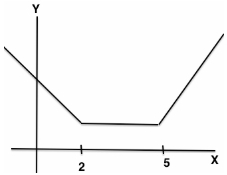
Consider the function $f(x) = |x - 2| + |x - 5|$,$x \in R$.
Statement-$1$: $f'(4) = 0$.
Statement-$2$: $f$ is continuous in $[2, 5]$,differentiable in $(2, 5)$,and $f(2) = f(5)$.
Statement-$1$: $f'(4) = 0$.
Statement-$2$: $f$ is continuous in $[2, 5]$,differentiable in $(2, 5)$,and $f(2) = f(5)$.
A
Statement-$1$ is false,Statement-$2$ is true.
B
Statement-$1$ is true,Statement-$2$ is false.
C
Statement-$1$ is true,Statement-$2$ is true; Statement-$2$ is not a correct explanation for Statement-$1$.
D
Statement-$1$ is true,Statement-$2$ is true; Statement-$2$ is a correct explanation for Statement-$1$.
Solution
(D) The function is defined as $f(x) = |x - 2| + |x - 5|$.
We can express this piecewise as:
$f(x) = \begin{cases} -(x-2) - (x-5) = -2x + 7 & \text{if } x < 2 \\ (x-2) - (x-5) = 3 & \text{if } 2 \le x < 5 \\ (x-2) + (x-5) = 2x - 7 & \text{if } x \ge 5 \end{cases}$
For Statement-$1$:
In the interval $(2, 5)$,$f(x) = 3$. Therefore,$f'(x) = 0$ for all $x \in (2, 5)$.
Since $4 \in (2, 5)$,$f'(4) = 0$. Thus,Statement-$1$ is true.
For Statement-$2$:
$f(x)$ is a sum of continuous functions,so it is continuous everywhere. In $[2, 5]$,$f(x) = 3$,which is a constant function,so it is differentiable in $(2, 5)$.
Also,$f(2) = |2-2| + |2-5| = 3$ and $f(5) = |5-2| + |5-5| = 3$. Thus,$f(2) = f(5)$.
Statement-$2$ is true.
Statement-$2$ describes the conditions of Rolle's Theorem,which implies the existence of a point $c \in (2, 5)$ such that $f'(c) = 0$. Since $f(x)$ is constant on $[2, 5]$,$f'(x) = 0$ for all $x \in (2, 5)$,which confirms Statement-$1$. Thus,Statement-$2$ is a correct explanation for Statement-$1$.
We can express this piecewise as:
$f(x) = \begin{cases} -(x-2) - (x-5) = -2x + 7 & \text{if } x < 2 \\ (x-2) - (x-5) = 3 & \text{if } 2 \le x < 5 \\ (x-2) + (x-5) = 2x - 7 & \text{if } x \ge 5 \end{cases}$
For Statement-$1$:
In the interval $(2, 5)$,$f(x) = 3$. Therefore,$f'(x) = 0$ for all $x \in (2, 5)$.
Since $4 \in (2, 5)$,$f'(4) = 0$. Thus,Statement-$1$ is true.
For Statement-$2$:
$f(x)$ is a sum of continuous functions,so it is continuous everywhere. In $[2, 5]$,$f(x) = 3$,which is a constant function,so it is differentiable in $(2, 5)$.
Also,$f(2) = |2-2| + |2-5| = 3$ and $f(5) = |5-2| + |5-5| = 3$. Thus,$f(2) = f(5)$.
Statement-$2$ is true.
Statement-$2$ describes the conditions of Rolle's Theorem,which implies the existence of a point $c \in (2, 5)$ such that $f'(c) = 0$. Since $f(x)$ is constant on $[2, 5]$,$f'(x) = 0$ for all $x \in (2, 5)$,which confirms Statement-$1$. Thus,Statement-$2$ is a correct explanation for Statement-$1$.
0 likes
View SolutionContinuity and Differentiation — Rolle’s theorem, Lagrange's mean value theorem · Frequently Asked Questions
1Are these Continuity and Differentiation questions useful for JEE and NEET?
Yes. All questions in this section are mapped to JEE Main and NEET exam patterns. Previous year questions from JEE Main, NEET, GUJCET and state-level exams are included with full solutions.
2Can I switch to Hindi or Gujarati for these questions?
Yes. Use the language tabs in the hero section or the sidebar to view the same questions and solutions in English, Hindi or Gujarati.
3How do I generate a question paper from this subtopic?
Use the Vedclass Exam Paper Generator — select the chapter and subtopic, set difficulty, and generate Sets A, B, C, D automatically. First 3 chapters of every subject are free.
Vedclass Products
For Students
Vedclass Test Series
Mock tests in real JEE/NEET style with performance analysis. 5-day free trial.
Start Free TrialFor Teachers
Exam Paper Generator
Generate Set A/B/C/D papers from this chapter in 2 minutes. 3 chapters free.
Try FreeFor Institutes
Online Exam Module
Live online exams with unlimited students, 360° analytics & white-label branding.
See DemoFor Teachers & Institutes
Generate a Continuity and Differentiation Exam Paper in 2 Minutes
Select subtopic & difficulty — Sets A, B, C, D auto-generated with No Repeat logic.
First 3 chapters of every subject are free — no payment required.