
A English
Rate of Change of Quantities Questions in English
Class 12 Mathematics · Applications of Derivatives · Rate of Change of Quantities
365+
Questions
English
Language
100%
With Solutions
Showing 44 of 365 questions in English
301
MediumMCQ
$A$ particle is moving along a line according to the law $S = t^3 - 3t^2 + 4t - 2$,where $S$ is measured in meters and $t$ is measured in seconds. Then the velocity (in $m/s$) of the particle when its acceleration is zero is:
A
$2$
B
$1/4$
C
$17/4$
D
$1$
Solution
(D) Given the position function $S(t) = t^3 - 3t^2 + 4t - 2$.
Velocity $v(t)$ is the derivative of $S(t)$ with respect to $t$:
$v(t) = \frac{dS}{dt} = 3t^2 - 6t + 4$.
Acceleration $a(t)$ is the derivative of $v(t)$ with respect to $t$:
$a(t) = \frac{dv}{dt} = 6t - 6$.
Set acceleration to zero to find the time $t$:
$6t - 6 = 0 \implies t = 1 \text{ second}$.
Now,substitute $t = 1$ into the velocity function:
$v(1) = 3(1)^2 - 6(1) + 4 = 3 - 6 + 4 = 1 \text{ m/s}$.
Thus,the velocity of the particle when its acceleration is zero is $1 \text{ m/s}$.
Velocity $v(t)$ is the derivative of $S(t)$ with respect to $t$:
$v(t) = \frac{dS}{dt} = 3t^2 - 6t + 4$.
Acceleration $a(t)$ is the derivative of $v(t)$ with respect to $t$:
$a(t) = \frac{dv}{dt} = 6t - 6$.
Set acceleration to zero to find the time $t$:
$6t - 6 = 0 \implies t = 1 \text{ second}$.
Now,substitute $t = 1$ into the velocity function:
$v(1) = 3(1)^2 - 6(1) + 4 = 3 - 6 + 4 = 1 \text{ m/s}$.
Thus,the velocity of the particle when its acceleration is zero is $1 \text{ m/s}$.
0 likes
View Solution302
MediumMCQ
If the rate of change of $x$ is more than the rate of change of $y$ on the curve $x^3 = 12y$ for $x > 0$,then $x$ lies in the interval:
A
$(-2, 0) \cup (0, 2)$
B
$(-2, 2)$
C
$[3, \infty)$
D
$(0, 2)$
Solution
(D) Given the curve $x^3 = 12y$. Differentiating both sides with respect to time $t$,we get:
$3x^2 \frac{dx}{dt} = 12 \frac{dy}{dt}$
$\frac{dy}{dt} = \frac{3x^2}{12} \frac{dx}{dt} = \frac{x^2}{4} \frac{dx}{dt}$
Given that the rate of change of $x$ is more than the rate of change of $y$,i.e.,$\frac{dx}{dt} > \frac{dy}{dt}$.
Substituting the value of $\frac{dy}{dt}$:
$\frac{dx}{dt} > \frac{x^2}{4} \frac{dx}{dt}$
Since $x > 0$,$\frac{dx}{dt}$ is positive (assuming $x$ is increasing),so we can divide by $\frac{dx}{dt}$:
$1 > \frac{x^2}{4}$
$x^2 < 4$
$|x| < 2$
Since the condition $x > 0$ is given,the interval for $x$ is $(0, 2)$.
$3x^2 \frac{dx}{dt} = 12 \frac{dy}{dt}$
$\frac{dy}{dt} = \frac{3x^2}{12} \frac{dx}{dt} = \frac{x^2}{4} \frac{dx}{dt}$
Given that the rate of change of $x$ is more than the rate of change of $y$,i.e.,$\frac{dx}{dt} > \frac{dy}{dt}$.
Substituting the value of $\frac{dy}{dt}$:
$\frac{dx}{dt} > \frac{x^2}{4} \frac{dx}{dt}$
Since $x > 0$,$\frac{dx}{dt}$ is positive (assuming $x$ is increasing),so we can divide by $\frac{dx}{dt}$:
$1 > \frac{x^2}{4}$
$x^2 < 4$
$|x| < 2$
Since the condition $x > 0$ is given,the interval for $x$ is $(0, 2)$.
0 likes
View Solution303
MediumMCQ
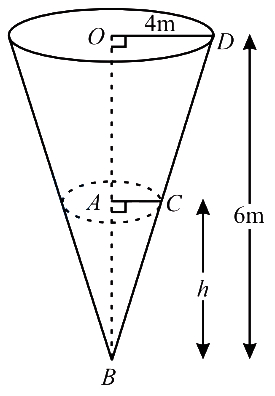
$A$ container is in the shape of an inverted cone. Its height is $6 \ m$ and the radius at the top is $4 \ m$. If it is filled with water at the rate of $3 \ m^3/min$,then the rate of change of the height of the water (in $m/min$) when the water level is $3 \ m$,is
A
$\frac{3}{4 \pi}$
B
$\frac{2}{9 \pi}$
C
$16 \pi$
D
$2 \pi$
Solution
(A) Let $V$ be the volume,$r$ be the radius,and $h$ be the height of the water in the inverted cone at any time $t$.
Given,$\frac{dV}{dt} = 3 \ m^3/min$.
The volume of the cone is $V = \frac{1}{3} \pi r^2 h$.
From the similarity of triangles in the cone,we have $\frac{r}{h} = \frac{4}{6} = \frac{2}{3}$,which implies $r = \frac{2}{3}h$.
Substituting $r$ in the volume formula:
$V = \frac{1}{3} \pi \left(\frac{2}{3}h\right)^2 h = \frac{1}{3} \pi \left(\frac{4}{9}h^2\right) h = \frac{4}{27} \pi h^3$.
Differentiating with respect to $t$:
$\frac{dV}{dt} = \frac{4}{27} \pi (3h^2) \frac{dh}{dt} = \frac{4}{9} \pi h^2 \frac{dh}{dt}$.
Given $\frac{dV}{dt} = 3$ and we need to find $\frac{dh}{dt}$ when $h = 3 \ m$:
$3 = \frac{4}{9} \pi (3)^2 \frac{dh}{dt}$
$3 = \frac{4}{9} \pi (9) \frac{dh}{dt}$
$3 = 4 \pi \frac{dh}{dt}$
$\frac{dh}{dt} = \frac{3}{4 \pi} \ m/min$.
Given,$\frac{dV}{dt} = 3 \ m^3/min$.
The volume of the cone is $V = \frac{1}{3} \pi r^2 h$.
From the similarity of triangles in the cone,we have $\frac{r}{h} = \frac{4}{6} = \frac{2}{3}$,which implies $r = \frac{2}{3}h$.
Substituting $r$ in the volume formula:
$V = \frac{1}{3} \pi \left(\frac{2}{3}h\right)^2 h = \frac{1}{3} \pi \left(\frac{4}{9}h^2\right) h = \frac{4}{27} \pi h^3$.
Differentiating with respect to $t$:
$\frac{dV}{dt} = \frac{4}{27} \pi (3h^2) \frac{dh}{dt} = \frac{4}{9} \pi h^2 \frac{dh}{dt}$.
Given $\frac{dV}{dt} = 3$ and we need to find $\frac{dh}{dt}$ when $h = 3 \ m$:
$3 = \frac{4}{9} \pi (3)^2 \frac{dh}{dt}$
$3 = \frac{4}{9} \pi (9) \frac{dh}{dt}$
$3 = 4 \pi \frac{dh}{dt}$
$\frac{dh}{dt} = \frac{3}{4 \pi} \ m/min$.
0 likes
View Solution304
MediumMCQ
The volume of a sphere is increasing at the rate of $1200 \text{ cm}^3/\text{s}$. The rate of increase in its surface area when the radius is $10 \text{ cm}$ is: (in $\text{ cm}^2/\text{s}$)
A
$120$
B
$240$
C
$200$
D
$100$
Solution
(B) Let $V$ be the volume,$S$ be the surface area,and $r$ be the radius of the sphere.
It is given that $\frac{dV}{dt} = 1200 \text{ cm}^3/\text{s}$ and $r = 10 \text{ cm}$.
The volume of a sphere is $V = \frac{4}{3} \pi r^3$.
Differentiating with respect to $t$,we get $\frac{dV}{dt} = 4 \pi r^2 \frac{dr}{dt}$.
Substituting the given values: $1200 = 4 \pi (10)^2 \frac{dr}{dt} \implies 1200 = 400 \pi \frac{dr}{dt} \implies \frac{dr}{dt} = \frac{3}{\pi} \text{ cm/s}$.
The surface area of a sphere is $S = 4 \pi r^2$.
Differentiating with respect to $t$,we get $\frac{dS}{dt} = 8 \pi r \frac{dr}{dt}$.
Substituting $r = 10 \text{ cm}$ and $\frac{dr}{dt} = \frac{3}{\pi} \text{ cm/s}$:
$\frac{dS}{dt} = 8 \pi (10) \left( \frac{3}{\pi} \right) = 80 \times 3 = 240 \text{ cm}^2/\text{s}$.
It is given that $\frac{dV}{dt} = 1200 \text{ cm}^3/\text{s}$ and $r = 10 \text{ cm}$.
The volume of a sphere is $V = \frac{4}{3} \pi r^3$.
Differentiating with respect to $t$,we get $\frac{dV}{dt} = 4 \pi r^2 \frac{dr}{dt}$.
Substituting the given values: $1200 = 4 \pi (10)^2 \frac{dr}{dt} \implies 1200 = 400 \pi \frac{dr}{dt} \implies \frac{dr}{dt} = \frac{3}{\pi} \text{ cm/s}$.
The surface area of a sphere is $S = 4 \pi r^2$.
Differentiating with respect to $t$,we get $\frac{dS}{dt} = 8 \pi r \frac{dr}{dt}$.
Substituting $r = 10 \text{ cm}$ and $\frac{dr}{dt} = \frac{3}{\pi} \text{ cm/s}$:
$\frac{dS}{dt} = 8 \pi (10) \left( \frac{3}{\pi} \right) = 80 \times 3 = 240 \text{ cm}^2/\text{s}$.
0 likes
View Solution305
DifficultMCQ
If the volume of a sphere increases at the rate of $2 \pi \text{ cm}^3/\text{s}$,then the rate of increase of its radius (in $\text{cm}/\text{s}$),when the volume is $288 \pi \text{ cm}^3$,is
A
$\frac{1}{36}$
B
$\frac{1}{72}$
C
$\frac{1}{18}$
D
$\frac{1}{9}$
Solution
(B) Given that the rate of change of volume is $\frac{dV}{dt} = 2 \pi \text{ cm}^3/\text{s}$.
We know that the volume of a sphere is $V = \frac{4}{3} \pi r^3$.
Differentiating both sides with respect to $t$,we get $\frac{dV}{dt} = 4 \pi r^2 \frac{dr}{dt}$.
Given $V = 288 \pi$,we find the radius $r$ as:
$288 \pi = \frac{4}{3} \pi r^3 \Rightarrow 216 = r^3 \Rightarrow r = 6 \text{ cm}$.
Substituting the values into the derivative equation:
$2 \pi = 4 \pi (6)^2 \frac{dr}{dt}$
$2 \pi = 4 \pi (36) \frac{dr}{dt}$
$2 \pi = 144 \pi \frac{dr}{dt}$
$\frac{dr}{dt} = \frac{2 \pi}{144 \pi} = \frac{1}{72} \text{ cm}/\text{s}$.
We know that the volume of a sphere is $V = \frac{4}{3} \pi r^3$.
Differentiating both sides with respect to $t$,we get $\frac{dV}{dt} = 4 \pi r^2 \frac{dr}{dt}$.
Given $V = 288 \pi$,we find the radius $r$ as:
$288 \pi = \frac{4}{3} \pi r^3 \Rightarrow 216 = r^3 \Rightarrow r = 6 \text{ cm}$.
Substituting the values into the derivative equation:
$2 \pi = 4 \pi (6)^2 \frac{dr}{dt}$
$2 \pi = 4 \pi (36) \frac{dr}{dt}$
$2 \pi = 144 \pi \frac{dr}{dt}$
$\frac{dr}{dt} = \frac{2 \pi}{144 \pi} = \frac{1}{72} \text{ cm}/\text{s}$.
0 likes
View Solution306
DifficultMCQ
The radius of a circular plate is increasing at the rate of $0.01 \text{ cm/s}$ when the radius is $12 \text{ cm}$. Then,the rate at which the area increases,is
A
$0.24 \pi \text{ cm}^2/\text{s}$
B
$60 \pi \text{ cm}^2/\text{s}$
C
$24 \pi \text{ cm}^2/\text{s}$
D
$1.2 \pi \text{ cm}^2/\text{s}$
Solution
(A) The area $A$ of a circular plate with radius $r$ is given by $A = \pi r^2$.
To find the rate at which the area increases,we differentiate $A$ with respect to time $t$:
$\frac{dA}{dt} = \frac{d}{dt}(\pi r^2) = 2 \pi r \frac{dr}{dt}$.
Given that $\frac{dr}{dt} = 0.01 \text{ cm/s}$ and $r = 12 \text{ cm}$,we substitute these values into the equation:
$\frac{dA}{dt} = 2 \pi (12) (0.01) = 0.24 \pi \text{ cm}^2/\text{s}$.
Thus,the rate at which the area increases is $0.24 \pi \text{ cm}^2/\text{s}$.
To find the rate at which the area increases,we differentiate $A$ with respect to time $t$:
$\frac{dA}{dt} = \frac{d}{dt}(\pi r^2) = 2 \pi r \frac{dr}{dt}$.
Given that $\frac{dr}{dt} = 0.01 \text{ cm/s}$ and $r = 12 \text{ cm}$,we substitute these values into the equation:
$\frac{dA}{dt} = 2 \pi (12) (0.01) = 0.24 \pi \text{ cm}^2/\text{s}$.
Thus,the rate at which the area increases is $0.24 \pi \text{ cm}^2/\text{s}$.
0 likes
View Solution307
DifficultMCQ
Gas is being pumped into a spherical balloon at the rate of $30 \ ft^3 / \text{min}$. The rate at which the radius increases when it reaches the value $15 \ ft$,is:
A
$\frac{1}{30 \pi} \ ft / \text{min}$
B
$\frac{1}{15 \pi} \ ft / \text{min}$
C
$\frac{1}{20} \ ft / \text{min}$
D
$\frac{1}{25} \ ft / \text{min}$
Solution
(A) Given that,the rate of change of volume is $\frac{dV}{dt} = 30 \ ft^3 / \text{min}$ and the radius $r = 15 \ ft$.
The volume of a sphere is given by $V = \frac{4}{3} \pi r^3$.
Differentiating both sides with respect to time $t$,we get $\frac{dV}{dt} = 4 \pi r^2 \frac{dr}{dt}$.
Substituting the given values,$30 = 4 \pi (15)^2 \frac{dr}{dt}$.
$30 = 4 \pi (225) \frac{dr}{dt} = 900 \pi \frac{dr}{dt}$.
Therefore,$\frac{dr}{dt} = \frac{30}{900 \pi} = \frac{1}{30 \pi} \ ft / \text{min}$.
The volume of a sphere is given by $V = \frac{4}{3} \pi r^3$.
Differentiating both sides with respect to time $t$,we get $\frac{dV}{dt} = 4 \pi r^2 \frac{dr}{dt}$.
Substituting the given values,$30 = 4 \pi (15)^2 \frac{dr}{dt}$.
$30 = 4 \pi (225) \frac{dr}{dt} = 900 \pi \frac{dr}{dt}$.
Therefore,$\frac{dr}{dt} = \frac{30}{900 \pi} = \frac{1}{30 \pi} \ ft / \text{min}$.
0 likes
View Solution308
MediumMCQ
$A$ particle moves along a straight line according to the law $s = \frac{1}{3} t^3 - 3 t^2 + 9 t + 17$,where $s$ is in metre and $t$ is in second. Its velocity decreases in
A
$0 < t < 5$
B
$0 < t < 3$
C
$t > 5$
D
$t > 3$
Solution
(B) Given the displacement function: $s = \frac{1}{3} t^3 - 3 t^2 + 9 t + 17$.
The velocity $v$ is the derivative of displacement with respect to time: $v = \frac{ds}{dt} = t^2 - 6 t + 9$.
To find when the velocity decreases,we calculate the acceleration $a = \frac{dv}{dt}$.
$a = \frac{dv}{dt} = 2 t - 6$.
Velocity decreases when the acceleration is negative,i.e.,$\frac{dv}{dt} < 0$.
$2 t - 6 < 0 \implies 2 t < 6 \implies t < 3$.
Since time $t$ must be greater than $0$,the velocity decreases in the interval $0 < t < 3$.
The velocity $v$ is the derivative of displacement with respect to time: $v = \frac{ds}{dt} = t^2 - 6 t + 9$.
To find when the velocity decreases,we calculate the acceleration $a = \frac{dv}{dt}$.
$a = \frac{dv}{dt} = 2 t - 6$.
Velocity decreases when the acceleration is negative,i.e.,$\frac{dv}{dt} < 0$.
$2 t - 6 < 0 \implies 2 t < 6 \implies t < 3$.
Since time $t$ must be greater than $0$,the velocity decreases in the interval $0 < t < 3$.
0 likes
View Solution309
EasyMCQ
The side of an equilateral triangle is increasing at the rate of $2 \text{ cm/s}$. Find the rate at which the area is increasing when the side of the triangle is $20 \text{ cm}$.
A
$5 \sqrt{3} \text{ cm}^2/\text{s}$
B
$10 \sqrt{3} \text{ cm}^2/\text{s}$
C
$20 \sqrt{3} \text{ cm}^2/\text{s}$
D
$40 \sqrt{3} \text{ cm}^2/\text{s}$
Solution
(C) Let $a$ be the side of the equilateral triangle and $A$ be its area.
The area of an equilateral triangle is given by $A = \frac{\sqrt{3}}{4} a^2$.
Differentiating both sides with respect to time $t$,we get:
$\frac{dA}{dt} = \frac{\sqrt{3}}{4} \times 2a \times \frac{da}{dt} = \frac{\sqrt{3}}{2} a \frac{da}{dt}$.
Given that $\frac{da}{dt} = 2 \text{ cm/s}$ and $a = 20 \text{ cm}$.
Substituting these values into the equation:
$\frac{dA}{dt} = \frac{\sqrt{3}}{2} \times 20 \times 2 = 20 \sqrt{3} \text{ cm}^2/\text{s}$.
Thus,the rate at which the area is increasing is $20 \sqrt{3} \text{ cm}^2/\text{s}$.
The area of an equilateral triangle is given by $A = \frac{\sqrt{3}}{4} a^2$.
Differentiating both sides with respect to time $t$,we get:
$\frac{dA}{dt} = \frac{\sqrt{3}}{4} \times 2a \times \frac{da}{dt} = \frac{\sqrt{3}}{2} a \frac{da}{dt}$.
Given that $\frac{da}{dt} = 2 \text{ cm/s}$ and $a = 20 \text{ cm}$.
Substituting these values into the equation:
$\frac{dA}{dt} = \frac{\sqrt{3}}{2} \times 20 \times 2 = 20 \sqrt{3} \text{ cm}^2/\text{s}$.
Thus,the rate at which the area is increasing is $20 \sqrt{3} \text{ cm}^2/\text{s}$.
0 likes
View Solution310
EasyMCQ
Let a kind of bacteria grow following the function $f(t) = t^4$,where $t$ is given in seconds. If the rate of growth of the bacteria after $t_0$ seconds is $4000 \text{ units/second}$,then $t_0 =$
A
$0$
B
$10$
C
$20$
D
$30$
Solution
(B) The growth function of the bacteria is given by $f(t) = t^4$.
To find the rate of growth,we calculate the derivative of $f(t)$ with respect to time $t$:
$f'(t) = \frac{d}{dt}(t^4) = 4t^3$.
We are given that the rate of growth at $t = t_0$ is $4000 \text{ units/second}$.
Therefore,$f'(t_0) = 4t_0^3 = 4000$.
Dividing both sides by $4$,we get $t_0^3 = 1000$.
Taking the cube root of both sides,$t_0 = \sqrt[3]{1000} = 10$.
Thus,$t_0 = 10$ seconds.
To find the rate of growth,we calculate the derivative of $f(t)$ with respect to time $t$:
$f'(t) = \frac{d}{dt}(t^4) = 4t^3$.
We are given that the rate of growth at $t = t_0$ is $4000 \text{ units/second}$.
Therefore,$f'(t_0) = 4t_0^3 = 4000$.
Dividing both sides by $4$,we get $t_0^3 = 1000$.
Taking the cube root of both sides,$t_0 = \sqrt[3]{1000} = 10$.
Thus,$t_0 = 10$ seconds.
0 likes
View Solution311
EasyMCQ
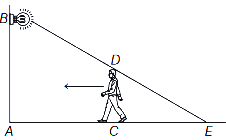
$A$ man $2 \text{ m}$ tall walks at the rate of $1 \frac{2}{3} \text{ m/s}$ towards a street light which is $5 \frac{1}{3} \text{ m}$ above the ground. The rate at which the length of his shadow is changing when he is $3 \frac{1}{3} \text{ m}$ away from the base of the light is . . . . . . (in $\text{ m/s}$)
A
$-1$
B
$2$
C
$-2$
D
$1$
Solution
(A) Let $AB$ be the street light of height $H = 5 \frac{1}{3} = \frac{16}{3} \text{ m}$. Let $CD$ be the man of height $h = 2 \text{ m}$. Let $AC = x$ be the distance of the man from the light and $CE = y$ be the length of his shadow.
From similar triangles $\triangle ABE$ and $\triangle DCE$,we have:
$\frac{AB}{CD} = \frac{AE}{CE} \Rightarrow \frac{16/3}{2} = \frac{x+y}{y}$
$\frac{8}{3} = \frac{x}{y} + 1$ $\Rightarrow \frac{x}{y} = \frac{5}{3}$ $\Rightarrow y = \frac{3}{5}x$
Differentiating with respect to time $t$:
$\frac{dy}{dt} = \frac{3}{5} \frac{dx}{dt}$
Given that the man walks towards the light at $1 \frac{2}{3} \text{ m/s}$,so $\frac{dx}{dt} = -\frac{5}{3} \text{ m/s}$ (negative because $x$ is decreasing).
Therefore,$\frac{dy}{dt} = \frac{3}{5} \times (-\frac{5}{3}) = -1 \text{ m/s}$.
The length of the shadow is changing at the rate of $-1 \text{ m/s}$.
From similar triangles $\triangle ABE$ and $\triangle DCE$,we have:
$\frac{AB}{CD} = \frac{AE}{CE} \Rightarrow \frac{16/3}{2} = \frac{x+y}{y}$
$\frac{8}{3} = \frac{x}{y} + 1$ $\Rightarrow \frac{x}{y} = \frac{5}{3}$ $\Rightarrow y = \frac{3}{5}x$
Differentiating with respect to time $t$:
$\frac{dy}{dt} = \frac{3}{5} \frac{dx}{dt}$
Given that the man walks towards the light at $1 \frac{2}{3} \text{ m/s}$,so $\frac{dx}{dt} = -\frac{5}{3} \text{ m/s}$ (negative because $x$ is decreasing).
Therefore,$\frac{dy}{dt} = \frac{3}{5} \times (-\frac{5}{3}) = -1 \text{ m/s}$.
The length of the shadow is changing at the rate of $-1 \text{ m/s}$.
0 likes
View Solution312
EasyMCQ
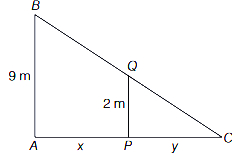
$A$ man of height $2 \ m$ walks at a uniform speed of $7 \ m/min$ away from a lamp post of height $9 \ m$. The rate (in $m/min$) at which the length of his shadow increases is
A
$2$
B
$\frac{5}{2}$
C
$3$
D
$\frac{7}{2}$
Solution
(A) Let $AB$ be the lamp-post and $PQ$ be the man. Let $C$ be the tip of the shadow. Let $AP = x$ be the distance of the man from the lamp-post and $PC = y$ be the length of his shadow.
Given: $AB = 9 \ m$,$PQ = 2 \ m$,and $\frac{dx}{dt} = 7 \ m/min$.
Since $\triangle CAB$ and $\triangle CPQ$ are similar triangles,we have:
$\frac{PC}{AC} = \frac{PQ}{AB}$
$\frac{y}{x+y} = \frac{2}{9}$
$9y = 2x + 2y$
$7y = 2x$
$x = \frac{7}{2}y$
Differentiating both sides with respect to time $t$:
$\frac{dx}{dt} = \frac{7}{2} \frac{dy}{dt}$
Substituting $\frac{dx}{dt} = 7$:
$7 = \frac{7}{2} \frac{dy}{dt}$
$\frac{dy}{dt} = 2 \ m/min$.
Thus,the length of his shadow increases at a rate of $2 \ m/min$.
Given: $AB = 9 \ m$,$PQ = 2 \ m$,and $\frac{dx}{dt} = 7 \ m/min$.
Since $\triangle CAB$ and $\triangle CPQ$ are similar triangles,we have:
$\frac{PC}{AC} = \frac{PQ}{AB}$
$\frac{y}{x+y} = \frac{2}{9}$
$9y = 2x + 2y$
$7y = 2x$
$x = \frac{7}{2}y$
Differentiating both sides with respect to time $t$:
$\frac{dx}{dt} = \frac{7}{2} \frac{dy}{dt}$
Substituting $\frac{dx}{dt} = 7$:
$7 = \frac{7}{2} \frac{dy}{dt}$
$\frac{dy}{dt} = 2 \ m/min$.
Thus,the length of his shadow increases at a rate of $2 \ m/min$.
0 likes
View Solution313
EasyMCQ
Let $x$ and $y$ be the sides of two squares such that $y = x - x^2$. The rate of change of the area of the second square with respect to the area of the first square is
A
$1 - 3 x + 2 x^2$
B
$1 + 3 x - 2 x^2$
C
$2 x$
D
$x + 2 x^3 - 3 x^2$
Solution
(A) Let $A_1$ be the area of the first square and $A_2$ be the area of the second square.
Given the side of the first square is $x$,its area is $A_1 = x^2$.
Given the side of the second square is $y = x - x^2$,its area is $A_2 = y^2 = (x - x^2)^2$.
Expanding this,we get $A_2 = x^2 - 2 x^3 + x^4$.
We need to find the rate of change of $A_2$ with respect to $A_1$,which is $\frac{d A_2}{d A_1}$.
Using the chain rule,$\frac{d A_2}{d A_1} = \frac{d A_2 / d x}{d A_1 / d x}$.
First,calculate the derivatives with respect to $x$:
$\frac{d A_1}{d x} = \frac{d}{d x}(x^2) = 2 x$.
$\frac{d A_2}{d x} = \frac{d}{d x}(x^2 - 2 x^3 + x^4) = 2 x - 6 x^2 + 4 x^3$.
Now,substitute these into the chain rule formula:
$\frac{d A_2}{d A_1} = \frac{2 x - 6 x^2 + 4 x^3}{2 x} = \frac{2 x(1 - 3 x + 2 x^2)}{2 x} = 1 - 3 x + 2 x^2$.
Given the side of the first square is $x$,its area is $A_1 = x^2$.
Given the side of the second square is $y = x - x^2$,its area is $A_2 = y^2 = (x - x^2)^2$.
Expanding this,we get $A_2 = x^2 - 2 x^3 + x^4$.
We need to find the rate of change of $A_2$ with respect to $A_1$,which is $\frac{d A_2}{d A_1}$.
Using the chain rule,$\frac{d A_2}{d A_1} = \frac{d A_2 / d x}{d A_1 / d x}$.
First,calculate the derivatives with respect to $x$:
$\frac{d A_1}{d x} = \frac{d}{d x}(x^2) = 2 x$.
$\frac{d A_2}{d x} = \frac{d}{d x}(x^2 - 2 x^3 + x^4) = 2 x - 6 x^2 + 4 x^3$.
Now,substitute these into the chain rule formula:
$\frac{d A_2}{d A_1} = \frac{2 x - 6 x^2 + 4 x^3}{2 x} = \frac{2 x(1 - 3 x + 2 x^2)}{2 x} = 1 - 3 x + 2 x^2$.
0 likes
View Solution314
EasyMCQ
The radius of a circle is increasing at a rate of $0.1 \text{ cm s}^{-1}$. Then the rate of change of area,when its radius is $5 \text{ cm}$,is .........
A
$\pi^2 \text{ cm}^2 \text{ s}^{-1}$
B
$\pi \text{ cm}^2 \text{ s}^{-1}$
C
$2 \pi \text{ cm}^2 \text{ s}^{-1}$
D
$\frac{\pi}{2} \text{ cm}^2 \text{ s}^{-1}$
Solution
(B) Let the radius of the circle be $r \text{ cm}$ and its area be $A \text{ cm}^2$.
Given that the rate of change of the radius is $\frac{dr}{dt} = 0.1 \text{ cm s}^{-1}$.
The area of a circle is given by $A = \pi r^2$.
Differentiating both sides with respect to time $t$,we get $\frac{dA}{dt} = 2 \pi r \frac{dr}{dt}$.
Substituting the given values $r = 5 \text{ cm}$ and $\frac{dr}{dt} = 0.1 \text{ cm s}^{-1}$,we have:
$\frac{dA}{dt} = 2 \pi (5) (0.1) = 10 \pi (0.1) = \pi \text{ cm}^2 \text{ s}^{-1}$.
Thus,the rate of change of the area is $\pi \text{ cm}^2 \text{ s}^{-1}$.
Given that the rate of change of the radius is $\frac{dr}{dt} = 0.1 \text{ cm s}^{-1}$.
The area of a circle is given by $A = \pi r^2$.
Differentiating both sides with respect to time $t$,we get $\frac{dA}{dt} = 2 \pi r \frac{dr}{dt}$.
Substituting the given values $r = 5 \text{ cm}$ and $\frac{dr}{dt} = 0.1 \text{ cm s}^{-1}$,we have:
$\frac{dA}{dt} = 2 \pi (5) (0.1) = 10 \pi (0.1) = \pi \text{ cm}^2 \text{ s}^{-1}$.
Thus,the rate of change of the area is $\pi \text{ cm}^2 \text{ s}^{-1}$.
0 likes
View Solution315
MediumMCQ
If the rate of change of the slope of the tangent drawn to the curve $y=x^3-2x^2+3x-2$ at the point $(2,4)$ is $k$ times the rate of change of its abscissa,then $k=$
A
$2$
B
$4$
C
$6$
D
$8$
Solution
(D) Given the curve $y = x^3 - 2x^2 + 3x - 2$.
The slope of the tangent $m$ is given by $\frac{dy}{dx} = 3x^2 - 4x + 3$.
We need to find the rate of change of the slope $m$ with respect to time $t$,which is $\frac{dm}{dt}$.
Differentiating $m$ with respect to $x$,we get $\frac{dm}{dx} = \frac{d}{dx}(3x^2 - 4x + 3) = 6x - 4$.
By the chain rule,$\frac{dm}{dt} = \frac{dm}{dx} \cdot \frac{dx}{dt} = (6x - 4) \frac{dx}{dt}$.
At the point $(2, 4)$,$x = 2$.
Substituting $x = 2$ into the expression,we get $\frac{dm}{dt} = (6(2) - 4) \frac{dx}{dt} = (12 - 4) \frac{dx}{dt} = 8 \frac{dx}{dt}$.
The problem states that $\frac{dm}{dt} = k \cdot \frac{dx}{dt}$.
Comparing the two expressions,we find $k = 8$.
The slope of the tangent $m$ is given by $\frac{dy}{dx} = 3x^2 - 4x + 3$.
We need to find the rate of change of the slope $m$ with respect to time $t$,which is $\frac{dm}{dt}$.
Differentiating $m$ with respect to $x$,we get $\frac{dm}{dx} = \frac{d}{dx}(3x^2 - 4x + 3) = 6x - 4$.
By the chain rule,$\frac{dm}{dt} = \frac{dm}{dx} \cdot \frac{dx}{dt} = (6x - 4) \frac{dx}{dt}$.
At the point $(2, 4)$,$x = 2$.
Substituting $x = 2$ into the expression,we get $\frac{dm}{dt} = (6(2) - 4) \frac{dx}{dt} = (12 - 4) \frac{dx}{dt} = 8 \frac{dx}{dt}$.
The problem states that $\frac{dm}{dt} = k \cdot \frac{dx}{dt}$.
Comparing the two expressions,we find $k = 8$.
0 likes
View Solution316
MediumMCQ
If a particle is moving in a straight line so that after $t$ seconds its distance $S$ (in $cm$) from a fixed point on the line is given by $S = f(t) = t^3 - 5t^2 + 8t$,then the acceleration of the particle at $t = 5 \text{ sec}$ is (in $cm/sec^2$).
A
$10$
B
$30$
C
$20$
D
$40$
Solution
(C) The distance of the particle is given by $S = f(t) = t^3 - 5t^2 + 8t$.
Velocity $v(t)$ is the first derivative of distance with respect to time $t$:
$v(t) = \frac{dS}{dt} = \frac{d}{dt}(t^3 - 5t^2 + 8t) = 3t^2 - 10t + 8$.
Acceleration $a(t)$ is the derivative of velocity with respect to time $t$:
$a(t) = \frac{dv}{dt} = \frac{d}{dt}(3t^2 - 10t + 8) = 6t - 10$.
To find the acceleration at $t = 5 \text{ sec}$,substitute $t = 5$ into the acceleration equation:
$a(5) = 6(5) - 10 = 30 - 10 = 20 \text{ cm/sec}^2$.
Thus,the acceleration of the particle at $t = 5 \text{ sec}$ is $20 \text{ cm/sec}^2$.
Velocity $v(t)$ is the first derivative of distance with respect to time $t$:
$v(t) = \frac{dS}{dt} = \frac{d}{dt}(t^3 - 5t^2 + 8t) = 3t^2 - 10t + 8$.
Acceleration $a(t)$ is the derivative of velocity with respect to time $t$:
$a(t) = \frac{dv}{dt} = \frac{d}{dt}(3t^2 - 10t + 8) = 6t - 10$.
To find the acceleration at $t = 5 \text{ sec}$,substitute $t = 5$ into the acceleration equation:
$a(5) = 6(5) - 10 = 30 - 10 = 20 \text{ cm/sec}^2$.
Thus,the acceleration of the particle at $t = 5 \text{ sec}$ is $20 \text{ cm/sec}^2$.
0 likes
View Solution317
MediumMCQ
If a balloon lying at an altitude of $30 \ m$ from an observer at a particular instant is moving horizontally at the rate of $1 \ m/s$ away from him,then the rate at which the balloon is moving away directly from the observer at the $40^{\text{th}}$ second is (in $m/s$)
A
$1.2$
B
$0.9$
C
$0.6$
D
$0.8$
Solution
(D) Let the position of the observer be at the origin $(0, 0)$. The balloon is at a constant altitude $y = 30 \ m$. Let its horizontal position at time $t$ be $x(t)$. Given that the balloon moves horizontally at $1 \ m/s$,we have $x(t) = 1 \cdot t = t$ (assuming it starts at $x=0$ at $t=0$).
The distance $s$ of the balloon from the observer is given by $s = \sqrt{x^2 + y^2} = \sqrt{t^2 + 30^2}$.
To find the rate at which the balloon is moving away from the observer,we differentiate $s$ with respect to $t$:
$\frac{ds}{dt} = \frac{1}{2\sqrt{t^2 + 30^2}} \cdot 2t = \frac{t}{\sqrt{t^2 + 30^2}}$.
At $t = 40 \ s$:
$\frac{ds}{dt} = \frac{40}{\sqrt{40^2 + 30^2}} = \frac{40}{\sqrt{1600 + 900}} = \frac{40}{\sqrt{2500}} = \frac{40}{50} = 0.8 \ m/s$.
Thus,the rate is $0.8 \ m/s$.
The distance $s$ of the balloon from the observer is given by $s = \sqrt{x^2 + y^2} = \sqrt{t^2 + 30^2}$.
To find the rate at which the balloon is moving away from the observer,we differentiate $s$ with respect to $t$:
$\frac{ds}{dt} = \frac{1}{2\sqrt{t^2 + 30^2}} \cdot 2t = \frac{t}{\sqrt{t^2 + 30^2}}$.
At $t = 40 \ s$:
$\frac{ds}{dt} = \frac{40}{\sqrt{40^2 + 30^2}} = \frac{40}{\sqrt{1600 + 900}} = \frac{40}{\sqrt{2500}} = \frac{40}{50} = 0.8 \ m/s$.
Thus,the rate is $0.8 \ m/s$.
0 likes
View Solution318
MediumMCQ
$A$ man of $5 \text{ feet}$ height is walking away from a light fixed at a height of $15 \text{ feet}$ at the rate of $K \text{ miles/hour}$. If the rate of increase of his shadow is $\frac{11}{5} \text{ feet/sec}$,then $K=$ (Take $1 \text{ mile} = 5280 \text{ feet}$)
A
$2$
B
$3$
C
$4$
D
$5$
Solution
(B) Let $H = 15 \text{ ft}$ be the height of the light and $h = 5 \text{ ft}$ be the height of the man.
Let $x$ be the distance of the man from the light source and $s$ be the length of his shadow.
By similar triangles,we have $\frac{s}{h} = \frac{x+s}{H}$.
Substituting the values,$\frac{s}{5} = \frac{x+s}{15} \implies 3s = x + s \implies 2s = x$.
Differentiating with respect to time $t$,we get $2 \frac{ds}{dt} = \frac{dx}{dt}$.
Given $\frac{ds}{dt} = \frac{11}{5} \text{ ft/sec}$,so $\frac{dx}{dt} = 2 \times \frac{11}{5} = \frac{22}{5} \text{ ft/sec}$.
To convert $\frac{dx}{dt}$ to $\text{miles/hour}$,we have $\frac{22}{5} \text{ ft/sec} = \frac{22}{5} \times 3600 \text{ ft/hour} = \frac{22 \times 3600}{5 \times 5280} \text{ miles/hour}$.
Calculating this,$\frac{79200}{26400} = 3 \text{ miles/hour}$.
Thus,$K = 3$.
Let $x$ be the distance of the man from the light source and $s$ be the length of his shadow.
By similar triangles,we have $\frac{s}{h} = \frac{x+s}{H}$.
Substituting the values,$\frac{s}{5} = \frac{x+s}{15} \implies 3s = x + s \implies 2s = x$.
Differentiating with respect to time $t$,we get $2 \frac{ds}{dt} = \frac{dx}{dt}$.
Given $\frac{ds}{dt} = \frac{11}{5} \text{ ft/sec}$,so $\frac{dx}{dt} = 2 \times \frac{11}{5} = \frac{22}{5} \text{ ft/sec}$.
To convert $\frac{dx}{dt}$ to $\text{miles/hour}$,we have $\frac{22}{5} \text{ ft/sec} = \frac{22}{5} \times 3600 \text{ ft/hour} = \frac{22 \times 3600}{5 \times 5280} \text{ miles/hour}$.
Calculating this,$\frac{79200}{26400} = 3 \text{ miles/hour}$.
Thus,$K = 3$.
0 likes
View Solution319
MediumMCQ
$A$ rod of length $41 \ ft$ with an end $A$ on the floor and another end $B$ on the wall perpendicular to the floor is sliding away horizontally from the wall at the rate of $3 \ ft/min$. When the end $B$ is at a height of $9 \ ft$ from the floor,the rate at which the area of the triangle formed by the rod with the wall and the floor changes at that instant is (in $ft^2/min$):
A
$-\frac{1519}{6}$
B
$\frac{1618}{3}$
C
$-\frac{1600}{3}$
D
$\frac{1509}{6}$
Solution
(A) Let $x$ be the distance of end $A$ from the wall and $y$ be the height of end $B$ from the floor. The length of the rod is constant,so $x^2 + y^2 = 41^2 = 1681$.
Differentiating with respect to time $t$,we get $2x \frac{dx}{dt} + 2y \frac{dy}{dt} = 0$,which simplifies to $x \frac{dx}{dt} + y \frac{dy}{dt} = 0$.
Given $\frac{dx}{dt} = 3 \ ft/min$. When $y = 9$,$x^2 + 9^2 = 1681 \implies x^2 = 1681 - 81 = 1600 \implies x = 40 \ ft$.
Substituting these values: $40(3) + 9 \frac{dy}{dt} = 0 \implies 9 \frac{dy}{dt} = -120 \implies \frac{dy}{dt} = -\frac{120}{9} = -\frac{40}{3} \ ft/min$.
The area of the triangle is $A = \frac{1}{2}xy$.
Differentiating with respect to $t$: $\frac{dA}{dt} = \frac{1}{2} \left( x \frac{dy}{dt} + y \frac{dx}{dt} \right)$.
Substituting the values: $\frac{dA}{dt} = \frac{1}{2} \left( 40 \times (-\frac{40}{3}) + 9 \times 3 \right) = \frac{1}{2} \left( -\frac{1600}{3} + 27 \right) = \frac{1}{2} \left( \frac{-1600 + 81}{3} \right) = \frac{1}{2} \left( -\frac{1519}{3} \right) = -\frac{1519}{6} \ ft^2/min$.
Differentiating with respect to time $t$,we get $2x \frac{dx}{dt} + 2y \frac{dy}{dt} = 0$,which simplifies to $x \frac{dx}{dt} + y \frac{dy}{dt} = 0$.
Given $\frac{dx}{dt} = 3 \ ft/min$. When $y = 9$,$x^2 + 9^2 = 1681 \implies x^2 = 1681 - 81 = 1600 \implies x = 40 \ ft$.
Substituting these values: $40(3) + 9 \frac{dy}{dt} = 0 \implies 9 \frac{dy}{dt} = -120 \implies \frac{dy}{dt} = -\frac{120}{9} = -\frac{40}{3} \ ft/min$.
The area of the triangle is $A = \frac{1}{2}xy$.
Differentiating with respect to $t$: $\frac{dA}{dt} = \frac{1}{2} \left( x \frac{dy}{dt} + y \frac{dx}{dt} \right)$.
Substituting the values: $\frac{dA}{dt} = \frac{1}{2} \left( 40 \times (-\frac{40}{3}) + 9 \times 3 \right) = \frac{1}{2} \left( -\frac{1600}{3} + 27 \right) = \frac{1}{2} \left( \frac{-1600 + 81}{3} \right) = \frac{1}{2} \left( -\frac{1519}{3} \right) = -\frac{1519}{6} \ ft^2/min$.
0 likes
View Solution320
MediumMCQ
The height of a cone with semi-vertical angle $\pi / 3$ is increasing at the rate of $2 \text{ units/min}$. The rate at which the radius of the cone is to be decreased so as to have a fixed volume always is
A
$\frac{1}{\sqrt{3}}$
B
$\frac{1}{\sqrt{2}}$
C
$\sqrt{3}$
D
$\sqrt{2}$
Solution
(C) Let $h$ be the height and $r$ be the radius of the cone. The semi-vertical angle $\alpha = \pi / 3$.
We know that $\tan(\alpha) = r / h$,so $r = h \tan(\pi / 3) = h \sqrt{3}$.
The volume of the cone is $V = \frac{1}{3} \pi r^2 h$.
Substituting $r = h \sqrt{3}$,we get $V = \frac{1}{3} \pi (h \sqrt{3})^2 h = \pi h^3$.
Since the volume $V$ is fixed,differentiating with respect to time $t$ gives $\frac{dV}{dt} = 3 \pi h^2 \frac{dh}{dt} = 0$.
However,the problem implies $V$ is constant at a specific instant.
From $V = \frac{1}{3} \pi r^2 h$,differentiating with respect to $t$: $\frac{dV}{dt} = \frac{1}{3} \pi (2rh \frac{dr}{dt} + r^2 \frac{dh}{dt}) = 0$.
Thus,$2rh \frac{dr}{dt} = -r^2 \frac{dh}{dt}$,which simplifies to $\frac{dr}{dt} = -\frac{r}{2h} \frac{dh}{dt}$.
Given $\frac{dh}{dt} = 2$ and $r = h \sqrt{3}$,we have $\frac{dr}{dt} = -\frac{h \sqrt{3}}{2h} (2) = -\sqrt{3}$.
The rate at which the radius is decreasing is $\sqrt{3} \text{ units/min}$.
We know that $\tan(\alpha) = r / h$,so $r = h \tan(\pi / 3) = h \sqrt{3}$.
The volume of the cone is $V = \frac{1}{3} \pi r^2 h$.
Substituting $r = h \sqrt{3}$,we get $V = \frac{1}{3} \pi (h \sqrt{3})^2 h = \pi h^3$.
Since the volume $V$ is fixed,differentiating with respect to time $t$ gives $\frac{dV}{dt} = 3 \pi h^2 \frac{dh}{dt} = 0$.
However,the problem implies $V$ is constant at a specific instant.
From $V = \frac{1}{3} \pi r^2 h$,differentiating with respect to $t$: $\frac{dV}{dt} = \frac{1}{3} \pi (2rh \frac{dr}{dt} + r^2 \frac{dh}{dt}) = 0$.
Thus,$2rh \frac{dr}{dt} = -r^2 \frac{dh}{dt}$,which simplifies to $\frac{dr}{dt} = -\frac{r}{2h} \frac{dh}{dt}$.
Given $\frac{dh}{dt} = 2$ and $r = h \sqrt{3}$,we have $\frac{dr}{dt} = -\frac{h \sqrt{3}}{2h} (2) = -\sqrt{3}$.
The rate at which the radius is decreasing is $\sqrt{3} \text{ units/min}$.
0 likes
View Solution321
EasyMCQ
$A$ particle moving from a fixed point on a straight line travels a distance $S$ metres in $t$ seconds. If $S = t^3 - t^2 - t + 3$,then the distance (in metres) travelled by the particle when it comes to rest is:
A
$5$
B
$4$
C
$2$
D
$3$
Solution
(C) The distance $S$ is given by the function $S(t) = t^3 - t^2 - t + 3$.
The velocity $v$ of the particle is the rate of change of distance with respect to time,given by $v = \frac{dS}{dt}$.
$v = \frac{d}{dt}(t^3 - t^2 - t + 3) = 3t^2 - 2t - 1$.
The particle comes to rest when its velocity $v = 0$.
Setting $v = 0$,we get $3t^2 - 2t - 1 = 0$.
Factoring the quadratic equation: $3t^2 - 3t + t - 1 = 0 \Rightarrow 3t(t - 1) + 1(t - 1) = 0 \Rightarrow (3t + 1)(t - 1) = 0$.
Since time $t$ cannot be negative,we take $t = 1$ second.
Now,substitute $t = 1$ into the distance equation $S(t)$:
$S(1) = (1)^3 - (1)^2 - (1) + 3 = 1 - 1 - 1 + 3 = 2$ metres.
Thus,the distance travelled by the particle when it comes to rest is $2$ metres.
The velocity $v$ of the particle is the rate of change of distance with respect to time,given by $v = \frac{dS}{dt}$.
$v = \frac{d}{dt}(t^3 - t^2 - t + 3) = 3t^2 - 2t - 1$.
The particle comes to rest when its velocity $v = 0$.
Setting $v = 0$,we get $3t^2 - 2t - 1 = 0$.
Factoring the quadratic equation: $3t^2 - 3t + t - 1 = 0 \Rightarrow 3t(t - 1) + 1(t - 1) = 0 \Rightarrow (3t + 1)(t - 1) = 0$.
Since time $t$ cannot be negative,we take $t = 1$ second.
Now,substitute $t = 1$ into the distance equation $S(t)$:
$S(1) = (1)^3 - (1)^2 - (1) + 3 = 1 - 1 - 1 + 3 = 2$ metres.
Thus,the distance travelled by the particle when it comes to rest is $2$ metres.
0 likes
View Solution322
EasyMCQ
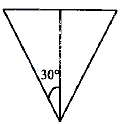
The vertical angle of a right circular cone is $60^{\circ}$. If water is being poured into the cone at the rate of $\frac{1}{\sqrt{3}} \text{ m}^3/\text{min}$,then the rate $(\text{m/min})$ at which the radius of the water level is increasing when the height of the water level is $3 \text{ m}$ is
A
$\frac{1}{3 \sqrt{3} \pi}$
B
$\frac{1}{9 \sqrt{3} \pi}$
C
$\frac{1}{9 \pi}$
D
$\frac{1}{33}$
Solution
(C) Let $r$ be the radius and $h$ be the height of the water level in the cone at any time $t$.
The vertical angle is $60^{\circ}$,so the semi-vertical angle is $30^{\circ}$.
From the geometry of the cone,$\frac{r}{h} = \tan 30^{\circ} = \frac{1}{\sqrt{3}}$,which implies $h = \sqrt{3}r$.
The volume $V$ of the water in the cone is given by $V = \frac{1}{3} \pi r^2 h$.
Substituting $h = \sqrt{3}r$,we get $V = \frac{1}{3} \pi r^2 (\sqrt{3}r) = \frac{\sqrt{3}}{3} \pi r^3 = \frac{1}{\sqrt{3}} \pi r^3$.
Differentiating with respect to $t$,we get $\frac{dV}{dt} = \frac{1}{\sqrt{3}} \pi (3r^2) \frac{dr}{dt} = \sqrt{3} \pi r^2 \frac{dr}{dt}$.
Given $\frac{dV}{dt} = \frac{1}{\sqrt{3}}$,we have $\sqrt{3} \pi r^2 \frac{dr}{dt} = \frac{1}{\sqrt{3}}$,so $\frac{dr}{dt} = \frac{1}{3 \pi r^2}$.
Since $h = \sqrt{3}r$,when $h = 3 \text{ m}$,$r = \frac{3}{\sqrt{3}} = \sqrt{3} \text{ m}$.
Substituting $r = \sqrt{3}$ into the expression for $\frac{dr}{dt}$,we get $\frac{dr}{dt} = \frac{1}{3 \pi (\sqrt{3})^2} = \frac{1}{3 \pi (3)} = \frac{1}{9 \pi} \text{ m/min}$.
The vertical angle is $60^{\circ}$,so the semi-vertical angle is $30^{\circ}$.
From the geometry of the cone,$\frac{r}{h} = \tan 30^{\circ} = \frac{1}{\sqrt{3}}$,which implies $h = \sqrt{3}r$.
The volume $V$ of the water in the cone is given by $V = \frac{1}{3} \pi r^2 h$.
Substituting $h = \sqrt{3}r$,we get $V = \frac{1}{3} \pi r^2 (\sqrt{3}r) = \frac{\sqrt{3}}{3} \pi r^3 = \frac{1}{\sqrt{3}} \pi r^3$.
Differentiating with respect to $t$,we get $\frac{dV}{dt} = \frac{1}{\sqrt{3}} \pi (3r^2) \frac{dr}{dt} = \sqrt{3} \pi r^2 \frac{dr}{dt}$.
Given $\frac{dV}{dt} = \frac{1}{\sqrt{3}}$,we have $\sqrt{3} \pi r^2 \frac{dr}{dt} = \frac{1}{\sqrt{3}}$,so $\frac{dr}{dt} = \frac{1}{3 \pi r^2}$.
Since $h = \sqrt{3}r$,when $h = 3 \text{ m}$,$r = \frac{3}{\sqrt{3}} = \sqrt{3} \text{ m}$.
Substituting $r = \sqrt{3}$ into the expression for $\frac{dr}{dt}$,we get $\frac{dr}{dt} = \frac{1}{3 \pi (\sqrt{3})^2} = \frac{1}{3 \pi (3)} = \frac{1}{9 \pi} \text{ m/min}$.
0 likes
View Solution323
EasyMCQ
$A$ point $P$ is moving on the curve $x^3 y^4 = 2^7$. The $x$-coordinate of $P$ is decreasing at the rate of $8 \text{ units per second}$. When the point $P$ is at $(2, 2)$,the $y$-coordinate of $P$:
A
increases at the rate of $6 \text{ units per second}$
B
decreases at the rate of $6 \text{ units per second}$
C
increases at the rate of $4 \text{ units per second}$
D
decreases at the rate of $4 \text{ units per second}$
Solution
(A) Given the curve equation: $x^3 y^4 = 2^7$.
Differentiating both sides with respect to time $t$:
$3x^2 y^4 \frac{dx}{dt} + 4x^3 y^3 \frac{dy}{dt} = 0$.
We are given $\frac{dx}{dt} = -8 \text{ units/sec}$ (since it is decreasing).
At the point $(2, 2)$,substitute $x = 2, y = 2$ and $\frac{dx}{dt} = -8$:
$3(2)^2 (2)^4 (-8) + 4(2)^3 (2)^3 \frac{dy}{dt} = 0$.
$3(4)(16)(-8) + 4(8)(8) \frac{dy}{dt} = 0$.
$-1536 + 256 \frac{dy}{dt} = 0$.
$256 \frac{dy}{dt} = 1536$.
$\frac{dy}{dt} = \frac{1536}{256} = 6$.
Since $\frac{dy}{dt} > 0$,the $y$-coordinate increases at the rate of $6 \text{ units per second}$.
Differentiating both sides with respect to time $t$:
$3x^2 y^4 \frac{dx}{dt} + 4x^3 y^3 \frac{dy}{dt} = 0$.
We are given $\frac{dx}{dt} = -8 \text{ units/sec}$ (since it is decreasing).
At the point $(2, 2)$,substitute $x = 2, y = 2$ and $\frac{dx}{dt} = -8$:
$3(2)^2 (2)^4 (-8) + 4(2)^3 (2)^3 \frac{dy}{dt} = 0$.
$3(4)(16)(-8) + 4(8)(8) \frac{dy}{dt} = 0$.
$-1536 + 256 \frac{dy}{dt} = 0$.
$256 \frac{dy}{dt} = 1536$.
$\frac{dy}{dt} = \frac{1536}{256} = 6$.
Since $\frac{dy}{dt} > 0$,the $y$-coordinate increases at the rate of $6 \text{ units per second}$.
0 likes
View Solution324
EasyMCQ
In a $\triangle ABC$,the sides $b$ and $c$ are fixed. If there is an error of $\delta A$ in measuring angle $A$,then the percentage error in measuring the length of the side $a$ is:
A
$\frac{2 \Delta \delta A}{R \sin A} \times 100$
B
$2 \times \frac{\delta A}{A} \times 100$
C
$\frac{\Delta \delta A}{2 R^2 \sin^2 A} \times 100$
D
$\frac{\Delta^2 \delta A}{R \sin A} \times 100$
Solution
(C) Using the Law of Cosines: $a^2 = b^2 + c^2 - 2bc \cos A$.
Differentiating both sides with respect to $A$,we get: $2a \delta a = 2bc \sin A \delta A$.
Thus,$\delta a = \frac{bc \sin A \delta A}{a}$.
We know that the area of the triangle is $\Delta = \frac{1}{2} bc \sin A$,so $bc \sin A = 2\Delta$.
Also,by the Sine Rule,$\frac{a}{\sin A} = 2R$,which implies $a = 2R \sin A$.
Substituting these into the expression for $\delta a$: $\delta a = \frac{2\Delta \delta A}{2R \sin A} = \frac{\Delta \delta A}{R \sin A}$.
The percentage error is $\frac{\delta a}{a} \times 100 = \frac{\Delta \delta A}{R \sin A \cdot 2R \sin A} \times 100 = \frac{\Delta \delta A}{2R^2 \sin^2 A} \times 100$.
Differentiating both sides with respect to $A$,we get: $2a \delta a = 2bc \sin A \delta A$.
Thus,$\delta a = \frac{bc \sin A \delta A}{a}$.
We know that the area of the triangle is $\Delta = \frac{1}{2} bc \sin A$,so $bc \sin A = 2\Delta$.
Also,by the Sine Rule,$\frac{a}{\sin A} = 2R$,which implies $a = 2R \sin A$.
Substituting these into the expression for $\delta a$: $\delta a = \frac{2\Delta \delta A}{2R \sin A} = \frac{\Delta \delta A}{R \sin A}$.
The percentage error is $\frac{\delta a}{a} \times 100 = \frac{\Delta \delta A}{R \sin A \cdot 2R \sin A} \times 100 = \frac{\Delta \delta A}{2R^2 \sin^2 A} \times 100$.
0 likes
View Solution325
EasyMCQ
If water is poured into a cylindrical tank of radius $3.5 \ ft$ at the rate of $1 \ ft^3/min$,then the rate at which the level of the water in the tank increases (in $ft/min$) is
A
$\frac{1}{154}$
B
$\frac{8}{77}$
C
$\frac{2}{77}$
D
$\frac{1}{11}$
Solution
(C) The volume $V$ of a cylinder is given by $V = \pi r^2 h$,where $r$ is the radius and $h$ is the height (water level).
Given $r = 3.5 \ ft = \frac{7}{2} \ ft$ and the rate of change of volume $\frac{dV}{dt} = 1 \ ft^3/min$.
Differentiating with respect to $t$,we get $\frac{dV}{dt} = \pi r^2 \frac{dh}{dt}$.
Substituting the values: $1 = \pi \times (\frac{7}{2})^2 \times \frac{dh}{dt}$.
$1 = \frac{22}{7} \times \frac{49}{4} \times \frac{dh}{dt}$.
$1 = \frac{11 \times 7}{2} \times \frac{dh}{dt} = \frac{77}{2} \times \frac{dh}{dt}$.
Therefore,$\frac{dh}{dt} = \frac{2}{77} \ ft/min$.
Given $r = 3.5 \ ft = \frac{7}{2} \ ft$ and the rate of change of volume $\frac{dV}{dt} = 1 \ ft^3/min$.
Differentiating with respect to $t$,we get $\frac{dV}{dt} = \pi r^2 \frac{dh}{dt}$.
Substituting the values: $1 = \pi \times (\frac{7}{2})^2 \times \frac{dh}{dt}$.
$1 = \frac{22}{7} \times \frac{49}{4} \times \frac{dh}{dt}$.
$1 = \frac{11 \times 7}{2} \times \frac{dh}{dt} = \frac{77}{2} \times \frac{dh}{dt}$.
Therefore,$\frac{dh}{dt} = \frac{2}{77} \ ft/min$.
0 likes
View Solution326
EasyMCQ
$A$ ladder of length $13 \ m$ has one end resting against a vertical wall and the other on the ground. If the lower end moves away from the wall at a speed of $2 \ m/min$,then the speed (in $m/min$) at which the upper end falls when the bottom is $5 \ m$ away from the wall is
A
$\frac{6}{5}$
B
$\frac{12}{5}$
C
$\frac{5}{6}$
D
$\frac{5}{12}$
Solution
(C) Let $x$ be the distance of the lower end from the wall and $y$ be the height of the upper end from the ground. The ladder forms a right-angled triangle with the wall and the ground,so $x^2 + y^2 = 13^2 = 169$.
Differentiating both sides with respect to time $t$,we get $2x \frac{dx}{dt} + 2y \frac{dy}{dt} = 0$,which simplifies to $x \frac{dx}{dt} + y \frac{dy}{dt} = 0$.
Given that the lower end moves away from the wall at a speed of $\frac{dx}{dt} = 2 \ m/min$.
When $x = 5 \ m$,we find $y$ using $x^2 + y^2 = 169$: $5^2 + y^2 = 169 \Rightarrow 25 + y^2 = 169 \Rightarrow y^2 = 144 \Rightarrow y = 12 \ m$.
Substituting these values into the differentiated equation: $5(2) + 12 \frac{dy}{dt} = 0$.
$10 + 12 \frac{dy}{dt} = 0 \Rightarrow 12 \frac{dy}{dt} = -10 \Rightarrow \frac{dy}{dt} = -\frac{10}{12} = -\frac{5}{6} \ m/min$.
The negative sign indicates that the upper end is falling. Thus,the speed at which the upper end falls is $\frac{5}{6} \ m/min$.
Differentiating both sides with respect to time $t$,we get $2x \frac{dx}{dt} + 2y \frac{dy}{dt} = 0$,which simplifies to $x \frac{dx}{dt} + y \frac{dy}{dt} = 0$.
Given that the lower end moves away from the wall at a speed of $\frac{dx}{dt} = 2 \ m/min$.
When $x = 5 \ m$,we find $y$ using $x^2 + y^2 = 169$: $5^2 + y^2 = 169 \Rightarrow 25 + y^2 = 169 \Rightarrow y^2 = 144 \Rightarrow y = 12 \ m$.
Substituting these values into the differentiated equation: $5(2) + 12 \frac{dy}{dt} = 0$.
$10 + 12 \frac{dy}{dt} = 0 \Rightarrow 12 \frac{dy}{dt} = -10 \Rightarrow \frac{dy}{dt} = -\frac{10}{12} = -\frac{5}{6} \ m/min$.
The negative sign indicates that the upper end is falling. Thus,the speed at which the upper end falls is $\frac{5}{6} \ m/min$.
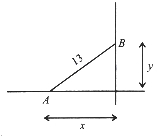
0 likes
View Solution327
EasyMCQ
If the radius of a spherical balloon is increasing at the rate of $5 \text{ inch/min}$, then the rate at which the volume increases (in $\text{cubic inches/min}$) when the radius is $10 \text{ inches}$ is: (in $\pi$)
A
$100$
B
$1000$
C
$2000$
D
$25000$
Solution
(C) Given that the rate of change of the radius is $\frac{dr}{dt} = 5 \text{ inch/min}$.
When the radius $r = 10 \text{ inches}$.
The volume $V$ of a spherical balloon is given by $V = \frac{4}{3} \pi r^3$.
Differentiating both sides with respect to time $t$, we get:
$\frac{dV}{dt} = \frac{d}{dt} \left( \frac{4}{3} \pi r^3 \right) = \frac{4}{3} \pi (3r^2) \frac{dr}{dt} = 4 \pi r^2 \frac{dr}{dt}$.
Substituting the given values $r = 10$ and $\frac{dr}{dt} = 5$:
$\frac{dV}{dt} = 4 \pi (10)^2 (5) = 4 \pi (100) (5) = 2000 \pi \text{ cubic inches/min}$.
When the radius $r = 10 \text{ inches}$.
The volume $V$ of a spherical balloon is given by $V = \frac{4}{3} \pi r^3$.
Differentiating both sides with respect to time $t$, we get:
$\frac{dV}{dt} = \frac{d}{dt} \left( \frac{4}{3} \pi r^3 \right) = \frac{4}{3} \pi (3r^2) \frac{dr}{dt} = 4 \pi r^2 \frac{dr}{dt}$.
Substituting the given values $r = 10$ and $\frac{dr}{dt} = 5$:
$\frac{dV}{dt} = 4 \pi (10)^2 (5) = 4 \pi (100) (5) = 2000 \pi \text{ cubic inches/min}$.
0 likes
View Solution328
EasyMCQ
$A$ particle moves in a straight line such that its displacement $S$ (in $m$) at a time $t$ (in $sec$) is given by $S(t) = t^3 - 4t^2 + 7t$. The instantaneous velocity $v$ at $t = 4$ is (in $m/sec$)
A
$21$
B
$23$
C
$20$
D
$19$
Solution
(B) The displacement of the particle is given by $S(t) = t^3 - 4t^2 + 7t$.
Instantaneous velocity $v$ is the rate of change of displacement with respect to time,which is given by $v = \frac{dS}{dt}$.
Differentiating $S(t)$ with respect to $t$:
$v = \frac{d}{dt}(t^3 - 4t^2 + 7t) = 3t^2 - 8t + 7$.
To find the velocity at $t = 4 \ sec$,substitute $t = 4$ into the expression for $v$:
$v = 3(4)^2 - 8(4) + 7$
$v = 3(16) - 32 + 7$
$v = 48 - 32 + 7$
$v = 16 + 7 = 23 \ m/sec$.
Instantaneous velocity $v$ is the rate of change of displacement with respect to time,which is given by $v = \frac{dS}{dt}$.
Differentiating $S(t)$ with respect to $t$:
$v = \frac{d}{dt}(t^3 - 4t^2 + 7t) = 3t^2 - 8t + 7$.
To find the velocity at $t = 4 \ sec$,substitute $t = 4$ into the expression for $v$:
$v = 3(4)^2 - 8(4) + 7$
$v = 3(16) - 32 + 7$
$v = 48 - 32 + 7$
$v = 16 + 7 = 23 \ m/sec$.
0 likes
View Solution329
EasyMCQ
If the area of a circle increases at the rate of $\frac{1}{\sqrt{\pi}}$ sq. units/sec,then the rate (in units/sec) at which the perimeter of the circle changes,when perimeter is $\sqrt{\pi}$ units,is
A
$2$
B
$4$
C
$\frac{1}{\sqrt{\pi}}$
D
$\sqrt{\pi}$
Solution
(A) Let $A$ be the area and $P$ be the perimeter of the circle. We have,$\frac{dA}{dt} = \frac{1}{\sqrt{\pi}}$.
Since $A = \pi r^2$,differentiating with respect to $t$ gives $\frac{dA}{dt} = 2\pi r \frac{dr}{dt}$.
Substituting the given rate: $2\pi r \frac{dr}{dt} = \frac{1}{\sqrt{\pi}} \Rightarrow \frac{dr}{dt} = \frac{1}{2\pi r \sqrt{\pi}}$.
The perimeter is $P = 2\pi r$. Differentiating with respect to $t$ gives $\frac{dP}{dt} = 2\pi \frac{dr}{dt}$.
Substituting $\frac{dr}{dt}$: $\frac{dP}{dt} = 2\pi \times \frac{1}{2\pi r \sqrt{\pi}} = \frac{1}{r \sqrt{\pi}}$.
Given $P = \sqrt{\pi}$,we have $2\pi r = \sqrt{\pi} \Rightarrow r = \frac{\sqrt{\pi}}{2\pi} = \frac{1}{2\sqrt{\pi}}$.
Substituting $r$ into the expression for $\frac{dP}{dt}$: $\frac{dP}{dt} = \frac{1}{(\frac{1}{2\sqrt{\pi}}) \sqrt{\pi}} = \frac{1}{1/2} = 2$ units/sec.
Since $A = \pi r^2$,differentiating with respect to $t$ gives $\frac{dA}{dt} = 2\pi r \frac{dr}{dt}$.
Substituting the given rate: $2\pi r \frac{dr}{dt} = \frac{1}{\sqrt{\pi}} \Rightarrow \frac{dr}{dt} = \frac{1}{2\pi r \sqrt{\pi}}$.
The perimeter is $P = 2\pi r$. Differentiating with respect to $t$ gives $\frac{dP}{dt} = 2\pi \frac{dr}{dt}$.
Substituting $\frac{dr}{dt}$: $\frac{dP}{dt} = 2\pi \times \frac{1}{2\pi r \sqrt{\pi}} = \frac{1}{r \sqrt{\pi}}$.
Given $P = \sqrt{\pi}$,we have $2\pi r = \sqrt{\pi} \Rightarrow r = \frac{\sqrt{\pi}}{2\pi} = \frac{1}{2\sqrt{\pi}}$.
Substituting $r$ into the expression for $\frac{dP}{dt}$: $\frac{dP}{dt} = \frac{1}{(\frac{1}{2\sqrt{\pi}}) \sqrt{\pi}} = \frac{1}{1/2} = 2$ units/sec.
0 likes
View Solution330
EasyMCQ
$A$ tank in the shape of a rectangular parallelepiped has a volume of $27 \ m^3$. This tank is filled with water such that the rate of change of the water level is thrice the rate of change of the water quantity falling into the tank. The height of the tank (in meters) is:
A
$9$
B
$18$
C
$81$
D
$243$
Solution
(C) Let the volume of the rectangular parallelepiped be $V = 27 \ m^3$.
Let $A$ be the area of the base and $h$ be the height of the tank.
Then,$V = A \times h$.
Differentiating with respect to time $t$,we get $\frac{dV}{dt} = A \frac{dh}{dt}$.
According to the problem,the rate of change of the water level $\frac{dh}{dt}$ is thrice the rate of change of the water quantity $\frac{dV}{dt}$,i.e.,$\frac{dh}{dt} = 3 \frac{dV}{dt}$.
Substituting this into the derivative equation: $\frac{dV}{dt} = A \times (3 \frac{dV}{dt})$.
This implies $1 = 3A$,so $A = \frac{1}{3} \ m^2$.
Since $V = A \times h$,we have $27 = \frac{1}{3} \times h$.
Therefore,$h = 27 \times 3 = 81 \ m$.
Let $A$ be the area of the base and $h$ be the height of the tank.
Then,$V = A \times h$.
Differentiating with respect to time $t$,we get $\frac{dV}{dt} = A \frac{dh}{dt}$.
According to the problem,the rate of change of the water level $\frac{dh}{dt}$ is thrice the rate of change of the water quantity $\frac{dV}{dt}$,i.e.,$\frac{dh}{dt} = 3 \frac{dV}{dt}$.
Substituting this into the derivative equation: $\frac{dV}{dt} = A \times (3 \frac{dV}{dt})$.
This implies $1 = 3A$,so $A = \frac{1}{3} \ m^2$.
Since $V = A \times h$,we have $27 = \frac{1}{3} \times h$.
Therefore,$h = 27 \times 3 = 81 \ m$.
0 likes
View Solution331
EasyMCQ
The volume of a sphere is increasing at the rate of $4 \pi \text{ cm}^3/\text{sec}$. When its volume is $288 \pi \text{ cm}^3$,the rate of increase (in $\text{cm/sec}$) in its radius is
A
$\frac{1}{36}$
B
$\frac{1}{6}$
C
$\frac{1}{7}$
D
$\frac{1}{49}$
Solution
(A) Given that,the rate of increase in volume is $\frac{dV}{dt} = 4 \pi \text{ cm}^3/\text{sec}$.
Volume of the sphere is $V = 288 \pi \text{ cm}^3$.
The formula for the volume of a sphere is $V = \frac{4}{3} \pi r^3$.
Substituting the given volume to find the radius $r$:
$288 \pi = \frac{4}{3} \pi r^3 \implies 288 = \frac{4}{3} r^3 \implies r^3 = 216 \implies r = 6 \text{ cm}$.
Differentiating the volume formula with respect to time $t$:
$\frac{dV}{dt} = 4 \pi r^2 \frac{dr}{dt}$.
Substituting the known values $\frac{dV}{dt} = 4 \pi$ and $r = 6$:
$4 \pi = 4 \pi (6)^2 \frac{dr}{dt}$.
$1 = 36 \frac{dr}{dt} \implies \frac{dr}{dt} = \frac{1}{36} \text{ cm/sec}$.
Volume of the sphere is $V = 288 \pi \text{ cm}^3$.
The formula for the volume of a sphere is $V = \frac{4}{3} \pi r^3$.
Substituting the given volume to find the radius $r$:
$288 \pi = \frac{4}{3} \pi r^3 \implies 288 = \frac{4}{3} r^3 \implies r^3 = 216 \implies r = 6 \text{ cm}$.
Differentiating the volume formula with respect to time $t$:
$\frac{dV}{dt} = 4 \pi r^2 \frac{dr}{dt}$.
Substituting the known values $\frac{dV}{dt} = 4 \pi$ and $r = 6$:
$4 \pi = 4 \pi (6)^2 \frac{dr}{dt}$.
$1 = 36 \frac{dr}{dt} \implies \frac{dr}{dt} = \frac{1}{36} \text{ cm/sec}$.
0 likes
View Solution332
EasyMCQ
The radius of a sphere is changing. At an instant of time,the rate of change in its volume and its surface area are equal. Then the value of the radius at that instant is?
A
$1$
B
$2$
C
$\frac{3}{2}$
D
$3$
Solution
(B) Given that,at any instant of time,the rate of change in volume with respect to time is equal to the rate of change in surface area with respect to time,i.e.,$\frac{dV}{dt} = \frac{dS}{dt}$ $\ldots(i)$
The volume of a sphere of radius $r$ is $V = \frac{4}{3} \pi r^3$.
Differentiating with respect to $t$,we get $\frac{dV}{dt} = \frac{d}{dt}(\frac{4}{3} \pi r^3) = \frac{4}{3} \pi (3r^2) \frac{dr}{dt} = 4 \pi r^2 \frac{dr}{dt}$ $\ldots(ii)$
The surface area of a sphere of radius $r$ is $S = 4 \pi r^2$.
Differentiating with respect to $t$,we get $\frac{dS}{dt} = \frac{d}{dt}(4 \pi r^2) = 4 \pi (2r) \frac{dr}{dt} = 8 \pi r \frac{dr}{dt}$ $\ldots(iii)$
Substituting the values from equations $(ii)$ and $(iii)$ into equation $(i)$,we get $4 \pi r^2 \frac{dr}{dt} = 8 \pi r \frac{dr}{dt}$.
Assuming $\frac{dr}{dt} \neq 0$,we divide both sides by $4 \pi r \frac{dr}{dt}$ to obtain $r = 2$.
The volume of a sphere of radius $r$ is $V = \frac{4}{3} \pi r^3$.
Differentiating with respect to $t$,we get $\frac{dV}{dt} = \frac{d}{dt}(\frac{4}{3} \pi r^3) = \frac{4}{3} \pi (3r^2) \frac{dr}{dt} = 4 \pi r^2 \frac{dr}{dt}$ $\ldots(ii)$
The surface area of a sphere of radius $r$ is $S = 4 \pi r^2$.
Differentiating with respect to $t$,we get $\frac{dS}{dt} = \frac{d}{dt}(4 \pi r^2) = 4 \pi (2r) \frac{dr}{dt} = 8 \pi r \frac{dr}{dt}$ $\ldots(iii)$
Substituting the values from equations $(ii)$ and $(iii)$ into equation $(i)$,we get $4 \pi r^2 \frac{dr}{dt} = 8 \pi r \frac{dr}{dt}$.
Assuming $\frac{dr}{dt} \neq 0$,we divide both sides by $4 \pi r \frac{dr}{dt}$ to obtain $r = 2$.
0 likes
View Solution333
MediumMCQ
$A$ vessel in the shape of an inverted cone of height $10 \ ft$ and semi-vertical angle $30^{\circ}$ is full of water. Due to a hole at the vertex,the slant height of the water in the vessel is decreasing at a constant rate of $\frac{1}{\sqrt{3}} \ ft/min$. The rate (in $cu. \ ft/min$) at which the volume of water in the vessel is decreasing,when the volume of water is $\frac{8 \pi}{\sqrt{3}} \ cu. \ ft$,is
A
$\frac{2 \pi}{\sqrt{3}}$
B
$2 \pi$
C
$2 \pi \sqrt{3}$
D
$\pi \sqrt{3}$
Solution
(B) Let $h$ be the height,$r$ be the radius,and $l$ be the slant height of the water at any time $t$. Given the semi-vertical angle $\alpha = 30^{\circ}$.
From the geometry of the cone,$r = h \tan 30^{\circ} = \frac{h}{\sqrt{3}}$.
The volume $V$ of the water is $V = \frac{1}{3} \pi r^2 h = \frac{1}{3} \pi \left(\frac{h}{\sqrt{3}}\right)^2 h = \frac{\pi h^3}{9}$.
Given $V = \frac{8 \pi}{\sqrt{3}}$,we have $\frac{\pi h^3}{9} = \frac{8 \pi}{\sqrt{3}} \Rightarrow h^3 = \frac{72}{\sqrt{3}} = 24 \sqrt{3} = (2 \sqrt{3})^3$,so $h = 2 \sqrt{3} \ ft$.
The slant height $l = \sqrt{h^2 + r^2} = \sqrt{h^2 + \frac{h^2}{3}} = \sqrt{\frac{4h^2}{3}} = \frac{2h}{\sqrt{3}}$.
Differentiating with respect to $t$,$\frac{dl}{dt} = \frac{2}{\sqrt{3}} \frac{dh}{dt}$.
Given $\frac{dl}{dt} = -\frac{1}{\sqrt{3}}$ (decreasing),we have $-\frac{1}{\sqrt{3}} = \frac{2}{\sqrt{3}} \frac{dh}{dt} \Rightarrow \frac{dh}{dt} = -\frac{1}{2} \ ft/min$.
The rate of change of volume is $\frac{dV}{dt} = \frac{d}{dt} \left(\frac{\pi h^3}{9}\right) = \frac{\pi}{3} h^2 \frac{dh}{dt}$.
Substituting $h = 2 \sqrt{3}$ and $\frac{dh}{dt} = -\frac{1}{2}$,we get $\frac{dV}{dt} = \frac{\pi}{3} (2 \sqrt{3})^2 \left(-\frac{1}{2}\right) = \frac{\pi}{3} (12) \left(-\frac{1}{2}\right) = -2 \pi \ cu. \ ft/min$.
Thus,the volume is decreasing at a rate of $2 \pi \ cu. \ ft/min$.
From the geometry of the cone,$r = h \tan 30^{\circ} = \frac{h}{\sqrt{3}}$.
The volume $V$ of the water is $V = \frac{1}{3} \pi r^2 h = \frac{1}{3} \pi \left(\frac{h}{\sqrt{3}}\right)^2 h = \frac{\pi h^3}{9}$.
Given $V = \frac{8 \pi}{\sqrt{3}}$,we have $\frac{\pi h^3}{9} = \frac{8 \pi}{\sqrt{3}} \Rightarrow h^3 = \frac{72}{\sqrt{3}} = 24 \sqrt{3} = (2 \sqrt{3})^3$,so $h = 2 \sqrt{3} \ ft$.
The slant height $l = \sqrt{h^2 + r^2} = \sqrt{h^2 + \frac{h^2}{3}} = \sqrt{\frac{4h^2}{3}} = \frac{2h}{\sqrt{3}}$.
Differentiating with respect to $t$,$\frac{dl}{dt} = \frac{2}{\sqrt{3}} \frac{dh}{dt}$.
Given $\frac{dl}{dt} = -\frac{1}{\sqrt{3}}$ (decreasing),we have $-\frac{1}{\sqrt{3}} = \frac{2}{\sqrt{3}} \frac{dh}{dt} \Rightarrow \frac{dh}{dt} = -\frac{1}{2} \ ft/min$.
The rate of change of volume is $\frac{dV}{dt} = \frac{d}{dt} \left(\frac{\pi h^3}{9}\right) = \frac{\pi}{3} h^2 \frac{dh}{dt}$.
Substituting $h = 2 \sqrt{3}$ and $\frac{dh}{dt} = -\frac{1}{2}$,we get $\frac{dV}{dt} = \frac{\pi}{3} (2 \sqrt{3})^2 \left(-\frac{1}{2}\right) = \frac{\pi}{3} (12) \left(-\frac{1}{2}\right) = -2 \pi \ cu. \ ft/min$.
Thus,the volume is decreasing at a rate of $2 \pi \ cu. \ ft/min$.
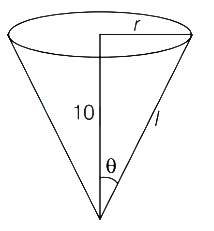
0 likes
View Solution334
MediumMCQ
The $x$-coordinate changes on the curve $y=3x^5+15x-8$ at the rate of $\frac{1}{5} \text{ units/sec}$. If $A(x_1, y_1)$ and $B(x_2, y_2)$ are the points on the curve at which the $y$-coordinate changes at the rate of $6 \text{ units/sec}$,then the slope of $AB$ is:
A
$10$
B
$\tan^{-1}\left(\frac{1}{2}\right)$
C
$18$
D
$\tan^{-1} 2$
Solution
(C) Given the curve $y = 3x^5 + 15x - 8$.
The rate of change of $x$ is $\frac{dx}{dt} = \frac{1}{5} \text{ units/sec}$.
The rate of change of $y$ is $\frac{dy}{dt} = 6 \text{ units/sec}$.
Differentiating $y$ with respect to $t$:
$\frac{dy}{dt} = \frac{dy}{dx} \cdot \frac{dx}{dt} = (15x^4 + 15) \cdot \frac{dx}{dt}$.
Substituting the given values:
$6 = (15x^4 + 15) \cdot \frac{1}{5} = 3(x^4 + 1)$.
$x^4 + 1 = 2 \Rightarrow x^4 = 1 \Rightarrow x = \pm 1$.
For $x = 1$,$y = 3(1)^5 + 15(1) - 8 = 10$. So,$A = (1, 10)$.
For $x = -1$,$y = 3(-1)^5 + 15(-1) - 8 = -3 - 15 - 8 = -26$. So,$B = (-1, -26)$.
The slope of $AB$ is $\frac{y_2 - y_1}{x_2 - x_1} = \frac{-26 - 10}{-1 - 1} = \frac{-36}{-2} = 18$.
The rate of change of $x$ is $\frac{dx}{dt} = \frac{1}{5} \text{ units/sec}$.
The rate of change of $y$ is $\frac{dy}{dt} = 6 \text{ units/sec}$.
Differentiating $y$ with respect to $t$:
$\frac{dy}{dt} = \frac{dy}{dx} \cdot \frac{dx}{dt} = (15x^4 + 15) \cdot \frac{dx}{dt}$.
Substituting the given values:
$6 = (15x^4 + 15) \cdot \frac{1}{5} = 3(x^4 + 1)$.
$x^4 + 1 = 2 \Rightarrow x^4 = 1 \Rightarrow x = \pm 1$.
For $x = 1$,$y = 3(1)^5 + 15(1) - 8 = 10$. So,$A = (1, 10)$.
For $x = -1$,$y = 3(-1)^5 + 15(-1) - 8 = -3 - 15 - 8 = -26$. So,$B = (-1, -26)$.
The slope of $AB$ is $\frac{y_2 - y_1}{x_2 - x_1} = \frac{-26 - 10}{-1 - 1} = \frac{-36}{-2} = 18$.
0 likes
View Solution335
DifficultMCQ
The height of a right circular cylinder is decreasing while its diameter is increasing at a rate of $4 \text{ cm/s}$ so as to keep its volume unchanged. The rate of change in its lateral surface area (in $\text{cm}^2/\text{s}$) at the instant when its diameter is $8 \text{ cm}$ and height is $12 \text{ cm}$,is (in $\pi$)
A
$24$
B
$-24$
C
$48$
D
$-48$
Solution
(D) Given: $\frac{d(2r)}{dt} = 4 \text{ cm/s} \implies \frac{dr}{dt} = 2 \text{ cm/s}$.
Volume of cylinder $V = \pi r^2 h$. Since volume is constant, $\frac{dV}{dt} = 0$.
$\frac{dV}{dt} = \pi \left( r^2 \frac{dh}{dt} + 2rh \frac{dr}{dt} \right) = 0$.
$r^2 \frac{dh}{dt} + 2rh(2) = 0 \implies r \frac{dh}{dt} + 4h = 0 \implies \frac{dh}{dt} = -\frac{4h}{r}$.
At $r = 4 \text{ cm}$ and $h = 12 \text{ cm}$, $\frac{dh}{dt} = -\frac{4(12)}{4} = -12 \text{ cm/s}$.
Lateral surface area $S = 2 \pi rh$.
$\frac{dS}{dt} = 2 \pi \left( r \frac{dh}{dt} + h \frac{dr}{dt} \right)$.
Substituting the values: $\frac{dS}{dt} = 2 \pi \left( 4(-12) + 12(2) \right) = 2 \pi (-48 + 24) = 2 \pi (-24) = -48 \pi \text{ cm}^2/\text{s}$.
Volume of cylinder $V = \pi r^2 h$. Since volume is constant, $\frac{dV}{dt} = 0$.
$\frac{dV}{dt} = \pi \left( r^2 \frac{dh}{dt} + 2rh \frac{dr}{dt} \right) = 0$.
$r^2 \frac{dh}{dt} + 2rh(2) = 0 \implies r \frac{dh}{dt} + 4h = 0 \implies \frac{dh}{dt} = -\frac{4h}{r}$.
At $r = 4 \text{ cm}$ and $h = 12 \text{ cm}$, $\frac{dh}{dt} = -\frac{4(12)}{4} = -12 \text{ cm/s}$.
Lateral surface area $S = 2 \pi rh$.
$\frac{dS}{dt} = 2 \pi \left( r \frac{dh}{dt} + h \frac{dr}{dt} \right)$.
Substituting the values: $\frac{dS}{dt} = 2 \pi \left( 4(-12) + 12(2) \right) = 2 \pi (-48 + 24) = 2 \pi (-24) = -48 \pi \text{ cm}^2/\text{s}$.
0 likes
View Solution336
EasyMCQ
The radius of a circular plate is increasing at the rate of $0.01 \text{ cm/sec}$. When the radius is $12 \text{ cm}$,the rate at which the area increases is (in $\text{cm}^2/\text{sec}$): (in $\pi$)
A
$60$
B
$24$
C
$1.2$
D
$0.24$
Solution
(D) Given: The rate of change of the radius is $\frac{dr}{dt} = 0.01 \text{ cm/sec}$.
We need to find the rate of change of the area $A$ when $r = 12 \text{ cm}$.
The area of a circular plate is given by $A = \pi r^2$.
Differentiating both sides with respect to time $t$,we get:
$\frac{dA}{dt} = 2 \pi r \frac{dr}{dt}$.
Substituting the given values $r = 12 \text{ cm}$ and $\frac{dr}{dt} = 0.01 \text{ cm/sec}$:
$\frac{dA}{dt} = 2 \pi (12) (0.01) = 24 \pi (0.01) = 0.24 \pi \text{ cm}^2/\text{sec}$.
Thus,the rate at which the area increases is $0.24 \pi \text{ cm}^2/\text{sec}$.
We need to find the rate of change of the area $A$ when $r = 12 \text{ cm}$.
The area of a circular plate is given by $A = \pi r^2$.
Differentiating both sides with respect to time $t$,we get:
$\frac{dA}{dt} = 2 \pi r \frac{dr}{dt}$.
Substituting the given values $r = 12 \text{ cm}$ and $\frac{dr}{dt} = 0.01 \text{ cm/sec}$:
$\frac{dA}{dt} = 2 \pi (12) (0.01) = 24 \pi (0.01) = 0.24 \pi \text{ cm}^2/\text{sec}$.
Thus,the rate at which the area increases is $0.24 \pi \text{ cm}^2/\text{sec}$.
0 likes
View Solution337
DifficultMCQ
The relation between pressure $p$ and volume $V$ is given by $p V^{1/4} = \text{constant}$. If the percentage decrease in volume is $\frac{1}{2} \%$,then the percentage increase in pressure is:
A
$\frac{1}{8} \%$
B
$\frac{1}{16} \%$
C
$\frac{1}{4} \%$
D
$\frac{1}{2} \%$
Solution
(A) Given the relation $p V^{1/4} = C$,where $C$ is a constant.
Taking the natural logarithm on both sides: $\ln p + \frac{1}{4} \ln V = \ln C$.
Differentiating both sides with respect to $V$: $\frac{dp}{p} + \frac{1}{4} \frac{dV}{V} = 0$.
This implies $\frac{dp}{p} = -\frac{1}{4} \frac{dV}{V}$.
Given that the percentage decrease in volume is $\frac{dV}{V} = -\frac{1}{2} \% = -0.5 \%$.
Substituting this into the equation: $\frac{dp}{p} = -\frac{1}{4} (-0.5 \%) = 0.125 \% = \frac{1}{8} \%$.
Thus,the percentage increase in pressure is $\frac{1}{8} \%$.
Taking the natural logarithm on both sides: $\ln p + \frac{1}{4} \ln V = \ln C$.
Differentiating both sides with respect to $V$: $\frac{dp}{p} + \frac{1}{4} \frac{dV}{V} = 0$.
This implies $\frac{dp}{p} = -\frac{1}{4} \frac{dV}{V}$.
Given that the percentage decrease in volume is $\frac{dV}{V} = -\frac{1}{2} \% = -0.5 \%$.
Substituting this into the equation: $\frac{dp}{p} = -\frac{1}{4} (-0.5 \%) = 0.125 \% = \frac{1}{8} \%$.
Thus,the percentage increase in pressure is $\frac{1}{8} \%$.
0 likes
View Solution338
MediumMCQ
$A$ point is moving on $y=4-2x^2$. The $x$-coordinate of the point is decreasing at the rate of $5 \text{ units/s}$. Then,the rate at which the $y$-coordinate of the point is changing when the point is at $(1, 2)$ is
A
$5 \text{ units/s}$
B
$10 \text{ units/s}$
C
$15 \text{ units/s}$
D
$20 \text{ units/s}$
Solution
(D) Given the equation of the curve is $y = 4 - 2x^2$.
On differentiating both sides with respect to time $t$,we get:
$\frac{dy}{dt} = -4x \frac{dx}{dt}$.
We are given that the $x$-coordinate is decreasing at the rate of $5 \text{ units/s}$,so $\frac{dx}{dt} = -5 \text{ units/s}$.
At the point $(1, 2)$,we have $x = 1$.
Substituting these values into the derivative equation:
$\frac{dy}{dt} = -4(1)(-5) = 20 \text{ units/s}$.
Thus,the $y$-coordinate is changing at the rate of $20 \text{ units/s}$.
On differentiating both sides with respect to time $t$,we get:
$\frac{dy}{dt} = -4x \frac{dx}{dt}$.
We are given that the $x$-coordinate is decreasing at the rate of $5 \text{ units/s}$,so $\frac{dx}{dt} = -5 \text{ units/s}$.
At the point $(1, 2)$,we have $x = 1$.
Substituting these values into the derivative equation:
$\frac{dy}{dt} = -4(1)(-5) = 20 \text{ units/s}$.
Thus,the $y$-coordinate is changing at the rate of $20 \text{ units/s}$.
0 likes
View Solution339
EasyMCQ
$A$ particle moves along the curve $y=x^2+2x$. Then,the point on the curve such that the $x$ and $y$ coordinates of the particle change with the same rate is
A
$(1,3)$
B
$\left(\frac{1}{2}, \frac{5}{2}\right)$
C
$\left(-\frac{1}{2}, -\frac{3}{4}\right)$
D
$(-1, -1)$
Solution
(C) Given the equation of the curve is $y = x^2 + 2x$.
Since the $x$ and $y$ coordinates of the particle change at the same rate,we have $\frac{dy}{dt} = \frac{dx}{dt}$.
Differentiating the equation of the curve with respect to $t$,we get:
$\frac{dy}{dt} = (2x + 2) \frac{dx}{dt}$.
Substituting $\frac{dy}{dt} = \frac{dx}{dt}$ into the equation,we get:
$\frac{dx}{dt} = (2x + 2) \frac{dx}{dt}$.
Assuming $\frac{dx}{dt} \neq 0$,we can divide both sides by $\frac{dx}{dt}$:
$1 = 2x + 2$
$2x = -1$
$x = -\frac{1}{2}$.
Now,substitute $x = -\frac{1}{2}$ into the curve equation to find $y$:
$y = \left(-\frac{1}{2}\right)^2 + 2\left(-\frac{1}{2}\right)$
$y = \frac{1}{4} - 1 = -\frac{3}{4}$.
Therefore,the required point is $\left(-\frac{1}{2}, -\frac{3}{4}\right)$.
Since the $x$ and $y$ coordinates of the particle change at the same rate,we have $\frac{dy}{dt} = \frac{dx}{dt}$.
Differentiating the equation of the curve with respect to $t$,we get:
$\frac{dy}{dt} = (2x + 2) \frac{dx}{dt}$.
Substituting $\frac{dy}{dt} = \frac{dx}{dt}$ into the equation,we get:
$\frac{dx}{dt} = (2x + 2) \frac{dx}{dt}$.
Assuming $\frac{dx}{dt} \neq 0$,we can divide both sides by $\frac{dx}{dt}$:
$1 = 2x + 2$
$2x = -1$
$x = -\frac{1}{2}$.
Now,substitute $x = -\frac{1}{2}$ into the curve equation to find $y$:
$y = \left(-\frac{1}{2}\right)^2 + 2\left(-\frac{1}{2}\right)$
$y = \frac{1}{4} - 1 = -\frac{3}{4}$.
Therefore,the required point is $\left(-\frac{1}{2}, -\frac{3}{4}\right)$.
0 likes
View Solution340
MediumMCQ
The volume of a spherical balloon is increasing at the rate of $2 \ cm^3/sec$. When its radius is $4 \ cm$,the rate of change of its surface area (in $cm^2/sec$) is
A
$1$
B
$2$
C
$3$
D
$4$
Solution
(A) Let $V$ be the volume and $S$ be the surface area of the spherical balloon with radius $r$.
Given: $\frac{dV}{dt} = 2 \ cm^3/sec$.
We know that the volume of a sphere is $V = \frac{4}{3} \pi r^3$.
Differentiating with respect to $t$,we get $\frac{dV}{dt} = 4 \pi r^2 \frac{dr}{dt}$.
Substituting the given values: $2 = 4 \pi r^2 \frac{dr}{dt} \implies \frac{dr}{dt} = \frac{1}{2 \pi r^2}$.
The surface area of a sphere is $S = 4 \pi r^2$.
Differentiating with respect to $t$,we get $\frac{dS}{dt} = 8 \pi r \frac{dr}{dt}$.
Substituting $\frac{dr}{dt} = \frac{1}{2 \pi r^2}$ into the equation for $\frac{dS}{dt}$:
$\frac{dS}{dt} = 8 \pi r \left( \frac{1}{2 \pi r^2} \right) = \frac{4}{r}$.
At $r = 4 \ cm$,the rate of change of surface area is $\frac{dS}{dt} = \frac{4}{4} = 1 \ cm^2/sec$.
Thus,the correct option is $A$.
Given: $\frac{dV}{dt} = 2 \ cm^3/sec$.
We know that the volume of a sphere is $V = \frac{4}{3} \pi r^3$.
Differentiating with respect to $t$,we get $\frac{dV}{dt} = 4 \pi r^2 \frac{dr}{dt}$.
Substituting the given values: $2 = 4 \pi r^2 \frac{dr}{dt} \implies \frac{dr}{dt} = \frac{1}{2 \pi r^2}$.
The surface area of a sphere is $S = 4 \pi r^2$.
Differentiating with respect to $t$,we get $\frac{dS}{dt} = 8 \pi r \frac{dr}{dt}$.
Substituting $\frac{dr}{dt} = \frac{1}{2 \pi r^2}$ into the equation for $\frac{dS}{dt}$:
$\frac{dS}{dt} = 8 \pi r \left( \frac{1}{2 \pi r^2} \right) = \frac{4}{r}$.
At $r = 4 \ cm$,the rate of change of surface area is $\frac{dS}{dt} = \frac{4}{4} = 1 \ cm^2/sec$.
Thus,the correct option is $A$.
0 likes
View Solution341
MediumMCQ
If a particle moves in a straight line according to the law $x = a \sin (\sqrt{\lambda} t + b)$,then the particle will come to rest at two points whose distance is [symbols have their usual meaning]
A
$a$
B
$\frac{a}{2}$
C
$2a$
D
$4a$
Solution
(C) The velocity of the particle is given by the derivative of position with respect to time:
$v = \frac{dx}{dt} = a \cos (\sqrt{\lambda} t + b) \cdot \sqrt{\lambda}$.
For the particle to come to rest,the velocity must be zero:
$v = 0 \Rightarrow a \sqrt{\lambda} \cos (\sqrt{\lambda} t + b) = 0$.
Since $a \neq 0$ and $\lambda > 0$,we have $\cos (\sqrt{\lambda} t + b) = 0$.
This occurs when the argument is $\pm \frac{\pi}{2}$.
Let the two points be $x_1$ and $x_2$:
$x_1 = a \sin (\frac{\pi}{2}) = a(1) = a$.
$x_2 = a \sin (-\frac{\pi}{2}) = a(-1) = -a$.
The distance between these two points is $|x_1 - x_2| = |a - (-a)| = |2a| = 2a$.
$v = \frac{dx}{dt} = a \cos (\sqrt{\lambda} t + b) \cdot \sqrt{\lambda}$.
For the particle to come to rest,the velocity must be zero:
$v = 0 \Rightarrow a \sqrt{\lambda} \cos (\sqrt{\lambda} t + b) = 0$.
Since $a \neq 0$ and $\lambda > 0$,we have $\cos (\sqrt{\lambda} t + b) = 0$.
This occurs when the argument is $\pm \frac{\pi}{2}$.
Let the two points be $x_1$ and $x_2$:
$x_1 = a \sin (\frac{\pi}{2}) = a(1) = a$.
$x_2 = a \sin (-\frac{\pi}{2}) = a(-1) = -a$.
The distance between these two points is $|x_1 - x_2| = |a - (-a)| = |2a| = 2a$.
0 likes
View Solution342
EasyMCQ
$A$ particle starts moving from rest from a fixed point in a fixed direction. The distance $s$ from the fixed point at a time $t$ is given by $s = t^{2} + at - b + 17$,where $a$ and $b$ are real numbers. If the particle comes to rest after $5 \ s$ at a distance of $s = 25$ units from the fixed point,then the values of $a$ and $b$ are respectively:
A
$a = -10, b = -33$
B
$a = -10, b = -30$
C
$a = -8, b = 33$
D
$a = -10, b = 33$
Solution
(A) Given the distance equation: $s = t^{2} + at - b + 17$.
Since the particle starts from rest,the velocity $v = \frac{ds}{dt}$ must be zero at $t = 5 \ s$.
Calculating the velocity: $v = \frac{ds}{dt} = 2t + a$.
Setting $v = 0$ at $t = 5$: $2(5) + a = 0 \implies 10 + a = 0 \implies a = -10$.
Now,given that at $t = 5 \ s$,the distance $s = 25$:
$25 = (5)^{2} + a(5) - b + 17$.
Substituting $a = -10$: $25 = 25 + (-10)(5) - b + 17$.
$25 = 25 - 50 - b + 17$.
$25 = -8 - b$.
$b = -8 - 25 = -33$.
Thus,the values are $a = -10$ and $b = -33$.
Since the particle starts from rest,the velocity $v = \frac{ds}{dt}$ must be zero at $t = 5 \ s$.
Calculating the velocity: $v = \frac{ds}{dt} = 2t + a$.
Setting $v = 0$ at $t = 5$: $2(5) + a = 0 \implies 10 + a = 0 \implies a = -10$.
Now,given that at $t = 5 \ s$,the distance $s = 25$:
$25 = (5)^{2} + a(5) - b + 17$.
Substituting $a = -10$: $25 = 25 + (-10)(5) - b + 17$.
$25 = 25 - 50 - b + 17$.
$25 = -8 - b$.
$b = -8 - 25 = -33$.
Thus,the values are $a = -10$ and $b = -33$.
0 likes
View Solution343
MediumMCQ
The law of motion of a body moving along a straight line is $x = \frac{1}{2} vt$,where $x$ is its distance from a fixed point on the line at time $t$ and $v$ is its velocity. Then:
A
acceleration $f$ varies directly with $x$
B
acceleration $f$ varies inversely with $x$
C
acceleration $f$ is constant
D
acceleration $f$ varies directly with $t$
Solution
(C) Given the equation of motion: $x = \frac{1}{2} vt$.
Since velocity $v = \frac{dx}{dt}$,we substitute this into the equation:
$x = \frac{1}{2} \left( \frac{dx}{dt} \right) t$.
Rearranging the terms to separate variables:
$\frac{2 dt}{t} = \frac{dx}{x}$.
Integrating both sides:
$2 \int \frac{dt}{t} = \int \frac{dx}{x} \implies 2 \ln |t| + C' = \ln |x|$.
This simplifies to $\ln |t^2| + C' = \ln |x|$,which implies $x = c t^2$ for some constant $c$.
Now,find the velocity $v$ by differentiating $x$ with respect to $t$:
$v = \frac{dx}{dt} = \frac{d}{dt} (c t^2) = 2ct$.
Finally,find the acceleration $f$ by differentiating $v$ with respect to $t$:
$f = \frac{dv}{dt} = \frac{d}{dt} (2ct) = 2c$.
Since $2c$ is a constant,the acceleration $f$ is constant.
Since velocity $v = \frac{dx}{dt}$,we substitute this into the equation:
$x = \frac{1}{2} \left( \frac{dx}{dt} \right) t$.
Rearranging the terms to separate variables:
$\frac{2 dt}{t} = \frac{dx}{x}$.
Integrating both sides:
$2 \int \frac{dt}{t} = \int \frac{dx}{x} \implies 2 \ln |t| + C' = \ln |x|$.
This simplifies to $\ln |t^2| + C' = \ln |x|$,which implies $x = c t^2$ for some constant $c$.
Now,find the velocity $v$ by differentiating $x$ with respect to $t$:
$v = \frac{dx}{dt} = \frac{d}{dt} (c t^2) = 2ct$.
Finally,find the acceleration $f$ by differentiating $v$ with respect to $t$:
$f = \frac{dv}{dt} = \frac{d}{dt} (2ct) = 2c$.
Since $2c$ is a constant,the acceleration $f$ is constant.
0 likes
View Solution344
DifficultMCQ
The points on the ellipse $16x^{2} + 9y^{2} = 400$ at which the ordinate decreases at the same rate at which the abscissa increases are given by:
A
$\left(3, \frac{16}{3}\right)$ and $\left(-3, -\frac{16}{3}\right)$
B
$\left(3, -\frac{16}{3}\right)$ and $\left(-3, \frac{16}{3}\right)$
C
$\left(\frac{1}{16}, \frac{1}{9}\right)$ and $\left(-\frac{1}{16}, -\frac{1}{9}\right)$
D
$\left(\frac{1}{16}, -\frac{1}{9}\right)$ and $\left(-\frac{1}{16}, \frac{1}{9}\right)$
Solution
(A) Given that the ordinate $y$ decreases at the same rate at which the abscissa $x$ increases,we have $\frac{dy}{dt} = -\frac{dx}{dt}$.
The equation of the ellipse is $16x^{2} + 9y^{2} = 400$.
Differentiating both sides with respect to $t$,we get:
$16(2x) \frac{dx}{dt} + 9(2y) \frac{dy}{dt} = 0$
$32x \frac{dx}{dt} + 18y \frac{dy}{dt} = 0$
$16x \frac{dx}{dt} + 9y \frac{dy}{dt} = 0$.
Substituting $\frac{dy}{dt} = -\frac{dx}{dt}$ into the equation:
$16x \frac{dx}{dt} + 9y \left(-\frac{dx}{dt}\right) = 0$
$(16x - 9y) \frac{dx}{dt} = 0$.
Since $\frac{dx}{dt} \neq 0$ for the points to be moving,we have $16x - 9y = 0$,which implies $y = \frac{16}{9}x$.
Substituting $y = \frac{16}{9}x$ into the ellipse equation:
$16x^{2} + 9\left(\frac{16}{9}x\right)^{2} = 400$
$16x^{2} + 9 \cdot \frac{256}{81}x^{2} = 400$
$16x^{2} + \frac{256}{9}x^{2} = 400$
$\frac{144x^{2} + 256x^{2}}{9} = 400$
$\frac{400x^{2}}{9} = 400$
$x^{2} = 9 \Rightarrow x = \pm 3$.
If $x = 3$,then $y = \frac{16}{9}(3) = \frac{16}{3}$.
If $x = -3$,then $y = \frac{16}{9}(-3) = -\frac{16}{3}$.
Thus,the points are $\left(3, \frac{16}{3}\right)$ and $\left(-3, -\frac{16}{3}\right)$.
The equation of the ellipse is $16x^{2} + 9y^{2} = 400$.
Differentiating both sides with respect to $t$,we get:
$16(2x) \frac{dx}{dt} + 9(2y) \frac{dy}{dt} = 0$
$32x \frac{dx}{dt} + 18y \frac{dy}{dt} = 0$
$16x \frac{dx}{dt} + 9y \frac{dy}{dt} = 0$.
Substituting $\frac{dy}{dt} = -\frac{dx}{dt}$ into the equation:
$16x \frac{dx}{dt} + 9y \left(-\frac{dx}{dt}\right) = 0$
$(16x - 9y) \frac{dx}{dt} = 0$.
Since $\frac{dx}{dt} \neq 0$ for the points to be moving,we have $16x - 9y = 0$,which implies $y = \frac{16}{9}x$.
Substituting $y = \frac{16}{9}x$ into the ellipse equation:
$16x^{2} + 9\left(\frac{16}{9}x\right)^{2} = 400$
$16x^{2} + 9 \cdot \frac{256}{81}x^{2} = 400$
$16x^{2} + \frac{256}{9}x^{2} = 400$
$\frac{144x^{2} + 256x^{2}}{9} = 400$
$\frac{400x^{2}}{9} = 400$
$x^{2} = 9 \Rightarrow x = \pm 3$.
If $x = 3$,then $y = \frac{16}{9}(3) = \frac{16}{3}$.
If $x = -3$,then $y = \frac{16}{9}(-3) = -\frac{16}{3}$.
Thus,the points are $\left(3, \frac{16}{3}\right)$ and $\left(-3, -\frac{16}{3}\right)$.
0 likes
View SolutionApplications of Derivatives — Rate of Change of Quantities · Frequently Asked Questions
1Are these Applications of Derivatives questions useful for JEE and NEET?
Yes. All questions in this section are mapped to JEE Main and NEET exam patterns. Previous year questions from JEE Main, NEET, GUJCET and state-level exams are included with full solutions.
2Can I switch to Hindi or Gujarati for these questions?
Yes. Use the language tabs in the hero section or the sidebar to view the same questions and solutions in English, Hindi or Gujarati.
3How do I generate a question paper from this subtopic?
Use the Vedclass Exam Paper Generator — select the chapter and subtopic, set difficulty, and generate Sets A, B, C, D automatically. First 3 chapters of every subject are free.
Vedclass Products
For Students
Vedclass Test Series
Mock tests in real JEE/NEET style with performance analysis. 5-day free trial.
Start Free TrialFor Teachers
Exam Paper Generator
Generate Set A/B/C/D papers from this chapter in 2 minutes. 3 chapters free.
Try FreeFor Institutes
Online Exam Module
Live online exams with unlimited students, 360° analytics & white-label branding.
See DemoFor Teachers & Institutes
Generate a Applications of Derivatives Exam Paper in 2 Minutes
Select subtopic & difficulty — Sets A, B, C, D auto-generated with No Repeat logic.
First 3 chapters of every subject are free — no payment required.