
A English
Maxima and Minima Questions in English
Class 12 Mathematics · Applications of Derivatives · Maxima and Minima
760+
Questions
English
Language
100%
With Solutions
Showing 50 of 760 questions in English
251
AdvancedMCQ
Let $f: R \to R$,$f(x) = ax^3 + bx^2 + cx + d$ have no extreme value. Then which of the following is always correct?
A
$3a + 2b + c \ge 0$
B
$c \le 0$
C
$(3a + 2b + c)c \ge 0$
D
$3a + 2b + 2c \ge 0$
Solution
(C) For a cubic function $f(x) = ax^3 + bx^2 + cx + d$ to have no extreme values,its derivative $f'(x) = 3ax^2 + 2bx + c$ must not change sign.
This means $f'(x)$ must be either always $\ge 0$ or always $\le 0$ for all $x \in R$.
This implies that the quadratic expression $g(x) = 3ax^2 + 2bx + c$ does not change sign.
For a quadratic $g(x) = Ax^2 + Bx + C$ to maintain a constant sign,its discriminant $D = B^2 - 4AC$ must be $\le 0$.
Here,$D = (2b)^2 - 4(3a)(c) = 4b^2 - 12ac \le 0$,which implies $b^2 \le 3ac$.
If $f'(x)$ does not change sign,then $f'(x_1)$ and $f'(x_2)$ must have the same sign for any $x_1, x_2 \in R$.
Specifically,$f'(1) = 3a + 2b + c$ and $f'(0) = c$ must have the same sign or be zero.
Therefore,their product must be non-negative: $(3a + 2b + c)c \ge 0$.
This means $f'(x)$ must be either always $\ge 0$ or always $\le 0$ for all $x \in R$.
This implies that the quadratic expression $g(x) = 3ax^2 + 2bx + c$ does not change sign.
For a quadratic $g(x) = Ax^2 + Bx + C$ to maintain a constant sign,its discriminant $D = B^2 - 4AC$ must be $\le 0$.
Here,$D = (2b)^2 - 4(3a)(c) = 4b^2 - 12ac \le 0$,which implies $b^2 \le 3ac$.
If $f'(x)$ does not change sign,then $f'(x_1)$ and $f'(x_2)$ must have the same sign for any $x_1, x_2 \in R$.
Specifically,$f'(1) = 3a + 2b + c$ and $f'(0) = c$ must have the same sign or be zero.
Therefore,their product must be non-negative: $(3a + 2b + c)c \ge 0$.
0 likes
View Solution252
AdvancedMCQ
Let the radius and height of a right circular cylinder be related as $r^2 + h = 6$. If the volume of the cylinder is maximum,then the value of $\frac{r}{h}$ is:
A
$\frac{1}{\sqrt{3}}$
B
$\sqrt{3}$
C
$1$
D
$3$
Solution
(A) The volume of a right circular cylinder is given by $V = \pi r^2 h$.
Given the relation $r^2 + h = 6$,we can express $h$ as $h = 6 - r^2$.
Substituting this into the volume formula: $V = \pi r^2 (6 - r^2) = \pi (6r^2 - r^4)$.
To find the maximum volume,we differentiate $V$ with respect to $r$: $\frac{dV}{dr} = \pi (12r - 4r^3)$.
Setting $\frac{dV}{dr} = 0$,we get $12r - 4r^3 = 0$,which implies $4r(3 - r^2) = 0$.
Since $r > 0$,we have $r^2 = 3$,so $r = \sqrt{3}$.
Substituting $r^2 = 3$ into the relation $h = 6 - r^2$,we get $h = 6 - 3 = 3$.
Therefore,the ratio $\frac{r}{h} = \frac{\sqrt{3}}{3} = \frac{1}{\sqrt{3}}$.
Given the relation $r^2 + h = 6$,we can express $h$ as $h = 6 - r^2$.
Substituting this into the volume formula: $V = \pi r^2 (6 - r^2) = \pi (6r^2 - r^4)$.
To find the maximum volume,we differentiate $V$ with respect to $r$: $\frac{dV}{dr} = \pi (12r - 4r^3)$.
Setting $\frac{dV}{dr} = 0$,we get $12r - 4r^3 = 0$,which implies $4r(3 - r^2) = 0$.
Since $r > 0$,we have $r^2 = 3$,so $r = \sqrt{3}$.
Substituting $r^2 = 3$ into the relation $h = 6 - r^2$,we get $h = 6 - 3 = 3$.
Therefore,the ratio $\frac{r}{h} = \frac{\sqrt{3}}{3} = \frac{1}{\sqrt{3}}$.
0 likes
View Solution253
AdvancedMCQ
In the interval $(0, 1)$,the maximum value of the function $f(x) = |x \ln x|$ is:
A
$0$
B
$1$
C
$e$
D
$e^{-1}$
Solution
(D) For $x \in (0, 1)$,$\ln x < 0$,so $x \ln x < 0$.
Thus,$f(x) = |x \ln x| = -x \ln x$.
To find the critical points,we calculate the derivative: $f'(x) = -(1 \cdot \ln x + x \cdot \frac{1}{x}) = -(1 + \ln x)$.
Setting $f'(x) = 0$,we get $1 + \ln x = 0$,which implies $\ln x = -1$,so $x = e^{-1} = \frac{1}{e}$.
Since $f'(x) > 0$ for $x < \frac{1}{e}$ and $f'(x) < 0$ for $x > \frac{1}{e}$,the function has a local maximum at $x = \frac{1}{e}$.
The maximum value is $f(\frac{1}{e}) = -(\frac{1}{e}) \ln(\frac{1}{e}) = -(\frac{1}{e})(-1) = \frac{1}{e} = e^{-1}$.
Thus,$f(x) = |x \ln x| = -x \ln x$.
To find the critical points,we calculate the derivative: $f'(x) = -(1 \cdot \ln x + x \cdot \frac{1}{x}) = -(1 + \ln x)$.
Setting $f'(x) = 0$,we get $1 + \ln x = 0$,which implies $\ln x = -1$,so $x = e^{-1} = \frac{1}{e}$.
Since $f'(x) > 0$ for $x < \frac{1}{e}$ and $f'(x) < 0$ for $x > \frac{1}{e}$,the function has a local maximum at $x = \frac{1}{e}$.
The maximum value is $f(\frac{1}{e}) = -(\frac{1}{e}) \ln(\frac{1}{e}) = -(\frac{1}{e})(-1) = \frac{1}{e} = e^{-1}$.
0 likes
View Solution254
AdvancedMCQ
The function $f(x) = \frac{x^2 - 2}{\sqrt{1 + x^2}}$:
A
is always increasing
B
is always decreasing
C
has exactly one point of minima
D
has exactly one point of maxima
Solution
(C) Given $f(x) = \frac{x^2 - 2}{\sqrt{1 + x^2}}$.
To find the critical points,we calculate the derivative $f'(x)$ using the quotient rule:
$f'(x) = \frac{\sqrt{1+x^2}(2x) - (x^2-2)\frac{1}{2\sqrt{1+x^2}}(2x)}{1+x^2}$
$f'(x) = \frac{2x(1+x^2) - x(x^2-2)}{(1+x^2)^{3/2}}$
$f'(x) = \frac{2x + 2x^3 - x^3 + 2x}{(1+x^2)^{3/2}} = \frac{x^3 + 4x}{(1+x^2)^{3/2}} = \frac{x(x^2 + 4)}{(1+x^2)^{3/2}}$.
Since $x^2 + 4 > 0$ and $(1+x^2)^{3/2} > 0$ for all $x \in \mathbb{R}$,the sign of $f'(x)$ depends only on $x$.
For $x < 0$,$f'(x) < 0$ (function is decreasing).
For $x > 0$,$f'(x) > 0$ (function is increasing).
At $x = 0$,$f'(x) = 0$ and the sign changes from negative to positive,which indicates that $x = 0$ is a point of local minima.
Thus,the function has exactly one point of minima.
To find the critical points,we calculate the derivative $f'(x)$ using the quotient rule:
$f'(x) = \frac{\sqrt{1+x^2}(2x) - (x^2-2)\frac{1}{2\sqrt{1+x^2}}(2x)}{1+x^2}$
$f'(x) = \frac{2x(1+x^2) - x(x^2-2)}{(1+x^2)^{3/2}}$
$f'(x) = \frac{2x + 2x^3 - x^3 + 2x}{(1+x^2)^{3/2}} = \frac{x^3 + 4x}{(1+x^2)^{3/2}} = \frac{x(x^2 + 4)}{(1+x^2)^{3/2}}$.
Since $x^2 + 4 > 0$ and $(1+x^2)^{3/2} > 0$ for all $x \in \mathbb{R}$,the sign of $f'(x)$ depends only on $x$.
For $x < 0$,$f'(x) < 0$ (function is decreasing).
For $x > 0$,$f'(x) > 0$ (function is increasing).
At $x = 0$,$f'(x) = 0$ and the sign changes from negative to positive,which indicates that $x = 0$ is a point of local minima.
Thus,the function has exactly one point of minima.

0 likes
View Solution255
AdvancedMCQ
If $g(x) = 2f(2x^3 - 3x^2) + f(6x^2 - 4x^3 - 3)$,$\forall x \in R$ and $f''(x) > 0$,$\forall x \in R$,then $g'(x) > 0$ for $x$ belonging to
A
$\left( - \infty , - \frac{1}{2} \right) \cup \left( 0,1 \right)$
B
$\left( - \frac{1}{2},0 \right) \cup \left( 1,\infty \right)$
C
$\left( 0,\infty \right)$
D
$\left( - \infty ,1 \right)$
Solution
(B) Given $f''(x) > 0$,$f'(x)$ is a strictly increasing function.
$g'(x) = 2f'(2x^3 - 3x^2) \cdot (6x^2 - 6x) + f'(6x^2 - 4x^3 - 3) \cdot (12x - 12x^2)$
$g'(x) = 12(x^2 - x) f'(2x^3 - 3x^2) - 12(x^2 - x) f'(6x^2 - 4x^3 - 3)$
$g'(x) = 12x(x - 1) [f'(2x^3 - 3x^2) - f'(6x^2 - 4x^3 - 3)]$
For $g'(x) > 0$,we analyze the sign of $12x(x - 1)$ and the difference $[f'(2x^3 - 3x^2) - f'(6x^2 - 4x^3 - 3)]$.
Since $f'(x)$ is increasing,$f'(A) > f'(B) \iff A > B$.
Let $A = 2x^3 - 3x^2$ and $B = 6x^2 - 4x^3 - 3$.
$A - B = (2x^3 - 3x^2) - (6x^2 - 4x^3 - 3) = 6x^3 - 9x^2 + 3 = 3(2x^3 - 3x^2 + 1) = 3(x - 1)^2(2x + 1)$.
Thus,$f'(A) - f'(B) > 0$ when $3(x - 1)^2(2x + 1) > 0$,which implies $x > -\frac{1}{2}$ (excluding $x = 1$).
Now,$g'(x) > 0$ when $12x(x - 1)$ and $(f'(A) - f'(B))$ have the same sign.
Case $I$: $x(x - 1) > 0$ and $x > -\frac{1}{2}$. This occurs when $x \in (1, \infty)$.
Case $II$: $x(x - 1) < 0$ and $x < -\frac{1}{2}$. This occurs when $x \in (-\frac{1}{2}, 0)$.
Combining these,$g'(x) > 0$ for $x \in (-\frac{1}{2}, 0) \cup (1, \infty)$.
$g'(x) = 2f'(2x^3 - 3x^2) \cdot (6x^2 - 6x) + f'(6x^2 - 4x^3 - 3) \cdot (12x - 12x^2)$
$g'(x) = 12(x^2 - x) f'(2x^3 - 3x^2) - 12(x^2 - x) f'(6x^2 - 4x^3 - 3)$
$g'(x) = 12x(x - 1) [f'(2x^3 - 3x^2) - f'(6x^2 - 4x^3 - 3)]$
For $g'(x) > 0$,we analyze the sign of $12x(x - 1)$ and the difference $[f'(2x^3 - 3x^2) - f'(6x^2 - 4x^3 - 3)]$.
Since $f'(x)$ is increasing,$f'(A) > f'(B) \iff A > B$.
Let $A = 2x^3 - 3x^2$ and $B = 6x^2 - 4x^3 - 3$.
$A - B = (2x^3 - 3x^2) - (6x^2 - 4x^3 - 3) = 6x^3 - 9x^2 + 3 = 3(2x^3 - 3x^2 + 1) = 3(x - 1)^2(2x + 1)$.
Thus,$f'(A) - f'(B) > 0$ when $3(x - 1)^2(2x + 1) > 0$,which implies $x > -\frac{1}{2}$ (excluding $x = 1$).
Now,$g'(x) > 0$ when $12x(x - 1)$ and $(f'(A) - f'(B))$ have the same sign.
Case $I$: $x(x - 1) > 0$ and $x > -\frac{1}{2}$. This occurs when $x \in (1, \infty)$.
Case $II$: $x(x - 1) < 0$ and $x < -\frac{1}{2}$. This occurs when $x \in (-\frac{1}{2}, 0)$.
Combining these,$g'(x) > 0$ for $x \in (-\frac{1}{2}, 0) \cup (1, \infty)$.
0 likes
View Solution256
MediumMCQ
The number of points of local maxima of the function $f(x) = x + \sin x$ is-
A
$0$
B
$1$
C
$2$
D
infinite
Solution
(A) Given the function $f(x) = x + \sin x$.
To find the local maxima,we first find the derivative $f'(x) = 1 + \cos x$.
Setting $f'(x) = 0$,we get $1 + \cos x = 0$,which implies $\cos x = -1$.
This occurs at $x = (2n + 1)\pi$ for any integer $n$.
Now,we check the sign of $f'(x)$ around these critical points. Since $\cos x \geq -1$ for all $x$,$f'(x) = 1 + \cos x \geq 0$ for all $x$.
Because $f'(x)$ does not change sign from positive to negative at any point $x = (2n + 1)\pi$,the function is strictly increasing and does not have any local maxima.
Therefore,the number of points of local maxima is $0$.
To find the local maxima,we first find the derivative $f'(x) = 1 + \cos x$.
Setting $f'(x) = 0$,we get $1 + \cos x = 0$,which implies $\cos x = -1$.
This occurs at $x = (2n + 1)\pi$ for any integer $n$.
Now,we check the sign of $f'(x)$ around these critical points. Since $\cos x \geq -1$ for all $x$,$f'(x) = 1 + \cos x \geq 0$ for all $x$.
Because $f'(x)$ does not change sign from positive to negative at any point $x = (2n + 1)\pi$,the function is strictly increasing and does not have any local maxima.
Therefore,the number of points of local maxima is $0$.
0 likes
View Solution257
AdvancedMCQ
The maximum area of a parallelogram inscribed in a triangle $ABC$ (given that $A$ is also one of the vertices of the parallelogram) is equal to (where symbols have their usual meaning in $\Delta ABC$):
A
$\frac{bc}{8} \sin A$
B
$\frac{bc}{2} \sin A$
C
$\frac{bc}{4} \sin A$
D
$\frac{bc}{3} \sin A$
Solution
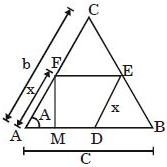
(C) Let $AF = x$. Since $FM \parallel ED$ and $FE \parallel AD$,the parallelogram is $AMFE$ (or $AFED$ based on the diagram). Let $AF = x$. Since $\Delta AFE \sim \Delta ABC$,we have $\frac{FE}{BC} = \frac{AF}{AB} = \frac{AE}{AC}$.
Let $AF = x$. Then $FE = \frac{x}{b} \cdot c$. The height of the parallelogram with respect to base $AF$ is $h = x \sin A$.
The area of the parallelogram is $Area = \text{base} \times \text{height} = FE \times (x \sin A) = (\frac{cx}{b}) \times (x \sin A) = \frac{c \sin A}{b} x^2$. However,looking at the diagram,the base is $AD$ and height is $FM$.
Let $AF = x$. Then $FE = \frac{x}{b} c$. The height of the parallelogram from $FE$ to $AB$ is $x \sin A$.
Area $A(x) = FE \cdot (x \sin A) = (\frac{c}{b} x) \cdot (x \sin A) = \frac{c \sin A}{b} x^2$. This is not correct as $x$ is limited.
Correct approach: Let $AF = x$. Then $FE = \frac{c}{b}(b-x)$. The height of the parallelogram is $h = x \sin A$.
Area $A(x) = FE \cdot h = \frac{c}{b}(b-x) \cdot x \sin A = \frac{c \sin A}{b} (bx - x^2)$.
To maximize,$\frac{dA}{dx} = \frac{c \sin A}{b} (b - 2x) = 0 \Rightarrow x = \frac{b}{2}$.
Maximum Area $= \frac{c \sin A}{b} (b(\frac{b}{2}) - (\frac{b}{2})^2) = \frac{c \sin A}{b} (\frac{b^2}{4}) = \frac{bc}{4} \sin A$.
Let $AF = x$. Then $FE = \frac{x}{b} \cdot c$. The height of the parallelogram with respect to base $AF$ is $h = x \sin A$.
The area of the parallelogram is $Area = \text{base} \times \text{height} = FE \times (x \sin A) = (\frac{cx}{b}) \times (x \sin A) = \frac{c \sin A}{b} x^2$. However,looking at the diagram,the base is $AD$ and height is $FM$.
Let $AF = x$. Then $FE = \frac{x}{b} c$. The height of the parallelogram from $FE$ to $AB$ is $x \sin A$.
Area $A(x) = FE \cdot (x \sin A) = (\frac{c}{b} x) \cdot (x \sin A) = \frac{c \sin A}{b} x^2$. This is not correct as $x$ is limited.
Correct approach: Let $AF = x$. Then $FE = \frac{c}{b}(b-x)$. The height of the parallelogram is $h = x \sin A$.
Area $A(x) = FE \cdot h = \frac{c}{b}(b-x) \cdot x \sin A = \frac{c \sin A}{b} (bx - x^2)$.
To maximize,$\frac{dA}{dx} = \frac{c \sin A}{b} (b - 2x) = 0 \Rightarrow x = \frac{b}{2}$.
Maximum Area $= \frac{c \sin A}{b} (b(\frac{b}{2}) - (\frac{b}{2})^2) = \frac{c \sin A}{b} (\frac{b^2}{4}) = \frac{bc}{4} \sin A$.
0 likes
View Solution258
AdvancedMCQ
The shortest distance of the point $(0,0)$ from the curve $y = e^x + e^{-x}$ is-
A
$1$
B
$2$
C
$\sqrt{2}$
D
$e + \frac{1}{e}$
Solution
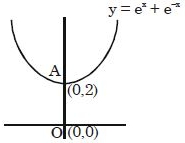
(B) The given curve is $y = e^x + e^{-x}$.
We want to find the shortest distance from the origin $(0,0)$ to this curve.
Let $f(x) = e^x + e^{-x}$. By the $AM$-$GM$ inequality,$e^x + e^{-x} \ge 2\sqrt{e^x \cdot e^{-x}} = 2\sqrt{1} = 2$.
The minimum value of $y$ is $2$,which occurs at $x = 0$.
Thus,the point on the curve closest to the origin is $(0,2)$.
The distance between $(0,0)$ and $(0,2)$ is $\sqrt{(0-0)^2 + (2-0)^2} = \sqrt{4} = 2$.
We want to find the shortest distance from the origin $(0,0)$ to this curve.
Let $f(x) = e^x + e^{-x}$. By the $AM$-$GM$ inequality,$e^x + e^{-x} \ge 2\sqrt{e^x \cdot e^{-x}} = 2\sqrt{1} = 2$.
The minimum value of $y$ is $2$,which occurs at $x = 0$.
Thus,the point on the curve closest to the origin is $(0,2)$.
The distance between $(0,0)$ and $(0,2)$ is $\sqrt{(0-0)^2 + (2-0)^2} = \sqrt{4} = 2$.
0 likes
View Solution259
AdvancedMCQ
Given $\lambda \in [0, 20]$,find the number of integral values of $\lambda$ for which the function $f(x) = x^3 - 12x + \lambda$ has a point of local maxima.
A
$5$
B
$4$
C
$0$
D
$21$
Solution
(D) Given the function $f(x) = x^3 - 12x + \lambda$.
To find the points of local maxima and minima,we calculate the first derivative:
$f'(x) = 3x^2 - 12$.
Setting $f'(x) = 0$ gives $3(x^2 - 4) = 0$,which implies $x = 2$ or $x = -2$.
Now,we check the second derivative:
$f''(x) = 6x$.
At $x = -2$,$f''(-2) = 6(-2) = -12 < 0$,which indicates a local maximum at $x = -2$.
At $x = 2$,$f''(2) = 6(2) = 12 > 0$,which indicates a local minimum at $x = 2$.
Since the existence of local maxima and minima for a cubic polynomial $f(x) = ax^3 + bx^2 + cx + d$ depends only on the derivative $f'(x) = 3ax^2 + 2bx + c$,and here $f'(x) = 3x^2 - 12$ is independent of $\lambda$,the function $f(x)$ will have a point of local maxima for all values of $\lambda$.
Given $\lambda \in [0, 20]$,the integral values of $\lambda$ are $\{0, 1, 2, \dots, 20\}$.
The total number of such values is $20 - 0 + 1 = 21$.
To find the points of local maxima and minima,we calculate the first derivative:
$f'(x) = 3x^2 - 12$.
Setting $f'(x) = 0$ gives $3(x^2 - 4) = 0$,which implies $x = 2$ or $x = -2$.
Now,we check the second derivative:
$f''(x) = 6x$.
At $x = -2$,$f''(-2) = 6(-2) = -12 < 0$,which indicates a local maximum at $x = -2$.
At $x = 2$,$f''(2) = 6(2) = 12 > 0$,which indicates a local minimum at $x = 2$.
Since the existence of local maxima and minima for a cubic polynomial $f(x) = ax^3 + bx^2 + cx + d$ depends only on the derivative $f'(x) = 3ax^2 + 2bx + c$,and here $f'(x) = 3x^2 - 12$ is independent of $\lambda$,the function $f(x)$ will have a point of local maxima for all values of $\lambda$.
Given $\lambda \in [0, 20]$,the integral values of $\lambda$ are $\{0, 1, 2, \dots, 20\}$.
The total number of such values is $20 - 0 + 1 = 21$.
0 likes
View Solution260
AdvancedMCQ
The greatest value of the function $f(x) = -1 + \frac{2}{2^{x^2} + 1}$ is:
A
$1$
B
$3/2$
C
$2/3$
D
$0$
Solution
(D) Given the function $f(x) = -1 + \frac{2}{2^{x^2} + 1}$.
To find the greatest value of $f(x)$,we need to maximize the term $\frac{2}{2^{x^2} + 1}$.
$A$ fraction is maximized when its denominator is minimized.
The denominator $2^{x^2} + 1$ is minimized when $2^{x^2}$ is minimized.
Since $x^2 \ge 0$ for all real $x$,the minimum value of $x^2$ is $0$,which occurs at $x = 0$.
At $x = 0$,$2^{x^2} = 2^0 = 1$.
Thus,the minimum value of the denominator is $1 + 1 = 2$.
The maximum value of the fraction is $\frac{2}{2} = 1$.
Therefore,the greatest value of $f(x)$ is $f(0) = -1 + 1 = 0$.
To find the greatest value of $f(x)$,we need to maximize the term $\frac{2}{2^{x^2} + 1}$.
$A$ fraction is maximized when its denominator is minimized.
The denominator $2^{x^2} + 1$ is minimized when $2^{x^2}$ is minimized.
Since $x^2 \ge 0$ for all real $x$,the minimum value of $x^2$ is $0$,which occurs at $x = 0$.
At $x = 0$,$2^{x^2} = 2^0 = 1$.
Thus,the minimum value of the denominator is $1 + 1 = 2$.
The maximum value of the fraction is $\frac{2}{2} = 1$.
Therefore,the greatest value of $f(x)$ is $f(0) = -1 + 1 = 0$.
0 likes
View Solution261
AdvancedMCQ
If $y = a \ln |x + 1| + b(x + 1)^2 + x$ has an extremum value of $4$ at $x = 0$,then the value of $(a, b)$ is:
A
$(-9, 4)$
B
$(9, -4)$
C
$(5, -4)$
D
$(5, 4)$
Solution
(A) Given the function $y = a \ln |x + 1| + b(x + 1)^2 + x$.
Since the function has an extremum at $x = 0$,the value of the function at $x = 0$ is $4$.
Substituting $x = 0$ and $y = 4$ into the equation:
$4 = a \ln |0 + 1| + b(0 + 1)^2 + 0$
$4 = a \ln(1) + b(1)^2 + 0$
Since $\ln(1) = 0$,we get $4 = 0 + b + 0$,which implies $b = 4$.
Now,find the derivative $\frac{dy}{dx}$:
$\frac{dy}{dx} = \frac{a}{x + 1} + 2b(x + 1) + 1$.
At an extremum point,the derivative is zero. Thus,at $x = 0$,$\frac{dy}{dx} = 0$:
$\frac{a}{0 + 1} + 2b(0 + 1) + 1 = 0$
$a + 2b + 1 = 0$.
Substitute $b = 4$ into the equation:
$a + 2(4) + 1 = 0$
$a + 8 + 1 = 0$
$a + 9 = 0 \Rightarrow a = -9$.
Therefore,$(a, b) = (-9, 4)$.
Since the function has an extremum at $x = 0$,the value of the function at $x = 0$ is $4$.
Substituting $x = 0$ and $y = 4$ into the equation:
$4 = a \ln |0 + 1| + b(0 + 1)^2 + 0$
$4 = a \ln(1) + b(1)^2 + 0$
Since $\ln(1) = 0$,we get $4 = 0 + b + 0$,which implies $b = 4$.
Now,find the derivative $\frac{dy}{dx}$:
$\frac{dy}{dx} = \frac{a}{x + 1} + 2b(x + 1) + 1$.
At an extremum point,the derivative is zero. Thus,at $x = 0$,$\frac{dy}{dx} = 0$:
$\frac{a}{0 + 1} + 2b(0 + 1) + 1 = 0$
$a + 2b + 1 = 0$.
Substitute $b = 4$ into the equation:
$a + 2(4) + 1 = 0$
$a + 8 + 1 = 0$
$a + 9 = 0 \Rightarrow a = -9$.
Therefore,$(a, b) = (-9, 4)$.
0 likes
View Solution262
AdvancedMCQ
Let $f(x) = \begin{cases} 3 - x, & 0 \le x < 1 \\ x^2 + \log_e b, & x \ge 1 \end{cases}$. The set of values of $b$ such that $f(x)$ has a local minimum at $x = 1$ is
A
$(0, 1]$
B
$(0, e]$
C
$[e, \infty)$
D
$[1, \infty)$
Solution
(B) For $f(x)$ to have a local minimum at $x = 1$,the function must satisfy $f(1) \le f(1 - h)$ and $f(1) \le f(1 + h)$ for small $h > 0$.
First,we evaluate the left-hand limit at $x = 1$:
$f(1^-) = \lim_{x \to 1^-} (3 - x) = 3 - 1 = 2$.
Next,we evaluate the function value at $x = 1$:
$f(1) = 1^2 + \log_e b = 1 + \log_e b$.
For $x > 1$,$f(x) = x^2 + \log_e b$. Since $f'(x) = 2x > 0$ for $x > 1$,the function is strictly increasing for $x > 1$. Thus,$f(x) \ge f(1)$ for all $x > 1$ in the neighborhood of $1$.
For $x < 1$,$f(x) = 3 - x$. Since $f'(x) = -1 < 0$ for $x < 1$,the function is strictly decreasing for $x < 1$. Thus,$f(x) > f(1^-) = 2$ for all $x < 1$ in the neighborhood of $1$.
For $x = 1$ to be a local minimum,we require $f(1) \le f(x)$ for all $x$ in a neighborhood of $1$. Specifically,we need $f(1) \le f(1^-)$:
$1 + \log_e b \le 2$
$\log_e b \le 1$
$b \le e^1 = e$.
Since the logarithm $\log_e b$ is defined only for $b > 0$,the set of values for $b$ is $(0, e]$.
First,we evaluate the left-hand limit at $x = 1$:
$f(1^-) = \lim_{x \to 1^-} (3 - x) = 3 - 1 = 2$.
Next,we evaluate the function value at $x = 1$:
$f(1) = 1^2 + \log_e b = 1 + \log_e b$.
For $x > 1$,$f(x) = x^2 + \log_e b$. Since $f'(x) = 2x > 0$ for $x > 1$,the function is strictly increasing for $x > 1$. Thus,$f(x) \ge f(1)$ for all $x > 1$ in the neighborhood of $1$.
For $x < 1$,$f(x) = 3 - x$. Since $f'(x) = -1 < 0$ for $x < 1$,the function is strictly decreasing for $x < 1$. Thus,$f(x) > f(1^-) = 2$ for all $x < 1$ in the neighborhood of $1$.
For $x = 1$ to be a local minimum,we require $f(1) \le f(x)$ for all $x$ in a neighborhood of $1$. Specifically,we need $f(1) \le f(1^-)$:
$1 + \log_e b \le 2$
$\log_e b \le 1$
$b \le e^1 = e$.
Since the logarithm $\log_e b$ is defined only for $b > 0$,the set of values for $b$ is $(0, e]$.
0 likes
View Solution263
AdvancedMCQ
The ratio of the altitude of the cone of greatest volume which can be inscribed in a given sphere to the diameter of the sphere is:
A
$2/3$
B
$3/4$
C
$1/3$
D
$1/4$
Solution
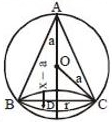
(A) Let $h$ be the height of the cone inscribed in a sphere of radius $R$. Let the center of the sphere be $O$. The distance from the center $O$ to the base of the cone is $|h-R|$.
By the Pythagorean theorem,the radius $r$ of the base of the cone satisfies $r^2 + (h-R)^2 = R^2$,so $r^2 = R^2 - (h^2 - 2hR + R^2) = 2hR - h^2$.
The volume $V$ of the cone is $V = \frac{1}{3} \pi r^2 h = \frac{1}{3} \pi (2hR - h^2) h = \frac{1}{3} \pi (2h^2R - h^3)$.
To maximize $V$,we find the derivative with respect to $h$: $\frac{dV}{dh} = \frac{1}{3} \pi (4hR - 3h^2)$.
Setting $\frac{dV}{dh} = 0$ gives $h(4R - 3h) = 0$. Since $h \neq 0$,we have $h = \frac{4R}{3}$.
The diameter of the sphere is $D = 2R$.
The ratio of the altitude of the cone to the diameter of the sphere is $\frac{h}{D} = \frac{4R/3}{2R} = \frac{4}{6} = \frac{2}{3}$.
By the Pythagorean theorem,the radius $r$ of the base of the cone satisfies $r^2 + (h-R)^2 = R^2$,so $r^2 = R^2 - (h^2 - 2hR + R^2) = 2hR - h^2$.
The volume $V$ of the cone is $V = \frac{1}{3} \pi r^2 h = \frac{1}{3} \pi (2hR - h^2) h = \frac{1}{3} \pi (2h^2R - h^3)$.
To maximize $V$,we find the derivative with respect to $h$: $\frac{dV}{dh} = \frac{1}{3} \pi (4hR - 3h^2)$.
Setting $\frac{dV}{dh} = 0$ gives $h(4R - 3h) = 0$. Since $h \neq 0$,we have $h = \frac{4R}{3}$.
The diameter of the sphere is $D = 2R$.
The ratio of the altitude of the cone to the diameter of the sphere is $\frac{h}{D} = \frac{4R/3}{2R} = \frac{4}{6} = \frac{2}{3}$.
0 likes
View Solution264
DifficultMCQ
Let $f(x) = x^3 - 6x^2 + 12x - 3$. Then at $x = 2$,$f(x)$ has:
A
a maximum
B
a minimum
C
both a maximum and minimum
D
neither a maximum nor a minimum
Solution
(D) To determine the nature of the function at $x = 2$,we find the first and second derivatives of $f(x) = x^3 - 6x^2 + 12x - 3$.
Step $1$: Find the first derivative $f'(x)$.
$f'(x) = \frac{d}{dx}(x^3 - 6x^2 + 12x - 3) = 3x^2 - 12x + 12$.
Step $2$: Find the critical points by setting $f'(x) = 0$.
$3x^2 - 12x + 12 = 0 \implies 3(x^2 - 4x + 4) = 0 \implies 3(x - 2)^2 = 0$.
This gives $x = 2$ as the critical point.
Step $3$: Find the second derivative $f''(x)$.
$f''(x) = \frac{d}{dx}(3x^2 - 12x + 12) = 6x - 12$.
Step $4$: Evaluate $f''(x)$ at $x = 2$.
$f''(2) = 6(2) - 12 = 12 - 12 = 0$.
Since $f''(2) = 0$,the second derivative test is inconclusive. We examine the sign of $f'(x)$ around $x = 2$.
$f'(x) = 3(x - 2)^2$. Since $(x - 2)^2$ is always non-negative for all real $x$,$f'(x) \geq 0$ for all $x$.
Because the derivative does not change sign as $x$ passes through $2$,$x = 2$ is a point of inflection,not a local maximum or minimum.
Step $1$: Find the first derivative $f'(x)$.
$f'(x) = \frac{d}{dx}(x^3 - 6x^2 + 12x - 3) = 3x^2 - 12x + 12$.
Step $2$: Find the critical points by setting $f'(x) = 0$.
$3x^2 - 12x + 12 = 0 \implies 3(x^2 - 4x + 4) = 0 \implies 3(x - 2)^2 = 0$.
This gives $x = 2$ as the critical point.
Step $3$: Find the second derivative $f''(x)$.
$f''(x) = \frac{d}{dx}(3x^2 - 12x + 12) = 6x - 12$.
Step $4$: Evaluate $f''(x)$ at $x = 2$.
$f''(2) = 6(2) - 12 = 12 - 12 = 0$.
Since $f''(2) = 0$,the second derivative test is inconclusive. We examine the sign of $f'(x)$ around $x = 2$.
$f'(x) = 3(x - 2)^2$. Since $(x - 2)^2$ is always non-negative for all real $x$,$f'(x) \geq 0$ for all $x$.
Because the derivative does not change sign as $x$ passes through $2$,$x = 2$ is a point of inflection,not a local maximum or minimum.
0 likes
View Solution265
AdvancedMCQ
The maximum value of ${\left( {\frac{1}{x}} \right)^{2{x^2}}}$ is
A
$e$
B
$\sqrt[e]{e}$
C
$1$
D
None of these
Solution
(B) Let $y = (\frac{1}{x})^{2x^2} = x^{-2x^2}$.
Taking the natural logarithm on both sides,we get $\ln y = -2x^2 \ln x$.
Differentiating with respect to $x$,we have $\frac{1}{y} \frac{dy}{dx} = -4x \ln x - 2x^2 (\frac{1}{x}) = -4x \ln x - 2x = -2x(2 \ln x + 1)$.
Thus,$\frac{dy}{dx} = -2x(2 \ln x + 1) y$.
For critical points,set $\frac{dy}{dx} = 0$. Since $x > 0$ and $y > 0$,we have $2 \ln x + 1 = 0$,which implies $\ln x = -\frac{1}{2}$,so $x = e^{-1/2} = \frac{1}{\sqrt{e}}$.
At $x = \frac{1}{\sqrt{e}}$,the function attains its maximum value.
Substituting $x = e^{-1/2}$ into the original expression:
$y_{max} = (\frac{1}{e^{-1/2}})^{2(e^{-1/2})^2} = (e^{1/2})^{2(e^{-1})} = e^{(1/2) \times (2/e)} = e^{1/e} = \sqrt[e]{e}$.
Taking the natural logarithm on both sides,we get $\ln y = -2x^2 \ln x$.
Differentiating with respect to $x$,we have $\frac{1}{y} \frac{dy}{dx} = -4x \ln x - 2x^2 (\frac{1}{x}) = -4x \ln x - 2x = -2x(2 \ln x + 1)$.
Thus,$\frac{dy}{dx} = -2x(2 \ln x + 1) y$.
For critical points,set $\frac{dy}{dx} = 0$. Since $x > 0$ and $y > 0$,we have $2 \ln x + 1 = 0$,which implies $\ln x = -\frac{1}{2}$,so $x = e^{-1/2} = \frac{1}{\sqrt{e}}$.
At $x = \frac{1}{\sqrt{e}}$,the function attains its maximum value.
Substituting $x = e^{-1/2}$ into the original expression:
$y_{max} = (\frac{1}{e^{-1/2}})^{2(e^{-1/2})^2} = (e^{1/2})^{2(e^{-1})} = e^{(1/2) \times (2/e)} = e^{1/e} = \sqrt[e]{e}$.
0 likes
View Solution266
AdvancedMCQ
The maximum value of $f(x) = (7-x)^4 (2+x)^5$ is
A
$(4 \times 5)^{4+5}$
B
$4^5 5^4$
C
$4^4 5^5$
D
None of these
Solution
(C) To find the maximum value,we first find the derivative $f'(x)$ and set it to $0$.
$f(x) = (7-x)^4 (2+x)^5$
Using the product rule and chain rule:
$f'(x) = 4(7-x)^3(-1)(2+x)^5 + 5(7-x)^4(2+x)^4$
$f'(x) = (7-x)^3(2+x)^4 [-4(2+x) + 5(7-x)]$
$f'(x) = (7-x)^3(2+x)^4 [-8 - 4x + 35 - 5x]$
$f'(x) = (7-x)^3(2+x)^4 [27 - 9x]$
Setting $f'(x) = 0$,we get critical points $x = 7, x = -2, x = 3$.
For $x \in (-2, 7)$,the function is positive. At $x = 3$,the derivative changes from positive to negative,indicating a local maximum.
The maximum value is $f(3) = (7-3)^4 (2+3)^5 = 4^4 \times 5^5$.
$f(x) = (7-x)^4 (2+x)^5$
Using the product rule and chain rule:
$f'(x) = 4(7-x)^3(-1)(2+x)^5 + 5(7-x)^4(2+x)^4$
$f'(x) = (7-x)^3(2+x)^4 [-4(2+x) + 5(7-x)]$
$f'(x) = (7-x)^3(2+x)^4 [-8 - 4x + 35 - 5x]$
$f'(x) = (7-x)^3(2+x)^4 [27 - 9x]$
Setting $f'(x) = 0$,we get critical points $x = 7, x = -2, x = 3$.
For $x \in (-2, 7)$,the function is positive. At $x = 3$,the derivative changes from positive to negative,indicating a local maximum.
The maximum value is $f(3) = (7-3)^4 (2+3)^5 = 4^4 \times 5^5$.
0 likes
View Solution267
AdvancedMCQ
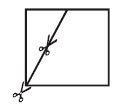
Consider a square of side $2 \ cm$. It is cut from one of its corners as shown in the adjacent figure. The maximum value of the sum of the perimeters of the two plane figures thus formed is
A
$2\sqrt{2} + 8$
B
$12$
C
$8$
D
$4\sqrt{2} + 8$
Solution
(D) Let the square have side length $2 \ cm$. $A$ cut is made from one corner to a point on an adjacent side,creating a right-angled triangle and a quadrilateral (trapezium).
Let the cut start from a corner and end at a distance $x$ from the corner on one side and $y$ from the corner on the other side. However,based on the figure,the cut is a straight line segment of length $L$ connecting a point at distance $x$ from the corner on one side to the corner itself on the other side.
Let the triangle have sides $x$,$2$,and $L$,where $L = \sqrt{x^2 + 2^2}$.
The perimeter of the triangle is $P_1 = x + 2 + L$.
The remaining figure is a quadrilateral with sides $2$,$2$,$(2-x)$,and $L$.
The perimeter of the quadrilateral is $P_2 = 2 + 2 + (2-x) + L = 6 - x + L$.
The sum of the perimeters is $S = P_1 + P_2 = (x + 2 + L) + (6 - x + L) = 8 + 2L$.
To maximize $S$,we must maximize $L$. The maximum length of a straight line segment $L$ that can be cut from a corner of a square of side $2$ is the diagonal of the square.
Thus,$L = \sqrt{2^2 + 2^2} = \sqrt{8} = 2\sqrt{2}$.
The maximum sum of the perimeters is $S_{max} = 8 + 2(2\sqrt{2}) = 8 + 4\sqrt{2} \ cm$.
Let the cut start from a corner and end at a distance $x$ from the corner on one side and $y$ from the corner on the other side. However,based on the figure,the cut is a straight line segment of length $L$ connecting a point at distance $x$ from the corner on one side to the corner itself on the other side.
Let the triangle have sides $x$,$2$,and $L$,where $L = \sqrt{x^2 + 2^2}$.
The perimeter of the triangle is $P_1 = x + 2 + L$.
The remaining figure is a quadrilateral with sides $2$,$2$,$(2-x)$,and $L$.
The perimeter of the quadrilateral is $P_2 = 2 + 2 + (2-x) + L = 6 - x + L$.
The sum of the perimeters is $S = P_1 + P_2 = (x + 2 + L) + (6 - x + L) = 8 + 2L$.
To maximize $S$,we must maximize $L$. The maximum length of a straight line segment $L$ that can be cut from a corner of a square of side $2$ is the diagonal of the square.
Thus,$L = \sqrt{2^2 + 2^2} = \sqrt{8} = 2\sqrt{2}$.
The maximum sum of the perimeters is $S_{max} = 8 + 2(2\sqrt{2}) = 8 + 4\sqrt{2} \ cm$.
0 likes
View Solution268
AdvancedMCQ
If $f(x) = \int_{x}^{x^2} (t - 1) \, dt$ for $1 \le x \le 3$,then the global maximum value of $f(x)$ is
A
$11$
B
$30$
C
$14$
D
None of these
Solution
(B) Given $f(x) = \int_{x}^{x^2} (t - 1) \, dt$.
Using the Leibniz integral rule,we differentiate $f(x)$ with respect to $x$:
$f'(x) = (x^2 - 1) \cdot \frac{d}{dx}(x^2) - (x - 1) \cdot \frac{d}{dx}(x)$
$f'(x) = (x^2 - 1)(2x) - (x - 1)(1)$
$f'(x) = 2x^3 - 2x - x + 1 = 2x^3 - 3x + 1$.
We can factorize $f'(x)$ by observing that $x=1$ is a root:
$f'(x) = (x - 1)(2x^2 + 2x - 1)$.
For $x \in [1, 3]$,$f'(x) \ge 0$,so $f(x)$ is an increasing function.
The maximum value occurs at the right endpoint,$x = 3$.
$f(3) = \int_{3}^{9} (t - 1) \, dt = \left[ \frac{t^2}{2} - t \right]_{3}^{9}$
$f(3) = \left( \frac{81}{2} - 9 \right) - \left( \frac{9}{2} - 3 \right) = \frac{72}{2} - 6 = 36 - 6 = 30$.
Using the Leibniz integral rule,we differentiate $f(x)$ with respect to $x$:
$f'(x) = (x^2 - 1) \cdot \frac{d}{dx}(x^2) - (x - 1) \cdot \frac{d}{dx}(x)$
$f'(x) = (x^2 - 1)(2x) - (x - 1)(1)$
$f'(x) = 2x^3 - 2x - x + 1 = 2x^3 - 3x + 1$.
We can factorize $f'(x)$ by observing that $x=1$ is a root:
$f'(x) = (x - 1)(2x^2 + 2x - 1)$.
For $x \in [1, 3]$,$f'(x) \ge 0$,so $f(x)$ is an increasing function.
The maximum value occurs at the right endpoint,$x = 3$.
$f(3) = \int_{3}^{9} (t - 1) \, dt = \left[ \frac{t^2}{2} - t \right]_{3}^{9}$
$f(3) = \left( \frac{81}{2} - 9 \right) - \left( \frac{9}{2} - 3 \right) = \frac{72}{2} - 6 = 36 - 6 = 30$.
0 likes
View Solution269
AdvancedMCQ
The number of points in $(-\infty, \infty)$ for which $x^2 - x \sin x - \cos x = 0$ is
A
$6$
B
$4$
C
$2$
D
$0$
Solution
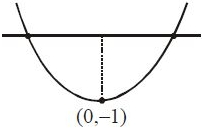
(C) Let $f(x) = x^2 - x \sin x - \cos x$.
Then,the derivative is $f'(x) = 2x - (\sin x + x \cos x) - (-\sin x) = 2x - x \cos x = x(2 - \cos x)$.
Since $-1 \le \cos x \le 1$,we have $2 - \cos x > 0$ for all real $x$.
Thus,$f'(x) = 0$ only at $x = 0$.
For $x < 0$,$f'(x) < 0$,so $f(x)$ is strictly decreasing.
For $x > 0$,$f'(x) > 0$,so $f(x)$ is strictly increasing.
Therefore,$x = 0$ is the point of global minimum.
The minimum value is $f(0) = 0^2 - 0 \sin(0) - \cos(0) = -1$.
As $x \to \infty$,$f(x) \to \infty$,and as $x \to -\infty$,$f(x) \to \infty$.
Since $f(x)$ is continuous,it crosses the $x$-axis exactly once in $(-\infty, 0)$ and exactly once in $(0, \infty)$.
Thus,there are exactly $2$ points where $f(x) = 0$.
Then,the derivative is $f'(x) = 2x - (\sin x + x \cos x) - (-\sin x) = 2x - x \cos x = x(2 - \cos x)$.
Since $-1 \le \cos x \le 1$,we have $2 - \cos x > 0$ for all real $x$.
Thus,$f'(x) = 0$ only at $x = 0$.
For $x < 0$,$f'(x) < 0$,so $f(x)$ is strictly decreasing.
For $x > 0$,$f'(x) > 0$,so $f(x)$ is strictly increasing.
Therefore,$x = 0$ is the point of global minimum.
The minimum value is $f(0) = 0^2 - 0 \sin(0) - \cos(0) = -1$.
As $x \to \infty$,$f(x) \to \infty$,and as $x \to -\infty$,$f(x) \to \infty$.
Since $f(x)$ is continuous,it crosses the $x$-axis exactly once in $(-\infty, 0)$ and exactly once in $(0, \infty)$.
Thus,there are exactly $2$ points where $f(x) = 0$.
0 likes
View Solution270
AdvancedMCQ
The maximum value of ${x^4}{e^{ - {x^2}}}$ is
A
$e^2$
B
$e^{-2}$
C
$12e^{-2}$
D
$4e^{-2}$
Solution
(D) Let $f(x) = x^4 e^{-x^2}$.
To find the maximum value,we find the derivative $f'(x)$:
$f'(x) = 4x^3 e^{-x^2} + x^4 e^{-x^2}(-2x)$
$f'(x) = 2x^3 e^{-x^2}(2 - x^2)$
Setting $f'(x) = 0$,we get $x = 0$ or $x^2 = 2$,which means $x = 0, \pm \sqrt{2}$.
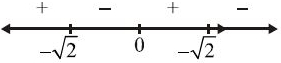
Analyzing the sign of $f'(x)$:
For $x < -\sqrt{2}$,$f'(x) > 0$.
For $-\sqrt{2} < x < 0$,$f'(x) < 0$.
For $0 < x < \sqrt{2}$,$f'(x) > 0$.
For $x > \sqrt{2}$,$f'(x) < 0$.
Thus,$f(x)$ has local maxima at $x = \pm \sqrt{2}$.
The maximum value is $f(\pm \sqrt{2}) = (\pm \sqrt{2})^4 e^{-(\pm \sqrt{2})^2} = 4 e^{-2}$.
To find the maximum value,we find the derivative $f'(x)$:
$f'(x) = 4x^3 e^{-x^2} + x^4 e^{-x^2}(-2x)$
$f'(x) = 2x^3 e^{-x^2}(2 - x^2)$
Setting $f'(x) = 0$,we get $x = 0$ or $x^2 = 2$,which means $x = 0, \pm \sqrt{2}$.
Analyzing the sign of $f'(x)$:
For $x < -\sqrt{2}$,$f'(x) > 0$.
For $-\sqrt{2} < x < 0$,$f'(x) < 0$.
For $0 < x < \sqrt{2}$,$f'(x) > 0$.
For $x > \sqrt{2}$,$f'(x) < 0$.
Thus,$f(x)$ has local maxima at $x = \pm \sqrt{2}$.
The maximum value is $f(\pm \sqrt{2}) = (\pm \sqrt{2})^4 e^{-(\pm \sqrt{2})^2} = 4 e^{-2}$.
0 likes
View Solution271
AdvancedMCQ
The global maximum value of $f(x) = \log_{10}(4x^3 - 12x^2 + 11x - 3)$,$x \in [2, 3]$,is
A
$-\frac{3}{2}\log_{10}3$
B
$1 + \log_{10}3$
C
$\log_{10}3$
D
$\frac{3}{2}\log_{10}3$
Solution
(B) Let $g(x) = 4x^3 - 12x^2 + 11x - 3$.
Then $g'(x) = 12x^2 - 24x + 11$.
We can write $g'(x) = 12(x^2 - 2x) + 11 = 12(x^2 - 2x + 1 - 1) + 11 = 12(x - 1)^2 - 1$.
For $x \in [2, 3]$,$(x - 1) \in [1, 2]$,so $(x - 1)^2 \in [1, 4]$.
Thus,$g'(x) \geq 12(1) - 1 = 11 > 0$ for all $x \in [2, 3]$.
Since $g'(x) > 0$,$g(x)$ is a strictly increasing function on $[2, 3]$.
Consequently,$f(x) = \log_{10}(g(x))$ is also strictly increasing on $[2, 3]$.
The global maximum value occurs at the right endpoint $x = 3$.
$f(3) = \log_{10}(4(3)^3 - 12(3)^2 + 11(3) - 3) = \log_{10}(4(27) - 12(9) + 33 - 3) = \log_{10}(108 - 108 + 30) = \log_{10}(30)$.
$f(3) = \log_{10}(10 \times 3) = \log_{10}10 + \log_{10}3 = 1 + \log_{10}3$.
Then $g'(x) = 12x^2 - 24x + 11$.
We can write $g'(x) = 12(x^2 - 2x) + 11 = 12(x^2 - 2x + 1 - 1) + 11 = 12(x - 1)^2 - 1$.
For $x \in [2, 3]$,$(x - 1) \in [1, 2]$,so $(x - 1)^2 \in [1, 4]$.
Thus,$g'(x) \geq 12(1) - 1 = 11 > 0$ for all $x \in [2, 3]$.
Since $g'(x) > 0$,$g(x)$ is a strictly increasing function on $[2, 3]$.
Consequently,$f(x) = \log_{10}(g(x))$ is also strictly increasing on $[2, 3]$.
The global maximum value occurs at the right endpoint $x = 3$.
$f(3) = \log_{10}(4(3)^3 - 12(3)^2 + 11(3) - 3) = \log_{10}(4(27) - 12(9) + 33 - 3) = \log_{10}(108 - 108 + 30) = \log_{10}(30)$.
$f(3) = \log_{10}(10 \times 3) = \log_{10}10 + \log_{10}3 = 1 + \log_{10}3$.
0 likes
View Solution272
DifficultMCQ
The height of a right circular cone of maximum volume inscribed in a sphere of diameter $a$ is
A
$(2/3)a$
B
$(3/4)a$
C
$(1/3)a$
D
$(1/4)a$
Solution
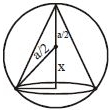
(A) Let $R = a/2$ be the radius of the sphere. Let $h$ be the height of the cone and $r$ be the radius of the base of the cone.
From the geometry,if $x$ is the distance from the center of the sphere to the base of the cone,then $h = R + x = a/2 + x$.
The radius of the base of the cone is given by $r^2 = R^2 - x^2 = (a/2)^2 - x^2$.
The volume of the cone is $V = \frac{1}{3} \pi r^2 h = \frac{1}{3} \pi ((a/2)^2 - x^2)(a/2 + x)$.
Expanding this,$V = \frac{\pi}{3} (a^2/4 - x^2)(a/2 + x) = \frac{\pi}{3} (a^3/8 + a^2x/4 - ax^2/2 - x^3)$.
To maximize volume,find $dV/dx = 0$:
$dV/dx = \frac{\pi}{3} (a^2/4 - ax - 3x^2) = 0$.
$3x^2 + ax - a^2/4 = 0$.
Using the quadratic formula,$x = \frac{-a \pm \sqrt{a^2 - 4(3)(-a^2/4)}}{2(3)} = \frac{-a \pm \sqrt{a^2 + 3a^2}}{6} = \frac{-a \pm 2a}{6}$.
Since $x$ must be positive,$x = a/6$.
Therefore,the height $h = a/2 + a/6 = (3a + a)/6 = 4a/6 = (2/3)a$.
From the geometry,if $x$ is the distance from the center of the sphere to the base of the cone,then $h = R + x = a/2 + x$.
The radius of the base of the cone is given by $r^2 = R^2 - x^2 = (a/2)^2 - x^2$.
The volume of the cone is $V = \frac{1}{3} \pi r^2 h = \frac{1}{3} \pi ((a/2)^2 - x^2)(a/2 + x)$.
Expanding this,$V = \frac{\pi}{3} (a^2/4 - x^2)(a/2 + x) = \frac{\pi}{3} (a^3/8 + a^2x/4 - ax^2/2 - x^3)$.
To maximize volume,find $dV/dx = 0$:
$dV/dx = \frac{\pi}{3} (a^2/4 - ax - 3x^2) = 0$.
$3x^2 + ax - a^2/4 = 0$.
Using the quadratic formula,$x = \frac{-a \pm \sqrt{a^2 - 4(3)(-a^2/4)}}{2(3)} = \frac{-a \pm \sqrt{a^2 + 3a^2}}{6} = \frac{-a \pm 2a}{6}$.
Since $x$ must be positive,$x = a/6$.
Therefore,the height $h = a/2 + a/6 = (3a + a)/6 = 4a/6 = (2/3)a$.
0 likes
View Solution273
DifficultMCQ
If a right circular cone having maximum volume is inscribed in a sphere of radius $3 \, cm$,then the curved surface area (in $cm^2$) of this cone is
A
$8\sqrt{3} \pi$
B
$6\sqrt{2} \pi$
C
$6\sqrt{3} \pi$
D
$8\sqrt{2} \pi$
Solution
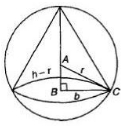
(A) Let $R = 3 \, cm$ be the radius of the sphere.
Let $h$ be the height and $b$ be the base radius of the inscribed cone.
From the geometry of the sphere,the relationship between $h, b,$ and $R$ is given by $(h-R)^2 + b^2 = R^2$.
Thus,$b^2 = R^2 - (h-R)^2 = 2hR - h^2$.
The volume of the cone is $V = \frac{1}{3} \pi b^2 h = \frac{1}{3} \pi (2hR - h^2) h = \frac{\pi}{3} (2Rh^2 - h^3)$.
To maximize volume,we find $\frac{dV}{dh} = \frac{\pi}{3} (4Rh - 3h^2) = 0$.
This gives $h(4R - 3h) = 0$. Since $h \neq 0$,we have $h = \frac{4R}{3} = \frac{4(3)}{3} = 4 \, cm$.
Now,$b^2 = 2(4)(3) - (4)^2 = 24 - 16 = 8$,so $b = \sqrt{8} = 2\sqrt{2} \, cm$.
The slant height $l = \sqrt{h^2 + b^2} = \sqrt{4^2 + (2\sqrt{2})^2} = \sqrt{16 + 8} = \sqrt{24} = 2\sqrt{6} \, cm$.
The curved surface area is $A = \pi b l = \pi (2\sqrt{2}) (2\sqrt{6}) = 4\pi \sqrt{12} = 4\pi (2\sqrt{3}) = 8\sqrt{3} \pi \, cm^2$.
Let $h$ be the height and $b$ be the base radius of the inscribed cone.
From the geometry of the sphere,the relationship between $h, b,$ and $R$ is given by $(h-R)^2 + b^2 = R^2$.
Thus,$b^2 = R^2 - (h-R)^2 = 2hR - h^2$.
The volume of the cone is $V = \frac{1}{3} \pi b^2 h = \frac{1}{3} \pi (2hR - h^2) h = \frac{\pi}{3} (2Rh^2 - h^3)$.
To maximize volume,we find $\frac{dV}{dh} = \frac{\pi}{3} (4Rh - 3h^2) = 0$.
This gives $h(4R - 3h) = 0$. Since $h \neq 0$,we have $h = \frac{4R}{3} = \frac{4(3)}{3} = 4 \, cm$.
Now,$b^2 = 2(4)(3) - (4)^2 = 24 - 16 = 8$,so $b = \sqrt{8} = 2\sqrt{2} \, cm$.
The slant height $l = \sqrt{h^2 + b^2} = \sqrt{4^2 + (2\sqrt{2})^2} = \sqrt{16 + 8} = \sqrt{24} = 2\sqrt{6} \, cm$.
The curved surface area is $A = \pi b l = \pi (2\sqrt{2}) (2\sqrt{6}) = 4\pi \sqrt{12} = 4\pi (2\sqrt{3}) = 8\sqrt{3} \pi \, cm^2$.
0 likes
View Solution274
DifficultMCQ
Let $f(x)$ be a polynomial of degree $4$ having extreme values at $x = 1$ and $x = 2$. If $\mathop {\lim }\limits_{x \to 0} \left( {\frac{{f(x)}}{{{x^2}}} + 1} \right) = 3$,then $f(-1)$ is equal to
A
$\frac{1}{2}$
B
$\frac{3}{2}$
C
$\frac{5}{2}$
D
$\frac{9}{2}$
Solution
(D) Since $f(x)$ is a polynomial of degree $4$,let $f(x) = Ax^4 + Bx^3 + Cx^2 + Dx + E$.
Given $\lim_{x \to 0} \left( \frac{f(x)}{x^2} + 1 \right) = 3$,we have $\lim_{x \to 0} \left( \frac{Ax^4 + Bx^3 + Cx^2 + Dx + E}{x^2} + 1 \right) = 3$.
This implies $\lim_{x \to 0} \left( Ax^2 + Bx + C + \frac{D}{x} + \frac{E}{x^2} + 1 \right) = 3$.
For the limit to exist and be finite,we must have $D = 0$ and $E = 0$. Thus,$C + 1 = 3$,which gives $C = 2$.
Now,$f(x) = Ax^4 + Bx^3 + 2x^2$. The derivative is $f'(x) = 4Ax^3 + 3Bx^2 + 4x$.
Since $f(x)$ has extreme values at $x = 1$ and $x = 2$,$f'(1) = 0$ and $f'(2) = 0$.
$f'(1) = 4A + 3B + 4 = 0 \implies 4A + 3B = -4$ (Equation $1$).
$f'(2) = 4A(8) + 3B(4) + 4(2) = 32A + 12B + 8 = 0 \implies 8A + 3B = -2$ (Equation $2$).
Subtracting Equation $1$ from Equation $2$: $(8A + 3B) - (4A + 3B) = -2 - (-4) \implies 4A = 2 \implies A = \frac{1}{2}$.
Substituting $A = \frac{1}{2}$ into Equation $1$: $4(\frac{1}{2}) + 3B = -4 \implies 2 + 3B = -4 \implies 3B = -6 \implies B = -2$.
Thus,$f(x) = \frac{1}{2}x^4 - 2x^3 + 2x^2$.
Finally,$f(-1) = \frac{1}{2}(-1)^4 - 2(-1)^3 + 2(-1)^2 = \frac{1}{2} + 2 + 2 = \frac{9}{2}$.
Given $\lim_{x \to 0} \left( \frac{f(x)}{x^2} + 1 \right) = 3$,we have $\lim_{x \to 0} \left( \frac{Ax^4 + Bx^3 + Cx^2 + Dx + E}{x^2} + 1 \right) = 3$.
This implies $\lim_{x \to 0} \left( Ax^2 + Bx + C + \frac{D}{x} + \frac{E}{x^2} + 1 \right) = 3$.
For the limit to exist and be finite,we must have $D = 0$ and $E = 0$. Thus,$C + 1 = 3$,which gives $C = 2$.
Now,$f(x) = Ax^4 + Bx^3 + 2x^2$. The derivative is $f'(x) = 4Ax^3 + 3Bx^2 + 4x$.
Since $f(x)$ has extreme values at $x = 1$ and $x = 2$,$f'(1) = 0$ and $f'(2) = 0$.
$f'(1) = 4A + 3B + 4 = 0 \implies 4A + 3B = -4$ (Equation $1$).
$f'(2) = 4A(8) + 3B(4) + 4(2) = 32A + 12B + 8 = 0 \implies 8A + 3B = -2$ (Equation $2$).
Subtracting Equation $1$ from Equation $2$: $(8A + 3B) - (4A + 3B) = -2 - (-4) \implies 4A = 2 \implies A = \frac{1}{2}$.
Substituting $A = \frac{1}{2}$ into Equation $1$: $4(\frac{1}{2}) + 3B = -4 \implies 2 + 3B = -4 \implies 3B = -6 \implies B = -2$.
Thus,$f(x) = \frac{1}{2}x^4 - 2x^3 + 2x^2$.
Finally,$f(-1) = \frac{1}{2}(-1)^4 - 2(-1)^3 + 2(-1)^2 = \frac{1}{2} + 2 + 2 = \frac{9}{2}$.
0 likes
View Solution275
DifficultMCQ
Let $M$ and $m$ be respectively the local maximum and the local minimum values of the function $f(x) = 2x^3 - 9x^2 + 12x + 5$ in the interval $[0, 3]$. Then $M - m$ is equal to
A
$1$
B
$5$
C
$4$
D
$9$
Solution
(A) Given function is $f(x) = 2x^3 - 9x^2 + 12x + 5$.
To find local maxima and minima,we find the derivative $f'(x)$:
$f'(x) = 6x^2 - 18x + 12$.
Setting $f'(x) = 0$ for critical points:
$6(x^2 - 3x + 2) = 0 \Rightarrow 6(x - 1)(x - 2) = 0$.
So,the critical points are $x = 1$ and $x = 2$.
Now,we check the second derivative $f''(x) = 12x - 18$.
At $x = 1$,$f''(1) = 12(1) - 18 = -6 < 0$,so $x = 1$ is a local maximum.
$M = f(1) = 2(1)^3 - 9(1)^2 + 12(1) + 5 = 2 - 9 + 12 + 5 = 10$.
At $x = 2$,$f''(2) = 12(2) - 18 = 6 > 0$,so $x = 2$ is a local minimum.
$m = f(2) = 2(2)^3 - 9(2)^2 + 12(2) + 5 = 16 - 36 + 24 + 5 = 9$.
Therefore,$M - m = 10 - 9 = 1$.
To find local maxima and minima,we find the derivative $f'(x)$:
$f'(x) = 6x^2 - 18x + 12$.
Setting $f'(x) = 0$ for critical points:
$6(x^2 - 3x + 2) = 0 \Rightarrow 6(x - 1)(x - 2) = 0$.
So,the critical points are $x = 1$ and $x = 2$.
Now,we check the second derivative $f''(x) = 12x - 18$.
At $x = 1$,$f''(1) = 12(1) - 18 = -6 < 0$,so $x = 1$ is a local maximum.
$M = f(1) = 2(1)^3 - 9(1)^2 + 12(1) + 5 = 2 - 9 + 12 + 5 = 10$.
At $x = 2$,$f''(2) = 12(2) - 18 = 6 > 0$,so $x = 2$ is a local minimum.
$m = f(2) = 2(2)^3 - 9(2)^2 + 12(2) + 5 = 16 - 36 + 24 + 5 = 9$.
Therefore,$M - m = 10 - 9 = 1$.
0 likes
View Solution276
DifficultMCQ
Let $k$ and $K$ be the minimum and the maximum values of the function $f(x) = \frac{(1 + x)^{0.6}}{1 + x^{0.6}}$ in $[0, 1]$ respectively,then the ordered pair $(k, K)$ is equal to
A
$(2^{-0.4}, 1)$
B
$(2^{-0.4}, 2^{0.6})$
C
$(2^{-0.6}, 1)$
D
$(1, 2^{0.6})$
Solution
(A) Let $f(x) = \frac{(1 + x)^{3/5}}{1 + x^{3/5}}$ for $x \in [0, 1]$.
Taking the derivative $f'(x)$:
$f'(x) = \frac{(1 + x^{3/5}) \cdot \frac{3}{5}(1 + x)^{-2/5} - (1 + x)^{3/5} \cdot \frac{3}{5}x^{-2/5}}{(1 + x^{3/5})^2}$
$f'(x) = \frac{3}{5} \left[ \frac{1 + x^{3/5}}{(1 + x)^{2/5}} - \frac{(1 + x)^{3/5}}{x^{2/5}} \right]$
$f'(x) = \frac{3}{5} \left[ \frac{x^{2/5}(1 + x^{3/5}) - (1 + x)^{3/5}(1 + x)^{2/5}}{x^{2/5}(1 + x)^{2/5}} \right]$
$f'(x) = \frac{3}{5} \left[ \frac{x^{2/5} + x - (1 + x)}{x^{2/5}(1 + x)^{2/5}} \right] = \frac{3}{5} \left[ \frac{x^{2/5} - 1}{x^{2/5}(1 + x)^{2/5}} \right]$
Since $x \in [0, 1]$,$x^{2/5} \le 1$,so $f'(x) \le 0$. The function is monotonically decreasing.
Thus,the maximum value $K = f(0) = \frac{(1+0)^{0.6}}{1+0^{0.6}} = 1$.
The minimum value $k = f(1) = \frac{(1+1)^{0.6}}{1+1^{0.6}} = \frac{2^{0.6}}{2} = 2^{0.6 - 1} = 2^{-0.4}$.
Therefore,the ordered pair $(k, K)$ is $(2^{-0.4}, 1)$.
Taking the derivative $f'(x)$:
$f'(x) = \frac{(1 + x^{3/5}) \cdot \frac{3}{5}(1 + x)^{-2/5} - (1 + x)^{3/5} \cdot \frac{3}{5}x^{-2/5}}{(1 + x^{3/5})^2}$
$f'(x) = \frac{3}{5} \left[ \frac{1 + x^{3/5}}{(1 + x)^{2/5}} - \frac{(1 + x)^{3/5}}{x^{2/5}} \right]$
$f'(x) = \frac{3}{5} \left[ \frac{x^{2/5}(1 + x^{3/5}) - (1 + x)^{3/5}(1 + x)^{2/5}}{x^{2/5}(1 + x)^{2/5}} \right]$
$f'(x) = \frac{3}{5} \left[ \frac{x^{2/5} + x - (1 + x)}{x^{2/5}(1 + x)^{2/5}} \right] = \frac{3}{5} \left[ \frac{x^{2/5} - 1}{x^{2/5}(1 + x)^{2/5}} \right]$
Since $x \in [0, 1]$,$x^{2/5} \le 1$,so $f'(x) \le 0$. The function is monotonically decreasing.
Thus,the maximum value $K = f(0) = \frac{(1+0)^{0.6}}{1+0^{0.6}} = 1$.
The minimum value $k = f(1) = \frac{(1+1)^{0.6}}{1+1^{0.6}} = \frac{2^{0.6}}{2} = 2^{0.6 - 1} = 2^{-0.4}$.
Therefore,the ordered pair $(k, K)$ is $(2^{-0.4}, 1)$.
0 likes
View Solution277
DifficultMCQ
The volume of the largest possible right circular cylinder that can be inscribed in a sphere of radius $R = \sqrt{3}$ is
A
$\frac{4}{3}\sqrt{3}\pi$
B
$\frac{8}{3}\sqrt{3}\pi$
C
$4\pi$
D
$2\pi$
Solution
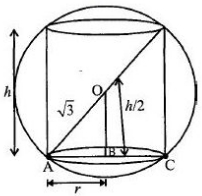
(C) Let the radius of the sphere be $R = \sqrt{3}$. Let the height of the cylinder be $h$ and its radius be $r$.
In the right-angled triangle formed by the radius of the sphere,the radius of the cylinder,and half the height of the cylinder,we have:
$R^2 = r^2 + (h/2)^2$
$(\sqrt{3})^2 = r^2 + \frac{h^2}{4}$
$3 = r^2 + \frac{h^2}{4} \Rightarrow r^2 = 3 - \frac{h^2}{4}$
The volume of the cylinder is $V = \pi r^2 h = \pi (3 - \frac{h^2}{4})h = 3\pi h - \frac{\pi h^3}{4}$.
To maximize the volume,we find the derivative with respect to $h$ and set it to zero:
$\frac{dV}{dh} = 3\pi - \frac{3\pi h^2}{4} = 0$
$3\pi = \frac{3\pi h^2}{4} \Rightarrow h^2 = 4 \Rightarrow h = 2$.
Substituting $h = 2$ into the volume formula:
$V = \pi (3 - \frac{2^2}{4})(2) = \pi (3 - 1)(2) = 4\pi$.
In the right-angled triangle formed by the radius of the sphere,the radius of the cylinder,and half the height of the cylinder,we have:
$R^2 = r^2 + (h/2)^2$
$(\sqrt{3})^2 = r^2 + \frac{h^2}{4}$
$3 = r^2 + \frac{h^2}{4} \Rightarrow r^2 = 3 - \frac{h^2}{4}$
The volume of the cylinder is $V = \pi r^2 h = \pi (3 - \frac{h^2}{4})h = 3\pi h - \frac{\pi h^3}{4}$.
To maximize the volume,we find the derivative with respect to $h$ and set it to zero:
$\frac{dV}{dh} = 3\pi - \frac{3\pi h^2}{4} = 0$
$3\pi = \frac{3\pi h^2}{4} \Rightarrow h^2 = 4 \Rightarrow h = 2$.
Substituting $h = 2$ into the volume formula:
$V = \pi (3 - \frac{2^2}{4})(2) = \pi (3 - 1)(2) = 4\pi$.
0 likes
View Solution278
DifficultMCQ
The maximum area of a right-angled triangle with hypotenuse $h$ is
A
$\frac{h^2}{2\sqrt{2}}$
B
$\frac{h^2}{2}$
C
$\frac{h^2}{\sqrt{2}}$
D
$\frac{h^2}{4}$
Solution
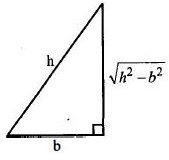
(D) Let the base be $b$ and the hypotenuse be $h$.
Then the altitude (perpendicular) is $\sqrt{h^2 - b^2}$.
The area $A$ of the triangle is given by $A = \frac{1}{2} \times \text{base} \times \text{altitude} = \frac{1}{2} b \sqrt{h^2 - b^2}$.
To maximize the area,we differentiate $A$ with respect to $b$:
$\frac{dA}{db} = \frac{1}{2} \left[ \sqrt{h^2 - b^2} + b \cdot \frac{-2b}{2\sqrt{h^2 - b^2}} \right] = \frac{1}{2} \left[ \frac{h^2 - b^2 - b^2}{\sqrt{h^2 - b^2}} \right] = \frac{h^2 - 2b^2}{2\sqrt{h^2 - b^2}}$.
Setting $\frac{dA}{db} = 0$,we get $h^2 - 2b^2 = 0$,which implies $b^2 = \frac{h^2}{2}$,or $b = \frac{h}{\sqrt{2}}$.
Substituting this value into the area formula:
$A_{max} = \frac{1}{2} \cdot \frac{h}{\sqrt{2}} \cdot \sqrt{h^2 - \frac{h^2}{2}} = \frac{1}{2} \cdot \frac{h}{\sqrt{2}} \cdot \frac{h}{\sqrt{2}} = \frac{h^2}{4}$.
Then the altitude (perpendicular) is $\sqrt{h^2 - b^2}$.
The area $A$ of the triangle is given by $A = \frac{1}{2} \times \text{base} \times \text{altitude} = \frac{1}{2} b \sqrt{h^2 - b^2}$.
To maximize the area,we differentiate $A$ with respect to $b$:
$\frac{dA}{db} = \frac{1}{2} \left[ \sqrt{h^2 - b^2} + b \cdot \frac{-2b}{2\sqrt{h^2 - b^2}} \right] = \frac{1}{2} \left[ \frac{h^2 - b^2 - b^2}{\sqrt{h^2 - b^2}} \right] = \frac{h^2 - 2b^2}{2\sqrt{h^2 - b^2}}$.
Setting $\frac{dA}{db} = 0$,we get $h^2 - 2b^2 = 0$,which implies $b^2 = \frac{h^2}{2}$,or $b = \frac{h}{\sqrt{2}}$.
Substituting this value into the area formula:
$A_{max} = \frac{1}{2} \cdot \frac{h}{\sqrt{2}} \cdot \sqrt{h^2 - \frac{h^2}{2}} = \frac{1}{2} \cdot \frac{h}{\sqrt{2}} \cdot \frac{h}{\sqrt{2}} = \frac{h^2}{4}$.
0 likes
View Solution279
DifficultMCQ
The cost of running a bus from $A$ to $B$ is $Rs. \left( av + \frac{b}{v} \right)$,where $v \text{ km/h}$ is the average speed of the bus. When the bus travels at $30 \text{ km/h}$,the cost is $Rs. 75$,while at $40 \text{ km/h}$,it is $Rs. 65$. The most economical speed (in $\text{km/h}$) of the bus is:
A
$45$
B
$50$
C
$60$
D
$40$
Solution
(C) Let the cost function be $C(v) = av + \frac{b}{v}$.
Given that at $v = 30 \text{ km/h}$,$C = 75$,so $30a + \frac{b}{30} = 75 \implies 900a + b = 2250 \quad (i)$.
Given that at $v = 40 \text{ km/h}$,$C = 65$,so $40a + \frac{b}{40} = 65 \implies 1600a + b = 2600 \quad (ii)$.
Subtracting $(i)$ from $(ii)$,we get $700a = 350$,which implies $a = 0.5$.
Substituting $a = 0.5$ into $(i)$,we get $900(0.5) + b = 2250 \implies 450 + b = 2250 \implies b = 1800$.
To find the most economical speed,we minimize $C(v)$ by setting $\frac{dC}{dv} = 0$.
$\frac{dC}{dv} = a - \frac{b}{v^2} = 0 \implies v^2 = \frac{b}{a}$.
$v^2 = \frac{1800}{0.5} = 3600 \implies v = 60 \text{ km/h}$.
Given that at $v = 30 \text{ km/h}$,$C = 75$,so $30a + \frac{b}{30} = 75 \implies 900a + b = 2250 \quad (i)$.
Given that at $v = 40 \text{ km/h}$,$C = 65$,so $40a + \frac{b}{40} = 65 \implies 1600a + b = 2600 \quad (ii)$.
Subtracting $(i)$ from $(ii)$,we get $700a = 350$,which implies $a = 0.5$.
Substituting $a = 0.5$ into $(i)$,we get $900(0.5) + b = 2250 \implies 450 + b = 2250 \implies b = 1800$.
To find the most economical speed,we minimize $C(v)$ by setting $\frac{dC}{dv} = 0$.
$\frac{dC}{dv} = a - \frac{b}{v^2} = 0 \implies v^2 = \frac{b}{a}$.
$v^2 = \frac{1800}{0.5} = 3600 \implies v = 60 \text{ km/h}$.
0 likes
View Solution280
DifficultMCQ
The maximum volume (in $m^3$) of the right circular cone having slant height $3 \, m$ is
A
$6\pi$
B
$3\sqrt{3}\pi$
C
$\frac{4}{3}\pi$
D
$2\sqrt{3}\pi$
Solution
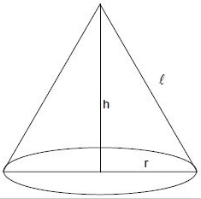
(D) Let the slant height be $l = 3 \, m$,radius be $r$,and height be $h$.
We know that $l^2 = r^2 + h^2$,so $r^2 = l^2 - h^2 = 9 - h^2$.
The volume of the cone is $V = \frac{1}{3} \pi r^2 h$.
Substituting $r^2$,we get $V(h) = \frac{1}{3} \pi (9 - h^2) h = \frac{1}{3} \pi (9h - h^3)$.
To find the maximum volume,differentiate $V$ with respect to $h$:
$\frac{dV}{dh} = \frac{1}{3} \pi (9 - 3h^2)$.
Setting $\frac{dV}{dh} = 0$,we get $9 - 3h^2 = 0$,which implies $h^2 = 3$,so $h = \sqrt{3}$.
Now,calculate the maximum volume:
$V = \frac{1}{3} \pi (9 - 3) \sqrt{3} = \frac{1}{3} \pi (6) \sqrt{3} = 2\sqrt{3}\pi \, m^3$.
We know that $l^2 = r^2 + h^2$,so $r^2 = l^2 - h^2 = 9 - h^2$.
The volume of the cone is $V = \frac{1}{3} \pi r^2 h$.
Substituting $r^2$,we get $V(h) = \frac{1}{3} \pi (9 - h^2) h = \frac{1}{3} \pi (9h - h^3)$.
To find the maximum volume,differentiate $V$ with respect to $h$:
$\frac{dV}{dh} = \frac{1}{3} \pi (9 - 3h^2)$.
Setting $\frac{dV}{dh} = 0$,we get $9 - 3h^2 = 0$,which implies $h^2 = 3$,so $h = \sqrt{3}$.
Now,calculate the maximum volume:
$V = \frac{1}{3} \pi (9 - 3) \sqrt{3} = \frac{1}{3} \pi (6) \sqrt{3} = 2\sqrt{3}\pi \, m^3$.
0 likes
View Solution281
DifficultMCQ
The shortest distance between the point $\left( \frac{3}{2}, 0 \right)$ and the curve $y = \sqrt{x}, (x > 0)$ is:
A
$\frac{\sqrt{5}}{2}$
B
$\frac{\sqrt{3}}{2}$
C
$\frac{3}{2}$
D
$\frac{5}{4}$
Solution
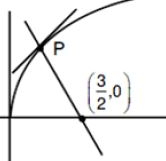
(A) Let $P(x, y)$ be a point on the curve $y = \sqrt{x}$. Then $P$ can be represented as $(t^2, t)$ for $t > 0$.
The squared distance $D^2$ between $P(t^2, t)$ and $\left( \frac{3}{2}, 0 \right)$ is given by:
$f(t) = (t^2 - \frac{3}{2})^2 + (t - 0)^2 = t^4 - 3t^2 + \frac{9}{4} + t^2 = t^4 - 2t^2 + \frac{9}{4}$.
To find the minimum distance,we differentiate $f(t)$ with respect to $t$ and set it to zero:
$f'(t) = 4t^3 - 4t = 4t(t^2 - 1) = 0$.
Since $t > 0$,we have $t^2 = 1$,which gives $t = 1$.
For $t = 1$,the point $P$ is $(1^2, 1) = (1, 1)$.
The shortest distance is the distance between $(1, 1)$ and $\left( \frac{3}{2}, 0 \right)$:
$d = \sqrt{(\frac{3}{2} - 1)^2 + (0 - 1)^2} = \sqrt{(\frac{1}{2})^2 + (-1)^2} = \sqrt{\frac{1}{4} + 1} = \sqrt{\frac{5}{4}} = \frac{\sqrt{5}}{2}$.
The squared distance $D^2$ between $P(t^2, t)$ and $\left( \frac{3}{2}, 0 \right)$ is given by:
$f(t) = (t^2 - \frac{3}{2})^2 + (t - 0)^2 = t^4 - 3t^2 + \frac{9}{4} + t^2 = t^4 - 2t^2 + \frac{9}{4}$.
To find the minimum distance,we differentiate $f(t)$ with respect to $t$ and set it to zero:
$f'(t) = 4t^3 - 4t = 4t(t^2 - 1) = 0$.
Since $t > 0$,we have $t^2 = 1$,which gives $t = 1$.
For $t = 1$,the point $P$ is $(1^2, 1) = (1, 1)$.
The shortest distance is the distance between $(1, 1)$ and $\left( \frac{3}{2}, 0 \right)$:
$d = \sqrt{(\frac{3}{2} - 1)^2 + (0 - 1)^2} = \sqrt{(\frac{1}{2})^2 + (-1)^2} = \sqrt{\frac{1}{4} + 1} = \sqrt{\frac{5}{4}} = \frac{\sqrt{5}}{2}$.
0 likes
View Solution282
DifficultMCQ
$A$ helicopter is flying along the curve given by $y = x^{3/2} + 7, (x \geq 0)$. $A$ soldier positioned at the point $(1/2, 7)$ wants to shoot down the helicopter when it is nearest to him. Then this nearest distance is
A
$\frac{\sqrt{5}}{6}$
B
$\frac{1}{3}\sqrt{\frac{7}{3}}$
C
$\frac{1}{6}\sqrt{\frac{7}{3}}$
D
$\frac{1}{2}$
Solution
(C) Let the point on the curve be $P(x, x^{3/2} + 7)$. The soldier is at $A(1/2, 7)$.
The squared distance $D^2 = (x - 1/2)^2 + (x^{3/2} + 7 - 7)^2 = (x - 1/2)^2 + x^3$.
Let $f(x) = (x - 1/2)^2 + x^3$. For minimum distance,$f'(x) = 0$.
$f'(x) = 2(x - 1/2) + 3x^2 = 3x^2 + 2x - 1 = 0$.
$(3x - 1)(x + 1) = 0$. Since $x \geq 0$,we have $x = 1/3$.
The point $P$ is $(1/3, (1/3)^{3/2} + 7) = (1/3, 7 + \frac{1}{3\sqrt{3}})$.
The distance $AD = \sqrt{(1/3 - 1/2)^2 + (7 + \frac{1}{3\sqrt{3}} - 7)^2} = \sqrt{(-1/6)^2 + (\frac{1}{3\sqrt{3}})^2}$.
$AD = \sqrt{\frac{1}{36} + \frac{1}{27}} = \sqrt{\frac{3 + 4}{108}} = \sqrt{\frac{7}{108}} = \frac{1}{6}\sqrt{\frac{7}{3}}$.
The squared distance $D^2 = (x - 1/2)^2 + (x^{3/2} + 7 - 7)^2 = (x - 1/2)^2 + x^3$.
Let $f(x) = (x - 1/2)^2 + x^3$. For minimum distance,$f'(x) = 0$.
$f'(x) = 2(x - 1/2) + 3x^2 = 3x^2 + 2x - 1 = 0$.
$(3x - 1)(x + 1) = 0$. Since $x \geq 0$,we have $x = 1/3$.
The point $P$ is $(1/3, (1/3)^{3/2} + 7) = (1/3, 7 + \frac{1}{3\sqrt{3}})$.
The distance $AD = \sqrt{(1/3 - 1/2)^2 + (7 + \frac{1}{3\sqrt{3}} - 7)^2} = \sqrt{(-1/6)^2 + (\frac{1}{3\sqrt{3}})^2}$.
$AD = \sqrt{\frac{1}{36} + \frac{1}{27}} = \sqrt{\frac{3 + 4}{108}} = \sqrt{\frac{7}{108}} = \frac{1}{6}\sqrt{\frac{7}{3}}$.
0 likes
View Solution283
DifficultMCQ
The maximum area (in sq. units) of a rectangle having its base on the $x-$axis and its other two vertices on the parabola $y = 12 - x^2$ such that the rectangle lies inside the parabola,is
A
$36$
B
$20\sqrt{2}$
C
$32$
D
$18\sqrt{3}$
Solution
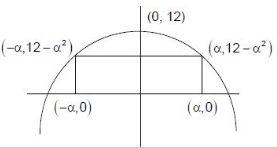
(C) Let the vertices of the rectangle on the parabola be $(\alpha, 12 - \alpha^2)$ and $(-\alpha, 12 - \alpha^2)$,where $\alpha > 0$.
The base of the rectangle lies on the $x-$axis,so the length of the base is $2\alpha$ and the height is $12 - \alpha^2$.
The area $A$ of the rectangle is given by $A = \text{length} \times \text{height} = 2\alpha(12 - \alpha^2) = 24\alpha - 2\alpha^3$.
To find the maximum area,we differentiate $A$ with respect to $\alpha$:
$\frac{dA}{d\alpha} = 24 - 6\alpha^2$.
Setting $\frac{dA}{d\alpha} = 0$,we get $24 - 6\alpha^2 = 0$,which implies $\alpha^2 = 4$,so $\alpha = 2$ (since $\alpha > 0$).
To verify this is a maximum,we check the second derivative: $\frac{d^2A}{d\alpha^2} = -12\alpha$. At $\alpha = 2$,$\frac{d^2A}{d\alpha^2} = -24 < 0$,so it is a maximum.
The maximum area is $A = 2(2)(12 - 2^2) = 4(12 - 4) = 4(8) = 32$ sq. units.
The base of the rectangle lies on the $x-$axis,so the length of the base is $2\alpha$ and the height is $12 - \alpha^2$.
The area $A$ of the rectangle is given by $A = \text{length} \times \text{height} = 2\alpha(12 - \alpha^2) = 24\alpha - 2\alpha^3$.
To find the maximum area,we differentiate $A$ with respect to $\alpha$:
$\frac{dA}{d\alpha} = 24 - 6\alpha^2$.
Setting $\frac{dA}{d\alpha} = 0$,we get $24 - 6\alpha^2 = 0$,which implies $\alpha^2 = 4$,so $\alpha = 2$ (since $\alpha > 0$).
To verify this is a maximum,we check the second derivative: $\frac{d^2A}{d\alpha^2} = -12\alpha$. At $\alpha = 2$,$\frac{d^2A}{d\alpha^2} = -24 < 0$,so it is a maximum.
The maximum area is $A = 2(2)(12 - 2^2) = 4(12 - 4) = 4(8) = 32$ sq. units.
0 likes
View Solution284
DifficultMCQ
If the function $f$ given by $f(x) = x^3 - 3(a - 2)x^2 + 3ax + 7$ for some $a \in R$ is increasing in $(0, 1]$ and decreasing in $[1, 5)$,then a root of the equation $\frac{f(x) - 14}{(x - 1)^2} = 0$ $(x \neq 1)$ is
A
$-7$
B
$5$
C
$7$
D
$6$
Solution
(C) Given $f(x) = x^3 - 3(a - 2)x^2 + 3ax + 7$.
The derivative is $f'(x) = 3x^2 - 6(a - 2)x + 3a$.
Since $f(x)$ is increasing in $(0, 1]$ and decreasing in $[1, 5)$,the function must have a local maximum at $x = 1$.
Thus,$f'(1) = 0$.
$f'(1) = 3(1)^2 - 6(a - 2)(1) + 3a = 3 - 6a + 12 + 3a = 15 - 3a = 0$.
Solving for $a$,we get $a = 5$.
Substituting $a = 5$ into $f(x)$,we get $f(x) = x^3 - 3(5 - 2)x^2 + 3(5)x + 7 = x^3 - 9x^2 + 15x + 7$.
We need to solve $\frac{f(x) - 14}{(x - 1)^2} = 0$,which implies $f(x) - 14 = 0$ for $x \neq 1$.
$x^3 - 9x^2 + 15x + 7 - 14 = x^3 - 9x^2 + 15x - 7 = 0$.
Since $x = 1$ is a root of $f(x) - 14 = 0$,we can divide by $(x - 1)^2$:
$x^3 - 9x^2 + 15x - 7 = (x - 1)^2(x - 7) = 0$.
Thus,the root of the equation $\frac{f(x) - 14}{(x - 1)^2} = 0$ is $x = 7$.
The derivative is $f'(x) = 3x^2 - 6(a - 2)x + 3a$.
Since $f(x)$ is increasing in $(0, 1]$ and decreasing in $[1, 5)$,the function must have a local maximum at $x = 1$.
Thus,$f'(1) = 0$.
$f'(1) = 3(1)^2 - 6(a - 2)(1) + 3a = 3 - 6a + 12 + 3a = 15 - 3a = 0$.
Solving for $a$,we get $a = 5$.
Substituting $a = 5$ into $f(x)$,we get $f(x) = x^3 - 3(5 - 2)x^2 + 3(5)x + 7 = x^3 - 9x^2 + 15x + 7$.
We need to solve $\frac{f(x) - 14}{(x - 1)^2} = 0$,which implies $f(x) - 14 = 0$ for $x \neq 1$.
$x^3 - 9x^2 + 15x + 7 - 14 = x^3 - 9x^2 + 15x - 7 = 0$.
Since $x = 1$ is a root of $f(x) - 14 = 0$,we can divide by $(x - 1)^2$:
$x^3 - 9x^2 + 15x - 7 = (x - 1)^2(x - 7) = 0$.
Thus,the root of the equation $\frac{f(x) - 14}{(x - 1)^2} = 0$ is $x = 7$.
0 likes
View Solution285
DifficultMCQ
If $S_1$ and $S_2$ are respectively the sets of local minimum and local maximum points of the function $f(x) = 9x^4 + 12x^3 - 36x^2 + 25, x \in R$,then
A
$S_1 = \{-2, 1\}; S_2 = \{0\}$
B
$S_1 = \{-2, 0\}; S_2 = \{1\}$
C
$S_1 = \{-2\}; S_2 = \{0, 1\}$
D
$S_1 = \{-1\}; S_2 = \{0, 2\}$
Solution
(A) Given the function $f(x) = 9x^4 + 12x^3 - 36x^2 + 25$.
To find the critical points,we find the first derivative $f'(x)$:
$f'(x) = 36x^3 + 36x^2 - 72x$
Setting $f'(x) = 0$:
$36x(x^2 + x - 2) = 0$
$36x(x - 1)(x + 2) = 0$
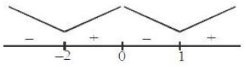
The critical points are $x = -2, 0, 1$.
Now,we use the second derivative test $f''(x) = 108x^2 + 72x - 72$:
For $x = -2$: $f''(-2) = 108(4) + 72(-2) - 72 = 432 - 144 - 72 = 216 > 0$ (Local Minima).
For $x = 0$: $f''(0) = -72 < 0$ (Local Maxima).
For $x = 1$: $f''(1) = 108 + 72 - 72 = 108 > 0$ (Local Minima).
Thus,the set of local minimum points $S_1 = \{-2, 1\}$ and the set of local maximum points $S_2 = \{0\}$.
To find the critical points,we find the first derivative $f'(x)$:
$f'(x) = 36x^3 + 36x^2 - 72x$
Setting $f'(x) = 0$:
$36x(x^2 + x - 2) = 0$
$36x(x - 1)(x + 2) = 0$
The critical points are $x = -2, 0, 1$.
Now,we use the second derivative test $f''(x) = 108x^2 + 72x - 72$:
For $x = -2$: $f''(-2) = 108(4) + 72(-2) - 72 = 432 - 144 - 72 = 216 > 0$ (Local Minima).
For $x = 0$: $f''(0) = -72 < 0$ (Local Maxima).
For $x = 1$: $f''(1) = 108 + 72 - 72 = 108 > 0$ (Local Minima).
Thus,the set of local minimum points $S_1 = \{-2, 1\}$ and the set of local maximum points $S_2 = \{0\}$.
0 likes
View Solution286
DifficultMCQ
The height of a right circular cylinder of maximum volume inscribed in a sphere of radius $3$ is
A
$ \sqrt{3} $
B
$ \sqrt{6} $
C
$ 2\sqrt{3} $
D
$ \frac{2}{3} \sqrt{3} $
Solution
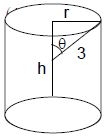
(C) Let the radius of the sphere be $R=3$. Let the height of the cylinder be $h$ and its radius be $r$.
From the geometry of the sphere and cylinder,we have $r^2 + (h/2)^2 = R^2 = 3^2 = 9$.
Thus,$r^2 = 9 - \frac{h^2}{4}$.
The volume of the cylinder is $V = \pi r^2 h = \pi (9 - \frac{h^2}{4}) h = \pi (9h - \frac{h^3}{4})$.
To maximize the volume,we find the derivative with respect to $h$ and set it to zero:
$\frac{dV}{dh} = \pi (9 - \frac{3h^2}{4}) = 0$.
$9 = \frac{3h^2}{4} \Rightarrow h^2 = 12 \Rightarrow h = \sqrt{12} = 2\sqrt{3}$.
Thus,the height of the cylinder of maximum volume is $2\sqrt{3}$.
From the geometry of the sphere and cylinder,we have $r^2 + (h/2)^2 = R^2 = 3^2 = 9$.
Thus,$r^2 = 9 - \frac{h^2}{4}$.
The volume of the cylinder is $V = \pi r^2 h = \pi (9 - \frac{h^2}{4}) h = \pi (9h - \frac{h^3}{4})$.
To maximize the volume,we find the derivative with respect to $h$ and set it to zero:
$\frac{dV}{dh} = \pi (9 - \frac{3h^2}{4}) = 0$.
$9 = \frac{3h^2}{4} \Rightarrow h^2 = 12 \Rightarrow h = \sqrt{12} = 2\sqrt{3}$.
Thus,the height of the cylinder of maximum volume is $2\sqrt{3}$.
0 likes
View Solution287
DifficultMCQ
If $f(x)$ is a non-zero polynomial of degree four,having local extreme points at $x = -1, 0, 1$; then the set $S = \{x \in R; f(x) = f(0)\}$ contains exactly
A
four irrational numbers
B
four rational numbers
C
two irrational and one rational number
D
two irrational and two rational numbers
Solution
(C) Since $f(x)$ is a polynomial of degree $4$ and has local extreme points at $x = -1, 0, 1$,its derivative $f'(x)$ must be a polynomial of degree $3$ with roots at $-1, 0, 1$.
Thus,$f'(x) = \lambda(x + 1)(x)(x - 1) = \lambda(x^3 - x)$,where $\lambda \neq 0$.
Integrating $f'(x)$,we get $f(x) = \lambda(\frac{x^4}{4} - \frac{x^2}{2}) + \mu$,where $\mu$ is the constant of integration.
We are given the set $S = \{x \in R; f(x) = f(0)\}$.
Substituting $f(0) = \mu$ into the equation $f(x) = f(0)$,we get $\lambda(\frac{x^4}{4} - \frac{x^2}{2}) + \mu = \mu$.
This simplifies to $\lambda(\frac{x^4}{4} - \frac{x^2}{2}) = 0$.
Since $\lambda \neq 0$,we have $\frac{x^4}{4} - \frac{x^2}{2} = 0$,which implies $x^2(\frac{x^2}{4} - \frac{1}{2}) = 0$.
This gives $x^2 = 0$ or $x^2 = 2$.
Thus,the roots are $x = 0, 0, \sqrt{2}, -\sqrt{2}$.
The distinct elements in the set $S$ are $0, \sqrt{2}, -\sqrt{2}$.
Here,$0$ is a rational number,and $\sqrt{2}, -\sqrt{2}$ are irrational numbers.
Therefore,the set $S$ contains two irrational numbers and one rational number.
Thus,$f'(x) = \lambda(x + 1)(x)(x - 1) = \lambda(x^3 - x)$,where $\lambda \neq 0$.
Integrating $f'(x)$,we get $f(x) = \lambda(\frac{x^4}{4} - \frac{x^2}{2}) + \mu$,where $\mu$ is the constant of integration.
We are given the set $S = \{x \in R; f(x) = f(0)\}$.
Substituting $f(0) = \mu$ into the equation $f(x) = f(0)$,we get $\lambda(\frac{x^4}{4} - \frac{x^2}{2}) + \mu = \mu$.
This simplifies to $\lambda(\frac{x^4}{4} - \frac{x^2}{2}) = 0$.
Since $\lambda \neq 0$,we have $\frac{x^4}{4} - \frac{x^2}{2} = 0$,which implies $x^2(\frac{x^2}{4} - \frac{1}{2}) = 0$.
This gives $x^2 = 0$ or $x^2 = 2$.
Thus,the roots are $x = 0, 0, \sqrt{2}, -\sqrt{2}$.
The distinct elements in the set $S$ are $0, \sqrt{2}, -\sqrt{2}$.
Here,$0$ is a rational number,and $\sqrt{2}, -\sqrt{2}$ are irrational numbers.
Therefore,the set $S$ contains two irrational numbers and one rational number.
0 likes
View Solution288
DifficultMCQ
If $m$ is the minimum value of $k$ for which the function $f(x) = x\sqrt{kx - x^2}$ is increasing in the interval $[0, 3]$ and $M$ is the maximum value of $f$ in $[0, 3]$ when $k = m$,then the ordered pair $(m, M)$ is equal to
A
$(5, 3\sqrt{6})$
B
$(4, 3\sqrt{2})$
C
$(3, 3\sqrt{3})$
D
$(4, 3\sqrt{3})$
Solution
(D) Given $f(x) = x\sqrt{kx - x^2}$.
For $f(x)$ to be defined,$kx - x^2 \geq 0$,which implies $x(k - x) \geq 0$. For $x \in [0, 3]$,this requires $k \geq 3$.
The derivative is $f'(x) = \sqrt{kx - x^2} + x \cdot \frac{k - 2x}{2\sqrt{kx - x^2}} = \frac{2(kx - x^2) + kx - 2x^2}{2\sqrt{kx - x^2}} = \frac{3kx - 4x^2}{2\sqrt{kx - x^2}}$.
For $f(x)$ to be increasing on $[0, 3]$,we need $f'(x) \geq 0$ for all $x \in (0, 3)$.
This implies $3kx - 4x^2 \geq 0$,or $x(3k - 4x) \geq 0$.
Since $x > 0$,we require $3k - 4x \geq 0$,or $k \geq \frac{4x}{3}$.
For this to hold for all $x \in [0, 3]$,$k$ must be at least the maximum value of $\frac{4x}{3}$ on $[0, 3]$,which is $\frac{4(3)}{3} = 4$.
Thus,$m = 4$.
Now,for $k = 4$,$f(x) = x\sqrt{4x - x^2}$.
To find the maximum value $M$ on $[0, 3]$,we check the derivative $f'(x) = \frac{12x - 4x^2}{2\sqrt{4x - x^2}} = \frac{2x(3 - x)}{\sqrt{4x - x^2}}$.
The critical point is $x = 3$. Since $f(0) = 0$ and $f(3) = 3\sqrt{4(3) - 3^2} = 3\sqrt{12 - 9} = 3\sqrt{3}$,the maximum value $M = 3\sqrt{3}$.
Therefore,$(m, M) = (4, 3\sqrt{3})$.
For $f(x)$ to be defined,$kx - x^2 \geq 0$,which implies $x(k - x) \geq 0$. For $x \in [0, 3]$,this requires $k \geq 3$.
The derivative is $f'(x) = \sqrt{kx - x^2} + x \cdot \frac{k - 2x}{2\sqrt{kx - x^2}} = \frac{2(kx - x^2) + kx - 2x^2}{2\sqrt{kx - x^2}} = \frac{3kx - 4x^2}{2\sqrt{kx - x^2}}$.
For $f(x)$ to be increasing on $[0, 3]$,we need $f'(x) \geq 0$ for all $x \in (0, 3)$.
This implies $3kx - 4x^2 \geq 0$,or $x(3k - 4x) \geq 0$.
Since $x > 0$,we require $3k - 4x \geq 0$,or $k \geq \frac{4x}{3}$.
For this to hold for all $x \in [0, 3]$,$k$ must be at least the maximum value of $\frac{4x}{3}$ on $[0, 3]$,which is $\frac{4(3)}{3} = 4$.
Thus,$m = 4$.
Now,for $k = 4$,$f(x) = x\sqrt{4x - x^2}$.
To find the maximum value $M$ on $[0, 3]$,we check the derivative $f'(x) = \frac{12x - 4x^2}{2\sqrt{4x - x^2}} = \frac{2x(3 - x)}{\sqrt{4x - x^2}}$.
The critical point is $x = 3$. Since $f(0) = 0$ and $f(3) = 3\sqrt{4(3) - 3^2} = 3\sqrt{12 - 9} = 3\sqrt{3}$,the maximum value $M = 3\sqrt{3}$.
Therefore,$(m, M) = (4, 3\sqrt{3})$.
0 likes
View Solution289
DifficultMCQ
Let $f(x)$ be a polynomial of degree $5$ such that $x=\pm 1$ are its critical points. If $\mathop {\lim }\limits_{x \to 0} \left(2+\frac{f(x)}{x^{3}}\right)=4,$ then which one of the following is not true?
A
$f$ is an odd function
B
$x=1$ is a point of minima and $x=-1$ is a point of maxima of $f$.
C
$x=1$ is a point of maxima and $x=-1$ is a point of minima of $f$.
D
$f(1)-4f(-1)=4$
Solution
(B) Given $\lim _{x \rightarrow 0}\left(2+\frac{f(x)}{x^{3}}\right)=4$,we have $\lim _{x \rightarrow 0} \frac{f(x)}{x^{3}}=2$. Since $f(x)$ is a polynomial of degree $5$,let $f(x) = ax^5 + bx^4 + cx^3 + dx^2 + ex + g$. For the limit to exist and be $2$,we must have $g=e=d=0$ and $c=2$. Thus,$f(x) = ax^5 + bx^4 + 2x^3$.
$f'(x) = 5ax^4 + 4bx^3 + 6x^2$.
Since $x=\pm 1$ are critical points,$f'(1) = 5a + 4b + 6 = 0$ and $f'(-1) = 5a - 4b + 6 = 0$.
Adding these gives $10a + 12 = 0 \Rightarrow a = -6/5$. Subtracting gives $8b = 0 \Rightarrow b = 0$.
So,$f(x) = 2x^3 - \frac{6}{5}x^5$.
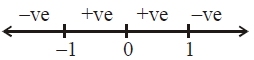
$f'(x) = 6x^2 - 6x^4 = 6x^2(1-x^2) = 6x^2(1-x)(1+x)$.
For $x < -1$,$f'(x) < 0$. For $-1 < x < 0$,$f'(x) > 0$. For $0 < x < 1$,$f'(x) > 0$. For $x > 1$,$f'(x) < 0$.
At $x = -1$,$f'(x)$ changes from negative to positive,so it is a point of local minima.
At $x = 1$,$f'(x)$ changes from positive to negative,so it is a point of local maxima.
Option $B$ states $x=1$ is a point of minima and $x=-1$ is a point of maxima,which is false.
$f'(x) = 5ax^4 + 4bx^3 + 6x^2$.
Since $x=\pm 1$ are critical points,$f'(1) = 5a + 4b + 6 = 0$ and $f'(-1) = 5a - 4b + 6 = 0$.
Adding these gives $10a + 12 = 0 \Rightarrow a = -6/5$. Subtracting gives $8b = 0 \Rightarrow b = 0$.
So,$f(x) = 2x^3 - \frac{6}{5}x^5$.
$f'(x) = 6x^2 - 6x^4 = 6x^2(1-x^2) = 6x^2(1-x)(1+x)$.
For $x < -1$,$f'(x) < 0$. For $-1 < x < 0$,$f'(x) > 0$. For $0 < x < 1$,$f'(x) > 0$. For $x > 1$,$f'(x) < 0$.
At $x = -1$,$f'(x)$ changes from negative to positive,so it is a point of local minima.
At $x = 1$,$f'(x)$ changes from positive to negative,so it is a point of local maxima.
Option $B$ states $x=1$ is a point of minima and $x=-1$ is a point of maxima,which is false.
0 likes
View Solution290
DifficultMCQ
Let $f(x)$ be a polynomial of degree $3$ such that $f(-1)=10$,$f(1)=-6$,$f(x)$ has a critical point at $x=-1$,and $f^{\prime}(x)$ has a critical point at $x=1$. Then $f(x)$ has a local minima at $x=$
A
$4$
B
$3$
C
$6$
D
$9$
Solution
(B) Since $f(x)$ is a polynomial of degree $3$,$f^{\prime \prime}(x)$ is a linear function. Given $f^{\prime}(x)$ has a critical point at $x=1$,$f^{\prime \prime}(1)=0$. Thus,$f^{\prime \prime}(x) = \lambda(x-1)$.
Integrating $f^{\prime \prime}(x)$,we get $f^{\prime}(x) = \frac{\lambda x^2}{2} - \lambda x + C$.
Since $f(x)$ has a critical point at $x=-1$,$f^{\prime}(-1) = 0$. Substituting $x=-1$ gives $\frac{\lambda}{2} + \lambda + C = 0$,so $C = -\frac{3\lambda}{2}$.
Thus,$f^{\prime}(x) = \frac{\lambda x^2}{2} - \lambda x - \frac{3\lambda}{2}$.
Integrating $f^{\prime}(x)$,we get $f(x) = \frac{\lambda x^3}{6} - \frac{\lambda x^2}{2} - \frac{3\lambda x}{2} + d$.
Using $f(1) = -6$: $\frac{\lambda}{6} - \frac{\lambda}{2} - \frac{3\lambda}{2} + d = -6 \Rightarrow -\frac{11\lambda}{6} + d = -6 \Rightarrow -11\lambda + 6d = -36 \dots (i)$.
Using $f(-1) = 10$: $-\frac{\lambda}{6} - \frac{\lambda}{2} + \frac{3\lambda}{2} + d = 10 \Rightarrow \frac{5\lambda}{6} + d = 10 \Rightarrow 5\lambda + 6d = 60 \dots (ii)$.
Subtracting $(i)$ from $(ii)$: $16\lambda = 96 \Rightarrow \lambda = 6$.
Substituting $\lambda = 6$ into $(ii)$: $5(6) + 6d = 60 \Rightarrow 30 + 6d = 60 \Rightarrow d = 5$.
So,$f(x) = x^3 - 3x^2 - 9x + 5$.
$f^{\prime}(x) = 3x^2 - 6x - 9 = 3(x^2 - 2x - 3) = 3(x-3)(x+1)$.
Setting $f^{\prime}(x) = 0$ gives critical points $x=3$ and $x=-1$.
$f^{\prime \prime}(x) = 6x - 6$. At $x=3$,$f^{\prime \prime}(3) = 18 - 6 = 12 > 0$,so $f(x)$ has a local minima at $x=3$.
Integrating $f^{\prime \prime}(x)$,we get $f^{\prime}(x) = \frac{\lambda x^2}{2} - \lambda x + C$.
Since $f(x)$ has a critical point at $x=-1$,$f^{\prime}(-1) = 0$. Substituting $x=-1$ gives $\frac{\lambda}{2} + \lambda + C = 0$,so $C = -\frac{3\lambda}{2}$.
Thus,$f^{\prime}(x) = \frac{\lambda x^2}{2} - \lambda x - \frac{3\lambda}{2}$.
Integrating $f^{\prime}(x)$,we get $f(x) = \frac{\lambda x^3}{6} - \frac{\lambda x^2}{2} - \frac{3\lambda x}{2} + d$.
Using $f(1) = -6$: $\frac{\lambda}{6} - \frac{\lambda}{2} - \frac{3\lambda}{2} + d = -6 \Rightarrow -\frac{11\lambda}{6} + d = -6 \Rightarrow -11\lambda + 6d = -36 \dots (i)$.
Using $f(-1) = 10$: $-\frac{\lambda}{6} - \frac{\lambda}{2} + \frac{3\lambda}{2} + d = 10 \Rightarrow \frac{5\lambda}{6} + d = 10 \Rightarrow 5\lambda + 6d = 60 \dots (ii)$.
Subtracting $(i)$ from $(ii)$: $16\lambda = 96 \Rightarrow \lambda = 6$.
Substituting $\lambda = 6$ into $(ii)$: $5(6) + 6d = 60 \Rightarrow 30 + 6d = 60 \Rightarrow d = 5$.
So,$f(x) = x^3 - 3x^2 - 9x + 5$.
$f^{\prime}(x) = 3x^2 - 6x - 9 = 3(x^2 - 2x - 3) = 3(x-3)(x+1)$.
Setting $f^{\prime}(x) = 0$ gives critical points $x=3$ and $x=-1$.
$f^{\prime \prime}(x) = 6x - 6$. At $x=3$,$f^{\prime \prime}(3) = 18 - 6 = 12 > 0$,so $f(x)$ has a local minima at $x=3$.
0 likes
View Solution291
DifficultMCQ
Let a function $f:[0,5] \rightarrow R$ be continuous. $f(1)=3$ and $F$ be defined as $F(x)=\int_{1}^{x} t^{2} g(t) dt$,where $g(t)=\int_{1}^{t} f(u) du$. Then for the function $F$,the point $x=1$ is
A
a point of local minima
B
not a critical point
C
a point of inflection
D
a point of local maxima
Solution
(A) Given $F(x) = \int_{1}^{x} t^{2} g(t) dt$. By the Fundamental Theorem of Calculus,$F'(x) = x^{2} g(x) = x^{2} \int_{1}^{x} f(u) du$.
At $x=1$,$F'(1) = 1^{2} \int_{1}^{1} f(u) du = 0$. Thus,$x=1$ is a critical point.
Now,find the second derivative: $F''(x) = \frac{d}{dx} [x^{2} g(x)] = x^{2} g'(x) + 2x g(x)$.
Since $g(t) = \int_{1}^{t} f(u) du$,$g'(t) = f(t)$.
So,$F''(x) = x^{2} f(x) + 2x \int_{1}^{x} f(u) du$.
Evaluating at $x=1$: $F''(1) = 1^{2} f(1) + 2(1) \int_{1}^{1} f(u) du = f(1) + 0 = 3$.
Since $F'(1) = 0$ and $F''(1) = 3 > 0$,by the Second Derivative Test,$x=1$ is a point of local minima.
At $x=1$,$F'(1) = 1^{2} \int_{1}^{1} f(u) du = 0$. Thus,$x=1$ is a critical point.
Now,find the second derivative: $F''(x) = \frac{d}{dx} [x^{2} g(x)] = x^{2} g'(x) + 2x g(x)$.
Since $g(t) = \int_{1}^{t} f(u) du$,$g'(t) = f(t)$.
So,$F''(x) = x^{2} f(x) + 2x \int_{1}^{x} f(u) du$.
Evaluating at $x=1$: $F''(1) = 1^{2} f(1) + 2(1) \int_{1}^{1} f(u) du = f(1) + 0 = 3$.
Since $F'(1) = 0$ and $F''(1) = 3 > 0$,by the Second Derivative Test,$x=1$ is a point of local minima.
0 likes
View Solution292
Medium
Find the maximum and the minimum values,if any,of the function $f$ given by $f(x) = x^{2}, x \in R$.
Solution
(N/A) The function is $f(x) = x^{2}$.
Since $x^{2} \geq 0$ for all $x \in R$,the minimum value of the function is $0$,which occurs at $x = 0$.
As $x \to \infty$ or $x \to -\infty$,$f(x) = x^{2} \to \infty$.
Therefore,the function $f(x) = x^{2}$ has no maximum value in $R$.
Since $x^{2} \geq 0$ for all $x \in R$,the minimum value of the function is $0$,which occurs at $x = 0$.
As $x \to \infty$ or $x \to -\infty$,$f(x) = x^{2} \to \infty$.
Therefore,the function $f(x) = x^{2}$ has no maximum value in $R$.
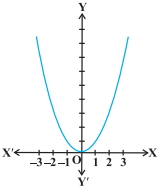
0 likes
View Solution293
Easy
Find the maximum and minimum values of $f,$ if any,of the function given by $f(x)=|x|, x \in R.$
Solution
(N/A) From the graph of the given function,note that:
$f(x) \geq 0$ for all $x \in R$ and $f(x)=0$ if $x=0.$
Therefore,the function $f$ has a minimum value of $0$ and the point of minimum value of $f$ is $x=0.$
Also,the graph clearly shows that $f$ has no maximum value in $R$ and hence no point of maximum value in $R.$
$f(x) \geq 0$ for all $x \in R$ and $f(x)=0$ if $x=0.$
Therefore,the function $f$ has a minimum value of $0$ and the point of minimum value of $f$ is $x=0.$
Also,the graph clearly shows that $f$ has no maximum value in $R$ and hence no point of maximum value in $R.$
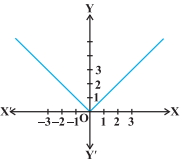
0 likes
View Solution294
Easy
Find the maximum and the minimum values,if any,of the function given by $f(x) = x, x \in (0, 1)$.
Solution
(NONE) The given function $f(x) = x$ is a strictly increasing function in the open interval $(0, 1)$.
From the graph of the function,it appears that the minimum value should be at a point closest to $0$ on its right,and the maximum value should be at a point closest to $1$ on its left.
However,such points do not exist in the open interval $(0, 1)$.
For any point $x_0 \in (0, 1)$,we can always find a smaller point $\frac{x_0}{2} \in (0, 1)$ such that $\frac{x_0}{2} < x_0$. Thus,there is no minimum value.
Similarly,for any point $x_1 \in (0, 1)$,we can always find a larger point $\frac{x_1 + 1}{2} \in (0, 1)$ such that $\frac{x_1 + 1}{2} > x_1$. Thus,there is no maximum value.
Therefore,the function $f(x) = x$ has neither a maximum nor a minimum value in the interval $(0, 1)$.
From the graph of the function,it appears that the minimum value should be at a point closest to $0$ on its right,and the maximum value should be at a point closest to $1$ on its left.
However,such points do not exist in the open interval $(0, 1)$.
For any point $x_0 \in (0, 1)$,we can always find a smaller point $\frac{x_0}{2} \in (0, 1)$ such that $\frac{x_0}{2} < x_0$. Thus,there is no minimum value.
Similarly,for any point $x_1 \in (0, 1)$,we can always find a larger point $\frac{x_1 + 1}{2} \in (0, 1)$ such that $\frac{x_1 + 1}{2} > x_1$. Thus,there is no maximum value.
Therefore,the function $f(x) = x$ has neither a maximum nor a minimum value in the interval $(0, 1)$.
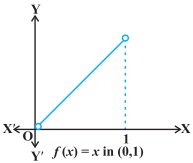
0 likes
View Solution295
Easy
Find all points of local maxima and local minima of the function $f$ given by $f(x) = x^3 - 3x + 3$.
Solution
(A) We have $f(x) = x^3 - 3x + 3$.
Taking the derivative,we get $f'(x) = 3x^2 - 3 = 3(x - 1)(x + 1)$.
Setting $f'(x) = 0$,we find critical points at $x = 1$ and $x = -1$.
To determine the nature of these points,we use the first derivative test:
For $x = 1$:
- For values close to $1$ and to the right,$f'(x) > 0$.
- For values close to $1$ and to the left,$f'(x) < 0$.
Since the sign changes from negative to positive,$x = 1$ is a point of local minima,and the local minimum value is $f(1) = 1 - 3 + 3 = 1$.
For $x = -1$:
- For values close to $-1$ and to the left,$f'(x) > 0$.
- For values close to $-1$ and to the right,$f'(x) < 0$.
Since the sign changes from positive to negative,$x = -1$ is a point of local maxima,and the local maximum value is $f(-1) = -1 + 3 + 3 = 5$.
Taking the derivative,we get $f'(x) = 3x^2 - 3 = 3(x - 1)(x + 1)$.
Setting $f'(x) = 0$,we find critical points at $x = 1$ and $x = -1$.
To determine the nature of these points,we use the first derivative test:
For $x = 1$:
- For values close to $1$ and to the right,$f'(x) > 0$.
- For values close to $1$ and to the left,$f'(x) < 0$.
Since the sign changes from negative to positive,$x = 1$ is a point of local minima,and the local minimum value is $f(1) = 1 - 3 + 3 = 1$.
For $x = -1$:
- For values close to $-1$ and to the left,$f'(x) > 0$.
- For values close to $-1$ and to the right,$f'(x) < 0$.
Since the sign changes from positive to negative,$x = -1$ is a point of local maxima,and the local maximum value is $f(-1) = -1 + 3 + 3 = 5$.
0 likes
View Solution296
MediumMCQ
Find all the points of local maxima and local minima of the function $f$ given by $f(x) = 2x^3 - 6x^2 + 6x + 5$.
A
Local maxima at $x=1$,local minima at $x=1$
B
Local maxima at $x=1$,no local minima
C
No local maxima,local minima at $x=1$
D
No local maxima and no local minima
Solution
(D) Given function is $f(x) = 2x^3 - 6x^2 + 6x + 5$.
First,we find the derivative $f'(x)$:
$f'(x) = \frac{d}{dx}(2x^3 - 6x^2 + 6x + 5) = 6x^2 - 12x + 6$.
Setting $f'(x) = 0$ to find critical points:
$6(x^2 - 2x + 1) = 0$
$6(x - 1)^2 = 0$
This gives $x = 1$ as the only critical point.
Now,we examine the sign of $f'(x)$ around $x = 1$:
For $x < 1$,let $x = 0$,then $f'(0) = 6(0-1)^2 = 6 > 0$.
For $x > 1$,let $x = 2$,then $f'(2) = 6(2-1)^2 = 6 > 0$.
Since $f'(x)$ does not change sign as $x$ passes through $1$ (it remains positive),$x = 1$ is neither a point of local maxima nor a point of local minima.
Therefore,the function has no local maxima and no local minima.
First,we find the derivative $f'(x)$:
$f'(x) = \frac{d}{dx}(2x^3 - 6x^2 + 6x + 5) = 6x^2 - 12x + 6$.
Setting $f'(x) = 0$ to find critical points:
$6(x^2 - 2x + 1) = 0$
$6(x - 1)^2 = 0$
This gives $x = 1$ as the only critical point.
Now,we examine the sign of $f'(x)$ around $x = 1$:
For $x < 1$,let $x = 0$,then $f'(0) = 6(0-1)^2 = 6 > 0$.
For $x > 1$,let $x = 2$,then $f'(2) = 6(2-1)^2 = 6 > 0$.
Since $f'(x)$ does not change sign as $x$ passes through $1$ (it remains positive),$x = 1$ is neither a point of local maxima nor a point of local minima.
Therefore,the function has no local maxima and no local minima.
0 likes
View Solution297
EasyMCQ
Find the local minimum value of the function $f$ given by $f(x) = 3 + |x|, x \in R$.
A
$3$
B
$0$
C
$1$
D
$4$
Solution
(A) The given function is $f(x) = 3 + |x|$.
Note that the function is not differentiable at $x = 0$,so the second derivative test cannot be applied.
We use the first derivative test. The critical point is $x = 0$.
For $x < 0$,$f(x) = 3 - x$,so $f'(x) = -1 < 0$.
For $x > 0$,$f(x) = 3 + x$,so $f'(x) = 1 > 0$.
Since the derivative changes sign from negative to positive at $x = 0$,$x = 0$ is a point of local minima.
The local minimum value is $f(0) = 3 + |0| = 3$.
Note that the function is not differentiable at $x = 0$,so the second derivative test cannot be applied.
We use the first derivative test. The critical point is $x = 0$.
For $x < 0$,$f(x) = 3 - x$,so $f'(x) = -1 < 0$.
For $x > 0$,$f(x) = 3 + x$,so $f'(x) = 1 > 0$.
Since the derivative changes sign from negative to positive at $x = 0$,$x = 0$ is a point of local minima.
The local minimum value is $f(0) = 3 + |0| = 3$.
0 likes
View Solution298
Medium
Find the local maximum and local minimum values of the function $f$ given by $f(x) = 3x^4 + 4x^3 - 12x^2 + 12$.
Solution
(N/A) Given the function $f(x) = 3x^4 + 4x^3 - 12x^2 + 12$.
First,find the derivative $f'(x) = 12x^3 + 12x^2 - 24x$.
Factorizing the derivative,we get $f'(x) = 12x(x^2 + x - 2) = 12x(x - 1)(x + 2)$.
Setting $f'(x) = 0$,we find the critical points $x = 0, x = 1, x = -2$.
Now,find the second derivative $f''(x) = 36x^2 + 24x - 24$.
Evaluating the second derivative at the critical points:
$f''(0) = -24 < 0$,so $x = 0$ is a point of local maxima. The local maximum value is $f(0) = 12$.
$f''(1) = 36(1)^2 + 24(1) - 24 = 36 > 0$,so $x = 1$ is a point of local minima. The local minimum value is $f(1) = 3(1)^4 + 4(1)^3 - 12(1)^2 + 12 = 3 + 4 - 12 + 12 = 7$.
$f''(-2) = 36(-2)^2 + 24(-2) - 24 = 144 - 48 - 24 = 72 > 0$,so $x = -2$ is a point of local minima. The local minimum value is $f(-2) = 3(-2)^4 + 4(-2)^3 - 12(-2)^2 + 12 = 48 - 32 - 48 + 12 = -20$.
First,find the derivative $f'(x) = 12x^3 + 12x^2 - 24x$.
Factorizing the derivative,we get $f'(x) = 12x(x^2 + x - 2) = 12x(x - 1)(x + 2)$.
Setting $f'(x) = 0$,we find the critical points $x = 0, x = 1, x = -2$.
Now,find the second derivative $f''(x) = 36x^2 + 24x - 24$.
Evaluating the second derivative at the critical points:
$f''(0) = -24 < 0$,so $x = 0$ is a point of local maxima. The local maximum value is $f(0) = 12$.
$f''(1) = 36(1)^2 + 24(1) - 24 = 36 > 0$,so $x = 1$ is a point of local minima. The local minimum value is $f(1) = 3(1)^4 + 4(1)^3 - 12(1)^2 + 12 = 3 + 4 - 12 + 12 = 7$.
$f''(-2) = 36(-2)^2 + 24(-2) - 24 = 144 - 48 - 24 = 72 > 0$,so $x = -2$ is a point of local minima. The local minimum value is $f(-2) = 3(-2)^4 + 4(-2)^3 - 12(-2)^2 + 12 = 48 - 32 - 48 + 12 = -20$.
0 likes
View Solution299
Medium
Find all the points of local maxima and local minima of the function $f$ given by $f(x) = 2x^3 - 6x^2 + 6x + 5$.
Solution
(NONE) Given the function $f(x) = 2x^3 - 6x^2 + 6x + 5$.
First,we find the first derivative: $f'(x) = 6x^2 - 12x + 6 = 6(x^2 - 2x + 1) = 6(x - 1)^2$.
Setting $f'(x) = 0$,we get $6(x - 1)^2 = 0$,which implies $x = 1$.
Now,we examine the sign of $f'(x)$ around $x = 1$.
For $x < 1$,$(x - 1)^2 > 0$,so $f'(x) > 0$.
For $x > 1$,$(x - 1)^2 > 0$,so $f'(x) > 0$.
Since the sign of $f'(x)$ does not change as $x$ passes through $1$ (it remains positive on both sides),the function $f(x)$ is strictly increasing at $x = 1$.
Therefore,$x = 1$ is neither a point of local maxima nor a point of local minima. It is a point of inflexion.
First,we find the first derivative: $f'(x) = 6x^2 - 12x + 6 = 6(x^2 - 2x + 1) = 6(x - 1)^2$.
Setting $f'(x) = 0$,we get $6(x - 1)^2 = 0$,which implies $x = 1$.
Now,we examine the sign of $f'(x)$ around $x = 1$.
For $x < 1$,$(x - 1)^2 > 0$,so $f'(x) > 0$.
For $x > 1$,$(x - 1)^2 > 0$,so $f'(x) > 0$.
Since the sign of $f'(x)$ does not change as $x$ passes through $1$ (it remains positive on both sides),the function $f(x)$ is strictly increasing at $x = 1$.
Therefore,$x = 1$ is neither a point of local maxima nor a point of local minima. It is a point of inflexion.
0 likes
View Solution300
MediumMCQ
Find two positive numbers whose sum is $15$ and the sum of whose squares is minimum.
A
$7.5, 7.5$
B
$5, 10$
C
$6, 9$
D
$4, 11$
Solution
(A) Let the two positive numbers be $x$ and $y$. Given that $x + y = 15$,so $y = 15 - x$.
Let $S$ be the sum of the squares of the numbers,so $S = x^2 + y^2$.
Substituting $y = 15 - x$,we get $S(x) = x^2 + (15 - x)^2 = x^2 + 225 - 30x + x^2 = 2x^2 - 30x + 225$.
To find the minimum,we find the first derivative $S'(x) = 4x - 30$.
Setting $S'(x) = 0$,we get $4x = 30$,which implies $x = \frac{30}{4} = 7.5$.
Now,find the second derivative $S''(x) = 4$.
Since $S''(7.5) = 4 > 0$,the function $S(x)$ has a local minimum at $x = 7.5$.
Thus,the two numbers are $x = 7.5$ and $y = 15 - 7.5 = 7.5$.
Let $S$ be the sum of the squares of the numbers,so $S = x^2 + y^2$.
Substituting $y = 15 - x$,we get $S(x) = x^2 + (15 - x)^2 = x^2 + 225 - 30x + x^2 = 2x^2 - 30x + 225$.
To find the minimum,we find the first derivative $S'(x) = 4x - 30$.
Setting $S'(x) = 0$,we get $4x = 30$,which implies $x = \frac{30}{4} = 7.5$.
Now,find the second derivative $S''(x) = 4$.
Since $S''(7.5) = 4 > 0$,the function $S(x)$ has a local minimum at $x = 7.5$.
Thus,the two numbers are $x = 7.5$ and $y = 15 - 7.5 = 7.5$.
0 likes
View SolutionApplications of Derivatives — Maxima and Minima · Frequently Asked Questions
1Are these Applications of Derivatives questions useful for JEE and NEET?
Yes. All questions in this section are mapped to JEE Main and NEET exam patterns. Previous year questions from JEE Main, NEET, GUJCET and state-level exams are included with full solutions.
2Can I switch to Hindi or Gujarati for these questions?
Yes. Use the language tabs in the hero section or the sidebar to view the same questions and solutions in English, Hindi or Gujarati.
3How do I generate a question paper from this subtopic?
Use the Vedclass Exam Paper Generator — select the chapter and subtopic, set difficulty, and generate Sets A, B, C, D automatically. First 3 chapters of every subject are free.
Vedclass Products
For Students
Vedclass Test Series
Mock tests in real JEE/NEET style with performance analysis. 5-day free trial.
Start Free TrialFor Teachers
Exam Paper Generator
Generate Set A/B/C/D papers from this chapter in 2 minutes. 3 chapters free.
Try FreeFor Institutes
Online Exam Module
Live online exams with unlimited students, 360° analytics & white-label branding.
See DemoFor Teachers & Institutes
Generate a Applications of Derivatives Exam Paper in 2 Minutes
Select subtopic & difficulty — Sets A, B, C, D auto-generated with No Repeat logic.
First 3 chapters of every subject are free — no payment required.