
A English
Adsorption and Adsorption isotherm Questions in English
Class 12 Chemistry · Surface Chemistry · Adsorption and Adsorption isotherm
422+
Questions
English
Language
100%
With Solutions
Showing 50 of 422 questions in English
101
EasyMCQ
What is the type of phenomenon involved in the removal of coloring matter from a sugar solution using charcoal?
A
Adsorption
B
Absorption
C
Both absorption and adsorption
D
None of the above
Solution
(A) The removal of coloring matter from a sugar solution by charcoal is an example of $Adsorption$.
In this process,the colored molecules accumulate on the surface of the charcoal particles rather than being absorbed into the bulk of the solid.
Therefore,it is a surface phenomenon known as $Adsorption$.
In this process,the colored molecules accumulate on the surface of the charcoal particles rather than being absorbed into the bulk of the solid.
Therefore,it is a surface phenomenon known as $Adsorption$.
0 likes
View Solution102
DifficultMCQ
$0.2 \ g$ of fine animal charcoal is mixed with half a litre of acetic acid solution and shaken for $30 \ minutes$. What happens to the concentration of the solution?
A
The concentration of the solution decreases
B
Concentration increases
C
Concentration remains same
D
None of these
Solution
(A) Activated charcoal acts as an adsorbent. When it is added to an acetic acid solution,the acetic acid molecules are adsorbed onto the surface of the charcoal. This process reduces the amount of acetic acid present in the bulk solution,thereby decreasing the concentration of the solution.
0 likes
View Solution103
MediumMCQ
Which of the following statements is correct for the spontaneous adsorption of a gas?
A
$\Delta S$ is negative and,therefore $\Delta H$ should be highly positive.
B
$\Delta S$ is negative and therefore,$\Delta H$ should be highly negative.
C
$\Delta S$ is positive and therefore,$\Delta H$ should be negative.
D
$\Delta S$ is positive and therefore,$\Delta H$ should also be highly positive.
Solution
(B) The spontaneity of a process is determined by the Gibbs free energy equation: $\Delta G = \Delta H - T \Delta S$.
For a process to be spontaneous,$\Delta G$ must be negative.
During the adsorption of a gas on a solid surface,the gas molecules become restricted,leading to a decrease in randomness,so $\Delta S < 0$ (negative).
Substituting this into the equation: $\Delta G = \Delta H - T(\text{negative}) = \Delta H + T \Delta S$.
For $\Delta G$ to be negative,$\Delta H$ must be sufficiently negative to overcome the positive $T \Delta S$ term.
Therefore,$\Delta H$ must be highly negative.
For a process to be spontaneous,$\Delta G$ must be negative.
During the adsorption of a gas on a solid surface,the gas molecules become restricted,leading to a decrease in randomness,so $\Delta S < 0$ (negative).
Substituting this into the equation: $\Delta G = \Delta H - T(\text{negative}) = \Delta H + T \Delta S$.
For $\Delta G$ to be negative,$\Delta H$ must be sufficiently negative to overcome the positive $T \Delta S$ term.
Therefore,$\Delta H$ must be highly negative.
0 likes
View Solution104
MediumMCQ
The decomposition of phosphine $(PH_3)$ on tungsten at low pressure is a first-order reaction. It is because the
A
rate is proportional to the surface coverage
B
rate is inversely proportional to the surface coverage
C
rate is independent of the surface coverage
D
rate of decomposition is very slow.
Solution
(A) The decomposition reaction is $PH_3 \xrightarrow{W} P + \frac{3}{2} H_2$.
According to the Langmuir adsorption isotherm,the fraction of surface coverage $\theta$ is given by $\theta = \frac{kP}{1 + kP}$.
At low pressure,$kP \ll 1$,so $\theta \approx kP$.
Since the rate of reaction is proportional to the surface coverage $(\text{Rate} \propto \theta)$,at low pressure,the rate becomes proportional to the partial pressure of $PH_3$ $(\text{Rate} \propto P_{PH_3})$,which corresponds to a first-order reaction.
According to the Langmuir adsorption isotherm,the fraction of surface coverage $\theta$ is given by $\theta = \frac{kP}{1 + kP}$.
At low pressure,$kP \ll 1$,so $\theta \approx kP$.
Since the rate of reaction is proportional to the surface coverage $(\text{Rate} \propto \theta)$,at low pressure,the rate becomes proportional to the partial pressure of $PH_3$ $(\text{Rate} \propto P_{PH_3})$,which corresponds to a first-order reaction.
0 likes
View Solution105
EasyMCQ
Which one of the following characteristics is associated with adsorption?
A
$\Delta G$ and $\Delta H$ are negative but $\Delta S$ is positive.
B
$\Delta G$ and $\Delta S$ are negative but $\Delta H$ is positive.
C
$\Delta G$ is negative but $\Delta H$ and $\Delta S$ are positive.
D
$\Delta G, \Delta H$ and $\Delta S$ all are negative.
Solution
(D) Adsorption is a spontaneous process that occurs with the release of energy and a decrease in the entropy of the substance.
For a spontaneous process,the Gibbs free energy change,$\Delta G$,must be negative.
The relationship is given by $\Delta G = \Delta H - T \Delta S$.
Since the process is exothermic,the enthalpy change,$\Delta H$,is negative.
As the molecules get adsorbed on the surface,their randomness decreases,meaning the entropy change,$\Delta S$,is also negative.
For a spontaneous process,the Gibbs free energy change,$\Delta G$,must be negative.
The relationship is given by $\Delta G = \Delta H - T \Delta S$.
Since the process is exothermic,the enthalpy change,$\Delta H$,is negative.
As the molecules get adsorbed on the surface,their randomness decreases,meaning the entropy change,$\Delta S$,is also negative.
0 likes
View Solution106
EasyMCQ
In Freundlich adsorption isotherm,the value of $1/n$ is
A
between $0$ and $1$ in all cases
B
between $2$ and $4$ in all cases
C
$1$ in case of physical adsorption
D
$1$ in case of chemisorption
Solution
(A) In Freundlich adsorption isotherm,the equation is given by $\frac{x}{m} = k p^{1/n}$.
Here,$x$ is the mass of the adsorbate,$m$ is the mass of the adsorbent,$p$ is the pressure,and $k$ and $n$ are constants that depend on the nature of the adsorbent and adsorbate at a particular temperature.
The value of $n$ is always greater than $1$,which implies that $n > 1$.
Therefore,the value of the exponent $1/n$ must lie between $0$ and $1$ in all cases.
Here,$x$ is the mass of the adsorbate,$m$ is the mass of the adsorbent,$p$ is the pressure,and $k$ and $n$ are constants that depend on the nature of the adsorbent and adsorbate at a particular temperature.
The value of $n$ is always greater than $1$,which implies that $n > 1$.
Therefore,the value of the exponent $1/n$ must lie between $0$ and $1$ in all cases.
0 likes
View Solution107
EasyMCQ
If $x$ is the amount of adsorbate and $m$ is the amount of adsorbent,which of the following relations is not related to the adsorption process?
A
$x/m = f(p)$ at constant $T$
B
$x/m = f(T)$ at constant $p$
C
$p = f(T)$ at constant $(x/m)$
D
$x/m = p \times T$
Solution
(D) The relation $x/m = p \times T$ is incorrect for the adsorption process.
Adsorption is typically described by the Freundlich or Langmuir isotherms,where the extent of adsorption $(x/m)$ is a function of pressure $(p)$ at constant temperature $(T)$,or a function of temperature $(T)$ at constant pressure $(p)$.
The relationship $p = f(T)$ at constant $x/m$ represents isosteres.
The expression $x/m = p \times T$ does not represent any standard adsorption isotherm or thermodynamic relation.
Adsorption is typically described by the Freundlich or Langmuir isotherms,where the extent of adsorption $(x/m)$ is a function of pressure $(p)$ at constant temperature $(T)$,or a function of temperature $(T)$ at constant pressure $(p)$.
The relationship $p = f(T)$ at constant $x/m$ represents isosteres.
The expression $x/m = p \times T$ does not represent any standard adsorption isotherm or thermodynamic relation.
0 likes
View Solution108
MediumMCQ
The Langmuir adsorption isotherm is deduced using the assumption that:
A
the adsorption sites are equivalent in their ability to adsorb the particles
B
the heat of adsorption varies with coverage
C
the adsorbed molecules interact with each other
D
the adsorption takes place in multilayers
Solution
(A) The main assumptions of the Langmuir adsorption isotherm are:
$(i)$ The surface of the solid is homogeneous,meaning all adsorption sites are equivalent in their ability to adsorb the particles.
$(ii)$ Adsorption is limited to the formation of a unimolecular layer (monolayer).
$(iii)$ There are no lateral interactions between the adsorbed molecules.
$(iv)$ The heat of adsorption is constant and independent of the surface coverage.
$(i)$ The surface of the solid is homogeneous,meaning all adsorption sites are equivalent in their ability to adsorb the particles.
$(ii)$ Adsorption is limited to the formation of a unimolecular layer (monolayer).
$(iii)$ There are no lateral interactions between the adsorbed molecules.
$(iv)$ The heat of adsorption is constant and independent of the surface coverage.
0 likes
View Solution109
MediumMCQ
$A$ plot of $\log (x/m)$ versus $\log p$ for the adsorption of a gas on a solid gives a straight line with slope equal to
A
$\log K$
B
$-\log K$
C
$n$
D
$1/n$
Solution
(D) According to the Freundlich adsorption isotherm,the relation is given by $x/m = K p^{1/n}$.
Taking logarithm on both sides,we get $\log(x/m) = \log K + \frac{1}{n} \log p$.
Comparing this with the equation of a straight line $y = mx + c$,where $y = \log(x/m)$,$x = \log p$,slope $m = 1/n$,and intercept $c = \log K$.
Therefore,the slope of the plot is $1/n$.
Taking logarithm on both sides,we get $\log(x/m) = \log K + \frac{1}{n} \log p$.
Comparing this with the equation of a straight line $y = mx + c$,where $y = \log(x/m)$,$x = \log p$,slope $m = 1/n$,and intercept $c = \log K$.
Therefore,the slope of the plot is $1/n$.
0 likes
View Solution110
MediumMCQ
In Langmuir's model of adsorption of a gas on a solid surface:
A
the mass of gas striking a given area of surface is proportional to the pressure of the gas
B
the mass of gas striking a given area of surface is independent of the pressure of the gas
C
the rate of dissociation of adsorbed molecules from the surface does not depend on the surface covered
D
the adsorption at a single site on the surface may involve multiple molecules at the same time
Solution
(A) According to Langmuir's model of adsorption,the rate of adsorption is proportional to the pressure of the gas $(p)$ and the number of vacant sites on the surface.
The mass of gas striking a given area of surface is directly proportional to the pressure of the gas $(p)$ because the frequency of molecular collisions with the surface increases linearly with pressure.
Therefore,the correct statement is that the mass of gas striking a given area of surface is proportional to the pressure of the gas.
The mass of gas striking a given area of surface is directly proportional to the pressure of the gas $(p)$ because the frequency of molecular collisions with the surface increases linearly with pressure.
Therefore,the correct statement is that the mass of gas striking a given area of surface is proportional to the pressure of the gas.
0 likes
View Solution111
MediumMCQ
Which of the following statements is incorrect regarding physisorption?
A
More easily liquefiable gases are adsorbed readily.
B
Under high pressure it results into multi-molecular layer on adsorbent surface.
C
Enthalpy of adsorption $(\Delta H_{adsorption})$ is low and positive.
D
It occurs because of van der Waal's forces.
Solution
(C) Physisorption is an exothermic process because the formation of weak van der Waal's forces between the adsorbate and adsorbent releases energy.
Therefore,the enthalpy of adsorption $(\Delta H_{adsorption})$ is always negative,typically ranging between $-20 \text{ to } -40 \text{ kJ/mol}$.
Option $C$ states that the enthalpy is positive,which is incorrect.
Therefore,the enthalpy of adsorption $(\Delta H_{adsorption})$ is always negative,typically ranging between $-20 \text{ to } -40 \text{ kJ/mol}$.
Option $C$ states that the enthalpy is positive,which is incorrect.
0 likes
View Solution112
MediumMCQ
According to the Freundlich adsorption isotherm,which of the following is correct?
A
$x/m \propto p^0$
B
$x/m \propto p^1$
C
$x/m \propto p^{1/n}$
D
All the above are correct for different ranges of pressure
Solution
(D) The Freundlich adsorption isotherm is mathematically represented as $x/m = kP^{1/n}$ where $n > 1$.
At low pressure,$1/n \approx 1$,so $x/m \propto p^1$.
At high pressure,$1/n \approx 0$,so $x/m \propto p^0$.
At intermediate pressure,$x/m \propto p^{1/n}$.
Therefore,all the given relations are correct for different ranges of pressure.
At low pressure,$1/n \approx 1$,so $x/m \propto p^1$.
At high pressure,$1/n \approx 0$,so $x/m \propto p^0$.
At intermediate pressure,$x/m \propto p^{1/n}$.
Therefore,all the given relations are correct for different ranges of pressure.
0 likes
View Solution113
AdvancedMCQ
$3 \, g$ of activated charcoal was added to $50 \, mL$ of acetic acid solution $(0.06 \, N)$ in a flask. After an hour,it was filtered and the strength of the filtrate was found to be $0.042 \, N$. The amount of acetic acid adsorbed (per gram of charcoal) is: .............. $mg$
A
$42$
B
$54$
C
$18$
D
$36$
Solution
(C) The initial amount of acetic acid in $50 \, mL$ of $0.06 \, N$ solution is calculated as:
$w_1 = \frac{N \times M_{wt} \times V}{1000} = \frac{0.06 \times 60 \times 50}{1000} = 0.18 \, g = 180 \, mg$.
The final amount of acetic acid in the filtrate after adsorption is:
$w_2 = \frac{0.042 \times 60 \times 50}{1000} = 0.126 \, g = 126 \, mg$.
The amount of acetic acid adsorbed by $3 \, g$ of charcoal is:
$w_{ads} = 180 \, mg - 126 \, mg = 54 \, mg$.
The amount of acetic acid adsorbed per gram of charcoal is:
$\frac{54 \, mg}{3 \, g} = 18 \, mg/g$.
$w_1 = \frac{N \times M_{wt} \times V}{1000} = \frac{0.06 \times 60 \times 50}{1000} = 0.18 \, g = 180 \, mg$.
The final amount of acetic acid in the filtrate after adsorption is:
$w_2 = \frac{0.042 \times 60 \times 50}{1000} = 0.126 \, g = 126 \, mg$.
The amount of acetic acid adsorbed by $3 \, g$ of charcoal is:
$w_{ads} = 180 \, mg - 126 \, mg = 54 \, mg$.
The amount of acetic acid adsorbed per gram of charcoal is:
$\frac{54 \, mg}{3 \, g} = 18 \, mg/g$.
0 likes
View Solution114
MediumMCQ
For a linear plot of $\log(x/m)$ versus $\log p$ in a Freundlich adsorption isotherm,which of the following statements is correct? ($k$ and $n$ are constants)
A
Only $1/n$ appears as the slope.
B
$\log(1/n)$ appears as the intercept.
C
Both $k$ and $1/n$ appear in the slope term.
D
$1/n$ appears as the intercept.
Solution
(A) The Freundlich adsorption isotherm is given by the equation: $\frac{x}{m} = k p^{1/n}$.
Taking the logarithm on both sides,we get: $\log\left(\frac{x}{m}\right) = \log k + \frac{1}{n} \log p$.
Comparing this with the linear equation $y = mx + c$,where $y = \log(x/m)$,$x = \log p$,the slope is $1/n$ and the intercept is $\log k$.
Therefore,only $1/n$ appears as the slope.
Taking the logarithm on both sides,we get: $\log\left(\frac{x}{m}\right) = \log k + \frac{1}{n} \log p$.
Comparing this with the linear equation $y = mx + c$,where $y = \log(x/m)$,$x = \log p$,the slope is $1/n$ and the intercept is $\log k$.
Therefore,only $1/n$ appears as the slope.
0 likes
View Solution115
MediumMCQ
Which of the following is false regarding adsorption?
A
Physical adsorption is usually multilayer.
B
Chemisorption is usually monolayer.
C
Physical adsorption requires high activation energy.
D
Chemisorptions are usually irreversible.
Solution
(C) Physical adsorption (physisorption) involves weak van der Waals forces and does not require significant activation energy.
Conversely,chemisorption involves strong chemical bonds and typically requires high activation energy.
Therefore,the statement that physical adsorption requires high activation energy is false.
Conversely,chemisorption involves strong chemical bonds and typically requires high activation energy.
Therefore,the statement that physical adsorption requires high activation energy is false.
0 likes
View Solution116
EasyMCQ
Select the correct statement.
A
Both chemical and physical adsorption increase with an increase in pressure.
B
Both chemical and physical adsorption increase with an increase of temperature.
C
Both have high activation energy.
D
Multilayers may form in both chemical and physical adsorption.
Solution
(A) $1$. Physical adsorption (physisorption) is exothermic and decreases with an increase in temperature. Chemical adsorption (chemisorption) often increases initially with temperature due to activation energy requirements.
$2$. Both physical and chemical adsorption increase with an increase in pressure as more gas molecules are forced onto the surface.
$3$. Physisorption is reversible and forms multilayers,whereas chemisorption is irreversible and forms a monolayer.
$4$. Therefore,the correct statement is that both increase with an increase in pressure.
$2$. Both physical and chemical adsorption increase with an increase in pressure as more gas molecules are forced onto the surface.
$3$. Physisorption is reversible and forms multilayers,whereas chemisorption is irreversible and forms a monolayer.
$4$. Therefore,the correct statement is that both increase with an increase in pressure.
0 likes
View Solution117
EasyMCQ
Adsorption is multilayer in case of
A
Physical adsorption
B
Chemical adsorption
C
Both $I$ and $II$
D
None of these
Solution
(A) Adsorption is multilayer in the case of physical adsorption (physisorption) due to weak van der Waals forces.
In contrast,chemical adsorption (chemisorption) is unilayer because it involves the formation of strong chemical bonds between the adsorbate and adsorbent molecules.
In contrast,chemical adsorption (chemisorption) is unilayer because it involves the formation of strong chemical bonds between the adsorbate and adsorbent molecules.
0 likes
View Solution118
DifficultMCQ
Plot of $\log \left( \frac{x}{m} \right)$ against $\log P$ is a straight line inclined at an angle of $45^{\circ}$. When the pressure is $0.5 \ atm$ and Freundlich parameter $(K)$ is $10$,then the amount of solute adsorbed per gram of adsorbent is .......... $g$ $(\log 5 = 0.699)$.
A
$1$
B
$6.99$
C
$3$
D
$5$
Solution
(D) According to the Freundlich adsorption isotherm,$\frac{x}{m} = K P^{1/n}$.
Taking logarithm on both sides,we get $\log \left( \frac{x}{m} \right) = \log K + \frac{1}{n} \log P$.
The plot of $\log \left( \frac{x}{m} \right)$ versus $\log P$ is a straight line with slope $= \frac{1}{n}$ and intercept $= \log K$.
Given that the line is inclined at an angle of $45^{\circ}$,the slope is $\frac{1}{n} = \tan 45^{\circ} = 1$.
Thus,$n = 1$.
Given $P = 0.5 \ atm$ and $K = 10$,substituting these values into the equation:
$\frac{x}{m} = K \times P^{1/n} = 10 \times (0.5)^{1} = 5$.
Therefore,the amount of solute adsorbed per gram of adsorbent is $5 \ g$.
Taking logarithm on both sides,we get $\log \left( \frac{x}{m} \right) = \log K + \frac{1}{n} \log P$.
The plot of $\log \left( \frac{x}{m} \right)$ versus $\log P$ is a straight line with slope $= \frac{1}{n}$ and intercept $= \log K$.
Given that the line is inclined at an angle of $45^{\circ}$,the slope is $\frac{1}{n} = \tan 45^{\circ} = 1$.
Thus,$n = 1$.
Given $P = 0.5 \ atm$ and $K = 10$,substituting these values into the equation:
$\frac{x}{m} = K \times P^{1/n} = 10 \times (0.5)^{1} = 5$.
Therefore,the amount of solute adsorbed per gram of adsorbent is $5 \ g$.
0 likes
View Solution119
EasyMCQ
Gas masks containing activated charcoal to remove poisonous gases from the atmosphere act on the principle of:
A
Adsorption
B
Absorption
C
Sorption
D
None of these
Solution
(A) Gas masks contain activated charcoal,which acts as a highly effective adsorbent.
Poisonous gases from the atmosphere get adsorbed onto the surface of the activated charcoal,thereby purifying the air.
This process is based on the principle of adsorption.
Poisonous gases from the atmosphere get adsorbed onto the surface of the activated charcoal,thereby purifying the air.
This process is based on the principle of adsorption.
0 likes
View Solution120
MediumMCQ
The plot of $\log(\frac{x}{m})$ against $\log P$ is a straight line inclined at an angle of $45^{\circ}$. When the pressure is $0.5 \ atm$ and the Freundlich parameter $(K)$ is $10$,the amount of solute adsorbed per gram of adsorbent will be $(\log 5 = 0.699)$ .......... $g$.
A
$1$
B
$6.99$
C
$3$
D
$5$
Solution
(D) The Freundlich adsorption isotherm is given by $\frac{x}{m} = K(P)^{1/n}$.
Taking logarithm on both sides,we get $\log(\frac{x}{m}) = \log K + \frac{1}{n} \log P$.
Comparing this with the equation of a straight line $y = mx + c$,the slope is $\frac{1}{n}$.
Given that the line is inclined at an angle of $45^{\circ}$,the slope is $\tan 45^{\circ} = 1$.
Therefore,$\frac{1}{n} = 1$,which implies $n = 1$.
Substituting the values $K = 10$,$P = 0.5 \ atm$,and $n = 1$ into the isotherm equation:
$\frac{x}{m} = 10 \times (0.5)^{1} = 5$.
Since $m = 1 \ g$,the amount of solute adsorbed $x$ is $5 \ g$.
Taking logarithm on both sides,we get $\log(\frac{x}{m}) = \log K + \frac{1}{n} \log P$.
Comparing this with the equation of a straight line $y = mx + c$,the slope is $\frac{1}{n}$.
Given that the line is inclined at an angle of $45^{\circ}$,the slope is $\tan 45^{\circ} = 1$.
Therefore,$\frac{1}{n} = 1$,which implies $n = 1$.
Substituting the values $K = 10$,$P = 0.5 \ atm$,and $n = 1$ into the isotherm equation:
$\frac{x}{m} = 10 \times (0.5)^{1} = 5$.
Since $m = 1 \ g$,the amount of solute adsorbed $x$ is $5 \ g$.
0 likes
View Solution121
MediumMCQ
Which of the following is not a characteristic of chemisorption?
A
Adsorption is irreversible
B
Adsorption is specific
C
$\Delta H$ is of the order of $540 \, kJ/mol$
D
Adsorption increases with increase of surface area
Solution
(C) Chemisorption (chemical adsorption) involves the formation of strong chemical bonds between the adsorbate and the adsorbent.
$1$. It is highly specific in nature.
$2$. It is generally irreversible.
$3$. The enthalpy of adsorption $(\Delta H)$ is high,typically in the range of $80-240 \, kJ/mol$,not $540 \, kJ/mol$.
$4$. Like physisorption,it increases with an increase in the surface area of the adsorbent.
Therefore,the statement that $\Delta H$ is of the order of $540 \, kJ/mol$ is incorrect.
$1$. It is highly specific in nature.
$2$. It is generally irreversible.
$3$. The enthalpy of adsorption $(\Delta H)$ is high,typically in the range of $80-240 \, kJ/mol$,not $540 \, kJ/mol$.
$4$. Like physisorption,it increases with an increase in the surface area of the adsorbent.
Therefore,the statement that $\Delta H$ is of the order of $540 \, kJ/mol$ is incorrect.
0 likes
View Solution122
MediumMCQ
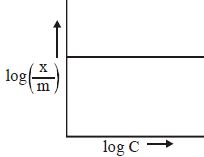
For the adsorption of a solution on a solid surface,the Freundlich adsorption isotherm is given by $\frac{x}{m} = k C^{1/n}$. The plot of $\log (\frac{x}{m})$ versus $\log C$ is shown below. This corresponds to which of the following conditions?
A
$C=0$
B
$C=2 \ M$
C
$C=$ constant
D
$\frac{1}{n} = 0$
Solution
(D) The Freundlich adsorption isotherm equation is $\frac{x}{m} = k C^{1/n}$.
Taking the logarithm on both sides,we get: $\log (\frac{x}{m}) = \log k + \frac{1}{n} \log C$.
This is a linear equation of the form $y = mx + c$,where $y = \log (\frac{x}{m})$,$x = \log C$,slope $m = \frac{1}{n}$,and intercept $c = \log k$.
The given graph is a horizontal line parallel to the $\log C$ axis,which means the slope of the line is zero.
Therefore,$\frac{1}{n} = 0$.
Taking the logarithm on both sides,we get: $\log (\frac{x}{m}) = \log k + \frac{1}{n} \log C$.
This is a linear equation of the form $y = mx + c$,where $y = \log (\frac{x}{m})$,$x = \log C$,slope $m = \frac{1}{n}$,and intercept $c = \log k$.
The given graph is a horizontal line parallel to the $\log C$ axis,which means the slope of the line is zero.
Therefore,$\frac{1}{n} = 0$.
0 likes
View Solution123
DifficultMCQ
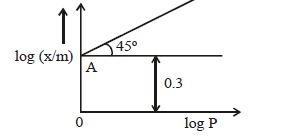
The graph between $\log (\frac{x}{m})$ and $\log P$ is provided for the adsorption of $NH_3$ gas on a metal surface. Calculate the weight of $NH_3$ gas adsorbed by $50 \ gm$ of the metal surface at $2 \ atm$ pressure. (in $gm$)
A
$100$
B
$75$
C
$200$
D
$50$
Solution
(C) According to the Freundlich adsorption isotherm,$\log (\frac{x}{m}) = \log K + \frac{1}{n} \log P$.
From the given graph,the slope is $\tan(45^{\circ}) = 1$,so $\frac{1}{n} = 1$.
The intercept on the y-axis is $\log K = 0.3$. Since $\log 2 \approx 0.301$,we have $K = 2$.
Substituting these values into the Freundlich equation: $\frac{x}{m} = K \cdot P^{1/n} = 2 \cdot P^1$.
Given $m = 50 \ gm$ and $P = 2 \ atm$,we get $\frac{x}{50} = 2 \cdot 2 = 4$.
Therefore,$x = 50 \cdot 4 = 200 \ gm$.
From the given graph,the slope is $\tan(45^{\circ}) = 1$,so $\frac{1}{n} = 1$.
The intercept on the y-axis is $\log K = 0.3$. Since $\log 2 \approx 0.301$,we have $K = 2$.
Substituting these values into the Freundlich equation: $\frac{x}{m} = K \cdot P^{1/n} = 2 \cdot P^1$.
Given $m = 50 \ gm$ and $P = 2 \ atm$,we get $\frac{x}{50} = 2 \cdot 2 = 4$.
Therefore,$x = 50 \cdot 4 = 200 \ gm$.
0 likes
View Solution124
MediumMCQ
Which of the following parameters is $\text{correct}$ regarding the adsorption of gases over a solid?
A
$\Delta S_{\text{system}} > 0$
B
$\Delta S_{\text{surrounding}} > 0$
C
$\Delta G > 0$
D
$\Delta H > 0$
Solution
(B) Adsorption is a spontaneous process,so $\Delta G < 0$.
It is an exothermic process,so the enthalpy change $\Delta H < 0$.
Since gas molecules are adsorbed on the solid surface,their freedom of movement decreases,leading to a decrease in entropy,so $\Delta S_{\text{system}} < 0$.
For a spontaneous process,the total entropy change $\Delta S_{\text{total}} = \Delta S_{\text{system}} + \Delta S_{\text{surrounding}} > 0$.
Since $\Delta S_{\text{system}}$ is negative,$\Delta S_{\text{surrounding}}$ must be positive and greater in magnitude than $|\Delta S_{\text{system}}|$ to make the process spontaneous. Thus,$\Delta S_{\text{surrounding}} > 0$ is the correct parameter.
It is an exothermic process,so the enthalpy change $\Delta H < 0$.
Since gas molecules are adsorbed on the solid surface,their freedom of movement decreases,leading to a decrease in entropy,so $\Delta S_{\text{system}} < 0$.
For a spontaneous process,the total entropy change $\Delta S_{\text{total}} = \Delta S_{\text{system}} + \Delta S_{\text{surrounding}} > 0$.
Since $\Delta S_{\text{system}}$ is negative,$\Delta S_{\text{surrounding}}$ must be positive and greater in magnitude than $|\Delta S_{\text{system}}|$ to make the process spontaneous. Thus,$\Delta S_{\text{surrounding}} > 0$ is the correct parameter.
0 likes
View Solution125
MediumMCQ
Froth floatation process for concentration of ores is an illustration of the practical application of:
A
Adsorption
B
Absorption
C
Coagulation
D
Sedimentation
Solution
(A) The froth floatation process is used for the concentration of sulphide ores.
In this process,the ore particles are preferentially wetted by the oil (frother),while the gangue particles are wetted by water.
This selective wetting is based on the principle of adsorption,where the collector molecules (like pine oil or xanthates) adsorb onto the surface of the ore particles,making them hydrophobic and allowing them to attach to air bubbles and rise to the surface as froth.
In this process,the ore particles are preferentially wetted by the oil (frother),while the gangue particles are wetted by water.
This selective wetting is based on the principle of adsorption,where the collector molecules (like pine oil or xanthates) adsorb onto the surface of the ore particles,making them hydrophobic and allowing them to attach to air bubbles and rise to the surface as froth.
0 likes
View Solution126
DifficultMCQ
Plot of $\log \left( \frac{x}{m} \right)$ against $\log P$ is a straight line inclined at an angle of $45^o$. When the pressure is $0.5 \ atm$ and Freundlich parameter,$k$ is $10$,the amount of solute adsorbed per gram of adsorbent will be ...... $g$ $(\log 5 = 0.6990)$
A
$1$
B
$2$
C
$3$
D
$5$
Solution
(D) According to the Freundlich adsorption isotherm equation:
$\log \left( \frac{x}{m} \right) = \log k + \frac{1}{n} \log P$
Comparing this with the equation of a straight line $y = mx + c$,the slope is $\frac{1}{n}$.
Given that the line is inclined at an angle of $45^o$,the slope is:
$\frac{1}{n} = \tan 45^o = 1$
Given $k = 10$ and $P = 0.5 \ atm$,we substitute these values into the adsorption isotherm equation:
$\frac{x}{m} = k \times P^{1/n}$
$\frac{x}{m} = 10 \times (0.5)^1$
$\frac{x}{m} = 5$
Since we are calculating the amount of solute adsorbed per gram of adsorbent $(m = 1 \ g)$,the amount of solute $x$ is $5 \ g$.
$\log \left( \frac{x}{m} \right) = \log k + \frac{1}{n} \log P$
Comparing this with the equation of a straight line $y = mx + c$,the slope is $\frac{1}{n}$.
Given that the line is inclined at an angle of $45^o$,the slope is:
$\frac{1}{n} = \tan 45^o = 1$
Given $k = 10$ and $P = 0.5 \ atm$,we substitute these values into the adsorption isotherm equation:
$\frac{x}{m} = k \times P^{1/n}$
$\frac{x}{m} = 10 \times (0.5)^1$
$\frac{x}{m} = 5$
Since we are calculating the amount of solute adsorbed per gram of adsorbent $(m = 1 \ g)$,the amount of solute $x$ is $5 \ g$.
0 likes
View Solution127
MediumMCQ
When a graph is plotted between $\log (x/m)$ and $\log P$,it is a straight line with an angle of $45^o$ and an intercept of $0.3010$ on the $y-$axis. If the initial pressure is $0.3 \ atm$,what will be the amount of gas adsorbed per $g$ of adsorbent $(x/m)$?
A
$0.4$
B
$0.6$
C
$0.8$
D
$0.1$
Solution
(B) The Freundlich adsorption isotherm equation is given by $\log (x/m) = \log k + (1/n) \log P$.
Comparing this with the equation of a straight line $y = mx + c$,we have the slope $1/n = \tan 45^o = 1$ and the intercept $\log k = 0.3010$.
Calculating $k$,we get $k = \text{antilog}(0.3010) = 2$.
Substituting the values into the adsorption equation: $(x/m) = k \cdot P^{1/n} = 2 \times (0.3)^1 = 0.6$.
Comparing this with the equation of a straight line $y = mx + c$,we have the slope $1/n = \tan 45^o = 1$ and the intercept $\log k = 0.3010$.
Calculating $k$,we get $k = \text{antilog}(0.3010) = 2$.
Substituting the values into the adsorption equation: $(x/m) = k \cdot P^{1/n} = 2 \times (0.3)^1 = 0.6$.
0 likes
View Solution128
MediumMCQ
Which of the following statements is not correct?
A
Physical adsorption is due to van der Waals forces.
B
Chemical adsorption decreases on increasing temperature and pressure.
C
Physical adsorption is reversible.
D
Activation energy for a chemical adsorption is greater than that of physical adsorption.
Solution
(B) is the incorrect statement.
Chemical adsorption (chemisorption) typically increases with an increase in temperature initially because it requires activation energy,and it increases with an increase in pressure.
Physical adsorption (physisorption) is reversible,whereas chemical adsorption is generally irreversible.
Activation energy for chemical adsorption is significantly higher than that of physical adsorption.
Chemical adsorption (chemisorption) typically increases with an increase in temperature initially because it requires activation energy,and it increases with an increase in pressure.
Physical adsorption (physisorption) is reversible,whereas chemical adsorption is generally irreversible.
Activation energy for chemical adsorption is significantly higher than that of physical adsorption.
0 likes
View Solution129
MediumMCQ
For the adsorption of a gas on a solid adsorbent,which of the following is positive?
A
$\Delta H$
B
$\Delta S$
C
Both $(A)$ and $(B)$
D
None of these
Solution
(D) Adsorption is a spontaneous process,so $\Delta G < 0$.
It is an exothermic process,so $\Delta H < 0$.
Since the gas molecules are adsorbed on the solid surface,their freedom of movement decreases,leading to a decrease in entropy,so $\Delta S < 0$.
Therefore,none of the given thermodynamic quantities $(\Delta H, \Delta S, \Delta G)$ are positive for the adsorption process.
It is an exothermic process,so $\Delta H < 0$.
Since the gas molecules are adsorbed on the solid surface,their freedom of movement decreases,leading to a decrease in entropy,so $\Delta S < 0$.
Therefore,none of the given thermodynamic quantities $(\Delta H, \Delta S, \Delta G)$ are positive for the adsorption process.
0 likes
View Solution130
EasyMCQ
Freundlich adsorption isotherm gives a straight line on plotting :-
A
$x/m$ vs $P$
B
$\log(x/m)$ vs $P$
C
$\log(x/m)$ vs $\log P$
D
$x/m$ vs $1/P$
Solution
(C) The Freundlich adsorption isotherm is given by the equation $\frac{x}{m} = kP^{1/n}$.
Taking logarithms on both sides,we get $\log(\frac{x}{m}) = \log k + \frac{1}{n} \log P$.
This equation is of the form $y = mx + c$,where $y = \log(x/m)$,$x = \log P$,slope $m = 1/n$,and intercept $c = \log k$.
Therefore,plotting $\log(x/m)$ vs $\log P$ gives a straight line.
Taking logarithms on both sides,we get $\log(\frac{x}{m}) = \log k + \frac{1}{n} \log P$.
This equation is of the form $y = mx + c$,where $y = \log(x/m)$,$x = \log P$,slope $m = 1/n$,and intercept $c = \log k$.
Therefore,plotting $\log(x/m)$ vs $\log P$ gives a straight line.
0 likes
View Solution131
EasyMCQ
During adsorption,the $\Delta H$ is negative and the magnitude of this negative value
A
goes on increasing
B
goes on decreasing
C
remains same
D
first increases then decreases
Solution
(B) During adsorption,the negative value of $\Delta H$ goes on decreasing as the process proceeds.
This is because the number of available active adsorption sites on the surface decreases,leading to a reduction in the heat released (exothermicity) as the surface becomes covered.
This is because the number of available active adsorption sites on the surface decreases,leading to a reduction in the heat released (exothermicity) as the surface becomes covered.
0 likes
View Solution132
EasyMCQ
Which statement is true for Column Chromatography?
A
Most adsorbed substances are retained near the top
B
Most adsorbed substances are retained near the bottom
C
The components of the mixture to be separated is called stationary phase
D
Chromatography is not a purification method
Solution
(A) In column chromatography,the separation of components depends on their differential adsorption on the stationary phase.
The components that are most readily adsorbed are retained near the top of the column.
The components that are less strongly adsorbed move further down the column to various distances.
The components that are most readily adsorbed are retained near the top of the column.
The components that are less strongly adsorbed move further down the column to various distances.
0 likes
View Solution133
EasyMCQ
Which gas will be adsorbed on a solid to a greater extent?
A
$A$. $A$ gas having a non-polar molecule
B
$B$. $A$ gas having a higher critical temperature $(T_c)$
C
$C$. $A$ gas having a lower critical temperature
D
$D$. $A$ gas having a higher critical pressure
Solution
(B) The extent of adsorption of a gas on a solid surface depends on the ease of liquefaction of the gas.
Gases with higher critical temperatures $(T_c)$ have stronger intermolecular forces of attraction,making them easier to liquefy.
Easily liquefiable gases are adsorbed to a greater extent on the surface of a solid.
Therefore,a gas with a higher critical temperature $(T_c)$ will be adsorbed to a greater extent.
Gases with higher critical temperatures $(T_c)$ have stronger intermolecular forces of attraction,making them easier to liquefy.
Easily liquefiable gases are adsorbed to a greater extent on the surface of a solid.
Therefore,a gas with a higher critical temperature $(T_c)$ will be adsorbed to a greater extent.
0 likes
View Solution134
EasyMCQ
Which of the following characteristics is not correct for physical adsorption?
A
Adsorption is spontaneous at suitable conditions.
B
It is not specific in nature.
C
It is reversible in nature.
D
Amount of adsorption increases with increase in temperature.
Solution
(D) Physical adsorption decreases with an increase in temperature because an increase in temperature leads to an increase in kinetic energy of molecules and hence,their desorption.
Since physical adsorption is an exothermic process,it occurs more readily at lower temperatures and decreases with an increase in temperature (Le-Chatelier's Principle).
If the adsorption is a spontaneous phenomenon,it should be exothermic,at least for adsorption from the gaseous phase.
$A$ molecule in the gas phase will have an entropy higher than in the adsorbed state,then the $\Delta S$ should be negative. The only way to have a $\Delta G$ negative (spontaneous) is to have a $\Delta H$ negative (exothermic process).
Therefore,the process will be spontaneous $(\Delta G < 0)$ if the temperature is low.
Since physical adsorption is an exothermic process,it occurs more readily at lower temperatures and decreases with an increase in temperature (Le-Chatelier's Principle).
If the adsorption is a spontaneous phenomenon,it should be exothermic,at least for adsorption from the gaseous phase.
$A$ molecule in the gas phase will have an entropy higher than in the adsorbed state,then the $\Delta S$ should be negative. The only way to have a $\Delta G$ negative (spontaneous) is to have a $\Delta H$ negative (exothermic process).
Therefore,the process will be spontaneous $(\Delta G < 0)$ if the temperature is low.
0 likes
View Solution135
MediumMCQ
Which of the following is not a point of difference between physisorption and chemisorption?
A
Magnitude of chemisorption first increases then decreases but that of physisorption decreases with rise in temperature
B
Chemisorption is an irreversible process whereas physisorption is reversible in nature
C
Activation energy is high for physisorption and low for chemisorption
D
Physisorption results in the formation of multimolecular layer,while only unimolecular layer is formed in case of chemisorption
Solution
(C) Physisorption is caused by weak van der Waals forces,so it requires very low activation energy. In contrast,chemisorption involves the formation of chemical bonds,which requires a significant amount of activation energy. Therefore,the statement that activation energy is high for physisorption and low for chemisorption is incorrect.
0 likes
View Solution136
EasyMCQ
The froth flotation process is used for the concentration of sulphide ores and:
A
It is based on the absorption principle.
B
It is based on the adsorption principle.
C
It is based on the crystallisation method.
D
It is based on the concept of specific gravity.
Solution
(B) The froth flotation process is based on the difference in the wetting properties of the ore and the gangue particles with water and oil. The sulphide ore particles are preferentially wetted by oil (hydrophobic),while the gangue particles are wetted by water (hydrophilic). This selective wetting is a surface phenomenon known as adsorption.
0 likes
View Solution137
EasyMCQ
Which forms multimolecular layers during adsorption?
A
Physical adsorption
B
Vander Waal's adsorption
C
Freundlich adsorption
D
All of these
Solution
(D) Physical adsorption is characterized by weak $Vander \text{ } Waal's$ forces between the adsorbate and the adsorbent.
Due to these weak forces,multiple layers of adsorbate molecules can accumulate on the surface of the adsorbent,leading to the formation of multimolecular layers.
Since $Vander \text{ } Waal's$ adsorption is another name for physical adsorption,and the $Freundlich$ adsorption isotherm describes the behavior of physical adsorption,all these terms refer to the same phenomenon.
Therefore,the correct answer is $All \text{ } of \text{ } these$.
Due to these weak forces,multiple layers of adsorbate molecules can accumulate on the surface of the adsorbent,leading to the formation of multimolecular layers.
Since $Vander \text{ } Waal's$ adsorption is another name for physical adsorption,and the $Freundlich$ adsorption isotherm describes the behavior of physical adsorption,all these terms refer to the same phenomenon.
Therefore,the correct answer is $All \text{ } of \text{ } these$.
0 likes
View Solution138
MediumMCQ
The volumes of gases $H_2, CH_4, CO_2$ and $NH_3$ adsorbed by $1 \ g$ of charcoal at $288 \ K$ are in the order:
A
$H_2 > CH_4 > CO_2 > NH_3$
B
$CH_4 > CO_2 > NH_3 > H_2$
C
$CO_2 > NH_3 > H_2 > CH_4$
D
$NH_3 > CO_2 > CH_4 > H_2$
Solution
(D) The amount of gas adsorbed by a solid depends on the nature of the gas.
Easily liquefiable gases,which have higher critical temperatures,are adsorbed more readily because they possess stronger van der Waals forces.
The critical temperatures of these gases are in the order: $NH_3 (405.5 \ K) > CO_2 (304.1 \ K) > CH_4 (190.6 \ K) > H_2 (33.2 \ K)$.
Therefore,the volume of gases adsorbed by $1 \ g$ of charcoal at $288 \ K$ follows the same order: $NH_3 > CO_2 > CH_4 > H_2$.
Easily liquefiable gases,which have higher critical temperatures,are adsorbed more readily because they possess stronger van der Waals forces.
The critical temperatures of these gases are in the order: $NH_3 (405.5 \ K) > CO_2 (304.1 \ K) > CH_4 (190.6 \ K) > H_2 (33.2 \ K)$.
Therefore,the volume of gases adsorbed by $1 \ g$ of charcoal at $288 \ K$ follows the same order: $NH_3 > CO_2 > CH_4 > H_2$.
0 likes
View Solution139
DifficultMCQ
Charcoal is mixed in $500 \ mL$ of $0.5 \ M$ acetic acid solution. After some time,the concentration of the solution becomes $0.3 \ M$. Find the total number of molecules adsorbed on the surface of the charcoal.
A
$6 \times 10^{23} \text{ molecules}$
B
$6 \times 10^{22} \text{ molecules}$
C
$6 \times 10^{24} \text{ molecules}$
D
$6 \times 10^{21} \text{ molecules}$
Solution
(B) Initial moles of acetic acid: $(n_{CH_3COOH})_{\text{initial}} = 500 \ mL \times 0.5 \ M = 250 \ mmol = 0.25 \ mol$.
Final moles of acetic acid: $(n_{CH_3COOH})_{\text{final}} = 500 \ mL \times 0.3 \ M = 150 \ mmol = 0.15 \ mol$.
Moles adsorbed on charcoal: $\Delta n = 0.25 \ mol - 0.15 \ mol = 0.1 \ mol$.
Number of molecules adsorbed: $N = \Delta n \times N_A = 0.1 \times 6 \times 10^{23} = 6 \times 10^{22} \text{ molecules}$.
Final moles of acetic acid: $(n_{CH_3COOH})_{\text{final}} = 500 \ mL \times 0.3 \ M = 150 \ mmol = 0.15 \ mol$.
Moles adsorbed on charcoal: $\Delta n = 0.25 \ mol - 0.15 \ mol = 0.1 \ mol$.
Number of molecules adsorbed: $N = \Delta n \times N_A = 0.1 \times 6 \times 10^{23} = 6 \times 10^{22} \text{ molecules}$.
0 likes
View Solution140
MediumMCQ
Which plot is the adsorption isobar for chemisorption where $x$ is the amount of gas adsorbed on mass $m$ at temperature $T$?
A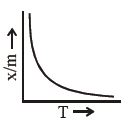
B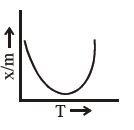
C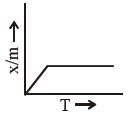
D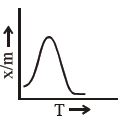
Solution
(D) Chemisorption involves the formation of chemical bonds between the adsorbate and the adsorbent. This process requires an activation energy to initiate the bond formation.
Initially,as the temperature $T$ increases,more gas molecules gain sufficient energy to overcome the activation energy barrier,leading to an increase in the extent of adsorption $(x/m)$.
However,at higher temperatures,the thermal energy becomes sufficient to break the chemical bonds formed,leading to desorption.
Therefore,the adsorption isobar for chemisorption shows an initial increase followed by a decrease in $x/m$ as temperature $T$ increases.
This corresponds to the plot shown in option $D$.
Initially,as the temperature $T$ increases,more gas molecules gain sufficient energy to overcome the activation energy barrier,leading to an increase in the extent of adsorption $(x/m)$.
However,at higher temperatures,the thermal energy becomes sufficient to break the chemical bonds formed,leading to desorption.
Therefore,the adsorption isobar for chemisorption shows an initial increase followed by a decrease in $x/m$ as temperature $T$ increases.
This corresponds to the plot shown in option $D$.
0 likes
View Solution141
MediumMCQ
Which of the plots is adsorption isobar for chemisorption?
A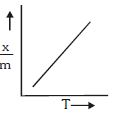
B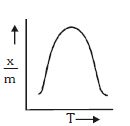
C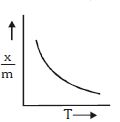
D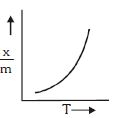
Solution
(B) An adsorption isobar is a plot of the extent of adsorption $(x/m)$ versus temperature $(T)$ at a constant pressure.
For chemisorption,the process involves the formation of chemical bonds,which requires an initial activation energy.
Therefore,as the temperature increases,the rate of adsorption initially increases due to the overcoming of the activation energy barrier.
However,at higher temperatures,the desorption process becomes dominant due to the breaking of chemical bonds,causing the extent of adsorption to decrease.
Thus,the plot of $x/m$ versus $T$ for chemisorption shows an initial increase followed by a decrease,which corresponds to the graph in option $B$.
For chemisorption,the process involves the formation of chemical bonds,which requires an initial activation energy.
Therefore,as the temperature increases,the rate of adsorption initially increases due to the overcoming of the activation energy barrier.
However,at higher temperatures,the desorption process becomes dominant due to the breaking of chemical bonds,causing the extent of adsorption to decrease.
Thus,the plot of $x/m$ versus $T$ for chemisorption shows an initial increase followed by a decrease,which corresponds to the graph in option $B$.
0 likes
View Solution142
EasyMCQ
Consider the graphs $(I)$,$(II)$ and $(III)$. The correct statement related to the graphs is/are:
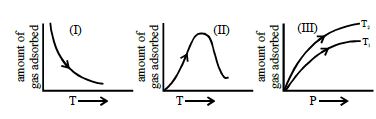
A
$(I)$ is physiosorption,$(II)$ is chemisorption and $T_2 > T_1$
B
$(I)$ is chemisorption,$(II)$ is physiosorption
C
$(I)$ is physiosorption,$(II)$ is chemisorption and $T_1 > T_2$
D
$(I)$ and $(II)$ are physiosorption and $T_1 = T_2$
Solution
(C) Graph $(I)$ shows the variation of the amount of gas adsorbed with temperature for physical adsorption (physiosorption). In physiosorption,adsorption decreases with an increase in temperature because it is an exothermic process.
Graph $(II)$ shows the variation for chemical adsorption (chemisorption). Chemisorption initially increases with temperature due to the activation energy requirement and then decreases at higher temperatures.
Graph $(III)$ represents the Freundlich adsorption isotherm,where the amount of gas adsorbed increases with pressure. For physical adsorption,adsorption decreases as temperature increases. Since the curve for $T_1$ is below the curve for $T_2$ at the same pressure,it implies $T_1 > T_2$.
Graph $(II)$ shows the variation for chemical adsorption (chemisorption). Chemisorption initially increases with temperature due to the activation energy requirement and then decreases at higher temperatures.
Graph $(III)$ represents the Freundlich adsorption isotherm,where the amount of gas adsorbed increases with pressure. For physical adsorption,adsorption decreases as temperature increases. Since the curve for $T_1$ is below the curve for $T_2$ at the same pressure,it implies $T_1 > T_2$.
0 likes
View Solution143
MediumMCQ
Which gas will be adsorbed on a solid to a greater extent?
A
Having non-polar molecule
B
Having highest critical temperature
C
Having lowest critical temperature
D
Having lowest critical pressure
Solution
(B) The extent of adsorption of a gas on a solid surface depends on the ease of liquefaction of the gas.
Easily liquefiable gases are adsorbed more readily.
The ease of liquefaction is directly related to the critical temperature $(T_c)$ of the gas.
Higher the critical temperature of a gas,greater is the magnitude of intermolecular forces of attraction,and thus,it is more easily adsorbed on a solid surface.
Therefore,the gas with the highest critical temperature will be adsorbed to a greater extent.
Easily liquefiable gases are adsorbed more readily.
The ease of liquefaction is directly related to the critical temperature $(T_c)$ of the gas.
Higher the critical temperature of a gas,greater is the magnitude of intermolecular forces of attraction,and thus,it is more easily adsorbed on a solid surface.
Therefore,the gas with the highest critical temperature will be adsorbed to a greater extent.
0 likes
View Solution144
EasyMCQ
The rate of physical adsorption:
A
Decreases with increase of pressure
B
Is independent of pressure at high pressure
C
Is maximum at one atmospheric pressure
D
Always increases with increase of pressure
Solution
(B) According to the Freundlich adsorption isotherm,the extent of adsorption $(x/m)$ is given by $x/m = kP^{1/n}$.
At high pressure,the value of $1/n$ approaches $0$,making $x/m$ constant.
Therefore,the rate of physical adsorption becomes independent of pressure at high pressure.
At high pressure,the value of $1/n$ approaches $0$,making $x/m$ constant.
Therefore,the rate of physical adsorption becomes independent of pressure at high pressure.
0 likes
View Solution145
MediumMCQ
Which of the following is true in respect of chemical adsorption?
A
$\Delta H < 0, \Delta S > 0, \Delta G > 0$
B
$\Delta H < 0, \Delta S < 0, \Delta G < 0$
C
$\Delta H < 0, \Delta S > 0, \Delta G < 0$
D
$\Delta H < 0, \Delta S < 0, \Delta G > 0$
Solution
(B) Chemical adsorption is an exothermic process,so the enthalpy change $(\Delta H)$ is negative $(\Delta H < 0)$.
Since the gas molecules are adsorbed on the solid surface,their randomness decreases,leading to a decrease in entropy $(\Delta S < 0)$.
For a spontaneous process,the Gibbs free energy change $(\Delta G)$ must be negative $(\Delta G < 0)$.
Since the gas molecules are adsorbed on the solid surface,their randomness decreases,leading to a decrease in entropy $(\Delta S < 0)$.
For a spontaneous process,the Gibbs free energy change $(\Delta G)$ must be negative $(\Delta G < 0)$.
0 likes
View Solution146
EasyMCQ
The charge of $As_2S_3$ sol is due to the adsorption of
A
$H^{+}$
B
$OH^{-}$
C
$O_2^{2-}$
D
$S^{2-}$
Solution
(D) The $As_2S_3$ sol is a negatively charged sol.
This negative charge arises due to the preferential adsorption of common ions,specifically $S^{2-}$ ions,on the surface of the $As_2S_3$ particles from the dispersion medium.
This negative charge arises due to the preferential adsorption of common ions,specifically $S^{2-}$ ions,on the surface of the $As_2S_3$ particles from the dispersion medium.
0 likes
View Solution147
MediumMCQ
Which of the following is true with respect to chemical adsorption?
A
$ \Delta H < 0, \Delta S > 0, \Delta G > 0 $
B
$ \Delta H < 0, \Delta S < 0, \Delta G < 0 $
C
$ \Delta H > 0, \Delta S > 0, \Delta G < 0 $
D
$ \Delta H > 0, \Delta S < 0, \Delta G > 0 $
Solution
(B) For any spontaneous adsorption process,the Gibbs free energy change,$ \Delta G $,must be negative $( \Delta G < 0 )$.
Adsorption is an exothermic process,meaning heat is released,so the enthalpy change,$ \Delta H $,is negative $( \Delta H < 0 )$.
Since gas molecules are restricted to the surface upon adsorption,the randomness of the system decreases,leading to a negative entropy change,$ \Delta S < 0 $.
Adsorption is an exothermic process,meaning heat is released,so the enthalpy change,$ \Delta H $,is negative $( \Delta H < 0 )$.
Since gas molecules are restricted to the surface upon adsorption,the randomness of the system decreases,leading to a negative entropy change,$ \Delta S < 0 $.
0 likes
View Solution148
EasyMCQ
Absorption and adsorption are respectively
A
surface phenomena,bulk phenomena
B
bulk phenomena,surface phenomena
C
both are bulk phenomena
D
both are surface phenomena
Solution
(B) Absorption is a bulk phenomenon where a substance is uniformly distributed throughout the body of a solid or liquid.
Adsorption is a surface phenomenon where particles accumulate only at the surface of a solid or liquid rather than in the bulk.
Therefore,absorption is a bulk phenomenon and adsorption is a surface phenomenon.
Adsorption is a surface phenomenon where particles accumulate only at the surface of a solid or liquid rather than in the bulk.
Therefore,absorption is a bulk phenomenon and adsorption is a surface phenomenon.
0 likes
View Solution149
EasyMCQ
Adsorption is multilayer in case of
A
Physical adsorption
B
Chemisorption
C
Both $A$ and $B$
D
None of these
Solution
(A) Adsorption is multilayer in the case of physical adsorption (physisorption) due to weak van der Waals forces.
In contrast,chemisorption is unilayer because it involves the formation of strong chemical bonds between the adsorbate and adsorbent molecules,which limits the adsorption to a single layer.
In contrast,chemisorption is unilayer because it involves the formation of strong chemical bonds between the adsorbate and adsorbent molecules,which limits the adsorption to a single layer.
0 likes
View Solution150
EasyMCQ
The statement not applicable to chemisorption is
A
highly specific
B
independent of temperature
C
irreversible
D
multilayered
Solution
(B) Chemisorption involves the formation of chemical bonds between the adsorbate and the adsorbent.
$1$. It is highly specific in nature.
$2$. It is generally irreversible.
$3$. It is a unimolecular process,meaning it forms a monolayer,not a multilayer.
$4$. It is dependent on temperature; typically,it increases with an increase in temperature initially due to activation energy requirements.
Therefore,the statement 'independent of temperature' is not applicable to chemisorption.
$1$. It is highly specific in nature.
$2$. It is generally irreversible.
$3$. It is a unimolecular process,meaning it forms a monolayer,not a multilayer.
$4$. It is dependent on temperature; typically,it increases with an increase in temperature initially due to activation energy requirements.
Therefore,the statement 'independent of temperature' is not applicable to chemisorption.
0 likes
View SolutionSurface Chemistry — Adsorption and Adsorption isotherm · Frequently Asked Questions
1Are these Surface Chemistry questions useful for JEE and NEET?
Yes. All questions in this section are mapped to JEE Main and NEET exam patterns. Previous year questions from JEE Main, NEET, GUJCET and state-level exams are included with full solutions.
2Can I switch to Hindi or Gujarati for these questions?
Yes. Use the language tabs in the hero section or the sidebar to view the same questions and solutions in English, Hindi or Gujarati.
3How do I generate a question paper from this subtopic?
Use the Vedclass Exam Paper Generator — select the chapter and subtopic, set difficulty, and generate Sets A, B, C, D automatically. First 3 chapters of every subject are free.
Vedclass Products
For Students
Vedclass Test Series
Mock tests in real JEE/NEET style with performance analysis. 5-day free trial.
Start Free TrialFor Teachers
Exam Paper Generator
Generate Set A/B/C/D papers from this chapter in 2 minutes. 3 chapters free.
Try FreeFor Institutes
Online Exam Module
Live online exams with unlimited students, 360° analytics & white-label branding.
See DemoFor Teachers & Institutes
Generate a Surface Chemistry Exam Paper in 2 Minutes
Select subtopic & difficulty — Sets A, B, C, D auto-generated with No Repeat logic.
First 3 chapters of every subject are free — no payment required.