
A English
Depression of freezing point of the solvent Questions in English
Class 12 Chemistry · Solutions · Depression of freezing point of the solvent
209+
Questions
English
Language
100%
With Solutions
Showing 50 of 209 questions in English
51
MediumMCQ
The freezing point of a solution containing $4.8 \ g$ of a compound in $60 \ g$ of benzene is $4.48 ^\circ C$. What is the molar mass of the compound $(K_f = 5.1 \ K \ kg \ mol^{-1})$,(freezing point of benzene $= 5.5 ^\circ C$)?
A
$100$
B
$200$
C
$300$
D
$400$
Solution
(D) The depression in freezing point is given by $\Delta T_f = T_f^\circ - T_f = 5.5 ^\circ C - 4.48 ^\circ C = 1.02 ^\circ C$ (or $1.02 \ K$).
Using the formula for molar mass $M = \frac{K_f \times w \times 1000}{W \times \Delta T_f}$,where $w = 4.8 \ g$,$W = 60 \ g$,$K_f = 5.1 \ K \ kg \ mol^{-1}$,and $\Delta T_f = 1.02 \ K$.
$M = \frac{5.1 \times 4.8 \times 1000}{60 \times 1.02} = \frac{24480}{61.2} = 400 \ g \ mol^{-1}$.
Using the formula for molar mass $M = \frac{K_f \times w \times 1000}{W \times \Delta T_f}$,where $w = 4.8 \ g$,$W = 60 \ g$,$K_f = 5.1 \ K \ kg \ mol^{-1}$,and $\Delta T_f = 1.02 \ K$.
$M = \frac{5.1 \times 4.8 \times 1000}{60 \times 1.02} = \frac{24480}{61.2} = 400 \ g \ mol^{-1}$.
0 likes
View Solution52
MediumMCQ
When $0.01 \ mol$ of sugar is dissolved in $100 \ g$ of a solvent,the depression in freezing point is $0.40 \ ^oC$. When $0.03 \ mol$ of glucose is dissolved in $50 \ g$ of the same solvent,the depression in freezing point will be $......... \ ^oC$.
A
$0.60$
B
$0.80$
C
$1.60$
D
$2.4$
Solution
(D) The depression in freezing point is given by the formula $\Delta T_f = m \times K_f$,where $m$ is the molality of the solution and $K_f$ is the cryoscopic constant of the solvent.
For the first case: $m_1 = \frac{0.01 \ mol}{100 \ g} \times 1000 \ g/kg = 0.1 \ mol/kg$.
Given $\Delta T_{f1} = 0.40 \ ^oC$,we have $0.40 = 0.1 \times K_f$,which gives $K_f = 4 \ ^oC \ kg/mol$.
For the second case: $m_2 = \frac{0.03 \ mol}{50 \ g} \times 1000 \ g/kg = 0.6 \ mol/kg$.
Now,calculating the new depression in freezing point: $\Delta T_{f2} = m_2 \times K_f = 0.6 \times 4 = 2.4 \ ^oC$.
For the first case: $m_1 = \frac{0.01 \ mol}{100 \ g} \times 1000 \ g/kg = 0.1 \ mol/kg$.
Given $\Delta T_{f1} = 0.40 \ ^oC$,we have $0.40 = 0.1 \times K_f$,which gives $K_f = 4 \ ^oC \ kg/mol$.
For the second case: $m_2 = \frac{0.03 \ mol}{50 \ g} \times 1000 \ g/kg = 0.6 \ mol/kg$.
Now,calculating the new depression in freezing point: $\Delta T_{f2} = m_2 \times K_f = 0.6 \times 4 = 2.4 \ ^oC$.
0 likes
View Solution53
EasyMCQ
If molality of the dilute solution is doubled,the value of molal depression constant $(K_f)$ will be
A
halved
B
tripled
C
unchanged
D
doubled.
Solution
(C) The molal depression constant,also known as the cryoscopic constant $(K_f)$,is a characteristic property of the solvent.
It depends solely on the nature of the solvent and is independent of the concentration of the solute or the molality of the solution.
Therefore,if the molality of the dilute solution is doubled,the value of $(K_f)$ will remain unchanged.
It depends solely on the nature of the solvent and is independent of the concentration of the solute or the molality of the solution.
Therefore,if the molality of the dilute solution is doubled,the value of $(K_f)$ will remain unchanged.
0 likes
View Solution54
MediumMCQ
$A$ solution of sucrose (molar mass $= 342 \, g \, mol^{-1}$) has been prepared by dissolving $68.5 \, g$ of sucrose in $1000 \, g$ of water. The freezing point of the solution obtained will be ......... $^oC$. ($K_f$ for water $= 1.86 \, K \, kg \, mol^{-1}$)
A
$-0.37$
B
$-0.52$
C
$+0.37$
D
$-0.57$
Solution
(A) Given: $w_2 = 68.5 \, g$,$M_2 = 342 \, g \, mol^{-1}$,$w_1 = 1000 \, g = 1 \, kg$,$K_f = 1.86 \, K \, kg \, mol^{-1}$.
$\Delta T_f = K_f \times m = K_f \times \frac{w_2}{M_2 \times w_1(kg)}$
$\Delta T_f = 1.86 \times \frac{68.5}{342 \times 1} = 0.3725 \, K$ or $^oC$.
Freezing point of solution $T_f = T_f^o - \Delta T_f = 0 \, ^oC - 0.3725 \, ^oC = -0.3725 \, ^oC \approx -0.37 \, ^oC$.
$\Delta T_f = K_f \times m = K_f \times \frac{w_2}{M_2 \times w_1(kg)}$
$\Delta T_f = 1.86 \times \frac{68.5}{342 \times 1} = 0.3725 \, K$ or $^oC$.
Freezing point of solution $T_f = T_f^o - \Delta T_f = 0 \, ^oC - 0.3725 \, ^oC = -0.3725 \, ^oC \approx -0.37 \, ^oC$.
0 likes
View Solution55
MediumMCQ
$1.00 \ g$ of a non-electrolyte solute (molar mass $250 \ g \ mol^{-1}$) was dissolved in $51.2 \ g$ of benzene. If the freezing point depression constant,$K_f$ of benzene is $5.12 \ K \ kg \ mol^{-1},$ the freezing point of benzene will be lowered by .......... $K$.
A
$0.2$
B
$0.4$
C
$0.3$
D
$0.5$
Solution
(B) The formula for freezing point depression is $\Delta T_f = K_f \times m$,where $m$ is the molality of the solution.
Molality $m = \frac{W_1 \times 1000}{M_1 \times W_2}$,where $W_1$ is the mass of solute,$M_1$ is the molar mass of solute,and $W_2$ is the mass of solvent in grams.
Given: $W_1 = 1.00 \ g$,$M_1 = 250 \ g \ mol^{-1}$,$W_2 = 51.2 \ g$,$K_f = 5.12 \ K \ kg \ mol^{-1}$.
Substituting the values: $\Delta T_f = 5.12 \times \frac{1.00 \times 1000}{250 \times 51.2}$.
$\Delta T_f = 5.12 \times \frac{1000}{12800} = 5.12 \times 0.078125 = 0.4 \ K$.
Molality $m = \frac{W_1 \times 1000}{M_1 \times W_2}$,where $W_1$ is the mass of solute,$M_1$ is the molar mass of solute,and $W_2$ is the mass of solvent in grams.
Given: $W_1 = 1.00 \ g$,$M_1 = 250 \ g \ mol^{-1}$,$W_2 = 51.2 \ g$,$K_f = 5.12 \ K \ kg \ mol^{-1}$.
Substituting the values: $\Delta T_f = 5.12 \times \frac{1.00 \times 1000}{250 \times 51.2}$.
$\Delta T_f = 5.12 \times \frac{1000}{12800} = 5.12 \times 0.078125 = 0.4 \ K$.
0 likes
View Solution56
DifficultMCQ
Ethylene glycol is used as an antifreeze in cold climates. The mass of ethylene glycol $(C_2H_6O_2)$ that should be added to $4 \ kg$ of water to prevent it from freezing at $-6 \ ^oC$ is ......... $g$.
($K_f$ for water $= 1.86 \ K \ kg \ mol^{-1}$,and molar mass of ethylene glycol $= 62 \ g \ mol^{-1}$)
($K_f$ for water $= 1.86 \ K \ kg \ mol^{-1}$,and molar mass of ethylene glycol $= 62 \ g \ mol^{-1}$)
A
$800.00$
B
$204.30$
C
$400.00$
D
$304.60$
Solution
(A) Given:
$K_f = 1.86 \ K \ kg \ mol^{-1}$
Mass of solvent $(W_A)$ $= 4 \ kg = 4000 \ g$
Freezing point depression $\Delta T_f = 0 - (-6) = 6 \ K$
Molar mass of solute $(M_B)$ $= 62 \ g \ mol^{-1}$
The formula for freezing point depression is $\Delta T_f = K_f \times m$,where $m$ is molality.
$\Delta T_f = K_f \times \frac{w \times 1000}{M_B \times W_A \text{ (in g)}}$
$6 = 1.86 \times \frac{w \times 1000}{62 \times 4000}$
$6 = 1.86 \times \frac{w}{62 \times 4}$
$w = \frac{6 \times 62 \times 4}{1.86}$
$w = \frac{1488}{1.86} = 800 \ g$
$K_f = 1.86 \ K \ kg \ mol^{-1}$
Mass of solvent $(W_A)$ $= 4 \ kg = 4000 \ g$
Freezing point depression $\Delta T_f = 0 - (-6) = 6 \ K$
Molar mass of solute $(M_B)$ $= 62 \ g \ mol^{-1}$
The formula for freezing point depression is $\Delta T_f = K_f \times m$,where $m$ is molality.
$\Delta T_f = K_f \times \frac{w \times 1000}{M_B \times W_A \text{ (in g)}}$
$6 = 1.86 \times \frac{w \times 1000}{62 \times 4000}$
$6 = 1.86 \times \frac{w}{62 \times 4}$
$w = \frac{6 \times 62 \times 4}{1.86}$
$w = \frac{1488}{1.86} = 800 \ g$
0 likes
View Solution57
DifficultMCQ
$K_f$ for water is $1.86 \, K \, kg \, mol^{-1}$. If your automobile radiator holds $1.0 \, kg$ of water,how many $gm$ of ethylene glycol $(C_2H_6O_2)$ must you add to lower the freezing point of the solution to $-2.8 \, ^oC$?
A
$72$
B
$93$
C
$39$
D
$27$
Solution
(B) The formula for freezing point depression is $\Delta T_f = i \times K_f \times m$.
Given values: $\Delta T_f = 2.8 \, K$,$K_f = 1.86 \, K \, kg \, mol^{-1}$,$i = 1$ (since ethylene glycol is a non-electrolyte).
Mass of solvent (water) $= 1.0 \, kg$.
Let the mass of solute (ethylene glycol) be $x \, g$.
Molar mass of ethylene glycol $(C_2H_6O_2)$ $= (2 \times 12) + (6 \times 1) + (2 \times 16) = 62 \, g \, mol^{-1}$.
Molality $(m)$ $= \frac{\text{moles of solute}}{\text{mass of solvent in kg}} = \frac{x / 62}{1} = \frac{x}{62} \, mol \, kg^{-1}$.
Substituting into the equation: $2.8 = 1 \times 1.86 \times \frac{x}{62}$.
Solving for $x$: $x = \frac{2.8 \times 62}{1.86} = 93.33 \, g \approx 93 \, g$.
Given values: $\Delta T_f = 2.8 \, K$,$K_f = 1.86 \, K \, kg \, mol^{-1}$,$i = 1$ (since ethylene glycol is a non-electrolyte).
Mass of solvent (water) $= 1.0 \, kg$.
Let the mass of solute (ethylene glycol) be $x \, g$.
Molar mass of ethylene glycol $(C_2H_6O_2)$ $= (2 \times 12) + (6 \times 1) + (2 \times 16) = 62 \, g \, mol^{-1}$.
Molality $(m)$ $= \frac{\text{moles of solute}}{\text{mass of solvent in kg}} = \frac{x / 62}{1} = \frac{x}{62} \, mol \, kg^{-1}$.
Substituting into the equation: $2.8 = 1 \times 1.86 \times \frac{x}{62}$.
Solving for $x$: $x = \frac{2.8 \times 62}{1.86} = 93.33 \, g \approx 93 \, g$.
0 likes
View Solution58
DifficultMCQ
Which of the following aqueous solutions has the highest freezing point?
A
$0.12 \ m \ Ca(NO_3)_2$ solution
B
$0.15 \ m \ NaCl$ solution
C
$0.2 \ m$ urea solution
D
$0.2 \ m \ CH_3COOH$ solution
Solution
(C) The depression in freezing point is given by $\Delta T_f = i \times K_f \times m$. The freezing point is $T_f = T_f^0 - \Delta T_f$. To have the highest freezing point,the value of $\Delta T_f$ must be the lowest,which means the van't Hoff factor $(i)$ multiplied by molality $(m)$ must be the minimum.
For $A$: $i = 3$ $(Ca^{2+} + 2NO_3^-)$,$i \times m = 3 \times 0.12 = 0.36$.
For $B$: $i = 2$ $(Na^+ + Cl^-)$,$i \times m = 2 \times 0.15 = 0.30$.
For $C$: $i = 1$ (urea is non-electrolyte),$i \times m = 1 \times 0.2 = 0.20$.
For $D$: $i \approx 1$ (weak acid,$CH_3COOH$ is slightly dissociated),$i \times m \approx 1 \times 0.2 = 0.20$. Since $CH_3COOH$ dissociates slightly,$i > 1$,so $i \times m > 0.20$.
Comparing the values,urea has the lowest $i \times m$ value,thus it has the highest freezing point.
For $A$: $i = 3$ $(Ca^{2+} + 2NO_3^-)$,$i \times m = 3 \times 0.12 = 0.36$.
For $B$: $i = 2$ $(Na^+ + Cl^-)$,$i \times m = 2 \times 0.15 = 0.30$.
For $C$: $i = 1$ (urea is non-electrolyte),$i \times m = 1 \times 0.2 = 0.20$.
For $D$: $i \approx 1$ (weak acid,$CH_3COOH$ is slightly dissociated),$i \times m \approx 1 \times 0.2 = 0.20$. Since $CH_3COOH$ dissociates slightly,$i > 1$,so $i \times m > 0.20$.
Comparing the values,urea has the lowest $i \times m$ value,thus it has the highest freezing point.
0 likes
View Solution59
MediumMCQ
$A$ solution of $36 \ g$ of glucose $(C_6H_{12}O_6)$ in $1000 \ g$ of water is cooled to $-0.5 \ ^\circ C$. How many grams of ice would have separated from the solution? (Given: $K_f = 1.86 \ K \ kg \ mol^{-1}$)
A
$744$
B
$300$
C
$256$
D
$180$
Solution
(C) The depression in freezing point is given by $\Delta T_f = K_f \times m$,where $m$ is the molality of the solution.
Given $\Delta T_f = 0.5 \ ^\circ C$,$K_f = 1.86 \ K \ kg \ mol^{-1}$,and moles of glucose = $\frac{36 \ g}{180 \ g/mol} = 0.2 \ mol$.
Let $W$ be the mass of water remaining in liquid state (in $kg$).
$0.5 = 1.86 \times \frac{0.2}{W}$
$W = \frac{1.86 \times 0.2}{0.5} = 0.744 \ kg = 744 \ g$.
Since the initial mass of water was $1000 \ g$,the mass of ice separated = $1000 \ g - 744 \ g = 256 \ g$.
Given $\Delta T_f = 0.5 \ ^\circ C$,$K_f = 1.86 \ K \ kg \ mol^{-1}$,and moles of glucose = $\frac{36 \ g}{180 \ g/mol} = 0.2 \ mol$.
Let $W$ be the mass of water remaining in liquid state (in $kg$).
$0.5 = 1.86 \times \frac{0.2}{W}$
$W = \frac{1.86 \times 0.2}{0.5} = 0.744 \ kg = 744 \ g$.
Since the initial mass of water was $1000 \ g$,the mass of ice separated = $1000 \ g - 744 \ g = 256 \ g$.
0 likes
View Solution60
MediumMCQ
$A$ fixed amount of glucose is dissolved in $100 \text{ g}$ water to form a solution that freezes at $-0.2^\circ\text{C}$. If the solution is cooled down to $-0.25^\circ\text{C}$, then ......... $\text{g}$ of ice would have separated.
A
$18$
B
$20$
C
$80$
D
$25$
Solution
(B) We know that $\Delta T_f = K_f \cdot m$. Since the amount of solute is constant, $\Delta T_f \propto \frac{1}{W}$, where $W$ is the mass of the solvent. Given: $\Delta T_{f1} = 0.2^\circ\text{C}$, $W_1 = 100 \text{ g}$, $\Delta T_{f2} = 0.25^\circ\text{C}$. $\frac{\Delta T_{f1}}{\Delta T_{f2}} = \frac{W_2}{W_1}$ $\frac{0.2}{0.25} = \frac{W_2}{100}$ $W_2 = \frac{0.2 \cdot 100}{0.25} = 80 \text{ g}$ Mass of ice separated = $W_1 - W_2 = 100 \text{ g} - 80 \text{ g} = 20 \text{ g}$.
0 likes
View Solution61
MediumMCQ
| Column-$I$ (Various solutions) | Column-$II$ (Freezing point) |
|---|---|
| $a$. $0.1 \, M \ BaCl_2$ solution | $p$. $271 \, K$ |
| $b$. $0.1 \, M \ NaCl$ solution | $q$. $270 \, K$ |
| $c$. $0.1 \, M \ K_3[Fe(CN)_6]$ solution | $r$. $268 \, K$ |
| $d$. $0.1 \, M \ Al_2(SO_4)_3$ solution | $s$. $269 \, K$ |
Given: Freezing point of $0.1 \, M$ sucrose solution $= 272 \, K$ and freezing point of water $= 273 \, K$.
Which of the following options shows the correct matches?
A
$a-r, b-p, c-s, d-q$
B
$a-q, b-p, c-s, d-r$
C
$a-q, b-s, c-p, d-r$
D
$a-s, b-q, c-r, d-q$
Solution
(B) The depression in freezing point is given by $\Delta T_f = i \times K_f \times m$.
Since $K_f$ and $m$ are constant,$\Delta T_f \propto i$.
Freezing point $T_f = T_f^0 - \Delta T_f = 273 - (i \times K_f \times 0.1)$.
For sucrose,$i=1$,$\Delta T_f = 273 - 272 = 1 \, K$.
Thus,$K_f \times 0.1 = 1$.
$T_f = 273 - i$.
For $a. \ BaCl_2$ $(i=3)$: $T_f = 273 - 3 = 270 \, K$ $(q)$.
For $b. \ NaCl$ $(i=2)$: $T_f = 273 - 2 = 271 \, K$ $(p)$.
For $c. \ K_3[Fe(CN)_6]$ $(i=4)$: $T_f = 273 - 4 = 269 \, K$ $(s)$.
For $d. \ Al_2(SO_4)_3$ $(i=5)$: $T_f = 273 - 5 = 268 \, K$ $(r)$.
Therefore,the correct match is $a-q, b-p, c-s, d-r$.
Since $K_f$ and $m$ are constant,$\Delta T_f \propto i$.
Freezing point $T_f = T_f^0 - \Delta T_f = 273 - (i \times K_f \times 0.1)$.
For sucrose,$i=1$,$\Delta T_f = 273 - 272 = 1 \, K$.
Thus,$K_f \times 0.1 = 1$.
$T_f = 273 - i$.
For $a. \ BaCl_2$ $(i=3)$: $T_f = 273 - 3 = 270 \, K$ $(q)$.
For $b. \ NaCl$ $(i=2)$: $T_f = 273 - 2 = 271 \, K$ $(p)$.
For $c. \ K_3[Fe(CN)_6]$ $(i=4)$: $T_f = 273 - 4 = 269 \, K$ $(s)$.
For $d. \ Al_2(SO_4)_3$ $(i=5)$: $T_f = 273 - 5 = 268 \, K$ $(r)$.
Therefore,the correct match is $a-q, b-p, c-s, d-r$.
0 likes
View Solution62
MediumMCQ
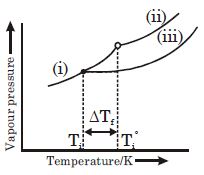
Identify $(i)$,$(ii)$ and $(iii)$ in the following diagram representing the depression in freezing point:
A
$(i)$ Solution,$(ii)$ Frozen solvent,$(iii)$ Liquid solvent
B
$(i)$ Frozen solvent,$(ii)$ Solution,$(iii)$ Liquid solvent
C
$(i)$ Frozen solvent,$(ii)$ Liquid solvent,$(iii)$ Solution
D
$(i)$ Solution,$(ii)$ Liquid solvent,$(iii)$ Frozen solvent
Solution
(C) The provided diagram represents the vapour pressure curve for the depression in freezing point.
In this graph:
$(i)$ represents the intersection point of the vapour pressure curve of the solid solvent and the solution,which corresponds to the freezing point of the solution $(T_f)$.
$(ii)$ represents the vapour pressure curve of the pure liquid solvent.
$(iii)$ represents the vapour pressure curve of the solution.
Therefore,$(i)$ is the frozen solvent (at the freezing point),$(ii)$ is the liquid solvent,and $(iii)$ is the solution.
Thus,the correct identification is $(i)$ Frozen solvent,$(ii)$ Liquid solvent,$(iii)$ Solution.
In this graph:
$(i)$ represents the intersection point of the vapour pressure curve of the solid solvent and the solution,which corresponds to the freezing point of the solution $(T_f)$.
$(ii)$ represents the vapour pressure curve of the pure liquid solvent.
$(iii)$ represents the vapour pressure curve of the solution.
Therefore,$(i)$ is the frozen solvent (at the freezing point),$(ii)$ is the liquid solvent,and $(iii)$ is the solution.
Thus,the correct identification is $(i)$ Frozen solvent,$(ii)$ Liquid solvent,$(iii)$ Solution.
0 likes
View Solution63
MediumMCQ
If the freezing point of an aqueous urea solution is $271.14 \ K$ at $1 \ \text{atm}$ pressure (given $K_f$ of water = $1.86 \ K \ kg/mol$),then what is the mole fraction of urea in this solution? (Freezing point of pure water is $273 \ K$)
A
$\frac{1}{56.5}$
B
$1$
C
$\frac{55.5}{56.5}$
D
$\frac{1.86}{56.5}$
Solution
(A) The depression in freezing point is given by $\Delta T_f = T_f^{\circ} - T_f = 273 \ K - 271.14 \ K = 1.86 \ K$.
Using the formula $\Delta T_f = K_f \times m$,where $m$ is the molality:
$1.86 = 1.86 \times m \implies m = 1 \ mol/kg$.
This means $1 \ mol$ of urea is dissolved in $1000 \ g$ of water.
Moles of water = $\frac{1000 \ g}{18 \ g/mol} \approx 55.55 \ mol$.
Mole fraction of urea $(X_{\text{urea}})$ = $\frac{n_{\text{urea}}}{n_{\text{urea}} + n_{\text{water}}} = \frac{1}{1 + 55.55} = \frac{1}{56.55} \approx \frac{1}{56.5}$.
Using the formula $\Delta T_f = K_f \times m$,where $m$ is the molality:
$1.86 = 1.86 \times m \implies m = 1 \ mol/kg$.
This means $1 \ mol$ of urea is dissolved in $1000 \ g$ of water.
Moles of water = $\frac{1000 \ g}{18 \ g/mol} \approx 55.55 \ mol$.
Mole fraction of urea $(X_{\text{urea}})$ = $\frac{n_{\text{urea}}}{n_{\text{urea}} + n_{\text{water}}} = \frac{1}{1 + 55.55} = \frac{1}{56.55} \approx \frac{1}{56.5}$.
0 likes
View Solution64
MediumMCQ
Calculate the molecular weight of a substance whose $7.0\%$ by mass solution in water freezes at $-0.93\,^{\circ}C$. The cryoscopic constant of water is $1.86\,^{\circ}C\,kg\,mol^{-1}$. .......... $g\,mol^{-1}$.
A
$140$
B
$150.5$
C
$160$
D
$155$
Solution
(B) The depression in freezing point is given by $\Delta T_{f} = K_{f} \cdot m$,where $m$ is the molality of the solution.
Given: $\Delta T_{f} = 0 - (-0.93) = 0.93\,^{\circ}C$,$K_{f} = 1.86\,^{\circ}C\,kg\,mol^{-1}$,and the solution is $7.0\%$ by mass,meaning $7\,g$ of solute in $93\,g$ of water.
Molality $m = \frac{\text{mass of solute}}{\text{molar mass of solute} \times \text{mass of solvent in kg}} = \frac{7}{M \times 0.093}$.
Substituting the values: $0.93 = 1.86 \times \frac{7}{M \times 0.093}$.
$M = \frac{1.86 \times 7}{0.93 \times 0.093} = \frac{13.02}{0.08649} \approx 150.5\,g\,mol^{-1}$.
Given: $\Delta T_{f} = 0 - (-0.93) = 0.93\,^{\circ}C$,$K_{f} = 1.86\,^{\circ}C\,kg\,mol^{-1}$,and the solution is $7.0\%$ by mass,meaning $7\,g$ of solute in $93\,g$ of water.
Molality $m = \frac{\text{mass of solute}}{\text{molar mass of solute} \times \text{mass of solvent in kg}} = \frac{7}{M \times 0.093}$.
Substituting the values: $0.93 = 1.86 \times \frac{7}{M \times 0.093}$.
$M = \frac{1.86 \times 7}{0.93 \times 0.093} = \frac{13.02}{0.08649} \approx 150.5\,g\,mol^{-1}$.
0 likes
View Solution65
EasyMCQ
Which aqueous solution has the minimum freezing point?
A
$0.01 \ M \ NaCl$
B
$0.005 \ M \ C_2H_5OH$
C
$0.005 \ M \ MgI_2$
D
$0.005 \ M \ MgSO_4$
Solution
(A) The freezing point depression is given by $\Delta T_f = i \times K_f \times m$. The freezing point of the solution is $T_f = T_f^\circ - \Delta T_f$. To have the minimum freezing point,the solution must have the maximum value of the van't Hoff factor $(i)$ multiplied by molality $(m)$.
$A: 0.01 \ M \ NaCl \implies i=2, m=0.01, i \times m = 0.02$
$B: 0.005 \ M \ C_2H_5OH \implies i=1, m=0.005, i \times m = 0.005$
$C: 0.005 \ M \ MgI_2 \implies i=3, m=0.005, i \times m = 0.015$
$D: 0.005 \ M \ MgSO_4 \implies i=2, m=0.005, i \times m = 0.010$
Comparing the values of $i \times m$,$0.01 \ M \ NaCl$ has the highest value,therefore it will have the maximum depression in freezing point and the minimum freezing point.
$A: 0.01 \ M \ NaCl \implies i=2, m=0.01, i \times m = 0.02$
$B: 0.005 \ M \ C_2H_5OH \implies i=1, m=0.005, i \times m = 0.005$
$C: 0.005 \ M \ MgI_2 \implies i=3, m=0.005, i \times m = 0.015$
$D: 0.005 \ M \ MgSO_4 \implies i=2, m=0.005, i \times m = 0.010$
Comparing the values of $i \times m$,$0.01 \ M \ NaCl$ has the highest value,therefore it will have the maximum depression in freezing point and the minimum freezing point.
0 likes
View Solution66
EasyMCQ
$1.8 \ g$ of fructose is added to $2 \ kg$ of water. The freezing point of the solution is $(k_f = 1.86 \ K \ kg \ mol^{-1})$ (in $^\circ C$)
A
$-186$
B
$0.0093$
C
$-0.0186$
D
$-0.0093$
Solution
(D) The molar mass of fructose $(C_6H_{12}O_6)$ is $180 \ g \ mol^{-1}$.
Number of moles of fructose = $\frac{1.8 \ g}{180 \ g \ mol^{-1}} = 0.01 \ mol$.
Molality $(m)$ = $\frac{\text{moles of solute}}{\text{mass of solvent in kg}} = \frac{0.01 \ mol}{2 \ kg} = 0.005 \ m$.
Depression in freezing point $(\Delta T_f)$ = $i \times m \times k_f$.
Since fructose is a non-electrolyte,the van't Hoff factor $(i)$ = $1$.
$\Delta T_f = 1 \times 0.005 \times 1.86 = 0.0093 \ K$ (or $^\circ C$).
Freezing point of solution = $T_f^\circ - \Delta T_f = 0 \ ^\circ C - 0.0093 \ ^\circ C = -0.0093 \ ^\circ C$.
Number of moles of fructose = $\frac{1.8 \ g}{180 \ g \ mol^{-1}} = 0.01 \ mol$.
Molality $(m)$ = $\frac{\text{moles of solute}}{\text{mass of solvent in kg}} = \frac{0.01 \ mol}{2 \ kg} = 0.005 \ m$.
Depression in freezing point $(\Delta T_f)$ = $i \times m \times k_f$.
Since fructose is a non-electrolyte,the van't Hoff factor $(i)$ = $1$.
$\Delta T_f = 1 \times 0.005 \times 1.86 = 0.0093 \ K$ (or $^\circ C$).
Freezing point of solution = $T_f^\circ - \Delta T_f = 0 \ ^\circ C - 0.0093 \ ^\circ C = -0.0093 \ ^\circ C$.
0 likes
View Solution67
MediumMCQ
How many grams of methyl alcohol should be added to a $10 \, L$ tank of water to prevent its freezing at $268 \, K$? ($K_f$ for water is $1.86 \, K \, kg \, mol^{-1}$,density of water is $1 \, kg/L$)
A
$880.07$
B
$899.04$
C
$886.02$
D
$868.06$
Solution
(D) The depression in freezing point is given by $\Delta T_f = K_f \times m$,where $m$ is the molality of the solution.
Given: $\Delta T_f = 273 \, K - 268 \, K = 5 \, K$,$K_f = 1.86 \, K \, kg \, mol^{-1}$,volume of water = $10 \, L$,mass of water $(W)$ = $10 \, kg$,molar mass of methyl alcohol $(CH_3OH)$ = $32 \, g/mol$.
Molality $m = \frac{w \times 1000}{M \times W_{solvent(g)}} = \frac{w}{32 \times 10}$.
Substituting the values: $5 = 1.86 \times \frac{w}{32 \times 10}$.
$w = \frac{5 \times 32 \times 10}{1.86} = \frac{1600}{1.86} \approx 860.22 \, g$.
Comparing with the given options,the closest value is $868.06 \, g$.
Given: $\Delta T_f = 273 \, K - 268 \, K = 5 \, K$,$K_f = 1.86 \, K \, kg \, mol^{-1}$,volume of water = $10 \, L$,mass of water $(W)$ = $10 \, kg$,molar mass of methyl alcohol $(CH_3OH)$ = $32 \, g/mol$.
Molality $m = \frac{w \times 1000}{M \times W_{solvent(g)}} = \frac{w}{32 \times 10}$.
Substituting the values: $5 = 1.86 \times \frac{w}{32 \times 10}$.
$w = \frac{5 \times 32 \times 10}{1.86} = \frac{1600}{1.86} \approx 860.22 \, g$.
Comparing with the given options,the closest value is $868.06 \, g$.
0 likes
View Solution68
DifficultMCQ
$A$ solution containing $62 \ g$ of ethylene glycol in $250 \ g$ of water is cooled to $-10 \ ^\circ C$. If $K_f$ for water is $1.86 \ K \ kg \ mol^{-1}$,the amount of water (in $g$) separated as ice is:
A
$48$
B
$32$
C
$64$
D
$16$
Solution
(C) The molar mass of ethylene glycol $(C_2H_6O_2)$ is $62 \ g \ mol^{-1}$.
Moles of ethylene glycol $= \frac{62 \ g}{62 \ g \ mol^{-1}} = 1 \ mol$.
Let the mass of water remaining in the liquid phase be $w \ g$.
The freezing point depression is $\Delta T_f = 0 - (-10) = 10 \ K$.
Using the formula $\Delta T_f = K_f \times m$,where $m$ is the molality:
$10 = 1.86 \times \frac{1 \ mol}{(w / 1000) \ kg}$.
$w = \frac{1.86 \times 1000}{10} = 186 \ g$.
The amount of water separated as ice $= \text{Initial mass} - \text{Remaining mass} = 250 \ g - 186 \ g = 64 \ g$.
Moles of ethylene glycol $= \frac{62 \ g}{62 \ g \ mol^{-1}} = 1 \ mol$.
Let the mass of water remaining in the liquid phase be $w \ g$.
The freezing point depression is $\Delta T_f = 0 - (-10) = 10 \ K$.
Using the formula $\Delta T_f = K_f \times m$,where $m$ is the molality:
$10 = 1.86 \times \frac{1 \ mol}{(w / 1000) \ kg}$.
$w = \frac{1.86 \times 1000}{10} = 186 \ g$.
The amount of water separated as ice $= \text{Initial mass} - \text{Remaining mass} = 250 \ g - 186 \ g = 64 \ g$.
0 likes
View Solution69
DifficultMCQ
The freezing point of a diluted milk sample is found to be $-0.2\ ^\circ C$,while it should be $-0.5\ ^\circ C$ for pure milk. How much water has been added to pure milk to make the diluted sample?
A
$1$ cup of water to $2$ cups of pure milk
B
$3$ cups of water to $2$ cups of pure milk
C
$1$ cup of water to $3$ cups of pure milk
D
$2$ cups of water to $3$ cups of pure milk
Solution
(B) The depression in freezing point $\Delta T_f$ is directly proportional to the concentration of the solute in the milk. Let $V_p$ be the volume of pure milk and $V_w$ be the volume of added water.
For pure milk,the freezing point depression is proportional to the concentration $C_p = \frac{n}{V_p} = 0.5$.
For diluted milk,the concentration is $C_d = \frac{n}{V_p + V_w} = 0.2$.
Taking the ratio: $\frac{C_p}{C_d} = \frac{V_p + V_w}{V_p} = \frac{0.5}{0.2} = 2.5$.
This implies $V_p + V_w = 2.5 V_p$,so $V_w = 1.5 V_p$.
If $V_p = 2$ cups,then $V_w = 1.5 \times 2 = 3$ cups.
Thus,$3$ cups of water are added to $2$ cups of pure milk.
For pure milk,the freezing point depression is proportional to the concentration $C_p = \frac{n}{V_p} = 0.5$.
For diluted milk,the concentration is $C_d = \frac{n}{V_p + V_w} = 0.2$.
Taking the ratio: $\frac{C_p}{C_d} = \frac{V_p + V_w}{V_p} = \frac{0.5}{0.2} = 2.5$.
This implies $V_p + V_w = 2.5 V_p$,so $V_w = 1.5 V_p$.
If $V_p = 2$ cups,then $V_w = 1.5 \times 2 = 3$ cups.
Thus,$3$ cups of water are added to $2$ cups of pure milk.
0 likes
View Solution70
DifficultMCQ
Which of the following has the lowest freezing point?
A
Phthalic acid
B
$9,10-$Dimethylanthracene
C
$2-$Naphthol
D
Naphthalene
Solution
(B) The freezing point of a substance is related to its ability to form a stable crystal lattice,which is influenced by intermolecular forces and molecular symmetry.
Phthalic acid $(C_8H_6O_4)$ has strong intermolecular hydrogen bonding.
$2$-Naphthol $(C_{10}H_8O)$ also exhibits hydrogen bonding.
Naphthalene $(C_{10}H_8)$ is a highly symmetric planar molecule that packs well in a crystal lattice.
$9$,$10$-Dimethylanthracene is a bulky,non-polar molecule with significant steric hindrance due to the methyl groups at the $9$ and $10$ positions,which disrupts efficient crystal packing,leading to a lower freezing point compared to the others.
Phthalic acid $(C_8H_6O_4)$ has strong intermolecular hydrogen bonding.
$2$-Naphthol $(C_{10}H_8O)$ also exhibits hydrogen bonding.
Naphthalene $(C_{10}H_8)$ is a highly symmetric planar molecule that packs well in a crystal lattice.
$9$,$10$-Dimethylanthracene is a bulky,non-polar molecule with significant steric hindrance due to the methyl groups at the $9$ and $10$ positions,which disrupts efficient crystal packing,leading to a lower freezing point compared to the others.
0 likes
View Solution71
DifficultMCQ
Freezing point of a $4 \%$ aqueous solution of $X$ is equal to the freezing point of a $12 \%$ aqueous solution of $Y$. If the molecular weight of $X$ is $A$,then the molecular weight of $Y$ is ............. $A$.
A
$3$
B
$2$
C
$1$
D
$4$
Solution
(A) The depression in freezing point is given by $\Delta T_f = K_f \times m$,where $m$ is the molality of the solution.
Since the freezing points are equal,$(\Delta T_f)_X = (\Delta T_f)_Y$,which implies $m_X = m_Y$.
For a $4 \%$ aqueous solution of $X$,the mass of $X$ is $4 \ g$ in $96 \ g$ of water. Molality $m_X = \frac{4 \times 1000}{A \times 96}$.
For a $12 \%$ aqueous solution of $Y$,the mass of $Y$ is $12 \ g$ in $88 \ g$ of water. Molality $m_Y = \frac{12 \times 1000}{M_Y \times 88}$.
Equating the two: $\frac{4}{A \times 96} = \frac{12}{M_Y \times 88}$.
Solving for $M_Y$: $M_Y = \frac{12 \times 96 \times A}{4 \times 88} = \frac{3 \times 96 \times A}{88} = \frac{288 \times A}{88} \approx 3.27 \times A$.
Rounding to the nearest integer,the molecular weight of $Y$ is $3A$.
Since the freezing points are equal,$(\Delta T_f)_X = (\Delta T_f)_Y$,which implies $m_X = m_Y$.
For a $4 \%$ aqueous solution of $X$,the mass of $X$ is $4 \ g$ in $96 \ g$ of water. Molality $m_X = \frac{4 \times 1000}{A \times 96}$.
For a $12 \%$ aqueous solution of $Y$,the mass of $Y$ is $12 \ g$ in $88 \ g$ of water. Molality $m_Y = \frac{12 \times 1000}{M_Y \times 88}$.
Equating the two: $\frac{4}{A \times 96} = \frac{12}{M_Y \times 88}$.
Solving for $M_Y$: $M_Y = \frac{12 \times 96 \times A}{4 \times 88} = \frac{3 \times 96 \times A}{88} = \frac{288 \times A}{88} \approx 3.27 \times A$.
Rounding to the nearest integer,the molecular weight of $Y$ is $3A$.
0 likes
View Solution72
EasyMCQ
Arrange the following solutions in order of decreasing freezing points:
$(a) \ 0.075 \ M \ CuSO_4$ $(b) \ 0.060 \ M \ (NH_4)_2SO_4$
$(c) \ 0.14 \ M \ urea$ $(d) \ 0.04 \ M \ MgCl_2$
$(a) \ 0.075 \ M \ CuSO_4$ $(b) \ 0.060 \ M \ (NH_4)_2SO_4$
$(c) \ 0.14 \ M \ urea$ $(d) \ 0.04 \ M \ MgCl_2$
A
$c > a > d > b$
B
$d > c > a > b$
C
$c > d > a > b$
D
$b > a > c > d$
Solution
(C) The freezing point depression is given by $\Delta T_f = i \times K_f \times m$. The freezing point is $T_f = T_f^0 - \Delta T_f$. Thus, a higher value of the van't Hoff factor $(i)$ multiplied by molality $(m)$ results in a lower freezing point.
Calculate the product $i \times m$ for each solution:
$(a) \ CuSO_4 \rightarrow Cu^{2+} + SO_4^{2-}$, so $i = 2$. Product $= 2 \times 0.075 = 0.150 \ M$.
$(b) \ (NH_4)_2SO_4 \rightarrow 2NH_4^+ + SO_4^{2-}$, so $i = 3$. Product $= 3 \times 0.060 = 0.180 \ M$.
$(c) \ \text{Urea is a non-electrolyte}$, so $i = 1$. Product $= 1 \times 0.14 = 0.140 \ M$.
$(d) \ MgCl_2 \rightarrow Mg^{2+} + 2Cl^-$, so $i = 3$. Product $= 3 \times 0.04 = 0.120 \ M$.
Comparing the products $(i \times m)$: $(b) \ 0.180 > (a) \ 0.150 > (c) \ 0.140 > (d) \ 0.120$.
Since freezing point decreases as the product $i \times m$ increases, the order of decreasing freezing points is $(c) > (d) > (a) > (b)$.
Calculate the product $i \times m$ for each solution:
$(a) \ CuSO_4 \rightarrow Cu^{2+} + SO_4^{2-}$, so $i = 2$. Product $= 2 \times 0.075 = 0.150 \ M$.
$(b) \ (NH_4)_2SO_4 \rightarrow 2NH_4^+ + SO_4^{2-}$, so $i = 3$. Product $= 3 \times 0.060 = 0.180 \ M$.
$(c) \ \text{Urea is a non-electrolyte}$, so $i = 1$. Product $= 1 \times 0.14 = 0.140 \ M$.
$(d) \ MgCl_2 \rightarrow Mg^{2+} + 2Cl^-$, so $i = 3$. Product $= 3 \times 0.04 = 0.120 \ M$.
Comparing the products $(i \times m)$: $(b) \ 0.180 > (a) \ 0.150 > (c) \ 0.140 > (d) \ 0.120$.
Since freezing point decreases as the product $i \times m$ increases, the order of decreasing freezing points is $(c) > (d) > (a) > (b)$.
0 likes
View Solution73
MediumMCQ
$x$ moles of $CO(NH_2)_2$ are present in $1200 \ g$ of water. If the freezing point of the solution is $-4.02 \ ^oC$,calculate the value of $x$. Given $k_f \ (H_2O) = 1.86 \ K \ kg \ mol^{-1}$.
A
$1.86$
B
$2.59$
C
$2.10$
D
$3.02$
Solution
(B) The depression in freezing point is given by the formula: $\Delta T_f = k_f \times m$,where $m$ is the molality of the solution.
$\Delta T_f = T_f^\circ - T_f = 0 \ ^oC - (-4.02 \ ^oC) = 4.02 \ K$.
Molality $m = \frac{\text{moles of solute}}{\text{mass of solvent in kg}} = \frac{x}{1.2 \ kg}$.
Substituting the values into the formula: $4.02 = 1.86 \times \frac{x}{1.2}$.
Solving for $x$: $x = \frac{4.02 \times 1.2}{1.86} = \frac{4.824}{1.86} \approx 2.59 \ \text{moles}$.
$\Delta T_f = T_f^\circ - T_f = 0 \ ^oC - (-4.02 \ ^oC) = 4.02 \ K$.
Molality $m = \frac{\text{moles of solute}}{\text{mass of solvent in kg}} = \frac{x}{1.2 \ kg}$.
Substituting the values into the formula: $4.02 = 1.86 \times \frac{x}{1.2}$.
Solving for $x$: $x = \frac{4.02 \times 1.2}{1.86} = \frac{4.824}{1.86} \approx 2.59 \ \text{moles}$.
0 likes
View Solution74
MediumMCQ
The freezing point of a $0.05 \ molal$ solution of a non-electrolyte in water is $(K_f = 1.86 \ K \ kg \ mol^{-1})$:
A
$- 1.86 \ ^oC$
B
$- 0.93 \ ^oC$
C
$- 0.093 \ ^oC$
D
$0.093 \ ^oC$
Solution
(C) The depression in freezing point is given by the formula: $\Delta T_f = K_f \times m$
Given $K_f = 1.86 \ K \ kg \ mol^{-1}$ and molality $m = 0.05 \ molal$.
$\Delta T_f = 1.86 \times 0.05 = 0.093 \ K$
Since the freezing point of pure water is $0 \ ^oC$,the freezing point of the solution is:
$T_f = T_f^\circ - \Delta T_f = 0 \ ^oC - 0.093 \ ^oC = - 0.093 \ ^oC$
Given $K_f = 1.86 \ K \ kg \ mol^{-1}$ and molality $m = 0.05 \ molal$.
$\Delta T_f = 1.86 \times 0.05 = 0.093 \ K$
Since the freezing point of pure water is $0 \ ^oC$,the freezing point of the solution is:
$T_f = T_f^\circ - \Delta T_f = 0 \ ^oC - 0.093 \ ^oC = - 0.093 \ ^oC$
0 likes
View Solution75
MediumMCQ
The freezing point of a $1\%$ aqueous solution of calcium nitrate will be:
A
$0\,^{\circ}C$
B
Above $0\,^{\circ}C$
C
$1\,^{\circ}C$
D
Below $0\,^{\circ}C$
Solution
(D) The freezing point of a solution is determined by the colligative property known as depression of freezing point. $\Delta T_f = i \times K_f \times m$. Since calcium nitrate $(Ca(NO_3)_2)$ is a solute,its addition to water lowers the freezing point of the solvent. Therefore,the freezing point of the solution will be less than the freezing point of pure water $(0\,^{\circ}C)$.
0 likes
View Solution76
MediumMCQ
$50 \ g$ of antifreeze (ethylene glycol) is added to $200 \ g$ of water. What amount of ice will separate out at $-9.3 \ ^oC$? $(K_f = 1.86 \ K \ kg \ mol^{-1})$
A
$42 \ mg$
B
$42 \ g$
C
$38.71 \ g$
D
$38.71 \ mg$
Solution
(C) The molar mass of ethylene glycol $(C_2H_6O_2)$ is $62 \ g \ mol^{-1}$.
Using the formula for depression in freezing point: $\Delta T_f = K_f \times m$,where $m$ is the molality.
$\Delta T_f = 9.3 \ K$.
$9.3 = 1.86 \times \frac{50 / 62}{W / 1000}$,where $W$ is the mass of water remaining in liquid state.
$9.3 = \frac{1.86 \times 50 \times 1000}{62 \times W}$.
$W = \frac{1.86 \times 50 \times 1000}{62 \times 9.3} = 161.29 \ g$.
The amount of ice separated is the initial mass of water minus the mass of water remaining in liquid state.
$\text{Ice separated} = 200 \ g - 161.29 \ g = 38.71 \ g$.
Using the formula for depression in freezing point: $\Delta T_f = K_f \times m$,where $m$ is the molality.
$\Delta T_f = 9.3 \ K$.
$9.3 = 1.86 \times \frac{50 / 62}{W / 1000}$,where $W$ is the mass of water remaining in liquid state.
$9.3 = \frac{1.86 \times 50 \times 1000}{62 \times W}$.
$W = \frac{1.86 \times 50 \times 1000}{62 \times 9.3} = 161.29 \ g$.
The amount of ice separated is the initial mass of water minus the mass of water remaining in liquid state.
$\text{Ice separated} = 200 \ g - 161.29 \ g = 38.71 \ g$.
0 likes
View Solution77
MediumMCQ
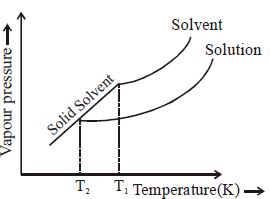
$6 \ g$ urea is dissolved in $1 \ kg$ solvent. The value of $(T_1 - T_2)$ will be .......... $^\circ C$. $(K_f = 2 \ kg \ K \ mol^{-1})$
A
$0.2$
B
$-0.2$
C
$0.1$
D
$-0.1$
Solution
(A) $T_1 =$ Freezing point of pure solvent
$T_2 =$ Freezing point of solution
$\Delta T_f = T_1 - T_2 = i \times K_f \times m$
For urea,van't Hoff factor $i = 1$.
Molality $m = \frac{\text{moles of solute}}{\text{mass of solvent in kg}} = \frac{6 \ g / 60 \ g \ mol^{-1}}{1 \ kg} = 0.1 \ mol \ kg^{-1}$.
$\Delta T_f = 1 \times 2 \ kg \ K \ mol^{-1} \times 0.1 \ mol \ kg^{-1} = 0.2 \ K$.
Since the difference in temperature is the same in $^\circ C$ and $K$,$T_1 - T_2 = 0.2 \ ^\circ C$.
$T_2 =$ Freezing point of solution
$\Delta T_f = T_1 - T_2 = i \times K_f \times m$
For urea,van't Hoff factor $i = 1$.
Molality $m = \frac{\text{moles of solute}}{\text{mass of solvent in kg}} = \frac{6 \ g / 60 \ g \ mol^{-1}}{1 \ kg} = 0.1 \ mol \ kg^{-1}$.
$\Delta T_f = 1 \times 2 \ kg \ K \ mol^{-1} \times 0.1 \ mol \ kg^{-1} = 0.2 \ K$.
Since the difference in temperature is the same in $^\circ C$ and $K$,$T_1 - T_2 = 0.2 \ ^\circ C$.
0 likes
View Solution78
DifficultMCQ
$CaCl_2$ is preferred over $NaCl$ for clearing ice on roads,particularly in very cold countries. This is because:
A
$CaCl_2$ is less soluble in $H_2O$ than $NaCl$
B
$CaCl_2$ is hygroscopic but $NaCl$ is not
C
Eutectic mixture of $CaCl_2/H_2O$ freezes at $-55 \ ^oC$ while that of $NaCl/H_2O$ freezes at $-18 \ ^oC$
D
$NaCl$ makes the road slippery but $CaCl_2$ does not
Solution
(C) The freezing point of a solution is lowered by the addition of a solute (depression in freezing point).
$CaCl_2$ is preferred because the eutectic mixture of $CaCl_2$ and $H_2O$ has a much lower freezing point $(-55 \ ^oC)$ compared to the eutectic mixture of $NaCl$ and $H_2O$ $(-18 \ ^oC)$.
This allows $CaCl_2$ to effectively melt ice at significantly lower temperatures.
$CaCl_2$ is preferred because the eutectic mixture of $CaCl_2$ and $H_2O$ has a much lower freezing point $(-55 \ ^oC)$ compared to the eutectic mixture of $NaCl$ and $H_2O$ $(-18 \ ^oC)$.
This allows $CaCl_2$ to effectively melt ice at significantly lower temperatures.
0 likes
View Solution79
MediumMCQ
The freezing point of a $4 \%$ by weight aqueous solution of $A$ is equal to the freezing point of a $10 \%$ by weight aqueous solution of $B$. If the molecular weight of $A$ is $60$,then the molecular weight of $B$ is:
A
$180$
B
$90$
C
$45$
D
$160$
Solution
(D) For the same freezing point,the molality $(m)$ of both aqueous solutions must be equal,assuming both are non-electrolytes.
$m_A = m_B$
The formula for molality is $m = \frac{\text{mass of solute (g)} \times 1000}{\text{molecular weight of solute} \times \text{mass of solvent (g)}}$.
For a $4 \%$ solution of $A$,mass of $A = 4 \ g$ and mass of water $= 96 \ g$.
For a $10 \%$ solution of $B$,mass of $B = 10 \ g$ and mass of water $= 90 \ g$.
Substituting the values: $\frac{4 \times 1000}{60 \times 96} = \frac{10 \times 1000}{M_B \times 90}$.
Simplifying the equation: $\frac{4}{60 \times 96} = \frac{10}{M_B \times 90}$.
$M_B = \frac{10 \times 60 \times 96}{4 \times 90} = \frac{57600}{360} = 160$.
$m_A = m_B$
The formula for molality is $m = \frac{\text{mass of solute (g)} \times 1000}{\text{molecular weight of solute} \times \text{mass of solvent (g)}}$.
For a $4 \%$ solution of $A$,mass of $A = 4 \ g$ and mass of water $= 96 \ g$.
For a $10 \%$ solution of $B$,mass of $B = 10 \ g$ and mass of water $= 90 \ g$.
Substituting the values: $\frac{4 \times 1000}{60 \times 96} = \frac{10 \times 1000}{M_B \times 90}$.
Simplifying the equation: $\frac{4}{60 \times 96} = \frac{10}{M_B \times 90}$.
$M_B = \frac{10 \times 60 \times 96}{4 \times 90} = \frac{57600}{360} = 160$.
0 likes
View Solution80
EasyMCQ
During the freezing of a solution at its freezing point,which of the following equilibria exists?
A
Solution$_{(l)}$ $\rightleftharpoons$ Solid solution$_{(s)}$
B
Solvent$_{(l)}$ $\rightleftharpoons$ Solvent$_{(s)}$
C
Solution$_{(l)}$ $\rightleftharpoons$ Solute$_{(s)}$ + Solvent$_{(l)}$
D
Solute$_{(l)}$ $\rightleftharpoons$ Solute$_{(s)}$
Solution
(B) At the freezing point of a solution,the liquid phase of the solvent is in equilibrium with the solid phase of the pure solvent.
This is because,upon cooling,only the solvent molecules crystallize out as solid,while the solute remains in the remaining liquid solution.
Therefore,the equilibrium is represented as: Solvent$_{(l)}$ $\rightleftharpoons$ Solvent$_{(s)}$.
This is because,upon cooling,only the solvent molecules crystallize out as solid,while the solute remains in the remaining liquid solution.
Therefore,the equilibrium is represented as: Solvent$_{(l)}$ $\rightleftharpoons$ Solvent$_{(s)}$.
0 likes
View Solution81
MediumMCQ
Ethylene glycol is used as an anti-freezing agent. Calculate the amount of ethylene glycol to be added to $4 \ kg$ of water to prevent it from freezing at $-6 \ ^{\circ}C$. ($K_f$ for water $= 1.85 \ K \ kg \ mol^{-1}$) (molar mass of $(CH_2OH)_2 = 62 \ g \ mol^{-1}$) .......... $g$.
A
$102.3$
B
$804.3$
C
$523.4$
D
$453.2$
Solution
(B) The depression in freezing point is given by the formula: $\Delta T_f = K_f \times m$
Where $m$ is the molality of the solution.
Given: $\Delta T_f = 6 \ K$,$K_f = 1.85 \ K \ kg \ mol^{-1}$,$W_A = 4 \ kg$,$M_B = 62 \ g \ mol^{-1}$.
Substituting the values in the formula: $\Delta T_f = K_f \times \frac{w_B}{M_B \times W_A}$
$6 = \frac{1.85 \times w_B}{62 \times 4}$
$w_B = \frac{6 \times 62 \times 4}{1.85}$
$w_B = \frac{1488}{1.85} \approx 804.32 \ g$
Thus,the amount of ethylene glycol required is approximately $804.3 \ g$.
Where $m$ is the molality of the solution.
Given: $\Delta T_f = 6 \ K$,$K_f = 1.85 \ K \ kg \ mol^{-1}$,$W_A = 4 \ kg$,$M_B = 62 \ g \ mol^{-1}$.
Substituting the values in the formula: $\Delta T_f = K_f \times \frac{w_B}{M_B \times W_A}$
$6 = \frac{1.85 \times w_B}{62 \times 4}$
$w_B = \frac{6 \times 62 \times 4}{1.85}$
$w_B = \frac{1488}{1.85} \approx 804.32 \ g$
Thus,the amount of ethylene glycol required is approximately $804.3 \ g$.
0 likes
View Solution82
EasyMCQ
The freezing point of a $0.05 \ molal$ solution of a non-electrolyte in water is $.......... \ ^oC$. $(K_f = 1.86 \ K \ kg \ mol^{-1})$
A
$-1.86$
B
$-0.93$
C
$-0.093$
D
$0.093$
Solution
(C) The depression in freezing point is given by the formula: $\Delta T_f = K_f \times m$.
Given $K_f = 1.86 \ K \ kg \ mol^{-1}$ and molality $m = 0.05 \ molal$.
$\Delta T_f = 1.86 \times 0.05 = 0.093 \ K$.
Since the freezing point of pure water is $0 \ ^oC$,the freezing point of the solution is $T_f = T_f^0 - \Delta T_f$.
$T_f = 0 - 0.093 = -0.093 \ ^oC$.
Given $K_f = 1.86 \ K \ kg \ mol^{-1}$ and molality $m = 0.05 \ molal$.
$\Delta T_f = 1.86 \times 0.05 = 0.093 \ K$.
Since the freezing point of pure water is $0 \ ^oC$,the freezing point of the solution is $T_f = T_f^0 - \Delta T_f$.
$T_f = 0 - 0.093 = -0.093 \ ^oC$.
0 likes
View Solution83
MediumMCQ
....... $g$ will be the amount of ice separated on cooling a solution of $40 \ g$ ethylene glycol in $400 \ g$ water up to $-9.3 \ ^oC$. ($K_f$ for water is $1.86 \ K \ kg \ mol^{-1}$)
A
$177.78$
B
$270.97$
C
$222.22$
D
$129.03$
Solution
(B) The molar mass of ethylene glycol $(C_2H_6O_2)$ is $62 \ g \ mol^{-1}$.
Given: $\Delta T_f = 9.3 \ K$,$K_f = 1.86 \ K \ kg \ mol^{-1}$,mass of solute $(w)$ = $40 \ g$.
Using the formula $\Delta T_f = \frac{1000 \times K_f \times w}{M \times W}$,where $W$ is the mass of the solvent remaining in liquid state.
$9.3 = \frac{1000 \times 1.86 \times 40}{62 \times W}$
$9.3 = \frac{74400}{62 \times W}$
$W = \frac{74400}{62 \times 9.3} = \frac{74400}{576.6} \approx 129.03 \ g$.
The amount of ice separated = (Initial mass of water) - (Mass of water remaining in liquid state).
Ice separated = $400 - 129.03 = 270.97 \ g$.
Given: $\Delta T_f = 9.3 \ K$,$K_f = 1.86 \ K \ kg \ mol^{-1}$,mass of solute $(w)$ = $40 \ g$.
Using the formula $\Delta T_f = \frac{1000 \times K_f \times w}{M \times W}$,where $W$ is the mass of the solvent remaining in liquid state.
$9.3 = \frac{1000 \times 1.86 \times 40}{62 \times W}$
$9.3 = \frac{74400}{62 \times W}$
$W = \frac{74400}{62 \times 9.3} = \frac{74400}{576.6} \approx 129.03 \ g$.
The amount of ice separated = (Initial mass of water) - (Mass of water remaining in liquid state).
Ice separated = $400 - 129.03 = 270.97 \ g$.
0 likes
View Solution84
EasyMCQ
When a solution containing a non-volatile solute freezes,which equilibrium exists?
A
solid solvent $\rightleftharpoons$ liquid solvent
B
solid solute $\rightleftharpoons$ liquid solution
C
solid solute $\rightleftharpoons$ liquid solvent
D
solid solvent $\rightleftharpoons$ solvent in solution
Solution
(D) When a solution containing a non-volatile solute freezes,the solid phase that separates out is pure solid solvent.
Therefore,the equilibrium is established between the pure solid solvent and the solvent present in the liquid solution.
The equilibrium can be represented as: $\text{solid solvent} \rightleftharpoons \text{solvent in solution}$.
Therefore,the equilibrium is established between the pure solid solvent and the solvent present in the liquid solution.
The equilibrium can be represented as: $\text{solid solvent} \rightleftharpoons \text{solvent in solution}$.
0 likes
View Solution85
MediumMCQ
In winter,the normal temperature in Kullu valley was found to be $-11\,^{\circ}C$. Is a $28\%$ (by mass) aqueous solution of ethylene glycol suitable for a car radiator? $K_f$ for water $= 1.86\, K\, kg\, mol^{-1}$.
A
Yes
B
No
C
Can't predict
D
None of these
Solution
(A) The molar mass of ethylene glycol $(C_2H_6O_2)$ is $62\, g\, mol^{-1}$.
Given $28\%$ by mass solution means $28\, g$ of ethylene glycol in $72\, g$ of water.
Molality $(m)$ $= \frac{\text{mass of solute}}{\text{molar mass of solute} \times \text{mass of solvent in kg}} = \frac{28}{62 \times 0.072} \approx 6.27\, mol\, kg^{-1}$.
Depression in freezing point $\Delta T_f = K_f \times m = 1.86 \times 6.27 \approx 11.66\, K$.
The freezing point of the solution $= 0 - 11.66 = -11.66\, ^{\circ}C$.
Since the freezing point of the solution $(-11.66\, ^{\circ}C)$ is lower than the ambient temperature $(-11\, ^{\circ}C)$,the solution will not freeze.
Therefore,it is suitable for a car radiator.
Given $28\%$ by mass solution means $28\, g$ of ethylene glycol in $72\, g$ of water.
Molality $(m)$ $= \frac{\text{mass of solute}}{\text{molar mass of solute} \times \text{mass of solvent in kg}} = \frac{28}{62 \times 0.072} \approx 6.27\, mol\, kg^{-1}$.
Depression in freezing point $\Delta T_f = K_f \times m = 1.86 \times 6.27 \approx 11.66\, K$.
The freezing point of the solution $= 0 - 11.66 = -11.66\, ^{\circ}C$.
Since the freezing point of the solution $(-11.66\, ^{\circ}C)$ is lower than the ambient temperature $(-11\, ^{\circ}C)$,the solution will not freeze.
Therefore,it is suitable for a car radiator.
0 likes
View Solution86
EasyMCQ
Which of the following solutions has the maximum freezing point?
A
$1\, m\, CH_3COONa$
B
$1\, m\, CaCl_2$
C
$1\, m\, Na_3PO_4$
D
$1\, m\, C_{12}H_{22}O_{11}$
Solution
(D) The depression in freezing point is given by the formula $\Delta T_f = i \times K_f \times m$,where $i$ is the van't Hoff factor,$K_f$ is the cryoscopic constant,and $m$ is the molality.
Since $K_f$ and $m$ are constant for all solutions,the depression in freezing point depends on the van't Hoff factor $(i)$.
Freezing point $T_f = T_f^0 - \Delta T_f$. To have the maximum freezing point,the depression $\Delta T_f$ must be minimum,which means $i$ must be minimum.
Let us calculate $i$ for each solute:
$(A)$ $CH_3COONa \rightarrow CH_3COO^- + Na^+$,$i = 2$
$(B)$ $CaCl_2 \rightarrow Ca^{2+} + 2Cl^-$,$i = 3$
$(C)$ $Na_3PO_4 \rightarrow 3Na^+ + PO_4^{3-}$,$i = 4$
$(D)$ $C_{12}H_{22}O_{11}$ (sucrose) is a non-electrolyte,$i = 1$
Since $C_{12}H_{22}O_{11}$ has the smallest $i$ value,it will have the minimum depression in freezing point and thus the maximum freezing point.
Since $K_f$ and $m$ are constant for all solutions,the depression in freezing point depends on the van't Hoff factor $(i)$.
Freezing point $T_f = T_f^0 - \Delta T_f$. To have the maximum freezing point,the depression $\Delta T_f$ must be minimum,which means $i$ must be minimum.
Let us calculate $i$ for each solute:
$(A)$ $CH_3COONa \rightarrow CH_3COO^- + Na^+$,$i = 2$
$(B)$ $CaCl_2 \rightarrow Ca^{2+} + 2Cl^-$,$i = 3$
$(C)$ $Na_3PO_4 \rightarrow 3Na^+ + PO_4^{3-}$,$i = 4$
$(D)$ $C_{12}H_{22}O_{11}$ (sucrose) is a non-electrolyte,$i = 1$
Since $C_{12}H_{22}O_{11}$ has the smallest $i$ value,it will have the minimum depression in freezing point and thus the maximum freezing point.
0 likes
View Solution87
MediumMCQ
An aqueous solution contains $5\%$ by weight of urea and $10\%$ by weight of glucose. The freezing point of the solution is .......... $^oC$. [ $K_f$ for $H_2O$ is $1.86 \ K \ kg \ mol^{-1}$ ]
A
$2.78$
B
$-2.78$
C
$-5.96$
D
$5.96$
Solution
(B) The depression in freezing point is given by $\Delta T_f = K_f \times \sum m_i$,where $m_i$ is the molality of each solute.
For $5\%$ urea (molar mass $= 60 \ g \ mol^{-1}$) in $95 \ g$ water: $m_{urea} = \frac{5 \times 1000}{60 \times 95} \approx 0.877 \ mol \ kg^{-1}$.
For $10\%$ glucose (molar mass $= 180 \ g \ mol^{-1}$) in $90 \ g$ water: $m_{glucose} = \frac{10 \times 1000}{180 \times 90} \approx 0.617 \ mol \ kg^{-1}$.
Total $\Delta T_f = 1.86 \times (0.877 + 0.617) = 1.86 \times 1.494 \approx 2.78 \ ^oC$.
Since $T_f = T_f^{\circ} - \Delta T_f$ and $T_f^{\circ} = 0 \ ^oC$,the freezing point is $0 - 2.78 = -2.78 \ ^oC$.
For $5\%$ urea (molar mass $= 60 \ g \ mol^{-1}$) in $95 \ g$ water: $m_{urea} = \frac{5 \times 1000}{60 \times 95} \approx 0.877 \ mol \ kg^{-1}$.
For $10\%$ glucose (molar mass $= 180 \ g \ mol^{-1}$) in $90 \ g$ water: $m_{glucose} = \frac{10 \times 1000}{180 \times 90} \approx 0.617 \ mol \ kg^{-1}$.
Total $\Delta T_f = 1.86 \times (0.877 + 0.617) = 1.86 \times 1.494 \approx 2.78 \ ^oC$.
Since $T_f = T_f^{\circ} - \Delta T_f$ and $T_f^{\circ} = 0 \ ^oC$,the freezing point is $0 - 2.78 = -2.78 \ ^oC$.
0 likes
View Solution88
EasyMCQ
At the freezing point of a solution containing a nonvolatile solute,which of the following are in equilibrium?
A
liquid solvent,solid solvent
B
liquid solvent,solid solute
C
liquid solute,solid solute
D
liquid solute,solid solvent
Solution
(A) At the freezing point of a solution,the liquid solvent and the solid solvent are in equilibrium.
During the freezing process,only the solvent molecules transition from the liquid phase to the solid phase.
The vapour pressure of the solid solvent and the liquid solvent must be equal at the freezing point for the system to be in equilibrium.
Therefore,the correct equilibrium is between the liquid solvent and the solid solvent.
During the freezing process,only the solvent molecules transition from the liquid phase to the solid phase.
The vapour pressure of the solid solvent and the liquid solvent must be equal at the freezing point for the system to be in equilibrium.
Therefore,the correct equilibrium is between the liquid solvent and the solid solvent.
0 likes
View Solution89
MediumMCQ
The normal freezing point $(f.p.)$ of nitrobenzene is $278.82 \ K$. If a non-volatile solute is dissolved in it and a solution of $0.25 \ molality$ is prepared,the observed freezing point of the solution is $276.82 \ K$. Evaluate the cryoscopic constant $(K_f)$ of nitrobenzene in $K \ kg \ mol^{-1}$.
A
$6$
B
$8$
C
$7$
D
$5$
Solution
(B) The depression in freezing point $(\Delta T_f)$ is calculated as:
$\Delta T_f = T_f^{\circ} - T_f = 278.82 \ K - 276.82 \ K = 2.00 \ K$.
The formula for depression in freezing point is $\Delta T_f = K_f \times m$,where $m$ is the molality of the solution.
Given $m = 0.25 \ mol \ kg^{-1}$ and $\Delta T_f = 2.00 \ K$.
Substituting the values: $2.00 \ K = K_f \times 0.25 \ mol \ kg^{-1}$.
Therefore,$K_f = \frac{2.00}{0.25} = 8 \ K \ kg \ mol^{-1}$.
Thus,the correct option is $B$.
$\Delta T_f = T_f^{\circ} - T_f = 278.82 \ K - 276.82 \ K = 2.00 \ K$.
The formula for depression in freezing point is $\Delta T_f = K_f \times m$,where $m$ is the molality of the solution.
Given $m = 0.25 \ mol \ kg^{-1}$ and $\Delta T_f = 2.00 \ K$.
Substituting the values: $2.00 \ K = K_f \times 0.25 \ mol \ kg^{-1}$.
Therefore,$K_f = \frac{2.00}{0.25} = 8 \ K \ kg \ mol^{-1}$.
Thus,the correct option is $B$.
0 likes
View Solution90
EasyMCQ
The cryoscopic constant of a liquid is the ratio of the depression of freezing point and the........
A
Freezing point of the solvent
B
Mole fraction of the solute
C
Molality of the solution
D
Ebullioscopic constant of the solvent
Solution
(C) The depression of freezing point $(\Delta T_f)$ is given by the formula: $\Delta T_f = K_f \times m$,where $K_f$ is the cryoscopic constant (molal depression constant) and $m$ is the molality of the solution.
Therefore,the cryoscopic constant $K_f$ is defined as the ratio of the depression of freezing point $(\Delta T_f)$ to the molality $(m)$ of the solution: $K_f = \frac{\Delta T_f}{m}$.
Therefore,the cryoscopic constant $K_f$ is defined as the ratio of the depression of freezing point $(\Delta T_f)$ to the molality $(m)$ of the solution: $K_f = \frac{\Delta T_f}{m}$.
0 likes
View Solution91
EasyMCQ
When an aqueous solution freezes at its freezing point,which components are in equilibrium?
A
Liquid solvent and solid solvent
B
Liquid solvent and solid solute
C
Solid solvent and solid solute
D
Solid solvent and liquid solute
Solution
(A) The freezing point of a substance is defined as the temperature at which the vapor pressure of the substance in its liquid phase is equal to its vapor pressure in the solid phase. In the case of a solution,when it reaches its freezing point,the liquid solvent is in equilibrium with the solid solvent. The solute remains in the liquid phase.
0 likes
View Solution92
MediumMCQ
The molal depression constant for water is $1.86\,^{\circ}C/m$. If $342\,g$ of sugar $(C_{12}H_{22}O_{11})$ is dissolved in $1000\,g$ of water,the freezing point of the solution will be ............. $^{\circ}C$.
A
$-1.86$
B
$1.86$
C
$-3.92$
D
$2.42$
Solution
(A) The molar mass of sugar $(C_{12}H_{22}O_{11})$ is $12 \times 12 + 22 \times 1 + 11 \times 16 = 144 + 22 + 176 = 342\,g/mol$.
Given mass of solute $(w_2) = 342\,g$.
Given mass of solvent $(w_1) = 1000\,g = 1\,kg$.
Molality $(m) = \frac{\text{moles of solute}}{\text{mass of solvent in kg}} = \frac{342/342}{1} = 1\,m$.
The depression in freezing point $(\Delta T_f)$ is given by $\Delta T_f = K_f \times m = 1.86 \times 1 = 1.86\,^{\circ}C$.
Freezing point of solution $(T_f) = T_f^{\circ} - \Delta T_f = 0 - 1.86 = -1.86\,^{\circ}C$.
Given mass of solute $(w_2) = 342\,g$.
Given mass of solvent $(w_1) = 1000\,g = 1\,kg$.
Molality $(m) = \frac{\text{moles of solute}}{\text{mass of solvent in kg}} = \frac{342/342}{1} = 1\,m$.
The depression in freezing point $(\Delta T_f)$ is given by $\Delta T_f = K_f \times m = 1.86 \times 1 = 1.86\,^{\circ}C$.
Freezing point of solution $(T_f) = T_f^{\circ} - \Delta T_f = 0 - 1.86 = -1.86\,^{\circ}C$.
0 likes
View Solution93
MediumMCQ
The mass of urea required to be dissolved in $500 \ mL$ of water to produce a depression in freezing point of $0.186 \ ^oC$ is ........ $g$. $(K_f = 1.86 \ ^oC/m)$
A
$9$
B
$6$
C
$3$
D
$0.3$
Solution
(C) The formula for depression in freezing point is $\Delta T_f = K_f \times m$,where $m$ is the molality.
Molality $m = \frac{w_2 \times 1000}{M_2 \times w_1}$,where $w_2$ is the mass of solute (urea),$M_2$ is the molar mass of urea $(60 \ g/mol)$,and $w_1$ is the mass of solvent (water).
Given: $\Delta T_f = 0.186 \ ^oC$,$K_f = 1.86 \ ^oC/m$,$w_1 = 500 \ g$ (since density of water is $1 \ g/mL$,$500 \ mL = 500 \ g$).
Substituting the values: $0.186 = 1.86 \times \frac{w_2 \times 1000}{60 \times 500}$.
$0.186 = 1.86 \times \frac{w_2 \times 2}{60}$.
$0.186 = 1.86 \times \frac{w_2}{30}$.
$w_2 = \frac{0.186 \times 30}{1.86} = 0.1 \times 30 = 3 \ g$.
Molality $m = \frac{w_2 \times 1000}{M_2 \times w_1}$,where $w_2$ is the mass of solute (urea),$M_2$ is the molar mass of urea $(60 \ g/mol)$,and $w_1$ is the mass of solvent (water).
Given: $\Delta T_f = 0.186 \ ^oC$,$K_f = 1.86 \ ^oC/m$,$w_1 = 500 \ g$ (since density of water is $1 \ g/mL$,$500 \ mL = 500 \ g$).
Substituting the values: $0.186 = 1.86 \times \frac{w_2 \times 1000}{60 \times 500}$.
$0.186 = 1.86 \times \frac{w_2 \times 2}{60}$.
$0.186 = 1.86 \times \frac{w_2}{30}$.
$w_2 = \frac{0.186 \times 30}{1.86} = 0.1 \times 30 = 3 \ g$.
0 likes
View Solution94
MediumMCQ
When an aqueous solution of glucose is frozen,which crystals will separate out first?
A
Glucose
B
Water
C
Both
D
None of these
Solution
(B) When a solution is cooled,the solvent (water) begins to freeze first because the freezing point of the solution is lower than that of the pure solvent. As the solvent freezes,the concentration of the solute (glucose) in the remaining liquid increases,further lowering the freezing point. Therefore,pure $H_2O$ crystals separate out first.
0 likes
View Solution95
MediumMCQ
Which of the following solutions will have the lowest freezing point?
A
$0.08 \, m \, KNO_3$
B
$0.03 \, m \, FeCl_3$
C
$0.05 \, m \, Ca(NO_3)_2$
D
$0.04 \, m \, Al_2(SO_4)_3$
Solution
(D) The depression in freezing point is given by the formula $\Delta T_f = i \times K_f \times m$,where $i$ is the van't Hoff factor and $m$ is the molality. The freezing point is lowest when the depression in freezing point $(\Delta T_f)$ is maximum. This depends on the value of $i \times m$.
For $A$: $KNO_3 \rightarrow K^+ + NO_3^-$,so $i = 2$. $i \times m = 2 \times 0.08 = 0.16$.
For $B$: $FeCl_3 \rightarrow Fe^{3+} + 3Cl^-$,so $i = 4$. $i \times m = 4 \times 0.03 = 0.12$.
For $C$: $Ca(NO_3)_2 \rightarrow Ca^{2+} + 2NO_3^-$,so $i = 3$. $i \times m = 3 \times 0.05 = 0.15$.
For $D$: $Al_2(SO_4)_3 \rightarrow 2Al^{3+} + 3SO_4^{2-}$,so $i = 5$. $i \times m = 5 \times 0.04 = 0.20$.
Since the value of $i \times m$ is highest for $D$ $(0.20)$,it will have the maximum depression in freezing point,and thus the lowest freezing point.
For $A$: $KNO_3 \rightarrow K^+ + NO_3^-$,so $i = 2$. $i \times m = 2 \times 0.08 = 0.16$.
For $B$: $FeCl_3 \rightarrow Fe^{3+} + 3Cl^-$,so $i = 4$. $i \times m = 4 \times 0.03 = 0.12$.
For $C$: $Ca(NO_3)_2 \rightarrow Ca^{2+} + 2NO_3^-$,so $i = 3$. $i \times m = 3 \times 0.05 = 0.15$.
For $D$: $Al_2(SO_4)_3 \rightarrow 2Al^{3+} + 3SO_4^{2-}$,so $i = 5$. $i \times m = 5 \times 0.04 = 0.20$.
Since the value of $i \times m$ is highest for $D$ $(0.20)$,it will have the maximum depression in freezing point,and thus the lowest freezing point.
0 likes
View Solution96
MediumMCQ
If $0.072 \ g-atom$ of sulfur is dissolved in $100 \ g$ of solvent $(K_f = 7.00)$,the depression in freezing point is $0.84 \ ^\circ C$. The molecular formula of sulfur in the solution is .............
A
$S_8$
B
$S_7$
C
$S_6$
D
$S_2$
Solution
(C) Given: $K_f = 7.00$,$W_2 = 0.072 \ g-atom \times 32 \ g/mol = 2.304 \ g$,$W_1 = 100 \ g$,$\Delta T_f = 0.84 \ ^\circ C$.
Using the formula: $\Delta T_f = K_f \times m = K_f \times \frac{W_2 \times 1000}{M_2 \times W_1}$.
$0.84 = 7.00 \times \frac{2.304 \times 1000}{M_2 \times 100}$.
$M_2 = \frac{7.00 \times 2.304 \times 10}{0.84} = \frac{161.28}{0.84} = 192 \ g/mol$.
Since the atomic mass of sulfur is $32 \ g/mol$,the number of atoms in the molecule is $n = \frac{192}{32} = 6$.
Therefore,the molecular formula is $S_6$.
Using the formula: $\Delta T_f = K_f \times m = K_f \times \frac{W_2 \times 1000}{M_2 \times W_1}$.
$0.84 = 7.00 \times \frac{2.304 \times 1000}{M_2 \times 100}$.
$M_2 = \frac{7.00 \times 2.304 \times 10}{0.84} = \frac{161.28}{0.84} = 192 \ g/mol$.
Since the atomic mass of sulfur is $32 \ g/mol$,the number of atoms in the molecule is $n = \frac{192}{32} = 6$.
Therefore,the molecular formula is $S_6$.
0 likes
View Solution97
AdvancedMCQ
$A$ $5\%$ solution (by mass) of cane sugar in water has a freezing point of $271 \ K$ and the freezing point of pure water is $273.15 \ K$. The freezing point of a $5\%$ solution (by mass) of glucose in water is ............. $K$.
A
$271$
B
$273.15$
C
$269.07$
D
$277.23$
Solution
(C) The depression in freezing point is given by $\Delta T_f = K_f \times m$,where $m$ is the molality.
For a $5\%$ solution (by mass),the molality $m = \frac{w_2 \times 1000}{M_2 \times w_1}$.
Since the percentage by mass is the same $(5\%)$,the molality is inversely proportional to the molar mass $(M_2)$ of the solute.
$\Delta T_f \propto \frac{1}{M_2}$.
For cane sugar $(M_1 = 342 \ g/mol)$: $\Delta T_{f1} = 273.15 - 271 = 2.15 \ K$.
For glucose $(M_2 = 180 \ g/mol)$: $\Delta T_{f2} = \Delta T_{f1} \times \frac{M_1}{M_2}$.
$\Delta T_{f2} = 2.15 \times \frac{342}{180} = 2.15 \times 1.9 = 4.085 \ K$.
The freezing point of the glucose solution $= 273.15 - 4.085 = 269.065 \ K \approx 269.07 \ K$.
For a $5\%$ solution (by mass),the molality $m = \frac{w_2 \times 1000}{M_2 \times w_1}$.
Since the percentage by mass is the same $(5\%)$,the molality is inversely proportional to the molar mass $(M_2)$ of the solute.
$\Delta T_f \propto \frac{1}{M_2}$.
For cane sugar $(M_1 = 342 \ g/mol)$: $\Delta T_{f1} = 273.15 - 271 = 2.15 \ K$.
For glucose $(M_2 = 180 \ g/mol)$: $\Delta T_{f2} = \Delta T_{f1} \times \frac{M_1}{M_2}$.
$\Delta T_{f2} = 2.15 \times \frac{342}{180} = 2.15 \times 1.9 = 4.085 \ K$.
The freezing point of the glucose solution $= 273.15 - 4.085 = 269.065 \ K \approx 269.07 \ K$.
0 likes
View Solution98
MediumMCQ
Which of the following $0.10 \ m$ aqueous solutions will have the lowest freezing point?
A
$Al_2(SO_4)_3$
B
$C_6H_{12}O_6$
C
$KCl$
D
$C_{12}H_{22}O_{11}$
Solution
(A) The depression in freezing point $\Delta T_f$ is directly proportional to the van't Hoff factor $i$ for solutions of the same molality: $\Delta T_f = i \times K_f \times m$.
Since the molality $m$ is the same for all,the solution with the highest value of $i$ will have the greatest depression in freezing point and thus the lowest freezing point.
$1$. $Al_2(SO_4)_3 \rightarrow 2Al^{3+} + 3SO_4^{2-}$ $(i = 5)$
$2$. $C_6H_{12}O_6$ (glucose) is a non-electrolyte $(i = 1)$
$3$. $KCl \rightarrow K^{+} + Cl^{-}$ $(i = 2)$
$4$. $C_{12}H_{22}O_{11}$ (sucrose) is a non-electrolyte $(i = 1)$
Since $Al_2(SO_4)_3$ has the highest van't Hoff factor $(i = 5)$,it will show the maximum depression in freezing point,resulting in the lowest freezing point.
Since the molality $m$ is the same for all,the solution with the highest value of $i$ will have the greatest depression in freezing point and thus the lowest freezing point.
$1$. $Al_2(SO_4)_3 \rightarrow 2Al^{3+} + 3SO_4^{2-}$ $(i = 5)$
$2$. $C_6H_{12}O_6$ (glucose) is a non-electrolyte $(i = 1)$
$3$. $KCl \rightarrow K^{+} + Cl^{-}$ $(i = 2)$
$4$. $C_{12}H_{22}O_{11}$ (sucrose) is a non-electrolyte $(i = 1)$
Since $Al_2(SO_4)_3$ has the highest van't Hoff factor $(i = 5)$,it will show the maximum depression in freezing point,resulting in the lowest freezing point.
0 likes
View Solution99
MediumMCQ
How much amount of $NaCl$ should be added to $600 \ g$ of water $(\rho=1.00 \ g / mL)$ to decrease the freezing point of water to $-0.2^{\circ} C ?$ ............. $gm$
(The freezing point depression constant for water $=2 \ K \ kg \ mol^{-1}$ )
(The freezing point depression constant for water $=2 \ K \ kg \ mol^{-1}$ )
A
$2.25$
B
$2$
C
$1.75$
D
$1.5$
Solution
(C) The formula for freezing point depression is $\Delta T_{f} = i \times K_{f} \times m$.
Here,$\Delta T_{f} = 0.2 \ K$,$K_{f} = 2 \ K \ kg \ mol^{-1}$,and for $NaCl$,the van't Hoff factor $i = 2$.
The molality $m = \frac{w / 58.5}{0.6 \ kg}$,where $w$ is the mass of $NaCl$ in grams.
Substituting the values: $0.2 = 2 \times 2 \times \frac{w}{58.5 \times 0.6}$.
$0.2 = 4 \times \frac{w}{35.1}$.
$w = \frac{0.2 \times 35.1}{4} = 1.755 \ g$.
Here,$\Delta T_{f} = 0.2 \ K$,$K_{f} = 2 \ K \ kg \ mol^{-1}$,and for $NaCl$,the van't Hoff factor $i = 2$.
The molality $m = \frac{w / 58.5}{0.6 \ kg}$,where $w$ is the mass of $NaCl$ in grams.
Substituting the values: $0.2 = 2 \times 2 \times \frac{w}{58.5 \times 0.6}$.
$0.2 = 4 \times \frac{w}{35.1}$.
$w = \frac{0.2 \times 35.1}{4} = 1.755 \ g$.
0 likes
View Solution100
Difficult
$45 \ g$ of ethylene glycol $(C_{2}H_{6}O_{2})$ is mixed with $600 \ g$ of water. Calculate $(a)$ the freezing point depression and $(b)$ the freezing point of the solution.
Solution
(N/A) The depression in freezing point is calculated using the formula $\Delta T_{f} = K_{f} \times m$,where $m$ is the molality of the solution.
$1.$ Calculate the moles of ethylene glycol: $\text{Moles} = \frac{45 \ g}{62 \ g \ mol^{-1}} = 0.726 \ mol$.
$2.$ Calculate the mass of water in $kg$: $\text{Mass} = \frac{600 \ g}{1000 \ g \ kg^{-1}} = 0.6 \ kg$.
$3.$ Calculate the molality $(m)$: $m = \frac{0.726 \ mol}{0.6 \ kg} = 1.21 \ mol \ kg^{-1}$.
$4.$ Calculate the freezing point depression $(\Delta T_{f})$: $\Delta T_{f} = 1.86 \ K \ kg \ mol^{-1} \times 1.21 \ mol \ kg^{-1} = 2.25 \ K$.
$5.$ Calculate the freezing point of the solution: $T_{f} = T_{f}^{\circ} - \Delta T_{f} = 273.15 \ K - 2.25 \ K = 270.90 \ K$.
$1.$ Calculate the moles of ethylene glycol: $\text{Moles} = \frac{45 \ g}{62 \ g \ mol^{-1}} = 0.726 \ mol$.
$2.$ Calculate the mass of water in $kg$: $\text{Mass} = \frac{600 \ g}{1000 \ g \ kg^{-1}} = 0.6 \ kg$.
$3.$ Calculate the molality $(m)$: $m = \frac{0.726 \ mol}{0.6 \ kg} = 1.21 \ mol \ kg^{-1}$.
$4.$ Calculate the freezing point depression $(\Delta T_{f})$: $\Delta T_{f} = 1.86 \ K \ kg \ mol^{-1} \times 1.21 \ mol \ kg^{-1} = 2.25 \ K$.
$5.$ Calculate the freezing point of the solution: $T_{f} = T_{f}^{\circ} - \Delta T_{f} = 273.15 \ K - 2.25 \ K = 270.90 \ K$.
0 likes
View SolutionSolutions — Depression of freezing point of the solvent · Frequently Asked Questions
1Are these Solutions questions useful for JEE and NEET?
Yes. All questions in this section are mapped to JEE Main and NEET exam patterns. Previous year questions from JEE Main, NEET, GUJCET and state-level exams are included with full solutions.
2Can I switch to Hindi or Gujarati for these questions?
Yes. Use the language tabs in the hero section or the sidebar to view the same questions and solutions in English, Hindi or Gujarati.
3How do I generate a question paper from this subtopic?
Use the Vedclass Exam Paper Generator — select the chapter and subtopic, set difficulty, and generate Sets A, B, C, D automatically. First 3 chapters of every subject are free.
Vedclass Products
For Students
Vedclass Test Series
Mock tests in real JEE/NEET style with performance analysis. 5-day free trial.
Start Free TrialFor Teachers
Exam Paper Generator
Generate Set A/B/C/D papers from this chapter in 2 minutes. 3 chapters free.
Try FreeFor Institutes
Online Exam Module
Live online exams with unlimited students, 360° analytics & white-label branding.
See DemoFor Teachers & Institutes
Generate a Solutions Exam Paper in 2 Minutes
Select subtopic & difficulty — Sets A, B, C, D auto-generated with No Repeat logic.
First 3 chapters of every subject are free — no payment required.