
A English
Colligative properties of electrolyte Questions in English
Class 12 Chemistry · Solutions · Colligative properties of electrolyte
257+
Questions
English
Language
100%
With Solutions
Showing 50 of 257 questions in English
151
MediumMCQ
If a $0.25 \, m$ solution of electrolyte $X_3Y_2$ undergoes $50 \%$ ionization,the van't Hoff factor will be ...... .
A
$0.5$
B
$0.75$
C
$2$
D
$3$
0 likes
View Solution152
MediumMCQ
For a $0.1 \, molal$ aqueous solution of $2-$iodopropanoic acid,the degree of dissociation is $5 \%$. The freezing point of the solution will be ............ $^o C$.
A
$-0.2$
B
$-0.1953$
C
$-0.2153$
D
$-0.186$
Solution
(B) The dissociation of $2-$iodopropanoic acid $(CH_3CH(I)COOH)$ is given by: $CH_3CH(I)COOH \rightleftharpoons CH_3CH(I)COO^- + H^+$.
For a weak acid,the van't Hoff factor $i = 1 + \alpha(n-1)$.
Here,$n = 2$ and $\alpha = 0.05$ $(5 \%)$.
So,$i = 1 + 0.05(2-1) = 1.05$.
The depression in freezing point is given by $\Delta T_f = i \times K_f \times m$.
Given $K_f = 1.86 \, K \, kg \, mol^{-1}$ and $m = 0.1 \, molal$.
$\Delta T_f = 1.05 \times 1.86 \times 0.1 = 0.1953 \, K$.
The freezing point of the solution is $T_f = T_f^0 - \Delta T_f = 0 - 0.1953 = -0.1953 \, ^oC$.
For a weak acid,the van't Hoff factor $i = 1 + \alpha(n-1)$.
Here,$n = 2$ and $\alpha = 0.05$ $(5 \%)$.
So,$i = 1 + 0.05(2-1) = 1.05$.
The depression in freezing point is given by $\Delta T_f = i \times K_f \times m$.
Given $K_f = 1.86 \, K \, kg \, mol^{-1}$ and $m = 0.1 \, molal$.
$\Delta T_f = 1.05 \times 1.86 \times 0.1 = 0.1953 \, K$.
The freezing point of the solution is $T_f = T_f^0 - \Delta T_f = 0 - 0.1953 = -0.1953 \, ^oC$.
0 likes
View Solution153
EasyMCQ
For a given electrolyte $A_xB_y$,the relationship between the degree of dissociation '$\alpha$' and the van't Hoff factor '$i$' is ........
A
$\alpha = \frac{i - 1}{x + y - 1}$
B
$i = \alpha (x + y + 1)$
C
$\alpha = \frac{x + y - 1}{i - 1}$
D
$i = \alpha (1 - x - y)$
Solution
(A) For an electrolyte $A_xB_y$ dissociating as $A_xB_y \rightarrow xA^{y+} + yB^{x-}$,the total number of ions produced is $n = x + y$.
If '$\alpha$' is the degree of dissociation,the number of particles at equilibrium is $1 - \alpha + x\alpha + y\alpha = 1 + \alpha(x + y - 1)$.
The van't Hoff factor '$i$' is defined as the ratio of the number of particles after dissociation to the number of particles before dissociation.
Thus,$i = 1 + \alpha(x + y - 1)$.
Rearranging for '$\alpha$',we get $\alpha = \frac{i - 1}{x + y - 1}$.
If '$\alpha$' is the degree of dissociation,the number of particles at equilibrium is $1 - \alpha + x\alpha + y\alpha = 1 + \alpha(x + y - 1)$.
The van't Hoff factor '$i$' is defined as the ratio of the number of particles after dissociation to the number of particles before dissociation.
Thus,$i = 1 + \alpha(x + y - 1)$.
Rearranging for '$\alpha$',we get $\alpha = \frac{i - 1}{x + y - 1}$.
0 likes
View Solution154
MediumMCQ
For a $0.1 \ M \ Ba(NO_3)_2$ solution, the van't Hoff factor is $2.74$. The degree of dissociation is .............
A
$0.913$
B
$0.74$
C
$0.87$
D
$1.0$
Solution
(C) The dissociation of $Ba(NO_3)_2$ is given by:
$Ba(NO_3)_2 \rightarrow Ba^{2+} + 2NO_3^-$.
Here, the number of ions produced per formula unit, $n = 3$.
The formula for the van't Hoff factor $(i)$ in terms of the degree of dissociation $(\alpha)$ is:
$i = 1 + (n - 1)\alpha$.
Substituting the given values:
$2.74 = 1 + (3 - 1)\alpha$
$2.74 = 1 + 2\alpha$
$1.74 = 2\alpha$
$\alpha = \frac{1.74}{2} = 0.87$.
Thus, the degree of dissociation is $0.87$.
$Ba(NO_3)_2 \rightarrow Ba^{2+} + 2NO_3^-$.
Here, the number of ions produced per formula unit, $n = 3$.
The formula for the van't Hoff factor $(i)$ in terms of the degree of dissociation $(\alpha)$ is:
$i = 1 + (n - 1)\alpha$.
Substituting the given values:
$2.74 = 1 + (3 - 1)\alpha$
$2.74 = 1 + 2\alpha$
$1.74 = 2\alpha$
$\alpha = \frac{1.74}{2} = 0.87$.
Thus, the degree of dissociation is $0.87$.
0 likes
View Solution155
MediumMCQ
What is the percentage of dissociation of a $0.011 \ m$ aqueous solution of $K_3[Fe(CN)_6]$ having a freezing point of $-0.063 \ ^oC$? (Given: $K_f = 1.86 \ K \ kg \ mol^{-1}$ for water)
A
$75$
B
$67$
C
$33$
D
$50$
Solution
(B) The depression in freezing point is given by $\Delta T_f = T_f^\circ - T_f = 0 - (-0.063) = 0.063 \ K$.
Using the formula $\Delta T_f = i \times K_f \times m$,we have $0.063 = i \times 1.86 \times 0.011$.
Calculating $i$: $i = \frac{0.063}{1.86 \times 0.011} = \frac{0.063}{0.02046} \approx 3.079$.
For $K_3[Fe(CN)_6]$,the dissociation is $K_3[Fe(CN)_6] \rightarrow 3K^+ + [Fe(CN)_6]^{3-}$,so $n = 4$.
The degree of dissociation $\alpha$ is given by $\alpha = \frac{i - 1}{n - 1}$.
Substituting the values: $\alpha = \frac{3.079 - 1}{4 - 1} = \frac{2.079}{3} = 0.693$.
Percentage of dissociation $\approx 69.3 \%$,which is closest to $67 \%$.
Using the formula $\Delta T_f = i \times K_f \times m$,we have $0.063 = i \times 1.86 \times 0.011$.
Calculating $i$: $i = \frac{0.063}{1.86 \times 0.011} = \frac{0.063}{0.02046} \approx 3.079$.
For $K_3[Fe(CN)_6]$,the dissociation is $K_3[Fe(CN)_6] \rightarrow 3K^+ + [Fe(CN)_6]^{3-}$,so $n = 4$.
The degree of dissociation $\alpha$ is given by $\alpha = \frac{i - 1}{n - 1}$.
Substituting the values: $\alpha = \frac{3.079 - 1}{4 - 1} = \frac{2.079}{3} = 0.693$.
Percentage of dissociation $\approx 69.3 \%$,which is closest to $67 \%$.
0 likes
View Solution156
EasyMCQ
When $Hg(CN)_2$ is added to a solution of completely ionized $KCN$,the following reaction occurs: $2KCN + Hg(CN)_2 \to K_2[Hg(CN)_4]$. Due to the formation of this complex,which of the following occurs?
A
The boiling point increases.
B
The osmotic pressure decreases.
C
The vapour pressure decreases.
D
The freezing point decreases.
Solution
(B) The reaction is $2K^+ + 2CN^- + Hg(CN)_2 \to 2K^+ + [Hg(CN)_4]^{2-}$.
Initially,there are $2$ moles of $K^+$ and $2$ moles of $CN^-$ ions,totaling $4$ particles per formula unit of $KCN$ (assuming complete dissociation).
After the reaction,the $CN^-$ ions are consumed to form the complex $[Hg(CN)_4]^{2-}$.
The total number of particles in the solution decreases because $4$ ions $(2K^+ + 2CN^-)$ are replaced by $3$ particles $(2K^+ + [Hg(CN)_4]^{2-})$.
Since colligative properties like osmotic pressure are directly proportional to the number of particles in the solution,a decrease in the number of particles leads to a decrease in osmotic pressure.
Initially,there are $2$ moles of $K^+$ and $2$ moles of $CN^-$ ions,totaling $4$ particles per formula unit of $KCN$ (assuming complete dissociation).
After the reaction,the $CN^-$ ions are consumed to form the complex $[Hg(CN)_4]^{2-}$.
The total number of particles in the solution decreases because $4$ ions $(2K^+ + 2CN^-)$ are replaced by $3$ particles $(2K^+ + [Hg(CN)_4]^{2-})$.
Since colligative properties like osmotic pressure are directly proportional to the number of particles in the solution,a decrease in the number of particles leads to a decrease in osmotic pressure.
0 likes
View Solution157
MediumMCQ
At a constant temperature,the vapor pressures of aqueous solutions of $Na_2SO_4$,urea,$AlCl_3$,and $1.2 \, m \, KCl$ are approximately equal. The molalities of the aqueous solutions of $Na_2SO_4$,urea,and $AlCl_3$ are,respectively: (Assume $100 \%$ dissociation of the solute)
A
$3.6 \, m, 2.4 \, m, 4.8 \, m$
B
$0.8 \, m, 2.4 \, m, 0.6 \, m$
C
$0.6 \, m, 3.6 \, m, 0.8 \, m$
D
$3.6 \, m, 1.2 \, m, 2.4 \, m$
Solution
(B) The vapor pressure of a solution depends on the van't Hoff factor $(i)$ and the molality $(m)$ of the solution. For the vapor pressures to be equal,the effective concentration (osmolarity) must be equal: $i_1 m_1 = i_2 m_2 = i_3 m_3 = i_4 m_4$.
For $KCl$,$i = 2$ $(K^+ + Cl^-)$,so $i \times m = 2 \times 1.2 = 2.4$.
For $Na_2SO_4$,$i = 3$ $(2Na^+ + SO_4^{2-})$,so $3 \times m_1 = 2.4 \implies m_1 = 0.8 \, m$.
For urea (non-electrolyte),$i = 1$,so $1 \times m_2 = 2.4 \implies m_2 = 2.4 \, m$.
For $AlCl_3$,$i = 4$ $(Al^{3+} + 3Cl^-)$,so $4 \times m_3 = 2.4 \implies m_3 = 0.6 \, m$.
Thus,the molalities are $0.8 \, m, 2.4 \, m, 0.6 \, m$.
For $KCl$,$i = 2$ $(K^+ + Cl^-)$,so $i \times m = 2 \times 1.2 = 2.4$.
For $Na_2SO_4$,$i = 3$ $(2Na^+ + SO_4^{2-})$,so $3 \times m_1 = 2.4 \implies m_1 = 0.8 \, m$.
For urea (non-electrolyte),$i = 1$,so $1 \times m_2 = 2.4 \implies m_2 = 2.4 \, m$.
For $AlCl_3$,$i = 4$ $(Al^{3+} + 3Cl^-)$,so $4 \times m_3 = 2.4 \implies m_3 = 0.6 \, m$.
Thus,the molalities are $0.8 \, m, 2.4 \, m, 0.6 \, m$.
0 likes
View Solution158
DifficultMCQ
$1 \ mol$ each of the following compounds is dissolved in $1 \ L$ of solution. Which will have the largest $\Delta T_b$ value?
A
$HF$
B
$HCl$
C
$HBr$
D
$HI$
Solution
(D) The elevation in boiling point is given by the formula $\Delta T_b = i \times K_b \times m$.
Since $1 \ mol$ of each compound is dissolved in $1 \ L$ of solution,the molality $(m)$ is the same for all.
Therefore,$\Delta T_b$ is directly proportional to the van't Hoff factor $(i)$.
The van't Hoff factor $(i)$ depends on the degree of dissociation $(\alpha)$.
Stronger acids dissociate more completely in water. The acid strength order for hydrogen halides is $HI > HBr > HCl > HF$.
This is because the bond dissociation energy follows the order $HI < HBr < HCl < HF$.
Since $HI$ has the lowest bond dissociation energy,it dissociates most readily,leading to the highest number of ions in the solution.
Thus,$i$ is maximum for $HI$,resulting in the largest $\Delta T_b$ value.
Since $1 \ mol$ of each compound is dissolved in $1 \ L$ of solution,the molality $(m)$ is the same for all.
Therefore,$\Delta T_b$ is directly proportional to the van't Hoff factor $(i)$.
The van't Hoff factor $(i)$ depends on the degree of dissociation $(\alpha)$.
Stronger acids dissociate more completely in water. The acid strength order for hydrogen halides is $HI > HBr > HCl > HF$.
This is because the bond dissociation energy follows the order $HI < HBr < HCl < HF$.
Since $HI$ has the lowest bond dissociation energy,it dissociates most readily,leading to the highest number of ions in the solution.
Thus,$i$ is maximum for $HI$,resulting in the largest $\Delta T_b$ value.
0 likes
View Solution159
DifficultMCQ
$0.01 \ M$ solutions of $KCl$ and $BaCl_2$ are prepared in water. The freezing point of $KCl$ is found to be $-2 \ ^oC$. What is the freezing point of $BaCl_2$ if it is completely ionised? ............. $^oC$
A
$-3$
B
$+3$
C
$-2$
D
$-4$
Solution
(A) The depression in freezing point is given by $\Delta T_f = i \times K_f \times m$.
Since the concentration $(m)$ and solvent $(K_f)$ are the same for both solutions,$\Delta T_f \propto i$.
For $KCl$,$i = 2$ $(KCl \rightarrow K^+ + Cl^-)$.
For $BaCl_2$,$i = 3$ $(BaCl_2 \rightarrow Ba^{2+} + 2Cl^-)$.
Given $\Delta T_f$ for $KCl = 0 - (-2) = 2 \ ^oC$.
Using the ratio: $\frac{\Delta T_f(KCl)}{\Delta T_f(BaCl_2)} = \frac{i(KCl)}{i(BaCl_2)} = \frac{2}{3}$.
$\Delta T_f(BaCl_2) = \frac{3 \times 2}{2} = 3 \ ^oC$.
Freezing point of $BaCl_2 = 0 - 3 = -3 \ ^oC$.
Since the concentration $(m)$ and solvent $(K_f)$ are the same for both solutions,$\Delta T_f \propto i$.
For $KCl$,$i = 2$ $(KCl \rightarrow K^+ + Cl^-)$.
For $BaCl_2$,$i = 3$ $(BaCl_2 \rightarrow Ba^{2+} + 2Cl^-)$.
Given $\Delta T_f$ for $KCl = 0 - (-2) = 2 \ ^oC$.
Using the ratio: $\frac{\Delta T_f(KCl)}{\Delta T_f(BaCl_2)} = \frac{i(KCl)}{i(BaCl_2)} = \frac{2}{3}$.
$\Delta T_f(BaCl_2) = \frac{3 \times 2}{2} = 3 \ ^oC$.
Freezing point of $BaCl_2 = 0 - 3 = -3 \ ^oC$.
0 likes
View Solution160
EasyMCQ
The freezing point of an equimolal aqueous solution will be highest for:
A
$C_6H_5NH_3^+Cl^-$
B
$Ca(NO_3)_2$
C
$La(NO_3)_3$
D
$C_6H_{12}O_6$
Solution
(D) The depression in freezing point is given by the formula $\Delta T_f = i \times K_f \times m$.
For equimolal solutions,$\Delta T_f$ is directly proportional to the van't Hoff factor $(i)$.
$C_6H_{12}O_6$ (glucose) is a non-electrolyte,so its $i = 1$.
$C_6H_5NH_3^+Cl^-$ dissociates into $2$ ions $(i = 2)$.
$Ca(NO_3)_2$ dissociates into $3$ ions $(i = 3)$.
$La(NO_3)_3$ dissociates into $4$ ions $(i = 4)$.
Since glucose has the lowest $i$ value,it will have the minimum depression in freezing point $(\Delta T_f)$.
Therefore,the freezing point $(T_f = T_f^0 - \Delta T_f)$ will be the highest for $C_6H_{12}O_6$.
For equimolal solutions,$\Delta T_f$ is directly proportional to the van't Hoff factor $(i)$.
$C_6H_{12}O_6$ (glucose) is a non-electrolyte,so its $i = 1$.
$C_6H_5NH_3^+Cl^-$ dissociates into $2$ ions $(i = 2)$.
$Ca(NO_3)_2$ dissociates into $3$ ions $(i = 3)$.
$La(NO_3)_3$ dissociates into $4$ ions $(i = 4)$.
Since glucose has the lowest $i$ value,it will have the minimum depression in freezing point $(\Delta T_f)$.
Therefore,the freezing point $(T_f = T_f^0 - \Delta T_f)$ will be the highest for $C_6H_{12}O_6$.
0 likes
View Solution161
Easy
$0.6 \, mL$ of acetic acid $(CH_{3}COOH)$,having density $1.06 \, g \, mL^{-1}$,is dissolved in $1 \, L$ of water. The depression in freezing point observed for this strength of acid was $0.0205^{\circ} \, C$. Calculate the van't Hoff factor and the dissociation constant of acid.
Solution
Number of moles of acetic acid = $\frac{0.6 \, mL \times 1.06 \, g \, mL^{-1}}{60 \, g \, mol^{-1}} = 0.0106 \, mol$.
Molality $(m) = \frac{0.0106 \, mol}{1 \, kg} = 0.0106 \, mol \, kg^{-1}$.
Theoretical depression in freezing point $(\Delta T_{f, \text{calc}}) = K_{f} \times m = 1.86 \, K \, kg \, mol^{-1} \times 0.0106 \, mol \, kg^{-1} = 0.0197 \, K$.
van't Hoff Factor $(i) = \frac{\Delta T_{f, \text{obs}}}{\Delta T_{f, \text{calc}}} = \frac{0.0205 \, K}{0.0197 \, K} \approx 1.041$.
For dissociation $CH_{3}COOH \rightleftharpoons CH_{3}COO^{-} + H^{+}$,$i = 1 + \alpha$,where $\alpha$ is the degree of dissociation.
$\alpha = i - 1 = 1.041 - 1 = 0.041$.
Dissociation constant $(K_{a}) = \frac{c \alpha^{2}}{1 - \alpha} = \frac{0.0106 \times (0.041)^{2}}{1 - 0.041} = \frac{0.0106 \times 0.001681}{0.959} \approx 1.86 \times 10^{-5}$.
Molality $(m) = \frac{0.0106 \, mol}{1 \, kg} = 0.0106 \, mol \, kg^{-1}$.
Theoretical depression in freezing point $(\Delta T_{f, \text{calc}}) = K_{f} \times m = 1.86 \, K \, kg \, mol^{-1} \times 0.0106 \, mol \, kg^{-1} = 0.0197 \, K$.
van't Hoff Factor $(i) = \frac{\Delta T_{f, \text{obs}}}{\Delta T_{f, \text{calc}}} = \frac{0.0205 \, K}{0.0197 \, K} \approx 1.041$.
For dissociation $CH_{3}COOH \rightleftharpoons CH_{3}COO^{-} + H^{+}$,$i = 1 + \alpha$,where $\alpha$ is the degree of dissociation.
$\alpha = i - 1 = 1.041 - 1 = 0.041$.
Dissociation constant $(K_{a}) = \frac{c \alpha^{2}}{1 - \alpha} = \frac{0.0106 \times (0.041)^{2}}{1 - 0.041} = \frac{0.0106 \times 0.001681}{0.959} \approx 1.86 \times 10^{-5}$.
0 likes
View Solution162
Advanced
Calculate the depression in the freezing point of water when $10 \ g$ of $CH_3CH_2CHClCOOH$ is added to $250 \ g$ of water. $K_a = 1.4 \times 10^{-3}$,$K_f = 1.86 \ K \ kg \ mol^{-1}$
Solution
(D) Molar mass of $CH_3CH_2CHClCOOH = (3 \times 12) + (5 \times 1) + 35.5 + (2 \times 16) + 1 = 122.5 \ g \ mol^{-1}$.
Number of moles of $CH_3CH_2CHClCOOH = \frac{10 \ g}{122.5 \ g \ mol^{-1}} = 0.0816 \ mol$.
Molality $(m)$ of the solution $= \frac{0.0816 \ mol}{0.250 \ kg} = 0.3264 \ mol \ kg^{-1}$.
For the dissociation $CH_3CH_2CHClCOOH \leftrightarrow CH_3CH_2CHClCOO^{-} + H^{+}$,the dissociation constant $K_a$ is given by $K_a = \frac{C \alpha^2}{1 - \alpha} \approx C \alpha^2$.
$\alpha = \sqrt{\frac{K_a}{C}} = \sqrt{\frac{1.4 \times 10^{-3}}{0.3264}} = 0.0655$.
The van't Hoff factor $i = 1 + \alpha = 1 + 0.0655 = 1.0655$.
The depression in freezing point $\Delta T_f = i \cdot K_f \cdot m = 1.0655 \times 1.86 \ K \ kg \ mol^{-1} \times 0.3264 \ mol \ kg^{-1} = 0.647 \ K \approx 0.65 \ K$.
Number of moles of $CH_3CH_2CHClCOOH = \frac{10 \ g}{122.5 \ g \ mol^{-1}} = 0.0816 \ mol$.
Molality $(m)$ of the solution $= \frac{0.0816 \ mol}{0.250 \ kg} = 0.3264 \ mol \ kg^{-1}$.
For the dissociation $CH_3CH_2CHClCOOH \leftrightarrow CH_3CH_2CHClCOO^{-} + H^{+}$,the dissociation constant $K_a$ is given by $K_a = \frac{C \alpha^2}{1 - \alpha} \approx C \alpha^2$.
$\alpha = \sqrt{\frac{K_a}{C}} = \sqrt{\frac{1.4 \times 10^{-3}}{0.3264}} = 0.0655$.
The van't Hoff factor $i = 1 + \alpha = 1 + 0.0655 = 1.0655$.
The depression in freezing point $\Delta T_f = i \cdot K_f \cdot m = 1.0655 \times 1.86 \ K \ kg \ mol^{-1} \times 0.3264 \ mol \ kg^{-1} = 0.647 \ K \approx 0.65 \ K$.
0 likes
View Solution163
Advanced
$19.5 \ g$ of $CH_2FCOOH$ is dissolved in $500 \ g$ of water. The depression in the freezing point of water observed is $1.0 \ ^\circ C$. Calculate the van't Hoff factor and dissociation constant of fluoroacetic acid.
Solution
(N/A) It is given that:
$w_1 = 500 \ g$
$w_2 = 19.5 \ g$
$K_f = 1.86 \ K \ kg \ mol^{-1}$
$\Delta T_f = 1 \ K$
We know that:
$M_2 = \frac{K_f \times w_2 \times 1000}{\Delta T_f \times w_1}$
$= \frac{1.86 \ K \ kg \ mol^{-1} \times 19.5 \ g \times 1000 \ g \ kg^{-1}}{500 \ g \times 1 \ K}$
$= 72.54 \ g \ mol^{-1}$
Therefore,observed molar mass of $CH_2FCOOH$,$(M_2)_{obs} = 72.54 \ g \ mol^{-1}$
The calculated molar mass of $CH_2FCOOH$ is $(M_2)_{cal} = 12 + 2 + 19 + 12 + 16 + 16 + 1 = 78 \ g \ mol^{-1}$
Therefore,van't Hoff factor,$i = \frac{(M_2)_{cal}}{(M_2)_{obs}} = \frac{78}{72.54} = 1.0753$
For the dissociation reaction: $CH_2FCOOH \rightleftharpoons CH_2FCOO^{-} + H^{+}$
At equilibrium: $C(1-\alpha)$,$C\alpha$,$C\alpha$
Total moles $= C(1+\alpha)$
$\therefore i = 1 + \alpha \Rightarrow \alpha = i - 1 = 0.0753$
Concentration $C = \frac{19.5 \ g}{78 \ g \ mol^{-1}} \times \frac{1000 \ g}{500 \ g} \approx 0.5 \ M$
$K_a = \frac{C\alpha^2}{1 - \alpha} = \frac{0.5 \times (0.0753)^2}{1 - 0.0753} = \frac{0.5 \times 0.00567}{0.9247} \approx 3.07 \times 10^{-3}$
$w_1 = 500 \ g$
$w_2 = 19.5 \ g$
$K_f = 1.86 \ K \ kg \ mol^{-1}$
$\Delta T_f = 1 \ K$
We know that:
$M_2 = \frac{K_f \times w_2 \times 1000}{\Delta T_f \times w_1}$
$= \frac{1.86 \ K \ kg \ mol^{-1} \times 19.5 \ g \times 1000 \ g \ kg^{-1}}{500 \ g \times 1 \ K}$
$= 72.54 \ g \ mol^{-1}$
Therefore,observed molar mass of $CH_2FCOOH$,$(M_2)_{obs} = 72.54 \ g \ mol^{-1}$
The calculated molar mass of $CH_2FCOOH$ is $(M_2)_{cal} = 12 + 2 + 19 + 12 + 16 + 16 + 1 = 78 \ g \ mol^{-1}$
Therefore,van't Hoff factor,$i = \frac{(M_2)_{cal}}{(M_2)_{obs}} = \frac{78}{72.54} = 1.0753$
For the dissociation reaction: $CH_2FCOOH \rightleftharpoons CH_2FCOO^{-} + H^{+}$
At equilibrium: $C(1-\alpha)$,$C\alpha$,$C\alpha$
Total moles $= C(1+\alpha)$
$\therefore i = 1 + \alpha \Rightarrow \alpha = i - 1 = 0.0753$
Concentration $C = \frac{19.5 \ g}{78 \ g \ mol^{-1}} \times \frac{1000 \ g}{500 \ g} \approx 0.5 \ M$
$K_a = \frac{C\alpha^2}{1 - \alpha} = \frac{0.5 \times (0.0753)^2}{1 - 0.0753} = \frac{0.5 \times 0.00567}{0.9247} \approx 3.07 \times 10^{-3}$
0 likes
View Solution164
Difficult
When $0.01 \ mol$ of sodium sulphate $(Na_2SO_4)$ is dissolved in $1 \ kg$ of water,complete ionization of the solution is observed. Calculate the decrease in the freezing point of the solution. $(K_f = 1.86 \ K \ kg \ mol^{-1})$
Solution
(0.0558 K) The dissociation of sodium sulphate is given by: $Na_2SO_4 \rightarrow 2Na^{+} + SO_4^{2-}$.
Since complete ionization occurs,the van't Hoff factor $(i)$ is $3$.
The molality $(m)$ of the solution is $0.01 \ mol / 1 \ kg = 0.01 \ m$.
The depression in freezing point $(\Delta T_f)$ is calculated using the formula: $\Delta T_f = i \times K_f \times m$.
Substituting the values: $\Delta T_f = 3 \times 1.86 \ K \ kg \ mol^{-1} \times 0.01 \ m = 0.0558 \ K$.
Since complete ionization occurs,the van't Hoff factor $(i)$ is $3$.
The molality $(m)$ of the solution is $0.01 \ mol / 1 \ kg = 0.01 \ m$.
The depression in freezing point $(\Delta T_f)$ is calculated using the formula: $\Delta T_f = i \times K_f \times m$.
Substituting the values: $\Delta T_f = 3 \times 1.86 \ K \ kg \ mol^{-1} \times 0.01 \ m = 0.0558 \ K$.
0 likes
View Solution165
Advanced
Explain the van't Hoff factor and provide its formula.
Solution
(N/A) The van't Hoff factor,denoted by $i$,was introduced to account for the extent of dissociation or association of solute particles in a solution. It is defined as:
$i = \frac{\text{Normal molar mass}}{\text{Abnormal molar mass}} = \frac{\text{Observed colligative property}}{\text{Calculated colligative property}}$
Alternatively,it can be expressed as:
$i = \frac{\text{Total number of moles of particles after association/dissociation}}{\text{Number of moles of particles before association/dissociation}}$
Here,the abnormal molar mass is the experimentally determined molar mass,and the calculated colligative properties are obtained by assuming that the non-volatile solute is neither associated nor dissociated.
In the case of association,the value of $i$ is less than unity $(i < 1)$,while for dissociation,it is greater than unity $(i > 1)$. When there is no association or dissociation,$i = 1$.
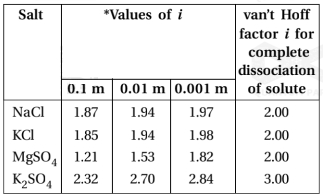
For example,the value of $i$ for an aqueous $KCl$ solution is close to $2$,while the value for ethanoic acid in benzene is nearly $0.5$.
Inclusion of the van't Hoff factor modifies the equations for colligative properties as follows:
$1$. Relative lowering of vapour pressure: $\frac{P_1^0 - P_1}{P_1^0} = i \frac{n_2}{n_1}$
$2$. Elevation of boiling point: $\Delta T_b = i K_b m$
$3$. Depression of freezing point: $\Delta T_f = i K_f m$
$4$. Osmotic pressure: $\Pi = i CRT$ (where $C = n/V$)
$i = \frac{\text{Normal molar mass}}{\text{Abnormal molar mass}} = \frac{\text{Observed colligative property}}{\text{Calculated colligative property}}$
Alternatively,it can be expressed as:
$i = \frac{\text{Total number of moles of particles after association/dissociation}}{\text{Number of moles of particles before association/dissociation}}$
Here,the abnormal molar mass is the experimentally determined molar mass,and the calculated colligative properties are obtained by assuming that the non-volatile solute is neither associated nor dissociated.
In the case of association,the value of $i$ is less than unity $(i < 1)$,while for dissociation,it is greater than unity $(i > 1)$. When there is no association or dissociation,$i = 1$.
For example,the value of $i$ for an aqueous $KCl$ solution is close to $2$,while the value for ethanoic acid in benzene is nearly $0.5$.
Inclusion of the van't Hoff factor modifies the equations for colligative properties as follows:
$1$. Relative lowering of vapour pressure: $\frac{P_1^0 - P_1}{P_1^0} = i \frac{n_2}{n_1}$
$2$. Elevation of boiling point: $\Delta T_b = i K_b m$
$3$. Depression of freezing point: $\Delta T_f = i K_f m$
$4$. Osmotic pressure: $\Pi = i CRT$ (where $C = n/V$)
0 likes
View Solution166
DifficultMCQ
Write the value of the van't Hoff factor $(i)$ for $K_{2}SO_{4}$ and $K_{4}[Fe(CN)_{6}]$.
A
$i = 2$ and $i = 4$
B
$i = 3$ and $i = 5$
C
$i = 3$ and $i = 4$
D
$i = 2$ and $i = 5$
Solution
(B) The van't Hoff factor $(i)$ represents the number of particles a solute dissociates into in a solution.
For $K_{2}SO_{4}$,the dissociation is: $K_{2}SO_{4} \rightarrow 2K^{+} + SO_{4}^{2-}$. The total number of ions produced is $2 + 1 = 3$. Thus,$i = 3$.
For $K_{4}[Fe(CN)_{6}]$,the dissociation is: $K_{4}[Fe(CN)_{6}] \rightarrow 4K^{+} + [Fe(CN)_{6}]^{4-}$. The total number of ions produced is $4 + 1 = 5$. Thus,$i = 5$.
For $K_{2}SO_{4}$,the dissociation is: $K_{2}SO_{4} \rightarrow 2K^{+} + SO_{4}^{2-}$. The total number of ions produced is $2 + 1 = 3$. Thus,$i = 3$.
For $K_{4}[Fe(CN)_{6}]$,the dissociation is: $K_{4}[Fe(CN)_{6}] \rightarrow 4K^{+} + [Fe(CN)_{6}]^{4-}$. The total number of ions produced is $4 + 1 = 5$. Thus,$i = 5$.
0 likes
View Solution167
MediumMCQ
The elevation of boiling point of $0.10 \ m$ aqueous $CrCl_{3} \cdot xNH_{3}$ solution is two times that of $0.05 \ m$ aqueous $CaCl_{2}$ solution. The value of $x$ is.........
[Assume $100 \%$ ionisation of the complex and $CaCl_{2},$ coordination number of $Cr$ as $6,$ and that all $NH_{3}$ molecules are present inside the coordination sphere $]$
[Assume $100 \%$ ionisation of the complex and $CaCl_{2},$ coordination number of $Cr$ as $6,$ and that all $NH_{3}$ molecules are present inside the coordination sphere $]$
A
$10$
B
$5$
C
$12$
D
$15$
Solution
(B) The elevation in boiling point is given by $\Delta T_{b} = i \times K_{b} \times m$.
For $0.05 \ m$ $CaCl_{2}$ solution,$i = 3$ (since $CaCl_{2} \rightarrow Ca^{2+} + 2Cl^{-}$). Thus,$\Delta T_{b(CaCl_{2})} = 3 \times 0.05 \times K_{b} = 0.15 \times K_{b}$.
For $0.10 \ m$ $CrCl_{3} \cdot xNH_{3}$ solution,$\Delta T_{b(complex)} = i \times 0.10 \times K_{b}$.
Given $\Delta T_{b(complex)} = 2 \times \Delta T_{b(CaCl_{2})}$,we have $i \times 0.10 \times K_{b} = 2 \times (0.15 \times K_{b}) = 0.30 \times K_{b}$.
Therefore,$i = 3$.
Since the complex $[Cr(NH_{3})_{x}Cl_{3}]$ ionizes to give $i = 3$ ions,it must dissociate as $[Cr(NH_{3})_{x}Cl_{3-y}]^{y+} + yCl^{-}$,where $1 + y = 3$,so $y = 2$.
This means the complex is $[Cr(NH_{3})_{x}Cl]Cl_{2}$.
Given the coordination number of $Cr$ is $6$,the number of ligands is $x + 1 = 6$,which gives $x = 5$.
For $0.05 \ m$ $CaCl_{2}$ solution,$i = 3$ (since $CaCl_{2} \rightarrow Ca^{2+} + 2Cl^{-}$). Thus,$\Delta T_{b(CaCl_{2})} = 3 \times 0.05 \times K_{b} = 0.15 \times K_{b}$.
For $0.10 \ m$ $CrCl_{3} \cdot xNH_{3}$ solution,$\Delta T_{b(complex)} = i \times 0.10 \times K_{b}$.
Given $\Delta T_{b(complex)} = 2 \times \Delta T_{b(CaCl_{2})}$,we have $i \times 0.10 \times K_{b} = 2 \times (0.15 \times K_{b}) = 0.30 \times K_{b}$.
Therefore,$i = 3$.
Since the complex $[Cr(NH_{3})_{x}Cl_{3}]$ ionizes to give $i = 3$ ions,it must dissociate as $[Cr(NH_{3})_{x}Cl_{3-y}]^{y+} + yCl^{-}$,where $1 + y = 3$,so $y = 2$.
This means the complex is $[Cr(NH_{3})_{x}Cl]Cl_{2}$.
Given the coordination number of $Cr$ is $6$,the number of ligands is $x + 1 = 6$,which gives $x = 5$.
0 likes
View Solution168
MediumMCQ
$AB_2$ is $10\%$ dissociated in water to $A^{2+}$ and $B^{-}$. The boiling point of a $10.0 \text{ molal}$ aqueous solution of $AB_2$ is . . . . . . $^\circ C$. (Round off to the Nearest Integer). [Given: Molal elevation constant of water $K_b = 0.5 \text{ K kg mol}^{-1}$,boiling point of pure water $= 100^\circ C$]
A
$201$
B
$105$
C
$102$
D
$106$
Solution
(D) For the dissociation reaction: $AB_2 \rightleftharpoons A^{2+} + 2B^-$,the number of ions produced per formula unit is $n = 3$.
Given the degree of dissociation $\alpha = 10\% = 0.1$.
The van't Hoff factor $i$ is calculated as $i = 1 + (n-1)\alpha = 1 + (3-1)0.1 = 1 + 0.2 = 1.2$.
The elevation in boiling point is given by $\Delta T_b = i \cdot K_b \cdot m$.
Substituting the values: $\Delta T_b = 1.2 \times 0.5 \text{ K kg mol}^{-1} \times 10.0 \text{ mol kg}^{-1} = 6 \text{ K}$ (or $6^\circ C$).
The boiling point of the solution is $T_b = T_b^\circ + \Delta T_b = 100^\circ C + 6^\circ C = 106^\circ C$.
Given the degree of dissociation $\alpha = 10\% = 0.1$.
The van't Hoff factor $i$ is calculated as $i = 1 + (n-1)\alpha = 1 + (3-1)0.1 = 1 + 0.2 = 1.2$.
The elevation in boiling point is given by $\Delta T_b = i \cdot K_b \cdot m$.
Substituting the values: $\Delta T_b = 1.2 \times 0.5 \text{ K kg mol}^{-1} \times 10.0 \text{ mol kg}^{-1} = 6 \text{ K}$ (or $6^\circ C$).
The boiling point of the solution is $T_b = T_b^\circ + \Delta T_b = 100^\circ C + 6^\circ C = 106^\circ C$.
0 likes
View Solution169
MediumMCQ
When $9.45 \text{ g}$ of $ClCH_2COOH$ is added to $500 \text{ mL}$ of water,its freezing point drops by $0.5^\circ \text{C}$. The dissociation constant of $ClCH_2COOH$ is $x \times 10^{-3}$. The value of $x$ is ............... (Rounded off to the nearest integer) $[K_{f(H_2O)} = 1.86 \text{ K kg mol}^{-1}]$
A
$38$
B
$42$
C
$36$
D
$44$
Solution
(C) Molar mass of $ClCH_2COOH = 94.5 \text{ g mol}^{-1}$.
Molality $(m) = \frac{9.45 \text{ g}}{94.5 \text{ g mol}^{-1} \times 0.5 \text{ kg}} = 0.2 \text{ m}$.
Using the formula $\Delta T_f = i \cdot K_f \cdot m$:
$0.5 = i \times 1.86 \times 0.2$.
$i = \frac{0.5}{0.372} \approx 1.344$.
For the dissociation $ClCH_2COOH \rightleftharpoons ClCH_2COO^- + H^+$,the van't Hoff factor is $i = 1 + \alpha$.
$\alpha = i - 1 = 0.344$.
The dissociation constant $K_a = \frac{C\alpha^2}{1-\alpha} = \frac{0.2 \times (0.344)^2}{1 - 0.344} = \frac{0.2 \times 0.118336}{0.656} \approx 0.0361 = 36.1 \times 10^{-3}$.
Thus,$x \approx 36$.
Molality $(m) = \frac{9.45 \text{ g}}{94.5 \text{ g mol}^{-1} \times 0.5 \text{ kg}} = 0.2 \text{ m}$.
Using the formula $\Delta T_f = i \cdot K_f \cdot m$:
$0.5 = i \times 1.86 \times 0.2$.
$i = \frac{0.5}{0.372} \approx 1.344$.
For the dissociation $ClCH_2COOH \rightleftharpoons ClCH_2COO^- + H^+$,the van't Hoff factor is $i = 1 + \alpha$.
$\alpha = i - 1 = 0.344$.
The dissociation constant $K_a = \frac{C\alpha^2}{1-\alpha} = \frac{0.2 \times (0.344)^2}{1 - 0.344} = \frac{0.2 \times 0.118336}{0.656} \approx 0.0361 = 36.1 \times 10^{-3}$.
Thus,$x \approx 36$.
0 likes
View Solution170
EasyMCQ
$1$ molal aqueous solution of an electrolyte $A_{2}B_{3}$ is $60\%$ ionised. The boiling point of the solution at $1 \ atm$ is ......... $K$.
(Rounded-off to the nearest integer)
[Given $K_{b}$ for $H_{2}O = 0.52 \ K \ kg \ mol^{-1}$]
(Rounded-off to the nearest integer)
[Given $K_{b}$ for $H_{2}O = 0.52 \ K \ kg \ mol^{-1}$]
A
$370$
B
$380$
C
$375$
D
$385$
Solution
(C) The electrolyte $A_{2}B_{3}$ dissociates as: $A_{2}B_{3} \rightarrow 2A^{3+} + 3B^{2-}$.
The number of ions produced per formula unit is $n = 2 + 3 = 5$.
The degree of dissociation $\alpha = 0.60$.
The van't Hoff factor $i = 1 + \alpha(n - 1) = 1 + 0.60(5 - 1) = 1 + 0.60(4) = 1 + 2.4 = 3.4$.
The elevation in boiling point is given by $\Delta T_{b} = i K_{b} m$.
Substituting the values: $\Delta T_{b} = 3.4 \times 0.52 \times 1 = 1.768 \ K$.
The boiling point of the solution $T_{b} = T_{b}^{\circ} + \Delta T_{b} = 373.15 + 1.768 = 374.918 \ K$.
Rounding off to the nearest integer,we get $375 \ K$.
The number of ions produced per formula unit is $n = 2 + 3 = 5$.
The degree of dissociation $\alpha = 0.60$.
The van't Hoff factor $i = 1 + \alpha(n - 1) = 1 + 0.60(5 - 1) = 1 + 0.60(4) = 1 + 2.4 = 3.4$.
The elevation in boiling point is given by $\Delta T_{b} = i K_{b} m$.
Substituting the values: $\Delta T_{b} = 3.4 \times 0.52 \times 1 = 1.768 \ K$.
The boiling point of the solution $T_{b} = T_{b}^{\circ} + \Delta T_{b} = 373.15 + 1.768 = 374.918 \ K$.
Rounding off to the nearest integer,we get $375 \ K$.
0 likes
View Solution171
MediumMCQ
If a compound $AB$ dissociates to the extent of $75\,\%$ in an aqueous solution,the molality of the solution which shows a $2.5\, K$ rise in the boiling point of the solution is $......$ molal.
(Rounded-off to the nearest integer) $[K_{b} = 0.52\, K\, kg\, mol^{-1}]$
(Rounded-off to the nearest integer) $[K_{b} = 0.52\, K\, kg\, mol^{-1}]$
A
$4$
B
$3$
C
$6$
D
$5$
Solution
(B) The degree of dissociation $\alpha = 0.75$ and for $AB$,the number of ions $n = 2$.
The van't Hoff factor $i = 1 - \alpha + n\alpha = 1 - 0.75 + 2 \times 0.75 = 1.75$.
The elevation in boiling point is given by $\Delta T_{b} = i \times K_{b} \times m$.
Substituting the values: $2.5 = 1.75 \times 0.52 \times m$.
Calculating molality $m = \frac{2.5}{1.75 \times 0.52} = \frac{2.5}{0.91} \approx 2.747$.
Rounding off to the nearest integer,we get $3$.
The van't Hoff factor $i = 1 - \alpha + n\alpha = 1 - 0.75 + 2 \times 0.75 = 1.75$.
The elevation in boiling point is given by $\Delta T_{b} = i \times K_{b} \times m$.
Substituting the values: $2.5 = 1.75 \times 0.52 \times m$.
Calculating molality $m = \frac{2.5}{1.75 \times 0.52} = \frac{2.5}{0.91} \approx 2.747$.
Rounding off to the nearest integer,we get $3$.
0 likes
View Solution172
MediumMCQ
Of the following four aqueous solutions,the total number of those solutions whose freezing point is lower than that of $0.10 \, M \, C_{2}H_{5}OH$ is (Integer answer).
$(i)$ $0.10 \, M \, Ba_{3}(PO_{4})_{2}$
$(ii)$ $0.10 \, M \, Na_{2}SO_{4}$
$(iii)$ $0.10 \, M \, KCl$
$(iv)$ $0.10 \, M \, Li_{3}PO_{4}$
$(i)$ $0.10 \, M \, Ba_{3}(PO_{4})_{2}$
$(ii)$ $0.10 \, M \, Na_{2}SO_{4}$
$(iii)$ $0.10 \, M \, KCl$
$(iv)$ $0.10 \, M \, Li_{3}PO_{4}$
A
$4$
B
$3$
C
$1$
D
$2$
Solution
(A) The freezing point depression is given by $\Delta T_f = i \times K_f \times m$,where $i$ is the van't Hoff factor and $m$ is the molality.
Since $0.10 \, M \, C_{2}H_{5}OH$ is a non-electrolyte,its van't Hoff factor $i = 1$. Thus,its effective concentration is $1 \times 0.10 = 0.10 \, M$.
For the other solutions:
$(i)$ $Ba_{3}(PO_{4})_{2}$ dissociates into $5$ ions $(3Ba^{2+} + 2PO_{4}^{3-})$,so $i = 5$. Effective concentration = $5 \times 0.10 = 0.50 \, M$.
$(ii)$ $Na_{2}SO_{4}$ dissociates into $3$ ions $(2Na^{+} + SO_{4}^{2-})$,so $i = 3$. Effective concentration = $3 \times 0.10 = 0.30 \, M$.
$(iii)$ $KCl$ dissociates into $2$ ions $(K^{+} + Cl^{-})$,so $i = 2$. Effective concentration = $2 \times 0.10 = 0.20 \, M$.
$(iv)$ $Li_{3}PO_{4}$ dissociates into $4$ ions $(3Li^{+} + PO_{4}^{3-})$,so $i = 4$. Effective concentration = $4 \times 0.10 = 0.40 \, M$.
Since all these solutions have an effective concentration greater than $0.10 \, M$,they all exhibit a greater depression in freezing point,meaning their freezing points are lower than that of $0.10 \, M \, C_{2}H_{5}OH$.
Therefore,the total number of such solutions is $4$.
Since $0.10 \, M \, C_{2}H_{5}OH$ is a non-electrolyte,its van't Hoff factor $i = 1$. Thus,its effective concentration is $1 \times 0.10 = 0.10 \, M$.
For the other solutions:
$(i)$ $Ba_{3}(PO_{4})_{2}$ dissociates into $5$ ions $(3Ba^{2+} + 2PO_{4}^{3-})$,so $i = 5$. Effective concentration = $5 \times 0.10 = 0.50 \, M$.
$(ii)$ $Na_{2}SO_{4}$ dissociates into $3$ ions $(2Na^{+} + SO_{4}^{2-})$,so $i = 3$. Effective concentration = $3 \times 0.10 = 0.30 \, M$.
$(iii)$ $KCl$ dissociates into $2$ ions $(K^{+} + Cl^{-})$,so $i = 2$. Effective concentration = $2 \times 0.10 = 0.20 \, M$.
$(iv)$ $Li_{3}PO_{4}$ dissociates into $4$ ions $(3Li^{+} + PO_{4}^{3-})$,so $i = 4$. Effective concentration = $4 \times 0.10 = 0.40 \, M$.
Since all these solutions have an effective concentration greater than $0.10 \, M$,they all exhibit a greater depression in freezing point,meaning their freezing points are lower than that of $0.10 \, M \, C_{2}H_{5}OH$.
Therefore,the total number of such solutions is $4$.
0 likes
View Solution173
MediumMCQ
Which one of the following $0.10 \ M$ aqueous solutions will exhibit the largest freezing point depression?
A
Hydrazine
B
Glucose
C
Glycine
D
$KHSO_{4}$
Solution
(D) The freezing point depression $(\Delta T_{f})$ is a colligative property given by the formula $\Delta T_{f} = i \times K_{f} \times m$,where $i$ is the Van't Hoff factor.
For a given molality $(m)$ and solvent,$\Delta T_{f}$ is directly proportional to the Van't Hoff factor $(i)$.
$1.$ Hydrazine $(NH_{2}NH_{2})$,Glucose $(C_{6}H_{12}O_{6})$,and Glycine $(NH_{2}CH_{2}COOH)$ are non-electrolytes,so their $i \approx 1$.
$2.$ $KHSO_{4}$ is a strong electrolyte that dissociates in water as $KHSO_{4} \rightarrow K^{+} + H^{+} + SO_{4}^{2-}$,giving $i \approx 3$.
Since $KHSO_{4}$ has the highest Van't Hoff factor,it will exhibit the largest freezing point depression.
For a given molality $(m)$ and solvent,$\Delta T_{f}$ is directly proportional to the Van't Hoff factor $(i)$.
$1.$ Hydrazine $(NH_{2}NH_{2})$,Glucose $(C_{6}H_{12}O_{6})$,and Glycine $(NH_{2}CH_{2}COOH)$ are non-electrolytes,so their $i \approx 1$.
$2.$ $KHSO_{4}$ is a strong electrolyte that dissociates in water as $KHSO_{4} \rightarrow K^{+} + H^{+} + SO_{4}^{2-}$,giving $i \approx 3$.
Since $KHSO_{4}$ has the highest Van't Hoff factor,it will exhibit the largest freezing point depression.
0 likes
View Solution174
MediumMCQ
Which one of the following $0.06 \ M$ aqueous solutions has the lowest freezing point?
A
$C_{6}H_{12}O_{6}$
B
$K_{2}SO_{4}$
C
$KI$
D
$Al_{2}(SO_{4})_{3}$
Solution
(D) The freezing point depression is given by the formula $\Delta T_{f} = i \times K_{f} \times m$.
Since $K_{f}$ and $m$ are constant for all solutions,$\Delta T_{f} \propto i$.
The freezing point $(T_{f})$ is related to the depression as $T_{f} = T_{f}^{\circ} - \Delta T_{f}$,meaning $T_{f} \propto -i$.
Therefore,the solution with the highest van't Hoff factor $(i)$ will have the lowest freezing point.
For $C_{6}H_{12}O_{6}$ (non-electrolyte),$i = 1$.
For $K_{2}SO_{4} \rightarrow 2K^{+} + SO_{4}^{2-}$,$i = 3$.
For $KI \rightarrow K^{+} + I^{-}$,$i = 2$.
For $Al_{2}(SO_{4})_{3} \rightarrow 2Al^{3+} + 3SO_{4}^{2-}$,$i = 5$.
Since $Al_{2}(SO_{4})_{3}$ has the highest value of $i = 5$,it will have the lowest freezing point.
Since $K_{f}$ and $m$ are constant for all solutions,$\Delta T_{f} \propto i$.
The freezing point $(T_{f})$ is related to the depression as $T_{f} = T_{f}^{\circ} - \Delta T_{f}$,meaning $T_{f} \propto -i$.
Therefore,the solution with the highest van't Hoff factor $(i)$ will have the lowest freezing point.
For $C_{6}H_{12}O_{6}$ (non-electrolyte),$i = 1$.
For $K_{2}SO_{4} \rightarrow 2K^{+} + SO_{4}^{2-}$,$i = 3$.
For $KI \rightarrow K^{+} + I^{-}$,$i = 2$.
For $Al_{2}(SO_{4})_{3} \rightarrow 2Al^{3+} + 3SO_{4}^{2-}$,$i = 5$.
Since $Al_{2}(SO_{4})_{3}$ has the highest value of $i = 5$,it will have the lowest freezing point.
0 likes
View Solution175
MediumMCQ
The boiling point (in ${}^{\circ}C$) of $0.1 \, molal$ aqueous solution of $CuSO_{4} \cdot 5H_{2}O$ at $1 \, bar$ is closest to $.....$
[Given : Ebullioscopic (molal boiling point elevation) constant of water,$K_{b}=0.512 \, K \, kg \, mol^{-1}$ ]
[Given : Ebullioscopic (molal boiling point elevation) constant of water,$K_{b}=0.512 \, K \, kg \, mol^{-1}$ ]
A
$100.36$
B
$99.64$
C
$100.10$
D
$99.90$
Solution
(C) The boiling point elevation is given by the formula $\Delta T_{b} = i \times K_{b} \times m$.
For $CuSO_{4} \cdot 5H_{2}O$,the van't Hoff factor $i = 2$ because it dissociates as $CuSO_{4} \rightarrow Cu^{2+} + SO_{4}^{2-}$.
Given $K_{b} = 0.512 \, K \, kg \, mol^{-1}$ and molality $m = 0.1 \, mol \, kg^{-1}$.
$\Delta T_{b} = 2 \times 0.512 \times 0.1 = 0.1024 \, K$.
The boiling point of pure water is $100^{\circ}C$.
Therefore,the boiling point of the solution is $T_{b} = 100 + 0.1024 = 100.1024^{\circ}C$,which is closest to $100.10^{\circ}C$.
For $CuSO_{4} \cdot 5H_{2}O$,the van't Hoff factor $i = 2$ because it dissociates as $CuSO_{4} \rightarrow Cu^{2+} + SO_{4}^{2-}$.
Given $K_{b} = 0.512 \, K \, kg \, mol^{-1}$ and molality $m = 0.1 \, mol \, kg^{-1}$.
$\Delta T_{b} = 2 \times 0.512 \times 0.1 = 0.1024 \, K$.
The boiling point of pure water is $100^{\circ}C$.
Therefore,the boiling point of the solution is $T_{b} = 100 + 0.1024 = 100.1024^{\circ}C$,which is closest to $100.10^{\circ}C$.
0 likes
View Solution176
DifficultMCQ
The boiling point of $0.001 \ M$ aqueous solutions of $NaCl$,$Na_{2}SO_{4}$,$K_{3}PO_{4}$ and $CH_{3}COOH$ should follow the order.
A
$CH_{3}COOH < NaCl < Na_{2}SO_{4} < K_{3}PO_{4}$
B
$NaCl < Na_{2}SO_{4} < K_{3}PO_{4} < CH_{3}COOH$
C
$CH_{3}COOH < K_{3}PO_{4} < Na_{2}SO_{4} < NaCl$
D
$CH_{3}COOH < K_{3}PO_{4} < NaCl < Na_{2}SO_{4}$
Solution
(A) The elevation in boiling point is given by the formula $\Delta T_{b} = i \times K_{b} \times m$. Since $K_{b}$ and $m$ are constant for the given solutions,$\Delta T_{b} \propto i$ (van't Hoff factor).
$CH_{3}COOH$ is a weak electrolyte and dissociates partially,so its $i$ value is approximately $1 < i < 2$.
$NaCl$ dissociates into $2$ ions $(Na^+, Cl^-)$,so $i \approx 2$.
$Na_{2}SO_{4}$ dissociates into $3$ ions $(2Na^+, SO_{4}^{2-})$,so $i \approx 3$.
$K_{3}PO_{4}$ dissociates into $4$ ions $(3K^+, PO_{4}^{3-})$,so $i \approx 4$.
Therefore,the order of boiling points is $CH_{3}COOH < NaCl < Na_{2}SO_{4} < K_{3}PO_{4}$.
$CH_{3}COOH$ is a weak electrolyte and dissociates partially,so its $i$ value is approximately $1 < i < 2$.
$NaCl$ dissociates into $2$ ions $(Na^+, Cl^-)$,so $i \approx 2$.
$Na_{2}SO_{4}$ dissociates into $3$ ions $(2Na^+, SO_{4}^{2-})$,so $i \approx 3$.
$K_{3}PO_{4}$ dissociates into $4$ ions $(3K^+, PO_{4}^{3-})$,so $i \approx 4$.
Therefore,the order of boiling points is $CH_{3}COOH < NaCl < Na_{2}SO_{4} < K_{3}PO_{4}$.
0 likes
View Solution177
MediumMCQ
The boiling point of $0.01 \, M$ aqueous solutions of sucrose,$NaCl$ and $CaCl_2$ would be
A
the same
B
highest for sucrose solution
C
highest for $NaCl$ solution
D
highest for $CaCl_2$ solution
Solution
(D)
Boiling point elevation is a colligative property,which depends on the number of solute particles in the solution.
For the same molar concentration $(0.01 \, M)$,the solution with the highest van't Hoff factor $(i)$ will show the greatest elevation in boiling point.
$1$. Sucrose $(C_{12}H_{22}O_{11})$: Non-electrolyte,$i = 1$.
$2$. $NaCl$: Dissociates as $NaCl \rightarrow Na^{+} + Cl^{-}$,$i = 2$.
$3$. $CaCl_2$: Dissociates as $CaCl_2 \rightarrow Ca^{2+} + 2Cl^{-}$,$i = 3$.
Since $CaCl_2$ produces the maximum number of particles ($3$ ions per formula unit),it will have the highest boiling point.
Boiling point elevation is a colligative property,which depends on the number of solute particles in the solution.
For the same molar concentration $(0.01 \, M)$,the solution with the highest van't Hoff factor $(i)$ will show the greatest elevation in boiling point.
$1$. Sucrose $(C_{12}H_{22}O_{11})$: Non-electrolyte,$i = 1$.
$2$. $NaCl$: Dissociates as $NaCl \rightarrow Na^{+} + Cl^{-}$,$i = 2$.
$3$. $CaCl_2$: Dissociates as $CaCl_2 \rightarrow Ca^{2+} + 2Cl^{-}$,$i = 3$.
Since $CaCl_2$ produces the maximum number of particles ($3$ ions per formula unit),it will have the highest boiling point.
0 likes
View Solution178
MediumMCQ
$0.004 \ M \ K_2SO_4$ solution is isotonic with $0.01 \ M$ glucose solution. The percentage dissociation of $K_2SO_4$ is $........$ (Nearest integer).
A
$71$
B
$73$
C
$74$
D
$75$
Solution
(D) For isotonic solutions, the osmotic pressure $(\pi)$ is equal: $\pi_{K_2SO_4} = \pi_{\text{glucose}}$.
Since $\pi = iCRT$, we have $i_{K_2SO_4} \times 0.004 \times RT = 1 \times 0.01 \times RT$.
Solving for the van't Hoff factor $(i)$: $i = \frac{0.01}{0.004} = 2.5$.
For the dissociation of $K_2SO_4$ $(K_2SO_4 \rightarrow 2K^+ + SO_4^{2-})$, the number of ions produced $(n)$ is $3$.
The degree of dissociation $(\alpha)$ is given by the formula: $i = 1 + (n - 1)\alpha$.
Substituting the values: $2.5 = 1 + (3 - 1)\alpha$.
$1.5 = 2\alpha$, which gives $\alpha = 0.75$.
The percentage dissociation is $\alpha \times 100 = 75\%$.
Since $\pi = iCRT$, we have $i_{K_2SO_4} \times 0.004 \times RT = 1 \times 0.01 \times RT$.
Solving for the van't Hoff factor $(i)$: $i = \frac{0.01}{0.004} = 2.5$.
For the dissociation of $K_2SO_4$ $(K_2SO_4 \rightarrow 2K^+ + SO_4^{2-})$, the number of ions produced $(n)$ is $3$.
The degree of dissociation $(\alpha)$ is given by the formula: $i = 1 + (n - 1)\alpha$.
Substituting the values: $2.5 = 1 + (3 - 1)\alpha$.
$1.5 = 2\alpha$, which gives $\alpha = 0.75$.
The percentage dissociation is $\alpha \times 100 = 75\%$.
0 likes
View Solution179
MediumMCQ
$80$ mole percent of $MgCl_2$ is dissociated in aqueous solution. The vapour pressure of $1.0$ molal aqueous solution of $MgCl_2$ at $38^{\circ} C$ is $.........$ $mm$ $Hg$. (Nearest integer)
Given : Vapour pressure of water at $38^{\circ} C$ is $50$ $mm$ $Hg$.
Given : Vapour pressure of water at $38^{\circ} C$ is $50$ $mm$ $Hg$.
A
$47$
B
$48$
C
$46$
D
$45$
Solution
(B) $MgCl_2 \rightarrow Mg^{2+} + 2Cl^-$
Initial moles: $1$,$0$,$0$
At equilibrium: $1-\alpha$,$\alpha$,$2\alpha$
Total particles $i = 1 + 2\alpha$. Given $\alpha = 0.8$,so $i = 1 + 2(0.8) = 2.6$.
For a $1.0$ molal solution,$n_2 = 1$ mole of solute in $1000 \ g$ of water ($n_1 = 1000/18 = 55.55$ moles).
Using Raoult's Law: $\frac{p^{\circ} - p_s}{p^{\circ}} = \frac{i \times n_2}{n_1 + i \times n_2} \approx \frac{i \times n_2}{n_1}$.
$\frac{50 - p_s}{50} = \frac{2.6 \times 1}{55.55} = 0.0468$.
$50 - p_s = 2.34 \implies p_s = 47.66 \ mm \ Hg$.
Rounding to the nearest integer,$p_s \approx 48 \ mm \ Hg$.
Initial moles: $1$,$0$,$0$
At equilibrium: $1-\alpha$,$\alpha$,$2\alpha$
Total particles $i = 1 + 2\alpha$. Given $\alpha = 0.8$,so $i = 1 + 2(0.8) = 2.6$.
For a $1.0$ molal solution,$n_2 = 1$ mole of solute in $1000 \ g$ of water ($n_1 = 1000/18 = 55.55$ moles).
Using Raoult's Law: $\frac{p^{\circ} - p_s}{p^{\circ}} = \frac{i \times n_2}{n_1 + i \times n_2} \approx \frac{i \times n_2}{n_1}$.
$\frac{50 - p_s}{50} = \frac{2.6 \times 1}{55.55} = 0.0468$.
$50 - p_s = 2.34 \implies p_s = 47.66 \ mm \ Hg$.
Rounding to the nearest integer,$p_s \approx 48 \ mm \ Hg$.
0 likes
View Solution180
DifficultMCQ
We have three aqueous solutions of $NaCl$ labelled as $A$,$B$ and $C$ with concentrations $0.1 \ M$,$0.01 \ M$ and $0.001 \ M$,respectively. The value of van 't Hoff factor $(i)$ for these solutions will be in the order:
A
$i_A < i_B < i_C$
B
$i_A < i_C < i_B$
C
$i_A = i_B = i_C$
D
$i_A > i_B > i_C$
Solution
(A) The van 't Hoff factor $(i)$ for a strong electrolyte like $NaCl$ increases as the concentration decreases.
In more concentrated solutions (like $0.1 \ M$),interionic attractions are stronger,which reduces the effective dissociation.
As the solution becomes more dilute (from $A$ to $C$),the ions move further apart,and $i$ approaches its theoretical maximum value of $2$.
Therefore,the order of the van 't Hoff factor is $i_A < i_B < i_C$.
In more concentrated solutions (like $0.1 \ M$),interionic attractions are stronger,which reduces the effective dissociation.
As the solution becomes more dilute (from $A$ to $C$),the ions move further apart,and $i$ approaches its theoretical maximum value of $2$.
Therefore,the order of the van 't Hoff factor is $i_A < i_B < i_C$.
0 likes
View Solution181
MediumMCQ
Considering acetic acid dissociates in water,its dissociation constant is $6.25 \times 10^{-5}$. If $5 \ mL$ of acetic acid is dissolved in $1 \ L$ water,the solution will freeze at $-x \times 10^{-2} \ {}^{\circ}C$,provided pure water freezes at $0 \ {}^{\circ}C$.
$x = . . . . . . . . .$ (Nearest integer)
Given: $(K_{f})_{\text{water}} = 1.86 \ K \ kg \ mol^{-1}$.
Density of acetic acid is $1.2 \ g \ mL^{-1}$.
Molar mass of water $= 18 \ g \ mol^{-1}$.
Molar mass of acetic acid $= 60 \ g \ mol^{-1}$.
Density of water $= 1 \ g \ cm^{-3}$.
Acetic acid dissociates as:
$CH_3COOH \rightleftharpoons CH_3COO^{-} + H^{+}$
$x = . . . . . . . . .$ (Nearest integer)
Given: $(K_{f})_{\text{water}} = 1.86 \ K \ kg \ mol^{-1}$.
Density of acetic acid is $1.2 \ g \ mL^{-1}$.
Molar mass of water $= 18 \ g \ mol^{-1}$.
Molar mass of acetic acid $= 60 \ g \ mol^{-1}$.
Density of water $= 1 \ g \ cm^{-3}$.
Acetic acid dissociates as:
$CH_3COOH \rightleftharpoons CH_3COO^{-} + H^{+}$
A
$19$
B
$20$
C
$25$
D
$30$
Solution
(A) Mass of $CH_3COOH = V \times d = 5 \ mL \times 1.2 \ g \ mL^{-1} = 6 \ g$.
Moles of $CH_3COOH = \frac{6 \ g}{60 \ g \ mol^{-1}} = 0.1 \ mol$.
Molality $(m) = \frac{0.1 \ mol}{1 \ kg \ \text{water}} = 0.1 \ m$.
For the dissociation $CH_3COOH \rightleftharpoons CH_3COO^{-} + H^{+}$,$K_{a} = \frac{C\alpha^{2}}{1-\alpha}$.
Since $\alpha$ is small,$1-\alpha \approx 1$,so $K_{a} \approx C\alpha^{2}$.
$\alpha = \sqrt{\frac{K_{a}}{C}} = \sqrt{\frac{6.25 \times 10^{-5}}{0.1}} = \sqrt{6.25 \times 10^{-4}} = 25 \times 10^{-3} = 0.025$.
van't Hoff factor $(i) = 1 + \alpha(n-1) = 1 + 0.025(2-1) = 1.025$.
Freezing point depression $\Delta T_{f} = i \times K_{f} \times m = 1.025 \times 1.86 \times 0.1 = 0.19065 \ {}^{\circ}C$.
Given $\Delta T_{f} = x \times 10^{-2} \ {}^{\circ}C$,so $x \approx 19$.
Moles of $CH_3COOH = \frac{6 \ g}{60 \ g \ mol^{-1}} = 0.1 \ mol$.
Molality $(m) = \frac{0.1 \ mol}{1 \ kg \ \text{water}} = 0.1 \ m$.
For the dissociation $CH_3COOH \rightleftharpoons CH_3COO^{-} + H^{+}$,$K_{a} = \frac{C\alpha^{2}}{1-\alpha}$.
Since $\alpha$ is small,$1-\alpha \approx 1$,so $K_{a} \approx C\alpha^{2}$.
$\alpha = \sqrt{\frac{K_{a}}{C}} = \sqrt{\frac{6.25 \times 10^{-5}}{0.1}} = \sqrt{6.25 \times 10^{-4}} = 25 \times 10^{-3} = 0.025$.
van't Hoff factor $(i) = 1 + \alpha(n-1) = 1 + 0.025(2-1) = 1.025$.
Freezing point depression $\Delta T_{f} = i \times K_{f} \times m = 1.025 \times 1.86 \times 0.1 = 0.19065 \ {}^{\circ}C$.
Given $\Delta T_{f} = x \times 10^{-2} \ {}^{\circ}C$,so $x \approx 19$.
0 likes
View Solution182
MediumMCQ
Consider the dissociation of the weak acid $HX$ as given below:
$HX_{(aq)} \rightleftharpoons H^{+}_{(aq)} + X^{-}_{(aq)}, K_{a} = 1.2 \times 10^{-5}$
$[K_{a}: \text{ dissociation constant}]$
The osmotic pressure of $0.03 \ M$ aqueous solution of $HX$ at $300 \ K$ is ............... $\times 10^{-2} \ bar$ (nearest integer).
$[\text{Given: } R = 0.083 \ L \ bar \ mol^{-1} \ K^{-1}]$
$HX_{(aq)} \rightleftharpoons H^{+}_{(aq)} + X^{-}_{(aq)}, K_{a} = 1.2 \times 10^{-5}$
$[K_{a}: \text{ dissociation constant}]$
The osmotic pressure of $0.03 \ M$ aqueous solution of $HX$ at $300 \ K$ is ............... $\times 10^{-2} \ bar$ (nearest integer).
$[\text{Given: } R = 0.083 \ L \ bar \ mol^{-1} \ K^{-1}]$
A
$76$
B
$77$
C
$79$
D
$80$
Solution
(A) The dissociation of $HX$ is given by: $HX \rightleftharpoons H^{+} + X^{-}$.
Initial concentration: $0.03 \ M$.
Equilibrium concentration: $(0.03 - x), x, x$.
Since $K_{a}$ is very small,$0.03 - x \approx 0.03$.
$K_{a} = \frac{x^2}{0.03} = 1.2 \times 10^{-5}$.
$x^2 = 3.6 \times 10^{-7} = 36 \times 10^{-8}$.
$x = 6 \times 10^{-4} \ M$.
Total concentration of particles $C_{total} = (0.03 - x) + x + x = 0.03 + x = 0.03 + 0.0006 = 0.0306 \ M$.
Osmotic pressure $\Pi = C_{total} \times R \times T$.
$\Pi = 0.0306 \times 0.083 \times 300 = 0.76194 \ bar$.
$\Pi = 76.194 \times 10^{-2} \ bar$.
Rounding to the nearest integer,we get $76 \times 10^{-2} \ bar$.
Initial concentration: $0.03 \ M$.
Equilibrium concentration: $(0.03 - x), x, x$.
Since $K_{a}$ is very small,$0.03 - x \approx 0.03$.
$K_{a} = \frac{x^2}{0.03} = 1.2 \times 10^{-5}$.
$x^2 = 3.6 \times 10^{-7} = 36 \times 10^{-8}$.
$x = 6 \times 10^{-4} \ M$.
Total concentration of particles $C_{total} = (0.03 - x) + x + x = 0.03 + x = 0.03 + 0.0006 = 0.0306 \ M$.
Osmotic pressure $\Pi = C_{total} \times R \times T$.
$\Pi = 0.0306 \times 0.083 \times 300 = 0.76194 \ bar$.
$\Pi = 76.194 \times 10^{-2} \ bar$.
Rounding to the nearest integer,we get $76 \times 10^{-2} \ bar$.
0 likes
View Solution183
MediumMCQ
$A$ solution containing $10 \ g$ of an electrolyte $AB_2$ in $100 \ g$ of water boils at $100.52^{\circ} C$. The degree of ionization of the electrolyte $(\alpha)$ is............ $\times 10^{-1}$.
(nearest integer)
[Given : Molar mass of $AB_2 = 200 \ g \ mol^{-1}$,$K_{b}$ (molal boiling point elevation constant of water) $= 0.52 \ K \ kg \ mol^{-1}$,boiling point of water $= 100^{\circ} C$;
$AB_2$ ionises as $AB_2 \rightarrow A^{2+} + 2B^{-}$]
(nearest integer)
[Given : Molar mass of $AB_2 = 200 \ g \ mol^{-1}$,$K_{b}$ (molal boiling point elevation constant of water) $= 0.52 \ K \ kg \ mol^{-1}$,boiling point of water $= 100^{\circ} C$;
$AB_2$ ionises as $AB_2 \rightarrow A^{2+} + 2B^{-}$]
A
$3$
B
$5$
C
$6$
D
$8$
Solution
(B) The dissociation reaction is $AB_2 \rightarrow A^{2+} + 2B^-$. The van't Hoff factor $i$ is given by $i = 1 + (n-1)\alpha$,where $n=3$. So,$i = 1 + 2\alpha$.
The boiling point elevation is $\Delta T_b = T_b - T_b^{\circ} = 100.52^{\circ} C - 100^{\circ} C = 0.52 \ K$.
The molality $m$ is calculated as $m = \frac{\text{moles of solute}}{\text{mass of solvent in kg}} = \frac{10/200}{100/1000} = \frac{0.05}{0.1} = 0.5 \ mol \ kg^{-1}$.
Using the formula $\Delta T_b = i \cdot K_b \cdot m$:
$0.52 = (1 + 2\alpha) \times 0.52 \times 0.5$
$1 = (1 + 2\alpha) \times 0.5$
$2 = 1 + 2\alpha$
$2\alpha = 1$
$\alpha = 0.5 = 5 \times 10^{-1}$.
Thus,the value is $5$.
The boiling point elevation is $\Delta T_b = T_b - T_b^{\circ} = 100.52^{\circ} C - 100^{\circ} C = 0.52 \ K$.
The molality $m$ is calculated as $m = \frac{\text{moles of solute}}{\text{mass of solvent in kg}} = \frac{10/200}{100/1000} = \frac{0.05}{0.1} = 0.5 \ mol \ kg^{-1}$.
Using the formula $\Delta T_b = i \cdot K_b \cdot m$:
$0.52 = (1 + 2\alpha) \times 0.52 \times 0.5$
$1 = (1 + 2\alpha) \times 0.5$
$2 = 1 + 2\alpha$
$2\alpha = 1$
$\alpha = 0.5 = 5 \times 10^{-1}$.
Thus,the value is $5$.
0 likes
View Solution184
DifficultMCQ
The freezing point (in ${}^{\circ}C$) of a solution containing $0.1 \ g$ of $K_3[Fe(CN)_6]$ (Mol. Wt. $329$) in $100 \ g$ of water $(K_f = 1.86 \ K \ kg \ mol^{-1})$ is
A
$-2.3 \times 10^{-2}$
B
$-5.7 \times 10^{-2}$
C
$-5.7 \times 10^{-3}$
D
$-1.2 \times 10^{-2}$
Solution
(A) The dissociation of $K_3[Fe(CN)_6]$ is given by: $K_3[Fe(CN)_6] \rightarrow 3K^{+} + [Fe(CN)_6]^{3-}$.
Since $1 \ mol$ of $K_3[Fe(CN)_6]$ produces $4 \ mol$ of ions,the van't Hoff factor $i = 4$.
The formula for depression in freezing point is $\Delta T_f = i \times K_f \times m$.
Here,molality $m = \frac{w_2 \times 1000}{M_2 \times w_1} = \frac{0.1 \times 1000}{329 \times 100} = \frac{1}{329} \ mol \ kg^{-1}$.
$\Delta T_f = 4 \times 1.86 \times \frac{1}{329} \approx 0.0226 \ K \approx 0.023 \ K$.
Since the freezing point of pure water is $0 \ {}^{\circ}C$,the freezing point of the solution is $T_f = 0 - \Delta T_f = -0.023 \ {}^{\circ}C = -2.3 \times 10^{-2} \ {}^{\circ}C$.
Since $1 \ mol$ of $K_3[Fe(CN)_6]$ produces $4 \ mol$ of ions,the van't Hoff factor $i = 4$.
The formula for depression in freezing point is $\Delta T_f = i \times K_f \times m$.
Here,molality $m = \frac{w_2 \times 1000}{M_2 \times w_1} = \frac{0.1 \times 1000}{329 \times 100} = \frac{1}{329} \ mol \ kg^{-1}$.
$\Delta T_f = 4 \times 1.86 \times \frac{1}{329} \approx 0.0226 \ K \approx 0.023 \ K$.
Since the freezing point of pure water is $0 \ {}^{\circ}C$,the freezing point of the solution is $T_f = 0 - \Delta T_f = -0.023 \ {}^{\circ}C = -2.3 \times 10^{-2} \ {}^{\circ}C$.
0 likes
View Solution185
AdvancedMCQ
$MX_{2}$ dissociates into $M^{2+}$ and $X^{-}$ ions in an aqueous solution,with a degree of dissociation $(\alpha)$ of $0.5$. The ratio of the observed depression of freezing point of the aqueous solution to the value of the depression of freezing point in the absence of ionic dissociation is
A
$1$
B
$2$
C
$3$
D
$4$
Solution
(B) The dissociation reaction is: $MX_{2} \rightleftharpoons M^{2+} + 2X^{-}$.
Initially,let the concentration be $C$. At equilibrium,the concentrations are: $[MX_{2}] = C(1-\alpha)$,$[M^{2+}] = C\alpha$,and $[X^{-}] = 2C\alpha$.
The total number of particles (van't Hoff factor $i$) is given by: $i = 1 - \alpha + n\alpha$,where $n$ is the number of ions produced per formula unit.
For $MX_{2}$,$n = 3$ ($1$ $M^{2+}$ and $2$ $X^{-}$ ions).
Given $\alpha = 0.5$,we have: $i = 1 + (3-1)\alpha = 1 + 2(0.5) = 1 + 1 = 2$.
The ratio of the observed depression of freezing point to the theoretical depression (in the absence of dissociation) is equal to the van't Hoff factor $i$.
Therefore,the ratio is $2$.
Initially,let the concentration be $C$. At equilibrium,the concentrations are: $[MX_{2}] = C(1-\alpha)$,$[M^{2+}] = C\alpha$,and $[X^{-}] = 2C\alpha$.
The total number of particles (van't Hoff factor $i$) is given by: $i = 1 - \alpha + n\alpha$,where $n$ is the number of ions produced per formula unit.
For $MX_{2}$,$n = 3$ ($1$ $M^{2+}$ and $2$ $X^{-}$ ions).
Given $\alpha = 0.5$,we have: $i = 1 + (3-1)\alpha = 1 + 2(0.5) = 1 + 1 = 2$.
The ratio of the observed depression of freezing point to the theoretical depression (in the absence of dissociation) is equal to the van't Hoff factor $i$.
Therefore,the ratio is $2$.
0 likes
View Solution186
MediumMCQ
If the freezing point of a $0.01 \ m$ aqueous solution of a cobalt $(III)$ chloride-ammonia complex (which behaves as a strong electrolyte) is $-0.0558^{\circ} C$,the number of chloride $(Cl^-)$ ions in the coordination sphere of the complex is.
$\left[ K_{f} \text{ of water } = 1.86 \ K \ kg \ mol^{-1} \right]$
$\left[ K_{f} \text{ of water } = 1.86 \ K \ kg \ mol^{-1} \right]$
A
$1$
B
$2$
C
$3$
D
$4$
Solution
(A) The depression in freezing point is given by $\Delta T_{f} = i K_{f} m$.
Given $\Delta T_{f} = 0 - (-0.0558) = 0.0558 \ K$,$K_{f} = 1.86 \ K \ kg \ mol^{-1}$,and $m = 0.01 \ m$.
Substituting the values: $0.0558 = i \times 1.86 \times 0.01$.
$i = \frac{0.0558}{0.0186} = 3$.
Since the complex is a cobalt $(III)$ chloride-ammonia complex,it is of the form $[Co(NH_3)_xCl_y]Cl_z$.
For $i = 3$,the complex dissociates into $3$ ions: $[Co(NH_3)_xCl_y]^{2+} + 2Cl^-$.
This implies there are $2$ chloride ions outside the coordination sphere.
Since the coordination number of $Co(III)$ is $6$,the formula is $[Co(NH_3)_5Cl]Cl_2$.
Thus,the number of chloride ions inside the coordination sphere is $1$.
Given $\Delta T_{f} = 0 - (-0.0558) = 0.0558 \ K$,$K_{f} = 1.86 \ K \ kg \ mol^{-1}$,and $m = 0.01 \ m$.
Substituting the values: $0.0558 = i \times 1.86 \times 0.01$.
$i = \frac{0.0558}{0.0186} = 3$.
Since the complex is a cobalt $(III)$ chloride-ammonia complex,it is of the form $[Co(NH_3)_xCl_y]Cl_z$.
For $i = 3$,the complex dissociates into $3$ ions: $[Co(NH_3)_xCl_y]^{2+} + 2Cl^-$.
This implies there are $2$ chloride ions outside the coordination sphere.
Since the coordination number of $Co(III)$ is $6$,the formula is $[Co(NH_3)_5Cl]Cl_2$.
Thus,the number of chloride ions inside the coordination sphere is $1$.
0 likes
View Solution187
AdvancedMCQ
An aqueous solution is prepared by dissolving $0.1 \ mol$ of an ionic salt in $1.8 \ kg$ of water at $35^{\circ} C$. The salt remains $90 \%$ dissociated in the solution. The vapour pressure of the solution is $59.724 \ mm \ Hg$. Vapor pressure of water at $35^{\circ} C$ is $60.000 \ mm \ Hg$. The number of ions present per formula unit of the ionic salt is . . . . . .
A
$5$
B
$6$
C
$7$
D
$8$
Solution
(A) Given: $n_{\text{salt}} = 0.1 \ mol$,$W_{\text{water}} = 1.8 \ kg = 1800 \ g$,$T = 35^{\circ} C$,$\alpha = 0.90$,$P_s = 59.724 \ mm \ Hg$,$P^{\circ} = 60.000 \ mm \ Hg$.
Moles of water $n_w = \frac{1800 \ g}{18 \ g/mol} = 100 \ mol$.
Let $x$ be the number of ions per formula unit. The salt dissociates as $AB_x \rightarrow A^{x+} + xB^-$. The van't Hoff factor $i = 1 + \alpha(x - 1) = 1 + 0.9(x - 1) = 0.1 + 0.9x$.
Using Raoult's Law: $\frac{P^{\circ} - P_s}{P_s} = \frac{i \cdot n_{\text{salt}}}{n_w}$.
$\frac{60.000 - 59.724}{59.724} = \frac{(0.1 + 0.9x) \cdot 0.1}{100}$.
$\frac{0.276}{59.724} = \frac{0.01 + 0.09x}{100}$.
$0.004621 \approx \frac{0.01 + 0.09x}{100} \Rightarrow 0.4621 = 0.01 + 0.09x$.
$0.4521 = 0.09x \Rightarrow x = \frac{0.4521}{0.09} \approx 5.02$.
Thus,the number of ions per formula unit is $5$.
Moles of water $n_w = \frac{1800 \ g}{18 \ g/mol} = 100 \ mol$.
Let $x$ be the number of ions per formula unit. The salt dissociates as $AB_x \rightarrow A^{x+} + xB^-$. The van't Hoff factor $i = 1 + \alpha(x - 1) = 1 + 0.9(x - 1) = 0.1 + 0.9x$.
Using Raoult's Law: $\frac{P^{\circ} - P_s}{P_s} = \frac{i \cdot n_{\text{salt}}}{n_w}$.
$\frac{60.000 - 59.724}{59.724} = \frac{(0.1 + 0.9x) \cdot 0.1}{100}$.
$\frac{0.276}{59.724} = \frac{0.01 + 0.09x}{100}$.
$0.004621 \approx \frac{0.01 + 0.09x}{100} \Rightarrow 0.4621 = 0.01 + 0.09x$.
$0.4521 = 0.09x \Rightarrow x = \frac{0.4521}{0.09} \approx 5.02$.
Thus,the number of ions per formula unit is $5$.
0 likes
View Solution188
MediumMCQ
If $A_2 B$ is $30 \%$ ionised in an aqueous solution,then the value of van't Hoff factor $(i)$ is $............ \times 10^{-1}$.
A
$46$
B
$36$
C
$26$
D
$16$
Solution
(D) For the dissociation of $A_2 B$: $A_2 B \rightarrow 2 A^{+} + B^{2-}$.
Here,the number of ions produced per formula unit is $y = 3$.
The degree of ionisation is $\alpha = 30 \% = 0.3$.
The van't Hoff factor $(i)$ is calculated using the formula: $i = 1 + (y - 1)\alpha$.
Substituting the values: $i = 1 + (3 - 1)(0.3) = 1 + (2)(0.3) = 1 + 0.6 = 1.6$.
Expressing $1.6$ in the form $............ \times 10^{-1}$,we get $16 \times 10^{-1}$.
Thus,the correct option is $D$.
Here,the number of ions produced per formula unit is $y = 3$.
The degree of ionisation is $\alpha = 30 \% = 0.3$.
The van't Hoff factor $(i)$ is calculated using the formula: $i = 1 + (y - 1)\alpha$.
Substituting the values: $i = 1 + (3 - 1)(0.3) = 1 + (2)(0.3) = 1 + 0.6 = 1.6$.
Expressing $1.6$ in the form $............ \times 10^{-1}$,we get $16 \times 10^{-1}$.
Thus,the correct option is $D$.
0 likes
View Solution189
MediumMCQ
The percentage dissociation of a salt $(MX_3)$ solution at a given temperature $($van't Hoff factor $i = 2)$ is $..........\%$ ($Nearest$ $integer$).
A
$13$
B
$43$
C
$23$
D
$33$
Solution
(D) The dissociation reaction for the salt is: $MX_3 \rightarrow M^{3+} + 3X^{-}$.
Here,the number of ions produced per formula unit is $n = 1 + 3 = 4$.
The relationship between the van't Hoff factor $(i)$ and the degree of dissociation $(\alpha)$ is given by: $i = 1 + (n - 1)\alpha$.
Substituting the given values: $2 = 1 + (4 - 1)\alpha$.
$2 = 1 + 3\alpha$.
$3\alpha = 1$.
$\alpha = \frac{1}{3} \approx 0.3333$.
Therefore,the percentage dissociation is $0.3333 \times 100 = 33.33\%$.
The nearest integer is $33\%$.
Here,the number of ions produced per formula unit is $n = 1 + 3 = 4$.
The relationship between the van't Hoff factor $(i)$ and the degree of dissociation $(\alpha)$ is given by: $i = 1 + (n - 1)\alpha$.
Substituting the given values: $2 = 1 + (4 - 1)\alpha$.
$2 = 1 + 3\alpha$.
$3\alpha = 1$.
$\alpha = \frac{1}{3} \approx 0.3333$.
Therefore,the percentage dissociation is $0.3333 \times 100 = 33.33\%$.
The nearest integer is $33\%$.
0 likes
View Solution190
MediumMCQ
Calculate the amount of $KCl$ $(MW=74.5 \ g \ mol^{-1})$ required to depress the freezing point of $500 \ g$ of water by $2 \ K$ (in $g$)? $(K_f=1.86 \ K \ kg \ mol^{-1})$
A
$10.0$
B
$40.0$
C
$20.0$
D
$35.0$
Solution
(C) The formula for depression in freezing point is $\Delta T_f = i \times K_f \times m$,where $i$ is the van't Hoff factor,$K_f$ is the cryoscopic constant,and $m$ is the molality.
For $KCl$,which is a strong electrolyte,$i = 2$ (dissociates into $K^+$ and $Cl^-$).
Given: $\Delta T_f = 2 \ K$,$K_f = 1.86 \ K \ kg \ mol^{-1}$,$W_{solvent} = 500 \ g = 0.5 \ kg$,$MW_{KCl} = 74.5 \ g \ mol^{-1}$.
Molality $m = \frac{W_{solute} / MW_{solute}}{W_{solvent} (kg)} = \frac{W_{KCl} / 74.5}{0.5}$.
Substituting the values: $2 = 2 \times 1.86 \times \frac{W_{KCl} / 74.5}{0.5}$.
$2 = 3.72 \times \frac{W_{KCl}}{37.25}$.
$W_{KCl} = \frac{2 \times 37.25}{3.72} \approx 20.0 \ g$.
For $KCl$,which is a strong electrolyte,$i = 2$ (dissociates into $K^+$ and $Cl^-$).
Given: $\Delta T_f = 2 \ K$,$K_f = 1.86 \ K \ kg \ mol^{-1}$,$W_{solvent} = 500 \ g = 0.5 \ kg$,$MW_{KCl} = 74.5 \ g \ mol^{-1}$.
Molality $m = \frac{W_{solute} / MW_{solute}}{W_{solvent} (kg)} = \frac{W_{KCl} / 74.5}{0.5}$.
Substituting the values: $2 = 2 \times 1.86 \times \frac{W_{KCl} / 74.5}{0.5}$.
$2 = 3.72 \times \frac{W_{KCl}}{37.25}$.
$W_{KCl} = \frac{2 \times 37.25}{3.72} \approx 20.0 \ g$.
0 likes
View Solution191
MediumMCQ
Which of the following has the highest boiling point?
A
$1 \%$ urea solution
B
$1 \%$ sucrose solution
C
$1 \%$ NaCl solution
D
$1 \% CaCl_{2}$ solution
Solution
(D) The elevation in boiling point is given by $\Delta T_{b} = i \times K_{b} \times m$.
Since the concentration $(m)$ is the same for all solutions,the elevation in boiling point is directly proportional to the van't Hoff factor $(i)$.
$(i)$ For $1 \%$ urea,$i = 1$ (non-electrolyte).
$(ii)$ For $1 \%$ sucrose,$i = 1$ (non-electrolyte).
$(iii)$ For $1 \%$ NaCl,$i = 2$ (dissociates into $Na^{+}$ and $Cl^{-}$).
$(iv)$ For $1 \% CaCl_{2}$,$i = 3$ (dissociates into $Ca^{2+}$ and $2Cl^{-}$).
Since $CaCl_{2}$ has the highest van't Hoff factor $(i = 3)$,it will show the maximum elevation in boiling point. Therefore,the $1 \% CaCl_{2}$ solution has the highest boiling point.
Since the concentration $(m)$ is the same for all solutions,the elevation in boiling point is directly proportional to the van't Hoff factor $(i)$.
$(i)$ For $1 \%$ urea,$i = 1$ (non-electrolyte).
$(ii)$ For $1 \%$ sucrose,$i = 1$ (non-electrolyte).
$(iii)$ For $1 \%$ NaCl,$i = 2$ (dissociates into $Na^{+}$ and $Cl^{-}$).
$(iv)$ For $1 \% CaCl_{2}$,$i = 3$ (dissociates into $Ca^{2+}$ and $2Cl^{-}$).
Since $CaCl_{2}$ has the highest van't Hoff factor $(i = 3)$,it will show the maximum elevation in boiling point. Therefore,the $1 \% CaCl_{2}$ solution has the highest boiling point.
0 likes
View Solution192
MediumMCQ
Solutions $A$,$B$,$C$ and $D$ are respectively $0.1 \ M$ glucose,$0.05 \ M \ NaCl$,$0.05 \ M \ BaCl_{2}$ and $0.1 \ M \ AlCl_{3}$. Which one of the following pairs is isotonic?
A
$A$ and $B$
B
$B$ and $C$
C
$A$ and $D$
D
$A$ and $C$
Solution
(A) Isotonic solutions have the same molar concentration of solute particles in the solution.
We calculate the molar concentration of particles (van't Hoff factor $i \times M$):
For $A$ (glucose): $1 \times 0.1 \ M = 0.1 \ M$.
For $B$ $(NaCl)$: $2 \times 0.05 \ M = 0.1 \ M$.
For $C$ $(BaCl_{2})$: $3 \times 0.05 \ M = 0.15 \ M$.
For $D$ $(AlCl_{3})$: $4 \times 0.1 \ M = 0.4 \ M$.
Since solutions $A$ and $B$ have the same concentration of particles $(0.1 \ M)$,they are isotonic.
We calculate the molar concentration of particles (van't Hoff factor $i \times M$):
For $A$ (glucose): $1 \times 0.1 \ M = 0.1 \ M$.
For $B$ $(NaCl)$: $2 \times 0.05 \ M = 0.1 \ M$.
For $C$ $(BaCl_{2})$: $3 \times 0.05 \ M = 0.15 \ M$.
For $D$ $(AlCl_{3})$: $4 \times 0.1 \ M = 0.4 \ M$.
Since solutions $A$ and $B$ have the same concentration of particles $(0.1 \ M)$,they are isotonic.
0 likes
View Solution193
MediumMCQ
Find the expected value of $\Delta T_{b}$ for $1 \ m \ AlCl_3$ solution in water if a solution of a nonelectrolyte of the same concentration has a $\Delta T_{b}$ value of '$x$' $K$.
A
$x \ K$
B
$2 x \ K$
C
$3 x \ K$
D
$4 x \ K$
Solution
(D) The elevation in boiling point is given by the formula $\Delta T_{b} = i \times K_{b} \times m$.
For a nonelectrolyte,the van't Hoff factor $i = 1$. Thus,for the nonelectrolyte solution,$\Delta T_{b} = 1 \times K_{b} \times m = x \ K$.
For $AlCl_3$,the dissociation is $AlCl_3 \rightarrow Al^{3+} + 3Cl^-$.
The van't Hoff factor $i$ for $AlCl_3$ is $1 + 3 = 4$.
Therefore,for $1 \ m \ AlCl_3$ solution,$\Delta T_{b} = 4 \times K_{b} \times m = 4 \times (K_{b} \times m) = 4x \ K$.
For a nonelectrolyte,the van't Hoff factor $i = 1$. Thus,for the nonelectrolyte solution,$\Delta T_{b} = 1 \times K_{b} \times m = x \ K$.
For $AlCl_3$,the dissociation is $AlCl_3 \rightarrow Al^{3+} + 3Cl^-$.
The van't Hoff factor $i$ for $AlCl_3$ is $1 + 3 = 4$.
Therefore,for $1 \ m \ AlCl_3$ solution,$\Delta T_{b} = 4 \times K_{b} \times m = 4 \times (K_{b} \times m) = 4x \ K$.
0 likes
View Solution194
MediumMCQ
Which of the following solutions exhibits the minimum boiling point elevation under identical conditions? (Assume complete dissociation)
A
$0.2 \ m \ KCl$
B
$0.1 \ m \ NaCl$
C
$1 \ m \ AlCl_3$
D
$0.05 \ m \ MgCl_2$
Solution
(D) The boiling point elevation is given by the formula $\Delta T_b = i \times K_b \times m$,where $i$ is the van't Hoff factor and $m$ is the molality. Since $K_b$ is constant,$\Delta T_b$ is proportional to $i \times m$.
For complete dissociation,$i$ equals the number of ions produced per formula unit.
$A$: $KCl \rightarrow K^+ + Cl^-$,$i = 2$. $\Delta T_b \propto 2 \times 0.2 = 0.4$.
$B$: $NaCl \rightarrow Na^+ + Cl^-$,$i = 2$. $\Delta T_b \propto 2 \times 0.1 = 0.2$.
$C$: $AlCl_3 \rightarrow Al^{3+} + 3Cl^-$,$i = 4$. $\Delta T_b \propto 4 \times 1 = 4.0$.
$D$: $MgCl_2 \rightarrow Mg^{2+} + 2Cl^-$,$i = 3$. $\Delta T_b \propto 3 \times 0.05 = 0.15$.
Comparing the values,$0.15 < 0.2 < 0.4 < 4.0$. Thus,$0.05 \ m \ MgCl_2$ exhibits the minimum boiling point elevation.
For complete dissociation,$i$ equals the number of ions produced per formula unit.
$A$: $KCl \rightarrow K^+ + Cl^-$,$i = 2$. $\Delta T_b \propto 2 \times 0.2 = 0.4$.
$B$: $NaCl \rightarrow Na^+ + Cl^-$,$i = 2$. $\Delta T_b \propto 2 \times 0.1 = 0.2$.
$C$: $AlCl_3 \rightarrow Al^{3+} + 3Cl^-$,$i = 4$. $\Delta T_b \propto 4 \times 1 = 4.0$.
$D$: $MgCl_2 \rightarrow Mg^{2+} + 2Cl^-$,$i = 3$. $\Delta T_b \propto 3 \times 0.05 = 0.15$.
Comparing the values,$0.15 < 0.2 < 0.4 < 4.0$. Thus,$0.05 \ m \ MgCl_2$ exhibits the minimum boiling point elevation.
0 likes
View Solution195
MediumMCQ
Determine the expected value of $\Delta T_{f}$ for $1 \ m$ $CaCl_{2}$ solution if $1 \ m$ urea solution has $\Delta T_{f}$ value '$x$' $K$.
A
$x \ K$
B
$2x \ K$
C
$3x \ K$
D
$\frac{x}{2} \ K$
Solution
(C) The depression in freezing point is given by the formula $\Delta T_{f} = i \times K_{f} \times m$.
For a $1 \ m$ urea solution,urea is a non-electrolyte,so the van't Hoff factor $i = 1$. Thus,$\Delta T_{f} = 1 \times K_{f} \times 1 = K_{f} = x \ K$.
For a $1 \ m$ $CaCl_{2}$ solution,$CaCl_{2}$ dissociates as $CaCl_{2} \rightarrow Ca^{2+} + 2Cl^{-}$,so the van't Hoff factor $i = 3$.
Thus,$\Delta T_{f} = 3 \times K_{f} \times 1 = 3 \times x \ K = 3x \ K$.
For a $1 \ m$ urea solution,urea is a non-electrolyte,so the van't Hoff factor $i = 1$. Thus,$\Delta T_{f} = 1 \times K_{f} \times 1 = K_{f} = x \ K$.
For a $1 \ m$ $CaCl_{2}$ solution,$CaCl_{2}$ dissociates as $CaCl_{2} \rightarrow Ca^{2+} + 2Cl^{-}$,so the van't Hoff factor $i = 3$.
Thus,$\Delta T_{f} = 3 \times K_{f} \times 1 = 3 \times x \ K = 3x \ K$.
0 likes
View Solution196
MediumMCQ
Which of the following aqueous solutions having same molality exhibits maximum boiling point elevation? (Assume complete dissociation)
A
$KCl$
B
$NaCl$
C
$AlCl_3$
D
$BaCl_2$
Solution
(C) The elevation in boiling point is given by the formula $\Delta T_b = i \times K_b \times m$. Since the molality $(m)$ and the ebullioscopic constant $(K_b)$ are the same for all solutions,the elevation in boiling point depends directly on the van't Hoff factor $(i)$.
For complete dissociation:
$KCl \rightarrow K^+ + Cl^-$ $(i = 2)$
$NaCl \rightarrow Na^+ + Cl^-$ $(i = 2)$
$AlCl_3 \rightarrow Al^{3+} + 3Cl^-$ $(i = 4)$
$BaCl_2 \rightarrow Ba^{2+} + 2Cl^-$ $(i = 3)$
Since $AlCl_3$ has the highest van't Hoff factor $(i = 4)$,it will exhibit the maximum boiling point elevation.
For complete dissociation:
$KCl \rightarrow K^+ + Cl^-$ $(i = 2)$
$NaCl \rightarrow Na^+ + Cl^-$ $(i = 2)$
$AlCl_3 \rightarrow Al^{3+} + 3Cl^-$ $(i = 4)$
$BaCl_2 \rightarrow Ba^{2+} + 2Cl^-$ $(i = 3)$
Since $AlCl_3$ has the highest van't Hoff factor $(i = 4)$,it will exhibit the maximum boiling point elevation.
0 likes
View Solution197
EasyMCQ
Calculate the van't Hoff factor $(i)$ of a $0.2 \ m$ aqueous solution of an electrolyte if it freezes at $-0.660 \ K$. Given: $K_{f} = 1.84 \ K \ kg \ mol^{-1}$.
A
$1.97$
B
$1.79$
C
$0.242$
D
$0.557$
Solution
(B) The depression in freezing point is given by the formula: $\Delta T_{f} = i \cdot K_{f} \cdot m$.
Given: $\Delta T_{f} = 0.660 \ K$,$m = 0.2 \ m$,and $K_{f} = 1.84 \ K \ kg \ mol^{-1}$.
Substituting the values: $0.660 = i \times 1.84 \times 0.2$.
$i = \frac{0.660}{1.84 \times 0.2} = \frac{0.660}{0.368} \approx 1.793$.
Thus,the van't Hoff factor $(i)$ is approximately $1.79$.
Given: $\Delta T_{f} = 0.660 \ K$,$m = 0.2 \ m$,and $K_{f} = 1.84 \ K \ kg \ mol^{-1}$.
Substituting the values: $0.660 = i \times 1.84 \times 0.2$.
$i = \frac{0.660}{1.84 \times 0.2} = \frac{0.660}{0.368} \approx 1.793$.
Thus,the van't Hoff factor $(i)$ is approximately $1.79$.
0 likes
View Solution198
EasyMCQ
What is the expected value of $\Delta T_f$ for $1.25 \ m$ $CaCl_2$ solution if $1.25 \ m$ sucrose solution has $\Delta T_f$ value $x \ K$?
A
$x \ K$
B
$\frac{x}{2} \ K$
C
$2 x \ K$
D
$3 x \ K$
Solution
(D) For sucrose solution,$(\Delta T_f)_1 = K_f m_1 \dots (I)$.
For $CaCl_2$ solution,$(\Delta T_f)_2 = i K_f m_2 \dots (II)$.
Since $m_1 = m_2 = 1.25 \ m$,we have $\frac{(\Delta T_f)_2}{(\Delta T_f)_1} = \frac{i K_f m_2}{K_f m_1} = i$.
For $CaCl_2$,the van't Hoff factor $i = 3$ (as $CaCl_2 \rightarrow Ca^{2+} + 2Cl^-$).
Therefore,$(\Delta T_f)_2 = i \times (\Delta T_f)_1 = 3 \times x \ K = 3 x \ K$.
For $CaCl_2$ solution,$(\Delta T_f)_2 = i K_f m_2 \dots (II)$.
Since $m_1 = m_2 = 1.25 \ m$,we have $\frac{(\Delta T_f)_2}{(\Delta T_f)_1} = \frac{i K_f m_2}{K_f m_1} = i$.
For $CaCl_2$,the van't Hoff factor $i = 3$ (as $CaCl_2 \rightarrow Ca^{2+} + 2Cl^-$).
Therefore,$(\Delta T_f)_2 = i \times (\Delta T_f)_1 = 3 \times x \ K = 3 x \ K$.
0 likes
View Solution199
MediumMCQ
Calculate the van't Hoff factor $(i)$ of $K_2SO_4$ if a $0.1 \ m$ aqueous solution of $K_2SO_4$ freezes at $-0.43 \ ^{\circ}C$. The cryoscopic constant $(K_f)$ of water is $1.86 \ K \ kg \ mol^{-1}$.
A
$2.3$
B
$2.7$
C
$3.1$
D
$3.5$
Solution
(A) The formula for depression in freezing point is $\Delta T_f = i \cdot K_f \cdot m$.
Given: $\Delta T_f = 0 - (-0.43) = 0.43 \ K$,$K_f = 1.86 \ K \ kg \ mol^{-1}$,and $m = 0.1 \ m$.
Substituting the values: $0.43 = i \times 1.86 \times 0.1$.
Solving for $i$: $i = \frac{0.43}{0.186} \approx 2.31$.
Rounding to the nearest given option,the value is $2.3$.
Given: $\Delta T_f = 0 - (-0.43) = 0.43 \ K$,$K_f = 1.86 \ K \ kg \ mol^{-1}$,and $m = 0.1 \ m$.
Substituting the values: $0.43 = i \times 1.86 \times 0.1$.
Solving for $i$: $i = \frac{0.43}{0.186} \approx 2.31$.
Rounding to the nearest given option,the value is $2.3$.
0 likes
View Solution200
EasyMCQ
Which of the following solutes dissolved in water,having the same concentration,exhibits the highest value of colligative property?
A
Urea
B
Glucose
C
Sucrose
D
Sodium chloride
Solution
(D) Colligative properties depend on the number of particles in the solution. The relationship is given by the van't Hoff factor $(i)$.
For non-electrolytes like urea,glucose,and sucrose,the value of $i$ is $1$.
For sodium chloride $(NaCl)$,which is a strong electrolyte,it dissociates as $NaCl \rightarrow Na^+ + Cl^-$,resulting in $i = 2$.
Since the colligative property is directly proportional to the van't Hoff factor $(i)$,the solute with the highest $i$ value will exhibit the highest colligative property.
For non-electrolytes like urea,glucose,and sucrose,the value of $i$ is $1$.
For sodium chloride $(NaCl)$,which is a strong electrolyte,it dissociates as $NaCl \rightarrow Na^+ + Cl^-$,resulting in $i = 2$.
Since the colligative property is directly proportional to the van't Hoff factor $(i)$,the solute with the highest $i$ value will exhibit the highest colligative property.
0 likes
View SolutionSolutions — Colligative properties of electrolyte · Frequently Asked Questions
1Are these Solutions questions useful for JEE and NEET?
Yes. All questions in this section are mapped to JEE Main and NEET exam patterns. Previous year questions from JEE Main, NEET, GUJCET and state-level exams are included with full solutions.
2Can I switch to Hindi or Gujarati for these questions?
Yes. Use the language tabs in the hero section or the sidebar to view the same questions and solutions in English, Hindi or Gujarati.
3How do I generate a question paper from this subtopic?
Use the Vedclass Exam Paper Generator — select the chapter and subtopic, set difficulty, and generate Sets A, B, C, D automatically. First 3 chapters of every subject are free.
Vedclass Products
For Students
Vedclass Test Series
Mock tests in real JEE/NEET style with performance analysis. 5-day free trial.
Start Free TrialFor Teachers
Exam Paper Generator
Generate Set A/B/C/D papers from this chapter in 2 minutes. 3 chapters free.
Try FreeFor Institutes
Online Exam Module
Live online exams with unlimited students, 360° analytics & white-label branding.
See DemoFor Teachers & Institutes
Generate a Solutions Exam Paper in 2 Minutes
Select subtopic & difficulty — Sets A, B, C, D auto-generated with No Repeat logic.
First 3 chapters of every subject are free — no payment required.