
A English
Composition, Properties and Uses of Polymer Questions in English
Class 12 Chemistry · Polymers · Composition, Properties and Uses of Polymer
556+
Questions
English
Language
100%
With Solutions
Showing 49 of 556 questions in English
451
EasyMCQ
Which among the following statements is $NOT$ true for neoprene?
A
It is resistant to petroleum
B
It is obtained from styrene
C
It is a synthetic rubber
D
It is a condensation polymer
Solution
(D) Neoprene is a synthetic rubber formed by the free-radical polymerization of chloroprene ($2$-chloro-$1,3$-butadiene).
It is an addition polymer,not a condensation polymer.
It is highly resistant to petroleum,vegetable oils,and light.
Therefore,the statement that it is a condensation polymer is incorrect.
It is an addition polymer,not a condensation polymer.
It is highly resistant to petroleum,vegetable oils,and light.
Therefore,the statement that it is a condensation polymer is incorrect.
0 likes
View Solution452
MediumMCQ
Identify the polymer used in making floor tiles.
A
$PETE$
B
$PVC$
C
$HDPE$
D
$LDPE$
Solution
(B) $PVC$ (Polyvinyl chloride) is widely used in the manufacturing of floor tiles,pipes,and various construction materials due to its durability and chemical resistance.
0 likes
View Solution453
MediumMCQ
Buna-$S$ is obtained from
A
Styrene and $2-$chloro$-1,3-$butadiene
B
Adipic acid and hexamethylene diamine
C
Styrene and butadiene
D
Glycine and $\varepsilon-$amino caproic acid
Solution
(C) Buna-$S$ is a copolymer of $1,3-$butadiene and styrene.
It is obtained by the polymerization of $1,3-$butadiene and styrene in the ratio of $3:1$ in the presence of a catalyst (often sodium or free radical initiator).
The reaction is represented as:
$nCH_2=CH-CH=CH_2 + nC_6H_5CH=CH_2 \xrightarrow{\text{Polymerization}} (-CH_2-CH=CH-CH_2-CH(C_6H_5)-CH_2-)_n$
It is obtained by the polymerization of $1,3-$butadiene and styrene in the ratio of $3:1$ in the presence of a catalyst (often sodium or free radical initiator).
The reaction is represented as:
$nCH_2=CH-CH=CH_2 + nC_6H_5CH=CH_2 \xrightarrow{\text{Polymerization}} (-CH_2-CH=CH-CH_2-CH(C_6H_5)-CH_2-)_n$
0 likes
View Solution454
EasyMCQ
Which of the following polymers is used to manufacture tyres?
A
Neoprene
B
$SBR$
C
Bakelite
D
Polyacrylonitrile
Solution
(B) $SBR$ (Styrene-Butadiene Rubber) is a synthetic rubber used extensively in the manufacture of automobile tyres due to its high abrasion resistance and durability.
0 likes
View Solution455
EasyMCQ
Which of the following polymers is used to obtain shopping bags?
A
$HDPE$
B
$LDPE$
C
Polypropylene
D
$PVC$
Solution
(B) $LDPE$ (Low Density Polyethylene) is used to obtain shopping bags because of its flexibility and toughness.
0 likes
View Solution456
EasyMCQ
Identify the polymer obtained by heating $n$ moles of isobutylene with $n$ moles of isoprene at $100^{\circ} C$ in the presence of anhydrous $AlCl_{3}$.
A
Butyl rubber
B
Buna-$N$
C
Buna-$S$
D
Neoprene rubber
Solution
(A) The copolymerization of isobutylene ($2$-methylpropene) with a small amount of isoprene ($2$-methyl-$1,3$-butadiene) in the presence of anhydrous $AlCl_{3}$ at low temperatures (around $-100^{\circ} C$) yields Butyl rubber.
The chemical reaction is as follows:
$n \ CH_{2}=C(CH_{3})_{2} + n \ CH_{2}=C(CH_{3})-CH=CH_{2}$ $\xrightarrow{AlCl_{3}} -[CH_{2}-C(CH_{3})_{2}-CH_{2}-C(CH_{3})=CH-CH_{2}]_{n}-$
Thus,the correct option is $A$.
The chemical reaction is as follows:
$n \ CH_{2}=C(CH_{3})_{2} + n \ CH_{2}=C(CH_{3})-CH=CH_{2}$ $\xrightarrow{AlCl_{3}} -[CH_{2}-C(CH_{3})_{2}-CH_{2}-C(CH_{3})=CH-CH_{2}]_{n}-$
Thus,the correct option is $A$.
0 likes
View Solution457
EasyMCQ
Identify the addition polymer from the following:
A
Nylon-$6, 6$
B
Polyester
C
Orlon
D
Urea formaldehyde polymer
Solution
(C) Orlon (polyacrylonitrile) is formed by the addition polymerization of acrylonitrile monomers.
Nylon-$6, 6$,polyester,and urea-formaldehyde polymers are formed by condensation polymerization,which involves the elimination of small molecules like $H_2O$ or $CH_3OH$.
Nylon-$6, 6$,polyester,and urea-formaldehyde polymers are formed by condensation polymerization,which involves the elimination of small molecules like $H_2O$ or $CH_3OH$.
0 likes
View Solution458
MediumMCQ
Which of the following compounds contain the $-CO-NH-$ linkage?
A
Vinyl cyanide
B
Dimethyl terephthalate
C
Caprolactam
D
Hexamethylenediamine
Solution
(C) The $-CO-NH-$ linkage is known as the amide linkage or peptide linkage.
$Caprolactam$ is a cyclic amide which,upon ring-opening polymerization,forms $Nylon-6$. The structure of $Caprolactam$ contains the $-CO-NH-$ group within its ring.
Vinyl cyanide $(CH_2=CH-CN)$ contains a nitrile group.
Dimethyl terephthalate contains ester linkages $(-COO-)$.
Hexamethylenediamine $(H_2N-(CH_2)_6-NH_2)$ contains amine groups.
$Caprolactam$ is a cyclic amide which,upon ring-opening polymerization,forms $Nylon-6$. The structure of $Caprolactam$ contains the $-CO-NH-$ group within its ring.
Vinyl cyanide $(CH_2=CH-CN)$ contains a nitrile group.
Dimethyl terephthalate contains ester linkages $(-COO-)$.
Hexamethylenediamine $(H_2N-(CH_2)_6-NH_2)$ contains amine groups.
0 likes
View Solution459
EasyMCQ
Which of the following compounds is present in natural rubber as a monomer?
A
$1,3-$Butadiene
B
$2-$Chloro$-1,3-$butadiene
C
Styrene
D
$2-$Methyl$-1,3-$butadiene
Solution
(D) Natural rubber is a linear polymer of isoprene ($2-$methyl$-1,3-$butadiene).
It is formed by the polymerization of isoprene units.
The reaction is as follows:
$n \ CH_2=C(CH_3)-CH=CH_2 \xrightarrow{\text{Polymerization}} [CH_2-C(CH_3)=CH-CH_2]_n$
Thus,the monomer of natural rubber is $2-$methyl$-1,3-$butadiene.
It is formed by the polymerization of isoprene units.
The reaction is as follows:
$n \ CH_2=C(CH_3)-CH=CH_2 \xrightarrow{\text{Polymerization}} [CH_2-C(CH_3)=CH-CH_2]_n$
Thus,the monomer of natural rubber is $2-$methyl$-1,3-$butadiene.
0 likes
View Solution460
MediumMCQ
Which polymer among the following does $NOT$ contain ester linkage in it?
A
Dacron
B
$PHBV$
C
Terylene
D
Nylon-$2$-nylon-$6$
Solution
(D) $Dacron$ (also known as $Terylene$) and $PHBV$ $(Poly-\beta-hydroxybutyrate-co-\beta-hydroxyvalerate)$ are polyesters,meaning they contain ester linkages $(-COO-)$.
$Nylon-2-nylon-6$ is a polyamide copolymer formed from glycine and amino caproic acid,which contains amide linkages $(-CONH-)$ instead of ester linkages.
$Nylon-2-nylon-6$ is a polyamide copolymer formed from glycine and amino caproic acid,which contains amide linkages $(-CONH-)$ instead of ester linkages.
0 likes
View Solution461
EasyMCQ
Which among the following polymers is obtained from styrene and $1,3-$Butadiene?
A
Buna-$N$
B
$PHBV$
C
Butyl rubber
D
$SBR$
Solution
(D) Buna-$S$ or styrene butadiene rubber $(SBR)$ is a copolymer formed by the polymerization of styrene $(C_6H_5CH=CH_2)$ and $1,3-$butadiene $(CH_2=CH-CH=CH_2)$.
The reaction is as follows:
$n(C_6H_5CH=CH_2) + n(CH_2=CH-CH=CH_2) \xrightarrow{Peroxide} [-CH(C_6H_5)-CH_2-CH_2-CH=CH-CH_2-]_n$
Thus,the correct answer is $SBR$.
The reaction is as follows:
$n(C_6H_5CH=CH_2) + n(CH_2=CH-CH=CH_2) \xrightarrow{Peroxide} [-CH(C_6H_5)-CH_2-CH_2-CH=CH-CH_2-]_n$
Thus,the correct answer is $SBR$.
0 likes
View Solution462
EasyMCQ
Which polymer from the following is used as synthetic leather?
A
Bakelite
B
$PVC$
C
Polystyrene
D
Polythene
Solution
(B) $PVC$ (Polyvinyl chloride) is widely used in the manufacturing of synthetic leather,often referred to as artificial leather or rexine. It is durable,water-resistant,and cost-effective compared to natural leather.
0 likes
View Solution463
EasyMCQ
Which among the following polymers is used for making handles of cooker?
A
Novolac
B
Bakelite
C
Acrilan
D
Melamine
Solution
(B) Bakelite is a thermosetting polymer formed by the condensation reaction of phenol and formaldehyde.
It is a poor conductor of heat and electricity,which makes it ideal for manufacturing electrical switches,plugs,and handles of cooking utensils like cookers.
It is a poor conductor of heat and electricity,which makes it ideal for manufacturing electrical switches,plugs,and handles of cooking utensils like cookers.
0 likes
View Solution464
EasyMCQ
Which of the following polymers is used in paints?
A
Gutta percha
B
Melamine
C
Buna-$S$
D
Novolac
Solution
(D) Novolac is a linear polymer of phenol and formaldehyde. It is used as a constituent in the preparation of paints and as a binder in laminated wooden planks.
0 likes
View Solution465
MediumMCQ
Lactic acid and glycolic acid are the monomers used for the preparation of which polymer?
A
Nylon-$2$-nylon-$6$
B
Dexon
C
$PHBV$
D
Buna-$N$
Solution
(B) The copolymerization of lactic acid $(CH_3CH(OH)COOH)$ and glycolic acid $(HOCH_2COOH)$ leads to the formation of a biodegradable polymer known as Dexon (also referred to as polyglycolide-co-lactide or $PLGA$). The reaction involves the condensation of these hydroxy acids with the elimination of water molecules. The structure of the resulting polymer is: $[ -O-CH(CH_3)-CO-O-CH_2-CO- ]_n$.
0 likes
View Solution466
MediumMCQ
The polymer used in making handles of cookers and frying pans is
A
Bakelite
B
Nylon-$2$-$6$
C
Orlon
D
Polyvinyl chloride
Solution
(A) Bakelite is a thermosetting polymer formed by the condensation polymerization of phenol and formaldehyde. Because it is a poor conductor of heat and electricity and is resistant to heat,it is widely used for making handles of cookers,frying pans,and electrical switches.
0 likes
View Solution467
EasyMCQ
Bulletproof helmets are made from -
A
Lexan
B
Saran
C
Glyptal
D
Thiokol
Solution
(A) Lexan is a type of polycarbonate polymer known for its high impact resistance and durability,which is why it is used for making bulletproof helmets.
0 likes
View Solution468
EasyMCQ
$Nylon-6,6$ is a
A
polyester
B
polyamide
C
polyacrylate
D
None of the above
Solution
(B) $Nylon-6,6$ is a condensation polymer formed by the reaction between hexamethylene diamine $(nH_2N-(CH_2)_6-NH_2)$ and adipic acid $(nHOOC-(CH_2)_4-COOH)$.
Since the repeating units are linked by amide bonds $(-CONH-)$,it is classified as a polyamide.
Since the repeating units are linked by amide bonds $(-CONH-)$,it is classified as a polyamide.
0 likes
View Solution469
EasyMCQ
The natural rubber is the polymer of
A
$1,3-$butadiene
B
polyamide
C
isoprene
D
None of these
Solution
(C) Natural rubber is a linear polymer of isoprene ($2-$methyl-$1,3-$butadiene).
It is formed by the polymerization of isoprene units.
The reaction is as follows:
$nCH_2=C(CH_3)-CH=CH_2 \xrightarrow{\text{Polymerization}} [CH_2-C(CH_3)=CH-CH_2]_n$
It is formed by the polymerization of isoprene units.
The reaction is as follows:
$nCH_2=C(CH_3)-CH=CH_2 \xrightarrow{\text{Polymerization}} [CH_2-C(CH_3)=CH-CH_2]_n$
0 likes
View Solution470
EasyMCQ
Adipic acid is used in the preparation of
A
nylon-$6$
B
dacron
C
nylon-$66$
D
novolac
Solution
(C) Nylon-$66$ is a condensation polymer formed by the reaction between hexamethylenediamine and adipic acid.
$n HOOC(CH_2)_4COOH + n H_2N(CH_2)_6NH_2 \rightarrow [NH(CH_2)_6NHCO(CH_2)_4CO]_n + 2n H_2O$
$n HOOC(CH_2)_4COOH + n H_2N(CH_2)_6NH_2 \rightarrow [NH(CH_2)_6NHCO(CH_2)_4CO]_n + 2n H_2O$
0 likes
View Solution471
EasyMCQ
Terylene is the polyester of
A
hexamethylene diamine and adipic acid
B
vinyl chloride and formaldehyde
C
melamine and formaldehyde
D
ethylene glycol and terephthalic acid
Solution
(D) Terylene (Dacron) is a polyester fibre which is prepared by the condensation polymerisation of ethylene glycol and terephthalic acid with the elimination of water molecules.
The chemical reaction is as follows:
$n(HO-CH_2-CH_2-OH) + n(HOOC-C_6H_4-COOH) \xrightarrow{\Delta, -nH_2O} [-O-CH_2-CH_2-O-CO-C_6H_4-CO-]_n$
This reaction takes place at approximately $425-475 \ K$.
The chemical reaction is as follows:
$n(HO-CH_2-CH_2-OH) + n(HOOC-C_6H_4-COOH) \xrightarrow{\Delta, -nH_2O} [-O-CH_2-CH_2-O-CO-C_6H_4-CO-]_n$
This reaction takes place at approximately $425-475 \ K$.
0 likes
View Solution472
EasyMCQ
Nylon$-66$ is not a
A
condensation polymer
B
polyamide
C
both $(a)$ and $(b)$
D
None of the above
Solution
(D) Nylon$-66$ is a polyamide fibre which is manufactured by the condensation polymerisation of adipic acid and hexamethylene diamine. Since it is both a condensation polymer and a polyamide,the statement 'Nylon$-66$ is not a' is false for both options $(a)$ and $(b)$. Therefore,the correct answer is $(d)$.
0 likes
View Solution473
EasyMCQ
Which of the following set of polymers are used as fibres?
$(i)$ Teflon
$(ii)$ Starch
$(iii)$ Terylene
$(iv)$ Orlon
$(i)$ Teflon
$(ii)$ Starch
$(iii)$ Terylene
$(iv)$ Orlon
A
$(i)$ and $(ii)$
B
$(ii)$ and $(iii)$
C
$(iii)$ and $(iv)$
D
$(i)$ and $(iv)$
Solution
(C) Fibres are thread-forming solids that possess high tensile strength and high modulus. These characteristics are due to strong intermolecular forces like hydrogen bonds or dipole-dipole interactions.
Among the given polymers:
$(i)$ Teflon is an elastomer/plastic.
$(ii)$ Starch is a natural polymer (carbohydrate).
$(iii)$ Terylene is a polyester fibre.
$(iv)$ Orlon (polyacrylonitrile) is a synthetic fibre.
Therefore,the correct set is $(iii)$ and $(iv)$.
Among the given polymers:
$(i)$ Teflon is an elastomer/plastic.
$(ii)$ Starch is a natural polymer (carbohydrate).
$(iii)$ Terylene is a polyester fibre.
$(iv)$ Orlon (polyacrylonitrile) is a synthetic fibre.
Therefore,the correct set is $(iii)$ and $(iv)$.
0 likes
View Solution474
EasyMCQ
The biodegradable polymer obtained by polymerization of glycine and aminocaproic acid is
A
nylon $6$
B
$PHBV$
C
nylon-$2$-nylon-$6$
D
nylon-$6, 10$
Solution
(C) The biodegradable polymer nylon-$2$-nylon-$6$ is an alternating polyamide copolymer of glycine $[H_2N-CH_2-COOH]$ and aminocaproic acid $[H_2N-(CH_2)_5-COOH]$.
0 likes
View Solution475
EasyMCQ
Which of the following monomers form biodegradable polymers?
A
Ethylene glycol and phthalic acid
B
Caprolactam and $1, 3-$butadiene
C
Phenol and formaldehyde
D
$3-$hydroxybutanoic acid and $3-$hydroxypentanoic acid
Solution
(D) $PHBV$ (Poly-$\beta$-hydroxybutyrate-co-$\beta$-hydroxyvalerate) is a biodegradable polymer that belongs to the family of polyhydroxyalkanoates $(PHAs)$.
It is synthesized by the copolymerization of two monomeric units,namely $3-$hydroxybutanoic acid and $3-$hydroxypentanoic acid.
It is synthesized by the copolymerization of two monomeric units,namely $3-$hydroxybutanoic acid and $3-$hydroxypentanoic acid.
0 likes
View Solution476
EasyMCQ
Among the following,the branched chain polymer is
A
Polyvinyl chloride
B
Bakelite
C
Low density polythene
D
High density polythene
Solution
(C) Low density polythene $(LDPE)$ is prepared by the polymerization of ethene under high pressure and temperature in the presence of traces of dioxygen or a peroxide initiator.
This process involves free radical addition and $H$-atom abstraction,which results in a highly branched structure.
This process involves free radical addition and $H$-atom abstraction,which results in a highly branched structure.
0 likes
View Solution477
MediumMCQ
Match the List-$I$ with List-$II$ in the following.
| List-$I$ | List-$II$ |
|---|---|
| $1$. Caprolactam | $a$. $(-CH_2-CH(CH_3)-)_n$ |
| $2$. Vinyl chloride | $b$. $(-CH_2-CH(C_6H_5)-)_n$ |
| $3$. Styrene | $c$. $(-CH_2-CH(Cl)-)_n$ |
| $4$. Propene | $d$. $(-CO-(CH_2)_5-NH-)_n$ |
A
$1-c, 2-d, 3-a, 4-b$
B
$1-a, 2-d, 3-c, 4-b$
C
$1-d, 2-c, 3-a, 4-b$
D
$1-d, 2-c, 3-b, 4-a$
Solution
(D) The correct matches are:
$1$. Caprolactam polymerizes to form Nylon-$6$,which has the structure $(-CO-(CH_2)_5-NH-)_n$ $(d)$.
$2$. Vinyl chloride polymerizes to form Polyvinyl chloride $(PVC)$,which has the structure $(-CH_2-CH(Cl)-)_n$ $(c)$.
$3$. Styrene polymerizes to form Polystyrene,which has the structure $(-CH_2-CH(C_6H_5)-)_n$ $(b)$.
$4$. Propene polymerizes to form Polypropylene,which has the structure $(-CH_2-CH(CH_3)-)_n$ $(a)$.
Thus,the correct match is $1-d, 2-c, 3-b, 4-a$.
$1$. Caprolactam polymerizes to form Nylon-$6$,which has the structure $(-CO-(CH_2)_5-NH-)_n$ $(d)$.
$2$. Vinyl chloride polymerizes to form Polyvinyl chloride $(PVC)$,which has the structure $(-CH_2-CH(Cl)-)_n$ $(c)$.
$3$. Styrene polymerizes to form Polystyrene,which has the structure $(-CH_2-CH(C_6H_5)-)_n$ $(b)$.
$4$. Propene polymerizes to form Polypropylene,which has the structure $(-CH_2-CH(CH_3)-)_n$ $(a)$.
Thus,the correct match is $1-d, 2-c, 3-b, 4-a$.
0 likes
View Solution478
EasyMCQ
Which of the following is correctly matched?
A
$Teflon - \text{Caprolactum}$
B
$Bakelite - \text{Novolac}$
C
$Polyester - \text{Tetrafluoroethene}$
D
$Nylon - \text{Acrylonitrile}$
Solution
(B) The correct pair is $Bakelite$ and $Novolac$.
$Bakelite$ is formed by the polymerization of $phenol$ and $formaldehyde$ monomers.
$Teflon$ is the polymer of $tetrafluoroethene$.
$Polyester$ is the polymer of $ethylene glycol$ and $terephthalic acid$.
$Nylon 6$ is the polymer of $caprolactum$.
$Bakelite$ is formed by the polymerization of $phenol$ and $formaldehyde$ monomers.
$Teflon$ is the polymer of $tetrafluoroethene$.
$Polyester$ is the polymer of $ethylene glycol$ and $terephthalic acid$.
$Nylon 6$ is the polymer of $caprolactum$.
0 likes
View Solution479
EasyMCQ
The polymer containing five methylene groups in its repeating unit is
A
Dacron
B
Bakelite
C
Nylon-$6,6$
D
Nylon-$6$
Solution
(D) The correct answer is $(D)$.
Nylon-$6$ is prepared by the polymerization of caprolactam.
The monomer,caprolactam,contains a seven-membered ring with one nitrogen atom and six carbon atoms.
In the repeating unit of Nylon-$6$,which is $-[NH-(CH_2)_5-CO]-$,there are $5$ methylene $(-CH_2-)$ groups.
Nylon-$6$ is prepared by the polymerization of caprolactam.
The monomer,caprolactam,contains a seven-membered ring with one nitrogen atom and six carbon atoms.
In the repeating unit of Nylon-$6$,which is $-[NH-(CH_2)_5-CO]-$,there are $5$ methylene $(-CH_2-)$ groups.
0 likes
View Solution480
EasyMCQ
$Cis-1,4-polyisoprene$ is called:
A
Buna-$S$
B
Natural rubber
C
Buna-$N$
D
Neoprene
Solution
(B) $Cis-1,4-polyisoprene$ is the chemical name for natural rubber. It is a polymer of $2-methyl-1,3-butadiene$ (isoprene). The structure is as follows:
$[-CH_2-C(CH_3)=CH-CH_2-]_n$
Due to the $cis$ configuration of the double bonds,the polymer chains are coiled and exhibit elastic properties,making it natural rubber.
$[-CH_2-C(CH_3)=CH-CH_2-]_n$
Due to the $cis$ configuration of the double bonds,the polymer chains are coiled and exhibit elastic properties,making it natural rubber.
0 likes
View Solution481
EasyMCQ
Which one of the following is a polyamide polymer?
A
$Terylene$
B
$Nylon-6,6$
C
$Buna-S$
D
$Bakelite$
Solution
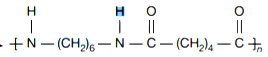
(B) $Nylon-6,6$ is a polyamide polymer because it contains amide linkages $(-CONH-)$ formed by the condensation polymerization of hexamethylenediamine and adipic acid.
0 likes
View Solution482
EasyMCQ
Which of the following is not true?
A
In vulcanisation,the rubber becomes harder and stronger.
B
Natural rubber has 'cis' configuration at every double bond.
C
Buna-$S$ is a co-polymer of $1,3$-butadiene and styrene.
D
Natural rubber is a $1,4$-polymer of isoprene.
Solution
(B) The statement in option $B$ is incorrect because natural rubber (cis$-1,4-$polyisoprene) has a 'cis' configuration at every double bond,not a 'trans' configuration. Gutta-percha is the 'trans' isomer of natural rubber.
Buna-$S$ is a co-polymer of $1,3$-butadiene and styrene,which is correct.
Vulcanisation makes rubber harder and stronger by forming cross-links between polymer chains.
Natural rubber is indeed a $1,4$-polymer of isoprene ($2$-methyl-$1,3$-butadiene).
Buna-$S$ is a co-polymer of $1,3$-butadiene and styrene,which is correct.
Vulcanisation makes rubber harder and stronger by forming cross-links between polymer chains.
Natural rubber is indeed a $1,4$-polymer of isoprene ($2$-methyl-$1,3$-butadiene).
0 likes
View Solution483
EasyMCQ
Orlon has which monomeric unit?
A
Acrolein
B
Glycol
C
Vinyl cyanide
D
Isoprene
Solution
(C) Orlon is a polymer of acrylonitrile,which is also known as vinyl cyanide.
The polymerization reaction is as follows:
$nCH_2=CH(CN) \xrightarrow{\text{Peroxide}} -(CH_2-CH(CN))_n-$
Thus,the monomeric unit of Orlon is vinyl cyanide.
The polymerization reaction is as follows:
$nCH_2=CH(CN) \xrightarrow{\text{Peroxide}} -(CH_2-CH(CN))_n-$
Thus,the monomeric unit of Orlon is vinyl cyanide.
0 likes
View Solution484
EasyMCQ
In Buna-$S$,the symbol $Bu$ stands for
A
$1-$butene
B
$n-$butene
C
$2-$butene
D
butadiene
Solution
(D) When a mixture of $1,3-$butadiene and styrene in the ratio of $3:1$ undergoes copolymerisation in the presence of sodium,it forms a styrene-butadiene copolymer,commonly known as styrene-butadiene rubber $(SBR)$ or Buna-$S$.
In the name Buna-$S$,'$Bu$' stands for butadiene,'$Na$' stands for sodium (which acts as the polymerising agent),and '$S$' stands for styrene.
In the name Buna-$S$,'$Bu$' stands for butadiene,'$Na$' stands for sodium (which acts as the polymerising agent),and '$S$' stands for styrene.
0 likes
View Solution485
DifficultMCQ
Which of the following is not a biodegradable polymer?
A
Polyhydroxy butyrate-co-$\beta$-hydroxyvalerate
B
$PHBV$
C
Nylon $2$-Nylon-$6$
D
Glyptal
Solution
(D) Biodegradable polymers are polymers that decompose by bacterial action.
Polyhydroxy butyrate-co-$\beta$-hydroxyvalerate $(PHBV)$ and Nylon $2$-Nylon-$6$ are examples of biodegradable polymers.
Glyptal is a condensation polymer of ethylene glycol and phthalic acid,which is not biodegradable.
Polyhydroxy butyrate-co-$\beta$-hydroxyvalerate $(PHBV)$ and Nylon $2$-Nylon-$6$ are examples of biodegradable polymers.
Glyptal is a condensation polymer of ethylene glycol and phthalic acid,which is not biodegradable.
0 likes
View Solution486
EasyMCQ
Match the polymers in List-$I$ with their monomers in List-$II$ and select the correct match:
The correct match is:
| List-$I$ | List-$II$ |
|---|---|
| $A$. $Nylon$ $6,6$ | $i$. $Ethylene$ $glycol$ and $Terephthalic$ $acid$ |
| $B$. $Terylene$ | $ii$. $1,3-Butadiene$ and $Styrene$ |
| $C$. $Buna-S$ | $iii$. $Chloroprene$ |
| $D$. $Neoprene$ | $iv$. $Acrylonitrile$ |
| $v$. $Adipic$ $acid$ and $Hexamethylenediamine$ |
The correct match is:
A
$v, i, ii, iii$
B
$iv, ii, i, iii$
C
$iii, i, ii, iv$
D
$v, ii, iii, i$
Solution
(A) The correct matching is:
$A$. $Nylon$ $6,6$ is a polyamide formed from $Adipic$ $acid$ and $Hexamethylenediamine$ $(v)$.
$B$. $Terylene$ (also known as $Dacron$) is a polyester formed from $Ethylene$ $glycol$ and $Terephthalic$ $acid$ $(i)$.
$C$. $Buna-S$ is a copolymer of $1,3-Butadiene$ and $Styrene$ $(ii)$.
$D$. $Neoprene$ is a polymer of $Chloroprene$ $(iii)$.
Therefore,the correct sequence for $A, B, C, D$ is $(v, i, ii, iii)$.
$A$. $Nylon$ $6,6$ is a polyamide formed from $Adipic$ $acid$ and $Hexamethylenediamine$ $(v)$.
$B$. $Terylene$ (also known as $Dacron$) is a polyester formed from $Ethylene$ $glycol$ and $Terephthalic$ $acid$ $(i)$.
$C$. $Buna-S$ is a copolymer of $1,3-Butadiene$ and $Styrene$ $(ii)$.
$D$. $Neoprene$ is a polymer of $Chloroprene$ $(iii)$.
Therefore,the correct sequence for $A, B, C, D$ is $(v, i, ii, iii)$.
0 likes
View Solution487
EasyMCQ
Which of the following is a biodegradable polymer of polyamide class?
A
Dextron
B
Nylon-$2$-nylon-$6$
C
Nylon-$6, 6$
D
$PHBV$
Solution
(B) Dextron - Biodegradable polymer of polyester class.
$(b)$ Nylon-$2$-nylon-$6$ - Biodegradable polymer of polyamide class.
$(c)$ Nylon-$6, 6$ - Non-biodegradable polymer of polyamide class.
$(d)$ $PHBV$ - Biodegradable polymer of polyester class.
Therefore,option $(b)$ is correct.
$(b)$ Nylon-$2$-nylon-$6$ - Biodegradable polymer of polyamide class.
$(c)$ Nylon-$6, 6$ - Non-biodegradable polymer of polyamide class.
$(d)$ $PHBV$ - Biodegradable polymer of polyester class.
Therefore,option $(b)$ is correct.
0 likes
View Solution488
MediumMCQ
Match the following:
The correct answer is
| List-$I$ (Use) | List-$II$ (Substance) |
|---|---|
| $A$. Electrodes in batteries | $II$. Polyacetylene |
| $B$. Welding of metals | $III$. Oxyacetylene |
| $C$. Toys | $I$. Polypropylene |
A
$A-III, B-II, C-I$
B
$A-II, B-III, C-I$
C
$A-II, B-I, C-III$
D
$A-I, B-II, C-III$
Solution
(B) The correct matches are as follows:
$1$. Electrodes in batteries are made from conducting polymers like $Polyacetylene$ $(A-II)$.
$2$. Welding of metals is performed using $Oxyacetylene$ flame $(B-III)$.
$3$. Toys are commonly manufactured using $Polypropylene$ $(C-I)$.
Therefore,the correct sequence is $A-II, B-III, C-I$.
$1$. Electrodes in batteries are made from conducting polymers like $Polyacetylene$ $(A-II)$.
$2$. Welding of metals is performed using $Oxyacetylene$ flame $(B-III)$.
$3$. Toys are commonly manufactured using $Polypropylene$ $(C-I)$.
Therefore,the correct sequence is $A-II, B-III, C-I$.
0 likes
View Solution489
MediumMCQ
Consider the following statements:
Statement-$I$: Nylon $6$ is a condensation copolymer.
Statement-$II$: Nylon $6, 6$ is a condensation polymer of adipic acid and hexamethylenediamine.
The correct answer is:
Statement-$I$: Nylon $6$ is a condensation copolymer.
Statement-$II$: Nylon $6, 6$ is a condensation polymer of adipic acid and hexamethylenediamine.
The correct answer is:
A
Both statement-$I$ and statement-$II$ are correct
B
Statement-$I$ is correct,but statement-$II$ is not correct
C
Statement-$I$ is not correct,but statement-$II$ is correct
D
Both statement-$I$ and statement-$II$ are not correct
Solution
(D) Statement-$I$ is incorrect because Nylon $6$ is a condensation homopolymer formed from the monomer caprolactam,not a copolymer.
Statement-$II$ is incorrect because Nylon $6, 6$ is formed from adipic acid and hexamethylenediamine,not tetramethylenediamine.
Therefore,both statements are incorrect.
Statement-$II$ is incorrect because Nylon $6, 6$ is formed from adipic acid and hexamethylenediamine,not tetramethylenediamine.
Therefore,both statements are incorrect.
0 likes
View Solution490
MediumMCQ
$A$ polymer sample contains $10$ molecules each with molecular mass $5,000$ and $5$ molecules each with molecular mass $50,000$. The number average molecular mass of the polymer sample is
A
$2 \times 10^4$
B
$3 \times 10^4$
C
$2 \times 10^5$
D
$3 \times 10^5$
Solution
(A) The number average molecular mass $(\overline{M}_n)$ is calculated using the formula: $\overline{M}_n = \frac{\sum N_i M_i}{\sum N_i}$
Here,$N_1 = 10$,$M_1 = 5,000$ and $N_2 = 5$,$M_2 = 50,000$.
$\sum N_i M_i = (10 \times 5,000) + (5 \times 50,000) = 50,000 + 250,000 = 300,000$.
$\sum N_i = 10 + 5 = 15$.
$\overline{M}_n = \frac{300,000}{15} = 20,000 = 2 \times 10^4$.
Here,$N_1 = 10$,$M_1 = 5,000$ and $N_2 = 5$,$M_2 = 50,000$.
$\sum N_i M_i = (10 \times 5,000) + (5 \times 50,000) = 50,000 + 250,000 = 300,000$.
$\sum N_i = 10 + 5 = 15$.
$\overline{M}_n = \frac{300,000}{15} = 20,000 = 2 \times 10^4$.
0 likes
View Solution491
MediumMCQ
The number of linear and crosslinked polymers in the following respectively are: Novolac,Nylon $6,6$,Bakelite,$PVC$,melamine.
A
$1, 4$
B
$4, 1$
C
$2, 3$
D
$3, 2$
Solution
(D) $1$. Linear polymers: These are long chain polymers. Examples from the list are: Nylon $6,6$,$PVC$,and Novolac (which is a linear polymer). So,there are $3$ linear polymers.
$2$. Crosslinked polymers: These are polymers with crosslinks between chains. Examples from the list are: Bakelite and melamine-formaldehyde resin. So,there are $2$ crosslinked polymers.
$3$. Therefore,the number of linear and crosslinked polymers are $3$ and $2$ respectively.
The correct option is $D$.
$2$. Crosslinked polymers: These are polymers with crosslinks between chains. Examples from the list are: Bakelite and melamine-formaldehyde resin. So,there are $2$ crosslinked polymers.
$3$. Therefore,the number of linear and crosslinked polymers are $3$ and $2$ respectively.
The correct option is $D$.
0 likes
View Solution492
MediumMCQ
$A$ polymer $X$ is biodegradable and is obtained from the monomers $Y$ and $Z$. What are $Y$ and $Z$?
A
$H_2N-CH_2-CH_2-COOH$ and $H_2N-(CH_2)_5-COOH$
B
$H_2N-CH(CH_3)-COOH$ and $H_2N-(CH_2)_5-COOH$
C
$CH_3-CH(OH)-CH_2-COOH$ and $CH_3-CH_2-CH(OH)-CH_2-COOH$
D
$HO-CH(CH_3)-CH_2-COOH$ and $HO-CH(CH_2CH_3)-CH_2-COOH$
Solution
(C) The biodegradable polymer $PHBV$ (poly $\beta$-hydroxybutyrate-co-$\beta$-hydroxyvalerate) is obtained by the copolymerization of $3$-hydroxybutanoic acid and $3$-hydroxypentanoic acid.
The monomers are:
$Y = CH_3-CH(OH)-CH_2-COOH$ ($3$-hydroxybutanoic acid)
$Z = CH_3-CH_2-CH(OH)-CH_2-COOH$ ($3$-hydroxypentanoic acid)
Thus,option $C$ is the correct answer.
The monomers are:
$Y = CH_3-CH(OH)-CH_2-COOH$ ($3$-hydroxybutanoic acid)
$Z = CH_3-CH_2-CH(OH)-CH_2-COOH$ ($3$-hydroxypentanoic acid)
Thus,option $C$ is the correct answer.
0 likes
View Solution493
MediumMCQ
$PHBV$ is a biodegradable polymer of two monomers $X$ and $Y$. $X$ and $Y$ respectively are
A
$X=C_2H_5-CH(OH)-CH_2CO_2H$; $Y=C_2H_5-CH(OH)-CO_2H$
B
$X=CH_3-CH(OH)-CH_2CO_2H$; $Y=C_2H_5-CH(OH)-CH_2CO_2H$
C
$X=CH_3-CH(OH)-CH_2OH$; $Y=C_2H_5-CH(OH)-CH_2CO_2H$
D
$X=H_2N-(CH_2)_5-CO_2H$; $Y=CH_3-CH(OH)-CH_2CO_2H$
Solution
(B) $PHBV$ (Poly-$\beta$-hydroxybutyrate-co-$\beta$-hydroxyvalerate) is a copolymer formed by the condensation polymerization of two hydroxy acids:
$1$. $3$-Hydroxybutanoic acid $(CH_3-CH(OH)-CH_2-COOH)$
$2$. $3$-Hydroxypentanoic acid $(CH_3-CH_2-CH(OH)-CH_2-COOH)$
Thus,$X$ is $3$-hydroxybutanoic acid and $Y$ is $3$-hydroxypentanoic acid.
Comparing this with the given options,option $B$ matches these structures.
$1$. $3$-Hydroxybutanoic acid $(CH_3-CH(OH)-CH_2-COOH)$
$2$. $3$-Hydroxypentanoic acid $(CH_3-CH_2-CH(OH)-CH_2-COOH)$
Thus,$X$ is $3$-hydroxybutanoic acid and $Y$ is $3$-hydroxypentanoic acid.
Comparing this with the given options,option $B$ matches these structures.
0 likes
View Solution494
MediumMCQ
The correctly matched set of the following is:
A
$Polystyrene$ - copolymer - thermoplastic
B
$Bakelite$ - addition polymer - thermosetting
C
$Nylon$ $6$ - Homopolymer - fibre
D
$Buna-N$ - Homopolymer - elastomer
Solution
(C) Let us analyze the given polymers based on their type and classification:
$1$. $Polystyrene$ is a homopolymer of styrene and is a thermoplastic.
$2$. $Bakelite$ is a condensation polymer (phenol-formaldehyde resin) and is thermosetting.
$3$. $Nylon$ $6$ is a homopolymer of caprolactam and is classified as a fibre due to strong intermolecular forces like hydrogen bonding.
$4$. $Buna-N$ is a copolymer of $1,3-butadiene$ and $acrylonitrile$ and is an elastomer.
Comparing these with the options:
- Option $A$: $Polystyrene$ is a homopolymer,not a copolymer.
- Option $B$: $Bakelite$ is a condensation polymer,not an addition polymer.
- Option $C$: $Nylon$ $6$ is a homopolymer and is a fibre. This is correct.
- Option $D$: $Buna-N$ is a copolymer,not a homopolymer.
Therefore,the correct set is $Nylon$ $6$ - Homopolymer - fibre.
$1$. $Polystyrene$ is a homopolymer of styrene and is a thermoplastic.
$2$. $Bakelite$ is a condensation polymer (phenol-formaldehyde resin) and is thermosetting.
$3$. $Nylon$ $6$ is a homopolymer of caprolactam and is classified as a fibre due to strong intermolecular forces like hydrogen bonding.
$4$. $Buna-N$ is a copolymer of $1,3-butadiene$ and $acrylonitrile$ and is an elastomer.
Comparing these with the options:
- Option $A$: $Polystyrene$ is a homopolymer,not a copolymer.
- Option $B$: $Bakelite$ is a condensation polymer,not an addition polymer.
- Option $C$: $Nylon$ $6$ is a homopolymer and is a fibre. This is correct.
- Option $D$: $Buna-N$ is a copolymer,not a homopolymer.
Therefore,the correct set is $Nylon$ $6$ - Homopolymer - fibre.
0 likes
View Solution495
EasyMCQ
In which of the following pairs is the polymer correctly matched with the intermolecular forces present in them?
| $A$. Neoprene --- Weak intermolecular forces | $B$. Terylene --- Hydrogen bonding |
| $C$. Polystyrene --- Very weak intermolecular forces | $D$. Polythene --- Hydrogen bonding |
A
$A, B$
B
$B, C$
C
$C, D$
D
$A, D$
Solution
(A) The classification of polymers based on intermolecular forces is as follows:
$1$. Neoprene is an elastomer,which possesses weak intermolecular forces. Thus,$A$ is correct.
$2$. Terylene is a fibre,which possesses strong intermolecular forces (dipole-dipole or hydrogen bonding). Thus,$B$ is correct.
$3$. Polystyrene is a thermoplastic,which possesses weak intermolecular forces,not 'very weak'.
$4$. Polythene is a thermoplastic,which possesses weak van der Waals forces,not hydrogen bonding.
Therefore,the correctly matched pairs are $A$ and $B$.
$1$. Neoprene is an elastomer,which possesses weak intermolecular forces. Thus,$A$ is correct.
$2$. Terylene is a fibre,which possesses strong intermolecular forces (dipole-dipole or hydrogen bonding). Thus,$B$ is correct.
$3$. Polystyrene is a thermoplastic,which possesses weak intermolecular forces,not 'very weak'.
$4$. Polythene is a thermoplastic,which possesses weak van der Waals forces,not hydrogen bonding.
Therefore,the correctly matched pairs are $A$ and $B$.
0 likes
View Solution496
EasyMCQ
Identify the condensation polymers from the following:
$A$. $PHBV$
$B$. Buna$-N$
$C$. Neoprene
$D$. Nylon$-6$
$E$. Glyptal
$A$. $PHBV$
$B$. Buna$-N$
$C$. Neoprene
$D$. Nylon$-6$
$E$. Glyptal
A
$A, B, D$
B
$B, C, D$
C
$B, C, E$
D
$A, D, E$
Solution
(D) Condensation polymers are formed by the repeated condensation reaction between two different bi-functional or tri-functional monomeric units,usually involving the elimination of small molecules like $H_2O$,$HCl$,etc.
$1$. $PHBV$ (Poly-$\beta$-hydroxybutyrate-co-$\beta$-hydroxyvalerate) is a condensation polymer.
$2$. $Nylon-6$ is a condensation polymer (formed from caprolactam via ring-opening polymerization,which is a type of condensation).
$3$. $Glyptal$ is a condensation polymer (polyester).
$4$. $Buna-N$ and $Neoprene$ are addition polymers.
Therefore,the condensation polymers are $A, D$,and $E$.
$1$. $PHBV$ (Poly-$\beta$-hydroxybutyrate-co-$\beta$-hydroxyvalerate) is a condensation polymer.
$2$. $Nylon-6$ is a condensation polymer (formed from caprolactam via ring-opening polymerization,which is a type of condensation).
$3$. $Glyptal$ is a condensation polymer (polyester).
$4$. $Buna-N$ and $Neoprene$ are addition polymers.
Therefore,the condensation polymers are $A, D$,and $E$.
0 likes
View Solution497
EasyMCQ
Match the following polymers in List-$I$ with their monomers in List-$II$:
| List-$I$ | List-$II$ |
|---|---|
| $(A)$ $-(NH-(CH_2)_6-NH-CO-(CH_2)_4-CO)_n-$ | $(I)$ Ethylene glycol and terephthalic acid |
| $(B)$ $-(CO-(CH_2)_5-NH)_n-$ | $(II)$ Phenol and formaldehyde |
| $(C)$ $-(CF_2-CF_2)_n-$ | $(III)$ Caprolactam |
| $(D)$ $-(O-CH_2-CH_2-OOC-C_6H_4-CO)_n-$ | $(IV)$ Hexamethylene diamine and adipic acid |
| $(V)$ Tetrafluoroethene |
A
$IV, III, V, I$
B
$III, II, IV, I$
C
$IV, III, II, I$
D
$II, IV, III, V$
Solution
(NONE) The correct matches are:
$(A)$ $-(NH-(CH_2)_6-NH-CO-(CH_2)_4-CO)_n-$ is Nylon-$6,6$,which is formed from Hexamethylene diamine and Adipic acid. So,$A \rightarrow IV$.
$(B)$ $-(CO-(CH_2)_5-NH)_n-$ is Nylon-$6$,which is formed from Caprolactam. So,$B \rightarrow III$.
$(C)$ $-(CF_2-CF_2)_n-$ is Teflon,which is formed from Tetrafluoroethene. So,$C \rightarrow V$.
$(D)$ $-(O-CH_2-CH_2-OOC-C_6H_4-CO)_n-$ is Dacron (Terylene),which is formed from Ethylene glycol and Terephthalic acid. So,$D \rightarrow I$.
Thus,the correct sequence is $A-IV, B-III, C-V, D-I$.
$(A)$ $-(NH-(CH_2)_6-NH-CO-(CH_2)_4-CO)_n-$ is Nylon-$6,6$,which is formed from Hexamethylene diamine and Adipic acid. So,$A \rightarrow IV$.
$(B)$ $-(CO-(CH_2)_5-NH)_n-$ is Nylon-$6$,which is formed from Caprolactam. So,$B \rightarrow III$.
$(C)$ $-(CF_2-CF_2)_n-$ is Teflon,which is formed from Tetrafluoroethene. So,$C \rightarrow V$.
$(D)$ $-(O-CH_2-CH_2-OOC-C_6H_4-CO)_n-$ is Dacron (Terylene),which is formed from Ethylene glycol and Terephthalic acid. So,$D \rightarrow I$.
Thus,the correct sequence is $A-IV, B-III, C-V, D-I$.
0 likes
View Solution498
EasyMCQ
Match the following.
The correct answer is:
| List-$I$ (Polymer/Type) | List-$II$ (Monomer/Example) |
|---|---|
| $A$. Addition polymer | $I$. Bakelite |
| $B$. Condensation polymer | $II$. $2$-methyl-$1,3$-butadiene |
| $C$. Acrilan | $III$. $2,3$-dimethyl-$1,3$-butadiene |
| $D$. Rubber | $IV$. Vinyl cyanide |
| $V$. Polythene |
The correct answer is:
A
$A-V, B-I, C-IV, D-II$
B
$A-V, B-I, C-II, D-III$
C
$A-I, B-V, C-IV, D-II$
D
$A-I, B-V, C-II, D-III$
Solution
(A) The matching is as follows:
$A$. Addition polymer is $V$. Polythene.
$B$. Condensation polymer is $I$. Bakelite.
$C$. Acrilan is $IV$. Vinyl cyanide (Acrylonitrile).
$D$. Rubber (Natural rubber) is $II$. $2$-methyl-$1,3$-butadiene (Isoprene).
Therefore,the correct sequence is $A-V, B-I, C-IV, D-II$.
$A$. Addition polymer is $V$. Polythene.
$B$. Condensation polymer is $I$. Bakelite.
$C$. Acrilan is $IV$. Vinyl cyanide (Acrylonitrile).
$D$. Rubber (Natural rubber) is $II$. $2$-methyl-$1,3$-butadiene (Isoprene).
Therefore,the correct sequence is $A-V, B-I, C-IV, D-II$.
0 likes
View Solution499
MediumMCQ
The number average molecular mass of a polymer that contains $15$ molecules with each of mass $8,000$ and $15$ molecules with each of mass $80,000$ is: (in $,000$)
A
$22$
B
$33$
C
$11$
D
$44$
Solution
(D) The number average molecular mass $(M_n)$ of a polymer is calculated using the formula:
$M_n = \frac{\Sigma N_i M_i}{\Sigma N_i}$
Given:
$N_1 = 15, M_1 = 8,000$
$N_2 = 15, M_2 = 80,000$
Substituting the values:
$M_n = \frac{15 \times 8,000 + 15 \times 80,000}{15 + 15}$
$M_n = \frac{120,000 + 1,200,000}{30}$
$M_n = \frac{1,320,000}{30} = 44,000$
$M_n = \frac{\Sigma N_i M_i}{\Sigma N_i}$
Given:
$N_1 = 15, M_1 = 8,000$
$N_2 = 15, M_2 = 80,000$
Substituting the values:
$M_n = \frac{15 \times 8,000 + 15 \times 80,000}{15 + 15}$
$M_n = \frac{120,000 + 1,200,000}{30}$
$M_n = \frac{1,320,000}{30} = 44,000$
0 likes
View SolutionPolymers — Composition, Properties and Uses of Polymer · Frequently Asked Questions
1Are these Polymers questions useful for JEE and NEET?
Yes. All questions in this section are mapped to JEE Main and NEET exam patterns. Previous year questions from JEE Main, NEET, GUJCET and state-level exams are included with full solutions.
2Can I switch to Hindi or Gujarati for these questions?
Yes. Use the language tabs in the hero section or the sidebar to view the same questions and solutions in English, Hindi or Gujarati.
3How do I generate a question paper from this subtopic?
Use the Vedclass Exam Paper Generator — select the chapter and subtopic, set difficulty, and generate Sets A, B, C, D automatically. First 3 chapters of every subject are free.
Vedclass Products
For Students
Vedclass Test Series
Mock tests in real JEE/NEET style with performance analysis. 5-day free trial.
Start Free TrialFor Teachers
Exam Paper Generator
Generate Set A/B/C/D papers from this chapter in 2 minutes. 3 chapters free.
Try FreeFor Institutes
Online Exam Module
Live online exams with unlimited students, 360° analytics & white-label branding.
See DemoFor Teachers & Institutes
Generate a Polymers Exam Paper in 2 Minutes
Select subtopic & difficulty — Sets A, B, C, D auto-generated with No Repeat logic.
First 3 chapters of every subject are free — no payment required.