
A English
Nitrogen family Questions in English
Class 12 Chemistry · p-Block Elements (Class 12) · Nitrogen family
1110+
Questions
English
Language
100%
With Solutions
Showing 50 of 1110 questions in English
701
MediumMCQ
Why is $BiH_{3}$ the strongest reducing agent amongst all the hydrides of Group $15$ elements?
A
$BiH_{3}$ has the highest bond dissociation energy.
B
$BiH_{3}$ has the lowest bond dissociation energy.
C
$BiH_{3}$ is the most stable hydride.
D
$BiH_{3}$ has the smallest atomic size.
Solution
(B) As we move down the group from $N$ to $Bi$,the atomic size of the central atom increases.
This leads to an increase in the bond length of the $E-H$ bond (where $E = N, P, As, Sb, Bi$).
Consequently,the bond dissociation enthalpy decreases significantly from $NH_{3}$ to $BiH_{3}$.
Since $BiH_{3}$ has the lowest bond dissociation energy,it can easily release $H$ atoms,making it the strongest reducing agent among the hydrides of Group $15$ elements.
This leads to an increase in the bond length of the $E-H$ bond (where $E = N, P, As, Sb, Bi$).
Consequently,the bond dissociation enthalpy decreases significantly from $NH_{3}$ to $BiH_{3}$.
Since $BiH_{3}$ has the lowest bond dissociation energy,it can easily release $H$ atoms,making it the strongest reducing agent among the hydrides of Group $15$ elements.
0 likes
View Solution702
MediumMCQ
Why is $N_2$ less reactive at room temperature?
A
Due to high electronegativity of $N$.
B
Due to the presence of a strong triple covalent bond between $N$ atoms.
C
Due to its small atomic size.
D
Due to the absence of $d$-orbitals.
Solution
(B) The two $N$ atoms in $N_2$ are bonded to each other by a very strong triple covalent bond $(N \equiv N)$.
The bond dissociation energy of this bond is extremely high $(941.4 \ kJ \ mol^{-1})$.
As a result,$N_2$ is chemically inert and less reactive at room temperature.
The bond dissociation energy of this bond is extremely high $(941.4 \ kJ \ mol^{-1})$.
As a result,$N_2$ is chemically inert and less reactive at room temperature.
0 likes
View Solution703
MediumMCQ
What happens when white phosphorus is heated with concentrated $NaOH$ solution in an inert atmosphere of $CO_{2}$?
A
It forms $PH_{3}$ and $NaH_{2}PO_{2}$.
B
It forms $P_{2}O_{5}$ and $H_{2}O$.
C
It forms $Na_{3}PO_{4}$ and $H_{2}$.
D
It forms $PH_{3}$ and $Na_{3}PO_{4}$.
Solution
(A) White phosphorus $(P_{4})$ reacts with concentrated $NaOH$ solution in an inert atmosphere of $CO_{2}$ to produce phosphine $(PH_{3})$ and sodium hypophosphite $(NaH_{2}PO_{2})$.
The chemical equation for this reaction is:
$P_{4} + 3NaOH + 3H_{2}O \to PH_{3} + 3NaH_{2}PO_{2}$
This is a disproportionation reaction where phosphorus is both oxidized and reduced.
The chemical equation for this reaction is:
$P_{4} + 3NaOH + 3H_{2}O \to PH_{3} + 3NaH_{2}PO_{2}$
This is a disproportionation reaction where phosphorus is both oxidized and reduced.
0 likes
View Solution704
MediumMCQ
What happens when $PCl_{5}$ is heated?
A
$PCl_{5}$ remains stable.
B
$PCl_{5}$ decomposes to form $PCl_{3}$ and $Cl_{2}$.
C
$PCl_{5}$ reacts with oxygen.
D
$PCl_{5}$ sublimes without decomposition.
Solution
(B) In $PCl_{5}$,the geometry is trigonal bipyramidal. It contains three equatorial bonds and two axial bonds. The axial bonds are longer and weaker than the equatorial bonds due to greater repulsion. Therefore,upon heating,$PCl_{5}$ readily decomposes to form $PCl_{3}$ and $Cl_{2}$ gas. The reaction is: $PCl_{5} \xrightarrow{\Delta} PCl_{3} + Cl_{2}$.
0 likes
View Solution705
Medium
Write a balanced chemical equation for the reaction of $PCl_5$ with water.
Solution
(N/A) The reaction of phosphorus pentachloride $(PCl_5)$ with water occurs in two steps,but the overall balanced equation is:
$PCl_5 + 4H_2O \longrightarrow H_3PO_4 + 5HCl$
$PCl_5 + 4H_2O \longrightarrow H_3PO_4 + 5HCl$
0 likes
View Solution706
Medium
What is the basicity of $H_3PO_4$?
Solution
(3) The structure of $H_3PO_4$ (orthophosphoric acid) shows that it contains three $P-OH$ groups.
The basicity of an oxoacid is defined by the number of ionizable $H$ atoms attached to oxygen atoms.
Since there are three $OH$ groups present in $H_3PO_4$,it can release three $H^+$ ions in an aqueous solution.
Therefore,its basicity is $3$,and it is a tribasic acid.
The basicity of an oxoacid is defined by the number of ionizable $H$ atoms attached to oxygen atoms.
Since there are three $OH$ groups present in $H_3PO_4$,it can release three $H^+$ ions in an aqueous solution.
Therefore,its basicity is $3$,and it is a tribasic acid.
0 likes
View Solution707
MediumMCQ
What happens when $H_{3}PO_{3}$ is heated?
A
$PH_{3}$ and $H_{3}PO_{4}$ are formed.
B
$PH_{3}$ and $P_{2}O_{5}$ are formed.
C
$H_{3}PO_{4}$ and $H_{2}$ are formed.
D
$PH_{3}$ and $H_{2}O$ are formed.
Solution
(A) $H_{3}PO_{3},$ on heating,undergoes a disproportionation reaction to form $PH_{3}$ and $H_{3}PO_{4}$.
The oxidation state of $P$ in $H_{3}PO_{3}$ is $+3$.
The oxidation state of $P$ in $PH_{3}$ is $-3$ (reduction).
The oxidation state of $P$ in $H_{3}PO_{4}$ is $+5$ (oxidation).
Since the oxidation state of the same element increases and decreases simultaneously,it is a disproportionation reaction.
The balanced chemical equation is:
$4H_{3}PO_{3} \xrightarrow{\Delta} 3H_{3}PO_{4} + PH_{3}$
The oxidation state of $P$ in $H_{3}PO_{3}$ is $+3$.
The oxidation state of $P$ in $PH_{3}$ is $-3$ (reduction).
The oxidation state of $P$ in $H_{3}PO_{4}$ is $+5$ (oxidation).
Since the oxidation state of the same element increases and decreases simultaneously,it is a disproportionation reaction.
The balanced chemical equation is:
$4H_{3}PO_{3} \xrightarrow{\Delta} 3H_{3}PO_{4} + PH_{3}$
0 likes
View Solution708
Difficult
Discuss the general characteristics of Group $15$ elements with reference to their electronic configuration,oxidation state,atomic size,ionisation enthalpy and electronegativity.
Solution
(N/A) General trends in Group $15$ elements:
$(i)$ Electronic configuration: All the elements in Group $15$ have $5$ valence electrons. Their general electronic configuration is $ns^{2} np^{3}$.
$(ii)$ Oxidation states: All these elements have $5$ valence electrons and require three more electrons to complete their octets. The common oxidation states are $-3, +3$ and $+5$. The stability of the $+5$ oxidation state decreases down the group,while the stability of the $+3$ oxidation state increases due to the inert pair effect.
$(iii)$ Ionization enthalpy and electronegativity: First ionization enthalpy decreases on moving down the group due to increasing atomic size. Similarly,electronegativity decreases down the group as the atomic size increases.
$(iv)$ Atomic size: On moving down the group,the atomic size increases due to the addition of new electron shells.
$(i)$ Electronic configuration: All the elements in Group $15$ have $5$ valence electrons. Their general electronic configuration is $ns^{2} np^{3}$.
$(ii)$ Oxidation states: All these elements have $5$ valence electrons and require three more electrons to complete their octets. The common oxidation states are $-3, +3$ and $+5$. The stability of the $+5$ oxidation state decreases down the group,while the stability of the $+3$ oxidation state increases due to the inert pair effect.
$(iii)$ Ionization enthalpy and electronegativity: First ionization enthalpy decreases on moving down the group due to increasing atomic size. Similarly,electronegativity decreases down the group as the atomic size increases.
$(iv)$ Atomic size: On moving down the group,the atomic size increases due to the addition of new electron shells.
0 likes
View Solution709
Medium
Why does the reactivity of nitrogen differ from phosphorus?
Solution
(N/A) Nitrogen is chemically less reactive than phosphorus. This is primarily due to the high stability of the $N_2$ molecule. In $N_2$,the two nitrogen atoms are linked by a $p\pi-p\pi$ triple bond $(N \equiv N)$. This triple bond has a very high bond dissociation enthalpy,making it difficult to break under normal conditions. Due to its small atomic size,nitrogen can form stable $p\pi-p\pi$ multiple bonds,whereas phosphorus,being larger,prefers to form single bonds and exists as $P_4$ molecules with strained bonds. Consequently,phosphorus is much more reactive than nitrogen.
0 likes
View Solution710
Difficult
Discuss the trends in chemical reactivity of group $15$ elements.
Solution
(N/A) The ionisation enthalpies of group-$15$ elements are much higher than corresponding group-$14$ elements due to increased nuclear charge,reduced atomic radii,and stable half-filled $ns^2np^3$ electronic configuration,resulting in a very low tendency to lose electrons.
Down the group,there is a decrease in the ionisation enthalpy due to an increase in atomic size,which decreases the force of attraction on electrons by the nucleus. The order of successive ionisation enthalpies is $\Delta_{i}H_{1} < \Delta_{i}H_{2} < \Delta_{i}H_{3}$.
Nitrogen is the most electronegative element in group-$15$. Down the group,electronegativity decreases with an increase in atomic size. However,amongst the heavier elements,the difference is not very pronounced.
Down the group,there is a decrease in the ionisation enthalpy due to an increase in atomic size,which decreases the force of attraction on electrons by the nucleus. The order of successive ionisation enthalpies is $\Delta_{i}H_{1} < \Delta_{i}H_{2} < \Delta_{i}H_{3}$.
Nitrogen is the most electronegative element in group-$15$. Down the group,electronegativity decreases with an increase in atomic size. However,amongst the heavier elements,the difference is not very pronounced.
0 likes
View Solution711
Difficult
How is nitrogen prepared in the laboratory? Write the chemical equations of the reactions involved.
Solution
(N/A) In the laboratory,nitrogen is prepared by treating an aqueous solution of ammonium chloride with sodium nitrite.
The chemical equation for the reaction is:
$NH_4Cl_{(aq)} + NaNO_{2_{(aq)}} \to N_{2_{(g)}} + 2H_2O_{(l)} + NaCl_{(aq)}$
Small amounts of $NO$ and $HNO_3$ are produced as impurities. These can be removed by passing the nitrogen gas through an aqueous solution of sulphuric acid containing potassium dichromate.
The chemical equation for the reaction is:
$NH_4Cl_{(aq)} + NaNO_{2_{(aq)}} \to N_{2_{(g)}} + 2H_2O_{(l)} + NaCl_{(aq)}$
Small amounts of $NO$ and $HNO_3$ are produced as impurities. These can be removed by passing the nitrogen gas through an aqueous solution of sulphuric acid containing potassium dichromate.
0 likes
View Solution712
Medium
How is ammonia manufactured industrially?
Solution
(N/A) Ammonia is manufactured on a large scale by the Haber's process.
$N_{2(g)} + 3H_{2(g)} \rightleftharpoons 2NH_{3(g)} \quad \Delta_{f} H^{\circ} = -46.1 \, kJ/mol$
The optimum conditions for the production of ammonia are:
$(i)$ Pressure: $A$ high pressure of about $200 \times 10^{5} \, Pa$ $(200 \, atm)$ is maintained to shift the equilibrium in the forward direction.
$(ii)$ Temperature: An optimum temperature of about $700 \, K$ is used.
$(iii)$ Catalyst: Iron oxide with small amounts of $K_{2}O$ and $Al_{2}O_{3}$ is used to increase the rate of attainment of equilibrium.
$N_{2(g)} + 3H_{2(g)} \rightleftharpoons 2NH_{3(g)} \quad \Delta_{f} H^{\circ} = -46.1 \, kJ/mol$
The optimum conditions for the production of ammonia are:
$(i)$ Pressure: $A$ high pressure of about $200 \times 10^{5} \, Pa$ $(200 \, atm)$ is maintained to shift the equilibrium in the forward direction.
$(ii)$ Temperature: An optimum temperature of about $700 \, K$ is used.
$(iii)$ Catalyst: Iron oxide with small amounts of $K_{2}O$ and $Al_{2}O_{3}$ is used to increase the rate of attainment of equilibrium.
0 likes
View Solution713
Medium
Illustrate how copper metal can give different products on reaction with $HNO_3$.
Solution
Concentrated nitric acid is a strong oxidizing agent. It is used for oxidizing most metals. The products of oxidation depend on the concentration of the acid,temperature,and also on the material undergoing oxidation.
With dilute $HNO_3$:
$3Cu + 8HNO_{3(dilute)} \to 3Cu(NO_3)_2 + 2NO + 4H_2O$
With concentrated $HNO_3$:
$Cu + 4HNO_{3(conc)} \to Cu(NO_3)_2 + 2NO_2 + 2H_2O$
With dilute $HNO_3$:
$3Cu + 8HNO_{3(dilute)} \to 3Cu(NO_3)_2 + 2NO + 4H_2O$
With concentrated $HNO_3$:
$Cu + 4HNO_{3(conc)} \to Cu(NO_3)_2 + 2NO_2 + 2H_2O$
0 likes
View Solution714
Medium
Why does $R_{3}P=O$ exist but $R_{3}N=O$ does not ($R=$ alkyl group)?
Solution
(N/A) $N$ (unlike $P$) lacks the $d$-orbital. This restricts nitrogen to expand its coordination number beyond four. Hence,$R_{3}N=O$ does not exist.
0 likes
View Solution715
Medium
Explain why $NH_3$ is basic while $BiH_3$ is only feebly basic.
Solution
(N/A) $NH_3$ is distinctly basic,whereas $BiH_3$ is only feebly basic.
Nitrogen has a small atomic size,which causes the lone pair of electrons to be concentrated in a small region,resulting in high electron density.
As we move down the group from $N$ to $Bi$,the size of the central atom increases.
This increase in size causes the lone pair of electrons to be distributed over a larger volume,which significantly decreases the electron density.
Consequently,the electron-donating capacity (Lewis basicity) of the group $15$ hydrides decreases as we move down the group.
Nitrogen has a small atomic size,which causes the lone pair of electrons to be concentrated in a small region,resulting in high electron density.
As we move down the group from $N$ to $Bi$,the size of the central atom increases.
This increase in size causes the lone pair of electrons to be distributed over a larger volume,which significantly decreases the electron density.
Consequently,the electron-donating capacity (Lewis basicity) of the group $15$ hydrides decreases as we move down the group.
0 likes
View Solution716
Medium
Nitrogen exists as a diatomic molecule $(N_2)$ and phosphorus as $P_4$. Why?
Solution
(N/A) Nitrogen,due to its small size and high electronegativity,has a strong tendency to form $p\pi-p\pi$ multiple bonds with itself. This results in the formation of a stable diatomic molecule,$N_2$,held together by a triple bond.
As we move down the group,the atomic size increases,which makes the effective overlapping of $p$-orbitals for $p\pi-p\pi$ bonding difficult.
Consequently,heavier elements like phosphorus prefer to form single bonds with three other atoms,leading to the formation of a tetrahedral $P_4$ molecule.
As we move down the group,the atomic size increases,which makes the effective overlapping of $p$-orbitals for $p\pi-p\pi$ bonding difficult.
Consequently,heavier elements like phosphorus prefer to form single bonds with three other atoms,leading to the formation of a tetrahedral $P_4$ molecule.
0 likes
View Solution717
Medium
Write the main differences between the properties of white phosphorus and red phosphorus.
Solution
(N/A)
| Property | White Phosphorus | Red Phosphorus |
|---|---|---|
| Physical State | Soft and waxy solid. | Hard and crystalline solid. |
| Odour | Garlic smell. | Odourless. |
| Toxicity | Poisonous. | Non-poisonous. |
| Solubility | Insoluble in water,soluble in $CS_2$. | Insoluble in both water and $CS_2$. |
| Reactivity | Undergoes spontaneous combustion in air. | Relatively less reactive. |
| Structure | Exists as discrete $P_4$ molecules. | Exists as a polymeric chain of tetrahedral $P_4$ units. |
0 likes
View Solution718
MediumMCQ
Why does nitrogen show catenation properties less than phosphorus?
A
Due to high electronegativity of nitrogen.
B
Due to the small size of nitrogen atom leading to inter-electronic repulsion.
C
Due to the presence of $d$-orbitals in phosphorus.
D
Due to the formation of $p\pi-p\pi$ multiple bonds in nitrogen.
Solution
(B) Catenation is the ability of an element to form chains of identical atoms.
Nitrogen shows less catenation than phosphorus because the $N-N$ single bond is much weaker than the $P-P$ single bond.
Due to the small size of the nitrogen atom,the lone pairs on the two nitrogen atoms experience significant inter-electronic repulsion,which weakens the $N-N$ single bond.
In contrast,phosphorus atoms are larger,resulting in less inter-electronic repulsion and a stronger $P-P$ single bond.
Nitrogen shows less catenation than phosphorus because the $N-N$ single bond is much weaker than the $P-P$ single bond.
Due to the small size of the nitrogen atom,the lone pairs on the two nitrogen atoms experience significant inter-electronic repulsion,which weakens the $N-N$ single bond.
In contrast,phosphorus atoms are larger,resulting in less inter-electronic repulsion and a stronger $P-P$ single bond.
0 likes
View Solution719
Medium
Give the disproportionation reaction of $H_3PO_3$.
Solution
(N/A) On heating,orthophosphorus acid $(H_3PO_3)$ disproportionates to give orthophosphoric acid $(H_3PO_4)$ and phosphine $(PH_3)$.
The balanced chemical equation is:
$4H_3\overset{+3}{P}O_3 \xrightarrow{\Delta} 3H_3\overset{+5}{P}O_4 + \overset{-3}{P}H_3$
In this reaction,the phosphorus atom in $H_3PO_3$ (oxidation state $+3$) is simultaneously oxidized to $H_3PO_4$ (oxidation state $+5$) and reduced to $PH_3$ (oxidation state $-3$).
The balanced chemical equation is:
$4H_3\overset{+3}{P}O_3 \xrightarrow{\Delta} 3H_3\overset{+5}{P}O_4 + \overset{-3}{P}H_3$
In this reaction,the phosphorus atom in $H_3PO_3$ (oxidation state $+3$) is simultaneously oxidized to $H_3PO_4$ (oxidation state $+5$) and reduced to $PH_3$ (oxidation state $-3$).
0 likes
View Solution720
Medium
Can $PCl_{5}$ act as an oxidizing as well as a reducing agent? Justify.
Solution
(N/A) $PCl_{5}$ can only act as an oxidizing agent. The highest oxidation state that $P$ can show is $+5$. In $PCl_{5}$,phosphorus is in its highest oxidation state $(+5)$. Since it cannot increase its oxidation state further,it cannot act as a reducing agent. However,it can decrease its oxidation state by gaining electrons and thus act as an oxidizing agent.
0 likes
View Solution721
Difficult
Explain the occurrence of elements of group-$15$.
Solution
(N/A) $(i)$ Nitrogen: Molecular nitrogen comprises $78\%$ by volume of the atmosphere. In the earth's crust,it occurs as sodium nitrate,$NaNO_{3}$ (chile saltpetre),and potassium nitrate,$KNO_{3}$ (Indian saltpetre). It is also found in the form of proteins in plants and animals.
$(ii)$ Phosphorus: Phosphorus occurs in minerals of the apatite family,$Ca_{9}(PO_{4})_{6} \cdot CaX_{2}$ (where $X = F, Cl, \text{or } OH$). For example,Fluorapatite $[Ca_{9}(PO_{4})_{6} \cdot CaF_{2}]$,Chlorapatite $[Ca_{9}(PO_{4})_{6} \cdot CaCl_{2}]$,and Hydroxyapatite $[Ca_{9}(PO_{4})_{6} \cdot Ca(OH)_{2}]$ are main components of phosphate rocks. Phosphorus is an essential constituent of animal and plant matter,present in bones and living cells. Phosphoproteins are present in milk and eggs.
$(iii)$ Arsenic,antimony,and bismuth are found mainly as sulphide minerals.
$(iv)$ Moscovium: It is a synthetic radioactive element with atomic mass-$289$ and a very short half-life. Due to its short half-life,it is available in very small amounts.
$(ii)$ Phosphorus: Phosphorus occurs in minerals of the apatite family,$Ca_{9}(PO_{4})_{6} \cdot CaX_{2}$ (where $X = F, Cl, \text{or } OH$). For example,Fluorapatite $[Ca_{9}(PO_{4})_{6} \cdot CaF_{2}]$,Chlorapatite $[Ca_{9}(PO_{4})_{6} \cdot CaCl_{2}]$,and Hydroxyapatite $[Ca_{9}(PO_{4})_{6} \cdot Ca(OH)_{2}]$ are main components of phosphate rocks. Phosphorus is an essential constituent of animal and plant matter,present in bones and living cells. Phosphoproteins are present in milk and eggs.
$(iii)$ Arsenic,antimony,and bismuth are found mainly as sulphide minerals.
$(iv)$ Moscovium: It is a synthetic radioactive element with atomic mass-$289$ and a very short half-life. Due to its short half-life,it is available in very small amounts.
0 likes
View Solution722
Difficult
State the electronic configuration of group-$15$ elements.
Solution
The valence shell electronic configuration of group-$15$ elements is $ns^{2}np^{3}$. The detailed electronic configurations are as follows:
All elements of group-$15$ have $5$ electrons in their valence shell. Hence,the general electronic configuration is $ns^{2}np^{3}$.
| Element | Electronic configuration |
| ${ }_{7} N$ | $[He] 2s^{2} 2p^{3}$ |
| ${ }_{15} P$ | $[Ne] 3s^{2} 3p^{3}$ |
| ${ }_{33} As$ | $[Ar] 3d^{10} 4s^{2} 4p^{3}$ |
| ${ }_{51} Sb$ | $[Kr] 4d^{10} 5s^{2} 5p^{3}$ |
| ${ }_{83} Bi$ | $[Xe] 4f^{14} 5d^{10} 6s^{2} 6p^{3}$ |
| ${ }_{115} Mc$ | $[Rn] 5f^{14} 6d^{10} 7s^{2} 7p^{3}$ |
All elements of group-$15$ have $5$ electrons in their valence shell. Hence,the general electronic configuration is $ns^{2}np^{3}$.
0 likes
View Solution723
Difficult
Discuss the variations in atomic and ionic radii of elements,the trends in ionisation enthalpies and electronegativity of group-$15$ elements.
Solution
(N/A) $1$. Atomic and Ionic Radii: The atomic and ionic radii of group-$15$ elements are smaller than those of group-$14$ elements due to increased effective nuclear charge. Down the group,radii increase due to the addition of new principal shells. The increase is significant from $N$ to $P$,but smaller from $As$ to $Bi$ due to the poor shielding effect of completely filled $d$ and $f$-orbitals.
$2$. Ionisation Enthalpy: Ionisation enthalpy decreases down the group due to the increase in atomic size and shielding effect. Group-$15$ elements have higher ionisation enthalpies than group-$14$ elements because of their extra stable half-filled $p$-orbital electronic configuration $(ns^2 np^3)$.
$3$. Electronegativity: Electronegativity decreases down the group with increasing atomic size. Nitrogen is the most electronegative element in this group.
$2$. Ionisation Enthalpy: Ionisation enthalpy decreases down the group due to the increase in atomic size and shielding effect. Group-$15$ elements have higher ionisation enthalpies than group-$14$ elements because of their extra stable half-filled $p$-orbital electronic configuration $(ns^2 np^3)$.
$3$. Electronegativity: Electronegativity decreases down the group with increasing atomic size. Nitrogen is the most electronegative element in this group.
0 likes
View Solution724
Difficult
Write a note on oxidation states of group $-15$ elements. Write a note on the nature of bonding of group $-15$ elements.
Solution
(N/A) The common oxidation states of group $-15$ elements are $-3, +3$ and $+5$. The tendency to exhibit $-3$ oxidation state decreases down the group due to an increase in atomic size and metallic character. In fact,$Bi$ hardly exists in the $(-3)$ oxidation state.
The stability of the $(+5)$ oxidation state decreases down the group,and that of the $(+3)$ oxidation state increases due to the inert pair effect. The only known compound of bismuth in the $(+5)$ oxidation state is $BiF_{5}$.
Nitrogen exhibits $(+1), (+2), (+4)$ oxidation states with oxygen in addition to the $(+5)$ oxidation state. However,it does not form compounds in the $(+5)$ oxidation state with halogens because nitrogen lacks $d$-orbitals to accommodate electrons from other elements to form bonds.
Nitrogen in all oxidation states from $(+1)$ to $(+4)$ disproportionates in acidic medium. For example: $3HNO_{2} \rightarrow HNO_{3} + H_{2}O + 2NO$.
Phosphorus shows $(+1)$ and $(+4)$ oxidation states in some oxo-acids. Phosphorus disproportionates in all intermediate states from $(-3)$ to $(+5)$ in acidic or alkaline medium. For example: $2H_{3}PO_{2} \stackrel{\Delta}{\longrightarrow} H_{3}PO_{4} + PH_{3}$.
Arsenic,Antimony,and Bismuth in $(+3)$ oxidation states are stable with respect to disproportionation.
Nitrogen is restricted to a maximum covalency of $4$ since only four (one $s$ and three $p$) orbitals are available for bonding. The heavier elements have vacant $d$-orbitals in the outermost shell which can be used for bonding (covalency) and hence can expand their covalence. Example: $PCl_{5}, [PCl_{6}]^{-}, [PF_{6}]^{-}$.
Nitrogen forms $p\pi-p\pi$ bonds due to its small size,while other elements do not form $p\pi-p\pi$ bonds. Hence,in their elemental state,Phosphorus,Arsenic,and Antimony exist as $P_{4}, As_{4},$ and $Sb_{4}$ respectively as tetrahedral molecules.
Due to the non-availability of $d$-orbitals in nitrogen,it cannot form $d\pi-p\pi$ bonds,which are possible with other elements. Example: $R_{3}P=O$ or $R_{3}P=CH_{2}$ $(R = \text{alkyl group})$. Phosphorus and Arsenic form $d\pi-d\pi$ bonds with transition metals when their compounds act as ligands. For example: $P(C_{2}H_{5})_{3}$.
The stability of the $(+5)$ oxidation state decreases down the group,and that of the $(+3)$ oxidation state increases due to the inert pair effect. The only known compound of bismuth in the $(+5)$ oxidation state is $BiF_{5}$.
Nitrogen exhibits $(+1), (+2), (+4)$ oxidation states with oxygen in addition to the $(+5)$ oxidation state. However,it does not form compounds in the $(+5)$ oxidation state with halogens because nitrogen lacks $d$-orbitals to accommodate electrons from other elements to form bonds.
Nitrogen in all oxidation states from $(+1)$ to $(+4)$ disproportionates in acidic medium. For example: $3HNO_{2} \rightarrow HNO_{3} + H_{2}O + 2NO$.
Phosphorus shows $(+1)$ and $(+4)$ oxidation states in some oxo-acids. Phosphorus disproportionates in all intermediate states from $(-3)$ to $(+5)$ in acidic or alkaline medium. For example: $2H_{3}PO_{2} \stackrel{\Delta}{\longrightarrow} H_{3}PO_{4} + PH_{3}$.
Arsenic,Antimony,and Bismuth in $(+3)$ oxidation states are stable with respect to disproportionation.
| Element | Oxidation states |
| $1.$ Nitrogen | $(-3)$ to $(+5)$ |
| $2.$ Phosphorus | $(-3), (+3), (+5)$ |
| $3.$ Arsenic | $(-3), (+3), (+5)$ |
| $4.$ Antimony | $(+3), (+5)$ |
| $5.$ Bismuth | $(+3)$ |
Nitrogen is restricted to a maximum covalency of $4$ since only four (one $s$ and three $p$) orbitals are available for bonding. The heavier elements have vacant $d$-orbitals in the outermost shell which can be used for bonding (covalency) and hence can expand their covalence. Example: $PCl_{5}, [PCl_{6}]^{-}, [PF_{6}]^{-}$.
Nitrogen forms $p\pi-p\pi$ bonds due to its small size,while other elements do not form $p\pi-p\pi$ bonds. Hence,in their elemental state,Phosphorus,Arsenic,and Antimony exist as $P_{4}, As_{4},$ and $Sb_{4}$ respectively as tetrahedral molecules.
Due to the non-availability of $d$-orbitals in nitrogen,it cannot form $d\pi-p\pi$ bonds,which are possible with other elements. Example: $R_{3}P=O$ or $R_{3}P=CH_{2}$ $(R = \text{alkyl group})$. Phosphorus and Arsenic form $d\pi-d\pi$ bonds with transition metals when their compounds act as ligands. For example: $P(C_{2}H_{5})_{3}$.
0 likes
View Solution725
Difficult
Write a note on $p$-block elements of the periodic table.
Solution
(N/A) Elements in which the last electron enters the $p$-orbital are known as $p$-block elements. The general electronic configuration of $p$-block elements ranges from $ns^2 np^1$ to $ns^2 np^6$.
$p$-block elements comprise groups $13$ to $18$. Along with $s$-block elements,they are called representative or main group elements. The outermost electronic configuration varies from $ns^2 np^1$ to $ns^2 np^6$ in each period.
Noble Gases (Group-$18$): These elements exhibit very low chemical reactivity due to their stable octet configuration.
Halogens (Group-$17$): These are highly reactive non-metals that precede the noble gases.
Chalcogens (Group-$16$): Elements of group $16$ are known as chalcogens. They have high electron gain enthalpy and tend to accept $2$ electrons to achieve a stable noble gas configuration. This group includes $O, S, Se, Te, Po$.
Metallic and Non-metallic Properties: In the $p$-block,non-metallic character increases from left to right across a period,while metallic character increases from top to bottom down a group.
$p$-block elements comprise groups $13$ to $18$. Along with $s$-block elements,they are called representative or main group elements. The outermost electronic configuration varies from $ns^2 np^1$ to $ns^2 np^6$ in each period.
Noble Gases (Group-$18$): These elements exhibit very low chemical reactivity due to their stable octet configuration.
Halogens (Group-$17$): These are highly reactive non-metals that precede the noble gases.
Chalcogens (Group-$16$): Elements of group $16$ are known as chalcogens. They have high electron gain enthalpy and tend to accept $2$ electrons to achieve a stable noble gas configuration. This group includes $O, S, Se, Te, Po$.
Metallic and Non-metallic Properties: In the $p$-block,non-metallic character increases from left to right across a period,while metallic character increases from top to bottom down a group.
0 likes
View Solution726
Difficult
What is a $p$-block element? Discuss the gaseous elements and metallic properties of $p$-block elements.
Solution
(N/A) Definition: Elements in which the last electron enters the $p$-orbital are known as $p$-block elements. Their general electronic configuration is $ns^{2} np^{1-6}$.
Gaseous Elements: The $p$-block contains several gaseous elements,primarily found in group $18$ (Noble gases like $He$,$Ne$,$Ar$,$Kr$,$Xe$,$Rn$) and some in groups $15$,$16$,and $17$ (e.g.,$N_2$,$O_2$,$F_2$,$Cl_2$).
Metallic Properties: The $p$-block is unique as it contains metals,non-metals,and metalloids.
$1$. Trend across a period: Moving from left to right,the non-metallic character increases due to an increase in effective nuclear charge and ionization enthalpy.
$2$. Trend down a group: Moving from top to bottom,the metallic character increases because the ionization enthalpy decreases,making it easier for atoms to lose electrons.
Gaseous Elements: The $p$-block contains several gaseous elements,primarily found in group $18$ (Noble gases like $He$,$Ne$,$Ar$,$Kr$,$Xe$,$Rn$) and some in groups $15$,$16$,and $17$ (e.g.,$N_2$,$O_2$,$F_2$,$Cl_2$).
Metallic Properties: The $p$-block is unique as it contains metals,non-metals,and metalloids.
$1$. Trend across a period: Moving from left to right,the non-metallic character increases due to an increase in effective nuclear charge and ionization enthalpy.
$2$. Trend down a group: Moving from top to bottom,the metallic character increases because the ionization enthalpy decreases,making it easier for atoms to lose electrons.
0 likes
View Solution727
Medium
Write four main properties of $p$-block elements.
Solution
(N/A) The four important characteristic properties of $p$-block elements are as follows:
$(a)$ $p$-block elements include both metals and non-metals,but the number of non-metals is significantly higher. Metallic character increases from top to bottom within a group,while non-metallic character increases from left to right along a period.
$(b)$ The ionization enthalpy of $p$-block elements is generally higher compared to $s$-block elements.
$(c)$ They predominantly form covalent compounds.
$(d)$ They exhibit variable oxidation states. Oxidizing character generally increases from left to right across a period,while reducing character increases from top to bottom within a group.
$(a)$ $p$-block elements include both metals and non-metals,but the number of non-metals is significantly higher. Metallic character increases from top to bottom within a group,while non-metallic character increases from left to right along a period.
$(b)$ The ionization enthalpy of $p$-block elements is generally higher compared to $s$-block elements.
$(c)$ They predominantly form covalent compounds.
$(d)$ They exhibit variable oxidation states. Oxidizing character generally increases from left to right across a period,while reducing character increases from top to bottom within a group.
0 likes
View Solution728
Medium
Write four characteristic properties of $p$-block elements.
Solution
(N/A) The $p$-block elements exhibit the following characteristic properties:
$1$. They include metals,non-metals,and metalloids.
$2$. Their valence shell electronic configuration is $ns^2 np^{1-6}$.
$3$. They show a wide range of oxidation states,including both positive and negative values.
$4$. They generally form acidic oxides,although some are amphoteric or neutral.
$1$. They include metals,non-metals,and metalloids.
$2$. Their valence shell electronic configuration is $ns^2 np^{1-6}$.
$3$. They show a wide range of oxidation states,including both positive and negative values.
$4$. They generally form acidic oxides,although some are amphoteric or neutral.
0 likes
View Solution729
Medium
$p$-Block elements form acidic,basic,and amphoteric oxides. Explain each property by giving two examples and also write the reactions of these oxides with water.
Solution
(N/A) $p$-Block elements form various types of oxides based on their oxidation state and position in the periodic table.
$1.$ Acidic Oxides: These oxides react with water to form acids. Non-metals generally form acidic oxides.
Examples: $SO_2, N_2O_5$.
Reactions:
$SO_2 + H_2O \rightarrow H_2SO_3$ (Sulfurous acid)
$N_2O_5 + H_2O \rightarrow 2HNO_3$ (Nitric acid)
$2.$ Basic Oxides: These oxides react with water to form bases. Metallic elements at the bottom of the $p$-block form basic oxides.
Examples: $Tl_2O, Bi_2O_3$.
Reaction:
$Tl_2O + H_2O \rightarrow 2TlOH$ (Thallium hydroxide)
$3.$ Amphoteric Oxides: These oxides show both acidic and basic character. They react with both acids and bases.
Examples: $Al_2O_3, SnO_2$.
Note: Amphoteric oxides like $Al_2O_3$ are generally insoluble in water and do not react with it directly.
$1.$ Acidic Oxides: These oxides react with water to form acids. Non-metals generally form acidic oxides.
Examples: $SO_2, N_2O_5$.
Reactions:
$SO_2 + H_2O \rightarrow H_2SO_3$ (Sulfurous acid)
$N_2O_5 + H_2O \rightarrow 2HNO_3$ (Nitric acid)
$2.$ Basic Oxides: These oxides react with water to form bases. Metallic elements at the bottom of the $p$-block form basic oxides.
Examples: $Tl_2O, Bi_2O_3$.
Reaction:
$Tl_2O + H_2O \rightarrow 2TlOH$ (Thallium hydroxide)
$3.$ Amphoteric Oxides: These oxides show both acidic and basic character. They react with both acids and bases.
Examples: $Al_2O_3, SnO_2$.
Note: Amphoteric oxides like $Al_2O_3$ are generally insoluble in water and do not react with it directly.
0 likes
View Solution730
EasyMCQ
Which method is used to produce nitric acid?
A
Haber's process
B
Ostwald's process
C
Contact process
D
Solvay process
Solution
(B) The industrial production of nitric acid $(HNO_3)$ is carried out by the $Ostwald's$ process. In this process,ammonia $(NH_3)$ is catalytically oxidized to nitric oxide $(NO)$,which is then oxidized to nitrogen dioxide $(NO_2)$,and finally absorbed in water to form nitric acid.
0 likes
View Solution731
Easy
How can you explain the higher stability of $BCl_3$ as compared to $TlCl_3$?
Solution
(N/A) Boron and thallium belong to group $13$ of the periodic table.
In this group,the $+1$ oxidation state becomes more stable as we move down the group due to the inert pair effect.
$BCl_3$ is more stable than $TlCl_3$ because the $+3$ oxidation state of $B$ is more stable than the $+3$ oxidation state of $Tl$.
In $Tl$,the $+3$ oxidation state is highly oxidising and it tends to revert to the more stable $+1$ oxidation state.
In this group,the $+1$ oxidation state becomes more stable as we move down the group due to the inert pair effect.
$BCl_3$ is more stable than $TlCl_3$ because the $+3$ oxidation state of $B$ is more stable than the $+3$ oxidation state of $Tl$.
In $Tl$,the $+3$ oxidation state is highly oxidising and it tends to revert to the more stable $+1$ oxidation state.
0 likes
View Solution732
Easy
In some of the reactions,thallium resembles aluminium,whereas in others,it resembles group-$I$ metals. Support this statement by giving some evidence.
Solution
(N/A) Thallium $(Tl)$ belongs to group $13$ of the periodic table. The most common oxidation state for this group is $+3$. However,heavier members of this group also display the $+1$ oxidation state due to the inert pair effect.
$1$. Resemblance with aluminium: Like aluminium $(Al)$,thallium forms compounds in the $+3$ oxidation state,such as $TlCl_3$ and $Tl_2O_3$.
$2$. Resemblance with group-$I$ metals: Like alkali metals,thallium forms compounds in the $+1$ oxidation state,such as $Tl_2O$ and $TlCl$. This is due to the stability of the $+1$ oxidation state in thallium caused by the inert pair effect.
$1$. Resemblance with aluminium: Like aluminium $(Al)$,thallium forms compounds in the $+3$ oxidation state,such as $TlCl_3$ and $Tl_2O_3$.
$2$. Resemblance with group-$I$ metals: Like alkali metals,thallium forms compounds in the $+1$ oxidation state,such as $Tl_2O$ and $TlCl$. This is due to the stability of the $+1$ oxidation state in thallium caused by the inert pair effect.
0 likes
View Solution733
Medium
Rationalize the given statements and provide chemical reactions:
$1$. Lead $(II)$ chloride reacts with $Cl_2$ to give $PbCl_4$.
$2$. Lead $(IV)$ chloride is highly unstable towards heat.
$3$. Lead is known not to form an iodide,$PbI_4$.
$1$. Lead $(II)$ chloride reacts with $Cl_2$ to give $PbCl_4$.
$2$. Lead $(IV)$ chloride is highly unstable towards heat.
$3$. Lead is known not to form an iodide,$PbI_4$.
Solution
(N/A) Lead belongs to group $14$ of the periodic table. The two oxidation states displayed by this group are $+2$ and $+4$. On moving down the group,the $+2$ oxidation state becomes more stable and the $+4$ oxidation state becomes less stable due to the inert pair effect. However,$PbCl_4$ can be formed by passing $Cl_2$ gas through a saturated solution of $PbCl_2$.
$PbCl_{2(s)} + Cl_{2(g)} \rightarrow PbCl_{4(l)}$
$(b)$ Due to the inert pair effect,the $+4$ oxidation state of $Pb$ is highly unstable. Upon heating,$PbCl_4$ decomposes to form the more stable $Pb(II)$ chloride.
$PbCl_{4(l)} \xrightarrow{\Delta} PbCl_{2(s)} + Cl_{2(g)}$
$(c)$ Lead does not form $PbI_4$ because $Pb^{4+}$ is a strong oxidizing agent and $I^-$ is a strong reducing agent. $Pb(IV)$ oxidizes $I^-$ to $I_2$ and itself gets reduced to $Pb(II)$,making $PbI_4$ unstable.
$PbI_4 \rightarrow PbI_2 + I_2$
$PbCl_{2(s)} + Cl_{2(g)} \rightarrow PbCl_{4(l)}$
$(b)$ Due to the inert pair effect,the $+4$ oxidation state of $Pb$ is highly unstable. Upon heating,$PbCl_4$ decomposes to form the more stable $Pb(II)$ chloride.
$PbCl_{4(l)} \xrightarrow{\Delta} PbCl_{2(s)} + Cl_{2(g)}$
$(c)$ Lead does not form $PbI_4$ because $Pb^{4+}$ is a strong oxidizing agent and $I^-$ is a strong reducing agent. $Pb(IV)$ oxidizes $I^-$ to $I_2$ and itself gets reduced to $Pb(II)$,making $PbI_4$ unstable.
$PbI_4 \rightarrow PbI_2 + I_2$
0 likes
View Solution734
Easy
Give reasons: Concentrated $HNO_3$ can be transported in aluminium containers.
Solution
(N/A) $(i)$ Concentrated $HNO_3$ can be stored and transported in aluminium containers because it reacts with aluminium to form a thin,non-porous,protective oxide layer $(Al_2O_3)$ on the surface of the metal.
$(ii)$ This oxide layer makes the aluminium passive,preventing further reaction with the acid.
$(iii)$ The chemical reaction is: $2 Al_{(s)} + 6 HNO_{3(conc.)} \rightarrow Al_2O_{3(s)} + 6 NO_{2(g)} + 3 H_2O_{(l)}$
$(ii)$ This oxide layer makes the aluminium passive,preventing further reaction with the acid.
$(iii)$ The chemical reaction is: $2 Al_{(s)} + 6 HNO_{3(conc.)} \rightarrow Al_2O_{3(s)} + 6 NO_{2(g)} + 3 H_2O_{(l)}$
0 likes
View Solution735
EasyMCQ
In the Haber process,hydrogen is obtained by reacting methane with steam in the presence of a $NiO$ catalyst. This process is known as steam reforming. Why is it necessary to remove $CO$ when ammonia is obtained by the Haber process?
A
$CO$ acts as a catalyst poison for the iron catalyst.
B
$CO$ reacts with $N_2$ to form $HCN$.
C
$CO$ increases the rate of the reverse reaction.
D
$CO$ is highly flammable and poses a safety risk.
Solution
(A) In the Haber process,the synthesis of ammonia is carried out using an iron catalyst with molybdenum as a promoter. $CO$ (carbon monoxide) acts as a catalyst poison for the iron catalyst. If $CO$ is not removed,it binds to the active sites of the iron catalyst,thereby reducing its catalytic activity and decreasing the yield of ammonia. Therefore,it is essential to remove $CO$ before the gas mixture enters the catalyst chamber.
0 likes
View Solution736
Difficult
Discuss the anomalous behaviour of nitrogen.
Solution
(N/A) The anomalous behaviour of nitrogen is due to:
$(i)$ Small size
$(ii)$ High electronegativity
$(iii)$ High ionization enthalpy
$(iv)$ Absence of $d$-orbitals
$1$. Nitrogen exists as a diatomic $(N_2)$ gaseous molecule due to its ability to form $p\pi-p\pi$ multiple bonds,whereas other elements of the group exist as solids due to larger atomic size and inability to form effective $p\pi-p\pi$ bonds.
$2$. Nitrogen has a unique ability to form $p\pi-p\pi$ multiple bonds with itself and with small,highly electronegative elements like oxygen and carbon. Heavier elements form single bonds ($P-P$,$As-As$,$Sb-Sb$) because their atomic orbitals are too large and diffuse for effective overlapping.
$3$. Catenation tendency is weaker in nitrogen because the $N-N$ single bond is weaker than the $P-P$ bond due to strong interelectronic repulsions between the lone pairs of nitrogen atoms.
$4$. Nitrogen cannot expand its covalency beyond $4$ due to the absence of $d$-orbitals in its valence shell,preventing the formation of pentavalent compounds like $PCl_5$.
$5$. Nitrogen cannot form $d\pi-p\pi$ bonds,unlike heavier elements which can form such bonds with transition metals or oxygen (e.g.,$R_3P=O$).
$6$. Trihalides of nitrogen,except $NF_3$,are unstable,whereas trihalides of other group-$15$ elements are stable.
$(i)$ Small size
$(ii)$ High electronegativity
$(iii)$ High ionization enthalpy
$(iv)$ Absence of $d$-orbitals
$1$. Nitrogen exists as a diatomic $(N_2)$ gaseous molecule due to its ability to form $p\pi-p\pi$ multiple bonds,whereas other elements of the group exist as solids due to larger atomic size and inability to form effective $p\pi-p\pi$ bonds.
$2$. Nitrogen has a unique ability to form $p\pi-p\pi$ multiple bonds with itself and with small,highly electronegative elements like oxygen and carbon. Heavier elements form single bonds ($P-P$,$As-As$,$Sb-Sb$) because their atomic orbitals are too large and diffuse for effective overlapping.
$3$. Catenation tendency is weaker in nitrogen because the $N-N$ single bond is weaker than the $P-P$ bond due to strong interelectronic repulsions between the lone pairs of nitrogen atoms.
$4$. Nitrogen cannot expand its covalency beyond $4$ due to the absence of $d$-orbitals in its valence shell,preventing the formation of pentavalent compounds like $PCl_5$.
$5$. Nitrogen cannot form $d\pi-p\pi$ bonds,unlike heavier elements which can form such bonds with transition metals or oxygen (e.g.,$R_3P=O$).
$6$. Trihalides of nitrogen,except $NF_3$,are unstable,whereas trihalides of other group-$15$ elements are stable.
0 likes
View Solution737
Advanced
Explain the nature of hydride compounds of group-$15$ elements. Explain the nature of oxide compounds of group-$15$ elements. Write a note on halide compounds of group-$15$ elements.
Solution
(N/A) All the elements of group-$15$ form hydrides of type $EH_3$ where $E=N, P, As, Sb$ or $Bi$.
On moving down the group,the stability of hydrides decreases i.e.,$NH_3$ is most stable while $BiH_3$ is least stable. This is due to decrease in the bond dissociation enthalpy of $E-H$ bond as a result of increase in atomic size of the element. Consequently,the reducing character of hydrides increases.
Reducing strength: $NH_3 < PH_3 < AsH_3 < SbH_3 < BiH_3$
Thermal stability: $NH_3 > PH_3 > AsH_3 > SbH_3 > BiH_3$
Thus,ammonia is a mild reducing agent while $BiH_3$ is a strong reducing agent.
The basicity of the hydrides decreases down the group. $BiH_3$ is least basic while $NH_3$ is most basic. The high basicity of $NH_3$ is due to high electronegativity and small size of nitrogen.
Order of basicity: $NH_3 > PH_3 > AsH_3 > SbH_3 \geq BiH_3$
Ammonia $(NH_3)$ exhibits hydrogen bonding both in solid and liquid state. Because of this,it has higher melting and boiling points than that of $PH_3$.
Order of boiling points: $BiH_3 > SbH_3 > NH_3 > AsH_3 > PH_3$
All the elements of group-$15$ form two types of oxides: $E_2O_3$ and $E_2O_5$. The oxide in the higher oxidation state of the element is more acidic than that of lower oxidation state. The acidic character decreases down the group.
The oxides of the type $E_2O_3$ of nitrogen and phosphorus are purely acidic,those of arsenic and antimony are amphoteric,and those of bismuth are basic.
The acidic strength of the trioxides and pentoxides decreases with the decrease in the electronegativity of the central atom.
Acidic Strength of trioxide: $N_2O_3 > P_2O_3 > As_2O_3$
Acidic Strength of pentoxide: $N_2O_5 > P_2O_5 > As_2O_5$
The elements of group-$15$ react with halogens to form two series of halides: $EX_3$ and $EX_5$. The pentahalides of nitrogen are not known due to the absence of $d$-orbitals in its valence shell. Pentahalides are more covalent than trihalides. This is due to the fact that in pentahalides,the $(+5)$ oxidation state exists while in trihalides,the $(+3)$ oxidation state exists. Since elements in the $(+5)$ oxidation state have more polarising power than in the $(+3)$ oxidation state,the covalent character of bonds is greater in pentahalides.
The trivalent halides except $BiF_3$ are covalent. $BiF_3$ is ionic. All the trihalides of these elements except those of nitrogen are stable. Amongst the trihalides of nitrogen,only $NF_3$ is stable.
On moving down the group,the stability of hydrides decreases i.e.,$NH_3$ is most stable while $BiH_3$ is least stable. This is due to decrease in the bond dissociation enthalpy of $E-H$ bond as a result of increase in atomic size of the element. Consequently,the reducing character of hydrides increases.
Reducing strength: $NH_3 < PH_3 < AsH_3 < SbH_3 < BiH_3$
Thermal stability: $NH_3 > PH_3 > AsH_3 > SbH_3 > BiH_3$
Thus,ammonia is a mild reducing agent while $BiH_3$ is a strong reducing agent.
The basicity of the hydrides decreases down the group. $BiH_3$ is least basic while $NH_3$ is most basic. The high basicity of $NH_3$ is due to high electronegativity and small size of nitrogen.
Order of basicity: $NH_3 > PH_3 > AsH_3 > SbH_3 \geq BiH_3$
Ammonia $(NH_3)$ exhibits hydrogen bonding both in solid and liquid state. Because of this,it has higher melting and boiling points than that of $PH_3$.
Order of boiling points: $BiH_3 > SbH_3 > NH_3 > AsH_3 > PH_3$
All the elements of group-$15$ form two types of oxides: $E_2O_3$ and $E_2O_5$. The oxide in the higher oxidation state of the element is more acidic than that of lower oxidation state. The acidic character decreases down the group.
The oxides of the type $E_2O_3$ of nitrogen and phosphorus are purely acidic,those of arsenic and antimony are amphoteric,and those of bismuth are basic.
The acidic strength of the trioxides and pentoxides decreases with the decrease in the electronegativity of the central atom.
Acidic Strength of trioxide: $N_2O_3 > P_2O_3 > As_2O_3$
Acidic Strength of pentoxide: $N_2O_5 > P_2O_5 > As_2O_5$
The elements of group-$15$ react with halogens to form two series of halides: $EX_3$ and $EX_5$. The pentahalides of nitrogen are not known due to the absence of $d$-orbitals in its valence shell. Pentahalides are more covalent than trihalides. This is due to the fact that in pentahalides,the $(+5)$ oxidation state exists while in trihalides,the $(+3)$ oxidation state exists. Since elements in the $(+5)$ oxidation state have more polarising power than in the $(+3)$ oxidation state,the covalent character of bonds is greater in pentahalides.
The trivalent halides except $BiF_3$ are covalent. $BiF_3$ is ionic. All the trihalides of these elements except those of nitrogen are stable. Amongst the trihalides of nitrogen,only $NF_3$ is stable.
0 likes
View Solution738
EasyMCQ
What type of element is Moscovium $(Mc)$?
A
Transition metal
B
Post-transition metal
C
Alkali metal
D
Noble gas
Solution
(B) Moscovium $(Mc)$ is a synthetic chemical element with atomic number $115$. It belongs to Group $15$ of the periodic table,which is the nitrogen family. In the periodic table,elements in this group that follow the transition metals are classified as post-transition metals. Therefore,Moscovium is considered a post-transition metal.
0 likes
View Solution739
Easy
Explain the nature of oxide compounds of group-$15$ elements.
Solution
All the elements of group-$15$ form two types of oxides: $E_{2}O_{3}$ and $E_{2}O_{5}$.
The oxide in the higher oxidation state of the element is more acidic than that of the lower oxidation state.
The acidic character decreases down the group.
The oxides of the type $E_{2}O_{3}$ of nitrogen and phosphorus are purely acidic,those of arsenic and antimony are amphoteric,and those of bismuth are basic.
The acidic strength of the trioxides and pentoxides decreases with the decrease in the electronegativity of the central atom.
Acidic Strength of trioxide: $N_{2}O_{3} > P_{2}O_{3} > As_{2}O_{3}$
Acidic Strength of pentoxide: $N_{2}O_{5} > P_{2}O_{5} > As_{2}O_{5}$
The oxide in the higher oxidation state of the element is more acidic than that of the lower oxidation state.
The acidic character decreases down the group.
The oxides of the type $E_{2}O_{3}$ of nitrogen and phosphorus are purely acidic,those of arsenic and antimony are amphoteric,and those of bismuth are basic.
The acidic strength of the trioxides and pentoxides decreases with the decrease in the electronegativity of the central atom.
Acidic Strength of trioxide: $N_{2}O_{3} > P_{2}O_{3} > As_{2}O_{3}$
Acidic Strength of pentoxide: $N_{2}O_{5} > P_{2}O_{5} > As_{2}O_{5}$
0 likes
View Solution740
EasyMCQ
Arrange the hydrides of Group $15$ elements in the increasing order of their basic strength.
A
$NH_3 < PH_3 < AsH_3 < SbH_3 < BiH_3$
B
$BiH_3 < SbH_3 < AsH_3 < PH_3 < NH_3$
C
$NH_3 < PH_3 < AsH_3 < BiH_3 < SbH_3$
D
$BiH_3 < AsH_3 < SbH_3 < PH_3 < NH_3$
Solution
(B) The basic strength of the hydrides of Group $15$ elements depends on the availability of the lone pair of electrons on the central atom.
As we move down the group from $N$ to $Bi$,the atomic size increases.
Due to the increase in size,the lone pair of electrons is spread over a larger volume,which decreases the electron density.
Therefore,the tendency to donate the lone pair decreases,and the basic strength decreases.
The order of basic strength is: $NH_3 > PH_3 > AsH_3 > SbH_3 > BiH_3$.
As we move down the group from $N$ to $Bi$,the atomic size increases.
Due to the increase in size,the lone pair of electrons is spread over a larger volume,which decreases the electron density.
Therefore,the tendency to donate the lone pair decreases,and the basic strength decreases.
The order of basic strength is: $NH_3 > PH_3 > AsH_3 > SbH_3 > BiH_3$.
0 likes
View Solution741
EasyMCQ
What is the nature of hydrides and oxides of Group $15$ elements?
A
Hydrides are basic and oxides are acidic
B
Hydrides are acidic and oxides are basic
C
Hydrides are basic and oxides are amphoteric or acidic
D
Hydrides are acidic and oxides are amphoteric
Solution
(C) The hydrides of Group $15$ elements $(EH_3)$ possess a lone pair of electrons on the central atom,which makes them Lewis bases. As we move down the group,the basic strength decreases.
Regarding oxides,the elements form oxides in different oxidation states. The lower oxidation state oxides (like $N_2O$,$NO$) are generally neutral,while higher oxidation state oxides (like $N_2O_5$,$P_4O_{10}$) are acidic. Some oxides like $As_2O_3$ and $Sb_2O_3$ are amphoteric. Therefore,the oxides are generally acidic or amphoteric in nature.
Regarding oxides,the elements form oxides in different oxidation states. The lower oxidation state oxides (like $N_2O$,$NO$) are generally neutral,while higher oxidation state oxides (like $N_2O_5$,$P_4O_{10}$) are acidic. Some oxides like $As_2O_3$ and $Sb_2O_3$ are amphoteric. Therefore,the oxides are generally acidic or amphoteric in nature.
0 likes
View Solution742
EasyMCQ
Which element forms unstable trihalides?
A
$N$
B
$P$
C
$As$
D
$Sb$
Solution
(A) Among the group $15$ elements,nitrogen $(N)$ forms unstable trihalides like $NF_3$ (which is stable) but $NCl_3$,$NBr_3$,and $NI_3$ are highly unstable and explosive. This is primarily due to the small size of the nitrogen atom and the weak $N-X$ bond strength compared to the $N-N$ bond or the steric repulsion between the halogen atoms.
0 likes
View Solution743
Difficult
Describe the methods of preparation,properties,and uses of dinitrogen gas $(N_2)$.
Solution
(N/A) Methods of preparation of dinitrogen $(N_2)$:
$1$. Commercial preparation: Dinitrogen is produced by the liquefaction and fractional distillation of air. Liquid nitrogen $(bp = 77.2 \ K)$ distills out first,leaving behind liquid oxygen $(bp = 90 \ K)$.
$2$. Laboratory preparation: It is prepared by treating an aqueous solution of ammonium chloride $(NH_4Cl)$ with sodium nitrite $(NaNO_2)$.
$NH_4Cl(aq) + NaNO_2(aq) \rightarrow N_2(g) + 2H_2O(l) + NaCl(aq)$.
Small amounts of $NO$ and $HNO_3$ are formed as impurities,which are removed by passing the gas through aqueous sulfuric acid containing potassium dichromate $(K_2Cr_2O_7)$.
$3$. Thermal decomposition: Pure dinitrogen can be obtained by the thermal decomposition of sodium or barium azide.
$Ba(N_3)_2(s) \xrightarrow{\Delta} Ba(s) + 3N_2(g)$
$2NaN_3(s) \xrightarrow{\Delta} 2Na(s) + 3N_2(g)$
Properties:
It is a colorless,odorless,tasteless,and non-toxic gas. It has very low solubility in water and low boiling and freezing points.
Uses:
$(i)$ Used in the manufacture of ammonia and other industrial chemicals containing nitrogen (e.g.,calcium cyanamide).
$(ii)$ Used to provide an inert atmosphere in iron and steel industries.
$(iii)$ Liquid dinitrogen is used as a refrigerant to preserve biological materials and food items,and in cryosurgery.
$(iv)$ It is used in the filling of electric bulbs to prevent oxidation of the filament.
$1$. Commercial preparation: Dinitrogen is produced by the liquefaction and fractional distillation of air. Liquid nitrogen $(bp = 77.2 \ K)$ distills out first,leaving behind liquid oxygen $(bp = 90 \ K)$.
$2$. Laboratory preparation: It is prepared by treating an aqueous solution of ammonium chloride $(NH_4Cl)$ with sodium nitrite $(NaNO_2)$.
$NH_4Cl(aq) + NaNO_2(aq) \rightarrow N_2(g) + 2H_2O(l) + NaCl(aq)$.
Small amounts of $NO$ and $HNO_3$ are formed as impurities,which are removed by passing the gas through aqueous sulfuric acid containing potassium dichromate $(K_2Cr_2O_7)$.
$3$. Thermal decomposition: Pure dinitrogen can be obtained by the thermal decomposition of sodium or barium azide.
$Ba(N_3)_2(s) \xrightarrow{\Delta} Ba(s) + 3N_2(g)$
$2NaN_3(s) \xrightarrow{\Delta} 2Na(s) + 3N_2(g)$
Properties:
It is a colorless,odorless,tasteless,and non-toxic gas. It has very low solubility in water and low boiling and freezing points.
Uses:
$(i)$ Used in the manufacture of ammonia and other industrial chemicals containing nitrogen (e.g.,calcium cyanamide).
$(ii)$ Used to provide an inert atmosphere in iron and steel industries.
$(iii)$ Liquid dinitrogen is used as a refrigerant to preserve biological materials and food items,and in cryosurgery.
$(iv)$ It is used in the filling of electric bulbs to prevent oxidation of the filament.
0 likes
View Solution744
MediumMCQ
What are the boiling points of nitrogen and oxygen gases?
A
$77.4 \ K$ and $90.2 \ K$
B
$90.2 \ K$ and $77.4 \ K$
C
$273 \ K$ and $373 \ K$
D
$100 \ K$ and $150 \ K$
Solution
(A) The boiling point of nitrogen $(N_2)$ is approximately $77.4 \ K$.
The boiling point of oxygen $(O_2)$ is approximately $90.2 \ K$.
Therefore,the correct option is $A$.
The boiling point of oxygen $(O_2)$ is approximately $90.2 \ K$.
Therefore,the correct option is $A$.
0 likes
View Solution745
MediumMCQ
What are the boiling and freezing points of nitrogen gas?
A
$77.2 \ K$ and $63.1 \ K$
B
$273 \ K$ and $0 \ K$
C
$373 \ K$ and $273 \ K$
D
$100 \ K$ and $50 \ K$
Solution
(A) Nitrogen $(N_2)$ is a diatomic gas at room temperature.
Its boiling point is $77.2 \ K$ and its freezing point is $63.1 \ K$.
Its boiling point is $77.2 \ K$ and its freezing point is $63.1 \ K$.
0 likes
View Solution746
EasyMCQ
How many isotopes of nitrogen gas are stable? Which are they?
A
$1$,$^{14}N$
B
$2$,$^{14}N$ and $^{15}N$
C
$3$,$^{14}N$,$^{15}N$ and $^{16}N$
D
$4$,$^{13}N$,$^{14}N$,$^{15}N$ and $^{16}N$
Solution
(B) Nitrogen has two stable isotopes found in nature: $^{14}N$ and $^{15}N$.
$^{14}N$ is the most abundant isotope,accounting for approximately $99.63\%$ of natural nitrogen,while $^{15}N$ accounts for about $0.37\%$.
Other isotopes of nitrogen,such as $^{13}N$ and $^{16}N$,are radioactive and unstable.
$^{14}N$ is the most abundant isotope,accounting for approximately $99.63\%$ of natural nitrogen,while $^{15}N$ accounts for about $0.37\%$.
Other isotopes of nitrogen,such as $^{13}N$ and $^{16}N$,are radioactive and unstable.
0 likes
View Solution747
EasyMCQ
Which gas is used to provide an inert atmosphere?
A
Nitrogen $(N_2)$
B
Oxygen $(O_2)$
C
Chlorine $(Cl_2)$
D
Fluorine $(F_2)$
Solution
(A) Nitrogen $(N_2)$ is used to provide an inert atmosphere in metallurgical processes and in the food industry because of its high bond dissociation energy $(941.4 \ kJ \ mol^{-1})$ due to the presence of a strong $N \equiv N$ triple bond,which makes it chemically unreactive at room temperature.
0 likes
View Solution748
Difficult
Give the preparation of ammonia. Discuss the physical and chemical properties of ammonia. Give the uses of ammonia.
Solution
(A) Ammonia is present in small quantities in air and soil where it is formed by the decay of nitrogenous organic matter,e.g.,urea.
$H_{2}N-CO-NH_{2} + 2H_{2}O \rightarrow (NH_{4})_{2}CO_{3} + 2NH_{3} + CO_{2} + H_{2}O$
On a small scale,ammonia is obtained from ammonium salts which decompose when treated with caustic soda or calcium hydroxide.
$2NH_{4}Cl + Ca(OH)_{2} \rightarrow 2NH_{3} + 2H_{2}O + CaCl_{2}$
$(NH_{4})_{2}SO_{4} + 2NaOH \rightarrow 2NH_{3} + 2H_{2}O + Na_{2}SO_{4}$
On a large scale,ammonia is manufactured by Haber's process:
$N_{2(g)} + 3H_{2(g)} \rightleftharpoons 2NH_{3(g)} ; \Delta_{f}H^{\circ} = -46.1 \ kJ \ mol^{-1}$
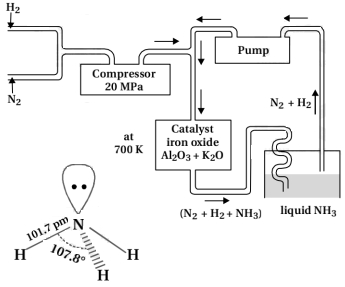
In accordance with Le Chatelier's principle,high pressure would favour the formation of ammonia. The optimum conditions for the production of ammonia are a pressure of $200 \times 10^{5} \ Pa$ ($200$ bar),a temperature of $\sim 700 \ K$ and the use of a catalyst such as iron oxide with small amounts of $K_{2}O$ and $Al_{2}O_{3}$ to increase the rate of attainment of equilibrium; earlier,molybdenum was used as a promoter.
$I$. Physical properties: The ammonia molecule is trigonal pyramidal with the nitrogen atom at the apex. It has three bonding electron pairs and one non-bonding electron pair. Ammonia is a colourless gas with a pungent odour. Its freezing and boiling points are $198.4 \ K$ and $239.7 \ K$ respectively. In the solid and liquid states,it is associated through $H$-bonds as in the case of water,which accounts for its higher melting and boiling points than expected on the basis of its molecular mass.
$II$. Chemical properties: Ammonia is highly soluble in water. Its aqueous solution is weakly basic due to the formation of $OH^{-}$ ions.
$\ddot{N}H_{3(g)} + H_{2}O_{(l)} \rightleftharpoons NH_{4(aq)}^{+} + OH^{-}_{(aq)}$
It forms ammonium salts with acids,e.g.,$NH_{4}Cl, (NH_{4})_{2}SO_{4}$,etc. As a weak base,it precipitates hydroxides (hydrated oxides in the case of some metals) of many metals from their salt solutions.
For example:
$ZnSO_{4(aq)} + 2NH_{4}OH_{(aq)} \rightarrow Zn(OH)_{2(s)} + (NH_{4})_{2}SO_{4(aq)}$ (White ppt)
$FeCl_{3(aq)} + NH_{4}OH_{(aq)} \rightarrow Fe_{2}O_{3} \cdot xH_{2}O_{(s)} + NH_{4}Cl_{(aq)}$ (Brown ppt)
Ammonia acts as a Lewis base due to the presence of a lone pair of electrons on the nitrogen atom. It donates the electron pair and forms linkages with metal ions; the formation of such complex compounds finds application in the detection of metal ions such as $Cu^{2+}, Ag^{+}$,etc.
$Cu^{2+}_{(aq)} + 4NH_{3(aq)} \rightleftharpoons [Cu(NH_{3})_{4}]^{2+}_{(aq)}$ (Blue to deep blue)
$Ag^{+}_{(aq)} + Cl^{-}_{(aq)}$ $\rightarrow AgCl_{(s)}$ $\xrightarrow{2NH_{3(aq)}} [Ag(NH_{3})_{2}]Cl_{(aq)}$
Uses: Liquid ammonia is used as a refrigerant due to its large heat of vapourisation. Ammonia is used to produce various nitrogenous fertilizers (ammonium nitrate,ammonium phosphate,and ammonium sulphate) and in the manufacture of some inorganic nitrogen compounds,the most important one being nitric acid.
$H_{2}N-CO-NH_{2} + 2H_{2}O \rightarrow (NH_{4})_{2}CO_{3} + 2NH_{3} + CO_{2} + H_{2}O$
On a small scale,ammonia is obtained from ammonium salts which decompose when treated with caustic soda or calcium hydroxide.
$2NH_{4}Cl + Ca(OH)_{2} \rightarrow 2NH_{3} + 2H_{2}O + CaCl_{2}$
$(NH_{4})_{2}SO_{4} + 2NaOH \rightarrow 2NH_{3} + 2H_{2}O + Na_{2}SO_{4}$
On a large scale,ammonia is manufactured by Haber's process:
$N_{2(g)} + 3H_{2(g)} \rightleftharpoons 2NH_{3(g)} ; \Delta_{f}H^{\circ} = -46.1 \ kJ \ mol^{-1}$
In accordance with Le Chatelier's principle,high pressure would favour the formation of ammonia. The optimum conditions for the production of ammonia are a pressure of $200 \times 10^{5} \ Pa$ ($200$ bar),a temperature of $\sim 700 \ K$ and the use of a catalyst such as iron oxide with small amounts of $K_{2}O$ and $Al_{2}O_{3}$ to increase the rate of attainment of equilibrium; earlier,molybdenum was used as a promoter.
$I$. Physical properties: The ammonia molecule is trigonal pyramidal with the nitrogen atom at the apex. It has three bonding electron pairs and one non-bonding electron pair. Ammonia is a colourless gas with a pungent odour. Its freezing and boiling points are $198.4 \ K$ and $239.7 \ K$ respectively. In the solid and liquid states,it is associated through $H$-bonds as in the case of water,which accounts for its higher melting and boiling points than expected on the basis of its molecular mass.
$II$. Chemical properties: Ammonia is highly soluble in water. Its aqueous solution is weakly basic due to the formation of $OH^{-}$ ions.
$\ddot{N}H_{3(g)} + H_{2}O_{(l)} \rightleftharpoons NH_{4(aq)}^{+} + OH^{-}_{(aq)}$
It forms ammonium salts with acids,e.g.,$NH_{4}Cl, (NH_{4})_{2}SO_{4}$,etc. As a weak base,it precipitates hydroxides (hydrated oxides in the case of some metals) of many metals from their salt solutions.
For example:
$ZnSO_{4(aq)} + 2NH_{4}OH_{(aq)} \rightarrow Zn(OH)_{2(s)} + (NH_{4})_{2}SO_{4(aq)}$ (White ppt)
$FeCl_{3(aq)} + NH_{4}OH_{(aq)} \rightarrow Fe_{2}O_{3} \cdot xH_{2}O_{(s)} + NH_{4}Cl_{(aq)}$ (Brown ppt)
Ammonia acts as a Lewis base due to the presence of a lone pair of electrons on the nitrogen atom. It donates the electron pair and forms linkages with metal ions; the formation of such complex compounds finds application in the detection of metal ions such as $Cu^{2+}, Ag^{+}$,etc.
$Cu^{2+}_{(aq)} + 4NH_{3(aq)} \rightleftharpoons [Cu(NH_{3})_{4}]^{2+}_{(aq)}$ (Blue to deep blue)
$Ag^{+}_{(aq)} + Cl^{-}_{(aq)}$ $\rightarrow AgCl_{(s)}$ $\xrightarrow{2NH_{3(aq)}} [Ag(NH_{3})_{2}]Cl_{(aq)}$
Uses: Liquid ammonia is used as a refrigerant due to its large heat of vapourisation. Ammonia is used to produce various nitrogenous fertilizers (ammonium nitrate,ammonium phosphate,and ammonium sulphate) and in the manufacture of some inorganic nitrogen compounds,the most important one being nitric acid.
0 likes
View Solution749
EasyMCQ
Which gas is used in the manufacturing of nitrogenous fertilizers?
A
$N_2$
B
$NH_3$
C
$NO_2$
D
$N_2O$
Solution
(B) The primary gas used in the industrial manufacturing of nitrogenous fertilizers (such as urea,ammonium nitrate,and ammonium sulfate) is ammonia $(NH_3)$.
It is produced on a large scale via the Haber process,where nitrogen $(N_2)$ and hydrogen $(H_2)$ react in the presence of an iron catalyst.
It is produced on a large scale via the Haber process,where nitrogen $(N_2)$ and hydrogen $(H_2)$ react in the presence of an iron catalyst.
0 likes
View Solution750
Medium
Describe the preparation,properties,and structures of oxides of nitrogen.
Solution
(N/A) The oxides of nitrogen are summarized in the table below:
| Name and Formula | Oxidation State,Preparation,and Properties |
|---|---|
| Dinitrogen oxide $(N_{2}O)$ | Oxidation state: $+1$. Preparation: $NH_{4}NO_{3} \xrightarrow{Heat} N_{2}O + 2H_{2}O$. Properties: Colourless gas,neutral. |
| Nitrogen monoxide $(NO)$ | Oxidation state: $+2$. Preparation: $2NaNO_{2} + 2FeSO_{4} + 3H_{2}SO_{4} \rightarrow Fe_{2}(SO_{4})_{3} + 2NaHSO_{4} + 2H_{2}O + 2NO$. Properties: Colourless gas,neutral. |
| Dinitrogen trioxide $(N_{2}O_{3})$ | Oxidation state: $+3$. Preparation: $2NO + N_{2}O_{4} \xrightarrow{250 \ K} 2N_{2}O_{3}$. Properties: Blue solid,acidic. |
| Nitrogen dioxide $(NO_{2})$ | Oxidation state: $+4$. Preparation: $2Pb(NO_{3})_{2} \xrightarrow{673 \ K} 4NO_{2} + 2PbO + O_{2}$. Properties: Brown gas,acidic. |
| Dinitrogen tetroxide $(N_{2}O_{4})$ | Oxidation state: $+4$. Preparation: $2NO_{2} \rightleftharpoons N_{2}O_{4}$. Properties: Colourless solid/liquid,acidic. |
| Dinitrogen pentoxide $(N_{2}O_{5})$ | Oxidation state: $+5$. Preparation: $4HNO_{3} + P_{4}O_{10} \rightarrow 4HPO_{3} + 2N_{2}O_{5}$. Properties: Colourless solid,acidic. |
0 likes
View Solutionp-Block Elements (Class 12) — Nitrogen family · Frequently Asked Questions
1Are these p-Block Elements (Class 12) questions useful for JEE and NEET?
Yes. All questions in this section are mapped to JEE Main and NEET exam patterns. Previous year questions from JEE Main, NEET, GUJCET and state-level exams are included with full solutions.
2Can I switch to Hindi or Gujarati for these questions?
Yes. Use the language tabs in the hero section or the sidebar to view the same questions and solutions in English, Hindi or Gujarati.
3How do I generate a question paper from this subtopic?
Use the Vedclass Exam Paper Generator — select the chapter and subtopic, set difficulty, and generate Sets A, B, C, D automatically. First 3 chapters of every subject are free.
Vedclass Products
For Students
Vedclass Test Series
Mock tests in real JEE/NEET style with performance analysis. 5-day free trial.
Start Free TrialFor Teachers
Exam Paper Generator
Generate Set A/B/C/D papers from this chapter in 2 minutes. 3 chapters free.
Try FreeFor Institutes
Online Exam Module
Live online exams with unlimited students, 360° analytics & white-label branding.
See DemoFor Teachers & Institutes
Generate a p-Block Elements (Class 12) Exam Paper in 2 Minutes
Select subtopic & difficulty — Sets A, B, C, D auto-generated with No Repeat logic.
First 3 chapters of every subject are free — no payment required.