
A English
Nitrogen family Questions in English
Class 12 Chemistry · p-Block Elements (Class 12) · Nitrogen family
1110+
Questions
English
Language
100%
With Solutions
Showing 50 of 1110 questions in English
751
Difficult
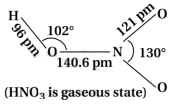
Give the preparation of Nitric acid $(HNO_3)$. Discuss its physical and chemical properties and state its uses.
Solution
(D) **Preparation**:
$1.$ Laboratory Method: Heating $NaNO_3$ or $KNO_3$ with concentrated $H_2SO_4$ in a glass retort.
$NaNO_3 + H_2SO_4 \rightarrow NaHSO_4 + HNO_3$
$2.$ Ostwald's Process:
$(i)$ $4NH_{3(g)} + 5O_{2(g)} \xrightarrow{Pt/Rh, 500 K, 9 bar} 4NO_{(g)} + 6H_2O_{(g)}$
(ii) $2NO_{(g)} + O_{2(g)} \rightleftharpoons 2NO_{2(g)}$
(iii) $3NO_{2(g)} + H_2O_{(l)} \rightarrow 2HNO_{3(aq)} + NO_{(g)}$
**Physical Properties**: It is a colorless liquid with a pungent odor. Freezing point is $231.4 K$ and boiling point is $355.6 K$. Laboratory grade nitric acid contains $68\%$ of $HNO_3$ by mass and has a specific gravity of $1.504$.
**Chemical Properties**:
$1.$ Acidic Nature: In aqueous solution,it behaves as a strong acid.
$HNO_{3(aq)} + H_2O_{(l)} \rightarrow H_3O^{+}_{(aq)} + NO_3^-(aq)$
$2.$ Oxidizing Nature: It is a strong oxidizing agent and attacks most metals except noble metals like $Au$ and $Pt$.
$3Cu + 8HNO_3(dilute) \rightarrow 3Cu(NO_3)_2 + 2NO + 4H_2O$
$Cu + 4HNO_3(concentrated) \rightarrow Cu(NO_3)_2 + 2NO_2 + 2H_2O$
It also oxidizes non-metals:
$I_2 + 10HNO_3 \rightarrow 2HIO_3 + 10NO_2 + 4H_2O$
$C + 4HNO_3 \rightarrow CO_2 + 2H_2O + 4NO_2$
**Uses**:
$1.$ In the manufacture of ammonium nitrate $(NH_4NO_3)$ for fertilizers.
$2.$ In the preparation of explosives like $TNT$ and nitroglycerine.
$3.$ For pickling of stainless steel and etching of metals.
$4.$ As an oxidizer in rocket fuels.
$1.$ Laboratory Method: Heating $NaNO_3$ or $KNO_3$ with concentrated $H_2SO_4$ in a glass retort.
$NaNO_3 + H_2SO_4 \rightarrow NaHSO_4 + HNO_3$
$2.$ Ostwald's Process:
$(i)$ $4NH_{3(g)} + 5O_{2(g)} \xrightarrow{Pt/Rh, 500 K, 9 bar} 4NO_{(g)} + 6H_2O_{(g)}$
(ii) $2NO_{(g)} + O_{2(g)} \rightleftharpoons 2NO_{2(g)}$
(iii) $3NO_{2(g)} + H_2O_{(l)} \rightarrow 2HNO_{3(aq)} + NO_{(g)}$
**Physical Properties**: It is a colorless liquid with a pungent odor. Freezing point is $231.4 K$ and boiling point is $355.6 K$. Laboratory grade nitric acid contains $68\%$ of $HNO_3$ by mass and has a specific gravity of $1.504$.
**Chemical Properties**:
$1.$ Acidic Nature: In aqueous solution,it behaves as a strong acid.
$HNO_{3(aq)} + H_2O_{(l)} \rightarrow H_3O^{+}_{(aq)} + NO_3^-(aq)$
$2.$ Oxidizing Nature: It is a strong oxidizing agent and attacks most metals except noble metals like $Au$ and $Pt$.
$3Cu + 8HNO_3(dilute) \rightarrow 3Cu(NO_3)_2 + 2NO + 4H_2O$
$Cu + 4HNO_3(concentrated) \rightarrow Cu(NO_3)_2 + 2NO_2 + 2H_2O$
It also oxidizes non-metals:
$I_2 + 10HNO_3 \rightarrow 2HIO_3 + 10NO_2 + 4H_2O$
$C + 4HNO_3 \rightarrow CO_2 + 2H_2O + 4NO_2$
**Uses**:
$1.$ In the manufacture of ammonium nitrate $(NH_4NO_3)$ for fertilizers.
$2.$ In the preparation of explosives like $TNT$ and nitroglycerine.
$3.$ For pickling of stainless steel and etching of metals.
$4.$ As an oxidizer in rocket fuels.
0 likes
View Solution752
EasyMCQ
What is the maximum concentration of aqueous $HNO_3$ that can be obtained by distillation with concentrated $H_2SO_4$ in terms of percentage by mass (in $\%$)?
A
$68$
B
$98$
C
$85$
D
$50$
Solution
(A) Concentrated nitric acid is typically obtained by the distillation of a mixture of $NaNO_3$ or $KNO_3$ and concentrated $H_2SO_4$.
However,the maximum concentration of aqueous $HNO_3$ that can be achieved by distillation is approximately $68 \%$ by mass.
Further concentration to $98 \%$ can be achieved by dehydration with concentrated $H_2SO_4$.
However,the maximum concentration of aqueous $HNO_3$ that can be achieved by distillation is approximately $68 \%$ by mass.
Further concentration to $98 \%$ can be achieved by dehydration with concentrated $H_2SO_4$.
0 likes
View Solution753
MediumMCQ
State the melting point,boiling point,and specific gravity of $HNO_3$.
A
$231.4 \ K, 355.6 \ K, 1.504 \ g/cm^3$
B
$245.2 \ K, 360.5 \ K, 1.450 \ g/cm^3$
C
$235.4 \ K, 359.1 \ K, 1.513 \ g/cm^3$
D
$250.1 \ K, 373.2 \ K, 1.600 \ g/cm^3$
Solution
(A) The physical properties of pure nitric acid $(HNO_3)$ are as follows:
Melting point: $231.4 \ K$
Boiling point: $355.6 \ K$
Specific gravity: $1.504 \ g/cm^3$
Therefore,the correct option is $A$.
Melting point: $231.4 \ K$
Boiling point: $355.6 \ K$
Specific gravity: $1.504 \ g/cm^3$
Therefore,the correct option is $A$.
0 likes
View Solution754
Advanced
Provide information about the allotropes of phosphorus.
Solution
(N/A) Phosphorus is found in many allotropic forms,among which white,red,and black phosphorus are important.
$(a)$ White Phosphorus: It is obtained by industrial synthesis.
It is a translucent white waxy solid.
It is poisonous,insoluble in water but soluble in carbon disulfide,and glows in the dark (chemiluminescence).
It dissolves in boiling $NaOH$ solution in an inert atmosphere to give $PH_3$.
$P_4 + 3NaOH + 3H_2O \rightarrow PH_3 + 3NaH_2PO_2$
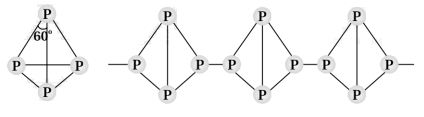
It consists of discrete tetrahedral $P_4$ molecules as shown in the figure.
$(b)$ Red Phosphorus: It is obtained by heating white phosphorus at $573 \ K$ in an inert atmosphere for several days.
Red phosphorus has an iron-grey lustre.
It is odourless,non-poisonous,and insoluble in water as well as in carbon disulfide.
It is much less reactive than white phosphorus and does not glow in the dark. It is polymeric.
As shown in the figure,it consists of chains of $P_4$ tetrahedral units linked together.
$(a)$ White Phosphorus: It is obtained by industrial synthesis.
It is a translucent white waxy solid.
It is poisonous,insoluble in water but soluble in carbon disulfide,and glows in the dark (chemiluminescence).
It dissolves in boiling $NaOH$ solution in an inert atmosphere to give $PH_3$.
$P_4 + 3NaOH + 3H_2O \rightarrow PH_3 + 3NaH_2PO_2$
It consists of discrete tetrahedral $P_4$ molecules as shown in the figure.
$(b)$ Red Phosphorus: It is obtained by heating white phosphorus at $573 \ K$ in an inert atmosphere for several days.
Red phosphorus has an iron-grey lustre.
It is odourless,non-poisonous,and insoluble in water as well as in carbon disulfide.
It is much less reactive than white phosphorus and does not glow in the dark. It is polymeric.
As shown in the figure,it consists of chains of $P_4$ tetrahedral units linked together.
0 likes
View Solution755
EasyMCQ
At what temperature is white phosphorus heated to obtain red phosphorus (in $K$)?
A
$573$
B
$473$
C
$373$
D
$673$
Solution
(A) White phosphorus is converted into red phosphorus by heating it in an inert atmosphere at $573 \ K$ for several days.
0 likes
View Solution756
EasyMCQ
What is the appearance of red phosphorus?
A
White waxy solid
B
Iron grey lustrous solid
C
Black solid
D
Yellow solid
Solution
(B) Red phosphorus is an iron grey lustrous solid. It is polymeric in nature and consists of chains of $P_4$ tetrahedra linked together.
0 likes
View Solution757
EasyMCQ
How many allotropic forms of black phosphorus exist?
A
$1$
B
$2$
C
$3$
D
$4$
Solution
(B) Black phosphorus has $2$ allotropic forms:
$1$. $\alpha$-black phosphorus: Formed when red phosphorus is heated in a sealed tube at $803 \ K$.
$2$. $\beta$-black phosphorus: Formed when white phosphorus is heated at $473 \ K$ under high pressure.
$1$. $\alpha$-black phosphorus: Formed when red phosphorus is heated in a sealed tube at $803 \ K$.
$2$. $\beta$-black phosphorus: Formed when white phosphorus is heated at $473 \ K$ under high pressure.
0 likes
View Solution758
EasyMCQ
At what temperature is red phosphorus heated to obtain $\alpha$-black phosphorus (in $K$)?
A
$803$
B
$473$
C
$573$
D
$673$
Solution
(A) When red phosphorus is heated in a sealed tube at $803 \ K$,it transforms into $\alpha$-black phosphorus.
0 likes
View Solution759
EasyMCQ
At what temperature is white phosphorus heated to form $\beta$-black phosphorus (in $K$)?
A
$473$
B
$573$
C
$673$
D
$873$
Solution
(A) White phosphorus is heated under high pressure at $473 \ K$ to form $\beta$-black phosphorus.
This process involves the transformation of the tetrahedral $P_4$ units into a layered structure.
This process involves the transformation of the tetrahedral $P_4$ units into a layered structure.
0 likes
View Solution760
Advanced
Give the preparation of phosphine $(PH_{3})$. State the physical and chemical properties of phosphine $(PH_{3})$. State the uses of phosphine.
Solution
(N/A) Preparation: Phosphine is prepared by the reaction of calcium phosphide with water or dilute $HCl$.
$Ca_{3}P_{2} + 6H_{2}O \rightarrow 3Ca(OH)_{2} + 2PH_{3}$
$Ca_{3}P_{2} + 6HCl \rightarrow 3CaCl_{2} + 2PH_{3}$
In the laboratory,it is prepared by heating white phosphorus with concentrated $NaOH$ solution in an inert atmosphere of $CO_{2}$.
$P_{4} + 3NaOH + 3H_{2}O \rightarrow PH_{3} + 3NaH_{2}PO_{2}$ (Sodium hypophosphite)
To obtain pure $PH_{3}$,it is absorbed in $HI$ to form phosphonium iodide $(PH_{4}I)$,which on treatment with $KOH$ releases pure phosphine: $PH_{4}I + KOH \rightarrow KI + H_{2}O + PH_{3}$.
Physical Properties: $PH_{3}$ is a colourless gas with a rotten fish smell and is highly poisonous. It is sparingly soluble in water.
Chemical Properties: Phosphine explodes in contact with traces of oxidizing agents like $HNO_{3}$,$Cl_{2}$,and $Br_{2}$ vapours. It is weakly basic and forms phosphonium compounds with acids,e.g.,$PH_{3} + HBr \rightarrow PH_{4}Br$ (Phosphonium bromide). It reacts with metal salts to form phosphides: $3CuSO_{4} + 2PH_{3} \rightarrow Cu_{3}P_{2} + 3H_{2}SO_{4}$ and $3HgCl_{2} + 2PH_{3} \rightarrow Hg_{3}P_{2} + 6HCl$.
Uses: Phosphine is used in Holme's signals. Containers containing calcium carbide $(CaC_{2})$ and calcium phosphide $(Ca_{3}P_{2})$ are pierced and thrown into the sea; the evolved gases ($C_{2}H_{2}$ and $PH_{3}$) burn and serve as a signal. It is also used in the preparation of smoke screens.
$Ca_{3}P_{2} + 6H_{2}O \rightarrow 3Ca(OH)_{2} + 2PH_{3}$
$Ca_{3}P_{2} + 6HCl \rightarrow 3CaCl_{2} + 2PH_{3}$
In the laboratory,it is prepared by heating white phosphorus with concentrated $NaOH$ solution in an inert atmosphere of $CO_{2}$.
$P_{4} + 3NaOH + 3H_{2}O \rightarrow PH_{3} + 3NaH_{2}PO_{2}$ (Sodium hypophosphite)
To obtain pure $PH_{3}$,it is absorbed in $HI$ to form phosphonium iodide $(PH_{4}I)$,which on treatment with $KOH$ releases pure phosphine: $PH_{4}I + KOH \rightarrow KI + H_{2}O + PH_{3}$.
Physical Properties: $PH_{3}$ is a colourless gas with a rotten fish smell and is highly poisonous. It is sparingly soluble in water.
Chemical Properties: Phosphine explodes in contact with traces of oxidizing agents like $HNO_{3}$,$Cl_{2}$,and $Br_{2}$ vapours. It is weakly basic and forms phosphonium compounds with acids,e.g.,$PH_{3} + HBr \rightarrow PH_{4}Br$ (Phosphonium bromide). It reacts with metal salts to form phosphides: $3CuSO_{4} + 2PH_{3} \rightarrow Cu_{3}P_{2} + 3H_{2}SO_{4}$ and $3HgCl_{2} + 2PH_{3} \rightarrow Hg_{3}P_{2} + 6HCl$.
Uses: Phosphine is used in Holme's signals. Containers containing calcium carbide $(CaC_{2})$ and calcium phosphide $(Ca_{3}P_{2})$ are pierced and thrown into the sea; the evolved gases ($C_{2}H_{2}$ and $PH_{3}$) burn and serve as a signal. It is also used in the preparation of smoke screens.
0 likes
View Solution761
EasyMCQ
Name the gas that has a smell like rotten fish.
A
Phosphine $(PH_3)$
B
Ammonia $(NH_3)$
C
Nitrogen dioxide $(NO_2)$
D
Hydrogen sulfide $(H_2S)$
Solution
(A) Phosphine $(PH_3)$ is a colorless,highly toxic gas that possesses a characteristic odor of rotten fish. It is prepared by the reaction of white phosphorus with concentrated sodium hydroxide solution in an inert atmosphere of $CO_2$.
0 likes
View Solution762
EasyMCQ
What is the solubility of phosphine $(PH_3)$ in water?
A
Highly soluble
B
Slightly soluble
C
Insoluble
D
Completely miscible
Solution
(B) Phosphine $(PH_3)$ is only slightly soluble in water. It is a non-polar covalent molecule,which explains its low solubility in a polar solvent like water.
0 likes
View Solution763
EasyMCQ
What compounds are formed when phosphine $(PH_3)$ is absorbed in a solution of mercuric chloride $(HgCl_2)$?
A
Mercury phosphide $(Hg_3P_2)$
B
Mercury$(II)$ chloride-phosphine complex $(HgCl_2 \cdot 2PH_3)$
C
Mercury$(II)$ phosphide-chloride $(Hg_3P_2 \cdot 3HgCl_2)$
D
Phosphorus trichloride $(PCl_3)$
Solution
(C) When phosphine $(PH_3)$ gas is passed through a solution of mercuric chloride $(HgCl_2)$,it forms a complex compound known as mercury$(II)$ phosphide-chloride,which has the formula $3HgCl_2 \cdot 2PH_3$ (or $Hg_3P_2 \cdot 3HgCl_2$).
The chemical reaction is:
$3HgCl_2 + 2PH_3 \rightarrow Hg_3P_2 \cdot 3HgCl_2 + 6HCl$
The chemical reaction is:
$3HgCl_2 + 2PH_3 \rightarrow Hg_3P_2 \cdot 3HgCl_2 + 6HCl$
0 likes
View Solution764
EasyMCQ
What does phosphine $(PH_3)$ form when it reacts with acids?
A
Phosphonium salts
B
Phosphorous acid
C
Phosphoric acid
D
Phosphorus pentachloride
Solution
(A) Phosphine $(PH_3)$ acts as a weak base due to the presence of a lone pair of electrons on the phosphorus atom.
When it reacts with strong acids (like $HX$,where $X = Cl, Br, I$),it undergoes protonation to form phosphonium salts.
The reaction is: $PH_3 + HX \rightarrow PH_4X$ (where $PH_4X$ is a phosphonium salt).
When it reacts with strong acids (like $HX$,where $X = Cl, Br, I$),it undergoes protonation to form phosphonium salts.
The reaction is: $PH_3 + HX \rightarrow PH_4X$ (where $PH_4X$ is a phosphonium salt).
0 likes
View Solution765
Medium
Explain the molecular structure and properties of phosphorus trichloride $(PCl_{3})$.
Solution
(N/A) Molecular Structure of $PCl_{3}$:
$PCl_{3}$ has a trigonal pyramidal shape,similar to ammonia $(NH_{3})$.
The phosphorus atom is $sp^{3}$ hybridized and contains one lone pair of electrons.
Properties of $PCl_{3}$:
$1$. It is a colourless,oily liquid.
$2$. It undergoes hydrolysis in the presence of moisture:
$PCl_{3} + 3H_{2}O \rightarrow H_{3}PO_{3} + 3HCl$
$3$. It reacts with organic compounds containing the hydroxyl $(-OH)$ group,such as carboxylic acids and alcohols:
$3CH_{3}COOH + PCl_{3} \rightarrow 3CH_{3}COCl + H_{3}PO_{3}$
$3C_{2}H_{5}OH + PCl_{3} \rightarrow 3C_{2}H_{5}Cl + H_{3}PO_{3}$
$PCl_{3}$ has a trigonal pyramidal shape,similar to ammonia $(NH_{3})$.
The phosphorus atom is $sp^{3}$ hybridized and contains one lone pair of electrons.
Properties of $PCl_{3}$:
$1$. It is a colourless,oily liquid.
$2$. It undergoes hydrolysis in the presence of moisture:
$PCl_{3} + 3H_{2}O \rightarrow H_{3}PO_{3} + 3HCl$
$3$. It reacts with organic compounds containing the hydroxyl $(-OH)$ group,such as carboxylic acids and alcohols:
$3CH_{3}COOH + PCl_{3} \rightarrow 3CH_{3}COCl + H_{3}PO_{3}$
$3C_{2}H_{5}OH + PCl_{3} \rightarrow 3C_{2}H_{5}Cl + H_{3}PO_{3}$
0 likes
View Solution766
Medium
Explain the molecular structure and properties of phosphorus pentachloride $(PCl_5)$.
Solution
(N/A) Structure: Phosphorus pentachloride $(PCl_5)$ has a trigonal bipyramidal geometry in gaseous and liquid phases. The phosphorus atom undergoes $sp^3d$ hybridization.
In $PCl_5$,the three equatorial $P-Cl$ bonds are equivalent,while the two axial $P-Cl$ bonds are longer than the equatorial bonds. This is because the axial bond pairs experience greater repulsion from the equatorial bond pairs compared to the repulsion between equatorial bond pairs themselves.
Properties of $PCl_5$:
$1$. $PCl_5$ is a yellowish-white powder. In moist air,it hydrolyzes to give phosphorus oxychloride $(POCl_3)$ and finally phosphoric acid $(H_3PO_4)$:
$PCl_5 + H_2O \rightarrow POCl_3 + 2HCl$
$POCl_3 + 3H_2O \rightarrow H_3PO_4 + 3HCl$
$2$. When heated,it sublimes,but on strong heating,it decomposes:
$PCl_5 \xrightarrow{\Delta} PCl_3 + Cl_2$
$3$. It reacts with organic compounds containing the $-OH$ group,converting them into chloro derivatives:
$C_2H_5OH + PCl_5 \rightarrow C_2H_5Cl + POCl_3 + HCl$
$CH_3COOH + PCl_5 \rightarrow CH_3COCl + POCl_3 + HCl$
$4$. Finely divided metals,upon heating with $PCl_5$,yield their corresponding chlorides:
$2Ag + PCl_5 \rightarrow 2AgCl + PCl_3$
$Sn + 2PCl_5 \rightarrow SnCl_4 + 2PCl_3$
In $PCl_5$,the three equatorial $P-Cl$ bonds are equivalent,while the two axial $P-Cl$ bonds are longer than the equatorial bonds. This is because the axial bond pairs experience greater repulsion from the equatorial bond pairs compared to the repulsion between equatorial bond pairs themselves.
Properties of $PCl_5$:
$1$. $PCl_5$ is a yellowish-white powder. In moist air,it hydrolyzes to give phosphorus oxychloride $(POCl_3)$ and finally phosphoric acid $(H_3PO_4)$:
$PCl_5 + H_2O \rightarrow POCl_3 + 2HCl$
$POCl_3 + 3H_2O \rightarrow H_3PO_4 + 3HCl$
$2$. When heated,it sublimes,but on strong heating,it decomposes:
$PCl_5 \xrightarrow{\Delta} PCl_3 + Cl_2$
$3$. It reacts with organic compounds containing the $-OH$ group,converting them into chloro derivatives:
$C_2H_5OH + PCl_5 \rightarrow C_2H_5Cl + POCl_3 + HCl$
$CH_3COOH + PCl_5 \rightarrow CH_3COCl + POCl_3 + HCl$
$4$. Finely divided metals,upon heating with $PCl_5$,yield their corresponding chlorides:
$2Ag + PCl_5 \rightarrow 2AgCl + PCl_3$
$Sn + 2PCl_5 \rightarrow SnCl_4 + 2PCl_3$
0 likes
View Solution767
EasyMCQ
What is the product formed when white phosphorus reacts with thionyl chloride $(SOCl_2)$?
A
$PCl_3, SO_2, S_2Cl_2$
B
$PCl_5, SO_2, S_2Cl_2$
C
$PCl_3, SO_2, Cl_2$
D
$PCl_5, SO_2, Cl_2$
Solution
(A) The reaction of white phosphorus $(P_4)$ with thionyl chloride $(SOCl_2)$ is a standard method for the preparation of phosphorus trichloride $(PCl_3)$.
The balanced chemical equation is:
$P_4 + 8SOCl_2 \rightarrow 4PCl_3 + 4SO_2 + 2S_2Cl_2$
Thus,the products formed are phosphorus trichloride $(PCl_3)$,sulfur dioxide $(SO_2)$,and disulfur dichloride $(S_2Cl_2)$.
The balanced chemical equation is:
$P_4 + 8SOCl_2 \rightarrow 4PCl_3 + 4SO_2 + 2S_2Cl_2$
Thus,the products formed are phosphorus trichloride $(PCl_3)$,sulfur dioxide $(SO_2)$,and disulfur dichloride $(S_2Cl_2)$.
0 likes
View Solution768
EasyMCQ
What is the color of $PCl_5$?
A
Yellowish-white
B
Greenish-yellow
C
Colorless
D
Red
Solution
(A) $PCl_5$ (Phosphorus pentachloride) is a yellowish-white crystalline solid at room temperature.
0 likes
View Solution769
Difficult
Draw the structures of different oxoacids of phosphorus and indicate the oxidation state of phosphorus,characteristic bonds,and their numbers in each.
Solution
(N/A) The structures,oxidation states,and characteristic bonds of various phosphorus oxoacids are summarized in the table below:
| Name and Structure | Oxidation State | Characteristic Bonds and their Numbers |
|---|---|---|
| Hypophosphorous acid $(H_3PO_2)$ | $+1$ | One $P-OH$,two $P-H$,one $P=O$ |
| Orthophosphorous (Phosphonic) acid $(H_3PO_3)$ | $+3$ | Two $P-OH$,one $P-H$,one $P=O$ |
| Orthophosphoric acid $(H_3PO_4)$ | $+5$ | Three $P-OH$,one $P=O$ |
| Pyrophosphoric acid $(H_4P_2O_7)$ | $+5$ | Four $P-OH$,two $P=O$,one $P-O-P$ |
0 likes
View Solution770
DifficultMCQ
Determine whether the following statements are True $(T)$ or False $(F)$:
$1.$ Ammonia is produced from a mixture of $SO_2$ and $N_2$.
$2.$ $N_2H_2$ and $N_2H_4$ are formed from a mixture of $N_2/H_2$ in the Haber process.
$3.$ Compounds of $d$ or $f$ block elements are not used as catalysts in the Haber process.
$1.$ Ammonia is produced from a mixture of $SO_2$ and $N_2$.
$2.$ $N_2H_2$ and $N_2H_4$ are formed from a mixture of $N_2/H_2$ in the Haber process.
$3.$ Compounds of $d$ or $f$ block elements are not used as catalysts in the Haber process.
A
$1-T, 2-T, 3-T$
B
$1-F, 2-F, 3-F$
C
$1-T, 2-F, 3-T$
D
$1-F, 2-T, 3-F$
Solution
(B) $1.$ False: Ammonia $(NH_3)$ is produced from a mixture of $N_2$ and $H_2$,not $SO_2$ and $N_2$.
$2.$ False: The Haber process produces ammonia $(NH_3)$ from $N_2$ and $H_2$,not $N_2H_2$ or $N_2H_4$.
$3.$ False: The Haber process uses iron $(Fe)$,which is a $d$-block element,as a catalyst (often promoted by $K_2O$ and $Al_2O_3$).
Therefore,all statements are False $(F, F, F)$.
$2.$ False: The Haber process produces ammonia $(NH_3)$ from $N_2$ and $H_2$,not $N_2H_2$ or $N_2H_4$.
$3.$ False: The Haber process uses iron $(Fe)$,which is a $d$-block element,as a catalyst (often promoted by $K_2O$ and $Al_2O_3$).
Therefore,all statements are False $(F, F, F)$.
0 likes
View Solution771
MediumMCQ
When a brown compound of manganese $(A)$ is treated with $HCl$,it gives a gas $(B)$. The gas taken in excess,reacts with $NH_3$ to give an explosive compound $(C)$. Identify compounds $A$,$B$,and $C$.
A
$A = MnO_2, B = Cl_2, C = NCl_3$
B
$A = Mn_3O_4, B = Cl_2, C = NH_4Cl$
C
$A = MnO_2, B = O_2, C = NCl_3$
D
$A = MnO_2, B = Cl_2, C = NH_4Cl$
Solution
(A) The brown compound of manganese is manganese dioxide $(MnO_2)$.
When $MnO_2$ reacts with concentrated $HCl$,it produces chlorine gas $(Cl_2)$: $MnO_2 + 4HCl \rightarrow MnCl_2 + 2H_2O + Cl_2$.
Thus,$A = MnO_2$ and $B = Cl_2$.
When excess chlorine gas reacts with ammonia $(NH_3)$,it forms nitrogen trichloride $(NCl_3)$,which is an explosive compound: $NH_3 + 3Cl_2 \rightarrow NCl_3 + 3HCl$.
Thus,$C = NCl_3$.
When $MnO_2$ reacts with concentrated $HCl$,it produces chlorine gas $(Cl_2)$: $MnO_2 + 4HCl \rightarrow MnCl_2 + 2H_2O + Cl_2$.
Thus,$A = MnO_2$ and $B = Cl_2$.
When excess chlorine gas reacts with ammonia $(NH_3)$,it forms nitrogen trichloride $(NCl_3)$,which is an explosive compound: $NH_3 + 3Cl_2 \rightarrow NCl_3 + 3HCl$.
Thus,$C = NCl_3$.
0 likes
View Solution772
EasyMCQ
$HCl$ reacts with $NH_3$ to produce white fumes of which compound?
A
$NH_4Cl$
B
$NH_4OH$
C
$N_2$
D
$Cl_2$
Solution
(A) The reaction between ammonia $(NH_3)$ and hydrogen chloride $(HCl)$ gas is as follows:
$NH_3(g) + HCl(g) \rightarrow NH_4Cl(s)$
$NH_4Cl$ (ammonium chloride) is formed as a solid,which appears as white fumes.
$NH_3(g) + HCl(g) \rightarrow NH_4Cl(s)$
$NH_4Cl$ (ammonium chloride) is formed as a solid,which appears as white fumes.
0 likes
View Solution773
Medium
Write a balanced chemical equation for the reaction showing catalytic oxidation of $NH_3$ by atmospheric oxygen.
Solution
(N/A) The catalytic oxidation of ammonia $(NH_3)$ by atmospheric oxygen in the presence of a platinum-rhodium catalyst at $500 \ K$ and $9 \ bar$ pressure is given by the following balanced equation:
$4 NH_3(g) + 5 O_2(g) \xrightarrow{Pt/Rh, 500 \ K, 9 \ bar} 4 NO(g) + 6 H_2O(g)$
$4 NH_3(g) + 5 O_2(g) \xrightarrow{Pt/Rh, 500 \ K, 9 \ bar} 4 NO(g) + 6 H_2O(g)$
0 likes
View Solution774
Medium
Write the structure of pyrophosphoric acid.
Solution
(N/A) The chemical formula of pyrophosphoric acid is $H_4P_2O_7$.
Its structure consists of two $PO_4$ tetrahedral units linked by an oxygen atom ($P-O-P$ linkage).
Each phosphorus atom is bonded to one terminal oxygen atom via a double bond $(P=O)$ and two hydroxyl groups $(-OH)$.
The structure is as follows:
$HO-P(=O)(OH)-O-P(=O)(OH)-OH$
Its structure consists of two $PO_4$ tetrahedral units linked by an oxygen atom ($P-O-P$ linkage).
Each phosphorus atom is bonded to one terminal oxygen atom via a double bond $(P=O)$ and two hydroxyl groups $(-OH)$.
The structure is as follows:
$HO-P(=O)(OH)-O-P(=O)(OH)-OH$
0 likes
View Solution775
Medium
$PH_3$ forms bubbles when passed slowly in water but $NH_3$ dissolves. Explain why?
Solution
(N/A) $NH_3$ is capable of forming hydrogen bonds with water molecules due to the high electronegativity and small size of the nitrogen atom,which makes it highly soluble in water.
In contrast,$PH_3$ (phosphine) has a much lower electronegativity and larger atomic size,preventing it from forming hydrogen bonds with water molecules.
Consequently,$PH_3$ is only sparingly soluble in water and escapes as bubbles.
In contrast,$PH_3$ (phosphine) has a much lower electronegativity and larger atomic size,preventing it from forming hydrogen bonds with water molecules.
Consequently,$PH_3$ is only sparingly soluble in water and escapes as bubbles.
0 likes
View Solution776
Medium
Why is nitric oxide $(NO)$ paramagnetic in the gaseous state,but the solid obtained on cooling it is diamagnetic?
Solution
(N/A) Nitric oxide $(NO)$ is an odd-electron molecule with a single unpaired electron on the nitrogen atom,represented as $: \dot{N}=\ddot{O}$.
Due to this unpaired electron,$NO$ is paramagnetic in the gaseous state.
In the solid state,however,$NO$ molecules undergo dimerization to form $N_2O_2$,where the unpaired electrons pair up,making the solid diamagnetic.
Due to this unpaired electron,$NO$ is paramagnetic in the gaseous state.
In the solid state,however,$NO$ molecules undergo dimerization to form $N_2O_2$,where the unpaired electrons pair up,making the solid diamagnetic.
0 likes
View Solution777
Medium
On reaction with $Cl_2$,phosphorus forms two types of halides $A$ and $B$. Halide $A$ is a yellowish-white powder,while halide $B$ is a colourless oily liquid. Identify $A$ and $B$ and write the formulas of their hydrolysis products.
Solution
(A) is $PCl_5$ and $B$ is $PCl_3$.
$B (PCl_3)$ undergoes hydrolysis to form phosphorous acid $(H_3PO_3)$ and hydrogen chloride $(HCl)$:
$PCl_3 + 3 H_2O \rightarrow H_3PO_3 + 3 HCl$
$A (PCl_5)$ undergoes hydrolysis to form phosphoric acid $(H_3PO_4)$ and hydrogen chloride $(HCl)$:
$PCl_5 + 4 H_2O \rightarrow H_3PO_4 + 5 HCl$
$B (PCl_3)$ undergoes hydrolysis to form phosphorous acid $(H_3PO_3)$ and hydrogen chloride $(HCl)$:
$PCl_3 + 3 H_2O \rightarrow H_3PO_3 + 3 HCl$
$A (PCl_5)$ undergoes hydrolysis to form phosphoric acid $(H_3PO_4)$ and hydrogen chloride $(HCl)$:
$PCl_5 + 4 H_2O \rightarrow H_3PO_4 + 5 HCl$
0 likes
View Solution778
Medium
In the ring test of $NO_{3}^{-}$ ion,$Fe^{2+}$ ion reduces nitrate ion to nitric oxide,which combines with $Fe^{2+}_{(aq)}$ ion to form a brown complex. Write the reactions involved in the formation of the brown ring.
Solution
$NO_{3}^{-} + 3 Fe^{2+} + 4 H^{+} \rightarrow NO + 3 Fe^{3+} + 2 H_{2}O$
$[Fe(H_{2}O)_{6}]^{2+} + NO \rightarrow [Fe(H_{2}O)_{5}(NO)]^{2+} + H_{2}O$
The brown complex formed is $[Fe(H_{2}O)_{5}(NO)]SO_{4}$ (or similar salt depending on the counter ion),which is responsible for the brown ring.
$[Fe(H_{2}O)_{6}]^{2+} + NO \rightarrow [Fe(H_{2}O)_{5}(NO)]^{2+} + H_{2}O$
The brown complex formed is $[Fe(H_{2}O)_{5}(NO)]SO_{4}$ (or similar salt depending on the counter ion),which is responsible for the brown ring.
0 likes
View Solution779
Medium
Name three oxoacids of nitrogen. Write the disproportionation reaction of that oxoacid of nitrogen in which nitrogen is in $(+3)$ oxidation state.
Solution
(N/A) Three oxoacids of nitrogen are:
$(i)$ Nitrous acid - $HNO_2$
$(ii)$ Nitric acid - $HNO_3$
$(iii)$ Hyponitrous acid - $H_2N_2O_2$
The oxoacid of nitrogen in which nitrogen is in $(+3)$ oxidation state is nitrous acid $(HNO_2)$.
The disproportionation reaction is:
$3HNO_2 \rightarrow HNO_3 + H_2O + 2NO$
In this reaction,the oxidation state of nitrogen changes from $(+3)$ to $(+5)$ in $HNO_3$ and $(+2)$ in $NO$.
$(i)$ Nitrous acid - $HNO_2$
$(ii)$ Nitric acid - $HNO_3$
$(iii)$ Hyponitrous acid - $H_2N_2O_2$
The oxoacid of nitrogen in which nitrogen is in $(+3)$ oxidation state is nitrous acid $(HNO_2)$.
The disproportionation reaction is:
$3HNO_2 \rightarrow HNO_3 + H_2O + 2NO$
In this reaction,the oxidation state of nitrogen changes from $(+3)$ to $(+5)$ in $HNO_3$ and $(+2)$ in $NO$.
0 likes
View Solution780
Medium
Nitric acid forms an oxide of nitrogen on reaction with $P_{4}O_{10}$. Write the reaction involved. Also,write the resonating structures of the oxide of nitrogen formed.
Solution
(N/A) The reaction between nitric acid $(HNO_{3})$ and phosphorus pentoxide $(P_{4}O_{10})$ is as follows:
$4 HNO_{3} + P_{4}O_{10} \rightarrow 2 N_{2}O_{5} + 4 HPO_{3}$
The oxide of nitrogen formed is dinitrogen pentoxide $(N_{2}O_{5})$. Its resonating structures are:
$[:O-N(=O)-O-N(=O)=O] \leftrightarrow [O=N(=O)-O-N(=O)-O:]$
$4 HNO_{3} + P_{4}O_{10} \rightarrow 2 N_{2}O_{5} + 4 HPO_{3}$
The oxide of nitrogen formed is dinitrogen pentoxide $(N_{2}O_{5})$. Its resonating structures are:
$[:O-N(=O)-O-N(=O)=O] \leftrightarrow [O=N(=O)-O-N(=O)-O:]$
0 likes
View Solution781
Medium
Phosphorus has three allotropic forms:
$(i)$ white phosphorus
$(ii)$ red phosphorus and
$(iii)$ black phosphorus.
Write the difference between white and red phosphorus on the basis of their structure and reactivity.
$(i)$ white phosphorus
$(ii)$ red phosphorus and
$(iii)$ black phosphorus.
Write the difference between white and red phosphorus on the basis of their structure and reactivity.
Solution
(N/A)
| Property | White Phosphorus | Red Phosphorus |
|---|---|---|
| Structure | Exists as discrete $P_4$ molecules where $P$ atoms lie at the corners of a tetrahedron with $60^{\circ}$ bond angles. | Exists as a polymeric chain structure formed by breaking one $P-P$ bond in the $P_4$ tetrahedron. |
| Reactivity | Highly reactive due to high angular strain in the $P_4$ molecule. | Less reactive because the polymeric structure reduces the angular strain. |
0 likes
View Solution782
Medium
Give an example to show the effect of concentration of nitric acid on the formation of oxidation products.
Solution
(N/A) The products of oxidation depend on the concentration of nitric acid,the nature of the metal,and the temperature of the reaction.
For dilute nitric acid:
$3 Cu + 8 HNO_3 (\text{dilute}) \rightarrow 3 Cu(NO_3)_2 + 2 NO + 4 H_2O$
For concentrated nitric acid:
$Cu + 4 HNO_3 (\text{conc.}) \rightarrow Cu(NO_3)_2 + 2 NO_2 + 2 H_2O$
For dilute nitric acid:
$3 Cu + 8 HNO_3 (\text{dilute}) \rightarrow 3 Cu(NO_3)_2 + 2 NO + 4 H_2O$
For concentrated nitric acid:
$Cu + 4 HNO_3 (\text{conc.}) \rightarrow Cu(NO_3)_2 + 2 NO_2 + 2 H_2O$
0 likes
View Solution783
Medium
Phosphorus forms a number of oxoacids. Out of these oxoacids,phosphinic acid $(H_3PO_2)$ has strong reducing properties. Write its structure and also write a reaction showing its reducing behavior.
Solution
(N/A) The structure of phosphinic acid $(H_3PO_2)$ is as follows:
$P$ is bonded to one $O$ atom via a double bond,one $-OH$ group,and two $H$ atoms.
Structure:
$H-P(=O)(H)-OH$
Phosphinic acid acts as a good reducing agent because of the presence of two $P-H$ bonds.
Reaction showing its reducing behavior:
$4AgNO_3 + 2H_2O + H_3PO_2 \rightarrow 4Ag + 4HNO_3 + H_3PO_4$
$P$ is bonded to one $O$ atom via a double bond,one $-OH$ group,and two $H$ atoms.
Structure:
$H-P(=O)(H)-OH$
Phosphinic acid acts as a good reducing agent because of the presence of two $P-H$ bonds.
Reaction showing its reducing behavior:
$4AgNO_3 + 2H_2O + H_3PO_2 \rightarrow 4Ag + 4HNO_3 + H_3PO_4$
0 likes
View Solution784
Difficult
On heating lead $(II)$ nitrate gives a brown gas $'A'$. The gas $'A'$ on cooling changes to a colourless solid $'B'$. Solid $'B'$ on heating with $NO$ changes to a blue solid $'C'$. Identify $'A'$,$'B'$ and $'C'$,write the reactions involved,and draw the structures of $'B'$ and $'C'$.
Solution
(N/A) $2 \ Pb(NO_3)_2 \xrightarrow{\Delta, 673 \ K} 2 \ PbO + 4 \ NO_2 + O_2$
Gas $'A'$ is $NO_2$ (Brown gas).
Upon cooling,$2 \ NO_2 \rightleftharpoons N_2O_4$. Thus,solid $'B'$ is $N_2O_4$.
$N_2O_4 + NO \xrightarrow{250 \ K} N_2O_3$
Solid $'C'$ is $N_2O_3$ (Blue solid).
Structures:
$N_2O_4$: The structure consists of two $NO_2$ units linked by an $N-N$ bond,showing resonance.
$N_2O_3$: The structure consists of $NO_2$ and $NO$ units linked by an $N-N$ bond,showing resonance.
Gas $'A'$ is $NO_2$ (Brown gas).
Upon cooling,$2 \ NO_2 \rightleftharpoons N_2O_4$. Thus,solid $'B'$ is $N_2O_4$.
$N_2O_4 + NO \xrightarrow{250 \ K} N_2O_3$
Solid $'C'$ is $N_2O_3$ (Blue solid).
Structures:
$N_2O_4$: The structure consists of two $NO_2$ units linked by an $N-N$ bond,showing resonance.
$N_2O_3$: The structure consists of $NO_2$ and $NO$ units linked by an $N-N$ bond,showing resonance.
0 likes
View Solution785
Difficult
On heating,compound $(A)$ gives a gas $(B)$ which is a constituent of air. This gas when treated with $3 \, \text{moles}$ of hydrogen $(H_2)$ in the presence of a catalyst gives another gas $(C)$ which is basic in nature. Gas $(C)$ on further oxidation in moist condition gives a compound $(D)$ which is a part of acid rain. Identify compounds $(A)$ to $(D)$ and also give necessary equations of all the steps involved.
Solution
(N/A) $(A) = NH_4NO_2$,$(B) = N_2$,$(C) = NH_3$,$(D) = HNO_3$
$(i) \ NH_4NO_2 \xrightarrow{\Delta} N_2(g) + 2H_2O(l)$
$(ii) \ N_2(g) + 3H_2(g) \xrightarrow{Fe/Mo} 2NH_3(g)$
$(iii) \ 4NH_3(g) + 5O_2(g) \xrightarrow{Pt/Rh} 4NO(g) + 6H_2O(l)$
$(iv) \ 2NO(g) + O_2(g) \rightarrow 2NO_2(g)$
$(v) \ 3NO_2(g) + H_2O(l) \rightarrow 2HNO_3(aq) + NO(g)$
$(i) \ NH_4NO_2 \xrightarrow{\Delta} N_2(g) + 2H_2O(l)$
$(ii) \ N_2(g) + 3H_2(g) \xrightarrow{Fe/Mo} 2NH_3(g)$
$(iii) \ 4NH_3(g) + 5O_2(g) \xrightarrow{Pt/Rh} 4NO(g) + 6H_2O(l)$
$(iv) \ 2NO(g) + O_2(g) \rightarrow 2NO_2(g)$
$(v) \ 3NO_2(g) + H_2O(l) \rightarrow 2HNO_3(aq) + NO(g)$
0 likes
View Solution786
Medium
Discuss the reactivity of group-$15$ elements with metals.
Solution
(N/A) All group-$15$ elements react with metals to form their binary compounds,in which they exhibit an oxidation state of $-3$. Examples include $Ca_{3}N_{2}$ (calcium nitride),$Ca_{3}P_{2}$ (calcium phosphide),$Na_{3}As$ (sodium arsenide),$Zn_{3}Sb_{2}$ (zinc antimonide),and $Mg_{3}Bi_{2}$ (magnesium bismuthide).
0 likes
View Solution787
Medium
Describe the methods for the preparation of dinitrogen $(N_{2})$.
Solution
(N/A) $(I)$ Commercial preparation: Commercially,dinitrogen is produced by the liquefaction and fractional distillation of air. Liquid dinitrogen (b.p. $77.2 \ K$) distills out first,leaving behind liquid oxygen (b.p. $90 \ K$).
$(II)$ Laboratory preparation: In the laboratory,dinitrogen is prepared by treating an aqueous solution of ammonium chloride with sodium nitrite.
$NH_{4}Cl_{(aq)} + NaNO_{2(aq)} \rightarrow NaCl_{(aq)} + N_{2(g)} + 2H_{2}O_{(l)}$
Small amounts of $NO$ and $HNO_{3}$ are also formed in this reaction; these impurities can be removed by passing the gas through aqueous sulphuric acid containing potassium dichromate.
$(III)$ By thermal decomposition: Thermal decomposition of ammonium dichromate and metal azides such as $Ba(N_{3})_{2}$ or $NaN_{3}$ yields nitrogen.
$(NH_{4})_{2}Cr_{2}O_{7} \xrightarrow{\Delta} N_{2} + 4H_{2}O + Cr_{2}O_{3}$
$Ba(N_{3})_{2} \xrightarrow{\Delta} Ba + 3N_{2(g)}$
$2NaN_{3} \xrightarrow{\Delta} 2Na + 3N_{2(g)}$
Very pure dinitrogen is obtained from metal azides.
$(II)$ Laboratory preparation: In the laboratory,dinitrogen is prepared by treating an aqueous solution of ammonium chloride with sodium nitrite.
$NH_{4}Cl_{(aq)} + NaNO_{2(aq)} \rightarrow NaCl_{(aq)} + N_{2(g)} + 2H_{2}O_{(l)}$
Small amounts of $NO$ and $HNO_{3}$ are also formed in this reaction; these impurities can be removed by passing the gas through aqueous sulphuric acid containing potassium dichromate.
$(III)$ By thermal decomposition: Thermal decomposition of ammonium dichromate and metal azides such as $Ba(N_{3})_{2}$ or $NaN_{3}$ yields nitrogen.
$(NH_{4})_{2}Cr_{2}O_{7} \xrightarrow{\Delta} N_{2} + 4H_{2}O + Cr_{2}O_{3}$
$Ba(N_{3})_{2} \xrightarrow{\Delta} Ba + 3N_{2(g)}$
$2NaN_{3} \xrightarrow{\Delta} 2Na + 3N_{2(g)}$
Very pure dinitrogen is obtained from metal azides.
0 likes
View Solution788
Difficult
Give physical and chemical properties of dinitrogen.
Solution
(N/A) Physical properties: Dinitrogen is a colourless,odourless,tasteless,and non-toxic gas. The nitrogen atom has two stable isotopes: ${}^{14}N$ and ${}^{15}N$.
Water solubility is very low ($23.2 \ cm^{3}$ per litre of water at $273 \ K$ and $1 \ bar$ pressure) and it has low freezing and boiling points.
Chemical properties: It is inert at room temperature because of high $N \equiv N$ bond enthalpy; reactivity increases with a rise in temperature.
At high temperatures,it directly combines with some metals to form predominantly ionic nitrides and with non-metals to form covalent nitrides.
For example:
$6Li + N_{2} \xrightarrow{\Delta} 2Li_{3}N$
$3Mg + N_{2} \xrightarrow{\Delta} Mg_{3}N_{2}$
It combines with hydrogen at about $773 \ K$ in the presence of a catalyst to form ammonia.
Dinitrogen combines with dioxygen only at very high temperatures (about $2000 \ K$) to form nitric oxide $(NO)$:
$N_{2(g)} + O_{2(g)} \xrightarrow{2000 \ K} 2NO_{(g)}$
Water solubility is very low ($23.2 \ cm^{3}$ per litre of water at $273 \ K$ and $1 \ bar$ pressure) and it has low freezing and boiling points.
Chemical properties: It is inert at room temperature because of high $N \equiv N$ bond enthalpy; reactivity increases with a rise in temperature.
At high temperatures,it directly combines with some metals to form predominantly ionic nitrides and with non-metals to form covalent nitrides.
For example:
$6Li + N_{2} \xrightarrow{\Delta} 2Li_{3}N$
$3Mg + N_{2} \xrightarrow{\Delta} Mg_{3}N_{2}$
It combines with hydrogen at about $773 \ K$ in the presence of a catalyst to form ammonia.
Dinitrogen combines with dioxygen only at very high temperatures (about $2000 \ K$) to form nitric oxide $(NO)$:
$N_{2(g)} + O_{2(g)} \xrightarrow{2000 \ K} 2NO_{(g)}$
0 likes
View Solution789
Medium
Enlist the main uses of nitrogen.
Solution
(N/A) $1$. In the manufacturing of $NH_3$ and industrial chemicals such as calcium cyanamide $(CaCN_2)$.
$2$. In the iron and steel industry to maintain an inert atmosphere.
$3$. As an inert diluent for reactive chemicals.
$4$. Liquid nitrogen is used as a refrigerant to preserve biological materials,food items,and in cryosurgery.
$2$. In the iron and steel industry to maintain an inert atmosphere.
$3$. As an inert diluent for reactive chemicals.
$4$. Liquid nitrogen is used as a refrigerant to preserve biological materials,food items,and in cryosurgery.
0 likes
View Solution790
Difficult
Write a note on allotropes of phosphorus.
Solution
(N/A) Phosphorus is found in many allotropic forms,the important ones being white,red,and black.
$I$. White phosphorus: White phosphorus is a translucent white waxy solid. It is poisonous,insoluble in water but soluble in carbon disulphide,and glows in the dark (chemiluminescence). It dissolves in boiling $NaOH$ solution in an inert atmosphere,giving $PH_{3}$ and sodium hypophosphite $(NaH_{2}PO_{2})$.
$P_{4} + 3NaOH + 3H_{2}O \rightarrow PH_{3} + 3NaH_{2}PO_{2}$
White phosphorus is less stable and therefore more reactive than the other solid phases under normal conditions because of angular strain in the $P_{4}$ molecule,where the angles are only $60^{\circ}$. It readily catches fire in air to give dense white fumes of $P_{4}O_{10}$.
$P_{4} + 5O_{2} \rightarrow P_{4}O_{10}$
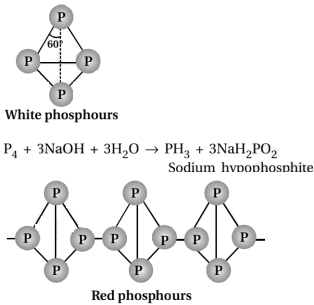
It consists of discrete tetrahedral $P_{4}$ molecules.
$II$. Red phosphorus: When white phosphorus is heated at $573 \ K$ in an inert atmosphere for several days,red phosphorus is obtained.
Red phosphorus is polymeric,consisting of chains of $P_{4}$ tetrahedra linked together. It possesses an iron-grey lustre and is odourless,non-poisonous,and insoluble in water as well as in carbon disulphide.
When red phosphorus is heated under high pressure,a series of phases of black phosphorus is obtained. Chemically,red phosphorus is much less reactive than white phosphorus and it does not glow in the dark.
$I$. White phosphorus: White phosphorus is a translucent white waxy solid. It is poisonous,insoluble in water but soluble in carbon disulphide,and glows in the dark (chemiluminescence). It dissolves in boiling $NaOH$ solution in an inert atmosphere,giving $PH_{3}$ and sodium hypophosphite $(NaH_{2}PO_{2})$.
$P_{4} + 3NaOH + 3H_{2}O \rightarrow PH_{3} + 3NaH_{2}PO_{2}$
White phosphorus is less stable and therefore more reactive than the other solid phases under normal conditions because of angular strain in the $P_{4}$ molecule,where the angles are only $60^{\circ}$. It readily catches fire in air to give dense white fumes of $P_{4}O_{10}$.
$P_{4} + 5O_{2} \rightarrow P_{4}O_{10}$
It consists of discrete tetrahedral $P_{4}$ molecules.
$II$. Red phosphorus: When white phosphorus is heated at $573 \ K$ in an inert atmosphere for several days,red phosphorus is obtained.
Red phosphorus is polymeric,consisting of chains of $P_{4}$ tetrahedra linked together. It possesses an iron-grey lustre and is odourless,non-poisonous,and insoluble in water as well as in carbon disulphide.
When red phosphorus is heated under high pressure,a series of phases of black phosphorus is obtained. Chemically,red phosphorus is much less reactive than white phosphorus and it does not glow in the dark.
0 likes
View Solution791
Medium
Give the preparation of phosphorus trichloride and phosphorus pentachloride.
Solution
(N/A) Preparation of phosphorus trichloride $(PCl_{3})$:
It is obtained by passing dry chlorine over heated white phosphorus:
$P_{4} + 6Cl_{2} \rightarrow 4PCl_{3}$
It is also obtained by the action of thionyl chloride with white phosphorus:
$P_{4} + 8SOCl_{2} \rightarrow 4PCl_{3} + 4SO_{2} + 2S_{2}Cl_{2}$
Preparation of phosphorus pentachloride $(PCl_{5})$:
Phosphorus pentachloride is prepared by the reaction of white phosphorus with excess of dry chlorine:
$P_{4} + 10Cl_{2} \rightarrow 4PCl_{5}$
It can also be prepared by the action of sulfuryl chloride $(SO_{2}Cl_{2})$ on white phosphorus:
$P_{4} + 10SO_{2}Cl_{2} \rightarrow 4PCl_{5} + 10SO_{2}$
It is obtained by passing dry chlorine over heated white phosphorus:
$P_{4} + 6Cl_{2} \rightarrow 4PCl_{3}$
It is also obtained by the action of thionyl chloride with white phosphorus:
$P_{4} + 8SOCl_{2} \rightarrow 4PCl_{3} + 4SO_{2} + 2S_{2}Cl_{2}$
Preparation of phosphorus pentachloride $(PCl_{5})$:
Phosphorus pentachloride is prepared by the reaction of white phosphorus with excess of dry chlorine:
$P_{4} + 10Cl_{2} \rightarrow 4PCl_{5}$
It can also be prepared by the action of sulfuryl chloride $(SO_{2}Cl_{2})$ on white phosphorus:
$P_{4} + 10SO_{2}Cl_{2} \rightarrow 4PCl_{5} + 10SO_{2}$
0 likes
View Solution792
Difficult
State the oxoacids of phosphorus with their formula,methods of preparation,and the presence of characteristic bonds in their structure.
Solution
(N/A)
$^{*}$ Exists in polymeric forms only. Characteristic bonds of $(HPO_{3})_{3}$ have been given in the Table. The compositions of oxoacids are interrelated in terms of loss or gain of $H_{2}O$ or $O$-atom.
| Name | Formula,Oxidation state,Bonds,and Preparation |
|---|---|
| Hypophosphorous (Phosphinic) | Formula: $H_{3}PO_{2}$; Oxidation state: $+1$; Bonds: Two $P-H$,One $P=O$,One $P-OH$; Preparation: White $P_{4} + \text{alkali}$ |
| Orthophosphorous (Phosphonic) | Formula: $H_{3}PO_{3}$; Oxidation state: $+3$; Bonds: One $P-H$,One $P=O$,Two $P-OH$; Preparation: $P_{2}O_{3} + H_{2}O$ |
| Pyrophosphorous | Formula: $H_{4}P_{2}O_{5}$; Oxidation state: $+3$; Bonds: Two $P-H$,Two $P=O$,Two $P-OH$; Preparation: $PCl_{3} + H_{3}PO_{3}$ |
| Hypophosphoric | Formula: $H_{4}P_{2}O_{6}$; Oxidation state: $+4$; Bonds: Two $P=O$,One $P-P$,Four $P-OH$; Preparation: Red $P_{4} + \text{alkali}$ |
| Orthophosphoric | Formula: $H_{3}PO_{4}$; Oxidation state: $+5$; Bonds: One $P=O$,Three $P-OH$; Preparation: $P_{4}O_{10} + H_{2}O$ |
| Pyrophosphoric | Formula: $H_{4}P_{2}O_{7}$; Oxidation state: $+5$; Bonds: Two $P=O$,One $P-O-P$,Four $P-OH$; Preparation: $P_{4}O_{10} + H_{2}O$ |
| Metaphosphoric$^{*}$ | Formula: $(HPO_{3})_{n}$; Oxidation state: $+5$; Bonds: Three $P=O$,Three $P-OH$,Three $P-O-P$ (for $n=3$); Preparation: Heat phosphoric acid |
0 likes
View Solution793
Difficult
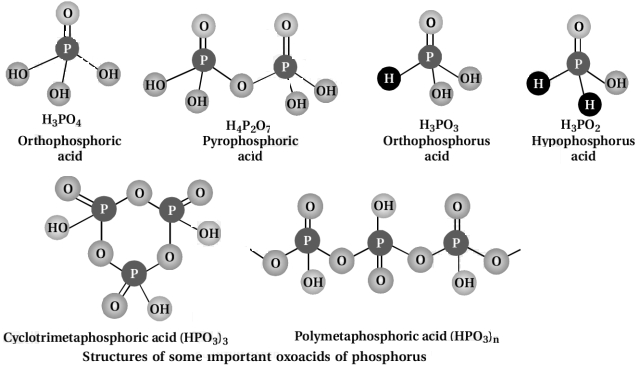
Draw the structures of the following oxoacids of phosphorus:
$(i)$ Orthophosphoric acid $(H_{3}PO_{4})$
$(ii)$ Pyrophosphoric acid $(H_{4}P_{2}O_{7})$
$(iii)$ Orthophosphorus acid $(H_{3}PO_{3})$
$(iv)$ Hypophosphorus acid $(H_{3}PO_{2})$
$(v)$ Cyclotrimetaphosphoric acid $((HPO_{3})_{3})$
$(vi)$ Polymetaphosphoric acid $((HPO_{3})_{n})$
$(i)$ Orthophosphoric acid $(H_{3}PO_{4})$
$(ii)$ Pyrophosphoric acid $(H_{4}P_{2}O_{7})$
$(iii)$ Orthophosphorus acid $(H_{3}PO_{3})$
$(iv)$ Hypophosphorus acid $(H_{3}PO_{2})$
$(v)$ Cyclotrimetaphosphoric acid $((HPO_{3})_{3})$
$(vi)$ Polymetaphosphoric acid $((HPO_{3})_{n})$
Solution
(N/A) In oxoacids,phosphorus is tetrahedrally surrounded by other atoms. All these acids contain at least one $P=O$ bond and one $P-OH$ bond.
The oxoacids in which phosphorus has an oxidation state less than $+5$ contain either a $P-P$ bond or a $P-H$ bond in addition to $P-OH$ and $P=O$ bonds,but not both. The structures are provided in the reference image.
The oxoacids in which phosphorus has an oxidation state less than $+5$ contain either a $P-P$ bond or a $P-H$ bond in addition to $P-OH$ and $P=O$ bonds,but not both. The structures are provided in the reference image.
0 likes
View Solution794
Medium
Explain the chemical behaviour of oxoacids of phosphorus.
Solution
The chemical behaviour of oxoacids of phosphorus is determined by their oxidation states,the presence of $P-H$ bonds,and the number of $P-OH$ bonds.
$1.$ Disproportionation: Oxoacids with phosphorus in the $+3$ oxidation state tend to disproportionate into higher and lower oxidation states. For example,orthophosphorous acid $(H_3PO_3)$ on heating disproportionates to give orthophosphoric acid $(H_3PO_4)$ and phosphine $(PH_3)$:
$4H_3PO_3 \rightarrow 3H_3PO_4 + PH_3$
$2.$ Reducing Property: Acids containing $P-H$ bonds exhibit strong reducing properties. Hypophosphorous acid $(H_3PO_2)$ contains two $P-H$ bonds and acts as a strong reducing agent,for example,reducing $AgNO_3$ to metallic silver:
$4AgNO_3 + 2H_2O + H_3PO_2 \rightarrow 4Ag + 4HNO_3 + H_3PO_4$
$3.$ Basicity: The hydrogen atoms attached to oxygen in $P-OH$ bonds are ionisable and contribute to the basicity of the acid. Hydrogen atoms attached directly to phosphorus ($P-H$ bonds) are non-ionisable. Thus,$H_3PO_4$ is tribasic,$H_3PO_3$ is dibasic,and $H_3PO_2$ is monobasic.
$1.$ Disproportionation: Oxoacids with phosphorus in the $+3$ oxidation state tend to disproportionate into higher and lower oxidation states. For example,orthophosphorous acid $(H_3PO_3)$ on heating disproportionates to give orthophosphoric acid $(H_3PO_4)$ and phosphine $(PH_3)$:
$4H_3PO_3 \rightarrow 3H_3PO_4 + PH_3$
$2.$ Reducing Property: Acids containing $P-H$ bonds exhibit strong reducing properties. Hypophosphorous acid $(H_3PO_2)$ contains two $P-H$ bonds and acts as a strong reducing agent,for example,reducing $AgNO_3$ to metallic silver:
$4AgNO_3 + 2H_2O + H_3PO_2 \rightarrow 4Ag + 4HNO_3 + H_3PO_4$
$3.$ Basicity: The hydrogen atoms attached to oxygen in $P-OH$ bonds are ionisable and contribute to the basicity of the acid. Hydrogen atoms attached directly to phosphorus ($P-H$ bonds) are non-ionisable. Thus,$H_3PO_4$ is tribasic,$H_3PO_3$ is dibasic,and $H_3PO_2$ is monobasic.
0 likes
View Solution795
Easy
Match the following:
| Compound | Nature |
|---|---|
| $i$. $PbO_2$ | $a$. Acidic |
| $ii$. $Sb_2O_3$ | $b$. Basic |
| $iii$. $GeO_2$ | $c$. Amphoteric |
Solution
(A) $PbO_2$ is amphoteric in nature.
$Sb_2O_3$ is amphoteric in nature (Note: In the context of the provided options,$Sb_2O_3$ is often classified as amphoteric,but given the choices,it acts as acidic relative to others).
$GeO_2$ is acidic in nature.
Correct matching: $i-c, ii-a, iii-a$.
$Sb_2O_3$ is amphoteric in nature (Note: In the context of the provided options,$Sb_2O_3$ is often classified as amphoteric,but given the choices,it acts as acidic relative to others).
$GeO_2$ is acidic in nature.
Correct matching: $i-c, ii-a, iii-a$.
0 likes
View Solution796
Medium
The $+1$ oxidation state in group $13$ and $+2$ oxidation state in group $14$ become more stable with increasing atomic number. Explain.
Solution
(N/A) On moving down the group in group $13$ and $14$,the lower oxidation state becomes more stable compared to the higher oxidation state due to the $\text{inert pair effect}$.
In the $\text{inert pair effect}$,the $ns^2$ electrons of the valence shell do not participate in bonding,and only $np$ electrons participate. As the size of the atom increases,the energy required to unpair the $ns^2$ electrons becomes significantly higher than the energy released during bond formation.
In group $13$,the valence shell configuration is $ns^2 np^1$. When both $s$ and $p$ electrons participate,they show a $+3$ oxidation state,but if only $p$ electrons participate,they show a $+1$ oxidation state.
In group $14$,the valence shell configuration is $ns^2 np^2$. When both $s$ and $p$ electrons participate,they show a $+4$ oxidation state,but if only $p$ electrons participate,they show a $+2$ oxidation state.
In the $\text{inert pair effect}$,the $ns^2$ electrons of the valence shell do not participate in bonding,and only $np$ electrons participate. As the size of the atom increases,the energy required to unpair the $ns^2$ electrons becomes significantly higher than the energy released during bond formation.
In group $13$,the valence shell configuration is $ns^2 np^1$. When both $s$ and $p$ electrons participate,they show a $+3$ oxidation state,but if only $p$ electrons participate,they show a $+1$ oxidation state.
In group $14$,the valence shell configuration is $ns^2 np^2$. When both $s$ and $p$ electrons participate,they show a $+4$ oxidation state,but if only $p$ electrons participate,they show a $+2$ oxidation state.
0 likes
View Solution797
Difficult
Account for the following observations:
$(A)$ $AlCl_3$ is a Lewis acid.
$(B)$ Though fluorine is more electronegative than chlorine yet $BF_3$ is a weaker Lewis acid than $BCl_3$.
$(C)$ $PbO_2$ is a stronger oxidizing agent than $SnO_2$.
$(D)$ The $+1$ oxidation state of thallium is more stable than its $+3$ state.
$(A)$ $AlCl_3$ is a Lewis acid.
$(B)$ Though fluorine is more electronegative than chlorine yet $BF_3$ is a weaker Lewis acid than $BCl_3$.
$(C)$ $PbO_2$ is a stronger oxidizing agent than $SnO_2$.
$(D)$ The $+1$ oxidation state of thallium is more stable than its $+3$ state.
Solution
(N/A) In $AlCl_3$,the octet of $Al$ is incomplete as it has $6$ electrons and accepts a pair of electrons. Electron acceptors are Lewis acids.
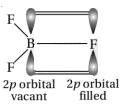
$(B)$ In $BF_3$,boron has a vacant $2p$ orbital and fluorine has one of the $2p$ orbitals completely filled. Both have the same energy and can overlap effectively to give $p\pi-p\pi$ back bonding.
While such type of bonding is not possible in $BCl_3$ as there is no effective overlapping between the $2p$-orbital of boron and $3p$-orbital of chlorine.
Therefore,the electron deficiency of $B$ in $BF_3$ is reduced,making it a weaker Lewis acid than $BCl_3$.
$(C)$ In $PbO_2$ and $SnO_2$,both lead and tin are present in the $+4$ oxidation state. Due to the inert pair effect,$Pb^{2+}$ is more stable than $Pb^{4+}$,making $PbO_2$ a strong oxidizing agent that readily reduces to $Pb^{2+}$. $SnO_2$ is more stable in the $+4$ state.
$(D)$ $Tl^{+}$ is more stable than $Tl^{3+}$ due to the inert pair effect,which is the reluctance of the $ns^2$ electrons to participate in bonding as we move down the group.
$(B)$ In $BF_3$,boron has a vacant $2p$ orbital and fluorine has one of the $2p$ orbitals completely filled. Both have the same energy and can overlap effectively to give $p\pi-p\pi$ back bonding.
While such type of bonding is not possible in $BCl_3$ as there is no effective overlapping between the $2p$-orbital of boron and $3p$-orbital of chlorine.
Therefore,the electron deficiency of $B$ in $BF_3$ is reduced,making it a weaker Lewis acid than $BCl_3$.
$(C)$ In $PbO_2$ and $SnO_2$,both lead and tin are present in the $+4$ oxidation state. Due to the inert pair effect,$Pb^{2+}$ is more stable than $Pb^{4+}$,making $PbO_2$ a strong oxidizing agent that readily reduces to $Pb^{2+}$. $SnO_2$ is more stable in the $+4$ state.
$(D)$ $Tl^{+}$ is more stable than $Tl^{3+}$ due to the inert pair effect,which is the reluctance of the $ns^2$ electrons to participate in bonding as we move down the group.
0 likes
View Solution798
Easy
What are neutral oxides? Give examples.
Solution
(N/A) Neutral oxides are those oxides which do not react with either acids or bases. Examples include $CO$,$NO$,and $N_2O$.
0 likes
View Solution799
Easy
Nitric acid is an oxidising agent and reacts with $PbO$ but it does not react with $PbO_{2}$. Explain why?
Solution
(N/A) $PbO$ is a basic oxide,so it reacts with $HNO_{3}$ to form lead nitrate and water:
$PbO + 2HNO_{3} \longrightarrow Pb(NO_{3})_{2} + H_{2}O$
$PbO_{2}$ does not react with $HNO_{3}$ because $PbO_{2}$ is a strong oxidising agent and $Pb$ is already in its highest oxidation state of $+4$. Since $HNO_{3}$ is also an oxidising agent,no redox reaction occurs between them.
$PbO + 2HNO_{3} \longrightarrow Pb(NO_{3})_{2} + H_{2}O$
$PbO_{2}$ does not react with $HNO_{3}$ because $PbO_{2}$ is a strong oxidising agent and $Pb$ is already in its highest oxidation state of $+4$. Since $HNO_{3}$ is also an oxidising agent,no redox reaction occurs between them.
0 likes
View Solution800
MediumMCQ
On heating,compound $(A)$ gives a gas $(B)$ which is a constituent of air. This gas,when treated with $H_{2}$ in the presence of a catalyst,gives another gas $(C)$ which is basic in nature. $(A)$ should not be:
A
$(NH_{4})_{2}Cr_{2}O_{7}$
B
$Pb(NO_{3})_{2}$
C
$NaN_{3}$
D
$NH_{4}NO_{2}$
Solution
(B) The basic gas $(C)$ is ammonia $(NH_{3})$.
According to the Haber process,$N_{2} + 3H_{2} \rightleftharpoons 2NH_{3}$. Thus,gas $(B)$ must be $N_{2}$.
Let us analyze the thermal decomposition of the given compounds:
$(1)$ $(NH_{4})_{2}Cr_{2}O_{7} \xrightarrow{\Delta} N_{2} \uparrow + Cr_{2}O_{3} + 4H_{2}O \uparrow$ (Produces $N_{2}$)
$(2)$ $Pb(NO_{3})_{2} \xrightarrow{\Delta} PbO + 2NO_{2} \uparrow + \frac{1}{2}O_{2} \uparrow$ (Does not produce $N_{2}$)
$(3)$ $2NaN_{3} \xrightarrow{\Delta} 2Na + 3N_{2} \uparrow$ (Produces $N_{2}$)
$(4)$ $NH_{4}NO_{2} \xrightarrow{\Delta} N_{2} \uparrow + 2H_{2}O \uparrow$ (Produces $N_{2}$)
Since $(A)$ must produce $N_{2}$ gas,$(A)$ cannot be $Pb(NO_{3})_{2}$.
According to the Haber process,$N_{2} + 3H_{2} \rightleftharpoons 2NH_{3}$. Thus,gas $(B)$ must be $N_{2}$.
Let us analyze the thermal decomposition of the given compounds:
$(1)$ $(NH_{4})_{2}Cr_{2}O_{7} \xrightarrow{\Delta} N_{2} \uparrow + Cr_{2}O_{3} + 4H_{2}O \uparrow$ (Produces $N_{2}$)
$(2)$ $Pb(NO_{3})_{2} \xrightarrow{\Delta} PbO + 2NO_{2} \uparrow + \frac{1}{2}O_{2} \uparrow$ (Does not produce $N_{2}$)
$(3)$ $2NaN_{3} \xrightarrow{\Delta} 2Na + 3N_{2} \uparrow$ (Produces $N_{2}$)
$(4)$ $NH_{4}NO_{2} \xrightarrow{\Delta} N_{2} \uparrow + 2H_{2}O \uparrow$ (Produces $N_{2}$)
Since $(A)$ must produce $N_{2}$ gas,$(A)$ cannot be $Pb(NO_{3})_{2}$.
0 likes
View Solutionp-Block Elements (Class 12) — Nitrogen family · Frequently Asked Questions
1Are these p-Block Elements (Class 12) questions useful for JEE and NEET?
Yes. All questions in this section are mapped to JEE Main and NEET exam patterns. Previous year questions from JEE Main, NEET, GUJCET and state-level exams are included with full solutions.
2Can I switch to Hindi or Gujarati for these questions?
Yes. Use the language tabs in the hero section or the sidebar to view the same questions and solutions in English, Hindi or Gujarati.
3How do I generate a question paper from this subtopic?
Use the Vedclass Exam Paper Generator — select the chapter and subtopic, set difficulty, and generate Sets A, B, C, D automatically. First 3 chapters of every subject are free.
Vedclass Products
For Students
Vedclass Test Series
Mock tests in real JEE/NEET style with performance analysis. 5-day free trial.
Start Free TrialFor Teachers
Exam Paper Generator
Generate Set A/B/C/D papers from this chapter in 2 minutes. 3 chapters free.
Try FreeFor Institutes
Online Exam Module
Live online exams with unlimited students, 360° analytics & white-label branding.
See DemoFor Teachers & Institutes
Generate a p-Block Elements (Class 12) Exam Paper in 2 Minutes
Select subtopic & difficulty — Sets A, B, C, D auto-generated with No Repeat logic.
First 3 chapters of every subject are free — no payment required.