
A English
Rate of decay and Half-life Questions in English
Class 12 Chemistry · Nuclear Chemistry · Rate of decay and Half-life
179+
Questions
English
Language
100%
With Solutions
Showing 27 of 179 questions in English
151
MediumMCQ
$A$ radioactive element has a half-life of $200 \ days$. The percentage of original activity remaining after $83 \ days$ is $....$ (Nearest integer).
(Given: $\text{antilog } 0.125 = 1.333$,$\text{antilog } 0.693 = 4.93$)
(Given: $\text{antilog } 0.125 = 1.333$,$\text{antilog } 0.693 = 4.93$)
A
$91$
B
$85$
C
$75$
D
$750$
Solution
(C) The decay constant $\lambda$ is given by $\lambda = \frac{0.693}{t_{1/2}} = \frac{0.693}{200} \approx 0.003465 \ day^{-1}$.
The activity $A$ at time $t$ is given by $A = A_0 e^{-\lambda t}$.
$\frac{A}{A_0} = e^{-\lambda t} = e^{-(0.693/200) \times 83} = e^{-0.2877}$.
Alternatively,using the formula $A = A_0 (1/2)^{t/t_{1/2}}$:
$\frac{A}{A_0} = (0.5)^{83/200} = (0.5)^{0.415}$.
Taking $\log$ on both sides: $\log(\frac{A}{A_0}) = 0.415 \times \log(0.5) = 0.415 \times (-0.301) \approx -0.1249$.
$\frac{A}{A_0} = \text{antilog}(-0.1249) = 10^{-0.1249} \approx 0.75$.
Percentage remaining = $0.75 \times 100 = 75 \ \%$.
The activity $A$ at time $t$ is given by $A = A_0 e^{-\lambda t}$.
$\frac{A}{A_0} = e^{-\lambda t} = e^{-(0.693/200) \times 83} = e^{-0.2877}$.
Alternatively,using the formula $A = A_0 (1/2)^{t/t_{1/2}}$:
$\frac{A}{A_0} = (0.5)^{83/200} = (0.5)^{0.415}$.
Taking $\log$ on both sides: $\log(\frac{A}{A_0}) = 0.415 \times \log(0.5) = 0.415 \times (-0.301) \approx -0.1249$.
$\frac{A}{A_0} = \text{antilog}(-0.1249) = 10^{-0.1249} \approx 0.75$.
Percentage remaining = $0.75 \times 100 = 75 \ \%$.
0 likes
View Solution152
MediumMCQ
Assuming $1 \, \mu g$ of trace radioactive element $X$ with a half-life of $30 \ years$ is absorbed by a growing tree. The amount of $X$ remaining in the tree after $100 \ years$ is $n \times 10^{-1} \, \mu g$. Find the value of $n$. $[Given : \ln 10 = 2.303 ; \log 2 = 0.30]$
A
$0$
B
$2$
C
$1$
D
$3$
Solution
(C) Radioactive decay follows first-order kinetics: $N_t = N_0 \times (1/2)^{t/t_{1/2}}$.
Given: $N_0 = 1 \, \mu g$,$t_{1/2} = 30 \ years$,$t = 100 \ years$.
$N_t = 1 \times (1/2)^{100/30} = (1/2)^{10/3}$.
Taking $\log$ on both sides: $\log N_t = \frac{10}{3} \log(0.5) = \frac{10}{3} \times (-0.30) = -1$.
$N_t = 10^{-1} \, \mu g$.
Comparing with $n \times 10^{-1} \, \mu g$,we get $n = 1$.
Given: $N_0 = 1 \, \mu g$,$t_{1/2} = 30 \ years$,$t = 100 \ years$.
$N_t = 1 \times (1/2)^{100/30} = (1/2)^{10/3}$.
Taking $\log$ on both sides: $\log N_t = \frac{10}{3} \log(0.5) = \frac{10}{3} \times (-0.30) = -1$.
$N_t = 10^{-1} \, \mu g$.
Comparing with $n \times 10^{-1} \, \mu g$,we get $n = 1$.
0 likes
View Solution153
DifficultMCQ
${ }^{227}Ac$ has a half-life of $22 \, years$ with respect to radioactive decay. The decay follows two parallel paths: ${ }^{227}Ac \longrightarrow { }^{227}Th$ and ${ }^{227}Ac \longrightarrow { }^{223}Fr$. If the percentage of the two daughter nuclides are $2.0$ and $98.0$,respectively,the decay constant (in $year^{-1}$) for ${ }^{227}Ac \longrightarrow { }^{227}Th$ path is closest to
A
$6.3 \times 10^{-2}$
B
$63 \times 10^{-3}$
C
$6.3 \times 10^{-1}$
D
$6.3 \times 10^{-4}$
Solution
(D) Radioactive decay follows first-order kinetics. The overall decay constant $k$ is related to the half-life $t_{1/2}$ by $k = \frac{0.693}{t_{1/2}}$.
Given $t_{1/2} = 22 \, years$,so $k = \frac{0.693}{22} \, year^{-1}$.
The decay occurs via two parallel paths with rate constants $k_1$ and $k_2$. The total rate constant is $k = k_1 + k_2$.
The branching fractions are given as percentages: $\frac{k_1}{k} = \frac{2.0}{100} = 0.02$ and $\frac{k_2}{k} = \frac{98.0}{100} = 0.98$.
We need to find $k_1$. From the branching fraction,$k_1 = 0.02 \times k$.
Substituting the value of $k$: $k_1 = 0.02 \times \frac{0.693}{22} = 0.02 \times 0.0315 = 0.00063 = 6.3 \times 10^{-4} \, year^{-1}$.
Thus,the correct option is $(D)$.
Given $t_{1/2} = 22 \, years$,so $k = \frac{0.693}{22} \, year^{-1}$.
The decay occurs via two parallel paths with rate constants $k_1$ and $k_2$. The total rate constant is $k = k_1 + k_2$.
The branching fractions are given as percentages: $\frac{k_1}{k} = \frac{2.0}{100} = 0.02$ and $\frac{k_2}{k} = \frac{98.0}{100} = 0.98$.
We need to find $k_1$. From the branching fraction,$k_1 = 0.02 \times k$.
Substituting the value of $k$: $k_1 = 0.02 \times \frac{0.693}{22} = 0.02 \times 0.0315 = 0.00063 = 6.3 \times 10^{-4} \, year^{-1}$.
Thus,the correct option is $(D)$.
0 likes
View Solution154
MediumMCQ
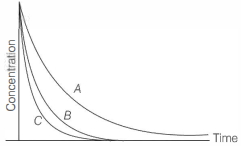
The decay profiles of three radioactive species $A$,$B$ and $C$ are given below:
These profiles imply that the decay constants $k_A$,$k_B$ and $k_C$ follow the order:
These profiles imply that the decay constants $k_A$,$k_B$ and $k_C$ follow the order:
A
$k_A > k_B > k_C$
B
$k_A > k_C > k_B$
C
$k_B > k_A > k_C$
D
$k_C > k_B > k_A$
Solution
(D)
Radioactive decay follows $1^{st}$ order kinetics.
The concentration at time $t$ is given by $C_t = C_0 e^{-kt}$.
For a given decrease in concentration,the time taken $t$ is inversely proportional to the decay constant $k$ (i.e.,$k \propto \frac{1}{t}$).
From the graph,species $C$ decays the fastest (reaches lower concentration in the shortest time),followed by $B$,and then $A$ (which decays the slowest).
Therefore,the decay constants follow the order $k_C > k_B > k_A$.
Radioactive decay follows $1^{st}$ order kinetics.
The concentration at time $t$ is given by $C_t = C_0 e^{-kt}$.
For a given decrease in concentration,the time taken $t$ is inversely proportional to the decay constant $k$ (i.e.,$k \propto \frac{1}{t}$).
From the graph,species $C$ decays the fastest (reaches lower concentration in the shortest time),followed by $B$,and then $A$ (which decays the slowest).
Therefore,the decay constants follow the order $k_C > k_B > k_A$.
0 likes
View Solution155
DifficultMCQ
After $2 \, \text{hours}$,the amount of a certain radioactive substance reduces to $1/16^{th}$ of the original amount (the decay process follows first-order kinetics). The half-life of the radioactive substance is $...... \, \text{min}$.
A
$15$
B
$30$
C
$45$
D
$60$
Solution
(B) For a first-order reaction,the amount remaining after $n$ half-lives is given by $N = N_0 \times (1/2)^n$.
Given that the substance reduces to $1/16$ of the original amount,we have $1/16 = (1/2)^n$.
Since $1/16 = (1/2)^4$,it follows that $n = 4$ half-lives.
The total time taken is $2 \, \text{hours} = 120 \, \text{min}$.
Therefore,$4 \times t_{1/2} = 120 \, \text{min}$.
$t_{1/2} = 120 / 4 = 30 \, \text{min}$.
Given that the substance reduces to $1/16$ of the original amount,we have $1/16 = (1/2)^n$.
Since $1/16 = (1/2)^4$,it follows that $n = 4$ half-lives.
The total time taken is $2 \, \text{hours} = 120 \, \text{min}$.
Therefore,$4 \times t_{1/2} = 120 \, \text{min}$.
$t_{1/2} = 120 / 4 = 30 \, \text{min}$.
0 likes
View Solution156
DifficultMCQ
The half-life of radioisotopic bromine $-82$ is $36 \ hours$. The fraction which remains after one day is . . . . . . $\times 10^{-2}$. (Given $\text{antilog } 0.2006 = 1.587$)
A
$41$
B
$52$
C
$63$
D
$36$
Solution
(C) The radioactive decay follows $1^{st}$ order kinetics.
Half-life $t_{1/2} = 36 \ hours$.
Decay constant $K = \frac{0.693}{t_{1/2}} = \frac{0.693}{36} = 0.01925 \ hr^{-1}$.
For $1^{st}$ order reaction,$\ln \frac{N_0}{N_t} = Kt$,where $N_t/N_0$ is the fraction remaining.
$\log \frac{N_0}{N_t} = \frac{Kt}{2.303}$.
Given $t = 1 \ day = 24 \ hours$.
$\log \frac{N_0}{N_t} = \frac{0.01925 \times 24}{2.303} = \frac{0.462}{2.303} \approx 0.2006$.
$\frac{N_0}{N_t} = \text{antilog } (0.2006) = 1.587$.
Fraction remaining $\frac{N_t}{N_0} = \frac{1}{1.587} \approx 0.6301$.
Thus,the fraction remaining is $63.01 \times 10^{-2} \approx 63 \times 10^{-2}$.
Half-life $t_{1/2} = 36 \ hours$.
Decay constant $K = \frac{0.693}{t_{1/2}} = \frac{0.693}{36} = 0.01925 \ hr^{-1}$.
For $1^{st}$ order reaction,$\ln \frac{N_0}{N_t} = Kt$,where $N_t/N_0$ is the fraction remaining.
$\log \frac{N_0}{N_t} = \frac{Kt}{2.303}$.
Given $t = 1 \ day = 24 \ hours$.
$\log \frac{N_0}{N_t} = \frac{0.01925 \times 24}{2.303} = \frac{0.462}{2.303} \approx 0.2006$.
$\frac{N_0}{N_t} = \text{antilog } (0.2006) = 1.587$.
Fraction remaining $\frac{N_t}{N_0} = \frac{1}{1.587} \approx 0.6301$.
Thus,the fraction remaining is $63.01 \times 10^{-2} \approx 63 \times 10^{-2}$.
0 likes
View Solution157
DifficultMCQ
The ratio of $\frac{{}^{14}C}{{}^{12}C}$ in a piece of wood is $\frac{1}{8}$ part that of the atmosphere. If the half-life of ${}^{14}C$ is $5730 \text{ years}$,the age of the wood sample is $.....$ years.
A
$17160$
B
$17170$
C
$17180$
D
$17190$
Solution
(D) The radioactive decay follows first-order kinetics: $\lambda t = \ln \frac{N_0}{N_t}$.
Given that the ratio in the wood sample is $\frac{1}{8}$ of the atmospheric ratio,we have $\frac{N_t}{N_0} = \frac{1}{8}$,which implies $\frac{N_0}{N_t} = 8$.
Using the relation $t = \frac{2.303}{\lambda} \log \frac{N_0}{N_t}$ or $t = \frac{t_{1/2}}{0.693} \ln \frac{N_0}{N_t}$.
Since $\ln 8 = \ln 2^3 = 3 \ln 2$,we get $\lambda t = 3 \ln 2$.
Substituting $\lambda = \frac{\ln 2}{t_{1/2}}$,we have $\frac{\ln 2}{t_{1/2}} \times t = 3 \ln 2$.
Therefore,$t = 3 \times t_{1/2} = 3 \times 5730 \text{ years} = 17190 \text{ years}$.
Given that the ratio in the wood sample is $\frac{1}{8}$ of the atmospheric ratio,we have $\frac{N_t}{N_0} = \frac{1}{8}$,which implies $\frac{N_0}{N_t} = 8$.
Using the relation $t = \frac{2.303}{\lambda} \log \frac{N_0}{N_t}$ or $t = \frac{t_{1/2}}{0.693} \ln \frac{N_0}{N_t}$.
Since $\ln 8 = \ln 2^3 = 3 \ln 2$,we get $\lambda t = 3 \ln 2$.
Substituting $\lambda = \frac{\ln 2}{t_{1/2}}$,we have $\frac{\ln 2}{t_{1/2}} \times t = 3 \ln 2$.
Therefore,$t = 3 \times t_{1/2} = 3 \times 5730 \text{ years} = 17190 \text{ years}$.
0 likes
View Solution158
Advanced
Carbon-$14$ is used to determine the age of organic material. The procedure is based on the formation of $^{14}C$ by neutron capture in the upper atmosphere.
${ }_{7}^{14}N + { }_{0}n^1 \rightarrow { }_{6}^{14}C + { }_{1}H^1$
$^{14}C$ is absorbed by living organisms during photosynthesis. The $^{14}C$ content is constant in living organisms. Once the plant or animal dies,the uptake of carbon dioxide by it ceases and the level of $^{14}C$ in the dead being falls due to the decay which $^{14}C$ undergoes.
${ }_{6}^{14}C \rightarrow { }_{7}^{14}N + \beta^{-}$
The half-life period of $^{14}C$ is $5770$ years. The decay constant $(\lambda)$ can be calculated by using the following formula $\lambda = \frac{0.693}{t_{1/2}}$.
The comparison of the $\beta^{-}$ activity of the dead matter with that of the carbon still in circulation enables measurement of the period of the isolation of the material from the living cycle. The method,however,ceases to be accurate over periods longer than $30,000$ years. The proportion of $^{14}C$ to $^{12}C$ in living matter is $1 : 10^{12}$.
$1.$ Which of the following options is correct?
$(A)$ In living organisms,circulation of $^{14}C$ from the atmosphere is high so the carbon content is constant in the organism.
$(B)$ Carbon dating can be used to find out the age of the Earth's crust and rocks.
$(C)$ Radioactive absorption due to cosmic radiation is equal to the rate of radioactive decay,hence the carbon content remains constant in living organisms.
$(D)$ Carbon dating cannot be used to determine the concentration of $^{14}C$ in dead beings.
$2.$ What should be the age of a fossil for meaningful determination of its age?
$(A)$ $6$ years
$(B)$ $6000$ years
$(C)$ $60,000$ years
$(D)$ It can be used to calculate any age.
$3.$ $A$ nuclear explosion has taken place,leading to an increase in the concentration of $^{14}C$ in nearby areas. $^{14}C$ concentration is $C_1$ in nearby areas and $C_2$ in areas far away. If the age of the fossil is determined to be $T_1$ and $T_2$ at the places respectively,then:
$(A)$ The age of the fossil will increase at the place where the explosion has taken place and $T_1 - T_2 = \frac{1}{\lambda} \ln \frac{C_1}{C_2}$
$(B)$ The age of the fossil will decrease at the place where the explosion has taken place and $T_1 - T_2 = \frac{1}{\lambda} \ln \frac{C_1}{C_2}$
$(C)$ The age of the fossil will be determined to be the same.
$(D)$ $\frac{T_1}{T_2} = \frac{C_1}{C_2}$
${ }_{7}^{14}N + { }_{0}n^1 \rightarrow { }_{6}^{14}C + { }_{1}H^1$
$^{14}C$ is absorbed by living organisms during photosynthesis. The $^{14}C$ content is constant in living organisms. Once the plant or animal dies,the uptake of carbon dioxide by it ceases and the level of $^{14}C$ in the dead being falls due to the decay which $^{14}C$ undergoes.
${ }_{6}^{14}C \rightarrow { }_{7}^{14}N + \beta^{-}$
The half-life period of $^{14}C$ is $5770$ years. The decay constant $(\lambda)$ can be calculated by using the following formula $\lambda = \frac{0.693}{t_{1/2}}$.
The comparison of the $\beta^{-}$ activity of the dead matter with that of the carbon still in circulation enables measurement of the period of the isolation of the material from the living cycle. The method,however,ceases to be accurate over periods longer than $30,000$ years. The proportion of $^{14}C$ to $^{12}C$ in living matter is $1 : 10^{12}$.
$1.$ Which of the following options is correct?
$(A)$ In living organisms,circulation of $^{14}C$ from the atmosphere is high so the carbon content is constant in the organism.
$(B)$ Carbon dating can be used to find out the age of the Earth's crust and rocks.
$(C)$ Radioactive absorption due to cosmic radiation is equal to the rate of radioactive decay,hence the carbon content remains constant in living organisms.
$(D)$ Carbon dating cannot be used to determine the concentration of $^{14}C$ in dead beings.
$2.$ What should be the age of a fossil for meaningful determination of its age?
$(A)$ $6$ years
$(B)$ $6000$ years
$(C)$ $60,000$ years
$(D)$ It can be used to calculate any age.
$3.$ $A$ nuclear explosion has taken place,leading to an increase in the concentration of $^{14}C$ in nearby areas. $^{14}C$ concentration is $C_1$ in nearby areas and $C_2$ in areas far away. If the age of the fossil is determined to be $T_1$ and $T_2$ at the places respectively,then:
$(A)$ The age of the fossil will increase at the place where the explosion has taken place and $T_1 - T_2 = \frac{1}{\lambda} \ln \frac{C_1}{C_2}$
$(B)$ The age of the fossil will decrease at the place where the explosion has taken place and $T_1 - T_2 = \frac{1}{\lambda} \ln \frac{C_1}{C_2}$
$(C)$ The age of the fossil will be determined to be the same.
$(D)$ $\frac{T_1}{T_2} = \frac{C_1}{C_2}$
Solution
(C, B, A) $1.$ $(C)$ Radioactive absorption due to cosmic radiation is balanced by the rate of radioactive decay,maintaining a constant $^{14}C$ level in living organisms.
$2.$ $(B)$ Carbon dating is effective for organic materials up to about $30,000$ years. $6000$ years is a meaningful age within this range.
$3.$ $(A)$ The age $T$ is given by $T = \frac{1}{\lambda} \ln \frac{C_0}{C}$,where $C_0$ is the initial concentration. If $C_1 > C_2$,then $T_1 = \frac{1}{\lambda} \ln \frac{C_0}{C_1}$ and $T_2 = \frac{1}{\lambda} \ln \frac{C_0}{C_2}$. Thus,$T_1 - T_2 = \frac{1}{\lambda} \ln \frac{C_2}{C_1}$ is incorrect; rather,the calculated age $T_1$ will be higher because the reference $C_0$ is assumed constant,leading to $T_1 - T_2 = \frac{1}{\lambda} \ln \frac{C_1}{C_2}$.
$2.$ $(B)$ Carbon dating is effective for organic materials up to about $30,000$ years. $6000$ years is a meaningful age within this range.
$3.$ $(A)$ The age $T$ is given by $T = \frac{1}{\lambda} \ln \frac{C_0}{C}$,where $C_0$ is the initial concentration. If $C_1 > C_2$,then $T_1 = \frac{1}{\lambda} \ln \frac{C_0}{C_1}$ and $T_2 = \frac{1}{\lambda} \ln \frac{C_0}{C_2}$. Thus,$T_1 - T_2 = \frac{1}{\lambda} \ln \frac{C_2}{C_1}$ is incorrect; rather,the calculated age $T_1$ will be higher because the reference $C_0$ is assumed constant,leading to $T_1 - T_2 = \frac{1}{\lambda} \ln \frac{C_1}{C_2}$.
0 likes
View Solution159
AdvancedMCQ
To determine the half-life of a radioactive element,a student plots a graph of $\ln|dN(t)/dt|$ versus $t$. Here $dN(t)/dt$ is the rate of radioactive decay at time $t$. If the number of radioactive nuclei of this element decreases by a factor of $p$ after $4.16 \ \text{years}$,the value of $p$ is
A
$2$
B
$4$
C
$6$
D
$8$
Solution
(D) The rate of radioactive decay is given by $|dN/dt| = \lambda N = \lambda N_0 e^{-\lambda t}$.
Taking the natural logarithm on both sides: $\ln|dN/dt| = \ln(\lambda N_0) - \lambda t$.
Comparing this with the equation of a straight line $y = mx + c$,the slope of the graph is $-\lambda$.
From the given graph (assuming slope $= -0.5$),we get $\lambda = 0.5 \ \text{year}^{-1}$.
The half-life is $t_{1/2} = \ln(2) / \lambda \approx 0.693 / 0.5 = 1.386 \ \text{years}$.
After $t = 4.16 \ \text{years}$,the number of nuclei remaining is $N = N_0 / p$.
Since $4.16 / 1.386 = 3$,the time elapsed is $3 \ t_{1/2}$.
Thus,$N = N_0 / 2^3 = N_0 / 8$.
Therefore,$p = 8$.
Taking the natural logarithm on both sides: $\ln|dN/dt| = \ln(\lambda N_0) - \lambda t$.
Comparing this with the equation of a straight line $y = mx + c$,the slope of the graph is $-\lambda$.
From the given graph (assuming slope $= -0.5$),we get $\lambda = 0.5 \ \text{year}^{-1}$.
The half-life is $t_{1/2} = \ln(2) / \lambda \approx 0.693 / 0.5 = 1.386 \ \text{years}$.
After $t = 4.16 \ \text{years}$,the number of nuclei remaining is $N = N_0 / p$.
Since $4.16 / 1.386 = 3$,the time elapsed is $3 \ t_{1/2}$.
Thus,$N = N_0 / 2^3 = N_0 / 8$.
Therefore,$p = 8$.
0 likes
View Solution160
EasyMCQ
$A$ certain nuclide has a half-life period of $30 \ min$. If a sample containing $600$ atoms is allowed to decay for $90 \ min$,how many atoms will remain (in $atoms$)?
A
$200$
B
$450$
C
$75$
D
$150$
Solution
(C) The number of half-lives $(n)$ is calculated as: $n = \frac{\text{total time}}{\text{half-life period}} = \frac{90 \ min}{30 \ min} = 3$.
The number of remaining atoms $(N)$ is given by the formula: $N = N_0 \times (\frac{1}{2})^n$.
Substituting the values: $N = 600 \times (\frac{1}{2})^3$.
$N = 600 \times \frac{1}{8} = 75 \ atoms$.
The number of remaining atoms $(N)$ is given by the formula: $N = N_0 \times (\frac{1}{2})^n$.
Substituting the values: $N = 600 \times (\frac{1}{2})^3$.
$N = 600 \times \frac{1}{8} = 75 \ atoms$.
0 likes
View Solution161
MediumMCQ
What type of reaction order is followed by radioactive processes?
A
$0$
B
$1$
C
$2$
D
$1.5$
Solution
(B) All radioactive decay processes follow first-order kinetics because the rate of decay is directly proportional to the number of radioactive nuclei present at that time.
0 likes
View Solution162
MediumMCQ
The unit of the decay constant for radioactive disintegration is:
A
time
B
$\min^{-2}$
C
time$^{-1}$
D
time $\text{mol}^{-1}$
Solution
(C) Radioactive disintegration follows first-order kinetics.
The rate law is given by $k = \frac{2.303}{t} \log \frac{N_0}{N}$.
Here,$k$ is the decay constant (or disintegration constant).
Since the unit of time $t$ is in the denominator,the unit of $k$ is $\text{time}^{-1}$ (e.g.,$\text{s}^{-1}$,$\text{min}^{-1}$,or $\text{year}^{-1}$).
The rate law is given by $k = \frac{2.303}{t} \log \frac{N_0}{N}$.
Here,$k$ is the decay constant (or disintegration constant).
Since the unit of time $t$ is in the denominator,the unit of $k$ is $\text{time}^{-1}$ (e.g.,$\text{s}^{-1}$,$\text{min}^{-1}$,or $\text{year}^{-1}$).
0 likes
View Solution163
DifficultMCQ
$A$ radioactive isotope having $t_{1/2} = 3 \ days$ was measured after $12 \ days$. If $3 \ g$ of the isotope remains in the container,what was the initial weight of the isotope (in $g$)?
A
$12$
B
$24$
C
$36$
D
$48$
Solution
(D) The number of half-lives $(n)$ is calculated as: $n = \frac{T}{t_{1/2}} = \frac{12 \ days}{3 \ days} = 4$.
Using the radioactive decay formula: $N = N_0 \times (1/2)^n$.
Given $N = 3 \ g$ and $n = 4$:
$3 = N_0 \times (1/2)^4$.
$3 = N_0 \times (1/16)$.
$N_0 = 3 \times 16 = 48 \ g$.
Using the radioactive decay formula: $N = N_0 \times (1/2)^n$.
Given $N = 3 \ g$ and $n = 4$:
$3 = N_0 \times (1/2)^4$.
$3 = N_0 \times (1/16)$.
$N_0 = 3 \times 16 = 48 \ g$.
0 likes
View Solution164
EasyMCQ
The half-life period for a radioactive substance is $15$ minutes. How many grams of this radioactive substance is decayed from $50$ g of substance after $1$ hour?
A
$37.5$
B
$25$
C
$43.75$
D
$46.875$
Solution
(D) Given: $t_{1/2} = 15 \text{ minutes}$,$N_0 = 50 \text{ g}$,$t = 1 \text{ hour} = 60 \text{ minutes}$.
Number of half-lives $n = \frac{t}{t_{1/2}} = \frac{60}{15} = 4$.
Amount remaining $N = \frac{N_0}{2^n} = \frac{50}{2^4} = \frac{50}{16} = 3.125 \text{ g}$.
Amount decayed $= N_0 - N = 50 - 3.125 = 46.875 \text{ g}$.
Number of half-lives $n = \frac{t}{t_{1/2}} = \frac{60}{15} = 4$.
Amount remaining $N = \frac{N_0}{2^n} = \frac{50}{2^4} = \frac{50}{16} = 3.125 \text{ g}$.
Amount decayed $= N_0 - N = 50 - 3.125 = 46.875 \text{ g}$.
0 likes
View Solution165
EasyMCQ
$2 \text{ g}$ of a radioactive sample having a half-life of $15$ days was synthesized on $1^{st}$ Jan $2009$. The amount of the sample left behind on $1^{st}$ March $2009$ (including both the days) is: (in $\text{ g}$)
A
$0$
B
$0.125$
C
$1$
D
$0.5$
Solution
(B) Total time from $1^{st}$ Jan to $1^{st}$ March $2009$ (including both days) $= 31 \text{ (Jan)} + 28 \text{ (Feb)} + 1 \text{ (March)} = 60 \text{ days}$.
Number of half-lives $(n)$ $= \frac{\text{Total time}}{\text{Half-life}} = \frac{60}{15} = 4$.
Amount left $(N)$ $= N_0 \times (\frac{1}{2})^n = 2 \times (\frac{1}{2})^4 = \frac{2}{16} = 0.125 \text{ g}$.
Number of half-lives $(n)$ $= \frac{\text{Total time}}{\text{Half-life}} = \frac{60}{15} = 4$.
Amount left $(N)$ $= N_0 \times (\frac{1}{2})^n = 2 \times (\frac{1}{2})^4 = \frac{2}{16} = 0.125 \text{ g}$.
0 likes
View Solution166
DifficultMCQ
The half-lives of two radioactive nuclides $A$ and $B$ are $1 \ min$ and $2 \ min$ respectively. Equal weights of $A$ and $B$ are taken separately and allowed to disintegrate for $4 \ min$. What will be the ratio of weights of $A$ and $B$ disintegrated?
A
$1:1$
B
$5:4$
C
$1:2$
D
$1:3$
Solution
(B) For $A$,$t_{1/2} = 1 \ min$. After $4 \ min$ ($4$ half-lives),the fraction of $A$ remaining is $(1/2)^4 = 1/16$.
Therefore,the fraction of $A$ disintegrated is $1 - 1/16 = 15/16$.
For $B$,$t_{1/2} = 2 \ min$. After $4 \ min$ ($2$ half-lives),the fraction of $B$ remaining is $(1/2)^2 = 1/4$.
Therefore,the fraction of $B$ disintegrated is $1 - 1/4 = 3/4$.
The ratio of disintegrated weights of $A$ and $B$ is $(15/16) : (3/4) = 15/16 : 12/16 = 15:12 = 5:4$.
Therefore,the fraction of $A$ disintegrated is $1 - 1/16 = 15/16$.
For $B$,$t_{1/2} = 2 \ min$. After $4 \ min$ ($2$ half-lives),the fraction of $B$ remaining is $(1/2)^2 = 1/4$.
Therefore,the fraction of $B$ disintegrated is $1 - 1/4 = 3/4$.
The ratio of disintegrated weights of $A$ and $B$ is $(15/16) : (3/4) = 15/16 : 12/16 = 15:12 = 5:4$.
0 likes
View Solution167
DifficultMCQ
$10 \ g$ of a radioactive element is disintegrated to $1 \ g$ in $2.303 \ \text{minutes}$. What is the half-life (in minutes) of that radioactive element?
A
$1 / 0.693$
B
$6.93$
C
$1$
D
$0.693$
Solution
(D) Radioactive disintegration follows first-order kinetics.
$k = \frac{2.303}{t} \log \frac{a}{a-x}$
Given $a = 10 \ g$,$(a-x) = 1 \ g$,and $t = 2.303 \ \text{min}$.
$k = \frac{2.303}{2.303} \log \frac{10}{1} = 1 \ \text{min}^{-1}$.
The half-life is given by $t_{1/2} = \frac{0.693}{k}$.
$t_{1/2} = \frac{0.693}{1} = 0.693 \ \text{min}$.
$k = \frac{2.303}{t} \log \frac{a}{a-x}$
Given $a = 10 \ g$,$(a-x) = 1 \ g$,and $t = 2.303 \ \text{min}$.
$k = \frac{2.303}{2.303} \log \frac{10}{1} = 1 \ \text{min}^{-1}$.
The half-life is given by $t_{1/2} = \frac{0.693}{k}$.
$t_{1/2} = \frac{0.693}{1} = 0.693 \ \text{min}$.
0 likes
View Solution168
DifficultMCQ
The half-life for decay of ${}^{14}C$ by $\beta$-emission is $5730 \ yr$. The fraction of ${}^{14}C$ that decays in a sample that is $22920 \ yr$ old would be
A
$\frac{1}{8}$
B
$\frac{1}{16}$
C
$\frac{7}{8}$
D
$\frac{15}{16}$
Solution
(D) The number of half-lives $n$ is calculated as: $n = \frac{t}{t_{1/2}} = \frac{22920}{5730} = 4$.
The amount of ${}^{14}C$ remaining after $n$ half-lives is given by: $N = N_0 (\frac{1}{2})^n = N_0 (\frac{1}{2})^4 = \frac{N_0}{16}$.
The fraction of ${}^{14}C$ that has decayed is: $\text{Decayed fraction} = \frac{N_0 - N}{N_0} = 1 - \frac{N}{N_0} = 1 - \frac{1}{16} = \frac{15}{16}$.
The amount of ${}^{14}C$ remaining after $n$ half-lives is given by: $N = N_0 (\frac{1}{2})^n = N_0 (\frac{1}{2})^4 = \frac{N_0}{16}$.
The fraction of ${}^{14}C$ that has decayed is: $\text{Decayed fraction} = \frac{N_0 - N}{N_0} = 1 - \frac{N}{N_0} = 1 - \frac{1}{16} = \frac{15}{16}$.
0 likes
View Solution169
MediumMCQ
If $n_t$ number of radioatoms are present at time $t$,the following expression will be a constant:
A
$n_t / t$
B
$\ln(n_t / t)$
C
$\frac{d \ln n_t}{d t}$
D
$t n_t$
Solution
(C) If $n_t$ is the number of radioactive atoms present at time $t$,radioactive decay follows the law:
$n_t = n_0 e^{-\lambda t}$
Taking the natural logarithm on both sides:
$\ln n_t = \ln n_0 - \lambda t$
Differentiating with respect to time $t$:
$\frac{d}{d t} (\ln n_t) = -\lambda$
Since $\lambda$ (decay constant) is a constant,the expression $\frac{d \ln n_t}{d t}$ is constant.
$n_t = n_0 e^{-\lambda t}$
Taking the natural logarithm on both sides:
$\ln n_t = \ln n_0 - \lambda t$
Differentiating with respect to time $t$:
$\frac{d}{d t} (\ln n_t) = -\lambda$
Since $\lambda$ (decay constant) is a constant,the expression $\frac{d \ln n_t}{d t}$ is constant.
0 likes
View Solution170
MediumMCQ
If in the case of a radioisotope the value of half-life $(T_{1/2})$ and decay constant $(\lambda)$ are identical in magnitude,then their value should be
A
$0.693 / 2$
B
$(0.693)^{1/2}$
C
$(0.693)^2$
D
$0.693$
Solution
(B) The relationship between half-life $(T_{1/2})$ and decay constant $(\lambda)$ is given by: $T_{1/2} = \frac{0.693}{\lambda}$.
Given that the magnitudes are identical,let $T_{1/2} = \lambda = x$.
Substituting this into the equation: $x = \frac{0.693}{x}$.
This simplifies to: $x^2 = 0.693$.
Therefore,$x = \sqrt{0.693} = (0.693)^{1/2}$.
Given that the magnitudes are identical,let $T_{1/2} = \lambda = x$.
Substituting this into the equation: $x = \frac{0.693}{x}$.
This simplifies to: $x^2 = 0.693$.
Therefore,$x = \sqrt{0.693} = (0.693)^{1/2}$.
0 likes
View Solution171
MediumMCQ
The half-life period of ${}_{53}I^{125}$ is $60$ days. The radioactivity after $180$ days will be (in $\%$)
A
$25$
B
$12.5$
C
$33.3$
D
$3.0$
Solution
(B) Let the initial radioactivity be $N_0 = 100 \%$.
Given,half-life period $(t_{1/2}) = 60$ days.
Total time $(T) = 180$ days.
The number of half-lives $(n)$ is calculated as:
$n = \frac{T}{t_{1/2}} = \frac{180}{60} = 3$.
The remaining radioactivity $(N)$ after $n$ half-lives is given by the formula:
$N = N_0 \times (\frac{1}{2})^n$.
Substituting the values:
$N = 100 \% \times (\frac{1}{2})^3 = 100 \% \times \frac{1}{8} = 12.5 \%$.
Therefore,the radioactivity after $180$ days will be $12.5 \%$.
Given,half-life period $(t_{1/2}) = 60$ days.
Total time $(T) = 180$ days.
The number of half-lives $(n)$ is calculated as:
$n = \frac{T}{t_{1/2}} = \frac{180}{60} = 3$.
The remaining radioactivity $(N)$ after $n$ half-lives is given by the formula:
$N = N_0 \times (\frac{1}{2})^n$.
Substituting the values:
$N = 100 \% \times (\frac{1}{2})^3 = 100 \% \times \frac{1}{8} = 12.5 \%$.
Therefore,the radioactivity after $180$ days will be $12.5 \%$.
0 likes
View Solution172
MediumMCQ
The half-life of $C^{14}$ is $5760 \ years$. For a $200 \ mg$ sample of $C^{14}$,the time taken to change to $25 \ mg$ is (in $years$)
A
$11520$
B
$23040$
C
$5760$
D
$17280$
Solution
(D) Given: Half-life of $C^{14}$,$t_{1/2} = 5760 \ years$.
Initial amount,$N_0 = 200 \ mg$.
Final amount,$N_t = 25 \ mg$.
Radioactive decay follows first-order kinetics.
We can use the relation: $N_t = N_0 \times (1/2)^n$,where $n$ is the number of half-lives.
$25 = 200 \times (1/2)^n$
$1/8 = (1/2)^n$
$(1/2)^3 = (1/2)^n$
Therefore,$n = 3$.
Total time $t = n \times t_{1/2} = 3 \times 5760 \ years = 17280 \ years$.
Alternatively,as shown in the diagram:
$200 \ mg$ $\xrightarrow{t_{1/2}} 100 \ mg$ $\xrightarrow{t_{1/2}} 50 \ mg$ $\xrightarrow{t_{1/2}} 25 \ mg$.
Total time = $3 \times 5760 \ years = 17280 \ years$.
Initial amount,$N_0 = 200 \ mg$.
Final amount,$N_t = 25 \ mg$.
Radioactive decay follows first-order kinetics.
We can use the relation: $N_t = N_0 \times (1/2)^n$,where $n$ is the number of half-lives.
$25 = 200 \times (1/2)^n$
$1/8 = (1/2)^n$
$(1/2)^3 = (1/2)^n$
Therefore,$n = 3$.
Total time $t = n \times t_{1/2} = 3 \times 5760 \ years = 17280 \ years$.
Alternatively,as shown in the diagram:
$200 \ mg$ $\xrightarrow{t_{1/2}} 100 \ mg$ $\xrightarrow{t_{1/2}} 50 \ mg$ $\xrightarrow{t_{1/2}} 25 \ mg$.
Total time = $3 \times 5760 \ years = 17280 \ years$.
0 likes
View Solution173
MediumMCQ
$A$ piece of wood from an archaeological sample has $5.0 \text{ counts min}^{-1} \text{ g}^{-1}$ of $^{14}C$,while a fresh sample of wood has a count of $15.0 \text{ counts min}^{-1} \text{ g}^{-1}$. If the half-life of $^{14}C$ is $5770 \text{ yr}$,the age of the archaeological sample is:
A
$8,500 \text{ yr}$
B
$9,200 \text{ yr}$
C
$10,000 \text{ yr}$
D
$11,000 \text{ yr}$
Solution
(B) Given:
Initial activity $(A_0)$ = $15.0 \text{ counts min}^{-1} \text{ g}^{-1}$
Final activity $(A)$ = $5.0 \text{ counts min}^{-1} \text{ g}^{-1}$
Half-life $(t_{1/2})$ = $5770 \text{ yr}$
The age of the sample $(t)$ is given by the radioactive decay formula:
$t = \frac{2.303}{\lambda} \log\left(\frac{A_0}{A}\right)$
Since $\lambda = \frac{0.693}{t_{1/2}}$,
$t = \frac{2.303 \times t_{1/2}}{0.693} \log\left(\frac{A_0}{A}\right)$
$t = \frac{2.303 \times 5770}{0.693} \log\left(\frac{15.0}{5.0}\right)$
$t = \frac{2.303 \times 5770}{0.693} \log(3)$
Using $\log(3) \approx 0.4771$:
$t = \frac{2.303 \times 5770 \times 0.4771}{0.693} \approx 9148 \text{ yr}$
The closest value is $9,200 \text{ yr}$.
Initial activity $(A_0)$ = $15.0 \text{ counts min}^{-1} \text{ g}^{-1}$
Final activity $(A)$ = $5.0 \text{ counts min}^{-1} \text{ g}^{-1}$
Half-life $(t_{1/2})$ = $5770 \text{ yr}$
The age of the sample $(t)$ is given by the radioactive decay formula:
$t = \frac{2.303}{\lambda} \log\left(\frac{A_0}{A}\right)$
Since $\lambda = \frac{0.693}{t_{1/2}}$,
$t = \frac{2.303 \times t_{1/2}}{0.693} \log\left(\frac{A_0}{A}\right)$
$t = \frac{2.303 \times 5770}{0.693} \log\left(\frac{15.0}{5.0}\right)$
$t = \frac{2.303 \times 5770}{0.693} \log(3)$
Using $\log(3) \approx 0.4771$:
$t = \frac{2.303 \times 5770 \times 0.4771}{0.693} \approx 9148 \text{ yr}$
The closest value is $9,200 \text{ yr}$.
0 likes
View Solution174
MediumMCQ
Radioactivity of a sample $(Z=22)$ decreases by $90 \%$ after $10 \ years$. What will be the half-life of the sample (in $years$)?
A
$5$
B
$2$
C
$3$
D
$10$
Solution
(C) The radioactive decay follows first-order kinetics. The decay constant $\lambda$ is given by: $\lambda = \frac{2.303}{t} \log \frac{N_0}{N_t}$.
Given that radioactivity decreases by $90 \%$,the remaining amount $N_t = N_0 - 0.90 N_0 = 0.10 N_0$.
Substituting the values: $\lambda = \frac{2.303}{10} \log \frac{N_0}{0.10 N_0} = \frac{2.303}{10} \log(10) = \frac{2.303}{10} \times 1 = 0.2303 \ year^{-1}$.
The half-life $t_{1/2}$ is given by: $t_{1/2} = \frac{0.693}{\lambda}$.
$t_{1/2} = \frac{0.693}{0.2303} \approx 3.01 \ years$.
Therefore,the half-life is approximately $3 \ years$.
Given that radioactivity decreases by $90 \%$,the remaining amount $N_t = N_0 - 0.90 N_0 = 0.10 N_0$.
Substituting the values: $\lambda = \frac{2.303}{10} \log \frac{N_0}{0.10 N_0} = \frac{2.303}{10} \log(10) = \frac{2.303}{10} \times 1 = 0.2303 \ year^{-1}$.
The half-life $t_{1/2}$ is given by: $t_{1/2} = \frac{0.693}{\lambda}$.
$t_{1/2} = \frac{0.693}{0.2303} \approx 3.01 \ years$.
Therefore,the half-life is approximately $3 \ years$.
0 likes
View Solution175
DifficultMCQ
The half-life of a radioactive element is $10 \ hours$. How much will be left after $4 \ hours$ in a $1 \ g$-atom sample?
A
$45.6 \times 10^{23} \ \text{atoms}$
B
$4.56 \times 10^{23} \ \text{atoms}$
C
$4.56 \times 10^{21} \ \text{atoms}$
D
$4.56 \times 10^{20} \ \text{atoms}$
Solution
(B) Radioactive decay follows first-order kinetics. The decay constant $k = \frac{0.693}{t_{1/2}} = \frac{0.693}{10} \ h^{-1}$.
Using the first-order integrated rate equation: $k = \frac{2.303}{t} \log \frac{N_0}{N_t}$.
Given $N_0 = 1 \ g$-atom,$t = 4 \ h$,and $k = 0.0693 \ h^{-1}$.
$0.0693 = \frac{2.303}{4} \log \frac{1}{N_t} \implies \log \frac{1}{N_t} = \frac{0.0693 \times 4}{2.303} \approx 0.12036$.
$\log N_t = -0.12036 = \bar{1}.87964 \implies N_t = 10^{-0.12036} \approx 0.7579 \ g$-atoms.
Number of atoms $= N_t \times N_A = 0.7579 \times 6.022 \times 10^{23} \approx 4.56 \times 10^{23} \ \text{atoms}$.
Using the first-order integrated rate equation: $k = \frac{2.303}{t} \log \frac{N_0}{N_t}$.
Given $N_0 = 1 \ g$-atom,$t = 4 \ h$,and $k = 0.0693 \ h^{-1}$.
$0.0693 = \frac{2.303}{4} \log \frac{1}{N_t} \implies \log \frac{1}{N_t} = \frac{0.0693 \times 4}{2.303} \approx 0.12036$.
$\log N_t = -0.12036 = \bar{1}.87964 \implies N_t = 10^{-0.12036} \approx 0.7579 \ g$-atoms.
Number of atoms $= N_t \times N_A = 0.7579 \times 6.022 \times 10^{23} \approx 4.56 \times 10^{23} \ \text{atoms}$.
0 likes
View Solution176
DifficultMCQ
The half-life of ${}^{65}Zn$ is $245 \ days$. After $x$ days,$75\%$ of original activity remained. The value of $x$ in days is . . . . . . . (Nearest integer)
(Given $: \log 3=0.4771$ and $\log 2=0.3010$ )
(Given $: \log 3=0.4771$ and $\log 2=0.3010$ )
A
$102$
B
$122$
C
$245$
D
$61$
Solution
(A) The decay constant $K$ is given by $K = \frac{\ln 2}{t_{1/2}} = \frac{0.693}{245} \ days^{-1}$.
For a first-order reaction,the time $t$ required for the activity to reach $A_t$ from $A_0$ is $t = \frac{1}{K} \ln \frac{A_0}{A_t}$.
Given that $75\%$ of the original activity remains,$A_t = 0.75 A_0 = \frac{3}{4} A_0$,so $\frac{A_0}{A_t} = \frac{4}{3}$.
Substituting the values: $x = \frac{245}{\ln 2} \ln \frac{4}{3} = 245 \times \frac{\log(4/3)}{\log 2}$.
$x = 245 \times \frac{2 \log 2 - \log 3}{\log 2} = 245 \times \frac{2(0.3010) - 0.4771}{0.3010}$.
$x = 245 \times \frac{0.6020 - 0.4771}{0.3010} = 245 \times \frac{0.1249}{0.3010} \approx 101.66 \ days$.
Rounding to the nearest integer,$x = 102$.
For a first-order reaction,the time $t$ required for the activity to reach $A_t$ from $A_0$ is $t = \frac{1}{K} \ln \frac{A_0}{A_t}$.
Given that $75\%$ of the original activity remains,$A_t = 0.75 A_0 = \frac{3}{4} A_0$,so $\frac{A_0}{A_t} = \frac{4}{3}$.
Substituting the values: $x = \frac{245}{\ln 2} \ln \frac{4}{3} = 245 \times \frac{\log(4/3)}{\log 2}$.
$x = 245 \times \frac{2 \log 2 - \log 3}{\log 2} = 245 \times \frac{2(0.3010) - 0.4771}{0.3010}$.
$x = 245 \times \frac{0.6020 - 0.4771}{0.3010} = 245 \times \frac{0.1249}{0.3010} \approx 101.66 \ days$.
Rounding to the nearest integer,$x = 102$.
0 likes
View Solution177
DifficultMCQ
The half-life for radioactive decay of $^{14}C$ is $5730 \text{ years}$. An archaeological artifact containing wood had only $80\%$ of the $^{14}C$ found in a living tree. Which is the correct formula for age $(t)$ of the sample?
A
$t = \frac{0.3}{5730} \log \frac{20}{100}$
B
$t = \frac{5730}{0.3} \log \frac{100}{80}$
C
$t = \frac{0.3}{5730} \log \frac{100}{20}$
D
$t = \frac{5730}{0.3} \log \frac{80}{100}$
Solution
(B) Radioactive decay follows first-order kinetics: $k = \frac{2.303}{t} \log \frac{[N]_0}{[N]_t}$.
For radioactive decay,the rate constant $k$ is related to half-life $(t_{1/2})$ as $k = \frac{0.693}{t_{1/2}}$.
Given $t_{1/2} = 5730 \text{ years}$,$[N]_0 = 100$,and $[N]_t = 80$.
Substituting these values into the first-order equation: $t = \frac{2.303}{k} \log \frac{[N]_0}{[N]_t} = \frac{2.303 \times 5730}{0.693} \log \frac{100}{80}$.
Since $\frac{2.303}{0.693} \approx \frac{1}{0.3}$,the expression simplifies to $t = \frac{5730}{0.3} \log \frac{100}{80}$.
For radioactive decay,the rate constant $k$ is related to half-life $(t_{1/2})$ as $k = \frac{0.693}{t_{1/2}}$.
Given $t_{1/2} = 5730 \text{ years}$,$[N]_0 = 100$,and $[N]_t = 80$.
Substituting these values into the first-order equation: $t = \frac{2.303}{k} \log \frac{[N]_0}{[N]_t} = \frac{2.303 \times 5730}{0.693} \log \frac{100}{80}$.
Since $\frac{2.303}{0.693} \approx \frac{1}{0.3}$,the expression simplifies to $t = \frac{5730}{0.3} \log \frac{100}{80}$.
0 likes
View SolutionNuclear Chemistry — Rate of decay and Half-life · Frequently Asked Questions
1Are these Nuclear Chemistry questions useful for JEE and NEET?
Yes. All questions in this section are mapped to JEE Main and NEET exam patterns. Previous year questions from JEE Main, NEET, GUJCET and state-level exams are included with full solutions.
2Can I switch to Hindi or Gujarati for these questions?
Yes. Use the language tabs in the hero section or the sidebar to view the same questions and solutions in English, Hindi or Gujarati.
3How do I generate a question paper from this subtopic?
Use the Vedclass Exam Paper Generator — select the chapter and subtopic, set difficulty, and generate Sets A, B, C, D automatically. First 3 chapters of every subject are free.
Vedclass Products
For Students
Vedclass Test Series
Mock tests in real JEE/NEET style with performance analysis. 5-day free trial.
Start Free TrialFor Teachers
Exam Paper Generator
Generate Set A/B/C/D papers from this chapter in 2 minutes. 3 chapters free.
Try FreeFor Institutes
Online Exam Module
Live online exams with unlimited students, 360° analytics & white-label branding.
See DemoFor Teachers & Institutes
Generate a Nuclear Chemistry Exam Paper in 2 Minutes
Select subtopic & difficulty — Sets A, B, C, D auto-generated with No Repeat logic.
First 3 chapters of every subject are free — no payment required.