
A English
Reduction to free Metal Questions in English
Class 12 Chemistry · General Principles and Processes of Isolation of Elements · Reduction to free Metal
597+
Questions
English
Language
100%
With Solutions
Showing 50 of 597 questions in English
451
AdvancedMCQ
In which furnace is pig iron produced? State its impurities.
A
Blast furnace
B
Reverberatory furnace
C
Muffle furnace
D
Electric furnace
Solution
(A) Pig iron is produced in a $Blast \ furnace$.
It contains approximately $4 \%$ carbon and small amounts of impurities such as $S, P, Si,$ and $Mn$.
It contains approximately $4 \%$ carbon and small amounts of impurities such as $S, P, Si,$ and $Mn$.
0 likes
View Solution452
Medium
How is cast iron manufactured? State its physical properties.
Solution
(N/A) Cast iron is different from pig iron and is manufactured by melting pig iron with scrap iron and coke using a hot air blast.
It contains approximately $3 \%$ carbon.
Cast iron is hard and brittle.
It contains approximately $3 \%$ carbon.
Cast iron is hard and brittle.
0 likes
View Solution453
Medium
Write a note on wrought iron.
Solution
(N/A) Wrought iron is the purest form of commercial iron and is prepared from cast iron by oxidizing impurities in a reverberatory furnace lined with haematite $(Fe_2O_3)$.
The haematite oxidizes carbon to carbon monoxide:
$Fe_2O_3 + 3C \rightarrow 2Fe + 3CO$
Limestone is added as a flux,and impurities like sulfur,silicon,and phosphorus are oxidized and passed into the slag.
Finally,the metal is removed from the furnace and passed through rollers to remove the slag,yielding pure wrought iron.
The haematite oxidizes carbon to carbon monoxide:
$Fe_2O_3 + 3C \rightarrow 2Fe + 3CO$
Limestone is added as a flux,and impurities like sulfur,silicon,and phosphorus are oxidized and passed into the slag.
Finally,the metal is removed from the furnace and passed through rollers to remove the slag,yielding pure wrought iron.
0 likes
View Solution454
Medium
Explain the extraction of: $(i)$ Copper from Copper$(I)$ oxide,$(ii)$ Zinc from zinc oxide.
Solution
(A) $(i)$ Extraction of copper from $Cu_{2}O$: In the Ellingham diagram,the $Cu_{2}O$ line is at the top,making it easy to reduce copper oxide ores to metal by heating with coke. Often,sulphide ores are roasted to oxides: $2Cu_{2}S + 3O_{2} \rightarrow 2Cu_{2}O + 2SO_{2}$. The oxide is then reduced: $Cu_{2}O + C \rightarrow 2Cu + CO$. In practice,iron is removed as slag $(FeSiO_{3})$ and copper is obtained via auto-reduction: $2Cu_{2}O + Cu_{2}S \rightarrow 6Cu + SO_{2}$. The product is called Blister Copper.
$(ii)$ Extraction of zinc from $ZnO$: Zinc oxide is reduced using coke at high temperatures $(1673 \ K)$. The oxide is mixed with coke and clay to form briquettes: $ZnO + C \xrightarrow{1673 \ K} Zn + CO$. The zinc metal is then distilled off and collected by rapid chilling.
$(ii)$ Extraction of zinc from $ZnO$: Zinc oxide is reduced using coke at high temperatures $(1673 \ K)$. The oxide is mixed with coke and clay to form briquettes: $ZnO + C \xrightarrow{1673 \ K} Zn + CO$. The zinc metal is then distilled off and collected by rapid chilling.
0 likes
View Solution455
Medium
Explain the extraction/purification of copper.
Solution
(N/A) The $\Delta_{r} G^{\circ}$ vs $T$ plot for the formation of $Cu_{2}O$ is almost at the top.
Therefore,the reduction of copper oxide ore to metal by heating with coke is very easy.
Both $(C, CO)$ and $(C, CO_{2})$ lines are at much lower positions in the graph,especially above $500-600 \ K$. Furthermore,some ores are sulfides and some also contain iron.
Roasting/smelting of sulfide ore gives the oxide:
$2 Cu_{2}S + 3 O_{2} \rightarrow 2 Cu_{2}O + 2 SO_{2}$
Then,the oxide can be easily reduced to metallic copper using coke:
$Cu_{2}O + C \rightarrow 2 Cu + CO$
In the process,the ore is mixed with silica and heated in a reverberatory furnace.
In the furnace,iron oxide is formed as iron silicate slag,and copper is obtained in the form of copper matte,which contains $Cu_{2}S$ and $FeS$:
$FeO + SiO_{2} \rightarrow FeSiO_{3} \text{ (slag)}$
Then,the copper matte is taken into a silica-lined converter. Some silica is added,and a blast of hot air is blown.
Thus,the remaining $FeS$ is converted to $FeO$ and $Cu_{2}S/Cu_{2}O$ is converted to copper metal,represented by the following reactions:
$2 FeS + 3 O_{2} \rightarrow 2 FeO + 2 SO_{2}$
$FeO + SiO_{2} \rightarrow FeSiO_{3}$
$2 Cu_{2}S + 3 O_{2} \rightarrow 2 Cu_{2}O + 2 SO_{2}$
$2 Cu_{2}O + Cu_{2}S \rightarrow 6 Cu + SO_{2}$
The copper obtained in solid form has blisters due to the evolution of $SO_{2}$,hence it is called blister copper.
Therefore,the reduction of copper oxide ore to metal by heating with coke is very easy.
Both $(C, CO)$ and $(C, CO_{2})$ lines are at much lower positions in the graph,especially above $500-600 \ K$. Furthermore,some ores are sulfides and some also contain iron.
Roasting/smelting of sulfide ore gives the oxide:
$2 Cu_{2}S + 3 O_{2} \rightarrow 2 Cu_{2}O + 2 SO_{2}$
Then,the oxide can be easily reduced to metallic copper using coke:
$Cu_{2}O + C \rightarrow 2 Cu + CO$
In the process,the ore is mixed with silica and heated in a reverberatory furnace.
In the furnace,iron oxide is formed as iron silicate slag,and copper is obtained in the form of copper matte,which contains $Cu_{2}S$ and $FeS$:
$FeO + SiO_{2} \rightarrow FeSiO_{3} \text{ (slag)}$
Then,the copper matte is taken into a silica-lined converter. Some silica is added,and a blast of hot air is blown.
Thus,the remaining $FeS$ is converted to $FeO$ and $Cu_{2}S/Cu_{2}O$ is converted to copper metal,represented by the following reactions:
$2 FeS + 3 O_{2} \rightarrow 2 FeO + 2 SO_{2}$
$FeO + SiO_{2} \rightarrow FeSiO_{3}$
$2 Cu_{2}S + 3 O_{2} \rightarrow 2 Cu_{2}O + 2 SO_{2}$
$2 Cu_{2}O + Cu_{2}S \rightarrow 6 Cu + SO_{2}$
The copper obtained in solid form has blisters due to the evolution of $SO_{2}$,hence it is called blister copper.
0 likes
View Solution456
Difficult
Describe the process of obtaining blister copper.
Solution
(N/A) The $\Delta_{r} G^{\circ}$ vs $T$ plot for the formation of oxides shows that the $Cu_{2}O$ line is at the top.
Therefore,the reduction of copper oxide ore to metal by heating with coke is very easy.
Both $(C, CO)$ and $(C, CO_{2})$ lines are at much lower positions in the graph,especially above $500-600 \ K$.
However,most ores are sulfides and often contain iron.
Smelting of sulfide ore yields oxide:
$2Cu_{2}S + 3O_{2} \rightarrow 2Cu_{2}O + 2SO_{2}$
Then,the oxide can be easily reduced to metallic copper using coke:
$Cu_{2}O + C \rightarrow 2Cu + CO$
In the actual process,the ore is mixed with silica and heated in a reverberatory furnace.
Iron oxide is removed as iron silicate slag,and copper is produced in the form of copper matte,which contains $Cu_{2}S$ and $FeS$:
$FeO + SiO_{2} \rightarrow FeSiO_{3} \text{ (slag)}$
Copper matte is then charged into a silica-lined converter. Some silica is added,and a hot air blast is blown.
This converts the remaining $FeS$ to $FeO$ and $Cu_{2}S/Cu_{2}O$ to metallic copper:
$2FeS + 3O_{2} \rightarrow 2FeO + 2SO_{2}$
$FeO + SiO_{2} \rightarrow FeSiO_{3}$
$2Cu_{2}S + 3O_{2} \rightarrow 2Cu_{2}O + 2SO_{2}$
$2Cu_{2}O + Cu_{2}S \rightarrow 6Cu + SO_{2}$
The solidified copper has blisters due to the evolution of $SO_{2}$ gas,hence it is called blister copper.
Therefore,the reduction of copper oxide ore to metal by heating with coke is very easy.
Both $(C, CO)$ and $(C, CO_{2})$ lines are at much lower positions in the graph,especially above $500-600 \ K$.
However,most ores are sulfides and often contain iron.
Smelting of sulfide ore yields oxide:
$2Cu_{2}S + 3O_{2} \rightarrow 2Cu_{2}O + 2SO_{2}$
Then,the oxide can be easily reduced to metallic copper using coke:
$Cu_{2}O + C \rightarrow 2Cu + CO$
In the actual process,the ore is mixed with silica and heated in a reverberatory furnace.
Iron oxide is removed as iron silicate slag,and copper is produced in the form of copper matte,which contains $Cu_{2}S$ and $FeS$:
$FeO + SiO_{2} \rightarrow FeSiO_{3} \text{ (slag)}$
Copper matte is then charged into a silica-lined converter. Some silica is added,and a hot air blast is blown.
This converts the remaining $FeS$ to $FeO$ and $Cu_{2}S/Cu_{2}O$ to metallic copper:
$2FeS + 3O_{2} \rightarrow 2FeO + 2SO_{2}$
$FeO + SiO_{2} \rightarrow FeSiO_{3}$
$2Cu_{2}S + 3O_{2} \rightarrow 2Cu_{2}O + 2SO_{2}$
$2Cu_{2}O + Cu_{2}S \rightarrow 6Cu + SO_{2}$
The solidified copper has blisters due to the evolution of $SO_{2}$ gas,hence it is called blister copper.
0 likes
View Solution457
Medium
Explain the reduction process involved in the extraction of zinc.
Solution
(N/A) Method: The reduction of zinc oxide $(ZnO)$ is carried out using coke $(C)$. In this case,the temperature is higher than that used in the case of copper.
For the purpose of heating,the oxide is made into brickettes with coke and clay.
Reaction: $ZnO + C \rightarrow Zn + CO$
The metal is distilled off and collected by rapid chilling.
For the purpose of heating,the oxide is made into brickettes with coke and clay.
Reaction: $ZnO + C \rightarrow Zn + CO$
The metal is distilled off and collected by rapid chilling.
0 likes
View Solution458
EasyMCQ
Blisters on copper are produced due to the evolution of which gas?
A
$SO_2$
B
$CO_2$
C
$H_2S$
D
$O_2$
Solution
(A) During the extraction of copper,the final step involves the Bessemerization of copper matte $(Cu_2S + FeS)$.
In this process,the reaction $2Cu_2S + 3O_2 \rightarrow 2Cu_2O + 2SO_2$ occurs.
Subsequently,$Cu_2O + Cu_2S \rightarrow 6Cu + SO_2$ takes place.
The $SO_2$ gas produced escapes from the molten copper as it solidifies,creating bubbles on the surface,which are known as 'blister copper'.
In this process,the reaction $2Cu_2S + 3O_2 \rightarrow 2Cu_2O + 2SO_2$ occurs.
Subsequently,$Cu_2O + Cu_2S \rightarrow 6Cu + SO_2$ takes place.
The $SO_2$ gas produced escapes from the molten copper as it solidifies,creating bubbles on the surface,which are known as 'blister copper'.
0 likes
View Solution459
EasyMCQ
What is pig iron?
A
Iron with $4\%$ carbon content
B
Purest form of iron
C
Iron with $0.1\%$ carbon content
D
Iron with $10\%$ carbon content
Solution
(A) Pig iron is the iron obtained from blast furnaces. It contains about $4\%$ carbon and many impurities in smaller amounts (like $S, P, Si, Mn$). It is the most impure form of iron.
0 likes
View Solution460
EasyMCQ
Describe the reaction occurring in the blast furnace at the lower temperature range.
A
Reduction of $Fe_2O_3$ to $Fe_3O_4$
B
Reduction of $Fe_3O_4$ to $FeO$
C
Reduction of $FeO$ to $Fe$
D
Formation of slag
Solution
(A) In the blast furnace,the lower temperature range is approximately $500-800 \ K$.
In this region,the reduction of iron oxides occurs by carbon monoxide $(CO)$.
The reactions are:
$3Fe_2O_3 + CO \rightarrow 2Fe_3O_4 + CO_2$
$Fe_3O_4 + CO \rightarrow 3FeO + CO_2$
$FeO + CO \rightarrow Fe + CO_2$
Thus,the primary process is the reduction of iron oxides to metallic iron.
In this region,the reduction of iron oxides occurs by carbon monoxide $(CO)$.
The reactions are:
$3Fe_2O_3 + CO \rightarrow 2Fe_3O_4 + CO_2$
$Fe_3O_4 + CO \rightarrow 3FeO + CO_2$
$FeO + CO \rightarrow Fe + CO_2$
Thus,the primary process is the reduction of iron oxides to metallic iron.
0 likes
View Solution461
Difficult
Explain electrometallurgy in detail.
Solution
(N/A) Electrometallurgy is the process of extracting electropositive metals from their ores or salts by electrolytic reduction,typically in a molten state or aqueous solution.
This method is based on electrochemical principles,governed by the Gibbs free energy equation:
$\Delta G^{\circ} = -nF E^{\circ}_{cell}$
Where:
$n = \text{number of electrons transferred}$
$F = \text{Faraday constant}$
$E^{\circ}_{cell} = \text{standard cell potential}$
For a spontaneous reaction,$\Delta G^{\circ}$ must be negative,which requires a positive $E^{\circ}_{cell}$. Highly reactive metals have large negative reduction potentials,making their reduction difficult. In such cases,electrolysis is employed where $M^{n+}$ ions are reduced at the cathode:
$M^{n+} + ne^{-} \rightarrow M_{(s)}$
Precautions are taken regarding the reactivity of the metal produced,and suitable electrodes are chosen. Flux is often added to the molten electrolyte to increase conductivity and lower the melting point.
Examples of processes based on these principles include the Hall-Heroult process (for $Al$),Castner's process (for $Na$),and Down's cell process (for $Na$).
This method is based on electrochemical principles,governed by the Gibbs free energy equation:
$\Delta G^{\circ} = -nF E^{\circ}_{cell}$
Where:
$n = \text{number of electrons transferred}$
$F = \text{Faraday constant}$
$E^{\circ}_{cell} = \text{standard cell potential}$
For a spontaneous reaction,$\Delta G^{\circ}$ must be negative,which requires a positive $E^{\circ}_{cell}$. Highly reactive metals have large negative reduction potentials,making their reduction difficult. In such cases,electrolysis is employed where $M^{n+}$ ions are reduced at the cathode:
$M^{n+} + ne^{-} \rightarrow M_{(s)}$
Precautions are taken regarding the reactivity of the metal produced,and suitable electrodes are chosen. Flux is often added to the molten electrolyte to increase conductivity and lower the melting point.
Examples of processes based on these principles include the Hall-Heroult process (for $Al$),Castner's process (for $Na$),and Down's cell process (for $Na$).
0 likes
View Solution462
Medium
Explain the hydrometallurgical process with a suitable example.
Solution
(N/A) The extraction of metals by using their aqueous solutions is called hydrometallurgy.
Example: $Au$,$Ag$,and $Cu$ are extracted by this method.
The copper from low-grade ores and scraps is extracted by hydrometallurgy. It is leached out using acid or bacteria. The solution containing $Cu^{2+}$ ions is treated with scrap iron or $H_{2}$ gas.
The chemical reaction is:
$Cu^{2+}_{(aq)} + H_{2(g)} \rightarrow Cu_{(s)} + 2H^{+}_{(aq)}$
Example: $Au$,$Ag$,and $Cu$ are extracted by this method.
The copper from low-grade ores and scraps is extracted by hydrometallurgy. It is leached out using acid or bacteria. The solution containing $Cu^{2+}$ ions is treated with scrap iron or $H_{2}$ gas.
The chemical reaction is:
$Cu^{2+}_{(aq)} + H_{2(g)} \rightarrow Cu_{(s)} + 2H^{+}_{(aq)}$
0 likes
View Solution463
Difficult
Explain the Hall-Heroult process.
Solution
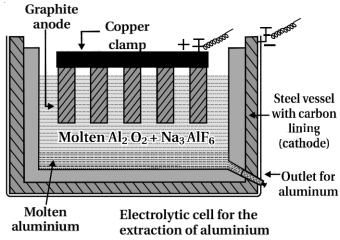
(N/A) In the electrolytic reduction of aluminium,purified $Al_{2}O_{3}$ is mixed with $Na_{3}AlF_{6}$ (cryolite) or $CaF_{2}$ (fluorspar),which lowers the melting point of the mixture and increases its electrical conductivity.
The fused matrix is electrolysed in a steel vessel with a carbon lining that acts as the cathode,while graphite rods act as the anode.
The overall reaction is:
$2 Al_{2}O_{3} + 3 C \rightarrow 4 Al + 3 CO_{2}$
The oxygen gas liberated at the anode during electrolysis reacts with the carbon of the anode to form $CO$ and $CO_{2}$. Consequently,for each $1 \ kg$ of aluminium produced,about $0.5 \ kg$ of carbon anode is consumed. Since the anodes are consumed in the reaction,they need to be replaced periodically.
At Cathode: $Al^{3+} (melt) + 3 e^{-} \rightarrow Al (l)$
At Anode:
$C (s) + O^{2-} (melt) \rightarrow CO (g) + 2 e^{-}$
$C (s) + 2 O^{2-} (melt) \rightarrow CO_{2} (g) + 4 e^{-}$
The fused matrix is electrolysed in a steel vessel with a carbon lining that acts as the cathode,while graphite rods act as the anode.
The overall reaction is:
$2 Al_{2}O_{3} + 3 C \rightarrow 4 Al + 3 CO_{2}$
The oxygen gas liberated at the anode during electrolysis reacts with the carbon of the anode to form $CO$ and $CO_{2}$. Consequently,for each $1 \ kg$ of aluminium produced,about $0.5 \ kg$ of carbon anode is consumed. Since the anodes are consumed in the reaction,they need to be replaced periodically.
At Cathode: $Al^{3+} (melt) + 3 e^{-} \rightarrow Al (l)$
At Anode:
$C (s) + O^{2-} (melt) \rightarrow CO (g) + 2 e^{-}$
$C (s) + 2 O^{2-} (melt) \rightarrow CO_{2} (g) + 4 e^{-}$
0 likes
View Solution464
Advanced
Explain the electrolytic reduction of alumina.
Solution
(N/A) In the electrolytic reduction of aluminium,purified $Al_{2}O_{3}$ is mixed with $Na_{3}AlF_{6}$ (cryolite) or $CaF_{2}$ (fluorspar),which lowers the melting point of the mixture and increases its electrical conductivity.
This mixture is electrolysed in a steel vessel with a carbon lining that acts as the cathode,while graphite rods act as the anode.
The overall process is represented by the equation:
$2Al_{2}O_{3} + 3C \rightarrow 4Al + 3CO_{2}$
During electrolysis,oxygen gas is liberated at the anode,which reacts with the carbon of the anode to form $CO$ and $CO_{2}$.
For every $1 \ kg$ of aluminium produced,approximately $0.5 \ kg$ of the carbon anode is consumed. Therefore,the graphite anodes need to be replaced periodically.
Cathode reaction: $Al^{3+} + 3e^{-} \rightarrow Al_{(l)}$
Anode reactions:
$C_{(s)} + O^{2-} \rightarrow CO_{(g)} + 2e^{-}$
$C_{(s)} + 2O^{2-} \rightarrow CO_{2(g)} + 4e^{-}$
This mixture is electrolysed in a steel vessel with a carbon lining that acts as the cathode,while graphite rods act as the anode.
The overall process is represented by the equation:
$2Al_{2}O_{3} + 3C \rightarrow 4Al + 3CO_{2}$
During electrolysis,oxygen gas is liberated at the anode,which reacts with the carbon of the anode to form $CO$ and $CO_{2}$.
For every $1 \ kg$ of aluminium produced,approximately $0.5 \ kg$ of the carbon anode is consumed. Therefore,the graphite anodes need to be replaced periodically.
Cathode reaction: $Al^{3+} + 3e^{-} \rightarrow Al_{(l)}$
Anode reactions:
$C_{(s)} + O^{2-} \rightarrow CO_{(g)} + 2e^{-}$
$C_{(s)} + 2O^{2-} \rightarrow CO_{2(g)} + 4e^{-}$
0 likes
View Solution465
Easy
Why is copper extracted from low-grade ores by hydrometallurgy?
Solution
(N/A) Copper is extracted from low-grade ores using hydrometallurgy. The ore is leached using acid or bacteria. The resulting solution contains $Cu^{2+}$ ions,which are then treated with scrap iron or $H_2$ gas. The reaction is: $Cu^{2+}_{(aq)} + H_{2(g)} \rightarrow Cu_{(s)} + 2H^+_{(aq)}$.
0 likes
View Solution466
EasyMCQ
Which of the following chemical equations represents the hydrometallurgical process for the extraction of copper from its ore?
A
$Cu^{2+} (aq) + H_2 (g) \rightarrow Cu (s) + 2H^+ (aq)$
B
$Cu^{2+} (aq) + Fe (s) \rightarrow Cu (s) + Fe^{2+} (aq)$
C
$Cu_2S + 2Cu_2O \rightarrow 6Cu + SO_2$
D
$Cu_2S + H_2 \rightarrow 2Cu + H_2S$
Solution
(B) Hydrometallurgy involves the extraction of metals from their ores using aqueous solutions. For copper,low-grade ores are leached with acid or bacteria. The resulting solution containing $Cu^{2+}$ ions is treated with scrap iron or $H_2$ gas. The reaction with scrap iron is represented as: $Cu^{2+} (aq) + Fe (s) \rightarrow Cu (s) + Fe^{2+} (aq)$. Thus,option $B$ is the correct representation.
0 likes
View Solution467
Medium
Explain the leaching and oxidation-reduction process in the metallurgy of gold.
Solution
(N/A) The leaching of gold and silver is carried out using $CN^-$. This is an oxidation process $(Au \rightarrow Au^+)$.
The metal is subsequently recovered by the displacement method.
$4Au_{(s)} + 8CN^-_{(aq)} + 2H_2O_{(aq)} + O_{2(g)} \rightarrow 4[Au(CN)_2]^-_{(aq)} + 4OH^-_{(aq)}$
$2[Au(CN)_2]^-_{(aq)} + Zn_{(s)} \rightarrow 2Au_{(s)} + [Zn(CN)_4]^{2-}_{(aq)}$
In this reaction,$Zn$ acts as a reducing agent.
The metal is subsequently recovered by the displacement method.
$4Au_{(s)} + 8CN^-_{(aq)} + 2H_2O_{(aq)} + O_{2(g)} \rightarrow 4[Au(CN)_2]^-_{(aq)} + 4OH^-_{(aq)}$
$2[Au(CN)_2]^-_{(aq)} + Zn_{(s)} \rightarrow 2Au_{(s)} + [Zn(CN)_4]^{2-}_{(aq)}$
In this reaction,$Zn$ acts as a reducing agent.
0 likes
View Solution468
Medium
At temperatures above $1073 \ K$,coke can be used to reduce $FeO$ to $Fe$. How can you justify this reduction with an Ellingham diagram?
Solution
(N/A) In an Ellingham diagram,the line representing the oxidation of carbon to carbon monoxide $(2C + O_2 \rightarrow 2CO)$ slopes downwards,while the line for the oxidation of iron to iron$(II)$ oxide $(2Fe + O_2 \rightarrow 2FeO)$ slopes upwards.
At temperatures above $1073 \ K$,the Gibbs free energy of formation for $CO$ becomes more negative than that for $FeO$,i.e.,$\Delta_{f} G^{\ominus}_{(C, CO)} < \Delta_{f} G^{\ominus}_{(Fe, FeO)}$.
Since the reduction of $FeO$ by $C$ $(2FeO + 2C \rightarrow 2Fe + 2CO)$ is the sum of the two reactions,the overall $\Delta G^{\ominus}$ becomes negative,making the reduction thermodynamically feasible.
At temperatures above $1073 \ K$,the Gibbs free energy of formation for $CO$ becomes more negative than that for $FeO$,i.e.,$\Delta_{f} G^{\ominus}_{(C, CO)} < \Delta_{f} G^{\ominus}_{(Fe, FeO)}$.
Since the reduction of $FeO$ by $C$ $(2FeO + 2C \rightarrow 2Fe + 2CO)$ is the sum of the two reactions,the overall $\Delta G^{\ominus}$ becomes negative,making the reduction thermodynamically feasible.
0 likes
View Solution469
Medium
Wrought iron is the purest form of iron. Write a reaction used for the preparation of wrought iron from cast iron. How can the impurities of sulphur,silicon and phosphorus be removed from cast iron?
Solution
(N/A) Wrought iron is prepared from cast iron by oxidizing impurities in a reverberatory furnace lined with haematite $(Fe_2O_3)$.
The chemical reaction involved is:
$Fe_2O_3(s) + 3C(s) \rightarrow 2Fe(s) + 3CO(g)$
To remove impurities like sulphur,silicon,and phosphorus,limestone $(CaCO_3)$ is added as a flux. The impurities are oxidized to their respective oxides ($SO_2$,$SiO_2$,$P_4O_{10}$) and are removed as slag. For example,$SiO_2$ reacts with limestone to form calcium silicate slag $(CaSiO_3)$. The molten metal is then removed and freed from the slag by passing it through rollers.
The chemical reaction involved is:
$Fe_2O_3(s) + 3C(s) \rightarrow 2Fe(s) + 3CO(g)$
To remove impurities like sulphur,silicon,and phosphorus,limestone $(CaCO_3)$ is added as a flux. The impurities are oxidized to their respective oxides ($SO_2$,$SiO_2$,$P_4O_{10}$) and are removed as slag. For example,$SiO_2$ reacts with limestone to form calcium silicate slag $(CaSiO_3)$. The molten metal is then removed and freed from the slag by passing it through rollers.
0 likes
View Solution470
Medium
How is copper extracted from low grade copper ores?
Solution
(N/A) Copper is extracted from low grade ores using the process of hydrometallurgy,specifically leaching.
$1$. The ore is treated with an aqueous solution of acid or bacteria,which dissolves the copper ions into the solution while leaving the impurities behind.
$2$. The resulting solution containing $Cu^{2+}$ ions is then treated with scrap iron $(Fe)$ or hydrogen gas $(H_2)$ to reduce the copper ions to metallic copper.
$3$. The chemical reaction involved is: $Cu^{2+}(aq) + H_2(g) \rightarrow Cu(s) + 2H^+(aq)$ or $Cu^{2+}(aq) + Fe(s) \rightarrow Cu(s) + Fe^{2+}(aq)$.
$1$. The ore is treated with an aqueous solution of acid or bacteria,which dissolves the copper ions into the solution while leaving the impurities behind.
$2$. The resulting solution containing $Cu^{2+}$ ions is then treated with scrap iron $(Fe)$ or hydrogen gas $(H_2)$ to reduce the copper ions to metallic copper.
$3$. The chemical reaction involved is: $Cu^{2+}(aq) + H_2(g) \rightarrow Cu(s) + 2H^+(aq)$ or $Cu^{2+}(aq) + Fe(s) \rightarrow Cu(s) + Fe^{2+}(aq)$.
0 likes
View Solution471
Medium
Although carbon and hydrogen are better reducing agents,they are not used to reduce metallic oxides at high temperatures. Why?
Solution
(N/A) This is due to the formation of metal carbides and metal hydrides at high temperatures.
$CaO + 3C \xrightarrow{2273 \ K} CaC_2 + CO$
$Ca + H_2 \rightarrow CaH_2$
$CaO + 3C \xrightarrow{2273 \ K} CaC_2 + CO$
$Ca + H_2 \rightarrow CaH_2$
0 likes
View Solution472
Medium
The purest form of iron is prepared by oxidising impurities from cast iron in a reverberatory furnace. Which iron ore is used to line the furnace? Explain by giving the reaction.
Solution
(N/A) The lining of the reverberatory furnace is done using haematite $(Fe_{2}O_{3})$,which oxidises the impurities present in cast iron.
The reaction involved is:
$Fe_{2}O_{3} + 3C \rightarrow 2Fe + 3CO$
In this process,carbon is oxidised to $CO$. Other impurities like sulphur,silicon,and phosphorus are also oxidised to $SO_{2}$,$SiO_{2}$,and $P_{4}O_{10}$ respectively. $SO_{2}$ escapes as a gas,while $SiO_{2}$ and $P_{4}O_{10}$ are removed as slag by reacting with a flux.
The reaction involved is:
$Fe_{2}O_{3} + 3C \rightarrow 2Fe + 3CO$
In this process,carbon is oxidised to $CO$. Other impurities like sulphur,silicon,and phosphorus are also oxidised to $SO_{2}$,$SiO_{2}$,and $P_{4}O_{10}$ respectively. $SO_{2}$ escapes as a gas,while $SiO_{2}$ and $P_{4}O_{10}$ are removed as slag by reacting with a flux.
0 likes
View Solution473
MediumMCQ
Why is sulphide ore of copper heated in a furnace after mixing with silica?
A
To remove iron oxide as slag.
B
To reduce copper sulphide to copper metal.
C
To convert copper sulphide to copper oxide.
D
To increase the melting point of the ore.
Solution
(A) Iron oxide $(FeO)$ is present as an impurity in the sulphide ore of copper. Silica $(SiO_2)$ is added as a flux to remove this impurity. It reacts with $FeO$ to form iron silicate $(FeSiO_3)$,which is a fusible slag.
$FeO + SiO_2 \rightarrow FeSiO_3$
This process allows the separation of the slag from the copper matte.
$FeO + SiO_2 \rightarrow FeSiO_3$
This process allows the separation of the slag from the copper matte.
0 likes
View Solution474
Medium
What should be the considerations during the extraction of metals by electrochemical method?
Solution
(N/A) $i$. Reactivity of the metal: The metals should be extracted by electrolysis of their fused salts if the metals are highly reactive,as they may react with water during the reaction.
$ii$. Nature of electrodes: The electrodes used for electrolysis should not react with the products of electrolysis. If they do react,the electrodes must be made of a material that is inexpensive,as their periodic replacement should not exceed the cost of the process.
$ii$. Nature of electrodes: The electrodes used for electrolysis should not react with the products of electrolysis. If they do react,the electrodes must be made of a material that is inexpensive,as their periodic replacement should not exceed the cost of the process.
0 likes
View Solution475
MediumMCQ
What is the role of flux in metallurgical processes?
A
To reduce the melting point of the ore.
B
To remove gangue in the form of slag.
C
To increase the density of the ore.
D
To act as a catalyst in the reaction.
Solution
(B) The role of flux in metallurgical processes is:
$(i)$ To remove the gangue present in the ore by reacting with it to form a fusible substance called slag.
$(ii)$ To lower the melting point of the mixture,making the extraction process more efficient.
$(i)$ To remove the gangue present in the ore by reacting with it to form a fusible substance called slag.
$(ii)$ To lower the melting point of the mixture,making the extraction process more efficient.
0 likes
View Solution476
Medium
Write down the reactions taking place in the blast furnace related to the metallurgy of iron in the temperature range $500-800 \ K$.
Solution
(N/A) In the temperature range of $500-800 \ K$ (lower temperature range),the following reduction reactions occur in the blast furnace:
$3 Fe_{2}O_{3} + CO \rightarrow 2 Fe_{3}O_{4} + CO_{2}$
$Fe_{3}O_{4} + 4 CO \rightarrow 3 Fe + 4 CO_{2}$
$Fe_{2}O_{3} + CO \rightarrow 2 FeO + CO_{2}$
$3 Fe_{2}O_{3} + CO \rightarrow 2 Fe_{3}O_{4} + CO_{2}$
$Fe_{3}O_{4} + 4 CO \rightarrow 3 Fe + 4 CO_{2}$
$Fe_{2}O_{3} + CO \rightarrow 2 FeO + CO_{2}$
0 likes
View Solution477
Medium
Write the chemical reactions involved in the extraction of gold by the cyanide process. Also,explain the role of zinc in this extraction.
Solution
(N/A) The extraction of gold involves the following steps:
$1$. Leaching: Gold is treated with a dilute solution of sodium cyanide $(NaCN)$ in the presence of air $(O_2)$ to form a soluble complex:
$4 Au(s) + 8 CN^{-}(aq) + 2 H_{2}O(l) + O_{2}(g) \rightarrow 4 [Au(CN)_{2}]^{-}(aq) + 4 OH^{-}(aq)$
$2$. Reduction: The gold is recovered from the complex by adding zinc $(Zn)$,which acts as a reducing agent:
$2 [Au(CN)_{2}]^{-}(aq) + Zn(s) \rightarrow 2 Au(s) + [Zn(CN)_{4}]^{2-}(aq)$
Zinc acts as a reducing agent by displacing gold from its complex.
$1$. Leaching: Gold is treated with a dilute solution of sodium cyanide $(NaCN)$ in the presence of air $(O_2)$ to form a soluble complex:
$4 Au(s) + 8 CN^{-}(aq) + 2 H_{2}O(l) + O_{2}(g) \rightarrow 4 [Au(CN)_{2}]^{-}(aq) + 4 OH^{-}(aq)$
$2$. Reduction: The gold is recovered from the complex by adding zinc $(Zn)$,which acts as a reducing agent:
$2 [Au(CN)_{2}]^{-}(aq) + Zn(s) \rightarrow 2 Au(s) + [Zn(CN)_{4}]^{2-}(aq)$
Zinc acts as a reducing agent by displacing gold from its complex.
0 likes
View Solution478
Medium
Explain the extraction of elements by oxidation.
Solution
(N/A) Besides reduction,some extractions are based on oxidation,particularly for non-metals.
$(i)$ Extraction of chlorine from brine: The extraction is based on oxidation.
$2 Cl_{(aq)}^{-} + 2 H_2O_{(l)} \rightarrow 2 OH_{(aq)}^{-} + H_{2(g)} + Cl_{2(g)}$
The change in Gibbs free energy for the reaction is $+422 \ kJ$. When it is converted to $E^{0}$ using the equation $\Delta G^{0} = -nFE^{0}$,we get $E^{0} = -2.2 \ V$. Thus,an external $emf$ higher than $2.2 \ V$ needs to be supplied to carry out the process.
The electrolysis,however,requires an excess potential to overcome some other hindering reactions. Thus,$Cl_2$ is obtained by electrolysis,giving out $H_2$ and aqueous $NaOH$ as by-products. Electrolysis of molten $NaCl$ is also carried out,but in that case,$Na$ metal is produced and not $NaOH$.
$(ii)$ Gold Cyanidation process: Extraction of gold or silver involves leaching with $CN^{-}$. This is also an oxidation reaction ($Ag \rightarrow Ag^{+}$,$Au \rightarrow Au^{+}$).
The metal is later recovered by the displacement method.
$4 Au_{(s)} + 8 CN_{(aq)}^{-} + 2 H_2O_{(l)} + O_{2(g)} \rightarrow 4[Au(CN)_2]^{-}_{(aq)} + 4 OH_{(aq)}^{-}$
$2[Au(CN)_2]^{-}_{(aq)} + Zn_{(s)} \rightarrow 2 Au_{(s)} + [Zn(CN)_4]^{2-}_{(aq)}$
$Zinc$ acts as a reducing agent.
$(i)$ Extraction of chlorine from brine: The extraction is based on oxidation.
$2 Cl_{(aq)}^{-} + 2 H_2O_{(l)} \rightarrow 2 OH_{(aq)}^{-} + H_{2(g)} + Cl_{2(g)}$
The change in Gibbs free energy for the reaction is $+422 \ kJ$. When it is converted to $E^{0}$ using the equation $\Delta G^{0} = -nFE^{0}$,we get $E^{0} = -2.2 \ V$. Thus,an external $emf$ higher than $2.2 \ V$ needs to be supplied to carry out the process.
The electrolysis,however,requires an excess potential to overcome some other hindering reactions. Thus,$Cl_2$ is obtained by electrolysis,giving out $H_2$ and aqueous $NaOH$ as by-products. Electrolysis of molten $NaCl$ is also carried out,but in that case,$Na$ metal is produced and not $NaOH$.
$(ii)$ Gold Cyanidation process: Extraction of gold or silver involves leaching with $CN^{-}$. This is also an oxidation reaction ($Ag \rightarrow Ag^{+}$,$Au \rightarrow Au^{+}$).
The metal is later recovered by the displacement method.
$4 Au_{(s)} + 8 CN_{(aq)}^{-} + 2 H_2O_{(l)} + O_{2(g)} \rightarrow 4[Au(CN)_2]^{-}_{(aq)} + 4 OH_{(aq)}^{-}$
$2[Au(CN)_2]^{-}_{(aq)} + Zn_{(s)} \rightarrow 2 Au_{(s)} + [Zn(CN)_4]^{2-}_{(aq)}$
$Zinc$ acts as a reducing agent.
0 likes
View Solution479
Medium
Explain the thermodynamics of the extraction of iron from its oxide.
Solution
(A) In the process of extraction of iron,the key step involving reduction is $FeO_{(s)} + C_{(s)} \rightarrow Fe_{(s/l)} + CO_{(g)}$ $(i)$.
The reaction $(i)$ can be seen as the coupling of the following two reactions:
$FeO_{(s)} \rightarrow Fe_{(s)} + \frac{1}{2} O_{2(g)}$ ; $\Delta_{r} G^{\ominus}_{(FeO, Fe)}$ $(ii)$
$C_{(s)} + \frac{1}{2} O_{2(g)} \rightarrow CO_{(g)}$ ; $\Delta_{r} G^{\ominus}_{(C, CO)}$ $(iii)$
When reactions $(ii)$ and $(iii)$ are coupled to yield $(i)$,the net Gibbs free energy change is:
$\Delta_{r} G^{\ominus} = \Delta_{r} G^{\ominus}_{(C, CO)} + \Delta_{r} G^{\ominus}_{(FeO, Fe)}$ $(iv)$
The reaction will occur spontaneously if the value of $\Delta_{r} G^{\ominus}$ in equation $(iv)$ is negative. This is explained by the Ellingham diagram:
$(i)$ In the given figure,the $\Delta_{r} G^{\ominus}$ vs $T$ plot for the oxidation of $Fe$ to $FeO$ goes upward,while the plot for the oxidation of $C$ to $CO$ goes downward. These two plots intersect at approximately $1073 \ K$.
$(ii)$ At temperatures above $1073 \ K$,the $C \rightarrow CO$ line lies below the $Fe \rightarrow FeO$ line,meaning $\Delta_{r} G^{\ominus}_{(C, CO)} < \Delta_{r} G^{\ominus}_{(FeO, Fe)}$.
Thus,above $1073 \ K$,coke acts as a reducing agent for $FeO$ and is itself oxidized to $CO$.
The reaction $(i)$ can be seen as the coupling of the following two reactions:
$FeO_{(s)} \rightarrow Fe_{(s)} + \frac{1}{2} O_{2(g)}$ ; $\Delta_{r} G^{\ominus}_{(FeO, Fe)}$ $(ii)$
$C_{(s)} + \frac{1}{2} O_{2(g)} \rightarrow CO_{(g)}$ ; $\Delta_{r} G^{\ominus}_{(C, CO)}$ $(iii)$
When reactions $(ii)$ and $(iii)$ are coupled to yield $(i)$,the net Gibbs free energy change is:
$\Delta_{r} G^{\ominus} = \Delta_{r} G^{\ominus}_{(C, CO)} + \Delta_{r} G^{\ominus}_{(FeO, Fe)}$ $(iv)$
The reaction will occur spontaneously if the value of $\Delta_{r} G^{\ominus}$ in equation $(iv)$ is negative. This is explained by the Ellingham diagram:
$(i)$ In the given figure,the $\Delta_{r} G^{\ominus}$ vs $T$ plot for the oxidation of $Fe$ to $FeO$ goes upward,while the plot for the oxidation of $C$ to $CO$ goes downward. These two plots intersect at approximately $1073 \ K$.
$(ii)$ At temperatures above $1073 \ K$,the $C \rightarrow CO$ line lies below the $Fe \rightarrow FeO$ line,meaning $\Delta_{r} G^{\ominus}_{(C, CO)} < \Delta_{r} G^{\ominus}_{(FeO, Fe)}$.
Thus,above $1073 \ K$,coke acts as a reducing agent for $FeO$ and is itself oxidized to $CO$.
0 likes
View Solution480
Difficult
Explain the theory of reduction of metal oxides with carbon as a reducing agent,or explain the role of a reducing agent in the reduction of metal oxides.
Solution
During the reduction process,the oxide of a metal decomposes and the reducing agent removes the oxygen. The role of the reducing agent is to provide a $\Delta_{r} G^{\ominus}$ value that is negative and large enough to make the sum of $\Delta_{r} G^{\ominus}$ of the two reactions (oxidation of the reducing agent and reduction of the metal oxide) negative.
$M_{x}O_{(s)} \rightarrow xM_{(s \text{ or } l)} + \frac{1}{2}O_{2(g)}$ ; $\Delta_{r} G^{\ominus}(M_{x}O, M)$ $... (i)$
If reduction is carried out by carbon,the oxidation of the reducing agent $(C)$ occurs:
$C_{(s)} + \frac{1}{2}O_{2(g)} \rightarrow CO_{(g)}$ ; $\Delta_{r} G^{\ominus}(C, CO)$ $... (ii)$
Alternatively,the complete oxidation of carbon to carbon dioxide may take place:
$\frac{1}{2}C_{(s)} + \frac{1}{2}O_{2(g)} \rightarrow \frac{1}{2}CO_{2(g)}$ ; $\frac{1}{2}\Delta_{r} G^{\ominus}(C, CO_{2})$ $... (iii)$
On coupling reactions $(i)$ and $(ii)$,we get:
$M_{x}O_{(s)} + C_{(s)} \rightarrow xM_{(s \text{ or } l)} + CO_{(g)}$ $... (iv)$
On coupling reactions $(i)$ and $(iii)$,we have:
$M_{x}O_{(s)} + \frac{1}{2}C_{(s)} \rightarrow xM_{(s \text{ or } l)} + \frac{1}{2}CO_{2(g)}$ $... (v)$
Similarly,if carbon monoxide is the reducing agent,it is oxidized as follows:
$CO_{(g)} + \frac{1}{2}O_{2(g)} \rightarrow CO_{2(g)}$ ; $\Delta_{r} G^{\ominus}(CO, CO_{2})$ $... (vi)$
On coupling reactions $(i)$ and $(vi)$,we have:
$M_{x}O_{(s)} + CO_{(g)} \rightarrow xM_{(s \text{ or } l)} + CO_{2(g)}$ $... (vii)$
The reactions $(iv)$ and $(vii)$ describe the reduction of metal oxide $M_{x}O$. The temperature chosen must be such that the $\Delta_{r} G^{\ominus}$ for the combined redox process is negative. This is indicated by the intersection point of the two curves in the Ellingham diagram. After that point,the $\Delta_{r} G^{\ominus}$ becomes sufficiently negative to make the reduction of $M_{x}O$ feasible.
$M_{x}O_{(s)} \rightarrow xM_{(s \text{ or } l)} + \frac{1}{2}O_{2(g)}$ ; $\Delta_{r} G^{\ominus}(M_{x}O, M)$ $... (i)$
If reduction is carried out by carbon,the oxidation of the reducing agent $(C)$ occurs:
$C_{(s)} + \frac{1}{2}O_{2(g)} \rightarrow CO_{(g)}$ ; $\Delta_{r} G^{\ominus}(C, CO)$ $... (ii)$
Alternatively,the complete oxidation of carbon to carbon dioxide may take place:
$\frac{1}{2}C_{(s)} + \frac{1}{2}O_{2(g)} \rightarrow \frac{1}{2}CO_{2(g)}$ ; $\frac{1}{2}\Delta_{r} G^{\ominus}(C, CO_{2})$ $... (iii)$
On coupling reactions $(i)$ and $(ii)$,we get:
$M_{x}O_{(s)} + C_{(s)} \rightarrow xM_{(s \text{ or } l)} + CO_{(g)}$ $... (iv)$
On coupling reactions $(i)$ and $(iii)$,we have:
$M_{x}O_{(s)} + \frac{1}{2}C_{(s)} \rightarrow xM_{(s \text{ or } l)} + \frac{1}{2}CO_{2(g)}$ $... (v)$
Similarly,if carbon monoxide is the reducing agent,it is oxidized as follows:
$CO_{(g)} + \frac{1}{2}O_{2(g)} \rightarrow CO_{2(g)}$ ; $\Delta_{r} G^{\ominus}(CO, CO_{2})$ $... (vi)$
On coupling reactions $(i)$ and $(vi)$,we have:
$M_{x}O_{(s)} + CO_{(g)} \rightarrow xM_{(s \text{ or } l)} + CO_{2(g)}$ $... (vii)$
The reactions $(iv)$ and $(vii)$ describe the reduction of metal oxide $M_{x}O$. The temperature chosen must be such that the $\Delta_{r} G^{\ominus}$ for the combined redox process is negative. This is indicated by the intersection point of the two curves in the Ellingham diagram. After that point,the $\Delta_{r} G^{\ominus}$ becomes sufficiently negative to make the reduction of $M_{x}O$ feasible.
0 likes
View Solution481
MediumMCQ
Which metal is added to recover $Au$ from $[Au(CN)_2]^-$?
A
$Zn$
B
$Cu$
C
$Fe$
D
$Ag$
Solution
(A) The extraction of gold from its ore involves the formation of the dicyanoaurate$(I)$ complex,$[Au(CN)_2]^-$.
To recover metallic gold from this complex,a more electropositive metal like zinc $(Zn)$ is added.
The displacement reaction is: $2[Au(CN)_2]^- (aq) + Zn (s) \rightarrow 2Au (s) + [Zn(CN)_4]^{2-} (aq)$.
To recover metallic gold from this complex,a more electropositive metal like zinc $(Zn)$ is added.
The displacement reaction is: $2[Au(CN)_2]^- (aq) + Zn (s) \rightarrow 2Au (s) + [Zn(CN)_4]^{2-} (aq)$.
0 likes
View Solution482
EasyMCQ
Cast iron is used for the manufacture of
A
wrought iron and pig iron
B
wrought iron and steel
C
wrought iron,pig iron and steel
D
pig iron,scrap iron and steel
Solution
(B) Cast iron is the most impure form of iron,containing about $3-4.5 \%$ carbon. It is used for the manufacture of wrought iron and steel by removing impurities through oxidation.
0 likes
View Solution483
MediumMCQ
An Ellingham diagram provides information about :
A
the pressure dependence of the standard electrode potentials of reduction reactions involved in the extraction of metals.
B
the kinetics of the reduction process.
C
the temperature dependence of the standard Gibbs energies of formation of some metal oxides.
D
the conditions of $pH$ and potential under which a species is thermodynamically stable.
Solution
(C) The Ellingham diagram is a plot of the standard Gibbs energy of formation $(\Delta G^{\circ})$ versus temperature $(T)$ for the formation of metal oxides.
It helps in predicting the feasibility of the reduction of a metal oxide by a given reducing agent.
It helps in predicting the feasibility of the reduction of a metal oxide by a given reducing agent.
0 likes
View Solution484
MediumMCQ
In the processing of steel,which of the following allotropes of carbon is used?
A
Carbon black
B
Charcoal
C
Coke
D
Graphones
Solution
(C) Carbon black,charcoal,coke,and graphene are forms or allotropes of carbon. Among these,$Coke$ is primarily used in the blast furnace for the reduction of iron ore to produce steel.
0 likes
View Solution485
MediumMCQ
Which of the following has maximum iron content?
A
Cast Iron
B
Wrought Iron
C
Pig Iron
D
Stainless steel
Solution
(B) The iron content in various forms of iron is as follows:
$1$. Cast iron: Contains about $93-95 \%$ iron.
$2$. Pig iron: Contains about $93-95 \%$ iron.
$3$. Wrought iron: Contains about $99.5-99.9 \%$ iron,making it the purest form of commercial iron.
$4$. Stainless steel: Contains about $70-80 \%$ iron along with chromium and nickel.
Therefore,Wrought iron has the maximum iron content.
$1$. Cast iron: Contains about $93-95 \%$ iron.
$2$. Pig iron: Contains about $93-95 \%$ iron.
$3$. Wrought iron: Contains about $99.5-99.9 \%$ iron,making it the purest form of commercial iron.
$4$. Stainless steel: Contains about $70-80 \%$ iron along with chromium and nickel.
Therefore,Wrought iron has the maximum iron content.
0 likes
View Solution486
DifficultMCQ
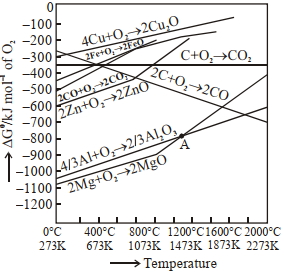
The point of intersection and sudden increase in the slope,in the diagram given below,respectively,indicates
A
$ \Delta G = 0 $ and melting or boiling point of the metal oxide
B
$ \Delta G > 0 $ and decomposition of the metal oxide
C
$ \Delta G < 0 $ and decomposition of the metal oxide
D
$ \Delta G = 0 $ and reduction of the metal oxide
Solution
(A) In an Ellingham diagram,the point of intersection of two lines indicates that the $ \Delta G $ values for the two reactions are equal,meaning $ \Delta G = 0 $ for the overall coupled reaction.
$A$ sudden change in the slope of a line in the Ellingham diagram indicates a phase change (melting or boiling) of the metal or the metal oxide.
$A$ sudden change in the slope of a line in the Ellingham diagram indicates a phase change (melting or boiling) of the metal or the metal oxide.
0 likes
View Solution487
MediumMCQ
The chemical that is added to reduce the melting point of the reaction mixture during the extraction of aluminium is
A
Cryolite
B
Bauxite
C
Calamine
D
Kaolinite
Solution
(A) During the extraction of aluminium by the Hall-$H$éroult process,pure $Al_2O_3$ has a very high melting point.
To reduce the melting point of the reaction mixture and to increase its electrical conductivity,$Na_3AlF_6$ (Cryolite) is added.
To reduce the melting point of the reaction mixture and to increase its electrical conductivity,$Na_3AlF_6$ (Cryolite) is added.
0 likes
View Solution488
MediumMCQ
Which of the following reduction reactions $CANNOT$ be carried out with coke?
A
$Al_2O_3 \rightarrow Al$
B
$ZnO \rightarrow Zn$
C
$Fe_2O_3 \rightarrow Fe$
D
$Cu_2O \rightarrow Cu$
Solution
(A) The reduction of $Al_2O_3 \rightarrow Al$ cannot be carried out using coke (carbon) because aluminum has a very high affinity for oxygen and is more stable than $CO_2$.
It is instead carried out by the electrolytic reduction of its fused salts (Hall-Heroult process).
$ZnO$,$Fe_2O_3$,and $Cu_2O$ can be reduced to their respective metals using carbon (coke) as a reducing agent.
It is instead carried out by the electrolytic reduction of its fused salts (Hall-Heroult process).
$ZnO$,$Fe_2O_3$,and $Cu_2O$ can be reduced to their respective metals using carbon (coke) as a reducing agent.
0 likes
View Solution489
MediumMCQ
$Al_{2}O_{3}$ was leached with alkali to get $X$. The solution of $X$ on passing of gas $Y$,forms $Z$. $X$,$Y$ and $Z$ respectively are
A
$X = Na[Al(OH)_{4}], Y = SO_{2}, Z = Al_{2}O_{3}$
B
$X = Na[Al(OH)_{4}], Y = CO_{2}, Z = Al_{2}O_{3} \cdot xH_{2}O$
C
$X = Al(OH)_{3}, Y = CO_{2}, Z = Al_{2}O_{3}$
D
$X = Al(OH)_{3}, Y = SO_{2}, Z = Al_{2}O_{3} \cdot xH_{2}O$
Solution
(B) In the Bayer's process,$Al_{2}O_{3}$ is leached with $NaOH$ to form sodium aluminate,$X = Na[Al(OH)_{4}]$.
Passing $CO_{2}$ gas $(Y)$ through the solution of $X$ results in the precipitation of hydrated alumina,$Z = Al_{2}O_{3} \cdot xH_{2}O$.
The chemical reactions are:
$Al_{2}O_{3}(s) + 2NaOH(aq) + 3H_{2}O(l) \rightarrow 2Na[Al(OH)_{4}](aq)$
$2Na[Al(OH)_{4}](aq) + CO_{2}(g) \rightarrow Al_{2}O_{3} \cdot xH_{2}O(s) + 2NaHCO_{3}(aq)$
Passing $CO_{2}$ gas $(Y)$ through the solution of $X$ results in the precipitation of hydrated alumina,$Z = Al_{2}O_{3} \cdot xH_{2}O$.
The chemical reactions are:
$Al_{2}O_{3}(s) + 2NaOH(aq) + 3H_{2}O(l) \rightarrow 2Na[Al(OH)_{4}](aq)$
$2Na[Al(OH)_{4}](aq) + CO_{2}(g) \rightarrow Al_{2}O_{3} \cdot xH_{2}O(s) + 2NaHCO_{3}(aq)$
0 likes
View Solution490
EasyMCQ
The Ellingham diagram is a graphical representation of
A
$\Delta H$ vs $T$
B
$\Delta G$ vs $T$
C
$\Delta G$ vs $P$
D
$(\Delta G - T \Delta S)$ vs $T$
Solution
(B) The Ellingham diagram is a plot of the Gibbs free energy change $(\Delta G)$ versus temperature $(T)$ for the formation of metal oxides from their respective elements and oxygen. It helps in predicting the feasibility of the reduction of metal oxides.
0 likes
View Solution491
MediumMCQ
Given below are two statements.
Statement $I:$ The choice of reducing agents for metals extraction can be made by using Ellingham diagram,a plot of $\Delta G$ vs temperature.
Statement $II:$ The value of $\Delta S$ increases from left to right in Ellingham diagram.
In the light of the above statements,choose the most appropriate answer from the options given below:
Statement $I:$ The choice of reducing agents for metals extraction can be made by using Ellingham diagram,a plot of $\Delta G$ vs temperature.
Statement $II:$ The value of $\Delta S$ increases from left to right in Ellingham diagram.
In the light of the above statements,choose the most appropriate answer from the options given below:
A
Both Statement $I$ and Statement $II$ are true
B
Statement $I$ is false but Statement $II$ is true
C
Both Statement $I$ and Statement $II$ are false
D
Statement $I$ is true but Statement $II$ is false
Solution
(D) Statement $I$ is true because the Ellingham diagram,which plots $\Delta G$ versus temperature,helps in selecting a suitable reducing agent for metal extraction. $A$ metal with a more negative $\Delta G$ value can reduce the oxide of a metal with a less negative $\Delta G$ value.
Statement $II$ is false because the slope of the lines in the Ellingham diagram is equal to $-\Delta S$. Since most metal oxidation reactions involve a decrease in entropy $(\Delta S < 0)$,the slopes are generally positive. The value of $\Delta S$ does not increase from left to right; rather,the entropy change remains relatively constant for a given reaction.
Statement $II$ is false because the slope of the lines in the Ellingham diagram is equal to $-\Delta S$. Since most metal oxidation reactions involve a decrease in entropy $(\Delta S < 0)$,the slopes are generally positive. The value of $\Delta S$ does not increase from left to right; rather,the entropy change remains relatively constant for a given reaction.
0 likes
View Solution492
MediumMCQ
Given below are two statements: one is labelled as Assertion $(A)$ and the other is labelled as Reason $(R).$
Assertion $(A):$ Aluminium is extracted from bauxite by the electrolysis of a molten mixture of $Al_2O_3$ with cryolite.
Reason $(R):$ The oxidation state of $Al$ in cryolite is $+3$.
In the light of the above statements,choose the most appropriate answer from the options given below:
Assertion $(A):$ Aluminium is extracted from bauxite by the electrolysis of a molten mixture of $Al_2O_3$ with cryolite.
Reason $(R):$ The oxidation state of $Al$ in cryolite is $+3$.
In the light of the above statements,choose the most appropriate answer from the options given below:
A
$(A)$ is true but $(R)$ is false.
B
$(A)$ is false but $(R)$ is true.
C
Both $(A)$ and $(R)$ are correct and $(R)$ is the correct explanation of $(A)$.
D
Both $(A)$ and $(R)$ are correct but $(R)$ is not the correct explanation of $(A)$.
Solution
(D) Aluminium is extracted from alumina $(Al_2O_3)$ by electrolysis. Since $Al_2O_3$ has a very high melting point and is a poor conductor of electricity,it is mixed with cryolite $(Na_3AlF_6)$ to lower the melting point and increase electrical conductivity. Thus,Assertion $(A)$ is true.
$(B)$ In cryolite $(Na_3AlF_6)$,let the oxidation state of $Al$ be $x$. The sum of oxidation states is $3(+1) + x + 6(-1) = 0$,which gives $3 + x - 6 = 0$,so $x = +3$. Thus,Reason $(R)$ is true.
$(C)$ While both statements are true,the fact that $Al$ has a $+3$ oxidation state in cryolite is not the reason why cryolite is used in the electrolysis process (it is used to lower the melting point and improve conductivity). Therefore,$(R)$ is not the correct explanation of $(A)$.
$(B)$ In cryolite $(Na_3AlF_6)$,let the oxidation state of $Al$ be $x$. The sum of oxidation states is $3(+1) + x + 6(-1) = 0$,which gives $3 + x - 6 = 0$,so $x = +3$. Thus,Reason $(R)$ is true.
$(C)$ While both statements are true,the fact that $Al$ has a $+3$ oxidation state in cryolite is not the reason why cryolite is used in the electrolysis process (it is used to lower the melting point and improve conductivity). Therefore,$(R)$ is not the correct explanation of $(A)$.
0 likes
View Solution493
MediumMCQ
The maximum temperature that can be achieved in a blast furnace is:
A
upto $1200 \ K$
B
upto $2200 \ K$
C
upto $1900 \ K$
D
upto $5000 \ K$
Solution
(B) In a blast furnace,the temperature varies at different zones.
The combustion zone,where coke burns to produce heat,reaches the maximum temperature of approximately $2200 \ K$.
The combustion zone,where coke burns to produce heat,reaches the maximum temperature of approximately $2200 \ K$.
0 likes
View Solution494
DifficultMCQ
The addition of silica during the extraction of copper from its sulphide ore:
A
converts iron oxide into iron silicate
B
converts copper sulphide into copper silicate
C
reduces copper sulphide into metallic copper
D
reduces the melting point of the reaction mixture
Solution
(A) During the extraction of copper from its sulphide ore,$FeO$ is present as an impurity.
Silica $(SiO_2)$ is added as a flux to remove this impurity.
The reaction is:
$FeO + SiO_2 \rightarrow FeSiO_3$
Here,$FeSiO_3$ is formed as a slag,which is easily removed from the molten copper matte.
Silica $(SiO_2)$ is added as a flux to remove this impurity.
The reaction is:
$FeO + SiO_2 \rightarrow FeSiO_3$
Here,$FeSiO_3$ is formed as a slag,which is easily removed from the molten copper matte.
0 likes
View Solution495
EasyMCQ
Which of the following chemical reactions represents the Hall-Heroult process?
A
$Cr_2O_3 + 2 Al \rightarrow Al_2O_3 + 2 Cr$
B
$2 Al_2O_3 + 3 C \rightarrow 4 Al + 3 CO_2$
C
$FeO + CO \rightarrow Fe + CO_2$
D
$2[Au(CN)_2]_{(aq)}^{-} + Zn_{(s)} \rightarrow 2 Au_{(s)} + [Zn(CN)_4]^{2-}$
Solution
(B) The Hall-Heroult process is the major industrial method for the extraction of aluminium from alumina $(Al_2O_3)$.
In this electrolytic process,alumina is dissolved in molten cryolite $(Na_3AlF_6)$ and electrolyzed using carbon electrodes.
The overall chemical reaction is: $2 Al_2O_3 + 3 C \rightarrow 4 Al + 3 CO_2$.
In this electrolytic process,alumina is dissolved in molten cryolite $(Na_3AlF_6)$ and electrolyzed using carbon electrodes.
The overall chemical reaction is: $2 Al_2O_3 + 3 C \rightarrow 4 Al + 3 CO_2$.
0 likes
View Solution496
EasyMCQ
Leaching of gold with dilute aqueous solution of $NaCN$ in presence of oxygen gives complex $[A]$,which on reaction with zinc forms the elemental gold and another complex $[B]$. $[A]$ and $[B],$ respectively are ...... .
A
$[Au(CN)_4]^-$ and $[Zn(CN)_2(OH)_2]^{2-}$
B
$[Au(CN)_2]^-$ and $[Zn(OH)_4]^{2-}$
C
$[Au(CN)_2]^-$ and $[Zn(CN)_4]^{2-}$
D
$[Au(CN)_4]^{2-}$ and $[Zn(CN)_6]^{4-}$
Solution
(C) The leaching process of gold involves the formation of the dicyanoaurate$(I)$ complex $[A]$:
$4Au(s) + 8CN^-(aq) + 2H_2O(aq) + O_2(g) \rightarrow 4[Au(CN)_2]^-(aq) + 4OH^-(aq)$.
Here,$[A]$ is $[Au(CN)_2]^-$.
Next,the displacement reaction with zinc occurs:
$2[Au(CN)_2]^-(aq) + Zn(s) \rightarrow [Zn(CN)_4]^{2-}(aq) + 2Au(s)$.
Here,$[B]$ is $[Zn(CN)_4]^{2-}$.
Thus,$[A]$ and $[B]$ are $[Au(CN)_2]^-$ and $[Zn(CN)_4]^{2-}$ respectively.
$4Au(s) + 8CN^-(aq) + 2H_2O(aq) + O_2(g) \rightarrow 4[Au(CN)_2]^-(aq) + 4OH^-(aq)$.
Here,$[A]$ is $[Au(CN)_2]^-$.
Next,the displacement reaction with zinc occurs:
$2[Au(CN)_2]^-(aq) + Zn(s) \rightarrow [Zn(CN)_4]^{2-}(aq) + 2Au(s)$.
Here,$[B]$ is $[Zn(CN)_4]^{2-}$.
Thus,$[A]$ and $[B]$ are $[Au(CN)_2]^-$ and $[Zn(CN)_4]^{2-}$ respectively.
0 likes
View Solution497
MediumMCQ
Given below are two statements.
Statement $I$: According to the Ellingham diagram,any metal oxide with higher $\Delta G^{\circ}$ is more stable than the one with lower $\Delta G^{\circ}$.
Statement $II$: The metal involved in the formation of oxide placed lower in the Ellingham diagram can reduce the oxide of a metal placed higher in the diagram.
In the light of the above statements,choose the correct answer from the options given below.
Statement $I$: According to the Ellingham diagram,any metal oxide with higher $\Delta G^{\circ}$ is more stable than the one with lower $\Delta G^{\circ}$.
Statement $II$: The metal involved in the formation of oxide placed lower in the Ellingham diagram can reduce the oxide of a metal placed higher in the diagram.
In the light of the above statements,choose the correct answer from the options given below.
A
Both Statement $I$ and Statement $II$ are correct.
B
Both Statement $I$ and Statement $II$ are incorrect.
C
Statement $I$ is correct but Statement $II$ is incorrect.
D
Statement $I$ is incorrect but Statement $II$ is correct.
Solution
(D) In the Ellingham diagram,a more negative value of $\Delta G^{\circ}$ indicates a more stable metal oxide. Therefore,Statement $I$ is incorrect because a metal oxide with a lower (more negative) $\Delta G^{\circ}$ is more stable.
Statement $II$ is correct because a metal whose oxide formation line is lower in the Ellingham diagram has a more negative $\Delta G^{\circ}$ and can act as a reducing agent for the metal oxide whose line is higher in the diagram.
Statement $II$ is correct because a metal whose oxide formation line is lower in the Ellingham diagram has a more negative $\Delta G^{\circ}$ and can act as a reducing agent for the metal oxide whose line is higher in the diagram.
0 likes
View Solution498
EasyMCQ
Statement $I :$ Leaching of gold with cyanide ion in absence of air $/$ $O_2$ leads to cyano complex of $Au(III)$.
Statement $II :$ Zinc is oxidized during the displacement reaction carried out for gold extraction.
In the light of the above statements,choose the correct answer from the options given below.
Statement $II :$ Zinc is oxidized during the displacement reaction carried out for gold extraction.
In the light of the above statements,choose the correct answer from the options given below.
A
Both Statement $I$ and Statement $II$ are correct
B
Both Statement $I$ and Statement $II$ are incorrect
C
Statement $I$ is correct but Statement $II$ is incorrect
D
Statement $I$ is incorrect but Statement $II$ is correct
Solution
(D) Statement $I$ is incorrect because the leaching of gold with cyanide ion requires the presence of air or $O_2$ as an oxidizing agent to convert $Au$ to $Au^+$,forming the complex $[Au(CN)_2]^-$. It does not form $Au(III)$ complex.
Statement $II$ is correct because in the displacement reaction,zinc acts as a reducing agent and is oxidized to $[Zn(CN)_4]^{2-}$ while gold is reduced from $Au^+$ to $Au$.
Statement $II$ is correct because in the displacement reaction,zinc acts as a reducing agent and is oxidized to $[Zn(CN)_4]^{2-}$ while gold is reduced from $Au^+$ to $Au$.
0 likes
View Solution499
MediumMCQ
In the metallurgical extraction of copper,the following reaction is used:
$FeO + SiO_{2} \rightarrow FeSiO_{3}$
$FeO$ and $FeSiO_{3}$ respectively are:
$FeO + SiO_{2} \rightarrow FeSiO_{3}$
$FeO$ and $FeSiO_{3}$ respectively are:
A
gangue and flux
B
flux and slag
C
slag and flux
D
gangue and slag
Solution
(D) In the extraction of copper,$FeO$ is an impurity present in the ore,which acts as a gangue.
$SiO_{2}$ is added as a flux to remove the $FeO$ impurity.
$FeSiO_{3}$ is the fusible material formed,which is known as slag.
Therefore,$FeO$ is gangue and $FeSiO_{3}$ is slag.
$SiO_{2}$ is added as a flux to remove the $FeO$ impurity.
$FeSiO_{3}$ is the fusible material formed,which is known as slag.
Therefore,$FeO$ is gangue and $FeSiO_{3}$ is slag.
0 likes
View Solution500
MediumMCQ
Given are two statements,one is labelled as Assertion $A$ and the other is labelled as Reason $R$.
Assertion $A$: Magnesium can reduce $Al_{2}O_{3}$ at a temperature below $1350^{\circ} C$,while above $1350^{\circ} C$ aluminium can reduce $MgO$.
Reason $R$: The melting and boiling points of magnesium are lower than those of aluminium.
In light of the above statements,choose the most appropriate answer from the options given below:
Assertion $A$: Magnesium can reduce $Al_{2}O_{3}$ at a temperature below $1350^{\circ} C$,while above $1350^{\circ} C$ aluminium can reduce $MgO$.
Reason $R$: The melting and boiling points of magnesium are lower than those of aluminium.
In light of the above statements,choose the most appropriate answer from the options given below:
A
Both $A$ and $R$ are correct,and $R$ is the correct explanation of $A$.
B
Both $A$ and $R$ are correct,but $R$ is $NOT$ the correct explanation of $A$.
C
$A$ is correct,$R$ is not correct.
D
$A$ is not correct,$R$ is correct.
Solution
(B) According to the Ellingham diagram,the line for the formation of $MgO$ $(2Mg O_{2} \rightarrow 2MgO)$ intersects the line for the formation of $Al_{2}O_{3}$ $(4/3 Al O_{2} \rightarrow 2/3 Al_{2}O_{3})$ at $1350^{\circ} C$.
Below $1350^{\circ} C$,the $MgO$ line lies below the $Al_{2}O_{3}$ line,meaning $Mg$ is a better reducing agent and can reduce $Al_{2}O_{3}$.
Above $1350^{\circ} C$,the $Al_{2}O_{3}$ line lies below the $MgO$ line,meaning $Al$ is a better reducing agent and can reduce $MgO$. Thus,Assertion $A$ is correct.
Reason $R$ states that the melting and boiling points of magnesium are lower than those of aluminium. While this is a factual statement,it is not the reason for the intersection of the Ellingham lines,which depends on the standard Gibbs free energy of formation $(\Delta G^{\circ})$ of the oxides. Thus,$R$ is correct but is not the correct explanation of $A$.
Below $1350^{\circ} C$,the $MgO$ line lies below the $Al_{2}O_{3}$ line,meaning $Mg$ is a better reducing agent and can reduce $Al_{2}O_{3}$.
Above $1350^{\circ} C$,the $Al_{2}O_{3}$ line lies below the $MgO$ line,meaning $Al$ is a better reducing agent and can reduce $MgO$. Thus,Assertion $A$ is correct.
Reason $R$ states that the melting and boiling points of magnesium are lower than those of aluminium. While this is a factual statement,it is not the reason for the intersection of the Ellingham lines,which depends on the standard Gibbs free energy of formation $(\Delta G^{\circ})$ of the oxides. Thus,$R$ is correct but is not the correct explanation of $A$.
0 likes
View SolutionGeneral Principles and Processes of Isolation of Elements — Reduction to free Metal · Frequently Asked Questions
1Are these General Principles and Processes of Isolation of Elements questions useful for JEE and NEET?
Yes. All questions in this section are mapped to JEE Main and NEET exam patterns. Previous year questions from JEE Main, NEET, GUJCET and state-level exams are included with full solutions.
2Can I switch to Hindi or Gujarati for these questions?
Yes. Use the language tabs in the hero section or the sidebar to view the same questions and solutions in English, Hindi or Gujarati.
3How do I generate a question paper from this subtopic?
Use the Vedclass Exam Paper Generator — select the chapter and subtopic, set difficulty, and generate Sets A, B, C, D automatically. First 3 chapters of every subject are free.
Vedclass Products
For Students
Vedclass Test Series
Mock tests in real JEE/NEET style with performance analysis. 5-day free trial.
Start Free TrialFor Teachers
Exam Paper Generator
Generate Set A/B/C/D papers from this chapter in 2 minutes. 3 chapters free.
Try FreeFor Institutes
Online Exam Module
Live online exams with unlimited students, 360° analytics & white-label branding.
See DemoFor Teachers & Institutes
Generate a General Principles and Processes of Isolation of Elements Exam Paper in 2 Minutes
Select subtopic & difficulty — Sets A, B, C, D auto-generated with No Repeat logic.
First 3 chapters of every subject are free — no payment required.