
A English
Reduction to free Metal Questions in English
Class 12 Chemistry · General Principles and Processes of Isolation of Elements · Reduction to free Metal
597+
Questions
English
Language
100%
With Solutions
Showing 50 of 597 questions in English
501
EasyMCQ
In the isolation of which one of the following metals from their ores,is the use of cyanide salt not commonly involved?
A
Zinc
B
Gold
C
Silver
D
Copper
Solution
(D) The cyanide process (leaching) is primarily used for the extraction of $Gold$ $(Au)$ and $Silver$ $(Ag)$ from their ores.
In the froth flotation process for $Zinc$ sulfide $(ZnS)$,$NaCN$ or $KCN$ is used as a depressant to prevent $ZnS$ from forming froth.
However,$Copper$ $(Cu)$ extraction from its ores (like $CuFeS_2$) typically involves roasting and smelting,not a cyanide-based leaching process.
In the froth flotation process for $Zinc$ sulfide $(ZnS)$,$NaCN$ or $KCN$ is used as a depressant to prevent $ZnS$ from forming froth.
However,$Copper$ $(Cu)$ extraction from its ores (like $CuFeS_2$) typically involves roasting and smelting,not a cyanide-based leaching process.
0 likes
View Solution502
MediumMCQ
The compound$(s)$ that is(are) removed as slag during the extraction of copper is:
$1. CaO$
$2. FeO$
$3. Al_{2}O_{3}$
$4. ZnO$
$5. NiO$
Choose the correct answer from the options given below.
$1. CaO$
$2. FeO$
$3. Al_{2}O_{3}$
$4. ZnO$
$5. NiO$
Choose the correct answer from the options given below.
A
$3, 4$ Only
B
$1, 2, 5$ Only
C
$1, 2$ Only
D
$2$ Only
Solution
(D) During the extraction of copper from copper pyrites $(CuFeS_{2})$,the ore is roasted to remove sulfur as $SO_{2}$ and convert iron and copper into oxides.
In the smelting process,silica $(SiO_{2})$ is added as a flux to remove the iron oxide $(FeO)$ impurity.
$FeO$ reacts with $SiO_{2}$ to form iron silicate $(FeSiO_{3})$,which is removed as slag:
$FeO + SiO_{2} \rightarrow FeSiO_{3}$ (slag).
Therefore,only $FeO$ is removed as slag.
In the smelting process,silica $(SiO_{2})$ is added as a flux to remove the iron oxide $(FeO)$ impurity.
$FeO$ reacts with $SiO_{2}$ to form iron silicate $(FeSiO_{3})$,which is removed as slag:
$FeO + SiO_{2} \rightarrow FeSiO_{3}$ (slag).
Therefore,only $FeO$ is removed as slag.
0 likes
View Solution503
DifficultMCQ
Given below are two statements: One is labelled as Assertion $A$ and the other is labelled as Reason $R$.
Assertion $A$: The reduction of a metal oxide is easier if the metal formed is in liquid state than solid state.
Reason $R$: The value of $\Delta G^{\ominus}$ becomes more on negative side as entropy is higher in liquid state than solid state.
In the light of the above statements,choose the most appropriate answer from the options given below.
Assertion $A$: The reduction of a metal oxide is easier if the metal formed is in liquid state than solid state.
Reason $R$: The value of $\Delta G^{\ominus}$ becomes more on negative side as entropy is higher in liquid state than solid state.
In the light of the above statements,choose the most appropriate answer from the options given below.
A
Both $A$ and $R$ are correct and $R$ is the correct explanation of $A$.
B
Both $A$ and $R$ are correct but $R$ is $NOT$ the correct explanation of $A$.
C
$A$ is correct but $R$ is not correct.
D
$A$ is not correct but $R$ is correct.
Solution
(A) The Gibbs free energy change is given by the equation $\Delta G = \Delta H - T \Delta S$.
Since the entropy of a liquid is higher than that of a solid,the entropy change $(\Delta S)$ for the formation of liquid metal is more positive compared to solid metal.
As $\Delta S$ increases,the term $-T \Delta S$ becomes more negative,which makes the overall $\Delta G^{\ominus}$ value more negative.
$A$ more negative $\Delta G^{\ominus}$ indicates a more spontaneous reaction,making the reduction of metal oxide easier.
Therefore,both Assertion $A$ and Reason $R$ are correct,and $R$ is the correct explanation of $A$.
Since the entropy of a liquid is higher than that of a solid,the entropy change $(\Delta S)$ for the formation of liquid metal is more positive compared to solid metal.
As $\Delta S$ increases,the term $-T \Delta S$ becomes more negative,which makes the overall $\Delta G^{\ominus}$ value more negative.
$A$ more negative $\Delta G^{\ominus}$ indicates a more spontaneous reaction,making the reduction of metal oxide easier.
Therefore,both Assertion $A$ and Reason $R$ are correct,and $R$ is the correct explanation of $A$.
0 likes
View Solution504
DifficultMCQ
Extraction of silver is achieved by initial complexation of the ore (argentite) with $X$ followed by reduction with $Y$. $X$ and $Y$,respectively are
A
$CN^{-}$ and $Zn$
B
$CN^{-}$ and $Cu$
C
$Cl^{-}$ and $Zn$
D
$Br^{-}$ and $Zn$
Solution
(A) The correct option is $A$.
Extraction of silver is achieved by the initial complexation of the ore (argentite,$Ag_2S$) with cyanide ion $(CN^-)$ to form a soluble complex,followed by reduction with zinc $(Zn)$.
This process is known as the Mac-Arthur Forrest cyanide process.
The chemical reactions are:
$Ag_2S + 4CN^- \rightarrow 2[Ag(CN)_2]^- + S^{2-}$
$2[Ag(CN)_2]^- + Zn \rightarrow [Zn(CN)_4]^{2-} + 2Ag$
Here,$X = CN^-$ and $Y = Zn$.
Extraction of silver is achieved by the initial complexation of the ore (argentite,$Ag_2S$) with cyanide ion $(CN^-)$ to form a soluble complex,followed by reduction with zinc $(Zn)$.
This process is known as the Mac-Arthur Forrest cyanide process.
The chemical reactions are:
$Ag_2S + 4CN^- \rightarrow 2[Ag(CN)_2]^- + S^{2-}$
$2[Ag(CN)_2]^- + Zn \rightarrow [Zn(CN)_4]^{2-} + 2Ag$
Here,$X = CN^-$ and $Y = Zn$.
0 likes
View Solution505
MediumMCQ
The metal which is extracted by oxidation and subsequent reduction from its ore is:
A
$Al$
B
$Ag$
C
$Cu$
D
$Fe$
Solution
(B) The metal is $Ag$ (Silver).
In the extraction of silver,the ore is treated with a dilute solution of $NaCN$ or $KCN$ in the presence of air $(O_2)$,which acts as an oxidizing agent to dissolve the metal as a complex:
$4Ag + 8CN^{-} + O_2 + 2H_2O \rightarrow 4[Ag(CN)_2]^{-} + 4OH^{-}$
Subsequently,the metal is recovered from the complex by displacement using a more electropositive metal like zinc $(Zn)$,which acts as a reducing agent:
$2[Ag(CN)_2]^{-} + Zn \rightarrow 2Ag \downarrow + [Zn(CN)_4]^{2-}$
In the extraction of silver,the ore is treated with a dilute solution of $NaCN$ or $KCN$ in the presence of air $(O_2)$,which acts as an oxidizing agent to dissolve the metal as a complex:
$4Ag + 8CN^{-} + O_2 + 2H_2O \rightarrow 4[Ag(CN)_2]^{-} + 4OH^{-}$
Subsequently,the metal is recovered from the complex by displacement using a more electropositive metal like zinc $(Zn)$,which acts as a reducing agent:
$2[Ag(CN)_2]^{-} + Zn \rightarrow 2Ag \downarrow + [Zn(CN)_4]^{2-}$
0 likes
View Solution506
MediumMCQ
In the extraction of copper,its sulphide ore is heated in a reverberatory furnace after mixing with silica to:
A
separate $CuO$ as $CuSiO_3$
B
remove calcium as $CaSiO_3$
C
decrease the temperature needed for roasting of $Cu_2S$
D
remove $FeO$ as $FeSiO_3$
Solution
(D) The copper ore contains iron as an impurity.
It is mixed with silica $(SiO_2)$ before heating in a reverberatory furnace.
$FeO$ acts as a basic impurity and reacts with acidic silica to form iron silicate slag $(FeSiO_3)$,which can be easily removed.
$FeO + SiO_2 \longrightarrow FeSiO_3$
It is mixed with silica $(SiO_2)$ before heating in a reverberatory furnace.
$FeO$ acts as a basic impurity and reacts with acidic silica to form iron silicate slag $(FeSiO_3)$,which can be easily removed.
$FeO + SiO_2 \longrightarrow FeSiO_3$
0 likes
View Solution507
DifficultMCQ
Given below are two statements: one is labelled as Assertion $A$ and the other is labelled as Reason $R$.
Assertion $A:$ In an Ellingham diagram,the oxidation of carbon to carbon monoxide shows a negative slope with respect to temperature.
Reason $R:$ $CO$ tends to get decomposed at higher temperature.
In the light of the above statements,choose the correct answer from the options given below:
Assertion $A:$ In an Ellingham diagram,the oxidation of carbon to carbon monoxide shows a negative slope with respect to temperature.
Reason $R:$ $CO$ tends to get decomposed at higher temperature.
In the light of the above statements,choose the correct answer from the options given below:
A
Both $A$ and $R$ are correct and $R$ is the correct explanation of $A$
B
$A$ is not correct but $R$ is correct
C
Both $A$ and $R$ are correct but $R$ is $NOT$ the correct explanation of $A$
D
$A$ is correct but $R$ is not correct
Solution
(D) The reaction for the oxidation of carbon is $2C(s) + O_2(g) \rightarrow 2CO(g)$.
The entropy change $\Delta_{r}S^{\circ}$ is positive because the number of moles of gaseous products is greater than the number of moles of gaseous reactants.
According to the Gibbs-Helmholtz equation,$\Delta_{r}G^{\circ} = \Delta_{r}H^{\circ} - T\Delta_{r}S^{\circ}$. Since $\Delta_{r}S^{\circ} > 0$,the slope of the line in the Ellingham diagram (which is $-\Delta_{r}S^{\circ}$) is negative.
Therefore,Assertion $A$ is correct.
Carbon monoxide $(CO)$ is a very stable compound at high temperatures,and its tendency to decompose decreases as temperature increases. Thus,Reason $R$ is incorrect.
The entropy change $\Delta_{r}S^{\circ}$ is positive because the number of moles of gaseous products is greater than the number of moles of gaseous reactants.
According to the Gibbs-Helmholtz equation,$\Delta_{r}G^{\circ} = \Delta_{r}H^{\circ} - T\Delta_{r}S^{\circ}$. Since $\Delta_{r}S^{\circ} > 0$,the slope of the line in the Ellingham diagram (which is $-\Delta_{r}S^{\circ}$) is negative.
Therefore,Assertion $A$ is correct.
Carbon monoxide $(CO)$ is a very stable compound at high temperatures,and its tendency to decompose decreases as temperature increases. Thus,Reason $R$ is incorrect.
0 likes
View Solution508
MediumMCQ
In the Hall-Heroult process,which of the following is used for reducing $Al_2O_3$?
A
Graphite
B
Magnesium
C
$Na_3AlF_6$
D
$CaF_2$
Solution
(A) In the Hall-Heroult process,the electrolytic reduction of $Al_2O_3$ is carried out in a steel vessel lined with carbon.
Graphite rods act as the anode and the carbon lining acts as the cathode.
During the process,$Al_2O_3$ is reduced to $Al$ at the cathode,while the graphite anode is consumed as it reacts with oxygen to form $CO$ and $CO_2$.
Graphite rods act as the anode and the carbon lining acts as the cathode.
During the process,$Al_2O_3$ is reduced to $Al$ at the cathode,while the graphite anode is consumed as it reacts with oxygen to form $CO$ and $CO_2$.
0 likes
View Solution509
MediumMCQ
The Gibbs energy vs $T$ plot for the formation of oxides is given below:
For the given diagram,the correct statement is-
For the given diagram,the correct statement is-
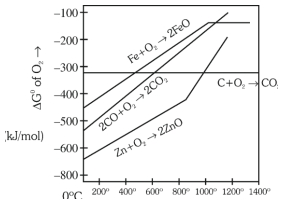
A
At $600^{\circ} C$,$C$ can reduce $ZnO$
B
At $600^{\circ} C$,$C$ can reduce $FeO$
C
At $600^{\circ} C$,$CO$ cannot reduce $FeO$
D
At $600^{\circ} C$,$CO$ can reduce $ZnO$
Solution
(B) In an Ellingham diagram,a metal oxide can be reduced by a reducing agent if the line for the formation of the reducing agent's oxide lies below the line for the formation of the metal oxide at that temperature.
At $600^{\circ} C$:
$1$. The line for $2C + O_2 \rightarrow 2CO$ is below the line for $2Fe + O_2 \rightarrow 2FeO$. Thus,$C$ can reduce $FeO$.
$2$. The line for $2C + O_2 \rightarrow 2CO$ is above the line for $2Zn + O_2 \rightarrow 2ZnO$. Thus,$C$ cannot reduce $ZnO$.
$3$. The line for $2CO + O_2 \rightarrow 2CO_2$ is below the line for $2Fe + O_2 \rightarrow 2FeO$. Thus,$CO$ can reduce $FeO$.
$4$. The line for $2CO + O_2 \rightarrow 2CO_2$ is above the line for $2Zn + O_2 \rightarrow 2ZnO$. Thus,$CO$ cannot reduce $ZnO$.
Therefore,the correct statement is that at $600^{\circ} C$,$C$ can reduce $FeO$.
At $600^{\circ} C$:
$1$. The line for $2C + O_2 \rightarrow 2CO$ is below the line for $2Fe + O_2 \rightarrow 2FeO$. Thus,$C$ can reduce $FeO$.
$2$. The line for $2C + O_2 \rightarrow 2CO$ is above the line for $2Zn + O_2 \rightarrow 2ZnO$. Thus,$C$ cannot reduce $ZnO$.
$3$. The line for $2CO + O_2 \rightarrow 2CO_2$ is below the line for $2Fe + O_2 \rightarrow 2FeO$. Thus,$CO$ can reduce $FeO$.
$4$. The line for $2CO + O_2 \rightarrow 2CO_2$ is above the line for $2Zn + O_2 \rightarrow 2ZnO$. Thus,$CO$ cannot reduce $ZnO$.
Therefore,the correct statement is that at $600^{\circ} C$,$C$ can reduce $FeO$.
0 likes
View Solution510
MediumMCQ
In the extraction process of copper,the product obtained after carrying out the reactions
$(i) 2 Cu_2S + 3 O_2 \rightarrow 2 Cu_2O + 2 SO_2$
$(ii) 2 Cu_2O + Cu_2S \rightarrow 6 Cu + SO_2$ is called
$(i) 2 Cu_2S + 3 O_2 \rightarrow 2 Cu_2O + 2 SO_2$
$(ii) 2 Cu_2O + Cu_2S \rightarrow 6 Cu + SO_2$ is called
A
Blister copper
B
Copper scrap
C
Reduced copper
D
Copper matte
Solution
(A) The reactions given are:
$(i) 2 Cu_2S + 3 O_2 \rightarrow 2 Cu_2O + 2 SO_2$
$(ii) 2 Cu_2O + Cu_2S \rightarrow 6 Cu + SO_2$
These reactions represent the self-reduction process in the extraction of copper.
Due to the evolution of $SO_2$ gas during the solidification of the molten copper,the surface of the metal develops bubbles or blisters.
Therefore,the copper obtained is referred to as blister copper.
$(i) 2 Cu_2S + 3 O_2 \rightarrow 2 Cu_2O + 2 SO_2$
$(ii) 2 Cu_2O + Cu_2S \rightarrow 6 Cu + SO_2$
These reactions represent the self-reduction process in the extraction of copper.
Due to the evolution of $SO_2$ gas during the solidification of the molten copper,the surface of the metal develops bubbles or blisters.
Therefore,the copper obtained is referred to as blister copper.
0 likes
View Solution511
MediumMCQ
Given below are two statements: one is labelled as Assertion $A$ and the other is labelled as Reason $R$.
Assertion $A$: In the Ellingham diagram,a sharp change in slope of the line is observed for $Mg \rightarrow MgO$ at $\sim 1120^{\circ} C$.
Reason $R$: There is a large change of entropy associated with the change of state.
In the light of the above statements,choose the correct answer from the options given below.
Assertion $A$: In the Ellingham diagram,a sharp change in slope of the line is observed for $Mg \rightarrow MgO$ at $\sim 1120^{\circ} C$.
Reason $R$: There is a large change of entropy associated with the change of state.
In the light of the above statements,choose the correct answer from the options given below.
A
Both $A$ and $R$ are true but $R$ is $NOT$ the correct explanation of $A$.
B
Both $A$ and $R$ are true and $R$ is the correct explanation of $A$.
C
$A$ is false but $R$ is true.
D
$A$ is true but $R$ is false.
Solution
(B) The Ellingham diagram plots $\Delta G^{\circ}$ versus $T$. The slope of the line is $-\Delta S$.
At the melting point of the metal $(Mg)$,the metal changes from solid to liquid state $(Mg_{(s)} \rightarrow Mg_{(l)})$.
This phase change involves a significant change in entropy $(\Delta S)$.
Since the entropy of the liquid state is higher than that of the solid state,the value of $\Delta S$ for the reaction $2Mg_{(l)} + O_2(g) \rightarrow 2MgO_{(s)}$ becomes more negative than for $2Mg_{(s)} + O_2(g) \rightarrow 2MgO_{(s)}$.
Consequently,the slope $(-\Delta S)$ increases sharply at the melting point $(\sim 1120^{\circ} C)$.
Thus,both Assertion $A$ and Reason $R$ are true,and $R$ is the correct explanation of $A$.
At the melting point of the metal $(Mg)$,the metal changes from solid to liquid state $(Mg_{(s)} \rightarrow Mg_{(l)})$.
This phase change involves a significant change in entropy $(\Delta S)$.
Since the entropy of the liquid state is higher than that of the solid state,the value of $\Delta S$ for the reaction $2Mg_{(l)} + O_2(g) \rightarrow 2MgO_{(s)}$ becomes more negative than for $2Mg_{(s)} + O_2(g) \rightarrow 2MgO_{(s)}$.
Consequently,the slope $(-\Delta S)$ increases sharply at the melting point $(\sim 1120^{\circ} C)$.
Thus,both Assertion $A$ and Reason $R$ are true,and $R$ is the correct explanation of $A$.
0 likes
View Solution512
AdvancedMCQ
Match the extraction processes listed in Column $I$ with metals listed in Column $II$:
| Column $I$ | Column $II$ |
| $A$. Self reduction | $P$. Lead |
| $B$. Carbon reduction | $Q$. Silver |
| $C$. Complex formation and displacement by metal | $R$. Copper |
| $D$. Decomposition of iodide | $S$. Boron |
A
$A-Q, R; B-S, R; C-R; D-Q$
B
$A-P, R; B-P, R; C-Q; D-S$
C
$A-R, S; B-P, R; C-S; D-S$
D
$A-S, R; B-Q, R; C-S; D-R$
Solution
(B) . Self reduction: Used for metals like $Cu$ (from $Cu_2S$) and $Pb$ (from $PbS$). Thus,$A-P, R$.
$B$. Carbon reduction: Used for metals like $Pb$ (from $PbO$) and $Cu$ (from $CuO$). Thus,$B-P, R$.
$C$. Complex formation and displacement by metal: Used for $Ag$ (MacArthur-Forrest cyanide process). Thus,$C-Q$.
$D$. Decomposition of iodide: Used for refining of $B$ (Van Arkel method). Thus,$D-S$.
Matching: $A-P, R; B-P, R; C-Q; D-S$. Therefore,the correct option is $B$.
$B$. Carbon reduction: Used for metals like $Pb$ (from $PbO$) and $Cu$ (from $CuO$). Thus,$B-P, R$.
$C$. Complex formation and displacement by metal: Used for $Ag$ (MacArthur-Forrest cyanide process). Thus,$C-Q$.
$D$. Decomposition of iodide: Used for refining of $B$ (Van Arkel method). Thus,$D-S$.
Matching: $A-P, R; B-P, R; C-Q; D-S$. Therefore,the correct option is $B$.
0 likes
View Solution513
AdvancedMCQ
Native silver metal forms a water soluble complex with a dilute aqueous solution of $NaCN$ in the presence of
A
nitrogen
B
oxygen
C
carbon dioxide
D
argon
Solution
(B) Native silver metal $(Ag)$ reacts with a dilute aqueous solution of $NaCN$ in the presence of atmospheric oxygen $(O_2)$ to form a water-soluble complex,sodium dicyanoargentate$(I)$.
The chemical equation for this process is:
$4 Ag + 8 NaCN + 2 H_2O + O_2 \longrightarrow 4 Na[Ag(CN)_2] + 4 NaOH$
The chemical equation for this process is:
$4 Ag + 8 NaCN + 2 H_2O + O_2 \longrightarrow 4 Na[Ag(CN)_2] + 4 NaOH$
0 likes
View Solution514
AdvancedMCQ
Copper is the most noble of the first row transition metals and occurs in small deposits in several countries. Ores of copper include chalcanthite $(CuSO_4 \cdot 5H_2O)$,atacamite $(Cu_2Cl(OH)_3)$,cuprite $(Cu_2O)$,copper glance $(Cu_2S)$ and malachite $(Cu_2(OH)_2CO_3)$. However,$80\%$ of the world copper production comes from the ore of chalcopyrite $(CuFeS_2)$. The extraction of copper from chalcopyrite involves partial roasting,removal of iron and self-reduction. $1.$ Partial roasting of chalcopyrite produces: $(A)$ $Cu_2S$ and $FeO$ $(B)$ $Cu_2O$ and $FeO$ $(C)$ $CuS$ and $Fe_2O_3$ $(D)$ $Cu_2O$ and $Fe_2O_3$. $2.$ Iron is removed from chalcopyrite as: $(A)$ $FeO$ $(B)$ $FeS$ $(C)$ $Fe_2O_3$ $(D)$ $FeSiO_3$. $3.$ In self-reduction,the reducing species is: $(A)$ $S$ $(B)$ $O^{2-}$ $(C)$ $S^{2-}$ $(D)$ $SO_2$. Give the answer for questions $1, 2$ and $3$.
A
$(C, B, C)$
B
$(B, B, C)$
C
$(B, D, C)$
D
$(A, B, C)$
Solution
(C) $1.$ Partial roasting of chalcopyrite: $2CuFeS_2 + O_2 \rightarrow Cu_2S + 2FeS + SO_2 \uparrow$. Further roasting: $2Cu_2S + 3O_2 \rightarrow 2Cu_2O + 2SO_2 \uparrow$ and $2FeS + 3O_2 \rightarrow 2FeO + 2SO_2 \uparrow$. Thus,the products are $Cu_2O$ and $FeO$.
$2.$ Iron is removed as slag by adding silica $(SiO_2)$: $FeO + SiO_2 \rightarrow FeSiO_3$ (slag).
$3.$ In self-reduction: $2Cu_2O + Cu_2S \rightarrow 6Cu + SO_2 \uparrow$. Here,the sulfur in $Cu_2S$ (as $S^{2-}$) is oxidized to $SO_2$ (where $S$ is $+4$),making $S^{2-}$ the reducing agent.
$2.$ Iron is removed as slag by adding silica $(SiO_2)$: $FeO + SiO_2 \rightarrow FeSiO_3$ (slag).
$3.$ In self-reduction: $2Cu_2O + Cu_2S \rightarrow 6Cu + SO_2 \uparrow$. Here,the sulfur in $Cu_2S$ (as $S^{2-}$) is oxidized to $SO_2$ (where $S$ is $+4$),making $S^{2-}$ the reducing agent.
0 likes
View Solution515
DifficultMCQ
Extraction of metal from the ore cassiterite involves
A
$A, D$
B
$A, B$
C
$B, D$
D
$C, D$
Solution
(A) The ore cassiterite is $SnO_{2}$.
$1$. The extraction involves the reduction of the oxide ore $SnO_{2}$ using carbon (smelting): $SnO_{2} + 2C \rightarrow Sn + 2CO$.
$2$. Cassiterite often contains iron as an impurity in the form of $FeWO_{4}$ (ferberite) or other iron oxides. This is removed by magnetic separation or by converting it into slag during the smelting process.
Therefore,the process involves carbon reduction of an oxide ore and the removal of iron impurity.
$1$. The extraction involves the reduction of the oxide ore $SnO_{2}$ using carbon (smelting): $SnO_{2} + 2C \rightarrow Sn + 2CO$.
$2$. Cassiterite often contains iron as an impurity in the form of $FeWO_{4}$ (ferberite) or other iron oxides. This is removed by magnetic separation or by converting it into slag during the smelting process.
Therefore,the process involves carbon reduction of an oxide ore and the removal of iron impurity.
0 likes
View Solution516
EasyMCQ
The cyanide process of gold extraction involves leaching out gold from its ore with $CN^{-}$ in the presence of $Q$ in water to form $R$. Subsequently,$R$ is treated with $T$ to obtain $Au$ and $Z$. Choose the correct option$(s)$.
$1$. $T$ is $Zn$
$2$. $R$ is $[Au(CN)_2]^-$
$3$. $Z$ is $[Zn(CN)_4]^{2-}$
$4$. $Q$ is $O_2$
$1$. $T$ is $Zn$
$2$. $R$ is $[Au(CN)_2]^-$
$3$. $Z$ is $[Zn(CN)_4]^{2-}$
$4$. $Q$ is $O_2$
A
$1, 2, 3$
B
$1, 2, 4$
C
$1, 3, 4$
D
$1, 2, 3, 4$
Solution
(D) The extraction of gold involves the following reactions:
$4Au_{(s)} + 8CN^{-}_{(aq)} + 2H_2O_{(l)} + O_{2(g)} \rightarrow 4[Au(CN)_2]^{-}_{(aq)} + 4OH^{-}_{(aq)}$
Here,$Q = O_2$ and $R = [Au(CN)_2]^{-}$.
The complex $R$ is then treated with zinc $(T = Zn)$ to displace gold:
$2[Au(CN)_2]^{-}_{(aq)} + Zn_{(s)} \rightarrow [Zn(CN)_4]^{2-}_{(aq)} + 2Au_{(s)}$
Here,$Z = [Zn(CN)_4]^{2-}$.
All statements $1, 2, 3,$ and $4$ are correct.
$4Au_{(s)} + 8CN^{-}_{(aq)} + 2H_2O_{(l)} + O_{2(g)} \rightarrow 4[Au(CN)_2]^{-}_{(aq)} + 4OH^{-}_{(aq)}$
Here,$Q = O_2$ and $R = [Au(CN)_2]^{-}$.
The complex $R$ is then treated with zinc $(T = Zn)$ to displace gold:
$2[Au(CN)_2]^{-}_{(aq)} + Zn_{(s)} \rightarrow [Zn(CN)_4]^{2-}_{(aq)} + 2Au_{(s)}$
Here,$Z = [Zn(CN)_4]^{2-}$.
All statements $1, 2, 3,$ and $4$ are correct.
0 likes
View Solution517
MediumMCQ
Tin is obtained from cassiterite by reduction with coke. Use the data given below to determine the minimum temperature (in $K$) at which the reduction of cassiterite by coke would take place.
At $298 \ K$: $\Delta_{f}H^{\circ}(SnO_{2(s)}) = -581.0 \ kJ \ mol^{-1}$,$\Delta_{f}H^{\circ}(CO_{2(g)}) = -394.0 \ kJ \ mol^{-1}$
$S^{\circ}(SnO_{2(s)}) = 56.0 \ J \ K^{-1} \ mol^{-1}$,$S^{\circ}(Sn_{(s)}) = 52.0 \ J \ K^{-1} \ mol^{-1}$
$S^{\circ}(C_{(s)}) = 6.0 \ J \ K^{-1} \ mol^{-1}$,$S^{\circ}(CO_{2(g)}) = 210.0 \ J \ K^{-1} \ mol^{-1}$
Assume that the enthalpies and the entropies are temperature independent.
At $298 \ K$: $\Delta_{f}H^{\circ}(SnO_{2(s)}) = -581.0 \ kJ \ mol^{-1}$,$\Delta_{f}H^{\circ}(CO_{2(g)}) = -394.0 \ kJ \ mol^{-1}$
$S^{\circ}(SnO_{2(s)}) = 56.0 \ J \ K^{-1} \ mol^{-1}$,$S^{\circ}(Sn_{(s)}) = 52.0 \ J \ K^{-1} \ mol^{-1}$
$S^{\circ}(C_{(s)}) = 6.0 \ J \ K^{-1} \ mol^{-1}$,$S^{\circ}(CO_{2(g)}) = 210.0 \ J \ K^{-1} \ mol^{-1}$
Assume that the enthalpies and the entropies are temperature independent.
A
$934$
B
$935$
C
$936$
D
$937$
Solution
(B) The chemical equation for the reduction of cassiterite $(SnO_2)$ by coke $(C)$ is: $SnO_{2(s)} + C_{(s)} \longrightarrow Sn_{(s)} + CO_{2(g)}$
Calculate the standard enthalpy of reaction: $\Delta H^{\circ}_{rxn} = [\Delta_{f}H^{\circ}(Sn_{(s)}) + \Delta_{f}H^{\circ}(CO_{2(g)})] - [\Delta_{f}H^{\circ}(SnO_{2(s)}) + \Delta_{f}H^{\circ}(C_{(s)})]$
Since $\Delta_{f}H^{\circ}$ for elements in their standard state is $0$,$\Delta H^{\circ}_{rxn} = [-394.0] - [-581.0] = 187.0 \ kJ \ mol^{-1} = 187000 \ J \ mol^{-1}$
Calculate the standard entropy of reaction: $\Delta S^{\circ}_{rxn} = [S^{\circ}(Sn_{(s)}) + S^{\circ}(CO_{2(g)})] - [S^{\circ}(SnO_{2(s)}) + S^{\circ}(C_{(s)})]$
$\Delta S^{\circ}_{rxn} = [52.0 + 210.0] - [56.0 + 6.0] = 262.0 - 62.0 = 200.0 \ J \ K^{-1} \ mol^{-1}$
For the reaction to be spontaneous,$\Delta G^{\circ} < 0$. At equilibrium,$\Delta G^{\circ} = 0$,so $T = \frac{\Delta H^{\circ}}{\Delta S^{\circ}}$
$T = \frac{187000 \ J \ mol^{-1}}{200.0 \ J \ K^{-1} \ mol^{-1}} = 935 \ K$
Calculate the standard enthalpy of reaction: $\Delta H^{\circ}_{rxn} = [\Delta_{f}H^{\circ}(Sn_{(s)}) + \Delta_{f}H^{\circ}(CO_{2(g)})] - [\Delta_{f}H^{\circ}(SnO_{2(s)}) + \Delta_{f}H^{\circ}(C_{(s)})]$
Since $\Delta_{f}H^{\circ}$ for elements in their standard state is $0$,$\Delta H^{\circ}_{rxn} = [-394.0] - [-581.0] = 187.0 \ kJ \ mol^{-1} = 187000 \ J \ mol^{-1}$
Calculate the standard entropy of reaction: $\Delta S^{\circ}_{rxn} = [S^{\circ}(Sn_{(s)}) + S^{\circ}(CO_{2(g)})] - [S^{\circ}(SnO_{2(s)}) + S^{\circ}(C_{(s)})]$
$\Delta S^{\circ}_{rxn} = [52.0 + 210.0] - [56.0 + 6.0] = 262.0 - 62.0 = 200.0 \ J \ K^{-1} \ mol^{-1}$
For the reaction to be spontaneous,$\Delta G^{\circ} < 0$. At equilibrium,$\Delta G^{\circ} = 0$,so $T = \frac{\Delta H^{\circ}}{\Delta S^{\circ}}$
$T = \frac{187000 \ J \ mol^{-1}}{200.0 \ J \ K^{-1} \ mol^{-1}} = 935 \ K$
0 likes
View Solution518
DifficultMCQ
In the cyanide extraction process of silver from argentite ore,the oxidizing and reducing agents used are
A
$O_2$ and $CO$ respectively
B
$O_2$ and $Zn$ dust respectively
C
$HNO_3$ and $Zn$ dust respectively
D
$HNO_3$ and $CO$ respectively
Solution
(B) In the extraction of silver,argentite ore $(Ag_2S)$ is leached with a dilute solution of $NaCN$ in the presence of air $(O_2)$:
$Ag_2S + 4NaCN + \frac{1}{2}O_2 + H_2O \longrightarrow 2Na[Ag(CN)_2] + S + 2NaOH$
Here,$O_2$ acts as an oxidizing agent to facilitate the dissolution of silver.
Then,the silver is recovered from the complex by adding zinc dust,which acts as a reducing agent:
$2[Ag(CN)_2]^- + Zn \longrightarrow [Zn(CN)_4]^{2-} + 2Ag$
Thus,$O_2$ is the oxidizing agent and $Zn$ dust is the reducing agent.
$Ag_2S + 4NaCN + \frac{1}{2}O_2 + H_2O \longrightarrow 2Na[Ag(CN)_2] + S + 2NaOH$
Here,$O_2$ acts as an oxidizing agent to facilitate the dissolution of silver.
Then,the silver is recovered from the complex by adding zinc dust,which acts as a reducing agent:
$2[Ag(CN)_2]^- + Zn \longrightarrow [Zn(CN)_4]^{2-} + 2Ag$
Thus,$O_2$ is the oxidizing agent and $Zn$ dust is the reducing agent.
0 likes
View Solution519
MediumMCQ
The carbon-based reduction method is $NOT$ used for the extraction of:
A
$A$. tin from $SnO_2$
B
$B$. iron from $Fe_2O_3$
C
$C$. aluminium from $Al_2O_3$
D
$D$. magnesium from $MgCO_3, CaCO_3$
Solution
(D) Carbon reduction is suitable for metals with moderate reactivity like $Sn$ and $Fe$.
$Al_2O_3$ (Aluminium oxide) and $Mg$ (Magnesium) are highly reactive metals.
Aluminium is extracted by the electrolytic reduction of molten $Al_2O_3$ in the presence of cryolite.
Magnesium is extracted by the electrolytic reduction of fused $MgCl_2$ or $MgO$.
Therefore,the carbon-based reduction method is $NOT$ used for $C$ and $D$.
$Al_2O_3$ (Aluminium oxide) and $Mg$ (Magnesium) are highly reactive metals.
Aluminium is extracted by the electrolytic reduction of molten $Al_2O_3$ in the presence of cryolite.
Magnesium is extracted by the electrolytic reduction of fused $MgCl_2$ or $MgO$.
Therefore,the carbon-based reduction method is $NOT$ used for $C$ and $D$.
0 likes
View Solution520
AdvancedMCQ
Upon heating with $Cu_2S$,the reagent$(s)$ that give copper metal is/are:
$(A)$ $CuFeS_2$
$(B)$ $CuO$
$(C)$ $Cu_2O$
$(D)$ $CuSO_4$
$(A)$ $CuFeS_2$
$(B)$ $CuO$
$(C)$ $Cu_2O$
$(D)$ $CuSO_4$
A
$(A, B, C)$
B
$(A, B, D)$
C
$(A, C, D)$
D
$(B, C, D)$
Solution
(D) The process of self-reduction (or auto-reduction) is used in the extraction of copper from its sulfide ores.
$1. \ Cu_2S + 2 Cu_2O \longrightarrow 6 Cu + SO_2$
$2. \ Cu_2S + 2 CuO \longrightarrow 4 Cu + SO_2$
$3. \ Cu_2S + CuSO_4 \longrightarrow 3 Cu + 2 SO_2$
$CuFeS_2$ (chalcopyrite) is an ore that requires roasting and smelting to produce matte $(Cu_2S + FeS)$,but it does not directly produce copper metal upon simple heating with $Cu_2S$ in the same manner as the oxides or sulfate. Therefore,the reagents that produce copper metal are $CuO$,$Cu_2O$,and $CuSO_4$.
$1. \ Cu_2S + 2 Cu_2O \longrightarrow 6 Cu + SO_2$
$2. \ Cu_2S + 2 CuO \longrightarrow 4 Cu + SO_2$
$3. \ Cu_2S + CuSO_4 \longrightarrow 3 Cu + 2 SO_2$
$CuFeS_2$ (chalcopyrite) is an ore that requires roasting and smelting to produce matte $(Cu_2S + FeS)$,but it does not directly produce copper metal upon simple heating with $Cu_2S$ in the same manner as the oxides or sulfate. Therefore,the reagents that produce copper metal are $CuO$,$Cu_2O$,and $CuSO_4$.
0 likes
View Solution521
EasyMCQ
Bessemerization is used in the extraction of
A
Iron
B
Copper
C
Aluminium
D
Zinc
Solution
(B) Bessemerization is a process used in the metallurgy of $Copper$ to remove impurities like $FeS$ and $Cu_2S$ by oxidation. In this process,air is blown through the molten matte,which oxidizes the iron sulfide to iron oxide,which is then removed as slag.
0 likes
View Solution522
EasyMCQ
Which among the following processes occurs at $1500 \ K$ in a blast furnace for the extraction of iron?
A
Reduction of ore
B
Ore loses moisture
C
Combustion of coke
D
Slag formation
Solution
(D) In the blast furnace,different temperature zones exist for different processes.
At $1500 \ K$,the formation of slag occurs where calcium oxide $(CaO)$ reacts with silica $(SiO_{2})$ impurity to form calcium silicate $(CaSiO_{3})$.
The reaction is: $CaO + SiO_{2} \rightarrow CaSiO_{3} \ (\text{slag})$.
At $1500 \ K$,the formation of slag occurs where calcium oxide $(CaO)$ reacts with silica $(SiO_{2})$ impurity to form calcium silicate $(CaSiO_{3})$.
The reaction is: $CaO + SiO_{2} \rightarrow CaSiO_{3} \ (\text{slag})$.
0 likes
View Solution523
EasyMCQ
Which of the following compounds acts as a flux in the extraction of copper from copper pyrites?
A
$CaSiO_{3}$
B
$FeO$
C
$FeSiO_{3}$
D
$SiO_{2}$
Solution
(D) Copper is extracted from the ore copper pyrite $(CuFeS_{2})$ by smelting in a blast furnace.
In this process,$FeO$ is formed as an impurity (gangue).
To remove this impurity,silica $(SiO_{2})$ is added as an acidic flux.
It reacts with $FeO$ to form a fusible slag,$FeSiO_{3}$.
$FeO + SiO_{2} \rightarrow FeSiO_{3}$ (slag).
In this process,$FeO$ is formed as an impurity (gangue).
To remove this impurity,silica $(SiO_{2})$ is added as an acidic flux.
It reacts with $FeO$ to form a fusible slag,$FeSiO_{3}$.
$FeO + SiO_{2} \rightarrow FeSiO_{3}$ (slag).
0 likes
View Solution524
EasyMCQ
Limestone is used as a flux in the extraction of
A
Iron
B
Aluminium
C
Zinc
D
Copper
Solution
(A) Limestone $(CaCO_3)$ is used as a flux in the extraction of iron.
In the blast furnace,it decomposes at high temperatures to form calcium oxide $(CaO)$ and carbon dioxide $(CO_2)$.
$CaCO_3 \rightarrow CaO + CO_2$
The calcium oxide $(CaO)$ acts as a basic flux and reacts with the acidic impurity silica $(SiO_2)$ present in the ore to form fusible calcium silicate slag $(CaSiO_3)$.
$CaO + SiO_2 \rightarrow CaSiO_3$ (slag)
In the blast furnace,it decomposes at high temperatures to form calcium oxide $(CaO)$ and carbon dioxide $(CO_2)$.
$CaCO_3 \rightarrow CaO + CO_2$
The calcium oxide $(CaO)$ acts as a basic flux and reacts with the acidic impurity silica $(SiO_2)$ present in the ore to form fusible calcium silicate slag $(CaSiO_3)$.
$CaO + SiO_2 \rightarrow CaSiO_3$ (slag)
0 likes
View Solution525
EasyMCQ
What happens during the Bessemerization process in the extraction of copper from copper pyrites?
A
$Au$ and $Ag$ metals are deposited as anode mud.
B
Impurities such as $As$ and $Sb$ are removed as volatile oxides.
C
$Cu$ is obtained by auto-reduction of $Cu_2O$ and $Cu_2S$.
D
Iron is removed in the form of slag.
Solution
(C) In the Bessemer converter,air is blown through the molten matte. The remaining $FeS$ is oxidized to $FeO$,which reacts with silica to form slag $(FeSiO_3)$. Subsequently,a portion of $Cu_2S$ is oxidized to $Cu_2O$. This $Cu_2O$ then reacts with the remaining $Cu_2S$ to produce metallic copper through a process known as auto-reduction (or self-reduction): $2Cu_2O + Cu_2S \rightarrow 6Cu + SO_2 \uparrow$.
0 likes
View Solution526
EasyMCQ
Which among the following reactions occurs at the zone of slag formation in the extraction of iron by a blast furnace?
A
$C + \frac{1}{2} O_2 \longrightarrow CO$
B
$CaO + SiO_2 \longrightarrow CaSiO_3$
C
$Fe_2O_3 + 3CO \longrightarrow 2Fe + 3CO_2$
D
$Fe_2O_3 + 3C \longrightarrow 2Fe + 3CO$
Solution
(B) In the blast furnace,the extraction of iron involves different temperature zones.
At the zone of slag formation (approx. $1073-1273 \ K$),the limestone $(CaCO_3)$ decomposes to $CaO$.
This $CaO$ acts as a flux and reacts with the silica $(SiO_2)$ impurity present in the ore to form calcium silicate,which is the slag.
The reaction is: $CaO + SiO_2 \longrightarrow CaSiO_3 \text{ (slag)}$.
At the zone of slag formation (approx. $1073-1273 \ K$),the limestone $(CaCO_3)$ decomposes to $CaO$.
This $CaO$ acts as a flux and reacts with the silica $(SiO_2)$ impurity present in the ore to form calcium silicate,which is the slag.
The reaction is: $CaO + SiO_2 \longrightarrow CaSiO_3 \text{ (slag)}$.
0 likes
View Solution527
EasyMCQ
Which oxide formation according to the Ellingham diagram shows a graph with a sudden change in slope?
A
$CO_{2}$
B
$Ag_{2}O$
C
$Al_{2}O_{3}$
D
$MgO$
Solution
(C) In an Ellingham diagram,a sudden change in the slope of the $\Delta G^{\circ}$ vs $T$ plot indicates a phase change (melting or boiling) of the metal or the oxide.
Looking at the provided Ellingham diagram,the line corresponding to the formation of $Al_{2}O_{3}$ (represented by the reaction $\frac{4}{3} Al + O_{2} \rightarrow \frac{2}{3} Al_{2}O_{3}$) shows a distinct change in slope at a specific temperature,which corresponds to the melting point of aluminum.
Therefore,the correct option is $C$.
Looking at the provided Ellingham diagram,the line corresponding to the formation of $Al_{2}O_{3}$ (represented by the reaction $\frac{4}{3} Al + O_{2} \rightarrow \frac{2}{3} Al_{2}O_{3}$) shows a distinct change in slope at a specific temperature,which corresponds to the melting point of aluminum.
Therefore,the correct option is $C$.
0 likes
View Solution528
EasyMCQ
What is the role of tuyeres used in a blast furnace for the extraction of iron?
A
It enables the even distribution of charge.
B
To blow a blast of preheated air into the furnace.
C
It is used to remove molten slag and iron.
D
It prevents the loss of hot gases.
Solution
(B) In a blast furnace,the tuyeres are pipes located near the base of the furnace.
Their primary function is to blow a blast of preheated air into the furnace to facilitate the combustion of coke.
This combustion process produces $CO_2$ and generates a significant amount of heat,which is essential for the reduction of iron oxides.
Their primary function is to blow a blast of preheated air into the furnace to facilitate the combustion of coke.
This combustion process produces $CO_2$ and generates a significant amount of heat,which is essential for the reduction of iron oxides.
0 likes
View Solution529
MediumMCQ
Which reaction from the following occurs at $2000 \ K$ in the blast furnace for the extraction of iron?
A
$CaO + SiO_2 \longrightarrow CaSiO_3$
B
$CaCO_3 \longrightarrow CaO + CO_2$
C
$Fe_2O_3 + 3CO \longrightarrow 2Fe + 3CO_2$
D
$2C + O_2 \longrightarrow 2CO$
Solution
(D) In the blast furnace,different temperature zones exist.
At the bottom of the furnace,the temperature is approximately $2000 \ K$.
In this high-temperature zone,carbon reacts with oxygen to form carbon monoxide: $2C + O_2 \longrightarrow 2CO$.
This reaction is exothermic and provides the heat required for the process.
At the bottom of the furnace,the temperature is approximately $2000 \ K$.
In this high-temperature zone,carbon reacts with oxygen to form carbon monoxide: $2C + O_2 \longrightarrow 2CO$.
This reaction is exothermic and provides the heat required for the process.
0 likes
View Solution530
EasyMCQ
How many moles of gaseous oxygen at one atmosphere are considered for the reaction with an element to plot a graph in an Ellingham diagram?
A
$2$
B
$0.25$
C
$0.5$
D
$1$
Solution
(D) In an Ellingham diagram,the standard free energy change $(\Delta G^{\circ})$ is plotted against temperature for the oxidation of elements. The reactions are normalized such that they involve exactly $1 \text{ mole}$ of gaseous oxygen $(O_2)$ at $1 \text{ atm}$ pressure. For example,the reaction for the formation of magnesium oxide is written as $2Mg(s) + O_2(g) \rightarrow 2MgO(s)$,and for aluminum oxide,it is $\frac{4}{3}Al(s) + O_2(g) \rightarrow \frac{2}{3}Al_2O_3(s)$. Thus,$1 \text{ mole}$ of $O_2$ is used.
0 likes
View Solution531
MediumMCQ
Which of the following elements has the lowest tendency to form its oxide?
A
$Al$
B
$Fe$
C
$Cr$
D
$Hg$
Solution
(D) The tendency to form an oxide is related to the standard Gibbs free energy of formation $({\Delta}G_f^{\circ})$ of the oxide. Elements with a less negative or positive ${\Delta}G_f^{\circ}$ have a lower tendency to form oxides. Among the given elements,$Hg$ (mercury) is a noble metal with a very low affinity for oxygen,making it the least likely to form a stable oxide under standard conditions.
0 likes
View Solution532
EasyMCQ
The order of stability of metal oxides is:
A
$Fe_{2}O_{3} < Cr_{2}O_{3} < Al_{2}O_{3} < MgO$
B
$Cr_{2}O_{3} < MgO < Al_{2}O_{3} < Fe_{2}O_{3}$
C
$MgO < Al_{2}O_{3} < Cr_{2}O_{3} < Fe_{2}O_{3}$
D
$Fe_{2}O_{3} < Al_{2}O_{3} < Cr_{2}O_{3} < MgO$
Solution
(A) The stability of metal oxides is determined by their standard Gibbs free energy of formation $(\Delta G_f^\circ)$.
More negative values of $\Delta G_f^\circ$ indicate higher stability.
Based on the Ellingham diagram,the order of stability is:
$Fe_{2}O_{3} < Cr_{2}O_{3} < Al_{2}O_{3} < MgO$.
More negative values of $\Delta G_f^\circ$ indicate higher stability.
Based on the Ellingham diagram,the order of stability is:
$Fe_{2}O_{3} < Cr_{2}O_{3} < Al_{2}O_{3} < MgO$.
0 likes
View Solution533
EasyMCQ
From the Ellingham graphs on carbon,which of the following statements is false?
A
$CO$ reduces $Fe_{2}O_{3}$ to $Fe$ at less than $983 \ K$.
B
$CO$ is less stable than $CO_{2}$ at more than $983 \ K$.
C
$CO$ reduces $Fe_{2}O_{3}$ to $Fe$ in the reduction zone of blast furnace.
D
$CO_{2}$ is more stable than $CO$ at less than $983 \ K$.
Solution
(B) In the Ellingham diagram,the line for the formation of $CO$ from $C$ and $O_{2}$ intersects the line for the formation of $CO_{2}$ at $983 \ K$.
Below $983 \ K$,the formation of $CO_{2}$ is more spontaneous (more negative $\Delta_{f}G^{\circ}$),meaning $CO_{2}$ is more stable than $CO$.
Above $983 \ K$,the formation of $CO$ becomes more spontaneous (more negative $\Delta_{f}G^{\circ}$),meaning $CO$ is more stable than $CO_{2}$.
Therefore,the statement that '$CO$ is less stable than $CO_{2}$ at more than $983 \ K$' is false.
Below $983 \ K$,the formation of $CO_{2}$ is more spontaneous (more negative $\Delta_{f}G^{\circ}$),meaning $CO_{2}$ is more stable than $CO$.
Above $983 \ K$,the formation of $CO$ becomes more spontaneous (more negative $\Delta_{f}G^{\circ}$),meaning $CO$ is more stable than $CO_{2}$.
Therefore,the statement that '$CO$ is less stable than $CO_{2}$ at more than $983 \ K$' is false.
0 likes
View Solution534
MediumMCQ
During the extraction of gold,the following reactions take place: $4Au + 8CN^{-} + 2H_2O + O_2 \longrightarrow 4[Au(CN)_2]^{-} + 4OH^{-}$ and $2[Au(CN)_2]^{-} + Zn \longrightarrow [Zn(CN)_4]^{2-} + 2Au$. $X$ and $Y$ are respectively:
A
$[Au(CN)_2]^{-}$ and $[Zn(CN)_6]^{4-}$
B
$[Au(CN)_4]^{2-}$ and $[Zn(CN)_4]^{2-}$
C
$[Au(CN)_4]^{3-}$ and $[Zn(CN)_4]^{2-}$
D
$[Au(CN)_2]^{-}$ and $[Zn(CN)_4]^{2-}$
Solution
(D) The extraction of gold involves the leaching of gold with a cyanide solution in the presence of air $(O_2)$:
$4Au + 8CN^{-} + 2H_2O + O_2 \longrightarrow 4[Au(CN)_2]^{-} + 4OH^{-}$
In this reaction,the gold is oxidized to the complex $[Au(CN)_2]^{-}$.
Next,the gold is recovered from the complex by displacement with zinc:
$2[Au(CN)_2]^{-} + Zn \longrightarrow 2Au + [Zn(CN)_4]^{2-}$
Comparing these with the given reactions,$X$ is $[Au(CN)_2]^{-}$ and $Y$ is $[Zn(CN)_4]^{2-}$.
$4Au + 8CN^{-} + 2H_2O + O_2 \longrightarrow 4[Au(CN)_2]^{-} + 4OH^{-}$
In this reaction,the gold is oxidized to the complex $[Au(CN)_2]^{-}$.
Next,the gold is recovered from the complex by displacement with zinc:
$2[Au(CN)_2]^{-} + Zn \longrightarrow 2Au + [Zn(CN)_4]^{2-}$
Comparing these with the given reactions,$X$ is $[Au(CN)_2]^{-}$ and $Y$ is $[Zn(CN)_4]^{2-}$.
0 likes
View Solution535
MediumMCQ
For the formation of which compound in the Ellingham diagram does $\Delta G^{\circ}$ become more and more negative with an increase in temperature?
A
$CO$
B
$FeO$
C
$ZnO$
D
$Cu_2O$
Solution
(A) In the Ellingham diagram,the slope of the line for the formation of $CO$ is negative because the reaction $2C(s) + O_2(g) \rightarrow 2CO(g)$ involves an increase in the number of moles of gas $(\Delta n_g = 2 - 1 = 1)$.
According to the equation $\Delta G^{\circ} = \Delta H^{\circ} - T\Delta S^{\circ}$,since $\Delta S^{\circ}$ is positive,the term $-T\Delta S^{\circ}$ becomes more negative as temperature $(T)$ increases.
Therefore,the formation of $CO$ becomes more thermodynamically stable and favorable at higher temperatures compared to metal oxides like $FeO$,$ZnO$,or $Cu_2O$,which show positive slopes.
According to the equation $\Delta G^{\circ} = \Delta H^{\circ} - T\Delta S^{\circ}$,since $\Delta S^{\circ}$ is positive,the term $-T\Delta S^{\circ}$ becomes more negative as temperature $(T)$ increases.
Therefore,the formation of $CO$ becomes more thermodynamically stable and favorable at higher temperatures compared to metal oxides like $FeO$,$ZnO$,or $Cu_2O$,which show positive slopes.
0 likes
View Solution536
EasyMCQ
Copper is extracted from copper pyrites by
A
thermal decomposition
B
reduction by coke
C
electrometallurgy
D
auto reduction
Solution
(D) Copper is extracted from copper pyrites $(CuFeS_{2})$ by the auto-reduction process. The steps are as follows:
$2 CuFeS_{2} + O_{2} \longrightarrow Cu_{2}S + 2 FeS + SO_{2}$
$2 FeS + 3 O_{2} \longrightarrow 2 FeO + 2 SO_{2}$
$FeO + SiO_{2} \longrightarrow FeSiO_{3}$
$2 Cu_{2}S + 3 O_{2} \longrightarrow 2 Cu_{2}O + 2 SO_{2}$
$2 Cu_{2}O + Cu_{2}S \longrightarrow 6 Cu + SO_{2}$
In the final step,$Cu_{2}O$ reacts with $Cu_{2}S$ to produce metallic copper,which is known as auto-reduction.
$2 CuFeS_{2} + O_{2} \longrightarrow Cu_{2}S + 2 FeS + SO_{2}$
$2 FeS + 3 O_{2} \longrightarrow 2 FeO + 2 SO_{2}$
$FeO + SiO_{2} \longrightarrow FeSiO_{3}$
$2 Cu_{2}S + 3 O_{2} \longrightarrow 2 Cu_{2}O + 2 SO_{2}$
$2 Cu_{2}O + Cu_{2}S \longrightarrow 6 Cu + SO_{2}$
In the final step,$Cu_{2}O$ reacts with $Cu_{2}S$ to produce metallic copper,which is known as auto-reduction.
0 likes
View Solution537
MediumMCQ
Carbon cannot reduce $Fe_2O_3$ to $Fe$ at a temperature below $983 \ K$ because
A
free energy change for the formation of $CO$ is more negative than that of $Fe_2O_3$
B
$CO$ is thermodynamically more stable than $Fe_2O_3$
C
carbon has higher affinity towards oxygen than iron
D
iron has higher affinity towards oxygen than carbon
Solution
(D) According to the Ellingham diagram,the line for the formation of $Fe_2O_3$ lies below the line for the formation of $CO$ at temperatures below $983 \ K$.
This indicates that the formation of $Fe_2O_3$ is more spontaneous (more negative $\Delta G^\circ$) than the formation of $CO$ in this temperature range.
Therefore,iron has a higher affinity for oxygen than carbon below $983 \ K$,making the reduction of $Fe_2O_3$ by carbon non-spontaneous.
This indicates that the formation of $Fe_2O_3$ is more spontaneous (more negative $\Delta G^\circ$) than the formation of $CO$ in this temperature range.
Therefore,iron has a higher affinity for oxygen than carbon below $983 \ K$,making the reduction of $Fe_2O_3$ by carbon non-spontaneous.
0 likes
View Solution538
DifficultMCQ
Copper is extracted from copper pyrites $(CuFeS_2)$ by heating in a Bessemer converter. The method is based on the principle that:
A
Copper has more affinity for oxygen than sulphur at high temperature.
B
Iron has less affinity for oxygen than sulphur at high temperature.
C
Copper has less affinity for oxygen than sulphur at high temperature.
D
Sulphur has less affinity for oxygen at high temperature.
Solution
(C) In the Bessemer converter,copper is extracted through a self-reduction process. The reactions involved are:
$2Cu_2S + 3O_2 \rightarrow 2Cu_2O + 2SO_2$
$2Cu_2O + Cu_2S \rightarrow 6Cu + SO_2$
These reactions occur because,at high temperatures,sulphur has a greater affinity for oxygen than copper does,allowing sulphur to remove oxygen from $Cu_2O$ to form $SO_2$ gas. Thus,copper has less affinity for oxygen than sulphur.
$2Cu_2S + 3O_2 \rightarrow 2Cu_2O + 2SO_2$
$2Cu_2O + Cu_2S \rightarrow 6Cu + SO_2$
These reactions occur because,at high temperatures,sulphur has a greater affinity for oxygen than copper does,allowing sulphur to remove oxygen from $Cu_2O$ to form $SO_2$ gas. Thus,copper has less affinity for oxygen than sulphur.
0 likes
View Solution539
MediumMCQ
The temperature of the slag zone in the metallurgy of iron using a blast furnace is:
A
$1200-1500^{\circ} C$
B
$1500-1600^{\circ} C$
C
$400-700^{\circ} C$
D
$800-1000^{\circ} C$
Solution
(D) In the blast furnace used for the extraction of iron,different zones have different temperature ranges.
The slag formation zone,where limestone $(CaCO_3)$ decomposes to $CaO$ and reacts with silica $(SiO_2)$ to form slag $(CaSiO_3)$,occurs at a temperature range of approximately $800-1000^{\circ} C$.
Therefore,the correct option is $D$.
The slag formation zone,where limestone $(CaCO_3)$ decomposes to $CaO$ and reacts with silica $(SiO_2)$ to form slag $(CaSiO_3)$,occurs at a temperature range of approximately $800-1000^{\circ} C$.
Therefore,the correct option is $D$.
0 likes
View Solution540
MediumMCQ
The incorrect statement about the Hall$-$Heroult process is:
A
Carbon anode is oxidised to $CO$ and $CO_2$.
B
$Na_3AlF_6$ helps to decrease the melting point of the electrolyte.
C
$CaF_2$ helps to increase the conductivity of the electrolyte.
D
Oxidation state of oxygen changes in the overall cell reaction.
Solution
(D) The incorrect statement about the Hall$-$Heroult process is given in option $(D)$.
In this process,the overall cell reaction is $2Al_2O_3 + 3C \longrightarrow 4Al + 3CO_2$.
In $Al_2O_3$,the oxidation state of oxygen is $-2$,and in $CO_2$,it is also $-2$.
Therefore,the oxidation state of oxygen does not change during the overall cell reaction.
In this process,the overall cell reaction is $2Al_2O_3 + 3C \longrightarrow 4Al + 3CO_2$.
In $Al_2O_3$,the oxidation state of oxygen is $-2$,and in $CO_2$,it is also $-2$.
Therefore,the oxidation state of oxygen does not change during the overall cell reaction.
0 likes
View Solution541
MediumMCQ
Among the following,the main reactions occurring in the blast furnace during the extraction of iron from haematite are:
$i$. $Fe_2O_3 + 3CO \rightarrow 2Fe + 3CO_2$
$ii$. $FeO + SiO_2 \rightarrow FeSiO_3$
$iii$. $Fe_2O_3 + 3C \rightarrow 2Fe + 3CO$
$iv$. $CaO + SiO_2 \rightarrow CaSiO_3$
$i$. $Fe_2O_3 + 3CO \rightarrow 2Fe + 3CO_2$
$ii$. $FeO + SiO_2 \rightarrow FeSiO_3$
$iii$. $Fe_2O_3 + 3C \rightarrow 2Fe + 3CO$
$iv$. $CaO + SiO_2 \rightarrow CaSiO_3$
A
$ii$ and $iii$
B
$i$ and $iv$
C
$i$ and $ii$
D
$iii$ and $iv$
Solution
(B) In the blast furnace,the extraction of iron from haematite $(Fe_2O_3)$ involves the following key processes:
$1$. Reduction of iron oxide: $Fe_2O_3$ is reduced by $CO$ to form metallic iron $(Fe)$ and $CO_2$. This is represented by reaction $i$: $Fe_2O_3 + 3CO \rightarrow 2Fe + 3CO_2$.
$2$. Slag formation: The impurity $SiO_2$ (silica) is removed by adding limestone $(CaCO_3)$,which decomposes to $CaO$. $CaO$ reacts with $SiO_2$ to form calcium silicate slag $(CaSiO_3)$. This is represented by reaction $iv$: $CaO + SiO_2 \rightarrow CaSiO_3$.
Therefore,reactions $i$ and $iv$ are the main reactions occurring in the blast furnace.
$1$. Reduction of iron oxide: $Fe_2O_3$ is reduced by $CO$ to form metallic iron $(Fe)$ and $CO_2$. This is represented by reaction $i$: $Fe_2O_3 + 3CO \rightarrow 2Fe + 3CO_2$.
$2$. Slag formation: The impurity $SiO_2$ (silica) is removed by adding limestone $(CaCO_3)$,which decomposes to $CaO$. $CaO$ reacts with $SiO_2$ to form calcium silicate slag $(CaSiO_3)$. This is represented by reaction $iv$: $CaO + SiO_2 \rightarrow CaSiO_3$.
Therefore,reactions $i$ and $iv$ are the main reactions occurring in the blast furnace.
0 likes
View Solution542
EasyMCQ
The composition of 'copper matte' is,
A
$Cu_{2}S + FeS$
B
$Cu_{2}S + Cu_{2}O$
C
$Cu_{2}S + FeO$
D
$Cu_{2}O + FeS$
Solution
(A) Copper matte is obtained during the extraction of copper from copper pyrites $(CuFeS_{2})$.
It is a molten mixture consisting mainly of copper$(I)$ sulphide $(Cu_{2}S)$ and iron$(II)$ sulphide $(FeS)$.
It is a molten mixture consisting mainly of copper$(I)$ sulphide $(Cu_{2}S)$ and iron$(II)$ sulphide $(FeS)$.
0 likes
View Solution543
DifficultMCQ
Cryolite is
A
$Na_{3}AlF_{6}$ and is used in the electrolysis of alumina for decreasing electrical conductivity.
B
$Na_{3}AlF_{6}$ and is used in the electrolysis of alumina for lowering the melting point of alumina only.
C
$Na_{3}AlF_{6}$ and is used in the electrolysis of alumina for lowering the melting point and increasing the conductivity of alumina.
D
$Na_{3}AlF_{6}$ and is used in the electrolytic refining of alumina.
Solution
(C) Cryolite is $Na_{3}AlF_{6}$.
In the Hall-Heroult process,pure alumina $(Al_{2}O_{3})$ has a very high melting point $(2323 \ K)$ and is a poor conductor of electricity.
Cryolite $(Na_{3}AlF_{6})$ is added to the electrolyte to lower the melting point of the mixture to about $1240 \ K$ and to increase its electrical conductivity,making the electrolysis process more efficient.
In the Hall-Heroult process,pure alumina $(Al_{2}O_{3})$ has a very high melting point $(2323 \ K)$ and is a poor conductor of electricity.
Cryolite $(Na_{3}AlF_{6})$ is added to the electrolyte to lower the melting point of the mixture to about $1240 \ K$ and to increase its electrical conductivity,making the electrolysis process more efficient.
0 likes
View Solution544
MediumMCQ
Carbon can reduce ferric oxide to iron at a temperature above $983 \ K$ because
A
carbon monoxide formed is thermodynamically less stable than ferric oxide
B
carbon has a higher affinity towards oxidation than iron
C
free energy change for the formation of carbon dioxide is less negative than that for ferric oxide
D
iron has a higher affinity towards oxygen than carbon
Solution
(B) According to the Ellingham diagram,the line for the formation of $CO_2$ from $C$ and $O_2$ intersects the line for the formation of $Fe_2O_3$ from $Fe$ and $O_2$ at approximately $983 \ K$.
Above $983 \ K$,the Gibbs free energy change $(\Delta G)$ for the formation of $CO_2$ becomes more negative than the $\Delta G$ for the formation of $Fe_2O_3$.
This implies that at temperatures above $983 \ K$,carbon has a higher affinity for oxygen than iron does,allowing carbon to effectively reduce ferric oxide to metallic iron.
Above $983 \ K$,the Gibbs free energy change $(\Delta G)$ for the formation of $CO_2$ becomes more negative than the $\Delta G$ for the formation of $Fe_2O_3$.
This implies that at temperatures above $983 \ K$,carbon has a higher affinity for oxygen than iron does,allowing carbon to effectively reduce ferric oxide to metallic iron.
0 likes
View Solution545
MediumMCQ
Identify the reaction that does not take place in a blast furnace.
A
$CaCO_3 \longrightarrow CaO + CO_2$
B
$CaO + SiO_2 \longrightarrow CaSiO_3$
C
$2Fe_2O_3 + 3C \longrightarrow 4Fe + 3CO_2$
D
$CO_2 + C \longrightarrow 2CO$
Solution
(C) In the blast furnace,the reduction of iron oxide is primarily carried out by $CO$ (carbon monoxide) rather than direct reduction by solid carbon as shown in option $C$.
The reaction $2Fe_2O_3 + 3C \longrightarrow 4Fe + 3CO_2$ is not the primary mechanism in the blast furnace.
The other reactions listed: $(A)$ decomposition of limestone,$(B)$ slag formation,and $(D)$ the Boudouard reaction,all occur within the furnace.
The reaction $2Fe_2O_3 + 3C \longrightarrow 4Fe + 3CO_2$ is not the primary mechanism in the blast furnace.
The other reactions listed: $(A)$ decomposition of limestone,$(B)$ slag formation,and $(D)$ the Boudouard reaction,all occur within the furnace.
0 likes
View Solution546
EasyMCQ
When compared to $\Delta G^{\circ}$ for the formation of $Al_{2}O_{3}$,the $\Delta G^{\circ}$ for the formation of $Cr_{2}O_{3}$ is
A
higher
B
lower
C
same
D
unpredicted
Solution
(A) The stability of an oxide is determined by the magnitude of its standard Gibbs free energy of formation,$\Delta G^{\circ}$.
$Al_{2}O_{3}$ is more stable than $Cr_{2}O_{3}$,which means the $\Delta G^{\circ}$ value for the formation of $Al_{2}O_{3}$ is more negative (lower) than that of $Cr_{2}O_{3}$.
Therefore,the $\Delta G^{\circ}$ for the formation of $Cr_{2}O_{3}$ is higher than that of $Al_{2}O_{3}$.
$Al_{2}O_{3}$ is more stable than $Cr_{2}O_{3}$,which means the $\Delta G^{\circ}$ value for the formation of $Al_{2}O_{3}$ is more negative (lower) than that of $Cr_{2}O_{3}$.
Therefore,the $\Delta G^{\circ}$ for the formation of $Cr_{2}O_{3}$ is higher than that of $Al_{2}O_{3}$.
0 likes
View Solution547
MediumMCQ
Which of the following metals cannot be obtained by auto-reduction of their compounds?
A
Lead
B
Mercury
C
Titanium
D
Copper
Solution
(C) Auto-reduction (or self-reduction) is a process used for metals like $Pb$,$Hg$,and $Cu$ where the sulfide ore is partially roasted to form oxide,which then reacts with the remaining sulfide to yield the metal.
For example,$2Cu_2S + 3O_2 \rightarrow 2Cu_2O + 2SO_2$ followed by $2Cu_2O + Cu_2S \rightarrow 6Cu + SO_2$.
Titanium $(Ti)$ is a highly reactive metal and cannot be extracted by auto-reduction. It is typically extracted using the Kroll process,which involves the reduction of $TiCl_4$ with magnesium $(Mg)$ or sodium $(Na)$.
For example,$2Cu_2S + 3O_2 \rightarrow 2Cu_2O + 2SO_2$ followed by $2Cu_2O + Cu_2S \rightarrow 6Cu + SO_2$.
Titanium $(Ti)$ is a highly reactive metal and cannot be extracted by auto-reduction. It is typically extracted using the Kroll process,which involves the reduction of $TiCl_4$ with magnesium $(Mg)$ or sodium $(Na)$.
0 likes
View Solution548
MediumMCQ
In the extraction of copper from copper glance,blister copper is formed by the evolution of gas $\underline{X}$. The shape of the molecule of $\underline{X}$ is
A
Angular
B
Planar trigonal
C
Tetrahedral
D
Pyramidal
Solution
(A) The extraction of copper from copper glance $(Cu_2S)$ involves the following reactions:
$2 Cu_2S + 3 O_2 \rightarrow 2 Cu_2O + 2 SO_2$
$2 Cu_2O + Cu_2S \rightarrow 6 Cu + SO_2$
Here,the gas $\underline{X}$ evolved is sulfur dioxide $(SO_2)$.
In $SO_2$,the sulfur atom is $sp^2$ hybridized with one lone pair of electrons.
Due to the presence of one lone pair,the shape of the $SO_2$ molecule is angular or bent.
$2 Cu_2S + 3 O_2 \rightarrow 2 Cu_2O + 2 SO_2$
$2 Cu_2O + Cu_2S \rightarrow 6 Cu + SO_2$
Here,the gas $\underline{X}$ evolved is sulfur dioxide $(SO_2)$.
In $SO_2$,the sulfur atom is $sp^2$ hybridized with one lone pair of electrons.
Due to the presence of one lone pair,the shape of the $SO_2$ molecule is angular or bent.
0 likes
View Solution549
MediumMCQ
Impure silver ore $+ CN^{-} + H_2O \xrightarrow{O_2} [X]^{-} + OH^{-}$
$[X]^{-} + Zn \longrightarrow [Y]^{2-} + Ag \text{ (pure)}$
The coordination numbers of the metals in $[X]$ and $[Y]$ are respectively
$[X]^{-} + Zn \longrightarrow [Y]^{2-} + Ag \text{ (pure)}$
The coordination numbers of the metals in $[X]$ and $[Y]$ are respectively
A
$3, 4$
B
$1, 4$
C
$4, 2$
D
$2, 4$
Solution
(D) The extraction of silver involves the formation of a dicyanoargentate$(I)$ complex followed by displacement with zinc.
$4 Ag_{(s)} + 8 CN^{-}_{(aq)} + 2 H_2O_{(l)} + O_{2(g)} \longrightarrow 4[Ag(CN)_2]^{-}_{(aq)} + 4 OH^{-}_{(aq)}$
Here,$[X]^{-}$ is $[Ag(CN)_2]^{-}$. The coordination number of $Ag$ is $2$.
$2[Ag(CN)_2]^{-}_{(aq)} + Zn_{(s)} \longrightarrow [Zn(CN)_4]^{2-}_{(aq)} + 2 Ag_{(s)}$
Here,$[Y]^{2-}$ is $[Zn(CN)_4]^{2-}$. The coordination number of $Zn$ is $4$.
Therefore,the coordination numbers are $2$ and $4$ respectively.
$4 Ag_{(s)} + 8 CN^{-}_{(aq)} + 2 H_2O_{(l)} + O_{2(g)} \longrightarrow 4[Ag(CN)_2]^{-}_{(aq)} + 4 OH^{-}_{(aq)}$
Here,$[X]^{-}$ is $[Ag(CN)_2]^{-}$. The coordination number of $Ag$ is $2$.
$2[Ag(CN)_2]^{-}_{(aq)} + Zn_{(s)} \longrightarrow [Zn(CN)_4]^{2-}_{(aq)} + 2 Ag_{(s)}$
Here,$[Y]^{2-}$ is $[Zn(CN)_4]^{2-}$. The coordination number of $Zn$ is $4$.
Therefore,the coordination numbers are $2$ and $4$ respectively.
0 likes
View Solution550
DifficultMCQ
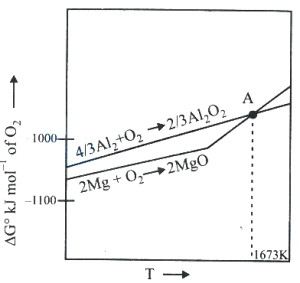
Observe the following Ellingham diagram,and identify the incorrect statement regarding it.
A
At point $A$ for the reduction of $Al_2O_3$ by $Mg$,$\Delta G^{\circ} = 0$.
B
Below $1673 \ K$,$Mg$ can reduce $Al_2O_3$ to $Al$.
C
Below $1673 \ K$,$Al$ can reduce $MgO$ to $Mg$.
D
Above $1673 \ K$,$Al$ can reduce $MgO$ to $Mg$.
Solution
(C) In an Ellingham diagram,the metal whose oxide line is lower can reduce the oxide of the metal whose line is higher.
At point $A$ $(1673 \ K)$,the lines for the formation of $MgO$ and $Al_2O_3$ intersect,meaning $\Delta G^{\circ} = 0$ for the reaction $3MgO + 2Al \rightarrow Al_2O_3 + 3Mg$.
Below $1673 \ K$,the $MgO$ line is below the $Al_2O_3$ line,so $Mg$ can reduce $Al_2O_3$ to $Al$.
Above $1673 \ K$,the $Al_2O_3$ line is below the $MgO$ line,so $Al$ can reduce $MgO$ to $Mg$.
Therefore,the statement that $Al$ can reduce $MgO$ to $Mg$ below $1673 \ K$ is incorrect.
At point $A$ $(1673 \ K)$,the lines for the formation of $MgO$ and $Al_2O_3$ intersect,meaning $\Delta G^{\circ} = 0$ for the reaction $3MgO + 2Al \rightarrow Al_2O_3 + 3Mg$.
Below $1673 \ K$,the $MgO$ line is below the $Al_2O_3$ line,so $Mg$ can reduce $Al_2O_3$ to $Al$.
Above $1673 \ K$,the $Al_2O_3$ line is below the $MgO$ line,so $Al$ can reduce $MgO$ to $Mg$.
Therefore,the statement that $Al$ can reduce $MgO$ to $Mg$ below $1673 \ K$ is incorrect.
0 likes
View SolutionGeneral Principles and Processes of Isolation of Elements — Reduction to free Metal · Frequently Asked Questions
1Are these General Principles and Processes of Isolation of Elements questions useful for JEE and NEET?
Yes. All questions in this section are mapped to JEE Main and NEET exam patterns. Previous year questions from JEE Main, NEET, GUJCET and state-level exams are included with full solutions.
2Can I switch to Hindi or Gujarati for these questions?
Yes. Use the language tabs in the hero section or the sidebar to view the same questions and solutions in English, Hindi or Gujarati.
3How do I generate a question paper from this subtopic?
Use the Vedclass Exam Paper Generator — select the chapter and subtopic, set difficulty, and generate Sets A, B, C, D automatically. First 3 chapters of every subject are free.
Vedclass Products
For Students
Vedclass Test Series
Mock tests in real JEE/NEET style with performance analysis. 5-day free trial.
Start Free TrialFor Teachers
Exam Paper Generator
Generate Set A/B/C/D papers from this chapter in 2 minutes. 3 chapters free.
Try FreeFor Institutes
Online Exam Module
Live online exams with unlimited students, 360° analytics & white-label branding.
See DemoFor Teachers & Institutes
Generate a General Principles and Processes of Isolation of Elements Exam Paper in 2 Minutes
Select subtopic & difficulty — Sets A, B, C, D auto-generated with No Repeat logic.
First 3 chapters of every subject are free — no payment required.