
A English
Reduction to free Metal Questions in English
Class 12 Chemistry · General Principles and Processes of Isolation of Elements · Reduction to free Metal
597+
Questions
English
Language
100%
With Solutions
Showing 50 of 597 questions in English
401
EasyMCQ
Extraction of metal from the ore cassiterite does not involve:
A
carbon reduction of an oxide ore
B
self reduction of a sulphide ore
C
removal of copper impurity
D
removal of iron impurity
Solution
(B) The ore cassiterite is $SnO_2$. The extraction process involves the following steps:
$1$. Concentration of the ore by gravity separation.
$2$. Roasting to remove sulfur and arsenic impurities.
$3$. Carbon reduction of the oxide ore: $SnO_2 + 2C \to Sn + 2CO$.
$4$. Refining of the metal to remove impurities like $Fe$,$W$,and $Cu$.
Since cassiterite is an oxide ore,it does not undergo self-reduction,which is characteristic of sulfide ores like $Cu_2S$ or $PbS$.
$1$. Concentration of the ore by gravity separation.
$2$. Roasting to remove sulfur and arsenic impurities.
$3$. Carbon reduction of the oxide ore: $SnO_2 + 2C \to Sn + 2CO$.
$4$. Refining of the metal to remove impurities like $Fe$,$W$,and $Cu$.
Since cassiterite is an oxide ore,it does not undergo self-reduction,which is characteristic of sulfide ores like $Cu_2S$ or $PbS$.
0 likes
View Solution402
MediumMCQ
Which of the following processes involves smelting?
A
$2PbS + 3O_2 \to 2PbO + 2SO_2 \uparrow$
B
$Al_2O_3 \cdot 2H_2O \to Al_2O_3 + 2H_2O$
C
$Fe_2O_3 + 3CO \to 2Fe + 3CO_2$
D
$Cr_2O_3 \xrightarrow{Al} 2Cr + Al_2O_3$
Solution
(C) Smelting is the process of extraction of a metal in its molten state by using a reducing agent (like $CO$ or $C$) in the presence of a flux at high temperatures.
In the reaction $Fe_2O_3 + 3CO \to 2Fe + 3CO_2$,iron oxide is reduced by carbon monoxide to molten iron.
Option $A$ represents roasting,option $B$ represents calcination/dehydration,and option $D$ represents aluminothermic reduction.
In the reaction $Fe_2O_3 + 3CO \to 2Fe + 3CO_2$,iron oxide is reduced by carbon monoxide to molten iron.
Option $A$ represents roasting,option $B$ represents calcination/dehydration,and option $D$ represents aluminothermic reduction.
0 likes
View Solution403
MediumMCQ
Thermite is a mixture of iron oxide and which of the following?
A
Zinc powder
B
Sodium pieces
C
Potassium metal
D
Aluminium powder
Solution
(D) Thermite is a mixture of metal oxide (usually $Fe_2O_3$) and metal powder (usually $Al$).
The reaction is highly exothermic and is used for welding purposes.
The chemical reaction is: $Fe_2O_3(s) + 2Al(s) \rightarrow 2Fe(l) + Al_2O_3(s) + \text{Heat}$.
The reaction is highly exothermic and is used for welding purposes.
The chemical reaction is: $Fe_2O_3(s) + 2Al(s) \rightarrow 2Fe(l) + Al_2O_3(s) + \text{Heat}$.
0 likes
View Solution404
EasyMCQ
Which of the following is used to remove silicon dioxide in the Serpeck's process for the purification of bauxite?
A
$CaO$
B
$Na_2CO_3$
C
Coke
D
Nickel
Solution
(C) In the Serpeck's process,bauxite $(Al_2O_3 \cdot 2H_2O)$ is heated with coke and nitrogen at $1800 \ ^\circ C$ to form aluminium nitride $(AlN)$.
$Al_2O_3 + 3C + N_2 \rightarrow 2AlN + 3CO$.
Silicon dioxide $(SiO_2)$ is an impurity present in bauxite. It is removed by reacting with coke to form silicon carbide $(SiC)$ or by reacting with $CaO$ if present as a flux,but in the specific context of Serpeck's process,the reduction of $SiO_2$ by coke is the primary mechanism to eliminate it as volatile $SiO$ or $SiC$.
$Al_2O_3 + 3C + N_2 \rightarrow 2AlN + 3CO$.
Silicon dioxide $(SiO_2)$ is an impurity present in bauxite. It is removed by reacting with coke to form silicon carbide $(SiC)$ or by reacting with $CaO$ if present as a flux,but in the specific context of Serpeck's process,the reduction of $SiO_2$ by coke is the primary mechanism to eliminate it as volatile $SiO$ or $SiC$.
0 likes
View Solution405
MediumMCQ
In the alumino-thermite process,what does $Al$ act as?
A
Flux
B
Oxidizing agent
C
Reducing agent
D
Solder
Solution
(C) In the alumino-thermite process,metal oxides (like $Fe_2O_3$) are reduced to their respective metals using aluminum powder as a reducing agent.
The chemical reaction is: $Fe_2O_3 + 2Al \rightarrow 2Fe + Al_2O_3 + \text{Heat}$.
Here,$Al$ undergoes oxidation to $Al_2O_3$ and reduces $Fe_2O_3$ to $Fe$. Therefore,$Al$ acts as a reducing agent.
The chemical reaction is: $Fe_2O_3 + 2Al \rightarrow 2Fe + Al_2O_3 + \text{Heat}$.
Here,$Al$ undergoes oxidation to $Al_2O_3$ and reduces $Fe_2O_3$ to $Fe$. Therefore,$Al$ acts as a reducing agent.
0 likes
View Solution406
MediumMCQ
The reduction of $Al$ oxide cannot be carried out by chemical reactions because .....
A
$Al$ oxide is very stable.
B
$Al$ oxide is very reactive.
C
The reducing agent becomes contaminated.
D
The process pollutes the environment.
0 likes
View Solution407
MediumMCQ
In the electrolytic extraction of $Al$,molten cryolite $(Na_3AlF_6)$ is used because it .......
A
makes the solution of bauxite conducting
B
acts as a reducing agent
C
increases the production of $Al$ at the anode
D
protects the anode
Solution
(A) In the Hall-Heroult process,pure alumina $(Al_2O_3)$ has a very high melting point $(2323 \ K)$ and is a poor conductor of electricity.
Adding molten cryolite $(Na_3AlF_6)$ serves two main purposes:
$1$. It lowers the melting point of the mixture to about $1240 \ K$.
$2$. It increases the electrical conductivity of the molten mixture,making the electrolysis process efficient.
Adding molten cryolite $(Na_3AlF_6)$ serves two main purposes:
$1$. It lowers the melting point of the mixture to about $1240 \ K$.
$2$. It increases the electrical conductivity of the molten mixture,making the electrolysis process efficient.
0 likes
View Solution408
MediumMCQ
During the extraction of sodium metal by electrolysis,a mixture of $40\%$ molten $NaCl$ and $60\%$ $CaCl_2$ is used because .......
A
it helps in the conduction of electricity
B
the melting point of this mixture is lower than the melting point of $NaCl$
C
$Ca^{2+}$ ions from $CaCl_2$ displace $Na^+$ ions from $NaCl$
D
$Ca^{2+}$ ions can reduce $NaCl$ to $Na$
Solution
(B) The melting point of pure $NaCl$ is very high $(1081 \ K)$.
To lower the operating temperature of the electrolytic cell (Downs process),$CaCl_2$ and $KF$ are added to $NaCl$.
This mixture lowers the melting point of the electrolyte to approximately $873 \ K$,which saves energy and prevents the volatilization of sodium metal.
To lower the operating temperature of the electrolytic cell (Downs process),$CaCl_2$ and $KF$ are added to $NaCl$.
This mixture lowers the melting point of the electrolyte to approximately $873 \ K$,which saves energy and prevents the volatilization of sodium metal.
0 likes
View Solution409
MediumMCQ
How is magnesium obtained from the following?
A
Reduction of $MgO$ with coke
B
Reduction of magnesium salt solution with $Fe$
C
Electrolysis of molten magnesium salt
D
Electrolysis of $Mg(NO_3)_2$ solution
Solution
(C) Magnesium is a highly reactive metal. It cannot be obtained by chemical reduction of its oxide with carbon (coke) because $Mg$ has a higher affinity for oxygen than carbon.
It is commercially produced by the electrolysis of molten magnesium chloride $(MgCl_2)$ mixed with other chlorides to lower the melting point.
Therefore,the correct method is the electrolysis of molten magnesium salt.
It is commercially produced by the electrolysis of molten magnesium chloride $(MgCl_2)$ mixed with other chlorides to lower the melting point.
Therefore,the correct method is the electrolysis of molten magnesium salt.
0 likes
View Solution410
EasyMCQ
Which of the following conditions favours the reduction of a metal oxide to metal?
A
$ \Delta H = +ve, T \Delta S = +ve $ at low temperature
B
$ \Delta H = +ve, T \Delta S = -ve $ at any temperature
C
$ \Delta H = -ve, T \Delta S = -ve $ at high temperature
D
$ \Delta H = -ve, T \Delta S = +ve $ at any temperature
Solution
(D) The Gibbs free energy change is given by the equation: $ \Delta G = \Delta H - T \Delta S $.
For a process to be spontaneous,the value of $ \Delta G $ must be negative $( \Delta G < 0 )$.
If $ \Delta H $ is negative $( -ve )$ and $ T \Delta S $ is positive $( +ve )$,then $ \Delta G = (-ve) - (+ve) = -ve $.
This condition ensures that $ \Delta G $ is always negative at any temperature,thereby favouring the reduction of a metal oxide to metal.
For a process to be spontaneous,the value of $ \Delta G $ must be negative $( \Delta G < 0 )$.
If $ \Delta H $ is negative $( -ve )$ and $ T \Delta S $ is positive $( +ve )$,then $ \Delta G = (-ve) - (+ve) = -ve $.
This condition ensures that $ \Delta G $ is always negative at any temperature,thereby favouring the reduction of a metal oxide to metal.
0 likes
View Solution411
MediumMCQ
Which of the following statements is not correct about the Ellingham diagram?
A
$\Delta G$ increases with an increase in temperature.
B
It consists of plots of $\Delta_fG^o$ vs $T$ for the formation of oxides.
C
$A$ coupling reaction can be well expressed by this diagram.
D
It expresses the kinetics of the reduction process.
Solution
(D) Ellingham diagrams are based on thermodynamic concepts.
They represent the change in Gibbs free energy $(\Delta G)$ with respect to temperature $(T)$.
They do not provide any information regarding the kinetics of the reduction process,such as the rate of reaction.
They represent the change in Gibbs free energy $(\Delta G)$ with respect to temperature $(T)$.
They do not provide any information regarding the kinetics of the reduction process,such as the rate of reaction.
0 likes
View Solution412
MediumMCQ
Carbon cannot be used to produce magnesium by chemical reduction of $MgO$ because
A
Carbon is not a powerful reducing agent
B
Magnesium reacts with carbon to form carbides
C
Carbon does not react with magnesium
D
Carbon is a non-metal
Solution
(B) Carbon cannot be used to produce magnesium by chemical reduction of $MgO$ because magnesium reacts with carbon to form carbides at high temperatures.
$2 Mg + 3 C \xrightarrow{2000^{\circ} C} Mg_2 C_3$
$2 Mg + 3 C \xrightarrow{2000^{\circ} C} Mg_2 C_3$
0 likes
View Solution413
MediumMCQ
Assertion : Zinc can be used while copper cannot be used in the recovery of $Ag$ from the complex $[Ag(CN)_2]^-$.
Reason : Zinc is a more powerful reducing agent than copper.
Reason : Zinc is a more powerful reducing agent than copper.
A
If both Assertion and Reason are correct and the Reason is a correct explanation of the Assertion.
B
If both Assertion and Reason are correct but Reason is not a correct explanation of the Assertion.
C
If the Assertion is correct but Reason is incorrect.
D
If both the Assertion and Reason are incorrect.
Solution
(A) The recovery of $Ag$ from the complex $[Ag(CN)_2]^-$ involves the displacement of $Ag^+$ by a more reactive metal.
The standard reduction potentials are $E^o_{Zn^{2+}/Zn} = -0.76 \ V$ and $E^o_{Cu^{2+}/Cu} = +0.34 \ V$.
Since $Zn$ has a more negative reduction potential than $Cu$,it is a stronger reducing agent.
$Zn$ can displace $Ag$ from $[Ag(CN)_2]^-$ because it can reduce $Ag^+$ to $Ag(s)$,whereas $Cu$ cannot effectively reduce $Ag^+$ in this complex due to its lower reducing power.
Thus,both the Assertion and the Reason are correct,and the Reason correctly explains the Assertion.
The standard reduction potentials are $E^o_{Zn^{2+}/Zn} = -0.76 \ V$ and $E^o_{Cu^{2+}/Cu} = +0.34 \ V$.
Since $Zn$ has a more negative reduction potential than $Cu$,it is a stronger reducing agent.
$Zn$ can displace $Ag$ from $[Ag(CN)_2]^-$ because it can reduce $Ag^+$ to $Ag(s)$,whereas $Cu$ cannot effectively reduce $Ag^+$ in this complex due to its lower reducing power.
Thus,both the Assertion and the Reason are correct,and the Reason correctly explains the Assertion.
0 likes
View Solution414
EasyMCQ
Carbon and $CO$ gas are used to reduce which of the following pairs of metal oxides for the extraction of metals?
A
$FeO, SnO$
B
$SnO, ZnO$
C
$BaO, Na_2O_2$
D
$FeO, ZnO$
Solution
(D) In the process of smelting,metal oxides are reduced by carbon or carbon monoxide $(CO)$.
For $ZnO$: $ZnO + C \to Zn + CO$.
For $FeO$: $FeO + C \to Fe + CO$.
Metals like $Zn, Fe, Pb,$ and $Sn$ are typically extracted from their oxide ores using carbon reduction (smelting). Both $FeO$ and $ZnO$ are standard examples of oxides reduced by carbon in industrial metallurgy.
For $ZnO$: $ZnO + C \to Zn + CO$.
For $FeO$: $FeO + C \to Fe + CO$.
Metals like $Zn, Fe, Pb,$ and $Sn$ are typically extracted from their oxide ores using carbon reduction (smelting). Both $FeO$ and $ZnO$ are standard examples of oxides reduced by carbon in industrial metallurgy.
0 likes
View Solution415
MediumMCQ
In the metallurgical process of aluminium,cryolite $(Na_3AlF_6)$ is mixed with alumina $(Al_2O_3)$ in its molten state,because it
A
decreases the amount of alumina
B
oxidises the alumina
C
increases the melting point of alumina
D
decreases the melting point of alumina
Solution
(D) In the Hall-Heroult process,pure alumina $(Al_2O_3)$ has a very high melting point (approx. $2323 \ K$),which makes it difficult to melt and consume a lot of energy.
Cryolite $(Na_3AlF_6)$ is added to the molten alumina to lower its melting point to about $1140 \ K$ and to increase its electrical conductivity.
Therefore,the correct option is $D$.
Cryolite $(Na_3AlF_6)$ is added to the molten alumina to lower its melting point to about $1140 \ K$ and to increase its electrical conductivity.
Therefore,the correct option is $D$.
0 likes
View Solution416
MediumMCQ
The main reactions occurring in a blast furnace during the extraction of iron from haematite are $....$.
$(i)$ $Fe_2O_3 + 3CO \to 2Fe + 3CO_2$
$(ii)$ $FeO + SiO_2 \to FeSiO_3$
$(iii)$ $Fe_2O_3 + 3C \to 2Fe + 3CO$
$(iv)$ $CaO + SiO_2 \to CaSiO_3$
$(i)$ $Fe_2O_3 + 3CO \to 2Fe + 3CO_2$
$(ii)$ $FeO + SiO_2 \to FeSiO_3$
$(iii)$ $Fe_2O_3 + 3C \to 2Fe + 3CO$
$(iv)$ $CaO + SiO_2 \to CaSiO_3$
A
$(i)$ and $(iii)$
B
$(ii)$ and $(iv)$
C
$(i)$ and $(iv)$
D
$(i)$,$(ii)$ and $(iii)$
Solution
(C) In the blast furnace,the reduction of iron oxides $(Fe_2O_3)$ occurs primarily by carbon monoxide $(CO)$ to form iron $(Fe)$ and carbon dioxide $(CO_2)$,represented by reaction $(i)$.
Additionally,the removal of silica $(SiO_2)$ impurity as slag $(CaSiO_3)$ occurs via reaction $(iv)$,where calcium oxide $(CaO)$ acts as a flux.
Reaction $(ii)$ is not a primary reaction in the blast furnace for iron extraction,and reaction $(iii)$ is not the main reduction mechanism compared to the $CO$ reduction.
Therefore,the correct reactions are $(i)$ and $(iv)$.
Additionally,the removal of silica $(SiO_2)$ impurity as slag $(CaSiO_3)$ occurs via reaction $(iv)$,where calcium oxide $(CaO)$ acts as a flux.
Reaction $(ii)$ is not a primary reaction in the blast furnace for iron extraction,and reaction $(iii)$ is not the main reduction mechanism compared to the $CO$ reduction.
Therefore,the correct reactions are $(i)$ and $(iv)$.
0 likes
View Solution417
DifficultMCQ
Assertion : Extraction of iron metal from iron oxide ore is carried out by heating with coke.
Reason : The reaction,
$Fe_2O_{3(s)} \to Fe_{(s)} + 3/2 O_{2(g)}$ is a spontaneous process.
Reason : The reaction,
$Fe_2O_{3(s)} \to Fe_{(s)} + 3/2 O_{2(g)}$ is a spontaneous process.
A
If both Assertion and Reason are correct and the Reason is a correct explanation of the Assertion.
B
If both Assertion and Reason are correct but Reason is not a correct explanation of the Assertion.
C
If the Assertion is correct but Reason is incorrect.
D
If both the Assertion and Reason are incorrect.
Solution
(C) The extraction of iron from $Fe_2O_3$ is carried out in a blast furnace by heating with coke $(C)$.
The coke reacts with oxygen to form $CO$,which acts as the reducing agent:
$Fe_2O_3 3CO \to 2Fe 3CO_2$
Thus,the assertion is correct.
The reaction $Fe_2O_{3(s)} \to 2Fe_{(s)} 3/2 O_{2(g)}$ is not spontaneous because it involves the breaking of strong metal-oxygen bonds,which is highly endothermic $(\Delta H > 0)$ and results in an increase in entropy $(\Delta S > 0)$,but at standard temperatures,the Gibbs free energy change $(\Delta G = \Delta H - T\Delta S)$ remains positive.
Therefore,the reason is incorrect.
The coke reacts with oxygen to form $CO$,which acts as the reducing agent:
$Fe_2O_3 3CO \to 2Fe 3CO_2$
Thus,the assertion is correct.
The reaction $Fe_2O_{3(s)} \to 2Fe_{(s)} 3/2 O_{2(g)}$ is not spontaneous because it involves the breaking of strong metal-oxygen bonds,which is highly endothermic $(\Delta H > 0)$ and results in an increase in entropy $(\Delta S > 0)$,but at standard temperatures,the Gibbs free energy change $(\Delta G = \Delta H - T\Delta S)$ remains positive.
Therefore,the reason is incorrect.
0 likes
View Solution418
DifficultMCQ
Assertion : Copper obtained after $Bessemerization$ is known as blister copper.
Reason : Blisters are produced on the surface of the metal due to escaping of dissolved $SO_2$.
Reason : Blisters are produced on the surface of the metal due to escaping of dissolved $SO_2$.
A
If both Assertion and Reason are correct and the Reason is a correct explanation of the Assertion.
B
If both Assertion and Reason are correct but Reason is not a correct explanation of the Assertion.
C
If the Assertion is correct but Reason is incorrect.
D
If both the Assertion and Reason are incorrect.
Solution
(A) During the $Bessemerization$ process,the molten copper is poured into moulds and allowed to cool.
As the metal solidifies,the dissolved $SO_2$ gas escapes,creating bubbles or blisters on the surface of the solidified copper.
Hence,the copper obtained is called blister copper.
Both the assertion and the reason are correct,and the reason is the correct explanation of the assertion.
As the metal solidifies,the dissolved $SO_2$ gas escapes,creating bubbles or blisters on the surface of the solidified copper.
Hence,the copper obtained is called blister copper.
Both the assertion and the reason are correct,and the reason is the correct explanation of the assertion.
0 likes
View Solution419
MediumMCQ
Assertion : Coke and flux are used in smelting.
Reason : The phenomenon in which ore is mixed with suitable flux and coke is heated to fusion is known as smelting.
Reason : The phenomenon in which ore is mixed with suitable flux and coke is heated to fusion is known as smelting.
A
If both Assertion and Reason are correct and the Reason is a correct explanation of the Assertion.
B
If both Assertion and Reason are correct but Reason is not a correct explanation of the Assertion.
C
If the Assertion is correct but Reason is incorrect.
D
If both the Assertion and Reason are incorrect.
Solution
(B) Both Assertion and Reason are true. Smelting is a process of reduction of roasted ore with carbon (coke) in the presence of a flux. The flux is added to remove the gangue as slag. While the definition provided in the Reason is accurate,the use of coke and flux in smelting is a specific requirement for the reduction and slag formation process,making the Reason a descriptive definition rather than the direct cause for why they are used.
0 likes
View Solution420
MediumMCQ
To obtain silver from silver amalgam,it is heated in a vessel which is made of
A
$Cu$
B
$Fe$
C
$Ni$
D
$Zn$
Solution
(B) $Fe$ and $Pt$ do not form amalgams with mercury.
$\text{Silver amalgam} (Ag-Hg) \xrightarrow[\Delta]{Fe \text{ vessel}} Ag + Hg \uparrow$
If the vessel were made of other metals like $Cu$,$Ni$,or $Zn$,they would react with the liberated mercury to form their own amalgams,contaminating the silver.
$\text{Silver amalgam} (Ag-Hg) \xrightarrow[\Delta]{Fe \text{ vessel}} Ag + Hg \uparrow$
If the vessel were made of other metals like $Cu$,$Ni$,or $Zn$,they would react with the liberated mercury to form their own amalgams,contaminating the silver.
0 likes
View Solution421
MediumMCQ
Considering the Ellingham diagram,which of the following metals can be used to reduce alumina $(Al_2O_3)$?
A
$Fe$
B
$Zn$
C
$Mg$
D
$Cu$
Solution
(C) According to the Ellingham diagram,a metal can reduce the oxide of another metal if its own oxide formation curve lies below the curve of the metal oxide being reduced.
This is because the metal with the curve lower in the diagram has a more negative Gibbs free energy of formation $(-\Delta G)$ for its oxide.
Magnesium $(Mg)$ forms $MgO$,and its formation curve lies below the formation curve of alumina $(Al_2O_3)$ at temperatures below $1623 \ K$.
Therefore,$Mg$ can reduce $Al_2O_3$ to $Al$.
This is because the metal with the curve lower in the diagram has a more negative Gibbs free energy of formation $(-\Delta G)$ for its oxide.
Magnesium $(Mg)$ forms $MgO$,and its formation curve lies below the formation curve of alumina $(Al_2O_3)$ at temperatures below $1623 \ K$.
Therefore,$Mg$ can reduce $Al_2O_3$ to $Al$.
0 likes
View Solution422
EasyMCQ
The purest form of commercial iron is
A
scrap iron and pig iron
B
wrought iron
C
cast iron
D
pig iron
Solution
(B) Wrought iron is the purest form of commercial iron,containing about $99.5 \%$ to $99.9 \%$ iron. It is prepared from cast iron by oxidizing impurities in a reverberatory furnace lined with hematite $(Fe_2O_3)$.
0 likes
View Solution423
AdvancedMCQ
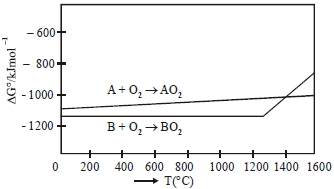
According to the following Ellingham diagram,$A$ reduces $BO_{2}$ when the temperature is
A
$< 1400^{\circ} C$
B
$> 1400^{\circ} C$
C
$< 1200^{\circ} C$
D
$> 1200^{\circ} C$ but $< 1400^{\circ} C$
Solution
(B) In an Ellingham diagram,a metal $A$ can reduce the oxide of another metal $B$ $(BO_{2})$ if the line for the formation of $AO_{2}$ lies below the line for the formation of $BO_{2}$.
From the given diagram,the line for $A + O_{2} \rightarrow AO_{2}$ intersects the line for $B + O_{2} \rightarrow BO_{2}$ at $1400^{\circ} C$.
Above $1400^{\circ} C$,the line for $AO_{2}$ formation is below the line for $BO_{2}$ formation,meaning the $\Delta G^{\circ}$ for the reaction $A + BO_{2} \rightarrow AO_{2} + B$ becomes negative.
Therefore,$A$ reduces $BO_{2}$ at temperatures $> 1400^{\circ} C$.
From the given diagram,the line for $A + O_{2} \rightarrow AO_{2}$ intersects the line for $B + O_{2} \rightarrow BO_{2}$ at $1400^{\circ} C$.
Above $1400^{\circ} C$,the line for $AO_{2}$ formation is below the line for $BO_{2}$ formation,meaning the $\Delta G^{\circ}$ for the reaction $A + BO_{2} \rightarrow AO_{2} + B$ becomes negative.
Therefore,$A$ reduces $BO_{2}$ at temperatures $> 1400^{\circ} C$.
0 likes
View Solution424
Easy
Suggest a list of metals that are extracted electrolytically.
Solution
(N/A) Metals that are at the top of the reactivity series,such as $Na$,$K$,$Ca$,$Li$,$Mg$,and $Al$,are extracted electrolytically because they are highly reactive and cannot be reduced by common reducing agents like carbon.
0 likes
View Solution425
Medium
Suggest a condition under which magnesium could reduce alumina. The two equations are:
$(a)$ $\frac{4}{3} Al + O_2 \rightarrow \frac{2}{3} Al_2O_3$
$(b)$ $2 Mg + O_2 \rightarrow 2 MgO$
$(a)$ $\frac{4}{3} Al + O_2 \rightarrow \frac{2}{3} Al_2O_3$
$(b)$ $2 Mg + O_2 \rightarrow 2 MgO$
Solution
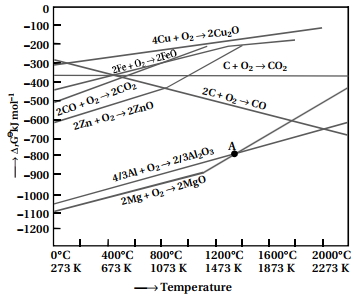
(N/A) According to the Ellingham diagram,the curves for the formation of $Al_2O_3$ and $MgO$ intersect at point $A$ (approximately $1623 \ K$ or $1350 \ ^\circ C$).
At temperatures below this intersection point,the line for the formation of $MgO$ lies below the line for the formation of $Al_2O_3$,meaning the $\Delta _r G^\Theta$ for the formation of $MgO$ is more negative.
Therefore,at temperatures below $1623 \ K$,magnesium can reduce alumina $(Al_2O_3)$ to aluminum $(Al)$ because the overall reaction $\frac{2}{3} Al_2O_3 + 2 Mg \rightarrow 2 MgO + \frac{4}{3} Al$ will have a negative $\Delta _r G^\Theta$ value.
At temperatures below this intersection point,the line for the formation of $MgO$ lies below the line for the formation of $Al_2O_3$,meaning the $\Delta _r G^\Theta$ for the formation of $MgO$ is more negative.
Therefore,at temperatures below $1623 \ K$,magnesium can reduce alumina $(Al_2O_3)$ to aluminum $(Al)$ because the overall reaction $\frac{2}{3} Al_2O_3 + 2 Mg \rightarrow 2 MgO + \frac{4}{3} Al$ will have a negative $\Delta _r G^\Theta$ value.
0 likes
View Solution426
Easy
Although thermodynamically feasible,in practice,magnesium metal is not used for the reduction of alumina in the metallurgy of aluminium. Why?
Solution
(N/A) According to the Ellingham diagram,magnesium can reduce alumina $(Al_2O_3)$ at temperatures below the point of intersection of the $Al_2O_3$ and $MgO$ curves. However,this process is not used in practice because it is economically unviable and technically difficult to maintain the required temperature conditions.
0 likes
View Solution427
Easy
Why is the reduction of a metal oxide easier if the metal formed is in liquid state at the temperature of reduction?
Solution
(N/A) The entropy of a substance is higher in the liquid state compared to the solid state.
When the metal formed is in the liquid state,the entropy change $(\Delta S)$ for the reduction reaction becomes more positive.
According to the Gibbs free energy equation,${\Delta _r}{G^\Theta } = \Delta H - T\Delta S$.
As $\Delta S$ increases,the value of ${\Delta _r}{G^\Theta }$ becomes more negative,which makes the reduction process thermodynamically more favorable and easier.
When the metal formed is in the liquid state,the entropy change $(\Delta S)$ for the reduction reaction becomes more positive.
According to the Gibbs free energy equation,${\Delta _r}{G^\Theta } = \Delta H - T\Delta S$.
As $\Delta S$ increases,the value of ${\Delta _r}{G^\Theta }$ becomes more negative,which makes the reduction process thermodynamically more favorable and easier.
0 likes
View Solution428
Easy
At a site,low grade copper ores are available and zinc and iron scraps are also available. Which of the two scraps would be more suitable for reducing the leached copper ore and why?
Solution
(B) The reduction of leached copper ore $(Cu^{2+})$ can be carried out using either $zinc$ $(Zn)$ or $iron$ $(Fe)$ scraps based on the displacement reaction: $M + Cu^{2+} \rightarrow M^{2+} + Cu$.
$Zinc$ is more reactive than $iron$ as it is placed higher in the electrochemical series,meaning the reduction process would be faster with $zinc$.
However,$iron$ is significantly cheaper than $zinc$. Therefore,from an economic and industrial perspective,$iron$ scraps are more suitable and advantageous for the reduction of leached copper ore.
$Zinc$ is more reactive than $iron$ as it is placed higher in the electrochemical series,meaning the reduction process would be faster with $zinc$.
However,$iron$ is significantly cheaper than $zinc$. Therefore,from an economic and industrial perspective,$iron$ scraps are more suitable and advantageous for the reduction of leached copper ore.
0 likes
View Solution429
Medium
Is it true that under certain conditions,$Mg$ can reduce $Al_2O_3$ and $Al$ can reduce $MgO$? What are those conditions?
Solution
(N/A) Yes,it is true. This can be explained using the Ellingham diagram,which plots the standard Gibbs free energy of formation $(\Delta_f G^\Theta)$ versus temperature $(T)$.
$1$. The reaction $3Mg + Al_2O_3 \to 3MgO + 2Al$ occurs when the $\Delta_f G^\Theta$ curve for $MgO$ lies below the $\Delta_f G^\Theta$ curve for $Al_2O_3$. This happens at temperatures below $1623 \ K$.
$2$. The reaction $2Al + 3MgO \to Al_2O_3 + 3Mg$ occurs when the $\Delta_f G^\Theta$ curve for $Al_2O_3$ lies below the $\Delta_f G^\Theta$ curve for $MgO$. This happens at temperatures above $1623 \ K$.
$3$. The intersection point of the two curves is $1623 \ K$,where $\Delta_f G^\Theta$ for both reactions is equal.
$1$. The reaction $3Mg + Al_2O_3 \to 3MgO + 2Al$ occurs when the $\Delta_f G^\Theta$ curve for $MgO$ lies below the $\Delta_f G^\Theta$ curve for $Al_2O_3$. This happens at temperatures below $1623 \ K$.
$2$. The reaction $2Al + 3MgO \to Al_2O_3 + 3Mg$ occurs when the $\Delta_f G^\Theta$ curve for $Al_2O_3$ lies below the $\Delta_f G^\Theta$ curve for $MgO$. This happens at temperatures above $1623 \ K$.
$3$. The intersection point of the two curves is $1623 \ K$,where $\Delta_f G^\Theta$ for both reactions is equal.
0 likes
View Solution430
Medium
Copper can be extracted by hydrometallurgy but not zinc. Explain.
Solution
(N/A) The reduction potentials of $Zn$ and $Fe$ are lower than that of $Cu$. In hydrometallurgy,metals like $Fe$ can be used to displace $Cu$ from its aqueous solution.
$Fe_{(s)} + Cu_{(aq)}^{2+} \to Fe_{(aq)}^{2+} + Cu_{(s)}$
However,to displace $Zn$ from its solution,more reactive metals (i.e.,metals having lower reduction potentials than $Zn$) such as $Mg, Ca, K,$ etc.,are required.
These highly reactive metals react vigorously with water to evolve $H_2$ gas instead of displacing the metal.
$2K_{(s)} + 2H_2O_{(l)} \to 2KOH_{(aq)} + H_{2(g)}$
As a result,these metals cannot be used in hydrometallurgy to extract $Zn$. Hence,$Cu$ can be extracted by hydrometallurgy but not $Zn$.
$Fe_{(s)} + Cu_{(aq)}^{2+} \to Fe_{(aq)}^{2+} + Cu_{(s)}$
However,to displace $Zn$ from its solution,more reactive metals (i.e.,metals having lower reduction potentials than $Zn$) such as $Mg, Ca, K,$ etc.,are required.
These highly reactive metals react vigorously with water to evolve $H_2$ gas instead of displacing the metal.
$2K_{(s)} + 2H_2O_{(l)} \to 2KOH_{(aq)} + H_{2(g)}$
As a result,these metals cannot be used in hydrometallurgy to extract $Zn$. Hence,$Cu$ can be extracted by hydrometallurgy but not $Zn$.
0 likes
View Solution431
Medium
Why is the extraction of copper from pyrites more difficult than that from its oxide ore through reduction?
Solution
(N/A) The Gibbs free energy of formation $\Delta_r G$ of $Cu_2S$ is less negative than that of $H_2S$ and $CS_2$.
Therefore,$H_2$ and $C$ cannot reduce $Cu_2S$ to $Cu$.
On the other hand,the Gibbs free energy of formation of $Cu_2O$ is greater than that of $CO$. Hence,$C$ can reduce $Cu_2O$ to $Cu$.
$C_{(s)} + Cu_2O_{(s)} \longrightarrow 2Cu_{(s)} + CO_{(g)}$
Thus,the extraction of copper from its pyrite ore is more difficult than from its oxide ore through reduction.
Therefore,$H_2$ and $C$ cannot reduce $Cu_2S$ to $Cu$.
On the other hand,the Gibbs free energy of formation of $Cu_2O$ is greater than that of $CO$. Hence,$C$ can reduce $Cu_2O$ to $Cu$.
$C_{(s)} + Cu_2O_{(s)} \longrightarrow 2Cu_{(s)} + CO_{(g)}$
Thus,the extraction of copper from its pyrite ore is more difficult than from its oxide ore through reduction.
0 likes
View Solution432
MediumMCQ
Out of $C$ and $CO$,which is a better reducing agent at $673 \, K$?
A
$C$
B
$CO$
C
Both are equally good
D
None of these
Solution
(B) According to the Ellingham diagram,at temperatures below $983 \, K$,the $\Delta G$ value for the oxidation of $CO$ to $CO_2$ is more negative than the $\Delta G$ value for the oxidation of $C$ to $CO$.
Since $CO$ has a greater affinity for oxygen at this temperature,it acts as a better reducing agent than $C$ at $673 \, K$.
Since $CO$ has a greater affinity for oxygen at this temperature,it acts as a better reducing agent than $C$ at $673 \, K$.
0 likes
View Solution433
Medium
Write down the reactions taking place in different zones in the blast furnace during the extraction of iron.
Solution
(N/A) During the extraction of iron,the reduction of iron oxides takes place in the blast furnace. The furnace has different temperature zones,and the reactions are as follows:
$1.$ Lower temperature range (approx. $500-800 \ K$):
$3Fe_{2}O_{3} + CO \longrightarrow 2Fe_{3}O_{4} + CO_{2}$
$Fe_{3}O_{4} + 4CO \longrightarrow 3Fe + 4CO_{2}$
$Fe_{2}O_{3} + CO \longrightarrow 2Fe + 3CO_{2}$
$2.$ Higher temperature range (approx. $900-1500 \ K$):
$C + CO_{2} \longrightarrow 2CO$
$FeO + CO \longrightarrow Fe + CO_{2}$
$3.$ Formation of slag:
$CaCO_{3} \longrightarrow CaO + CO_{2}$
$CaO + SiO_{2} \longrightarrow CaSiO_{3} \text{ (Slag)}$
$4.$ At very high temperatures (approx. $2170 \ K$):
$C + O_{2} \longrightarrow CO_{2}$
$FeO + C \longrightarrow Fe + CO$
$1.$ Lower temperature range (approx. $500-800 \ K$):
$3Fe_{2}O_{3} + CO \longrightarrow 2Fe_{3}O_{4} + CO_{2}$
$Fe_{3}O_{4} + 4CO \longrightarrow 3Fe + 4CO_{2}$
$Fe_{2}O_{3} + CO \longrightarrow 2Fe + 3CO_{2}$
$2.$ Higher temperature range (approx. $900-1500 \ K$):
$C + CO_{2} \longrightarrow 2CO$
$FeO + CO \longrightarrow Fe + CO_{2}$
$3.$ Formation of slag:
$CaCO_{3} \longrightarrow CaO + CO_{2}$
$CaO + SiO_{2} \longrightarrow CaSiO_{3} \text{ (Slag)}$
$4.$ At very high temperatures (approx. $2170 \ K$):
$C + O_{2} \longrightarrow CO_{2}$
$FeO + C \longrightarrow Fe + CO$
0 likes
View Solution434
Medium
State the role of silica in the metallurgy of copper.
Solution
(N/A) During the roasting of copper pyrite ore $(CuFeS_{2})$,a mixture of $FeO$ and $Cu_{2}O$ is obtained.
$2CuFeS_{2} + O_{2} \xrightarrow{\Delta} Cu_{2}S + 2FeS + SO_{2}$
$2Cu_{2}S + 3O_{2} \xrightarrow{\Delta} 2Cu_{2}O + 2SO_{2}$
$2FeS + 3O_{2} \xrightarrow{\Delta} 2FeO + 2SO_{2}$
The role of silica $(SiO_{2})$ in the metallurgy of copper is to act as an acidic flux to remove the basic impurity,iron$(II)$ oxide $(FeO)$,which is formed during the roasting process.
$FeO$ combines with silica to form iron$(II)$ silicate,$FeSiO_{3}$,which is known as slag.
$FeO + SiO_{2} \xrightarrow{\Delta} FeSiO_{3} \text{ (Slag)}$
$2CuFeS_{2} + O_{2} \xrightarrow{\Delta} Cu_{2}S + 2FeS + SO_{2}$
$2Cu_{2}S + 3O_{2} \xrightarrow{\Delta} 2Cu_{2}O + 2SO_{2}$
$2FeS + 3O_{2} \xrightarrow{\Delta} 2FeO + 2SO_{2}$
The role of silica $(SiO_{2})$ in the metallurgy of copper is to act as an acidic flux to remove the basic impurity,iron$(II)$ oxide $(FeO)$,which is formed during the roasting process.
$FeO$ combines with silica to form iron$(II)$ silicate,$FeSiO_{3}$,which is known as slag.
$FeO + SiO_{2} \xrightarrow{\Delta} FeSiO_{3} \text{ (Slag)}$
0 likes
View Solution435
Medium
How is 'cast iron' different from 'pig iron'?
Solution
(N/A) The iron obtained from blast furnaces is known as pig iron. It contains around $4 \%$ carbon and many impurities such as $S$,$P$,$Si$,and $Mn$ in smaller amounts.
Cast iron is obtained by melting pig iron with scrap iron and coke using a hot air blast. It contains a lower amount of carbon (about $3 \%$) than pig iron. Unlike pig iron,cast iron is extremely hard and brittle.
Cast iron is obtained by melting pig iron with scrap iron and coke using a hot air blast. It contains a lower amount of carbon (about $3 \%$) than pig iron. Unlike pig iron,cast iron is extremely hard and brittle.
0 likes
View Solution436
Medium
Why is copper matte put in a silica-lined converter?
Solution
Copper matte contains $Cu_{2}S$ and $FeS$. Copper matte is placed in a silica-lined converter to remove the remaining $FeS$ and $FeO$ present in the matte as slag $(FeSiO_{3})$. Silica $(SiO_{2})$ acts as an acidic flux to remove the basic impurity $FeO$. When a hot air blast is blown,the following reactions occur:
$2FeS + 3O_{2} \longrightarrow 2FeO + 2SO_{2}$
$FeO + SiO_{2} \longrightarrow FeSiO_{3} \text{ (slag)}$
$2Cu_{2}S + 3O_{2} \longrightarrow 2Cu_{2}O + 2SO_{2}$
$2Cu_{2}O + Cu_{2}S \longrightarrow 6Cu + SO_{2}$
$2FeS + 3O_{2} \longrightarrow 2FeO + 2SO_{2}$
$FeO + SiO_{2} \longrightarrow FeSiO_{3} \text{ (slag)}$
$2Cu_{2}S + 3O_{2} \longrightarrow 2Cu_{2}O + 2SO_{2}$
$2Cu_{2}O + Cu_{2}S \longrightarrow 6Cu + SO_{2}$
0 likes
View Solution437
EasyMCQ
What is the role of cryolite in the metallurgy of aluminium?
A
It acts as a reducing agent.
B
It lowers the melting point of the mixture and increases electrical conductivity.
C
It prevents the oxidation of aluminium.
D
It acts as a catalyst for the reaction.
Solution
(B) Cryolite $(Na_3AlF_6)$ serves two primary functions in the electrolytic extraction of aluminium:
$1.$ It lowers the melting point of the mixture from $2323 \, K$ to approximately $1140 \, K$,which saves energy.
$2.$ It increases the electrical conductivity of the molten alumina $(Al_2O_3)$,facilitating the electrolysis process.
$1.$ It lowers the melting point of the mixture from $2323 \, K$ to approximately $1140 \, K$,which saves energy.
$2.$ It increases the electrical conductivity of the molten alumina $(Al_2O_3)$,facilitating the electrolysis process.
0 likes
View Solution438
Easy
Why is zinc not extracted from zinc oxide through reduction using $CO$?
Solution
(N/A) The standard Gibbs free energy of formation of $ZnO$ is more negative than that of $CO_2$ at the temperatures where $CO$ is typically used as a reducing agent.
According to the Ellingham diagram,the line for the formation of $CO$ from $C$ and $O_2$ lies below the line for the formation of $ZnO$ from $Zn$ and $O_2$ only at very high temperatures.
At lower temperatures,$CO$ cannot effectively reduce $ZnO$ to $Zn$ because the reaction is not thermodynamically feasible $(\Delta G > 0)$.
Therefore,carbon $(C)$ is used as a reducing agent instead of $CO$ for the extraction of zinc from $ZnO$.
According to the Ellingham diagram,the line for the formation of $CO$ from $C$ and $O_2$ lies below the line for the formation of $ZnO$ from $Zn$ and $O_2$ only at very high temperatures.
At lower temperatures,$CO$ cannot effectively reduce $ZnO$ to $Zn$ because the reaction is not thermodynamically feasible $(\Delta G > 0)$.
Therefore,carbon $(C)$ is used as a reducing agent instead of $CO$ for the extraction of zinc from $ZnO$.
0 likes
View Solution439
Medium
The value of ${\Delta _r}{G^\Theta }$ for the formation of $Cr_2O_3$ is $-540 \, kJ \, mol^{-1}$ and that of $Al_2O_3$ is $-827 \, kJ \, mol^{-1}$. Is the reduction of $Cr_2O_3$ possible with $Al$?
Solution
(A) The value of ${\Delta _r}{G^\Theta }$ for the formation of $Al_2O_3$ $(-827 \, kJ \, mol^{-1})$ is more negative than that of $Cr_2O_3$ $(-540 \, kJ \, mol^{-1})$.
Therefore,$Al$ can reduce $Cr_2O_3$ to $Cr$.
Alternatively,consider the following reactions:
$2Al + \frac{3}{2}O_2 \longrightarrow Al_2O_3 \quad {\Delta _r}{G^\Theta } = -827 \, kJ \, mol^{-1}$ $(i)$
$2Cr + \frac{3}{2}O_2 \longrightarrow Cr_2O_3 \quad {\Delta _r}{G^\Theta } = -540 \, kJ \, mol^{-1}$ $(ii)$
Subtracting equation $(ii)$ from $(i)$,we get:
$2Al + Cr_2O_3 \longrightarrow Al_2O_3 + 2Cr$
${\Delta _r}{G^\Theta } = -827 - (-540) = -287 \, kJ \, mol^{-1}$
Since the total ${\Delta _r}{G^\Theta }$ for the reaction is negative,the reduction of $Cr_2O_3$ by $Al$ is thermodynamically possible.
Therefore,$Al$ can reduce $Cr_2O_3$ to $Cr$.
Alternatively,consider the following reactions:
$2Al + \frac{3}{2}O_2 \longrightarrow Al_2O_3 \quad {\Delta _r}{G^\Theta } = -827 \, kJ \, mol^{-1}$ $(i)$
$2Cr + \frac{3}{2}O_2 \longrightarrow Cr_2O_3 \quad {\Delta _r}{G^\Theta } = -540 \, kJ \, mol^{-1}$ $(ii)$
Subtracting equation $(ii)$ from $(i)$,we get:
$2Al + Cr_2O_3 \longrightarrow Al_2O_3 + 2Cr$
${\Delta _r}{G^\Theta } = -827 - (-540) = -287 \, kJ \, mol^{-1}$
Since the total ${\Delta _r}{G^\Theta }$ for the reaction is negative,the reduction of $Cr_2O_3$ by $Al$ is thermodynamically possible.
0 likes
View Solution440
MediumMCQ
Out of $C$ and $CO$,which is a better reducing agent for $ZnO$?
A
$C$
B
$CO$
C
Both are equally effective
D
None of these
Solution
(A) The reduction of $ZnO$ to $Zn$ is typically carried out at $1673 \, K$.
From the Ellingham diagram,it is observed that above $1073 \, K$,the Gibbs free energy of formation of $CO$ from $C$ is lower than the Gibbs free energy of formation of $ZnO$.
Therefore,$C$ can easily reduce $ZnO$ to $Zn$ at these temperatures.
On the other hand,the Gibbs free energy of formation of $CO_2$ from $CO$ is always higher than the Gibbs free energy of formation of $ZnO$ in this temperature range.
Thus,$CO$ cannot effectively reduce $ZnO$.
Hence,$C$ is a better reducing agent than $CO$ for the reduction of $ZnO$.
From the Ellingham diagram,it is observed that above $1073 \, K$,the Gibbs free energy of formation of $CO$ from $C$ is lower than the Gibbs free energy of formation of $ZnO$.
Therefore,$C$ can easily reduce $ZnO$ to $Zn$ at these temperatures.
On the other hand,the Gibbs free energy of formation of $CO_2$ from $CO$ is always higher than the Gibbs free energy of formation of $ZnO$ in this temperature range.
Thus,$CO$ cannot effectively reduce $ZnO$.
Hence,$C$ is a better reducing agent than $CO$ for the reduction of $ZnO$.
0 likes
View Solution441
Medium
The choice of a reducing agent in a particular case depends on thermodynamic factors. How far do you agree with this statement? Support your opinion with two examples.
Solution
(N/A) Yes,the choice of a reducing agent is primarily governed by thermodynamic factors,specifically the Gibbs free energy change $(\Delta G^{\Theta})$. $A$ metal can reduce the oxide of another metal if the standard free energy of formation $(\Delta_f G^{\Theta})$ of the oxide of the reducing metal is more negative than that of the metal being reduced.
Example $1$: Aluminum $(Al)$ can reduce Copper$(I)$ oxide $(Cu_2O)$ to Copper $(Cu)$ because $\Delta_f G^{\Theta} (Al_2O_3)$ is more negative than $\Delta_f G^{\Theta} (Cu_2O)$. The reaction is: $2Al + 3Cu_2O \rightarrow Al_2O_3 + 6Cu$.
Example $2$: Magnesium $(Mg)$ can reduce Zinc oxide $(ZnO)$ to Zinc $(Zn)$ because $\Delta_f G^{\Theta} (MgO)$ is more negative than $\Delta_f G^{\Theta} (ZnO)$. The reaction is: $Mg + ZnO \rightarrow MgO + Zn$.
Example $1$: Aluminum $(Al)$ can reduce Copper$(I)$ oxide $(Cu_2O)$ to Copper $(Cu)$ because $\Delta_f G^{\Theta} (Al_2O_3)$ is more negative than $\Delta_f G^{\Theta} (Cu_2O)$. The reaction is: $2Al + 3Cu_2O \rightarrow Al_2O_3 + 6Cu$.
Example $2$: Magnesium $(Mg)$ can reduce Zinc oxide $(ZnO)$ to Zinc $(Zn)$ because $\Delta_f G^{\Theta} (MgO)$ is more negative than $\Delta_f G^{\Theta} (ZnO)$. The reaction is: $Mg + ZnO \rightarrow MgO + Zn$.
0 likes
View Solution442
Medium
What is the role of the graphite rod in the electrometallurgy of aluminium?
Solution
(N/A) In the electrometallurgy of aluminium,a fused mixture of purified alumina $(Al_2O_3)$,cryolite $(Na_3AlF_6)$,and fluorspar $(CaF_2)$ is electrolysed. In this process,graphite rods are used as the anode. During electrolysis,$Al$ is liberated at the cathode,while $CO$ and $CO_2$ are produced at the anode due to the reaction of oxygen with the graphite anode.
Cathode: $Al^{3+}_{(melt)} + 3e^- \to Al_{(l)}$
Anode: $C_{(s)} + 2O^{2-}_{(melt)} \to CO_{2(g)} + 4e^-$
If a metal were used as the anode,$O_2$ would be liberated,which would oxidize the metal electrode and convert the produced $Al$ back into $Al_2O_3$. Thus,the graphite anode prevents the formation of $O_2$ and is also cost-effective.
Cathode: $Al^{3+}_{(melt)} + 3e^- \to Al_{(l)}$
Anode: $C_{(s)} + 2O^{2-}_{(melt)} \to CO_{2(g)} + 4e^-$
If a metal were used as the anode,$O_2$ would be liberated,which would oxidize the metal electrode and convert the produced $Al$ back into $Al_2O_3$. Thus,the graphite anode prevents the formation of $O_2$ and is also cost-effective.
0 likes
View Solution443
MediumMCQ
Predict conditions under which $Al$ might be expected to reduce $MgO$.
A
At temperatures below $1350^{\circ}C$
B
At temperatures above $1350^{\circ}C$
C
At all temperatures
D
Under no conditions
Solution
(B) According to the Ellingham diagram,the line for the formation of $Al_2O_3$ intersects the line for the formation of $MgO$ at approximately $1350^{\circ}C$.
Above $1350^{\circ}C$,the standard Gibbs free energy of formation of $Al_2O_3$ is more negative than that of $MgO$.
Therefore,$Al$ can reduce $MgO$ to $Mg$ at temperatures above $1350^{\circ}C$.
Above $1350^{\circ}C$,the standard Gibbs free energy of formation of $Al_2O_3$ is more negative than that of $MgO$.
Therefore,$Al$ can reduce $MgO$ to $Mg$ at temperatures above $1350^{\circ}C$.
0 likes
View Solution444
MediumMCQ
How is zinc produced from its ore?
A
By roasting the ore in the presence of excess air.
B
By smelting the ore with coke followed by fractional distillation.
C
By electrolysis of molten zinc chloride.
D
By reduction with hydrogen gas.
Solution
(B) Zinc is produced by smelting its ore with coke $(C)$ in a blast furnace.
Due to its low boiling point,zinc metal vaporizes at the temperature of the furnace.
The zinc vapors are then condensed in a receiver to obtain pure zinc metal.
This process is known as distillation.
Due to its low boiling point,zinc metal vaporizes at the temperature of the furnace.
The zinc vapors are then condensed in a receiver to obtain pure zinc metal.
This process is known as distillation.
0 likes
View Solution445
Medium
Explain the reduction of metal oxides to metal.
Solution
(N/A) Metal oxides are reduced to their respective metals by heating them with a reducing agent such as carbon $(C)$ or carbon monoxide $(CO)$.
The reducing agent combines with the oxygen present in the metal oxide.
The general reaction is: $M_{x}O_{y} + yC \rightarrow xM + yCO$.
Some metal oxides are easily reduced,while others are difficult to reduce. Reduction involves the gain of electrons by the metal ion. In most cases,heating is required to facilitate the process.
The reducing agent combines with the oxygen present in the metal oxide.
The general reaction is: $M_{x}O_{y} + yC \rightarrow xM + yCO$.
Some metal oxides are easily reduced,while others are difficult to reduce. Reduction involves the gain of electrons by the metal ion. In most cases,heating is required to facilitate the process.
0 likes
View Solution446
EasyMCQ
Which of the following is obtained as a slag during the extraction of iron from iron oxide?
A
$CaSiO_3$
B
$FeSiO_3$
C
$CaO$
D
$SiO_2$
Solution
(A) In the extraction of iron from iron oxide (hematite,$Fe_2O_3$) in a blast furnace,limestone $(CaCO_3)$ is added as a flux.
$CaCO_3$ decomposes to form calcium oxide $(CaO)$.
$CaO$ reacts with the silica $(SiO_2)$ impurity present in the ore to form calcium silicate $(CaSiO_3)$,which is the slag.
Reaction: $CaO + SiO_2 \rightarrow CaSiO_3$ (slag).
$CaCO_3$ decomposes to form calcium oxide $(CaO)$.
$CaO$ reacts with the silica $(SiO_2)$ impurity present in the ore to form calcium silicate $(CaSiO_3)$,which is the slag.
Reaction: $CaO + SiO_2 \rightarrow CaSiO_3$ (slag).
0 likes
View Solution447
Advanced
Explain the use of physico-chemical principles in metallurgy.
Solution
(N/A) Some basic concepts of thermodynamics help in understanding the principles of metallurgical transformations.
In pyrometallurgy,the interpretation of which element is suitable for the reduction of a given metal oxide $(M_xO_y)$ at a specific temperature is done using Gibbs energy. The criterion for easy thermal reduction is that the value of the Gibbs energy change $(\Delta G)$ must be negative at the given temperature.
The change in Gibbs energy at a given temperature is represented by the following equation:
$\Delta G = \Delta H - T \Delta S$
Where $\Delta H = \text{enthalpy change}$,$\Delta S = \text{entropy change}$.
Any reaction will proceed only when the value of $\Delta G$ in the above equation is negative.
$(i)$ Increasing temperature $T$: If $\Delta S$ is positive,then increasing temperature $(T)$ will increase the value of $T \Delta S$ $(\Delta H < T \Delta S)$,and subsequently,$\Delta G$ will become negative.
If the overall reaction resulting from the coupling of two reactions,i.e.,oxidation and reduction,results in a negative value of $\Delta G$,then the final reaction occurs easily. This type of coupling can be easily understood through a plot of Gibbs energy $(\Delta_r G^{\ominus})$ versus $T$ for the formation of oxides.
This plot is for the free energy change when one gram mole of oxygen is consumed.
$(ii)$ Ellingham diagrams: The graphical representation of Gibbs energy was first used by $H.J.T. Ellingham$ and provides a sound basis for calculating the choice of reducing agent in the reduction of oxides. This is known as the Ellingham diagram.
In pyrometallurgy,the interpretation of which element is suitable for the reduction of a given metal oxide $(M_xO_y)$ at a specific temperature is done using Gibbs energy. The criterion for easy thermal reduction is that the value of the Gibbs energy change $(\Delta G)$ must be negative at the given temperature.
The change in Gibbs energy at a given temperature is represented by the following equation:
$\Delta G = \Delta H - T \Delta S$
Where $\Delta H = \text{enthalpy change}$,$\Delta S = \text{entropy change}$.
Any reaction will proceed only when the value of $\Delta G$ in the above equation is negative.
$(i)$ Increasing temperature $T$: If $\Delta S$ is positive,then increasing temperature $(T)$ will increase the value of $T \Delta S$ $(\Delta H < T \Delta S)$,and subsequently,$\Delta G$ will become negative.
If the overall reaction resulting from the coupling of two reactions,i.e.,oxidation and reduction,results in a negative value of $\Delta G$,then the final reaction occurs easily. This type of coupling can be easily understood through a plot of Gibbs energy $(\Delta_r G^{\ominus})$ versus $T$ for the formation of oxides.
This plot is for the free energy change when one gram mole of oxygen is consumed.
$(ii)$ Ellingham diagrams: The graphical representation of Gibbs energy was first used by $H.J.T. Ellingham$ and provides a sound basis for calculating the choice of reducing agent in the reduction of oxides. This is known as the Ellingham diagram.
0 likes
View Solution448
Advanced
Explain the role of thermodynamics in the extraction of elements. Or,explain how thermodynamics is helpful in the selection of a reducing agent for metallurgical operations.
Solution
(N/A) To understand the theory of metallurgical transformations,the Gibb's free energy change $(\Delta G)$ is the most significant term. For any reaction,the Gibb's free energy change is given by:
$\Delta G = \Delta H - T \Delta S$
Where,$\Delta H$ is the enthalpy change,$T$ is the temperature in Kelvin,and $\Delta S$ is the entropy change for the process.
The criterion for the feasibility of a thermal reduction is that at a given temperature,the Gibb's free energy change for the reaction must be negative. When the value of $\Delta G$ is negative,the reaction will proceed.
Under the following conditions,the value of $\Delta G$ is negative:
$(i)$ If $\Delta S$ is positive,on increasing the temperature $(T)$,the value of $T \Delta S$ increases such that $\Delta H < T \Delta S$. In this situation,$\Delta G$ becomes negative on increasing the temperature.
$(ii)$ If the coupling of two reactions (reduction and oxidation) results in a negative value of $\Delta G$ for the overall reaction,the final reaction becomes feasible. Such coupling can be understood by studying plots of $\Delta_r G^\circ$ versus $T$ for the formation of oxides. These plots are drawn for free energy changes when one gram mole of oxygen is consumed.
The graphical representation of Gibb's free energy versus temperature was first used by $H.J.T. Ellingham$,which provides the basis for considering the choice of a reducing agent in the reduction of oxides. This is known as the $Ellingham$ diagram. Such diagrams help in predicting the feasibility of the thermal reduction of an ore.
$\Delta G = \Delta H - T \Delta S$
Where,$\Delta H$ is the enthalpy change,$T$ is the temperature in Kelvin,and $\Delta S$ is the entropy change for the process.
The criterion for the feasibility of a thermal reduction is that at a given temperature,the Gibb's free energy change for the reaction must be negative. When the value of $\Delta G$ is negative,the reaction will proceed.
Under the following conditions,the value of $\Delta G$ is negative:
$(i)$ If $\Delta S$ is positive,on increasing the temperature $(T)$,the value of $T \Delta S$ increases such that $\Delta H < T \Delta S$. In this situation,$\Delta G$ becomes negative on increasing the temperature.
$(ii)$ If the coupling of two reactions (reduction and oxidation) results in a negative value of $\Delta G$ for the overall reaction,the final reaction becomes feasible. Such coupling can be understood by studying plots of $\Delta_r G^\circ$ versus $T$ for the formation of oxides. These plots are drawn for free energy changes when one gram mole of oxygen is consumed.
The graphical representation of Gibb's free energy versus temperature was first used by $H.J.T. Ellingham$,which provides the basis for considering the choice of a reducing agent in the reduction of oxides. This is known as the $Ellingham$ diagram. Such diagrams help in predicting the feasibility of the thermal reduction of an ore.
0 likes
View Solution449
Advanced
State the important features of Ellingham diagram. Also state its limitations.
Solution
(N/A) Ellingham diagram normally consists of plots of $\Delta_{f} G^{\circ}$ $vs$ $T$ for the formation of oxides of common metals and reducing agents,$i.e.$,for the reaction given below:
$2xM_{(s)} + O_{2_{(g)}} \rightarrow 2M_{x}O_{(s)}$
In this reaction,gas is consumed in the formation of oxide; hence,molecular randomness decreases,which leads to a negative value of $\Delta S$. As a result,the sign of the $T\Delta S$ term in the equation becomes positive. Subsequently,$\Delta_{f} G^{\circ}$ shifts towards a higher side despite rising $T$. The result is a positive slope in the curve for most of the reactions for the formation of $M_{x}O_{(s)}$.
$(b)$ Each plot is a straight line and slopes upwards except when some change in phase ($s \rightarrow l$ or $l \rightarrow g$) takes place. The temperature at which such change occurs is indicated by an increase in the slope on the positive side ($e.g.$,in the $Zn, ZnO$ plot,the melting is indicated by an abrupt change in the curve).
$(c)$ When temperature is raised,a point is reached in the curve where it crosses the $\Delta_{r} G^{\circ} = 0$ line. Below this temperature,$\Delta_{r} G^{\circ}$ for the formation of oxide is negative,so $M_{x}O$ is stable. Above this point,the free energy of formation of oxide is positive,and the oxide $M_{x}O$ will decompose on its own.
$(d)$ Similar diagrams are constructed for sulfides and halides also. From them,it becomes clear why the reduction of $M_{x}S$ is difficult.
Limitations of Ellingham Diagram:
$(i)$ The graph simply indicates whether a reaction is possible or not,$i.e.$,the tendency of reduction with a reducing agent is indicated. This is because it is based only on thermodynamic concepts. It does not explain the kinetics of the reduction process. It cannot answer questions like how fast reduction can proceed.
$(ii)$ It is interesting to note that $\Delta H$ (enthalpy change) and $\Delta S$ (entropy change) values for any chemical reaction remain nearly constant even on varying temperature. So,the only dominant variable in the equation $\Delta G = \Delta H - T\Delta S$ becomes $T$. However,$\Delta S$ depends much on the physical state of the compound.
$(iii)$ Since entropy depends on disorder or randomness in the system,it will increase if a compound melts $(s \rightarrow l)$ or vaporizes $(l \rightarrow g)$ since molecular randomness increases on changing the phase from solid to liquid or from liquid to gas.
$(iv)$ The interpretation of $\Delta_{r} G^{\circ}$ is based on $K$ $(\Delta G^{\circ} = -RT \ln K)$. Thus,it is presumed that the reactants and products are in equilibrium: $M_{x}O + A_{red} \rightleftharpoons xM + A_{red}O$. This is not always true because the reactant/product may be solid. In commercial processes,reactants and products are in contact for a short time.
$2xM_{(s)} + O_{2_{(g)}} \rightarrow 2M_{x}O_{(s)}$
In this reaction,gas is consumed in the formation of oxide; hence,molecular randomness decreases,which leads to a negative value of $\Delta S$. As a result,the sign of the $T\Delta S$ term in the equation becomes positive. Subsequently,$\Delta_{f} G^{\circ}$ shifts towards a higher side despite rising $T$. The result is a positive slope in the curve for most of the reactions for the formation of $M_{x}O_{(s)}$.
$(b)$ Each plot is a straight line and slopes upwards except when some change in phase ($s \rightarrow l$ or $l \rightarrow g$) takes place. The temperature at which such change occurs is indicated by an increase in the slope on the positive side ($e.g.$,in the $Zn, ZnO$ plot,the melting is indicated by an abrupt change in the curve).
$(c)$ When temperature is raised,a point is reached in the curve where it crosses the $\Delta_{r} G^{\circ} = 0$ line. Below this temperature,$\Delta_{r} G^{\circ}$ for the formation of oxide is negative,so $M_{x}O$ is stable. Above this point,the free energy of formation of oxide is positive,and the oxide $M_{x}O$ will decompose on its own.
$(d)$ Similar diagrams are constructed for sulfides and halides also. From them,it becomes clear why the reduction of $M_{x}S$ is difficult.
Limitations of Ellingham Diagram:
$(i)$ The graph simply indicates whether a reaction is possible or not,$i.e.$,the tendency of reduction with a reducing agent is indicated. This is because it is based only on thermodynamic concepts. It does not explain the kinetics of the reduction process. It cannot answer questions like how fast reduction can proceed.
$(ii)$ It is interesting to note that $\Delta H$ (enthalpy change) and $\Delta S$ (entropy change) values for any chemical reaction remain nearly constant even on varying temperature. So,the only dominant variable in the equation $\Delta G = \Delta H - T\Delta S$ becomes $T$. However,$\Delta S$ depends much on the physical state of the compound.
$(iii)$ Since entropy depends on disorder or randomness in the system,it will increase if a compound melts $(s \rightarrow l)$ or vaporizes $(l \rightarrow g)$ since molecular randomness increases on changing the phase from solid to liquid or from liquid to gas.
$(iv)$ The interpretation of $\Delta_{r} G^{\circ}$ is based on $K$ $(\Delta G^{\circ} = -RT \ln K)$. Thus,it is presumed that the reactants and products are in equilibrium: $M_{x}O + A_{red} \rightleftharpoons xM + A_{red}O$. This is not always true because the reactant/product may be solid. In commercial processes,reactants and products are in contact for a short time.
0 likes
View Solution450
Advanced
Explain the extraction of iron from its oxide ores.
Solution
(N/A) The extraction of iron from its oxide ores $(Fe_{2}O_{3}, Fe_{3}O_{4})$ involves the following steps:
$1$. Concentration and Calcination: After concentration,the ore is subjected to calcination/roasting to remove moisture,decompose carbonates,and oxidize any sulphide impurities.
$2$. Blast Furnace Process: The concentrated ore is mixed with limestone $(CaCO_{3})$ and coke $(C)$ and fed into a blast furnace from the top.
$3$. Chemical Reactions in Blast Furnace:
- At the top (lower temperature,$500-800 \ K$): The iron oxides are reduced by $CO$ gas.
$3Fe_{2}O_{3} + CO \rightarrow 2Fe_{3}O_{4} + CO_{2}$
$Fe_{3}O_{4} + CO \rightarrow 3FeO + CO_{2}$
- At the middle (higher temperature,$900-1500 \ K$): $FeO$ is reduced to metallic iron.
$FeO + CO \rightarrow Fe + CO_{2}$
$C + CO_{2} \rightarrow 2CO$
- Limestone decomposes to $CaO$,which reacts with silica $(SiO_{2})$ impurity to form slag $(CaSiO_{3})$.
$CaCO_{3} \rightarrow CaO + CO_{2}$
$CaO + SiO_{2} \rightarrow CaSiO_{3}$
- At the bottom (very high temperature,up to $2200 \ K$): Coke burns to provide heat and $CO$ for reduction.
$C + O_{2} \rightarrow CO_{2}$
$FeO + C \rightarrow Fe + CO$
$1$. Concentration and Calcination: After concentration,the ore is subjected to calcination/roasting to remove moisture,decompose carbonates,and oxidize any sulphide impurities.
$2$. Blast Furnace Process: The concentrated ore is mixed with limestone $(CaCO_{3})$ and coke $(C)$ and fed into a blast furnace from the top.
$3$. Chemical Reactions in Blast Furnace:
- At the top (lower temperature,$500-800 \ K$): The iron oxides are reduced by $CO$ gas.
$3Fe_{2}O_{3} + CO \rightarrow 2Fe_{3}O_{4} + CO_{2}$
$Fe_{3}O_{4} + CO \rightarrow 3FeO + CO_{2}$
- At the middle (higher temperature,$900-1500 \ K$): $FeO$ is reduced to metallic iron.
$FeO + CO \rightarrow Fe + CO_{2}$
$C + CO_{2} \rightarrow 2CO$
- Limestone decomposes to $CaO$,which reacts with silica $(SiO_{2})$ impurity to form slag $(CaSiO_{3})$.
$CaCO_{3} \rightarrow CaO + CO_{2}$
$CaO + SiO_{2} \rightarrow CaSiO_{3}$
- At the bottom (very high temperature,up to $2200 \ K$): Coke burns to provide heat and $CO$ for reduction.
$C + O_{2} \rightarrow CO_{2}$
$FeO + C \rightarrow Fe + CO$
0 likes
View SolutionGeneral Principles and Processes of Isolation of Elements — Reduction to free Metal · Frequently Asked Questions
1Are these General Principles and Processes of Isolation of Elements questions useful for JEE and NEET?
Yes. All questions in this section are mapped to JEE Main and NEET exam patterns. Previous year questions from JEE Main, NEET, GUJCET and state-level exams are included with full solutions.
2Can I switch to Hindi or Gujarati for these questions?
Yes. Use the language tabs in the hero section or the sidebar to view the same questions and solutions in English, Hindi or Gujarati.
3How do I generate a question paper from this subtopic?
Use the Vedclass Exam Paper Generator — select the chapter and subtopic, set difficulty, and generate Sets A, B, C, D automatically. First 3 chapters of every subject are free.
Vedclass Products
For Students
Vedclass Test Series
Mock tests in real JEE/NEET style with performance analysis. 5-day free trial.
Start Free TrialFor Teachers
Exam Paper Generator
Generate Set A/B/C/D papers from this chapter in 2 minutes. 3 chapters free.
Try FreeFor Institutes
Online Exam Module
Live online exams with unlimited students, 360° analytics & white-label branding.
See DemoFor Teachers & Institutes
Generate a General Principles and Processes of Isolation of Elements Exam Paper in 2 Minutes
Select subtopic & difficulty — Sets A, B, C, D auto-generated with No Repeat logic.
First 3 chapters of every subject are free — no payment required.