
A English
Reduction to free Metal Questions in English
Class 12 Chemistry · General Principles and Processes of Isolation of Elements · Reduction to free Metal
597+
Questions
English
Language
100%
With Solutions
Showing 50 of 597 questions in English
351
EasyMCQ
The Ellingham diagram represents a plot of:
A
$\Delta G$ v/s $T$
B
$\Delta H$ v/s $T$
C
$\Delta G$ v/s $P$
D
$\Delta G - T\Delta S$ v/s $T$
Solution
(A) The Ellingham diagram is a graphical representation of the change in Gibbs free energy $(\Delta G)$ of formation of oxides,sulfides,and halides of elements as a function of temperature $(T)$.
It is essentially a plot of $\Delta G$ versus $T$ for the oxidation or reduction reactions of metals.
This diagram helps in predicting the feasibility of thermal reduction of metal oxides.
It is essentially a plot of $\Delta G$ versus $T$ for the oxidation or reduction reactions of metals.
This diagram helps in predicting the feasibility of thermal reduction of metal oxides.
0 likes
View Solution352
EasyMCQ
During the extraction of iron,the slag produced is:
A
$CO$
B
$FeSiO_3$
C
$MgSiO_3$
D
$CaSiO_3$
Solution
(D) In the extraction of iron,$SiO_2$ is present as an acidic impurity. To remove it,a basic flux like $CaO$ is added.
The reaction is: $\mathop {CaO}\limits_{\text{Flux}} + \mathop {SiO_2}\limits_{\text{Impurity}} \to \mathop {CaSiO_3}\limits_{\text{Slag}}$
Thus,the slag produced is $CaSiO_3$.
The reaction is: $\mathop {CaO}\limits_{\text{Flux}} + \mathop {SiO_2}\limits_{\text{Impurity}} \to \mathop {CaSiO_3}\limits_{\text{Slag}}$
Thus,the slag produced is $CaSiO_3$.
0 likes
View Solution353
EasyMCQ
In the aluminothermite process,aluminium acts as:
A
An oxidising agent
B
Flux
C
$A$ reducing agent
D
None of these
Solution
(C) In the aluminothermite process,metal oxides (like $Cr_2O_3$ or $Fe_2O_3$) are reduced to their respective metals using aluminium powder.
The chemical reaction is: $Cr_2O_3 + 2Al \to Al_2O_3 + 2Cr$.
In this reaction,aluminium $(Al)$ gets oxidised to $Al_2O_3$ and reduces the metal oxide to metal. Therefore,$Al$ acts as a reducing agent.
The chemical reaction is: $Cr_2O_3 + 2Al \to Al_2O_3 + 2Cr$.
In this reaction,aluminium $(Al)$ gets oxidised to $Al_2O_3$ and reduces the metal oxide to metal. Therefore,$Al$ acts as a reducing agent.
0 likes
View Solution354
EasyMCQ
Which of the following is the correct match for $Ore - Process - Method$?
A
$CuFeS_2 - \text{Concentration} - \text{Leaching}$
B
$Au - \text{Purification} - \text{Polling}$
C
$Fe_2O_3 - \text{Reduction} - \text{Electrolysis}$
D
$PbS - \text{Reduction} - \text{Self reduction}$
Solution
(D) $1$. $CuFeS_2$ (Copper pyrites) is concentrated by froth flotation,not leaching.
$2$. $Au$ (Gold) is purified by zone refining or electrolytic refining,not polling.
$3$. $Fe_2O_3$ (Hematite) is reduced by carbon (smelting) in a blast furnace,not electrolysis.
$4$. $PbS$ (Galena) is extracted by roasting to form $PbO$,which then reacts with remaining $PbS$ to produce lead metal. This process is known as self-reduction or auto-reduction. Thus,$PbS - \text{Reduction} - \text{Self reduction}$ is the correct match.
$2$. $Au$ (Gold) is purified by zone refining or electrolytic refining,not polling.
$3$. $Fe_2O_3$ (Hematite) is reduced by carbon (smelting) in a blast furnace,not electrolysis.
$4$. $PbS$ (Galena) is extracted by roasting to form $PbO$,which then reacts with remaining $PbS$ to produce lead metal. This process is known as self-reduction or auto-reduction. Thus,$PbS - \text{Reduction} - \text{Self reduction}$ is the correct match.
0 likes
View Solution355
AdvancedMCQ
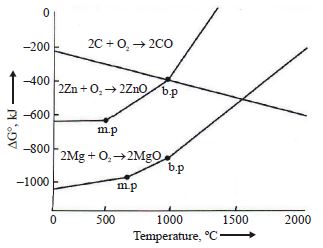
The Ellingham diagram for zinc,magnesium and carbon converting into corresponding oxides is shown below.
At $........$ $^oC$ temperature,zinc and carbon have equal affinity for oxygen.
At $........$ $^oC$ temperature,zinc and carbon have equal affinity for oxygen.
A
$1000$
B
$1500$
C
$500$
D
$1200$
Solution
(A) In the Ellingham diagram,the point of intersection of two lines represents the temperature at which the two metals (or a metal and carbon) have an equal affinity for oxygen.
The line for the oxidation of zinc $(2Zn + O_2 \rightarrow 2ZnO)$ and the line for the oxidation of carbon $(2C + O_2 \rightarrow 2CO)$ intersect at $1000^{\circ}C$.
Therefore,at $1000^{\circ}C$,zinc and carbon have equal affinity for oxygen.
The line for the oxidation of zinc $(2Zn + O_2 \rightarrow 2ZnO)$ and the line for the oxidation of carbon $(2C + O_2 \rightarrow 2CO)$ intersect at $1000^{\circ}C$.
Therefore,at $1000^{\circ}C$,zinc and carbon have equal affinity for oxygen.
0 likes
View Solution356
AdvancedMCQ
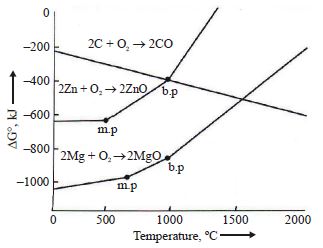
The Ellingham diagram for zinc,magnesium,and carbon converting into corresponding oxides is shown below. To make the following reduction process spontaneous,the temperature should be:
$ZnO + C \to Zn + CO$
$ZnO + C \to Zn + CO$
A
$1000 \, ^\circ C$
B
$> 1100 \, ^\circ C$
C
$< 500 \, ^\circ C$
D
$< 1000 \, ^\circ C$
Solution
(B) In an Ellingham diagram,a metal oxide can be reduced by a reducing agent if the $\Delta G^\circ$ line of the reducing agent lies below the $\Delta G^\circ$ line of the metal oxide at a given temperature.
The reduction reaction is $ZnO + C \to Zn + CO$.
From the provided Ellingham diagram,the line for the oxidation of carbon $(2C + O_2 \to 2CO)$ intersects the line for the oxidation of zinc $(2Zn + O_2 \to 2ZnO)$ at approximately $1000 \, ^\circ C$.
For temperatures above $1000 \, ^\circ C$,the $\Delta G^\circ$ line for the formation of $CO$ lies below the $\Delta G^\circ$ line for the formation of $ZnO$. Therefore,carbon can act as a reducing agent for $ZnO$ only at temperatures greater than $1000 \, ^\circ C$.
The reduction reaction is $ZnO + C \to Zn + CO$.
From the provided Ellingham diagram,the line for the oxidation of carbon $(2C + O_2 \to 2CO)$ intersects the line for the oxidation of zinc $(2Zn + O_2 \to 2ZnO)$ at approximately $1000 \, ^\circ C$.
For temperatures above $1000 \, ^\circ C$,the $\Delta G^\circ$ line for the formation of $CO$ lies below the $\Delta G^\circ$ line for the formation of $ZnO$. Therefore,carbon can act as a reducing agent for $ZnO$ only at temperatures greater than $1000 \, ^\circ C$.
0 likes
View Solution357
MediumMCQ
The Ellingham diagram for zinc,magnesium,and carbon converting into corresponding oxides is shown below. At $1100 \, ^oC$,which reaction is spontaneous to a maximum extent?
A
$MgO + C \to Mg + CO$
B
$ZnO + C \to Zn + CO$
C
$MgO + Zn \to Mg + ZnO$
D
$ZnO + Mg \to MgO + Zn$
Solution
(D) In an Ellingham diagram,a metal can reduce the oxide of another metal if the former's oxidation line lies below the latter's line at a given temperature.
At $1100 \, ^oC$,the line for the formation of $MgO$ is significantly below the line for the formation of $ZnO$.
Therefore,$Mg$ can effectively reduce $ZnO$ to $Zn$.
The reaction $ZnO + Mg \to MgO + Zn$ has the most negative Gibbs free energy change $(\Delta G)$ among the given options,making it the most spontaneous reaction.
At $1100 \, ^oC$,the line for the formation of $MgO$ is significantly below the line for the formation of $ZnO$.
Therefore,$Mg$ can effectively reduce $ZnO$ to $Zn$.
The reaction $ZnO + Mg \to MgO + Zn$ has the most negative Gibbs free energy change $(\Delta G)$ among the given options,making it the most spontaneous reaction.
0 likes
View Solution358
EasyMCQ
Which oxide will not give metal on heating?
A
$HgO$
B
$ZnO$
C
$Ag_2O$
D
All of these
Solution
(B) Metals lying above $H$ in the electrochemical series are not obtained from their oxides by simple heating.
On heating,$ZnO$ will not give $Zn$ metal because $Zn$ is a moderately reactive metal.
However,it can be reduced with $C$ or $H_2$ to give the free metal:
$ZnO + C \rightarrow Zn + CO$
$ZnO + CO \rightarrow Zn + CO_2$
$ZnO + H_2 \xrightarrow{\text{above } 400^{\circ} C} Zn + H_2O$
In contrast,$HgO$ and $Ag_2O$ are oxides of noble metals and decompose upon heating to give $Hg$ and $Ag$ respectively:
$2HgO \rightarrow 2Hg + O_2$
$2Ag_2O \rightarrow 4Ag + O_2$
On heating,$ZnO$ will not give $Zn$ metal because $Zn$ is a moderately reactive metal.
However,it can be reduced with $C$ or $H_2$ to give the free metal:
$ZnO + C \rightarrow Zn + CO$
$ZnO + CO \rightarrow Zn + CO_2$
$ZnO + H_2 \xrightarrow{\text{above } 400^{\circ} C} Zn + H_2O$
In contrast,$HgO$ and $Ag_2O$ are oxides of noble metals and decompose upon heating to give $Hg$ and $Ag$ respectively:
$2HgO \rightarrow 2Hg + O_2$
$2Ag_2O \rightarrow 4Ag + O_2$
0 likes
View Solution359
MediumMCQ
Formation of metallic copper from the sulphide ore in the normal thermo-metallurgical process essentially involves which one of the following reactions?
A
$Cu_2S + O_2 \to Cu_2O + SO_2$; $Cu_2O + C \to Cu + CO$
B
$Cu_2S + O_2 \to Cu_2S + Cu_2O + SO_2$; $2Cu_2O + Cu_2S \to 6Cu + SO_2$
C
$Cu_2S + 2O_2 \to CuSO_4$; $CuSO_4 + CuS \to CuSO_4$
D
$Cu_2S + O_2 \to CuO + SO_2$; $Cu_2O + CO \to Cu + CO_2$
Solution
(B) In the extraction of copper from copper glance $(Cu_2S)$,the ore is roasted in a limited supply of air to partially convert $Cu_2S$ into $Cu_2O$:
$2Cu_2S + 3O_2 \to 2Cu_2O + 2SO_2$
After roasting,the temperature is increased to carry out self-reduction (auto-reduction),where the remaining $Cu_2S$ acts as a reducing agent for $Cu_2O$:
$2Cu_2O + Cu_2S \to 6Cu + SO_2$
This process is known as self-reduction or auto-reduction.
$2Cu_2S + 3O_2 \to 2Cu_2O + 2SO_2$
After roasting,the temperature is increased to carry out self-reduction (auto-reduction),where the remaining $Cu_2S$ acts as a reducing agent for $Cu_2O$:
$2Cu_2O + Cu_2S \to 6Cu + SO_2$
This process is known as self-reduction or auto-reduction.
0 likes
View Solution360
MediumMCQ
Carbon cannot be used in the reduction of $Al_2O_3$ because
A
it is an expensive proposition
B
the enthalpy of formation of $CO_2$ is more than that of $Al_2O_3$
C
pure carbon is not easily available
D
the enthalpy of formation of $Al_2O_3$ is too high
Solution
(D) The reduction of a metal oxide by carbon is thermodynamically feasible only if the Gibbs free energy change $(\Delta G)$ for the reaction is negative.
$Al_2O_3$ has a very high negative enthalpy of formation,meaning it is extremely stable.
Carbon cannot reduce $Al_2O_3$ to $Al$ because the affinity of $Al$ for oxygen is much higher than that of $C$ for oxygen at moderate temperatures.
Therefore,the enthalpy of formation of $Al_2O_3$ is too high for carbon to act as a reducing agent.
$Al_2O_3$ has a very high negative enthalpy of formation,meaning it is extremely stable.
Carbon cannot reduce $Al_2O_3$ to $Al$ because the affinity of $Al$ for oxygen is much higher than that of $C$ for oxygen at moderate temperatures.
Therefore,the enthalpy of formation of $Al_2O_3$ is too high for carbon to act as a reducing agent.
0 likes
View Solution361
EasyMCQ
The slag consists of molten impurities generally in the form of
A
Metal carbonate
B
Metal silicate
C
Metal oxide
D
Metal nitrate
Solution
(B) In the process of metallurgy,a flux is added to remove gangue (impurities).
Flux reacts with gangue to form a fusible material called slag.
For example,if the impurity is $SiO_2$ (acidic),a basic flux like $CaO$ is added.
$CaO + SiO_2 \rightarrow CaSiO_3$ (Calcium silicate).
Thus,the slag consists of molten impurities generally in the form of metal silicate.
Flux reacts with gangue to form a fusible material called slag.
For example,if the impurity is $SiO_2$ (acidic),a basic flux like $CaO$ is added.
$CaO + SiO_2 \rightarrow CaSiO_3$ (Calcium silicate).
Thus,the slag consists of molten impurities generally in the form of metal silicate.
0 likes
View Solution362
EasyMCQ
During the extraction of copper from copper pyrite,the flux used for the removal of ferrous oxide is:
A
$NaOH$
B
$Na_2CO_3$
C
$Coke$
D
$SiO_2$
Solution
(D) In the extraction of copper from copper pyrite $(CuFeS_2)$,the ore is roasted to convert iron sulfide into ferrous oxide $(FeO)$.
$FeO$ is a basic impurity.
To remove this basic impurity,an acidic flux,$SiO_2$,is added.
$FeO + SiO_2 \rightarrow FeSiO_3$ (slag).
Thus,$SiO_2$ is used as the flux.
$FeO$ is a basic impurity.
To remove this basic impurity,an acidic flux,$SiO_2$,is added.
$FeO + SiO_2 \rightarrow FeSiO_3$ (slag).
Thus,$SiO_2$ is used as the flux.
0 likes
View Solution363
MediumMCQ
$A$ flux is used to remove . . . . . . .
A
Basic impurities
B
Acidic impurities
C
All types of impurities
D
Both acidic and basic impurities
Solution
(D) flux is a substance added to the ore during smelting to remove gangue (impurities).
If the gangue is acidic (e.g.,$SiO_2$),a basic flux (e.g.,$CaO$) is added to form a fusible slag $(CaSiO_3)$.
If the gangue is basic (e.g.,$FeO$),an acidic flux (e.g.,$SiO_2$) is added to form a fusible slag $(FeSiO_3)$.
Therefore,a flux is used to remove both acidic and basic impurities depending on the nature of the gangue present in the ore.
If the gangue is acidic (e.g.,$SiO_2$),a basic flux (e.g.,$CaO$) is added to form a fusible slag $(CaSiO_3)$.
If the gangue is basic (e.g.,$FeO$),an acidic flux (e.g.,$SiO_2$) is added to form a fusible slag $(FeSiO_3)$.
Therefore,a flux is used to remove both acidic and basic impurities depending on the nature of the gangue present in the ore.
0 likes
View Solution364
EasyMCQ
In the alumino-thermite process,the ignition mixture is a mixture of ..........
A
Magnesium powder and $BaO_2$
B
Magnesium powder,aluminium and $BaO_2$
C
Magnesium and aluminium powder
D
Magnesium and aluminium oxide
Solution
(A) The alumino-thermite process is used for the extraction of metals like $Cr$ and $Mn$ from their oxides using aluminium powder as a reducing agent.
To initiate the reaction,an ignition mixture is required to provide the necessary heat.
This ignition mixture consists of magnesium powder and barium peroxide $(BaO_2)$.
To initiate the reaction,an ignition mixture is required to provide the necessary heat.
This ignition mixture consists of magnesium powder and barium peroxide $(BaO_2)$.
0 likes
View Solution365
MediumMCQ
The purpose of smelting in metallurgy is ...........
A
Oxidation
B
Reduction
C
Removal of volatile impurities
D
Formation of an alloy
Solution
(B) Smelting is a process of reduction in which the roasted or calcined ore is mixed with a suitable flux and fuel and then heated to a high temperature above its melting point. In this process,the metal oxide is reduced to its metallic state by a reducing agent like carbon or carbon monoxide.
0 likes
View Solution366
MediumMCQ
The inner lining of a blast furnace is made of ...........
A
Graphite
B
Silica rocks
C
Fire bricks
D
Basic bricks
Solution
(C) The blast furnace is used for the extraction of iron from its ore.
Because the temperature inside the blast furnace is extremely high,the inner lining must be made of materials that can withstand high heat without melting or reacting.
These are known as fire bricks or refractory bricks,which are primarily composed of alumina $(Al_2O_3)$ and silica $(SiO_2)$.
Because the temperature inside the blast furnace is extremely high,the inner lining must be made of materials that can withstand high heat without melting or reacting.
These are known as fire bricks or refractory bricks,which are primarily composed of alumina $(Al_2O_3)$ and silica $(SiO_2)$.
0 likes
View Solution367
MediumMCQ
When silica is present as an impurity in an ore,a/an ........ flux is required.
A
Acidic
B
Basic
C
Both
D
None of these
Solution
(B) Silica $(SiO_2)$ is an acidic impurity (gangue). To remove an acidic impurity,a basic flux is required. The basic flux reacts with the acidic impurity to form a fusible slag. For example,$CaO$ (basic flux) reacts with $SiO_2$ (acidic impurity) to form $CaSiO_3$ (slag).
0 likes
View Solution368
MediumMCQ
Which of the following metals is extracted by the electrolytic reduction method?
A
$Fe$
B
$Cu$
C
$Ag$
D
$Al$
Solution
(D) Highly reactive metals like $Al$,$Na$,$Mg$,and $Ca$ are extracted by the electrolytic reduction of their fused salts because they cannot be reduced by carbon or other common reducing agents.
$Al$ is extracted by the Hall-$H$éroult process,which involves the electrolytic reduction of alumina $(Al_2O_3)$ dissolved in molten cryolite $(Na_3AlF_6)$.
$Al$ is extracted by the Hall-$H$éroult process,which involves the electrolytic reduction of alumina $(Al_2O_3)$ dissolved in molten cryolite $(Na_3AlF_6)$.
0 likes
View Solution369
EasyMCQ
What is the most common method for the extraction of metal from its oxide ore?
A
Reduction by carbon
B
Reduction by hydrogen
C
Reduction by aluminium
D
Electrolytic method
Solution
(A) The most common and economical method for the extraction of metals from their oxide ores is reduction by carbon. In this process,the metal oxide is heated with coke (carbon),which acts as a reducing agent to produce the metal and carbon monoxide or carbon dioxide. This is widely used for metals like $Fe$,$Zn$,$Pb$,etc.
0 likes
View Solution370
EasyMCQ
Which substance is used to provide a basic lining in a furnace?
A
Calcined dolomite
B
Limestone
C
Hematite
D
Silica
Solution
(A) In metallurgy,a basic lining is required in furnaces where basic impurities (like $P_4O_{10}$) are to be removed or when the slag formed is acidic. $MgO \cdot CaO$ (calcined dolomite) or $MgO$ (magnesia) are commonly used as basic refractory materials for lining the furnace.
0 likes
View Solution371
MediumMCQ
The cyanide process is used for the extraction of which of the following?
A
$Au$
B
$Ag$
C
$Cu$
D
Both $(A)$ and $(B)$
Solution
(D) The cyanide process,also known as the Mac-Arthur Forrest process,is used for the extraction of gold $(Au)$ and silver $(Ag)$ from their ores.
In this process,the crushed ore is treated with a dilute solution of sodium cyanide $(NaCN)$ in the presence of air $(O_2)$,which acts as an oxidizing agent.
The metal dissolves in the cyanide solution to form a soluble complex:
$4M + 8CN^- + 2H_2O + O_2 \rightarrow 4[M(CN)_2]^- + 4OH^-$ (where $M = Au$ or $Ag$).
Therefore,both $Au$ and $Ag$ are extracted using this method.
In this process,the crushed ore is treated with a dilute solution of sodium cyanide $(NaCN)$ in the presence of air $(O_2)$,which acts as an oxidizing agent.
The metal dissolves in the cyanide solution to form a soluble complex:
$4M + 8CN^- + 2H_2O + O_2 \rightarrow 4[M(CN)_2]^- + 4OH^-$ (where $M = Au$ or $Ag$).
Therefore,both $Au$ and $Ag$ are extracted using this method.
0 likes
View Solution372
MediumMCQ
In metallurgy,aluminum acts as a .....
A
Oxidizing agent
B
Reducing agent
C
Flux
D
Solder
Solution
(B) In the process of metallurgy,specifically in the thermite process,aluminum is used to reduce metal oxides (like $Cr_2O_3$ or $Fe_2O_3$) to their respective metals.
Since aluminum undergoes oxidation $(Al \rightarrow Al^{3+} + 3e^-)$ and reduces the metal oxide,it acts as a strong reducing agent.
Since aluminum undergoes oxidation $(Al \rightarrow Al^{3+} + 3e^-)$ and reduces the metal oxide,it acts as a strong reducing agent.
0 likes
View Solution373
MediumMCQ
In the electrolytic process of extraction of aluminum,what is used as the electrolyte?
A
$Al(OH)_3$ in $NaOH$ solution
B
$Al_2(SO_4)_3$ aqueous solution
C
Molten mixture of $Al_2O_3$ and $Na_3AlF_6$
D
Molten mixture of $Al_2O_3$ and $Al(OH)_3$
Solution
(C) In the Hall-Heroult process for the extraction of aluminum,pure $Al_2O_3$ is mixed with $Na_3AlF_6$ (cryolite) and $CaF_2$ (fluorspar).
This mixture is used as the electrolyte because it lowers the melting point of the mixture and increases its electrical conductivity.
Therefore,the correct option is $C$.
This mixture is used as the electrolyte because it lowers the melting point of the mixture and increases its electrical conductivity.
Therefore,the correct option is $C$.
0 likes
View Solution374
MediumMCQ
Which methods are used for the extraction of $Pb$ and $Sn$ from their respective ores?
A
Carbon reduction and Self-reduction
B
Self-reduction and Carbon reduction
C
Electrolysis and Self-reduction
D
Self-reduction and Electrolysis
Solution
(B) The extraction of $Pb$ (lead) from its ore galena $(PbS)$ is primarily carried out by the self-reduction process (also known as air reduction).
In this process,$PbS$ is partially roasted to form $PbO$,which then reacts with the remaining $PbS$ to produce $Pb$ metal: $2PbS + 3O_2 \rightarrow 2PbO + 2SO_2$ and $PbS + 2PbO \rightarrow 3Pb + SO_2$.
The extraction of $Sn$ (tin) from its ore cassiterite $(SnO_2)$ is carried out by carbon reduction,where $SnO_2$ is heated with coke (carbon) in a furnace: $SnO_2 + 2C \rightarrow Sn + 2CO$.
In this process,$PbS$ is partially roasted to form $PbO$,which then reacts with the remaining $PbS$ to produce $Pb$ metal: $2PbS + 3O_2 \rightarrow 2PbO + 2SO_2$ and $PbS + 2PbO \rightarrow 3Pb + SO_2$.
The extraction of $Sn$ (tin) from its ore cassiterite $(SnO_2)$ is carried out by carbon reduction,where $SnO_2$ is heated with coke (carbon) in a furnace: $SnO_2 + 2C \rightarrow Sn + 2CO$.
0 likes
View Solution375
MediumMCQ
In metallurgy,flux is used to:
A
Convert infusible impurities into fusible impurities
B
Convert soluble impurities into insoluble impurities
C
Convert fusible impurities into infusible impurities
D
Convert minerals into silicates
Solution
(A) In metallurgy,flux is a substance added to the ore to remove gangue (impurities).
It reacts with infusible impurities (gangue) to form a fusible material known as slag.
Thus,the process converts infusible impurities into fusible impurities,which can be easily removed from the molten metal.
It reacts with infusible impurities (gangue) to form a fusible material known as slag.
Thus,the process converts infusible impurities into fusible impurities,which can be easily removed from the molten metal.
0 likes
View Solution376
MediumMCQ
In the blast furnace,the reduction of iron oxide is carried out by which of the following?
A
Silica
B
Carbon monoxide
C
Carbon
D
Limestone
Solution
(B) In the blast furnace,the reduction of iron oxides ($Fe_2O_3$ and $Fe_3O_4$) occurs primarily by $CO$ gas at lower temperatures $(500-800 \ K)$.
The reaction is: $Fe_2O_3 + 3CO \rightarrow 2Fe + 3CO_2$.
At higher temperatures $(> 1073 \ K)$,carbon $(C)$ also acts as a reducing agent,but $CO$ is the primary reducing agent in the upper cooler parts of the furnace.
The reaction is: $Fe_2O_3 + 3CO \rightarrow 2Fe + 3CO_2$.
At higher temperatures $(> 1073 \ K)$,carbon $(C)$ also acts as a reducing agent,but $CO$ is the primary reducing agent in the upper cooler parts of the furnace.
0 likes
View Solution377
EasyMCQ
Which of the following statements is correct regarding the slag obtained during the extraction of metals like copper and iron?
A
Slag is lighter than the metal and its melting point is higher than that of the metal.
B
Slag is lighter than the metal and its melting point is lower than that of the metal.
C
Slag is heavier than the metal and its melting point is higher than that of the metal.
D
Slag is heavier than the metal and its melting point is lower than that of the metal.
Solution
(B) During the extraction of metals like $Fe$ (iron) and $Cu$ (copper),a flux is added to remove gangue impurities.
The flux reacts with the gangue to form a fusible material called slag.
Slag is essentially a silicate or phosphate compound.
Properties of slag:
$1$. It is lighter than the molten metal,so it floats on the surface of the molten metal,protecting it from oxidation.
$2$. It has a lower melting point than the metal,allowing it to remain in a liquid state for easy removal.
The flux reacts with the gangue to form a fusible material called slag.
Slag is essentially a silicate or phosphate compound.
Properties of slag:
$1$. It is lighter than the molten metal,so it floats on the surface of the molten metal,protecting it from oxidation.
$2$. It has a lower melting point than the metal,allowing it to remain in a liquid state for easy removal.
0 likes
View Solution378
MediumMCQ
The alumino-thermite process is used for the metallurgy of which metal?
A
$Pb$
B
$Ag$
C
$Cr$
D
$none \ of \ these$
Solution
(C) The alumino-thermite process involves the reduction of metal oxides (like $Cr_2O_3$ or $Fe_2O_3$) using aluminum powder as a reducing agent.
This process is highly exothermic and is commonly used for the extraction of metals like $Cr$ and $Mn$ from their respective oxides.
Therefore,among the given options,$Cr$ is the correct metal extracted via this method.
This process is highly exothermic and is commonly used for the extraction of metals like $Cr$ and $Mn$ from their respective oxides.
Therefore,among the given options,$Cr$ is the correct metal extracted via this method.
0 likes
View Solution379
MediumMCQ
Cryolite is .........
A
$Na_3AlF_6$ and is used to decrease the electrical conductivity in the electrolysis of alumina.
B
$Na_3AlF_6$ and is used to decrease the melting point of alumina in the electrolysis of alumina.
C
$Na_3AlF_6$ and is used for the electrolytic refining of alumina.
D
$Na_3AlF_6$ and is used in the electrolysis of alumina.
Solution
(B) Cryolite is $Na_3AlF_6$.
In the Hall-$H$éroult process,pure alumina $(Al_2O_3)$ has a very high melting point $(2323 \ K)$.
Adding cryolite $(Na_3AlF_6)$ lowers the melting point of the mixture to about $1240 \ K$ and also increases the electrical conductivity of the melt,making the electrolysis process more efficient.
In the Hall-$H$éroult process,pure alumina $(Al_2O_3)$ has a very high melting point $(2323 \ K)$.
Adding cryolite $(Na_3AlF_6)$ lowers the melting point of the mixture to about $1240 \ K$ and also increases the electrical conductivity of the melt,making the electrolysis process more efficient.
0 likes
View Solution380
EasyMCQ
In the extraction of copper from sulfide ore,copper metal is obtained by the reduction of $Cu_2O$ with which of the following?
A
$FeS$
B
$Co$
C
$Cu_2S$
D
$SO_2$
Solution
(C) In the metallurgy of copper,the sulfide ore is first roasted to form $Cu_2O$ and $Cu_2S$.
Some $Cu_2O$ reacts with $Cu_2S$ in a process known as self-reduction (or auto-reduction) to produce copper metal.
The chemical reaction is: $2Cu_2O + Cu_2S \rightarrow 6Cu + SO_2$.
Some $Cu_2O$ reacts with $Cu_2S$ in a process known as self-reduction (or auto-reduction) to produce copper metal.
The chemical reaction is: $2Cu_2O + Cu_2S \rightarrow 6Cu + SO_2$.
0 likes
View Solution381
EasyMCQ
Which metals are extracted using the self-reduction method?
A
$Cu$ and $Hg$
B
$Zn$ and $Hg$
C
$Cu$ and $Al$
D
$Fe$ and $Pb$
Solution
(A) The self-reduction method (also known as auto-reduction) is used for the extraction of metals that have low affinity for oxygen,such as $Cu$,$Hg$,and $Pb$.
For copper,the reaction is: $2Cu_2S + 3O_2 \rightarrow 2Cu_2O + 2SO_2$ followed by $2Cu_2O + Cu_2S \rightarrow 6Cu + SO_2$.
For mercury,the reaction is: $2HgS + 3O_2 \rightarrow 2HgO + 2SO_2$ followed by $2HgO + HgS \rightarrow 3Hg + SO_2$.
Therefore,$Cu$ and $Hg$ are extracted using this method.
For copper,the reaction is: $2Cu_2S + 3O_2 \rightarrow 2Cu_2O + 2SO_2$ followed by $2Cu_2O + Cu_2S \rightarrow 6Cu + SO_2$.
For mercury,the reaction is: $2HgS + 3O_2 \rightarrow 2HgO + 2SO_2$ followed by $2HgO + HgS \rightarrow 3Hg + SO_2$.
Therefore,$Cu$ and $Hg$ are extracted using this method.
0 likes
View Solution382
EasyMCQ
Which substance is used as a flux to remove acidic impurities in metallurgy?
A
Silica
B
Limestone
C
Sodium chloride
D
Sodium carbonate
Solution
(B) In metallurgy,a flux is added to remove gangue (impurities) from the ore.
If the impurity is acidic (e.g.,$SiO_2$),a basic flux is used.
If the impurity is basic (e.g.,$FeO$),an acidic flux is used.
Limestone $(CaCO_3)$ acts as a basic flux because it decomposes to form calcium oxide $(CaO)$,which reacts with acidic silica $(SiO_2)$ to form slag $(CaSiO_3)$:
$CaCO_3 \rightarrow CaO + CO_2$
$CaO + SiO_2 \rightarrow CaSiO_3$ (slag).
Therefore,limestone is used to remove acidic impurities.
If the impurity is acidic (e.g.,$SiO_2$),a basic flux is used.
If the impurity is basic (e.g.,$FeO$),an acidic flux is used.
Limestone $(CaCO_3)$ acts as a basic flux because it decomposes to form calcium oxide $(CaO)$,which reacts with acidic silica $(SiO_2)$ to form slag $(CaSiO_3)$:
$CaCO_3 \rightarrow CaO + CO_2$
$CaO + SiO_2 \rightarrow CaSiO_3$ (slag).
Therefore,limestone is used to remove acidic impurities.
0 likes
View Solution383
EasyMCQ
Which of the following furnaces can achieve the highest temperature?
A
Blast furnace
B
Reverberatory furnace
C
Electric furnace
D
Muffle furnace
Solution
(C) An $Electric \ furnace$ uses electrical energy to generate heat,which allows it to reach significantly higher temperatures (often exceeding $3000 \ ^\circ C$) compared to fuel-fired furnaces like the blast furnace,reverberatory furnace,or muffle furnace. Therefore,the correct option is $C$.
0 likes
View Solution384
EasyMCQ
What does the slag obtained during the extraction of copper mainly consist of?
A
$Cu_2S$
B
$FeSiO_3$
C
$CaSiO_3$
D
$SiO_2$
Solution
(B) During the extraction of copper from copper pyrites $(CuFeS_2)$,the ore is roasted to remove sulfur and then smelted in a blast furnace.
In the furnace,iron oxide $(FeO)$ is formed as an impurity.
Silica $(SiO_2)$ is added as a flux to remove this impurity.
$FeO + SiO_2 \rightarrow FeSiO_3$ (slag).
Thus,the slag formed is iron silicate $(FeSiO_3)$.
In the furnace,iron oxide $(FeO)$ is formed as an impurity.
Silica $(SiO_2)$ is added as a flux to remove this impurity.
$FeO + SiO_2 \rightarrow FeSiO_3$ (slag).
Thus,the slag formed is iron silicate $(FeSiO_3)$.
0 likes
View Solution385
MediumMCQ
What does the slag obtained during the extraction of iron primarily consist of?
A
$CuSiO_3$
B
$FeSiO_3$
C
$CaSiO_3$
D
$SiO_2$
Solution
(C) During the extraction of iron in a blast furnace,limestone $(CaCO_3)$ is added as a flux.
It decomposes to form calcium oxide $(CaO)$.
$CaO$ reacts with the impurity silica $(SiO_2)$ present in the ore to form calcium silicate $(CaSiO_3)$,which is the slag.
$CaO + SiO_2 \rightarrow CaSiO_3$ (Slag).
It decomposes to form calcium oxide $(CaO)$.
$CaO$ reacts with the impurity silica $(SiO_2)$ present in the ore to form calcium silicate $(CaSiO_3)$,which is the slag.
$CaO + SiO_2 \rightarrow CaSiO_3$ (Slag).
0 likes
View Solution386
EasyMCQ
Which of the following metals is not obtained by electrolysis?
A
$Ca$
B
$Mg$
C
$Cr$
D
$Al$
Solution
(C) Highly reactive metals like $Ca$,$Mg$,and $Al$ are extracted by the electrolysis of their fused salts because they cannot be reduced by carbon or other common reducing agents.
$Cr$ (Chromium) is typically obtained by the reduction of its oxide $(Cr_2O_3)$ with aluminum (Alumino-thermic process) or by other chemical reduction methods,not by electrolysis of its salt in the extraction process.
$Cr$ (Chromium) is typically obtained by the reduction of its oxide $(Cr_2O_3)$ with aluminum (Alumino-thermic process) or by other chemical reduction methods,not by electrolysis of its salt in the extraction process.
0 likes
View Solution387
EasyMCQ
What is the substance added during the extraction of metals that combines with impurities to form a molten product called?
A
Slag
B
Sludge
C
Gangue
D
Flux
Solution
(D) In the process of metallurgy,a substance called $Flux$ is added to the ore to remove the impurities (gangue).
$Flux$ reacts with the gangue to form a fusible material known as $Slag$.
Therefore,the substance added is $Flux$.
$Flux$ reacts with the gangue to form a fusible material known as $Slag$.
Therefore,the substance added is $Flux$.
0 likes
View Solution388
EasyMCQ
From which of the following is silver obtained by the reaction with $Na[Ag(CN)_2]$?
A
$Fe$
B
$Sn$
C
$Zn$
D
$Au$
Solution
(C) In the hydrometallurgical process for the extraction of silver,$Na[Ag(CN)_2]$ is formed by the leaching of silver ore with $NaCN$ solution.
To recover silver from this complex,a more electropositive metal like zinc $(Zn)$ is added.
The displacement reaction is: $2Na[Ag(CN)_2] + Zn \rightarrow Na_2[Zn(CN)_4] + 2Ag$.
Since $Zn$ is more reactive than $Ag$,it displaces silver from the complex.
To recover silver from this complex,a more electropositive metal like zinc $(Zn)$ is added.
The displacement reaction is: $2Na[Ag(CN)_2] + Zn \rightarrow Na_2[Zn(CN)_4] + 2Ag$.
Since $Zn$ is more reactive than $Ag$,it displaces silver from the complex.
0 likes
View Solution389
DifficultMCQ
In the process of leaching of gold by cyanide,what are the complexes $X$ and $Y$ respectively?
$4Au(s) + 8CN^-(aq) + 2H_2O(aq) + O_2(g) \to 4[Au(CN)_2]^-(aq) + 4OH^-(aq)$
$2[Au(CN)_2]^-(aq) + Zn(s) \to [Zn(CN)_4]^{2-}(aq) + 2Au(s)$
$X$ and $Y$ are:
$4Au(s) + 8CN^-(aq) + 2H_2O(aq) + O_2(g) \to 4[Au(CN)_2]^-(aq) + 4OH^-(aq)$
$2[Au(CN)_2]^-(aq) + Zn(s) \to [Zn(CN)_4]^{2-}(aq) + 2Au(s)$
$X$ and $Y$ are:
A
$[Au(CN)_2]^-, [Zn(CN)_4]^{2-}$
B
$[Au(CN)_4]^{2-}, [Zn(CN)_4]^{2-}$
C
$[Au(CN)_2]^-, [Zn(CN)_6]^{2-}$
D
$[Au(CN)_2]^{2-}, [Zn(CN)_4]^{2-}$
Solution
(A) The extraction of gold involves leaching the ore with a dilute solution of $NaCN$ or $KCN$ in the presence of air $(O_2)$,which provides $O_2$ to oxidize gold to $Au^+$.
The chemical reaction is:
$4Au(s) + 8CN^-(aq) + 2H_2O(aq) + O_2(g) \to 4[Au(CN)_2]^-(aq) + 4OH^-(aq)$
Here,$X$ is $[Au(CN)_2]^-$.
Gold is then recovered from this complex by displacement using zinc $(Zn)$:
$2[Au(CN)_2]^-(aq) + Zn(s) \to [Zn(CN)_4]^{2-}(aq) + 2Au(s)$
Here,$Y$ is $[Zn(CN)_4]^{2-}$.
Thus,$X = [Au(CN)_2]^-$ and $Y = [Zn(CN)_4]^{2-}$.
The chemical reaction is:
$4Au(s) + 8CN^-(aq) + 2H_2O(aq) + O_2(g) \to 4[Au(CN)_2]^-(aq) + 4OH^-(aq)$
Here,$X$ is $[Au(CN)_2]^-$.
Gold is then recovered from this complex by displacement using zinc $(Zn)$:
$2[Au(CN)_2]^-(aq) + Zn(s) \to [Zn(CN)_4]^{2-}(aq) + 2Au(s)$
Here,$Y$ is $[Zn(CN)_4]^{2-}$.
Thus,$X = [Au(CN)_2]^-$ and $Y = [Zn(CN)_4]^{2-}$.
0 likes
View Solution390
EasyMCQ
Matte is a mixture of .......... .
A
$Cu_2S + Fe_2S$
B
$Cu_2S + FeO$
C
$Cu_2O + FeS$
D
$Cu_2S + FeS$
Solution
(D) In the metallurgy of copper,the concentrated ore is roasted in a reverberatory furnace.
After roasting,the ore is smelted with silica $(SiO_2)$ and coke.
During this process,iron oxide $(FeO)$ reacts with silica to form iron silicate slag $(FeSiO_3)$.
The remaining copper sulfide $(Cu_2S)$ and some unreacted iron sulfide $(FeS)$ form a molten mixture known as matte.
Therefore,matte is a mixture of $Cu_2S + FeS$.
After roasting,the ore is smelted with silica $(SiO_2)$ and coke.
During this process,iron oxide $(FeO)$ reacts with silica to form iron silicate slag $(FeSiO_3)$.
The remaining copper sulfide $(Cu_2S)$ and some unreacted iron sulfide $(FeS)$ form a molten mixture known as matte.
Therefore,matte is a mixture of $Cu_2S + FeS$.
0 likes
View Solution391
EasyMCQ
Which zone of the blast furnace has the highest temperature?
A
Reduction zone
B
Slag formation zone
C
Combustion zone
D
Fusion zone
Solution
(C) In a blast furnace,the combustion zone (also known as the tuyere zone) is located at the bottom where hot air is blasted into the furnace.
This region has the highest temperature,reaching approximately $2000 \ K$ to $2200 \ K$,due to the exothermic reaction of coke with oxygen: $C + O_2 \rightarrow CO_2 + \text{Heat}$.
This region has the highest temperature,reaching approximately $2000 \ K$ to $2200 \ K$,due to the exothermic reaction of coke with oxygen: $C + O_2 \rightarrow CO_2 + \text{Heat}$.
0 likes
View Solution392
EasyMCQ
Who studied the plots of $\Delta G$ versus $T$?
A
Hall-Heroult
B
Ellingham
C
Helmholtz
D
Gibbs
Solution
(B) The plots of $\Delta G$ (Gibbs free energy change) versus $T$ (temperature) are known as Ellingham diagrams. These diagrams were first used by Harold Ellingham to evaluate the feasibility of metal oxide reduction by various reducing agents.
0 likes
View Solution393
EasyMCQ
In the process of obtaining cast iron from pig iron,the reverberatory furnace is lined with ..........
A
$Fe_2O_3$
B
$Fe_3O_4$
C
Graphite
D
$FeS_2$
Solution
(A) The conversion of pig iron into cast iron (or wrought iron) involves the removal of impurities like $C$,$Si$,$Mn$,$S$,and $P$ by oxidation. In the reverberatory furnace,the hearth is lined with $Fe_2O_3$. This $Fe_2O_3$ oxidizes the carbon present in the pig iron to carbon monoxide $(CO)$:
$Fe_2O_3 + 3C \rightarrow 2Fe + 3CO$.
$Fe_2O_3 + 3C \rightarrow 2Fe + 3CO$.
0 likes
View Solution394
MediumMCQ
Which of the following reactions takes place in the Bessemer converter during the extraction of copper?
A
$2CuFeS_2 + O_2 \to Cu_2S + FeS + SO_2$
B
$2Cu_2O + Cu_2S \to 6Cu + SO_2$
C
$2Cu_2S + 3O_2 \to 2Cu_2O + 2SO_2$
D
$2FeS + 3O_2 \to 2FeO + 2SO_2$
Solution
(B) In the Bessemer converter,the molten matte $(Cu_2S + FeS)$ is subjected to a blast of air.
First,the remaining $FeS$ is oxidized to $FeO$,which then reacts with silica $(SiO_2)$ to form slag.
After the removal of iron,the remaining $Cu_2S$ undergoes self-reduction (autoreduction) in the presence of air:
$2Cu_2S + 3O_2 \to 2Cu_2O + 2SO_2$
$2Cu_2O + Cu_2S \to 6Cu + SO_2$
Both reactions $C$ and $B$ occur in the converter,but the primary reaction that leads to the formation of metallic copper via self-reduction is $2Cu_2O + Cu_2S \to 6Cu + SO_2$.
First,the remaining $FeS$ is oxidized to $FeO$,which then reacts with silica $(SiO_2)$ to form slag.
After the removal of iron,the remaining $Cu_2S$ undergoes self-reduction (autoreduction) in the presence of air:
$2Cu_2S + 3O_2 \to 2Cu_2O + 2SO_2$
$2Cu_2O + Cu_2S \to 6Cu + SO_2$
Both reactions $C$ and $B$ occur in the converter,but the primary reaction that leads to the formation of metallic copper via self-reduction is $2Cu_2O + Cu_2S \to 6Cu + SO_2$.
0 likes
View Solution395
MediumMCQ
Choose the correct option with reference to the following statements:
$(1)$ Pig iron is produced at a temperature of $1270 \ K$.
$(2)$ Pig iron contains $4 \%$ carbon.
$(3)$ Pig iron cannot be cast into a variety of shapes.
$(4)$ Pig iron contains small amounts of impurities like $P, S, Si, Mn$.
$(1)$ Pig iron is produced at a temperature of $1270 \ K$.
$(2)$ Pig iron contains $4 \%$ carbon.
$(3)$ Pig iron cannot be cast into a variety of shapes.
$(4)$ Pig iron contains small amounts of impurities like $P, S, Si, Mn$.
A
$FTFT$
B
$TFTT$
C
$TFTF$
D
$TTFF$
0 likes
View Solution396
MediumMCQ
Which of the following processes is associated with the smelting stage?
A
$Al_2O_3 \cdot 2H_2O \to Al_2O_3 + 2H_2O$
B
$Fe_2O_3 + 3C \to 2Fe + 3CO$
C
$ZnCO_3 \to ZnO + CO_2$
D
$2PbS + 3O_2 \to 2PbO + 2SO_2$
Solution
(B) Smelting is a process of reduction of a metal oxide with carbon at high temperatures.
In the given options,the reaction $Fe_2O_3 + 3C \to 2Fe + 3CO$ represents the reduction of iron oxide by carbon,which is the characteristic reaction of the smelting process in a blast furnace.
Option $A$ represents calcination/dehydration.
Option $C$ represents calcination.
Option $D$ represents roasting.
In the given options,the reaction $Fe_2O_3 + 3C \to 2Fe + 3CO$ represents the reduction of iron oxide by carbon,which is the characteristic reaction of the smelting process in a blast furnace.
Option $A$ represents calcination/dehydration.
Option $C$ represents calcination.
Option $D$ represents roasting.
0 likes
View Solution397
MediumMCQ
How are the most electropositive metals extracted from their ores?
A
Reduction with carbon at high temperature
B
Auto-reduction
C
Thermal decomposition
D
Electrolysis of molten ionic salts
Solution
(D) Highly electropositive metals (such as $Na, K, Mg, Ca, Al$) have a very high affinity for oxygen and cannot be reduced by common reducing agents like carbon or carbon monoxide.
Therefore,these metals are extracted by the electrolysis of their molten ionic salts (fused chlorides or oxides),where the metal is deposited at the cathode.
Therefore,these metals are extracted by the electrolysis of their molten ionic salts (fused chlorides or oxides),where the metal is deposited at the cathode.
0 likes
View Solution398
MediumMCQ
Bessemerization is involved in the extraction of which metal?
A
$Fe$
B
$Ag$
C
$Al$
D
$Cu$
Solution
(D) Bessemerization is a process used in the metallurgy of copper $(Cu)$.
In this process,molten matte $(Cu_2S + FeS)$ is taken in a Bessemer converter.
Air is blown through the molten matte to oxidize $FeS$ to $FeO$,which then reacts with silica $(SiO_2)$ to form slag $(FeSiO_3)$.
Finally,the remaining $Cu_2S$ is reduced to metallic copper,known as blister copper.
In this process,molten matte $(Cu_2S + FeS)$ is taken in a Bessemer converter.
Air is blown through the molten matte to oxidize $FeS$ to $FeO$,which then reacts with silica $(SiO_2)$ to form slag $(FeSiO_3)$.
Finally,the remaining $Cu_2S$ is reduced to metallic copper,known as blister copper.
0 likes
View Solution399
MediumMCQ
In the extraction of zinc,what burns to produce a blue flame?
A
$ZnO$
B
$C$
C
$Zn$
D
$CO$
Solution
(D) In the extraction of zinc,zinc oxide $(ZnO)$ is reduced by coke $(C)$ at high temperatures $(1673 \ K)$:
$ZnO + C \rightarrow Zn + CO$
Here,the carbon monoxide $(CO)$ gas produced escapes and burns at the mouth of the furnace with a characteristic blue flame.
$ZnO + C \rightarrow Zn + CO$
Here,the carbon monoxide $(CO)$ gas produced escapes and burns at the mouth of the furnace with a characteristic blue flame.
0 likes
View Solution400
MediumMCQ
Extraction of copper from copper pyrites is done by heating in a blast furnace. On which principle is this method based?
A
At high temperatures,copper has more affinity for oxygen than sulfur.
B
At high temperatures,iron has less affinity for oxygen than sulfur.
C
At high temperatures,sulfur has less affinity for oxygen than copper.
D
At high temperatures,iron has more affinity for oxygen than sulfur.
Solution
(D) The extraction of copper from copper pyrites $(CuFeS_2)$ involves roasting in a blast furnace. $CuFeS_2$ is converted into $Cu_2S$ and $FeO$. $FeO$ is then removed as slag by adding silica $(SiO_2)$ to form $FeSiO_3$. The principle behind this process is that at high temperatures,iron has a greater affinity for oxygen than sulfur,allowing it to be selectively oxidized and removed as slag,while copper remains as a sulfide.
0 likes
View SolutionGeneral Principles and Processes of Isolation of Elements — Reduction to free Metal · Frequently Asked Questions
1Are these General Principles and Processes of Isolation of Elements questions useful for JEE and NEET?
Yes. All questions in this section are mapped to JEE Main and NEET exam patterns. Previous year questions from JEE Main, NEET, GUJCET and state-level exams are included with full solutions.
2Can I switch to Hindi or Gujarati for these questions?
Yes. Use the language tabs in the hero section or the sidebar to view the same questions and solutions in English, Hindi or Gujarati.
3How do I generate a question paper from this subtopic?
Use the Vedclass Exam Paper Generator — select the chapter and subtopic, set difficulty, and generate Sets A, B, C, D automatically. First 3 chapters of every subject are free.
Vedclass Products
For Students
Vedclass Test Series
Mock tests in real JEE/NEET style with performance analysis. 5-day free trial.
Start Free TrialFor Teachers
Exam Paper Generator
Generate Set A/B/C/D papers from this chapter in 2 minutes. 3 chapters free.
Try FreeFor Institutes
Online Exam Module
Live online exams with unlimited students, 360° analytics & white-label branding.
See DemoFor Teachers & Institutes
Generate a General Principles and Processes of Isolation of Elements Exam Paper in 2 Minutes
Select subtopic & difficulty — Sets A, B, C, D auto-generated with No Repeat logic.
First 3 chapters of every subject are free — no payment required.