
A English
Drugs and Medicines Questions in English
Class 12 Chemistry · Chemistry in Everyday Life · Drugs and Medicines
657+
Questions
English
Language
100%
With Solutions
Showing 49 of 657 questions in English
351
MediumMCQ
Which of the following compounds is not an antacid?
A
Phenelzine
B
Ranitidine
C
Aluminium hydroxide
D
Cimetidine
Solution
(A) $Phenelzine$ is an antidepressant,while $Ranitidine$,$Aluminium \ hydroxide$,and $Cimetidine$ are antacids.
0 likes
View Solution352
MediumMCQ
Assertion : Penicillin is an antibiotic.
Reason : The drugs which act on the central nervous system and help in reducing anxiety are called antibiotics.
Reason : The drugs which act on the central nervous system and help in reducing anxiety are called antibiotics.
A
If both Assertion and Reason are correct and the Reason is a correct explanation of the Assertion.
B
If both Assertion and Reason are correct but Reason is not a correct explanation of the Assertion.
C
If the Assertion is correct but Reason is incorrect.
D
If both the Assertion and Reason are incorrect.
Solution
(C) The Assertion is true because Penicillin is a well-known antibiotic used to treat bacterial infections.
The Reason is false because drugs that act on the central nervous system to reduce anxiety are known as tranquilizers,not antibiotics.
The Reason is false because drugs that act on the central nervous system to reduce anxiety are known as tranquilizers,not antibiotics.
0 likes
View Solution353
DifficultMCQ
Assertion : The addition of $BHA$ to butter increases its storage life from months to years.
Reason : Butylated hydroxy anisole $(BHA)$ is an antioxidant.
Reason : Butylated hydroxy anisole $(BHA)$ is an antioxidant.
A
If both Assertion and Reason are correct and the Reason is a correct explanation of the Assertion.
B
If both Assertion and Reason are correct but Reason is not a correct explanation of the Assertion.
C
If the Assertion is correct but Reason is incorrect.
D
If both the Assertion and Reason are incorrect.
Solution
(A) Antioxidants are chemical substances that retard the action of oxygen on food,thereby preventing oxidation and helping in preservation. $BHA$ (Butylated hydroxy anisole) is a well-known antioxidant added to butter to prevent rancidity caused by oxidation. Therefore,the addition of $BHA$ increases the storage life of butter,and the reason correctly explains the assertion.
0 likes
View Solution354
DifficultMCQ
Assertion : Tetracycline is a broad spectrum antibiotic.
Reason : Tetracycline is effective against a number of types of bacteria,large viruses and typhus fever.
Reason : Tetracycline is effective against a number of types of bacteria,large viruses and typhus fever.
A
If both Assertion and Reason are correct and the Reason is a correct explanation of the Assertion.
B
If both Assertion and Reason are correct but Reason is not a correct explanation of the Assertion.
C
If the Assertion is correct but Reason is incorrect.
D
If both the Assertion and Reason are incorrect.
Solution
(A) Broad spectrum antibiotics are those medicines which are effective against a wide range of Gram-positive and Gram-negative bacteria.
$Tetracycline$ is a well-known broad spectrum antibiotic.
It is effective against a number of types of bacteria,large viruses,and typhus fever.
Since the reason correctly explains why $Tetracycline$ is classified as a broad spectrum antibiotic,both statements are correct and the reason is the correct explanation of the assertion.
$Tetracycline$ is a well-known broad spectrum antibiotic.
It is effective against a number of types of bacteria,large viruses,and typhus fever.
Since the reason correctly explains why $Tetracycline$ is classified as a broad spectrum antibiotic,both statements are correct and the reason is the correct explanation of the assertion.
0 likes
View Solution355
DifficultMCQ
Assertion : Sedatives are given to patients who are mentally agitated and violent.
Reason : Sedatives are used to suppress the activities of the central nervous system.
Reason : Sedatives are used to suppress the activities of the central nervous system.
A
If both Assertion and Reason are correct and the Reason is a correct explanation of the Assertion.
B
If both Assertion and Reason are correct but Reason is not a correct explanation of the Assertion.
C
If the Assertion is correct but Reason is incorrect.
D
If both the Assertion and Reason are incorrect.
Solution
(A) Sedatives are a class of drugs that act on the central nervous system $(CNS)$ to produce a calming effect,reduce anxiety,and induce sleep.
Patients who are mentally agitated or violent require drugs that can suppress the overactive functions of the $CNS$ to bring about relaxation and calmness.
Therefore,both the Assertion and the Reason are correct,and the Reason is the correct explanation for the Assertion.
Patients who are mentally agitated or violent require drugs that can suppress the overactive functions of the $CNS$ to bring about relaxation and calmness.
Therefore,both the Assertion and the Reason are correct,and the Reason is the correct explanation for the Assertion.
0 likes
View Solution356
EasyMCQ
Among the following,the narrow spectrum antibiotic is
A
penicillin $G$
B
ampicillin
C
amoxycillin
D
chloramphenicol
Solution
(A) Antibiotics that are effective mainly against either Gram-positive or Gram-negative bacteria are classified as narrow spectrum antibiotics.
Penicillin $G$ is a classic example of a narrow spectrum antibiotic.
In contrast,ampicillin,amoxycillin,and chloramphenicol are broad spectrum antibiotics,meaning they are effective against a wide range of Gram-positive and Gram-negative bacteria.
Penicillin $G$ is a classic example of a narrow spectrum antibiotic.
In contrast,ampicillin,amoxycillin,and chloramphenicol are broad spectrum antibiotics,meaning they are effective against a wide range of Gram-positive and Gram-negative bacteria.
0 likes
View Solution357
EasyMCQ
The artificial sweetener stable at cooking temperature and does not provide calories is
A
Saccharin
B
Aspartame
C
Sucralose
D
Alitame
Solution
(C) Sucralose is a trichloro derivative of sucrose. It is stable at cooking temperature and does not provide calories to the body.
0 likes
View Solution358
AdvancedMCQ
$A$ chemist has $4$ samples of artificial sweetener $A, B, C$,and $D$. To identify these samples,he performed certain experiments and noted the following observations:
$(i)$ $A$ and $D$ both form blue-violet colour with ninhydrin.
$(ii)$ Lassaigne extract of $C$ gives positive $AgNO_{3}$ test and negative $Fe_{4}[Fe(CN)_{6}]_{3}$ test.
$(iii)$ Lassaigne extract of $B$ and $D$ gives positive sodium nitroprusside test.
Based on these observations,which option is correct?
$(i)$ $A$ and $D$ both form blue-violet colour with ninhydrin.
$(ii)$ Lassaigne extract of $C$ gives positive $AgNO_{3}$ test and negative $Fe_{4}[Fe(CN)_{6}]_{3}$ test.
$(iii)$ Lassaigne extract of $B$ and $D$ gives positive sodium nitroprusside test.
Based on these observations,which option is correct?
A
$A$: Aspartame; $B$: Saccharin; $C$: Sucralose; $D$: Alitame
B
$A$: Alitame; $B$: Saccharin; $C$: Aspartame; $D$: Sucralose
C
$A$: Saccharin; $B$: Alitame; $C$: Sucralose; $D$: Aspartame
D
$A$: Aspartame; $B$: Alitame; $C$: Saccharin; $D$: Sucralose
Solution
(A) $(i)$ Blue-violet color with ninhydrin $\rightarrow$ indicates the presence of a free amino group (amino acid derivative). Aspartame and Alitame contain amino groups,while Saccharin and Sucralose do not.
$(ii)$ Lassaigne extract of $C$ gives a positive $AgNO_{3}$ test,indicating the presence of chlorine $(Cl)$. The negative $Fe_{4}[Fe(CN)_{6}]_{3}$ test indicates the absence of nitrogen $(N)$. Sucralose is the only sweetener among the options that contains $Cl$ and lacks $N$.
$(iii)$ Lassaigne extract of $B$ and $D$ gives a positive sodium nitroprusside test,which indicates the presence of sulfur $(S)$. Saccharin and Alitame both contain sulfur atoms.
Combining these: $C$ is Sucralose. $A$ and $D$ are amino acid derivatives (Aspartame and Alitame). Since $D$ contains $S$ (positive nitroprusside test),$D$ is Alitame. Therefore,$A$ is Aspartame. Consequently,$B$ must be Saccharin. The correct mapping is $A$: Aspartame,$B$: Saccharin,$C$: Sucralose,$D$: Alitame.
$(ii)$ Lassaigne extract of $C$ gives a positive $AgNO_{3}$ test,indicating the presence of chlorine $(Cl)$. The negative $Fe_{4}[Fe(CN)_{6}]_{3}$ test indicates the absence of nitrogen $(N)$. Sucralose is the only sweetener among the options that contains $Cl$ and lacks $N$.
$(iii)$ Lassaigne extract of $B$ and $D$ gives a positive sodium nitroprusside test,which indicates the presence of sulfur $(S)$. Saccharin and Alitame both contain sulfur atoms.
Combining these: $C$ is Sucralose. $A$ and $D$ are amino acid derivatives (Aspartame and Alitame). Since $D$ contains $S$ (positive nitroprusside test),$D$ is Alitame. Therefore,$A$ is Aspartame. Consequently,$B$ must be Saccharin. The correct mapping is $A$: Aspartame,$B$: Saccharin,$C$: Sucralose,$D$: Alitame.
0 likes
View Solution359
Medium
Sleeping pills are recommended by doctors to patients suffering from sleeplessness,but it is not advisable to take their doses without consultation with a doctor. Why?
Solution
(N/A) Most drugs,when taken in doses higher than those recommended,can act as poisons and cause harmful effects. In many cases,an overdose of sleeping pills can even lead to death. Therefore,it is essential to consult a doctor before taking any medication to ensure the dosage is safe and appropriate for the patient's condition.
0 likes
View Solution360
MediumMCQ
With reference to which classification has the statement,"ranitidine is an antacid" been given?
A
Classification based on chemical structure
B
Classification based on drug action
C
Classification based on pharmacological effect
D
Classification based on molecular targets
Solution
(C) The statement "ranitidine is an antacid" is based on the classification of drugs according to their $pharmacological \ effect$.
This is because the term $antacid$ describes the therapeutic function of the drug,which is to neutralize or counteract the excess acid produced in the stomach.
This is because the term $antacid$ describes the therapeutic function of the drug,which is to neutralize or counteract the excess acid produced in the stomach.
0 likes
View Solution361
Medium
Why do we require artificial sweetening agents?
Solution
(N/A) large number of people suffer from diseases such as diabetes and obesity.
These individuals cannot consume normal sugar,i.e.,$sucrose$,as it is harmful to their health.
Therefore,artificial sweetening agents are required because they provide sweetness without adding to the calorie intake of a person.
Examples of artificial sweeteners include $saccharin$,$aspartame$,and $alitame$.
These individuals cannot consume normal sugar,i.e.,$sucrose$,as it is harmful to their health.
Therefore,artificial sweetening agents are required because they provide sweetness without adding to the calorie intake of a person.
Examples of artificial sweeteners include $saccharin$,$aspartame$,and $alitame$.
0 likes
View Solution362
Medium
The following type of non-ionic detergent is present in liquid detergents,emulsifying agents,and wetting agents. Label the hydrophilic and hydrophobic parts in the molecule. Identify the functional group$(s)$ present in the molecule.
$C_9H_{19}-C_6H_4-O(CH_2CH_2O)_xCH_2CH_2OH$ $(x = 5 \text{ to } 10)$
$C_9H_{19}-C_6H_4-O(CH_2CH_2O)_xCH_2CH_2OH$ $(x = 5 \text{ to } 10)$
Solution
(N/A) The molecule is a non-ionic detergent.
$1$. Hydrophobic part: The long hydrocarbon chain $(C_9H_{19}-C_6H_4-)$ is the hydrophobic (water-repelling) part.
$2$. Hydrophilic part: The polyoxyethylene chain $(-O(CH_2CH_2O)_xCH_2CH_2OH)$ is the hydrophilic (water-attracting) part.
$3$. Functional groups present in the molecule are:
$(i)$ Ether group $(-O-)$
$(ii)$ Primary alcoholic group $(-OH)$
$1$. Hydrophobic part: The long hydrocarbon chain $(C_9H_{19}-C_6H_4-)$ is the hydrophobic (water-repelling) part.
$2$. Hydrophilic part: The polyoxyethylene chain $(-O(CH_2CH_2O)_xCH_2CH_2OH)$ is the hydrophilic (water-attracting) part.
$3$. Functional groups present in the molecule are:
$(i)$ Ether group $(-O-)$
$(ii)$ Primary alcoholic group $(-OH)$
0 likes
View Solution363
Difficult
Why do we need to classify drugs in different ways?
Solution
(N/A) The classification of drugs is necessary because different classification systems serve different purposes for various professionals:
$(i)$ On the basis of pharmacological effect: This classification provides doctors with the whole range of drugs available for the treatment of a particular type of problem. Hence,it is very useful to doctors.
$(ii)$ On the basis of drug action: This classification is based on the action of a drug on a particular biochemical process. It helps in understanding how a drug interacts with biological systems.
$(iii)$ On the basis of chemical structure: This classification provides a range of drugs sharing common structural features,which often exhibit similar pharmacological activity.
$(iv)$ On the basis of molecular targets: This classification provides medicinal chemists with drugs having the same mechanism of action on specific molecular targets. Hence,it is the most useful to medicinal chemists.
$(i)$ On the basis of pharmacological effect: This classification provides doctors with the whole range of drugs available for the treatment of a particular type of problem. Hence,it is very useful to doctors.
$(ii)$ On the basis of drug action: This classification is based on the action of a drug on a particular biochemical process. It helps in understanding how a drug interacts with biological systems.
$(iii)$ On the basis of chemical structure: This classification provides a range of drugs sharing common structural features,which often exhibit similar pharmacological activity.
$(iv)$ On the basis of molecular targets: This classification provides medicinal chemists with drugs having the same mechanism of action on specific molecular targets. Hence,it is the most useful to medicinal chemists.
0 likes
View Solution364
Medium
Explain the term,target molecules or drug targets as used in medicinal chemistry.
Solution
(N/A) In medicinal chemistry,drug targets refer to the key molecules involved in certain metabolic pathways that result in specific diseases. These molecules are typically biological macromolecules such as carbohydrates,proteins,lipids,and nucleic acids.
Drugs are chemical agents designed to interact with these target molecules,often by binding to their active sites,to inhibit or modulate their biological activity and thereby treat the disease.
Drugs are chemical agents designed to interact with these target molecules,often by binding to their active sites,to inhibit or modulate their biological activity and thereby treat the disease.
0 likes
View Solution365
Medium
Why should medicines not be taken without consulting doctors?
Solution
(N/A) Medicines are chemical substances that interact with specific receptor sites in the body to produce a therapeutic effect.
$1$. $A$ single medicine can bind to more than one receptor site,potentially causing toxic effects at unintended sites.
$2$. Taking medicines in doses higher than those recommended can lead to harmful or poisonous effects.
$3$. Doctors are trained to assess the patient's condition and prescribe the correct dosage to minimize side effects.
Therefore,medicines should not be taken without consulting a doctor.
$1$. $A$ single medicine can bind to more than one receptor site,potentially causing toxic effects at unintended sites.
$2$. Taking medicines in doses higher than those recommended can lead to harmful or poisonous effects.
$3$. Doctors are trained to assess the patient's condition and prescribe the correct dosage to minimize side effects.
Therefore,medicines should not be taken without consulting a doctor.
0 likes
View Solution366
Medium
How do antiseptics differ from disinfectants? Give one example of each.
Solution
(N/A) Antiseptics and disinfectants are both antimicrobial substances,but they differ in their application.
Antiseptics are applied to living tissues such as wounds,cuts,ulcers,or diseased skin surfaces to either kill or prevent the growth of microorganisms. An example is $0.2 \%$ solution of phenol.
Disinfectants are applied to inanimate objects like floors,drainage systems,and instruments,and they are harmful to living tissues. An example is chlorine in the concentration of $0.2$ to $0.4 \ ppm$ in aqueous solution.
Antiseptics are applied to living tissues such as wounds,cuts,ulcers,or diseased skin surfaces to either kill or prevent the growth of microorganisms. An example is $0.2 \%$ solution of phenol.
Disinfectants are applied to inanimate objects like floors,drainage systems,and instruments,and they are harmful to living tissues. An example is chlorine in the concentration of $0.2$ to $0.4 \ ppm$ in aqueous solution.
0 likes
View Solution367
MediumMCQ
Why are cimetidine and ranitidine better antacids than sodium hydrogencarbonate or magnesium or aluminium hydroxide?
A
They are more effective at neutralizing acid.
B
They prevent the interaction of histamine with the receptors present in the stomach wall.
C
They are cheaper and easily available.
D
They do not cause any side effects.
Solution
(B) Sodium hydrogencarbonate,magnesium hydroxide,or aluminium hydroxide are simple antacids that neutralize the excess acid in the stomach but do not control the underlying cause of acid production.
Cimetidine and ranitidine are better antacids because they act as histamine receptor antagonists.
They prevent the interaction of histamine with the receptors present in the stomach wall,which results in the release of a lesser amount of acid,thereby providing a more effective and long-lasting solution to hyperacidity.
Cimetidine and ranitidine are better antacids because they act as histamine receptor antagonists.
They prevent the interaction of histamine with the receptors present in the stomach wall,which results in the release of a lesser amount of acid,thereby providing a more effective and long-lasting solution to hyperacidity.
0 likes
View Solution368
Medium
While antacids and antiallergic drugs interfere with the function of histamines,why do these not interfere with the function of each other?
Solution
(N/A) Specific drugs bind to specific receptors. Antacids (such as cimetidine) are designed to bind to histamine receptors in the stomach wall to prevent acid secretion,while antiallergic drugs (such as brompheniramine) bind to different histamine receptors involved in allergic reactions. Because these drugs target different types of receptors,they do not interfere with each other's functions.
0 likes
View Solution369
Medium
Low level of noradrenaline is the cause of depression. What type of drugs are needed to cure this problem? Name two drugs.
Solution
(N/A) Anti-depressant drugs are needed to counteract the effect of depression. These drugs inhibit enzymes that catalyse the degradation of the neurotransmitter,noradrenaline. As a result,the important neurotransmitter is slowly metabolised and can activate its receptor for longer periods of time.
Two anti-depressant drugs are:
$i$. Iproniazid
$ii$. Phenelzine
Two anti-depressant drugs are:
$i$. Iproniazid
$ii$. Phenelzine
0 likes
View Solution370
Medium
What is meant by the term 'broad spectrum antibiotics'? Explain.
Solution
Antibiotics that are effective against a wide range of gram-positive and gram-negative bacteria are known as broad spectrum antibiotics.
Chloramphenicol is a broad spectrum antibiotic. Its structure is as follows:
$O_2N-C_6H_4-CH(OH)-CH(NHCOCHCl_2)-CH_2OH$
It can be used for the treatment of typhoid,dysentery,acute fever,pneumonia,meningitis,and certain forms of urinary infections.
Two other broad spectrum antibiotics are vancomycin and ofloxacin.
Ampicillin and amoxicillin,which are synthetically modified from penicillin,are also broad spectrum antibiotics.
Chloramphenicol is a broad spectrum antibiotic. Its structure is as follows:
$O_2N-C_6H_4-CH(OH)-CH(NHCOCHCl_2)-CH_2OH$
It can be used for the treatment of typhoid,dysentery,acute fever,pneumonia,meningitis,and certain forms of urinary infections.
Two other broad spectrum antibiotics are vancomycin and ofloxacin.
Ampicillin and amoxicillin,which are synthetically modified from penicillin,are also broad spectrum antibiotics.
0 likes
View Solution371
Medium
How do antiseptics differ from disinfectants? Give one example of each.
Solution
(N/A) Antiseptics and disinfectants are both effective against micro-organisms.
Antiseptics are applied to living tissues such as wounds,cuts,ulcers,and diseased skin surfaces,whereas disinfectants are applied to inanimate objects such as floors,drainage systems,and instruments.
Disinfectants are generally harmful to living tissues.
Example of an antiseptic: $0.2$ percent solution of phenol is an antiseptic,while a $1$ percent solution of phenol is a disinfectant. Another example of an antiseptic is tincture of iodine ($2-3$ percent solution of iodine in alcohol-water mixture).
Antiseptics are applied to living tissues such as wounds,cuts,ulcers,and diseased skin surfaces,whereas disinfectants are applied to inanimate objects such as floors,drainage systems,and instruments.
Disinfectants are generally harmful to living tissues.
Example of an antiseptic: $0.2$ percent solution of phenol is an antiseptic,while a $1$ percent solution of phenol is a disinfectant. Another example of an antiseptic is tincture of iodine ($2-3$ percent solution of iodine in alcohol-water mixture).
0 likes
View Solution372
Medium
Why are cimetidine and ranitidine better antacids than sodium hydrogencarbonate or magnesium or aluminium hydroxide?
Solution
(N/A) Antacids such as $NaHCO_3$,$Mg(OH)_2$,and $Al(OH)_3$ work by neutralising the excess hydrochloric acid present in the stomach.
However,these do not address the root cause of acid production.
Cimetidine and ranitidine are better antacids because they act as histamine receptor antagonists.
They prevent the interaction of histamine with the receptors present in the stomach walls,which signals the release of acid.
Consequently,they reduce the amount of acid produced,making them more effective than simple neutralising agents.
However,these do not address the root cause of acid production.
Cimetidine and ranitidine are better antacids because they act as histamine receptor antagonists.
They prevent the interaction of histamine with the receptors present in the stomach walls,which signals the release of acid.
Consequently,they reduce the amount of acid produced,making them more effective than simple neutralising agents.
0 likes
View Solution373
MediumMCQ
Name a substance which can be used as an antiseptic as well as disinfectant.
A
Chlorine
B
Phenol
C
Iodine
D
Bithionol
Solution
(B) Phenol can be used as an antiseptic as well as a disinfectant.
$0.2 \%$ solution of phenol is used as an antiseptic,while $1 \%$ solution of phenol is used as a disinfectant.
$0.2 \%$ solution of phenol is used as an antiseptic,while $1 \%$ solution of phenol is used as a disinfectant.
0 likes
View Solution374
Medium
What are the main constituents of Dettol?
Solution
(N/A) The main constituents of Dettol are chloroxylenol and $\alpha$-terpineol. Chloroxylenol acts as an antiseptic,while $\alpha$-terpineol also contributes to its antiseptic properties.
0 likes
View Solution375
Medium
What is tincture of iodine? What is its use?
Solution
(N/A) Tincture of iodine is a $2-3 \%$ solution of iodine in an alcohol-water mixture. It is applied to wounds as an antiseptic.
0 likes
View Solution376
Medium
What are food preservatives?
Solution
(N/A) Food preservatives are chemical substances added to food to prevent spoilage caused by microbial growth,such as bacteria,yeasts,and molds. They extend the shelf life of food products. Common examples include table salt,sugar,vegetable oils,sodium benzoate $(C_{6}H_{5}COONa)$,and salts of propanoic acid.
0 likes
View Solution377
Medium
Why is the use of aspartame limited to cold foods and drinks?
Solution
(N/A) Aspartame is an artificial sweetener that becomes unstable at cooking temperatures. It undergoes decomposition when heated,which leads to a loss of its sweetening property. This is the reason why its use is limited to cold foods and drinks.
0 likes
View Solution378
Medium
What are artificial sweetening agents? Give two examples.
Solution
(N/A) Artificial sweetening agents are chemical substances that provide sweetness to food without adding significant calories to the body. They are often used by diabetic patients and people who need to control their calorie intake. Examples include: $1$. $Aspartame$ $2$. $Saccharin$ $3$. $Sucralose$ $4$. $Alitame$.
0 likes
View Solution379
MediumMCQ
Name a sweetening agent used in the preparation of sweets for a diabetic patient.
A
Sucrose
B
Aspartame
C
Glucose
D
Fructose
Solution
(B) Artificial sweetening agents such as $saccharin$,$alitame$,and $aspartame$ are used in the preparation of sweets for diabetic patients because they do not add calories or affect blood sugar levels. Among the given options,$aspartame$ is a commonly used artificial sweetener.
0 likes
View Solution380
MediumMCQ
What problem arises in using alitame as an artificial sweetener?
A
It is unstable at cooking temperature.
B
It is difficult to control the sweetness of food.
C
It causes health issues like cancer.
D
It is not soluble in water.
Solution
(B) Alitame is a high-potency sweetener. The major problem with using alitame is that it is difficult to control the sweetness of food while using it as an artificial sweetener.
0 likes
View Solution381
Medium
How are synthetic detergents better than soap?
Solution
(N/A) Soaps are effective only in soft water and form scum with hard water due to the presence of calcium and magnesium ions.
In contrast,synthetic detergents are effective in both soft water and hard water because their calcium and magnesium salts are soluble in water.
Therefore,synthetic detergents are considered better cleaning agents than soaps.
In contrast,synthetic detergents are effective in both soft water and hard water because their calcium and magnesium salts are soluble in water.
Therefore,synthetic detergents are considered better cleaning agents than soaps.
0 likes
View Solution382
Difficult
Explain the following terms with suitable examples:
$(i)$ Cationic detergents
$(ii)$ Anionic detergents
$(iii)$ Non-ionic detergents
$(i)$ Cationic detergents
$(ii)$ Anionic detergents
$(iii)$ Non-ionic detergents
Solution
(N/A) $(i)$ Cationic detergents
Cationic detergents are quaternary ammonium salts of acetates,chlorides,or bromides. These are called cationic detergents because the cationic part of these detergents contains a long hydrocarbon chain and a positive charge on the $N$ atom.
For example: Cetyltrimethylammonium bromide,which has the structure:
$[CH_3(CH_2)_{15}N(CH_3)_3]^+ Br^-$
$(ii)$ Anionic detergents
Anionic detergents are of two types:
$1.$ Sodium alkyl sulphates: These are sodium salts of long-chain alcohols. They are prepared by treating these alcohols with concentrated sulphuric acid followed by sodium hydroxide. Examples include sodium lauryl sulphate $(C_{11}H_{23}CH_2OSO_3^-Na^+)$ and sodium stearyl sulphate $(C_{17}H_{35}CH_2OSO_3^-Na^+)$.
$2.$ Sodium alkylbenzenesulphonates: These are sodium salts of long-chain alkylbenzenesulphonic acids. They are prepared by Friedel-Crafts alkylation of benzene with long-chain alkyl halides or alkenes,followed by treatment with concentrated sulphuric acid and then sodium hydroxide. Sodium $4-(1-dodecyl)$ benzenesulphonate is an example.
$(iii)$ Non-ionic detergents
Molecules of these detergents do not contain any ions. These detergents are esters of alcohols having high molecular mass. They are obtained by reacting polyethylene glycol and stearic acid.
$CH_3(CH_2)_{16}COOH + HO(CH_2CH_2O)_nCH_2CH_2OH \xrightarrow{-H_2O} CH_3(CH_2)_{16}COO(CH_2CH_2O)_nCH_2CH_2OH$
Cationic detergents are quaternary ammonium salts of acetates,chlorides,or bromides. These are called cationic detergents because the cationic part of these detergents contains a long hydrocarbon chain and a positive charge on the $N$ atom.
For example: Cetyltrimethylammonium bromide,which has the structure:
$[CH_3(CH_2)_{15}N(CH_3)_3]^+ Br^-$
$(ii)$ Anionic detergents
Anionic detergents are of two types:
$1.$ Sodium alkyl sulphates: These are sodium salts of long-chain alcohols. They are prepared by treating these alcohols with concentrated sulphuric acid followed by sodium hydroxide. Examples include sodium lauryl sulphate $(C_{11}H_{23}CH_2OSO_3^-Na^+)$ and sodium stearyl sulphate $(C_{17}H_{35}CH_2OSO_3^-Na^+)$.
$2.$ Sodium alkylbenzenesulphonates: These are sodium salts of long-chain alkylbenzenesulphonic acids. They are prepared by Friedel-Crafts alkylation of benzene with long-chain alkyl halides or alkenes,followed by treatment with concentrated sulphuric acid and then sodium hydroxide. Sodium $4-(1-dodecyl)$ benzenesulphonate is an example.
$(iii)$ Non-ionic detergents
Molecules of these detergents do not contain any ions. These detergents are esters of alcohols having high molecular mass. They are obtained by reacting polyethylene glycol and stearic acid.
$CH_3(CH_2)_{16}COOH + HO(CH_2CH_2O)_nCH_2CH_2OH \xrightarrow{-H_2O} CH_3(CH_2)_{16}COO(CH_2CH_2O)_nCH_2CH_2OH$
0 likes
View Solution383
Medium
What are biodegradable and non-biodegradable detergents? Give one example of each.
Solution
(N/A) Detergents that can be degraded by microorganisms (bacteria) are called biodegradable detergents. These detergents typically possess straight hydrocarbon chains,which are easily broken down by bacteria. Example: $Sodium \ lauryl \ sulphate$.
Detergents that cannot be easily degraded by microorganisms are called non-biodegradable detergents. These detergents possess highly branched hydrocarbon chains,which hinder bacterial action. Example: $Sodium \ 4-(1,3,5,7-tetramethyloctyl) \ benzene \ sulphonate$.
Detergents that cannot be easily degraded by microorganisms are called non-biodegradable detergents. These detergents possess highly branched hydrocarbon chains,which hinder bacterial action. Example: $Sodium \ 4-(1,3,5,7-tetramethyloctyl) \ benzene \ sulphonate$.
0 likes
View Solution384
MediumMCQ
If water contains dissolved calcium hydrogencarbonate,out of soaps and synthetic detergents which one will you use for cleaning clothes?
A
Soap
B
Synthetic detergent
C
Both
D
None
Solution
(B) Synthetic detergents are preferred for cleaning clothes in hard water.
When soaps are dissolved in water containing calcium ions $(Ca^{2+})$,they react to form insoluble calcium salts (scum),which are ineffective for cleaning.
In contrast,synthetic detergents form soluble salts with calcium ions,allowing them to remain effective as cleansing agents even in hard water.
When soaps are dissolved in water containing calcium ions $(Ca^{2+})$,they react to form insoluble calcium salts (scum),which are ineffective for cleaning.
In contrast,synthetic detergents form soluble salts with calcium ions,allowing them to remain effective as cleansing agents even in hard water.
0 likes
View Solution385
Advanced
Define drugs and explain their classification.
Solution
(N/A) Drugs are chemicals of low molecular masses $(\sim 100-500 \ u)$.
These interact with macromolecular targets and produce a biological response. When the biological response is therapeutic and useful,these chemicals are called medicines and are used in the diagnosis,prevention,and treatment of diseases.
Most of the drugs used as medicines are potential poisons if taken in doses higher than those recommended. The use of chemicals for therapeutic effect is called chemotherapy.
Drugs can be classified mainly on the criteria outlined as follows:
$(a)$ On the basis of pharmacological effect: This classification is based on the pharmacological effect of the drugs. It is useful for doctors because it provides them with the whole range of drugs available for the treatment of a particular type of problem. For example,analgesics have a pain-killing effect,and antiseptics kill or arrest the growth of microorganisms.
$(b)$ On the basis of drug action: It is based on the action of a drug on a particular biochemical process. For example,all antihistamines inhibit the action of the compound histamine,which causes inflammation in the body. There are various ways in which the action of histamines can be blocked.
$(c)$ On the basis of chemical structure: It is based on the chemical structure of the drug. Drugs classified in this way share common structural features and often have similar pharmacological activity. For example,sulfonamides have common structural features as shown below:
$H_2N-C_6H_4-SO_2NHR$
$(d)$ On the basis of molecular targets: Drugs usually interact with biomolecules such as carbohydrates,lipids,proteins,and nucleic acids. These are called target molecules or drug targets. Drugs possessing some common structural features may have the same mechanism of action on targets. The classification based on molecular targets is the most useful classification for medicinal chemists.
These interact with macromolecular targets and produce a biological response. When the biological response is therapeutic and useful,these chemicals are called medicines and are used in the diagnosis,prevention,and treatment of diseases.
Most of the drugs used as medicines are potential poisons if taken in doses higher than those recommended. The use of chemicals for therapeutic effect is called chemotherapy.
Drugs can be classified mainly on the criteria outlined as follows:
$(a)$ On the basis of pharmacological effect: This classification is based on the pharmacological effect of the drugs. It is useful for doctors because it provides them with the whole range of drugs available for the treatment of a particular type of problem. For example,analgesics have a pain-killing effect,and antiseptics kill or arrest the growth of microorganisms.
$(b)$ On the basis of drug action: It is based on the action of a drug on a particular biochemical process. For example,all antihistamines inhibit the action of the compound histamine,which causes inflammation in the body. There are various ways in which the action of histamines can be blocked.
$(c)$ On the basis of chemical structure: It is based on the chemical structure of the drug. Drugs classified in this way share common structural features and often have similar pharmacological activity. For example,sulfonamides have common structural features as shown below:
$H_2N-C_6H_4-SO_2NHR$
$(d)$ On the basis of molecular targets: Drugs usually interact with biomolecules such as carbohydrates,lipids,proteins,and nucleic acids. These are called target molecules or drug targets. Drugs possessing some common structural features may have the same mechanism of action on targets. The classification based on molecular targets is the most useful classification for medicinal chemists.
0 likes
View Solution386
Advanced
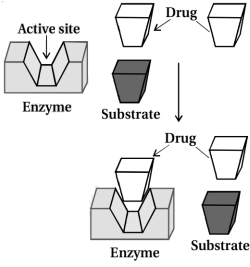
Explain the process of drug-enzyme interaction.
Solution
Drugs inhibit the catalytic activity of enzymes in two primary ways:
$(i)$ Competitive Inhibition: Drugs compete with the natural substrate for their attachment to the active sites of enzymes. These drugs are called competitive inhibitors.
$(ii)$ Allosteric Inhibition: Some drugs do not bind to the enzyme's active site. Instead,they bind to a different site on the enzyme known as the allosteric site. This binding changes the shape of the active site,preventing the substrate from binding effectively.
$(i)$ Competitive Inhibition: Drugs compete with the natural substrate for their attachment to the active sites of enzymes. These drugs are called competitive inhibitors.
$(ii)$ Allosteric Inhibition: Some drugs do not bind to the enzyme's active site. Instead,they bind to a different site on the enzyme known as the allosteric site. This binding changes the shape of the active site,preventing the substrate from binding effectively.
0 likes
View Solution387
Advanced
Explain the role of receptors as drug targets.
Solution
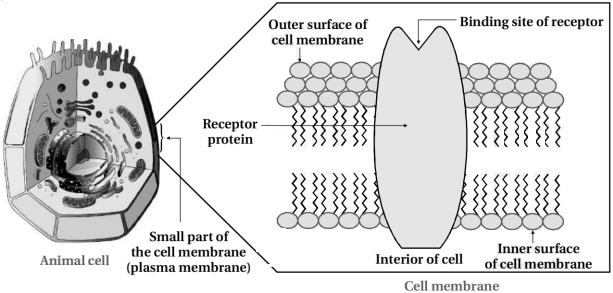
(N/A) Receptors are proteins that are crucial to the body's communication process.
Receptor proteins are embedded in the cell membrane in such a way that their small part possessing an active site projects out of the surface of the membrane and opens on the outside region of the cell membrane.
In the body,messages between two neurons and between neurons and muscles are communicated through certain chemicals. These chemicals,known as chemical messengers,are received at the binding sites of receptor proteins.
Receptor proteins are embedded in the cell membrane in such a way that their small part possessing an active site projects out of the surface of the membrane and opens on the outside region of the cell membrane.
In the body,messages between two neurons and between neurons and muscles are communicated through certain chemicals. These chemicals,known as chemical messengers,are received at the binding sites of receptor proteins.
0 likes
View Solution388
Advanced
Explain the therapeutic action of antacids and antihistamines.
Solution
(N/A) Antacids: Overproduction of acid in the stomach causes irritation and pain. In severe cases,ulcers are developed in the stomach. Until $1970$,the only treatment for acidity was the administration of antacids,such as sodium hydrogen carbonate or a mixture of aluminum and magnesium hydroxide. However,excessive hydrogen carbonate can make the stomach alkaline and trigger the production of even more acid.
Metal hydroxides are better alternatives because,being insoluble,they do not increase the $pH$ above neutrality. These treatments control only symptoms,and not the cause. Therefore,with these metal salts,the patients cannot be treated easily. In advanced stages,ulcers become life-threatening and the only treatment is the removal of the affected part of the stomach.
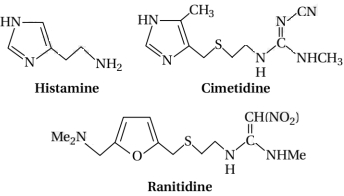
$A$ major breakthrough in the treatment of hyperacidity came through the discovery that a chemical,histamine,stimulates the secretion of pepsin and hydrochloric acid in the stomach.
The drug cimetidine (Tegamet) was designed to prevent the interaction of histamine with the receptors present in the stomach wall. This resulted in the release of a lesser amount of acid.
The importance of the drug was so great that it remained the largest-selling drug in the world until another drug,ranitidine (Zantac),was discovered.
$(b)$ Antihistamines: Histamine is a potent vasodilator. It has various functions. It contracts the smooth muscles in the bronchi and gut and relaxes other muscles,such as those in the walls of fine blood vessels.
Histamine is also responsible for the nasal congestion associated with the common cold and allergic response to pollen. Synthetic drugs,brompheniramine (Dimetapp) and terfenadine (Seldane),act as antihistamines.
Metal hydroxides are better alternatives because,being insoluble,they do not increase the $pH$ above neutrality. These treatments control only symptoms,and not the cause. Therefore,with these metal salts,the patients cannot be treated easily. In advanced stages,ulcers become life-threatening and the only treatment is the removal of the affected part of the stomach.
$A$ major breakthrough in the treatment of hyperacidity came through the discovery that a chemical,histamine,stimulates the secretion of pepsin and hydrochloric acid in the stomach.
The drug cimetidine (Tegamet) was designed to prevent the interaction of histamine with the receptors present in the stomach wall. This resulted in the release of a lesser amount of acid.
The importance of the drug was so great that it remained the largest-selling drug in the world until another drug,ranitidine (Zantac),was discovered.
$(b)$ Antihistamines: Histamine is a potent vasodilator. It has various functions. It contracts the smooth muscles in the bronchi and gut and relaxes other muscles,such as those in the walls of fine blood vessels.
Histamine is also responsible for the nasal congestion associated with the common cold and allergic response to pollen. Synthetic drugs,brompheniramine (Dimetapp) and terfenadine (Seldane),act as antihistamines.
0 likes
View Solution389
Advanced
Explain neurologically active drugs.
Solution
(N/A) Neurologically active drugs are classified into two main types: $(a)$ Tranquilizers and $(b)$ Analgesics.
$(a)$ Tranquilizers: These are a class of chemical compounds used for the treatment of stress,and mild or even severe mental diseases. They relieve anxiety,stress,irritability,or excitement by inducing a sense of well-being. They are essential components of sleeping pills.
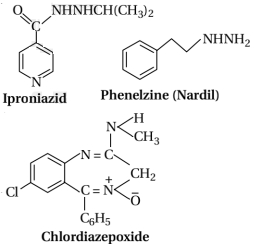
There are various types of tranquilizers that function through different mechanisms. For example,noradrenaline is a neurotransmitter that plays a role in mood changes. If the level of noradrenaline is low,the signal-sending activity becomes low,and the person suffers from depression. In such situations,antidepressant drugs are required.
These drugs inhibit the enzymes that catalyze the degradation of noradrenaline. By inhibiting the enzyme,this neurotransmitter is metabolized more slowly and can activate its receptor for a longer period,thus counteracting depression. Iproniazid and phenelzine are examples of such drugs.
Some tranquilizers,such as chlordiazepoxide and meprobamate,are relatively mild and suitable for relieving tension. Equanil is used in controlling depression and hypertension.
$(a)$ Tranquilizers: These are a class of chemical compounds used for the treatment of stress,and mild or even severe mental diseases. They relieve anxiety,stress,irritability,or excitement by inducing a sense of well-being. They are essential components of sleeping pills.
There are various types of tranquilizers that function through different mechanisms. For example,noradrenaline is a neurotransmitter that plays a role in mood changes. If the level of noradrenaline is low,the signal-sending activity becomes low,and the person suffers from depression. In such situations,antidepressant drugs are required.
These drugs inhibit the enzymes that catalyze the degradation of noradrenaline. By inhibiting the enzyme,this neurotransmitter is metabolized more slowly and can activate its receptor for a longer period,thus counteracting depression. Iproniazid and phenelzine are examples of such drugs.
Some tranquilizers,such as chlordiazepoxide and meprobamate,are relatively mild and suitable for relieving tension. Equanil is used in controlling depression and hypertension.
0 likes
View Solution390
Advanced
Explain antimicrobial drugs.
Solution
(N/A) Diseases in human beings and animals may be caused by a variety of microorganisms such as bacteria,viruses,fungi,and other pathogens. Antimicrobial drugs are substances used to selectively destroy,prevent the development of,or inhibit the pathogenic action of microbes such as bacteria (antibacterial drugs),fungi (antifungal agents),viruses (antiviral agents),or other parasites (antiparasitic drugs). Antibiotics,antiseptics,and disinfectants are examples of antimicrobial drugs.
$(i)$ Antibiotics: These are chemical substances produced by microorganisms that can destroy or inhibit the growth of other microorganisms due to their low toxicity for humans and animals.
Antibiotics are used as drugs to treat infections. Initially,they were defined as substances produced by microorganisms. However,with the development of synthetic methods,many compounds are now produced wholly or partly by chemical synthesis. An antibiotic now refers to a substance that,in low concentrations,inhibits the growth or destroys microorganisms by intervening in their metabolic processes.
The search for chemicals that would adversely affect invading bacteria but not the host began in the nineteenth century. Paul Ehrlich,a German bacteriologist,developed the first effective treatment for syphilis,known as arsphenamine or salvarsan. He received the Nobel Prize for Medicine in $1908$. Although salvarsan is toxic to humans,its effect on the bacteria (spirochete) causing syphilis is much greater. Ehrlich noted the structural similarity between the $-As=As-$ linkage in arsphenamine and the $-N=N-$ linkage in azodyes,leading him to search for compounds that selectively bind to bacteria.
$(i)$ Antibiotics: These are chemical substances produced by microorganisms that can destroy or inhibit the growth of other microorganisms due to their low toxicity for humans and animals.
Antibiotics are used as drugs to treat infections. Initially,they were defined as substances produced by microorganisms. However,with the development of synthetic methods,many compounds are now produced wholly or partly by chemical synthesis. An antibiotic now refers to a substance that,in low concentrations,inhibits the growth or destroys microorganisms by intervening in their metabolic processes.
The search for chemicals that would adversely affect invading bacteria but not the host began in the nineteenth century. Paul Ehrlich,a German bacteriologist,developed the first effective treatment for syphilis,known as arsphenamine or salvarsan. He received the Nobel Prize for Medicine in $1908$. Although salvarsan is toxic to humans,its effect on the bacteria (spirochete) causing syphilis is much greater. Ehrlich noted the structural similarity between the $-As=As-$ linkage in arsphenamine and the $-N=N-$ linkage in azodyes,leading him to search for compounds that selectively bind to bacteria.
0 likes
View Solution391
Difficult
Explain Antifertility Drugs.
Solution
(N/A) Antifertility drugs are chemical substances used to control the population by preventing conception.
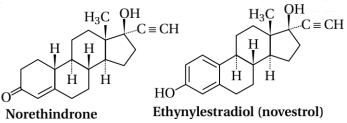
Birth control pills essentially contain a mixture of synthetic estrogen and progesterone derivatives. Both of these compounds are hormones. It is known that progesterone suppresses ovulation. Synthetic progesterone derivatives are more potent than progesterone. $Norethindrone$ is an example of a synthetic progesterone derivative most widely used as an antifertility drug.
The estrogen derivative which is used in combination with a progesterone derivative is $Ethynylestradiol$ $(Novestrol)$.
Birth control pills essentially contain a mixture of synthetic estrogen and progesterone derivatives. Both of these compounds are hormones. It is known that progesterone suppresses ovulation. Synthetic progesterone derivatives are more potent than progesterone. $Norethindrone$ is an example of a synthetic progesterone derivative most widely used as an antifertility drug.
The estrogen derivative which is used in combination with a progesterone derivative is $Ethynylestradiol$ $(Novestrol)$.
0 likes
View Solution392
Advanced
Explain artificial sweetening agents.
Solution
(N/A) Artificial sweetening agents are chemical substances that are sweeter than sugar but do not add significant calories to the diet. They are often used by people who need to control their calorie intake or by diabetics. Some common artificial sweeteners are listed below:
| Artificial sweetener | Sweetness value in comparison to cane sugar |
|---|---|
| Aspartame | $100$ |
| Saccharin | $550$ |
| Sucralose | $600$ |
| Alitame | $2000$ |
0 likes
View Solution393
Difficult
Explain food preservatives and antioxidants in food.
Solution
(N/A) $(i)$ Food preservatives: Food preservatives prevent spoilage of food due to microbial growth. The most commonly used preservatives include table salt,sugar,vegetable oils,and sodium benzoate,$C_6H_5COONa$.
Sodium benzoate is used in limited quantities and is metabolized in the body. Salts of sorbic acid and propanoic acid are also used as preservatives.
$(ii)$ Antioxidants: These are important and necessary food additives. These help in food preservation by retarding the action of oxygen on food. These are more reactive towards oxygen than the food material which they are protecting.
The two most familiar antioxidants are butylated hydroxy toluene $(BHT)$ and butylated hydroxy anisole $(BHA)$. The addition of $BHA$ to butter increases its shelf life from months to years.
Sometimes $BHT$ and $BHA$ along with citric acid are added to produce more effect. Sulphur dioxide and sulphite are useful antioxidants for wine and beer,sugar syrups,and cut,peeled,or dried fruits and vegetables.
Sodium benzoate is used in limited quantities and is metabolized in the body. Salts of sorbic acid and propanoic acid are also used as preservatives.
$(ii)$ Antioxidants: These are important and necessary food additives. These help in food preservation by retarding the action of oxygen on food. These are more reactive towards oxygen than the food material which they are protecting.
The two most familiar antioxidants are butylated hydroxy toluene $(BHT)$ and butylated hydroxy anisole $(BHA)$. The addition of $BHA$ to butter increases its shelf life from months to years.
Sometimes $BHT$ and $BHA$ along with citric acid are added to produce more effect. Sulphur dioxide and sulphite are useful antioxidants for wine and beer,sugar syrups,and cut,peeled,or dried fruits and vegetables.
0 likes
View Solution394
Advanced
What are synthetic detergents? Explain their types.
Solution
(N/A) Synthetic detergents are cleansing agents which have all the properties of soaps,but which actually do not contain any soap.
These can be used both in soft and hard water as they give foam even in hard water. Some of the detergents give foam even in ice cold water.
Synthetic detergents are mainly classified into three categories:
$i$. Anionic detergents
$ii$. Cationic detergents
$iii$. Non-ionic detergents
$i$. Anionic Detergents:
Anionic detergents are sodium salts of sulphonated long chain alcohols or hydrocarbons.
Alkyl hydrogensulphates formed by treating long chain alcohols with concentrated sulphuric acid are neutralised with alkali to form anionic detergents.
Similarly,alkyl benzene sulphonates are obtained by neutralizing alkyl benzene sulphonic acids with alkali.
In anionic detergents,the anionic part of the molecule is involved in the cleansing action. Sodium salts of alkylbenzenesulphonates are an important class of anionic detergents. They are mostly used for household work. Anionic detergents are also used in toothpastes.
$ii$. Cationic Detergents:
These are quaternary ammonium salts of amines with acetates,chlorides,or bromides as anions. The cationic part possesses a long hydrocarbon chain and a positive charge on the nitrogen atom. Hence,these are called cationic detergents. Cetyltrimethylammonium bromide is a popular cationic detergent and is used in hair conditioners.
$iii$. Non-ionic Detergents:
These detergents do not contain any ion in their constitution. One such detergent is formed when stearic acid reacts with polyethylene glycol.
$CH_3(CH_2)_{16}COOH + HO(CH_2CH_2O)_nCH_2CH_2OH \rightarrow CH_3(CH_2)_{16}COO(CH_2CH_2O)_nCH_2CH_2OH$
Liquid dishwashing detergents are non-ionic type.
These can be used both in soft and hard water as they give foam even in hard water. Some of the detergents give foam even in ice cold water.
Synthetic detergents are mainly classified into three categories:
$i$. Anionic detergents
$ii$. Cationic detergents
$iii$. Non-ionic detergents
$i$. Anionic Detergents:
Anionic detergents are sodium salts of sulphonated long chain alcohols or hydrocarbons.
Alkyl hydrogensulphates formed by treating long chain alcohols with concentrated sulphuric acid are neutralised with alkali to form anionic detergents.
Similarly,alkyl benzene sulphonates are obtained by neutralizing alkyl benzene sulphonic acids with alkali.
In anionic detergents,the anionic part of the molecule is involved in the cleansing action. Sodium salts of alkylbenzenesulphonates are an important class of anionic detergents. They are mostly used for household work. Anionic detergents are also used in toothpastes.
$ii$. Cationic Detergents:
These are quaternary ammonium salts of amines with acetates,chlorides,or bromides as anions. The cationic part possesses a long hydrocarbon chain and a positive charge on the nitrogen atom. Hence,these are called cationic detergents. Cetyltrimethylammonium bromide is a popular cationic detergent and is used in hair conditioners.
$iii$. Non-ionic Detergents:
These detergents do not contain any ion in their constitution. One such detergent is formed when stearic acid reacts with polyethylene glycol.
$CH_3(CH_2)_{16}COOH + HO(CH_2CH_2O)_nCH_2CH_2OH \rightarrow CH_3(CH_2)_{16}COO(CH_2CH_2O)_nCH_2CH_2OH$
Liquid dishwashing detergents are non-ionic type.
0 likes
View Solution395
MediumMCQ
What is the average molecular mass of drugs?
A
$100-500 \ u$
B
$1000-5000 \ u$
C
$10000-50000 \ u$
D
$500-1000 \ u$
Solution
(A) Drugs are chemicals of low molecular masses,typically in the range of $100-500 \ u$.
They interact with macromolecular targets and produce a biological response.
When the biological response is therapeutic and useful,these chemicals are called medicines.
They interact with macromolecular targets and produce a biological response.
When the biological response is therapeutic and useful,these chemicals are called medicines.
0 likes
View Solution396
Easy
Write the uses of medicines.
Solution
(N/A) Medicines are chemical substances used for the diagnosis,prevention,and treatment of diseases.
0 likes
View Solution397
EasyMCQ
What are antiseptics?
A
Chemicals that kill microorganisms on non-living objects.
B
Chemicals that kill or prevent the growth of microorganisms on living tissues.
C
Chemicals that are used to preserve food items.
D
Chemicals that act as artificial sweeteners.
Solution
(B) Antiseptics are chemical substances that either kill or prevent the growth of microorganisms.
They are antimicrobial in nature.
Antiseptics are applied to living tissues such as wounds,cuts,ulcers,and diseased skin surfaces.
Common examples include furacine and soframicine.
They are antimicrobial in nature.
Antiseptics are applied to living tissues such as wounds,cuts,ulcers,and diseased skin surfaces.
Common examples include furacine and soframicine.
0 likes
View Solution398
MediumMCQ
Which type of drugs come under antimicrobial drugs?
A
Antibiotics
B
Antiseptics
C
Disinfectants
D
All of the above
Solution
(D) Antimicrobial drugs are substances that destroy,prevent the development of,or inhibit the pathogenic action of microbes such as bacteria,fungi,viruses,or other parasites.
These include:
$1$. Antibiotics (e.g.,Penicillin)
$2$. Antiseptics (e.g.,Dettol)
$3$. Disinfectants (e.g.,Chlorine)
Therefore,all of the mentioned categories fall under the classification of antimicrobial drugs.
These include:
$1$. Antibiotics (e.g.,Penicillin)
$2$. Antiseptics (e.g.,Dettol)
$3$. Disinfectants (e.g.,Chlorine)
Therefore,all of the mentioned categories fall under the classification of antimicrobial drugs.
0 likes
View Solution399
MediumMCQ
Where are receptors located?
A
Inside the nucleus
B
On the outer surface of the cell membrane
C
Inside the cytoplasm
D
Within the mitochondria
Solution
(B) Receptors are proteins that are crucial to the body's communication process.
Receptors are embedded on the outer surface of the cell membrane in such a way that their small part,possessing active sites,projects out of the surface of the membrane and opens on the outside region of the cell membrane.
Receptors are embedded on the outer surface of the cell membrane in such a way that their small part,possessing active sites,projects out of the surface of the membrane and opens on the outside region of the cell membrane.
0 likes
View SolutionChemistry in Everyday Life — Drugs and Medicines · Frequently Asked Questions
1Are these Chemistry in Everyday Life questions useful for JEE and NEET?
Yes. All questions in this section are mapped to JEE Main and NEET exam patterns. Previous year questions from JEE Main, NEET, GUJCET and state-level exams are included with full solutions.
2Can I switch to Hindi or Gujarati for these questions?
Yes. Use the language tabs in the hero section or the sidebar to view the same questions and solutions in English, Hindi or Gujarati.
3How do I generate a question paper from this subtopic?
Use the Vedclass Exam Paper Generator — select the chapter and subtopic, set difficulty, and generate Sets A, B, C, D automatically. First 3 chapters of every subject are free.
Vedclass Products
For Students
Vedclass Test Series
Mock tests in real JEE/NEET style with performance analysis. 5-day free trial.
Start Free TrialFor Teachers
Exam Paper Generator
Generate Set A/B/C/D papers from this chapter in 2 minutes. 3 chapters free.
Try FreeFor Institutes
Online Exam Module
Live online exams with unlimited students, 360° analytics & white-label branding.
See DemoFor Teachers & Institutes
Generate a Chemistry in Everyday Life Exam Paper in 2 Minutes
Select subtopic & difficulty — Sets A, B, C, D auto-generated with No Repeat logic.
First 3 chapters of every subject are free — no payment required.