
A English
Mix Examples of Chemistry in Everyday life Questions in English
Class 12 Chemistry · Chemistry in Everyday Life · Mix Examples of Chemistry in Everyday life
33+
Questions
English
Language
100%
With Solutions
Showing 33 of 33 questions in English
1
MediumMCQ
$A$ neutral fertilizer among the following compounds is
A
Urea
B
Calcium ammonium nitrate
C
Ammonium sulphate
D
Ammonium nitrate
Solution
(B) Calcium ammonium nitrate $(CAN)$ is a fine free-flowing,light brown or grey granular fertilizer,containing $26 \%$ of nitrogen.
It is almost neutral and can be safely applied even to acid soils.
It is almost neutral and can be safely applied even to acid soils.
0 likes
View Solution2
MediumMCQ
Which of the following are produced from coal tar?
A
Synthetic dyes
B
Drugs
C
Perfumes
D
All the three
Solution
(D) . Synthetic dyes,drugs,and perfumes are all produced from coal tar.
0 likes
View Solution3
EasyMCQ
$A$ detergent is a
A
Cleaning agent
B
Drug
C
Catalyst
D
Vitamin
Solution
(A) detergent is a substance used for cleaning purposes,which acts as a surfactant to remove dirt and grease. Therefore,it is a cleaning agent.
0 likes
View Solution4
EasyMCQ
Toilet soap is a mixture of:
A
Calcium and sodium salts of fatty acids
B
Fatty acids and glycerol
C
Sodium salts of fatty acids
D
Potassium salt of fatty acids
Solution
(D) Toilet soaps are prepared by using better grades of fats and oils and care is taken to remove excess alkali. They are generally the potassium salts of higher fatty acids,which are more soluble in water and produce a better lather compared to sodium salts.
0 likes
View Solution5
DifficultMCQ
Structurally,a biodegradable detergent should contain:
A
Normal alkyl chain
B
Branched alkyl chain
C
Phenyl side chain
D
Cyclohexyl side chain
Solution
(A) Biodegradable detergents are those that can be easily decomposed by microorganisms. \\ These detergents typically possess a linear or normal alkyl chain. \\ Branched alkyl chains,on the other hand,hinder the action of enzymes produced by microorganisms,making the detergent non-biodegradable. \\ Therefore,the correct structural feature for a biodegradable detergent is a normal alkyl chain.
0 likes
View Solution6
DifficultMCQ
Which of the following represents a synthetic detergent?
A
$C_{15}H_{31}COOK$
B
$CH_3[CH_2]_{16}COONa$
C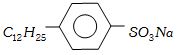
D
None of these
Solution
(C) Synthetic detergents are cleansing agents that have all the properties of soaps,but do not actually contain any soap. They are typically sodium salts of long-chain alkyl benzene sulphonic acids or sodium salts of long-chain alkyl hydrogen sulphates.
Option $(C)$ represents sodium dodecyl benzene sulphonate,which is a widely used anionic synthetic detergent. The structure is shown in the image provided.
Option $(C)$ represents sodium dodecyl benzene sulphonate,which is a widely used anionic synthetic detergent. The structure is shown in the image provided.
0 likes
View Solution7
MediumMCQ
Soap is a/an ...... .
A
Sodium stearate
B
Calcium stearate
C
Sodium acetate
D
Sodium benzoate
Solution
(A) Soap is chemically defined as the sodium or potassium salt of long-chain fatty acids. $C_{17}H_{35}COONa$ (Sodium stearate) is a common example of a soap used for cleaning purposes. Therefore,the correct option is $A$.
0 likes
View Solution8
MediumMCQ
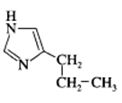
Identify the use of the given drug.
A
Vasodilator
B
Analgesics
C
Antacid
D
Antiseptic
Solution
(A) The structure shown in the image is $4-(2-ethyl)imidazole$. This compound is a derivative of histamine. Histamine is a potent vasodilator. Therefore,the drug class represented by this structure is a vasodilator.
0 likes
View Solution9
EasyMCQ
Which of the following is a soap?
A
$C_{17}H_{35}COOK$
B
$C_{17}H_{35}COOH$
C
$C_{15}H_{31}COOH$
D
$(C_{17}H_{35}COO)_2Ca$
Solution
(A) Soaps are generally the $Na$ or $K$ salts of long-chain fatty acids.
$C_{17}H_{35}COOK$ (Potassium stearate) is a soap.
$C_{17}H_{35}COOH$ and $C_{15}H_{31}COOH$ are fatty acids.
$(C_{17}H_{35}COO)_2Ca$ is a calcium salt which is insoluble in water and does not act as a soap.
$C_{17}H_{35}COOK$ (Potassium stearate) is a soap.
$C_{17}H_{35}COOH$ and $C_{15}H_{31}COOH$ are fatty acids.
$(C_{17}H_{35}COO)_2Ca$ is a calcium salt which is insoluble in water and does not act as a soap.
0 likes
View Solution10
MediumMCQ
Match the column:
| Column-$I$ (Structure) | Column-$II$ (Cleansing agents) |
| $(i) CH_3(CH_2)_{16}COO(CH_2CH_2O)_nCH_2CH_2OH$ | $(a)$ Cationic detergent |
| $(ii) C_{17}H_{35}COO^-Na^+$ | $(b)$ Anionic detergent |
| $(iii) CH_3(CH_2)_{10}CH_2OSO_3^-Na^+$ | $(c)$ Nonionic detergent |
| $(iv) [CH_3(CH_2)_{15}N(CH_3)_3]^+Br^-$ | $(d)$ Soap |
A
$i-a, ii-b, iii-c, iv-d$
B
$i-a, ii-b, iii-d, iv-c$
C
$i-c, ii-d, iii-b, iv-a$
D
$i-c, ii-d, iii-a, iv-b$
Solution
(C) $(i)$ Non-ionic detergent: These do not contain any ion in their constitution. The structure $CH_3(CH_2)_{16}COO(CH_2CH_2O)_nCH_2CH_2OH$ is a non-ionic detergent formed from stearic acid and polyethylene glycol.
$(ii)$ Soap: Soaps are sodium or potassium salts of long-chain fatty acids,such as sodium stearate $(C_{17}H_{35}COO^-Na^+)$.
$(iii)$ Anionic detergent: These are sodium salts of sulfonated long-chain alcohols or hydrocarbons,such as sodium lauryl sulphate $(CH_3(CH_2)_{10}CH_2OSO_3^-Na^+)$.
$(iv)$ Cationic detergent: These are quaternary ammonium salts of amines with acetates,chlorides,or bromides as anions,such as cetyltrimethylammonium bromide $([CH_3(CH_2)_{15}N(CH_3)_3]^+Br^-)$.
Therefore,the correct match is $(i-c, ii-d, iii-b, iv-a)$.
$(ii)$ Soap: Soaps are sodium or potassium salts of long-chain fatty acids,such as sodium stearate $(C_{17}H_{35}COO^-Na^+)$.
$(iii)$ Anionic detergent: These are sodium salts of sulfonated long-chain alcohols or hydrocarbons,such as sodium lauryl sulphate $(CH_3(CH_2)_{10}CH_2OSO_3^-Na^+)$.
$(iv)$ Cationic detergent: These are quaternary ammonium salts of amines with acetates,chlorides,or bromides as anions,such as cetyltrimethylammonium bromide $([CH_3(CH_2)_{15}N(CH_3)_3]^+Br^-)$.
Therefore,the correct match is $(i-c, ii-d, iii-b, iv-a)$.
0 likes
View Solution11
Medium
Why do soaps not work in hard water?
Solution
(N/A) Soaps are sodium or potassium salts of long-chain fatty acids. Hard water contains calcium $(Ca^{2+})$ and magnesium $(Mg^{2+})$ ions. When soaps are dissolved in hard water,these ions displace sodium or potassium from their salts and form insoluble calcium or magnesium salts of fatty acids. These insoluble salts separate as scum.
$2C_{17}H_{35}COONa + CaCl_2 \to (C_{17}H_{35}COO)_2Ca + 2NaCl$
This is the reason why soaps do not work in hard water.
$2C_{17}H_{35}COONa + CaCl_2 \to (C_{17}H_{35}COO)_2Ca + 2NaCl$
This is the reason why soaps do not work in hard water.
0 likes
View Solution12
Medium
Explain the importance of chemicals in food and also explain their types.
Solution
(N/A) Chemicals are added to food for $(i)$ their preservation,$(ii)$ enhancing their appeal,and $(iii)$ adding nutritive value to them.
The main categories of food additives are as follows:
$(i)$ Food colours
$(ii)$ Flavours and sweeteners
$(iii)$ Fat emulsifiers and stabilizing agents
$(iv)$ Flour improvers,antistaling agents,and bleaches
$(v)$ Antioxidants
$(vi)$ Preservatives
$(vii)$ Nutritional supplements such as minerals,vitamins,and amino acids.
Except for chemicals of category $(vii)$,none of the above additives have nutritive value. These are added either to increase the shelf life of stored food or for cosmetic purposes.
The main categories of food additives are as follows:
$(i)$ Food colours
$(ii)$ Flavours and sweeteners
$(iii)$ Fat emulsifiers and stabilizing agents
$(iv)$ Flour improvers,antistaling agents,and bleaches
$(v)$ Antioxidants
$(vi)$ Preservatives
$(vii)$ Nutritional supplements such as minerals,vitamins,and amino acids.
Except for chemicals of category $(vii)$,none of the above additives have nutritive value. These are added either to increase the shelf life of stored food or for cosmetic purposes.
0 likes
View Solution13
Advanced
Explain about soaps in detail.
Solution
(A) Soaps are detergents that have been used for a long time. Soaps used for cleaning purposes are sodium or potassium salts of long-chain fatty acids,such as stearic,oleic,and palmitic acids.
Soaps containing sodium: Soaps containing sodium salts are formed by heating fat with an aqueous sodium hydroxide solution. This reaction is known as saponification.
Chemical reaction of soap making:
$(CH_2-O-CO-C_{17}H_{35})-(CH-O-CO-C_{17}H_{35})-(CH_2-O-CO-C_{17}H_{35}) + 3NaOH$ $\rightarrow CH_2(OH)-CH(OH)-CH_2(OH) + 3C_{17}H_{35}COONa$
In this reaction,esters of fatty acids are hydrolysed,and the soap obtained remains in colloidal form. It is precipitated from the solution by adding sodium chloride.
The solution left after removing the soap contains glycerol,which can be recovered by fractional distillation. Only sodium and potassium soaps are soluble in water and are used for cleaning purposes. Generally,potassium soaps are softer to the skin than sodium soaps. These can be prepared by using potassium hydroxide solution in place of sodium hydroxide.
Basically,all soaps are made by boiling fats or oils with a suitable soluble hydroxide. Variations are made by using different raw materials.
$i$. Toilet soaps:
These are prepared by using better grades of fats and oils,and care is taken to remove excess alkali. Colour and perfumes are added to make these more attractive.
Soaps containing sodium: Soaps containing sodium salts are formed by heating fat with an aqueous sodium hydroxide solution. This reaction is known as saponification.
Chemical reaction of soap making:
$(CH_2-O-CO-C_{17}H_{35})-(CH-O-CO-C_{17}H_{35})-(CH_2-O-CO-C_{17}H_{35}) + 3NaOH$ $\rightarrow CH_2(OH)-CH(OH)-CH_2(OH) + 3C_{17}H_{35}COONa$
In this reaction,esters of fatty acids are hydrolysed,and the soap obtained remains in colloidal form. It is precipitated from the solution by adding sodium chloride.
The solution left after removing the soap contains glycerol,which can be recovered by fractional distillation. Only sodium and potassium soaps are soluble in water and are used for cleaning purposes. Generally,potassium soaps are softer to the skin than sodium soaps. These can be prepared by using potassium hydroxide solution in place of sodium hydroxide.
Basically,all soaps are made by boiling fats or oils with a suitable soluble hydroxide. Variations are made by using different raw materials.
$i$. Toilet soaps:
These are prepared by using better grades of fats and oils,and care is taken to remove excess alkali. Colour and perfumes are added to make these more attractive.
0 likes
View Solution14
Difficult
Give information on the uses of green chemistry in day-to-day life.
Solution
(N/A) Uses of green chemistry in our life are as follows:
$(i)$ Dry Cleaning of Clothes: Tetrachloroethene $(Cl_2C=CCl_2)$ was earlier used as a solvent for dry cleaning. This compound contaminates groundwater and is a suspected carcinogen. Instead,liquefied carbon dioxide with a suitable detergent is now used. Replacement of halogenated solvents by liquid $CO_2$ results in less harm to groundwater. Hydrogen peroxide $(H_2O_2)$ is used for bleaching clothes,which gives better results and uses less water.
$(ii)$ Bleaching of Paper: Earlier,chlorine gas was used for bleaching paper,whereas hydrogen peroxide $(H_2O_2)$ is used nowadays.
$(iii)$ Synthesis of Chemicals: Ethanal $(CH_3CHO)$ is now commercially prepared by the oxidation of ethene in the presence of an ionic catalyst in an aqueous medium with a yield of $90 \%$.
$CH_2=CH_2 + O_2 \xrightarrow[Pd(II)/Cu(II) \text{ (in water)}]{Catalyst} CH_3CHO \text{ (90 \%)}$
$(i)$ Dry Cleaning of Clothes: Tetrachloroethene $(Cl_2C=CCl_2)$ was earlier used as a solvent for dry cleaning. This compound contaminates groundwater and is a suspected carcinogen. Instead,liquefied carbon dioxide with a suitable detergent is now used. Replacement of halogenated solvents by liquid $CO_2$ results in less harm to groundwater. Hydrogen peroxide $(H_2O_2)$ is used for bleaching clothes,which gives better results and uses less water.
$(ii)$ Bleaching of Paper: Earlier,chlorine gas was used for bleaching paper,whereas hydrogen peroxide $(H_2O_2)$ is used nowadays.
$(iii)$ Synthesis of Chemicals: Ethanal $(CH_3CHO)$ is now commercially prepared by the oxidation of ethene in the presence of an ionic catalyst in an aqueous medium with a yield of $90 \%$.
$CH_2=CH_2 + O_2 \xrightarrow[Pd(II)/Cu(II) \text{ (in water)}]{Catalyst} CH_3CHO \text{ (90 \%)}$
0 likes
View Solution15
Easy
How are transparent soaps manufactured?
Solution
(N/A) Transparent soaps are manufactured by dissolving the soap in ethanol and then evaporating the excess solvent.
0 likes
View Solution16
Medium
What are fillers and what role do these fillers play in soap?
Solution
(N/A) Substances which are added to soaps to change their properties in order to make them more useful for a particular application are called fillers.
Some important examples are given below:
$(i)$ Sodium rosinate,sodium silicate,borax,and sodium carbonate are added to laundry soap to increase their lather-forming ability.
$(ii)$ Glycerol is added to shaving soaps to prevent them from rapid drying.
$(iii)$ In medicated soaps,substances of medicinal value are added.
Some important examples are given below:
$(i)$ Sodium rosinate,sodium silicate,borax,and sodium carbonate are added to laundry soap to increase their lather-forming ability.
$(ii)$ Glycerol is added to shaving soaps to prevent them from rapid drying.
$(iii)$ In medicated soaps,substances of medicinal value are added.
0 likes
View Solution17
Medium
Match the soaps given in Column $-I$ with items given in Column $-II$.
| Column $-I$ | Column $-II$ |
| $A$. Soap chips | $1$. Dried miniature soap bubbles |
| $B$. Soap granules | $2$. Small broken pieces of soap formed from melted soaps |
| $C$. Soap powder | $3$. Soap powder $+$ abrasives $+$ builders $(Na_2CO_3, Na_3PO_4)$ |
| $D$. Scouring Soap | $4$. Soap powder $+$ builders like $Na_2CO_3$ and $Na_3PO_4$ |
Solution
(A-2, B-1, C-4, D-3) The correct matching is as follows:
$A$. Soap chips $\rightarrow$ $2$. Small broken pieces of soap formed from melted soaps
$B$. Soap granules $\rightarrow$ $1$. Dried miniature soap bubbles
$C$. Soap powder $\rightarrow$ $4$. Soap powder $+$ builders like $Na_2CO_3$ and $Na_3PO_4$
$D$. Scouring Soap $\rightarrow$ $3$. Soap powder $+$ abrasives $+$ builders $(Na_2CO_3, Na_3PO_4)$
Therefore,the correct sequence is $A-2, B-1, C-4, D-3$.
$A$. Soap chips $\rightarrow$ $2$. Small broken pieces of soap formed from melted soaps
$B$. Soap granules $\rightarrow$ $1$. Dried miniature soap bubbles
$C$. Soap powder $\rightarrow$ $4$. Soap powder $+$ builders like $Na_2CO_3$ and $Na_3PO_4$
$D$. Scouring Soap $\rightarrow$ $3$. Soap powder $+$ abrasives $+$ builders $(Na_2CO_3, Na_3PO_4)$
Therefore,the correct sequence is $A-2, B-1, C-4, D-3$.
0 likes
View Solution18
MediumMCQ
Match List-$I$ with List-$II$ :
Choose the correct match:
| List-$I$ (Chemical) | List-$II$ (Used as) |
| $(a)$. Sucralose | $(i)$. Synthetic detergent |
| $(b)$. Glyceryl ester of stearic acid | $(ii)$. Artificial sweetener |
| $(c)$. Sodium benzoate | $(iii)$. Antiseptic |
| $(d)$. Bithionol | $(iv)$. Food preservative |
Choose the correct match:
A
$(a)-(iv), (b)-(iii), (c)-(ii), (d)-(i)$
B
$(a)-(ii), (b)-(i), (c)-(iv), (d)-(iii)$
C
$(a)-(iii), (b)-(ii), (c)-(iv), (d)-(i)$
D
$(a)-(i), (b)-(ii), (c)-(iv), (d)-(iii)$
Solution
(B) The correct matches are:
$(a)$. Sucralose is an artificial sweetener. $(a)-(ii)$
$(b)$. Glyceryl ester of stearic acid is a soap. $(b)-(i)$
$(c)$. Sodium benzoate is a food preservative. $(c)-(iv)$
$(d)$. Bithionol is an antiseptic. $(d)-(iii)$
Therefore,the correct sequence is $(a)-(ii), (b)-(i), (c)-(iv), (d)-(iii)$.
$(a)$. Sucralose is an artificial sweetener. $(a)-(ii)$
$(b)$. Glyceryl ester of stearic acid is a soap. $(b)-(i)$
$(c)$. Sodium benzoate is a food preservative. $(c)-(iv)$
$(d)$. Bithionol is an antiseptic. $(d)-(iii)$
Therefore,the correct sequence is $(a)-(ii), (b)-(i), (c)-(iv), (d)-(iii)$.
0 likes
View Solution19
MediumMCQ
Match List-$I$ with List-$II$:
| List-$I$ | List-$II$ |
| $A$. $[CH_{3}(CH_{2})_{15}N(CH_{3})_{3}]^{+} Br^{-}$ | $I$. Dishwashing liquid |
| $B$. $CH_{3}(CH_{2})_{11}-C_{6}H_{4}-SO_{3}^{-}Na^{+}$ | $II$. Toothpaste |
| $C$. $C_{17}H_{35}COO^{-}Na^{+} + Na_{2}CO_{3} +$ Rosinate | $III$. Laundry soap |
| $D$. $CH_{3}(CH_{2})_{16}COO(CH_{2}CH_{2}O)_{n}CH_{2}CH_{2}OH$ | $IV$. Hair conditioner |
A
$A-IV, B-II, C-III, D-I$
B
$A-III, B-II, C-IV, D-I$
C
$A-IV, B-III, C-II, D-I$
D
$A-III, B-IV, C-I, D-II$
Solution
(A) : $[CH_{3}(CH_{2})_{15}N(CH_{3})_{3}]^{+} Br^{-}$ is a cationic detergent used in hair conditioners.
$B$: $CH_{3}(CH_{2})_{11}-C_{6}H_{4}-SO_{3}^{-}Na^{+}$ is an anionic detergent used in toothpastes.
$C$: $C_{17}H_{35}COO^{-}Na^{+} + Na_{2}CO_{3} +$ Rosinate is used as laundry soap.
$D$: $CH_{3}(CH_{2})_{16}COO(CH_{2}CH_{2}O)_{n}CH_{2}CH_{2}OH$ is a non-ionic detergent formed from stearic acid and polyethylene glycol,used as liquid dishwashing detergent.
Therefore,the correct matching is $A-IV, B-II, C-III, D-I$.
$B$: $CH_{3}(CH_{2})_{11}-C_{6}H_{4}-SO_{3}^{-}Na^{+}$ is an anionic detergent used in toothpastes.
$C$: $C_{17}H_{35}COO^{-}Na^{+} + Na_{2}CO_{3} +$ Rosinate is used as laundry soap.
$D$: $CH_{3}(CH_{2})_{16}COO(CH_{2}CH_{2}O)_{n}CH_{2}CH_{2}OH$ is a non-ionic detergent formed from stearic acid and polyethylene glycol,used as liquid dishwashing detergent.
Therefore,the correct matching is $A-IV, B-II, C-III, D-I$.
0 likes
View Solution20
EasyMCQ
Which of the following enhances the lathering property of soap?
A
Sodium stearate
B
Sodium carbonate
C
Sodium rosinate
D
Trisodium phosphate
Solution
(C) Rosin is added to soaps during manufacturing. It forms sodium rosinate,which is a substance that enhances the lathering property of the soap.
0 likes
View Solution21
EasyMCQ
Which from the following methods is $\underline{\text{NOT}}$ used to preserve food?
A
Removal of heat
B
Irradiation
C
Addition of water
D
Addition of heat
Solution
(C) Food preservation involves techniques that inhibit the growth of microorganisms or prevent chemical changes.
$1$. Removal of heat (refrigeration/freezing) slows down microbial growth.
$2$. Irradiation kills bacteria and parasites.
$3$. Addition of heat (pasteurization/canning) destroys enzymes and microorganisms.
$4$. Addition of water (hydration) actually promotes microbial growth and spoilage,so it is $\underline{\text{NOT}}$ a method of food preservation.
$1$. Removal of heat (refrigeration/freezing) slows down microbial growth.
$2$. Irradiation kills bacteria and parasites.
$3$. Addition of heat (pasteurization/canning) destroys enzymes and microorganisms.
$4$. Addition of water (hydration) actually promotes microbial growth and spoilage,so it is $\underline{\text{NOT}}$ a method of food preservation.
0 likes
View Solution22
MediumMCQ
Potassium metabisulphite is a(an)
A
preservative
B
antioxidant
C
artificial sweetener
D
Both $(a)$ and $(b)$
Solution
(D) Potassium metabisulphite,$K_{2}S_{2}O_{5}$,is a white crystalline solid with a pungent odour of sulphur.
It is widely used in the food industry as an antimicrobial preservative to prevent spoilage and as an antioxidant to prevent oxidation of food products.
Therefore,it functions as both a preservative and an antioxidant.
It is widely used in the food industry as an antimicrobial preservative to prevent spoilage and as an antioxidant to prevent oxidation of food products.
Therefore,it functions as both a preservative and an antioxidant.
0 likes
View Solution23
EasyMCQ
Identify the principle suggesting to avoid protection and deprotection of selective group for organic reactions in green chemistry.
A
Reduce derivatives
B
Use of renewable feed stock
C
Design for energy efficiency
D
Designing safer chemicals
Solution
(A) The principle of $12$ Principles of Green Chemistry that suggests avoiding unnecessary derivatization (such as protection and deprotection steps) is known as "Reduce derivatives".
This principle aims to minimize the use of temporary groups,as they require additional reagents and generate waste,thereby increasing the atom economy of the process.
This principle aims to minimize the use of temporary groups,as they require additional reagents and generate waste,thereby increasing the atom economy of the process.
0 likes
View Solution24
MediumMCQ
How many methyl groups are present in butylated hydroxytoluene?
A
$6$
B
$10$
C
$4$
D
$7$
Solution
(D) Butylated hydroxytoluene $(BHT)$ has the structure $2,6-di-tert-butyl-4-methylphenol$.
Each $tert-butyl$ group $(-C(CH_3)_3)$ contains $3$ methyl groups.
There are two $tert-butyl$ groups,so $2 \times 3 = 6$ methyl groups.
Additionally,there is one methyl group attached to the para position of the benzene ring.
Total number of methyl groups = $6 + 1 = 7$.
Each $tert-butyl$ group $(-C(CH_3)_3)$ contains $3$ methyl groups.
There are two $tert-butyl$ groups,so $2 \times 3 = 6$ methyl groups.
Additionally,there is one methyl group attached to the para position of the benzene ring.
Total number of methyl groups = $6 + 1 = 7$.
0 likes
View Solution25
DifficultMCQ
Which cleansing agent gets precipitated in hard water?
A
Cetyl trimethyl ammonium bromide
B
Sodium dodecyl benzene sulphonate
C
Sodium lauryl sulphate
D
Sodium stearate
Solution
(D) is the correct answer.
Sodium stearate $(C_{17}H_{35}COONa)$ is a soap. In hard water,it reacts with calcium or magnesium ions ($Ca^{2+}$ or $Mg^{2+}$) to form insoluble precipitates (scum),which makes it ineffective as a cleansing agent.
The reaction with calcium ions is:
$2 C_{17}H_{35}COONa + CaCl_{2} \rightarrow (C_{17}H_{35}COO)_{2}Ca + 2 NaCl$
Sodium stearate $(C_{17}H_{35}COONa)$ is a soap. In hard water,it reacts with calcium or magnesium ions ($Ca^{2+}$ or $Mg^{2+}$) to form insoluble precipitates (scum),which makes it ineffective as a cleansing agent.
The reaction with calcium ions is:
$2 C_{17}H_{35}COONa + CaCl_{2} \rightarrow (C_{17}H_{35}COO)_{2}Ca + 2 NaCl$
0 likes
View Solution26
EasyMCQ
Pick the correct statement among the following:
A
Cetyl trimethyl ammonium bromide is a popular cationic detergent used in air conditioner.
B
Non-ionic detergents are formed when polyethylene glycol reacts with adipic acid.
C
Sodium dodecyl benzene sulphonate used in toothpaste is a cationic detergent.
D
None of the above.
Solution
(D) Option $A$: Cetyltrimethylammonium bromide is a popular cationic detergent used in hair conditioners,not air conditioners.
Option $B$: Non-ionic detergents are formed when polyethylene glycol reacts with stearic acid,not adipic acid.
Option $C$: Sodium dodecyl benzene sulphonate used in toothpaste is an anionic detergent,not a cationic detergent.
Option $D$: Since all statements $A$,$B$,and $C$ are incorrect,the correct choice is $D$.
Option $B$: Non-ionic detergents are formed when polyethylene glycol reacts with stearic acid,not adipic acid.
Option $C$: Sodium dodecyl benzene sulphonate used in toothpaste is an anionic detergent,not a cationic detergent.
Option $D$: Since all statements $A$,$B$,and $C$ are incorrect,the correct choice is $D$.
0 likes
View Solution27
MediumMCQ
Arrange the following pesticides in the chronological order of their release into the market:
$A$: Organophosphates
$B$: Organochlorides
$C$: Sodium chlorate
$A$: Organophosphates
$B$: Organochlorides
$C$: Sodium chlorate
A
$B, A, C$
B
$B, C, A$
C
$C, B, A$
D
$A, B, C$
Solution
(C) The chronological order of the release of these pesticides into the market is as follows:
$1$. Sodium chlorate $(C)$ was used as a herbicide in the early $20^{th}$ century.
$2$. Organochlorides $(B)$ like $DDT$ were introduced in the $1940s$.
$3$. Organophosphates $(A)$ were developed later,around $1975$.
Thus,the correct order is $C, B, A$.
$1$. Sodium chlorate $(C)$ was used as a herbicide in the early $20^{th}$ century.
$2$. Organochlorides $(B)$ like $DDT$ were introduced in the $1940s$.
$3$. Organophosphates $(A)$ were developed later,around $1975$.
Thus,the correct order is $C, B, A$.
0 likes
View Solution28
EasyMCQ
Which of the following statements are not correct?
$a$) Antihistamine also functions as an antacid
$b$) The shape of an active site of an enzyme does not change when the drug binds to an allosteric site
$c$) Chemical messengers communicate the message between two neurons
$d$) Potassium soaps are hard,while sodium soaps are soft to skin
The correct answer is
$a$) Antihistamine also functions as an antacid
$b$) The shape of an active site of an enzyme does not change when the drug binds to an allosteric site
$c$) Chemical messengers communicate the message between two neurons
$d$) Potassium soaps are hard,while sodium soaps are soft to skin
The correct answer is
A
$a, b, d$
B
$b, c, d$
C
$a, c$
D
$c, d$
Solution
(A) ) Incorrect: Antihistamines (like cimetidine) are used to treat acidity,but they are distinct from antacids (like $Mg(OH)_2$). However,some antihistamines are specifically designed to inhibit acid secretion. The statement is generally considered incorrect in the context of drug classification.
$b$) Incorrect: When a drug binds to an allosteric site,it changes the shape of the active site,preventing the substrate from binding.
$c$) Correct: Chemical messengers are chemicals that transmit signals between neurons or between neurons and muscles.
$d$) Incorrect: Sodium soaps are hard,while potassium soaps are soft and used in shaving creams and shampoos.
Therefore,statements $a, b,$ and $d$ are incorrect.
$b$) Incorrect: When a drug binds to an allosteric site,it changes the shape of the active site,preventing the substrate from binding.
$c$) Correct: Chemical messengers are chemicals that transmit signals between neurons or between neurons and muscles.
$d$) Incorrect: Sodium soaps are hard,while potassium soaps are soft and used in shaving creams and shampoos.
Therefore,statements $a, b,$ and $d$ are incorrect.
0 likes
View Solution29
EasyMCQ
Which of the following structures represents the compound generally added to soaps to impart antiseptic properties?
A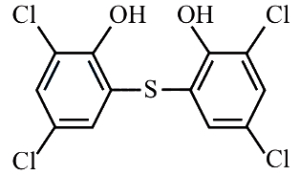
B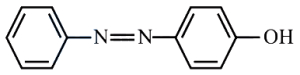
C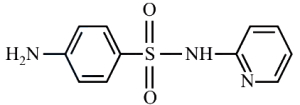
D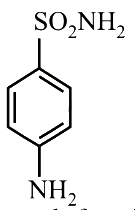
Solution
(A) Bithionol is added to soaps to impart antiseptic properties. Its structure consists of two $2,4$-dichlorophenol units connected by a sulfur bridge. This compound helps in reducing the odor produced by bacterial decomposition of organic matter on the skin.
0 likes
View Solution30
EasyMCQ
Consider the following statements:
Statement-$I$: Shaving soaps contain glycerol to prevent rapid drying.
Statement-$II$: Laundry soaps contain sodium rosinate or sodium silicate as fillers,not sodium carbonate.
Correct answer is:
Statement-$I$: Shaving soaps contain glycerol to prevent rapid drying.
Statement-$II$: Laundry soaps contain sodium rosinate or sodium silicate as fillers,not sodium carbonate.
Correct answer is:
A
Both statement-$I$ and statement-$II$ are correct
B
Both statement-$I$ and statement-$II$ are not correct
C
Statement-$I$ is correct,but statement-$II$ is not correct
D
Statement-$I$ is not correct,but statement-$II$ is correct
Solution
(C) Statement-$I$ is correct. Shaving soaps contain glycerol to prevent rapid drying by forming a film that retains moisture.
Statement-$II$ is incorrect. Laundry soaps often contain fillers like sodium rosinate or sodium silicate to increase their lathering and cleaning efficiency,whereas sodium carbonate is typically used in washing powders,not as a filler in laundry soaps.
Therefore,statement-$I$ is correct,but statement-$II$ is not correct.
Statement-$II$ is incorrect. Laundry soaps often contain fillers like sodium rosinate or sodium silicate to increase their lathering and cleaning efficiency,whereas sodium carbonate is typically used in washing powders,not as a filler in laundry soaps.
Therefore,statement-$I$ is correct,but statement-$II$ is not correct.
0 likes
View Solution31
MediumMCQ
Which of the following statements are correct?
$a$. Aspartame is sweeter than saccharin
$b$. Shaving soaps contain glycerol to prevent drying
$c$. Salt of sorbic acid is used as a food preservative
$d$. Norethindrone is an example of an antifertility drug
$a$. Aspartame is sweeter than saccharin
$b$. Shaving soaps contain glycerol to prevent drying
$c$. Salt of sorbic acid is used as a food preservative
$d$. Norethindrone is an example of an antifertility drug
A
$a, c, d$
B
$b, c, d$
C
$a, b, c, d$
D
$b, c, d$
Solution
(B) . Aspartame is about $100$ times as sweet as cane sugar,while saccharin is about $550$ times as sweet as cane sugar. Thus,saccharin is sweeter than aspartame. Statement $a$ is incorrect.
$b$. Shaving soaps contain glycerol to prevent rapid drying. Statement $b$ is correct.
$c$. Salts of sorbic acid and propionic acid are used as food preservatives. Statement $c$ is correct.
$d$. Norethindrone is a synthetic progesterone derivative used as an antifertility drug. Statement $d$ is correct.
Therefore,the correct statements are $b, c, d$.
$b$. Shaving soaps contain glycerol to prevent rapid drying. Statement $b$ is correct.
$c$. Salts of sorbic acid and propionic acid are used as food preservatives. Statement $c$ is correct.
$d$. Norethindrone is a synthetic progesterone derivative used as an antifertility drug. Statement $d$ is correct.
Therefore,the correct statements are $b, c, d$.
0 likes
View Solution32
EasyMCQ
When soap is dissolved in hard water,its cleaning ability decreases. This is due to the formation of:
A
$(C_{17}H_{35}COO)_2Sn$
B
$(C_{17}H_{35}COO)_2Ca$
C
$C_{17}H_{35}COOLi$
D
$C_{17}H_{35}COOH$
Solution
(B) Soap is the sodium or potassium salt of long-chain fatty acids (e.g.,$C_{17}H_{35}COONa$).
Hard water contains dissolved calcium $(Ca^{2+})$ and magnesium $(Mg^{2+})$ ions.
When soap is added to hard water,these ions react with the soap to form insoluble calcium or magnesium salts of the fatty acids,such as $(C_{17}H_{35}COO)_2Ca$.
These insoluble salts precipitate as a greyish white scum,which prevents the formation of lather and reduces the cleaning efficiency of the soap.
Hard water contains dissolved calcium $(Ca^{2+})$ and magnesium $(Mg^{2+})$ ions.
When soap is added to hard water,these ions react with the soap to form insoluble calcium or magnesium salts of the fatty acids,such as $(C_{17}H_{35}COO)_2Ca$.
These insoluble salts precipitate as a greyish white scum,which prevents the formation of lather and reduces the cleaning efficiency of the soap.
0 likes
View Solution33
EasyMCQ
Which one of the following will improve the lathering property of soap?
A
Sodium stearate
B
Sodium rosinate
C
Sodium carbonate
D
Sodium phosphate
Solution
(B) Sodium rosinate is added to soap during its manufacture to improve its lathering property. It acts as a lathering agent.
0 likes
View SolutionChemistry in Everyday Life — Mix Examples of Chemistry in Everyday life · Frequently Asked Questions
1Are these Chemistry in Everyday Life questions useful for JEE and NEET?
Yes. All questions in this section are mapped to JEE Main and NEET exam patterns. Previous year questions from JEE Main, NEET, GUJCET and state-level exams are included with full solutions.
2Can I switch to Hindi or Gujarati for these questions?
Yes. Use the language tabs in the hero section or the sidebar to view the same questions and solutions in English, Hindi or Gujarati.
3How do I generate a question paper from this subtopic?
Use the Vedclass Exam Paper Generator — select the chapter and subtopic, set difficulty, and generate Sets A, B, C, D automatically. First 3 chapters of every subject are free.
Vedclass Products
For Students
Vedclass Test Series
Mock tests in real JEE/NEET style with performance analysis. 5-day free trial.
Start Free TrialFor Teachers
Exam Paper Generator
Generate Set A/B/C/D papers from this chapter in 2 minutes. 3 chapters free.
Try FreeFor Institutes
Online Exam Module
Live online exams with unlimited students, 360° analytics & white-label branding.
See DemoFor Teachers & Institutes
Generate a Chemistry in Everyday Life Exam Paper in 2 Minutes
Select subtopic & difficulty — Sets A, B, C, D auto-generated with No Repeat logic.
First 3 chapters of every subject are free — no payment required.