
A English
Rate of a reaction Questions in English
Class 12 Chemistry · Chemical Kinetics · Rate of a reaction
237+
Questions
English
Language
100%
With Solutions
Showing 24 of 237 questions in English
201
MediumMCQ
Find the average rate of formation of $O_{2(g)}$ in the following reaction:
$2 NO_{2(g)} \rightarrow 2 NO_{(g)} + O_{2(g)}$
Given that $\left[-\frac{\Delta[NO_2]}{\Delta t}\right] = x \ mol \ dm^{-3} \ s^{-1}$
$2 NO_{2(g)} \rightarrow 2 NO_{(g)} + O_{2(g)}$
Given that $\left[-\frac{\Delta[NO_2]}{\Delta t}\right] = x \ mol \ dm^{-3} \ s^{-1}$
A
$\frac{x}{2} \ mol \ dm^{-3} \ s^{-1}$
B
$x \ mol \ dm^{-3} \ s^{-1}$
C
$2x \ mol \ dm^{-3} \ s^{-1}$
D
$4x \ mol \ dm^{-3} \ s^{-1}$
Solution
(A) The rate of reaction is expressed as:
$Rate = -\frac{1}{2} \frac{\Delta[NO_2]}{\Delta t} = \frac{1}{2} \frac{\Delta[NO]}{\Delta t} = \frac{\Delta[O_2]}{\Delta t}$
Given that the rate of disappearance of $NO_2$ is $-\frac{\Delta[NO_2]}{\Delta t} = x \ mol \ dm^{-3} \ s^{-1}$.
Substituting this into the rate expression:
$\frac{\Delta[O_2]}{\Delta t} = \frac{1}{2} \left( -\frac{\Delta[NO_2]}{\Delta t} \right)$
$\frac{\Delta[O_2]}{\Delta t} = \frac{1}{2} \times x = \frac{x}{2} \ mol \ dm^{-3} \ s^{-1}$
$Rate = -\frac{1}{2} \frac{\Delta[NO_2]}{\Delta t} = \frac{1}{2} \frac{\Delta[NO]}{\Delta t} = \frac{\Delta[O_2]}{\Delta t}$
Given that the rate of disappearance of $NO_2$ is $-\frac{\Delta[NO_2]}{\Delta t} = x \ mol \ dm^{-3} \ s^{-1}$.
Substituting this into the rate expression:
$\frac{\Delta[O_2]}{\Delta t} = \frac{1}{2} \left( -\frac{\Delta[NO_2]}{\Delta t} \right)$
$\frac{\Delta[O_2]}{\Delta t} = \frac{1}{2} \times x = \frac{x}{2} \ mol \ dm^{-3} \ s^{-1}$
0 likes
View Solution202
EasyMCQ
The instantaneous rate of reaction for the reaction $3A + 2B \rightarrow 5C$ is . . . . . . .
A
$+\frac{1}{3} \frac{d[A]}{dt} = -\frac{1}{2} \frac{d[B]}{dt} = -\frac{1}{5} \frac{d[C]}{dt}$
B
$-\frac{1}{3} \frac{d[A]}{dt} = +\frac{1}{2} \frac{d[B]}{dt} = -\frac{1}{5} \frac{d[C]}{dt}$
C
$-\frac{1}{3} \frac{d[A]}{dt} = -\frac{1}{2} \frac{d[B]}{dt} = +\frac{1}{5} \frac{d[C]}{dt}$
D
$+\frac{1}{3} \frac{d[A]}{dt} = -\frac{1}{2} \frac{d[B]}{dt} = +\frac{1}{5} \frac{d[C]}{dt}$
Solution
(C) For a general reaction $aA + bB \rightarrow cC$,the rate of reaction is given by:
Rate $= -\frac{1}{a} \frac{d[A]}{dt} = -\frac{1}{b} \frac{d[B]}{dt} = +\frac{1}{c} \frac{d[C]}{dt}$.
For the given reaction $3A + 2B \rightarrow 5C$,the coefficients are $a=3$,$b=2$,and $c=5$.
Substituting these values,we get:
Rate $= -\frac{1}{3} \frac{d[A]}{dt} = -\frac{1}{2} \frac{d[B]}{dt} = +\frac{1}{5} \frac{d[C]}{dt}$.
Therefore,option $C$ is correct.
Rate $= -\frac{1}{a} \frac{d[A]}{dt} = -\frac{1}{b} \frac{d[B]}{dt} = +\frac{1}{c} \frac{d[C]}{dt}$.
For the given reaction $3A + 2B \rightarrow 5C$,the coefficients are $a=3$,$b=2$,and $c=5$.
Substituting these values,we get:
Rate $= -\frac{1}{3} \frac{d[A]}{dt} = -\frac{1}{2} \frac{d[B]}{dt} = +\frac{1}{5} \frac{d[C]}{dt}$.
Therefore,option $C$ is correct.
0 likes
View Solution203
MediumMCQ
For the reaction $2 N_2O_{5(g)} \rightarrow 4 NO_{2(g)} + O_{2(g)}$,the initial concentration of $N_2O_5$ is $2.0 \ mol \ L^{-1}$ and after $300 \ min$,it is reduced to $1.4 \ mol \ L^{-1}$. The rate of production of $NO_2$ (in $mol \ L^{-1} \ min^{-1}$) is
A
$2.5 \times 10^{-4}$
B
$4 \times 10^{-4}$
C
$2.5 \times 10^{-3}$
D
$4 \times 10^{-3}$
Solution
(D) The rate of reaction is given by: $Rate = -\frac{1}{2} \frac{d[N_2O_5]}{dt} = \frac{1}{4} \frac{d[NO_2]}{dt}$.
First,calculate the rate of disappearance of $N_2O_5$: $-\frac{d[N_2O_5]}{dt} = -\frac{1.4 - 2.0}{300} = \frac{0.6}{300} = 2 \times 10^{-3} \ mol \ L^{-1} \ min^{-1}$.
Since the rate of production of $NO_2$ is twice the rate of disappearance of $N_2O_5$ (from the stoichiometry $2:4$ or $1:2$): $\frac{d[NO_2]}{dt} = 2 \times (-\frac{d[N_2O_5]}{dt}) = 2 \times 2 \times 10^{-3} = 4 \times 10^{-3} \ mol \ L^{-1} \ min^{-1}$.
First,calculate the rate of disappearance of $N_2O_5$: $-\frac{d[N_2O_5]}{dt} = -\frac{1.4 - 2.0}{300} = \frac{0.6}{300} = 2 \times 10^{-3} \ mol \ L^{-1} \ min^{-1}$.
Since the rate of production of $NO_2$ is twice the rate of disappearance of $N_2O_5$ (from the stoichiometry $2:4$ or $1:2$): $\frac{d[NO_2]}{dt} = 2 \times (-\frac{d[N_2O_5]}{dt}) = 2 \times 2 \times 10^{-3} = 4 \times 10^{-3} \ mol \ L^{-1} \ min^{-1}$.
0 likes
View Solution204
EasyMCQ
For an elementary reaction $2 A + 3 B \rightarrow 4 C + D$,the rate of appearance of $C$ at time $t$ is $2.8 \times 10^{-3} \ mol \ L^{-1} \ s^{-1}$. The rate of disappearance of $B$ at time $t$ will be:
A
$\frac{4}{3}(2.8 \times 10^{-3}) \ mol \ L^{-1} \ s^{-1}$
B
$\frac{3}{4}(2.8 \times 10^{-3}) \ mol \ L^{-1} \ s^{-1}$
C
$2(2.8 \times 10^{-3}) \ mol \ L^{-1} \ s^{-1}$
D
$\frac{1}{4}(2.8 \times 10^{-3}) \ mol \ L^{-1} \ s^{-1}$
Solution
(B) For the reaction $2 A + 3 B \rightarrow 4 C + D$,the rate expression is given by:
$-\frac{1}{3} \frac{d[B]}{dt} = +\frac{1}{4} \frac{d[C]}{dt}$
Given that the rate of appearance of $C$ is $\frac{d[C]}{dt} = 2.8 \times 10^{-3} \ mol \ L^{-1} \ s^{-1}$.
The rate of disappearance of $B$ is $-\frac{d[B]}{dt}$.
From the rate expression: $-\frac{d[B]}{dt} = \frac{3}{4} \frac{d[C]}{dt}$
Substituting the given value: $-\frac{d[B]}{dt} = \frac{3}{4} \times (2.8 \times 10^{-3}) \ mol \ L^{-1} \ s^{-1}$.
$-\frac{1}{3} \frac{d[B]}{dt} = +\frac{1}{4} \frac{d[C]}{dt}$
Given that the rate of appearance of $C$ is $\frac{d[C]}{dt} = 2.8 \times 10^{-3} \ mol \ L^{-1} \ s^{-1}$.
The rate of disappearance of $B$ is $-\frac{d[B]}{dt}$.
From the rate expression: $-\frac{d[B]}{dt} = \frac{3}{4} \frac{d[C]}{dt}$
Substituting the given value: $-\frac{d[B]}{dt} = \frac{3}{4} \times (2.8 \times 10^{-3}) \ mol \ L^{-1} \ s^{-1}$.
0 likes
View Solution205
EasyMCQ
For the reaction,$2 \ SO_{2} + O_{2} \rightleftharpoons 2 \ SO_{3}$,the rate of disappearance of $O_{2}$ is $2 \times 10^{-4} \ mol \ L^{-1} \ s^{-1}$. The rate of appearance of $SO_{3}$ is
A
$2 \times 10^{-4} \ mol \ L^{-1} \ s^{-1}$
B
$4 \times 10^{-4} \ mol \ L^{-1} \ s^{-1}$
C
$1 \times 10^{-4} \ mol \ L^{-1} \ s^{-1}$
D
$6 \times 10^{-4} \ mol \ L^{-1} \ s^{-1}$
Solution
(B) For the reaction,$2 \ SO_{2} + O_{2} \rightleftharpoons 2 \ SO_{3}$.
The rate of reaction is given by: $\text{Rate} = -\frac{1}{2} \frac{d[SO_{2}]}{dt} = -\frac{d[O_{2}]}{dt} = +\frac{1}{2} \frac{d[SO_{3}]}{dt}$.
Given that the rate of disappearance of $O_{2}$ is $-\frac{d[O_{2}]}{dt} = 2 \times 10^{-4} \ mol \ L^{-1} \ s^{-1}$.
We need to find the rate of appearance of $SO_{3}$,which is $\frac{d[SO_{3}]}{dt}$.
From the rate expression: $-\frac{d[O_{2}]}{dt} = \frac{1}{2} \frac{d[SO_{3}]}{dt}$.
Therefore,$\frac{d[SO_{3}]}{dt} = 2 \times (-\frac{d[O_{2}]}{dt}) = 2 \times (2 \times 10^{-4} \ mol \ L^{-1} \ s^{-1}) = 4 \times 10^{-4} \ mol \ L^{-1} \ s^{-1}$.
The rate of reaction is given by: $\text{Rate} = -\frac{1}{2} \frac{d[SO_{2}]}{dt} = -\frac{d[O_{2}]}{dt} = +\frac{1}{2} \frac{d[SO_{3}]}{dt}$.
Given that the rate of disappearance of $O_{2}$ is $-\frac{d[O_{2}]}{dt} = 2 \times 10^{-4} \ mol \ L^{-1} \ s^{-1}$.
We need to find the rate of appearance of $SO_{3}$,which is $\frac{d[SO_{3}]}{dt}$.
From the rate expression: $-\frac{d[O_{2}]}{dt} = \frac{1}{2} \frac{d[SO_{3}]}{dt}$.
Therefore,$\frac{d[SO_{3}]}{dt} = 2 \times (-\frac{d[O_{2}]}{dt}) = 2 \times (2 \times 10^{-4} \ mol \ L^{-1} \ s^{-1}) = 4 \times 10^{-4} \ mol \ L^{-1} \ s^{-1}$.
0 likes
View Solution206
EasyMCQ
For the reaction $3 \,A \rightarrow 2 \,B$, the rate of reaction $+\frac{d[B]}{d t}$ is equal to:
A
$-\frac{3}{2} \frac{d[A]}{d t}$
B
$-\frac{2}{3} \frac{d[A]}{d t}$
C
$+2 \frac{d[A]}{d t}$
D
$-\frac{1}{3} \frac{d[A]}{d t}$
Solution
(B) For the given reaction, $3 \,A \rightarrow 2 \,B$.
According to the rate law expression, the rate of reaction is defined as:
Rate $= -\frac{1}{3} \frac{d[A]}{d t} = +\frac{1}{2} \frac{d[B]}{d t}$.
To find the rate of appearance of $B$, which is $+\frac{d[B]}{d t}$, we multiply both sides by $2$:
$+\frac{d[B]}{d t} = -\frac{2}{3} \frac{d[A]}{d t}$.
According to the rate law expression, the rate of reaction is defined as:
Rate $= -\frac{1}{3} \frac{d[A]}{d t} = +\frac{1}{2} \frac{d[B]}{d t}$.
To find the rate of appearance of $B$, which is $+\frac{d[B]}{d t}$, we multiply both sides by $2$:
$+\frac{d[B]}{d t} = -\frac{2}{3} \frac{d[A]}{d t}$.
0 likes
View Solution207
EasyMCQ
For a reaction $\frac{1}{2} A \rightarrow 2 B$,the rate of disappearance of $A$ is related to the rate of appearance of $B$ by the expression:
A
$\frac{-d[A]}{dt} = 4 \frac{d[B]}{dt}$
B
$\frac{-d[A]}{dt} = \frac{1}{4} \frac{d[B]}{dt}$
C
$\frac{-d[A]}{dt} = \frac{1}{2} \frac{d[B]}{dt}$
D
$\frac{-d[A]}{dt} = \frac{d[B]}{dt}$
Solution
(B) For a general reaction $aA \rightarrow bB$,the rate of reaction is given by:
Rate $= -\frac{1}{a} \frac{d[A]}{dt} = \frac{1}{b} \frac{d[B]}{dt}$
Given the reaction $\frac{1}{2} A \rightarrow 2 B$,we have $a = \frac{1}{2}$ and $b = 2$.
Substituting these values:
$-\frac{1}{1/2} \frac{d[A]}{dt} = \frac{1}{2} \frac{d[B]}{dt}$
$-2 \frac{d[A]}{dt} = \frac{1}{2} \frac{d[B]}{dt}$
Multiplying both sides by $\frac{1}{2}$:
$-\frac{d[A]}{dt} = \frac{1}{4} \frac{d[B]}{dt}$
Rate $= -\frac{1}{a} \frac{d[A]}{dt} = \frac{1}{b} \frac{d[B]}{dt}$
Given the reaction $\frac{1}{2} A \rightarrow 2 B$,we have $a = \frac{1}{2}$ and $b = 2$.
Substituting these values:
$-\frac{1}{1/2} \frac{d[A]}{dt} = \frac{1}{2} \frac{d[B]}{dt}$
$-2 \frac{d[A]}{dt} = \frac{1}{2} \frac{d[B]}{dt}$
Multiplying both sides by $\frac{1}{2}$:
$-\frac{d[A]}{dt} = \frac{1}{4} \frac{d[B]}{dt}$
0 likes
View Solution208
MediumMCQ
Consider the reaction given below:
$A + 2 B \longrightarrow 3 C + 2 D$.
If the rate of disappearance of $B$ is $x \times 10^{-2} \ mol \ L^{-1} \ s^{-1}$,the ratio of the rate of reaction and the rate of appearance of $C$ is:
$A + 2 B \longrightarrow 3 C + 2 D$.
If the rate of disappearance of $B$ is $x \times 10^{-2} \ mol \ L^{-1} \ s^{-1}$,the ratio of the rate of reaction and the rate of appearance of $C$ is:
A
$1:3$
B
$3:1$
C
$1:2$
D
$2:1$
Solution
(A) For the reaction $A + 2 B \longrightarrow 3 C + 2 D$,the rate of reaction $(r)$ is given by:
$r = -\frac{d[A]}{dt} = -\frac{1}{2} \frac{d[B]}{dt} = \frac{1}{3} \frac{d[C]}{dt} = \frac{1}{2} \frac{d[D]}{dt}$
Given that the rate of disappearance of $B$ is $-\frac{d[B]}{dt} = x \times 10^{-2} \ mol \ L^{-1} \ s^{-1}$.
Substituting this into the rate expression:
$r = -\frac{1}{2} \frac{d[B]}{dt} = \frac{1}{2} (x \times 10^{-2}) = 0.5x \times 10^{-2} \ mol \ L^{-1} \ s^{-1}$.
The rate of appearance of $C$ is $\frac{d[C]}{dt}$.
From the rate expression,$r = \frac{1}{3} \frac{d[C]}{dt}$,so $\frac{d[C]}{dt} = 3r$.
The ratio of the rate of reaction $(r)$ to the rate of appearance of $C$ $(\frac{d[C]}{dt})$ is:
$\frac{r}{\frac{d[C]}{dt}} = \frac{r}{3r} = \frac{1}{3}$.
$r = -\frac{d[A]}{dt} = -\frac{1}{2} \frac{d[B]}{dt} = \frac{1}{3} \frac{d[C]}{dt} = \frac{1}{2} \frac{d[D]}{dt}$
Given that the rate of disappearance of $B$ is $-\frac{d[B]}{dt} = x \times 10^{-2} \ mol \ L^{-1} \ s^{-1}$.
Substituting this into the rate expression:
$r = -\frac{1}{2} \frac{d[B]}{dt} = \frac{1}{2} (x \times 10^{-2}) = 0.5x \times 10^{-2} \ mol \ L^{-1} \ s^{-1}$.
The rate of appearance of $C$ is $\frac{d[C]}{dt}$.
From the rate expression,$r = \frac{1}{3} \frac{d[C]}{dt}$,so $\frac{d[C]}{dt} = 3r$.
The ratio of the rate of reaction $(r)$ to the rate of appearance of $C$ $(\frac{d[C]}{dt})$ is:
$\frac{r}{\frac{d[C]}{dt}} = \frac{r}{3r} = \frac{1}{3}$.
0 likes
View Solution209
EasyMCQ
$A \rightarrow B$ is a first order reaction. The concentration of $A$ is decreased from $x \ mol \ L^{-1}$ to $y \ mol \ L^{-1}$ in $100 \ \min$. What is the average velocity of the reaction in $mol \ L^{-1} \ \min^{-1}$?
A
$\frac{|x-y|}{100}$
B
$\frac{|y-x|^2}{100}$
C
$\frac{100}{|x-y|}$
D
$\frac{100}{|x+y|}$
Solution
(A) The average rate of a reaction is defined as the change in concentration of a reactant or product divided by the time interval taken for the change.
For the reaction $A \rightarrow B$,the average rate is given by:
$\text{Average Rate} = -\frac{\Delta[A]}{\Delta t}$
Here,the change in concentration of $A$ is $\Delta[A] = [A]_{final} - [A]_{initial} = y - x$.
The time interval is $\Delta t = 100 \ \min$.
Therefore,the average rate is $-\frac{y - x}{100} = \frac{x - y}{100}$.
Since rate is always positive,we take the magnitude: $\frac{|x - y|}{100} \ mol \ L^{-1} \ \min^{-1}$.
For the reaction $A \rightarrow B$,the average rate is given by:
$\text{Average Rate} = -\frac{\Delta[A]}{\Delta t}$
Here,the change in concentration of $A$ is $\Delta[A] = [A]_{final} - [A]_{initial} = y - x$.
The time interval is $\Delta t = 100 \ \min$.
Therefore,the average rate is $-\frac{y - x}{100} = \frac{x - y}{100}$.
Since rate is always positive,we take the magnitude: $\frac{|x - y|}{100} \ mol \ L^{-1} \ \min^{-1}$.
0 likes
View Solution210
MediumMCQ
$R \longrightarrow P$ is a first order reaction. The concentration of $R$ changed from $0.04$ to $0.03 \ mol \ L^{-1}$ in $40 \ min$. What is the average velocity of the reaction in $mol \ L^{-1} \ s^{-1}$?
A
$2.5 \times 10^{-4}$
B
$4.167 \times 10^{-6}$
C
$4.167 \times 10^{6}$
D
$2.5 \times 10^{-5}$
Solution
(B) The average rate of reaction is given by the formula: $\text{Average Rate} = -\frac{\Delta[R]}{\Delta t}$.
Given,$\Delta[R] = [R]_2 - [R]_1 = 0.03 - 0.04 = -0.01 \ mol \ L^{-1}$.
Given,$\Delta t = 40 \ min = 40 \times 60 \ s = 2400 \ s$.
Substituting the values: $\text{Average Rate} = -\frac{-0.01}{2400} = \frac{0.01}{2400} \ mol \ L^{-1} \ s^{-1}$.
$\text{Average Rate} = \frac{1 \times 10^{-2}}{24 \times 10^2} = \frac{1}{24} \times 10^{-4} \approx 0.04167 \times 10^{-4} = 4.167 \times 10^{-6} \ mol \ L^{-1} \ s^{-1}$.
Given,$\Delta[R] = [R]_2 - [R]_1 = 0.03 - 0.04 = -0.01 \ mol \ L^{-1}$.
Given,$\Delta t = 40 \ min = 40 \times 60 \ s = 2400 \ s$.
Substituting the values: $\text{Average Rate} = -\frac{-0.01}{2400} = \frac{0.01}{2400} \ mol \ L^{-1} \ s^{-1}$.
$\text{Average Rate} = \frac{1 \times 10^{-2}}{24 \times 10^2} = \frac{1}{24} \times 10^{-4} \approx 0.04167 \times 10^{-4} = 4.167 \times 10^{-6} \ mol \ L^{-1} \ s^{-1}$.
0 likes
View Solution211
MediumMCQ
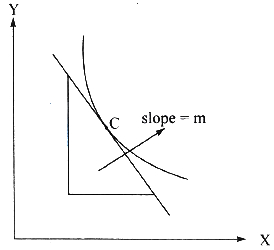
$A \rightarrow P$ is a first-order reaction. The following graph is obtained for this reaction ($x$-axis $=$ time,$y$-axis $=$ concentration of $A$). The instantaneous rate of the reaction at point $C$ is:
A
$\frac{1}{m}$
B
$m$
C
$2.303 \ m$
D
$\frac{1}{2.303 \ m}$
Solution
(B) For a reaction $A \rightarrow P$,the rate of reaction is defined as the negative of the rate of change of concentration of reactant $A$ with respect to time.
$r_{\text{inst}} = -\frac{d[A]}{dt}$
In the given graph,the $y$-axis represents the concentration of $A$ and the $x$-axis represents time.
The slope of the tangent drawn to the curve at any point gives the value of $\frac{d[A]}{dt}$.
Since the slope of the tangent at point $C$ is $m$,the value of $\frac{d[A]}{dt}$ at point $C$ is $m$.
Therefore,the instantaneous rate of reaction at point $C$ is $-(\text{slope}) = -m$.
However,in the context of magnitude of rate,the instantaneous rate is represented by the absolute value of the slope,which is $m$.
$r_{\text{inst}} = -\frac{d[A]}{dt}$
In the given graph,the $y$-axis represents the concentration of $A$ and the $x$-axis represents time.
The slope of the tangent drawn to the curve at any point gives the value of $\frac{d[A]}{dt}$.
Since the slope of the tangent at point $C$ is $m$,the value of $\frac{d[A]}{dt}$ at point $C$ is $m$.
Therefore,the instantaneous rate of reaction at point $C$ is $-(\text{slope}) = -m$.
However,in the context of magnitude of rate,the instantaneous rate is represented by the absolute value of the slope,which is $m$.
0 likes
View Solution212
MediumMCQ
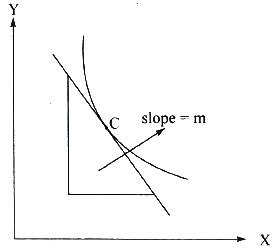
$A \rightarrow P$ is a first order reaction. The following graph is obtained for this reaction,($x$-axis $=$ time; $y$-axis $=$ concentration of $A$). The instantaneous rate of the reaction at point $C$ is
A
$\frac{1}{m}$
B
$m$
C
$2.303 \ m$
D
$\frac{1}{2.303 \ m}$
Solution
(B) For a reaction $A \rightarrow P$,the rate of reaction is defined as the negative of the rate of change of concentration of reactant $A$ with respect to time,i.e.,$r_{\text{inst}} = -\frac{d[A]}{dt}$.
In the given graph,the $y$-axis represents the concentration of $A$ and the $x$-axis represents time.
The slope of the tangent drawn to the curve at any point $C$ is given by $\frac{d[A]}{dt}$.
Since the curve shows a decrease in concentration with time,the slope $\frac{d[A]}{dt}$ is negative.
Therefore,the instantaneous rate of reaction at point $C$ is equal to the negative of the slope,which is $-(\text{slope})$.
However,in the context of the provided options and the standard interpretation of such graphical problems where $m$ represents the magnitude of the slope (i.e.,$m = |\text{slope}|$),the instantaneous rate is equal to $m$.
In the given graph,the $y$-axis represents the concentration of $A$ and the $x$-axis represents time.
The slope of the tangent drawn to the curve at any point $C$ is given by $\frac{d[A]}{dt}$.
Since the curve shows a decrease in concentration with time,the slope $\frac{d[A]}{dt}$ is negative.
Therefore,the instantaneous rate of reaction at point $C$ is equal to the negative of the slope,which is $-(\text{slope})$.
However,in the context of the provided options and the standard interpretation of such graphical problems where $m$ represents the magnitude of the slope (i.e.,$m = |\text{slope}|$),the instantaneous rate is equal to $m$.
0 likes
View Solution213
EasyMCQ
$A$ reaction,$3 X_{(g)} \rightarrow 2 Y_{(g)} + Z_{(g)}$ takes place in a closed vessel. What is the rate of formation of $Y$ (in $mol \ L^{-1} \ s^{-1}$) if the rate of disappearance of $X$ is $7.2 \times 10^{-3} \ mol \ L^{-1} \ s^{-1}$?
A
$3.6 \times 10^{-3}$
B
$4.8 \times 10^{-3}$
C
$2.4 \times 10^{-3}$
D
$1.2 \times 10^{-3}$
Solution
(B) The rate of reaction is given by the expression: $-\frac{1}{3} \frac{d[X]}{dt} = \frac{1}{2} \frac{d[Y]}{dt} = \frac{d[Z]}{dt}$
Given that the rate of disappearance of $X$ is $-\frac{d[X]}{dt} = 7.2 \times 10^{-3} \ mol \ L^{-1} \ s^{-1}$.
From the rate expression,we have: $\frac{1}{2} \frac{d[Y]}{dt} = -\frac{1}{3} \frac{d[X]}{dt}$
Therefore,the rate of formation of $Y$ is: $\frac{d[Y]}{dt} = \frac{2}{3} \times (-\frac{d[X]}{dt}) = \frac{2}{3} \times 7.2 \times 10^{-3} = 4.8 \times 10^{-3} \ mol \ L^{-1} \ s^{-1}$.
Given that the rate of disappearance of $X$ is $-\frac{d[X]}{dt} = 7.2 \times 10^{-3} \ mol \ L^{-1} \ s^{-1}$.
From the rate expression,we have: $\frac{1}{2} \frac{d[Y]}{dt} = -\frac{1}{3} \frac{d[X]}{dt}$
Therefore,the rate of formation of $Y$ is: $\frac{d[Y]}{dt} = \frac{2}{3} \times (-\frac{d[X]}{dt}) = \frac{2}{3} \times 7.2 \times 10^{-3} = 4.8 \times 10^{-3} \ mol \ L^{-1} \ s^{-1}$.
0 likes
View Solution214
EasyMCQ
At $298 \ K$ the value of $-\frac{\Delta[Br^{-}]}{\Delta t}$ for the reaction$5Br^-{_{\text{(aq)}}} + BrO_3^-{_{\text{(aq)}}} + 6H^+{_{\text{(aq)}}} \rightarrow 3Br_{2\text{(aq)}} + 3H_2O_{\text{(l)}}$ is $x \ mol \ L^{-1} \ min^{-1}$. What is the rate (in $mol \ L^{-1} \ min^{-1}$) of this reaction?
A
$\frac{x}{5}$
B
$x$
C
$5x$
D
$-\frac{x}{5}$
Solution
(A) For the given reaction: $5Br^-{_{\text{(aq)}}} + BrO_3^-{_{\text{(aq)}}} + 6H^+{_{\text{(aq)}}} \rightarrow 3Br_{2\text{(aq)}} + 3H_2O_{\text{(l)}}$
The rate of reaction is defined as the rate of disappearance of reactants divided by their stoichiometric coefficients.
Rate $= -\frac{1}{5} \frac{\Delta[Br^{-}]}{\Delta t} = -\frac{\Delta[BrO_3^{-}]}{\Delta t} = -\frac{1}{6} \frac{\Delta[H^{+}]}{\Delta t} = \frac{1}{3} \frac{\Delta[Br_2]}{\Delta t} = \frac{1}{3} \frac{\Delta[H_2O]}{\Delta t}$
Given that $-\frac{\Delta[Br^{-}]}{\Delta t} = x \ mol \ L^{-1} \ min^{-1}$.
Substituting this into the rate expression:
Rate $= \frac{1}{5} \times (-\frac{\Delta[Br^{-}]}{\Delta t}) = \frac{1}{5} \times x = \frac{x}{5} \ mol \ L^{-1} \ min^{-1}$.
The rate of reaction is defined as the rate of disappearance of reactants divided by their stoichiometric coefficients.
Rate $= -\frac{1}{5} \frac{\Delta[Br^{-}]}{\Delta t} = -\frac{\Delta[BrO_3^{-}]}{\Delta t} = -\frac{1}{6} \frac{\Delta[H^{+}]}{\Delta t} = \frac{1}{3} \frac{\Delta[Br_2]}{\Delta t} = \frac{1}{3} \frac{\Delta[H_2O]}{\Delta t}$
Given that $-\frac{\Delta[Br^{-}]}{\Delta t} = x \ mol \ L^{-1} \ min^{-1}$.
Substituting this into the rate expression:
Rate $= \frac{1}{5} \times (-\frac{\Delta[Br^{-}]}{\Delta t}) = \frac{1}{5} \times x = \frac{x}{5} \ mol \ L^{-1} \ min^{-1}$.
0 likes
View Solution215
MediumMCQ
Consider the following reaction: $N_{2(g)} + 3H_{2(g)} \longrightarrow 2NH_{3(g)}$. The rate of this reaction in terms of $N_2$ at $T \ K$ is $\frac{-d[N_2]}{dt} = 0.02 \ mol \ L^{-1} \ s^{-1}$. What is the value of $\frac{-d[H_2]}{dt}$ (in units of $mol \ L^{-1} \ s^{-1}$) at the same temperature?
A
$0.02$
B
$50$
C
$0.06$
D
$0.04$
Solution
(C) For the reaction $N_{2(g)} + 3H_{2(g)} \longrightarrow 2NH_{3(g)}$,the rate of reaction is given by:
Rate $= -\frac{d[N_2]}{dt} = -\frac{1}{3} \frac{d[H_2]}{dt} = \frac{1}{2} \frac{d[NH_3]}{dt}$.
Given that $-\frac{d[N_2]}{dt} = 0.02 \ mol \ L^{-1} \ s^{-1}$.
Equating the terms for $N_2$ and $H_2$:
$-\frac{d[N_2]}{dt} = -\frac{1}{3} \frac{d[H_2]}{dt}$.
Therefore,$-\frac{d[H_2]}{dt} = 3 \times (-\frac{d[N_2]}{dt})$.
$-\frac{d[H_2]}{dt} = 3 \times 0.02 = 0.06 \ mol \ L^{-1} \ s^{-1}$.
Rate $= -\frac{d[N_2]}{dt} = -\frac{1}{3} \frac{d[H_2]}{dt} = \frac{1}{2} \frac{d[NH_3]}{dt}$.
Given that $-\frac{d[N_2]}{dt} = 0.02 \ mol \ L^{-1} \ s^{-1}$.
Equating the terms for $N_2$ and $H_2$:
$-\frac{d[N_2]}{dt} = -\frac{1}{3} \frac{d[H_2]}{dt}$.
Therefore,$-\frac{d[H_2]}{dt} = 3 \times (-\frac{d[N_2]}{dt})$.
$-\frac{d[H_2]}{dt} = 3 \times 0.02 = 0.06 \ mol \ L^{-1} \ s^{-1}$.
0 likes
View Solution216
MediumMCQ
Which one of the following equations is correct for the reaction $N_{2(g)} + 3H_{2(g)} \longrightarrow 2NH_{3(g)}$?
A
$3 \frac{d[NH_3]}{dt} = 2 \frac{d[H_2]}{dt}$
B
$3 \frac{d[NH_3]}{dt} = 3 \frac{d[H_2]}{dt}$
C
$2 \frac{d[NH_3]}{dt} = -3 \frac{d[H_2]}{dt}$
D
$3 \frac{d[NH_3]}{dt} = -2 \frac{d[H_2]}{dt}$
Solution
(D) For the reaction $N_{2(g)} + 3H_{2(g)} \longrightarrow 2NH_{3(g)}$,the rate of reaction is expressed as:
$Rate = -\frac{d[N_2]}{dt} = -\frac{1}{3} \frac{d[H_2]}{dt} = \frac{1}{2} \frac{d[NH_3]}{dt}$
Equating the terms for $NH_3$ and $H_2$:
$-\frac{1}{3} \frac{d[H_2]}{dt} = \frac{1}{2} \frac{d[NH_3]}{dt}$
Multiplying both sides by $6$:
$-2 \frac{d[H_2]}{dt} = 3 \frac{d[NH_3]}{dt}$
Rearranging gives $3 \frac{d[NH_3]}{dt} = -2 \frac{d[H_2]}{dt}$.
$Rate = -\frac{d[N_2]}{dt} = -\frac{1}{3} \frac{d[H_2]}{dt} = \frac{1}{2} \frac{d[NH_3]}{dt}$
Equating the terms for $NH_3$ and $H_2$:
$-\frac{1}{3} \frac{d[H_2]}{dt} = \frac{1}{2} \frac{d[NH_3]}{dt}$
Multiplying both sides by $6$:
$-2 \frac{d[H_2]}{dt} = 3 \frac{d[NH_3]}{dt}$
Rearranging gives $3 \frac{d[NH_3]}{dt} = -2 \frac{d[H_2]}{dt}$.
0 likes
View Solution217
EasyMCQ
Consider a gas phase reaction which occurs in a closed vessel: $2 \ A \rightarrow 4 \ B + C$. The concentration of $B$ is found to be increased by $5 \times 10^{-3} \ mol \ L^{-1}$ in $10 \ s$. The rate of disappearance of $A$ (in $mol \ L^{-1} \ s^{-1}$) is:
A
$4.75 \times 10^{-4}$
B
$7.5 \times 10^{-4}$
C
$1.25 \times 10^{-4}$
D
$2.5 \times 10^{-4}$
Solution
(D) For the reaction $2 \ A \rightarrow 4 \ B + C$,the rate expression is given by: $-\frac{1}{2} \frac{d[A]}{dt} = \frac{1}{4} \frac{d[B]}{dt}$.
We need to find the rate of disappearance of $A$,which is $-\frac{d[A]}{dt}$.
From the expression: $-\frac{d[A]}{dt} = \frac{2}{4} \frac{d[B]}{dt} = \frac{1}{2} \frac{d[B]}{dt}$.
Given $\frac{\Delta [B]}{\Delta t} = \frac{5 \times 10^{-3} \ mol \ L^{-1}}{10 \ s} = 5 \times 10^{-4} \ mol \ L^{-1} \ s^{-1}$.
Therefore,$-\frac{d[A]}{dt} = \frac{1}{2} \times (5 \times 10^{-4} \ mol \ L^{-1} \ s^{-1}) = 2.5 \times 10^{-4} \ mol \ L^{-1} \ s^{-1}$.
We need to find the rate of disappearance of $A$,which is $-\frac{d[A]}{dt}$.
From the expression: $-\frac{d[A]}{dt} = \frac{2}{4} \frac{d[B]}{dt} = \frac{1}{2} \frac{d[B]}{dt}$.
Given $\frac{\Delta [B]}{\Delta t} = \frac{5 \times 10^{-3} \ mol \ L^{-1}}{10 \ s} = 5 \times 10^{-4} \ mol \ L^{-1} \ s^{-1}$.
Therefore,$-\frac{d[A]}{dt} = \frac{1}{2} \times (5 \times 10^{-4} \ mol \ L^{-1} \ s^{-1}) = 2.5 \times 10^{-4} \ mol \ L^{-1} \ s^{-1}$.
0 likes
View Solution218
EasyMCQ
If the rate of disappearance of $N_2O_5$ in the following reaction is $1.2 \times 10^{-5} \ mol \ L^{-1} \ s^{-1}$,the rate of production of $NO_2$ in $mol \ L^{-1} \ s^{-1}$ is:
$2N_2O_{5(g)} \longrightarrow 4NO_{2(g)} + O_{2(g)}$
$2N_2O_{5(g)} \longrightarrow 4NO_{2(g)} + O_{2(g)}$
A
$1.2 \times 10^{-5}$
B
$3.6 \times 10^{-5}$
C
$2.4 \times 10^{-5}$
D
$4.8 \times 10^{-5}$
Solution
(C) For the reaction $2N_2O_{5(g)} \longrightarrow 4NO_{2(g)} + O_{2(g)}$,the rate expression is given by:
$-\frac{1}{2} \frac{d[N_2O_5]}{dt} = \frac{1}{4} \frac{d[NO_2]}{dt} = \frac{d[O_2]}{dt}$
Given that the rate of disappearance of $N_2O_5$ is $-\frac{d[N_2O_5]}{dt} = 1.2 \times 10^{-5} \ mol \ L^{-1} \ s^{-1}$.
From the rate expression,we have:
$\frac{1}{4} \frac{d[NO_2]}{dt} = \frac{1}{2} \left( -\frac{d[N_2O_5]}{dt} \right)$
$\frac{d[NO_2]}{dt} = 2 \times \left( -\frac{d[N_2O_5]}{dt} \right)$
$\frac{d[NO_2]}{dt} = 2 \times (1.2 \times 10^{-5} \ mol \ L^{-1} \ s^{-1}) = 2.4 \times 10^{-5} \ mol \ L^{-1} \ s^{-1}$.
$-\frac{1}{2} \frac{d[N_2O_5]}{dt} = \frac{1}{4} \frac{d[NO_2]}{dt} = \frac{d[O_2]}{dt}$
Given that the rate of disappearance of $N_2O_5$ is $-\frac{d[N_2O_5]}{dt} = 1.2 \times 10^{-5} \ mol \ L^{-1} \ s^{-1}$.
From the rate expression,we have:
$\frac{1}{4} \frac{d[NO_2]}{dt} = \frac{1}{2} \left( -\frac{d[N_2O_5]}{dt} \right)$
$\frac{d[NO_2]}{dt} = 2 \times \left( -\frac{d[N_2O_5]}{dt} \right)$
$\frac{d[NO_2]}{dt} = 2 \times (1.2 \times 10^{-5} \ mol \ L^{-1} \ s^{-1}) = 2.4 \times 10^{-5} \ mol \ L^{-1} \ s^{-1}$.
0 likes
View Solution219
EasyMCQ
Observe the following reaction: $2 A + B \longrightarrow C$. The rate of formation of $C$ is $2.2 \times 10^{-3} \ mol \ L^{-1} \ min^{-1}$. What is the value of $-\frac{d[A]}{d t}$ (in $mol \ L^{-1} \ min^{-1}$)?
A
$2.2 \times 10^{-3}$
B
$1.1 \times 10^{-3}$
C
$4.4 \times 10^{-3}$
D
$5.5 \times 10^{-3}$
Solution
(C) For the reaction $2 A + B \longrightarrow C$,the rate of reaction is given by: $-\frac{1}{2} \frac{d[A]}{d t} = -\frac{d[B]}{d t} = \frac{d[C]}{d t}$.
Given that the rate of formation of $C$ is $\frac{d[C]}{d t} = 2.2 \times 10^{-3} \ mol \ L^{-1} \ min^{-1}$.
From the rate expression,we have $-\frac{1}{2} \frac{d[A]}{d t} = \frac{d[C]}{d t}$.
Therefore,$-\frac{d[A]}{d t} = 2 \times \frac{d[C]}{d t}$.
Substituting the value: $-\frac{d[A]}{d t} = 2 \times 2.2 \times 10^{-3} = 4.4 \times 10^{-3} \ mol \ L^{-1} \ min^{-1}$.
Given that the rate of formation of $C$ is $\frac{d[C]}{d t} = 2.2 \times 10^{-3} \ mol \ L^{-1} \ min^{-1}$.
From the rate expression,we have $-\frac{1}{2} \frac{d[A]}{d t} = \frac{d[C]}{d t}$.
Therefore,$-\frac{d[A]}{d t} = 2 \times \frac{d[C]}{d t}$.
Substituting the value: $-\frac{d[A]}{d t} = 2 \times 2.2 \times 10^{-3} = 4.4 \times 10^{-3} \ mol \ L^{-1} \ min^{-1}$.
0 likes
View Solution220
MediumMCQ
For the reaction $5Br^-{_{\text{(aq)}}} + 6H^+{_{\text{(aq)}}} + BrO_3^-{_{\text{(aq)}}} \rightarrow 3Br_{2\text{(aq)}} + 3H_2O_{\text{(l)}}$. If $-\frac{\Delta[BrO_3^{-}]}{\Delta t} = 0.01 \ mol \ L^{-1} \ min^{-1}$,calculate $\frac{\Delta[Br_2]}{\Delta t}$ in $mol \ L^{-1} \ min^{-1}$.
A
$0.01$
B
$0.3$
C
$0.03$
D
$0.005$
Solution
(C) For the given reaction: $5Br^-{_{\text{(aq)}}} + 6H^+{_{\text{(aq)}}} + BrO_3^-{_{\text{(aq)}}} \rightarrow 3Br_{2\text{(aq)}} + 3H_2O_{\text{(l)}}$
The rate of reaction expression is:
$Rate = -\frac{1}{5} \frac{\Delta[Br^{-}]}{\Delta t} = -\frac{\Delta[BrO_3^{-}]}{\Delta t} = +\frac{1}{3} \frac{\Delta[Br_2]}{\Delta t}$
Given that $-\frac{\Delta[BrO_3^{-}]}{\Delta t} = 0.01 \ mol \ L^{-1} \ min^{-1}$,we equate the terms:
$-\frac{\Delta[BrO_3^{-}]}{\Delta t} = \frac{1}{3} \frac{\Delta[Br_2]}{\Delta t}$
Substituting the given value:
$0.01 = \frac{1}{3} \frac{\Delta[Br_2]}{\Delta t}$
Therefore,$\frac{\Delta[Br_2]}{\Delta t} = 3 \times 0.01 = 0.03 \ mol \ L^{-1} \ min^{-1}$.
The rate of reaction expression is:
$Rate = -\frac{1}{5} \frac{\Delta[Br^{-}]}{\Delta t} = -\frac{\Delta[BrO_3^{-}]}{\Delta t} = +\frac{1}{3} \frac{\Delta[Br_2]}{\Delta t}$
Given that $-\frac{\Delta[BrO_3^{-}]}{\Delta t} = 0.01 \ mol \ L^{-1} \ min^{-1}$,we equate the terms:
$-\frac{\Delta[BrO_3^{-}]}{\Delta t} = \frac{1}{3} \frac{\Delta[Br_2]}{\Delta t}$
Substituting the given value:
$0.01 = \frac{1}{3} \frac{\Delta[Br_2]}{\Delta t}$
Therefore,$\frac{\Delta[Br_2]}{\Delta t} = 3 \times 0.01 = 0.03 \ mol \ L^{-1} \ min^{-1}$.
0 likes
View Solution221
EasyMCQ
For the reaction,$5Br^-{_{\text{(aq)}}} + BrO_3^-{_{\text{(aq)}}} + 6H^+{_{\text{(aq)}}} \rightarrow 3Br_{2\text{(aq)}} + 3H_2O_{\text{(l)}}$,if $-\frac{\Delta[Br^{-}]}{\Delta t} = 0.05 \ mol \ L^{-1} \ min^{-1}$,then the value of $-\frac{\Delta[BrO_3^{-}]}{\Delta t}$ in $mol \ L^{-1} \ min^{-1}$ is:
A
$0.005$
B
$0.05$
C
$0.5$
D
$0.01$
Solution
(D) For the given reaction: $5Br^-{_{\text{(aq)}}} + BrO_3^-{_{\text{(aq)}}} + 6H^+{_{\text{(aq)}}} \rightarrow 3Br_{2\text{(aq)}} + 3H_2O_{\text{(l)}}$
The rate of reaction is expressed as:
$Rate = -\frac{1}{5} \frac{\Delta[Br^{-}]}{\Delta t} = -\frac{\Delta[BrO_3^{-}]}{\Delta t} = -\frac{1}{6} \frac{\Delta[H^{+}]}{\Delta t} = \frac{1}{3} \frac{\Delta[Br_2]}{\Delta t}$
Given that $-\frac{\Delta[Br^{-}]}{\Delta t} = 0.05 \ mol \ L^{-1} \ min^{-1}$.
Equating the rates:
$-\frac{1}{5} \frac{\Delta[Br^{-}]}{\Delta t} = -\frac{\Delta[BrO_3^{-}]}{\Delta t}$
Substituting the given value:
$-\frac{\Delta[BrO_3^{-}]}{\Delta t} = \frac{1}{5} \times 0.05 = 0.01 \ mol \ L^{-1} \ min^{-1}$.
The rate of reaction is expressed as:
$Rate = -\frac{1}{5} \frac{\Delta[Br^{-}]}{\Delta t} = -\frac{\Delta[BrO_3^{-}]}{\Delta t} = -\frac{1}{6} \frac{\Delta[H^{+}]}{\Delta t} = \frac{1}{3} \frac{\Delta[Br_2]}{\Delta t}$
Given that $-\frac{\Delta[Br^{-}]}{\Delta t} = 0.05 \ mol \ L^{-1} \ min^{-1}$.
Equating the rates:
$-\frac{1}{5} \frac{\Delta[Br^{-}]}{\Delta t} = -\frac{\Delta[BrO_3^{-}]}{\Delta t}$
Substituting the given value:
$-\frac{\Delta[BrO_3^{-}]}{\Delta t} = \frac{1}{5} \times 0.05 = 0.01 \ mol \ L^{-1} \ min^{-1}$.
0 likes
View Solution222
MediumMCQ
Consider the following reaction: $2 NO_{2(g)} + F_{2(g)} \longrightarrow 2 NO_2F_{(g)}$. The expression for the rate of reaction in terms of the rate of change of partial pressure of reactant and product is/are:
A
rate $= -\frac{1}{2} \left[ \frac{dp(NO_2)}{dt} \right]$
B
rate $= \frac{1}{2} \left[ \frac{dp(NO_2)}{dt} \right]$
C
rate $= -\frac{1}{2} \left[ \frac{dp(NO_2F)}{dt} \right]$
D
rate $= \frac{1}{2} \left[ \frac{dp(NO_2F)}{dt} \right]$
Solution
(D) For the reaction $2 NO_{2(g)} + F_{2(g)} \longrightarrow 2 NO_2F_{(g)}$,the rate of reaction is expressed in terms of the rate of change of partial pressure as:
Rate $= -\frac{1}{2} \left[ \frac{dp(NO_2)}{dt} \right] = -\left[ \frac{dp(F_2)}{dt} \right] = +\frac{1}{2} \left[ \frac{dp(NO_2F)}{dt} \right]$.
Comparing this with the given options,option $D$ is correct.
Rate $= -\frac{1}{2} \left[ \frac{dp(NO_2)}{dt} \right] = -\left[ \frac{dp(F_2)}{dt} \right] = +\frac{1}{2} \left[ \frac{dp(NO_2F)}{dt} \right]$.
Comparing this with the given options,option $D$ is correct.
0 likes
View Solution223
DifficultMCQ
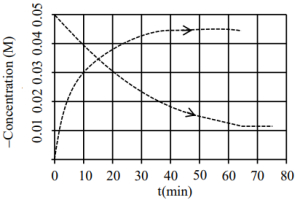
Given above is the concentration vs time plot for a dissociation reaction: $A \rightarrow nB$. Based on the data of the initial phase of the reaction (initial $10 \ min$),the value of $n$ is . . . . . . .
A
$4$
B
$3$
C
$2$
D
$5$
Solution
(B) From the graph,at $t = 0 \ min$,$[A] = 0.05 \ M$ and $[B] = 0 \ M$.
At $t = 10 \ min$,$[A] = 0.04 \ M$ and $[B] = 0.03 \ M$.
The change in concentration of $A$ is $\Delta[A] = 0.05 - 0.04 = 0.01 \ M$.
The change in concentration of $B$ is $\Delta[B] = 0.03 - 0 = 0.03 \ M$.
According to the stoichiometry of the reaction $A \rightarrow nB$,the rate of disappearance of $A$ and appearance of $B$ are related as: $\Delta[B] = n \times \Delta[A]$.
Substituting the values: $0.03 = n \times 0.01$.
Therefore,$n = \frac{0.03}{0.01} = 3$.
At $t = 10 \ min$,$[A] = 0.04 \ M$ and $[B] = 0.03 \ M$.
The change in concentration of $A$ is $\Delta[A] = 0.05 - 0.04 = 0.01 \ M$.
The change in concentration of $B$ is $\Delta[B] = 0.03 - 0 = 0.03 \ M$.
According to the stoichiometry of the reaction $A \rightarrow nB$,the rate of disappearance of $A$ and appearance of $B$ are related as: $\Delta[B] = n \times \Delta[A]$.
Substituting the values: $0.03 = n \times 0.01$.
Therefore,$n = \frac{0.03}{0.01} = 3$.
0 likes
View Solution224
MediumMCQ
Select the correct reaction for the given rate: $\text{rate} = -\frac{1}{6} \frac{d[A]}{dt} = -\frac{1}{4} \frac{d[B]}{dt} = \frac{1}{3} \frac{d[C]}{dt} = \frac{1}{4} \frac{d[D]}{dt}$
A
$2A + 3B \to 4C + 3D$
B
$6A + 4B \to 3C + 4D$
C
$3A + 2B \to 3C + 4D$
D
$3A + 2B \to 4C + 3D$
Solution
(B) For a general chemical reaction $aA + bB \to cC + dD$,the rate of reaction is expressed as:
$\text{rate} = -\frac{1}{a} \frac{d[A]}{dt} = -\frac{1}{b} \frac{d[B]}{dt} = \frac{1}{c} \frac{d[C]}{dt} = \frac{1}{d} \frac{d[D]}{dt}$.
Comparing the given rate expression with the general form:
$-\frac{1}{6} \frac{d[A]}{dt} = -\frac{1}{a} \frac{d[A]}{dt} \implies a = 6$.
$-\frac{1}{4} \frac{d[B]}{dt} = -\frac{1}{b} \frac{d[B]}{dt} \implies b = 4$.
$\frac{1}{3} \frac{d[C]}{dt} = \frac{1}{c} \frac{d[C]}{dt} \implies c = 3$.
$\frac{1}{4} \frac{d[D]}{dt} = \frac{1}{d} \frac{d[D]}{dt} \implies d = 4$.
Substituting these stoichiometric coefficients into the general reaction equation,we get:
$6A + 4B \to 3C + 4D$.
$\text{rate} = -\frac{1}{a} \frac{d[A]}{dt} = -\frac{1}{b} \frac{d[B]}{dt} = \frac{1}{c} \frac{d[C]}{dt} = \frac{1}{d} \frac{d[D]}{dt}$.
Comparing the given rate expression with the general form:
$-\frac{1}{6} \frac{d[A]}{dt} = -\frac{1}{a} \frac{d[A]}{dt} \implies a = 6$.
$-\frac{1}{4} \frac{d[B]}{dt} = -\frac{1}{b} \frac{d[B]}{dt} \implies b = 4$.
$\frac{1}{3} \frac{d[C]}{dt} = \frac{1}{c} \frac{d[C]}{dt} \implies c = 3$.
$\frac{1}{4} \frac{d[D]}{dt} = \frac{1}{d} \frac{d[D]}{dt} \implies d = 4$.
Substituting these stoichiometric coefficients into the general reaction equation,we get:
$6A + 4B \to 3C + 4D$.
0 likes
View SolutionChemical Kinetics — Rate of a reaction · Frequently Asked Questions
1Are these Chemical Kinetics questions useful for JEE and NEET?
Yes. All questions in this section are mapped to JEE Main and NEET exam patterns. Previous year questions from JEE Main, NEET, GUJCET and state-level exams are included with full solutions.
2Can I switch to Hindi or Gujarati for these questions?
Yes. Use the language tabs in the hero section or the sidebar to view the same questions and solutions in English, Hindi or Gujarati.
3How do I generate a question paper from this subtopic?
Use the Vedclass Exam Paper Generator — select the chapter and subtopic, set difficulty, and generate Sets A, B, C, D automatically. First 3 chapters of every subject are free.
Vedclass Products
For Students
Vedclass Test Series
Mock tests in real JEE/NEET style with performance analysis. 5-day free trial.
Start Free TrialFor Teachers
Exam Paper Generator
Generate Set A/B/C/D papers from this chapter in 2 minutes. 3 chapters free.
Try FreeFor Institutes
Online Exam Module
Live online exams with unlimited students, 360° analytics & white-label branding.
See DemoFor Teachers & Institutes
Generate a Chemical Kinetics Exam Paper in 2 Minutes
Select subtopic & difficulty — Sets A, B, C, D auto-generated with No Repeat logic.
First 3 chapters of every subject are free — no payment required.