
A English
First Order reaction Questions in English
Class 12 Chemistry · Chemical Kinetics · First Order reaction
534+
Questions
English
Language
100%
With Solutions
Showing 48 of 534 questions in English
451
EasyMCQ
Which of the following is the slope of the graph of rate versus concentration of the reactant for a first-order reaction?
A
$-k$
B
$k$
C
$\frac{k}{2.303}$
D
$\frac{-k}{2.303}$
Solution
(B) For a first-order reaction,the rate law is given by: $\text{Rate} = k[R]^1$.
Comparing this with the equation of a straight line,$y = mx + c$,where $y = \text{Rate}$,$x = [R]$,$m = \text{slope}$,and $c = 0$.
Thus,the slope of the graph of $\text{Rate}$ versus $[R]$ is equal to the rate constant $k$.
Comparing this with the equation of a straight line,$y = mx + c$,where $y = \text{Rate}$,$x = [R]$,$m = \text{slope}$,and $c = 0$.
Thus,the slope of the graph of $\text{Rate}$ versus $[R]$ is equal to the rate constant $k$.
0 likes
View Solution452
EasyMCQ
Slope of the graph between $\log \frac{[A]_0}{[A]_t}$ ($y$-axis) and time ($x$-axis) for a first-order reaction is equal to:
A
$\frac{k}{2.303}$
B
$k$
C
$-k$
D
$-\frac{2.303}{k}$
Solution
(A) The integrated rate law for a first-order reaction is given by:
$k = \frac{2.303}{t} \log_{10} \frac{[A]_0}{[A]_t}$
Rearranging the equation:
$\log_{10} \frac{[A]_0}{[A]_t} = \frac{k}{2.303} t$
Comparing this with the equation of a straight line $y = mx + c$,where $y = \log_{10} \frac{[A]_0}{[A]_t}$,$x = t$,$c = 0$,and $m$ is the slope:
The slope $m = \frac{k}{2.303}$.
$k = \frac{2.303}{t} \log_{10} \frac{[A]_0}{[A]_t}$
Rearranging the equation:
$\log_{10} \frac{[A]_0}{[A]_t} = \frac{k}{2.303} t$
Comparing this with the equation of a straight line $y = mx + c$,where $y = \log_{10} \frac{[A]_0}{[A]_t}$,$x = t$,$c = 0$,and $m$ is the slope:
The slope $m = \frac{k}{2.303}$.
0 likes
View Solution453
EasyMCQ
For which of the following graphs of a first-order reaction will the value of the slope be $\frac{K}{2.303}$?
A
$\log \frac{[R]_0}{[R]} \text{ vs } t \text{ (Time)}$
B
$\log \frac{[R]}{[R]_0} \text{ vs } t \text{ (Time)}$
C
$\ln \frac{[R]_0}{[R]} \text{ vs } t \text{ (Time)}$
D
$\ln \frac{[R]}{[R]_0} \text{ vs } t \text{ (Time)}$
Solution
(A) The integrated rate equation for a first-order reaction is given by: $\ln \frac{[R]_0}{[R]} = Kt$.
Converting to base $10$ logarithm: $\log \frac{[R]_0}{[R]} = \frac{Kt}{2.303}$.
Comparing this with the equation of a straight line $y = mx + c$,where $y = \log \frac{[R]_0}{[R]}$ and $x = t$,the slope $m$ is equal to $\frac{K}{2.303}$.
Therefore,the graph of $\log \frac{[R]_0}{[R]}$ versus $t$ gives a slope of $\frac{K}{2.303}$.
Converting to base $10$ logarithm: $\log \frac{[R]_0}{[R]} = \frac{Kt}{2.303}$.
Comparing this with the equation of a straight line $y = mx + c$,where $y = \log \frac{[R]_0}{[R]}$ and $x = t$,the slope $m$ is equal to $\frac{K}{2.303}$.
Therefore,the graph of $\log \frac{[R]_0}{[R]}$ versus $t$ gives a slope of $\frac{K}{2.303}$.
0 likes
View Solution454
EasyMCQ
What is the value of the slope when a graph is plotted of $\log \frac{[R]_0}{[R]}$ versus $t$ (time) for a first-order reaction?
A
$-\frac{K}{2.303}$
B
$\frac{K}{2.303}$
C
$-K$
D
$\frac{2.303}{K}$
Solution
(B) For a first-order reaction,the integrated rate equation is given by:
$K = \frac{2.303}{t} \log \frac{[R]_0}{[R]}$
Rearranging this equation to the form $y = mx + c$:
$\log \frac{[R]_0}{[R]} = \frac{K}{2.303} \times t$
Comparing this with the equation of a straight line $y = mx$,where $y = \log \frac{[R]_0}{[R]}$,$x = t$,and the slope $m = \frac{K}{2.303}$.
Therefore,the slope of the graph is $\frac{K}{2.303}$.
$K = \frac{2.303}{t} \log \frac{[R]_0}{[R]}$
Rearranging this equation to the form $y = mx + c$:
$\log \frac{[R]_0}{[R]} = \frac{K}{2.303} \times t$
Comparing this with the equation of a straight line $y = mx$,where $y = \log \frac{[R]_0}{[R]}$,$x = t$,and the slope $m = \frac{K}{2.303}$.
Therefore,the slope of the graph is $\frac{K}{2.303}$.
0 likes
View Solution455
EasyMCQ
The rate constant for a first order reaction is $60 \text{ s}^{-1}$. How much time (in seconds) will it take to reduce the initial concentration of the reactant to its $1/16^{th}$ value?
A
$2.3 \times 10^{-2} \text{ s}$
B
$9.5 \times 10^{-2} \text{ s}$
C
$4.6 \times 10^{-2} \text{ s}$
D
$6.9 \times 10^{-2} \text{ s}$
Solution
(C) For a first order reaction,the rate equation is given by $k = \frac{2.303}{t} \log \frac{[R]_0}{[R]}$.
Given that the concentration reduces to $1/16^{th}$ of its initial value,$[R] = \frac{[R]_0}{16}$,so $\frac{[R]_0}{[R]} = 16$.
Substituting the values: $t = \frac{2.303}{k} \log(16)$.
$t = \frac{2.303}{60} \log(2^4) = \frac{2.303 \times 4 \times 0.3010}{60}$.
$t = \frac{2.303 \times 1.204}{60} \approx 0.0462 \text{ s}$.
Therefore,$t = 4.6 \times 10^{-2} \text{ s}$.
Given that the concentration reduces to $1/16^{th}$ of its initial value,$[R] = \frac{[R]_0}{16}$,so $\frac{[R]_0}{[R]} = 16$.
Substituting the values: $t = \frac{2.303}{k} \log(16)$.
$t = \frac{2.303}{60} \log(2^4) = \frac{2.303 \times 4 \times 0.3010}{60}$.
$t = \frac{2.303 \times 1.204}{60} \approx 0.0462 \text{ s}$.
Therefore,$t = 4.6 \times 10^{-2} \text{ s}$.
0 likes
View Solution456
EasyMCQ
For which of the following graphs is the intersection (y-intercept) zero?
A
$[R] \rightarrow t$
B
$\log \frac{[R]_0}{[R]} \rightarrow t$
C
$\log K \rightarrow \frac{1}{T}$
D
$\log [R] \rightarrow t$
Solution
(B) For a first-order reaction,the integrated rate equation is $\log \frac{[R]_0}{[R]} = \frac{kt}{2.303}$.
Comparing this with the equation of a straight line $y = mx + c$,where $y = \log \frac{[R]_0}{[R]}$,$x = t$,$m = \frac{k}{2.303}$,and $c = 0$.
Since the y-intercept $c$ is $0$,the graph of $\log \frac{[R]_0}{[R]}$ versus $t$ passes through the origin.
Therefore,the correct option is $B$.
Comparing this with the equation of a straight line $y = mx + c$,where $y = \log \frac{[R]_0}{[R]}$,$x = t$,$m = \frac{k}{2.303}$,and $c = 0$.
Since the y-intercept $c$ is $0$,the graph of $\log \frac{[R]_0}{[R]}$ versus $t$ passes through the origin.
Therefore,the correct option is $B$.
0 likes
View Solution457
EasyMCQ
Time required to decompose $SO_2Cl_2$ to half of its initial amount is $40 \ minutes$. If the decomposition is a first order reaction,what will be the rate constant of the reaction?
A
$2.88 \times 10^{-4} \ s^{-1}$
B
$2.88 \times 10^{-2} \ s^{-1}$
C
$1.73 \times 10^{-2} \ s^{-1}$
D
$1.73 \times 10^{-4} \ s^{-1}$
Solution
(A) For a first order reaction,the half-life is given by $t_{1/2} = \frac{0.693}{k}$.
Given $t_{1/2} = 40 \ minutes$.
Convert time to seconds: $t_{1/2} = 40 \times 60 \ s = 2400 \ s$.
Now,calculate the rate constant $k = \frac{0.693}{t_{1/2}}$.
$k = \frac{0.693}{2400} \ s^{-1} = 0.00028875 \ s^{-1}$.
Rounding to three significant figures,$k = 2.88 \times 10^{-4} \ s^{-1}$.
Given $t_{1/2} = 40 \ minutes$.
Convert time to seconds: $t_{1/2} = 40 \times 60 \ s = 2400 \ s$.
Now,calculate the rate constant $k = \frac{0.693}{t_{1/2}}$.
$k = \frac{0.693}{2400} \ s^{-1} = 0.00028875 \ s^{-1}$.
Rounding to three significant figures,$k = 2.88 \times 10^{-4} \ s^{-1}$.
0 likes
View Solution458
EasyMCQ
Which of the following graphs has an intercept equal to zero?
A
$\log K \text{ vs } \frac{1}{T}$
B
$\log \frac{[R]_0}{[R]} \text{ vs } t$
C
$\log [R] \text{ vs } t$
D
$[R] \text{ vs } t$
Solution
(B) For a first-order reaction,the integrated rate equation is $\log \frac{[R]_0}{[R]} = \frac{kt}{2.303}$.
Comparing this with the equation of a straight line $y = mx + c$,where $y = \log \frac{[R]_0}{[R]}$,$x = t$,$m = \frac{k}{2.303}$,and $c = 0$.
Since the intercept $c$ is $0$,the graph of $\log \frac{[R]_0}{[R]}$ versus $t$ passes through the origin.
Therefore,the correct option is $B$.
Comparing this with the equation of a straight line $y = mx + c$,where $y = \log \frac{[R]_0}{[R]}$,$x = t$,$m = \frac{k}{2.303}$,and $c = 0$.
Since the intercept $c$ is $0$,the graph of $\log \frac{[R]_0}{[R]}$ versus $t$ passes through the origin.
Therefore,the correct option is $B$.
0 likes
View Solution459
EasyMCQ
At $27^{\circ} C$ temperature,the time required for $75 \%$ completion of a first order reaction is $20 \ s$. What will be its rate constant?
A
$0.693 \ s^{-1}$
B
$0.0693 \ s^{-1}$
C
$0.693 \ s^{-1} \ mol^{-1} \ L$
D
$0.0693 \ s^{-1} \ mol^{-1} \ L$
Solution
(B) For a $1^{st}$ order reaction,the rate constant $K$ is given by the formula: $K = \frac{2.303}{t} \log \left( \frac{[A]_0}{[A]_t} \right)$.
Given that the reaction is $75 \%$ complete,the remaining concentration $[A]_t = [A]_0 - 0.75 [A]_0 = 0.25 [A]_0$.
Substituting the values: $K = \frac{2.303}{20} \log \left( \frac{[A]_0}{0.25 [A]_0} \right)$.
$K = \frac{2.303}{20} \log (4) = \frac{2.303}{20} \times 0.6021 \approx \frac{1.386}{20} = 0.0693 \ s^{-1}$.
Alternatively,$t_{75\%} = 2 \times t_{1/2}$. Since $t_{1/2} = \frac{0.693}{K}$,then $20 = 2 \times \frac{0.693}{K}$,which gives $K = \frac{1.386}{20} = 0.0693 \ s^{-1}$.
Given that the reaction is $75 \%$ complete,the remaining concentration $[A]_t = [A]_0 - 0.75 [A]_0 = 0.25 [A]_0$.
Substituting the values: $K = \frac{2.303}{20} \log \left( \frac{[A]_0}{0.25 [A]_0} \right)$.
$K = \frac{2.303}{20} \log (4) = \frac{2.303}{20} \times 0.6021 \approx \frac{1.386}{20} = 0.0693 \ s^{-1}$.
Alternatively,$t_{75\%} = 2 \times t_{1/2}$. Since $t_{1/2} = \frac{0.693}{K}$,then $20 = 2 \times \frac{0.693}{K}$,which gives $K = \frac{1.386}{20} = 0.0693 \ s^{-1}$.
0 likes
View Solution460
EasyMCQ
The value of rate constant for a first order reaction is $2.303 \times 10^{-2} \text{ s}^{-1}$. What will be the time required to reduce the concentration to $\frac{1}{10}$th of its initial concentration (in $\text{ s}$)?
A
$10$
B
$100$
C
$2303$
D
$230.3$
Solution
(B) For a first-order reaction, the integrated rate equation is $t = \frac{2.303}{k} \log\left(\frac{[A]_0}{[A]}\right)$.
Given $k = 2.303 \times 10^{-2} \text{ s}^{-1}$ and $[A] = \frac{[A]_0}{10}$.
Substituting these values, we get $t = \frac{2.303}{2.303 \times 10^{-2}} \log\left(\frac{[A]_0}{[A]_0 / 10}\right)$.
$t = \frac{1}{10^{-2}} \log(10) = 10^2 \times 1 = 100 \text{ s}$.
Given $k = 2.303 \times 10^{-2} \text{ s}^{-1}$ and $[A] = \frac{[A]_0}{10}$.
Substituting these values, we get $t = \frac{2.303}{2.303 \times 10^{-2}} \log\left(\frac{[A]_0}{[A]_0 / 10}\right)$.
$t = \frac{1}{10^{-2}} \log(10) = 10^2 \times 1 = 100 \text{ s}$.
0 likes
View Solution461
EasyMCQ
The half-life period for a first-order reaction is . . . . . . .
A
Proportional to concentration
B
Independent of concentration
C
Inversely proportional to concentration
D
Inversely proportional to the square of the concentration
Solution
(B) For a first-order reaction,the rate constant $k$ is given by $k = \frac{2.303}{t} \log \frac{[A]_0}{[A]}$.
At half-life $(t = t_{1/2})$,the concentration $[A] = \frac{[A]_0}{2}$.
Substituting these values: $k = \frac{2.303}{t_{1/2}} \log \frac{[A]_0}{[A]_0/2} = \frac{2.303}{t_{1/2}} \log 2$.
Thus,$t_{1/2} = \frac{2.303 \times 0.3010}{k} = \frac{0.693}{k}$.
Since $t_{1/2}$ depends only on the rate constant $k$ and not on the initial concentration $[A]_0$,it is independent of the concentration.
At half-life $(t = t_{1/2})$,the concentration $[A] = \frac{[A]_0}{2}$.
Substituting these values: $k = \frac{2.303}{t_{1/2}} \log \frac{[A]_0}{[A]_0/2} = \frac{2.303}{t_{1/2}} \log 2$.
Thus,$t_{1/2} = \frac{2.303 \times 0.3010}{k} = \frac{0.693}{k}$.
Since $t_{1/2}$ depends only on the rate constant $k$ and not on the initial concentration $[A]_0$,it is independent of the concentration.
0 likes
View Solution462
EasyMCQ
For a first order reaction,the initial concentration of a reactant is $0.05 \ M$. After $45 \ minutes$,it is decreased by $0.015 \ M$. Calculate the half-life period $(t_{1/2})$ (in $min$)?
A
$87.42$
B
$25.90$
C
$78.72$
D
$77.20$
Solution
(B) For a first order reaction,the rate constant $k$ is given by: $k = \frac{2.303}{t} \log \frac{[A]_0}{[A]_t}$
Given: $[A]_0 = 0.05 \ M$,$[A]_t = 0.05 - 0.015 = 0.035 \ M$,and $t = 45 \ min$.
Substituting the values: $k = \frac{2.303}{45} \log \frac{0.05}{0.035} = \frac{2.303}{45} \log (1.4286) \approx 0.02673 \ min^{-1}$.
The half-life period is: $t_{1/2} = \frac{0.693}{k} = \frac{0.693}{0.02673} \approx 25.92 \ min$.
Given: $[A]_0 = 0.05 \ M$,$[A]_t = 0.05 - 0.015 = 0.035 \ M$,and $t = 45 \ min$.
Substituting the values: $k = \frac{2.303}{45} \log \frac{0.05}{0.035} = \frac{2.303}{45} \log (1.4286) \approx 0.02673 \ min^{-1}$.
The half-life period is: $t_{1/2} = \frac{0.693}{k} = \frac{0.693}{0.02673} \approx 25.92 \ min$.
0 likes
View Solution463
EasyMCQ
For a first order reaction,the half-life period is $5 \ min$. What time will it take for $99.9 \%$ completion of the reaction (in $min$)?
A
$40$
B
$25$
C
$20$
D
$50$
Solution
(D) For a first-order reaction,the rate constant $k$ is given by $k = \frac{0.693}{t_{1/2}}$.
Given $t_{1/2} = 5 \ min$,so $k = \frac{0.693}{5} \ min^{-1}$.
The time $t$ required for $99.9 \%$ completion is given by the formula $t = \frac{2.303}{k} \log \frac{[A]_0}{[A]_t}$.
For $99.9 \%$ completion,$[A]_t = [A]_0 - 0.999[A]_0 = 0.001[A]_0$.
Substituting the values: $t = \frac{2.303}{0.693/5} \log \frac{[A]_0}{0.001[A]_0}$.
$t = \frac{2.303 \times 5}{0.693} \log(1000)$.
Since $\log(1000) = 3$ and $\frac{2.303}{0.693} \approx 3.32$,we have $t \approx 3.32 \times 5 \times 3 = 49.8 \approx 50 \ min$.
Thus,the correct option is $D$.
Given $t_{1/2} = 5 \ min$,so $k = \frac{0.693}{5} \ min^{-1}$.
The time $t$ required for $99.9 \%$ completion is given by the formula $t = \frac{2.303}{k} \log \frac{[A]_0}{[A]_t}$.
For $99.9 \%$ completion,$[A]_t = [A]_0 - 0.999[A]_0 = 0.001[A]_0$.
Substituting the values: $t = \frac{2.303}{0.693/5} \log \frac{[A]_0}{0.001[A]_0}$.
$t = \frac{2.303 \times 5}{0.693} \log(1000)$.
Since $\log(1000) = 3$ and $\frac{2.303}{0.693} \approx 3.32$,we have $t \approx 3.32 \times 5 \times 3 = 49.8 \approx 50 \ min$.
Thus,the correct option is $D$.
0 likes
View Solution464
EasyMCQ
$A$ first order reaction is found to have a rate constant,$k = 5.5 \times 10^{-14} \ s^{-1}$. The half life of reaction is . . . . . . .
A
$1.26 \times 10^{13} \ s$
B
$1.26 \times 10^{14} \ s$
C
$6.93 \times 10^{14} \ s$
D
$12.6 \times 10^{15} \ s$
Solution
(A) For a first order reaction,the half-life $(t_{1/2})$ is given by the formula: $t_{1/2} = \frac{0.693}{k}$.
Given $k = 5.5 \times 10^{-14} \ s^{-1}$.
Substituting the value of $k$ in the formula:
$t_{1/2} = \frac{0.693}{5.5 \times 10^{-14}} \ s$.
$t_{1/2} = 0.126 \times 10^{14} \ s$.
$t_{1/2} = 1.26 \times 10^{13} \ s$.
Given $k = 5.5 \times 10^{-14} \ s^{-1}$.
Substituting the value of $k$ in the formula:
$t_{1/2} = \frac{0.693}{5.5 \times 10^{-14}} \ s$.
$t_{1/2} = 0.126 \times 10^{14} \ s$.
$t_{1/2} = 1.26 \times 10^{13} \ s$.
0 likes
View Solution465
MediumMCQ
The plot of $t_{1/2}$ versus $[R]_0$ for a reaction is a straight line parallel to the $x$-axis. The unit for the rate constant of this reaction is:
A
$L \ mol^{-1} \ s^{-1}$
B
$s^{-1}$
C
$mol \ L^{-1} \ s^{-1}$
D
$mol^{-1} \ L \ s^{-1}$
Solution
(B) For a reaction,the half-life $t_{1/2}$ is related to the initial concentration $[R]_0$ by the expression $t_{1/2} \propto [R]_0^{1-n}$,where $n$ is the order of the reaction.
If the plot of $t_{1/2}$ versus $[R]_0$ is a straight line parallel to the $x$-axis,it implies that $t_{1/2}$ is independent of the initial concentration $[R]_0$.
This occurs when $1-n = 0$,which means $n = 1$.
Therefore,the reaction is a first-order reaction.
The unit of the rate constant for a first-order reaction is $s^{-1}$.
If the plot of $t_{1/2}$ versus $[R]_0$ is a straight line parallel to the $x$-axis,it implies that $t_{1/2}$ is independent of the initial concentration $[R]_0$.
This occurs when $1-n = 0$,which means $n = 1$.
Therefore,the reaction is a first-order reaction.
The unit of the rate constant for a first-order reaction is $s^{-1}$.
0 likes
View Solution466
MediumMCQ
Half-life of a first order reaction is $20 \ s$ and initial concentration of reactant is $0.2 \ M$. The concentration of reactant left after $80 \ s$ is (in $M$)
A
$0.1$
B
$0.05$
C
$0.0125$
D
$0.2$
Solution
(C) The number of half-lives $(n)$ is calculated as: $n = \frac{t}{t_{1/2}} = \frac{80 \ s}{20 \ s} = 4$.
The concentration of reactant remaining after $n$ half-lives is given by the formula: $[A_t] = [A_0] \times (\frac{1}{2})^n$.
Substituting the values: $[A_t] = 0.2 \ M \times (\frac{1}{2})^4 = 0.2 \times \frac{1}{16} = 0.0125 \ M$.
The concentration of reactant remaining after $n$ half-lives is given by the formula: $[A_t] = [A_0] \times (\frac{1}{2})^n$.
Substituting the values: $[A_t] = 0.2 \ M \times (\frac{1}{2})^4 = 0.2 \times \frac{1}{16} = 0.0125 \ M$.
0 likes
View Solution467
MediumMCQ
$A$ first order reaction is half completed in $45 \ min$. How long does it need $99.9 \%$ of the reaction to be completed (in $Hours$)?
A
$7.5$
B
$10$
C
$20$
D
$5$
Solution
(A) For a first order reaction,the rate constant $k$ is given by $k = \frac{0.693}{t_{1/2}}$.
Given $t_{1/2} = 45 \ min$,so $k = \frac{0.693}{45} \ min^{-1}$.
For $99.9 \%$ completion,the amount remaining $(a-x)$ is $100 - 99.9 = 0.1$.
The time $t$ required is $t = \frac{2.303}{k} \log \frac{a}{a-x}$.
Substituting the values: $t = \frac{2.303}{0.693 / 45} \log \frac{100}{0.1} = \frac{2.303 \times 45}{0.693} \log 1000$.
Since $\log 1000 = 3$,we have $t = \frac{2.303 \times 45 \times 3}{0.693} \approx 448.5 \ min$.
Converting to hours: $t = \frac{448.5}{60} \approx 7.475 \ hrs \approx 7.5 \ hours$.
Given $t_{1/2} = 45 \ min$,so $k = \frac{0.693}{45} \ min^{-1}$.
For $99.9 \%$ completion,the amount remaining $(a-x)$ is $100 - 99.9 = 0.1$.
The time $t$ required is $t = \frac{2.303}{k} \log \frac{a}{a-x}$.
Substituting the values: $t = \frac{2.303}{0.693 / 45} \log \frac{100}{0.1} = \frac{2.303 \times 45}{0.693} \log 1000$.
Since $\log 1000 = 3$,we have $t = \frac{2.303 \times 45 \times 3}{0.693} \approx 448.5 \ min$.
Converting to hours: $t = \frac{448.5}{60} \approx 7.475 \ hrs \approx 7.5 \ hours$.
0 likes
View Solution468
MediumMCQ
If the rate constant for a first order reaction is $k$,the time $(t)$ required for the completion of $99 \%$ of the reaction is given by
A
$t = \frac{4.606}{k}$
B
$t = \frac{2.303}{k}$
C
$t = \frac{0.693}{k}$
D
$t = \frac{6.909}{k}$
Solution
(A) For a first order reaction,the integrated rate equation is $t = \frac{2.303}{k} \log \frac{[R]_0}{[R]}$.
Given that $99 \%$ of the reaction is complete,the remaining concentration $[R]$ is $100 \% - 99 \% = 1 \%$ of the initial concentration $[R]_0$.
So,$[R] = 0.01 [R]_0 = \frac{[R]_0}{100}$.
Substituting these values into the equation:
$t = \frac{2.303}{k} \log \frac{[R]_0}{[R]_0 / 100} = \frac{2.303}{k} \log(100)$.
Since $\log(100) = 2$,we get $t = \frac{2.303 \times 2}{k} = \frac{4.606}{k}$.
Given that $99 \%$ of the reaction is complete,the remaining concentration $[R]$ is $100 \% - 99 \% = 1 \%$ of the initial concentration $[R]_0$.
So,$[R] = 0.01 [R]_0 = \frac{[R]_0}{100}$.
Substituting these values into the equation:
$t = \frac{2.303}{k} \log \frac{[R]_0}{[R]_0 / 100} = \frac{2.303}{k} \log(100)$.
Since $\log(100) = 2$,we get $t = \frac{2.303 \times 2}{k} = \frac{4.606}{k}$.
0 likes
View Solution469
MediumMCQ
The time required for $60 \%$ completion of a first order reaction is $50 \ min$. The time required for $93.6 \%$ completion of the same reaction will be (in $min$)
A
$100$
B
$83.8$
C
$50$
D
$150$
Solution
(D) For a first order reaction,the rate constant $k$ is given by $k = \frac{2.303}{t} \log \frac{[A]_0}{[A]_t}$.
For $60 \%$ completion,$[A]_t = [A]_0 - 0.60[A]_0 = 0.40[A]_0$ and $t = 50 \ min$.
$k = \frac{2.303}{50} \log \frac{[A]_0}{0.40[A]_0} = \frac{2.303}{50} \log 2.5$.
For $93.6 \%$ completion,$[A]_t = [A]_0 - 0.936[A]_0 = 0.064[A]_0$.
$k = \frac{2.303}{t'} \log \frac{[A]_0}{0.064[A]_0} = \frac{2.303}{t'} \log \frac{1}{0.064} = \frac{2.303}{t'} \log 15.625$.
Equating the two expressions for $k$:
$\frac{2.303}{50} \log 2.5 = \frac{2.303}{t'} \log 15.625$.
$t' = 50 \times \frac{\log 15.625}{\log 2.5} = 50 \times \frac{\log (2.5)^3}{\log 2.5} = 50 \times 3 = 150 \ min$.
For $60 \%$ completion,$[A]_t = [A]_0 - 0.60[A]_0 = 0.40[A]_0$ and $t = 50 \ min$.
$k = \frac{2.303}{50} \log \frac{[A]_0}{0.40[A]_0} = \frac{2.303}{50} \log 2.5$.
For $93.6 \%$ completion,$[A]_t = [A]_0 - 0.936[A]_0 = 0.064[A]_0$.
$k = \frac{2.303}{t'} \log \frac{[A]_0}{0.064[A]_0} = \frac{2.303}{t'} \log \frac{1}{0.064} = \frac{2.303}{t'} \log 15.625$.
Equating the two expressions for $k$:
$\frac{2.303}{50} \log 2.5 = \frac{2.303}{t'} \log 15.625$.
$t' = 50 \times \frac{\log 15.625}{\log 2.5} = 50 \times \frac{\log (2.5)^3}{\log 2.5} = 50 \times 3 = 150 \ min$.
0 likes
View Solution470
DifficultMCQ
The half-life period of a $1^{st}$ order reaction is $60 \ minutes$. What percentage will be left over after $240 \ minutes$ (in $\%$)?
A
$6.25$
B
$1.25$
C
$5$
D
$6$
Solution
(A) For a $1^{st}$ order reaction,the amount remaining after $n$ half-lives is given by the formula: $[A] = [A]_0 \times (1/2)^n$.
Number of half-lives $n = \frac{\text{Total time}}{\text{Half-life}} = \frac{240 \ minutes}{60 \ minutes} = 4$.
Percentage remaining $= (1/2)^n \times 100 = (1/2)^4 \times 100$.
Percentage remaining $= \frac{1}{16} \times 100 = 6.25 \%$.
Number of half-lives $n = \frac{\text{Total time}}{\text{Half-life}} = \frac{240 \ minutes}{60 \ minutes} = 4$.
Percentage remaining $= (1/2)^n \times 100 = (1/2)^4 \times 100$.
Percentage remaining $= \frac{1}{16} \times 100 = 6.25 \%$.
0 likes
View Solution471
MediumMCQ
In a first order reaction,the concentration of the reactant is reduced to $12.5 \%$ in one hour. When was it half completed?
A
$3 \ hr$
B
$20 \ min$
C
$30 \ min$
D
$15 \ min$
Solution
(B) For a first order reaction,the rate constant $k$ is given by $k = \frac{2.303}{t} \log \frac{[A]_0}{[A]}$.
Given that the concentration is reduced to $12.5 \%$ in $1 \ hr$ $(60 \ min)$,we have $[A]_0 = 100$ and $[A] = 12.5$.
$k = \frac{2.303}{60} \log \frac{100}{12.5} = \frac{2.303}{60} \log 8 = \frac{2.303}{60} \times 0.903 = 0.0346 \ min^{-1}$.
The half-life $t_{1/2}$ is calculated as $t_{1/2} = \frac{0.693}{k} = \frac{0.693}{0.0346} \approx 20 \ min$.
Alternatively,$12.5 \% = (1/2)^3$,which means $3$ half-lives have passed in $60 \ min$. Thus,$t_{1/2} = 60/3 = 20 \ min$.
Given that the concentration is reduced to $12.5 \%$ in $1 \ hr$ $(60 \ min)$,we have $[A]_0 = 100$ and $[A] = 12.5$.
$k = \frac{2.303}{60} \log \frac{100}{12.5} = \frac{2.303}{60} \log 8 = \frac{2.303}{60} \times 0.903 = 0.0346 \ min^{-1}$.
The half-life $t_{1/2}$ is calculated as $t_{1/2} = \frac{0.693}{k} = \frac{0.693}{0.0346} \approx 20 \ min$.
Alternatively,$12.5 \% = (1/2)^3$,which means $3$ half-lives have passed in $60 \ min$. Thus,$t_{1/2} = 60/3 = 20 \ min$.
0 likes
View Solution472
DifficultMCQ
Half-life period of a first-order reaction is $10 \ min$. Starting with an initial concentration of $12 \ M$,the rate after $20 \ min$ is:
A
$0.0693 \ M \ min^{-1}$
B
$0.693 \times 3 \ M \ min^{-1}$
C
$0.0693 \times 3 \ M \ min^{-1}$
D
$0.0693 \times 4 \ M \ min^{-1}$
Solution
(C) For a first-order reaction,the rate constant $k$ is given by $k = \frac{0.693}{t_{1/2}}$.
Given $t_{1/2} = 10 \ min$,so $k = \frac{0.693}{10} = 0.0693 \ min^{-1}$.
After $20 \ min$ (which is $2 \times t_{1/2}$),the concentration $[A]$ will be reduced to $\frac{1}{4}$ of the initial concentration.
$[A] = \frac{12}{4} = 3 \ M$.
The rate of reaction is given by $Rate = k[A]$.
$Rate = 0.0693 \times 3 \ M \ min^{-1}$.
Given $t_{1/2} = 10 \ min$,so $k = \frac{0.693}{10} = 0.0693 \ min^{-1}$.
After $20 \ min$ (which is $2 \times t_{1/2}$),the concentration $[A]$ will be reduced to $\frac{1}{4}$ of the initial concentration.
$[A] = \frac{12}{4} = 3 \ M$.
The rate of reaction is given by $Rate = k[A]$.
$Rate = 0.0693 \times 3 \ M \ min^{-1}$.
0 likes
View Solution473
DifficultMCQ
If $50 \%$ of the reactant is converted into a product in a first order reaction in $25 \ min$,how much of it would react in $100 \ min$ (in $\%$)?
A
$93.75$
B
$87.5$
C
$75$
D
$100$
Solution
(A) For a first order reaction,the half-life $t_{1/2} = 25 \ min$.
The number of half-lives $n$ in $100 \ min$ is calculated as $n = \frac{100 \ min}{25 \ min} = 4$.
The amount of reactant remaining after $n$ half-lives is given by $\frac{A_0}{2^n}$.
Amount remaining $= \frac{100}{2^4} = \frac{100}{16} = 6.25 \%$.
The amount of reactant converted into product $= 100 \% - 6.25 \% = 93.75 \%$.
The number of half-lives $n$ in $100 \ min$ is calculated as $n = \frac{100 \ min}{25 \ min} = 4$.
The amount of reactant remaining after $n$ half-lives is given by $\frac{A_0}{2^n}$.
Amount remaining $= \frac{100}{2^4} = \frac{100}{16} = 6.25 \%$.
The amount of reactant converted into product $= 100 \% - 6.25 \% = 93.75 \%$.
0 likes
View Solution474
MediumMCQ
$A$ first order reaction is $60 \%$ complete in $20 \ min$. How long will the reaction take to be $84 \%$ complete (in $min$)?
A
$68$
B
$40$
C
$76$
D
$54$
Solution
(B) For a first order reaction,the rate constant is given by $k = \frac{2.303}{t} \log \frac{a}{a-x}$.
Case $I$: Given $x = 60 \%$,$t = 20 \ min$,so $a-x = 40$.
$k = \frac{2.303}{20} \log \frac{100}{40} = \frac{2.303}{20} \log 2.5$.
$k = \frac{2.303}{20} \times 0.3979 \approx 0.0458 \ min^{-1}$.
Case $II$: For $84 \%$ completion,$x = 84$,so $a-x = 16$.
$t = \frac{2.303}{k} \log \frac{100}{16} = \frac{2.303}{0.0458} \log 6.25$.
$t = \frac{2.303}{0.0458} \times 0.7959 \approx 40 \ min$.
Case $I$: Given $x = 60 \%$,$t = 20 \ min$,so $a-x = 40$.
$k = \frac{2.303}{20} \log \frac{100}{40} = \frac{2.303}{20} \log 2.5$.
$k = \frac{2.303}{20} \times 0.3979 \approx 0.0458 \ min^{-1}$.
Case $II$: For $84 \%$ completion,$x = 84$,so $a-x = 16$.
$t = \frac{2.303}{k} \log \frac{100}{16} = \frac{2.303}{0.0458} \log 6.25$.
$t = \frac{2.303}{0.0458} \times 0.7959 \approx 40 \ min$.
0 likes
View Solution475
MediumMCQ
At $300 \ K$,a gaseous reaction $A(g) \longrightarrow B(g) + C(g)$ follows first-order kinetics. Starting with pure $A$,the total pressure at the end of $20 \ min$ is $100 \ mm \ of \ Hg$. The total pressure after the completion of the reaction is $180 \ mm \ of \ Hg$. The partial pressure of $A$ at $20 \ min$ (in $mm \ of \ Hg$) is:
A
$90$
B
$180$
C
$80$
D
$100$
Solution
(C) The reaction is $A(g) \longrightarrow B(g) + C(g)$.
Let the initial pressure of $A$ be $P_i$.
At $t = 0$: $P_A = P_i$,$P_B = 0$,$P_C = 0$. Total pressure $P_{total} = P_i = 180 \ mm \ of \ Hg$ (at completion).
At $t = 20 \ min$: $P_A = P_i - x$,$P_B = x$,$P_C = x$.
Total pressure $P_t = (P_i - x) + x + x = P_i + x = 100 \ mm \ of \ Hg$.
Since $P_i = 180 \ mm \ of \ Hg$,we have $180 + x = 100$,which is not possible as $x$ must be positive. Re-evaluating the data: The total pressure at completion is $2P_i = 180 \ mm \ of \ Hg$,so $P_i = 90 \ mm \ of \ Hg$.
At $t = 20 \ min$: $P_t = P_i + x = 100 \ mm \ of \ Hg$.
$90 + x = 100 \implies x = 10 \ mm \ of \ Hg$.
The partial pressure of $A$ at $20 \ min$ is $P_A = P_i - x = 90 - 10 = 80 \ mm \ of \ Hg$.
Let the initial pressure of $A$ be $P_i$.
At $t = 0$: $P_A = P_i$,$P_B = 0$,$P_C = 0$. Total pressure $P_{total} = P_i = 180 \ mm \ of \ Hg$ (at completion).
At $t = 20 \ min$: $P_A = P_i - x$,$P_B = x$,$P_C = x$.
Total pressure $P_t = (P_i - x) + x + x = P_i + x = 100 \ mm \ of \ Hg$.
Since $P_i = 180 \ mm \ of \ Hg$,we have $180 + x = 100$,which is not possible as $x$ must be positive. Re-evaluating the data: The total pressure at completion is $2P_i = 180 \ mm \ of \ Hg$,so $P_i = 90 \ mm \ of \ Hg$.
At $t = 20 \ min$: $P_t = P_i + x = 100 \ mm \ of \ Hg$.
$90 + x = 100 \implies x = 10 \ mm \ of \ Hg$.
The partial pressure of $A$ at $20 \ min$ is $P_A = P_i - x = 90 - 10 = 80 \ mm \ of \ Hg$.
0 likes
View Solution476
EasyMCQ
The following data is obtained during the first order thermal decomposition of $2A_{(g)} \longrightarrow B_{(g)} + C_{(s)}$ at constant volume and temperature. The rate constant in $min^{-1}$ is:
| $S$.No. | Time | Total pressure in Pascal |
|---|---|---|
| $1$. | At the end of $10 \ min$ | $300$ |
| $2$. | After completion | $200$ |
A
$0.0693$
B
$6.93$
C
$0.00693$
D
$69.3$
Solution
(A) For the reaction $2A_{(g)} \longrightarrow B_{(g)} + C_{(s)}$,let the initial pressure of $A$ be $P_0 = 2p$.
At $t = \infty$ (completion),$2A$ is fully consumed,so $P_{total} = P_B + P_C = p + p = 2p = 200 \ Pa$. Thus,$p = 100 \ Pa$ and $P_0 = 200 \ Pa$.
At $t = 10 \ min$,the pressure of $A$ is $2p - x$,$B$ is $x/2$,and $C$ is solid (negligible pressure).
$P_{total} = (2p - x) + x/2 = 2p - x/2 = 300 \ Pa$.
Substituting $2p = 200$,we get $200 - x/2 = 300$,which implies $x/2 = -100$. This suggests the reaction stoichiometry or data provided is inconsistent with standard gas laws.
Assuming the standard model where $P_{total} = P_0 + (n-1)x$,for $2A \rightarrow B + C$,$P_{total} = P_0 + (2-1)x = P_0 + x$.
At $t = \infty$,$P_{\infty} = P_0/2 = 200 \implies P_0 = 400 \ Pa$.
At $t = 10$,$P_t = P_0 + x/2 = 300 \implies 400 + x/2 = 300 \implies x/2 = -100$.
Given the options,the intended calculation is $k = \frac{2.303}{t} \log \frac{P_0}{P_A}$,where $P_A = 2(P_0 - P_t) = 2(400 - 300) = 200$.
$k = \frac{2.303}{10} \log \frac{400}{200} = 0.2303 \times 0.3010 \approx 0.0693 \ min^{-1}$.
At $t = \infty$ (completion),$2A$ is fully consumed,so $P_{total} = P_B + P_C = p + p = 2p = 200 \ Pa$. Thus,$p = 100 \ Pa$ and $P_0 = 200 \ Pa$.
At $t = 10 \ min$,the pressure of $A$ is $2p - x$,$B$ is $x/2$,and $C$ is solid (negligible pressure).
$P_{total} = (2p - x) + x/2 = 2p - x/2 = 300 \ Pa$.
Substituting $2p = 200$,we get $200 - x/2 = 300$,which implies $x/2 = -100$. This suggests the reaction stoichiometry or data provided is inconsistent with standard gas laws.
Assuming the standard model where $P_{total} = P_0 + (n-1)x$,for $2A \rightarrow B + C$,$P_{total} = P_0 + (2-1)x = P_0 + x$.
At $t = \infty$,$P_{\infty} = P_0/2 = 200 \implies P_0 = 400 \ Pa$.
At $t = 10$,$P_t = P_0 + x/2 = 300 \implies 400 + x/2 = 300 \implies x/2 = -100$.
Given the options,the intended calculation is $k = \frac{2.303}{t} \log \frac{P_0}{P_A}$,where $P_A = 2(P_0 - P_t) = 2(400 - 300) = 200$.
$k = \frac{2.303}{10} \log \frac{400}{200} = 0.2303 \times 0.3010 \approx 0.0693 \ min^{-1}$.
0 likes
View Solution477
MediumMCQ
The following data were obtained during the first-order decomposition of $2 A_{(g)} \rightarrow B_{(g)} + C_{(s)}$ at a constant volume and at a particular temperature. The rate constant in $min^{-1}$ is:
| $S$.no. | Time | Total pressure in Pascal |
|---|---|---|
| $1.$ | At the end of $10 \ min$ | $300$ |
| $2.$ | After completion | $200$ |
A
$0.0693$
B
$69.3$
C
$6.93$
D
$6.93 \times 10^{-4}$
Solution
(A) The reaction is $2 A_{(g)} \rightarrow B_{(g)} + C_{(s)}$.
Let the initial pressure of $A$ be $P_0$.
At $t = \infty$ (completion),only $B_{(g)}$ is present,so $P_B = P_0 / 2 = 200 \ Pa$,which means $P_0 = 400 \ Pa$.
At $t = 10 \ min$,let the pressure of $A$ reacted be $2x$.
Initial: $P_A = 400, P_B = 0, P_C = 0$.
At $t = 10$: $P_A = 400 - 2x, P_B = x, P_C = 0$ (since $C$ is solid).
Total pressure $P_t = (400 - 2x) + x = 400 - x = 300 \ Pa$.
Therefore,$x = 100 \ Pa$.
The partial pressure of $A$ at $t = 10 \ min$ is $P_A = 400 - 2(100) = 200 \ Pa$.
For a first-order reaction,$k = \frac{2.303}{t} \log \left( \frac{P_0}{P_A} \right)$.
$k = \frac{2.303}{10} \log \left( \frac{400}{200} \right) = \frac{2.303}{10} \log 2$.
$k = \frac{2.303 \times 0.3010}{10} \approx 0.0693 \ min^{-1}$.
Let the initial pressure of $A$ be $P_0$.
At $t = \infty$ (completion),only $B_{(g)}$ is present,so $P_B = P_0 / 2 = 200 \ Pa$,which means $P_0 = 400 \ Pa$.
At $t = 10 \ min$,let the pressure of $A$ reacted be $2x$.
Initial: $P_A = 400, P_B = 0, P_C = 0$.
At $t = 10$: $P_A = 400 - 2x, P_B = x, P_C = 0$ (since $C$ is solid).
Total pressure $P_t = (400 - 2x) + x = 400 - x = 300 \ Pa$.
Therefore,$x = 100 \ Pa$.
The partial pressure of $A$ at $t = 10 \ min$ is $P_A = 400 - 2(100) = 200 \ Pa$.
For a first-order reaction,$k = \frac{2.303}{t} \log \left( \frac{P_0}{P_A} \right)$.
$k = \frac{2.303}{10} \log \left( \frac{400}{200} \right) = \frac{2.303}{10} \log 2$.
$k = \frac{2.303 \times 0.3010}{10} \approx 0.0693 \ min^{-1}$.
0 likes
View Solution478
EasyMCQ
$A_{(g)} \xrightarrow{\Delta} P_{(g)} + Q_{(g)} + R_{(g)}$ follows first-order kinetics with a half-life of $69.3 \ s$ at $500^{\circ}C$. Starting from the gas '$A$' enclosed in a container at $500^{\circ}C$ and at a pressure of $0.4 \ atm$,the total pressure of the system after $230 \ s$ will be (in $atm$)
A
$1.32$
B
$1.12$
C
$1.15$
D
$1.22$
Solution
(B) Given,half-life $t_{1/2} = 69.3 \ s$.
For a first-order reaction,the rate constant $k = \frac{0.693}{t_{1/2}} = \frac{0.693}{69.3} = 10^{-2} \ s^{-1}$.
For first-order kinetics,$k = \frac{2.303}{t} \log \frac{P_0}{P_t}$,where $P_0$ is initial pressure and $P_t$ is pressure at time $t$.
$10^{-2} = \frac{2.303}{230} \log \frac{0.4}{P_t}$.
$1 = \log \frac{0.4}{P_t} \implies \frac{0.4}{P_t} = 10 \implies P_t = 0.04 \ atm$.
From the reaction $A_{(g)} \rightarrow P_{(g)} + Q_{(g)} + R_{(g)}$:
At $t = 0$,$P_A = 0.4 \ atm$,$P_P = 0, P_Q = 0, P_R = 0$.
At $t = 230 \ s$,$P_A = 0.04 \ atm$. The decrease in pressure of $A$ is $0.4 - 0.04 = 0.36 \ atm$.
According to stoichiometry,the pressure of products formed is $P_P = 0.36 \ atm, P_Q = 0.36 \ atm, P_R = 0.36 \ atm$.
Total pressure $P_{total} = P_A + P_P + P_Q + P_R = 0.04 + 0.36 + 0.36 + 0.36 = 1.12 \ atm$.
For a first-order reaction,the rate constant $k = \frac{0.693}{t_{1/2}} = \frac{0.693}{69.3} = 10^{-2} \ s^{-1}$.
For first-order kinetics,$k = \frac{2.303}{t} \log \frac{P_0}{P_t}$,where $P_0$ is initial pressure and $P_t$ is pressure at time $t$.
$10^{-2} = \frac{2.303}{230} \log \frac{0.4}{P_t}$.
$1 = \log \frac{0.4}{P_t} \implies \frac{0.4}{P_t} = 10 \implies P_t = 0.04 \ atm$.
From the reaction $A_{(g)} \rightarrow P_{(g)} + Q_{(g)} + R_{(g)}$:
At $t = 0$,$P_A = 0.4 \ atm$,$P_P = 0, P_Q = 0, P_R = 0$.
At $t = 230 \ s$,$P_A = 0.04 \ atm$. The decrease in pressure of $A$ is $0.4 - 0.04 = 0.36 \ atm$.
According to stoichiometry,the pressure of products formed is $P_P = 0.36 \ atm, P_Q = 0.36 \ atm, P_R = 0.36 \ atm$.
Total pressure $P_{total} = P_A + P_P + P_Q + P_R = 0.04 + 0.36 + 0.36 + 0.36 = 1.12 \ atm$.
0 likes
View Solution479
MediumMCQ
$A \rightarrow$ products is a first-order reaction. The following data is obtained for this reaction at $T \ K$. The value of $x : y$ is:
| Rate $(\text{mol } L^{-1} \ \text{min}^{-1})$ | $[A]$ |
|---|---|
| $0.2$ | $0.02 \ M$ |
| $0.4$ | $x \ M$ |
| $1.0$ | $y \ M$ |
A
$1 : 5$
B
$2 : 3$
C
$5 : 2$
D
$2 : 5$
Solution
(D) For a first-order reaction,the rate law is given by: $\text{Rate} = k[A]$.
From the given data,we can find the rate constant $k$:
$0.2 = k \times 0.02 \implies k = \frac{0.2}{0.02} = 10 \ \text{min}^{-1}$.
Now,we find $x$ using the rate $0.4$:
$0.4 = 10 \times x \implies x = 0.04 \ M$.
Next,we find $y$ using the rate $1.0$:
$1.0 = 10 \times y \implies y = 0.10 \ M$.
The ratio $x : y$ is $0.04 : 0.10 = 4 : 10 = 2 : 5$.
From the given data,we can find the rate constant $k$:
$0.2 = k \times 0.02 \implies k = \frac{0.2}{0.02} = 10 \ \text{min}^{-1}$.
Now,we find $x$ using the rate $0.4$:
$0.4 = 10 \times x \implies x = 0.04 \ M$.
Next,we find $y$ using the rate $1.0$:
$1.0 = 10 \times y \implies y = 0.10 \ M$.
The ratio $x : y$ is $0.04 : 0.10 = 4 : 10 = 2 : 5$.
0 likes
View Solution480
MediumMCQ
For a first order reaction,the concentration of reactant was reduced from $0.03 \ mol \ L^{-1}$ to $0.02 \ mol \ L^{-1}$ in $25 \ min$. What is its rate (in $mol \ L^{-1} \ s^{-1}$)?
A
$6.667 \times 10^{-6}$
B
$4 \times 10^{-4}$
C
$6.667 \times 10^{-4}$
D
$4 \times 10^{-6}$
Solution
(A) Given: $\Delta t = 25 \ min = 25 \times 60 \ s = 1500 \ s$.
Change in concentration $\Delta [R] = [R]_f - [R]_i = 0.02 - 0.03 = -0.01 \ mol \ L^{-1}$.
Rate $= -\frac{\Delta [R]}{\Delta t} = -\frac{-0.01}{1500} \ mol \ L^{-1} \ s^{-1}$.
Rate $= \frac{0.01}{1500} = \frac{1}{150000} = 6.667 \times 10^{-6} \ mol \ L^{-1} \ s^{-1}$.
Change in concentration $\Delta [R] = [R]_f - [R]_i = 0.02 - 0.03 = -0.01 \ mol \ L^{-1}$.
Rate $= -\frac{\Delta [R]}{\Delta t} = -\frac{-0.01}{1500} \ mol \ L^{-1} \ s^{-1}$.
Rate $= \frac{0.01}{1500} = \frac{1}{150000} = 6.667 \times 10^{-6} \ mol \ L^{-1} \ s^{-1}$.
0 likes
View Solution481
DifficultMCQ
The reaction $X \rightarrow$ products is a first order reaction. In $40 \ min$,the concentration of $X$ changes from $1.0 \ M$ to $0.25 \ M$. What is the rate of reaction when $[X] = 0.1 \ M$? $(\log 4 = 0.60)$
A
$1.73 \times 10^{-3} \ mol \ L^{-1} \ min^{-1}$
B
$3.47 \times 10^{-4} \ mol \ L^{-1} \ min^{-1}$
C
$1.73 \times 10^{-4} \ mol \ L^{-1} \ min^{-1}$
D
$3.45 \times 10^{-3} \ mol \ L^{-1} \ min^{-1}$
Solution
(D) For a first order reaction,the rate constant $k$ is given by:
$k = \frac{2.303}{t} \log \frac{[X]_0}{[X]_t}$
Given $[X]_0 = 1.0 \ M$,$[X]_t = 0.25 \ M$,and $t = 40 \ min$:
$k = \frac{2.303}{40} \log \frac{1.0}{0.25} = \frac{2.303}{40} \log 4$
$k = \frac{2.303 \times 0.60}{40} = 0.034545 \ min^{-1}$
Now,the rate of reaction when $[X] = 0.1 \ M$ is:
$Rate = k[X] = 0.034545 \times 0.1$
$Rate = 0.0034545 \ mol \ L^{-1} \ min^{-1} = 3.45 \times 10^{-3} \ mol \ L^{-1} \ min^{-1}$
$k = \frac{2.303}{t} \log \frac{[X]_0}{[X]_t}$
Given $[X]_0 = 1.0 \ M$,$[X]_t = 0.25 \ M$,and $t = 40 \ min$:
$k = \frac{2.303}{40} \log \frac{1.0}{0.25} = \frac{2.303}{40} \log 4$
$k = \frac{2.303 \times 0.60}{40} = 0.034545 \ min^{-1}$
Now,the rate of reaction when $[X] = 0.1 \ M$ is:
$Rate = k[X] = 0.034545 \times 0.1$
$Rate = 0.0034545 \ mol \ L^{-1} \ min^{-1} = 3.45 \times 10^{-3} \ mol \ L^{-1} \ min^{-1}$
0 likes
View Solution482
MediumMCQ
In a first order reaction,the concentration of the reactant is reduced to $1/8$ of the initial concentration in $75 \ minutes$. The $t_{1/2}$ of the reaction (in minutes) is $(\log 2 = 0.30, \log 3 = 0.47, \log 4 = 0.60)$.
A
$60.2$
B
$50.2$
C
$25.1$
D
$75.1$
Solution
(C) For a first order reaction,the concentration after time $t$ is given by $[A]_t = [A]_0 \times (1/2)^n$,where $n$ is the number of half-lives.
Given that the concentration is reduced to $1/8$ of the initial concentration,we have $(1/2)^n = 1/8$.
Since $1/8 = (1/2)^3$,we find that $n = 3$.
This means $3$ half-lives have passed in $75 \ minutes$.
Therefore,$3 \times t_{1/2} = 75 \ minutes$.
$t_{1/2} = 75 / 3 = 25 \ minutes$.
The closest option is $25.1 \ minutes$.
Given that the concentration is reduced to $1/8$ of the initial concentration,we have $(1/2)^n = 1/8$.
Since $1/8 = (1/2)^3$,we find that $n = 3$.
This means $3$ half-lives have passed in $75 \ minutes$.
Therefore,$3 \times t_{1/2} = 75 \ minutes$.
$t_{1/2} = 75 / 3 = 25 \ minutes$.
The closest option is $25.1 \ minutes$.
0 likes
View Solution483
MediumMCQ
For a first order reaction,the ratio between the time taken to complete $\frac{3}{4}$ th of the reaction and time taken to complete half of the reaction is
A
$2$
B
$3$
C
$1.5$
D
$2.5$
Solution
(A) For a first order reaction,the time taken to complete a fraction $f$ is given by $t = \frac{2.303}{k} \log(\frac{1}{1-f})$.
For half-life $(t_{1/2})$,$f = 0.5$,so $t_{1/2} = \frac{2.303}{k} \log(2)$.
For $\frac{3}{4}$ th completion,$f = 0.75$,so $t_{3/4} = \frac{2.303}{k} \log(\frac{1}{1-0.75}) = \frac{2.303}{k} \log(4) = \frac{2.303}{k} \log(2^2) = 2 \times \frac{2.303}{k} \log(2)$.
Therefore,the ratio $\frac{t_{3/4}}{t_{1/2}} = \frac{2 \times \frac{2.303}{k} \log(2)}{\frac{2.303}{k} \log(2)} = 2$.
For half-life $(t_{1/2})$,$f = 0.5$,so $t_{1/2} = \frac{2.303}{k} \log(2)$.
For $\frac{3}{4}$ th completion,$f = 0.75$,so $t_{3/4} = \frac{2.303}{k} \log(\frac{1}{1-0.75}) = \frac{2.303}{k} \log(4) = \frac{2.303}{k} \log(2^2) = 2 \times \frac{2.303}{k} \log(2)$.
Therefore,the ratio $\frac{t_{3/4}}{t_{1/2}} = \frac{2 \times \frac{2.303}{k} \log(2)}{\frac{2.303}{k} \log(2)} = 2$.
0 likes
View Solution484
EasyMCQ
At $T(K)$,if the rate constant of a first order reaction is $4.606 \times 10^{-3} \ s^{-1}$,the time to reduce the initial concentration of the reactant to $1/10$ of its initial value in seconds is:
A
$500$
B
$1000$
C
$100$
D
$50$
Solution
(A) For a first order reaction,the rate constant $k$ is given by the formula: $k = \frac{2.303}{t} \log \frac{[A]_0}{[A]_t}$.
Given,$k = 4.606 \times 10^{-3} \ s^{-1}$ and $[A]_t = \frac{1}{10} [A]_0$,so $\frac{[A]_0}{[A]_t} = 10$.
Substituting the values: $4.606 \times 10^{-3} = \frac{2.303}{t} \log(10)$.
Since $\log(10) = 1$,we have $4.606 \times 10^{-3} = \frac{2.303}{t}$.
Solving for $t$: $t = \frac{2.303}{4.606 \times 10^{-3}} = \frac{1}{2} \times 10^3 = 500 \ s$.
Given,$k = 4.606 \times 10^{-3} \ s^{-1}$ and $[A]_t = \frac{1}{10} [A]_0$,so $\frac{[A]_0}{[A]_t} = 10$.
Substituting the values: $4.606 \times 10^{-3} = \frac{2.303}{t} \log(10)$.
Since $\log(10) = 1$,we have $4.606 \times 10^{-3} = \frac{2.303}{t}$.
Solving for $t$: $t = \frac{2.303}{4.606 \times 10^{-3}} = \frac{1}{2} \times 10^3 = 500 \ s$.
0 likes
View Solution485
DifficultMCQ
If the rate constant for a first order reaction is $2.303 \times 10^{-3} \ s^{-1}$,find the time required to reduce $4 \ g$ of the reactant to $0.2 \ g$. (in $hours$)
A
$1.30$
B
$21.60$
C
$0.36$
D
$2.60$
Solution
(C) For a first order reaction,the integrated rate law is given by:
$k = \frac{2.303}{t} \log \frac{[A]_0}{[A]_t}$
Given:
$k = 2.303 \times 10^{-3} \ s^{-1}$
$[A]_0 = 4 \ g$
$[A]_t = 0.2 \ g$
Substituting the values:
$t = \frac{2.303}{2.303 \times 10^{-3}} \log \frac{4}{0.2}$
$t = \frac{1}{10^{-3}} \log 20$
$t = 1000 \times 1.301 = 1301 \ s$
Converting time to hours:
$t = \frac{1301}{3600} \approx 0.36 \ hours$
Thus,the correct option is $C$.
$k = \frac{2.303}{t} \log \frac{[A]_0}{[A]_t}$
Given:
$k = 2.303 \times 10^{-3} \ s^{-1}$
$[A]_0 = 4 \ g$
$[A]_t = 0.2 \ g$
Substituting the values:
$t = \frac{2.303}{2.303 \times 10^{-3}} \log \frac{4}{0.2}$
$t = \frac{1}{10^{-3}} \log 20$
$t = 1000 \times 1.301 = 1301 \ s$
Converting time to hours:
$t = \frac{1301}{3600} \approx 0.36 \ hours$
Thus,the correct option is $C$.
0 likes
View Solution486
MediumMCQ
The time taken for $10 \%$ completion of a first order reaction is $20$ minutes. The time required for the completion of $19 \%$ of the same reaction in minutes is
A
$40$
B
$60$
C
$30$
D
$50$
Solution
(A) For a first order reaction,the rate constant $k$ is given by the formula: $k = \frac{2.303}{t} \log \left( \frac{a}{a-x} \right)$.
For $10 \%$ completion,$x = 0.1a$ and $t = 20 \text{ min}$.
$k = \frac{2.303}{20} \log \left( \frac{a}{0.9a} \right) = \frac{2.303}{20} \log \left( \frac{1}{0.9} \right)$.
For $19 \%$ completion,$x = 0.19a$ and $t = ?$.
$k = \frac{2.303}{t} \log \left( \frac{a}{0.81a} \right) = \frac{2.303}{t} \log \left( \frac{1}{0.81} \right) = \frac{2.303}{t} \log \left( \frac{1}{0.9^2} \right) = \frac{2.303}{t} \times 2 \log \left( \frac{1}{0.9} \right)$.
Equating the two expressions for $k$:
$\frac{2.303}{20} \log \left( \frac{1}{0.9} \right) = \frac{2.303}{t} \times 2 \log \left( \frac{1}{0.9} \right)$.
$\frac{1}{20} = \frac{2}{t} \implies t = 40 \text{ minutes}$.
For $10 \%$ completion,$x = 0.1a$ and $t = 20 \text{ min}$.
$k = \frac{2.303}{20} \log \left( \frac{a}{0.9a} \right) = \frac{2.303}{20} \log \left( \frac{1}{0.9} \right)$.
For $19 \%$ completion,$x = 0.19a$ and $t = ?$.
$k = \frac{2.303}{t} \log \left( \frac{a}{0.81a} \right) = \frac{2.303}{t} \log \left( \frac{1}{0.81} \right) = \frac{2.303}{t} \log \left( \frac{1}{0.9^2} \right) = \frac{2.303}{t} \times 2 \log \left( \frac{1}{0.9} \right)$.
Equating the two expressions for $k$:
$\frac{2.303}{20} \log \left( \frac{1}{0.9} \right) = \frac{2.303}{t} \times 2 \log \left( \frac{1}{0.9} \right)$.
$\frac{1}{20} = \frac{2}{t} \implies t = 40 \text{ minutes}$.
0 likes
View Solution487
EasyMCQ
$20 \%$ of a first order reaction was found to be completed at $10:00 \ am$. At $11:30 \ am$ on the same day,$20 \%$ of the reaction was found to be remaining. The half-life period in minutes of the reaction is
A
$90$
B
$45$
C
$60$
D
$30$
Solution
(B) The time interval between $10:00 \ am$ and $11:30 \ am$ is $t = 90 \ min$.
At $10:00 \ am$,$20 \%$ is completed,so the remaining concentration is $80 \%$ of initial concentration $([A]_0)$.
At $11:30 \ am$,$20 \%$ is remaining,so $[A]_t = 0.20 [A]_0$.
The rate constant $k$ for a first-order reaction is given by $k = \frac{2.303}{t} \log \frac{[A]_{initial}}{[A]_{final}}$.
Substituting the values: $k = \frac{2.303}{90} \log \frac{0.80 [A]_0}{0.20 [A]_0} = \frac{2.303}{90} \log 4$.
Using $\log 4 \approx 0.602$,$k = \frac{2.303 \times 0.602}{90} \approx 0.0154 \ min^{-1}$.
The half-life $t_{1/2} = \frac{0.693}{k} = \frac{0.693}{0.0154} \approx 45 \ min$.
At $10:00 \ am$,$20 \%$ is completed,so the remaining concentration is $80 \%$ of initial concentration $([A]_0)$.
At $11:30 \ am$,$20 \%$ is remaining,so $[A]_t = 0.20 [A]_0$.
The rate constant $k$ for a first-order reaction is given by $k = \frac{2.303}{t} \log \frac{[A]_{initial}}{[A]_{final}}$.
Substituting the values: $k = \frac{2.303}{90} \log \frac{0.80 [A]_0}{0.20 [A]_0} = \frac{2.303}{90} \log 4$.
Using $\log 4 \approx 0.602$,$k = \frac{2.303 \times 0.602}{90} \approx 0.0154 \ min^{-1}$.
The half-life $t_{1/2} = \frac{0.693}{k} = \frac{0.693}{0.0154} \approx 45 \ min$.
0 likes
View Solution488
EasyMCQ
Thermal decomposition of $HCOOH$ is a first order reaction and the rate constant at $T(K)$ is $4.606 \times 10^{-3} \ s^{-1}$. The time required to decompose $90 \%$ of initial quantity of $HCOOH$ at $T(K)$ in seconds is
A
$100$
B
$500$
C
$1000$
D
$50$
Solution
(B) For a first order reaction,the rate equation is given by:
$K = \frac{2.303}{t} \log \frac{[A]_0}{[A]_t}$
Given: $K = 4.606 \times 10^{-3} \ s^{-1}$
If $90 \%$ of the initial quantity decomposes,then the remaining quantity $[A]_t = 100 \% - 90 \% = 10 \%$.
Let $[A]_0 = 100$. Then $[A]_t = 10$.
Substituting the values:
$t = \frac{2.303}{4.606 \times 10^{-3}} \log \frac{100}{10}$
$t = \frac{2.303}{4.606 \times 10^{-3}} \log(10)$
Since $\log(10) = 1$:
$t = \frac{2.303}{4.606 \times 10^{-3}} \times 1 = 0.5 \times 10^3 = 500 \ s$.
$K = \frac{2.303}{t} \log \frac{[A]_0}{[A]_t}$
Given: $K = 4.606 \times 10^{-3} \ s^{-1}$
If $90 \%$ of the initial quantity decomposes,then the remaining quantity $[A]_t = 100 \% - 90 \% = 10 \%$.
Let $[A]_0 = 100$. Then $[A]_t = 10$.
Substituting the values:
$t = \frac{2.303}{4.606 \times 10^{-3}} \log \frac{100}{10}$
$t = \frac{2.303}{4.606 \times 10^{-3}} \log(10)$
Since $\log(10) = 1$:
$t = \frac{2.303}{4.606 \times 10^{-3}} \times 1 = 0.5 \times 10^3 = 500 \ s$.
0 likes
View Solution489
DifficultMCQ
Isomerisation of gaseous cyclobutene to butadiene is a first order reaction. At $T \ K$,the rate constant of the reaction is $3.3 \times 10^{-4} \ s^{-1}$. What is the time required (in $min$) to complete $90 \%$ of this reaction at the same temperature? $(\log 2 = 0.3)$
A
$116.67$
B
$233.34$
C
$58.34$
D
$350$
Solution
(A) For a first order reaction,the rate constant $K$ is given by:
$K = \frac{2.303}{t} \log \frac{[A]_0}{[A]_t}$
Given $K = 3.3 \times 10^{-4} \ s^{-1}$ and the reaction is $90 \%$ complete,so $[A]_t = [A]_0 - 0.90[A]_0 = 0.10[A]_0$.
Substituting the values:
$3.3 \times 10^{-4} = \frac{2.303}{t} \log \frac{[A]_0}{0.10[A]_0}$
$3.3 \times 10^{-4} = \frac{2.303}{t} \log(10)$
Since $\log(10) = 1$:
$t = \frac{2.303}{3.3 \times 10^{-4}} \ s$
$t \approx 0.6978 \times 10^4 \ s = 6978 \ s$
To convert time into minutes:
$t = \frac{6978}{60} \ min \approx 116.3 \ min$
Rounding to the nearest provided option,the answer is $116.67 \ min$.
$K = \frac{2.303}{t} \log \frac{[A]_0}{[A]_t}$
Given $K = 3.3 \times 10^{-4} \ s^{-1}$ and the reaction is $90 \%$ complete,so $[A]_t = [A]_0 - 0.90[A]_0 = 0.10[A]_0$.
Substituting the values:
$3.3 \times 10^{-4} = \frac{2.303}{t} \log \frac{[A]_0}{0.10[A]_0}$
$3.3 \times 10^{-4} = \frac{2.303}{t} \log(10)$
Since $\log(10) = 1$:
$t = \frac{2.303}{3.3 \times 10^{-4}} \ s$
$t \approx 0.6978 \times 10^4 \ s = 6978 \ s$
To convert time into minutes:
$t = \frac{6978}{60} \ min \approx 116.3 \ min$
Rounding to the nearest provided option,the answer is $116.67 \ min$.
0 likes
View Solution490
EasyMCQ
The first order reaction $A_{(g)} \rightarrow B_{(g)} + 2C_{(g)}$ occurs at $25^{\circ} C$. After $24 \ min$,the ratio of the concentration of products to the concentration of the reactant is $1:3$. What is the half-life of the reaction (in $min$)? $(\log 1.11 = 0.046)$
A
$150.5$
B
$142.2$
C
$157.8$
D
$15.78$
Solution
(C) For the reaction $A_{(g)} \rightarrow B_{(g)} + 2C_{(g)}$,let the initial concentration of $A$ be $100 \ M$ at $t = 0$.
At $t = 24 \ min$,let the concentration of $A$ reacted be $x$.
Concentration of $A$ remaining $= 100 - x$.
Concentration of $B = x$ and concentration of $C = 2x$.
Total concentration of products $= x + 2x = 3x$.
Given the ratio of products to reactant is $1:3$,so $\frac{3x}{100 - x} = \frac{1}{3}$.
$9x = 100 - x \implies 10x = 100 \implies x = 10$.
Concentration of $A$ remaining $[A]_t = 100 - 10 = 90$.
Rate constant $k = \frac{2.303}{t} \log(\frac{[A]_0}{[A]_t}) = \frac{2.303}{24} \log(\frac{100}{90}) = \frac{2.303}{24} \log(1.11)$.
Using $\log 1.11 = 0.046$,$k = \frac{2.303 \times 0.046}{24} \approx 0.004415 \ min^{-1}$.
Half-life $t_{1/2} = \frac{0.693}{k} = \frac{0.693}{0.004415} \approx 157.19 \ min$,which is approximately $157.8 \ min$.
At $t = 24 \ min$,let the concentration of $A$ reacted be $x$.
Concentration of $A$ remaining $= 100 - x$.
Concentration of $B = x$ and concentration of $C = 2x$.
Total concentration of products $= x + 2x = 3x$.
Given the ratio of products to reactant is $1:3$,so $\frac{3x}{100 - x} = \frac{1}{3}$.
$9x = 100 - x \implies 10x = 100 \implies x = 10$.
Concentration of $A$ remaining $[A]_t = 100 - 10 = 90$.
Rate constant $k = \frac{2.303}{t} \log(\frac{[A]_0}{[A]_t}) = \frac{2.303}{24} \log(\frac{100}{90}) = \frac{2.303}{24} \log(1.11)$.
Using $\log 1.11 = 0.046$,$k = \frac{2.303 \times 0.046}{24} \approx 0.004415 \ min^{-1}$.
Half-life $t_{1/2} = \frac{0.693}{k} = \frac{0.693}{0.004415} \approx 157.19 \ min$,which is approximately $157.8 \ min$.
0 likes
View Solution491
MediumMCQ
At $298 \ K$,for a first order reaction $(A \rightarrow P)$ the following graph is obtained. The rate constant (in $s^{-1}$) and initial concentration (in $mol \ L^{-1}$) of '$A$' are respectively ($y$-axis $= \ln(a-x)$; $x$-axis $=$ time in sec).
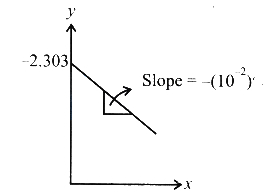
A
$2.303; 10^{-1}$
B
$10^{-2}; 2.303$
C
$10^{-1}; 10^{-2}$
D
$10^{-2}; 10^{-1}$
Solution
(D) For a first order reaction,the integrated rate equation is: $\ln(a-x) = -Kt + \ln a$.
Comparing this with the equation of a straight line $y = mx + c$,where $y = \ln(a-x)$,$x = \text{time}$,slope $m = -K$,and intercept $c = \ln a$.
From the given graph:
Intercept $c = -2.303 = \ln a$.
Therefore,$a = e^{-2.303} \approx 10^{-1} \ mol \ L^{-1}$.
Slope $m = -(10)^{-2} = -K$.
Therefore,$K = 10^{-2} \ s^{-1}$.
Thus,the rate constant is $10^{-2} \ s^{-1}$ and the initial concentration is $10^{-1} \ mol \ L^{-1}$.
Comparing this with the equation of a straight line $y = mx + c$,where $y = \ln(a-x)$,$x = \text{time}$,slope $m = -K$,and intercept $c = \ln a$.
From the given graph:
Intercept $c = -2.303 = \ln a$.
Therefore,$a = e^{-2.303} \approx 10^{-1} \ mol \ L^{-1}$.
Slope $m = -(10)^{-2} = -K$.
Therefore,$K = 10^{-2} \ s^{-1}$.
Thus,the rate constant is $10^{-2} \ s^{-1}$ and the initial concentration is $10^{-1} \ mol \ L^{-1}$.
0 likes
View Solution492
EasyMCQ
The time required for completion of $93.75 \%$ of a first order reaction is $x$ minutes. The half life of it (in minutes) is
A
$x / 8$
B
$x / 2$
C
$x / 4$
D
$x / 3$
Solution
(C) For a first order reaction,the integrated rate equation is $k = \frac{2.303}{t} \log \frac{[A]_0}{[A]_t}$.
Given that $93.75 \%$ of the reaction is complete,the remaining concentration is $[A]_t = [A]_0 - 0.9375[A]_0 = 0.0625[A]_0$.
Substituting this into the rate equation for $t = x$:
$k = \frac{2.303}{x} \log \frac{[A]_0}{0.0625[A]_0} = \frac{2.303}{x} \log(16) = \frac{2.303}{x} \log(2^4) = \frac{2.303 \times 4 \times \log(2)}{x} = \frac{4 \times 0.693}{x}$.
We know that the half-life $t_{1/2}$ is given by $k = \frac{0.693}{t_{1/2}}$.
Equating the two expressions for $k$:
$\frac{0.693}{t_{1/2}} = \frac{4 \times 0.693}{x}$.
Therefore,$t_{1/2} = \frac{x}{4}$ minutes.
Given that $93.75 \%$ of the reaction is complete,the remaining concentration is $[A]_t = [A]_0 - 0.9375[A]_0 = 0.0625[A]_0$.
Substituting this into the rate equation for $t = x$:
$k = \frac{2.303}{x} \log \frac{[A]_0}{0.0625[A]_0} = \frac{2.303}{x} \log(16) = \frac{2.303}{x} \log(2^4) = \frac{2.303 \times 4 \times \log(2)}{x} = \frac{4 \times 0.693}{x}$.
We know that the half-life $t_{1/2}$ is given by $k = \frac{0.693}{t_{1/2}}$.
Equating the two expressions for $k$:
$\frac{0.693}{t_{1/2}} = \frac{4 \times 0.693}{x}$.
Therefore,$t_{1/2} = \frac{x}{4}$ minutes.
0 likes
View Solution493
EasyMCQ
In a first order reaction,the concentration of the reactant is reduced from $0.6 \ mol \ L^{-1}$ to $0.2 \ mol \ L^{-1}$ in $5 \ min$. What is the rate constant of the reaction (in $min^{-1}$)? $(\log 3 = 0.4771)$
A
$0.219$
B
$0.325$
C
$0.421$
D
$0.522$
Solution
(A) For a first order reaction,the rate constant $k$ is given by the formula:
$k = \frac{2.303}{t} \log \frac{[A]_0}{[A]}$
Given values are:
$t = 5 \ min$
$[A]_0 = 0.6 \ mol \ L^{-1}$
$[A] = 0.2 \ mol \ L^{-1}$
Substituting the values in the formula:
$k = \frac{2.303}{5} \log \frac{0.6}{0.2}$
$k = \frac{2.303}{5} \log 3$
Using $\log 3 = 0.4771$:
$k = \frac{2.303 \times 0.4771}{5}$
$k = \frac{1.0988}{5} = 0.21976 \ min^{-1} \approx 0.219 \ min^{-1}$
$k = \frac{2.303}{t} \log \frac{[A]_0}{[A]}$
Given values are:
$t = 5 \ min$
$[A]_0 = 0.6 \ mol \ L^{-1}$
$[A] = 0.2 \ mol \ L^{-1}$
Substituting the values in the formula:
$k = \frac{2.303}{5} \log \frac{0.6}{0.2}$
$k = \frac{2.303}{5} \log 3$
Using $\log 3 = 0.4771$:
$k = \frac{2.303 \times 0.4771}{5}$
$k = \frac{1.0988}{5} = 0.21976 \ min^{-1} \approx 0.219 \ min^{-1}$
0 likes
View Solution494
EasyMCQ
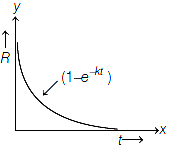
If the decomposition reaction $A_{(g)} \longrightarrow B_{(g)}$ follows first-order kinetics,then the graph of the rate of formation of $B$,denoted by $R$,against time $t$ will be:
A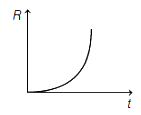
B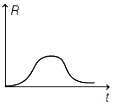
C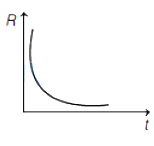
D
None of these
Solution
(C) For a first-order reaction $A \longrightarrow B$:
The rate of formation of $B$ is given by $R = \frac{d[B]}{dt} = k[A]$.
For first-order kinetics,the concentration of reactant $A$ at time $t$ is $[A] = [A]_0 e^{-kt}$.
Substituting this into the rate expression: $R = k[A]_0 e^{-kt}$.
This equation shows that the rate $R$ decreases exponentially with time $t$. Therefore,the graph of $R$ vs $t$ is an exponential decay curve.
The rate of formation of $B$ is given by $R = \frac{d[B]}{dt} = k[A]$.
For first-order kinetics,the concentration of reactant $A$ at time $t$ is $[A] = [A]_0 e^{-kt}$.
Substituting this into the rate expression: $R = k[A]_0 e^{-kt}$.
This equation shows that the rate $R$ decreases exponentially with time $t$. Therefore,the graph of $R$ vs $t$ is an exponential decay curve.
0 likes
View Solution495
EasyMCQ
If the rate constant for a first order reaction is $k$,then find the time required for completion of $80 \%$ of the reaction.
A
$\frac{3.2}{k}$
B
$\frac{1.6}{k}$
C
$\frac{4.8}{k}$
D
$\frac{0.8}{k}$
Solution
(B) For a first order reaction,the rate constant $k$ is given by the equation:
$k = \frac{2.303}{t} \log \frac{[A]_0}{[A]_t}$
Given that $80 \%$ of the reaction is completed,we have:
$[A]_0 = 100$
$[A]_t = 100 - 80 = 20$
Substituting these values into the equation:
$k = \frac{2.303}{t} \log \frac{100}{20}$
$k = \frac{2.303}{t} \log 5$
Since $\log 5 \approx 0.699$,we get:
$k = \frac{2.303 \times 0.699}{t}$
$k \approx \frac{1.609}{t}$
Therefore,the time $t$ required is:
$t \approx \frac{1.6}{k}$
$k = \frac{2.303}{t} \log \frac{[A]_0}{[A]_t}$
Given that $80 \%$ of the reaction is completed,we have:
$[A]_0 = 100$
$[A]_t = 100 - 80 = 20$
Substituting these values into the equation:
$k = \frac{2.303}{t} \log \frac{100}{20}$
$k = \frac{2.303}{t} \log 5$
Since $\log 5 \approx 0.699$,we get:
$k = \frac{2.303 \times 0.699}{t}$
$k \approx \frac{1.609}{t}$
Therefore,the time $t$ required is:
$t \approx \frac{1.6}{k}$
0 likes
View Solution496
EasyMCQ
If the rate constant of a first order reaction is $4.606 \times 10^{-3} \ s^{-1}$,then find the time required for $400 \ g$ of the reactant to reduce to $50 \ g$. (in $min$)
A
$7.52$
B
$0.45$
C
$46.06$
D
$15.05$
Solution
(A) Given: Rate constant $k = 4.606 \times 10^{-3} \ s^{-1}$.
Initial concentration $[A]_0 = 400 \ g$.
Final concentration $[A]_t = 50 \ g$.
For a first order reaction,the formula is $k = \frac{2.303}{t} \log \frac{[A]_0}{[A]_t}$.
Substituting the values: $t = \frac{2.303}{4.606 \times 10^{-3}} \log \frac{400}{50}$.
$t = \frac{2.303}{4.606 \times 10^{-3}} \log 8$.
$t = \frac{2.303}{4.606 \times 10^{-3}} \times 0.9030$.
$t = 0.5 \times 10^3 \times 0.9030 = 451.5 \ s$.
Converting to minutes: $t = \frac{451.5}{60} \ min = 7.525 \ min \approx 7.52 \ min$.
Initial concentration $[A]_0 = 400 \ g$.
Final concentration $[A]_t = 50 \ g$.
For a first order reaction,the formula is $k = \frac{2.303}{t} \log \frac{[A]_0}{[A]_t}$.
Substituting the values: $t = \frac{2.303}{4.606 \times 10^{-3}} \log \frac{400}{50}$.
$t = \frac{2.303}{4.606 \times 10^{-3}} \log 8$.
$t = \frac{2.303}{4.606 \times 10^{-3}} \times 0.9030$.
$t = 0.5 \times 10^3 \times 0.9030 = 451.5 \ s$.
Converting to minutes: $t = \frac{451.5}{60} \ min = 7.525 \ min \approx 7.52 \ min$.
0 likes
View Solution497
MediumMCQ
Which among the following represents the expression for the $\left(\frac{3}{4}\right)^{\text{th}}$ life of a $1^{\text{st}}$ order reaction?
A
$\frac{k}{2.303} \log \left(\frac{4}{3}\right)$
B
$\frac{2.303}{k} \log \left(\frac{3}{4}\right)$
C
$\frac{2.303}{k} \log (4)$
D
$\frac{2.303}{k} \log (3)$
Solution
(C) For a $1^{\text{st}}$ order reaction,the integrated rate equation is given by:
$t = \frac{2.303}{k} \log \left(\frac{a}{a-x}\right)$
For the $\left(\frac{3}{4}\right)^{\text{th}}$ life,$x = \frac{3}{4}a$.
Substituting this value into the equation:
$t_{3/4} = \frac{2.303}{k} \log \left(\frac{a}{a - \frac{3}{4}a}\right)$
$t_{3/4} = \frac{2.303}{k} \log \left(\frac{a}{\frac{1}{4}a}\right)$
$t_{3/4} = \frac{2.303}{k} \log (4)$
$t = \frac{2.303}{k} \log \left(\frac{a}{a-x}\right)$
For the $\left(\frac{3}{4}\right)^{\text{th}}$ life,$x = \frac{3}{4}a$.
Substituting this value into the equation:
$t_{3/4} = \frac{2.303}{k} \log \left(\frac{a}{a - \frac{3}{4}a}\right)$
$t_{3/4} = \frac{2.303}{k} \log \left(\frac{a}{\frac{1}{4}a}\right)$
$t_{3/4} = \frac{2.303}{k} \log (4)$
0 likes
View Solution498
EasyMCQ
$A$ reaction has a rate constant $k = 2.4 \times 10^{-4} \ s^{-1}$. Find the ratio of $t_{99.9}$ to $t_{50}$.
A
$1$
B
$5$
C
$10$
D
$15$
Solution
(C) The unit of $k$ is $s^{-1}$,which indicates that it is a first-order reaction.
For a first-order reaction,the time required for a certain percentage of completion is given by $t = \frac{2.303}{k} \log \frac{[A]_0}{[A]_t}$.
For $t_{99.9}$,the remaining concentration is $0.1 \%$ of the initial concentration,so $t_{99.9} = \frac{2.303}{k} \log \frac{100}{0.1} = \frac{2.303}{k} \log 1000 = \frac{2.303 \times 3}{k}$.
For $t_{50}$,the time is the half-life,$t_{50} = \frac{0.693}{k} = \frac{2.303 \times 0.301}{k}$.
The ratio $\frac{t_{99.9}}{t_{50}} = \frac{3 \times 2.303 / k}{0.301 \times 2.303 / k} = \frac{3}{0.301} \approx 10$.
For a first-order reaction,the time required for a certain percentage of completion is given by $t = \frac{2.303}{k} \log \frac{[A]_0}{[A]_t}$.
For $t_{99.9}$,the remaining concentration is $0.1 \%$ of the initial concentration,so $t_{99.9} = \frac{2.303}{k} \log \frac{100}{0.1} = \frac{2.303}{k} \log 1000 = \frac{2.303 \times 3}{k}$.
For $t_{50}$,the time is the half-life,$t_{50} = \frac{0.693}{k} = \frac{2.303 \times 0.301}{k}$.
The ratio $\frac{t_{99.9}}{t_{50}} = \frac{3 \times 2.303 / k}{0.301 \times 2.303 / k} = \frac{3}{0.301} \approx 10$.
0 likes
View SolutionChemical Kinetics — First Order reaction · Frequently Asked Questions
1Are these Chemical Kinetics questions useful for JEE and NEET?
Yes. All questions in this section are mapped to JEE Main and NEET exam patterns. Previous year questions from JEE Main, NEET, GUJCET and state-level exams are included with full solutions.
2Can I switch to Hindi or Gujarati for these questions?
Yes. Use the language tabs in the hero section or the sidebar to view the same questions and solutions in English, Hindi or Gujarati.
3How do I generate a question paper from this subtopic?
Use the Vedclass Exam Paper Generator — select the chapter and subtopic, set difficulty, and generate Sets A, B, C, D automatically. First 3 chapters of every subject are free.
Vedclass Products
For Students
Vedclass Test Series
Mock tests in real JEE/NEET style with performance analysis. 5-day free trial.
Start Free TrialFor Teachers
Exam Paper Generator
Generate Set A/B/C/D papers from this chapter in 2 minutes. 3 chapters free.
Try FreeFor Institutes
Online Exam Module
Live online exams with unlimited students, 360° analytics & white-label branding.
See DemoFor Teachers & Institutes
Generate a Chemical Kinetics Exam Paper in 2 Minutes
Select subtopic & difficulty — Sets A, B, C, D auto-generated with No Repeat logic.
First 3 chapters of every subject are free — no payment required.