
A English
First Order reaction Questions in English
Class 12 Chemistry · Chemical Kinetics · First Order reaction
534+
Questions
English
Language
100%
With Solutions
Showing 31 of 534 questions in English
501
EasyMCQ
For an elementary reaction,$X_{(g)} \rightarrow Y_{(g)} + Z_{(g)}$,the $t_{1/2}$ is $10 \text{ minutes}$. In what period of time would the concentration of $X$ be reduced to $10 \%$ of its original concentration?
A
$20 \text{ minutes}$
B
$33.2 \text{ minutes}$
C
$15 \text{ minutes}$
D
$25.2 \text{ minutes}$
Solution
(B) For a first-order reaction,the half-life is given by $t_{1/2} = \frac{0.693}{K}$.
Given $t_{1/2} = 10 \text{ minutes}$,the rate constant $K = \frac{0.693}{10} = 0.0693 \text{ min}^{-1}$.
The integrated rate law for a first-order reaction is $t = \frac{2.303}{K} \log \frac{[A]_0}{[A]}$.
Here,$[A] = 10 \% [A]_0 = 0.1 [A]_0$,so $\frac{[A]_0}{[A]} = 10$.
Substituting the values: $t = \frac{2.303}{0.0693} \log(10) = \frac{2.303}{0.0693} \times 1 \approx 33.2 \text{ minutes}$.
Given $t_{1/2} = 10 \text{ minutes}$,the rate constant $K = \frac{0.693}{10} = 0.0693 \text{ min}^{-1}$.
The integrated rate law for a first-order reaction is $t = \frac{2.303}{K} \log \frac{[A]_0}{[A]}$.
Here,$[A] = 10 \% [A]_0 = 0.1 [A]_0$,so $\frac{[A]_0}{[A]} = 10$.
Substituting the values: $t = \frac{2.303}{0.0693} \log(10) = \frac{2.303}{0.0693} \times 1 \approx 33.2 \text{ minutes}$.
0 likes
View Solution502
MediumMCQ
The rate equation for a first-$order$ reaction is given by $R = R_0 e^{-kt}$. $A$ straight line with positive slope is obtained by plotting which of the following? ($R_0 =$ Initial concentration of the reactant,$R =$ concentration of the reactant at time $t$)
A
$\log(R_0/R)$ vs time
B
$R$ vs time
C
$\log R$ vs time
D
$\log(R/R_0)$ vs time
Solution
(A) For a first-$order$ reaction,the rate equation is $R = R_0 e^{-kt}$.
Taking the natural logarithm on both sides: $\ln R = \ln R_0 - kt$.
This can be rearranged as $\ln(R_0/R) = kt$.
Converting to base $10$: $\log(R_0/R) = \frac{kt}{2.303}$.
Comparing this with the equation of a straight line $y = mx + c$,where $y = \log(R_0/R)$ and $x = t$,the slope is $m = \frac{k}{2.303}$,which is positive.
Therefore,plotting $\log(R_0/R)$ vs time gives a straight line with a positive slope.
Taking the natural logarithm on both sides: $\ln R = \ln R_0 - kt$.
This can be rearranged as $\ln(R_0/R) = kt$.
Converting to base $10$: $\log(R_0/R) = \frac{kt}{2.303}$.
Comparing this with the equation of a straight line $y = mx + c$,where $y = \log(R_0/R)$ and $x = t$,the slope is $m = \frac{k}{2.303}$,which is positive.
Therefore,plotting $\log(R_0/R)$ vs time gives a straight line with a positive slope.
0 likes
View Solution503
EasyMCQ
The rate equation for a first-order reaction is given by $[R] = [R]_0 e^{-kt}$. $A$ straight line with a positive slope is obtained by plotting: ($[R]_0 =$ initial concentration of reactant,$[R] =$ concentration of reactant at time $t$)
A
$\log \frac{[R]_0}{[R]}$ vs $t$
B
$[R]$ vs $t$
C
$\log [R]$ vs $t$
D
$\log \frac{[R]}{[R]_0}$ vs $t$
Solution
(A) For a first-order reaction: $[R] = [R]_0 e^{-kt}$.
Taking natural logarithm on both sides: $\ln [R] = \ln [R]_0 - kt$.
Rearranging the terms: $\ln [R]_0 - \ln [R] = kt$,which gives $\ln \frac{[R]_0}{[R]} = kt$.
Converting to base $10$ logarithm: $2.303 \log \frac{[R]_0}{[R]} = kt$.
Therefore,$\log \frac{[R]_0}{[R]} = \frac{k}{2.303} t$.
Comparing this with the equation of a straight line $y = mx + c$,a plot of $\log \frac{[R]_0}{[R]}$ vs $t$ gives a straight line passing through the origin with a positive slope $m = \frac{k}{2.303}$.
Taking natural logarithm on both sides: $\ln [R] = \ln [R]_0 - kt$.
Rearranging the terms: $\ln [R]_0 - \ln [R] = kt$,which gives $\ln \frac{[R]_0}{[R]} = kt$.
Converting to base $10$ logarithm: $2.303 \log \frac{[R]_0}{[R]} = kt$.
Therefore,$\log \frac{[R]_0}{[R]} = \frac{k}{2.303} t$.
Comparing this with the equation of a straight line $y = mx + c$,a plot of $\log \frac{[R]_0}{[R]}$ vs $t$ gives a straight line passing through the origin with a positive slope $m = \frac{k}{2.303}$.
0 likes
View Solution504
EasyMCQ
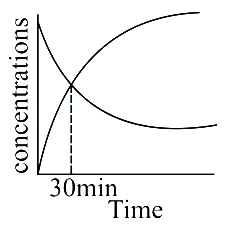
For a first order reaction $A_5 \rightarrow 5 B_2$,the concentration vs time plot is as shown. The half-life of the reaction is
A
$120 \ minutes$
B
$109.75 \ minutes$
C
$112.5 \ minutes$
D
$114 \ minutes$
Solution
(D) The half-life of a reaction is the time required for the reactant concentration to decrease to one-half its initial value.
For a first-order reaction,the rate constant $k$ is given by $k = \frac{2.303}{t} \log \frac{[A]_0}{[A]_t}$.
From the graph,at $t = 30 \ minutes$,the concentration of reactant $[A]_t$ equals the concentration of product $[B_2]$.
Reaction: $A_5 \rightarrow 5 B_2$
Initial: $a \quad 0$
At $t = 30 \ min$: $a-x \quad 5x$
Given $a-x = 5x$,so $a = 6x$.
Substituting into the rate equation:
$k = \frac{2.303}{30} \log \frac{a}{a-x} = \frac{2.303}{30} \log \frac{6x}{x} = \frac{2.303}{30} \log 6 \approx \frac{2.303 \times 0.778}{30} \approx 0.0597 \ min^{-1}$.
The half-life is $t_{1/2} = \frac{0.693}{k} = \frac{0.693}{0.0597} \approx 116 \ minutes$.
Given the options,$114 \ minutes$ is the closest value.
For a first-order reaction,the rate constant $k$ is given by $k = \frac{2.303}{t} \log \frac{[A]_0}{[A]_t}$.
From the graph,at $t = 30 \ minutes$,the concentration of reactant $[A]_t$ equals the concentration of product $[B_2]$.
Reaction: $A_5 \rightarrow 5 B_2$
Initial: $a \quad 0$
At $t = 30 \ min$: $a-x \quad 5x$
Given $a-x = 5x$,so $a = 6x$.
Substituting into the rate equation:
$k = \frac{2.303}{30} \log \frac{a}{a-x} = \frac{2.303}{30} \log \frac{6x}{x} = \frac{2.303}{30} \log 6 \approx \frac{2.303 \times 0.778}{30} \approx 0.0597 \ min^{-1}$.
The half-life is $t_{1/2} = \frac{0.693}{k} = \frac{0.693}{0.0597} \approx 116 \ minutes$.
Given the options,$114 \ minutes$ is the closest value.
0 likes
View Solution505
EasyMCQ
The decomposition of benzene diazonium chloride is a first order reaction. The time taken for the decomposition of $\frac{1}{4}$ and $\frac{1}{10}$ of its initial concentration are $t_{1/4}$ and $t_{1/10}$ respectively. The value of $\frac{t_{1/4}}{t_{1/10}} \times 100$ is (Given: $\log 2 = 0.3, \log 3 = 0.477$)
A
$272$
B
$300$
C
$90$
D
$45$
Solution
(A) For a first order reaction,$k = \frac{2.303}{t} \log \frac{a}{a-x}$.
For $t_{1/4}$,$x = \frac{a}{4}$,so $t_{1/4} = \frac{2.303}{k} \log \frac{a}{3a/4} = \frac{2.303}{k} \log \frac{4}{3}$.
For $t_{1/10}$,$x = \frac{a}{10}$,so $t_{1/10} = \frac{2.303}{k} \log \frac{a}{9a/10} = \frac{2.303}{k} \log \frac{10}{9}$.
Taking the ratio: $\frac{t_{1/4}}{t_{1/10}} = \frac{\log(4/3)}{\log(10/9)} = \frac{\log 4 - \log 3}{\log 10 - \log 9} = \frac{2 \log 2 - \log 3}{1 - 2 \log 3}$.
Using $\log 2 = 0.3$ and $\log 3 = 0.477$: $\frac{t_{1/4}}{t_{1/10}} = \frac{2(0.3) - 0.477}{1 - 2(0.477)} = \frac{0.6 - 0.477}{1 - 0.954} = \frac{0.123}{0.046} \approx 2.67$.
Thus,$\frac{t_{1/4}}{t_{1/10}} \times 100 \approx 267$. The closest option is $272$.
For $t_{1/4}$,$x = \frac{a}{4}$,so $t_{1/4} = \frac{2.303}{k} \log \frac{a}{3a/4} = \frac{2.303}{k} \log \frac{4}{3}$.
For $t_{1/10}$,$x = \frac{a}{10}$,so $t_{1/10} = \frac{2.303}{k} \log \frac{a}{9a/10} = \frac{2.303}{k} \log \frac{10}{9}$.
Taking the ratio: $\frac{t_{1/4}}{t_{1/10}} = \frac{\log(4/3)}{\log(10/9)} = \frac{\log 4 - \log 3}{\log 10 - \log 9} = \frac{2 \log 2 - \log 3}{1 - 2 \log 3}$.
Using $\log 2 = 0.3$ and $\log 3 = 0.477$: $\frac{t_{1/4}}{t_{1/10}} = \frac{2(0.3) - 0.477}{1 - 2(0.477)} = \frac{0.6 - 0.477}{1 - 0.954} = \frac{0.123}{0.046} \approx 2.67$.
Thus,$\frac{t_{1/4}}{t_{1/10}} \times 100 \approx 267$. The closest option is $272$.
0 likes
View Solution506
EasyMCQ
$A \rightarrow P$ is a first order reaction. At $300 \ K$,this reaction was started with $[A] = 0.5 \ mol \ L^{-1}$. The rate constant of the reaction was $0.125 \ min^{-1}$. The same reaction was started separately with $[A] = 1 \ mol \ L^{-1}$ at $300 \ K$. The rate constant (in $min^{-1}$) now is:
A
$0.25$
B
$0.05$
C
$0.125$
D
$1.00$
Solution
(C) For a given chemical reaction,the rate constant $k$ depends only on the temperature and the nature of the reactant.
It is independent of the initial concentration of the reactant.
Since the temperature remains constant at $300 \ K$,the rate constant $k$ will remain the same regardless of the change in initial concentration $[A]$.
Therefore,the rate constant remains $0.125 \ min^{-1}$.
It is independent of the initial concentration of the reactant.
Since the temperature remains constant at $300 \ K$,the rate constant $k$ will remain the same regardless of the change in initial concentration $[A]$.
Therefore,the rate constant remains $0.125 \ min^{-1}$.
0 likes
View Solution507
MediumMCQ
If benzene diazonium chloride undergoes first order decomposition at $T \ K$ with a rate constant of $6.93 \times 10^{-2} \ min^{-1}$,the time for completion of $90 \%$ of the reaction (in $min$) is (nearest integer) $(\log 2 = 0.30, \log 3 = 0.477)$.
A
$15$
B
$30$
C
$33$
D
$43$
Solution
(C) For a first order reaction,the rate equation is given by:
$t = \frac{2.303}{k} \log \frac{a}{a-x}$
Given that the reaction is $90 \%$ complete,we have $a = 100$ and $(a-x) = 100 - 90 = 10$.
The rate constant $k = 6.93 \times 10^{-2} \ min^{-1}$.
Substituting these values into the equation:
$t = \frac{2.303}{6.93 \times 10^{-2}} \log \frac{100}{10}$
$t = \frac{2.303}{0.0693} \times \log(10)$
Since $\log(10) = 1$,we get:
$t = \frac{2.303}{0.0693} \approx 33.23 \ min$.
The nearest integer value is $33 \ min$.
$t = \frac{2.303}{k} \log \frac{a}{a-x}$
Given that the reaction is $90 \%$ complete,we have $a = 100$ and $(a-x) = 100 - 90 = 10$.
The rate constant $k = 6.93 \times 10^{-2} \ min^{-1}$.
Substituting these values into the equation:
$t = \frac{2.303}{6.93 \times 10^{-2}} \log \frac{100}{10}$
$t = \frac{2.303}{0.0693} \times \log(10)$
Since $\log(10) = 1$,we get:
$t = \frac{2.303}{0.0693} \approx 33.23 \ min$.
The nearest integer value is $33 \ min$.
0 likes
View Solution508
MediumMCQ
For the reaction $R \rightarrow P$,the half-life is independent of the initial concentration of the reactant,$R$. Which one of the following graphs is not correct for this reaction?
A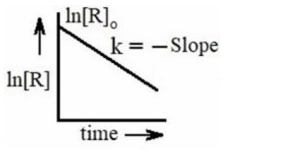
B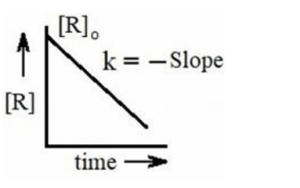
C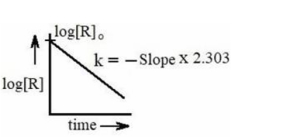
D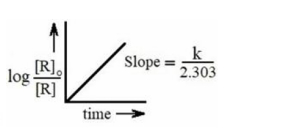
Solution
(B) The condition that the half-life $(t_{1/2})$ is independent of the initial concentration $([R]_0)$ is a characteristic property of a first-order reaction.
For a first-order reaction,the integrated rate equation is $\ln[R] = -kt + \ln[R]_0$,which can also be written as $\log[R] = -\frac{kt}{2.303} + \log[R]_0$ or $\log\frac{[R]_0}{[R]} = \frac{kt}{2.303}$.
Graph $A$ ($\ln[R]$ vs $\text{time}$) is a straight line with slope $-k$,which is correct.
Graph $B$ ($[R]$ vs $\text{time}$) represents an exponential decay curve,not a straight line with a constant negative slope. Therefore,this graph is incorrect for a first-order reaction.
Graph $C$ ($\log[R]$ vs $\text{time}$) is a straight line with slope $-\frac{k}{2.303}$,which is correct.
Graph $D$ ($\log\frac{[R]_0}{[R]}$ vs $\text{time}$) is a straight line passing through the origin with slope $\frac{k}{2.303}$,which is correct.
For a first-order reaction,the integrated rate equation is $\ln[R] = -kt + \ln[R]_0$,which can also be written as $\log[R] = -\frac{kt}{2.303} + \log[R]_0$ or $\log\frac{[R]_0}{[R]} = \frac{kt}{2.303}$.
Graph $A$ ($\ln[R]$ vs $\text{time}$) is a straight line with slope $-k$,which is correct.
Graph $B$ ($[R]$ vs $\text{time}$) represents an exponential decay curve,not a straight line with a constant negative slope. Therefore,this graph is incorrect for a first-order reaction.
Graph $C$ ($\log[R]$ vs $\text{time}$) is a straight line with slope $-\frac{k}{2.303}$,which is correct.
Graph $D$ ($\log\frac{[R]_0}{[R]}$ vs $\text{time}$) is a straight line passing through the origin with slope $\frac{k}{2.303}$,which is correct.
0 likes
View Solution509
MediumMCQ
Consider a general first order reaction $A_{(g)} \rightarrow B_{(g)} + C_{(g)}$. If the initial pressure is $200 \ mm$ and after $20 \ minutes$ it is $250 \ mm$,then the half-life period of the reaction (in minutes) is. $(\log 2 = 0.30, \log 3 = 0.48, \log 4 = 0.60)$
A
$40.2$
B
$50.2$
C
$20.5$
D
$60.5$
Solution
(B) For the reaction $A_{(g)} \rightarrow B_{(g)} + C_{(g)}$,let the initial pressure of $A$ be $P_0 = 200 \ mm$. At time $t = 20 \ min$,let the pressure of $A$ decrease by $x$. The total pressure $P_t = (P_0 - x) + x + x = P_0 + x$. Given $P_t = 250 \ mm$,so $250 = 200 + x$,which gives $x = 50 \ mm$. The pressure of $A$ at $t = 20 \ min$ is $P_A = P_0 - x = 200 - 50 = 150 \ mm$. The rate constant $k = \frac{2.303}{t} \log(\frac{P_0}{P_A}) = \frac{2.303}{20} \log(\frac{200}{150}) = \frac{2.303}{20} \log(\frac{4}{3}) = \frac{2.303}{20} (\log 4 - \log 3) = \frac{2.303}{20} (0.60 - 0.48) = \frac{2.303 \times 0.12}{20} = 0.013818 \ min^{-1}$. The half-life $t_{1/2} = \frac{0.693}{k} = \frac{0.693}{0.013818} \approx 50.15 \ min$. Thus,the half-life is approximately $50.2 \ min$.
0 likes
View Solution510
EasyMCQ
$R \rightarrow P$ is a first order reaction. For this reaction,a graph of $\ln [R]$ (on $y$-axis) and time (on $x$-axis) gives a straight line with a negative slope. The intercept on the $y$-axis is equal to ($k =$ rate constant):
A
$\ln [R]_0$
B
$[R]_0$
C
$k \times 2.303$
D
$\frac{k}{2.303}$
Solution
(A) For a first-order reaction,the integrated rate equation is given by: $\ln [R] = -kt + \ln [R]_0$.
Comparing this with the equation of a straight line,$y = mx + c$,where $y = \ln [R]$,$x = t$,$m = -k$ (slope),and $c = \ln [R]_0$ (intercept).
Therefore,the intercept on the $y$-axis is equal to $\ln [R]_0$.
Comparing this with the equation of a straight line,$y = mx + c$,where $y = \ln [R]$,$x = t$,$m = -k$ (slope),and $c = \ln [R]_0$ (intercept).
Therefore,the intercept on the $y$-axis is equal to $\ln [R]_0$.
0 likes
View Solution511
MediumMCQ
For a first order reaction,the graph between $\log \frac{a}{(a-x)}$ (on $y$-axis) and time (in $min$,on $x$-axis) gave a straight line passing through origin. The slope is $2 \times 10^{-3} \ min^{-1}$. What is the rate constant (in $min^{-1}$)?
A
$2 \times 10^{-3}$
B
$\frac{2 \times 10^{-3}}{2.303}$
C
$4.606 \times 10^{-3}$
D
$0.5 \times 10^{-5}$
Solution
(C) For a first order reaction,the integrated rate equation is given by:
$\log \frac{a}{a-x} = \frac{kt}{2.303}$
Comparing this with the equation of a straight line $y = mx + c$:
Here,$y = \log \frac{a}{a-x}$,$x = t$,and the slope $m = \frac{k}{2.303}$.
Given that the slope $m = 2 \times 10^{-3} \ min^{-1}$,we have:
$\frac{k}{2.303} = 2 \times 10^{-3} \ min^{-1}$
Therefore,$k = 2.303 \times 2 \times 10^{-3} \ min^{-1} = 4.606 \times 10^{-3} \ min^{-1}$.
$\log \frac{a}{a-x} = \frac{kt}{2.303}$
Comparing this with the equation of a straight line $y = mx + c$:
Here,$y = \log \frac{a}{a-x}$,$x = t$,and the slope $m = \frac{k}{2.303}$.
Given that the slope $m = 2 \times 10^{-3} \ min^{-1}$,we have:
$\frac{k}{2.303} = 2 \times 10^{-3} \ min^{-1}$
Therefore,$k = 2.303 \times 2 \times 10^{-3} \ min^{-1} = 4.606 \times 10^{-3} \ min^{-1}$.
0 likes
View Solution512
MediumMCQ
The decomposition of $O_{3(g)}$ follows first order kinetics and is given by $O_{3(g)} \longrightarrow O_{2(g)} + O_{(g)}$. The rate constant for this reaction is $1.0 \times 10^{-3} \ s^{-1}$. The initial pressure of $O_{3(g)}$ is $100 \ atm$. What will be the partial pressure (in $atm$) of $O_3, O_2, O$ respectively after $38.38 \ minutes$?
A
$95, 5, 5$
B
$10, 90, 0$
C
$10, 90, 90$
D
$10, 0, 90$
Solution
(C) The decomposition reaction is $O_{3(g)} \longrightarrow O_{2(g)} + O_{(g)}$.
Initial pressure: $100 \ atm, \ 0, \ 0$.
Pressure after time $t$: $(100-x), \ x, \ x$.
Given: $k = 1.0 \times 10^{-3} \ s^{-1}$,$t = 38.38 \ min = 38.38 \times 60 \ s = 2302.8 \ s$.
Using the first-order rate equation: $k = \frac{2.303}{t} \log \frac{p_i}{p_f}$.
$1.0 \times 10^{-3} = \frac{2.303}{2302.8} \log \frac{100}{100-x}$.
$\log \frac{100}{100-x} = \frac{1.0 \times 10^{-3} \times 2302.8}{2.303} \approx 1$.
$\frac{100}{100-x} = 10^1 = 10$.
$100 = 1000 - 10x \implies 10x = 900 \implies x = 90 \ atm$.
Partial pressure of $O_3 = 100 - 90 = 10 \ atm$.
Partial pressure of $O_2 = 90 \ atm$.
Partial pressure of $O = 90 \ atm$.
Thus,the correct option is $C$.
Initial pressure: $100 \ atm, \ 0, \ 0$.
Pressure after time $t$: $(100-x), \ x, \ x$.
Given: $k = 1.0 \times 10^{-3} \ s^{-1}$,$t = 38.38 \ min = 38.38 \times 60 \ s = 2302.8 \ s$.
Using the first-order rate equation: $k = \frac{2.303}{t} \log \frac{p_i}{p_f}$.
$1.0 \times 10^{-3} = \frac{2.303}{2302.8} \log \frac{100}{100-x}$.
$\log \frac{100}{100-x} = \frac{1.0 \times 10^{-3} \times 2302.8}{2.303} \approx 1$.
$\frac{100}{100-x} = 10^1 = 10$.
$100 = 1000 - 10x \implies 10x = 900 \implies x = 90 \ atm$.
Partial pressure of $O_3 = 100 - 90 = 10 \ atm$.
Partial pressure of $O_2 = 90 \ atm$.
Partial pressure of $O = 90 \ atm$.
Thus,the correct option is $C$.
0 likes
View Solution513
MediumMCQ
The first order decomposition of $H_2O_2$ in an appropriate medium is characterised by a rate constant of $0.2303 \ min^{-1}$. What is the time (in $min$) required to complete $9/10$ fraction of the reaction?
A
$0.1$
B
$10$
C
$100$
D
$0.01$
Solution
(B) Given,rate constant $(k)$ for first order $= 0.2303 \ min^{-1}$.
For a first order reaction,the time $(t)$ is given by:
$t = \frac{2.303}{k} \log \left( \frac{a}{a-x} \right)$
where $a$ is the initial concentration and $x$ is the amount reacted.
Let the initial concentration $(a) = 1$.
Given that the fraction completed is $9/10$,so $x = 0.9$.
The remaining concentration $(a-x) = 1 - 0.9 = 0.1$.
Substituting the values into the equation:
$t = \frac{2.303}{0.2303} \log \left( \frac{1}{0.1} \right)$
$t = 10 \log(10)$
Since $\log(10) = 1$,we get $t = 10 \times 1 = 10 \ min$.
Therefore,the correct option is $(b)$.
For a first order reaction,the time $(t)$ is given by:
$t = \frac{2.303}{k} \log \left( \frac{a}{a-x} \right)$
where $a$ is the initial concentration and $x$ is the amount reacted.
Let the initial concentration $(a) = 1$.
Given that the fraction completed is $9/10$,so $x = 0.9$.
The remaining concentration $(a-x) = 1 - 0.9 = 0.1$.
Substituting the values into the equation:
$t = \frac{2.303}{0.2303} \log \left( \frac{1}{0.1} \right)$
$t = 10 \log(10)$
Since $\log(10) = 1$,we get $t = 10 \times 1 = 10 \ min$.
Therefore,the correct option is $(b)$.
0 likes
View Solution514
EasyMCQ
$A$ particular reaction has a rate constant $1.15 \times 10^{-3} \,s^{-1}$. How long does it take for $6 \,g$ of the reactant to reduce to $3 \,g$ (in $\,s$)? $(\log 2 = 0.301)$
A
$301$
B
$603$
C
$840$
D
$15$
Solution
(B) The unit of the rate constant $k$ is $s^{-1}$, which indicates that the reaction is a first-order reaction.
For a first-order reaction, the rate constant equation is given by:
$k = \frac{2.303}{t} \log \frac{[A]_0}{[A]_t}$
Given:
$k = 1.15 \times 10^{-3} \,s^{-1}$
$[A]_0 = 6 \,g$
$[A]_t = 3 \,g$
Substituting the values:
$1.15 \times 10^{-3} = \frac{2.303}{t} \log \frac{6}{3}$
$1.15 \times 10^{-3} = \frac{2.303}{t} \log 2$
Using $\log 2 = 0.301$:
$t = \frac{2.303 \times 0.301}{1.15 \times 10^{-3}}$
$t = \frac{0.6932}{1.15 \times 10^{-3}}$
$t \approx 602.8 \,s \approx 603 \,s$
For a first-order reaction, the rate constant equation is given by:
$k = \frac{2.303}{t} \log \frac{[A]_0}{[A]_t}$
Given:
$k = 1.15 \times 10^{-3} \,s^{-1}$
$[A]_0 = 6 \,g$
$[A]_t = 3 \,g$
Substituting the values:
$1.15 \times 10^{-3} = \frac{2.303}{t} \log \frac{6}{3}$
$1.15 \times 10^{-3} = \frac{2.303}{t} \log 2$
Using $\log 2 = 0.301$:
$t = \frac{2.303 \times 0.301}{1.15 \times 10^{-3}}$
$t = \frac{0.6932}{1.15 \times 10^{-3}}$
$t \approx 602.8 \,s \approx 603 \,s$
0 likes
View Solution515
MediumMCQ
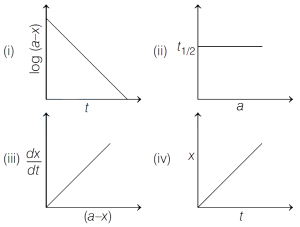
Which of the following graphs represent a first order reaction ($a =$ initial concentration of reactant,$x =$ concentration of reactant consumed,$t =$ time)?
A
$(i), (ii)$
B
$(iii), (iv)$
C
$(ii), (iii)$
D
$(i), (ii), (iii)$
Solution
(D) For a first order reaction,the integrated rate equation is $\log(a-x) = -\frac{kt}{2.303} + \log a$. Thus,a plot of $\log(a-x)$ vs $t$ is a straight line with a negative slope,as shown in $(i)$.
For a first order reaction,the half-life is $t_{1/2} = \frac{0.693}{k}$,which is independent of the initial concentration $a$. Thus,a plot of $t_{1/2}$ vs $a$ is a horizontal line,as shown in $(ii)$.
For a first order reaction,the rate is $\frac{dx}{dt} = k(a-x)$. Thus,a plot of $\frac{dx}{dt}$ vs $(a-x)$ is a straight line passing through the origin,as shown in $(iii)$.
Therefore,graphs $(i), (ii),$ and $(iii)$ represent a first order reaction.
For a first order reaction,the half-life is $t_{1/2} = \frac{0.693}{k}$,which is independent of the initial concentration $a$. Thus,a plot of $t_{1/2}$ vs $a$ is a horizontal line,as shown in $(ii)$.
For a first order reaction,the rate is $\frac{dx}{dt} = k(a-x)$. Thus,a plot of $\frac{dx}{dt}$ vs $(a-x)$ is a straight line passing through the origin,as shown in $(iii)$.
Therefore,graphs $(i), (ii),$ and $(iii)$ represent a first order reaction.
0 likes
View Solution516
MediumMCQ
In a first order reaction,the concentration of the reactant decreases from $0.6 \ M$ to $0.3 \ M$ in $15 \ min$. The time taken for the concentration to change from $0.1 \ M$ to $0.025 \ M$ in minutes is
A
$1.2$
B
$12$
C
$30$
D
$3$
Solution
(C) Since the concentration of the reactant decreases from $0.6 \ M$ to $0.3 \ M$ (i.e.,halved) in $15 \ min$,the half-life $(t_{1/2})$ for this reaction is $15 \ min$.
For a first-order reaction,the concentration decreases by half in each successive half-life interval.
Starting from $0.1 \ M$:
$0.1 \ M$ $\xrightarrow{15 \ min} 0.05 \ M$ $\xrightarrow{15 \ min} 0.025 \ M$.
Total time taken $= 15 \ min + 15 \ min = 30 \ min$.
For a first-order reaction,the concentration decreases by half in each successive half-life interval.
Starting from $0.1 \ M$:
$0.1 \ M$ $\xrightarrow{15 \ min} 0.05 \ M$ $\xrightarrow{15 \ min} 0.025 \ M$.
Total time taken $= 15 \ min + 15 \ min = 30 \ min$.
0 likes
View Solution517
MediumMCQ
Which one of the following plots is correct for a first order reaction?
A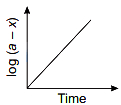
B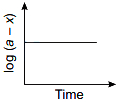
C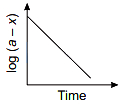
D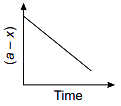
Solution
(C) The integrated rate equation for a first order reaction is given by:
$k = \frac{2.303}{t} \log \frac{a}{(a-x)}$
Rearranging this equation:
$\frac{kt}{2.303} = \log a - \log (a-x)$
$\log (a-x) = -\frac{k}{2.303} t + \log a$
This equation is in the form of a straight line $y = mx + c$,where $y = \log (a-x)$,$x = t$,slope $m = -\frac{k}{2.303}$,and intercept $c = \log a$.
Therefore,a plot of $\log (a-x)$ versus $t$ yields a straight line with a negative slope.
$k = \frac{2.303}{t} \log \frac{a}{(a-x)}$
Rearranging this equation:
$\frac{kt}{2.303} = \log a - \log (a-x)$
$\log (a-x) = -\frac{k}{2.303} t + \log a$
This equation is in the form of a straight line $y = mx + c$,where $y = \log (a-x)$,$x = t$,slope $m = -\frac{k}{2.303}$,and intercept $c = \log a$.
Therefore,a plot of $\log (a-x)$ versus $t$ yields a straight line with a negative slope.
0 likes
View Solution518
DifficultMCQ
For a first order reaction at $27^{\circ} C$,the ratio of time required for $75 \%$ completion to $25 \%$ completion of reaction is
A
$3$
B
$2.303$
C
$4.8$
D
$0.477$
Solution
(C) For a first order reaction,the time $t$ is given by $t = \frac{2.303}{k} \log_{10} \frac{a}{a-x}$.
Let the initial concentration $a = 100$.
For $75 \%$ completion,$x = 75$,so the remaining concentration is $100 - 75 = 25$. Thus,$t_{75\%} = \frac{2.303}{k} \log \frac{100}{25} = \frac{2.303}{k} \log 4$.
For $25 \%$ completion,$x = 25$,so the remaining concentration is $100 - 25 = 75$. Thus,$t_{25\%} = \frac{2.303}{k} \log \frac{100}{75} = \frac{2.303}{k} \log \frac{4}{3}$.
The ratio is $\frac{t_{75\%}}{t_{25\%}} = \frac{\log 4}{\log (4/3)} = \frac{\log 4}{\log 4 - \log 3}$.
Using $\log 4 \approx 0.6020$ and $\log 3 \approx 0.4771$,we get $\frac{0.6020}{0.6020 - 0.4771} = \frac{0.6020}{0.1249} \approx 4.82$.
Let the initial concentration $a = 100$.
For $75 \%$ completion,$x = 75$,so the remaining concentration is $100 - 75 = 25$. Thus,$t_{75\%} = \frac{2.303}{k} \log \frac{100}{25} = \frac{2.303}{k} \log 4$.
For $25 \%$ completion,$x = 25$,so the remaining concentration is $100 - 25 = 75$. Thus,$t_{25\%} = \frac{2.303}{k} \log \frac{100}{75} = \frac{2.303}{k} \log \frac{4}{3}$.
The ratio is $\frac{t_{75\%}}{t_{25\%}} = \frac{\log 4}{\log (4/3)} = \frac{\log 4}{\log 4 - \log 3}$.
Using $\log 4 \approx 0.6020$ and $\log 3 \approx 0.4771$,we get $\frac{0.6020}{0.6020 - 0.4771} = \frac{0.6020}{0.1249} \approx 4.82$.
0 likes
View Solution519
MediumMCQ
The reaction $2A \rightarrow 2B + C$ has a rate constant of $1.2 \times 10^{-2} \ s^{-1}$. Which of the following is correct?
A
Plot of $[A]$ vs $\frac{1}{t}$ will be a straight line
B
Plot of $\frac{1}{[A]}$ vs $t^2$ will be a straight line
C
Plot of $\ln [A]$ vs $t$ will be a straight line
D
Plot of $[A]$ vs $t^2$ will be a straight line
Solution
(C) The unit of the rate constant $k$ is $s^{-1}$,which indicates that the reaction is a $1^{st}$ order reaction.
For a $1^{st}$ order reaction,the integrated rate equation is given by $\ln [A] = \ln [A]_0 - kt$.
Comparing this with the equation of a straight line $y = mx + c$,where $y = \ln [A]$,$x = t$,$m = -k$ (slope),and $c = \ln [A]_0$ (intercept).
Therefore,a plot of $\ln [A]$ versus $t$ will be a straight line with a negative slope equal to $-k$.
For a $1^{st}$ order reaction,the integrated rate equation is given by $\ln [A] = \ln [A]_0 - kt$.
Comparing this with the equation of a straight line $y = mx + c$,where $y = \ln [A]$,$x = t$,$m = -k$ (slope),and $c = \ln [A]_0$ (intercept).
Therefore,a plot of $\ln [A]$ versus $t$ will be a straight line with a negative slope equal to $-k$.
0 likes
View Solution520
MediumMCQ
For a first order reaction $t_{1/2}$ is $1200 \ s$. The specific rate constant in $s^{-1}$ is
A
$5.8 \times 10^{-4}$
B
$5.8 \times 10^{-5}$
C
$0.58 \times 10^{-6}$
D
$0.58 \times 10^{-5}$
Solution
(A) For a first order reaction,the relationship between the rate constant $k$ and the half-life $t_{1/2}$ is given by the formula:
$k = \frac{0.693}{t_{1/2}}$
Given $t_{1/2} = 1200 \ s$.
Substituting the value:
$k = \frac{0.693}{1200} \ s^{-1}$
$k = 0.0005775 \ s^{-1}$
Rounding to two significant figures,we get:
$k \approx 5.8 \times 10^{-4} \ s^{-1}$
$k = \frac{0.693}{t_{1/2}}$
Given $t_{1/2} = 1200 \ s$.
Substituting the value:
$k = \frac{0.693}{1200} \ s^{-1}$
$k = 0.0005775 \ s^{-1}$
Rounding to two significant figures,we get:
$k \approx 5.8 \times 10^{-4} \ s^{-1}$
0 likes
View Solution521
MediumMCQ
For a first order reaction with rate constant $k$,the slope of the plot of $\log(\text{reactant concentration})$ against time is
A
$k / 2.303$
B
$k$
C
$-k / 2.303$
D
$-k$
Solution
(C) For a first order reaction,the integrated rate equation is:
$\ln[A]_t = -kt + \ln[A]_0$
Converting to base $10$ logarithm:
$\log[A]_t = \frac{-kt}{2.303} + \log[A]_0$
Comparing this with the equation of a straight line $y = mx + c$,where $y = \log[A]_t$,$x = t$,and $c = \log[A]_0$,the slope $m$ is equal to $\frac{-k}{2.303}$.
$\ln[A]_t = -kt + \ln[A]_0$
Converting to base $10$ logarithm:
$\log[A]_t = \frac{-kt}{2.303} + \log[A]_0$
Comparing this with the equation of a straight line $y = mx + c$,where $y = \log[A]_t$,$x = t$,and $c = \log[A]_0$,the slope $m$ is equal to $\frac{-k}{2.303}$.
0 likes
View Solution522
MediumMCQ
Consider the following two first order reactions occurring at $298 \ K$ with same initial concentration of $A$: $(1)$ $A \rightarrow B$; rate constant,$k=0.693 \ min^{-1}$ $(2)$ $A \rightarrow C$; half-life,$t_{1/2}=0.693 \ min$. Choose the correct option.
A
Reaction $(1)$ is faster than reaction $(2)$.
B
Reaction $(1)$ is slower than reaction $(2)$.
C
Both reactions proceed at the same rate.
D
Since two different products are formed,rates cannot be compared.
Solution
(B) For a first order reaction,the relationship between half-life $(t_{1/2})$ and rate constant $(k)$ is given by $t_{1/2} = \frac{0.693}{k}$.
For reaction $(1)$: $A \rightarrow B$,$k = 0.693 \ min^{-1}$. Therefore,$t_{1/2} = \frac{0.693}{0.693} = 1.0 \ min$.
For reaction $(2)$: $A \rightarrow C$,$t_{1/2} = 0.693 \ min$. Therefore,$k = \frac{0.693}{0.693} = 1.0 \ min^{-1}$.
Comparing the rate constants,for reaction $(1)$,$k = 0.693 \ min^{-1}$ and for reaction $(2)$,$k = 1.0 \ min^{-1}$.
Since the rate of a first order reaction is $Rate = k[A]$,and the initial concentration of $A$ is the same for both,the reaction with the higher rate constant is faster.
Since $1.0 > 0.693$,reaction $(2)$ is faster than reaction $(1)$,meaning reaction $(1)$ is slower than reaction $(2)$.
For reaction $(1)$: $A \rightarrow B$,$k = 0.693 \ min^{-1}$. Therefore,$t_{1/2} = \frac{0.693}{0.693} = 1.0 \ min$.
For reaction $(2)$: $A \rightarrow C$,$t_{1/2} = 0.693 \ min$. Therefore,$k = \frac{0.693}{0.693} = 1.0 \ min^{-1}$.
Comparing the rate constants,for reaction $(1)$,$k = 0.693 \ min^{-1}$ and for reaction $(2)$,$k = 1.0 \ min^{-1}$.
Since the rate of a first order reaction is $Rate = k[A]$,and the initial concentration of $A$ is the same for both,the reaction with the higher rate constant is faster.
Since $1.0 > 0.693$,reaction $(2)$ is faster than reaction $(1)$,meaning reaction $(1)$ is slower than reaction $(2)$.
0 likes
View Solution523
DifficultMCQ
The time taken for $10 \%$ completion of a first order reaction is $20 \ min$. Then,for $19 \%$ completion,the reaction will take (in $min$)
A
$40$
B
$60$
C
$30$
D
$50$
Solution
(A) For a first order reaction,the rate equation is $t = \frac{2.303}{k} \log \frac{100}{100 - x}$.
For $10 \%$ completion $(x = 10)$: $20 = \frac{2.303}{k} \log \frac{100}{90} = \frac{2.303}{k} \log (10/9)$ $(i)$.
For $19 \%$ completion $(x = 19)$: $t = \frac{2.303}{k} \log \frac{100}{100 - 19} = \frac{2.303}{k} \log \frac{100}{81} = \frac{2.303}{k} \log (10/9)^2 = 2 \times \frac{2.303}{k} \log (10/9)$ (ii).
Dividing equation (ii) by equation $(i)$:
$\frac{t}{20} = \frac{2 \times \frac{2.303}{k} \log (10/9)}{\frac{2.303}{k} \log (10/9)} = 2$.
Therefore,$t = 20 \times 2 = 40 \ min$.
For $10 \%$ completion $(x = 10)$: $20 = \frac{2.303}{k} \log \frac{100}{90} = \frac{2.303}{k} \log (10/9)$ $(i)$.
For $19 \%$ completion $(x = 19)$: $t = \frac{2.303}{k} \log \frac{100}{100 - 19} = \frac{2.303}{k} \log \frac{100}{81} = \frac{2.303}{k} \log (10/9)^2 = 2 \times \frac{2.303}{k} \log (10/9)$ (ii).
Dividing equation (ii) by equation $(i)$:
$\frac{t}{20} = \frac{2 \times \frac{2.303}{k} \log (10/9)}{\frac{2.303}{k} \log (10/9)} = 2$.
Therefore,$t = 20 \times 2 = 40 \ min$.
0 likes
View Solution524
DifficultMCQ
An organic compound undergoes first order decomposition. The time taken for decomposition to $\left(\frac{1}{8}\right)^{\text{th}}$ and $\left(\frac{1}{10}\right)^{\text{th}}$ of its initial concentration are $t_{1/8}$ and $t_{1/10}$ respectively. What is the value of $\frac{t_{1/8}}{t_{1/10}} \times 10$? (Given: $\log 2 = 0.3$)
A
$9$
B
$0.9$
C
$3$
D
$30$
Solution
(A) For a first-order reaction,the time $t$ taken for the concentration to reach $A_t$ from $A_0$ is given by $t = \frac{1}{k} \ln \frac{A_0}{A_t}$.
For $t_{1/8}$,the remaining concentration is $\frac{A_0}{8}$,so $t_{1/8} = \frac{1}{k} \ln \frac{A_0}{A_0/8} = \frac{1}{k} \ln 8$.
For $t_{1/10}$,the remaining concentration is $\frac{A_0}{10}$,so $t_{1/10} = \frac{1}{k} \ln \frac{A_0}{A_0/10} = \frac{1}{k} \ln 10$.
Taking the ratio: $\frac{t_{1/8}}{t_{1/10}} = \frac{\ln 8}{\ln 10} = \frac{\log 8}{\log 10} = \log 8$.
Since $\log 8 = \log 2^3 = 3 \log 2 = 3 \times 0.3 = 0.9$.
Therefore,$\frac{t_{1/8}}{t_{1/10}} \times 10 = 0.9 \times 10 = 9$.
For $t_{1/8}$,the remaining concentration is $\frac{A_0}{8}$,so $t_{1/8} = \frac{1}{k} \ln \frac{A_0}{A_0/8} = \frac{1}{k} \ln 8$.
For $t_{1/10}$,the remaining concentration is $\frac{A_0}{10}$,so $t_{1/10} = \frac{1}{k} \ln \frac{A_0}{A_0/10} = \frac{1}{k} \ln 10$.
Taking the ratio: $\frac{t_{1/8}}{t_{1/10}} = \frac{\ln 8}{\ln 10} = \frac{\log 8}{\log 10} = \log 8$.
Since $\log 8 = \log 2^3 = 3 \log 2 = 3 \times 0.3 = 0.9$.
Therefore,$\frac{t_{1/8}}{t_{1/10}} \times 10 = 0.9 \times 10 = 9$.
0 likes
View Solution525
DifficultMCQ
Decomposition of $A$ is a first order reaction at $T \ K$ and is given by $A_{(g)} \rightarrow B_{(g)} + C_{(g)}$. In a closed $1 \ L$ vessel,$1 \ bar$ of $A_{(g)}$ is allowed to decompose at $T \ K$. After $100 \ minutes$,the total pressure was $1.5 \ bar$. What is the rate constant (in $min^{-1}$) of the reaction? (Given: $\log 2 = 0.3$)
A
$6.9 \times 10^{-1}$
B
$6.9 \times 10^{-3}$
C
$6.9 \times 10^{-2}$
D
$6.9 \times 10^{-4}$
Solution
(B) The reaction is $A_{(g)} \rightarrow B_{(g)} + C_{(g)}$.
Initially $(t=0)$: $P_A = 1 \ bar$,$P_B = 0$,$P_C = 0$. Total pressure $P_0 = 1 \ bar$.
At time $t = 100 \ min$: $P_A = 1 - x$,$P_B = x$,$P_C = x$.
Total pressure $P_t = (1 - x) + x + x = 1 + x$.
Given $P_t = 1.5 \ bar$,so $1 + x = 1.5 \implies x = 0.5 \ bar$.
Partial pressure of $A$ at $t = 100 \ min$ is $P_A = 1 - 0.5 = 0.5 \ bar$.
For a first-order reaction,$k = \frac{2.303}{t} \log \frac{P_0}{P_A}$.
$k = \frac{2.303}{100} \log \frac{1}{0.5} = \frac{2.303}{100} \log 2$.
Using $\log 2 = 0.3$,$k = \frac{2.303 \times 0.3}{100} = \frac{0.6909}{100} \approx 6.9 \times 10^{-3} \ min^{-1}$.
Initially $(t=0)$: $P_A = 1 \ bar$,$P_B = 0$,$P_C = 0$. Total pressure $P_0 = 1 \ bar$.
At time $t = 100 \ min$: $P_A = 1 - x$,$P_B = x$,$P_C = x$.
Total pressure $P_t = (1 - x) + x + x = 1 + x$.
Given $P_t = 1.5 \ bar$,so $1 + x = 1.5 \implies x = 0.5 \ bar$.
Partial pressure of $A$ at $t = 100 \ min$ is $P_A = 1 - 0.5 = 0.5 \ bar$.
For a first-order reaction,$k = \frac{2.303}{t} \log \frac{P_0}{P_A}$.
$k = \frac{2.303}{100} \log \frac{1}{0.5} = \frac{2.303}{100} \log 2$.
Using $\log 2 = 0.3$,$k = \frac{2.303 \times 0.3}{100} = \frac{0.6909}{100} \approx 6.9 \times 10^{-3} \ min^{-1}$.
0 likes
View Solution526
DifficultMCQ
When the value of rate constant $(k)$ is $2.0 \text{ min}^{-1}$,then what will be the half-life of the reaction $(t_{1/2})$ in seconds?
A
$34.4$
B
$24.6$
C
$30.2$
D
$20.8$
Solution
(D) For a first-order reaction,the rate constant is given as $k = 2.0 \text{ min}^{-1}$.
The formula for the half-life $(t_{1/2})$ of a first-order reaction is $t_{1/2} = \frac{0.693}{k}$.
Substituting the value of $k$: $t_{1/2} = \frac{0.693}{2.0} = 0.3465 \text{ min}$.
To convert the half-life from minutes to seconds,multiply by $60$: $0.3465 \text{ min} \times 60 \text{ s/min} = 20.79 \text{ s}$.
Rounding to one decimal place,we get $20.8 \text{ seconds}$.
The formula for the half-life $(t_{1/2})$ of a first-order reaction is $t_{1/2} = \frac{0.693}{k}$.
Substituting the value of $k$: $t_{1/2} = \frac{0.693}{2.0} = 0.3465 \text{ min}$.
To convert the half-life from minutes to seconds,multiply by $60$: $0.3465 \text{ min} \times 60 \text{ s/min} = 20.79 \text{ s}$.
Rounding to one decimal place,we get $20.8 \text{ seconds}$.
0 likes
View Solution527
DifficultMCQ
For a first-order gas-phase reaction $A(g) \to B(g) + C(g)$,let $p_i$ be the initial pressure of gas $A$ and $p_t$ be the total pressure of the reaction mixture at time $t$. The expression for the rate constant $(k)$ is:
A
$\frac{1}{t} \ln \frac{p_i}{2p_i - p_t}$
B
$\frac{1}{t} \ln \frac{2p_i}{p_i - p_t}$
C
$\frac{1}{t} \ln \frac{p_i}{3p_i - 2p_t}$
D
$\frac{1}{t} \ln \frac{3p_i}{4p_i - p_t}$
Solution
(A) $1$. Consider the reaction: $A(g) \to B(g) + C(g)$.
$2$. At $t = 0$,the initial pressure of $A$ is $p_i$,and the pressures of $B$ and $C$ are $0$.
$3$. At time $t$,let $x$ be the decrease in pressure of $A$. The pressures are: $P_A = p_i - x$,$P_B = x$,and $P_C = x$.
$4$. The total pressure $p_t$ at time $t$ is given by: $p_t = (p_i - x) + x + x = p_i + x$.
$5$. From this,we find $x = p_t - p_i$.
$6$. The partial pressure of $A$ at time $t$ is $P_A = p_i - x = p_i - (p_t - p_i) = 2p_i - p_t$.
$7$. For a first-order reaction,the rate constant $k$ is given by: $k = \frac{1}{t} \ln \frac{p_i}{P_A}$.
$8$. Substituting $P_A$,we get: $k = \frac{1}{t} \ln \frac{p_i}{2p_i - p_t}$.
$2$. At $t = 0$,the initial pressure of $A$ is $p_i$,and the pressures of $B$ and $C$ are $0$.
$3$. At time $t$,let $x$ be the decrease in pressure of $A$. The pressures are: $P_A = p_i - x$,$P_B = x$,and $P_C = x$.
$4$. The total pressure $p_t$ at time $t$ is given by: $p_t = (p_i - x) + x + x = p_i + x$.
$5$. From this,we find $x = p_t - p_i$.
$6$. The partial pressure of $A$ at time $t$ is $P_A = p_i - x = p_i - (p_t - p_i) = 2p_i - p_t$.
$7$. For a first-order reaction,the rate constant $k$ is given by: $k = \frac{1}{t} \ln \frac{p_i}{P_A}$.
$8$. Substituting $P_A$,we get: $k = \frac{1}{t} \ln \frac{p_i}{2p_i - p_t}$.
0 likes
View Solution528
MediumMCQ
Consider the first order reaction $R \to P$. The fraction of molecules decomposed in the given first order reaction can be expressed as:
A
$1 - e^{kt}$
B
$1 + e^{kt}$
C
$1 - e^{-kt}$
D
$e^{-kt}$
Solution
(C) $1$. For a first order reaction,the concentration of reactant at time $t$ is given by $[R]_t = [R]_0 e^{-kt}$.
$2$. The fraction of reactant remaining at time $t$ is the ratio of the concentration at time $t$ to the initial concentration: $\frac{[R]_t}{[R]_0} = e^{-kt}$.
$3$. The fraction of molecules decomposed is equal to $1$ minus the fraction remaining: $\text{Fraction decomposed} = 1 - \frac{[R]_t}{[R]_0} = 1 - e^{-kt}$.
$2$. The fraction of reactant remaining at time $t$ is the ratio of the concentration at time $t$ to the initial concentration: $\frac{[R]_t}{[R]_0} = e^{-kt}$.
$3$. The fraction of molecules decomposed is equal to $1$ minus the fraction remaining: $\text{Fraction decomposed} = 1 - \frac{[R]_t}{[R]_0} = 1 - e^{-kt}$.
0 likes
View Solution529
MediumMCQ
Sucrose hydrolyses in acidic medium into glucose and fructose by first order rate law with $t_{1/2} = 3 \text{ hours}$. The percentage of sucrose remaining after $6 \text{ hours}$ is . . . . . . . (Nearest integer) (Given: $\log 2 = 0.3010$ and $\log 3 = 0.4771$)
A
$25$
B
$50$
C
$75$
D
$100$
Solution
(A) For a first-order reaction,the amount remaining after $n$ half-lives is given by the formula $N = N_0 \times (1/2)^n$.
Here,the total time is $t = 6 \text{ hours}$ and the half-life is $t_{1/2} = 3 \text{ hours}$.
The number of half-lives $n$ is calculated as $n = t / t_{1/2} = 6 / 3 = 2$.
The fraction of sucrose remaining is $(1/2)^n = (1/2)^2 = 1/4 = 0.25$.
To find the percentage remaining,we multiply the fraction by $100$: $0.25 \times 100 = 25\%$.
Thus,$25\%$ of the sucrose remains after $6 \text{ hours}$.
Here,the total time is $t = 6 \text{ hours}$ and the half-life is $t_{1/2} = 3 \text{ hours}$.
The number of half-lives $n$ is calculated as $n = t / t_{1/2} = 6 / 3 = 2$.
The fraction of sucrose remaining is $(1/2)^n = (1/2)^2 = 1/4 = 0.25$.
To find the percentage remaining,we multiply the fraction by $100$: $0.25 \times 100 = 25\%$.
Thus,$25\%$ of the sucrose remains after $6 \text{ hours}$.
0 likes
View Solution530
DifficultMCQ
If the half-life of a first-order reaction is $6.93$ minutes,then the time required for the completion of $99\%$ of the reaction will be . . . . . . minutes. (Given: $\log 2 = 0.3010$)
A
$46$
B
$92$
C
$23$
D
$69$
Solution
(A) $1$. For a first-order reaction,the rate constant $k$ is given by $k = 0.693 / t_{1/2}$.
Given $t_{1/2} = 6.93$ minutes,so $k = 0.693 / 6.93 = 0.1 \text{ min}^{-1}$.
$2$. The time $t$ required for the completion of $99\%$ of the reaction is calculated using the formula: $t = (2.303 / k) \log([A]_0 / [A]_t)$.
Here,$[A]_0 = 100$ and $[A]_t = 100 - 99 = 1$.
$3$. Substituting the values: $t = (2.303 / 0.1) \log(100 / 1) = 23.03 \times \log(10^2) = 23.03 \times 2 = 46.06$ minutes.
Rounding to the nearest integer,the time is $46$ minutes.
Given $t_{1/2} = 6.93$ minutes,so $k = 0.693 / 6.93 = 0.1 \text{ min}^{-1}$.
$2$. The time $t$ required for the completion of $99\%$ of the reaction is calculated using the formula: $t = (2.303 / k) \log([A]_0 / [A]_t)$.
Here,$[A]_0 = 100$ and $[A]_t = 100 - 99 = 1$.
$3$. Substituting the values: $t = (2.303 / 0.1) \log(100 / 1) = 23.03 \times \log(10^2) = 23.03 \times 2 = 46.06$ minutes.
Rounding to the nearest integer,the time is $46$ minutes.
0 likes
View Solution531
DifficultMCQ
For a first order reaction $A \rightarrow B$,the data is provided in the table below. Find $x$ in minutes. (Nearest integer)
| $t/\text{min}$ | $[A]/M$ |
|---|---|
| $0$ | $0.6500$ |
| $x$ | $0.0650$ |
| $20$ | $0.00065$ |
A
$10$
B
$5$
C
$15$
D
$20$
Solution
(A) For a first-order reaction,the rate constant $k$ is given by the formula:
$k = \frac{1}{t} \ln\left(\frac{[A]_0}{[A]_t}\right)$
At $t = 20 \text{ min}$,$[A]_0 = 0.6500 \text{ M}$ and $[A]_t = 0.00065 \text{ M}$.
$k = \frac{1}{20} \ln\left(\frac{0.6500}{0.00065}\right) = \frac{1}{20} \ln(1000) = \frac{1}{20} \times 6.908 = 0.3454 \text{ min}^{-1}$.
Now,for $t = x$,$[A]_t = 0.0650 \text{ M}$.
$k = \frac{1}{x} \ln\left(\frac{[A]_0}{[A]_t}\right)$
$0.3454 = \frac{1}{x} \ln\left(\frac{0.6500}{0.0650}\right)$
$0.3454 = \frac{1}{x} \ln(10)$
$0.3454 = \frac{2.303}{x}$
$x = \frac{2.303}{0.3454} \approx 6.67 \text{ min}$.
Rounding to the nearest integer,we get $x = 7 \text{ min}$. However,looking at the options provided,there might be a discrepancy in the question data or options. If we consider the ratio of concentrations,$[A]_0/[A]_x = 10$ and $[A]_0/[A]_{20} = 1000 = 10^3$. Since the reaction is first order,the time taken for a concentration change of $10^n$ is proportional to $n$. Thus,if $20 \text{ min}$ corresponds to $n=3$,then $x$ (for $n=1$) should be $20/3 \approx 6.67 \text{ min}$. Given the options,$x = 7$ is the closest integer.
$k = \frac{1}{t} \ln\left(\frac{[A]_0}{[A]_t}\right)$
At $t = 20 \text{ min}$,$[A]_0 = 0.6500 \text{ M}$ and $[A]_t = 0.00065 \text{ M}$.
$k = \frac{1}{20} \ln\left(\frac{0.6500}{0.00065}\right) = \frac{1}{20} \ln(1000) = \frac{1}{20} \times 6.908 = 0.3454 \text{ min}^{-1}$.
Now,for $t = x$,$[A]_t = 0.0650 \text{ M}$.
$k = \frac{1}{x} \ln\left(\frac{[A]_0}{[A]_t}\right)$
$0.3454 = \frac{1}{x} \ln\left(\frac{0.6500}{0.0650}\right)$
$0.3454 = \frac{1}{x} \ln(10)$
$0.3454 = \frac{2.303}{x}$
$x = \frac{2.303}{0.3454} \approx 6.67 \text{ min}$.
Rounding to the nearest integer,we get $x = 7 \text{ min}$. However,looking at the options provided,there might be a discrepancy in the question data or options. If we consider the ratio of concentrations,$[A]_0/[A]_x = 10$ and $[A]_0/[A]_{20} = 1000 = 10^3$. Since the reaction is first order,the time taken for a concentration change of $10^n$ is proportional to $n$. Thus,if $20 \text{ min}$ corresponds to $n=3$,then $x$ (for $n=1$) should be $20/3 \approx 6.67 \text{ min}$. Given the options,$x = 7$ is the closest integer.
0 likes
View SolutionChemical Kinetics — First Order reaction · Frequently Asked Questions
1Are these Chemical Kinetics questions useful for JEE and NEET?
Yes. All questions in this section are mapped to JEE Main and NEET exam patterns. Previous year questions from JEE Main, NEET, GUJCET and state-level exams are included with full solutions.
2Can I switch to Hindi or Gujarati for these questions?
Yes. Use the language tabs in the hero section or the sidebar to view the same questions and solutions in English, Hindi or Gujarati.
3How do I generate a question paper from this subtopic?
Use the Vedclass Exam Paper Generator — select the chapter and subtopic, set difficulty, and generate Sets A, B, C, D automatically. First 3 chapters of every subject are free.
Vedclass Products
For Students
Vedclass Test Series
Mock tests in real JEE/NEET style with performance analysis. 5-day free trial.
Start Free TrialFor Teachers
Exam Paper Generator
Generate Set A/B/C/D papers from this chapter in 2 minutes. 3 chapters free.
Try FreeFor Institutes
Online Exam Module
Live online exams with unlimited students, 360° analytics & white-label branding.
See DemoFor Teachers & Institutes
Generate a Chemical Kinetics Exam Paper in 2 Minutes
Select subtopic & difficulty — Sets A, B, C, D auto-generated with No Repeat logic.
First 3 chapters of every subject are free — no payment required.