
A English
Fats and Lipids Questions in English
Class 12 Chemistry · Biomolecules · Fats and Lipids
86+
Questions
English
Language
100%
With Solutions
Showing 36 of 86 questions in English
51
EasyMCQ
Hydrolysis of oils and fats yields which alcohol?
A
Glycol
B
Glycerol
D
Pentanol
Solution
(B) Oils and fats are triglycerides,which are esters of glycerol with long-chain fatty acids. Upon hydrolysis (saponification or acid-catalyzed hydrolysis),they break down into fatty acids and $Glycerol$ $(CH_2OH-CHOH-CH_2OH)$.
0 likes
View Solution52
EasyMCQ
The correct order of calorific value is:
A
$Fat > Protein > Carbohydrate$
B
$Carbohydrate > Fat > Protein$
C
$Protein > Carbohydrate > Fat$
D
$Fat > Carbohydrate > Protein$
Solution
(A) The physiological calorific value of food components is as follows:
$1$. $Fat$: $9.45 \ kcal/g$
$2$. $Protein$: $5.65 \ kcal/g$ (Gross) or $4.0 \ kcal/g$ (Physiological)
$3$. $Carbohydrate$: $4.1 \ kcal/g$
Therefore,the correct order of calorific value is $Fat > Protein > Carbohydrate$.
$1$. $Fat$: $9.45 \ kcal/g$
$2$. $Protein$: $5.65 \ kcal/g$ (Gross) or $4.0 \ kcal/g$ (Physiological)
$3$. $Carbohydrate$: $4.1 \ kcal/g$
Therefore,the correct order of calorific value is $Fat > Protein > Carbohydrate$.
0 likes
View Solution53
EasyMCQ
In our body,energy is stored in the form of......
A
$ATP$
B
$ADP$
C
Fats
D
Carbohydrates
Solution
(A) In our body,energy is stored in the form of $ATP$ (Adenosine Triphosphate).
0 likes
View Solution54
EasyMCQ
How are soaps classified?
A
Carbohydrates
B
Salts of fatty acids
C
Ethers
D
Alcohols
Solution
(B) Soaps are the sodium or potassium salts of long-chain fatty acids,such as stearic,oleic,or palmitic acid. They are produced by the process of saponification,where fats or oils are treated with an aqueous alkali solution.
0 likes
View Solution55
MediumMCQ
Glycerol is obtained from which of the following?
A
Fats
B
Propylene
C
Both $(A)$ and $(B)$
D
None of these
Solution
(C) Glycerol is a byproduct of the saponification of fats and oils.
It can also be synthesized industrially from propylene via the chlorination process to form allyl chloride,followed by hydrolysis.
It can also be synthesized industrially from propylene via the chlorination process to form allyl chloride,followed by hydrolysis.
0 likes
View Solution56
MediumMCQ
Which of the following is an unsaturated fatty acid?
A
Oleic acid
B
Lauric acid
C
Stearic acid
D
Palmitic acid
Solution
(A) Oleic acid $(C_{17}H_{33}COOH)$ is an unsaturated fatty acid.
It contains one double bond in its hydrocarbon chain,with the structure $CH_3(CH_2)_7CH=CH(CH_2)_7COOH$.
It contains one double bond in its hydrocarbon chain,with the structure $CH_3(CH_2)_7CH=CH(CH_2)_7COOH$.
0 likes
View Solution57
EasyMCQ
Which of the following functional groups is present in waxes?
A
Acid
B
Ester
C
Alcohol
D
Ether
Solution
(B) Waxes are chemically defined as esters of long-chain fatty acids and long-chain monohydric alcohols. Therefore,the functional group present in waxes is the $Ester$ group.
0 likes
View Solution58
DifficultMCQ
$CH_2-O-COR_1$
$|$
$CH-O-COR_2$
$|$
$CH_2-O-COR_3 + 3NaOH \to (A) + 3R-COONa$ (Salt of fatty acid/soap)
Product $(A)$ of the reaction is
$|$
$CH-O-COR_2$
$|$
$CH_2-O-COR_3 + 3NaOH \to (A) + 3R-COONa$ (Salt of fatty acid/soap)
Product $(A)$ of the reaction is
A
Ethylene glycol
B
Glycerol
C
Glyceryltrinitrate (explosive)
D
Cumene hydrogen peroxide
Solution
(B) The given reaction is the alkaline hydrolysis of a triglyceride (fat or oil),which is known as saponification.
The reaction is:
$CH_2(OCOR_1)-CH(OCOR_2)-CH_2(OCOR_3) + 3NaOH \to CH_2(OH)-CH(OH)-CH_2(OH) + 3R-COONa$
Here,the product $(A)$ is $CH_2(OH)-CH(OH)-CH_2(OH)$,which is commonly known as glycerol (or propane-$1,2,3$-triol).
Therefore,the correct option is $(B)$.
The reaction is:
$CH_2(OCOR_1)-CH(OCOR_2)-CH_2(OCOR_3) + 3NaOH \to CH_2(OH)-CH(OH)-CH_2(OH) + 3R-COONa$
Here,the product $(A)$ is $CH_2(OH)-CH(OH)-CH_2(OH)$,which is commonly known as glycerol (or propane-$1,2,3$-triol).
Therefore,the correct option is $(B)$.
0 likes
View Solution59
AdvancedMCQ
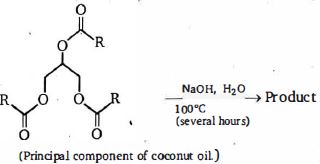
The product obtained in the above reaction is:
A
$RCOONa$
B
Glycerol
C
Both $(a)$ and $(b)$
D
None of these
Solution
(C) The reaction shown is the alkaline hydrolysis of a triglyceride (a fat or oil),which is known as saponification.
When a triglyceride reacts with $NaOH$ and $H_2O$,it undergoes hydrolysis to produce the sodium salt of the fatty acid $(RCOONa)$ and glycerol $(CH_2(OH)CH(OH)CH_2OH)$.
Therefore,both products are formed.
When a triglyceride reacts with $NaOH$ and $H_2O$,it undergoes hydrolysis to produce the sodium salt of the fatty acid $(RCOONa)$ and glycerol $(CH_2(OH)CH(OH)CH_2OH)$.
Therefore,both products are formed.
0 likes
View Solution60
EasyMCQ
Which of the following represents soap?
A
$C_{17}H_{35}COOK$
B
$C_{17}H_{35}COOH$
C
$C_{15}H_{31}COOH$
D
$(C_{17}H_{35}COO)_2Ca$
Solution
(A) Soaps are defined as the sodium or potassium salts of long-chain fatty acids.
$C_{17}H_{35}COOK$ is potassium stearate,which is a soap.
$C_{17}H_{35}COOH$ and $C_{15}H_{31}COOH$ are fatty acids.
$(C_{17}H_{35}COO)_2Ca$ is a calcium salt,which is insoluble in water and forms scum instead of soap.
Thus,the correct option is $A$.
$C_{17}H_{35}COOK$ is potassium stearate,which is a soap.
$C_{17}H_{35}COOH$ and $C_{15}H_{31}COOH$ are fatty acids.
$(C_{17}H_{35}COO)_2Ca$ is a calcium salt,which is insoluble in water and forms scum instead of soap.
Thus,the correct option is $A$.
0 likes
View Solution61
MediumMCQ
How many different types of acyl groups are present in a triglyceride?
A
$1$
B
$2$
C
$3$
D
$4$
Solution
(C) triglyceride is an ester derived from glycerol and three fatty acids.
In a triglyceride,the three hydroxyl groups of glycerol are esterified with three fatty acid molecules.
These fatty acid chains are attached to the glycerol backbone via ester linkages,forming acyl groups.
Depending on the specific triglyceride,these three acyl groups can be the same (simple triglyceride) or different (mixed triglyceride).
However,the structure of a triglyceride molecule inherently contains $3$ acyl groups attached to the glycerol backbone.
In a triglyceride,the three hydroxyl groups of glycerol are esterified with three fatty acid molecules.
These fatty acid chains are attached to the glycerol backbone via ester linkages,forming acyl groups.
Depending on the specific triglyceride,these three acyl groups can be the same (simple triglyceride) or different (mixed triglyceride).
However,the structure of a triglyceride molecule inherently contains $3$ acyl groups attached to the glycerol backbone.
0 likes
View Solution62
EasyMCQ
Phospholipids are esters of glycerol with which of the following?
A
Three carboxylic acid residues
B
Two carboxylic acid residues and one phosphate group
C
One carboxylic acid residue and two phosphate groups
D
Three phosphate groups
Solution
(B) Phospholipids are a class of lipids that are major components of all cell membranes.
They are derivatives of glycerol where two of the hydroxyl groups are esterified with fatty acids (carboxylic acid residues) and the third hydroxyl group is esterified with a phosphoric acid group,which is often further linked to other polar head groups.
Therefore,the correct composition is two carboxylic acid residues and one phosphate group.
They are derivatives of glycerol where two of the hydroxyl groups are esterified with fatty acids (carboxylic acid residues) and the third hydroxyl group is esterified with a phosphoric acid group,which is often further linked to other polar head groups.
Therefore,the correct composition is two carboxylic acid residues and one phosphate group.
0 likes
View Solution63
EasyMCQ
Which linkage is present in fats?
A
Peptide linkage
B
Ester linkage
C
Glycosidic linkage
D
Diphosphoester linkage
Solution
(B) Fats are triglycerides,which are triesters of glycerol with three fatty acid molecules.
They are formed by the reaction between the hydroxyl groups of glycerol and the carboxyl groups of fatty acids,resulting in the formation of an $ester$ linkage $(-COO-)$.
They are formed by the reaction between the hydroxyl groups of glycerol and the carboxyl groups of fatty acids,resulting in the formation of an $ester$ linkage $(-COO-)$.
0 likes
View Solution64
MediumMCQ
What does drying oil contain?
A
Linoleic acid
B
Lauric acid
C
Stearic acid
D
Butyric acid
Solution
(A) Drying oils are oils that harden into a tough,solid film after a period of exposure to air. This property is due to the presence of high levels of polyunsaturated fatty acids,specifically $Linoleic \ acid$ and $Linolenic \ acid$,which undergo oxidative polymerization. Among the given options,$Linoleic \ acid$ is the correct component.
0 likes
View Solution65
MediumMCQ
The iodine value is associated with which of the following?
A
Oils and fats
B
Alcohols
C
Hydrocarbons
D
Lipids
Solution
(A) The iodine value is a measure of the degree of unsaturation in a fat or oil.
It is defined as the mass of iodine in grams that is consumed by $100 \ g$ of a chemical substance.
Since oils and fats are triglycerides containing fatty acid chains with varying degrees of unsaturation (double bonds),the iodine value is specifically used to characterize them.
It is defined as the mass of iodine in grams that is consumed by $100 \ g$ of a chemical substance.
Since oils and fats are triglycerides containing fatty acid chains with varying degrees of unsaturation (double bonds),the iodine value is specifically used to characterize them.
0 likes
View Solution66
AdvancedMCQ
$A$ triglyceride can have how many different acyl groups?
A
$1$
B
$2$
C
$3$
D
$4$
Solution
(C) triglyceride is an ester derived from glycerol and three fatty acids.
These three fatty acids can be the same or different.
Therefore,a triglyceride can have up to $3$ different acyl groups attached to the glycerol backbone.
These three fatty acids can be the same or different.
Therefore,a triglyceride can have up to $3$ different acyl groups attached to the glycerol backbone.
0 likes
View Solution67
Difficult
Write the chemical equation for preparing sodium soap from glyceryl oleate and glyceryl palmitate. Structural formulae of these compounds are given below.
$(i)$ $(C_{15}H_{31}COO)_{3}C_{3}H_{5}$ - Glyceryl palmitate
$(ii)$ $(C_{17}H_{33}COO)_{3}C_{3}H_{5}$ - Glyceryl oleate
$(i)$ $(C_{15}H_{31}COO)_{3}C_{3}H_{5}$ - Glyceryl palmitate
$(ii)$ $(C_{17}H_{33}COO)_{3}C_{3}H_{5}$ - Glyceryl oleate
Solution
(N/A) The process of preparing soap by heating glyceryl esters of fatty acids with aqueous sodium hydroxide is called saponification.
$(i)$ Saponification of glyceryl palmitate:
$(C_{15}H_{31}COO)_{3}C_{3}H_{5} + 3NaOH \xrightarrow{\text{Heat}} C_{3}H_{5}(OH)_{3} + 3C_{15}H_{31}COONa$ (Sodium palmitate,a soap)
$(ii)$ Saponification of glyceryl oleate:
$(C_{17}H_{33}COO)_{3}C_{3}H_{5} + 3NaOH \xrightarrow{\text{Heat}} C_{3}H_{5}(OH)_{3} + 3C_{17}H_{33}COONa$ (Sodium oleate,a soap)
$(i)$ Saponification of glyceryl palmitate:
$(C_{15}H_{31}COO)_{3}C_{3}H_{5} + 3NaOH \xrightarrow{\text{Heat}} C_{3}H_{5}(OH)_{3} + 3C_{15}H_{31}COONa$ (Sodium palmitate,a soap)
$(ii)$ Saponification of glyceryl oleate:
$(C_{17}H_{33}COO)_{3}C_{3}H_{5} + 3NaOH \xrightarrow{\text{Heat}} C_{3}H_{5}(OH)_{3} + 3C_{17}H_{33}COONa$ (Sodium oleate,a soap)
0 likes
View Solution68
EasyMCQ
Give the formula of sodium stearate.
A
$C_{17}H_{35}COONa$
B
$C_{15}H_{31}COONa$
C
$C_{17}H_{33}COONa$
D
$C_{11}H_{23}COONa$
Solution
(A) Sodium stearate is the sodium salt of stearic acid,which is a saturated fatty acid with an $18$-carbon chain. The chemical formula for stearic acid is $C_{17}H_{35}COOH$. Replacing the hydrogen atom of the carboxyl group with a sodium ion gives the formula $C_{17}H_{35}COONa$.
0 likes
View Solution69
Medium
What is the side product of the soap industry? Give reactions showing soap formation.
Solution
(N/A) The side product of the soap industry is glycerol.
Soaps are sodium or potassium salts of long-chain fatty acids such as stearic acid,oleic acid,and palmitic acid.
Soap is formed by heating fat (glyceryl ester of fatty acid) with aqueous sodium hydroxide. This reaction is known as saponification.
The chemical reaction is:
$CH_2OCOC_{17}H_{35}-CHOCOC_{17}H_{35}-CH_2OCOC_{17}H_{35} + 3NaOH \rightarrow 3C_{17}H_{35}COONa + CH_2OH-CHOH-CH_2OH$
In this reaction,the esters of fatty acids are hydrolysed,and the soap obtained remains in colloidal form. It is precipitated from the solution by adding $NaCl$.
Soaps are sodium or potassium salts of long-chain fatty acids such as stearic acid,oleic acid,and palmitic acid.
Soap is formed by heating fat (glyceryl ester of fatty acid) with aqueous sodium hydroxide. This reaction is known as saponification.
The chemical reaction is:
$CH_2OCOC_{17}H_{35}-CHOCOC_{17}H_{35}-CH_2OCOC_{17}H_{35} + 3NaOH \rightarrow 3C_{17}H_{35}COONa + CH_2OH-CHOH-CH_2OH$
In this reaction,the esters of fatty acids are hydrolysed,and the soap obtained remains in colloidal form. It is precipitated from the solution by adding $NaCl$.
0 likes
View Solution70
DifficultMCQ
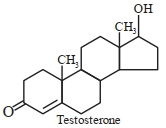
Testosterone,which is a steroidal hormone,has the following structure. The total number of asymmetric carbon atoms in testosterone is $..........$
A
$5$
B
$6$
C
$4$
D
$3$
Solution
(B) An asymmetric carbon atom (chiral center) is a carbon atom that is bonded to four different groups.
In the structure of testosterone,we identify the chiral centers by checking each carbon atom.
By examining the steroid backbone,we find that there are $6$ asymmetric carbon atoms.
These are the carbons at positions $8, 9, 10, 13, 14,$ and $17$ of the steroid nucleus.
Therefore,the total number of asymmetric carbon atoms is $6$.
In the structure of testosterone,we identify the chiral centers by checking each carbon atom.
By examining the steroid backbone,we find that there are $6$ asymmetric carbon atoms.
These are the carbons at positions $8, 9, 10, 13, 14,$ and $17$ of the steroid nucleus.
Therefore,the total number of asymmetric carbon atoms is $6$.
0 likes
View Solution71
MediumMCQ
The reaction used for the preparation of soap from fat is:
A
reduction reaction
B
alkaline hydrolysis reaction
C
an addition reaction
D
an oxidation reaction
Solution
(B) The process of making soap from fats or oils is known as $Saponification$.
It involves the alkaline hydrolysis of triglycerides (fats) using a strong base like $NaOH$ or $KOH$ to produce glycerol and the salt of a fatty acid (soap).
It involves the alkaline hydrolysis of triglycerides (fats) using a strong base like $NaOH$ or $KOH$ to produce glycerol and the salt of a fatty acid (soap).
0 likes
View Solution72
EasyMCQ
What is the number of moles of propane-$1,2,3$-triol formed when $n$ mole of triglyceride is hydrolysed?
A
$n$
B
$2n$
C
$3n$
D
$0.5n$
Solution
(A) Triglycerides are triesters of glycerol (propane-$1,2,3$-triol) and fatty acids.
When one mole of a triglyceride undergoes hydrolysis,it reacts with three moles of water to produce one mole of glycerol and three moles of fatty acids.
The chemical reaction is: $\text{Triglyceride} + 3H_2O \rightarrow \text{Glycerol} + 3 \text{Fatty Acids}$.
Therefore,if $n$ moles of triglyceride are hydrolysed,$n$ moles of propane-$1,2,3$-triol (glycerol) will be formed.
When one mole of a triglyceride undergoes hydrolysis,it reacts with three moles of water to produce one mole of glycerol and three moles of fatty acids.
The chemical reaction is: $\text{Triglyceride} + 3H_2O \rightarrow \text{Glycerol} + 3 \text{Fatty Acids}$.
Therefore,if $n$ moles of triglyceride are hydrolysed,$n$ moles of propane-$1,2,3$-triol (glycerol) will be formed.
0 likes
View Solution73
EasyMCQ
What is the combining ratio of glycerol and fatty acids when they combine to form triglyceride?
A
$3 : 4$
B
$3 : 2$
C
$1 : 3$
D
$1 : 2$
Solution
(C) $1$ molecule of glycerol combines with $3$ molecules of fatty acids to form triglyceride.
Hence,the ratio of glycerol to fatty acids is $1 : 3$.
Hence,the ratio of glycerol to fatty acids is $1 : 3$.
0 likes
View Solution74
EasyMCQ
Which among the following compounds belongs to lipids?
A
Chloroxylenol
B
Terpenes
C
$BHA$
D
Novestrol
Solution
(B) Terpenes are classified as lipids or lipid-like compounds because they are hydrophobic and soluble in organic solvents. They are synthesized from isoprene units,which are $C_5H_8$ hydrocarbon units. Chloroxylenol is an antiseptic,$BHA$ is an antioxidant,and Novestrol is a synthetic estrogen.
0 likes
View Solution75
EasyMCQ
What is the number of moles of water molecules required for the complete hydrolysis of $n$ moles of a triglyceride?
A
$4n$
B
$3n$
C
$2n$
D
$n$
Solution
(B) triglyceride is an ester formed from one molecule of glycerol and three molecules of fatty acids.
During the process of hydrolysis,the ester bonds are broken by the addition of water molecules.
Since a triglyceride contains $3$ ester linkages,$3$ moles of water are required to hydrolyze $1$ mole of triglyceride into $1$ mole of glycerol and $3$ moles of fatty acids.
Therefore,for the complete hydrolysis of $n$ moles of triglyceride,$3n$ moles of water molecules are required.
During the process of hydrolysis,the ester bonds are broken by the addition of water molecules.
Since a triglyceride contains $3$ ester linkages,$3$ moles of water are required to hydrolyze $1$ mole of triglyceride into $1$ mole of glycerol and $3$ moles of fatty acids.
Therefore,for the complete hydrolysis of $n$ moles of triglyceride,$3n$ moles of water molecules are required.
0 likes
View Solution76
EasyMCQ
What is the number of $>C=C<$ bonds present in a linolenic acid molecule?
A
Zero
B
One
C
Two
D
Three
Solution
(D) $Linolenic$ acid is a polyunsaturated fatty acid with the chemical formula $C_{18}H_{30}O_2$.
It contains $18$ carbon atoms and $3$ carbon-carbon double bonds $( > C=C < )$.
The structure is $CH_3CH_2CH=CHCH_2CH=CHCH_2CH=CH(CH_2)_7COOH$.
Therefore,the number of $ > C=C < $ bonds present in a linolenic acid molecule is $3$.
It contains $18$ carbon atoms and $3$ carbon-carbon double bonds $( > C=C < )$.
The structure is $CH_3CH_2CH=CHCH_2CH=CHCH_2CH=CH(CH_2)_7COOH$.
Therefore,the number of $ > C=C < $ bonds present in a linolenic acid molecule is $3$.
0 likes
View Solution77
EasyMCQ
Among the following,the formula of saturated fatty acid is
A
$C_{17}H_{29}COOH$
B
$C_{17}H_{35}COOH$
C
$C_{17}H_{31}COOH$
D
$C_{17}H_{33}COOH$
Solution
(B) The general formula for saturated fatty acids is $C_{n}H_{2n+1}COOH$.
For $n = 17$,the formula becomes $C_{17}H_{2(17)+1}COOH = C_{17}H_{35}COOH$.
Since $C_{17}H_{35}COOH$ (stearic acid) follows this general formula,it is a saturated fatty acid.
For $n = 17$,the formula becomes $C_{17}H_{2(17)+1}COOH = C_{17}H_{35}COOH$.
Since $C_{17}H_{35}COOH$ (stearic acid) follows this general formula,it is a saturated fatty acid.
0 likes
View Solution78
EasyMCQ
To which functional group do fats belong?
A
Carboxylic acids
B
Carbonyl
C
Ester
D
Fatty acids
Solution
(C) Fats are formed by the reaction of glycerol (a trihydric alcohol) with long-chain fatty acids (carboxylic acids).
This reaction is an esterification process,resulting in the formation of triacylglycerols.
Chemically,these are classified as esters of glycerol and are commonly known as glycerides.
This reaction is an esterification process,resulting in the formation of triacylglycerols.
Chemically,these are classified as esters of glycerol and are commonly known as glycerides.
0 likes
View Solution79
MediumMCQ
Fats are esters of
A
sugar
B
glycerol
C
tributyrine
D
polypeptide
Solution
(B) Fats and oils are triesters of glycerol with long-chain fatty acids,commonly known as triglycerides.
They are formed by the esterification of glycerol $(CH_2OH-CHOH-CH_2OH)$ with three molecules of higher carboxylic acids (fatty acids).
Therefore,fats are esters of glycerol.
They are formed by the esterification of glycerol $(CH_2OH-CHOH-CH_2OH)$ with three molecules of higher carboxylic acids (fatty acids).
Therefore,fats are esters of glycerol.
0 likes
View Solution80
EasyMCQ
Find the number of moles of glycerol produced when $n$ mole of triglyceride undergoes saponification.
A
$n$
B
$2n$
C
$3n$
D
$\frac{3}{2} n$
Solution
(A) Saponification is the alkaline hydrolysis of a triglyceride (a triester of glycerol and fatty acids).
The general reaction is: $\text{Triglyceride} + 3NaOH \rightarrow \text{Glycerol} + 3 \times \text{Soap (Fatty acid salt)}$.
According to the stoichiometry of the reaction,$1$ mole of triglyceride produces $1$ mole of glycerol.
Therefore,$n$ moles of triglyceride will produce $n$ moles of glycerol.
The general reaction is: $\text{Triglyceride} + 3NaOH \rightarrow \text{Glycerol} + 3 \times \text{Soap (Fatty acid salt)}$.
According to the stoichiometry of the reaction,$1$ mole of triglyceride produces $1$ mole of glycerol.
Therefore,$n$ moles of triglyceride will produce $n$ moles of glycerol.
0 likes
View Solution81
EasyMCQ
Which among the following compounds represents a soap molecule?
A
Ammonium salt of formic acid
B
Ammonium salt of higher fatty acids
C
Sodium salt of formic acid
D
Potassium salt of higher fatty acids
Solution
(D) Soaps are defined as the sodium or potassium salts of long-chain fatty acids (higher fatty acids).
They are typically prepared by the saponification of fats or oils using $NaOH$ or $KOH$.
They are typically prepared by the saponification of fats or oils using $NaOH$ or $KOH$.
0 likes
View Solution82
EasyMCQ
Which one of the following statements is true?
A
Saponification of oil yields a diol
B
Drying of oil involves hydrolysis
C
Addition of antioxidant to oil minimizes rancidity
D
Refining of oil involves hydrogenation
Solution
(C) Saponification of oils yields a triol (glycerol).
Drying (hardening) of oil involves hydrogenation.
Refining of oil is done by distillation or other such processes,not by hydrogenation.
Antioxidants are added to prevent the oxidation of oil,thus they minimize rancidity.
Drying (hardening) of oil involves hydrogenation.
Refining of oil is done by distillation or other such processes,not by hydrogenation.
Antioxidants are added to prevent the oxidation of oil,thus they minimize rancidity.
0 likes
View Solution83
MediumMCQ
Waxes are esters of
A
glycerol
B
long chain alcohols
C
glycerol and fatty acid
D
long chain alcohols and long chain fatty acids
Solution
(D) Waxes are esters formed by the reaction of long-chain fatty acids with long-chain monohydric alcohols,such as myricyl alcohol or cetyl alcohol.
0 likes
View Solution84
DifficultMCQ
Oils are liquids at room temperature since they contain a higher percentage of
A
oleates
B
palmitates
C
stearates
D
myristates
Solution
(A) Oils are liquids at room temperature because they contain a high proportion of unsaturated fatty acid residues,such as oleic acid,linoleic acid,and linolenic acid. These residues form esters known as oleates. In contrast,fats are solids at room temperature and contain a high proportion of saturated fatty acid residues like myristic,palmitic,and stearic acids. For example,glyceryl trioleate (triolein) is an oil,while glyceryl tristearate (tristearin) is a fat.
0 likes
View Solution85
DifficultMCQ
The number of moles of hydrogen that can be added to $1$ mole of an oil is the highest in
A
groundnut oil
B
sunflower seed oil
C
mustard oil
D
linseed oil
Solution
(D) $1$ mole of linseed oil has the maximum number of moles of hydrogen added because it contains the highest degree of unsaturation.
Linseed oil is a typical drying oil.
It consists primarily of linolenic acid esters (polyunsaturated fatty acids),which have multiple double bonds,allowing for the addition of more hydrogen compared to other oils listed.
Linseed oil is a typical drying oil.
It consists primarily of linolenic acid esters (polyunsaturated fatty acids),which have multiple double bonds,allowing for the addition of more hydrogen compared to other oils listed.
0 likes
View Solution86
MediumMCQ
The one which has the least iodine value is
A
sunflower oil
B
ginger oil
C
ghee
D
groundnut oil
Solution
(C) The iodine value is a measure of the degree of unsaturation in fats and oils. Higher unsaturation leads to a higher iodine value. $Ghee$ is primarily composed of saturated fatty acids,making it the least unsaturated among the given options. Therefore,it has the least iodine value.
0 likes
View SolutionBiomolecules — Fats and Lipids · Frequently Asked Questions
1Are these Biomolecules questions useful for JEE and NEET?
Yes. All questions in this section are mapped to JEE Main and NEET exam patterns. Previous year questions from JEE Main, NEET, GUJCET and state-level exams are included with full solutions.
2Can I switch to Hindi or Gujarati for these questions?
Yes. Use the language tabs in the hero section or the sidebar to view the same questions and solutions in English, Hindi or Gujarati.
3How do I generate a question paper from this subtopic?
Use the Vedclass Exam Paper Generator — select the chapter and subtopic, set difficulty, and generate Sets A, B, C, D automatically. First 3 chapters of every subject are free.
Vedclass Products
For Students
Vedclass Test Series
Mock tests in real JEE/NEET style with performance analysis. 5-day free trial.
Start Free TrialFor Teachers
Exam Paper Generator
Generate Set A/B/C/D papers from this chapter in 2 minutes. 3 chapters free.
Try FreeFor Institutes
Online Exam Module
Live online exams with unlimited students, 360° analytics & white-label branding.
See DemoFor Teachers & Institutes
Generate a Biomolecules Exam Paper in 2 Minutes
Select subtopic & difficulty — Sets A, B, C, D auto-generated with No Repeat logic.
First 3 chapters of every subject are free — no payment required.