
A English
Flower Questions in English
Class 12 Biology · Sexual Reproduction in Flowering Plants · Flower
92+
Questions
English
Language
100%
With Solutions
Showing 42 of 92 questions in English
51
Easy
Mention the social,religious,and cultural value of flowers.
Solution
(N/A) Human beings have had an intimate relationship with flowers since time immemorial. Flowers are objects of aesthetic,ornamental,social,religious,and cultural value. They have always been used as symbols for conveying important human emotions such as love,affection,happiness,grief,and mourning.
0 likes
View Solution52
Medium
Explain why a flower is considered a condensed shoot.
Solution
(N/A) flower is considered a modified or condensed shoot because of the following reasons:
$1$. The floral axis,known as the thalamus or receptacle,is a highly condensed stem with very short internodes.
$2$. The floral appendages (sepals,petals,stamens,and carpels) are homologous to leaves. They are arranged in whorls on the thalamus,similar to how leaves are arranged at the nodes of a vegetative shoot.
$3$. During the development of a flower,the apical meristem of the shoot is transformed into a floral meristem,indicating that the flower is essentially a shoot that has stopped growing in length to produce reproductive structures.
$1$. The floral axis,known as the thalamus or receptacle,is a highly condensed stem with very short internodes.
$2$. The floral appendages (sepals,petals,stamens,and carpels) are homologous to leaves. They are arranged in whorls on the thalamus,similar to how leaves are arranged at the nodes of a vegetative shoot.
$3$. During the development of a flower,the apical meristem of the shoot is transformed into a floral meristem,indicating that the flower is essentially a shoot that has stopped growing in length to produce reproductive structures.
0 likes
View Solution53
Medium
Describe the organs/parts of a typical flower.
Solution
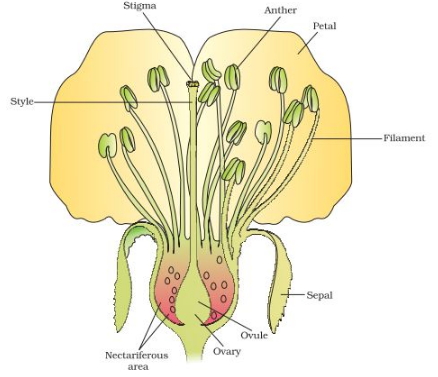
(N/A) typical flower consists of four whorls arranged on the thalamus. These are categorized into two sterile whorls and two fertile whorls.
$1$. Sterile Whorls:
- Calyx: The outermost whorl consisting of sepals,which protect the flower in the bud stage.
- Corolla: The second whorl consisting of petals,which are often brightly colored to attract pollinators.
$2$. Fertile Whorls:
- Androecium: The male reproductive whorl consisting of stamens. Each stamen has a filament (stalk) and an anther (pollen-bearing part). The connective tissue joins the anther lobes to the filament.
- Gynoecium: The innermost female reproductive whorl consisting of one or more carpels (pistils). Each carpel consists of three parts: the ovary (basal swollen part containing ovules),the style (elongated tube),and the stigma (terminal part that receives pollen grains).
$1$. Sterile Whorls:
- Calyx: The outermost whorl consisting of sepals,which protect the flower in the bud stage.
- Corolla: The second whorl consisting of petals,which are often brightly colored to attract pollinators.
$2$. Fertile Whorls:
- Androecium: The male reproductive whorl consisting of stamens. Each stamen has a filament (stalk) and an anther (pollen-bearing part). The connective tissue joins the anther lobes to the filament.
- Gynoecium: The innermost female reproductive whorl consisting of one or more carpels (pistils). Each carpel consists of three parts: the ovary (basal swollen part containing ovules),the style (elongated tube),and the stigma (terminal part that receives pollen grains).
0 likes
View Solution54
Medium
Give differences: Accessory whorls and Essential whorls.
Solution
(N/A)
| Accessory whorls | Essential whorls |
|---|---|
| $(1)$ The whorls of a flower which are not directly involved in sexual reproduction but assist in the process are called accessory whorls. | $(1)$ The whorls of a flower which are directly associated with sexual reproduction are called essential whorls. |
| $(2)$ Calyx and corolla are accessory whorls. | $(2)$ Androecium and Gynoecium are essential whorls. |
| $(3)$ They provide protection to the reproductive organs and aid in pollination. | $(3)$ They are responsible for the production of gametes and fertilization. |
| $(4)$ They are considered sterile whorls. | $(4)$ They are considered fertile whorls. |
0 likes
View Solution55
Medium
Draw a labelled diagram of a typical flower.
Solution
(N/A) typical flower consists of four different kinds of whorls arranged successively on the swollen end of the stalk or pedicel,called the thalamus or receptacle. These are:
$1$. Calyx (Wajrachakra): The outermost whorl of the flower,consisting of sepals. They protect the flower in the bud stage.
$2$. Corolla (Dalchakra): The second whorl,consisting of petals. They are usually brightly coloured to attract insects for pollination.
$3$. Androecium (Pumkesarchakra): The third whorl,composed of stamens. Each stamen represents the male reproductive organ.
$4$. Gynoecium (Strikesearchakra): The innermost whorl,consisting of one or more carpels. Each carpel represents the female reproductive organ.
$1$. Calyx (Wajrachakra): The outermost whorl of the flower,consisting of sepals. They protect the flower in the bud stage.
$2$. Corolla (Dalchakra): The second whorl,consisting of petals. They are usually brightly coloured to attract insects for pollination.
$3$. Androecium (Pumkesarchakra): The third whorl,composed of stamens. Each stamen represents the male reproductive organ.
$4$. Gynoecium (Strikesearchakra): The innermost whorl,consisting of one or more carpels. Each carpel represents the female reproductive organ.
0 likes
View Solution56
MediumMCQ
State the types of stamen based on the cohesion of their parts.
A
Monadelphous,Diadelphous,Polyadelphous
B
Epipetalous,Episepalous
C
Syngenesious,Synandrous
D
All of the above
Solution
(D) The stamens can be classified based on the cohesion of their parts (filaments or anthers) as follows:
$1$. $Monadelphous$: Stamens are united into a single bundle (e.g.,China rose).
$2$. $Diadelphous$: Stamens are united into two bundles (e.g.,Pea).
$3$. $Polyadelphous$: Stamens are united into more than two bundles (e.g.,Citrus).
$4$. $Syngenesious$: Only anthers are united,filaments are free (e.g.,Sunflower).
$5$. $Synandrous$: Both anthers and filaments are united throughout their entire length (e.g.,Cucurbita).
Additionally,stamens can be attached to other floral parts,such as $Epipetalous$ (attached to petals) or $Episepalous$ (attached to sepals).
$1$. $Monadelphous$: Stamens are united into a single bundle (e.g.,China rose).
$2$. $Diadelphous$: Stamens are united into two bundles (e.g.,Pea).
$3$. $Polyadelphous$: Stamens are united into more than two bundles (e.g.,Citrus).
$4$. $Syngenesious$: Only anthers are united,filaments are free (e.g.,Sunflower).
$5$. $Synandrous$: Both anthers and filaments are united throughout their entire length (e.g.,Cucurbita).
Additionally,stamens can be attached to other floral parts,such as $Epipetalous$ (attached to petals) or $Episepalous$ (attached to sepals).
0 likes
View Solution57
Medium
Give scientific reasons: The flower possesses religious,cultural,and scientific value.
Solution
(N/A) Flowers have held an intimate relationship with human beings since time immemorial.
$1$. Religious and Cultural Value: Flowers are used in various religious rituals,festivals,and ceremonies as offerings or decorations,symbolizing purity and devotion.
$2$. Social Value: They serve as symbols for conveying human emotions such as love,affection,happiness,grief,and mourning.
$3$. Scientific Value: Scientifically,flowers are the reproductive structures of angiosperms. They are essential for the process of pollination and fertilization,which leads to the formation of seeds and fruits,ensuring the continuity of the species and providing food for various organisms.
$1$. Religious and Cultural Value: Flowers are used in various religious rituals,festivals,and ceremonies as offerings or decorations,symbolizing purity and devotion.
$2$. Social Value: They serve as symbols for conveying human emotions such as love,affection,happiness,grief,and mourning.
$3$. Scientific Value: Scientifically,flowers are the reproductive structures of angiosperms. They are essential for the process of pollination and fertilization,which leads to the formation of seeds and fruits,ensuring the continuity of the species and providing food for various organisms.
0 likes
View Solution58
EasyMCQ
The reproductive phase in plants begins with the formation of:
A
Leaf
B
Branch
C
Flower
D
Root
Solution
(C) In angiosperms (flowering plants), the reproductive phase is marked by the development of flowers. The flower is the specialized reproductive structure that contains the male $(androecium)$ and female $(gynoecium)$ reproductive organs. Once a plant reaches maturity and begins to flower, it enters its reproductive phase, which leads to the formation of fruits and seeds.
0 likes
View Solution59
EasyMCQ
What is it called when both male and female reproductive structures are found in the same plant body?
A
Monoecious
B
Unisexual
C
Heterothallic
D
Dioecious
Solution
(A) When both male and female reproductive structures (staminate and pistillate flowers) are present on the same plant body,the condition is known as $Monoecious$. Examples include cucurbits and coconuts. In contrast,$Dioecious$ refers to plants where male and female flowers are borne on separate individuals.
0 likes
View Solution60
EasyMCQ
In which of the following plants are both staminate and pistillate flowers found on the same individual?
A
Coconut
B
Papaya
C
Spinach
D
Date palm
Solution
(A) Plants that bear both staminate (male) and pistillate (female) flowers on the same individual are called monoecious plants.
Among the given options,coconut is a monoecious plant.
Papaya,spinach,and date palm are dioecious plants,meaning they have separate male and female individuals.
Among the given options,coconut is a monoecious plant.
Papaya,spinach,and date palm are dioecious plants,meaning they have separate male and female individuals.
0 likes
View Solution61
MediumMCQ
Which whorl of a flower attracts insects?
A
Calyx
B
Androecium
C
Corolla
D
Gynoecium
Solution
(C) The flower consists of four whorls: Calyx,Corolla,Androecium,and Gynoecium.
$1$. The Calyx (sepals) is usually green and protects the flower in the bud stage.
$2$. The Corolla (petals) is typically brightly colored to attract insects for pollination.
$3$. The Androecium (stamens) is the male reproductive part.
$4$. The Gynoecium (pistil/carpel) is the female reproductive part.
Therefore,the Corolla is the whorl responsible for attracting insects.
$1$. The Calyx (sepals) is usually green and protects the flower in the bud stage.
$2$. The Corolla (petals) is typically brightly colored to attract insects for pollination.
$3$. The Androecium (stamens) is the male reproductive part.
$4$. The Gynoecium (pistil/carpel) is the female reproductive part.
Therefore,the Corolla is the whorl responsible for attracting insects.
0 likes
View Solution62
MediumMCQ
If the gynoecium has many pistils and they are fused together,what is it called?
A
Multicarpellary
B
Monocarpellary
C
Syncarpous
D
Apocarpous
Solution
(C) In a flower,the gynoecium represents the female reproductive part.
When the gynoecium consists of many pistils (carpels),it is termed as multicarpellary.
If these pistils are fused together,the condition is known as $Syncarpous$ (e.g.,Papaver).
If the pistils are free,the condition is known as $Apocarpous$ (e.g.,Michelia).
When the gynoecium consists of many pistils (carpels),it is termed as multicarpellary.
If these pistils are fused together,the condition is known as $Syncarpous$ (e.g.,Papaver).
If the pistils are free,the condition is known as $Apocarpous$ (e.g.,Michelia).
0 likes
View Solution63
MediumMCQ
What is the height of the flower of Amorphophallus (in $feet$)?
A
$6$
B
$5$
C
$7$
D
$8$
Solution
(A) The flower of $Amorphophallus$ (suran) is known for being the tallest flower in the world. Its height is approximately $6$ feet.
0 likes
View Solution64
MediumMCQ
Most of the flowering plants produce which type of flowers?
A
Unisexual
B
Bisexual
C
Sterile
D
None of these
Solution
(B) Most of the flowering plants produce bisexual flowers. In a bisexual flower,both the male reproductive organ (stamen) and the female reproductive organ (pistil) are present in the same flower. This arrangement facilitates self-pollination,although plants have evolved various outbreeding devices to promote cross-pollination.
0 likes
View Solution65
MediumMCQ
If both male and female flowers are present on the same plant,the plant is called ........
A
Dioecious
B
Monoecious
C
Staminate
D
Pistillate
Solution
(B) When both male and female flowers are present on the same individual plant,the condition is known as $Monoecious$.
Examples of monoecious plants include castor and maize.
In contrast,if male and female flowers are present on separate plants,the condition is known as $Dioecious$ (e.g.,papaya and date palm).
Examples of monoecious plants include castor and maize.
In contrast,if male and female flowers are present on separate plants,the condition is known as $Dioecious$ (e.g.,papaya and date palm).
0 likes
View Solution66
MediumMCQ
In angiosperms,the sporophylls are organised into:
A
Seeds
B
Fruits
C
Flowers
D
Seed coats
Solution
(C) In angiosperms,the sporophylls (microsporophylls or stamens and megasporophylls or carpels) are organised into specialized reproductive structures called flowers.
0 likes
View Solution67
EasyMCQ
The largest flower is:
A
Rafflesia arnoldii
B
Helianthus annuus
C
Welwitschia mirabilis
D
Nelumbo nucifera
Solution
(A) $Rafflesia$ $arnoldii$ is known as the largest flower in the world. It is a parasitic plant that produces a massive,single bloom that can reach a diameter of about $1$ meter.
0 likes
View Solution68
MediumMCQ
$A$ flower is always solitary when:
A
The shoot bud transforms into a flower.
B
The shoot tip transforms into a flower.
C
The lateral shoot transforms into a flower.
D
The horizontal shoot transforms into a flower.
Solution
(B) In flowering plants,when the apical meristem or the shoot tip transforms into a flower,the growth of the main axis is terminated. This results in the formation of a single,solitary flower at the apex of the stem,as the shoot tip is no longer capable of producing further vegetative growth.
0 likes
View Solution69
MediumMCQ
$A$: Androecium of $Cucurbita$ is synandrous.
$R$: Anthers as well as filaments of stamens are united throughout their whole length.
$R$: Anthers as well as filaments of stamens are united throughout their whole length.
A
Assertion and Reason both are correct and Reason is the correct explanation of Assertion.
B
Assertion and Reason both are correct but Reason is not the correct explanation of Assertion.
C
Assertion is correct,but Reason is incorrect.
D
Both Assertion and Reason are incorrect.
Solution
(A) In the family $Cucurbitaceae$ (e.g.,$Cucurbita$),the stamens are modified into a condition known as synandrous.
In a synandrous condition,both the anthers and the filaments of the stamens are fused together throughout their entire length to form a single structure.
Therefore,both the Assertion and the Reason are correct,and the Reason provides the correct explanation for the Assertion.
In a synandrous condition,both the anthers and the filaments of the stamens are fused together throughout their entire length to form a single structure.
Therefore,both the Assertion and the Reason are correct,and the Reason provides the correct explanation for the Assertion.
0 likes
View Solution70
EasyMCQ
The flower of $Hibiscus$ is:
A
Bisexual
B
Unisexual
C
Neuter
D
Very small
Solution
(A) flower is considered bisexual (also known as hermaphrodite) if it contains both male (stamen) and female (pistil) reproductive organs. The $Hibiscus$ flower possesses both androecium (stamens) and gynoecium (pistil) within the same floral structure. Therefore,it is classified as a bisexual flower.
0 likes
View Solution71
EasyMCQ
Self-fertilisation occurs in the
A
Bisexual flower
B
Unisexual flower
C
Both $ (a) $ and $ (b) $
D
Dioecious flower
Solution
(A) Self-fertilisation is a common phenomenon in plants where pollen grains are transferred from the anther to the stigma of the same flower or another flower on the same plant.
This process requires the presence of both male and female reproductive organs in the same flower,which is the definition of a bisexual flower (also known as a hermaphrodite flower).
This process requires the presence of both male and female reproductive organs in the same flower,which is the definition of a bisexual flower (also known as a hermaphrodite flower).
0 likes
View Solution72
EasyMCQ
In papaya, the flowers are:
A
Unisexual
B
Bisexual
C
Neuter
D
Flowers are not formed
Solution
(A) Papaya $(Carica \, papaya)$ is a dioecious plant, which means that male and female flowers are borne on separate plants.
Because each flower contains either only stamens (male) or only carpels (female), the flowers are classified as unisexual.
Therefore, the correct option is $A$.
Because each flower contains either only stamens (male) or only carpels (female), the flowers are classified as unisexual.
Therefore, the correct option is $A$.
0 likes
View Solution73
EasyMCQ
'Unisexual female flower is called staminate'. The above statement is
A
True
B
False
C
Sometimes $ (a) $ and sometimes $ (b) $
D
Neither $ (a) $ nor $ (b) $
Solution
(B) The statement is False.
In botany,a flower that contains only stamens (the male reproductive organ) is called a staminate flower.
$A$ flower that contains only pistils (the female reproductive organ) is called a pistillate flower.
Therefore,a unisexual female flower is referred to as pistillate,not staminate.
In botany,a flower that contains only stamens (the male reproductive organ) is called a staminate flower.
$A$ flower that contains only pistils (the female reproductive organ) is called a pistillate flower.
Therefore,a unisexual female flower is referred to as pistillate,not staminate.
0 likes
View Solution74
EasyMCQ
'Unisexual male flower is called pistillate'. The above statement is
A
True
B
False
C
Sometimes $(a)$ and sometimes $(b)$
D
Neither $(a)$ nor $(b)$
Solution
(B) False. $A$ unisexual flower that contains only stamens (male reproductive organs) is called a staminate flower. $A$ flower that contains only pistils (female reproductive organs) is called a pistillate flower.
0 likes
View Solution75
MediumMCQ
Flower is a
A
Modified male plant only
B
Modified female plant only
C
Modified reproductive shoot
D
Vegetative shoot system
Solution
(C) flower is defined as a modified shoot that is specialized for the purpose of sexual reproduction in angiosperms. In a flower,the apical meristem of the shoot changes into a floral meristem,and the leaves are modified into floral whorls such as sepals,petals,stamens,and carpels.
0 likes
View Solution76
MediumMCQ
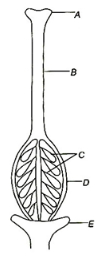
Identify $A$ to $E$ in the following diagram.
A
$A-Style, B-Stigma, C-Ovules, D-Thalamus, E-Ovary$
B
$A-Ovary, B-Thalamus, C-Ovules, D-Style, E-Stigma$
C
$A-Thalamus, B-Style, C-Stigma, D-Ovary, E-Ovules$
D
$A-Stigma, B-Style, C-Ovules, D-Ovary, E-Thalamus$
Solution
(D) is the Stigma,which acts as a landing platform for pollen grains.
$B$ is the Style,which provides a passage for the pollen tube to reach the ovary.
$C$ represents the Ovules,which develop into seeds after fertilization.
$D$ is the Ovary,which contains the ovules and develops into the fruit.
$E$ is the Thalamus,which is the basal part of the flower that supports the ovary.
$B$ is the Style,which provides a passage for the pollen tube to reach the ovary.
$C$ represents the Ovules,which develop into seeds after fertilization.
$D$ is the Ovary,which contains the ovules and develops into the fruit.
$E$ is the Thalamus,which is the basal part of the flower that supports the ovary.
0 likes
View Solution77
MediumMCQ
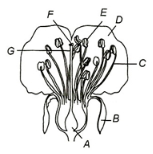
Identify $A$ to $G$ in the following figure and answer accordingly.
A
$A-$Ovary,$B-$Filament,$C-$Sepal,$D-$Petal,$E-$Style,$F-$Stigma,$G-$Anther
B
$A-$Petal,$B-$Ovary,$C-$Petal,$D-$Filament,$E-$Anther,$F-$Stigma,$G-$Style
C
$A-$Ovary,$B-$Sepal,$C-$Filament,$D-$Petal,$E-$Anther,$F-$Stigma,$G-$Style
D
$A-$Ovary,$B-$Sepal,$C-$Filament,$D-$Petal,$E-$Anther,$F-$Stigma,$G-$Style
Solution
(C) Based on the structure of a typical flower:
$A$ represents the Ovary,which is the basal swollen part of the carpel.
$B$ represents the Sepal,which is the outermost whorl of the flower.
$C$ represents the Filament,which is the stalk of the stamen.
$D$ represents the Petal,which is the brightly colored part of the flower.
$E$ represents the Anther,which is the pollen-bearing part of the stamen.
$F$ represents the Stigma,which is the receptive surface for pollen grains.
$G$ represents the Style,which is the elongated tube connecting the stigma to the ovary.
Therefore,the correct identification is $A-$Ovary,$B-$Sepal,$C-$Filament,$D-$Petal,$E-$Anther,$F-$Stigma,$G-$Style,which corresponds to option $C$ and $D$ (as they are identical in the provided input).
$A$ represents the Ovary,which is the basal swollen part of the carpel.
$B$ represents the Sepal,which is the outermost whorl of the flower.
$C$ represents the Filament,which is the stalk of the stamen.
$D$ represents the Petal,which is the brightly colored part of the flower.
$E$ represents the Anther,which is the pollen-bearing part of the stamen.
$F$ represents the Stigma,which is the receptive surface for pollen grains.
$G$ represents the Style,which is the elongated tube connecting the stigma to the ovary.
Therefore,the correct identification is $A-$Ovary,$B-$Sepal,$C-$Filament,$D-$Petal,$E-$Anther,$F-$Stigma,$G-$Style,which corresponds to option $C$ and $D$ (as they are identical in the provided input).
0 likes
View Solution78
Medium
Give a scientific reason: The coconut plant is monoecious,while the date palm is dioecious.
Solution
(N/A) The coconut plant bears both unisexual male and female flowers on the same individual plant,which is why it is termed monoecious. The male flower is referred to as a staminate flower,and the female flower is referred to as a pistillate flower.
Conversely,the date palm bears unisexual male and female flowers on separate individual plants,which is why it is termed dioecious.
Conversely,the date palm bears unisexual male and female flowers on separate individual plants,which is why it is termed dioecious.
0 likes
View Solution79
MediumMCQ
Which part is responsible for sexual reproduction in angiosperms?
A
Root
B
Stem
C
Leaf
D
Flower
Solution
(D) In angiosperms (flowering plants), the $\text{Flower}$ is the reproductive unit.
It contains the male reproductive organs (stamens) and female reproductive organs (pistil/carpel).
Sexual reproduction involves the fusion of male and female gametes produced within these floral structures, leading to the formation of seeds and fruits.
It contains the male reproductive organs (stamens) and female reproductive organs (pistil/carpel).
Sexual reproduction involves the fusion of male and female gametes produced within these floral structures, leading to the formation of seeds and fruits.
0 likes
View Solution80
EasyMCQ
Name the whorls of a flower from the inside to the outside.
A
Gynoecium $\rightarrow$ Androecium $\rightarrow$ Corolla $\rightarrow$ Calyx
B
Calyx $\rightarrow$ Corolla $\rightarrow$ Androecium $\rightarrow$ Gynoecium
C
Corolla $\rightarrow$ Calyx $\rightarrow$ Androecium $\rightarrow$ Gynoecium
D
Gynoecium $\rightarrow$ Androecium $\rightarrow$ Calyx $\rightarrow$ Corolla
Solution
(A) typical flower consists of four whorls arranged on the thalamus. From the outermost to the innermost,they are: Calyx (sepals),Corolla (petals),Androecium (stamens),and Gynoecium (carpels). Therefore,when moving from the inside to the outside,the order is: Gynoecium $\rightarrow$ Androecium $\rightarrow$ Corolla $\rightarrow$ Calyx.
0 likes
View Solution81
EasyMCQ
Select the correct option for the flower from the following:
Accessory organs $\quad$ Reproductive organs
Accessory organs $\quad$ Reproductive organs
A
Calyx,Corolla $\quad$ Androecium,Gynoecium
B
Androecium,Gynoecium $\quad$ Calyx,Corolla
C
Calyx,Androecium $\quad$ Corolla,Gynoecium
D
Corolla,Gynoecium $\quad$ Calyx,Androecium
Solution
(A) flower typically consists of four whorls arranged on the thalamus.
These are the calyx,corolla,androecium,and gynoecium.
$1$. Accessory organs: These are the non-reproductive parts of the flower that protect the inner reproductive organs or attract pollinators. These include the calyx (sepals) and corolla (petals).
$2$. Reproductive organs: These are the parts directly involved in sexual reproduction. These include the androecium (stamens,male reproductive part) and gynoecium (carpels/pistils,female reproductive part).
Therefore,the correct classification is: Accessory organs $(Calyx, Corolla)$ and Reproductive organs $(Androecium, Gynoecium)$.
These are the calyx,corolla,androecium,and gynoecium.
$1$. Accessory organs: These are the non-reproductive parts of the flower that protect the inner reproductive organs or attract pollinators. These include the calyx (sepals) and corolla (petals).
$2$. Reproductive organs: These are the parts directly involved in sexual reproduction. These include the androecium (stamens,male reproductive part) and gynoecium (carpels/pistils,female reproductive part).
Therefore,the correct classification is: Accessory organs $(Calyx, Corolla)$ and Reproductive organs $(Androecium, Gynoecium)$.
0 likes
View Solution82
EasyMCQ
In a flower,the anther and the stigma are located in which whorls,respectively?
A
Androecium,Gynoecium
B
Gynoecium,Androecium
C
Androecium,Androecium
D
Gynoecium,Gynoecium
Solution
(A) In a flower,the reproductive organs are arranged in whorls.
$1$. The $Androecium$ is the male reproductive whorl of a flower,which consists of stamens. Each stamen is composed of a filament and an anther.
$2$. The $Gynoecium$ is the female reproductive whorl of a flower,which consists of carpels or pistils. Each carpel consists of an ovary,a style,and a stigma.
Therefore,the anther is part of the $Androecium$ and the stigma is part of the $Gynoecium$.
$1$. The $Androecium$ is the male reproductive whorl of a flower,which consists of stamens. Each stamen is composed of a filament and an anther.
$2$. The $Gynoecium$ is the female reproductive whorl of a flower,which consists of carpels or pistils. Each carpel consists of an ovary,a style,and a stigma.
Therefore,the anther is part of the $Androecium$ and the stigma is part of the $Gynoecium$.
0 likes
View Solution83
EasyMCQ
How can it be determined that the juvenile phase has ended in plants?
A
Fruit formation
B
Seed formation
C
Flowering
D
None of these
Solution
(C) The juvenile phase is the period of growth between birth and reproductive maturity. In plants,this phase is also known as the vegetative phase. The end of the juvenile or vegetative phase is marked by the onset of the reproductive phase,which is clearly visible when the plant begins to produce flowers. Therefore,flowering is the morphological indicator that the plant has reached reproductive maturity.
0 likes
View Solution84
MediumMCQ
Select the correct option regarding flowers.
A
Humans have had an intimate relationship with flowers since time immemorial.
B
Flowers possess aesthetic,ornamental,social,religious,and cultural values.
C
They are used as symbols to express human emotions.
D
All of the above.
Solution
(D) Flowers have been an integral part of human life for ages.
$1$. Humans have had an intimate relationship with flowers since time immemorial as objects of aesthetic,ornamental,social,religious,and cultural value.
$2$. They have always been used as symbols for conveying important human feelings such as love,affection,happiness,grief,and mourning.
$3$. Therefore,all the given statements are correct.
$1$. Humans have had an intimate relationship with flowers since time immemorial as objects of aesthetic,ornamental,social,religious,and cultural value.
$2$. They have always been used as symbols for conveying important human feelings such as love,affection,happiness,grief,and mourning.
$3$. Therefore,all the given statements are correct.
0 likes
View Solution85
EasyMCQ
Which part of the plant is associated with sexual reproduction?
A
Leaf
B
Flower
C
Stem
D
All of the above
Solution
(B) The $Flower$ is the reproductive unit of angiosperms (flowering plants). It contains the male reproductive organs (stamens) and female reproductive organs (pistil/carpel). Sexual reproduction involves the fusion of male and female gametes, which occurs within the flower. Therefore, the flower is the organ directly associated with sexual reproduction in plants.
0 likes
View Solution86
MediumMCQ
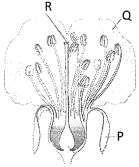
The figure below shows a vertical section of a flower. Identify the parts $P, Q,$ and $R$.
$\quad \quad P \quad\quad Q\quad\quad R$
$\quad \quad P \quad\quad Q\quad\quad R$
A
Sepal $\quad$ Petal $\quad$ Anther
B
Sepal $\quad$ Petal $\quad$ Stigma
C
Petal $\quad$ Sepal $\quad$ Anther
D
Petal $\quad$ Sepal $\quad$ Stigma
Solution
(B) Based on the provided diagram of the vertical section of a flower:
$1$. $P$ points to the outermost whorl of the flower,which is the sepal (calyx).
$2$. $Q$ points to the brightly colored,leaf-like structure,which is the petal (corolla).
$3$. $R$ points to the uppermost part of the carpel/pistil,which is the stigma.
Therefore,the correct identification is $P = \text{Sepal}, Q = \text{Petal}, R = \text{Stigma}$.
Thus,option $B$ is the correct answer.
$1$. $P$ points to the outermost whorl of the flower,which is the sepal (calyx).
$2$. $Q$ points to the brightly colored,leaf-like structure,which is the petal (corolla).
$3$. $R$ points to the uppermost part of the carpel/pistil,which is the stigma.
Therefore,the correct identification is $P = \text{Sepal}, Q = \text{Petal}, R = \text{Stigma}$.
Thus,option $B$ is the correct answer.
0 likes
View Solution87
EasyMCQ
Identify the essential whorls and accessory whorls of a flower.
Essential Whorls $\quad$ $\quad$ Accessory Whorls
Essential Whorls $\quad$ $\quad$ Accessory Whorls
A
Androecium,Gynoecium $\quad$ $\quad$ Corolla,Calyx
B
Corolla,Calyx $\quad$ $\quad$ Androecium,Gynoecium
C
Calyx,Androecium $\quad$ $\quad$ Corolla,Gynoecium
D
Corolla,Gynoecium $\quad$ $\quad$ Calyx,Androecium
Solution
(A) In a flower,the whorls are categorized based on their function in reproduction:
$1$. Accessory Whorls: These are the outer whorls that do not directly participate in reproduction but protect the reproductive parts or attract pollinators. These include the Calyx (sepals) and Corolla (petals).
$2$. Essential Whorls: These are the inner whorls that are directly involved in the process of reproduction. These include the Androecium (stamens) and Gynoecium (pistil/carpel).
Therefore,the correct classification is: Essential Whorls = Androecium,Gynoecium; Accessory Whorls = Corolla,Calyx.
$1$. Accessory Whorls: These are the outer whorls that do not directly participate in reproduction but protect the reproductive parts or attract pollinators. These include the Calyx (sepals) and Corolla (petals).
$2$. Essential Whorls: These are the inner whorls that are directly involved in the process of reproduction. These include the Androecium (stamens) and Gynoecium (pistil/carpel).
Therefore,the correct classification is: Essential Whorls = Androecium,Gynoecium; Accessory Whorls = Corolla,Calyx.
0 likes
View Solution88
EasyMCQ
What are the $tassels$ present in maize?
A
Ovary
B
Stamens and anthers
C
Stigma and style of the pistil
D
Filaments of the stamens
Solution
(B) In maize plants,the $tassels$ represent the male inflorescence.
These $tassels$ consist of the stigma and style of the pistil are incorrect; rather,the $tassels$ are the male flowers which produce pollen grains.
However,the long,silky,thread-like structures that hang out of the cob are the stigma and style of the female flowers.
The question asks about $tassels$,which are the male inflorescence found at the top of the plant,consisting of stamens and anthers.
These $tassels$ consist of the stigma and style of the pistil are incorrect; rather,the $tassels$ are the male flowers which produce pollen grains.
However,the long,silky,thread-like structures that hang out of the cob are the stigma and style of the female flowers.
The question asks about $tassels$,which are the male inflorescence found at the top of the plant,consisting of stamens and anthers.
0 likes
View Solution89
MediumMCQ
Given below are two statements: One is labelled as Assertion $A$ and the other is labelled as Reason $R$:
Assertion $A$: $A$ flower is defined as a modified shoot wherein the shoot apical meristem changes to a floral meristem.
Reason $R$: The internode of the shoot gets condensed to produce different floral appendages laterally at successive nodes instead of leaves.
In the light of the above statements,choose the correct answer from the options given below:
Assertion $A$: $A$ flower is defined as a modified shoot wherein the shoot apical meristem changes to a floral meristem.
Reason $R$: The internode of the shoot gets condensed to produce different floral appendages laterally at successive nodes instead of leaves.
In the light of the above statements,choose the correct answer from the options given below:
A
$A$ is false but $R$ is true
B
Both $A$ and $R$ are true and $R$ is the correct explanation of $A$
C
Both $A$ and $R$ are true but $R$ is $NOT$ the correct explanation of $A$
D
$A$ is true but $R$ is false
Solution
(B) flower is considered a modified shoot because the shoot apical meristem undergoes a transformation into a floral meristem.
During this process,the internodes do not elongate,causing the floral axis to become highly condensed.
Instead of producing leaves,the apex produces various floral appendages (sepals,petals,stamens,and carpels) laterally at successive nodes.
Since the condensation of the internodes is the structural reason why the shoot is modified into a flower,both $A$ and $R$ are true,and $R$ is the correct explanation of $A$.
During this process,the internodes do not elongate,causing the floral axis to become highly condensed.
Instead of producing leaves,the apex produces various floral appendages (sepals,petals,stamens,and carpels) laterally at successive nodes.
Since the condensation of the internodes is the structural reason why the shoot is modified into a flower,both $A$ and $R$ are true,and $R$ is the correct explanation of $A$.
0 likes
View Solution90
EasyMCQ
When a flower has both stamens and carpels,it is described as:
A
Asexual
B
Unisexual
C
Bisexual
D
Dioecious
Solution
(C) The correct answer is $C$.
Bisexual flowers,also known as hermaphrodite flowers,are those that contain both male reproductive organs (stamens) and female reproductive organs (carpels or pistils) within the same flower.
Bisexual flowers,also known as hermaphrodite flowers,are those that contain both male reproductive organs (stamens) and female reproductive organs (carpels or pistils) within the same flower.
0 likes
View Solution91
EasyMCQ
Usually,the whorl in a flower that attracts insects and protects the essential parts is
A
calyx
B
androecium
C
gynoecium
D
corolla
Solution
(D) The correct answer is $D$.
The corolla,which is composed of petals,is the whorl that typically attracts insects through its bright colors and scent,facilitating pollination.
Additionally,the corolla serves a protective function for the essential reproductive organs,namely the androecium and gynoecium,during the early stages of floral development.
The corolla,which is composed of petals,is the whorl that typically attracts insects through its bright colors and scent,facilitating pollination.
Additionally,the corolla serves a protective function for the essential reproductive organs,namely the androecium and gynoecium,during the early stages of floral development.
0 likes
View Solution92
EasyMCQ
The diagram given denotes the various parts of a typical flower. Identify the labelled parts $A$,$B$,$C$,and $D$ and choose the correct option.
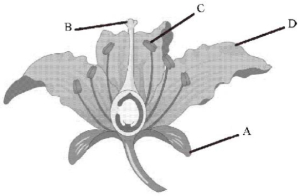
A
$A$-Petals,$B$-Sepals,$C$-Stamens,$D$-Pistil
B
$A$-Sepals,$B$-Pistil,$C$-Petals,$D$-Stamens
C
$A$-Sepals,$B$-Pistil,$C$-Stamens,$D$-Petals
D
$A$-Sepals,$B$-Petals,$C$-Pistil,$D$-Stamens
Solution
(C) The correct option is $C$.
In the given diagram of a typical flower:
$A$ represents the Sepals (Calyx),which are the outermost whorl.
$B$ represents the Pistil (Gynoecium),which is the female reproductive part.
$C$ represents the Stamens (Androecium),which are the male reproductive parts.
$D$ represents the Petals (Corolla),which are the brightly colored parts of the flower.
Therefore,the correct sequence is $A$-Sepals,$B$-Pistil,$C$-Stamens,$D$-Petals.
In the given diagram of a typical flower:
$A$ represents the Sepals (Calyx),which are the outermost whorl.
$B$ represents the Pistil (Gynoecium),which is the female reproductive part.
$C$ represents the Stamens (Androecium),which are the male reproductive parts.
$D$ represents the Petals (Corolla),which are the brightly colored parts of the flower.
Therefore,the correct sequence is $A$-Sepals,$B$-Pistil,$C$-Stamens,$D$-Petals.
0 likes
View SolutionSexual Reproduction in Flowering Plants — Flower · Frequently Asked Questions
1Are these Sexual Reproduction in Flowering Plants questions useful for JEE and NEET?
Yes. All questions in this section are mapped to JEE Main and NEET exam patterns. Previous year questions from JEE Main, NEET, GUJCET and state-level exams are included with full solutions.
2Can I switch to Hindi or Gujarati for these questions?
Yes. Use the language tabs in the hero section or the sidebar to view the same questions and solutions in English, Hindi or Gujarati.
3How do I generate a question paper from this subtopic?
Use the Vedclass Exam Paper Generator — select the chapter and subtopic, set difficulty, and generate Sets A, B, C, D automatically. First 3 chapters of every subject are free.
Vedclass Products
For Students
Vedclass Test Series
Mock tests in real JEE/NEET style with performance analysis. 5-day free trial.
Start Free TrialFor Teachers
Exam Paper Generator
Generate Set A/B/C/D papers from this chapter in 2 minutes. 3 chapters free.
Try FreeFor Institutes
Online Exam Module
Live online exams with unlimited students, 360° analytics & white-label branding.
See DemoFor Teachers & Institutes
Generate a Sexual Reproduction in Flowering Plants Exam Paper in 2 Minutes
Select subtopic & difficulty — Sets A, B, C, D auto-generated with No Repeat logic.
First 3 chapters of every subject are free — no payment required.