
A English
Endosperm Questions in English
Class 12 Biology · Sexual Reproduction in Flowering Plants · Endosperm
118+
Questions
English
Language
100%
With Solutions
Showing 49 of 118 questions in English
51
MediumMCQ
In the seeds of $......$,the endosperm is consumed during the development of the embryo.
A
Pea
B
Maize
C
Coconut
D
Castor
Solution
(A) In flowering plants,the endosperm is the tissue formed to provide nutrition to the developing embryo.
In some seeds,known as non-albuminous or exalbuminous seeds,the endosperm is completely consumed by the developing embryo before the seed matures.
Examples of such seeds include pea,bean,and groundnut.
In contrast,in albuminous seeds like maize,wheat,and castor,a portion of the endosperm persists in the mature seed.
Therefore,the correct answer is pea.
In some seeds,known as non-albuminous or exalbuminous seeds,the endosperm is completely consumed by the developing embryo before the seed matures.
Examples of such seeds include pea,bean,and groundnut.
In contrast,in albuminous seeds like maize,wheat,and castor,a portion of the endosperm persists in the mature seed.
Therefore,the correct answer is pea.
0 likes
View Solution52
EasyMCQ
In albuminous seeds,food is stored in the ...... .
A
Seed coat
B
Plumule
C
Cotyledon
D
Endosperm
Solution
(D) Albuminous seeds are those in which the endosperm is retained in the mature seed and serves as the food storage tissue for the developing embryo. Examples include wheat,maize,barley,and castor. In contrast,exalbuminous or non-albuminous seeds consume the endosperm completely during development,storing food primarily in the cotyledons.
0 likes
View Solution53
MediumMCQ
The coconut water and the edible part of coconut are equivalent to which of the following?
A
Mesocarp
B
Embryo
C
Endosperm
D
Endocarp
Solution
(C) The coconut water represents the free-nuclear endosperm,which is a liquid containing numerous nuclei.
The white edible part of the coconut represents the cellular endosperm,which is formed after the nuclei undergo cell wall formation.
Therefore,both the coconut water and the white kernel are different forms of the endosperm.
The white edible part of the coconut represents the cellular endosperm,which is formed after the nuclei undergo cell wall formation.
Therefore,both the coconut water and the white kernel are different forms of the endosperm.
0 likes
View Solution54
EasyMCQ
Which of the following seeds consumes the endosperm during the development of the embryo?
A
Coconut
B
Castor
C
Pea
D
Maize
Solution
(C) In flowering plants,seeds are classified into two types based on the presence or absence of endosperm at maturity:
$1$. Albuminous (non-endospermic) seeds: In these seeds,the endosperm is completely consumed by the developing embryo before the seed matures. Examples include pea,bean,and groundnut.
$2$. Exalbuminous (endospermic) seeds: In these seeds,a part of the endosperm persists in the mature seed. Examples include castor,coconut,and maize.
Therefore,the pea seed is a non-endospermic seed where the endosperm is consumed during embryo development.
$1$. Albuminous (non-endospermic) seeds: In these seeds,the endosperm is completely consumed by the developing embryo before the seed matures. Examples include pea,bean,and groundnut.
$2$. Exalbuminous (endospermic) seeds: In these seeds,a part of the endosperm persists in the mature seed. Examples include castor,coconut,and maize.
Therefore,the pea seed is a non-endospermic seed where the endosperm is consumed during embryo development.
0 likes
View Solution55
MediumMCQ
If a diploid female plant is crossed with a tetraploid male plant,what will be the ploidy of the endosperm?
A
Tetraploid
B
Triploid
C
Diploid
D
Pentaploid
Solution
(A) In angiosperms,the endosperm is formed by the process of double fertilization,specifically through the fusion of one male gamete with two polar nuclei (central cell).
$1$. The female plant is diploid $(2n)$,so its polar nuclei will be haploid ($n$ each). The central cell,containing two polar nuclei,will have a ploidy of $n + n = 2n$.
$2$. The male plant is tetraploid $(4n)$,so its gametes (produced by meiosis) will be diploid $(2n)$.
$3$. During double fertilization,one male gamete $(2n)$ fuses with the central cell $(2n)$.
$4$. The resulting endosperm ploidy is $2n + 2n = 4n$ (Tetraploid).
$1$. The female plant is diploid $(2n)$,so its polar nuclei will be haploid ($n$ each). The central cell,containing two polar nuclei,will have a ploidy of $n + n = 2n$.
$2$. The male plant is tetraploid $(4n)$,so its gametes (produced by meiosis) will be diploid $(2n)$.
$3$. During double fertilization,one male gamete $(2n)$ fuses with the central cell $(2n)$.
$4$. The resulting endosperm ploidy is $2n + 2n = 4n$ (Tetraploid).
0 likes
View Solution56
MediumMCQ
In a plant species where the synergid cells contain $8$ chromosomes,how many chromosomes will be present in the endosperm cells?
A
$24$
B
$32$
C
$8$
D
$6$
Solution
(A) Synergid cells are haploid $(n)$ in nature.
Given that the number of chromosomes in a synergid cell is $n = 8$.
The endosperm in angiosperms is formed by the fusion of two polar nuclei and one male gamete,resulting in a triploid $(3n)$ structure.
Therefore,the number of chromosomes in the endosperm cells = $3 \times n = 3 \times 8 = 24$.
Given that the number of chromosomes in a synergid cell is $n = 8$.
The endosperm in angiosperms is formed by the fusion of two polar nuclei and one male gamete,resulting in a triploid $(3n)$ structure.
Therefore,the number of chromosomes in the endosperm cells = $3 \times n = 3 \times 8 = 24$.
0 likes
View Solution57
MediumMCQ
Which of the following plants does not have stored food in its seeds?
A
Orchid
B
Maize
C
Wheat
D
Rice
Solution
(A) In most monocotyledonous plants like maize,wheat,and rice,the endosperm is persistent and stores food for the developing embryo. However,in orchids,the seeds are extremely small and lack an endosperm or any significant stored food reserves. They rely on mycorrhizal associations for germination and early development.
0 likes
View Solution58
EasyMCQ
In which of the following plant groups does endosperm formation occur after fertilization?
A
Pteridophytes
B
Angiosperms
C
Bryophytes
D
Gymnosperms
Solution
(B) In $Angiosperms$,the endosperm is formed as a result of a process called $triple$ $fusion$,which involves the fusion of one male gamete with two polar nuclei. This process occurs only after fertilization. In contrast,in $Gymnosperms$,the endosperm is a haploid tissue formed before fertilization. $Pteridophytes$ and $Bryophytes$ do not produce an endosperm.
0 likes
View Solution59
MediumMCQ
When is the endosperm formed in angiosperms?
A
Before fertilization
B
After fertilization
C
Along with fertilization
D
None of these
Solution
(B) In angiosperms,the endosperm is formed as a result of a process called double fertilization. Specifically,one male gamete fuses with the two polar nuclei (or the secondary nucleus) to form the Primary Endosperm Nucleus $(PEN)$. This process is known as triple fusion. Since this fusion occurs during the fertilization event,the development of the endosperm typically begins after the fertilization process is initiated.
0 likes
View Solution60
MediumMCQ
The morphological nature of the edible part of coconut is
A
cotyledon
B
endosperm
C
pericarp
D
perisperm
Solution
(B) The coconut fruit is a drupe. In a coconut,the edible part is the endosperm. The coconut water represents the free-nuclear endosperm,while the white kernel represents the cellular endosperm. Therefore,the correct option is $B$.
0 likes
View Solution61
MediumMCQ
The coconut water and the edible part of coconut are equivalent to
A
endosperm
B
endocarp
C
mesocarp
D
embryo
Solution
(A) : Coconut fruit is a drupe. It has a membranous epicarp,fibrous mesocarp,and stony endocarp. The endocarp encloses a single seed with a brown testa that contains a small embryo and a white oily endosperm (edible part) with a watery fluid called coconut water.
0 likes
View Solution62
MediumMCQ
Endosperm is consumed by the developing embryo in the seed of
A
pea
B
maize
C
coconut
D
castor
Solution
(A) The correct answer is $A$.
During the development of the embryo,the food stored in the endosperm is continuously utilized by the developing embryo,leading to its complete exhaustion.
Such seeds are known as non-endospermic or exalbuminous seeds.
Common examples of non-endospermic seeds include pea,gram,bean,and groundnut.
In contrast,maize,coconut,and castor are examples of endospermic or albuminous seeds,where the endosperm persists in the mature seed.
During the development of the embryo,the food stored in the endosperm is continuously utilized by the developing embryo,leading to its complete exhaustion.
Such seeds are known as non-endospermic or exalbuminous seeds.
Common examples of non-endospermic seeds include pea,gram,bean,and groundnut.
In contrast,maize,coconut,and castor are examples of endospermic or albuminous seeds,where the endosperm persists in the mature seed.
0 likes
View Solution63
MediumMCQ
The coconut water from tender coconut represents
A
free nuclear proembryo
B
free nuclear endosperm
C
endocarp
D
fleshy mesocarp
Solution
(B) The correct answer is $B$.
Coconut water is a classic example of free-nuclear endosperm.
In the development of coconut endosperm,the primary endosperm nucleus undergoes successive nuclear divisions without cytokinesis,resulting in the formation of a large number of free nuclei.
This liquid containing free nuclei is known as coconut water.
Later,cellularization occurs in the peripheral part,forming the solid coconut meat (cellular endosperm).
Coconut water is a classic example of free-nuclear endosperm.
In the development of coconut endosperm,the primary endosperm nucleus undergoes successive nuclear divisions without cytokinesis,resulting in the formation of a large number of free nuclei.
This liquid containing free nuclei is known as coconut water.
Later,cellularization occurs in the peripheral part,forming the solid coconut meat (cellular endosperm).
0 likes
View Solution64
MediumMCQ
Coconut water from a tender coconut is
A
innermost layers of the seed coat
B
degenerated nucellus
C
immature embryo
D
free nuclear endosperm.
Solution
(D) The correct answer is $D$.
Coconut water is a classic example of free-nuclear endosperm.
During the development of the coconut,the primary endosperm nucleus undergoes successive nuclear divisions without cytokinesis,resulting in the formation of a large number of free nuclei.
This liquid,known as coconut water,is the free-nuclear endosperm.
Later,cellularization occurs in the peripheral region,forming the solid,multicellular endosperm known as the coconut kernel or coconut meal.
Coconut water is a classic example of free-nuclear endosperm.
During the development of the coconut,the primary endosperm nucleus undergoes successive nuclear divisions without cytokinesis,resulting in the formation of a large number of free nuclei.
This liquid,known as coconut water,is the free-nuclear endosperm.
Later,cellularization occurs in the peripheral region,forming the solid,multicellular endosperm known as the coconut kernel or coconut meal.
0 likes
View Solution65
MediumMCQ
Perisperm differs from endosperm in
A
being a diploid tissue
B
its formation by fusion of secondary nucleus with several sperms
C
being a haploid tissue
D
having no reserve food.
Solution
(A) : Both perisperm and endosperm are nutritive layers.
Perisperm is the residual persistent nucellus of the seed that remains after fertilization.
Endosperm develops when one of the male gametes fuses with two haploid polar nuclei (triple fusion).
Thus,perisperm is a diploid $(2n)$ tissue,whereas endosperm is a triploid $(3n)$ tissue.
Perisperm is the residual persistent nucellus of the seed that remains after fertilization.
Endosperm develops when one of the male gametes fuses with two haploid polar nuclei (triple fusion).
Thus,perisperm is a diploid $(2n)$ tissue,whereas endosperm is a triploid $(3n)$ tissue.
0 likes
View Solution66
MediumMCQ
Albuminous seeds store their reserve food mainly in
A
endosperm
B
cotyledons
C
hypocotyl
D
perisperm
Solution
(A) Albuminous or endospermic seeds are those in which the endosperm is not completely consumed by the developing embryo during seed maturation.
Instead,the endosperm persists in the mature seed and serves as the primary food storage tissue.
Examples of such seeds include castor,maize,wheat,barley,and coconut.
Therefore,the correct option is $A$.
Instead,the endosperm persists in the mature seed and serves as the primary food storage tissue.
Examples of such seeds include castor,maize,wheat,barley,and coconut.
Therefore,the correct option is $A$.
0 likes
View Solution67
EasyMCQ
What is coconut water?
A
Cellular endosperm
B
Sporogenous tissue
C
Free-nuclear endosperm
D
Heart-shaped embryo
Solution
(C) Coconut water is the liquid part of the endosperm in a coconut.
During the development of the coconut,the primary endosperm nucleus undergoes successive nuclear divisions without cytokinesis,resulting in the formation of free-nuclear endosperm.
This liquid endosperm is known as coconut water,which is rich in nutrients and growth hormones like cytokinins.
Later,cellularization occurs in the peripheral region,forming the solid white kernel (cellular endosperm).
During the development of the coconut,the primary endosperm nucleus undergoes successive nuclear divisions without cytokinesis,resulting in the formation of free-nuclear endosperm.
This liquid endosperm is known as coconut water,which is rich in nutrients and growth hormones like cytokinins.
Later,cellularization occurs in the peripheral region,forming the solid white kernel (cellular endosperm).
0 likes
View Solution68
MediumMCQ
In which of the following seeds does the endosperm persist in the mature seed?
A
Castor
B
Peas
C
Ground nut
D
All of the above
Solution
(A) In flowering plants,the endosperm is a nutritive tissue formed during double fertilization.
Seeds are classified into two types based on the presence or absence of endosperm in the mature seed:
$1$. Albuminous (Endospermic) seeds: In these seeds,the endosperm is retained and provides nourishment to the developing embryo. Examples include castor,maize,wheat,and sunflower.
$2$. Exalbuminous (Non-endospermic) seeds: In these seeds,the endosperm is completely consumed by the developing embryo before seed maturation. Examples include peas,beans,and groundnut.
Therefore,among the given options,only castor is an albuminous seed where the endosperm persists.
Seeds are classified into two types based on the presence or absence of endosperm in the mature seed:
$1$. Albuminous (Endospermic) seeds: In these seeds,the endosperm is retained and provides nourishment to the developing embryo. Examples include castor,maize,wheat,and sunflower.
$2$. Exalbuminous (Non-endospermic) seeds: In these seeds,the endosperm is completely consumed by the developing embryo before seed maturation. Examples include peas,beans,and groundnut.
Therefore,among the given options,only castor is an albuminous seed where the endosperm persists.
0 likes
View Solution69
MediumMCQ
Liquid endosperm in coconut is an example of ...........
A
Uninucleate condition
B
Multinucleate condition
C
Unicellular condition
D
Multicellular condition
Solution
(B) The liquid endosperm in coconut,also known as coconut water,is a classic example of a free-nuclear endosperm.
During the development of the endosperm,the primary endosperm nucleus undergoes repeated mitotic divisions without being followed by cytokinesis (cell wall formation).
This process results in a large cell containing many free nuclei,which is referred to as a multinucleate condition or a coenocytic condition.
Therefore,the correct option is $B$.
During the development of the endosperm,the primary endosperm nucleus undergoes repeated mitotic divisions without being followed by cytokinesis (cell wall formation).
This process results in a large cell containing many free nuclei,which is referred to as a multinucleate condition or a coenocytic condition.
Therefore,the correct option is $B$.
0 likes
View Solution70
DifficultMCQ
What is the difference between perisperm and endosperm?
A
It is a haploid tissue.
B
It does not contain stored food.
C
It is a diploid tissue.
D
It is formed by the fusion of male gametes with the secondary nucleus.
Solution
(C) Perisperm is the persistent nucellus in a seed,which is diploid $(2n)$ in nature because it is derived from the maternal sporophytic tissue. In contrast,the endosperm is a triploid $(3n)$ tissue formed by the fusion of one male gamete with the secondary nucleus (double fertilization). Therefore,the key difference is that perisperm is a diploid tissue,whereas endosperm is a triploid tissue.
0 likes
View Solution71
MediumMCQ
The physiological nature of the edible part of a coconut is . . . . . . .
A
Perisperm
B
Cotyledon
C
Endosperm
D
Pericarp
Solution
(C) The edible part of the coconut is the endosperm.
In coconut,the endosperm is present in two forms:
$1$. Liquid endosperm (coconut water),which consists of free-nuclear endosperm.
$2$. Cellular endosperm (white kernel),which is the solid part.
Therefore,the correct answer is $C$ (Endosperm).
In coconut,the endosperm is present in two forms:
$1$. Liquid endosperm (coconut water),which consists of free-nuclear endosperm.
$2$. Cellular endosperm (white kernel),which is the solid part.
Therefore,the correct answer is $C$ (Endosperm).
0 likes
View Solution72
MediumMCQ
If a plant species has $8$ chromosomes in its synergid cells,what will be the number of chromosomes in its endosperm cells?
A
$24$
B
$32$
C
$8$
D
$16$
Solution
(A) In angiosperms,synergid cells are haploid $(n)$. Given that the number of chromosomes in synergid cells is $n = 8$.
The endosperm in angiosperms is formed by the fusion of two polar nuclei and one male gamete,resulting in a triploid $(3n)$ structure.
Therefore,the number of chromosomes in the endosperm cells = $3 \times n = 3 \times 8 = 24$.
The endosperm in angiosperms is formed by the fusion of two polar nuclei and one male gamete,resulting in a triploid $(3n)$ structure.
Therefore,the number of chromosomes in the endosperm cells = $3 \times n = 3 \times 8 = 24$.
0 likes
View Solution73
EasyMCQ
What does the coconut water from a tender coconut represent?
A
Immature embryo
B
Free-nuclear endosperm
C
Innermost layer of the seed coat
D
Degenerating nucellus
Solution
(B) The coconut water found in a tender coconut is a classic example of free-nuclear endosperm. During the development of the coconut,the primary endosperm nucleus undergoes successive nuclear divisions without being followed by cell wall formation. This results in the formation of a liquid containing thousands of free nuclei,which is known as free-nuclear endosperm. Later,cellularization occurs in the peripheral part to form the coconut meat (cellular endosperm).
0 likes
View Solution74
MediumMCQ
Assertion: Endosperm is a nutritive tissue and it is triploid.
Reason: Endosperm is formed by the fusion of the secondary nucleus with the second male gamete. It is used by the developing embryo.
Reason: Endosperm is formed by the fusion of the secondary nucleus with the second male gamete. It is used by the developing embryo.
A
If both Assertion and Reason are correct and the Reason is a correct explanation of the Assertion.
B
If both Assertion and Reason are correct but Reason is not a correct explanation of the Assertion.
C
If the Assertion is correct but Reason is incorrect.
D
If both the Assertion and Reason are incorrect.
Solution
(A) The process of double fertilization involves the fusion of one male gamete $(n)$ with the secondary nucleus $(2n)$ to form the primary endosperm nucleus $(3n)$.
This process is known as triple fusion.
The primary endosperm nucleus develops into the endosperm,which is a triploid $(3n)$ nutritive tissue.
The endosperm provides essential nutrients to the developing embryo.
This process is known as triple fusion.
The primary endosperm nucleus develops into the endosperm,which is a triploid $(3n)$ nutritive tissue.
The endosperm provides essential nutrients to the developing embryo.
0 likes
View Solution75
Medium
What is endosperm? Describe the types of endosperm.
Solution
(N/A) The primary endosperm cell $(PEC)$ divides repeatedly to form a triploid endosperm tissue. The cells of this tissue are filled with reserve food materials and are used for the nutrition of the developing embryo. There are three types of endosperm: Nuclear,Cellular,and Helobial.
$(a)$ Nuclear endosperm: This is the most common type of endosperm development. The primary endosperm nucleus $(PEN)$ undergoes successive nuclear divisions without cytokinesis to give rise to free nuclei. This stage is called free nuclear endosperm.
$(b)$ Cellular endosperm: In this type,cell wall formation occurs after each nuclear division,making the endosperm cellular from the beginning.
$(c)$ Helobial endosperm: This is an intermediate type where the first division is followed by cytokinesis,resulting in a large micropylar chamber and a small chalazal chamber. Subsequent divisions in the micropylar chamber are usually nuclear.
Example: The coconut water from tender coconut is free nuclear endosperm (made up of thousands of nuclei),and the surrounding white kernel is the cellular endosperm.
Endosperm may either be completely consumed by the developing embryo (e.g.,pea,groundnut,beans) before seed maturation,or it may persist in the mature seed (e.g.,castor and coconut) and be used up during seed germination.
$(a)$ Nuclear endosperm: This is the most common type of endosperm development. The primary endosperm nucleus $(PEN)$ undergoes successive nuclear divisions without cytokinesis to give rise to free nuclei. This stage is called free nuclear endosperm.
$(b)$ Cellular endosperm: In this type,cell wall formation occurs after each nuclear division,making the endosperm cellular from the beginning.
$(c)$ Helobial endosperm: This is an intermediate type where the first division is followed by cytokinesis,resulting in a large micropylar chamber and a small chalazal chamber. Subsequent divisions in the micropylar chamber are usually nuclear.
Example: The coconut water from tender coconut is free nuclear endosperm (made up of thousands of nuclei),and the surrounding white kernel is the cellular endosperm.
Endosperm may either be completely consumed by the developing embryo (e.g.,pea,groundnut,beans) before seed maturation,or it may persist in the mature seed (e.g.,castor and coconut) and be used up during seed germination.
0 likes
View Solution76
MediumMCQ
What is the location and function of the primary endosperm $(3n)$?
A
Location: Ovary; Function: Protects the ovule.
B
Location: Embryo sac; Function: Provides nutrition to the developing embryo.
C
Location: Integument; Function: Forms the seed coat.
D
Location: Micropyle; Function: Facilitates pollen tube entry.
Solution
(B) Location: The primary endosperm nucleus $(PEN)$ is formed within the central cell of the embryo sac after the process of double fertilization (fusion of one male gamete with two polar nuclei).
Function: The primary endosperm nucleus develops into the endosperm,which acts as a nutritive tissue to provide essential nutrients to the developing embryo.
Function: The primary endosperm nucleus develops into the endosperm,which acts as a nutritive tissue to provide essential nutrients to the developing embryo.
0 likes
View Solution77
DifficultMCQ
Why does the zygote begin to divide only after the division of the Primary Endosperm Cell $(PEC)$?
A
To ensure the availability of nutrition for the developing embryo.
B
To prevent the zygote from drying out.
C
To allow the zygote to mature before fertilization.
D
To initiate the process of double fertilization.
Solution
(A) The Primary Endosperm Cell $(PEC)$ divides repeatedly to form the triploid endosperm tissue.
This tissue acts as a reservoir of stored food materials.
The zygote,located at the micropylar end of the embryo sac,requires a significant amount of nutrition for its development into an embryo.
Therefore,the zygote remains dormant or waits for the endosperm to develop first,ensuring that a sufficient supply of nutrients is available to support the growth and development of the embryo.
This tissue acts as a reservoir of stored food materials.
The zygote,located at the micropylar end of the embryo sac,requires a significant amount of nutrition for its development into an embryo.
Therefore,the zygote remains dormant or waits for the endosperm to develop first,ensuring that a sufficient supply of nutrients is available to support the growth and development of the embryo.
0 likes
View Solution78
MediumMCQ
The full form of $PEC$ is .......
A
Primary Endosperm Nucleus
B
Primary Embryo Nucleus
C
Primary Endosperm Cell
D
Primary Embryo Cell
Solution
(C) In angiosperms,during double fertilization,one of the male gametes fuses with the two polar nuclei located in the central cell to form a triploid $(3n)$ structure known as the Primary Endosperm Nucleus $(PEN)$. The central cell,after the fusion of the male gamete with the polar nuclei,becomes the Primary Endosperm Cell $(PEC)$. Therefore,$PEC$ stands for Primary Endosperm Cell.
0 likes
View Solution79
MediumMCQ
The endosperm is formed from which of the following?
A
$PEN$ (Primary Endosperm Nucleus)
B
$MMC$ (Megaspore Mother Cell)
C
Zygote
D
Antipodal cell
Solution
(A) In angiosperms,the process of double fertilization involves the fusion of one male gamete with the central cell (containing two polar nuclei) to form the Primary Endosperm Nucleus $(PEN)$.
This $PEN$ undergoes repeated mitotic divisions to develop into the endosperm,which provides nutrition to the developing embryo.
Therefore,the endosperm is formed from the $PEN$.
This $PEN$ undergoes repeated mitotic divisions to develop into the endosperm,which provides nutrition to the developing embryo.
Therefore,the endosperm is formed from the $PEN$.
0 likes
View Solution80
EasyMCQ
What is the ploidy level of the endosperm in typical angiosperms?
A
$4n$
B
$3n$
C
$2n$
D
$n$
Solution
(B) In typical angiosperms,the process of double fertilization occurs.
One male gamete $(n)$ fuses with the two polar nuclei $(n + n)$ present in the central cell to form the primary endosperm nucleus $(PEN)$.
This process is known as triple fusion.
Since the $PEN$ is formed by the fusion of three haploid nuclei,it is triploid $(3n)$.
Therefore,the endosperm that develops from the $PEN$ is also triploid $(3n)$.
One male gamete $(n)$ fuses with the two polar nuclei $(n + n)$ present in the central cell to form the primary endosperm nucleus $(PEN)$.
This process is known as triple fusion.
Since the $PEN$ is formed by the fusion of three haploid nuclei,it is triploid $(3n)$.
Therefore,the endosperm that develops from the $PEN$ is also triploid $(3n)$.
0 likes
View Solution81
MediumMCQ
What is formed by repeated divisions in the $PEN$ (Primary Endosperm Nucleus)?
A
Cellular endosperm
B
Embryo
C
Nuclear endosperm
D
Cotyledons
Solution
(C) The $PEN$ (Primary Endosperm Nucleus) undergoes repeated nuclear divisions to give rise to free nuclei. This stage is known as free-nuclear endosperm. Subsequently,cell wall formation occurs,leading to the development of cellular endosperm. Therefore,the primary product of repeated divisions in $PEN$ is the formation of nuclear endosperm (free-nuclear endosperm).
0 likes
View Solution82
MediumMCQ
What is the ploidy of the cells of the white kernel (meat) of a coconut?
A
Haploid
B
Diploid
C
Triploid
D
Tetraploid
Solution
(C) The white kernel (meat) of a coconut is a type of endosperm.
In angiosperms,the endosperm is formed by the process of triple fusion,where one male gamete $(n)$ fuses with two polar nuclei $(n + n)$ of the central cell.
This results in the formation of a primary endosperm nucleus $(PEN)$,which is triploid $(3n)$.
Therefore,the cells of the coconut endosperm (white kernel) are triploid $(3n)$.
In angiosperms,the endosperm is formed by the process of triple fusion,where one male gamete $(n)$ fuses with two polar nuclei $(n + n)$ of the central cell.
This results in the formation of a primary endosperm nucleus $(PEN)$,which is triploid $(3n)$.
Therefore,the cells of the coconut endosperm (white kernel) are triploid $(3n)$.
0 likes
View Solution83
MediumMCQ
Which of the following is formed by repeated divisions of $PEN$?
A
Sugarcane juice
B
Coconut water
C
Mango juice
D
Palm juice
Solution
(B) The $PEN$ ($Primary$ $Endosperm$ $Nucleus$) undergoes repeated nuclear divisions to give rise to free nuclei. This stage is known as free-nuclear endosperm. Coconut water from tender coconut is a familiar example of such endosperm,which is made up of thousands of free nuclei.
0 likes
View Solution84
MediumMCQ
In which of the following plants is the endosperm consumed during seed germination?
A
Castor
B
Groundnut
C
Pea
D
Bean
Solution
(C) In non-albuminous or ex-albuminous seeds, the endosperm is completely consumed by the developing embryo during seed development. As a result, the mature seeds do not contain endosperm. Examples of such plants include pea $(Pisum \text{ } sativum)$, bean, and groundnut. In contrast, albuminous seeds like castor retain endosperm in the mature seed, which is then consumed during germination. Therefore, among the given options, pea is a non-albuminous seed where the endosperm is consumed before germination, but the question asks for plants where it is consumed during germination. Actually, in non-albuminous seeds, the food is stored in cotyledons. Among the options, pea, bean, and groundnut are non-albuminous. However, castor is albuminous. Given the standard context of this question, it refers to non-albuminous seeds where the endosperm is absent at maturity.
0 likes
View Solution85
MediumMCQ
From where does the developing embryo receive nutrition?
A
Antipodal cells
B
Synergids
C
Seed coat
D
Endosperm
Solution
(D) In angiosperms,the process of double fertilization involves the fusion of one male gamete with the egg cell to form a zygote,and the fusion of another male gamete with the two polar nuclei to form the Primary Endosperm Nucleus $(PEN)$.
This $PEN$ develops into the endosperm,which is a nutrient-rich tissue.
The primary function of the endosperm is to provide essential nutrition to the developing embryo during its growth and maturation.
This $PEN$ develops into the endosperm,which is a nutrient-rich tissue.
The primary function of the endosperm is to provide essential nutrition to the developing embryo during its growth and maturation.
0 likes
View Solution86
MediumMCQ
In which of the following plants is the endosperm completely consumed by the developing embryo before seed maturation?
A
Coconut
B
Castor
C
Maize
D
Bean
Solution
(D) In angiosperms, the endosperm provides nutrition to the developing embryo.
Based on the consumption of endosperm, seeds are classified into two types:
$1$. Albuminous (non-endospermic): The endosperm is completely consumed by the developing embryo before seed maturation. Examples include pea, bean, and groundnut.
$2$. Non-albuminous (endospermic): The endosperm persists in the mature seed. Examples include castor, coconut, and maize.
Therefore, among the given options, the bean $(Phaseolus vulgaris)$ is a non-endospermic seed where the endosperm is fully consumed.
Based on the consumption of endosperm, seeds are classified into two types:
$1$. Albuminous (non-endospermic): The endosperm is completely consumed by the developing embryo before seed maturation. Examples include pea, bean, and groundnut.
$2$. Non-albuminous (endospermic): The endosperm persists in the mature seed. Examples include castor, coconut, and maize.
Therefore, among the given options, the bean $(Phaseolus vulgaris)$ is a non-endospermic seed where the endosperm is fully consumed.
0 likes
View Solution87
MediumMCQ
In which of the following dicotyledonous plants does the endosperm persist in the mature seed?
A
Coconut
B
Castor
C
Pea
D
Groundnut
Solution
(B) In most dicotyledonous plants,the endosperm is completely consumed by the developing embryo during seed maturation,resulting in non-albuminous or ex-albuminous seeds (e.g.,pea,groundnut).
However,in some dicotyledonous plants like castor ($Ricinus$ $communis$),the endosperm persists in the mature seed,making them albuminous or endospermic seeds.
Coconut is also an example of an albuminous seed,but among the given options,castor is the classic dicotyledonous example cited in $NCERT$ textbooks for persistent endosperm.
However,in some dicotyledonous plants like castor ($Ricinus$ $communis$),the endosperm persists in the mature seed,making them albuminous or endospermic seeds.
Coconut is also an example of an albuminous seed,but among the given options,castor is the classic dicotyledonous example cited in $NCERT$ textbooks for persistent endosperm.
0 likes
View Solution88
MediumMCQ
The endosperm in angiosperms develops from
A
Zygote
B
Secondary nucleus
C
Chalazal polar nucleus
D
Micropylar polar nucleus
Solution
(B) In angiosperms,the endosperm develops through the process of triple fusion,where one male gamete fuses with the secondary nucleus (or definitive nucleus).
The secondary nucleus is a diploid $(2n)$ structure formed by the fusion of two polar nuclei (one from the chalazal end and one from the micropylar end) before fertilization.
Upon fusion with a haploid $(n)$ male gamete,it forms a primary endosperm nucleus $(PEN)$,which is triploid $(3n)$.
Therefore,the endosperm develops from the secondary nucleus after fertilization.
The secondary nucleus is a diploid $(2n)$ structure formed by the fusion of two polar nuclei (one from the chalazal end and one from the micropylar end) before fertilization.
Upon fusion with a haploid $(n)$ male gamete,it forms a primary endosperm nucleus $(PEN)$,which is triploid $(3n)$.
Therefore,the endosperm develops from the secondary nucleus after fertilization.
0 likes
View Solution89
MediumMCQ
The endosperm of an angiosperm is:
A
diploid
B
triploid
C
haploid
D
tetraploid
Solution
(B) In angiosperms,the endosperm is formed through the process of double fertilization,specifically by the fusion of one male gamete $(n)$ with two polar nuclei $(n + n)$ or a secondary nucleus $(2n)$.
This process is known as triple fusion.
As a result,the endosperm becomes triploid $(3n)$ and serves as a nutrient-rich tissue to support the developing embryo.
This process is known as triple fusion.
As a result,the endosperm becomes triploid $(3n)$ and serves as a nutrient-rich tissue to support the developing embryo.
0 likes
View Solution90
EasyMCQ
Fusion of a male gamete with the secondary nucleus forms the
A
Zygote
B
Embryo
C
Seed
D
Endosperm
Solution
(D) Triple fusion is the process where one male gamete fuses with the secondary nucleus (or two polar nuclei) to form the primary endosperm nucleus $(PEN)$.
This process results in the formation of the endosperm,which provides nutrition to the developing embryo.
This process results in the formation of the endosperm,which provides nutrition to the developing embryo.
0 likes
View Solution91
MediumMCQ
In the monocotyledonous seeds,the endosperm is separated from the embryo by a distinct layer known as
A
Testa
B
Aleurone
C
Tegmen
D
Epithelium
Solution
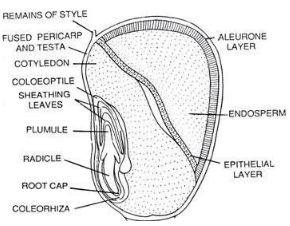
(B) In monocotyledonous seeds,such as maize,the outer covering of the endosperm is separated from the embryo by a proteinaceous layer known as the aleurone layer.
This layer plays a crucial role in the mobilization of nutrients during seed germination.
This layer plays a crucial role in the mobilization of nutrients during seed germination.
0 likes
View Solution92
MediumMCQ
$A$ : The storage region of maize grain is whitish or yellow.
$R$ : It is rich in protein granules.
$R$ : It is rich in protein granules.
A
Assertion and Reason both are correct and also correct explanation.
B
Assertion and Reason both are correct but not explanation of assertion.
C
Assertion is correct,but Reason is incorrect.
D
Both Assertion and Reason are incorrect.
Solution
(C) The storage region of maize grain is known as the endosperm.
This region is primarily rich in starch granules,which give it a whitish or yellowish appearance.
Protein granules (aleurone layer) are found in the outer layer of the endosperm,but the bulk of the storage tissue is starchy.
Therefore,the Assertion is correct,but the Reason is incorrect.
This region is primarily rich in starch granules,which give it a whitish or yellowish appearance.
Protein granules (aleurone layer) are found in the outer layer of the endosperm,but the bulk of the storage tissue is starchy.
Therefore,the Assertion is correct,but the Reason is incorrect.
0 likes
View Solution93
MediumMCQ
The endosperm in angiosperms develops from:
A
Zygote
B
Secondary nucleus
C
Chalazal polar nucleus
D
Micropylar polar nucleus
Solution
(B) In angiosperms,the endosperm is a triploid $(3n)$ nutritive tissue. It is formed through the process of double fertilization,specifically by the fusion of one male gamete with the secondary nucleus (or the central cell containing two polar nuclei). This process is known as triple fusion,resulting in the formation of the Primary Endosperm Nucleus $(PEN)$,which subsequently develops into the endosperm.
0 likes
View Solution94
MediumMCQ
Aleurone layer is found in
A
Dicotyledons
B
Monocotyledons
C
Conifers
D
Ferns
Solution
(B) The aleurone layer is a specialized protein-rich layer that surrounds the endosperm in the seeds of monocotyledons (such as maize,wheat,and rice).
It is typically triploid $(3n)$ in nature,formed during double fertilization.
This layer plays a crucial role in the mobilization of stored nutrients during seed germination by secreting enzymes like amylase.
It is typically triploid $(3n)$ in nature,formed during double fertilization.
This layer plays a crucial role in the mobilization of stored nutrients during seed germination by secreting enzymes like amylase.
0 likes
View Solution95
MediumMCQ
The milky water of tender coconut is:
A
Liquid gametes
B
Liquid nucellus
C
Liquid female gametophyte
D
Liquid endosperm
Solution
(D) The milky water found inside a tender coconut is known as liquid endosperm. It is a free-nuclear endosperm,where the primary endosperm nucleus undergoes successive nuclear divisions without cytokinesis,resulting in a liquid containing numerous free nuclei.
0 likes
View Solution96
MediumMCQ
Endospermic seeds are seen in
A
Castor
B
Coconut
C
Both $(a)$ and $(b)$
D
None of these
Solution
(C) Endosperm may either be completely consumed by the developing embryo (e.g.,pea,groundnut,beans) before seed maturation,or it may persist in the mature seed (e.g.,castor and coconut) and be used up during seed germination.
Seeds in which the endosperm persists are called endospermic or albuminous seeds.
Since both castor and coconut retain endosperm in their mature seeds,they are examples of endospermic seeds.
Seeds in which the endosperm persists are called endospermic or albuminous seeds.
Since both castor and coconut retain endosperm in their mature seeds,they are examples of endospermic seeds.
0 likes
View Solution97
MediumMCQ
An angiospermic leaf carries $16$ chromosomes. The number of chromosomes in its endosperm will be
A
$16$
B
$24$
C
$12$
D
$8$
Solution
(B) somatic cell (e.g.,cell of a leaf) contains a diploid $(2n)$ number of chromosomes.
Given,$2n = 16$,so $n = 8$.
In angiosperms,the endosperm is formed by the process of triple fusion,which involves the fusion of two polar nuclei $(n + n)$ and one male gamete $(n)$.
Therefore,the endosperm is triploid $(3n)$.
Calculation: $3n = 3 \times 8 = 24$.
Thus,the number of chromosomes in the endosperm will be $24$.
Given,$2n = 16$,so $n = 8$.
In angiosperms,the endosperm is formed by the process of triple fusion,which involves the fusion of two polar nuclei $(n + n)$ and one male gamete $(n)$.
Therefore,the endosperm is triploid $(3n)$.
Calculation: $3n = 3 \times 8 = 24$.
Thus,the number of chromosomes in the endosperm will be $24$.
0 likes
View Solution98
MediumMCQ
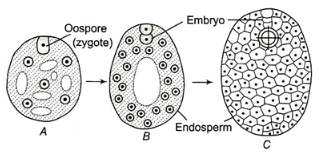
Identify the type of endosperm development shown in the given diagram.
A
Cellular
B
Helobial
C
Nuclear
D
None of these
Solution
(A) The provided diagram illustrates the development of Cellular endosperm.
There are three main types of endosperm development:
$(i)$ Nuclear Type: The primary endosperm nucleus divides repeatedly without wall formation to produce a large number of free nuclei. Examples include maize,coconut,and wheat.
$(ii)$ Cellular Type: Every division of the primary endosperm nucleus is followed by cytokinesis (wall formation),resulting in the formation of cells from the beginning. Examples include Balsam,Datura,and Petunia.
$(iii)$ Helobial Type: The first division of the primary endosperm nucleus is followed by transverse cytokinesis to form two unequal cells. Further development in both cells occurs similar to the nuclear type of endosperm.
In the given diagram,the presence of distinct cell walls around each nucleus from the early stages (as seen in stages $A$,$B$,and $C$) confirms that it is Cellular endosperm.
There are three main types of endosperm development:
$(i)$ Nuclear Type: The primary endosperm nucleus divides repeatedly without wall formation to produce a large number of free nuclei. Examples include maize,coconut,and wheat.
$(ii)$ Cellular Type: Every division of the primary endosperm nucleus is followed by cytokinesis (wall formation),resulting in the formation of cells from the beginning. Examples include Balsam,Datura,and Petunia.
$(iii)$ Helobial Type: The first division of the primary endosperm nucleus is followed by transverse cytokinesis to form two unequal cells. Further development in both cells occurs similar to the nuclear type of endosperm.
In the given diagram,the presence of distinct cell walls around each nucleus from the early stages (as seen in stages $A$,$B$,and $C$) confirms that it is Cellular endosperm.
0 likes
View Solution99
MediumMCQ
In an angiosperm,if the male plant is diploid $(2n)$ and the female plant is tetraploid $(4n)$,what will be the ploidy of the endosperm?
A
Haploid
B
Triploid
C
Tetraploid
D
Pentaploid
Solution
(D) In angiosperms,the endosperm is formed by the process of double fertilization,specifically the fusion of one male gamete with two polar nuclei (triple fusion).
$1$. The male plant is diploid $(2n)$,so the male gamete produced by it will be haploid $(n)$.
$2$. The female plant is tetraploid $(4n)$,so the polar nuclei (which are derived from the megaspore mother cell) will be diploid $(2n)$ each.
$3$. The endosperm is formed by the fusion of one male gamete $(n)$ and two polar nuclei $(2n + 2n)$.
$4$. Therefore,the ploidy of the endosperm = $n + 2n + 2n = 5n$ (Pentaploid).
$1$. The male plant is diploid $(2n)$,so the male gamete produced by it will be haploid $(n)$.
$2$. The female plant is tetraploid $(4n)$,so the polar nuclei (which are derived from the megaspore mother cell) will be diploid $(2n)$ each.
$3$. The endosperm is formed by the fusion of one male gamete $(n)$ and two polar nuclei $(2n + 2n)$.
$4$. Therefore,the ploidy of the endosperm = $n + 2n + 2n = 5n$ (Pentaploid).
0 likes
View SolutionSexual Reproduction in Flowering Plants — Endosperm · Frequently Asked Questions
1Are these Sexual Reproduction in Flowering Plants questions useful for JEE and NEET?
Yes. All questions in this section are mapped to JEE Main and NEET exam patterns. Previous year questions from JEE Main, NEET, GUJCET and state-level exams are included with full solutions.
2Can I switch to Hindi or Gujarati for these questions?
Yes. Use the language tabs in the hero section or the sidebar to view the same questions and solutions in English, Hindi or Gujarati.
3How do I generate a question paper from this subtopic?
Use the Vedclass Exam Paper Generator — select the chapter and subtopic, set difficulty, and generate Sets A, B, C, D automatically. First 3 chapters of every subject are free.
Vedclass Products
For Students
Vedclass Test Series
Mock tests in real JEE/NEET style with performance analysis. 5-day free trial.
Start Free TrialFor Teachers
Exam Paper Generator
Generate Set A/B/C/D papers from this chapter in 2 minutes. 3 chapters free.
Try FreeFor Institutes
Online Exam Module
Live online exams with unlimited students, 360° analytics & white-label branding.
See DemoFor Teachers & Institutes
Generate a Sexual Reproduction in Flowering Plants Exam Paper in 2 Minutes
Select subtopic & difficulty — Sets A, B, C, D auto-generated with No Repeat logic.
First 3 chapters of every subject are free — no payment required.