
A English
Embryo Questions in English
Class 12 Biology · Sexual Reproduction in Flowering Plants · Embryo
81+
Questions
English
Language
100%
With Solutions
Showing 31 of 81 questions in English
51
EasyMCQ
Zygote develops into:
A
Embryo
B
Ovule
C
Seed
D
Fruit
Solution
(A) In sexual reproduction,the fusion of male and female gametes results in the formation of a diploid cell called the $Zygote$.
Following fertilization,the $Zygote$ undergoes repeated mitotic divisions to develop into an $Embryo$.
In flowering plants,the $Ovule$ develops into a $Seed$,and the $Ovary$ develops into a $Fruit$.
Following fertilization,the $Zygote$ undergoes repeated mitotic divisions to develop into an $Embryo$.
In flowering plants,the $Ovule$ develops into a $Seed$,and the $Ovary$ develops into a $Fruit$.
0 likes
View Solution52
EasyMCQ
Embryogenesis is the process of development of
A
Embryo
B
Endosperm
C
Individual
D
Internal organs
Solution
(A) Embryogenesis refers to the development of an embryo from the zygote. During embryogenesis,the zygote undergoes cell division $(mitosis)$ and cell differentiation. The cell division of the zygote is called cleavage.
0 likes
View Solution53
MediumMCQ
Embryogenesis is the process of development of an embryo from the zygote. During this process,the zygote undergoes:
A
Meiosis
B
Cell division (mitosis)
C
Cell differentiation
D
Both $(B)$ and $(C)$
Solution
(D) Embryogenesis refers to the development of an embryo from the zygote.
During this process,the zygote undergoes cell division (mitosis) to increase the number of cells.
Simultaneously,the cells undergo cell differentiation to form specialized tissues and organs for the developing organism.
Meiosis does not occur during embryogenesis as the zygote is already diploid $(2n)$ and needs to maintain this ploidy level in the somatic cells of the embryo.
Therefore,both cell division (mitosis) and cell differentiation are essential processes in embryogenesis.
During this process,the zygote undergoes cell division (mitosis) to increase the number of cells.
Simultaneously,the cells undergo cell differentiation to form specialized tissues and organs for the developing organism.
Meiosis does not occur during embryogenesis as the zygote is already diploid $(2n)$ and needs to maintain this ploidy level in the somatic cells of the embryo.
Therefore,both cell division (mitosis) and cell differentiation are essential processes in embryogenesis.
0 likes
View Solution54
EasyMCQ
The progenitor of the next generation in a mature seed is:
A
Gamete
B
Spore
C
Oospore
D
Embryo
Solution
(D) In a mature seed,the embryo represents the young sporophyte of the next generation.
It is formed by the fusion of male and female gametes (fertilization) resulting in a zygote,which then develops into the embryo.
Therefore,the embryo acts as the progenitor of the next generation plant.
It is formed by the fusion of male and female gametes (fertilization) resulting in a zygote,which then develops into the embryo.
Therefore,the embryo acts as the progenitor of the next generation plant.
0 likes
View Solution55
MediumMCQ
Scutellum is
A
Cotyledon in dicots
B
Cotyledon in gymnosperm
C
Monocot root
D
Cotyledon in grass family
Solution
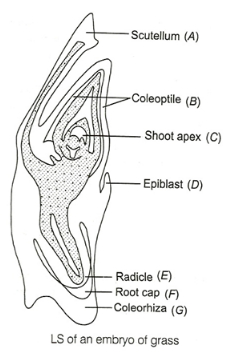
(D) Embryos of monocotyledons possess only one cotyledon.
In the grass family,the cotyledon is called the scutellum,which is situated toward one side (lateral) of the embryonal axis.
At its lower end,the embryonal axis has the radicle and root cap enclosed in an undifferentiated sheath called the coleorhiza.
The portion of the embryonal axis above the level of attachment of the scutellum is the epicotyl.
Epicotyl has a shoot apex and a few leaf primordia enclosed in a hollow structure called the coleoptile.
In the grass family,the cotyledon is called the scutellum,which is situated toward one side (lateral) of the embryonal axis.
At its lower end,the embryonal axis has the radicle and root cap enclosed in an undifferentiated sheath called the coleorhiza.
The portion of the embryonal axis above the level of attachment of the scutellum is the epicotyl.
Epicotyl has a shoot apex and a few leaf primordia enclosed in a hollow structure called the coleoptile.
0 likes
View Solution56
MediumMCQ
Identify the $A$ to $E$ in the following diagram.
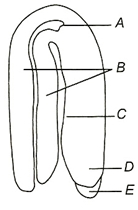
A
$A-Cotyledons, B-Hypocotyl, C-Plumule, D-Root cap, E-Radicle$
B
$A-Radicle, B-Root cap, C-Plumule, D-Hypocotyl, E-Cotyledons$
C
$A-Hypocotyl, B-Cotyledons, C-Plumule, D-Radicle, E-Root cap$
D
$A-Plumule, B-Cotyledons, C-Hypocotyl, D-Radicle, E-Root cap$
Solution
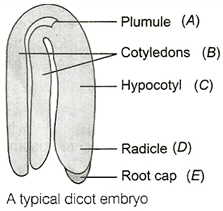
(D) The diagram shows a typical dicot embryo with its various important parts. $A$ typical dicotyledonous embryo consists of an embryonal axis and two cotyledons.
$1$. The portion of the embryonal axis above the level of cotyledons is the epicotyl, which terminates with the plumule or stem tip.
$2$. The cylindrical portion below the level of cotyledons is the hypocotyl, which terminates at its lower end in the radicle or root tip.
$3$. The root tip is covered with a root cap.
Based on the provided diagram, the labels correspond to: $A-Plumule, B-Cotyledons, C-Hypocotyl, D-Radicle, E-Root cap$.
$1$. The portion of the embryonal axis above the level of cotyledons is the epicotyl, which terminates with the plumule or stem tip.
$2$. The cylindrical portion below the level of cotyledons is the hypocotyl, which terminates at its lower end in the radicle or root tip.
$3$. The root tip is covered with a root cap.
Based on the provided diagram, the labels correspond to: $A-Plumule, B-Cotyledons, C-Hypocotyl, D-Radicle, E-Root cap$.
0 likes
View Solution57
MediumMCQ
The single cotyledon in monocots is known as:
A
Scutellum which is lateral in position
B
Aleurone layer which is terminal in position
C
Scutellum which is centrally placed
D
Epiblast which is haploid and lateral in position
Solution
(A) In monocotyledonous seeds,the embryo consists of a single cotyledon.
This single cotyledon is called the $Scutellum$.
It is situated towards one side (lateral) of the embryonal axis.
Therefore,the correct description is that it is a $Scutellum$ which is lateral in position.
This single cotyledon is called the $Scutellum$.
It is situated towards one side (lateral) of the embryonal axis.
Therefore,the correct description is that it is a $Scutellum$ which is lateral in position.
0 likes
View Solution58
MediumMCQ
The cylindrical portion below the level of cotyledons on the embryonal axis is known as:
A
Epicotyl
B
Hypocotyl
C
Radicle
D
Plumule
Solution
(B) In a dicotyledonous embryo,the embryonal axis consists of two parts separated by the level of attachment of cotyledons.
$1$. The portion of the embryonal axis above the level of cotyledons is called the $Epicotyl$,which terminates with the $Plumule$ (stem tip).
$2$. The cylindrical portion below the level of cotyledons is called the $Hypocotyl$,which terminates at its lower end in the $Radicle$ or root tip.
Therefore,the correct answer is $Hypocotyl$.
$1$. The portion of the embryonal axis above the level of cotyledons is called the $Epicotyl$,which terminates with the $Plumule$ (stem tip).
$2$. The cylindrical portion below the level of cotyledons is called the $Hypocotyl$,which terminates at its lower end in the $Radicle$ or root tip.
Therefore,the correct answer is $Hypocotyl$.
0 likes
View Solution59
MediumMCQ
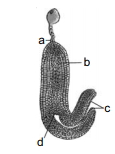
Examine the figure given below and select the right option identifying all the four parts $a, b, c$ and $d$.
A
$a$: Suspensor,$b$: Radicle,$c$: Cotyledons,$d$: Plumule
B
$a$: Plumule,$b$: Cotyledons,$c$: Radicle,$d$: Suspensor
C
$a$: Suspensor,$b$: Plumule,$c$: Cotyledons,$d$: Radicle
D
$a$: Radicle,$b$: Plumule,$c$: Cotyledons,$d$: Suspensor
Solution
(C) The provided figure represents a developing dicot embryo.
Based on the anatomical structure:
$a$ points to the suspensor,which anchors the embryo to the endosperm.
$b$ points to the plumule (embryonic shoot).
$c$ points to the cotyledons (seed leaves).
$d$ points to the radicle (embryonic root).
Therefore,the correct identification is $a$: Suspensor,$b$: Plumule,$c$: Cotyledons,$d$: Radicle.
This corresponds to option $C$.
Based on the anatomical structure:
$a$ points to the suspensor,which anchors the embryo to the endosperm.
$b$ points to the plumule (embryonic shoot).
$c$ points to the cotyledons (seed leaves).
$d$ points to the radicle (embryonic root).
Therefore,the correct identification is $a$: Suspensor,$b$: Plumule,$c$: Cotyledons,$d$: Radicle.
This corresponds to option $C$.
0 likes
View Solution60
MediumMCQ
Examine the figure given below and select the right option identifying all the four parts $a, b, c$ and $d$.
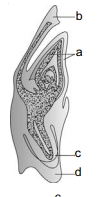
A
Coleoptile,Scutellum,Radicle,Coleorrhiza
B
Coleorrhiza,Radicle,Scutellum,Coleoptile
C
Scutellum,Coleorrhiza,Radicle,Coleoptile
D
Radicle,Scutellum,Coleoptile,Coleorrhiza
Solution
(A) The provided figure represents the longitudinal section of a monocot embryo (specifically a grass embryo).
- Part $a$ points to the protective sheath covering the plumule,known as the Coleoptile.
- Part $b$ points to the shield-shaped cotyledon,known as the Scutellum.
- Part $c$ points to the embryonic root,known as the Radicle.
- Part $d$ points to the undifferentiated sheath covering the radicle,known as the Coleorrhiza.
Therefore,the correct sequence is $a$: Coleoptile,$b$: Scutellum,$c$: Radicle,$d$: Coleorrhiza.
- Part $a$ points to the protective sheath covering the plumule,known as the Coleoptile.
- Part $b$ points to the shield-shaped cotyledon,known as the Scutellum.
- Part $c$ points to the embryonic root,known as the Radicle.
- Part $d$ points to the undifferentiated sheath covering the radicle,known as the Coleorrhiza.
Therefore,the correct sequence is $a$: Coleoptile,$b$: Scutellum,$c$: Radicle,$d$: Coleorrhiza.
0 likes
View Solution61
MediumMCQ
$A$: Eight cells of the octant stage in dicot embryogeny are formed by $2$ vertical and $1$ transverse division in the embryonal cell.
$R$: These cells are arranged in epibasal and hypobasal tiers.
$R$: These cells are arranged in epibasal and hypobasal tiers.
A
Assertion and Reason both are correct and Reason is the correct explanation of Assertion.
B
Assertion and Reason both are correct but Reason is not the correct explanation of Assertion.
C
Assertion is correct,but Reason is incorrect.
D
Both Assertion and Reason are incorrect.
Solution
(A) In dicot embryogeny,the zygote undergoes a transverse division to form a terminal cell (embryonal cell) and a basal cell.
The terminal cell undergoes two vertical divisions at right angles to each other,followed by one transverse division,resulting in an eight-celled stage known as the octant stage.
These eight cells are arranged in two tiers: the upper four cells form the epibasal tier (which gives rise to plumule and cotyledons),and the lower four cells form the hypobasal tier (which gives rise to the hypocotyl and radicle).
Thus,both the Assertion and the Reason are correct,and the Reason correctly explains the arrangement of the cells formed in the octant stage.
The terminal cell undergoes two vertical divisions at right angles to each other,followed by one transverse division,resulting in an eight-celled stage known as the octant stage.
These eight cells are arranged in two tiers: the upper four cells form the epibasal tier (which gives rise to plumule and cotyledons),and the lower four cells form the hypobasal tier (which gives rise to the hypocotyl and radicle).
Thus,both the Assertion and the Reason are correct,and the Reason correctly explains the arrangement of the cells formed in the octant stage.
0 likes
View Solution62
DifficultMCQ
$A$: Complete radicle is not produced by the hypo-basal tier of the octant embryo during Crucifer-type development.
$R$: The hypophysis cell of the suspensor contributes to the tip of the radicle in this type of development.
$R$: The hypophysis cell of the suspensor contributes to the tip of the radicle in this type of development.
A
Assertion and Reason both are correct and Reason is the correct explanation of Assertion.
B
Assertion and Reason both are correct but Reason is not the correct explanation of Assertion.
C
Assertion is correct,but Reason is incorrect.
D
Both Assertion and Reason are incorrect.
Solution
(A) In Crucifer-type (or Onagrad-type) embryo development,the zygote divides to form a terminal cell and a basal cell.
The terminal cell forms the octant embryo,which differentiates into the plumule and the hypocotyl.
The basal cell forms the suspensor,and the cell of the suspensor adjacent to the embryo proper is called the hypophysis.
The hypophysis undergoes divisions to form the root cap and the tip of the radicle.
Therefore,the hypo-basal tier of the octant embryo does not produce the complete radicle,as the tip is derived from the hypophysis.
Both statements are correct and the Reason explains why the hypo-basal tier does not produce the complete radicle.
The terminal cell forms the octant embryo,which differentiates into the plumule and the hypocotyl.
The basal cell forms the suspensor,and the cell of the suspensor adjacent to the embryo proper is called the hypophysis.
The hypophysis undergoes divisions to form the root cap and the tip of the radicle.
Therefore,the hypo-basal tier of the octant embryo does not produce the complete radicle,as the tip is derived from the hypophysis.
Both statements are correct and the Reason explains why the hypo-basal tier does not produce the complete radicle.
0 likes
View Solution63
MediumMCQ
The scutellum is a ......... .
A
Cotyledon
B
Coleoptile
C
Endosperm
D
Radicle
Solution
(A) In monocotyledonous seeds,such as maize,the embryo consists of one large and shield-shaped cotyledon known as the $scutellum$.
It is situated towards one side (lateral) of the embryonic axis.
Therefore,the scutellum is a cotyledon.
It is situated towards one side (lateral) of the embryonic axis.
Therefore,the scutellum is a cotyledon.
0 likes
View Solution64
EasyMCQ
The embryo is formed from ........ .
A
Zygote
B
Ovule
C
Seed
D
Pollen grain
Solution
(A) In sexual reproduction,the fusion of male and female gametes results in the formation of a diploid cell called the $Zygote$.
Following fertilization,the $Zygote$ undergoes repeated mitotic divisions to develop into an embryo.
Therefore,the embryo is derived directly from the $Zygote$.
Following fertilization,the $Zygote$ undergoes repeated mitotic divisions to develop into an embryo.
Therefore,the embryo is derived directly from the $Zygote$.
0 likes
View Solution65
MediumMCQ
What are the successive stages of embryogeny in a dicotyledonous plant?
A
Proembryo $\rightarrow$ Heart-shaped embryo $\rightarrow$ Globular embryo $\rightarrow$ Mature embryo
B
Proembryo $\rightarrow$ Globular embryo $\rightarrow$ Heart-shaped embryo $\rightarrow$ Mature embryo
C
Globular embryo $\rightarrow$ Proembryo $\rightarrow$ Heart-shaped embryo $\rightarrow$ Mature embryo
D
Globular embryo $\rightarrow$ Heart-shaped embryo $\rightarrow$ Proembryo $\rightarrow$ Mature embryo
Solution
(B) In dicotyledonous plants,the zygote undergoes a series of divisions to form the embryo. The developmental stages are as follows:
$1$. The zygote divides to form the proembryo.
$2$. The proembryo further develops into a globular embryo.
$3$. The globular embryo then differentiates into a heart-shaped embryo.
$4$. Finally,it matures into a fully developed embryo with cotyledons and an embryonal axis.
Therefore,the correct sequence is: Proembryo $\rightarrow$ Globular embryo $\rightarrow$ Heart-shaped embryo $\rightarrow$ Mature embryo.
$1$. The zygote divides to form the proembryo.
$2$. The proembryo further develops into a globular embryo.
$3$. The globular embryo then differentiates into a heart-shaped embryo.
$4$. Finally,it matures into a fully developed embryo with cotyledons and an embryonal axis.
Therefore,the correct sequence is: Proembryo $\rightarrow$ Globular embryo $\rightarrow$ Heart-shaped embryo $\rightarrow$ Mature embryo.
0 likes
View Solution66
MediumMCQ
Select the incorrect statement regarding the embryo of angiospermic plants.
A
The embryo develops from the diploid zygote located near the micropyle.
B
The embryo is formed before the formation of the endosperm.
C
The early stages of embryo development are similar in both monocots and dicots.
D
The embryo is formed from the fertilized egg (zygote).
Solution
(B) In angiosperms,the development of the embryo (embryogeny) occurs from the zygote.
$1$. The zygote is formed by the fusion of the male gamete and the egg cell,resulting in a diploid $(2n)$ structure located near the micropylar end of the embryo sac.
$2$. The early stages of embryogeny are identical in both monocots and dicots (proembryo,globular,and heart-shaped stages).
$3$. Crucially,the development of the endosperm precedes the development of the embryo. This is an evolutionary adaptation to ensure that nutrition is available for the developing embryo.
$4$. Therefore,the statement that the embryo is formed before the endosperm is incorrect.
$1$. The zygote is formed by the fusion of the male gamete and the egg cell,resulting in a diploid $(2n)$ structure located near the micropylar end of the embryo sac.
$2$. The early stages of embryogeny are identical in both monocots and dicots (proembryo,globular,and heart-shaped stages).
$3$. Crucially,the development of the endosperm precedes the development of the embryo. This is an evolutionary adaptation to ensure that nutrition is available for the developing embryo.
$4$. Therefore,the statement that the embryo is formed before the endosperm is incorrect.
0 likes
View Solution67
MediumMCQ
The given structure is a typical dicot embryo. Identify the plumule from the following.
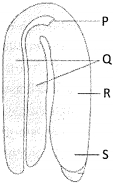
A
$P$
B
$Q$
C
$R$
D
$S$
Solution
(A) In a typical dicot embryo,the structure consists of an embryonal axis and two cotyledons.
- $P$ represents the plumule,which is the embryonic shoot tip.
- $Q$ represents the cotyledons.
- $R$ represents the hypocotyl.
- $S$ represents the radicle,which is the embryonic root tip.
Therefore,the plumule is represented by $P$.
- $P$ represents the plumule,which is the embryonic shoot tip.
- $Q$ represents the cotyledons.
- $R$ represents the hypocotyl.
- $S$ represents the radicle,which is the embryonic root tip.
Therefore,the plumule is represented by $P$.
0 likes
View Solution68
MediumMCQ
The given structure is a longitudinal section of a grass embryo. Identify $P, Q,$ and $R$.
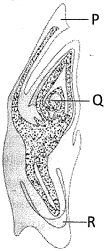
A
$P$: Scutellum,$Q$: Coleoptile,$R$: Radicle
B
$P$: Scutellum,$Q$: Shoot apex,$R$: Root cap
C
$P$: Scutellum,$Q$: Epiblast,$R$: Radicle
D
$P$: Coleoptile,$Q$: Shoot apex,$R$: Root cap
Solution
(B) In the longitudinal section of a grass embryo (e.g.,maize):
$1$. $P$ represents the Scutellum,which is a large,shield-shaped cotyledon.
$2$. $Q$ represents the Shoot apex,which is enclosed in a foliar structure called the coleoptile.
$3$. $R$ represents the Root cap,which protects the radicle at the base of the embryo.
Therefore,the correct identification is $P$: Scutellum,$Q$: Shoot apex,$R$: Root cap.
$1$. $P$ represents the Scutellum,which is a large,shield-shaped cotyledon.
$2$. $Q$ represents the Shoot apex,which is enclosed in a foliar structure called the coleoptile.
$3$. $R$ represents the Root cap,which protects the radicle at the base of the embryo.
Therefore,the correct identification is $P$: Scutellum,$Q$: Shoot apex,$R$: Root cap.
0 likes
View Solution69
MediumMCQ
What is the scutellum?
A
Cotyledon of a dicot seed
B
Cotyledon of a monocot seed
C
Embryonal axis of a dicot embryo
D
Embryonal axis of a monocot embryo
Solution
(B) In monocotyledonous seeds,such as those of the grass family (Poaceae),the single cotyledon is known as the scutellum. It is shield-shaped and situated towards one side (lateral) of the embryonal axis. Its primary function is to absorb nutrients from the endosperm and transfer them to the developing embryo.
0 likes
View Solution70
MediumMCQ
The root cap is covered by an undifferentiated sheath called $P$,and the shoot apex is enclosed in a hollow foliar structure called $Q$.
$\quad\quad\quad P \quad \quad Q$
$\quad\quad\quad P \quad \quad Q$
A
$P = \text{Coleorhiza}, Q = \text{Coleoptile}$
B
$P = \text{Coleoptile}, Q = \text{Coleorhiza}$
C
$P = \text{Radicle}, Q = \text{Plumule}$
D
$P = \text{Plumule}, Q = \text{Radicle}$
Solution
(A) In the embryo of a monocotyledon (e.g.,grass),the root cap is covered by an undifferentiated sheath known as the $P = \text{Coleorhiza}$.
The shoot apex and a few leaf primordia enclosed in a hollow foliar structure are known as the $Q = \text{Coleoptile}$.
Therefore,the correct sequence is $P = \text{Coleorhiza}$ and $Q = \text{Coleoptile}$.
The shoot apex and a few leaf primordia enclosed in a hollow foliar structure are known as the $Q = \text{Coleoptile}$.
Therefore,the correct sequence is $P = \text{Coleorhiza}$ and $Q = \text{Coleoptile}$.
0 likes
View Solution71
DifficultMCQ
Identify the cotyledon in the given structure.
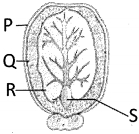
A
$P$
B
$Q$
C
$R$
D
$S$
Solution
(C) The given image represents the structure of a monocot embryo (specifically a grass embryo).
In this structure:
$P$ represents the pericarp/seed coat.
$Q$ represents the endosperm.
$R$ represents the scutellum,which is the single cotyledon in monocots.
$S$ represents the coleoptile or the embryonic axis.
Therefore,the cotyledon is represented by $R$.
In this structure:
$P$ represents the pericarp/seed coat.
$Q$ represents the endosperm.
$R$ represents the scutellum,which is the single cotyledon in monocots.
$S$ represents the coleoptile or the embryonic axis.
Therefore,the cotyledon is represented by $R$.
0 likes
View Solution72
EasyMCQ
Root cap is produced from . . . . . . of the suspensor.
A
haustorium
B
hypocotyl
C
epicotyl
D
hypophysis
Solution
(D) During the development of a dicot embryo,the zygote divides to form a proembryo and a suspensor.
The terminal cell of the suspensor,which is in contact with the embryo proper,is known as the $hypophysis$.
This $hypophysis$ cell undergoes further divisions to give rise to the radicle and the root cap of the developing embryo.
The terminal cell of the suspensor,which is in contact with the embryo proper,is known as the $hypophysis$.
This $hypophysis$ cell undergoes further divisions to give rise to the radicle and the root cap of the developing embryo.
0 likes
View Solution73
EasyMCQ
In angiosperms,the embryo is developed at . . . . . . of the embryo sac.
A
antipodal side
B
micropylar end
C
chalazal end
D
centre
Solution
(B) In angiosperms,the process of fertilization involves the fusion of a male gamete with the egg cell to form a zygote.
This zygote is located at the micropylar end of the embryo sac.
Following fertilization,the zygote undergoes mitotic divisions to develop into an embryo.
Therefore,the development of the embryo occurs at the micropylar end of the embryo sac.
This zygote is located at the micropylar end of the embryo sac.
Following fertilization,the zygote undergoes mitotic divisions to develop into an embryo.
Therefore,the development of the embryo occurs at the micropylar end of the embryo sac.
0 likes
View Solution74
EasyMCQ
Match the embryonal cell in Column-$I$ with their origin given in Column-$II$ and choose the correct options given below.
| Column-$I$ | Column-$II$ |
| $a$. Suspensor initial | $i$. Large basal cell of the $2$-celled pro-embryo |
| $b$. Embryonal initial | $ii$. First cell of the suspensor towards micropylar end |
| $c$. Haustorium | $iii$. Lowermost cell of the suspensor |
| $d$. Hypophysis | $iv$. Small terminal cell of $2$-celled pro-embryo |
A
$a-iv, b-i, c-iii, d-ii$
B
$a-i, b-iv, c-ii, d-iii$
C
$a-i, b-ii, c-iii, d-iv$
D
$a-ii, b-iii, c-i, d-iv$
Solution
(B) In the development of a dicot embryo,the zygote undergoes a transverse division to form a large basal cell and a small terminal cell (also called the embryonal initial).
$1$. The large basal cell acts as the suspensor initial $(a-i)$.
$2$. The small terminal cell is the embryonal initial $(b-iv)$.
$3$. The suspensor is formed from the basal cell. The first cell of the suspensor towards the micropylar end often enlarges to form a haustorium $(c-ii)$.
$4$. The lowermost cell of the suspensor,which is in contact with the embryonal mass,is called the hypophysis $(d-iii)$.
Therefore,the correct matching is $a-i, b-iv, c-ii, d-iii$.
$1$. The large basal cell acts as the suspensor initial $(a-i)$.
$2$. The small terminal cell is the embryonal initial $(b-iv)$.
$3$. The suspensor is formed from the basal cell. The first cell of the suspensor towards the micropylar end often enlarges to form a haustorium $(c-ii)$.
$4$. The lowermost cell of the suspensor,which is in contact with the embryonal mass,is called the hypophysis $(d-iii)$.
Therefore,the correct matching is $a-i, b-iv, c-ii, d-iii$.
0 likes
View Solution75
EasyMCQ
The apical cell of the $2$-celled pro-embryo in angiosperms undergoes . . . . . . division to form $8$-celled octant pro-embryo.
A
Four transverse mitotic
B
Four vertical mitotic
C
Two meiotic
D
One transverse and two vertical mitotic
Solution
(D) In a $2$-celled pro-embryo,the larger cell towards the micropyle is called the suspensor or basal cell.
The smaller cell towards the chalazal end is the terminal or embryonal cell.
This terminal cell undergoes one transverse and two vertical mitotic divisions to form the $8$-celled octant stage.
The smaller cell towards the chalazal end is the terminal or embryonal cell.
This terminal cell undergoes one transverse and two vertical mitotic divisions to form the $8$-celled octant stage.
0 likes
View Solution76
EasyMCQ
The correct sequence of developmental stages of embryo in angiosperms is . . . . . .
A
Octant $\rightarrow$ horse shoe shaped $\rightarrow$ heart shaped $\rightarrow$ globular
B
Octant $\rightarrow$ heart shaped $\rightarrow$ horse shoe shaped $\rightarrow$ globular
C
Globular $\rightarrow$ octant $\rightarrow$ heart shaped $\rightarrow$ horse shoe shaped
D
Octant $\rightarrow$ globular $\rightarrow$ heart shaped $\rightarrow$ horse shoe shaped
Solution
(D) The embryonal initial undergoes $3$ successive mitotic divisions to form an $8$-celled stage known as the octant.
Further development leads to the formation of a globular embryo.
As the embryo continues to grow,the enlargement of the hypocotyl and cotyledons results in the formation of a heart-shaped structure.
Finally,the embryo matures into a horse shoe-shaped structure.
Further development leads to the formation of a globular embryo.
As the embryo continues to grow,the enlargement of the hypocotyl and cotyledons results in the formation of a heart-shaped structure.
Finally,the embryo matures into a horse shoe-shaped structure.
0 likes
View Solution77
EasyMCQ
In angiosperms,during the development of the embryo,the suspensor cells develop from:
A
oospore
B
integument
C
endosperm
D
cotyledon
Solution
(A) In angiosperms,the zygote (also known as the oospore) undergoes a transverse division to form two cells: a larger basal cell and a smaller terminal cell (or apical cell).
The basal cell undergoes further transverse divisions to form a filamentous structure called the suspensor.
The suspensor helps in pushing the developing embryo into the endosperm for nutrition.
Therefore,the suspensor cells develop from the oospore (zygote).
The basal cell undergoes further transverse divisions to form a filamentous structure called the suspensor.
The suspensor helps in pushing the developing embryo into the endosperm for nutrition.
Therefore,the suspensor cells develop from the oospore (zygote).
0 likes
View Solution78
EasyMCQ
The suspensor in a developing embryo is formed from:
A
Basal cell
B
Hypophysis
C
Terminal cell
D
Haustorium
Solution
(A) In the development of a dicot embryo,the zygote undergoes a transverse division to form two cells: a larger basal cell and a smaller terminal (or apical) cell.
The basal cell undergoes repeated transverse divisions to form a filamentous structure known as the suspensor.
The suspensor helps in pushing the embryo into the endosperm for nutrition.
The terminal cell undergoes further divisions to form the embryo proper (radicle,plumule,and cotyledons).
The basal cell undergoes repeated transverse divisions to form a filamentous structure known as the suspensor.
The suspensor helps in pushing the embryo into the endosperm for nutrition.
The terminal cell undergoes further divisions to form the embryo proper (radicle,plumule,and cotyledons).
0 likes
View Solution79
EasyMCQ
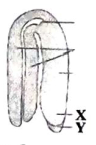
What is depicted by "$X$" and "$Y$" in the following diagram?
A
$X$ - Plumule, $Y$ - Cotyledon
B
$X$ - Plumule, $Y$ - Root cap
C
$X$ - Root cap, $Y$ - Radicle
D
$X$ - Radicle, $Y$ - Root cap
Solution
(D) The provided diagram represents the structure of a dicot embryo. In this structure, the lower pointed portion is the radicle, which is covered by a protective sheath-like structure at the tip known as the root cap. Therefore, "$X$" represents the radicle and "$Y$" represents the root cap. Thus, the correct option is $D$.
0 likes
View Solution80
EasyMCQ
Which of the following plant organs is diploid?
A
Pollen grains
B
Egg cell
C
Male gamete
D
Zygote
Solution
(D) In flowering plants,the life cycle involves an alternation of generations between the haploid gametophyte and the diploid sporophyte.
$A$. Pollen grains are haploid $(n)$ structures produced by meiosis.
$B$. The egg cell is a haploid $(n)$ female gamete.
$C$. The male gamete is a haploid $(n)$ cell.
$D$. The zygote is formed by the fusion of the male and female gametes $(n + n)$,resulting in a diploid $(2n)$ cell.
Therefore,the zygote is the diploid structure.
$A$. Pollen grains are haploid $(n)$ structures produced by meiosis.
$B$. The egg cell is a haploid $(n)$ female gamete.
$C$. The male gamete is a haploid $(n)$ cell.
$D$. The zygote is formed by the fusion of the male and female gametes $(n + n)$,resulting in a diploid $(2n)$ cell.
Therefore,the zygote is the diploid structure.
0 likes
View Solution81
EasyMCQ
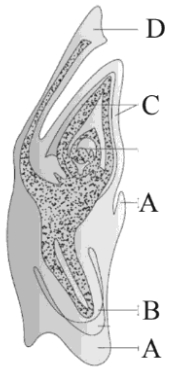
In this diagram showing the $L$.$S$. of an embryo of grass,identify the answer having the correct combination of alphabets with the right part.
A
$A$-Epiblast,$B$-Scutellum,$C$-Coleoptile,$D$-Radicle,$E$-Coleorrhiza,$F$-Shoot apex
B
$A$-Root cap,$B$-Coleoptile,$C$-Scutellum,$D$-Coleorrhiza,$E$-Epiblast,$F$-Shoot apex
C
$A$-Epiblast,$B$-Radicle,$C$-Coleoptile,$D$-Scutellum,$E$-Coleorrhiza,$F$-Shoot apex
D
$A$-Shoot apex,$B$-Epiblast,$C$-Coleorrhiza,$D$-Scutellum,$E$-Coleoptile,$F$-Radicle
Solution
(A) Based on the standard diagram of the $L$.$S$. of a grass embryo (monocot embryo) as provided in the $NCERT$ textbook:
- $A$ represents the Epiblast (the small,rudimentary second cotyledon).
- $B$ represents the Radicle (the embryonic root).
- $C$ represents the Coleoptile (the protective sheath covering the plumule).
- $D$ represents the Scutellum (the large,shield-shaped cotyledon).
- The structure covering the radicle is the Coleorrhiza.
- The top portion represents the Shoot apex (plumule).
Comparing these labels with the given options,option $A$ provides the correct identification for the parts labeled in the standard diagram of a grass embryo.
- $A$ represents the Epiblast (the small,rudimentary second cotyledon).
- $B$ represents the Radicle (the embryonic root).
- $C$ represents the Coleoptile (the protective sheath covering the plumule).
- $D$ represents the Scutellum (the large,shield-shaped cotyledon).
- The structure covering the radicle is the Coleorrhiza.
- The top portion represents the Shoot apex (plumule).
Comparing these labels with the given options,option $A$ provides the correct identification for the parts labeled in the standard diagram of a grass embryo.
0 likes
View SolutionSexual Reproduction in Flowering Plants — Embryo · Frequently Asked Questions
1Are these Sexual Reproduction in Flowering Plants questions useful for JEE and NEET?
Yes. All questions in this section are mapped to JEE Main and NEET exam patterns. Previous year questions from JEE Main, NEET, GUJCET and state-level exams are included with full solutions.
2Can I switch to Hindi or Gujarati for these questions?
Yes. Use the language tabs in the hero section or the sidebar to view the same questions and solutions in English, Hindi or Gujarati.
3How do I generate a question paper from this subtopic?
Use the Vedclass Exam Paper Generator — select the chapter and subtopic, set difficulty, and generate Sets A, B, C, D automatically. First 3 chapters of every subject are free.
Vedclass Products
For Students
Vedclass Test Series
Mock tests in real JEE/NEET style with performance analysis. 5-day free trial.
Start Free TrialFor Teachers
Exam Paper Generator
Generate Set A/B/C/D papers from this chapter in 2 minutes. 3 chapters free.
Try FreeFor Institutes
Online Exam Module
Live online exams with unlimited students, 360° analytics & white-label branding.
See DemoFor Teachers & Institutes
Generate a Sexual Reproduction in Flowering Plants Exam Paper in 2 Minutes
Select subtopic & difficulty — Sets A, B, C, D auto-generated with No Repeat logic.
First 3 chapters of every subject are free — no payment required.