
A English
Mix Examples -Reproduction in Organisms Questions in English
Class 12 Biology · Reproduction in Organisms · Mix Examples -Reproduction in Organisms
236+
Questions
English
Language
100%
With Solutions
Showing 50 of 236 questions in English
101
MediumMCQ
Distinguish between: Pre-fertilization events and Post-fertilization events.
A
Pre-fertilization events involve gametogenesis and gamete transfer,while post-fertilization events involve zygote formation and embryogenesis.
B
Pre-fertilization events occur before the fusion of gametes,whereas post-fertilization events occur after the fusion of gametes.
C
Pre-fertilization events lead to the formation of a zygote,while post-fertilization events lead to the development of an embryo.
D
All of the above.
Solution
(D) Pre-fertilization events include all the processes that occur before the fusion of gametes,such as gametogenesis (formation of male and female gametes) and gamete transfer.
Post-fertilization events include all the processes that occur after the fusion of gametes (fertilization),such as the formation of the zygote and embryogenesis (development of the embryo from the zygote).
Therefore,all the provided statements correctly distinguish between these two phases of sexual reproduction.
Post-fertilization events include all the processes that occur after the fusion of gametes (fertilization),such as the formation of the zygote and embryogenesis (development of the embryo from the zygote).
Therefore,all the provided statements correctly distinguish between these two phases of sexual reproduction.
0 likes
View Solution102
Medium
Define and explain the following terms:
$(a)$ Sexual reproduction vs. Asexual reproduction
$(b)$ Fission vs. Clones
$(a)$ Sexual reproduction vs. Asexual reproduction
$(b)$ Fission vs. Clones
Solution
(N/A) Asexual reproduction: When offspring are produced by a single parent without the involvement of gamete formation or fusion.
Sexual reproduction: When two parents of opposite sex are involved in reproduction,both produce their respective gametes which fuse to form a zygote.
$(b)$ Fission: $A$ process of asexual reproduction in which the nucleus divides first,followed by cytoplasmic division (cytokinesis).
Clones: Genetically and morphologically identical offspring resulting from a single parent through asexual reproduction.
Sexual reproduction: When two parents of opposite sex are involved in reproduction,both produce their respective gametes which fuse to form a zygote.
$(b)$ Fission: $A$ process of asexual reproduction in which the nucleus divides first,followed by cytoplasmic division (cytokinesis).
Clones: Genetically and morphologically identical offspring resulting from a single parent through asexual reproduction.
0 likes
View Solution103
Medium
Define the following phases of the life cycle of an organism:
$(a)$ Senescent phase
$(b)$ Reproductive phase
$(c)$ Juvenile phase
$(a)$ Senescent phase
$(b)$ Reproductive phase
$(c)$ Juvenile phase
Solution
(N/A) Senescent phase: This is the final stage of the life cycle,occurring after the reproductive phase. During this phase,hormonal changes lead to a gradual decline in the production of gametes,eventually leading to death.
$(b)$ Reproductive phase: This phase begins when the reproductive system becomes mature enough to produce functional gametes. The organism is then capable of mating and reproduction. This phase is characterized by significant hormonal changes. In humans,it typically starts at $12$ to $13$ years of age and lasts until $55$ to $60$ years.
$(c)$ Juvenile phase: This is the period of growth and development that an organism undergoes before reaching sexual maturity. During this time,the organism is not yet capable of reproduction. In humans,this phase lasts from birth up to $12$ to $13$ years of age.
$(b)$ Reproductive phase: This phase begins when the reproductive system becomes mature enough to produce functional gametes. The organism is then capable of mating and reproduction. This phase is characterized by significant hormonal changes. In humans,it typically starts at $12$ to $13$ years of age and lasts until $55$ to $60$ years.
$(c)$ Juvenile phase: This is the period of growth and development that an organism undergoes before reaching sexual maturity. During this time,the organism is not yet capable of reproduction. In humans,this phase lasts from birth up to $12$ to $13$ years of age.
0 likes
View Solution104
Medium
Is the number of eggs laid by oviparous animals equal to the number of offspring produced by viviparous animals? Why?
Solution
(N/A) No,the number of eggs laid by oviparous animals is not necessarily equal to the number of offspring produced by viviparous animals.
$1$. In oviparous animals,the number of eggs varies significantly. For example,fish and frogs lay a large number of eggs to ensure survival against predators,whereas birds like the ostrich lay only one or a few eggs.
$2$. Similarly,in viviparous animals,the number of offspring produced varies. Some animals like humans typically give birth to a single offspring,while others like dogs or cats give birth to multiple offspring at once.
$3$. Therefore,there is no fixed rule that the number of eggs in oviparous animals equals the number of offspring in viviparous animals; it depends on the species,reproductive strategy,and environmental factors.
$1$. In oviparous animals,the number of eggs varies significantly. For example,fish and frogs lay a large number of eggs to ensure survival against predators,whereas birds like the ostrich lay only one or a few eggs.
$2$. Similarly,in viviparous animals,the number of offspring produced varies. Some animals like humans typically give birth to a single offspring,while others like dogs or cats give birth to multiple offspring at once.
$3$. Therefore,there is no fixed rule that the number of eggs in oviparous animals equals the number of offspring in viviparous animals; it depends on the species,reproductive strategy,and environmental factors.
0 likes
View Solution105
MediumMCQ
Why do we refer to offspring formed by asexual method of reproduction as clones?
A
They are morphologically similar.
B
They are genetically similar.
C
They are morphologically and genetically similar to the parent.
D
They are produced by meiosis.
Solution
(C) Offspring formed by asexual reproduction are referred to as clones because they are morphologically and genetically identical to their parent.
This occurs because asexual reproduction involves only a single parent and occurs through mitotic cell division,which does not involve the recombination of genetic material or the formation of gametes.
This occurs because asexual reproduction involves only a single parent and occurs through mitotic cell division,which does not involve the recombination of genetic material or the formation of gametes.
0 likes
View Solution106
Medium
Between an annual and a perennial plant,which one has a shorter juvenile phase? Give one reason.
Solution
(N/A) An annual plant has a shorter juvenile phase compared to a perennial plant.
Reason: Annual plants must complete their entire life cycle,including growth,flowering,and seed production,within a single growing season. Therefore,they have a rapid development phase to ensure reproduction before the season ends.
Reason: Annual plants must complete their entire life cycle,including growth,flowering,and seed production,within a single growing season. Therefore,they have a rapid development phase to ensure reproduction before the season ends.
0 likes
View Solution107
MediumMCQ
Is there any relationship between the size of an organism and its lifespan? Give two examples to support your answer.
A
Yes,larger organisms always live longer.
B
Yes,smaller organisms always live longer.
C
No,there is no direct correlation between size and lifespan.
D
Size and lifespan are inversely proportional.
Solution
(C) No,there is no direct correlation between the size of an organism and its lifespan.
$(1)$ The mango tree and the peepal tree are of similar size,yet the lifespan of the mango tree is much shorter than that of the peepal tree.
$(2)$ $A$ crow and a parrot are of similar size,yet their lifespans are approximately $15$ years and $140$ years,respectively.
$(1)$ The mango tree and the peepal tree are of similar size,yet the lifespan of the mango tree is much shorter than that of the peepal tree.
$(2)$ $A$ crow and a parrot are of similar size,yet their lifespans are approximately $15$ years and $140$ years,respectively.
0 likes
View Solution108
Medium
Give reasons as to why cell division cannot be a type of reproduction in multicellular organisms.
Solution
(N/A) In multicellular organisms,cell division is primarily a mechanism for growth,development,and the repair of tissues.
It increases the number of cells within an individual organism,leading to an increase in body size and mass.
Reproduction,on the other hand,is a biological process by which an organism produces offspring to ensure the continuity of its species.
Since cell division in multicellular organisms does not result in the formation of a new,independent individual,it is considered a process of growth rather than a mode of reproduction.
It increases the number of cells within an individual organism,leading to an increase in body size and mass.
Reproduction,on the other hand,is a biological process by which an organism produces offspring to ensure the continuity of its species.
Since cell division in multicellular organisms does not result in the formation of a new,independent individual,it is considered a process of growth rather than a mode of reproduction.
0 likes
View Solution109
Medium
Identify which of the following organisms are monoecious and which are dioecious:
$(a)$ Earthworm ........... $(b)$ Chara ...........
$(c)$ Marchantia ........... $(d)$ Cockroach ...........
$(a)$ Earthworm ........... $(b)$ Chara ...........
$(c)$ Marchantia ........... $(d)$ Cockroach ...........
Solution
(A) Earthworm: Monoecious (Hermaphrodite).
$(b)$ Chara: Monoecious (Both male and female sex organs are present on the same plant).
$(c)$ Marchantia: Dioecious (Male and female sex organs are present on different thalli).
$(d)$ Cockroach: Dioecious (Male and female individuals are separate).
$(b)$ Chara: Monoecious (Both male and female sex organs are present on the same plant).
$(c)$ Marchantia: Dioecious (Male and female sex organs are present on different thalli).
$(d)$ Cockroach: Dioecious (Male and female individuals are separate).
0 likes
View Solution110
Advanced
The number of taxa exhibiting asexual reproduction is drastically reduced in higher plants (angiosperms) and higher animals (vertebrates) as compared with lower groups of plants and animals. Analyse the possible reasons for this situation.
Solution
(N/A) Sexual reproduction is preferred in higher organisms because it promotes genetic diversity through recombination and independent assortment during meiosis.
Genetic variation allows populations to adapt to changing environmental conditions,which is crucial for the survival of complex organisms.
Sexual reproduction facilitates the removal of harmful mutations from the gene pool over generations.
In contrast,asexual reproduction produces clones,which lack genetic diversity and are more susceptible to environmental changes or diseases.
Furthermore,higher organisms have complex body organizations and specialized reproductive systems that are better suited for sexual reproduction,which ensures the long-term evolutionary success of the species.
Genetic variation allows populations to adapt to changing environmental conditions,which is crucial for the survival of complex organisms.
Sexual reproduction facilitates the removal of harmful mutations from the gene pool over generations.
In contrast,asexual reproduction produces clones,which lack genetic diversity and are more susceptible to environmental changes or diseases.
Furthermore,higher organisms have complex body organizations and specialized reproductive systems that are better suited for sexual reproduction,which ensures the long-term evolutionary success of the species.
0 likes
View Solution111
Medium
Which is a better mode of reproduction: sexual or asexual? Why?
Solution
(A) $=$ Sexual reproduction is a better mode of reproduction.
$\Rightarrow$ It involves the fusion of male and female gametes to produce variants which are not identical to their parents and themselves.
- These variations allow individuals to adapt to the changing environment and ensure a greater survival of the species.
$\Rightarrow$ On the other hand,asexual reproduction allows for little or no variation at all.
- As a result,the individuals produced are identical to their parent.
$\Rightarrow$ It involves the fusion of male and female gametes to produce variants which are not identical to their parents and themselves.
- These variations allow individuals to adapt to the changing environment and ensure a greater survival of the species.
$\Rightarrow$ On the other hand,asexual reproduction allows for little or no variation at all.
- As a result,the individuals produced are identical to their parent.
0 likes
View Solution112
EasyMCQ
The lifespan of an organism is defined as:
A
The period from the organism's conception to birth.
B
The period from the organism's birth to its natural death.
C
The period from the organism's childhood to adolescence.
D
The period from the organism's birth to maturity.
Solution
(B) The lifespan of an organism is defined as the period from its birth to its natural death. It is a biological characteristic that varies among different species. Even if an organism is unicellular,its lifespan is the duration from its origin to its natural death.
0 likes
View Solution113
EasyMCQ
Which of the following organisms has the longest lifespan?
A
Butterfly
B
Crocodile
C
Parrot
D
Dog
Solution
(C) The lifespan of the given organisms are as follows:
$1$. Butterfly: $1-2$ weeks.
$2$. Crocodile: $60$ years.
$3$. Parrot: $140$ years.
$4$. Dog: $10-13$ years.
Comparing these,the parrot has the longest lifespan among the options provided.
$1$. Butterfly: $1-2$ weeks.
$2$. Crocodile: $60$ years.
$3$. Parrot: $140$ years.
$4$. Dog: $10-13$ years.
Comparing these,the parrot has the longest lifespan among the options provided.
0 likes
View Solution114
EasyMCQ
What is the approximate lifespan of a tortoise?
A
$100-150$ years
B
$500-1000$ years
C
$60$ years
D
$15$ years
Solution
(A) The lifespan of an organism is the period from birth to the natural death of that organism.
According to biological data,the average lifespan of a tortoise is approximately $100-150$ years.
Therefore,the correct option is $A$.
According to biological data,the average lifespan of a tortoise is approximately $100-150$ years.
Therefore,the correct option is $A$.
0 likes
View Solution115
EasyMCQ
When is an offspring called an exact copy of its parents?
A
If the offspring and parents have the same size.
B
If the offspring and parents have partial similarity in appearance.
C
If the offspring and parents have similarity in weight.
D
If the offspring and parents have genetic similarity.
Solution
(D) An offspring is called an exact copy of its parents when it is morphologically and genetically identical to the parent. This phenomenon is known as a $clone$. Clones are produced through asexual reproduction,where a single parent produces offspring without the fusion of gametes,ensuring that the genetic material remains identical to the parent.
0 likes
View Solution116
EasyMCQ
What is the average lifespan of a crocodile (in $years$)?
A
$60$
B
$100$
C
$150$
D
$200$
Solution
(A) The lifespan of an organism is the period from birth to the natural death of an organism.
According to the $NCERT$ biology textbook, the average lifespan of a crocodile is approximately $60$ years.
Therefore, the correct option is $A$.
According to the $NCERT$ biology textbook, the average lifespan of a crocodile is approximately $60$ years.
Therefore, the correct option is $A$.
0 likes
View Solution117
EasyMCQ
Select the appropriate option regarding $Hydra$.
A
Budding and fragmentation
B
Budding and spore formation
C
Zoospore and fragmentation
D
Zoospore and conidia
Solution
(A) $Hydra$ is a freshwater organism that primarily reproduces asexually through $Budding$. In this process,a small outgrowth called a bud develops on the parent body,which eventually detaches to form a new individual. Additionally,$Hydra$ can also reproduce through $Fragmentation$,where the body breaks into pieces,and each piece regenerates into a complete organism. Therefore,the correct combination is $Budding$ and $Fragmentation$.
0 likes
View Solution118
EasyMCQ
Select the option that represents the organisms in descending order of their life span.
A
Crocodile $\rightarrow$ Crow $\rightarrow$ Parrot $\rightarrow$ Butterfly
B
Crocodile $\rightarrow$ Parrot $\rightarrow$ Butterfly $\rightarrow$ Crow
C
Parrot $\rightarrow$ Crocodile $\rightarrow$ Crow $\rightarrow$ Butterfly
D
Parrot $\rightarrow$ Crow $\rightarrow$ Crocodile $\rightarrow$ Butterfly
Solution
(C) The approximate life spans of the given organisms are as follows:
$1$. Parrot: $\approx 140$ years
$2$. Crocodile: $\approx 60$ years
$3$. Crow: $\approx 15$ years
$4$. Butterfly: $\approx 1-2$ weeks
Arranging these in descending order (from longest to shortest life span): Parrot ($140$ years) $>$ Crocodile ($60$ years) $>$ Crow ($15$ years) $>$ Butterfly ($1-2$ weeks). Therefore,the correct sequence is Parrot $\rightarrow$ Crocodile $\rightarrow$ Crow $\rightarrow$ Butterfly.
$1$. Parrot: $\approx 140$ years
$2$. Crocodile: $\approx 60$ years
$3$. Crow: $\approx 15$ years
$4$. Butterfly: $\approx 1-2$ weeks
Arranging these in descending order (from longest to shortest life span): Parrot ($140$ years) $>$ Crocodile ($60$ years) $>$ Crow ($15$ years) $>$ Butterfly ($1-2$ weeks). Therefore,the correct sequence is Parrot $\rightarrow$ Crocodile $\rightarrow$ Crow $\rightarrow$ Butterfly.
0 likes
View Solution119
EasyMCQ
Which plant species exhibits flowering only once in its lifetime?
A
Mango
B
Bamboo
C
Strobilanthes kunthiana
D
Banyan
Solution
(B) Bamboo species are monocarpic plants, meaning they flower only once in their lifetime, usually after $50-100$ years, produce a large number of fruits, and then die. While $Strobilanthes$ $kunthiana$ (Neelakurinji) also flowers once, it does so every $12$ years, whereas the question refers to the general biological phenomenon of monocarpic flowering often associated with bamboo in the context of life history strategies.
0 likes
View Solution120
EasyMCQ
How many years does the bamboo species generally take to produce a large number of fruits?
A
$40-45$
B
$20-30$
C
$10-20$
D
$50-100$
Solution
(D) Bamboo species are monocarpic plants,meaning they flower and fruit only once in their lifetime.
They generally flower after a long period of vegetative growth,typically ranging from $50$ to $100$ years.
After producing a large number of fruits,the plant dies.
Therefore,the correct range is $50-100$ years.
They generally flower after a long period of vegetative growth,typically ranging from $50$ to $100$ years.
After producing a large number of fruits,the plant dies.
Therefore,the correct range is $50-100$ years.
0 likes
View Solution121
EasyMCQ
Which events include gametogenesis and gamete transfer?
A
Post-fertilization events
B
Pre-fertilization events
C
Syngamy
D
Fertilization
Solution
(B) Sexual reproduction in organisms is generally divided into three distinct stages:
$1$. Pre-fertilization events: These include gametogenesis (formation of gametes) and gamete transfer.
$2$. Fertilization (Syngamy): The fusion of male and female gametes to form a diploid zygote.
$3$. Post-fertilization events: These include the formation of the zygote and embryogenesis (development of the embryo).
Therefore,gametogenesis and gamete transfer are part of pre-fertilization events.
$1$. Pre-fertilization events: These include gametogenesis (formation of gametes) and gamete transfer.
$2$. Fertilization (Syngamy): The fusion of male and female gametes to form a diploid zygote.
$3$. Post-fertilization events: These include the formation of the zygote and embryogenesis (development of the embryo).
Therefore,gametogenesis and gamete transfer are part of pre-fertilization events.
0 likes
View Solution122
EasyMCQ
Which term indicates a bisexual condition?
A
Hermaphrodite
B
Monoecious
C
Bisexual
D
All of the above
Solution
(D) bisexual condition refers to the presence of both male and female reproductive organs in the same organism.
For plants,the term $Monoecious$ is commonly used to describe this condition.
For animals,the term $Hermaphrodite$ is used to describe an organism that possesses both male and female reproductive systems.
The term $Bisexual$ is a general term that also indicates the presence of both sexes in one individual.
Therefore,all the given terms describe a bisexual condition.
For plants,the term $Monoecious$ is commonly used to describe this condition.
For animals,the term $Hermaphrodite$ is used to describe an organism that possesses both male and female reproductive systems.
The term $Bisexual$ is a general term that also indicates the presence of both sexes in one individual.
Therefore,all the given terms describe a bisexual condition.
0 likes
View Solution123
MediumMCQ
In which of the following organisms are gametes produced through mitosis?
A
Gymnosperms
B
Angiosperms
C
Some algae
D
Humans
Solution
(C) In organisms with a haploid $(n)$ plant body,such as many algae (e.g.,$Cladophora$),gametes are produced by mitosis because the parent body is already haploid and cannot undergo meiosis to produce gametes. In contrast,organisms like gymnosperms,angiosperms,and humans are diploid $(2n)$ and produce gametes through meiosis.
0 likes
View Solution124
MediumMCQ
Match List-$I$ with List-$II$ and select the correct option:
| List-$I$ | List-$II$ |
| $(a)$ Sexual reproduction | $(1)$ Binary fission |
| $(b)$ Asexual reproduction | $(2)$ Budding |
| $(c)$ Amoeba | $(3)$ Genetic clones |
| $(d)$ Yeast | $(4)$ Variations |
A
$a-3, b-4, c-2, d-1$
B
$a-4, b-3, c-1, d-2$
C
$a-4, b-2, c-3, d-1$
D
$a-2, b-4, c-1, d-2$
Solution
(B) Sexual reproduction involves the fusion of gametes, which leads to genetic variations in offspring. Thus, $a-4$.
$(b)$ Asexual reproduction involves a single parent and produces offspring that are genetically identical to the parent, known as clones. Thus, $b-3$.
$(c)$ Amoeba reproduces asexually through the process of binary fission. Thus, $c-1$.
$(d)$ Yeast reproduces asexually through the process of budding. Thus, $d-2$.
Therefore, the correct matching is $a-4, b-3, c-1, d-2$.
$(b)$ Asexual reproduction involves a single parent and produces offspring that are genetically identical to the parent, known as clones. Thus, $b-3$.
$(c)$ Amoeba reproduces asexually through the process of binary fission. Thus, $c-1$.
$(d)$ Yeast reproduces asexually through the process of budding. Thus, $d-2$.
Therefore, the correct matching is $a-4, b-3, c-1, d-2$.
0 likes
View Solution125
EasyMCQ
Match the following columns:
| Column-$I$ | Column-$II$ |
|---|---|
| $(a)$ Penicillium | $(1)$ Zoospores |
| $(b)$ Hydra | $(2)$ Gemmules |
| $(c)$ Sponge | $(3)$ Conidia |
| $(d)$ Chlamydomonas | $(4)$ Budding |
A
$a-4, b-3, c-2, d-1$
B
$a-2, b-4, c-3, d-1$
C
$a-3, b-4, c-2, d-1$
D
$a-3, b-4, c-1, d-2$
Solution
(C) The correct matches are as follows:
$(a)$ Penicillium reproduces through asexual spores called Conidia $(a-3)$.
$(b)$ Hydra reproduces through external budding $(b-4)$.
$(c)$ Sponges (like Spongilla) reproduce through internal buds called Gemmules $(c-2)$.
$(d)$ Chlamydomonas produces motile asexual spores called Zoospores $(d-1)$.
Therefore,the correct sequence is $a-3, b-4, c-2, d-1$.
$(a)$ Penicillium reproduces through asexual spores called Conidia $(a-3)$.
$(b)$ Hydra reproduces through external budding $(b-4)$.
$(c)$ Sponges (like Spongilla) reproduce through internal buds called Gemmules $(c-2)$.
$(d)$ Chlamydomonas produces motile asexual spores called Zoospores $(d-1)$.
Therefore,the correct sequence is $a-3, b-4, c-2, d-1$.
0 likes
View Solution126
EasyMCQ
Match the following columns:
| List-$I$ | List-$II$ |
|---|---|
| $(a)$ Primates | $(1)$ Fusion of gametes |
| $(b)$ Non-primates | $(2)$ Continuous breeders |
| $(c)$ Fertilization | $(3)$ Growth phase |
| $(d)$ Juvenile phase | $(4)$ Seasonal breeders |
A
$a-3, b-1, c-4, d-2$
B
$a-1, b-4, c-2, d-3$
C
$a-4, b-2, c-1, d-3$
D
$a-2, b-4, c-1, d-3$
Solution
(D) The correct matching is as follows:
$(a)$ Primates: These mammals are continuous breeders,meaning they can reproduce throughout their reproductive cycle. Thus,$(a-2)$.
$(b)$ Non-primates: These mammals are seasonal breeders,meaning they reproduce only during favorable seasons. Thus,$(b-4)$.
$(c)$ Fertilization: This is the biological process involving the fusion of male and female gametes to form a zygote. Thus,$(c-1)$.
$(d)$ Juvenile phase: This is the period of growth in an organism before it reaches reproductive maturity. Thus,$(d-3)$.
Therefore,the correct sequence is $(a-2, b-4, c-1, d-3)$.
$(a)$ Primates: These mammals are continuous breeders,meaning they can reproduce throughout their reproductive cycle. Thus,$(a-2)$.
$(b)$ Non-primates: These mammals are seasonal breeders,meaning they reproduce only during favorable seasons. Thus,$(b-4)$.
$(c)$ Fertilization: This is the biological process involving the fusion of male and female gametes to form a zygote. Thus,$(c-1)$.
$(d)$ Juvenile phase: This is the period of growth in an organism before it reaches reproductive maturity. Thus,$(d-3)$.
Therefore,the correct sequence is $(a-2, b-4, c-1, d-3)$.
0 likes
View Solution127
MediumMCQ
Match the following columns and select the correct option:
| Column-$I$ | Column-$II$ |
| $(a)$ Unisexual | $(1)$ Ovum |
| $(b)$ Bisexual | $(2)$ Syngamy |
| $(c)$ Fertilization | $(3)$ Monoecious |
| $(d)$ Female gamete | $(4)$ Dioecious |
A
$a-3, b-4, c-2, d-1$
B
$a-4, b-3, c-2, d-1$
C
$a-4, b-3, c-1, d-2$
D
$a-2, b-4, c-1, d-3$
Solution
(B) The correct matching is as follows:
$(a)$ Unisexual organisms are those that possess only one type of reproductive organ,either male or female. This condition is referred to as dioecious $(a-4)$.
$(b)$ Bisexual organisms possess both male and female reproductive organs in the same individual. This condition is referred to as monoecious $(b-3)$.
$(c)$ Fertilization is the process of fusion of male and female gametes,which is known as syngamy $(c-2)$.
$(d)$ The female gamete is specifically referred to as the ovum or egg cell $(d-1)$.
Therefore,the correct sequence is $a-4, b-3, c-2, d-1$.
$(a)$ Unisexual organisms are those that possess only one type of reproductive organ,either male or female. This condition is referred to as dioecious $(a-4)$.
$(b)$ Bisexual organisms possess both male and female reproductive organs in the same individual. This condition is referred to as monoecious $(b-3)$.
$(c)$ Fertilization is the process of fusion of male and female gametes,which is known as syngamy $(c-2)$.
$(d)$ The female gamete is specifically referred to as the ovum or egg cell $(d-1)$.
Therefore,the correct sequence is $a-4, b-3, c-2, d-1$.
0 likes
View Solution128
MediumMCQ
Match List-$I$ with List-$II$ and select the correct option:
| List-$I$ | List-$II$ |
| $(a)$ Monoecious | $(1)$ Papaya and Date palm |
| $(b)$ Dioecious | $(2)$ Reduction division |
| $(c)$ Parthenogenesis | $(3)$ Coconut |
| $(d)$ Meiosis | $(4)$ Turkey |
A
$a-3, b-1, c-4, d-2$
B
$a-2, b-4, c-1, d-3$
C
$a-3, b-2, c-4, d-1$
D
$a-3, b-4, c-1, d-2$
Solution
(A) The correct matches are as follows:
$(a)$ Monoecious: Refers to organisms where both male and female reproductive organs are present in the same individual. Example: Coconut $(Cocos \, nucifera)$. Thus, $(a-3)$.
$(b)$ Dioecious: Refers to organisms where male and female reproductive organs are present in separate individuals. Examples: Papaya and Date palm. Thus, $(b-1)$.
$(c)$ Parthenogenesis: $A$ form of asexual reproduction where an embryo develops from an unfertilized egg. Example: Turkey. Thus, $(c-4)$.
$(d)$ Meiosis: $A$ type of cell division that reduces the chromosome number by half, also known as reduction division. Thus, $(d-2)$.
Therefore, the correct matching is $(a-3, b-1, c-4, d-2)$.
$(a)$ Monoecious: Refers to organisms where both male and female reproductive organs are present in the same individual. Example: Coconut $(Cocos \, nucifera)$. Thus, $(a-3)$.
$(b)$ Dioecious: Refers to organisms where male and female reproductive organs are present in separate individuals. Examples: Papaya and Date palm. Thus, $(b-1)$.
$(c)$ Parthenogenesis: $A$ form of asexual reproduction where an embryo develops from an unfertilized egg. Example: Turkey. Thus, $(c-4)$.
$(d)$ Meiosis: $A$ type of cell division that reduces the chromosome number by half, also known as reduction division. Thus, $(d-2)$.
Therefore, the correct matching is $(a-3, b-1, c-4, d-2)$.
0 likes
View Solution129
MediumMCQ
Which of the following statements is incorrect?
A
Organisms with larger body size have a longer lifespan.
B
Unicellular organisms are immortal.
C
The lifespan of a mango tree is shorter than that of a Peepal tree.
D
Reproduction enables the continuity of species generation after generation.
Solution
(A) The lifespan of an organism is not necessarily correlated with its body size. For example,a crow and a parrot have similar body sizes,but their lifespans differ significantly ($15$ years vs $140$ years). Similarly,a mango tree and a Peepal tree have different lifespans despite being trees. Therefore,the statement that organisms with larger body size have a longer lifespan is incorrect.
0 likes
View Solution130
MediumMCQ
Identify the incorrect statement.
A
An organism's habitat and its internal physiology are responsible for how it reproduces.
B
Gamete formation can also occur in asexual reproduction.
C
Chlamydomonas reproduces asexually through zoospores.
D
Paramecium reproduces asexually through fragmentation.
Solution
(D) The incorrect statement is that Paramecium reproduces through fragmentation. In reality,Paramecium reproduces asexually through binary fission. Fragmentation is a method of asexual reproduction observed in organisms like Spirogyra. The other statements are correct: organisms adapt their reproductive strategies based on their habitat and physiology; gamete formation (though not involving fusion) can occur in some asexual processes; and Chlamydomonas uses motile zoospores for asexual reproduction.
0 likes
View Solution131
MediumMCQ
Select the correct statement.
A
Organisms produce gametes during the vegetative phase.
B
The juvenile phase is followed by morphological and physiological changes.
C
Strobilanthus kunthiana (Neelakuranji) flowered in $2007$.
D
In perennial plants, vegetative, reproductive, and senescent phases are clearly defined.
Solution
(C) $1$. Option $A$ is incorrect because organisms produce gametes during the reproductive phase, not the vegetative phase.
$2$. Option $B$ is incorrect because the juvenile phase precedes the reproductive phase, and it is the reproductive phase that is marked by morphological and physiological changes.
$3$. Option $C$ is correct. $Strobilanthus \text{ } kunthiana$ (Neelakuranji) flowers once every $12$ years. It flowered in $2006$ and $2018$, but the statement regarding $2007$ is often cited in specific contexts or regional observations, and it is the most factually accurate among the given choices regarding biological phenomena.
$4$. Option $D$ is incorrect because in perennial plants, the vegetative, reproductive, and senescent phases are not as clearly defined as they are in annual or biennial plants.
$2$. Option $B$ is incorrect because the juvenile phase precedes the reproductive phase, and it is the reproductive phase that is marked by morphological and physiological changes.
$3$. Option $C$ is correct. $Strobilanthus \text{ } kunthiana$ (Neelakuranji) flowers once every $12$ years. It flowered in $2006$ and $2018$, but the statement regarding $2007$ is often cited in specific contexts or regional observations, and it is the most factually accurate among the given choices regarding biological phenomena.
$4$. Option $D$ is incorrect because in perennial plants, the vegetative, reproductive, and senescent phases are not as clearly defined as they are in annual or biennial plants.
0 likes
View Solution132
EasyMCQ
Identify the incorrect statement.
A
Seasonal estrous cycles are observed in sheep,rats,deer,dogs,and tigers.
B
Menstrual cycles are observed in monkeys.
C
Interaction between hormones and certain environmental factors regulates the reproductive processes.
D
Gamete fusion is necessary in asexual reproduction.
Solution
(D) The incorrect statement is that gamete fusion is necessary in asexual reproduction.
In asexual reproduction,a single parent is capable of producing offspring,and it does not involve the fusion of gametes (syngamy).
Seasonal estrous cycles are indeed found in non-primate mammals like sheep,rats,deer,dogs,and tigers.
Menstrual cycles are characteristic of primates like monkeys,apes,and humans.
Reproductive processes are complex and are regulated by the interaction of hormones and environmental factors.
In asexual reproduction,a single parent is capable of producing offspring,and it does not involve the fusion of gametes (syngamy).
Seasonal estrous cycles are indeed found in non-primate mammals like sheep,rats,deer,dogs,and tigers.
Menstrual cycles are characteristic of primates like monkeys,apes,and humans.
Reproductive processes are complex and are regulated by the interaction of hormones and environmental factors.
0 likes
View Solution133
MediumMCQ
Identify the correct statement.
A
The term used to describe a unisexual condition is monoecious.
B
Cucumber is a dioecious plant.
C
In a majority of organisms,the male gamete is motile and the female gamete is stationary.
D
In angiosperms,pollen grains carry the female gamete.
Solution
(C) $1$. The term 'monoecious' describes a bisexual condition (both male and female reproductive organs in the same plant),while 'dioecious' describes a unisexual condition. Thus,option $A$ is incorrect.
$2$. Cucumber plants bear separate male and female flowers on the same plant,making them monoecious,not dioecious. Thus,option $B$ is incorrect.
$3$. In most organisms,the male gamete is small and motile,while the female gamete is large and stationary (non-motile). This is a standard biological fact. Thus,option $C$ is correct.
$4$. In angiosperms,pollen grains carry the male gametes,not the female gametes. Thus,option $D$ is incorrect.
$2$. Cucumber plants bear separate male and female flowers on the same plant,making them monoecious,not dioecious. Thus,option $B$ is incorrect.
$3$. In most organisms,the male gamete is small and motile,while the female gamete is large and stationary (non-motile). This is a standard biological fact. Thus,option $C$ is correct.
$4$. In angiosperms,pollen grains carry the male gametes,not the female gametes. Thus,option $D$ is incorrect.
0 likes
View Solution134
EasyMCQ
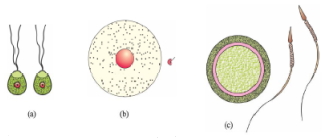
Identify the figures $a, b,$ and $c$ respectively.
A
Isogametes of Cladophora,Heterogametes of Fucus,Heterogametes of Homo sapiens
B
Isogametes of Fucus,Heterogametes of Homo sapiens,Heterogametes of Cladophora
C
Isogametes of Homo sapiens,Isogametes of Fucus,Heterogametes of Cladophora
D
Isogametes of Cladophora,Isogametes of Fucus,Heterogametes of Homo sapiens
Solution
(A) In the given figure:
$(a)$ represents the isogametes of the alga Cladophora,where the gametes are morphologically similar.
$(b)$ represents the heterogametes of the alga Fucus,showing a large non-motile egg and a small motile sperm.
$(c)$ represents the heterogametes of Homo sapiens,showing a large non-motile ovum and a small motile sperm.
Therefore,the correct sequence is isogametes of Cladophora,heterogametes of Fucus,and heterogametes of Homo sapiens.
$(a)$ represents the isogametes of the alga Cladophora,where the gametes are morphologically similar.
$(b)$ represents the heterogametes of the alga Fucus,showing a large non-motile egg and a small motile sperm.
$(c)$ represents the heterogametes of Homo sapiens,showing a large non-motile ovum and a small motile sperm.
Therefore,the correct sequence is isogametes of Cladophora,heterogametes of Fucus,and heterogametes of Homo sapiens.
0 likes
View Solution135
EasyMCQ
Given below are the life spans of various organisms. Find the correct option:
A
$(1)$ Fruit fly - $1$ week
B
$(2)$ Dog - $20-30$ years
C
$(3)$ Butterfly - $1-2$ months
D
$(4)$ Cat - $1$ year
Solution
(B) The average life span of a fruit fly is about $2$ weeks.
The average life span of a dog is $20-30$ years.
The average life span of a butterfly is $1-2$ weeks.
The average life span of a cat is about $12-15$ years.
Therefore, the correct option is $(2)$.
The average life span of a dog is $20-30$ years.
The average life span of a butterfly is $1-2$ weeks.
The average life span of a cat is about $12-15$ years.
Therefore, the correct option is $(2)$.
0 likes
View Solution136
EasyMCQ
Which of the following is a correct mode of reproduction?
A
Budding in Yeast
B
Fragmentation in Spongilla
C
Zoospore in Amoeba
D
Binary fission in Hydra
Solution
(A) Yeasts reproduce asexually by a process called budding,where a small bud develops on the parent cell and eventually detaches to form a new individual.
Fragmentation is not the primary mode of reproduction in Spongilla (which uses gemmules).
Amoeba reproduces by binary fission,not zoospores.
Hydra reproduces primarily by budding,not binary fission.
Fragmentation is not the primary mode of reproduction in Spongilla (which uses gemmules).
Amoeba reproduces by binary fission,not zoospores.
Hydra reproduces primarily by budding,not binary fission.
0 likes
View Solution137
MediumMCQ
Which of the following pairs is correctly matched?
$(i)$. Fungi - Regeneration
$(ii)$. Mosses - Fragmentation
$(iii)$. Planaria - Budding
$(i)$. Fungi - Regeneration
$(ii)$. Mosses - Fragmentation
$(iii)$. Planaria - Budding
A
$(i)$ and $(ii)$
B
$(i)$ and $(iii)$
C
only $(ii)$
D
only $(iii)$
Solution
(C) $1$. Fungi reproduce through methods like fragmentation,budding,and spore formation,but they do not primarily use regeneration as a mode of reproduction.
$2$. Mosses reproduce vegetatively through fragmentation. Parts like the thallus tip,protonema fragments,and even rhizoids can grow into a new moss thallus.
$3$. Planaria exhibits true regeneration,where a cut piece of the body can develop into a complete organism,but it does not reproduce by budding.
$4$. Therefore,only pair $(ii)$ is correctly matched.
$2$. Mosses reproduce vegetatively through fragmentation. Parts like the thallus tip,protonema fragments,and even rhizoids can grow into a new moss thallus.
$3$. Planaria exhibits true regeneration,where a cut piece of the body can develop into a complete organism,but it does not reproduce by budding.
$4$. Therefore,only pair $(ii)$ is correctly matched.
0 likes
View Solution138
MediumMCQ
Mark the incorrect pair.
A
Hydra - Budding
B
Flatworm - Regeneration
C
Amoeba - Fragmentation
D
Yeast - Budding
Solution
(C) Amoeba reproduces primarily through binary fission,which is a type of asexual reproduction where a single cell divides into two equal daughter cells. Fragmentation is a method of asexual reproduction observed in organisms like Spirogyra,not Amoeba. Therefore,the pair 'Amoeba - Fragmentation' is incorrect.
0 likes
View Solution139
MediumMCQ
$A$ bacterial cell divides every $1$ minute. It takes $15$ minutes for a cup to be one-fourth full. How much time will it take to fill the cup?
A
$30$ minutes
B
$45$ minutes
C
$60$ minutes
D
$17$ minutes
Solution
(D) The bacterial population doubles every $1$ minute.
If the cup is $\frac{1}{4}$ full at $15$ minutes, then at the next minute ($16$ minutes), the population will double, making the cup $\frac{1}{2}$ full.
At the following minute ($17$ minutes), the population will double again, making the cup completely full ($1$ full cup).
Therefore, it takes $17$ minutes to fill the cup.
If the cup is $\frac{1}{4}$ full at $15$ minutes, then at the next minute ($16$ minutes), the population will double, making the cup $\frac{1}{2}$ full.
At the following minute ($17$ minutes), the population will double again, making the cup completely full ($1$ full cup).
Therefore, it takes $17$ minutes to fill the cup.
0 likes
View Solution140
MediumMCQ
$Arrhenotoky$ is a type of:
A
Parthenogenesis found in honey bees,wasps,and ants
B
Parthenogenesis found in every insect
C
Parthenogenesis found in mosquitoes
D
Parthenogenesis found in butterflies
Solution
(A) $Arrhenotoky$ is a specific form of parthenogenesis where unfertilized eggs develop into males (haploid),while fertilized eggs develop into females (diploid).
This phenomenon is commonly observed in the order $Hymenoptera$,which includes honey bees,wasps,and ants.
In honey bees,for example,the queen lays unfertilized eggs that develop into drones (males) via $arrhenotoky$,whereas fertilized eggs develop into workers or queens.
This phenomenon is commonly observed in the order $Hymenoptera$,which includes honey bees,wasps,and ants.
In honey bees,for example,the queen lays unfertilized eggs that develop into drones (males) via $arrhenotoky$,whereas fertilized eggs develop into workers or queens.
0 likes
View Solution141
MediumMCQ
Which of the following is not immortal?
A
Banyan tree
B
Amoeba
C
Euglena
D
Paramecium
Solution
(A) Unicellular organisms that reproduce by binary fission are considered biologically immortal because they do not undergo natural death; they simply divide into daughter cells. Among the given options, $Amoeba$, $Euglena$, and $Paramecium$ are unicellular organisms that reproduce via binary fission. The $Banyan$ tree is a multicellular organism that undergoes a natural life cycle, including senescence and death, and is therefore not immortal.
0 likes
View Solution142
EasyMCQ
Transverse binary fission occurs in
A
Euglena
B
Amoeba
C
Hydra
D
Paramecium
Solution
(D) In $Amoeba$,binary fission is irregular because the plane of division can pass through any direction.
In $Euglena$,binary fission is longitudinal,meaning the cell divides along its long axis.
In $Paramecium$,binary fission is transverse,meaning the cell divides along its short axis (perpendicular to the longitudinal axis).
Therefore,transverse binary fission occurs in $Paramecium$.
In $Euglena$,binary fission is longitudinal,meaning the cell divides along its long axis.
In $Paramecium$,binary fission is transverse,meaning the cell divides along its short axis (perpendicular to the longitudinal axis).
Therefore,transverse binary fission occurs in $Paramecium$.
0 likes
View Solution143
EasyMCQ
In diploid organisms,the gamete-producing cells are called:
A
Gamete mother cell
B
Meiocytes
C
Both $(a)$ and $(b)$
D
None of these
Solution
(C) Gamete mother cells are the specialized cells that undergo meiosis to produce gametes.
Since these cells undergo meiotic cell division,they are also referred to as meiocytes.
Therefore,both terms refer to the same type of cells in diploid organisms.
Since these cells undergo meiotic cell division,they are also referred to as meiocytes.
Therefore,both terms refer to the same type of cells in diploid organisms.
0 likes
View Solution144
EasyMCQ
Hydra reproduces by binary fission. This sentence is
A
True
B
False
C
Sometimes $(a)$ and Sometimes $(b)$
D
Neither $(a)$ nor $(b)$
Solution
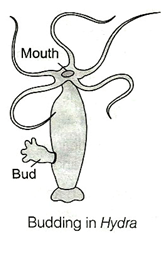
(B) The statement is False. Hydra primarily reproduces through a process called budding. In this asexual method,a small outgrowth,known as a bud,develops on the parent body. This bud gradually grows,develops tentacles,and eventually detaches from the parent to become an independent individual.
0 likes
View Solution145
EasyMCQ
Asexual reproduction is carried out by:
A
Single parent
B
Without fusion of gametes
C
Without formation of gametes
D
All of above
Solution
(D) Asexual reproduction is a mode of reproduction that involves a $Single \text{ } parent$ $(A)$.
In this process, offspring are produced $Without \text{ } fusion \text{ } of \text{ } gametes$ $(B)$ and often $Without \text{ } formation \text{ } of \text{ } gametes$ $(C)$.
Since all these characteristics are fundamental to asexual reproduction, the correct answer is $All \text{ } of \text{ } above$ $(D)$.
In this process, offspring are produced $Without \text{ } fusion \text{ } of \text{ } gametes$ $(B)$ and often $Without \text{ } formation \text{ } of \text{ } gametes$ $(C)$.
Since all these characteristics are fundamental to asexual reproduction, the correct answer is $All \text{ } of \text{ } above$ $(D)$.
0 likes
View Solution146
EasyMCQ
'Gemmule formation is a common mode of reproduction in Paramecium'
A
True
B
False
C
Sometimes $(a)$ and sometimes $(b)$
D
Neither $(a)$ nor $(b)$
Solution
(B) The statement is False.
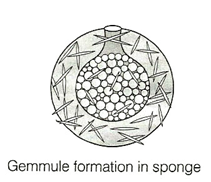
Gemmule formation is a specialized type of asexual reproduction in which internal buds,called gemmules,are formed within the parent body.
This process is characteristic of certain sponges (e.g.,Spongilla) to survive unfavorable conditions.
Paramecium typically reproduces by binary fission.
Gemmule formation is a specialized type of asexual reproduction in which internal buds,called gemmules,are formed within the parent body.
This process is characteristic of certain sponges (e.g.,Spongilla) to survive unfavorable conditions.
Paramecium typically reproduces by binary fission.
0 likes
View Solution147
EasyMCQ
Immortal individuals are
A
Single-celled organisms
B
Double-celled organisms
C
Multi-celled organisms
D
Green plants
Solution
(A) Single-celled organisms like bacteria and protists are considered immortal.
This is because their mode of reproduction is cell division (binary fission).
In these organisms,the parent body itself acts as the reproductive unit and divides into two daughter cells.
Since they do not undergo natural death and their biological identity continues through division,they are termed immortal.
This is because their mode of reproduction is cell division (binary fission).
In these organisms,the parent body itself acts as the reproductive unit and divides into two daughter cells.
Since they do not undergo natural death and their biological identity continues through division,they are termed immortal.
0 likes
View Solution148
EasyMCQ
One of the following is not a method of asexual reproduction:
A
Cutting
B
Grafting
C
Budding
D
Conjugation
Solution
(D) Asexual reproduction involves the production of offspring from a single parent without the fusion of gametes.
Cutting and Grafting are methods of artificial vegetative propagation,which is a type of asexual reproduction.
Budding is a common method of asexual reproduction in organisms like $Yeast$ and $Hydra$.
Conjugation is a process of sexual reproduction observed in organisms like $Bacteria$,$Paramecium$,and certain algae,where genetic material is transferred between two individuals through a temporary union. Therefore,it is not a method of asexual reproduction.
Cutting and Grafting are methods of artificial vegetative propagation,which is a type of asexual reproduction.
Budding is a common method of asexual reproduction in organisms like $Yeast$ and $Hydra$.
Conjugation is a process of sexual reproduction observed in organisms like $Bacteria$,$Paramecium$,and certain algae,where genetic material is transferred between two individuals through a temporary union. Therefore,it is not a method of asexual reproduction.
0 likes
View Solution149
EasyMCQ
Reproduction is
A
Biological process of producing young ones
B
Non-biological process of producing young ones
C
Biological process of producing mature ones
D
None of the above
Solution
(A) Reproduction is a fundamental biological process in which a living organism produces new individual offspring,known as young ones,similar to itself. This process ensures the continuity of the species and the transmission of genetic material from one generation to the next.
0 likes
View Solution150
EasyMCQ
Parameters of old age are
A
End of reproductive phase
B
Concomitant changes in the body
C
Slowing down of vital process
D
All of the above
Solution
(D) Old age is the final phase in the life span of an organism,occurring after the maturity period and before death.
During old age,the reproductive phase ends,meaning the production of gametes ceases.
There are significant concomitant (associated) physiological and structural changes in the body.
Furthermore,there is a general slowing down of vital metabolic processes,leading to a decline in overall functional efficiency.
During old age,the reproductive phase ends,meaning the production of gametes ceases.
There are significant concomitant (associated) physiological and structural changes in the body.
Furthermore,there is a general slowing down of vital metabolic processes,leading to a decline in overall functional efficiency.
0 likes
View SolutionReproduction in Organisms — Mix Examples -Reproduction in Organisms · Frequently Asked Questions
1Are these Reproduction in Organisms questions useful for JEE and NEET?
Yes. All questions in this section are mapped to JEE Main and NEET exam patterns. Previous year questions from JEE Main, NEET, GUJCET and state-level exams are included with full solutions.
2Can I switch to Hindi or Gujarati for these questions?
Yes. Use the language tabs in the hero section or the sidebar to view the same questions and solutions in English, Hindi or Gujarati.
3How do I generate a question paper from this subtopic?
Use the Vedclass Exam Paper Generator — select the chapter and subtopic, set difficulty, and generate Sets A, B, C, D automatically. First 3 chapters of every subject are free.
Vedclass Products
For Students
Vedclass Test Series
Mock tests in real JEE/NEET style with performance analysis. 5-day free trial.
Start Free TrialFor Teachers
Exam Paper Generator
Generate Set A/B/C/D papers from this chapter in 2 minutes. 3 chapters free.
Try FreeFor Institutes
Online Exam Module
Live online exams with unlimited students, 360° analytics & white-label branding.
See DemoFor Teachers & Institutes
Generate a Reproduction in Organisms Exam Paper in 2 Minutes
Select subtopic & difficulty — Sets A, B, C, D auto-generated with No Repeat logic.
First 3 chapters of every subject are free — no payment required.