
A English
Mix Examples -Reproduction in Organisms Questions in English
Class 12 Biology · Reproduction in Organisms · Mix Examples -Reproduction in Organisms
236+
Questions
English
Language
100%
With Solutions
Showing 50 of 236 questions in English
151
EasyMCQ
Events in the sexual reproduction:
$I.$ Pre-fertilisation
$II.$ Fertilisation
$III.$ Post-fertilisation
The sequential order of their occurrence is:
$I.$ Pre-fertilisation
$II.$ Fertilisation
$III.$ Post-fertilisation
The sequential order of their occurrence is:
A
$I \rightarrow III \rightarrow II$
B
$II \rightarrow I \rightarrow III$
C
$III \rightarrow II \rightarrow I$
D
$I \rightarrow II \rightarrow III$
Solution
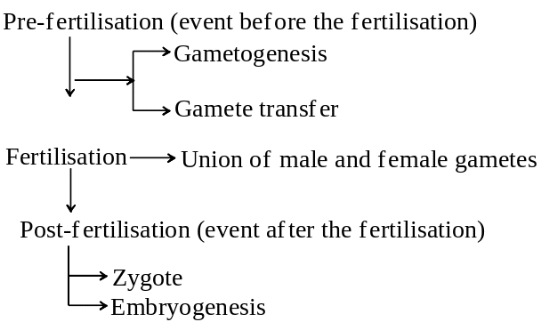
(D) Sexual reproduction is characterized by the fusion of male and female gametes,the formation of zygote,embryogenesis and variations. These events are grouped into three distinct stages:
$1$. Pre-fertilisation events: These include all the events prior to the fusion of gametes,specifically gametogenesis (formation of gametes) and gamete transfer.
$2$. Fertilisation: This is the actual process of the fusion of male and female gametes to form a diploid zygote.
$3$. Post-fertilisation events: These include events that occur after the formation of the zygote,such as the development of the zygote and embryogenesis.
Therefore,the correct sequential order is Pre-fertilisation $\rightarrow$ Fertilisation $\rightarrow$ Post-fertilisation,which corresponds to $I \rightarrow II \rightarrow III$.
$1$. Pre-fertilisation events: These include all the events prior to the fusion of gametes,specifically gametogenesis (formation of gametes) and gamete transfer.
$2$. Fertilisation: This is the actual process of the fusion of male and female gametes to form a diploid zygote.
$3$. Post-fertilisation events: These include events that occur after the formation of the zygote,such as the development of the zygote and embryogenesis.
Therefore,the correct sequential order is Pre-fertilisation $\rightarrow$ Fertilisation $\rightarrow$ Post-fertilisation,which corresponds to $I \rightarrow II \rightarrow III$.
0 likes
View Solution152
EasyMCQ
$A$ clone is two or more individuals which are similar:
A
Genetically
B
Morphologically
C
Sexually
D
Both $(A)$ and $(B)$
Solution
(D) clone is defined as a group of individuals that are morphologically and genetically identical to each other and to their parent.
These individuals are produced through asexual reproduction,where no genetic recombination occurs.
Therefore,clones exhibit similarity in both their physical appearance (morphology) and their genetic makeup (genotype).
These individuals are produced through asexual reproduction,where no genetic recombination occurs.
Therefore,clones exhibit similarity in both their physical appearance (morphology) and their genetic makeup (genotype).
0 likes
View Solution153
EasyMCQ
The essential and most critical event in sexual reproduction is
A
Fertilization
B
Fusion of male and female gametes
C
Division in male and female gametes
D
Both $ (a) $ and $ (b) $
Solution
(D) The most essential event in sexual reproduction is fertilization. $ (a) $ Fertilization is defined as the fusion of male and female gametes to form a diploid zygote. Since $ (a) $ and $ (b) $ refer to the same biological process,both are correct.
0 likes
View Solution154
EasyMCQ
The period from birth to natural death is called
A
Life span
B
Life cycle
C
Life style
D
Reproductive phase
Solution
(A) The time period from birth till natural death is called the life span of an organism.
The life span is generally divided into four stages:
$(i)$ Juvenility: The period of life span from birth until the organism develops the capacity to reproduce.
$(ii)$ Maturity: The stage where reproduction begins and flourishes.
$(iii)$ Senescence or ageing: The progressive deterioration of the body is called ageing,which ends in senescence.
$(iv)$ Death: The cessation of all vital activities of an organism at the end of senescence leads to death.
The life span is generally divided into four stages:
$(i)$ Juvenility: The period of life span from birth until the organism develops the capacity to reproduce.
$(ii)$ Maturity: The stage where reproduction begins and flourishes.
$(iii)$ Senescence or ageing: The progressive deterioration of the body is called ageing,which ends in senescence.
$(iv)$ Death: The cessation of all vital activities of an organism at the end of senescence leads to death.
0 likes
View Solution155
EasyMCQ
Asexual reproduction is common in
A
Single-celled organisms
B
Plants with relatively simple organization
C
Animals with relatively simple organization
D
All of the above
Solution
(D) Asexual reproduction is a common mode of reproduction in organisms that have a relatively simple organization.
It is the primary method of reproduction in single-celled organisms (like Monera and Protista).
It is also observed in plants and animals with simple body organization (e.g.,algae,fungi,and simple invertebrates like sponges or hydra).
In asexual reproduction,mitotic cell division occurs,which is faster and less complex than meiosis,allowing for rapid population growth.
Therefore,all the given options represent groups where asexual reproduction is common.
It is the primary method of reproduction in single-celled organisms (like Monera and Protista).
It is also observed in plants and animals with simple body organization (e.g.,algae,fungi,and simple invertebrates like sponges or hydra).
In asexual reproduction,mitotic cell division occurs,which is faster and less complex than meiosis,allowing for rapid population growth.
Therefore,all the given options represent groups where asexual reproduction is common.
0 likes
View Solution156
EasyMCQ
Bisexual animals that possess both male and female reproductive organs are called hermaphrodites. The above statement is:
A
True
B
False
C
Sometimes $(a)$ and sometimes $(b)$
D
Neither $(a)$ nor $(b)$
Solution
(A) True. Organisms that possess both male and female reproductive organs are known as hermaphrodites or bisexual organisms.
Examples include earthworms,sponges,tapeworms,and leeches.
Examples include earthworms,sponges,tapeworms,and leeches.
0 likes
View Solution157
EasyMCQ
Clones are
A
Morphologically similar individuals
B
Genetically similar individuals
C
Both $(a)$ and $(b)$
D
None of the above
Solution
(C) Morphologically and genetically similar organisms are called clones.
These are produced through asexual reproduction,which is a type of reproduction involving only a single organism.
These are produced through asexual reproduction,which is a type of reproduction involving only a single organism.
0 likes
View Solution158
EasyMCQ
If the parent body is haploid,then the gametes are:
A
Haploid
B
Diploid
C
Triploid
D
None of these
Solution
(A) Gametes are always haploid $(n)$ regardless of whether the parent body is haploid $(n)$ or diploid $(2n)$.
If the parent body is haploid,it produces gametes through mitosis,where the chromosome number remains the same $(n \rightarrow n)$.
If the parent body is diploid,it produces gametes through meiosis,where the chromosome number is reduced to half $(2n \rightarrow n)$.
If the parent body is haploid,it produces gametes through mitosis,where the chromosome number remains the same $(n \rightarrow n)$.
If the parent body is diploid,it produces gametes through meiosis,where the chromosome number is reduced to half $(2n \rightarrow n)$.
0 likes
View Solution159
EasyMCQ
Where does syngamy occur? In...
A
External medium
B
Internal medium
C
Both $(a)$ and $(b)$
D
None of these
Solution
(C) Syngamy (fertilization) is the fusion of male and female gametes. It is classified into two types:
$(i)$ External Fertilization: When syngamy takes place in the external medium. Generally,the external medium is water,e.g.,amphibians and fishes.
(ii) Internal Fertilization: When syngamy takes place inside the female body,e.g.,reptiles,birds,and mammals.
Since syngamy can occur in both external and internal media,the correct answer is both $(a)$ and $(b)$.
$(i)$ External Fertilization: When syngamy takes place in the external medium. Generally,the external medium is water,e.g.,amphibians and fishes.
(ii) Internal Fertilization: When syngamy takes place inside the female body,e.g.,reptiles,birds,and mammals.
Since syngamy can occur in both external and internal media,the correct answer is both $(a)$ and $(b)$.
0 likes
View Solution160
MediumMCQ
Which of the following statements support the view that elaborate sexual reproductive processes appeared much later in organic evolution?
$I.$ Lower groups of organisms have complex body design
$II.$ Asexual reproduction is common in lower groups
$III.$ Asexual reproduction is common in higher groups of organisms
$IV.$ High incidences of sexual reproduction are visible in angiosperms and vertebrates
$I.$ Lower groups of organisms have complex body design
$II.$ Asexual reproduction is common in lower groups
$III.$ Asexual reproduction is common in higher groups of organisms
$IV.$ High incidences of sexual reproduction are visible in angiosperms and vertebrates
A
$I$ and $II$
B
$I$ and $IV$
C
$II$ and $IV$
D
$II$ and $III$
Solution
(C) $Statement \; I$: Incorrect. Lower groups of organisms typically possess simple body designs.
$Statement \; II$: Correct. Asexual reproduction is the primary mode of reproduction in simpler, early-evolving organisms.
$Statement \; III$: Incorrect. Sexual reproduction is the dominant mode of reproduction in higher, more complex organisms.
$Statement \; IV$: Correct. Complex organisms that evolved later, such as angiosperms and vertebrates, predominantly utilize sexual reproduction, which is a more elaborate process compared to asexual reproduction.
Therefore, statements $II$ and $IV$ support the view that sexual reproduction appeared later in evolution.
$Statement \; II$: Correct. Asexual reproduction is the primary mode of reproduction in simpler, early-evolving organisms.
$Statement \; III$: Incorrect. Sexual reproduction is the dominant mode of reproduction in higher, more complex organisms.
$Statement \; IV$: Correct. Complex organisms that evolved later, such as angiosperms and vertebrates, predominantly utilize sexual reproduction, which is a more elaborate process compared to asexual reproduction.
Therefore, statements $II$ and $IV$ support the view that sexual reproduction appeared later in evolution.
0 likes
View Solution161
MediumMCQ
$A$ large number of offspring are produced in the case of:
A
Fertilization that occurs in an external medium
B
Fertilization that occurs in an internal medium
C
Either $(a)$ or $(b)$
D
Both $(a)$ and $(b)$
Solution
(A) large number of offspring are produced in the case of external fertilization. This is because,in an external medium,the gametes and the developing embryos are exposed to various environmental hazards,predators,and unfavorable conditions. To ensure that at least some offspring survive to adulthood,organisms produce a vast number of gametes and offspring.
0 likes
View Solution162
EasyMCQ
Life span of Cow is $20-25\, years.$ What is the life span of horse?
A
$140\, years$
B
$20-30\, years$
C
$100-150\, years$
D
$60\, years$
Solution
(B) The life span of an organism is the period from birth to the natural death of that organism.
According to biological data, the average life span of a cow is approximately $20-25\, years$.
The average life span of a horse is approximately $25-30\, years$.
Therefore, the correct option is $B$.
According to biological data, the average life span of a cow is approximately $20-25\, years$.
The average life span of a horse is approximately $25-30\, years$.
Therefore, the correct option is $B$.
0 likes
View Solution163
MediumMCQ
$Statement\; 1$: $A$ plant can be retained and multiplied indefinitely without any change or variation through asexual reproduction.
$Statement\; 2$: Asexual reproduction does not involve meiosis and syngamy.
$Statement\; 2$: Asexual reproduction does not involve meiosis and syngamy.
A
$Statement\; 1$ is True, $Statement\; 2$ is True; $Statement\; 2$ is the correct explanation for $Statement\; 1$.
B
$Statement\; 1$ is True, $Statement\; 2$ is True; $Statement\; 2$ is not the correct explanation for $Statement\; 1$.
C
$Statement\; 1$ is True, $Statement\; 2$ is False.
D
$Statement\; 1$ is False, $Statement\; 2$ is True.
Solution
(A) Asexual reproduction involves the production of offspring from a single parent without the involvement of gamete formation or fusion (syngamy) and meiosis.
Since there is no recombination of genetic material, the offspring are genetically identical to the parent, forming clones.
Therefore, a plant can be multiplied indefinitely without any genetic variation.
Both statements are true, and $Statement\; 2$ explains why the plant remains unchanged (lack of meiosis/syngamy prevents variation).
Since there is no recombination of genetic material, the offspring are genetically identical to the parent, forming clones.
Therefore, a plant can be multiplied indefinitely without any genetic variation.
Both statements are true, and $Statement\; 2$ explains why the plant remains unchanged (lack of meiosis/syngamy prevents variation).
0 likes
View Solution164
EasyMCQ
Match the following and choose the correct combination from the options given:
| Column-$I$ | Column-$II$ |
|---|---|
| $(A)$ Butterfly | $(1)$ $60 \text{ years}$ |
| $(B)$ Crow | $(2)$ $140 \text{ years}$ |
| $(C)$ Parrot | $(3)$ $15 \text{ years}$ |
| $(D)$ Crocodile | $(4)$ $1-2 \text{ weeks}$ |
A
$A-1, B-2, C-3, D-4$
B
$A-4, B-3, C-1, D-2$
C
$A-2, B-3, C-4, D-1$
D
$A-4, B-3, C-2, D-1$
Solution
(D) The average lifespan of the organisms listed is as follows:
$(A)$ Butterfly: $1-2 \text{ weeks}$ $(A-4)$
$(B)$ Crow: $15 \text{ years}$ $(B-3)$
$(C)$ Parrot: $140 \text{ years}$ $(C-2)$
$(D)$ Crocodile: $60 \text{ years}$ $(D-1)$
Therefore,the correct matching is $A-4, B-3, C-2, D-1$.
$(A)$ Butterfly: $1-2 \text{ weeks}$ $(A-4)$
$(B)$ Crow: $15 \text{ years}$ $(B-3)$
$(C)$ Parrot: $140 \text{ years}$ $(C-2)$
$(D)$ Crocodile: $60 \text{ years}$ $(D-1)$
Therefore,the correct matching is $A-4, B-3, C-2, D-1$.
0 likes
View Solution165
EasyMCQ
Match the following organisms with their approximate life spans:
| Column-$I$ | Column-$II$ |
|---|---|
| $A$. Elephant | $a$. $1 \text{ month}$ |
| $B$. Fruit fly | $b$. $4 \text{ months}$ |
| $C$. Rice plant | $c$. $7-15 \text{ days}$ |
| $D$. Butterfly | $d$. $60-90 \text{ years}$ |
A
$A-c, B-b, C-a, D-d$
B
$A-d, B-a, C-b, D-c$
C
$A-d, B-c, C-a, D-b$
D
$A-d, B-c, C-b, D-a$
Solution
(B) The approximate life spans of the given organisms are as follows:
$1$. Elephant: $60-90 \text{ years}$ $(A-d)$
$2$. Fruit fly: $30 \text{ days}$ or $1 \text{ month}$ $(B-a)$
$3$. Rice plant: $3-4 \text{ months}$ $(C-b)$
$4$. Butterfly: $1-2 \text{ weeks}$ or $7-15 \text{ days}$ $(D-c)$
Therefore,the correct matching is $A-d, B-a, C-b, D-c$.
$1$. Elephant: $60-90 \text{ years}$ $(A-d)$
$2$. Fruit fly: $30 \text{ days}$ or $1 \text{ month}$ $(B-a)$
$3$. Rice plant: $3-4 \text{ months}$ $(C-b)$
$4$. Butterfly: $1-2 \text{ weeks}$ or $7-15 \text{ days}$ $(D-c)$
Therefore,the correct matching is $A-d, B-a, C-b, D-c$.
0 likes
View Solution166
MediumMCQ
Reproduction is a biological process in which an organism gives rise to young ones (offspring) similar to itself. An organism's method of reproduction depends upon which of the following factors?
A
Habitat
B
Internal physiology
C
Genitalia
D
All of the above
Solution
(D) Reproduction is a fundamental biological process that ensures the continuity of species. The method of reproduction adopted by an organism is not random but is influenced by several complex factors.
$1$. Habitat: The environment in which an organism lives (e.g.,aquatic vs. terrestrial) dictates the survival strategies and reproductive modes.
$2$. Internal physiology: The metabolic and hormonal state of the organism plays a crucial role in determining whether it reproduces sexually or asexually.
$3$. Genitalia: The presence and complexity of reproductive organs are essential for sexual reproduction.
Since all these factors collectively influence how an organism reproduces,the correct answer is $D$.
$1$. Habitat: The environment in which an organism lives (e.g.,aquatic vs. terrestrial) dictates the survival strategies and reproductive modes.
$2$. Internal physiology: The metabolic and hormonal state of the organism plays a crucial role in determining whether it reproduces sexually or asexually.
$3$. Genitalia: The presence and complexity of reproductive organs are essential for sexual reproduction.
Since all these factors collectively influence how an organism reproduces,the correct answer is $D$.
0 likes
View Solution167
EasyMCQ
Female gamete undergoes development to form new organisms without fertilization. This process is called parthenogenesis. It occurs in:
A
Rotifers
B
Turkey birds
C
Some reptiles
D
All of the above
Solution
(D) Parthenogenesis is a form of asexual reproduction where an embryo develops from an unfertilized egg cell.
This phenomenon is observed in various organisms across the animal kingdom.
$1$. In $Rotifers$,parthenogenesis is a common mode of reproduction.
$2$. In $Turkey$ $birds$,parthenogenesis can occur,leading to the development of embryos from unfertilized eggs.
$3$. In $Some$ $reptiles$ (such as certain species of lizards),parthenogenesis is also a known reproductive strategy.
Since all the given options exhibit this process,the correct answer is $D$.
This phenomenon is observed in various organisms across the animal kingdom.
$1$. In $Rotifers$,parthenogenesis is a common mode of reproduction.
$2$. In $Turkey$ $birds$,parthenogenesis can occur,leading to the development of embryos from unfertilized eggs.
$3$. In $Some$ $reptiles$ (such as certain species of lizards),parthenogenesis is also a known reproductive strategy.
Since all the given options exhibit this process,the correct answer is $D$.
0 likes
View Solution168
EasyMCQ
Oestrus cycle is cyclic changes in the activities of ovaries and accessory duct during
A
Reproductive (seasonal) period
B
Maturation period
C
Ageing period
D
Juvenile period
Solution
(A) The oestrus cycle refers to the cyclic changes in the activities of ovaries and accessory ducts in non-primate mammals.
These changes occur specifically during the reproductive or seasonal period of the organism.
Therefore,it is a characteristic feature of seasonal breeders.
These changes occur specifically during the reproductive or seasonal period of the organism.
Therefore,it is a characteristic feature of seasonal breeders.
0 likes
View Solution169
MediumMCQ
Identify the organisms shown in the following diagrams $A$, $B$, and $C$.
A
$A$ - Male cockroach, $B$ - Funaria, $C$ - Unisexual flower
B
$A$ - Male cockroach, $B$ - Marchantia, $C$ - Bisexual flower
C
$A$ - Female cockroach, $B$ - Cycas, $C$ - Unisexual flower
D
$A$ - Female cockroach, $B$ - Marchantia, $C$ - Bisexual flower
Solution
(D) represents a female cockroach because the presence of the brood pouch and specific abdominal structures are distinguishing characteristics of the female.
$B$ represents $Marchantia$, a liverwort with a thalloid body where male and female sex organs are borne on separate thalli (dioecious).
$C$ represents a bisexual flower because it contains both male (stamen) and female (pistil) reproductive parts within the same flower.
$B$ represents $Marchantia$, a liverwort with a thalloid body where male and female sex organs are borne on separate thalli (dioecious).
$C$ represents a bisexual flower because it contains both male (stamen) and female (pistil) reproductive parts within the same flower.
0 likes
View Solution170
EasyMCQ
Identify the gametes in figures $A, B$,and $C$.
A
$A-$Isogametes,$B-$Heterogametes,$C-$Heterogametes
B
$A-$Homogametes,$B-$Isogametes,$C-$Heterogametes
C
$A-$Isogametes,$B-$Isogametes,$C-$Heterogametes
D
$A-$Heterogametes,$B-$Heterogametes,$C-$Isogametes
Solution
(C) Figure $A$ shows isogametes (or homogametes),where both gametes are morphologically identical.
Figure $B$ shows heterogametes,where there is a significant size difference between the two gametes.
Figure $C$ shows distinct heterogametes,specifically an egg (ovum) and a sperm,which are morphologically and physiologically different.
Figure $B$ shows heterogametes,where there is a significant size difference between the two gametes.
Figure $C$ shows distinct heterogametes,specifically an egg (ovum) and a sperm,which are morphologically and physiologically different.
0 likes
View Solution171
MediumMCQ
Diploid zygote is universal in
A
All sexually reproducing organisms
B
All asexually reproducing organisms
C
All sexually and asexually reproducing organisms
D
All plants and animals
Solution
(A) The presence of a diploid zygote is universal in all sexually reproducing organisms.
This is true regardless of whether the parents are haploid or diploid.
In organisms with a haploid parent body,the diploid zygote undergoes meiosis to produce haploid spores,which develop into a haploid body.
In diploid organisms,the diploid zygote undergoes mitosis to develop into a diploid individual.
This is true regardless of whether the parents are haploid or diploid.
In organisms with a haploid parent body,the diploid zygote undergoes meiosis to produce haploid spores,which develop into a haploid body.
In diploid organisms,the diploid zygote undergoes mitosis to develop into a diploid individual.
0 likes
View Solution172
EasyMCQ
Arrange the following with respect to increasing life span: Rose,Fruit fly,Rice.
A
Fruit fly,Rice,Rose
B
Rose,Rice,Fruit fly
C
Rice,Rose,Fruit fly
D
Fruit fly,Rose,Rice
Solution
(A) The average life spans of the given organisms are as follows:
$1$. Fruit fly: Approximately $2$ weeks.
$2$. Rice: Approximately $3-4$ months.
$3$. Rose: Approximately $5-7$ years.
Therefore,the order of increasing life span is: Fruit fly < Rice < Rose.
$1$. Fruit fly: Approximately $2$ weeks.
$2$. Rice: Approximately $3-4$ months.
$3$. Rose: Approximately $5-7$ years.
Therefore,the order of increasing life span is: Fruit fly < Rice < Rose.
0 likes
View Solution173
MediumMCQ
Which of the following factor$(s)$ is/are responsible for how an organism reproduces?
A
Organism's habitat
B
Environmental factors
C
Internal physiology
D
More than one option is correct
Solution
(D) The method of reproduction in an organism is influenced by several complex factors:
- $1$. Organism's habitat: The availability of resources and environmental stability in a habitat significantly influences the reproductive strategy. For example,organisms in nutrient-deficient or stressful conditions often switch to sexual reproduction to increase genetic diversity.
- $2$. Environmental factors: External conditions such as temperature,light,and water availability act as cues that trigger reproductive cycles in many species.
- $3$. Internal physiology: The hormonal balance,metabolic state,and genetic makeup of an organism determine its readiness and capacity to reproduce.
Since all these factors play a crucial role in determining the reproductive mode of an organism,the correct answer is $D$.
- $1$. Organism's habitat: The availability of resources and environmental stability in a habitat significantly influences the reproductive strategy. For example,organisms in nutrient-deficient or stressful conditions often switch to sexual reproduction to increase genetic diversity.
- $2$. Environmental factors: External conditions such as temperature,light,and water availability act as cues that trigger reproductive cycles in many species.
- $3$. Internal physiology: The hormonal balance,metabolic state,and genetic makeup of an organism determine its readiness and capacity to reproduce.
Since all these factors play a crucial role in determining the reproductive mode of an organism,the correct answer is $D$.
0 likes
View Solution174
EasyMCQ
Asexual reproduction is common in
A
Single-celled organisms
B
Organisms having simple organization
C
Aquatic plants
D
More than one option is correct
Solution
(D) Asexual reproduction is a mode of reproduction where a single parent produces offspring.
It is common in single-celled organisms (like bacteria and protists) and in organisms with simple body organization (like many algae and fungi).
Since both option $A$ and option $B$ are correct,the most appropriate answer is $D$.
It is common in single-celled organisms (like bacteria and protists) and in organisms with simple body organization (like many algae and fungi).
Since both option $A$ and option $B$ are correct,the most appropriate answer is $D$.
0 likes
View Solution175
EasyMCQ
For which of the following organisms is there no natural death?
A
Bacteria reproducing by sporulation
B
Yeast reproducing by budding
C
Unicellular organisms reproducing by spores
D
Unicellular organisms reproducing by binary fission
Solution
(D) Unicellular organisms like bacteria and amoeba are considered immortal because they do not undergo natural death. During reproduction,the parent cell divides into two daughter cells through binary fission,meaning the original parent organism continues to exist as part of the offspring. Thus,there is no natural death for these organisms.
0 likes
View Solution176
EasyMCQ
Cell division itself is a mode of reproduction in
A
Amoeba,Penicillium
B
Chara,Bacteria
C
Chlamydomonas,Penicillium
D
Amoeba,Bacteria
Solution
(D) In unicellular organisms,cell division is synonymous with reproduction.
$Amoeba$ and $Bacteria$ are unicellular organisms that reproduce by binary fission,which is a form of cell division.
$Amoeba$ and $Bacteria$ are unicellular organisms that reproduce by binary fission,which is a form of cell division.
0 likes
View Solution177
MediumMCQ
During budding in yeast,
A
Cytokinesis is unequal
B
Identity of parent is lost
C
Clones are produced
D
More than one option is correct
Solution
(D) In yeast,budding is a form of asexual reproduction.
$1$. Cytokinesis is unequal,as a small bud is formed on the parent cell while the parent remains intact.
$2$. Since it is asexual reproduction,the offspring are genetically identical to the parent,meaning clones are produced.
$3$. The identity of the parent is not lost.
Therefore,both $A$ and $C$ are correct,making $D$ the right choice.
$1$. Cytokinesis is unequal,as a small bud is formed on the parent cell while the parent remains intact.
$2$. Since it is asexual reproduction,the offspring are genetically identical to the parent,meaning clones are produced.
$3$. The identity of the parent is not lost.
Therefore,both $A$ and $C$ are correct,making $D$ the right choice.
0 likes
View Solution178
MediumMCQ
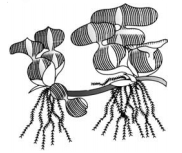
Choose the incorrect option for the organism given below.
A
Scourge of the water bodies
B
Reproduction through offset
C
Found in running water
D
Drains oxygen from water
Solution
(C) The organism shown in the image is $Eichhornia$ $crassipes$ (Water Hyacinth).
It is known as the 'Scourge of the water bodies' because it grows rapidly and covers the entire surface of the water.
It reproduces vegetatively through structures called offsets.
It causes a significant reduction in dissolved oxygen levels in the water,leading to the death of fishes and other aquatic organisms.
It is typically found in stagnant or standing water,not in running water. Therefore,the statement 'Found in running water' is incorrect.
It is known as the 'Scourge of the water bodies' because it grows rapidly and covers the entire surface of the water.
It reproduces vegetatively through structures called offsets.
It causes a significant reduction in dissolved oxygen levels in the water,leading to the death of fishes and other aquatic organisms.
It is typically found in stagnant or standing water,not in running water. Therefore,the statement 'Found in running water' is incorrect.
0 likes
View Solution179
MediumMCQ
"Vegetative reproduction is also a type of asexual reproduction." Which of the following statements justify this?
A
Involvement of one parent
B
Gametes are not involved
C
Does not involve meiosis
D
More than one option is correct
Solution
(D) Vegetative reproduction is considered a form of asexual reproduction because:
$1$. It involves only a single parent (uniparental).
$2$. There is no formation or fusion of gametes.
$3$. It involves only mitotic cell division, meaning meiosis does not occur.
Since all three statements ($A$, $B$, and $C$) are correct, the correct choice is $D$.
$1$. It involves only a single parent (uniparental).
$2$. There is no formation or fusion of gametes.
$3$. It involves only mitotic cell division, meaning meiosis does not occur.
Since all three statements ($A$, $B$, and $C$) are correct, the correct choice is $D$.
0 likes
View Solution180
EasyMCQ
In all sexually reproducing organisms,the events involved are:
A
Same,sequential
B
Same,non-sequential
C
Different,sequential
D
Different,non-sequential
Solution
(A) The events involved in all sexually reproducing organisms are the same and occur in a sequential manner.
The sequence of events is: $Pre-fertilization \rightarrow Fertilization \rightarrow Post-fertilization$.
The sequence of events is: $Pre-fertilization \rightarrow Fertilization \rightarrow Post-fertilization$.
0 likes
View Solution181
MediumMCQ
Choose the odd one with respect to sexuality.
A
Coconut
B
Cucurbits
C
Chara
D
Papaya
Solution
(D) In biology,sexuality refers to whether an organism is monoecious (bisexual) or dioecious (unisexual).
$1$. Coconut,Cucurbits,and Chara are examples of monoecious plants,meaning both male and female reproductive organs are present on the same individual.
$2$. Papaya is a dioecious plant,meaning male and female reproductive organs are present on separate individuals (unisexual).
Therefore,Papaya is the odd one out.
$1$. Coconut,Cucurbits,and Chara are examples of monoecious plants,meaning both male and female reproductive organs are present on the same individual.
$2$. Papaya is a dioecious plant,meaning male and female reproductive organs are present on separate individuals (unisexual).
Therefore,Papaya is the odd one out.
0 likes
View Solution182
EasyMCQ
What would be the number of chromosomes in the meiocyte and gamete of an onion, respectively?
A
$32, 16$
B
$16, 8$
C
$24, 12$
D
$14, 7$
Solution
(A) In an onion $(Allium \text{ cepa})$, the diploid number of chromosomes $(2n)$ is $32$.
Meiocytes are diploid cells that undergo meiosis to produce gametes.
Therefore, the number of chromosomes in the meiocyte is $2n = 32$.
The gametes are haploid cells produced after meiosis, containing half the number of chromosomes $(n)$.
Thus, the number of chromosomes in the gamete is $n = 16$.
So, the number of chromosomes in the meiocyte and gamete of an onion is $32$ and $16$, respectively.
Meiocytes are diploid cells that undergo meiosis to produce gametes.
Therefore, the number of chromosomes in the meiocyte is $2n = 32$.
The gametes are haploid cells produced after meiosis, containing half the number of chromosomes $(n)$.
Thus, the number of chromosomes in the gamete is $n = 16$.
So, the number of chromosomes in the meiocyte and gamete of an onion is $32$ and $16$, respectively.
0 likes
View Solution183
EasyMCQ
In fungi,the term $homothallic$ is used to represent:
A
Dioecious condition
B
Unisexual condition
C
Bisexual condition
D
More than one option is correct
Solution
(C) In fungi,the term $homothallic$ refers to a condition where both male and female reproductive structures are present on the same thallus or mycelium. This is equivalent to a $bisexual$ or $monoecious$ condition,where a single organism can produce both types of gametes.
0 likes
View Solution184
MediumMCQ
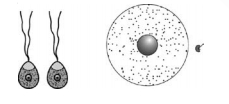
The given figures labelled $A$ and $B$ represent:
A
Isogametes of Rhizopus - Heterogametes of Fucus
B
Isogametes of Cladophora - Heterogametes of Fucus
C
Isogametes of Rhizopus - Heterogametes of angiosperms
D
Isogametes of Chara - Heterogametes of Synchytrium
Solution
(B) In the provided figure,$A$ represents isogametes of the alga Cladophora,which are morphologically similar.
$B$ represents heterogametes (antherozoid and egg) of the brown alga Fucus,which are morphologically distinct.
Therefore,the correct representation is Isogametes of Cladophora and Heterogametes of Fucus.
$B$ represents heterogametes (antherozoid and egg) of the brown alga Fucus,which are morphologically distinct.
Therefore,the correct representation is Isogametes of Cladophora and Heterogametes of Fucus.
0 likes
View Solution185
MediumMCQ
Zoospore,Conidia,Tuber,Offset,Pollen,Zygote. From the structures given in the above box,how many are not associated with asexual reproduction?
A
Three
B
Two
C
Four
D
One
Solution
(B) The structures involved in asexual reproduction are: Zoospore,Conidia,Tuber,and Offset.
Structures not associated with asexual reproduction are: Pollen and Zygote.
$1$. Pollen is a male gametophyte involved in sexual reproduction.
$2$. Zygote is a diploid cell formed by the fusion of male and female gametes during sexual reproduction.
Therefore,there are $2$ structures that are not associated with asexual reproduction.
Structures not associated with asexual reproduction are: Pollen and Zygote.
$1$. Pollen is a male gametophyte involved in sexual reproduction.
$2$. Zygote is a diploid cell formed by the fusion of male and female gametes during sexual reproduction.
Therefore,there are $2$ structures that are not associated with asexual reproduction.
0 likes
View Solution186
MediumMCQ
Choose the correct option for asexual and sexual reproduction in organisms that have a relatively simple organization.
| Feature | Asexual reproduction | Sexual reproduction |
| $(a)$ Condition | Favourable | Unfavourable |
| $(b)$ Occurrence | More | Less |
| $(c)$ Structures | Spore | Gamete |
| $(d)$ Division | Meiosis | Mitosis |
A
$(a)$ and $(d)$
B
$(b)$ and $(c)$
C
$(a)$, $(b)$ and $(c)$
D
$(b)$ only
Solution
(C) In organisms with simple organization (like algae and fungi), the following observations are made:
$(a)$ Asexual reproduction typically occurs under favourable conditions, while sexual reproduction is often triggered by unfavourable conditions to ensure survival through genetic recombination.
$(b)$ Asexual reproduction is more frequent as it is a rapid process, whereas sexual reproduction is less frequent.
$(c)$ Asexual reproduction involves the formation of spores (e.g., zoospores), while sexual reproduction involves the formation and fusion of gametes.
$(d)$ Asexual reproduction involves mitosis (or simple fission), while sexual reproduction involves meiosis to produce haploid gametes.
Therefore, statements $(a)$, $(b)$, and $(c)$ are correct. Statement $(d)$ is incorrect because the types of cell division are swapped.
$(a)$ Asexual reproduction typically occurs under favourable conditions, while sexual reproduction is often triggered by unfavourable conditions to ensure survival through genetic recombination.
$(b)$ Asexual reproduction is more frequent as it is a rapid process, whereas sexual reproduction is less frequent.
$(c)$ Asexual reproduction involves the formation of spores (e.g., zoospores), while sexual reproduction involves the formation and fusion of gametes.
$(d)$ Asexual reproduction involves mitosis (or simple fission), while sexual reproduction involves meiosis to produce haploid gametes.
Therefore, statements $(a)$, $(b)$, and $(c)$ are correct. Statement $(d)$ is incorrect because the types of cell division are swapped.
0 likes
View Solution187
MediumMCQ
Clear-cut distinction between vegetative,reproductive,and senescent phases is shown by:
A
All annuals and perennials
B
All biennials and perennials
C
All annuals and biennials
D
All perennials
Solution
(C) In annual and biennial plants,there is a clear-cut vegetative,reproductive,and senescent phase. These plants complete their life cycle within one or two seasons,respectively,and then die. In contrast,many perennial species show complex,overlapping phases,making a clear-cut distinction difficult. Therefore,all annuals and biennials exhibit these distinct phases.
0 likes
View Solution188
EasyMCQ
In few fungi and most of the algae,gametes are:
A
B
C
D
Solution
(A) In many algae and a few fungi,both male and female gametes are motile (flagellated). This condition is known as isogamy or anisogamy,where both gametes are morphologically similar or slightly different but both possess the ability to move.
0 likes
View Solution189
MediumMCQ
Organisms showing internal fertilisation show a reduction in the number of . . . . . . gametes and an increase in the number of . . . . . . gametes.
A
Male,female
B
Sperm,eggs
C
Female,male
D
Eggs,sperm
Solution
(C) In organisms exhibiting internal fertilisation,the male gametes are produced in very large numbers to ensure that they reach the egg,as there is a significant risk of loss during the journey to the site of fertilisation.
Conversely,the number of female gametes produced is significantly reduced because the internal environment provides protection and increases the probability of successful fertilisation.
Therefore,there is a reduction in the number of female gametes and an increase in the number of male gametes.
Conversely,the number of female gametes produced is significantly reduced because the internal environment provides protection and increases the probability of successful fertilisation.
Therefore,there is a reduction in the number of female gametes and an increase in the number of male gametes.
0 likes
View Solution190
MediumMCQ
Synchrony between the maturity of sexes and the release of a large number of gametes is shown by:
A
All spermatophytes
B
All bryophytes
C
Most of the algae
D
Most of the land plants
Solution
(C) In many aquatic organisms,such as most algae,fishes,and amphibians,syngamy occurs in the external medium (water).
To enhance the chances of syngamy,these organisms exhibit great synchrony between the sexes and release a large number of gametes into the surrounding medium.
This is a characteristic feature of external fertilization.
To enhance the chances of syngamy,these organisms exhibit great synchrony between the sexes and release a large number of gametes into the surrounding medium.
This is a characteristic feature of external fertilization.
0 likes
View Solution191
MediumMCQ
Study the following statements and choose the correct option.
$I$. Life spans of organisms are correlated with sizes.
$II$. Death of all individuals is certain.
$III$. The organism's habitat,internal physiology,etc.,are collectively responsible for how it reproduces.
$IV$. When offspring is produced by a single parent with or without the involvement of gamete formation,it is called asexual reproduction.
$I$. Life spans of organisms are correlated with sizes.
$II$. Death of all individuals is certain.
$III$. The organism's habitat,internal physiology,etc.,are collectively responsible for how it reproduces.
$IV$. When offspring is produced by a single parent with or without the involvement of gamete formation,it is called asexual reproduction.
A
$I, II$ are correct
B
$III, IV$ are correct
C
$I, III$ are correct
D
$II, IV$ are correct
Solution
(D) Statement $I$ is incorrect because the life span of an organism is not necessarily correlated with its size (e.g.,a crow and a parrot have similar sizes but vastly different life spans).
Statement $II$ is correct because death is an inevitable biological reality for all individual organisms.
Statement $III$ is correct because an organism's reproductive strategy is influenced by its habitat,internal physiology,and other environmental factors.
Statement $IV$ is correct because asexual reproduction involves a single parent and does not necessarily require the formation or fusion of gametes.
Therefore,statements $II, III,$ and $IV$ are correct. However,based on the provided options,the most appropriate choice is $D$ ($II, IV$ are correct).
Statement $II$ is correct because death is an inevitable biological reality for all individual organisms.
Statement $III$ is correct because an organism's reproductive strategy is influenced by its habitat,internal physiology,and other environmental factors.
Statement $IV$ is correct because asexual reproduction involves a single parent and does not necessarily require the formation or fusion of gametes.
Therefore,statements $II, III,$ and $IV$ are correct. However,based on the provided options,the most appropriate choice is $D$ ($II, IV$ are correct).
0 likes
View Solution192
MediumMCQ
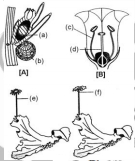
Examine the figures $A, B, C,$ and $D$ given below and select the right option for female sex organs.
A
$a, d$ and $f$
B
$b, d$ and $f$
C
$a, c$ and $e$
D
$a, d$ and $e$
Solution
(D) In the given figures:
$a$ represents the Nucule (female sex organ in Chara).
$b$ represents the Globule (male sex organ in Chara).
$c$ represents the Stamen (male sex organ in a flower).
$d$ represents the Carpel/Pistil (female sex organ in a flower).
$e$ represents the Archegoniophore (female sex organ bearer in Marchantia).
$f$ represents the Antheridiophore (male sex organ bearer in Marchantia).
Therefore,the female sex organs are $a$ (Nucule),$d$ (Carpel),and $e$ (Archegoniophore). The correct option is $D$.
$a$ represents the Nucule (female sex organ in Chara).
$b$ represents the Globule (male sex organ in Chara).
$c$ represents the Stamen (male sex organ in a flower).
$d$ represents the Carpel/Pistil (female sex organ in a flower).
$e$ represents the Archegoniophore (female sex organ bearer in Marchantia).
$f$ represents the Antheridiophore (male sex organ bearer in Marchantia).
Therefore,the female sex organs are $a$ (Nucule),$d$ (Carpel),and $e$ (Archegoniophore). The correct option is $D$.
0 likes
View Solution193
MediumMCQ
Study the following statements and choose the correct option:
$I$. Asexual reproduction is common among single-celled organisms and organisms with relatively simple organization.
$II$. Conidia,bud,and gemmules are common sexual structures.
$III$. Runner,rhizome,sucker,tuber,offset,and bulb are vegetative propagules.
$IV$. The invasive weed found growing in freshwater bodies is $Zostera$.
$I$. Asexual reproduction is common among single-celled organisms and organisms with relatively simple organization.
$II$. Conidia,bud,and gemmules are common sexual structures.
$III$. Runner,rhizome,sucker,tuber,offset,and bulb are vegetative propagules.
$IV$. The invasive weed found growing in freshwater bodies is $Zostera$.
A
$I$,$II$ are correct
B
$III$,$IV$ are correct
C
$I$,$III$ are correct
D
$II$,$IV$ are correct
Solution
(C) Statement $I$ is correct: Asexual reproduction is indeed common in single-celled organisms and those with simple body organization.
Statement $II$ is incorrect: Conidia,buds,and gemmules are asexual reproductive structures,not sexual structures.
Statement $III$ is correct: Runner,rhizome,sucker,tuber,offset,and bulb are all examples of vegetative propagules in plants.
Statement $IV$ is incorrect: The invasive weed found growing in freshwater bodies is $Eichhornia$ $crassipes$ (water hyacinth),not $Zostera$. $Zostera$ is a marine angiosperm (sea grass).
Therefore,statements $I$ and $III$ are correct.
Statement $II$ is incorrect: Conidia,buds,and gemmules are asexual reproductive structures,not sexual structures.
Statement $III$ is correct: Runner,rhizome,sucker,tuber,offset,and bulb are all examples of vegetative propagules in plants.
Statement $IV$ is incorrect: The invasive weed found growing in freshwater bodies is $Eichhornia$ $crassipes$ (water hyacinth),not $Zostera$. $Zostera$ is a marine angiosperm (sea grass).
Therefore,statements $I$ and $III$ are correct.
0 likes
View Solution194
MediumMCQ
Choose the correct options from the following:
$I$. Annual and biennial plants show clear-cut vegetative,reproductive,and senescent phases.
$II$. Bamboo species flower only once in their life,generally after $50-100$ years.
$III$. $Strobilanthus$ $kunthiana$ is a monocarpic plant which flowers only once after $12$ years.
$I$. Annual and biennial plants show clear-cut vegetative,reproductive,and senescent phases.
$II$. Bamboo species flower only once in their life,generally after $50-100$ years.
$III$. $Strobilanthus$ $kunthiana$ is a monocarpic plant which flowers only once after $12$ years.
A
$I, III$ are correct
B
$II$ is correct
C
$I, II$ are correct
D
$III$ is correct
Solution
(C) $I$. Annual and biennial plants exhibit distinct vegetative,reproductive,and senescent phases,making this statement correct.
$II$. Bamboo species are well-known for flowering only once in their lifetime,typically after a period of $50-100$ years,making this statement correct.
$III$. $Strobilanthus$ $kunthiana$ (Neelakuranji) is a monocarpic plant,but it flowers once every $12$ years,not $6$ years. Therefore,this statement is incorrect.
Thus,statements $I$ and $II$ are correct.
$II$. Bamboo species are well-known for flowering only once in their lifetime,typically after a period of $50-100$ years,making this statement correct.
$III$. $Strobilanthus$ $kunthiana$ (Neelakuranji) is a monocarpic plant,but it flowers once every $12$ years,not $6$ years. Therefore,this statement is incorrect.
Thus,statements $I$ and $II$ are correct.
0 likes
View Solution195
MediumMCQ
$A$ : At the end of juvenility,the organism develops the capacity to reproduce.
$R$ : It represents the time period between the first and next flowering in plants.
$R$ : It represents the time period between the first and next flowering in plants.
A
Assertion and Reason both are correct and Reason is the correct explanation of Assertion.
B
Assertion and Reason both are correct but Reason is not the correct explanation of Assertion.
C
Assertion is correct,but Reason is incorrect.
D
Both Assertion and Reason are incorrect.
Solution
(C) The Assertion $(A)$ is correct because the juvenile phase (or vegetative phase in plants) is the period of growth and development before an organism reaches reproductive maturity. Once this phase ends,the organism gains the ability to reproduce.
The Reason $(R)$ is incorrect. The time period between the first and next flowering in plants is not the definition of juvenility. Juvenility refers to the period from birth/germination to the onset of reproductive maturity. The period between two flowering events is often referred to as the inter-flowering period in polycarpic plants.
The Reason $(R)$ is incorrect. The time period between the first and next flowering in plants is not the definition of juvenility. Juvenility refers to the period from birth/germination to the onset of reproductive maturity. The period between two flowering events is often referred to as the inter-flowering period in polycarpic plants.
0 likes
View Solution196
MediumMCQ
$A$: Reproduction is a biological process of giving rise to young ones.
$R$: Reproduction increases population and maintains the continuity of species.
$R$: Reproduction increases population and maintains the continuity of species.
A
Assertion and Reason both are correct and Reason is the correct explanation of Assertion.
B
Assertion and Reason both are correct but Reason is not the correct explanation of Assertion.
C
Assertion is correct,but Reason is incorrect.
D
Both Assertion and Reason are incorrect.
Solution
(A) Reproduction is defined as a biological process in which an organism gives rise to young ones (offspring) similar to itself.
This process is essential for the survival of species as it increases the population size and ensures the continuity of the species from generation to generation.
Therefore,both the Assertion and the Reason are correct,and the Reason provides a valid explanation for why reproduction is a necessary biological process.
This process is essential for the survival of species as it increases the population size and ensures the continuity of the species from generation to generation.
Therefore,both the Assertion and the Reason are correct,and the Reason provides a valid explanation for why reproduction is a necessary biological process.
0 likes
View Solution197
MediumMCQ
$A$: Endogamy is common in the majority of animals.
$R$: Fusing gametes are quite different and develop from different individuals.
$R$: Fusing gametes are quite different and develop from different individuals.
A
Assertion and Reason both are correct and Reason is the correct explanation of Assertion.
B
Assertion and Reason both are correct but Reason is not the correct explanation of Assertion.
C
Assertion is correct,but Reason is incorrect.
D
Both Assertion and Reason are incorrect.
Solution
(D) Assertion $A$ states that endogamy is common in the majority of animals,which is incorrect. Endogamy refers to breeding within a closed group or population,whereas most animals exhibit exogamy or cross-breeding to promote genetic diversity.
Reason $R$ states that fusing gametes are quite different and develop from different individuals. This is a characteristic of sexual reproduction (specifically cross-fertilization),which is generally true for many animals,but it does not support the assertion because the assertion itself is false.
Since the assertion is false and the reason describes a process contrary to endogamy,both statements are considered incorrect in the context of the assertion provided.
Therefore,the correct option is $D$.
Reason $R$ states that fusing gametes are quite different and develop from different individuals. This is a characteristic of sexual reproduction (specifically cross-fertilization),which is generally true for many animals,but it does not support the assertion because the assertion itself is false.
Since the assertion is false and the reason describes a process contrary to endogamy,both statements are considered incorrect in the context of the assertion provided.
Therefore,the correct option is $D$.
0 likes
View Solution198
MediumMCQ
$A$: Cereals are monocarpic plants.
$R$: They have distinct juvenile,reproductive,and senescent phases.
$R$: They have distinct juvenile,reproductive,and senescent phases.
A
Assertion and Reason both are correct and Reason is the correct explanation of Assertion.
B
Assertion and Reason both are correct but Reason is not the correct explanation of Assertion.
C
Assertion is correct,but Reason is incorrect.
D
Both Assertion and Reason are incorrect.
Solution
(B) Monocarpic plants are those that flower and produce seeds only once in their lifetime,after which they die. Cereals like wheat,rice,and maize are annual plants that complete their life cycle in one season,flower once,and then die,making them monocarpic.
All sexually reproducing organisms,including monocarpic plants,exhibit distinct phases in their life cycle: the juvenile phase (growth),the reproductive phase (flowering/fruiting),and the senescent phase (aging/death).
Therefore,both statements are correct,and the presence of these distinct phases is a general characteristic of all organisms,but the specific reason for being monocarpic is the single flowering event,not just the existence of these phases. Thus,$B$ is the correct choice.
All sexually reproducing organisms,including monocarpic plants,exhibit distinct phases in their life cycle: the juvenile phase (growth),the reproductive phase (flowering/fruiting),and the senescent phase (aging/death).
Therefore,both statements are correct,and the presence of these distinct phases is a general characteristic of all organisms,but the specific reason for being monocarpic is the single flowering event,not just the existence of these phases. Thus,$B$ is the correct choice.
0 likes
View Solution199
MediumMCQ
$A$: Zygote is the first cell of the new generation in all sexually reproducing organisms.
$R$: Cell division and cell differentiation are the stages of embryogenesis.
$R$: Cell division and cell differentiation are the stages of embryogenesis.
A
Assertion and Reason both are correct and Reason is the correct explanation of Assertion.
B
Assertion and Reason both are correct but Reason is not the correct explanation of Assertion.
C
Assertion is correct,but Reason is incorrect.
D
Both Assertion and Reason are incorrect.
Solution
(B) The Assertion is correct because in all sexually reproducing organisms,the fusion of male and female gametes results in the formation of a diploid zygote,which serves as the vital link between two generations.
The Reason is also correct because embryogenesis involves the development of an embryo from the zygote through the processes of cell division (mitosis) and cell differentiation (specialization of cells into tissues and organs).
However,the Reason does not explain why the zygote is the first cell of the new generation; it merely describes the processes that occur after the zygote is formed. Therefore,both are correct,but the Reason is not the correct explanation of the Assertion.
The Reason is also correct because embryogenesis involves the development of an embryo from the zygote through the processes of cell division (mitosis) and cell differentiation (specialization of cells into tissues and organs).
However,the Reason does not explain why the zygote is the first cell of the new generation; it merely describes the processes that occur after the zygote is formed. Therefore,both are correct,but the Reason is not the correct explanation of the Assertion.
0 likes
View Solution200
MediumMCQ
$A$: No individual is immortal except one-celled organisms.
$R$: $A$ few number of plant and animal species have existed on Earth and do not die because of budding.
$R$: $A$ few number of plant and animal species have existed on Earth and do not die because of budding.
A
Assertion and Reason both are correct and Reason is the correct explanation of Assertion.
B
Assertion and Reason both are correct but Reason is not the correct explanation of Assertion.
C
Assertion is correct,but Reason is incorrect.
D
Both Assertion and Reason are incorrect.
Solution
(C) The Assertion is correct because,in single-celled organisms like bacteria or protozoa,the parent cell divides into two daughter cells,effectively continuing its life without a natural death. Thus,they are considered biologically immortal.
The Reason is incorrect because budding is a form of asexual reproduction found in organisms like yeast or Hydra,but it does not make multicellular plant or animal species 'immortal'. Multicellular organisms have a defined life span and undergo senescence and death. Therefore,the statement that they do not die because of budding is factually wrong.
The Reason is incorrect because budding is a form of asexual reproduction found in organisms like yeast or Hydra,but it does not make multicellular plant or animal species 'immortal'. Multicellular organisms have a defined life span and undergo senescence and death. Therefore,the statement that they do not die because of budding is factually wrong.
0 likes
View SolutionReproduction in Organisms — Mix Examples -Reproduction in Organisms · Frequently Asked Questions
1Are these Reproduction in Organisms questions useful for JEE and NEET?
Yes. All questions in this section are mapped to JEE Main and NEET exam patterns. Previous year questions from JEE Main, NEET, GUJCET and state-level exams are included with full solutions.
2Can I switch to Hindi or Gujarati for these questions?
Yes. Use the language tabs in the hero section or the sidebar to view the same questions and solutions in English, Hindi or Gujarati.
3How do I generate a question paper from this subtopic?
Use the Vedclass Exam Paper Generator — select the chapter and subtopic, set difficulty, and generate Sets A, B, C, D automatically. First 3 chapters of every subject are free.
Vedclass Products
For Students
Vedclass Test Series
Mock tests in real JEE/NEET style with performance analysis. 5-day free trial.
Start Free TrialFor Teachers
Exam Paper Generator
Generate Set A/B/C/D papers from this chapter in 2 minutes. 3 chapters free.
Try FreeFor Institutes
Online Exam Module
Live online exams with unlimited students, 360° analytics & white-label branding.
See DemoFor Teachers & Institutes
Generate a Reproduction in Organisms Exam Paper in 2 Minutes
Select subtopic & difficulty — Sets A, B, C, D auto-generated with No Repeat logic.
First 3 chapters of every subject are free — no payment required.