
A English
Mix Examples -Reproduction in Organisms Questions in English
Class 12 Biology · Reproduction in Organisms · Mix Examples -Reproduction in Organisms
236+
Questions
English
Language
100%
With Solutions
Showing 50 of 236 questions in English
51
MediumMCQ
Identify the correct sentence.
A
Offspring produced by asexual reproduction are genetically similar but not morphologically.
B
Ginger exhibits asexual reproduction by offset.
C
In Agave, rhizome takes part in asexual reproduction.
D
Water hyacinth reproduces by offset.
Solution
(D) $1$. Asexual reproduction produces clones, which are genetically and morphologically identical to the parent. Thus, option $A$ is incorrect.
$2$. Ginger reproduces vegetatively through rhizomes, not offsets. Thus, option $B$ is incorrect.
$3$. Agave reproduces through bulbils, not rhizomes. Thus, option $C$ is incorrect.
$4$. Water hyacinth $(Eichhornia \text{ crassipes})$ is known as the 'Terror of Bengal' and it reproduces vegetatively through offsets. Thus, option $D$ is correct.
$2$. Ginger reproduces vegetatively through rhizomes, not offsets. Thus, option $B$ is incorrect.
$3$. Agave reproduces through bulbils, not rhizomes. Thus, option $C$ is incorrect.
$4$. Water hyacinth $(Eichhornia \text{ crassipes})$ is known as the 'Terror of Bengal' and it reproduces vegetatively through offsets. Thus, option $D$ is correct.
0 likes
View Solution52
MediumMCQ
In organisms,the further development of the zygote depends on:
A
Type of life cycle
B
Environment
C
Chemical compounds
D
$A$ and $B$ both
Solution
(D) The development of the zygote in organisms is a critical process that determines how the embryo grows into a new individual.
This process is primarily influenced by two main factors:
$1$. The type of life cycle the organism follows (e.g.,haplontic,diplontic,or haplo-diplontic life cycles).
$2$. The environmental conditions to which the organism is exposed,which dictate the survival and growth strategies of the zygote.
Therefore,both the type of life cycle and the environment play crucial roles in the further development of the zygote.
This process is primarily influenced by two main factors:
$1$. The type of life cycle the organism follows (e.g.,haplontic,diplontic,or haplo-diplontic life cycles).
$2$. The environmental conditions to which the organism is exposed,which dictate the survival and growth strategies of the zygote.
Therefore,both the type of life cycle and the environment play crucial roles in the further development of the zygote.
0 likes
View Solution53
EasyMCQ
Select the incorrect pair :
A
Maize - $20$ chromosomes in meiocyte
B
Potato - $24$ chromosomes in gamete
C
Onion - $8$ chromosomes in gamete
D
Apple - $34$ chromosomes in meiocyte
Solution
(D) To identify the incorrect pair,we must compare the chromosome numbers in meiocytes $(2n)$ and gametes $(n)$:
$1$. Maize: Meiocyte $(2n)$ has $20$ chromosomes. This is correct.
$2$. Potato: Meiocyte $(2n)$ has $48$ chromosomes,so the gamete $(n)$ has $24$ chromosomes. This is correct.
$3$. Onion: Meiocyte $(2n)$ has $16$ chromosomes,so the gamete $(n)$ has $8$ chromosomes. This is correct.
$4$. Apple: Meiocyte $(2n)$ has $34$ chromosomes. The option states $39$,which is incorrect. Therefore,the pair 'Apple - $39$ chromosomes in meiocyte' is the incorrect one.
$1$. Maize: Meiocyte $(2n)$ has $20$ chromosomes. This is correct.
$2$. Potato: Meiocyte $(2n)$ has $48$ chromosomes,so the gamete $(n)$ has $24$ chromosomes. This is correct.
$3$. Onion: Meiocyte $(2n)$ has $16$ chromosomes,so the gamete $(n)$ has $8$ chromosomes. This is correct.
$4$. Apple: Meiocyte $(2n)$ has $34$ chromosomes. The option states $39$,which is incorrect. Therefore,the pair 'Apple - $39$ chromosomes in meiocyte' is the incorrect one.
0 likes
View Solution54
MediumMCQ
Which of the following statements is not correct about sexual reproduction?
$(I)$ Gametes fuse to form the zygote.
$(II)$ It is an elaborate,complex,and fast process compared to asexual reproduction.
$(III)$ Offspring are not identical to the parents.
$(I)$ Gametes fuse to form the zygote.
$(II)$ It is an elaborate,complex,and fast process compared to asexual reproduction.
$(III)$ Offspring are not identical to the parents.
A
Only $I$
B
Only $II$
C
Only $III$
D
$I, II$ and $III$
Solution
(B) Sexual reproduction is an elaborate,complex,and slow process compared to asexual reproduction,not a fast one. Therefore,statement $(II)$ is incorrect. Statements $(I)$ and $(III)$ are correct because sexual reproduction involves the fusion of gametes to form a zygote,and offspring show genetic variations,making them not identical to their parents.
0 likes
View Solution55
EasyMCQ
Match the following:
| Column – $I$ | Column – $II$ |
|---|---|
| $(1)$ Conidia | $(p)$ Hydra |
| $(2)$ Buds | $(q)$ Penicillium |
| $(3)$ Gemmules | $(r)$ Amoeba |
| $(4)$ Binary fission | $(s)$ Sponge |
A
$(1-p), (2-q), (3-r), (4-s)$
B
$(1-q), (2-p), (3-s), (4-r)$
C
$(1-r), (2-s), (3-p), (4-q)$
D
$(1-s), (2-r), (3-q), (4-p)$
Solution
(B) The correct matches are as follows:
$(1)$ Conidia are asexual reproductive structures found in $Penicillium$ $(q)$.
$(2)$ Buds are observed in $Hydra$ $(p)$ as a method of asexual reproduction.
$(3)$ Gemmules are internal buds found in sponges $(s)$ that help in asexual reproduction.
$(4)$ Binary fission is a common method of asexual reproduction in $Amoeba$ $(r)$.
Therefore,the correct matching is $(1-q), (2-p), (3-s), (4-r)$.
$(1)$ Conidia are asexual reproductive structures found in $Penicillium$ $(q)$.
$(2)$ Buds are observed in $Hydra$ $(p)$ as a method of asexual reproduction.
$(3)$ Gemmules are internal buds found in sponges $(s)$ that help in asexual reproduction.
$(4)$ Binary fission is a common method of asexual reproduction in $Amoeba$ $(r)$.
Therefore,the correct matching is $(1-q), (2-p), (3-s), (4-r)$.
0 likes
View Solution56
MediumMCQ
Select the incorrect pair:
A
Potato - Eye
B
Ginger - Rhizome
C
Agave - Bulbil
D
Water hyacinth - Leaf buds
Solution
(D) In plants, vegetative propagation occurs through various specialized structures.
$1$. Potato reproduces through 'eyes', which are axillary buds.
$2$. Ginger reproduces through underground stems called rhizomes.
$3$. Agave reproduces through bulbils, which are fleshy buds.
$4$. Water hyacinth (Eichhornia) reproduces through offsets, not leaf buds. Leaf buds are characteristic of plants like Bryophyllum.
Therefore, the pair $Water \text{ } hyacinth - Leaf \text{ } buds$ is incorrect.
$1$. Potato reproduces through 'eyes', which are axillary buds.
$2$. Ginger reproduces through underground stems called rhizomes.
$3$. Agave reproduces through bulbils, which are fleshy buds.
$4$. Water hyacinth (Eichhornia) reproduces through offsets, not leaf buds. Leaf buds are characteristic of plants like Bryophyllum.
Therefore, the pair $Water \text{ } hyacinth - Leaf \text{ } buds$ is incorrect.
0 likes
View Solution57
EasyMCQ
........ and ........ are examples showing external fertilization.
A
Algae and birds
B
Algae and mammals
C
Fishes and reptiles
D
Algae and fish
Solution
(D) External fertilization is a process where the fusion of gametes takes place outside the body of the organism, usually in an external medium like water.
This type of fertilization is common in aquatic organisms.
Among the given options, $Algae$ and $fish$ (specifically bony fishes) exhibit external fertilization, where both male and female gametes are released into the surrounding water medium to facilitate fertilization.
Birds, mammals, and reptiles typically undergo internal fertilization.
This type of fertilization is common in aquatic organisms.
Among the given options, $Algae$ and $fish$ (specifically bony fishes) exhibit external fertilization, where both male and female gametes are released into the surrounding water medium to facilitate fertilization.
Birds, mammals, and reptiles typically undergo internal fertilization.
0 likes
View Solution58
MediumMCQ
$(a)$ In both plants and animals,there are three phases during their life cycle.
$(b)$ In plants and animals,hormones are responsible for the transitions between these three phases.
$(b)$ In plants and animals,hormones are responsible for the transitions between these three phases.
A
$A$ and $B$ both correct.
B
$A$ and $B$ both incorrect.
C
$A$ is correct and $B$ is incorrect.
D
$A$ is incorrect and $B$ is correct.
Solution
(A) Statement $(a)$ is correct: All organisms,including plants and animals,undergo three main phases in their life cycle: the juvenile phase (or vegetative phase in plants),the reproductive phase,and the senescence (or aging) phase.
Statement $(b)$ is correct: The transition between these three phases is regulated by the interaction between hormones and certain environmental factors. Hormones play a crucial role in triggering the onset of the reproductive phase and the subsequent transition to senescence.
Statement $(b)$ is correct: The transition between these three phases is regulated by the interaction between hormones and certain environmental factors. Hormones play a crucial role in triggering the onset of the reproductive phase and the subsequent transition to senescence.
0 likes
View Solution59
EasyMCQ
Select the incorrect pair.
A
Parthenogenesis - honeybees
B
External fertilization - algae and fish
C
Internal fertilization - gymnosperms
D
Syngamy - formation of haploid gametes
Solution
(D) Syngamy is the process of fusion of male and female gametes to form a diploid zygote. It is not the process of formation of haploid gametes. The formation of haploid gametes is known as gametogenesis. Therefore,the pair 'Syngamy - formation of haploid gametes' is incorrect.
0 likes
View Solution60
MediumMCQ
Select the incorrect sentence regarding post-fertilization events.
A
In flowering plants,the fruit is formed from the ovary.
B
The further development of the zygote depends on the life cycle of the organism and the environment to which it is exposed.
C
In haploid organisms,the zygote divides by meiosis to form haploid spores.
D
The embryo is the vital link that ensures the continuity of species between organisms of one generation and the next.
Solution
(D) The incorrect statement is $D$. The vital link that ensures the continuity of species between organisms of one generation and the next is the $zygote$,not the $embryo$.
$A$ is correct: After fertilization,the ovary develops into the fruit.
$B$ is correct: The development of the zygote is determined by the organism's life cycle and environmental conditions.
$C$ is correct: In organisms with a haplontic life cycle,the zygote undergoes meiosis to produce haploid spores,which then grow into new individuals.
$A$ is correct: After fertilization,the ovary develops into the fruit.
$B$ is correct: The development of the zygote is determined by the organism's life cycle and environmental conditions.
$C$ is correct: In organisms with a haplontic life cycle,the zygote undergoes meiosis to produce haploid spores,which then grow into new individuals.
0 likes
View Solution61
MediumMCQ
Why are the chances of survival of young ones greater in viviparous organisms?
A
Proper embryonic care and protection.
B
Zygote develops into a young one inside the body of the female organism.
C
$A$ and $B$ both.
D
None of the above.
Solution
(C) In viviparous organisms,the development of the zygote into a young one takes place inside the body of the female organism.
This internal development provides a safe environment,protecting the embryo from external environmental hazards and predators.
Furthermore,the female organism provides proper embryonic care and nourishment,which significantly increases the chances of survival of the young ones compared to oviparous organisms.
This internal development provides a safe environment,protecting the embryo from external environmental hazards and predators.
Furthermore,the female organism provides proper embryonic care and nourishment,which significantly increases the chances of survival of the young ones compared to oviparous organisms.
0 likes
View Solution62
EasyMCQ
Choose the incorrect statement.
A
Budding - Yeast
B
Binary fission - Amoeba
C
Gemmules - Chlamydomonas
D
Conidia - Penicillium
Solution
(C) The correct answer is $C$.
$1$. Budding is a common method of asexual reproduction in $Yeast$ $(Saccharomyces)$.
$2$. Binary fission is the primary mode of reproduction in $Amoeba$.
$3$. $Gemmules$ are internal buds formed in sponges (e.g.,$Spongilla$) to survive unfavorable conditions,not in $Chlamydomonas$. $Chlamydomonas$ reproduces via zoospores.
$4$. $Conidia$ are asexual reproductive structures found in $Penicillium$.
$1$. Budding is a common method of asexual reproduction in $Yeast$ $(Saccharomyces)$.
$2$. Binary fission is the primary mode of reproduction in $Amoeba$.
$3$. $Gemmules$ are internal buds formed in sponges (e.g.,$Spongilla$) to survive unfavorable conditions,not in $Chlamydomonas$. $Chlamydomonas$ reproduces via zoospores.
$4$. $Conidia$ are asexual reproductive structures found in $Penicillium$.
0 likes
View Solution63
EasyMCQ
Which of the following is not a bisexual animal?
A
Earthworm
B
Spongilla
C
Cockroach
D
Tapeworm
Solution
(C) bisexual animal (or hermaphrodite) is an organism that possesses both male and female reproductive organs.
Earthworms,Spongilla (a type of sponge),and Tapeworms are all examples of bisexual organisms.
Cockroaches are unisexual (dioecious) animals,meaning they have separate male and female individuals.
Therefore,the correct answer is $C$ (Cockroach).
Earthworms,Spongilla (a type of sponge),and Tapeworms are all examples of bisexual organisms.
Cockroaches are unisexual (dioecious) animals,meaning they have separate male and female individuals.
Therefore,the correct answer is $C$ (Cockroach).
0 likes
View Solution64
MediumMCQ
Whose spores are non-motile?
A
Penicillium
B
Chlamydomonas
C
Both $A$ and $B$ are correct
D
Both $A$ and $B$ are incorrect
Solution
(A) $1$. $Penicillium$ reproduces through asexual spores called conidia.
$2$. Conidia are non-motile spores produced exogenously.
$3$. $Chlamydomonas$ produces zoospores,which are motile spores equipped with flagella.
$4$. Since $Penicillium$ has non-motile spores and $Chlamydomonas$ has motile spores,option $A$ is the correct answer.
$2$. Conidia are non-motile spores produced exogenously.
$3$. $Chlamydomonas$ produces zoospores,which are motile spores equipped with flagella.
$4$. Since $Penicillium$ has non-motile spores and $Chlamydomonas$ has motile spores,option $A$ is the correct answer.
0 likes
View Solution65
MediumMCQ
$A-$ In protists and monerans,the parent cell divides into two to give rise to new individuals.
$R-$ Binary fission occurs in Paramoecium.
$R-$ Binary fission occurs in Paramoecium.
A
$A$ and $R$ are correct,and $R$ is the correct explanation of $A$.
B
$A$ and $R$ are correct,but $R$ is not the correct explanation of $A$.
C
$A$ is correct,but $R$ is incorrect.
D
$A$ is incorrect,but $R$ is correct.
Solution
(A) $A-$ In unicellular organisms like protists and monerans,the cell division itself is the mode of reproduction,where the parent cell divides into two to form new individuals. This is a correct statement.
$R-$ Paramoecium is a protist that reproduces by binary fission,where the parent cell divides into two daughter cells. This is also a correct statement.
Since Paramoecium is a protist,the process of binary fission in Paramoecium is an example of the general mechanism described in the assertion. Therefore,both statements are correct.
$R-$ Paramoecium is a protist that reproduces by binary fission,where the parent cell divides into two daughter cells. This is also a correct statement.
Since Paramoecium is a protist,the process of binary fission in Paramoecium is an example of the general mechanism described in the assertion. Therefore,both statements are correct.
0 likes
View Solution66
EasyMCQ
Choose the correct pair:
A
Maize - $20$ - chromosome number in meiocyte $(2n)$
B
Potato - $24$ - chromosome number in gametes $(n)$
C
Housefly - $12$ - chromosome number in meiocyte $(2n)$
D
Rat - $42$ - chromosome number in gamete $(n)$
Solution
(B) To determine the correct pair,we must look at the standard chromosome counts for these organisms as provided in the $NCERT$ textbook:
$1$. Maize: Meiocyte $(2n) = 20$,Gamete $(n) = 10$.
$2$. Potato: Meiocyte $(2n) = 48$,Gamete $(n) = 24$.
$3$. Housefly: Meiocyte $(2n) = 12$,Gamete $(n) = 6$.
$4$. Rat: Meiocyte $(2n) = 42$,Gamete $(n) = 21$.
Comparing these with the options:
- Option $A$: Maize meiocyte is $20$,not $17$.
- Option $B$: Potato gamete is $24$. This is correct.
- Option $C$: Housefly meiocyte is $12$,not $20$.
- Option $D$: Rat gamete is $21$,not $19$.
Therefore,the correct pair is Potato with $24$ chromosomes in its gametes.
$1$. Maize: Meiocyte $(2n) = 20$,Gamete $(n) = 10$.
$2$. Potato: Meiocyte $(2n) = 48$,Gamete $(n) = 24$.
$3$. Housefly: Meiocyte $(2n) = 12$,Gamete $(n) = 6$.
$4$. Rat: Meiocyte $(2n) = 42$,Gamete $(n) = 21$.
Comparing these with the options:
- Option $A$: Maize meiocyte is $20$,not $17$.
- Option $B$: Potato gamete is $24$. This is correct.
- Option $C$: Housefly meiocyte is $12$,not $20$.
- Option $D$: Rat gamete is $21$,not $19$.
Therefore,the correct pair is Potato with $24$ chromosomes in its gametes.
0 likes
View Solution67
EasyMCQ
Which organism does not have heterogametes?
A
Fucus algae
B
Cladophora algae
C
Human
D
None
Solution
(B) Heterogametes are gametes that are morphologically distinct,such as male (sperm) and female (egg) gametes.
In many algae,such as $Cladophora$,the gametes are morphologically similar and are called isogametes.
$Fucus$ (an alga) and humans produce distinct male and female gametes,which are examples of heterogametes.
Therefore,$Cladophora$ is the organism that does not have heterogametes.
In many algae,such as $Cladophora$,the gametes are morphologically similar and are called isogametes.
$Fucus$ (an alga) and humans produce distinct male and female gametes,which are examples of heterogametes.
Therefore,$Cladophora$ is the organism that does not have heterogametes.
0 likes
View Solution68
EasyMCQ
In some organisms like $A, B, C$ and $D$, the female gamete undergoes development to form new organisms without fertilisation. Identify the correct set of organisms.
A
Fishes - Rotifers - Mammals - Some lizards
B
Lion - Amphibians - Fishes - Honey bee
C
Algae - Amphibians - Birds - Human
D
Honey bee - Rotifers - Birds (turkey) - Some lizards
Solution
(D) The phenomenon where the female gamete undergoes development to form a new organism without fertilisation is known as $Parthenogenesis$.
This process is observed in several organisms, including $Honey$ $bee$, $Rotifers$, certain species of $Birds$ (e.g., $Turkey$), and some $Lizards$.
Therefore, the correct set of organisms is $Honey$ $bee - Rotifers - Birds$ $(Turkey)$ $- Some$ $lizards$.
This process is observed in several organisms, including $Honey$ $bee$, $Rotifers$, certain species of $Birds$ (e.g., $Turkey$), and some $Lizards$.
Therefore, the correct set of organisms is $Honey$ $bee - Rotifers - Birds$ $(Turkey)$ $- Some$ $lizards$.
0 likes
View Solution69
EasyMCQ
Which is not a bisexual animal?
A
Tapeworm
B
Leech
C
Sponge
D
Rat
Solution
(D) bisexual animal,also known as a hermaphrodite,is an organism that possesses both male and female reproductive organs.
$1$. Tapeworms,leeches,and sponges are examples of hermaphroditic organisms.
$2$. $A$ rat is a unisexual organism,meaning it has separate male and female individuals.
Therefore,the rat is not a bisexual animal.
$1$. Tapeworms,leeches,and sponges are examples of hermaphroditic organisms.
$2$. $A$ rat is a unisexual organism,meaning it has separate male and female individuals.
Therefore,the rat is not a bisexual animal.
0 likes
View Solution70
MediumMCQ
$A-$ Events after the formation of zygote are called post-fertilization events.
$R -$ In viviparous animals,a young one develops outside the mother's body.
$R -$ In viviparous animals,a young one develops outside the mother's body.
A
$A$ and $R$ are correct.
B
$A$ and $R$ are incorrect.
C
$A$ is correct,$R$ is incorrect.
D
$A$ is incorrect,$R$ is correct.
Solution
(C) Assertion $(A)$ is correct: Post-fertilization events include all the processes that occur after the formation of the zygote,such as embryogenesis.
Reason $(R)$ is incorrect: Viviparous animals are those in which the development of the young one takes place inside the female body,and the mother gives birth to young ones. Animals that lay eggs and develop outside the mother's body are called oviparous.
Reason $(R)$ is incorrect: Viviparous animals are those in which the development of the young one takes place inside the female body,and the mother gives birth to young ones. Animals that lay eggs and develop outside the mother's body are called oviparous.
0 likes
View Solution71
EasyMCQ
In $Ophioglossum$ (a fern),the chromosome number in a gamete is ..... and in potato,the chromosome number in a gamete is ....
A
$380, 12$
B
$630, 24$
C
$12, 380$
D
$24, 630$
Solution
(B) The chromosome number in the meiocyte (diploid cell) of $Ophioglossum$ (a fern) is $1260$. Therefore,the chromosome number in its gamete (haploid cell) is $1260 / 2 = 630$.
In potato ($Solanum$ $tuberosum$),the chromosome number in the meiocyte is $48$. Therefore,the chromosome number in its gamete is $48 / 2 = 24$.
Thus,the correct values are $630$ and $24$ respectively.
In potato ($Solanum$ $tuberosum$),the chromosome number in the meiocyte is $48$. Therefore,the chromosome number in its gamete is $48 / 2 = 24$.
Thus,the correct values are $630$ and $24$ respectively.
0 likes
View Solution72
EasyMCQ
Match the following columns:
| Column-$I$ | Column-$II$ |
| $p$. Gemmules | $v$. Sponge |
| $q$. Conidia | $w$. Hydra |
| $r$. Zoospores | $x$. Penicillium |
| $s$. Bud | $y$. Amoeba |
| - | $z$. Chlamydomonas |
A
$p-w, q-z, r-v, s-x$
B
$p-v, q-x, r-z, s-w$
C
$p-w, q-v, r-x, s-z$
D
$p-z, q-x, r-y, s-w$
Solution
(B) The correct matches for asexual reproductive structures are as follows:
$1$. $p$. Gemmules: These are internal buds found in sponges $(v)$.
$2$. $q$. Conidia: These are asexual spores produced by fungi like Penicillium $(x)$.
$3$. $r$. Zoospores: These are motile, flagellated spores found in algae like Chlamydomonas $(z)$.
$4$. $s$. Bud: This is a small outgrowth seen in Hydra $(w)$ during budding.
Therefore, the correct matching is $p-v, q-x, r-z, s-w$.
$1$. $p$. Gemmules: These are internal buds found in sponges $(v)$.
$2$. $q$. Conidia: These are asexual spores produced by fungi like Penicillium $(x)$.
$3$. $r$. Zoospores: These are motile, flagellated spores found in algae like Chlamydomonas $(z)$.
$4$. $s$. Bud: This is a small outgrowth seen in Hydra $(w)$ during budding.
Therefore, the correct matching is $p-v, q-x, r-z, s-w$.
0 likes
View Solution73
MediumMCQ
$A$ - In several fungi and plants,terms such as Homothallic and Monoecious are used to represent bisexual conditions.
$R$ - Dioecious is the term used to describe unisexual conditions.
$R$ - Dioecious is the term used to describe unisexual conditions.
A
$A$ and $R$ are correct.
B
$A$ and $R$ are incorrect.
C
$A$ is correct,$R$ is incorrect.
D
$A$ is incorrect,$R$ is correct.
Solution
(A) Assertion $(A)$ is correct: In many fungi and plants,terms like 'Homothallic' and 'Monoecious' are used to denote bisexual conditions,where both male and female reproductive structures are present in the same individual.
Reason $(R)$ is correct: The term 'Dioecious' is used to describe unisexual conditions in plants,where male and female reproductive structures are present on separate individuals.
Therefore,both $A$ and $R$ are correct.
Reason $(R)$ is correct: The term 'Dioecious' is used to describe unisexual conditions in plants,where male and female reproductive structures are present on separate individuals.
Therefore,both $A$ and $R$ are correct.
0 likes
View Solution74
MediumMCQ
Choose the incorrect sentence.
A
Pelagic fishes produce a small number of large-sized offspring.
B
Bamboo breed only once in their lifetime.
C
Oysters produce a large number of small-sized offspring.
D
Birds breed many times during their lifetime.
Solution
(A) Organisms evolve towards the most efficient reproductive strategy.
Some organisms breed only once in their lifetime (e.g.,Pacific salmon fish,bamboo),while others breed many times during their lifetime (e.g.,most birds and mammals).
Some produce a large number of small-sized offspring (e.g.,oysters,pelagic fishes),while others produce a small number of large-sized offspring (e.g.,birds,mammals).
Therefore,the statement that pelagic fishes produce a small number of large-sized offspring is incorrect,as they typically produce a large number of small-sized offspring.
Some organisms breed only once in their lifetime (e.g.,Pacific salmon fish,bamboo),while others breed many times during their lifetime (e.g.,most birds and mammals).
Some produce a large number of small-sized offspring (e.g.,oysters,pelagic fishes),while others produce a small number of large-sized offspring (e.g.,birds,mammals).
Therefore,the statement that pelagic fishes produce a small number of large-sized offspring is incorrect,as they typically produce a large number of small-sized offspring.
0 likes
View Solution75
MediumMCQ
Reproduction means....
A
Production of progeny possessing features more or less similar to those of parents
B
Only sexual reproduction
C
Only asexual reproduction
D
The character not found in lower organisms
Solution
(A) Reproduction is a fundamental biological process by which living organisms produce new individuals (progeny) that possess features more or less similar to those of their parents. It ensures the continuity of species. Reproduction can be sexual or asexual,and it is a characteristic feature of living organisms,though it is not an all-inclusive defining characteristic because some organisms like worker bees or mules do not reproduce.
0 likes
View Solution76
MediumMCQ
Which of the following are types of reproduction in organisms?
A
Sexual
B
Asexual
C
Regeneration
D
All of the above
Solution
(D) Reproduction is a fundamental characteristic of living organisms.
It occurs primarily in two forms: $Sexual$ reproduction, which involves the fusion of gametes, and $Asexual$ reproduction, which does not involve gamete fusion.
$Regeneration$ is a specialized form of asexual reproduction where an organism can regrow lost body parts or develop into a new individual from a fragment.
Therefore, all the listed options are valid modes of reproduction in organisms.
It occurs primarily in two forms: $Sexual$ reproduction, which involves the fusion of gametes, and $Asexual$ reproduction, which does not involve gamete fusion.
$Regeneration$ is a specialized form of asexual reproduction where an organism can regrow lost body parts or develop into a new individual from a fragment.
Therefore, all the listed options are valid modes of reproduction in organisms.
0 likes
View Solution77
MediumMCQ
$A -$ The number of chromosomes in human reproductive cells is $2n$.
$R -$ All organisms perform asexual reproduction.
$R -$ All organisms perform asexual reproduction.
A
$A$ and $R$ both are correct
B
$A$ and $R$ both are incorrect
C
$A$ is correct and $R$ is incorrect
D
$A$ is incorrect and $R$ is correct
Solution
(B) $A -$ Human reproductive cells (gametes) are haploid,meaning they contain $n$ chromosomes,not $2n$. Thus,statement $A$ is incorrect.
$R -$ Not all organisms reproduce asexually; many organisms,including humans,reproduce sexually. Thus,statement $R$ is incorrect.
$R -$ Not all organisms reproduce asexually; many organisms,including humans,reproduce sexually. Thus,statement $R$ is incorrect.
0 likes
View Solution78
MediumMCQ
Which of the following is correctly matched?
A
Onion - Bulb
B
Ginger - Sucker
C
Chlamydomonas - Conidia
D
Yeast - Zoospores
Solution
(A) $1$. Onion $(Allium \text{ } cepa)$ reproduces vegetatively through a specialized underground stem structure known as a $Bulb$.
$2$. Ginger reproduces through $Rhizomes$, not suckers.
$3$. $Chlamydomonas$ reproduces through $Zoospores$, not conidia.
$4$. $Yeast$ reproduces through $Budding$, not zoospores.
Therefore, the correct match is Onion - Bulb.
$2$. Ginger reproduces through $Rhizomes$, not suckers.
$3$. $Chlamydomonas$ reproduces through $Zoospores$, not conidia.
$4$. $Yeast$ reproduces through $Budding$, not zoospores.
Therefore, the correct match is Onion - Bulb.
0 likes
View Solution79
EasyMCQ
Individuals that are genetically identical and produced through asexual reproduction are called:
A
Callus
B
Clone
C
Deme
D
Aggregate
Solution
(B) In asexual reproduction,the offspring produced are genetically and morphologically identical to their parents and to each other. Such genetically identical individuals are collectively referred to as a $Clone$.
0 likes
View Solution80
MediumMCQ
Select the incorrect statement:
A
Isogametes are similar in structure,function,and behavior.
B
Anisogametes differ in either structure,function,or behavior.
C
In Oomycetes,the female gamete is relatively small and motile,while the male gamete is large and non-motile.
D
Chlamydomonas exhibits both isogamy and anisogamy,and Fucus exhibits oogamy.
Solution
(C) The incorrect statement is $C$. In $Oomycetes$ (a group of water molds),the sexual reproduction is oogamous. In oogamy,the female gamete is typically large and non-motile (egg/ovum),while the male gamete is small and motile (antherozoid/sperm). The statement provided in option $C$ incorrectly reverses these characteristics. Options $A$,$B$,and $D$ are biologically correct descriptions of gametic types and reproductive strategies in algae and fungi.
0 likes
View Solution81
MediumMCQ
Which of the following pairs is $NOT$ correctly matched?
Type of Reproduction - Example
Type of Reproduction - Example
A
Offset - Water hyacinth
B
Rhizome - Banana
C
Binary fission - Sargassum
D
Conidia - Penicillium
Solution
(C) $1$. Offset is a vegetative propagule found in $Eichhornia$ (Water hyacinth).
$2$. Rhizome is a vegetative propagule found in $Musa$ (Banana).
$3$. Conidia are asexual reproductive structures found in $Penicillium$.
$4$. Binary fission is a method of asexual reproduction seen in unicellular organisms like $Amoeba$ or bacteria. $Sargassum$ is a brown alga that reproduces primarily through fragmentation or sexual reproduction, not binary fission. Therefore, the pair $Binary \text{ } fission - Sargassum$ is incorrectly matched.
$2$. Rhizome is a vegetative propagule found in $Musa$ (Banana).
$3$. Conidia are asexual reproductive structures found in $Penicillium$.
$4$. Binary fission is a method of asexual reproduction seen in unicellular organisms like $Amoeba$ or bacteria. $Sargassum$ is a brown alga that reproduces primarily through fragmentation or sexual reproduction, not binary fission. Therefore, the pair $Binary \text{ } fission - Sargassum$ is incorrectly matched.
0 likes
View Solution82
MediumMCQ
Which of the following statements is $NOT$ correct?
A
Offspring produced by asexual reproduction are called clones.
B
Microscopic,motile asexual reproductive structures are called zoospores.
C
In potato,banana,and ginger,the plantlets arise from the internodes of modified stems.
D
Water hyacinth (Eichhornia),growing in standing water,drains oxygen from the water,which leads to the death of fishes.
Solution
(C) The correct answer is $C$.
In potato,banana,and ginger,the new plantlets arise from the nodes (not internodes) of modified stems.
- Potato: Eyes are nodes.
- Banana: Rhizome nodes.
- Ginger: Rhizome nodes.
- Option $A$ is correct: Clones are morphologically and genetically identical individuals.
- Option $B$ is correct: Zoospores are flagellated,motile structures.
- Option $D$ is correct: Water hyacinth is an invasive weed that causes oxygen depletion in water bodies,leading to the death of aquatic organisms.
In potato,banana,and ginger,the new plantlets arise from the nodes (not internodes) of modified stems.
- Potato: Eyes are nodes.
- Banana: Rhizome nodes.
- Ginger: Rhizome nodes.
- Option $A$ is correct: Clones are morphologically and genetically identical individuals.
- Option $B$ is correct: Zoospores are flagellated,motile structures.
- Option $D$ is correct: Water hyacinth is an invasive weed that causes oxygen depletion in water bodies,leading to the death of aquatic organisms.
0 likes
View Solution83
EasyMCQ
Which one of the following is correctly matched?
A
Onion - Bulb
B
Ginger - Sucker
C
Chlamydomonas - Conidia
D
Yeast - Zoospores
Solution
(A) The correct match is $A$ (Onion - Bulb).
$B$ (Ginger) reproduces via Rhizome,not Sucker.
$C$ (Chlamydomonas) reproduces via Zoospores,not Conidia.
$D$ (Yeast) reproduces via Budding,not Zoospores.
$B$ (Ginger) reproduces via Rhizome,not Sucker.
$C$ (Chlamydomonas) reproduces via Zoospores,not Conidia.
$D$ (Yeast) reproduces via Budding,not Zoospores.
0 likes
View Solution84
MediumMCQ
Which form of reproduction is correctly matched?
A
Euglena $\to$ longitudinal binary fission
B
Paramecium $\to$ transverse binary fission
C
Amoeba $\to$ multiple fission
D
Plasmodium $\to$ binary fission
Solution
(B) Reproduction is the biological process by which new individual organisms are produced from their parents.
In $Euglena$,binary fission occurs longitudinally.
In $Paramecium$,binary fission occurs transversely.
$Amoeba$ typically reproduces by simple binary fission,but under unfavorable conditions,it can undergo multiple fission.
$Plasmodium$ reproduces by multiple fission.
Therefore,the correct match is $Paramecium \to$ transverse binary fission.
In $Euglena$,binary fission occurs longitudinally.
In $Paramecium$,binary fission occurs transversely.
$Amoeba$ typically reproduces by simple binary fission,but under unfavorable conditions,it can undergo multiple fission.
$Plasmodium$ reproduces by multiple fission.
Therefore,the correct match is $Paramecium \to$ transverse binary fission.
0 likes
View Solution85
MediumMCQ
Identify the events $(A, B, D$ and $E)$ in the life cycle of sexual reproduction.
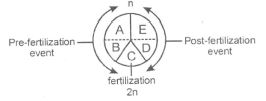
A
$A-$ Gamete transfer,$B-$ Gametogenesis,$D-$ Zygote formation,$E-$ Embryogenesis
B
$A-$ Gametogenesis,$B-$ Gamete transfer,$D-$ Zygote formation,$E-$ Embryogenesis
C
$A-$ Gametogenesis,$B-$ Zygote formation,$D-$ Gamete transfer,$E-$ Embryogenesis
D
$A-$ Gametogenesis,$B-$ Gamete transfer,$D-$ Embryogenesis,$E-$ Zygote formation.
Solution
(B) In sexual reproduction,the events are categorized into three stages:
$1$. Pre-fertilization events: These include Gametogenesis $(A)$ and Gamete transfer $(B)$.
$2$. Fertilization $(C)$: The fusion of male and female gametes to form a diploid zygote $(2n)$.
$3$. Post-fertilization events: These include Zygote formation $(D)$ and Embryogenesis $(E)$.
Therefore,the correct sequence is $A-$ Gametogenesis,$B-$ Gamete transfer,$D-$ Zygote formation,$E-$ Embryogenesis.
$1$. Pre-fertilization events: These include Gametogenesis $(A)$ and Gamete transfer $(B)$.
$2$. Fertilization $(C)$: The fusion of male and female gametes to form a diploid zygote $(2n)$.
$3$. Post-fertilization events: These include Zygote formation $(D)$ and Embryogenesis $(E)$.
Therefore,the correct sequence is $A-$ Gametogenesis,$B-$ Gamete transfer,$D-$ Zygote formation,$E-$ Embryogenesis.
0 likes
View Solution86
EasyMCQ
Which of the following statements is incorrect?
$(i)$ Bamboo species flower only once in their lifetime,generally after $50-100$ years,produce a large number of fruits,and die.
$(ii)$ In animals,the juvenile phase is followed by morphological and physiological changes prior to active reproductive behaviour.
$(iii)$ The reproductive phase is of the same duration in all organisms.
$(iv)$ The juvenile phase is the period of growth between the birth of an individual until it reaches reproductive maturity.
$(i)$ Bamboo species flower only once in their lifetime,generally after $50-100$ years,produce a large number of fruits,and die.
$(ii)$ In animals,the juvenile phase is followed by morphological and physiological changes prior to active reproductive behaviour.
$(iii)$ The reproductive phase is of the same duration in all organisms.
$(iv)$ The juvenile phase is the period of growth between the birth of an individual until it reaches reproductive maturity.
A
Only $(i)$
B
Only $(ii)$
C
Only $(iii)$
D
Only $(iv)$
Solution
(C) Statement $(iii)$ is incorrect. The duration of the reproductive phase varies significantly among different organisms depending on their species,environmental conditions,and life history strategies. It is not uniform across all living beings.
0 likes
View Solution87
MediumMCQ
In a practical test, a student has to identify the organisms in which syngamy does not occur. In those organisms, the female gamete undergoes development to form new organisms without fertilization. This phenomenon is called "$X$". Identify the organisms and the phenomenon "$X$".
A
Frog, Parthenogenesis
B
Lizards, Gametogenesis
C
Rotifers, Embryogenesis
D
Honeybee, Parthenogenesis
Solution
(D) Parthenogenesis is a form of asexual reproduction in which an unfertilized egg develops into a new individual.
In organisms like rotifers, honeybees, and some lizards and birds (like turkeys), the female gamete undergoes development to form new organisms without fertilization.
This process is known as Parthenogenesis.
Therefore, the correct pair is Honeybee and Parthenogenesis.
In organisms like rotifers, honeybees, and some lizards and birds (like turkeys), the female gamete undergoes development to form new organisms without fertilization.
This process is known as Parthenogenesis.
Therefore, the correct pair is Honeybee and Parthenogenesis.
0 likes
View Solution88
MediumMCQ
Assertion : Death is one of the important regulatory processes on earth.
Reason : It avoids over-crowding caused by continuous reproduction.
Reason : It avoids over-crowding caused by continuous reproduction.
A
If both Assertion and Reason are correct and the Reason is a correct explanation of the Assertion.
B
If both Assertion and Reason are correct but Reason is not a correct explanation of the Assertion.
C
If the Assertion is correct but Reason is incorrect.
D
If both the Assertion and Reason are incorrect.
Solution
(A) Death is a natural and essential biological process that ensures the continuity of life by maintaining ecological balance.
Continuous reproduction by organisms leads to an increase in population size.
If organisms did not die,the earth would face severe over-crowding and depletion of resources.
Therefore,death acts as a regulatory mechanism to prevent over-crowding and maintain the stability of ecosystems.
Thus,both the Assertion and the Reason are correct,and the Reason is the correct explanation of the Assertion.
Continuous reproduction by organisms leads to an increase in population size.
If organisms did not die,the earth would face severe over-crowding and depletion of resources.
Therefore,death acts as a regulatory mechanism to prevent over-crowding and maintain the stability of ecosystems.
Thus,both the Assertion and the Reason are correct,and the Reason is the correct explanation of the Assertion.
0 likes
View Solution89
MediumMCQ
Assertion: Clones are produced by sexual reproduction.
Reason: These are prepared by a group of cells descended from many cells or by inbreeding of a heterozygous line.
Reason: These are prepared by a group of cells descended from many cells or by inbreeding of a heterozygous line.
A
If both Assertion and Reason are correct and the Reason is a correct explanation of the Assertion.
B
If both Assertion and Reason are correct but Reason is not a correct explanation of the Assertion.
C
If the Assertion is correct but Reason is incorrect.
D
If both the Assertion and Reason are incorrect.
Solution
(D) Clones are genetically identical individuals produced through asexual reproduction,not sexual reproduction. Therefore,the Assertion is incorrect.
Cloning involves the production of organisms from a single parent,resulting in offspring that are clones of the parent. The Reason provided is also scientifically inaccurate as it describes processes that do not result in clones. Thus,both the Assertion and the Reason are incorrect.
Cloning involves the production of organisms from a single parent,resulting in offspring that are clones of the parent. The Reason provided is also scientifically inaccurate as it describes processes that do not result in clones. Thus,both the Assertion and the Reason are incorrect.
0 likes
View Solution90
Medium
Why is reproduction essential for organisms?
Solution
(N/A) Reproduction is a fundamental feature of all living organisms. It is a biological process through which living organisms produce offspring similar to themselves. Reproduction ensures the continuity of various species on the Earth. In the absence of reproduction,species would not be able to exist for a long time and might soon become extinct.
0 likes
View Solution91
MediumMCQ
Which is a better mode of reproduction: sexual or asexual? Why?
A
Sexual reproduction,because it promotes genetic variation.
B
Asexual reproduction,because it is faster.
C
Both are equally good.
D
Neither is good.
Solution
(A) Sexual reproduction is considered a better mode of reproduction.
It allows for the formation of new genetic variants through the combination of $DNA$ from two different individuals,typically one of each sex.
It involves the fusion of male and female gametes to produce offspring that are not identical to their parents or to each other.
This genetic variation allows individuals to adapt to constantly changing and challenging environments.
Furthermore,it leads to the evolution of better-suited organisms,which ensures the long-term survival of a species.
In contrast,asexual reproduction allows for very little or no variation at all.
As a result,the individuals produced are exact clones of their parents and each other,making them less adaptable to environmental changes.
It allows for the formation of new genetic variants through the combination of $DNA$ from two different individuals,typically one of each sex.
It involves the fusion of male and female gametes to produce offspring that are not identical to their parents or to each other.
This genetic variation allows individuals to adapt to constantly changing and challenging environments.
Furthermore,it leads to the evolution of better-suited organisms,which ensures the long-term survival of a species.
In contrast,asexual reproduction allows for very little or no variation at all.
As a result,the individuals produced are exact clones of their parents and each other,making them less adaptable to environmental changes.
0 likes
View Solution92
MediumMCQ
Why is the offspring formed by asexual reproduction referred to as a clone?
A
They are produced by mitosis.
B
They are morphologically and genetically identical to the parent.
C
They are produced by meiosis.
D
They are produced by sexual reproduction.
Solution
(B) clone is a group of morphologically and genetically identical individuals.
In the process of asexual reproduction,only one parent is involved,and there is no fusion of male and female gametes.
As a result,the offspring produced are morphologically and genetically similar to their parents and are thus called clones.
In the process of asexual reproduction,only one parent is involved,and there is no fusion of male and female gametes.
As a result,the offspring produced are morphologically and genetically similar to their parents and are thus called clones.
0 likes
View Solution93
Medium
Offspring formed due to sexual reproduction have better chances of survival. Why? Is this statement always true?
Solution
(N/A) Sexual reproduction involves the fusion of male and female gametes. This process allows for the formation of new genetic variants through the recombination of $DNA$ from two different parents. These variations enable individuals to adapt to changing environmental conditions,thereby increasing their chances of survival.
However,this statement is not always true. In certain stable environments,asexual reproduction can be more advantageous. For instance,organisms that are well-adapted to a specific,unchanging environment do not necessarily require genetic variation. Furthermore,asexual reproduction is a faster and more energy-efficient mode of reproduction compared to sexual reproduction.
However,this statement is not always true. In certain stable environments,asexual reproduction can be more advantageous. For instance,organisms that are well-adapted to a specific,unchanging environment do not necessarily require genetic variation. Furthermore,asexual reproduction is a faster and more energy-efficient mode of reproduction compared to sexual reproduction.
0 likes
View Solution94
Medium
How does the progeny formed from asexual reproduction differ from those formed by sexual reproduction?
Solution
(N/A)
| Progeny from Asexual Reproduction | Progeny from Sexual Reproduction |
|---|---|
| $1$. Asexual reproduction does not involve the fusion of male and female gametes. Organisms produce offspring that are morphologically and genetically identical to the parent. | $1$. Sexual reproduction involves the fusion of male and female gametes from two individuals. Organisms produce offspring that are not identical to the parents. |
| $2$. Offspring thus produced do not show variations and are called clones. | $2$. Offspring thus produced show variations from each other and their parents. |
1 likes
View Solution95
Medium
Distinguish between asexual and sexual reproduction. Why is vegetative reproduction also considered as a type of asexual reproduction?
Solution
(N/A)
Vegetative propagation is a process in which new plants are obtained from vegetative parts like rhizomes,suckers,tubers,or bulbs without the production of seeds or spores. Since it does not involve the fusion of male and female gametes and requires only a single parent,it is considered a type of asexual reproduction.
| Feature | Sexual Reproduction | Asexual Reproduction |
|---|---|---|
| $1$. Gamete Fusion | Involves the fusion of male and female gametes. | Does not involve the fusion of gametes. |
| $2$. Number of Parents | Usually requires two different individuals. | Requires only one individual. |
| $3$. Offspring Characteristics | Offspring are not identical to parents; show variations. | Offspring are genetically identical to the parent (clones). |
| $4$. Occurrence | Common in most animals and higher plants. | Common in organisms with simple organization (e.g.,algae,fungi). |
| $5$. Speed | Generally a slow process. | Generally a fast process. |
Vegetative propagation is a process in which new plants are obtained from vegetative parts like rhizomes,suckers,tubers,or bulbs without the production of seeds or spores. Since it does not involve the fusion of male and female gametes and requires only a single parent,it is considered a type of asexual reproduction.
0 likes
View Solution96
Medium
Differentiate between a zoospore and a zygote.
Solution
(N/A)
| Feature | Zoospore vs Zygote |
|---|---|
| $1$. Nature | $A$ zoospore is a motile asexual spore that utilizes flagella for movement,whereas a zygote is a non-motile diploid cell formed as a result of fertilization. |
| $2$. Reproduction | $A$ zoospore is an asexual reproductive structure,whereas a zygote is formed as a result of sexual reproduction. |
0 likes
View Solution97
EasyMCQ
What is the life span of organisms?
A
The period from birth to natural death.
B
The period from birth to the reproductive stage.
C
The period from birth to the growth stage.
D
The period from birth to the aging stage.
Solution
(A) The period from birth to the natural death of an organism represents its life span.
No individual is immortal,except for single-celled organisms,which continue their life span in their offspring through binary fission.
The continuity of life on Earth is maintained through the process of reproduction.
Life spans vary greatly among different organisms; for example,a butterfly lives for $1-2$ weeks,while a banyan tree can live for several hundred years.
No individual is immortal,except for single-celled organisms,which continue their life span in their offspring through binary fission.
The continuity of life on Earth is maintained through the process of reproduction.
Life spans vary greatly among different organisms; for example,a butterfly lives for $1-2$ weeks,while a banyan tree can live for several hundred years.
0 likes
View Solution98
Medium
Why is reproduction essential for organisms? Describe its types.
Solution
(N/A) Reproduction is a biological process by which an organism gives rise to young ones (offspring) similar to itself.
It is essential for the following reasons:
$1$. It ensures the continuity of species generation after generation.
$2$. It helps in the population organization of organisms.
$3$. It introduces variations that are essential for evolution and adaptation.
Types of reproduction:
$1$. Asexual Reproduction: In this type,a single parent is involved,and offspring are produced without the fusion of gametes. It does not involve meiosis,so the offspring are genetically identical to the parent (clones).
$2$. Sexual Reproduction: In this type,two parents of opposite sex are involved. It involves the formation and fusion of gametes through meiosis,which leads to genetic variation in the offspring.
It is essential for the following reasons:
$1$. It ensures the continuity of species generation after generation.
$2$. It helps in the population organization of organisms.
$3$. It introduces variations that are essential for evolution and adaptation.
Types of reproduction:
$1$. Asexual Reproduction: In this type,a single parent is involved,and offspring are produced without the fusion of gametes. It does not involve meiosis,so the offspring are genetically identical to the parent (clones).
$2$. Sexual Reproduction: In this type,two parents of opposite sex are involved. It involves the formation and fusion of gametes through meiosis,which leads to genetic variation in the offspring.
0 likes
View Solution99
MediumMCQ
What is senescence? What is responsible for it?
A
The end of the reproductive phase
B
The beginning of the juvenile phase
C
The process of rapid cell division
D
The stage of active gamete production
Solution
(A) Senescence,or old age,is characterized by the end of the reproductive phase in an organism's life cycle.
During the final stage of the life span,concomitant changes occur in the body,such as a slowing down of metabolism,which eventually leads to death.
In both plants and animals,hormones are responsible for the transitions between the three phases of life (juvenile,reproductive,and senescent).
The interaction between hormones and certain environmental factors regulates the reproductive processes and governs the behavioral expressions of organisms.
During the final stage of the life span,concomitant changes occur in the body,such as a slowing down of metabolism,which eventually leads to death.
In both plants and animals,hormones are responsible for the transitions between the three phases of life (juvenile,reproductive,and senescent).
The interaction between hormones and certain environmental factors regulates the reproductive processes and governs the behavioral expressions of organisms.
0 likes
View Solution100
Medium
Differentiate between asexual reproduction and sexual reproduction.
Solution
(A) Based on whether there is participation of one organism or two in the process of reproduction,it is of two types:
$1$. Asexual reproduction: When offspring are produced by a single parent with or without the involvement of gamete formation,the reproduction is asexual. In this method,a single individual is capable of producing offspring. As a result,the offspring produced are not only identical to one another but are also exact copies of their parent (clones).
$2$. Sexual reproduction: When two parents (of opposite sex) participate in the reproductive process and involve the fusion of male and female gametes,it is called sexual reproduction. This process involves the formation of male and female gametes,either by the same individual or by different individuals of the opposite sex. These gametes fuse to form the zygote,which develops into a new organism. It is an elaborate,complex,and slow process compared to asexual reproduction. Due to the fusion of gametes,sexual reproduction results in offspring that are not identical to the parents or amongst themselves.
$1$. Asexual reproduction: When offspring are produced by a single parent with or without the involvement of gamete formation,the reproduction is asexual. In this method,a single individual is capable of producing offspring. As a result,the offspring produced are not only identical to one another but are also exact copies of their parent (clones).
$2$. Sexual reproduction: When two parents (of opposite sex) participate in the reproductive process and involve the fusion of male and female gametes,it is called sexual reproduction. This process involves the formation of male and female gametes,either by the same individual or by different individuals of the opposite sex. These gametes fuse to form the zygote,which develops into a new organism. It is an elaborate,complex,and slow process compared to asexual reproduction. Due to the fusion of gametes,sexual reproduction results in offspring that are not identical to the parents or amongst themselves.
0 likes
View SolutionReproduction in Organisms — Mix Examples -Reproduction in Organisms · Frequently Asked Questions
1Are these Reproduction in Organisms questions useful for JEE and NEET?
Yes. All questions in this section are mapped to JEE Main and NEET exam patterns. Previous year questions from JEE Main, NEET, GUJCET and state-level exams are included with full solutions.
2Can I switch to Hindi or Gujarati for these questions?
Yes. Use the language tabs in the hero section or the sidebar to view the same questions and solutions in English, Hindi or Gujarati.
3How do I generate a question paper from this subtopic?
Use the Vedclass Exam Paper Generator — select the chapter and subtopic, set difficulty, and generate Sets A, B, C, D automatically. First 3 chapters of every subject are free.
Vedclass Products
For Students
Vedclass Test Series
Mock tests in real JEE/NEET style with performance analysis. 5-day free trial.
Start Free TrialFor Teachers
Exam Paper Generator
Generate Set A/B/C/D papers from this chapter in 2 minutes. 3 chapters free.
Try FreeFor Institutes
Online Exam Module
Live online exams with unlimited students, 360° analytics & white-label branding.
See DemoFor Teachers & Institutes
Generate a Reproduction in Organisms Exam Paper in 2 Minutes
Select subtopic & difficulty — Sets A, B, C, D auto-generated with No Repeat logic.
First 3 chapters of every subject are free — no payment required.