
A English
Mix Examples -Reproduction in Organisms Questions in English
Class 12 Biology · Reproduction in Organisms · Mix Examples -Reproduction in Organisms
236+
Questions
English
Language
100%
With Solutions
Showing 36 of 236 questions in English
201
MediumMCQ
In bacteria,fungi,and lower plants,various thick-walled $A$ are formed,which help them to survive $B$ conditions; these germinate on the availability of a suitable environment. In higher plants,$C$ and some other vegetative reproductive structures serve as means to tide over periods of stress besides helping in dispersal; they germinate to form new plants under favourable moisture and temperature conditions. Choose the correct option for $A, B$,and $C$.
A
$A-$Spores,$B-$Unfavourable,$C-$Seeds
B
$A-$Seeds,$B-$Unfavourable,$C-$Spores
C
$A-$Seeds,$B-$Favourable,$C-$Spores
D
$A-$Spore,$B-$Favourable,$C-$Seeds
Solution
(A) In bacteria,fungi,and lower plants,thick-walled structures called $A-$Spores are formed to survive $B-$Unfavourable conditions. These spores remain dormant until suitable environmental conditions return. In higher plants,$C-$Seeds and other vegetative propagules (like tubers,rhizomes,etc.) act as perennating structures that help the plant survive stress periods and aid in dispersal. When favourable moisture and temperature conditions are met,they germinate to produce new plants. Therefore,the correct sequence is $A-$Spores,$B-$Unfavourable,$C-$Seeds.
0 likes
View Solution202
Medium
Explain the senescence phase.
Solution
(N/A) Senescence phase: After the reproductive phase,hormonal changes gradually slow down the production of male and female gametes.
$\rightarrow$ This phase is known as the senescence phase or old age.
$\rightarrow$ It brings about concomitant changes in the body of the organism,such as the slowing down of metabolism.
$\rightarrow$ This is the final phase of the life span.
$\rightarrow$ Old age ultimately leads to death.
$\rightarrow$ This phase is known as the senescence phase or old age.
$\rightarrow$ It brings about concomitant changes in the body of the organism,such as the slowing down of metabolism.
$\rightarrow$ This is the final phase of the life span.
$\rightarrow$ Old age ultimately leads to death.
0 likes
View Solution203
Easy
What are meiocytes?
Solution
Meiocytes are specialized diploid $(2n)$ cells that undergo meiosis to produce haploid $(n)$ gametes.
In diploid organisms, such as pteridophytes, gymnosperms, angiosperms, and most animals, gametes are produced through the process of meiosis.
At the end of meiosis, only one set of chromosomes $(n)$ is incorporated into each gamete.
Table: Chromosome numbers in meiocytes $(2n)$ and gametes $(n)$ of some organisms.
In diploid organisms, such as pteridophytes, gymnosperms, angiosperms, and most animals, gametes are produced through the process of meiosis.
At the end of meiosis, only one set of chromosomes $(n)$ is incorporated into each gamete.
Table: Chromosome numbers in meiocytes $(2n)$ and gametes $(n)$ of some organisms.
| Name of Organism | Chromosome Number in Meiocyte $(2n)$ / Gamete $(n)$ |
| Human Beings | $46 / 23$ |
| Housefly | $12 / 6$ |
| Rat | $42 / 21$ |
| Dog | $78 / 39$ |
| Cat | $38 / 19$ |
| Fruit fly | $8 / 4$ |
| Ophioglossum (a fern) | $1260 / 630$ |
| Apple | $34 / 17$ |
| Rice | $24 / 12$ |
| Maize | $20 / 10$ |
| Potato | $48 / 24$ |
| Butterfly | $380 / 190$ |
| Onion | $32 / 16$ |
0 likes
View Solution204
Medium
Differentiate between Oviparous and Viviparous animals.
Solution
(N/A)
| Oviparous | Viviparous |
|---|---|
| $(1)$ Fertilization usually takes place outside the body. | $(1)$ Fertilization takes place inside the body. |
| $(2)$ Fertilized eggs are covered by a hard calcareous shell. | $(2)$ Zygote develops into a young one within the body of the female. |
| $(3)$ After the completion of the incubation period,young ones hatch out. | $(3)$ After the completion of the gestation period,young ones are delivered out of the female body. |
0 likes
View Solution205
Medium
Match the following columns regarding the methods of asexual reproduction and their examples:
| Column $I$ | Column $II$ |
| $(1)$ Binary fission | $(a)$ Penicillium |
| $(2)$ Budding | $(b)$ Bryophyllum |
| $(3)$ Zoospore | $(c)$ Potato |
| $(4)$ Conidia | $(d)$ Algae |
| $(5)$ Tuber | $(e)$ Yeast |
| $(6)$ Leaf buds | $(f)$ Amoeba |
| $(g)$ Hydra | |
| $(h)$ Paramoecium |
Solution
(A-D) The correct matches are as follows:
$(1)$ Binary fission: $(f)$ Amoeba and $(h)$ Paramoecium.
$(2)$ Budding: $(e)$ Yeast and $(g)$ Hydra.
$(3)$ Zoospore: $(d)$ Algae (e.g.,Chlamydomonas).
$(4)$ Conidia: $(a)$ Penicillium.
$(5)$ Tuber: $(c)$ Potato.
$(6)$ Leaf buds: $(b)$ Bryophyllum.
Therefore,the matching sequence is: $(1-f, h), (2-e, g), (3-d), (4-a), (5-c), (6-b)$.
$(1)$ Binary fission: $(f)$ Amoeba and $(h)$ Paramoecium.
$(2)$ Budding: $(e)$ Yeast and $(g)$ Hydra.
$(3)$ Zoospore: $(d)$ Algae (e.g.,Chlamydomonas).
$(4)$ Conidia: $(a)$ Penicillium.
$(5)$ Tuber: $(c)$ Potato.
$(6)$ Leaf buds: $(b)$ Bryophyllum.
Therefore,the matching sequence is: $(1-f, h), (2-e, g), (3-d), (4-a), (5-c), (6-b)$.
0 likes
View Solution206
Easy
Match the following columns:
| Column $I$ | Column $II$ |
| $(1)$ Earthworm | $(a)$ Males are absent |
| $(2)$ Cockroach | $(b)$ Hermaphrodite |
| $(3)$ Honey bee | $(c)$ Dioecious |
| $(4)$ Rotifers | $(d)$ Parthenogenesis |
Solution
(B) The correct matches are as follows:
$(1)$ Earthworm is a hermaphrodite (bisexual), meaning it contains both male and female reproductive organs in the same individual. Thus, $(1-b)$.
$(2)$ Cockroach is dioecious, meaning male and female reproductive organs are present in separate individuals. Thus, $(2-c)$.
$(3)$ Honey bee exhibits parthenogenesis, where unfertilized eggs develop into new individuals (drones). Thus, $(3-d)$.
$(4)$ Rotifers are organisms where males are often absent in certain populations, and reproduction occurs via parthenogenesis. Thus, $(4-a)$.
Therefore, the correct sequence is $(1-b, 2-c, 3-d, 4-a)$.
$(1)$ Earthworm is a hermaphrodite (bisexual), meaning it contains both male and female reproductive organs in the same individual. Thus, $(1-b)$.
$(2)$ Cockroach is dioecious, meaning male and female reproductive organs are present in separate individuals. Thus, $(2-c)$.
$(3)$ Honey bee exhibits parthenogenesis, where unfertilized eggs develop into new individuals (drones). Thus, $(3-d)$.
$(4)$ Rotifers are organisms where males are often absent in certain populations, and reproduction occurs via parthenogenesis. Thus, $(4-a)$.
Therefore, the correct sequence is $(1-b, 2-c, 3-d, 4-a)$.
0 likes
View Solution207
Medium
Match the following columns:
| Column $I$ | Column $II$ |
| $(1)$ Uniparental reproduction | $(a)$ Sexual reproduction |
| $(2)$ Budding | $(b)$ Spongilla |
| $(3)$ Gemmule | $(c)$ Plasmodium |
| $(4)$ Syngamy | $(d)$ Gametes |
| $(5)$ Fusion of similar gametes | $(e)$ Hydra |
| $(6)$ Biparental reproduction | $(f)$ Penicillium |
| $(7)$ Haploid | $(g)$ Asexual reproduction |
| $(8)$ Conidia | $(h)$ Isogamy |
| $(9)$ Multiple fission | $(i)$ Fusion of two haploid gametes |
Solution
(A) $(1-g)$ Uniparental reproduction is a characteristic of asexual reproduction.
$(2-e)$ Budding is a common method of asexual reproduction in Hydra.
$(3-b)$ Gemmules are internal buds found in sponges like Spongilla.
$(4-i)$ Syngamy refers to the fusion of two haploid gametes to form a diploid zygote.
$(5-h)$ Fusion of similar gametes is known as isogamy.
$(6-a)$ Biparental reproduction is a characteristic of sexual reproduction.
$(7-c)$ Plasmodium is a haploid organism (in its vegetative stage).
$(8-f)$ Conidia are asexual reproductive structures found in Penicillium.
$(9-d)$ Multiple fission is a process where the parent cell divides into many daughter cells, often associated with the formation of gametes or spores in some contexts; however, in this specific matching set, it relates to the production of multiple units.
$(2-e)$ Budding is a common method of asexual reproduction in Hydra.
$(3-b)$ Gemmules are internal buds found in sponges like Spongilla.
$(4-i)$ Syngamy refers to the fusion of two haploid gametes to form a diploid zygote.
$(5-h)$ Fusion of similar gametes is known as isogamy.
$(6-a)$ Biparental reproduction is a characteristic of sexual reproduction.
$(7-c)$ Plasmodium is a haploid organism (in its vegetative stage).
$(8-f)$ Conidia are asexual reproductive structures found in Penicillium.
$(9-d)$ Multiple fission is a process where the parent cell divides into many daughter cells, often associated with the formation of gametes or spores in some contexts; however, in this specific matching set, it relates to the production of multiple units.
0 likes
View Solution208
MediumMCQ
Match the following columns:
| Column-$I$ (Organisms) | Column-$II$ (Mode of Reproduction) |
| $P$. Fungi | $I$. Budding |
| $Q$. Yeast and Hydra | $II$. True Regeneration |
| $R$. Planaria | $III$. Asexual Spores |
| $S$. Fungi, Filamentous Algae, Protonema of Mosses | $IV$. Fragmentation |
A
$(P-II), (Q-I), (R-III), (S-IV)$
B
$(P-IV), (Q-III), (R-I), (S-II)$
C
$(P-I), (Q-III), (R-II), (S-IV)$
D
$(P-III), (Q-I), (R-II), (S-IV)$
Solution
(D) The correct matches are as follows:
$P$. Fungi reproduce through asexual spores $(III)$.
$Q$. Yeast and Hydra reproduce through budding $(I)$.
$R$. Planaria exhibits true regeneration $(II)$.
$S$. Fungi, filamentous algae, and the protonema of mosses all multiply by fragmentation $(IV)$.
Therefore, the correct sequence is $(P-III), (Q-I), (R-II), (S-IV)$.
$P$. Fungi reproduce through asexual spores $(III)$.
$Q$. Yeast and Hydra reproduce through budding $(I)$.
$R$. Planaria exhibits true regeneration $(II)$.
$S$. Fungi, filamentous algae, and the protonema of mosses all multiply by fragmentation $(IV)$.
Therefore, the correct sequence is $(P-III), (Q-I), (R-II), (S-IV)$.
0 likes
View Solution209
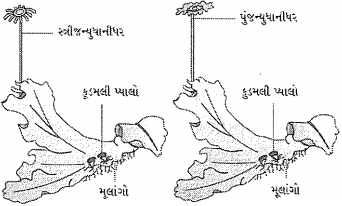
MediumMCQ
Select the correct option based on the given figure.
A
Marchantia - Bisexual
B
Marchantia - Unisexual
C
Funaria - Unisexual
D
Funaria - Bisexual
Solution
(B) The provided figure shows two separate thalli of the liverwort $Marchantia$.
One thallus bears the female reproductive structure called the archegoniophore (stri-janyu-dhani-dhar),while the other bears the male reproductive structure called the antheridiophore (pun-janyu-dhani-dhar).
Since the male and female reproductive organs are present on separate thalli,$Marchantia$ is dioecious or unisexual.
Therefore,the correct option is $B$.
One thallus bears the female reproductive structure called the archegoniophore (stri-janyu-dhani-dhar),while the other bears the male reproductive structure called the antheridiophore (pun-janyu-dhani-dhar).
Since the male and female reproductive organs are present on separate thalli,$Marchantia$ is dioecious or unisexual.
Therefore,the correct option is $B$.
0 likes
View Solution210
MediumMCQ
Identify the haploid and diploid structures from the following:
$I$ - Zoospore,$II$ - Zygote,$III$ - Egg cell,$IV$ - Gametophyte,$V$ - Sporophyte
Haploid structures $\quad\quad$ Diploid structures
$I$ - Zoospore,$II$ - Zygote,$III$ - Egg cell,$IV$ - Gametophyte,$V$ - Sporophyte
Haploid structures $\quad\quad$ Diploid structures
A
$I, II, III \quad\quad IV, V$
B
$II, V \quad\quad I, III, IV$
C
$I, III, IV \quad\quad II, V$
D
$IV, V \quad\quad I, II, III$
Solution
(C) In biological life cycles,haploid $(n)$ structures contain a single set of chromosomes,while diploid $(2n)$ structures contain two sets of chromosomes.
$I$ - Zoospore: Haploid $(n)$
$II$ - Zygote: Diploid $(2n)$
$III$ - Egg cell: Haploid $(n)$
$IV$ - Gametophyte: Haploid $(n)$
$V$ - Sporophyte: Diploid $(2n)$
Therefore,the haploid structures are $I, III, IV$ and the diploid structures are $II, V$.
$I$ - Zoospore: Haploid $(n)$
$II$ - Zygote: Diploid $(2n)$
$III$ - Egg cell: Haploid $(n)$
$IV$ - Gametophyte: Haploid $(n)$
$V$ - Sporophyte: Diploid $(2n)$
Therefore,the haploid structures are $I, III, IV$ and the diploid structures are $II, V$.
0 likes
View Solution211
EasyMCQ
Gametes are $.....P.....$, and the zygote is always $.....Q......$. Identify $P$ and $Q$ respectively.
A
Haploid, Diploid
B
Diploid, Haploid
C
Haploid, Haploid
D
Diploid, Diploid
Solution
(A) Gametes are reproductive cells produced through meiosis, which reduces the chromosome number to half, making them $Haploid$ $(n)$.
When a male gamete $(n)$ and a female gamete $(n)$ fuse during fertilization, they form a $Zygote$ $(2n)$.
Therefore, the zygote is always $Diploid$ $(2n)$.
Thus, $P$ is $Haploid$ and $Q$ is $Diploid$.
When a male gamete $(n)$ and a female gamete $(n)$ fuse during fertilization, they form a $Zygote$ $(2n)$.
Therefore, the zygote is always $Diploid$ $(2n)$.
Thus, $P$ is $Haploid$ and $Q$ is $Diploid$.
0 likes
View Solution212
EasyMCQ
In this type of reproduction,the offspring are exact clones of their parents.
A
Asexual reproduction
B
Sexual reproduction
C
Vegetative propagation
D
Both $A$ and $C$
Solution
(D) In asexual reproduction,a single parent produces offspring without the fusion of gametes.
Since there is no meiosis or fertilization involved,the offspring are genetically and morphologically identical to the parent,often referred to as clones.
Vegetative propagation is a specific type of asexual reproduction observed in plants.
Therefore,both asexual reproduction and vegetative propagation result in the formation of clones.
Since there is no meiosis or fertilization involved,the offspring are genetically and morphologically identical to the parent,often referred to as clones.
Vegetative propagation is a specific type of asexual reproduction observed in plants.
Therefore,both asexual reproduction and vegetative propagation result in the formation of clones.
0 likes
View Solution213
EasyMCQ
Reproduction without the fusion of gametes $- P$
Reproduction involving the fusion of gametes $- Q$
Choose the correct option for $P$ and $Q$.
$\quad\quad \quad P \quad\quad\quad \quad Q$
Reproduction involving the fusion of gametes $- Q$
Choose the correct option for $P$ and $Q$.
$\quad\quad \quad P \quad\quad\quad \quad Q$
A
Sexual reproduction $\quad$ Vegetative reproduction
B
Sexual reproduction $\quad$ Asexual reproduction
C
Asexual reproduction $\quad$ Sexual reproduction
D
Vegetative reproduction $\quad$ Asexual reproduction
Solution
(C) $1$. Asexual reproduction is a mode of reproduction that does not involve the fusion of gametes or the change in the number of chromosomes. The offspring produced are genetically identical to the parent.
$2$. Sexual reproduction is a mode of reproduction that involves the fusion of male and female gametes to form a zygote,which eventually develops into a new organism.
$3$. Therefore,$P$ represents Asexual reproduction and $Q$ represents Sexual reproduction.
$2$. Sexual reproduction is a mode of reproduction that involves the fusion of male and female gametes to form a zygote,which eventually develops into a new organism.
$3$. Therefore,$P$ represents Asexual reproduction and $Q$ represents Sexual reproduction.
0 likes
View Solution214
MediumMCQ
In which type of reproduction can gametes be formed?
A
Sexual reproduction
B
Asexual reproduction
C
Both
D
None of these
Solution
(C) Gametes are primarily formed in $Sexual$ reproduction through meiosis. However, in some cases of $Asexual$ reproduction, gametes can also be formed. For example, in honeybees, the male $(Drone)$ develops from an unfertilized egg (gamete) through a process called $Parthenogenesis$. Since the gamete is formed but does not undergo fusion, it is considered a form of asexual reproduction involving gamete formation.
0 likes
View Solution215
EasyMCQ
Match the following columns:
| Column-$I$ (Organism) | Column-$II$ (Lifespan) |
|---|---|
| $P$. Butterfly | $I$. $140$ years |
| $Q$. Crow | $II$. $100-150$ years |
| $R$. Parrot | $III$. $1-2$ weeks |
| $S$. Tortoise | $IV$. $15$ years |
A
$(P-II), (Q-IV), (R-I), (S-III)$
B
$(P-III), (Q-IV), (R-II), (S-I)$
C
$(P-III), (Q-II), (R-IV), (S-I)$
D
$(P-III), (Q-IV), (R-I), (S-II)$
Solution
(D) The lifespan of organisms is as follows:
$1$. Butterfly $(P)$: $1-2$ weeks $(III)$.
$2$. Crow $(Q)$: $15$ years $(IV)$.
$3$. Parrot $(R)$: $140$ years $(I)$.
$4$. Tortoise $(S)$: $100-150$ years $(II)$.
Therefore,the correct matching is $(P-III), (Q-IV), (R-I), (S-II)$.
$1$. Butterfly $(P)$: $1-2$ weeks $(III)$.
$2$. Crow $(Q)$: $15$ years $(IV)$.
$3$. Parrot $(R)$: $140$ years $(I)$.
$4$. Tortoise $(S)$: $100-150$ years $(II)$.
Therefore,the correct matching is $(P-III), (Q-IV), (R-I), (S-II)$.
0 likes
View Solution216
EasyMCQ
Clones are defined as ......
A
Morphologically similar organisms
B
Genetically similar organisms
C
Morphologically and genetically similar organisms
D
None of the above
Solution
(C) The term $Clones$ is used to describe individuals that are produced through asexual reproduction.
These individuals are exact copies of their parents.
Because they arise from a single parent without the fusion of gametes,they possess identical genetic material.
Furthermore,they exhibit the same physical characteristics as the parent.
Therefore,clones are defined as organisms that are both morphologically and genetically similar.
These individuals are exact copies of their parents.
Because they arise from a single parent without the fusion of gametes,they possess identical genetic material.
Furthermore,they exhibit the same physical characteristics as the parent.
Therefore,clones are defined as organisms that are both morphologically and genetically similar.
0 likes
View Solution217
MediumMCQ
Match the following columns:
| Column-$I$ | Column-$II$ |
|---|---|
| $P$ | $I$. Conidia of Penicillium |
| $Q$ | $II$. Zoospores of Chlamydomonas |
| $R$ | $III$. Gemmules in sponge |
| $S$ | $IV$. Budding in Hydra |
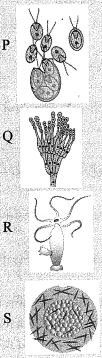
A
$(P-I), (Q-II), (R-IV), (S-III)$
B
$(P-II), (Q-I), (R-IV), (S-III)$
C
$(P-II), (Q-I), (R-III), (S-IV)$
D
$(P-I), (Q-II), (R-III), (S-IV)$
Solution
(B) Based on the provided images:
$P$ shows the zoospores of Chlamydomonas,which are motile structures.
$Q$ shows the conidia of Penicillium,which are non-motile spores produced in chains.
$R$ shows budding in Hydra,where a small outgrowth develops into a new individual.
$S$ shows gemmules in sponges,which are internal buds used for asexual reproduction.
Therefore,the correct matching is:
$P-II$
$Q-I$
$R-IV$
$S-III$
Thus,the correct option is $(P-II), (Q-I), (R-IV), (S-III)$.
$P$ shows the zoospores of Chlamydomonas,which are motile structures.
$Q$ shows the conidia of Penicillium,which are non-motile spores produced in chains.
$R$ shows budding in Hydra,where a small outgrowth develops into a new individual.
$S$ shows gemmules in sponges,which are internal buds used for asexual reproduction.
Therefore,the correct matching is:
$P-II$
$Q-I$
$R-IV$
$S-III$
Thus,the correct option is $(P-II), (Q-I), (R-IV), (S-III)$.
0 likes
View Solution218
MediumMCQ
Which type of reproduction occurs in $Amoeba$ under unfavorable conditions?
A
Fragmentation
B
Budding
C
Binary fission
D
Sporulation (Multiple fission)
Solution
(D) Under unfavorable conditions,$Amoeba$ withdraws its pseudopodia and secretes a three-layered hard covering or cyst around itself. This phenomenon is called encystation. When favorable conditions return,the encysted $Amoeba$ divides by multiple fission and produces many minute $Amoeba$ or pseudopodiospores. This process is known as sporulation.
0 likes
View Solution219
EasyMCQ
Match the following columns:
| Column-$I$ (Reproductive Structures) | Column-$II$ (Examples) |
|---|---|
| $P$. Conidia | $I$. Hydra |
| $Q$. Buds | $II$. Penicillium |
| $R$. Gemmules | $III$. Sponges |
A
$P-I, Q-II, R-III$
B
$P-II, Q-I, R-III$
C
$P-III, Q-II, R-I$
D
$P-III, Q-I, R-II$
Solution
(B) The correct matches are as follows:
$1$. Conidia $(P)$ are asexual reproductive structures found in fungi like $Penicillium$ $(II)$.
$2$. Buds $(Q)$ are small outgrowths that develop into new individuals,commonly seen in $Hydra$ $(I)$.
$3$. Gemmules $(R)$ are internal buds formed in sponges $(III)$ to survive unfavorable conditions.
Therefore,the correct matching is $P-II, Q-I, R-III$.
$1$. Conidia $(P)$ are asexual reproductive structures found in fungi like $Penicillium$ $(II)$.
$2$. Buds $(Q)$ are small outgrowths that develop into new individuals,commonly seen in $Hydra$ $(I)$.
$3$. Gemmules $(R)$ are internal buds formed in sponges $(III)$ to survive unfavorable conditions.
Therefore,the correct matching is $P-II, Q-I, R-III$.
0 likes
View Solution220
MediumMCQ
What is the significance of asexual reproduction?
A
Induces variation
B
Maintains variation
C
Induces mutation
D
None of the above
Solution
(D) Asexual reproduction involves a single parent and does not involve the fusion of gametes or meiosis.
As a result,the offspring produced are genetically identical to the parent,often referred to as clones.
Since there is no recombination of genetic material,it does not induce or maintain variation.
While mutations can occur,they are not the primary significance or purpose of asexual reproduction.
Therefore,none of the given options correctly describe the primary significance of asexual reproduction.
As a result,the offspring produced are genetically identical to the parent,often referred to as clones.
Since there is no recombination of genetic material,it does not induce or maintain variation.
While mutations can occur,they are not the primary significance or purpose of asexual reproduction.
Therefore,none of the given options correctly describe the primary significance of asexual reproduction.
0 likes
View Solution221
MediumMCQ
In $P$ type of plants,vegetative,reproductive,and senescent phases are clearly visible,whereas in $Q$ type of plants,it is difficult to clearly define these phases.
$\quad\quad\quad\quad P \quad\quad\quad\quad Q$
$(A)$ Annual $\quad$ Biennial,Perennial
$(B)$ Annual,Biennial $\quad$ Perennial
$(C)$ Perennial $\quad$ Annual,Biennial
$(D)$ Biennial,Perennial $\quad$ Annual
$\quad\quad\quad\quad P \quad\quad\quad\quad Q$
$(A)$ Annual $\quad$ Biennial,Perennial
$(B)$ Annual,Biennial $\quad$ Perennial
$(C)$ Perennial $\quad$ Annual,Biennial
$(D)$ Biennial,Perennial $\quad$ Annual
A
Annual $\quad$ Biennial,Perennial
B
Annual,Biennial $\quad$ Perennial
C
Perennial $\quad$ Annual,Biennial
D
Biennial,Perennial $\quad$ Annual
Solution
(B) In annual and biennial plants,the life cycle is completed within one or two years,respectively. Therefore,their vegetative,reproductive,and senescent phases are clearly distinct and observable.
In contrast,perennial plants live for many years. In many perennial species,the transition between vegetative,reproductive,and senescent phases is not clearly defined,as they may flower repeatedly over many years or have complex growth patterns.
Thus,$P$ represents Annual and Biennial plants,while $Q$ represents Perennial plants.
In contrast,perennial plants live for many years. In many perennial species,the transition between vegetative,reproductive,and senescent phases is not clearly defined,as they may flower repeatedly over many years or have complex growth patterns.
Thus,$P$ represents Annual and Biennial plants,while $Q$ represents Perennial plants.
0 likes
View Solution222
EasyMCQ
The processes of gametogenesis and gamete transfer are included in the ......... phase.
A
Pre-fertilization phase
B
Fertilization phase
C
Post-fertilization phase
D
All of the above
Solution
(A) Sexual reproduction in organisms is generally categorized into three distinct phases: Pre-fertilization,Fertilization,and Post-fertilization events.
$1$. Pre-fertilization events include gametogenesis (the formation of male and female gametes) and gamete transfer (the process of bringing gametes together for fusion).
$2$. Fertilization involves the fusion of male and female gametes to form a diploid zygote.
$3$. Post-fertilization events include the formation of the zygote and embryogenesis (development of the embryo).
Therefore,gametogenesis and gamete transfer are part of the pre-fertilization phase.
$1$. Pre-fertilization events include gametogenesis (the formation of male and female gametes) and gamete transfer (the process of bringing gametes together for fusion).
$2$. Fertilization involves the fusion of male and female gametes to form a diploid zygote.
$3$. Post-fertilization events include the formation of the zygote and embryogenesis (development of the embryo).
Therefore,gametogenesis and gamete transfer are part of the pre-fertilization phase.
0 likes
View Solution223
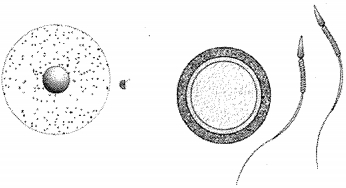
EasyMCQ
The given figure shows gametes. Select the correct option.
A
Heterogametes of Fucus $\quad$ Heterogametes of Human
B
Heterogametes of Human $\quad$ Heterogametes of Fucus
C
Heterogametes of Cladophora $\quad$ Heterogametes of Fucus
D
Heterogametes of Fucus $\quad$ Heterogametes of Cladophora
Solution
(A) In the given figure,the left side shows the heterogametes of the alga $Fucus$ (an egg and antherozoid).
The right side shows the heterogametes of humans (an ovum and sperms).
Therefore,the correct sequence is Heterogametes of $Fucus$ and Heterogametes of Human.
The right side shows the heterogametes of humans (an ovum and sperms).
Therefore,the correct sequence is Heterogametes of $Fucus$ and Heterogametes of Human.
0 likes
View Solution224
MediumMCQ
In fungi and plants,the bisexual condition is represented by $P$ and the unisexual condition is represented by $Q$. Choose the correct option for $P$ and $Q$.
$P \quad\quad Q$
$P \quad\quad Q$
A
Homothallic,Dioecious $\quad$ Heterothallic,Monoecious
B
Heterothallic,Monoecious $\quad$ Homothallic,Dioecious
C
Heterothallic,Dioecious $\quad$ Homothallic,Monoecious
D
Homothallic,Monoecious $\quad$ Heterothallic,Dioecious
Solution
(D) In fungi and plants,the term 'bisexual' refers to the presence of both male and female reproductive structures on the same organism. For fungi,this is termed 'homothallic',and for plants,it is termed 'monoecious'.
Conversely,the 'unisexual' condition refers to the presence of male and female reproductive structures on separate organisms. For fungi,this is termed 'heterothallic',and for plants,it is termed 'dioecious'.
Therefore,$P$ (bisexual) corresponds to 'Homothallic,Monoecious' and $Q$ (unisexual) corresponds to 'Heterothallic,Dioecious'.
Conversely,the 'unisexual' condition refers to the presence of male and female reproductive structures on separate organisms. For fungi,this is termed 'heterothallic',and for plants,it is termed 'dioecious'.
Therefore,$P$ (bisexual) corresponds to 'Homothallic,Monoecious' and $Q$ (unisexual) corresponds to 'Heterothallic,Dioecious'.
0 likes
View Solution225
MediumMCQ
$I -$ Monera,$II -$ Bryophytes,$III -$ Pteridophytes,$IV -$ Fungi,$V -$ Gymnosperms,$VI -$ Humans,$VII -$ Angiosperms,$VIII -$ Algae.
- In which of the following ways are gametes produced in the organisms listed above?
$\quad\quad$ Through Mitosis $\quad\quad\quad$ Through Meiosis
- In which of the following ways are gametes produced in the organisms listed above?
$\quad\quad$ Through Mitosis $\quad\quad\quad$ Through Meiosis
A
$III, IV, V, VI, VII \quad\quad I, II, VIII$
B
$I, II, VIII \quad\quad III, IV, V, VI, VII$
C
$I, II, IV, VIII \quad\quad III, V, VI, VII$
D
$III, V, VI, VII \quad\quad I, II, IV, VIII$
Solution
(C) Organisms belonging to Monera $(I)$,Fungi $(IV)$,Algae $(VIII)$,and Bryophytes $(II)$ are haploid $(n)$ in their vegetative phase. Therefore,they produce gametes through mitosis to maintain their ploidy level.
Organisms like Pteridophytes $(III)$,Gymnosperms $(V)$,Angiosperms $(VII)$,and Humans $(VI)$ are diploid $(2n)$ in their vegetative phase. Therefore,they undergo meiosis to produce haploid $(n)$ gametes.
Thus,the correct classification is:
- Mitosis: $I, II, IV, VIII$
- Meiosis: $III, V, VI, VII$
The correct option is $C$.
Organisms like Pteridophytes $(III)$,Gymnosperms $(V)$,Angiosperms $(VII)$,and Humans $(VI)$ are diploid $(2n)$ in their vegetative phase. Therefore,they undergo meiosis to produce haploid $(n)$ gametes.
Thus,the correct classification is:
- Mitosis: $I, II, IV, VIII$
- Meiosis: $III, V, VI, VII$
The correct option is $C$.
0 likes
View Solution226
EasyMCQ
Match the following columns:
| Column-$I$ (Organisms) | Column-$II$ (Chromosome number in gamete) |
|---|---|
| $P$. Apple | $I$. $12$ |
| $Q$. Rice | $II$. $10$ |
| $R$. Maize | $III$. $190$ |
| $S$. Potato | $IV$. $17$ |
| $T$. Butterfly | $V$. $24$ |
A
$(P-IV), (Q-II), (R-I), (S-V), (T-III)$
B
$(P-IV), (Q-I), (R-II), (S-V), (T-III)$
C
$(P-I), (Q-IV), (R-V), (S-II), (T-III)$
D
$(P-III), (Q-II), (R-I), (S-V), (T-IV)$
Solution
(B) To determine the chromosome number in gametes $(n)$,we divide the diploid chromosome number $(2n)$ by $2$.
$P$. Apple $(2n = 34)$: Gamete $(n)$ = $34/2 = 17$ $(IV)$.
$Q$. Rice $(2n = 24)$: Gamete $(n)$ = $24/2 = 12$ $(I)$.
$R$. Maize $(2n = 20)$: Gamete $(n)$ = $20/2 = 10$ $(II)$.
$S$. Potato $(2n = 48)$: Gamete $(n)$ = $48/2 = 24$ $(V)$.
$T$. Butterfly $(2n = 380)$: Gamete $(n)$ = $380/2 = 190$ $(III)$.
Thus,the correct matching is: $P-IV, Q-I, R-II, S-V, T-III$.
$P$. Apple $(2n = 34)$: Gamete $(n)$ = $34/2 = 17$ $(IV)$.
$Q$. Rice $(2n = 24)$: Gamete $(n)$ = $24/2 = 12$ $(I)$.
$R$. Maize $(2n = 20)$: Gamete $(n)$ = $20/2 = 10$ $(II)$.
$S$. Potato $(2n = 48)$: Gamete $(n)$ = $48/2 = 24$ $(V)$.
$T$. Butterfly $(2n = 380)$: Gamete $(n)$ = $380/2 = 190$ $(III)$.
Thus,the correct matching is: $P-IV, Q-I, R-II, S-V, T-III$.
0 likes
View Solution227
MediumMCQ
Select the correct option for the zygote.
$I -$ It is found only in organisms undergoing sexual reproduction.
$II -$ It is always diploid $(2n)$.
$III -$ It is also known as a fertilized egg.
$IV -$ It is always formed as a result of fertilization or syngamy.
$V -$ It is the link between two generations.
$I -$ It is found only in organisms undergoing sexual reproduction.
$II -$ It is always diploid $(2n)$.
$III -$ It is also known as a fertilized egg.
$IV -$ It is always formed as a result of fertilization or syngamy.
$V -$ It is the link between two generations.
A
$I, II, III, IV, V$
B
$I, II, III, IV$
C
$II, III, IV, V$
D
$II, III, IV$
Solution
(A) The zygote is a vital link that ensures the continuity of species between organisms of one generation and the next.
$I -$ Zygote formation is a characteristic feature of sexual reproduction.
$II -$ Since it is formed by the fusion of two haploid gametes $(n + n)$,the zygote is always diploid $(2n)$.
$III -$ The zygote is commonly referred to as the fertilized egg.
$IV -$ It is the product of syngamy (fertilization).
$V -$ It acts as a bridge or link between two generations.
Therefore,all the given statements $(I, II, III, IV, V)$ are correct regarding the zygote.
$I -$ Zygote formation is a characteristic feature of sexual reproduction.
$II -$ Since it is formed by the fusion of two haploid gametes $(n + n)$,the zygote is always diploid $(2n)$.
$III -$ The zygote is commonly referred to as the fertilized egg.
$IV -$ It is the product of syngamy (fertilization).
$V -$ It acts as a bridge or link between two generations.
Therefore,all the given statements $(I, II, III, IV, V)$ are correct regarding the zygote.
0 likes
View Solution228
MediumMCQ
Classify the following organisms based on internal and external fertilization:
$I -$ Fungi,$II -$ Aves (Birds),$III -$ Algae,$IV -$ Bryophytes,$V -$ Pteridophytes,
$VI -$ Gymnosperms,$VII -$ Angiosperms,$VIII -$ Fish,
$IX -$ Amphibians,$X -$ Reptiles,$XI -$ Mammals.
$I -$ Fungi,$II -$ Aves (Birds),$III -$ Algae,$IV -$ Bryophytes,$V -$ Pteridophytes,
$VI -$ Gymnosperms,$VII -$ Angiosperms,$VIII -$ Fish,
$IX -$ Amphibians,$X -$ Reptiles,$XI -$ Mammals.
A
Internal fertilization: $III, VIII, IX$; External fertilization: $I, II, IV, V, VI, VII, X, XI$
B
Internal fertilization: $I, II, IV, V, VI, VII, X, XI$; External fertilization: $III, VIII, IX$
C
Internal fertilization: $I, II, IV, VI, VII, XI$; External fertilization: $III, V, VIII, IX, X$
D
Internal fertilization: $III, V, VIII, IX, X$; External fertilization: $I, II, IV, VI, VII, XI$
Solution
(B) External fertilization occurs in water where gametes are released into the medium. This is observed in most Algae $(III)$,some Amphibians $(IX)$,and most Fish $(VIII)$.
Internal fertilization occurs inside the body of the organism. This is observed in Fungi $(I)$,Bryophytes $(IV)$,Pteridophytes $(V)$,Gymnosperms $(VI)$,Angiosperms $(VII)$,Reptiles $(X)$,Birds $(II)$,and Mammals $(XI)$.
Therefore,Internal fertilization: $I, II, IV, V, VI, VII, X, XI$ and External fertilization: $III, VIII, IX$.
Internal fertilization occurs inside the body of the organism. This is observed in Fungi $(I)$,Bryophytes $(IV)$,Pteridophytes $(V)$,Gymnosperms $(VI)$,Angiosperms $(VII)$,Reptiles $(X)$,Birds $(II)$,and Mammals $(XI)$.
Therefore,Internal fertilization: $I, II, IV, V, VI, VII, X, XI$ and External fertilization: $III, VIII, IX$.
0 likes
View Solution229
MediumMCQ
Select the correct option for external fertilization.
A
Increases the chance of syngamy by producing a large number of gametes.
B
The probability of being destroyed by predators is very high.
C
Fertilization occurs in water.
D
All of the above.
Solution
(D) External fertilization is the process in which the fusion of gametes occurs outside the body of the organism,typically in an external medium like water.
$1$. Organisms exhibiting external fertilization (such as bony fishes and amphibians) release a large number of gametes to increase the chances of syngamy.
$2$. In this process,the probability of offspring being destroyed by predators is very high,which results in a lower survival rate to adulthood.
$3$. Water is an essential medium for this type of fertilization.
Therefore,all the given options are correct for external fertilization.
$1$. Organisms exhibiting external fertilization (such as bony fishes and amphibians) release a large number of gametes to increase the chances of syngamy.
$2$. In this process,the probability of offspring being destroyed by predators is very high,which results in a lower survival rate to adulthood.
$3$. Water is an essential medium for this type of fertilization.
Therefore,all the given options are correct for external fertilization.
0 likes
View Solution230
EasyMCQ
Select the correct option for oviparous animals.
A
Reptiles and birds are oviparous animals.
B
They lay eggs covered by a hard calcareous shell in a safe place.
C
After a period of incubation,young ones hatch out.
D
All of the above.
Solution
(D) Oviparous animals are those that lay eggs.
$1$. Reptiles and birds are classic examples of oviparous organisms.
$2$. These animals lay eggs protected by a hard calcareous (calcium-rich) shell in a safe environment to protect them from predators and environmental stress.
$3$. After a specific incubation period,the embryo develops and the young ones hatch out from the eggs.
Therefore,all the given statements are correct.
$1$. Reptiles and birds are classic examples of oviparous organisms.
$2$. These animals lay eggs protected by a hard calcareous (calcium-rich) shell in a safe environment to protect them from predators and environmental stress.
$3$. After a specific incubation period,the embryo develops and the young ones hatch out from the eggs.
Therefore,all the given statements are correct.
0 likes
View Solution231
MediumMCQ
The process that preserves genetic information from generation to generation is $P$.
The process that introduces variations in traits is $Q$.
Select the correct option for $P$ and $Q$.
$\quad\quad\quad P\quad\quad Q$
The process that introduces variations in traits is $Q$.
Select the correct option for $P$ and $Q$.
$\quad\quad\quad P\quad\quad Q$
A
Sexual reproduction $\quad$ Asexual reproduction
B
Asexual reproduction $\quad$ Asexual reproduction
C
Sexual reproduction $\quad$ Sexual reproduction
D
Asexual reproduction $\quad$ Sexual reproduction
Solution
(D) $P$ refers to Asexual reproduction. In asexual reproduction,the offspring produced are genetically identical to the parent because there is no fusion of gametes or recombination of genetic material,thus preserving genetic information across generations.
$Q$ refers to Sexual reproduction. In sexual reproduction,the fusion of male and female gametes and the process of meiosis (crossing over) introduce genetic variations in the offspring,leading to diversity in traits.
$Q$ refers to Sexual reproduction. In sexual reproduction,the fusion of male and female gametes and the process of meiosis (crossing over) introduce genetic variations in the offspring,leading to diversity in traits.
0 likes
View Solution232
MediumMCQ
Which of the following organisms breed only once in their lifetime?
$I -$ Bamboo,$II -$ Birds,$III -$ Mammals,$IV -$ Deep sea fish,$V -$ Pacific salmon fish
$I -$ Bamboo,$II -$ Birds,$III -$ Mammals,$IV -$ Deep sea fish,$V -$ Pacific salmon fish
A
$I, IV, V$
B
$II, IV, V$
C
$I, V$
D
$I, III, IV$
Solution
(C) Some organisms breed only once in their lifetime,a phenomenon known as semelparity.
$I -$ Bamboo species are well-known for flowering and producing seeds only once in their lifetime after a long vegetative period.
$V -$ Pacific salmon fish migrate from the ocean to freshwater rivers to spawn and die shortly after,meaning they breed only once.
$II, III,$ and $IV$ (Birds,Mammals,and most Deep sea fish) are iteroparous,meaning they breed multiple times throughout their lifespan.
Therefore,the correct organisms are $I$ and $V$.
$I -$ Bamboo species are well-known for flowering and producing seeds only once in their lifetime after a long vegetative period.
$V -$ Pacific salmon fish migrate from the ocean to freshwater rivers to spawn and die shortly after,meaning they breed only once.
$II, III,$ and $IV$ (Birds,Mammals,and most Deep sea fish) are iteroparous,meaning they breed multiple times throughout their lifespan.
Therefore,the correct organisms are $I$ and $V$.
0 likes
View Solution233
MediumMCQ
Match List-$I$ with List-$II$:
Choose the correct answer from the options given below:
| List-$I$ | List-$II$ |
| $a$. Chlamydomonas | $i$. Conidia |
| $b$. Penicillium | $ii$. Zoospores |
| $c$. Hydra | $iii$. Gemmules |
| $d$. Sponge | $iv$. Buds |
Choose the correct answer from the options given below:
A
$a-i, b-iv, c-iii, d-ii$
B
$a-ii, b-i, c-iv, d-iii$
C
$a-iii, b-ii, c-i, d-iv$
D
$a-iv, b-iii, c-ii, d-i$
Solution
(B) The correct matches are as follows:
$1$. Chlamydomonas produces motile asexual spores called Zoospores $(a-ii)$.
$2$. Penicillium reproduces through asexual spores known as Conidia $(b-i)$.
$3$. Hydra reproduces by the formation of external Buds $(c-iv)$.
$4$. Sponges (like Sycon) reproduce through internal buds called Gemmules $(d-iii)$.
Therefore,the correct matching is $a-ii, b-i, c-iv, d-iii$.
$1$. Chlamydomonas produces motile asexual spores called Zoospores $(a-ii)$.
$2$. Penicillium reproduces through asexual spores known as Conidia $(b-i)$.
$3$. Hydra reproduces by the formation of external Buds $(c-iv)$.
$4$. Sponges (like Sycon) reproduce through internal buds called Gemmules $(d-iii)$.
Therefore,the correct matching is $a-ii, b-i, c-iv, d-iii$.
0 likes
View Solution234
EasyMCQ
Clones are produced by asexual reproduction and resulting individuals are identical . . . . . . .
A
morphologically only
B
genetically only
C
anatomically only
D
morphologically and genetically
Solution
(D) Clones are defined as individuals that are produced through asexual reproduction.
Since asexual reproduction involves only a single parent and does not involve meiosis or fertilization,the offspring produced are exact copies of the parent.
Therefore,these individuals are identical both morphologically (in terms of physical appearance) and genetically (in terms of $DNA$ sequence).
Since asexual reproduction involves only a single parent and does not involve meiosis or fertilization,the offspring produced are exact copies of the parent.
Therefore,these individuals are identical both morphologically (in terms of physical appearance) and genetically (in terms of $DNA$ sequence).
0 likes
View Solution235
EasyMCQ
Considering the mode of asexual reproduction,match Column $I$ with Column $II$ and select the correct option:
| Column $I$ | Column $II$ |
|---|---|
| $i$. Yeast | $a$. fragmentation |
| $ii$. Penicillium | $b$. zoospores |
| $iii$. Filamentous algae | $c$. budding |
| $iv$. Chlamydomonas | $d$. conidia |
A
$i-c, ii-d, iii-a, iv-b$
B
$i-b, ii-c, iii-a, iv-d$
C
$i-d, ii-c, iii-b, iv-a$
D
$i-c, ii-b, iii-a, iv-d$
Solution
(A) The correct matches for the modes of asexual reproduction are as follows:
$1$. Yeast $(i)$ reproduces by budding $(c)$.
$2$. Penicillium $(ii)$ produces asexual spores called conidia $(d)$.
$3$. Filamentous algae $(iii)$ like Spirogyra reproduce by fragmentation $(a)$.
$4$. Chlamydomonas $(iv)$ produces motile asexual spores called zoospores $(b)$.
Therefore,the correct sequence is $i-c, ii-d, iii-a, iv-b$.
$1$. Yeast $(i)$ reproduces by budding $(c)$.
$2$. Penicillium $(ii)$ produces asexual spores called conidia $(d)$.
$3$. Filamentous algae $(iii)$ like Spirogyra reproduce by fragmentation $(a)$.
$4$. Chlamydomonas $(iv)$ produces motile asexual spores called zoospores $(b)$.
Therefore,the correct sequence is $i-c, ii-d, iii-a, iv-b$.
0 likes
View Solution236
EasyMCQ
Which of the following pair of animals are continuous breeders?
A
Donkey and apes
B
Goat and apes
C
Sheep and human
D
Apes and human
Solution
(D) Continuous breeders are animals that are sexually active throughout their reproductive phase,regardless of the season.
Examples include humans and apes.
Seasonal breeders,on the other hand,are reproductively active only during favorable seasons (e.g.,sheep,goats,and donkeys).
Therefore,the correct pair is apes and humans.
Examples include humans and apes.
Seasonal breeders,on the other hand,are reproductively active only during favorable seasons (e.g.,sheep,goats,and donkeys).
Therefore,the correct pair is apes and humans.
0 likes
View SolutionReproduction in Organisms — Mix Examples -Reproduction in Organisms · Frequently Asked Questions
1Are these Reproduction in Organisms questions useful for JEE and NEET?
Yes. All questions in this section are mapped to JEE Main and NEET exam patterns. Previous year questions from JEE Main, NEET, GUJCET and state-level exams are included with full solutions.
2Can I switch to Hindi or Gujarati for these questions?
Yes. Use the language tabs in the hero section or the sidebar to view the same questions and solutions in English, Hindi or Gujarati.
3How do I generate a question paper from this subtopic?
Use the Vedclass Exam Paper Generator — select the chapter and subtopic, set difficulty, and generate Sets A, B, C, D automatically. First 3 chapters of every subject are free.
Vedclass Products
For Students
Vedclass Test Series
Mock tests in real JEE/NEET style with performance analysis. 5-day free trial.
Start Free TrialFor Teachers
Exam Paper Generator
Generate Set A/B/C/D papers from this chapter in 2 minutes. 3 chapters free.
Try FreeFor Institutes
Online Exam Module
Live online exams with unlimited students, 360° analytics & white-label branding.
See DemoFor Teachers & Institutes
Generate a Reproduction in Organisms Exam Paper in 2 Minutes
Select subtopic & difficulty — Sets A, B, C, D auto-generated with No Repeat logic.
First 3 chapters of every subject are free — no payment required.