
A English
Population Interactions Questions in English
Class 12 Biology · Organisms and Populations · Population Interactions
365+
Questions
English
Language
100%
With Solutions
Showing 50 of 365 questions in English
251
MediumMCQ
If a predator overexploits its prey in an ecosystem,what might be the consequences of this?
A
Prey might become extinct.
B
Predator might become extinct.
C
Both $(a)$ and $(b)$.
D
No effect on prey and predator.
Solution
(C) If a predator overexploits its prey,the prey population may decline to the point of extinction.
Since the predator depends on the prey for its survival,the extinction of the prey will lead to a shortage of food for the predator.
Consequently,the predator population will also face extinction due to starvation.
Since the predator depends on the prey for its survival,the extinction of the prey will lead to a shortage of food for the predator.
Consequently,the predator population will also face extinction due to starvation.
0 likes
View Solution252
MediumMCQ
How can interspecific parasitism be represented?
A
Species $A (+);$ Species $B (+)$
B
Species $A (-);$ Species $B (0)$
C
Species $A (-);$ Species $B (-)$
D
Species $A (+);$ Species $B (-)$
Solution
(D) Interspecific parasitism is a type of interaction where one species (the parasite) benefits while the other species (the host) is harmed.
In this interaction,the parasite $(A)$ gains nutrition and shelter,represented by a positive sign $(+)$.
The host $(B)$ is harmed because it loses nutrients and may suffer from diseases or reduced fitness,represented by a negative sign $(-)$.
Therefore,parasitism is represented as Species $A (+)$ and Species $B (-)$.
In this interaction,the parasite $(A)$ gains nutrition and shelter,represented by a positive sign $(+)$.
The host $(B)$ is harmed because it loses nutrients and may suffer from diseases or reduced fitness,represented by a negative sign $(-)$.
Therefore,parasitism is represented as Species $A (+)$ and Species $B (-)$.
0 likes
View Solution253
MediumMCQ
Despite interspecific competition in nature, which mechanism might competing species have evolved for their survival?
A
Mutualism
B
Competitive release
C
Resource partitioning
D
Predation
Solution
(C) In nature, when two species compete for the same limiting resource, they often evolve mechanisms to avoid direct competition to ensure their survival.
This phenomenon is known as $Resource \text{ } partitioning$.
By choosing different times for feeding or different foraging patterns, species can coexist in the same habitat without one driving the other to extinction.
This concept was famously demonstrated by $Robert \text{ } MacArthur$ through his study of warblers, which showed that five closely related species of warblers living on the same tree were able to avoid competition by behavioral differences in their foraging activities.
This phenomenon is known as $Resource \text{ } partitioning$.
By choosing different times for feeding or different foraging patterns, species can coexist in the same habitat without one driving the other to extinction.
This concept was famously demonstrated by $Robert \text{ } MacArthur$ through his study of warblers, which showed that five closely related species of warblers living on the same tree were able to avoid competition by behavioral differences in their foraging activities.
0 likes
View Solution254
Easy
Definition / Explanation: Ectoparasites
Solution
(N/A) $\rightarrow$ Organisms that depend on another organism (host) for food and shelter but live on the external surface of the host are called ectoparasites. Examples include lice on humans or ticks on dogs.
0 likes
View Solution255
Easy
Define/Explain: Endoparasites.
Solution
(N/A) $\rightarrow$ Organisms that live inside the body of another organism (host) and depend on it for food and shelter are called endoparasites. Examples include $Taenia$ $solium$ (tapeworm) and $Ascaris$ $lumbricoides$ (roundworm).
0 likes
View Solution256
Medium
Explain the general information about population interaction and show the various outcomes observed between them.
Solution
(N/A) All animals, plants, and microbes in a biological community interact with each other.
- It is obvious that in nature, plants, animals, and microbes do not and cannot live in isolation but interact in various ways to form a biological community.
$\rightarrow$ Interspecific interactions arise from the interaction of populations of populations of two different species.
$\Rightarrow$ These interactions may be beneficial, detrimental, or neutral to one or both species.
The various outcomes are summarized in the table below:
$+$ sign indicates a beneficial interaction, $-$ sign indicates a detrimental interaction, and $0$ sign indicates a neutral interaction.
$\Rightarrow$ Both species benefit in mutualism, and both lose in competition.
In both parasitism and predation, only one species benefits (the parasite and predator, respectively), and the interaction is detrimental to the other species (the host and prey, respectively).
The interaction where one species is benefited and the other is neither benefited nor harmed is called commensalism. In amensalism, one species is harmed, whereas the other remains unaffected.
- It is obvious that in nature, plants, animals, and microbes do not and cannot live in isolation but interact in various ways to form a biological community.
$\rightarrow$ Interspecific interactions arise from the interaction of populations of populations of two different species.
$\Rightarrow$ These interactions may be beneficial, detrimental, or neutral to one or both species.
The various outcomes are summarized in the table below:
| Species $A$ | Species $B$ | Name of Interaction |
| $+$ | $+$ | Mutualism |
| $-$ | $-$ | Competition |
| $+$ | $-$ | Predation |
| $+$ | $-$ | Parasitism |
| $+$ | $0$ | Commensalism |
| $-$ | $0$ | Amensalism |
$+$ sign indicates a beneficial interaction, $-$ sign indicates a detrimental interaction, and $0$ sign indicates a neutral interaction.
$\Rightarrow$ Both species benefit in mutualism, and both lose in competition.
In both parasitism and predation, only one species benefits (the parasite and predator, respectively), and the interaction is detrimental to the other species (the host and prey, respectively).
The interaction where one species is benefited and the other is neither benefited nor harmed is called commensalism. In amensalism, one species is harmed, whereas the other remains unaffected.
0 likes
View Solution257
Medium
Explain predation in detail.
Solution
(A) Predation is an interaction where one organism (the predator) kills and consumes another organism (the prey).
$1$. Energy Transfer: Predators act as 'conduits' for energy transfer across trophic levels.
$2$. Population Control: Predators keep prey populations under control. Without them,prey species could reach high densities,causing ecosystem instability.
$3$. Invasive Species Control: When exotic species are introduced,they spread rapidly due to the absence of natural predators. For example,the prickly pear cactus in Australia ($1920$s) was controlled only after introducing its natural moth predator.
$4$. Biological Control: Agricultural pest control relies on the predator's ability to regulate prey populations.
$5$. Maintaining Biodiversity: Predators maintain species diversity by reducing competition among prey species. For example,the starfish $Pisaster$ in the American Pacific Coast prevents the extinction of invertebrate species by controlling dominant competitors.
$6$. Prudence: Predators are 'prudent' because overexploiting prey leads to the extinction of both the prey and the predator due to lack of food.
$7$. Prey Defenses: Prey have evolved defenses like cryptic coloration (camouflage),toxicity (e.g.,Monarch butterfly),and other mechanisms to avoid predation.
$8$. Plant-Herbivore Interaction: For plants,herbivores are predators. Since plants cannot move,they have evolved various chemical and morphological defenses against phytophagous insects.
$1$. Energy Transfer: Predators act as 'conduits' for energy transfer across trophic levels.
$2$. Population Control: Predators keep prey populations under control. Without them,prey species could reach high densities,causing ecosystem instability.
$3$. Invasive Species Control: When exotic species are introduced,they spread rapidly due to the absence of natural predators. For example,the prickly pear cactus in Australia ($1920$s) was controlled only after introducing its natural moth predator.
$4$. Biological Control: Agricultural pest control relies on the predator's ability to regulate prey populations.
$5$. Maintaining Biodiversity: Predators maintain species diversity by reducing competition among prey species. For example,the starfish $Pisaster$ in the American Pacific Coast prevents the extinction of invertebrate species by controlling dominant competitors.
$6$. Prudence: Predators are 'prudent' because overexploiting prey leads to the extinction of both the prey and the predator due to lack of food.
$7$. Prey Defenses: Prey have evolved defenses like cryptic coloration (camouflage),toxicity (e.g.,Monarch butterfly),and other mechanisms to avoid predation.
$8$. Plant-Herbivore Interaction: For plants,herbivores are predators. Since plants cannot move,they have evolved various chemical and morphological defenses against phytophagous insects.
0 likes
View Solution258
Medium
Explain parasitism in detail.
Solution
(N/A) Parasitism is a mode of interaction where one organism (the parasite) benefits at the expense of another (the host).
$1$. Evolutionary Adaptation: Parasitism has evolved in many taxonomic groups,from plants to higher vertebrates. Parasites have evolved to be host-specific,meaning they can parasitize only a single species of host. This leads to co-evolution,where the host evolves mechanisms to counteract and neutralize the parasite.
$2$. Complex Life Cycles: Many parasites have complex life cycles involving one or two intermediate hosts or vectors to facilitate infection of the primary host. For example,the human liver fluke (a trematode) requires two intermediate hosts (snail and fish) to complete its life cycle,and the malarial parasite requires a vector (mosquito) for transmission.
$3$. Impact on Host: Parasites generally harm the host by reducing its survival,growth,and reproductive success,which ultimately lowers the host population density.
$4$. Types of Parasites:
- Ectoparasites: These feed externally on the host. Examples include lice on humans,ticks on dogs,copepods on marine fish,and the plant parasite $Cuscuta$,which has lost its chlorophyll.
- Endoparasites: These live inside the host body at various sites such as the liver,kidney,lungs,or $RBCs$. They exhibit extreme specialization and complex morphological/physiological adaptations.
$5$. Brood Parasitism: This is a special case where a parasitic bird lays its eggs in the nest of a host bird,which then incubates them. Through evolution,the parasite's eggs have come to resemble the host's eggs in size and color to avoid detection. $A$ classic example is the cuckoo (koel) laying eggs in a crow's nest.
$1$. Evolutionary Adaptation: Parasitism has evolved in many taxonomic groups,from plants to higher vertebrates. Parasites have evolved to be host-specific,meaning they can parasitize only a single species of host. This leads to co-evolution,where the host evolves mechanisms to counteract and neutralize the parasite.
$2$. Complex Life Cycles: Many parasites have complex life cycles involving one or two intermediate hosts or vectors to facilitate infection of the primary host. For example,the human liver fluke (a trematode) requires two intermediate hosts (snail and fish) to complete its life cycle,and the malarial parasite requires a vector (mosquito) for transmission.
$3$. Impact on Host: Parasites generally harm the host by reducing its survival,growth,and reproductive success,which ultimately lowers the host population density.
$4$. Types of Parasites:
- Ectoparasites: These feed externally on the host. Examples include lice on humans,ticks on dogs,copepods on marine fish,and the plant parasite $Cuscuta$,which has lost its chlorophyll.
- Endoparasites: These live inside the host body at various sites such as the liver,kidney,lungs,or $RBCs$. They exhibit extreme specialization and complex morphological/physiological adaptations.
$5$. Brood Parasitism: This is a special case where a parasitic bird lays its eggs in the nest of a host bird,which then incubates them. Through evolution,the parasite's eggs have come to resemble the host's eggs in size and color to avoid detection. $A$ classic example is the cuckoo (koel) laying eggs in a crow's nest.
0 likes
View Solution259
Medium
Explain competition in detail.
Solution
(N/A) Competition is a potent force in organic evolution.
It is generally believed that competition occurs when closely related species compete for the same resources that are limiting,but this is not entirely true.
Firstly,totally unrelated species could also compete for the same resource.
For instance,in some shallow South American lakes,visiting flamingoes and resident fishes compete for their common food,the zooplankton in the lake.
Secondly,resources need not be limiting for competition to occur; in interference competition,the feeding efficiency of one species might be reduced due to the interfering and inhibitory presence of the other species,even if resources (food and space) are abundant.
Therefore,competition is best defined as a process in which the fitness of one species (measured in terms of its '$r$',the intrinsic rate of increase) is significantly lower in the presence of another species.
It is relatively easy to demonstrate in laboratory experiments,as Gause and other experimental ecologists did,when resources are limited the competitively superior species will eventually eliminate the other species,but evidence for such competitive exclusion occurring in nature is not always conclusive.
Strong and persuasive circumstantial evidence does exist however in some cases.
The Abingdon tortoise in Galapagos Islands became extinct within a decade after goats were introduced on the island,apparently due to the greater browsing efficiency of the goats.
Another evidence for the occurrence of competition in nature comes from what is called competition release.
$A$ species whose distribution is restricted to a small geographical area because of the presence of a competitively superior species,is found to expand its distributional range dramatically when the competing species is experimentally removed.
Connell's elegant field experiments showed that on the rocky sea coasts of Scotland,the larger and competitively superior barnacle $Balanus$ dominates the intertidal area and excludes the smaller barnacle $Chthamalus$ from that zone.
In general,herbivores and plants appear to be more adversely affected by competition than carnivores.
It is generally believed that competition occurs when closely related species compete for the same resources that are limiting,but this is not entirely true.
Firstly,totally unrelated species could also compete for the same resource.
For instance,in some shallow South American lakes,visiting flamingoes and resident fishes compete for their common food,the zooplankton in the lake.
Secondly,resources need not be limiting for competition to occur; in interference competition,the feeding efficiency of one species might be reduced due to the interfering and inhibitory presence of the other species,even if resources (food and space) are abundant.
Therefore,competition is best defined as a process in which the fitness of one species (measured in terms of its '$r$',the intrinsic rate of increase) is significantly lower in the presence of another species.
It is relatively easy to demonstrate in laboratory experiments,as Gause and other experimental ecologists did,when resources are limited the competitively superior species will eventually eliminate the other species,but evidence for such competitive exclusion occurring in nature is not always conclusive.
Strong and persuasive circumstantial evidence does exist however in some cases.
The Abingdon tortoise in Galapagos Islands became extinct within a decade after goats were introduced on the island,apparently due to the greater browsing efficiency of the goats.
Another evidence for the occurrence of competition in nature comes from what is called competition release.
$A$ species whose distribution is restricted to a small geographical area because of the presence of a competitively superior species,is found to expand its distributional range dramatically when the competing species is experimentally removed.
Connell's elegant field experiments showed that on the rocky sea coasts of Scotland,the larger and competitively superior barnacle $Balanus$ dominates the intertidal area and excludes the smaller barnacle $Chthamalus$ from that zone.
In general,herbivores and plants appear to be more adversely affected by competition than carnivores.
0 likes
View Solution260
Medium
Give scientific reasons: Clown fish and sea anemone pair up.
Solution
(N/A) The clown fish lives among the tentacles of a sea anemone and is protected from predators by the stinging cells (nematocysts) present on the tentacles of the sea anemone. In this association,the clown fish is benefited by receiving protection,while the sea anemone is neither benefited nor harmed. This type of population interaction is known as commensalism.
0 likes
View Solution261
Medium
Describe commensalism.
Solution
(N/A) Commensalism is a type of population interaction in which one species benefits,and the other species is neither harmed nor benefited.
Examples include:
$1$. An orchid growing as an epiphyte on a mango branch.
$2$. Barnacles growing on the back of a whale; the barnacles benefit from movement to nutrient-rich waters,while the whale derives no apparent benefit or harm.
$3$. The cattle egret and grazing cattle: The egret forages close to grazing cattle because the cattle stir up and flush out insects from the vegetation,making them easier for the egret to catch.
$4$. Sea anemone and clown fish: The clown fish gets protection from predators by living among the stinging tentacles of the sea anemone,while the anemone receives no benefit or harm.
Examples include:
$1$. An orchid growing as an epiphyte on a mango branch.
$2$. Barnacles growing on the back of a whale; the barnacles benefit from movement to nutrient-rich waters,while the whale derives no apparent benefit or harm.
$3$. The cattle egret and grazing cattle: The egret forages close to grazing cattle because the cattle stir up and flush out insects from the vegetation,making them easier for the egret to catch.
$4$. Sea anemone and clown fish: The clown fish gets protection from predators by living among the stinging tentacles of the sea anemone,while the anemone receives no benefit or harm.
0 likes
View Solution262
Medium
Describe mutualism in detail.
Solution
(N/A) Mutualism is an interaction that confers benefits on both the interacting species.
- Lichens: $A$ mutualistic relationship between a fungus and photosynthesizing algae or cyanobacteria.
- Mycorrhizae: $A$ mutualistic relationship between fungi and the roots of higher plants. Fungi absorb essential nutrients from the soil,and in return,the plant provides energy-yielding carbohydrates to the fungi.
- Plant-Animal Interaction: This is one of the most spectacular and evolutionarily fascinating examples of mutualism. Plants need animals for pollination and the dispersal of seeds.
- Animals are rewarded for their services in the form of pollen,nectar,juices,fruits,and seeds.
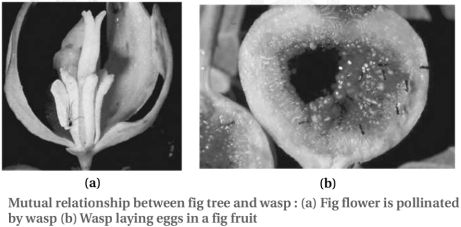
- In many species of fig trees,there is a tight one-to-one relationship with a specific pollinator species of wasp.
- The fig species is pollinated only by its partner wasp and no other species.
- The female wasp uses the fruit not only as an oviposition (egg-laying) site but also uses the developing seeds within the fruit to nourish its larvae.
- The wasp pollinates the fig inflorescence while searching for suitable egg-laying sites.
Mutual relationship between fig tree and wasp: $(a)$ Fig flower is pollinated by a wasp. $(b)$ Wasp laying eggs in a fig fruit.
- Lichens: $A$ mutualistic relationship between a fungus and photosynthesizing algae or cyanobacteria.
- Mycorrhizae: $A$ mutualistic relationship between fungi and the roots of higher plants. Fungi absorb essential nutrients from the soil,and in return,the plant provides energy-yielding carbohydrates to the fungi.
- Plant-Animal Interaction: This is one of the most spectacular and evolutionarily fascinating examples of mutualism. Plants need animals for pollination and the dispersal of seeds.
- Animals are rewarded for their services in the form of pollen,nectar,juices,fruits,and seeds.
- In many species of fig trees,there is a tight one-to-one relationship with a specific pollinator species of wasp.
- The fig species is pollinated only by its partner wasp and no other species.
- The female wasp uses the fruit not only as an oviposition (egg-laying) site but also uses the developing seeds within the fruit to nourish its larvae.
- The wasp pollinates the fig inflorescence while searching for suitable egg-laying sites.
Mutual relationship between fig tree and wasp: $(a)$ Fig flower is pollinated by a wasp. $(b)$ Wasp laying eggs in a fig fruit.
0 likes
View Solution263
Medium
Explain sexual deceit.
Solution
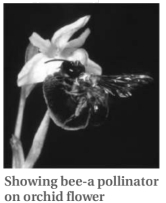
(N/A) Sexual deceit is a specialized pollination strategy employed by certain plants,such as the Mediterranean orchid $Ophrys$.
In this mechanism,one petal of the orchid flower bears an uncanny resemblance to the female of a specific bee species in terms of size,colour,and markings.
The male bee is attracted to the flower,perceiving it as a female mate.
As the male bee attempts to mate with the flower,a process known as pseudocopulation occurs.
During this process,pollen grains from the flower are dusted onto the male bee's body.
When the same bee visits another flower and attempts to pseudocopulate again,it transfers the pollen to that flower,thereby ensuring pollination.
This is an example of co-evolution where the plant has evolved to exploit the reproductive behaviour of the pollinator to ensure its own reproductive success without offering any reward like nectar or pollen.
In this mechanism,one petal of the orchid flower bears an uncanny resemblance to the female of a specific bee species in terms of size,colour,and markings.
The male bee is attracted to the flower,perceiving it as a female mate.
As the male bee attempts to mate with the flower,a process known as pseudocopulation occurs.
During this process,pollen grains from the flower are dusted onto the male bee's body.
When the same bee visits another flower and attempts to pseudocopulate again,it transfers the pollen to that flower,thereby ensuring pollination.
This is an example of co-evolution where the plant has evolved to exploit the reproductive behaviour of the pollinator to ensure its own reproductive success without offering any reward like nectar or pollen.
0 likes
View Solution264
Medium
Differentiate between Commensalism and Mutualism.
Solution
(N/A)
| Commensalism | Mutualism |
| $(1)$ One species is benefited,while the other remains unaffected. | $(1)$ Both species are mutually benefited. |
| $(2)$ $(+, 0)$ interaction. | $(2)$ $(+, +)$ interaction. |
| $(3)$ Example: Epiphytes on a host plant,clownfish and sea anemone. | $(3)$ Example: Rhizobium-legume association,mycorrhiza. |
0 likes
View Solution265
MediumMCQ
Give scientific reasons: The members of a population do not breed with other populations.
A
Due to geographical isolation.
B
Due to reproductive isolation.
C
Due to behavioral differences.
D
All of the above.
Solution
(D) Members of different populations of the same species or different species often do not interbreed due to various forms of reproductive isolation.
These mechanisms include geographical barriers,temporal isolation (breeding at different times),behavioral differences (mating rituals),and mechanical or genetic incompatibility.
These barriers ensure the maintenance of the gene pool and the distinct identity of the population.
These mechanisms include geographical barriers,temporal isolation (breeding at different times),behavioral differences (mating rituals),and mechanical or genetic incompatibility.
These barriers ensure the maintenance of the gene pool and the distinct identity of the population.
0 likes
View Solution266
MediumMCQ
Match the columns:
| Column-$I$ | Column-$II$ |
| $(a)$ Predation | $(i)$ Cuscuta and hedge plant |
| $(b)$ Commensalism | $(ii)$ Balanus and Chathamalus |
| $(c)$ Parasitism | $(iii)$ Cactus and Moth |
| $(d)$ Competition | $(iv)$ Orchid and Mango |
A
$a-iii, b-iv, c-i, d-ii$
B
$a-ii, b-iv, c-i, d-iii$
C
$a-iii, b-i, c-iv, d-ii$
D
$a-iv, b-iii, c-ii, d-i$
Solution
$(A)$ The correct matches are as follows:
$(a)$ Predation: Cactus and Moth (introduced in Australia to control cactus).
$(b)$ Commensalism: Orchid and Mango (orchid grows as an epiphyte on mango tree).
$(c)$ Parasitism: Cuscuta and hedge plant (Cuscuta is a parasitic plant).
$(d)$ Competition: Balanus and Chathamalus (Gause's competitive exclusion principle).
Therefore, the correct sequence is $a-iii, b-iv, c-i, d-ii$.
$(a)$ Predation: Cactus and Moth (introduced in Australia to control cactus).
$(b)$ Commensalism: Orchid and Mango (orchid grows as an epiphyte on mango tree).
$(c)$ Parasitism: Cuscuta and hedge plant (Cuscuta is a parasitic plant).
$(d)$ Competition: Balanus and Chathamalus (Gause's competitive exclusion principle).
Therefore, the correct sequence is $a-iii, b-iv, c-i, d-ii$.
0 likes
View Solution267
Medium
Match the columns:
| Column-$I$ | Column-$II$ |
| $(a)$ Camouflage | $(i)$ Dendrobates pumilio |
| $(b)$ Batesian mimicry | $(ii)$ Horse-shoe bat |
| $(c)$ Warning mimicry | $(iii)$ Monarch butterfly |
| $(d)$ Echolocation | $(iv)$ Praying Mantis |
Solution
(A) The correct matches are as follows:
$(a)$ Camouflage: $(iv)$ Praying Mantis - Many insects use camouflage to blend into their surroundings to avoid predators.
$(b)$ Batesian mimicry: $(iii)$ Monarch butterfly - In Batesian mimicry,a harmless species mimics the warning signals of a harmful species. The Monarch butterfly is toxic,and other butterflies mimic it.
$(c)$ Warning mimicry: $(i)$ Dendrobates pumilio - This is a poison dart frog that uses bright colors to warn predators of its toxicity.
$(d)$ Echolocation: $(ii)$ Horse-shoe bat - Bats use high-frequency sound waves to navigate and locate prey in the dark.
Therefore,the correct sequence is $(a-iv, b-iii, c-i, d-ii)$.
$(a)$ Camouflage: $(iv)$ Praying Mantis - Many insects use camouflage to blend into their surroundings to avoid predators.
$(b)$ Batesian mimicry: $(iii)$ Monarch butterfly - In Batesian mimicry,a harmless species mimics the warning signals of a harmful species. The Monarch butterfly is toxic,and other butterflies mimic it.
$(c)$ Warning mimicry: $(i)$ Dendrobates pumilio - This is a poison dart frog that uses bright colors to warn predators of its toxicity.
$(d)$ Echolocation: $(ii)$ Horse-shoe bat - Bats use high-frequency sound waves to navigate and locate prey in the dark.
Therefore,the correct sequence is $(a-iv, b-iii, c-i, d-ii)$.
0 likes
View Solution268
MediumMCQ
Which one of the following statements cannot be connected to Predation?
A
It might lead to extinction of a species
B
Both the interacting species are negatively impacted
C
It is necessitated by nature to maintain the ecological balance
D
It helps in maintaining species diversity in a community
Solution
(B) In predation,one species (the predator) benefits while the other species (the prey) is harmed. This is represented as a $(+,-)$ interaction.
Option $A$ is correct because if a predator is too efficient,it can overexploit its prey,leading to the extinction of the prey species.
Option $B$ is incorrect because in predation,one species benefits $(+)$ and the other is harmed $(-)$. The interaction where both species are negatively impacted is known as Competition $(-,-)$.
Option $C$ is correct because predators act as conduits for energy transfer across trophic levels and keep prey populations under control.
Option $D$ is correct because predators prevent any one prey species from becoming dominant,thereby maintaining species diversity in a community.
Option $A$ is correct because if a predator is too efficient,it can overexploit its prey,leading to the extinction of the prey species.
Option $B$ is incorrect because in predation,one species benefits $(+)$ and the other is harmed $(-)$. The interaction where both species are negatively impacted is known as Competition $(-,-)$.
Option $C$ is correct because predators act as conduits for energy transfer across trophic levels and keep prey populations under control.
Option $D$ is correct because predators prevent any one prey species from becoming dominant,thereby maintaining species diversity in a community.
0 likes
View Solution269
MediumMCQ
While explaining interspecific interaction of population,$(+)$ sign is assigned for beneficial interaction,$(-)$ sign is assigned for detrimental interaction and $(0)$ for neutral interaction. Which of the following interactions can be assigned $(+)$ for one species and $(-)$ for another species involved in the interaction?
A
Amensalism
B
Commensalism
C
Competition
D
Predation
Solution
(D) In population ecology,interspecific interactions are categorized based on their effect on the species involved:
$1$. Mutualism $(+, +)$: Both species benefit.
$2$. Competition $(-, -)$: Both species are harmed.
$3$. Predation $(+, -)$: One species (predator) benefits,while the other (prey) is harmed.
$4$. Parasitism $(+, -)$: One species (parasite) benefits,while the other (host) is harmed.
$5$. Commensalism $(+, 0)$: One species benefits,while the other is unaffected.
$6$. Amensalism $(-, 0)$: One species is harmed,while the other is unaffected.
Since the question asks for an interaction where one species benefits $(+)$ and the other is harmed $(-)$,both Predation and Parasitism fit this description. Among the given options,Predation is the correct choice.
$1$. Mutualism $(+, +)$: Both species benefit.
$2$. Competition $(-, -)$: Both species are harmed.
$3$. Predation $(+, -)$: One species (predator) benefits,while the other (prey) is harmed.
$4$. Parasitism $(+, -)$: One species (parasite) benefits,while the other (host) is harmed.
$5$. Commensalism $(+, 0)$: One species benefits,while the other is unaffected.
$6$. Amensalism $(-, 0)$: One species is harmed,while the other is unaffected.
Since the question asks for an interaction where one species benefits $(+)$ and the other is harmed $(-)$,both Predation and Parasitism fit this description. Among the given options,Predation is the correct choice.
0 likes
View Solution270
MediumMCQ
What is the nature of the interaction between methanogens and cattle?
A
Mutualism
B
Commensalism
C
Competition
D
Amensalism
Solution
(A) Methanogens are anaerobic bacteria that reside in the rumen (a part of the stomach) of cattle.
They help in the digestion of cellulose present in the plant material consumed by the cattle.
In return,the cattle provide the methanogens with food and a suitable anaerobic environment for their survival.
Since both organisms benefit from this association,this interaction is known as $Mutualism$.
They help in the digestion of cellulose present in the plant material consumed by the cattle.
In return,the cattle provide the methanogens with food and a suitable anaerobic environment for their survival.
Since both organisms benefit from this association,this interaction is known as $Mutualism$.
0 likes
View Solution271
EasyMCQ
What type of interaction exists between leguminous plants and $Rhizobium$ bacteria?
A
Competition
B
Commensalism
C
Mutualism
D
Amensalism
Solution
(C) The interaction between leguminous plants and $Rhizobium$ bacteria is an example of $Mutualism$ (or $Symbiosis$).
In this relationship, both species benefit from each other.
The $Rhizobium$ bacteria live in the root nodules of leguminous plants, where they fix atmospheric nitrogen into a usable form (ammonia) for the plant.
In return, the leguminous plant provides the bacteria with shelter and nutrients (carbohydrates) required for their survival.
In this relationship, both species benefit from each other.
The $Rhizobium$ bacteria live in the root nodules of leguminous plants, where they fix atmospheric nitrogen into a usable form (ammonia) for the plant.
In return, the leguminous plant provides the bacteria with shelter and nutrients (carbohydrates) required for their survival.
0 likes
View Solution272
MediumMCQ
Match the following columns:
| Column-$I$ | Column-$II$ |
| $P. +,+$ | $I. \text{Mutualism}$ |
| $Q. -,-$ | $II. \text{Parasitism}$ |
| $R. -,0$ | $III. \text{Competition}$ |
| $S. +,0$ | $IV. \text{Amensalism}$ |
| $T. +,-$ | $V. \text{Commensalism}$ |
| $VI. \text{Predation}$ |
A
$(P-I), (Q-III), (R-IV), (S-V), (T-II, VI)$
B
$(P-I), (Q-III), (R-IV), (S-V), (T-II, VI)$
C
$(P-I, V), (Q-III), (R-IV), (S-II), (T-IV)$
D
$(P-IV), (Q-I), (R-III), (S-II, V), (T-VI)$
Solution
(A) The population interactions are classified based on the effect on the two interacting species:
$1$. $P (+,+)$: Both species benefit, which is $\text{Mutualism}$ $(I)$.
$2$. $Q (-,-)$: Both species are harmed, which is $\text{Competition}$ $(III)$.
$3$. $R (-,0)$: One species is harmed and the other is unaffected, which is $\text{Amensalism}$ $(IV)$.
$4$. $S (+,0)$: One species benefits and the other is unaffected, which is $\text{Commensalism}$ $(V)$.
$5$. $T (+,-)$: One species benefits and the other is harmed, which includes $\text{Parasitism}$ $(II)$ and $\text{Predation}$ $(VI)$.
Therefore, the correct matching is $(P-I), (Q-III), (R-IV), (S-V), (T-II, VI)$.
$1$. $P (+,+)$: Both species benefit, which is $\text{Mutualism}$ $(I)$.
$2$. $Q (-,-)$: Both species are harmed, which is $\text{Competition}$ $(III)$.
$3$. $R (-,0)$: One species is harmed and the other is unaffected, which is $\text{Amensalism}$ $(IV)$.
$4$. $S (+,0)$: One species benefits and the other is unaffected, which is $\text{Commensalism}$ $(V)$.
$5$. $T (+,-)$: One species benefits and the other is harmed, which includes $\text{Parasitism}$ $(II)$ and $\text{Predation}$ $(VI)$.
Therefore, the correct matching is $(P-I), (Q-III), (R-IV), (S-V), (T-II, VI)$.
0 likes
View Solution273
MediumMCQ
Which of the following is an example of predation?
A
Tiger and deer
B
Seed-eating sparrow
C
Plant and herbivore
D
All of the above
Solution
(D) Predation is an interaction where one organism (the predator) kills and consumes another organism (the prey).
$A$. $A$ tiger hunting a deer is a classic example of carnivore-prey interaction.
$B$. $A$ sparrow eating seeds is a form of predation where the plant is the prey.
$C$. Herbivores grazing on plants are also considered predators because they consume parts of the plant,often leading to its death or reduced fitness.
Therefore,all the given options represent different forms of predation.
$A$. $A$ tiger hunting a deer is a classic example of carnivore-prey interaction.
$B$. $A$ sparrow eating seeds is a form of predation where the plant is the prey.
$C$. Herbivores grazing on plants are also considered predators because they consume parts of the plant,often leading to its death or reduced fitness.
Therefore,all the given options represent different forms of predation.
0 likes
View Solution274
MediumMCQ
What is the function of predation?
A
Keeps prey populations under control
B
Maintains species diversity
C
Keeps the ecosystem stable
D
All of the above
Solution
(D) Predation plays several critical roles in an ecosystem:
$1$. It acts as a conduit for energy transfer across trophic levels.
$2$. It keeps prey populations under control,preventing them from over-exploiting their resources.
$3$. It helps in maintaining species diversity in a community by reducing the intensity of competition among competing prey species.
$4$. Therefore,it contributes to the overall stability of the ecosystem.
Thus,all the given options are correct.
$1$. It acts as a conduit for energy transfer across trophic levels.
$2$. It keeps prey populations under control,preventing them from over-exploiting their resources.
$3$. It helps in maintaining species diversity in a community by reducing the intensity of competition among competing prey species.
$4$. Therefore,it contributes to the overall stability of the ecosystem.
Thus,all the given options are correct.
0 likes
View Solution275
MediumMCQ
In the early $1920$s,the prickly pear cactus introduced into Australia caused havoc by spreading rapidly into millions of hectares of rangeland. Finally,how was it controlled?
A
$A$ species of moth
B
$A$ species of butterfly
C
$A$ species of bird
D
$A$ species of mammal
Solution
(A) In the early $1920$s,the prickly pear cactus was introduced into Australia.
It spread rapidly into millions of hectares of rangeland,causing significant ecological damage.
This invasive species was finally brought under control by introducing a cactus-feeding predator,specifically a moth species $(Cactoblastis cactorum)$,into the area.
This is a classic example of biological control,where a natural predator is used to manage an invasive population.
It spread rapidly into millions of hectares of rangeland,causing significant ecological damage.
This invasive species was finally brought under control by introducing a cactus-feeding predator,specifically a moth species $(Cactoblastis cactorum)$,into the area.
This is a classic example of biological control,where a natural predator is used to manage an invasive population.
0 likes
View Solution276
MediumMCQ
Biological control methods adopted in agricultural pest control are an example of which interaction?
A
Antibiosis
B
Parasitism
C
Predation
D
Competition
Solution
(C) Biological control involves the use of natural predators or parasites to control pest populations in agriculture.
In this interaction, one organism (the predator) kills and consumes the other organism (the prey/pest).
Therefore, the use of natural predators to control agricultural pests is a classic example of $Predation$.
In this interaction, one organism (the predator) kills and consumes the other organism (the prey/pest).
Therefore, the use of natural predators to control agricultural pests is a classic example of $Predation$.
0 likes
View Solution277
MediumMCQ
In an intertidal area,when all starfish were removed,more than $Q$ species of invertebrates became extinct within a year due to $P$.
A
Interspecific competition,$20$
B
Interspecific competition,$10$
C
Predation,$20$
D
Predation,$10$
Solution
(C) This experiment was conducted by Robert Paine in the rocky intertidal communities of the American Pacific Coast.
He removed all starfish $(Pisaster)$ from an enclosed intertidal area.
As a result,more than $20$ species of invertebrates became extinct within a year due to interspecific competition.
This occurred because the starfish acted as a keystone predator,keeping the population of prey species in check.
Therefore,$P$ is Predation and $Q$ is $20$.
He removed all starfish $(Pisaster)$ from an enclosed intertidal area.
As a result,more than $20$ species of invertebrates became extinct within a year due to interspecific competition.
This occurred because the starfish acted as a keystone predator,keeping the population of prey species in check.
Therefore,$P$ is Predation and $Q$ is $20$.
0 likes
View Solution278
MediumMCQ
Some species of insects and frogs are ....... to avoid being easily detected by the predator.
A
cryptically-coloured (camouflaged)
B
poisonous
C
spiny
D
glycoside chemical
Solution
(A) Many species of insects and frogs have evolved to be cryptically-coloured (camouflaged) to blend in with their surroundings.
This adaptation helps them avoid being easily detected by their predators.
Camouflage is a survival strategy that allows an organism to remain hidden from predators or prey by matching its background environment.
This adaptation helps them avoid being easily detected by their predators.
Camouflage is a survival strategy that allows an organism to remain hidden from predators or prey by matching its background environment.
0 likes
View Solution279
MediumMCQ
How does the Monarch butterfly acquire the poisonous chemical in its body?
A
By feeding on poisonous weeds during the adult stage.
B
By gene expression during the adult stage.
C
By feeding on poisonous weeds during the caterpillar stage.
D
By gene expression during the caterpillar stage.
Solution
(C) The Monarch butterfly is highly distasteful to its predator (birds) because of a special chemical present in its body. This chemical is acquired by the butterfly during its caterpillar stage by feeding on a poisonous weed (milkweed). Since the chemical is stored in the body,it remains present even in the adult stage,providing protection against predators.
0 likes
View Solution280
MediumMCQ
Match the following columns:
| Column-$I$ | Column-$II$ |
| $P$. Calotropis | $I$. Special chemical |
| $Q$. Cactus and Acacia | $II$. Camouflage |
| $R$. Monarch butterfly | $III$. Thorns |
| $S$. Some species of insects and frogs | $IV$. Glycosides |
A
$P-III, Q-IV, R-I, S-II$
B
$P-IV, Q-III, R-II, S-I$
C
$P-IV, Q-III, R-I, S-II$
D
$P-II, Q-I, R-III, S-IV$
Solution
(C) The correct matches are as follows:
$P$. Calotropis produces highly poisonous cardiac glycosides, which protect it from herbivores. Thus, $P-IV$.
$Q$. Cactus and Acacia have evolved thorns as their principal morphological defense against herbivores. Thus, $Q-III$.
$R$. The Monarch butterfly is highly distasteful to its predator (birds) because of a special chemical acquired during its caterpillar stage by feeding on a poisonous weed. Thus, $R-I$.
$S$. Some species of insects and frogs are cryptically-colored (camouflage) to avoid being detected easily by the predator. Thus, $S-II$.
Therefore, the correct matching is $P-IV, Q-III, R-I, S-II$.
$P$. Calotropis produces highly poisonous cardiac glycosides, which protect it from herbivores. Thus, $P-IV$.
$Q$. Cactus and Acacia have evolved thorns as their principal morphological defense against herbivores. Thus, $Q-III$.
$R$. The Monarch butterfly is highly distasteful to its predator (birds) because of a special chemical acquired during its caterpillar stage by feeding on a poisonous weed. Thus, $R-I$.
$S$. Some species of insects and frogs are cryptically-colored (camouflage) to avoid being detected easily by the predator. Thus, $S-II$.
Therefore, the correct matching is $P-IV, Q-III, R-I, S-II$.
0 likes
View Solution281
MediumMCQ
Which of the following is an example of brood parasitism?
A
Cuckoo and Crow
B
Insect and Frog
C
Peacock and Cuckoo
D
All of the above
Solution
(A) Brood parasitism is a fascinating example of parasitism in birds in which the parasitic bird lays its eggs in the nest of its host and lets the host incubate them.
During the course of evolution,the eggs of the parasitic bird (e.g.,Cuckoo) have evolved to resemble the host's eggs in size and color to reduce the chances of the host bird detecting and ejecting the foreign eggs.
In this case,the Cuckoo ($Cuculus$ $canorus$) lays its eggs in the nest of the Crow ($Corvus$ $splendens$),which is a classic example of brood parasitism.
During the course of evolution,the eggs of the parasitic bird (e.g.,Cuckoo) have evolved to resemble the host's eggs in size and color to reduce the chances of the host bird detecting and ejecting the foreign eggs.
In this case,the Cuckoo ($Cuculus$ $canorus$) lays its eggs in the nest of the Crow ($Corvus$ $splendens$),which is a classic example of brood parasitism.
0 likes
View Solution282
MediumMCQ
Who proposed the Competitive Exclusion Principle?
A
Allen
B
Von Humboldt
C
Paul Ehrlich
D
Gause
Solution
(D) The Competitive Exclusion Principle was proposed by the Russian ecologist $G.F. Gause$.
According to this principle,two species competing for the same limiting resource cannot coexist indefinitely in the same habitat.
The species that is more efficient at utilizing the resource will eventually eliminate the other species from that habitat.
According to this principle,two species competing for the same limiting resource cannot coexist indefinitely in the same habitat.
The species that is more efficient at utilizing the resource will eventually eliminate the other species from that habitat.
0 likes
View Solution283
MediumMCQ
Which of the following examples does $NOT$ represent competition?
A
Visiting flamingos and resident fishes in South American shallow lakes competing for their common food.
B
Marine fishes and copepods.
C
Balanus and Chathamalus barnacles.
D
Paramecium caudatum and Paramecium aurelia.
Solution
(B) Competition is an interaction where both species are harmed ($-/-$ interaction).
$A$. Flamingos and resident fishes compete for common food resources,which is a clear example of competition.
$B$. Marine fishes and copepods represent a predator-prey relationship,not competition.
$C$. Balanus and Chathamalus barnacles are a classic example of interspecific competition studied by Connell.
$D$. Paramecium caudatum and Paramecium aurelia are a classic example of Gause's competitive exclusion principle.
Therefore,the correct answer is $B$.
$A$. Flamingos and resident fishes compete for common food resources,which is a clear example of competition.
$B$. Marine fishes and copepods represent a predator-prey relationship,not competition.
$C$. Balanus and Chathamalus barnacles are a classic example of interspecific competition studied by Connell.
$D$. Paramecium caudatum and Paramecium aurelia are a classic example of Gause's competitive exclusion principle.
Therefore,the correct answer is $B$.
0 likes
View Solution284
MediumMCQ
In interference competition,........
A
The feeding efficiency of one species might be reduced due to the interfering and inhibitory presence of the other species.
B
The fitness of one species is significantly reduced in the presence of another species.
C
Two closely related species competing for the same resources cannot coexist indefinitely.
D
This type of life ensures a cost-effective arrangement for living and feeding.
Solution
(A) Interference competition is a type of interaction where one species directly interferes with or inhibits the feeding efficiency of another species.
Even if resources are abundant,the presence of one species physically or behaviorally hinders the other from accessing those resources,thereby reducing its efficiency.
Therefore,option $A$ is the correct description of interference competition.
Even if resources are abundant,the presence of one species physically or behaviorally hinders the other from accessing those resources,thereby reducing its efficiency.
Therefore,option $A$ is the correct description of interference competition.
0 likes
View Solution285
MediumMCQ
Select the correct option for the following organisms:
$I -$ Copepods,$II -$ Liver fluke,$III -$ Lice,$IV -$ Ticks,$V -$ Ascaris,$VI -$ Cuscuta
Ectoparasites $\quad\quad$ Endoparasites
$I -$ Copepods,$II -$ Liver fluke,$III -$ Lice,$IV -$ Ticks,$V -$ Ascaris,$VI -$ Cuscuta
Ectoparasites $\quad\quad$ Endoparasites
A
$I, II, III, IV \quad V, VI$
B
$I, IV, VI \quad II, III, V$
C
$I, III, IV, VI \quad II, V$
D
$V, VI \quad I, II, III, IV$
Solution
(C) Ectoparasites are organisms that live on the surface of the host body. Among the given list:
- $I$ (Copepods) are ectoparasites on marine fish.
- $III$ (Lice) are ectoparasites on humans.
- $IV$ (Ticks) are ectoparasites on dogs/cattle.
- $VI$ (Cuscuta) is a parasitic plant that grows on hedge plants (ectoparasite).
Endoparasites are organisms that live inside the host body. Among the given list:
- $II$ (Liver fluke) lives in the bile duct of the host.
- $V$ (Ascaris) lives in the intestine of the host.
Therefore,Ectoparasites are $(I, III, IV, VI)$ and Endoparasites are $(II, V)$.
- $I$ (Copepods) are ectoparasites on marine fish.
- $III$ (Lice) are ectoparasites on humans.
- $IV$ (Ticks) are ectoparasites on dogs/cattle.
- $VI$ (Cuscuta) is a parasitic plant that grows on hedge plants (ectoparasite).
Endoparasites are organisms that live inside the host body. Among the given list:
- $II$ (Liver fluke) lives in the bile duct of the host.
- $V$ (Ascaris) lives in the intestine of the host.
Therefore,Ectoparasites are $(I, III, IV, VI)$ and Endoparasites are $(II, V)$.
0 likes
View Solution286
MediumMCQ
This type of life ensures an inexpensive arrangement for living and eating.
A
Competition
B
Parasitism
C
Predation
D
Commensalism
Solution
(B) In $Parasitism$, one organism (the parasite) lives on or inside another organism (the host) and derives its nutrition directly from the host. This interaction provides the parasite with a safe habitat and a constant supply of food without the need to hunt or build a shelter, making it an inexpensive way of life. While the parasite benefits, the host is harmed.
0 likes
View Solution287
MediumMCQ
Which of the following is $NOT$ an adaptation for parasites?
A
Loss of unnecessary sense organs
B
Presence of adhesive organs or suckers to cling to the host
C
Loss of digestive system
D
Low reproductive capacity
Solution
(D) Parasites have evolved special adaptations to survive in or on their hosts. These include:
$1$. Loss of unnecessary sense organs.
$2$. Presence of adhesive organs or suckers to cling to the host.
$3$. Loss of digestive system (as they absorb predigested food from the host).
$4$. High reproductive capacity to ensure the survival of the species.
Therefore,'Low reproductive capacity' is $NOT$ an adaptation for parasites; in fact,they possess high reproductive capacity.
$1$. Loss of unnecessary sense organs.
$2$. Presence of adhesive organs or suckers to cling to the host.
$3$. Loss of digestive system (as they absorb predigested food from the host).
$4$. High reproductive capacity to ensure the survival of the species.
Therefore,'Low reproductive capacity' is $NOT$ an adaptation for parasites; in fact,they possess high reproductive capacity.
0 likes
View Solution288
EasyMCQ
Identify Gause's Competitive Exclusion Principle from the following.
A
The feeding efficiency of one species may be reduced due to the interfering and inhibitory presence of the other species.
B
The fitness of one species is significantly lower in the presence of another species.
C
Two closely related species competing for the same resources cannot coexist indefinitely.
D
This type of life ensures a non-expensive arrangement for living and eating.
Solution
(C) Gause's Competitive Exclusion Principle states that two closely related species competing for the same resources cannot coexist indefinitely and the competitively inferior one will be eliminated eventually. This principle is a fundamental concept in ecology regarding interspecific competition.
0 likes
View Solution289
MediumMCQ
Flamingos and fish compete in a lake for .......... .
A
Phytoplankton
B
Small fish
C
Zooplankton
D
All of the above
Solution
(C) Interspecific competition occurs when individuals of different species compete for the same limiting resource. In the case of shallow lakes,both flamingos and certain fish species feed on zooplankton. Therefore,they compete for the same food source,which is zooplankton.
0 likes
View Solution290
MediumMCQ
Which of the following definitions is most appropriate for competition?
A
The feeding efficiency of one species might be reduced due to the interfering and inhibitory presence of the other species.
B
The fitness of one species is significantly lower in the presence of another species.
C
Two closely related species competing for the same resources cannot coexist indefinitely.
D
This type of life ensures a cost-effective arrangement for living and feeding.
Solution
(B) Competition is defined as a process in which the fitness of one species (measured in terms of its '$r$',the intrinsic rate of increase) is significantly lower in the presence of another species.
Option $A$ describes interference competition,which is a mechanism of competition.
Option $C$ refers to Gause's Competitive Exclusion Principle,which is a consequence of competition.
Option $B$ provides the most fundamental and comprehensive definition of the biological interaction known as competition.
Option $A$ describes interference competition,which is a mechanism of competition.
Option $C$ refers to Gause's Competitive Exclusion Principle,which is a consequence of competition.
Option $B$ provides the most fundamental and comprehensive definition of the biological interaction known as competition.
0 likes
View Solution291
MediumMCQ
Select the incorrect statement from the following.
A
The competitively superior barnacle Balanus dominates the intertidal area and excludes the smaller barnacle Chathamalus from that zone.
B
Herbivores and plants appear to be more adversely affected by competition than carnivores.
C
In the Galapagos Islands,Abingdon tortoises became extinct within a decade after goats were introduced there.
D
Competition is a process in which the fitness of one species is significantly lower in the presence of another species.
Solution
(B) The incorrect statement is $B$. Ecological studies indicate that carnivores are generally less affected by competition than herbivores and plants. Statement $A$ describes Gause's Competitive Exclusion Principle. Statement $C$ illustrates competitive release (or the impact of invasive species). Statement $D$ provides the standard definition of biological competition,where the fitness of one species is reduced due to the presence of another.
0 likes
View Solution292
MediumMCQ
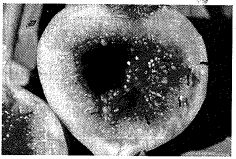
Identify the figure given below.
A
Eggs laid by wasp in fig fruit
B
Eggs laid by moth in fig fruit
C
Eggs laid by wasp in Amorphophallus fruit
D
Eggs laid by moth in Amorphophallus fruit
Solution
(A) The figure shows a cross-section of a fig fruit (syconium) containing eggs laid by a wasp. This is a classic example of mutualism (co-evolution) between a fig species and its pollinator wasp species. The wasp pollinates the fig while searching for suitable egg-laying sites. The fig provides the wasp with food (developing seeds) and a safe place for its larvae to develop. Therefore,the correct option is $A$.
0 likes
View Solution293
MediumMCQ
Who demonstrated that five closely related species of warblers living on the same tree were able to avoid competition and coexist?
A
Gause
B
Allen
C
Paul Ehrlich
D
MacArthur
Solution
(D) Robert MacArthur demonstrated that five closely related species of warblers living on the same tree were able to avoid competition and coexist due to behavioral differences in their foraging activities. This phenomenon is known as resource partitioning.
0 likes
View Solution294
MediumMCQ
How do parasites harm the host?
A
They can reduce the survival,growth,and reproduction of the host.
B
They reduce the population density of the host.
C
They make the host physically weak and more vulnerable to predation.
D
All of the above.
Solution
(D) Parasites harm the host in several ways:
$1$. They reduce the host's survival,growth,and reproduction by extracting nutrients.
$2$. They can reduce the host's population density.
$3$. They make the host physically weak,which makes them more vulnerable to predation.
Therefore,all the given options are correct.
$1$. They reduce the host's survival,growth,and reproduction by extracting nutrients.
$2$. They can reduce the host's population density.
$3$. They make the host physically weak,which makes them more vulnerable to predation.
Therefore,all the given options are correct.
0 likes
View Solution295
MediumMCQ
Select the mismatched pair regarding parasitism.
A
Human - Louse
B
Dog - Tick
C
Copepod - Cephalopod
D
Cuscuta - Hedge plant
Solution
(C) Parasitism is a type of population interaction where one organism (the parasite) benefits while the other (the host) is harmed.
$(a)$ Human and Louse: The louse is an ectoparasite on humans. This is a correct example of parasitism.
$(b)$ Dog and Tick: The tick is an ectoparasite on dogs. This is a correct example of parasitism.
$(c)$ Copepod and Cephalopod: Copepods are small crustaceans that can be parasitic,but they are generally free-living or commensal in relation to cephalopods; this is not a standard example of parasitism in the context of host-parasite interactions.
$(d)$ Cuscuta and Hedge plant: Cuscuta (dodder) is a parasitic plant that derives nutrition from the host hedge plant. This is a correct example of parasitism.
Therefore,the mismatched pair is $C$.
$(a)$ Human and Louse: The louse is an ectoparasite on humans. This is a correct example of parasitism.
$(b)$ Dog and Tick: The tick is an ectoparasite on dogs. This is a correct example of parasitism.
$(c)$ Copepod and Cephalopod: Copepods are small crustaceans that can be parasitic,but they are generally free-living or commensal in relation to cephalopods; this is not a standard example of parasitism in the context of host-parasite interactions.
$(d)$ Cuscuta and Hedge plant: Cuscuta (dodder) is a parasitic plant that derives nutrition from the host hedge plant. This is a correct example of parasitism.
Therefore,the mismatched pair is $C$.
0 likes
View Solution296
EasyMCQ
This is an interaction in which one species benefits and the other species is neither harmed nor benefited.
A
Mutualism
B
Commensalism
C
Competition
D
Amensalism
Solution
(B) In biological interactions, different types of relationships exist between species.
$1$. $Mutualism$ $(+, +)$: Both species benefit from the interaction.
$2$. $Commensalism$ $(+, 0)$: One species benefits, while the other is neither harmed nor benefited.
$3$. $Competition$ $(-, -)$: Both species are harmed.
$4$. $Amensalism$ $(-, 0)$: One species is harmed, while the other is neither harmed nor benefited.
Therefore, the interaction described is $Commensalism$.
$1$. $Mutualism$ $(+, +)$: Both species benefit from the interaction.
$2$. $Commensalism$ $(+, 0)$: One species benefits, while the other is neither harmed nor benefited.
$3$. $Competition$ $(-, -)$: Both species are harmed.
$4$. $Amensalism$ $(-, 0)$: One species is harmed, while the other is neither harmed nor benefited.
Therefore, the interaction described is $Commensalism$.
0 likes
View Solution297
MediumMCQ
Identify the examples of Commensalism and Mutualism from the given list:
$I -$ Mango tree and Orchid
$II -$ Fungi and Algae or Cyanobacteria (Lichen)
$III -$ Fungi and roots of higher plants (Mycorrhizae)
$IV -$ Whale and Barnacles
$V -$ Sea Anemone and Clown fish
$VI -$ Plants and Seed dispersers
$VII -$ Plants and Pollinators
$VIII -$ Cattle egret and Grazing cattle
Commensalism $\quad\quad$ Mutualism
$I -$ Mango tree and Orchid
$II -$ Fungi and Algae or Cyanobacteria (Lichen)
$III -$ Fungi and roots of higher plants (Mycorrhizae)
$IV -$ Whale and Barnacles
$V -$ Sea Anemone and Clown fish
$VI -$ Plants and Seed dispersers
$VII -$ Plants and Pollinators
$VIII -$ Cattle egret and Grazing cattle
Commensalism $\quad\quad$ Mutualism
A
$I, II, III, V, VI, VIII \quad\quad IV, VII$
B
$II, III, VI, VII \quad\quad I, IV, V, VIII$
C
$I, IV, V, VIII \quad\quad II, III, VI, VII$
D
$IV, VII \quad\quad I, II, III, V, VI, VIII$
Solution
(C) Commensalism is an interaction where one species benefits and the other is neither harmed nor benefited.
Examples of Commensalism:
$I -$ Orchid growing as an epiphyte on a Mango tree.
$IV -$ Barnacles growing on the back of a Whale.
$V -$ Clown fish living among stinging tentacles of Sea Anemone.
$VIII -$ Cattle egret foraging close to grazing cattle.
Mutualism is an interaction where both species benefit.
Examples of Mutualism:
$II -$ Lichens (Fungi and Algae/Cyanobacteria).
$III -$ Mycorrhizae (Fungi and roots of higher plants).
$VI -$ Plants and Seed dispersers.
$VII -$ Plants and Pollinators.
Thus,Commensalism includes $I, IV, V, VIII$ and Mutualism includes $II, III, VI, VII$.
Examples of Commensalism:
$I -$ Orchid growing as an epiphyte on a Mango tree.
$IV -$ Barnacles growing on the back of a Whale.
$V -$ Clown fish living among stinging tentacles of Sea Anemone.
$VIII -$ Cattle egret foraging close to grazing cattle.
Mutualism is an interaction where both species benefit.
Examples of Mutualism:
$II -$ Lichens (Fungi and Algae/Cyanobacteria).
$III -$ Mycorrhizae (Fungi and roots of higher plants).
$VI -$ Plants and Seed dispersers.
$VII -$ Plants and Pollinators.
Thus,Commensalism includes $I, IV, V, VIII$ and Mutualism includes $II, III, VI, VII$.
0 likes
View Solution298
MediumMCQ
What type of interaction exists between the wasp and the fig tree?
A
Competition
B
Amensalism
C
Mutualism
D
Commensalism
Solution
(C) The interaction between the fig tree and the wasp is a classic example of $Mutualism$ (obligatory mutualism).
In this relationship, the fig tree provides a place for the wasp to lay its eggs and also provides developing seeds as food for the wasp larvae.
In return, the wasp pollinates the fig inflorescence while searching for suitable egg-laying sites.
Neither species can complete its life cycle without the other, making it a $+/+$ interaction.
In this relationship, the fig tree provides a place for the wasp to lay its eggs and also provides developing seeds as food for the wasp larvae.
In return, the wasp pollinates the fig inflorescence while searching for suitable egg-laying sites.
Neither species can complete its life cycle without the other, making it a $+/+$ interaction.
0 likes
View Solution299
MediumMCQ
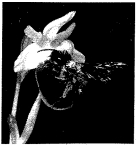
What does the following figure represent?
A
Wasp as a pollinator on an orchid flower
B
Bee as a pollinator on an orchid flower
C
Wasp as a pollinator on a fig flower
D
Bee as a pollinator on a fig flower
Solution
(B) The figure shows the Mediterranean orchid,Ophrys,which employs 'sexual deceit' to get pollinated. One petal of its flower bears an uncanny resemblance to the female of the bee in size,colour,and markings. The male bee is attracted to what it perceives as a female,'pseudocopulates' with the flower,and during that process,pollen grains are dusted on its body. When the same bee pseudocopulates with another flower,it transfers pollen to it and thus pollinates the flower. Therefore,the figure represents a bee as a pollinator on an orchid flower.
0 likes
View Solution300
EasyMCQ
Two butterfly species are competing for the same nectar of a flower in a garden. To survive and coexist together,they may avoid competition in the same garden by:
A
feeding at the same time
B
choosing different foraging patterns
C
increasing time spent on attacking each other
D
predating on each other
Solution
(B) According to Gause's Competitive Exclusion Principle,two species competing for the same limiting resource cannot coexist indefinitely. However,species can avoid competition and coexist by adopting 'resource partitioning'. This involves choosing different foraging patterns,such as feeding at different times of the day or visiting different types of flowers,thereby reducing direct competition for the same resource.
0 likes
View SolutionOrganisms and Populations — Population Interactions · Frequently Asked Questions
1Are these Organisms and Populations questions useful for JEE and NEET?
Yes. All questions in this section are mapped to JEE Main and NEET exam patterns. Previous year questions from JEE Main, NEET, GUJCET and state-level exams are included with full solutions.
2Can I switch to Hindi or Gujarati for these questions?
Yes. Use the language tabs in the hero section or the sidebar to view the same questions and solutions in English, Hindi or Gujarati.
3How do I generate a question paper from this subtopic?
Use the Vedclass Exam Paper Generator — select the chapter and subtopic, set difficulty, and generate Sets A, B, C, D automatically. First 3 chapters of every subject are free.
Vedclass Products
For Students
Vedclass Test Series
Mock tests in real JEE/NEET style with performance analysis. 5-day free trial.
Start Free TrialFor Teachers
Exam Paper Generator
Generate Set A/B/C/D papers from this chapter in 2 minutes. 3 chapters free.
Try FreeFor Institutes
Online Exam Module
Live online exams with unlimited students, 360° analytics & white-label branding.
See DemoFor Teachers & Institutes
Generate a Organisms and Populations Exam Paper in 2 Minutes
Select subtopic & difficulty — Sets A, B, C, D auto-generated with No Repeat logic.
First 3 chapters of every subject are free — no payment required.