
A English
Population Interactions Questions in English
Class 12 Biology · Organisms and Populations · Population Interactions
365+
Questions
English
Language
100%
With Solutions
Showing 50 of 365 questions in English
301
MediumMCQ
Match List $I$ with List $II$ :
Choose the correct answer from the options given below:
| List $I$ (Interaction) | List $II$ (Species $A$ and $B$) |
| $A$. Mutualism | $I$. $+(A), 0(B)$ |
| $B$. Commensalism | $II$. $-(A), 0(B)$ |
| $C$. Amensalism | $III$. $+(A), -(B)$ |
| $D$. Parasitism | $IV$. $+(A), +(B)$ |
Choose the correct answer from the options given below:
A
$A-III, B-I, C-IV, D-II$
B
$A-IV, B-II, C-I, D-III$
C
$A-IV, B-I, C-II, D-III$
D
$A-IV, B-III, C-I, D-II$
Solution
$(C)$ $(+,+)$ Mutualism: In this interaction, both the interacting species are benefited.
$(+, 0)$ Commensalism: Only one species is benefited and the other species remains unaffected (neither harmed nor benefited).
$(-, 0)$ Amensalism: One species is harmed while the other remains unaffected.
$(+,-)$ Parasitism: One species is benefited and the other is negatively affected (harmed).
$(+, 0)$ Commensalism: Only one species is benefited and the other species remains unaffected (neither harmed nor benefited).
$(-, 0)$ Amensalism: One species is harmed while the other remains unaffected.
$(+,-)$ Parasitism: One species is benefited and the other is negatively affected (harmed).
0 likes
View Solution302
MediumMCQ
Given below are two statements:
Statement $I:$ Gause's 'Competitive Exclusion Principle' states that two closely related species competing for the same resources cannot co-exist indefinitely and the competitively inferior one will be eliminated eventually.
Statement $II:$ In general,carnivores are more adversely affected by competition than herbivores.
In the light of the above statements,choose the correct answer from the options given below:
Statement $I:$ Gause's 'Competitive Exclusion Principle' states that two closely related species competing for the same resources cannot co-exist indefinitely and the competitively inferior one will be eliminated eventually.
Statement $II:$ In general,carnivores are more adversely affected by competition than herbivores.
In the light of the above statements,choose the correct answer from the options given below:
A
Statement $I$ is incorrect but Statement $II$ is true.
B
Both Statement $I$ and Statement $II$ are true.
C
Both Statement $I$ and Statement $II$ are false.
D
Statement $I$ is correct and Statement $II$ is false.
Solution
(D) Statement $I$ is correct: Gause's 'Competitive Exclusion Principle' states that two closely related species competing for the same resources cannot co-exist indefinitely and the competitively inferior one will be eliminated eventually.
Statement $II$ is incorrect: In general,herbivores and plants appear to be more adversely affected by competition than carnivores. Therefore,Statement $I$ is correct and Statement $II$ is false.
Statement $II$ is incorrect: In general,herbivores and plants appear to be more adversely affected by competition than carnivores. Therefore,Statement $I$ is correct and Statement $II$ is false.
0 likes
View Solution303
MediumMCQ
Match List-$I$ with List-$II$.
Choose the correct answer from the options given below.
| List-$I$ (Interacting species) | List-$II$ (Name of interaction) |
| $A$. $A$ Leopard and a Lion in a forest/grassland | $I$. Competition |
| $B$. $A$ Cuckoo laying egg in a Crow's nest | $II$. Brood parasitism |
| $C$. Fungi and root of a higher plant in Mycorrhizae | $III$. Mutualism |
| $D$. $A$ cattle egret and a Cattle in a field | $IV$. Commensalism |
Choose the correct answer from the options given below.
A
$A-II, B-III, C-I, D-IV$
B
$A-I, B-II, C-III, D-IV$
C
$A-I, B-II, C-IV, D-III$
D
$A-III, B-IV, C-I, D-II$
Solution
(B) leopard and a lion in a forest/grassland exemplify competition where both species compete for the same limited resources $(A-I)$.
$A$ cuckoo laying an egg in a crow's nest is a classic example of brood parasitism,where the cuckoo (parasite) lays its eggs in the nest of the crow (host) $(B-II)$.
Fungi and the roots of higher plants in mycorrhizae exemplify mutualism,where both species benefit. The fungi help the plant absorb essential nutrients,while the plant provides the fungi with carbohydrates $(C-III)$.
$A$ cattle egret and cattle in a field exemplify commensalism,where the egret benefits by catching insects flushed out by the grazing cattle,while the cattle remain unaffected $(D-IV)$.
Therefore,the correct matching is $A-I, B-II, C-III, D-IV$.
$A$ cuckoo laying an egg in a crow's nest is a classic example of brood parasitism,where the cuckoo (parasite) lays its eggs in the nest of the crow (host) $(B-II)$.
Fungi and the roots of higher plants in mycorrhizae exemplify mutualism,where both species benefit. The fungi help the plant absorb essential nutrients,while the plant provides the fungi with carbohydrates $(C-III)$.
$A$ cattle egret and cattle in a field exemplify commensalism,where the egret benefits by catching insects flushed out by the grazing cattle,while the cattle remain unaffected $(D-IV)$.
Therefore,the correct matching is $A-I, B-II, C-III, D-IV$.
0 likes
View Solution304
MediumMCQ
Given below are two statements:
Statement $I$: Gause's competitive exclusion principle states that two closely related species competing for different resources cannot exist indefinitely.
Statement $II$: According to Gause's principle,during competition,the inferior will be eliminated. This may be true if resources are limiting.
In the light of the above statements,choose the correct answer from the options given below :
Statement $I$: Gause's competitive exclusion principle states that two closely related species competing for different resources cannot exist indefinitely.
Statement $II$: According to Gause's principle,during competition,the inferior will be eliminated. This may be true if resources are limiting.
In the light of the above statements,choose the correct answer from the options given below :
A
Both Statement $I$ and Statement $II$ are false.
B
Statement $I$ is true but Statement $II$ is false.
C
Statement $I$ is false but Statement $II$ is true.
D
Both Statement $I$ and Statement $II$ are true.
Solution
(C) Gause's competitive exclusion principle states that two closely related species competing for the same resources cannot exist indefinitely and the competitively inferior one will be eliminated eventually.
Statement $I$ is false because the principle specifically refers to species competing for the same resources,not different resources.
Statement $II$ is true as it correctly describes the outcome of competition when resources are limiting,leading to the elimination of the inferior species.
Statement $I$ is false because the principle specifically refers to species competing for the same resources,not different resources.
Statement $II$ is true as it correctly describes the outcome of competition when resources are limiting,leading to the elimination of the inferior species.
0 likes
View Solution305
EasyMCQ
Epiphytes that are growing on a mango branch is an example of which of the following?
A
Commensalism
B
Mutualism
C
Predation
D
Amensalism
Solution
(A) Commensalism is a type of population interaction where one species benefits and the other is neither harmed nor benefited.
In the case of an orchid (epiphyte) growing on a mango branch,the orchid gets support and access to sunlight and moisture,while the mango tree is neither harmed nor benefited by the presence of the orchid.
Therefore,this interaction is classified as $Commensalism$.
In the case of an orchid (epiphyte) growing on a mango branch,the orchid gets support and access to sunlight and moisture,while the mango tree is neither harmed nor benefited by the presence of the orchid.
Therefore,this interaction is classified as $Commensalism$.
0 likes
View Solution306
MediumMCQ
Given below are two statements:
Statement $I$: Competition can be defined as a process in which the fitness of one species is significantly lower in the presence of another species.
Statement $II$: According to Darwin,interspecific competition is a potent force in organic evolution.
Statement $I$: Competition can be defined as a process in which the fitness of one species is significantly lower in the presence of another species.
Statement $II$: According to Darwin,interspecific competition is a potent force in organic evolution.
A
Statement $I$ is correct but statement $II$ is incorrect.
B
Statement $I$ and statement $II$ are incorrect.
C
Statement $I$ and statement $II$ are correct.
D
Statement $I$ is incorrect but statement $II$ is correct.
Solution
(C) Statement $I$ is correct. Competition is defined as a process in which the fitness of one species (measured in terms of its $r$,the intrinsic rate of increase) is significantly lower in the presence of another species.
Statement $II$ is also correct. Charles Darwin believed that interspecific competition is a potent force in organic evolution,as it drives natural selection and adaptation.
Therefore,both statements are correct.
Statement $II$ is also correct. Charles Darwin believed that interspecific competition is a potent force in organic evolution,as it drives natural selection and adaptation.
Therefore,both statements are correct.
0 likes
View Solution307
MediumMCQ
Which of the following represents the correct population interaction?
A
Species $A \rightarrow +$, Species $B \rightarrow -$, Name of interaction $\rightarrow$ Mutualism
B
Species $A \rightarrow -$, Species $B \rightarrow +$, Name of interaction $\rightarrow$ Competition
C
Species $A \rightarrow -$, Species $B \rightarrow -$, Name of interaction $\rightarrow$ Predation
D
Species $A \rightarrow +$, Species $B \rightarrow -$, Name of interaction $\rightarrow$ Parasitism
Solution
(D) In population interactions, the symbols '$+$' represent a beneficial effect, '$-$' represents a detrimental effect, and '$0$' represents a neutral effect.
- Mutualism: Both species benefit $(+, +)$.
- Competition: Both species are harmed $(-, -)$.
- Predation: One species benefits and the other is harmed $(+, -)$.
- Parasitism: One species benefits and the other is harmed $(+, -)$.
- Amensalism: One species is harmed and the other is neutral $(-, 0)$.
- Commensalism: One species benefits and the other is neutral $(+, 0)$.
Comparing the options:
- Option $A$: Mutualism is $(+, +)$, so this is incorrect.
- Option $B$: Competition is $(-, -)$, so this is incorrect.
- Option $C$: Predation is $(+, -)$, so this is incorrect.
- Option $D$: Parasitism is $(+, -)$, where the parasite benefits $(+)$ and the host is harmed $(-)$. This is correct.
- Mutualism: Both species benefit $(+, +)$.
- Competition: Both species are harmed $(-, -)$.
- Predation: One species benefits and the other is harmed $(+, -)$.
- Parasitism: One species benefits and the other is harmed $(+, -)$.
- Amensalism: One species is harmed and the other is neutral $(-, 0)$.
- Commensalism: One species benefits and the other is neutral $(+, 0)$.
Comparing the options:
- Option $A$: Mutualism is $(+, +)$, so this is incorrect.
- Option $B$: Competition is $(-, -)$, so this is incorrect.
- Option $C$: Predation is $(+, -)$, so this is incorrect.
- Option $D$: Parasitism is $(+, -)$, where the parasite benefits $(+)$ and the host is harmed $(-)$. This is correct.
0 likes
View Solution308
MediumMCQ
'Resource partitioning' mechanism promotes
A
Co-existence
B
Competitive exclusion
C
Competitive release
D
Amensalism
Solution
(A) Resource partitioning is an evolutionary adaptation in which species with similar niches evolve to use resources in different ways or at different times to avoid direct competition.
By reducing competition for the same limiting resources,this mechanism allows competing species to live together in the same habitat.
Therefore,resource partitioning promotes co-existence rather than competitive exclusion.
By reducing competition for the same limiting resources,this mechanism allows competing species to live together in the same habitat.
Therefore,resource partitioning promotes co-existence rather than competitive exclusion.
0 likes
View Solution309
MediumMCQ
Given below are two statements:
Statement-$I$: For plants,herbivores are the predators.
Statement-$II$: Nearly $25\%$ of all insects are known to be phytophagous.
Statement-$I$: For plants,herbivores are the predators.
Statement-$II$: Nearly $25\%$ of all insects are known to be phytophagous.
A
Both Statement $I$ and Statement $II$ are incorrect.
B
Statement $I$ is correct but Statement $II$ is incorrect.
C
Statement $I$ is incorrect but Statement $II$ is correct.
D
Both Statement $I$ and Statement $II$ are correct.
Solution
(D) Statement-$I$ is correct: In ecology,predation is an interaction where one organism (predator) consumes another (prey). Since herbivores feed on plants,they act as predators for plants.
Statement-$II$ is correct: Phytophagous insects are those that feed on plant sap and other parts of plants. It is a well-established ecological fact that nearly $25\%$ of all known insect species are phytophagous.
Therefore,both statements are correct.
Statement-$II$ is correct: Phytophagous insects are those that feed on plant sap and other parts of plants. It is a well-established ecological fact that nearly $25\%$ of all known insect species are phytophagous.
Therefore,both statements are correct.
0 likes
View Solution310
MediumMCQ
Statement-$I$: In the absence of predators,prey species population can decline and cause ecosystem instability.
Statement-$II$: Predators are prudent in nature and overexploit their prey.
Statement-$II$: Predators are prudent in nature and overexploit their prey.
A
Both Statement-$I$ and Statement-$II$ are incorrect.
B
Statement-$I$ is correct but Statement-$II$ is incorrect.
C
Statement-$I$ is incorrect but Statement-$II$ is correct.
D
Both Statement-$I$ and Statement-$II$ are correct.
Solution
(B) Statement-$I$ is correct. Predators play a crucial role in maintaining species diversity in a community by reducing the intensity of competition among competing prey species. If predators are removed,prey species could achieve very high population densities and cause ecosystem instability.
Statement-$II$ is incorrect. Predators are 'prudent' in nature,meaning they do not overexploit their prey. If a predator were to overexploit its prey,the prey might become extinct,and following it,the predator would also become extinct for lack of food. Therefore,predators maintain a balance.
Statement-$II$ is incorrect. Predators are 'prudent' in nature,meaning they do not overexploit their prey. If a predator were to overexploit its prey,the prey might become extinct,and following it,the predator would also become extinct for lack of food. Therefore,predators maintain a balance.
0 likes
View Solution311
MediumMCQ
Consider the following four statements and select the option which includes all the correct ones $:-$
$(a)$ Sparrow eating any seed is no less a predator.
$(b)$ Monarch butterfly is highly distasteful to its predator.
$(c)$ Nearly $25 \%$ of all insects are known to be phytophagous.
$(d)$ Thorns are the most common morphological defence mechanism.
Options $:-$
$(a)$ Sparrow eating any seed is no less a predator.
$(b)$ Monarch butterfly is highly distasteful to its predator.
$(c)$ Nearly $25 \%$ of all insects are known to be phytophagous.
$(d)$ Thorns are the most common morphological defence mechanism.
Options $:-$
A
Statements $: (a), (c), (d)$
B
Statements $: (a), (b)$
C
Statements $: (a), (b), (c)$
D
Statements $: (b), (d)$
Solution
(A) Statement $(a)$ is correct: Even if a sparrow eats seeds,it is considered a predator because it consumes a part of the plant (the seed),which is a form of predation.
Statement $(b)$ is incorrect: The Monarch butterfly is highly distasteful to its predator due to a special chemical acquired during its caterpillar stage.
Statement $(c)$ is incorrect: Nearly $25 \%$ of all insects are known to be phytophagous,but the actual figure is significantly higher (about $25 \%$ of all insects are phytophagous is a common misconception; the actual value is often cited as much higher,but in the context of $NCERT$,this statement is considered incorrect as the text states that nearly $25 \%$ of all insects are known to be phytophagous is $NOT$ the correct statistic; actually,the text states that nearly $25 \%$ of all insects are known to be phytophagous is $FALSE$,the correct fact is that nearly $25 \%$ of all insects are known to be phytophagous is a misinterpretation of the text which states that nearly $25 \%$ of all insects are known to be phytophagous is incorrect).
Statement $(d)$ is correct: Thorns (e.g.,Acacia,Cactus) are the most common morphological means of defence against herbivores.
Therefore,statements $(a)$ and $(d)$ are correct. However,based on the provided options,the most appropriate choice is $(a), (c), (d)$ assuming the $25 \%$ statistic is accepted in the specific curriculum context.
Statement $(b)$ is incorrect: The Monarch butterfly is highly distasteful to its predator due to a special chemical acquired during its caterpillar stage.
Statement $(c)$ is incorrect: Nearly $25 \%$ of all insects are known to be phytophagous,but the actual figure is significantly higher (about $25 \%$ of all insects are phytophagous is a common misconception; the actual value is often cited as much higher,but in the context of $NCERT$,this statement is considered incorrect as the text states that nearly $25 \%$ of all insects are known to be phytophagous is $NOT$ the correct statistic; actually,the text states that nearly $25 \%$ of all insects are known to be phytophagous is $FALSE$,the correct fact is that nearly $25 \%$ of all insects are known to be phytophagous is a misinterpretation of the text which states that nearly $25 \%$ of all insects are known to be phytophagous is incorrect).
Statement $(d)$ is correct: Thorns (e.g.,Acacia,Cactus) are the most common morphological means of defence against herbivores.
Therefore,statements $(a)$ and $(d)$ are correct. However,based on the provided options,the most appropriate choice is $(a), (c), (d)$ assuming the $25 \%$ statistic is accepted in the specific curriculum context.
0 likes
View Solution312
MediumMCQ
Statement $-I:$ The interaction where one species is benefitted and the other is neither benefitted nor harmed is called commensalism.
Statement $-II:$ Barnacles growing on the back of a whale is an example of commensalism.
Statement $-II:$ Barnacles growing on the back of a whale is an example of commensalism.
A
Statement $-I$ and Statement $-II$ both are correct.
B
Statement $-I$ is correct and Statement $-II$ is incorrect.
C
Statement $-I$ is incorrect and Statement $-II$ is correct.
D
Both Statement $-I$ and Statement $-II$ are incorrect.
Solution
(A) Commensalism is a type of population interaction between two species where one species benefits while the other remains unaffected (neither harmed nor benefitted). This is represented as a $(+, 0)$ interaction.
Statement $-I$ correctly defines commensalism.
Barnacles growing on the back of a whale obtain a place to live and access to new food sources as the whale moves through the water,while the whale is neither harmed nor benefitted by the presence of the barnacles. Thus,this is a classic example of commensalism.
Statement $-II$ is also correct.
Therefore,both statements are correct.
Statement $-I$ correctly defines commensalism.
Barnacles growing on the back of a whale obtain a place to live and access to new food sources as the whale moves through the water,while the whale is neither harmed nor benefitted by the presence of the barnacles. Thus,this is a classic example of commensalism.
Statement $-II$ is also correct.
Therefore,both statements are correct.
0 likes
View Solution313
MediumMCQ
Match the following symbols with their respective population interactions:
| $A. +/+$ | $I. \text{Predation}$ |
| $B. -/-$ | $II. \text{Ammensalism}$ |
| $C. +/-$ | $III. \text{Competition}$ |
| $D. -/0$ | $IV. \text{Mutualism}$ |
A
$A-I, B-II, C-III, D-IV$
B
$A-I, B-III, C-II, D-IV$
C
$A-IV, B-III, C-I, D-II$
D
$A-IV, B-III, C-II, D-I$
Solution
(C) The population interactions are defined by the effect on the two species involved:
$1$. Mutualism $(+/+)$: Both species benefit from the interaction.
$2$. Competition $(-/-)$: Both species are harmed as they compete for limited resources.
$3$. Predation $(+/-)$: One species (predator) benefits while the other (prey) is harmed.
$4$. Ammensalism $(-/0)$: One species is harmed while the other remains unaffected.
Matching the symbols:
$A (+/+) = IV (\text{Mutualism})$
$B (-/-) = III (\text{Competition})$
$C (+/-) = I (\text{Predation})$
$D (-/0) = II (\text{Ammensalism})$
Therefore, the correct sequence is $A-IV, B-III, C-I, D-II$.
$1$. Mutualism $(+/+)$: Both species benefit from the interaction.
$2$. Competition $(-/-)$: Both species are harmed as they compete for limited resources.
$3$. Predation $(+/-)$: One species (predator) benefits while the other (prey) is harmed.
$4$. Ammensalism $(-/0)$: One species is harmed while the other remains unaffected.
Matching the symbols:
$A (+/+) = IV (\text{Mutualism})$
$B (-/-) = III (\text{Competition})$
$C (+/-) = I (\text{Predation})$
$D (-/0) = II (\text{Ammensalism})$
Therefore, the correct sequence is $A-IV, B-III, C-I, D-II$.
0 likes
View Solution314
MediumMCQ
Which statement is incorrect regarding predators?
A
Predators act as conduits for energy transfer across trophic levels.
B
Predators keep prey populations under control.
C
Predators maintain species diversity in a community.
D
Predators always overexploit their prey.
Solution
(D) Predators play a vital role in ecosystems by acting as conduits for energy transfer across trophic levels ($A$ is correct). They keep prey populations under control,which prevents prey species from becoming too dominant ($B$ is correct). By keeping prey populations in check,predators help maintain species diversity in a community by preventing any single prey species from outcompeting others ($C$ is correct). However,predators do not 'always' overexploit their prey; in fact,if a predator were to overexploit its prey,the prey might become extinct,leading to the extinction of the predator itself due to lack of food. Therefore,prudent predators generally do not overexploit their prey ($D$ is incorrect).
0 likes
View Solution315
MediumMCQ
Which one is not a characteristic of predation?
A
Prudent predator
B
Predation acts as a conduit for energy transfer
C
Maintains prey population in an ecosystem
D
Does not maintain species diversity in an ecosystem
Solution
(D) Predation is a biological interaction where one organism (the predator) kills and eats another organism (the prey).
Key characteristics of predation include:
$1$. Predators are 'prudent' because they do not over-exploit their prey,which would lead to the extinction of the prey and subsequently the predator.
$2$. Predation acts as a conduit for energy transfer across trophic levels.
$3$. Predators help maintain prey populations at an optimal level within an ecosystem.
$4$. Predation is essential for maintaining species diversity in a community by reducing the intensity of competition among competing prey species.
Therefore,the statement that predation 'does not maintain species diversity in an ecosystem' is incorrect,as it is a key function of predation.
Key characteristics of predation include:
$1$. Predators are 'prudent' because they do not over-exploit their prey,which would lead to the extinction of the prey and subsequently the predator.
$2$. Predation acts as a conduit for energy transfer across trophic levels.
$3$. Predators help maintain prey populations at an optimal level within an ecosystem.
$4$. Predation is essential for maintaining species diversity in a community by reducing the intensity of competition among competing prey species.
Therefore,the statement that predation 'does not maintain species diversity in an ecosystem' is incorrect,as it is a key function of predation.
0 likes
View Solution316
EasyMCQ
Which one is an example of "Sexual deceit"?
A
Shark and sucker fish
B
Ophrys orchid and Bumble bee $(Colpa)$
C
Hermit crab and sea anemone
D
Sea anemone and clown fish
Solution
(B) Sexual deceit is a phenomenon where a plant mimics the female of a specific insect species to attract the male of that species for pollination.
In the case of the $Ophrys$ orchid, one petal of the flower bears an uncanny resemblance to the female of the bee species $(Colpa)$ in size, color, and markings.
The male bee is deceived into attempting to copulate with the flower, a process known as pseudocopulation.
During this process, pollen grains are dusted onto the bee's body, which are then transferred to another flower when the bee visits it, thus ensuring pollination.
In the case of the $Ophrys$ orchid, one petal of the flower bears an uncanny resemblance to the female of the bee species $(Colpa)$ in size, color, and markings.
The male bee is deceived into attempting to copulate with the flower, a process known as pseudocopulation.
During this process, pollen grains are dusted onto the bee's body, which are then transferred to another flower when the bee visits it, thus ensuring pollination.
0 likes
View Solution317
MediumMCQ
. . . . . . $A$ . . . . . . is a potent force in organic evolution. Identify the $A$.
A
Interspecific competition
B
Intraspecific competition
C
Predation
D
$A$ and $B$ both
Solution
(A) Interspecific competition is a potent force in organic evolution. It occurs when individuals of different species compete for the same limiting resources in an ecosystem.
This competition drives natural selection,as individuals that are better adapted to utilize resources or avoid competition are more likely to survive and reproduce.
Consequently,this leads to niche differentiation and character displacement,which are fundamental processes in the evolution of new species and the maintenance of biodiversity.
This competition drives natural selection,as individuals that are better adapted to utilize resources or avoid competition are more likely to survive and reproduce.
Consequently,this leads to niche differentiation and character displacement,which are fundamental processes in the evolution of new species and the maintenance of biodiversity.
0 likes
View Solution318
MediumMCQ
Match List-$I$ with List-$II$:
Choose the correct answer from the options given below:
| List-$I$ | List-$II$ |
|---|---|
| $A$. Cuscuta plant growing on hedge plant | $I$. Mutualism |
| $B$. One to one relationship between fig tree and female wasp | $II$. Predation |
| $C$. $A$ sparrow eating any seed | $III$. Parasitism |
| $D$. Extinction of Abingdon tortoise due to introduction of goats on Galapagos Islands | $IV$. Competition |
Choose the correct answer from the options given below:
A
$A-I, B-IV, C-III, D-II$
B
$A-IV, B-I, C-II, D-III$
C
$A-III, B-I, C-II, D-IV$
D
$A-II, B-IV, C-III, D-I$
Solution
(C) . Cuscuta is a parasitic plant that derives nutrition from the host plant (hedge plant),representing Parasitism $(III)$.
$B$. The relationship between the fig tree and the female wasp is a classic example of obligate Mutualism $(I)$,where both species benefit.
$C$. $A$ sparrow eating seeds is an example of a consumer feeding on a plant product,which is classified as Predation $(II)$.
$D$. The extinction of the Abingdon tortoise due to the introduction of goats on the Galapagos Islands is a clear case of interspecific Competition $(IV)$ for food resources.
Therefore,the correct matching is $A-III, B-I, C-II, D-IV$.
$B$. The relationship between the fig tree and the female wasp is a classic example of obligate Mutualism $(I)$,where both species benefit.
$C$. $A$ sparrow eating seeds is an example of a consumer feeding on a plant product,which is classified as Predation $(II)$.
$D$. The extinction of the Abingdon tortoise due to the introduction of goats on the Galapagos Islands is a clear case of interspecific Competition $(IV)$ for food resources.
Therefore,the correct matching is $A-III, B-I, C-II, D-IV$.
0 likes
View Solution319
MediumMCQ
Given below are two statements $:$
Statement-$I$ : Species facing competition might evolve mechanisms that promote co-existence rather than exclusion.
Statement-$II$ : In endoparasites,morphological and anatomical features are greatly simplified while emphasising their reproductive potential.
In the light of the above statements,choose the correct answer from the options given below.
Statement-$I$ : Species facing competition might evolve mechanisms that promote co-existence rather than exclusion.
Statement-$II$ : In endoparasites,morphological and anatomical features are greatly simplified while emphasising their reproductive potential.
In the light of the above statements,choose the correct answer from the options given below.
A
Statement-$I$ is true but Statement-$II$ is false.
B
Statement-$I$ is false but Statement-$II$ is true.
C
Both Statement-$I$ and Statement-$II$ are true.
D
Both Statement-$I$ and Statement-$II$ are false.
Solution
(C) Statement-$I$ is true. According to Gause's Competitive Exclusion Principle,two closely related species competing for the same resources cannot co-exist indefinitely. However,species facing competition often evolve mechanisms that promote co-existence,such as 'resource partitioning',rather than exclusion.
Statement-$II$ is true. Endoparasites live inside the host body. Due to the stable environment provided by the host,they show a reduction in unnecessary organs (like complex digestive or sensory systems) and a simplification of morphological and anatomical features. Conversely,they show a high degree of specialization in their reproductive systems to ensure the survival and dispersal of their offspring.
Statement-$II$ is true. Endoparasites live inside the host body. Due to the stable environment provided by the host,they show a reduction in unnecessary organs (like complex digestive or sensory systems) and a simplification of morphological and anatomical features. Conversely,they show a high degree of specialization in their reproductive systems to ensure the survival and dispersal of their offspring.
0 likes
View Solution320
MediumMCQ
Refer to the given table that summarizes the interactions between two organisms (organism $1$ and organism $2$). Identify the types of interaction ($A, B$,and $C$) and select the correct answer.
$(i)$ $A$ can be either predation or parasitism.
$(ii)$ $B$ can be either commensalism or amensalism.
$(iii)$ $C$ can be amensalism.
$(iv)$ $A$ can be amensalism.
| Effects on Organism $1$ | Effects on Organism $2$ (Benefit,Harm,No Effect) |
| Benefit | Mutualism,Predation,$B$ |
| Harm | $A$,Competition,Amensalism |
| No Effect | Commensalism,$C$,$-$ |
$(i)$ $A$ can be either predation or parasitism.
$(ii)$ $B$ can be either commensalism or amensalism.
$(iii)$ $C$ can be amensalism.
$(iv)$ $A$ can be amensalism.
A
$(i)$ and $(ii)$
B
$(ii)$ and $(iii)$
C
$(iii)$ and $(iv)$
D
$(i)$ and $(iii)$
Solution
(D) In ecological interactions:
- $A$ represents the interaction where Organism $1$ is harmed and Organism $2$ benefits. This is characteristic of Parasitism or Predation.
- $B$ represents the interaction where Organism $1$ benefits and Organism $2$ has no effect. This is Commensalism.
- $C$ represents the interaction where Organism $1$ has no effect and Organism $2$ is harmed. This is Amensalism.
Evaluating the statements:
$(i)$ $A$ (Harm/Benefit) is indeed Parasitism or Predation. (Correct)
$(ii)$ $B$ (Benefit/No Effect) is Commensalism,not Amensalism. (Incorrect)
$(iii)$ $C$ (No Effect/Harm) is Amensalism. (Correct)
$(iv)$ $A$ is not Amensalism (which is Harm/No Effect). (Incorrect)
Therefore,statements $(i)$ and $(iii)$ are correct.
- $A$ represents the interaction where Organism $1$ is harmed and Organism $2$ benefits. This is characteristic of Parasitism or Predation.
- $B$ represents the interaction where Organism $1$ benefits and Organism $2$ has no effect. This is Commensalism.
- $C$ represents the interaction where Organism $1$ has no effect and Organism $2$ is harmed. This is Amensalism.
Evaluating the statements:
$(i)$ $A$ (Harm/Benefit) is indeed Parasitism or Predation. (Correct)
$(ii)$ $B$ (Benefit/No Effect) is Commensalism,not Amensalism. (Incorrect)
$(iii)$ $C$ (No Effect/Harm) is Amensalism. (Correct)
$(iv)$ $A$ is not Amensalism (which is Harm/No Effect). (Incorrect)
Therefore,statements $(i)$ and $(iii)$ are correct.
0 likes
View Solution321
MediumMCQ
Which of the following statements is incorrect with respect to the above given figure?
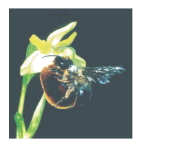
A
One petal of the flower bears an uncanny resemblance to the female bumble bee in size,colour and markings.
B
The female bumble bee is a critical link species which helps in pollination of the flower.
C
The flower employs 'Sexual deceit' to get pollination done by a particular species of bumble bee.
D
Male bumble bee pseudocopulates with the flower.
Solution
(B) The figure shows the Mediterranean orchid,Ophrys,which exhibits a special type of interaction known as 'Sexual deceit'.
In this interaction,one petal of the flower resembles the female bumble bee in size,colour,and markings.
This resemblance attracts the male bumble bee,which attempts to mate with the flower,a process known as 'pseudocopulation'.
During this process,pollen grains are dusted on the male bee's body,which are then transferred to another flower when the bee visits it,thus facilitating pollination.
The female bumble bee is not involved in this process at all; the interaction is specifically between the flower and the male bumble bee.
Therefore,the statement that the female bumble bee is a critical link species for pollination is incorrect.
In this interaction,one petal of the flower resembles the female bumble bee in size,colour,and markings.
This resemblance attracts the male bumble bee,which attempts to mate with the flower,a process known as 'pseudocopulation'.
During this process,pollen grains are dusted on the male bee's body,which are then transferred to another flower when the bee visits it,thus facilitating pollination.
The female bumble bee is not involved in this process at all; the interaction is specifically between the flower and the male bumble bee.
Therefore,the statement that the female bumble bee is a critical link species for pollination is incorrect.
0 likes
View Solution322
MediumMCQ
Commensalism can be represented as :
A
Species $A (-);$ species $B (0)$
B
Species $A (+);$ species $B (+)$
C
Species $A (-) ;$ species $B (-)$
D
Species $A (+);$ species $B (0)$
Solution
(D) Commensalism is a type of population interaction between two species where one species benefits and the other species is neither harmed nor benefited.
In this interaction,the species that benefits is denoted by a plus sign $(+)$,and the species that is unaffected is denoted by a zero $(0)$.
Therefore,commensalism is represented as $(+, 0)$.
In this interaction,the species that benefits is denoted by a plus sign $(+)$,and the species that is unaffected is denoted by a zero $(0)$.
Therefore,commensalism is represented as $(+, 0)$.
0 likes
View Solution323
MediumMCQ
Given below are two statements: one is labelled as Assertion $A$ and the other is labelled as Reason $R$:
Assertion $(A)$: Recent studies do not entirely support the Gause's 'Competitive Exclusion Principle' in nature.
Reason $(R)$: Recent studies of competition rule out the occurrence of interspecific competition in nature.
In the light of the above statements,choose the most appropriate answer from the options given below:
Assertion $(A)$: Recent studies do not entirely support the Gause's 'Competitive Exclusion Principle' in nature.
Reason $(R)$: Recent studies of competition rule out the occurrence of interspecific competition in nature.
In the light of the above statements,choose the most appropriate answer from the options given below:
A
Assertion and Reason both are correct but Reason is not the correct explanation of Assertion.
B
Assertion is correct but Reason is incorrect.
C
Assertion is incorrect but Reason is correct.
D
Assertion and Reason both are correct and Reason is the correct explanation of Assertion.
Solution
(B) Gause's 'Competitive Exclusion Principle' states that two species competing for the same limiting resource cannot coexist indefinitely.
However,recent ecological studies suggest that while competition is a potent force,species can often coexist through mechanisms like 'resource partitioning' rather than exclusion. Thus,Assertion $(A)$ is correct.
Reason $(R)$ states that recent studies rule out interspecific competition. This is incorrect,as interspecific competition is a well-documented phenomenon in nature; it is simply not the only factor determining community structure.
Therefore,Assertion $(A)$ is correct,but Reason $(R)$ is incorrect.
However,recent ecological studies suggest that while competition is a potent force,species can often coexist through mechanisms like 'resource partitioning' rather than exclusion. Thus,Assertion $(A)$ is correct.
Reason $(R)$ states that recent studies rule out interspecific competition. This is incorrect,as interspecific competition is a well-documented phenomenon in nature; it is simply not the only factor determining community structure.
Therefore,Assertion $(A)$ is correct,but Reason $(R)$ is incorrect.
0 likes
View Solution324
MediumMCQ
Identify the incorrect statement.
A
Predators help in maintaining species diversity in a community.
B
Mutualism is an obligatory relationship.
C
The weed Calotropis produces highly poisonous cardiac glycosides.
D
Herbivores are not predators.
Solution
(D) In ecology,a predator is any organism that consumes another living organism (the prey).
$1$. Predators play a vital role in maintaining species diversity by reducing the intensity of competition among competing prey species.
$2$. Mutualism is an interaction where both species benefit; while often obligatory,it is a type of symbiotic relationship.
$3$. $Calotropis$ is a plant that produces cardiac glycosides as a chemical defense mechanism against herbivores.
$4$. Herbivores are considered predators because they consume plant parts (prey). Therefore,the statement 'Herbivores are not predators' is incorrect.
$1$. Predators play a vital role in maintaining species diversity by reducing the intensity of competition among competing prey species.
$2$. Mutualism is an interaction where both species benefit; while often obligatory,it is a type of symbiotic relationship.
$3$. $Calotropis$ is a plant that produces cardiac glycosides as a chemical defense mechanism against herbivores.
$4$. Herbivores are considered predators because they consume plant parts (prey). Therefore,the statement 'Herbivores are not predators' is incorrect.
0 likes
View Solution325
EasyMCQ
Association between clown fish and sea anemone is . . . . . . .
A
mutualism
B
commensalism
C
amensalism
D
parasitism
Solution
(B) The association between the clown fish and the sea anemone is an example of commensalism.
In this interaction,the clown fish gets protection from predators by living among the stinging tentacles of the sea anemone,which do not harm the clown fish.
The sea anemone remains unaffected by the presence of the clown fish,meaning it is neither harmed nor benefited.
Therefore,this relationship is classified as commensalism,where one species benefits and the other remains neutral.
In this interaction,the clown fish gets protection from predators by living among the stinging tentacles of the sea anemone,which do not harm the clown fish.
The sea anemone remains unaffected by the presence of the clown fish,meaning it is neither harmed nor benefited.
Therefore,this relationship is classified as commensalism,where one species benefits and the other remains neutral.
0 likes
View Solution326
EasyMCQ
Which one of the following statements is $INCORRECT$ regarding competition?
A
Resources need not always be limiting for competition to occur.
B
Only related species compete with each other.
C
Feeding efficiency of one species is reduced due to interference of other species.
D
Fitness of one species is significantly lower in the presence of another species.
Solution
(B) Competition is defined as a process in which the fitness of one species is significantly lower in the presence of another species. It is a common misconception that only closely related species compete. In reality,totally unrelated species can also compete for the same limiting resource. For example,in some shallow South American lakes,visiting flamingos and resident fishes compete for their common food,the zooplankton. Therefore,the statement that 'Only related species compete with each other' is incorrect.
0 likes
View Solution327
EasyMCQ
In population interaction,'resource partitioning' means
A
Equal distribution of resources among all organisms
B
Distribution of resources among two competing species by choosing different times for feeding
C
The resources are restricted to a geographical area
D
The resources are protected by walls
Solution
(B) Resource partitioning is a mechanism that allows species to coexist in a community by minimizing competition.
If two species compete for the same resource,they could avoid competition by choosing different times for feeding or different foraging patterns.
This concept was famously demonstrated by Robert MacArthur,who showed that five closely related species of warblers living on the same tree were able to avoid competition and coexist due to behavioral differences in their foraging activities.
If two species compete for the same resource,they could avoid competition by choosing different times for feeding or different foraging patterns.
This concept was famously demonstrated by Robert MacArthur,who showed that five closely related species of warblers living on the same tree were able to avoid competition and coexist due to behavioral differences in their foraging activities.
0 likes
View Solution328
EasyMCQ
Which one of the following pairs shows co-evolution?
A
Flamingoes and resident fish
B
Indian crow and Asian koel
C
Hummingbird and plants
D
Leopards and lions in a forest
Solution
(C) Co-evolution refers to the process where two or more species reciprocally affect each other's evolution.
In the case of plants and their pollinators,such as hummingbirds,the plants evolve specific floral traits (like shape,color,and nectar production) to attract specific pollinators,while the pollinators evolve specialized structures (like beak shape) to access the nectar efficiently.
This mutual adaptation is a classic example of co-evolution,often associated with mutualism.
Flamingoes and resident fish compete for the same food,which is an example of competition.
Indian crow and Asian koel represent brood parasitism.
Leopards and lions represent interspecific competition.
In the case of plants and their pollinators,such as hummingbirds,the plants evolve specific floral traits (like shape,color,and nectar production) to attract specific pollinators,while the pollinators evolve specialized structures (like beak shape) to access the nectar efficiently.
This mutual adaptation is a classic example of co-evolution,often associated with mutualism.
Flamingoes and resident fish compete for the same food,which is an example of competition.
Indian crow and Asian koel represent brood parasitism.
Leopards and lions represent interspecific competition.
0 likes
View Solution329
EasyMCQ
Given below are two statements.
Statement $I$: $Calotropis$ growing in abandoned fields is never consumed by cattle and goats.
Statement $II$: $Calotropis$ produces highly poisonous cardiac glycosides.
In light of above statements,select the most appropriate answer from the option given below.
Statement $I$: $Calotropis$ growing in abandoned fields is never consumed by cattle and goats.
Statement $II$: $Calotropis$ produces highly poisonous cardiac glycosides.
In light of above statements,select the most appropriate answer from the option given below.
A
Both statement $I$ and statement $II$ are correct.
B
Both statement $I$ and statement $II$ are incorrect.
C
Statement $I$ is correct and statement $II$ is incorrect.
D
Statement $I$ is incorrect and statement $II$ is correct.
Solution
(A) Statement $I$ is correct: $Calotropis$ is a weed that grows in abandoned fields and is known to produce chemical defenses that prevent it from being eaten by herbivores like cattle and goats.
Statement $II$ is correct: The chemical defense mechanism of $Calotropis$ involves the production of highly poisonous cardiac glycosides,which are toxic to most herbivores.
Therefore,both statements are correct.
Statement $II$ is correct: The chemical defense mechanism of $Calotropis$ involves the production of highly poisonous cardiac glycosides,which are toxic to most herbivores.
Therefore,both statements are correct.
0 likes
View Solution330
EasyMCQ
Which one of the following is $NOT$ an adaptation found in endoparasites?
A
Loss of unnecessary sense organs.
B
Loss of digestive system.
C
Loss of reproductive system.
D
Presence of suckers.
Solution
(C) Endoparasites live inside the host body where they obtain pre-digested nutrients,leading to the loss of unnecessary sense organs and the digestive system.
They possess special structures like suckers or hooks for attachment to the host.
However,they do not lose their reproductive system; in fact,they often have highly developed reproductive systems to ensure the survival and propagation of their species within the host environment.
They possess special structures like suckers or hooks for attachment to the host.
However,they do not lose their reproductive system; in fact,they often have highly developed reproductive systems to ensure the survival and propagation of their species within the host environment.
0 likes
View Solution331
EasyMCQ
Which one of the following is $INCORRECT$ about population interaction?
A
Both the species are benefited in mutualism.
B
Both the species are harmed in competition.
C
In parasitism and predation only one species is benefited and the other is harmed.
D
In amensalism,one species is benefited whereas the other is not affected.
Solution
(D) In amensalism,one species is harmed $(-)$ while the other is not affected $(0)$. Therefore,the statement in option $D$ is incorrect because it claims one species is benefited $(+)$ in amensalism.
0 likes
View Solution332
EasyMCQ
Given below are two statements.
Statement $I$: Intraspecific competition occurs between organisms of the same population.
Statement $II$: Such interaction may be beneficial,harmful or neutral to the interacting individuals.
In the light of the above two statements,choose the correct option.
Statement $I$: Intraspecific competition occurs between organisms of the same population.
Statement $II$: Such interaction may be beneficial,harmful or neutral to the interacting individuals.
In the light of the above two statements,choose the correct option.
A
Both statement $I$ and statement $II$ are correct.
B
Both statement $I$ and statement $II$ are incorrect.
C
Statement $I$ is correct but statement $II$ is incorrect.
D
Statement $I$ is incorrect but statement $II$ is correct.
Solution
(C) Statement $I$ is correct: Intraspecific competition is a type of interaction where individuals of the same species (or population) compete for limited resources such as food,space,or mates.
Statement $II$ is incorrect: In competition (whether intraspecific or interspecific),both interacting species or individuals are negatively affected ($-/-$ interaction). Therefore,it is always harmful to both parties involved,not beneficial or neutral.
Statement $II$ is incorrect: In competition (whether intraspecific or interspecific),both interacting species or individuals are negatively affected ($-/-$ interaction). Therefore,it is always harmful to both parties involved,not beneficial or neutral.
0 likes
View Solution333
EasyMCQ
In brood parasitism as observed in Asian koel and Indian crow,the eggs of . . . . . . .
A
the host bird hatch first
B
the parasitic bird hatch first
C
both host and parasitic birds hatch together
D
both host and parasitic birds hatch irrespective to any order
Solution
(B) Brood parasitism is a phenomenon where the parasitic bird (e.g.,Asian koel) lays its eggs in the nest of a host bird (e.g.,Indian crow) and lets the host incubate them.
During the course of evolution,the eggs of the parasitic bird have evolved to resemble the host's eggs in size and color to reduce the chances of the host bird detecting and ejecting the foreign eggs.
In the specific case of the Asian koel and the Indian crow,the eggs of the parasitic bird (Asian koel) have evolved to hatch earlier than the eggs of the host bird (Indian crow).
This early hatching provides a competitive advantage to the parasitic chick,allowing it to grow faster and often outcompete or eliminate the host's own offspring.
During the course of evolution,the eggs of the parasitic bird have evolved to resemble the host's eggs in size and color to reduce the chances of the host bird detecting and ejecting the foreign eggs.
In the specific case of the Asian koel and the Indian crow,the eggs of the parasitic bird (Asian koel) have evolved to hatch earlier than the eggs of the host bird (Indian crow).
This early hatching provides a competitive advantage to the parasitic chick,allowing it to grow faster and often outcompete or eliminate the host's own offspring.
0 likes
View Solution334
EasyMCQ
Identify the correct types of ecological interactions represented by $P$,$Q$,$R$ and $S$.
| Interaction between Species $A$ and Species $B$ | Type of interaction |
| $+$,$-$ | $P$ |
| $-$,$-$ | $Q$ |
| $+$,$0$ | $R$ |
| $-$,$0$ | $S$ |
A
$P$-Commensalism; $Q$-Amensalism; $R$-Parasitism; $S$-Competition
B
$P$-Parasitism; $Q$-Competition; $R$-Commensalism; $S$-Amensalism
C
$P$-Parasitism; $Q$-Competition; $R$-Commensalism; $S$-Amensalism
D
$P$-Predation; $Q$-Amensalism; $R$-Commensalism; $S$-Parasitism
Solution
(B) In ecological interactions,the symbols represent the effect on the species involved: '$+$' indicates a beneficial effect,'$-$' indicates a detrimental effect,and '$0$' indicates a neutral effect.
$1$. $P$ ($+$,$-$): One species benefits while the other is harmed. This is characteristic of Predation or Parasitism.
$2$. $Q$ ($-$,$-$): Both species are harmed. This is characteristic of Competition.
$3$. $R$ ($+$,$0$): One species benefits while the other is unaffected. This is characteristic of Commensalism.
$4$. $S$ ($-$,$0$): One species is harmed while the other is unaffected. This is characteristic of Amensalism.
Comparing these with the options,$P$ can be Parasitism/Predation,$Q$ is Competition,$R$ is Commensalism,and $S$ is Amensalism. Option $B$ and $C$ are identical and represent the correct sequence.
$1$. $P$ ($+$,$-$): One species benefits while the other is harmed. This is characteristic of Predation or Parasitism.
$2$. $Q$ ($-$,$-$): Both species are harmed. This is characteristic of Competition.
$3$. $R$ ($+$,$0$): One species benefits while the other is unaffected. This is characteristic of Commensalism.
$4$. $S$ ($-$,$0$): One species is harmed while the other is unaffected. This is characteristic of Amensalism.
Comparing these with the options,$P$ can be Parasitism/Predation,$Q$ is Competition,$R$ is Commensalism,and $S$ is Amensalism. Option $B$ and $C$ are identical and represent the correct sequence.
0 likes
View Solution335
EasyMCQ
Birds living in the same habitat generally differ in their niches because they . . . . . . .
A
make different types of nests
B
have different sizes and shapes
C
have different eating habits
D
belong to the same species
Solution
(C) niche refers to the functional role of an organism in its environment,which includes its diet,habitat,and interactions with other species.
Even if birds live in the same habitat,they often avoid direct competition for resources by occupying different niches.
This is primarily achieved through differences in their feeding habits (e.g.,different food sources or foraging techniques),which allows them to coexist in the same ecosystem.
Therefore,the correct answer is $C$.
Even if birds live in the same habitat,they often avoid direct competition for resources by occupying different niches.
This is primarily achieved through differences in their feeding habits (e.g.,different food sources or foraging techniques),which allows them to coexist in the same ecosystem.
Therefore,the correct answer is $C$.
0 likes
View Solution336
EasyMCQ
Match the pairs of partners showing interspecific interaction from Column-$I$ and Column-$II$:
| Column-$I$ | Column-$II$ |
|---|---|
| $a$. Sea anemone | $i$. Cyanobacteria |
| $b$. Plant | $ii$. Man |
| $c$. Plasmodium | $iii$. Herbivore |
| $d$. Fungi | $iv$. Clown fish |
A
$(a)-(iii), (b)-(ii), (c)-(i), (d)-(iv)$
B
$(a)-(ii), (b)-(i), (c)-(iv), (d)-(iii)$
C
$(a)-(iv), (b)-(ii), (c)-(iii), (d)-(i)$
D
$(a)-(iv), (b)-(iii), (c)-(ii), (d)-(i)$
Solution
(D) The correct matches for the interspecific interactions are as follows:
$1$. Sea anemone $(a)$ interacts with Clown fish $(iv)$ through commensalism,where the clown fish gets protection from predators by living among the stinging tentacles of the sea anemone.
$2$. Plant $(b)$ interacts with Herbivore $(iii)$ through herbivory,where the herbivore consumes the plant.
$3$. Plasmodium $(c)$ interacts with Man $(ii)$ through parasitism,where Plasmodium acts as a parasite causing malaria in humans.
$4$. Fungi $(d)$ interacts with Cyanobacteria $(i)$ in the form of lichens,which is a mutualistic relationship.
Therefore,the correct matching is $(a)-(iv), (b)-(iii), (c)-(ii), (d)-(i)$.
$1$. Sea anemone $(a)$ interacts with Clown fish $(iv)$ through commensalism,where the clown fish gets protection from predators by living among the stinging tentacles of the sea anemone.
$2$. Plant $(b)$ interacts with Herbivore $(iii)$ through herbivory,where the herbivore consumes the plant.
$3$. Plasmodium $(c)$ interacts with Man $(ii)$ through parasitism,where Plasmodium acts as a parasite causing malaria in humans.
$4$. Fungi $(d)$ interacts with Cyanobacteria $(i)$ in the form of lichens,which is a mutualistic relationship.
Therefore,the correct matching is $(a)-(iv), (b)-(iii), (c)-(ii), (d)-(i)$.
0 likes
View Solution337
EasyMCQ
In brood parasitism . . . . . . .
A
the eggs after being laid in host's nest are incubated by parent bird.
B
the eggs of host bird are destroyed.
C
the parasite's egg hatch after the host's egg.
D
the eggs of one bird are laid in another bird's nest who incubates them.
Solution
(D) Brood parasitism is a fascinating example of parasitism in birds in which the parasitic bird lays its eggs in the nest of its host and lets the host incubate them.
During the course of evolution,the eggs of the parasitic bird have evolved to resemble the host's eggs in size and color to reduce the chances of the host bird detecting and ejecting the foreign eggs.
Therefore,the correct description is that the eggs of one bird are laid in another bird's nest,and the host bird incubates them.
During the course of evolution,the eggs of the parasitic bird have evolved to resemble the host's eggs in size and color to reduce the chances of the host bird detecting and ejecting the foreign eggs.
Therefore,the correct description is that the eggs of one bird are laid in another bird's nest,and the host bird incubates them.
0 likes
View Solution338
EasyMCQ
The relation between a herbivore and a carnivore is an example of . . . . . . .
A
Parasitism
B
Mutualism
C
Predation
D
Commensalism
Solution
(C) Predation is a biological interaction where one organism,the predator,kills and eats another organism,the prey. In the case of a herbivore and a carnivore,the carnivore acts as the predator and the herbivore acts as the prey. Therefore,this relationship is an example of predation.
0 likes
View Solution339
EasyMCQ
Which one of the following shows interspecific competition?
A
Between tree and orchid
B
Between two Peepal trees
C
Between lions and leopards
D
Between tiger and camel
Solution
(C) Interspecific competition is a type of interaction where individuals of different species compete for the same limiting resource in an ecosystem.
$1$. Between tree and orchid: This is an example of commensalism,where the orchid (epiphyte) benefits and the tree is unaffected.
$2$. Between two Peepal trees: This is an example of intraspecific competition,as it involves individuals of the same species.
$3$. Between lions and leopards: Both are carnivores that often compete for the same prey species in the same habitat,representing interspecific competition.
$4$. Between tiger and camel: These species occupy different niches and do not typically compete for the same resources.
Therefore,the correct answer is $C$.
$1$. Between tree and orchid: This is an example of commensalism,where the orchid (epiphyte) benefits and the tree is unaffected.
$2$. Between two Peepal trees: This is an example of intraspecific competition,as it involves individuals of the same species.
$3$. Between lions and leopards: Both are carnivores that often compete for the same prey species in the same habitat,representing interspecific competition.
$4$. Between tiger and camel: These species occupy different niches and do not typically compete for the same resources.
Therefore,the correct answer is $C$.
0 likes
View Solution340
EasyMCQ
Which one of the following is $NOT$ an example of commensalism?
A
Golden jackal and tiger
B
Remora fish and shark
C
Sea anemone and hermit crab
D
Sacculina and crabs
Solution
(D) Commensalism is an interaction between two species where one species benefits and the other is neither harmed nor benefited.
$A$. Golden jackal and tiger: This is an example of commensalism where the jackal follows the tiger to feed on the leftovers of its prey.
$B$. Remora fish and shark: This is a classic example of commensalism where the remora fish attaches to the shark to get food scraps and transportation without harming the shark.
$C$. Sea anemone and hermit crab: This is an example of commensalism (or sometimes mutualism) where the sea anemone gets mobility and food scraps while the hermit crab gets protection from predators.
$D$. Sacculina and crabs: This is an example of parasitism. $Sacculina$ is a parasitic barnacle that infects crabs,eventually castrating them and taking over their physiological functions to benefit itself at the expense of the crab.
$A$. Golden jackal and tiger: This is an example of commensalism where the jackal follows the tiger to feed on the leftovers of its prey.
$B$. Remora fish and shark: This is a classic example of commensalism where the remora fish attaches to the shark to get food scraps and transportation without harming the shark.
$C$. Sea anemone and hermit crab: This is an example of commensalism (or sometimes mutualism) where the sea anemone gets mobility and food scraps while the hermit crab gets protection from predators.
$D$. Sacculina and crabs: This is an example of parasitism. $Sacculina$ is a parasitic barnacle that infects crabs,eventually castrating them and taking over their physiological functions to benefit itself at the expense of the crab.
0 likes
View Solution341
EasyMCQ
Which of the following is an example of a positive interaction in a population?
A
Adamsia - Hermit Crab
B
Plasmodium - Mosquito
C
Sacculina - Crab
D
Wuchereria - Man
Solution
(A) positive interaction is one where at least one species benefits and none are harmed.
$A$. $Adamsia$ (sea anemone) and Hermit Crab exhibit mutualism (commensalism in some contexts),where both or at least one benefits without harm to the other.
$B$. $Plasmodium$ and Mosquito represent a parasitic relationship where the parasite harms the host.
$C$. $Sacculina$ and Crab represent a parasitic relationship.
$D$. $Wuchereria$ and Man represent a parasitic relationship.
Therefore,the correct option is $A$.
$A$. $Adamsia$ (sea anemone) and Hermit Crab exhibit mutualism (commensalism in some contexts),where both or at least one benefits without harm to the other.
$B$. $Plasmodium$ and Mosquito represent a parasitic relationship where the parasite harms the host.
$C$. $Sacculina$ and Crab represent a parasitic relationship.
$D$. $Wuchereria$ and Man represent a parasitic relationship.
Therefore,the correct option is $A$.
0 likes
View Solution342
EasyMCQ
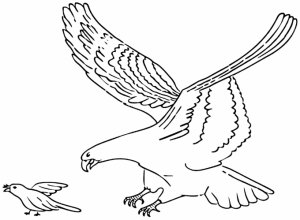
The interaction observed in this diagram is
A
Commensalism
B
Competition
C
Mutualism
D
Predation
Solution
(D) The diagram shows a bird of prey (hawk/eagle) about to capture a smaller bird.
This is a classic example of predation,where one organism (the predator) kills and consumes another organism (the prey).
In this interaction,the predator benefits while the prey is harmed.
This is a classic example of predation,where one organism (the predator) kills and consumes another organism (the prey).
In this interaction,the predator benefits while the prey is harmed.
0 likes
View Solution343
EasyMCQ
Select the $CORRECT$ match:
| List-$I$ | List-$II$ |
|---|---|
| $i$. Competition | $a$. Tapeworm and man |
| $ii$. Commensalism | $b$. Lichen |
| $iii$. Mutualism | $c$. Cattle egret and cattle |
| $iv$. Parasitism | $d$. Lions and Leopards |
A
$i-d, ii-c, iii-b, iv-a$
B
$i-d, ii-b, iii-c, iv-a$
C
$i-c, ii-b, iii-d, iv-a$
D
$i-a, ii-b, iii-d, iv-c$
Solution
(A) The correct matches for the ecological interactions are as follows:
$1$. Competition $(i)$: Lions and Leopards $(d)$ compete for the same prey resources.
$2$. Commensalism $(ii)$: Cattle egret and cattle $(c)$ represent commensalism,where the egret benefits while the cattle are neither harmed nor benefited.
$3$. Mutualism $(iii)$: Lichen $(b)$ is a classic example of mutualism between algae and fungi.
$4$. Parasitism $(iv)$: Tapeworm and man $(a)$ represent parasitism,where the tapeworm derives nutrition from the human host,causing harm.
Therefore,the correct sequence is $i-d, ii-c, iii-b, iv-a$.
$1$. Competition $(i)$: Lions and Leopards $(d)$ compete for the same prey resources.
$2$. Commensalism $(ii)$: Cattle egret and cattle $(c)$ represent commensalism,where the egret benefits while the cattle are neither harmed nor benefited.
$3$. Mutualism $(iii)$: Lichen $(b)$ is a classic example of mutualism between algae and fungi.
$4$. Parasitism $(iv)$: Tapeworm and man $(a)$ represent parasitism,where the tapeworm derives nutrition from the human host,causing harm.
Therefore,the correct sequence is $i-d, ii-c, iii-b, iv-a$.
0 likes
View Solution344
EasyMCQ
$A$ cuckoo laying eggs in the nest of other species of birds,is an example of
A
Adelphoparasitism
B
Brood parasitism
C
Ectoparasites
D
Hyper parasitism
Solution
(B) Brood parasitism is a fascinating example of parasitism in birds in which the parasitic bird lays its eggs in the nest of its host and lets the host incubate them.
During the course of evolution,the eggs of the parasitic bird have evolved to resemble the host's eggs in size and color to reduce the chances of the host bird detecting the foreign eggs and ejecting them from the nest.
The cuckoo ($Cuculus$ $canorus$) is a well-known example of a brood parasite that lays its eggs in the nest of a crow.
During the course of evolution,the eggs of the parasitic bird have evolved to resemble the host's eggs in size and color to reduce the chances of the host bird detecting the foreign eggs and ejecting them from the nest.
The cuckoo ($Cuculus$ $canorus$) is a well-known example of a brood parasite that lays its eggs in the nest of a crow.
0 likes
View Solution345
EasyMCQ
Which type of interaction is seen between sea anemone and clown fish?
A
Predation
B
Mutualism
C
Population density
D
Commensalism
Solution
(D) The interaction between the sea anemone and the clown fish is an example of $Commensalism$. In this relationship,the clown fish gets protection from predators by living among the stinging tentacles of the sea anemone,while the sea anemone remains unaffected by the presence of the fish. Therefore,the correct option is $D$.
0 likes
View Solution346
EasyMCQ
Choose the correct option for population interaction.
A
Fig and wasp $\rightarrow$ Mutualism
B
Monarch butterfly and predator birds $\rightarrow$ Competition
C
Sea anemone and clown fish $\rightarrow$ Parasitism
D
Cattle egret and grazing cattle $\rightarrow$ Parasitism
Solution
(A) The correct option is $A$.
$1$. Fig and wasp exhibit mutualism,where the wasp pollinates the fig inflorescence and the fig provides a place for the wasp to lay eggs.
$2$. Monarch butterfly and predator birds exhibit predation (or aposematism),not competition.
$3$. Sea anemone and clown fish exhibit commensalism,where the clown fish gets protection from predators among the stinging tentacles of the anemone,while the anemone remains unaffected.
$4$. Cattle egret and grazing cattle exhibit commensalism,where the egret feeds on insects flushed out by the cattle,while the cattle remain unaffected.
$1$. Fig and wasp exhibit mutualism,where the wasp pollinates the fig inflorescence and the fig provides a place for the wasp to lay eggs.
$2$. Monarch butterfly and predator birds exhibit predation (or aposematism),not competition.
$3$. Sea anemone and clown fish exhibit commensalism,where the clown fish gets protection from predators among the stinging tentacles of the anemone,while the anemone remains unaffected.
$4$. Cattle egret and grazing cattle exhibit commensalism,where the egret feeds on insects flushed out by the cattle,while the cattle remain unaffected.
0 likes
View Solution347
EasyMCQ
Select the correct statement which explains best parasitism.
A
One organism is benefited,other is affected.
B
Both the organisms are benefited.
C
One organism is benefited,other is not affected.
D
One organism is benefited.
Solution
(A) Parasitism is a type of population interaction between two species where one species (the parasite) is benefited and the other species (the host) is harmed or affected. In this relationship,the parasite derives its nutrition directly from the host,which leads to the host's detriment. Therefore,the correct statement is that one organism is benefited and the other is affected (harmed).
0 likes
View Solution348
EasyMCQ
Which of the following is an example of competitive interaction?
A
Starfish $Pisaster$ and clownfish
B
$Cuscuta$ and Mycorrhiza
C
Visiting flamingos and resident fishes of shallow South American lakes
D
Monarch butterfly and $Balanus$
Solution
(C) Competitive interaction occurs when two species compete for the same limiting resource. In shallow South American lakes,visiting flamingos and resident fishes both compete for their common food resource,which is zooplankton. This is a classic example of interspecific competition where both species are negatively affected by the presence of the other.
0 likes
View Solution349
EasyMCQ
Which type of interrelation is observed in species $A$ $(+)$ and species $B$ $(-)$?
A
Amensalism
B
Predation
C
Commensalism
D
Mutualism
Solution
(B) In ecological interactions,the symbol $(+)$ denotes a beneficial effect,while $(-)$ denotes a detrimental effect.
In the case of Predation,the predator (species $A$) benefits $(+)$ by consuming the prey,while the prey (species $B$) is harmed $(-)$.
Therefore,the interaction where one species benefits and the other is harmed is known as Predation.
Amensalism involves $(-, 0)$,Commensalism involves $(+, 0)$,and Mutualism involves $(+, +)$.
In the case of Predation,the predator (species $A$) benefits $(+)$ by consuming the prey,while the prey (species $B$) is harmed $(-)$.
Therefore,the interaction where one species benefits and the other is harmed is known as Predation.
Amensalism involves $(-, 0)$,Commensalism involves $(+, 0)$,and Mutualism involves $(+, +)$.
0 likes
View Solution350
EasyMCQ
Match the Column-$I$ and Column-$II$:
| Column-$I$ | Column-$II$ |
| $(P)$ Lichens | $(i)$ Parasitism |
| $(Q)$ Abingdon tortoise and goat | $(ii)$ Commensalism |
| $(R)$ Sea anemone and clown fish | $(iii)$ Competition |
| $(S)$ Human and liver fluke | $(iv)$ Mutualism |
A
$(P-i)$,$(Q-ii)$,$(R-iii)$,$(S-iv)$
B
$(P-iii)$,$(Q-iv)$,$(R-ii)$,$(S-i)$
C
$(P-iv)$,$(Q-iii)$,$(R-i)$,$(S-ii)$
D
$(P-iv)$,$(Q-iii)$,$(R-ii)$,$(S-i)$
Solution
(D) The correct matches are as follows:
$(P)$ Lichens represent a symbiotic association between algae and fungi,which is an example of Mutualism $(iv)$.
$(Q)$ Abingdon tortoise and goats in the Galapagos Islands compete for the same food source (grass),representing Competition $(iii)$.
$(R)$ Sea anemone and clown fish exhibit Commensalism $(ii)$,where the clown fish gets protection from predators while the anemone remains unaffected.
$(S)$ Human and liver fluke represent Parasitism $(i)$,where the liver fluke derives nutrition from the human host,causing harm.
Therefore,the correct sequence is $(P-iv, Q-iii, R-ii, S-i)$.
$(P)$ Lichens represent a symbiotic association between algae and fungi,which is an example of Mutualism $(iv)$.
$(Q)$ Abingdon tortoise and goats in the Galapagos Islands compete for the same food source (grass),representing Competition $(iii)$.
$(R)$ Sea anemone and clown fish exhibit Commensalism $(ii)$,where the clown fish gets protection from predators while the anemone remains unaffected.
$(S)$ Human and liver fluke represent Parasitism $(i)$,where the liver fluke derives nutrition from the human host,causing harm.
Therefore,the correct sequence is $(P-iv, Q-iii, R-ii, S-i)$.
0 likes
View SolutionOrganisms and Populations — Population Interactions · Frequently Asked Questions
1Are these Organisms and Populations questions useful for JEE and NEET?
Yes. All questions in this section are mapped to JEE Main and NEET exam patterns. Previous year questions from JEE Main, NEET, GUJCET and state-level exams are included with full solutions.
2Can I switch to Hindi or Gujarati for these questions?
Yes. Use the language tabs in the hero section or the sidebar to view the same questions and solutions in English, Hindi or Gujarati.
3How do I generate a question paper from this subtopic?
Use the Vedclass Exam Paper Generator — select the chapter and subtopic, set difficulty, and generate Sets A, B, C, D automatically. First 3 chapters of every subject are free.
Vedclass Products
For Students
Vedclass Test Series
Mock tests in real JEE/NEET style with performance analysis. 5-day free trial.
Start Free TrialFor Teachers
Exam Paper Generator
Generate Set A/B/C/D papers from this chapter in 2 minutes. 3 chapters free.
Try FreeFor Institutes
Online Exam Module
Live online exams with unlimited students, 360° analytics & white-label branding.
See DemoFor Teachers & Institutes
Generate a Organisms and Populations Exam Paper in 2 Minutes
Select subtopic & difficulty — Sets A, B, C, D auto-generated with No Repeat logic.
First 3 chapters of every subject are free — no payment required.