
A English
Population Attributes Questions in English
Class 12 Biology · Organisms and Populations · Population Attributes
194+
Questions
English
Language
100%
With Solutions
Showing 44 of 194 questions in English
151
Medium
Define/Explain: Age composition.
Solution
(N/A) Age composition refers to the relative abundance of organisms of different age groups within a population at a given time. It is a key attribute of a population that helps in understanding the growth status (expanding,stable,or declining) of the population.
0 likes
View Solution152
Easy
Define/Explain: Census.
Solution
(N/A) Census refers to the complete count of individuals within a specific area. In the context of human populations,it is conducted systematically after every $10$ years to gather demographic data.
0 likes
View Solution153
MediumMCQ
If $8$ Drosophila in a laboratory population of $80$ died during a week, the death rate in the population is
A
$10$
B
$1.0$
C
zero
D
$0.1$
Solution
(D) The death rate is calculated as the number of deaths per individual per unit time.
Formula: $\text{Death Rate} = \frac{\text{Number of deaths}}{\text{Initial population size}}$
Given:
Number of deaths = $8$
Initial population size = $80$
$\text{Death Rate} = \frac{8}{80} = 0.1 \text{ individuals per Drosophila per week}$.
Therefore, the correct option is $D$.
Formula: $\text{Death Rate} = \frac{\text{Number of deaths}}{\text{Initial population size}}$
Given:
Number of deaths = $8$
Initial population size = $80$
$\text{Death Rate} = \frac{8}{80} = 0.1 \text{ individuals per Drosophila per week}$.
Therefore, the correct option is $D$.
0 likes
View Solution154
EasyMCQ
Members of the same species living in the same habitat interact with each other to form a ........ .
A
Population
B
Community
C
Ecosystem
D
Biome
Solution
(A) In ecology,a group of individuals of the same species occupying a specific geographical area at a given time and interacting with each other is defined as a $Population$.
- $A$ $Community$ consists of populations of different species living in the same area.
- An $Ecosystem$ includes both biotic (living) and abiotic (non-living) components.
- $A$ $Biome$ is a large regional unit characterized by specific climate and vegetation.
- $A$ $Community$ consists of populations of different species living in the same area.
- An $Ecosystem$ includes both biotic (living) and abiotic (non-living) components.
- $A$ $Biome$ is a large regional unit characterized by specific climate and vegetation.
0 likes
View Solution155
MediumMCQ
Identify the incorrect statement regarding the characteristics of a population.
A
All individuals in a population belong to the same species.
B
Individuals are reproductively isolated from other species.
C
Individuals are morphologically and anatomically distinct from each other.
D
Individuals share the same gene pool and interbreed.
Solution
(C) population is defined as a group of individuals of the same species living in a specific geographical area at a given time.
$1$. Individuals of a population belong to the same species ($A$ is correct).
$2$. They are reproductively isolated from other species ($B$ is correct).
$3$. They share a common gene pool and can interbreed ($D$ is correct).
$4$. Option $C$ is incorrect because individuals of the same species generally share similar morphological and anatomical characteristics,rather than being distinct from each other in these aspects.
$1$. Individuals of a population belong to the same species ($A$ is correct).
$2$. They are reproductively isolated from other species ($B$ is correct).
$3$. They share a common gene pool and can interbreed ($D$ is correct).
$4$. Option $C$ is incorrect because individuals of the same species generally share similar morphological and anatomical characteristics,rather than being distinct from each other in these aspects.
0 likes
View Solution156
MediumMCQ
If there were $30$ lotus plants in a pond last year and through reproduction $10$ new plants were added, taking the current population to $40$, then the birth rate = $.........$ offspring per lotus per year.
A
$0.4$
B
$0.33$
C
$0.25$
D
$0.30$
Solution
(B) The birth rate is defined as the number of births per capita per unit time.
Formula: $\text{Birth Rate} = \frac{\text{Number of new offspring}}{\text{Initial population size}}$
Given:
Initial population $(N_0)$ = $30$
Number of new offspring $(B)$ = $10$
Calculation:
$\text{Birth Rate} = \frac{10}{30} = \frac{1}{3} \approx 0.33$ offspring per lotus per year.
Therefore, the correct option is $B$.
Formula: $\text{Birth Rate} = \frac{\text{Number of new offspring}}{\text{Initial population size}}$
Given:
Initial population $(N_0)$ = $30$
Number of new offspring $(B)$ = $10$
Calculation:
$\text{Birth Rate} = \frac{10}{30} = \frac{1}{3} \approx 0.33$ offspring per lotus per year.
Therefore, the correct option is $B$.
0 likes
View Solution157
MediumMCQ
If $10$ individuals in a laboratory population of $50$ fruit flies die during a week, then the death rate during this period is $= ........$ individuals per fruit fly per week.
A
$0.6$
B
$0.9$
C
$0.1$
D
$0.2$
Solution
(D) The death rate is calculated as the number of deaths divided by the initial population size over a specific time period.
Death rate $= \frac{\text{Number of deaths}}{\text{Initial population size}}$
Given:
Number of deaths $= 10$
Initial population size $= 50$
Death rate $= \frac{10}{50} = 0.2$ individuals per fruit fly per week.
Therefore, the correct option is $D$.
Death rate $= \frac{\text{Number of deaths}}{\text{Initial population size}}$
Given:
Number of deaths $= 10$
Initial population size $= 50$
Death rate $= \frac{10}{50} = 0.2$ individuals per fruit fly per week.
Therefore, the correct option is $D$.
0 likes
View Solution158
MediumMCQ
The following figure shows the age pyramids for human populations. What types of populations are represented by $P$,$Q$,and $R$?
$P \quad\quad Q \quad\quad R$
$P \quad\quad Q \quad\quad R$

A
Declining population $\quad$ Expanding population $\quad$ Stable population
B
Stable population $\quad$ Expanding population $\quad$ Declining population
C
Expanding population $\quad$ Stable population $\quad$ Declining population
D
Declining population $\quad$ Stable population $\quad$ Expanding population
Solution
(C) The age pyramid $P$ shows a broad base of pre-reproductive individuals,indicating an expanding population.
The age pyramid $Q$ shows pre-reproductive and reproductive individuals in almost equal proportions,indicating a stable population.
The age pyramid $R$ shows a narrow base of pre-reproductive individuals,indicating a declining population.
Therefore,$P$ represents an expanding population,$Q$ represents a stable population,and $R$ represents a declining population.
The age pyramid $Q$ shows pre-reproductive and reproductive individuals in almost equal proportions,indicating a stable population.
The age pyramid $R$ shows a narrow base of pre-reproductive individuals,indicating a declining population.
Therefore,$P$ represents an expanding population,$Q$ represents a stable population,and $R$ represents a declining population.
0 likes
View Solution159
MediumMCQ
In a village,the human population is $2000$. If the number of females is $1100$,what will be the sex ratio of the population?
A
Female - $55\%$,Male - $45\%$
B
Female - $45\%$,Male - $55\%$
C
Female - $50\%$,Male - $50\%$
D
Female - $60\%$,Male - $40\%$
Solution
(A) Total population = $2000$.
Number of females = $1100$.
Number of males = Total population - Number of females = $2000 - 1100 = 900$.
Percentage of females = $(1100 / 2000) \times 100 = 55\%$.
Percentage of males = $(900 / 2000) \times 100 = 45\%$.
Therefore,the sex ratio is Female - $55\%$ and Male - $45\%$.
Number of females = $1100$.
Number of males = Total population - Number of females = $2000 - 1100 = 900$.
Percentage of females = $(1100 / 2000) \times 100 = 55\%$.
Percentage of males = $(900 / 2000) \times 100 = 45\%$.
Therefore,the sex ratio is Female - $55\%$ and Male - $45\%$.
0 likes
View Solution160
EasyMCQ
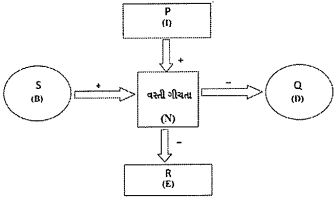
In the given figure,which factors are responsible for the increase in population density?
A
$P$ and $Q$
B
$P$ and $S$
C
$Q$ and $R$
D
$R$ and $S$
Solution
(B) Population density $(N)$ is influenced by four basic processes:
$1$. Natality $(B)$: Number of births during a given period that are added to the initial density.
$2$. Immigration $(I)$: Number of individuals of the same species that have come into the habitat from elsewhere during the time period under consideration.
$3$. Mortality $(D)$: Number of deaths in the population during a given period.
$4$. Emigration $(E)$: Number of individuals of the population who left the habitat and went elsewhere during the time period under consideration.
In the provided diagram:
- $S$ represents Births $(B)$
- $P$ represents Immigration $(I)$
- $Q$ represents Deaths $(D)$
- $R$ represents Emigration $(E)$
Factors that increase population density are Natality $(B)$ and Immigration $(I)$,which correspond to $S$ and $P$ respectively. Therefore,$P$ and $S$ are responsible for the increase in population density.
$1$. Natality $(B)$: Number of births during a given period that are added to the initial density.
$2$. Immigration $(I)$: Number of individuals of the same species that have come into the habitat from elsewhere during the time period under consideration.
$3$. Mortality $(D)$: Number of deaths in the population during a given period.
$4$. Emigration $(E)$: Number of individuals of the population who left the habitat and went elsewhere during the time period under consideration.
In the provided diagram:
- $S$ represents Births $(B)$
- $P$ represents Immigration $(I)$
- $Q$ represents Deaths $(D)$
- $R$ represents Emigration $(E)$
Factors that increase population density are Natality $(B)$ and Immigration $(I)$,which correspond to $S$ and $P$ respectively. Therefore,$P$ and $S$ are responsible for the increase in population density.
0 likes
View Solution161
MediumMCQ
Select the correct option based on the number and size of offspring produced by the following organisms:
$I -$ Oysters,$II -$ Birds,$III -$ Pelagic fishes,$IV -$ Mammals
(Many small-sized offspring) $\quad$ (Few large-sized offspring)
$I -$ Oysters,$II -$ Birds,$III -$ Pelagic fishes,$IV -$ Mammals
(Many small-sized offspring) $\quad$ (Few large-sized offspring)
A
$III, IV \quad I, II$
B
$I, II \quad III, IV$
C
$II, IV \quad I, III$
D
$I, III \quad II, IV$
Solution
(D) Organisms evolve different reproductive strategies to maximize their fitness based on environmental stability and resource availability.
$1$. Some organisms produce a large number of small-sized offspring (e.g.,Oysters,Pelagic fishes). This strategy ensures that at least a few survive despite high predation rates.
$2$. Other organisms produce a small number of large-sized offspring (e.g.,Birds,Mammals). This strategy focuses on providing better parental care and higher survival probability for each individual offspring.
Therefore,$I$ (Oysters) and $III$ (Pelagic fishes) produce many small-sized offspring,while $II$ (Birds) and $IV$ (Mammals) produce few large-sized offspring.
The correct matching is $I, III$ for many small-sized offspring and $II, IV$ for few large-sized offspring.
$1$. Some organisms produce a large number of small-sized offspring (e.g.,Oysters,Pelagic fishes). This strategy ensures that at least a few survive despite high predation rates.
$2$. Other organisms produce a small number of large-sized offspring (e.g.,Birds,Mammals). This strategy focuses on providing better parental care and higher survival probability for each individual offspring.
Therefore,$I$ (Oysters) and $III$ (Pelagic fishes) produce many small-sized offspring,while $II$ (Birds) and $IV$ (Mammals) produce few large-sized offspring.
The correct matching is $I, III$ for many small-sized offspring and $II, IV$ for few large-sized offspring.
0 likes
View Solution162
MediumMCQ
Factors related to increase in population density are $:-$
A
Natality $\&$ emigration
B
Natality $\&$ mortality
C
Natality $\&$ immigration
D
Emigration $\&$ predation
Solution
(C) Population density $(N)$ changes due to four basic processes: Natality $(B)$,Mortality $(D)$,Immigration $(I)$,and Emigration $(E)$.
Natality is the number of births during a given period in the population that are added to the initial density.
Immigration is the number of individuals of the same species that have come into the habitat from elsewhere during the time period under consideration.
Both Natality and Immigration contribute to an increase in population density.
Conversely,Mortality and Emigration contribute to a decrease in population density.
Therefore,the factors related to an increase in population density are Natality and Immigration.
Natality is the number of births during a given period in the population that are added to the initial density.
Immigration is the number of individuals of the same species that have come into the habitat from elsewhere during the time period under consideration.
Both Natality and Immigration contribute to an increase in population density.
Conversely,Mortality and Emigration contribute to a decrease in population density.
Therefore,the factors related to an increase in population density are Natality and Immigration.
0 likes
View Solution163
MediumMCQ
Read the following statements and choose the option with all the correct statements only :
$(A)$ The size of a population for any species is not a static parameter.
$(B)$ Total number is always the most appropriate measure of population density because in all cases it is most meaningful and easy to determine.
$(C)$ $A$ population growing in a habitat with unlimited resources shows initially a lag phase followed by phases of acceleration and deceleration and finally an asymptote.
$(D)$ According to ecologists,life history traits of organisms have evolved in relation to the constraints imposed by the abiotic and biotic components of the habitat in which they live.
Choose the correct answer from the options given below :
$(A)$ The size of a population for any species is not a static parameter.
$(B)$ Total number is always the most appropriate measure of population density because in all cases it is most meaningful and easy to determine.
$(C)$ $A$ population growing in a habitat with unlimited resources shows initially a lag phase followed by phases of acceleration and deceleration and finally an asymptote.
$(D)$ According to ecologists,life history traits of organisms have evolved in relation to the constraints imposed by the abiotic and biotic components of the habitat in which they live.
Choose the correct answer from the options given below :
A
$(A, B, C, D)$
B
$(A, C, D)$ only
C
$(A, D)$ only
D
$(A)$ only
Solution
(C) Statement $(A)$ is correct because population size changes over time due to births,deaths,immigration,and emigration.
Statement $(B)$ is incorrect because total number is not always the most appropriate measure. For example,in a large population with dense cover,counting individuals is difficult or meaningless; in such cases,biomass or percent cover is used.
Statement $(C)$ is incorrect because a population growing with unlimited resources exhibits exponential growth ($J$-shaped curve),which does not show deceleration or an asymptote. The description provided (lag,acceleration,deceleration,asymptote) refers to logistic growth ($S$-shaped curve) which occurs under limited resources.
Statement $(D)$ is correct as life history traits (like clutch size,age at first reproduction) are adaptations evolved to maximize fitness under the specific environmental constraints of the habitat.
Therefore,only statements $(A)$ and $(D)$ are correct.
Statement $(B)$ is incorrect because total number is not always the most appropriate measure. For example,in a large population with dense cover,counting individuals is difficult or meaningless; in such cases,biomass or percent cover is used.
Statement $(C)$ is incorrect because a population growing with unlimited resources exhibits exponential growth ($J$-shaped curve),which does not show deceleration or an asymptote. The description provided (lag,acceleration,deceleration,asymptote) refers to logistic growth ($S$-shaped curve) which occurs under limited resources.
Statement $(D)$ is correct as life history traits (like clutch size,age at first reproduction) are adaptations evolved to maximize fitness under the specific environmental constraints of the habitat.
Therefore,only statements $(A)$ and $(D)$ are correct.
0 likes
View Solution164
MediumMCQ
The size of population does not depend on?
A
Food availability
B
Changes over time
C
Climatic condition
D
Morphological differences
Solution
(D) Population size is a dynamic parameter that changes over time depending on various factors such as food availability,climatic conditions,predation pressure,and competition.
$A$,$B$,and $C$ are direct factors that influence birth rates,death rates,and migration,thereby affecting population density.
$D$ (Morphological differences) refers to the physical appearance of individuals within a population. While morphological variation exists within a population,it does not directly determine the total size or growth rate of the population. Therefore,population size does not depend on morphological differences.
$A$,$B$,and $C$ are direct factors that influence birth rates,death rates,and migration,thereby affecting population density.
$D$ (Morphological differences) refers to the physical appearance of individuals within a population. While morphological variation exists within a population,it does not directly determine the total size or growth rate of the population. Therefore,population size does not depend on morphological differences.
0 likes
View Solution165
MediumMCQ
Which of the following attributes is/are of a population but not of an individual organism?
A
Sex ratio
B
Birth rate
C
Death rate
D
All of the above
Solution
(D) An individual organism has a sex (male or female),but it does not have a sex ratio. $A$ sex ratio is a characteristic of a population,defined as the ratio of males to females in the population.
Similarly,an individual organism is either born or dies,but it does not have a birth rate or a death rate. Birth rate (natality) and death rate (mortality) are expressed as per capita births or deaths in a population over a specific period.
Therefore,all the given attributes are characteristics of a population and not of an individual organism.
Similarly,an individual organism is either born or dies,but it does not have a birth rate or a death rate. Birth rate (natality) and death rate (mortality) are expressed as per capita births or deaths in a population over a specific period.
Therefore,all the given attributes are characteristics of a population and not of an individual organism.
0 likes
View Solution166
EasyMCQ
The number of births under ideal conditions with no competition,abundance of resources such as food and water is . . . . . . .
A
Absolute mortality
B
Absolute natality
C
Realized mortality
D
Realized natality
Solution
(B) In population ecology,$Natality$ refers to the number of births during a given period in the population that are added to the initial density.
$Absolute$ $natality$ (or $Maximum$ $natality$) is the maximum number of births possible under ideal environmental conditions,where there is no competition and resources like food and water are abundant.
$Realized$ $natality$ is the actual birth rate observed under existing environmental conditions,which are usually limited by competition and resource availability.
Therefore,the correct term for births under ideal conditions is $Absolute$ $natality$.
$Absolute$ $natality$ (or $Maximum$ $natality$) is the maximum number of births possible under ideal environmental conditions,where there is no competition and resources like food and water are abundant.
$Realized$ $natality$ is the actual birth rate observed under existing environmental conditions,which are usually limited by competition and resource availability.
Therefore,the correct term for births under ideal conditions is $Absolute$ $natality$.
0 likes
View Solution167
EasyMCQ
Under a particular set of selection pressure,organisms evolve towards the most efficient reproductive strategy. For example:
$A$) Oysters produce a large number of small-sized offspring.
$B$) Mammals produce a small number of large-sized offspring.
In the light of the above statements,choose the correct option.
$A$) Oysters produce a large number of small-sized offspring.
$B$) Mammals produce a small number of large-sized offspring.
In the light of the above statements,choose the correct option.
A
Both $A$ and $B$ are correct.
B
Both $A$ and $B$ are incorrect.
C
$A$ is correct but $B$ is incorrect.
D
$A$ is incorrect but $B$ is correct.
Solution
(A) Organisms evolve towards the most efficient reproductive strategy based on the selection pressure in their environment.
Some organisms,like oysters,produce a large number of small-sized offspring (e.g.,$Oysters$ produce millions of eggs) to ensure that at least a few survive predation and environmental challenges.
Other organisms,like mammals,produce a small number of large-sized offspring and invest significant energy in parental care to ensure the survival of their young.
Both strategies are evolutionary adaptations to maximize fitness in their respective ecological niches.
Therefore,both statements $A$ and $B$ are correct.
Some organisms,like oysters,produce a large number of small-sized offspring (e.g.,$Oysters$ produce millions of eggs) to ensure that at least a few survive predation and environmental challenges.
Other organisms,like mammals,produce a small number of large-sized offspring and invest significant energy in parental care to ensure the survival of their young.
Both strategies are evolutionary adaptations to maximize fitness in their respective ecological niches.
Therefore,both statements $A$ and $B$ are correct.
0 likes
View Solution168
EasyMCQ
The tiger census in our national parks is often based on . . . . . . .
A
the actual count of individuals
B
the number on the collar around their neck
C
pugmarks and faecal pellets
D
the actual photographs
Solution
(C) The tiger census in national parks and tiger reserves is often based on indirect methods because tigers are elusive,solitary,and nocturnal animals.
Specifically,the census relies on the identification and counting of pugmarks (footprints) and faecal pellets (scat) found in the habitat.
These signs provide reliable data to estimate the population density and distribution of tigers in a given area without requiring the direct sighting of every individual.
Specifically,the census relies on the identification and counting of pugmarks (footprints) and faecal pellets (scat) found in the habitat.
These signs provide reliable data to estimate the population density and distribution of tigers in a given area without requiring the direct sighting of every individual.
0 likes
View Solution169
EasyMCQ
In a pond,there were $500$ carp fishes at the beginning of the year. They have a birth rate of $4$ offspring per carp per year. What will be the total number of carp fish at the end of that year?
A
$2000$
B
$2500$
C
$3000$
D
$3500$
Solution
(B) The birth rate is defined as the number of new offspring produced per individual per unit time.
Birth rate = $\frac{\text{Number of new offspring}}{\text{Initial population size}}$
Given,birth rate = $4$ offspring/carp/year and initial population = $500$.
Therefore,the number of new offspring = $\text{Birth rate} \times \text{Initial population}$
Number of new offspring = $4 \times 500 = 2000$.
The total number of carp fish at the end of the year = $\text{Initial population} + \text{New offspring}$
Total population = $500 + 2000 = 2500$.
Birth rate = $\frac{\text{Number of new offspring}}{\text{Initial population size}}$
Given,birth rate = $4$ offspring/carp/year and initial population = $500$.
Therefore,the number of new offspring = $\text{Birth rate} \times \text{Initial population}$
Number of new offspring = $4 \times 500 = 2000$.
The total number of carp fish at the end of the year = $\text{Initial population} + \text{New offspring}$
Total population = $500 + 2000 = 2500$.
0 likes
View Solution170
EasyMCQ
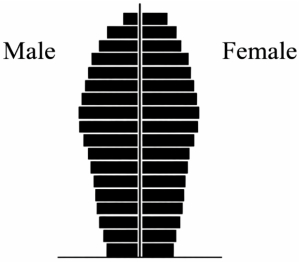
Given below is the age pyramid for Hungary. Which type of growth does it represent?
A
Zero
B
Slow
C
Rapid
D
Negative
Solution
(D) The age pyramid for Hungary shows a narrow base and a wider middle/top section.
In this pyramid,the number of individuals in the pre-reproductive and reproductive age groups is smaller compared to the number of individuals in the post-reproductive age group.
This indicates a declining population,which represents negative growth.
In this pyramid,the number of individuals in the pre-reproductive and reproductive age groups is smaller compared to the number of individuals in the post-reproductive age group.
This indicates a declining population,which represents negative growth.
0 likes
View Solution171
EasyMCQ
The absolute natality is . . . . . . realised natality.
A
seldom more than
B
always less than
C
same as
D
always more than
Solution
(D) Absolute natality (or maximum natality) is the theoretical maximum number of births under ideal environmental conditions,where there is no competition or limiting factors.
Realised natality is the actual number of births that occur under existing environmental conditions,which are typically limited by resources,predation,and competition.
Since environmental conditions are rarely perfect,the actual number of births (realised natality) is almost always lower than the theoretical maximum (absolute natality).
Therefore,absolute natality is always more than realised natality.
Realised natality is the actual number of births that occur under existing environmental conditions,which are typically limited by resources,predation,and competition.
Since environmental conditions are rarely perfect,the actual number of births (realised natality) is almost always lower than the theoretical maximum (absolute natality).
Therefore,absolute natality is always more than realised natality.
0 likes
View Solution172
EasyMCQ
Which one of the following is $NOT$ a characteristic of a population?
A
Transfer of energy from one form to another
B
Age pyramids
C
Expanding population
D
Natality
Solution
(A) population is defined as a group of individuals of the same species living in a specific geographical area at a given time.
Key characteristics of a population include natality (birth rate),mortality (death rate),age distribution (represented by age pyramids),sex ratio,and population growth (e.g.,expanding,stable,or declining population).
Option $A$ describes the 'Transfer of energy from one form to another',which is a fundamental principle of thermodynamics and a characteristic of an ecosystem,not a population.
Therefore,it is not a characteristic of a population.
Key characteristics of a population include natality (birth rate),mortality (death rate),age distribution (represented by age pyramids),sex ratio,and population growth (e.g.,expanding,stable,or declining population).
Option $A$ describes the 'Transfer of energy from one form to another',which is a fundamental principle of thermodynamics and a characteristic of an ecosystem,not a population.
Therefore,it is not a characteristic of a population.
0 likes
View Solution173
EasyMCQ
Density of population decreases when . . . . . . .
A
Mortality increases and immigration decreases
B
Mortality and emigration increases
C
Natality remains constant and immigration increases
D
Natality and immigration increases
Solution
(B) The population density $(N)$ changes based on four primary factors: Natality $(B)$,Mortality $(D)$,Immigration $(I)$,and Emigration $(E)$.
The formula for population density at time $t+1$ is: $N_{t+1} = N_t + [(B + I) - (D + E)]$.
Population density decreases when the number of individuals leaving the population exceeds the number of individuals entering it.
Specifically,an increase in Mortality $(D)$ or an increase in Emigration $(E)$ leads to a decrease in population density.
Therefore,option $B$ is correct as it describes factors that reduce population size.
The formula for population density at time $t+1$ is: $N_{t+1} = N_t + [(B + I) - (D + E)]$.
Population density decreases when the number of individuals leaving the population exceeds the number of individuals entering it.
Specifically,an increase in Mortality $(D)$ or an increase in Emigration $(E)$ leads to a decrease in population density.
Therefore,option $B$ is correct as it describes factors that reduce population size.
0 likes
View Solution174
EasyMCQ
Natality of a region is assessed by the rate of . . . . . . of individuals per unit area,per unit time.
A
Immigration
B
Emigration
C
Death
D
Births
Solution
(D) Natality refers to the number of births in a population during a given period. It is defined as the number of births per unit area per unit time.
$1$. Immigration $(I)$ is the number of individuals of the same species that have come into the habitat from elsewhere during the time period under consideration.
$2$. Emigration $(E)$ is the number of individuals of the population who left the habitat and gone elsewhere during the time period under consideration.
$3$. Mortality is the number of deaths in the population during a given period.
$4$. Natality is the number of births in the population during a given period.
Therefore,the correct option is $D$.
$1$. Immigration $(I)$ is the number of individuals of the same species that have come into the habitat from elsewhere during the time period under consideration.
$2$. Emigration $(E)$ is the number of individuals of the population who left the habitat and gone elsewhere during the time period under consideration.
$3$. Mortality is the number of deaths in the population during a given period.
$4$. Natality is the number of births in the population during a given period.
Therefore,the correct option is $D$.
0 likes
View Solution175
EasyMCQ
Mortality is the rate of . . . . . . of individuals in a population.
A
Deaths
B
Emigration
C
Immigration
D
Births
Solution
(A) Mortality refers to the number of deaths in a population during a given period.
It is one of the key factors that decreases the population density.
In contrast,natality refers to the number of births in a population during a given period,which increases the population density.
Therefore,mortality is the rate of deaths of individuals in a population.
It is one of the key factors that decreases the population density.
In contrast,natality refers to the number of births in a population during a given period,which increases the population density.
Therefore,mortality is the rate of deaths of individuals in a population.
0 likes
View Solution176
EasyMCQ
The population will be of declining type if the number of individuals in . . . . . . .
A
Post-reproductive age group is smaller than reproductive age group
B
Both pre-reproductive and post-reproductive age groups are same
C
Pre-reproductive age group is smaller than reproductive age group
D
Pre-reproductive age group is larger than reproductive age group
Solution
(C) In an age pyramid,the population is classified as declining when the proportion of individuals in the pre-reproductive age group is smaller than those in the reproductive and post-reproductive age groups.
This indicates that the birth rate is low and the population is not replacing itself,leading to a decrease in the total population size over time.
Therefore,the correct condition for a declining population is that the pre-reproductive age group is smaller than the reproductive age group.
This indicates that the birth rate is low and the population is not replacing itself,leading to a decrease in the total population size over time.
Therefore,the correct condition for a declining population is that the pre-reproductive age group is smaller than the reproductive age group.
0 likes
View Solution177
EasyMCQ
The changing nature of a population is called:
A
Population growth
B
Reproductive potential
C
Population dynamics
D
Population explosion
Solution
(C) Population dynamics refers to the study of how and why population sizes and structures change over time. It involves analyzing factors such as birth rates,death rates,immigration,and emigration that influence the size and composition of a population. Therefore,the changing nature of a population is termed as population dynamics.
0 likes
View Solution178
EasyMCQ
Density of population increases when . . . . . . .
A
Mortality and emigration increases
B
Natality and immigration increases
C
Mortality increases and immigration decreases
D
Natality decreases and emigration increases
Solution
(B) The population density $(N)$ at time $t+1$ is calculated using the formula: $N_{t+1} = N_t + [(B + I) - (D + E)]$.
Where:
$B$ = Natality (birth rate)
$I$ = Immigration (number of individuals joining the population)
$D$ = Mortality (death rate)
$E$ = Emigration (number of individuals leaving the population)
Population density increases when the number of individuals added to the population $(B + I)$ is greater than the number of individuals lost from the population $(D + E)$.
Therefore,an increase in Natality $(B)$ and Immigration $(I)$ leads to an increase in population density.
Where:
$B$ = Natality (birth rate)
$I$ = Immigration (number of individuals joining the population)
$D$ = Mortality (death rate)
$E$ = Emigration (number of individuals leaving the population)
Population density increases when the number of individuals added to the population $(B + I)$ is greater than the number of individuals lost from the population $(D + E)$.
Therefore,an increase in Natality $(B)$ and Immigration $(I)$ leads to an increase in population density.
0 likes
View Solution179
EasyMCQ
Density of population increases when . . . . . . .
A
Emigration increases
B
Immigration decreases
C
Mortality increases
D
Natality increases
Solution
(D) Population density $(N)$ is influenced by four primary factors: Natality $(B)$,Mortality $(D)$,Immigration $(I)$,and Emigration $(E)$.
The formula for population density at time $t+1$ is: $N_{t+1} = N_t + [(B + I) - (D + E)]$.
$1$. Natality $(B)$: Number of births in a population during a given period,which adds to the population density.
$2$. Immigration $(I)$: Number of individuals of the same species that have come into the habitat from elsewhere during a given period,which adds to the population density.
$3$. Mortality $(D)$: Number of deaths in a population during a given period,which reduces the population density.
$4$. Emigration $(E)$: Number of individuals of the population who left the habitat and gone elsewhere during a given period,which reduces the population density.
Therefore,population density increases when Natality $(B)$ or Immigration $(I)$ increases,or when Mortality $(D)$ or Emigration $(E)$ decreases.
The formula for population density at time $t+1$ is: $N_{t+1} = N_t + [(B + I) - (D + E)]$.
$1$. Natality $(B)$: Number of births in a population during a given period,which adds to the population density.
$2$. Immigration $(I)$: Number of individuals of the same species that have come into the habitat from elsewhere during a given period,which adds to the population density.
$3$. Mortality $(D)$: Number of deaths in a population during a given period,which reduces the population density.
$4$. Emigration $(E)$: Number of individuals of the population who left the habitat and gone elsewhere during a given period,which reduces the population density.
Therefore,population density increases when Natality $(B)$ or Immigration $(I)$ increases,or when Mortality $(D)$ or Emigration $(E)$ decreases.
0 likes
View Solution180
EasyMCQ
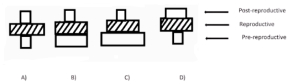
Which of the following statements correctly correlates with the provided age pyramids?
A
$A$ and $B$ are steady populations.
B
$A$ and $D$ are declining populations.
C
$C$ and $D$ are growing populations.
D
$B$ and $D$ are declining populations.
Solution
(A) The age pyramids represent the distribution of different age groups in a population:
$1$. Pyramid $C$ has a broad base of pre-reproductive individuals,indicating a growing population.
$2$. Pyramid $B$ shows a stable distribution where pre-reproductive and reproductive individuals are roughly equal,indicating a stable or steady population.
$3$. Pyramid $A$ shows a bell-shaped structure,also representing a stable population.
$4$. Pyramid $D$ has a narrow base of pre-reproductive individuals compared to the reproductive group,indicating a declining population.
Therefore,$A$ and $B$ represent stable populations,while $D$ represents a declining population. Comparing this with the options,$B$ and $D$ are declining is incorrect,but $A$ and $B$ are steady is correct. However,looking at standard interpretations: $A$ is stable,$B$ is stable,$C$ is growing,and $D$ is declining. Thus,$A$ and $B$ are steady populations.
$1$. Pyramid $C$ has a broad base of pre-reproductive individuals,indicating a growing population.
$2$. Pyramid $B$ shows a stable distribution where pre-reproductive and reproductive individuals are roughly equal,indicating a stable or steady population.
$3$. Pyramid $A$ shows a bell-shaped structure,also representing a stable population.
$4$. Pyramid $D$ has a narrow base of pre-reproductive individuals compared to the reproductive group,indicating a declining population.
Therefore,$A$ and $B$ represent stable populations,while $D$ represents a declining population. Comparing this with the options,$B$ and $D$ are declining is incorrect,but $A$ and $B$ are steady is correct. However,looking at standard interpretations: $A$ is stable,$B$ is stable,$C$ is growing,and $D$ is declining. Thus,$A$ and $B$ are steady populations.
0 likes
View Solution181
EasyMCQ
The tiger census in our national parks and tiger reserves is based on:
A
Natality rate
B
Pug marks
C
Migration
D
Mortality rate
Solution
(B) Population size,more technically called population density (designated as $N$),need not necessarily be measured in numbers only.
The tiger census in our national parks and tiger reserves is often based on pug marks and fecal pellets.
The tiger census in our national parks and tiger reserves is often based on pug marks and fecal pellets.
0 likes
View Solution182
EasyMCQ
$A$ population is a group of all . . . . . . in a given time.
A
individuals on this planet
B
individuals belonging to same species
C
plants only
D
animals only
Solution
(B) In ecology,a population is defined as a group of individuals of the same species occupying a specific geographical area at a given time. These individuals are capable of interbreeding and sharing a common gene pool.
0 likes
View Solution183
EasyMCQ
In any population group,if the rate of natality and immigration increases,then the density of the population is . . . . . . .
A
Zero
B
Decrease
C
Stable
D
Increase
Solution
(D) The population density $(N)$ is influenced by four primary factors: natality $(B)$,mortality $(D)$,immigration $(I)$,and emigration $(E)$.
The formula for population density at time $t+1$ is given by: $N_{t+1} = N_t + [(B + I) - (D + E)]$.
Natality $(B)$ refers to the number of births in a population during a given period,which adds individuals to the population.
Immigration $(I)$ refers to the number of individuals of the same species that have come into the habitat from elsewhere during the time period under consideration,which also adds individuals to the population.
Since both natality and immigration contribute to an increase in the number of individuals,an increase in these rates will lead to an increase in the overall population density.
The formula for population density at time $t+1$ is given by: $N_{t+1} = N_t + [(B + I) - (D + E)]$.
Natality $(B)$ refers to the number of births in a population during a given period,which adds individuals to the population.
Immigration $(I)$ refers to the number of individuals of the same species that have come into the habitat from elsewhere during the time period under consideration,which also adds individuals to the population.
Since both natality and immigration contribute to an increase in the number of individuals,an increase in these rates will lead to an increase in the overall population density.
0 likes
View Solution184
EasyMCQ
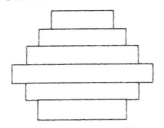
The given age pyramid for human population indicates:
A
Expanding human population
B
Declining human population
C
Stable human population
D
Fluctuating human population
Solution
(B) The provided age pyramid shows a base (pre-reproductive age group) that is narrower than the middle section (reproductive age group).
This shape is characteristic of a declining population,where the number of individuals in the reproductive age group is higher than those in the pre-reproductive age group,leading to a decrease in the population over time.
This shape is characteristic of a declining population,where the number of individuals in the reproductive age group is higher than those in the pre-reproductive age group,leading to a decrease in the population over time.
0 likes
View Solution185
EasyMCQ
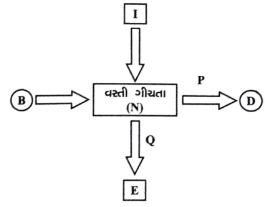
Choose the correct option for $P$ and $Q$ in the given diagram representing population density $(N)$:
A
$P - +$,$Q - +$
B
$P - +$,$Q - -$
C
$P - -$,$Q - -$
D
$P - -$,$Q - +$
Solution
(C) In the given diagram,the factors affecting population density $(N)$ are shown:
$I$ represents Immigration (adds to population,$+$).
$B$ represents Births/Natality (adds to population,$+$).
$D$ represents Deaths/Mortality (removes from population,$-$).
$E$ represents Emigration (removes from population,$-$).
Therefore,$P$ corresponds to Deaths $(D)$ and $Q$ corresponds to Emigration $(E)$.
Both $P$ and $Q$ represent factors that decrease the population density,so they are both marked with a negative sign $(-)$.
Thus,the correct option is $C$.
$I$ represents Immigration (adds to population,$+$).
$B$ represents Births/Natality (adds to population,$+$).
$D$ represents Deaths/Mortality (removes from population,$-$).
$E$ represents Emigration (removes from population,$-$).
Therefore,$P$ corresponds to Deaths $(D)$ and $Q$ corresponds to Emigration $(E)$.
Both $P$ and $Q$ represent factors that decrease the population density,so they are both marked with a negative sign $(-)$.
Thus,the correct option is $C$.
0 likes
View Solution186
EasyMCQ
In population density, . . . . . . and . . . . . . increase the population.
A
Birth-rate,emigration
B
Death rate,immigration
C
Birth-rate,immigration
D
Death rate,emigration
Solution
(C) Population density $(N)$ is affected by four basic processes. The two factors that contribute to an increase in population density are:
$1$. Natality (Birth-rate): The number of births during a given period in the population that are added to the initial density.
$2$. Immigration: The number of individuals of the same species that have come into the habitat from elsewhere during the time period under consideration.
Conversely,mortality (death rate) and emigration decrease the population density. Therefore,the correct option is $C$.
$1$. Natality (Birth-rate): The number of births during a given period in the population that are added to the initial density.
$2$. Immigration: The number of individuals of the same species that have come into the habitat from elsewhere during the time period under consideration.
Conversely,mortality (death rate) and emigration decrease the population density. Therefore,the correct option is $C$.
0 likes
View Solution187
EasyMCQ
At one time,the number of cheetahs in a habitat is $80$. Their birth rate is $4$ and death rate is $2$. Among them,$6$ cheetahs are internal migrants (immigration) and $3$ cheetahs are migratory (emigration). Calculate the population density of cheetahs in that habitat.
A
$85$
B
$90$
C
$83$
D
$95$
Solution
(A) The population density $(N_{t+1})$ at time $t+1$ is calculated using the formula:
$N_{t+1} = N_t + [(B + I) - (D + E)]$
Where:
$N_t$ = Initial population = $80$
$B$ = Birth rate = $4$
$I$ = Immigration = $6$
$D$ = Death rate = $2$
$E$ = Emigration = $3$
Substituting the values:
$N_{t+1} = 80 + [(4 + 6) - (2 + 3)]$
$N_{t+1} = 80 + [10 - 5]$
$N_{t+1} = 80 + 5 = 85$
Therefore,the population density is $85$.
$N_{t+1} = N_t + [(B + I) - (D + E)]$
Where:
$N_t$ = Initial population = $80$
$B$ = Birth rate = $4$
$I$ = Immigration = $6$
$D$ = Death rate = $2$
$E$ = Emigration = $3$
Substituting the values:
$N_{t+1} = 80 + [(4 + 6) - (2 + 3)]$
$N_{t+1} = 80 + [10 - 5]$
$N_{t+1} = 80 + 5 = 85$
Therefore,the population density is $85$.
0 likes
View Solution188
EasyMCQ
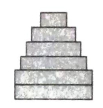
The given diagram of an age pyramid represents . . . . . . .
A
Stable human population
B
Expanding human population
C
Decreasing human population
D
Increasing and decreasing human population
Solution
(A) The given age pyramid shows a bell-shaped structure,which is characteristic of a stable population.
In a stable population,the proportion of individuals in the pre-reproductive and reproductive age groups remains relatively constant.
This indicates that the birth rate is roughly equal to the death rate,leading to a stable population size over time.
Therefore,the correct option is $A$.
In a stable population,the proportion of individuals in the pre-reproductive and reproductive age groups remains relatively constant.
This indicates that the birth rate is roughly equal to the death rate,leading to a stable population size over time.
Therefore,the correct option is $A$.
0 likes
View Solution189
EasyMCQ
If $8$ individuals in a laboratory population of $80$ fruit flies died during a specified time interval, the death rate in the population during that period is
A
$0.1$ individual/time interval
B
$1$ individual/time interval
C
$0.01$ individual/time interval
D
$0.001$ individual/time interval
Solution
(A) The death rate is calculated as the number of deaths divided by the initial population size over a specific time interval.
Death rate = $\frac{\text{Number of deaths}}{\text{Initial population size}}$
Death rate = $\frac{8}{80} = 0.1$ individual per individual per time interval.
Therefore, the death rate is $0.1$ individual/time interval.
Death rate = $\frac{\text{Number of deaths}}{\text{Initial population size}}$
Death rate = $\frac{8}{80} = 0.1$ individual per individual per time interval.
Therefore, the death rate is $0.1$ individual/time interval.
0 likes
View Solution190
EasyMCQ
The average natality rate in our village is $25$, the average mortality rate is $24$, immigration is $2$, and emigration is $3$. What is the net increase in the population?
A
$10$
B
$0$
C
$27$
D
$5$
Solution
(B) The formula for the net population change is: $\text{Net Increase} = (\text{Natality} + \text{Immigration}) - (\text{Mortality} + \text{Emigration})$.
Given values are: $\text{Natality} = 25$, $\text{Mortality} = 24$, $\text{Immigration} = 2$, and $\text{Emigration} = 3$.
Substituting these values into the formula:
$\text{Net Increase} = (25 + 2) - (24 + 3)$
$\text{Net Increase} = 27 - 27 = 0$.
Therefore, the net increase in the population is $0$.
Given values are: $\text{Natality} = 25$, $\text{Mortality} = 24$, $\text{Immigration} = 2$, and $\text{Emigration} = 3$.
Substituting these values into the formula:
$\text{Net Increase} = (25 + 2) - (24 + 3)$
$\text{Net Increase} = 27 - 27 = 0$.
Therefore, the net increase in the population is $0$.
0 likes
View Solution191
EasyMCQ
Population size keeps changing depending on different factor$(s)$ such as:
A
food availability
B
predation pressure
C
adverse weather
D
all of the above
Solution
(D) The correct answer is $D$.
Population size is not a static parameter; it keeps fluctuating due to various ecological factors.
$1$. Food availability: Limited resources restrict population growth,while abundance promotes it.
$2$. Predation pressure: High predation rates reduce the population size of prey species.
$3$. Adverse weather: Extreme conditions like droughts,floods,or severe winters can significantly decrease population density.
Therefore,all the mentioned factors are responsible for the dynamic nature of population size.
Population size is not a static parameter; it keeps fluctuating due to various ecological factors.
$1$. Food availability: Limited resources restrict population growth,while abundance promotes it.
$2$. Predation pressure: High predation rates reduce the population size of prey species.
$3$. Adverse weather: Extreme conditions like droughts,floods,or severe winters can significantly decrease population density.
Therefore,all the mentioned factors are responsible for the dynamic nature of population size.
0 likes
View Solution192
EasyMCQ
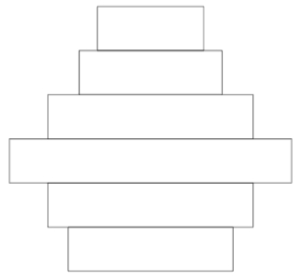
The shape of the pyramids reflects the growth status of the population. Identify the type of age pyramid represented below for human population.
A
Declining
B
Expanding
C
Ascending
D
Stable
Solution
(A) The correct answer is $A$ (Declining).
The age pyramid shown in the image represents a declining population.
In this type of pyramid,the proportion of pre-reproductive individuals (at the base) is smaller than the proportion of reproductive and post-reproductive individuals.
This indicates that the birth rate is low and the population is shrinking over time.
The age pyramid shown in the image represents a declining population.
In this type of pyramid,the proportion of pre-reproductive individuals (at the base) is smaller than the proportion of reproductive and post-reproductive individuals.
This indicates that the birth rate is low and the population is shrinking over time.
0 likes
View Solution193
EasyMCQ
$A$ population is correctly defined as having which of the following characteristics?
$(A)$ Inhabiting the same geographical area
$(B)$ Individuals belonging to the same species
$(C)$ Possessing a constant and uniform density and dispersion
$(A)$ Inhabiting the same geographical area
$(B)$ Individuals belonging to the same species
$(C)$ Possessing a constant and uniform density and dispersion
A
$A$ and $B$ only
B
$B$ and $C$ only
C
$A$ and $C$ only
D
$B$ only
Solution
(A) The correct answer is $A$ and $B$ only.
$A$ population is defined as a group of individuals of the same species that occupy a specific geographical area at a given time.
These individuals are capable of interbreeding and sharing or exchanging genetic information.
Option $(C)$ is incorrect because population density and dispersion are dynamic characteristics that change over time and space,rather than being constant or uniform.
$A$ population is defined as a group of individuals of the same species that occupy a specific geographical area at a given time.
These individuals are capable of interbreeding and sharing or exchanging genetic information.
Option $(C)$ is incorrect because population density and dispersion are dynamic characteristics that change over time and space,rather than being constant or uniform.
0 likes
View Solution194
EasyMCQ
Which one of the following population attributes contributes to an increase in population density?
A
Natality and Emigration
B
Mortality and Immigration
C
Natality and Immigration
D
Mortality and Emigration
Solution
(C) The population density of an area increases due to two main factors:
$1$. Natality $(B)$: It refers to the number of births during a given period in the population that are added to the initial density.
$2$. Immigration $(I)$: It refers to the number of individuals of the same species that have come into the habitat from elsewhere during the time period under consideration.
Therefore,both Natality and Immigration contribute to an increase in population density.
$1$. Natality $(B)$: It refers to the number of births during a given period in the population that are added to the initial density.
$2$. Immigration $(I)$: It refers to the number of individuals of the same species that have come into the habitat from elsewhere during the time period under consideration.
Therefore,both Natality and Immigration contribute to an increase in population density.
0 likes
View SolutionOrganisms and Populations — Population Attributes · Frequently Asked Questions
1Are these Organisms and Populations questions useful for JEE and NEET?
Yes. All questions in this section are mapped to JEE Main and NEET exam patterns. Previous year questions from JEE Main, NEET, GUJCET and state-level exams are included with full solutions.
2Can I switch to Hindi or Gujarati for these questions?
Yes. Use the language tabs in the hero section or the sidebar to view the same questions and solutions in English, Hindi or Gujarati.
3How do I generate a question paper from this subtopic?
Use the Vedclass Exam Paper Generator — select the chapter and subtopic, set difficulty, and generate Sets A, B, C, D automatically. First 3 chapters of every subject are free.
Vedclass Products
For Students
Vedclass Test Series
Mock tests in real JEE/NEET style with performance analysis. 5-day free trial.
Start Free TrialFor Teachers
Exam Paper Generator
Generate Set A/B/C/D papers from this chapter in 2 minutes. 3 chapters free.
Try FreeFor Institutes
Online Exam Module
Live online exams with unlimited students, 360° analytics & white-label branding.
See DemoFor Teachers & Institutes
Generate a Organisms and Populations Exam Paper in 2 Minutes
Select subtopic & difficulty — Sets A, B, C, D auto-generated with No Repeat logic.
First 3 chapters of every subject are free — no payment required.