
A English
Population Attributes Questions in English
Class 12 Biology · Organisms and Populations · Population Attributes
194+
Questions
English
Language
100%
With Solutions
Showing 50 of 194 questions in English
51
MediumMCQ
The age pyramid with a broad base indicates:
A
high percentage of old individuals
B
low percentage of young individuals
C
a stable population
D
high percentage of young individuals
Solution
(D) The correct answer is $D$.
An age pyramid is a graphical representation of the abundance of individuals in different age groups,with pre-reproductive individuals at the base,reproductive individuals in the middle,and post-reproductive individuals at the top.
$A$ triangular age pyramid (broad base) indicates a high proportion of pre-reproductive individuals,a moderate number of reproductive individuals,and fewer post-reproductive individuals.
This structure represents a young or rapidly growing population.
In contrast,a bell-shaped pyramid represents a stable population,and an urn-shaped pyramid represents a declining population.
An age pyramid is a graphical representation of the abundance of individuals in different age groups,with pre-reproductive individuals at the base,reproductive individuals in the middle,and post-reproductive individuals at the top.
$A$ triangular age pyramid (broad base) indicates a high proportion of pre-reproductive individuals,a moderate number of reproductive individuals,and fewer post-reproductive individuals.
This structure represents a young or rapidly growing population.
In contrast,a bell-shaped pyramid represents a stable population,and an urn-shaped pyramid represents a declining population.
0 likes
View Solution52
MediumMCQ
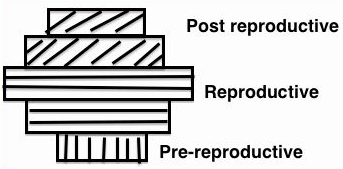
What type of human population is represented by the following age pyramid?
A
Vanishing population
B
Stable population
C
Declining population
D
Expanding population
Solution
(C) The provided age pyramid is urn-shaped,where the number of reproductive individuals is higher than the number of pre-reproductive individuals.
An age pyramid is a graphic representation of the abundance of individuals of different age groups,with pre-reproductive individuals at the base,reproductive individuals in the middle,and post-reproductive individuals at the top.
$1$. Triangular age pyramid: It has a high proportion of pre-reproductive individuals,a moderate number of reproductive individuals,and fewer post-reproductive individuals. It represents a young or rapidly growing population.
$2$. Bell-shaped age pyramid: The number of pre-reproductive and reproductive individuals is almost equal. Post-reproductive individuals are comparatively fewer. It represents a stable or stationary population where the growth rate is nearly zero.
$3$. Urn-shaped age pyramid: The number of reproductive individuals is higher than the number of pre-reproductive individuals. It represents a declining or diminishing population.
An age pyramid is a graphic representation of the abundance of individuals of different age groups,with pre-reproductive individuals at the base,reproductive individuals in the middle,and post-reproductive individuals at the top.
$1$. Triangular age pyramid: It has a high proportion of pre-reproductive individuals,a moderate number of reproductive individuals,and fewer post-reproductive individuals. It represents a young or rapidly growing population.
$2$. Bell-shaped age pyramid: The number of pre-reproductive and reproductive individuals is almost equal. Post-reproductive individuals are comparatively fewer. It represents a stable or stationary population where the growth rate is nearly zero.
$3$. Urn-shaped age pyramid: The number of reproductive individuals is higher than the number of pre-reproductive individuals. It represents a declining or diminishing population.
0 likes
View Solution53
MediumMCQ
Geometric representation of age structure is a characteristic of
A
population
B
landscape
C
ecosystem
D
biotic community
Solution
(A) The correct answer is $A$.
Population possesses several attributes that are characteristics of the group as a whole,rather than of an individual.
Age distribution is one such attribute,which refers to the number or percentage of individuals in a population across different age groups.
This distribution is represented geometrically in the form of an age pyramid,which helps in understanding the growth status of the population.
Population possesses several attributes that are characteristics of the group as a whole,rather than of an individual.
Age distribution is one such attribute,which refers to the number or percentage of individuals in a population across different age groups.
This distribution is represented geometrically in the form of an age pyramid,which helps in understanding the growth status of the population.
0 likes
View Solution54
MediumMCQ
If the mean and the median pertaining to a certain character of a population are of the same value,the following is most likely to occur:
A
a bi-modal distribution
B
a $T$-shaped curve
C
a skewed curve
D
a normal distribution
Solution
(D) In a statistical distribution,when the mean,median,and mode are equal,the frequency distribution curve is perfectly symmetrical.
This symmetrical,bell-shaped curve is known as a normal distribution.
Therefore,if the mean and median of a population character are identical,it indicates a normal distribution.
This symmetrical,bell-shaped curve is known as a normal distribution.
Therefore,if the mean and median of a population character are identical,it indicates a normal distribution.
0 likes
View Solution55
EasyMCQ
Emigration is:
A
Going out of some individuals to return after some time.
B
Temporary inward movement of some individuals.
C
Permanent outward movement of some individuals from a population.
D
Permanent inward movement of some individuals into a population.
Solution
(C) Emigration is defined as the permanent outward movement of individuals from a population to another area.
It is one of the factors that contributes to a decrease in population density.
In contrast,immigration refers to the permanent inward movement of individuals into a population,which increases population density.
Therefore,option $C$ is the correct description of emigration.
It is one of the factors that contributes to a decrease in population density.
In contrast,immigration refers to the permanent inward movement of individuals into a population,which increases population density.
Therefore,option $C$ is the correct description of emigration.
0 likes
View Solution56
MediumMCQ
The tiger census in our national parks and tiger reserves is often based on:
A
Pug marks
B
Fecal pellets
C
Biomass
D
$A$ and $B$ both
Solution
(D) The tiger census in national parks and tiger reserves is conducted using indirect methods to estimate population size.
These methods primarily rely on identifying and counting 'pug marks' (footprints) and 'fecal pellets' (scat) found in the habitat.
These signs are unique and help wildlife biologists track individual tigers and estimate their population density without disturbing the animals.
Therefore,both $A$ and $B$ are correct methods used for the census.
These methods primarily rely on identifying and counting 'pug marks' (footprints) and 'fecal pellets' (scat) found in the habitat.
These signs are unique and help wildlife biologists track individual tigers and estimate their population density without disturbing the animals.
Therefore,both $A$ and $B$ are correct methods used for the census.
0 likes
View Solution57
MediumMCQ
Under normal conditions,..................... are the most important factors influencing population density.
A
Births and deaths
B
Births and immigration
C
Emigration and immigration
D
Deaths and emigration
Solution
(A) Population density is primarily determined by four factors: natality (births),mortality (deaths),immigration,and emigration.
Under normal conditions,the most significant factors influencing population density in a given area are natality (births) and mortality (deaths).
While immigration and emigration are important,they are often secondary to births and deaths in determining the overall population size under stable,normal environmental conditions.
Under normal conditions,the most significant factors influencing population density in a given area are natality (births) and mortality (deaths).
While immigration and emigration are important,they are often secondary to births and deaths in determining the overall population size under stable,normal environmental conditions.
0 likes
View Solution58
MediumMCQ
Mortality is:
A
The number of individuals of the population who left the habitat and gone elsewhere during the time period under consideration.
B
The number of births during a given period in the population that are added to the initial density.
C
The number of individuals of the same species that have come into habitat from elsewhere during the time period under consideration.
D
The number of deaths in the population during a given period.
Solution
(D) Mortality refers to the death rate of a population.
It is defined as the number of deaths in the population during a given period.
In population ecology,mortality is one of the key factors that decreases the population density over time.
Option $A$ describes Emigration.
Option $B$ describes Natality.
Option $C$ describes Immigration.
Therefore,the correct definition of Mortality is provided in option $D$.
It is defined as the number of deaths in the population during a given period.
In population ecology,mortality is one of the key factors that decreases the population density over time.
Option $A$ describes Emigration.
Option $B$ describes Natality.
Option $C$ describes Immigration.
Therefore,the correct definition of Mortality is provided in option $D$.
0 likes
View Solution59
MediumMCQ
Which of the following are useful for measuring population density (size)?
$(a)$ Numbers
$(b)$ Biomass
$(c)$ Pug marks
$(d)$ Height
$(a)$ Numbers
$(b)$ Biomass
$(c)$ Pug marks
$(d)$ Height
A
$(a), (b), (d)$
B
$(b), (c), (d)$
C
$(a), (b), (c)$
D
$(a), (c), (d)$
Solution
(C) Population density is the number of individuals of a species per unit area or volume at a given time.
$1$. Numbers: This is the most common measure of population density (e.g.,counting the number of individuals in a specific area).
$2$. Biomass: This is used when the total number of individuals is difficult to count or when the size of individuals varies significantly (e.g.,in a forest,the number of trees is less meaningful than their biomass).
$3$. Pug marks: These are used to estimate the population density of certain animals like tigers in national parks and tiger reserves,where direct counting is difficult.
$4$. Height: Height is an individual characteristic and is not a standard measure for population density.
Therefore,$(a)$,$(b)$,and $(c)$ are useful for measuring population density.
$1$. Numbers: This is the most common measure of population density (e.g.,counting the number of individuals in a specific area).
$2$. Biomass: This is used when the total number of individuals is difficult to count or when the size of individuals varies significantly (e.g.,in a forest,the number of trees is less meaningful than their biomass).
$3$. Pug marks: These are used to estimate the population density of certain animals like tigers in national parks and tiger reserves,where direct counting is difficult.
$4$. Height: Height is an individual characteristic and is not a standard measure for population density.
Therefore,$(a)$,$(b)$,and $(c)$ are useful for measuring population density.
0 likes
View Solution60
MediumMCQ
Natality is
A
The number of individuals of the same species that have come into the habitat from elsewhere during the time period under consideration.
B
The number of births during a given period in the population that are added to the initial density.
C
The number of deaths in the population during a given period.
D
The number of individuals of the population who left the habitat and gone elsewhere during the time period under consideration.
Solution
(B) Natality refers to the birth rate of a population.
It is defined as the number of births during a given period in the population that are added to the initial population density.
Option $A$ describes Immigration.
Option $C$ describes Mortality.
Option $D$ describes Emigration.
It is defined as the number of births during a given period in the population that are added to the initial population density.
Option $A$ describes Immigration.
Option $C$ describes Mortality.
Option $D$ describes Emigration.
0 likes
View Solution61
EasyMCQ
The unchecked reproductive capacity in a population is called ..........
A
Biotic potential
B
Fecundity
C
Carrying capacity
D
Natality
Solution
(A) Biotic potential refers to the maximum reproductive capacity of an organism under optimal environmental conditions,where resources are unlimited and there are no environmental resistances. It represents the inherent ability of a population to increase in size when conditions are ideal.
0 likes
View Solution62
MediumMCQ
Some characteristics of the demography of developing countries are ....
A
High fertility,low mortality,rapid population growth,and a very young age distribution.
B
High fertility,high density,rapidly rising mortality,and very young individuals.
C
High infant mortality,low fertility,uneven population growth,and a very young age distribution.
D
High mortality,high density,uneven population growth,and a very old age distribution.
Solution
(A) Developing countries are typically characterized by high birth rates (high fertility) and declining death rates (low mortality) due to improved medical facilities. This combination leads to rapid population growth. Furthermore,because of the high birth rates,these populations have a large proportion of young individuals,resulting in a 'young' age pyramid structure.
0 likes
View Solution63
MediumMCQ
What is the total population of organisms of the same type called?
A
Colony
B
Species
C
Population
D
Community
Solution
(C) In ecology, a group of individuals of the same species living in a specific geographical area at a specific time is referred to as a $Population$.
$Species$ refers to a group of organisms that can interbreed to produce fertile offspring.
$Community$ refers to an assemblage of populations of different species living in the same area.
Therefore, the correct term for a group of organisms of the same type is $Population$.
$Species$ refers to a group of organisms that can interbreed to produce fertile offspring.
$Community$ refers to an assemblage of populations of different species living in the same area.
Therefore, the correct term for a group of organisms of the same type is $Population$.
0 likes
View Solution64
MediumMCQ
The geometric representation of age structure is known as:
A
Population
B
Landscape
C
Ecosystem
D
Biotic community
Solution
(A) The age structure of a population is represented by plotting the percentage of individuals in different age groups (pre-reproductive,reproductive,and post-reproductive).
When this data is represented geometrically,it forms an 'age pyramid'.
An age pyramid is a characteristic feature of a population,not a landscape,ecosystem,or biotic community.
Therefore,the geometric representation of age structure refers to the population.
When this data is represented geometrically,it forms an 'age pyramid'.
An age pyramid is a characteristic feature of a population,not a landscape,ecosystem,or biotic community.
Therefore,the geometric representation of age structure refers to the population.
0 likes
View Solution65
MediumMCQ
$A$ biologist studied a rat population at the time of birth. He observed that the estimated births were $250$, estimated deaths were $240$, $20$ rats immigrated into the population, and $30$ rats emigrated from the population. What was the net increase in the population?
A
$0$
B
$10$
C
$15$
D
$05$
Solution
(A) The formula for population change is given by: $N_{t+1} = N_t + [(B + I) - (D + E)]$, where $N$ is population size, $B$ is births, $I$ is immigration, $D$ is deaths, and $E$ is emigration.
Net increase = $(Births + Immigration) - (Deaths + Emigration)$.
Given values: $Births (B) = 250$, $Deaths (D) = 240$, $Immigration (I) = 20$, $Emigration (E) = 30$.
Net increase = $(250 + 20) - (240 + 30)$.
Net increase = $270 - 270 = 0$.
Therefore, the net increase in the population is $0$.
Net increase = $(Births + Immigration) - (Deaths + Emigration)$.
Given values: $Births (B) = 250$, $Deaths (D) = 240$, $Immigration (I) = 20$, $Emigration (E) = 30$.
Net increase = $(250 + 20) - (240 + 30)$.
Net increase = $270 - 270 = 0$.
Therefore, the net increase in the population is $0$.
0 likes
View Solution66
MediumMCQ
Natality refers to.
A
Number of individuals entering a habitat
B
Death rate
C
Birth rate
D
Number of individuals leaving the habitat
Solution
(C) Natality is defined as the birth rate within a population.
It refers to the number of births per unit of time per unit of population.
In contrast,mortality refers to the death rate,immigration refers to the number of individuals entering a habitat,and emigration refers to the number of individuals leaving a habitat.
Therefore,the correct option is $C$.
It refers to the number of births per unit of time per unit of population.
In contrast,mortality refers to the death rate,immigration refers to the number of individuals entering a habitat,and emigration refers to the number of individuals leaving a habitat.
Therefore,the correct option is $C$.
0 likes
View Solution67
MediumMCQ
If $4$ individuals in a laboratory population of $40$ fruitflies died during a specified time interval (i.e.,a week),the death rate in the population during that period is
A
$1$
B
$0.1$
C
$0.01$
D
$0.4$
Solution
(B) Mortality or death rate refers to the number of deaths in a population per unit time.
The formula for calculating the death rate is:
$\text{Death rate} = \frac{\text{Number of deaths}}{\text{Total population}}$
Given:
Number of deaths = $4$
Total population = $40$
$\text{Death rate} = \frac{4}{40} = 0.1$ individuals per fruitfly per week.
The formula for calculating the death rate is:
$\text{Death rate} = \frac{\text{Number of deaths}}{\text{Total population}}$
Given:
Number of deaths = $4$
Total population = $40$
$\text{Death rate} = \frac{4}{40} = 0.1$ individuals per fruitfly per week.
0 likes
View Solution68
MediumMCQ
In an $Urn$-shaped age pyramid of the population,the trend of growth is:
A
Rapid
B
Stable
C
Declining
D
Stationary
Solution
(C) In an $Urn$-shaped age pyramid,the number of individuals in the pre-reproductive age group is significantly lower than those in the reproductive age group.
This indicates a shrinking population base,which leads to a negative growth rate.
Therefore,the population trend is considered declining.
This indicates a shrinking population base,which leads to a negative growth rate.
Therefore,the population trend is considered declining.
0 likes
View Solution69
Easy
List the attributes that populations but not individuals possess.
Solution
(N/A) population is defined as a group of individuals of the same species residing in a particular geographical area at a particular time and functioning as a unit.
The main attributes or characteristics of a population that individuals do not possess are:
$1$. Birth rate (Natality): It is the ratio of live births in an area to the population of an area. It is expressed as the number of individuals added to the population per capita.
$2$. Death rate (Mortality): It is the ratio of deaths in an area to the population of an area. It is expressed as the loss of individuals per capita.
$3$. Sex ratio: It is the ratio of the number of females to males in a population (e.g.,number of females per $1000$ males).
$4$. Age distribution: It is the percentage of individuals of different ages in a given population. The age distribution pattern is commonly represented through age pyramids.
$5$. Population density: It is defined as the number of individuals of a population present per unit area or volume at a given time.
The main attributes or characteristics of a population that individuals do not possess are:
$1$. Birth rate (Natality): It is the ratio of live births in an area to the population of an area. It is expressed as the number of individuals added to the population per capita.
$2$. Death rate (Mortality): It is the ratio of deaths in an area to the population of an area. It is expressed as the loss of individuals per capita.
$3$. Sex ratio: It is the ratio of the number of females to males in a population (e.g.,number of females per $1000$ males).
$4$. Age distribution: It is the percentage of individuals of different ages in a given population. The age distribution pattern is commonly represented through age pyramids.
$5$. Population density: It is defined as the number of individuals of a population present per unit area or volume at a given time.
0 likes
View Solution70
Easy
Define population and community.
Solution
(N/A) Population:
$A$ population is defined as a group of individuals of the same species residing in a particular geographical area at a particular time,capable of interbreeding and functioning as a unit.
Community:
$A$ community is defined as an assemblage of populations of different species living in a particular area and interacting with each other,either directly or indirectly.
$A$ population is defined as a group of individuals of the same species residing in a particular geographical area at a particular time,capable of interbreeding and functioning as a unit.
Community:
$A$ community is defined as an assemblage of populations of different species living in a particular area and interacting with each other,either directly or indirectly.
0 likes
View Solution71
Medium
List any three important characteristics of a population and explain.
Solution
(N/A) population is defined as a group of individuals of the same species,residing in a particular geographical area at a particular time,and functioning as a unit.
Three important characteristics of a population are:
$1$. Birth rate (Natality): It is the number of live births per unit population per unit time. It represents the rate at which new individuals are added to the population.
$2$. Death rate (Mortality): It is the number of deaths per unit population per unit time. It represents the rate at which individuals are lost from the population.
$3$. Age Distribution: It is the percentage of individuals of different ages in a given population. At any given time,a population is composed of individuals in various age groups (pre-reproductive,reproductive,and post-reproductive). This pattern is commonly represented through age pyramids.
Three important characteristics of a population are:
$1$. Birth rate (Natality): It is the number of live births per unit population per unit time. It represents the rate at which new individuals are added to the population.
$2$. Death rate (Mortality): It is the number of deaths per unit population per unit time. It represents the rate at which individuals are lost from the population.
$3$. Age Distribution: It is the percentage of individuals of different ages in a given population. At any given time,a population is composed of individuals in various age groups (pre-reproductive,reproductive,and post-reproductive). This pattern is commonly represented through age pyramids.
0 likes
View Solution72
Medium
Describe the various processes responsible for fluctuations in population density.
Solution
(N/A) The size of a population for any species is not a static parameter. It keeps changing over time, depending on various factors including food availability, predation pressure, and adverse weather.
In fact, these changes in population density give us an idea of what is happening to the population—whether it is increasing or decreasing. Whatever the ultimate reason, the density of a population in a given habitat during a given period fluctuates due to changes in four basic processes. Out of these four, two (natality and immigration) contribute to an increase in population density, and two (mortality and emigration) contribute to a decrease.
$(i)$ Natality: It refers to the number of births during a given period in the population that are added to the initial density.
$(ii)$ Mortality: It is the number of deaths in the population during a given period.
$(iii)$ Immigration: It is the number of individuals of the same species that have come into the habitat from elsewhere during the time period under consideration.
$(iv)$ Emigration: It is the number of individuals of the population who left the habitat and went elsewhere during the time period under consideration.
In fact, these changes in population density give us an idea of what is happening to the population—whether it is increasing or decreasing. Whatever the ultimate reason, the density of a population in a given habitat during a given period fluctuates due to changes in four basic processes. Out of these four, two (natality and immigration) contribute to an increase in population density, and two (mortality and emigration) contribute to a decrease.
$(i)$ Natality: It refers to the number of births during a given period in the population that are added to the initial density.
$(ii)$ Mortality: It is the number of deaths in the population during a given period.
$(iii)$ Immigration: It is the number of individuals of the same species that have come into the habitat from elsewhere during the time period under consideration.
$(iv)$ Emigration: It is the number of individuals of the population who left the habitat and went elsewhere during the time period under consideration.
0 likes
View Solution73
Easy
Explain the specific attributes of a population.
Solution
(N/A) In nature,we rarely find individuals of any species living in isolation; most of them live in groups in a well-defined geographical area,share or compete for similar resources,potentially interbreed,and thus form a population.
Although the term interbreeding implies sexual reproduction,a group of individuals resulting from even asexual reproduction is also generally considered a population for the purpose of ecological studies. Examples include all cormorants in a wetland,rats in an abandoned dwelling,teakwood trees in a forest tract,bacteria in a culture plate,and lotus plants in a pond.
While an individual organism is the one that has to cope with a changed environment,it is at the population level that natural selection operates to evolve the desired traits. Population ecology is,therefore,an important area of ecology because it links ecology to population genetics and evolution.
$A$ population has certain attributes that an individual organism does not. An individual may have births and deaths,but a population has birth rates and death rates. In a population,these rates refer to per capita births and deaths. The rates,hence,expressed are change in numbers with respect to the members of the population.
For example,if in a pond there were $20$ lotus plants last year and through reproduction $8$ new plants are added,taking the current population to $28$,we calculate the birth rate as $8/20 = 0.4$ offspring per lotus per year. If $4$ individuals in a laboratory population of $40$ fruit flies died during a specified time interval,say a week,the death rate in the population during that period is $4/40 = 0.1$ individuals per fruit fly per week.
Another attribute characteristic of a population is sex ratio. An individual is either a male or a female,but a population has a sex ratio (e.g.,$60 \%$ of the population are females and $40 \%$ are males).
$A$ population at any given time is composed of individuals of different ages.
Although the term interbreeding implies sexual reproduction,a group of individuals resulting from even asexual reproduction is also generally considered a population for the purpose of ecological studies. Examples include all cormorants in a wetland,rats in an abandoned dwelling,teakwood trees in a forest tract,bacteria in a culture plate,and lotus plants in a pond.
While an individual organism is the one that has to cope with a changed environment,it is at the population level that natural selection operates to evolve the desired traits. Population ecology is,therefore,an important area of ecology because it links ecology to population genetics and evolution.
$A$ population has certain attributes that an individual organism does not. An individual may have births and deaths,but a population has birth rates and death rates. In a population,these rates refer to per capita births and deaths. The rates,hence,expressed are change in numbers with respect to the members of the population.
For example,if in a pond there were $20$ lotus plants last year and through reproduction $8$ new plants are added,taking the current population to $28$,we calculate the birth rate as $8/20 = 0.4$ offspring per lotus per year. If $4$ individuals in a laboratory population of $40$ fruit flies died during a specified time interval,say a week,the death rate in the population during that period is $4/40 = 0.1$ individuals per fruit fly per week.
Another attribute characteristic of a population is sex ratio. An individual is either a male or a female,but a population has a sex ratio (e.g.,$60 \%$ of the population are females and $40 \%$ are males).
$A$ population at any given time is composed of individuals of different ages.
0 likes
View Solution74
EasyMCQ
Define/Explain: $(i)$ Birth rate (ii) Endotherms
A
Birth rate: Number of births per capita per unit time; Endotherms: Organisms that maintain a constant body temperature.
B
Birth rate: Total population size; Endotherms: Organisms that change body temperature with the environment.
C
Birth rate: Death rate per unit time; Endotherms: Organisms that live in water.
D
Birth rate: Migration rate; Endotherms: Organisms that hibernate.
Solution
(A) $(i)$ Birth rate: It is defined as the number of births per capita per unit time in a population. It represents the rate at which new individuals are added to the population through reproduction.
(ii) Endotherms: These are organisms that can maintain a constant internal body temperature regardless of the external environmental temperature. They achieve this through metabolic processes,such as shivering or sweating,and are often referred to as 'warm-blooded' animals.
(ii) Endotherms: These are organisms that can maintain a constant internal body temperature regardless of the external environmental temperature. They achieve this through metabolic processes,such as shivering or sweating,and are often referred to as 'warm-blooded' animals.
0 likes
View Solution75
Easy
Define the following terms:
$(1)$ Immigration
$(2)$ Emigration
$(3)$ Mortality
$(1)$ Immigration
$(2)$ Emigration
$(3)$ Mortality
Solution
(N/A) $(1)$ Immigration: It is the number of individuals of the same species that have come into the habitat from elsewhere during the time period under consideration.
$(2)$ Emigration: It is the number of individuals of the population who left the habitat and gone elsewhere during the time period under consideration.
$(3)$ Mortality: It is the number of deaths in the population during a given period.
$(2)$ Emigration: It is the number of individuals of the population who left the habitat and gone elsewhere during the time period under consideration.
$(3)$ Mortality: It is the number of deaths in the population during a given period.
0 likes
View Solution76
Easy
The density of a population in a habitat per unit area is measured in different units. Write the unit of measurement against the following:
$(a)$ Bacteria $.......................$
$(b)$ Banyan $ .......................$
$(c)$ Deer $ .......................$
$(d)$ Fish $ ......................$
$(a)$ Bacteria $.......................$
$(b)$ Banyan $ .......................$
$(c)$ Deer $ .......................$
$(d)$ Fish $ ......................$
Solution
(N/A) Bacteria: $\text{Number} / \text{Volume}$ or $\text{Number} / \text{Weight}$.
$(b)$ Banyan: $\text{Percentage cover} / \text{Area}$.
$(c)$ Deer: $\text{Number} / \text{Area}$.
$(d)$ Fish: $\text{Number} / \text{Trap}$ or $\text{Biomass} / \text{Area}$.
$(b)$ Banyan: $\text{Percentage cover} / \text{Area}$.
$(c)$ Deer: $\text{Number} / \text{Area}$.
$(d)$ Fish: $\text{Number} / \text{Trap}$ or $\text{Biomass} / \text{Area}$.
0 likes
View Solution77
Easy
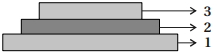
$(a)$ Label the three tiers $1, 2, 3$ given in the above age pyramid.
$(b)$ What type of population growth is represented by the above age pyramid?
$(b)$ What type of population growth is represented by the above age pyramid?
Solution
(N/A) Based on the provided age pyramid:
$1$. Pre-reproductive population (the base tier,which is the widest,indicating a large number of young individuals).
$2$. Reproductive population (the middle tier).
$3$. Post-reproductive population (the top tier).
$(b)$ The age pyramid represents an expanding or growing population. This is characterized by a broad base,which indicates that the number of pre-reproductive individuals is significantly higher than the reproductive and post-reproductive individuals,leading to future population growth.
$1$. Pre-reproductive population (the base tier,which is the widest,indicating a large number of young individuals).
$2$. Reproductive population (the middle tier).
$3$. Post-reproductive population (the top tier).
$(b)$ The age pyramid represents an expanding or growing population. This is characterized by a broad base,which indicates that the number of pre-reproductive individuals is significantly higher than the reproductive and post-reproductive individuals,leading to future population growth.
0 likes
View Solution78
Medium
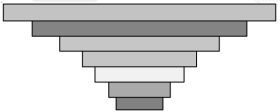
Define 'zero population growth rate'. Draw an age pyramid for the same.
Solution
Zero population growth rate occurs when the birth rate is equal to the death rate,resulting in no net change in the population size over time.
In an age pyramid representing a stable population (zero growth),the number of individuals in the pre-reproductive and reproductive age groups are approximately equal.
This results in a bell-shaped age pyramid,where the base (pre-reproductive) and middle (reproductive) sections are similar in width,while the top (post-reproductive) section tapers off.
In an age pyramid representing a stable population (zero growth),the number of individuals in the pre-reproductive and reproductive age groups are approximately equal.
This results in a bell-shaped age pyramid,where the base (pre-reproductive) and middle (reproductive) sections are similar in width,while the top (post-reproductive) section tapers off.
0 likes
View Solution79
Easy
List any four characters that are employed in human population census.
Solution
(N/A) The four key characters employed in human population census are:
$(i)$ Birth rates (Natality): The number of births per unit of population per unit time.
$(ii)$ Death rates (Mortality): The number of deaths per unit of population per unit time.
$(iii)$ Sex ratio: The ratio of the number of females to the number of males in the population.
$(iv)$ Age distribution: The percentage of individuals of a given age or age group in the population.
$(i)$ Birth rates (Natality): The number of births per unit of population per unit time.
$(ii)$ Death rates (Mortality): The number of deaths per unit of population per unit time.
$(iii)$ Sex ratio: The ratio of the number of females to the number of males in the population.
$(iv)$ Age distribution: The percentage of individuals of a given age or age group in the population.
0 likes
View Solution80
Medium
An individual and a population have certain characteristics. Name these attributes with definitions.
Solution
(N/A) population has certain attributes that an individual organism does not.
An individual may have births and deaths,but a population has birth rates and death rates.
In a population,these rates refer to per capita births and deaths,respectively.
The rates are expressed as the change in numbers (increase or decrease) with respect to the members of the population.
Another attribute characteristic of a population is the sex ratio.
An individual is either a male or a female,but a population has a sex ratio (e.g.,$60\%$ of the population are females and $40\%$ are males).
$A$ population at any given time is composed of individuals of different ages.
If the age distribution (percentage of individuals of a given age or age group) is plotted for the population,the resulting structure is called an age pyramid.
For the human population,age pyramids generally show the age distribution of males and females in a combined diagram.
The shape of the pyramids reflects the growth status of the population: $(a)$ growing,$(b)$ stable,or $(c)$ declining.
An individual may have births and deaths,but a population has birth rates and death rates.
In a population,these rates refer to per capita births and deaths,respectively.
The rates are expressed as the change in numbers (increase or decrease) with respect to the members of the population.
Another attribute characteristic of a population is the sex ratio.
An individual is either a male or a female,but a population has a sex ratio (e.g.,$60\%$ of the population are females and $40\%$ are males).
$A$ population at any given time is composed of individuals of different ages.
If the age distribution (percentage of individuals of a given age or age group) is plotted for the population,the resulting structure is called an age pyramid.
For the human population,age pyramids generally show the age distribution of males and females in a combined diagram.
The shape of the pyramids reflects the growth status of the population: $(a)$ growing,$(b)$ stable,or $(c)$ declining.
0 likes
View Solution81
Medium
The following diagrams represent the age pyramids of different populations. Comment on the status of these populations.
.jpg)
Solution
(N/A) Fig. $A$: It is a triangular-shaped age pyramid. In this figure,the base,i.e.,the pre-reproductive stage,is very large compared to the reproductive and post-reproductive stages. This type of age structure indicates that the population is expanding rapidly.
Fig. $B$: It is a bell-shaped pyramid. In this figure,the pre-reproductive and reproductive stages are roughly equal. This type of age structure indicates that the population is stable.
Fig. $C$: It is an 'Urn'-shaped pyramid. In this figure,the pre-reproductive and reproductive stages are smaller than the post-reproductive stage. In this population,there are more older individuals. This type of age structure indicates that the population is declining.
Fig. $B$: It is a bell-shaped pyramid. In this figure,the pre-reproductive and reproductive stages are roughly equal. This type of age structure indicates that the population is stable.
Fig. $C$: It is an 'Urn'-shaped pyramid. In this figure,the pre-reproductive and reproductive stages are smaller than the post-reproductive stage. In this population,there are more older individuals. This type of age structure indicates that the population is declining.
0 likes
View Solution82
EasyMCQ
Which of the following is not an attribute of a population?
A
Species interaction
B
Sex ratio
C
Natality
D
Mortality
Solution
(A) population is a group of individuals of the same species living in a specific geographical area at a given time. Attributes of a population include birth rate (natality),death rate (mortality),sex ratio,and age distribution. Species interaction refers to the interaction between two or more different species in a community,which is a property of a community,not a single population.
0 likes
View Solution83
EasyMCQ
Which of the following is not a population attribute?
A
Sex ratio
B
Natality
C
Species interaction
D
Mortality
Solution
(C) population is a group of individuals of the same species living in a specific area at a specific time.
Key attributes of a population include:
$1$. Birth rate (Natality): The number of births per capita per unit time.
$2$. Death rate (Mortality): The number of deaths per capita per unit time.
$3$. Sex ratio: The ratio of males to females in a population.
$4$. Age distribution: The percentage of individuals of different ages in a population.
Species interaction refers to the interaction between two or more different species in a community,which is a community-level attribute,not a population-level attribute.
Therefore,the correct option is $C$.
Key attributes of a population include:
$1$. Birth rate (Natality): The number of births per capita per unit time.
$2$. Death rate (Mortality): The number of deaths per capita per unit time.
$3$. Sex ratio: The ratio of males to females in a population.
$4$. Age distribution: The percentage of individuals of different ages in a population.
Species interaction refers to the interaction between two or more different species in a community,which is a community-level attribute,not a population-level attribute.
Therefore,the correct option is $C$.
0 likes
View Solution84
EasyMCQ
What is the scientific study of human population called?
A
Democracy
B
Demography
C
Census
D
Population density
Solution
(B) The scientific study of human populations is known as $Demography$.
It encompasses the study of the size,structure,and distribution of these populations,and how populations change over time due to births,deaths,migration,and aging.
It encompasses the study of the size,structure,and distribution of these populations,and how populations change over time due to births,deaths,migration,and aging.
0 likes
View Solution85
MediumMCQ
What makes a population stable?
A
Variation in traits
B
Variation in food
C
Variation in climate
D
Low number of members
Solution
(A) population is considered stable when it possesses genetic variation in its traits.
Genetic variation allows a population to adapt to changing environmental conditions through natural selection.
If a population lacks variation,it becomes vulnerable to extinction when environmental pressures change,as there are no individuals with advantageous traits to survive and reproduce.
Therefore,variation in traits is the fundamental factor that ensures the long-term stability and evolutionary success of a population.
Genetic variation allows a population to adapt to changing environmental conditions through natural selection.
If a population lacks variation,it becomes vulnerable to extinction when environmental pressures change,as there are no individuals with advantageous traits to survive and reproduce.
Therefore,variation in traits is the fundamental factor that ensures the long-term stability and evolutionary success of a population.
0 likes
View Solution86
MediumMCQ
The attributes of birth rate and death rate are not applicable to which of the following?
A
Individual organism
B
Population
C
Ecosystem
D
Both $A$ and $C$
Solution
(D) Birth rate and death rate are population attributes,not individual attributes.
An individual organism can either be born or die,but it cannot have a 'rate' of birth or death.
These rates are statistical measures calculated for a group of individuals living in a specific area,known as a population.
Therefore,birth rate and death rate are applicable to populations,but not to individual organisms or ecosystems as a whole.
An individual organism can either be born or die,but it cannot have a 'rate' of birth or death.
These rates are statistical measures calculated for a group of individuals living in a specific area,known as a population.
Therefore,birth rate and death rate are applicable to populations,but not to individual organisms or ecosystems as a whole.
0 likes
View Solution87
MediumMCQ
In the hierarchy of biological organization,a population is formed by the aggregation of..........
A
Communities
B
Organisms
C
Species
D
Ecosystems
Solution
(B) In the hierarchy of biological organization,the levels are organized from the simplest to the most complex: $Individual \rightarrow Population \rightarrow Community \rightarrow Ecosystem \rightarrow Biome \rightarrow Biosphere$.
$A$ population is defined as a group of individuals of the same species living in a well-defined geographical area at a specific time.
Therefore,a population is formed by the aggregation of individual organisms.
$A$ population is defined as a group of individuals of the same species living in a well-defined geographical area at a specific time.
Therefore,a population is formed by the aggregation of individual organisms.
0 likes
View Solution88
MediumMCQ
Consider the birth rate and death rate per year in a given population.
Total population after $5$ years $\rightarrow 100$
Number of individuals dying per year $\rightarrow 10$
Number of individuals born per year $\rightarrow 20$
Total population after $5$ years $\rightarrow 100$
Number of individuals dying per year $\rightarrow 10$
Number of individuals born per year $\rightarrow 20$
A
$20 \%, 40 \%$
B
$40 \%, 20 \%$
C
$20 \%, 10 \%$
D
$10 \%, 20 \%$
Solution
(B) To calculate the birth rate and death rate,we first need to determine the initial population size $(N_0)$.
Given that the population after $5$ years $(N_5)$ is $100$,the annual number of births $(B)$ is $20$,and the annual number of deaths $(D)$ is $10$.
The net increase in population per year is $B - D = 20 - 10 = 10$.
Over $5$ years,the total increase is $10 \times 5 = 50$.
Therefore,the initial population $N_0 = N_5 - 50 = 100 - 50 = 50$.
Birth rate is calculated as $\frac{\text{Number of births}}{\text{Initial population}} = \frac{20}{50} = 0.4$ or $40 \%$.
Death rate is calculated as $\frac{\text{Number of deaths}}{\text{Initial population}} = \frac{10}{50} = 0.2$ or $20 \%$.
Thus,the birth rate is $40 \%$ and the death rate is $20 \%$.
Given that the population after $5$ years $(N_5)$ is $100$,the annual number of births $(B)$ is $20$,and the annual number of deaths $(D)$ is $10$.
The net increase in population per year is $B - D = 20 - 10 = 10$.
Over $5$ years,the total increase is $10 \times 5 = 50$.
Therefore,the initial population $N_0 = N_5 - 50 = 100 - 50 = 50$.
Birth rate is calculated as $\frac{\text{Number of births}}{\text{Initial population}} = \frac{20}{50} = 0.4$ or $40 \%$.
Death rate is calculated as $\frac{\text{Number of deaths}}{\text{Initial population}} = \frac{10}{50} = 0.2$ or $20 \%$.
Thus,the birth rate is $40 \%$ and the death rate is $20 \%$.
0 likes
View Solution89
MediumMCQ
Which factors affect the population size in a specific habitat?
A
Competition with other species
B
Use of pesticides
C
Impact of predators
D
All of the above
Solution
(D) The population size of any species in a given habitat is not a static parameter; it keeps changing over time depending on various factors.
These factors include:
$1$. Food availability: Limited resources lead to competition.
$2$. Predation pressure: Predators directly influence the survival and reproduction of prey populations.
$3$. Weather and climate: Environmental conditions affect survival rates.
$4$. Human activities: The use of pesticides or habitat destruction significantly impacts population density.
Since competition,pesticide use,and predation are all critical factors that regulate population size,the correct answer is $D$.
These factors include:
$1$. Food availability: Limited resources lead to competition.
$2$. Predation pressure: Predators directly influence the survival and reproduction of prey populations.
$3$. Weather and climate: Environmental conditions affect survival rates.
$4$. Human activities: The use of pesticides or habitat destruction significantly impacts population density.
Since competition,pesticide use,and predation are all critical factors that regulate population size,the correct answer is $D$.
0 likes
View Solution90
MediumMCQ
In a population,there are $100$ small-sized Parthenium plants and only $1$ large-sized Banyan tree. Which of these has a lower population density?
A
Parthenium
B
Banyan tree
C
Both $A$ and $B$
D
Population density cannot be determined for such a small population
Solution
(B) Population density is defined as the number of individuals per unit area.
In this case,the Banyan tree has a count of $1$,while the Parthenium has a count of $100$.
Even though the Banyan tree is physically larger,the numerical count of individuals per unit area is significantly lower for the Banyan tree ($1$ individual) compared to the Parthenium ($100$ individuals).
Therefore,the Banyan tree has a much lower population density.
In this case,the Banyan tree has a count of $1$,while the Parthenium has a count of $100$.
Even though the Banyan tree is physically larger,the numerical count of individuals per unit area is significantly lower for the Banyan tree ($1$ individual) compared to the Parthenium ($100$ individuals).
Therefore,the Banyan tree has a much lower population density.
0 likes
View Solution91
MediumMCQ
Which characteristic is responsible for an increase in population?
A
Natality
B
Mortality
C
Emigration
D
All of the above
Solution
(A) Population density changes due to four basic processes:
$1$. Natality $(B)$: The number of births during a given period in the population that are added to the initial density.
$2$. Mortality $(D)$: The number of deaths in the population during a given period.
$3$. Immigration $(I)$: The number of individuals of the same species that have come into the habitat from elsewhere during the time period under consideration.
$4$. Emigration $(E)$: The number of individuals of the population who left the habitat and went elsewhere during the time period under consideration.
Natality and Immigration contribute to an increase in population density,while Mortality and Emigration contribute to a decrease. Therefore,Natality is the primary characteristic responsible for the increase in population.
$1$. Natality $(B)$: The number of births during a given period in the population that are added to the initial density.
$2$. Mortality $(D)$: The number of deaths in the population during a given period.
$3$. Immigration $(I)$: The number of individuals of the same species that have come into the habitat from elsewhere during the time period under consideration.
$4$. Emigration $(E)$: The number of individuals of the population who left the habitat and went elsewhere during the time period under consideration.
Natality and Immigration contribute to an increase in population density,while Mortality and Emigration contribute to a decrease. Therefore,Natality is the primary characteristic responsible for the increase in population.
0 likes
View Solution92
MediumMCQ
What effect does natality have on a population?
A
Increase
B
Decrease
C
Population remains stable
D
Increase or decrease depending on factors
Solution
(A) Natality refers to the number of births during a given period in the population that are added to the initial density.
Since new individuals are added to the population through births,natality leads to an increase in the population size.
Since new individuals are added to the population through births,natality leads to an increase in the population size.
0 likes
View Solution93
MediumMCQ
Which of the following equations correctly represents the calculation of population density?
A
$N_t+1 = N_t + [(B + I) - (D + E)]$
B
$N_t+1 = N_t + [(B + E) - (I + D)]$
C
$N_t+1 = N_t - [(B + D) - (I + E)]$
D
$N_t+1 = N_t + [(B + I) - (D + E)]$
Solution
(D) The population density at time $t+1$ $(N_{t+1})$ is calculated based on the population density at time $t$ $(N_t)$.
Factors that increase the population are Births $(B)$ and Immigration $(I)$.
Factors that decrease the population are Deaths $(D)$ and Emigration $(E)$.
The correct mathematical equation is $N_{t+1} = N_t + [(B + I) - (D + E)]$.
Factors that increase the population are Births $(B)$ and Immigration $(I)$.
Factors that decrease the population are Deaths $(D)$ and Emigration $(E)$.
The correct mathematical equation is $N_{t+1} = N_t + [(B + I) - (D + E)]$.
0 likes
View Solution94
MediumMCQ
If a population has just been established in an ecosystem,which of the following factors will have the greatest impact?
A
Natality
B
Mortality
C
Immigration
D
Emigration
Solution
(C) In a newly established population within an ecosystem,the initial increase in population size is primarily driven by the arrival of individuals from outside areas. This process is known as $Immigration$. While $Natality$ (birth rate) contributes to growth,$Immigration$ is the most significant factor in the early stages of colonization or establishment of a new population in a vacant habitat.
0 likes
View Solution95
MediumMCQ
Which of the following is $NOT$ a primary factor affecting population density?
A
Immigration
B
Emigration
C
All of the above
D
Soil composition
Solution
(D) Population density is primarily influenced by four factors: $Natality$ (birth rate), $Mortality$ (death rate), $Immigration$ (individuals moving into the habitat), and $Emigration$ (individuals moving out of the habitat).
$Soil$ $composition$ is an abiotic factor that may influence the distribution or growth of a population, but it is not one of the four primary demographic factors that directly change population density numbers.
$Soil$ $composition$ is an abiotic factor that may influence the distribution or growth of a population, but it is not one of the four primary demographic factors that directly change population density numbers.
0 likes
View Solution96
MediumMCQ
In a pond, there were $20$ lotus plants and $10$ new plants were added. Calculate the birth rate for the year.
A
$2$
B
$0.5$
C
$1$
D
$1.5$
Solution
(B) The birth rate is calculated as the number of new individuals added to the population divided by the initial population size.
Birth rate = $\frac{\text{Number of new offspring}}{\text{Initial population size}}$
Given:
Number of new offspring = $10$
Initial population size = $20$
Birth rate = $\frac{10}{20} = 0.5$ offspring per lotus per year.
Therefore, the correct option is $B$.
Birth rate = $\frac{\text{Number of new offspring}}{\text{Initial population size}}$
Given:
Number of new offspring = $10$
Initial population size = $20$
Birth rate = $\frac{10}{20} = 0.5$ offspring per lotus per year.
Therefore, the correct option is $B$.
0 likes
View Solution97
MediumMCQ
Which factors influence the change in population density?
A
Natality (Birth rate)
B
Mortality (Death rate)
C
Immigration
D
All of the above
Solution
(D) The population density of a species in a given habitat fluctuates over time due to four basic processes:
$1$. Natality $(B)$: The number of births during a given period in the population.
$2$. Mortality $(D)$: The number of deaths during a given period in the population.
$3$. Immigration $(I)$: The number of individuals of the same species that have come into the habitat from elsewhere during the time period under consideration.
$4$. Emigration $(E)$: The number of individuals of the population who left the habitat and went elsewhere during the time period under consideration.
Since Natality,Mortality,and Immigration (along with Emigration) all directly affect the population size,the correct answer is 'All of the above'.
$1$. Natality $(B)$: The number of births during a given period in the population.
$2$. Mortality $(D)$: The number of deaths during a given period in the population.
$3$. Immigration $(I)$: The number of individuals of the same species that have come into the habitat from elsewhere during the time period under consideration.
$4$. Emigration $(E)$: The number of individuals of the population who left the habitat and went elsewhere during the time period under consideration.
Since Natality,Mortality,and Immigration (along with Emigration) all directly affect the population size,the correct answer is 'All of the above'.
0 likes
View Solution98
MediumMCQ
Which environmental conditions are available for organisms that produce a large number of offspring at once versus those that produce only one offspring,considering their life history traits and the constraints imposed by biotic and abiotic factors?
A
Seasonal breeding,Continuous breeding
B
Continuous breeding,Seasonal breeding
C
Reproductive period,Reproductive limitation
D
None of these
Solution
(A) Organisms evolve life history traits to maximize their fitness in the environment they inhabit.
$1$. Some organisms breed only once in their lifetime (e.g.,Pacific salmon fish,bamboo) and produce a large number of small-sized offspring.
$2$. Other organisms breed many times during their lifetime (e.g.,most mammals,birds) and produce a small number of large-sized offspring.
$3$. The question refers to the classification based on breeding frequency relative to environmental stability and resource availability.
$4$. Organisms that produce a large number of offspring at once often do so in environments where survival rates are low,while those producing fewer offspring often invest more in parental care in more stable environments.
$5$. In the context of the provided options,the distinction between seasonal and continuous breeding is the standard ecological classification for these reproductive strategies.
$1$. Some organisms breed only once in their lifetime (e.g.,Pacific salmon fish,bamboo) and produce a large number of small-sized offspring.
$2$. Other organisms breed many times during their lifetime (e.g.,most mammals,birds) and produce a small number of large-sized offspring.
$3$. The question refers to the classification based on breeding frequency relative to environmental stability and resource availability.
$4$. Organisms that produce a large number of offspring at once often do so in environments where survival rates are low,while those producing fewer offspring often invest more in parental care in more stable environments.
$5$. In the context of the provided options,the distinction between seasonal and continuous breeding is the standard ecological classification for these reproductive strategies.
0 likes
View Solution99
MediumMCQ
The effect of various factors on a population is reflected in its size,which can be expressed by .......
A
Population count
B
Population biomass
C
Percentage cover
D
All of the above
Solution
(D) The size of a population is a key attribute that reflects the status of its habitat and the impact of various environmental factors.
Population size can be measured in different ways depending on the species:
$1$. Population count: Used for organisms like humans or large animals where individuals can be easily counted.
$2$. Population biomass: Used for plants or organisms where counting is difficult,and total mass provides a better estimate.
$3$. Percentage cover: Used for plants or sessile organisms where individual counting is impractical,and the area covered by the species is measured.
Therefore,all these methods are valid ways to express population size.
Population size can be measured in different ways depending on the species:
$1$. Population count: Used for organisms like humans or large animals where individuals can be easily counted.
$2$. Population biomass: Used for plants or organisms where counting is difficult,and total mass provides a better estimate.
$3$. Percentage cover: Used for plants or sessile organisms where individual counting is impractical,and the area covered by the species is measured.
Therefore,all these methods are valid ways to express population size.
0 likes
View Solution100
MediumMCQ
Which of the following attributes can be applied to an individual organism but not to a population?
A
Age distribution
B
Sex ratio
C
Birth rate and death rate
D
None of these
Solution
(D) An individual organism can be born or die,but it does not have a 'birth rate' or 'death rate' in the statistical sense; these are population attributes. Similarly,an individual has a specific age or sex,but 'age distribution' and 'sex ratio' are characteristics of a population. Since all the options provided $(A, B, C)$ are attributes of a population,the correct answer is $D$.
0 likes
View SolutionOrganisms and Populations — Population Attributes · Frequently Asked Questions
1Are these Organisms and Populations questions useful for JEE and NEET?
Yes. All questions in this section are mapped to JEE Main and NEET exam patterns. Previous year questions from JEE Main, NEET, GUJCET and state-level exams are included with full solutions.
2Can I switch to Hindi or Gujarati for these questions?
Yes. Use the language tabs in the hero section or the sidebar to view the same questions and solutions in English, Hindi or Gujarati.
3How do I generate a question paper from this subtopic?
Use the Vedclass Exam Paper Generator — select the chapter and subtopic, set difficulty, and generate Sets A, B, C, D automatically. First 3 chapters of every subject are free.
Vedclass Products
For Students
Vedclass Test Series
Mock tests in real JEE/NEET style with performance analysis. 5-day free trial.
Start Free TrialFor Teachers
Exam Paper Generator
Generate Set A/B/C/D papers from this chapter in 2 minutes. 3 chapters free.
Try FreeFor Institutes
Online Exam Module
Live online exams with unlimited students, 360° analytics & white-label branding.
See DemoFor Teachers & Institutes
Generate a Organisms and Populations Exam Paper in 2 Minutes
Select subtopic & difficulty — Sets A, B, C, D auto-generated with No Repeat logic.
First 3 chapters of every subject are free — no payment required.