
A English
Population Attributes Questions in English
Class 12 Biology · Organisms and Populations · Population Attributes
194+
Questions
English
Language
100%
With Solutions
Showing 50 of 194 questions in English
101
MediumMCQ
The study of human populations in a biological community is called...........
A
Democracy
B
Demography
C
Histology
D
Cytology
Solution
(B) The study of human populations,including their size,structure,and distribution,is known as $Demography$.
$Democracy$ refers to a system of government.
$Histology$ is the study of the microscopic structure of tissues.
$Cytology$ is the study of the structure and function of cells.
Therefore,the correct option is $B$.
$Democracy$ refers to a system of government.
$Histology$ is the study of the microscopic structure of tissues.
$Cytology$ is the study of the structure and function of cells.
Therefore,the correct option is $B$.
0 likes
View Solution102
MediumMCQ
Identify the factor that has the most significant impact on the population size of a general population.
A
Emigration
B
Immigration
C
Mortality
D
All of the above
Solution
(D) The population size of any species is dynamic and changes due to four basic processes: Natality (birth rate),Mortality (death rate),Immigration,and Emigration.
Among these,Natality and Mortality are the most important factors that influence population density under normal conditions.
Since Natality and Mortality are the primary drivers of population growth or decline in most natural ecosystems,they are considered the most significant factors.
However,in the context of the given options,if we consider the overall dynamics,all these factors contribute to population change. But specifically,Natality and Mortality are the most fundamental.
Given the options provided,'All of the above' is the most appropriate choice as all these factors collectively determine the population size.
Among these,Natality and Mortality are the most important factors that influence population density under normal conditions.
Since Natality and Mortality are the primary drivers of population growth or decline in most natural ecosystems,they are considered the most significant factors.
However,in the context of the given options,if we consider the overall dynamics,all these factors contribute to population change. But specifically,Natality and Mortality are the most fundamental.
Given the options provided,'All of the above' is the most appropriate choice as all these factors collectively determine the population size.
0 likes
View Solution103
MediumMCQ
Which age group of organisms constitutes the pre-reproductive population?
A
Pre-reproductive age
B
Reproductive age
C
Post-reproductive age
D
Both $B$ and $C$
Solution
(A) In population ecology,the age structure of a population is divided into three main categories:
$1$. Pre-reproductive age: Individuals who have not yet reached sexual maturity.
$2$. Reproductive age: Individuals who are capable of reproduction.
$3$. Post-reproductive age: Individuals who have passed the reproductive phase.
The pre-reproductive age group represents the young individuals in a population,which determines the future growth potential of that population.
$1$. Pre-reproductive age: Individuals who have not yet reached sexual maturity.
$2$. Reproductive age: Individuals who are capable of reproduction.
$3$. Post-reproductive age: Individuals who have passed the reproductive phase.
The pre-reproductive age group represents the young individuals in a population,which determines the future growth potential of that population.
0 likes
View Solution104
MediumMCQ
In a laboratory population of $40$ fruit flies, if $4$ flies die in a week, what is the death rate?
A
$1$
B
$10$
C
$0.01$
D
$0.1$
Solution
(D) The death rate is calculated as the number of deaths per individual per unit time.
Formula: $\text{Death Rate} = \frac{\text{Number of deaths}}{\text{Initial population size}}$
Given:
Number of deaths = $4$
Initial population size = $40$
$\text{Death Rate} = \frac{4}{40} = 0.1$ individuals per fruit fly per week.
Therefore, the correct option is $D$.
Formula: $\text{Death Rate} = \frac{\text{Number of deaths}}{\text{Initial population size}}$
Given:
Number of deaths = $4$
Initial population size = $40$
$\text{Death Rate} = \frac{4}{40} = 0.1$ individuals per fruit fly per week.
Therefore, the correct option is $D$.
0 likes
View Solution105
MediumMCQ
Which of the following formulas is used to determine natality?
A
Total number of births / Initial population size
B
Number of deaths / Initial population size
C
$N_{t+1} = N_t + [(B + I) - (D + E)]$
D
None of these
Solution
(A) Natality refers to the number of births during a given period in the population that are added to the initial density.
It is calculated as the ratio of the total number of births to the initial population size.
Therefore, the formula is: $\text{Natality} = \frac{\text{Total number of births}}{\text{Initial population size}}$.
It is calculated as the ratio of the total number of births to the initial population size.
Therefore, the formula is: $\text{Natality} = \frac{\text{Total number of births}}{\text{Initial population size}}$.
0 likes
View Solution106
MediumMCQ
Match the following columns correctly.
| Column-$I$ | Column-$II$ |
| $(a)$ Population density | $(i)$ Demography |
| $(b)$ Natality | $(ii)$ Birth rate |
| $(c)$ Mortality | $(iii)$ Population decline |
| $(d)$ Demography | $(iv)$ Total number of individuals per unit area and unit volume |
A
$(a-iv), (b-ii), (c-iii), (d-i)$
B
$(a-i), (b-ii), (c-iii), (d-iv)$
C
$(a-ii), (b-i), (c-iv), (d-iii)$
D
$(a-iii), (b-iv), (c-i), (d-ii)$
Solution
(A) The correct matches are as follows:
$(a)$ Population density: It is defined as the total number of individuals per unit area or unit volume. Thus, $(a-iv)$.
$(b)$ Natality: It refers to the birth rate, which is the number of births per unit population per unit time. Thus, $(b-ii)$.
$(c)$ Mortality: It refers to the death rate, which leads to a decline in the population. Thus, $(c-iii)$.
$(d)$ Demography: It is the statistical study of human populations or populations of other organisms. Thus, $(d-i)$.
Therefore, the correct sequence is $(a-iv), (b-ii), (c-iii), (d-i)$.
$(a)$ Population density: It is defined as the total number of individuals per unit area or unit volume. Thus, $(a-iv)$.
$(b)$ Natality: It refers to the birth rate, which is the number of births per unit population per unit time. Thus, $(b-ii)$.
$(c)$ Mortality: It refers to the death rate, which leads to a decline in the population. Thus, $(c-iii)$.
$(d)$ Demography: It is the statistical study of human populations or populations of other organisms. Thus, $(d-i)$.
Therefore, the correct sequence is $(a-iv), (b-ii), (c-iii), (d-i)$.
0 likes
View Solution107
MediumMCQ
Identify the odd one out from the given options regarding population attributes.
A
Birth rate
B
Immigration
C
Natality
D
Mortality
Solution
(B) In population ecology,population density is influenced by four basic processes: Natality (Birth rate),Mortality (Death rate),Immigration,and Emigration.
$A$. Birth rate is a synonym for Natality.
$B$. Immigration is the movement of individuals into a population.
$C$. Natality is the birth rate.
$D$. Mortality is the death rate.
Since Birth rate and Natality refer to the same biological concept,and the question asks for the odd one out,we look for the term that does not fit the pattern of the others. However,in standard biological contexts,'Immigration' is the odd one out because Natality,Birth rate,and Mortality are intrinsic rates of population change,whereas Immigration is an external factor of dispersal.
$A$. Birth rate is a synonym for Natality.
$B$. Immigration is the movement of individuals into a population.
$C$. Natality is the birth rate.
$D$. Mortality is the death rate.
Since Birth rate and Natality refer to the same biological concept,and the question asks for the odd one out,we look for the term that does not fit the pattern of the others. However,in standard biological contexts,'Immigration' is the odd one out because Natality,Birth rate,and Mortality are intrinsic rates of population change,whereas Immigration is an external factor of dispersal.
0 likes
View Solution108
MediumMCQ
Read the given statements carefully and select the correct ones:
$(1)$ Individuals of the same species together form a population.
$(2)$ Mortality is an important factor for population growth.
$(3)$ Natality (birth rate) is an important factor for the immediate increase in population size.
$(4)$ In commensalism,both organisms benefit from the interaction.
$(1)$ Individuals of the same species together form a population.
$(2)$ Mortality is an important factor for population growth.
$(3)$ Natality (birth rate) is an important factor for the immediate increase in population size.
$(4)$ In commensalism,both organisms benefit from the interaction.
A
Only $1$ and $3$
B
$1, 2$ and $3$
C
Only $1$
D
$1, 2, 3, 4$
Solution
(B) Statement $(1)$ is correct: $A$ population is defined as a group of individuals of the same species living in a specific geographical area.
Statement $(2)$ is correct: Mortality (death rate) is a key factor that influences population density and growth.
Statement $(3)$ is correct: Natality (birth rate) is the primary factor that increases the number of individuals in a population.
Statement $(4)$ is incorrect: In commensalism,one organism benefits while the other remains unaffected (neither harmed nor benefited). Mutualism is the interaction where both organisms benefit.
Statement $(2)$ is correct: Mortality (death rate) is a key factor that influences population density and growth.
Statement $(3)$ is correct: Natality (birth rate) is the primary factor that increases the number of individuals in a population.
Statement $(4)$ is incorrect: In commensalism,one organism benefits while the other remains unaffected (neither harmed nor benefited). Mutualism is the interaction where both organisms benefit.
0 likes
View Solution109
MediumMCQ
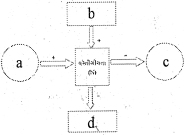
In the given diagram,identify $a, b, c,$ and $d$. Specifically,identify $b$ and $c$.
A
$b = \text{Emigration}, c = \text{Natality}$
B
$b = \text{Immigration}, c = \text{Mortality}$
C
$b = \text{Natality}, c = \text{Mortality}$
D
$b = \text{Emigration}, c = \text{Immigration}$
Solution
(B) In the population density model,the four factors affecting population density are:
$1$. $a = \text{Natality (Birth rate)}$: Increases population density (+).
$2$. $b = \text{Immigration}$: Individuals moving into the habitat,increases population density (+).
$3$. $c = \text{Mortality (Death rate)}$: Decreases population density (-).
$4$. $d = \text{Emigration}$: Individuals moving out of the habitat,decreases population density (-).
Therefore,$b$ represents Immigration and $c$ represents Mortality.
$1$. $a = \text{Natality (Birth rate)}$: Increases population density (+).
$2$. $b = \text{Immigration}$: Individuals moving into the habitat,increases population density (+).
$3$. $c = \text{Mortality (Death rate)}$: Decreases population density (-).
$4$. $d = \text{Emigration}$: Individuals moving out of the habitat,decreases population density (-).
Therefore,$b$ represents Immigration and $c$ represents Mortality.
0 likes
View Solution110
EasyMCQ
The impact of immigration on population density is
A
Positive
B
Negative
C
Both positive and negative
D
Neutralized by natality
Solution
(A) Immigration refers to the number of individuals of the same species that have come into the habitat from elsewhere during the time period under consideration.
Since these individuals add to the existing population,immigration increases the population density.
Therefore,the impact of immigration on population density is positive.
Since these individuals add to the existing population,immigration increases the population density.
Therefore,the impact of immigration on population density is positive.
0 likes
View Solution111
MediumMCQ
What is true about the isolated small tribal populations?
A
Wrestlers who develop strong body muscles in their lifetime pass this character on their progeny
B
There is no change in population size as they have a large gene pool
C
There is a decline in population as boys marry girls only from their own tribe
D
Hereditary diseases like colour blindness do not spread in the isolated population
Solution
(C) Change in population density provides insight into whether a population is increasing or declining.
Population density is influenced by natality,mortality,immigration,and emigration.
In an isolated small tribal population,if individuals marry only within their own tribe,it leads to a restricted gene pool.
Over time,this practice increases the frequency of homozygous recessive traits,including hereditary diseases.
Furthermore,such isolation often leads to a decline in population due to reduced genetic diversity and potential reproductive barriers,ultimately resulting in a decrease in the population size.
Population density is influenced by natality,mortality,immigration,and emigration.
In an isolated small tribal population,if individuals marry only within their own tribe,it leads to a restricted gene pool.
Over time,this practice increases the frequency of homozygous recessive traits,including hereditary diseases.
Furthermore,such isolation often leads to a decline in population due to reduced genetic diversity and potential reproductive barriers,ultimately resulting in a decrease in the population size.
0 likes
View Solution112
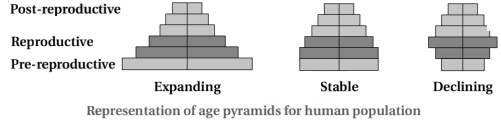
MediumMCQ
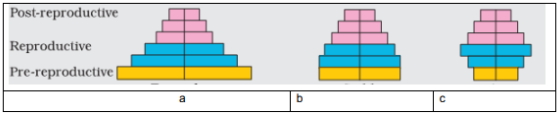
Select the correct option with respect to the given age pyramids.
A
$a$ - Expanding,$b$ - Stable,$c$ - Declining
B
$a$ - Stable,$b$ - Expanding,$c$ - Declining
C
$a$ - Stable,$b$ - Declining,$c$ - Expanding
D
$a$ - Declining,$b$ - Stable,$c$ - Expanding
Solution
(A) Age pyramids represent the distribution of various age groups in a population.
$1$. Pyramid $a$ has a wide base (large pre-reproductive population) and a narrow top,which indicates an expanding population.
$2$. Pyramid $b$ shows a relatively uniform distribution of pre-reproductive and reproductive age groups,indicating a stable population.
$3$. Pyramid $c$ has a narrow base (small pre-reproductive population) and a wider top,which indicates a declining population.
$1$. Pyramid $a$ has a wide base (large pre-reproductive population) and a narrow top,which indicates an expanding population.
$2$. Pyramid $b$ shows a relatively uniform distribution of pre-reproductive and reproductive age groups,indicating a stable population.
$3$. Pyramid $c$ has a narrow base (small pre-reproductive population) and a wider top,which indicates a declining population.
0 likes
View Solution113
MediumMCQ
The number of organisms in a population is added by:
A
Immigration
B
Birth
C
Emigration
D
Both $(A)$ and $(B)$
Solution
(D) Population density changes due to four basic processes:
$1$. Natality (Births): The number of births during a given period in the population that are added to initial density.
$2$. Immigration: The number of individuals of the same species that have come into the habitat from elsewhere during the time period under consideration.
$3$. Mortality (Deaths): The number of deaths in the population during a given period.
$4$. Emigration: The number of individuals of the population who left the habitat and gone elsewhere during the time period under consideration.
Therefore,both Births and Immigration contribute to an increase in the population size.
$1$. Natality (Births): The number of births during a given period in the population that are added to initial density.
$2$. Immigration: The number of individuals of the same species that have come into the habitat from elsewhere during the time period under consideration.
$3$. Mortality (Deaths): The number of deaths in the population during a given period.
$4$. Emigration: The number of individuals of the population who left the habitat and gone elsewhere during the time period under consideration.
Therefore,both Births and Immigration contribute to an increase in the population size.
0 likes
View Solution114
EasyMCQ
Scientific study of human population is called
A
Dramography
B
Dandrography
C
Demography
D
None of these
Solution
(C) Population is defined as the total number of individuals of a species present in a particular area at a given time.
Each species has many populations living in different regions.
The scientific study of human population is called $Demography$.
Each species has many populations living in different regions.
The scientific study of human population is called $Demography$.
0 likes
View Solution115
MediumMCQ
$A$ population is said to achieve demographic transition, if
A
Birth rate equals death rate
B
Emigration equals immigration
C
Doubling time is $33 \; \text{years}$
D
Both $(a)$ and $(b)$
Solution
(D) Demographic transition refers to the transition from high birth and death rates to lower birth and death rates as a country or region develops from a pre-industrial to an industrialized economic system.
In the context of population ecology and demographics, a population is said to achieve demographic transition when the birth rate equals the death rate, resulting in zero population growth.
Additionally, for the total population size to remain stable in a specific area, the number of individuals leaving (emigration) must equal the number of individuals entering (immigration).
Therefore, both conditions contribute to the stabilization of a population.
In the context of population ecology and demographics, a population is said to achieve demographic transition when the birth rate equals the death rate, resulting in zero population growth.
Additionally, for the total population size to remain stable in a specific area, the number of individuals leaving (emigration) must equal the number of individuals entering (immigration).
Therefore, both conditions contribute to the stabilization of a population.
0 likes
View Solution116
MediumMCQ
Population is the total number of
A
Interbreeding individuals of a species found in same geographical area
B
Interbreeding individuals of a species found in particular place
C
Interbreeding individuals of a species found in different geographical area
D
All of the above
Solution
(A) population is defined as a group of individuals of the same species that live in a specific geographical area at a given time,have the potential to interbreed,and share or compete for similar resources.
0 likes
View Solution117
MediumMCQ
Ecological age groups of a population are:
$I.$ Pre-reproductive
$II.$ Reproductive
$III.$ Post-reproductive
$IV.$ Old-age group
$V.$ Adolescent age group
$VI.$ Infertile age group
Choose the correct option for the given statements.
$I.$ Pre-reproductive
$II.$ Reproductive
$III.$ Post-reproductive
$IV.$ Old-age group
$V.$ Adolescent age group
$VI.$ Infertile age group
Choose the correct option for the given statements.
A
$I, II$ and $III$
B
$III, IV$ and $V$
C
$IV, V$ and $VI$
D
$I, V$ and $VI$
Solution
(A) population is characterized by three distinct ecological age groups based on their reproductive status:
$(i)$ Pre-reproductive: Individuals who have not yet reached sexual maturity.
$(ii)$ Reproductive: Individuals who are capable of reproduction.
$(iii)$ Post-reproductive: Individuals who have passed their reproductive phase.
This classification of population age structure was proposed by Bodenheimer in $1958$.
$(i)$ Pre-reproductive: Individuals who have not yet reached sexual maturity.
$(ii)$ Reproductive: Individuals who are capable of reproduction.
$(iii)$ Post-reproductive: Individuals who have passed their reproductive phase.
This classification of population age structure was proposed by Bodenheimer in $1958$.
0 likes
View Solution118
MediumMCQ
If natality rate is parallel to mortality rate,then the population:
A
Slowly increases
B
Remains stationary
C
Shows $J$-shaped curve
D
Slowly decreases
Solution
(B) Natality refers to the birth rate,while mortality refers to the death rate.
When the natality rate is equal to the mortality rate,the number of individuals added to the population is exactly balanced by the number of individuals lost.
Therefore,the net change in the population size is zero,and the population remains stationary.
When the natality rate is equal to the mortality rate,the number of individuals added to the population is exactly balanced by the number of individuals lost.
Therefore,the net change in the population size is zero,and the population remains stationary.
0 likes
View Solution119
MediumMCQ
The physiological capacity to produce offspring is called
A
Birth rate
B
Biotic potential
C
Crude natality
D
Mortality
Solution
(B) The physiological capacity of an organism to produce offspring under ideal,unlimited environmental conditions is known as $Biotic$ $potential$ or reproductive potential.
It represents the maximum reproductive rate of a population when resources are abundant and environmental resistance is minimal.
It is a characteristic feature of a population's age structure and its inherent biological ability to increase in number.
It represents the maximum reproductive rate of a population when resources are abundant and environmental resistance is minimal.
It is a characteristic feature of a population's age structure and its inherent biological ability to increase in number.
0 likes
View Solution120
EasyMCQ
Find out the population density when $N$ is $1000$ and $S$ is $100 \, m^{2}$.
A
$10$
B
$1000$
C
$1$
D
$100$
Solution
(A) Population density is defined as the number of individuals per unit area.
The formula is: $\text{Population density} = \frac{N}{S}$
Given:
$N = 1000$ (Total number of individuals)
$S = 100 \, m^{2}$ (Total area)
Calculation:
$\text{Population density} = \frac{1000}{100} = 10 \, \text{individuals per } m^{2}$.
Therefore, the population density is $10$.
The formula is: $\text{Population density} = \frac{N}{S}$
Given:
$N = 1000$ (Total number of individuals)
$S = 100 \, m^{2}$ (Total area)
Calculation:
$\text{Population density} = \frac{1000}{100} = 10 \, \text{individuals per } m^{2}$.
Therefore, the population density is $10$.
0 likes
View Solution121
EasyMCQ
Population density of terrestrial organisms is measured in terms of individuals per
A
$m^{3}$
B
$m^{4}$
C
$m$
D
$m^{2}$
Solution
(D) Population density is defined as the number of individuals of a species per unit area or volume.
For terrestrial organisms,the habitat is measured in two dimensions,which is represented as square meters $(m^{2})$.
For aquatic organisms,the habitat is measured in three dimensions,which is represented as cubic meters $(m^{3})$.
Therefore,the population density of terrestrial organisms is measured in individuals per $m^{2}$.
For terrestrial organisms,the habitat is measured in two dimensions,which is represented as square meters $(m^{2})$.
For aquatic organisms,the habitat is measured in three dimensions,which is represented as cubic meters $(m^{3})$.
Therefore,the population density of terrestrial organisms is measured in individuals per $m^{2}$.
0 likes
View Solution122
EasyMCQ
Ratio between natality and mortality is called:
A
Population ratio
B
Vital index
C
Density coefficient
D
Census ratio
Solution
(B) The Vital index is defined as the ratio of natality (birth rate) to mortality (death rate) multiplied by $100$.
It is used to determine the growth potential of a population.
The formula is:
Vital index $= \frac{\text{Natality}}{\text{Mortality}} \times 100$
Therefore,the correct option is $B$.
It is used to determine the growth potential of a population.
The formula is:
Vital index $= \frac{\text{Natality}}{\text{Mortality}} \times 100$
Therefore,the correct option is $B$.
0 likes
View Solution123
MediumMCQ
If in a pond there are $20$ lotus plants of last year and through reproduction $8$ new plants are added. Then the birth rate is
A
$0.8$ offspring per lotus per year
B
$0.2$ offspring per lotus per year
C
$0.4$ offspring per lotus per year
D
$0.6$ offspring per lotus per year
Solution
(C) The birth rate is calculated as the number of new offspring produced per unit of the existing population per unit of time.
Initial number of lotus plants $= 20$
Number of new plants added (offspring) $= 8$
Birth rate $= \frac{\text{Number of new offspring}}{\text{Initial population}} = \frac{8}{20} = 0.4$ offspring per lotus per year.
Initial number of lotus plants $= 20$
Number of new plants added (offspring) $= 8$
Birth rate $= \frac{\text{Number of new offspring}}{\text{Initial population}} = \frac{8}{20} = 0.4$ offspring per lotus per year.
0 likes
View Solution124
MediumMCQ
Population size is more technically called
A
Population density
B
Demography
C
Population growth
D
Population dynamics
Solution
(A) Population size depends on several factors such as mortality,natality,etc. In nature,it can range from less than $10$ (e.g.,Siberian cranes at Bharatpur wetlands) to millions (e.g.,Chlamydomonas in a pond).
Population size,more technically called population density (designated as $N$),does not necessarily need to be measured in numbers only. Although the total number is the most appropriate measure,in some cases,it is difficult to determine.
For example:
In a forest area,suppose there are $200$ Parthenium plants but only a single banyan tree with a huge canopy.
The following inferences can be made:
$(i)$ The population density of the banyan is low.
$(ii)$ The population cover area of the banyan is high.
In this example,the percentage of cover or biomass is more meaningful than the absolute population size.
Population size,more technically called population density (designated as $N$),does not necessarily need to be measured in numbers only. Although the total number is the most appropriate measure,in some cases,it is difficult to determine.
For example:
In a forest area,suppose there are $200$ Parthenium plants but only a single banyan tree with a huge canopy.
The following inferences can be made:
$(i)$ The population density of the banyan is low.
$(ii)$ The population cover area of the banyan is high.
In this example,the percentage of cover or biomass is more meaningful than the absolute population size.
0 likes
View Solution125
MediumMCQ
The population of any species is:
A
$A$ static phenomenon
B
$A$ dynamic phenomenon
C
Neither $(a)$ nor $(b)$
D
Both $(a)$ and $(b)$
Solution
(B) The population of any species is not constant; it keeps on changing over time due to various factors such as natality (birth rate),mortality (death rate),immigration,and emigration. Because these factors cause the population size and density to fluctuate,it is considered a dynamic phenomenon rather than a static one.
0 likes
View Solution126
MediumMCQ
The permanent decrease in population number occurs due to:
A
Migration
B
Natality
C
Emigration
D
Mortality
Solution
(D) Mortality refers to the death rate,which is the number of deaths per thousand individuals in a population per unit of time.
It is a primary factor that leads to a permanent decrease in the total population size and population density.
While emigration also causes a decrease,mortality is the fundamental biological process of death that reduces the population number.
It is a primary factor that leads to a permanent decrease in the total population size and population density.
While emigration also causes a decrease,mortality is the fundamental biological process of death that reduces the population number.
0 likes
View Solution127
MediumMCQ
When there is a large number of post-reproductive or older individuals and a lesser number of pre-reproductive individuals,then that population is:
A
Growing
B
Declining
C
Stable
D
None of the above
Solution
(B) population with a large number of post-reproductive or older individuals and a lesser number of pre-reproductive individuals will show a negative growth rate or declining growth.
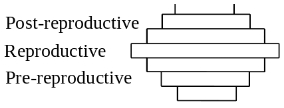
Age pyramid is a graphic representation of different age groups found in a population,with the pre-reproductive group at the base,reproductive ones in the middle,and the post-reproductive group at the top.
Age pyramids are of three kinds:
$(i)$ Triangular Age Pyramid: The number of pre-reproductive individuals is very large. The number of reproductive individuals is moderate and post-reproductive are fewer. The population size is growing.
$(ii)$ Bell-shaped Age Pyramid: The number of pre-reproductive and reproductive individuals is almost equal. Post-reproductive individuals are comparatively fewer. The population size is stable.
$(iii)$ Urn-shaped Age Pyramid: The proportion of the reproductive age group is higher than the individuals in the pre-reproductive age group. The number of post-reproductive individuals is also sizable. It is a declining population with negative growth.
Age pyramid is a graphic representation of different age groups found in a population,with the pre-reproductive group at the base,reproductive ones in the middle,and the post-reproductive group at the top.
Age pyramids are of three kinds:
$(i)$ Triangular Age Pyramid: The number of pre-reproductive individuals is very large. The number of reproductive individuals is moderate and post-reproductive are fewer. The population size is growing.
$(ii)$ Bell-shaped Age Pyramid: The number of pre-reproductive and reproductive individuals is almost equal. Post-reproductive individuals are comparatively fewer. The population size is stable.
$(iii)$ Urn-shaped Age Pyramid: The proportion of the reproductive age group is higher than the individuals in the pre-reproductive age group. The number of post-reproductive individuals is also sizable. It is a declining population with negative growth.
0 likes
View Solution128
MediumMCQ
The most important factor which determined the increase in human population in India during the $20^{\text{th}}$ century.
A
Natality
B
Mortality
C
Immigration
D
Emigration
Solution
(A) Population refers to a group or assemblage of organisms of the same species living in a particular area at a given time.
Population growth is determined by the number of individuals added to or removed from the population.
The addition of individuals occurs through natality (birth rate) or immigration (entry of individuals from outside).
The decline occurs through mortality (death rate) or emigration (exit of individuals to outside).
During the $20^{\text{th}}$ century,the human population of India increased primarily due to a high rate of natality compared to mortality.
Population growth is determined by the number of individuals added to or removed from the population.
The addition of individuals occurs through natality (birth rate) or immigration (entry of individuals from outside).
The decline occurs through mortality (death rate) or emigration (exit of individuals to outside).
During the $20^{\text{th}}$ century,the human population of India increased primarily due to a high rate of natality compared to mortality.
0 likes
View Solution129
MediumMCQ
Periodic departure and return of an individual in a population is known as
A
Immigration
B
Migration
C
Emigration
D
Mutation
Solution
(B) Migration is the periodic or temporary movement of individuals from one region to another and their subsequent return to the original habitat,often triggered by unfavorable environmental conditions.
For example,the migration of birds from Siberia and other extremely cold Northern regions to warmer areas during winter.
In contrast,immigration (movement into a population) and emigration (movement out of a population) are typically considered permanent changes in the population density of a specific area.
For example,the migration of birds from Siberia and other extremely cold Northern regions to warmer areas during winter.
In contrast,immigration (movement into a population) and emigration (movement out of a population) are typically considered permanent changes in the population density of a specific area.
0 likes
View Solution130
MediumMCQ
Sex ratio is the
A
Ratio of females to males
B
Ratio of males to females
C
Both $(a)$ and $(b)$
D
Ratio of infant girl to infant boy
Solution
(B) Sex ratio is defined as the ratio of males to females in a population.
Types of Sex Ratio:
In most species,the sex ratio varies according to the age profile of the population.
It is generally divided into four sub-divisions:
$(i)$ Primary sex ratio: Ratio at fertilization.
$(ii)$ Secondary sex ratio: Ratio at birth.
$(iii)$ Tertiary sex ratio: Ratio of sexually active organisms. It is also called adult sex ratio and abbreviated as $ASR$. $ASR$ is defined as the proportion of adults in a population that are male.
$(iv)$ Quaternary sex ratio: Ratio in post-reproductive organisms.
Types of Sex Ratio:
In most species,the sex ratio varies according to the age profile of the population.
It is generally divided into four sub-divisions:
$(i)$ Primary sex ratio: Ratio at fertilization.
$(ii)$ Secondary sex ratio: Ratio at birth.
$(iii)$ Tertiary sex ratio: Ratio of sexually active organisms. It is also called adult sex ratio and abbreviated as $ASR$. $ASR$ is defined as the proportion of adults in a population that are male.
$(iv)$ Quaternary sex ratio: Ratio in post-reproductive organisms.
0 likes
View Solution131
MediumMCQ
The type of population,where pre-reproductive animals occur in large numbers,is
A
Declining
B
Fluctuating
C
Stable
D
Growing
Solution
(D) In a population,the age structure is represented by the proportion of individuals in different age groups: pre-reproductive,reproductive,and post-reproductive.
When the number of pre-reproductive individuals is very large compared to the reproductive and post-reproductive groups,the population is considered to be expanding or growing.
This is represented by a triangular age pyramid.
When the number of pre-reproductive individuals is very large compared to the reproductive and post-reproductive groups,the population is considered to be expanding or growing.
This is represented by a triangular age pyramid.
0 likes
View Solution132
MediumMCQ
Maximum survival and reproductive capacity shown by a population under optimal environmental conditions is called
A
Carrying capacity
B
Natality
C
Biotic potential
D
Vitality
Solution
(C) Chapman $(1928)$ proposed the term 'biotic potential' to define the maximum reproductive power of an organism.
It is defined as the inherent ability of a population to survive and increase in number under optimal environmental conditions,where resources are unlimited and environmental resistance is absent.
It is defined as the inherent ability of a population to survive and increase in number under optimal environmental conditions,where resources are unlimited and environmental resistance is absent.
0 likes
View Solution133
MediumMCQ
Certain characteristic demographic features of developing countries are:
A
High fertility,low or rapidly falling mortality rate,rapid population growth and a very young age distribution
B
High fertility,high density,rapidly rising mortality rate and a very young age distribution
C
High fertility,high density,rapidly rising mortality rate and a very old age distribution
D
High mortality,high density,uneven population growth and a very old age distribution
Solution
(A) Developing countries are characterized by an expanding population pyramid.
This indicates a population with a large proportion of individuals in the pre-reproductive phase,which corresponds to a very young age distribution.
These countries typically exhibit high fertility rates and,due to improvements in healthcare,a low or rapidly falling mortality rate.
Consequently,these factors lead to rapid population growth.
This indicates a population with a large proportion of individuals in the pre-reproductive phase,which corresponds to a very young age distribution.
These countries typically exhibit high fertility rates and,due to improvements in healthcare,a low or rapidly falling mortality rate.
Consequently,these factors lead to rapid population growth.
0 likes
View Solution134
MediumMCQ
Under a particular set of selection pressure,organisms evolve towards the most $A$ reproductive strategy. Some organisms breed only $B$ in lifetime while others breed $C$ in lifetime. Choose the correct option for $A, B$ and $C$.
A
$A-$efficient,$B-$once,$C-$many
B
$A-$efficient,$B-$many,$C-$once
C
$A-$deficient,$B-$many,$C-$once
D
$A-$deficient,$B-$once,$C-$many
Solution
(A) Organisms evolve towards the most $A-$efficient reproductive strategy to maximize their fitness.
Some organisms,such as Pacific salmon fish and bamboo,breed only $B-$once in their lifetime.
Others,such as most birds and mammals,breed $C-$many times in their lifetime.
Therefore,the correct sequence is $A-$efficient,$B-$once,$C-$many.
Some organisms,such as Pacific salmon fish and bamboo,breed only $B-$once in their lifetime.
Others,such as most birds and mammals,breed $C-$many times in their lifetime.
Therefore,the correct sequence is $A-$efficient,$B-$once,$C-$many.
0 likes
View Solution135
MediumMCQ
Choose the wrong statement.
A
Natality and immigration increase the population density.
B
Mortality and emigration decrease the population density.
C
Adverse conditions do not affect the population density.
D
Food availability and predation pressure affect population density.
Solution
(C) The population density of an area is determined by four basic processes: natality $(B)$,mortality $(D)$,immigration $(I)$,and emigration $(E)$.
Population density $(N)$ at time $t+1$ is given by $N_{t+1} = N_t + [(B + I) - (D + E)]$.
Natality and immigration increase population density,while mortality and emigration decrease it.
Adverse conditions (such as lack of food or extreme weather) significantly affect population density by increasing mortality and decreasing natality,and by influencing migration patterns. Therefore,the statement that adverse conditions do not affect population density is incorrect.
Population density $(N)$ at time $t+1$ is given by $N_{t+1} = N_t + [(B + I) - (D + E)]$.
Natality and immigration increase population density,while mortality and emigration decrease it.
Adverse conditions (such as lack of food or extreme weather) significantly affect population density by increasing mortality and decreasing natality,and by influencing migration patterns. Therefore,the statement that adverse conditions do not affect population density is incorrect.
0 likes
View Solution136
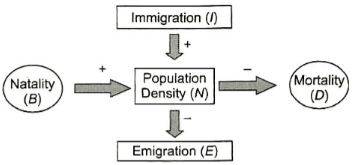
MediumMCQ
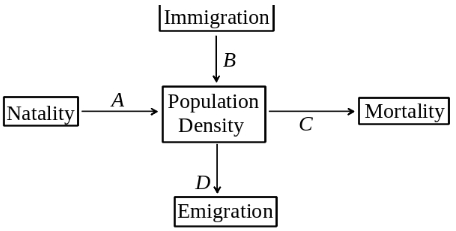
Study the figure and identify $A, B, C,$ and $D$ in relation to their effect on population density.
A
$A-$Increase,$B-$Decrease,$C-$Increase,$D-$Decrease
B
$A-$Decrease,$B-$Increase,$C-$Decrease,$D-$Increase
C
$A-$Increase,$B-$Increase,$C-$Decrease,$D-$Decrease
D
$A-$Decrease,$B-$Decrease,$C-$Increase,$D-$Increase
Solution
(C) The figure illustrates the factors affecting population density $(N)$:
$1.$ Natality $(A)$ refers to the number of births during a given period,which adds to the population density. Thus,$A$ represents an increase.
$2.$ Immigration $(B)$ refers to the number of individuals of the same species that have come into the habitat from elsewhere during the time period under consideration,which adds to the population density. Thus,$B$ represents an increase.
$3.$ Mortality $(C)$ refers to the number of deaths in the population during a given period,which reduces the population density. Thus,$C$ represents a decrease.
$4.$ Emigration $(D)$ refers to the number of individuals of the population who left the habitat and gone elsewhere during the time period under consideration,which reduces the population density. Thus,$D$ represents a decrease.
Therefore,the correct sequence is $A-$Increase,$B-$Increase,$C-$Decrease,$D-$Decrease. The correct option is $(c)$.
$1.$ Natality $(A)$ refers to the number of births during a given period,which adds to the population density. Thus,$A$ represents an increase.
$2.$ Immigration $(B)$ refers to the number of individuals of the same species that have come into the habitat from elsewhere during the time period under consideration,which adds to the population density. Thus,$B$ represents an increase.
$3.$ Mortality $(C)$ refers to the number of deaths in the population during a given period,which reduces the population density. Thus,$C$ represents a decrease.
$4.$ Emigration $(D)$ refers to the number of individuals of the population who left the habitat and gone elsewhere during the time period under consideration,which reduces the population density. Thus,$D$ represents a decrease.
Therefore,the correct sequence is $A-$Increase,$B-$Increase,$C-$Decrease,$D-$Decrease. The correct option is $(c)$.
0 likes
View Solution137
MediumMCQ
Bell-shaped age pyramid indicates that
A
Number of pre-reproductive and reproductive individuals is almost equal
B
Post-reproductive individuals are comparatively fewer
C
The population size remains stable
D
All of the above
Solution
(D) The correct answer is $D$. All of the above.
$A$ bell-shaped age pyramid indicates a moderate proportion of young to old individuals.
As the rate of growth becomes slow and stable,the pre-reproductive and reproductive age groups become more or less equal in size,while the post-reproductive group remains the smallest.
In a stable population,the intrinsic rate of natural increase $(r)$ is zero.
$A$ bell-shaped curve is only possible when $r = 0$,which means the population growth is zero.
An age pyramid is a graphic representation of different age groups found in a population,with the pre-reproductive group at the base,reproductive individuals in the middle,and the post-reproductive group at the top.
There are three main types of age pyramids:
$(i)$ Triangular Age Pyramid: The number of pre-reproductive individuals is very large. The number of reproductive individuals is moderate,and post-reproductive individuals are fewer. The population size is growing.
$(ii)$ Bell-shaped Age Pyramid: The number of pre-reproductive and reproductive individuals is almost equal. Post-reproductive individuals are comparatively fewer. The population size is stable.
$(iii)$ Urn-shaped Age Pyramid: The proportion of the reproductive age group is higher than the individuals in the pre-reproductive age group. The number of post-reproductive individuals is also sizable. This represents a declining population with negative growth.
$A$ bell-shaped age pyramid indicates a moderate proportion of young to old individuals.
As the rate of growth becomes slow and stable,the pre-reproductive and reproductive age groups become more or less equal in size,while the post-reproductive group remains the smallest.
In a stable population,the intrinsic rate of natural increase $(r)$ is zero.
$A$ bell-shaped curve is only possible when $r = 0$,which means the population growth is zero.
An age pyramid is a graphic representation of different age groups found in a population,with the pre-reproductive group at the base,reproductive individuals in the middle,and the post-reproductive group at the top.
There are three main types of age pyramids:
$(i)$ Triangular Age Pyramid: The number of pre-reproductive individuals is very large. The number of reproductive individuals is moderate,and post-reproductive individuals are fewer. The population size is growing.
$(ii)$ Bell-shaped Age Pyramid: The number of pre-reproductive and reproductive individuals is almost equal. Post-reproductive individuals are comparatively fewer. The population size is stable.
$(iii)$ Urn-shaped Age Pyramid: The proportion of the reproductive age group is higher than the individuals in the pre-reproductive age group. The number of post-reproductive individuals is also sizable. This represents a declining population with negative growth.
0 likes
View Solution138
MediumMCQ
If birth rate is $100,$ death rate is $10,$ and the number of individuals in the population group is $1000,$ then what will be the percentage of natural growth rate (in $, \%$)?
A
$0.09$
B
$9.0$
C
$0.9$
D
$90$
Solution
(B) The increase in the number of individuals in a particular time period is termed as 'birth rate' or 'natality',while the individuals dying over a time period is known as 'mortality' or 'death rate'.
Birth rate $= 100$
Death rate $= 10$
Number of individuals in a population $= 1000$
Natural growth rate $= 100 - 10 = 90$
Percentage of growth rate $= \frac{90}{1000} \times 100 = 9\, \%$
Birth rate $= 100$
Death rate $= 10$
Number of individuals in a population $= 1000$
Natural growth rate $= 100 - 10 = 90$
Percentage of growth rate $= \frac{90}{1000} \times 100 = 9\, \%$
0 likes
View Solution139
MediumMCQ
If natality is represented by $B$,mortality by $D$,immigration by $I$,emigration by $E$,and population density by $N$,then the population density at time $t+1$ is represented by:
A
$N_{t+1} = N_t - [(B+I) - (D+E)]$
B
$N_{t+1} = N_t + [(B+I) - (D+E)]$
C
$N_{t+1} = N_t + [(B+I) + (D+E)]$
D
$N_{t+1} = N_t - [(B+I) + (D+E)]$
Solution
(B) The population density at time $t+1$ is calculated by adding the individuals added to the population (natality $B$ and immigration $I$) and subtracting the individuals removed from the population (mortality $D$ and emigration $E$) from the initial population density $N_t$.
The formula is given by: $N_{t+1} = N_t + [(B+I) - (D+E)]$.
Here,$(B+I)$ represents the total additions to the population,and $(D+E)$ represents the total losses from the population.
The formula is given by: $N_{t+1} = N_t + [(B+I) - (D+E)]$.
Here,$(B+I)$ represents the total additions to the population,and $(D+E)$ represents the total losses from the population.
0 likes
View Solution140
MediumMCQ
$A$ population is:
A
$A$ group of organisms of one species occupying a defined area
B
$A$ group of organisms of different species occupying a defined area
C
$A$ group of organisms of different species occupying different geographical areas
D
$A$ group of sexually isolated organisms occupying a defined area
Solution
(A) population is defined as a group of individuals of the same species that live in a specific geographical area at a given time and have the potential to interbreed.
0 likes
View Solution141
MediumMCQ
Members of a population:
A
Can interbreed and produce fertile offspring
B
Share a common gene pool
C
Share or compete for similar resources
D
More than one option is correct
Solution
(D) population is defined as a group of individuals of the same species living in a specific geographical area at a specific time.
$1$. Members of a population can interbreed and produce fertile offspring,which is a fundamental characteristic of a species.
$2$. They share a common gene pool,meaning they can exchange genetic material through reproduction.
$3$. Because they live in the same area and have similar requirements,they share or compete for similar resources.
Therefore,all the given statements are correct.
$1$. Members of a population can interbreed and produce fertile offspring,which is a fundamental characteristic of a species.
$2$. They share a common gene pool,meaning they can exchange genetic material through reproduction.
$3$. Because they live in the same area and have similar requirements,they share or compete for similar resources.
Therefore,all the given statements are correct.
0 likes
View Solution142
MediumMCQ
Find the odd one out with respect to population attributes.
A
Natality
B
Death rate
C
Age pyramid
D
Births
Solution
(C) In population ecology,population attributes include birth rate (natality),death rate (mortality),sex ratio,and age distribution.
$A$,$B$,and $D$ (Natality,Death rate,and Births) are specific demographic rates that directly influence population density.
$C$ (Age pyramid) is a graphical representation of the age distribution of a population,which is a structural attribute rather than a rate of change.
Therefore,the age pyramid is the odd one out.
$A$,$B$,and $D$ (Natality,Death rate,and Births) are specific demographic rates that directly influence population density.
$C$ (Age pyramid) is a graphical representation of the age distribution of a population,which is a structural attribute rather than a rate of change.
Therefore,the age pyramid is the odd one out.
0 likes
View Solution143
MediumMCQ
Which of the following contributes to an increase in population density?
A
Mortality
B
Emigration
C
Natality
D
Predation
Solution
(C) Population density is influenced by four basic processes: Natality $(B)$,Mortality $(D)$,Immigration $(I)$,and Emigration $(E)$.
Natality refers to the number of births during a given period in the population that are added to the initial density.
Therefore,Natality contributes to an increase in population density,whereas Mortality and Emigration contribute to a decrease.
Natality refers to the number of births during a given period in the population that are added to the initial density.
Therefore,Natality contributes to an increase in population density,whereas Mortality and Emigration contribute to a decrease.
0 likes
View Solution144
MediumMCQ
$A$ group of individuals living in a particular geographical area at a particular time is called:
A
Local population
B
Deme
C
Community
D
Both $(A)$ & $(B)$
Solution
(D) group of individuals of the same species living in a particular geographical area at a particular time is referred to as a local population or a deme.
These terms are often used interchangeably in ecology to describe a sub-group of a species that occupies a specific habitat and potentially interbreeds.
These terms are often used interchangeably in ecology to describe a sub-group of a species that occupies a specific habitat and potentially interbreeds.
0 likes
View Solution145
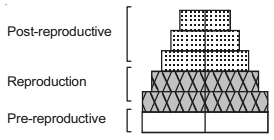
MediumMCQ
Which of the following types of age pyramids reflects a stable population growth?
A
Triangular
B
Bell-shaped
C
Urn-shaped
D
Both bell-shaped and urn-shaped
Solution
(B) Age pyramids represent the distribution of various age groups in a population.
$1$. $A$ triangular-shaped pyramid indicates an expanding population,where the pre-reproductive age group is the largest.
$2$. $A$ bell-shaped pyramid indicates a stable population,where the pre-reproductive and reproductive age groups are approximately equal in size.
$3$. An urn-shaped pyramid indicates a declining population,where the pre-reproductive age group is smaller than the reproductive age group.
Therefore,the bell-shaped pyramid reflects a stable population growth.
$1$. $A$ triangular-shaped pyramid indicates an expanding population,where the pre-reproductive age group is the largest.
$2$. $A$ bell-shaped pyramid indicates a stable population,where the pre-reproductive and reproductive age groups are approximately equal in size.
$3$. An urn-shaped pyramid indicates a declining population,where the pre-reproductive age group is smaller than the reproductive age group.
Therefore,the bell-shaped pyramid reflects a stable population growth.
0 likes
View Solution146
MediumMCQ
Read the following statements and select the correct option with respect to population attributes:
$(a)$ Population density is necessarily measured in numbers.
$(b)$ Tiger census is often based on pug marks and fecal pellets.
$(c)$ Biomass is not a meaningful measure to know population size.
$(d)$ Size of a population for any species is not a static parameter.
$(a)$ Population density is necessarily measured in numbers.
$(b)$ Tiger census is often based on pug marks and fecal pellets.
$(c)$ Biomass is not a meaningful measure to know population size.
$(d)$ Size of a population for any species is not a static parameter.
A
$a$ & $b$
B
$a$ & $d$
C
$c$ & $d$
D
$b$ & $d$
Solution
(D) Statement $(a)$ is incorrect because population density can be measured in terms of biomass or percent cover,not just numbers.
Statement $(b)$ is correct; in many cases,direct counting is difficult,so indirect methods like pug marks and fecal pellets are used for tiger census.
Statement $(c)$ is incorrect because biomass is a very meaningful measure,especially when the population size is huge and counting individuals is time-consuming.
Statement $(d)$ is correct because population size fluctuates due to changes in weather,food availability,predation pressure,and competition.
Therefore,statements $(b)$ and $(d)$ are correct.
Statement $(b)$ is correct; in many cases,direct counting is difficult,so indirect methods like pug marks and fecal pellets are used for tiger census.
Statement $(c)$ is incorrect because biomass is a very meaningful measure,especially when the population size is huge and counting individuals is time-consuming.
Statement $(d)$ is correct because population size fluctuates due to changes in weather,food availability,predation pressure,and competition.
Therefore,statements $(b)$ and $(d)$ are correct.
0 likes
View Solution147
MediumMCQ
Select the incorrect statement regarding different population attributes.
A
Natural selection operates at the population level.
B
The size of the population provides significant information about its status in the habitat.
C
In age pyramids,the age distribution of males and females is shown in separate diagrams.
D
$A$ population is a group of individuals multiplying by sexual and asexual reproduction.
Solution
(C) The incorrect statement is that age pyramids show the age distribution of males and females in separate diagrams. In reality,age pyramids represent the age distribution of males and females within the same diagram,typically with males on one side and females on the other.
0 likes
View Solution148
Medium
Explain the characteristics of a population.
Solution
(N/A) Populations: Individuals of any species living in groups in a well-defined geographical area,sharing or competing for similar resources,and potentially interbreeding,constitute a population.
Population Attributes: $A$ population has certain attributes that an individual organism does not. For example,an individual may have births and deaths,but a population has birth rates and death rates. The birth and death rates are referred to as per capita births or deaths,respectively,which represent the increase or decrease in the number of individuals with respect to the members of the population.
Sex ratio is another attribute of a population. An individual may be male or female,but a population has a sex ratio.
$A$ population at any given time is composed of individuals of different ages. If the age distribution is plotted for the population,the resulting structure is called an age pyramid. The shape of the pyramid reflects the growth status of the population,which may be:
$(i)$ Expanding
$(ii)$ Stable
$(iii)$ Declining
Population size or population density $(N)$ is often measured in terms of the number of individuals,but this may sometimes not be appropriate.
The tiger census in our national parks and tiger reserves is often based on pug marks and fecal pellets rather than direct counting.
Population Attributes: $A$ population has certain attributes that an individual organism does not. For example,an individual may have births and deaths,but a population has birth rates and death rates. The birth and death rates are referred to as per capita births or deaths,respectively,which represent the increase or decrease in the number of individuals with respect to the members of the population.
Sex ratio is another attribute of a population. An individual may be male or female,but a population has a sex ratio.
$A$ population at any given time is composed of individuals of different ages. If the age distribution is plotted for the population,the resulting structure is called an age pyramid. The shape of the pyramid reflects the growth status of the population,which may be:
$(i)$ Expanding
$(ii)$ Stable
$(iii)$ Declining
Population size or population density $(N)$ is often measured in terms of the number of individuals,but this may sometimes not be appropriate.
The tiger census in our national parks and tiger reserves is often based on pug marks and fecal pellets rather than direct counting.
0 likes
View Solution149
Easy
Differentiate between Natality rate and Mortality rate.
Solution
(N/A)
| Natality rate | Mortality rate |
|---|---|
| $(1)$ Number of births per $1,000$ individuals of a population per year. | $(1)$ Number of deaths per $1,000$ individuals of a population per year. |
| $(2)$ It increases the population size and population density. | $(2)$ It decreases the population size and population density. |
0 likes
View Solution150
Medium
Differentiate between Immigration and Emigration.
Solution
(N/A)
| Immigration | Emigration |
|---|---|
| $(1)$ Inward movement of individuals into a local population. | $(1)$ Outward movement of individuals from a local population. |
| $(2)$ Increases the population density and the size of the gene pool. | $(2)$ Decreases the population density and the size of the gene pool. |
| $(3)$ Often occurs in search of better living conditions or resources. | $(3)$ Often occurs to escape unfavourable conditions,such as scarcity of food,shelter,mates,or natural calamities like droughts and floods. |
0 likes
View SolutionOrganisms and Populations — Population Attributes · Frequently Asked Questions
1Are these Organisms and Populations questions useful for JEE and NEET?
Yes. All questions in this section are mapped to JEE Main and NEET exam patterns. Previous year questions from JEE Main, NEET, GUJCET and state-level exams are included with full solutions.
2Can I switch to Hindi or Gujarati for these questions?
Yes. Use the language tabs in the hero section or the sidebar to view the same questions and solutions in English, Hindi or Gujarati.
3How do I generate a question paper from this subtopic?
Use the Vedclass Exam Paper Generator — select the chapter and subtopic, set difficulty, and generate Sets A, B, C, D automatically. First 3 chapters of every subject are free.
Vedclass Products
For Students
Vedclass Test Series
Mock tests in real JEE/NEET style with performance analysis. 5-day free trial.
Start Free TrialFor Teachers
Exam Paper Generator
Generate Set A/B/C/D papers from this chapter in 2 minutes. 3 chapters free.
Try FreeFor Institutes
Online Exam Module
Live online exams with unlimited students, 360° analytics & white-label branding.
See DemoFor Teachers & Institutes
Generate a Organisms and Populations Exam Paper in 2 Minutes
Select subtopic & difficulty — Sets A, B, C, D auto-generated with No Repeat logic.
First 3 chapters of every subject are free — no payment required.