
A English
Pregnancy and Embryonic development Questions in English
Class 12 Biology · Human Reproduction · Pregnancy and Embryonic development
405+
Questions
English
Language
100%
With Solutions
Showing 50 of 405 questions in English
301
MediumMCQ
Which one of the following is known as the anti-abortion hormone?
A
Relaxin
B
Progesterone
C
Estrogen
D
Epinephrine
Solution
(B) $(i)$ Progesterone is a steroid hormone secreted by the corpus luteum.
$(ii)$ Progesterone is responsible for the maintenance of pregnancy by maintaining the endometrium wall,hence it is called the pregnancy hormone.
$(iii)$ Hyposecretion of progesterone results in abortion; therefore,it is also known as the anti-abortion hormone.
$(iv)$ During pregnancy,progesterone helps in the attachment of the embryo to the uterine wall,the development of the placenta,and the growth of secretory alveoli in the mammary glands.
$(ii)$ Progesterone is responsible for the maintenance of pregnancy by maintaining the endometrium wall,hence it is called the pregnancy hormone.
$(iii)$ Hyposecretion of progesterone results in abortion; therefore,it is also known as the anti-abortion hormone.
$(iv)$ During pregnancy,progesterone helps in the attachment of the embryo to the uterine wall,the development of the placenta,and the growth of secretory alveoli in the mammary glands.
0 likes
View Solution302
EasyMCQ
Which of the following hormones is not a secretory product of the human placenta?
A
Human chorionic gonadotrophin
B
Prolactin
C
Oestrogen
D
Progesterone
Solution
(B) Prolactin is secreted by the anterior pituitary gland,which stimulates mammary gland development during pregnancy and lactation after childbirth.
Placenta is a temporary endocrine organ that forms a connection between the uterine wall of the mother and the foetus.
It facilitates the exchange of materials between the mother and the foetus.
The placenta secretes hormones such as Human chorionic gonadotrophin $(hCG)$,Human placental lactogen $(hPL)$,oestrogen,and progesterone.
Placenta is a temporary endocrine organ that forms a connection between the uterine wall of the mother and the foetus.
It facilitates the exchange of materials between the mother and the foetus.
The placenta secretes hormones such as Human chorionic gonadotrophin $(hCG)$,Human placental lactogen $(hPL)$,oestrogen,and progesterone.
0 likes
View Solution303
MediumMCQ
In females,$LH$ stimulates . . . . . . in the ovary to secrete . . . . . . .
A
Graafian follicle,$ICSH$ respectively
B
Graafian follicle,prolactin respectively
C
Corpus luteum,$FSH$ respectively
D
Corpus luteum,progesterone respectively
Solution
(D) In females,$LH$ (Luteinizing Hormone) acts on the corpus luteum.
It stimulates the corpus luteum to secrete the hormone progesterone.
$FSH$ (Follicle Stimulating Hormone) is responsible for the development of the Graafian follicle.
It stimulates the corpus luteum to secrete the hormone progesterone.
$FSH$ (Follicle Stimulating Hormone) is responsible for the development of the Graafian follicle.
0 likes
View Solution304
MediumMCQ
Placental hormone called chorionic gonadotropin $(HCG)$,which stimulates the secretion of progesterone by the ovary during pregnancy,is:
A
Proteinaceous in nature
B
Steroid in nature
C
Biogenic amine
D
Both $(a)$ and $(b)$
Solution
(A) Human chorionic gonadotropin $(HCG)$ is a glycoprotein hormone produced by the placenta during pregnancy.
It acts on the corpus luteum in the ovary to stimulate the secretion of progesterone,which is essential for maintaining the pregnancy.
Chemically,$HCG$ is proteinaceous in nature,as it consists of protein subunits.
Other examples of proteinaceous hormones include human growth hormone,$TSH$,$FSH$,$LH$,and $PTH$.
Steroid hormones include testosterone and estrogen,while amine hormones include epinephrine and norepinephrine.
It acts on the corpus luteum in the ovary to stimulate the secretion of progesterone,which is essential for maintaining the pregnancy.
Chemically,$HCG$ is proteinaceous in nature,as it consists of protein subunits.
Other examples of proteinaceous hormones include human growth hormone,$TSH$,$FSH$,$LH$,and $PTH$.
Steroid hormones include testosterone and estrogen,while amine hormones include epinephrine and norepinephrine.
0 likes
View Solution305
MediumMCQ
$A$: Human chorionic gonadotrophin $(hCG)$ prevents the corpus luteum from involuting.
$R$: It has properties similar to luteinizing hormone $(LH)$.
$R$: It has properties similar to luteinizing hormone $(LH)$.
A
Assertion and Reason both are correct and Reason is the correct explanation of Assertion.
B
Assertion is correct,but Reason is incorrect.
C
Assertion is incorrect,but Reason is correct.
D
Both Assertion and Reason are incorrect.
Solution
(A) Human chorionic gonadotrophin $(hCG)$ is a hormone secreted by the placenta during pregnancy.
It acts as a luteotropic agent,meaning it maintains the corpus luteum in the ovary,preventing its involution (degeneration) and ensuring the continued production of progesterone.
This hormone is structurally and functionally similar to the luteinizing hormone $(LH)$ secreted by the anterior pituitary gland.
Therefore,both the Assertion and the Reason are correct,and the Reason is the correct explanation for the Assertion.
It acts as a luteotropic agent,meaning it maintains the corpus luteum in the ovary,preventing its involution (degeneration) and ensuring the continued production of progesterone.
This hormone is structurally and functionally similar to the luteinizing hormone $(LH)$ secreted by the anterior pituitary gland.
Therefore,both the Assertion and the Reason are correct,and the Reason is the correct explanation for the Assertion.
0 likes
View Solution306
EasyMCQ
The period of pregnancy is called:
A
Gestation period
B
Incubation period
C
Pre-patent period
D
Blastulation
Solution
(A) The period of pregnancy, which is the time from conception to birth, is known as the $Gestation \text{ period}$.
During this time, the fetus develops inside the mother's uterus.
$Incubation \text{ period}$ refers to the time between exposure to a pathogen and the appearance of symptoms.
$Pre-patent \text{ period}$ is the time between infection and the appearance of the parasite in the blood or feces.
$Blastulation$ is the process of formation of a blastula from a morula.
During this time, the fetus develops inside the mother's uterus.
$Incubation \text{ period}$ refers to the time between exposure to a pathogen and the appearance of symptoms.
$Pre-patent \text{ period}$ is the time between infection and the appearance of the parasite in the blood or feces.
$Blastulation$ is the process of formation of a blastula from a morula.
0 likes
View Solution307
MediumMCQ
During embryogenesis,the zygote undergoes:
A
Cell division (mitosis)
B
Cell division (meiosis)
C
Cell differentiation
D
$ (a) $ followed by $ (c) $
Solution
(D) After the formation of the zygote,it undergoes successive mitotic divisions known as cleavage to form a mass of cells.
Cleavage is essentially mitosis without a resting phase ($G_1$ or $G_2$ phases are absent or very short).
Since mitosis maintains the same genetic constitution,all resulting cells are genetically identical.
Cleavage is subsequently followed by cell differentiation processes,such as gastrulation,which eventually lead to the formation of different tissues and body parts.
Cleavage is essentially mitosis without a resting phase ($G_1$ or $G_2$ phases are absent or very short).
Since mitosis maintains the same genetic constitution,all resulting cells are genetically identical.
Cleavage is subsequently followed by cell differentiation processes,such as gastrulation,which eventually lead to the formation of different tissues and body parts.
0 likes
View Solution308
MediumMCQ
Chances of survival of young ones is greater in:
A
Fishes
B
Eutherian mammals
C
Birds
D
Amphibians
Solution
(B) The chances of survival of young ones are greater in $Eutherian$ mammals because they exhibit internal development of the embryo within the mother's uterus.
This provides a protected environment,constant nutrition,and stable conditions for the developing fetus.
Furthermore,$Eutherian$ mammals provide significant parental care after birth,which increases the probability of the offspring surviving to adulthood.
In contrast,fishes,amphibians,and most birds lay eggs in the external environment,where the offspring are exposed to predators and environmental fluctuations,leading to higher mortality rates.
This provides a protected environment,constant nutrition,and stable conditions for the developing fetus.
Furthermore,$Eutherian$ mammals provide significant parental care after birth,which increases the probability of the offspring surviving to adulthood.
In contrast,fishes,amphibians,and most birds lay eggs in the external environment,where the offspring are exposed to predators and environmental fluctuations,leading to higher mortality rates.
0 likes
View Solution309
EasyMCQ
Notochord,skeletal system and dermis of the skin are the derivatives of
A
Mesoderm
B
Endoderm
C
Ectoderm
D
All of these
Solution
(A) The notochord,skeletal system (bones and cartilage),and the dermis of the skin are derived from the mesoderm germ layer during embryonic development.
Other structures derived from the mesoderm include connective tissues,muscles,the circulatory system,and the excretory system.
Other structures derived from the mesoderm include connective tissues,muscles,the circulatory system,and the excretory system.
0 likes
View Solution310
EasyMCQ
The hormone that prepares and maintains the uterus during pregnancy is secreted by
A
Corpora cardiaca
B
Corpus luteum
C
Corpora albicans
D
Graafian follicle
Solution
(B) The hormone responsible for preparing and maintaining the uterus during pregnancy is progesterone.
This hormone is primarily secreted by the $Corpus \ luteum$,which is a temporary endocrine structure formed from the ruptured $Graafian \ follicle$ after ovulation.
This hormone is primarily secreted by the $Corpus \ luteum$,which is a temporary endocrine structure formed from the ruptured $Graafian \ follicle$ after ovulation.
0 likes
View Solution311
EasyMCQ
In humans,all three germ layers originate from:
A
Trophoblast cells
B
Inner cell mass
C
Both $(a)$ and $(b)$
D
They have special lineage
Solution
(B) During embryonic development,the blastocyst consists of an outer layer called the trophoblast and an inner group of cells called the inner cell mass $(ICM)$. The inner cell mass contains the pluripotent stem cells that differentiate into the three primary germ layers: ectoderm,mesoderm,and endoderm,which eventually give rise to all tissues and organs of the body.
0 likes
View Solution312
EasyMCQ
Relaxin (a hormone) is secreted by
A
Placenta
B
Ovary
C
Both $(a)$ and $(b)$
D
Posterior lobe of pituitary
Solution
(C) Relaxin is a hormone that is secreted by both the ovary (specifically the corpus luteum) and the placenta during pregnancy.
It plays a crucial role in childbirth by increasing the flexibility of the pubic symphysis and the ligaments of the sacroiliac and sacrococcygeal joints.
This action helps to dilate the uterine cervix,thereby facilitating the process of parturition (labour).
It plays a crucial role in childbirth by increasing the flexibility of the pubic symphysis and the ligaments of the sacroiliac and sacrococcygeal joints.
This action helps to dilate the uterine cervix,thereby facilitating the process of parturition (labour).
0 likes
View Solution313
MediumMCQ
During pregnancy,which one of the following is excreted?
A
$HCG$
B
$FSH$
C
$LH$
D
$Progesterone$
Solution
(A) The placenta produces the hormone Human Chorionic Gonadotropin $(HCG)$.
$HCG$ is secreted by the trophoblastic cells of the developing embryo.
This hormone has properties similar to the Luteinizing Hormone $(LH)$ of the pituitary gland.
$HCG$ maintains the corpus luteum in the ovary and stimulates it to secrete progesterone throughout the early stages of pregnancy.
Progesterone is essential for maintaining the endometrium of the uterus,which supports the developing fetus and prevents menstruation.
Because $HCG$ is produced only during pregnancy,its presence in the urine is used as a diagnostic marker for pregnancy tests.
$HCG$ is secreted by the trophoblastic cells of the developing embryo.
This hormone has properties similar to the Luteinizing Hormone $(LH)$ of the pituitary gland.
$HCG$ maintains the corpus luteum in the ovary and stimulates it to secrete progesterone throughout the early stages of pregnancy.
Progesterone is essential for maintaining the endometrium of the uterus,which supports the developing fetus and prevents menstruation.
Because $HCG$ is produced only during pregnancy,its presence in the urine is used as a diagnostic marker for pregnancy tests.
0 likes
View Solution314
EasyMCQ
Which of the following hormones are secreted by the placenta?
A
$HCG$ (Human Chorionic Gonadotrophin)
B
Human placental lactogen $(hPL)$
C
Oestrogen
D
All of the above
Solution
(D) The placenta acts as an endocrine tissue and produces several hormones essential for pregnancy. These include Human Chorionic Gonadotrophin $(HCG)$,Human placental lactogen $(hPL)$,oestrogens,and progestogens (progesterone). Additionally,in the later phase of pregnancy,the placenta also secretes relaxin. Therefore,all the listed options are correct.
0 likes
View Solution315
MediumMCQ
The extra-embryonic membranes of a mammalian embryo are derived from
A
Trophoblast
B
Follicle cells
C
Formative cells
D
Inner cell mass
Solution
(A) The $Trophoblast$ is an epithelium surrounding the mammalian blastocyst. It forms the outer layer of the chorion and becomes a significant part of the embryonic component of the extra-embryonic membranes.
0 likes
View Solution316
MediumMCQ
After one month of pregnancy,the embryo's $A$ is formed. By the end of the $B$ month of pregnancy,the foetus develops limbs and digits. By the end of $C$,most of the major organ systems are formed,for example,the limbs and external genital organs are well-developed. By the end of $D$,the body is covered with fine hair,eyelids separate,and eyelashes are formed. Here $A$ and $D$ refer to:
A
$A-$heart,$B-$second,$C-$first trimester,$D-$second trimester
B
$A-$heart,$B-$second,$C-$first month,$D-$second month
C
$A-$heart,$B-$second,$C-$first week,$D-$second week
D
$A-$heart,$B-$second,$C-$first trimester,$D-$second trimester (Note: The original question options were incomplete/incorrect; based on $NCERT$,$A$ is heart,$B$ is second month,$C$ is first trimester,$D$ is second trimester.)
Solution
(A) According to the $NCERT$ textbook on human reproduction:
$1$. After one month of pregnancy,the embryo's heart is formed.
$2$. By the end of the second month of pregnancy,the foetus develops limbs and digits.
$3$. By the end of the first trimester ($12$ weeks),most of the major organ systems are formed,for example,the limbs and external genital organs are well-developed.
$4$. By the end of the second trimester ($24$ weeks),the body is covered with fine hair,eyelids separate,and eyelashes are formed.
Therefore,$A$ refers to the heart and $D$ refers to the second trimester.
$1$. After one month of pregnancy,the embryo's heart is formed.
$2$. By the end of the second month of pregnancy,the foetus develops limbs and digits.
$3$. By the end of the first trimester ($12$ weeks),most of the major organ systems are formed,for example,the limbs and external genital organs are well-developed.
$4$. By the end of the second trimester ($24$ weeks),the body is covered with fine hair,eyelids separate,and eyelashes are formed.
Therefore,$A$ refers to the heart and $D$ refers to the second trimester.
0 likes
View Solution317
MediumMCQ
Identify $A$ to $D$ in the given figure.
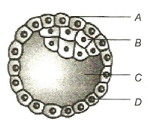
A
$A-$Breaking zona pellucida,$B-$Inner cell mass,$C-$Blastocoel,$D-$Trophoblast
B
$A-$Breaking zona pellucida,$B-$Inner cell mass,$C-$Trophoblast,$D-$Blastocoel
C
$A-$Breaking zona pellucida,$B-$Blastocoel,$C-$Inner cell mass,$D-$Trophoblast
D
$A-$Breaking zona pellucida,$B-$Trophoblast,$C-$Inner cell mass,$D-$Blastocoel
Solution
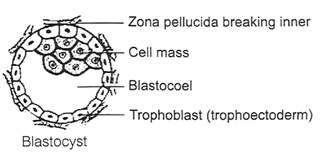
(A) In the process of development,the morula continues to divide and transforms into a blastocyst.
As the blastocyst forms,the cells arrange themselves into an outer layer called the trophoblast and an inner group of cells called the inner cell mass.
The blastocyst also contains a fluid-filled cavity known as the blastocoel.
During this stage,the zona pellucida begins to degenerate or break,allowing the blastocyst to implant in the uterine wall.
Based on the provided figure:
$A$ points to the breaking zona pellucida.
$B$ points to the inner cell mass.
$C$ points to the blastocoel (cavity).
$D$ points to the outer layer of cells,the trophoblast.
As the blastocyst forms,the cells arrange themselves into an outer layer called the trophoblast and an inner group of cells called the inner cell mass.
The blastocyst also contains a fluid-filled cavity known as the blastocoel.
During this stage,the zona pellucida begins to degenerate or break,allowing the blastocyst to implant in the uterine wall.
Based on the provided figure:
$A$ points to the breaking zona pellucida.
$B$ points to the inner cell mass.
$C$ points to the blastocoel (cavity).
$D$ points to the outer layer of cells,the trophoblast.
0 likes
View Solution318
EasyMCQ
Human placenta is derived from
A
Ectoderm
B
Trophoblast
C
Endoderm
D
Mesoderm
Solution
(B) The human placenta is derived from the $Trophoblast$ (also known as $Trophoectoderm$).
This is the outermost layer of cells of the $Blastocyst$.
It is responsible for forming the foetal component of the placenta.
It does not contribute to the formation of the embryo proper.
This is the outermost layer of cells of the $Blastocyst$.
It is responsible for forming the foetal component of the placenta.
It does not contribute to the formation of the embryo proper.
0 likes
View Solution319
EasyMCQ
Placenta acts as an
A
Endocrine gland
B
Exocrine gland
C
Apocrine gland
D
Merocrine gland
Solution
(A) The placenta acts as an endocrine gland because it produces several hormones essential for the maintenance of pregnancy.
These hormones include human chorionic gonadotropin $(HCG)$,human placental lactogen $(HPL)$,estrogens,and progesterone.
In the later phase of pregnancy,it also produces relaxin.
These hormones include human chorionic gonadotropin $(HCG)$,human placental lactogen $(HPL)$,estrogens,and progesterone.
In the later phase of pregnancy,it also produces relaxin.
0 likes
View Solution320
MediumMCQ
Which one of the following statements with regard to embryonic development in humans is correct?
A
Cleavage divisions bring about considerable increase in the mass of protoplasm
B
In the second cleavage division,one of the two blastomeres usually divides a little sooner than the second
C
With more cleavage divisions,the resultant blastomeres become larger and larger
D
Cleavage division results in a hollow ball of cells called morula
Solution
(B) During the embryonic development of humans,cleavage refers to a series of rapid mitotic cell divisions of the zygote.
In the second cleavage division,one of the two blastomeres usually divides a little sooner than the second.
Cleavage increases the number of cells (blastomeres) without increasing the total mass of the cytoplasm,as the size of the embryo remains constant during these early stages.
In the second cleavage division,one of the two blastomeres usually divides a little sooner than the second.
Cleavage increases the number of cells (blastomeres) without increasing the total mass of the cytoplasm,as the size of the embryo remains constant during these early stages.
0 likes
View Solution321
MediumMCQ
Identify $A, B, C$ and $D$ in the figure given below.
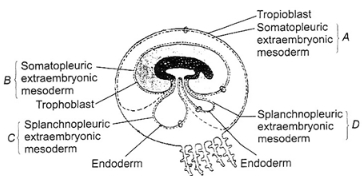
A
$A-$Yolk sac,$B-$Amnion,$C-$Allantois,$D-$Chorion
B
$A-$Chorion,$B-$Amnion,$C-$Yolk sac,$D-$Allantois
C
$A-$Chorion,$B-$Amnion,$C-$Allantois,$D-$Yolk sac
D
$A-$Chorion,$B-$Allantois,$C-$Amnion,$D-$Yolk sac
Solution
(B) The correct identification is $A-$Chorion,$B-$Amnion,$C-$Yolk sac,$D-$Allantois.
Extraembryonic or Foetal Membranes:
The growing embryo/foetus develops four membranes called the extraembryonic or foetal membranes. These include chorion,amnion,allantois,and yolk sac.
$(i)$ Chorion: It is made up of trophoblast outside and somatopleuric extraembryonic mesoderm inside. It completely surrounds the embryo and protects it. It also takes part in the formation of the placenta.
$(ii)$ Amnion: It is composed of trophoblast inside and somatopleuric extraembryonic mesoderm outside. The space between the embryo and the amnion is called the amniotic cavity,which is filled with a clear,watery fluid. The amniotic fluid prevents desiccation of the embryo and acts as a protective cushion that absorbs shocks.
$(iii)$ Yolk Sac: The primary yolk sac consists of endoderm inside and splanchnopleuric extraembryonic mesoderm outside. The yolk sac is non-functional in human beings except that it functions as the site of early blood cell formation.
$(iv)$ Allantois: The allantois is composed of endoderm inside and splanchnopleuric extraembryonic mesoderm outside. It is a sac-like structure that arises from the gut of the embryo. In humans,the allantois is small and non-functional except for furnishing blood vessels to the placenta.
Extraembryonic or Foetal Membranes:
The growing embryo/foetus develops four membranes called the extraembryonic or foetal membranes. These include chorion,amnion,allantois,and yolk sac.
$(i)$ Chorion: It is made up of trophoblast outside and somatopleuric extraembryonic mesoderm inside. It completely surrounds the embryo and protects it. It also takes part in the formation of the placenta.
$(ii)$ Amnion: It is composed of trophoblast inside and somatopleuric extraembryonic mesoderm outside. The space between the embryo and the amnion is called the amniotic cavity,which is filled with a clear,watery fluid. The amniotic fluid prevents desiccation of the embryo and acts as a protective cushion that absorbs shocks.
$(iii)$ Yolk Sac: The primary yolk sac consists of endoderm inside and splanchnopleuric extraembryonic mesoderm outside. The yolk sac is non-functional in human beings except that it functions as the site of early blood cell formation.
$(iv)$ Allantois: The allantois is composed of endoderm inside and splanchnopleuric extraembryonic mesoderm outside. It is a sac-like structure that arises from the gut of the embryo. In humans,the allantois is small and non-functional except for furnishing blood vessels to the placenta.
0 likes
View Solution322
EasyMCQ
Placenta acts as an endocrine tissue and produces several hormones like:
$A.$ Human chorionic gonadotropin $(hCG)$
$B.$ Human placental lactogen $(hPL)$
$C.$ Estrogens
$D.$ Progesterone
$A.$ Human chorionic gonadotropin $(hCG)$
$B.$ Human placental lactogen $(hPL)$
$C.$ Estrogens
$D.$ Progesterone
A
$A \; \& \; B$
B
$B \; \text{only}$
C
$A, B \; \& \; C$
D
$A, B, C \; \& \; D$
Solution
(D) The placenta acts as an endocrine tissue and produces several hormones essential for pregnancy.
These hormones include Human chorionic gonadotropin $(hCG)$,Human placental lactogen $(hPL)$,estrogens,and progesterone.
$hCG$ is responsible for maintaining the corpus luteum,while $hPL$ is involved in maternal metabolism.
Estrogens and progesterone are crucial for maintaining the uterine lining and supporting fetal development.
Therefore,all the listed hormones ($A, B, C,$ and $D$) are produced by the placenta.
These hormones include Human chorionic gonadotropin $(hCG)$,Human placental lactogen $(hPL)$,estrogens,and progesterone.
$hCG$ is responsible for maintaining the corpus luteum,while $hPL$ is involved in maternal metabolism.
Estrogens and progesterone are crucial for maintaining the uterine lining and supporting fetal development.
Therefore,all the listed hormones ($A, B, C,$ and $D$) are produced by the placenta.
0 likes
View Solution323
MediumMCQ
Which of the following groups of hormones are produced in women only during pregnancy?
A
$hCG, hPL$,relaxin
B
Estrogen,progesterone,$hCG$
C
Cortisol,prolactin,thyroxine
D
Prolactin,progesterone,$hCG$
Solution
(A) During pregnancy,the placenta acts as an endocrine tissue and produces several hormones that are exclusive to the pregnant state.
$hCG$ (Human Chorionic Gonadotropin) maintains the corpus luteum to ensure the continued secretion of progesterone.
$hPL$ (Human Placental Lactogen) is involved in the growth of the mammary glands and metabolic changes in the mother.
Relaxin is also secreted during the later stages of pregnancy to facilitate parturition by softening the pubic symphysis.
Therefore,the group consisting of $hCG, hPL$,and relaxin is produced only during pregnancy.
$hCG$ (Human Chorionic Gonadotropin) maintains the corpus luteum to ensure the continued secretion of progesterone.
$hPL$ (Human Placental Lactogen) is involved in the growth of the mammary glands and metabolic changes in the mother.
Relaxin is also secreted during the later stages of pregnancy to facilitate parturition by softening the pubic symphysis.
Therefore,the group consisting of $hCG, hPL$,and relaxin is produced only during pregnancy.
0 likes
View Solution324
MediumMCQ
Immediately after implantation,the ectoderm,endoderm,and mesoderm of the embryo are formed from:
A
Trophoblast
B
Cytotrophoblast
C
Embryoblast
D
Syncytiotrophoblast
Solution
(C) After implantation,the inner cell mass,also known as the embryoblast,differentiates into the epiblast and hypoblast. These layers eventually give rise to the three germ layers: ectoderm,mesoderm,and endoderm,which form all the tissues and organs of the developing embryo.
0 likes
View Solution325
MediumMCQ
The stem cells which have the potency to give rise to all tissues and organs are formed from:
A
Trophoblast
B
Umbilical cord
C
Inner cell mass
D
Placenta
Solution
(C) The blastocyst consists of an outer layer called the trophoblast and an inner group of cells attached to the trophoblast called the inner cell mass. The inner cell mass contains stem cells which have the potency to give rise to all the tissues and organs of the body. These are known as pluripotent stem cells.
0 likes
View Solution326
MediumMCQ
Identify the stages $A$ and $B$; and what is the correct labelling of $C$ and $D$ in the process of human embryonic development?
A
$A$: Morula,$B$: Blastocyst,$C$: Follicular cells,$D$: Inner cell mass
B
$A$: Morula,$B$: Blastocyst,$C$: Embryoblast,$D$: Trophoblast
C
$A$: Morula,$B$: Blastocyst,$C$: Trophoblast,$D$: Inner cell mass
D
$A$: Blastocyst,$B$: Morula,$C$: Trophoblast,$D$: Inner cell mass
Solution
(C) During human embryonic development,the zygote undergoes cleavage to form a solid ball of $8-16$ cells known as the Morula $(A)$.
As the Morula continues to divide and move into the uterus,it transforms into a Blastocyst $(B)$.
The Blastocyst consists of an outer layer of cells called the Trophoblast $(C)$ and an inner group of cells attached to the Trophoblast known as the Inner cell mass $(D)$.
As the Morula continues to divide and move into the uterus,it transforms into a Blastocyst $(B)$.
The Blastocyst consists of an outer layer of cells called the Trophoblast $(C)$ and an inner group of cells attached to the Trophoblast known as the Inner cell mass $(D)$.
0 likes
View Solution327
EasyMCQ
The first sign of the growing foetus may be noticed by listening to the heart sound carefully through the stethoscope. The embryo's heart is formed . . . . . . .
A
By the end of the second month of pregnancy
B
By the end of the first trimester
C
After one month of pregnancy
D
During the fifth month
Solution
(C) According to human developmental biology,the heart of the developing embryo is formed after one month of pregnancy. This is the first organ to develop and can be detected by listening to the heartbeat through a stethoscope.
0 likes
View Solution328
MediumMCQ
The first sign of the growing foetus may be noticed by listening to the heart sound carefully through the stethoscope. The embryo's heart is formed after one month of pregnancy. Which of the following gestation periods is correctly matched?
A
Dog: $60-65$ days
B
Elephant: $607-641$ days
C
Cat: $52-65$ days
D
Cow: $330-345$ days
Solution
(B) The gestation period for a dog is approximately $60-65$ days.
The gestation period for an elephant is approximately $607-641$ days.
The gestation period for a cat is approximately $58-65$ days.
The gestation period for a cow is approximately $279-292$ days.
Therefore,the correct match is $B$ (Elephant: $607-641$ days).
The gestation period for an elephant is approximately $607-641$ days.
The gestation period for a cat is approximately $58-65$ days.
The gestation period for a cow is approximately $279-292$ days.
Therefore,the correct match is $B$ (Elephant: $607-641$ days).
0 likes
View Solution329
MediumMCQ
Which of the following decidua layer forms a partition between the developing embryo and the lumen of the uterus?
A
Decidua basalis
B
Decidua parietalis
C
Decidua capsularis
D
Contra deciduate
Solution
(C) The modified endometrium of the uterus after implantation is known as the decidua. It is shed during parturition.
$1$. $\text{Decidua basalis}$: This is the part of the decidua that lies between the chorionic villi and the myometrium.
$2$. $\text{Decidua parietalis}$ ($=$ $\text{Decidua vera}$): This part lines the rest of the uterine cavity, excluding the site of embryo attachment.
$3$. $\text{Decidua capsularis}$: This layer grows over the developing embryo, effectively forming a partition between the embryo and the uterine lumen.
$4$. $\text{Contra-deciduate}$: This refers to a condition where the fetal part of the placenta is retained and absorbed to provide nourishment, as seen in $Talpa$.
$1$. $\text{Decidua basalis}$: This is the part of the decidua that lies between the chorionic villi and the myometrium.
$2$. $\text{Decidua parietalis}$ ($=$ $\text{Decidua vera}$): This part lines the rest of the uterine cavity, excluding the site of embryo attachment.
$3$. $\text{Decidua capsularis}$: This layer grows over the developing embryo, effectively forming a partition between the embryo and the uterine lumen.
$4$. $\text{Contra-deciduate}$: This refers to a condition where the fetal part of the placenta is retained and absorbed to provide nourishment, as seen in $Talpa$.
0 likes
View Solution330
MediumMCQ
Which of the following is not a correct statement about the umbilical cord?
A
It connects the placenta to the embryo.
B
It helps in the transport of substances to and from the embryo.
C
It produces several hormones like $hPL$,estrogen,and progesterone.
D
It contains $100\%$ fetal blood.
Solution
(C) The umbilical cord is a conduit that connects the fetus to the placenta,facilitating the transport of oxygen,nutrients,and waste products between the mother and the fetus. It does not possess endocrine functions. The production of hormones such as $hPL$ (human Placental Lactogen),estrogen,and progesterone is a function of the placenta,not the umbilical cord. Therefore,option $C$ is the incorrect statement.
0 likes
View Solution331
MediumMCQ
If both ovaries are removed from a pregnant human female in the first trimester of pregnancy,then it will lead to:
A
Abortion
B
Normal development
C
Irregular ovulation with no fixed time interval
D
Menarche
Solution
(A) During the first trimester of pregnancy,the $corpus \ luteum$ in the ovary is the primary source of progesterone,which is essential for maintaining the pregnancy. If both ovaries are removed during this period,the progesterone levels drop significantly,leading to the shedding of the uterine lining and resulting in abortion. After the first trimester,the placenta takes over the role of producing sufficient progesterone to maintain the pregnancy.
0 likes
View Solution332
EasyMCQ
The decidua which takes part in the formation of the maternal portion of the placenta is:
A
Decidua basalis
B
Decidua capsularis
C
Decidua parietalis
D
Chorion
Solution
(A) The decidua is the modified endometrium of the uterus during pregnancy.
It is divided into three regions based on its position relative to the embryo:
$1$. $Decidua$ $basalis$: This is the part of the decidua that lies between the embryo and the stratum basalis of the uterus. It contributes to the formation of the maternal component of the placenta.
$2$. $Decidua$ $capsularis$: This is the part of the decidua that covers the embryo and separates it from the uterine cavity.
$3$. $Decidua$ $parietalis$: This is the remaining part of the decidua that lines the rest of the uterine cavity.
Therefore,the $Decidua$ $basalis$ is the correct answer as it directly participates in the formation of the maternal portion of the placenta.
It is divided into three regions based on its position relative to the embryo:
$1$. $Decidua$ $basalis$: This is the part of the decidua that lies between the embryo and the stratum basalis of the uterus. It contributes to the formation of the maternal component of the placenta.
$2$. $Decidua$ $capsularis$: This is the part of the decidua that covers the embryo and separates it from the uterine cavity.
$3$. $Decidua$ $parietalis$: This is the remaining part of the decidua that lines the rest of the uterine cavity.
Therefore,the $Decidua$ $basalis$ is the correct answer as it directly participates in the formation of the maternal portion of the placenta.
0 likes
View Solution333
MediumMCQ
The minimum number of barriers present between foetal and maternal blood is present in which type of placenta?
A
Syndesmochorial
B
Haemochorial
C
Haemoendothelial
D
Endotheliochorial
Solution
(C) In the $Haemoendothelial$ type of placenta,all maternal tissue layers and the connective tissue of the foetal villi are eroded,leaving only the endothelium of the foetal blood vessels in direct contact with the maternal blood. This results in the minimum number of barriers between the foetal and maternal blood. Examples include rats and rabbits.
0 likes
View Solution334
EasyMCQ
Blood flowing in the umbilical cord of a mammalian embryo is:
A
$100\;\%$ maternal
B
$50\;\%$ maternal and $50\;\%$ foetal
C
$100\;\%$ foetal
D
$75\;\%$ foetal and $25\;\%$ maternal
Solution
(C) The umbilical cord acts as a vital connection between the foetus and the placenta.
It contains umbilical arteries and an umbilical vein,which transport blood exclusively between the foetus and the placenta.
Therefore,the blood circulating within the umbilical cord is $100\;\%$ foetal in origin,as it is part of the foetal circulatory system.
It contains umbilical arteries and an umbilical vein,which transport blood exclusively between the foetus and the placenta.
Therefore,the blood circulating within the umbilical cord is $100\;\%$ foetal in origin,as it is part of the foetal circulatory system.
0 likes
View Solution335
MediumMCQ
The type of placenta in humans is:
A
Chorionic,discoidal,epitheliochorial,deciduate
B
Deciduate,hemochorial,diffuse,allantochorionic
C
Hemochorial,metadiscoidal,deciduate,chorionic
D
Non-deciduate,discoidal,chorionic,hemoendothelial
Solution
(C) The human placenta is classified as follows:
$1$. Hemochorial: The maternal blood comes in direct contact with the chorionic villi because the maternal endothelium,connective tissue,and uterine epithelium are eroded.
$2$. Metadiscoidal: Initially,the villi are distributed over the entire surface of the blastocyst,but later they are restricted to a disc-shaped area.
$3$. Deciduate: During parturition,a portion of the maternal uterine tissue (decidua) is shed along with the placenta.
$4$. Chorionic: It is formed primarily by the chorionic villi.
Therefore,the correct classification is Hemochorial,metadiscoidal,deciduate,and chorionic.
$1$. Hemochorial: The maternal blood comes in direct contact with the chorionic villi because the maternal endothelium,connective tissue,and uterine epithelium are eroded.
$2$. Metadiscoidal: Initially,the villi are distributed over the entire surface of the blastocyst,but later they are restricted to a disc-shaped area.
$3$. Deciduate: During parturition,a portion of the maternal uterine tissue (decidua) is shed along with the placenta.
$4$. Chorionic: It is formed primarily by the chorionic villi.
Therefore,the correct classification is Hemochorial,metadiscoidal,deciduate,and chorionic.
0 likes
View Solution336
MediumMCQ
Which type of placenta is present in the early human embryo?
A
Discoidal
B
Diffuse
C
Zonary
D
Cotyledonary
Solution
(A) The human placenta is classified as metadiscoidal. In the early stages of development,the chorionic villi are distributed over the entire surface of the blastocyst (diffuse),but as development progresses,they become restricted to a disc-shaped area,resulting in a discoidal placenta.
0 likes
View Solution337
MediumMCQ
$A$: If fertilization occurs,the corpus luteum is rescued from regression by human chorionic gonadotropin $(hCG)$,which is produced by the placenta.
$R$: In the first trimester,the corpus luteum,stimulated by $hCG$,is responsible for the production of progesterone.
$R$: In the first trimester,the corpus luteum,stimulated by $hCG$,is responsible for the production of progesterone.
A
Assertion and Reason both are correct and Reason is the correct explanation of Assertion.
B
Assertion and Reason both are correct but Reason is not the correct explanation of Assertion.
C
Assertion is correct,but Reason is incorrect.
D
Both Assertion and Reason are incorrect.
Solution
(A) $hCG$ (human chorionic gonadotropin) is produced by the developing placenta after implantation.
It acts on the corpus luteum to prevent its regression,thereby maintaining it as the corpus luteum of pregnancy.
The corpus luteum continues to secrete progesterone,which is essential for maintaining the endometrium during the first trimester of pregnancy.
After the first trimester,the placenta takes over the role of producing sufficient progesterone to maintain the pregnancy.
It acts on the corpus luteum to prevent its regression,thereby maintaining it as the corpus luteum of pregnancy.
The corpus luteum continues to secrete progesterone,which is essential for maintaining the endometrium during the first trimester of pregnancy.
After the first trimester,the placenta takes over the role of producing sufficient progesterone to maintain the pregnancy.
0 likes
View Solution338
MediumMCQ
$A$: If both the ovaries are removed after the first trimester of pregnancy,still there would be normal growth of the foetus.
$R$: After the first trimester,the placenta secretes sufficient progesterone.
$R$: After the first trimester,the placenta secretes sufficient progesterone.
A
Assertion and Reason both are correct and Reason is the correct explanation of Assertion.
B
Assertion and Reason both are correct but Reason is not the correct explanation of Assertion.
C
Assertion is correct,but Reason is incorrect.
D
Both Assertion and Reason are incorrect.
Solution
(A) During the first trimester of pregnancy,the corpus luteum in the ovary is the primary source of progesterone,which is essential for maintaining the pregnancy.
If both ovaries are removed during the first trimester,the source of progesterone is lost,leading to the termination of pregnancy (abortion).
However,after the first trimester,the placenta takes over the role of producing sufficient progesterone to maintain the pregnancy.
Therefore,if the ovaries are removed after the first trimester,the foetus continues to grow normally because the placenta provides the necessary hormones.
Thus,both the Assertion and the Reason are correct,and the Reason correctly explains the Assertion.
If both ovaries are removed during the first trimester,the source of progesterone is lost,leading to the termination of pregnancy (abortion).
However,after the first trimester,the placenta takes over the role of producing sufficient progesterone to maintain the pregnancy.
Therefore,if the ovaries are removed after the first trimester,the foetus continues to grow normally because the placenta provides the necessary hormones.
Thus,both the Assertion and the Reason are correct,and the Reason correctly explains the Assertion.
0 likes
View Solution339
MediumMCQ
$A$: Placenta is connected to the embryo through an umbilical cord which helps in the transport of substances to and from the embryo.
$R$: Placenta acts as an endocrine tissue.
$R$: Placenta acts as an endocrine tissue.
A
Assertion and Reason both are correct and Reason is the correct explanation of Assertion.
B
Assertion and Reason both are correct but Reason is not the correct explanation of Assertion.
C
Assertion is correct,but Reason is incorrect.
D
Both Assertion and Reason are incorrect.
Solution
(B) The Assertion is correct: The placenta is connected to the embryo through an umbilical cord,which facilitates the transport of oxygen,nutrients,and waste products between the mother and the fetus.
The Reason is also correct: The placenta acts as an endocrine tissue and produces several hormones like human chorionic gonadotropin $(hCG)$,human placental lactogen $(hPL)$,estrogens,and progestogens,which are essential for maintaining pregnancy.
Since both statements are factually correct but the Reason does not explain why the umbilical cord is used for transport,the correct option is $B$.
The Reason is also correct: The placenta acts as an endocrine tissue and produces several hormones like human chorionic gonadotropin $(hCG)$,human placental lactogen $(hPL)$,estrogens,and progestogens,which are essential for maintaining pregnancy.
Since both statements are factually correct but the Reason does not explain why the umbilical cord is used for transport,the correct option is $B$.
0 likes
View Solution340
MediumMCQ
$A$: The first sign of a growing foetus may be noticed by listening to the heart sound through the stethoscope.
$R$: By the end of the second month of pregnancy,the foetus develops limbs and digits.
$R$: By the end of the second month of pregnancy,the foetus develops limbs and digits.
A
Assertion and Reason both are correct and Reason is the correct explanation of Assertion.
B
Assertion and Reason both are correct but Reason is not the correct explanation of Assertion.
C
Assertion is correct,but Reason is incorrect.
D
Both Assertion and Reason are incorrect.
Solution
(C) The Assertion is incorrect because the first sign of a growing foetus is usually noticed by listening to the heart sound,but this is typically done after the first month of pregnancy,not as the 'first sign' in a general developmental context compared to other milestones. More importantly,the heart sound is best heard via a stethoscope later in development. However,the statement in the Assertion is technically considered false because the first sign of pregnancy is often the missed period or pregnancy test,and the heart sound is a clinical sign.
The Reason is correct because,by the end of the second month of pregnancy,the foetus does indeed develop limbs and digits.
Therefore,the Assertion is incorrect and the Reason is correct.
The Reason is correct because,by the end of the second month of pregnancy,the foetus does indeed develop limbs and digits.
Therefore,the Assertion is incorrect and the Reason is correct.
0 likes
View Solution341
MediumMCQ
$A$ : The morula passes through the phase of compaction,producing two major types of cells: the peripheral cells and the inner cell mass.
$R$ : The descendants of the inner cell mass become the trophoblast cells.
$R$ : The descendants of the inner cell mass become the trophoblast cells.
A
Assertion and Reason both are correct and Reason is the correct explanation of Assertion.
B
Assertion and Reason both are correct but Reason is not the correct explanation of Assertion.
C
Assertion is correct,but Reason is incorrect.
D
Both Assertion and Reason are incorrect.
Solution
(C) The morula undergoes compaction to form the blastocyst,which consists of two distinct cell types: the outer layer called the trophoblast and the inner group of cells known as the inner cell mass (embryoblast).
The trophoblast cells eventually form the extra-embryonic membranes (like the chorion) and the placenta,while the inner cell mass differentiates into the embryo proper.
Therefore,the Assertion is correct as it describes the formation of these two cell types,but the Reason is incorrect because the inner cell mass forms the embryo,not the trophoblast.
The trophoblast cells eventually form the extra-embryonic membranes (like the chorion) and the placenta,while the inner cell mass differentiates into the embryo proper.
Therefore,the Assertion is correct as it describes the formation of these two cell types,but the Reason is incorrect because the inner cell mass forms the embryo,not the trophoblast.
0 likes
View Solution342
MediumMCQ
$A$: Blastocyst undergoes gastrulation to produce the three germinal layers.
$R$: This involves cell movements (morphogenetic movement) that eventually help to attain new shape and morphology of embryo.
$R$: This involves cell movements (morphogenetic movement) that eventually help to attain new shape and morphology of embryo.
A
Assertion and Reason both are correct and Reason is the correct explanation of Assertion.
B
Assertion and Reason both are correct but Reason is not the correct explanation of Assertion.
C
Assertion is correct,but Reason is incorrect.
D
Both Assertion and Reason are incorrect.
Solution
(A) Gastrulation is the process in embryonic development during which the blastula (or blastocyst in mammals) is reorganized into a multilayered structure known as the gastrula,which contains the three germinal layers: ectoderm,mesoderm,and endoderm.
This process is driven by coordinated cell movements known as morphogenetic movements,which include processes like epiboly,emboly,involution,invagination,and delamination.
These movements allow cells to migrate to their specific positions,thereby establishing the body plan and the final morphology of the embryo.
Therefore,both the Assertion and the Reason are correct,and the Reason provides the correct explanation for the process described in the Assertion.
This process is driven by coordinated cell movements known as morphogenetic movements,which include processes like epiboly,emboly,involution,invagination,and delamination.
These movements allow cells to migrate to their specific positions,thereby establishing the body plan and the final morphology of the embryo.
Therefore,both the Assertion and the Reason are correct,and the Reason provides the correct explanation for the process described in the Assertion.
0 likes
View Solution343
DifficultMCQ
Which of the following secretes the hormone relaxin during the later phase of pregnancy?
A
Graafian follicle
B
Corpus luteum
C
Foetus
D
Uterus
Solution
(B) During pregnancy,the $Corpus \ luteum$ is the primary structure responsible for secreting the hormone $Relaxin$ in the later stages.
$Relaxin$ helps in the relaxation of the pelvic ligaments and widens the birth canal to facilitate parturition (childbirth).
While the placenta also produces various hormones like $hCG$,$hPL$,$estrogen$,and $progesterone$,$Relaxin$ is specifically secreted by the $Corpus \ luteum$ in humans.
$Relaxin$ helps in the relaxation of the pelvic ligaments and widens the birth canal to facilitate parturition (childbirth).
While the placenta also produces various hormones like $hCG$,$hPL$,$estrogen$,and $progesterone$,$Relaxin$ is specifically secreted by the $Corpus \ luteum$ in humans.
0 likes
View Solution344
EasyMCQ
Which hormone is responsible for the maintenance of pregnancy?
A
Estrogen
B
Relaxin
C
Prolactin
D
Progesterone
Solution
(D) Progesterone is known as the pregnancy hormone.
It is secreted by the corpus luteum after ovulation.
Its primary function is to maintain the endometrium of the uterus,which is essential for the implantation of the embryo and the successful maintenance of pregnancy.
If the level of progesterone drops,it leads to the shedding of the endometrium,resulting in menstruation.
It is secreted by the corpus luteum after ovulation.
Its primary function is to maintain the endometrium of the uterus,which is essential for the implantation of the embryo and the successful maintenance of pregnancy.
If the level of progesterone drops,it leads to the shedding of the endometrium,resulting in menstruation.
0 likes
View Solution345
MediumMCQ
Which processes occur during the development of an embryo from a zygote?
A
$I, III$
B
$I, II$
C
$II, III$
D
$I, II, III$
Solution
(A) The development of an embryo from a zygote involves two primary processes:
$1$. $I -$ Cell division (Mitosis): The zygote undergoes repeated mitotic divisions to increase the number of cells,forming the embryo.
$2$. $III -$ Cell differentiation: These cells undergo differentiation to form specialized tissues and organs.
Meiosis $(II)$ does not occur during embryogenesis because the zygote is already diploid $(2n)$ and needs to maintain this ploidy level in the developing organism. Therefore,the correct processes are $I$ and $III$.
$1$. $I -$ Cell division (Mitosis): The zygote undergoes repeated mitotic divisions to increase the number of cells,forming the embryo.
$2$. $III -$ Cell differentiation: These cells undergo differentiation to form specialized tissues and organs.
Meiosis $(II)$ does not occur during embryogenesis because the zygote is already diploid $(2n)$ and needs to maintain this ploidy level in the developing organism. Therefore,the correct processes are $I$ and $III$.
0 likes
View Solution346
EasyMCQ
The development of the zygote takes place inside the female body.
A
External fertilization
B
Oviparous
C
Viviparous
D
Internal fertilization
Solution
(C) In organisms where the development of the zygote takes place inside the female body, the organism is known as $Viviparous$.
In $Viviparous$ animals, the zygote develops into a young one inside the female body, and after attaining a certain stage of growth, the young ones are delivered out of the body of the female organism.
This is in contrast to $Oviparous$ animals, where the development occurs outside the female body in eggs.
In $Viviparous$ animals, the zygote develops into a young one inside the female body, and after attaining a certain stage of growth, the young ones are delivered out of the body of the female organism.
This is in contrast to $Oviparous$ animals, where the development occurs outside the female body in eggs.
0 likes
View Solution347
EasyMCQ
Progesterone is secreted by ........
A
Thecal cells of the follicle
B
Ovarian epithelium
C
Corpus luteum
D
All of the above
Solution
(C) After ovulation,the ruptured Graafian follicle transforms into a temporary endocrine structure known as the $Corpus \ luteum$.
This structure primarily secretes large amounts of $Progesterone$,which is essential for the maintenance of the endometrium for implantation of the fertilized ovum.
Therefore,the correct option is $C$.
This structure primarily secretes large amounts of $Progesterone$,which is essential for the maintenance of the endometrium for implantation of the fertilized ovum.
Therefore,the correct option is $C$.
0 likes
View Solution348
EasyMCQ
........ maintains the endometrium of the uterus.
A
Estrogen
B
Progesterone
C
$LH$
D
$FSH$
Solution
(B) The endometrium is the inner lining of the uterus which is essential for the implantation of the fertilized ovum and other events of pregnancy.
Progesterone is a hormone secreted by the corpus luteum after ovulation.
It is primarily responsible for the maintenance of the endometrium,which is necessary for the support of pregnancy.
If fertilization does not occur,the corpus luteum degenerates,leading to a decrease in progesterone levels,which causes the breakdown of the endometrium (menstruation).
Progesterone is a hormone secreted by the corpus luteum after ovulation.
It is primarily responsible for the maintenance of the endometrium,which is necessary for the support of pregnancy.
If fertilization does not occur,the corpus luteum degenerates,leading to a decrease in progesterone levels,which causes the breakdown of the endometrium (menstruation).
0 likes
View Solution349
EasyMCQ
The embryo with $8-16$ cells is called ........
A
Morula
B
Blastocyst
C
Trophoblast
D
Inner cell mass
Solution
(A) The mitotic division starts as the zygote moves through the isthmus of the oviduct towards the uterus and forms $2, 4, 8,$ and $16$ daughter cells called blastomeres.
The embryo with $8-16$ blastomeres is called a morula.
The morula continues to divide and transforms into a blastocyst as it moves further into the uterus.
The embryo with $8-16$ blastomeres is called a morula.
The morula continues to divide and transforms into a blastocyst as it moves further into the uterus.
0 likes
View Solution350
EasyMCQ
Identify the structure shown in the process of human embryonic development.
A
Morula
B
Blastocyst
C
Zygote
D
None of these
Solution
(A) The process of human embryonic development involves the formation of a $16$-celled stage known as the $Morula$.
Following fertilization,the $Zygote$ undergoes mitotic divisions called cleavage to form $2, 4, 8,$ and $16$ daughter cells called blastomeres.
The embryo with $8-16$ blastomeres is called a $Morula$.
The $Morula$ continues to divide and transforms into a $Blastocyst$ as it moves further into the uterus.
Following fertilization,the $Zygote$ undergoes mitotic divisions called cleavage to form $2, 4, 8,$ and $16$ daughter cells called blastomeres.
The embryo with $8-16$ blastomeres is called a $Morula$.
The $Morula$ continues to divide and transforms into a $Blastocyst$ as it moves further into the uterus.
0 likes
View SolutionHuman Reproduction — Pregnancy and Embryonic development · Frequently Asked Questions
1Are these Human Reproduction questions useful for JEE and NEET?
Yes. All questions in this section are mapped to JEE Main and NEET exam patterns. Previous year questions from JEE Main, NEET, GUJCET and state-level exams are included with full solutions.
2Can I switch to Hindi or Gujarati for these questions?
Yes. Use the language tabs in the hero section or the sidebar to view the same questions and solutions in English, Hindi or Gujarati.
3How do I generate a question paper from this subtopic?
Use the Vedclass Exam Paper Generator — select the chapter and subtopic, set difficulty, and generate Sets A, B, C, D automatically. First 3 chapters of every subject are free.
Vedclass Products
For Students
Vedclass Test Series
Mock tests in real JEE/NEET style with performance analysis. 5-day free trial.
Start Free TrialFor Teachers
Exam Paper Generator
Generate Set A/B/C/D papers from this chapter in 2 minutes. 3 chapters free.
Try FreeFor Institutes
Online Exam Module
Live online exams with unlimited students, 360° analytics & white-label branding.
See DemoFor Teachers & Institutes
Generate a Human Reproduction Exam Paper in 2 Minutes
Select subtopic & difficulty — Sets A, B, C, D auto-generated with No Repeat logic.
First 3 chapters of every subject are free — no payment required.