
A English
Pregnancy and Embryonic development Questions in English
Class 12 Biology · Human Reproduction · Pregnancy and Embryonic development
405+
Questions
English
Language
100%
With Solutions
Showing 50 of 405 questions in English
251
MediumMCQ
The temporary endocrine gland in the human body is the ...
A
Pineal gland
B
Corpus cardiacum
C
Corpus luteum
D
Corpus allatum
Solution
(C) The $Corpus$ $luteum$ is a temporary endocrine structure in the human female reproductive system.
It is formed from the ruptured follicle after ovulation.
It secretes large amounts of progesterone, which is essential for maintaining the endometrium during pregnancy.
If fertilization does not occur, the $Corpus$ $luteum$ degenerates into the $Corpus$ $albicans$.
It is formed from the ruptured follicle after ovulation.
It secretes large amounts of progesterone, which is essential for maintaining the endometrium during pregnancy.
If fertilization does not occur, the $Corpus$ $luteum$ degenerates into the $Corpus$ $albicans$.
0 likes
View Solution252
MediumMCQ
The amnion of the mammalian embryo is derived from:
A
Ectoderm and endoderm
B
Ectoderm and mesoderm
C
Mesoderm and trophoblast
D
Endoderm and mesoderm
Solution
(B) The amnion is one of the four extra-embryonic membranes found in amniotes,including mammals.
It is formed by the folding of the somatopleure,which consists of the somatic layer of the extra-embryonic mesoderm and the overlying ectoderm.
Therefore,the amnion is derived from the ectoderm and the mesoderm.
It is formed by the folding of the somatopleure,which consists of the somatic layer of the extra-embryonic mesoderm and the overlying ectoderm.
Therefore,the amnion is derived from the ectoderm and the mesoderm.
0 likes
View Solution253
MediumMCQ
Hormones secreted by the placenta to maintain pregnancy are
A
$hCG$,progestogens,estrogens,glucocorticoids
B
$hCG$,$hPL$,progestogens,Prolactin
C
$hCG$,$hPL$,progestogens,estrogens
D
$hCG$,$hPL$,estrogens,relaxin,oxytocin
Solution
(C) The placenta acts as an endocrine tissue and produces several hormones essential for maintaining pregnancy.
These hormones include Human Chorionic Gonadotropin $(hCG)$,Human Placental Lactogen $(hPL)$,progestogens (progesterone),and estrogens.
$hCG$ stimulates the corpus luteum to secrete progesterone until the placenta takes over this function.
$hPL$ is involved in growth of the fetus and metabolic changes in the mother.
Progesterone is essential for maintaining the endometrium,and estrogens are necessary for the development of the fetus and maternal tissues.
These hormones include Human Chorionic Gonadotropin $(hCG)$,Human Placental Lactogen $(hPL)$,progestogens (progesterone),and estrogens.
$hCG$ stimulates the corpus luteum to secrete progesterone until the placenta takes over this function.
$hPL$ is involved in growth of the fetus and metabolic changes in the mother.
Progesterone is essential for maintaining the endometrium,and estrogens are necessary for the development of the fetus and maternal tissues.
0 likes
View Solution254
MediumMCQ
Select the correct option describing gonadotropin activity in a normal pregnant female:
A
High level of $FSH$ and $LH$ stimulate the thickening of endometrium
B
High level of $FSH$ and $LH$ facilitate implantation of the embryo
C
High level of $hCG$ stimulates the synthesis of estrogen and progesterone
D
High level of $hCG$ stimulates the thickening of endometrium
Solution
(C) During pregnancy,the placenta produces human chorionic gonadotropin $(hCG)$.
This hormone acts similarly to $LH$ and maintains the corpus luteum in the ovary.
The corpus luteum then continues to secrete estrogen and progesterone,which are essential for maintaining the pregnancy.
Therefore,a high level of $hCG$ stimulates the synthesis of estrogen and progesterone.
This hormone acts similarly to $LH$ and maintains the corpus luteum in the ovary.
The corpus luteum then continues to secrete estrogen and progesterone,which are essential for maintaining the pregnancy.
Therefore,a high level of $hCG$ stimulates the synthesis of estrogen and progesterone.
0 likes
View Solution255
MediumMCQ
Which of the following organs is differentiated first during human embryonic development?
A
Heart
B
Skin
C
Brain
D
Neural tube
Solution
(A) In human beings,the first sign of the growing fetus may be noticed by listening to the heart sound carefully through the stethoscope.
After one month of pregnancy,the embryo's heart is formed.
By the end of the second month of pregnancy,the fetus develops limbs and digits.
By the end of $12$ weeks (the first trimester),most of the major organ systems,including the limbs and external genital organs,are well-developed.
After one month of pregnancy,the embryo's heart is formed.
By the end of the second month of pregnancy,the fetus develops limbs and digits.
By the end of $12$ weeks (the first trimester),most of the major organ systems,including the limbs and external genital organs,are well-developed.
0 likes
View Solution256
MediumMCQ
All of the following statements concerning pregnancy are accurate $EXCEPT$
A
the detection of human chorionic gonadotropin in the urine forms the basis for pregnancy tests.
B
the cyclic release of pituitary gonadotropins and ovarian steroids is continued.
C
the mammary gland tissue of the pregnant woman is stimulated to develop by placental hormones.
D
the corpus luteum of pregnancy maintains the uterus until the placenta is well established.
Solution
(B) During pregnancy, high levels of estrogen and progesterone in the maternal circulation exert negative feedback on the pituitary gland, which inhibits the cyclic release of pituitary gonadotropins ($FSH$ and $LH$) and prevents the menstrual cycle.
$hCG$ (human chorionic gonadotropin) is produced by the placenta, which maintains the corpus luteum of pregnancy and serves as the basis for pregnancy urine tests.
Placental hormones, along with other maternal hormones, stimulate the development of mammary gland tissues (ducts and alveoli) to prepare for lactation.
The corpus luteum of pregnancy secretes progesterone to maintain the endometrium until the placenta takes over this function.
$hCG$ (human chorionic gonadotropin) is produced by the placenta, which maintains the corpus luteum of pregnancy and serves as the basis for pregnancy urine tests.
Placental hormones, along with other maternal hormones, stimulate the development of mammary gland tissues (ducts and alveoli) to prepare for lactation.
The corpus luteum of pregnancy secretes progesterone to maintain the endometrium until the placenta takes over this function.
0 likes
View Solution257
EasyMCQ
The given figure shows the human foetus within the uterus with few structures marked as $A, B, C$ and $D$. Which of the following options shows the correct labeling?
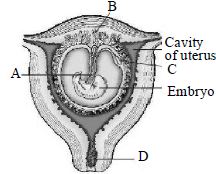
A
$A \to$ Umbilical cord with its veins,$B \to$ Chorionic villi,$C \to$ Antrum,$D \to$ Plug of mucus in cervix
B
$A \to$ Umbilical cord with its vessels,$B \to$ Fimbriae,$C \to$ Oocyte,$D \to$ Plug of mucus in vagina
C
$A \to$ Umbilical cord with its vessels,$B \to$ Placental villi,$C \to$ Yolk sac,$D \to$ Plug of mucus in cervix
D
$A \to$ Umbilical cord with its veins,$B \to$ Placental villi,$C \to$ Trophoblast,$D \to$ Plug of mucus in vagina
Solution
(C) Based on the anatomical structure of the human foetus within the uterus:
$A$ represents the Umbilical cord,which contains blood vessels that transport nutrients and oxygen to the foetus.
$B$ represents the Placental villi (chorionic villi),which are finger-like projections that increase the surface area for exchange between maternal and foetal blood.
$C$ represents the Yolk sac,which is an extra-embryonic membrane.
$D$ represents the Plug of mucus in the cervix,which acts as a protective barrier during pregnancy.
Therefore,the correct labeling is $A \to$ Umbilical cord with its vessels,$B \to$ Placental villi,$C \to$ Yolk sac,$D \to$ Plug of mucus in cervix.
$A$ represents the Umbilical cord,which contains blood vessels that transport nutrients and oxygen to the foetus.
$B$ represents the Placental villi (chorionic villi),which are finger-like projections that increase the surface area for exchange between maternal and foetal blood.
$C$ represents the Yolk sac,which is an extra-embryonic membrane.
$D$ represents the Plug of mucus in the cervix,which acts as a protective barrier during pregnancy.
Therefore,the correct labeling is $A \to$ Umbilical cord with its vessels,$B \to$ Placental villi,$C \to$ Yolk sac,$D \to$ Plug of mucus in cervix.
0 likes
View Solution258
MediumMCQ
Assertion: In the morula stage,cells divide without an increase in size.
Reason: Zona pellucida remains undivided until cleavage is complete.
Reason: Zona pellucida remains undivided until cleavage is complete.
A
If both Assertion and Reason are correct and the Reason is a correct explanation of the Assertion.
B
If both Assertion and Reason are correct but Reason is not a correct explanation of the Assertion.
C
If the Assertion is correct but Reason is incorrect.
D
If both the Assertion and Reason are incorrect.
Solution
(A) During the process of cleavage,the zygote undergoes repeated mitotic divisions to form a solid ball of $8-16$ cells called a morula.
In this stage,the cells divide without any increase in the overall size of the embryo because the cytoplasm does not grow between divisions.
The embryo remains enclosed within the $Zona \ pellucida$ throughout the cleavage process until it reaches the blastocyst stage.
Therefore,both the Assertion and the Reason are correct,and the Reason explains why the embryo does not increase in size during cleavage.
In this stage,the cells divide without any increase in the overall size of the embryo because the cytoplasm does not grow between divisions.
The embryo remains enclosed within the $Zona \ pellucida$ throughout the cleavage process until it reaches the blastocyst stage.
Therefore,both the Assertion and the Reason are correct,and the Reason explains why the embryo does not increase in size during cleavage.
0 likes
View Solution259
MediumMCQ
Assertion: Corpus luteum degenerates in the absence of fertilization.
Reason: Progesterone level decreases.
Reason: Progesterone level decreases.
A
If both Assertion and Reason are correct and the Reason is a correct explanation of the Assertion.
B
If both Assertion and Reason are correct but Reason is not a correct explanation of the Assertion.
C
If the Assertion is correct but Reason is incorrect.
D
If both the Assertion and Reason are incorrect.
Solution
(A) In females,the Graafian follicle transforms into the corpus luteum after ovulation.
The cells of the corpus luteum are known as luteal cells,which contain yellow granules called lutein.
These cells secrete the hormone progesterone,which is essential for maintaining pregnancy if fertilization occurs.
In the absence of fertilization,the corpus luteum degenerates into the corpus albicans,leading to a significant decrease in the level of progesterone.
The cells of the corpus luteum are known as luteal cells,which contain yellow granules called lutein.
These cells secrete the hormone progesterone,which is essential for maintaining pregnancy if fertilization occurs.
In the absence of fertilization,the corpus luteum degenerates into the corpus albicans,leading to a significant decrease in the level of progesterone.
0 likes
View Solution260
Medium
Why are offspring of oviparous animals at a greater risk as compared to offspring of viviparous animals?
Solution
(N/A) Oviparous animals lay eggs outside their body. As a result,the eggs of these animals are under continuous threat from various environmental factors and predators.
In contrast,in viviparous animals,the development of the embryo takes place inside the female body,providing protection and nourishment.
Therefore,the offspring of oviparous animals are at a greater risk of survival compared to the offspring of viviparous animals,which are born after a period of protected development.
In contrast,in viviparous animals,the development of the embryo takes place inside the female body,providing protection and nourishment.
Therefore,the offspring of oviparous animals are at a greater risk of survival compared to the offspring of viviparous animals,which are born after a period of protected development.
0 likes
View Solution261
Medium
What is placenta? Give information about hormones produced by the placenta.
Solution
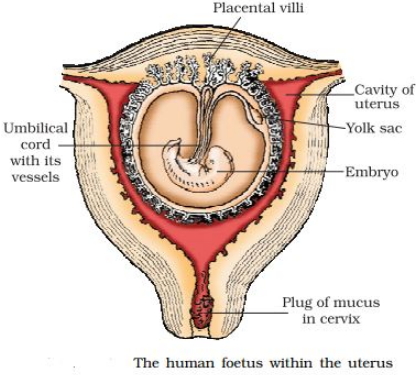
(N/A) After implantation,finger-like projections appear on the trophoblast called chorionic villi,which are surrounded by the uterine tissue and maternal blood.
The chorionic villi and uterine tissue become interdigitated with each other and jointly form a structural and functional unit between the developing embryo (foetus) and the maternal body,called the placenta.
Functions of the placenta:
$1$. The placenta facilitates the supply of oxygen and nutrients to the embryo.
$2$. It also facilitates the removal of carbon dioxide and excretory waste materials produced by the embryo.
$3$. The placenta is connected to the embryo through an umbilical cord,which helps in the transport of substances to and from the embryo.
Hormones produced by the placenta:
The placenta also acts as an endocrine tissue and produces several hormones:
$(i)$ Human chorionic gonadotropin $(hCG)$
$(ii)$ Human placental lactogen $(hPL)$
$(iii)$ Estrogens
$(iv)$ Progestogens
Additionally:
$(v)$ In the later phase of pregnancy,a hormone called relaxin is also secreted by the ovary.
$(vi)$ $hCG$,$hPL$,and relaxin are produced in women only during pregnancy.
$(vii)$ During pregnancy,the levels of other hormones like estrogens,progestogens,cortisol,prolactin,thyroxine,etc.,are increased in the maternal blood.
These hormones are essential for supporting fetal growth,metabolic changes in the mother,and the maintenance of pregnancy.
The chorionic villi and uterine tissue become interdigitated with each other and jointly form a structural and functional unit between the developing embryo (foetus) and the maternal body,called the placenta.
Functions of the placenta:
$1$. The placenta facilitates the supply of oxygen and nutrients to the embryo.
$2$. It also facilitates the removal of carbon dioxide and excretory waste materials produced by the embryo.
$3$. The placenta is connected to the embryo through an umbilical cord,which helps in the transport of substances to and from the embryo.
Hormones produced by the placenta:
The placenta also acts as an endocrine tissue and produces several hormones:
$(i)$ Human chorionic gonadotropin $(hCG)$
$(ii)$ Human placental lactogen $(hPL)$
$(iii)$ Estrogens
$(iv)$ Progestogens
Additionally:
$(v)$ In the later phase of pregnancy,a hormone called relaxin is also secreted by the ovary.
$(vi)$ $hCG$,$hPL$,and relaxin are produced in women only during pregnancy.
$(vii)$ During pregnancy,the levels of other hormones like estrogens,progestogens,cortisol,prolactin,thyroxine,etc.,are increased in the maternal blood.
These hormones are essential for supporting fetal growth,metabolic changes in the mother,and the maintenance of pregnancy.
0 likes
View Solution262
Medium
Write a note on pregnancy and embryonic development in human beings.
Solution
(N/A) Pregnancy: The duration of development of the foetus in the female reproductive system is called pregnancy.
In human beings,the duration of pregnancy (gestation period) is approximately $280$ days (or $40$ weeks) from the last menstrual cycle.
During the first $8$ weeks,the developing organism is called an embryo,and after that,it is known as a foetus.
Embryonic Development:
$1$. Immediately after implantation,the inner cell mass differentiates into three germinal layers: ectoderm (outer),endoderm (inner),and soon after,mesoderm (middle).
$2$. These three layers give rise to all tissues and organs in the adult.
$3$. The inner cell mass contains stem cells,which have the potency to give rise to all tissues and organs.
Timeline of Development:
- After $1$ month: The embryo's heart is formed. Heart sounds can be heard via a stethoscope.
- By the end of $2$ months: The foetus develops limbs and digits.
- By the end of $12$ weeks (first trimester): Most major organ systems are formed,including limbs and external genital organs.
- During the $5$th month: The first movements of the foetus and the appearance of hair on the head are observed.
- By the end of $24$ weeks (second trimester): The body is covered with fine hair,eyelids separate,and eyelashes are formed.
- By the end of $9$ months: The foetus is fully developed and ready for delivery.
In human beings,the duration of pregnancy (gestation period) is approximately $280$ days (or $40$ weeks) from the last menstrual cycle.
During the first $8$ weeks,the developing organism is called an embryo,and after that,it is known as a foetus.
Embryonic Development:
$1$. Immediately after implantation,the inner cell mass differentiates into three germinal layers: ectoderm (outer),endoderm (inner),and soon after,mesoderm (middle).
$2$. These three layers give rise to all tissues and organs in the adult.
$3$. The inner cell mass contains stem cells,which have the potency to give rise to all tissues and organs.
Timeline of Development:
- After $1$ month: The embryo's heart is formed. Heart sounds can be heard via a stethoscope.
- By the end of $2$ months: The foetus develops limbs and digits.
- By the end of $12$ weeks (first trimester): Most major organ systems are formed,including limbs and external genital organs.
- During the $5$th month: The first movements of the foetus and the appearance of hair on the head are observed.
- By the end of $24$ weeks (second trimester): The body is covered with fine hair,eyelids separate,and eyelashes are formed.
- By the end of $9$ months: The foetus is fully developed and ready for delivery.
0 likes
View Solution263
Medium
Vivipary automatically limits the number of offsprings in a litter. How?
Solution
(A) Vivipary is a reproductive strategy where the embryo develops inside the mother's body,receiving nourishment directly from her. In mammals,this is facilitated by the placenta.
Because the development of the fetus requires significant metabolic resources and energy from the mother,the female body can only support a limited number of offspring at one time.
This biological constraint ensures that the mother can provide adequate nutrition and protection to the developing young,thereby limiting the litter size to a sustainable number,typically ranging from $1$ to $8$ depending on the species.
Because the development of the fetus requires significant metabolic resources and energy from the mother,the female body can only support a limited number of offspring at one time.
This biological constraint ensures that the mother can provide adequate nutrition and protection to the developing young,thereby limiting the litter size to a sustainable number,typically ranging from $1$ to $8$ depending on the species.
0 likes
View Solution264
Easy
Explain the difference between the following terms:
$(1)$ Menstrual flow - Menstrual cycle
$(2)$ Embryo - Foetus
$(1)$ Menstrual flow - Menstrual cycle
$(2)$ Embryo - Foetus
Solution
(N/A) $(1)$ Menstrual flow: The menstrual flow results from the breakdown of the endometrial lining of the uterus and its blood vessels,which forms a liquid that is discharged through the vagina. Menstruation occurs only if the released ovum is not fertilized.
- Menstrual cycle: The cyclic changes occurring in the inner wall (endometrium) of the uterus,driven by fluctuations in the levels of female sex hormones (estrogen and progesterone),are called the menstrual cycle.
$(2)$ Embryo: The fertilized ovum during the first $8$ weeks of development is called an embryo.
- Foetus: The stage of the developing organism after $8$ weeks of gestation is called a foetus.
- Menstrual cycle: The cyclic changes occurring in the inner wall (endometrium) of the uterus,driven by fluctuations in the levels of female sex hormones (estrogen and progesterone),are called the menstrual cycle.
$(2)$ Embryo: The fertilized ovum during the first $8$ weeks of development is called an embryo.
- Foetus: The stage of the developing organism after $8$ weeks of gestation is called a foetus.
0 likes
View Solution265
DifficultMCQ
Apart from endocrine function,what are the other functions of the placenta?
A
Nutrient supply to the embryo
B
Removal of carbon dioxide and waste materials
C
Transport of substances via umbilical cord
D
All of the above
Solution
(D) The placenta performs several vital functions for the developing embryo:
$1$. It facilitates the supply of oxygen and essential nutrients from the mother's blood to the embryo.
$2$. It assists in the removal of carbon dioxide and nitrogenous waste materials produced by the embryo.
$3$. It acts as a physical connection between the mother and the fetus through the umbilical cord,which is essential for the transport of substances to and from the embryo.
$1$. It facilitates the supply of oxygen and essential nutrients from the mother's blood to the embryo.
$2$. It assists in the removal of carbon dioxide and nitrogenous waste materials produced by the embryo.
$3$. It acts as a physical connection between the mother and the fetus through the umbilical cord,which is essential for the transport of substances to and from the embryo.
0 likes
View Solution266
Medium
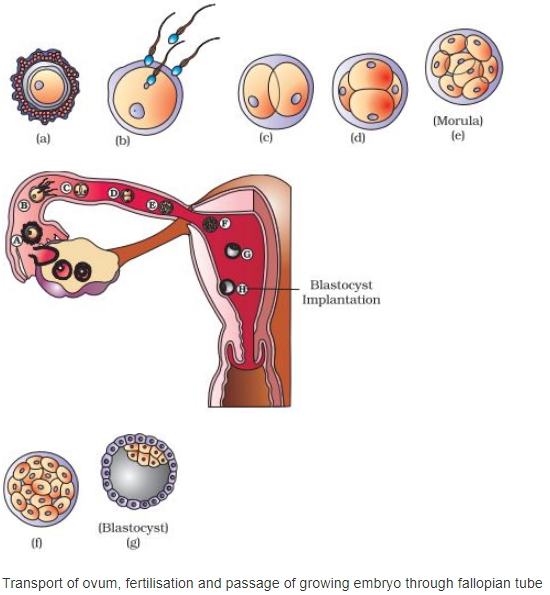
The zygote passes through several developmental stages until implantation. Describe each stage briefly with suitable diagrams.
Solution
(N/A) The developmental stages from zygote to implantation are as follows:
$1$. Zygote Formation: Fertilization of the ovum by a sperm in the fallopian tube results in the formation of a diploid zygote.
$2$. Cleavage: The zygote undergoes mitotic divisions called cleavage as it moves through the isthmus of the oviduct towards the uterus.
$3$. Morula Stage: These divisions produce $2, 4, 8,$ and $16$ daughter cells called blastomeres. The embryo with $8-16$ blastomeres is called a morula.
$4$. Blastocyst Stage: The morula continues to divide and transforms into a blastocyst. It consists of an outer layer called the trophoblast and an inner cell mass. The blastocyst moves into the uterus.
$5$. Implantation: The blastocyst embeds itself in the endometrium of the uterus,a process known as implantation,which leads to pregnancy.
$1$. Zygote Formation: Fertilization of the ovum by a sperm in the fallopian tube results in the formation of a diploid zygote.
$2$. Cleavage: The zygote undergoes mitotic divisions called cleavage as it moves through the isthmus of the oviduct towards the uterus.
$3$. Morula Stage: These divisions produce $2, 4, 8,$ and $16$ daughter cells called blastomeres. The embryo with $8-16$ blastomeres is called a morula.
$4$. Blastocyst Stage: The morula continues to divide and transforms into a blastocyst. It consists of an outer layer called the trophoblast and an inner cell mass. The blastocyst moves into the uterus.
$5$. Implantation: The blastocyst embeds itself in the endometrium of the uterus,a process known as implantation,which leads to pregnancy.
0 likes
View Solution267
EasyMCQ
Match the columns:
| Column $I$ | Column $II$ |
|---|---|
| $(a)$ Third week | $(1)$ Development of pre-umbilical cord |
| $(b)$ Third month | $(2)$ Body develops but head remains big |
| $(c)$ Fourth week | $(3)$ Embryonic slit widens |
| $(d)$ Fourth month | $(4)$ Muscles activate |
A
$a-3, b-2, c-1, d-4$
B
$a-1, b-2, c-3, d-4$
C
$a-3, b-4, c-1, d-2$
D
$a-2, b-1, c-4, d-3$
Solution
(A) The correct matching is as follows:
$(a)$ Third week: $(3)$ Embryonic slit widens.
$(b)$ Third month: $(2)$ Body develops but head remains big.
$(c)$ Fourth week: $(1)$ Development of pre-umbilical cord.
$(d)$ Fourth month: $(4)$ Muscles activate.
Therefore,the correct sequence is $(a-3, b-2, c-1, d-4)$.
$(a)$ Third week: $(3)$ Embryonic slit widens.
$(b)$ Third month: $(2)$ Body develops but head remains big.
$(c)$ Fourth week: $(1)$ Development of pre-umbilical cord.
$(d)$ Fourth month: $(4)$ Muscles activate.
Therefore,the correct sequence is $(a-3, b-2, c-1, d-4)$.
0 likes
View Solution268
EasyMCQ
Where does the development of the zygote take place in viviparous organisms?
A
In saltwater
B
Inside the body
C
In freshwater
D
Outside the body
Solution
(B) Viviparous organisms are those in which the development of the zygote takes place inside the body of the female parent.
After attaining a certain stage of growth,the young ones are delivered out of the body of the female parent.
Because of proper embryonic care and protection inside the mother's body,the chances of survival of young ones are greater in viviparous organisms compared to oviparous organisms.
After attaining a certain stage of growth,the young ones are delivered out of the body of the female parent.
Because of proper embryonic care and protection inside the mother's body,the chances of survival of young ones are greater in viviparous organisms compared to oviparous organisms.
0 likes
View Solution269
MediumMCQ
Which process is necessary for the development of an embryo from a zygote?
A
Mitosis
B
Cell differentiation
C
$A$ or $B$
D
$A$ and $B$
Solution
(D) The development of an embryo from a zygote involves two critical processes:
$1$. Mitosis $(A)$: The zygote undergoes repeated mitotic divisions (cleavage) to increase the number of cells.
$2$. Cell differentiation $(B)$: The cells formed through division undergo differentiation to form specialized tissues and organs.
Therefore,both processes are essential for the formation of a complete embryo from a single-celled zygote.
$1$. Mitosis $(A)$: The zygote undergoes repeated mitotic divisions (cleavage) to increase the number of cells.
$2$. Cell differentiation $(B)$: The cells formed through division undergo differentiation to form specialized tissues and organs.
Therefore,both processes are essential for the formation of a complete embryo from a single-celled zygote.
0 likes
View Solution270
MediumMCQ
Which animals have a higher chance of survival for their young offspring?
A
Oviparous
B
Viviparous
C
Animals showing external fertilization
D
Animals showing parthenogenesis
Solution
(B) Viviparous animals give birth to young ones rather than laying eggs.
In viviparous organisms,the developing embryo receives protection and nourishment from the mother within the female reproductive tract.
Because the offspring are born at a more advanced stage of development and are cared for by the parents,they have a significantly higher chance of survival compared to the offspring of oviparous animals,which are often exposed to environmental hazards and predators.
In viviparous organisms,the developing embryo receives protection and nourishment from the mother within the female reproductive tract.
Because the offspring are born at a more advanced stage of development and are cared for by the parents,they have a significantly higher chance of survival compared to the offspring of oviparous animals,which are often exposed to environmental hazards and predators.
0 likes
View Solution271
MediumMCQ
Which of the following structures forms the birth canal after fertilization?
A
Uterus
B
Cervix
C
Birth canal (Cervical canal + Vagina)
D
Oviduct
Solution
(C) The birth canal is formed by the combination of the cervical canal and the vagina.
During childbirth,the fetus passes through the cervical canal and the vagina,which together constitute the birth canal.
Therefore,the correct option is $C$.
During childbirth,the fetus passes through the cervical canal and the vagina,which together constitute the birth canal.
Therefore,the correct option is $C$.
0 likes
View Solution272
MediumMCQ
How many cleavages are required to form a $16$-celled blastomere?
A
$1$
B
$2$
C
$3$
D
$4$
Solution
(D) The process of cleavage involves mitotic divisions of the zygote.
$1$st cleavage: $1 \rightarrow 2$ cells.
$2$nd cleavage: $2 \rightarrow 4$ cells.
$3$rd cleavage: $4 \rightarrow 8$ cells.
$4$th cleavage: $8 \rightarrow 16$ cells.
Therefore,to form a $16$-celled stage (morula),$4$ successive cleavages are required.
$1$st cleavage: $1 \rightarrow 2$ cells.
$2$nd cleavage: $2 \rightarrow 4$ cells.
$3$rd cleavage: $4 \rightarrow 8$ cells.
$4$th cleavage: $8 \rightarrow 16$ cells.
Therefore,to form a $16$-celled stage (morula),$4$ successive cleavages are required.
0 likes
View Solution273
MediumMCQ
Which of the following differentiates into the embryo?
A
Blastomere
B
Blastocyst
C
Inner cell mass
D
Trophoblast
Solution
(C) During the development of the human embryo,the blastocyst consists of an outer layer of cells called the trophoblast and an inner group of cells attached to the trophoblast known as the inner cell mass. The trophoblast layer gets attached to the endometrium,while the inner cell mass differentiates into the embryo.
0 likes
View Solution274
EasyMCQ
Which of the following participate in the formation of the placenta?
A
Uterine tissue
B
Chorionic villi
C
Antrum
D
Both $A$ and $B$
Solution
(D) The placenta is a structural and functional unit between the developing embryo (foetus) and the maternal body.
It is formed by the interdigitation of the chorionic villi (foetal origin) and the uterine tissue (maternal origin).
These two tissues become intimately interdigitated to facilitate the exchange of nutrients,oxygen,and waste products between the mother and the foetus.
Therefore,both uterine tissue and chorionic villi participate in the formation of the placenta.
It is formed by the interdigitation of the chorionic villi (foetal origin) and the uterine tissue (maternal origin).
These two tissues become intimately interdigitated to facilitate the exchange of nutrients,oxygen,and waste products between the mother and the foetus.
Therefore,both uterine tissue and chorionic villi participate in the formation of the placenta.
0 likes
View Solution275
MediumMCQ
Which of the following is a correct function of the placenta?
A
Supplying $O_2$ and nutrients to the embryo
B
Removal of $CO_2$ and waste materials produced by the embryo
C
Acting as an endocrine tissue
D
All of the above
Solution
(D) The placenta is a structural and functional unit between the developing embryo (foetus) and the maternal body.
$1$. It facilitates the supply of $O_2$ and nutrients to the embryo.
$2$. It facilitates the removal of $CO_2$ and waste/excretory materials produced by the embryo.
$3$. It also acts as an endocrine tissue and produces several hormones like human chorionic gonadotropin $(hCG)$,human placental lactogen $(hPL)$,estrogens,and progestogens.
Therefore,all the given options are correct functions of the placenta.
$1$. It facilitates the supply of $O_2$ and nutrients to the embryo.
$2$. It facilitates the removal of $CO_2$ and waste/excretory materials produced by the embryo.
$3$. It also acts as an endocrine tissue and produces several hormones like human chorionic gonadotropin $(hCG)$,human placental lactogen $(hPL)$,estrogens,and progestogens.
Therefore,all the given options are correct functions of the placenta.
0 likes
View Solution276
MediumMCQ
Which hormone is produced only in the female body during pregnancy by the placenta?
A
Estrogen
B
Progesterone
C
$hCG, hPL$
D
All of the above
Solution
(C) During pregnancy,the placenta acts as an endocrine tissue and produces several hormones essential for maintaining pregnancy.
Specifically,the hormones $hCG$ (human Chorionic Gonadotropin),$hPL$ (human Placental Lactogen),and relaxin are produced only during pregnancy by the placenta.
Estrogen and progesterone are also produced by the placenta,but they are produced by other organs (like ovaries) in non-pregnant females as well.
Therefore,$hCG$ and $hPL$ are the hormones produced exclusively by the placenta during pregnancy.
Specifically,the hormones $hCG$ (human Chorionic Gonadotropin),$hPL$ (human Placental Lactogen),and relaxin are produced only during pregnancy by the placenta.
Estrogen and progesterone are also produced by the placenta,but they are produced by other organs (like ovaries) in non-pregnant females as well.
Therefore,$hCG$ and $hPL$ are the hormones produced exclusively by the placenta during pregnancy.
0 likes
View Solution277
MediumMCQ
Which hormones show an increased level in the maternal blood during pregnancy?
A
Estrogen,Progesterone,Cortisol,Thymosin,$FSH, LH$
B
Estrogen,Progesterone,Cortisone,Thyroxine,$FSH, LH$
C
Estrogen,Progesterone,Cortisol,Thyroxine,Prolactin
D
Estrogen,Progesterone,Cortisol,Oxytocin,$FSH, LH$
Solution
(C) During pregnancy,the placenta produces several hormones to support the developing fetus and prepare the mother's body for childbirth and lactation.
These include Estrogen,Progesterone,Cortisol,Thyroxine,and Prolactin.
Levels of these hormones increase several-fold in the maternal blood during pregnancy.
$FSH$ and $LH$ levels decrease during pregnancy due to the negative feedback effect of high levels of Estrogen and Progesterone on the anterior pituitary gland.
Therefore,option $C$ is the correct answer.
These include Estrogen,Progesterone,Cortisol,Thyroxine,and Prolactin.
Levels of these hormones increase several-fold in the maternal blood during pregnancy.
$FSH$ and $LH$ levels decrease during pregnancy due to the negative feedback effect of high levels of Estrogen and Progesterone on the anterior pituitary gland.
Therefore,option $C$ is the correct answer.
0 likes
View Solution278
MediumMCQ
Select the hormones that are produced only during pregnancy.
A
Estrogen,Progesterone
B
$hCG, hPL$
C
Relaxin
D
Both $B$ and $C$
Solution
(D) During pregnancy,the placenta produces several hormones that are essential for maintaining the pregnancy and supporting fetal development.
These hormones include human Chorionic Gonadotropin $(hCG)$,human Placental Lactogen $(hPL)$,and Relaxin.
While Estrogen and Progesterone are also produced during pregnancy,they are produced by the ovaries throughout the menstrual cycle as well.
Therefore,$hCG$,$hPL$,and Relaxin are specifically produced only during pregnancy.
Thus,the correct option is $D$ (Both $B$ and $C$).
These hormones include human Chorionic Gonadotropin $(hCG)$,human Placental Lactogen $(hPL)$,and Relaxin.
While Estrogen and Progesterone are also produced during pregnancy,they are produced by the ovaries throughout the menstrual cycle as well.
Therefore,$hCG$,$hPL$,and Relaxin are specifically produced only during pregnancy.
Thus,the correct option is $D$ (Both $B$ and $C$).
0 likes
View Solution279
MediumMCQ
The three germ layers—ectoderm,endoderm,and mesoderm—are formed by the division of the embryo. Identify the error in the given statement regarding the process of organogenesis mediated by stem cells.
A
Mesoderm participates in only one organogenesis process.
B
Ectoderm and endoderm contain stem cells.
C
Germ layers are formed by the differentiation of the embryo,not by the division of the embryo.
D
There is no error in the statement.
Solution
(C) The process of forming the three germ layers (ectoderm,mesoderm,and endoderm) from the inner cell mass of the blastocyst is known as gastrulation. This process involves the movement and differentiation of cells,not just simple division. While division (mitosis) occurs,the fundamental mechanism that establishes these distinct layers is cellular differentiation,where cells become specialized to form specific tissues and organs. Therefore,the statement that germ layers are formed by the 'division of the embryo' is scientifically inaccurate; they are formed through the 'differentiation of the embryo'.
0 likes
View Solution280
EasyMCQ
When is the heart formed in a human embryo?
A
After one month of pregnancy
B
At the third week of pregnancy
C
At the fourth week of pregnancy
D
After eight weeks of pregnancy
Solution
(C) In human development,the heart is the first organ to develop. The heart begins to form during the $4^{th}$ week of pregnancy (approximately $21-22$ days after fertilization). By the end of the first month of pregnancy,the heart is formed and begins to beat.
0 likes
View Solution281
MediumMCQ
The first sign of a growing fetus can be noticed by:
A
Sphygmomanometer
B
$ECG$
C
Stethoscope
D
Both $B$ and $C$
Solution
(C) The first sign of a growing fetus is the heartbeat,which can be heard through a stethoscope. By listening to the heart sounds carefully through a stethoscope,the physician can detect the fetal heartbeat,which is a clear indication of a developing fetus.
0 likes
View Solution282
MediumMCQ
By which time of pregnancy are the limbs and digits developed in the fetus?
A
Two weeks
B
Four weeks
C
Eight weeks
D
Twelve weeks
Solution
(C) In human pregnancy,the development of the fetus follows a specific timeline.
By the end of the first month of pregnancy,the embryo's heart is formed.
By the end of the second month (approximately $8$ weeks),the fetus develops limbs and digits.
Therefore,the correct answer is $8$ weeks.
By the end of the first month of pregnancy,the embryo's heart is formed.
By the end of the second month (approximately $8$ weeks),the fetus develops limbs and digits.
Therefore,the correct answer is $8$ weeks.
0 likes
View Solution283
MediumMCQ
During which period is the first movement of the fetus observed?
A
$16$ weeks
B
$20$ weeks
C
$24$ weeks
D
$7$th month
Solution
(B) The first movements of the fetus and the appearance of hair on the head are usually observed during the $5$th month of pregnancy.
Since $5$ months is equivalent to $20$ weeks,the correct answer is $20$ weeks.
During the $1$st month,the heart is formed.
By the end of the $2$nd month,limbs and digits develop.
By the end of $12$ weeks ($1$st trimester),most major organ systems are formed.
Since $5$ months is equivalent to $20$ weeks,the correct answer is $20$ weeks.
During the $1$st month,the heart is formed.
By the end of the $2$nd month,limbs and digits develop.
By the end of $12$ weeks ($1$st trimester),most major organ systems are formed.
0 likes
View Solution284
MediumMCQ
By the end of which week of pregnancy is the body of the fetus covered with fine hair,eyelids separate,and eyelashes are formed (in $weeks$)?
A
$20$
B
$28$
C
$32$
D
$24$
Solution
(D) According to human embryonic development milestones:
$1$. By the end of the first month,the heart is formed.
$2$. By the end of the second month,limbs and digits develop.
$3$. By the end of the $12$th week (first trimester),most major organ systems are formed.
$4$. During the $5$th month,the first movements of the fetus and appearance of hair on the head are observed.
$5$. By the end of $24$ weeks (second trimester),the body is covered with fine hair,eyelids separate,and eyelashes are formed.
$1$. By the end of the first month,the heart is formed.
$2$. By the end of the second month,limbs and digits develop.
$3$. By the end of the $12$th week (first trimester),most major organ systems are formed.
$4$. During the $5$th month,the first movements of the fetus and appearance of hair on the head are observed.
$5$. By the end of $24$ weeks (second trimester),the body is covered with fine hair,eyelids separate,and eyelashes are formed.
0 likes
View Solution285
MediumMCQ
In the human uterus,the period of maximum and minimum fetal growth occurs in which months,respectively?
A
$1^{st}$ month,$7^{th}$ month
B
$3^{rd}$ month,$8^{th}$ month
C
$4^{th}$ month,$9^{th}$ month
D
$5^{th}$ month,$9^{th}$ month
Solution
(C) During human pregnancy,the growth rate of the fetus is not uniform throughout the gestation period.
$1$. The $4^{th}$ month of pregnancy is characterized by rapid development and significant growth of the fetus.
$2$. By the $9^{th}$ month,the fetus is fully developed,and the rate of physical growth slows down significantly as the fetus prepares for parturition.
Therefore,the maximum growth occurs in the $4^{th}$ month and the minimum growth occurs in the $9^{th}$ month.
$1$. The $4^{th}$ month of pregnancy is characterized by rapid development and significant growth of the fetus.
$2$. By the $9^{th}$ month,the fetus is fully developed,and the rate of physical growth slows down significantly as the fetus prepares for parturition.
Therefore,the maximum growth occurs in the $4^{th}$ month and the minimum growth occurs in the $9^{th}$ month.
0 likes
View Solution286
EasyMCQ
What is the average gestation period in humans?
A
$280$ days
B
$250$ days
C
$30$ weeks
D
$32$ weeks
Solution
(A) The average gestation period in humans is approximately $280$ days or $40$ weeks,calculated from the first day of the last menstrual cycle. This period is essential for the complete development of the fetus from fertilization to birth.
0 likes
View Solution287
EasyMCQ
What is the average birth weight of a newborn baby (in $, kg$)?
A
$3$
B
$3.3$
C
$4$
D
$2.5$
Solution
(A) The average birth weight of a healthy newborn baby is typically considered to be around $3 \, kg$ to $3.5 \, kg$. Among the given options,$3 \, kg$ is the most accurate representation of the average birth weight.
0 likes
View Solution288
MediumMCQ
When does the differentiation of mammary glands occur?
A
After parturition
B
During pregnancy
C
At puberty
D
In all the given stages
Solution
(B) The mammary glands are modified sweat glands that undergo differentiation during pregnancy.
Under the influence of hormones like estrogen,progesterone,and prolactin,the mammary glands develop and differentiate to prepare for lactation.
While they start developing at puberty,the full differentiation and functional maturity occur during pregnancy.
Under the influence of hormones like estrogen,progesterone,and prolactin,the mammary glands develop and differentiate to prepare for lactation.
While they start developing at puberty,the full differentiation and functional maturity occur during pregnancy.
0 likes
View Solution289
MediumMCQ
Identify the correct sequence of embryonic development in females.
A
Fertilization $\rightarrow$ Zygote $\rightarrow$ Cleavage $\rightarrow$ Morula $\rightarrow$ Blastula $\rightarrow$ Gastrula
B
Fertilization $\rightarrow$ Cleavage $\rightarrow$ Zygote $\rightarrow$ Blastula $\rightarrow$ Morula $\rightarrow$ Gastrula
C
Fertilization $\rightarrow$ Zygote $\rightarrow$ Blastocyst $\rightarrow$ Morula $\rightarrow$ Embryo
D
Zygote $\rightarrow$ Fertilization $\rightarrow$ Cleavage $\rightarrow$ Gastrula $\rightarrow$ Blastula
Solution
(A) The process of embryonic development follows a specific sequence:
$1$. Fertilization: Fusion of male and female gametes to form a diploid zygote.
$2$. Zygote: The single-celled diploid product of fertilization.
$3$. Cleavage: Rapid mitotic divisions of the zygote without growth in size.
$4$. Morula: The $8-16$ celled stage formed after cleavage.
$5$. Blastula (Blastocyst): The stage where cells differentiate into trophoblast and inner cell mass.
$6$. Gastrula: The stage where germ layers are formed through gastrulation.
Therefore,the correct sequence is: Fertilization $\rightarrow$ Zygote $\rightarrow$ Cleavage $\rightarrow$ Morula $\rightarrow$ Blastula $\rightarrow$ Gastrula.
$1$. Fertilization: Fusion of male and female gametes to form a diploid zygote.
$2$. Zygote: The single-celled diploid product of fertilization.
$3$. Cleavage: Rapid mitotic divisions of the zygote without growth in size.
$4$. Morula: The $8-16$ celled stage formed after cleavage.
$5$. Blastula (Blastocyst): The stage where cells differentiate into trophoblast and inner cell mass.
$6$. Gastrula: The stage where germ layers are formed through gastrulation.
Therefore,the correct sequence is: Fertilization $\rightarrow$ Zygote $\rightarrow$ Cleavage $\rightarrow$ Morula $\rightarrow$ Blastula $\rightarrow$ Gastrula.
0 likes
View Solution290
MediumMCQ
In a urine analysis,the presence of which of the following indicates pregnancy?
A
Estrogen
B
$hCG$
C
Progesterone
D
$FSH$ and $LH$
Solution
(B) During pregnancy,the placenta produces the hormone Human Chorionic Gonadotropin $(hCG)$.
This hormone is released into the maternal blood and is subsequently excreted in the urine.
Pregnancy diagnostic kits are designed to detect the presence of $hCG$ in the urine,which serves as a reliable indicator of pregnancy.
Therefore,the correct option is $B$.
This hormone is released into the maternal blood and is subsequently excreted in the urine.
Pregnancy diagnostic kits are designed to detect the presence of $hCG$ in the urine,which serves as a reliable indicator of pregnancy.
Therefore,the correct option is $B$.
0 likes
View Solution291
MediumMCQ
Which structure connects the fetus to the placenta in mammals during pregnancy?
A
Allantois
B
Yolk sac
C
Amnion
D
Chorion
Solution
(A) In mammals,the umbilical cord is the structure that connects the fetus to the placenta. However,among the given options,the $Allantois$ is the extra-embryonic membrane that forms the blood vessels of the umbilical cord,which facilitates the exchange of nutrients,gases,and waste between the mother and the fetus. The $Chorion$ forms the fetal part of the placenta,but the specific connection is established via the umbilical cord derived from the $Allantois$.
0 likes
View Solution292
MediumMCQ
In which of the following stages does the embryo consume the maximum amount of $O_2$?
A
Gastrula
B
Blastula
C
Cleavage
D
Morula
Solution
(A) During embryonic development,the metabolic rate increases significantly as the complexity of the embryo grows.
$1$. The $Gastrula$ stage involves extensive cell migration,morphogenetic movements,and the differentiation of the three germ layers ($Ectoderm$,$Mesoderm$,and $Endoderm$).
$2$. These complex cellular activities require a high amount of energy,which is generated through aerobic respiration.
$3$. Therefore,the $Gastrula$ stage is characterized by the highest rate of oxygen consumption compared to earlier stages like $Cleavage$,$Morula$,or $Blastula$.
$1$. The $Gastrula$ stage involves extensive cell migration,morphogenetic movements,and the differentiation of the three germ layers ($Ectoderm$,$Mesoderm$,and $Endoderm$).
$2$. These complex cellular activities require a high amount of energy,which is generated through aerobic respiration.
$3$. Therefore,the $Gastrula$ stage is characterized by the highest rate of oxygen consumption compared to earlier stages like $Cleavage$,$Morula$,or $Blastula$.
0 likes
View Solution293
EasyMCQ
Which hormone relaxes the pubic symphysis during childbirth?
A
Oxytocin
B
Relaxin
C
hPL
D
hCG
Solution
(B) The hormone $Relaxin$ is secreted by the ovary and the placenta during the later stages of pregnancy. Its primary function is to relax the pelvic ligaments and the $pubic$ $symphysis$, which helps in widening the birth canal to facilitate the process of childbirth (parturition).
0 likes
View Solution294
EasyMCQ
Which of the following is known as the anti-abortion hormone?
A
Progesterone
B
Estrogen
C
$FSH$
D
$LH$
Solution
(A) Progesterone is known as the anti-abortion hormone.
It is essential for the maintenance of the endometrium,which is the inner lining of the uterus.
During pregnancy,progesterone levels remain high to prevent the shedding of the endometrium,thereby preventing miscarriage or abortion.
Therefore,it plays a crucial role in supporting and maintaining pregnancy.
It is essential for the maintenance of the endometrium,which is the inner lining of the uterus.
During pregnancy,progesterone levels remain high to prevent the shedding of the endometrium,thereby preventing miscarriage or abortion.
Therefore,it plays a crucial role in supporting and maintaining pregnancy.
0 likes
View Solution295
MediumMCQ
Select the odd one out.
A
$hCG$
B
Estrogen
C
Relaxin
D
Progesterone
Solution
(A) During pregnancy,the placenta acts as an endocrine tissue and produces several hormones essential for fetal development and maintenance of pregnancy. These include $hCG$ (human Chorionic Gonadotropin),$hPL$ (human Placental Lactogen),Estrogen,and Progesterone. Relaxin is also secreted by the ovary during the later stages of pregnancy. However,among the given options,$hCG$ is a hormone produced exclusively by the placenta during pregnancy,whereas Estrogen,Progesterone,and Relaxin can be produced by the ovaries in a non-pregnant state as well. Therefore,$hCG$ is the odd one out.
0 likes
View Solution296
EasyMCQ
What is the gestation period?
A
Lactation period
B
Parturition
C
The average nine-month period of pregnancy
D
Implantation
Solution
(C) The gestation period is defined as the duration of development of the embryo or fetus from the time of fertilization until birth.
In humans,this period lasts for approximately $280$ days or $9$ months.
Therefore,the gestation period refers to the average nine-month period of pregnancy.
In humans,this period lasts for approximately $280$ days or $9$ months.
Therefore,the gestation period refers to the average nine-month period of pregnancy.
0 likes
View Solution297
MediumMCQ
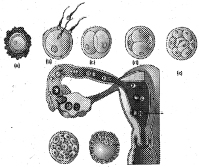
In the given figure,after how many days of fertilization is the part labeled as $f$ formed?
A
$4$
B
$16$
C
$3$
D
$1$
Solution
(A) The figure represents the process of fertilization and early embryonic development in humans.
Label $f$ in the standard $NCERT$ diagram refers to the blastocyst stage.
Following fertilization,the zygote undergoes cleavage as it moves through the fallopian tube towards the uterus.
The morula ($8$-$16$ celled stage) is formed around $3$ to $4$ days after fertilization.
The blastocyst stage is typically reached by the $5$th day after fertilization,and implantation occurs around the $6$th or $7$th day.
Among the given options,the blastocyst formation process is initiated and reaches its characteristic structure by the $4$th day as it enters the uterus.
Label $f$ in the standard $NCERT$ diagram refers to the blastocyst stage.
Following fertilization,the zygote undergoes cleavage as it moves through the fallopian tube towards the uterus.
The morula ($8$-$16$ celled stage) is formed around $3$ to $4$ days after fertilization.
The blastocyst stage is typically reached by the $5$th day after fertilization,and implantation occurs around the $6$th or $7$th day.
Among the given options,the blastocyst formation process is initiated and reaches its characteristic structure by the $4$th day as it enters the uterus.
0 likes
View Solution298
EasyMCQ
In human beings,at the end of $12$ weeks (first trimester) of pregnancy,which of the following is observed?
A
Movement of the foetus
B
Eyelids and eyelashes are formed
C
Most of the major organ systems are formed
D
The head is covered with fine hair
Solution
(C) In human pregnancy,by the end of the first trimester ($12$ weeks),most of the major organ systems are formed,for example,the limbs and external genital organs are well-developed.
- Movement of the foetus and the appearance of hair on the head are usually observed during the fifth month ($20$ weeks).
- Eyelids separate and eyelashes are formed by the end of $24$ weeks (second trimester).
- Movement of the foetus and the appearance of hair on the head are usually observed during the fifth month ($20$ weeks).
- Eyelids separate and eyelashes are formed by the end of $24$ weeks (second trimester).
0 likes
View Solution299
MediumMCQ
Identify the correct labeling and its function from the given diagram of a developing fetus.
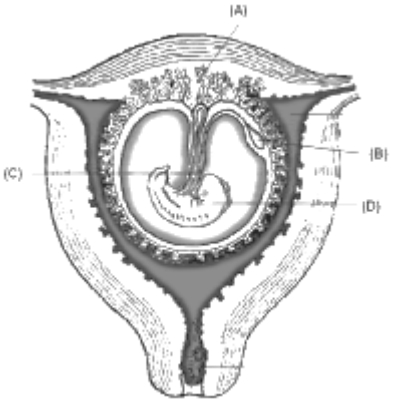
A
$A$ - Chorionic villi $\rightarrow$ Forms placenta
B
$B$ - Yolk sac $\rightarrow$ Prevents desiccation of embryo
C
$C$ - Umbilical cord $\rightarrow$ Haemopoiesis
D
$D$ - Blastocyst $\rightarrow$ Forms the embryo
Solution
(A) In the provided diagram,$A$ represents the Chorionic villi,which interdigitate with uterine tissue to form the placenta. The placenta serves as the structural and functional unit between the developing fetus and the maternal body,facilitating the exchange of nutrients,oxygen,and waste products. Option $B$ points to the Yolk sac,$C$ points to the Umbilical cord,and $D$ points to the Embryo itself. Therefore,the correct association is $A$ - Chorionic villi $\rightarrow$ forms placenta.
0 likes
View Solution300
MediumMCQ
Which hormone is secreted only during pregnancy in women?
A
Oestrogen
B
Progesterone
C
Luteinizing hormone
D
Human chorionic gonadotropin $(hCG)$
Solution
(D) During pregnancy,the developing placenta secretes several hormones essential for maintaining the gestation period.
Specifically,the trophoblast cells of the developing placenta secrete Human chorionic gonadotropin $(hCG)$.
This hormone is unique to pregnancy and is not secreted in non-pregnant women.
$hCG$ functions similarly to Luteinizing hormone $(LH)$ by maintaining the corpus luteum,which in turn continues to secrete progesterone and oestradiol to support the endometrium.
Specifically,the trophoblast cells of the developing placenta secrete Human chorionic gonadotropin $(hCG)$.
This hormone is unique to pregnancy and is not secreted in non-pregnant women.
$hCG$ functions similarly to Luteinizing hormone $(LH)$ by maintaining the corpus luteum,which in turn continues to secrete progesterone and oestradiol to support the endometrium.
0 likes
View SolutionHuman Reproduction — Pregnancy and Embryonic development · Frequently Asked Questions
1Are these Human Reproduction questions useful for JEE and NEET?
Yes. All questions in this section are mapped to JEE Main and NEET exam patterns. Previous year questions from JEE Main, NEET, GUJCET and state-level exams are included with full solutions.
2Can I switch to Hindi or Gujarati for these questions?
Yes. Use the language tabs in the hero section or the sidebar to view the same questions and solutions in English, Hindi or Gujarati.
3How do I generate a question paper from this subtopic?
Use the Vedclass Exam Paper Generator — select the chapter and subtopic, set difficulty, and generate Sets A, B, C, D automatically. First 3 chapters of every subject are free.
Vedclass Products
For Students
Vedclass Test Series
Mock tests in real JEE/NEET style with performance analysis. 5-day free trial.
Start Free TrialFor Teachers
Exam Paper Generator
Generate Set A/B/C/D papers from this chapter in 2 minutes. 3 chapters free.
Try FreeFor Institutes
Online Exam Module
Live online exams with unlimited students, 360° analytics & white-label branding.
See DemoFor Teachers & Institutes
Generate a Human Reproduction Exam Paper in 2 Minutes
Select subtopic & difficulty — Sets A, B, C, D auto-generated with No Repeat logic.
First 3 chapters of every subject are free — no payment required.