
A English
Pregnancy and Embryonic development Questions in English
Class 12 Biology · Human Reproduction · Pregnancy and Embryonic development
405+
Questions
English
Language
100%
With Solutions
Showing 50 of 405 questions in English
351
EasyMCQ
The structural and functional unit formed between the embryo and the maternal body is called .......
A
Morula
B
Blastocyst
C
Umbilical cord
D
Placenta
Solution
(D) The $Placenta$ is a structural and functional unit formed between the developing embryo (foetus) and the maternal body.
It facilitates the supply of oxygen and nutrients to the embryo and also helps in the removal of carbon dioxide and waste materials produced by the embryo.
Therefore,the correct option is $D$.
It facilitates the supply of oxygen and nutrients to the embryo and also helps in the removal of carbon dioxide and waste materials produced by the embryo.
Therefore,the correct option is $D$.
0 likes
View Solution352
MediumMCQ
How many of the following hormones are produced only during pregnancy in a woman?
Estrogen,Progesterone,Relaxin,$hCG, hPL$
Estrogen,Progesterone,Relaxin,$hCG, hPL$
A
$2$
B
$3$
C
$4$
D
$5$
Solution
(B) During pregnancy,the placenta acts as an endocrine tissue and produces several hormones.
$1$. Human Chorionic Gonadotropin $(hCG)$
$2$. Human Placental Lactogen $(hPL)$
$3$. Relaxin
Estrogen and Progesterone are produced by the placenta as well,but they are also produced by the ovary in non-pregnant women.
Therefore,only $hCG$,$hPL$,and Relaxin are produced exclusively during pregnancy.
The total count is $3$.
$1$. Human Chorionic Gonadotropin $(hCG)$
$2$. Human Placental Lactogen $(hPL)$
$3$. Relaxin
Estrogen and Progesterone are produced by the placenta as well,but they are also produced by the ovary in non-pregnant women.
Therefore,only $hCG$,$hPL$,and Relaxin are produced exclusively during pregnancy.
The total count is $3$.
0 likes
View Solution353
EasyMCQ
The figure below shows a human fetus within the uterus. Identify $P$ and $Q$.
$\quad\quad P \quad\quad\quad Q$
$\quad\quad P \quad\quad\quad Q$
A
Yolk sac $\quad$ Chorionic villi
B
Chorionic villi $\quad$ Yolk sac
C
Chorionic villi $\quad$ Umbilical cord
D
Umbilical cord $\quad$ Chorionic villi
Solution
(B) In the standard diagram of a human fetus within the uterus:
$P$ points to the finger-like projections arising from the chorion,known as Chorionic villi.
$Q$ points to the sac-like structure that is vestigial in humans but serves as an early site for blood cell formation,known as the Yolk sac.
Therefore,$P$ is Chorionic villi and $Q$ is Yolk sac.
$P$ points to the finger-like projections arising from the chorion,known as Chorionic villi.
$Q$ points to the sac-like structure that is vestigial in humans but serves as an early site for blood cell formation,known as the Yolk sac.
Therefore,$P$ is Chorionic villi and $Q$ is Yolk sac.
0 likes
View Solution354
MediumMCQ
How many of the following hormones are produced by the placenta?
Estrogen,Progesterone,Relaxin,$hCG$,$hPL$
Estrogen,Progesterone,Relaxin,$hCG$,$hPL$
A
$1$
B
$2$
C
$3$
D
$5$ (Note: The original option $D$ was corrected to $5$ as all $5$ are produced)
Solution
(D) The placenta acts as an endocrine tissue and produces several hormones essential for pregnancy.
These hormones include:
$1$. Human Chorionic Gonadotropin $(hCG)$
$2$. Human Placental Lactogen $(hPL)$
$3$. Estrogens
$4$. Progesterone
$5$. Relaxin (produced in the later phase of pregnancy)
Since all five listed hormones are produced by the placenta,the correct answer is $5$.
These hormones include:
$1$. Human Chorionic Gonadotropin $(hCG)$
$2$. Human Placental Lactogen $(hPL)$
$3$. Estrogens
$4$. Progesterone
$5$. Relaxin (produced in the later phase of pregnancy)
Since all five listed hormones are produced by the placenta,the correct answer is $5$.
0 likes
View Solution355
MediumMCQ
What is the function of the increased levels of estrogen,progesterone,cortisol,prolactin,and thyroxine in the maternal blood during pregnancy?
A
To support fetal growth
B
For metabolic changes in the mother
C
For the maintenance of pregnancy
D
All of the above
0 likes
View Solution356
MediumMCQ
Match the following columns regarding human embryonic development:
| Column-$I$ (Time of gestation) | Column-$II$ (Changes in embryo) |
| $P$. After one month | $I$. Major organ systems are formed |
| $Q$. End of second month | $II$. Formation of heart |
| $R$. End of three months | $III$. Development of limbs and digits |
| $S$. During fifth month | $IV$. Movement of fetus and hair on head |
A
$(P-III), (Q-II), (R-IV), (S-I)$
B
$(P-II), (Q-III), (R-I), (S-IV)$
C
$(P-I), (Q-II), (R-III), (S-IV)$
D
$(P-I), (Q-III), (R-IV), (S-II)$
Solution
(B) The correct matching is as follows:
$P$. After one month: The first sign of growing fetus is usually noticed by listening to the heart sound carefully. Thus, $P-II$.
$Q$. End of second month: The fetus develops limbs and digits. Thus, $Q-III$.
$R$. End of three months (first trimester): Most of the major organ systems are formed, for example, the limbs and external genital organs are well-developed. Thus, $R-I$.
$S$. During fifth month: The first movements of the fetus and appearance of hair on the head are usually observed during the fifth month. Thus, $S-IV$.
Therefore, the correct sequence is $(P-II), (Q-III), (R-I), (S-IV)$.
$P$. After one month: The first sign of growing fetus is usually noticed by listening to the heart sound carefully. Thus, $P-II$.
$Q$. End of second month: The fetus develops limbs and digits. Thus, $Q-III$.
$R$. End of three months (first trimester): Most of the major organ systems are formed, for example, the limbs and external genital organs are well-developed. Thus, $R-I$.
$S$. During fifth month: The first movements of the fetus and appearance of hair on the head are usually observed during the fifth month. Thus, $S-IV$.
Therefore, the correct sequence is $(P-II), (Q-III), (R-I), (S-IV)$.
0 likes
View Solution357
EasyMCQ
Which of the following changes occur in the fetus after $24$ weeks of gestation?
A
Eyelids separate.
B
Body is covered with fine hair.
C
Eyelashes are formed.
D
All of the above.
Solution
(D) By the end of $24$ weeks of gestation (end of the second trimester),several significant changes occur in the fetus:
$1$. The eyelids separate,and eyelashes are formed.
$2$. The body becomes covered with fine hair (lanugo).
Therefore,all the given options are correct.
$1$. The eyelids separate,and eyelashes are formed.
$2$. The body becomes covered with fine hair (lanugo).
Therefore,all the given options are correct.
0 likes
View Solution358
MediumMCQ
The average duration of human pregnancy is approximately ........... months.
A
$7$
B
$8$
C
$9$
D
$10$
Solution
(C) The average duration of human pregnancy,also known as the gestation period,is approximately $9$ months or $270-280$ days from the last menstrual period.
This period is divided into three trimesters,each lasting about $3$ months.
Therefore,the correct option is $C$.
This period is divided into three trimesters,each lasting about $3$ months.
Therefore,the correct option is $C$.
0 likes
View Solution359
DifficultMCQ
Find the correct statements :
$A.$ In human pregnancy,the major organ systems are formed at the end of $12$ weeks.
$B.$ In human pregnancy the major organ systems are formed at the end of $8$ weeks.
$C.$ In human pregnancy heart is formed after one month of gestation.
$D.$ In human pregnancy,limbs and digits develop by the end of second month.
$E.$ In human pregnancy the appearance of hair is usually observed in the fifth month.
Choose the correct answer from the options given below.
$A.$ In human pregnancy,the major organ systems are formed at the end of $12$ weeks.
$B.$ In human pregnancy the major organ systems are formed at the end of $8$ weeks.
$C.$ In human pregnancy heart is formed after one month of gestation.
$D.$ In human pregnancy,limbs and digits develop by the end of second month.
$E.$ In human pregnancy the appearance of hair is usually observed in the fifth month.
Choose the correct answer from the options given below.
A
$A$ and $E$ Only
B
$B$ and $C$ Only
C
$B, C, D$ and $E$ Only
D
$A, C, D$ and $E$ Only
Solution
(D) According to the $NCERT$ textbook on human reproduction:
$A.$ Correct: By the end of $12$ weeks (first trimester),most of the major organ systems are formed.
$B.$ Incorrect: Major organ systems are formed by the end of $12$ weeks,not $8$ weeks.
$C.$ Correct: The first sign of a growing fetus is the heart sound,which can be heard after one month of gestation.
$D.$ Correct: Limbs and digits develop by the end of the second month of pregnancy.
$E.$ Correct: The first movements of the fetus and the appearance of hair on the head are usually observed during the fifth month.
Therefore,statements $A, C, D,$ and $E$ are correct.
$A.$ Correct: By the end of $12$ weeks (first trimester),most of the major organ systems are formed.
$B.$ Incorrect: Major organ systems are formed by the end of $12$ weeks,not $8$ weeks.
$C.$ Correct: The first sign of a growing fetus is the heart sound,which can be heard after one month of gestation.
$D.$ Correct: Limbs and digits develop by the end of the second month of pregnancy.
$E.$ Correct: The first movements of the fetus and the appearance of hair on the head are usually observed during the fifth month.
Therefore,statements $A, C, D,$ and $E$ are correct.
0 likes
View Solution360
MediumMCQ
Most of the major organ systems in the foetus are formed $:-$
A
By the end of $12$ weeks
B
By the end of the second month
C
During the fifth month
D
By the end of nine months
Solution
(A) In human pregnancy,the development of the foetus follows a specific timeline.
By the end of the first month of pregnancy,the embryo's heart is formed.
By the end of the second month,the foetus develops limbs and digits.
By the end of $12$ weeks (first trimester),most of the major organ systems,such as the limbs and external genital organs,are well-developed.
The first movements of the foetus and the appearance of hair on the head are usually observed during the fifth month.
By the end of $24$ weeks (second trimester),the body is covered with fine hair,eyelids separate,and eyelashes are formed.
Therefore,the correct answer is that most major organ systems are formed by the end of $12$ weeks.
By the end of the first month of pregnancy,the embryo's heart is formed.
By the end of the second month,the foetus develops limbs and digits.
By the end of $12$ weeks (first trimester),most of the major organ systems,such as the limbs and external genital organs,are well-developed.
The first movements of the foetus and the appearance of hair on the head are usually observed during the fifth month.
By the end of $24$ weeks (second trimester),the body is covered with fine hair,eyelids separate,and eyelashes are formed.
Therefore,the correct answer is that most major organ systems are formed by the end of $12$ weeks.
0 likes
View Solution361
EasyMCQ
The placenta acts as an endocrine tissue and produces several hormones. Which of the following hormones is produced in women $ONLY$ during pregnancy?
A
$hCG$
B
$hPL$
C
Estrogen
D
Progesterone
Solution
(C) The placenta acts as an endocrine tissue and produces several hormones like human chorionic gonadotropin $(hCG)$,human placental lactogen $(hPL)$,estrogens,and progestogens.
Among these,$hCG$,$hPL$,and relaxin are produced in women $ONLY$ during pregnancy.
Estrogens and progestogens are produced by the ovary as well,even in non-pregnant women.
Therefore,Estrogen is not produced exclusively during pregnancy.
Among these,$hCG$,$hPL$,and relaxin are produced in women $ONLY$ during pregnancy.
Estrogens and progestogens are produced by the ovary as well,even in non-pregnant women.
Therefore,Estrogen is not produced exclusively during pregnancy.
0 likes
View Solution362
EasyMCQ
The first sign of a growing foetus may be noticed by $:-$
A
Movement of fetus
B
Appearance of hair on head
C
Listening to the heart sound carefully through the stethoscope
D
Formation of limbs
Solution
(C) The first sign of a growing foetus can be noticed by listening to the heart sound carefully through the stethoscope.
During pregnancy,the heart of the foetus starts beating early,and by the end of the first month of pregnancy,the foetus's heart is formed.
However,the heartbeat becomes audible through a stethoscope as the pregnancy progresses,serving as a primary clinical indicator of a healthy,growing foetus.
During pregnancy,the heart of the foetus starts beating early,and by the end of the first month of pregnancy,the foetus's heart is formed.
However,the heartbeat becomes audible through a stethoscope as the pregnancy progresses,serving as a primary clinical indicator of a healthy,growing foetus.
0 likes
View Solution363
MediumMCQ
Which of the following glands undergoes differentiation during pregnancy?
A
Cowper's gland
B
Mammary gland
C
Ovary
D
Pituitary gland
Solution
(B) During pregnancy,the mammary glands of the female undergo differentiation.
This process involves the development of alveoli and ducts,which are stimulated by hormones such as estrogen,progesterone,and prolactin.
This differentiation prepares the mammary glands for the production and secretion of milk (lactation) after childbirth.
This process involves the development of alveoli and ducts,which are stimulated by hormones such as estrogen,progesterone,and prolactin.
This differentiation prepares the mammary glands for the production and secretion of milk (lactation) after childbirth.
0 likes
View Solution364
MediumMCQ
Which one of the following is a temporary endocrine gland?
A
Pineal
B
Pancreas
C
Placenta
D
Parathyroid
Solution
(C) temporary endocrine gland is one that functions as an endocrine organ only for a specific period during the life cycle of an organism.
In humans,the $Placenta$ acts as a temporary endocrine gland during pregnancy.
It produces several hormones essential for maintaining pregnancy,such as human chorionic gonadotropin $(hCG)$,human placental lactogen $(hPL)$,estrogens,and progestogens.
Once the pregnancy ends and the placenta is delivered,it ceases to function as an endocrine gland.
In contrast,the pineal gland,pancreas,and parathyroid glands are permanent endocrine glands that function throughout the life of an individual.
In humans,the $Placenta$ acts as a temporary endocrine gland during pregnancy.
It produces several hormones essential for maintaining pregnancy,such as human chorionic gonadotropin $(hCG)$,human placental lactogen $(hPL)$,estrogens,and progestogens.
Once the pregnancy ends and the placenta is delivered,it ceases to function as an endocrine gland.
In contrast,the pineal gland,pancreas,and parathyroid glands are permanent endocrine glands that function throughout the life of an individual.
0 likes
View Solution365
MediumMCQ
Match the following:
| Column-$I$ | Column-$II$ |
|---|---|
| $A$. $1^{st}$ month | $i$. First movement of foetus |
| $B$. $2^{nd}$ month | $ii$. Major organ system |
| $C$. $3^{rd}$ month | $iii$. Foetal heart |
| $D$. $5^{th}$ month | $iv$. Limbs $\&$ digits |
A
$A-iii, B-ii, C-i, D-iv$
B
$A-iii, B-ii, C-iv, D-i$
C
$A-ii, B-iii, C-iv, D-i$
D
$A-iii, B-iv, C-ii, D-i$
Solution
(D) The developmental milestones of a human foetus are as follows:
$1$. After $1^{st}$ month of pregnancy,the embryo's heart is formed. Thus,$A-iii$.
$2$. By the end of the $2^{nd}$ month,the foetus develops limbs and digits. Thus,$B-iv$.
$3$. By the end of the $3^{rd}$ month (first trimester),most of the major organ systems are formed. Thus,$C-ii$.
$4$. During the $5^{th}$ month,the first movements of the foetus and appearance of hair on the head are usually observed. Thus,$D-i$.
Therefore,the correct matching is $A-iii, B-iv, C-ii, D-i$.
$1$. After $1^{st}$ month of pregnancy,the embryo's heart is formed. Thus,$A-iii$.
$2$. By the end of the $2^{nd}$ month,the foetus develops limbs and digits. Thus,$B-iv$.
$3$. By the end of the $3^{rd}$ month (first trimester),most of the major organ systems are formed. Thus,$C-ii$.
$4$. During the $5^{th}$ month,the first movements of the foetus and appearance of hair on the head are usually observed. Thus,$D-i$.
Therefore,the correct matching is $A-iii, B-iv, C-ii, D-i$.
0 likes
View Solution366
MediumMCQ
In which stage of development do the embryonic cells form the germinal layers?
A
Morula
B
Blastula
C
Gastrula
D
Zygote
Solution
(C) The process of formation of the three germinal layers (ectoderm,mesoderm,and endoderm) from the blastula is known as gastrulation.
This process occurs during the gastrula stage of embryonic development.
During gastrulation,the cells of the blastula undergo extensive rearrangement and migration to form these distinct layers,which eventually give rise to all the tissues and organs of the body.
This process occurs during the gastrula stage of embryonic development.
During gastrulation,the cells of the blastula undergo extensive rearrangement and migration to form these distinct layers,which eventually give rise to all the tissues and organs of the body.
0 likes
View Solution367
MediumMCQ
Assertion : After ovulation,the Graafian follicle transforms into corpus luteum.
Reason : The corpus luteum secretes a large amount of progesterone.
Reason : The corpus luteum secretes a large amount of progesterone.
A
Both Assertion and Reason are True and the Reason is a correct explanation of the Assertion.
B
Both Assertion and Reason are True but Reason is not a correct explanation of the Assertion.
C
Assertion is True but the Reason is False.
D
Both Assertion and Reason are False.
Solution
(A) After ovulation,the ruptured Graafian follicle is converted into a temporary endocrine structure called the corpus luteum.
This process is known as luteinization.
The primary function of the corpus luteum is to secrete large amounts of progesterone,which is essential for the maintenance of the endometrium for potential implantation of the embryo.
Since the formation of the corpus luteum directly leads to the secretion of progesterone,the Reason is a correct explanation of the Assertion.
This process is known as luteinization.
The primary function of the corpus luteum is to secrete large amounts of progesterone,which is essential for the maintenance of the endometrium for potential implantation of the embryo.
Since the formation of the corpus luteum directly leads to the secretion of progesterone,the Reason is a correct explanation of the Assertion.
0 likes
View Solution368
MediumMCQ
Which of the following hormone's level is increased during pregnancy in the maternal blood?
$(a)$ $FSH$
$(b)$ Progesterone
$(c)$ Thyroxine
$(d)$ Cortisol
$(e)$ $LH$
$(f)$ Estrogen
$(a)$ $FSH$
$(b)$ Progesterone
$(c)$ Thyroxine
$(d)$ Cortisol
$(e)$ $LH$
$(f)$ Estrogen
A
$b, c, d, f$
B
$a, b, e, f$
C
$a, c, d$
D
$b, c, d, e$
Solution
(A) During pregnancy,the placenta produces several hormones essential for maintaining the pregnancy and supporting fetal development.
$1$. Progesterone and Estrogen levels increase significantly to maintain the endometrium and support the growing fetus.
$2$. Cortisol levels also increase in maternal blood during pregnancy.
$3$. Thyroxine levels increase to support the increased metabolic rate of the mother.
$4$. $FSH$ and $LH$ levels decrease significantly during pregnancy due to the negative feedback effect of high levels of estrogen and progesterone on the anterior pituitary gland.
Therefore,the hormones that show increased levels are Progesterone $(b)$,Thyroxine $(c)$,Cortisol $(d)$,and Estrogen $(f)$.
$1$. Progesterone and Estrogen levels increase significantly to maintain the endometrium and support the growing fetus.
$2$. Cortisol levels also increase in maternal blood during pregnancy.
$3$. Thyroxine levels increase to support the increased metabolic rate of the mother.
$4$. $FSH$ and $LH$ levels decrease significantly during pregnancy due to the negative feedback effect of high levels of estrogen and progesterone on the anterior pituitary gland.
Therefore,the hormones that show increased levels are Progesterone $(b)$,Thyroxine $(c)$,Cortisol $(d)$,and Estrogen $(f)$.
0 likes
View Solution369
EasyMCQ
Human placenta is called haemochorial because . . . . . . .
A
it is attached to the wall of ovary of mother and umbilical cord.
B
the maternal blood comes in direct contact with the foetal chorionic villi.
C
it is a flattened and discoidal organ,present in the uterus of all females.
D
it acts as an endocrine tissue and produces hormones like $hCG$,$HPL$,progesterone,and estrogen.
Solution
(B) The human placenta is classified as 'haemochorial' because the maternal blood comes into direct contact with the foetal chorionic villi.
In this type of placenta,the maternal blood vessels are eroded,allowing the maternal blood to bathe the chorionic villi directly.
This facilitates the efficient exchange of nutrients,gases,and waste products between the maternal and foetal circulation.
In this type of placenta,the maternal blood vessels are eroded,allowing the maternal blood to bathe the chorionic villi directly.
This facilitates the efficient exchange of nutrients,gases,and waste products between the maternal and foetal circulation.
0 likes
View Solution370
EasyMCQ
Human embryo is a solid ball of $16-32$ cells by the end of . . . . . . day after fertilization.
A
$4^{\text{th}}$
B
$3^{\text{rd}}$
C
$5^{\text{th}}$
D
$6^{\text{th}}$
Solution
(A) After fertilization, the zygote undergoes successive mitotic divisions called cleavage as it moves through the isthmus of the oviduct towards the uterus.
By the end of the $4^{\text{th}}$ day after fertilization, the embryo consists of $16-32$ cells.
This solid ball of cells is known as the morula, which resembles a mulberry in appearance.
By the end of the $4^{\text{th}}$ day after fertilization, the embryo consists of $16-32$ cells.
This solid ball of cells is known as the morula, which resembles a mulberry in appearance.
0 likes
View Solution371
EasyMCQ
Primary ectoderm during gastrulation develops from . . . . . . .
A
syncytiotrophoblast
B
cytotrophoblast
C
hypoblasts
D
epiblasts
Solution
(D) During the process of gastrulation,the inner cell mass differentiates into two layers: the hypoblast and the epiblast.
The epiblast is a layer of columnar cells that gives rise to the three primary germ layers: ectoderm,mesoderm,and endoderm.
Therefore,the primary ectoderm develops from the epiblast cells.
The epiblast is a layer of columnar cells that gives rise to the three primary germ layers: ectoderm,mesoderm,and endoderm.
Therefore,the primary ectoderm develops from the epiblast cells.
0 likes
View Solution372
EasyMCQ
Select the correct pairs of germ layers and their derivatives from the following; and choose the correct option given below.
| Germ layer | Derivatives |
| $a$. Mesoderm | All types of muscles of body |
| $b$. Ectoderm | Iris Muscles and Ciliary Muscles |
| $c$. Endoderm | Lining of Middle ear |
| $d$. Ectoderm | Adrenal cortex and Medulla |
| $e$. Mesoderm | Sclera and Choroid layer of eye |
A
$A$ and $B$ only
B
$A, C$ and $E$ only
C
$B, C$ and $E$ only
D
$C, D$ and $E$ only
Solution
(C) The correct pairs are as follows:
$a$. Mesoderm: Forms all types of muscles of the body (except iris and ciliary muscles).
$b$. Ectoderm: Forms the iris and ciliary muscles of the eye.
$c$. Endoderm: Forms the lining of the middle ear.
$d$. Ectoderm: Forms the adrenal medulla,while the adrenal cortex is mesodermal in origin.
$e$. Mesoderm: Forms the sclera and choroid layer of the eye.
Therefore,the correct statements are $a, b, c,$ and $e$. However,based on the provided options,the most accurate selection is $b, c,$ and $e$ (Option $C$). Note: While $a$ is technically correct,it is often excluded in specific contexts where iris/ciliary muscles are highlighted as ectodermal exceptions.
$a$. Mesoderm: Forms all types of muscles of the body (except iris and ciliary muscles).
$b$. Ectoderm: Forms the iris and ciliary muscles of the eye.
$c$. Endoderm: Forms the lining of the middle ear.
$d$. Ectoderm: Forms the adrenal medulla,while the adrenal cortex is mesodermal in origin.
$e$. Mesoderm: Forms the sclera and choroid layer of the eye.
Therefore,the correct statements are $a, b, c,$ and $e$. However,based on the provided options,the most accurate selection is $b, c,$ and $e$ (Option $C$). Note: While $a$ is technically correct,it is often excluded in specific contexts where iris/ciliary muscles are highlighted as ectodermal exceptions.
0 likes
View Solution373
EasyMCQ
Following changes can be seen in the first trimester of pregnancy,$EXCEPT$:
A
Progesterone level is very high.
B
Menstrual cycle is suspended.
C
Eyebrows and eyelashes appear.
D
Heartbeat can be heard.
Solution
(C) The first trimester of pregnancy covers the first $3$ months. During this period,the heart is formed and the heartbeat can be heard. Progesterone levels remain high to maintain the pregnancy,and the menstrual cycle is suspended. However,eyebrows and eyelashes appear during the second trimester (around the $5^{th}$ month) of pregnancy.
0 likes
View Solution374
EasyMCQ
Match the following with respect to stages of embryonic development in human.
Choose the correct option-
| Column $I$ | Column $II$ |
| $a$. Fully formed morula | $i$. By end of $7^{\text{th}}$ day after fertilization |
| $b$. Fully formed blastocyst | $ii$. $15$ days after fertilization |
| $c$. Completion of implantation process | $iii$. By end of $4^{\text{th}}$ day after fertilization |
| $d$. Fully formed gastrula | $iv$. By end of $10^{\text{th}}$ day after fertilization |
Choose the correct option-
A
$A-III, B-I, C-IV, D-II$
B
$A-I, B-III, C-IV, D-II$
C
$A-III, B-II, C-I, D-IV$
D
$A-II, B-I, C-III, D-IV$
Solution
(A) The stages of human embryonic development occur as follows:
$a$. Fully formed morula: The morula stage is reached by the end of the $4^{\text{th}}$ day after fertilization $(a-iii)$.
$b$. Fully formed blastocyst: The blastocyst is fully formed by the end of the $7^{\text{th}}$ day after fertilization $(b-i)$.
$c$. Completion of implantation process: Implantation is generally completed by the end of the $10^{\text{th}}$ day after fertilization $(c-iv)$.
$d$. Fully formed gastrula: Gastrulation begins and proceeds,with the formation of the three germ layers typically becoming distinct around $15$ days after fertilization $(d-ii)$.
Therefore,the correct matching is $A-III, B-I, C-IV, D-II$.
$a$. Fully formed morula: The morula stage is reached by the end of the $4^{\text{th}}$ day after fertilization $(a-iii)$.
$b$. Fully formed blastocyst: The blastocyst is fully formed by the end of the $7^{\text{th}}$ day after fertilization $(b-i)$.
$c$. Completion of implantation process: Implantation is generally completed by the end of the $10^{\text{th}}$ day after fertilization $(c-iv)$.
$d$. Fully formed gastrula: Gastrulation begins and proceeds,with the formation of the three germ layers typically becoming distinct around $15$ days after fertilization $(d-ii)$.
Therefore,the correct matching is $A-III, B-I, C-IV, D-II$.
0 likes
View Solution375
EasyMCQ
Given below are two statements with respect to gastrulation.
$Statement-I$: Root of amniotic cavity is lined by amniogenic cells, which divides to form chorion.
$Statement-II$: Chorion is an embryonic membrane that participates in development of the embryo.
Choose the most appropriate answer from the options given below.
$Statement-I$: Root of amniotic cavity is lined by amniogenic cells, which divides to form chorion.
$Statement-II$: Chorion is an embryonic membrane that participates in development of the embryo.
Choose the most appropriate answer from the options given below.
A
Both $Statement-I$ and $Statement-II$ are correct.
B
$Statement-I$ is correct but $Statement-II$ is incorrect.
C
Both $Statement-I$ and $Statement-II$ are incorrect.
D
$Statement-I$ is incorrect but $Statement-II$ is correct.
Solution
$(D)$ $Statement-I$ is incorrect because the amniogenic cells line the roof of the amniotic cavity and divide to form the amnion, not the chorion.
$Statement-II$ is correct because the chorion is an extra-embryonic membrane that plays a crucial role in the development of the embryo by contributing to the formation of the placenta.
$Statement-II$ is correct because the chorion is an extra-embryonic membrane that plays a crucial role in the development of the embryo by contributing to the formation of the placenta.
0 likes
View Solution376
EasyMCQ
What will happen to the developing foetus if the $Corpus \text{ } Luteum$ regresses in the third week of pregnancy?
A
Endometrium starts secreting progesterone and maintains the pregnancy.
B
$Corpus \text{ } Albicans$ will maintain the pregnancy.
C
Placenta will secrete $hCG$ and maintain pregnancy.
D
Progesterone level depletes and foetus is aborted.
Solution
(D) During the early stages of pregnancy, the $Corpus \text{ } Luteum$ is essential for the secretion of progesterone, which maintains the endometrium and supports the developing foetus.
In the third week of pregnancy, the placenta is not yet fully functional to take over the production of progesterone.
If the $Corpus \text{ } Luteum$ regresses at this stage, the source of progesterone is lost.
As a result, the progesterone level in the blood drops significantly, leading to the shedding of the endometrium.
Consequently, the pregnancy cannot be maintained, and the foetus is aborted.
In the third week of pregnancy, the placenta is not yet fully functional to take over the production of progesterone.
If the $Corpus \text{ } Luteum$ regresses at this stage, the source of progesterone is lost.
As a result, the progesterone level in the blood drops significantly, leading to the shedding of the endometrium.
Consequently, the pregnancy cannot be maintained, and the foetus is aborted.
0 likes
View Solution377
EasyMCQ
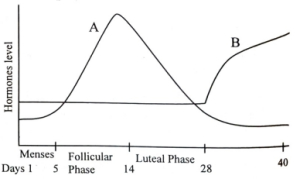
Given below is a graph with respect to levels of hormones in a pregnant female. Select the correct option.
A
'$A$' is estrogens and '$B$' is progesterone.
B
'$A$' is estrogens and '$B$' is hCG.
C
'$A$' is hCG and '$B$' is progesterone.
D
'$A$' is hCG and '$B$' is estrogens.
Solution
(B) In the provided graph,curve '$A$' represents the levels of estrogens during the menstrual cycle,which peaks before ovulation (around day $14$).
Curve '$B$' shows a sharp rise after day $28$,which is characteristic of human chorionic gonadotropin $(hCG)$ in a pregnant female.
$hCG$ is produced by the placenta after implantation to maintain the corpus luteum,which in turn continues to secrete progesterone to support pregnancy.
Therefore,'$A$' corresponds to estrogens and '$B$' corresponds to $hCG$.
Curve '$B$' shows a sharp rise after day $28$,which is characteristic of human chorionic gonadotropin $(hCG)$ in a pregnant female.
$hCG$ is produced by the placenta after implantation to maintain the corpus luteum,which in turn continues to secrete progesterone to support pregnancy.
Therefore,'$A$' corresponds to estrogens and '$B$' corresponds to $hCG$.
0 likes
View Solution378
EasyMCQ
The first germinal layer formed in the human embryo is . . . . . . .
A
mesoderm
B
trophectoderm
C
ectoderm
D
endoderm
Solution
(D) During human embryonic development,the process of gastrulation involves the formation of the three primary germ layers. The first germinal layer to differentiate from the inner cell mass is the endoderm. This occurs as cells from the epiblast migrate through the primitive streak to form the endoderm,followed by the mesoderm,and finally the ectoderm.
0 likes
View Solution379
EasyMCQ
With respect to derivatives of germinal layers in human beings, complete the analogy.
$Ectoderm : \text{Sweat glands} :: Endoderm :$ . . . . . . .
$Ectoderm : \text{Sweat glands} :: Endoderm :$ . . . . . . .
A
Mammary glands
B
Salivary glands
C
Thyroid glands
D
Pineal glands
Solution
(C) The germinal layers in humans give rise to specific organs and tissues during embryonic development.
$1$. The $Ectoderm$ gives rise to structures like the epidermis, sweat glands, mammary glands, salivary glands, and the pineal gland.
$2$. The $Endoderm$ gives rise to the epithelial lining of the digestive tract, respiratory tract, and endocrine glands such as the thyroid gland, parathyroid gland, and thymus.
Therefore, among the given options, the thyroid gland is a derivative of the $Endoderm$.
$1$. The $Ectoderm$ gives rise to structures like the epidermis, sweat glands, mammary glands, salivary glands, and the pineal gland.
$2$. The $Endoderm$ gives rise to the epithelial lining of the digestive tract, respiratory tract, and endocrine glands such as the thyroid gland, parathyroid gland, and thymus.
Therefore, among the given options, the thyroid gland is a derivative of the $Endoderm$.
0 likes
View Solution380
EasyMCQ
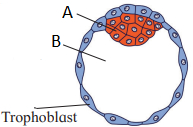
The diagram shows one of the human embryonic developmental stages. What do $A$ and $B$ indicate?
A
$A$-Trophoblast; $B$-Yolk sac
B
$A$-Inner mass of cells; $B$-Antrum
C
$A$-Ectoderm; $B$-Amniotic cavity
D
$A$-Inner mass of cells; $B$-Blastocoel
Solution
(D) The diagram represents a blastocyst,which is an early stage of human embryonic development.
In this structure,the outer layer of cells is called the trophoblast.
The inner group of cells attached to the trophoblast is known as the inner cell mass (indicated by $A$).
The fluid-filled cavity present inside the blastocyst is called the blastocoel (indicated by $B$).
Therefore,$A$ represents the inner cell mass and $B$ represents the blastocoel.
In this structure,the outer layer of cells is called the trophoblast.
The inner group of cells attached to the trophoblast is known as the inner cell mass (indicated by $A$).
The fluid-filled cavity present inside the blastocyst is called the blastocoel (indicated by $B$).
Therefore,$A$ represents the inner cell mass and $B$ represents the blastocoel.
0 likes
View Solution381
EasyMCQ
In human beings,usually the gestation period lasts for about . . . . . . days,from the beginning of the last menstrual cycle.
A
$280$
B
$266$
C
$256$
D
$243$
Solution
(A) The average gestation period in humans is approximately $266$ days from the time of fertilization.
However,when calculated from the beginning of the Last Menstrual Cycle $(LMC)$,it is approximately $280$ days ($266$ days of development + $14$ days of the follicular phase before ovulation).
However,when calculated from the beginning of the Last Menstrual Cycle $(LMC)$,it is approximately $280$ days ($266$ days of development + $14$ days of the follicular phase before ovulation).
0 likes
View Solution382
EasyMCQ
The hormone relaxin,responsible for the easy birth of the baby,is secreted by . . . . . . .
A
Graafian follicle
B
Corpus callosum
C
Corpus luteum
D
Corpus albicans
Solution
(C) The hormone $Relaxin$ is secreted by the $Corpus \ luteum$ during the later stages of pregnancy.
It helps in the relaxation of the pelvic ligaments and the widening of the birth canal,which facilitates the easy birth of the baby (parturition).
Therefore,the correct option is $C$.
It helps in the relaxation of the pelvic ligaments and the widening of the birth canal,which facilitates the easy birth of the baby (parturition).
Therefore,the correct option is $C$.
0 likes
View Solution383
EasyMCQ
During embryonic development,after the third cleavage,the number of blastomeres formed will be . . . . . . .
A
$8$
B
$10$
C
$16$
D
$6$
Solution
(A) Cleavage is a series of rapid mitotic divisions of the zygote that converts the single-celled zygote into a multicellular structure called a blastula.
In each cleavage division,the number of cells (blastomeres) doubles.
- After the $1^{st}$ cleavage,the number of blastomeres = $2^1 = 2$.
- After the $2^{nd}$ cleavage,the number of blastomeres = $2^2 = 4$.
- After the $3^{rd}$ cleavage,the number of blastomeres = $2^3 = 8$.
Therefore,after the third cleavage,$8$ blastomeres are formed.
In each cleavage division,the number of cells (blastomeres) doubles.
- After the $1^{st}$ cleavage,the number of blastomeres = $2^1 = 2$.
- After the $2^{nd}$ cleavage,the number of blastomeres = $2^2 = 4$.
- After the $3^{rd}$ cleavage,the number of blastomeres = $2^3 = 8$.
Therefore,after the third cleavage,$8$ blastomeres are formed.
0 likes
View Solution384
EasyMCQ
In the second trimester of pregnancy,there is a decline in the level of . . . . . . .
A
$ACTH$
B
$ICSH$
C
hCG
D
$MSH$
Solution
(C) During pregnancy,the placenta produces several hormones essential for maintaining the pregnancy,such as human chorionic gonadotropin $(hCG)$,human placental lactogen $(hPL)$,estrogens,and progestogens.
$hCG$ is produced by the syncytiotrophoblast of the placenta shortly after implantation to maintain the corpus luteum.
Its levels rise rapidly during the first trimester to ensure the production of progesterone.
By the second trimester,the placenta itself becomes fully capable of producing sufficient progesterone and estrogens to maintain the pregnancy,leading to a significant decline in the levels of $hCG$.
$hCG$ is produced by the syncytiotrophoblast of the placenta shortly after implantation to maintain the corpus luteum.
Its levels rise rapidly during the first trimester to ensure the production of progesterone.
By the second trimester,the placenta itself becomes fully capable of producing sufficient progesterone and estrogens to maintain the pregnancy,leading to a significant decline in the levels of $hCG$.
0 likes
View Solution385
EasyMCQ
$hCG$ is secreted by . . . . . . .
A
Allantois
B
Corona radiata
C
Corpus luteum
D
Placenta
Solution
(D) Human Chorionic Gonadotropin $(hCG)$ is a hormone produced by the syncytiotrophoblast cells of the placenta during pregnancy.
It plays a crucial role in maintaining the corpus luteum,which in turn continues to secrete progesterone to support the pregnancy until the placenta takes over this function fully.
Therefore,the correct answer is $D$ (Placenta).
It plays a crucial role in maintaining the corpus luteum,which in turn continues to secrete progesterone to support the pregnancy until the placenta takes over this function fully.
Therefore,the correct answer is $D$ (Placenta).
0 likes
View Solution386
EasyMCQ
The process by which primary germinal layers are formed is called
A
Blastulation
B
Cleavage
C
Gastrulation
D
Implantation
Solution
(C) Gastrulation is the morphogenetic process during embryonic development in which the blastula is reorganized into a multi-layered structure known as the gastrula.
This process involves the movement and rearrangement of cells to form the three primary germinal layers: ectoderm,mesoderm,and endoderm.
Blastulation is the formation of the blastula,cleavage is the series of mitotic divisions of the zygote,and implantation is the attachment of the blastocyst to the uterine wall.
This process involves the movement and rearrangement of cells to form the three primary germinal layers: ectoderm,mesoderm,and endoderm.
Blastulation is the formation of the blastula,cleavage is the series of mitotic divisions of the zygote,and implantation is the attachment of the blastocyst to the uterine wall.
0 likes
View Solution387
EasyMCQ
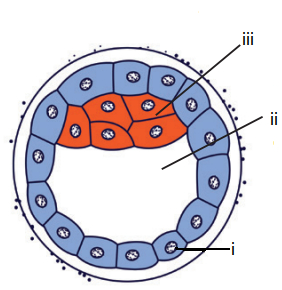
Choose the $CORRECT$ group of labelling.
A
$I$ - Trophoblast,$II$ - Archenteron,$III$ - Micromeres
B
$I$ - Trophoblast,$II$ - Blastocoel,$III$ - Megameres
C
$I$ - Trophoblast,$II$ - Archenteron,$III$ - Inner mass cells
D
$I$ - Trophoblast,$II$ - Blastocoel,$III$ - Inner mass cells
Solution
(D) The provided image represents a blastocyst stage of human embryonic development.
$I$ points to the outer layer of cells,known as the Trophoblast,which attaches to the endometrium.
$II$ points to the fluid-filled cavity inside the blastocyst,known as the Blastocoel.
$III$ points to the group of cells clustered at one end,known as the Inner cell mass (or embryoblast),which gives rise to the embryo proper.
Therefore,the correct labelling is $I$ - Trophoblast,$II$ - Blastocoel,$III$ - Inner mass cells.
$I$ points to the outer layer of cells,known as the Trophoblast,which attaches to the endometrium.
$II$ points to the fluid-filled cavity inside the blastocyst,known as the Blastocoel.
$III$ points to the group of cells clustered at one end,known as the Inner cell mass (or embryoblast),which gives rise to the embryo proper.
Therefore,the correct labelling is $I$ - Trophoblast,$II$ - Blastocoel,$III$ - Inner mass cells.
0 likes
View Solution388
EasyMCQ
Which one of the following is $NOT$ secreted by the corpus luteum?
A
Relaxin
B
hCG
C
Progesterone
D
Inhibin
Solution
(B) The corpus luteum is a temporary endocrine structure in the ovary that plays a vital role in the menstrual cycle and early pregnancy.
It primarily secretes progesterone,which is essential for maintaining the endometrium.
It also secretes moderate amounts of estrogen,inhibin,and relaxin (especially during pregnancy).
However,$hCG$ (human Chorionic Gonadotropin) is secreted by the syncytiotrophoblast cells of the developing placenta,not by the corpus luteum.
Therefore,the correct answer is $hCG$.
It primarily secretes progesterone,which is essential for maintaining the endometrium.
It also secretes moderate amounts of estrogen,inhibin,and relaxin (especially during pregnancy).
However,$hCG$ (human Chorionic Gonadotropin) is secreted by the syncytiotrophoblast cells of the developing placenta,not by the corpus luteum.
Therefore,the correct answer is $hCG$.
0 likes
View Solution389
EasyMCQ
These hormones are produced in women during pregnancy only :
A
hCG,progestogens and relaxin
B
hCG,hPL and relaxin
C
hPL,estrogen and relaxin
D
progestogens,estrogens and relaxin
Solution
(B) During pregnancy,the placenta acts as an endocrine tissue and produces several hormones which are essential for maintaining pregnancy.
Specifically,human Chorionic Gonadotropin $(hCG)$,human Placental Lactogen $(hPL)$,and relaxin are hormones that are produced in women $ONLY$ during pregnancy.
While estrogens and progestogens are also produced by the placenta during pregnancy,they are also produced by the ovaries in non-pregnant women.
Therefore,the correct option is $B$.
Specifically,human Chorionic Gonadotropin $(hCG)$,human Placental Lactogen $(hPL)$,and relaxin are hormones that are produced in women $ONLY$ during pregnancy.
While estrogens and progestogens are also produced by the placenta during pregnancy,they are also produced by the ovaries in non-pregnant women.
Therefore,the correct option is $B$.
0 likes
View Solution390
EasyMCQ
Major features of embryonic development at various months of pregnancy are given below. Choose the correct option for the correct sequential events.
$(i)$ The first movements of the foetus
$(II)$ The foetus develops limbs and digits
$(III)$ The embryo's heart is formed
$(IV)$ The body is covered with fine hairs
$(i)$ The first movements of the foetus
$(II)$ The foetus develops limbs and digits
$(III)$ The embryo's heart is formed
$(IV)$ The body is covered with fine hairs
A
$(II)$,$(IV)$,$(I)$,$(III)$
B
$(IV)$,$(II)$,$(I)$,$(III)$
C
$(II)$,$(III)$,$(IV)$,$(i)$
D
$(III)$,$(II)$,$(I)$,$(IV)$
Solution
(D) The correct sequence of embryonic development is as follows:
$(III)$ The embryo's heart is formed: This is the first sign of organ development,usually observed by the end of the first month.
$(II)$ The foetus develops limbs and digits: This occurs by the end of the second month of pregnancy.
$(I)$ The first movements of the foetus: These are observed during the fifth month of pregnancy.
$(IV)$ The body is covered with fine hairs: This occurs by the end of the second trimester (around the sixth month).
Therefore,the correct sequence is $(III), (II), (I), (IV)$,which corresponds to option $D$.
$(III)$ The embryo's heart is formed: This is the first sign of organ development,usually observed by the end of the first month.
$(II)$ The foetus develops limbs and digits: This occurs by the end of the second month of pregnancy.
$(I)$ The first movements of the foetus: These are observed during the fifth month of pregnancy.
$(IV)$ The body is covered with fine hairs: This occurs by the end of the second trimester (around the sixth month).
Therefore,the correct sequence is $(III), (II), (I), (IV)$,which corresponds to option $D$.
0 likes
View Solution391
EasyMCQ
The foetus develops its limbs and digits in . . . . . . during embryonic development.
A
Four weeks
B
Eight weeks
C
Twelve weeks
D
Two weeks
Solution
(B) During human embryonic development,the heart is formed after one month of pregnancy. By the end of the second month (eight weeks) of pregnancy,the foetus develops limbs and digits. By the end of the first trimester (twelve weeks),most of the major organ systems are formed.
0 likes
View Solution392
EasyMCQ
Which of the following hormones is not produced by the placenta?
A
hCG
B
Relaxin
C
hPL
D
Estrogens
Solution
(B) The placenta acts as an endocrine tissue and produces several hormones essential for pregnancy,such as human Chorionic Gonadotropin $(hCG)$,human Placental Lactogen $(hPL)$,estrogens,and progestogens.
Relaxin is also produced during the later stages of pregnancy,but it is primarily secreted by the ovary (corpus luteum) and not the placenta.
Therefore,the correct option is $B$.
Relaxin is also produced during the later stages of pregnancy,but it is primarily secreted by the ovary (corpus luteum) and not the placenta.
Therefore,the correct option is $B$.
0 likes
View Solution393
EasyMCQ
The inner cell mass of the blastocyst differentiates into:
A
extraembryonic membranes
B
the embryo proper
C
chorionic villi
D
placenta
Solution
(B) The correct answer is $B$.
In the process of human development,the blastocyst consists of an outer layer called the trophoblast and an inner group of cells known as the inner cell mass $(ICM)$.
The trophoblast layer attaches to the endometrium and eventually forms the extraembryonic membranes and the fetal part of the placenta.
The inner cell mass differentiates into the embryo proper,which includes the three germ layers (ectoderm,mesoderm,and endoderm) that give rise to all the tissues and organs of the developing fetus.
In the process of human development,the blastocyst consists of an outer layer called the trophoblast and an inner group of cells known as the inner cell mass $(ICM)$.
The trophoblast layer attaches to the endometrium and eventually forms the extraembryonic membranes and the fetal part of the placenta.
The inner cell mass differentiates into the embryo proper,which includes the three germ layers (ectoderm,mesoderm,and endoderm) that give rise to all the tissues and organs of the developing fetus.
0 likes
View Solution394
EasyMCQ
Gastrula has a pore which is known as . . . . . .
A
Blastopore
B
Zoospore
C
Gonophore
D
Oospore
Solution
(A) The correct answer is $A$.
During the process of gastrulation,the embryo forms a structure called the gastrula.
The gastrula contains an opening or pore known as the $Blastopore$.
$Blastopore$ is the first opening formed in the early embryo,which later develops into either the mouth or the anus depending on the organism (protostomes or deuterostomes).
During the process of gastrulation,the embryo forms a structure called the gastrula.
The gastrula contains an opening or pore known as the $Blastopore$.
$Blastopore$ is the first opening formed in the early embryo,which later develops into either the mouth or the anus depending on the organism (protostomes or deuterostomes).
0 likes
View Solution395
EasyMCQ
Match the hormone with its site of production:
| Hormone | Site of production |
|---|---|
| $A$. $hCG$ and $hPL$ | $(ii)$ Placenta |
| $B$. Progesterone | $(iii)$ Corpus luteum |
| $C$. Androgens | $(iv)$ Leydig cells |
| $D$. Relaxin | $(i)$ Ovary |
A
$A-iv, B-i, C-ii, D-iii$
B
$A-i, B-ii, C-iv, D-iii$
C
$A-ii, B-iii, C-iv, D-i$
D
$A-iii, B-i, C-iv, D-ii$
Solution
(C) The correct matches are as follows:
$1$. $hCG$ (human Chorionic Gonadotropin) and $hPL$ (human Placental Lactogen) are produced by the placenta during pregnancy.
$2$. Progesterone is primarily secreted by the corpus luteum in the ovary after ovulation.
$3$. Androgens (mainly testosterone) are synthesized and secreted by the Leydig cells (interstitial cells) of the testes.
$4$. Relaxin is produced by the ovary (specifically the corpus luteum) during the later stages of pregnancy.
Therefore,the correct matching is $A-ii, B-iii, C-iv, D-i$.
$1$. $hCG$ (human Chorionic Gonadotropin) and $hPL$ (human Placental Lactogen) are produced by the placenta during pregnancy.
$2$. Progesterone is primarily secreted by the corpus luteum in the ovary after ovulation.
$3$. Androgens (mainly testosterone) are synthesized and secreted by the Leydig cells (interstitial cells) of the testes.
$4$. Relaxin is produced by the ovary (specifically the corpus luteum) during the later stages of pregnancy.
Therefore,the correct matching is $A-ii, B-iii, C-iv, D-i$.
0 likes
View Solution396
EasyMCQ
Select the mismatched pair:
$A$. First month of pregnancy - Formation of heart
$B$. Second month of pregnancy - Movement of foetus
$C$. Third month of pregnancy - Formation of most of the major organ systems
$D$. Sixth month of pregnancy - Eye lids separate and eye lashes are formed
$A$. First month of pregnancy - Formation of heart
$B$. Second month of pregnancy - Movement of foetus
$C$. Third month of pregnancy - Formation of most of the major organ systems
$D$. Sixth month of pregnancy - Eye lids separate and eye lashes are formed
A
$C$
B
$D$
C
$A$
D
$B$
Solution
(B) The correct answer is $B$. The pair "Second month of pregnancy - Movement of foetus" is mismatched.
According to human development milestones:
$1$. During the first month, the heart is formed.
$2$. During the second month, the foetus develops limbs and digits.
$3$. By the end of the third month (first trimester), most major organ systems are formed.
$4$. During the fifth month, the first movements of the foetus and appearance of hair on the head are observed.
$5$. By the end of the sixth month (second trimester), the body is covered with fine hair, eye-lids separate, and eye-lashes are formed.
According to human development milestones:
$1$. During the first month, the heart is formed.
$2$. During the second month, the foetus develops limbs and digits.
$3$. By the end of the third month (first trimester), most major organ systems are formed.
$4$. During the fifth month, the first movements of the foetus and appearance of hair on the head are observed.
$5$. By the end of the sixth month (second trimester), the body is covered with fine hair, eye-lids separate, and eye-lashes are formed.
0 likes
View Solution397
EasyMCQ
Which of the following hormones is not secreted by the human placenta?
A
Progestogen
B
$HCG$
C
Estrogen
D
$LH$
Solution
(D) The correct answer is $D$.
$LH$ (Luteinizing Hormone) is secreted by the anterior pituitary gland,not the placenta.
The human placenta acts as an endocrine tissue and produces several hormones such as Human Chorionic Gonadotropin $(HCG)$,Human Placental Lactogen $(HPL)$,estrogens,and progestogens to maintain pregnancy.
$LH$ (Luteinizing Hormone) is secreted by the anterior pituitary gland,not the placenta.
The human placenta acts as an endocrine tissue and produces several hormones such as Human Chorionic Gonadotropin $(HCG)$,Human Placental Lactogen $(HPL)$,estrogens,and progestogens to maintain pregnancy.
0 likes
View Solution398
EasyMCQ
Which of the following hormones is not secreted by the human placenta?
A
Progestogen
B
hCG
C
$FSH$
D
Relaxin
Solution
(C) is the correct answer.
Follicle-stimulating hormone $(FSH)$ is secreted by the anterior lobe of the pituitary gland.
It stimulates the growth and maturation of ovarian follicles in the ovary.
Progestogens,human chorionic gonadotropin $(hCG)$,and relaxin are hormones secreted by the human placenta during pregnancy.
Follicle-stimulating hormone $(FSH)$ is secreted by the anterior lobe of the pituitary gland.
It stimulates the growth and maturation of ovarian follicles in the ovary.
Progestogens,human chorionic gonadotropin $(hCG)$,and relaxin are hormones secreted by the human placenta during pregnancy.
0 likes
View Solution399
EasyMCQ
In which month of gestation,the first movements of the fetus and the appearance of hair on its head are observed?
A
$5^{\text{th}}$ month
B
$1^{\text{st}}$ month
C
$8^{\text{th}}$ month
D
$4^{\text{th}}$ month
Solution
(A) The correct answer is $A$.
During the human pregnancy period (gestation),the first movements of the fetus and the appearance of hair on the head are observed during the $5^{\text{th}}$ month of pregnancy.
By the end of the first month,the heart is formed.
By the end of the second month,limbs and digits develop.
By the end of the first trimester,most major organ systems are formed.
During the $5^{\text{th}}$ month,the fetus shows movement and hair appears on the head.
During the human pregnancy period (gestation),the first movements of the fetus and the appearance of hair on the head are observed during the $5^{\text{th}}$ month of pregnancy.
By the end of the first month,the heart is formed.
By the end of the second month,limbs and digits develop.
By the end of the first trimester,most major organ systems are formed.
During the $5^{\text{th}}$ month,the fetus shows movement and hair appears on the head.
0 likes
View Solution400
EasyMCQ
Match the months listed in Column $I$ with the organogenesis of the foetus in Column $II$.
| Column $I$ | Column $II$ |
| $(A)$ First month | $(i)$ Separation of eyelids |
| $(B)$ Second month | $(ii)$ Hairs on head |
| $(C)$ Fifth month | $(iii)$ Heart |
| $(D)$ Sixth month | $(iv)$ Limbs and digits |
A
$A-iii, B-iv, C-ii, D-i$
B
$A-iii, B-iv, C-i, D-ii$
C
$A-ii, B-iii, C-iv, D-i$
D
$A-iv, B-ii, C-iii, D-i$
Solution
(A) The correct matching is as follows:
$(A)$ First month: The first sign of growing foetus is usually noticed by listening to the heart sound carefully through the stethoscope. Thus,$(A-iii)$.
$(B)$ Second month: By the end of the second month of pregnancy,the foetus develops limbs and digits. Thus,$(B-iv)$.
$(C)$ Fifth month: The first movements of the foetus and appearance of hair on the head are usually observed during the fifth month. Thus,$(C-ii)$.
$(D)$ Sixth month: By the end of $24$ weeks (second trimester),the body is covered with fine hair,eye-lids separate,and eyelashes are formed. Thus,$(D-i)$.
Therefore,the correct sequence is $A-iii, B-iv, C-ii, D-i$.
$(A)$ First month: The first sign of growing foetus is usually noticed by listening to the heart sound carefully through the stethoscope. Thus,$(A-iii)$.
$(B)$ Second month: By the end of the second month of pregnancy,the foetus develops limbs and digits. Thus,$(B-iv)$.
$(C)$ Fifth month: The first movements of the foetus and appearance of hair on the head are usually observed during the fifth month. Thus,$(C-ii)$.
$(D)$ Sixth month: By the end of $24$ weeks (second trimester),the body is covered with fine hair,eye-lids separate,and eyelashes are formed. Thus,$(D-i)$.
Therefore,the correct sequence is $A-iii, B-iv, C-ii, D-i$.
0 likes
View SolutionHuman Reproduction — Pregnancy and Embryonic development · Frequently Asked Questions
1Are these Human Reproduction questions useful for JEE and NEET?
Yes. All questions in this section are mapped to JEE Main and NEET exam patterns. Previous year questions from JEE Main, NEET, GUJCET and state-level exams are included with full solutions.
2Can I switch to Hindi or Gujarati for these questions?
Yes. Use the language tabs in the hero section or the sidebar to view the same questions and solutions in English, Hindi or Gujarati.
3How do I generate a question paper from this subtopic?
Use the Vedclass Exam Paper Generator — select the chapter and subtopic, set difficulty, and generate Sets A, B, C, D automatically. First 3 chapters of every subject are free.
Vedclass Products
For Students
Vedclass Test Series
Mock tests in real JEE/NEET style with performance analysis. 5-day free trial.
Start Free TrialFor Teachers
Exam Paper Generator
Generate Set A/B/C/D papers from this chapter in 2 minutes. 3 chapters free.
Try FreeFor Institutes
Online Exam Module
Live online exams with unlimited students, 360° analytics & white-label branding.
See DemoFor Teachers & Institutes
Generate a Human Reproduction Exam Paper in 2 Minutes
Select subtopic & difficulty — Sets A, B, C, D auto-generated with No Repeat logic.
First 3 chapters of every subject are free — no payment required.