
A English
Pregnancy and Embryonic development Questions in English
Class 12 Biology · Human Reproduction · Pregnancy and Embryonic development
405+
Questions
English
Language
100%
With Solutions
Showing 50 of 405 questions in English
201
EasyMCQ
Which of the following hormones plays a crucial role in the maintenance of pregnancy?
A
$HCG$
B
Progesterone
C
Estrogen
D
Prostaglandin
Solution
(B) Progesterone is known as the pregnancy hormone.
It is essential for the maintenance of the endometrium,which is necessary for the implantation of the blastocyst and the successful continuation of pregnancy.
It inhibits uterine contractions,thereby preventing the premature expulsion of the fetus.
It is essential for the maintenance of the endometrium,which is necessary for the implantation of the blastocyst and the successful continuation of pregnancy.
It inhibits uterine contractions,thereby preventing the premature expulsion of the fetus.
0 likes
View Solution202
EasyMCQ
Which of the following secretes progesterone?
A
Corpus luteum
B
Corpus albicans
C
Corpus callosum
D
Corpus striatum
Solution
(A) After ovulation,the ruptured follicle transforms into a temporary endocrine structure known as the $Corpus \ luteum$.
This structure is responsible for the secretion of large amounts of progesterone,which is essential for the maintenance of the endometrium and the support of pregnancy.
Therefore,the correct option is $A$.
This structure is responsible for the secretion of large amounts of progesterone,which is essential for the maintenance of the endometrium and the support of pregnancy.
Therefore,the correct option is $A$.
0 likes
View Solution203
EasyMCQ
Which hormone is produced by the placenta?
A
$GH$
B
Gastrin
C
$ACTH$
D
Progesterone
Solution
(D) The placenta acts as an endocrine tissue and produces several hormones essential for maintaining pregnancy. These include Human Chorionic Gonadotropin $(hCG)$,Human Placental Lactogen $(hPL)$,estrogens,and progesterone. Among the given options,progesterone is the correct hormone produced by the placenta.
0 likes
View Solution204
MediumMCQ
During pregnancy,the fetus receives some antibodies from its mother through the .............. .
A
Amniotic fluid
B
Placenta
C
Umbilical cord
D
Uterus
Solution
(B) During pregnancy,the fetus receives passive immunity from the mother. The $IgG$ antibodies are the only class of antibodies that can cross the placenta from the mother to the fetus. This provides the fetus with protection against various pathogens before birth. Therefore,the placenta acts as the medium for the transfer of these antibodies.
0 likes
View Solution205
EasyMCQ
The brain and spinal cord are derived from which germ layer?
A
Ectoderm
B
Mesoderm
C
Endoderm
D
Epidermis
Solution
(A) The brain and spinal cord constitute the central nervous system $(CNS)$.
During embryonic development,the nervous system originates from the ectoderm,which is the outermost germ layer.
Specifically,the neural tube,which eventually forms the brain and spinal cord,is derived from the neural ectoderm.
During embryonic development,the nervous system originates from the ectoderm,which is the outermost germ layer.
Specifically,the neural tube,which eventually forms the brain and spinal cord,is derived from the neural ectoderm.
0 likes
View Solution206
MediumMCQ
What is the correct sequence of events in the formation of an offspring from a zygote?
A
$Zygote \rightarrow$ Cell division $\rightarrow$ Differentiation $\rightarrow$ Organogenesis
B
$Zygote \rightarrow$ Differentiation $\rightarrow$ Organogenesis $\rightarrow$ Cell division
C
$Zygote \rightarrow$ Organogenesis $\rightarrow$ Differentiation $\rightarrow$ Cell division
D
Cell division $\rightarrow$ Differentiation $\rightarrow$ $Zygote \rightarrow$ Organogenesis
Solution
(A) The development of an embryo from a zygote follows a specific biological sequence:
$1$. $Zygote$: The initial single-celled stage formed by fertilization.
$2$. Cell division (Cleavage): The zygote undergoes rapid mitotic divisions to form a multicellular structure (morula and blastula).
$3$. Differentiation: Cells begin to specialize into different types to form specific tissues.
$4$. Organogenesis: The specialized tissues organize into functional organs and organ systems to form the complete offspring.
Therefore,the correct sequence is $Zygote \rightarrow$ Cell division $\rightarrow$ Differentiation $\rightarrow$ Organogenesis.
$1$. $Zygote$: The initial single-celled stage formed by fertilization.
$2$. Cell division (Cleavage): The zygote undergoes rapid mitotic divisions to form a multicellular structure (morula and blastula).
$3$. Differentiation: Cells begin to specialize into different types to form specific tissues.
$4$. Organogenesis: The specialized tissues organize into functional organs and organ systems to form the complete offspring.
Therefore,the correct sequence is $Zygote \rightarrow$ Cell division $\rightarrow$ Differentiation $\rightarrow$ Organogenesis.
0 likes
View Solution207
MediumMCQ
What is formed in the embryo as a result of organogenesis?
A
Tissue systems
B
Organs
C
Organ systems
D
All of the above
Solution
(D) Organogenesis is the process in embryonic development during which the three germ layers (ectoderm,mesoderm,and endoderm) differentiate into internal organs.
During this phase,the cells organize into tissues,which then form specific organs,and subsequently,these organs integrate to form organ systems.
Therefore,all the options listed are correct outcomes of the developmental process occurring during and after organogenesis.
During this phase,the cells organize into tissues,which then form specific organs,and subsequently,these organs integrate to form organ systems.
Therefore,all the options listed are correct outcomes of the developmental process occurring during and after organogenesis.
0 likes
View Solution208
MediumMCQ
$A$ temporary endocrine gland in the human body is
A
corpus cardiacum
B
corpus luteum
C
corpus allatum
D
pineal gland
Solution
(B) : The $Corpus$ luteum is a temporary endocrine gland found in the human female reproductive system.
It is formed from the ruptured Graafian follicle after ovulation.
It secretes the hormone progesterone, which is essential for the maintenance of the endometrium during pregnancy.
If fertilization does not occur, the $Corpus$ luteum degenerates, leading to a drop in progesterone levels and the onset of menstruation.
It is formed from the ruptured Graafian follicle after ovulation.
It secretes the hormone progesterone, which is essential for the maintenance of the endometrium during pregnancy.
If fertilization does not occur, the $Corpus$ luteum degenerates, leading to a drop in progesterone levels and the onset of menstruation.
0 likes
View Solution209
MediumMCQ
Several hormones like $hCG, hPL$,estrogen,and progesterone are produced by:
A
ovary
B
placenta
C
Fallopian tube
D
pituitary
Solution
(B) The correct answer is $B$. During pregnancy,the placenta acts as a temporary endocrine gland. It produces several essential hormones,including human chorionic gonadotropin $(hCG)$,human placental lactogen $(hPL)$,estrogens,and progestogens,which are necessary for the maintenance of pregnancy and fetal development.
0 likes
View Solution210
MediumMCQ
Select the correct option describing gonadotropin activity in a normal pregnant female.
A
High level of $FSH$ and $LH$ stimulates the thickening of endometrium.
B
High level of $FSH$ and $LH$ facilitates implantation of the embryo.
C
High level of $hCG$ stimulates the synthesis of estrogen and progesterone.
D
High level of $hCG$ stimulates the thickening of endometrium.
Solution
(C) The correct option is $C$.
During pregnancy,the trophoblastic cells of the developing embryo secrete a hormone called human chorionic gonadotropin $(hCG)$.
$hCG$ has biological properties similar to the luteinizing hormone $(LH)$ produced by the anterior pituitary gland.
It acts on the corpus luteum in the ovary and stimulates it to continue the synthesis and secretion of progesterone and estrogen.
These hormones are essential for maintaining the endometrium of the uterus,preventing its shedding (menstruation),and supporting the pregnancy.
During pregnancy,the trophoblastic cells of the developing embryo secrete a hormone called human chorionic gonadotropin $(hCG)$.
$hCG$ has biological properties similar to the luteinizing hormone $(LH)$ produced by the anterior pituitary gland.
It acts on the corpus luteum in the ovary and stimulates it to continue the synthesis and secretion of progesterone and estrogen.
These hormones are essential for maintaining the endometrium of the uterus,preventing its shedding (menstruation),and supporting the pregnancy.
0 likes
View Solution211
MediumMCQ
Which one of the following is not the function of placenta?
A
Facilitates removal of carbon dioxide and waste material from embryo
B
Secretes oxytocin during parturition
C
Facilitates supply of oxygen and nutrients to embryo
D
Secretes estrogen
Solution
(B) : Parturition is induced by a complex neuroendocrine mechanism. The signals for parturition originate from the fully developed foetus and the placenta,which induce mild uterine contractions called the foetal ejection reflex. This triggers the release of oxytocin from the maternal pituitary gland. Oxytocin acts on the uterine muscle and causes stronger uterine contractions,which in turn stimulates further secretion of oxytocin. The stimulatory reflex between the uterine contraction and oxytocin secretion continues,resulting in stronger and stronger contractions. This leads to the expulsion of the baby out of the uterus through the birth canal. Therefore,the placenta does not secrete oxytocin; it is secreted by the maternal pituitary.
0 likes
View Solution212
MediumMCQ
In a normal pregnant woman,the amount of total gonadotropin activity was assessed. The result expected was
A
high level of circulating $FSH$ and $LH$ in the uterus to stimulate implantation of the embryo
B
high level of circulating $hCG$ to stimulate endometrial thickening
C
high levels of $FSH$ and $LH$ in uterus to stimulate endometrial thickening
D
high level of circulating $hCG$ to stimulate estrogen and progesterone synthesis.
Solution
(D) : During pregnancy,the placenta acts as an endocrine tissue and produces several hormones like human chorionic gonadotropin $(hCG)$,human placental lactogen $(hPL)$,estrogens,and progestogens. The $hCG$ is secreted by the placenta to stimulate and maintain the corpus luteum in the ovary,which in turn secretes progesterone,essential for the maintenance of pregnancy.
0 likes
View Solution213
EasyMCQ
The first movements of the foetus and appearance of hair on its head are usually observed during which month of pregnancy?
A
Fourth month
B
Fifth month
C
Sixth month
D
Third month
Solution
(B) : In human beings,after one month of pregnancy,the embryo's heart is formed.
By the end of the second month of pregnancy,the foetus develops limbs and digits.
By the end of $12$ weeks (first trimester),most of the major organ systems are formed.
The first movements of the foetus and appearance of hair on the head are usually observed during the fifth month.
By the end of $24$ weeks (second trimester),the body is covered with fine hair,eyelids separate,and eyelashes are formed.
By the end of nine months of pregnancy,the foetus is fully developed and is ready for delivery.
By the end of the second month of pregnancy,the foetus develops limbs and digits.
By the end of $12$ weeks (first trimester),most of the major organ systems are formed.
The first movements of the foetus and appearance of hair on the head are usually observed during the fifth month.
By the end of $24$ weeks (second trimester),the body is covered with fine hair,eyelids separate,and eyelashes are formed.
By the end of nine months of pregnancy,the foetus is fully developed and is ready for delivery.
0 likes
View Solution214
MediumMCQ
Which one of the following statements about morula in humans is correct?
A
It has almost equal quantity of cytoplasm as an uncleaved zygote but much more $DNA$.
B
It has far less cytoplasm as well as less $DNA$ than in an uncleaved zygote.
C
It has more or less equal quantity of cytoplasm and $DNA$ as in uncleaved zygote.
D
It has more cytoplasm and more $DNA$ than an uncleaved zygote.
Solution
(A) : $A$ morula is an embryo at an early stage of embryonic development,consisting of cells (called blastomeres) in a solid ball contained within the zona pellucida.
During cleavage,the zygote undergoes rapid mitotic divisions without any significant growth in size.
Because there is no net growth,the total volume of cytoplasm remains approximately the same as that of the original zygote,while the number of cells increases.
However,since each cell division involves $DNA$ replication,the total amount of $DNA$ in the morula is significantly higher than in the uncleaved zygote.
Therefore,the morula has almost equal quantity of cytoplasm as an uncleaved zygote but much more $DNA$.
During cleavage,the zygote undergoes rapid mitotic divisions without any significant growth in size.
Because there is no net growth,the total volume of cytoplasm remains approximately the same as that of the original zygote,while the number of cells increases.
However,since each cell division involves $DNA$ replication,the total amount of $DNA$ in the morula is significantly higher than in the uncleaved zygote.
Therefore,the morula has almost equal quantity of cytoplasm as an uncleaved zygote but much more $DNA$.
0 likes
View Solution215
MediumMCQ
Foetal ejection reflex in human female is induced by
A
release of oxytocin from pituitary
B
fully developed foetus and placenta
C
differentiation of mammary glands
D
pressure exerted by amniotic fluid.
Solution
(B) : Parturition is induced by a complex neuroendocrine mechanism.
The signals for parturition originate from the fully developed foetus and the placenta,which induce mild uterine contractions called the foetal ejection reflex.
This triggers the release of oxytocin from the maternal pituitary.
Oxytocin acts on the uterine muscle and causes stronger uterine contractions,which in turn stimulates further secretion of oxytocin.
The stimulatory reflex between the uterine contraction and oxytocin secretion continues,resulting in stronger and stronger contractions.
This leads to the expulsion of the baby out of the uterus through the birth canal.
The signals for parturition originate from the fully developed foetus and the placenta,which induce mild uterine contractions called the foetal ejection reflex.
This triggers the release of oxytocin from the maternal pituitary.
Oxytocin acts on the uterine muscle and causes stronger uterine contractions,which in turn stimulates further secretion of oxytocin.
The stimulatory reflex between the uterine contraction and oxytocin secretion continues,resulting in stronger and stronger contractions.
This leads to the expulsion of the baby out of the uterus through the birth canal.
0 likes
View Solution216
MediumMCQ
Which extraembryonic membrane in humans prevents desiccation of the embryo inside the uterus?
A
Yolk sac
B
Amnion
C
Chorion
D
Allantois
Solution
(B) : Amnion is a type of extraembryonic membrane formed by the amniogenic cells inside and splanchnopleuric extraembryonic mesoderm outside.
Amnion surrounds the embryo,creating the amniotic cavity that is filled with amniotic fluid.
The amniotic fluid serves as a shock absorber for the foetus,regulates foetal body temperature,and prevents desiccation of the embryo.
Amnion surrounds the embryo,creating the amniotic cavity that is filled with amniotic fluid.
The amniotic fluid serves as a shock absorber for the foetus,regulates foetal body temperature,and prevents desiccation of the embryo.
0 likes
View Solution217
MediumMCQ
During embryogenesis,the zygote undergoes:
A
mitosis and cell differentiation
B
meiosis and cell differentiation
C
only mitosis
D
only cell differentiation
Solution
(A) During embryogenesis,the zygote undergoes repeated mitotic divisions (cleavage) to form an embryo.
Along with these divisions,the cells undergo cell differentiation,where they specialize to form different tissues and organs of the body.
Meiosis does not occur during embryogenesis because the zygote is already diploid $(2n)$ and needs to maintain this ploidy level in the developing organism's somatic cells.
Therefore,the correct process involves both mitosis and cell differentiation.
Along with these divisions,the cells undergo cell differentiation,where they specialize to form different tissues and organs of the body.
Meiosis does not occur during embryogenesis because the zygote is already diploid $(2n)$ and needs to maintain this ploidy level in the developing organism's somatic cells.
Therefore,the correct process involves both mitosis and cell differentiation.
0 likes
View Solution218
MediumMCQ
What is seen in the zygote during embryogenesis?
A
Only cell differentiation
B
Only mitosis
C
Mitosis and cell differentiation
D
Cell differentiation and mitosis
Solution
(C) During embryogenesis,the zygote undergoes a series of developmental processes to form an embryo.
$1$. The zygote first undergoes repeated mitotic divisions (cleavage) to increase the number of cells.
$2$. Subsequently,these cells undergo cell differentiation,where they specialize to form different tissues and organs of the body.
Therefore,both mitosis and cell differentiation occur during embryogenesis.
$1$. The zygote first undergoes repeated mitotic divisions (cleavage) to increase the number of cells.
$2$. Subsequently,these cells undergo cell differentiation,where they specialize to form different tissues and organs of the body.
Therefore,both mitosis and cell differentiation occur during embryogenesis.
0 likes
View Solution219
MediumMCQ
During pregnancy,the levels of which hormones are increased?
A
Cortisol,prolactin,progesterone,testosterone,thyroxine
B
Estrogen,parathormone,testosterone,cortisol
C
Prolactin,$MSH$,Androgens,Progesterone
D
Thyroxine,prolactin,cortisol,progesterone,estrogen
Solution
(D) During pregnancy,the placenta acts as an endocrine tissue and produces several hormones essential for fetal development and maternal physiological changes.
These hormones include human chorionic gonadotropin $(hCG)$,human placental lactogen $(hPL)$,estrogens,and progesterone.
Additionally,the levels of other hormones such as cortisol,prolactin,and thyroxine are also significantly increased in the maternal blood to support the metabolic demands of the growing fetus and the preparation for lactation.
These hormones include human chorionic gonadotropin $(hCG)$,human placental lactogen $(hPL)$,estrogens,and progesterone.
Additionally,the levels of other hormones such as cortisol,prolactin,and thyroxine are also significantly increased in the maternal blood to support the metabolic demands of the growing fetus and the preparation for lactation.
0 likes
View Solution220
MediumMCQ
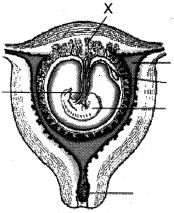
Identify $X$ from the figure:
A
Cavity of uterus
B
Placental villi
C
Yolk sac
D
Umbilical cord with its vessels
Solution
(B) In the provided diagram of a developing human fetus within the uterus,the label $X$ points to the finger-like projections that extend from the chorion into the uterine tissue. These structures are known as placental villi.
They are essential for the exchange of nutrients,gases,and waste products between the maternal blood and the fetal circulation.
Therefore,the correct identification for $X$ is placental villi.
They are essential for the exchange of nutrients,gases,and waste products between the maternal blood and the fetal circulation.
Therefore,the correct identification for $X$ is placental villi.
0 likes
View Solution221
MediumMCQ
By the end of the second month of pregnancy,the foetus develops........
A
Limbs and digits
B
Testis / ovary
C
Kidney
D
Brain
Solution
(A) In human pregnancy,the development of the foetus follows a specific timeline.
By the end of the first month of pregnancy,the embryo's heart is formed.
By the end of the second month of pregnancy,the foetus develops limbs and digits.
During the fifth month,the first movements of the foetus and appearance of hair on the head are usually observed.
By the end of $24$ weeks (second trimester),the body is covered with fine hair,eyelids separate,and eyelashes are formed.
Therefore,the correct option is $A$.
By the end of the first month of pregnancy,the embryo's heart is formed.
By the end of the second month of pregnancy,the foetus develops limbs and digits.
During the fifth month,the first movements of the foetus and appearance of hair on the head are usually observed.
By the end of $24$ weeks (second trimester),the body is covered with fine hair,eyelids separate,and eyelashes are formed.
Therefore,the correct option is $A$.
0 likes
View Solution222
EasyMCQ
In a human foetus,the limbs and digits develop by the end of:
A
$8$ weeks
B
Fifth month
C
First trimester
D
$12$ weeks
Solution
(A) In human development,the heart is formed after one month of pregnancy. By the end of the second month of pregnancy,the foetus develops limbs and digits. Therefore,the correct answer is $8$ weeks.
0 likes
View Solution223
MediumMCQ
Which is not the function of placenta?
A
Secretes insulin during parturition
B
Facilitates supply of $O_2$ and nutrients to embryo.
C
Produces estrogen.
D
Facilitates removal of $CO_2$ and waste material from embryo.
Solution
(A) The placenta is a structural and functional unit between the developing embryo (foetus) and the maternal body.
Its primary functions include:
$1$. Facilitating the supply of $O_2$ and nutrients to the embryo.
$2$. Facilitating the removal of $CO_2$ and waste materials produced by the embryo.
$3$. Acting as an endocrine tissue by producing several hormones like human chorionic gonadotropin $(hCG)$,human placental lactogen $(hPL)$,estrogens,and progestogens.
It does not secrete insulin. Insulin is secreted by the pancreas. Therefore,option $A$ is the correct answer.
Its primary functions include:
$1$. Facilitating the supply of $O_2$ and nutrients to the embryo.
$2$. Facilitating the removal of $CO_2$ and waste materials produced by the embryo.
$3$. Acting as an endocrine tissue by producing several hormones like human chorionic gonadotropin $(hCG)$,human placental lactogen $(hPL)$,estrogens,and progestogens.
It does not secrete insulin. Insulin is secreted by the pancreas. Therefore,option $A$ is the correct answer.
0 likes
View Solution224
MediumMCQ
The foetus is nourished by:
A
Placenta
B
Yolk
C
Blood
D
Phagocytosis
Solution
(A) The $Placenta$ is a specialized structural and functional unit that connects the developing foetus to the maternal body.
It facilitates the supply of oxygen and nutrients from the mother's blood to the foetus.
It also helps in the removal of carbon dioxide and waste materials produced by the foetus.
Therefore, the foetus receives nourishment through the $Placenta$.
It facilitates the supply of oxygen and nutrients from the mother's blood to the foetus.
It also helps in the removal of carbon dioxide and waste materials produced by the foetus.
Therefore, the foetus receives nourishment through the $Placenta$.
0 likes
View Solution225
MediumMCQ
By the end of about .......... weeks,the body is covered with fine hair.
A
$20$
B
$24$
C
$18$
D
$22$
Solution
(B) During human embryonic development,the fetus undergoes significant changes at different stages of pregnancy.
By the end of $24$ weeks (second trimester),the body of the fetus becomes covered with fine hair,known as lanugo.
Additionally,eyelids separate,and eyelashes are formed during this period.
By the end of $24$ weeks (second trimester),the body of the fetus becomes covered with fine hair,known as lanugo.
Additionally,eyelids separate,and eyelashes are formed during this period.
0 likes
View Solution226
MediumMCQ
Identify the odd one out among the hormones produced only during pregnancy.
A
$hCG$
B
$HPL$
C
Relaxin
D
Thyroxine
Solution
(D) During pregnancy,the placenta produces several hormones such as human Chorionic Gonadotropin $(hCG)$,human Placental Lactogen $(hPL)$,and Relaxin.
$hCG$,$hPL$,and Relaxin are produced only during pregnancy.
Thyroxine is a hormone produced by the thyroid gland throughout a person's life,not just during pregnancy.
Therefore,Thyroxine is the odd one out.
$hCG$,$hPL$,and Relaxin are produced only during pregnancy.
Thyroxine is a hormone produced by the thyroid gland throughout a person's life,not just during pregnancy.
Therefore,Thyroxine is the odd one out.
0 likes
View Solution227
EasyMCQ
In human beings,after .............. month of pregnancy,the embryo's heart is formed.
A
Two
B
Three
C
One
D
Four
Solution
(C) In human beings,after one month of pregnancy,the embryo's heart is formed. This is the first sign of a growing fetus that can be observed by listening to the heartbeat carefully through a stethoscope.
0 likes
View Solution228
EasyMCQ
The corpus luteum secretes ........
A
Estrogen
B
Progesterone
C
Secretin
D
Androgens
Solution
(B) After ovulation,the ruptured follicle transforms into a structure called the corpus luteum.
This structure acts as a temporary endocrine gland.
It primarily secretes large amounts of progesterone,which is essential for the maintenance of the endometrium for implantation of the fertilized ovum and other events of pregnancy.
It also secretes some amount of estrogen.
This structure acts as a temporary endocrine gland.
It primarily secretes large amounts of progesterone,which is essential for the maintenance of the endometrium for implantation of the fertilized ovum and other events of pregnancy.
It also secretes some amount of estrogen.
0 likes
View Solution229
MediumMCQ
Choose the incorrect pair:
A
Inner cell mass - Inner group of cells
B
$16$ cells embryo - Morula
C
Trophoblast - Chorionic layer
D
Placenta - Secretes Oxytocin
Solution
(D) The incorrect pair is $D$ (Placenta - Secretes Oxytocin).
$1$. The inner cell mass is the inner group of cells in the blastocyst.
$2$. $A$ $16$-celled embryo is known as a Morula.
$3$. The outer layer of the blastocyst is the Trophoblast,which forms the chorionic layer.
$4$. The placenta does not secrete oxytocin; oxytocin is synthesized by the hypothalamus and released by the posterior pituitary gland. The placenta secretes hormones like $hCG$,$hPL$,estrogen,and progesterone.
$1$. The inner cell mass is the inner group of cells in the blastocyst.
$2$. $A$ $16$-celled embryo is known as a Morula.
$3$. The outer layer of the blastocyst is the Trophoblast,which forms the chorionic layer.
$4$. The placenta does not secrete oxytocin; oxytocin is synthesized by the hypothalamus and released by the posterior pituitary gland. The placenta secretes hormones like $hCG$,$hPL$,estrogen,and progesterone.
0 likes
View Solution230
MediumMCQ
It is the structural and functional unit between the developing embryo (foetus) and the maternal body.
A
Placenta
B
Yolk sac
C
Cavity of uterus
D
Plug
Solution
(A) The $Placenta$ is a specialized disc-shaped organ that develops during pregnancy.
It acts as the structural and functional unit between the developing embryo (foetus) and the maternal body.
It facilitates the supply of oxygen and nutrients to the embryo and also helps in the removal of carbon dioxide and waste materials produced by the embryo.
It is connected to the foetus through the umbilical cord.
It acts as the structural and functional unit between the developing embryo (foetus) and the maternal body.
It facilitates the supply of oxygen and nutrients to the embryo and also helps in the removal of carbon dioxide and waste materials produced by the embryo.
It is connected to the foetus through the umbilical cord.
0 likes
View Solution231
EasyMCQ
When does a foetus develop limbs and digits?
A
By the end of $12$ weeks of pregnancy
B
By the end of the second month of pregnancy
C
By the end of $24$ weeks of pregnancy
D
During the fifth month of pregnancy
Solution
(B) According to human embryonic development,the heart is formed first,which can be heard via a stethoscope by the end of the first month.
By the end of the second month of pregnancy,the foetus develops limbs and digits.
By the end of $12$ weeks (first trimester),most of the major organ systems are formed.
Therefore,the correct answer is by the end of the second month of pregnancy.
By the end of the second month of pregnancy,the foetus develops limbs and digits.
By the end of $12$ weeks (first trimester),most of the major organ systems are formed.
Therefore,the correct answer is by the end of the second month of pregnancy.
0 likes
View Solution232
MediumMCQ
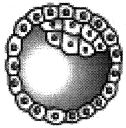
Identify the figure shown below.
A
Morula
B
Blastocyst
C
Trophoblast
D
Blastomere
Solution
(B) The figure shows a blastocyst,which is an early developmental stage of an embryo.
It consists of an outer layer of cells called the trophoblast and an inner cell mass.
The presence of a fluid-filled cavity known as the blastocoel is a characteristic feature of the blastocyst stage.
Therefore,the correct option is $B$.
It consists of an outer layer of cells called the trophoblast and an inner cell mass.
The presence of a fluid-filled cavity known as the blastocoel is a characteristic feature of the blastocyst stage.
Therefore,the correct option is $B$.
0 likes
View Solution233
MediumMCQ
Which of the following is false for progesterone?
A
Supports pregnancy
B
Develops endometrium for implantation
C
Milk secretion
D
Stimulates menstrual cycle
Solution
(C) Progesterone is a steroid hormone secreted primarily by the corpus luteum in the ovary.
$1$. It supports pregnancy by maintaining the endometrium.
$2$. It helps in the development of the endometrium for implantation.
$3$. Milk secretion (lactation) is primarily stimulated by the hormone prolactin,not progesterone.
$4$. Progesterone levels rise after ovulation to maintain the uterine lining; it does not stimulate the menstrual cycle (in fact,its withdrawal triggers menstruation).
Since both $C$ and $D$ are technically incorrect regarding the primary function of progesterone,in the context of standard biology questions,'Milk secretion' is the most distinct non-reproductive function attributed to other hormones,while 'Stimulates menstrual cycle' is also false as it inhibits the cycle's progression. However,given the options,'Milk secretion' is the most clearly false function.
$1$. It supports pregnancy by maintaining the endometrium.
$2$. It helps in the development of the endometrium for implantation.
$3$. Milk secretion (lactation) is primarily stimulated by the hormone prolactin,not progesterone.
$4$. Progesterone levels rise after ovulation to maintain the uterine lining; it does not stimulate the menstrual cycle (in fact,its withdrawal triggers menstruation).
Since both $C$ and $D$ are technically incorrect regarding the primary function of progesterone,in the context of standard biology questions,'Milk secretion' is the most distinct non-reproductive function attributed to other hormones,while 'Stimulates menstrual cycle' is also false as it inhibits the cycle's progression. However,given the options,'Milk secretion' is the most clearly false function.
0 likes
View Solution234
EasyMCQ
Progesterone is secreted by.........
A
Developing follicle
B
Mature follicle
C
Corpus luteum
D
None of the above
Solution
(C) After ovulation,the ruptured follicle transforms into a temporary endocrine structure known as the $Corpus \ luteum$.
This structure is primarily responsible for the secretion of the hormone $Progesterone$,which is essential for maintaining the endometrium during pregnancy.
This structure is primarily responsible for the secretion of the hormone $Progesterone$,which is essential for maintaining the endometrium during pregnancy.
0 likes
View Solution235
MediumMCQ
What is the primary function of the hormone secreted by the corpus luteum in females?
A
Acts on the mammary glands and stimulates milk secretion
B
Regulates female sexual behavior
C
Stimulation of growth and activities of female secondary sex organs
D
Development of ovarian follicles
Solution
(A) The corpus luteum is a temporary endocrine structure in the ovaries that secretes progesterone.
Progesterone is essential for the maintenance of the endometrium,which is necessary for the implantation of the fertilized ovum and other events of pregnancy.
It also acts on the mammary glands and stimulates the formation of alveoli (sacs that store milk) and milk secretion.
Therefore,the correct option is $A$.
Progesterone is essential for the maintenance of the endometrium,which is necessary for the implantation of the fertilized ovum and other events of pregnancy.
It also acts on the mammary glands and stimulates the formation of alveoli (sacs that store milk) and milk secretion.
Therefore,the correct option is $A$.
0 likes
View Solution236
MediumMCQ
Which of the following hormones is secreted by the human placenta?
A
Human Chorionic Gonadotropin $(hCG)$
B
Prolactin
C
Estrogen
D
Progesterone
Solution
(A) The human placenta acts as an endocrine tissue and produces several hormones essential for pregnancy.
These hormones include Human Chorionic Gonadotropin $(hCG)$,Human Placental Lactogen $(hPL)$,estrogens,and progestogens.
$hCG$ is specifically secreted by the placenta to maintain the corpus luteum during early pregnancy.
While estrogens and progesterone are also produced by the placenta,$hCG$ is a hallmark hormone exclusively associated with placental secretion in this context.
Therefore,the correct option is $A$.
These hormones include Human Chorionic Gonadotropin $(hCG)$,Human Placental Lactogen $(hPL)$,estrogens,and progestogens.
$hCG$ is specifically secreted by the placenta to maintain the corpus luteum during early pregnancy.
While estrogens and progesterone are also produced by the placenta,$hCG$ is a hallmark hormone exclusively associated with placental secretion in this context.
Therefore,the correct option is $A$.
0 likes
View Solution237
EasyMCQ
The gonads are derived from which embryonic layer during embryonic development?
A
Ectoderm
B
Endoderm
C
Mesoderm
D
Both $(A)$ and $(B)$
Solution
(C) The gonads (testes in males and ovaries in females) are derived from the intermediate mesoderm during embryonic development.
Specifically,they develop from the gonadal ridges,which are thickenings of the mesothelium and the underlying mesenchyme of the mesoderm.
Specifically,they develop from the gonadal ridges,which are thickenings of the mesothelium and the underlying mesenchyme of the mesoderm.
0 likes
View Solution238
MediumMCQ
Which of the following statements is true regarding cells during cleavage?
A
The nuclear-cytoplasmic ratio remains unchanged.
B
There is no increase in size.
C
Oxygen consumption is low.
D
The division is of meiotic type.
Solution
(B) Cleavage is a series of rapid mitotic divisions of the zygote that converts a single-celled zygote into a multicellular structure called a morula.
During cleavage,the total volume of the embryo remains the same as that of the zygote,meaning there is no increase in the overall size of the embryo.
As the cells (blastomeres) divide,the cytoplasm is partitioned into smaller cells,leading to an increase in the nuclear-cytoplasmic ratio.
Oxygen consumption increases significantly during cleavage due to high metabolic activity.
Therefore,the correct statement is that there is no increase in size.
During cleavage,the total volume of the embryo remains the same as that of the zygote,meaning there is no increase in the overall size of the embryo.
As the cells (blastomeres) divide,the cytoplasm is partitioned into smaller cells,leading to an increase in the nuclear-cytoplasmic ratio.
Oxygen consumption increases significantly during cleavage due to high metabolic activity.
Therefore,the correct statement is that there is no increase in size.
0 likes
View Solution239
MediumMCQ
The lens of the eye is derived from which germ layer?
A
Ectoderm
B
Mesoderm
C
Endoderm
D
Both $(A)$ and $(B)$
Solution
(A) The human eye lens is formed during embryonic development from the surface ectoderm. Specifically,the lens placode,which is a thickening of the surface ectoderm,invaginates to form the lens vesicle,which eventually differentiates into the mature lens. Therefore,the correct germ layer is the ectoderm.
0 likes
View Solution240
MediumMCQ
The gastrula stage is characterized by which of the following?
A
Invagination of the blastoderm
B
Invagination of the archenteron
C
Closure of the blastopore
D
Closure of the neural tube
Solution
(B) The gastrula stage is a critical phase in embryonic development where the single-layered blastula is reorganized into a multi-layered structure called the gastrula. This process is known as gastrulation. $A$ key characteristic of this stage is the formation of the primitive gut,known as the $archenteron$. This occurs through the process of invagination,where cells move inward to form the cavity. Therefore,the gastrula stage is characterized by the invagination of the $archenteron$.
0 likes
View Solution241
MediumMCQ
In human embryos, the extraembryonic membranes are derived from which of the following?
A
Inner cell mass
B
Trophoblast
C
Hypoblast
D
Follicular cells
Solution
(B) In human development, the blastocyst consists of an outer layer of cells called the $Trophoblast$ and an inner group of cells called the $Inner \text{ } cell \text{ } mass$.
The $Trophoblast$ layer is responsible for forming the extraembryonic membranes, such as the chorion and amnion, which facilitate the connection between the developing embryo and the maternal uterine wall (placenta formation).
The $Inner \text{ } cell \text{ } mass$ gives rise to the embryo proper.
Therefore, the correct answer is $Trophoblast$.
The $Trophoblast$ layer is responsible for forming the extraembryonic membranes, such as the chorion and amnion, which facilitate the connection between the developing embryo and the maternal uterine wall (placenta formation).
The $Inner \text{ } cell \text{ } mass$ gives rise to the embryo proper.
Therefore, the correct answer is $Trophoblast$.
0 likes
View Solution242
MediumMCQ
Which of the following statements is true regarding cleavage?
A
The size of the embryo increases.
B
The size of the cells decreases.
C
The size of the cells increases.
D
The size of the embryo decreases.
Solution
(B) Cleavage is a series of rapid mitotic cell divisions of the zygote following fertilization.
During cleavage,the total volume of the embryo remains constant because there is no growth phase ($G_1$ or $G_2$ phases) between the divisions.
As the number of cells (blastomeres) increases,the size of each individual cell decreases significantly with each successive division.
Therefore,the correct statement is that the size of the cells decreases.
During cleavage,the total volume of the embryo remains constant because there is no growth phase ($G_1$ or $G_2$ phases) between the divisions.
As the number of cells (blastomeres) increases,the size of each individual cell decreases significantly with each successive division.
Therefore,the correct statement is that the size of the cells decreases.
0 likes
View Solution243
EasyMCQ
Which part of the ovary acts as an endocrine gland after ovulation?
A
Graafian follicle
B
Stroma
C
Germinal epithelium
D
Corpus luteum
Solution
(D) After ovulation,the ruptured Graafian follicle transforms into a temporary endocrine structure known as the $Corpus \ luteum$.
This structure secretes large amounts of $Progesterone$,which is essential for the maintenance of the endometrium for potential implantation of the embryo.
This structure secretes large amounts of $Progesterone$,which is essential for the maintenance of the endometrium for potential implantation of the embryo.
0 likes
View Solution244
EasyMCQ
Which extra-embryonic membrane prevents the embryo from drying out in the uterus in humans?
A
Chorion
B
Allantois
C
Yolk sac
D
Amnion
Solution
(D) The $Amnion$ is a thin, tough, transparent membrane that surrounds the developing embryo.
It encloses the amniotic cavity, which is filled with amniotic fluid.
This fluid acts as a shock absorber and, most importantly, prevents the embryo from drying out (desiccation) by providing a moist environment within the uterus.
It encloses the amniotic cavity, which is filled with amniotic fluid.
This fluid acts as a shock absorber and, most importantly, prevents the embryo from drying out (desiccation) by providing a moist environment within the uterus.
0 likes
View Solution245
MediumMCQ
Which of the following statements is correct regarding the morula in humans?
A
It has less cytoplasm and less $DNA$ than an uncleaved zygote.
B
It has more or less equal quantity of cytoplasm and $DNA$ as an uncleaved zygote.
C
It has more cytoplasm and more $DNA$ than an uncleaved zygote.
D
It has approximately the same amount of $DNA$ as the uncleaved zygote but much less cytoplasm.
Solution
(D) During the process of cleavage,the zygote undergoes rapid mitotic divisions to form a solid ball of $8-16$ cells known as the morula.
Cleavage involves repeated cell divisions without any significant growth in the total size of the embryo.
Therefore,the total amount of cytoplasm remains approximately the same as that of the zygote,but it is distributed among many smaller cells.
Since $DNA$ replication occurs before every cell division,the total amount of $DNA$ in the morula is significantly higher than in the uncleaved zygote.
However,the question options provided in the prompt were scientifically inaccurate regarding the standard biological definition of cleavage. Based on the standard biological process,the morula has the same amount of $DNA$ as the zygote after replication,but the options provided in the original prompt were flawed. Given the standard interpretation of cleavage,the correct answer is that the morula contains the same amount of $DNA$ as the zygote (after replication) but is divided into smaller cells.
Cleavage involves repeated cell divisions without any significant growth in the total size of the embryo.
Therefore,the total amount of cytoplasm remains approximately the same as that of the zygote,but it is distributed among many smaller cells.
Since $DNA$ replication occurs before every cell division,the total amount of $DNA$ in the morula is significantly higher than in the uncleaved zygote.
However,the question options provided in the prompt were scientifically inaccurate regarding the standard biological definition of cleavage. Based on the standard biological process,the morula has the same amount of $DNA$ as the zygote after replication,but the options provided in the original prompt were flawed. Given the standard interpretation of cleavage,the correct answer is that the morula contains the same amount of $DNA$ as the zygote (after replication) but is divided into smaller cells.
0 likes
View Solution246
EasyMCQ
The first movement of the fetus and the appearance of hair on the head are usually observed during which month of pregnancy?
A
Fourth month
B
Fifth month
C
Sixth month
D
Third month
Solution
(B) During human pregnancy,the development of the fetus follows a specific timeline.
By the end of the first month,the heart is formed.
By the end of the second month,the fetus develops limbs and digits.
During the fifth month,the first movements of the fetus are observed,and the head becomes covered with fine hair.
Therefore,the correct answer is the fifth month.
By the end of the first month,the heart is formed.
By the end of the second month,the fetus develops limbs and digits.
During the fifth month,the first movements of the fetus are observed,and the head becomes covered with fine hair.
Therefore,the correct answer is the fifth month.
0 likes
View Solution247
MediumMCQ
Which of the following is $NOT$ a function of the placenta?
A
Supplies oxygen and nutrients to the embryo.
B
Secretes estrogen.
C
Removes $CO_2$ and waste materials from the embryo.
D
Secretes oxytocin during parturition.
Solution
(D) The placenta acts as an endocrine tissue and produces several hormones like human chorionic gonadotropin $(hCG)$,human placental lactogen $(hPL)$,estrogens,and progestogens. It also facilitates the supply of oxygen and nutrients to the embryo and the removal of $CO_2$ and waste materials produced by the embryo. However,oxytocin is secreted by the posterior pituitary gland (neurohypophysis) of the mother,not by the placenta. Therefore,the secretion of oxytocin is not a function of the placenta.
0 likes
View Solution248
MediumMCQ
Select the correct option regarding the function of gonadotropins in a pregnant woman.
A
High levels of $FSH$ and $LH$ stimulate the development of the endometrium.
B
High levels of $FSH$ and $LH$ facilitate implantation.
C
High levels of $HCG$ stimulate the synthesis of estrogen and progesterone.
D
High levels of $HCG$ stimulate the development of the endometrium.
Solution
(C) During pregnancy,the placenta produces Human Chorionic Gonadotropin $(HCG)$.
$HCG$ acts similarly to Luteinizing Hormone $(LH)$ and maintains the corpus luteum in the ovary.
The corpus luteum continues to secrete progesterone and estrogen,which are essential for maintaining the endometrium and supporting the pregnancy.
Therefore,high levels of $HCG$ stimulate the synthesis of estrogen and progesterone.
$HCG$ acts similarly to Luteinizing Hormone $(LH)$ and maintains the corpus luteum in the ovary.
The corpus luteum continues to secrete progesterone and estrogen,which are essential for maintaining the endometrium and supporting the pregnancy.
Therefore,high levels of $HCG$ stimulate the synthesis of estrogen and progesterone.
0 likes
View Solution249
EasyMCQ
The primary function of the $Corpus$ $Luteum$ in humans is to produce:
A
Only $Estrogen$
B
$Progesterone$
C
$Human$ $Chorionic$ $Gonadotropin$ $(hCG)$
D
Only $Relaxin$
Solution
(B) The $Corpus$ $Luteum$ is a temporary endocrine structure formed from the ruptured follicle after ovulation.
Its primary function is to secrete large amounts of $Progesterone$,which is essential for maintaining the endometrium for potential implantation of the embryo.
While it also secretes some $Estrogen$ and $Relaxin$,$Progesterone$ is its most significant and primary hormonal product.
Its primary function is to secrete large amounts of $Progesterone$,which is essential for maintaining the endometrium for potential implantation of the embryo.
While it also secretes some $Estrogen$ and $Relaxin$,$Progesterone$ is its most significant and primary hormonal product.
0 likes
View Solution250
MediumMCQ
Some hormones like $hCG$,$hPL$,estrogens,and progestogens are produced by which of the following?
A
Ovary
B
Placenta
C
Fallopian tube
D
Pituitary gland
Solution
(B) During pregnancy,the placenta acts as an endocrine tissue and produces several hormones essential for maintaining pregnancy.
These hormones include human Chorionic Gonadotropin $(hCG)$,human Placental Lactogen $(hPL)$,estrogens,and progestogens.
$hCG$ stimulates the corpus luteum to continue secreting progesterone until the placenta takes over.
$hPL$ is involved in growth and metabolism during pregnancy.
Therefore,the correct answer is the placenta.
These hormones include human Chorionic Gonadotropin $(hCG)$,human Placental Lactogen $(hPL)$,estrogens,and progestogens.
$hCG$ stimulates the corpus luteum to continue secreting progesterone until the placenta takes over.
$hPL$ is involved in growth and metabolism during pregnancy.
Therefore,the correct answer is the placenta.
0 likes
View SolutionHuman Reproduction — Pregnancy and Embryonic development · Frequently Asked Questions
1Are these Human Reproduction questions useful for JEE and NEET?
Yes. All questions in this section are mapped to JEE Main and NEET exam patterns. Previous year questions from JEE Main, NEET, GUJCET and state-level exams are included with full solutions.
2Can I switch to Hindi or Gujarati for these questions?
Yes. Use the language tabs in the hero section or the sidebar to view the same questions and solutions in English, Hindi or Gujarati.
3How do I generate a question paper from this subtopic?
Use the Vedclass Exam Paper Generator — select the chapter and subtopic, set difficulty, and generate Sets A, B, C, D automatically. First 3 chapters of every subject are free.
Vedclass Products
For Students
Vedclass Test Series
Mock tests in real JEE/NEET style with performance analysis. 5-day free trial.
Start Free TrialFor Teachers
Exam Paper Generator
Generate Set A/B/C/D papers from this chapter in 2 minutes. 3 chapters free.
Try FreeFor Institutes
Online Exam Module
Live online exams with unlimited students, 360° analytics & white-label branding.
See DemoFor Teachers & Institutes
Generate a Human Reproduction Exam Paper in 2 Minutes
Select subtopic & difficulty — Sets A, B, C, D auto-generated with No Repeat logic.
First 3 chapters of every subject are free — no payment required.