
A English
Menstrual Cycle Questions in English
Class 12 Biology · Human Reproduction · Menstrual Cycle
182+
Questions
English
Language
100%
With Solutions
Showing 50 of 182 questions in English
101
Medium
Why are menstrual cycles absent during pregnancy?
Solution
(N/A) The menstrual flow results from the breakdown of the endometrial lining of the uterus and its blood vessels,which forms a liquid that is discharged through the vagina. Menstruation only occurs if the released ovum is not fertilized.
During pregnancy,these stages of the menstrual cycle are suspended. The corpus luteum secretes large amounts of progesterone,which is essential for maintaining the endometrium. These hormonal changes prevent the menstrual flow from occurring during pregnancy. While the absence of menstruation is a primary indicator of pregnancy,it can also be caused by other factors such as stress or poor health.
During pregnancy,these stages of the menstrual cycle are suspended. The corpus luteum secretes large amounts of progesterone,which is essential for maintaining the endometrium. These hormonal changes prevent the menstrual flow from occurring during pregnancy. While the absence of menstruation is a primary indicator of pregnancy,it can also be caused by other factors such as stress or poor health.
0 likes
View Solution102
Medium
Mention the importance of $LH$ surge during the menstrual cycle.
Solution
(N/A) The $LH$ surge,which occurs in the middle of the menstrual cycle (around day $14$),is crucial for the following reasons:
$1$. It triggers the rupture of the mature Graafian follicle,leading to the release of the ovum,a process known as ovulation.
$2$. After ovulation,the remaining parts of the Graafian follicle transform into the corpus luteum.
$3$. The corpus luteum secretes high levels of progesterone,which is essential for maintaining the endometrium for the implantation of a fertilized ovum and for the successful progression of pregnancy.
$1$. It triggers the rupture of the mature Graafian follicle,leading to the release of the ovum,a process known as ovulation.
$2$. After ovulation,the remaining parts of the Graafian follicle transform into the corpus luteum.
$3$. The corpus luteum secretes high levels of progesterone,which is essential for maintaining the endometrium for the implantation of a fertilized ovum and for the successful progression of pregnancy.
0 likes
View Solution103
Medium
$A$ human female experiences two major changes,menarche and menopause,during her life. Mention the significance of both the events.
Solution
(N/A) In human beings,the first menstruation begins at puberty ($9$ to $15$ years) and is called menarche. The menstrual cycle stops at the age of approximately $50$ years,which is called menopause.
Menarche indicates the onset of the reproductive phase in a female,signifying that the reproductive system is maturing and capable of supporting pregnancy. It indicates that the ovaries have begun producing mature ova (female gametes) and the uterus is prepared for the growth and development of a fetus.
Menopause indicates the end of the reproductive phase. At this age,the ovaries stop producing mature eggs,and the production of reproductive hormones (estrogen and progesterone) significantly decreases or ceases. Consequently,the menstrual cycle stops,and the uterus is no longer prepared for the development of an embryo.
Menarche indicates the onset of the reproductive phase in a female,signifying that the reproductive system is maturing and capable of supporting pregnancy. It indicates that the ovaries have begun producing mature ova (female gametes) and the uterus is prepared for the growth and development of a fetus.
Menopause indicates the end of the reproductive phase. At this age,the ovaries stop producing mature eggs,and the production of reproductive hormones (estrogen and progesterone) significantly decreases or ceases. Consequently,the menstrual cycle stops,and the uterus is no longer prepared for the development of an embryo.
0 likes
View Solution104
Medium
The corpus luteum in pregnancy has a long life. However,if fertilization does not take place,it remains active only for $10-12$ days. Explain.
Solution
(N/A) After ovulation,the ruptured Graafian follicle transforms into the corpus luteum,which secretes large amounts of progesterone.
Progesterone is essential for maintaining the endometrium,which is necessary for the implantation of the fertilized ovum (zygote) and the subsequent maintenance of pregnancy.
In the event of pregnancy,the corpus luteum persists to support the developing embryo.
However,in the absence of fertilization,the high levels of progesterone are no longer required to maintain the endometrium.
Consequently,the corpus luteum degenerates within $10-12$ days,leading to the breakdown of the endometrium and the onset of menstruation.
Progesterone is essential for maintaining the endometrium,which is necessary for the implantation of the fertilized ovum (zygote) and the subsequent maintenance of pregnancy.
In the event of pregnancy,the corpus luteum persists to support the developing embryo.
However,in the absence of fertilization,the high levels of progesterone are no longer required to maintain the endometrium.
Consequently,the corpus luteum degenerates within $10-12$ days,leading to the breakdown of the endometrium and the onset of menstruation.
0 likes
View Solution105
Medium
What are the events that take place in the ovary and uterus during the follicular phase of the menstrual cycle?
Solution
(A) The menstrual cycle consists of four main phases: menstruation,follicular phase,ovulatory phase,and luteal phase.
During the follicular phase,primary follicles in the ovary grow and develop into a fully mature Graafian follicle.
Simultaneously,the endometrium of the uterus undergoes regeneration through the process of proliferation.
These changes are regulated by the levels of pituitary hormones ($LH$ and $FSH$) and ovarian hormones (estrogens).
$LH$ and $FSH$ levels increase during this phase,stimulating follicular development and the secretion of estrogens by the growing follicles.
Both $LH$ and $FSH$ reach their peak levels in the middle of the cycle (around the $14$th day). The rapid surge of $LH$,known as the $LH$ surge,induces the rupture of the Graafian follicle,leading to the release of the ovum,which is known as ovulation.
During the follicular phase,primary follicles in the ovary grow and develop into a fully mature Graafian follicle.
Simultaneously,the endometrium of the uterus undergoes regeneration through the process of proliferation.
These changes are regulated by the levels of pituitary hormones ($LH$ and $FSH$) and ovarian hormones (estrogens).
$LH$ and $FSH$ levels increase during this phase,stimulating follicular development and the secretion of estrogens by the growing follicles.
Both $LH$ and $FSH$ reach their peak levels in the middle of the cycle (around the $14$th day). The rapid surge of $LH$,known as the $LH$ surge,induces the rupture of the Graafian follicle,leading to the release of the ovum,which is known as ovulation.
0 likes
View Solution106
Medium
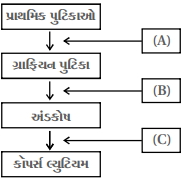
Given below is a flow chart showing ovarian changes during the menstrual cycle. Fill in the spaces by providing the names of the hormones responsible for the events shown.
$\boxed{\text{Primary follicles}}$
$\downarrow \leftarrow \boxed{A}$
$\boxed{\text{Graafian follicle}}$
$\downarrow \leftarrow \boxed{B}$
$\boxed{\text{Ovum}}$
$\downarrow \leftarrow \boxed{C}$
$\boxed{\text{Corpus luteum}}$
$\boxed{\text{Primary follicles}}$
$\downarrow \leftarrow \boxed{A}$
$\boxed{\text{Graafian follicle}}$
$\downarrow \leftarrow \boxed{B}$
$\boxed{\text{Ovum}}$
$\downarrow \leftarrow \boxed{C}$
$\boxed{\text{Corpus luteum}}$
Solution
(A-D) The correct hormones are: $A = FSH$ and $LH$,$B = LH$,$C = LH$.
$1$. During the follicular phase,the secretion of gonadotropins ($FSH$ and $LH$) increases gradually. $FSH$ stimulates the growth and development of primary follicles into Graafian follicles.
$2$. Rapid secretion of $LH$ ($LH$ surge) during the mid-cycle (around the $14$th day) induces the rupture of the Graafian follicle,leading to ovulation (release of the ovum).
$3$. After ovulation,the remaining parts of the Graafian follicle transform into the corpus luteum under the influence of $LH$. The corpus luteum then secretes large amounts of progesterone,which is essential for the maintenance of the endometrium.
$1$. During the follicular phase,the secretion of gonadotropins ($FSH$ and $LH$) increases gradually. $FSH$ stimulates the growth and development of primary follicles into Graafian follicles.
$2$. Rapid secretion of $LH$ ($LH$ surge) during the mid-cycle (around the $14$th day) induces the rupture of the Graafian follicle,leading to ovulation (release of the ovum).
$3$. After ovulation,the remaining parts of the Graafian follicle transform into the corpus luteum under the influence of $LH$. The corpus luteum then secretes large amounts of progesterone,which is essential for the maintenance of the endometrium.
0 likes
View Solution107
Medium
What role do pituitary gonadotropins play during the follicular and ovulatory phases of the menstrual cycle? Explain the shifts in steroidal secretions.
Solution
(N/A) During the follicular phase,the secretion of gonadotropins ($LH$ and $FSH$) from the anterior pituitary increases gradually. These hormones stimulate the growth and maturation of ovarian follicles. As the follicles grow,they secrete increasing amounts of estrogens.
In the ovulatory phase,specifically around the $14^{th}$ day of the cycle,both $LH$ and $FSH$ reach a peak level,known as the $LH$ surge. This rapid surge of $LH$ induces the rupture of the Graafian follicle,leading to ovulation. Following ovulation,the ruptured follicle transforms into the corpus luteum,which secretes large amounts of progesterone,while estrogen levels remain high.
In the ovulatory phase,specifically around the $14^{th}$ day of the cycle,both $LH$ and $FSH$ reach a peak level,known as the $LH$ surge. This rapid surge of $LH$ induces the rupture of the Graafian follicle,leading to ovulation. Following ovulation,the ruptured follicle transforms into the corpus luteum,which secretes large amounts of progesterone,while estrogen levels remain high.
0 likes
View Solution108
EasyMCQ
Match the columns.
| Column $I$ | Column $II$ |
|---|---|
| $(a)$ $6-14$ days | $(1)$ Menstrual phase |
| $(b)$ $1-5$ days | $(2)$ Polar body formation |
| $(c)$ $15-28$ days | $(3)$ Proliferative phase |
| $(4)$ Secretory phase (Endometrium is prepared for implantation) |
A
$a-3, b-1, c-4$
B
$a-1, b-3, c-4$
C
$a-4, b-1, c-3$
D
$a-3, b-4, c-1$
Solution
(A) The menstrual cycle consists of different phases based on the duration of the cycle:
$(a)$ $6-14$ days: This period corresponds to the follicular or proliferative phase,where the endometrium regenerates under the influence of estrogen. Thus,$(a-3)$.
$(b)$ $1-5$ days: This is the menstrual phase,characterized by the shedding of the endometrial lining. Thus,$(b-1)$.
$(c)$ $15-28$ days: This is the luteal or secretory phase,where the endometrium is prepared for the implantation of the embryo under the influence of progesterone. Thus,$(c-4)$.
Therefore,the correct match is $(a-3, b-1, c-4)$.
$(a)$ $6-14$ days: This period corresponds to the follicular or proliferative phase,where the endometrium regenerates under the influence of estrogen. Thus,$(a-3)$.
$(b)$ $1-5$ days: This is the menstrual phase,characterized by the shedding of the endometrial lining. Thus,$(b-1)$.
$(c)$ $15-28$ days: This is the luteal or secretory phase,where the endometrium is prepared for the implantation of the embryo under the influence of progesterone. Thus,$(c-4)$.
Therefore,the correct match is $(a-3, b-1, c-4)$.
0 likes
View Solution109
MediumMCQ
What is the menstrual cycle?
A
The bleeding phase lasting for $1-5$ days.
B
The process of ovulation and degeneration of the follicle.
C
The cyclic events occurring between one menstruation and the next.
D
The process of breakdown and regeneration of the uterine wall.
Solution
(C) The menstrual cycle is the reproductive cycle in all primates,including human females.
It involves a series of cyclic changes in the ovaries and the accessory ducts,as well as hormonal changes.
The cycle begins with the first menstrual flow (menarche) and repeats periodically.
Therefore,the menstrual cycle is defined as the sequence of cyclic events that occur from the beginning of one menstruation until the next.
It involves a series of cyclic changes in the ovaries and the accessory ducts,as well as hormonal changes.
The cycle begins with the first menstrual flow (menarche) and repeats periodically.
Therefore,the menstrual cycle is defined as the sequence of cyclic events that occur from the beginning of one menstruation until the next.
0 likes
View Solution110
MediumMCQ
In which of the following conditions is menstruation absent in females?
A
Pregnancy
B
Stress
C
Poor health
D
All of the above
Solution
(D) Menstruation is the periodic shedding of the uterine lining in females.
It is absent during pregnancy because the corpus luteum persists and secretes progesterone to maintain the endometrium.
Additionally,factors like severe stress,poor health,and hormonal imbalances can also lead to the cessation or irregularity of the menstrual cycle (amenorrhea).
Therefore,all the given conditions can lead to the absence of menstruation.
It is absent during pregnancy because the corpus luteum persists and secretes progesterone to maintain the endometrium.
Additionally,factors like severe stress,poor health,and hormonal imbalances can also lead to the cessation or irregularity of the menstrual cycle (amenorrhea).
Therefore,all the given conditions can lead to the absence of menstruation.
0 likes
View Solution111
MediumMCQ
How long does the menstrual phase of the menstrual cycle last?
A
$1$ to $5$ days
B
$1$ to $5$ months
C
$6$ to $13$ days
D
$14$ to $28$ days
Solution
(A) The menstrual cycle in human females typically lasts for $28$ to $29$ days.
The cycle begins with the menstrual phase,which lasts for approximately $3$ to $5$ days.
During this phase,the endometrial lining of the uterus and its blood vessels break down,resulting in the discharge of blood and tissue through the vagina.
Therefore,the correct duration for the menstrual phase is $1$ to $5$ days.
The cycle begins with the menstrual phase,which lasts for approximately $3$ to $5$ days.
During this phase,the endometrial lining of the uterus and its blood vessels break down,resulting in the discharge of blood and tissue through the vagina.
Therefore,the correct duration for the menstrual phase is $1$ to $5$ days.
0 likes
View Solution112
MediumMCQ
On which day of the menstrual cycle does ovulation occur?
A
$1$ to $5$ days
B
$18$ to $20$ days
C
$14$th day
D
$15$ to $28$ days
Solution
(C) In a typical $28$-day menstrual cycle,the menstrual phase occurs from day $1$ to $5$.
The follicular phase follows,leading up to the release of the ovum.
Ovulation,the process of releasing a secondary oocyte from the Graafian follicle,typically occurs on the $14$th day of the cycle due to the $LH$ surge.
Therefore,the correct answer is the $14$th day.
The follicular phase follows,leading up to the release of the ovum.
Ovulation,the process of releasing a secondary oocyte from the Graafian follicle,typically occurs on the $14$th day of the cycle due to the $LH$ surge.
Therefore,the correct answer is the $14$th day.
0 likes
View Solution113
MediumMCQ
Provide the sequential names of the various phases of the menstrual cycle.
A
Menstrual phase,Follicular phase,Secretory phase
B
Secretory phase,Follicular phase,Menstrual phase
C
Bleeding phase,Secretory phase,Follicular phase
D
Real phase,Proliferative phase,Menstrual phase
Solution
(A) The menstrual cycle in human females consists of three main phases in sequence:
$1$. Menstrual phase: The cycle starts with the menstrual flow,where the endometrial lining of the uterus breaks down.
$2$. Follicular phase (Proliferative phase): During this phase,the primary follicles in the ovary grow to become a fully mature Graafian follicle,and the endometrium regenerates through proliferation.
$3$. Secretory phase (Luteal phase): After ovulation,the remaining parts of the Graafian follicle transform into the corpus luteum,which secretes progesterone to maintain the endometrium for implantation.
Therefore,the correct sequence is Menstrual phase,Follicular phase,and Secretory phase.
$1$. Menstrual phase: The cycle starts with the menstrual flow,where the endometrial lining of the uterus breaks down.
$2$. Follicular phase (Proliferative phase): During this phase,the primary follicles in the ovary grow to become a fully mature Graafian follicle,and the endometrium regenerates through proliferation.
$3$. Secretory phase (Luteal phase): After ovulation,the remaining parts of the Graafian follicle transform into the corpus luteum,which secretes progesterone to maintain the endometrium for implantation.
Therefore,the correct sequence is Menstrual phase,Follicular phase,and Secretory phase.
0 likes
View Solution114
MediumMCQ
Which period of days is known as the secretory phase in the menstrual cycle?
A
$1$ to $5$ days
B
$6$ to $13$ days
C
$15$ to $28$ days
D
$14$th day
Solution
(C) The menstrual cycle consists of four phases: the menstrual phase,the follicular phase,the ovulatory phase,and the secretory (luteal) phase.
$1$. The menstrual phase occurs from day $1$ to $5$.
$2$. The follicular phase occurs from day $6$ to $13$.
$3$. The ovulatory phase occurs on day $14$.
$4$. The secretory phase,also known as the luteal phase,occurs from day $15$ to $28$,during which the corpus luteum secretes large amounts of progesterone.
$1$. The menstrual phase occurs from day $1$ to $5$.
$2$. The follicular phase occurs from day $6$ to $13$.
$3$. The ovulatory phase occurs on day $14$.
$4$. The secretory phase,also known as the luteal phase,occurs from day $15$ to $28$,during which the corpus luteum secretes large amounts of progesterone.
0 likes
View Solution115
MediumMCQ
The follicular phase is which phase of the menstrual cycle?
A
First
B
Second
C
Third
D
All
Solution
(B) The menstrual cycle consists of four main phases:
$1$. Menstrual phase ($1^{st}$ to $5^{th}$ day).
$2$. Follicular phase or Proliferative phase ($6^{th}$ to $13^{th}$ day).
$3$. Ovulatory phase ($14^{th}$ day).
$4$. Luteal phase or Secretory phase ($15^{th}$ to $28^{th}$ day).
Therefore,the follicular phase is the second phase of the menstrual cycle.
$1$. Menstrual phase ($1^{st}$ to $5^{th}$ day).
$2$. Follicular phase or Proliferative phase ($6^{th}$ to $13^{th}$ day).
$3$. Ovulatory phase ($14^{th}$ day).
$4$. Luteal phase or Secretory phase ($15^{th}$ to $28^{th}$ day).
Therefore,the follicular phase is the second phase of the menstrual cycle.
0 likes
View Solution116
MediumMCQ
At which stage and on which day is the thickness of the uterine wall,the endometrium,the greatest?
A
Menstrual phase ($1$ to $5$ days)
B
$14$th day,Ovulatory phase
C
Follicular phase ($13$th day)
D
Secretory phase ($23$rd day)
Solution
(D) The menstrual cycle consists of four phases: the menstrual phase,the follicular phase,the ovulatory phase,and the secretory (luteal) phase.
During the secretory phase,the corpus luteum secretes large amounts of progesterone.
Progesterone is essential for the maintenance of the endometrium,which becomes thick and vascular to prepare for potential implantation.
The endometrium reaches its maximum thickness during the mid-to-late secretory phase,typically around the $23$rd day of a $28$-day cycle.
During the secretory phase,the corpus luteum secretes large amounts of progesterone.
Progesterone is essential for the maintenance of the endometrium,which becomes thick and vascular to prepare for potential implantation.
The endometrium reaches its maximum thickness during the mid-to-late secretory phase,typically around the $23$rd day of a $28$-day cycle.
0 likes
View Solution117
MediumMCQ
At which phase is the secretion of gonadotropins ($LH$ and $FSH$) highest during the menstrual cycle?
A
Menstrual phase
B
Follicular phase
C
Luteal phase
D
Both $B$ and $C$
Solution
(B) During the menstrual cycle,the secretion of gonadotropins ($LH$ and $FSH$) increases gradually during the follicular phase and stimulates follicular development as well as the secretion of estrogens by the growing follicles.
Both $LH$ and $FSH$ attain a peak level in the middle of the cycle (about $14^{th}$ day).
This rapid secretion of $LH$ leading to its maximum level during the mid-cycle is called the $LH$ surge,which induces rupture of the Graafian follicle and thereby the release of the ovum (ovulation).
Therefore,the secretion of gonadotropins is highest during the follicular phase (specifically at the end of it,leading to ovulation).
Both $LH$ and $FSH$ attain a peak level in the middle of the cycle (about $14^{th}$ day).
This rapid secretion of $LH$ leading to its maximum level during the mid-cycle is called the $LH$ surge,which induces rupture of the Graafian follicle and thereby the release of the ovum (ovulation).
Therefore,the secretion of gonadotropins is highest during the follicular phase (specifically at the end of it,leading to ovulation).
0 likes
View Solution118
MediumMCQ
In which phase of the menstrual cycle is the secretion of estrogen at its peak?
A
Menstrual phase
B
Follicular phase
C
Secretory phase
D
All of the above
Solution
(B) The menstrual cycle consists of several phases: the menstrual phase,the follicular (or proliferative) phase,ovulation,and the luteal (or secretory) phase.
During the follicular phase,the primary follicles in the ovary grow to become a fully mature Graafian follicle.
These developing follicles secrete the hormone estrogen.
As the follicles grow and mature,the levels of estrogen in the blood gradually increase,reaching their peak just before ovulation,which occurs at the end of the follicular phase.
During the follicular phase,the primary follicles in the ovary grow to become a fully mature Graafian follicle.
These developing follicles secrete the hormone estrogen.
As the follicles grow and mature,the levels of estrogen in the blood gradually increase,reaching their peak just before ovulation,which occurs at the end of the follicular phase.
0 likes
View Solution119
MediumMCQ
Which hormone is essential for ovulation?
A
$FSH$
B
Estrogen
C
Progesterone
D
$LH$
Solution
(D) Ovulation is the process of release of a secondary oocyte from the Graafian follicle.
This process is triggered by a rapid surge in the levels of Luteinizing Hormone $(LH)$ in the blood,which is known as the $LH$ surge.
$LH$ surge occurs mid-cycle (around the $14^{th}$ day of a $28$-day menstrual cycle).
Therefore,$LH$ is the essential hormone for ovulation.
This process is triggered by a rapid surge in the levels of Luteinizing Hormone $(LH)$ in the blood,which is known as the $LH$ surge.
$LH$ surge occurs mid-cycle (around the $14^{th}$ day of a $28$-day menstrual cycle).
Therefore,$LH$ is the essential hormone for ovulation.
0 likes
View Solution120
MediumMCQ
Which layer of the uterine wall breaks down during the menstrual cycle?
A
Perimetrium
B
Myometrium
C
Endometrium
D
Both $B$ and $C$
Solution
(C) The uterine wall consists of three layers: the outer perimetrium,the middle myometrium,and the inner endometrium.
During the menstrual cycle,if fertilization does not occur,the corpus luteum degenerates,leading to a decrease in progesterone and estrogen levels.
This hormonal withdrawal causes the breakdown of the endometrium,which is the inner glandular layer of the uterus.
This shed tissue and blood are discharged through the vagina as menstrual flow.
During the menstrual cycle,if fertilization does not occur,the corpus luteum degenerates,leading to a decrease in progesterone and estrogen levels.
This hormonal withdrawal causes the breakdown of the endometrium,which is the inner glandular layer of the uterus.
This shed tissue and blood are discharged through the vagina as menstrual flow.
0 likes
View Solution121
MediumMCQ
What is the period between menarche and menopause known as in females?
A
Menstrual phase
B
Reproductive phase
C
Puberty
D
None of these
Solution
(B) In human females, the reproductive life starts at puberty with the onset of menstruation, which is called $Menarche$.
The reproductive life ends at the age of approximately $45-50$ years, which is called $Menopause$.
The entire period between $Menarche$ and $Menopause$ is characterized by cyclic changes in the ovaries and the uterus, which is known as the $Reproductive \text{ phase}$.
The reproductive life ends at the age of approximately $45-50$ years, which is called $Menopause$.
The entire period between $Menarche$ and $Menopause$ is characterized by cyclic changes in the ovaries and the uterus, which is known as the $Reproductive \text{ phase}$.
0 likes
View Solution122
MediumMCQ
In a human female,how many eggs are produced by one ovary in a year?
A
$12$
B
$24$
C
$6$
D
Cannot be determined
Solution
(C) In a human female,the menstrual cycle typically lasts for $28$ days.
Normally,one egg (ovum) is released per menstrual cycle from either of the two ovaries.
Assuming an average of $12$ menstrual cycles per year,the total number of eggs released is $12$.
Since the ovaries alternate or release eggs randomly,on average,one ovary produces one egg every two months.
Therefore,in one year,one ovary produces $12 / 2 = 6$ eggs.
Normally,one egg (ovum) is released per menstrual cycle from either of the two ovaries.
Assuming an average of $12$ menstrual cycles per year,the total number of eggs released is $12$.
Since the ovaries alternate or release eggs randomly,on average,one ovary produces one egg every two months.
Therefore,in one year,one ovary produces $12 / 2 = 6$ eggs.
0 likes
View Solution123
EasyMCQ
If the ovum is not fertilized in a female,the developed corpus luteum degenerates. What is this structure called?
A
Degenerated corpus luteum
B
Corpus albicans
C
Corpus cavernosum
D
Corpus spongiosum
Solution
(B) In the human female reproductive cycle,if fertilization does not occur,the corpus luteum,which is a temporary endocrine structure,begins to regress.
This process of degeneration leads to the formation of a scar-like tissue known as the $Corpus \ albicans$.
This structure is composed of fibrous connective tissue and eventually disappears from the ovary.
This process of degeneration leads to the formation of a scar-like tissue known as the $Corpus \ albicans$.
This structure is composed of fibrous connective tissue and eventually disappears from the ovary.
0 likes
View Solution124
EasyMCQ
Which hormone level is required for ovulation in females?
A
$FSH$
B
Estrogen
C
$LH$
D
Progesterone
Solution
(C) During the menstrual cycle,the levels of $LH$ (Luteinizing Hormone) and $FSH$ (Follicle Stimulating Hormone) attain a peak level in the middle of the cycle (about $14^{th}$ day).
Rapid secretion of $LH$ leading to its maximum level during the mid-cycle is called the $LH$ surge.
This $LH$ surge induces the rupture of the Graafian follicle and thereby the release of the ovum,a process known as ovulation.
Rapid secretion of $LH$ leading to its maximum level during the mid-cycle is called the $LH$ surge.
This $LH$ surge induces the rupture of the Graafian follicle and thereby the release of the ovum,a process known as ovulation.
0 likes
View Solution125
EasyMCQ
Which cellular layer is shed and undergoes regeneration during the menstrual cycle?
A
Epidermis of the skin
B
Endothelium of blood vessels
C
Endometrium
D
Lining of the digestive tract
Solution
(C) The $Endometrium$ is the inner glandular lining of the uterus. During the menstrual cycle,if fertilization does not occur,the $Endometrium$ breaks down and is shed as menstrual flow. Following this,it undergoes regeneration during the follicular phase of the next cycle under the influence of hormones like estrogen.
0 likes
View Solution126
MediumMCQ
If a female experiences menstruation $6$ times in $12$ months under normal conditions,which of the following can be inferred?
A
Irregular menstruation
B
Failure of follicle development
C
Only one ovary is functional
D
Presence of a sexually transmitted disease
Solution
(A) The normal menstrual cycle in human females is approximately $28$ to $29$ days. In a year ($12$ months),a female typically experiences about $12$ to $13$ menstrual cycles. If a female experiences menstruation only $6$ times in $12$ months,it indicates that the cycle length is approximately $60$ days. This condition is clinically referred to as oligomenorrhea,which is a type of irregular menstruation. Therefore,the correct inference is that the menstruation is irregular.
0 likes
View Solution127
MediumMCQ
What is the fertile period?
A
The period from ovulation to the start of menstruation.
B
The $7^{th}$ to $28^{th}$ day of the menstrual cycle.
C
The $10^{th}$ to $17^{th}$ day of the menstrual cycle.
D
The period of menopause.
Solution
(C) The fertile period,also known as the 'safe period' or 'ovulatory phase',is the time during the menstrual cycle when the probability of conception is highest.
Ovulation typically occurs around the $14^{th}$ day of a $28$-day menstrual cycle.
Since the ovum remains viable for about $24$ hours and sperm can survive in the female reproductive tract for up to $3-5$ days,the window of fertility is generally considered to be from the $10^{th}$ to the $17^{th}$ day of the menstrual cycle.
Therefore,the correct option is $C$.
Ovulation typically occurs around the $14^{th}$ day of a $28$-day menstrual cycle.
Since the ovum remains viable for about $24$ hours and sperm can survive in the female reproductive tract for up to $3-5$ days,the window of fertility is generally considered to be from the $10^{th}$ to the $17^{th}$ day of the menstrual cycle.
Therefore,the correct option is $C$.
0 likes
View Solution128
MediumMCQ
Name the hormone that has no role in the menstrual cycle.
A
$LH$
B
$FSH$
C
$GH$
D
$TSH$
Solution
(C) The menstrual cycle is primarily regulated by the hypothalamic-pituitary-ovarian axis,involving hormones such as $GnRH$,$FSH$,$LH$,estrogen,and progesterone.
$LH$ (Luteinizing Hormone) and $FSH$ (Follicle Stimulating Hormone) are gonadotropins essential for follicular development and ovulation.
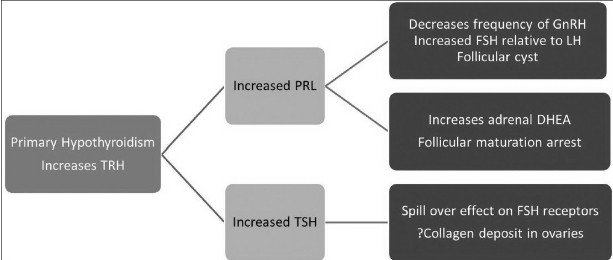
$TSH$ (Thyroid Stimulating Hormone),while primarily regulating the thyroid gland,shares a common alpha subunit with $LH$ and $FSH$,and its levels can influence reproductive function in pathological states.
$GH$ (Growth Hormone),also known as somatotropin,is primarily responsible for somatic growth,metabolism,and protein synthesis. It does not have a direct physiological role in the regulation of the menstrual cycle.
$LH$ (Luteinizing Hormone) and $FSH$ (Follicle Stimulating Hormone) are gonadotropins essential for follicular development and ovulation.
$TSH$ (Thyroid Stimulating Hormone),while primarily regulating the thyroid gland,shares a common alpha subunit with $LH$ and $FSH$,and its levels can influence reproductive function in pathological states.
$GH$ (Growth Hormone),also known as somatotropin,is primarily responsible for somatic growth,metabolism,and protein synthesis. It does not have a direct physiological role in the regulation of the menstrual cycle.
0 likes
View Solution129
MediumMCQ
Inhibition of secretion of which of the following hormones is necessary for the disintegration of the corpus luteum?
A
$LH$
B
Progesterone
C
Prolactin
D
$FSH$
Solution
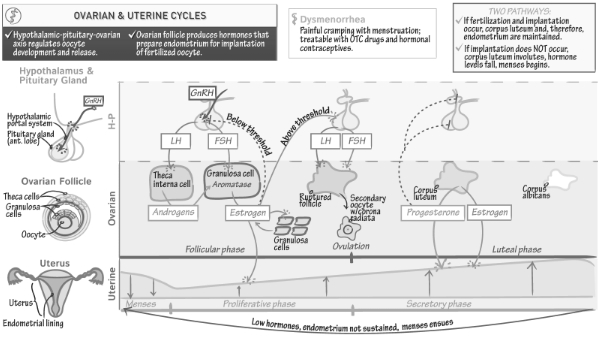
(A) The corpus luteum is maintained by the action of $LH$ (Luteinizing Hormone).
During the luteal phase of the menstrual cycle,$LH$ stimulates the corpus luteum to secrete progesterone.
If fertilization does not occur,the secretion of $LH$ decreases,which leads to the regression or disintegration of the corpus luteum.
As the corpus luteum degenerates,the levels of progesterone and estrogen drop,triggering the onset of menstruation.
During the luteal phase of the menstrual cycle,$LH$ stimulates the corpus luteum to secrete progesterone.
If fertilization does not occur,the secretion of $LH$ decreases,which leads to the regression or disintegration of the corpus luteum.
As the corpus luteum degenerates,the levels of progesterone and estrogen drop,triggering the onset of menstruation.
0 likes
View Solution130
EasyMCQ
The menstrual cycle is typically completed in:
A
$30 \, \text{Days}$
B
$31 \, \text{Days}$
C
$28 \, \text{Days}$
D
$27 \, \text{Days}$
Solution
(C) The menstrual cycle is a series of natural changes in hormone production and the structures of the uterus and ovaries of the female reproductive system that make pregnancy possible.
In human females, the average duration of a menstrual cycle is approximately $28 \, \text{days}$.
It begins on the first day of menstruation and ends just before the next menstrual period begins.
While the cycle length can vary between individuals, $28 \, \text{days}$ is considered the standard physiological average.
In human females, the average duration of a menstrual cycle is approximately $28 \, \text{days}$.
It begins on the first day of menstruation and ends just before the next menstrual period begins.
While the cycle length can vary between individuals, $28 \, \text{days}$ is considered the standard physiological average.
0 likes
View Solution131
EasyMCQ
The menstrual cycle is:
A
Seasonal hormonal ovarian change
B
Conditional hormonal ovarian change
C
Periodic hormonal ovarian change
D
Habitual hormonal ovarian change
Solution
(C) The menstrual cycle is defined as a periodic hormonal ovarian change.
It occurs every month in primates.
The cessation of the menstrual cycle is known as menopause.
It occurs every month in primates.
The cessation of the menstrual cycle is known as menopause.
0 likes
View Solution132
EasyMCQ
The reproductive cycle in female primates,such as monkeys,apes,and human beings,is called:
A
Menstrual cycle
B
Menarche
C
Menopause
D
Ovulation
Solution
(A) The correct answer is Menstrual cycle.
$(i)$ The rhythmic series of changes that occurs in the reproductive organs of female primates (monkeys,apes,and human beings) is called the menstrual cycle.
$(ii)$ It is repeated at an average interval of about $28/29$ days.
$(iii)$ The first appearance of menstruation at puberty is called menarche,while the cessation of the menstrual cycle at the end of the reproductive phase is called menopause.
$(i)$ The rhythmic series of changes that occurs in the reproductive organs of female primates (monkeys,apes,and human beings) is called the menstrual cycle.
$(ii)$ It is repeated at an average interval of about $28/29$ days.
$(iii)$ The first appearance of menstruation at puberty is called menarche,while the cessation of the menstrual cycle at the end of the reproductive phase is called menopause.
0 likes
View Solution133
EasyMCQ
Follicular phase is also called
A
Secretory phase
B
Luteal phase
C
Proliferative phase
D
Menstrual phase
Solution
(C) The follicular phase is also known as the proliferative phase.
Generally,the menstrual cycle consists of four phases:
$(i)$ Menstrual phase: $(a)$ The soft tissue of the endometrial lining of the uterus disintegrates,causing bleeding. $(b)$ The unfertilized egg and soft tissue are discharged. $(c)$ It lasts for $3-5$ days.
$(ii)$ Follicular Phase/Proliferative Phase: $(a)$ The primary follicles in the ovary grow and become a fully mature Graafian follicle. $(b)$ The endometrium of the uterus is regenerated due to the secretion of $LH$ and $FSH$ from the anterior pituitary and the ovarian hormone,estrogen. $(c)$ It lasts for about $10-14$ days.
$(iii)$ Ovulatory Phase: $(a)$ Rapid secretion of $LH$ ($LH$ surge) induces the rupture of the Graafian follicle,thereby leading to ovulation (release of the ovum). $(b)$ It lasts for only about $48 \; hr$.
$(iv)$ Luteal Phase/Secretory Phase: $(a)$ In this phase,the ruptured follicle changes into the corpus luteum in the ovary,and it begins to secrete the hormone progesterone. $(b)$ The endometrium thickens further,and its glands secrete a fluid into the uterus. $(c)$ If the ovum is not fertilized,the corpus luteum undergoes degeneration,which causes the disintegration of the endometrium,leading to menstruation.
Generally,the menstrual cycle consists of four phases:
$(i)$ Menstrual phase: $(a)$ The soft tissue of the endometrial lining of the uterus disintegrates,causing bleeding. $(b)$ The unfertilized egg and soft tissue are discharged. $(c)$ It lasts for $3-5$ days.
$(ii)$ Follicular Phase/Proliferative Phase: $(a)$ The primary follicles in the ovary grow and become a fully mature Graafian follicle. $(b)$ The endometrium of the uterus is regenerated due to the secretion of $LH$ and $FSH$ from the anterior pituitary and the ovarian hormone,estrogen. $(c)$ It lasts for about $10-14$ days.
$(iii)$ Ovulatory Phase: $(a)$ Rapid secretion of $LH$ ($LH$ surge) induces the rupture of the Graafian follicle,thereby leading to ovulation (release of the ovum). $(b)$ It lasts for only about $48 \; hr$.
$(iv)$ Luteal Phase/Secretory Phase: $(a)$ In this phase,the ruptured follicle changes into the corpus luteum in the ovary,and it begins to secrete the hormone progesterone. $(b)$ The endometrium thickens further,and its glands secrete a fluid into the uterus. $(c)$ If the ovum is not fertilized,the corpus luteum undergoes degeneration,which causes the disintegration of the endometrium,leading to menstruation.
0 likes
View Solution134
MediumMCQ
Which hormone level reaches peak during the luteal phase of the menstrual cycle?
A
Luteinizing hormone
B
Progesterone
C
Follicle-stimulating hormone
D
Oestrogen
Solution
(B) During the luteal phase of the menstrual cycle,the corpus luteum begins to secrete a hormone called progesterone.
This hormone reaches its peak level approximately on the $22^{\text{nd}}$ day after the beginning of the cycle.
In this phase,the uterine lining (endometrium) thickens further and becomes secretory to prepare for the implantation of a fertilized ovum.
This hormone reaches its peak level approximately on the $22^{\text{nd}}$ day after the beginning of the cycle.
In this phase,the uterine lining (endometrium) thickens further and becomes secretory to prepare for the implantation of a fertilized ovum.
0 likes
View Solution135
MediumMCQ
Which hormone is produced throughout the menstrual cycle?
A
$FSH$
B
$Oestrogen$
C
$LH$
D
$Progesterone$
Solution
(B) Oestrogen is produced throughout the menstrual cycle,although its levels fluctuate. The menstrual cycle consists of four phases:
$(i)$ Menstrual phase: The endometrial lining of the uterus disintegrates,causing bleeding. It lasts for $3-5$ days.
$(ii)$ Follicular phase: Primary follicles grow into mature Graafian follicles. The endometrium regenerates due to the secretion of $LH$,$FSH$,and oestrogen. It lasts for about $10-14$ days.
$(iii)$ Ovulatory phase: $A$ rapid secretion of $LH$ ($LH$ surge) induces the rupture of the Graafian follicle,leading to ovulation. It lasts for about $48$ hours.
$(iv)$ Luteal phase: The ruptured follicle transforms into the corpus luteum,which secretes progesterone. The endometrium thickens further. If fertilization does not occur,the corpus luteum degenerates,leading to menstruation. Oestrogen and progesterone levels rise during this phase.
$(i)$ Menstrual phase: The endometrial lining of the uterus disintegrates,causing bleeding. It lasts for $3-5$ days.
$(ii)$ Follicular phase: Primary follicles grow into mature Graafian follicles. The endometrium regenerates due to the secretion of $LH$,$FSH$,and oestrogen. It lasts for about $10-14$ days.
$(iii)$ Ovulatory phase: $A$ rapid secretion of $LH$ ($LH$ surge) induces the rupture of the Graafian follicle,leading to ovulation. It lasts for about $48$ hours.
$(iv)$ Luteal phase: The ruptured follicle transforms into the corpus luteum,which secretes progesterone. The endometrium thickens further. If fertilization does not occur,the corpus luteum degenerates,leading to menstruation. Oestrogen and progesterone levels rise during this phase.
0 likes
View Solution136
EasyMCQ
Cessation of the menstrual cycle at the age of $50$ is called:
A
Ovulation
B
Gametogenesis
C
Menarche
D
Menopause
Solution
(D) Menopause (Greek: $Men$ = month; $pausis$ = cessation) is a phase in a woman's life when ovulation and menstruation stop.
It typically occurs between $45-55$ years of age.
Some women experience irregular cycles for months or years prior to menopause,while others simply stop menstruating abruptly.
The decline in estrogen and progesterone levels leads to menopause.
It typically occurs between $45-55$ years of age.
Some women experience irregular cycles for months or years prior to menopause,while others simply stop menstruating abruptly.
The decline in estrogen and progesterone levels leads to menopause.
0 likes
View Solution137
EasyMCQ
Ovulation takes place in a month between
A
$11$ days
B
$14$ days
C
$15-28$ days
D
$21-26$ days
Solution
(B) Ovulation is the process of releasing a secondary oocyte from the ovary.
In a typical $28$-day human menstrual cycle,ovulation occurs on the $14$th day.
It takes place approximately $14$ days before the onset of the next menstrual cycle.
In a typical $28$-day human menstrual cycle,ovulation occurs on the $14$th day.
It takes place approximately $14$ days before the onset of the next menstrual cycle.
0 likes
View Solution138
EasyMCQ
The onset of menstruation in a human female is called:
A
Menopause
B
Puberty
C
Gestation
D
Menarche
Solution
(D) Menarche is the first occurrence of menstruation in a female,typically occurring around $13$ years of age. In contrast,menopause is the stage of life when the menstrual cycle naturally ceases.
0 likes
View Solution139
MediumMCQ
The corpus luteum secretes progesterone,which negatively feeds back and inhibits the release of:
A
$ABP$ and $ICSH$
B
$LH$ and $ICSH$
C
$LH$ and $FSH$
D
$FSH$ and $TSH$
Solution
(C) The corpus luteum secretes progesterone,which acts as a negative feedback mechanism to inhibit the release of $LH$ and $FSH$ from the anterior pituitary gland.
During the luteal phase,the ruptured Graafian follicle transforms into the corpus luteum,which secretes high levels of progesterone.
Progesterone maintains the endometrium for potential implantation.
If fertilization does not occur,the high levels of progesterone exert negative feedback on the hypothalamus and anterior pituitary,suppressing the secretion of gonadotropins ($LH$ and $FSH$),which eventually leads to the degeneration of the corpus luteum.
During the luteal phase,the ruptured Graafian follicle transforms into the corpus luteum,which secretes high levels of progesterone.
Progesterone maintains the endometrium for potential implantation.
If fertilization does not occur,the high levels of progesterone exert negative feedback on the hypothalamus and anterior pituitary,suppressing the secretion of gonadotropins ($LH$ and $FSH$),which eventually leads to the degeneration of the corpus luteum.
0 likes
View Solution140
MediumMCQ
Uterine endometrium,epithelial glands,and connective tissue are broken down in the menstrual phase. This is due to:
A
Over secretion of $FSH$
B
Lack of oestrogen
C
Lack of progesterone
D
Over production of progesterone
Solution
(C) During the menstrual cycle,the corpus luteum degenerates if fertilization does not occur. This leads to a sharp decrease in the levels of progesterone and oestrogen. The withdrawal of progesterone causes the breakdown of the uterine endometrium,epithelial glands,and connective tissue,which are then shed as menstrual flow.
0 likes
View Solution141
MediumMCQ
What happens at the beginning of the menstrual cycle?
A
Ovulation takes place
B
Corpus luteum degenerates
C
Levels of $LH$ and $FSH$ increase
D
Progesterone and oestrogen levels increase
Solution
(B) At the beginning of the menstrual cycle,the corpus luteum degenerates due to the decline in $LH$ levels.
This leads to a sharp decrease in the levels of progesterone and oestrogen.
As a result,the endometrium lining of the uterus breaks down,which causes menstruation.
This leads to a sharp decrease in the levels of progesterone and oestrogen.
As a result,the endometrium lining of the uterus breaks down,which causes menstruation.
0 likes
View Solution142
MediumMCQ
$A$ woman with a typical $28 \; \text{day}$ menstrual cycle is most likely to become pregnant as a result of sexual intercourse on which days of the cycle?
A
$1-3 \; \text{days}$
B
$5-8 \; \text{days}$
C
$12-15 \; \text{days}$
D
$24-28 \; \text{days}$
Solution
$(C)$ In a typical $28 \; \text{day}$ menstrual cycle, ovulation occurs around the $14^{th}$ day.
Since the ovum remains viable for about $24 \; \text{hours}$ and sperm can remain viable in the female reproductive tract for up to $48-72 \; \text{hours}$, the fertile period is considered to be around the time of ovulation.
Therefore, sexual intercourse between the $12^{th}$ and $15^{th}$ day of the cycle provides the highest probability of fertilization due to the $LH$ surge and subsequent release of the ovum.
Since the ovum remains viable for about $24 \; \text{hours}$ and sperm can remain viable in the female reproductive tract for up to $48-72 \; \text{hours}$, the fertile period is considered to be around the time of ovulation.
Therefore, sexual intercourse between the $12^{th}$ and $15^{th}$ day of the cycle provides the highest probability of fertilization due to the $LH$ surge and subsequent release of the ovum.
0 likes
View Solution143
EasyMCQ
At which phase, both $LH$ and $FSH$ attain a peak level?
A
Menstrual phase
B
Follicular phase
C
Ovulatory phase
D
Luteal phase
Solution
(C) During the menstrual cycle, the levels of gonadotropins ($LH$ and $FSH$) fluctuate significantly.
$LH$ and $FSH$ attain a peak level during the mid-cycle, which is known as the ovulatory phase (around day $14$).
This rapid secretion of $LH$ leading to its maximum level during the mid-cycle is called the $LH$ surge, which induces the rupture of the Graafian follicle and thereby the release of the ovum (ovulation).
$LH$ and $FSH$ attain a peak level during the mid-cycle, which is known as the ovulatory phase (around day $14$).
This rapid secretion of $LH$ leading to its maximum level during the mid-cycle is called the $LH$ surge, which induces the rupture of the Graafian follicle and thereby the release of the ovum (ovulation).
| Phase | Events |
| Menstrual phase ($1-5$ days) | Endometrial lining breaks down; progesterone and $LH$ levels are low. |
| Follicular phase ($6-13$ days) | Primary follicles grow; $FSH$ and estrogen levels increase. |
| Ovulatory phase ($14$th day) | $LH$ and $FSH$ reach peak levels; ovulation occurs. |
| Luteal phase ($15-28$ days) | Corpus luteum secretes progesterone; endometrium thickens. |
0 likes
View Solution144
MediumMCQ
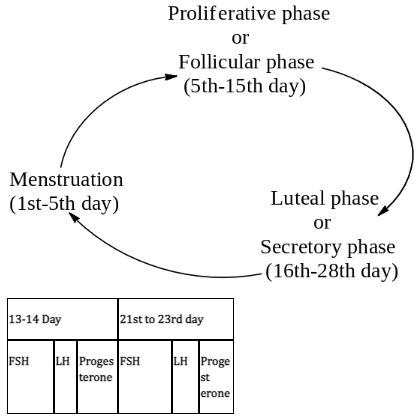
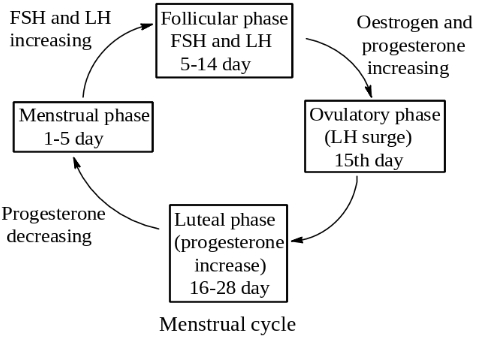
The events of the menstrual cycle are represented below. In which of the following options are the levels of $FSH$,$LH$,and progesterone mentioned correctly?
A
| High | High | Low | Low | Low | High |
B
| High | High | High | Low | Low | Low |
C
| Low | Low | Low | High | High | High |
D
| Low | Low | High | High | Low | Low |
Solution
(D) During the $13-14$th day (near ovulation),the levels of $FSH$ and $LH$ reach their peak (high concentration),while the level of progesterone is relatively low.
During the $21-23$rd day (luteal phase),the levels of $FSH$ and $LH$ are low,whereas the level of progesterone is high due to the presence of the corpus luteum.
During the $21-23$rd day (luteal phase),the levels of $FSH$ and $LH$ are low,whereas the level of progesterone is high due to the presence of the corpus luteum.
0 likes
View Solution145
MediumMCQ
Arrange the events of the menstrual cycle in the order they occur:
$I.$ Secretion of $FSH$
$II.$ Growth of corpus luteum
$III.$ Growth of follicle and oogenesis
$IV.$ Ovulation
$V.$ Sudden increase in the level of $LH$
$I.$ Secretion of $FSH$
$II.$ Growth of corpus luteum
$III.$ Growth of follicle and oogenesis
$IV.$ Ovulation
$V.$ Sudden increase in the level of $LH$
A
$I, III, V, IV, II$
B
$II, I, III, IV, V$
C
$III, I, IV, V, II$
D
$I, IV, III, V, II$
Solution
(A) The menstrual cycle begins with the secretion of $FSH$ (Follicle Stimulating Hormone) from the anterior pituitary gland $(I)$.
This hormone stimulates the growth of the ovarian follicle and the process of oogenesis $(III)$.
As the follicle matures,estrogen levels rise,eventually triggering a sudden surge in $LH$ (Luteinizing Hormone) levels,known as the $LH$ surge $(V)$.
This surge leads to the rupture of the Graafian follicle and the release of the ovum,a process called ovulation $(IV)$.
Following ovulation,the remnants of the follicle transform into the corpus luteum,which grows and secretes progesterone $(II)$.
Therefore,the correct sequence is $I, III, V, IV, II$.
This hormone stimulates the growth of the ovarian follicle and the process of oogenesis $(III)$.
As the follicle matures,estrogen levels rise,eventually triggering a sudden surge in $LH$ (Luteinizing Hormone) levels,known as the $LH$ surge $(V)$.
This surge leads to the rupture of the Graafian follicle and the release of the ovum,a process called ovulation $(IV)$.
Following ovulation,the remnants of the follicle transform into the corpus luteum,which grows and secretes progesterone $(II)$.
Therefore,the correct sequence is $I, III, V, IV, II$.
0 likes
View Solution146
MediumMCQ
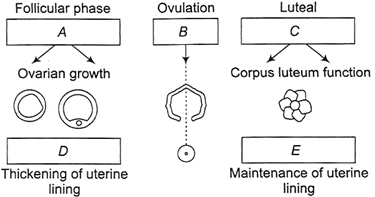
The figure given below illustrates the changes taking place during the human menstrual cycle. Identify hormones $A, B, C, D$ and $E$ from the figure. In the boxes shown in the figure, write the name of the hormone (or hormones) controlling the stage in the human menstrual cycle.
A
$A-FSH, B-LH, C-LH, D-\text{Oestrogen}, E-\text{Progesterone}$
B
$A-LH, B-FSH, C-LH, D-\text{Oestrogen}, E-\text{Progesterone}$
C
$A-FSH, B-LH, C-FSH, D-\text{Oestrogen}, E-\text{Progesterone}$
D
$A-FSH, B-LH, C-LH, D-\text{Progesterone}, E-\text{Oestrogen}$
Solution
(A) In the human menstrual cycle:
$1$. $A$ represents $FSH$ (Follicle Stimulating Hormone), which stimulates the growth of ovarian follicles during the follicular phase.
$2$. $B$ represents $LH$ (Luteinizing Hormone), which triggers ovulation.
$3$. $C$ represents $LH$, which is responsible for the maintenance and function of the corpus luteum.
$4$. $D$ represents Oestrogen, which is secreted by the developing follicles and causes the thickening of the uterine lining (endometrium).
$5$. $E$ represents Progesterone, which is secreted by the corpus luteum and is essential for the maintenance of the uterine lining during the luteal phase.
Therefore, the correct sequence is $A-FSH, B-LH, C-LH, D-\text{Oestrogen}, E-\text{Progesterone}$.
$1$. $A$ represents $FSH$ (Follicle Stimulating Hormone), which stimulates the growth of ovarian follicles during the follicular phase.
$2$. $B$ represents $LH$ (Luteinizing Hormone), which triggers ovulation.
$3$. $C$ represents $LH$, which is responsible for the maintenance and function of the corpus luteum.
$4$. $D$ represents Oestrogen, which is secreted by the developing follicles and causes the thickening of the uterine lining (endometrium).
$5$. $E$ represents Progesterone, which is secreted by the corpus luteum and is essential for the maintenance of the uterine lining during the luteal phase.
Therefore, the correct sequence is $A-FSH, B-LH, C-LH, D-\text{Oestrogen}, E-\text{Progesterone}$.
0 likes
View Solution147
MediumMCQ
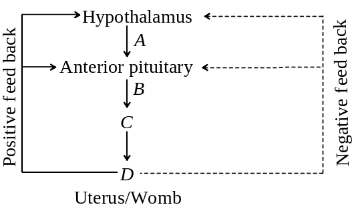
Given below is an incomplete flow chart showing the influence of hormones on gametogenesis in human females. $A, B, C$ and $D$ in the chart refer to:
A
$A-GnRH$ (Gonadotropin Releasing Hormone),$B-$Oestrogen and Progesterone,$C-$Ovary,$D-FSH$ and $LH$
B
$A-GnRH$ (Gonadotropin Releasing Hormone),$B-$Progesterone and $LH$,$C-$Ovary,$D-$Oestrogen and $FSH$
C
$A-GnRH$ (Gonadotropin Releasing Hormone),$B-FSH$ and Oestrogen,$C-$Ovary,$D-LH$ and Progesterone
D
$A-GnRH$ (Gonadotropin Releasing Hormone),$B-FSH$ and $LH$,$C-$Ovary,$D-$Oestrogen and Progesterone
Solution
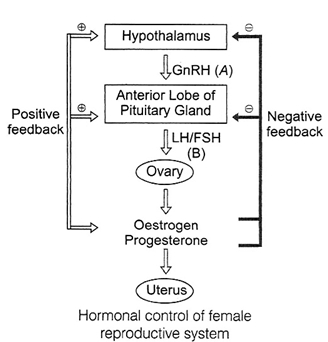
(D) The $GnRH$ (Gonadotropin Releasing Hormone) is secreted by the hypothalamus,which stimulates the anterior lobe of the pituitary gland to secrete $LH$ (Luteinizing Hormone) and $FSH$ (Follicle Stimulating Hormone) $(B)$.
These hormones act on the ovary $(C)$ to stimulate the development of ovarian follicles and the production of ovarian hormones,namely oestrogen and progesterone $(D)$.
Oestrogen and progesterone exert feedback control on the hypothalamus and anterior pituitary to regulate the cycle.
These hormones act on the ovary $(C)$ to stimulate the development of ovarian follicles and the production of ovarian hormones,namely oestrogen and progesterone $(D)$.
Oestrogen and progesterone exert feedback control on the hypothalamus and anterior pituitary to regulate the cycle.
0 likes
View Solution148
MediumMCQ
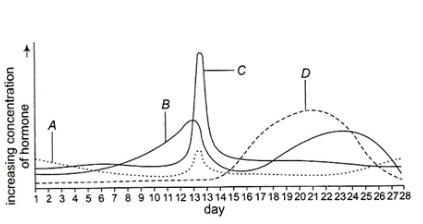
The following graph shows the relative concentrations of the four hormones present in the blood plasma of a woman during her menstrual cycle. Identify the hormones $A, B, C$ and $D$.
A
$A-FSH, B-Oestrogen, C-LH, D-Progesterone$
B
$A-LH, B-Progesterone, C-FSH, D-Oestrogen$
C
$A-FSH, B-Progesterone, C-LH, D-Oestrogen$
D
$A-LH, B-Oestrogen, C-FSH, D-Progesterone$
Solution
(A) In the menstrual cycle,the hormonal levels change as follows:
$1$. $C$ shows a sharp peak around day $14$,which is characteristic of the $LH$ surge,triggering ovulation.
$2$. $B$ represents Oestrogen,which rises during the follicular phase to stimulate the uterine lining.
$3$. $A$ represents $FSH$,which shows a small peak before ovulation to stimulate follicle development.
$4$. $D$ represents Progesterone,which rises significantly during the luteal phase (post-ovulation) to maintain the endometrium.
Therefore,the correct identification is $A-FSH, B-Oestrogen, C-LH, D-Progesterone$.
$1$. $C$ shows a sharp peak around day $14$,which is characteristic of the $LH$ surge,triggering ovulation.
$2$. $B$ represents Oestrogen,which rises during the follicular phase to stimulate the uterine lining.
$3$. $A$ represents $FSH$,which shows a small peak before ovulation to stimulate follicle development.
$4$. $D$ represents Progesterone,which rises significantly during the luteal phase (post-ovulation) to maintain the endometrium.
Therefore,the correct identification is $A-FSH, B-Oestrogen, C-LH, D-Progesterone$.
0 likes
View Solution149
MediumMCQ
Which one of the following statements is incorrect about the menstrual cycle?
A
The first menstruation begins at puberty and is called menarche.
B
Lack of menstruation may also occur due to some environmental factors like stress or poor health.
C
Corpus luteum secretes large amounts of progesterone,which is essential for the maintenance of the endometrium.
D
In the absence of fertilization,the corpus luteum degenerates in the luteal phase and new follicles start developing immediately.
Solution
(D) In the absence of fertilization,the corpus luteum degenerates during the luteal phase,but new follicles do not start developing immediately after its degeneration. The development of new follicles occurs during the follicular phase,where primary follicles in the ovary grow to become a fully mature Graafian follicle.
0 likes
View Solution150
MediumMCQ
In a fertile human female,approximately on which day of the menstrual cycle ($32$ days) does ovulation take place?
A
$Day \; 18$
B
$Day \; 14$
C
$Day \; 1$
D
$Day \; 8$
Solution
(A) In a human female,ovulation typically occurs $14$ days before the onset of the next menstrual cycle.
Given that the total duration of the menstrual cycle is $32$ days,the day of ovulation is calculated as:
$\text{Day of ovulation} = \text{Total cycle length} - 14$
$\text{Day of ovulation} = 32 - 14 = 18$
Therefore,ovulation takes place on the $18^{th}$ day of the menstrual cycle.
Given that the total duration of the menstrual cycle is $32$ days,the day of ovulation is calculated as:
$\text{Day of ovulation} = \text{Total cycle length} - 14$
$\text{Day of ovulation} = 32 - 14 = 18$
Therefore,ovulation takes place on the $18^{th}$ day of the menstrual cycle.
0 likes
View SolutionHuman Reproduction — Menstrual Cycle · Frequently Asked Questions
1Are these Human Reproduction questions useful for JEE and NEET?
Yes. All questions in this section are mapped to JEE Main and NEET exam patterns. Previous year questions from JEE Main, NEET, GUJCET and state-level exams are included with full solutions.
2Can I switch to Hindi or Gujarati for these questions?
Yes. Use the language tabs in the hero section or the sidebar to view the same questions and solutions in English, Hindi or Gujarati.
3How do I generate a question paper from this subtopic?
Use the Vedclass Exam Paper Generator — select the chapter and subtopic, set difficulty, and generate Sets A, B, C, D automatically. First 3 chapters of every subject are free.
Vedclass Products
For Students
Vedclass Test Series
Mock tests in real JEE/NEET style with performance analysis. 5-day free trial.
Start Free TrialFor Teachers
Exam Paper Generator
Generate Set A/B/C/D papers from this chapter in 2 minutes. 3 chapters free.
Try FreeFor Institutes
Online Exam Module
Live online exams with unlimited students, 360° analytics & white-label branding.
See DemoFor Teachers & Institutes
Generate a Human Reproduction Exam Paper in 2 Minutes
Select subtopic & difficulty — Sets A, B, C, D auto-generated with No Repeat logic.
First 3 chapters of every subject are free — no payment required.