
A English
Menstrual Cycle Questions in English
Class 12 Biology · Human Reproduction · Menstrual Cycle
182+
Questions
English
Language
100%
With Solutions
Showing 49 of 182 questions in English
51
MediumMCQ
Which hormones regulate the human menstrual cycle?
A
$FSH$
B
$LH$
C
$FSH, LH$,Estrogen,and Progesterone
D
Only Progesterone
Solution
(C) The human menstrual cycle is regulated by a complex interplay of hormones secreted by the hypothalamus,anterior pituitary gland,and the ovaries.
$1$. The hypothalamus secretes $GnRH$ (Gonadotropin-Releasing Hormone),which stimulates the anterior pituitary.
$2$. The anterior pituitary releases $FSH$ (Follicle-Stimulating Hormone) and $LH$ (Luteinizing Hormone).
$3$. $FSH$ stimulates the development of ovarian follicles,which secrete Estrogen.
$4$. $LH$ triggers ovulation and the formation of the corpus luteum,which secretes Progesterone.
Therefore,all these hormones ($FSH, LH$,Estrogen,and Progesterone) are essential for the regulation of the menstrual cycle.
$1$. The hypothalamus secretes $GnRH$ (Gonadotropin-Releasing Hormone),which stimulates the anterior pituitary.
$2$. The anterior pituitary releases $FSH$ (Follicle-Stimulating Hormone) and $LH$ (Luteinizing Hormone).
$3$. $FSH$ stimulates the development of ovarian follicles,which secrete Estrogen.
$4$. $LH$ triggers ovulation and the formation of the corpus luteum,which secretes Progesterone.
Therefore,all these hormones ($FSH, LH$,Estrogen,and Progesterone) are essential for the regulation of the menstrual cycle.
0 likes
View Solution52
MediumMCQ
When does ovulation occur during the menstrual cycle in human females?
A
At the end of the proliferative phase
B
In the middle of the secretory phase
C
Before the secretory phase
D
At the beginning of the proliferative phase
Solution
(A) In a $28$-day menstrual cycle,the cycle is divided into different phases.
$1$. The menstrual phase occurs from day $1$ to $5$.
$2$. The follicular or proliferative phase occurs from day $6$ to $13$.
$3$. Ovulation occurs on the $14^{th}$ day,which is at the end of the proliferative phase.
$4$. The luteal or secretory phase occurs from day $15$ to $28$.
Therefore,ovulation takes place at the end of the proliferative phase.
$1$. The menstrual phase occurs from day $1$ to $5$.
$2$. The follicular or proliferative phase occurs from day $6$ to $13$.
$3$. Ovulation occurs on the $14^{th}$ day,which is at the end of the proliferative phase.
$4$. The luteal or secretory phase occurs from day $15$ to $28$.
Therefore,ovulation takes place at the end of the proliferative phase.
0 likes
View Solution53
MediumMCQ
Which phase of the menstrual cycle is characterized by the induction of ovulation?
A
Luteal phase
B
Menstrual phase
C
Follicular phase
D
Secretory phase
Solution
(C) The menstrual cycle consists of four main phases: the menstrual phase,the follicular (or proliferative) phase,ovulation,and the luteal (or secretory) phase.
Ovulation typically occurs around the $14^{th}$ day of a $28$-day menstrual cycle.
It is triggered by a sudden surge in the levels of Luteinizing Hormone $(LH)$,known as the '$LH$ surge',which occurs at the end of the follicular phase.
Therefore,the follicular phase is the phase that leads to and includes the induction of ovulation.
Ovulation typically occurs around the $14^{th}$ day of a $28$-day menstrual cycle.
It is triggered by a sudden surge in the levels of Luteinizing Hormone $(LH)$,known as the '$LH$ surge',which occurs at the end of the follicular phase.
Therefore,the follicular phase is the phase that leads to and includes the induction of ovulation.
0 likes
View Solution54
MediumMCQ
Which phase of the menstrual cycle in humans lasts for $7-8$ days?
A
Follicular phase
B
Ovulatory phase
C
Luteal phase
D
Menstrual phase
Solution
(A) The menstrual cycle in humans typically lasts for $28$ days.
$1$. The menstrual phase lasts for $3-5$ days.
$2$. The follicular phase (also known as the proliferative phase) follows the menstrual phase and lasts for about $10-14$ days.
$3$. The ovulatory phase is very short,occurring around the $14^{th}$ day.
$4$. The luteal phase (also known as the secretory phase) follows ovulation and lasts for about $14$ days.
However,in many textbook contexts,the follicular phase is often described as the phase that spans the period after menstruation until ovulation,which covers the $7-8$ day window of active follicular development and maturation before the surge.
$1$. The menstrual phase lasts for $3-5$ days.
$2$. The follicular phase (also known as the proliferative phase) follows the menstrual phase and lasts for about $10-14$ days.
$3$. The ovulatory phase is very short,occurring around the $14^{th}$ day.
$4$. The luteal phase (also known as the secretory phase) follows ovulation and lasts for about $14$ days.
However,in many textbook contexts,the follicular phase is often described as the phase that spans the period after menstruation until ovulation,which covers the $7-8$ day window of active follicular development and maturation before the surge.
0 likes
View Solution55
MediumMCQ
What are the phases of the menstrual cycle?
A
Follicular phase and proliferative phase
B
Proliferative phase and secretory phase
C
Proliferative,secretory,and menstrual phase
D
Follicular,secretory,and menstrual phase
Solution
(D) The menstrual cycle consists of three main phases:
$1$. Menstrual phase: The cycle starts with the menstrual flow,where the endometrial lining of the uterus breaks down.
$2$. Follicular phase (also known as the proliferative phase): During this phase,the primary follicles in the ovary grow to become a fully mature Graafian follicle,and the endometrium regenerates through proliferation.
$3$. Secretory phase (also known as the luteal phase): After ovulation,the remaining parts of the Graafian follicle transform into the corpus luteum,which secretes progesterone. The endometrium becomes further thickened and ready for implantation.
Therefore,the correct sequence of phases is the menstrual phase,follicular (proliferative) phase,and secretory (luteal) phase.
$1$. Menstrual phase: The cycle starts with the menstrual flow,where the endometrial lining of the uterus breaks down.
$2$. Follicular phase (also known as the proliferative phase): During this phase,the primary follicles in the ovary grow to become a fully mature Graafian follicle,and the endometrium regenerates through proliferation.
$3$. Secretory phase (also known as the luteal phase): After ovulation,the remaining parts of the Graafian follicle transform into the corpus luteum,which secretes progesterone. The endometrium becomes further thickened and ready for implantation.
Therefore,the correct sequence of phases is the menstrual phase,follicular (proliferative) phase,and secretory (luteal) phase.
0 likes
View Solution56
EasyMCQ
In females,the cessation of reproductive capacity occurs around the age of $45$ to $50$ years. What is this process called?
A
Menarche
B
Senescence
C
Menopause
D
Puberty
Solution
(C) In human females,the reproductive phase extends from menarche (the onset of menstruation) to menopause.
Menopause is the permanent cessation of the menstrual cycle and reproductive capacity,which typically occurs between the ages of $45$ and $50$ years.
Menarche refers to the first menstrual cycle,while senescence refers to the biological process of aging.
Menopause is the permanent cessation of the menstrual cycle and reproductive capacity,which typically occurs between the ages of $45$ and $50$ years.
Menarche refers to the first menstrual cycle,while senescence refers to the biological process of aging.
0 likes
View Solution57
MediumMCQ
In the uterus,which hormone is responsible for the proliferation of the endometrium?
A
Relaxin
B
Oxytocin
C
Estrogen
D
Progesterone
Solution
(C) The menstrual cycle involves the cyclic changes in the endometrium of the uterus.
During the follicular phase,the secretion of gonadotropins ($LH$ and $FSH$) increases gradually and stimulates follicular development as well as the secretion of estrogens by the growing follicles.
Estrogen is primarily responsible for the proliferation of the endometrium of the uterus during the proliferative phase of the menstrual cycle.
Progesterone is mainly responsible for the maintenance of the endometrium during the secretory phase.
During the follicular phase,the secretion of gonadotropins ($LH$ and $FSH$) increases gradually and stimulates follicular development as well as the secretion of estrogens by the growing follicles.
Estrogen is primarily responsible for the proliferation of the endometrium of the uterus during the proliferative phase of the menstrual cycle.
Progesterone is mainly responsible for the maintenance of the endometrium during the secretory phase.
0 likes
View Solution58
EasyMCQ
What is the $CESSATION$ of the menstrual cycle called?
A
Ovulation
B
Menopause
C
Puberty
D
Implantation
Solution
(B) The permanent cessation of the menstrual cycle in human females is known as $Menopause$.
It typically occurs between the ages of $45$ and $50$ years.
$Ovulation$ refers to the release of an ovum from the ovary.
$Puberty$ is the period during which adolescents reach sexual maturity.
$Implantation$ is the process by which the embryo attaches to the uterine wall.
It typically occurs between the ages of $45$ and $50$ years.
$Ovulation$ refers to the release of an ovum from the ovary.
$Puberty$ is the period during which adolescents reach sexual maturity.
$Implantation$ is the process by which the embryo attaches to the uterine wall.
0 likes
View Solution59
MediumMCQ
Which of the following statements is correct?
A
The menstrual cycle is present in all animals.
B
The menstrual cycle is present in all primates.
C
The oestrous cycle is found in all mammals.
D
All mammals are oviparous.
Solution
(B) The reproductive cycle in female mammals is of two types: the menstrual cycle and the oestrous cycle.
$1$. The menstrual cycle occurs in primates (e.g.,monkeys,apes,and humans).
$2$. The oestrous cycle occurs in non-primate mammals (e.g.,cows,sheep,rats,deer,dogs,tigers).
$3$. Therefore,the statement that the menstrual cycle is present in all primates is correct.
$4$. Mammals are generally viviparous,not oviparous (except for monotremes like the platypus).
$1$. The menstrual cycle occurs in primates (e.g.,monkeys,apes,and humans).
$2$. The oestrous cycle occurs in non-primate mammals (e.g.,cows,sheep,rats,deer,dogs,tigers).
$3$. Therefore,the statement that the menstrual cycle is present in all primates is correct.
$4$. Mammals are generally viviparous,not oviparous (except for monotremes like the platypus).
0 likes
View Solution60
MediumMCQ
In human females,the menstrual cycle is regulated by the interaction of which hormones?
A
Only $FSH$
B
Only $LH$
C
Combination of $FSH$ and $LH$
D
Combination of estrogen and progesterone
Solution
(D) The menstrual cycle in human females is primarily regulated by the cyclic changes in the levels of ovarian hormones,specifically estrogen and progesterone.
These hormones are secreted by the ovaries under the influence of pituitary hormones ($FSH$ and $LH$).
However,the actual phases of the menstrual cycle (such as the follicular phase,ovulation,and the luteal phase) are directly controlled and maintained by the fluctuating levels of estrogen and progesterone.
Therefore,the correct answer is the combination of estrogen and progesterone.
These hormones are secreted by the ovaries under the influence of pituitary hormones ($FSH$ and $LH$).
However,the actual phases of the menstrual cycle (such as the follicular phase,ovulation,and the luteal phase) are directly controlled and maintained by the fluctuating levels of estrogen and progesterone.
Therefore,the correct answer is the combination of estrogen and progesterone.
0 likes
View Solution61
EasyMCQ
Which hormone is responsible for ovulation?
A
$FSH$
B
$LH$
C
Testosterone
D
Estrogen
Solution
(B) Ovulation is the process in the menstrual cycle where a mature ovarian follicle ruptures and releases an egg (ovum).
This process is primarily triggered by a surge in the levels of Luteinizing Hormone $(LH)$,often referred to as the '$LH$ surge'.
$FSH$ (Follicle Stimulating Hormone) is responsible for the growth and maturation of the ovarian follicles,but the final release of the egg is specifically caused by the peak of $LH$.
This process is primarily triggered by a surge in the levels of Luteinizing Hormone $(LH)$,often referred to as the '$LH$ surge'.
$FSH$ (Follicle Stimulating Hormone) is responsible for the growth and maturation of the ovarian follicles,but the final release of the egg is specifically caused by the peak of $LH$.
0 likes
View Solution62
MediumMCQ
The corpus luteum secretes which of the following?
A
$LH$
B
$FSH$
C
Progesterone
D
Testosterone
Solution
(C) The corpus luteum is a temporary endocrine structure in the ovary that develops from the ruptured follicle after ovulation.
It primarily secretes the hormone progesterone,which is essential for maintaining the endometrium during pregnancy.
It also secretes small amounts of estrogen.
It primarily secretes the hormone progesterone,which is essential for maintaining the endometrium during pregnancy.
It also secretes small amounts of estrogen.
0 likes
View Solution63
MediumMCQ
Changes in $GnRH$ pulse frequency in females are controlled by circulating levels of
A
progesterone only
B
progesterone and inhibin
C
estrogen and progesterone
D
estrogen and inhibin
Solution
(C) $GnRH$ is secreted by the hypothalamus,which stimulates the anterior lobe of the pituitary gland to secrete luteinizing hormone $(LH)$ and follicle-stimulating hormone $(FSH)$.
$FSH$ stimulates the growth of ovarian follicles and the production of estrogens.
$LH$ stimulates the corpus luteum to secrete progesterone.
Rising levels of progesterone and estrogen exert negative feedback on the hypothalamus and anterior pituitary,inhibiting the release of $GnRH$,which in turn inhibits the production of $FSH$ and $LH$.
$FSH$ stimulates the growth of ovarian follicles and the production of estrogens.
$LH$ stimulates the corpus luteum to secrete progesterone.
Rising levels of progesterone and estrogen exert negative feedback on the hypothalamus and anterior pituitary,inhibiting the release of $GnRH$,which in turn inhibits the production of $FSH$ and $LH$.
0 likes
View Solution64
MediumMCQ
Menstrual flow occurs due to lack of
A
oxytocin
B
vasopressin
C
progesterone
D
$FSH$
Solution
(C) The corpus luteum secretes large amounts of progesterone,which is essential for the maintenance of the endometrium.
This endometrium is necessary for the implantation of the fertilized ovum and other events of pregnancy.
In the absence of fertilization,the corpus luteum degenerates.
This causes the disintegration of the endometrium,leading to menstruation.
The menstrual flow results from the breakdown of the endometrial lining of the uterus and its blood vessels,which forms a liquid that is discharged through the vagina.
This endometrium is necessary for the implantation of the fertilized ovum and other events of pregnancy.
In the absence of fertilization,the corpus luteum degenerates.
This causes the disintegration of the endometrium,leading to menstruation.
The menstrual flow results from the breakdown of the endometrial lining of the uterus and its blood vessels,which forms a liquid that is discharged through the vagina.
0 likes
View Solution65
MediumMCQ
The secretory phase in the human menstrual cycle is also called
A
luteal phase and lasts for about $6$ days
B
follicular phase and lasts for about $6$ days
C
luteal phase and lasts for about $13$ days
D
follicular phase and lasts for about $13$ days.
Solution
(C) The secretory phase is also known as the luteal phase.
After ovulation,which occurs in the middle of the menstrual cycle,the empty Graafian follicle transforms into the corpus luteum under the influence of $LH$.
The corpus luteum secretes large amounts of progesterone,which is essential for the maintenance of the endometrium.
During this phase,the endometrial glands become secretory,preparing the uterine wall for the implantation of a blastocyst.
This phase typically lasts for about $13$ days,covering the period from day $16$ to day $28$ in a standard $28$-day menstrual cycle.
After ovulation,which occurs in the middle of the menstrual cycle,the empty Graafian follicle transforms into the corpus luteum under the influence of $LH$.
The corpus luteum secretes large amounts of progesterone,which is essential for the maintenance of the endometrium.
During this phase,the endometrial glands become secretory,preparing the uterine wall for the implantation of a blastocyst.
This phase typically lasts for about $13$ days,covering the period from day $16$ to day $28$ in a standard $28$-day menstrual cycle.
0 likes
View Solution66
MediumMCQ
About which day in a normal human menstrual cycle does rapid secretion of $LH$ (popularly called $LH$ surge) normally occur (in $14^{th}$ day)?
A
$14$
B
$20$
C
$5$
D
$11$
Solution
(A) In a normal human menstrual cycle of $28$ days, both $LH$ and $FSH$ reach their peak levels in the middle of the cycle, which is approximately the $14^{th}$ day.
This rapid secretion of $LH$, known as the $LH$ surge, is responsible for the rupture of the mature Graafian follicle.
Following the rupture of the follicle, the ovum is released, a process known as ovulation.
This rapid secretion of $LH$, known as the $LH$ surge, is responsible for the rupture of the mature Graafian follicle.
Following the rupture of the follicle, the ovum is released, a process known as ovulation.
0 likes
View Solution67
MediumMCQ
Which one of the following is the correct matching of the events occurring during the menstrual cycle?
A
Proliferative phase : Rapid regeneration of myometrium and maturation of Graafian follicle
B
Secretory phase : Development of corpus luteum and increased secretion of progesterone
C
Menstruation : Breakdown of myometrium and ovum not fertilised
D
Ovulation : $LH$ and $FSH$ attain peak level and sharp fall in the secretion of progesterone
Solution
(B) The correct answer is $B$.
During the secretory phase (also known as the luteal phase),the ruptured Graafian follicle transforms into the corpus luteum under the influence of $LH$.
The corpus luteum secretes large amounts of progesterone,which is essential for the maintenance of the endometrium.
Option $A$ is incorrect because the proliferative phase involves the regeneration of the endometrium,not the myometrium.
Option $C$ is incorrect because menstruation involves the breakdown of the endometrium,not the myometrium.
Option $D$ is incorrect because ovulation is triggered by the $LH$ surge,and progesterone levels rise after ovulation,not fall.
During the secretory phase (also known as the luteal phase),the ruptured Graafian follicle transforms into the corpus luteum under the influence of $LH$.
The corpus luteum secretes large amounts of progesterone,which is essential for the maintenance of the endometrium.
Option $A$ is incorrect because the proliferative phase involves the regeneration of the endometrium,not the myometrium.
Option $C$ is incorrect because menstruation involves the breakdown of the endometrium,not the myometrium.
Option $D$ is incorrect because ovulation is triggered by the $LH$ surge,and progesterone levels rise after ovulation,not fall.
0 likes
View Solution68
MediumMCQ
Which one of the following statements is incorrect about menstruation?
A
At menopause in the female,there is especially abrupt increase in gonadotropic hormones.
B
The beginning of the cycle of menstruation is called menarche.
C
During normal menstruation about $40 \ mL$ blood is lost.
D
The menstrual fluid can easily clot.
Solution
(D) The correct answer is $D$.
Menstruation is the process of shedding the uterine endometrium along with blood and tissue debris.
During a normal menstrual cycle,approximately $40 \ mL$ to $100 \ mL$ of blood is lost.
Menstrual fluid does not clot easily because it contains fibrinolysin,an enzyme that breaks down fibrin and prevents clotting.
Therefore,the statement that menstrual fluid can easily clot is incorrect.
Menarche refers to the first onset of menstruation at puberty,while menopause refers to the cessation of menstrual cycles,which is accompanied by a sharp rise in gonadotropic hormones ($FSH$ and $LH$) due to the loss of negative feedback from ovarian steroids.
Menstruation is the process of shedding the uterine endometrium along with blood and tissue debris.
During a normal menstrual cycle,approximately $40 \ mL$ to $100 \ mL$ of blood is lost.
Menstrual fluid does not clot easily because it contains fibrinolysin,an enzyme that breaks down fibrin and prevents clotting.
Therefore,the statement that menstrual fluid can easily clot is incorrect.
Menarche refers to the first onset of menstruation at puberty,while menopause refers to the cessation of menstrual cycles,which is accompanied by a sharp rise in gonadotropic hormones ($FSH$ and $LH$) due to the loss of negative feedback from ovarian steroids.
0 likes
View Solution69
MediumMCQ
In the human female,menstruation can be deferred by the administration of
A
combination of $FSH$ and $LH$
B
combination of estrogen and progesterone
C
$FSH$ only
D
$LH$ only
Solution
(B) The menstrual cycle is regulated by the levels of hormones like estrogen and progesterone.
During the cycle,the withdrawal of these hormones leads to the shedding of the uterine endometrium,which is known as menstruation.
By administering synthetic estrogen and progesterone,the hormonal levels in the blood are maintained artificially,which prevents the shedding of the endometrium and thus defers menstruation.
This is the principle behind the use of oral contraceptive pills.
Therefore,the correct option is $B$.
During the cycle,the withdrawal of these hormones leads to the shedding of the uterine endometrium,which is known as menstruation.
By administering synthetic estrogen and progesterone,the hormonal levels in the blood are maintained artificially,which prevents the shedding of the endometrium and thus defers menstruation.
This is the principle behind the use of oral contraceptive pills.
Therefore,the correct option is $B$.
0 likes
View Solution70
MediumMCQ
Withdrawal of which of the following hormones is the immediate cause of menstruation?
A
Progesterone
B
Estrogen
C
$FSH$
D
$FSH-RH$
Solution
(A) The menstrual cycle consists of three phases: the proliferative phase,the secretory phase,and the menstrual phase.
During the secretory phase,the corpus luteum secretes large amounts of progesterone,which is essential for the maintenance of the endometrium.
If fertilization does not occur,the corpus luteum degenerates.
This degeneration leads to a sharp decrease in the levels of progesterone.
The withdrawal of progesterone causes the breakdown of the endometrial lining and its blood vessels,which leads to menstruation.
During the secretory phase,the corpus luteum secretes large amounts of progesterone,which is essential for the maintenance of the endometrium.
If fertilization does not occur,the corpus luteum degenerates.
This degeneration leads to a sharp decrease in the levels of progesterone.
The withdrawal of progesterone causes the breakdown of the endometrial lining and its blood vessels,which leads to menstruation.
0 likes
View Solution71
MediumMCQ
Lack of menstruation is caused due to
A
Stress
B
Poor health
C
Pregnancy
D
All correct
Solution
(D) The absence of menstruation is known as amenorrhea.
It can be caused by various physiological and psychological factors.
$1$. $Stress$: High levels of stress can disrupt the hormonal balance (specifically the hypothalamus-pituitary-ovarian axis) required for the menstrual cycle.
$2$. $Poor$ $health$: Malnutrition, excessive exercise, or chronic illness can lead to the cessation of menstruation as the body prioritizes survival over reproduction.
$3$. $Pregnancy$: This is the most common natural cause of the temporary cessation of menstruation due to high levels of progesterone and estrogen maintaining the uterine lining.
Therefore, all the listed options are valid causes for the lack of menstruation.
It can be caused by various physiological and psychological factors.
$1$. $Stress$: High levels of stress can disrupt the hormonal balance (specifically the hypothalamus-pituitary-ovarian axis) required for the menstrual cycle.
$2$. $Poor$ $health$: Malnutrition, excessive exercise, or chronic illness can lead to the cessation of menstruation as the body prioritizes survival over reproduction.
$3$. $Pregnancy$: This is the most common natural cause of the temporary cessation of menstruation due to high levels of progesterone and estrogen maintaining the uterine lining.
Therefore, all the listed options are valid causes for the lack of menstruation.
0 likes
View Solution72
EasyMCQ
In the menstrual cycle,what is another name for the follicular phase?
A
Luteal phase
B
Secretory phase
C
Proliferative phase
D
Ovulationary phase
Solution
(C) The menstrual cycle consists of four main phases: the menstrual phase,the follicular phase,the ovulation phase,and the luteal phase.
During the follicular phase,the primary follicles in the ovary grow to become a fully mature Graafian follicle and simultaneously the endometrium of the uterus regenerates through proliferation.
Due to this regeneration and thickening of the uterine endometrium,the follicular phase is also known as the proliferative phase.
In contrast,the luteal phase is also known as the secretory phase because the corpus luteum secretes large amounts of progesterone.
During the follicular phase,the primary follicles in the ovary grow to become a fully mature Graafian follicle and simultaneously the endometrium of the uterus regenerates through proliferation.
Due to this regeneration and thickening of the uterine endometrium,the follicular phase is also known as the proliferative phase.
In contrast,the luteal phase is also known as the secretory phase because the corpus luteum secretes large amounts of progesterone.
0 likes
View Solution73
EasyMCQ
In a $28$ day human menstrual cycle,ovulation occurs on
A
Day $1$
B
Day $5$
C
Day $14$
D
Day $28$
Solution
(C) In a typical $28$ day human menstrual cycle,the cycle is divided into phases.
Ovulation is the process of release of a secondary oocyte from the Graafian follicle.
This event is triggered by a surge in Luteinizing Hormone $(LH)$ and Follicle Stimulating Hormone $(FSH)$,known as the $LH$ surge.
Ovulation typically occurs at the midpoint of the cycle,which is day $14$ in a $28$ day cycle.
Ovulation is the process of release of a secondary oocyte from the Graafian follicle.
This event is triggered by a surge in Luteinizing Hormone $(LH)$ and Follicle Stimulating Hormone $(FSH)$,known as the $LH$ surge.
Ovulation typically occurs at the midpoint of the cycle,which is day $14$ in a $28$ day cycle.
0 likes
View Solution74
MediumMCQ
The menstrual cycle is controlled by
A
Thymosins and adrenalin
B
$FSH$ and $LH$ of pituitary
C
Only thyroxine
D
Pituitary $GH$ $(STH)$
Solution
(B) The menstrual cycle is a complex process regulated by the interaction of hormones from the hypothalamus,anterior pituitary gland,and ovaries.
$1$. The hypothalamus releases Gonadotropin-Releasing Hormone $(GnRH)$.
$2$. $GnRH$ stimulates the anterior pituitary to secrete two gonadotropins: Follicle-Stimulating Hormone $(FSH)$ and Luteinizing Hormone $(LH)$.
$3$. $FSH$ stimulates the development of ovarian follicles,while $LH$ triggers ovulation and the formation of the corpus luteum.
$4$. Therefore,the menstrual cycle is primarily controlled by $FSH$ and $LH$ secreted by the pituitary gland.
$1$. The hypothalamus releases Gonadotropin-Releasing Hormone $(GnRH)$.
$2$. $GnRH$ stimulates the anterior pituitary to secrete two gonadotropins: Follicle-Stimulating Hormone $(FSH)$ and Luteinizing Hormone $(LH)$.
$3$. $FSH$ stimulates the development of ovarian follicles,while $LH$ triggers ovulation and the formation of the corpus luteum.
$4$. Therefore,the menstrual cycle is primarily controlled by $FSH$ and $LH$ secreted by the pituitary gland.
0 likes
View Solution75
MediumMCQ
In girls, the first menstruation begins at puberty and is called .....
A
Menarche
B
Menstrual cycle
C
Menopause
D
None
Solution
(A) The first menstruation that begins at puberty in human females is known as $Menarche$.
$Menopause$ refers to the permanent cessation of the menstrual cycle at the end of the reproductive phase (usually around $45-50$ years of age).
The $Menstrual \text{ } cycle$ is the entire reproductive cycle occurring in females.
Therefore, the correct term for the first menstruation is $Menarche$.
$Menopause$ refers to the permanent cessation of the menstrual cycle at the end of the reproductive phase (usually around $45-50$ years of age).
The $Menstrual \text{ } cycle$ is the entire reproductive cycle occurring in females.
Therefore, the correct term for the first menstruation is $Menarche$.
0 likes
View Solution76
EasyMCQ
Human female reaches menopause at the age of about (in $years$)
A
$25$
B
$35$
C
$50$
D
$70$
Solution
(C) Menopause is the permanent cessation of the menstrual cycle in human females.
It typically occurs between the ages of $45$ and $55$ years.
Therefore, the average age for the onset of menopause is considered to be approximately $50$ years.
It typically occurs between the ages of $45$ and $55$ years.
Therefore, the average age for the onset of menopause is considered to be approximately $50$ years.
0 likes
View Solution77
EasyMCQ
Menstrual cycle ceases : Menopause :: First menstruation begins :
A
Menarche
B
Menstrual cycle
C
Antrum
D
Mammary gland
Solution
(A) The cessation of the menstrual cycle in females is known as $Menopause$.
Similarly, the beginning of the first menstruation at puberty is known as $Menarche$.
Therefore, the correct analogy is $Menstrual \text{ cycle ceases} : \text{Menopause} :: \text{First menstruation begins} : \text{Menarche}$.
Similarly, the beginning of the first menstruation at puberty is known as $Menarche$.
Therefore, the correct analogy is $Menstrual \text{ cycle ceases} : \text{Menopause} :: \text{First menstruation begins} : \text{Menarche}$.
0 likes
View Solution78
EasyMCQ
When do both $LH$ and $FSH$ attain peak levels in the menstrual cycle?
A
On the first day of $MC$
B
On the last day
C
Between $6$ to $10$ days
D
On the $14^{th}$ day
Solution
(D) In a $28$-day menstrual cycle,the levels of $LH$ and $FSH$ reach their maximum concentration,known as the $LH$ surge,around the $14^{th}$ day.
This rapid secretion of $LH$ induces the rupture of the Graafian follicle and thereby leads to ovulation.
Therefore,both $LH$ and $FSH$ attain peak levels on the $14^{th}$ day.
This rapid secretion of $LH$ induces the rupture of the Graafian follicle and thereby leads to ovulation.
Therefore,both $LH$ and $FSH$ attain peak levels on the $14^{th}$ day.
0 likes
View Solution79
MediumMCQ
Changes in $GnRH$ pulse frequency in females is controlled by circulating levels of
A
progesterone only
B
progesterone and inhibin
C
estrogen and progesterone
D
estrogen and inhibin
Solution
(C) The secretion of $GnRH$ (Gonadotropin-Releasing Hormone) from the hypothalamus is regulated by the feedback mechanism of ovarian hormones.
In females,the pulse frequency of $GnRH$ is primarily controlled by the circulating levels of estrogen and progesterone.
Estrogen exerts both positive and negative feedback on the hypothalamus and anterior pituitary,while progesterone primarily exerts negative feedback,especially during the luteal phase of the menstrual cycle,to modulate the frequency of $GnRH$ pulses.
In females,the pulse frequency of $GnRH$ is primarily controlled by the circulating levels of estrogen and progesterone.
Estrogen exerts both positive and negative feedback on the hypothalamus and anterior pituitary,while progesterone primarily exerts negative feedback,especially during the luteal phase of the menstrual cycle,to modulate the frequency of $GnRH$ pulses.
0 likes
View Solution80
MediumMCQ
The secretion of progesterone by the corpus luteum is initiated by:
A
Thyroxine
B
$LH$
C
$MSH$
D
Testosterone
Solution
(B) The corpus luteum is a temporary endocrine structure in female mammals that is involved in the production of relatively high levels of progesterone.
Its formation and the maintenance of its secretory function are primarily regulated by the Luteinizing Hormone $(LH)$,which is secreted by the anterior pituitary gland.
$LH$ stimulates the corpus luteum to produce progesterone,which is essential for maintaining the endometrium during pregnancy.
Its formation and the maintenance of its secretory function are primarily regulated by the Luteinizing Hormone $(LH)$,which is secreted by the anterior pituitary gland.
$LH$ stimulates the corpus luteum to produce progesterone,which is essential for maintaining the endometrium during pregnancy.
0 likes
View Solution81
MediumMCQ
Which types of hormones regulate the menstrual cycle in humans?
A
$FSH$
B
$LH$
C
$FSH, LH,$ and estrogen
D
Progesterone
Solution
(C) The menstrual cycle in human females is regulated by a complex interaction of hormones.
$1$. The hypothalamus releases Gonadotropin-Releasing Hormone $(GnRH)$,which stimulates the anterior pituitary gland.
$2$. The anterior pituitary gland secretes Follicle-Stimulating Hormone $(FSH)$ and Luteinizing Hormone $(LH)$.
$3$. $FSH$ stimulates the growth of ovarian follicles,which in turn secrete estrogen.
$4$. $LH$ triggers ovulation and the formation of the corpus luteum,which secretes progesterone.
$5$. Therefore,the menstrual cycle is regulated by the combined action of $FSH, LH,$ estrogen,and progesterone. Among the given options,$FSH, LH,$ and estrogen are the primary regulators mentioned.
$1$. The hypothalamus releases Gonadotropin-Releasing Hormone $(GnRH)$,which stimulates the anterior pituitary gland.
$2$. The anterior pituitary gland secretes Follicle-Stimulating Hormone $(FSH)$ and Luteinizing Hormone $(LH)$.
$3$. $FSH$ stimulates the growth of ovarian follicles,which in turn secrete estrogen.
$4$. $LH$ triggers ovulation and the formation of the corpus luteum,which secretes progesterone.
$5$. Therefore,the menstrual cycle is regulated by the combined action of $FSH, LH,$ estrogen,and progesterone. Among the given options,$FSH, LH,$ and estrogen are the primary regulators mentioned.
0 likes
View Solution82
MediumMCQ
The withdrawal of which hormone causes immediate menstruation?
A
Estrogen
B
$FSH$
C
$FSH-RH$
D
Progesterone
Solution
(D) The menstrual cycle is regulated by the levels of ovarian hormones,specifically estrogen and progesterone.
Progesterone is essential for maintaining the endometrium (the lining of the uterus) during the secretory phase of the menstrual cycle.
When an ovum is not fertilized,the corpus luteum degenerates,leading to a sharp decline in the levels of progesterone.
The withdrawal or sudden decrease of progesterone causes the breakdown of the endometrial lining,which results in menstruation.
Therefore,the withdrawal of progesterone is the primary trigger for the onset of menstruation.
Progesterone is essential for maintaining the endometrium (the lining of the uterus) during the secretory phase of the menstrual cycle.
When an ovum is not fertilized,the corpus luteum degenerates,leading to a sharp decline in the levels of progesterone.
The withdrawal or sudden decrease of progesterone causes the breakdown of the endometrial lining,which results in menstruation.
Therefore,the withdrawal of progesterone is the primary trigger for the onset of menstruation.
0 likes
View Solution83
MediumMCQ
In human females,the menstrual cycle can be inhibited by the administration of:
A
Only $LH$
B
Combination of $FSH$ and $LH$
C
Combination of estrogen and progesterone
D
Only $FSH$
Solution
(C) The menstrual cycle is regulated by the feedback mechanism of hormones involving the hypothalamus,pituitary gland,and ovaries.
High levels of estrogen and progesterone exert a negative feedback effect on the anterior pituitary and hypothalamus,inhibiting the secretion of $FSH$ and $LH$.
Since $FSH$ and $LH$ are required for follicular development and ovulation,their inhibition prevents the progression of the menstrual cycle.
This principle is the basis for hormonal contraceptive pills,which typically contain a combination of synthetic estrogen and progesterone to prevent ovulation.
High levels of estrogen and progesterone exert a negative feedback effect on the anterior pituitary and hypothalamus,inhibiting the secretion of $FSH$ and $LH$.
Since $FSH$ and $LH$ are required for follicular development and ovulation,their inhibition prevents the progression of the menstrual cycle.
This principle is the basis for hormonal contraceptive pills,which typically contain a combination of synthetic estrogen and progesterone to prevent ovulation.
0 likes
View Solution84
EasyMCQ
Ovulation occurs under the influence of ...........
A
$LH$
B
$FSH$
C
Estrogen
D
Progesterone
Solution
(A) Ovulation is the process of release of the secondary oocyte from the Graafian follicle. This process is triggered by a rapid surge of Luteinizing Hormone $(LH)$ secreted by the anterior pituitary gland,which is known as the $LH$ surge. This surge typically occurs around the $14^{th}$ day of the menstrual cycle.
0 likes
View Solution85
EasyMCQ
In a $28$-day human ovarian cycle,ovulation occurs on:
A
Day $1$
B
Day $5$
C
Day $14$
D
Day $28$
Solution
(C) The human ovarian cycle typically lasts for $28$ days.
Ovulation is the process where a mature ovarian follicle ruptures and releases an egg (ovum).
In a standard $28$-day cycle,ovulation is triggered by a surge in Luteinizing Hormone $(LH)$ and typically occurs at the midpoint of the cycle,which is the $14$th day.
Ovulation is the process where a mature ovarian follicle ruptures and releases an egg (ovum).
In a standard $28$-day cycle,ovulation is triggered by a surge in Luteinizing Hormone $(LH)$ and typically occurs at the midpoint of the cycle,which is the $14$th day.
0 likes
View Solution86
EasyMCQ
In a human female,ovulation typically occurs during the menstrual cycle at:
A
The middle of the secretory phase
B
Before the end of the secretory phase
C
The beginning of the proliferative phase
D
The end of the proliferative phase
Solution
(D) In a typical $28$-day menstrual cycle,the cycle is divided into phases.
$1$. The menstrual phase occurs from day $1$ to $5$.
$2$. The follicular (proliferative) phase occurs from day $6$ to $13$.
$3$. Ovulation occurs on approximately the $14$th day,which marks the end of the proliferative phase.
$4$. The luteal (secretory) phase occurs from day $15$ to $28$.
Therefore,ovulation occurs at the end of the proliferative phase.
$1$. The menstrual phase occurs from day $1$ to $5$.
$2$. The follicular (proliferative) phase occurs from day $6$ to $13$.
$3$. Ovulation occurs on approximately the $14$th day,which marks the end of the proliferative phase.
$4$. The luteal (secretory) phase occurs from day $15$ to $28$.
Therefore,ovulation occurs at the end of the proliferative phase.
0 likes
View Solution87
MediumMCQ
What happens if the ovum fails to get fertilized?
A
Corpus luteum degenerates
B
Estrogen secretion decreases significantly
C
Primary follicle starts developing
D
Progesterone secretion decreases rapidly
Solution
(A) If fertilization does not occur,the $Corpus \ Luteum$ degenerates into a mass of fibrous tissue called $Corpus \ Albicans$.
As the $Corpus \ Luteum$ degenerates,it stops producing large amounts of progesterone and estrogen.
The rapid decline in the levels of these hormones,especially progesterone,leads to the disintegration of the endometrium,which causes menstruation.
While all options describe physiological changes,the primary event that triggers the end of the luteal phase is the degeneration of the $Corpus \ Luteum$.
As the $Corpus \ Luteum$ degenerates,it stops producing large amounts of progesterone and estrogen.
The rapid decline in the levels of these hormones,especially progesterone,leads to the disintegration of the endometrium,which causes menstruation.
While all options describe physiological changes,the primary event that triggers the end of the luteal phase is the degeneration of the $Corpus \ Luteum$.
0 likes
View Solution88
MediumMCQ
Which of the following statements is incorrect regarding the menstrual cycle?
A
Approximately $40 \, ml$ of blood is lost during a normal menstrual cycle.
B
The menstrual fluid clots easily.
C
During menopause,there is a sudden increase in gonadotropin hormones in women.
D
The onset of the menstrual cycle is called menarche.
Solution
(B) The correct answer is $B$.
$1$. During a normal menstrual cycle,approximately $30-50 \, ml$ of blood is lost,making option $A$ correct.
$2$. Menstrual fluid contains blood,tissue debris,and unfertilized ovum. It contains fibrinolysin,which prevents the blood from clotting,making option $B$ incorrect.
$3$. Menopause is characterized by the cessation of the menstrual cycle due to a decline in ovarian function and a decrease in estrogen/progesterone,while gonadotropins ($FSH$ and $LH$) increase due to the lack of negative feedback,but the statement in $C$ is scientifically inaccurate regarding the 'sudden increase' as a primary feature of menopause compared to the hormonal decline. However,$B$ is definitively incorrect as a biological fact.
$4$. The first menstrual cycle at puberty is known as menarche,making option $D$ correct.
$1$. During a normal menstrual cycle,approximately $30-50 \, ml$ of blood is lost,making option $A$ correct.
$2$. Menstrual fluid contains blood,tissue debris,and unfertilized ovum. It contains fibrinolysin,which prevents the blood from clotting,making option $B$ incorrect.
$3$. Menopause is characterized by the cessation of the menstrual cycle due to a decline in ovarian function and a decrease in estrogen/progesterone,while gonadotropins ($FSH$ and $LH$) increase due to the lack of negative feedback,but the statement in $C$ is scientifically inaccurate regarding the 'sudden increase' as a primary feature of menopause compared to the hormonal decline. However,$B$ is definitively incorrect as a biological fact.
$4$. The first menstrual cycle at puberty is known as menarche,making option $D$ correct.
0 likes
View Solution89
MediumMCQ
Which of the following is a correct match regarding events during the menstrual cycle?
A
Ovulation - $LH$ and $FSH$ attain peak levels and progesterone secretion drops rapidly.
B
Luteal phase - Corpus luteum secretes large amounts of progesterone.
C
Proliferative phase - Rapid regeneration of myometrium and maturation of Graafian follicle.
D
Menstruation - Breakdown of myometrium and lack of fertilization of the ovum.
Solution
(B) $1$. Ovulation: Triggered by the $LH$ surge. Progesterone levels are low before ovulation and rise after the formation of the corpus luteum.
$2$. Luteal phase: The ruptured follicle transforms into the corpus luteum,which secretes large amounts of progesterone,essential for the maintenance of the endometrium.
$3$. Proliferative phase: The endometrium (not myometrium) regenerates through proliferation,and the Graafian follicle matures under the influence of $FSH$ and $LH$.
$4$. Menstruation: Caused by the breakdown of the endometrial lining (not myometrium) due to the reduction in progesterone levels when the ovum is not fertilized.
$2$. Luteal phase: The ruptured follicle transforms into the corpus luteum,which secretes large amounts of progesterone,essential for the maintenance of the endometrium.
$3$. Proliferative phase: The endometrium (not myometrium) regenerates through proliferation,and the Graafian follicle matures under the influence of $FSH$ and $LH$.
$4$. Menstruation: Caused by the breakdown of the endometrial lining (not myometrium) due to the reduction in progesterone levels when the ovum is not fertilized.
0 likes
View Solution90
MediumMCQ
Menstruation is caused by the deficiency of which hormone?
A
Progesterone
B
$FSH$
C
Oxytocin
D
Vasopressin
Solution
(A) The menstrual cycle is regulated by hormones. During the luteal phase,the corpus luteum secretes large amounts of progesterone,which is essential for maintaining the endometrium. If fertilization does not occur,the corpus luteum degenerates,leading to a sharp decrease in the levels of progesterone. This withdrawal of progesterone causes the breakdown of the endometrial lining and its blood vessels,which results in menstruation.
0 likes
View Solution91
MediumMCQ
Changes in $GnRH$ pulse frequency in females control the secretion of ..........
A
Estrogen and Inhibin
B
Progesterone only
C
Progesterone and Inhibin
D
Estrogen and Progesterone
Solution
(D) The secretion of $GnRH$ (Gonadotropin-Releasing Hormone) from the hypothalamus is pulsatile.
In females,the frequency of these $GnRH$ pulses changes during the menstrual cycle.
These changes in pulse frequency regulate the secretion of gonadotropins ($LH$ and $FSH$) from the anterior pituitary gland.
These gonadotropins,in turn,stimulate the ovaries to secrete the ovarian hormones,which are Estrogen and Progesterone.
Therefore,the correct answer is $D$.
In females,the frequency of these $GnRH$ pulses changes during the menstrual cycle.
These changes in pulse frequency regulate the secretion of gonadotropins ($LH$ and $FSH$) from the anterior pituitary gland.
These gonadotropins,in turn,stimulate the ovaries to secrete the ovarian hormones,which are Estrogen and Progesterone.
Therefore,the correct answer is $D$.
0 likes
View Solution92
MediumMCQ
Match the items given in Column $I$ with those in Column $II$ and select the correct option given below:
| Column $I$ | Column $II$ |
|---|---|
| $(a)$ Proliferative Phase | $(i)$ Breakdown of endometrial lining |
| $(b)$ Secretory Phase | $(ii)$ Follicular phase |
| $(c)$ Menstruation | $(iii)$ Luteal Phase |
A
$a-ii, b-iii, c-i$
B
$a-iii, b-ii, c-i$
C
$a-iii, b-i, c-ii$
D
$a-i, b-iii, c-ii$
Solution
(A) The menstrual cycle consists of different phases:
$1$. The Proliferative Phase is also known as the Follicular phase,where the endometrium regenerates under the influence of estrogen. Thus,$(a)$ matches with $(ii)$.
$2$. The Secretory Phase is also known as the Luteal phase,where the corpus luteum secretes progesterone to maintain the endometrium. Thus,$(b)$ matches with $(iii)$.
$3$. Menstruation is the phase characterized by the breakdown of the endometrial lining due to the decline in progesterone levels. Thus,$(c)$ matches with $(i)$.
Therefore,the correct matching is $a-ii, b-iii, c-i$.
$1$. The Proliferative Phase is also known as the Follicular phase,where the endometrium regenerates under the influence of estrogen. Thus,$(a)$ matches with $(ii)$.
$2$. The Secretory Phase is also known as the Luteal phase,where the corpus luteum secretes progesterone to maintain the endometrium. Thus,$(b)$ matches with $(iii)$.
$3$. Menstruation is the phase characterized by the breakdown of the endometrial lining due to the decline in progesterone levels. Thus,$(c)$ matches with $(i)$.
Therefore,the correct matching is $a-ii, b-iii, c-i$.
0 likes
View Solution93
MediumMCQ
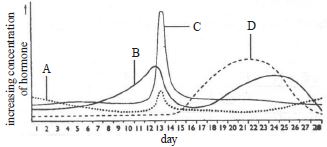
The following graph shows the relative concentrations of the four hormones present in the blood plasma of a woman during her menstrual cycle. Identify the hormones.
A
$A-FSH, B-Oestrogen, C-LH, D-Progesterone$
B
$A-LH, B-Progesterone, C-FSH, D-Oestrogen$
C
$A-FSH, B-Progesterone, C-LH, D-Oestrogen$
D
$A-LH, B-Oestrogen, C-FSH, D-Progesterone$
Solution
(A) In the menstrual cycle of a human female:
$1$. $A$ represents $FSH$ (Follicle Stimulating Hormone), which shows a small peak at the beginning of the cycle.
$2$. $B$ represents Oestrogen, which rises during the follicular phase.
$3$. $C$ represents $LH$ (Luteinizing Hormone), which shows a sharp, high peak ($LH$ surge) around the $14^{th}$ day, triggering ovulation.
$4$. $D$ represents Progesterone, which rises significantly during the luteal phase (after ovulation) to maintain the endometrium.
Therefore, the correct identification is $A-FSH, B-Oestrogen, C-LH, D-Progesterone$.
$1$. $A$ represents $FSH$ (Follicle Stimulating Hormone), which shows a small peak at the beginning of the cycle.
$2$. $B$ represents Oestrogen, which rises during the follicular phase.
$3$. $C$ represents $LH$ (Luteinizing Hormone), which shows a sharp, high peak ($LH$ surge) around the $14^{th}$ day, triggering ovulation.
$4$. $D$ represents Progesterone, which rises significantly during the luteal phase (after ovulation) to maintain the endometrium.
Therefore, the correct identification is $A-FSH, B-Oestrogen, C-LH, D-Progesterone$.
0 likes
View Solution94
MediumMCQ
No new follicles develop in the luteal phase of the menstrual cycle because
A
Follicles do not remain in the ovary after ovulation
B
$FSH$ levels are high in the luteal phase
C
$LH$ levels are high in the luteal phase
D
Both $FSH$ and $LH$ levels are low in the luteal phase
Solution
(D) During the luteal phase of the menstrual cycle,the corpus luteum secretes high levels of progesterone and estrogen.
These hormones exert a strong negative feedback effect on the anterior pituitary gland and the hypothalamus.
As a result,the secretion of gonadotropins,specifically $FSH$ (Follicle Stimulating Hormone) and $LH$ (Luteinizing Hormone),is significantly inhibited.
Since $FSH$ is required for the recruitment and development of new ovarian follicles,its low levels during the luteal phase prevent the development of any new follicles.
These hormones exert a strong negative feedback effect on the anterior pituitary gland and the hypothalamus.
As a result,the secretion of gonadotropins,specifically $FSH$ (Follicle Stimulating Hormone) and $LH$ (Luteinizing Hormone),is significantly inhibited.
Since $FSH$ is required for the recruitment and development of new ovarian follicles,its low levels during the luteal phase prevent the development of any new follicles.
0 likes
View Solution95
Medium
What is the menstrual cycle? Which hormones regulate the menstrual cycle?
Solution
(A) The menstrual cycle is a series of cyclic physiological changes that occur in the female reproductive tract of primates. The cycle typically lasts for $28$ days. The end of the cycle is marked by the breakdown of the uterine endometrium,which is released as blood and mucus through the vagina; this process is called menses.
The hormones that regulate the menstrual cycle include Follicle Stimulating Hormone $(FSH)$,Luteinizing Hormone $(LH)$,estrogen,and progesterone.
$1$. During the follicular phase,the levels of $FSH$ and $LH$ secreted by the anterior pituitary gland increase. $FSH$,stimulated by the Releasing Hormone $(RH)$ from the hypothalamus,promotes the development of primary follicles into Graafian follicles.
$2$. The gradual increase in $LH$ levels promotes follicular growth and estrogen secretion. Estrogen inhibits $FSH$ secretion,stimulates $LH$ secretion,and causes the thickening of the uterine endometrium.
$3$. $A$ surge in $LH$ levels (the $LH$ surge) causes the rupture of the Graafian follicle,releasing the ovum into the fallopian tube (ovulation).
$4$. The ruptured Graafian follicle transforms into the corpus luteum,which secretes progesterone during the luteal phase. Progesterone is essential for maintaining the endometrium for embryo implantation. High levels of progesterone inhibit the secretion of $LH$ and $FSH$,preventing further ovulation.
The hormones that regulate the menstrual cycle include Follicle Stimulating Hormone $(FSH)$,Luteinizing Hormone $(LH)$,estrogen,and progesterone.
$1$. During the follicular phase,the levels of $FSH$ and $LH$ secreted by the anterior pituitary gland increase. $FSH$,stimulated by the Releasing Hormone $(RH)$ from the hypothalamus,promotes the development of primary follicles into Graafian follicles.
$2$. The gradual increase in $LH$ levels promotes follicular growth and estrogen secretion. Estrogen inhibits $FSH$ secretion,stimulates $LH$ secretion,and causes the thickening of the uterine endometrium.
$3$. $A$ surge in $LH$ levels (the $LH$ surge) causes the rupture of the Graafian follicle,releasing the ovum into the fallopian tube (ovulation).
$4$. The ruptured Graafian follicle transforms into the corpus luteum,which secretes progesterone during the luteal phase. Progesterone is essential for maintaining the endometrium for embryo implantation. High levels of progesterone inhibit the secretion of $LH$ and $FSH$,preventing further ovulation.
0 likes
View Solution96
Medium
What is called the menstrual cycle? Describe its phases.
Solution
(N/A) The reproductive cycle in female primates (e.g.,monkeys,apes,and human beings) is called the menstrual cycle.
The first menstruation begins at puberty and is called menarche.
In human females,menstruation is repeated at an average interval of about $28/29$ days,and the cycle of events starting from one menstruation till the next one is called the menstrual cycle.
One ovum is released (ovulation) during the middle of each menstrual cycle.
The menstrual cycle involves cyclic changes occurring in the endometrium of the uterus.
Female sex hormones,estrogen and progesterone,regulate these changes.
The events of this cycle can be divided into the following $3$ phases:
$1$. Menstrual phase (Day $1-5$): The menstrual flow results from the breakdown of the endometrial lining of the uterus and its blood vessels,which forms a liquid that comes out through the vagina. It lasts for $3-5$ days. About $50 \text{ ml}$ to $150 \text{ ml}$ of blood is lost during this time. Lack of menstruation may be indicative of pregnancy,though it may also be caused by stress or poor health.
$2$. Follicular phase (Day $6-14$): During this phase,the primary follicles in the ovary grow to become a fully mature Graafian follicle,and simultaneously,the endometrium of the uterus regenerates through proliferation. These changes are induced by pituitary and ovarian hormones. The secretion of gonadotropins ($LH$ and $FSH$) increases gradually,stimulating follicular development and the secretion of estrogens. In the middle of the cycle (about $14^{\text{th}}$ day),both $LH$ and $FSH$ attain a peak level.
$3$. Luteal phase (Day $15-28$): The remaining parts of the Graafian follicle transform into the corpus luteum,which secretes large amounts of progesterone essential for the maintenance of the endometrium.
The first menstruation begins at puberty and is called menarche.
In human females,menstruation is repeated at an average interval of about $28/29$ days,and the cycle of events starting from one menstruation till the next one is called the menstrual cycle.
One ovum is released (ovulation) during the middle of each menstrual cycle.
The menstrual cycle involves cyclic changes occurring in the endometrium of the uterus.
Female sex hormones,estrogen and progesterone,regulate these changes.
The events of this cycle can be divided into the following $3$ phases:
$1$. Menstrual phase (Day $1-5$): The menstrual flow results from the breakdown of the endometrial lining of the uterus and its blood vessels,which forms a liquid that comes out through the vagina. It lasts for $3-5$ days. About $50 \text{ ml}$ to $150 \text{ ml}$ of blood is lost during this time. Lack of menstruation may be indicative of pregnancy,though it may also be caused by stress or poor health.
$2$. Follicular phase (Day $6-14$): During this phase,the primary follicles in the ovary grow to become a fully mature Graafian follicle,and simultaneously,the endometrium of the uterus regenerates through proliferation. These changes are induced by pituitary and ovarian hormones. The secretion of gonadotropins ($LH$ and $FSH$) increases gradually,stimulating follicular development and the secretion of estrogens. In the middle of the cycle (about $14^{\text{th}}$ day),both $LH$ and $FSH$ attain a peak level.
$3$. Luteal phase (Day $15-28$): The remaining parts of the Graafian follicle transform into the corpus luteum,which secretes large amounts of progesterone essential for the maintenance of the endometrium.
0 likes
View Solution97
Easy
Define the following terms:
$(1)$ Testosterone
$(2)$ Menstrual flow
$(1)$ Testosterone
$(2)$ Menstrual flow
Solution
(N/A) $(1)$ Testosterone is the primary male sex hormone. It is responsible for the development of secondary sexual characteristics in males.
$(2)$ Menstrual flow refers to the periodic shedding of the endometrial lining of the uterus along with blood vessels and unfertilized ovum,which is discharged through the vagina when fertilization does not occur.
$(2)$ Menstrual flow refers to the periodic shedding of the endometrial lining of the uterus along with blood vessels and unfertilized ovum,which is discharged through the vagina when fertilization does not occur.
0 likes
View Solution98
Easy
Provide definitions/explanations for the following terms:
$(1)$ Menstrual cycle
$(2)$ Foetus
$(1)$ Menstrual cycle
$(2)$ Foetus
Solution
(N/A) $(1)$ The menstrual cycle refers to the cyclic changes that occur in the endometrium (the inner wall of the uterus) due to fluctuations in the levels of the female sex hormones,estrogen and progesterone.
$(2)$ The developing human organism from the end of the eighth week of gestation until birth is referred to as a foetus.
$(2)$ The developing human organism from the end of the eighth week of gestation until birth is referred to as a foetus.
0 likes
View Solution99
Easy
Provide definitions/explanations for the following terms:
$(1)$ Embryo
$(2)$ Proliferation phase
$(1)$ Embryo
$(2)$ Proliferation phase
Solution
(N/A) $(1)$ The embryo is the early stage of development of a multicellular diploid eukaryotic organism. In humans,it refers to the product of conception from the time of implantation in the uterine wall until the end of the $8^{th}$ week of gestation.
$(2)$ The proliferation phase,also known as the follicular phase or proliferative phase,is the period of the menstrual cycle occurring between days $6$ and $14$. During this phase,the primary follicles in the ovary grow to become a fully mature Graafian follicle,and the endometrium of the uterus regenerates through proliferation.
$(2)$ The proliferation phase,also known as the follicular phase or proliferative phase,is the period of the menstrual cycle occurring between days $6$ and $14$. During this phase,the primary follicles in the ovary grow to become a fully mature Graafian follicle,and the endometrium of the uterus regenerates through proliferation.
0 likes
View SolutionHuman Reproduction — Menstrual Cycle · Frequently Asked Questions
1Are these Human Reproduction questions useful for JEE and NEET?
Yes. All questions in this section are mapped to JEE Main and NEET exam patterns. Previous year questions from JEE Main, NEET, GUJCET and state-level exams are included with full solutions.
2Can I switch to Hindi or Gujarati for these questions?
Yes. Use the language tabs in the hero section or the sidebar to view the same questions and solutions in English, Hindi or Gujarati.
3How do I generate a question paper from this subtopic?
Use the Vedclass Exam Paper Generator — select the chapter and subtopic, set difficulty, and generate Sets A, B, C, D automatically. First 3 chapters of every subject are free.
Vedclass Products
For Students
Vedclass Test Series
Mock tests in real JEE/NEET style with performance analysis. 5-day free trial.
Start Free TrialFor Teachers
Exam Paper Generator
Generate Set A/B/C/D papers from this chapter in 2 minutes. 3 chapters free.
Try FreeFor Institutes
Online Exam Module
Live online exams with unlimited students, 360° analytics & white-label branding.
See DemoFor Teachers & Institutes
Generate a Human Reproduction Exam Paper in 2 Minutes
Select subtopic & difficulty — Sets A, B, C, D auto-generated with No Repeat logic.
First 3 chapters of every subject are free — no payment required.