
A English
Menstrual Cycle Questions in English
Class 12 Biology · Human Reproduction · Menstrual Cycle
182+
Questions
English
Language
100%
With Solutions
Showing 32 of 182 questions in English
151
MediumMCQ
Which one of the following is the incorrect match of the events occurring during the menstrual cycle?
A
Menstruation : Breakdown of endometrium and ovum not fertilised
B
Ovulation : $LH$ and $FSH$ attain peak level
C
Proliferative phase : Rapid regeneration of endometrium and maturation of Graafian follicle
D
Development of corpus luteum : Follicular phase and increased secretion of progesterone
Solution
(D) The development of the corpus luteum occurs during the luteal or secretory phase,not the follicular phase. During the follicular phase,the primary focus is the development of the Graafian follicle and the regeneration of the endometrium. Therefore,option $D$ is the incorrect match.
0 likes
View Solution152
MediumMCQ
Identify the hormones that are secreted in large amounts prior to ovulation:
$A.$ $LH$
$B.$ $FSH$
$C.$ $Estrogen$
$D.$ $Progesterone$
$A.$ $LH$
$B.$ $FSH$
$C.$ $Estrogen$
$D.$ $Progesterone$
A
$A$ only
B
$A$ & $B$ only
C
$A, B$ & $C$ only
D
$A, B, C$ & $D$
Solution
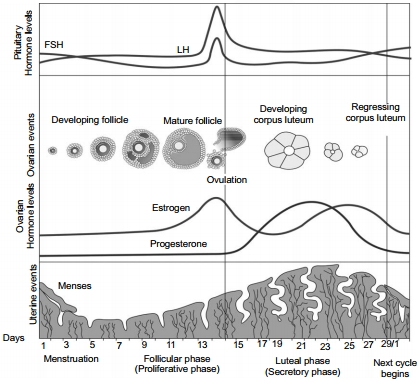
(C) During the menstrual cycle,the follicular phase is characterized by the growth of ovarian follicles and the secretion of estrogen.
As the follicle matures,estrogen levels rise significantly,which triggers a positive feedback mechanism on the anterior pituitary gland.
This leads to a rapid surge in the secretion of $LH$ (Luteinizing Hormone) and,to a lesser extent,$FSH$ (Follicle Stimulating Hormone) just before ovulation.
This '$LH$ surge' is the primary trigger for the rupture of the Graafian follicle and the release of the ovum (ovulation).
Therefore,$LH$,$FSH$,and estrogen are all present in high concentrations just before ovulation,while progesterone levels remain low during this phase.
Thus,the correct option is $C$.
As the follicle matures,estrogen levels rise significantly,which triggers a positive feedback mechanism on the anterior pituitary gland.
This leads to a rapid surge in the secretion of $LH$ (Luteinizing Hormone) and,to a lesser extent,$FSH$ (Follicle Stimulating Hormone) just before ovulation.
This '$LH$ surge' is the primary trigger for the rupture of the Graafian follicle and the release of the ovum (ovulation).
Therefore,$LH$,$FSH$,and estrogen are all present in high concentrations just before ovulation,while progesterone levels remain low during this phase.
Thus,the correct option is $C$.
0 likes
View Solution153
MediumMCQ
Inhibition of uterine contraction ceases and the bleeding and cramps of menstruation begin due to:
A
Increase in level of progesterone
B
Decrease in level of progesterone
C
Increase in level of $LH$
D
Decrease in level of $FSH$
Solution
(B) The inhibition of uterine contraction ceases and the bleeding and cramps of menstruation begin due to the decrease in the level of progesterone.
Progesterone is essential for maintaining the endometrium of the uterus.
When the corpus luteum degenerates,the level of progesterone drops significantly.
This withdrawal of progesterone leads to the breakdown of the endometrial lining,resulting in menstruation.
Progesterone is essential for maintaining the endometrium of the uterus.
When the corpus luteum degenerates,the level of progesterone drops significantly.
This withdrawal of progesterone leads to the breakdown of the endometrial lining,resulting in menstruation.
0 likes
View Solution154
MediumMCQ
Home use kits for determining a woman's fertile period depend on the detection of one hormone in the urine. This hormone is
A
Progesterone
B
Estradiol
C
$hCG$
D
$LH$
Solution
(D) The fertile period in a woman's menstrual cycle is characterized by the $LH$ surge,which occurs approximately $24-36$ hours before ovulation.
Home ovulation predictor kits detect the presence of $LH$ in the urine,as its concentration rises significantly during this surge.
$LH$ (Luteinizing Hormone) is responsible for inducing ovulation,making its detection a reliable indicator of the most fertile days.
Home ovulation predictor kits detect the presence of $LH$ in the urine,as its concentration rises significantly during this surge.
$LH$ (Luteinizing Hormone) is responsible for inducing ovulation,making its detection a reliable indicator of the most fertile days.
0 likes
View Solution155
MediumMCQ
$A$: Lack of menstruation may be indicative of pregnancy.
$R$: Menstruation only occurs if the released ovum is fertilised.
$R$: Menstruation only occurs if the released ovum is fertilised.
A
Assertion and Reason both are correct and Reason is the correct explanation of Assertion.
B
Assertion and Reason both are correct but Reason is not the correct explanation of Assertion.
C
Assertion is correct,but Reason is incorrect.
D
Both Assertion and Reason are incorrect.
Solution
(C) Assertion $(A)$ is correct because the absence of menstruation (amenorrhea) is one of the primary signs of pregnancy. During pregnancy,the corpus luteum is maintained by human chorionic gonadotropin $(hCG)$,which continues to secrete progesterone,preventing the shedding of the endometrium.
Reason $(R)$ is incorrect because menstruation occurs specifically when the released ovum is $NOT$ fertilized. If fertilization occurs,the corpus luteum persists and menstruation does not take place.
Reason $(R)$ is incorrect because menstruation occurs specifically when the released ovum is $NOT$ fertilized. If fertilization occurs,the corpus luteum persists and menstruation does not take place.
0 likes
View Solution156
MediumMCQ
$A$: Corpus luteum begins to atrophy after a short life of $10$ to $14$ days,if fertilization does not occur.
$R$: Luteolysis may be due to the withdrawal of $LH$ support.
$R$: Luteolysis may be due to the withdrawal of $LH$ support.
A
Assertion and Reason both are correct and Reason is the correct explanation of Assertion.
B
Assertion and Reason both are correct but Reason is not the correct explanation of Assertion.
C
Assertion is correct,but Reason is incorrect.
D
Both Assertion and Reason are incorrect.
Solution
(A) The corpus luteum is formed from the ruptured follicle after ovulation under the influence of $LH$ (Luteinizing Hormone).
If fertilization does not occur,the level of $LH$ drops significantly.
This withdrawal of $LH$ support leads to the degeneration of the corpus luteum,a process known as luteolysis.
Therefore,both the assertion and the reason are correct,and the reason provides the correct explanation for the assertion.
If fertilization does not occur,the level of $LH$ drops significantly.
This withdrawal of $LH$ support leads to the degeneration of the corpus luteum,a process known as luteolysis.
Therefore,both the assertion and the reason are correct,and the reason provides the correct explanation for the assertion.
0 likes
View Solution157
MediumMCQ
When is ovulation expected in a normal menstrual cycle?
A
$10-17$ day of menstrual phase
B
$12-14$ day of menstrual phase
C
$10-20$ day of menstrual phase
D
$6-7$ day of menstrual phase
Solution
(B) In a normal menstrual cycle of $28$ days,ovulation typically occurs on the $14^{\text{th}}$ day.
However,it is generally expected to occur between the $12^{\text{th}}$ and $14^{\text{th}}$ day of the menstrual cycle.
Ovulation is defined as the release of the secondary oocyte from the Graafian follicle.
Since the lifespan of a sperm is approximately $2-3$ days and the ovum remains viable for about $24$ hours,the period from the $10^{\text{th}}$ to the $17^{\text{th}}$ day is considered the 'fertile period' or 'unsafe period' for conception.
However,it is generally expected to occur between the $12^{\text{th}}$ and $14^{\text{th}}$ day of the menstrual cycle.
Ovulation is defined as the release of the secondary oocyte from the Graafian follicle.
Since the lifespan of a sperm is approximately $2-3$ days and the ovum remains viable for about $24$ hours,the period from the $10^{\text{th}}$ to the $17^{\text{th}}$ day is considered the 'fertile period' or 'unsafe period' for conception.
0 likes
View Solution158
EasyMCQ
What is the menstrual cycle?
A
$A$ cyclic change in the reproductive tract of non-primates.
B
$A$ cyclic change in the reproductive tract of primates.
C
$A$ process of gamete formation in males.
D
$A$ process of fertilization in mammals.
Solution
(B) The females of placental mammals exhibit cyclic changes in the activities of ovaries and accessory ducts,as well as hormones,during the reproductive phase.
In primate animals (such as humans,monkeys,and apes),this cycle is called the menstrual cycle.
It involves the shedding of the uterine lining when fertilization does not occur.
In primate animals (such as humans,monkeys,and apes),this cycle is called the menstrual cycle.
It involves the shedding of the uterine lining when fertilization does not occur.
0 likes
View Solution159
EasyMCQ
Categorize the following animals into those exhibiting menstrual cycle and those exhibiting oestrous cycle.
$I -$ Monkeys,$II -$ Cows,$III -$ Sheep,$IV -$ Apes,$V -$ Humans,$VI -$ Rats,$VII -$ Deer,$VIII -$ Dogs,$IX -$ Tigers
$\text{Menstrual cycle} \quad \quad \quad \text{Oestrous cycle}$
$I -$ Monkeys,$II -$ Cows,$III -$ Sheep,$IV -$ Apes,$V -$ Humans,$VI -$ Rats,$VII -$ Deer,$VIII -$ Dogs,$IX -$ Tigers
$\text{Menstrual cycle} \quad \quad \quad \text{Oestrous cycle}$
A
$I, IV, V, VII, IX \quad \quad II, III, VI, VIII$
B
$I, II, III, IV, V, VII \quad \quad VI, VIII, IX$
C
$I, IV, V \quad \quad \quad \quad II, III, VI, VII, VIII, IX$
D
$II, III, VI, VIII \quad \quad \quad I, IV, V, VII, IX$
Solution
(C) Primates such as monkeys $(I)$,apes $(IV)$,and humans $(V)$ exhibit a menstrual cycle.
Non-primate mammals such as cows $(II)$,sheep $(III)$,rats $(VI)$,deer $(VII)$,dogs $(VIII)$,and tigers $(IX)$ exhibit an oestrous cycle.
Therefore,the correct classification is:
Menstrual cycle: $I, IV, V$
Oestrous cycle: $II, III, VI, VII, VIII, IX$
This matches option $C$.
Non-primate mammals such as cows $(II)$,sheep $(III)$,rats $(VI)$,deer $(VII)$,dogs $(VIII)$,and tigers $(IX)$ exhibit an oestrous cycle.
Therefore,the correct classification is:
Menstrual cycle: $I, IV, V$
Oestrous cycle: $II, III, VI, VII, VIII, IX$
This matches option $C$.
0 likes
View Solution160
EasyMCQ
In human females,the menstrual cycle repeats at an average interval of ....... days.
A
$18-19$
B
$28-29$
C
$38-39$
D
$50-51$
Solution
(B) The menstrual cycle is a series of changes that occur in the female reproductive system,specifically in the ovaries and the uterus,to prepare for a potential pregnancy.
In human females,the menstrual cycle typically repeats at an average interval of $28-29$ days.
This cycle is regulated by hormones such as $FSH$,$LH$,estrogen,and progesterone.
Therefore,the correct option is $B$.
In human females,the menstrual cycle typically repeats at an average interval of $28-29$ days.
This cycle is regulated by hormones such as $FSH$,$LH$,estrogen,and progesterone.
Therefore,the correct option is $B$.
0 likes
View Solution161
EasyMCQ
On which day of the menstrual cycle does ovulation occur?
A
1st day
B
14th day
C
21st day
D
28th day
Solution
(B) In a typical $28$-day menstrual cycle,the ovulation process occurs due to the $LH$ surge.
This surge is triggered by the high levels of estrogen in the blood.
Ovulation typically takes place on the $14$th day of the cycle,where the mature Graafian follicle ruptures to release the secondary oocyte (ovum).
This surge is triggered by the high levels of estrogen in the blood.
Ovulation typically takes place on the $14$th day of the cycle,where the mature Graafian follicle ruptures to release the secondary oocyte (ovum).
0 likes
View Solution162
MediumMCQ
Identify the phases of the menstrual cycle in the correct order.
A
Luteal phase $\rightarrow$ Follicular phase $\rightarrow$ Menstrual phase
B
Menstrual phase $\rightarrow$ Follicular phase $\rightarrow$ Luteal phase
C
Follicular phase $\rightarrow$ Menstrual phase $\rightarrow$ Luteal phase
D
Menstrual phase $\rightarrow$ Luteal phase $\rightarrow$ Follicular phase
Solution
(B) The menstrual cycle in human females consists of four main phases occurring in a specific sequence:
$1$. Menstrual phase: The cycle starts with the menstrual flow,where the endometrial lining of the uterus breaks down.
$2$. Follicular phase (Proliferative phase): Primary follicles in the ovary grow to become a fully mature Graafian follicle,and the endometrium regenerates through proliferation.
$3$. Ovulatory phase: The release of the ovum (ovulation) occurs,usually around the $14^{th}$ day.
$4$. Luteal phase (Secretory phase): The remaining parts of the Graafian follicle transform into the corpus luteum,which secretes progesterone to maintain the endometrium.
Therefore,the correct chronological order is Menstrual phase $\rightarrow$ Follicular phase $\rightarrow$ Luteal phase.
$1$. Menstrual phase: The cycle starts with the menstrual flow,where the endometrial lining of the uterus breaks down.
$2$. Follicular phase (Proliferative phase): Primary follicles in the ovary grow to become a fully mature Graafian follicle,and the endometrium regenerates through proliferation.
$3$. Ovulatory phase: The release of the ovum (ovulation) occurs,usually around the $14^{th}$ day.
$4$. Luteal phase (Secretory phase): The remaining parts of the Graafian follicle transform into the corpus luteum,which secretes progesterone to maintain the endometrium.
Therefore,the correct chronological order is Menstrual phase $\rightarrow$ Follicular phase $\rightarrow$ Luteal phase.
0 likes
View Solution163
MediumMCQ
When is the $LH$ surge observed during the menstrual cycle?
A
On the first day of the cycle
B
On the last day of the cycle
C
On the $14$th day of the cycle
D
On the $21$st day of the cycle
Solution
(C) The menstrual cycle in a human female typically lasts for $28$ days.
During the follicular phase,estrogen levels rise,which triggers a rapid secretion of Luteinizing Hormone $(LH)$ from the anterior pituitary gland.
This phenomenon is known as the $LH$ surge.
The $LH$ surge occurs around the middle of the cycle,specifically on the $14$th day,and is responsible for inducing ovulation (the release of the secondary oocyte from the Graafian follicle).
During the follicular phase,estrogen levels rise,which triggers a rapid secretion of Luteinizing Hormone $(LH)$ from the anterior pituitary gland.
This phenomenon is known as the $LH$ surge.
The $LH$ surge occurs around the middle of the cycle,specifically on the $14$th day,and is responsible for inducing ovulation (the release of the secondary oocyte from the Graafian follicle).
0 likes
View Solution164
EasyMCQ
The first menstruation is called $........$,and in humans,the menstrual cycle ceases around the age of $50$ years,which is termed as $........$.
A
Menarche,Menopause
B
Menopause,Menarche
C
Menstrual phase,Luteal phase
D
Luteal phase,Menstrual phase
Solution
(A) In human females,the first menstruation that begins at puberty is called $Menarche$.
The permanent cessation of the menstrual cycle,which typically occurs around the age of $50$ years in human females,is known as $Menopause$.
Therefore,the correct sequence is $Menarche$ and $Menopause$.
The permanent cessation of the menstrual cycle,which typically occurs around the age of $50$ years in human females,is known as $Menopause$.
Therefore,the correct sequence is $Menarche$ and $Menopause$.
0 likes
View Solution165
MediumMCQ
The diagram below shows various events during the menstrual cycle. Identify the hormones $P, Q, R,$ and $S$.
A
$LH, FSH, \text{Estrogen}, \text{Progesterone}$
B
$FSH, LH, \text{Estrogen}, \text{Progesterone}$
C
$FSH, LH, \text{Progesterone}, \text{Estrogen}$
D
$LH, FSH, \text{Progesterone}, \text{Estrogen}$
Solution
(A) In the menstrual cycle, the levels of hormones fluctuate as follows:
$1$. $FSH$ (Follicle Stimulating Hormone) rises during the follicular phase to stimulate follicle development.
$2$. $LH$ (Luteinizing Hormone) shows a sharp peak ($LH$ surge) just before ovulation (around day $14$).
$3$. $\text{Estrogen}$ levels rise during the follicular phase, peaking just before ovulation.
$4$. $\text{Progesterone}$ levels rise significantly during the luteal phase (after ovulation) to maintain the endometrium.
Based on standard physiological graphs of the menstrual cycle, $P$ represents $LH$ (due to the sharp mid-cycle peak), $Q$ represents $FSH$, $R$ represents $\text{Estrogen}$, and $S$ represents $\text{Progesterone}$.
$1$. $FSH$ (Follicle Stimulating Hormone) rises during the follicular phase to stimulate follicle development.
$2$. $LH$ (Luteinizing Hormone) shows a sharp peak ($LH$ surge) just before ovulation (around day $14$).
$3$. $\text{Estrogen}$ levels rise during the follicular phase, peaking just before ovulation.
$4$. $\text{Progesterone}$ levels rise significantly during the luteal phase (after ovulation) to maintain the endometrium.
Based on standard physiological graphs of the menstrual cycle, $P$ represents $LH$ (due to the sharp mid-cycle peak), $Q$ represents $FSH$, $R$ represents $\text{Estrogen}$, and $S$ represents $\text{Progesterone}$.
0 likes
View Solution166
MediumMCQ
Select the incorrect statement regarding the follicular phase.
A
Primary follicles grow and become a fully mature Graafian follicle.
B
The endometrium of the uterus regenerates through proliferation.
C
The secretion of $LH$ and $FSH$ (gonadotropins) increases gradually during this phase.
D
The secretion of estrogen decreases during this phase.
Solution
(D) The follicular phase (also known as the proliferative phase) is characterized by the following events:
$1$. Primary follicles in the ovary grow to become a fully mature Graafian follicle.
$2$. The endometrium of the uterus regenerates through proliferation.
$3$. These changes in the ovary and the uterus are induced by changes in the levels of pituitary and ovarian hormones.
$4$. The secretion of gonadotropins ($LH$ and $FSH$) increases gradually during the follicular phase and stimulates follicular development as well as the secretion of estrogens by the growing follicles.
$5$. Therefore,the secretion of estrogen increases,not decreases,during this phase.
Thus,the statement that estrogen secretion decreases is incorrect.
$1$. Primary follicles in the ovary grow to become a fully mature Graafian follicle.
$2$. The endometrium of the uterus regenerates through proliferation.
$3$. These changes in the ovary and the uterus are induced by changes in the levels of pituitary and ovarian hormones.
$4$. The secretion of gonadotropins ($LH$ and $FSH$) increases gradually during the follicular phase and stimulates follicular development as well as the secretion of estrogens by the growing follicles.
$5$. Therefore,the secretion of estrogen increases,not decreases,during this phase.
Thus,the statement that estrogen secretion decreases is incorrect.
0 likes
View Solution167
MediumMCQ
Select the mismatched pair from the following options.
A
Ovulation - Ovulation
B
Menarche - Menopause
C
Follicular phase - Proliferative phase
D
Luteal phase - Secretory phase
Solution
(A) In the human menstrual cycle,the phases are named based on the physiological changes occurring in the uterus and ovaries.
$1$. The $Follicular$ $phase$ is also known as the $Proliferative$ $phase$ because the endometrium regenerates through proliferation.
$2$. The $Luteal$ $phase$ is also known as the $Secretory$ $phase$ because the corpus luteum secretes progesterone,which prepares the endometrium for implantation.
$3$. $Menarche$ refers to the onset of menstruation at puberty,while $Menopause$ refers to the cessation of menstruation at the end of the reproductive phase. These are two distinct events in a woman's life,not synonymous phases of a single cycle.
$4$. $Ovulation$ is a specific event where the secondary oocyte is released from the ovary,not a pair of synonymous terms.
$1$. The $Follicular$ $phase$ is also known as the $Proliferative$ $phase$ because the endometrium regenerates through proliferation.
$2$. The $Luteal$ $phase$ is also known as the $Secretory$ $phase$ because the corpus luteum secretes progesterone,which prepares the endometrium for implantation.
$3$. $Menarche$ refers to the onset of menstruation at puberty,while $Menopause$ refers to the cessation of menstruation at the end of the reproductive phase. These are two distinct events in a woman's life,not synonymous phases of a single cycle.
$4$. $Ovulation$ is a specific event where the secondary oocyte is released from the ovary,not a pair of synonymous terms.
0 likes
View Solution168
MediumMCQ
When is the menstrual cycle not observed?
A
After menopause
B
Before menarche
C
During pregnancy
D
All of the above
Solution
(D) The menstrual cycle is a physiological process in human females that involves periodic shedding of the uterine lining.
$1$. Before $menarche$ (the first menstrual cycle),the reproductive system is not yet mature,so cycles do not occur.
$2$. During pregnancy,the hormonal environment (high levels of progesterone) prevents the maturation of follicles and the shedding of the endometrium,thus stopping the menstrual cycle.
$3$. After $menopause$ (the permanent cessation of menstruation,typically occurring between $45$ and $50$ years of age),the ovarian function declines,and the menstrual cycle ceases.
Therefore,all the given conditions represent phases where the menstrual cycle is not observed.
$1$. Before $menarche$ (the first menstrual cycle),the reproductive system is not yet mature,so cycles do not occur.
$2$. During pregnancy,the hormonal environment (high levels of progesterone) prevents the maturation of follicles and the shedding of the endometrium,thus stopping the menstrual cycle.
$3$. After $menopause$ (the permanent cessation of menstruation,typically occurring between $45$ and $50$ years of age),the ovarian function declines,and the menstrual cycle ceases.
Therefore,all the given conditions represent phases where the menstrual cycle is not observed.
0 likes
View Solution169
EasyMCQ
The first menstruation is called:
A
Menopause
B
Menarche
C
Diapause
D
Ovulation
Solution
(B) The first menstruation that occurs at puberty in human females is known as $Menarche$.
$Menopause$ refers to the permanent cessation of the menstrual cycle at the end of the reproductive phase.
$Diapause$ is a state of suspended development in certain animals.
$Ovulation$ is the process of release of an ovum from the Graafian follicle.
$Menopause$ refers to the permanent cessation of the menstrual cycle at the end of the reproductive phase.
$Diapause$ is a state of suspended development in certain animals.
$Ovulation$ is the process of release of an ovum from the Graafian follicle.
0 likes
View Solution170
MediumMCQ
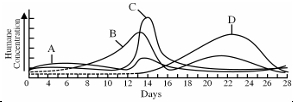
Identify the hormones $A, B, C$ and $D$ from the graph by observing their concentrations in blood during the menstrual cycle of a female:
A
$A \rightarrow \text{FSH}, B \rightarrow \text{Progesterone}, C \rightarrow \text{Estrogen}, D \rightarrow \text{LH}$
B
$A \rightarrow \text{FSH}, B \rightarrow \text{Estrogen}, C \rightarrow \text{LH}, D \rightarrow \text{Progesterone}$
C
$A \rightarrow \text{FSH}, B \rightarrow \text{LH}, C \rightarrow \text{Progesterone}, D \rightarrow \text{Estrogen}$
D
$A \rightarrow \text{LH}, B \rightarrow \text{Estrogen}, C \rightarrow \text{Progesterone}, D \rightarrow \text{FSH}$
Solution
(B) In the menstrual cycle,the hormonal levels change as follows:
$1$. $A$ represents $FSH$ (Follicle Stimulating Hormone),which shows a gradual increase during the follicular phase.
$2$. $B$ represents Estrogen,which rises steadily during the follicular phase as the follicles develop.
$3$. $C$ represents $LH$ (Luteinizing Hormone),which shows a sharp peak ($LH$ surge) around day $14$,triggering ovulation.
$4$. $D$ represents Progesterone,which is secreted by the corpus luteum and rises significantly during the luteal phase (after day $14$) to maintain the endometrium.
Therefore,the correct identification is $A \rightarrow \text{FSH}, B \rightarrow \text{Estrogen}, C \rightarrow \text{LH}, D \rightarrow \text{Progesterone}$.
$1$. $A$ represents $FSH$ (Follicle Stimulating Hormone),which shows a gradual increase during the follicular phase.
$2$. $B$ represents Estrogen,which rises steadily during the follicular phase as the follicles develop.
$3$. $C$ represents $LH$ (Luteinizing Hormone),which shows a sharp peak ($LH$ surge) around day $14$,triggering ovulation.
$4$. $D$ represents Progesterone,which is secreted by the corpus luteum and rises significantly during the luteal phase (after day $14$) to maintain the endometrium.
Therefore,the correct identification is $A \rightarrow \text{FSH}, B \rightarrow \text{Estrogen}, C \rightarrow \text{LH}, D \rightarrow \text{Progesterone}$.
0 likes
View Solution171
MediumMCQ
Match the Column-$A$ with Column-$B$:
| Column-$A$ | Column-$B$ |
|---|---|
| $A$. Follicular phase | $i$. Release of secondary oocyte |
| $B$. Luteal phase | $ii$. Fully mature Graafian follicle |
| $C$. Menstrual phase | $iii$. Formation of corpus luteum |
| $D$. Ovulatory phase | $iv$. Breakdown of endometrium |
A
$A-(i), B-(ii), C-(iv), D-(iii)$
B
$A-(ii), B-(iii), C-(i), D-(iv)$
C
$A-(ii), B-(iii), C-(iv), D-(i)$
D
$A-(iv), B-(ii), C-(i), D-(iii)$
Solution
(C) The menstrual cycle consists of four phases:
$1$. Menstrual phase $(C)$: Characterized by the breakdown of the endometrial lining of the uterus,leading to bleeding $(iv)$.
$2$. Follicular phase $(A)$: During this phase,primary follicles in the ovary grow to become a fully mature Graafian follicle $(ii)$.
$3$. Ovulatory phase $(D)$: This phase involves the release of the secondary oocyte from the Graafian follicle,typically around the $14^{th}$ day $(i)$.
$4$. Luteal phase $(B)$: After ovulation,the remaining parts of the Graafian follicle transform into the corpus luteum,which secretes progesterone $(iii)$.
Therefore,the correct matching is $A-(ii), B-(iii), C-(iv), D-(i)$.
$1$. Menstrual phase $(C)$: Characterized by the breakdown of the endometrial lining of the uterus,leading to bleeding $(iv)$.
$2$. Follicular phase $(A)$: During this phase,primary follicles in the ovary grow to become a fully mature Graafian follicle $(ii)$.
$3$. Ovulatory phase $(D)$: This phase involves the release of the secondary oocyte from the Graafian follicle,typically around the $14^{th}$ day $(i)$.
$4$. Luteal phase $(B)$: After ovulation,the remaining parts of the Graafian follicle transform into the corpus luteum,which secretes progesterone $(iii)$.
Therefore,the correct matching is $A-(ii), B-(iii), C-(iv), D-(i)$.
0 likes
View Solution172
MediumMCQ
If the number of days of the menstrual cycle $(M.C.)$ is $35$ days in a female, then what will be the ovulation day in that female (in $days$)?
A
$20$
B
$21$
C
$49$
D
$14$
Solution
(B) The ovulation day in a menstrual cycle is calculated by subtracting $14$ days from the total number of days in the cycle.
Formula: $\text{Ovulation Day} = \text{Total cycle length} - 14$.
Given: $\text{Total cycle length} = 35$ days.
Calculation: $35 - 14 = 21$ days.
Therefore, in a $35$-day menstrual cycle, ovulation occurs on the $21$st day.
Formula: $\text{Ovulation Day} = \text{Total cycle length} - 14$.
Given: $\text{Total cycle length} = 35$ days.
Calculation: $35 - 14 = 21$ days.
Therefore, in a $35$-day menstrual cycle, ovulation occurs on the $21$st day.
0 likes
View Solution173
EasyMCQ
Processes such as menarche,menopause,and reproductive cycles are controlled by:
A
hCG
B
gonadotropins
C
oxytocin
D
relaxin
Solution
(B) The reproductive processes in females,including menarche (the onset of menstruation),the menstrual cycle,and menopause (the cessation of menstruation),are primarily regulated by gonadotropic hormones,specifically $FSH$ (Follicle Stimulating Hormone) and $LH$ (Luteinizing Hormone),which are secreted by the anterior pituitary gland.
0 likes
View Solution174
EasyMCQ
Select the correct statement.
A
The follicular phase extends from $1^{st}$ to $13^{th}$ day in the menstrual cycle.
B
In the secretory phase,corpus luteum releases inhibin which stops secretion of $FSH$.
C
Endometrium lining of uterus tends to regenerate towards the end of the menstrual phase under the effect of prostaglandins.
D
Follicular phase is the longest phase of the menstrual cycle.
Solution
(B) The corpus luteum is formed after ovulation and is active during the secretory (luteal) phase.
It secretes large amounts of progesterone,some estrogens,and inhibin.
Inhibin acts as a negative feedback signal to the anterior pituitary gland,which inhibits the secretion of $FSH$ (Follicle Stimulating Hormone).
Therefore,the statement in option $B$ is correct.
It secretes large amounts of progesterone,some estrogens,and inhibin.
Inhibin acts as a negative feedback signal to the anterior pituitary gland,which inhibits the secretion of $FSH$ (Follicle Stimulating Hormone).
Therefore,the statement in option $B$ is correct.
0 likes
View Solution175
EasyMCQ
The corpus luteum formed during the post-ovulatory phase of the menstrual cycle survives for only . . . . . . weeks in the absence of fertilization.
A
Four
B
Three
C
Two
D
One
Solution
(C) In the absence of fertilization,the corpus luteum survives for approximately $2$ weeks. After this period,it degenerates into a white scar tissue known as the corpus albicans due to the decline in luteinizing hormone $(LH)$ levels.
0 likes
View Solution176
EasyMCQ
Given below are two statements with respect to the menstrual cycle.
$Statement-I$: The menstrual phase in the menstrual cycle occurs when an ovulated egg is not fertilized and is thus shed out along with the endometrium.
$Statement-II$: The menstrual phase is often referred to as the 'funeral of an unfertilized egg'.
Choose the most appropriate answer from the options given below.
$Statement-I$: The menstrual phase in the menstrual cycle occurs when an ovulated egg is not fertilized and is thus shed out along with the endometrium.
$Statement-II$: The menstrual phase is often referred to as the 'funeral of an unfertilized egg'.
Choose the most appropriate answer from the options given below.
A
Both $Statement-I$ and $Statement-II$ are correct.
B
$Statement-I$ is correct but $Statement-II$ is incorrect.
C
Both $Statement-I$ and $Statement-II$ are incorrect.
D
$Statement-I$ is incorrect but $Statement-II$ is correct.
Solution
(A) $Statement-I$ is correct: The menstrual phase occurs when the corpus luteum degenerates, leading to a decrease in progesterone levels. This causes the breakdown of the endometrial lining and the discharge of the unfertilized ovum along with blood and tissue debris.
$Statement-II$ is correct: The term 'funeral of an unfertilized egg' is a common biological metaphor used to describe the menstrual phase, as it marks the end of the reproductive cycle for that specific ovum.
$Statement-II$ is correct: The term 'funeral of an unfertilized egg' is a common biological metaphor used to describe the menstrual phase, as it marks the end of the reproductive cycle for that specific ovum.
0 likes
View Solution177
EasyMCQ
In the menstrual cycle,the level of progesterone reaches its maximum in the . . . . . .
A
secretory phase
B
proliferative phase
C
ovulatory phase
D
menstrual phase
Solution
(A) During the menstrual cycle,the $luteal$ or $secretory$ phase follows ovulation.
After ovulation,the ruptured follicle transforms into the $corpus$ $luteum$.
The $corpus$ $luteum$ secretes large amounts of progesterone,which is essential for the maintenance of the endometrium for implantation.
Therefore,the level of progesterone reaches its maximum during the $secretory$ phase (approximately day $20$ to $23$ of a $28$-day cycle).
After ovulation,the ruptured follicle transforms into the $corpus$ $luteum$.
The $corpus$ $luteum$ secretes large amounts of progesterone,which is essential for the maintenance of the endometrium for implantation.
Therefore,the level of progesterone reaches its maximum during the $secretory$ phase (approximately day $20$ to $23$ of a $28$-day cycle).
0 likes
View Solution178
EasyMCQ
During which days of the menstrual cycle does the secretion of $LH$ from the pituitary reach its maximum level?
A
$25$ to $28$ days
B
$13$ to $15$ days
C
$19$ to $23$ days
D
$1$ to $5$ days
Solution
(B) In a typical $28$-day menstrual cycle,the levels of $LH$ (Luteinizing Hormone) and $FSH$ (Follicle Stimulating Hormone) attain a peak level in the middle of the cycle,around the $14$th day.
This rapid secretion of $LH$ is known as the $LH$ surge,which induces the rupture of the Graafian follicle and thereby leads to ovulation.
Therefore,the maximum level of $LH$ occurs between the $13$th and $15$th days of the menstrual cycle.
This rapid secretion of $LH$ is known as the $LH$ surge,which induces the rupture of the Graafian follicle and thereby leads to ovulation.
Therefore,the maximum level of $LH$ occurs between the $13$th and $15$th days of the menstrual cycle.
0 likes
View Solution179
EasyMCQ
From the following tables,select the option that correctly characterizes various phases of the menstrual cycle.
A
| Menstruation phase | Follicular phase | Luteal phase |
|---|---|---|
| Regeneration of endometrium | High level of progesterone | Developing corpus luteum |
B
| Menstruation phase | Follicular phase | Luteal phase |
|---|---|---|
| Matured follicle | Regression of corpus luteum | Ovulation |
C
| Menstruation phase | Follicular phase | Luteal phase |
|---|---|---|
| Menses | Developing corpus luteum | Follicle maturation |
D
| Menstruation phase | Follicular phase | Luteal phase |
|---|---|---|
| Menses | $LH$ surge | Regeneration of endometrium |
Solution
(D) The correct option is $D$.
In the human menstrual cycle:
$1$. The Menstruation phase is characterized by the shedding of the endometrial lining,known as menses.
$2$. The Follicular phase involves the maturation of follicles and culminates in the $LH$ surge,which triggers ovulation.
$3$. The Luteal phase follows ovulation,where the ruptured follicle transforms into the corpus luteum,which secretes progesterone to maintain the endometrium,leading to its regeneration and preparation for potential implantation.
In the human menstrual cycle:
$1$. The Menstruation phase is characterized by the shedding of the endometrial lining,known as menses.
$2$. The Follicular phase involves the maturation of follicles and culminates in the $LH$ surge,which triggers ovulation.
$3$. The Luteal phase follows ovulation,where the ruptured follicle transforms into the corpus luteum,which secretes progesterone to maintain the endometrium,leading to its regeneration and preparation for potential implantation.
0 likes
View Solution180
EasyMCQ
If in a normal menstruating woman,menses occur on $5^{\text{th}}$ April,what will be the expected date of ovulation?
A
$10^{\text{th}}$ April
B
$18^{\text{th}}$ April
C
$29^{\text{th}}$ April
D
$14^{\text{th}}$ April
Solution
(B) In a normal menstrual cycle of $28$ days,ovulation typically occurs on the $14^{\text{th}}$ day from the start of the menstrual flow.
However,the question implies a cycle where the ovulation date is calculated based on the standard physiological window.
If the menstrual cycle is $28$ days,the $14^{\text{th}}$ day from $5^{\text{th}}$ April is $18^{\text{th}}$ April $(5 + 13 = 18)$.
Therefore,the expected date of ovulation is $18^{\text{th}}$ April.
However,the question implies a cycle where the ovulation date is calculated based on the standard physiological window.
If the menstrual cycle is $28$ days,the $14^{\text{th}}$ day from $5^{\text{th}}$ April is $18^{\text{th}}$ April $(5 + 13 = 18)$.
Therefore,the expected date of ovulation is $18^{\text{th}}$ April.
0 likes
View Solution181
EasyMCQ
During the menstrual cycle,cyclical changes take place in:
A
perimetrium
B
endometrium
C
corpus luteum
D
myometrium
Solution
(B) The correct answer is $B$.
During the menstrual cycle,the uterine wall undergoes significant structural and functional changes.
The innermost layer of the uterus,known as the $endometrium$,is the site of these cyclical changes.
It undergoes proliferation,secretory activity,and eventually sloughing off (menstruation) if fertilization does not occur.
During the menstrual cycle,the uterine wall undergoes significant structural and functional changes.
The innermost layer of the uterus,known as the $endometrium$,is the site of these cyclical changes.
It undergoes proliferation,secretory activity,and eventually sloughing off (menstruation) if fertilization does not occur.
0 likes
View Solution182
EasyMCQ
The time for optimum chances of conception in a woman is . . . . . . starting from the day of menstruation.
A
$1^{\text{st}}$ day
B
$4^{\text{th}}$ day
C
$14^{\text{th}}$ day
D
$26^{\text{th}}$ day
Solution
(C) $14^{\text{th}}$ day.
In a typical $28$-day menstrual cycle,ovulation occurs around the $14^{\text{th}}$ day.
This is the time when the mature ovum is released from the ovary into the fallopian tube.
Since the ovum remains viable for about $24$ hours and sperm can survive for $2-3$ days in the female reproductive tract,the period around the $14^{\text{th}}$ day offers the highest probability of fertilization and conception.
In a typical $28$-day menstrual cycle,ovulation occurs around the $14^{\text{th}}$ day.
This is the time when the mature ovum is released from the ovary into the fallopian tube.
Since the ovum remains viable for about $24$ hours and sperm can survive for $2-3$ days in the female reproductive tract,the period around the $14^{\text{th}}$ day offers the highest probability of fertilization and conception.
0 likes
View SolutionHuman Reproduction — Menstrual Cycle · Frequently Asked Questions
1Are these Human Reproduction questions useful for JEE and NEET?
Yes. All questions in this section are mapped to JEE Main and NEET exam patterns. Previous year questions from JEE Main, NEET, GUJCET and state-level exams are included with full solutions.
2Can I switch to Hindi or Gujarati for these questions?
Yes. Use the language tabs in the hero section or the sidebar to view the same questions and solutions in English, Hindi or Gujarati.
3How do I generate a question paper from this subtopic?
Use the Vedclass Exam Paper Generator — select the chapter and subtopic, set difficulty, and generate Sets A, B, C, D automatically. First 3 chapters of every subject are free.
Vedclass Products
For Students
Vedclass Test Series
Mock tests in real JEE/NEET style with performance analysis. 5-day free trial.
Start Free TrialFor Teachers
Exam Paper Generator
Generate Set A/B/C/D papers from this chapter in 2 minutes. 3 chapters free.
Try FreeFor Institutes
Online Exam Module
Live online exams with unlimited students, 360° analytics & white-label branding.
See DemoFor Teachers & Institutes
Generate a Human Reproduction Exam Paper in 2 Minutes
Select subtopic & difficulty — Sets A, B, C, D auto-generated with No Repeat logic.
First 3 chapters of every subject are free — no payment required.