
A English
Male reproductive system Questions in English
Class 12 Biology · Human Reproduction · Male reproductive system
325+
Questions
English
Language
100%
With Solutions
Showing 47 of 325 questions in English
151
EasyMCQ
In adults,the length and width of the testis are about . . . . . . respectively.
A
$4$ to $5 \, cm$,$2$ to $3 \, cm$
B
$3$ to $5 \, cm$,$2$ to $5 \, cm$
C
$4$ to $5 \, cm$,$3$ to $5 \, cm$
D
$2$ to $5 \, cm$,$4$ to $5 \, cm$
Solution
(A) According to the $NCERT$ textbook,the testes are situated outside the abdominal cavity within a pouch called the scrotum.
Each testis is oval in shape,with a length of about $4$ to $5 \, cm$ and a width of about $2$ to $3 \, cm$.
Therefore,the correct option is $A$.
Each testis is oval in shape,with a length of about $4$ to $5 \, cm$ and a width of about $2$ to $3 \, cm$.
Therefore,the correct option is $A$.
0 likes
View Solution152
MediumMCQ
......... performs a dual function as a primary sex organ as well as an endocrine gland.
A
Foreskin
B
Testis
C
Urethra
D
Bulbourethral gland
Solution
(B) The $Testis$ serves a dual function in the male reproductive system.
$1$. As a primary sex organ, it is responsible for the production of male gametes, known as $sperm$ (spermatogenesis).
$2$. As an endocrine gland, it secretes male sex hormones, primarily $testosterone$, which are released directly into the bloodstream to regulate secondary sexual characteristics and reproductive functions.
$1$. As a primary sex organ, it is responsible for the production of male gametes, known as $sperm$ (spermatogenesis).
$2$. As an endocrine gland, it secretes male sex hormones, primarily $testosterone$, which are released directly into the bloodstream to regulate secondary sexual characteristics and reproductive functions.
0 likes
View Solution153
MediumMCQ
The cells of $Leydig$ produce and secrete .......... .
A
Ovary and Estrogens
B
Liver and Cholesterol
C
Pancreas and Glucagon
D
Testis and Testosterone
Solution
(D) The $Leydig$ cells,also known as interstitial cells,are located in the connective tissue spaces between the seminiferous tubules of the testis.
These cells are responsible for the synthesis and secretion of a group of hormones called androgens,primarily $Testosterone$.
$Testosterone$ is the main male sex hormone responsible for the development of secondary sexual characteristics in males.
These cells are responsible for the synthesis and secretion of a group of hormones called androgens,primarily $Testosterone$.
$Testosterone$ is the main male sex hormone responsible for the development of secondary sexual characteristics in males.
0 likes
View Solution154
EasyMCQ
The location and secretion of Leydig cells are ..........
A
Liver - Cholesterol
B
Ovary - Estrogen
C
Testis - Testosterone
D
Pancreas - Glucagon
Solution
(C) Leydig cells,also known as interstitial cells,are located in the interstitial spaces between the seminiferous tubules of the testis.
These cells are responsible for the synthesis and secretion of androgens,primarily testosterone,in response to stimulation by Luteinizing Hormone $(LH)$.
These cells are responsible for the synthesis and secretion of androgens,primarily testosterone,in response to stimulation by Luteinizing Hormone $(LH)$.
0 likes
View Solution155
MediumMCQ
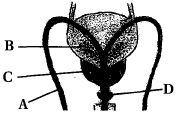
The given figure shows the male reproductive system of a human. Select the correct set for the labeled parts $A, B, C$ and $D$.
A
$A$: Ureter,$B$: Prostate,$C$: Seminal vesicle,$D$: Bulbourethral gland
B
$A$: Vas deferens,$B$: Seminal vesicle,$C$: Prostate,$D$: Bulbourethral gland
C
$A$: Vas deferens,$B$: Seminal vesicle,$C$: Bulbourethral gland,$D$: Prostate gland
D
$A$: Ureter,$B$: Seminal vesicle,$C$: Prostate,$D$: Bulbourethral gland
Solution
(B) In the provided diagram of the human male reproductive system:
$A$ represents the Vas deferens,which transports sperm from the epididymis to the ejaculatory duct.
$B$ represents the Seminal vesicle,a gland that secretes a fluid containing fructose and prostaglandins.
$C$ represents the Prostate gland,which surrounds the urethra and contributes to the seminal fluid.
$D$ represents the Bulbourethral gland (also known as Cowper's gland),which secretes a lubricating fluid.
Therefore,the correct sequence is $A$: Vas deferens,$B$: Seminal vesicle,$C$: Prostate,$D$: Bulbourethral gland.
$A$ represents the Vas deferens,which transports sperm from the epididymis to the ejaculatory duct.
$B$ represents the Seminal vesicle,a gland that secretes a fluid containing fructose and prostaglandins.
$C$ represents the Prostate gland,which surrounds the urethra and contributes to the seminal fluid.
$D$ represents the Bulbourethral gland (also known as Cowper's gland),which secretes a lubricating fluid.
Therefore,the correct sequence is $A$: Vas deferens,$B$: Seminal vesicle,$C$: Prostate,$D$: Bulbourethral gland.
0 likes
View Solution156
EasyMCQ
In human males,the seminal plasma is rich in which of the following?
A
Fructose and calcium
B
Glucose and calcium
C
$DNA$ and testosterone
D
Ribose and potassium
Solution
(A) The seminal plasma in human males is secreted by the accessory glands,which include the seminal vesicles,prostate gland,and bulbourethral glands.
Specifically,the seminal vesicles contribute the majority of the fluid,which is rich in fructose,calcium,and certain enzymes.
Fructose serves as the primary energy source for the sperm,while calcium and other substances help in the motility and survival of the sperm within the female reproductive tract.
Specifically,the seminal vesicles contribute the majority of the fluid,which is rich in fructose,calcium,and certain enzymes.
Fructose serves as the primary energy source for the sperm,while calcium and other substances help in the motility and survival of the sperm within the female reproductive tract.
0 likes
View Solution157
EasyMCQ
The $Vasa$ $efferentia$ arise from the ...
A
Rete testis to epididymis
B
Testicular lobules to rete testis
C
Epididymis to vas deferens
D
Rete testis to vas deferens
Solution
(A) In the male reproductive system,the process of sperm transport begins in the seminiferous tubules.
From the seminiferous tubules,sperm move into the $Rete$ $testis$.
The $Vasa$ $efferentia$ (efferent ductules) then arise from the $Rete$ $testis$ and carry the sperm to the $Epididymis$,where they are stored and matured.
Therefore,the $Vasa$ $efferentia$ connect the $Rete$ $testis$ to the $Epididymis$.
From the seminiferous tubules,sperm move into the $Rete$ $testis$.
The $Vasa$ $efferentia$ (efferent ductules) then arise from the $Rete$ $testis$ and carry the sperm to the $Epididymis$,where they are stored and matured.
Therefore,the $Vasa$ $efferentia$ connect the $Rete$ $testis$ to the $Epididymis$.
0 likes
View Solution158
EasyMCQ
Where are the $Sertoli$ cells found?
A
Ovary and they secrete progesterone.
B
Adrenal cortex and they secrete adrenaline.
C
Seminiferous tubules and they provide nutrition to the germ cells.
D
Pancreas and they secrete cholecystokinin.
Solution
(C) $Sertoli$ cells are specialized somatic cells found within the $seminiferous$ $tubules$ of the testes.
They play a crucial role in spermatogenesis by providing structural and nutritional support to the developing germ cells (spermatids).
Additionally,they form the blood-testis barrier and secrete factors like androgen-binding protein $(ABP)$ and inhibin.
They play a crucial role in spermatogenesis by providing structural and nutritional support to the developing germ cells (spermatids).
Additionally,they form the blood-testis barrier and secrete factors like androgen-binding protein $(ABP)$ and inhibin.
0 likes
View Solution159
MediumMCQ
In humans, the testes are located outside the abdominal cavity within the scrotum. What is the purpose of this arrangement?
A
To reduce the pressure exerted by internal organs.
B
To provide sufficient space for the growth of the epididymis.
C
To facilitate the expression of secondary sexual characteristics in males.
D
To maintain the temperature of the scrotum lower than the body temperature.
Solution
(D) The testes are situated outside the abdominal cavity in a pouch called the scrotum.
This is essential because spermatogenesis, the process of sperm production, requires a temperature approximately $2-2.5^{\circ}C$ lower than the normal internal body temperature.
The scrotum acts as a thermoregulator to provide this cooler environment, which is necessary for the viability and proper development of sperm.
This is essential because spermatogenesis, the process of sperm production, requires a temperature approximately $2-2.5^{\circ}C$ lower than the normal internal body temperature.
The scrotum acts as a thermoregulator to provide this cooler environment, which is necessary for the viability and proper development of sperm.
0 likes
View Solution160
MediumMCQ
If for some reason the $vas deferens$ in the human reproductive system becomes blocked, the reproductive cells will not be able to be transported from:
A
Epididymis to vas deferens
B
Ovary to uterus
C
Vagina to uterus
D
Testis to epididymis
Solution
(A) In the human male reproductive system, sperm are produced in the $testes$.
From the $testes$, they move into the $epididymis$ for maturation and storage.
The $vas deferens$ (sperm duct) is the tube that transports mature sperm from the $epididymis$ to the $urethra$ for ejaculation.
If the $vas deferens$ is blocked, the sperm cannot be transported from the $epididymis$ to the $vas deferens$ (or further towards the $urethra$), thus preventing their release.
From the $testes$, they move into the $epididymis$ for maturation and storage.
The $vas deferens$ (sperm duct) is the tube that transports mature sperm from the $epididymis$ to the $urethra$ for ejaculation.
If the $vas deferens$ is blocked, the sperm cannot be transported from the $epididymis$ to the $vas deferens$ (or further towards the $urethra$), thus preventing their release.
0 likes
View Solution161
EasyMCQ
The Leydig cells found in the human body are the source of ...
A
Progesterone
B
Intestinal juice
C
Glucagon
D
Androgens
Solution
(D) Leydig cells,also known as interstitial cells,are located in the connective tissue spaces between the seminiferous tubules of the testes.
These cells synthesize and secrete testicular hormones called androgens,primarily testosterone.
Androgens are responsible for the development of secondary sexual characteristics in males.
These cells synthesize and secrete testicular hormones called androgens,primarily testosterone.
Androgens are responsible for the development of secondary sexual characteristics in males.
0 likes
View Solution162
EasyMCQ
What is the common duct shared by the reproductive and excretory systems in the human male?
A
Urethra
B
Ureter
C
Vas deferens
D
Vasa efferentia
Solution
(A) In the human male,the urethra acts as a common pathway for both the reproductive system (transporting semen) and the excretory system (transporting urine).
It originates from the urinary bladder and extends through the penis to its external opening called the urethral meatus.
It originates from the urinary bladder and extends through the penis to its external opening called the urethral meatus.
0 likes
View Solution163
EasyMCQ
Which of the following represents the correct pathway of sperm transport?
A
Rete testis $\to$ Vasa efferentia $\to$ Epididymis $\to$ Vas deferens
B
Rete testis $\to$ Epididymis $\to$ Vasa efferentia $\to$ Vas deferens
C
Rete testis $\to$ Vas deferens $\to$ Vasa efferentia $\to$ Epididymis
D
Vasa efferentia $\to$ Rete testis $\to$ Vas deferens $\to$ Epididymis
Solution
(A) The pathway of sperm transport from the seminiferous tubules is as follows:
$1$. Seminiferous tubules produce sperm.
$2$. Sperm move into the Rete testis.
$3$. From the Rete testis,they pass through the Vasa efferentia.
$4$. They then enter the Epididymis for maturation and storage.
$5$. Finally,they move into the Vas deferens for transport towards the urethra.
Therefore,the correct sequence is: Rete testis $\to$ Vasa efferentia $\to$ Epididymis $\to$ Vas deferens.
$1$. Seminiferous tubules produce sperm.
$2$. Sperm move into the Rete testis.
$3$. From the Rete testis,they pass through the Vasa efferentia.
$4$. They then enter the Epididymis for maturation and storage.
$5$. Finally,they move into the Vas deferens for transport towards the urethra.
Therefore,the correct sequence is: Rete testis $\to$ Vasa efferentia $\to$ Epididymis $\to$ Vas deferens.
0 likes
View Solution164
MediumMCQ
$A$ bullock is more docile than a bull because of...
A
Higher level of cortisone
B
Lower level of testosterone in the blood
C
Lower level of adrenaline/noradrenaline in the blood
D
Higher level of thyroxine
Solution
(B) bull is an uncastrated male bovine,which maintains high levels of the hormone $Testosterone$ in its blood. $Testosterone$ is responsible for the development of secondary sexual characteristics and aggressive behavior in males.
$A$ bullock (or steer) is a castrated male bovine. Castration involves the removal of the testes,which are the primary source of $Testosterone$ production.
Due to the absence of testes,the level of $Testosterone$ in the blood of a bullock is significantly lower than that of a bull. This reduction in $Testosterone$ levels leads to a decrease in aggressive behavior,making the bullock more docile and easier to manage for agricultural work.
$A$ bullock (or steer) is a castrated male bovine. Castration involves the removal of the testes,which are the primary source of $Testosterone$ production.
Due to the absence of testes,the level of $Testosterone$ in the blood of a bullock is significantly lower than that of a bull. This reduction in $Testosterone$ levels leads to a decrease in aggressive behavior,making the bullock more docile and easier to manage for agricultural work.
0 likes
View Solution165
DifficultMCQ
Select the correct sequence of transport of sperm cells in the male reproductive system.
A
Testis $\rightarrow$ Epididymis $\rightarrow$ Vasa efferentia $\rightarrow$ Rete testis $\rightarrow$ Inguinal canal $\rightarrow$ Urethra
B
Seminiferous tubules $\rightarrow$ Rete testis $\rightarrow$ Vasa efferentia $\rightarrow$ Epididymis $\rightarrow$ Vas deferens $\rightarrow$ Ejaculatory duct $\rightarrow$ Urethra $\rightarrow$ Urethral meatus
C
Seminiferous tubules $\rightarrow$ Vasa efferentia $\rightarrow$ Epididymis $\rightarrow$ Inguinal canal $\rightarrow$ Urethra
D
Testis $\rightarrow$ Epididymis $\rightarrow$ Vasa efferentia $\rightarrow$ Vas deferens $\rightarrow$ Ejaculatory duct $\rightarrow$ Inguinal canal $\rightarrow$ Urethra $\rightarrow$ Urethral meatus
Solution
(B) The correct pathway of sperm transport in the male reproductive system is as follows:
$1$. Sperm are produced in the $Seminiferous \text{ } tubules$.
$2$. They move into the $Rete \text{ } testis$.
$3$. From there, they pass through the $Vasa \text{ } efferentia$.
$4$. They are then stored and matured in the $Epididymis$.
$5$. During ejaculation, they travel through the $Vas \text{ } deferens$.
$6$. They enter the $Ejaculatory \text{ } duct$ (formed by the duct of the seminal vesicle and $Vas \text{ } deferens$).
$7$. Finally, they pass through the $Urethra$ and exit the body via the $Urethral \text{ } meatus$.
$1$. Sperm are produced in the $Seminiferous \text{ } tubules$.
$2$. They move into the $Rete \text{ } testis$.
$3$. From there, they pass through the $Vasa \text{ } efferentia$.
$4$. They are then stored and matured in the $Epididymis$.
$5$. During ejaculation, they travel through the $Vas \text{ } deferens$.
$6$. They enter the $Ejaculatory \text{ } duct$ (formed by the duct of the seminal vesicle and $Vas \text{ } deferens$).
$7$. Finally, they pass through the $Urethra$ and exit the body via the $Urethral \text{ } meatus$.
0 likes
View Solution166
EasyMCQ
Leydig cells are found in
A
Testes of frog
B
Testes of rabbit
C
Kidney of frog
D
Kidney of rabbit
Solution
(B) Leydig cells,also known as interstitial cells,are located in the interstitial spaces between the seminiferous tubules of the testes in mammals.
These cells are responsible for the synthesis and secretion of testicular hormones called androgens,primarily testosterone.
Testosterone plays a crucial role in the development of secondary sexual characteristics in males and the regulation of spermatogenesis.
Since the rabbit is a mammal,Leydig cells are present in its testes.
These cells are responsible for the synthesis and secretion of testicular hormones called androgens,primarily testosterone.
Testosterone plays a crucial role in the development of secondary sexual characteristics in males and the regulation of spermatogenesis.
Since the rabbit is a mammal,Leydig cells are present in its testes.
0 likes
View Solution167
MediumMCQ
Assertion : Testicular lobules are the compartments present in testis.
Reason : These lobules are involved in the process of fertilization.
Reason : These lobules are involved in the process of fertilization.
A
If both Assertion and Reason are correct and the Reason is a correct explanation of the Assertion.
B
If both Assertion and Reason are correct but Reason is not a correct explanation of the Assertion.
C
If both the Assertion and Reason are incorrect.
D
If the Assertion is correct but Reason is incorrect.
Solution
(D) Testicular lobules are the structural compartments found within the testes,each containing $1-3$ highly coiled seminiferous tubules.
These lobules are the sites of spermatogenesis (production of sperm),not fertilization.
Fertilization is the process of fusion of male and female gametes,which typically occurs in the ampullary region of the fallopian tube in the female reproductive system.
Therefore,the Assertion is correct,but the Reason is incorrect.
These lobules are the sites of spermatogenesis (production of sperm),not fertilization.
Fertilization is the process of fusion of male and female gametes,which typically occurs in the ampullary region of the fallopian tube in the female reproductive system.
Therefore,the Assertion is correct,but the Reason is incorrect.
0 likes
View Solution168
Easy
Draw a labeled diagram of the male reproductive system.
Solution
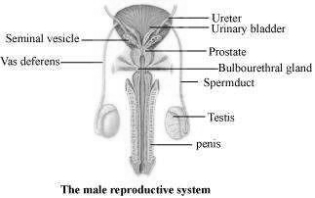
(N/A) The male reproductive system is located in the pelvic region. It includes a pair of testes along with accessory ducts,glands,and the external genitalia.
$1$. Testes: Primary sex organs that produce sperms and male sex hormones (androgens).
$2$. Accessory Ducts: Include rete testis,vasa efferentia,epididymis,and vas deferens. These transport and store sperms.
$3$. Accessory Glands: Include paired seminal vesicles,a prostate gland,and paired bulbourethral glands. Their secretions constitute the seminal plasma,which is rich in fructose,calcium,and certain enzymes.
$4$. External Genitalia: The penis is the male external genitalia,which facilitates insemination of sperms into the female reproductive tract.
$1$. Testes: Primary sex organs that produce sperms and male sex hormones (androgens).
$2$. Accessory Ducts: Include rete testis,vasa efferentia,epididymis,and vas deferens. These transport and store sperms.
$3$. Accessory Glands: Include paired seminal vesicles,a prostate gland,and paired bulbourethral glands. Their secretions constitute the seminal plasma,which is rich in fructose,calcium,and certain enzymes.
$4$. External Genitalia: The penis is the male external genitalia,which facilitates insemination of sperms into the female reproductive tract.
0 likes
View Solution169
Easy
Describe the structure of a seminiferous tubule.
Solution
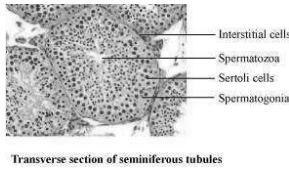
(N/A) The production of sperms in the testes takes place in highly coiled structures called seminiferous tubules. These tubules are located within the testicular lobules.
Each seminiferous tubule is lined on its inside by two types of cells: male germ cells (spermatogonia) and Sertoli cells.
The male germ cells (spermatogonia) undergo meiotic divisions finally leading to sperm formation,while Sertoli cells provide nutrition to the germ cells.
The regions outside the seminiferous tubules called interstitial spaces contain small blood vessels and interstitial cells or Leydig cells.
Leydig cells synthesize and secrete testicular hormones called androgens (mainly testosterone).
Each seminiferous tubule is lined on its inside by two types of cells: male germ cells (spermatogonia) and Sertoli cells.
The male germ cells (spermatogonia) undergo meiotic divisions finally leading to sperm formation,while Sertoli cells provide nutrition to the germ cells.
The regions outside the seminiferous tubules called interstitial spaces contain small blood vessels and interstitial cells or Leydig cells.
Leydig cells synthesize and secrete testicular hormones called androgens (mainly testosterone).
0 likes
View Solution170
EasyMCQ
What are the major components of seminal plasma?
A
Fructose,calcium,and certain enzymes
B
Glucose,potassium,and hormones
C
Sperms,water,and proteins
D
Mucus,blood,and urea
Solution
(A) Semen,produced in the male reproductive system,consists of sperms and seminal plasma.
Seminal plasma is the fluid portion of semen,which is secreted by the accessory glands (seminal vesicles,prostate gland,and bulbourethral glands).
It is rich in fructose,calcium,ascorbic acid,and certain enzymes.
These components provide nourishment and protection to the sperms,facilitating their motility and survival.
Seminal plasma is the fluid portion of semen,which is secreted by the accessory glands (seminal vesicles,prostate gland,and bulbourethral glands).
It is rich in fructose,calcium,ascorbic acid,and certain enzymes.
These components provide nourishment and protection to the sperms,facilitating their motility and survival.
0 likes
View Solution171
Easy
What are the major functions of male accessory ducts and glands?
Solution
(N/A) The male accessory ducts include the $rete testis$, $vasa efferentia$, $epididymis$, and $vas deferens$. Their primary function is the transport and temporary storage of sperms.
On the other hand, the male accessory glands consist of the $seminal vesicles$, $prostate gland$, and $bulbourethral glands$.
These glands secrete seminal plasma, which is rich in $fructose$, $calcium$, and certain enzymes.
This fluid provides nourishment to the sperms, facilitates their motility, and helps in neutralizing the acidity of the female reproductive tract.
On the other hand, the male accessory glands consist of the $seminal vesicles$, $prostate gland$, and $bulbourethral glands$.
These glands secrete seminal plasma, which is rich in $fructose$, $calcium$, and certain enzymes.
This fluid provides nourishment to the sperms, facilitates their motility, and helps in neutralizing the acidity of the female reproductive tract.
0 likes
View Solution172
Easy
Mention the location and structure of testes and explain about seminiferous tubules.
Solution
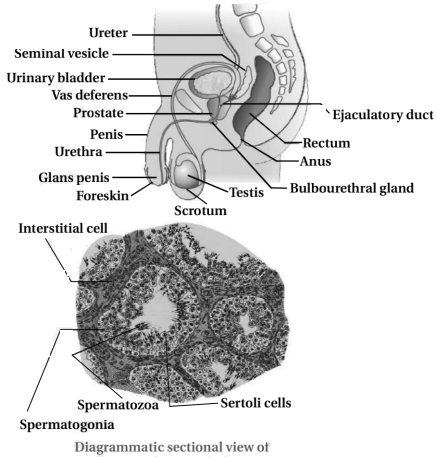
(N/A) Location and Structure of Testes:
The testes are situated outside the abdominal cavity within a pouch called the scrotum. The scrotum helps in maintaining the low temperature of the testes ($2-2.5^{\circ}C$ lower than the normal internal body temperature),which is necessary for spermatogenesis.
In adults,each testis is oval in shape,with a length of about $4$ to $5 \text{ cm}$ and a width of about $2$ to $3 \text{ cm}$. Each testis is covered by a dense covering.
Seminiferous Tubules:
Each testis has about $250$ compartments called testicular lobules. Each lobule contains one to three highly coiled seminiferous tubules in which sperms are produced.
Each seminiferous tubule is lined on its inside by two types of cells called male germ cells (spermatogonia) and Sertoli cells.
The male germ cells undergo meiotic divisions finally leading to sperm formation,while Sertoli cells provide nutrition to the germ cells.
The regions outside the seminiferous tubules called interstitial spaces contain small blood vessels and interstitial cells or Leydig cells. Leydig cells synthesize and secrete testicular hormones called androgens.
The testes are situated outside the abdominal cavity within a pouch called the scrotum. The scrotum helps in maintaining the low temperature of the testes ($2-2.5^{\circ}C$ lower than the normal internal body temperature),which is necessary for spermatogenesis.
In adults,each testis is oval in shape,with a length of about $4$ to $5 \text{ cm}$ and a width of about $2$ to $3 \text{ cm}$. Each testis is covered by a dense covering.
Seminiferous Tubules:
Each testis has about $250$ compartments called testicular lobules. Each lobule contains one to three highly coiled seminiferous tubules in which sperms are produced.
Each seminiferous tubule is lined on its inside by two types of cells called male germ cells (spermatogonia) and Sertoli cells.
The male germ cells undergo meiotic divisions finally leading to sperm formation,while Sertoli cells provide nutrition to the germ cells.
The regions outside the seminiferous tubules called interstitial spaces contain small blood vessels and interstitial cells or Leydig cells. Leydig cells synthesize and secrete testicular hormones called androgens.
0 likes
View Solution173
Easy
Provide information about the reproductive accessory ducts in the male human reproductive system.
Solution
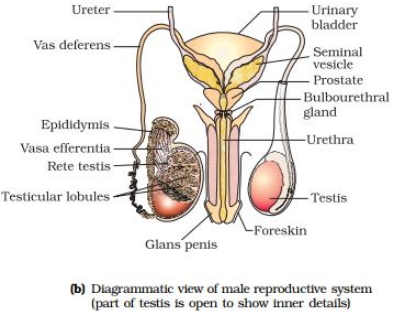
(N/A) The male sex accessory ducts include the rete testis,vasa efferentia,epididymis,and vas deferens.
The seminiferous tubules of the testis open into the vasa efferentia through the rete testis.
The vasa efferentia leave the testis and open into the epididymis,which is located along the posterior surface of each testis.
The epididymis leads to the vas deferens that ascends to the abdomen and loops over the urinary bladder.
It receives a duct from the seminal vesicle and opens into the urethra as the ejaculatory duct.
These ducts store and transport the sperms from the testis to the outside through the urethra.
The urethra originates from the urinary bladder and extends through the penis to its external opening called the urethral meatus.
The seminiferous tubules of the testis open into the vasa efferentia through the rete testis.
The vasa efferentia leave the testis and open into the epididymis,which is located along the posterior surface of each testis.
The epididymis leads to the vas deferens that ascends to the abdomen and loops over the urinary bladder.
It receives a duct from the seminal vesicle and opens into the urethra as the ejaculatory duct.
These ducts store and transport the sperms from the testis to the outside through the urethra.
The urethra originates from the urinary bladder and extends through the penis to its external opening called the urethral meatus.
0 likes
View Solution174
Easy
Explain the structure of the penis.
Solution
(N/A) The penis is the male external genitalia.
It is made up of special erectile tissue that helps in the erection of the penis to facilitate insemination.
The enlarged end of the penis,called the glans penis,is covered by a loose fold of skin called the foreskin.
It is made up of special erectile tissue that helps in the erection of the penis to facilitate insemination.
The enlarged end of the penis,called the glans penis,is covered by a loose fold of skin called the foreskin.
0 likes
View Solution175
Medium
Write a note on male accessory glands.
Solution
(A) The male accessory glands include paired seminal vesicles,a prostate gland,and paired bulbourethral glands. These glands secrete fluids that constitute the seminal plasma.
$1$. Seminal vesicles: These are paired glands located behind the urinary bladder. They produce about $60-70 \%$ of the volume of semen. Their yellowish,viscous secretion is rich in fructose,vitamin $C$,and other substances that provide nourishment to sperm cells. The duct of each seminal vesicle joins the vas deferens to form the ejaculatory duct.
$2$. Prostate gland: This is a single gland located surrounding the urethra at the base of the urinary bladder. Its secretion is milky and slightly acidic/neutral,which helps in activating sperms and enhancing their motility. It enters the urethra through several small ducts.
$3$. Bulbourethral glands (Cowper's glands): These are paired glands located beneath the prostate gland on either side of the urethra. They secrete an alkaline fluid that neutralizes the acidity of the urethra and acts as a lubricant during copulation.
Constitution of semen: Semen is a milky,sticky mixture of sperms and the secretions of these accessory glands. The alkaline nature of semen (pH $7.2$ to $7.6$) helps neutralize the acidic environment of the female reproductive tract. It protects fragile sperms and facilitates their movement. $A$ typical ejaculation contains $2$ to $5 \text{ ml}$ of semen.
$1$. Seminal vesicles: These are paired glands located behind the urinary bladder. They produce about $60-70 \%$ of the volume of semen. Their yellowish,viscous secretion is rich in fructose,vitamin $C$,and other substances that provide nourishment to sperm cells. The duct of each seminal vesicle joins the vas deferens to form the ejaculatory duct.
$2$. Prostate gland: This is a single gland located surrounding the urethra at the base of the urinary bladder. Its secretion is milky and slightly acidic/neutral,which helps in activating sperms and enhancing their motility. It enters the urethra through several small ducts.
$3$. Bulbourethral glands (Cowper's glands): These are paired glands located beneath the prostate gland on either side of the urethra. They secrete an alkaline fluid that neutralizes the acidity of the urethra and acts as a lubricant during copulation.
Constitution of semen: Semen is a milky,sticky mixture of sperms and the secretions of these accessory glands. The alkaline nature of semen (pH $7.2$ to $7.6$) helps neutralize the acidic environment of the female reproductive tract. It protects fragile sperms and facilitates their movement. $A$ typical ejaculation contains $2$ to $5 \text{ ml}$ of semen.
0 likes
View Solution176
Medium
Write a note on the transport and formation of sperms.
Solution
(N/A) $1$. Spermatogenesis: Sperms are formed in the seminiferous tubules of the testes through a process called spermatogenesis.
$2$. Transport: Sperms released from the seminiferous tubules are transported by the accessory ducts,which include the rete testis,vasa efferentia,epididymis,and vas deferens.
$3$. Maturation: During their passage through the epididymis,sperms undergo physiological maturation,gaining motility and the ability to fertilize an ovum.
$4$. Semen Formation: The secretions of the accessory glands (seminal vesicles,prostate gland,and bulbourethral glands) are essential for the maturation and survival of sperms. The seminal plasma,along with the sperms,constitutes the semen.
$5$. Hormonal Regulation: The functions of the male sex accessory ducts and glands are maintained by testicular hormones,primarily testosterone.
$2$. Transport: Sperms released from the seminiferous tubules are transported by the accessory ducts,which include the rete testis,vasa efferentia,epididymis,and vas deferens.
$3$. Maturation: During their passage through the epididymis,sperms undergo physiological maturation,gaining motility and the ability to fertilize an ovum.
$4$. Semen Formation: The secretions of the accessory glands (seminal vesicles,prostate gland,and bulbourethral glands) are essential for the maturation and survival of sperms. The seminal plasma,along with the sperms,constitutes the semen.
$5$. Hormonal Regulation: The functions of the male sex accessory ducts and glands are maintained by testicular hormones,primarily testosterone.
0 likes
View Solution177
Medium
Give scientific reasons: Testis are located in the scrotum outside the abdominal cavity.
Solution
(N/A) The process of spermatogenesis,which involves the formation of spermatids and spermatozoa,requires a temperature approximately $2^{\circ}C$ to $3^{\circ}C$ lower than the normal internal body temperature.
This lower temperature is essential for the viability and proper functioning of the germinal epithelium in the testes.
The scrotum acts as a thermoregulatory organ,maintaining the testes outside the abdominal cavity to ensure this cooler environment,which is necessary for successful sperm production.
This lower temperature is essential for the viability and proper functioning of the germinal epithelium in the testes.
The scrotum acts as a thermoregulatory organ,maintaining the testes outside the abdominal cavity to ensure this cooler environment,which is necessary for successful sperm production.
0 likes
View Solution178
EasyMCQ
State the location and function of Leydig cells.
A
Located in the seminiferous tubules; produce estrogen.
B
Located in the interstitial spaces outside the seminiferous tubules; produce androgens like testosterone.
C
Located in the epididymis; store sperm.
D
Located in the prostate gland; produce seminal fluid.
Solution
(B) Leydig cells,also known as interstitial cells,are located in the interstitial spaces (the regions outside the seminiferous tubules) of the testes.
Their primary function is to synthesize and secrete a group of hormones known as androgens,primarily testosterone,which are essential for the development of male secondary sexual characteristics and spermatogenesis.
Their primary function is to synthesize and secrete a group of hormones known as androgens,primarily testosterone,which are essential for the development of male secondary sexual characteristics and spermatogenesis.
0 likes
View Solution179
Medium
Give scientific reasons: When a male is sexually excited,the epididymis wall shrinks/contracts.
Solution
(N/A) The epididymis is a $6 \ m$ long,highly coiled structure that serves as a temporary storage site for immature sperm. During their stay in the epididymis,sperm cells undergo maturation and acquire the capacity for motility (swimming).
When a male experiences sexual excitement,the smooth muscle walls of the epididymis contract. This contraction facilitates the transport of mature sperm cells from the epididymis into the vas deferens,moving them toward the ejaculatory duct.
When a male experiences sexual excitement,the smooth muscle walls of the epididymis contract. This contraction facilitates the transport of mature sperm cells from the epididymis into the vas deferens,moving them toward the ejaculatory duct.
0 likes
View Solution180
Medium
Describe the location and function of the Scrotum and Epididymis.
Solution
(N/A) $(1)$ Scrotum:
Location: It is a pouch-like structure located outside the abdominal cavity in males that houses the testes.
Function: It maintains the temperature of the testes $2-2.5^{\circ}C$ lower than the normal internal body temperature,which is essential for spermatogenesis.
$(2)$ Epididymis:
Location: It is a long,highly coiled tube located along the posterior surface of each testis.
Function: It serves as a temporary storage site for sperms and provides an environment for the maturation and acquisition of motility by the sperms.
Location: It is a pouch-like structure located outside the abdominal cavity in males that houses the testes.
Function: It maintains the temperature of the testes $2-2.5^{\circ}C$ lower than the normal internal body temperature,which is essential for spermatogenesis.
$(2)$ Epididymis:
Location: It is a long,highly coiled tube located along the posterior surface of each testis.
Function: It serves as a temporary storage site for sperms and provides an environment for the maturation and acquisition of motility by the sperms.
0 likes
View Solution181
MediumMCQ
Describe the location and function of Sertoli cells and Leydig cells.
A
Sertoli cells: Interstitial space,produce androgens; Leydig cells: Seminiferous tubules,provide nutrition.
B
Sertoli cells: Seminiferous tubules,provide nutrition; Leydig cells: Interstitial space,produce androgens.
C
Sertoli cells: Interstitial space,provide nutrition; Leydig cells: Seminiferous tubules,produce androgens.
D
Sertoli cells: Seminiferous tubules,produce androgens; Leydig cells: Interstitial space,provide nutrition.
Solution
(B) $1.$ Leydig cells (Interstitial cells):
Location: They are located in the regions outside the seminiferous tubules,known as interstitial spaces.
Function: They synthesize and secrete testicular hormones called androgens (primarily testosterone).
$2.$ Sertoli cells (Nurse cells):
Location: They are situated inside the seminiferous tubules,embedded between the germ cells.
Function: They provide nutrition to the developing germ cells (spermatozoa) and provide structural support.
Location: They are located in the regions outside the seminiferous tubules,known as interstitial spaces.
Function: They synthesize and secrete testicular hormones called androgens (primarily testosterone).
$2.$ Sertoli cells (Nurse cells):
Location: They are situated inside the seminiferous tubules,embedded between the germ cells.
Function: They provide nutrition to the developing germ cells (spermatozoa) and provide structural support.
0 likes
View Solution182
Easy
Explain the difference between the following terms:
$(1)$ Testosterone - Progesterone
$(2)$ Vasa efferentia - Vas deferens
$(1)$ Testosterone - Progesterone
$(2)$ Vasa efferentia - Vas deferens
Solution
(N/A) $(1)$ $\Rightarrow$ Testosterone: It is a primary male sex hormone produced by the Leydig cells of the testes. It is responsible for the development of secondary sexual characteristics in males.
$\rightarrow$ Progesterone: It is a female sex hormone produced mainly by the corpus luteum in the ovary. It is essential for maintaining the endometrium of the uterus for implantation of the embryo.
$(2)$ Vasa efferentia: These are a series of fine ciliated ducts that arise from the rete testis and carry spermatozoa from the testis to the epididymis.
$\rightarrow$ Vas deferens: It is a long,muscular tube that arises from the cauda epididymis and transports mature sperm from the epididymis to the ejaculatory duct.
$\rightarrow$ Progesterone: It is a female sex hormone produced mainly by the corpus luteum in the ovary. It is essential for maintaining the endometrium of the uterus for implantation of the embryo.
$(2)$ Vasa efferentia: These are a series of fine ciliated ducts that arise from the rete testis and carry spermatozoa from the testis to the epididymis.
$\rightarrow$ Vas deferens: It is a long,muscular tube that arises from the cauda epididymis and transports mature sperm from the epididymis to the ejaculatory duct.
0 likes
View Solution183
Medium
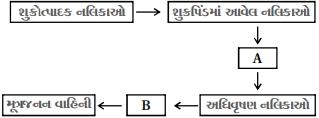
The path of sperm transport is given below. Provide the missing steps in blank boxes.
$\boxed{\text{Seminiferous tubules}} \to \boxed{\text{Rete testis}} \to \boxed{A} \to \boxed{\text{Epididymis}} \to \boxed{B} \to \boxed{\text{Urethra}}$
$\boxed{\text{Seminiferous tubules}} \to \boxed{\text{Rete testis}} \to \boxed{A} \to \boxed{\text{Epididymis}} \to \boxed{B} \to \boxed{\text{Urethra}}$
Solution
(A) The correct sequence of sperm transport in the male reproductive system is:
Seminiferous tubules $\to$ Rete testis $\to$ Vasa efferentia $\to$ Epididymis $\to$ Vas deferens $\to$ Ejaculatory duct $\to$ Urethra.
Comparing this with the given flow chart:
$A = \text{Vasa efferentia}$
$B = \text{Vas deferens}$
Seminiferous tubules $\to$ Rete testis $\to$ Vasa efferentia $\to$ Epididymis $\to$ Vas deferens $\to$ Ejaculatory duct $\to$ Urethra.
Comparing this with the given flow chart:
$A = \text{Vasa efferentia}$
$B = \text{Vas deferens}$
0 likes
View Solution184
MediumMCQ
What is the significance of the epididymis in male fertility?
A
It produces testosterone.
B
It stores sperms and facilitates their maturation and motility.
C
It provides nourishment to the developing fetus.
D
It is the site of spermatogenesis.
Solution
(B) The epididymis plays a crucial role in male fertility by providing an environment for sperm maturation.
During their transit through the epididymis,sperms gain the ability to become motile and acquire the capacity for fertilization.
Additionally,the epididymis acts as a temporary storage site for sperms before they are transported into the $vas \ deferens$.
It also exhibits peristaltic and segmenting contractions at regular intervals to facilitate the expulsion of sperms from the testis.
During their transit through the epididymis,sperms gain the ability to become motile and acquire the capacity for fertilization.
Additionally,the epididymis acts as a temporary storage site for sperms before they are transported into the $vas \ deferens$.
It also exhibits peristaltic and segmenting contractions at regular intervals to facilitate the expulsion of sperms from the testis.
0 likes
View Solution185
Easy
Match the columns.
| Column $I$ | Column $II$ |
| $(a)$ Seminiferous tubules | $(1)$ Site for storage and maturation of sperm |
| $(b)$ Urethra | $(2)$ Structure which releases sperm cells |
| $(c)$ Seminal vesicle | $(3)$ $A$ paired gland producing nutrients |
| $(d)$ Epididymis | $(4)$ Coiled duct where sperm development begins |
Solution
(A) $(a - 4), (b - 2), (c - 3), (d - 1)$
Explanation:
- $(a)$ Seminiferous tubules are highly coiled structures within the testes where spermatogenesis (sperm development) begins.
- $(b)$ The urethra acts as the common passage for both urine and semen, facilitating the release of sperm cells.
- $(c)$ Seminal vesicles are paired accessory glands that secrete a fluid rich in fructose and other nutrients for sperm.
- $(d)$ The epididymis is the site where sperm are stored and undergo physiological maturation before ejaculation.
Explanation:
- $(a)$ Seminiferous tubules are highly coiled structures within the testes where spermatogenesis (sperm development) begins.
- $(b)$ The urethra acts as the common passage for both urine and semen, facilitating the release of sperm cells.
- $(c)$ Seminal vesicles are paired accessory glands that secrete a fluid rich in fructose and other nutrients for sperm.
- $(d)$ The epididymis is the site where sperm are stored and undergo physiological maturation before ejaculation.
0 likes
View Solution186
EasyMCQ
Match the columns.
| Column $I$ | Column $II$ |
| $(a)$ Vas deferens | $(1)$ Duct that transports sperm from the epididymis to the urethra. |
| $(b)$ Spermatogenesis | $(2)$ Process of formation of spermatozoa from spermatogonia. |
| $(c)$ Prostate gland | $(3)$ $A$ gland surrounding the urethra that secretes seminal fluid. |
A
$(a-1), (b-2), (c-3)$
B
$(a-2), (b-1), (c-3)$
C
$(a-1), (b-3), (c-2)$
D
$(a-3), (b-2), (c-1)$
Solution
(A) The correct matches are as follows:
$(a)$ Vas deferens: It is the duct that transports sperm from the epididymis to the urethra. Thus, $(a-1)$.
$(b)$ Spermatogenesis: It is the biological process of the formation of spermatozoa from spermatogonia in the testes. Thus, $(b-2)$.
$(c)$ Prostate gland: It is an accessory reproductive gland that surrounds the urethra and secretes a fluid that forms part of the semen. Thus, $(c-3)$.
Therefore, the correct sequence is $(a-1, b-2, c-3)$.
$(a)$ Vas deferens: It is the duct that transports sperm from the epididymis to the urethra. Thus, $(a-1)$.
$(b)$ Spermatogenesis: It is the biological process of the formation of spermatozoa from spermatogonia in the testes. Thus, $(b-2)$.
$(c)$ Prostate gland: It is an accessory reproductive gland that surrounds the urethra and secretes a fluid that forms part of the semen. Thus, $(c-3)$.
Therefore, the correct sequence is $(a-1, b-2, c-3)$.
0 likes
View Solution187
MediumMCQ
Which is the primary sex organ in males?
A
Penis
B
Testis
C
Scrotum
D
Both $A$ and $B$
Solution
(B) The primary sex organ in males is the testis.
Testes are responsible for the production of male gametes (sperms) and the secretion of male sex hormones (androgens like testosterone).
Other structures like the penis and scrotum are considered accessory reproductive organs.
Testes are responsible for the production of male gametes (sperms) and the secretion of male sex hormones (androgens like testosterone).
Other structures like the penis and scrotum are considered accessory reproductive organs.
0 likes
View Solution188
MediumMCQ
How much lower temperature does the scrotum provide for spermatogenesis compared to the normal body temperature?
A
$2-2.5^{\circ} C$
B
$3-3.5^{\circ} C$
C
$2-2.5^{\circ} F$
D
$3-3.5^{\circ} F$
Solution
(A) Spermatogenesis,the process of sperm production,requires a temperature that is approximately $2-2.5^{\circ} C$ lower than the normal internal body temperature $(37^{\circ} C)$.
The scrotum is located outside the abdominal cavity to maintain this cooler environment,which is essential for the viability and proper development of sperm cells.
The scrotum is located outside the abdominal cavity to maintain this cooler environment,which is essential for the viability and proper development of sperm cells.
0 likes
View Solution189
MediumMCQ
What are the width and length of the testis,respectively?
A
$4-5 \, cm, 2-3 \, cm$
B
$2-3 \, cm, 4-5 \, cm$
C
$3-4 \, cm, 5-6 \, cm$
D
$2-4 \, cm, 4-5 \, cm$
Solution
(B) The human testes are oval-shaped organs located outside the abdominal cavity within a pouch called the scrotum.
Each testis has a length of approximately $4-5 \, cm$ and a width of approximately $2-3 \, cm$.
Therefore,the width and length are $2-3 \, cm$ and $4-5 \, cm$ respectively.
Each testis has a length of approximately $4-5 \, cm$ and a width of approximately $2-3 \, cm$.
Therefore,the width and length are $2-3 \, cm$ and $4-5 \, cm$ respectively.
0 likes
View Solution190
MediumMCQ
The number of testicular lobules in each testis is...?
A
$200$
B
Approximately $200-300$
C
Approximately $250$
D
None of these
Solution
(B) Each testis contains approximately $250$ compartments called testicular lobules.
These lobules are the structural units of the testis.
Each lobule contains one to three highly coiled seminiferous tubules in which sperms are produced.
These lobules are the structural units of the testis.
Each lobule contains one to three highly coiled seminiferous tubules in which sperms are produced.
0 likes
View Solution191
MediumMCQ
What is the specific location of the testes in mammals?
A
Abdominal cavity
B
Scrotum
C
Extra-abdominal pouch
D
$B$ and $C$ both
Solution
(D) In mammals, the testes are situated outside the abdominal cavity within a pouch called the scrotum.
This structure is also referred to as an extra-abdominal pouch.
The scrotum helps in maintaining the low temperature of the testes ($2$ - $2.5$ $^{\circ}C$ lower than the normal internal body temperature), which is necessary for spermatogenesis.
Therefore, both $B$ and $C$ describe the same anatomical location correctly.
This structure is also referred to as an extra-abdominal pouch.
The scrotum helps in maintaining the low temperature of the testes ($2$ - $2.5$ $^{\circ}C$ lower than the normal internal body temperature), which is necessary for spermatogenesis.
Therefore, both $B$ and $C$ describe the same anatomical location correctly.
0 likes
View Solution192
MediumMCQ
What is the functional unit of the human testis?
A
Testicular lobules
B
Epididymis
C
Seminiferous tubules
D
Both $B$ and $C$
Solution
(C) The human testis is composed of approximately $250$ compartments called testicular lobules.
Each testicular lobule contains $1$ to $3$ highly coiled seminiferous tubules.
The seminiferous tubules are the structural and functional units of the testis because they are the sites where spermatogenesis (the production of sperm) occurs.
Therefore,the correct answer is $C$.
Each testicular lobule contains $1$ to $3$ highly coiled seminiferous tubules.
The seminiferous tubules are the structural and functional units of the testis because they are the sites where spermatogenesis (the production of sperm) occurs.
Therefore,the correct answer is $C$.
0 likes
View Solution193
EasyMCQ
From which germ layer are human testes derived?
A
Ectoderm
B
Endoderm
C
Mesoderm
D
None of these
Solution
(C) The human testes are derived from the intermediate mesoderm during embryonic development.
During the development of the urogenital system,the gonads (testes in males and ovaries in females) originate from the mesodermal germ layer.
During the development of the urogenital system,the gonads (testes in males and ovaries in females) originate from the mesodermal germ layer.
0 likes
View Solution194
EasyMCQ
What is the location and function of the Leydig cells?
A
Ovary $-$ Production of estrogen
B
Testis $-$ Production of sperm
C
Testis $-$ Production of testosterone
D
Leydig cells $-$ Production of progesterone
Solution
(C) Leydig cells (also known as interstitial cells) are located in the interstitial spaces outside the seminiferous tubules within the testis. Their primary function is to synthesize and secrete the male sex hormone,testosterone,in response to luteinizing hormone $(LH)$.
0 likes
View Solution195
MediumMCQ
Identify the correct pathway of sperm transport from the testes.
A
Seminiferous tubules $\rightarrow$ Vasa efferentia $\rightarrow$ Rete testis $\rightarrow$ Epididymis $\rightarrow$ Vas deferens $\rightarrow$ Ejaculatory duct $\rightarrow$ Urethra
B
Seminiferous tubules $\rightarrow$ Rete testis $\rightarrow$ Vasa efferentia $\rightarrow$ Epididymis $\rightarrow$ Vas deferens $\rightarrow$ Ejaculatory duct $\rightarrow$ Urethra
C
Seminiferous tubules $\rightarrow$ Epididymis $\rightarrow$ Rete testis $\rightarrow$ Vasa efferentia $\rightarrow$ Vas deferens $\rightarrow$ Ejaculatory duct $\rightarrow$ Urethra
D
Seminiferous tubules $\rightarrow$ Vasa efferentia $\rightarrow$ Epididymis $\rightarrow$ Rete testis $\rightarrow$ Vas deferens $\rightarrow$ Ejaculatory duct $\rightarrow$ Urethra
Solution
(B) The process of spermatogenesis occurs in the seminiferous tubules of the testes.
From the seminiferous tubules,sperm move into the rete testis.
Then,they pass through the vasa efferentia to reach the epididymis,where they are stored and matured.
From the epididymis,sperm travel through the vas deferens to the ejaculatory duct,which receives ducts from the seminal vesicles.
Finally,the sperm are transported through the urethra to be expelled from the body.
From the seminiferous tubules,sperm move into the rete testis.
Then,they pass through the vasa efferentia to reach the epididymis,where they are stored and matured.
From the epididymis,sperm travel through the vas deferens to the ejaculatory duct,which receives ducts from the seminal vesicles.
Finally,the sperm are transported through the urethra to be expelled from the body.
0 likes
View Solution196
MediumMCQ
The ejaculatory duct is formed by the union of which of the following?
A
Vas deferens $+$ Prostate duct
B
Ureter $+$ Vas deferens
C
Vas deferens $+$ Seminal vesicle duct
D
Both $B$ and $C$
Solution
(C) The ejaculatory duct is a short duct that is formed by the union of the duct from the seminal vesicle and the vas deferens.
These ducts pass through the prostate gland and open into the urethra.
Therefore,the correct combination is the vas deferens and the duct of the seminal vesicle.
These ducts pass through the prostate gland and open into the urethra.
Therefore,the correct combination is the vas deferens and the duct of the seminal vesicle.
0 likes
View Solution197
MediumMCQ
What is present in high concentration in the seminal plasma?
A
Enzymes,$Mg^{2+}$
B
$Ca^{2+}$,Fructose,$Mg^{2+}$
C
Fructose,$Ca^{2+}$,Enzymes
D
Calcium,Enzymes
Solution
(C) The seminal plasma is the fluid component of semen,which is secreted by the accessory glands,including the seminal vesicles,prostate gland,and bulbourethral glands.
Seminal vesicles contribute about $60-70\%$ of the total volume of semen.
The secretion of the seminal vesicles is rich in fructose,calcium,and certain enzymes.
Fructose serves as the primary energy source for sperm motility.
Therefore,the correct composition is fructose,calcium,and enzymes.
Seminal vesicles contribute about $60-70\%$ of the total volume of semen.
The secretion of the seminal vesicles is rich in fructose,calcium,and certain enzymes.
Fructose serves as the primary energy source for sperm motility.
Therefore,the correct composition is fructose,calcium,and enzymes.
0 likes
View SolutionHuman Reproduction — Male reproductive system · Frequently Asked Questions
1Are these Human Reproduction questions useful for JEE and NEET?
Yes. All questions in this section are mapped to JEE Main and NEET exam patterns. Previous year questions from JEE Main, NEET, GUJCET and state-level exams are included with full solutions.
2Can I switch to Hindi or Gujarati for these questions?
Yes. Use the language tabs in the hero section or the sidebar to view the same questions and solutions in English, Hindi or Gujarati.
3How do I generate a question paper from this subtopic?
Use the Vedclass Exam Paper Generator — select the chapter and subtopic, set difficulty, and generate Sets A, B, C, D automatically. First 3 chapters of every subject are free.
Vedclass Products
For Students
Vedclass Test Series
Mock tests in real JEE/NEET style with performance analysis. 5-day free trial.
Start Free TrialFor Teachers
Exam Paper Generator
Generate Set A/B/C/D papers from this chapter in 2 minutes. 3 chapters free.
Try FreeFor Institutes
Online Exam Module
Live online exams with unlimited students, 360° analytics & white-label branding.
See DemoFor Teachers & Institutes
Generate a Human Reproduction Exam Paper in 2 Minutes
Select subtopic & difficulty — Sets A, B, C, D auto-generated with No Repeat logic.
First 3 chapters of every subject are free — no payment required.