
A English
Male reproductive system Questions in English
Class 12 Biology · Human Reproduction · Male reproductive system
325+
Questions
English
Language
100%
With Solutions
Showing 50 of 325 questions in English
201
MediumMCQ
What is the average number of sperm in a single ejaculation?
A
$100$ to $200$ million
B
$200$ to $300$ million
C
$300$ to $400$ million
D
$400$ to $500$ million
Solution
(B) During a single ejaculation,the human male releases approximately $200$ to $300$ million sperms.
For normal fertility,at least $60$ percent of sperms must have normal shape and size,and at least $40$ percent of them must show vigorous motility.
For normal fertility,at least $60$ percent of sperms must have normal shape and size,and at least $40$ percent of them must show vigorous motility.
0 likes
View Solution202
MediumMCQ
Which gland contributes the most to the formation of semen?
A
Seminal vesicle
B
Prostate gland
C
Bulbourethral gland
D
All of the above
Solution
(A) The semen is composed of secretions from the accessory glands and sperm.
$1$. The seminal vesicles contribute about $60-70\%$ of the total volume of semen.
$2$. The prostate gland contributes about $20-30\%$.
$3$. The bulbourethral glands (Cowper's glands) contribute a very small amount of mucus.
Therefore,the seminal vesicles contribute the largest volume to the semen.
$1$. The seminal vesicles contribute about $60-70\%$ of the total volume of semen.
$2$. The prostate gland contributes about $20-30\%$.
$3$. The bulbourethral glands (Cowper's glands) contribute a very small amount of mucus.
Therefore,the seminal vesicles contribute the largest volume to the semen.
0 likes
View Solution203
MediumMCQ
What are the seminiferous tubules in the human testis?
A
Structural unit
B
Functional unit
C
Site of hormone production
D
All of the above
Solution
(D) The seminiferous tubules are the structural and functional units of the human testis.
They are the site where spermatogenesis (the process of sperm production) occurs,making them the functional units.
Additionally,the interstitial spaces between these tubules contain Leydig cells (interstitial cells),which are responsible for the production of androgens (testosterone),making them associated with hormone production.
Therefore,all the given options are correct.
They are the site where spermatogenesis (the process of sperm production) occurs,making them the functional units.
Additionally,the interstitial spaces between these tubules contain Leydig cells (interstitial cells),which are responsible for the production of androgens (testosterone),making them associated with hormone production.
Therefore,all the given options are correct.
0 likes
View Solution204
MediumMCQ
The germinal epithelium and Sertoli cells of the seminiferous tubule are composed of which type of epithelial tissue?
A
Squamous,Columnar
B
Cuboidal,Ciliated
C
Columnar,Squamous
D
Cuboidal,Columnar
Solution
(D) The seminiferous tubules are lined by a germinal epithelium which consists of two types of cells: $1$. Male germ cells (spermatogonia) and $2$. Sertoli cells (nurse cells).
- The germinal epithelium is primarily composed of cuboidal cells that undergo spermatogenesis.
- Sertoli cells are tall,columnar cells that provide nutrition and support to the developing spermatozoa.
- Therefore,the germinal epithelium consists of cuboidal cells,and the Sertoli cells are columnar in shape.
- The germinal epithelium is primarily composed of cuboidal cells that undergo spermatogenesis.
- Sertoli cells are tall,columnar cells that provide nutrition and support to the developing spermatozoa.
- Therefore,the germinal epithelium consists of cuboidal cells,and the Sertoli cells are columnar in shape.
0 likes
View Solution205
MediumMCQ
What is the function of the inguinal canal in humans?
A
To connect the testes to the scrotum.
B
To connect the seminal vesicle to the vas deferens.
C
To connect the scrotum to the abdominal cavity.
D
To connect the epididymis to the urinogenital duct.
Solution
(C) The inguinal canal is a passage in the anterior abdominal wall that allows structures to pass between the abdominal cavity and the scrotum. During fetal development,the testes descend from the abdominal cavity into the scrotum through this canal. Therefore,it serves as a pathway connecting the scrotum to the abdominal cavity.
0 likes
View Solution206
EasyMCQ
What is the location of $Leydig$ cells in humans?
A
In the lumen of seminiferous tubules
B
In the cuboidal epithelial cells of seminiferous tubules
C
In the initial part of the seminiferous tubules
D
In the interstitial spaces between seminiferous tubules
Solution
(D) $Leydig$ cells,also known as interstitial cells,are located in the interstitial spaces outside the seminiferous tubules within the testes.
These cells are responsible for the synthesis and secretion of testicular hormones called androgens,primarily testosterone.
These cells are responsible for the synthesis and secretion of testicular hormones called androgens,primarily testosterone.
0 likes
View Solution207
MediumMCQ
What happens when the $vas$ $deferens$ is cut in humans?
A
Semen is not produced
B
Sperm cells die
C
Semen becomes sperm-free
D
Menopause occurs
Solution
(C) The $vas$ $deferens$ is a duct that transports sperm from the epididymis to the urethra.
Cutting or ligating the $vas$ $deferens$ is a surgical procedure known as a $vasectomy$.
This procedure prevents sperm from reaching the urethra,meaning the semen ejaculated will not contain any sperm.
However,the production of semen by accessory glands (seminal vesicles,prostate,and bulbourethral glands) continues,so the volume of the ejaculate remains largely unchanged,but it is $azoospermic$ (sperm-free).
Cutting or ligating the $vas$ $deferens$ is a surgical procedure known as a $vasectomy$.
This procedure prevents sperm from reaching the urethra,meaning the semen ejaculated will not contain any sperm.
However,the production of semen by accessory glands (seminal vesicles,prostate,and bulbourethral glands) continues,so the volume of the ejaculate remains largely unchanged,but it is $azoospermic$ (sperm-free).
0 likes
View Solution208
EasyMCQ
What divides the testis into lobules?
A
Tunica albuginea
B
Tunica vaginalis
C
Tunica vasculosa
D
All of the above
Solution
(A) The testis is covered by a dense connective tissue capsule called the $Tunica \ albuginea$.
Extensions of this capsule,known as septa,project inward into the testis and divide it into about $200-250$ compartments called testicular lobules.
Therefore,the $Tunica \ albuginea$ is responsible for dividing the testis into lobules.
Extensions of this capsule,known as septa,project inward into the testis and divide it into about $200-250$ compartments called testicular lobules.
Therefore,the $Tunica \ albuginea$ is responsible for dividing the testis into lobules.
0 likes
View Solution209
EasyMCQ
Name the condition in which the testes fail to descend from the abdominal cavity into the scrotum.
A
Cancer
B
Orchitis
C
Spermatic fascia
D
Cryptorchidism
Solution
(D) The condition in which one or both testes fail to descend from the abdominal cavity into the scrotum during development is known as $Cryptorchidism$.
Normally,the testes descend into the scrotum before birth because the temperature of the scrotum is $2-2.5^{\circ}C$ lower than the internal body temperature,which is essential for spermatogenesis.
If the testes remain in the abdominal cavity,the higher body temperature can lead to infertility or an increased risk of testicular cancer.
Normally,the testes descend into the scrotum before birth because the temperature of the scrotum is $2-2.5^{\circ}C$ lower than the internal body temperature,which is essential for spermatogenesis.
If the testes remain in the abdominal cavity,the higher body temperature can lead to infertility or an increased risk of testicular cancer.
0 likes
View Solution210
EasyMCQ
Which of the following glands is not present in pairs in the male reproductive system?
A
Bulbourethral gland
B
Seminal vesicle
C
Cowper's gland
D
Prostate gland
Solution
(D) In the human male reproductive system,the accessory glands include the seminal vesicles,the prostate gland,and the bulbourethral glands (also known as Cowper's glands).
$1$. The seminal vesicles are a pair of glands.
$2$. The bulbourethral glands (Cowper's glands) are also a pair of glands.
$3$. The prostate gland is a single,unpaired gland that surrounds the urethra.
Therefore,the prostate gland is the only gland among the options that is not present in pairs.
$1$. The seminal vesicles are a pair of glands.
$2$. The bulbourethral glands (Cowper's glands) are also a pair of glands.
$3$. The prostate gland is a single,unpaired gland that surrounds the urethra.
Therefore,the prostate gland is the only gland among the options that is not present in pairs.
0 likes
View Solution211
MediumMCQ
Where do the sperm cells mature?
A
Seminiferous tubules
B
Epididymis
C
Vas deferens
D
Seminal vesicle
Solution
(B) Sperm cells are produced in the $Seminiferous \text{ tubules}$ of the testes. After production, they move to the $Epididymis$, where they undergo physiological maturation, gaining motility and the ability to fertilize an egg. Therefore, the $Epididymis$ is the site of sperm maturation.
0 likes
View Solution212
MediumMCQ
Which system is responsible for the erection of the penis?
A
Sympathetic nervous system
B
Central nervous system
C
Peripheral nervous system
D
Parasympathetic nervous system
Solution
(D) The erection of the penis is a vascular phenomenon primarily controlled by the $Parasympathetic$ nervous system.
When sexual stimulation occurs, the $Parasympathetic$ nerves release neurotransmitters like nitric oxide $(NO)$, which cause the smooth muscles of the penile arteries and the erectile tissues (corpora cavernosa) to relax.
This relaxation leads to vasodilation, increasing blood flow into the erectile tissues, which results in the erection of the penis.
Conversely, the $Sympathetic$ nervous system is primarily responsible for ejaculation.
When sexual stimulation occurs, the $Parasympathetic$ nerves release neurotransmitters like nitric oxide $(NO)$, which cause the smooth muscles of the penile arteries and the erectile tissues (corpora cavernosa) to relax.
This relaxation leads to vasodilation, increasing blood flow into the erectile tissues, which results in the erection of the penis.
Conversely, the $Sympathetic$ nervous system is primarily responsible for ejaculation.
0 likes
View Solution213
MediumMCQ
Ejaculation of semen is controlled by which system?
A
Sympathetic nervous system
B
Central nervous system
C
Peripheral nervous system
D
Parasympathetic nervous system
Solution
(A) The process of ejaculation is a reflex action that involves the coordination of the autonomic nervous system.
Specifically,the sympathetic nervous system is responsible for the emission and ejaculation of semen.
During sexual arousal,the parasympathetic nervous system is primarily responsible for penile erection,while the sympathetic nervous system triggers the contraction of the smooth muscles in the vas deferens,seminal vesicles,and prostate gland,leading to the expulsion of semen (ejaculation).
Specifically,the sympathetic nervous system is responsible for the emission and ejaculation of semen.
During sexual arousal,the parasympathetic nervous system is primarily responsible for penile erection,while the sympathetic nervous system triggers the contraction of the smooth muscles in the vas deferens,seminal vesicles,and prostate gland,leading to the expulsion of semen (ejaculation).
0 likes
View Solution214
EasyMCQ
When do the Leydig cells mature in males?
A
At the onset of puberty
B
At the age of $10$ years
C
In adulthood
D
Both $A$ and $B$
Solution
(A) Leydig cells,also known as interstitial cells,are located in the interstitial spaces of the testes.
These cells are responsible for the synthesis and secretion of testicular hormones called androgens,primarily testosterone.
Leydig cells remain inactive during childhood and become mature and functional at the onset of puberty due to the stimulation by Luteinizing Hormone $(LH)$ from the anterior pituitary gland.
These cells are responsible for the synthesis and secretion of testicular hormones called androgens,primarily testosterone.
Leydig cells remain inactive during childhood and become mature and functional at the onset of puberty due to the stimulation by Luteinizing Hormone $(LH)$ from the anterior pituitary gland.
0 likes
View Solution215
EasyMCQ
Seminal plasma in humans is rich in which of the following?
A
Fructose and calcium
B
Ribose and potassium
C
Glucose and calcium
D
$DNA$ and testosterone
Solution
(A) The seminal plasma in humans is secreted by the accessory glands, which include the seminal vesicles, prostate gland, and bulbourethral glands.
Seminal vesicles contribute about $60-70\%$ of the total volume of semen.
This fluid is rich in fructose, which provides energy to the sperm for motility.
It also contains calcium and certain enzymes that are essential for the survival and activation of sperm.
Therefore, seminal plasma is rich in fructose and calcium.
Seminal vesicles contribute about $60-70\%$ of the total volume of semen.
This fluid is rich in fructose, which provides energy to the sperm for motility.
It also contains calcium and certain enzymes that are essential for the survival and activation of sperm.
Therefore, seminal plasma is rich in fructose and calcium.
0 likes
View Solution216
MediumMCQ
Select the odd one out.
A
Sertoli cells
B
Germ cells
C
Leydig cells
D
Follicle
Solution
(D) The male reproductive system consists of structures like $Sertoli$ cells,germ cells,and $Leydig$ cells,which are all components found within the testes.
$Sertoli$ cells provide nourishment to developing sperm.
Germ cells are the precursors to sperm.
$Leydig$ cells produce androgens (testosterone).
In contrast,a follicle is a structure found in the female reproductive system (ovary) involved in oogenesis.
Therefore,the follicle is the odd one out.
$Sertoli$ cells provide nourishment to developing sperm.
Germ cells are the precursors to sperm.
$Leydig$ cells produce androgens (testosterone).
In contrast,a follicle is a structure found in the female reproductive system (ovary) involved in oogenesis.
Therefore,the follicle is the odd one out.
0 likes
View Solution217
MediumMCQ
Which duct is formed by the union of the vasa efferentia and the seminiferous tubules?
A
Urethra
B
Tunica vasculosa
C
Rete testis
D
Epididymis
Solution
(C) The seminiferous tubules of the testis open into the vasa efferentia through a network of tubules called the rete testis. The vasa efferentia leave the testis and open into the epididymis located along the posterior surface of each testis. Therefore,the network connecting the seminiferous tubules to the vasa efferentia is the rete testis.
0 likes
View Solution218
EasyMCQ
Which acid is found in human semen?
A
Citric acid
B
Malic acid
C
$OAA$
D
Succinic acid
Solution
(A) Human semen contains a high concentration of citric acid,which is primarily secreted by the prostate gland. This citric acid plays a crucial role in maintaining the $pH$ of the semen and is involved in the liquefaction process of the ejaculate after it enters the female reproductive tract.
0 likes
View Solution219
MediumMCQ
Match the following columns:
| Column-$I$ | Column-$II$ |
| $(1)$ Seminal vesicle | $(a)$ Gland contributing $70\%$ of semen |
| $(2)$ Prostate | $(b)$ Male accessory reproductive organ |
| $(3)$ Mammary gland | $(c)$ Male accessory reproductive gland |
| $(4)$ Penis | $(d)$ Gland differentiating during pregnancy |
A
$1-b, 2-a, 3-d, 4-c$
B
$1-b, 2-c, 3-d, 4-a$
C
$1-a, 2-c, 3-d, 4-b$
D
$1-a, 2-b, 3-d, 4-c$
Solution
(C) The correct matches are as follows:
$(1)$ Seminal vesicle: It is a male accessory reproductive gland that contributes about $60-70\%$ of the total volume of semen.
$(2)$ Prostate: It is a male accessory reproductive gland that secretes fluid into the urethra.
$(3)$ Mammary gland: These are modified sweat glands that undergo differentiation during pregnancy to produce milk.
$(4)$ Penis: It is the male external genitalia or male accessory reproductive organ.
Therefore,the correct matching is: $(1-a, 2-c, 3-d, 4-b)$.
$(1)$ Seminal vesicle: It is a male accessory reproductive gland that contributes about $60-70\%$ of the total volume of semen.
$(2)$ Prostate: It is a male accessory reproductive gland that secretes fluid into the urethra.
$(3)$ Mammary gland: These are modified sweat glands that undergo differentiation during pregnancy to produce milk.
$(4)$ Penis: It is the male external genitalia or male accessory reproductive organ.
Therefore,the correct matching is: $(1-a, 2-c, 3-d, 4-b)$.
0 likes
View Solution220
MediumMCQ
Identify the parts $a, b, c, d$ in the given diagram of the male reproductive system.
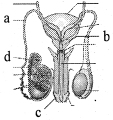
A
$a-$ Vas deferens,$b-$ Prostate,$c-$ Glans penis,$d-$ Epididymis
B
$a-$ Rete testis,$b-$ Bulbourethral gland,$c-$ Foreskin,$d-$ Vas deferens
C
$a-$ Epididymis,$b-$ Bulbourethral gland,$c-$ Glans penis,$d-$ Vas deferens
D
$a-$ Vas deferens,$b-$ Prostate,$c-$ Foreskin,$d-$ Rete testis
Solution
(A) In the provided diagram of the human male reproductive system:
$a$ represents the Vas deferens,which transports sperm from the epididymis to the ejaculatory duct.
$b$ represents the Prostate gland,an accessory gland that contributes to seminal fluid.
$c$ represents the Glans penis,the enlarged end of the penis.
$d$ represents the Epididymis,where sperm mature and are stored.
Therefore,the correct identification is $a-$ Vas deferens,$b-$ Prostate,$c-$ Glans penis,$d-$ Epididymis.
$a$ represents the Vas deferens,which transports sperm from the epididymis to the ejaculatory duct.
$b$ represents the Prostate gland,an accessory gland that contributes to seminal fluid.
$c$ represents the Glans penis,the enlarged end of the penis.
$d$ represents the Epididymis,where sperm mature and are stored.
Therefore,the correct identification is $a-$ Vas deferens,$b-$ Prostate,$c-$ Glans penis,$d-$ Epididymis.
0 likes
View Solution221
EasyMCQ
What is the process of circumcision?
A
Removal of the glans penis
B
Amputation of the penis
C
Removal of the foreskin (prepuce) from the glans penis
D
Removal of the entire skin of the penis
Solution
(C) Circumcision is a surgical procedure in which the foreskin,also known as the prepuce,is removed from the glans penis. This procedure is often performed for religious,cultural,or medical reasons. It does not involve the removal of the glans itself or the entire skin of the penis.
0 likes
View Solution222
EasyMCQ
The surgical removal of the testis is called...........
A
Cryptorchidism
B
Orchidectomy
C
Vasectomy
D
Tubectomy
Solution
(B) The surgical removal of one or both testes is known as $Orchidectomy$ (or $Orchiectomy$).
$Cryptorchidism$ refers to the condition where the testes fail to descend into the scrotum.
$Vasectomy$ is a surgical procedure for male sterilization where the $vas$ $deferens$ are cut or tied.
$Tubectomy$ is a surgical procedure for female sterilization where the fallopian tubes are blocked or cut.
$Cryptorchidism$ refers to the condition where the testes fail to descend into the scrotum.
$Vasectomy$ is a surgical procedure for male sterilization where the $vas$ $deferens$ are cut or tied.
$Tubectomy$ is a surgical procedure for female sterilization where the fallopian tubes are blocked or cut.
0 likes
View Solution223
MediumMCQ
In $Cryptorchidism$,the testes fail to descend into the scrotum. What is the surgical procedure to bring the testes into the scrotum called?
A
Orchiopexy
B
Vasectomy
C
Non-cryptorchidism
D
None of these
Solution
(A) $Cryptorchidism$ is a condition where one or both testes fail to descend into the scrotum during development.
The surgical procedure performed to move an undescended testis into the scrotum and permanently fix it there is known as $Orchiopexy$.
$Vasectomy$ is a method of male sterilization where the $vas$ $deferens$ are cut or blocked.
Therefore,the correct answer is $Orchiopexy$.
The surgical procedure performed to move an undescended testis into the scrotum and permanently fix it there is known as $Orchiopexy$.
$Vasectomy$ is a method of male sterilization where the $vas$ $deferens$ are cut or blocked.
Therefore,the correct answer is $Orchiopexy$.
0 likes
View Solution224
MediumMCQ
Compared to a bullock,a bull has higher levels of which of the following?
A
Adrenaline and Noradrenaline
B
Testosterone
C
Thyroxine
D
All of the above
Solution
(B) bull is an intact male bovine,while a bullock (steer) is a castrated male bovine.
Castration involves the removal of the testes,which are the primary source of the male sex hormone,$Testosterone$.
Since the bullock lacks functional testes,its $Testosterone$ levels are significantly lower than those of an intact bull.
$Testosterone$ is responsible for the development of secondary sexual characteristics,increased muscle mass,and aggressive behavior in bulls.
Therefore,a bull has higher levels of $Testosterone$ compared to a bullock.
Castration involves the removal of the testes,which are the primary source of the male sex hormone,$Testosterone$.
Since the bullock lacks functional testes,its $Testosterone$ levels are significantly lower than those of an intact bull.
$Testosterone$ is responsible for the development of secondary sexual characteristics,increased muscle mass,and aggressive behavior in bulls.
Therefore,a bull has higher levels of $Testosterone$ compared to a bullock.
0 likes
View Solution225
EasyMCQ
Identify the correct label and its function based on the provided diagram of the human male reproductive system.
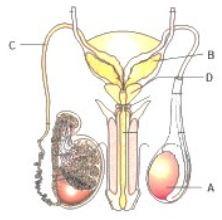
A
$(A)$ Testis - contains $250$ testicular lobules.
B
$(B)$ Seminal vesicle - stores sperms.
C
$(C)$ Vas deferens - helps in the transport of sperms.
D
$(D)$ Prostate gland - secretes seminal fluid.
Solution
(C) The correct option is $(C).$
In the given diagram:
$A$ represents the Testis,which contains about $250$ testicular lobules.
$B$ represents the Urinary bladder (not the seminal vesicle).
$C$ represents the Vas deferens,which transports sperms from the epididymis towards the urethra.
$D$ represents the Seminal vesicle.
Therefore,the statement '$C$ - Vas deferens - helps in the transport of sperms' is scientifically correct.
In the given diagram:
$A$ represents the Testis,which contains about $250$ testicular lobules.
$B$ represents the Urinary bladder (not the seminal vesicle).
$C$ represents the Vas deferens,which transports sperms from the epididymis towards the urethra.
$D$ represents the Seminal vesicle.
Therefore,the statement '$C$ - Vas deferens - helps in the transport of sperms' is scientifically correct.
0 likes
View Solution226
MediumMCQ
Development of epididymis,vas deferens,seminal vesicles,prostate glands and urethra is controlled by
A
Estrogen
B
Progesterone
C
Androgen
D
Pituitary hormone
Solution
(C) The development,maturation,and functional regulation of male accessory sex organs,including the epididymis,vas deferens,seminal vesicles,prostate gland,and urethra,are primarily controlled by androgens (such as testosterone). These hormones are essential for the maintenance of the male reproductive system.
0 likes
View Solution227
MediumMCQ
In humans,the testis functions as
A
Primary sex organ
B
Secondary sex organ
C
Endocrine gland
D
Both $(A)$ and $(C)$
Solution
(D) The testis performs a dual function in humans.
First,it acts as a primary sex organ because it produces male gametes (sperms) through the process of spermatogenesis.
Second,it acts as an endocrine gland because the Leydig cells (interstitial cells) present in the interstitial space produce androgens,primarily testosterone,which are released directly into the blood.
Therefore,the testis functions as both a primary sex organ and an endocrine gland.
First,it acts as a primary sex organ because it produces male gametes (sperms) through the process of spermatogenesis.
Second,it acts as an endocrine gland because the Leydig cells (interstitial cells) present in the interstitial space produce androgens,primarily testosterone,which are released directly into the blood.
Therefore,the testis functions as both a primary sex organ and an endocrine gland.
0 likes
View Solution228
MediumMCQ
The Leydig's cells secrete
A
Oestrogen
B
Testosterone
C
Progesterone
D
Corticosterone
Solution
(B) Leydig's cells,also known as interstitial cells,are characteristic of the testes of mammals.
These cells secrete the male sex hormone testosterone,which influences secondary sexual characters in males.
These cells secrete the male sex hormone testosterone,which influences secondary sexual characters in males.
0 likes
View Solution229
MediumMCQ
$A$: Occasionally,mammary glands are functional in males,and the condition is called gynaecomastia.
$R$: Decreased testosterone in later life may also lead to gynaecomastia. It is usually due to the perturbation of the estrogen-to-androgen ratio.
$R$: Decreased testosterone in later life may also lead to gynaecomastia. It is usually due to the perturbation of the estrogen-to-androgen ratio.
A
Assertion and Reason both are correct and Reason is the correct explanation of Assertion.
B
Assertion and Reason both are correct but Reason is not the correct explanation of Assertion.
C
Assertion is correct,but Reason is incorrect.
D
Both Assertion and Reason are incorrect.
Solution
(A) Gynaecomastia is the abnormal development or enlargement of mammary glands in males.
In later life,hormonal imbalances,such as a decrease in testosterone levels,can occur.
This leads to a perturbation in the estrogen-to-androgen ratio,where the relative influence of estrogen increases,promoting the development of breast tissue in males.
Therefore,both the assertion and the reason are correct,and the reason provides the correct explanation for the assertion.
In later life,hormonal imbalances,such as a decrease in testosterone levels,can occur.
This leads to a perturbation in the estrogen-to-androgen ratio,where the relative influence of estrogen increases,promoting the development of breast tissue in males.
Therefore,both the assertion and the reason are correct,and the reason provides the correct explanation for the assertion.
0 likes
View Solution230
EasyMCQ
Cryptorchidism is a condition in which
A
Testis does not descend into the scrotal sac
B
Male hormones are not reactive
C
Sperm is not found
D
Ovaries are removed
Solution
(A) Cryptorchidism is a medical condition in which one or both of the testes fail to descend from the abdomen into the scrotal sac during development. This condition is significant because the temperature in the scrotal sac is lower than the body temperature,which is essential for normal spermatogenesis.
0 likes
View Solution231
EasyMCQ
In humans,the unpaired male reproductive structure is
A
Seminal vesicle
B
Prostate
C
Bulbourethral gland
D
Testes
Solution
(B) In the human male reproductive system,the prostate gland is a single,unpaired,and large gland.
It is situated around the first part of the urethra.
It secretes a thin,milky fluid that contains calcium,citrate ions,phosphate ions,a clotting enzyme,and a profibrinolysin.
In contrast,seminal vesicles,bulbourethral glands,and testes are all present in pairs.
It is situated around the first part of the urethra.
It secretes a thin,milky fluid that contains calcium,citrate ions,phosphate ions,a clotting enzyme,and a profibrinolysin.
In contrast,seminal vesicles,bulbourethral glands,and testes are all present in pairs.
0 likes
View Solution232
MediumMCQ
The Leydig's cells secrete:
A
Oestrogen
B
Testosterone
C
Progesterone
D
Corticosterone
Solution
(B) Leydig's cells,also known as interstitial cells,are located in the connective tissue surrounding the seminiferous tubules in the testes.
These cells are endocrine in nature and are responsible for the synthesis and secretion of male sex hormones,collectively known as androgens,primarily $Testosterone$.
$Testosterone$ plays a crucial role in the development of male secondary sexual characteristics and the process of spermatogenesis.
In contrast,$Oestrogen$ and $Progesterone$ are female sex hormones,while $Corticosterone$ is a glucocorticoid secreted by the adrenal cortex.
These cells are endocrine in nature and are responsible for the synthesis and secretion of male sex hormones,collectively known as androgens,primarily $Testosterone$.
$Testosterone$ plays a crucial role in the development of male secondary sexual characteristics and the process of spermatogenesis.
In contrast,$Oestrogen$ and $Progesterone$ are female sex hormones,while $Corticosterone$ is a glucocorticoid secreted by the adrenal cortex.
0 likes
View Solution233
EasyMCQ
Vasa deferentia together with the duct from the seminal vesicle forms:
A
Caput epididymis
B
Corpus epididymis
C
Ejaculatory duct
D
Cauda epididymis
Solution
(C) The $vas$ $deferens$ loops over the urinary bladder,where it is joined by the duct from the seminal vesicle to form the ejaculatory duct. The ejaculatory duct stores and transports sperm from the testes to the urethra.
0 likes
View Solution234
MediumMCQ
The organs which produce gametes are called $...A...$ and those which neither produce gametes nor hormones are called $...B...$. Here $A$ and $B$ represent:
A
$A-$Primary sex organs; $B-$Secondary sex organs
B
$A-$Secondary sex organs; $B-$Primary sex organs
C
$A-$Tertiary sex organs; $B-$Secondary sex organs
D
$A-$Secondary sex organs; $B-$Tertiary sex organs
Solution
(A) Primary sex organs (gonads like testes or ovaries) are responsible for the production of gametes and the secretion of sex hormones.
Secondary sex organs (such as the vas deferens,epididymis,fallopian tubes,uterus,etc.) are involved in the transport and storage of gametes or the development of the fetus,but they do not produce gametes or sex hormones themselves.
Therefore,$A$ represents primary sex organs and $B$ represents secondary sex organs.
Secondary sex organs (such as the vas deferens,epididymis,fallopian tubes,uterus,etc.) are involved in the transport and storage of gametes or the development of the fetus,but they do not produce gametes or sex hormones themselves.
Therefore,$A$ represents primary sex organs and $B$ represents secondary sex organs.
0 likes
View Solution235
EasyMCQ
The enlarged end of the penis,known as the glans penis,is covered by a loose fold of skin called:
A
Foreskin
B
Prepuce
C
Both $(A)$ and $(B)$
D
None of the above
Solution
(C) The glans penis is the enlarged,sensitive end of the penis.
It is covered by a loose,retractable fold of skin.
This fold of skin is known as the foreskin or prepuce.
Therefore,both terms refer to the same anatomical structure.
It is covered by a loose,retractable fold of skin.
This fold of skin is known as the foreskin or prepuce.
Therefore,both terms refer to the same anatomical structure.
0 likes
View Solution236
EasyMCQ
The seminal plasma along with the sperm is called
A
Spermatid
B
Spermatozoa
C
Semen
D
All of these
Solution
(C) Seminal plasma is the combined secretion of three glands: $(a)$ seminal vesicles,$(b)$ prostate gland,and $(c)$ bulbourethral (Cowper's) gland.
When these secretions are mixed with sperm,they collectively form semen.
When these secretions are mixed with sperm,they collectively form semen.
0 likes
View Solution237
MediumMCQ
The primary sex organ in man is:
A
Scrotum
B
Accessory gland
C
Testis
D
Urinary bladder
Solution
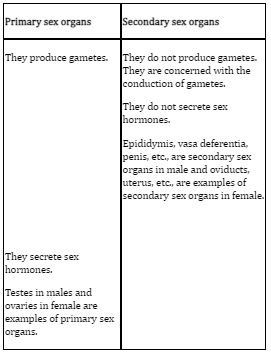
(C) The primary sex organs are those that are responsible for the production of gametes and the secretion of sex hormones. In males,the testes are the primary sex organs because they produce sperms (male gametes) and secrete the male sex hormone,testosterone. Secondary sex organs are involved in the transport and maturation of gametes but do not produce them. The differences are summarized below:
| Primary sex organs | Secondary sex organs |
|---|---|
| They produce gametes. | They do not produce gametes. They are concerned with the conduction of gametes. |
| They secrete sex hormones. | They do not secrete sex hormones. |
| Testes in males and ovaries in females are examples of primary sex organs. | Epididymis,vasa deferentia,penis,etc.,are secondary sex organs in males and oviducts,uterus,etc.,are examples of secondary sex organs in females. |
0 likes
View Solution238
EasyMCQ
The $Cauda$ $epididymis$ leads to:
A
Vas efferens
B
Vas deferens
C
Ejaculatory duct
D
Rete testis
Solution
(B) The $Vas$ $deferens$ is a large duct that arises from the $Cauda$ $epididymis$ and ascends into the abdomen,looping over the urinary bladder to reach the seminal vesicles.
0 likes
View Solution239
MediumMCQ
Most mammals have a testis sac called the scrotal sac,which is for:
A
Protection
B
Ova formation
C
Sperm formation
D
Temperature regulation
Solution
(D) The scrotal sac maintains the temperature of the testes at $2-2.5^{\circ}C$ lower than the internal body temperature.
This lower temperature is essential for spermatogenesis (sperm formation).
Therefore,the primary function of the scrotal sac is temperature regulation,which subsequently enables sperm production.
This lower temperature is essential for spermatogenesis (sperm formation).
Therefore,the primary function of the scrotal sac is temperature regulation,which subsequently enables sperm production.
0 likes
View Solution240
EasyMCQ
Sertoli cells are also called
A
Subtentacular cells
B
Sperm cells
C
Interstitial cells
D
Leydig cells
Solution
(A) Sertoli cells are specialized somatic cells found within the seminiferous tubules of the testes. They provide structural and nutritional support to developing germ cells,which is why they are also known as subtentacular cells.
0 likes
View Solution241
MediumMCQ
Two major entities seen in human testis $TS$ are
A
Sertoli cells and interstitial cells
B
Spermatozoa and Sertoli cells
C
Seminiferous tubules and Leydig cells
D
Seminiferous tubules and Sertoli cells
Solution
(C) The human testis is primarily composed of two major structural and functional components:
$1$. Seminiferous tubules: These are the highly coiled structures where spermatogenesis occurs.
$2$. Interstitial space: The region outside the seminiferous tubules,which contains Leydig cells (interstitial cells) that secrete androgens.
Sertoli cells and developing spermatozoa are located within the seminiferous tubules themselves,not as separate major entities of the testis structure as a whole.
$1$. Seminiferous tubules: These are the highly coiled structures where spermatogenesis occurs.
$2$. Interstitial space: The region outside the seminiferous tubules,which contains Leydig cells (interstitial cells) that secrete androgens.
Sertoli cells and developing spermatozoa are located within the seminiferous tubules themselves,not as separate major entities of the testis structure as a whole.
0 likes
View Solution242
MediumMCQ
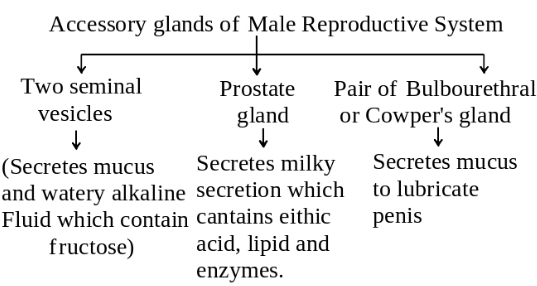
Label $A, B, C, D$ in the following diagram of the male reproductive system.
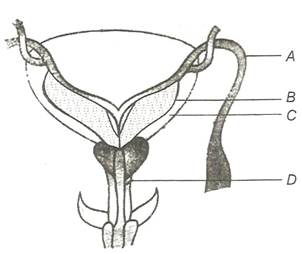
A
$A-$Vas deferens,$B-$Seminal vesicle,$C-$Urinary bladder,$D-$Prostate gland
B
$A-$Ureter,$B-$Prostate,$C-$Seminal vesicle,$D-$Bulbourethral gland
C
$A-$Vas deferens,$B-$Seminal vesicle,$C-$Urinary bladder,$D-$Bulbourethral gland
D
$A-$Vas deferens,$B-$Vesicle,$C-$Bulbourethral gland,$D-$Prostate
Solution
(A) Based on the anatomical structure of the male reproductive system:
$A$ represents the Vas deferens,which carries sperm from the epididymis.
$B$ represents the Seminal vesicle,which secretes a fluid containing fructose.
$C$ represents the Urinary bladder,which stores urine.
$D$ represents the Prostate gland,which surrounds the urethra and secretes a milky fluid.
$A$ represents the Vas deferens,which carries sperm from the epididymis.
$B$ represents the Seminal vesicle,which secretes a fluid containing fructose.
$C$ represents the Urinary bladder,which stores urine.
$D$ represents the Prostate gland,which surrounds the urethra and secretes a milky fluid.
0 likes
View Solution243
EasyMCQ
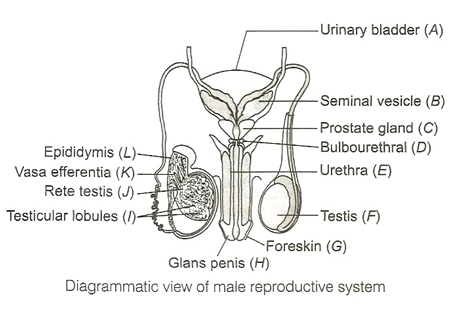
The seminiferous tubules of the testis open into the vasa efferentia by:
A
Vasa deferentia
B
Rete testis
C
Epididymis
D
Seminiferous tubules
Solution
(B) The seminiferous tubules of the testis open into the vasa efferentia through the rete testis.
$1$. The seminiferous tubules are the structural and functional units of the testis where sperm production occurs.
$2$. These tubules join together to form a network of tubules known as the rete testis.
$3$. From the rete testis,fine ciliated ductules called vasa efferentia arise,which carry the sperm out of the testis to the epididymis.
$1$. The seminiferous tubules are the structural and functional units of the testis where sperm production occurs.
$2$. These tubules join together to form a network of tubules known as the rete testis.
$3$. From the rete testis,fine ciliated ductules called vasa efferentia arise,which carry the sperm out of the testis to the epididymis.
0 likes
View Solution244
EasyMCQ
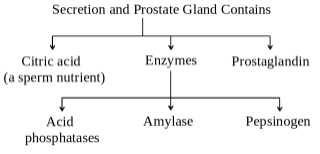
The prostate gland surrounds the $A$. It produces a milky, slightly alkaline solution which forms $B$ volume of the semen. The secretion contains $C$ acid and enzymes (acid phosphatases, amylase, pepsinogen, and prostaglandins). $A$, $B$, and $C$ in the above statement are:
A
$A - \text{prostate gland}, B - 35\%, C - \text{carboxylic}$
B
$A - \text{penis}, B - 40\%, C - \text{carboxylic}$
C
$A - \text{urethra}, B - 25\%, C - \text{citric}$
D
$A - \text{ureter}, B - 50\%, C - \text{citric}$
Solution
(C) The prostate gland is located around the urethra.
Its secretion is milky and slightly alkaline, contributing approximately $25\%$ to the total volume of semen.
The secretion is rich in citric acid, acid phosphatases, amylase, pepsinogen, and prostaglandins.
Therefore, $A = \text{urethra}$, $B = 25\%$, and $C = \text{citric}$.
Its secretion is milky and slightly alkaline, contributing approximately $25\%$ to the total volume of semen.
The secretion is rich in citric acid, acid phosphatases, amylase, pepsinogen, and prostaglandins.
Therefore, $A = \text{urethra}$, $B = 25\%$, and $C = \text{citric}$.
0 likes
View Solution245
EasyMCQ
Males have a number of internal accessory organs. Which one$(s)$ is/are responsible for secreting fluid containing fructose and prostaglandins?
A
Epididymis
B
Seminal vesicles
C
Vas deferens
D
Prostate gland
Solution
(B) The seminal vesicles are accessory glands in the male reproductive system.
They secrete a fluid that constitutes about $60-70\%$ of the total volume of semen.
This fluid is rich in fructose,which provides energy to the sperm,and prostaglandins,which help in the movement of sperm within the female reproductive tract.
They secrete a fluid that constitutes about $60-70\%$ of the total volume of semen.
This fluid is rich in fructose,which provides energy to the sperm,and prostaglandins,which help in the movement of sperm within the female reproductive tract.
0 likes
View Solution246
EasyMCQ
During early and middle fetal life,the testes are located in the:
A
Inguinal canal
B
Abdominal cavity
C
Pelvic cavity
D
Scrotal sacs
Solution
(B) During early and middle fetal life,the testes develop in the abdominal cavity.
They descend into the scrotal sacs during the late fetal development stage.
Failure of the testes to descend into the scrotum is a condition known as $Cryptorchidism$.
They descend into the scrotal sacs during the late fetal development stage.
Failure of the testes to descend into the scrotum is a condition known as $Cryptorchidism$.
0 likes
View Solution247
EasyMCQ
Where do sperms get matured?
A
In seminal vesicle
B
Seminiferous tubules
C
In epididymis
D
Vasa efferentia
Solution
(C) Epididymis is a mass of coiled tubules attached to the posterior surface of the testes.
It stores the sperms temporarily.
Sperms achieve maturity and motility in the epididymis by the reabsorption of fluid originally secreted by the seminiferous tubules and by chemicals produced by the lining of the epididymal tube.
It stores the sperms temporarily.
Sperms achieve maturity and motility in the epididymis by the reabsorption of fluid originally secreted by the seminiferous tubules and by chemicals produced by the lining of the epididymal tube.
0 likes
View Solution248
MediumMCQ
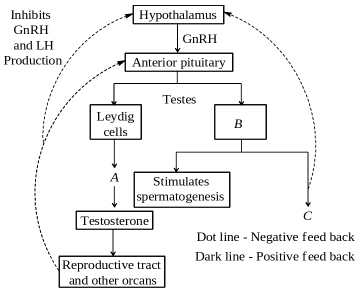
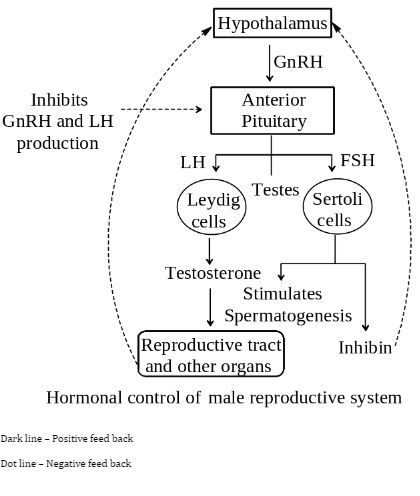
Find out $A, B$ and $C$ in the figure given below.
A
$A-$Sertoli cell,$B-$Testosterone,$C-$Inhibin
B
$A-$Inhibin,$B-$Sertoli cell,$C-$Testosterone
C
$A-$Testosterone,$B-$Sertoli cell,$C-$Inhibin
D
$A-$Testosterone,$B-$Sertoli cell,$C-$Testosterone
Solution
(C) $A-$Testosterone,$B-$Sertoli cell,$C-$Inhibin.
Hormonal Control of Spermatogenesis:
Spermatogenesis is initiated due to the increase in Gonadotropin Releasing Hormone $(GnRH)$ by the hypothalamus.
$GnRH$ acts on the anterior lobe of the pituitary gland to secrete Luteinising Hormone $(LH)$ and Follicle Stimulating Hormone $(FSH)$.
$LH$ acts on the Leydig cells of the testis to secrete testosterone.
$FSH$ acts on the Sertoli cells of the seminiferous tubules of the testis to secrete an androgen-binding protein $(ABP)$ and inhibin.
$ABP$ concentrates testosterone in the seminiferous tubules.
Inhibin suppresses $FSH$ synthesis.
$FSH$ acts on spermatogonia to stimulate sperm production.
Hormonal Control of Spermatogenesis:
Spermatogenesis is initiated due to the increase in Gonadotropin Releasing Hormone $(GnRH)$ by the hypothalamus.
$GnRH$ acts on the anterior lobe of the pituitary gland to secrete Luteinising Hormone $(LH)$ and Follicle Stimulating Hormone $(FSH)$.
$LH$ acts on the Leydig cells of the testis to secrete testosterone.
$FSH$ acts on the Sertoli cells of the seminiferous tubules of the testis to secrete an androgen-binding protein $(ABP)$ and inhibin.
$ABP$ concentrates testosterone in the seminiferous tubules.
Inhibin suppresses $FSH$ synthesis.
$FSH$ acts on spermatogonia to stimulate sperm production.
0 likes
View Solution249
MediumMCQ
Ejaculation is the $...A...$ response. Erection is a $...B...$ response. Here,$A$ and $B$ refer to:
A
$A-$parasympathetic,$B-$sympathetic
B
$A-$parasympathetic,$B-$parasympathetic
C
$A-$sympathetic,$B-$parasympathetic
D
$A-$sympathetic,$B-$sympathetic
Solution
(C) Ejaculation is a sympathetic response,which involves the contraction of smooth muscles in the reproductive tract to expel semen.
Erection is a parasympathetic response,which involves the dilation of blood vessels in the penis to allow blood flow into the erectile tissues.
Both sympathetic and parasympathetic nervous systems are divisions of the autonomic nervous system.
Erection is a parasympathetic response,which involves the dilation of blood vessels in the penis to allow blood flow into the erectile tissues.
Both sympathetic and parasympathetic nervous systems are divisions of the autonomic nervous system.
| Somatic Nervous System | Autonomic Nervous System |
| Conscious or voluntary regulation. Fibres do not synapse after they leave the $CNS$ (single neuron from $CNS$ to effector organ). Innervates skeletal muscle fibres,always stimulatory. | Functions without conscious awareness (involuntary). Fibres synapse once at a ganglion after they leave the $CNS$ (two neuron chain motor control). Innervates smooth muscle,cardiac muscle,and glands; either stimulates or inhibits. |
0 likes
View Solution250
MediumMCQ
The epididymis leads to $...A...$ that ascends to the abdomen and loops over the $...B....$ Here $A$ and $B$ refer to:
A
$A-$epididymis; $B-$vas deferens
B
$A-$vas deferens; $B-$epididymis
C
$A-$vas deferens; $B-$urinary bladder
D
$A-$urinary bladder; $B-$vas deferens
Solution
(C) The epididymis leads to the $vas \ deferens$ (vas deferens) that ascends to the abdomen and loops over the $urinary \ bladder$.
Therefore,$A$ refers to the $vas \ deferens$ and $B$ refers to the $urinary \ bladder$.
Thus,the correct option is $C$.
Therefore,$A$ refers to the $vas \ deferens$ and $B$ refers to the $urinary \ bladder$.
Thus,the correct option is $C$.
0 likes
View SolutionHuman Reproduction — Male reproductive system · Frequently Asked Questions
1Are these Human Reproduction questions useful for JEE and NEET?
Yes. All questions in this section are mapped to JEE Main and NEET exam patterns. Previous year questions from JEE Main, NEET, GUJCET and state-level exams are included with full solutions.
2Can I switch to Hindi or Gujarati for these questions?
Yes. Use the language tabs in the hero section or the sidebar to view the same questions and solutions in English, Hindi or Gujarati.
3How do I generate a question paper from this subtopic?
Use the Vedclass Exam Paper Generator — select the chapter and subtopic, set difficulty, and generate Sets A, B, C, D automatically. First 3 chapters of every subject are free.
Vedclass Products
For Students
Vedclass Test Series
Mock tests in real JEE/NEET style with performance analysis. 5-day free trial.
Start Free TrialFor Teachers
Exam Paper Generator
Generate Set A/B/C/D papers from this chapter in 2 minutes. 3 chapters free.
Try FreeFor Institutes
Online Exam Module
Live online exams with unlimited students, 360° analytics & white-label branding.
See DemoFor Teachers & Institutes
Generate a Human Reproduction Exam Paper in 2 Minutes
Select subtopic & difficulty — Sets A, B, C, D auto-generated with No Repeat logic.
First 3 chapters of every subject are free — no payment required.