
A English
Male reproductive system Questions in English
Class 12 Biology · Human Reproduction · Male reproductive system
325+
Questions
English
Language
100%
With Solutions
Showing 49 of 325 questions in English
101
EasyMCQ
Sertoli cells are found in:
A
Mammalian testis
B
Mammalian ovary
C
Earthworm testis
D
Frog pancreas
Solution
(A) Sertoli cells,also known as nurse cells,are specialized cells found within the seminiferous tubules of the mammalian testis.
They provide structural and nutritional support to the developing germ cells (spermatids) during the process of spermatogenesis.
They also play a role in the blood-testis barrier and secrete substances that facilitate sperm maturation.
They provide structural and nutritional support to the developing germ cells (spermatids) during the process of spermatogenesis.
They also play a role in the blood-testis barrier and secrete substances that facilitate sperm maturation.
0 likes
View Solution102
MediumMCQ
In which of the following animals do the testes descend into the scrotum only during the breeding season?
A
Frog
B
Kangaroo
C
Shrew
D
Bat
Solution
(D) In many mammals,the testes are permanently located in the scrotum. However,in certain mammals like bats $(Chiroptera)$ and some rodents,the testes descend into the scrotum only during the breeding season and retract into the abdominal cavity during the non-breeding season. This phenomenon is known as seasonal migration of testes.
0 likes
View Solution103
EasyMCQ
In mammals,the testes are located in:
A
Abdominal cavity
B
Thoracic cavity
C
Extra-abdominal cavity (Scrotum)
D
Pericardial cavity
Solution
(C) In mammals,the testes are situated outside the abdominal cavity within a pouch called the scrotum.
This extra-abdominal location is essential because the process of spermatogenesis requires a temperature approximately $2-2.5^{\circ}C$ lower than the normal internal body temperature.
The scrotum helps in maintaining this lower temperature,which is necessary for the production and survival of sperm.
This extra-abdominal location is essential because the process of spermatogenesis requires a temperature approximately $2-2.5^{\circ}C$ lower than the normal internal body temperature.
The scrotum helps in maintaining this lower temperature,which is necessary for the production and survival of sperm.
0 likes
View Solution104
MediumMCQ
What is the highest concentration found in human seminal plasma?
A
Fructose and some enzymes,but very low calcium
B
Fructose,calcium,and certain enzymes
C
Fructose and calcium,but no enzymes
D
Glucose and enzymes,but no calcium
Solution
(B) Seminal plasma in humans is rich in $Fructose$,$Calcium$,and certain enzymes. $Fructose$ is the primary energy source for sperm,while $Calcium$ and various enzymes (secreted by the seminal vesicles,prostate gland,and bulbourethral glands) facilitate sperm motility and survival. Therefore,option $B$ is the correct answer.
0 likes
View Solution105
EasyMCQ
What are the location and secretion of the $Leydig$ cells,respectively?
A
Liver - Cholesterol
B
Ovary - Estrogen
C
Testis - Testosterone
D
Pancreas - Glucagon
Solution
(C) The $Leydig$ cells,also known as interstitial cells,are located in the interstitial spaces between the seminiferous tubules of the $Testis$.
These cells are responsible for the synthesis and secretion of androgen hormones,primarily $Testosterone$,which is essential for the development of male secondary sexual characteristics and spermatogenesis.
These cells are responsible for the synthesis and secretion of androgen hormones,primarily $Testosterone$,which is essential for the development of male secondary sexual characteristics and spermatogenesis.
0 likes
View Solution106
MediumMCQ
Which gland/structure secretes the male sex hormone?
A
Leydig cells
B
Seminiferous tubules
C
Vas deferens
D
Testis
Solution
(A) The male sex hormone,known as $Testosterone$,is secreted by the $Leydig$ cells (also known as interstitial cells) present in the interstitial spaces of the $Testis$.
These cells are located outside the $Seminiferous$ $tubules$ and are stimulated by the $Luteinizing$ $Hormone$ $(LH)$ to synthesize and secrete androgens,primarily $Testosterone$.
These cells are located outside the $Seminiferous$ $tubules$ and are stimulated by the $Luteinizing$ $Hormone$ $(LH)$ to synthesize and secrete androgens,primarily $Testosterone$.
0 likes
View Solution107
EasyMCQ
In the mammalian reproductive system,testicular degeneration and other diseases occur due to the deficiency of .......
A
Vitamin $D$
B
Vitamin $B$
C
Vitamin $K$
D
Vitamin $E$
Solution
(D) Vitamin $E$ is known as the anti-sterility vitamin.
Its deficiency leads to the degeneration of germinal epithelium in the testes,which causes testicular degeneration and impaired reproductive function in mammals.
It is essential for the normal functioning of the reproductive system.
Its deficiency leads to the degeneration of germinal epithelium in the testes,which causes testicular degeneration and impaired reproductive function in mammals.
It is essential for the normal functioning of the reproductive system.
0 likes
View Solution108
MediumMCQ
What will happen if the epididymis is absent?
A
The lifespan of sperm will decrease.
B
Sperm will pass through the pathway rapidly.
C
Functional maturation will become faster.
D
Sperm will become incapable of fertilization.
Solution
(D) The epididymis is a long,coiled tube that stores sperm and provides an environment for their functional maturation. During their transit through the epididymis,sperm acquire motility and the ability to fertilize an egg. If the epididymis is absent,sperm will not undergo these essential maturation processes,rendering them incapable of fertilization.
0 likes
View Solution109
MediumMCQ
What happens if the $vas$ $deferens$ in a human male is cut?
A
Sperm cells will be formed without a nucleus.
B
Spermatogenesis will not occur.
C
Semen will be devoid of sperm.
D
Sperm will not become motile.
Solution
(C) The $vas$ $deferens$ is the duct that transports sperm from the testes to the urethra. If this duct is cut or ligated (a procedure known as a $vasectomy$),the production of sperm in the testes continues normally. However,the sperm cannot be transported to the ejaculatory duct. Consequently,the semen will be devoid of sperm.
0 likes
View Solution110
MediumMCQ
Which of the following is a derivative of the $Mullerian$ duct in male rabbits?
A
Prostatic utricle
B
Seminal vesicle
C
Cowper's gland
D
Urethra
Solution
(A) In male mammals,including rabbits,the $Mullerian$ ducts (paramesonephric ducts) typically regress due to the presence of Anti-$Mullerian$ Hormone $(AMH)$. However,a small vestigial remnant of the $Mullerian$ duct persists in the male reproductive system as the $Prostatic$ $utricle$ (also known as the $utriculus$ $prostaticus$),which is located in the prostate gland.
0 likes
View Solution111
EasyMCQ
What is the $Tunica \text{ } albuginea$ a covering of?
A
Ovary
B
Testis
C
Kidney
D
Liver
Solution
(B) The $Tunica \text{ } albuginea$ is a tough, fibrous connective tissue capsule that covers the $Testis$. It is also present in the $Ovary$, but in the context of standard biological terminology and common multiple-choice questions, it is primarily identified as the dense fibrous capsule surrounding the $Testis$. Therefore, the most appropriate answer is $Testis$.
0 likes
View Solution112
MediumMCQ
If the testes of a male rabbit do not descend from the abdominal cavity into the scrotal sac,then .......
A
The rabbit will die
B
Absence of male characteristics
C
The male reproductive system will not develop
D
Sperm will not be formed
Solution
(D) The testes are located outside the abdominal cavity within the scrotal sac because the process of spermatogenesis requires a temperature $2-2.5^{\circ}C$ lower than the normal internal body temperature. If the testes fail to descend into the scrotum (a condition known as cryptorchidism),the higher temperature of the abdominal cavity inhibits the production of viable sperm. Therefore,sperm will not be formed.
0 likes
View Solution113
EasyMCQ
The penile urethra runs through which of the following?
A
Corpus cavernosum
B
Corpus spongiosum
C
Corpus callosum
D
Corpus striatum
Solution
(B) The human penis consists of three cylindrical masses of erectile tissue: two dorsal columns called the $Corpus \ cavernosum$ and one ventral column called the $Corpus \ spongiosum$.
The penile urethra (the tube that carries both urine and semen) passes through the center of the $Corpus \ spongiosum$ and opens at the tip of the penis as the urethral meatus.
Therefore,the correct option is $B$.
The penile urethra (the tube that carries both urine and semen) passes through the center of the $Corpus \ spongiosum$ and opens at the tip of the penis as the urethral meatus.
Therefore,the correct option is $B$.
0 likes
View Solution114
EasyMCQ
The scrotum is a thin skin pouch that contains the......
A
Ovary
B
Testis
C
Kidney
D
Liver
Solution
(B) The scrotum is a pouch of skin that hangs outside the abdominal cavity. It contains the $Testis$ (plural: $Testes$). The main function of the scrotum is to maintain the temperature of the testes $2-2.5^{\circ}C$ lower than the normal internal body temperature, which is essential for spermatogenesis.
0 likes
View Solution115
MediumMCQ
The male penis is covered by a loose fold of skin,which is called:
A
Foreskin
B
Urethral meatus
C
External genitalia
D
Fimbriae
Solution
(A) The male external genitalia is called the penis. The enlarged end of the penis is called the glans penis,which is covered by a loose fold of skin called the foreskin or prepuce.
0 likes
View Solution116
EasyMCQ
Where are the seminiferous tubules found?
A
Liver
B
Kidney
C
Ovary
D
Testis
Solution
(D) The seminiferous tubules are the structural and functional units of the testis. They are highly coiled structures located within the testicular lobules of the testis. These tubules are the sites where spermatogenesis (the process of sperm production) occurs.
0 likes
View Solution117
EasyMCQ
What is the condition called when the testes fail to descend into the scrotum in mammals?
A
Cryptorchidism
B
Castration
C
Infertility
D
Impotence
Solution
(A) The condition in which one or both testes fail to descend from the abdomen into the scrotum during development is known as $Cryptorchidism$.
Normally,the testes descend into the scrotum during the later stages of fetal development because the temperature in the scrotum is $2-2.5^{\circ}C$ lower than the internal body temperature,which is essential for spermatogenesis.
If the testes remain in the abdominal cavity,the higher body temperature can lead to impaired sperm production and potential infertility.
Normally,the testes descend into the scrotum during the later stages of fetal development because the temperature in the scrotum is $2-2.5^{\circ}C$ lower than the internal body temperature,which is essential for spermatogenesis.
If the testes remain in the abdominal cavity,the higher body temperature can lead to impaired sperm production and potential infertility.
0 likes
View Solution118
MediumMCQ
Which of the following is an accessory reproductive gland?
A
Seminiferous tubule
B
Cowper's gland
C
Prostate gland
D
All of the above
Solution
(D) The male reproductive system includes accessory glands that secrete fluids to nourish and protect sperm.
These glands include the seminal vesicles,the prostate gland,and the bulbourethral glands (also known as Cowper's glands).
Seminiferous tubules are the sites of sperm production within the testes,not accessory glands.
Since both Cowper's gland and the prostate gland are accessory reproductive glands,the correct answer is $D$ (All of the above) is incorrect because seminiferous tubules are not glands. However,in many multiple-choice contexts where multiple options are correct,the question implies identifying the accessory glands. Given the options,both $B$ and $C$ are accessory glands. Therefore,the most appropriate answer in this context is $D$ if we consider the collective group,but strictly speaking,$B$ and $C$ are the glands.
These glands include the seminal vesicles,the prostate gland,and the bulbourethral glands (also known as Cowper's glands).
Seminiferous tubules are the sites of sperm production within the testes,not accessory glands.
Since both Cowper's gland and the prostate gland are accessory reproductive glands,the correct answer is $D$ (All of the above) is incorrect because seminiferous tubules are not glands. However,in many multiple-choice contexts where multiple options are correct,the question implies identifying the accessory glands. Given the options,both $B$ and $C$ are accessory glands. Therefore,the most appropriate answer in this context is $D$ if we consider the collective group,but strictly speaking,$B$ and $C$ are the glands.
0 likes
View Solution119
MediumMCQ
Which of the following is a secondary sex organ?
A
Testis
B
Ovary
C
Beard
D
Vas deferens
Solution
(D) Primary sex organs are those that produce gametes and secrete sex hormones,such as the $Testis$ in males and $Ovary$ in females.
Secondary sex organs are those that do not produce gametes but are essential for the transport and maturation of gametes or for the maintenance of the reproductive tract.
Examples of secondary sex organs include the $Vas$ $deferens$,$Epididymis$,$Seminal$ $vesicles$,$Prostate$ $gland$,and the $Penis$.
Therefore,the $Vas$ $deferens$ is a secondary sex organ.
Secondary sex organs are those that do not produce gametes but are essential for the transport and maturation of gametes or for the maintenance of the reproductive tract.
Examples of secondary sex organs include the $Vas$ $deferens$,$Epididymis$,$Seminal$ $vesicles$,$Prostate$ $gland$,and the $Penis$.
Therefore,the $Vas$ $deferens$ is a secondary sex organ.
0 likes
View Solution120
MediumMCQ
Where are Sertoli cells found?
A
Human testis
B
Frog testis
C
Human ovary
D
Frog ovary
Solution
(A) Sertoli cells,also known as nurse cells,are specialized somatic cells found within the seminiferous tubules of the testis in mammals,including humans. Their primary function is to provide structural and metabolic support to the developing germ cells (spermatids) during the process of spermatogenesis.
0 likes
View Solution121
MediumMCQ
From where does the tunica vaginalis of the testis develop?
A
Tunica albuginea
B
Tunica vasculosa
C
Tunica vaginalis
D
Rete testis
Solution
(C) The testis is covered by three layers: Tunica vaginalis, Tunica albuginea, and Tunica vasculosa.
$1$. The $Tunica$ vaginalis is the outermost serous membrane covering the testis.
$2$. It is derived from the $peritoneum$ (specifically the processus vaginalis) during the descent of the testes into the scrotum.
$3$. Tunica albuginea is the fibrous capsule, and Tunica vasculosa is the innermost vascular layer.
$1$. The $Tunica$ vaginalis is the outermost serous membrane covering the testis.
$2$. It is derived from the $peritoneum$ (specifically the processus vaginalis) during the descent of the testes into the scrotum.
$3$. Tunica albuginea is the fibrous capsule, and Tunica vasculosa is the innermost vascular layer.
0 likes
View Solution122
MediumMCQ
What structures are connected by the vasa efferentia?
A
Connects the testis to the epididymis.
B
Connects the kidney to the cloaca.
C
Connects the testis to the urinogenital duct.
D
None of the above.
Solution
(A) The $vasa efferentia$ are a series of fine ciliated tubules that arise from the $rete testis$. These ducts leave the testis and open into the $epididymis$ located along the posterior surface of each testis. Therefore, they serve as the connecting link between the $testis$ (specifically the $rete testis$) and the $epididymis$.
0 likes
View Solution123
EasyMCQ
In which of the following are the testes always located within the abdominal cavity?
A
Elephant
B
Whale
C
Armadillo
D
All of the above
Solution
(D) In most mammals,the testes descend into the scrotum outside the abdominal cavity to maintain a temperature lower than the body temperature,which is essential for spermatogenesis. However,in certain mammals like elephants,whales,and armadillos,the testes remain permanently within the abdominal cavity throughout their lives. Therefore,the correct answer is $D$.
0 likes
View Solution124
MediumMCQ
Leydig cells are responsible for the production of:
A
Sperm formation
B
Progesterone production
C
Testosterone production
D
Nourishment of sperms
Solution
(C) Leydig cells,also known as interstitial cells,are located in the interstitial spaces between the seminiferous tubules of the testis.
These cells synthesize and secrete testicular hormones called androgens,primarily $Testosterone$.
$Testosterone$ is essential for the development of secondary sexual characteristics and the process of spermatogenesis.
These cells synthesize and secrete testicular hormones called androgens,primarily $Testosterone$.
$Testosterone$ is essential for the development of secondary sexual characteristics and the process of spermatogenesis.
0 likes
View Solution125
EasyMCQ
$ICSH$ acts on which of the following in males?
A
Leydig cells
B
Sertoli cells
C
Spermatids
D
Spermatogonia
Solution
(A) $ICSH$ stands for Interstitial Cell Stimulating Hormone. In males,this hormone is identical to $LH$ (Luteinizing Hormone). It acts on the Leydig cells (also known as interstitial cells) located in the testes. Upon stimulation by $ICSH$,these cells synthesize and secrete androgens,primarily testosterone,which are essential for the development of secondary sexual characteristics and spermatogenesis.
0 likes
View Solution126
MediumMCQ
Which of the following depicts the correct pathway of transport of sperms?
A
Rete testis $\to$ Efferent ductules $\to$ Epididymis $\to$ Vas deferens
B
Rete testis $\to$ Epididymis $\to$ Efferent ductules $\to$ Vas deferens
C
Rete testis $\to$ Vas deferens $\to$ Efferent ductules $\to$ Epididymis
D
Efferent ductules $\to$ Rete testis $\to$ Vas deferens $\to$ Epididymis
Solution
(A) The correct pathway of sperm transport in the male reproductive system is as follows:
$1$. Sperms are produced in the seminiferous tubules.
$2$. They move into the Rete testis.
$3$. From the Rete testis,they pass through the Efferent ductules.
$4$. They then enter the Epididymis for maturation and storage.
$5$. Finally,they are transported through the Vas deferens.
Therefore,the correct sequence is: Rete testis $\to$ Efferent ductules $\to$ Epididymis $\to$ Vas deferens.
$1$. Sperms are produced in the seminiferous tubules.
$2$. They move into the Rete testis.
$3$. From the Rete testis,they pass through the Efferent ductules.
$4$. They then enter the Epididymis for maturation and storage.
$5$. Finally,they are transported through the Vas deferens.
Therefore,the correct sequence is: Rete testis $\to$ Efferent ductules $\to$ Epididymis $\to$ Vas deferens.
0 likes
View Solution127
MediumMCQ
The shared terminal duct of the reproductive and urinary system in the human male is
A
urethra
B
ureter
C
vas deferens
D
vasa efferentia
Solution
(A) The $A$ (urethra) is the common duct for both the reproductive and urinary systems in human males.
It originates from the neck of the urinary bladder and extends through the penis to the exterior.
In males,it serves as a common pathway for the transport of both urine and semen.
It originates from the neck of the urinary bladder and extends through the penis to the exterior.
In males,it serves as a common pathway for the transport of both urine and semen.
0 likes
View Solution128
MediumMCQ
The Leydig cells as found in the human body are the secretory source of
A
progesterone
B
intestinal mucus
C
glucagon
D
androgens
Solution
(D) : Interstitial cells or Leydig cells are the cells located in the interstitial spaces between the seminiferous tubules of the testis. They synthesize and secrete testicular hormones called androgens,primarily testosterone,in response to stimulation by the luteinizing hormone $(LH)$ released from the anterior pituitary gland.
0 likes
View Solution129
MediumMCQ
If for some reason,the $vasa$ $efferentia$ in the human reproductive system get blocked,the gametes will not be transported from:
A
testes to epididymis
B
epididymis to vas deferens
C
ovary to uterus
D
vagina to uterus
Solution
(A) : The male sex accessory ducts include $rete$ $testis$,$vasa$ $efferentia$,$epididymis$,and $vas$ $deferens$.
The $seminiferous$ $tubules$ of the $testis$ open into the $vasa$ $efferentia$ through the $rete$ $testis$.
The $vasa$ $efferentia$ leave the $testis$ and open into the $epididymis$,which is located along the posterior surface of each $testis$.
Therefore,if the $vasa$ $efferentia$ are blocked,the gametes (sperm) will not be transported from the $testes$ to the $epididymis$.
The $seminiferous$ $tubules$ of the $testis$ open into the $vasa$ $efferentia$ through the $rete$ $testis$.
The $vasa$ $efferentia$ leave the $testis$ and open into the $epididymis$,which is located along the posterior surface of each $testis$.
Therefore,if the $vasa$ $efferentia$ are blocked,the gametes (sperm) will not be transported from the $testes$ to the $epididymis$.
0 likes
View Solution130
EasyMCQ
The testes in humans are situated outside the abdominal cavity inside a pouch called scrotum. The purpose served is for
A
maintaining the scrotal temperature lower than the internal body temperature
B
escaping any possible compression by the visceral organs
C
providing more space for the growth of epididymis
D
providing a secondary sexual feature for exhibiting the male sex.
Solution
(A) The correct answer is $A$.
In humans,the testes are located outside the abdominal cavity within a pouch known as the scrotum.
The primary function of the scrotum is to maintain the temperature of the testes at $2-2.5^{\circ}C$ lower than the normal internal body temperature.
This lower temperature is essential for the process of spermatogenesis,which is the production of sperm.
In humans,the testes are located outside the abdominal cavity within a pouch known as the scrotum.
The primary function of the scrotum is to maintain the temperature of the testes at $2-2.5^{\circ}C$ lower than the normal internal body temperature.
This lower temperature is essential for the process of spermatogenesis,which is the production of sperm.
0 likes
View Solution131
MediumMCQ
Sertoli cells are found in which place and what is their function?
A
Ovaries and secrete progesterone
B
Adrenal cortex and secrete adrenaline
C
Seminiferous tubules and provide nutrition to germ cells
D
Pancreas and secrete cholecystokinin
Solution
(C) : Sertoli cells (named after the Italian histologist $Enrico$ $Sertoli$) are located within the walls of the seminiferous tubules of the testes.
They are large,pale cells that provide structural support and nutrition to the developing germ cells.
Specifically,they anchor and nourish the spermatids,which become partially embedded within them during the process of spermiogenesis.
They are large,pale cells that provide structural support and nutrition to the developing germ cells.
Specifically,they anchor and nourish the spermatids,which become partially embedded within them during the process of spermiogenesis.
0 likes
View Solution132
MediumMCQ
Vasa efferentia are the ductules leading from
A
testicular lobules to rete testis
B
rete testis to vas deferens
C
vas deferens to epididymis
D
epididymis to urethra
Solution
(B) The correct answer is $B$.
$Vasa$ $efferentia$ are a series of fine ciliated ductules that arise from the $rete$ $testis$.
These ductules transport spermatozoa from the $rete$ $testis$ to the $epididymis$ (which then leads to the $vas$ $deferens$).
Therefore,they serve as the connecting pathway between the $rete$ $testis$ and the $epididymis$.
Among the given options,$B$ is the most appropriate description of the pathway segment involving the $rete$ $testis$ and the subsequent duct system.
$Vasa$ $efferentia$ are a series of fine ciliated ductules that arise from the $rete$ $testis$.
These ductules transport spermatozoa from the $rete$ $testis$ to the $epididymis$ (which then leads to the $vas$ $deferens$).
Therefore,they serve as the connecting pathway between the $rete$ $testis$ and the $epididymis$.
Among the given options,$B$ is the most appropriate description of the pathway segment involving the $rete$ $testis$ and the subsequent duct system.
0 likes
View Solution133
MediumMCQ
Seminal plasma in human males is rich in
A
fructose and calcium
B
glucose and calcium
C
$DNA$ and testosterone
D
ribose and potassium
Solution
(A) The correct answer is $A$.
Seminal plasma is the fluid component of semen,which is ejaculated from the penis during sexual climax.
It is primarily secreted by the seminal vesicles,prostate gland,and bulbourethral (Cowper's) glands.
Seminal plasma is rich in fructose,calcium,and various enzymes.
Fructose serves as the primary energy source for sperm,while calcium and enzymes help in sperm motility and activation.
Additionally,it provides a medium for sperm transport,lubricates the female reproductive tract,and neutralizes the acidic environment of the vagina to protect the sperm.
Seminal plasma is the fluid component of semen,which is ejaculated from the penis during sexual climax.
It is primarily secreted by the seminal vesicles,prostate gland,and bulbourethral (Cowper's) glands.
Seminal plasma is rich in fructose,calcium,and various enzymes.
Fructose serves as the primary energy source for sperm,while calcium and enzymes help in sperm motility and activation.
Additionally,it provides a medium for sperm transport,lubricates the female reproductive tract,and neutralizes the acidic environment of the vagina to protect the sperm.
0 likes
View Solution134
MediumMCQ
Secretions from which one of the following are rich in fructose,calcium and some enzymes?
A
Male accessory glands
B
Liver
C
Pancreas
D
Salivary glands
Solution
(A) The male accessory glands include paired seminal vesicles,a prostate gland,and paired bulbourethral glands.
These glands produce secretions that constitute the seminal plasma.
Seminal plasma is rich in fructose,calcium,and certain enzymes,which provide nutrition and protection to the sperm.
The secretions of the bulbourethral glands also assist in the lubrication of the penis.
These glands produce secretions that constitute the seminal plasma.
Seminal plasma is rich in fructose,calcium,and certain enzymes,which provide nutrition and protection to the sperm.
The secretions of the bulbourethral glands also assist in the lubrication of the penis.
0 likes
View Solution135
EasyMCQ
Seminal plasma in humans is rich in
A
fructose and calcium but has no enzymes
B
glucose and certain enzymes but has no calcium
C
fructose and certain enzymes but poor in calcium
D
fructose,calcium and certain enzymes.
Solution
(D) The male accessory glands include paired seminal vesicles,a prostate,and paired bulbourethral glands.
These glands secrete fluids that constitute the seminal plasma.
Seminal plasma is rich in fructose,calcium,and certain enzymes.
Fructose provides energy for sperm motility,while calcium and enzymes support sperm function and survival.
The secretions of bulbourethral glands also help in the lubrication of the penis.
These glands secrete fluids that constitute the seminal plasma.
Seminal plasma is rich in fructose,calcium,and certain enzymes.
Fructose provides energy for sperm motility,while calcium and enzymes support sperm function and survival.
The secretions of bulbourethral glands also help in the lubrication of the penis.
0 likes
View Solution136
EasyMCQ
Given below is a diagrammatic sketch of a portion of the human male reproductive system. Select the correct set of the names of the parts labelled $A, B, C, D$.
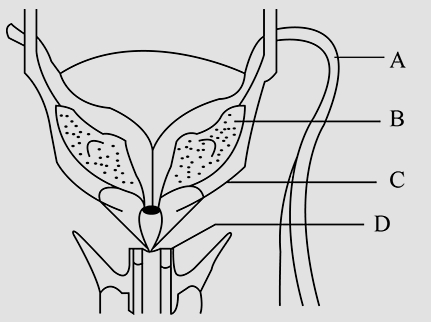
A
$A$ - Vas deferens,$B$ - Seminal vesicle,$C$ - Prostate,$D$ - Bulbourethral gland
B
$A$ - Vas deferens,$B$ - Seminal vesicle,$C$ - Bulbourethral gland,$D$ - Prostate
C
$A$ - Ureter,$B$ - Seminal vesicle,$C$ - Prostate,$D$ - Bulbourethral gland
D
$A$ - Ureter,$B$ - Prostate,$C$ - Seminal vesicle,$D$ - Bulbourethral gland
Solution
(A) Based on the anatomical structure of the human male reproductive system:
$A$ represents the Vas deferens,which carries sperm from the epididymis.
$B$ represents the Seminal vesicle,a gland that secretes a significant portion of the seminal fluid.
$C$ represents the Prostate gland,which surrounds the urethra and contributes to seminal fluid.
$D$ represents the Bulbourethral gland (also known as Cowper's gland),which secretes a lubricating fluid.
Therefore,the correct sequence is $A$ - Vas deferens,$B$ - Seminal vesicle,$C$ - Prostate,$D$ - Bulbourethral gland.
$A$ represents the Vas deferens,which carries sperm from the epididymis.
$B$ represents the Seminal vesicle,a gland that secretes a significant portion of the seminal fluid.
$C$ represents the Prostate gland,which surrounds the urethra and contributes to seminal fluid.
$D$ represents the Bulbourethral gland (also known as Cowper's gland),which secretes a lubricating fluid.
Therefore,the correct sequence is $A$ - Vas deferens,$B$ - Seminal vesicle,$C$ - Prostate,$D$ - Bulbourethral gland.
0 likes
View Solution137
MediumMCQ
Identify the odd one out.
A
Seminal vesicle
B
Prostate
C
Bulbourethral
D
Mammary gland
Solution
(D) The $A$,$B$,and $C$ options (Seminal vesicle,Prostate,and Bulbourethral gland) are accessory glands of the male reproductive system.
$D$ (Mammary gland) is a functional part of the female reproductive system,specifically involved in lactation.
$D$ (Mammary gland) is a functional part of the female reproductive system,specifically involved in lactation.
0 likes
View Solution138
EasyMCQ
What is the correct shape and length of the human testis?
A
Oval - $2$ to $5 \text{ cm}$
B
Round - $3$ to $7 \text{ cm}$
C
Oval - $4$ to $5 \text{ cm}$
D
Round - $2$ to $3 \text{ cm}$
Solution
(C) The human testes are primary sex organs located outside the abdominal cavity within a pouch called the scrotum.
Each testis is oval in shape.
The length of each testis is approximately $4$ to $5 \text{ cm}$ and the width is about $2$ to $3 \text{ cm}$.
Therefore,the correct description is Oval shape with a length of $4$ to $5 \text{ cm}$.
Each testis is oval in shape.
The length of each testis is approximately $4$ to $5 \text{ cm}$ and the width is about $2$ to $3 \text{ cm}$.
Therefore,the correct description is Oval shape with a length of $4$ to $5 \text{ cm}$.
0 likes
View Solution139
EasyMCQ
Accessory glands of the human male reproductive system are:
A
Seminal vesicles- $1$,prostate- $1$,bulbourethral- $2$
B
Seminal vesicles- $1$,prostate- $2$,bulbourethral- $1$
C
Seminal vesicles- $2$,prostate- $1$,bulbourethral- $2$
D
Seminal vesicles- $2$,prostate- $2$,bulbourethral- $2$
Solution
(C) The male accessory glands include the paired seminal vesicles,a single prostate gland,and the paired bulbourethral glands (also known as Cowper's glands).
$1$. Seminal vesicles: These are a pair of glands located behind the urinary bladder.
$2$. Prostate gland: This is a single,walnut-sized gland located below the urinary bladder.
$3$. Bulbourethral glands: These are a pair of small glands located on either side of the urethra below the prostate gland.
Therefore,the correct count is: Seminal vesicles $(2)$,prostate $(1)$,and bulbourethral glands $(2)$.
$1$. Seminal vesicles: These are a pair of glands located behind the urinary bladder.
$2$. Prostate gland: This is a single,walnut-sized gland located below the urinary bladder.
$3$. Bulbourethral glands: These are a pair of small glands located on either side of the urethra below the prostate gland.
Therefore,the correct count is: Seminal vesicles $(2)$,prostate $(1)$,and bulbourethral glands $(2)$.
0 likes
View Solution140
EasyMCQ
The location and secretion of Leydig cells are:
A
Liver - cholesterol
B
Ovary - estrogen
C
Testis - testosterone / androgens
D
Pancreas - glucagon
Solution
(C) Leydig cells,also known as interstitial cells,are located in the interstitial spaces between the seminiferous tubules of the testis.
These cells are responsible for the synthesis and secretion of testicular hormones,primarily testosterone,which belongs to the group of hormones known as androgens.
Therefore,the correct location is the testis and the secretion is testosterone/androgens.
These cells are responsible for the synthesis and secretion of testicular hormones,primarily testosterone,which belongs to the group of hormones known as androgens.
Therefore,the correct location is the testis and the secretion is testosterone/androgens.
0 likes
View Solution141
EasyMCQ
Seminal plasma of humans is rich in
A
Glucose,certain enzymes and $Ca^{+2}$
B
Fructose,certain enzymes and $Ca^{+2}$
C
Fructose,certain enzymes but no $Ca^{+2}$
D
Glucose,certain enzymes but no $Ca^{+2}$
Solution
(B) The seminal plasma in humans is the fluid component of semen,which is secreted by the accessory glands,including the seminal vesicles,prostate gland,and bulbourethral glands.
It is rich in fructose,which serves as the primary energy source for sperm motility.
It also contains various enzymes and high concentrations of calcium ions $(Ca^{+2})$,which are essential for sperm activation and function.
Therefore,the correct composition is fructose,certain enzymes,and $Ca^{+2}$.
It is rich in fructose,which serves as the primary energy source for sperm motility.
It also contains various enzymes and high concentrations of calcium ions $(Ca^{+2})$,which are essential for sperm activation and function.
Therefore,the correct composition is fructose,certain enzymes,and $Ca^{+2}$.
0 likes
View Solution142
MediumMCQ
The ...... helps in maintaining the low temperature of the testes.
A
Urethra
B
Scrotum
C
Penis
D
None
Solution
(B) The $Scrotum$ is a pouch-like structure that houses the testes outside the abdominal cavity.
It helps in maintaining the low temperature of the testes,which is $2-2.5^{\circ}C$ lower than the normal internal body temperature.
This lower temperature is essential for spermatogenesis (the process of sperm production).
It helps in maintaining the low temperature of the testes,which is $2-2.5^{\circ}C$ lower than the normal internal body temperature.
This lower temperature is essential for spermatogenesis (the process of sperm production).
0 likes
View Solution143
MediumMCQ
Seminiferous tubules open into
A
Epididymis
B
Vasa efferentia
C
Vasa deferentia
D
Rete testis
Solution
(D) The testis is the primary sex organ in males. Each testis contains approximately $250$ testicular lobules. Each lobule contains $1-3$ highly coiled seminiferous tubules. These seminiferous tubules open into the $Rete testis$. From the $Rete testis$, the sperm moves into the $Vasa efferentia$. The $Vasa efferentia$ then opens into the $Epididymis$, which leads to the $Vas deferens$. Therefore, the seminiferous tubules directly open into the $Rete testis$. Thus, the correct answer is $D$.
0 likes
View Solution144
MediumMCQ
Choose the incorrect pair.
A
Interstitial cells : male sex hormone testosterone
B
Sertoli cells : provide nutrition to the developing sperms
C
Seminal vesicle : produce seminal plasma
D
Prostate gland : responsible for sperm formation
Solution
(D) The correct answer is $D$.
$A$. Interstitial cells (Leydig cells) are present in the interstitial spaces of the testes and synthesize and secrete testicular hormones called androgens,primarily testosterone. This is a correct pair.
$B$. Sertoli cells are found inside the seminiferous tubules and provide nutrition to the developing germ cells (sperms). This is a correct pair.
$C$. Seminal vesicles are accessory glands that secrete a fluid component of the seminal plasma,which is rich in fructose,calcium,and certain enzymes. This is a correct pair.
$D$. The prostate gland is an accessory gland that secretes a fluid that forms part of the seminal plasma. It is not responsible for sperm formation (spermatogenesis),which occurs within the seminiferous tubules of the testes. Therefore,this pair is incorrect.
$A$. Interstitial cells (Leydig cells) are present in the interstitial spaces of the testes and synthesize and secrete testicular hormones called androgens,primarily testosterone. This is a correct pair.
$B$. Sertoli cells are found inside the seminiferous tubules and provide nutrition to the developing germ cells (sperms). This is a correct pair.
$C$. Seminal vesicles are accessory glands that secrete a fluid component of the seminal plasma,which is rich in fructose,calcium,and certain enzymes. This is a correct pair.
$D$. The prostate gland is an accessory gland that secretes a fluid that forms part of the seminal plasma. It is not responsible for sperm formation (spermatogenesis),which occurs within the seminiferous tubules of the testes. Therefore,this pair is incorrect.
0 likes
View Solution145
MediumMCQ
Which fluid is not present in semen?
A
Secretion of prostate gland
B
Estrogen
C
Fructose
D
Sperm
Solution
(B) Semen is a mixture of sperm and the secretions of the male accessory glands.
$1$. The male accessory glands include the seminal vesicles,prostate gland,and bulbourethral glands.
$2$. The seminal vesicles contribute fructose,which provides energy for sperm motility.
$3$. The prostate gland contributes various enzymes and citric acid.
$4$. Sperm are the male gametes produced in the testes.
$5$. Estrogen is a primary female sex hormone and is not a component of male semen.
$1$. The male accessory glands include the seminal vesicles,prostate gland,and bulbourethral glands.
$2$. The seminal vesicles contribute fructose,which provides energy for sperm motility.
$3$. The prostate gland contributes various enzymes and citric acid.
$4$. Sperm are the male gametes produced in the testes.
$5$. Estrogen is a primary female sex hormone and is not a component of male semen.
0 likes
View Solution146
MediumMCQ
Which gland's secretion acts as a lubricant in the male reproductive system?
A
Bulbourethral gland
B
Pancreas
C
Seminal vesicle
D
Vas deferens
Solution
(A) The secretion of the bulbourethral gland (also known as Cowper's gland) acts as a lubricant for the penis during sexual intercourse.
It also helps in neutralizing the acidity of the urethra caused by urine,providing a favorable environment for sperm survival.
It also helps in neutralizing the acidity of the urethra caused by urine,providing a favorable environment for sperm survival.
0 likes
View Solution147
MediumMCQ
Which organ of the human male reproductive system is not paired?
A
Vas deferens
B
Prostate gland
C
Bulbourethral gland
D
Testis
Solution
(B) In the human male reproductive system,most organs exist in pairs.
$1$. The $Vas$ $deferens$ is a pair of ducts that transport sperm from the epididymis to the ejaculatory duct.
$2$. The $Testis$ is a pair of primary sex organs responsible for sperm production.
$3$. The $Bulbourethral$ $gland$ (also known as Cowper's gland) is a pair of glands that secrete lubricating fluid.
$4$. The $Prostate$ $gland$ is a single,unpaired gland located at the base of the urinary bladder that secretes a fluid which forms a major part of the semen.
Therefore,the $Prostate$ $gland$ is the organ that is not paired.
$1$. The $Vas$ $deferens$ is a pair of ducts that transport sperm from the epididymis to the ejaculatory duct.
$2$. The $Testis$ is a pair of primary sex organs responsible for sperm production.
$3$. The $Bulbourethral$ $gland$ (also known as Cowper's gland) is a pair of glands that secrete lubricating fluid.
$4$. The $Prostate$ $gland$ is a single,unpaired gland located at the base of the urinary bladder that secretes a fluid which forms a major part of the semen.
Therefore,the $Prostate$ $gland$ is the organ that is not paired.
0 likes
View Solution148
EasyMCQ
Why are the testes situated in the scrotum,which is located outside the abdominal cavity?
A
To protect from pressure by internal organs.
B
Providing more space for the growth of epididymis.
C
External sexual characters appear in the male.
D
To get the low temperature needed for spermatogenesis.
Solution
(D) The testes are situated outside the abdominal cavity within a pouch called the scrotum.
This is because the process of spermatogenesis (the formation of sperm) requires a temperature that is $2-2.5^{\circ}C$ lower than the normal internal body temperature.
The scrotum provides this cooler environment,which is essential for the viability and proper development of sperm.
This is because the process of spermatogenesis (the formation of sperm) requires a temperature that is $2-2.5^{\circ}C$ lower than the normal internal body temperature.
The scrotum provides this cooler environment,which is essential for the viability and proper development of sperm.
0 likes
View Solution149
MediumMCQ
Identify $A, B, C, D, E$ and $F$ in the figure of the male reproductive system.
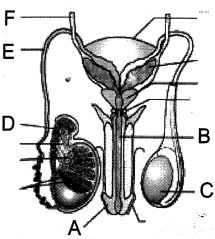
A
$A$ - Penis,$B$ - Urethra,$C$ - Testis,$D$ - Epididymis,$E$ - Vas deferens,$F$ - Ureter
B
$A$ - Urethra,$B$ - Penis,$C$ - Testis,$D$ - Epididymis,$E$ - Urethra,$F$ - Prostate gland
C
$A$ - Penis,$B$ - Urethra,$C$ - Testis,$D$ - Epididymis,$E$ - Ureter,$F$ - Vas deferens
D
$A$ - Glans penis,$B$ - Urethra,$C$ - Testis,$D$ - Epididymis,$E$ - Vas deferens,$F$ - Ureter
Solution
(A) Based on the anatomical structure of the human male reproductive system:
$A$ points to the Penis.
$B$ points to the Urethra.
$C$ points to the Testis.
$D$ points to the Epididymis.
$E$ points to the Vas deferens (which carries sperm from the epididymis).
$F$ points to the Ureter (the tube carrying urine from the kidney to the bladder).
Therefore,the correct identification is $A$ - Penis,$B$ - Urethra,$C$ - Testis,$D$ - Epididymis,$E$ - Vas deferens,$F$ - Ureter.
$A$ points to the Penis.
$B$ points to the Urethra.
$C$ points to the Testis.
$D$ points to the Epididymis.
$E$ points to the Vas deferens (which carries sperm from the epididymis).
$F$ points to the Ureter (the tube carrying urine from the kidney to the bladder).
Therefore,the correct identification is $A$ - Penis,$B$ - Urethra,$C$ - Testis,$D$ - Epididymis,$E$ - Vas deferens,$F$ - Ureter.
0 likes
View SolutionHuman Reproduction — Male reproductive system · Frequently Asked Questions
1Are these Human Reproduction questions useful for JEE and NEET?
Yes. All questions in this section are mapped to JEE Main and NEET exam patterns. Previous year questions from JEE Main, NEET, GUJCET and state-level exams are included with full solutions.
2Can I switch to Hindi or Gujarati for these questions?
Yes. Use the language tabs in the hero section or the sidebar to view the same questions and solutions in English, Hindi or Gujarati.
3How do I generate a question paper from this subtopic?
Use the Vedclass Exam Paper Generator — select the chapter and subtopic, set difficulty, and generate Sets A, B, C, D automatically. First 3 chapters of every subject are free.
Vedclass Products
For Students
Vedclass Test Series
Mock tests in real JEE/NEET style with performance analysis. 5-day free trial.
Start Free TrialFor Teachers
Exam Paper Generator
Generate Set A/B/C/D papers from this chapter in 2 minutes. 3 chapters free.
Try FreeFor Institutes
Online Exam Module
Live online exams with unlimited students, 360° analytics & white-label branding.
See DemoFor Teachers & Institutes
Generate a Human Reproduction Exam Paper in 2 Minutes
Select subtopic & difficulty — Sets A, B, C, D auto-generated with No Repeat logic.
First 3 chapters of every subject are free — no payment required.